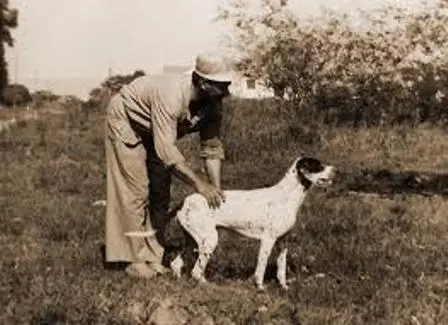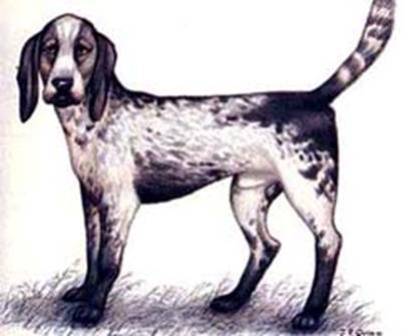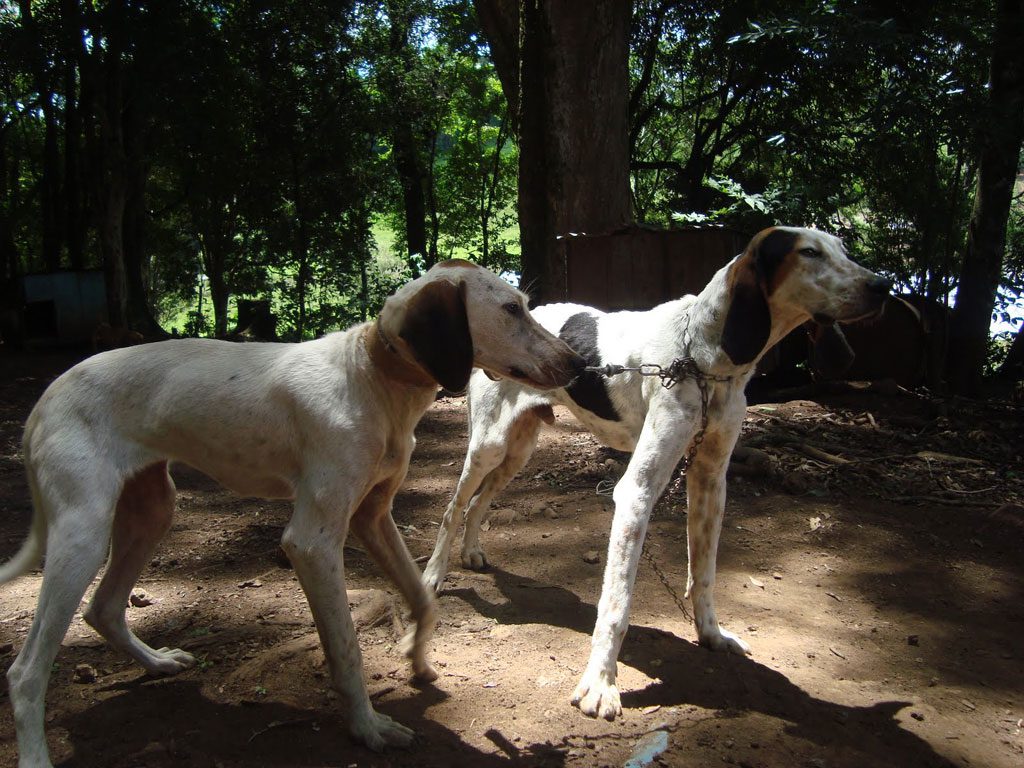
The Brazilian Tracker It was a breed of dog originating in Brazil, that was recognized by the FCI the 1 in September of 1967 in the Group 6 / Section 1.1 – Large size hounds with number 275. In fact, It was the first Brazilian to be recognized by the FCI breed of dog.
The Brazilian Tracker it's a Scent hound. The breed is also known under the names Urrador (his voice) or Urrador American.
It was developed in the Decade of 1950 by Oswaldo Aranha Filho (In janeiro river), to hunt peccaries (they are pigs of medium-sized and wild that found in all Central and South America), Jaguars, and other types of dams typical of the country.
Aranha Filho combined a number of breeds of hunting from America and Europe along with some native dogs of Brazil to create your dog. The Brazilian Tracker became Brazil's first race and it was what earned it the recognition of international dog associations.
The glory of being a breed officially recognized at the international level lasted barely six years, time in which by neglect and a series of relief, the race was decimated.
At that time there was only one breeder of Brazilian Tracker, Mr Oswaldo Aranha Filho, the creator of the race... And, their copies suffered because of two events, first of all an outbreak of babesiosis.
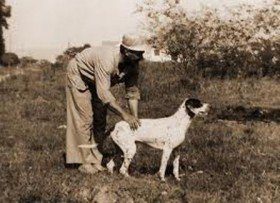 Babesiosis (or babesiosis) It is a parasitic disease similar to malaria caused by protozoa of the genus Babesia and usually affect pets, especially to dogs. Its name was established in honor of the Romanian biologist Victor Babeş, He was the first to isolate the pathogen. It is the typical disease that is transmitted through a vector organism, usually the tick (Ixodes dammini); in fact, This mite is the same that transmit Lyme disease and, often, both are associated with.
Y, in the second place, many of the dogs suffered poisoning from excess pesticide used by an employee of the farm.
It was exactly in the year 1973, when the Fédération Cynologique Internationale declared the dog breed Brazilian Tracker, officially extinct. Which led to him losing his classification number since, prompted the cancellation of the registration.
Since the FCI and the Brazilian Confederation of Cynophilia They declared this extinct breed, have carried out various efforts and programs of to retrieve it.
The standard of the breed of 1970 declaring a size between 62 and 67 cm and very similar in appearance to the Black and tan coonhound.
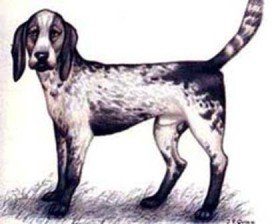
There have been attempts underway to recreate the race from a mixture of American Foxhound, Black and tan coonhound, and the Small Blue Gascony, English Foxhound, and Bluetick Coonhound.
The Rescue Support Group Brazilian Tracker of Brazil, a club dedicated to the restoration of the breed, Brazil, He devoted himself to organize - aim- a list of forty breeding animals of the correct type as, puediesen be certified as members of the race, in order to restore the race and return to be recognised by the Kennel Club of Brazil.
The re-establishment of the breed, It has not been an easy task, due to the existence of very few pure specimens, and above all by the lack of social interest, There are very few people interested in the recovery of the true Brazilian cultural heritage and the genetics of the breed.
At the moment, the character is not easy to illustrate or define. Efforts to restore the breed continue today., and are being used in breeding programs, breeds used in his development with the descendants of mixed races found in all Brazil.
But, the race again in the various canine clubs list (small) and dog organizations in North America, for the promotion of a rare species for those seeking an unusual pet.
As it's a race in the process of being rebuilt, no data on specific diseases or extraordinary health demands.
The Brazilian Tracker is a hunting dog, not a type of dog that has traditionally been used as a pet.
The copies that exist today, fruit of the reconstruction, they tend to be very independent animals and, sometimes, somewhat stubborn, with a strong instinct of prey that, leads him to chase the small animals that live in the house... But with proper socialization, any dog is a good dog.
- FCI CLASSIFICATION:
- Group :
- Section : . .
Federations:
FCI ⓘ
FCI breed standard "Brazilian Tracker"
Origin:
Brazil
Date of publication of the valid original standard:
04.09.2019
Use:
Hunting dog used for picking up and rounding up prey animals.
General appearance:
Strong and rustic. Cheerful and never aggressive. It has an excellent sense of smell and the capacity for hunting above the average of hunting dogs. It is very resistant and persistent, and you can hunt in hostile terrain and high temperatures. Docile and loyal.
IMPORTANT PROPORTIONS: The body has a length of 10:9 in relation to your height. The skull relationship - snout is from 1:1.
Behavior / temperament:
Calm and balanced, companion glued to his owner, self-confident, without fear, docile, without being shy or aggressive. Due to his work he must have a calm demeanor as he hunts as a couple, trios or pack, or even sometimes just as a trail dog.
Head:
Mesocephalus, triangular and a bit long.
Cranial region:
- Head: Triangular shape, skull and muzzle of similar length.
- Depression links (Stop): moderate.
facial region:
- Truffle: Slightly directed downward, completely black in color.
- Snout: Straight and long.
- Lips: Fine, dry and sticky, well pigmented black. Jaws / Teeth: Strong jaws, scissor bite with
complete denture (42 teeth).
- Cheeks: Droughts.
EYES: Almond biscuits, dark, with lively expression, well-pigmented black eyelids. Large eyes set wide apart, with typical bloodhound expression. Soft look, gentle and nice.
EARS: long, low-set, flexible and round tips. The long, when you stretch without force, reaches the tip of the muzzle without exceeding it. Low erectile capacity, hang close to the head.
Neck:
Strong. Rises freely and lightly over the shoulders, strong in substance, but not heavy, medium long, clean throat, allowing a slight wrinkle under the angle of the jaw (with little double chin).
Body:
- top line: Well defined, going down with a gentle curve down the neck passing through the cross, strong and tall, continuing in the direction of the rump, which is slightly oblique and slightly lower than the height of the withers.
- Cross: Strong, taller than the rump.
- Back: Strong, firm, slightly long, muscular and straight. Pork loin: Wide and strong.
- Rump: Slightly oblique, inclined 30° with respect to the horizontal. Breast
: Good size and depth, reaching to the elbows, with a broad and well-developed thorax.
- Bottom line and belly: Slightly retracted.
Tail:
Saber-shaped, without lateral deviation, inserted in the continuity of the croup, carried low at rest and above the top line when alert or moving. Long arriving or passing the garrón. The hair on the tail has the same texture as that on the body, stuck and short.
Tips
PREVIOUS MEMBERS:
- General appearance: Shoulders with strong parallel bones, muscular, with wide limbs.
- Shoulder (Scapula): Robust, with a good inclination of about 45° with respect to the horizontal line and the scapulo-humeral joint with an angle of about 105°).
- Arms (Humeri): Strong and muscular, the same length as the scapulae.
- Elbows: Close to the body and firm. forearms: Strong bone structure.
- Carpi (dolls): Straight, parallel and strong. Metacarpus: Straight, parallel and strong.
- Previous feet: Wide and powerful, with very resistant and elastic pads; dark pads and nails.
LATER MEMBERS:
- General appearance: Muscular and well angled, with firm hocks, with symmetrical and moderate angulations, wide feet.
- Thighs (Femur): Strong and muscular.
- Knees: Strong and moderate curvature.
- Legs (Tibia): Moderate angulation with the femur. Hocks: Strong, short and firm, with moderate angulation.
- Tarsos: Firms.
- Metatarsals: Straight, parallel to each other.
- Hind feet: Wide and powerful, with very resistant and elastic pads; dark pads and nails.
Movement:
It must be fluent, agile and firm, with good ground cover, with wide and balanced steps. At a trot, the tail can be above the top line. Very important for the dog's work is that the top line is kept level and firm..
Mantle
SKIN: Dark and tight to the body.
Fur: Short, smooth, well glued to the body, dense and a little hard to the touch.
Color: Completely speckled with black and white, imparting a slate blue reflection, with or without fawn and / or black spots on any part of the body; bicolor (white with leonate or black spots; or black and tawny, completely black with leonado color marks); tricolor (black and white with tawny spots); all colors with or without tawny spots on the head, on the chest, belly, in the fore and hind limbs and tail.
Size and weight:
Height to the cross:
- Male: 60 to 65 cm.;
- Female: 56 to 63 cm..
Tolerance: approx.. 1 cm.
Weight:
- Males: 26 to 33 kg.
- females: 21 to 30 kg.
The size and weight must be in harmony with the structure of the specimen.
Fouls:
Any deviation from the aforementioned criteria is considered as a fault and the severity of this is considered to the degree of the deviation to the standard and its consequences on the health and well-being of the dog..
SERIOUS FAULTS:
- Deviation from the characteristics of the breed described above that hinder its ability to work.
- Weak appearance.
- Very clear tawny marking in black and tawny dogs.
- Any deviation from the scissor bite and correct tooth formation, insofar as they are not disqualifying fouls.
FALTAS DESCALIFICANTES:
- Aggressiveness or extreme shyness.
- Any dog showing clear signs of physical or behavioral abnormalities.
- Short or Butterfly shaped ears.
- Threaded queue.
- Very lightweight bones.
- Depression links (stop) marked.
- Upper or lower prognathism.
N.B.:
- Males should have two normal-appearing testicles fully descended into the scrotum..
- Only functionally and clinically healthy dogs, with the typical conformation of the breed, should be used for parenting.
Source:
F.C.I - International Cynological Federation
1. Rastreador Brasileiro (English).
2. Rastreador Brasileiro (French).
3. Brasilianischer Spürhund, Amerikanischer Heuler (German).
4. Urrador, Onceiro, Pantaneiro, Rastejador-brasileiro (Portuguese).
5. Urrador, Urrador Americano (español).
 Not recognized by the FCI
 buldoguebrasil.com
 amigobicho
 buldogueserrano
 buldogueserrano
 Puppies-pics.com
 caopanheirocuritiba.com
 Produto.mercadolivre
 bulldogcampeiro1
 BULLDOG CAMPEIRO SON OF CALMA ORKUT CONTACTS..
 Buldogue Campeiro – conviviality
 Campeiro Bulldog in deals – Part I
 Campeiro Bulldog in deals – part 2
 CBKC – "Campeiro Bulldog"
 FCI 275 . Large-sized Hounds