โ–ท The world of Pets: Dogs, cats, birds, reptiles, amphibians

Cockatiel
Nymphicus hollandicus


Cacatรบa Ninfa

Content

Description

25-33 cm.. length and a weight between 80 and 100 grams approximately.
This small cockatoo is no doubt an of the bird's cage more common in the world.
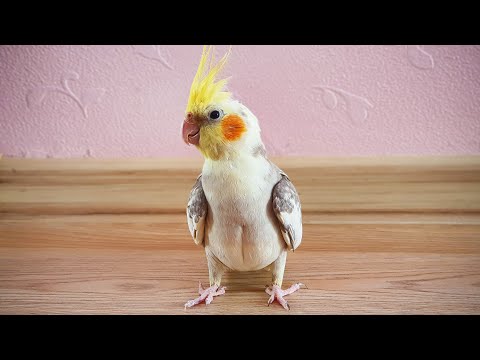
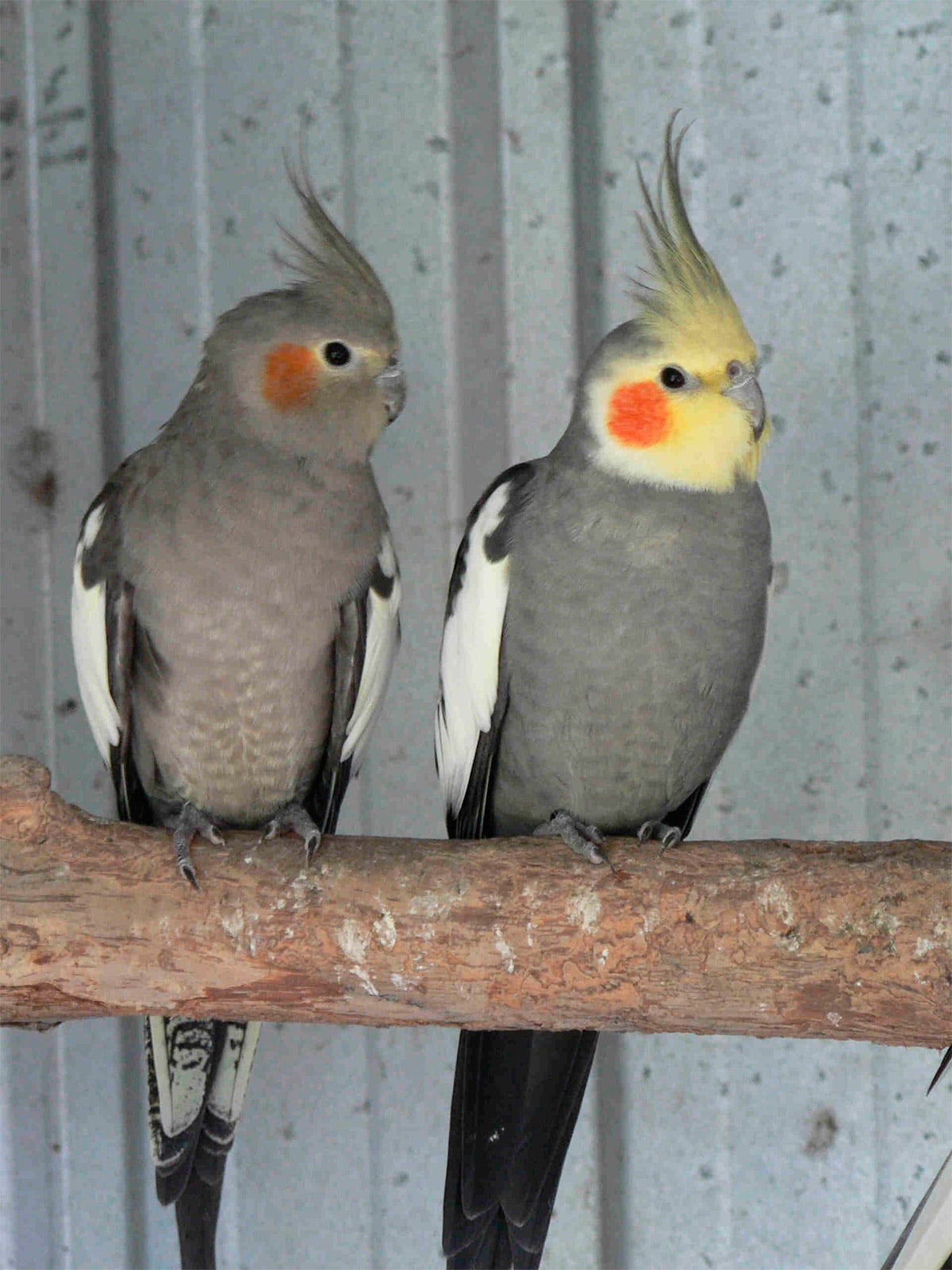
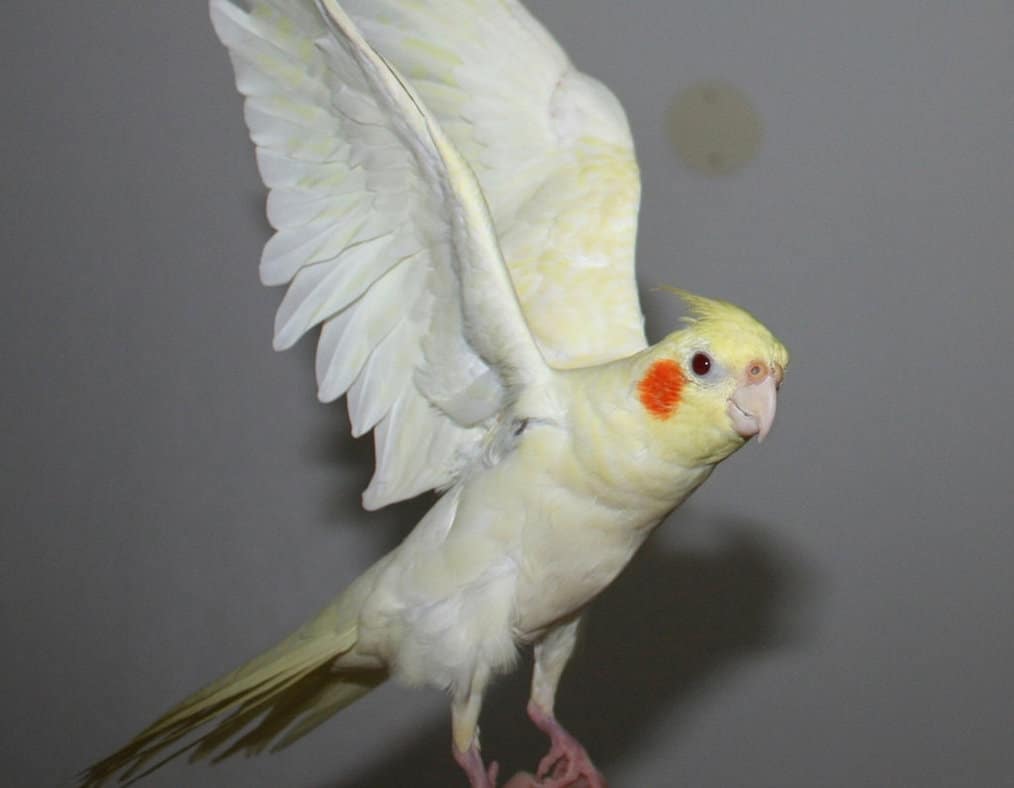
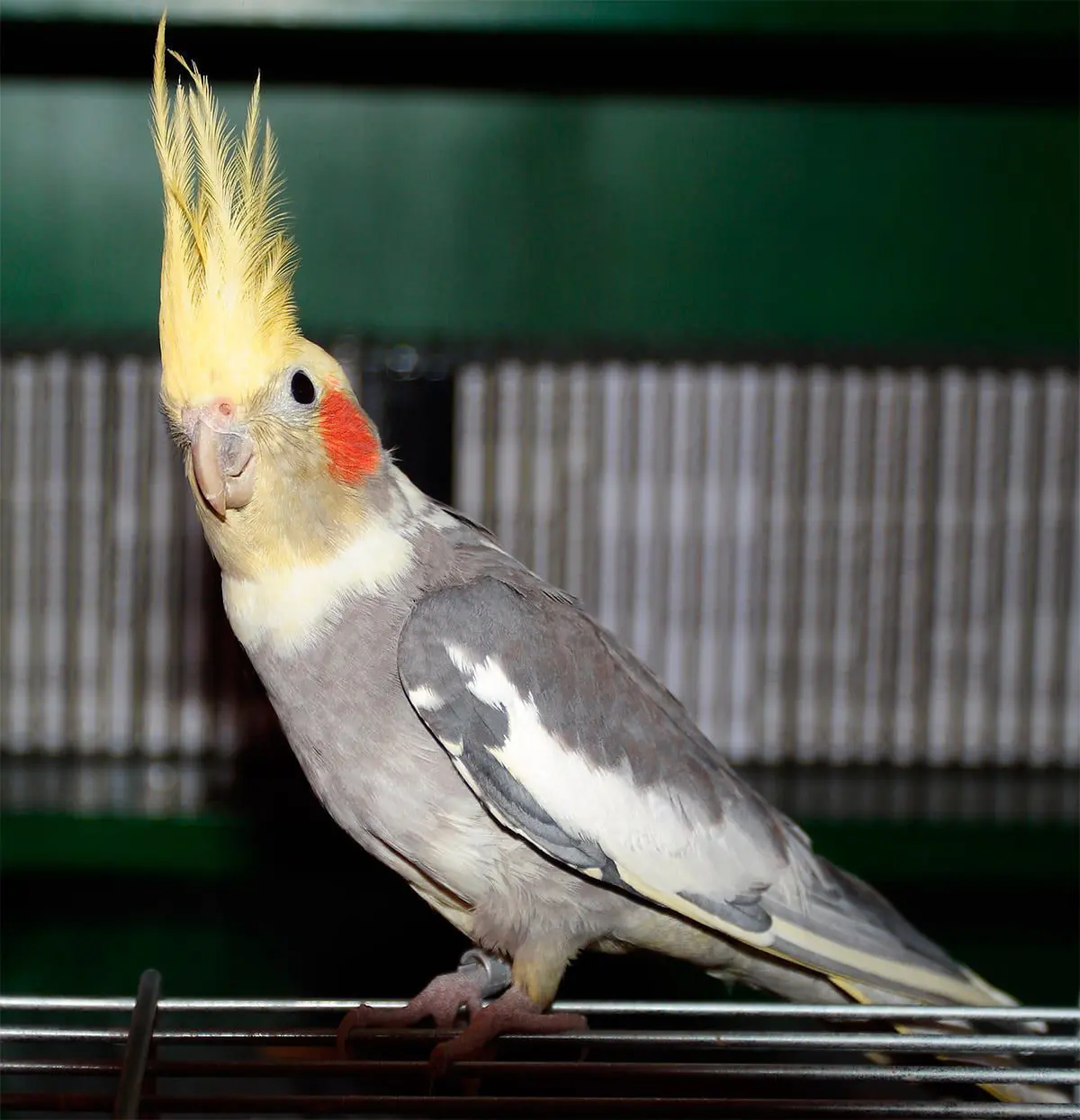
The Cockatiel (Nymphicus hollandicus) adult has the head and the basis of the crest yellow.
Stain handset is orange, paler on the back.
The neck and the long crest feathers are grey.
The upperparts are of color grey Pearl dark.
The wings are grey, but exhibit a white color in the covered and sides.
The underparts are a grey clear.
The tail varies from medium gray to dark gray, the base of the tail is paler.
The bill is grey, the irises dark brown.
The legs are grey-brown.

The female presents the stain handset duller, the tuft is less developed, In addition instead of the yellow, the head presents a yellowish grey with yellow dirty envelope the forecrown and a vaguely colorless gray general staining and staining is generally less intense.
The immature are much similar to the females, but have the tail shorter.

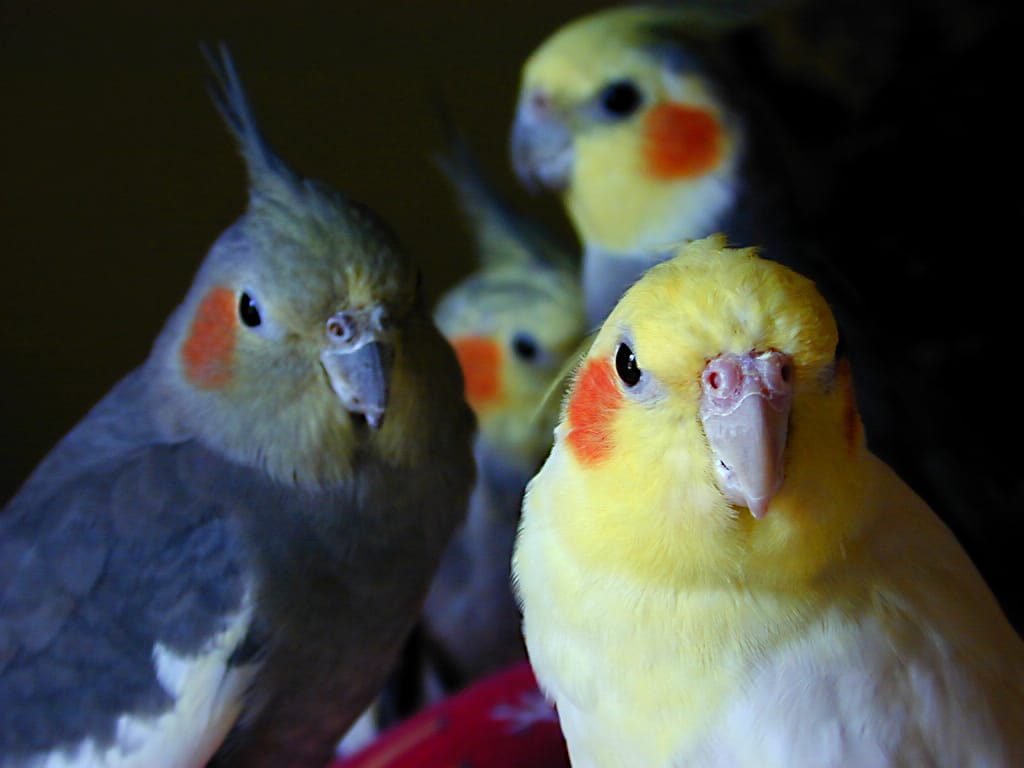
We find Pearl specimens in captivity, White, Gray and lutinos.

Habitat:

Video – "Cockatiel" (Nymphicus hollandicus)

Funny Parrot (Nymphicus Hollandicus)

The cockatoo Nymph they live in a wide variety of habitats, including open forests, small acacia forests that line the rivers and even stretches of Spinifex (Triodia) they are perennial and grow in semi-arid regions.

Also found in farmland, in the stubble and the orchards, as well as on the plains and along the roads.

In dry areas are observed in pairs or in groups of up to 100 individuals.

When feed, the groups contain an average of 27 Member. But, We have already seen demonstrations of almost 1.000 birds near landfills containing vegetable remainders of the rice milling.

Near the points of water, the cockatoo Nymph are often associated with the Budgerigar (Melopsittacus undulatus).

Estas Cockatoos eat twice a day: In the morning, shortly after the Sun, consuming around 2,72 grams of plant material. At night, about an hour and a half before the night, eating around a mass of 4,25 g., It is almost 7 grams for the whole day.

Son great travellers.
Outside of the nesting season, they form large gatherings around the planting of cereals.
As they feed on seeds, these birds need water and in times of drought, sometimes bands come to the coast.

All these movements are quite unpredictable, since they are related to the weather conditions and the State of the food resources. But, in the South of the continent, migrations are more regular: the birds come to nest during the austral spring and usually go away early in the new year.

Son gregarious and very social, so they need a wide repertoire of calls to communicate or express their feelings. They have a great power to imitate other birds.

Reproduction:

In the North, the reproduction is carried out between April and July, While in the South occurs in general from August to December.
The nest is located in a tree hollow whose bottom is padded with sawdust shavings. Most of the time, the nesting site is placed near a source of water in which poultry cooled daily.

The spawning has between 3 and 7 eggs they are incubated alternately by both parents for a few 20 days. 4 eggs are a normal litter. There will be several broods during the season. At birth, the chicks have a thick down comforter yellow. They receive their food mainly in the morning and in the evening.

Chicks they leave the nest after 3 to 4 weeks, but they remain within the family group, Depending on their parents for 1 month. After this time, they join large flocks that roam in search of food.

Food:

Consume a wide variety of small seeds He collected soil, including the cultivated fields of sorghum and sunflower. When they are abundant, local seed varieties are generally preferred to the seeds that come from crops.

Distribution:
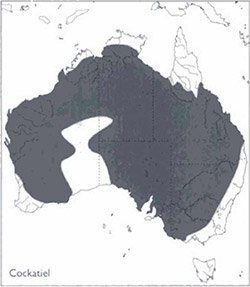
Distribucion Nymphicus hollandicus
Endemic to Australia. Its range covers a vast majority of the continent, except wet coastal areas. Also absent from the Cape York Peninsula, districts located more to the South in winter and areas located more to the North in the summer.

After heavy rainfall, large meetings can be set up in the center of the country where they are, usually, absent.

Conservation:

State of conservation โ“˜


minor concern Minor Concern โ“˜ (UICN)โ“˜

– Current IUCN Red List category: Least concern.

– The population trend: Stable

This bird is very common and extended throughout the area. Probably its population grows, It has benefited from the facilities and artificial reservoirs for the development of agriculture.

Its population It is estimated in around a million of birds. The birds that sought to be introduced in the United States they have failed in their attempts to establish themselves in the wild.

In Australia, these small cockatoos are often persecuted for considering them pests for agriculture.

"Cockatiel" in captivity:

The Nymphs or Carolinas they are highly prized birds as pets by its docile nature and for being less demanding than the larger parrots. The nymphs they are perfectly suited to life in the home, they are easy to care for and if you homeschool them from small become companions adorable and very affectionate.

They generally live in pairs or in colonies, that is why it is very common to mate them, to be able to enjoy the birth of the offspring and their development.

They usually enjoy sharing their time with people and rather stick to their owners, Each bird has its personality, so you don't like all that take them into your hands. Males can sing and learn to mimic a few words, but they are much better to imitating sounds, as melodies, sirens or other birds singing. Females vocalize much less but tend to also be more caring.

The nymphs are birds Smart, of friendly character and practically does not present problems of behaviour. They are easily adapted to family life and learn to interact and communicate with people who love. If you've decided to adopt one of these cute birds, make sure you dedicate time to your training to get to have a great pet. This will help you create a strong emotional bond between you and you will also keep it entertaining, mentally active, healthy and happy.

Alternative names:

Cockatiel, Cockatoo Parrot, Crested Parrot, Quarrion, Weero (ingles).
Calopsitte รฉlรฉgante, Perruche calopsitte (French).
Nymphensittich (German).
Cocatiel (Portuguese).
Cacatรบa Ninfa, Carolina, Ninfa (espaรฑol).

scientific classification:

Order: Psittaciformes
Family: Cacatuidae
Scientific name: Nymphicus hollandicus
Genus: Nymphicus
Citation: (Kerr, 1792)
Protonimo: Psittacus hollandicus

Images Cockatoo Nymph:


Sources:
Avibase, elblogdemaskota
Photos: commons.wikimedia.org, huffingtonpost.com, optusnet.com.au, cockateil.NET, galleryhip.com
Sounds: Marc Anderson (Xeno-canto)
โ–ท The world of Pets: Dogs, cats, birds, reptiles, amphibians

Mindanao Racquet-tail
Prioniturus waterstradti

Content

Description

Mindanao Racquet-tail

27 cm.. length between 120 and 160 g. of weight.

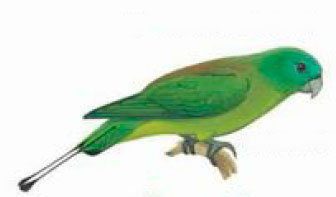
The Mindanao Racquet-tail (Prioniturus waterstradti) has the head bright green, with broadcasting slightly more blue-green in the cheeks, the lores and front of the crown. Duller green mantle; olive rump with different shades. The Green wings, with vane Dark internal to the flight feather, narrow marginalized yellow on the edges Interior; carpal edge yellow, wing feathers green; underside of primaries with blue dye.

The underparts brighter yellowish green, more yellow in undertail-coverts. Upper, the tail green, with side feathers blackish tip; undertail, the tail bluish; Blackish spatulas

Bill light grey; Brown irises; legs blackish gray.

females with extensions of tail more short.

Subspecies:

  • Prioniturus waterstradti malindangensis

    (Mearns, 1909) – Both adults, the color blue in the forecrown and the area under the eyes, paler; less Brown at the back.


  • Prioniturus waterstradti waterstradti

    (Rothschild, 1904) – The nominal

Habitat:

It is distributed in the humid montane forest, mainly between 850 and 2000 m, but have been recorded at altitudes of 450 m. Little is known about the habits of this species, that until recently was considered the same species as the Luzon Racquet-tail. Most of the observations refer to small flocks of between two and ten birds.. Apparently lower than other members of its genus is distributed in densities.

Reproduction:

There are no data on its reproductive ecology.

Food:

Without data

Distribution:

Size of the area of distribution (reproduction / resident): 11.300 km2

Endemic to the Highlands of Mindanao, Philippines. The records come from the Mount Apo, the Mount Malindang, Mount Kitanglad, Mount Mayon, Mount Matutum, Mt. Lebo, Anakan, Civolig, the Mount McKinley, Lake Faggamb and Baracatan, But even though the total population is estimated at 5.000 specimens, currently only limited to five mountains.

Subspecies distribution:

  • Prioniturus waterstradti malindangensis

    (Mearns, 1909) – Southeast of the mountains of Mindanao (Southeast of Philippines).


  • Prioniturus waterstradti waterstradti

    (Rothschild, 1904) – The nominal

Conservation:


Near-threatened


โ€ข Current IUCN Red List category: Near threatened

โ€ข Population trend: Decreasing

In 1993, the population was estimated at 5,000 individuals (Lambert et to the. 1993)

The population is suspected that it may be declining due to the continuous degradation of the forests and the capture for the cage bird trade.

Conservation Actions Proposed:

– Collect data on the impacts of the international and domestic trade.
– Review the estimate of the population.
– Calculate loss of forests within their geographic range and altitude using satellite and remote sensing images.
– Protect effectively important tracts of forest right in key places, both in the areas of strict protection, such as multi-use areas.

"Mindanao Racquet-tail" in captivity:

Not found in captivity.

Alternative names:

Mindanao Racquet-tail, Crimson-spotted Racket-tailed Parrot, Crimson-spotted Racquet-tailed Parr, Minadnao racket-tailed parrot, Mindanao Montane Racquet-tail, Mindanao Racket-Tail, Mindanao Racket-tailed Parrot, Mindanao Racquet tail, Mindanao Racquet-tailed Parrot (ingles).
Palette de Mindanao, Palette de Waterstradt, Perroquet ร  raquette de Mindanao (French).
Mindanao-Spatelschwanzpapagei, Mindanao Spatelschwanz-Papagei, Mindanaopapagei, Mindano-Spatelschwanzpapagei (German).
Prioniturus waterstradti (Portuguese).
Lorito Momoto de Mindanao, Lorito-momoto de Mindanao (espaรฑol).

scientific classification:

Order: Psittaciformes
Family: Psittaculidae
Genus: Prioniturus
Scientific name: Prioniturus waterstradti
Citation: Rothschild, 1904
Protonimo: Prioniturus waterstradti

Images "Mindanao Racquet-tail"

Video of the "Mindanao Racquet-tail"

————————————————————————————————

ยซLorito momo de Mindanaoยป (Prioniturus waterstradti)


Sources:

Avibase
– Parrots of the World โ€“ Forshaw Joseph M
– Parrots A Guide to the Parrots of the World – Tony Juniper & Mike Parr
– Birdlife

Sounds: Desmond Allen (Xeno-canto)

โ–ท The world of Pets: Dogs, cats, birds, reptiles, amphibians

White-eyed Parakeet
Psittacara leucophthalmus

Aratinga Ojiblanca

Content

Description:


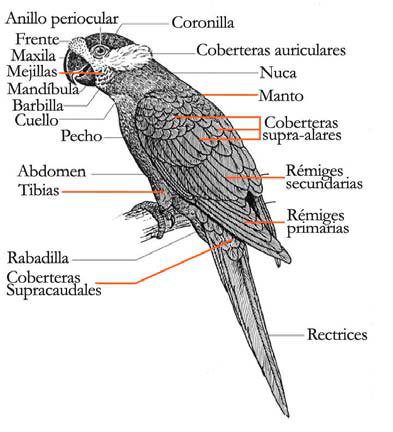
Anatomy-parrots

Of 32 cm. length and a weight between 140 and 170 g..
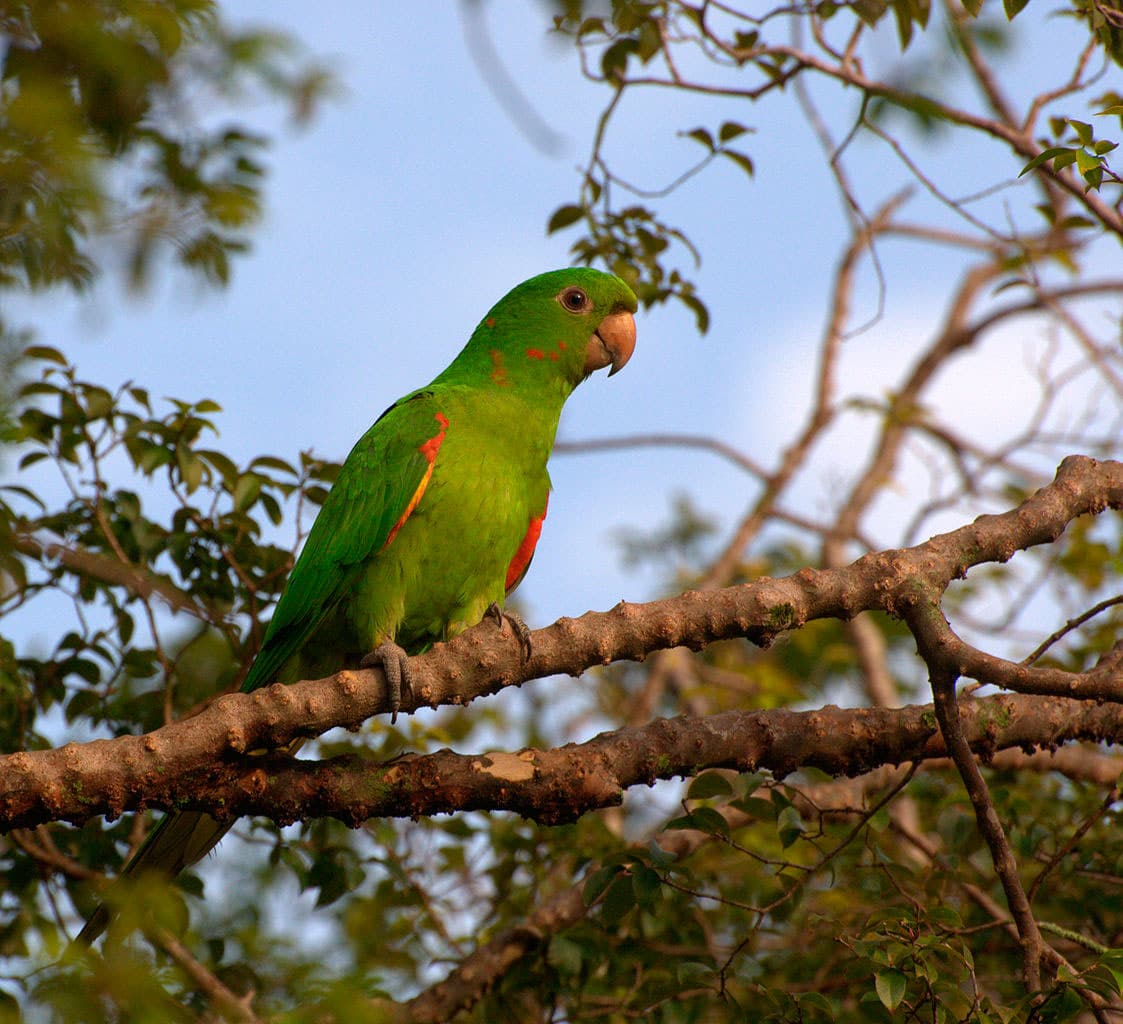
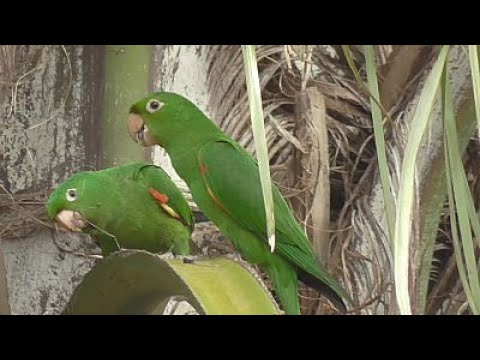
The White-eyed Parakeet (Psittacara leucophthalmus) has the head dark green with small scattered red feathers, especially in the area of the lores, cheeks, sides neck and throat. The head and nape Some birds are almost entirely green, others have solid red spots in the cheeks, with numerous scattered red feathers elsewhere.

The upperparts are dark green, with one or two scattered red feathers. Upper, the wings dark green, with a little red in the curve; undertail, with golden brown flight feathers, the outer red and green small coverts inner; Yellow large coverts external and green internal.

The underparts Green with scattered red feathers on the throat and the chest, sometimes forming irregular patches. Upper, the tail dark green; Brown down.

The bill hooked is color Horn and its gray tip; bare periophthalmic grayish white; irises yellow-orange; legs grey.

The plumage of the male and the female, they are identical.

The immature they have more muted colors; some feathers Red in the head, No red in the bend of wing and olive in the underwing-coverts outermost.

Subspecies description:

  • Psittacara leucophthalmus callogenys

    (Salvadori, 1891) – They have head, neck and throat, green grass dark with small feathers red color above the cheeks. The the mantle, the wing-coverts, the tail and primary feathers of the tail are dark green. The lower part of the chest and flanks of the body are green clear. The feathers largest of the wings and secondaries are dark green with a grey reflection at the ends. Smaller feathers of the wings and the area of the wing curvature are bright red; small coverts feathers are red; the feathers of the greater coverts are yellow. The top of the large feathers of the tail are dark green, the underparts is olive green.

    The eyes are black with the irises orange-brown. The bare periophthalmic is grayish white. Bill color horn, the sides and the tip of the upper part are dark gray. Legs brownish grey, black nails.

    On average largest the species nominal with the bill more robust. Birds in the West have a green dark.


  • Psittacara leucophthalmus leucophthalmus

    (Statius Mรผller, 1776) – The species nominal.


  • Psittacara leucophthalmus nicefori

    (Meyer de Schauensee, 1946) – Similar to the species nominal, except for having a red frontal band.

Habitat:

Video – "White-eyed Parakeet" (Psittacara leucophthalmus)

Calacante de Ala Roja Psittacara leucophthalmus.

The White-eyed Parakeet It is in a great range of forest habitats and forests, mainly in lowlands, even if they manage to reach altitudes of 1.700 meters in the Ecuador and 2.500 meters in Bolivia.

In the Amazon, they are in tropical rainforests, mostly along the rivers (including the forests and marshes), in scattered areas of woodland and in land grown in wetlands, mangroves, sheets and the forests of Palms in the Guianas, chaco types of forests in the South of its range, gallery forests and alluvial forests in Bolivia.

The White-eyed Parakeet they are highly gregarious, they form flocks, usually, hundreds of birds (usually up to 90), covering large expanses between the roosts and feeding areas.

In the Amazon, in general, birds travel along the banks of rivers, crossing also large tracts of forest to reach the meanders and hidden Marsh.

They form large community groups to sleep in trees, sugar cane fields and caves.

Associated with the Blue-crowned Conure (Psittacara acuticaudatus), the Blue-headed Parrot (Pionus menstruus), the Chestnut-fronted Macaw (Ara severus) and
Crimson-bellied Parakeet (Pyrrhura perlata), in mixed flocks, especially while they forage.

Reproduction:

The nest It consists of a natural cavity in a tree, often a palma, but also in limestone caves in Mato Grosso, Brazil. The female usually deposits there 3 white eggs, What incubates alone during 24 or 25 days. During this time, It is fed by the male. At birth the chicks are completely naked, a gray marker appears at the end of the first week. Son fed by parents for approximately 6 weeks, those that leave the nest and get together with the family group. are still dependent parents during 2 to 3 months.

The breeding season It has been reported in the months of November-December, in Argentina; July-August, in the East of Peru; From January to April, Mato Grosso; in Guianas during the month of February.

Food:

The diet of this species depends on the habitat, including a variety of dried fruits, seeds, fruit, berries, flowers and insects.

In general, they feed in the canopy, Although also feed on of grass seeds. Other reported foods include fruits of Palms and Goupia glabra, Tetragastris altissima and Allantoma lineata, as well as flowers Erythrina and ficus.

Distribution:

Size of its range (reproduction / resident): 13200000 km2

The White-eyed Parakeet are widespread in much of the North of South America, to the East of the Andes, to the North of Argentina.

Are distributed from the West of the Guianas (absent from Guyana), through Venezuela, from Anzoรกtegui and Monagas through the Delta Amacuro, until Bolรญvar and amazon, and up to the Colombian Amazon, to the North of the Department of the Goal. They live in much of Ecuador and Peru.

Extend through the entire interior of Brazil and possibly reach the coast of Sรฃo Paulo and Rio Grande do Sul (absent in the arid zones of the Northeast, mountainous areas of the northern basin of the amazon in Brazil and Venezuela, and the basin of the Black river in Brazil and Colombia).

Are also distributed to the East of Bolivia through Paraguay until Argentina, to the South of Santa Fe and Between rivers (possibly in the North of Buenos Aires), including Tucumรกn and Catamarca (There are no recent reports in Catamarca or Santa Fe, While reports of Santiago del Estero, Cรณrdoba and San Luis they are probably incorrect).

  • Narosky and Di Giacomo (1993) they consider that the population in the city of Buenos Aires and its surroundings possibly originated from specimens escaped from captivity, i.e. released or escaped pet, owners or traffickers of fauna.

Observed in the highest parts of Uruguay.

In general resident, Although some seasonal movements seem to occur in some areas. The most numerous in the center of the range, the least, at the edges. Locally abundant in the Amazon central and Mato Grosso, Brazil, as well as in the east of Peru. common in Colombia. Quite common in the forests of the coast of Suriname and in the gallery forests of Santa Cruz in Bolivia. Unevenly distributed in the North of Bolivia, where it is described as common to rare. common in Argentina, especially in the North.

The Aratinga Ojiblanca It adapts easily to the degradation and urban areas, long as no sources of food and nesting places (ceilings and other cavities) and this occurs in several cities.

Large captive population with high volume of international trade, in particular from Argentina, where the species, Perhaps, is being threatened due to the capture.

Subspecies distribution:

  • Psittacara leucophthalmus callogenys

    (Salvadori, 1891) – It is from Ecuador, Northeast of Peru and Northwest of Brazil.


  • Psittacara leucophthalmus leucophthalmus

    (Statius Mรผller, 1776) – The species nominal.


  • Psittacara leucophthalmus nicefori

    (Meyer de Schauensee, 1946) – Its validity is based on a single specimen found in an area around Guaicaramo in the guavio river, Department of the Goal, Colombia.

Conservation:

โ€ข Red List category of the UICN current: Least concern

โ€ข Population trend: Decreasing

The size of the world population White-eyed Parakeet It has not been quantified, but this species is described as ยซcommonยป (Stotz et to the., 1996).

The species has undergone intense trade: from 1981, When it was included in the Appendix II, 60.207 individuals have been captured in the wild, registered for the international trade (UNEP-WCMC trade database CITES, January 2005).

"White-eyed Parakeet" in captivity:

The White-eyed Parakeet they are among the best talkers within the family Aratinga. Well socialized they can become a good companions. Rarely are destructive and usually they are not pijas, they often take the choice to imitate human speech in place. Personality always varies from bird to bird, but they are generally known to be very playful and curious.

Imported birds are, mostly, shy and take time to gain confidence with their caregiver.

Alternative names:

White-eyed Parakeet, White-eyed Conure, Green Conure, White eyed Parakeet (English).
Conure pavouane, Perriche pavouane, Perruche pavouane (French).
Pavuasittich (German).
Aratinga-de-bando, araguaรญ, araguari, aratinga, arauรก-i, aruaรญ, guira-juba, maracanรฃ, maracanรฃ-malhada, maricatรฃ, periquitรฃo-maracanรฃ (Portuguese).
Aratinga Ojiblanca, Calacante ala roja, Calancate Ala Roja, Loro Barranquero, Loro de ala roja, Loro Maracanรก, Maracanรก ala roja, Perico Ojiblanco, Periquito Verde (espaรฑol).
Calacante ala roja, Calancate Ala Roja, Loro de ala roja (Argentina).
Loro ojiblanco, Perico Ojiblanco (Colombia).
Cotorra de Ojo Blanco (Peru).
Maracanรก ala roja (Paraguay).
Loro Barranquero, Loro Maracanรก (Uruguay).
Perico Ojo Blanco (Venezuela).

scientific classification:

Order: Psittaciformes
Family: Psittacidae
Genus: Psittacara
Scientific name: Psittacara leucophthalmus
Citation: (Statius Mรผller, 1776)
Protonimo: Psittacus leucophthalmus

White-eyed Parakeet images:


Species of the genus Psittacara

Sources:

Avibase
Parrots of the World โ€“ Forshaw Joseph M
Parrots A Guide to the Parrots of the World – Tony Juniper & Mike Parr
Birdlife

Photos:

(1) – White-eyed Parakeet (also known as the White-eyed Conure) in Piraju, Sao Paulo, Brazil By Dario Sanches [CC BY-SA 2.0], via Wikimedia Commons
(2) – White-eyed Parakeet at the aviary at the Mayaguez Zoo in Mayaguez, Puerto Rico By Kati Fleming (Own work) [CC BY-SA 3.0], via Wikimedia Commons
(3) – A White-eyed Parakeet in Reserva Guainumbi, Sao Luis do Paraitinga, Sao Paulo, Brazil By Dario Sanches from Sao Paulo, Brazil [CC BY-SA 2.0], via Wikimedia Commons
(4) – Barao do Rio Branco square, Serra Negra-SP By Dario Sanches [CC BY-SA 2.0], via Wikimedia Commons
(5) – White-eyed Parakeet (also known as White-eyed Conure) in Goiania, Goiรกs, Brazil By Wagner Machado Carlos Lemes [CC BY 2.0], via Wikimedia Commons
(6) – White-eyed Conure (Aratinga leucophthalmus) – upper body, neck and face. In captivity in the Parrotโ€™s Garden (Jardim dos Louros), in the Botanical Garden of Funchal, Madeira island, Portugal By jmaximo [CC BY 2.0], via Wikimedia Commons
(7) – White-eyed From The Crossley ID Guide Eastern Birds By Richard Crossley (Richard Crossley) [CC BY-SA 3.0], via Wikimedia Commons
(8) – White-eyed Conure, also called White-eyed Parakeet, in Brazil By Dario Sanches [CC BY-SA 2.0], via Wikimedia Commons
(9) – Couple of white-eyed parakeets (Aratinga elucophthalma). Spotted in Sao Carlos, Brazil By Leoadec (Own work) [CC BY-SA 3.0 or GFDL], via Wikimedia Commons

Sounds: (Xeno-canto)

โ–ท The world of Pets: Dogs, cats, birds, reptiles, amphibians

Mindanao Lorikeet
Trichoglossus johnstoniae

Mindanao Lorikeet

Content

Description

20 cm.. length and a weight between 48 and 62 gr.

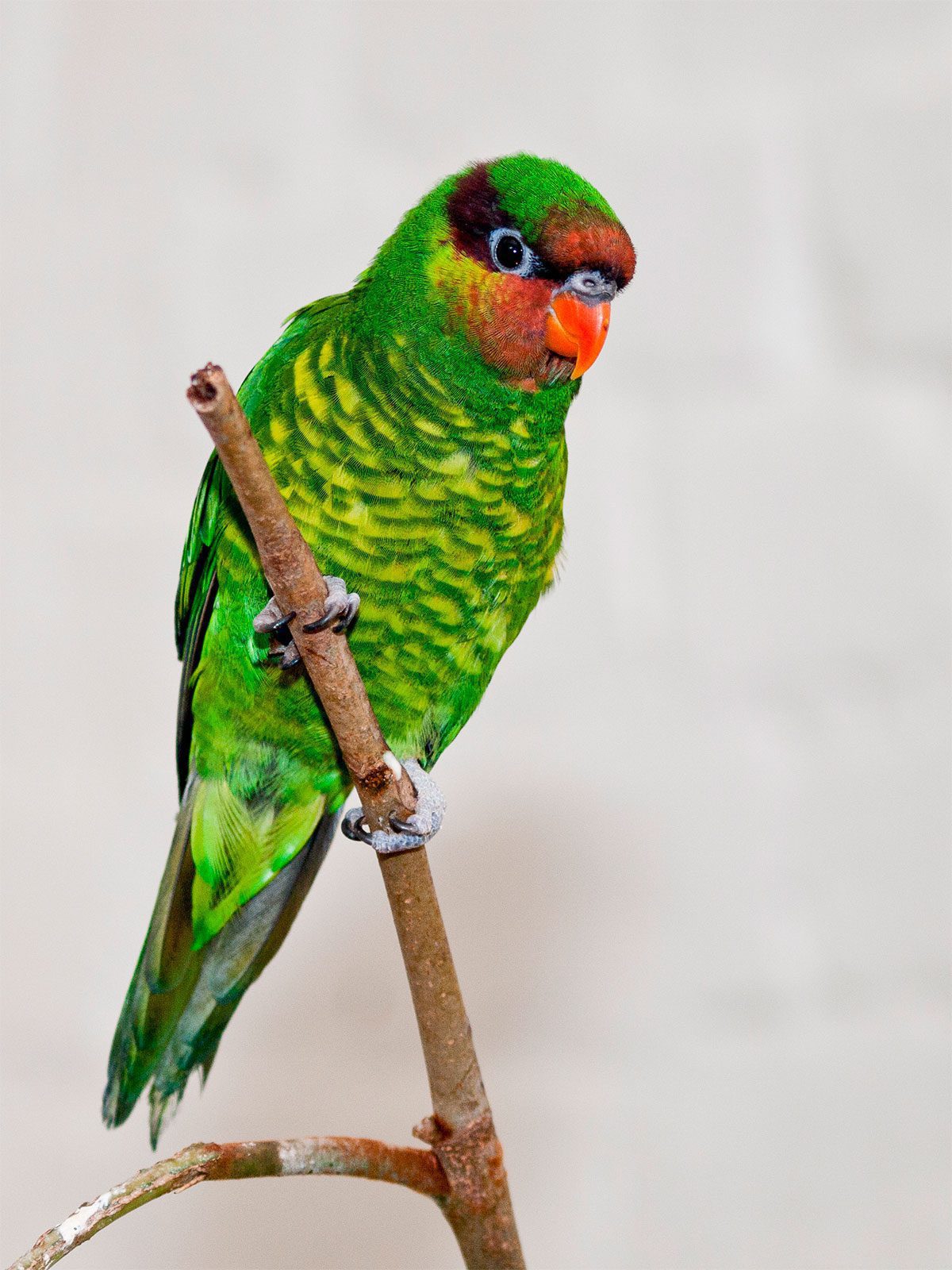
The plumage of the Mindanao Lorikeet (Trichoglossus johnstoniae) is usually Green. The facial area It is red with a tendency to pink. The band that goes from the eye until the part back from the neck it is dark purple.

The underparts are yellow, scalloped with green resembling scales. They have the Underwing coverts and subcaudales yellowish green. The band less of them wings is yellow. Its bill is reddish orange, the legs grayscale and the eye ring dark gray. The eyes orange-red.

The birds immatures have less red on the face. Instead of the band dark purple in adults, young birds have an off color lilac and a Brown stain behind the eye. The rings of the eyes are of color grey white. The eyes They are brown.

There are no significant differences between males and females.

  • Sound of the Mindanao Lorikeet.

Habitat:

Found of 1.000 to 2.500 m in the Mount Apo and 1.000 1,700 m in the Mount Malindang.

The Mindanao Lorikeet they prefer mossy forests, but also you can see them along the edge of the forest and in degraded areas.

Usually noisy during the flight, but when they feed on, remain calm. They migrate daily between different altitudes in the morning looking for food in the Highlands and in the evening return to their resting places in the lower areas.

They move higher during the day, in flocks of up to 50 birds, to feed on trees with flowers and shrubs. At sunset, they return to the lower slopes to rest.

Reproduction:

Little is known about the ecology of reproduction.. Probably it breeding is performed between months of March and may.

Captive breeding records indicate that the laying tends to be of two eggs, the incubation of some three weeks and that the young leave the nest between three weeks and a month more afternoon.

Food:

With feeds nectar, flowers, fruits, pollen and insects.

Distribution:

Size of the area of distribution (reproduction / resident): 8.700 km2

Endemic to the mountains of Mindanao (Philippines)

Conservation:


Near-threatened

โ€ข Current IUCN Red List category: Near threatened

โ€ข Population trend: Decreasing

Its habitat favorite is relatively unlikely that is affected by human activities in the medium term, but logging and capture should remain concerns.

The world population apparently not been quantified formally, but the species is described as very rare and there are those who think that there are less than 10.000 individuals.

"Mindanao Lorikeet" in captivity:

Very rare in captivity.

Due to its decreasing trend in terms of its population, any specimen that can not be returned to their natural habitat (natural range) should preferably be placed in a well-managed breeding program to ensure the survival of the species.

Alternative names:

Mindanao Lorikeet, Apo Lorikeet, Johnstone’s Lorikeet (ingles).
Loriquet de Johnstone (French).
Mindanaolori, Mindanao-Lori (German).
Loris johnstoniae (Portuguese).
Lori de Mindanao, Tricogloso de Mindano (espaรฑol).

scientific classification:

Order: Psittaciformes
Family: Psittaculidae
Genus: Trichoglossus
Scientific name: Trichoglossus johnstoniae
Citation: Hartert, 1903
Protonimo: Trichoglossus johnstoniae

โ€œMindanao Loryโ€ Images:

————————————————————————————————

ยซLori de Mindanaoยป (Trichoglossus johnstoniae)


Sources:

Avibase
– Parrots of the World โ€“ Forshaw Joseph M
– Parrots A Guide to the Parrots of the World – Tony Juniper & Mike Parr
– BirdLife.org

Photos:

1 – ยซTrichoglossus johnstoniae - London Zoo, England-8aยป by William Warby from London, England – Unknown-Tropical BirdUploaded by Snowmanradio. Licensed under CC BY 2.0 via Wikimedia Commons.
2 – ยซMindanao Lorikeet (Trichoglossus johnstoniae)-3cยป by Mindanao_Lorikeet_(Trichoglossus johnstoniae).jpg: Elizabeth Ellisderivative work: Snowmanradio (talk) – originally posted to Flickr as lovebird and uploaded to commons at Mindanao_Lorikeet_(Trichoglossus johnstoniae).jpg. Licensed under CC BY-SA 2.0 via Wikimedia Commons.
3 – by Jonathan Beilby – IBC.lynxeds.co
4 – zoochat.com
5 – papageien.org

Sounds: Kennedy, Robert S. – ยฉ 2014 Cornell University

โ–ท The world of Pets: Dogs, cats, birds, reptiles, amphibians

Papuan king parrot
Alisterus chloropterus

Papuan king parrot

Content


Anatomy-parrots

Description

36 cm.. length between 138 and 190 g. of weight.

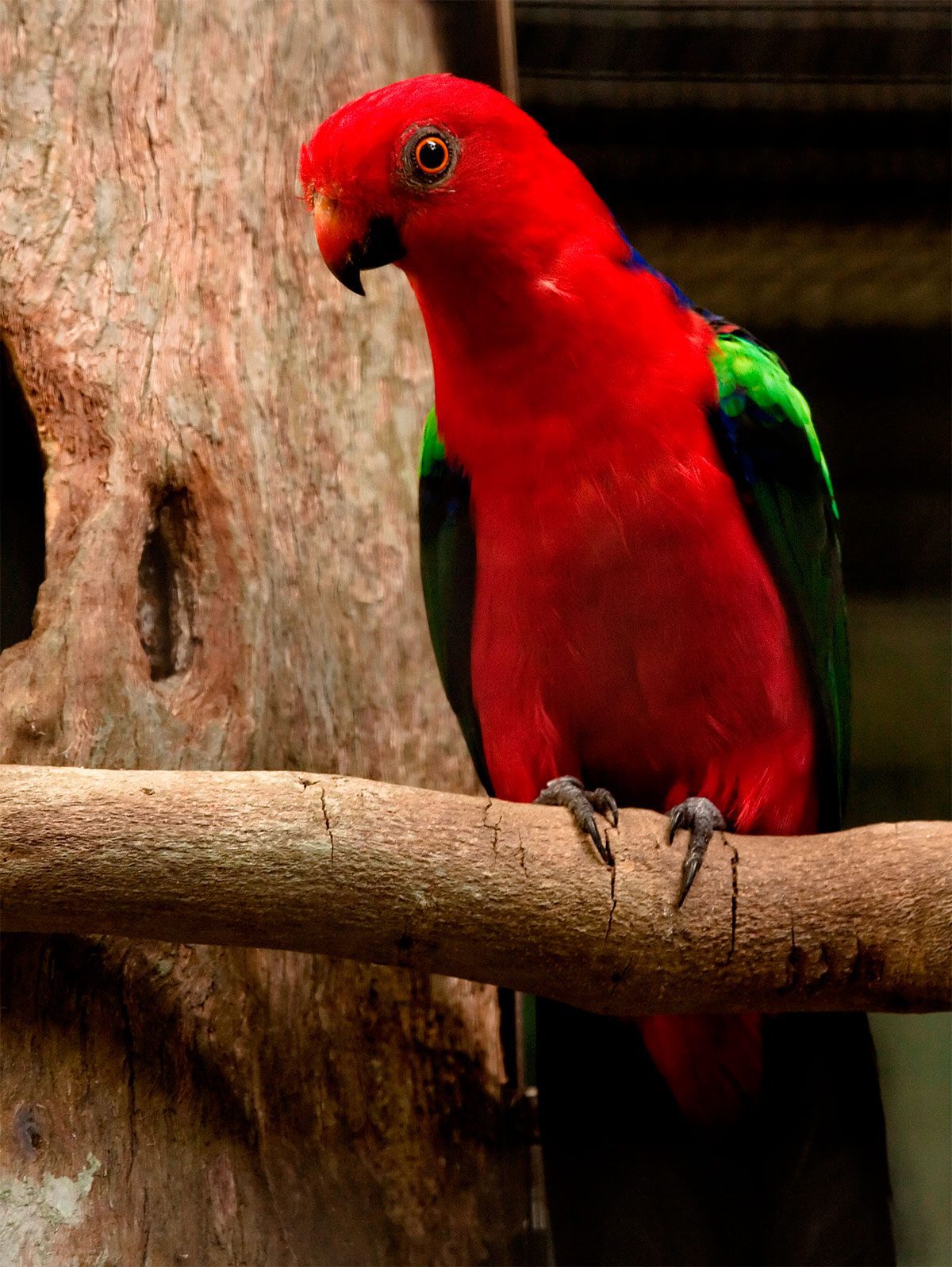
The Papuan king parrot (Alisterus chloropterus) It has a bright red head, wide rear collar of blue stretching at the nape to the back of the Crown and sides of the upper part of the chest. Blackish green mantle, apparently black in the field; lower part of the back, buttocks and supracaudales coverts Dark Violet.

Dark green wings with large patch of yellowish-green through the lower, internal medium and more large inner coverts; Green flight feathers, with vane Dark internal. Under, the wing coverts blue-violet. Bright red bottoms, with hidden dark bases to the coverts infracaudales. Upper, tail bluish black; Black down.

Black bill with red base to upper mandible; Orange iris; feet of color grey blackish.

The female of color green for over, devoid of the pale in wings patch, with a dark blue rump and blackish tail. Head and upper part of the chest of green (reddish mottled), and the rest of of the Red bottoms. Under, the Green wing coverts. Coverts with dark centers infracaudales, but this is less evident in the Australian females. Base with more brown on upper mandible than in males.

Young as females, but with tips to the tail feathers pink, a greener chest, and a peak and iris darker.

Subspecies description

  • Alisterus chloropterus chloropterus

    (Ramsay, EP 1879), the nominal subspecies.


  • Alisterus chloropterus callopterus

    (Albertis & Salvadori 1879) – Male with blue band narrow through the mantle, It does not extend to the rear of the Crown. More green in the mantle.


  • Alisterus chloropterus moszkowskii

    (Reichenow 1911) – Sexes generally similar. Male has no or only shows a blue light in the back of the neck band, and it has the mantle and signs on the sides of the chest of green. Male with violet that extends more down in the back that the nominal species. Both sexes can display tips pink tail feathers. Immature with narrower and more off the wings patch. Green marks on the chest.

Habitat:

They are distributed in the dense forests from close to sea level until the 2.800 m. The birds are also sometimes found in cultivated areas, at higher altitudes, in more open habitats with casuarinas, and in areas of secondary growth. Papagayo Papuans are heard more often than they are seen, and are more frequently asked vislumbrados flying between the trees through breaks in the forest.

Bird alone, couples or groups of up to ten copies, they feed on silently and discreetly in the lower floors and half-height of the forests, and they can be addressed a short distance when they deliberately leave in search of fruits, seeds, berries and nuts; When resent, they usually only fly within walking distance.

Reproduction:

Little-known cycle of reproduction, but nesting, according to sources, begins in the month of March with two or three eggs in the implementation. The period of incubation is of 21 days, and the incipient takes 35 days. Young people reach the independence in 50 days.

Food:

Fruits, seeds, berries and nuts

Distribution:

Size of the area of distribution (reproduction / resident): 324.000 km2

The Papuan king parrot extends from North of Cenderawasih Bay, to the East, about Aitape on the North Coast. Although locally common, the species is probably suffering due to the trade of birds. The world population is estimated at around 70.000 birds.

Subspecies distribution:

Conservation:


minor concern


โ€ข Current category of the Red List of the UICN: Least concern

โ€ข Population trend: Stable

The size of the world's population has not been quantified, Although it is estimated at around 70,000 specimens.

The species is reported as locally common (pit et to the. 1997).

The population is suspected to be stable in the absence of evidence of any reduction or substantial threats.

"Papuan king parrot" in captivity:

active parrot; need extra space because of the tendency that has to turn into an apathetic or lethargic in a small cage bird. It is not very loud. The dietary changes must occur slowly. It has a tendency to internal parasites.

Very rare in captivity.

Alternative names:

Papuan King-Parrot, Green-winged King Parrot, Green-winged King-Parrot, Papuan King Parrot (ingles).
Perruche ร  ailes vertes, Perruche royale ร  ailes vertes, Perruche royale de Papouasie (French).
Papuasittich (German).
Periquito-rei-de-asa-verde (Portuguese).
Papagayo Papรบ, Papagayo Real de Alas Verdes (espaรฑol).

scientific classification:

Order: Psittaciformes
Family: Psittaculidae
Genus: Alisterus
Scientific name: Alisterus chloropterus
Citation: (Ramsay, EP, 1879)
Protonimo: Aprosmictus chloropterus

โ€œPapuana Parrotโ€ images:

————————————————————————————————

ยซPapuan Parrotยป (Alisterus chloropterus)

Sources:

Avibase
– Parrots of the World โ€“ Forshaw Joseph M
– Parrots A Guide to the Parrots of the World – Tony Juniper & Mike Parr
Wikipedia
– Birdlife

Photos:

(1) – ยซAlisterus chloropterus-Jurong Bird Park-male-8aยป by Peter Tan – originally posted to Flickr as Australian King Parrot. Licensed under CC BY 2.0 via Wikimedia Commons.
(2) – ยซAlisterus chloropterus -Grantโ€™s picnic ground -in tree-8ยป by Jade Craven – originally posted to Flickr as King Parrot at Grants Picnic Ground. Licensed under CC BY 2.0 via Wikimedia Commons.
(3) – Birds and Birds – Parrocchetto reale aliverdi
(4) – Bottom view of a male perched on a branch by Carmelo Lรณpez – Lynx
(5) – franz.kulman

Sounds: Sam Woods (Xeno-canto)

โ–ท The world of Pets: Dogs, cats, birds, reptiles, amphibians

El Oro Parakeet
Pyrrhura orcesi


Cotorra de El Oro

Content

Description:

22 cm. of long and 73 g. of weight.

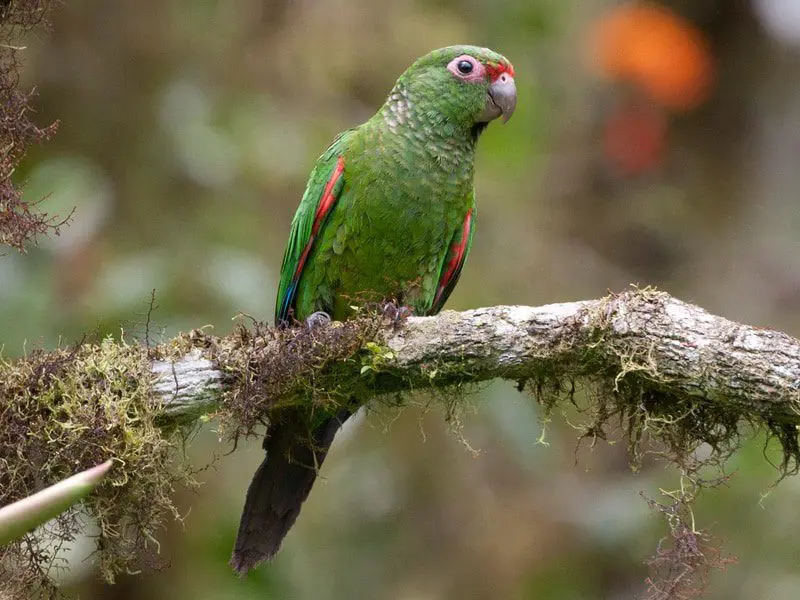
The El Oro Parakeet (Pyrrhura orcesi) is a bird relatively striking, with mostly green plumage. Has the forecrown red; feathers on the sides of the neck with the white base; Red patch from the shoulder up to the half of the wing , end of the wing blue (more visible in flight), tail above with a reddish tint and below completely red except the base.

Beak and legs blackish.

The females It is thought that less red have around the face.

the youth they are generally paler and lack much of the red marks that are seen in adults.

Habitat:

It inhabits in the very humid tropical forest between 800-1.200 m (occasionally at altitudes as low as 300 m). It has been reported that he tolerates some habitat fragmentation (Schaefer and Schmidt 2003). Performs seasonal movements. Are usually distributed in groups of 4-15, Although it has been observed in flocks of up to 60 birds. They may be closely related with the Maroon-tailed Parakeet (Pacific) (Pyrrhura melanura pacifica) and the Maroon-tailed Parakeet (Pyrrhura melanura)

The rest sites They seem to change frequently and are generally located between 2 and 24 meters above the ground, in natural cavities in trees or open branches.

It is extremely noisy and conspicuous when flying.

Reproduction:

As is a species discovered recently, very little is known about its ecology.

Seems to prefer the Dacryodes peruviana family Burseraceae for nest (Garzon 2007), and communal, sharing the tasks of incubation between several birds, Although a couple exhibited a behavior of pre-anidamiento in the cavity of a small tree Meliaceae in 1997 (Snyder et to the. 2000), and reported nests in natural cavities of 1,8-24 m above the ground in a variety of tree species (Schaefer and Schmidt 2003).

The time of incubation is of approximately 31 days.

The main breeding station seems to be between November and March (Garzon 2007), although it is difficult to specify because with the effects of 'El Niรฑo' they mate between December and January.

Movements seasonal altitudinal down to forests have been reported in the Buenaventura reserve (T. Schaefer in litt., 2007).

Food:

Discreetly feeding in the canopy, composing your diet of various fruits (including fig Ficus spp.), Fruits and flowers Cecropia (Snyder et to the., 2000).

Distribution:

Size distribution (reproduction / resident) 750 km2

The El Oro Parakeet is an endemic bird. They inhabit in the western slope of the Andes, in the southwest of Ecuador (in Caรฑar, Azuay, Gold and Loja), where was discovered in 1980.

Apparently, its population is limited to an area of only 100 km from North to South, and a maximum of 5-10 km wide (Juniper and Parr 1998), with its highly fragmented Habitat and with a population estimated in less than 1.000 individuals (Garzon 2007).

Its population in the town of Buenaventura has remained stable since 2002-2007 (Juniper and Parr 1998), estimated in 171 birds in period 2005-2006 (2007 Garzon, HM Schaefer in litt. 2012).

Conservation:

State of conservation โ“˜


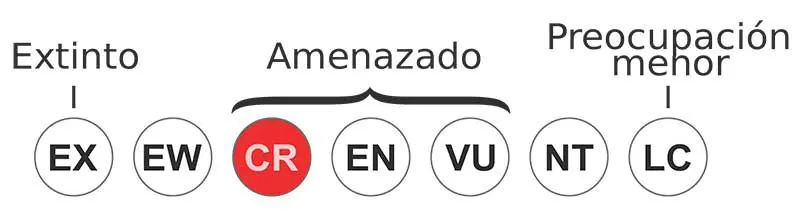
critical hazard critically endangered โ“˜ (UICN)โ“˜

โ€ข Current category of the Red List of the UICN: In danger of extinction

โ€ข Population trend: In decline.

The El Oro Parakeet is in danger of extinction due to deforestation and extreme forest fragmentation for cattle ranching, What causes the habitat degradation. This degradation destroy sites of nesting and feeding that these birds need to survive and reproduce at a healthy pace.

Population estimated in less than 1.000 individuals.

The habitat limited only to the Andes, to the West of Ecuador and because of this, sensitivity to the destruction of the Habitat is very heavy. Protection for some of the habitat of this species has been established in the Book ecological Buenaventura. In reserves, bird houses have been built in trees to help promote reproduction and has had some success. Other projects have been proposed to evaluate the size of the population.

BUENAVENTURA RESERVE REPORT

"El Oro Parakeet" in captivity:

Don't usually see in the poultry farming.

Alternative names:

El Oro Parakeet, El Oro Conure (English).
Conure d’Orcรฉs, Conure d’Orcรจs, Perruche d’El Oro (French).
Orcessittich, Orces Sittich, Orces-Sittich (German).
Tiriba-do-el-oro (Portuguese).
Cotorra de El Oro, Perico de orcรฉs (espaรฑol).

scientific classification:

Order: Psittaciformes
Family: Psittacidae
Genus: Pyrrhura
Scientific name: Pyrrhura orcesi
Citation: Ridgely & Robbins, 1988
Protonimo: Pyrrhura orcesi

Images "El Oro Parakeet"

Videos "El Oro Parakeet"


Especies del gรฉnero Pyrrhura

El Oro Parakeet (Pyrrhura orcesi)


Sources:

  • Avibase
  • Parrots of the World โ€“ Forshaw Joseph M
  • Parrots A Guide to the Parrots of the World – Tony Juniper & Mike Parr
  • Birdlife

Photos:

(1) – fjocotoco.org

โ–ท The world of Pets: Dogs, cats, birds, reptiles, amphibians

Musk Lorikeet
Glossopsitta concinna

Musk Lorikeet

Content

Description

20 to 23 cm.. length and a weight between 52 and 56 g..

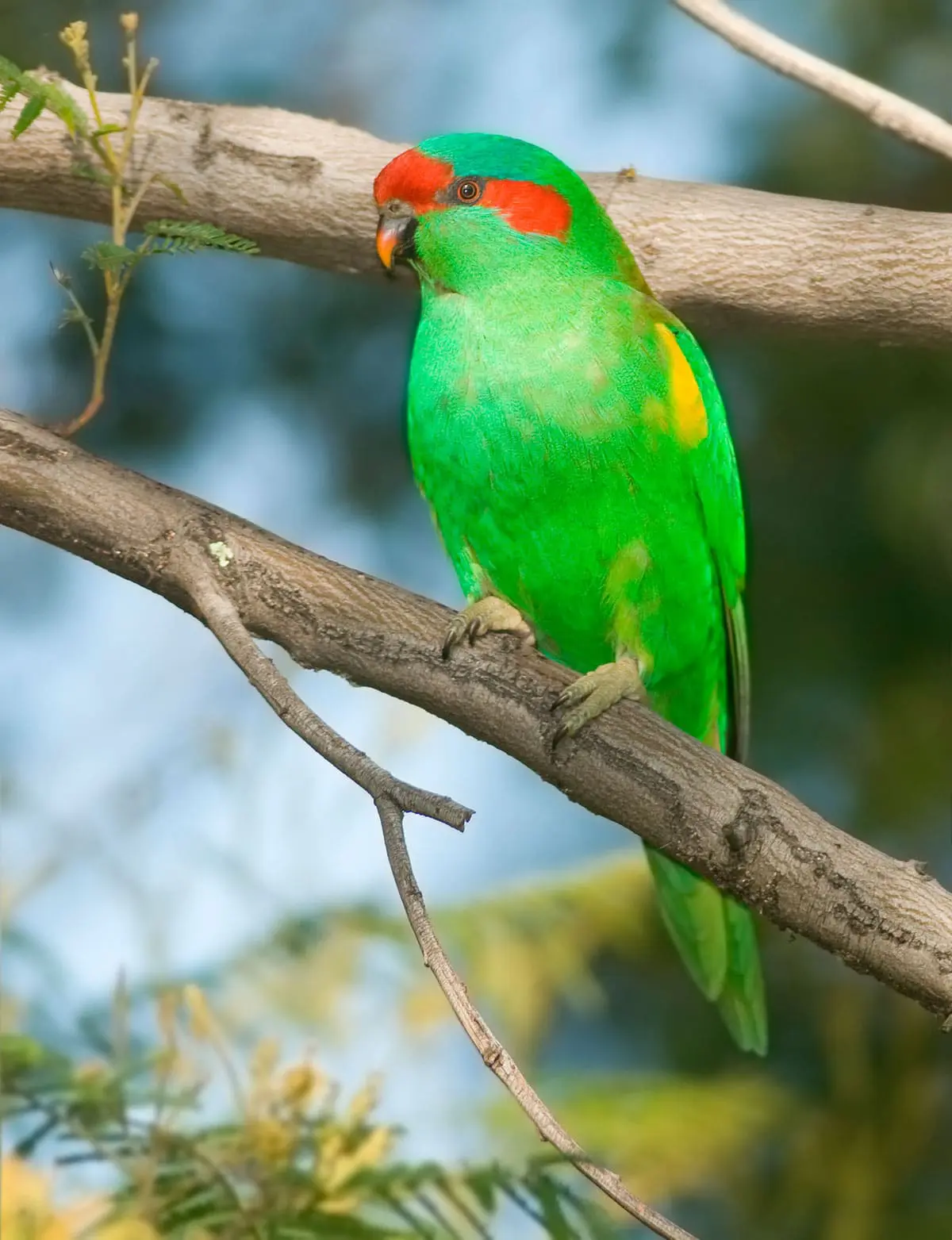
The general plumage of the Musk Lorikeet (Glossopsitta concinna) is green.

The part forward of the crown, lores and coverts headphones are of color Scarlet. Top of the head and cheeks, of color green impregnated of Turquoise under eye. The underparts of color green with a washed Brown olive around the sides of the chest. Green bright it rump. Wing coverts green, flight feather of color gray to black and a band of color yellow in the area of the shoulders. The feathers of the tail with brands reddish orange.
Part back from the neck yellowish green. Beside the edges of the wings colour yellow. Bill black-tipped Red. The irises Orange and the legs greenish Brown.

The blue area in the crown of the female It is smaller and paler which in the male.

The name of the species derives from a musky odor that is said to emit these birds.

Subspecies description:

  • Glossopsitta concinna concinna

    (Shaw, 1791) – Nominal.


  • Glossopsitta concinna didimus

    (Mathews, 1915) – Less blue in the crown, nearly absent in the female.

Habitat:

Seasonally nomadic Depending on the flowering of the eucalyptus, at least at the ends of their range.
Found in many habitats of open forest, agricultural and suburban areas, including forests of eucalyptus, dry forests, dense rainforest (particularly in Tasmania) and riparian forests.

It avoids the high open woods and high altitude. Often found in large flocks of more than one hundred of individuals, where couples who form strong bonds, they often live together. It is extremely trusting when feeds.

Flocks have been seen, frequently, flying at high altitude.

Reproduction:

Season of mating from August to January. The nests they are built in holes of eucalyptus. The two eggs are incubated for about 25 days and the young leave the nest between 6 and 7 weeks after hatching.

Food:

like most others Lori, the diet consists in nectar and pollen, as well as small fruits and some insects. They can RAID orchards, vineyards and crops, forming herds with the Swift Parrot (Lathamus discolor) and other gender lori Glossopsitta.

Distribution:

Size of the area of distribution (reproduction / resident): 664.000 km2

The Musk Lorikeet are located in the East of New South Wales, Victoria, South of Australia and Tasmania.

Subspecies distribution:

  • Glossopsitta concinna concinna

    (Shaw, 1791) – Nominal.


  • Glossopsitta concinna didimus

    (Mathews, 1915) – Tasmania, sometimes King Island. Small population wild in Perth.

Conservation:


minor concern

โ€ข Current IUCN Red List category: Least concern

โ€ข Population trend: Stable


The world population It has not been quantified, but the species is reported be very common (pit et to the. 1997).

The population suspected to be stable in the absence of evidence of any reduction or substantial threats.


"Musk Lorikeet" in captivity:

Rare out of Australia, small number in the aviaries of United States and United Kingdom.

A delight, playful, more quiet that the Iris Lorikeet; they can imitate sounds; a bit messy due to a diet of nectar.

Alternative names:

Musk Lorikeet (ingles).
Lori ร  bandeau rouge, Loriquet musquรฉ (French).
Moschuslori (German).
Loris Musk (Portuguese).
Lori Almizclero (espaรฑol).

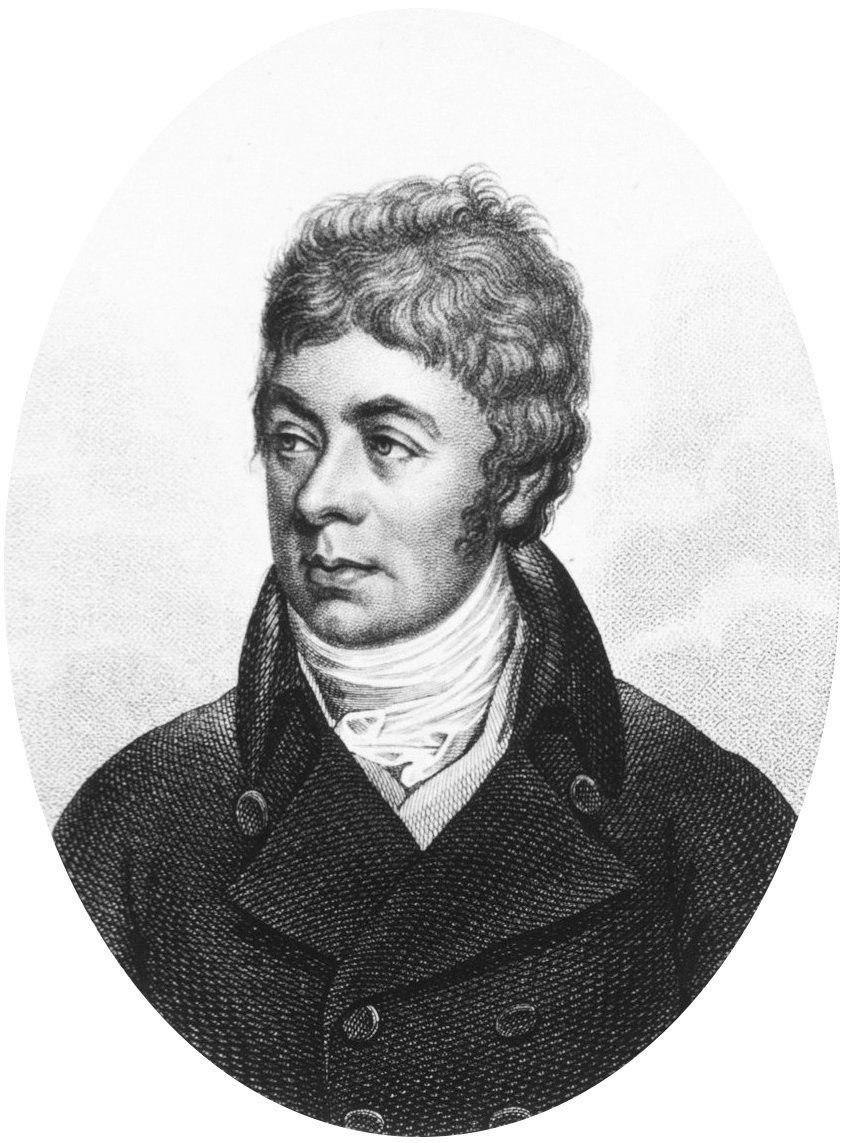
George Shaw
George Shaw

scientific classification:


Order: Psittaciformes
Family: Psittaculidae
Genus: Glossopsitta
Scientific name: Glossopsitta concinna
Citation: (Shaw, 1791)
Protonimo: Annual parrot


Images ยซLori AlmizCleroยป:

Videos "Musk Lorikeet"


ยซLori Readerยป (Glossopsitta concinna)


Sources:

Avibase
Parrots of the World โ€“ Forshaw Joseph M
Parrots A Guide to the Parrots of the World – Tony Juniper & Mike Parr
BirdLife.org

Photos:

1 – By JJ Harrison (jjharrison89@facebook.com) (Own work) [GFDL 1.2 or CC-BY-SA-3.0], via Wikimedia Commons
2 – By Steve (originally posted to Flickr as Musk Lorikeet.) [CC-BY-SA-2.0], via Wikimedia Commons
3 – free-pet-wallpapers.com
4 โ€“ ยซMusk Lorikeet 2" Of JJ Harrison (jjharrison89@facebook.com) – It operates propria. With license CC BY-SA 3.0 Transact Wikimedia Commons.
5 – Image: Steven Kuiter – biodiversitysnapshots.NET.au

Sounds: Marc Anderson (Xeno-canto)

โ–ท The world of Pets: Dogs, cats, birds, reptiles, amphibians

Crimson Rosella
Platycercus elegans

Crimson Rosella

Content


Anatomy-parrots

Description

Among 30 and 37 cm.. length and a weight between 99 and 170 g..

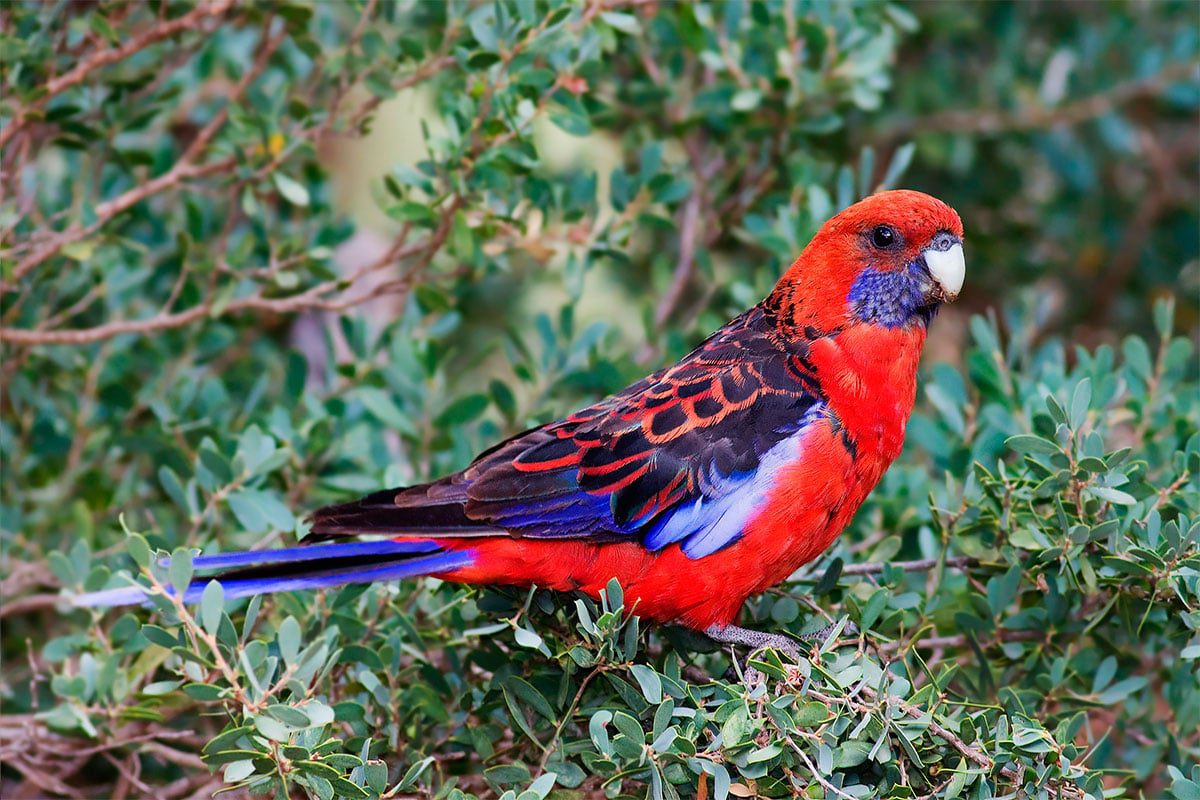
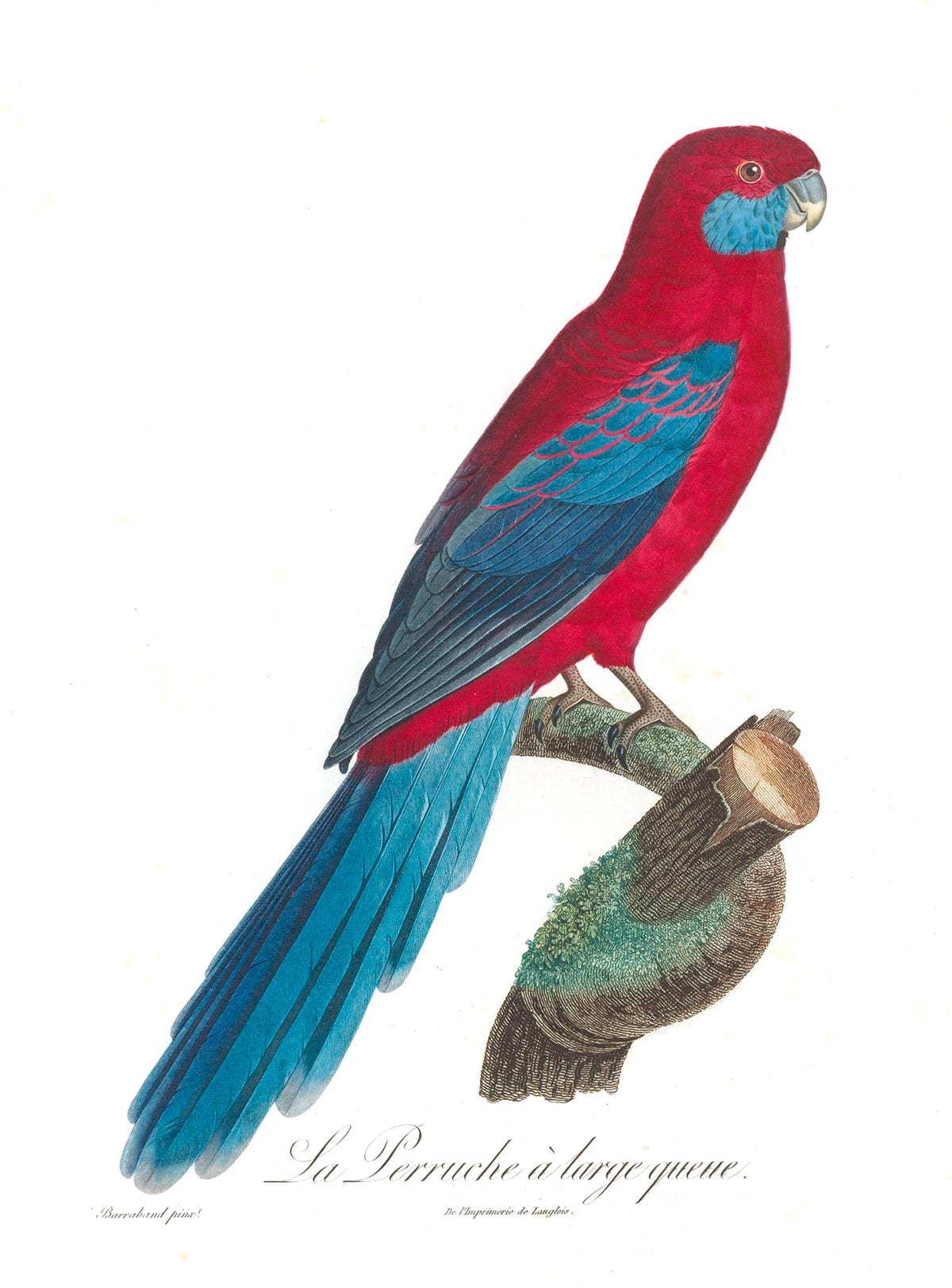
The Crimson Rosella (Platycercus elegans) has a predominantly red plumage.

Its head is bright crimson in color with the lower part of the cheeks and the throat of blue color.. Mantle feathers are black with broad crimson margins of variable intensity.; rump and uppertail coverts crimson.

Medium and lower inner wing coverts black; bend of wing, lesser coverts and medium blue color external; external greater coverts bright blue, Black Interior with red edges giving a scaly appearance to this area; primary coverts blue violet; feathers of flying blackish with thin margin foreign white in them more external and blue violet in vane outer; secondary black with vane external blue violet; tertiary black with red borders.

Under, Blackish wings with blue coats. Underparts showy crimson.

Upper, the tail is blue, the center of green-washed, Foreign feathers with vane Blackish internal and vane Violet Blue outer with pale at both ends; undertail, the tail of pale blue edged blackish when closed.

The peak of grayish-white; dark brown irises; greyish Brown legs.

The female It is smaller with narrower peak. It has no stripe under the wings..

The immature is very different, with upper parts olive green (including the tail at the top), and green underparts greyish.
The centers to the mantle feathers are dark brown, and the black markings of the wings of the adult are replaced by green. Very young birds rump is green Orange. There is a pale stripe on the bottom of the wings (formed by stains pale in vane inner). It shows red feathers on the head, chest, buttocks and subcaudales coverts and move through the first fall.

Adult plumage is reached in a few 15 months. Immatures of the population in the North are mainly red, and there are less green unripe in Norfolk Island than mainland populations.

Subspecies

Description subspecies Platycercus elegans
  • Platycercus elegans elegans

    (Gmelin, 1788) – The nominal species


  • Platycercus elegans flaveolus

    (Gould, 1837) – With 33 cm.. length, approximately, It is but little that the nominal species, Yellow has no orange hue and there is orange in the neck, chest and abdomen.


  • Platycercus elegans fleurieuensis

    (Ashby, 1917) – IMG – It differs from the species rated as having an intense orange color, Red plumage, the mantle and black gray back, with pale orange-red spots; pale blue medium and secondary wing coverts.


  • Platycercus elegans melanopterus

    (North, 1906) – Of 36 cm.. length, approximately. The bordered red are more narrow, with which the back looks more black. Female as the nominal.


  • Platycercus elegans nigrescens

    (Ramsay,EP, 1888) – With 34 cm.. length, It is smaller than the nominal value and the color red is much more dark. Red feathers are more narrow. Female as the nominal.


  • Platycercus elegans subadelaidae

    (Mathews, 1912) – Approximately from 36 cm.. length. Instead of Red Blend Red, Orange and yellow. Orange red forehead, the Crown and face, they turned to brighter red frontal band. Yellow olive from the low back to the supracaudales coverts

Habitat:

Crimson Rosella

The Crimson Rosella they frequent tropical and humid subtropical forests near the coast and the surroundings of montane forests at altitudes up to 1.900 m.

They are mainly on the edges of jungle, in the secondary zones and in the dense forests of eucalyptus they arrive at a good stage of maturity.

To the South of the hunter river in New South Wales, they are distributed at all altitudes.

The nominal species has a preference for thick wooded areas, but often goes into open areas and farmland where it is mixed with the Perico conr (Platycercus eximius).

It also tends to visit plots of pine trees.

In the Kangaroo Island, where is the only parakeet present, He lives in all types of forest habitats, they are also adapting to farmland.

The subspecies subadelaidae and fleurieuensis, sometimes grouped under the term Adelaide parakeet, frequent valleys forest, arboreal galleries that border the rivers or trees on the edge of the roads. They are also present in the orchards and farmland.

The Flaveolus subspecies attends the same types of habitat, that is to say, curtains of trees dominated by red rubber trees along the river.

To feed, move away from rivers and raid agricultural land, flooded Plains, or thickets ยซMalleeยซ.

Adults are sedentary. Usually, they live in pairs or in small groups. On the other hand, juveniles and subadults form noisy groups and many roam locally when leaving dormitory at sunrise.

Its main activity is carried out in the morning and in the evening. in the middle of the day, they rest in the shady foliage. But, If the sky is overcast and the weather is cool, these birds are active during the day.

The Crimson Rosella they seek food on Earth, in trees and shrubs. They often feed in the company of the Eastern Rosella (Platycercus eximius), But if the joint working group is altered during its activity, the two species are separated in flight and taken opposite directions, each seeking refuge by his side.

The Crimson Rosella they are not very shy and can be approached at a very short distance.
In urban areas, they are particularly friendly.

Reproduction:

The breeding season covers the months of August to February and, sometimes even later.

The elegant parakeet build their nests on a branch or in the cavity of a tree trunk. Usually, Choose a healthy or dead eucalyptus, but sometimes they install their nests in a place as strange as the metal beam of a construction crane.

In all cases, the nest is located high above the ground. Spawning usually includes 4 to 7 white eggs, rarely 8, which are incubated during approximately 19 days.

The female incubates the eggs alone, but the chicks receive equal attention from both parents.

The nesting cycle is quite long and it takes around 5 weeks

Food:

The Crimson Rosella they have a mainly vegetarian mixed diet. Consume the seeds of black Cypress of Australia (Callitris endlicheri), figs, seeds of acacia and eucalyptus.

The vegetable part of its menu is complemented by a wide variety of imported plants such as Rosa rubiginosa, clover or chickweed (Stellaria media).

In the South of its range, they eat the fruits or flowers trees of Melaleuca, banksia and casuarina.

Insects are not forgotten in your menu: Hemiptera, psyllids, termites, aphids and larvae of beetles.

These parrots times behave as true pests in orchards, eating apples, Plums, pears and quinces.

Distribution:

Confined to the coastal area of Eastern Australia where are widely distributed in the wooded areas along and East of the Great dividing range.

There is an isolated population in the North between the surrounding of Atherton, Northeast of Queensland, to the South of the mountain range of Clarke and Eungella (the population in Eungella It can also be isolated).

The main population is distributed around Gympie, Southeast of Queensland, in the North, across the border with New South Wales, coming up to the Warrumbungle National Park, Bathurst and Wagga Wagga, where are approaching the eastern end where the Yellow Rosella.

In Victoria extends from the East to the Grampian and the Edenhope district, where spills into the Southeast end of Australia, coming to Kingston at its western end.

There is also an isolated population in the Kangaroo Island.

The species is found in the wild around Sydney, Brisbane and Melbourne, and leaks from birds have been around Perth. There are records in the North of Tasmania and the islands of the bass strait, probably, also refer to birds Getaways.

It is common in the Norfolk Island where it was introduced in the century 19, but is absent in the vicinity of Nepean and Philip Island; an attempt to introduce the species in Lord Howe Island failed.

Was also introduced in New Zealand, showing in the West suburbs of Wellington, and some birds can also persist in the District of Dunedin of South Island where can hybridize with the introduced Perico conr.

The world's population is above 200.000. Moderate numbers in captivity.
The birds can be eradicated with a permit in States where the destruction of crops occurs.

Subspecies

Distribution subspecies Platycercus elegans

Conservation:


minor concern


โ€ข Current category of the Red List of the UICN: Least concern

โ€ข Population Trend: Decreasing

The size of the world's population has not been quantified, Although it is estimated above 200.000 specimens.

The Crimson Rosella they are infrequent at both ends of its distribution area, but in other places, they are locally abundant and common.
In the North, they are slightly less numerous. In the past recent, they have colonized successfully parks and urban gardens, so now are very widespread in the suburbs of Canberra and Adelaide.
In the Norfolk Island, the import is so successful that they now represent a competition and a significant danger to the Red-crowned parakeet (Cyanoramphus novaezelandiae).

"Crimson Rosella" in captivity:

Moderately loud, very active, they are acclimatized to the owner. It is not usually compatible with other birds.
A sample of the subspecies subadelaidae lived 26,8 years in captivity
Rare in captivity.

Alternative names:

Crimson Rosella, Adelaide Parakeet, Beautiful Lory, Blue-cheeked Rosella, Campbell Parakeet, Crimson Rosella (Crimson), Mountain Lowry, Murray Rosella, Murray Smoker, Murrumbidgee Lowry, Murrumbidgee Rosella, Pennant’s Parakeet, Pennant’s Rosella, Red Lory, Red Lowry, Red Parrot, Swamp Lory, Yellow Parakeet, Yellow Parrot (ingles).
Perruche de Pennant (French).
Pennantsittich, Adelaidesittich, Pennant-Sittich (German).
Rosela-Pennant (Portuguese).
Perico Elegante, Rosela Roja, Periquito Pennant, Rosella Carmesรญ (espaรฑol).

scientific classification:

Order: Psittaciformes
Family: Psittaculidae
Genus: Platycercus
Scientific name: Platycercus elegans
Citation: (Gmelin, JF, 1788)
Protonimo: Psittacus elegans

"Elegant Perico" images:

Videos "Crimson Rosella"

Crimson Rosella (Platycercus elegans)

Sources:

  • Avibase
  • Parrots of the World โ€“ Forshaw Joseph M
  • Parrots A Guide to the Parrots of the World – Tony Juniper & Mike Parr
  • Wikipedia
  • Loromania
  • Birdlife
  • AnAge: The Animal Ageing and Longevity Database – Anagรฉ Database

  • Photos:

(1) – An adult Crimson Rosella (Platycercus elegans), Wilsons Promontory National Park, Victoria, Australia By JJ Harrison (jjharrison89@facebook.com) (Own work) [CC BY-SA 3.0], via Wikimedia Commons
(2) – A Crimson Rosella photographed though a window in the Blue Mountains, Australia By John Poulakis from Australia (Crimson RosellaUploaded by Snowmanradio) [CC BY 2.0], via Wikimedia Commons
(3) – Crimson Rosella (Platycercus elegans) photographed taken in Swifts Creek, Victoria, Australia Fir0002 [GFDL, CC-BY-SA-3.0 or GFDL 1.2], via Wikimedia Commons
(4) – A Crimson Rosella in a bird bath Canberra, Australia By Duncan McCaskill (Picasa Web Albums) [CC BY 3.0], via Wikimedia Commons
(5) – Juvenile Crimson Rosella (Platycercus elegans) by David CookFlickr
(6) – An adult Crimson Rosella (Platycercus elegans) Jacques Barraband [Public domain], via Wikimedia Commons