โ–ท The world of Pets: Dogs, cats, birds, reptiles, amphibians

Golden Parakeet
Guaruba guarouba


Golden Parakeet

Content

Description Golden Parakeet:


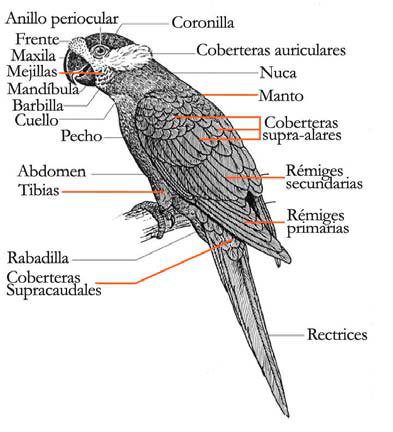
Anatomy-parrots

34 cm. of length and a weight of 270 g.

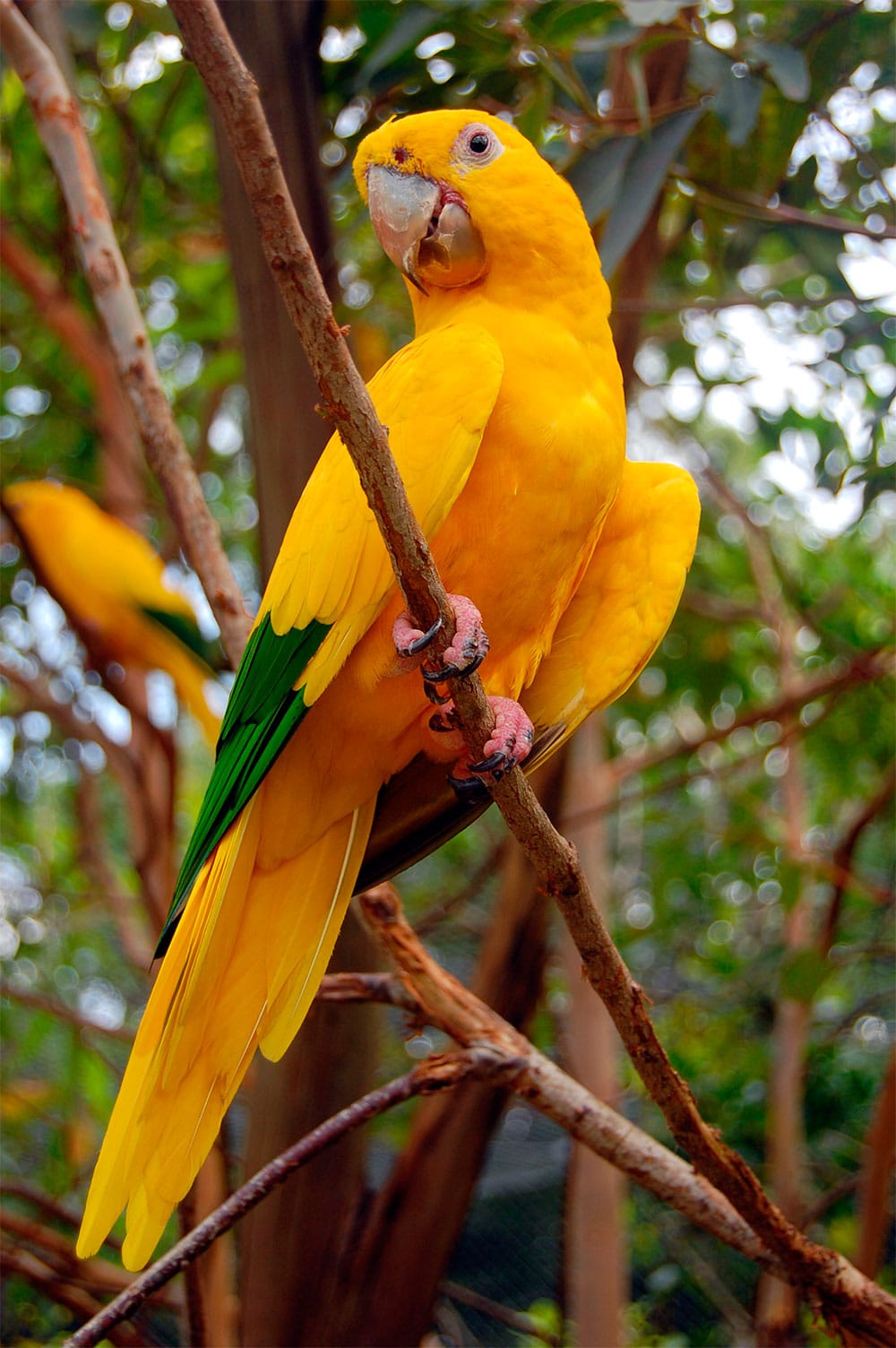
The Golden Parakeet (Guaruba guarouba) has all the head, upperparts, lower andtail , a bright yellow. The greater coverts, primaries and secondaries are dark green (one or two feathers yellow in some birds flying). Underwing-coverts yellow, the bottom of the flight feather dark yellow. Feather shafts of the tail are white.

The bill pale pink, more Brown on the basis of the upper jaw; bare periophthalmic naked whitish; Iris Orange to brownish Orange; legs Rosaceae.
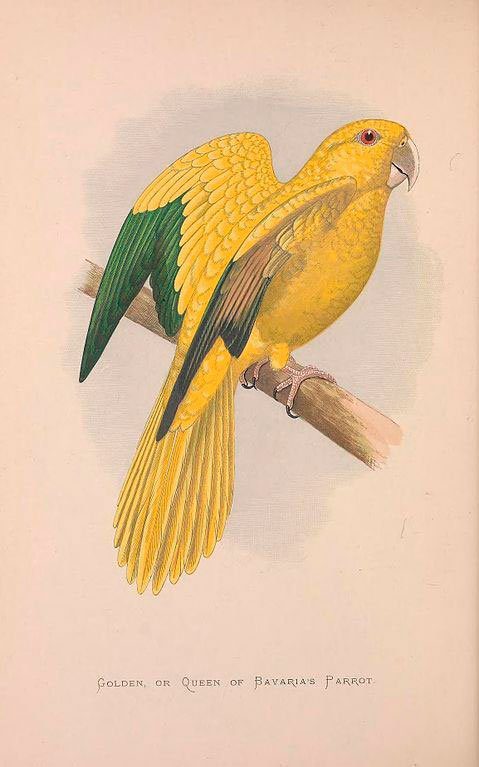
Illustration Aratinga Guaruba

Both sexes similar.

Immature colour olive brown opaque dark green streak. In the transition to adulthood, the head, top of the tail and back They are the last to acquire the bright yellow color of the adult plumage.

Habitat:

Video – "Golden Parakeet" (Guaruba guarouba)

yellow parakeet (Guaruba garouba) - Golden Parakeet - Aratinga guarouba

inhabits the humid tropical forests, avoiding the forests and marshes (seasonally flooded), Although in the immediate breeding period, You can wander through these habitats from the adjacent dry forests.
When is the breeding season, the Golden Parakeet they occupy the forests next to the clear.
Gregarious in all the seasons of the year. Observed in flocks of 3 to 30 birds, Although on a regular basis in groups between 6 and 10.
Forman communal roosts in tree cavities during the non-breeding season, using the holes in the area, alternately in successive nights. The usual and regular use of resting and feeding areas, is suspected to be due to the predictable daily routines. Sometimes seen feeding with other species of parrots.

Reproduction:

Nest at the top of the trunk or main branch of a hollow tree, a height between 15 and 30 m. Nesting tree is usually isolated, but near virgin forests. The old nest of other species It can be used by the Golden Parakeet, expanding its cavity as necessary.

The sexual behavior This species is unusual, and this is one of the most interesting aspects of their biology. With reproduce communally, with several females contributing to the work of the clutch, Although there are also reports of individual couples. Young people at different stages of development sometimes share a same nest.

On the other hand, at breeding sites during the reproductive period, the Golden Parakeet they react defensively to the presence of flocks of the same species, other species of parrots, especially the Scarlet Macaw (Ara macao), and before the approach of birds of prey.

The normal clutch female is of 2 to 4 eggs (perhaps up to six); 14 reported in a single nest chicks in captive, where the six adults helped in the breeding work. The breeding season, usually, takes place from December to April, and it corresponds to the rainy season

Food:

The Golden Parakeet, generally, feed in the forests of height, Although they will too of some cultivated plants; toreported foods (all the fruits or pseudo-fruits), They include the Palm trees of the genus Euterpe, that feels special canevale, Anacardium spruceanum, Anacardium occidentale, Protium and Tetragastris, Visnia quail, Inga, Byrsonima crassifobia, Carapa guianensis, Cecropia and Oenocarpus bacaba; as well flowers and buds (for example Symphonia), and crops as the corn and mango in some areas.

Golden Parakeet distribution:

endemic to the Amazonia, to the South of amazon in Brazil, from the west shore of the Tapajos River, to the East through the basins of the Xingu River and North of Tocantins to 5 ยฐ N, For, and up to the eastern shore of the Turiacu River in West Maranhรฃo.

Are not observed in the Marajรณ island and prevents the forests and marshes (for example, immediately to the South of the Amazonia).

Recent records in Rondร ยดnia and Mato Grosso, far from their known range, They suggest a little-known distribution. Apparently, they are distributed in large areas, but it is not known whether the movements are predictable or related with, for example, the seasonal availability of food.

Rare range-wide and no doubt in decline due to the very wide, fast and continuous deforestation and fragmentation of forests, both in the Amazonia occidental as in the Eastern.

The capture illegal for national and international live bird markets and the hunting for food and sport they pose a serious additional pressures. Protected areas in the range are insufficient and are being violated regularly, for example, with the illegal logging of Mahogany Swietenia macrophylla.

Listed in Appendix 1. In danger of extinction.

Conservation:

โ€ข Red List category of the UICN current: Vulnerable

โ€ข Population trend: Decreasing

The threat most obvious for the survival of the Golden Parakeet is deforestation? The construction of the tucuruรญ dam, which was completed in 1984, displaced 35.000 settlers from their House to adjoining territories and brought rapid deforestation. Prior to the dam construcicรณn, Wildlife in the lower basin of Tocantins It was considered among the richest and most diverse in the world. It is estimated that you a 117 species of mammals and 294 species of birds were displaced. So what 120 species of amphibians and reptiles were affected.

The population of the Golden Parakeet was initially in a range between 1,000-2,499 individuals, based on an assessment of the known records, descriptions of the abundance and range size. But, recent information suggests that the population may be greater. The species has been recorded in several additional places. (Laranjeiras and Cohn-Haft 2009), and a recent survey along of the Tapajos River by Laranjeiras (2011) indicated that it was as common in the study area as other Psittacidae, not threatened.
On the basis of this information, the population is placed on the band's 10,000-19,999 individuals, that means include c.6,600-13,400 mature individuals.

According to records of International Species Information System There is a population of 213 scattered individuals in different zoos.

Conservation Actions Underway:

CITES Appendix I and II, managed under the Association of Zoos and Aquariums Parrot Taxon Advisory Group and protected by the Brazilian legislation (being proposal as the national bird of Brazil).

– A campaign attacking trade of birds in Bolivia It can help to reduce international trade (AB Hennessey in litt., 2009).

– A population is relatively well protected in the Tapajos National Park, and a remnant population can survive in the Gurupi biological reserve.

Floresta Nacional do Jamari It is poorly protected and suffer the constant pressure of illegal occupants, loggers and poachers (F. Olmos in litt., 1999).

– The conservation of this species in the reserves is problematic because of its apparent nomadism.

Conservation Actions Proposed:

– Conduct studies to find the populations so far unknown, especially in the South and West of its range.

– The de facto protection the Gurupi biological reserve.

– Maintain the integrity of the Tapajos National Park.

– Protect and manage the land between the existing protected areas to facilitate the movements of nomadic.

– To enforce the legal restrictions on trade, especially in domestic markets.

– Further develop the program captive breeding.

"Golden Parakeet" in captivity:

Date back to the first reproductive outcomes of this kind of 1939 in Sri Lanka.

The Golden Parakeet It is probably the most coveted among all the parrots, being the prices demanded by her extremely high. It is very rare and endangered in its natural habitat, and are therefore protected from import.

Birds reserved for breeding are happier in the presence of members of their species. This is due to the nature of the Golden Parakeet, sociable and cheerful, with an intense need for interaction with their peers.

With regard to its longevity, according to sources, a specimen lived 23,2 years in captivity. It has been reported that these animals can live up to the 60,9 years in captivity, but this has not been verified; the same study reported that these animals can reproduced from the 3 years age in captivity.

Alternative names:

Golden Parakeet, Golden Conure, Queen of Bavaria’s Conure (English).
Conure dorรฉe, Conure ou, Garouba jaune, Perriche dorรฉe, Perruche dorรฉe, Perruche guarouba (French).
Goldsittich (German).
Arara-juba, ajurujuba, arajuba, Ararajuba, guarajuba, guaruba, guira-juba, marajuba, papagaio-imperial, tanajuba (Portuguese).
Aratinga Guaruba, Guacamayo Guarouba, Periquito Amarillo (espaรฑol).

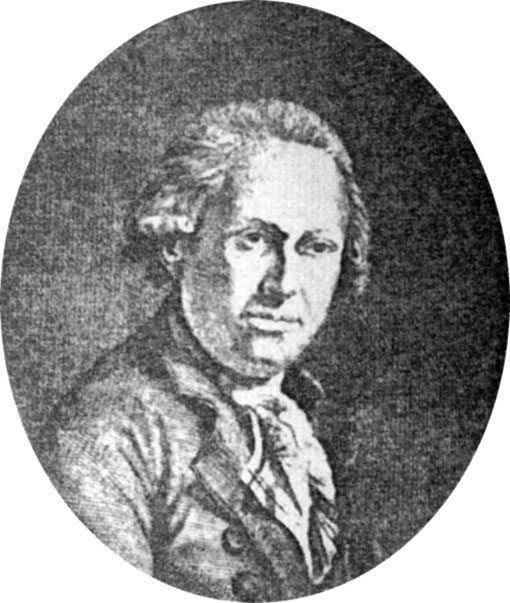
Gmelin Johann Friedrich

scientific classification:

Order: Psittaciformes
Family: Psittacidae
Genus: Guaruba
Scientific name: Guaruba guarouba
Citation: (Gmelin, JF, 1788)
Protonimo: Psittacus Guarouba

Golden Parakeet images:

Sources:

(1) – Avibase
(2) – Parrots of the World โ€“ Forshaw Joseph M
(3) – Parrots A Guide to the Parrots of the World – Tony Juniper & Mike Parr
(4) – Birdlife
(5) – WAZA

  • Photos:

(1) – Golden Parakeet (also known or Golden Conure) at Gramado Zoo, in south Brazil By Ironman br (Own work) [CC BY-SA 3.0], via Wikimedia Commons
(2) – Golden Parakeet or the Queen of Bavaria Conure in Burgers Zoo, Arnhem By frank wouters (originally posted to Flickr as goudparkiet) [CC BY 2.0], via Wikimedia Commons
(3) – Two Golden Parakeets at Gramado Zoo, Rio Grande do Sul, Brazil By diegodobelo (Zoo de GramadoUploaded by Snowmanradio) [CC BY-SA 2.0], via Wikimedia Commons
(4) – Golden Parakeet or the Queen of Bavaria Conure). Two captive By TJ Lin (originally posted to Flickr as Golden Conure) [CC BY-SA 2.0], via Wikimedia Commons
(5) – Photo taken at the National Aviary By Photo by and (C)2007 Derek Ramsey (Ram-Man) (Self-photographed) [GFDL 1.2 or CC BY-SA 2.5], via Wikimedia Commons
(6) – Photo taken at the National Aviary By Photo by and (C)2007 Derek Ramsey (Ram-Man) (Self-photographed) [GFDL 1.2 or CC BY-SA 2.5], via Wikimedia Commons
(7) – Golden Conure at the Parque das Aves, Foz do Iguaรงu, Brazil By Bruno Girin from London, United Kingdom (06680018Uploaded by Snowmanradio) [CC BY-SA 2.0], via Wikimedia Commons
(8) – Photo taken at the National Aviary By Photo by and (C)2007 Derek Ramsey (Ram-Man) (Self-photographed) [GFDL 1.2 or CC BY-SA 2.5], via Wikimedia Commons
(9) – Golden Conure by Jean – Flickr
(10) – Illustration Guaruba guarouba By Dutton, F. G.; Fawcett, Benjamin; Greene, W. T.; Lydon, A. F.; Lydon, A. F. [CC BY 2.0 or Public domain], via Wikimedia Commons

โ–ท The world of Pets: Dogs, cats, birds, reptiles, amphibians

Red-masked Parakeet
Psittacara erythrogenys

Aratinga de Guayaquil

Content


Anatomy-parrots

Description Aratinga of Guayaquil:

33 cm.. length between 165 and 200 g.. weight.

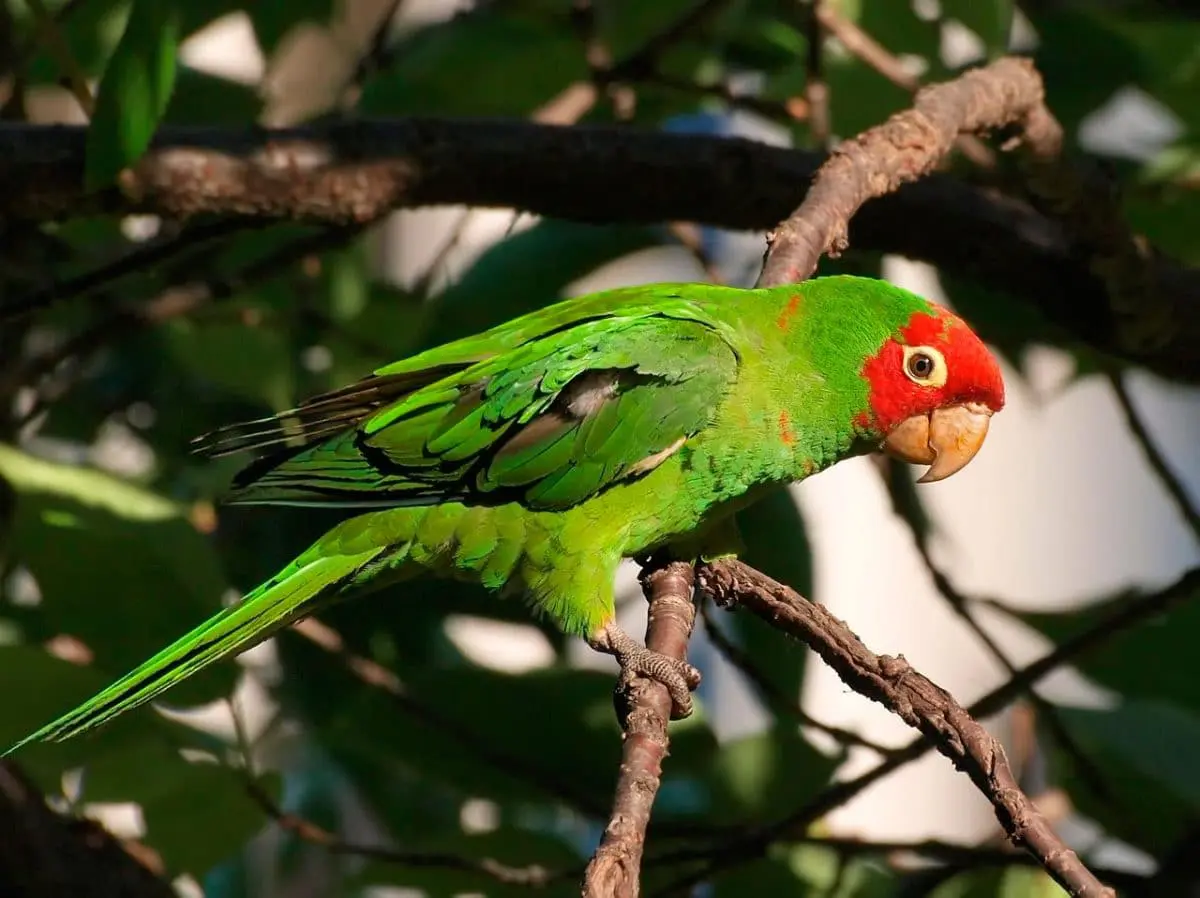
The Red-masked Parakeet (Psittacara erythrogenys) It is very similar to birds Scarlet-fronted Parakeet and to the Mitred Parakeet, but smaller and with more red area in the face, extending continuously up to the throat and nape.

Has the forecrown, crown, lores, the cheeks and the area around the eyes, bright red, generally forming a complete red mask to join to the chin (Sometimes the mask extends up to the throat). Since the nape up to the uppertail-coverts dark green, sometimes with scattered red feathers. The upperwing-coverts children with some feathers of red and the bend of wing red; remaining upperwing-coverts dark green, with dye Emerald to them vane outer the primary. The flight feather Brown Gold below; underwing-coverts minors, bright red, the greater coverts yellowish brown. The underparts brighter yellowish green, sometimes with mottled red and almost always with the the thighs red. Upper, the tail dark green; by below grayish brown.

The bill color pale horn; bare periophthalmic off-white; irises yellow; legs distant.

Both sexes similar.

The immature with the head and the thighs green.

Habitat Red-masked Parakeet:

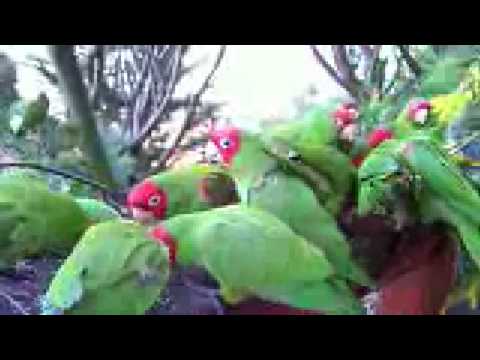
Video – "Red-masked Parakeet" (Psittacara erythrogenys)

Telegraph Hill Parrots January 30, 2008 (HD)

The Red-masked Parakeet It occupies a wide range of vegetation types, from arid zones to rainforests, Since the sea level to altitudes 2.500 m, Although its usual habitat is below of the 1.000 m, in humid forests, deciduous forests, areas of dry thorny scrub and arid with cactus; They also live in degraded forest, areas cultivated with scattered trees, and around the urban areas. They tend to prefer arid and semi-arid habitats, not avoiding moist forest habitats.

Outside the breeding season, is a bird gregarious; in general, observed in pairs or in groups of up to 12 individuals, forming groups of up to 200 birds in the places where their communal roosts are. Formerly registered flocks of thousands of birds in Guayaquil, Ecuador.

Often associated in mixed flocks with the Grey-cheeked Parakeet (Brotogeris pyrrhoptera) and also observed in mixed flocks with the Bronze winged Parrot (Pionus chalcopterus).

Reproduction Red-masked Parakeet:

Nests in holes of mature trees, for example of Ceiba trichistandra or Cochlospermun vitifolium, There are also records of nests in termite mounds, with a report in a nest on a cliff. The breeding season in the southwest of Ecuador recorded during the rainy season (January-March). The laying, between 2 and 4 eggs. The female the incubated eggs during 23 to 24 days. The pups they are born very little developed, blind and naked. They are fed with food previously digested by their mothers.

Food Aratinga of Guayaquil:

Few details exist about food preferences of the Red-masked Parakeet, Although seasonal movements from the more arid areas are probably related to food supply.

Reported foods include fruits of Hieronyma, Anacardiaceae, Oleaceae and Boraginaceae, as well as flowers of Erythrina.

Distribution:

Size of the area of distribution (reproduction / resident): 151.000 km2

The Red-masked Parakeet is distributed to the West of Ecuador and the Northwest corner of Peru.

In Ecuador, the species has been recorded from Manabi near south of the equator, through Pichincha, The rivers, Guayas, Azuay, Gold and Loja, until Tumbes, Piura, Lambayeque and Cajamarca, in the North of Peru and the region of Chachapoyas, amazon (6ยฐ 10โ€™S).

In Ecuador, the distribution of the Red-masked Parakeet is limited to the lowlands of the peaceful, Western slope of the Andes and valleys, Although it is apparently absent from the eastern slope; similar pattern in the Peru most Eastern records in the basin of the amazon (Valley of the Utcubamba River) to 77ยฐ 54โ€™W.

The seasonal movements to and from the more arid areas, otherwise, residents.

Usually considered to be common (described as the most common parrot in various locations in the province of Gold, Ecuador), but numbers fluctuate widely in some locations due to irregular seasonal movements. In some areas there has been a very drastic decrease of copies, reflecting the combined effects of the loss of habitat and your capture for the trade in live birds, for example, in Guayas, Ecuador.

There are at least eight protected areas, of which seven are in Ecuador.

There are leaks in Spain; so also in EE. UU., with breeding populations in the California cities of San Diego, Los Angeles, San Gabriel, Sunnyvale and San Francisco, You can see them eating fruits of cultivated tropical plants, and nesting in Palm trees.

Maintained in captivity at the local level (where is the most common Parrot kept in captivity) and commercialized in large quantities at the international level, especially since Peru.

Conservation:

State of conservation โ“˜


Near-threatened Near Threatened โ“˜ (UICN)โ“˜

โ€ข Red List category of the UICN current: Near-threatened

โ€ข Population trend: Decreasing

The size of the population This species has not been estimated officially, but, in the absence of sufficient data, It is suspected that it may be in around the 10.000 specimens, more or less equivalent to 6.700 mature individuals.

The population of the species is suspected that it may be subjected to a moderately rapid decrease, due to its capture for him pet trade together with the loss of habitat and fragmentation. Further research is required.

Conservation Actions Underway:

  • Appendix II of CITES.

Conservation Actions Proposed:

  • Carry out surveys to get an estimate of the population.
  • The current threat of trade research.
  • Enforcing trade restrictions.
  • Census of population and monitoring.
  • Monitor the rates of loss and fragmentation of habitat.
  • Study its ability to persist in altered and fragmented habitats.

The Red-masked Parakeet in captivity:

Shy and distrustful. Little common in captivity outside its area of distribution.

They may live until 25 years, Although the average tends to be between 10 and 15 years.

Their diet: fruit as, Apple, pear, orange, bananas, grenades, Kiwi, papaya, cactus fruits, they form a 30 percent of the diet. Vegetables, such as: Carrot, celery, green beans and peas in the pod, sweet corn on the cob, green leavess, such as: chard, lettuce , Kale, healer, Dandelion, Aviary grass, spray millet, mixture of small seeds, such as: Millet and small amounts of oats, buckwheat, safflower and hemp.

This species is found threatened from the wild bird trade local in Peru and Ecuador, where are rates of mortality due to mismanagement and stress high.

Never buy these birds in the illegal trade, Since these tend to come from its natural environment and it must be remembered that the Red-masked Parakeet is one endangered species.

Alternative names:

Red-masked Parakeet, Red Masked Conure, Red masked Parakeet, Red-headed Conure, Red-headed Parakeet, Red-masked Conure (English).
Conure ร  tรชte rouge, Conure ร  tรชte cerise, Conure ร  tรชte รฉcarlate, Perriche ร  tรชte rouge, Perruche ร  tรชte rouge (French).
Guayaquilsittich (German).
Periquito-de-cabeรงa-vermelha (Portuguese).
Aratinga de Guayaquil, Loro de cara roja, Periquito de Cabeza Roja, Perico Cara Roja (espaรฑol).
Loro de cara roja (Chile).
Cotorra de Cabeza Roja (Peru).
Perico caretirrojo (Ecuador).


scientific classification:

Renรฉ Primevรจre Lesson

Order: Psittaciformes
Family: Psittacidae
Genus: Psittacara
Scientific name: Psittacara erythrogenys
Citation: (Lesson, 1844)
Protonimo: Psittacara (psittacus) Erythrogenys

Red-masked Parakeet pictures:


Species of the genus Psittacara

Sources:

Avibase
– Parrots of the World โ€“ Forshaw Joseph M
– Parrots A Guide to the Parrots of the World – Tony Juniper & Mike Parr
– Birdlife
Feather wind

Photos:

(1) – A feral Red-masked Parakeet (also known as the Red-masked Conure and Cherry-headed Conure) in San Francisco, USA By Ingrid Taylar [CC BY 2.0], via Wikimedia Commons
(2) – Red-masked parakeet, Aratinga erythrogenys. Two birds in a tree in San Francisco, California By Jef Poskanzer (Flickr) [CC BY 2.0], via Wikimedia Commons
(3) – Red-masked Parakeet (Psittacara erythrogenys) at the Presidio, San Francisco, California By Frank Schulenburg (Own work) [CC BY-SA 4.0], via Wikimedia Commons
(4) – Red-masked parakeet (Aratinga erythrogenys). A juvenile parrot which is mostly green and just starting to get some red feathers on its head By Eliya Selhub (Flickr) [CC BY 2.0], via Wikimedia Commons
(5) – Red-masked Parakeet preening on a branch in San Francisco, USA By Ingrid Taylar from San Francisco Bay Area – California, USA [CC BY 2.0], via Wikimedia Commons
(6) – Red-masked Conure at Birds of Eden, South Africa By Dick Daniels (http://carolinabirds.org /) (Own work) [CC BY-SA 3.0 or GFDL], via Wikimedia Commons
(7) – A feral Red-masked Parakeet (also known as the Red-masked Conure and Cherry-headed Conure) in San Francisco, USA By Ingrid Taylar [CC BY 2.0], via Wikimedia Commons
(8) – Two feral Red-masked Parakeets in San Francisco, USA By Ingrid Taylar from San Francisco Bay Area – California, USA (Wild in SFUploaded by Snowmanradio) [CC BY 2.0], via Wikimedia Commons
(9) – Several Red-masked Parakeets eating a discarded apple in San Francisco, USA By Ingrid Taylar from San Francisco Bay Area – California, USA (A Big Find for ParrotsUploaded by Snowmanradio) [CC BY 2.0], via Wikimedia Commons

Sounds: (Xeno-canto)

โ–ท The world of Pets: Dogs, cats, birds, reptiles, amphibians

Green-cheeked Parakeet
Pyrrhura molinae


Green-cheeked Parakeet

Content

Description:

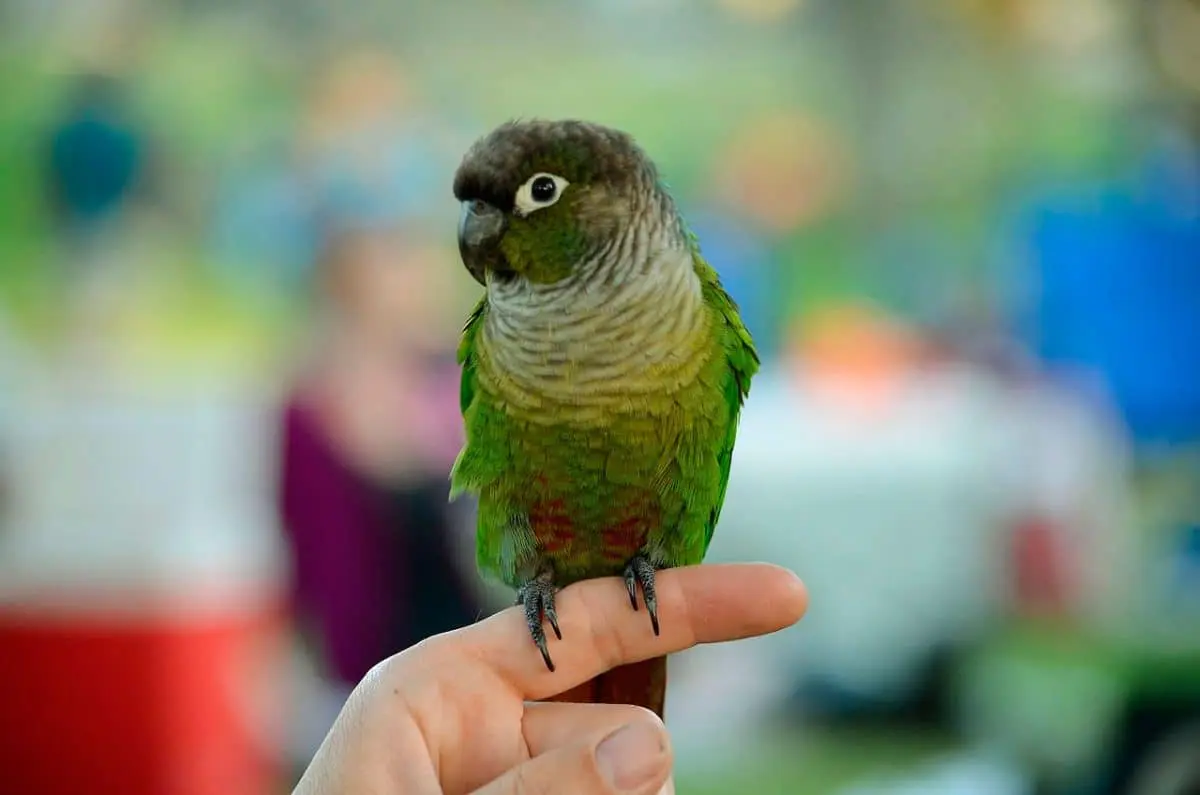
cotorra-de-molina-6

25 cm.. in length and 62โ€“81 grams in weight.

The Green-cheeked Parakeet (Pyrrhura molinae) has a close frontal band and lores, you are reddish brown to blackish; crown, of color brown or brown grayish marked laterally in shades blue and green; rear area of the crown and nape with blue tips; cheeks and sometimes the supercilii area (area of the front), of color green with dye olive; ear-coverts of color grey clear to pale.

Upperparts green. The primary coverts are bluish green and the remaining are mainly green, except for some feathers scattered of color blue, yellow or orange in the leading edge of wing. Primaries blue, secondaries Green with blue near the axis; both grey below. Underwing-coverts green. feathers in the chest, the throat and the sides of the neck, brownish at base with pale purple, light grey, or yellowish opaque in the tips, giving effect squamous; central belly with brown patches of varying size (only scattered feathers some birds); sides of the belly, the thighs and bottom of the chest, green; undertail-coverts bluish green.

Upper, the tail brown, with green at the base of the center of the tail feathers (hidden under the coverts); below, the tail brown.

The bill, grey; the cere white; bare periophthalmic whitish; irises brown; legs grey.

Both sexes are similar.

Immature paler. with the irises darker and less a defendant patch brown of the belly.

Subspecies description
  • Pyrrhura molinae australis

    (Todd, 1915) – Slightly smaller the species nominal, pale margin to the throat and to the close down of the chest; Brown-colored area in the chest more extensive; less blue in the undertail-coverts.


  • Pyrrhura molinae flavoptera

    (Maijer, Herzog, Kessler, Friggens & Fjeldsa, 1998) – Similar to the nominal species, but with the bend of wing and the carpal edge, orange-red; Alula with feather blue and yellow / white mixed.


  • Pyrrhura molinae hypoxantha

    (Salvadori & Festa, 1899) – Previously listed as Pyrrhura molinae sordida. The cheeks more pale that the of the nominal species; the color red in the belly less prominent and the skirting of feathers in the throat and the chest less distinctive.


  • Pyrrhura molinae molinae

    (Massena & Souancรฉ, 1854) – The nominal.


  • Pyrrhura molinae phoenicura

    (Schlegel, 1864) – It differs from the species nominal and of the subspecies Pyrrhura molinae australis, by having the basal half of feathers of the Centre of the tail, green. Some birds are yellow in the leading edge of wing.


  • Pyrrhura molinae restricta

    (Todd, 1947) – More blue that other subspecies, with stain blue in them lower cheeks and strong blue subfusion in the undertail-coverts. The blue tips on the feathers of the nape and zone back in the neck they form a most distinctive collar which in the nominal species.

Habitat:

The species Green-cheeked Parakeet inhabits dense forests, often low and forests with clear primary and secondary , including stripes of chaco, Savannah, deciduous forest and pantanal gallery, as well as rainforests MOSS-covered in the Eastern Andes where is reported to 2.900 meters above sea level.

In Brazil the subspecies Pyrrhura molinae hypoxantha are located mainly in deciduous forest above the 500 m.

Gregaria (at least outside the breeding season), usually in flocks of 10-20, sometimes many more.

Very often seen in rapid flight, under, fairly erratic and slightly wavy. Difficult to detect while feeding calmly in the treetops.

Reproduction:

It nests in hollow natural of trees. The laying is of 4 to 6 eggs during the month of February in the northeast of Argentina. Period of incubation: 20-24 days.

Food:

There is no information about the diet of the Green-cheeked Parakeet, but probably similar to nearby conspecifics; Forages in the treetops.

Distribution:

Size of the area of distribution (reproduction / resident): 675.000 km2

Its distribution runs from the southwest of Brazil and Northwest of Argentina to the East of Bolivia and probably South of Peru.

To this species is it can be observed in Mato Grosso and Mato Grosso from the South, in the southwest of Brazil, and in Beni, Peace, Cochabamba, Chuquisaca, Tarija and Santa Cruz, to the East of Bolivia, to the fringes of the chaco. They can be distributed through the North of Bolivia up to the end South of Peru, where a hybrid individual was captured with the Black-capped Parakeet (Pyrrhura rupicola).

Apparently absent from the land low of the pantanal and restricted in the basin of the Paraguay River isolated plots of forests of chaco in highlands on the right bank of the river.

In the Northwest of Argentina is distributed in Salta, Jujuy and with less frequency in Tucumรกn (a record in Catamarca is probably wrong).

They can live on the fringes of the Northwest of Paraguay but not is tested. Some local seasonal movements they can occur, birds in the higher elevations down to altitudes lower in winter (Mar-Aug).

Usually common (very common in Salta and Jujuy); Highest densities in deciduous forest; It is the most common parrot in the wooded valleys of Bolivia eastern but probably declining there due to rapid habitat clearance.

Is sold during those years eighty and was extended in captive outside of its area of distribution.

Subspecies distribution

Conservation:

State of conservation โ“˜


minor concern Minor Concern โ“˜ (UICN)โ“˜

โ€ข Current category of the Red List of the UICN: Least concern.

โ€ข Population trend: Stable.

Justification of the population

The size of the world population It has not been quantified, but this species is described as ยซcommonยป (Stotz et to the., 1996).

Justification of trend

Suspected that the population is stable in absence of evidence of any decline or threatens substantial.

"Green-cheeked Parakeet" in captivity:

Unknown in those birds up to the Decade of 1970, nowadays it is quite common. They have become one of the favorite birds in the pet trade, due to his sweet personality and at your disposal for fun. Son playful, loving and Smart.

They are not considered the best talkers. But, some Green-cheeked Parakeet, especially smart, they learned to speak very well, according to their owners. Even so, most say only a couple of things, And there's no guarantee that they'll ever learn to speak. They also have low and serious voice, so even if managed to talk, it would not be easy for them to say something understandable.

Price per couple (ancestral): 120-200 EUR. Hypoxantha: 150-300 EUR.

Alternative names:

Green-cheeked Parakeet, Green cheeked Parakeet, Green-cheeked Conure, Yellow-sided Conure (English).
Conure de Molina, Perriche de Molina, Perruche de Molina (French).
Molinasittich, Molina Sittich, Molina-Sittich (German).
cara-suja, tiriba-de-cara-suja (Portuguese).
Chiripepรฉ cabeza parda, Chiripepรฉ de cabeza gris, Cotorra de Molina, Perico Amarillo, Perico Verde, Cotorra de mejillas verdes (espaรฑol).
Chiripepรฉ cabeza parda (Argentina).
Chiripepรฉ cabeza parda (Paraguay).
Chiripepe cabeza parda (Bolivia).
Kirki (Aymara).
Sira (Guarani).

scientific classification:

Order: Psittaciformes
Family: Psittacidae
Genus: Pyrrhura
Scientific name: Pyrrhura molinae
Citation: (Massena & Souancรฉ, 1854)
Protonimo: Conurus molinae

Images Green-cheeked Parakeet:

Videos "Green-cheeked Parakeet"


Especies del gรฉnero Pyrrhura

Green-cheeked Parakeet (Pyrrhura molinae)


Sources:

Avibase
– Parrots of the World โ€“ Forshaw Joseph M
– Parrots A Guide to the Parrots of the World – Tony Juniper & Mike Parr
– Birdlife
โ€“ Book Parrots, Parrots and macaws
avianweb

Photos:

(1) – A Green-cheeked Parakeet perching on the index finger of a left hand By Eric Sonstroem from California, USA (Green-Cheeked ConureUploaded by snowmanradio) [CC BY 2.0], via Wikimedia Commons
(2) – Green-cheeked Conure perching in an aviary at Kuala Lumpur Bird Park, Malaysia By Brandon Lim (Rainbow LorakeetUploaded by Snowmanradio) [CC BY 2.0], via Wikimedia Commons
(3) – Green-cheeked Conure perching in an aviary By Brandon Lim (Rainbow LorakeetUploaded by Snowmanradio) [CC BY 2.0], via Wikimedia Commons
(4) – A juvenile pet Yellow-sided Green-cheeked Conure (also Sordid Conure and the Yellow-sided Conure). It is a naturally occurring subspecies of the Green-cheeked Conure. The photograph shows a wing-clipped pet parrot in a bird cage. By therouxdown (Reese closeupUploaded by Snowmanradio) [CC BY-SA 2.0], via Wikimedia Commons
(5) – A juvenile pet Yellow-sided Green-cheeked Conure (also Sordid Conure and the Yellow-sided Conure). It is a naturally occurring subspecies of the Green-cheeked Conure. The photograph shows a wing-clipped pet parrot perching on a food bowel By therouxdown (originally posted to Flickr as Reese profile) [CC BY-SA 2.0], via Wikimedia Commons
(6) – Molinaโ€™s Parrot from Philip Lutley Sclater and W. H. Hudson, Argentine Ornithology: A Descriptive Catalogue of the Birds of the Argentine Republic (1888-89) in Wikimedia

Sounds: (Xeno-canto)

โ–ท The world of Pets: Dogs, cats, birds, reptiles, amphibians

Red-fronted Parrotlet
Touit costaricensis

The few records Red-fronted Parrotlet existing in Costa Rica come from, mainly, from the central-southern highlands of the Caribbean slope.
Red-fronted Parrotlet
A captive Costa Rican Parrot eating – Nrg800, CC BY-SA 3.0, via Wikimedia Commons

Content

Description:


Anatomy-parrots

17,5 cm.. length.

The Red-fronted Parrotlet (Touit costaricensis) has the forecrown, anteriorly of crown, lores and stripe under the eyes, red; sides neck, cheeks and upperparts, green with the back of the crown and nape slightly paler and yellower. Inner wing-coverts green; exterior and median coverts and wing leading edge, red; primary coverts black.

Primaries and outer secondaries, black with green margin to outerweb of the primaries. Inner underwing-coverts, yellow, the outer, red. Feathers on base of the beak, on chin and throat, brighter yellowish green; the chest, the belly and undertail-coverts, green tinted yellowish. The tail greenish yellow with a black tip (except the outermost feathers) and dark green subterminally. Bill pale yellow; cere and bare periophthalmic, grey; irises grey; legs slaty.

The female It has less red on the upperwing-coverts, and perhaps more yellow in the underwing-coverts; probably, on average, are smaller than males. The immature It has little or no red on the head.

Note:

The Red-fronted Parrotlet It has sometimes been treated as conspecific with the Blue-fronted Parrotlet (Touit dilectissimus) North of South America and Panama. Although these taxa are clearly allied and share a recent common ancestor, most authors now treat them as separate on the basis of their clear and consistent plumage differences. The structural divergence can also exist in the Red-fronted Parrotlet longer seems to show the uppertail-coverts (extending almost to the end of the tail) its counterpart Southern, While (although the sample is small) it suggests a sexual dimorphism by the length of the wings and tail on Red-fronted Parrotlet but not in Blue-fronted Parrotlet.

Habitat:

Generally observed in the canopy moist forests at mid-altitudes. It moves towards the thicket, on forest edges, flying over the clear, sometimes in the lowlands (sometimes at sea level, especially in southeast Costa Rica), where perhaps it is a seasonal visitor. Tolerates some habitat alterations.

Observed in association with Red-headed Barbet (Eubucco bourcierii) and Blue-and-gold Tanager (Bangsia arcaei), both species associated in cool wet forests in the upper tropics and subtropics.

Observed to 3.000 meters in Costa Rica in the early dry season and reported regularly at altitudes 500-1.000 m during the wet season. Usually in pairs or small flocks family.

Reproduction:

The family size usually between 4-5 birds, suggests the clutch usual 2-3 eggs. probably plays during the season, dry.

Food:

They feed on fruits trees and epiphytes, such as Cavendishia and Clusia, but probably also include flowers and seeds.

Distribution:

Size of its range (breeding/resident): 10.000 km2

The few records Red-fronted Parrotlet existing in Costa Rica come, mainly, the highlands of central-south Caribbean side, where its range seems to extend to the south, from Monteverde, Turrialba volcano and Lemon.

Although there are no records in much of the east of Costa Rica, its existence can be continuous along the Cordillera de Talamanca (perhaps only in the Caribbean side) to western Panama. The handful of panamanian specimens and records from observations, They are mainly from the western highlands to a report from the east, about the Cocle Province.

It is obviously a kind rare and presumably in decline due to continued deforestation (at least in the lowlands) in a limited range.

Conservation:


Vulnerable

โ€ข Current category of the Red List of the UICN: Vulnerable.
โ€ข Population trend: Decreasing.

Population size : 2500-9999 specimens.

Rationale for the Red List category

This species is classified as Vulnerable because the clearing and forest fragmentation at middle elevations, mainly in the Central Volcanic Range and in the Sierra de Tilarรกn of Costa Rica, It is likely to be causing significant slopes in its small range and (presumably) in population.

Justification of the population

It is estimated that the breeding population of the Important Bird Areas of Costa Rica is 1.000 to 4.000 mature individuals (J. And others Craido 2007, J. Sรกnchez et al., In 2007), so it is believed that the total population may be within the range of 2.500-9.999 mature individuals. This is equivalent to 3.750-14.999 individuals in total, rounded here to 3.500-15.000 individuals.

Justification of trend

It is suspected that the population species is decreasing at a moderate rate, in line with continued clearing of its forest habitat in the northern part of its range.

Conservation Actions Underway

CITES Appendix II. Live in several areas protected, including national parks Braulio Carrillo, Tapantรญ-Cerro de la Muerte and Monteverde, Costa Rica, and La Amistad International Park and adjacent reserves in both countries. But, The legal protection of Palo Seco Protected Forest (BPPS) (a booking Panama adjacent to La Amistad) has not prevented clearance for agriculture (Angehr and Jordan, 1998).

Conservation Actions Proposed

Evaluate the importance of habitat outside the breeding season (J. Created en lit. 2007, J. Sanchez et al., In 2007). Conduct surveys to determine the total size of the population. Study of the ecology of the species (J. Sanchez et al., in bed. , 2007). Monitor population trends through regular surveys. Monitor rates of loss and recovery of forests (J. Sanchez et al., In 2007). Effectively protect the Bosque Protector Palo Seco (BPPS).

"Red-fronted Parrotlet" in captivity:

No reports are known captive birds.

Alternative names:

Red-fronted Parrotlet, Red fronted Parrotlet (English).
Toui du Costa Rica (French).
Costa-Rica-Papagei (German).
Red-fronted Parrotlet (Portuguese).
Cotorrita Costarricense, Lorito de Pecho Rojo, Periquito alirrojo (espaรฑol).

scientific classification:

Order: Psittaciformes
Family: Psittacidae
Genus: Touit
Scientific name: Touit costaricensis
Citation: (Cory, 1913)
Protonimo: Urochroma costaricensis

Images of the "Red-fronted Parrotlet"

Video of the "Red-fronted Parrotlet"


Species of the genus Touit


"Cotorrican Parrot" (Touit costaricensis)


Sources:

Avibase
– Parrots of the World โ€“ Forshaw Joseph M
– Parrots A Guide to the Parrots of the World – Tony Juniper & Mike Parr
– Birdlife

Photos:

(1) – Papagei am Rincon de la Vieja by Kovac – GEO Reisencommunity

Sounds:

โ–ท The world of Pets: Dogs, cats, birds, reptiles, amphibians

Cuban Parrot
Amazona leucocephala

Cuban Parrot

Content

Description:


Anatomy-parrots

28-33 cm.. length and 260-301 g. of weight.
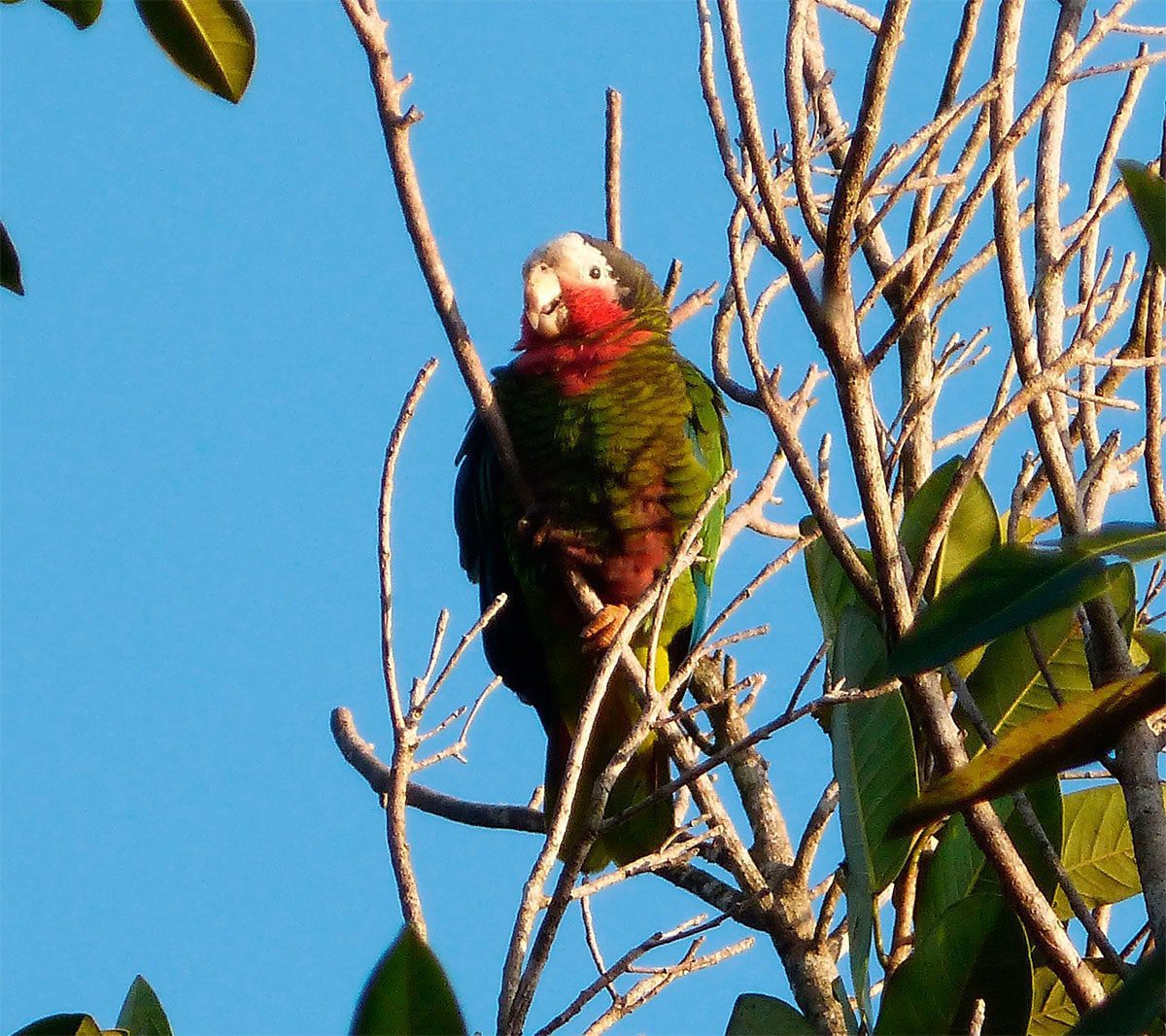
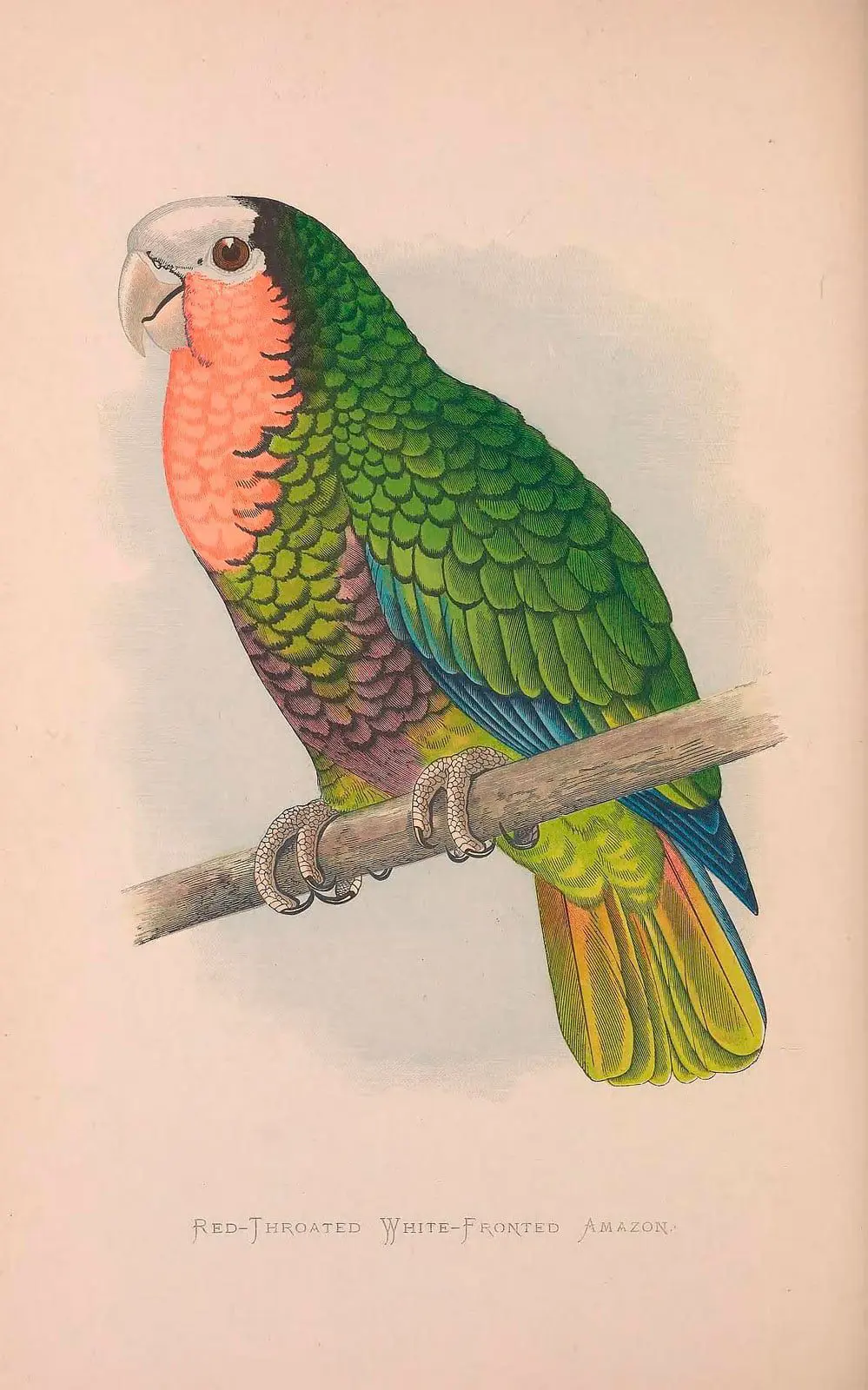
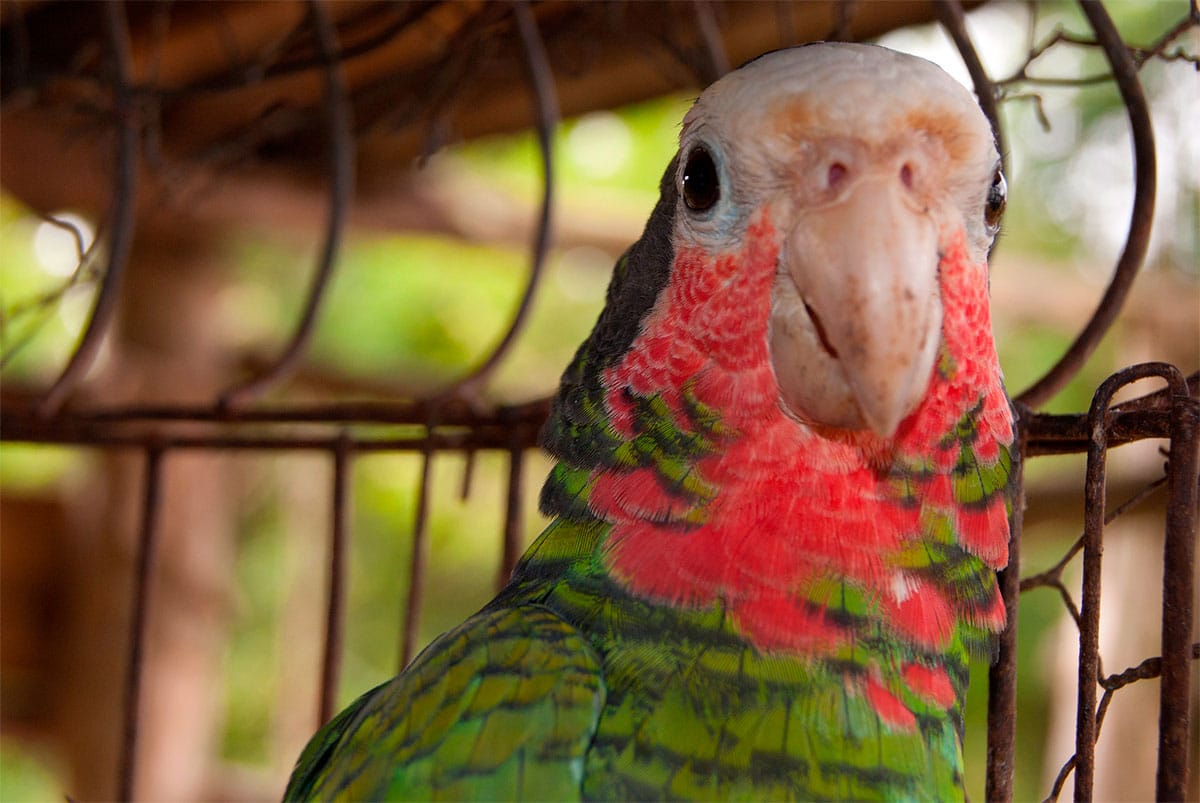
The Cuban Parrot (Amazona leucocephala) has a plumage rather variable, a main color ranging from bright green to olive color,, some birds feathers yellow dispersed in wings and in the back.

Forehead, fore crown, lores and area around eyes, white; lower cheeks and throat, red-pink; feathers the back of the crown and nape, bluish-green with black margins, giving the whole a heavy barred effect; similar pattern on the sides of neck but with the bluish tint absent; ear-coverts charcoal grey. Feathers of the back and the mantle, green with black distal margins but less intense than in the nape and head; rump and uppertail-coverts, dark green with weak margins to some feathers rump.

Cuban Parrot

Alula, greater coverts and flight feather, blue on the outerweb, gray on inner; remaining coberteras green with dark margins, showing most distinct barring on lesser coverts. Under the wings, green with dark margins, flight feather grey. Breast green with dark margins to most feathers; feathers on belly with vinaceous base showing green at margins forming a patch variable-sized, barely noticeable in some birds, striking in other; the thighs green or with some vinaceous feathers; undertail-coverts green. feathers tail green with red at base. Bill yellow-horn: irises reddish brown; legs yellowish brown.

Both sexes are alike, but males of the subspecies caymanenis reportedly larger and brighter than females. Usually, the immature show less black borders on the body feathers and less red wine in the belly.

  • Sound of the Cuban Parrot.

Description 4 subspecies:
  • Amazona leucocephala bahamensis

    (Bryant,H, 1867) – Larger that the nominal species, with slate blue on the back of the crown and more extensive white color head. Pens red wine in the belly, reduced or absent and red at the bottom of the tail less extensive.


  • Amazona leucocephala caymanensis

    (Cory, 1886) – It differs from other subspecies by the turquoise dye in the chest and in the rump and rosacea suffusion (sometimes yellowish) in white feathers head. Plumage Barred yellower and less thick than the nominal species (especially below and on upperwing-coverts), with less white in the head and much less pronounced the patch red wine belly.


  • Amazona leucocephala hesterna

    (Bangs, 1916) – Smaller and darker than the nominal species and that the subspecies caymanensis, most individuals with the red color confined to a point under the eye and patch smaller target in the crown, it lacks the rosy tint of the subspecies caymanensis. Patch red wine in the larger belly than the subspecies caymanensis.


  • Amazona leucocephala leucocephala

    (Linnaeus, 1758) – Nominal.

Habitat:

Cuban Amazon Video

The Cuban Parrot They inhabit in different habitats in different islands. In Cuba They inhabit dense forests; in the Bahamas, in native broadleaf forests and pine forests, and in the Cayman Islands, in dry forests in the plateau ridge and on nearby farmland (Bond 1979, King 1981, Sibley y Monroe 1990). Usually in small groups but forages while forming larger groups in places where food is plentiful; couples or family groups in flocks discernable. More usually in pairs during breeding. They sleep communally outside the breeding season.

Reproduction:

The Cuban Parrot make their nests in cavities or palm tree hollows created by termites or woodpeckers. The population of Abaco It is particularly interesting because nests in natural holes in substrate limestone in the soil (O'Brien et al., 2006); over there, chicks and adults are completely isolated from the frequent fires in the pine forests They are forming their habitat. Breeding March until mid-summer Cuba and Abaco. The laying usually it comprises between 2 and 4 eggs, the incubation period hard of 26 to 28 days and the chicks remain in the nest between 56 and 60 days.

Food:

The diet It includes yema Leaf Roystonea, the cones and new shoots tender the Pinus caribea, sea รขโ‚ฌโ€นรขโ‚ฌโ€นgrape uvifera and Conocarpus erretis, fruits and seeds of Smilax, Sabal, Durant, Exothea, Ernodea, Tabebuia, Acacia, Metopium, Tetrazygia, Swietenia, Cupania and Lisiloma. Sometimes they are persecuted for damage cultivated fruits like Mango (Mangifera) and grain.

Distribution and status:

Size of its range (breeding/resident): 590.000 km2

The Cuban Parrot live in Cuba, Island Pines, Bahamas and Cayman Islands. Formerly observed throughout the island Cuba but now it is difficult to see or is extinct in much of the island. They are still locally distributed throughout the provinces but they are still only common in a few redoubts, including the peninsulas of Zapata and Guanahacabibes and in Sierra de sewage.

You can see in the Isle of Pines (Isle of youth) which dropped dramatically in the twentieth century, especially during the sixties, with most of the population surviving on Lanier Swamp National Park.

Formerly distributed by all the major islands of the Bahamas, but currently extinct, Except in Gran Inagua (spread south, east and north) and Abaco (especially in the southern third). You can visit Little Inagua from Great Inagua.

Mainly in the central and eastern parts of Grand Cayman where habitat loss is less severe. A residual population persists Cayman Brac but it became extinct in little Cayman about 1932.

Mainly resident, but with some seasonal movements, for example in the Isle of youth, where birds possibly (at least once) moved to the coast from the dry interior in the non-breeding season.

The decline across the range is due to the habitat destruction and capture of birds Vivas (for use as pets locally and for export).

Poor breeding success in Grand Cayman in the seventies it was due to mosquito attacks against the pups. Birds that nest on the ground in Abaco attacked by wild cats. The hurricanes They can cause shortages of food and nesting sites. It is likely that Bahamas are stable, but generally decreasing. You can not be considered safe in most of its range.

Distribution 4 subspecies:

Conservation:

State of conservation โ“˜


Near-threatened Near Threatened โ“˜ (UICN)โ“˜

Rationale for the Red List category

The Cuban Parrot It is classified as near threatened because it is suspected to have suffered a reduction in population in Cuba, which has not ceased, mainly due to the capture and destruction of nesting sites.

โ€ข Current category of the Red List of the UICN: Near-threatened.

โ€ข Population trend: Decreasing.

โ€ข Population size : 13600-23000

Justification of the population

Population estimates for Bahamas and Cayman Islands they are as follows: 2.000 in Gran Cayman in 1995 (Bradley 2000), about 450 in Cayman Brac in 2013 (Marsden, 2013), 8.000-13.000 in Great Inagua, 3.000-5.000 in Abaco and around 10 individuals in new Providence (Bahamas National Trust 2016, S. Cant-Woodside in a bit., 2016). It is estimated that the population of Cuba amounts of 7.000 to 14.000 copies based on estimates recorded population density and the fact that it is likely that only a proportion of the estimated extent of occurrence deal. So, the total population It is estimated in 20.460-34.460 individuals, which is equivalent to 13.640-22.973 mature individuals, rounded here to 13.600-23.000 mature individuals.

Justification of trend

It is considered that the species is declining mainly due to the capture and destruction of nesting sites. It is considered that the population of the Bahamas It has remained stable or increased. The population of the Cayman Islands It has increased since the species was protected in 1989 (Bradley 20000). It is believed that the Cuban population has decreased in recent years, mainly due to the poaching (Canizares 2012, M. Canizares in a bit., 2016). Although there is no data on the extent of this decline, the species has been classified as Vulnerable in Cuba (Canizares 2012). So, It is suspected that the total population has decreased 10-20% over three generations.

Conservation Actions Underway

โ€ข CITES Appendix 1.

โ€ข Protected in the Bahamas under the Wild birds Protection Act (Protection).

โ€ข Rightfully protected in the Cayman Islands from 1989.

โ€ข Los artificial nests a variety of designs are in use in several locations Cuba and they have been used by more than 1.300 birds (Waugh 2006). The facts of artificial materials have proved more durable (Waugh 2006).

โ€ข Los volunteers counts in the center of Cuba They have been conducted twice a year since 2009 and more than 1.500 local people are involved in the activity.

โ€ข Important plant species are used for parrot feeding for reforestation and forest enrichment..

Conservation Actions Proposed

โ€ข Discourage the taking of birds from the wild through public education campaigns.

โ€ข Promote better bird-keeping practices to increase the longevity of captive birds and reduce the demand for wild populations.

โ€ข In Abaco, protect vital areas of broadleaf forests.

โ€ข In Cuba, make and erect more artificial nests.

โ€ข Monitor the population trends across its range.

Cuban Parrot in captivity:

Currently international trade Cuban Parrot It is legally prohibited; However, at regional level, the illegal traffic This species is one of the most worrying in Cuba.

Each captive specimen of this species which is capable of reproducing, must be placed in a well-managed captive breeding program and not sold as a pet, in order to ensure its long-term survival.

Alternative names:

bahaman parrot, Caribbean Amazon, Caribbean Parrot, Cuban Amazon, Cuban Parrot, Rose-throated Parrot, White-headed Amazon, White-headed Parrot (English).
Amazone ร  face rouge, Amazone ร  tรชte blanche, Amazone de Cuba (French).
Kubaamazone (German).
Papagaio-de-cuba (Portuguese).
Amazona Cubana, Cotorra (espaรฑol).

Carl Linnaeus

scientific classification:


Order: Psittaciformes
Family: Psittacidae
Genus: Amazona
Scientific name: Amazona leucocephala
Citation: (Linnaeus, 1758)
Protonimo: Psittacus leucocephalus


Images Cuban Parrot:


Species of the genus Amazona


Sources:

(1) Avibase
(2) Parrots of the World โ€“ Forshaw Joseph M
(3) Parrots A Guide to the Parrots of the World – Tony Juniper & Mike Parr
(4) Birdlife

Photos:

(1) – Rose-throated Parrot. Amazona leucocephala Long Beach, Zapata N.P. Cuba by gailhampshireFlickr
(2) – A Cuban parrot (amazona leucocephala) in Naturarte Center. santa Clara, Cuba 2011 by lezumbalaberenjenaFlickr
(3) – A Cuban parrot (Amazona leucocephala) Vega de Palma, Camajuanรญ, Cuba by lezumbalaberenjenaFlickr
(4) – Amazona leucocephala by Ekaterina Chernetsova (Papchinskaya)Flickr
(5) – Amazona leucocephala by Ekaterina Chernetsova (Papchinskaya)Flickr
(6) – Cuban Parrot (Amazona leucocephala) by HeathFlickr
(7) – Cuban Amazon by Eric SavageFlickr
(8) – Two Cuban Amazons in Matanzas, Matanzas Province, Cuba By Laura Gooch (BI110211-174 – Cuban Parrot) [CC BY-SA 2.0], via Wikimedia Commons
(9) – Cuban Amazon parrot on Grand Cayman Island By Lhb1239 (Own work) [CC BY-SA 3.0], via Wikimedia Commons
(10) – Cuban Amazon (also known as the Rose-throated Parrot) at Jungle Island, Miami, USA By Chris Acuna from Miami, USA (Jungle Island-20090823-086) [CC BY 2.0], via Wikimedia Commons
(11) – A Cuban Amazon in Isla de la Juventud, Cuba. It is in a small round cage on a balcony By Alex Graves (Parrot) [CC BY-SA 2.0], via Wikimedia Commons
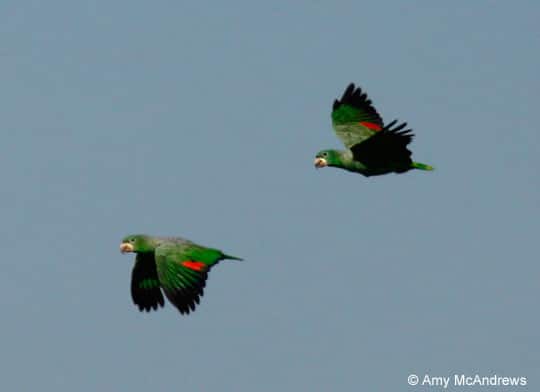
(12) – A Cuban Amazon flying in Matanzas, Matanzas Province, Cuba By Laura Gooch (BI110211-159 – Cuban Parrot) [CC BY-SA 2.0], via Wikimedia Commons
(13) – Cayman parrot (Amazona leucocephala caymanensis), Grand Cayman By Charlesjsharp (Own work, from Sharp Photography, sharpphotography) [CC BY-SA 4.0], via Wikimedia Commons
(14) – Parrots in captivity /. London :George Bell and Sons,1884-1887 [i.e. 1883-1888] by Biodiversity Heritage LibraryFlickr

Sounds: Hans Matheve, XC256757. accessible www.xeno-canto.org/256757

โ–ท The world of Pets: Dogs, cats, birds, reptiles, amphibians

Kawall's Parrot
Amazona kawalli

Kawall's Parrot

Content

Description:

35-36 cm.. length.

The Kawall's Parrot (Amazona kawalli) after not having been recorded in the wild for a few 70 years, It was rediscovered in the early 1980.

Wrongly confused with Southern Mealy Parrot (Amazona farinosa) which differs from the remarkable white band at the base of bill.

They have forecrown, the lores, the cheeks and ear-coverts green, although in some birds appear blackish. The crown, sides and back of the neck, as well as the nape, They are green with broad blackish margins to feathers, giving the whole a intricate scaly appearance, with escalation most pronounced in the nape and the the mantle.

Kawall's Parrot

Upperwing-coverts green, with the coverts smaller and medium dark shades showing weak at tips; some feathers yellowish green in the leading edge of wing . Primaries green with black towards the tips and some blue in outerweb (a specimen with primary external bright yellow in a wing); red in the three secondaries External form a speculum bright. The underparts They are green with scaling effect derived from the blackish tips to the feathers on the sides of the low chest; some feathers with dark tips in the middle of the chest although little visible; undertail-coverts, more greenish yellow. Upper, the tail It is green with wide band terminal greenish yellow, lateral feathers variably marked dark red (sometimes lined with black-brown and blue) in basal half; undertail, the tail similar but slightly off.


Anatomy-parrots

Bill gray bare skin cream in the base and a cream patch on the upper jaw; irises reddish-orange; legs gray.

The male has the lores and perhaps gray bill largest. Immature not described.

  • Sound of the Kawall's Parrot.

Habitat:

The Kawall's Parrot They inhabit tropical rainforests, with apparent preference for river edges and permanently flooded forests (igapรณ).

Reproduction:

Nests observed in tree cavities flooded forest

Food:

Foods reported include seeds trees Hevea brasiliensis and H. spruceana, mesocarpio palm fruit Maximiliana maripa and seeds of Eichleria and Joannesia.

Distribution:

Size of its range (breeding/resident ): 1,160,000 km2

The few published records come from the Amazon basin of Brazil; on top of Juruรก (under Eirunepรฉ), in the amazon; the confluence of roosevelt river and Aripuanรฃ River, to the South of For; and southern Santarรฉm, For.

Possibly they overlooked in the field due to morphological similarities with some of the best known and there are almost certainly more individuals than congeners the few records suggest. Distribution map based on alleged occurrence among localities known. No details on the population or condition.

Conservation:

State of conservation โ“˜


Near-threatened Near Threatened โ“˜ (UICN)โ“˜

โ€ข Current category of the Red List of the UICN: Near-threatened.

โ€ข Population trend: Stable.

Rationale for the Red List category

Based on a model of future deforestation in the Amazon basin and the susceptibility of the species to habitat fragmentation and hunting , It suspected population decline by 25-30% in the next three generations and, therefore, It has risen to Near Threatened.

Justification of the population

The size of the world's population has not been quantified, but this species is described as ยซrareยป (Stotz et to the., 1996).

Justification of trend

It is suspected that this species has lost 19.1-33.6% of habitat suitable within their distribution during three generations (37 years), based on a model of Amazon deforestation (Soares-Filho et to the., 2006, Bird et to the., 2011). But, it is considered that the species has a wider distribution than indicated on the map used in this analysis (A. Lees in litt 2011), As it suspected to decline by 25-30% during three generations.

Conservation Actions Underway

The species in Appendix II CITES.

Conservation Actions Proposed

First of all, expand the network of protected areas to effectively protect the IBA. Second manage more effectively the resources and existing and new protected areas, using the emerging opportunities for funding the management of protected areas with the overall goal of reducing carbon emissions and maximize the conservation of biodiversity. Especially relevant conservation on private land, through the expansion of market pressures for proper land management and prevention of deforestation on land not suitable for agriculture (Soares-Filho et to the., 2006). Campaign against proposed changes to Brazilian Forest Code that would lead to a decrease in the width of protected riparian forest areas such as Permanent Preservation Areas (APPs), that function as vital corridors in fragmented landscapes.

"Kawall's Parrot" in captivity:

The Kawall's Parrot It is a half-noisy parrot, not very active and hard chewing. They can easily tame. They are not common in aviculture. They are hardy once acclimated. Its minimum temperature tolerance is 15 degrees. Any lower temperature than this requires supplemental heat until the Parrot has acclimatized.

Alternative names:

Kawall’s Amazon, Kawall’s Parrot, Kawall’sParrot, White-cheeked Amazon, White-faced Amazon (English).
Amazone de Kawall (French).
Kawallamazone, Stromamazone (German).
papagaio-dos-Garbes (Portuguese).
Amazona de Kawall, Loro de Kawall, Loro de Kawallรญ, Amazonas de mejillas blancas,
loro de garbes
(espaรฑol).


scientific classification:

Rolf Grantsau

Order: Psittaciformes
Family: Psittacidae
Genus: Amazona
Scientific name: Amazona kawalli
Citation: Grantsau & Camargo, 1989
Protonimo: Amazona kawalli

Kawall's Parrot images:

Amazona de Control


Videos Kawall's Amazon:


Species of the genus Amazona


Sources:

  • Avibase
  • Parrots of the World โ€“ Forshaw Joseph M
  • Parrots A Guide to the Parrots of the World – Tony Juniper & Mike Parr
  • Birdlife

Photos:

(1) – Kawallโ€™s Amazon at Rio Cristalino, Mato Grosso, Brazil by Jacek Kisielewski [CC BY-SA 3.0], via Wikimedia Commons
(2) – Kawallโ€™s Parrot (Amazona kawalli) Cristalino Jungle Lodge, Mato Grosso, Brazil by Amy McAndrewsFlickr
(3) – ROLF GRANTSAU* and Hร‰LIO F. DE ALMEIDA CAMARGO** Museum of Zoology of the University of Sรฃo Paulo CP 7172, Sao Paulo, Brazil – NEW BRAZILIAN AMAZON SPECIES

Sounds: Jeremy Recall, XC313948. accessible www.xeno-canto.org/313948

โ–ท The world of Pets: Dogs, cats, birds, reptiles, amphibians

Slender-billed Parakeet
Enicognathus leptorhynchus

Slender-billed Parakeet

Content

Description:

40 to 42 cms. length and 200 to 250 g. of weight.
The Slender-billed Parakeet (Enicognathus leptorhynchus) has the lores, forecrown and a narrow ring feathers around the eyes bright crimson red; cheeks and sides neck, green; feathers of the crown, the nape, the the mantle and back, with dark green margins producing a scalloped effect (more pronounced in the crown, where the feathers are brighter and more emerald).

Scapulars, rump and uppertail-coverts They are green. Primary coverts green with blue suffusion; other coverts green. Flight feathers green-blue above with dark margins in innerwebs near the tips; light gray below. Underwing-coverts brighter yellowish green. Underparts yellowish green with patch dull red in centre of belly. Upper, the long tail red is off; greenish toward the tip; undertail, dull red suffused greyish.

Slender-billed Parakeet

The upper jaw It is dark gray with colored tip horn, the lower jaw is horn; Strait bare periophthalmic grey; irises orange-red; legs grey.

Both sexes are similar.

Immature darker, with the upper jaw shorter, less red in the face little or no red on belly.

  • Sound of the Slender-billed Parakeet.

Habitat:

Video – "Slender-billed Parakeet" (Enicognathus leptorhynchus)

CHOROY PARROT EATING

The Slender-billed Parakeet dwells in wooded areas, mainly Nothofagus and Araucaria, although they can be seen in more open cultivated fields or pastures, especially in winter. Its range is from sea level in winter to 2.000 meters in summer. Usually in flocks, of a few individuals to several hundred, even in breeding season; large communal concentrations sometimes composed of several thousand birds.

Reproduction:

Nests generally treeholes, often at a certain height and several couples using the same tree; very deep holes fill them with twigs to raise the base level. Occasionally nidifican in rock crevices, building the nest with twigs (for example, bamboo thicket This chusquea) if there is no tree cavities available. breeding season in November-December. Clutch 5-6 eggs.

Food:

Its diet It consists of seeds of wild and cultivated plants (They are sometimes considered a pest), including grains and thistles, seed cones araucaria (March April) open with its elongated peaks, acorns, seeds of Nothofagus and bulbous roots. generally place vigilantes while the rest of the birds feed.

Distribution and status:

Distribution area (breeding / resident): 195.000 km2

The Slender-billed Parakeet It is confined to the center Chile, from the South of Santiago through coastal lowlands and valleys on the slopes of hills peaceful, south to the Chiloe Island and maybe Palena River in the North of Aysen; They can also be seen in Isla Mocha off the southwest coast bio bio.

made some movements altitudinal seasonal, with moving from coastal lowlands to the foothills of the hills between spring and autumn bird (September-May).

Quite common, although in recent decades its population has suffered a decline due to, fundamentally, deforestation, his capture and the Newcastle disease.

Less frequent and perhaps only sporadic in the northern and southern ends of its range.

Caught locally as pets, although quite rare in captivity outside Chile.

Conservation:

State of conservation โ“˜


minor concern Minor Concern โ“˜ (UICN)โ“˜
  1. Current red list category of the UICN: Least concern.
  2. The population trend: Stable.
  3. Population size : Unknown.

(classified in Appendix II of CITES)

Justification of the Red List of the Category

This species has a range very large, and as a result does not approach the thresholds for Vulnerable under the range size criterion (extent of occurrence <20.000 km2). La tendencia de la population seems to be stable, and therefore the species does not approach the thresholds for Vulnerable according to the population trend criterion. (> 30% decrease of more than ten years or three generations). The population size It has not been quantified, but are not believed to approach the thresholds for Vulnerable based on population size criteria (<10.000 individuos maduros con una disminuciรณn continua estima en> 10% in ten years or three generations, or in a particular population structure). For these reasons, the species is evaluated as Least concern.

Justification of the population

The world population It has not been quantified, but the species according to sources is locally common (pit et to the., 1997).

Justification trend

The population suspected to be stable in the absence of evidence of any reduction or substantial threats.

"Slender-billed Parakeet" in captivity:

Virtually unknown until 1976.

It is a nice and noisy bird, whose docility and cunning behavior have meant it to be hunted down and captured to commercialize as pets, very common but absolutely illegal practice, because they are removed from their natural means of inhabitancy in South Chile, which they can not be replaced in urban areas and in captivity. People who do sell through a network of illegal trafficking. However, it is a rare bird watching in captivity outside Chile.

In captivity, according to sources, a specimen lived 15,3 years.

Alternative names:

Chilean Parakeet, Long-billed Conure, Long-billed Parakeet, Slender billed Parakeet, Slender-billed Conure, Slender-billed Parakeet, Slight-billed Conure, Slight-billed Parakeet (English).
Conure ร  long bec, Perriche ร  long bec, Perruche ร  long bec (French).
Langschnabelsittich, Langschnabel-Sittich (German).
Periquito Delgado-faturado (Portuguese).
Choroy, Cotorra Choroy (espaรฑol).


scientific classification:

Admiral Phillip Parker King

Order: Psittaciformes
Family: Psittacidae
Genus: Enicognathus
Scientific name: Enicognathus leptorhynchus
Citation: (King, PP, 1831)
Protonimo: Psittacara leptorhyncha

Images Slender-billed Parakeet:


Species of the genus Enicognathus

Sources:

  • Avibase
  • Parrots of the World โ€“ Forshaw Joseph M
  • Parrots A Guide to the Parrots of the World – Tony Juniper & Mike Parr
  • Birdlife
  • surmagico

Photos:

  • (1) Enicognathus leptorhynchus (Slender-billed parakeet), Vogelpark Walsrode Taken sometime during 1985 by Rรผdiger StehnFlickr
  • (2) Enicognathus leptorhynchus Paso Mamuil by Malal xerofitoFlickr
  • (3) they choroy, recovering after being stoned Austral By Blizzard (Own work) [CC BY-SA 4.0], via Wikimedia Commons
  • (4) Slender-billed Parakeets rehabilitating in a Parque Tumbes in a large aviary, Talcahuano, Bio Bio Region, Chile. In January 2012, about a 100 parrots were rescued from a pet shop in La Granja, Santiago Province, Chile. They were rehabilitated for about three months before being released to the wild. By Municipality of Talcahuano [CC BY-SA 2.0], via Wikimedia Commons
  • (5) Enicognathus leptorhynchus – thin-beaked conure – Slender-billed conure – long-billed conure Florin FeneruFlickr
  • (6) A painting of a Slender-billed Parakeet (originally captioned ยซPsittacara leptorhyncha Long-billed. Parrakeet-Maccaw.ยป) by Edward Lear 1812-1888 [Public domain], via Wikimedia Commons

Sounds: Ross Gallardy, XC296142. accessible www.xeno-canto.org/296142

โ–ท The world of Pets: Dogs, cats, birds, reptiles, amphibians

Ouvea Parakeet
Eunymphicus uvaeensis

Ouvea Parakeet

Content


Anatomy-parrots

Description:

Of 32cm.. length and 117 g. of weight.

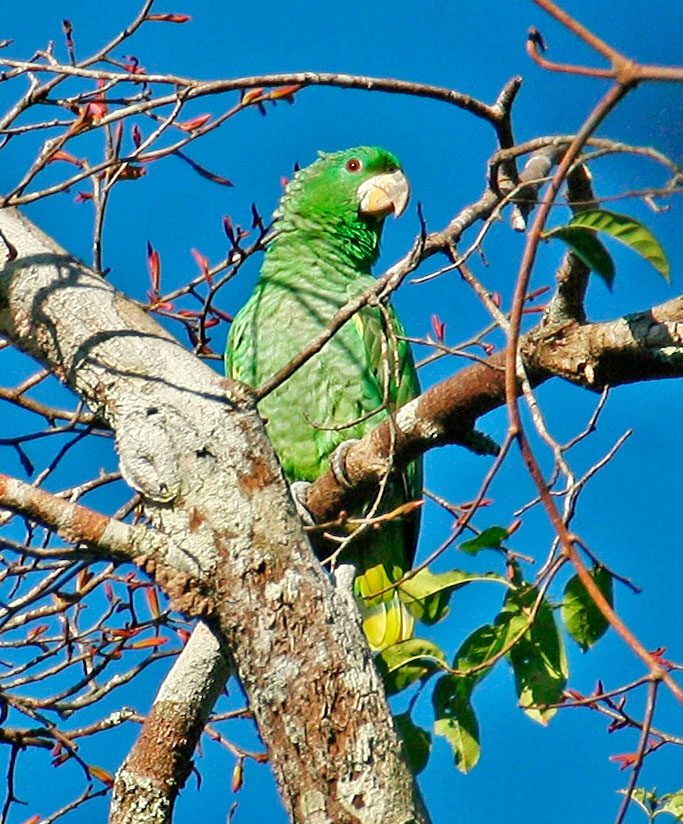
The Ouvea Parakeet (Eunymphicus uvaeensis) is similar to the Horned Parakeet (Eunymphicus cornutus) but with the face and nape green, no yellow, and crest upturned six pens greenish black: the Red of the crown It is limited to the center forecrown.

The Ouvea Parakeet generally bright mid-green. Head green, lighter on ear-coverts with some light shaft-streaks; centre of forecrown red with six wispy blackish-green uperwing feathers forming a small crest; rear-crown darker green; ears and cheeks dark green lower.

The upperparts light green, paler on rump. Wing coverts green; outerweb of primaries greenish-blue with innerwebs black. Underwing-coverts green. Underparts light yellowish-green. Uppertail green with a slight blue suffusion distally and blue edges to lateral feathers; undertail gray.

Bill blue-gray at base, blackish toward tip; irises orange; legs grey.

Both sexes similar.

Taxonomic status:

This taxon is considered a subspecies of Eunymphicus [cornutus or uvaeensis] (sensu lato) by some authors
  • Sound Uvea Parakeet.

Note:

some species, as in the case of Ouvea Parakeet, They are subject to extreme stress due to traps or harassment. The open availability of high-quality recordings of these species may make the problems even worse.. For this reason, transmission and download of these recordings is off. Recorders are free to share in xeno-edge, but they will have to approve access to these recordings.

We do not take this action lightly, and we wish it wasn't necessary, but we are convinced that the negative impacts of offering easy access to these recordings outweigh the benefits. To access these recordings, You can contact directly with the recorder.

Habitat:

It is restricted to areas of old growth forest with holes for nesting, but the highest numbers occur near papaya plantation areas.

The Ouvea Parakeet They are active in early morning and late afternoon, and usually rest in the trees during the heat of the day.

Reproduction:

An average of 2.9 Eggs are laid in one or two broods per year, of which 1.7 chicks hatch, but only 0.75 chicks survive to 30 days (Robinet et al. 1995, Robinet et al. 1996, Robinet and Salas 1999).

Food:

It feeds in the forests and crops of cultivated land adjacent. The Ouvea Parakeet It depends mainly on mature native forests with pines kauri Agathis australis.

Fruits of Ficus spp., there Canaria, scrub and passion fruit. Also forage for seeds. The cultivated papaya (Carica papaya) It is a favorite.

Distribution and status:

Population expansion (breeding/resident): 640 km2

Los Pericos Uvea are confined to 110 km2 in Ouvea island, Loyalty Islands. Introduced unsuccessfully in the nearby Lifou.

The species is found in isolated patches of forest now restricted to the coast, mainly in the district St Joseph between Cape Rossel and Cape Steep. Single 15-25 km2 of suitable habitat was considered to remain on the island in 1993, with about 70-90 birds present, although a more thorough study has suggested a total population of 617 individuals. More recent studies is estimated at 1.780 mature individuals in total (Theuerkauf s suffering. 2016)
In the past, the reduction of individuals to extensive conversion of forests for agriculture due, hunting and trade. The delicate political situation in Uvea, while Kanak Liberation Front struggle for independence France, It has hampered the work of conservation of the species.

It is relying on a captive breeding program based on Forest Park, about Noumea, in New Caledonia. Transfers from island to island also be considered feasible.

Conservation:


Vulnerable


โ€ข Current category of the Red List of the UICN: Vulnerable.

โ€ข Population trend: Growing.

โ€ข Population size : 600-1800 individuals.

Rationale for the Red List category

This species is classified as Vulnerable because it is in one very small island and can be threatened by invasive species, in particular the Black rat, that could bring the species to the category of Critically Endangered or Extinct in no time.

Justification of the population

The population is estimated at 1.780 mature individuals in total (Theuerkauf s suffering. 2016), rounded here to 1.800 mature individuals.

Justification trend

Barrรฉ et al (2010) reported that the population has increased in a 29% (of 10 birds / km2 34 birds / km2) between 1993 and 2009, which equates to an increase in population 34% in three generations.

Conservation Actions Underway

1 – Appendix I and II of CITES.

2 – The Association for the Protection of Perico Ouvea (ASPO) It was created in 1993 with members mostly local.

3 – ASPO initiated a long-term study of the biology and ecology of the species as the basis for two recovery plans. (1997-2002 and 2003-2008).

4 – Forest loss is being addressed through awareness programs and community trials to mitigate habitat degradation and improve the quality of forests, particularly in regard to nesting sites.

5 – Ten guides are used, whom, among other tasks, nests located.

6 – Illegal trade is being addressed successfully through increased awareness and enforcement.

7 – A captive breeding program has been discussed, but it hasn't started yet, and the species is found only in small quantities in captivity for a very limited reproductive success (Tap 1996).

8 – In 1998 translocation program began to repopulate southern Ouvea, and the number of birds in the south was 395 individuals in 2011 (Theuerkauf s suffering. 2016).

9 – Black rats were trapped on the island (Theuerkauf s suffering. 2016) and predator control is important.

10 – In 2003 a recovery plan was drawn updated, in which it recommended, among other things, the translocation program was canceled, since the population is considered viable and grow naturally; this Recovery Plan has been accepted by the local indigenous authorities (N. Barrรฉ a slightly. 2003, Anon 2004).

11 – Ouvea has been classified as IBA, but a management plan and a protection program involving the communities have not yet been established (Spaggiari et al. 2007).

12 – SCO obtained funding from the British Bird Watching Fair to build and test artificial nests PCV after the failure of trails wooden nest.

13 – ASPO personnel destroyed or removed 187 bee colonies between 2002 and 2008 (L. Verfaille a slightly. 2007, Barrรฉ et al. 2010).

14 – The continued presence of local guides is believed to effectively prevent nest poaching. (Barrรฉ et al. 2010).

Conservation Actions Proposed

1 – Continue population monitoring (Primotel 2000).

2 – Research interactions with Trichoglossus haematodus.

3 – Investigate the non-use of artificial nests.

4 – Review and strengthen measures to control predators.

5 – Assess progress and update plans for translocations.

6 – Review and update all aspects of the Action Plan.

7 – Maintaining the momentum of awareness and participation of the community and the island (Robinet and Salas 1997).

8 – Establish a project IBAs in Ouvea and fund a protection program (N. Barrรฉ a slightly. 2003).

9 – Start a captive breeding program to support future reintroductions.

10 – Carry out surveillance screening BFDV to guide future efforts biosecurity and conservation, and better understand the risk posed by BFDV (Jackson et al. 2014).

"Ouvea Parakeet" in captivity:

The Ouvea Parakeet they are still captured using a rope inside a fruit Upload papaya, and because the island is a plain, exports through an easily accessible atoll are difficult to control. Birds bought from trappers by 50 dollars can be sold by traders up 1.000 Australian dollars.

There is a captive breeding program, but it hasn't started yet, and the species is found only in small quantities in captivity for a very limited reproductive success (Tap 1996).

Alternative names:

Horned Parakeet (Ouvea), Ouvea Parakeet, Short-horned Parrot, Uvea Parakeet (English).
Nymphique d’Ouvรฉa, Perruche cornue (Ouvรฉa), Perruche dโ€™Ouvรฉa, Perruche d’Ouvรฉa (French).
Ouvรฉahornsittich, Uveasittich (German).
Periquito-de-uvea (Portuguese).
Perico de Uvea (espaรฑol).

scientific classification:

Edgar Leopold Layard

Order: Psittaciformes
Family: Psittaculidae
Gender: Eunymphicus
Scientific name: Eunymphicus uvaeensis
Subpoena: (Layard, THE & Layard, ELC, 1882)
Protonimo: Nymphicus uvaeensis

Images:

Videos "Ouvea Parakeet"

Sources:

โ€ข Avibase
โ€ข Parrots of the World โ€“ Forshaw Joseph M
โ€ข Parrots A Guide to the Parrots of the World – Tony Juniper & Mike Parr
โ€ข Birdlife

Photos:

(1) – This Uvea Parakeet was photographed feeding on a papaya at the edge of forest by Tunpin.ong [CC BY-SA 3.0], from Wikimedia Commons