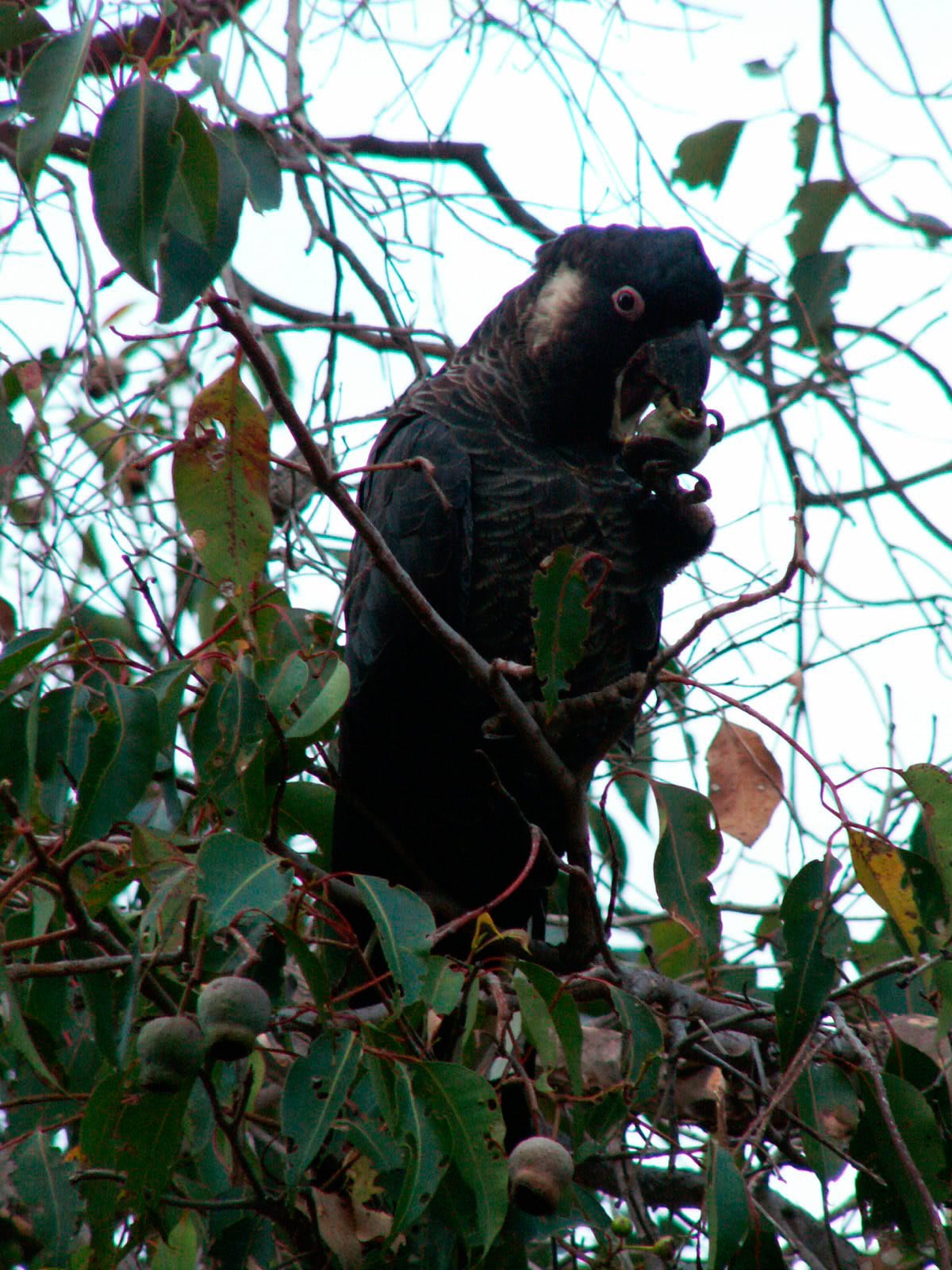
โ–ท The world of Pets: Dogs, cats, birds, reptiles, amphibians

Naretha Bluebonnet
Northiella narethae

Content


Anatomy-parrots

Description:

The Naretha Bluebonnet (Northiella narethae) It is smaller than Bluebonnet (Northiella haematogaster), of about 28 cm. long.

The legs and feet are dark gray, and the irises is dark brown.

The adult male has a two tonal facial pattern forecrown lighter green-blue, the ears and the area above the eye in contrast to the rest of the face which is purple-blue. The head, the neck forward and breast are marked with pale steaks and diffuse spots.. The back It is olive gray. The belly, the area of the vent and the thighs are uniform yellow, while red is limited to the area of รขโ‚ฌโ€นรขโ‚ฌโ€นthe undertail-coverts. The lesser wing coverts are blue and outer median wing coverts red, while the inner median and greater wing coverts, and inner secondary a yellow-olive colour. The central feathers of the tail are tinged with pale blue..

The female adult has a duller blue color in forecrown, and a reduced color on wings and tail, and with no tint of orange on the belly. It is smaller overall, at around 26 cm length.

The chicks they have a bill yellow and gain their adult plumage in the first post moves to bloom (three to four months old).

taxonomy:

the species Northiella narethae It was formerly classified as a subspecies (Northiella haematogaster narethe) of the Northiella haematogaster. A molecular study published in 2015 by Gaynor Dolman and Leo Joseph He confirmed the genetic isolation Naretha Bluebonnet (Northiella narethae) and recommended that it was restored as a separate species.

Habitat:

Arid and semiarid scrub and farmland, thickets mulga, weeds and dry forests open.

Reproduction:

It is heavily influenced by rainfall and food availability, but usually peaks between August and January.

The usual site nesting It is a very small cavity tree, particularly attracted to she-oaks providing appropriate holes for nesting, often near the ground, coated shavings and wood dust rotten. The female incubates the eggs but is cared for by the male who also contributes to raising the young..

Four to seven white eggs round (23mm x 19mm). Time of incubation: 22 days. The young usually leave the nest around the 30 days.

Food:

Seeds of various grasses and herbaceous plants (autochthonous), also nectar, flowers and various fruits.

Distribution:

Reports indicate that Naretha Bluebonnet They have been common in the arid region Nullarbor, and they have become more rare in the twentieth century. It is believed that localized individuals range makes the species highly endemic in an area on the border between Western Australia and Southern Australia.

Conservation:

We know the conservation status of this species, although probably in risk status.

"Naretha Bluebonnet" in captivity:

No data.

Alternative names:

Bluebonnet (Naretha), Little Bluebonnet, Naretha Bluebonnet (English).
Perruche ร  bonnet bleu (narethae), Perruche de Nareth, Perruche petite (French).
(German).
(Portuguese).
Perico Cariazul Naretha (espaรฑol).

Images "Naretha Bluebonnet"

scientific classification:

Order: Psittaciformes
Family: Psittaculidae
Gender: Northiella
Scientific name: Northiella narethae
Subpoena: (White, HL, 1921
Protonimo: Psephotus narethae

Sources:

โ€ข Avibase
โ€ข Parrots of the World โ€“ Forshaw Joseph M
โ€ข Parrots A Guide to the Parrots of the World – Tony Juniper & Mike Parr
โ€ข Birdlife

Photos:

(1) – Penochka Birds: Parrots (Psittacidae) – Source
โ–ท The world of Pets: Dogs, cats, birds, reptiles, amphibians

Flores Lorikeet
Trichoglossus weberi

Flores Lorikeet

Content

 Flores Lorikeet

Description Lori Flores:

25 cm. length and 100-150 g. of weight.

The Flores Lorikeet (Trichoglossus weberi) is generally Green; light green / blue stripes on the forecrown and lores, the rest of the head with brighter green stripes; underwing-coverts yellow / green. The chest and the thighs are yellowish or reddish. The bill It is orange-red and irises orange-red. The legs son grises. Smaller size than other species Trichoglossus.

The youth they are similar to adults.

    taxonomy:

Sometimes you think you're closer Olive headed Lorikeet (Trichoglossus euteles). With one exception, so far it has been treated as a subspecies within the complex Coconut Lorikeet (Trichoglossus haematodus), but differs in its chest rather pale green; abdominal patch medium green; head dark green with streaks of bright green; small size (less than a Scarlet-breasted Lorikeet (Trichoglossus forsteni) relatively small). Monotypic.

  • Sound of the Flores Lorikeet. (1)

(1) Some species are under extreme pressure because of traps and harassment. The open availability of high-quality recordings of these species may make the problems even worse.. For this reason, transmission and download of these recordings is off. Recorders are free to share in xeno-edge, but they will have to approve access to these recordings.

Habitat:

It's more common in the lowlands, but it is up 2400 meters above sea level. Wide variety of areas including settlements, forests, coconut plantations, Savanna, eucalyptus forests and mangroves.

It is found in mixed flocks with other parrots; small and noisy groups. Nomads, since they depend on flowering trees. It perches communally in groups of hundreds of birds.

Reproduction:

Birds have been recorded in conditions reproduction in June and is reported reproduction between February and August (White and Bruce 1986, Reeve y Rabenak 2016).

It will nest on the ground in some of the predator-free islands.

Food:

It feeds mainly from nectar, but also feeds on figs, insects and can be found around artificial feeding stations.

Distribution:

Extension of the distribution (breeding/resident): 25.500 km2

The Lori Flores are endemic to the flower island, Indonesian, where it is described as common (pit et to the. 1997).

Conservation Lori Flores:


Near-threatened

1. Current red list category of the UICN: Near-threatened.

2. The population trend: Decreasing.

3. Population size : 10000-19999 individuals.

    Rationale for the Red List category

It is believed that this species has recently split a moderately small population (approaching 10.000 mature individuals), forming one subpopulation, inferring that is suffering moderately rapid decreases due to the pressure of capture and loss of habitat. So, It has been classified as Near threatened, but more information on population size, trends and threats can lead to a reassessment of their status.

    Justification of the population

It is believed that the population of Flores Lorikeet It is moderately small (that is to say, approaching 10.000 mature individuals).

    Justification trend

They suspected that the population is declining due to loss of habitat and unsustainable levels of exploitation.

    Threats

The habitat destruction through the combined impacts of firewood collection, commercial logging, timber extraction for construction materials and clearance for agriculture may represent the most relevant threat.

The loss and fragmentation of forests It is already extensive in Flowers, where no semi-permanent forest below the 1.000 meters is included within the protected areas published in the Official Gazette. These threats are exacerbated by the expansion of human population, with large volumes of wood needed for housing construction, and the fact that the application of the laws by the government is little or no.

The moist deciduous forest is being cleared extensively through land grabbing and the establishment of agricultural areas, a factor that is inevitably reducing the range and population of this species. Forest clearing continues in the coastal belt to make way for crops, and illegal logging continues in protected areas.

It is presumed that the capture for trade in wild birds It represents an additional threat, as for other subspecies of the complex (Trichoglossus haemotodus).

Conservation actions and research in progress

Appendix II of the CITES. CMS Appendix II. It has been recorded in the Mbeliling Forest Reserve (Reeve y Rabenak 2016).

Proposed Research and Conservation Actions

1 – Estimate the population and assess population trends and scale of the pressure catch.

2- Conduct a species-specific study to identify important sites, in order to provide protection.

3- Carry out research on their status and habitat use (with special attention to feeding ecology and forest fragmentation) so that long-term management of the species facilitate.

4- Monitor trade to investigate whether this represents a significant threat.

5- Initiate campaigns sensitization to get the support of local people in forest protection.

In captivity:

In captivity it is kind enough rare de lori. He was raised for the first time Great Britain, in 1969, in Germany in 1984.

Because of its endangered status, Any suitable specimen can not be released back into their natural habitat (native range) It should preferably be placed in a breeding program well managed to ensure the continued survival of this species.

Alternative names

Flores Island rainbow lory, Flores Lorikeet, Leaf Lorikeet, Rainbow Lorikeet (Leaf) (English).
Loriquet ร  tรชte bleue (Weber), Loriquet ร  tรชte bleue (weberi), Loriquet de Flores, Loriquet de Weber (French).
Flores Blauwangenallfarblori, Flores-Allfarblori, Webers Lori (German).
Periquito-arco-รญris (weberi) (Portuguese).
Lori de Flores, Lori Arcoiris (weberi) (espaรฑol).

scientific classification:

Order: Psittaciformes
Family: Psittaculidae
Gender: Trichoglossus
Scientific name: Trichoglossus weberi
Subpoena: (Buttikofer, 1894)
Protonimo: Psitteuteles weber

"Lori de Flores" images:

Videos "Flores Lorikeet"


ยซLori de Floresยป (Trichoglossus weberi)


    Sources:

    1. Avibase
    2. Parrots of the World โ€“ Forshaw Joseph M
    3. Parrots A Guide to the Parrots of the World – Tony Juniper & Mike Parr
    4. Birdlife

    Photos:

    (1) – Flores Lorikeet, Trichoglossus (haematodus) weberi, at New Port Aquarium, Cincinnati, USA by derivative work: Snowmanradio (talk)Trichoglossus_haematodus_weberi_-New_Port_Aquarium-8.jpg: Serge Melki [CC BY 2.0], via Wikimedia Commons
    (2) – Weberโ€™s Lorikeets (Trichoglossus haematodus weberi) at Newport Aquarium by Ltshears [CC BY-SA 3.0 or GFDL], from Wikimedia Commons
    (3) – Fig. 1: Flores Lorikeet (Trichoglossus = Psitteuteles Weber Weber)
    Fig. 2: Olive-headed Lorikeet (Trichoglossus euteles = Psitteuteles euteles) by A Weberโ€™s lorikeet (Trichoglossus weberi) at the Jerusalem Biblical Zoo by SuperJew [CC BY-SA 4.0], from Wikimedia Commons
    (4) – Trichoglossus haematodus weberi Buttikofer, 1894 bt Huub Veldhuijzen van Zanten / Naturalis Biodiversity Center [CC BY-SA 3.0]

    (5) – Weberโ€™s lorikeet, Picture taken at Loro Parque in Puerto de la Cruz / Tenerife by Dominik DeobaldFlickr
    (6) – Johann Buttikofer [Public domain], via Wikimedia Commons

    Sounds: Raf Floats, XC350575. accessible www.xeno-canto.org/350575

โ–ท The world of Pets: Dogs, cats, birds, reptiles, amphibians

Brown-breasted Parakeet
Pyrrhura calliptera


Brown-breasted Parakeet

Content

Description:

Brown-breasted Parakeet

22-23 cm.. height.

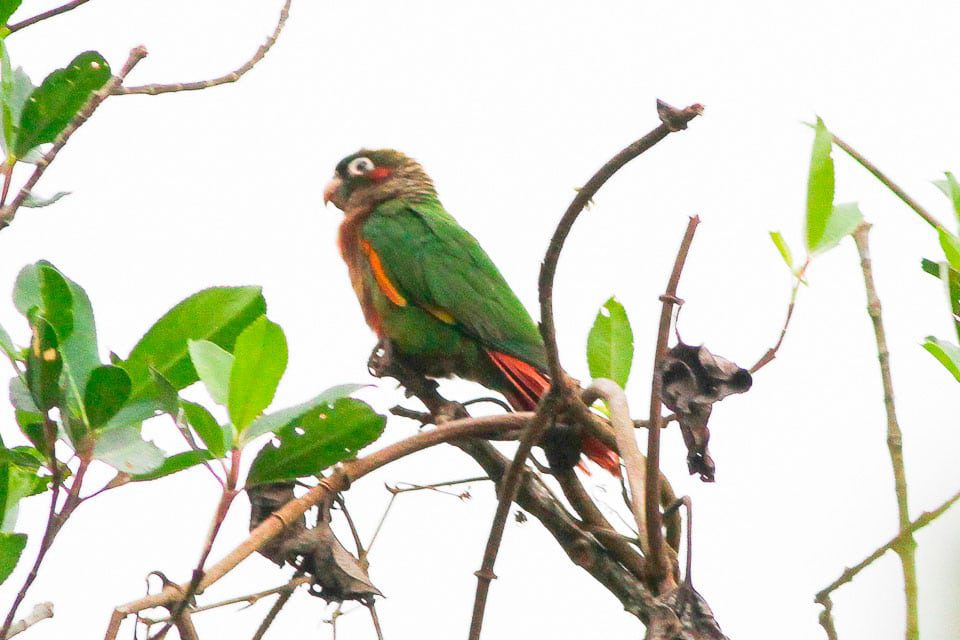
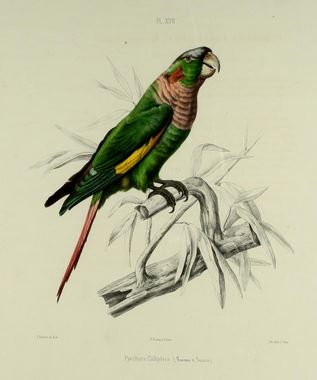
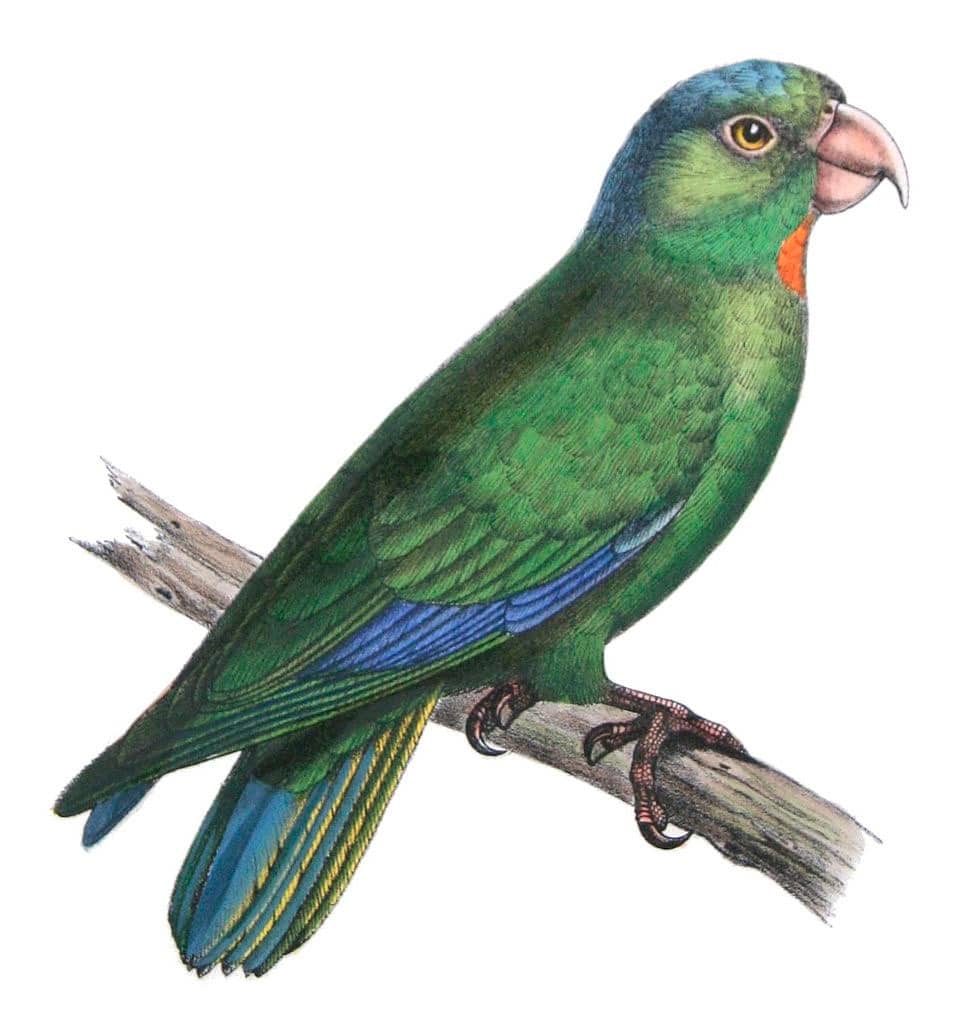
The Brown-breasted Parakeet (Pyrrhura calliptera) is easily recognized by the Wing mirror yellow in flight. In general it is green, with a red spot on the ear; chest brown reddish and sides of the neck characteristic dark brown.

Shoulder mostly yellow up to half of the wing and the end of the same pardo-olivaceo.
The primary feathers are blue and their covert wing external and internal yellow, usually with orange blend.
The tail reddish brown. Its bill pale yellowish; irises yellow; eye ring white.

The immature lack of yellow in the wings.

Habitat:

It inhabits in Misty jungles Andean and sub-andinas with canopy 15 to 25 m, secondary forests and Paramo, from 1700 to 3400 m. They fly at dawn and at dusk flocks, usually small of 6 to 12 individuals on the canopy of the forest.

Reproduction:

It nests in, generally, in cavities of trees located in wooded pastures or pasture surrounded by secondary forest fragments, bedrooms for both nests.
breeding conditions they have been observed in August and October, as well as between November and January in Fusagasugรก, Farallon de Medina and Soatรก (Cortes-Herrera et to the., 2007) and from September to February in the Chingaza National Park (Arenas-Mosquera 2011).

The size average of the laying is of 5-6 eggs of color whitish. The chicks take of 60 to 70 days to complete its development.

Food:

Diet Brown-breasted Parakeet consists in fruit (including plants of the Ericaceae, Lauraceae, Melastomataceae and Clusiaceae (Cortes-Herrera et to the., 2007), seeds and cultivated corn, Although flocks larger were observed in areas open to eating leaves and seeds (O. Courteous in litt., 2012).

Distribution:

Size distribution (reproduction / resident): 1,000 km2

Endemic. Cordillera Oriental in Colombia. Since Boyacรก to southwest of Cundinamarca. Has also been reported in the departments of Santander, Norte de Santander and Casanare in the localities of the Arrayanes and Salina.

The population total has been estimated at 5.000-10.000 individuals.

Conservation:

State of conservation โ“˜


Vulnerable Vulnerable โ“˜ (UICN)โ“˜

โ€ข Current category of the Red List of the UICN: Vulnerable.

โ€ข Population trend: Decreasing.

This species has a range very small and a small population, known in less than ten places in what is rapidly declining due to the loss of habitat and persecution as as plague by including cultivated corn in their diet.

These declines in population range are expected to continue.. So, qualified as vulnerable.

It is estimated that its population amounts to between 5.000 and 10.000 individuals, equivalent approximately to 3.300-6.700 mature individuals.

"Brown-breasted Parakeet" in captivity:

Not usually find it in captivity.

Alternative names:

Brown-breasted Parakeet, Brown breasted Parakeet, Brown-backed Conure, Brown-backed Parakeet, Brown-breasted Conure, Flame-winged Conure, Flame-winged Parakeet (English).
Perriche ร  poitrine brune, Perruche ร  poitrine brune (French).
Braunbrustsittich, Braunbrust-Sittich (German).
Tiriba-de-peito-marron (Portuguese).
Cotorra Pechiparda, Perico Bello, Periquito Aliamarillo (espaรฑol).

scientific classification:

Order: Psittaciformes
Family: Psittacidae
Genus: Pyrrhura
Scientific name: Pyrrhura calliptera
Citation: (Massena & Souancรฉ, 1854)
Protonimo: Conurus callipterus

Images "Brown-breasted Parakeet"

Videos "Brown-breasted Parakeet"


Especies del gรฉnero Pyrrhura

Brown-breasted Parakeet (Pyrrhura calliptera)


Sources:

Avibase
– Parrots of the World โ€“ Forshaw Joseph M
– Parrots A Guide to the Parrots of the World – Tony Juniper & Mike Parr
– Birdlife
Wiki Aves de Colombia

Photos:

(1) – Flame-winged Parakeet (Pyrrhura calliptera) By Ron Knight from Seaford, East Sussex, United Kingdom (Flame-winged Parakeet (Pyrrhura calliptera)) [CC BY 2.0], via Wikimedia Commons
(2) – Pyrrhura calliptera By J. Davernes (biodiversitylibrary.org) [Public domain], via Wikimedia Commons

Sounds: (Xeno-canto)

โ–ท The world of Pets: Dogs, cats, birds, reptiles, amphibians

Orange-chinned Parakeet
Brotogeris jugularis

Orange-chinned Parakeet

Content

Description:

catita-churica-7

17 to 20 cm.. height.
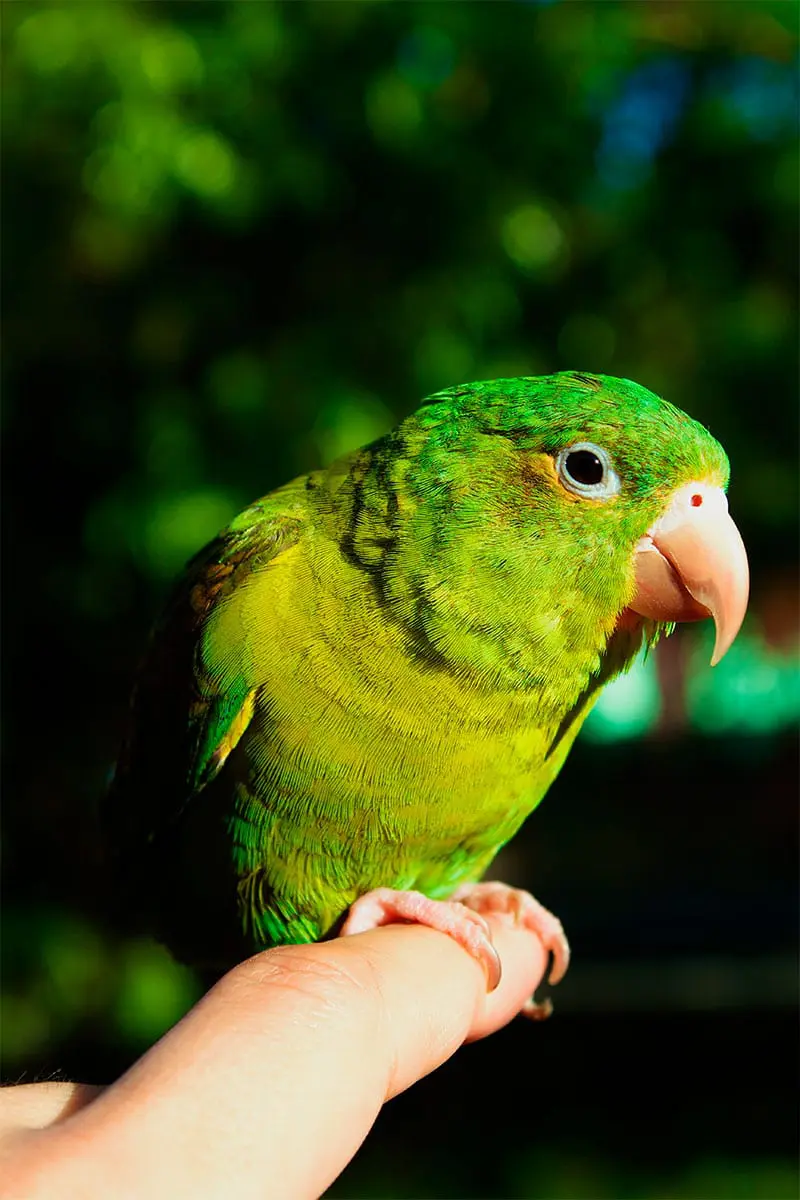
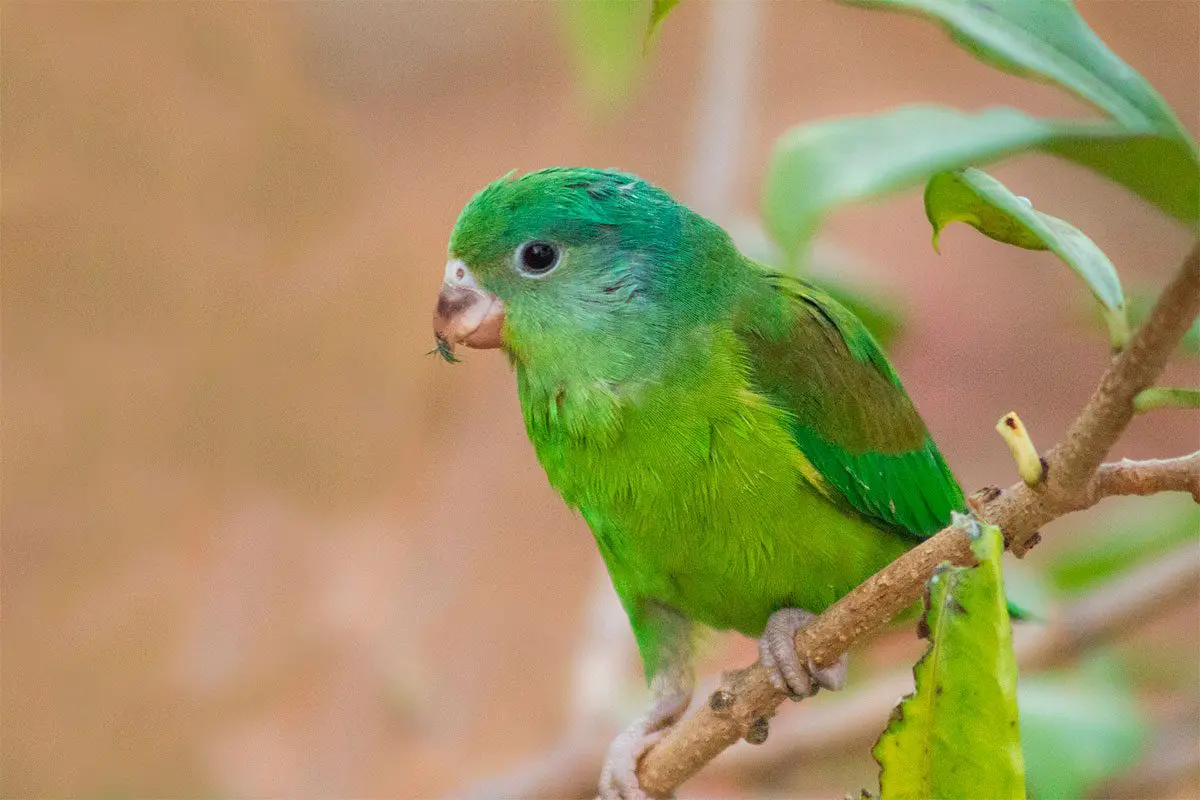
The Orange-chinned Parakeet (Brotogeris jugularis) has the forecrown, crown, back of the neck and upper cheeks, bright green with blue tinge; lores and lower cheeks, duller green with olive tinge. feathers in the the mantle and the top of the back, olive-green with more green tips; Scapulars Green tipped bronce-marrones; lower back and rump, bluish green. Lesser coverts and median, foliage color, with a patch large in the shoulder; Primary coverts blue, greater coverts green. Flight feathers greenish blue above, Blue-Green below with less yellow in the underwing-coverts.
Bright orange stain in the throat, which flying becomes very evident. Underparts brighter yellowish green, more blue from the belly up to the undertail-coverts. Upper, the tail bluish green; by below more pale and yellowish.

Bill color pale horn; bare periophthalmic whitish; irises dark brown; legs pink.

The plumage of both sexes are similar.

Description 2 subspecies:

  • Brotogeris jugularis exsul

    (Todd, 1917) – Has the back and rump olive, and dorsally the wing darker, In addition the stain in the neck smaller.

  • Brotogeris jugularis exsul
    Brotogeris jugularis exsul

  • Brotogeris jugularis jugularis

    (Statius Mรผller, 1776) – Nominal.

Habitat:

The Orange-chinned Parakeet prefer, generally, forests or partially wooded habitats with bushes, deciduous forest, dry and wet, plantations, edge of light and areas cultivated or grasslands with trees large. It tolerates human presence and it attends the parks and gardens in cities. Most numerous in partially deforested areas, mainly in tropical zone, Although it amounts to subtropical vegetation zones in (for example, the Cordillera de Guanacaste, Costa Rica. Observed at altitudes of 500 m (Guatemala), 900 m (Honduras), 1.360 m (El Salvador), 1.200 m (Costa Rica), 1.000 m (Venezuela). Usually, in pairs or small groups, with large gatherings where abundant food. More gregarious outside of breeding season. Rest communally on rubbers (Ficus sp.) or palms.

Son very good flying, in nature there have been flights of up to 45 kilometres per hour.

Reproduction:

Nest from May to July in tree hollows (including old Woodpecker nests) and termite mounds. A laying, usually, compose of four to six white eggs, What hatch after a few 26 days of incubation. The chicks leave the nest about 42 days after birth.

Sometimes colonial. Reproduction reported in March in Mexico; January in El Salvador; February-April in Panama; January-March in Colombia.

Food:

Feeds of seeds and fruits trees of Bombax, Ficus, Muntingia, Byrsonima, Cecropia, Ceiba, flowers and nectar of Erythrina, raft and guava. It feeds mainly in the canopy. They can be destructive crops (for example, Mango).

Distribution:

Size of the area of distribution (reproduction / resident): 781.000 km2

This parakeet occupies the lowlands of the southern Pacific slope of Mexico, in Oaxaca and Chiapas (reports of Warrior dubious) and areas adjacent to Guatemala and El Salvador, lowlands of the Honduran Pacific, and slopes of the Pacific and Caribbean Nicaragua.

In Costa Rica is mainly a bird of your side of the peaceful, but comes into the lowlands of the Caribbean adjacent, to the South of the Lake Cocibolca, spreading through the Pacific lowlands and the Caribbean from Panama, including the Islands Coiba and Cebaco.

Are also distributed to the West of the Andes in Colombia, to the south, to Atrato River and in the Caribbean lowlands of the region of Santa Marta and Serrania del Perija and further South, to the top of the Magdalena River Valley and lowlands of Norte de Santander and Arauca.

In Venezuela It extends from the North of the Orinoco in Zulia, Tรกchira North, Merida Western, the coastal mountains Yaracuy and Carabobo and in the lowlands of Portuguese, Cojedes, barinas, Apure and Guarico.

The Orange-chinned Parakeet are, mainly, residents although they roam locally in some areas (for example, in El Salvador after breeding season).

Usually of common to abundant though apparently uncommon at the local level (for example, Oaxaca).

Captured for the trade and common in captivity in countries of the range.

Distribution 2 subspecies:

Conservation:

State of conservation โ“˜


minor concern Minor Concern โ“˜ (UICN)โ“˜

โ€ข Current category of the Red List of the UICN: Least concern.

โ€ข Population trend: Stable.

Justification of the population

Partners in Flight estimate your total population in 500,000-4,999,999 individuals (A. Panjabi in litt., 2008).

Justification of trend

They suspected that the population is stable in absence of evidence of any decline or threatens substantial.

"Orange-chinned Parakeet" in captivity:

Very common in captivity does time. It is a bird very shy and easily alarmable but with the passage of time creates a good emotional relationship with his owner. It can be aggressive with other smaller parrots.

Alternative names:

Orange-chinned Parakeet, Bee Bee Parakeet, Brown-shouldered Parakeet, Mexican Parakeet, Orange chinned Parakeet, Tovi Parakeet (English).
Toui ร  menton d’or, Perruche ร  front orange, Perruche tovi, Toui ร  menton jaune (French).
Tovisittich, Goldkinnsittich (German).
Periquito-de-queixo-laranja (Portuguese).
Catita Churica, Chocoyo Barbinaranja, Perico Ala Amarilla, perico ala-amarilla, perico barbinaranja, Periquito Barbinaranja, Periquito Bronceado, Periquito de Alas Doradas (espaรฑol).
Periquito Bronceado (Colombia).
Periquito barbinaranja (Costa Rica).
perico barbinaranja (Honduras).
perico ala amarilla, perico ala-amarilla, Periquito Barbinaranja (Mexico).
Chocoyo Barbinaranja (Nicaragua).
Perico Ala Marrรณn (Venezuela).

scientific classification:

Order: Psittaciformes
Family: Psittacidae
Genus: Brotogeris
Scientific name: Brotogeris jugularis
Citation: (Statius Mรผller, 1776)
Protonimo: Psittacus jugularis

Images Orange-chinned Parakeet:


Species of the genus Brotogeris

Sources:

Avibase
– Parrots of the World โ€“ Forshaw Joseph M
– Parrots A Guide to the Parrots of the World – Tony Juniper & Mike Parr
Birdlife

Photos:

(1) – A pet Orange-chinned Parakeet in Panama By Nelson de Witt from USA (IMG_2058Uploaded by Snowmanradio) [CC BY-SA 2.0], via Wikimedia Commons
(2) – An Orange-chinned Parakeet feeding in Panama By Brian Gratwicke (Flickr: Orange-chinned Parakeet) [CC BY 2.0], via Wikimedia Commons
(3) – Orange-chinned parakeets in Panama City, Rep. of Panama. Aproximadamente tres o cuatro meses de edad By Ricaurte Puga (Own work) [GFDL or CC BY-SA 4.0-3.0-2.5-2.0-1.0], via Wikimedia Commons
(4) – Brotogeris jugularis en El Salvador tomando Coca Cola By Kevinmenendez (Own work) [GFDL or CC BY 3.0], via Wikimedia Commons
(5) – This is the smallest parakeet in El Salvador know as Catalnica, Perico de Lesson, Orange-chinned Parakeet (Brotogeris Jugularis) By ceasol (Flickr) [CC BY-SA 2.0], via Wikimedia Commons
(6) – Orange-chinned Parakeet | Brown wing parakeet (Brotogeris jugularis exsul) by Fernando FloresFlickr
(7) – Conurus jugularis Dev. & Cast. = Brotogeris jugularis (Mรผller, 1776) by Francis de Laporte de Castelnau [Public domain], via Wikimedia Commons

Sounds: (Xeno-Canto)

โ–ท The world of Pets: Dogs, cats, birds, reptiles, amphibians

Red billed Parrot
Pionus sordidus

Tropicbird Parrot

Content


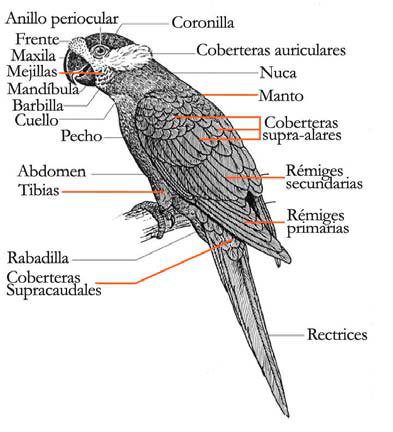
Anatomy-parrots

Description:

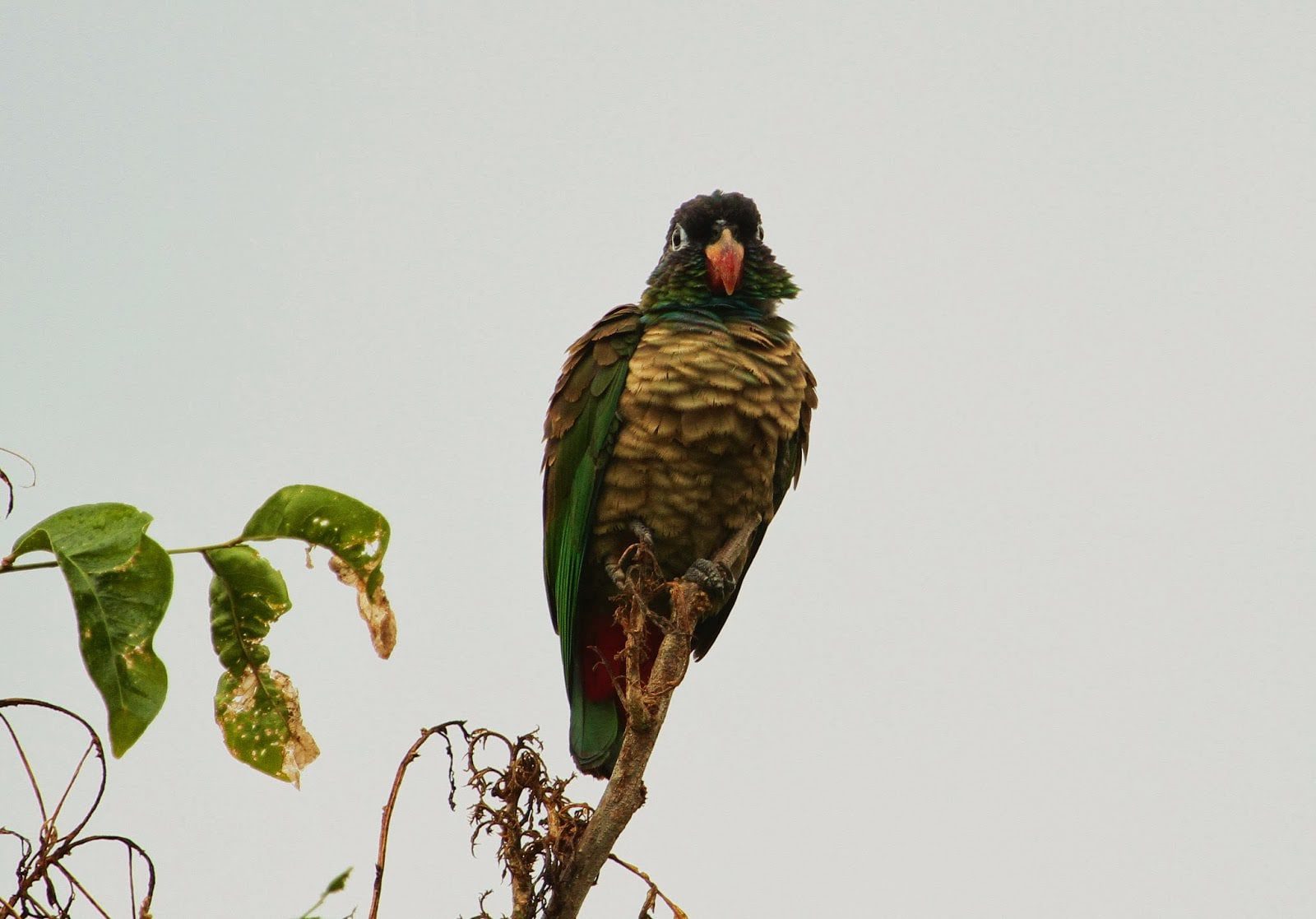
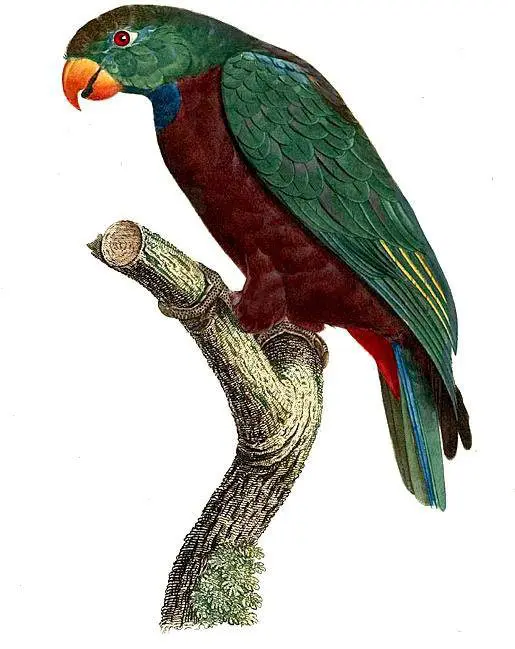
The Red billed Parrot (Pionus sordidus), of looking scruffy, has a length of 28 to 31 cm. and a weight between 255 and 275 g..

The subspecies Pionus sordidus corallinus, the most widespread, has the feathers of the forecrown, lores and behind the eyes, Green at the base and with blue edges widths; the cheeks, ear-coverts and the sides of the neck, mainly green with some blue narrow tips; the crown and rear of the neck, Green with edges blue narrow. Mantle and back pretty dull green with paler blue margins; rump and uppertail-coverts, of color green basally, more Brown olive distally. Coverts medium and small with wide olive green tips; the front edge of the wing ; coverts primary and higher and flight feather brightest which the parts superiores and others wing-coverts.

Under, the wings green; chin green; throat and upper breast with band broadband of color blue violet; belly green, Some birds with gray Suffusion; undertail-coverts crimson. Tail Green by the Center, Blue side; Red at the base.

Bill coral red, pale at the base of the upper jaw; cere dark grey; bare periophthalmic pale grey; Iris dark brown; legs pale grey.

Both sexes are similar. Immature sample undertail-coverts yellowish-green with some red marks; head green.

Subspecies description

Description 6 subspecies
  • Pionus sordidus antelius

    (Todd, 1947) – Similar to the nominal species but the feathers of the throat lack of edges blue and the center of the chest is in color pink.

  • Pionus sordidus corallinus

    (Bonaparte, 1854) – Described above.

  • Pionus sordidus mindoensis

    (Chapman, 1925) – Is as the subspecies Pionus sordidus corallinus, but of color green more beige, those edges blue of the feathers of the head are more narrow and the under wing-coverts not have them edges dark.

  • Pionus sordidus ponsi

    (Aveledo & Gines, 1950) – Throat of color blue violet almost solid. The chest and upperparts they are darker and greener that the of the nominal species, they lack clear margins to the feathers of the back and of the wing-coverts.

  • Pionus sordidus saturatus

    (Todd, 1915) – More dark and more green that it nominal species with the feathers of the upperparts lack of margins of color green olive. Less green in the throat and cheeks.

  • Pionus sordidus sordidus

    (Linnaeus, 1758) – Nominal. Much more Brown that the subspecies Pionus sordidus corallinus, with blue (turquoise) more reduced in the throat. Feathers in them upperparts with most distinctive pale margins.

Habitat:

Red billed Parrot

It is a very rare species. It inhabits in mountains of humid and semi-humid cloudy forests, edges of forest and partially deforested areas, between 200-2850 m, Although they are more frequent at altitudes of 500-1.500 m. They use areas of secondary growth, partially deforested with tall trees scattered and sometimes light forests on coffee plantations, being less frequent in dry areas.

Gregarious outside of breeding season; formations in flocks of up to 50 birds, sometimes more where the food is abundant. Children sleep in community.

Reproduction:

They nest in the cavity of the trees, sometimes in very degraded habitats. Birds in breeding attitude during the months of February-April in Colombia; It breeds in the months of April-June in Venezuela, January-may in Ecuador; Nest occupied in October in Bolivia. Laying three eggs in captivity.

Food:

Feeds of fruit, berries and seeds.

Distribution:

Size of the area of distribution (reproduction / resident): 169.000 km2

This species has a distribution batch through them land high in the North and West of South America, from Venezuela to the North of Bolivia. You can find in the North of Venezuela, in the mountains of Anzoรกtegui, Sucre, North of Monagas and apparently, of way to discontinuous, in the Highlands of the Federal District through the mountains coastal, to the West, until Lara and Falcon, then in the Sierra de Perija, Zulia and parts adjacent in Colombia, West to the foothills of Santa Marta in Magdalena, also locally in the Eastern Andes of Boyacรก and Huila. Extends over the Western side of the Andes in Ecuador, from Pichincha until Gold and for all the East side to the northeast of Peru.

Although there are no records in the Eastern Andean slope, in the central and southern Peru, the range includes the Yungas North of Bolivia in Santa Cruz and Cochabamba.

common locally; apparently less numerous in the West of Ecuador and North of Bolivia, and probably in decline locally due to the deforestation (for example, in the Ecuador Western, North of Venezuela and Andes of Colombia).

A recent study not localized to the subspecies Pionus sordidus antelius in its area of distribution widely cleared, Although the subspecies can dwell in forests moderately disturbed.

Kept as pets locally although generally scarce in captivity.

Subspecies distribution

Distribution 6 subspecies

Conservation:


minor concern


โ€ข Current category of the Red List of the UICN: Least concern.

โ€ข Population trend: Decreasing.

Justification of the population

The size of the world population It has not been quantified, but this species is described as ยซquite commonยป (Stotz et to the., 1996).

Justification of trend

It is suspected that the population is in decline due to ongoing habitat destruction.

"Red billed Parrot" in captivity:

Very rare in captivity. In general, they are not so nervous in temperament as other parrots. They can learn to imitate.

Its diet in captivity It varied: fruits such as: Apple, orange, banana, granada, Cactus, they form approximately the 30 percent of the diet; vegetables such as: Carrot, celery, green beans, pea in the pod, fresh corn; Greens such as: chard, lettuce, dandelion, Aviary grass; millet; mixture of small seeds, such as: millet, birdseed, and small amounts of oats, buckwheat, safflower and hemp; soaked and sprouted sunflower seeds; beans, cooked legumes and boiled corn; hard cheese.

Alternative names:

Red-billed Parrot, Dusky parrot, Red billed Parrot, Sordid parrot (English).
Pione ร  bec rouge, Perroquet sordide (French).
Dunenkopfpapagei, Dunenkopf, Dunenkopf-Papagei (German).
Curica-de-bico-vermelho (Portuguese).
Cotorra Piquirroja, Loro de Pico Rojo, Loro Piquirrojo (espaรฑol).
Cotorra piquiroja, Cotorra Piquirroja (Colombia).
Loro de Pico Rojo (Peru).
Perico Pico Rojo (Venezuela).

scientific classification:

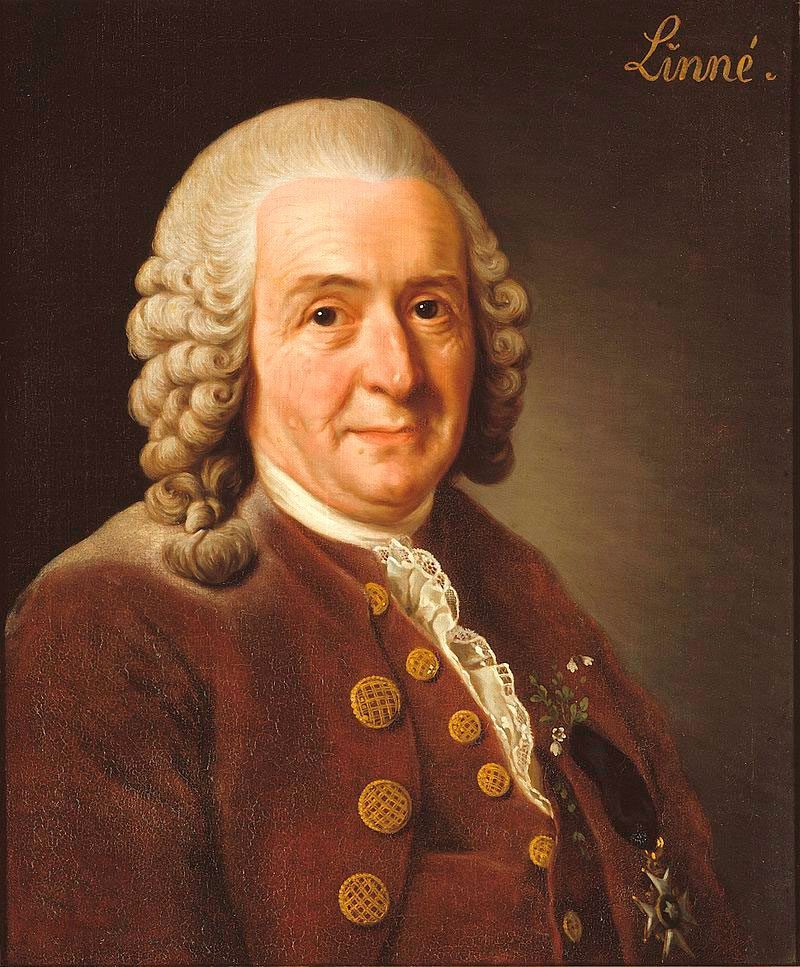
Carl Linnaeus
Carl Linnaeus

Order: Psittaciformes
Family: Psittacidae
Genus: Pionus
Scientific name: Pionus sordidus
Citation: (Linnaeus, 1758)
Protonimo: Psittacus sordidus


Images ยซLoro Piquirrojoยป:

Videos "Red billed Parrot"

ยซLoro Piquirrojoยป (Pionus sordidus)

Sources:

  • Avibase
  • Parrots of the World โ€“ Forshaw Joseph M
  • Parrots A Guide to the Parrots of the World – Tony Juniper & Mike Parr
  • Birdlife
  • Parrot Book, Parrots and macaws Neotropical

  • Photos:

(1) – Red-billed Parrot, Pionus s. sordidus, Perico Pico Rojo – Our beautiful world
(2) – Red-billed Parrot, Pionus s. sordidus, Perico Pico Rojo – Our beautiful world
(3) – Red-billed Parrot, Pionus s. sordidus, Perico Pico Rojo – Our beautiful world
(4) – Red-billed Parrot (also known ans the Red-billed Pionus); two captive By TJ Lin (originally posted to Flickr as coral-billed pionus) [CC BY-SA 2.0], via Wikimedia Commons
(5) – Red-billed-Parrot (Pionus sordidus), Pajaro Jumbo Reserve, NW Ecuador By Nomdeploom (Own work) [CC BY-SA 4.0], via Wikimedia Commons
(6) – BARRABAND, Jacques (1767/8-1809) Le Perroquet brun [Red-billed Parrot (Pionus sordidus)] – Wikimedia

  • Sounds: Sebastian K. Herzog

โ–ท The world of Pets: Dogs, cats, birds, reptiles, amphibians

Baudin's black cockatoo
Zanda baudinii

Baudin's black cockatoo

Content

Description

50 to 57 cm.. height and weight between 560 and 770 g.
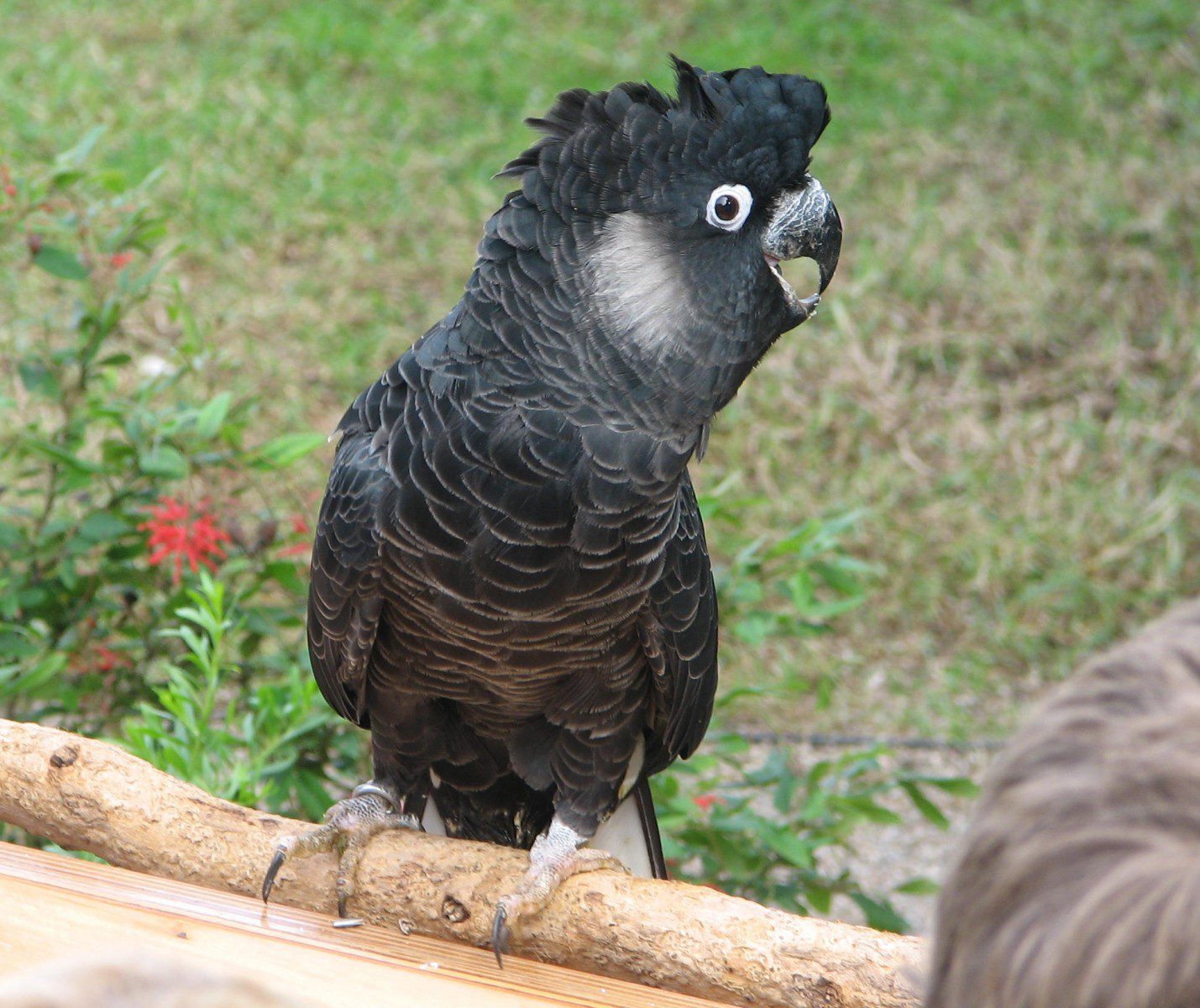
to Baudin's black cockatoo (Zanda baudinii) is almost entirely of black, with whitish margins in the feathers, patches rounded on them ear-coverts (yellowish to white in the female and Brown to grey in the male), white rectangular panels in the tail.
has a powerful bill (with greatly elongated upper jaw), Black in the male and white-gray color with a black color in the female tip.
Iris dark brown surrounded by a eye ring Red in the male and female grey.
Tail rounded, crest Erectile and legs greys. birds youth are like adults in appearance, but the bill of the male juvenile is equal to the of the of the female adult. The bill the juvenile male begins to darken after the second year.

Habitat:

Its natural habitat is the dense forests dominated by the Marris (Corymbia calophylla) in the extreme southwest of Australia.

Gregaria, is often seen in groups of three, a pair of adults with a young, or in small groups. Occasionally they gather in large flocks of up to 300 birds during the non-breeding season, usually in places where food is abundant.

Reproduction:

Very little is known about the reproductive biology This cockatoo, such as their reproduction area, nesting events calendar, the nest tree, Characteristics of holes for nests, implementation size, incubation period, incipient and successful nesting period.

Little is known about their reproductive cycle because nests are extremely difficult to locate.. Most of the characteristics of the biology of the species are inferred from the Short-billed black cockatoo.

They show a strong union of couple and probably is pair of by life. They remain together throughout the year, except when the female is incubating eggs. Probably they begin to breed at the age of four. The species breeds in late winter and spring, from August to November or December. Copulation probably takes place three days before laying. The female lays one or two white eggs and you can lay an egg of replacement if the first since egg fails. The incubation lasts a few 29 days and only the female incubates them. The chicks remain in the nest for a maximum of 16 weeks.

The nests are composed of a layer of wood chips, built in large hollow in the high eucalyptus, 30 to 40 cm. in diameter and more than 30 depth cm.

Food:

Are fed mainly from the seeds of MARRI and Karri. They are also fond of the rending of wood, Apart from pierce the bark of trunks in search of larvae. Apple trees and pear trees are frequently visited to enjoy its fruits.

Distribution:

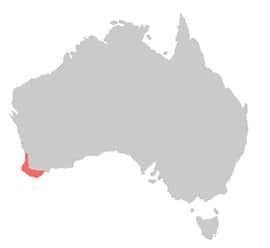
Confined in the South-West of Western Australia, especially among Perth, Albany and Margaret River.

Distribution Long-billed Black-billed Cockatoo

Small captive populations in the Melbourne Zoo, in the Healesville sanctuary in Victoria, and in the Zoo of Perth. The species is bred in captivity with great difficulty.

Conservation:

State of conservation โ“˜


Vulnerable Vulnerable โ“˜ (UICN)โ“˜

In Australia is listed as Vulnerable by the law on protection and conservation of biodiversity for the environment.

The total population of the species is estimated at 12.500 individuals, with one downward trend.
Before the inclusion of the threatened species, the annual reproductive rate was of 0,6 per couple, too low to replace the large number of birds that were killed by horticulturists to protect their crops. It is now illegal to shoot these birds, However is it still done.

In captivity:

Appears in the Appendix II of CITES, what limited international trade in the species. Itร‚ยดs illegal capture These wild birds, a penalty of up to 10,000 $. This cockatoo is protected under the Wildlife Conservation Act of Australia.

Alternative names:

Baudinโ€™s Black Cockatoo, Long-billed Black Cockatoo, White tailed Black Cockatoo (English).
Cacatoรจs de Baudin (French).
Langschnabel-RuรŸkakadu, WeiรŸohr-Rabenkakadu (German).
Cacatua-negra-de-bico-longo (Portuguese).
Cacatรบa Fรบnebre de Pico Largo, Cacatรบa Fรบnebre Piquilarga (espaรฑol).

scientific classification:

Order: Psittaciformes
Family: Cacatuidae
Scientific name: Zanda baudinii
Genus: Zanda
Citation: Lear, 1832
Protonimo: Zanda Baudinii

Images:


Species of the genus Zanda
  • Zanda funerea
  • —- Zanda funeral funeral
  • —- Zanda funerea whiteae
  • —- Zanda funerary xanthanota
  • Zanda baudinii
  • Zanda latirostris

  • Sources:
    Avibase, Australian Government
    Photos: Long-billed Black-cockatoo, Taronga Zoo, Sydney, Wikipedia, Goura (zoochat.com),
    Sounds: Chris Benesh (controles-canto.org)

    โ–ท The world of Pets: Dogs, cats, birds, reptiles, amphibians

    Cockatiel
    Nymphicus hollandicus


    Cacatรบa Ninfa

    Content

    Description

    25-33 cm.. length and a weight between 80 and 100 grams approximately.
    This small cockatoo is no doubt an of the bird's cage more common in the world.
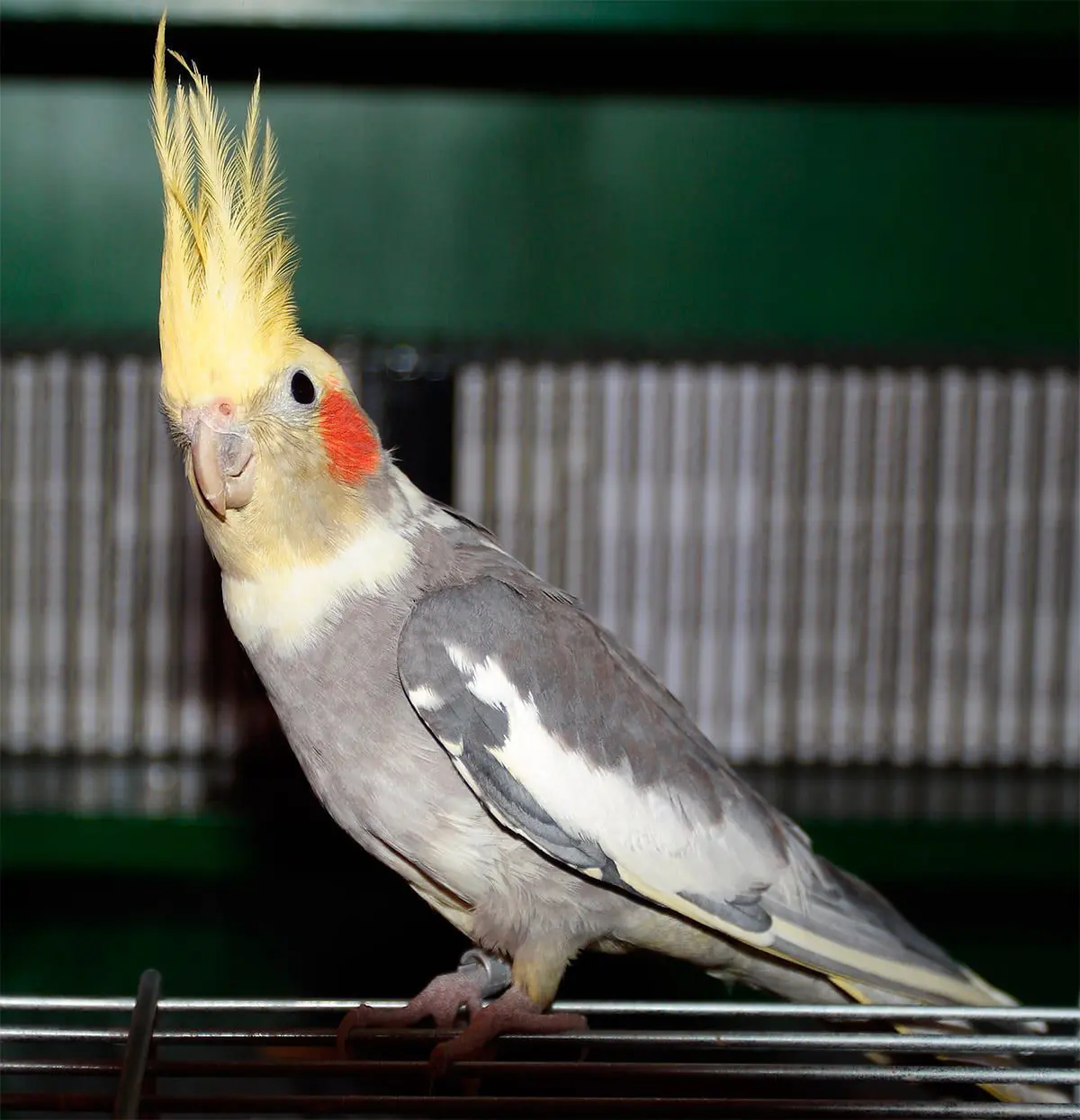
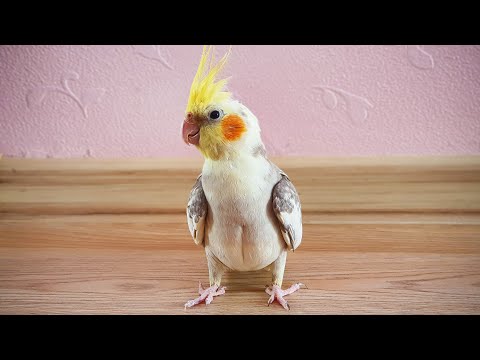
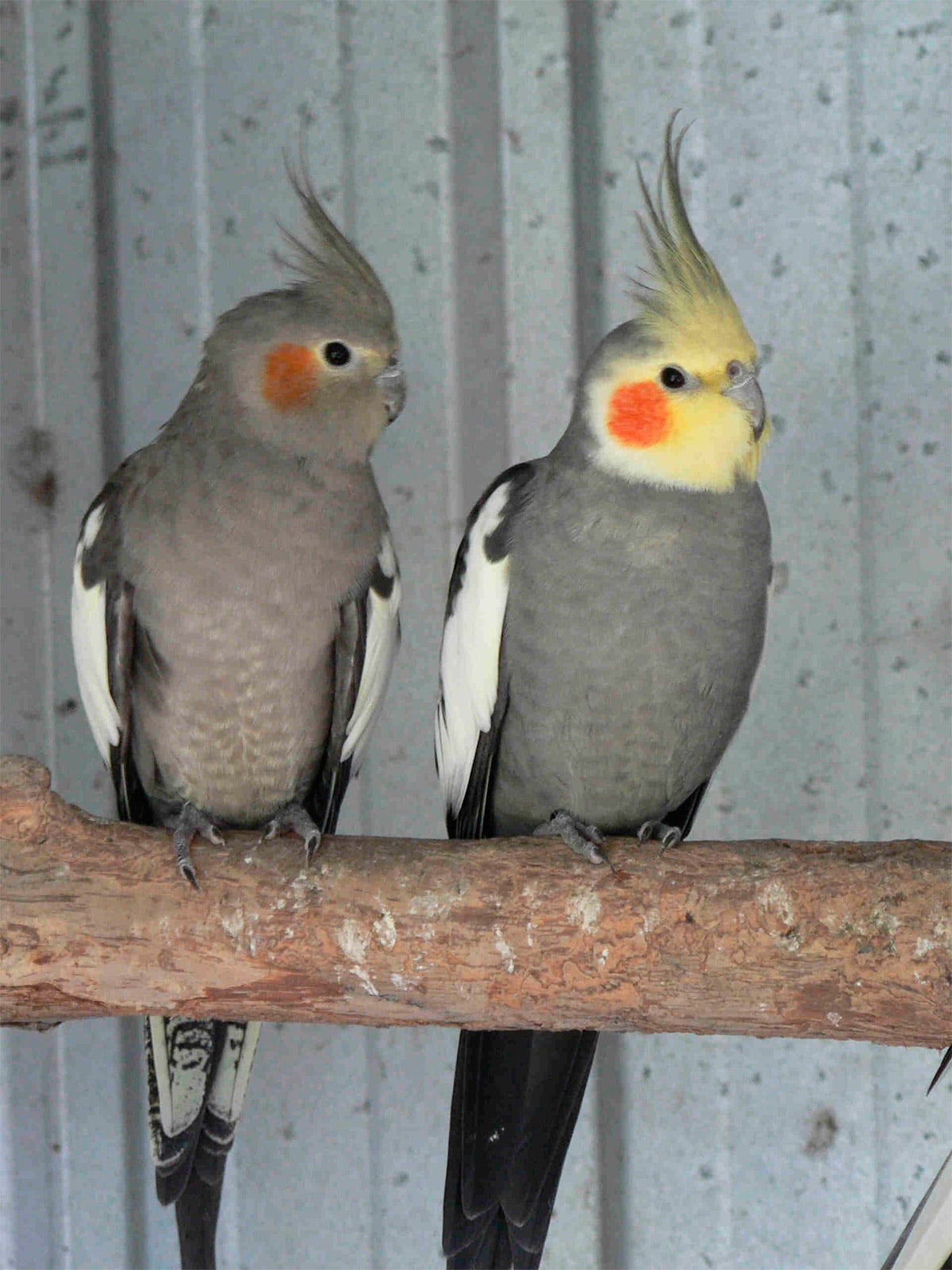
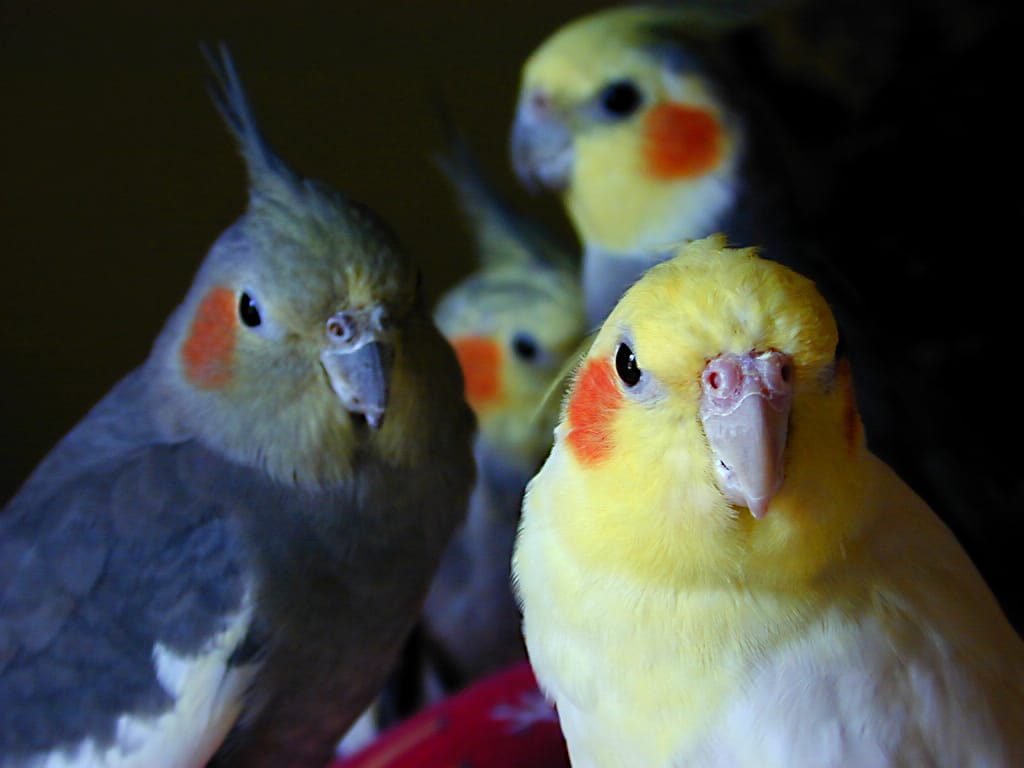
    The Cockatiel (Nymphicus hollandicus) adult has the head and the basis of the crest yellow.
    Stain handset is orange, paler on the back.
    The neck and the long crest feathers are grey.
    The upperparts are of color grey Pearl dark.
    The wings are grey, but exhibit a white color in the covered and sides.
    The underparts are a grey clear.
    The tail varies from medium gray to dark gray, the base of the tail is paler.
    The bill is grey, the irises dark brown.
    The legs are grey-brown.

    The female presents the stain handset duller, the tuft is less developed, In addition instead of the yellow, the head presents a yellowish grey with yellow dirty envelope the forecrown and a vaguely colorless gray general staining and staining is generally less intense.
    The immature are much similar to the females, but have the tail shorter.

    We find Pearl specimens in captivity, White, Gray and lutinos.

    Habitat:

    Video – "Cockatiel" (Nymphicus hollandicus)

    Funny Parrot (Nymphicus Hollandicus)

    The cockatoo Nymph they live in a wide variety of habitats, including open forests, small acacia forests that line the rivers and even stretches of Spinifex (Triodia) they are perennial and grow in semi-arid regions.

    Also found in farmland, in the stubble and the orchards, as well as on the plains and along the roads.

    In dry areas are observed in pairs or in groups of up to 100 individuals.

    When feed, the groups contain an average of 27 Member. But, We have already seen demonstrations of almost 1.000 birds near landfills containing vegetable remainders of the rice milling.

    Near the points of water, the cockatoo Nymph are often associated with the Budgerigar (Melopsittacus undulatus).

    Estas Cockatoos eat twice a day: In the morning, shortly after the Sun, consuming around 2,72 grams of plant material. At night, about an hour and a half before the night, eating around a mass of 4,25 g., It is almost 7 grams for the whole day.

    Son great travellers.
    Outside of the nesting season, they form large gatherings around the planting of cereals.
    As they feed on seeds, these birds need water and in times of drought, sometimes bands come to the coast.

    All these movements are quite unpredictable, since they are related to the weather conditions and the State of the food resources. But, in the South of the continent, migrations are more regular: the birds come to nest during the austral spring and usually go away early in the new year.

    Son gregarious and very social, so they need a wide repertoire of calls to communicate or express their feelings. They have a great power to imitate other birds.

    Reproduction:

    In the North, the reproduction is carried out between April and July, While in the South occurs in general from August to December.
    The nest is located in a tree hollow whose bottom is padded with sawdust shavings. Most of the time, the nesting site is placed near a source of water in which poultry cooled daily.

    The spawning has between 3 and 7 eggs they are incubated alternately by both parents for a few 20 days. 4 eggs are a normal litter. There will be several broods during the season. At birth, the chicks have a thick down comforter yellow. They receive their food mainly in the morning and in the evening.

    Chicks they leave the nest after 3 to 4 weeks, but they remain within the family group, Depending on their parents for 1 month. After this time, they join large flocks that roam in search of food.

    Food:

    Consume a wide variety of small seeds He collected soil, including the cultivated fields of sorghum and sunflower. When they are abundant, local seed varieties are generally preferred to the seeds that come from crops.

    Distribution:

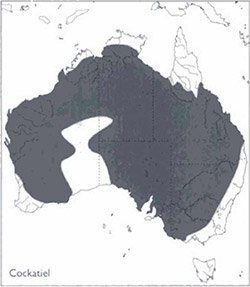
    Distribucion Nymphicus hollandicus
    Endemic to Australia. Its range covers a vast majority of the continent, except wet coastal areas. Also absent from the Cape York Peninsula, districts located more to the South in winter and areas located more to the North in the summer.

    After heavy rainfall, large meetings can be set up in the center of the country where they are, usually, absent.

    Conservation:

    State of conservation โ“˜


    minor concern Minor Concern โ“˜ (UICN)โ“˜

    – Current IUCN Red List category: Least concern.

    – The population trend: Stable

    This bird is very common and extended throughout the area. Probably its population grows, It has benefited from the facilities and artificial reservoirs for the development of agriculture.

    Its population It is estimated in around a million of birds. The birds that sought to be introduced in the United States they have failed in their attempts to establish themselves in the wild.

    In Australia, these small cockatoos are often persecuted for considering them pests for agriculture.

    "Cockatiel" in captivity:

    The Nymphs or Carolinas they are highly prized birds as pets by its docile nature and for being less demanding than the larger parrots. The nymphs they are perfectly suited to life in the home, they are easy to care for and if you homeschool them from small become companions adorable and very affectionate.

    They generally live in pairs or in colonies, that is why it is very common to mate them, to be able to enjoy the birth of the offspring and their development.

    They usually enjoy sharing their time with people and rather stick to their owners, Each bird has its personality, so you don't like all that take them into your hands. Males can sing and learn to mimic a few words, but they are much better to imitating sounds, as melodies, sirens or other birds singing. Females vocalize much less but tend to also be more caring.

    The nymphs are birds Smart, of friendly character and practically does not present problems of behaviour. They are easily adapted to family life and learn to interact and communicate with people who love. If you've decided to adopt one of these cute birds, make sure you dedicate time to your training to get to have a great pet. This will help you create a strong emotional bond between you and you will also keep it entertaining, mentally active, healthy and happy.

    Alternative names:

    Cockatiel, Cockatoo Parrot, Crested Parrot, Quarrion, Weero (ingles).
    Calopsitte รฉlรฉgante, Perruche calopsitte (French).
    Nymphensittich (German).
    Cocatiel (Portuguese).
    Cacatรบa Ninfa, Carolina, Ninfa (espaรฑol).

    scientific classification:

    Order: Psittaciformes
    Family: Cacatuidae
    Scientific name: Nymphicus hollandicus
    Genus: Nymphicus
    Citation: (Kerr, 1792)
    Protonimo: Psittacus hollandicus

    Images Cockatoo Nymph:


    Sources:
    Avibase, elblogdemaskota
    Photos: commons.wikimedia.org, huffingtonpost.com, optusnet.com.au, cockateil.NET, galleryhip.com
    Sounds: Marc Anderson (Xeno-canto)

    โ–ท The world of Pets: Dogs, cats, birds, reptiles, amphibians

    Scaly breasted Lorikeet
    Trichoglossus chlorolepidotus

    Scaly breasted Lorikeet

    Content

    Description

    23 cm.. length and a weight between 75 and 95 gr.

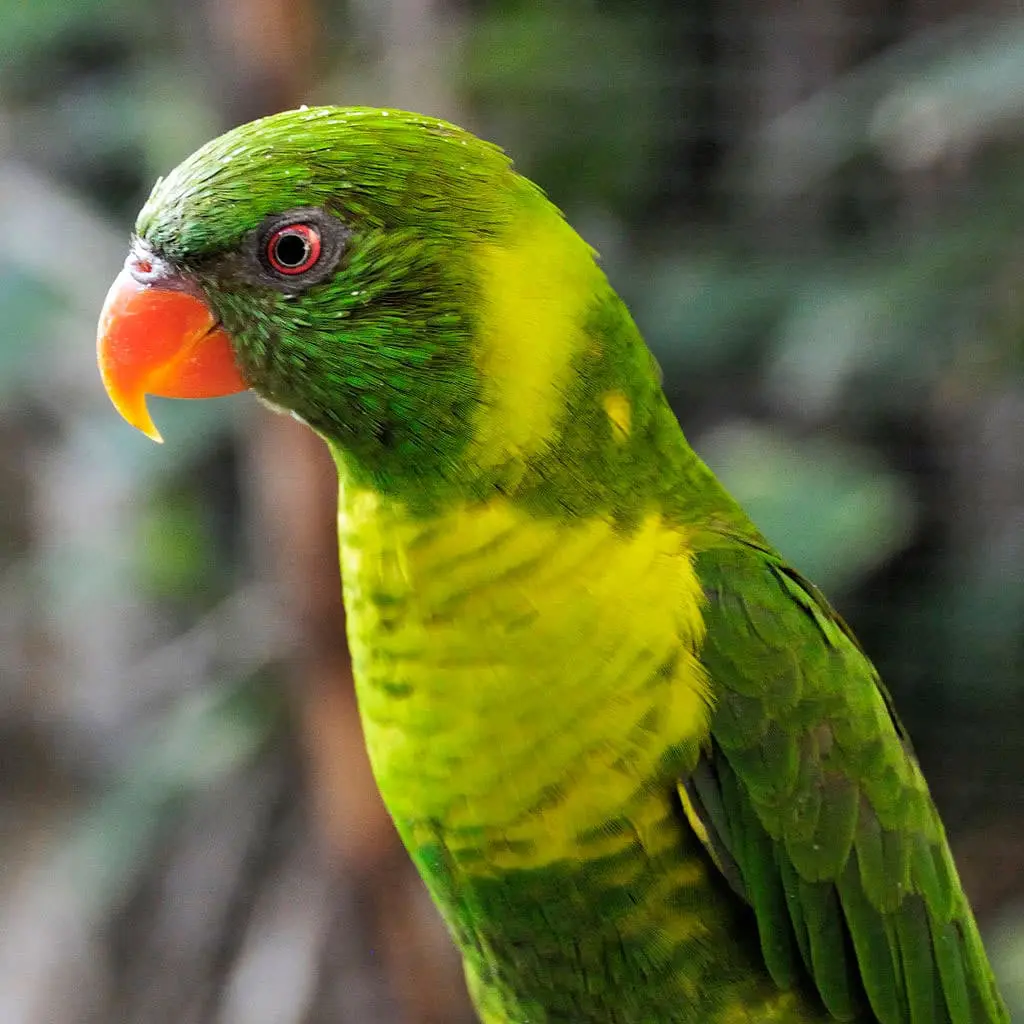
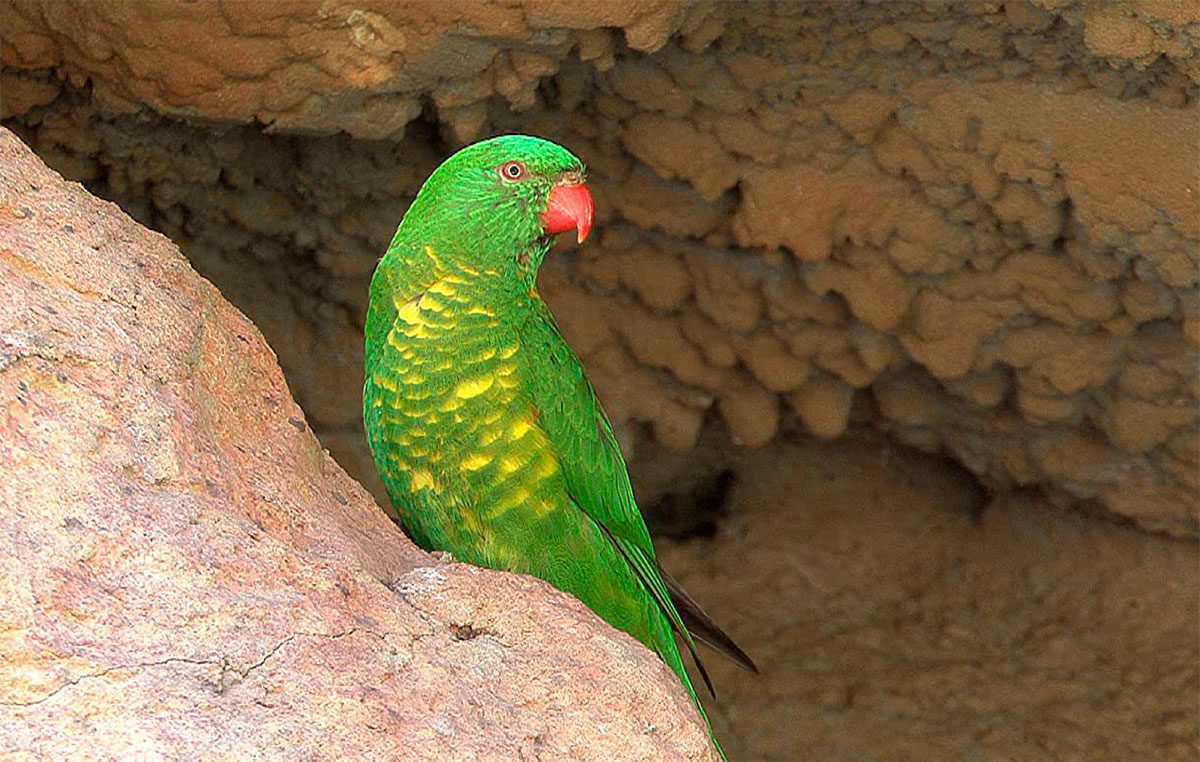
    The plumage of the Scaly breasted Lorikeet (Trichoglossus chlorolepidotus) is usually green.

    The part back from your neck, the throat and the chest has several brands of yellow.
    Under its tail, the the thighs and the sides of the body they are clearly marked with yellow.
    Under its wing , and more specifically by the part inferior of them flight feather, its color is reddish orange.
    The circle around the eyes is narrow and grey. Its irises is yellowish-Orange. The legs are ash and the bill orange.

    The immature are equal to adults, but with less scalloped yellow; the thighs Brown pale and tail shorter. The bill brown. The eye ring White grey.

    Habitat:

    The Scaly breasted Lorikeet they are distributed by many forest habitats, including parks and Gardens located on the outskirts of cities and farmland, where are the flowering trees present.

    They usually found in coastal areas and adjacent plateaus.

    They have a strong preference for agricultural land and coastal scrub that are dominated by trees of the genus Banksia.
    They can also be seen along the rivers, to the West of the Great dividing range. They can live up to 600 m.

    The Scaly breasted Lorikeet they have quite similar patterns to the of the Coconut Lorikeet. It is not uncommon to find them together in mixed flocks where one of the two species generally outnumbers the other..

    Most of the time, the Scaly breasted Lorikeet they live in pairs or in small groups of up to 10 individuals. They are most active at dawn, shortly after the dormitories are scattered.

    They usually roam locally. These short trips are motivated by the search for food.

    During flowering of trees, large groups may intervene if resources are abundant. The dispersion of groups is immediately after flowering.

    In urban districts, are sedentary Since the sources of food are abundant in the gardens during all the year.

    They are particularly friends of cultivated fruit, arriving to cause much damage in the orchards.

    These birds have a flying fast and direct. When they are in the air they are immediately identifiable by its green head and bright orange red wings bass. When flying over the tops of them trees with rhythms fast, their wings produce a buzzing sound which is easily audible.

    Reproduction:

    The nesting season comprises of mayo to February in the North of the area of distribution, probably related to the decrease of rainfall.

    In the southern part of the State of Victoria It takes place between August and January.

    The Scaly breasted Lorikeet They nest in tree cavities, usually at a considerable height from the ground. They cover the bottom of the nest with a layer of sawdust and then lay two or three white eggs., oval in shape.

    The incubation lasts a few 25 days. The male spends most of its time near hollow, but it does not seem to participate in the incubation. Both parents feed the chicks until they leave the nest, of 6 to 8 weeks after hatching.

    Food:

    The Scaly breasted Lorikeet they have a scheme rather similar to the of the Coconut Lorikeet. Both species feed primarily on nectar and pollen from the flowers especially the Niaouli (Melaleuca quinquenervia).

    They feed also on flowers, berries, fruit, seeds, small insects and their larvae. Are big lovers of the fruits cultivated. They also enter sorghum and corn fields because they crave small immature milky grains..

    Distribution:

    Size of the area of distribution (reproduction / resident): 2.310.000 km2

    The Scaly breasted Lorikeet being endemic to the Australian continent.

    Its area of distribution extends from Bamaga in the extreme north of Queensland the District of Illawarra, on the South coast of New South Wales.

    These birds are sedentary and abundant in the North, nomadic and less numerous in the South. They were introduced in the District of Melbourne, in the State of Victoria.

    Conservation:


    minor concern


    โ€ข Current IUCN Red List category: Least concern

    โ€ข Population trend: Stable

    The population World has not been quantified, but is estimated above 100.000 specimens.

    The species is described as common in the center of its area of distribution and more rare toward the areas north and South of their area of distribution.

    It is suspected that the population It stable in the absence of evidence of any reduction or substantial threats.

    "Scaly breasted Lorikeet" in captivity:

    Rare out of Australia; small number in the United States and the United Kingdom.

    Gregarious, playful and loud. A bit messy due to a diet of nectar.
    Its life in captivity ranges between 20 and 25 years.

    Alternative names:

    Scaly breasted Lorikeet, Scalybreasted Lorikeet, Scaly-breasted Lorikeet (ingles).
    Loriquet vert, Loriquet ร  poitrine squameuse, Loriquet รฉcaillรฉ (French).
    Schuppenlori (German).
    Lรณris-verde-de-peito-escamosos (Portuguese).
    Lori Escuamiverde, Tricogloso de Pecho Escamoso (espaรฑol).

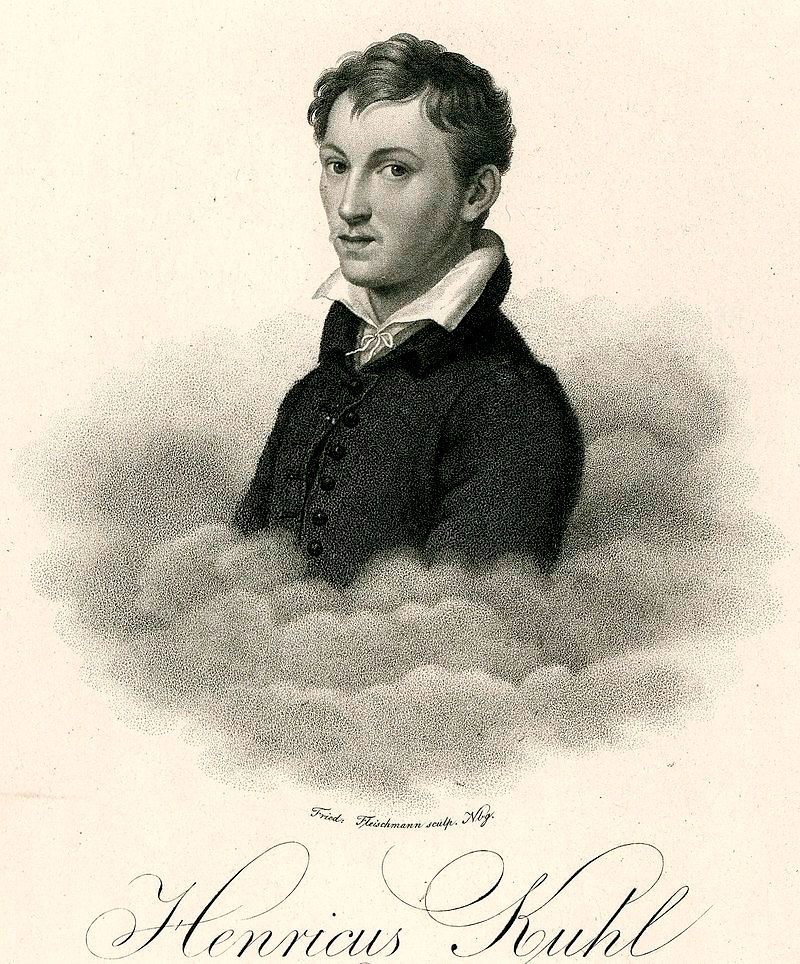
    Kuhl, Heinrich
    Heinrich Kuhl

    scientific classification:


    Order: Psittaciformes
    Family: Psittaculidae
    Genus: Trichoglossus
    Scientific name: Trichoglossus chlorolepidotus
    Citation: (Kuhl, 1820)
    Protonimo: Psittacus chlorolepidotus


    Images ยซGreen-skinned Loryยป:

    Videos "Scaly breasted Lorikeet"

    ——————————————————————————————————-

    ยซGreen-skinned Loryยป (Trichoglossus chlorolepidotus)


    Sources:
    Avibase
    – BirdLife.org
    – Parrots of the World โ€“ Forshaw Joseph M
    – Parrots A Guide to the Parrots of the World – Tony Juniper & Mike Parr

    Photos:

    – Josep de el Hoyo – IBC.lynxeds.com
    – by Tobias Spaltenberger – Two Scaly-breasted Lorikeets at Taronga Zoo, Australia. – Wikimedia
    – by Ken Havard – IBC.lynxeds.com
    – by Aviceda – Wikipedia
    – by Jeremy Eades – Wikipedia

    Sounds: Peter Woodall (Xeno-canto)