29 cm., including its tail up 13 cm.. and 100 g. of weight.
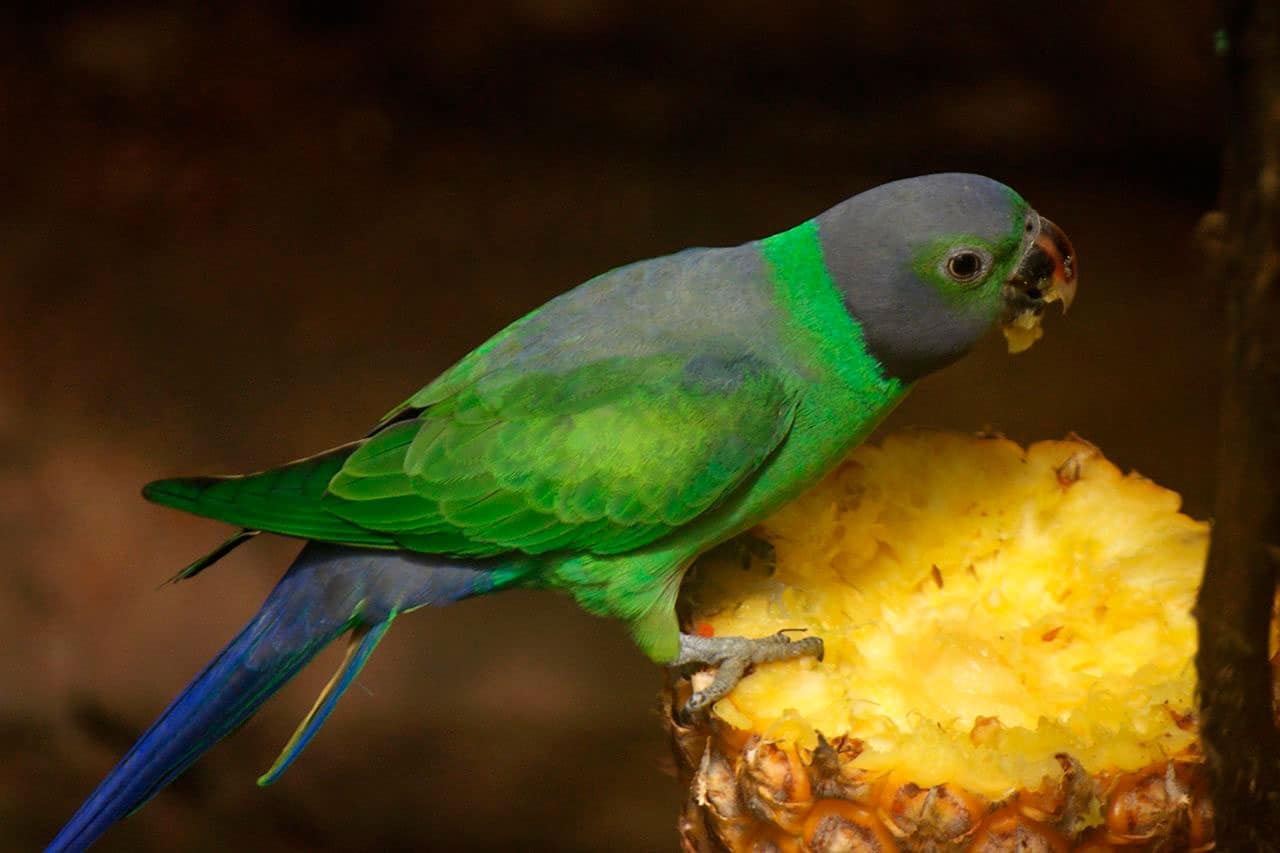
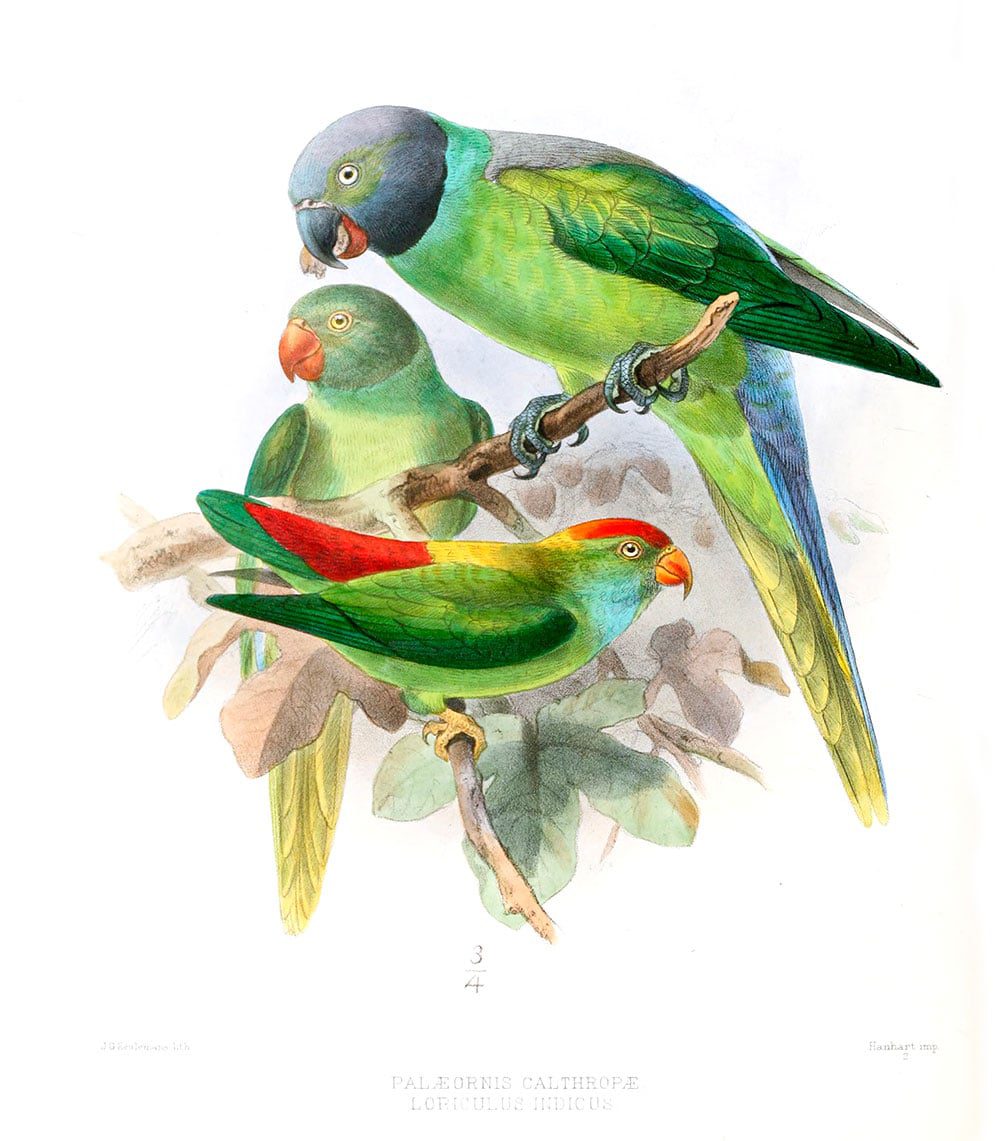
The adult male of the (Psittacula calthrapae)Layard's Parakeet has the head and back bluish grey, separated by a neck green. There is a wide swath in the chin of black color and tail It is blue with a yellow tip. Upper bill the male is red, and the bill bottom is brown.
The female es similar, but has the bill top in black, and dark green stripe on the cheek. Lack the band pink in nape and the neck is greenish yellow. They have the blue tint in the rear of the head if you can see in males. Feathers middle of the tail You are washed with blue.
The immature they are like the females, but with feathers tail shorter, with a plumage mainly green and bill dark red.
Their preferred habitats are forested areas 1.600 meters above sea level, although registered at altitudes 2.000 m, taking advantage of a wide variety of vegetation types including natural and semi-natural moist forests, tea plantation and botanical gardens; often at the edge of the woods, generally in small groups or couples.
Sedentary, especially in mountain areas, but extending over the lowlands, especially in humid forests near sea level.
after feeding, the Layard's Parakeet congregate in trees chattering loud and persistent. Before break, roam issuing strong calls.
Reproduction:
The time of reproduction It is around January to May, with a high season from July to September.
The eggs They are deposited in a natural cavity or disused nest Woody Woodpecker or a bearded, usually at the top of a tree. Competition for nest sites is often intense, especially with Plum-headed Parakeet. The cavity is lined with rotting wood and dust. Two to four white eggs make commissioning. Both sexes share duties incubation and feed on young.
Food:
Diet Layard's Parakeet It is believed to be similar to the Rose-ringed Parakeet and Plum-headed Parakeet, although their arboreal habits make them more frugivores and less destructive to crops.
According to sources, abundant in the 19th century and apparently still numerous in some areas, but declining due to habitat loss arising, for example, conversion of natural and semi-natural forests and plantations capture for trade.
– Avibase
– Parrots of the World – Forshaw Joseph M
– Parrots A Guide to the Parrots of the World – Tony Juniper & Mike Parr
– Birdlife
– Photos:
(1) – Layard’s Parakeet eating fruit in Sri Lanka. Its beak is not fully black, so it is probably a sub-adult female By Hafiz Issadeen (originally posted to Flickr as Layard’s Parakeet) [CC BY 2.0], via Wikimedia Commons
(2) – [BirdPhotoIndia] Layard’s parakeet, Sri Lanka – Indian Birds Photography
(3) – Photo by Steve G near Sinharaja, Sri Lanka, July 28, 2009 – Bird Forum
(4) – An adult of Layard’s Parakeet – World-Birds
(5) – Layard’s Parakeet Psittacula calthropae – Starron Bird and Wildlife
(6) – John Gerrard Keulemans [Public domain], via Wikimedia Commons
Origin: Mexico, Venezuela, Colombia, Ecuador, Peru, Bolivia, Argentina
Character: Intelligent, sociable
Life expectancy: 46 years
Height: 70 to 85 cm..
Content
Description:
70 to 85 cm.. length and a weight between 900 and 1100 g..
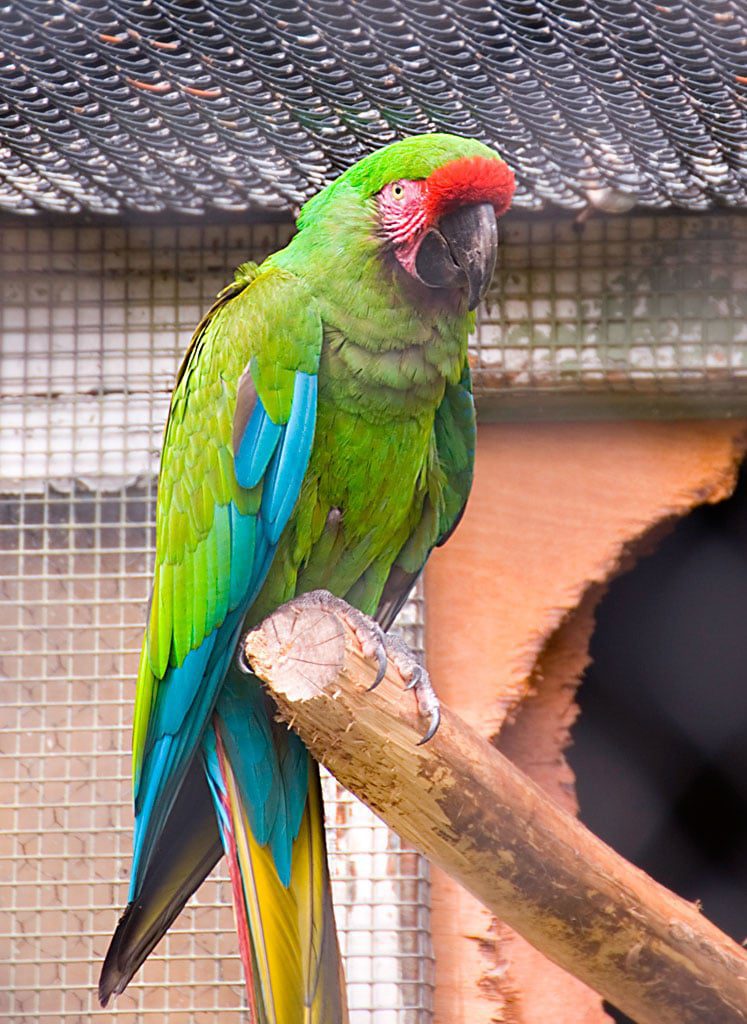
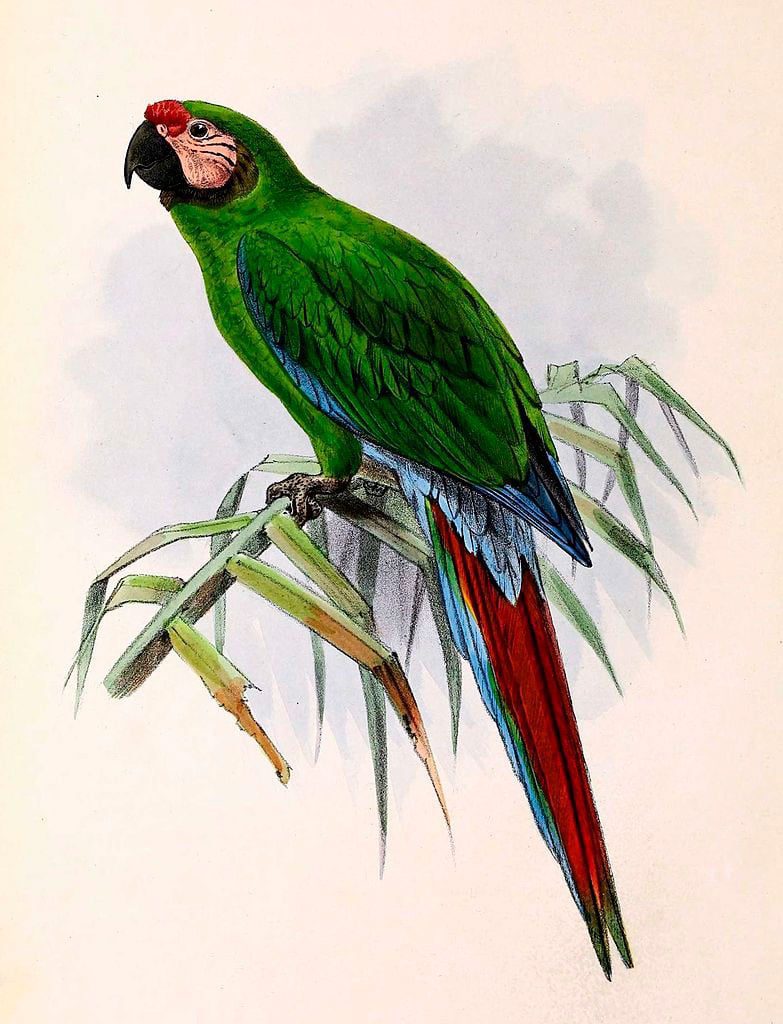
The Military Macaw(Ara militaris) has a dark green color. The head is a green slightly clearer and the crown blue. The back and the top of the wings they have a slightly greenish tone. The rounding of the wings, the edge of the wings and flight feather exterior are light blue.
The forecrown it is bright red in color and there are a series of purplish-brown lines of feathers on a background of bare skin, since the nose to behind eyes and in the cheeks.
The area of the throat and a narrow strip below the cheeks are olive brown in colour. Breast
and belly green; undertail- coverts pale blue.
Upper, the tail orange-red with the ends of the feathers blue; undertail, the tail olive green yellowish.
The eyes has irises yellow. The bill is dark gray, legs dark grey.
Both sexes similar.
Immature not described but as other large macaws, irises probably Brown, tail shorter and the bare facial skin clearer.
(Reichenow, 1908) – It differs from the species nominal by the throat reddish brown. The headphones feathers they have a base of reddish and blue present in the wings and at the end of the feathers is a more intense tone.
Ara militaris mexicanus
(Ridgway, 1915) – Almost identical to the species nominal but larger.
The Military Macaw they can be mainly observed in foothills of mountainous terrain in woodlands with cannons fields, mostly between 500 and 1, 500 meters above sea level, at the local level to 2.000 m, (3,100 m reported in Peru, to 2,400 m in Bolivia), but also at sea level in the Pacific of Mexico and in the region of Santa Marta, Colombia.
In Mexico, most are distributed in isolated highlands in semi-arid and arid forests, as well as in forests Quercus and Pinus; sometimes in humid, riparian lowland formations, with altitudinal movements to lower altitude to dense scrub forests between November and January.
Observed in humid forests in the Colombian Andes.
In Venezuela, in the rainforest, in some mountainous areas 600 m, sometimes also in more open dry forests.
Usually in pairs or small flocks (until 10 birds), but much larger swarms reported in flights to the roosts. Communal roosts on cliffs or in trees.
Reproduction:
Nest, usually, in crevices of cliffs; sometimes in large trees (for example, Acer, Pinus or Enterolobium).
In Mexico It has been observed to the Military Macaw making use of old nests of the Imperial Woodpecker (Campephilus imperialis) in dead pine.
Breeding pairs are for life.
The egg laying takes place in the month of June in Mexico. They are of two to three eggs that it will take 24 days to hatch, and where the young will remain with the parents for about a year.
The first flights the chicks are produced between the 97 and 140 days old and reach sexual maturity to the 3 or 4 years of age.
Food:
The diet of the Military Macaw It consists of a wide variety of fruits and nuts, including fruit of the Melia azedarach, Ficus and seeds of the Hura crepitans.
Distribution:
Size of the area of distribution (reproduction / resident): 276.000 km2
distributed by Mexico, In addition to several separate populations of South America, heading south to northwest of Argentina.
Widely distributed in Mexico from Sonora (where they have been observed at 28° 45'N) and Chihuahua in the North, until Chiapas, in the South and the East, where the birds may be geographically isolated.
Absent from the lowlands of the Caribbean; ancient appearances in Guatemala not confirmed.
In Colombia to the West of the Andes to the South of Dagua, of the Magdalena River Valley, and on the West side of the Andes, to the East of the Sierra Nevada de Santa Marta, in the North, through the East of the Ecuadorian Andes until Huanuco in the Peruvian Andes.
In Peru, mostly, observed in the East of the Andes, above all in the Marañón region, where at least, formerly, It was a common migrant from the slope of the peaceful between September-October(reported on the west slope at 6° 50'S) to feed on the fruit available seasonally.
Seasonal movements in many areas, for example, visitors to the West of Caquetá in Colombia, from the western slope of the Andes up to this.
Rare in the South of Mexico (in Chiapas possibly extinct), more numerous in the East and Northwest, where flocks of several hundred birds were reported at the end of 1970.
Very local in the Andes and at risk in Venezuela due to habitat loss and trade.
Fairly common in the North of the region of Santa Marta, but sporadic in other parts of Colombia.
Very rare in Argentina with only sporadic reports in recent years. Recent declines due to low habitat and bird trade, a large number of birds in captivity.
Subspecies distribution:
Ara militaris bolivianus
(Reichenow, 1908) – South of Bolivia and Northwest of Argentina.
The population size is estimated, provisionally, You can be in the band between 10.000 and 20.0000 individuals.
It is suspected that the population This species can be decreasing due to ongoing habitat loss and capture for national trade.
The loss of habitat and especially the national trade they are major threats to this species, even within the reserves (Snyder et to the. 2000).
In 1991-1995, 96 wild-caught specimens were found in the international trade, with Bolivia and Mexico, possibly, major exporters (Chebez 1994, D. Brightsmith in litt., 2007).
In Mexico, remains one of the most sought after species for the illegal trade of birds in cage; between 1995 and 2005, was the fifth country with the most parrots seized by the Environmental Control Agency from the country, becoming the fourth with more seizures between 2007 and 2010 (JC Cantú in litt. 2010).
In many areas it nests in hard-to-reach cavities in cliff faces., that provide some protection against the pressures of plundering of nests. But, the plundering of nests is a serious threat in Jalisco and Nayarit, where the species nests in tree cavities (C. Bonilla in litt. 2007, K. Renton in litt., 2007).
In Jalisco, Mexico, These macaws were not found in deforested areas, even when it was abundant the Hura polyandra (an important source of food), leaving, in the news, as trees to provide shade for cattle (Renton 2004).
An analysis of the GARP believes that the species has undergone a 23% loss of habitat within its distribution area in Mexico (Rios Munoz 2002).
A subpopulation in the Valle del Cauca, Colombia, account for less than 50 mature individuals, little is to be lost as a dam is expected to flood the only nesting cliff (ProAves Foundation 2011).
"Military Macaw" in captivity:
Very popular in poultry.
Although the Macaw Militar is present for more than one century in Europe, He has never enjoyed special interest among the fans, It's a shame, Since it is a being Intelligent. The main reason should be your little flamboyant plumage; especially compared to the one of other macaws. Other failures affect its presence in aviaries: is very loud and has a strong tendency to gnaw.
The power of their vocal organ is much higher than of any other species of Macaw. On the other hand it also good qualities: is very applied to learn, has a great talented imitator and presents an intelligence out of the ordinary.
With regard to its longevity, according to sources, a specimen lived 46 years in captivity. In captivity, these animals have been known that they can raise some 5 years of age.
– Avibase
– Parrots of the World – Forshaw Joseph M
– Parrots A Guide to the Parrots of the World – Tony Juniper & Mike Parr
– Birdlife
– Photos:
(1) – Military Macaw (Ara militaris) at London Zoo, England By jon hanson (originally posted to Flickr as military macaw) [CC BY-SA 2.0], via Wikimedia Commons
(2) – Military Macaw Ara militaris in captivity at Occidental Grand Xcaret Resort, Yucatan, Mexico By Tony Hisgett (originally posted to Flickr as Green Parrot) [CC BY 2.0], via Wikimedia Commons
(3) – Military Macaw flying at Whipsnade Zoo, Bedfordshire, England By Ara_militaris_-Whipsnade_Zoo_-flying-8a.jpg: Alex Smithderivative work: Snowmanradio [CC BY 2.0], via Wikimedia Commons
(4) – Three Military Macaws at Zoológico Los Coyotes, Mexico By Gary Denness (originally posted to Flickr as Squawk No Evil) [CC BY 2.0], via Wikimedia Commons
(5) – Two Military Macaws at Whipsnade Zoo, Bedfordshire, England. The macaw on the left has damaged feathers on its chest and abdomen probably because of a feather plucking habit By Mark Fosh (originally posted to Flickr as Macaw) [CC BY 2.0], via Wikimedia Commons
(6) – Two Military Macaws at Moody Gardens, Galveston, Texas, USA By joannapoe (originally posted to Flickr as 2005-06-18_11-52-47) [CC BY-SA 2.0], via Wikimedia Commons
(7) – A Military Macaw at Whipsnade Zoo, Bedfordshire, England. Some of its feathers are damaged probably due to feather plucking By William Warby from London, England (Military MacawUploaded by Snowmanradio) [CC BY 2.0], via Wikimedia Commons
(8) – Military Macaws in Mexico By Gregg (originally posted to Flickr as YOU WANT SOME?) [CC BY-SA 2.0], via Wikimedia Commons
(9) – Military Macaw (Ara militaris). Details of the head and face By Mary Mueller (Flickr) [CC BY 2.0], via Wikimedia Commons
(10) – Arara militaris by John Gerrard Keulemans [Public domain], via Wikimedia Commons
Among 28 and 30.5 cm.. of length and a weight of 232 g..
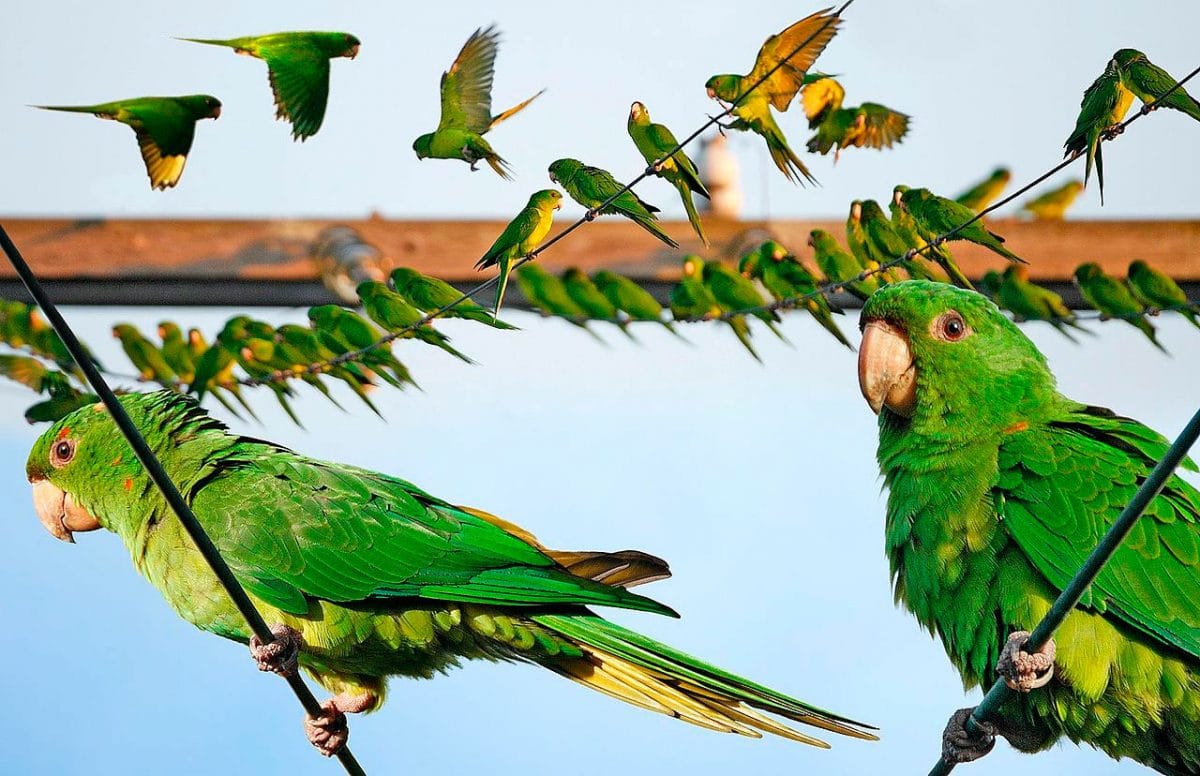
The Green Parakeet(Psittacara holochlorus) is a medium-sized Parrot with the wings in sharp form and the tail long and stitch. Its plumage is bright green, and can present several pens red or orange in the neck. In general, the underwing-coverts are metallic greenish-yellow color, While the the flight feathers and the bottom sides of the the tail feathers are yellow-olive. Presents a eye ring pale beige and the irises orange, the legs yellowish brown.
The Green Parakeet, as well as their subspecies, avoid moist lowland forests; Instead, prefer deciduous forests and gallery forests, scrub, clear and the edges of the forest.
In East Mexico, mainly seen in upland forest with some movements toward deciduous forests at elevations lower than during the non-breeding season. Registered to 2.100 meters in Mexico (the subspecies «brewsteri» at altitudes between 1,250 and 2,000m).
Views in flocks outside the breeding season, sometimes in groups of more of 100 birds, being larger groupings in places where food is abundant.
Reproduction:
The nests of the Green Parakeet they are located in tree cavities (for example, cavities made by woodpeckers), crack in rocks, holes in buildings or termite mounds. Colonial nesting reported in caves in the East of Mexico.
The breeding season has been recorded in the month of January to the East of Mexico (young in the nest); in April in Tamaulipas, to the South of Mexico.
The clutch most common consists of four eggs.
Food:
Diet Green Parakeet is based on seeds, nuts, berries and fruits; reported foods include the fruits of Myrica mexicana, seeds of Mimosa and corn (they can be destructive with their crops).
Distribution:
Size of the area of distribution (reproduction / resident): 275.000 km2
Some specimens settled in cities in southeastern Texas; It is not clear if they come from Pet escapes or are wild vagrant who emigrated from the North of Mexico. It is generally not migratory, but you can scroll to get food.
Subspecies distribution:
Psittacara holochlorus brewsteri
(Nelson, 1928) – Mountains of Northwest of Mexico, to the South of Sonora, Northeast of Sinaloa and South of Chihuahua.
• Red List category of the UICN current: Least concern
• Population trend: Decreasing
The population of the Green Parakeet It is suspected that it is between a slow to moderate decline due to the expansion of intensive farming and capture for the wild bird trade (Juniper and Parr 1998).
The State of conservation, globally, regards it as a kind of Least concern because it is abundant and widely distributed. It is considered one endangered species within the Mexican law by its restricted distribution. Nest boxes they have been provided in the South of Texas nest (Brush 2007).
The world population is estimated at 200.000 mature individuals.
Although it is not as popular as other large amazon parrots, the Green Parakeet is maintained as pet by the local population; have also been exported as pets to the United States. Although there are no accumulated figures, during the period of 9 months between October of 1979 and June of 1980, 327 birds were imported to the United States (Roete et to the. 1982).
While the loss of habitat It is probably the factor affecting the population of the Green Parakeet, their capture for the bird trade It is likely to be negative at the local level.
With the signing of the Wild birds Protection Act of 1991, the Green Parakeet can not be imported to the EE.UU. unless they are part of a breeding program authorized.
The marketing of all the species Mexican species parrots (parakeets, parrots and macaws) is banned in Mexico. Since the year 2008 It is a federal crime to catch, sell, buy this type of animal.
"Green Parakeet" in captivity:
Maintained as pet by the locals although its marketing is prohibited in Mexico.
The illegal trade in parrots and macaws is held thanks to demand from consumers. If the demand for these wild species is reduced, then the offer would be reduced and therefore the illegal capture.
According to sources, a specimen lived 21,8 years in captivity
– Avibase
– Parrots of the World – Forshaw Joseph M
– Parrots A Guide to the Parrots of the World – Tony Juniper & Mike Parr
– Birdlife
– Photos:
(1) – Green Parakeet From The Crossley ID Guide Eastern Birds By Richard Crossley (Richard Crossley) [CC BY-SA 3.0], via Wikimedia Commons
(2) – Green Parakeet by Vince Smith – Flickr
(3) – Aratinga verde by G. Lasley/Vireo – audubon.org
(4) – Aratinga verde by G. Lasley/Vireo – audubon.org
(5) – Aratinga holochlora (Psittacara holochlorus) – Bellas Aves de El Salvador –
Origin: Australia, Indonesian, New Caledonia, Papua New Guinea, Solomon Islands, Timor-Leste, Vanuatu
Character: Active
Life expectancy: 25 years
Height: 26 cm..
Content
Description:
26 cm.. of length and weight 100-157 g.
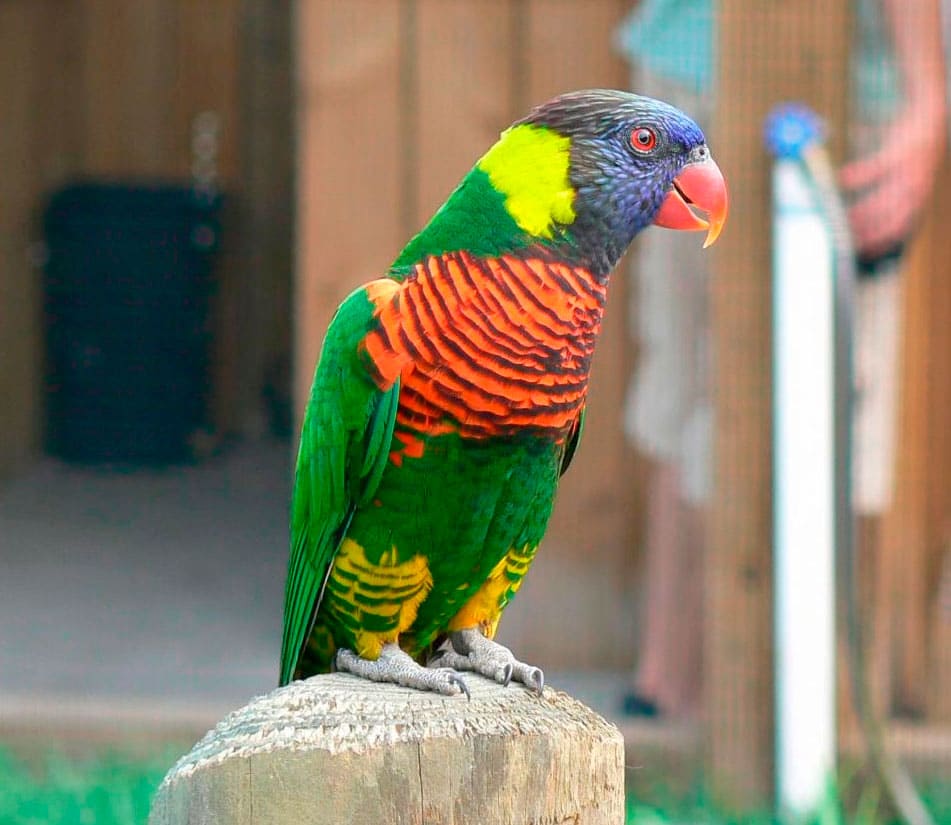
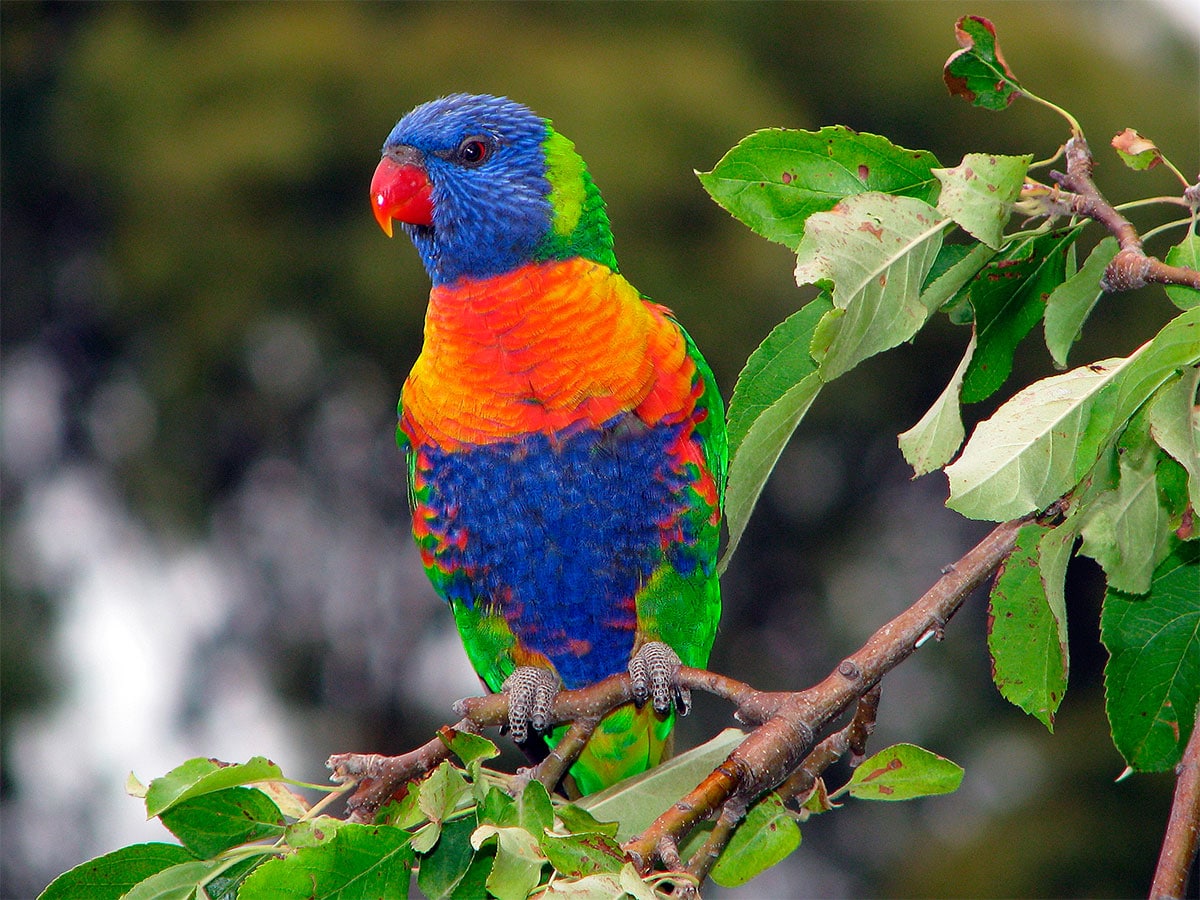
The Coconut Lorikeet(Trichoglossus haematodus) are colourful birds that find us almost all the colours of the Rainbow in their plumage.
Have the front of the crown, face and throat Dark bluish mauve, with violet stripes on the front of the crown, ear-coverts and part low of them cheeks; the rest of the head is dark blue with the bases of feathers brown-black color, especially around the rear of the crown and throat, and with greenish stripes at the rear of the crown.
The upperparts are of color green brilliant with specks of color reddish in the center of the the mantle (bases of feathers), and collar back brighter yellowish green.
The primaries with the tips blackish; a patch bright yellow in the innerwebs of the flight feather, that tends to orange in the secondaries; outerweb of the primaries and under wing-coverts, green. Underwing-coverts orange-red; the flight feather dark gray in tips.
The Breast
, the upper part of the abdomen and flanks bright reddish orange top, barred dark blue, tending to green at the bottom of the chest; abdomen with brands of color green in the Center, sometimes forming a discrete patch or interspersed with reddish orange; abdomen and the thighs with a beaming green and yellow with bases of color yellow; undertail-coverts of color yellow with tips of color green glossy. Upper, the tail of color green with them innerwebs of the lateral feathers yellowish: undertail, the tail greyish green in the outerweb, yellow in the innerwebs.
The bill orange red: the irises orange-red; legs gray or greenish gray.
Both sexes are very similar.
The immature they are more muted than adults, with the bill and the irises dark brown and tail more pointed.
Sound of the Coconut Lorikeet.
Description of subspecies of Trichoglossus haematodus
Trichoglossus haematodus caeruleiceps
(Albertis & Salvadori, 1879) – The blue of the head is more pale, Red is orange-red with the lined in very narrow and dark blue. Abdomen Blackish and band of the neck yellow.
Trichoglossus haematodus deplanchii
(Verreaux,J & Des Murs, 1860) – 26 cm.. of length and a weight of 140 gr.
The Coconut Lorikeet (deplanchii)(Trichoglossus haematodus deplanchii) is a variation of the nominal (Trichoglossus Haematodus)
Similar to the nominal Haematodus, but plumage slightly paler. The head has a very bright blue. Reddish orange on the chest, similar to the Trichoglossus haematodus massena, only that more alive. The abdomen is of color green beige and is extends to the part back from the neck. The the thighs and the feathers under the tail yellow and the upper part of the tail olive green.
Trichoglossus haematodus flavicans
(Cabanis & Reichenow, 1876) – Something bigger, 27 cm approximately in length. Its plumage varies from green to olive green and yellow opaque. Breast
and neck reddish colour with fine dark edges. Forehead and contour of eyes violet blue.
(Rothschild & Hartert, 1901) – 26 cm approximately in length. The blue of the head extends slightly less. The neck is yellow and the abdomen dark green.
The Coconut Lorikeet (massena) (Trichoglossus haematodus massena) is a variation of the nominal (Trichoglossus Haematodus).
The plumage is similar to the of the Ornate Lory except that it is usually paler. The head is blue, ending at the nape with dark brown feathers interspersed with more Brown clear. The chest is of color reddish with a narrow edging blue dark. In some cases, You can see some areas yellow in the plumage of the chest. The abdomen is green; but there may be some kind of mark on the bottom of the abdomen blue-violet.
The eyes are of color orange in the adult and Brown in the youth. The bill is red orange.
Trichoglossus haematodus micropteryx
(Stresemann, 1922) – Somewhat smaller, 25 cm approximately in length. The plumage is something more pale, the chest reddish orange with narrow edging of dark blue. Abdomen dark green. Band of the neck greenish yellow.
Trichoglossus haematodus nesophilus
(Neumann, 1929) – 26 cm approximately. Very similar to the Trichoglossus Haematodus Flavicans but with feathers underneath of the tail are green.
Trichoglossus haematodus nigrogularis
(Gray,GR, 1858) – Something bigger, 28 cm., approximately, length. Is similar to the Trichoglossus Haematodus Caeruliceps, but the blue of the head It is more dark and often have more red feathers on the neck.
Habitat:
The Coconut Lorikeet they are parrots of the Plains and Highlands. They are distributed by a wide variety of habitats such as mangrove forests, Moors and heathland near the coast, wooded meadows, tree galleries, reforestation during regeneration and rainforests.
In all cases, they need places with abundant flowers.
The Coconut Lorikeet they have also colonized habitats formed by man: coconut plantations, orchards and gardens on the outskirts of cities. They mark a greater preference for edges and clearings inside the dense jungles. Gladly tolerate the areas with degraded vegetation and plantations of small size in the small atolls.
They are birds sedentary, that does not prevent to do short trips looking for trees in flower. Because of these movements, populations appear to vary locally. Very gregarious, they live in pairs or in bands that can vary from a few birds to several hundred, Depending on the availability of food resources.
These birds are very active and noisy, flying a bit randomly above the tops of the trees or climbing up the branches in search of flowers or fruits.
during their search for food, the Coconut Lorikeet they usually share the space with other species of frugivores.
When they are hidden among the leaves, their cries of call reveal their presence.
They adopt a flight very quick and direct.
Son monogamous. During courtship, the couple is side-by-side, swaying, the neck forward and the pupil dilated. They wave irregularly wings to reveal the clear band that crosses its sub-wing.
Reproduction:
The breeding season performed at different times depending on the distribution area.
The species nominal eat your laying between September and December. Both members of the couple set up their nests in a tree cavity, usually a eucalyptus. Several nests, two or three may be in the same tree, but the entrance of the nest will fiercely defend against any intrusion.
In the the Admiralty Islands, the Coconut Lorikeet Sometimes they nest in the ground. The female normally lays 2 eggs on a bed of wood rotting chips. She incubated alone for a few 25 days.
The young chicks are altricial and need to 8 weeks to fend for if same. As soon as they are autonomous, they bind to the bedrooms and common bands.
Food:
The Coconut Lorikeet they have a bill acute equipped with a language composed of some structures similar to hairs tiny called papilla it help excavate the pollen and the nectar from the flowers.
Also eat fruits, berries, seeds, outbreaks and insect larvae.
In Australia, they forage primarily in eucalyptus trees and trees of the genus Banksia, in particular, coastal Banksia(Banksia integrifolia) and river banksia (seminuda), trees that often exceed the 15 metres in height.
They are also found in farmland, since they are particularly cultivated fruits and seeds Milky enthusiasts.
Easily entering gardens to steal fruit and not disdain approaching feeders
Distribution:
Size of its range (breeding/resident ): 5,310,000km 2
Endemics Oceania, at the edge of the Asian continent.
Can be found in Australia, in the East of Indonesian, Papua New Guinea, New Caledonia, the Solomon Islands and Vanuatu.
In Australia, mostly found on the coast, to the North of Queensland in the South of Australia and Tasmania.
Distribution of subspecies Trichoglossus haematodus
• Red List category of the UICN current: Least concern
• Population trend: Decreasing
The species has undergone intense trade: from 1981 When it began trading in CITES Appendix II and through the year 2005, 100.388 individuals were captured in the wild and reported in the international trade.
In some places of Australia, It is hunted for food and feathers are later used in ritual ceremonies
– Coconut Lorikeet, Rainbow Lorikeet (Coconut) (English).
– Loriquet à tête bleue (French).
– Allfarblori (German).
– Lóris-arco-íris (Portuguese).
– Lori Arcoiris, Lori de cocotero, Tricogloso de Pecho Rojo (español).
– Avibase
– Parrots of the World – Forshaw Joseph M
– Parrots A Guide to the Parrots of the World – Tony Juniper & Mike Parr
– Birdlife
– Oiseaux.NET
– Photos:
(1) – Rainbow Lorikeet perching on a wooden post at Tanganyika Wildlife Park, Kansas, USA. by Snowmanradio – Wikipedia
(2) – A Green-naped Lorikeet, T. h. haematodus, a sub-species of Rainbow Lorikeet, Trichoglossus haematodus at Jurong Bird Park, Singapore. by Benjamint444 – Wikipedia
(3) – A Rainbow Lorikeet (Trichoglossus haematodus moluccanus) in Melbourne, Australia. by Alfred Sin – Wikimedia
(4) – Lorikeets feeding on the flowering tree, Corymbia ‘Summer Beauty’ (cultivar). Photographed in suburban Brisbane, Australia. by Tatiana Gerus – Wikimedia
(5) – Two birds preening each other. Jervis Bay, New South Wales, Australia by Arnie Hollyman – ibc.lynxeds.com
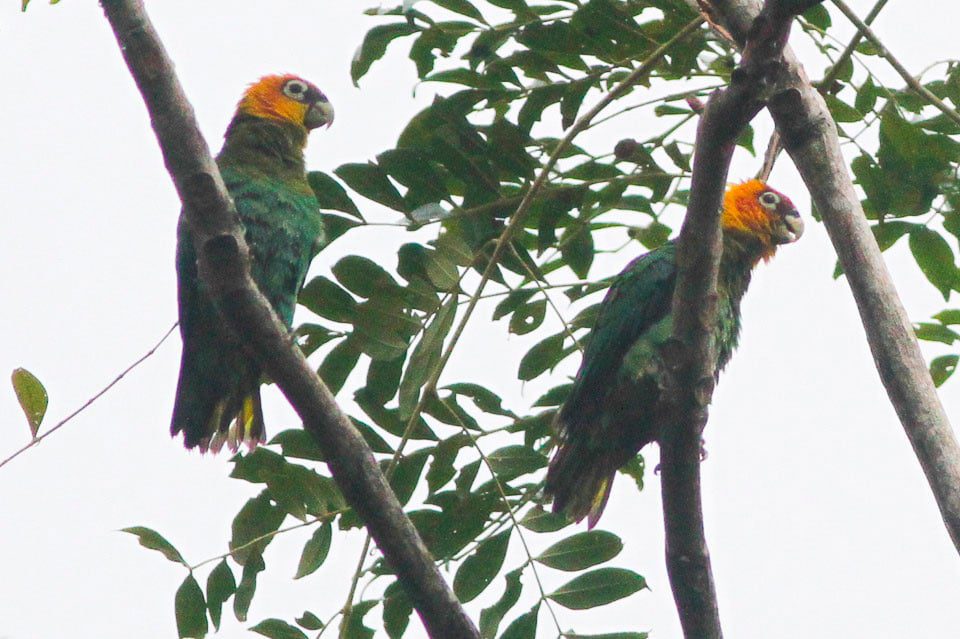
The Saffron-headed Parrot(Pyrilia pyrilia) is characterized by the lores naked; head, rear and both sides of the neck, bright yellow. Upperparts green. The spots of the upperwing-coverts are bright yellow with some red feathers at the base; Red at the front edge of the wing
with the external medium upperwing-coverts blue, or green with blue tips. The primary coverts are black, with the coverts remaining of the party top, green, sometimes with blue tips.
Primary and secondary bluish black with narrow green margin to the outerweb; tertiary green. Under the wings and axillary bright red, flight feather of color bluish pale. Breast
Yellow olive; belly Green but paler and more yellowish than the top; undertail-coverts green. above the tail with yellow in the innerwebs and blue tips; yellowish below. Bill color pale horn; cere blackish; dark grey skin nude of the lores extends around the eye ring; eye ring whitish; irises dark brown; legs grey.
Both sexes similar. The immature has the crown and shoulders Green with yellow yellowish brown in the face and throat.
Little known throughout its distribution. It inhabits in humid jungles, very wet, high secondary forest and cleared areas, between the 300 to 1700 m. In Venezuela can be seen in tropical and subtropical areas at altitudes of 150-1650 m (perhaps only seasonally to higher altitudes) and 1.000 metres in Colombia. Usually gregarious, seen in groups of up to 10 individuals.
Reproduction:
With reproduce during the first half of the year.
Birds in breeding conditions observed in the months of March-June in Antioquia (Colombia). Immature seen during the month of July in Sierra de Perija (Venezuela and Colombia).
Food:
Just have your feed data, Although it more likely is that your diet is composed of of fruit, berries and seeds.
Distribution:
Size of the area of distribution (reproduction / resident): 577.000 km2
The Saffron-headed Parrot is distributed in the this of the Province of Darien, Panama, to the North of Colombia and Northwest of Venezuela.
There are two records in the Northwest of Ecuador, a wandering pair alleged in the Book ecológica Cotacachi-Cayapas and a flock of about 20 birds in the Pedro Vicente Maldonado Canton, in the Northwest of Pichincha (Ridgely and Greenfield 2001), Although their status is uncertain (JF Freile in litt., 2000, Ridgely and Greenfield 2001).
Today it is rare to see to the Saffron-headed Parrot in accessible areas, Although it is still common Serrania de las Quinchas (Boyacá) and in the Hill of the peace (Santander) (Donegan et to the., 2003), Colombia and is soon likely to have decreased significantly in the Chocó, Colombia, or Darien (GR Angehr in litt., 1999, G. Stiles in litt., 1999).
There are few recent records, but they may still be numerous at the northern base of the Andes, Córdoba, North of Antioquia and Bolívar, and in the Valley of the Magdalena, to the East of Caldas and to the southeast of Antioquia, Colombia (Hilty and Brown 1986, A. Cuervo in litt., 1999).
Seems to have decreased in Venezuela, where recent records are from the area of Merida, the South-East slopes of the Cordillera de Mérida, Barinas (Kirwan and Sharpe 1999, C. Sharpe, J. and F. Rodriguez Rojas-Suarez in litt., 1999) and Sierra de Perija (CJ Sharpe in litt. 2011).
The population total may have fallen below 10.000 individuals (Juniper and Parr 1998, G. Stiles in litt., 1999). In fact, is estimated that the Western population (West of Sinu) is of 2.000 to 4.000 individuals (most habitat intact), the population Center (Serranía de San Lucas) is probably less than 1.000 individuals, the slopes West of the Eastern Cordillera It is estimated at approximately 1.000 individuals and the eastern slope of the Eastern Cordillera and Merida perhaps less than 1.000 individuals (C. Sharpe, J. and F. Rodriguez Rojas-Suarez in litt., 1999).
Conservation:
• Current category of the Red List of the UICN: Near-threatened.
• Population trend: Decreasing.
Rationale for the Red List category
This species has a population moderately small suspected is declining, and therefore qualifies as near-threatened. It is considered nationally vulnerable in Colombia (Renjifo et to the., 2002) and Venezuela (Sharpe 2008).
Justification of the population
The population is estimated at at least 7.000 copies in total, more or less equivalent to 4.700 mature individuals (PGW Salaman in litt., 2006).
Justification of trend
A slow to moderate and continuous decrease in population is suspected on the basis of the rates of habitat loss: its preferred habitat is severely threatened (T. Donegan in litt 2006.).
"Saffron-headed Parrot" in captivity:
Very difficult acclimating to captivity, susceptible to diseases in captive State.
(1) – Saffron-headed Parrot (Pyrilia pyrilia) by Ron Knight – Flickr
(2) – Iconographie des perroquets: Paris :P. Bertrand,1857. by Biodiversity Heritage Library – Flickr
Sounds:
▷ The world of Pets: Dogs, cats, birds, reptiles, amphibians
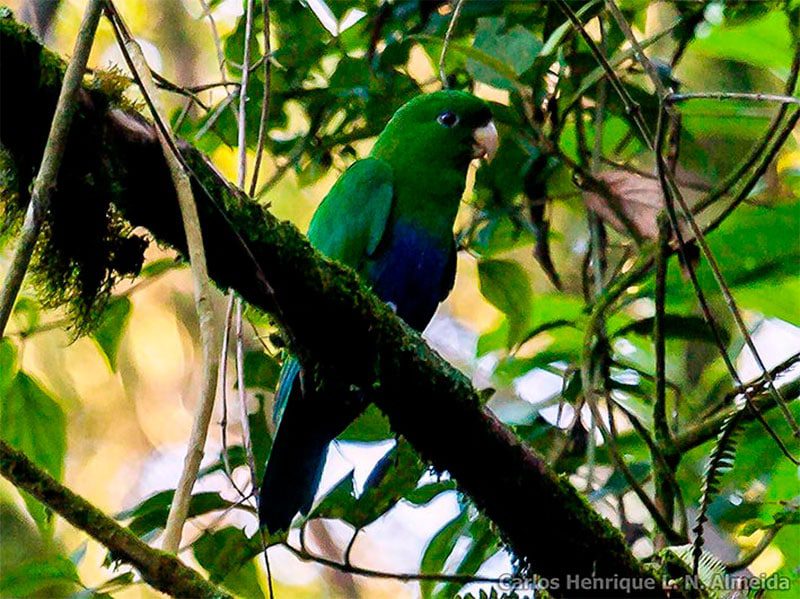
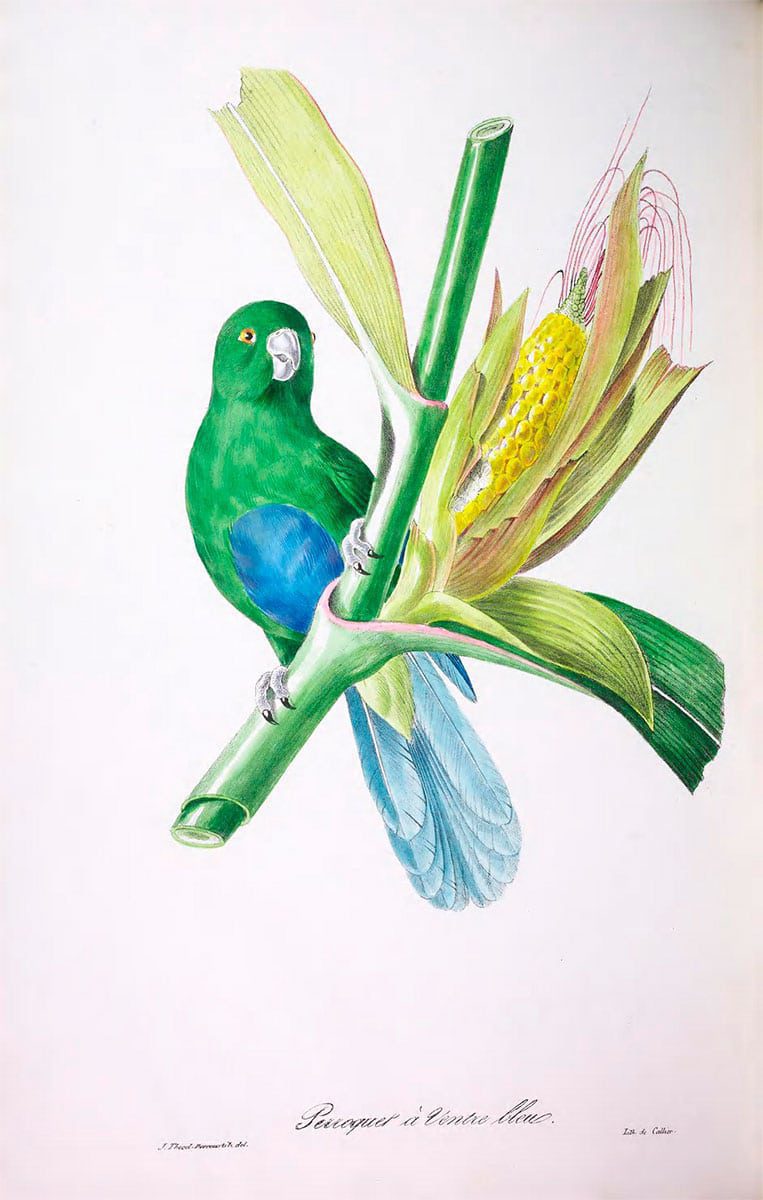
The Blue-bellied Parrot(Triclaria malachitacea) has the head, neck and all the "upper parts" and wing-coverts, grass-green.
Flight feathers grass-green with narrow blue tips to primaries, except the outermost, with a narrow pale blue margin to outerweb. Under, the wings with coverts green, and flight feather, bluish green. The underparts mainly green with large purplish-blue patch on centre of chest and the belly. Upper, the tail It is green with blue tips to central feathers; undertail, bluish green. Bill pink white: cere Pink; brown the irises; legs grey.
The female lacks the patch in the belly blue violet. The immature is as the adult but the respective young male has less blue purple in the underparts.
Sound of the Blue-bellied Parrot.
Its singing It is similar to a Thrush (Molothrus).
Habitat:
The Blue-bellied Parrot They live in the humid forests of the low mountains., generally preferring the canopy and the upper floors of tall forest, rich in bromeliads, along watercourses in the valleys. Visit cultivated areas with orchards and plantations and sometimes wooded suburban areas (for example in São Paulo).
Mainly observed at altitudes of 300-700 m, perhaps 1,000 meters in some places, but also they inhabit lowlands at sea level. The sporadic nature of reports, with apparent absence of apparently suitable areas, suggests some critical aspects of its little-understood ecology.
Reproduction:
Observed nests in cavities of large trees or stumps of palm. Strongly territorial, at least during breeding, with separation until nests 2 km. The breeding season It covers the months of September to January, maybe a little earlier or later.
Food:
Its diet it's formed, mainly, by fruit, seeds, outbreaks and nectar, some insects and their larvae (looking birds seen flying insects); specific foods include Pachystroma, Actinostemon, Sebastian, Eugenia, Campomanesia and Euterpe edulis, also occasionally Cortex, and citrus plantations.
Distribution and status:
Size of its range (breeding/resident): 361.000 km2
The species is quite common in large forest fragments in the Itajai Valley (G. Kohler in some ., 2011). Due to changes in habitat in the lowlands Santa Catarina, the most recent records in that state come from montane forests (G. Kohler in some ., 2011). Two records in Missions, Argentina, require confirmation. The population was estimated previously less than 5.000 individuals (Lambert et to the ., 1993), But Bencke (1996) suggested that there may be 10.000 in Rio Grande do Sul and significant numbers on the eastern slope of the Serra do Mar; But, the apparent rarity of the species suggests that these figures may be an overestimation (J. Gilardi in litt., 2010). In general, it is suspected that the population is declining, although in the State Park Tres Picos, Rio de Janeiro, It seems to have been stable since 2003 (A. Foster in a bit).
Population little known due to camouflage habits. Perhaps more numerous in the many facing slopes east of the Serra do Mar in Rio de Janeiro and São Paulo; habitat loss on a large scale has certainly caused a serious decline in its population, as well as the fragmentation of its distribution area. Although humid upland forests remain in substantial quantities in Serra do Mar, replacement of forests in valleys and on lower slopes with banana plantations could lead to further declines.
Captured for local LBMs and traded in small numbers internationally. There are records of several protected areas, but most of them may be insufficient to support populations of this species due to their low density.
Conservation:
• Current category of the Red List of the UICN: Near-threatened.
• Population trend: decreasing.
Rationale for the Red List category
This species is classified as near threatened because they suspect is in a moderately rapid decline due to loss of habitat and, perhaps to a lesser extent, to the capture for trade bird cage.
Justification of the population
The size of the world's population has not been quantified, but this species is generally described as "rare» (Stotz et to the ., 1996), although it is locally common in some places.
Justification of trend
Se sospecha una decrease moderate and continuous of the population depending on rates of habitat loss and perhaps, to a lesser extent, capture for the bird trade. The decline is not thought to be faster because the species occurs in montane areas where deforestation is typically less severe., It seems to tolerate mature secondary forests and anecdotal observations suggest that is locally stable, for example in the State Park Tres Picos, Rio de Janeiro. (A. Foster in a bit ., 2013).
The ecology and conservation of the Blue-bellied Parrot in remaining forest fragments in Rio Grande do Sul
This project aims to collect basic information on population, the distribution and ecology of the Blue-bellied Parrot in the center of Rio Grande do Sul, where a large population of the species is rapidly declining due to habitat fragmentation. The use of the radiotelemetry technique will make it possible to determine the area of use of the species and to evaluate their dispersal capacities.. Biology studies of this species is the objective to determine the elements that make up its diet and collect information on behavior and reproduction.. Through this information, It is intended to outline a regional plan for conservation Blue-bellied Parrot and their habitat, together with local actors. (AU)
Conservation status:
UICN: Vulnerable (with + 2c, d, Cl, Q2a). Previously in danger of extinction (Q2a: see Collar et al., 1994). CITES: Appendix II.
State of national protection: Protected by federal law and included in the list IBAMA of Brazilian species threatened with extinction (Bernardes et al 1990).
"Blue-bellied Parrot" in captivity:
unknown in captivity.
Alternative names:
– Blue-bellied Parrot, Blue bellied Parrot, Purple-bellied Parrot (English).
– Crick à ventre bleu, Caïque à ventre bleu (French).
– Blaubauchpapagei, Blaubauch, Blaubauch-Papagei (German).
– Papagaio-de-peito-roxo, araçoiaba, araçuaiava, cica, sabiá-ci, sabiá-cica (Portuguese).
– Loro de vientre azul, Loro Sabiá-cicá, Loro Ventriazul (español).
– araçoiaba, araçuaiava, cica, sabiá-ci, Sabiá-cica (Brazil).
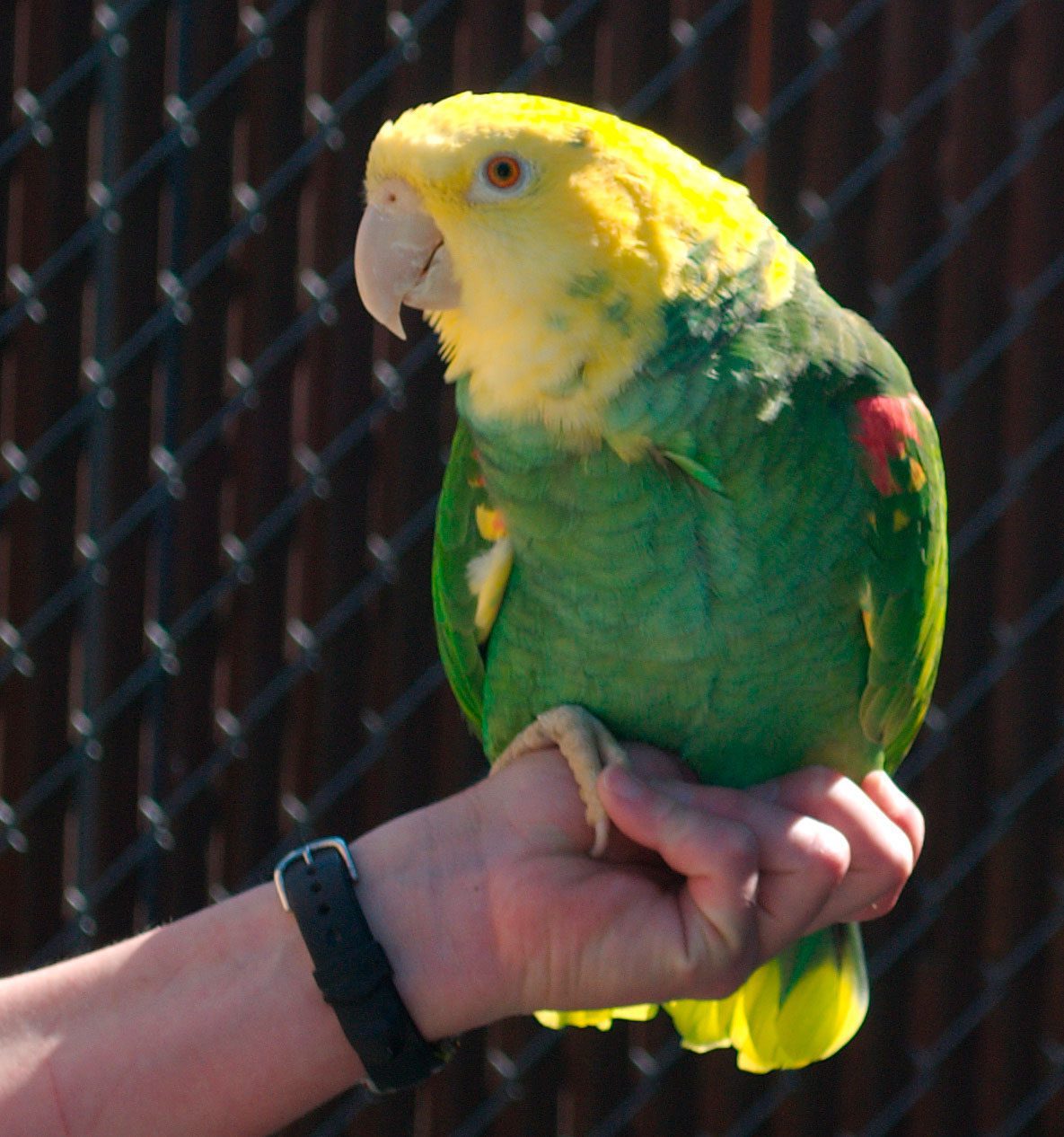
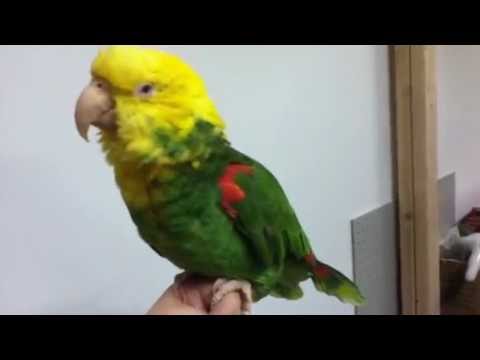
The Tres Marias Parrot(Amazona tresmariae) has head and throat yellow.
The upperparts are green. The underparts They are green but more yellowed than upperparts. Thighs yellow. Primaries and secondaries green, violet-blue becoming the tip. should carpal yellow. Speculum red on the basis of the five outer secondaries. The curve wings, pale red, with some yellow.
The tail is green, with yellowish green tip and lateral feathers basically marked with red on the inner band; outermost feathers fringed blue. The legs They are pale gray. The irises It is orange. The bill is horn-colored, gray towards the base of the upper jaw. Cere dark gray.
Both sexes are similar. The immature They are completely green head, except the yellow patch in forecrown. The curve wings, green. should carpal yellowish green.
They have preference by deciduous forests or evergreen, clear, Savanna Woods, pine forests, dense gallery forests; less commonly in dry thorn forests, mangroves or coastal marshes and cultivated areas with scattered trees.
Resident throughout its area of distribution.
Reproduction:
Nest in holes in tree trunks or fallen branches.
Food:
consume outbreaks, leaves news, fruits palm, seeds of Acacia, fruits of Macuna, figs and some fruits of cultivated land.
Distribution:
Endemic to the Marias Islands, on the west coast of Mexico.
Amazon tresmariae Conservation :
State of conservation ⓘ
Minor Concern ⓘ(UICN)ⓘ
• Current category of the Red List of the UICN: Least concern.
• Population trend: Decreasing.
The Tres Marias Parrot It has an extremely large range and, therefore, it does not approach the thresholds for Vulnerable at the discretion of the distribution area size (Extension <20,000 km2 combined with a size decreasing or fluctuating range, extent or quality of habitat or population size and a small number of locations or severe fragmentation).
Even though the population trend appears to be declining, It not believed to be declining fast enough to approach the thresholds for Vulnerable under the criteria of population trend (> 30% decline over ten years or three generations).
The population size has not been quantified, but it is not believed that approximates Vulnerable thresholds under the criterion of population size (<10.000 mature individuals with an estimated continuous decline> 10% in ten years or three generations or a population structure). For these reasons, the species is evaluated as Least Concern.
Usually it regarded as a subspecies of the Yellow-crowned Parrot (Amazona ochrocephala).
Tres Marias Parrot in captivity:
These birds belong to Appendix I of the CITES, with special protection because they are highly sought.
Alternative names:
– Panama yellow-crowned amazon, Tres Maria Yellow-headed Parrot, Tres Marias Amazon, Tres Marias Parrot, Yellow-headed Parrot (Tres Marias Is.) (English).
– Amazone à tête jaune (forme des Tres Marias), Amazone de Três Marias, Amazone des Tres Marias (French).
– Gelbkopfamazone-tresmariae, Tres-Marias-Amazone (German).
– Tres Marias Parrot (Portuguese).
– Tres Marias Parrot, Tres Marias Amazon, amazona de Tres Marias, Amazona cabeciamarilla de tres marias, Loro de las islas María (español).
Parrots A Guide to the Parrots of the World – Tony Juniper & Mike Parr
Photos:
(1) – Amazona tresmariae at Cougar Mountain Zoological Park, USA perching on a zoo keepers left hand By Derrick CoetzeeCamera location47° 33′ 11.72″ N, 122° 04′ 50.26″ W View this and other nearby images on: Openstreetmap – Google Earth 47.553255; -122.080628 [CC0], via Wikimedia Commons
(2) – Amazona tresmariae in a cage at Cougar Mountain Zoological Park By Derrick Coetzee from Seattle, USA (Tres Marias Amazon in cage 2) [CC0], via Wikimedia Commons
(3) – Amazona tresmariae at Cougar Mountain Zoological Park, USA. There are two with a woman zoo keeper By Derrick Coetzee [CC0], via Wikimedia Commons
(4) – Tres Marias Amazon in cage by D Coetzee – Flickr
(5) – Yellow-headed Parrot of the Tres Marias Islands by (c) Juan Cruzado Cortés – naturalista.mx
▷ The world of Pets: Dogs, cats, birds, reptiles, amphibians
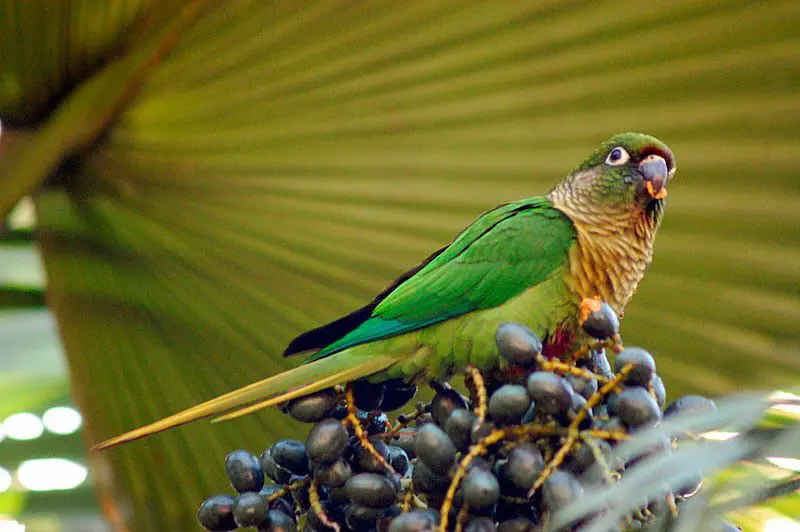
The Maroon-bellied Parakeet(Pyrrhura frontalis) has a frontal band matte red close with a few more bright red feathers behind cere; lores blackish; feathery cheeks and crown, greyish green blackish tips; ear-coverts olive green.
The upperparts They are green grass with a small area reddish at the bottom of the back. Primary coverts bluish green; wing-coverts grass-green, some feathers sometimes with olive tint. Primaries blue in the outerweb. green in the innerwebs, with dark tips; secondaries, mainly green. Sides of neck, throat and chest, brown oliváceo, feathers subterminally brown and black black tips, giving the whole a scalloped effect; lower breast green with a patch brown in the center of belly; flanks, the thighs and undertail-coverts, green. Upper, green tail in basal half, Shaded bronze to reddish tones on the tips; below, the tail is opaque brown.
Bill grey, sometimes paler in base mandible; yellow cere; bare periophthalmic whitish grey; irises dark brown; legs dark gray.
Both sexes are similar. The incipient brown lacks the belly. Immature paler than adult with irises darker.
Taxonomic note:
Closely related to Blaze-winged Parakeet(Pyrrhura devillei), with which it can be conspecific (populations or races that belong to the same species). It has been suggested that the species may also be conspecific with Green-cheeked Parakeet(Pyrrhura molinae).
Sound of the Maroon-bellied Parakeet.
Description 2 subspecies:
Pyrrhura frontalis chiripepe
(Vieillot, 1818) – As the nominal, but the upper surface of the tail It is completely green olive. Some orange-red markings on the bend of wing in some birds.
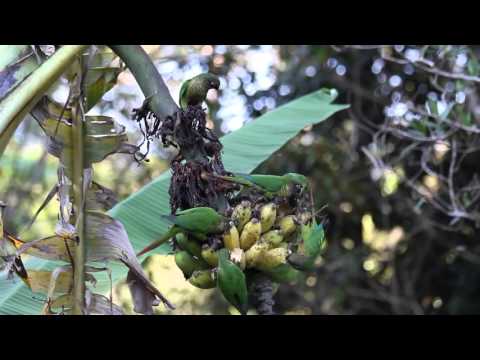
The Maroon-bellied Parakeet They extend through several forest habitats, forests, margins and marshy habitats, including the remaining patches Araucaria (for example, in Rio Grande do Sul). In the Paraguayan Chaco They seem almost confined to coastal areas of growth over the Paraguay River and its main tributaries. In Southeast Brazil They are mainly distributed in the highlands, to 1.400 meters above sea level; in other parts of the lowlands up near 1.000 m, where they are generally tolerant to disturbance, even reaching visit urban parks in the city of Assumption, Rio de Janeiro and São Paulo, and feeding in gardens (Rio Grande do Sul). gregarious, usually in flocks of 6-12 birds (until 40).
Reproduction:
They nest in the cavity of the trees. The breeding season It covers the months from October to December. Clutch 5-6 eggs.
The female incubated one for almost 30 days. The young leave the nest after about 45 days, after which they continue to be fed for some time by the two members of the couple.
Size of its range (reproductive / residents): 2.690.000 km2
The Maroon-bellied Parakeet It is endemic in Southeast South America, from the southeast of Brazil to the North of Argentina.
In Brazil They can be observed from south Bay ,through coastal states, until Rio Grande do Sul, and west, in the southeast of Minas Gerais, Brazil and South of Mato Grosso, through Paraguay (extension of records suggests its presence throughout the west end), North of Uruguay and North of Argentina, in Missions, Currents, Formosa, Chaco and sporadically in the past, in the North of Santa Fe (a population in Buenos Aires probably descended from leaks), and southeastern Bolivia.
Resident. Locally common to very common (for example, in Missions) but rare elsewhere (for example Currents) and extinguished in places due to conversion of forests for agriculture.
With He commercialized in large quantities with substantial late eighties exports averaging over 5.000 birds per year. There is a large captive population.
Distribution 2 subspecies:
Pyrrhura frontalis chiripepe
(Vieillot, 1818) – Central and southern Paraguay, northern Uruguay and northern Argentina.
Pyrrhura frontalis frontalis
(Vieillot, 1818) – Subspecies nominal. Southeastern Brazil from southern Bahia to Rio Grande do Sul including southeastern Minas Gerais and south and southeast of Mato Grosso.
Conservation:
State of conservation ⓘ
Minor Concern ⓘ(UICN)ⓘ
• Red List Category: Least concern
• Population trend: Stable.
Rationale for the Red List category
This species has a extremely large range and, therefore, it does not approach the thresholds for Vulnerable at the discretion of the distribution area size (Extension <20,000 km2 combinada con un tamaño de rango decreciente o fluctuante, extensión o calidad del hábitat o tamaño de población y un pequeño número de lugares o fragmentación severa). La tendencia de la población parece ser estable, por lo que la especie no se aproxima a los umbrales de Vulnerables bajo el criterio de tendencia poblacional (> 30% decline over ten years or three generations). The population size has not been quantified, but it is not believed to be close to the thresholds for Vulnerable under the criterion of population size (<10.000 individuos maduros con un declive continuo estimado> 10% in ten years or three generations or a population structure). For these reasons, the species is evaluated as least concern.
Justification of the population
The size of the world's population has not been quantified, but this species is described as «common» (Stotz et to the., 1996).
Justification of trend
They suspected that the population is stable in absence of evidence of any decline or threatens substantial.
Threats
The species has been marketed strongly: from 1981, when it was included in Appendix II of CITES, 52.523 individuals captured in the wild have been recorded in international trade (Trade database of UNEP-WCMC CITES, January 2005).
"Maroon-bellied Parakeet" in captivity:
The species is listed in Appendix II of the CITES.
There is a large captive population. They are intelligent birds, friendly and active. Readily they adapt to human contact and are easy to train. They are among the quietest cotorras, but its powerful high-pitched voices can become very annoying. Like other parakeets, They tend to express emotion with a series of loud cries, chillidos.
– Avibase
– Parrots of the World – Forshaw Joseph M
– Parrots A Guide to the Parrots of the World – Tony Juniper & Mike Parr
– Birdlife
– Photos:
(1) – RED-BROWN TIRIBA Botanical Garden of São Paulo By Dario Sanches [CC BY-SA 2.0], via Wikimedia Commons
(2) – Maroon-bellied Conure (Pyrrhura frontalis) on a wooden stump. Botanical Garden of São Paulo By Dario Sanches [CC BY-SA 2.0], via Wikimedia Commons
(3) – Pyrrhura frontalis Ilhabela-SP By Dario Sanches from São Paulo, Brazil (Maroon-bellied parakeet ( Pyrrhura frontalis)) [CC BY-SA 2.0], via Wikimedia Commons
(4) – Maroon-bellied Conure (Pyrrhura frontalis) – São Paulo Forest Garden By Dario Sanches [CC BY-SA 2.0], via Wikimedia Commons
(5) – Pyrrhura frontalis – Track dos Tucanos – Tapirai-SP IBA: Paranapiacaba Forest Massif By Jairmoreirafotografia (Own work) [CC BY-SA 4.0], via Wikimedia Commons
(6) – Parrots A Guide to the Parrots of the World – Tony Juniper & Mike Parr
 Minor Concern ⓘ
(UICN)ⓘ
Minor Concern ⓘ
(UICN)ⓘ


















_-London_Zoo.jpg)


_-eating_fruit.jpg)
_-on_stump.jpg)

_-Sao_Paulo.jpg)
