▷ The world of Pets: Dogs, cats, birds, reptiles, amphibians

Pudelpointer
Alemania FCI 216 . Braque Type

Pudelpointer

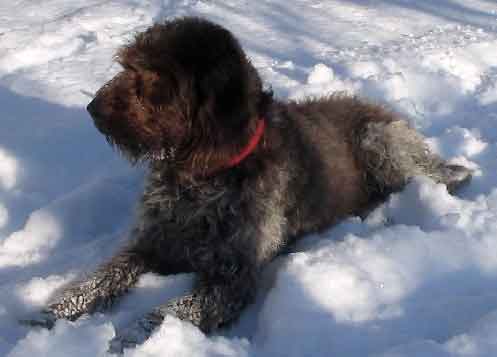
The Pudelpointer has a great passion for water and swimming, which probably comes from the Poodle's influence on his selection.

Content

History

It was the German Baron Von Zedlitz, a real foodie, who created the Pudelpointer towards the end of the 19th century.

The Pudelpointers are Pointing Dogs hard hair, whose genetic origins date back to a cross between a English Pointer and Pudelhund, without any other race of Pointing Dogs. Although the Poodle it was only used to create the first strains, his qualities as a hunter have been preserved until today.

The first crossing of a Pudelhund and English Pointer to establish the new breed took place in Germany in 1881. The father was a English Pointer property of Kaiser Federico III called tell and mother, a Poodle named molly, belonged to a famous Teutonic author on the subject of hunting dogs, Hegewald.

The genes of Poodle, like race, seemed to have been more dominant in transmission. To alter this, many more were introduced Pointers What Poodles in the breeding program to arrive at what the Pudelpointer is today. During the first 30 years of parenting, they only used 11 Poodles instead of more than 80 Pointers. After that initial time period, only the occasional reintroduction of the Pointer. After WWI and WWII, the breed was severely reduced and the reintroduction of the English Pointer became important to rebuild the brood.

The first Pudelpointers in North America were imported into 1956. After the foundations of the breed were laid, in 1977 The Club of the Pudelpointer from North America.

Combined with the exceptional abilities of the English Pointer to work on the plains, that is to say, a fine and receptive nose even at a distance, a quick search that covers a lot of ground and firm stops, we have created a versatile and genetically strong hunting dog that meets the requirements of hunting.

Germany is very careful in preserving the health of the breed, with increased vigilance against hip dysplasia and epilepsy. It also, the Pudlepointers currently play an important role in hunting events, since only dogs that have successfully participated in them are registered in the pedigree registry.

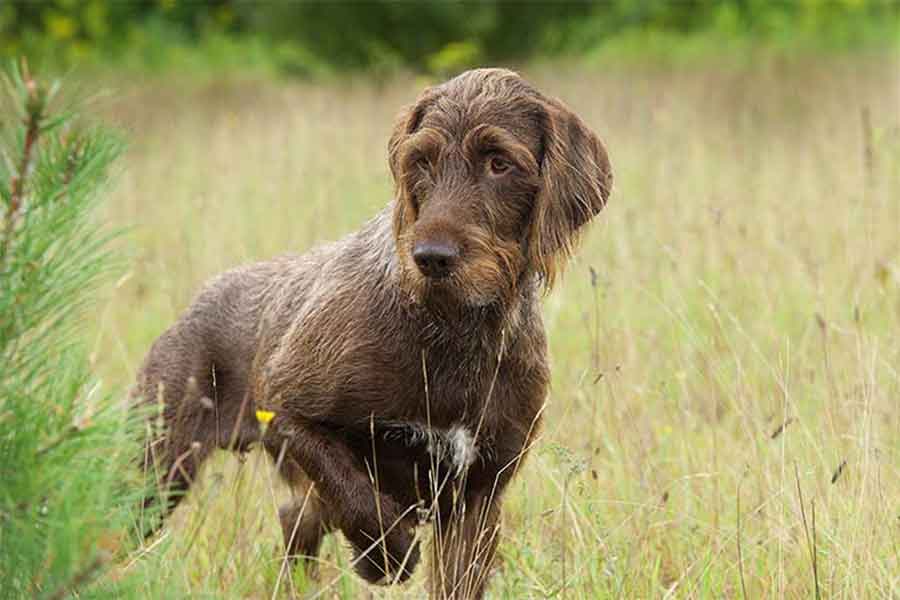
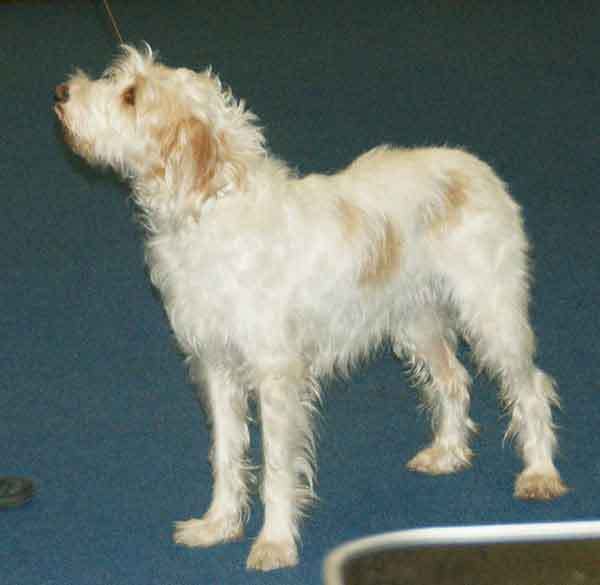
Photo: Pudelpointer by https://www.akc.org/dog-breeds/pudelpointer/

Physical characteristics

The Pudlepointer It is a breed of dog weighs between 20 and 30 Kg., measured between 53 and 66 cm.. on the shoulder and comes with liver colored fur, brown and occasionally black. The ideal coat is hard, lean and dense.

The Pudelpointer it is a large hunting dog that weighs between 20 and 30 Kg and measures between 53 and 66 cm.. The ideal type has the construction of a heavy pointer. The tail extends the rump in a regular line without breaking.. The tail can be shortened for hunting and, if the law allows it, the length should reach the lower edge of the vulva in females or cover the testicles in males. The length of the skull is equal to that of the muzzle. The ears are medium in size, hanging ears are high and close to the head. The tip of the ear is slightly rounded. Located on the sides, eyes are large and dark amber.

Covering the whole body, medium length hair is rough, close and close to the body, with a thick undercoat. The head has a beard and a toupee with curly streaks. The hair must provide protection against the cold, water and injuries. The coat is solid black, brown or dead leaf. White spots are allowed. These dogs shed very little hair.

Character and skills

Of the English Pointer, inherited the subtle nose, the burning and the lively gait. The Poodle gave him the vivacity of the spirit, the talent of transporter and the taste of water.

Energetic dog, very enthusiastic tracker and retriever at work, is comfortable on all terrains and can tolerate all weather conditions quite easily.

Health

Germany, the country of origin of the Pudelpointer, attaches special importance to the health status of the breed with special emphasis on the prevention of hip dysplasia (HD) and epilepsy in the breed. Some dogs may face these health challenges in their lives, but most of the Pudelpointers they are healthy dogs. Working with a responsible breeder, future owners can get the education they need to learn about specific health concerns within the breed.

Grooming

The Pudelpointer has a close layer, flat, hard and rough of medium length with a dense undercoat; as a result, seasonally shed. Beyond regular weekly grooming, the occasional bath will keep you clean and looking your best. Grooming can be a wonderful bonding experience for you and your dog..

Strong, fast-growing nails should be trimmed regularly with nail clippers or a nail buffer to prevent excessive growth., breakage and cracking. Ears should be checked regularly to prevent buildup of wax and debris, which can result in infection. Teeth should be brushed regularly.

Exercise

The Pudelpointer, as a hunting breed, need regular exercise. Exercise options may include backyard playtime, preferably fenced, or being taken for walks several times a day. Exercise can also be done in the form of indoor activities, like the hideout, chase a ball rolling on the ground or learn new tricks. Certain outdoor activities such as swimming, hiking or retrieving Frisbees or balls can provide a good outlet for expending energy.

Note: The Pudelpointer absolutely love water! Training for dog sports such as agility, obedience, and the rally can also be a great way to give your dog exercise.

Characteristics "Pudelpointer"

Coexistence is important that you have with your new friend. Before considering the acquisition of a dog of the breed "Pudelpointer" you know certain factors. Not all breeds of dogs are apt to live in an apartment, you must take into account his character, their need for exercise, their interaction with other pets, their care and if you have small children, their level of tolerance towards them.

Adaptation ⓘ

3,0 of 5 stars (based on 1 review)

friendly dog ​​ⓘ

4,0 of 5 stars (based on 1 review)

hair loss ⓘ

1,0 of 5 stars (based on 1 review)

Affection level ⓘ

4,0 of 5 stars (based on 1 review)

Need for exercise ⓘ

4,0 of 5 stars (based on 1 review)

Social need ⓘ

4,0 of 5 stars (based on 1 review)

Home ⓘ

3,0 of 5 stars (based on 1 review)

Toilet ⓘ

2,0 of 5 stars (based on 1 review)

Friendly with strangers ⓘ

4,0 of 5 stars (based on 1 review)

barking ⓘ

3,0 of 5 stars (based on 1 review)

Health ⓘ

4,0 of 5 stars (based on 1 review)

Territorial ⓘ

2,0 of 5 stars (based on 1 review)

Cat friendly ⓘ

2,0 of 5 stars (based on 1 review)

Intelligence ⓘ

4,0 of 5 stars (based on 1 review)

Versatility ⓘ

3,0 of 5 stars (based on 1 review)

Child friendly ⓘ

4,0 of 5 stars (based on 1 review)

Surveillance ⓘ

2,0 of 5 stars (based on 1 review)

joy ⓘ

3,0 of 5 stars (based on 1 review)

Videos "Pudelpointer"

Pudelpointer - TOP 10 Interesting Facts
Pudelpointer – TOP 10 Interesting Facts
Martha the Pudelpointer - Deliver to Hand
Martha the Pudelpointer – Deliver to Hand

Type and recognitions:

  • FCI CLASSIFICATION:
  • Group :
  • Section : . .

Federations:

  • – FCI – Group 7: Pointing Dogs. – Section 1: Continental Pointing Dogs. 1.1: Braque Type ⓘ
  • – CKC – Grupo 1 – Sporting Dogs ⓘ
  • – UKC – Gun Dogs ⓘ

FCI breed standard "Pudelpointer"

Origin:
Germany

Date of publication of the valid original standard:
09.11.2004

Use:

Hunting dog. Variable with all the characteristics required for the breed. Useful for the field, forest and water.


General appearance:

Ideally, its structure should show the type of a heavy Pointer with a not too long brown coarse coat., dark brown, color of dry leaves or black which protects its entire body.

IMPORTANT PROPORTIONS :

• The relationship between the length of the body and the height at the withers must be 10 to 9.
• The ratio of the length of the skull from the occipital protuberance to the stop is equal to the length of the snout from the stop to the nose..


Behavior / temperament:

neither shy nor aggressive. Quiet character, controlled and balanced. Marked hunting instinct without fearing prey or being sensitive to being shot.

Head:

Harmonious length and width according to your height and sex.

Cranial region:
  • Skull: Plano, just a little rounded on the sides, moderately wide, clearly developed eyebrow arch.
  • Depression links (Stop) : Marked.

facial region:

  • Truffle: Its color corresponds to the color of the hair, heavily Pigmented. Well open nasal Windows.
  • Snout : Harmonious relationship between its length and width. It should not be narrow or end in a point. Straight nasal bridge.
  • Lips : Tight, not hanging. In no way should you drool.
  • Jaws / Teeth : Big teeth, strong jaws with a perfect scissors bite, regular and complete in which the upper incisors close in front of the lower ones without losing contact and the teeth are placed vertically in the jaw. With 42 teeth according to the dental formula.

Eyes : Placed on the sides, large, dark amber tones with a lively expression. Eyelids well covered with hair and close to the eyeball.

Ears : Medium-sized, High insertion hangs flat and close to the sides of the skull; They are not fleshy; well covered with hair and rounded ends.

Neck:

Long Middle, strong muscles. The neck line is slightly domed without showing a double chin..

Body:

  • top line : Right.
  • Cross : Marked.Back : Short, straight, rigid with strong muscles.
  • Pork loin : With strong muscles.
  • Rump : Long and moderately inclined, with good musculature.
  • Breast : Wide and deep. Ribs well sprung but not barrel-shaped.
  • Bottom line and belly : retracted back, forming an elegant arch. Delgado.

Tail:

The transition from the rump is even in a line without interruption. Right tail, should not be carried upwards. Cover of rough hair without forming a flag. The tail, for hunting purposes and in accordance with animal protection, In the case of females, it is amputated to the lower edge of the vulva and in males, covering the testicles. In countries where amputation is prohibited by law, the tail can be left natural.. It should reach the joint of the hoof and its carriage should be straight or slightly saber-shaped, somewhat above the top line..

Tips

PREVIOUS MEMBERS :

In general: Seen from the front straight and parallel, seen from the side, limbs straight and well placed under the body. Strong joints and bones.
Shoulder : Well-fitted and muscular scapulae. Shoulders and forearm form a correct angle.
Arm : Long, well muscled and dry.
Elbow : Placed well under the body, well adjusted without turning in or out.
Forearm : Long, well developed muscles, dry and placed vertical. Arm and forearm form a correct angle.
Articulation of the carpus : Strong.
Metacarpus : something directed forward.
Previous foot : Round to oval, closed. Strong and durable pads. The hair on the feet and fingers should not be too long.

LATER MEMBERS :

In general : Hindquarters seen from behind straight and parallel, well muscled, strong bones.
Thigh : Long, width, well muscled.
Knee : Strong. Thigh and leg form a correct angle.
Warm-tarsal joints : Strong, very well angled.
Metatarsus : Short, vertical placement.
Rear foot : Round to oval, closed. Strong and durable pads. The hair on the feet and fingers should not be too long.

Movement:

Harmonic, elastic, with good reach and thrust. Steps that cover the surface well. Forelimbs and hindlimbs straight and parallel, maintaining an upright posture.

Mantle

SKIN : Tight, footprint, without forming folds.

HAIR : Cerrado, glued, hard, medium length with abundant undercoat. The length of the outer hair above the withers is 4 – 6 cm.. The head with a beard and chip-type curls on the forehead. The hair on the belly is closed and dense. The hard and dense coat should provide, as much as possible, good protection against inclement weather and injuries..

COLOR : Unicolor.

• Brown.
• Colors of dry leaves.
• Negro.

Small white marks allowed.


Size and weight:

Height to the cross :

  • Males : 60 to 68 cm.,
  • females : 55 to 63 cm..


Fouls:

Any deviation from the aforementioned criteria is considered a fault and the severity of it is considered to the extent of the deviation from the standard and its consequences on the health and well-being of the dog..
In particular :

• Sunken or steep back.
• Elbows turned outward or inward.
• Cow's hooves, sickle or together both standing and moving.
• Stiff movement or with short steps.
• Hair that is too long, too thin, absence of inner fleece.

DISQUALIFYING FOULS:

• Shyness towards prey, nervousness, aggressiveness, teether out of fear.
• Unsuitable temperament for hunting, especially fear of being shot.
• Prognathism, enognatismo, crossbite. Narrowly placed canines.
• Lack of teeth except P1.
• Entropion, ectropion of any type.
• Upper eyelids without eyelashes as well as eyelids devoid of hair.
• Short hair.
• Absence of beard.
• Any other color or markings of another color than that described by the standard.

Any dog ​​showing clear signs of physical or behavioral abnormalities must be disqualified..


N.B.:

Males should have two normal-appearing testicles fully descended into the scrotum..

Source: F.C.I - International Cynological Federation

Alternative names:

1. Pudelpointer (English).
2. Pudelpointer (French).
3. Pudelpointer (German).
4. Pudelpointer (Portuguese).
5. Pudelpointer (español).

▷ The world of Pets: Dogs, cats, birds, reptiles, amphibians

Slovakian Wirehaired Pointers
Eslovaquia FCI 320 . Braque Type

Slovakian Wirehaired Pointers

The Slovakian Wirehaired Pointers in an obedient and easy to train dog.

Content

History

The Slovakian Wirehaired Pointers is a relatively new breed. It dates back to the end of the decade of 1950, in Czechoslovakia after World War II and is believed to have been developed using the Weimaraner, the German Wirehaired Pointer and the Cesky Fousek.

At any given time, the Slovaks who developed the breed asked the Club Weimaraner from Germany to recognize this dog under the name of Rough-haired Weimaraner, but the request was rejected.

The resulting dog is a true wonder, that combines the talents of a hunting dog (on the plains, in the woods and in the water), a working dog and a companion dog. Adapts to all climates.

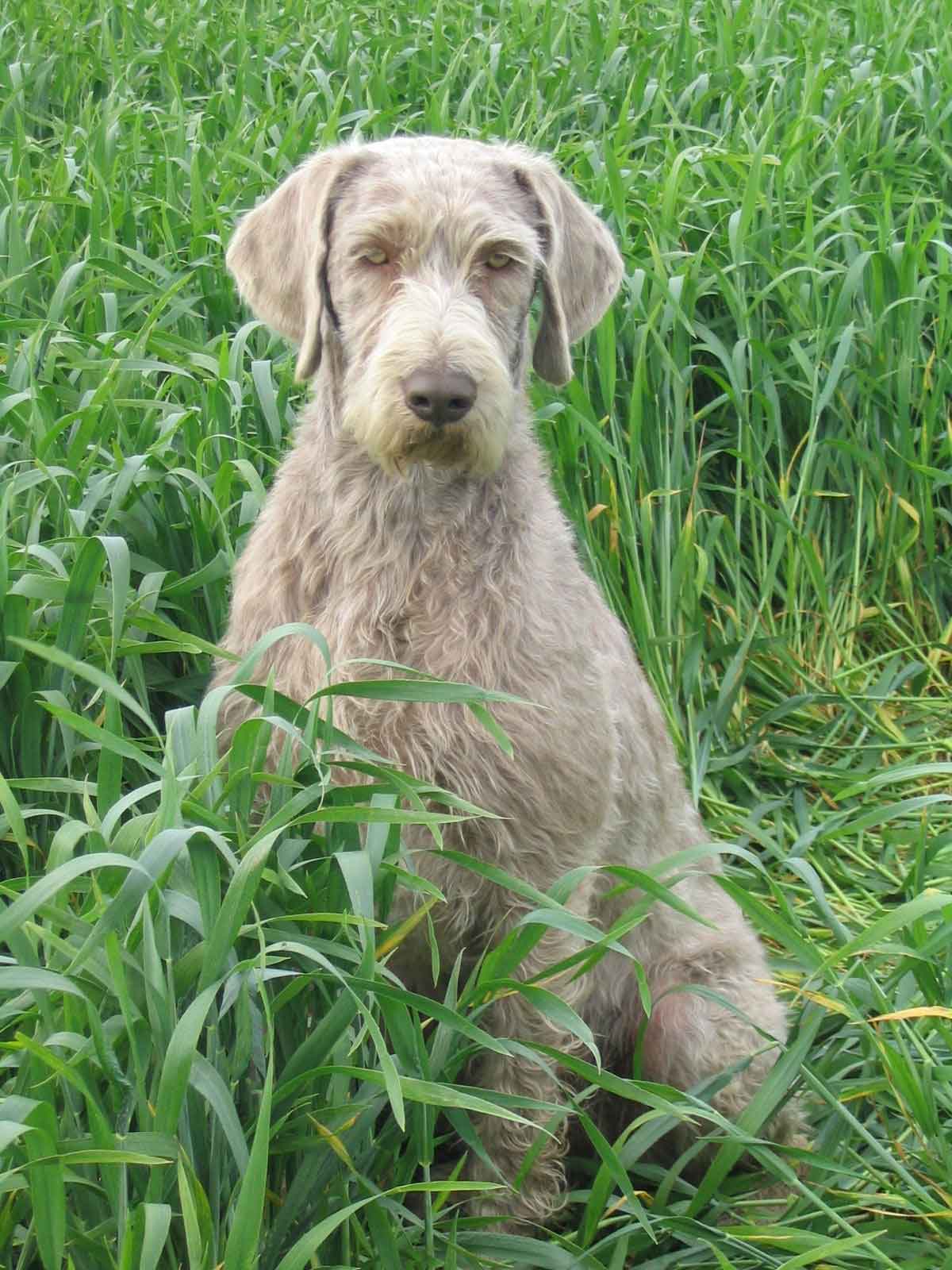
Photo: Slovakian Wire-haired Pointing Dog by Ing. Urban Michal (breeders HP), Public domain, via Wikimedia Commons

Physical characteristics

The Slovakian Wirehaired Pointers it's a tall braco, solidly built and not too heavy. This breed is bred to be a working dog, with nobility in its forms. Tail is cut to half length when permitted by law. It stands rather high, worn at rest and in horizontal action. The eyes are almond-shaped, amber, with a clever expression. In puppies and young dogs, are blue. Dropped ears sit above the eye, they are rounded and not too long.

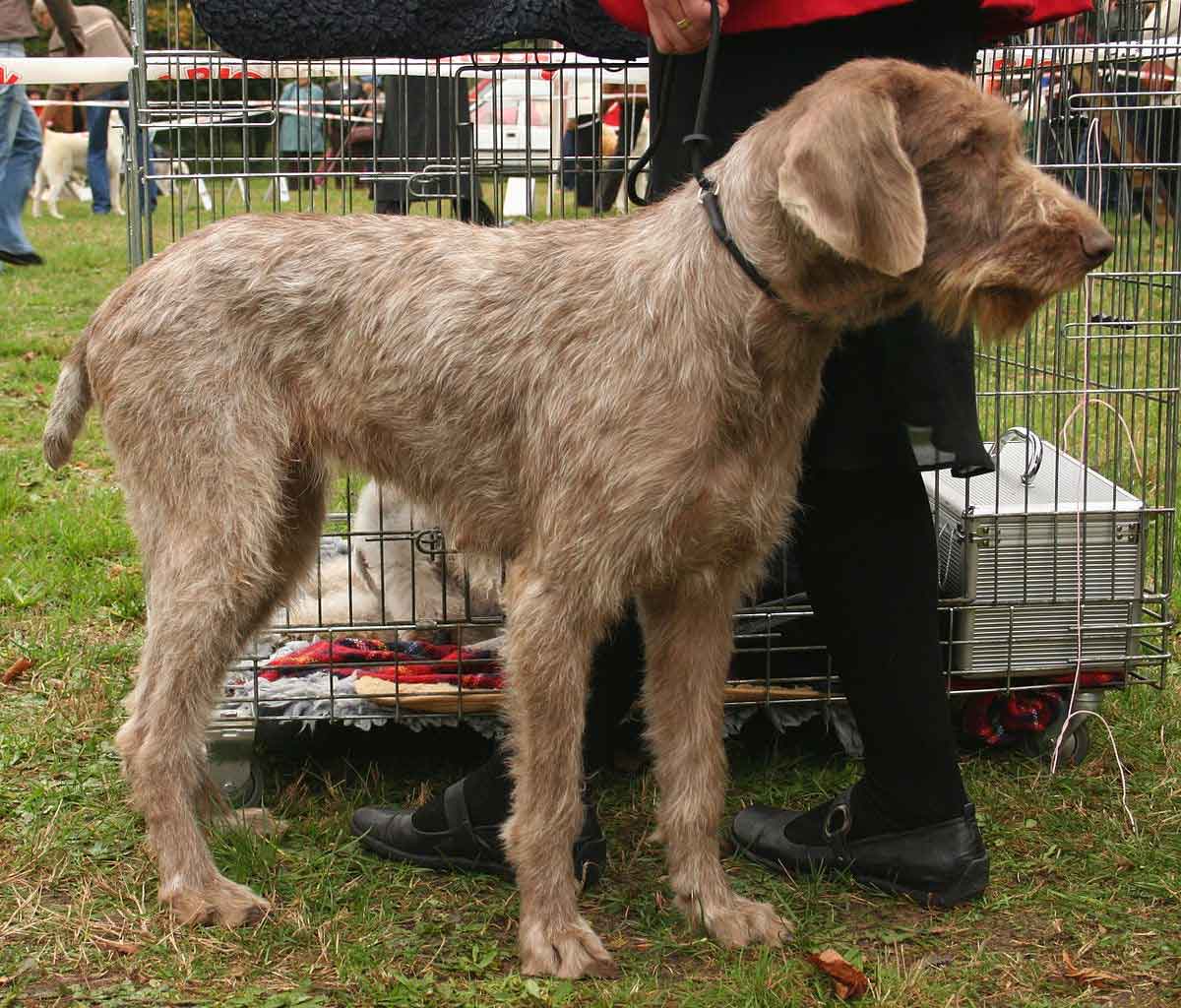
Slovakian Wirehaired Pointers
"Stilling hard hair" during the exhibition of dogs in Rybnik – Stone, Poland

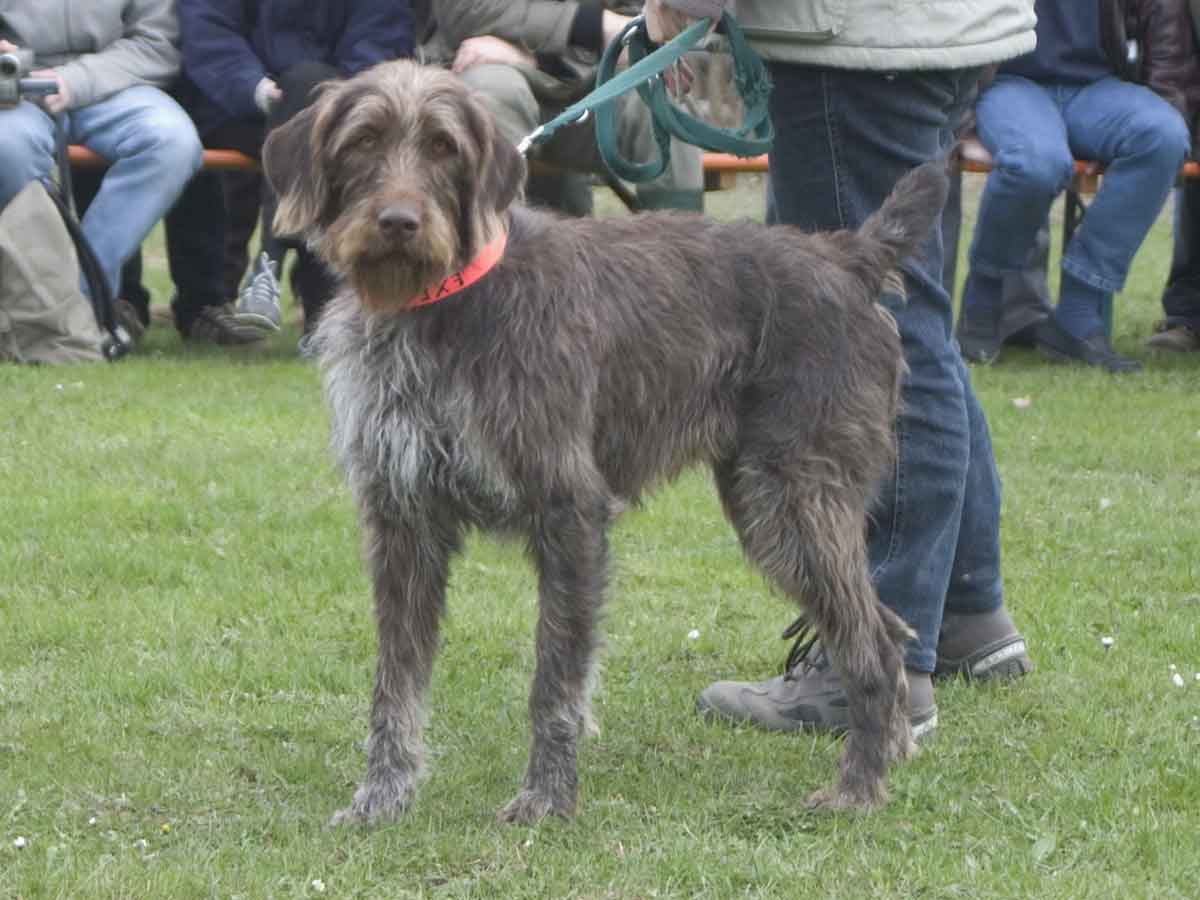
The undercoat consists of a short, fine down that normally falls off in summer. The top layer is about 4 cm long, hard, straight and well laid. At the bottom of the muzzle, hairs are longer and softer and form a mustache. above the eyes, are more pronounced and are obliquely erect. The forehead and occiput are covered with short, hard hair. They are short and soft on the ears. The tail is well provided with hair, but it is not brushed. The basic color is "gray": is a sand shaded with brown. White markings are allowed on the tips of the legs and on the chest. Smaller or larger dark spots can mark gray. There is also a speckled coat.

Character and skills

The Slovakian Wirehaired Pointers described in the FCI standard as easy to train and compliant. They are selected for their work characteristics as Pointer dogs. They hunt on the plains, forests and water. They work mainly after the shot, searching and recovering the game.

The Slovakian Wirehaired Pointers it's animated, happy and eager to please. He has a lot of energy and is very intelligent., but gets bored easily. This can sometimes make training a bit difficult., and should work to make training sessions fun, interesting and not very long. They need a steady and consistent hand in disciplining with structure and limits.. Harsh words or physical punishment should be avoided. They have a strong bond with their families, and may develop separation anxiety without proper conditioning.

the Slovakian Wirehaired Pointers they are the happiest doing things with their owner. This makes the breed a great candidate as a canine companion for owners who love walks., cycling or jogging. It is imperative that they have opportunities to run free, preferably in a fenced area, since his hunting instinct is very strong, and the dog will not be able to resist the urge to chase the prey.

Health

The Slovakian Wirehaired Pointers it is a generally healthy breed, and responsible breeders examine their breeders for health conditions such as elbow and hip dysplasia, progressive retinal atrophy and cataracts.

Grooming

The Slovakian Wirehaired Pointers requires only a minimum of grooming to maintain its good condition. Wiping them with a damp cloth is usually sufficient between baths.. Using a grooming glove or comb on your coat during the fall season can help keep the amount of hair shedding in your home down.. Toenails should be trimmed every four weeks. A dental care regimen should start at an early age to avoid problems later in life.

Characteristics "Slovakian Wirehaired Pointers"

Coexistence is important that you have with your new friend. Before considering the acquisition of a dog of the breed "Slovakian Wirehaired Pointers" you know certain factors. Not all breeds of dogs are apt to live in an apartment, you must take into account his character, their need for exercise, their interaction with other pets, their care and if you have small children, their level of tolerance towards them.

Adaptation ⓘ

4,0 of 5 stars (based on 1 review)

friendly dog ​​ⓘ

4,0 of 5 stars (based on 1 review)

hair loss ⓘ

2,0 of 5 stars (based on 1 review)

Affection level ⓘ

2,0 of 5 stars (based on 1 review)

Need for exercise ⓘ

4,0 of 5 stars (based on 1 review)

Social need ⓘ

3,0 of 5 stars (based on 1 review)

Home ⓘ

3,0 of 5 stars (based on 1 review)

Toilet ⓘ

2,0 of 5 stars (based on 1 review)

Friendly with strangers ⓘ

3,0 of 5 stars (based on 1 review)

barking ⓘ

2,0 of 5 stars (based on 1 review)

Health ⓘ

4,0 of 5 stars (based on 1 review)

Territorial ⓘ

4,0 of 5 stars (based on 1 review)

Cat friendly ⓘ

2,0 of 5 stars (based on 1 review)

Intelligence ⓘ

4,0 of 5 stars (based on 1 review)

Versatility ⓘ

4,0 of 5 stars (based on 1 review)

Child friendly ⓘ

4,0 of 5 stars (based on 1 review)

Surveillance ⓘ

3,0 of 5 stars (based on 1 review)

joy ⓘ

5,0 of 5 stars (based on 1 review)

Videos "Slovakian Wirehaired Pointers"

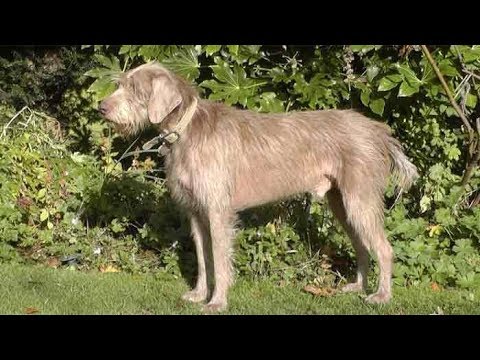
Dog Breed Video: Slovakian Rough Haired Pointer
Slovakian wire haired pointer - training
Slovakian wire haired pointer – training

Type and recognitions:

  • FCI CLASSIFICATION:
  • Group :
  • Section : . .

Federations:

  • – FCI – Group 7: Pointing Dogs. – Section 1: Continental Pointing Dogs. 1.1: Braque Type ⓘ
  • – ​KC – gundog ⓘ
  • – AKC – Group: Foundation Stock Service ⓘ

FCI breed standard "Slovakian Wirehaired Pointers"

Origin:
Slovakia

Date of publication of the valid original standard:
06.01.1995

Use:

Pointing Dogs.


General appearance:

This is a moderate force animal. Although it is a working dog, His appearance is noble. The color of the outer hair of hairs is "gray" and the hair is hard. It must be suitable for work in plain, in the forest and in the water and especially for work after the shot, To search and bring wounded hunt. It is an obedient and easy to train dog.

IMPORTANT PROPORTION :
The correlation between the height to the cross and the length of the trunk must be 10:9 in males and 10:8 in females. This animal must be solidly constituted, But not coarse appearance.


Behavior / temperament:

It must be suitable for work in plain, in the forest and in the water and especially for work after the shot, To search and bring wounded hunt. It is an obedient and easy to train dog.

Head:

It's quite long, thin, No folds on the skin and keep proportion to the body.

Cranial region:
  • Skull : It has a rectangular shape; Superciliar arcades must be pronounced; The front groove is visible. The occipital bump is palpable to touch.
  • Depression links (Stop) : Moderately inclined (about 45 °).

facial region:

  • Truffle : Is large and dark. The Windows are wide open.
  • Snout : It has approximately the same length as the skull. Is high and wide. The nasal helm is straight.
  • Lips : Moderately developed. They are well glued and are dark.
  • Jaws / Teeth : Uniform and robust jaw. The teeth are well developed. The joint is in the form of scissors.

Eyes : They have almond and are well sunk in the orbits. They are amber and intelligent expression. In puppies and young dogs are blue. The eyelids are dark.

Ears : They are convenient length and inserted above the eye region. The root is wide and the tips are round.

Neck:

Is medium length, delgado, No folds on the skin. It is well muscular and is high in the region of La Cruz.

Body:

  • top line: As a whole, The dog is very compact and rather bulky. The back is straight and the neck is inserted high. The dog wears the head up.
  • Cross : It is well pronounced and is well linked to the back.
  • Back : Straight, well muscled. Solid, very slightly inclined back.
  • Rump : Is wide and quite long, It is not too high or very oblique.
  • Breast : It is quite long and wide. It has oval shape and saves proportion with the rest of the body. Descend to the elbows. The ribs are well -tight and the plunder is well developed.
  • Belly and flanks : They are moderately retracted.

Tail:

It is moderately thick and rather high insertion. When the dog is at rest, carries it down and when it is in action, carries it in horizontal direction. The tail is very hairy, but not in the form of a brush. It is trimmed at half of its length.

Tips

PREVIOUS MEMBERS : As a whole, they are well developed. FRONT VIEWS THE PROFILE, They are approved.

  • Shoulder : Well developed and muscular. The shoulder blade is oblique.
  • Scapulo-Humeral angle : Is 110 °.
  • Elbow angle : It is 135 °. Steering : Vertical, thin and marked musculature.
  • Carpo : It is almost vertical : Quite thick, relatively short and almost vertical.
  • Front feet : They are round, the fingers are well together and arched. The nails and pads are dark. Internal fingers should be eliminated.

LATER MEMBERS : Together and profile, They are well angled. Seen from the back, they are leaden.

  • Thighs : They are quite long, wide and well muscled.
  • Lame-femoral angle : From 80 ° to 85 °
  • A fémoro-Tibial-Tibial (knee) : Between 125 ° and 130 °.
  • Leg : Wide, quite long and very muscular.
  • Hock angle : Between 125 ° and 135 °.
  • Metatarsus : It is almost vertical.
  • Rear feet : They are round, the fingers are well together and arched. The nails and pads are dark. The spur must be eliminated.

Movement:

Is balanced and agile. During the work in the plain, The gallop dog.

Mantle

SKIN : It is not very thick. Is elastic and without folds. Its color is gray.

HAIR : The inner hair is presented in the form of a short and fine hair. I usually change it during the summer. The outer hair of hairs measures some 4 cm.; Hair is hard, smooth and stuck. The hairs under the snout are longer and softer and form a beard. Above the eyes the hairs are more marked and are presented obliquely. The forehead and occipucio are covered with short and hard hair. They are short and soft about the ears. The tail is very thick.

COLOR : Base color is chestnut shaded sand (It is called "Gray"), With lighter or darker varieties, With or without white marks on the limbs and chest. Also "gray" with more or less large spots and eventually mottled.


Size and weight:

Height to the cross : It is of 62 – 68 cm in males and 57 – 64 cm in females.


Fouls:

Any deviation from the aforementioned criteria is considered as a fault and the severity of this is considered to the degree of the deviation to the standard and its consequences on the health and well-being of the dog..

SERIOUS FAULTS

• Tough appearance and lack of elegance.
• Head too big.
• Very long or very thick ears.
• Convex back.
• Very long or silky hair.
• Very short hair, No beard.
• Too clear color, pulling Blancuzco.
• Size too big or too small, Regarding the provisions of the standard.

MISS PLAYOFFS

Aggressive or fearful dog.
All anatomical defects, such as upper or lower prognathism, entropion, ectropion, irregular position of the limbs.
Any other base color other than the "gray" (Chestnut shaded sand color).
Any dog ​​showing clear signs of physical or behavioral abnormalities must be disqualified..


N.B.:

Males should have two normal-appearing testicles fully descended into the scrotum..

Source: F.C.I - International Cynological Federation

Alternative names:

1. Slovak Rough-haired Pointer, Slovakian Wirehaired Pointer (English).
2. (Nom d’origine : Slovensky Hrubosrsty Stavac), Griffon d’Arrêt Slovaque à poil dur (French).
3. SHS, Slovenský hrubosrstý stavač (German).
4. Braco eslovaco de pêlo duro, (em eslovaco: Slovenský hrubosrsty stavac) (Portuguese).
5. Grifón de muestra eslovaco de pelo duro (español).

▷ The world of Pets: Dogs, cats, birds, reptiles, amphibians

German Roughhaired Pointer
Alemania FCI 232 . Braque Type

German Roughhaired Pointer

The German Roughhaired Pointer has a calm and balanced character.

Content

History

The German Roughhaired Pointer It is the oldest breed of wire-haired dogs. The history of German Roughhaired Pointer goes back many hundreds of years. Already in 1539 this breed of dog could be admired in bronze engravings. In 1888 Hans Von Kaddisch showed that this breed is not a variety of the Shorthaired Pointer Dog, but the wire-haired counterpart of the Old German Wirehaired Pointer, and that it was selected and developed from rare surviving subjects that had survived in Germany.

The breed club, founded in 1892 As the "Club Stichelhaar«, changed his name to "Verein Deutsch Stichelhaar" in 1976. Since the beginning, has applied the rules of purebred breeding from the beginning, and excludes any crossing with the English breeds.

Photo: The german pointing dog Deutsch Stichelhaar by Alephalpha, CC BY-SA 3.0, via Wikimedia Commons

Physical characteristics

GERMAN BRISTY-COATED POINKING DOG
German Roughhaired Pointer

Males reach a withers height of 60 to 70 centimeters. Females are somewhat smaller, growing up to about 58 to 68 centimeters. The weight of a German Roughhaired Pointer it is usually between 20 and 29 kg.

The coat of this dog is hard and bristly. Is loose and has a moderate undercoat. The German Roughhaired Pointer comes in a variety of colors and patterns. They are often solid brown in color, or have a white patch on the chest. There are also light browns and grays. The dog's coat has a few 4 centimeters long.

The structure of this breed of dog is square and strong. He has a straight back line, leaning slightly towards the rump. The skull is widely built and slightly domed. The ears are smooth and hanging and have a high base. The appearance of the German Roughhaired Pointer reminds a German Wirehaired Pointer.

Character and skills

The German Roughhaired Pointer has a calm and balanced character. He is very easy to train and very willing to learn. His alertness and protective instincts are strong, but they can be controlled well.

The temperament of German Roughhaired Pointer it is usually quiet. Your temperament manifests when your abilities are nurtured through regular training. When you bring a German Roughhaired Pointer to your family, you have a new friendly roommate.

Your new pet is neither shy nor aggressive. If you keep your friend busy enough, will be a loyal companion. But, you must make it clear to him that you have the position of leader within the hierarchy. Only then will he be a loyal dog to you.

The German Roughhaired Pointer it is very popular with hunters. But, not suitable as a pure family dog. As this breed of dog is very self-confident, you should also be a strong leader.

Training

The natural instincts of German Roughhaired Pointer can be controlled well with proper training. The best way to do this is to train him to be a hunting dog.. The training of the German Roughhaired Pointer it is much more complex than that of other dogs. Just visiting a normal dog school is not enough. Usually the German Roughhaired Pointer it is only given to hunters for this reason.

Grooming

Health and Grooming

When it comes to grooming, the German Roughhaired Pointer it is similar to many other hunting dogs. So, the amount of grooming required is low. If you brush your four-legged friend's coat once a week, is perfectly enough. The German Roughhaired Pointer it is very robust in health. So, fortunately it is not very susceptible to disease.

Characteristics "German Roughhaired Pointer"

Coexistence is important that you have with your new friend. Before considering the acquisition of a dog of the breed "German Roughhaired Pointer" you know certain factors. Not all breeds of dogs are apt to live in an apartment, you must take into account his character, their need for exercise, their interaction with other pets, their care and if you have small children, their level of tolerance towards them.

Adaptation ⓘ

3,0 of 5 stars (based on 1 review)

friendly dog ​​ⓘ

4,0 of 5 stars (based on 1 review)

hair loss ⓘ

2,0 of 5 stars (based on 1 review)

Affection level ⓘ

5,0 of 5 stars (based on 1 review)

Need for exercise ⓘ

4,0 of 5 stars (based on 1 review)

Social need ⓘ

4,0 of 5 stars (based on 1 review)

Home ⓘ

2,0 of 5 stars (based on 1 review)

Toilet ⓘ

2,0 of 5 stars (based on 1 review)

Friendly with strangers ⓘ

3,0 of 5 stars (based on 1 review)

barking ⓘ

3,0 of 5 stars (based on 1 review)

Health ⓘ

3,0 of 5 stars (based on 1 review)

Territorial ⓘ

3,0 of 5 stars (based on 1 review)

Cat friendly ⓘ

2,0 of 5 stars (based on 1 review)

Intelligence ⓘ

4,0 of 5 stars (based on 1 review)

Versatility ⓘ

3,0 of 5 stars (based on 1 review)

Child friendly ⓘ

5,0 of 5 stars (based on 1 review)

Surveillance ⓘ

3,0 of 5 stars (based on 1 review)

joy ⓘ

4,0 of 5 stars (based on 1 review)

Videos "German Roughhaired Pointer"

Stichelhaar Dog wide
German Roughhaired Pointer
► German wire hair [2018] race, Looks & Nature
German Roughhaired Pointer

Type and recognitions:

  • FCI CLASSIFICATION:
  • Group :
  • Section : . .

Federations:

  • – FCI – Group 7: Pointing Dogs. – Section 1: Continental Pointing Dogs. 1.1: Braque Type ⓘ

FCI breed standard "German Roughhaired Pointer"

Origin:
Germany

Date of publication of the valid original standard:
29.11.2001

Use:

---


General appearance:

He is a strong pointing dog, medium to large in size with a strong, hard coat and moderate beard.
Clearly accentuated eyebrows give the dog a irascible look. His temperament is calm and balanced.

IMPORTANT PROPORTIONS :

• The length of the body and the height at the shoulders should be equal if possible..
• Body length may slightly exceed shoulder height.


Behavior / temperament:

Balanced, quiet, robust, courageous but controlled, neither shy nor aggressive.

Head:

Proportionate to body size and according to sex.

Cranial region:
  • Skull : Slightly rounded, width seen from the side with the highest part of the convexity in the center. Occipital protuberance not too developed.
  • Stop: Gradually ascending fronto-nasal depression, not abruptly.

facial region:

  • Truffle : From light to dark brown, not flesh colored.
  • Snout : Long, strong, half-width. Not pointed. Straight nasal bridge.
  • Lips : They hang closed properly and form a fold at the corner of the lips..
  • Jaws / Teeth : Strong jaws. Teeth with a regular and complete appearance according to the dental formula, scissor bite.

Eyes : Slightly oval, medium-sized, clear, neither protruding nor sunken; eyelids that close tightly around the eyes. They are brown; when the fur is lighter, also the eyes can be lighter, but not yellow.

Ears : Long Middle, in its insertion not too wide, rounded at the bottom edge. High insertion, in all its width and symmetrical. They should not exceed the height of the occiput too much and hang without forming folds, close to the head..

Neck:

Medium length, strong, slightly arched at the nape; gradually widens downward until it is completely inserted into the chest; does not form a double chin.

Body:

  • top line : Straight, something descending.
  • Cross : Clearly marked.
  • Back : Straight, strong, well muscled, hard.
  • Pork loin : Muscular.
  • Rump : It is not too short and slightly descending.
  • Breast : deep rib cage, well accentuated front view. Well arched ribs, never flat.
  • Bottom line and belly : moderately retracted towards the back and strong especially in the flank area.

Tail:

Long Middle, strong at the base and with an insertion not too low. In countries where tail amputation is prohibited by law, it can remain at its natural length.. The length should be up to the joint of the hoof and straight and in any case its carriage with a slight upward curvature.

Tips

PREVIOUS MEMBERS : Seen from the front, rights and parallels, seen in profile well placed under the body. The distance between the elbow and the ground should be slightly greater than the distance from the elbow to the withers.

  • Shoulder : Scapulas placed obliquely, strongly muscled.
  • Forearm : Not too long, heavily muscled.
  • Elbows : No outward or inward deviation.
  • Arm : Strong and straight.
  • Articulation of the carpus : Strongly developed.
  • Metacarpus : Strong and straight.
  • Previous feet : Round, tight. Large, hard pads, well arched nails.

LATER MEMBERS : Viewed from the back, straight and parallel, with strong bones, good muscular. Good tibio-tarsal angulation.

  • Thigh : Muscular, wide with good angulation towards the pelvis.
  • Knee : Strong with good angulation.
  • Leg : Long, muscular and tendon.
  • Warm-foot joint : Strong
  • Metatarsus : Placed under the tibiotarsal joints without being too inclined, but almost straight.
  • Hind Feet : Oval to round with toes close together and tight. Large, hard pads, well arched nails. Placed parallel without turning in or out.

Movement:

Covering the surface well, with good reach and strong thrust, parallel in the anterior and posterior with upright posture.

Mantle

SKIN : Tight, without forming wrinkles.

HAIR : On the body the hair should be tight, duro e hirsuto, placed in the direction of growth, loose and approximately 4 cm long. On the shoulders and lower part of the body the hair is somewhat longer and forms from the throat, down, on the central line of the chest and belly a short stripe or feather. Times, On the body there is a barely visible undercoat.

• On the snout, the hair forms a moderate beard, on the bridge of the nose the hair is short and coarse, It is not long or soft or falls to the sides. • On the skull, the hair is well glued, short and hard, above the ears somewhat longer than in the short-haired pointing dog and not as rough as above the skull.
• The head should be free of both soft and, woolly or silky. The eyebrows are thick and strong and the hair protrudes forward in a slanted and arched manner..
• On the front part of the forelimbs the short, hard hair is well attached., On the back it forms a somewhat longer feather from the elbow to the metacarpus..
• The hind limbs, On the back they also have a light feather up to the tibio-tarsal joint.. There are short hairs between the fingers, somewhat softer but should not stand out.
• The tail should be heavily covered with hair, well attached in the direction of growth. At the bottom the hair is somewhat longer but without forming a brush or flag.-

COLOR ;

• Brown with or without a white mark on the chest.
• Mottled brown with or without brown plates.
• Light mottling with or without brown patches.


Size and weight:

Height of the cross :

  • Males : 60 – 70 cm.
  • females : 58 – 68 cm..


Fouls:

Any deviation from the above mentioned criteria is considered to lack, and the gravity of this refers to the degree of deviation to the standard and its impact on the health and well-being of the dog.

• Heavy or coarse overall appearance.
• Exaggeratedly large head.
• Occiput with conical development, overdeveloped occipital protuberance.
• Flesh or black nose.
• Ears that are too long, with folds or fleshy.
• Sunken or steep back.
• Twisted forelimbs.
• Elbows markedly tilted outward or inward.
• Pie plano, open or turned outward, hare foot.
• Split back hair.

MISS PLAYOFFS :

• Shyness, afraid of shooting and hunting prey, aggressiveness, biting animal.
• Prognathism, enognatismo, crossbite, lack of teeth with the exception of two PM1
• Ectropion, entropion.
• By blando or semiblando (except for beard and eyebrows)
• Black fur, yellow or red marks on the head or limbs.

Any dog ​​showing physical or behavioral abnormalities must be disqualified..


N.B.:

Males should have two normal-appearing testicles fully descended into the scrotum..

Source: F.C.I - International Cynological Federation

Alternative names:

1. German Roughhaired Pointer , Stichelhaar (English).
2. Braque allemand à poil raide (French).
3. Stichelhaar (German).
4. (Portuguese).
5. Perro de muestra alemán de pelo cerdoso (español).

▷ The world of Pets: Dogs, cats, birds, reptiles, amphibians

Istrian Shorthaired Hound
Croacia FCI 151 . Medium-sized Hounds

Istrian Shorthaired Hound

There is also a "Wire-Coated Istrian Hound" of slightly larger size..

Content

History

The Istrian Shorthaired Hound is an ancient breed of hound dog originating from Istria, whose origins are lost in dark prehistory. The frescoes (1474, Chapel of the Virgin Mary in Beram, near Pazin), the paintings (including Titian, first half of the 18th century), and the chronicles (1719, Bishop Bakic of Djakovo) bear witness to it.

The Istrian Shorthaired Hound, highly appreciated for its excellent hunting qualities, was sold from Istria to neighboring countries. The first inscriptions in the herd book date from 1924, the breed was recognized by the FCI already in 1949, but the standard wasn't published until 1973.

Today, the Istrian Shorthaired Hound it is quite common in and around Istria and is still very popular with hunters due to its excellent characteristics.

Photos:

1 – Istrian Shorthaired Hound at a dog show in Zadar, Croatia (CACIB 2006.) by Mirta12, CC0, via Wikimedia Commons

Physical Characteristics Istrian Shorthaired Hound

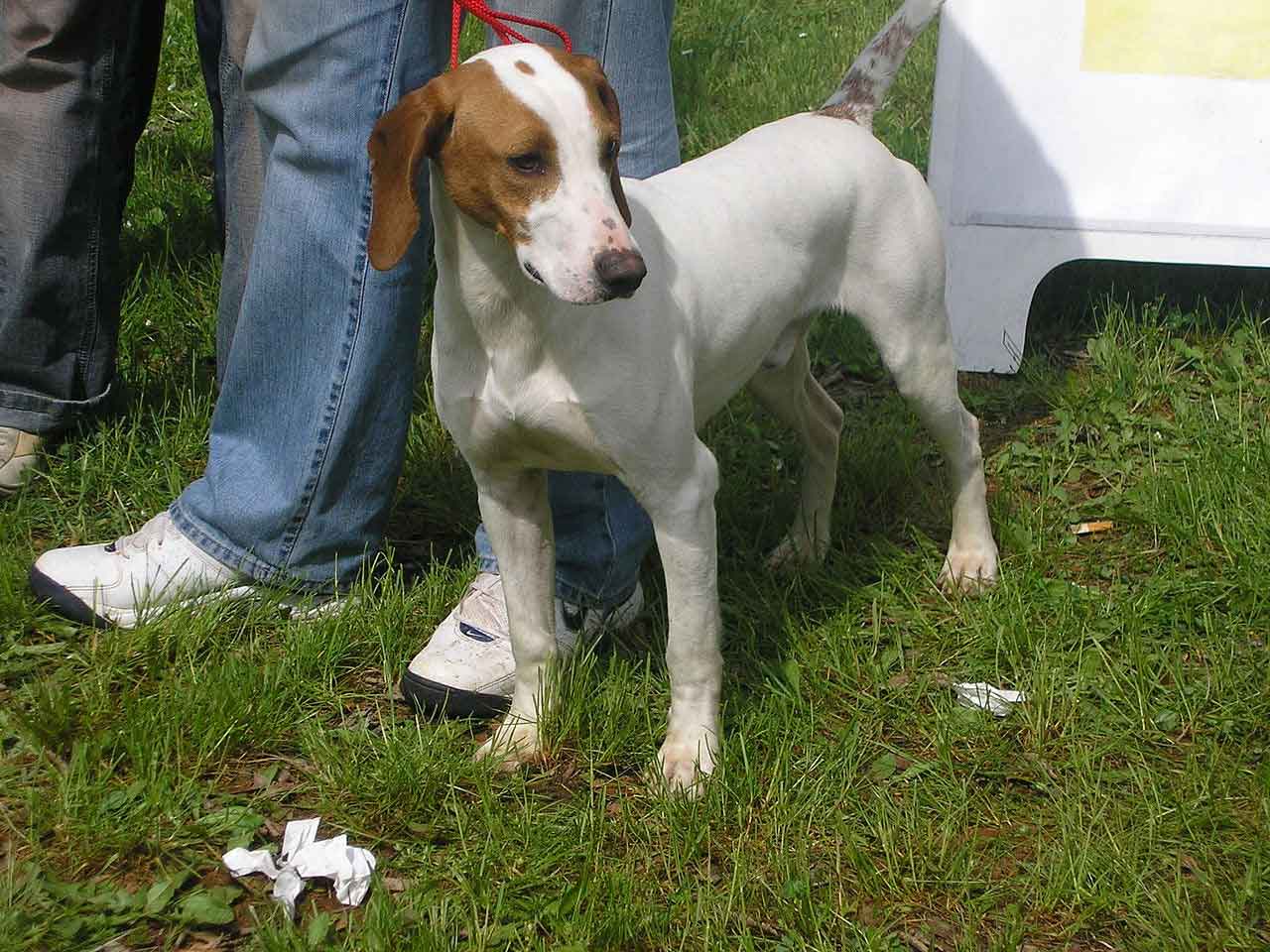
The Istrian Shorthaired Hound he is a medium sized running dog, who appears elegant and distinguished in his build and movements. The height at the withers in both males and females is between 44 and 56 cm., the weight of the dogs is 14 to 20 kg, the optimum is 18 kg.

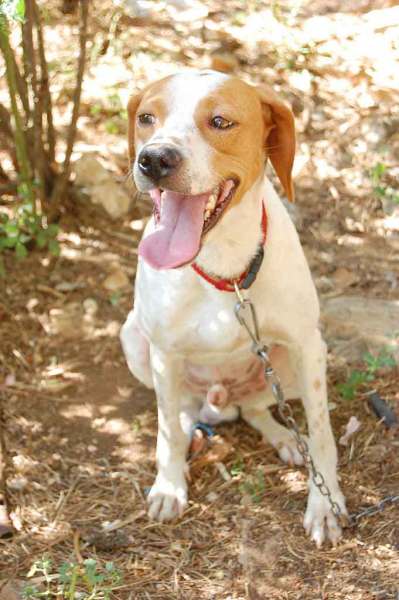
The coat of these dogs is thin, dense and, as the name reflects, short. This short-haired variant is somewhat smaller than the wire-haired version of the Istrian Hound.. The basic color of the coat is white with orange yellow tints. As a whole, the coat is shiny.

The life expectancy of dogs is 12 – 14 years.

Character and skills Istrian Shorthaired Hound

The characteristic of Istrian Shorthaired Hound it's his distinctive hunting instinct. The dogs have always been used as hunting dogs and still show corresponding characteristics today.. This includes his liveliness and his passion for hunting itself.. Like most hunting dogs, these dogs have little instinct for protection and are therefore quite unsuitable for guarding and protection tasks.

While the Istrian Shorthaired Hound be able to live your hunting instinct and feel fully occupied, has a gentle and friendly disposition. It is obedient and loyal to its owner. Your posture is nice.
It also, these dogs are smart and insightful, so they must be challenged in this regard as well. If the dogs are not kept according to their nature, they often get stubborn and sometimes even start poaching.

Keeping an Istrian Shorthaired Hound

The Istrian Shorthaired Hound It, by its nature, first of all a tracking dog. It is particularly suitable for hunting foxes and hares and is used almost exclusively for this purpose in its native country.. It is important that the dogs of this breed are kept by a hunter and encourage them to go hunting and take the trail., so it should be considered as an example for animals. Despite your gentle nature, they are not suitable as pure family dogs, as their pronounced hunting instinct would be neglected too.

Images "Istrian Shorthaired Hound"

Photos:

2 – Luri the Istrian Shorthaired Hound in a dog shelter in Zadar, Croatia by Mirta12, CC BY-SA 3.0, via Wikimedia Commons
3 – Luri the Istrian Shorthaired Hound in a dog shelter in Zadar, Croatia. He was underweight when the photo was taken by Mirta12, CC BY-SA 3.0, via Wikimedia Commons
4 – Luri the Istrian Shorthaired Hound in a dog shelter in Zadar, Croatia. He was underweight when the photo was taken by Mirta12, CC BY-SA 3.0, via Wikimedia Commons
5 – Istrian Shorthaired Hound Luri in a dog shelter in Zadar. When the photo was taken, he was underweight by Mirta12, CC BY-SA 3.0, via Wikimedia Commons
6 – Istrian Shorthaired Hound puppies at a dog show in Zadar, Croatia (CACIB 2006.) by Mirta12, CC BY-SA 3.0, via Wikimedia Commons

Videos "Istrian Shorthaired Hound"

Type and recognitions:

  • FCI CLASSIFICATION:
  • Group :
  • Section : . .

Federations:

  • – FCI – Group 6: Scent hounds, and related breeds. – Section 1.1: Large-sized Hounds. ⓘ
  • – UKC – Scenthound Group ⓘ

FCI breed standard "Istrian Shorthaired Hound"

Origin:
Croatia

Date of publication of the valid original standard:
3.11.2014

Use:

tireless hound, especially suitable for hare hunting, foxes and wild boars, although it can also be used as a tracking dog.


General appearance:

It is noble looking, with its snow white fur interspersed with yellow-orange spots. The hair is satin and fine. The head is long, narrow and thin. The body is agile. The tail is thin and slightly curled, Sabre-shaped.
This hound barks persistently, usually in a high pitched tone.

IMPORTANT PROPORTION : The length of the body must exceed the withers by a maximum of 10%.


Behavior / temperament:

Sweet character, docile, quiet, very attached to his master. Is energetic, and very passionate while hunting.

Head:

The length of the head fluctuates between 20 and 24 cm.. The forehead has no folds.

Cranial region:
  • Skull : In profile, the occipital protrusion is pronounced. The forehead is slightly arched, presenting a smooth transition towards the nasal bridge, which is straight. View from the top, the forehead is long and rather narrow, with an apparent frontal groove.
  • Depression links (Stop) : Outfit, no sharp sinking.

facial region:

  • Truffle : It is black, or at least brown. The nostrils are wide open.
  • Snout : It is long, width at the base, gradually tapering towards the limb. The nasal helm is straight.
  • Teeth : They're strong. The joint is in the form of scissors, uniform. Teeth are complete.
  • Eyes : They have an oval shape; they do not appear nor sunk, nor protruding. The iris should be as dark a color as possible. The eyelids are black or brown. The look is clear and expressive.
  • Ears : They are fine, with a broad ligament, implanted slightly above the horizontal line of the eyes; become narrower at the end. They are considered long, when carried forward along the bridge of the nose, they reach the canines; they are very long, when the canines exceed. They must be at least semi-long and reach the zygomatic arches.

Neck:

The upper profile is slightly arched in the nape region. The junction with the head is perceptible in the posterior part of the occipital protuberance. The neck is obliquely inserted into the trunk. Neck contour is compact. From the occipital protuberance to the withers, the neck measures of 15 to 20 cm.. The skin is stretched, no jowls or folds

Body:

The upper margin gently descends from the withers towards the rump.

  • Back : It is wide, straight and muscular.
  • Pork loin : Wide and short.
  • Rump : Long and wide; slightly inclined or horizontal. It is longer in females than in males. In the region of the rump the height is about one finger less than in the region of the withers. The haunches are barely noticeable.
  • Breast : Well inclined; reaches at least to the elbow. Normally, its circumference exceeds the height at the withers by some 12 cm.. The ribs are rounded. The front of the chest is well developed, but the tip of the sternum is barely visible.
  • Belly and flanks : The superior margin rises gently from the sternum to the inguinal region, therefore, the belly is slightly raised.

Tail:

Thick at its base, diminishing in its limb. The finer the tail, the greater the noble aspect of the dog. It is high implantation, of medium length and does not exceed the level of the hock. It comes slightly curled up.

Tips

PREVIOUS MEMBERS :

  • Shoulder pads : Long, oblique and well attached to the chest.
  • Elbows : Well applied to the body.
  • forearms : Perfectly vertical, well muscled.
  • Carpi : They are barely distinguishable from the forearm.
  • Metacarpus : They are straight and short. They can be slightly inclined, but the angle they form with the vertical never exceeds 10°.
  • Front feet : They look more like a cat's foot than a hare's. They are light, with fingers together. The pads are arched and firm; nails are solid.

LATER MEMBERS : Seen from the back, thigh, Leg, the hock tendon and the metatarsal are on the same vertical.

  • Thigh : Is short, wide and muscular.
  • Knee : The kneecap is wide, set high.
  • Legs : long, oblique and well muscled.
  • Hock : It's compact.
  • Metatarsals : Short, vertical or very slightly inclined, forming an angle of 10° to 20° with the vertical.
  • Hind feet : Similar to the forwards. However, they are a little longer.

Movement:

It is agile, uniform, loose.

Mantle

SKIN : Is elastic, is well applied over the entire body. Does not form folds. It is a pinkish color.

HAIR : It is flat, fine and shiny. Sometimes longer on the back of the thighs and on the inside of the tail, but this characteristic is not valued.

COLOR : The background color is snow white. In principle, the ears are orange; color that extends beyond the base of the ears and covers both sides of the forehead to the eye region, which gives the face its characteristic mask appearance. We mean a star if, on the upper part of the forehead there is a more or less large spot of the same orange color. The ears may also be dotted with orange spots, which is highly appreciated and considered as a sign of purebred. Yellow-orange spots can be seen in the form of specks or strips spread over any part of the body, but more often in the region of the tail ligament. They should never be so numerous as to dominate the white background color. The tone of the spots should be accentuated, never pale, nor dark, not even brown, which would show signs of a mixture of races. The presence of a third color is not allowed, not even in some hairs. The coat may be uniform white, without any stain.


Size and weight:

Height to the cross : It is of 44 to 56 cm..

Ideal size

  • for males : 50 cm.,
  • for females : 48 cm..

Weight : In an adult male it is about 18 kg.


Fouls:

Any deviation from the aforementioned criteria is considered as a fault and the severity of this is considered to the degree of the deviation to the standard and its consequences on the health and well-being of the dog..

MINOR FAULTS

• Spots with partial depigmentation on the nose or on one eyelid. Nose with a very clear pigmentation.
• Convex or slightly sunken back.
• Croup too oblique.
• Thin or too solid belly.

MISS PLAYOFFS

• Aggressive or fearful dog.
• Lack of proportion between body length and height at the withers.
• Head too short.
• Spots with abundant depigmentation, or total depigmentation of the nose.
• Muzzle too short, very pointed or obtuse.
• Upper or lower prognathism.
• Incorrect joint.
• Different colored eyes.
• Ligament of the ears set very high.
• Curled tail, deviated to one side or corkscrew. Cropped tail.
• Elbows too far apart.
• Twisted forearms.
• Pasterns too oblique.
• Hair that is too long.
• Any color other than yellow-orange.
• Size above or below the norms established by the standard.

Any dog ​​showing clear signs of physical or behavioral abnormalities must be disqualified..


N.B.:

Males should have two normal-appearing testicles fully descended into the scrotum..

Source: F.C.I - International Cynological Federation

Alternative names:

1. Original name – Istarski Kratkodlaki Gonič (English).
2. Chien courant d’Istrie à poil ras (French).
3. Istarski Kratkodlaki Gonič (German).
4. Istarski kratkodlaki gonic (Nome original) (Portuguese).
5. Nombre original – Istarski Kratkodlaki (español).

▷ The world of Pets: Dogs, cats, birds, reptiles, amphibians

Istrian Coarse-haired Hound
Croacia FCI 152 . Medium-sized Hounds

Istrian Coarse-haired Hound

The Istrian Coarse-haired Hound it is an excellent hound for hunting hare and fox.

Content

History

His story matches that of Istrian Shorthaired Hound, but the iconography in words and images is much more limited, as long-haired dogs are generally less attractive for renderings due to their outward appearance. But, the Istrian Coarse-haired Hound was described in detail by B. Laska in 1896 and 1905: under the name of "barbini» these hard elo hound dogs were put up for sale in the Pazin and Buzet area in Istria. During World War I the breed was almost extinct. From 1924 these dogs were registered in the Croatian Stallion Book. The FCI recognized the breed in 1948. The first standard dates back to 1969.

Photos:

1 – Istrian Wire-haired Hound by https://pxhere.com/es/photo/1583815

Physical characteristics

The Istrian Coarse-haired Hound has strong and robust bones. With a stern expression, gives the deceptive impression of being a dark and taciturn animal. His somewhat hairy appearance was the cause of his near disappearance, as he is physically repulsive to some due to his coarse fur. But, its deceptive appearance hides a wonderful character and very beautiful qualities.

HEIGHT
Among 45 and 58 cm. (17,72 to 22,83 inches) for the male
Among 45 and 58 cm. (17,72 to 22,83 inches) for the female

WEIGHT
Among 16 and 24 kg (35,27 to 52,91 pounds) for the male
Among 16 and 24 kg (35,27 to 52,91 pounds) for the female

COLOR
Its fur is white with orange spots, more or less big, on the body and often at the beginning of the tail. Their ears are generally orange.

HAIR
Her hair is straight, hard and pointed. It usually measures between 5 and 10 cm long.

MORPHOLOGY
Its head has a domed skull and a slightly pointed cap. His big eyes are dark. Its slender ears are well set on the cheeks and tend to flare towards the middle. His nose is black. Its tail is quite long and reaches the hock.

Character and skills

His character is that of a gentle dog, obedient and calm at home, while hunting is active, independent and passionate. His temperament is moderately lively, expression indicative of a calm and balanced nature, the look is somber. His bark is loud, moderate to deep.

He stands out for his immense diligence, it is resistant and persistent. It can have excellent performance even in the most difficult terrain and weather conditions.. The track never leaves. It is mainly used for hunting wild boar., deer, foxes and hares.

Training / Education:

Education is not that simple. Because when hunting he always depends on himself and cannot wait for the hunter's instructions, is suitable for a wide autonomy, the owner cannot avoid the servile obedience of this breed. You need in this direction a little understanding from the owner or coach.

No harsh training methods, it would only interrupt her relationship with the man, what a double shame. Requires a certain amount of patience and empathy, benign and yet a totally consistent approach to both education and training. More than punishment it will help stimulate the positive voice (compliment, stimulus) and the material (a treat).

Care and health

This robust and resistant dog does not suffer from any genetic disease or any particular pathology associated with the breed.. His health is excellent and he rarely gets sick.

WATCH OUT

Its rough appearance requires regular brushing to maintain its coat and ensure good health.

Images "Istrian Coarse-haired Hound"

Photos:

1 – A female Istrian Hound, Coarse-haired. Colour: white & orange by Canarian, CC BY-SA 4.0, via Wikimedia Commons
2 – Istrian Wire-haired Hound by https://pxhere.com/en/photo/1583811
3 – Istrian Wire-haired Hound by https://pxhere.com/es/photo/1583803
4 – Istrian Wire-haired Hound by https://commons.wikimedia.org/wiki/File:Istrian_hound2.jpg
5 – Istrian Coarse-haired Hound at a dog show in Zadar, Croatia (CACIB 2006.) by Mirta12, CC BY-SA 3.0, via Wikimedia Commons
6 – ISTARSKI OSTRODLAKI GONIC by www.youtube.com

Videos "Istrian Coarse-haired Hound"

Type and recognitions:

  • FCI CLASSIFICATION:
  • Group :
  • Section : . .

Federations:

  • – FCI – Group 6: Scent hounds, and related breeds. – Section 1.1: Large-sized Hounds. ⓘ
  • – UKC – Scenthound Group ⓘ

FCI breed standard "Istrian Coarse-haired Hound"

Origin:
Croatia

Date of publication of the valid original standard:
25.10.2000

Use:

Bloodhound par excellence, it is used mainly for hunting hare and fox. Can also be used as a tracking dog. Its constitution is appropriate for hunting in the vast open lands of Istria.


General appearance:

Coat color is snow white with yellow-orange markings. The hair is long and smooth. The head is oblong, bushy eyebrows. The body is robust, for strong bones. The tail is thick and a bit saber-shaped. The face is severe and taciturn expression, sometimes even gloomy. The voice is sonorous, medium intonation, which often becomes serious.

IMPORTANT PROPORTION : The length of the body must exceed the withers by a maximum of 10%.


Behavior / temperament:

This is a personable dog, docile and very attached to his master. Of moderate temperament, He is very passionate during the hunt.

Head:

It is well proportioned in relation to the body. Its length is 20 to 24 cm.; should not be too light. Pigmentation of visible mucosa is dark.

Cranial region:
  • Skull : Slightly bulky. The occipital protrusion is well apparent, as well as the frontal sulcus, which is often covered by a tuft of long, straight hair. The forehead is quite wide. The skull becomes narrower in the eye region.
  • Depression links (Stop) : It is not marked.

facial region:

  • Truffle : It is wide, with well developed nostrils. Pigmentation is dark black.
  • Snout : Thick, rectangular; the muzzle is wide and covered with bushy whiskers. Seen from the front, The jaws give the snout an appearance of roundness.
  • Teeth : Strong; the joint is scissor-shaped. The denture is complete. : They are good together and they are not very thick.
  • Eyes : The iris is dark in color. The eyes are large, but not exhorbitant. The look is gloomy. Since the hairs on the eyebrows are coarse and longer, these are tangled and bushy.
  • Ears : They are not too thick and are covered by shorter hair. They are implanted near the eyes, but they are not high, not near the edge of the upper profile of the skull. The ears are wider in the center and are close to the cheeks. Are long enough; finer and more rounded at the tip. They come forward. They are considered very long when they reach more or less to the nose, and long when they reach the canines. They must be at least semi-long and reach at least to the zygomatic arches.

Neck:

In profile, the junction of the neck with the head is marked at the back of the occipital protuberance. Its length is 12 to 15 cm and her skin is stretched, no dewlap.

Body:

Seen as a whole, the upper margin slopes slightly towards the rump.

  • Height to the cross : Little pronounced.
  • Back : It's straight and wide. Its length is well proportioned in relation to the height at the withers.
  • Pork loin : Short, muscular and rounded.
  • Rump : Wide, especially in females. Slightly inclined; rounded, since the haunches are apparent.
  • Breast : It's wide and deep. Descends at least to the elbow. Its circumference generally exceeds by 12 to 15 cm height at withers. The ribs are rounded. The tip of the sternum is barely visible. The front of the chest is rounded.
  • Belly and flanks : The lower margin rises progressively, from the xiphoid appendix, towards the ligament of the hind limbs. The belly is slightly raised. The flanks are not very accentuated and should not be crowned.

Tail:

Its implantation is not very high. It is thicker at the base and tapers at the tip. Low, with a slight curve towards the top. Reaches to or slightly exceeds the hock.

Tips

PREVIOUS MEMBERS :

  • Shoulder : The shoulder blades are oblique, long, muscular and well attached to the thorax. The angle of the scapulohumeral joint is about 90°.
  • Elbows : They do not deviate inward.
  • forearms : They are upright and well muscled.
  • Carpi : barely visible.
  • Metacarpus : Short, almost vertical; however with a slight incline, which together with the vertical forms an angle of 10°.
  • Front feet : Jack's foot, Straits, with fingers tight together. The pads are well developed and resistant. Nails are thick.

LATER MEMBERS :

  • Thighs : Short, wide and muscular.
  • Legs : They are longer than the thighs; oblique and well muscled.
  • Hock : Thick and wide.
  • Metatarsals : They are short and vertical. If there are spurs, these must be removed.
  • Hind feet : As the front ; they are often a little longer.

Movement:

It is loose and energetic.

Mantle

SKIN : Is elastic, it is well stretched over the whole body, reddish. No presence of wrinkles.

HAIR : The outer layer of hairs - known as wool hair - is tough. Its length is 5 to 10 cm., es hirsuto, never curled, nor with ripples. Under this layer of coarse hairs lies, especially in winter, an undercoat of abundant, short hairs. The outer layer of hairs is not stretched over the skin but is shaggy. Must not tangle or form felt-like tufts. Hair length and density vary depending on the region of the body..

COLOR : Snow white is the background color. Ears are usually orange. A star-shaped spot of the same color is often seen on the forehead. The ears may also have orange spots, which is a sign of purebred. Orange spots, more or less extended, or specks of the same color can be seen all over the body, but they are usually found at the base of the tail. These marks should not be abundant, nor spread in such a way that they are more noticeable than the snow white color. The color of the markings must be raised, nor pale, nor dark, nor brown, which would be a sign of miscegenation. A third color is not allowed, not even in some hairs.


Size and weight:

Height to the cross : The height to the cross is of 46 to 58 cm Ideal size for males : 52 cm., for females : 50 cm..

WEIGHT : The weight of a normally fed adult dog, is of 16 to 24 kg. An average weight of about 20 kg.


Fouls:

Any deviation from the aforementioned criteria is considered as a fault and the severity of this is considered to the degree of the deviation to the standard and its consequences on the health and well-being of the dog..

• Square jaw, seen from the front.
• Hanging and sagging lips.
• Third eyelid (flashing body, membrana nictitante ) apparent.

MISS PLAYOFFS :

• Aggressive or fearful dog.
• Lack of proportion between height at the withers and body length.
• Very pink or depigmented nose.
• Muzzle too obtuse, pointed or still raised.
• Incorrect occlusion of the jaws; pronounced prognathism.
• Pink eyelids.
• Different colored eyes
• Ears that are too short or too far from the head; very high or very low implantation. Too long ear hairs, silky, wavy, curly or with the consistency of felt.
• Tail that deviates laterally or has been clipped.
• Elbows far away from the body.
• Arched forearms.
• Very oblique pasterns.
• Any color other than yellow-orange. Grayish or blackish marks will never be accepted.
• Size above or below norms.

Any dog ​​showing clear signs of physical or behavioral abnormalities must be disqualified..


N.B.:

Males should have two normal-appearing testicles fully descended into the scrotum..

Source: F.C.I - International Cynological Federation

Alternative names:

1. Istrian Rough-coated Hound, Istrian Wire-haired Hound (English).
2. Chien courant d’Istrie à poil dur (French).
3. Rauhhaarige Istrische Bracke (German).
4. Em croata: istarski ostrodlaki gonic (Portuguese).
5. En croata, istarski oštrodlaki gonič (español).

▷ The world of Pets: Dogs, cats, birds, reptiles, amphibians

Posavac Hound
Croacia FCI 154 . Medium-sized Hounds

Posavac Hound

The Posavac Hound was registered in 1955 under the name "Kras Basin Hound"

Content

History

It is an ancient breed of running dog, originally from Croatia, whose origin is lost in the dark prehistory. The frescoes (1474, Chapel of Our Lady in Beram, near Pazin), the Chronicles (1719, Bishop Bakic of Djakovo, 1859 the vet Franjo Bertic also from Djakovo) and the books (Joze Kristen) bear witness to it.

The Posavac Hound They were bought in Croatia under the name «boskini» and were highly appreciated in neighboring areas. In 1924 this breed was presented for the first time at a dog show. The first entries in the Croatian pedigree book date back to 1929 and the FCI recognized this breed in 1955. The first standard with the correct name of the breed dates back to 1969; underlines the origin of the race in the wide and dense valley of the River Sava in the southeast of Zagreb.

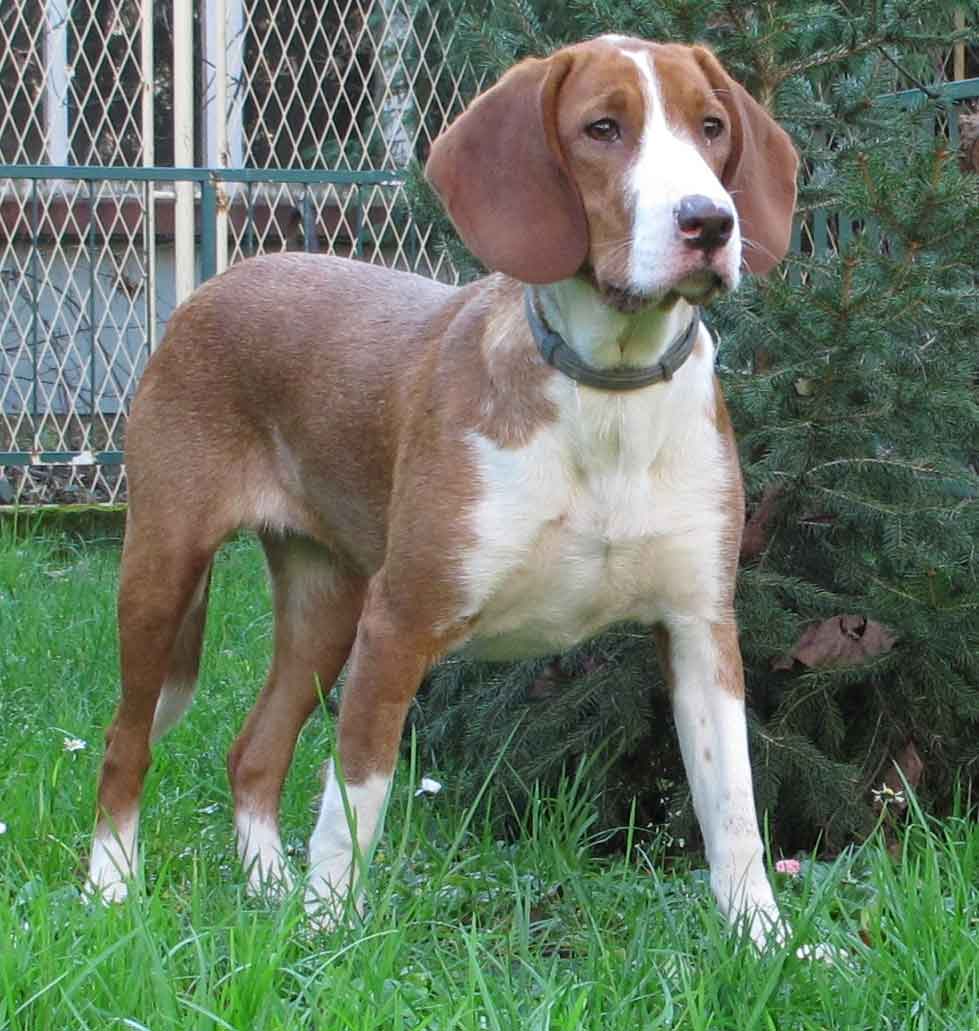
Photos: Cropped image of young Posavac hound female by Strojovodjazg, CC BY-SA 4.0, via Wikimedia Commons

Physical characteristics «Save Valley Hound»

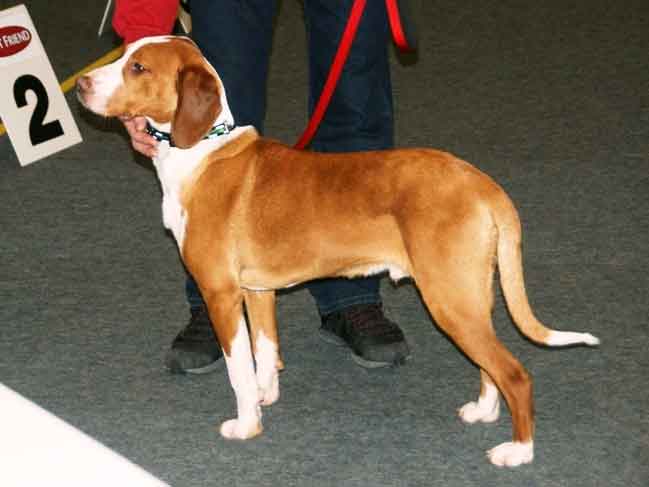
One Posavac Hound can weigh up to 20 kg and measure around 58 height cm. This Croatian dog is of strong constitution and of medium body proportions. His fur is typically red., reddish or wheat-colored. White markings appear on the head area, the neck, the chest, the lower part of the limbs and the end of the tail. The hair itself has between 2-3 cm long, rigid and dense in nature, and always very lying. On the backs of the limbs, as well as on the underside of the belly and tail, hair gets slightly longer.

Character and abilities «Save Valley Hound»

The Posavac Hound is prized as an extremely hardy hound dog, specialized in hunting hares and foxes. His constitution is perfectly adapted to the conditions of his native region, the vast forests of the Savetal. Here you can find areas of difficult access and a lot of undergrowth, lands that are suitable for Posavac Hound with his height.

This dog is very loyal and affectionate with his master. He is a passionate hunter with a moderately lively temperament.

Care and maintenance of the “Save Valley Hound”

Posavac Hound small
Posavac Hound small

It is enough to brush it once a month to maintain the beauty and protective properties of its coat.

Loss of hair

Hair loss is moderate.

Nutrition of the “Save Valley Hound”

The daily rations of the croatian: posavski gonič, as it's also called, must adapt to your daily life. This is especially true for hunting season.

One meal a day is enough for him.. It is better to give it to him at night so that he does not work on a full stomach. This reduces the risk of stomach disorders.

Videos "Posavac Hound"

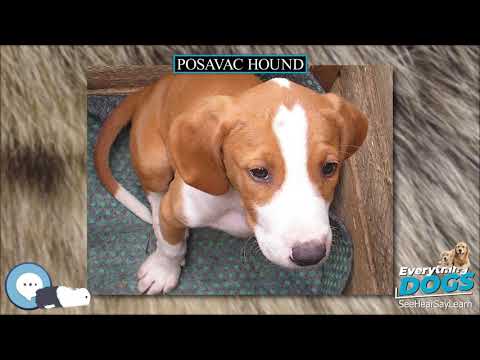
Posavac Hound 🐶🐾 Everything Dog Breeds 🐾🐶
Posavac Hound ?? Everything Dog Breeds ??
Posavski gonic (mala)

Type and recognitions:

  • FCI CLASSIFICATION:
  • Group :
  • Section : . .

Federations:

  • – FCI – Group 6: Scent hounds, and related breeds. – Section 1.2: Medium-sized Hounds. ⓘ
  • – UKC – Scenthound Group ⓘ
  • – Croatian Kennel Club

FCI breed standard "Posavac Hound"

Origin:
Croatia

Date of publication of the valid original standard:
03.11.2014

Use:

It is a hound with excellent resistance, especially suitable for hare hunting, the Fox, the boar, but can also be used as a trail dog.


General appearance:

Strong Hound Build, medium-sized dog with harmonious movements. Its characteristic reddish wheat color comes in all its shades.. White markings are found on the head, in the neck, on the forechest and on the chest, in the womb, on the lower parts of the limbs and on the tip of the tail. The difference between both sexes must be well marked.

important proportions

  • rectangular body, the length of the body exceeds the height at the withers.
  • The height to the elbow is approximately 50 % the height at the withers.
  • The length of the skull slightly exceeds that of the snout.


Behavior / temperament:

This breed is easily trained. It is a universal hound with a clear and melodic voice suitable for hunting in any area.. Docile, He is not nervous or aggressive, moderately lively temperament. Very attached to his master.

Head:

---

Cranial region:
  • Head: The head is well-proportioned to the body. It has slightly divergent lines.
  • Skull: Slightly longer than the snout, the widest part is the area between the ears. The temporal zone is slightly arched. The width of the skull exceeds its depth. The occipital protuberance and frontal sulcus are slightly marked.

facial region:

  • Truffle: Strong, with wide open nostrils. The entire nose and the inside of the nostrils should be black or dark brown..
  • Snout: Strong, square and full, somewhat shorter than the skull, gradually tapers from the naso-frontal depression to the nose, without being too pointy.
  • Belfos: Medium thick, well adjusted to the jaw, the lip corner is not visible. The pigmentation of the lips is completely in accordance with the color of the truffle.
  • Nasal bridge: The nasal cannula is straight or slightly convex (slightly fleshy nose).
  • Jaws / Teeth: The jaws are strong and well developed, the teeth are white and arranged in the jaw in a regular way. Scissor-shaped denture; the incisors are inserted into the jaws vertically. It is desirable that the denture be complete (42 teeth in accordance with the dental formula). The lack of premolars PM1 and molars M3 is not taken into consideration. It is not desirable for other teeth to be missing.
  • Cheeks: The chewing muscles and the zygomatic bone should not be too marked.

Eyes: Medium-sized, moderately separated, placed on the semi-front part with an angle of between 10 and 15 degrees with respect to the horizontal line. Oval in shape and dark brown in color; smart expression. The eyelids should not be sagging or show signs of entropion or ectropion.. The pigmentation of the edge of the eyelids must be completely in accordance with the color of the nose.

Ears: Pendants, fall close to the head, inserted at eye level. The ear is triangular in shape with a rounded tip., of medium length and thickness. When stretched forward they should reach the corner of the mouth.. The ears should not have folds, be curled or protrude. They are covered with short hair.

Neck:

Strong, well muscled and at an angle 45 degrees with respect to the horizontal line. It narrows towards the head. The skin is tight, without double chin or very marked folds.

Body:

  • Generality: The body must be strong.
  • Cross: Marked.
  • Back: Strong, well muscled, straight.
  • Pork loin: Of average length, width, good muscular, strong and well attached to the rump.
  • Rump: Well musculada, strong, flat and inclined at an angle between 25 and 30 degrees with respect to the horizontal line. Something lower than the cross.
  • Breast : Deep, wide but not too wide or barrel-shaped. The rib cage should reach to the elbow.
  • Ribs: Ribs well arched.
  • bottom line: Bottom line with slight retraction, from sternum to flanks.

Tail:

Inserted in the extension of the rump line. Strong in insertion, It gradually tapers towards the tip and is of medium length. If you stretch down, reaches at most to the hock. Saber-shaped with carriage below the top line. A higher tail is tolerated when the dog is in action.. The tail is well covered with hair, slightly longer at the bottom, preferably as small brushes.

Tips

Former members

  • Generality: Seen from the front, The forelimbs must be well proportioned with respect to the body and have regular angles..
  • Shoulder: Of average length, muscular. The shoulder angle is between 115 and 120 degrees.
  • Elbow: Well attached to the body.
  • Forearm: Strong, rounded bones with strong muscle tone. Parallels seen from the front.
  • Carpo: Short and elastic.
  • Metacarpus: Elastic, slightly inclined.
  • Front feet: Oval, with fingers together and strong pads. Nails should preferably be pigmented.

Later members

  • Generality: Strong and elastic in movement.
  • Thigh: Strong, wide and muscular.
  • Leg: They form an angle of about 40 degrees with respect to the horizontal line.
  • Knee: It is wide.
  • Metatarsus: Almost vertical with respect to the ground, firm and elastic.
  • Hock: Strong and firm.
  • Rear feet: Oval, with fingers together and strong pads. Nails should preferably be pigmented.

Movement:

Reach is essential, with good push. The movement must be harmonious, no sudden movements. The ideal is that the top line moves as little as possible and that the feet do not cross.

Mantle

Skin: Elastic, Де medium thickness, adheres well to the entire body, without wrinkles.

Fur: The hair is hard, thick, shiny and should be very close to the body. It has a length of between 2 and 3 cm.. The hair is a little longer on the back of the thighs (until 4 cm.), on the belly and under the tail, where it is preferred to form the so-called "brushes".

Color: The base color is reddish wheat in all its shades., with white marks on the head, in the neck, in the backsplash, on the chest, in the womb, on the lower parts of the limbs and on the tip of the tail. They are never dark brown or chocolate, since they are not allowed. The total surface area of ​​the white spots cannot exceed more than one third of the total surface area of ​​the body. The white color must be clear and not have splashes of the base color..

The characteristic white spots are located on :

- Head, in the form of a running cord or a strip (no white on the ears).
- The neck, as a necklace (complete or partial) or strip-shaped.
– On the parapet, as narrower or wider white surface.
- In the womb, a white strip.
– In the extremities, white surface on paws; also sock-shaped on the pasterns.
- In the queue, like a white tip.

It is desirable that all the white markings be in the indicated points and that they be distributed symmetrically on the dog's body.. The absence of white marks in the indicated points is considered a fault. White marks cannot appear on other parts of the body.


Size and weight:

Height to the cross

  • For males: 50 cm-56 cm.
  • for females: 47 cm-53 cm.

A difference of +/- 2 cm in males and females of exceptional type and conformation.


Fouls:

Any deviation from the above mentioned criteria is considered to lack, and the severity of this is considered the degree of deviation from the standard and its consequences on the health and well-being of the dog and the dog's ability to perform its traditional task.

disqualifying fouls:

– Aggressiveness or extreme shyness.
– Converging head lines.
– Muzzle longer than the skull.
– Atypically short snout.
- Superior or inferior prognathism, twisted bite.
- Blue eyes.
– Truffle, completely depigmented eyelids or lips.
– Body length less than the height at the withers.
– Dog with short limbs, of Achondroplastic type.
– Curled or deviated tail curved on one side.
– Body hair over 5 cm length.
– Dog of a single color (solid), absence of white spots.
– Gray or black spots on the body, presence of a third color.
– White spots splashed with the base color.
– Size above or below the norms established by the standard.


N.B.:

• Any dog ​​showing clear signs of physical or behavioral abnormalities should be disqualified..
• The aforementioned fouls that are more pronounced or more marked are eliminatory..
• Males must have two normal-appearing testicles fully descended into the scrotum..
• Only functionally and clinically healthy dogs, with the typical conformation of the breed, should be used for parenting.

Source: F.C.I - International Cynological Federation

Alternative names:

1. Croatian: posavski gonič (English).
2. Chien courant de Posavatz, chien courant du bassin de Kras (French).
3. Huidige hond van de Save Vallei, Posavski Gonič, Save-Bracke, Savetalbracke (German).
4. Em croata: Posavski gonic (Portuguese).
5. Sabueso de Posavaz (español).

▷ The world of Pets: Dogs, cats, birds, reptiles, amphibians

Great Anglo-French White and Orange Hound
Francia FCI 324 - Large-sized Hounds

l GREAT ORANGE AND WHITE ANGLO-FRENCH Hound

The Great Anglo-French White and Orange Hound it is considered little spread outside of France and little used even within its country.

Content

History Great Anglo-French White and Orange Hound

It probably dates from the 16th century and is originally from France, the Great Anglo-French White and Orange Hound comes from the cross between English Foxhound, French dogs and the addition of a contribution most likely from the Billy.

The addition of English and French blood produced a versatile all-rounder hunting dog that was particularly prized towards the end of the 19th century..

The boar, the Fox, deer and roe deer have been part of their specialties ever since.

Along with the Great Anglo-French White and Black Hound and the Great Anglo-French Tricolour Hound, it is one of the three French breeds that have been crossed with English blood.

Physical Characteristics Great White and Orange Anglo-French Hound

The Great Anglo-French White and Orange Hound it is a quite strong and powerful dog, with more English blood on his head than his tricolor counterpart. His eyes are big, brown and dark. The ears are quite thick, slightly turned and quite short. Its tail is quite long and sometimes slightly spied on.

His hair is short and not too thick, lemon white or orange white, as long as the orange is not too dark, tending towards red.

Height: 60 to 70 cm..
Weight: Of 30 to 35 kg.

Character and skills Great Anglo-French White and Black Hound

Solitary or in a pack, brave, tenacious, rapid, gentle and friendly, the Great White and Orange Anglo-French Hound is a sociable hunting dog with an obedient nature.

Usually, they are easy to learn, like your socialization.

Tenacious, vigorous, brave and fast in the hunt, they are tender and gentle with their family, including children in the home.

Health Great Anglo-French White and Black Hound

Quite robust and very solid, this large dog generally enjoys very good health.
He rarely gets sick and his longevity is still appreciable for a dog of his size..
The breed is not affected by any genetic defects or diseases.

Caring for Great Anglo-French White and Black Hound

Brush him from time to time, to remove dead hairs and keep the coat healthy and beautiful, It is more than enough.

Training Great Anglo-French White and Black Hound

Its socialization is easy, but your education must remain firm and adequate, although it requires less firmness than the other breeds in its category, because it is less dominant by nature than the other two.

His great intelligence also facilitates his education.

Exercise Great Anglo-French White and Black Hound

The Great Anglo-French White and Orange Hound is an extremely vigorous working dog, accustomed to very intense physical exercise. When not hunting, he must be given the opportunity to expend his excessive energy. This dog is an infamous cat hunter, so it should never be released without a leash until it is in a closed and secure area.

During the hunting season it is advisable to offer the dog some type of exercise that emulates its hunting behavior.. It is worth remembering that if the Great Anglo-French White and Orange Hound lacks opportunities to vent, will gradually turn into a rebellious animal, hyperactive and destructive.

Videos "Great Anglo-French White and Orange Hound"

HTTPS://youtube.com/watch?v=J0DEDEqOimA&list=PLcj6J71Gt710QwEM_fhrp9Eq6e4x6w06H&index=2
Horus sucht ein Zuhause
HTTPS://youtube.com/watch?v=UJjm2cAT46s
Grand Anglo Français Blanc et Orange ?? Everything Dog Breeds ??

Type and recognitions:

  • FCI CLASSIFICATION:
  • Group :
  • Section : . .

Federations:

  • – FCI – Group 6: Scent hounds, and related breeds. – Section 1.1: Large-sized Hounds. ⓘ
  • – Central Canine Society ⓘ

FCI breed standard "Great Anglo-French White and Orange Hound"

Origin:
France

Date of publication of the valid original standard:
27.01.1983

Use:

Hound


General appearance:

It is a fairly strong and robust dog.. In his head the English blood stands out more than in that of his tricolor counterpart..


Behavior / temperament:

---

Head:

It is quite short and big.

Cranial region:
  • Craging: It is rather wide and flat, without occipital bulge. The eyebrows are not prominent.
  • Dnaso-frontal depression (Stop): Well marked.

facial region:

  • Trufa: It is black or brown-orange in color.
  • Snout: Rather short nasal passage.
  • Belves: They extend beyond the lower jaw and give the muzzle a slightly square appearance..

OJOS: They are large, brown and dark.

OREJAS: Fairly long implantation in the plane of the eye line or slightly higher. They are rather thick, slightly crooked and rather short.

Neck:

It is straight and has a slight dewlap.

Body:

  • Espalda: Wide and muscular.
  • Pork loin: Wide and rather short.
  • Rump: Rather rounded.
  • Pecho: Quite high and low. Long, slightly rounded ribs.
  • Flalso: Massifs.

Tail:

It is quite long and sometimes spindly (towards the tip of the tail around some longer and thicker hairs slightly separated in the shape of a spike).

Tips

PREVIOUS MEMBERS:

  • Ageneral appearance: They're strong, wide and well plumb.
  • Shoulder: They are close to the chest, but they are very muscular.
  • Pinis previous: Rather rounded.

LATER MEMBERS:

  • Thighs: Muscular and thick.
  • Corvejones: Somewhat angled and are located close to the ground.
  • Hind feet: Rather rounded.

Movement:

This is a dog that moves easily.

Mantle

PIEL: White with orange or yellow spots.

Plink: Short and not very thick.

Codor: White – lemon or white – orange, provided the orange is not too dark (pulling red)


Size and weight:

Altura to the cross: Of 60 to 70 cm..


Fouls:

Any deviation from the aforementioned criteria is considered as a fault and the severity of this is considered to the degree of the deviation to the standard and its consequences on the health and well-being of the dog..

  • Constitutional defects.
  • Partial depigmentation of the truffle
  • Nasal cane too narrow.
  • Upper or lower prognathism.
  • light eyes.
  • Excess double chin.
  • Tail curled or drawn to one side.
  • Fur of another color than the established one (black or red hair).

FALTAS DISQUALIFYERS:

  • Aggressiveness or extreme shyness.
  • Any dog ​​showing clear signs of physical or behavioral abnormalities.


N.B.:
  • Males should have two normal-appearing testicles fully descended into the scrotum..
  • Only functionally and clinically healthy dogs, with the typical conformation of the breed, should be used for parenting.

Source: F.C.I - International Cynological Federation

Alternative names:

1. Chien Français Blanc et Orange (English).
2. Français blanc et orange (French).
3. Français blanc et orange (German).
4. Grande sabujo francês branco e laranja (Portuguese).
5. Français blanc et orange (español).

▷ The world of Pets: Dogs, cats, birds, reptiles, amphibians

Petit Gascon Saintongeois
Francia FCI 21 - Medium-sized Hounds

Petit Gascon Saintongeois

The Petit Gascon Saintongeois was destined, in its origins, mainly hunting the hare.

Content

History

Of French origin, named after the provinces of Gascuña and Saintonge.

By mid-century 20, some large game hunters in the Southwest selected the smallest specimens from their litters of Gascon Saintongeois and they fixed this variety, destined, in its origins, mainly hunting the hare.

Photo: Little Gascon de Saintonge by Jérôme BARDIAU, CC BY-SA 3.0, via Wikimedia Commons

Physical characteristics

Medium-sized dog, well proportioned and distinguished.

Size:

Males: 56 to 62 cm..
females: 54 to 59 cm..

Character and skills

Multi-purpose dog used for rifle hunting. Because of its origin it hunts especially the hare, but it is also very good for hunting big game.

Characteristics "Petit Gascon Saintongeois"

Coexistence is important that you have with your new friend. Before considering the acquisition of a dog of the breed "Petit Gascon Saintongeois" you know certain factors. Not all breeds of dogs are apt to live in an apartment, you must take into account his character, their need for exercise, their interaction with other pets, their care and if you have small children, their level of tolerance towards them.

Adaptation ⓘ

2,0 of 5 stars (based on 1 review)

friendly dog ​​ⓘ

3,0 of 5 stars (based on 1 review)

hair loss ⓘ

2,0 of 5 stars (based on 1 review)

Affection level ⓘ

2,0 of 5 stars (based on 1 review)

Need for exercise ⓘ

5,0 of 5 stars (based on 1 review)

Social need ⓘ

4,0 of 5 stars (based on 1 review)

Home ⓘ

2,0 of 5 stars (based on 1 review)

Toilet ⓘ

1,0 of 5 stars (based on 1 review)

Friendly with strangers ⓘ

2,0 of 5 stars (based on 1 review)

barking ⓘ

3,0 of 5 stars (based on 1 review)

Health ⓘ

4,0 of 5 stars (based on 1 review)

Territorial ⓘ

2,0 of 5 stars (based on 1 review)

Cat friendly ⓘ

2,0 of 5 stars (based on 1 review)

Intelligence ⓘ

4,0 of 5 stars (based on 1 review)

Versatility ⓘ

5,0 of 5 stars (based on 1 review)

Child friendly ⓘ

4,0 of 5 stars (based on 1 review)

Surveillance ⓘ

2,0 of 5 stars (based on 1 review)

joy ⓘ

4,0 of 5 stars (based on 1 review)

Videos "Petit Gascon Saintongeois"

HTTPS://youtube.com/watch?v=aM1D0Ttrupo
Petit Gascon Saintongeois
HTTPS://youtube.com/watch?v=p_qCOkxxHPs
Little Gascon Saintongeois

Type and recognitions:

  • FCI CLASSIFICATION:
  • Group :
  • Section : . .

Federations:

  • – FCI – Group 6: Scent hounds, and related breeds. – Section 1.2: Medium-sized Hounds. ⓘ
  • – Central Canine Society ⓘ

FCI breed standard "Petit Gascon Saintongeois"

Origin:
France

Date of publication of the valid original standard:
06.03.2007.

Use:

Gran Gascon Saintongeois: Used for rifle hunting and sometimes for small game, big game and also hare. It is generally used in a pack or alone, as a tracker.

Pequeño Gascon Saintongeois: Multi-purpose dog used for rifle hunting. Because of its origin it hunts especially the hare, but it is also very good for hunting big game.


General appearance:

Gedge: Very well built dog, which gives at the same time an impression of strength and elegance. He is of a very French type when it comes to the head, fur and expression.

Psmall: Medium-sized dog, well proportioned and distinguished.

PROPORCIONES IMPORTANT:

Height at withers/scapulo-ischial length in a ratio of 10/10.5 The length of the muzzle is equal to the skull.


Behavior / temperament:

Pack dog par excellence, up to the sense of smell, bold, gifted with a beautiful voice. He joins the pack by instinct. It's calm, affectionate and obeys orders easily.

Head:

The lines of the skull and the nasal passage are divergent.

Cranial region:
  • Craging: Seen from the front, It is arched and rather narrow; the occipital protuberance is well marked. Seen from above, the back has a pronounced ogival shape.
  • Dnaso-frontal depression: Little pointed.

facial region:

  • Trufa: black, well developed, the windows wide open.
  • Labios: They cover the lower jaw, the corner is discreet. The edge of the lips is black.
  • Cnasal year: Powerful, slightly arched.
  • Jaws: Scissor joint. The incisors are at right angles to the jaws..
  • Cheeks: Thin.

OJOS: Oval, browns. The edge of the eyelids is black. The expression is sweet and confident.

OREJAS: Fine, bent. They must reach at least the end of the truffle. They occur below the eye line, quite far back, leaving the skull very clear.

Neck:

Of medium length and thickness. It is slightly arched and has little dewlap.

Body:

  • lynand the top: It is firm and not excessively long.
  • Lomo: It is well attached to the body. It is slightly convex, quite muscular and not too long.
  • Glikeness: Slightly oblique, wide enough.
  • Pecho: Large, long, descends to the level of the elbows. The front part of the chest is quite open.
  • Costillas: Slightly rounded and long.
  • Flank: It's a little raised.

Tail:

It is thick at the base; very thin at its end. Reaches to the tip of the hock. The elegant bearing, Sabre-shaped.

Tips

PREVIOUS MEMBERS:

  • Ageneral appearance: The previous room is powerful.
  • Hshoulder: Rather long, muscular, moderately oblique.
  • Elbow: Well adhered to the body.
  • Aforearm: Strong bones.
  • Pinis previous: Slightly elongated oval shape. The fingers are thin and close together. The foot pads and nails are black.

LATER MEMBERS:

  • Ageneral appearance: The hindquarters are well proportioned.
  • Thighs: Long and well muscled.
  • Corvejón: Width, well angled. Well inclined, visibly directed towards the axis of the body.
  • Pinis later: Slightly elongated oval shape. The fingers are thin and close together. The foot pads and nails are black.

Movement:

Uniform and loose.

Mantle

PIEL: Stretchy and not too thick. It is white with black spots.

Plink: Short and dense.

Codor: The background is white, with black spots; sometimes it is speckled, although not in excess. Two black spots are usually present on each side of the head.; cover the ears, surrounding the eyes and cheeks-reach. The cheeks are color fire, preferably pale.

Two fire-colored brands, located on the top of the eyebrows, They simulate “four eyes”. They are also observed, tan traces on the inner surface of the ear and specks along the extremities. Some tawny hairs may appear on the top of the ear, without this giving the head a tricolor appearance. Sometimes a typical dead leaf spot is observed on the lower part of the thigh., known as “roe deer mark”.


Size and weight:

Height to the cross:

Grand:

  • Males: 65 to 72 cm..
  • females:62 to 68 cm..

Petit:

  • Males: 56 to 62 cm..
  • females: 54 to 59 cm..

    With a tolerance of approximately 1 cm..


Fouls:

Any deviation from the aforementioned criteria is considered as a fault and the severity of this is considered to the degree of the deviation to the standard and its consequences on the health and well-being of the dog..

Cthey are not coming:

  • Short.
  • Wide skull.
  • Short ears; ears that stand high.
  • Total absence of fire color.

Cfamily:

  • Absence of volume.
  • Flabby upper margin.
  • sunken croup.
  • Deviated tail.

Members:

  • Bone structure that is not sufficiently developed.
  • Shoulders that are too oblique or too straight.
  • crushed feet.
  • Straight posterior angulation.
  • closed hock, seen from behind.

FALTAS DISQUALIFYERS:

  • Aggressiveness or extreme shyness.
  • Any dog ​​showing clear signs of physical or behavioral abnormalities.
  • Lack of type, and in particular wide and round skull.
  • Upper or lower prognathism.
  • light eyes.
  • Any other layer other than that established in the standard.


N.B.:
  • Males should have two normal-appearing testicles fully descended into the scrotum..
  • Only functionally and clinically healthy dogs, with the typical conformation of the breed, should be used for parenting.

Source: F.C.I - International Cynological Federation