Origin: Afghanistan, Bhutan, India, Nepal, Pakistan
Character: Shy, quiet.
Life expectancy: 15 to 17 years.
Height: Of 39 to 41 cm..
Content
Description:
Of 39 to 41 cm.. of length and a weight of 125 g..
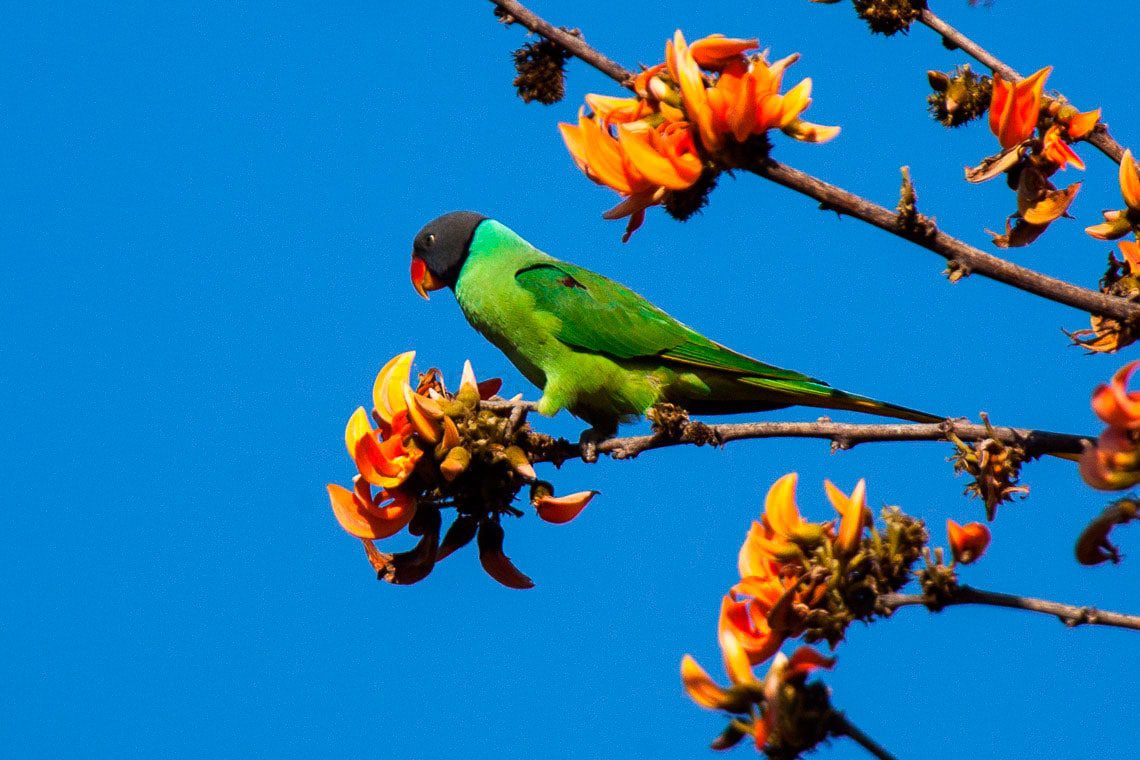
The Slaty-headed Parakeet(Psittacula himalayana) has the forecrown, crown, lores and ear-coverts slaty-grey; chin and lower cheeks black, extending in the lateral narrow shaped collar black, to mark a clear boundary between the dark head and back neck bright green and nape, whose colour fades to duller green on rest of upperparts..
Lesser wing-coverts outer, green, brown the inner coverts, with a distinctive patch shoulder; remaining upperwing-coverts green.
The primaries Green with narrow yellow margins in vane outer; secondaries green. Underwing-coverts bluish green. Underparts bright pale green. Uppertail bright blue green, tipped chrome yellow color in the center, outer feathers green with yellowish tips; undertail-coverts bright yellow.
upper jaw orange-red, tipped pale yellowish, the lower yellower; cere whitish; irises creamy white; legs yellowish green.
The female smaller, more opaque in nape, usually with the tail shorter and often they lack the brown in the patch of the shoulders.
The immature with the head greenish brown opaque; acquire gray slate after first winter. The young birds they have the irises dark.
The Slaty-headed Parakeet Mountain forests are distributed, at altitudes around 2.500 meters in summer; rarely above the 250 meters in winter. Otherwise residents, although there are fluctuations depending on local food supply.
Occupy denser forest than most of its congeners, but preferably in extensions near orchards or farms with high trees. Registered in a variety of slopes and steep wooded valleys, including oak forests, cedars, Oak, rhododendrons and pines.
Observed, in general, in small flocks or family groups, no large gatherings, although flocks 50 birds have been recorded at the end of the monsoon.
Also registered with mixed banndadas Rose-ringed Parakeet, the Plum-headed Parakeet and Blossom-headed Parakeet. Registered a flock of 15 males during the month of November Nepal.
Reproduction:
The nest Slaty-headed Parakeet usually it located in a recess, on top of a tree, at an altitude between 6 and 20 m above the ground; a rotten branch used to excavate a cavity or modificadan the old nest of other species.
In East Afghanistan, the nest is ,normally, an old hole made by a Scaly-bellied Woodpecker (Pico squamatus).
Often several nests are close together.
The breeding season in the west of the range is between March and May, (maybe later at higher altitudes); they leave the breeding area in July; the laying is of 3 to 5 eggs.
Food:
The Slaty-headed Parakeet it feeds on various fruit, cultivated and wild, dried fruits and seeds, depending on the season.
Although the overall economic impact of this species is probably light, they are considered locally as a pest due to attacks on corn crops, Apple trees (flower and fruit), pear and walnuts Juglans regia.
Distribution:
Size of the area of distribution (reproduction / resident): 696.000 km2
The Slaty-headed Parakeet It is distributed by the Himalaya occidental, where they are, Commonly, above the 1.350 m, from the East of Afghanistan through northern Pakistan, northern India and Nepal until Bhutan, West of Arunachal Pradesh and Assam (about 92 it is) to the North of the Brahmaputra.
The size of the world population Slaty-headed Parakeet It has not been quantified, but the species, according to sources, is usually common, although apparently very poorly documented in recent decades; uncommon in China.
The population is suspected to be stable in the absence of evidence of any reduction or substantial threats.
"Slaty-headed Parakeet" in captivity:
Fairly common in Australia, not so much in other places. In general, trade is not significant.
Alternative names:
– Slaty-headed Parakeet, Himalayan Slaty-headed Parakeet (English).
– Perruche de l’Himalaya, Perruche à tête ardoisée (French).
– Himalayasittich, Finsch-Sittich, Schwarzkopf-Edelsittich (German).
– Periquito-himalayana (Portuguese).
– Cotorra de Cabeza Pizarra, Cotorra del Himalaya (español).
– Avibase
– Parrots of the World – Forshaw Joseph M
– Parrots A Guide to the Parrots of the World – Tony Juniper & Mike Parr
– Birdlife
– Photos:
(1) – Slatina-headed Parakeet Psittacula Himalayas, Corbett National Park, India By Francesco Veronesi from Italy (Slaty-headed Parakeet – Corbett NP_1842) [CC BY-SA 2.0], via Wikimedia Commons
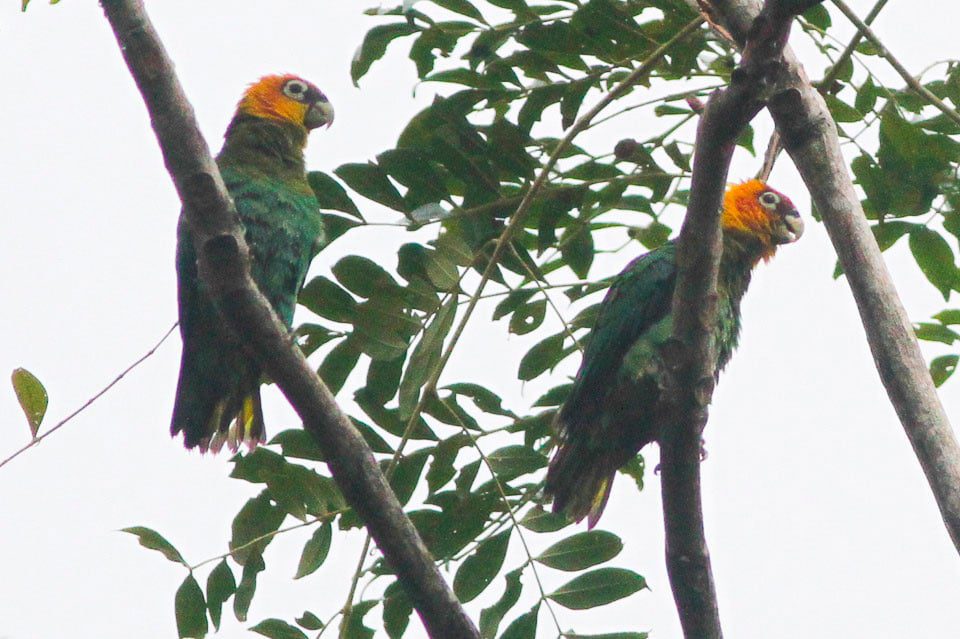
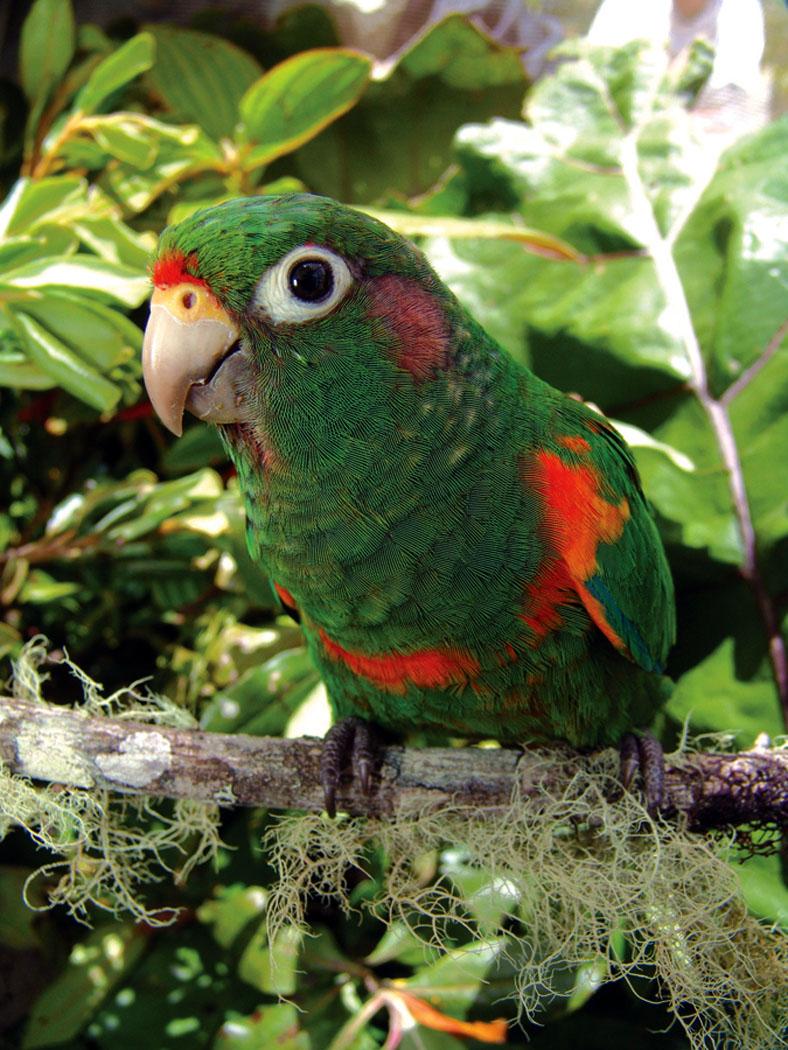
The Saffron-headed Parrot(Pyrilia pyrilia) is characterized by the lores naked; head, rear and both sides of the neck, bright yellow. Upperparts green. The spots of the upperwing-coverts are bright yellow with some red feathers at the base; Red at the front edge of the wing
with the external medium upperwing-coverts blue, or green with blue tips. The primary coverts are black, with the coverts remaining of the party top, green, sometimes with blue tips.
Primary and secondary bluish black with narrow green margin to the outerweb; tertiary green. Under the wings and axillary bright red, flight feather of color bluish pale. Breast
Yellow olive; belly Green but paler and more yellowish than the top; undertail-coverts green. above the tail with yellow in the innerwebs and blue tips; yellowish below. Bill color pale horn; cere blackish; dark grey skin nude of the lores extends around the eye ring; eye ring whitish; irises dark brown; legs grey.
Both sexes similar. The immature has the crown and shoulders Green with yellow yellowish brown in the face and throat.
Little known throughout its distribution. It inhabits in humid jungles, very wet, high secondary forest and cleared areas, between the 300 to 1700 m. In Venezuela can be seen in tropical and subtropical areas at altitudes of 150-1650 m (perhaps only seasonally to higher altitudes) and 1.000 metres in Colombia. Usually gregarious, seen in groups of up to 10 individuals.
Reproduction:
With reproduce during the first half of the year.
Birds in breeding conditions observed in the months of March-June in Antioquia (Colombia). Immature seen during the month of July in Sierra de Perija (Venezuela and Colombia).
Food:
Just have your feed data, Although it more likely is that your diet is composed of of fruit, berries and seeds.
Distribution:
Size of the area of distribution (reproduction / resident): 577.000 km2
The Saffron-headed Parrot is distributed in the this of the Province of Darien, Panama, to the North of Colombia and Northwest of Venezuela.
There are two records in the Northwest of Ecuador, a wandering pair alleged in the Book ecológica Cotacachi-Cayapas and a flock of about 20 birds in the Pedro Vicente Maldonado Canton, in the Northwest of Pichincha (Ridgely and Greenfield 2001), Although their status is uncertain (JF Freile in litt., 2000, Ridgely and Greenfield 2001).
Today it is rare to see to the Saffron-headed Parrot in accessible areas, Although it is still common Serrania de las Quinchas (Boyacá) and in the Hill of the peace (Santander) (Donegan et to the., 2003), Colombia and is soon likely to have decreased significantly in the Chocó, Colombia, or Darien (GR Angehr in litt., 1999, G. Stiles in litt., 1999).
There are few recent records, but they may still be numerous at the northern base of the Andes, Córdoba, North of Antioquia and Bolívar, and in the Valley of the Magdalena, to the East of Caldas and to the southeast of Antioquia, Colombia (Hilty and Brown 1986, A. Cuervo in litt., 1999).
Seems to have decreased in Venezuela, where recent records are from the area of Merida, the South-East slopes of the Cordillera de Mérida, Barinas (Kirwan and Sharpe 1999, C. Sharpe, J. and F. Rodriguez Rojas-Suarez in litt., 1999) and Sierra de Perija (CJ Sharpe in litt. 2011).
The population total may have fallen below 10.000 individuals (Juniper and Parr 1998, G. Stiles in litt., 1999). In fact, is estimated that the Western population (West of Sinu) is of 2.000 to 4.000 individuals (most habitat intact), the population Center (Serranía de San Lucas) is probably less than 1.000 individuals, the slopes West of the Eastern Cordillera It is estimated at approximately 1.000 individuals and the eastern slope of the Eastern Cordillera and Merida perhaps less than 1.000 individuals (C. Sharpe, J. and F. Rodriguez Rojas-Suarez in litt., 1999).
Conservation:
• Current category of the Red List of the UICN: Near-threatened.
• Population trend: Decreasing.
Rationale for the Red List category
This species has a population moderately small suspected is declining, and therefore qualifies as near-threatened. It is considered nationally vulnerable in Colombia (Renjifo et to the., 2002) and Venezuela (Sharpe 2008).
Justification of the population
The population is estimated at at least 7.000 copies in total, more or less equivalent to 4.700 mature individuals (PGW Salaman in litt., 2006).
Justification of trend
A slow to moderate and continuous decrease in population is suspected on the basis of the rates of habitat loss: its preferred habitat is severely threatened (T. Donegan in litt 2006.).
"Saffron-headed Parrot" in captivity:
Very difficult acclimating to captivity, susceptible to diseases in captive State.
(1) – Saffron-headed Parrot (Pyrilia pyrilia) by Ron Knight – Flickr
(2) – Iconographie des perroquets: Paris :P. Bertrand,1857. by Biodiversity Heritage Library – Flickr
Sounds:
▷ The world of Pets: Dogs, cats, birds, reptiles, amphibians
40 to 42 cms. length and 200 to 250 g. of weight.
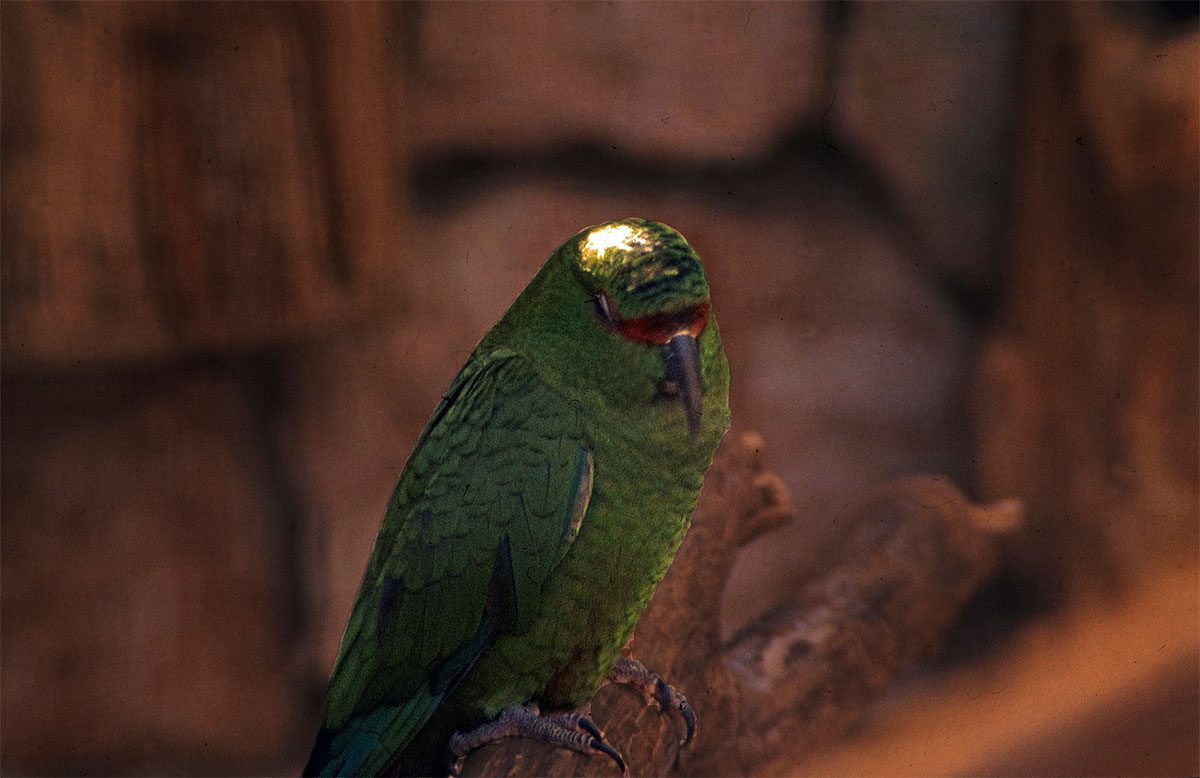
The Slender-billed Parakeet(Enicognathus leptorhynchus) has the lores, forecrown and a narrow ring feathers around the eyes bright crimson red; cheeks and sides neck, green; feathers of the crown, the nape, the the mantle and back, with dark green margins producing a scalloped effect (more pronounced in the crown, where the feathers are brighter and more emerald).
Scapulars, rump and uppertail-coverts They are green. Primary coverts green with blue suffusion; other coverts green. Flight feathers green-blue above with dark margins in innerwebs near the tips; light gray below. Underwing-coverts brighter yellowish green. Underparts yellowish green with patch dull red in centre of belly. Upper, the long tail red is off; greenish toward the tip; undertail, dull red suffused greyish.
The upper jaw It is dark gray with colored tip horn, the lower jaw is horn; Strait bare periophthalmic grey; irises orange-red; legs grey.
Both sexes are similar.
Immature darker, with the upper jaw shorter, less red in the face little or no red on belly.
Sound of the Slender-billed Parakeet.
Habitat:
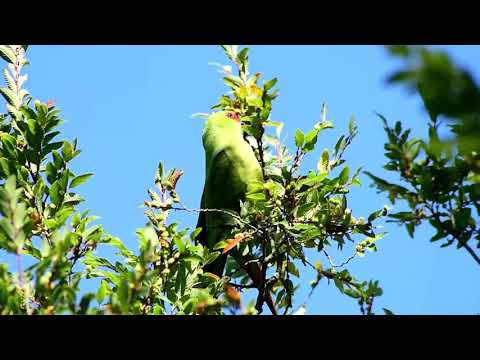
Video – "Slender-billed Parakeet" (Enicognathus leptorhynchus)
The Slender-billed Parakeet dwells in wooded areas, mainly Nothofagus and Araucaria, although they can be seen in more open cultivated fields or pastures, especially in winter. Its range is from sea level in winter to 2.000 meters in summer. Usually in flocks, of a few individuals to several hundred, even in breeding season; large communal concentrations sometimes composed of several thousand birds.
Reproduction:
Nests generally treeholes, often at a certain height and several couples using the same tree; very deep holes fill them with twigs to raise the base level. Occasionally nidifican in rock crevices, building the nest with twigs (for example, bamboo thicket This chusquea) if there is no tree cavities available. breeding season in November-December. Clutch 5-6 eggs.
Food:
Its diet It consists of seeds of wild and cultivated plants (They are sometimes considered a pest), including grains and thistles, seed cones araucaria (March April) open with its elongated peaks, acorns, seeds of Nothofagus and bulbous roots. generally place vigilantes while the rest of the birds feed.
Distribution and status:
Distribution area (breeding / resident): 195.000 km2
The Slender-billed Parakeet It is confined to the center Chile, from the South of Santiago through coastal lowlands and valleys on the slopes of hills peaceful, south to the Chiloe Island and maybe Palena River in the North of Aysen; They can also be seen in Isla Mocha off the southwest coast bio bio.
made some movements altitudinal seasonal, with moving from coastal lowlands to the foothills of the hills between spring and autumn bird (September-May).
Quite common, although in recent decades its population has suffered a decline due to, fundamentally, deforestation, his capture and the Newcastle disease.
Less frequent and perhaps only sporadic in the northern and southern ends of its range.
Caught locally as pets, although quite rare in captivity outside Chile.
Conservation:
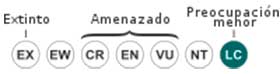
State of conservation ⓘ
Minor Concern ⓘ(UICN)ⓘ
Current red list category of the UICN: Least concern.
The population trend: Stable.
Population size : Unknown.
(classified in Appendix II of CITES)
Justification of the Red List of the Category
This species has a range very large, and as a result does not approach the thresholds for Vulnerable under the range size criterion (extent of occurrence <20.000 km2). La tendencia de la population seems to be stable, and therefore the species does not approach the thresholds for Vulnerable according to the population trend criterion. (> 30% decrease of more than ten years or three generations). The population size It has not been quantified, but are not believed to approach the thresholds for Vulnerable based on population size criteria (<10.000 individuos maduros con una disminución continua estima en> 10% in ten years or three generations, or in a particular population structure). For these reasons, the species is evaluated as Least concern.
Justification of the population
The world population It has not been quantified, but the species according to sources is locally common (pit et to the., 1997).
Justification trend
The population suspected to be stable in the absence of evidence of any reduction or substantial threats.
"Slender-billed Parakeet" in captivity:
Virtually unknown until 1976.
It is a nice and noisy bird, whose docility and cunning behavior have meant it to be hunted down and captured to commercialize as pets, very common but absolutely illegal practice, because they are removed from their natural means of inhabitancy in South Chile, which they can not be replaced in urban areas and in captivity. People who do sell through a network of illegal trafficking. However, it is a rare bird watching in captivity outside Chile.
In captivity, according to sources, a specimen lived 15,3 years.
Alternative names:
– Chilean Parakeet, Long-billed Conure, Long-billed Parakeet, Slender billed Parakeet, Slender-billed Conure, Slender-billed Parakeet, Slight-billed Conure, Slight-billed Parakeet (English).
– Conure à long bec, Perriche à long bec, Perruche à long bec (French).
– Langschnabelsittich, Langschnabel-Sittich (German).
– Periquito Delgado-faturado (Portuguese).
– Choroy, Cotorra Choroy (español).
(4) Slender-billed Parakeets rehabilitating in a Parque Tumbes in a large aviary, Talcahuano, Bio Bio Region, Chile. In January 2012, about a 100 parrots were rescued from a pet shop in La Granja, Santiago Province, Chile. They were rehabilitated for about three months before being released to the wild. By Municipality of Talcahuano [CC BY-SA 2.0], via Wikimedia Commons
(6) A painting of a Slender-billed Parakeet (originally captioned «Psittacara leptorhyncha Long-billed. Parrakeet-Maccaw.») by Edward Lear 1812-1888 [Public domain], via Wikimedia Commons
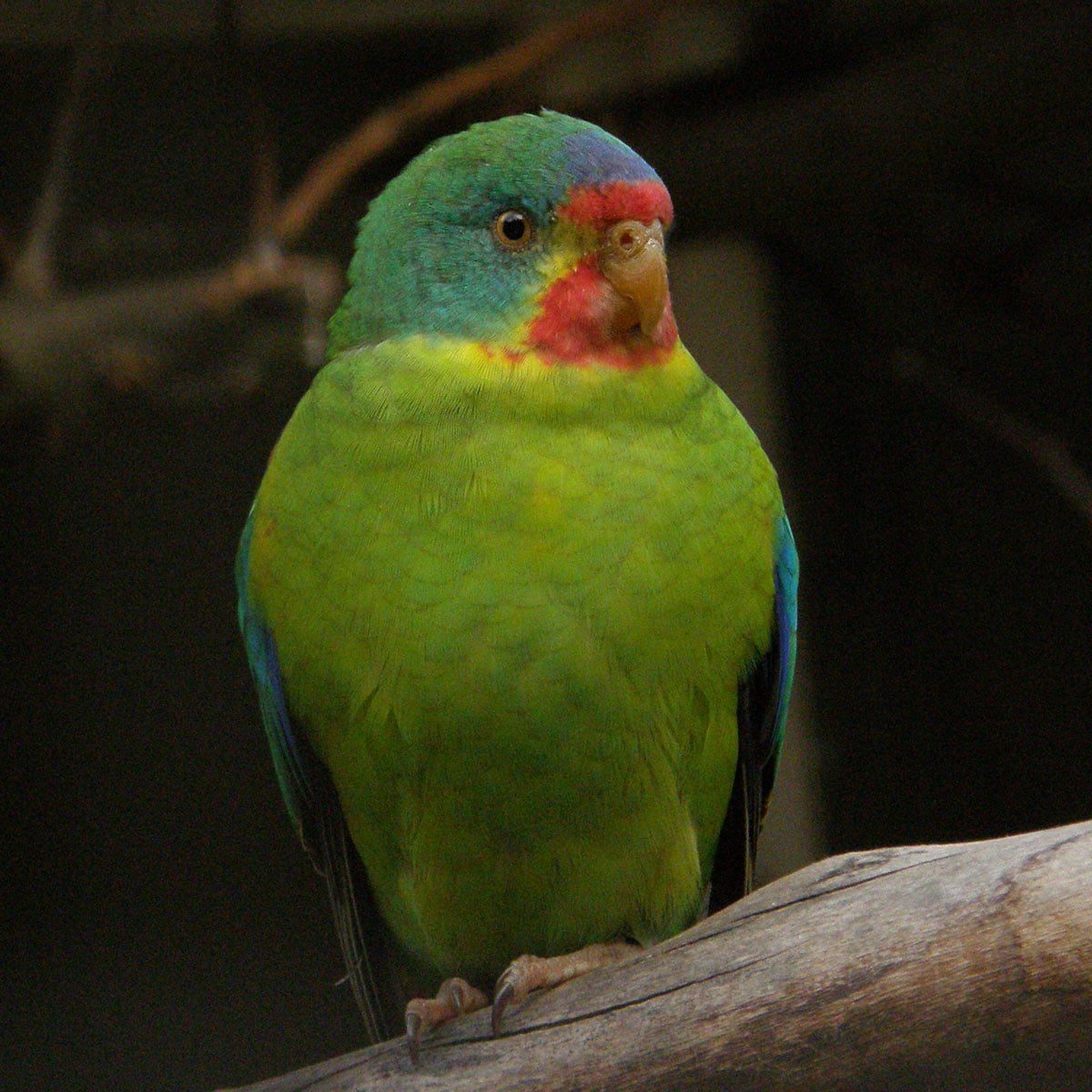
The Swift Parrot(Lathamus discolor) has a length of 23 to 28 cm.. and weighs approximately 65 g..
It is a slim Parrot, medium sized wings angular and pointed tail sharpened.
The head is bright emerald green. The forecrown, the chin and center of throat, red; lores bright yellow; centre of crown blue.
The upperparts (rump), bright green. The wing-coverts and feathers under wing
They are red. The feathers under the tail They are red with green scales effect. The chest and feathers belly are yellowish green.
The bill Horn is color and irises yellow.
The female is paler and extent of mask Red lower than that of males. The color of the bottom of the tail just have red.
To the Swift Parrot It is usually seen in small groups of up 30 birds, sometimes in larger flocks (hundreds of birds) around the abundant food sources. There has also been some extraordinary reports in the enumeration of the flocks of more of 1.000 birds.
Son migratory birds. Are reproduced in Tasmania and then move to Australia continental, in autumn, for the non-reproductive season. Most of the population spends the winter in Victoria and New South Wales, before returning to Tasmania in spring. Usually they are gregarious in raising.
The playback area It is always within the 8 km from the coast, largely restricted to an area of less of 500 km² along the eastern coastal strip between Santa Helena and the Lune River, including offshore islands, as Mary Island and Bruny island.
The higher densities They occur between the After Bernier and Orford and Wellington Ridge about Hobart. A smaller breeding population is located in the North of Tasmania between Launceston and Smithton.
Reproduction:
Reproductive success is strongly related to the intensity and scope of the flowering of the Eucalyptus globulus (Tasmanian Blue Gum). In years of bad bloom, it seems that there is little breeding.
The breeding season It is mid-September to late January. Birds begin to return to Tasmania from your area of wintering on the continent at the beginning of August. Most of the population comes in mid-September. Unpaired birds upon arrival to Tasmania they cannot start breeding until November after finding mates.
The De l'Tmño Nidada is three to five eggs. The female makes the incubation. in cautiverior incubation lasts about 25 days. Young people will fly in around 6 weeks. The presence of juveniles, recently fledged at the end of January and early February suggests double broods may occur. Second hatchlings depend on food availability.
A recent study has shown that the nests of the Swift Parrot often found in close proximity to each other. Nest trees may be to only 10-15 m from, and can support up to four active nests each.
Food:
The Swift Parrot It feeds mainly on nectar, mainly of eucalyptus, but also feeds on insects psyllids and lerps, seeds and fruits.
It is a tree Harvester, forages mainly in the eucalyptus, but from time to time low to the ground to feed on seeds, fallen flowers, fruit and Lerp. During the breeding season, the nectar from the flowers of the Eucalyptus globulus (Tasmanian Blue Gum) is the main source of food.
Sometimes they voraciously consume nectar in areas very accessible and this makes them reluctant to fly making them vulnerable to attack by cats, especially when forage among low foliage. His agility and alertness in flight can also be affected by the consumption of large quantities of nectar, possibly increasing the risk of collisions with artificial or hard-to-see objects.
Distribution:
Size of the area of distribution (reproduction / resident): 21.500 km2
The Swift Parrot, as its name suggests, migrates through the bass strait, between Tasmania and the Australian continent. Comes to Tasmania in September and returned to the southeast of Australia between March and April.
You can get to be as far north as the South-East of Queensland and get up to adelaide from the West, Although the most recent sightings are restricted to the southeastern part of the State.
Conservation:
They estimated that the current population probably contains about 2.000 mature individuals and is declining.
The population of this species is suspected to be declining in line with habitat loss and degradation..
The sugar gliders they are the main predators of the broods of the Swift Parrot on the island of Tasmania, being the cause of the 85% of deaths, but they are not present on the Islands Bruny and Maria
• Current IUCN Red List category: Danger
• Population trend: Decreasing
The logging of a particular species is also responsible for the decline of population, eucalyptus, which constitute the 90% your diet.
– The Swift Parrot is classified as a species in danger of extinction in the law of conservation of biodiversity and protection of the environment of 1999 of Australia.
– The Migratory Perico It is listed as a threatened species under the Victorian Wildlife Guarantee Act. (1988). According to this law, a state action must be carried out for the recovery and future management of this species.. In addition the Migrator parakeet is classified as endangered on the list of advisory on threatened vertebrate fauna of Victoria of 2007.
"Swift Parrot" in captivity:
There are no populations in captivity, they are being handled or propagated actively by reintroducing. But, the Swift Parrot is easily propagated in captivity, and many of them are housed in private collections.
Alternative names:
– Swift Parrot (ingles).
– Perruche de Latham (French).
– Schwalbensittich, Schwalbenlori (German).
– Periquito-andorinha (Portuguese).
– Periquito Migrado (español).
– Avibase
– Parrots of the World – Forshaw Joseph M
– Parrots A Guide to the Parrots of the World – Tony Juniper & Mike Parr
– BirdLife.org
– Wikipedia
– mundoexotics.com
– environment.gov.au
27 to 30 cm. length between 55 and 85 g. of weight.
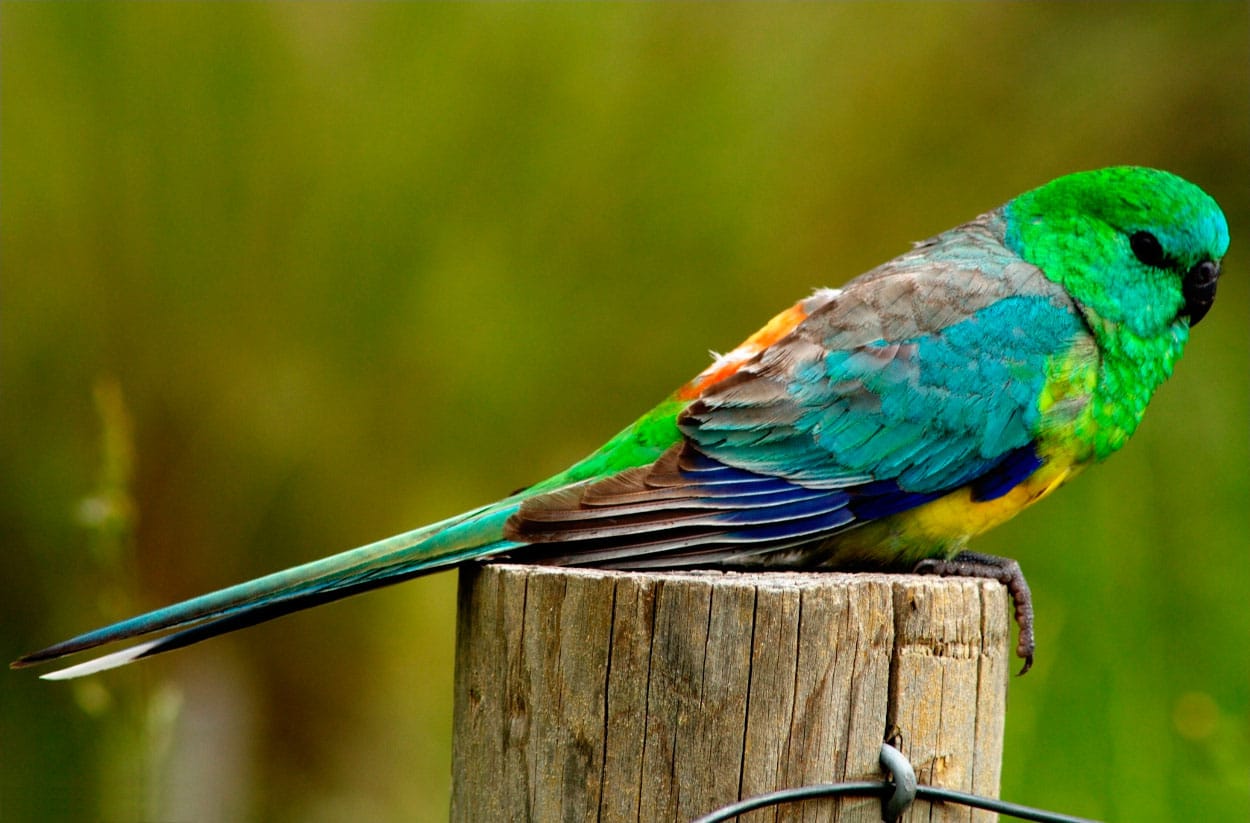
The Red-rumped Parrot(Psephotus haematonotus) It has a bright pale green head, slightly iridescent, with the front of the crown Blue pale and diffusion in the throat. Mantle Green grey with stripes dark fine; floor area of the back and Hip, Scarlet pale; uppertail-coverts bright green. Curve of the wing blue-violet shiny; carpal edge dark blue; small coverts bluish green, the external medium yellow, the inner of a pale blue-green; greater coverts, bluish green, clearer internal; primary coverts dark blue. Flight feathers Blackish with vane external edges and dark blue yellowish; tertiarys grey-green with vane Dark internal. Wing feathers dark blue. Green light the chest with a broadcasting slightly yellow, belly bright yellow, feathers of the chest and belly with stripes more dark very fine; the thighs, vent and undertail- coverts off-white, sometimes blur of yellowish-green. Upper, the tail Green feathered side of greenish-blue with white tips; by down whitish appearance when it is closed.
Bill black; irises brown; legs grey.
The female It is much more off than the male, usually greyish green. With white spots on the ear-coverts, the upper part of the chest is grey olive clear with fringed slightly more dark and the belly whitish with a blue-green light diffusion. The wing-coverts are of a gray olive more uniform that it's the male (medium-sized coverts pale blue). The vane outside of the flight feather they are more muted and more greenish, with the tail green. The bill and the irises are more pale, with some brands shaped pale wing bar.
The immature They also have a pale bar on the wings. Males are darker, with more olive than females and a rump with a narrow margin of Red; The feathers greenish blue begin to show in the head, the chest and wing-coverts first.
The adult plumage was purchased in two or three months, the male young retain the bar of wing
and have it rump more off for another year.
(Condon 1941) – Adults of both sexes are more pale in color, the male is a shade more blue, the Central undertail feathers they have more nuances blue and red of the rump is more pale; the nape and the the mantle of the female are more grayish Green
The Red-rumped Parrot usually sedentary, but some movements of flocks with breeding sites have been recorded at the edges of their range.
They prefer open terrain and trees of ribera, grasslands and croplands until 1.000 meters above sea level, where the annual precipitation is inferior to 800 mm. They are also found in suburban areas, having canevale for golf courses, roadsides and parks, and locally in the mangroves.
They are usually in pairs or small groups, but they are not uncommon flocks of 100 specimens or more during the post-breeding season. In these groups the pair bond is maintained and mutual grooming is common.. The Red-rumped Parrot are sociable, and to retire to the roosts are constantly called.
Reproduction:
The breeding season of the Red-rumped Parrot extends from July to January, Although you can rely more on the rains in the North than elsewhere. The courtship the male consists of head and tail Wiggles, as well as the drooping-wings pose.
The nesting they tend to occur in small colonies, often resulting in disputes between couples. The nest usually in a hollow tree, in different heights, often in a eucalyptus, it can also be located on a tree stump or even the eaves of a building can provide a suitable place. Between two and eight eggs (usually four to five) they form the laying. The female incubates alone for around 20 days, regularly fed by the male.
The pricipio, males remain in small groups, but as the chicks grow, These groups begin to disperse and males joined young people directly in the moments of eating. Young people take to abandon the nest between four to six weeks.
Food:
The Red-rumped Parrot they tend to feed on the ground, but it is also common to see them feeding in trees and shrubs.
The diet comprises a mixture of grasses and herbs, also seed sprouts, leaves, flowers and grain. They rest during the heat of the day and can remain hidden, unless you disturb them.
Distribution:
Size of the area of distribution (reproduction / resident): 1.930.000 km2
The Red-rumped Parrot are confined to the southeast of Australia, from the north of the Peninsula Eyre and Yorke, in the South of Australia, until the Montes Flinders, the basin of the Lake Eyre and Innamincka in the Northeast. The species expands eastward through Victoria, having come up to Melbourne in the middle of the Decade of 1970.
In the news, the species is still scarce in the eastern end of the State. But, in New South Wales can be found around Sydney and along the coast towards the North, extending inward across the fullest part of New South Wales (largely absent in the Northwest of the darling river,).
Its population is common and growing in the north and towards the south coast of Queensland, to the South of New South Wales, benefiting from the expansion of agriculture.
The world population is more of 200.000 specimens and the species is protected by law.
• Current category of the Red List of the UICN: Least concern
• Population Trend: Crecent
The size of the world population It has not been quantified, It is estimated over the 200.000 specimens.
Considered as a bird common to abundant in some parts of its area of distribution, do not believe that the Red-rumped Parrot is in danger of extinction, although there is some evidence that the numbers they may be decreasing slightly. The reasons for this are not clear.
As the Red-rumped Parrot It is immersed in the pet trade, This species is included in the Appendix II the Convention on international trade in endangered species (CITES), which means that all international trade in this species should be carefully controlled.
"Red-rumped Parrot" in captivity:
You have a nice voice. He is active and not especially shy. It can be kept with other parrots outside the breeding season..
The Red-rumped Parrot (Psephotus h. Psephotus) It is one of the species of breeding parakeets more common in captivity. The first imports of Australia they arrived in the middle of the 19TH century. In 1857, the Zoo's London announced the first reproduction successful with this species. Other reproductive successes would follow in Germany and Netherlands, already in 1860.
It's a tough species recommended for novice breeders. The Red-rumped Parrot It is very tolerant of our climate and prefers an Aviary in the open air all year round.
You can play from the age of one year; being two years total maturity age. Playing at the end of the winter, early spring. Usually has two to three young.
The El Perico shrike is also used as a foster parent. Breeders have used their good reproductive dispositions for the breeding of more delicate species such as the Australian King-Parrot (Alisterus scapuleris), the Red-winged Parrot (Apromictus erytropterus) or other species of Polytelis.
The first mutation mentioned back in the middle of the Decade of 1930. This mutation of Australian origin was named as Yellow before later being renamed as Green cake. They are currently known as cinnamon.
Other mutations emerged later as the panache, blue, lutino, opaline, etc … In the news, this species is very common in aviaries. Observations show an unrecognized majority of mutated subjects and a worrying decline in wild-type phenotypes.. Reasonably, it is likely that genetically pure wild type phenotypes are extremely rare today.
According to sources, a sample lived 12,2 years in captivity.
Alternative names:
– Red-rumped Parrot, Grass Parrot, Grassie, Green Leek, Ground Parrot, Red rumped Parrot, Red-backed Parakeet, Red-backed Parrot, Redrump, Red-rumped Grass Parakeet, Red-rumped Parakeet (ingles).
– Perruche à croupion rouge (French).
– Singsittich (German).
– Periquito-dorso-vermelho (Portuguese).
– Perico de Dorso Rojo, Perico Dorsirrojo, Periquito de Rabadilla Roja, Cotorra de rabadilla roja, Espalda roja, Periquito cantor (español).
– Avibase
– Parrots of the World – Forshaw Joseph M
– Parrots A Guide to the Parrots of the World – Tony Juniper & Mike Parr
– AnAge: The Animal Ageing and Longevity Database – Anagé entry for Psephotus haematonotus
– Birdlife
– Photos:
(1) – A male Red-rumped Parrot by Yarra River, Victoria, Australia By Andrea (originally posted to Flickr as rainbow parrot) [CC BY 2.0], via Wikimedia Commons
(2) – A male Red-rumped Parrot near Lake Ginninderra, Canberra, Australia By Duncan McCaskill (Picasa Web Albums) [CC BY 3.0], via Wikimedia Commons
(3) – Red-rumped Parrot in Capertee Valley, Blue Mountains, NSW, Australia. The red rump is seen only in male By Lip Kee Yap from Singapore, Republic of Singapore [CC BY-SA 2.0], via Wikimedia Commons
(4) – Red-rumped Parrot male (Psephotus haematonotus) – Flickr by Patrick_K59
(5) – Red-rumped Parrot (Psephotus haematonotus) Photographed @ Yarra Bend Park, Melbourne, Australia – Flickr
Origin: Bangladesh, Bhutan, Cambodia, China, India, Indonesian, Laos, Myanmar (Burma), Nepal, Thailand, Viet Nam
Character: Sociable
Life expectancy: 15 to 20 years.
Height: Of 33 to 38 cm..
Content
Description:
33 to 38 cm.. length between 133 and 168 g. of weight.
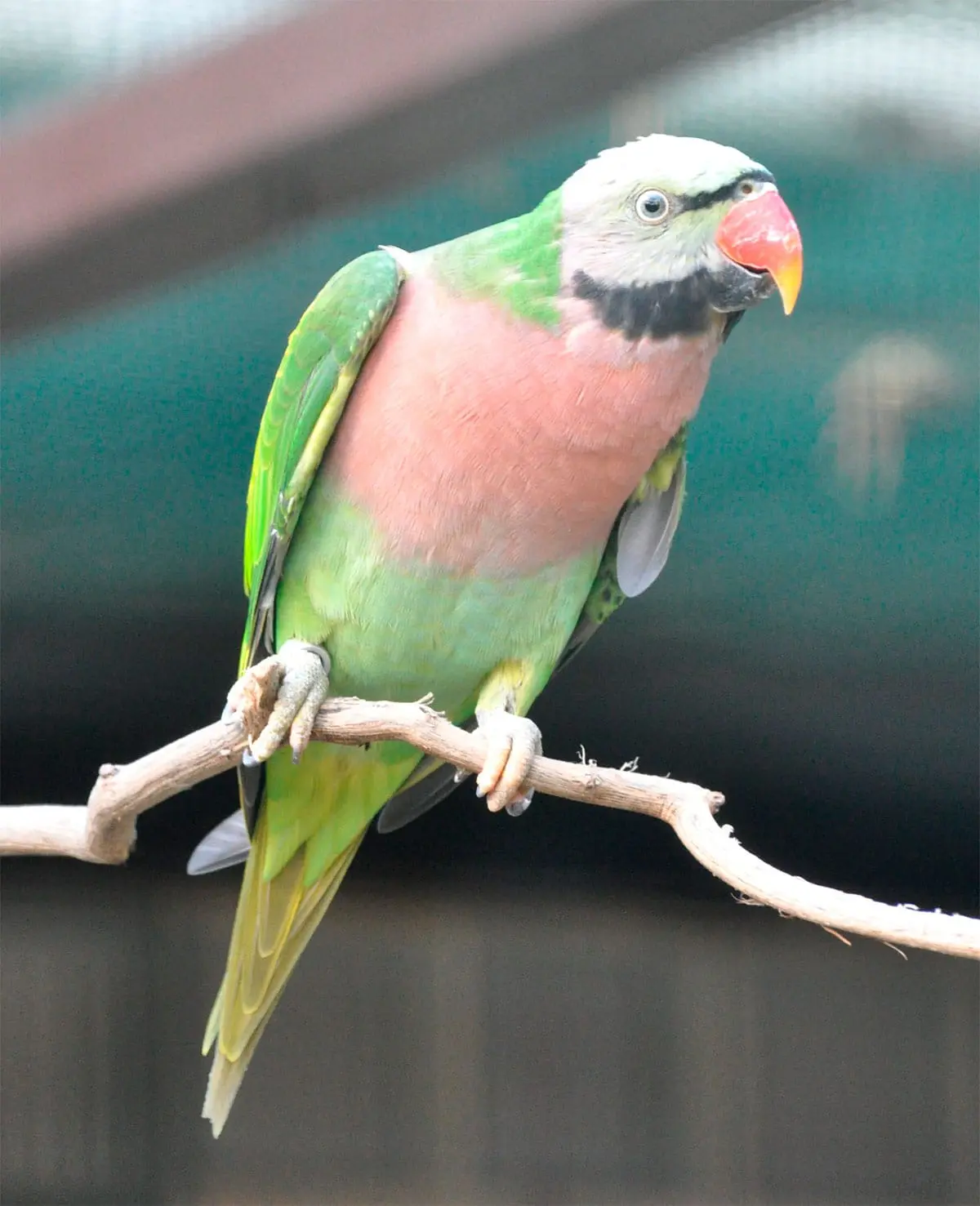
The Red-breasted Parakeet(Psittacula alexandri) is a bird with a form attractive, thin, and with a long and narrow tail. Its plumage is green, the overall tone of the head is grey, the bill red, and with brands distinctive in the head and face. The area around the eyes is greenish, with a pretty bluish tint. It has a fine line along its forecrown and wide stripes in their cheeks. Plumage in the chest, the throat and the top abdomen is salmon-pink color, extending halfway from the vent.
The female It has a shade bluish through the region of the face. In general, they have a pink color more off above the chest and the feather half of its tail they are shorter than the of the male.
The immature birds they have the tail shorter, the bill Pink, and incomplete rays of the cheek they are easily distinguished.
Between the young birds hard identification between males and females, However, breeders have managed to identify them correctly. The head of the female bows in a more uniform manner from the cere to the rear of the head. The young males they tend to be flatter in the forecrown. The females They seem to have a face darker than blue.
(Oberholser,1919) – Length: 36 cm.. Similar to the Psittacula alexandri fasciata (including sexual dimorphism in staining of the bill) but larger and paler.
(Oberholser, 1912) – Length: 36 cm.. As the Psittacula alexandri fasciata but with the belly blue (especially in males), the upper part of the abdomen darker and the lores, forecrown and bottom of the abdomen strongly impregnated with the pale blue.
Psittacula alexandri dammermani
(Chasen & Kloss, 1932) – Length: 36 cm.. Perhaps, on average, larger that the Psittacula alexandri fasciata. The pink color of the chest It is darker than the species nominal. In the female, the pink color extends from the throat at the sides of the neck. The bill larger than that of the species nominal. Both jaws Red in both sexes.
Psittacula alexandri fasciata
(Statius Müller, 1776) – Length: 33 cm.. Upper chest and abdomen is dark pink with violet tone, the head is bluish-grey way more uniform. The areas of the eyes and forehead with greenish hue. The females, part of the difference of the bill, nor have the violet tonality in the pink of the chest.
Psittacula alexandri kangeanensis
(Hoogerwerf, 1962) – Length: 33 cm.. More grey the head (less blue). Bill larger than that of the species nominal and both jaws Red in both sexes.
Psittacula alexandri major
(Richmond, 1902) – It is more large, of 38 cm.. length. Similar to the Psittacula Alexandri Fasciata but something more pale and the head is without bluish tone gray.
Psittacula alexandri perionca
(Oberholser, 1912) – Length: 37 cm.. As the Psittacula alexandri fasciata (including sexual dimorphism in the coloration of the bill) but paler and larger, without the Green tint around the eyes.
Habitat:
Usually, they live below 2.000 m (rarely above 345 metres in Nepal) all types or forest and wooded areas, including dry forest, secondary-humid deciduous forest, mangroves, coconut and mango groves , areas planted with trees (including hills of shifting cultivation), parks and urban areas. In the region of the Himalaya avoids the dense green forests.
Gregaria, usually in flocks of 6-10 birds, less frequently in groups of 50 and very exceptionally in thousands, larger flocks during garbage collection (for example, the mango or rice), sometimes mixed with the Slaty-headed Parakeet wave Gray-headed Parakeet. They form communal roosts in the tall trees, bamboo or sugarcane scrub areas.
Reproduction:
The Red-breasted Parakeet nests in natural cavities or old hole made by woodpeckers or barbets, usually at a height between 3 and 10 m, often in loose colonies. The hole is filled with wood shavings.
The laying is of 2 to 4 eggs.
The breeding season is between December and April, Depending on the location and the altitude; in Java, breeding has been recorded in every month, except for April.
Food:
Diet Red-breasted Parakeet includes wild figs and other fruits, fruit trees and wild, flowers and nectar (especially, for example, of the Parkia speciosa and Erythrina variegata), dried fruits (for example, chestnuts Castanea), fruit (for example, Mango), berries, seeds (for example Albizia), leaves and cereals such as rice and corn, by causing serious damage to crops, especially for rice.
Distribution:
Size of the area of distribution (reproduction / resident): 2.570.000 km2
The Red-breasted Parakeet are distributed from the central area of the Himalaya until Indochina, China and West of Indonesian. From the lowlands of the Himalaya in the North of India, approximately to the East of Dehradun, through Nepal, Sikkim and North of Bhutan in the southwest of Yunnan, China; to the South by Assam, Manipur and Nagaland, India, until Bangladesh and to the East by Burma (including Mergui archipelago), Indochina, Malacca Peninsula, around 9°N (a record of 1889 in the Kelantan River at approximately 5°N suggests a contraction in its distribution) of Guangxi and Provinces of Canton and Hainan Island, to the South of China.
They are also distributed in Islas Andaman and Indonesian in Java, Bali, Karimun Java, Kangean, Borneo South (where it was probably introduced from Java) and Simeulue, Nias and Banyak, West of Sumatra.
Getaways captive birds eggs were found in Singapore and a single record (presumably an escape) in Hong Kong.
Resident but with some local movements dependent on food supply.
It is the most common parrot in some parts of its range., but with a substantial decrease in Thailand and Laos in recent years and local extinctions (for example, Java and Bali), because of the live poultry trade; the nominal subspecies may be at risk as a result of his capture. A small number in captivity out of range (mainly the nominal species and fasciata).
(Statius Müller, 1776) – Continental Asia from the North of India through the Himalaya lower, Burma including the Mergui archipelago, Thailand and Indochina to the South of China, including Hainan
The population of the Red-breasted Parakeet It is suspected in a moderate to fast global decline, due to the unsustainable levels of exploitation and the destruction of their habitat. This suspicion is supported by widespread anecdotal evidence that in many parts of its range decreases.
Threats:
– The declines and local extinctions in recent decades in the population of the Red-breasted Parakeet have been attributed in large part to his capture to the trade in live birds (Juniper and Parr 1998).
– The hunt they are considered the main threats to the species in Nepal, where it is also threatened by the loss of forests (C. Inskipp and HS Baral in litt. 2011).
– His nasal voice makes the species a popular in Nepal cage bird, and their vocal habits during the breeding season, together with the tendency to form large flocks when not raising, they make susceptible to trappers. These factors lead to illegal hunting and his capture in protected areas; they are also persecuted by farmers due to their raids on crops (C. Inskipp and HS Baral in litt. 2013).
– Similarly, in Bangladesh, the species is captured for the cage bird trade It is also likely that they are affected by the removal of large trees (P. Thompson in litt. 2012).
– Almost the total disappearance of the species from the North of Laos, It is believed that it is mainly due to the loss of habitat through conversion to agriculture (JW Duckworth in litt. 2011).
– Loss and fragmentation of forests is likely to accelerate in Cambodia in the near future, given that many of the large agro-industrial concessions have been awarded recently (H. Rainey in some. 2011).
Conservation Actions:
– The species is listed in the Appendix II of CITES.
The Red-breasted Parakeet is a bird Smart and outgoing that is gaining increasing worldwide popularity. These parrots are sociable and playful, and if they are properly socialized, they can be a few excellent pets. They can be a bit aggressive and authoritarian, If it is not properly discipline. They need a good cage for a large size, with a lot of toys to avoid boredom.
Although this bird is linked with the Rose-ringed Parakeet, they are very different in personality. The Red-breasted Parakeet It is softer and not so noisy, although she has been described as "feisty". It is usually more quiet than other Psittacula. Also are great eaters and you accept easily new foods other birds may be thrown away.
You can get to imitate some sounds, even words, Although not as clear as the some of the larger parrots, example the Grey Parrot. But, according to some sources, they can speak more clearly than the Rose-ringed Parakeet.
Regular handling is important at an early age, since they can become aggressive, If not are well socialized and manipulated.
If you want a small Parrot with personality, the Red-breasted Parakeet It can be the ideal ave. But, It is still a "stubborn" and "stubborn" bird.. It is not surprising considering his intelligence. Obedience training is recommended. On the other hand it is one voracious chomping and should it be should provide plenty of toys to chew.
Like other parrots, need company, and if they will not be in an Aviary with other birds, We must be able and willing to spend large amounts of time with them.
In nature, this bird is often seen in flocks of 10 to 50 individuals. These flocks, often, they are heard before to be seen. This is a fact that must be taken into account before deciding to buy one Red-breasted Parakeet. Breeding females can be put in 3 to 4 eggs in each clutch, with an incubation approximately 22 days.
With regard to its longevity, according to sources, We need to know that a specimen lived 23,3 years in captivity.
Captive breeding:
The Red-breasted Parakeet commonly bred in captivity. They reach maturity between 2 and 3 years of age. The birds must be matched at a young age. The female can sometimes dominate males. The procession begins at the end of winter and the females can be seen calling males for food. In the wild they breed between the months of December and April, Although this is variable, Depending on the climate and altitude.
A thick-walled hollow trunk, It can be used as nest. If not available, any commercially available nesting box should suffice.
They require long aviaries, more than wide, due to its long tail and its type of flight (powerful, linear). Also like a protected breeding area. The entrance door to the Aviary must be on the opposite end. We must place leaves of Palm on the bird front and leafy branches on the back to protect the young fledged when they hit the walls of the Aviary and fall on your floor. If this is not done, many of the young people will die from injuries in the head or severely damage their hair. Young hatchlings do not have great control when they start to fly; they can be left with the parents during 9 months, but then you must be separated.
Diet during breeding It is very important. We can use sunflower seeds germinated, soaked chickpeas, Apple diced, celery, raw or boiled corn and green feed. Supplementation with multiple vitamins and liquid calcium is especially important prior to egg laying..
Alternative names:
– Red-breasted Parakeet, Banded Parakeet, Bearded Parakeet, Indian Red-breasted Parakeet, Moustached Parakeet, Pink-breasted Parakeet, Red breasted Parakeet, Rose-breasted Parakeet (English).
– Perruche à moustaches (French).
– Bartsittich, Rosenbrustsittich (German).
– Periquito-de-bigode (Portuguese).
– Cotorra de Pecho Rosado, Cotorra Pechirroja (español).
– Avibase
– Parrots of the World – Forshaw Joseph M
– Parrots A Guide to the Parrots of the World – Tony Juniper & Mike Parr
– Birdlife
– Photos:
(1) – Moustached Parakeet in the Walsrode Bird Park, Germany By Quartl (Own work) [CC BY-SA 3.0], via Wikimedia Commons
(2) – Red-breasted Parakeet at Brooklands Zoo, New Plymouth, New Zealand By Dave Young (originally posted to Flickr as bird) [CC BY 2.0], via Wikimedia Commons
(3) – Red-breasted Parakeet (Psittacula alexandri fasciata). Coutrtship – male on right. Changi Village, Singapore. 2 January 2006 By Lip Kee Yap [CC BY-SA 2.0], via Wikimedia Commons
(4) – Moustached Parakeet in the Walsrode Bird Park, Germany By Quartl (Own work) [CC BY-SA 3.0], via Wikimedia Commons
(5) – Female of Red-Breasted Parakeet (Psittacula alexandri) at Bangkok, Thailand By Jason Thompson (Flickr: Red-Breasted Parakeet (Female)) [CC BY 2.0], via Wikimedia Commons
(6) – Plate from Zoological illustrations, Volume 1, 2nd series By William Swainson [Public domain], via Wikimedia Commons
The Santa Marta Parakeet(Pyrrhura viridicata) It, in general, green, with a characteristic red stripe in the middle of the chest which continues until shoulder and armpit. The scales of the chest is less evident; the flight feathers blue. Band front narrow red in the forecrown and behind the eye with red and yellow dye. Tail over green and below red opaque.
Bill color bone; brown iris; pale black legs. It has no sexual dimorphism.
It inhabits in humid mountain forest, clouded forest, pastures and edges, from 1900 to 2800 m. They fly at dawn and at dusk in compact and numerous flocks on the canopy of the forest. Is les has observed flying over them clear adjacent and each time more visiting them mulberry plantations.
The species rests and nests in couples and in lesser proportion in groups of three individuals in cavities of Palms of bouquetCeroxylon ceriferum (Arecaceae).
Reproduction:
The period reproductive is starts in December and lasts until June, the cavities are visited on average 4 to 5 times a day. There is a sexual dimorphism and a low reproductive success can be associated with displacement or predation by the Aratinga wagleri wagleri (Scarlet-fronted Parakeet) or the Santa Marta Toucanet (Aulacorhynchus lautus prassinus) – Ramphastidae.
Food:
Twelve plant species are incorporated into the diet so far known to the Santa Marta Parakeet, It consists mainly of flowers and fruits, the inflorescence of the Croton bogotanus (Euphorbiaceae) is their main source of food. It forages in groups of size variable, presenting an integration and disintegration of subgroups throughout the day. A sentinel system was observed.
Distribution:
Size of the area of distribution (reproduction / resident): 1,600 km2
Endemic species of Sierra Nevada de Santa Marta, to the northeast of Colombia. The towns registered include The Summit, is of Taquiña on the basis of the Páramo of Mamarongo in the Guajira, and Cerro Quemado in the mountains of San Lorenzo.
Will produce some movements altitudinal seasonal. Almost all the habitat forest subtropical is designated as reserve forest or Park national, but the clearing for plantations of marijuana has been extensive, similar to the use of herbicides to combat it. So it only remains for the 15% the original forest (especially in the hillsides North), including only 200 the preferred height of the species km2. Fairly common within this very restricted range, but the population probably below of the 5.000 birds.
Conservation:
State of conservation ⓘ
Endangered ⓘ(UICN)ⓘ
• Current category of the Red List of the UICN: In danger of extinction.
• Population trend: Decreasing.
Rationale for the Red List category
The range of this species and its small population are probably decreasing as a result of habitat loss. So, qualifies as in danger.
Justification of the population
The population It has been estimated for a long time between 5.000 and 10.000 individuals, equivalent approximately to 3.300-6.700 mature individuals. The density of population is of 1 Ave per km2 (Botero-Delgadillo et to the. 2012). Assuming that the 680 km2 of habitat are fully occupied, the population total is calculated that is 2,900-4,800 birds, which is equivalent to 1,933-3,200 mature individuals; But, with occupation part is likely to remain less than 2.500 birds (Botero-Delgadillo et to the. 2012).
Justification of trend
Se sospecha una decrease moderate and continuous of the population on the basis of the rates of habitat loss.
Threats
only one left 15% the original vegetation of the Sierra Nevada de Santa Marta, to a large extent on the slope North, where this species is found (LM Renjifo, Com. 1993, 2000).
The main current threat is the expansion of plantations of non-native trees, such as the of Pine and eucalyptus, in addition to the clearing of land for livestock (C. Olaciregui in litt. 2012).
· Historically, the conversion of forests in plantations of marijuana and coca was also a major threat (LG Olarte in litt., 1993, com LM Renjifo. Comm., 1993, J. Fjeldså verbally they 2000, pers LM Renjifo. Comm., 2000, C. Olaciregui in litt. 2012), that is compounded by the Government with application of herbicides in the sierra (LG Olarte in litt., 1993, com LM Renjifo. Comm., 1993, 2000).
Other threats that followed the human migration to the area Since the Decade of 1950 hereafter include slash & burn (Dinerstein et to the., 1995, Snyder et to the. 2000, Salazar and Strewe undated, PGW Salaman in litt. 1999).
· It is known to be hunted in the cold river valley, and in the San Pedro district individuals in mulberry plantations have skyrocketed. The species not found in the local bird trade (Strewe 2005).
"Santa Marta Parakeet" in captivity:
Not marketed for captive.
Alternative names:
– Santa Marta Parakeet, Santa Marta Conure (English).
– Conure des Santa Marta, Perriche de Santa Marta, Perruche de Santa Marta (French).
– Santa-Marta-Sittich, Santa Marta Sittich, Sittich (German).
– Santa Marta Parakeet (Portuguese).
– Cotorra de Santa Marta, Perico Oliva, Periquito de Santa Marta (español).
Avibase
Parrots of the World – Forshaw Joseph M
Parrots A Guide to the Parrots of the World – Tony Juniper & Mike Parr Birdlife
Oliveros rooms, H.. 2005. Population and ecological evaluation of the Santa Marta parakeet Parrot parakeet in the sector of San Lorenzo, Sierra Nevada de Santa Marta, Colombia. (ProAves.org)
30 cm. length and 110 g. of weight.
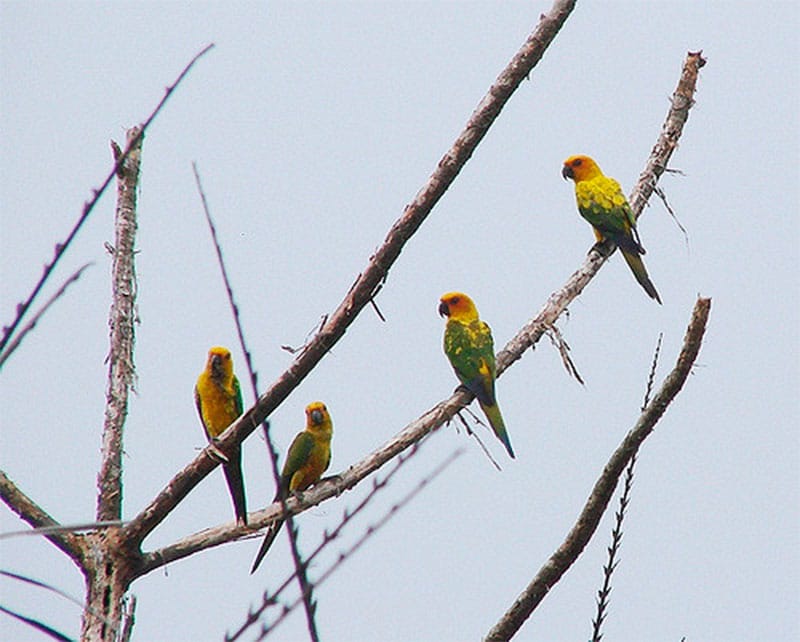
The Sulphur-breasted parakeet(Aratinga maculata) is pale orange, with the head and back of the neck pale yellow
. The throat and the chest are pale yellow, the the thighs are greenish; flanks pale orange, undertail-coverts greenish, the mantle pale greenish yellow; rump pale yellow orange, tail blue-green, wings green-yellow, underwing-coverts pale yellow. Close orange stripe on the front of the crown, in the lores and around eyes. Orbital ring pale grey. Iris dark gray / brown. Bill almost black.
The immature presumably as of adults, but with cheeks and top of the chest Yellow olive. (Observed one specimen).
Sound of the Sulphur-breasted parakeet.
taxonomy:
described in 2005 under the name of Aratinga pintoi, but later it was shown that the current name, It considered invalid for a long time, indeed it applies to this form, and therefore takes precedence; of holotype of Aratinga pintoi It has now been designated as neotype of Psittacus maculatus, which formally stabilizes synonymity. The species was misidentified as a juvenile of the Sun Parakeet(Aratinga solstitialis) or a hybrid between the latter and the Jandaya Parakeet(Aratinga jandaya); now generally recognized as a separate taxon, differing greatly reduced due to the orange-red in the face (where it forms an irregular mask), Breast and belly.
Habitat and behavior:
The species inhabits areas with large tracts of forest and Savannah adjacent (O’ Shea 2005, Mittermeier et to the. 2010). performs movements nomads.
It is similar in behavior and general ecology to the species of the group of the Aratinga solstitialis. Are in groups of 2-10 birds and they are relatively Meek, feeding along roads and orchards.
Reproduction:
Not much is known about their breeding habits. One nest observed with an egg of unknown size.
Extending its range (breeding/resident): 159.000 km2
The Sulphur-breasted parakeet (Aratinga maculata) (formerly pintoi; see Nemésio y Rasmussen 2009) It has a fragmented range in For and Amapá in Brazil, and at the southern end of Suriname(p. e.g.. Silveira et al. 2005, Mittermeier et to the. 2010, Vieira da Costa et al. 2011). After a three-day survey conducted in 2003, Silveira et al. (2005) They claim that Sulphur-breasted parakeet was quite common in Monte Alegre, For. in addition, in Suriname the species has been characterized as uncommon to fairly common (O’ Shea 2005, Mittermeier et to the. 2010).
Conservation:
• Current category of the Red List of the UICN: Least concern.
• Population trend: Growing.
• Population size : unknown.
Rationale for the Red List category
The trend of the population It seems to be increase, and therefore the species does not approach the thresholds for Vulnerable under the criteria of population trend (> 30% decrease in ten years or three generations). The population size has not been quantified, but it is not believed to approach the thresholds for Vulnerable under the criterion of population size (<10.000 individuos maduros con un descenso continuo estimado en >10% in ten years or three generations, or with a specific population structure). For these reasons, the species is evaluated as Least concern
Threats
The distribution area this species is affected by the deforestation, mainly driven by the expansion of agriculture as they build new roads; However, deforestation Brazil You may be benefiting this species and facilitating their spread to new areas (Vieira da Costa et al. 2011). Long-term, deforestation may become so rapid and extensive that the balance of extensive forest tracts and savannas required by the species will be exceeded and the species may begin to decline. Silveira et al. (2005) They claim that Monte Alegre, For, no obvious signs of a strong pressure entrapment. in addition, Mittermeier et to the. (2010) state that no hunting or capture of the species by Amerindians in the savannah was reported Sipaliwini of Suriname meridional.
"Sulphur-breasted parakeet" in captivity:
virtually unknown; maintained by local people and zoos Brazil. It can live up 30 years in captivity.
– Avibase
– Parrots of the World – Forshaw Joseph M
– Parrots A Guide to the Parrots of the World – Tony Juniper & Mike Parr
– Birdlife
– World Parrot Trust
 Minor Concern ⓘ
(UICN)ⓘ
Minor Concern ⓘ
(UICN)ⓘ














.jpg)
