โ–ท The world of Pets: Dogs, cats, birds, reptiles, amphibians

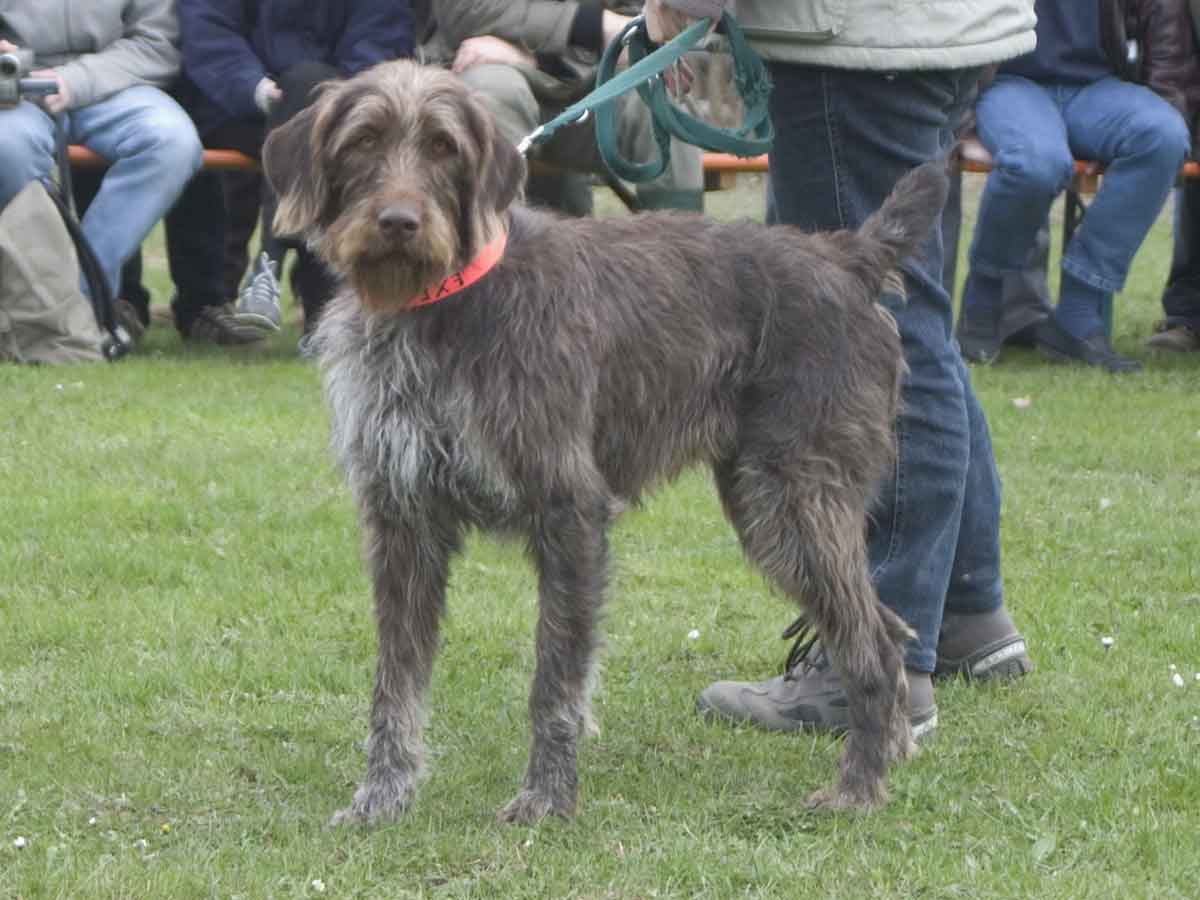
German Roughhaired Pointer
Alemania FCI 232 . Braque Type

German Roughhaired Pointer

The German Roughhaired Pointer has a calm and balanced character.

Content

History

The German Roughhaired Pointer It is the oldest breed of wire-haired dogs. The history of German Roughhaired Pointer goes back many hundreds of years. Already in 1539 this breed of dog could be admired in bronze engravings. In 1888 Hans Von Kaddisch showed that this breed is not a variety of the Shorthaired Pointer Dog, but the wire-haired counterpart of the Old German Wirehaired Pointer, and that it was selected and developed from rare surviving subjects that had survived in Germany.

The breed club, founded in 1892 As the "Club Stichelhaarยซ, changed his name to "Verein Deutsch Stichelhaar" in 1976. Since the beginning, has applied the rules of purebred breeding from the beginning, and excludes any crossing with the English breeds.

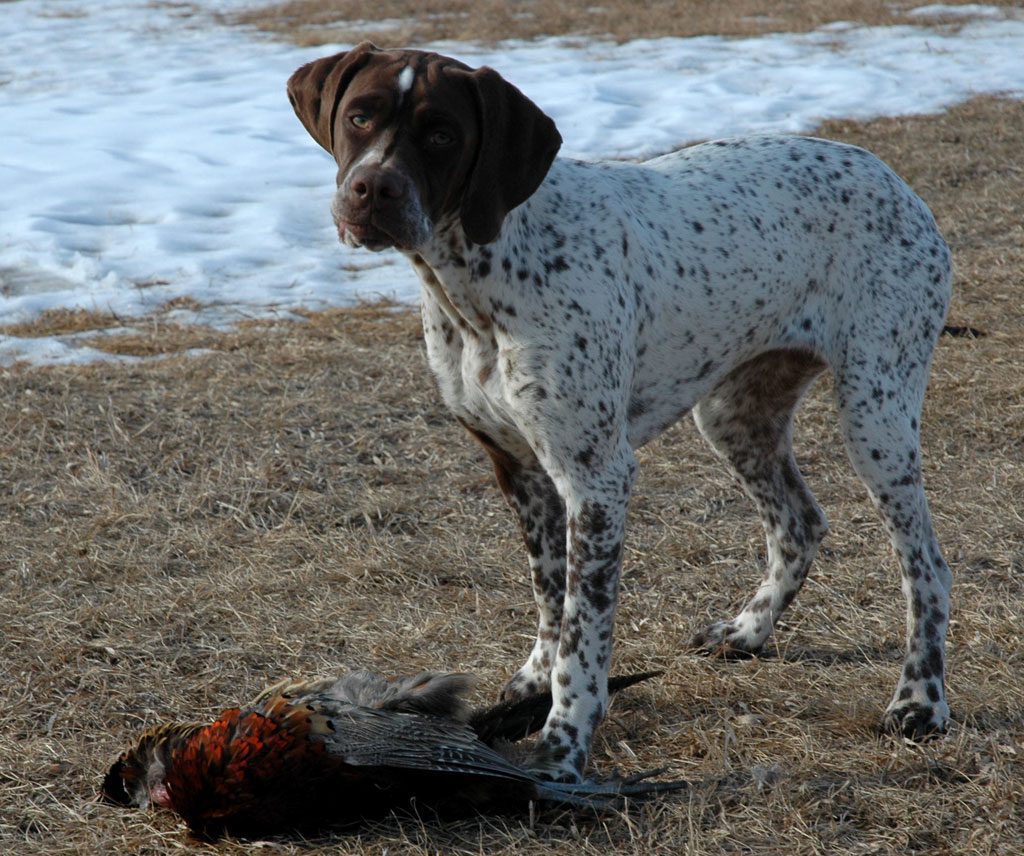
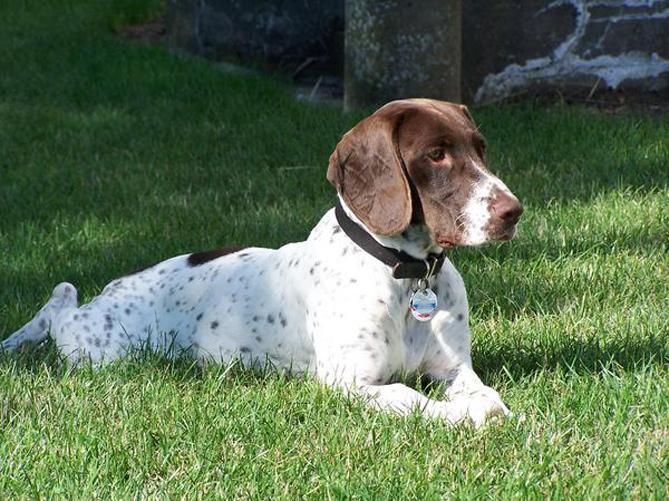
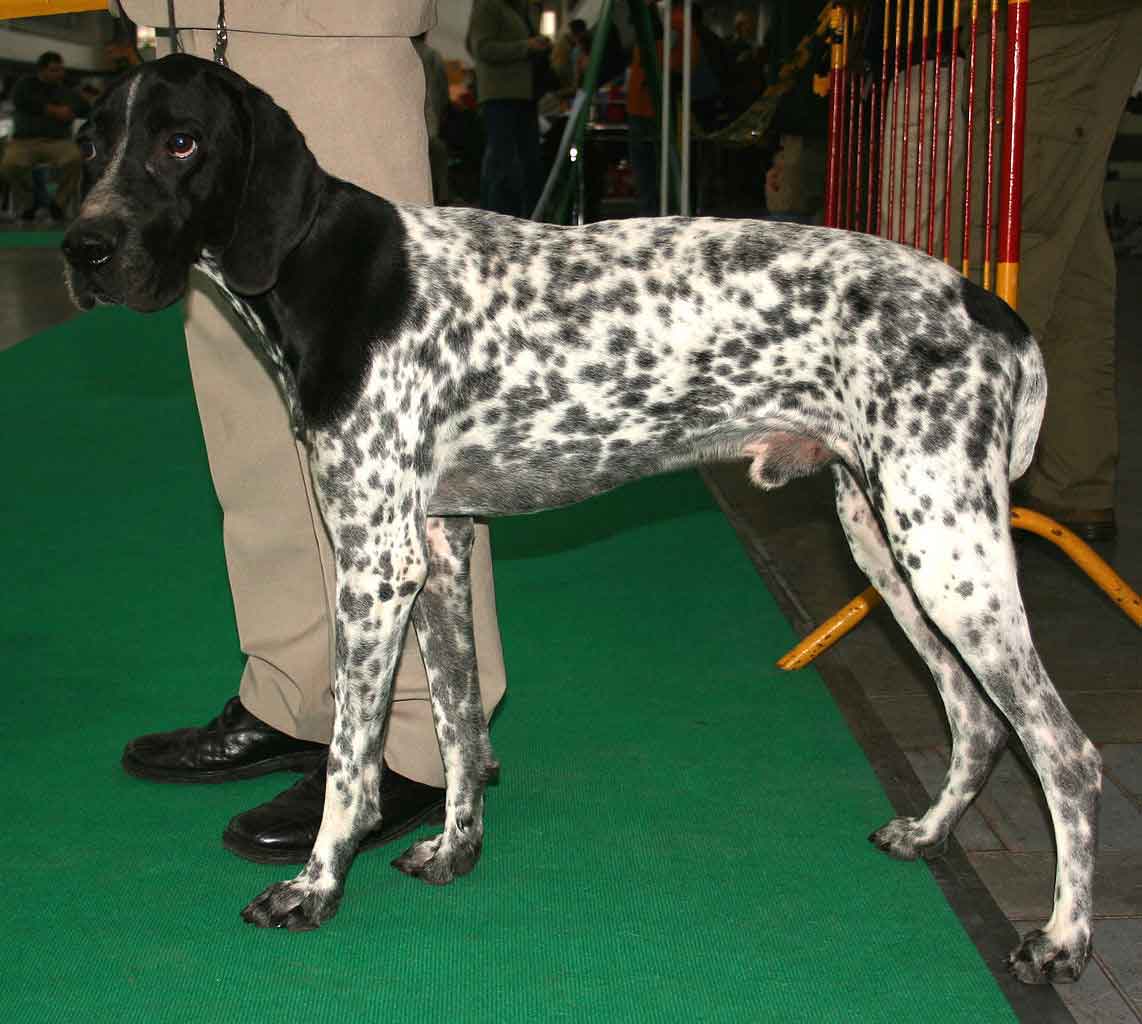
Photo: The german pointing dog Deutsch Stichelhaar by Alephalpha, CC BY-SA 3.0, via Wikimedia Commons

Physical characteristics

GERMAN BRISTY-COATED POINKING DOG
German Roughhaired Pointer

Males reach a withers height of 60 to 70 centimeters. Females are somewhat smaller, growing up to about 58 to 68 centimeters. The weight of a German Roughhaired Pointer it is usually between 20 and 29 kg.

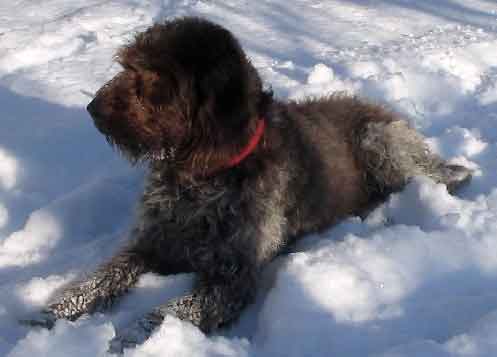
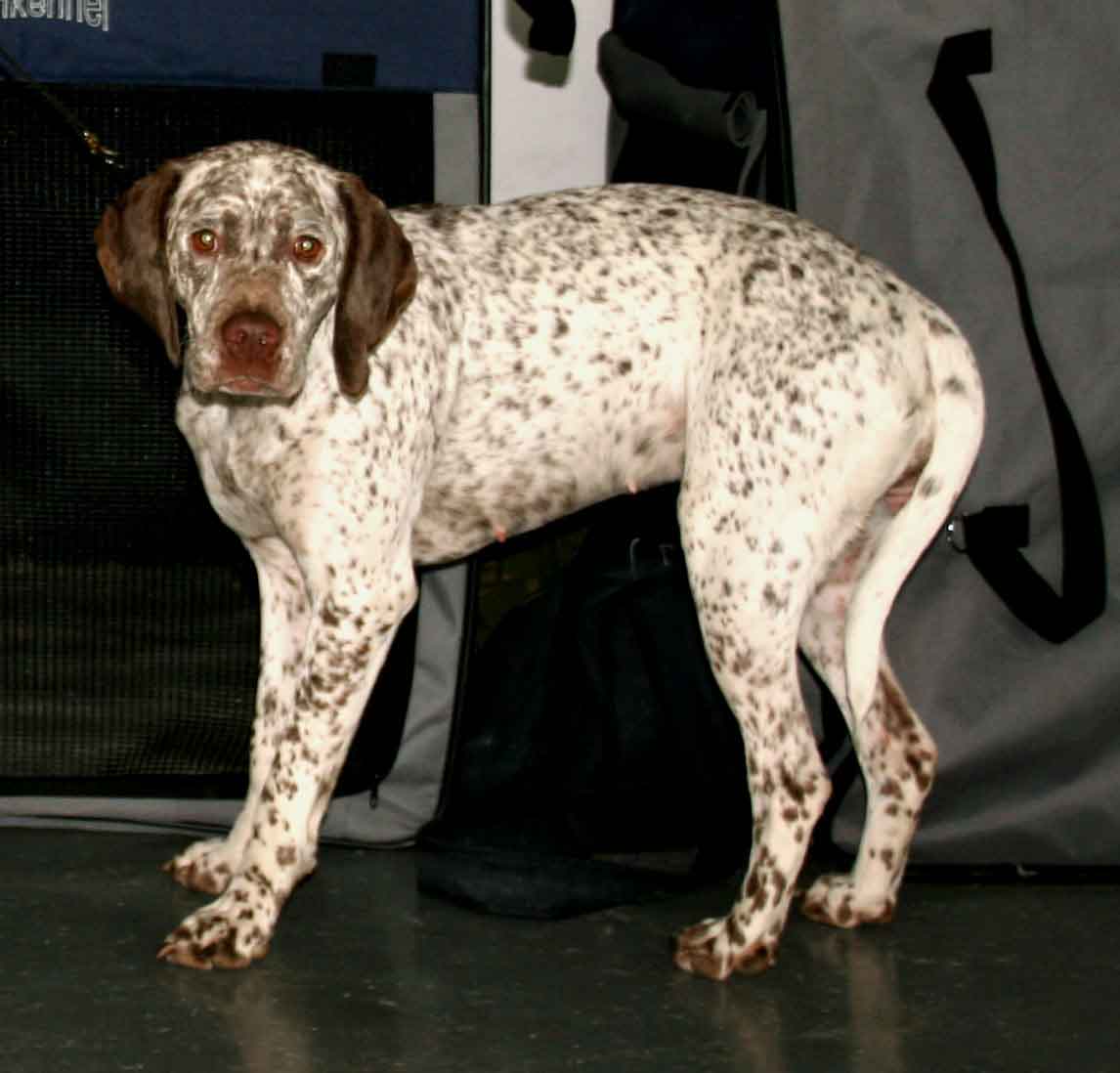
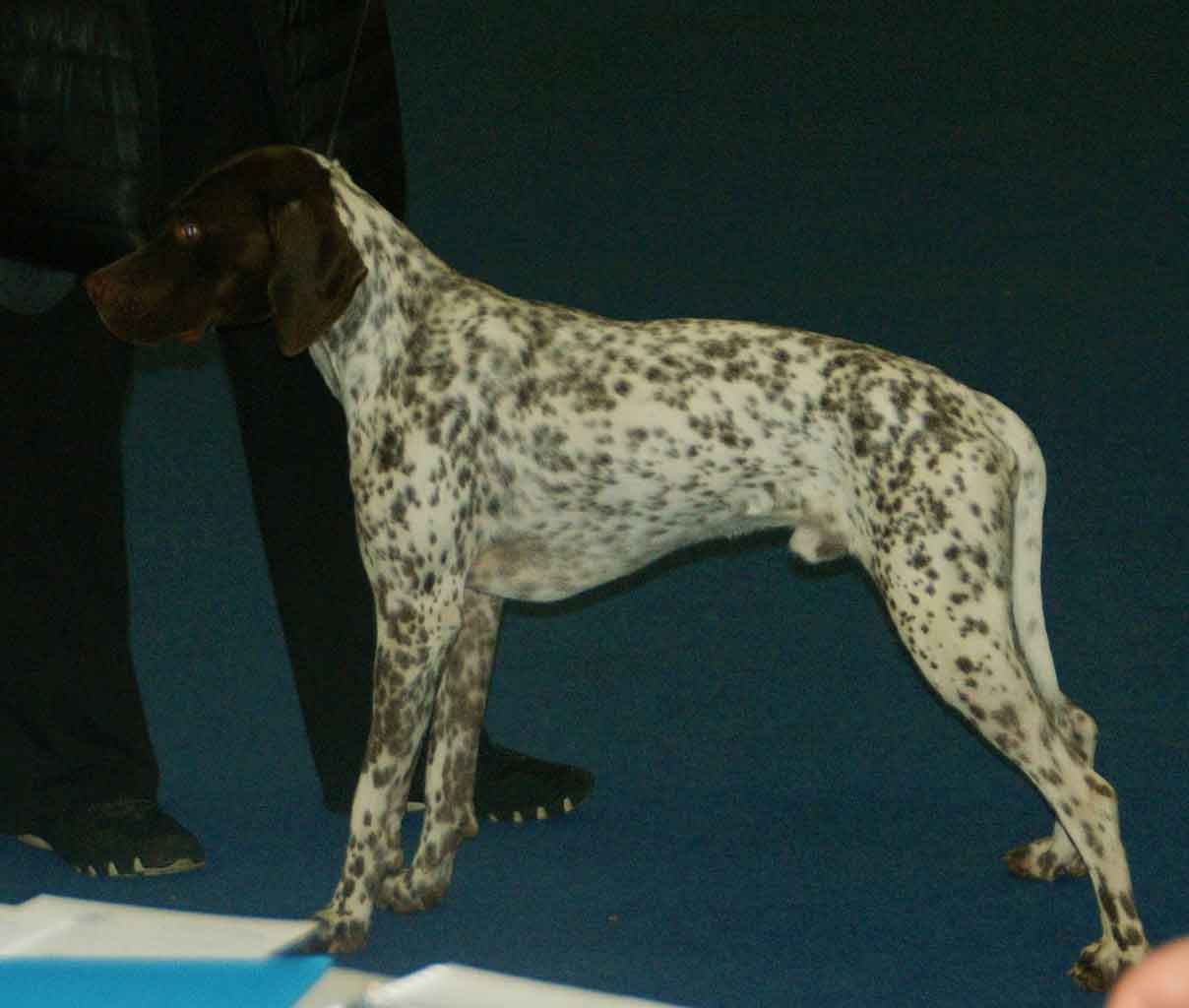
The coat of this dog is hard and bristly. Is loose and has a moderate undercoat. The German Roughhaired Pointer comes in a variety of colors and patterns. They are often solid brown in color, or have a white patch on the chest. There are also light browns and grays. The dog's coat has a few 4 centimeters long.

The structure of this breed of dog is square and strong. He has a straight back line, leaning slightly towards the rump. The skull is widely built and slightly domed. The ears are smooth and hanging and have a high base. The appearance of the German Roughhaired Pointer reminds a German Wirehaired Pointer.

Character and skills

The German Roughhaired Pointer has a calm and balanced character. He is very easy to train and very willing to learn. His alertness and protective instincts are strong, but they can be controlled well.

The temperament of German Roughhaired Pointer it is usually quiet. Your temperament manifests when your abilities are nurtured through regular training. When you bring a German Roughhaired Pointer to your family, you have a new friendly roommate.

Your new pet is neither shy nor aggressive. If you keep your friend busy enough, will be a loyal companion. But, you must make it clear to him that you have the position of leader within the hierarchy. Only then will he be a loyal dog to you.

The German Roughhaired Pointer it is very popular with hunters. But, not suitable as a pure family dog. As this breed of dog is very self-confident, you should also be a strong leader.

Training

The natural instincts of German Roughhaired Pointer can be controlled well with proper training. The best way to do this is to train him to be a hunting dog.. The training of the German Roughhaired Pointer it is much more complex than that of other dogs. Just visiting a normal dog school is not enough. Usually the German Roughhaired Pointer it is only given to hunters for this reason.

Grooming

Health and Grooming

When it comes to grooming, the German Roughhaired Pointer it is similar to many other hunting dogs. So, the amount of grooming required is low. If you brush your four-legged friend's coat once a week, is perfectly enough. The German Roughhaired Pointer it is very robust in health. So, fortunately it is not very susceptible to disease.

Characteristics "German Roughhaired Pointer"

Coexistence is important that you have with your new friend. Before considering the acquisition of a dog of the breed "German Roughhaired Pointer" you know certain factors. Not all breeds of dogs are apt to live in an apartment, you must take into account his character, their need for exercise, their interaction with other pets, their care and if you have small children, their level of tolerance towards them.

Adaptation โ“˜

3,0 of 5 stars (based on 1 review)

friendly dog โ€‹โ€‹โ“˜

4,0 of 5 stars (based on 1 review)

hair loss โ“˜

2,0 of 5 stars (based on 1 review)

Affection level โ“˜

5,0 of 5 stars (based on 1 review)

Need for exercise โ“˜

4,0 of 5 stars (based on 1 review)

Social need โ“˜

4,0 of 5 stars (based on 1 review)

Home โ“˜

2,0 of 5 stars (based on 1 review)

Toilet โ“˜

2,0 of 5 stars (based on 1 review)

Friendly with strangers โ“˜

3,0 of 5 stars (based on 1 review)

barking โ“˜

3,0 of 5 stars (based on 1 review)

Health โ“˜

3,0 of 5 stars (based on 1 review)

Territorial โ“˜

3,0 of 5 stars (based on 1 review)

Cat friendly โ“˜

2,0 of 5 stars (based on 1 review)

Intelligence โ“˜

4,0 of 5 stars (based on 1 review)

Versatility โ“˜

3,0 of 5 stars (based on 1 review)

Child friendly โ“˜

5,0 of 5 stars (based on 1 review)

Surveillance โ“˜

3,0 of 5 stars (based on 1 review)

joy โ“˜

4,0 of 5 stars (based on 1 review)

Videos "German Roughhaired Pointer"

Stichelhaar Dog wide
German Roughhaired Pointer
โ–บ German wire hair [2018] race, Looks & Nature
German Roughhaired Pointer

Type and recognitions:

  • FCI CLASSIFICATION:
  • Group :
  • Section : . .

Federations:

  • FCI – Group 7: Pointing Dogs. – Section 1: Continental Pointing Dogs. 1.1: Braque Type โ“˜

FCI breed standard "German Roughhaired Pointer"

Origin:
Germany

Date of publication of the valid original standard:
29.11.2001

Use:

---


General appearance:

He is a strong pointing dog, medium to large in size with a strong, hard coat and moderate beard.
Clearly accentuated eyebrows give the dog a irascible look. His temperament is calm and balanced.

IMPORTANT PROPORTIONS :

โ€ข The length of the body and the height at the shoulders should be equal if possible..
โ€ข Body length may slightly exceed shoulder height.


Behavior / temperament:

Balanced, quiet, robust, courageous but controlled, neither shy nor aggressive.

Head:

Proportionate to body size and according to sex.

Cranial region:
  • Skull : Slightly rounded, width seen from the side with the highest part of the convexity in the center. Occipital protuberance not too developed.
  • Stop: Gradually ascending fronto-nasal depression, not abruptly.

facial region:

  • Truffle : From light to dark brown, not flesh colored.
  • Snout : Long, strong, half-width. Not pointed. Straight nasal bridge.
  • Lips : They hang closed properly and form a fold at the corner of the lips..
  • Jaws / Teeth : Strong jaws. Teeth with a regular and complete appearance according to the dental formula, scissor bite.

Eyes : Slightly oval, medium-sized, clear, neither protruding nor sunken; eyelids that close tightly around the eyes. They are brown; when the fur is lighter, also the eyes can be lighter, but not yellow.

Ears : Long Middle, in its insertion not too wide, rounded at the bottom edge. High insertion, in all its width and symmetrical. They should not exceed the height of the occiput too much and hang without forming folds, close to the head..

Neck:

Medium length, strong, slightly arched at the nape; gradually widens downward until it is completely inserted into the chest; does not form a double chin.

Body:

  • top line : Straight, something descending.
  • Cross : Clearly marked.
  • Back : Straight, strong, well muscled, hard.
  • Pork loin : Muscular.
  • Rump : It is not too short and slightly descending.
  • Breast : deep rib cage, well accentuated front view. Well arched ribs, never flat.
  • Bottom line and belly : moderately retracted towards the back and strong especially in the flank area.

Tail:

Long Middle, strong at the base and with an insertion not too low. In countries where tail amputation is prohibited by law, it can remain at its natural length.. The length should be up to the joint of the hoof and straight and in any case its carriage with a slight upward curvature.

Tips

PREVIOUS MEMBERS : Seen from the front, rights and parallels, seen in profile well placed under the body. The distance between the elbow and the ground should be slightly greater than the distance from the elbow to the withers.

  • Shoulder : Scapulas placed obliquely, strongly muscled.
  • Forearm : Not too long, heavily muscled.
  • Elbows : No outward or inward deviation.
  • Arm : Strong and straight.
  • Articulation of the carpus : Strongly developed.
  • Metacarpus : Strong and straight.
  • Previous feet : Round, tight. Large, hard pads, well arched nails.

LATER MEMBERS : Viewed from the back, straight and parallel, with strong bones, good muscular. Good tibio-tarsal angulation.

  • Thigh : Muscular, wide with good angulation towards the pelvis.
  • Knee : Strong with good angulation.
  • Leg : Long, muscular and tendon.
  • Warm-foot joint : Strong
  • Metatarsus : Placed under the tibiotarsal joints without being too inclined, but almost straight.
  • Hind Feet : Oval to round with toes close together and tight. Large, hard pads, well arched nails. Placed parallel without turning in or out.

Movement:

Covering the surface well, with good reach and strong thrust, parallel in the anterior and posterior with upright posture.

Mantle

SKIN : Tight, without forming wrinkles.

HAIR : On the body the hair should be tight, duro e hirsuto, placed in the direction of growth, loose and approximately 4 cm long. On the shoulders and lower part of the body the hair is somewhat longer and forms from the throat, down, on the central line of the chest and belly a short stripe or feather. Times, On the body there is a barely visible undercoat.

โ€ข On the snout, the hair forms a moderate beard, on the bridge of the nose the hair is short and coarse, It is not long or soft or falls to the sides. โ€ข On the skull, the hair is well glued, short and hard, above the ears somewhat longer than in the short-haired pointing dog and not as rough as above the skull.
โ€ข The head should be free of both soft and, woolly or silky. The eyebrows are thick and strong and the hair protrudes forward in a slanted and arched manner..
โ€ข On the front part of the forelimbs the short, hard hair is well attached., On the back it forms a somewhat longer feather from the elbow to the metacarpus..
โ€ข The hind limbs, On the back they also have a light feather up to the tibio-tarsal joint.. There are short hairs between the fingers, somewhat softer but should not stand out.
โ€ข The tail should be heavily covered with hair, well attached in the direction of growth. At the bottom the hair is somewhat longer but without forming a brush or flag.-

COLOR ;

โ€ข Brown with or without a white mark on the chest.
โ€ข Mottled brown with or without brown plates.
โ€ข Light mottling with or without brown patches.


Size and weight:

Height of the cross :

  • Males : 60 โ€“ 70 cm.
  • females : 58 โ€“ 68 cm..


Fouls:

Any deviation from the above mentioned criteria is considered to lack, and the gravity of this refers to the degree of deviation to the standard and its impact on the health and well-being of the dog.

โ€ข Heavy or coarse overall appearance.
โ€ข Exaggeratedly large head.
โ€ข Occiput with conical development, overdeveloped occipital protuberance.
โ€ข Flesh or black nose.
โ€ข Ears that are too long, with folds or fleshy.
โ€ข Sunken or steep back.
โ€ข Twisted forelimbs.
โ€ข Elbows markedly tilted outward or inward.
โ€ข Pie plano, open or turned outward, hare foot.
โ€ข Split back hair.

MISS PLAYOFFS :

โ€ข Shyness, afraid of shooting and hunting prey, aggressiveness, biting animal.
โ€ข Prognathism, enognatismo, crossbite, lack of teeth with the exception of two PM1
โ€ข Ectropion, entropion.
โ€ข By blando or semiblando (except for beard and eyebrows)
โ€ข Black fur, yellow or red marks on the head or limbs.

Any dog โ€‹โ€‹showing physical or behavioral abnormalities must be disqualified..


N.B.:

Males should have two normal-appearing testicles fully descended into the scrotum..

Source: F.C.I - International Cynological Federation

Alternative names:

1. German Roughhaired Pointer , Stichelhaar (English).
2. Braque allemand ร  poil raide (French).
3. Stichelhaar (German).
4. (Portuguese).
5. Perro de muestra alemรกn de pelo cerdoso (espaรฑol).

โ–ท The world of Pets: Dogs, cats, birds, reptiles, amphibians

Ariรจge Pointer
Francia FCI 177 . Braque Type

Ariรจge Pointer

The Ariรจge Pointer it is a quiet breed of dog, although sometimes stubborn, which is common among hunting dogs.

Content

History

The Ariรจge Pointer is a French dog breed that comes from, as its name implies, from the department of Ariรจge, located on the Franco-Spanish border.

There are different theories about its origins.. But, the most common theory is that it descends from the ancient French Pointer, that was crossed in the 19th century with Braques of southern stock, with white and orange coats to give it more lightness and activity.

It also, looks a lot like the white and orange dogs painted in Jean-Baptiste Oudry's paintings (1686-1755), famous for his paintings of hunting scenes. So, It does not seem illogical that cynologists have attributed this dog to him as an ancestor.

Despite its official recognition by the F.C.I. (International Cynological Federation) in 1955, the second half of the twentieth century was almost fatal for the Ariรจge Pointer. But, some Ariรจge hunters continued to use it, which prevented the breed from completely disappearing.

In 1989, a team of fans of the breed decided to dedicate themselves to its survival, after having noticed that there was no more Ariรจge Pointer registered in the LOF (French Origins Book) from 1964.

The Club du Braque de lโ€™Ariรจge was thus created the following year, with the mission of contributing to the safeguarding and promotion of this breed, but also to centralize all the information that makes it possible to identify the specimens that would be found in France in the breeders, hunters or other fans of this dog.

The operation was generally a success. Like this, the increase in births meant that in 1999, less than 10 years later, the symbolic milestone of the 50 Ariรจge Pointer listed in TFO. The trend has continued, since today there are more than 350 specimens in the LOF, many of whom have won prizes in beauty or hunting contests.

However, the breed has spread relatively little outside its homeland, since most breeders and owners of the Ariรจge Pointer are located in the south-west of France, although there are also some scattered throughout the rest of the country.

Internationally, the Ariรจge Pointer was officially recognized in 2006 by the UKC (United Kennel Club), one of the leading canine organizations in the United States. But, the UKC is an exception, since the other large national canine organizations do not yet recognize the breed. It's still very difficult, yes not impossible, acquire a Ariรจge Pointer outside france.

Photo: Ariege Pointer, male. Colour: orange & white by Canarian, CC BY-SA 4.0, via Wikimedia Commons

Physical characteristics

Vigorous and powerful, the Ariรจge Pointer has a certain elegance. His musculature is prominent and harmonious, and its well drawn lines.

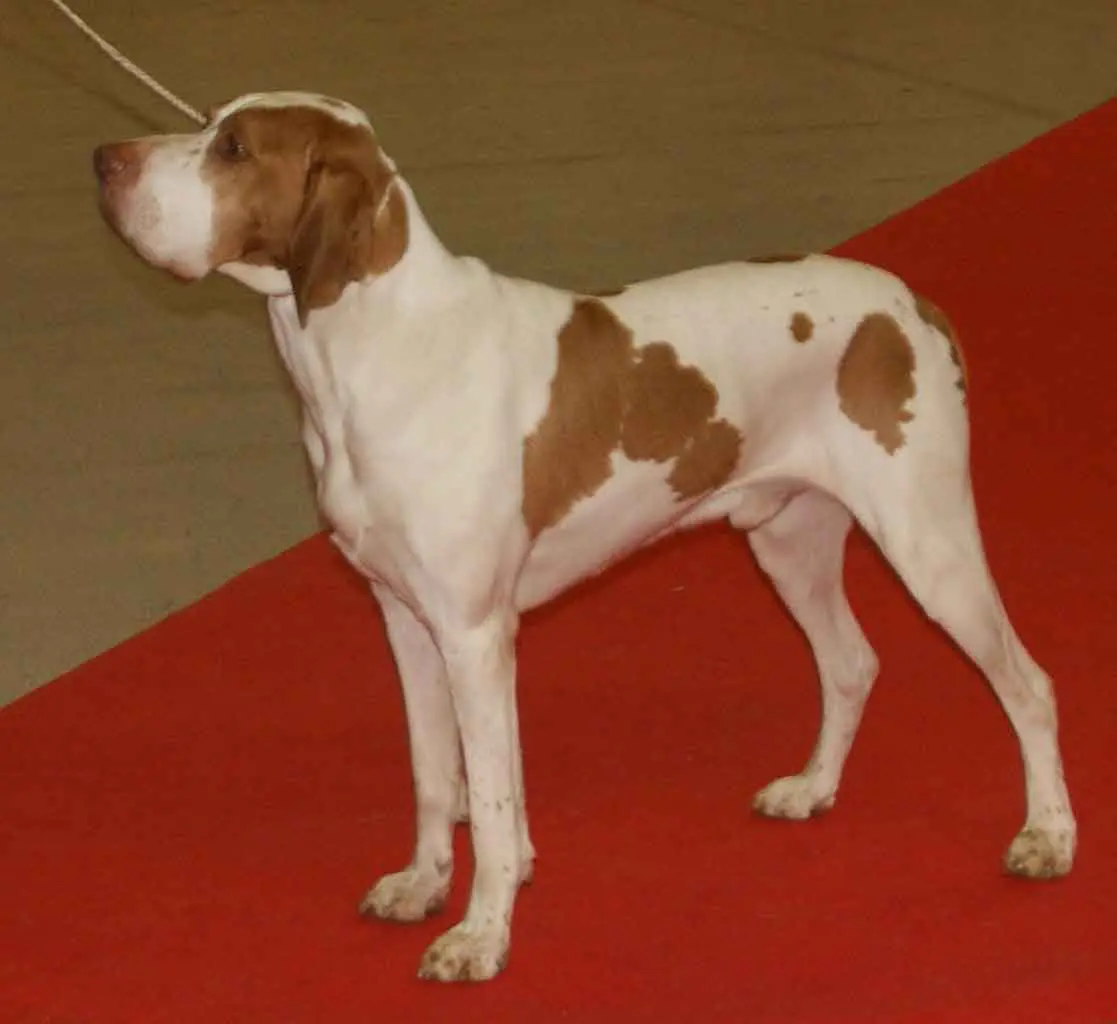
Usually pale orange or brown fawn in color, there are also speckled white and trout. His great characteristic is that the color of his nose is more often in harmony with that of his fur..

His hair is short and shiny and his head is long, angulosa, without a very pronounced stop.

His tail is low and long, in contrast to his ears, that are thin and well placed above the eye line.

Finally, the eyes of the Ariรจge Pointer they are oval shaped, dark amber or brown. Her frank and gentle eyes will easily seduce humans who cross her path.

Character and skills

The Ariรจge Pointer it is a quiet breed of dog, although sometimes stubborn, which is common among hunting dogs. He is also a very intelligent dog.

Adapted to all types of hunting and considered one of the best hunting dogs that exist, thanks in particular to his excellent sense of smell, his great stamina and unerring determination, it is effective in all types of hunting and on all terrains.

The Ariรจge Pointer it is also very resistant and adapts easily to all weather situations, though still more at home in the cold than in the tropics.

Very sensitive and affectionate with his master and his relatives, is docile, Gentile, easy to train, and therefore it is an excellent pet.

May be in contact with other animals, in any case congeners or other species of the same size, especially if you've gotten used to them from a young age as part of puppy socialization. On the other hand, its innate hunting instinct could lead it to attack small potential prey. So, it is better to avoid sharing your daily life with a rabbit, a rat or other game that awakens their deep stalker nature.

It is also for this reason that it is recommended to keep it on a leash when in town. On the other hand, if your education is not lacking, it's conceivable – and even desirable – let it go when in the field, so it can be spent, as this is necessary for their physical and psychological well-being.

In effect, the Ariรจge Pointer remains a lively, independent dog who needs daily exercise and is happy to take part in long walks or bike rides. It is a recommended breed of dog for an athletic owner, since you can't settle for a few relatively short outings to relieve yourself.

They can live in the city, but only if they have a garden. The latter does not make it less necessary to offer him long walks, all days, ideally in the middle of nature. It also, if you live in the city, it is advisable to accustom it from a young age to crowds and traffic, for example to avoid encountering a dog that runs behind cars.

Education

The Ariรจge Pointer has an innate aptitude for hunting, but he still deserves to be educated as soon as possible to consolidate his knowledge and teach him the fundamental commands of hunting (stop, stand up, report…).

Whether it is intended to be used as a working dog or simply as a companion dog, it is recommended to train it with patience and delicacy, since it is endowed with great sensitivity. If you don't, you risk getting upset and discouraged, and restoring trust between the owner and his animal is then a long and arduous task.

In any case, either during your education or at any time after, the owner must be calm, attentive and balanced to curb the very dynamic burning of your partner.

Health

The Ariรจge Pointer he is a robust dog with an iron constitution and no particular pathology.

Grooming

A weekly brushing of the dog's coat is sufficient, since the Ariรจge Pointer does not need much maintenance.

Having said that, like any hunting dog, the dog's ears should be systematically cleaned when he returns home, in order to remove any leaves or dirt that may have lodged there.

This special attention to its ears is also valid if it is only used as a companion dog., since dog breeds with floppy ears are at higher risk of ear problems.

Buy a ยซBraco del Ariรจgeยป

The price of a puppy Ariรจge Pointer in a hatchery is between 600 and 800 EUR. There is generally no price difference between a male and a female.

Characteristics "Ariรจge Pointer"

Coexistence is important that you have with your new friend. Before considering the acquisition of a dog of the breed "Ariรจge Pointer" you know certain factors. Not all breeds of dogs are apt to live in an apartment, you must take into account his character, their need for exercise, their interaction with other pets, their care and if you have small children, their level of tolerance towards them.

Adaptation โ“˜

3,0 of 5 stars (based on 1 review)

friendly dog โ€‹โ€‹โ“˜

3,0 of 5 stars (based on 1 review)

hair loss โ“˜

2,0 of 5 stars (based on 1 review)

Affection level โ“˜

4,0 of 5 stars (based on 1 review)

Need for exercise โ“˜

4,0 of 5 stars (based on 1 review)

Social need โ“˜

3,0 of 5 stars (based on 1 review)

Home โ“˜

2,0 of 5 stars (based on 1 review)

Toilet โ“˜

1,0 of 5 stars (based on 1 review)

Friendly with strangers โ“˜

3,0 of 5 stars (based on 1 review)

barking โ“˜

3,0 of 5 stars (based on 1 review)

Health โ“˜

4,0 of 5 stars (based on 1 review)

Territorial โ“˜

4,0 of 5 stars (based on 1 review)

Cat friendly โ“˜

2,0 of 5 stars (based on 1 review)

Intelligence โ“˜

5,0 of 5 stars (based on 1 review)

Versatility โ“˜

4,0 of 5 stars (based on 1 review)

Child friendly โ“˜

2,0 of 5 stars (based on 1 review)

Surveillance โ“˜

2,0 of 5 stars (based on 1 review)

joy โ“˜

4,0 of 5 stars (based on 1 review)

Videos "Ariรจge Pointer"

Braque de l'Ariรจge
Braque de l’Ariรจge
Braque de l'Ariรจge
Braque de l’Ariรจge

Type and recognitions:

  • FCI CLASSIFICATION:
  • Group :
  • Section : . .

Federations:

  • FCI – Group 7: Pointing Dogs. – Section 1: Continental Pointing Dogs. 1.1: Braque Type โ“˜
  • UKCGun Dog โ“˜

FCI breed standard "Ariรจge Pointer"

Origin:
France

Date of publication of the valid original standard:
24.01.1996

Use:

Pointing Dogs.


General appearance:

Of type ยซ Braco ยป, He is robust and powerfully built., although without the appearance of excessive heaviness. His appearance is vigorous. The most appreciated specimens are those with thin limbs, prominent muscles and well-defined lines. Its white fur, preferably splashed with pale orange or sometimes speckled with chestnut, Together with its size, it makes it an elegant and distinguished dog..

IMPORTANT PROPORTIONS :

Of medium proportions; the length of the body is slightly greater than the height at the withers. The skull is slightly longer than the nasal shank.


Behavior / temperament:

Adapts to all types of hunting; it is resistant, docile and easy to educate.

Head:

It must be long, angular and narrow in the region of the zygomatic arches.

Cranial region:
  • Skull : It is slightly domed; the frontal furrow is not very pronounced. The upper lines of the skull and the nasal cannula are slightly divergent forward.. The superciliary arches are moderately accentuated. The occipital protuberance is quite pronounced.
  • Depression links (stop) : Little pointed.

facial region:

  • Truffle : It's pink, flesh-colored or more or less pale brown, according to fur color; never black. The Windows are wide open.
  • Snout : Long, straight nose cane, sometimes very slightly convex. Front views, the lateral faces of the snout converge slightly forward.
  • Lips : They are quite thin and well descended; the commissure is quite folded without falling down.
  • Jaws / Teeth : The dental arches are well adapted. The articulation of the incisors is scissor-shaped; dental is accepted- hard clamp-shaped (the incisors on top of each other).

Eyes : The look is sweet, frank and intelligent. Wide open, The eyes are slightly oval and well set in the orbits.. The iris is a dark amber or chestnut color, according to coat color.

Ears : They are quite thin, long and crooked. They are inserted at or below the eye line.; They are not attached to the head. Their length allows them to reach the birth of the nose without having to stretch them.

Neck:

It's not very long, but quite thick and has a slight dewlap.

Body:

  • top line : The anterior part is almost rectilinear and descends from the withers to the eleventh dorsal vertebra. The second part, slightly convex, join the group.
  • Cross : It is well marked without being protruding.
  • Back : a little long, muscular, solid and straight.
  • Pork loin : Slightly convex.
  • Rump : Slightly oblique in relation to the top line.
  • Breast : It is broad, high and deep to the plane of the elbows. The ribs are rounded, but without exaggeration.
  • bottom line : Slightly oblique and somewhat raised in the abdominal part.

Tail:

Its insertion is located in the extension of the line of the rump. It is thick at the base and gradually tapers. They are usually cut 4/10. Long tail accepted. When raised it should not exceed the top line.

Tips

PREVIOUS MEMBERS : They are straight, for strong bones, wide and muscular.

  • Shoulder : Muscular, robust and moderately oblique.
  • Arms : Strong, well muscled and close to the chest.
  • Elbows : They are located in the plane of the sternum.
  • forearms : Vigorous and well poised.
  • Metacarpus : Seen in profile, they are slightly inclined.
  • Front feet : Together, well arched, forming a compact set, almost round. The nails are strong and the pads are very fleshy..

LATER MEMBERS : They are well poised.

  • Thighs : Well muscled and lowered.
  • Knee : Well parallel to the median plane of the body.
  • Leg : Robust.
  • Hock : Well layered.
  • Metatarsus : Pretty short, almost vertical.
  • Rear feet : They have the same characteristics as the front feet.

Movement:

Tireless and agile trot, interrupted by periods of gallop. Movements are loose and light.

Mantle

SKIN : It is not very thick and is quite elastic. It is thinner on the head. The external mucous membranes must be of a color that corresponds to the color of the coat; They should never have black spots.

HAIR : It's tight, bright, short, thinner and satin over the head and ears.

COLOR : Pale orange fawn, or sometimes brown. Has many mottled or speckled white patches. Some dogs are even white with spots.


Size and weight:

Height to the cross : In males it is 60 to 67 cm., and in females is of 56 to 65 cm..


Fouls:

Any deviation from the aforementioned criteria is considered as a fault and the severity of this is considered to the degree of the deviation to the standard and its consequences on the health and well-being of the dog..

MISS PLAYOFFS : Taking into account the reduced heritage of this breed, the purpose is not to show too much severity, but discard from reproduction the specimens that do not correspond to the type and those that have serious faults.

โ€ข Aggressive dogs, biting or too fearful.
โ€ข Total absence of the typical characteristics of the breed.
โ€ข Double nose (dogs whose windows are separated by a deep groove).
โ€ข Nose of a color that does not correspond to what is established by the standard.
โ€ข Black nose.
โ€ข Inferior or superior prognathism.
โ€ข Eyes : excessively light or different color.
โ€ข Entropion or ectropion, or any trace of surgical intervention to correct this defect.
โ€ข Excess depigmentation on the eyelids.
โ€ข Black nails.
โ€ข Dewclaws.
โ€ข Hind limbs: clearly observable difficulty in movements.
โ€ข Color that does not correspond to what is established by the standard.
โ€ข Size that deviates from the limits of the standard, with a tolerance of 1 cm more or less.
โ€ข Serious morphological anomalies.
โ€ข Defects that cause disability.

Any dog โ€‹โ€‹showing clear signs of physical or behavioral abnormalities must be disqualified..


N.B.:

Males should have two normal-appearing testicles fully descended into the scrotum..

Source: F.C.I - International Cynological Federation

Alternative names:

1. Ariรจge Pointer, Ariege Pointing Dog (English).
2. Braque de l’Ariรจge, braque de Toulouse, braque du Midi (French).
3. Ariรจge-Vorstehhund, Braque de lโ€™Ariรจge (German).
4. (em francรชs: Braque de l’Ariรจge) (Portuguese).
5. Braco de Ariรจge (espaรฑol).

โ–ท The world of Pets: Dogs, cats, birds, reptiles, amphibians

Old Danish Pointer
Dinamarca FCI 281 . Braque Type

Antiguo perro de muestra danรฉs

Given the hunting instinct of the Old Danish Pointer, it is necessary to socialize him as a child

Content

Characteristics "Old Danish Pointer"

Coexistence is important that you have with your new friend. Before considering the acquisition of a dog of the breed "Old Danish Pointer" you know certain factors. Not all breeds of dogs are apt to live in an apartment, you must take into account his character, their need for exercise, their interaction with other pets, their care and if you have small children, their level of tolerance towards them.

Adaptation โ“˜

3,0 of 5 stars (based on 1 review)

friendly dog โ€‹โ€‹โ“˜

3,0 of 5 stars (based on 1 review)

hair loss โ“˜

2,0 of 5 stars (based on 1 review)

Affection level โ“˜

5,0 of 5 stars (based on 1 review)

Need for exercise โ“˜

4,0 of 5 stars (based on 1 review)

Social need โ“˜

4,0 of 5 stars (based on 1 review)

Home โ“˜

1,0 of 5 stars (based on 1 review)

Toilet โ“˜

2,0 of 5 stars (based on 1 review)

Friendly with strangers โ“˜

4,0 of 5 stars (based on 1 review)

barking โ“˜

4,0 of 5 stars (based on 1 review)

Health โ“˜

4,0 of 5 stars (based on 1 review)

Territorial โ“˜

3,0 of 5 stars (based on 1 review)

Cat friendly โ“˜

3,0 of 5 stars (based on 1 review)

Intelligence โ“˜

4,0 of 5 stars (based on 1 review)

Versatility โ“˜

3,0 of 5 stars (based on 1 review)

Child friendly โ“˜

5,0 of 5 stars (based on 1 review)

Surveillance โ“˜

3,0 of 5 stars (based on 1 review)

joy โ“˜

4,0 of 5 stars (based on 1 review)

History

The Old Danish Pointer, is a medium sized breed of dog with brown markings, from Denmark.

Its Danish name is Gammel Dansk Hรธnsehund, It literally means bird hunting dog. It is in the Group 7, section 1.1 of the FCI.

Trace the origin of the race can be followed until the year 1710, When a man named Morten Bak, Glenstrup neighbor (adjacent to Randers and Hobro Denmark city), He crossed for eight generations strays dogs from local farmers, until he obtained a pure breed of black and white spotted dogs that he called "Bakhoundsโ€. The result was a popular hunting dog.

Race scholars agree that it is likely that these strays to the Lord Morten Bak, used in their breeding program, they were of Spanish origin, and is therefore considered as one of the direct ancestors of the race Old Danish Pointer.

The popularity of this breed faded unfortunately during the 19th century, the race disappeared almost altogether, only a dedicated breeder continued breeding with the integrated genetic information. After World War II there was only 10 dogs and intensive breeding work was started to prevent the extinction of the breed.

The race again won great popularity, above all thanks to Poul Thomsen (presenter of a recognized programs on animals in the Danish television).

Currently there is a considerable decline in Danish sample dogs, crossing often with the Braque Francais, quite similar.

Video

Physical characteristics

Its Constitution is strong, one of its clearest characteristics is the great difference between male and female. While the male is powerful and from, the female is lighter, spirit and capricious.
Height: Male 54-60 cm. (21-23.5 in), is preferred over 56 cm. . females 50-56 cm. (19.5-22 in), is preferred over 52 cm. .

Weight: Male: 30-35 kg . Female: 26-31 kg .

Character and skills

It gives the impression of being a silent dog and stable but showing determination and courage. It is a brave and determined dog. During the hunt act calmly, patience and slowness, always maintaining contact with the Hunter and doing its job of dog shows, discreetly, without disturbing the prey.

The Old Danish Pointer usually fits perfectly, both hunt small prey and large. His affable character allows him to hunt both in packs and alone with his master..

Home pet is a very familiar and quiet dog, provided you get sufficient exercise and have large enough space to run freely. However He Old Danish Pointer not an apartment dog. An active dog, is intended for people available enough to give you long daily walks and keep you from feeling lonely.

Given their hunting instinct, We need to socialize so small that it gets used to share a roof with small animals (cats, rabbits, etc.).

Images Old Danish Pointer

Type and recognitions:

  • FCI CLASSIFICATION:
  • Group :
  • Section : . .

Federations:

  • FCI – Group 7: Pointing Dogs. – Section 1: Continental Pointing Dogs. 1.1: Braque Type โ“˜

FCI breed standard "Old Danish Pointer"

Origin:
Denmark

Date of publication of the valid original standard:
08.01.1998

Use:

Versatile dog used for bird hunting.


General appearance:

It is a medium-sized dog, rectangular shape and strong build. One of the most charming characteristics of the breed is the great difference that exists between the male and the female..
While the male is powerful and substantial, the female is characterized by being lighter, capricious and have more spirit.

IMPORTANT PROPORTION :

The relationship between the height at the withers and the length of the body is approximately 8:9.


Behavior / temperament:

Gives the impression of being a calm and stable dog that shows determination and courage. during the hunt, progresses relatively slowly, always keeping in contact with the hunter. For his behavior in the hunting field, fulfills its task as a pointer without superfluous agitation. The breed is suitable for large and small hunting grounds.

Head:

Short and wide, without a pronounced stop. The occiput is prominent and clearly visible from any angle.

Cranial region:
  • Skull : Wide enough and distinctly rounded.
  • Depression links (Stop) : Is not pronounced.

facial region:

  • Truffle : Meaty and well defined; nostrils wide open. Dark to lighter liver color.
  • Snout : Wide muzzle.
  • Lips : Widely developed fluff from the nose and covering the lower jaw. The lips help give the head its characteristic importance.
  • Jaws / Teeth : Powerful jaws with regular scissor bite. A complete denture is desirable.
  • Cheeks : Well defined and developed, very muscular.

Eyes : Medium-sized, they are not sunken or prominent. Dark brown is desirable. Considering the origin of the breed, a slight drooping of the lower eyelids is tolerated, but should not be encouraged.

Ears : Relatively low set, wide and slightly rounded at the ends.
Its length is correct if the ear pulled towards the nose leaves a little more than the outer third of the muzzle uncovered. The front edge of the ear hangs nicely close to the cheek.

Neck:

Muscular and very hairy. The double chin should be considered a hallmark but should not be excessive.

Body:

  • Cross : Well defined. The highest point of the top line is located at the cross, and then descends slightly towards the rump.
  • Back : Firm and very muscular.
  • Pork loin : Short, broad and muscular, strongly together.
  • Rump : Wide, not too short, slightly inclined towards the insertion of the tail.
  • Breast : Deep and wide; a good width is desirable especially in males. The sternal region reaches up to the elbows. Well sprung ribs that reach well to the back of the body. The thorax is not flattened or crowded. A highly developed parapet is highly desirable.

Tail:

Insertion a little high than too low. Fairly wide at its base, slimming to tip. It is of medium length and reaches almost to the tibio-tarsal joints. The tail is carried hanging naturally. Amputation is not allowed

Tips

PREVIOUS MEMBERS : Viewed from the front, they are strong, straight and parallel.

  • Shoulder : Laid flat and close to the chest, covered with strong muscles that are clearly visible during movement or at rest.
  • Arm : Good length, very muscular.
  • Elbows : Closed to the body, but not too close to it, no deviations outwards or inwards, placed rather back. Good angulation between the arm and forearm.
  • Forearm : Straight, with powerful muscles and strong bones.
  • Articulation of the Carpus : Strong.
  • Metacarpus : Slightly oblique in relation to the forearm.
  • Previous feet : Strong and firm, well arched with hard pads.

LATER MEMBERS : Seen from the back, they are straight and parallel. With good angles and strong bones.

  • Thigh : Muscular, rather long and wide. Good angulation between the pelvis and the thigh.
  • Knee : Strong, well angled.
  • Leg : Quite long, muscular.
  • Warm-foot joint : Strong and powerful.
  • Metatarsus : Slightly oblique in relation to the leg.
  • Hind feet : Strong and firm, well arched, with hard pads.

Movement:

Space-spanning steps with good rear thrust and matching reach in front. The movement is straight and parallel in the fore and hind limbs. High head carriage.

Mantle

SKIN : Not too fine, it is rather tight on the body and extremities. On the head and neck the skin is looser, forming a double chin and presenting a crease at the corners of the lips.

HAIR : Short and dense, something hard to the touch. Hair must completely cover the body.

COLOR : White with brown markings, some large or many small speckled markings on the white background. The brown color can vary but is preferred from a brown to dark brown tone.


Size and weight:

Height to the cross :

  • Male : 54-60 cm., more than 56 cm.,
  • female : 50-56 cm., more than 52 cm..

Weight :

  • adult male : 30-35 kg,
  • female : 26-31 kg.


Fouls:

Any deviation from the aforementioned criteria is considered as a fault and the severity of this is considered to the degree of the deviation to the standard and its consequences on the health and well-being of the dog..

โ€ข Incorrect head posture.
โ€ข Flesh-colored nose with depigmented spots.
โ€ข Muzzle too short.
โ€ข Underdeveloped lips.
โ€ข Missing one or two premolars (PM1).
โ€ข Eyes too light.
โ€ข Slightly bowed back.
โ€ข Croup too short.
โ€ข Tail carried well above the top line.
โ€ข Light cow corvejones or slightly arched extremities.
โ€ข Hair too thin.
โ€ข Small variations in size (1-2 cm.) above or below the limits indicated in the standard.

SERIOUS FAULTS

โ€ข Bones too weak.
โ€ข Pronounced stop.
โ€ข Pointed snout.
โ€ข Pincer bite.
โ€ข Lack of another tooth besides the PM1.
โ€ข Pronounced carp back, slightly saddled back.
โ€ข Obvious deficiency in breast development. Thorax not sufficiently defined. Ribs too flat or crammed.
โ€ข Elbows turned very outward or inward.
โ€ข Cow-shaped or severely arched limbs.
โ€ข Sunken metacarpus.
โ€ข Flattened feet, fingers apart.
โ€ข Weak behavior, shy.

MISS PLAYOFFS

โ€ข Aggressive or fearful dog.
โ€ข Serious deviations in sexual characteristics.
โ€ข Teeth : Missing more than two PM1 and one other tooth. Teeth that are not visible will be considered missing unless their existence can be certified in previous exposure.
โ€ข Upper or lower underbite or any other defective bite.
โ€ข Cleft palate or cleft lip.
โ€ข Ectropion, entropion, distiquiasis (double lash line).
โ€ข Malformation of the chest or rib cage (for example, sternum too short, which causes a sudden elevation of the lower line behind the ribs).
โ€ข Size deviations of more than 2 cm above or below the limits indicated in the standard.
โ€ข Very shy and weak behavior.

Any dog โ€‹โ€‹showing clear signs of physical or behavioral abnormalities must be disqualified..


N.B.:

Males should have two normal-appearing testicles fully descended into the scrotum..

Source: F.C.I - International Cynological Federation

Alternative names:

1. Gammel Dansk Hรธnsehund, Old Danish Bird Dog, Old Danish Pointing Dog (English).
2. Pointer danois, Ancien chien d’arrรชt danois (French).
3. Gammel Dansk Honsehund, Altdรคnischer Hรผhnerhund (German).
4. (em dinamarquรชs: Gammel dansk hรธnsehund) (Portuguese).
5. Perro antiguo de muestra danรฉs (espaรฑol).

โ–ท The world of Pets: Dogs, cats, birds, reptiles, amphibians

Auvergne Pointer
Francia FCI 180 . Braque Type

Auvergne Pointer

Even today, the Auvergne Pointer is most often bred to become a hunting dog.

Content

History

The precise origins of the Auvergne Pointer are not clearly determined. This dog has been around for many years and was most likely developed in Auvergne, more precisely in the Cantal region, in central France.

Already in the seventeenth century, to satisfy your needs, French hunters tried to cross and develop short, smooth-haired Pointer breeds, commonly known as ยซpointersยป (the term "pointerยปIt comes from the vocabulary of hunting and means" aim ").

The Braque Francais is considered his ancestor, but its own origins are uncertain. In any case, It has been proven that it was the origin of the development of different races of Braques developed in all regions of the country, some of which gained in popularity, as the French Pointing Dog - Gascogne type or the French Pointing Dog - Pyrenean type . In Cantal, selective breeding gave rise to Auvergne Pointer.

According to some historians, the Auvergne Pointer is one of the oldest, with the exception of his own Braque Francais. But, contradictory assumptions have been made about it.

According to Jean Servier, former president of the Club of French braques and author of the World Dog Encyclopedia 1971, it is a cross between the Braque Francais, the Gascony type French Pointer and the Pyrenees French Pointer.

On the other hand, according to David Hancock, historian of dog breeds and author of the book The Heritage of the Dog, published in 1990, it is said to come from an imported breed when the Knights of the Order of Malta passed through Auvergne in the 16th century. The soldiers there developed a dog near the Auvergne Pointer, which is said to descend. There is no consensus on this hypothesis, but nevertheless it is accepted by certain organizations such as the Rรฉunion des Amateurs du Braque d’Auvergne (RABA), the official breed club created in 1913.

Although the origins of Auvergne Pointer remain relatively unclear, In any case, most specialists agree that its development dates back to the beginning of the 18th century..

In the early 20th century, almost every, If not all, the Auvergne Pointer they were in france. The breed was relatively rare, although among their owners they were highly appreciated for their hunting qualities, especially for game birds. In fact, the breeding work that led to its development gave it an excellent style and great resistance, allowing you to follow long tracks in forests or dense vegetated terrain. They are also versatile: are able to get, track back, aim and bring the hunt back to its master. So, they can replace several specialized dogs in a particular area on their own. Perhaps its main flaw is its rather slow pace, meaning it works closely with its owner rather than independently, running from one side to the other. This does not take away from the hunting qualities that made it popular in France throughout the 19th century., as well as in the decades leading up to World War II.

During World War II, like many french breeds, the Auvergne Pointer was threatened with extinction. In effect, the conflicts and the occupation of part of the French territory by Germany wreaked havoc on the canine population: many of their representatives were killed or abandoned when their owners no longer had the resources to care for them.

But, at the end of hostilities, an enthusiast, Andrรฉ de Tournay, managed to locate a little more than 20 specimens in different parts of the country. They were at the origin of various bloodlines and therefore played an essential role in the renewal of the breed..

The postwar rebirth of the breed by Mr.. de Tournay led to his recognition in 1955 by the Fรฉdรฉration Cynologique Internationale (FCI), that coordinates the official organizations of more than one hundred countries – among them the Sociรฉtรฉ Royale Saint-Hubert (SRSH) Belgian, the Swiss Kennel Club (SCS) y the Sociรฉtรฉ Centrale Canine (SCC) french. But, the latter had taken the initiative to recognize the Auvergne Braque already in 1913.

The prestigious and influential British Kennel Club took much longer to do the same, since he had to wait until 2016.

In 1987, a first article on this breed of dog was published in the American magazine Gun Dog Magazine. But, we don't know exactly when the first ones were imported Auvergne Pointer to the United States. In any case, they were probably delayed and limited in number. In 2016, a new article was published in the same magazine on the investigation of the origins of the establishment of this dog in the country, after fans surveyed Nelson Hooe, one of the first verified owners in the country.

In any case, the recognition of Auvergne Pointer in North America is still incomplete. Has been recognized by the United Kennel Club (UKC) from 2006, as well as by the Canadian Kennel Club (CKC), but it is not the case of the other reference organization in the United States, the American Kennel Club (AKC).

Photo: Braque_d’auvergne at the World Dog Show in Poznaล„ by Pleple2000, CC BY-SA 3.0, via Wikimedia Commons

Popularity

In France, the popularity of Auvergne Pointer is relatively stable in the long term, and has been at least since the early 1990s. 1970: there are around of 350 entries per year in the French Origin Book (LOF). This number sometimes peaks at around 500 births per year, how was the case, for example, in the mid 70. On the other hand, has never durably fallen below 250.

Although the Auvergne Pointer is relatively popular in his home country, it has only been exported and distributed to some extent outside of France, even in countries bordering France.

In Switzerland, for example, the statistics of the Amicus database show that its population is limited to about thirty individuals.

In Belgium, it is just as discreet, as evidenced by the absence of breeding on the national soil.

The same observation can be made, for example, in Italy, where the statistics of the Ente Nazionale della Cinofilia Italiana (ENCI) show an average of about ten registrations per year during 2010, or again in Spain, where the Royal Canine Society of Spain (RSCE) only count one birth between 2014 and 2019.

There are a handful of farms in Canada and the United States, but the Auvergne Pointer also still hard to find in those countries.

Physical characteristics

The Auvergne Pointer has a robust and noble appearance. His shapely body is well aligned, with a straight constitution – your back, from the tip of the shoulder to the tip of the buttock, is the same length as its front legs – and a long chest that descends to elbow level, midway between the withers and the lower part of the front legs. It is robust, strong but without heaviness, which gives it an elegant look. Their solid constitution gives them the stride and the resistance for which they are highly appreciated in hunting..

Both the front and back legs are straight, well aligned with the body, and the thighs and forearms are well muscled.

The tail stands quite high, carried horizontally and reaches the point of the hock. It can also be shortened at birth, and then barely exceeds 15 to 20 cm.. But, this practice, llamada ยซtail dockingยป, It is banned in many countries, including France, Belgium, Switzerland and Quebec.

The head of the Auvergne Pointer is well balanced. Seen from the front, the muzzle is square and its length is equal to or slightly less than that of the skull. Finish off with a pretty strong black nose, which dominates the solid jaws of equal length. It also, the upper lip covers the lower.

Positioned slightly toward the back of the skull, the ears are droopy, flexible and with a slightly satin texture.

The eyes are dark hazel, oval and quite large. They give this dog an expressive look, frank and gentle.

The fur of Auvergne Pointer consists of a sparse undercoat and short, smooth topcoat with a glossy appearance that is softer than other Braques. It is mottled black or grayish white, more or less present. The head is black, but the muzzle may have the same white markings as the body – a white border may also be present on the top of the skull, prolonging the color of the muzzle. Black fur can also tend to be blue, which is why these dogs are rarely called Auvergne Pointer blue.

There are also charcoal-colored dogs. But, this variety is rare and is not recognized by the breed standard.

Sexual dimorphism is not very pronounced in these dogs: the male is certainly on average a few centimeters taller than the female, but it's not particularly massive.

Character and skills

Even today, the Auvergne Pointer is most often bred to become a hunting dog. But, his affectionate character, Gentile, patient and smart also makes them great pets, and they are becoming more and more popular as such. In fact, fit perfectly into family life, they usually try to please their humans and are very loyal to them.

They are especially fond of children of all ages and are affectionate and playful provided they are not excessively boisterous. But, it should never be forgotten that a dog of any breed should never be left alone with a small child without adult supervision.

The downside of being so close to your family is that you cannot tolerate loneliness and need to be in the company of humans as often as possible.. If left alone for too long, can become a destructive or particularly loud reminder of your presence. No need to say, therefore, which does not suit people who are away for whole days or more. The close bond he has with his teachers also makes him very sensitive to reprimands and he is easily affected by possible punishments..

It is not only the humans in his family that he Auvergne Pointer inclines to appreciate. In effect, even if at first sight he is shy with strangers, quickly treats them like new friends, especially since it is totally devoid of aggression. Ready to greet newcomers with affection, may even tend to follow an intruder instead of defending your home or territory, which makes him a poor caretaker. But, is very capable of sounding the alarm when he hears something unusual.

In any case, He is not one of those who barks from morning to night, expressing yourself only when you have a good reason to do so: to raise the alarm, to express boredom, to seek attention, or to express any anxiety.

Sharing your home with a partner is a great way to reduce the risk of you suffering from the absence of your masters. In fact, such cohabitation generally goes very well, and he appreciates not living alone.
On the other hand, his hunting instinct is too ingrained in him to consider the possibility of peacefully cohabiting with another pet smaller than himself, like a bird, a rodent or even a cat: unless you were raised with him from a young age, chances are good that one day or another I'll end up attacking him. This character trait also means that he is best kept on a leash when going out to places where he is very likely to meet small animals., and where it would be dangerous for him to pursue them.

This is all the more true as it does not lack energy, to the point that you need to spend at least an hour a day to be well on your legs and on your head. Your resistance, However, allows you to go much further, since it is capable of chasing a prey for miles. So, it is ideal to plan long walks that include times when you can run freely and safely, especially if you don't have a chance to hunt. In any case, this dog is perfectly suitable for an active owner who likes to jog, cycling or hiking, and he would like nothing more than to take his pet with him – provided that it is kept on a leash when necessary.

Another great way to allow him to expend his energy is to train him for one or more dog sports.. Their intelligence and willingness to cooperate are particularly well expressed in agility and obedience tests.. More broadly, imply that it is quite easy to train him for all kinds of activities and teach him different tasks.

By the way, if your pilgrimages take you to pass near a water space where you can swim safely, She loves water – he is even a good swimmer – and generally appreciates taking a dip as soon as you get a chance to.

In any case, its high level of activity makes apartment living unsuitable for the Auvergne Pointer. Even a house with a small yard probably wouldn't be enough to make him happy.: the ideal environment for him is clearly a house with a large fenced garden, although this cannot replace long daily walks to satisfy your need for exercise.

Education

The Auvergne Pointer is known for his intelligence and the sweetness of his temperament. He is also eager to please his owners, so it reacts positively to training: learns quickly and is generally an easy dog รขโ‚ฌโ€นรขโ‚ฌโ€นto train.

But, it is important to use the right methods. In fact, its sensitivity means that the use of coercion or even punishment is strongly discouraged: would have every chance of undermining the trust that you normally place in your beloved master. On the other hand, positive dog training methods, based on repetition, the gratification and rewards, are very effective in taking full advantage of the great potential of this animal.

In fact, its obedient and cooperative nature makes it not difficult to train it for hunting, sports with dogs or any other task. This is all the more true since he is always happy to share activities with his master: unlike many races, prefers to work in complicity with his master rather than independently. So, It is an ideal option for those who like to spend time educating their partner and working alongside him, whether for hunting or dog sports. These may include, is an excellent candidate for agility and obedience competitions. Your sense of smell can also be used to track events, but its relatively slow speed limits its potential in this area.

For things to run smoothly, it is important to establish rules at an early age about what you are and are not allowed to do. They are not particularly stubborn by nature, and in fact they are quite obedient, but they can also do it when they are more flexible and responsive: this will make it easier and faster for them to assimilate the rules. It also, assimilates them more easily because they are the same from one day to the next and between the different people in the house: It is not a question of the gentleman authorizing today what the lady forbade the day before.

It also, teaching your dog to stay alone should be one of the priorities in the education of a Auvergne Pointer. In effect, as he likes company and is prone to separation anxiety, must get used to enduring absences from his family without reaching a state of discomfort.

It is also beneficial to start learning to call back soon, so that it can be allowed to unleash when conditions permit, limiting the risk of becoming deaf to his master's commands when he sees or smells a small passing animal.

You also have to be careful to quickly channel your tendency to chew what is within your reach., directing him to the right toys. This avoids the risk of damage and injury to the animal.

Finally, like any dog, we must not wait to offer you quality socialization from your first months. By letting you meet all kinds of humans, congeners and representatives of other species, but also face a multitude of different situations in various places, we make it a comfortable companion in all circumstances, performed in its environment and among humans.

Health

The Auvergne Pointer is generally a robust dog with few health problems. Your life expectancy of 12 to 15 years is quite honorable given its size.

It also, they are quite flexible in terms of weather, able to cope with both the summer heat and the winter cold of temperate or Mediterranean climates. If you are required to sleep outside when temperatures are low, a niche is necessary to provide shelter. In any case, their fur is not adapted to polar temperatures.

But, like any dog, are more prone to certain diseases, which in this case are :

  • hip dysplasia, whose appearance may be favored by a hereditary predisposition, and that corresponds to a malformation of this joint. Leads to pain, lameness and osteoarthritis when the animal ages;
  • dislocation of the patella, which is a malformation of the knee joint that causes the kneecap to slip out of position. Probably hereditary, causes a more or less severe limp. May require surgery in the most severe cases, although success is not guaranteed;
  • aortic stenosis, a potentially hereditary heart defect manifested by reduced blood flow. Leads to heart failure, that can manifest, for example, in a state of general weakness, and also increases the risk of heart attack. Not curable, but medications can reduce the effects of heart failure;
  • progressive retinal atrophy, which corresponds to a degeneration of the retina and is of hereditary origin. It affects both eyes and causes a progressive loss of vision in the dog;
  • Dilation-torsion of the stomach, which mainly affects breeds with a large chest and occurs when the stomach folds in on itself, blocking the evacuation of gases and interrupting blood circulation. It is fatal if a vet does not intervene quickly;
  • otitis, an ear infection favored by the pendulous shape of the ears.
  • Since a certain number of the conditions to which the breed is predisposed are or may be of hereditary origin, adopting a quality breeder from Auvergne Pointer can be a determining factor in obtaining a healthy puppy, and one that continues to be, in addition to having been well socialized from his first weeks. In effect, a professional worthy of the name sees to it that genetic tests are carried out systematically on his breeding stock, to rule out those who run the risk of transmitting this or that inherited condition to their offspring. So, must be able to present the results of these tests, as well as the health history of the dog, that attests to the vaccinations administered and that is useful for planning the next ones to be carried out, as well as withdrawals. At the same time, a certificate drawn up by a veterinarian attests to the good health of the animal at the time of adoption.

    Once the adoption is complete, it is important that the new owner respect the growth of his protรฉgรฉ: until it reaches adult size, what happens around two years of age, you should avoid intense physical exertion or excessively strenuous and prolonged exercises. This reduces both the risk of short-term injuries and that of sequelae or deformation of the bones or joints., which are particularly fragile during this period.

    Last, one way to keep your dog in good health is to take him to the vet regularly for a full checkup – At least once a year, and even more when he gets older. This will help prevent or detect potential health problems as soon as possible., as well as provide the opportunity to reinforce your dog's vaccinations.

    It is also important not to neglect the protection against fleas, worms, ticks and other undesirable pests, renewing your child's antiparasitic treatments throughout the year, whenever necessary. This is especially crucial for an individual who spends a lot of time, either hunting or in other activities.

    Grooming

    As his undercoat is not very thick and his top coat is short, the fur of the Auvergne Pointer requires little maintenance: a short brushing session with a soft bristle brush once a week is enough to keep you healthy, shiny and soft to the touch, especially since your hair loss is not very pronounced.

    During moulting periods, in spring and autumn, it is much more pronounced, so more frequent brushing is necessary. But, 2 or 3 times a week should be enough. After brushing it, the coat can be buffed with a clean soft cloth to make it even brighter.

    It is neither necessary nor advisable to bathe your dog too often: 3 or 4 times a year is usually more than enough, unless, Of course, that has gotten very dirty. In any case, you should always use a shampoo intended for dogs.

    Dangling ears require more attention, since their shape makes them prone to ear infections. So, it is important to examine them weekly and wipe them with a clean, slightly damp cloth to avoid the risk of infection.

    Your eyes need some attention too. The weekly maintenance session should be an opportunity to examine them, and wipe them gently with a damp cloth if there is dirt.

    Looking at its claws, regular physical activity that satisfies your need for fairly high levels of activity will usually allow you to smooth them out naturally. But, this does not mean that you should not check from time to time that this is the case. On the other hand, if your age or a health problem prevents you from being active enough, they generally need to be trimmed every 6 u 8 weeks to avoid being too long and bothering you, or even breaking and injuring you.

    The first time, a visit to a professional groomer can be a good way to learn how to care for a Auvergne Pointer, in order to operate efficiently and safely, while limiting the risks of hurting you. For its part, you will be calmer and more cooperative during care if it is part of your daily routine from a very young age: therefore, it is recommended to expose it to delicate handling from an early age.

    This is all the more true since it is also wise to get used to examining it after every long time spent outdoors. (especially after a hunting trip, for example), to detect possible injuries, thorns, parasites, spikes…

    Buy a "Braco de Auvernia"

    Either male or female, the price of a puppy Auvergne Pointer is generally between 650 and 1100 EUR. The average is about 800 EUR, no significant differences between males and females.

    But, it is difficult to find it outside of its country of origin, France, even in countries bordering on the latter.
    The same is true in North America, although there are a handful of breeders in Canada and the United States.

    The import from France is, therefore, sometimes the most suitable solution to avoid possible waiting times and have a maximum of choice. But, It must be taken into account that various expenses are added to the purchase price of the puppy: transportation expenses, administrative expenses, etc. It also, it is necessary, of course, make sure you know and respect the regulations regarding the importation of a dog from abroad.

    In any case, whatever the place, the price charged varies according to the prestige of the breeding, the lineage the animal came from, but also and above all its intrinsic characteristics, in particular its greater or lesser conformity with the norm. This last point also explains why there are sometimes significant differences within the same litter..

    Characteristics "Auvergne Pointer"

    Coexistence is important that you have with your new friend. Before considering the acquisition of a dog of the breed "Auvergne Pointer" you know certain factors. Not all breeds of dogs are apt to live in an apartment, you must take into account his character, their need for exercise, their interaction with other pets, their care and if you have small children, their level of tolerance towards them.

    Adaptation โ“˜

    3,0 of 5 stars (based on 1 review)

    friendly dog โ€‹โ€‹โ“˜

    4,0 of 5 stars (based on 1 review)

    hair loss โ“˜

    2,0 of 5 stars (based on 1 review)

    Affection level โ“˜

    4,0 of 5 stars (based on 1 review)

    Need for exercise โ“˜

    5,0 of 5 stars (based on 1 review)

    Social need โ“˜

    4,0 of 5 stars (based on 1 review)

    Home โ“˜

    3,0 of 5 stars (based on 1 review)

    Toilet โ“˜

    1,0 of 5 stars (based on 1 review)

    Friendly with strangers โ“˜

    4,0 of 5 stars (based on 1 review)

    barking โ“˜

    3,0 of 5 stars (based on 1 review)

    Health โ“˜

    4,0 of 5 stars (based on 1 review)

    Territorial โ“˜

    4,0 of 5 stars (based on 1 review)

    Cat friendly โ“˜

    2,0 of 5 stars (based on 1 review)

    Intelligence โ“˜

    4,0 of 5 stars (based on 1 review)

    Versatility โ“˜

    4,0 of 5 stars (based on 1 review)

    Child friendly โ“˜

    4,0 of 5 stars (based on 1 review)

    Surveillance โ“˜

    3,0 of 5 stars (based on 1 review)

    joy โ“˜

    4,0 of 5 stars (based on 1 review)

    Images "Auvergne Pointer"

    Photos:

    1 – Braque d’Auvergne sur fond blanc by Desaix83, d'aprรจs le travail de Pleple2000, CC BY-SA 3.0, via Wikimedia Commons
    2 – Riga, Baltic Winner 2013, 9-10 Nov by Thomas, CC BY-SA 3.0, via Wikimedia Commons
    3 – Braque d’Auvergne during the Rzeszรณw International Exhibition, Poland. Marian Surma is the breeder and owner of Poland by Pleple2000, CC BY-SA 3.0, via Wikimedia Commons
    4 – Braque d’Auvergne during the Rzeszรณw International Exhibition, Poland. Marian Surma is the breeder and owner of Poland by Wikimedia
    5 – Braque d’Auvergne during the Rzeszรณw International Exhibition, Poland. Marian Surma is the breeder and owner of Poland by Pleple2000, CC BY-SA 3.0, via Wikimedia Commons
    6 – Braque_d’auvergne at the World Expo in Poznaล„ by Pleple2000, CC BY-SA 3.0, via Wikimedia Commons

    Videos "Auvergne Pointer"

    Type and recognitions:

    • FCI CLASSIFICATION:
    • Group :
    • Section : . .

    Federations:

    • FCI – Group 7: Pointing Dogs. – Section 1: Continental Pointing Dogs. 1.1: Braque Type โ“˜
    • UKCGun Dog โ“˜

    FCI breed standard "Auvergne Pointer"

    Origin:
    France

    Date of publication of the valid original standard:
    24.03.2004

    Use:

    Pointing Dogs.


    General appearance:

    Rectilinear, Mediolineo. It is a robust dog, strongly constituted, no appearance of heaviness, With the typical characteristics of a braco. It has a light step and an elegance accentuated by the fur and harmony of its proportions. His constitution predisposes him to carry out a job completely and with agility, and allows you to resist a whole day, on the most difficult fields.

    IMPORTANT PROPORTIONS :

    • Body : The length of the body (from the tip of the shoulder to the tip of the buttock) It is approximately equal to the height at the withers.
      Chest height = Cross height x ยฝ.


    Behavior / temperament:

    It is a meek dog, very affectionate, Intelligent, docile. His training consists above all in developing his natural qualities. Your sense of smell is powerful. Adapts well to family life.

    Head:

    The length of the muzzle is slightly less than or equal to that of the skull.

    Cranial region:
    • Skull lines and nasal pipe : Slightly diverging towards the front (characteristic of the braco). The head is long, in proportion to size, a little lighter in females. Seen from above, the skull is oval in shape. The occipital protrusion is little protruding. The amplitude, at the level of the zygomatic arches it is equal to the length of the skull.
    • Superciliary arch : Well pronounced.
    • Depression links (Stop) : Moderately marked.

    facial region:

    • Truffle : It is always black, big enough, bright, with the windows wide open. Its superior profile is in the prolongation of the nasal canal.
    • Snout : Its length is similar to that of the skull. The nasal spout is straight.
    • Lips : Pretty thick. The upper lip covers the lower. Marked commissures, no noticeable crease. Seen from the front, the lips give a square shape to the tip of the muzzle.
    • Jaws / Teeth : Solid, of equal length. Teeth are strong. Joint is scissor-shaped or pointed toe.

    Eyes : Rather large, oval, dark hazelnut, well sunk in the orbits, expressive look, frank and sweet. The eyelids are well pigmented and do not show the conjunctiva.

    Ears : Inserted rather back. During rest, The ligament is below a line that meets the upper profile of the truffle and the eye. When is the dog attentive, The ligament of the ear can rise to this line.
    Slightly bent inward, but neither curled nor flat, the ear is flexible and slightly satin in texture. Its tip is moderately rounded. If you stretch to the front, must reach the truffle's birth, without exceeding the limb.

    Neck:

    Rather long, well inserted in the shoulders, slightly arched. Has a slight double chin. Neck length is visibly equal to head length.

    Body:

    • Top margin : Well tense, straight.
    • Cross : Marked.
    • Back : Narrow, flat and short. The spine is not protruding.
    • Pork loin : Well adhered, broad (especially in females), very slightly convex.
    • Rump : Oblique (35ยฐ In relation to superior margin), the tip of the haunches is visible.
    • Breast : Long and well sloped down to elbow level. In cross section to an ovoid shape, regularly flexible, no break at the bottom.
    • Lower margin : Gently rises to the belly, that is not agalgado. The flank is wide, little sunken, harmoniously joins the haunches.

    Tail:

    Very high insertion. Must be presented horizontally. Cylindrical and not very fine. If it's cropped, has a length of 15 to 20 cm., if it is not, reaches the tip of the hock without exceeding it.

    Tips

    They lie on the axis of the body.

    PREVIOUS MEMBERS : They are leaden.

    • Shoulder : Strong, well muscled, well detached when the dog is in action. Oblique at 45 ยฐ on the horizontal.
    • Elbows : Completely on the axis of the body.
    • forearms : Strong and long, muscular and straight.
    • dolls (carpos) : Strong without being knotty.
    • Metacarpus : Short ; viewed in profile they are slightly inclined.

    LATER MEMBERS : Well angled, they work in parallel planes.

    • Thighs : Well muscled.
    • Hocks : Slim and well outlined.
    • Metatarsals : Short and never thin.

    FEET : A little longer than the so -called "cat" foot, A little less long than the so -called "hare" foot. They don't even deviate inwards, nor out. Nails are strong and short ; the plantar pads are hard and resistant ; fingers are together.

    Movement:

    Medium width strides, but with a sustained rhythm that gives the dog its remarkable resistance. His usual hunting motion is a medium gallop, uniform and with a slight sway.

    Mantle

    SKIN : Pretty fine, rather lazy, but without exaggeration.

    HAIR : Short, not too fine. Never lasted, bright.

    COLOR : Negro, with variable length white patches. Due to the particularity of the patches, two types are observed : mottled or graying. This difference cannot lead to choosing between two specimens with the same quality.
    The head must be black, preferably with a whitelist that extends to the same. The white color in this list may extend over the lateral parts of the muzzle. A mottled white ear or a mottled white side of the head cannot be considered a fault..


    Size and weight:

    Height to the cross : (with a tolerance of + 2 cm and - 1cm for both sexes).

    • Males : 57 to 63 cm. (ideal height : 60 cm.).
    • females : 53 to 59 cm. (ideal height : 56 cm.).


    Fouls:

    Any deviation from the aforementioned criteria is considered as a fault and the severity of this is considered to the degree of the deviation to the standard and its consequences on the health and well-being of the dog..

    โ€ข Line of the Nasal Caรฑo and the parallel skull.
    โ€ข Head too bulky under the eyes.
    โ€ข Apparent conjunctive.

    SERIOUS FAULTS

    โ€ข Convergent nasal and skull lines (forward).
    โ€ข Concave or convex nasal pipe.
    โ€ข Very high insertion ear. Too short, flat, exaggerated corkscrew shape.
    โ€ข Collapant and floating lips, too short, snout that becomes thinner at the tip.
    โ€ข Sterno region too close.

    MISS PLAYOFFSCharacter :
    โ€ข Aggressive or fearful dog.

    Head :
    โ€ข Absence of the braco type.
    โ€ข Upper or lower prognathism with a difference of more than 1 mm between the incisive arches.
    โ€ข The absence of PM1 is accepted.
    โ€ข The absence of two other premolars is qualifying (PM2 - PM3) or any other tooth, including PM4.
    โ€ข Entropion or ectropion or traces of corrective intervention.

    Members
    โ€ข Presence of spur or traces of your amputation.

    Fur
    โ€ข Completely black the completely blanco.
    โ€ข Absence of mottled.
    โ€ข Fire marks or reflexes "Burn Bread" (leonado).
    โ€ข truffle with too many depigmented spots.
    โ€ข Despigmented parpped.
    โ€ข Yellow eye (bird of prey). Heterochrome eyes.

    Size
    โ€ข Outside the standard limits (regulatory tolerance : + 2cm y โ€“ 1cm).

    Any dog โ€‹โ€‹showing clear signs of physical or behavioral abnormalities must be disqualified..


    N.B.:

    Males should have two normal-appearing testicles fully descended into the scrotum..

    Source: F.C.I - International Cynological Federation

    Alternative names:

    1. Braque d’Auvergne (English).
    2. Bleu d’Auvergne (French).
    3. Braque d’Auvergne (German).
    4. (em francรชs: Braque d’Auvergne) (Portuguese).
    5. Azul de Auvernia (espaรฑol).

    โ–ท The world of Pets: Dogs, cats, birds, reptiles, amphibians

    Bourbonnais Pointing Dog
    Francia FCI 179 . Braque Type

    Bourbonnais Pointing Dog

    The Bourbonnais Pointing Dog at birth it is frequently tailless, It is also called "Short-tailed Pointer".

    Content

    History

    The Bourbonnais Pointing Dog it was already known in 1598 like an expert quail hunting dog. The authors of the time described him as a pleasant companion for the hunter, rustic and healthy looking, born with a short tail, with a white fur, whole and finely speckled with light brown or fawn trout.

    After World War I, a group of dedicated breeders formed the first Club du Braque du Bourbonnais in 1925 with the goal of reviving the race and restoring its pre-war prominence. The first breed standard was published in the club's first newsletter in 1930. Although the organization and these breeders made considerable progress, his efforts were again almost wiped out by World War II. It also, strict adherence to a natural tailless dog and strict color requirements resulted in a dog based on appearance rather than performance.

    The result of this selection in reverse leads to a total disaffection of the breeders. Of 1963 to 1973, there were no registrations in the L.O.F. (Book of French Origins) โ“˜. In 1970, under the impulse of Michel Comte, a team of breeders set themselves the mission of ensuring the survival of the Bourbonnais Pointing Dog.

    Today, French breeders strive to produce a Bourbonnais Pointing Dog that conforms to the breed standard, but of equal importance, the Bourbonnais Pointing Dog should now be proficient in the field as pointers, retrievers and trackers. Since the beginning of the 1970, the breeders of Bourbonnais Pointing Dog have substantially and rapidly improved the conformation of the breed and its performance in the field.

    One second Club du Braque du Bourbonnais it was created in 1982 by Michel Comte, with the official recognition of the Central Canine Society (SCC), French affiliate of the FCI, in 1985. The goal of reviving the breed had been achieved, the breed standard relaxed, spotting and docked tails were found acceptable and the breed's remarkable hunting instincts were restored. The new breed standard was fully recognized by the SCC and the FCI in 1991. The standard was translated and published on the FCI website at 1998.

    Photo: Braque_du_bourbonnais at the World Dog Show in Poznaล„ by Pleple2000, CC BY-SA 3.0, via Wikimedia Commons

    Physical characteristics

    The Bourbonnais Pointing Dog is a robust, compact and muscular mid-size braque. Gives an impression of robustness and strength. The female has a slimmer and more elegant silhouette. Some dogs are born without a tail (anurus) or with a naturally short tail (brachyura). Tail docking is practiced in countries where it is allowed.

    The head is pear-shaped, that is to say, rounded in all directions, with rounded side walls, well developed parietals and zygomatic arches. The pear-shaped head is typical of the breed.. The axes of the skull and muzzle are parallel or slightly divergent. Neither too light nor too heavy, the head is in proportion to the body. The eyes are large, rather rounded, hazelnut or dark amber, according to coat color. Medium length drop ears are situated at or just above the eye line.

    The coat is fine, dense and short. It is finer on the head and ears, a little thicker and sometimes a little longer on the back. White spots are very invasive, finely speckled with brown (known as "wine lees" or "withered lilac") the leonado (known as "peach blossom") in all its variants. White and colored hairs can blend into a roan pattern. The ear generally wears the basic color more or less mottled. Color patches should be few in number and small in extent: must not exceed the size of the palm of the hand on the body and must never encompass both eyes at the same time on the face.

    Character and skills

    The Bourbonnais Pointing Dog is described in the breed standard as gentle and affectionate, but also passionate and intelligent when hunting. Easily adapts to the most varied terrain and games. Naturally seeks a high emanation and displays a useful and accurate stopping ability.

    The Bourbonnais Pointing Dog they are mostly a Pointing Dogs versatile.

    Exercise and training

    Options for exercise could include play time in the backyard, preferably fenced, or being taken for walks several times a day. Exercise can also be done in the form of indoor activities, like the hideout, chase a ball rolling on the ground or learn new tricks. Certain outdoor activities such as swimming, hiking and retrieving balls or frisbees can provide a good outlet for expending energy. Training for dog sports such as agility, obedience and rallying can also be a great way to give your dog some exercise.

    Health

    Most of the Bourbonnais Pointing Dog they are healthy dogs. Working with a responsible breeder, those who wish to own a Bourbonnais Pointing Dog they can get the education they need to know about specific health concerns within the breed. Good breeders use health exams and genetic testing of their breeders to reduce the likelihood of disease in their puppies.

    The Bourbonnais Pointing Dog requires relatively gentle handling. Has the ability to perceive the mood of the manipulator, seeking eye contact at all times.

    Grooming

    The Bourbonnais Pointing Dog has a fine, dense and short coat. It's a little thicker, and sometimes longer, in the back. On the head and ears, the hair is thinner and shorter.

    Beyond periodic brushing, the occasional bath will keep your Bourbonnais Pointing Dog clean and looking its best. Grooming can be a wonderful bonding experience for you and your dog.. The breed's strong, fast-growing nails need to be regularly trimmed with a nail clipper or nail buffer to prevent excessive growth., breakage and cracking. The ears should be checked regularly to avoid accumulation of wax and debris, which can result in infection. Teeth should be brushed regularly.

    Characteristics "Bourbonnais Pointing Dog"

    Coexistence is important that you have with your new friend. Before considering the acquisition of a dog of the breed "Bourbonnais Pointing Dog" you know certain factors. Not all breeds of dogs are apt to live in an apartment, you must take into account his character, their need for exercise, their interaction with other pets, their care and if you have small children, their level of tolerance towards them.

    Adaptation โ“˜

    3,0 of 5 stars (based on 1 review)

    friendly dog โ€‹โ€‹โ“˜

    4,0 of 5 stars (based on 1 review)

    hair loss โ“˜

    2,0 of 5 stars (based on 1 review)

    Affection level โ“˜

    5,0 of 5 stars (based on 1 review)

    Need for exercise โ“˜

    5,0 of 5 stars (based on 1 review)

    Social need โ“˜

    4,0 of 5 stars (based on 1 review)

    Home โ“˜

    3,0 of 5 stars (based on 1 review)

    Toilet โ“˜

    1,0 of 5 stars (based on 1 review)

    Friendly with strangers โ“˜

    4,0 of 5 stars (based on 1 review)

    barking โ“˜

    3,0 of 5 stars (based on 1 review)

    Health โ“˜

    4,0 of 5 stars (based on 1 review)

    Territorial โ“˜

    2,0 of 5 stars (based on 1 review)

    Cat friendly โ“˜

    2,0 of 5 stars (based on 1 review)

    Intelligence โ“˜

    4,0 of 5 stars (based on 1 review)

    Versatility โ“˜

    4,0 of 5 stars (based on 1 review)

    Child friendly โ“˜

    4,0 of 5 stars (based on 1 review)

    Surveillance โ“˜

    3,0 of 5 stars (based on 1 review)

    joy โ“˜

    3,0 of 5 stars (based on 1 review)

    Images "Bourbonnais Pointing Dog"

    Photos:

    1 – Braque_du_bourbonnais at the World Dog Show in Poznaล„ by Pleple2000, CC BY-SA 3.0, via Wikimedia Commons
    2 – Braque_du_bourbonnais at the World Dog Show in Poznaล„ by Pleple2000, CC BY-SA 3.0, via Wikimedia Commons
    3 – Braque du Bourbonnais sur fond blanc by Desaix83, d'aprรจs le travail de Canarian, CC BY-SA 3.0, via Wikimedia Commons
    4 – Braque du Bourbonnais – world dog show 2010 by mjk23, CC BY 2.0, via Wikimedia Commons
    5 – Braque du Bourbonnais – world dog show 2010 by mjk23, CC BY 2.0 , via Wikimedia Commons
    6 – Braque_du_bourbonnais by The original uploader was Michael Comte at French Wikipedia., CC BY-SA 2.5, via Wikimedia Commons

    Videos "Bourbonnais Pointing Dog"

    Type and recognitions:

    • FCI CLASSIFICATION:
    • Group :
    • Section : . .

    Federations:

    • FCI – Group 7: Pointing Dogs. – Section 1: Continental Pointing Dogs. 1.1: Braque Type โ“˜

    FCI breed standard "Bourbonnais Pointing Dog"

    Origin:
    France

    Date of publication of the valid original standard:
    21.02.2006

    Use:

    Pointing Dogs.


    General appearance:

    Short-haired bracoid type, of medium lines and short limbs, well proportioned, compact and muscular. Medium-sized, gives an impression of robustness and strength that does not exclude a certain elegance. The female has a less chunky and more elegant silhouette.

    IMPORTANT PROPORTIONS:
    The length of the trunk is equal to or slightly greater than the height at the withers. The height of the chest is equal to or slightly higher than half the height at the withers. The length of the muzzle is slightly less than that of the skull.


    Behavior / temperament:

    At home he is sweet and affectionate. during the hunt, his passion and intelligence allow him to easily adapt to the most varied terrain and hunting. It naturally seeks high emanation and demonstrates useful and precise aptitude for the sample..

    Head:

    The main racial characteristic is what is known as โ€œpear shape.โ€. It is not too light, not too heavy, but in proportion to the body.

    Cranial region:
    • The cranium: It is rounded in all its parts. Side faces are rounded, the parietals and zygomatic arches are well developed. The axes of the skull and the nasal canal are parallel or very slightly divergent towards the front.
    • Naso-frontal depression: is moderately marked.

    facial region:

    • Truffle: Wide, with the windows wide open. Surpasses, times, the verticality of the lips. Its color is in accordance with that of the coat, no spots with depigmentation.
    • Snout: Large and wide at the base, tapers slightly towards the limb, forming a coniferous trunk. In females, is a little less wide.
    • Nasal spout: Straight or slightly arched.
    • Lips: They are not too thick, the upper lip covers the lower lip without forming a noticeable crease at the corners. The edge of the lips is well pigmented.
    • Jaws: Powerful, of uniform length. The denture is complete and the joint is scissor-shaped. Is accepted in the form of clip joint.

    Eyes: Large, rather round, hazelnut or dark amber, according to fur color. The look is expressive, sweet and smart. The edge of the eyelids is well pigmented.

    Ears: Medium length, can reach up to the throat or slightly exceed it. Its base, rather wide, is located at the level of the eye line or slightly above, which is valued. Fall naturally along the cheeks, horizontally or slightly bent.

    Neck:

    It's not too long. He's muscular, loose, harmoniously joins the shoulders. A slight double chin is acceptable.

    Body:

    • Top margin: Straight, very firm. The cross is well marked.
    • Back: Firm and well muscled.
    • Pork loin: Short, wide and muscular, well attached to the back. It is a little longer in females.
    • Rump: Rounded, slightly oblique, of powerful muscles.
    • Breast : Large, long and tall. Reaches to the tip of the elbow or slightly exceeds it. The sternum extends as far back as possible. Ribs well arched. The elevation of the abdomen is progressive. The flat flank is low.

    Tail:

    Some dogs are born without a tail. Otherwise, the tail is cut at the base. Its insert is a little low. In countries where caudectomy is prohibited by law, long tail must be submitted, in static, below top margin.

    Tips

    PREVIOUS MEMBERS:
    • In general: Well muscled. Head on, good heaviness.
    • Shoulder: Oblique shoulder blades, well attached to the chest wall. The muscles are firm and apparent.
    • Arm: Rather long and muscular.
    • Elbows: Well attached to the body, but not together. They don't even deviate inwards, nor out
    • Forearm: Straight, muscular, with big bones, although not rough.
    • Carpi: Solid.
    • Metacarpus: Very slightly inclined, in relation to the forearm.
    • Previous feet: On the axis of the body. Round or spoon-shaped. The bearings are solid and resistant, fingers together and arched, strong nails.
    LATER MEMBERS:
    • In general: Stout bones, with a very apparent muscle mass. Views from behind, well plumb and parallel.
    • Thighs: Long, well formed and well sloped.
    • Babillas: Strong, with good angulation between the thigh and the leg.
    • Legs: Muscular, visibly equal in length to thigh.
    • Hock: Well inclined, solid and well bent.
    • Metatarsals: Vertical and solid, no deviation.
    • Hind feet: Identical to the previous ones.

    Movement:

    Medium width strides. During the hunt the pace is a sustained gallop, balanced and agile.

    Mantle

    SKIN: Elastic, without being very fine; without folds.

    Fur: Up, dense and short. A little thicker, and sometimes , a little longer on the back. On the head and ears should be thinner and shorter.

    Color: White patches are well spread, finely mottled brown (old denomination: lees) or sprinkled with a greyish color (old denomination: peach blossom) in all its variants. The ears generally have the base color, mottled to a greater or lesser degree. The intrinsic mix of white and colored hair is also accepted., what a roan ensemble imparts. So much in the head, as in the rest of the body, only infrequent and sparsely spread areas of color are allowed.


    Size and weight:

    Height to the cross:

    • Males: 51 to 57 centimeters
    • females: 48 to 55 centimeters

    A tolerance of + from โ€“ 1 centimeter


    Fouls:

    Any deviation from the aforementioned criteria is considered as a fault and the severity of this is considered to the degree of the deviation to the standard and its consequences on the health and well-being of the dog..

    GENERAL CONSTRUCTION FAULTS:

    โ€ข Longilinear set.
    โ€ข Ears that are too long or too folded.

    SERIOUS FAULTS:

    โ€ข Overall construction that is heavy or features light bones.
    โ€ข Rough set.
    โ€ข Head disproportionate to the rest of the body.
    โ€ข Pointed and shrunken snout. Too prominent lips, forming a square snout.
    โ€ข Eyes too light.
    โ€ข Coat with excessively extended areas of color. Very noticeable spots on the head.
    โ€ข Size that deviates from the standard (+/โ€“ 2 cm.).

    FALTAS DESCALIFICANTES:

    โ€ข Aggressiveness or extreme shyness.
    โ€ข Any dog โ€‹โ€‹showing clear signs of physical or behavioral abnormalities.
    โ€ข Convergence of the craniofacial lines towards the front.
    Visibly arched nasal passage.
    โ€ข Upper or lower prognathism with loss of contact of the incisors.
    โ€ข Deviated incisor arch.
    โ€ข Internal deviation of the xiphoid process.
    โ€ข Presence of spurs or traces of ablation.
    โ€ข Any hint of black color (hair or truffle).
    โ€ข Thick black hairs.
    โ€ข Completely white coat. Any color that does not correspond to the standard.
    โ€ข Size that deviates from the standard (+/โ€“ 3 cm.).


    N.B.:

    โ€ข Males must have two normal-appearing testicles fully descended into the scrotum..
    โ€ข Only functionally and clinically healthy dogs, with the typical conformation of the breed, should be used for parenting.

    Source: F.C.I - International Cynological Federation

    Alternative names:

    1. Bourbonnais Pointer, Braque du Bourbonnais (English).
    2. Braque du Bourbonnais (French).
    3. Braque du Bourbonnais (German).
    4. (em francรชs: Braque du Bourbonnais) (Portuguese).
    5. Braco de Borbรณn, Braco de Bourbonnais (espaรฑol).

    โ–ท The world of Pets: Dogs, cats, birds, reptiles, amphibians

    French Pointing Dog - Pyrenean type
    Francia FCI 134 . Braque Type

    French Pointing Dog - Pyrenean type

    The French Pointing Dog - Pyrenean type he is sensitive and loving, he likes children and feels comfortable both in the city and in the country.

    Content

    History

    The origins of the French Pointing Dog - Pyrenean type are the same as the French Pointing Dog - Gascogne type. They are the best representatives of the old lines of Brachets and southern "Bracos".

    Already in the fifteenth century, he "Braque Francaisยป can be found on canvases depicting venero scenes. It is scattered throughout French territory during the French Revolution, and the regionalization of breeding allows the appearance of breeds such as the Ariรจge Pointer or the Auvergne Pointer.

    A breed that was abandoned in favor of British dogs, the breeding of Braque Francais was revived between the two wars, when the two guys became different. Developed in the Pyrenees, the race descends from the old Spanish Braque and of the now extinct Southern Hound.

    A more elegant version than the French Pointing Dog - Gascogne type, the French Pointing Dog - Pyrenean type has legs about 12,5 cm shorter than Gascony.

    Photo: Un braque francais, type pyrรฉnรฉes by Canarian, CC BY-SA 4.0, via Wikimedia Commons

    Physical characteristics

    The French Pointing Dog - Pyrenean type presents the same proportions and gender characteristics of the type French Pointing Dog - Gascogne type, only that its dimensions are smaller and its body structure is lighter. The differences are as follows:

  • It is a rustic dog, not heavy, but muscular enough. His skin is more stretched than that of the "Gascony" type.
  • The lips are less droopy than those of the "Gascony" type or less convex..
  • The forelimbs are lighter than those of the "French Pointer type Gascogne"
  • Finer and shorter hair than the Gascony type.
  • Character and skills

    Sensitive and affectionate, He is affectionate with children and feels comfortable both in the city and in the country.

    Your education should be smooth and early, because the French Pointing Dog - Pyrenean type he is a very sensitive dog, even shy. So, must get used to city noises very quickly.

    Has a natural gift for hunting and very good stamina.

    Easily cohabits with peers and can stay alone for a day. Fits well with apartment living, as long as you get used to it from a young age. But, you need to exercise very regularly.

    Some say he was born trained.

    Low maintenance required.

    Characteristics "French Pointing Dog - Pyrenean type "

    Coexistence is important that you have with your new friend. Before considering the acquisition of a dog of the breed "French Pointing Dog - Pyrenean type " you know certain factors. Not all breeds of dogs are apt to live in an apartment, you must take into account his character, their need for exercise, their interaction with other pets, their care and if you have small children, their level of tolerance towards them.

    Adaptation โ“˜

    3,0 of 5 stars (based on 1 review)

    friendly dog โ€‹โ€‹โ“˜

    4,0 of 5 stars (based on 1 review)

    hair loss โ“˜

    2,0 of 5 stars (based on 1 review)

    Affection level โ“˜

    4,0 of 5 stars (based on 1 review)

    Need for exercise โ“˜

    5,0 of 5 stars (based on 1 review)

    Social need โ“˜

    4,0 of 5 stars (based on 1 review)

    Home โ“˜

    3,0 of 5 stars (based on 1 review)

    Toilet โ“˜

    1,0 of 5 stars (based on 1 review)

    Friendly with strangers โ“˜

    4,0 of 5 stars (based on 1 review)

    barking โ“˜

    4,0 of 5 stars (based on 1 review)

    Health โ“˜

    3,0 of 5 stars (based on 1 review)

    Territorial โ“˜

    3,0 of 5 stars (based on 1 review)

    Cat friendly โ“˜

    2,0 of 5 stars (based on 1 review)

    Intelligence โ“˜

    4,0 of 5 stars (based on 1 review)

    Versatility โ“˜

    4,0 of 5 stars (based on 1 review)

    Child friendly โ“˜

    5,0 of 5 stars (based on 1 review)

    Surveillance โ“˜

    3,0 of 5 stars (based on 1 review)

    joy โ“˜

    5,0 of 5 stars (based on 1 review)

    Videos "French Pointing Dog - Pyrenean type "

    Braque Francais Type Pyrenees NAIBE MIRA MAYA
    Braque Francais Type Pyrenees NAIBE MIRA MAYA
    French Braques du Milobre de Bouisse
    Vidรฉo Braques Francais Du Milobre de Bouisse

    Type and recognitions:

    • FCI CLASSIFICATION:
    • Group :
    • Section : . .

    Federations:

    • FCI – Group 7: Pointing Dogs. – Section 1: Continental Pointing Dogs. 1.1: Braque Type โ“˜

    FCI breed standard "French Pointing Dog - Pyrenean type "

    Origin:
    France

    Date of publication of the valid original standard:
    06.05.1988

    Use:

    Pointing Dogs.


    General appearance:

    The small size French Pointer, "Pyrenees" type presents the same proportions and gender characteristics of the "Gascony" type., only that its dimensions are smaller and its body structure is lighter. The differences are as follows :

    It is a rustic dog, not heavy, but muscular enough. Its skin is more stretched than that of the "Gascony" type..


    Behavior / temperament:

    ---

    Head:

    ---

    Cranial region:

    facial region:

    • Truffle : Brown color, the windows wide open.
    • Lips : The lips are less droopy than those of the "Gascony" type or less convex.
    • Ears : Inserted above the eye line, very little bent. The tip of the ears should reach up to two centimeters before the nose emerges..

    Neck:

    Little or no double chin.

    Body:

    BELLY : Less descended than in the Gascony type.

    Tail:

    Thin, can be cut or cut from birth.

    Tips

    PREVIOUS MEMBERS : They are lighter than the Gascony type.

    • Shoulder : Muscular and moderately oblique.

    LATER MEMBERS :

    • Pies : Closed fingers.

    Movement:

    ---

    Mantle

    HAIR : Thinner and shorter than the Gascony type.


    Size and weight:

    • Male : 47 to 58 cm..
    • Female : 47 to 56 cm..

      You are looking for the size of 50 to 55 cm according to more numerous uses.


    Fouls:

    Any deviation from the aforementioned criteria is considered as a fault and the severity of this is considered to the degree of the deviation to the standard and its consequences on the health and well-being of the dog..

    โ€ข Overall appearance too heavy or too light.
    โ€ข Lips that are too pendulous or thin.
    โ€ข Very round eyes due to the exaggeration of the zygomatic and supraorbital arches.
    โ€ข Ears set at the level of the eye line, too long (they surpass the birth of the truffle).
    โ€ข Fat belly.
    โ€ข Crushed feet.

    ELIMATORY FOULS

    โ€ข Aggressive or fearful dog.
    โ€ข Double nose, very depigmented truffle.
    โ€ข Entropion, ectropion, white spots at the base of the eyelids.
    โ€ข Anurism.
    โ€ข Syndactyly, polydactyly, adactyls.

    Any dog โ€‹โ€‹showing clear signs of physical or behavioral abnormalities should be disqualified..


    N.B.:

    Males should have two normal-appearing testicles fully descended into the scrotum..

    Source: F.C.I - International Cynological Federation

    โ–ท The world of Pets: Dogs, cats, birds, reptiles, amphibians

    French Pointing Dog - Gascogne type
    Francia FCI 133 . Braque Type

    French Pointing Dog - Gascogne type

    Some even say that the French Pointing Dog - Gascogne type it is a dog that was born trained.

    Content

    History

    The type French Pointing Dog - Gascogne type grew up in the region of Gascuรฑa which bears his name. He is a direct descendant of the oldest known race of pointing dogs already described by Gaston PHEBUS, Count of Foix. This excellent pointing dog has managed to preserve its stamina. In the same way, It has maintained the efficiency of the days when dogs were raised only for the services they provided.

    Photo: Pyrenean Pointer at the World Dog Show in Poznaล„ by Pleple2000, CC BY-SA 3.0, via Wikimedia Commons

    Physical characteristics

    Nose and muzzle
    Has a big brown nose. Has a wide muzzle, rectangular, sometimes slightly convex.

    Eyes
    Has a frank look. Your brown or dark yellow eyes are wide.

    Ears
    The ears of the brave French Pointing Dog - Gascogne type they go well up to the tip of your nose. Slightly bent, turn round at the tip.

    Fur
    His hair French Pointing Dog - Gascogne type it is very thick. Their head and ears have finer hair.

    Their fur can be brown, Brown and white, mottled or spotted brown and white or brown with tawny markings above the eyes, lips and limbs.

    Tail
    The French Pointing Dog - Gascogne type has a generally docked tail, follows well the prolongation of the convex line of the croup. A long tail is not considered a defect, as long as it is well managed; neither the short tail of
    birth

    Character and skills

    Smart, obedient and very attached to their master, the kind dogs French Pointing Dog - Gascogne type they are soft and calm. Some even say it is a dog that was born trained.

    Your training will be smooth and early, since it is a very sensitive dog, even shy, and you have to get used to city noises very quickly. Let's not forget that he is an athlete and that he needs to "vent" regularly. Soft and calm, adapts very well to the city, as long as you get used to it at a young age. The French Pointing Dog - Gascogne type must live with his caregiver and is very affectionate with children.

    Education

    The reputation of French Pointing Dog - Gascogne type is well established. Like his cousin, the French Pointing Dog - Pyrenean type , "born trained", say his followers. Intelligent and very attached to his teacher, he will know how to learn all the tricks of a good education.

    It is a sensitive dog with which you must use gentleness. This dog must understand the commandments to assimilate them. One of the reasons why coercive methods should be banned. This is also true for all dog breeds.

    The French Pointing Dog - Gascogne type can be perfectly adapted to living in the city. But, will have to be introduced to noise and crowds at a very young age.

    Characteristics "French Pointing Dog - Gascogne type"

    Coexistence is important that you have with your new friend. Before considering the acquisition of a dog of the breed "French Pointing Dog - Gascogne type" you know certain factors. Not all breeds of dogs are apt to live in an apartment, you must take into account his character, their need for exercise, their interaction with other pets, their care and if you have small children, their level of tolerance towards them.

    Adaptation โ“˜

    3,0 of 5 stars (based on 1 review)

    friendly dog โ€‹โ€‹โ“˜

    5,0 of 5 stars (based on 1 review)

    hair loss โ“˜

    2,0 of 5 stars (based on 1 review)

    Affection level โ“˜

    4,0 of 5 stars (based on 1 review)

    Need for exercise โ“˜

    5,0 of 5 stars (based on 1 review)

    Social need โ“˜

    4,0 of 5 stars (based on 1 review)

    Home โ“˜

    3,0 of 5 stars (based on 1 review)

    Toilet โ“˜

    1,0 of 5 stars (based on 1 review)

    Friendly with strangers โ“˜

    4,0 of 5 stars (based on 1 review)

    barking โ“˜

    3,0 of 5 stars (based on 1 review)

    Health โ“˜

    5,0 of 5 stars (based on 1 review)

    Territorial โ“˜

    3,0 of 5 stars (based on 1 review)

    Cat friendly โ“˜

    3,0 of 5 stars (based on 1 review)

    Intelligence โ“˜

    5,0 of 5 stars (based on 1 review)

    Versatility โ“˜

    5,0 of 5 stars (based on 1 review)

    Child friendly โ“˜

    5,0 of 5 stars (based on 1 review)

    Surveillance โ“˜

    3,0 of 5 stars (based on 1 review)

    joy โ“˜

    4,0 of 5 stars (based on 1 review)

    Videos "French Pointing Dog - Gascogne type"

    French Shorthaired Pointer - Gascony type
    Braque Francais-type Gascogne
    Gascony French Pointer
    Braque Francais-type Gascogne

    Type and recognitions:

    • FCI CLASSIFICATION:
    • Group :
    • Section : . .

    Federations:

    • FCI – Group 7: Pointing Dogs. – Section 1: Continental Pointing Dogs. 1.1: Braque Type โ“˜

    FCI breed standard "French Pointing Dog - Gascogne type"

    Origin:
    France

    Date of publication of the valid original standard:
    06.05.1988

    Use:

    Pointing Dogs.


    General appearance:

    The French Pointer is a medium-sized pointing dog., brachoid type, noble in appearance, robust but not very heavy; strong, with good members. Females are thinner. The skin is soft and quite loose.

    IMPORTANT PROPORTIONS :
    The length of the snout is a little less than that of the skull.


    Behavior / temperament:

    ---

    Head:

    Quite big but not too heavy. The upper longitudinal axes of the skull and snout are slightly divergent.

    Cranial region:
    • Skull : Almost flat or very slightly rounded; It has a not very deep median groove. The occipital protuberance is little accentuated.
    • Depression links (Stop) : It's sunken and accentuated.

    facial region:

    • Truffle : Thick, brown; the windows are wide open.
    • Snout : Wide and rectangular; sometimes a little convex.
    • Lips : They descend a little until they form folds at the corners..
    • Jaws / Teeth : The denture must be complete. Pincer bite is tolerated.

    Eyes : Wide open and well placed in their orbit. Brown or dark yellow in color. frank look.

    Ears : Medium length, implanted at the level of the eye line, not too wide at their insertion point, framing the head well, slightly bent and rounded at the bottom edge. One or two vertical wrinkles may appear on the cheek at the level and slightly below the insertion of the ear.. The tips of the ears should reach the tip of the nose..

    Neck:

    suitably long, slightly arched at the top, has a little double chin.

    Body:

    • Back : Wide, straight, sometimes a little long but always well held.
    • Pork loin : Short, muscular and slightly arched.
    • Rump : Slightly inclined in relation to the top line.
    • Breast : Seen from the front it is wide; in profile it is long; reaches up to elbow level; the ribs are arched without exaggeration.
    • Belly : Flattened flanks, slightly retracted belly.

    Tail:

    Usually cut, follows well the prolongation of the convex line of the croup. A long tail is not considered a defect, as long as it is well managed; nor the short tail from birth.

    Tips

    PREVIOUS MEMBERS : With good poise, They are wide and muscular.

    • Shoulder : Very muscular and moderately oblique.
    • Arms : Strong and muscular.
    • Elbows : Placed at the level of the sternum.
    • Previous feet : The fingers are closed and well arched, compact, almost round. Strong nails and thick pads.

    LATER MEMBERS : Excellent poise.

    • Thighs : Strongly muscular.
    • Legs : Muscular.
    • Warm-tarsal joints : Medium angled.
    • Metatarsus : Pretty short.
    • Hind feet : compacts, almost round.

    Movement:

    ---

    Mantle

    HAIR : Rather thick and dense; thinner on the head and ears.

    COLOR :

    โ€ข Brown.
    โ€ข Brown and white.
    โ€ข Heavily mottled brown and white.
    โ€ข Brown and fawn tan (below the eyes, on the snout and limbs).


    Size and weight:

    • Male : 58 to 69 cm..
    • Female : 56 to 68 cm..

    Ideal size : 61 to 63 cm..


    Fouls:

    Any deviation from the aforementioned criteria is considered as a fault and the severity of this is considered to the degree of the deviation to the standard and its consequences on the health and well-being of the dog..

    โ€ข General appearance very heavy or very light.
    โ€ข Very pronounced occipital protuberance.
    โ€ข Lips that are very thick or not hanging enough.
    โ€ข Very round eyes due to the exaggeration of the zygomatic and supraorbital arches.
    โ€ข Flat ears, too short or too coiled.
    โ€ข Fat belly.
    โ€ข Crushed feet.

    MISS PLAYOFFS

    โ€ข Aggressive or fearful dog.
    โ€ข Marked divergence or convergence of the longitudinal craniofacial axes.
    โ€ข Double nose, very depigmented truffle.
    โ€ข Upper or lower prognathism.
    โ€ข Entropion, ectropion. White spots on the eyelids.
    โ€ข Absence of the tail.
    โ€ข Syndactyly, polydactyly, adactyls.

    Any dog โ€‹โ€‹showing clear signs of physical or behavioral abnormalities should be disqualified..


    N.B.:

    Males should have two normal-appearing testicles fully descended into the scrotum..

    Source: F.C.I - International Cynological Federation

    โ–ท The world of Pets: Dogs, cats, birds, reptiles, amphibians

    Saint Germain Pointer
    Francia FCI 115 . Braque Type

    Saint Germain Pointer

    The Saint Germain Pointer it is little known outside the French borders.

    Content

    History

    A versatile hunting dog that has been used not only for aiming, but also to throw and recover, the Saint Germain Pointer can work with a variety of hunting, including rabbits and pheasants. Unlike most hunting dogs, traditionally, this breed has been popular at shows and has been bred to have a very uniform and specific appearance.

    Originally bred in France mixing English Pointer with the French Pointing Dog - Gascogne type, This breed is believed to have developed in the early 1830 and claims to have a very elegant heritage. King Charles X of France was given two dogs English Pointer who were very talented hunters. The female, call miss, she was raised with a dog Braque Francais local, and the legacy of Saint Germain Pointer started. Initially, the breed was called Compiegne Pointers due to the location of the kennels in which they were raised, but this name was later altered when the kennels were moved to the region of Saint Germain. Many of the dogs produced were shown at dog shows throughout France and, at that time, they were the race of Pointer most shown in its native country.

    The race Saint Germain Pointer was initially very popular and in 1913 a club was formed that aimed to increase its prevalence in France, as well as improve the breed. Unfortunately, the size of the breed's population Saint Germain Pointer was greatly reduced in every world war. They have never fully recovered from the drastic decline in population size that occurred in the first half of the 20th century., but they are still a breed that has a loyal follower and are not in danger of extinction today.

    In recent years, the English Pointer enter the genetic pool of Saint Germain Pointer to increase their numbers and add some genetic diversity. Even though few, if there is any, of the breed members have been exported internationally, the UKC granted full recognition to the breed in 2006 within your group of hunting dogs.

    Photo: Braque_saint-germain at the World Dog Show in Poznaล„ by Pleple2000, CC BY-SA 3.0, via Wikimedia Commons

    Physical characteristics

    Braco Saint Germain
    Braque saint-germain at the World Dog Show in Poznaล„ by Pleple2000, CC BY-SA 3.0, via Wikimedia Commons

    The appearance of Saint Germain Pointer is particularly important for breeders, although it is mainly a hunting dog. Historically, have participated in a large number of French dog shows. Breed members must be of medium build, with good muscles and heavy bones. The dog's skull should be round and the same length as its muzzle.

    Your pink nose should have wide open nostrils, while your big golden eyes should show a placid and relaxed expression. Their ears are curved at the tip and should not reach beyond eye level. The shoulders of the Saint Germain Pointer they are impressively long and their limbs must be robust and heavy. They have a broad chest and a straight back, although your rump will bow slightly. The dog's sharp tail is carried at a distinctive horizontal angle when in motion.

    The short coat of the Saint Germain Pointer should be faded white with orange markings, and the ears are preferred to be orange everywhere. Unlike in the English Pointer, black hair is not tolerated. The males measure between 56 and 62 height cm, while the smaller females reach heights between 53 and 60 cm.. Most members of the breed will weigh between 18 and 27 kg.

    Character and skills

    While it is true that Saint Germain Pointer has traditionally excelled on the show floor, is primarily a hunting dog and, as such, has the character expected of a working animal. This breed is easy to train and loves to be kept active and given a task to do. They must have a "soft mouth", meaning they do not hurt or harm the prey they retrieve. They also tend to work in packs, which means that they normally get along with other dogs. Although it is undeniable that they have a natural instinct to chase small animals, anecdotally they get along well with the small pets in their house that they have been introduced to since childhood.

    The Saint Germain Pointer he is truly a family dog โ€‹โ€‹and does best when kept indoors with human company. He is particularly affectionate with those he trusts and will bond closely with each member of his family.. They are not typically a breed that displays any aggression, which means they are adapted to children, although they would not be good guard dogs. While it is true that this breed will be willing to befriend any child it meets, Caution is advised with very young children who may not be able to resist brisk greetings and rowdy play!

    Education

    More than many other dog breeds, the Saint Germain Pointer can be a real treat to train. He is a willing dog to please his master and has the intelligence to complete most tasks with relative ease.. Trainers will be most successful when they focus on the breed's most natural behaviors, like recovery.

    It is often said that the Saint Germain Pointer it is a hardy dog รขโ‚ฌโ€นรขโ‚ฌโ€นthat is much less sensitive than other closely related breeds. Trainers have the option to use firmer methods than might be expected, However, will continue to achieve the best results with the use of positive reinforcement techniques (instead of negatives).

    Exercise

    Not far behind when it comes to exercise, the Saint Germain Pointer is a dog that loves to be out of the house. He has great stamina when working and is able to run great distances for long periods of time without appearing to tire.. If kept solely as a pet, owners should be able to provide an hour or two of solid exercise each day and should also keep the dog stimulated with a variety of games and training sessions.

    Any attempt to keep this breed in a small apartment or house or to exercise it for less time than recommended, will likely lead to a frustrated dog becoming a difficult pet. Anxiety is likely to develop in these situations, hyperactivity and destructive behaviors.

    Health

    Unfortunately, there is no specific information on the health of the Saint Germain Pointer, and to date there have been no studies on the breed. A working dog, it is generally accepted as a hardy breed. The prudent owner would be on the lookout for these possible health conditions.:

    Hip Dysplasia

      Hip scoring should be performed by responsible breeders to ensure that the small population of the Saint Germain Pointer stay healthy. A simple x-ray of the hips will allow a veterinarian to assess the quality of the hip joints and inform the breeder if they are good enough to allow breeding..

    Ear infections

      When the ear canal becomes clogged with a buildup of smelly debris, an infection is likely present. Ears may also be red, hot and sensitive. Affected dogs tend to shake their heads and rub their faces against the ground. Infections occur mainly due to the proliferation of bacteria and yeast, although they can also be due to a foreign body, such as a grass seed inside the ear canal or ear mites.

    Grooming

    The short coat of the Saint Germain Pointer does not need to be brushed more than once or twice a week. Toenails may need to be trimmed every few months, particularly if you don't walk on hard surfaces. The breed's clear claws make claw clipping easy, since the cut is visible, making it more avoidable than in dogs with dark pigmented claws.

    The Most Important Grooming Duty An Owner Should Not Neglect, is maintaining good ear hygiene. Ears should be cleaned every one to two weeks with a dog ear cleaner. Owners should also ensure that the ears are dry inside and out after being exposed to water..

    Characteristics "Saint Germain Pointer"

    Coexistence is important that you have with your new friend. Before considering the acquisition of a dog of the breed "Saint Germain Pointer" you know certain factors. Not all breeds of dogs are apt to live in an apartment, you must take into account his character, their need for exercise, their interaction with other pets, their care and if you have small children, their level of tolerance towards them.

    Adaptation โ“˜

    3,0 of 5 stars (based on 1 review)

    friendly dog โ€‹โ€‹โ“˜

    4,0 of 5 stars (based on 1 review)

    hair loss โ“˜

    3,0 of 5 stars (based on 1 review)

    Affection level โ“˜

    4,0 of 5 stars (based on 1 review)

    Need for exercise โ“˜

    4,0 of 5 stars (based on 1 review)

    Social need โ“˜

    4,0 of 5 stars (based on 1 review)

    Home โ“˜

    4,0 of 5 stars (based on 1 review)

    Toilet โ“˜

    1,0 of 5 stars (based on 1 review)

    Friendly with strangers โ“˜

    4,0 of 5 stars (based on 1 review)

    barking โ“˜

    2,0 of 5 stars (based on 1 review)

    Health โ“˜

    4,0 of 5 stars (based on 1 review)

    Territorial โ“˜

    3,0 of 5 stars (based on 1 review)

    Cat friendly โ“˜

    2,0 of 5 stars (based on 1 review)

    Intelligence โ“˜

    4,0 of 5 stars (based on 1 review)

    Versatility โ“˜

    4,0 of 5 stars (based on 1 review)

    Child friendly โ“˜

    4,0 of 5 stars (based on 1 review)

    Surveillance โ“˜

    2,0 of 5 stars (based on 1 review)

    joy โ“˜

    4,0 of 5 stars (based on 1 review)

    Videos "Saint Germain Pointer"

    Saint Germain Pointer | Perfect Sense
    Saint Germain Pointer
    Saint Germain Pointer Dog Breed - Braque Saint Germain

    Saint Germain Pointer Dog Breed – Braque Saint Germain

    Type and recognitions:

    • FCI CLASSIFICATION:
    • Group :
    • Section : . .

    Federations:

    • FCI – Group 7: Pointing Dogs. – Section 1: Continental Pointing Dogs. 1.1: Braque Type โ“˜
    • UKCGundog โ“˜

    FCI breed standard "Saint Germain Pointer"

    Origin:
    France

    Date of publication of the valid original standard:
    25.03.2003

    Use:

    Pointing Dogs, mainly used for bird hunting, but it can also be used for hunting animals with fur..


    General appearance:

    Of medium proportions and parallel or very slightly divergent craniofacial lines and a moderately pronounced nasofrontal depression.. The bones are quite solid and the muscles are adapted to work that requires resistance.. Its fur is fawn and white., no presence of black. When is the dog in action, His search is of medium amplitude and his gallop is uniform and elastic..

    TEMPERAMENT / BEHAVIOR : Hunter first and foremost, He is very sociable, balanced, affectionate, and he can't stand being treated roughly during his training. In summary, it is easy to train.

    Hunt on all types of terrain and with passion, the pheasant, the partridge and the woodcock, who brings his master with gentleness. Since he is very affectionate with humans, appreciate family life.


    Behavior / temperament:

    Hunter first and foremost, He is very sociable, balanced, affectionate, and he can't stand being treated roughly during his training. In summary, it is easy to train.

    Hunt on all types of terrain and with passion, the pheasant, the partridge and the woodcock, who brings his master with gentleness. Since he is very affectionate with humans, appreciate family life.

    Head:

    ---

    Cranial region:
    • Skull : Slightly arched, ogival at the back. The occiput is protruding. The zygomatic arch is little accentuated.
    • Depression links (Stop) : It is not very pronounced.

    facial region:

    • Snout : The nasal passage is rectilinear or very slightly convex ; is the same length as the skull.
    • Truffle : Wide ; the nostrils are wide open and dark pink.
    • Lips : Completely covers the lower jaw. They are quite thin and do not have any black spots..
    • Jaws / Teeth : The jaws are robust and have the same length. Teeth are strong and well aligned. The joint is in the form of scissors.
    • Palate : Do not present any black spots.

    Eyes : Wide open ; They are quite large and golden yellow in color.. They are well inserted in the orbits and their gaze is frank and sweet..

    Ears : They occur at the level of the eye line and are not too long. The pavilion has a longitudinal fold. They have a round shape at the end and are slightly separated from the head..

    Neck:

    Muscular, quite long and slightly arched. A very slight double chin is tolerated.

    Body:

    • Back : Horizontal.
    • Pork loin : Pretty short, width, robust.
    • Rump : Slightly inclined.
    • Breast : Long, height and width. The tip of the sternum is slightly prominent. The ribs are long and flexible.
    • Belly : Slightly raised ; progressively joins the chest, without interruption. Since the chest is elongated, the flank is short.

    Tail:

    It appears low and does not exceed the tip of the hock. It is thick at the base and ends in a point.. When is the dog in action, appears horizontally.

    Tips

    Good bone structure. During rest, muscles are visible under the skin.

    PREVIOUS MEMBERS :

    • Shoulder : They're long, oblique, muscular, as those of a galloper should be.
    • Arms : They are slightly inclined.
    • forearms : Strong, muscular, vertical.
    • Metacarpus : Short, very little inclined, viewed profile.
    • Previous feet : Long, fingers together, the nails are very clear, and still white ; the bearings are solid.

    LATER MEMBERS : Seen from behind, are perpendicular to the ground.

    • Thighs : They're long, and muscular.
    • Legs : Well muscled.
    • Hocks : They are wide and are located in the axis of the body.
    • Metatarsals : Short, vertical, skinny.
    • Hind feet : Identical to the previous ones.

    Movement:

    The normal movement is the gallop; this must be elastic, balanced and sustained, medium extension. During all movements, The head should be slightly above the margin of the back., never below. Braque Saint Germain covers the ground well, whatever the movement adopted.

    Mantle

    SKIN : It is rather fine.

    HAIR : Short and not very thin.

    COLOR : Matte white with orange spots (leonado); mottled color is accepted, although it is not the most desirable. The ears are fawn in color; a tiny part of white is acceptable, but it is not the most desirable.


    Size and weight:

    Height to the cross :

    • Males : 56 cm to 62 cm..
    • females : 54 cm to 59 cm..

    With 2 extra cm for exceptional specimens.


    Fouls:

    Any deviation from the aforementioned criteria is considered as a fault and the severity of this is considered to the degree of the deviation to the standard and its consequences on the health and well-being of the dog..

    โ€ข Skull : Too wide.
    โ€ข Eyes : Small, with a lost look, lemon colored.
    โ€ข Ears : Similar to the folded ears of bloodhound dogs..
    โ€ข Group : Too steep.
    โ€ข Pies : Crushed ; presence of spurs.

    MISS PLAYOFFS

    โ€ข Fearful or aggressive dog.
    โ€ข Lack of type (any specimen whose characteristics separate it from its congeners).
    โ€ข Presence of black color, above all in :
    โ€ข The truffle
    โ€ข The lips
    โ€ข The palate
    โ€ข The eyes (the brown color is also a qualifying foul).
    โ€ข The ones.
    โ€ข Missing more than one tooth, apart from PM1 ; prognastismo, misaligned teeth.
    โ€ข Size that deviates from the limits.

    Any dog โ€‹โ€‹showing clear signs of physical or behavioral abnormalities must be disqualified..


    N.B.:

    Males should have two normal-appearing testicles fully descended into the scrotum..

    Source: F.C.I - International Cynological Federation

    Alternative names:

    1. St. Germain Pointing Dog (English).
    2. Braque Saint-Germain (French).
    3. Braque Charles bzw. Braque Compiegne (German).
    4. (em francรชs: Braque Saint-Germain) (Portuguese).
    5. Braco de Saint Germain (espaรฑol).