 FCI 177 . Braque Type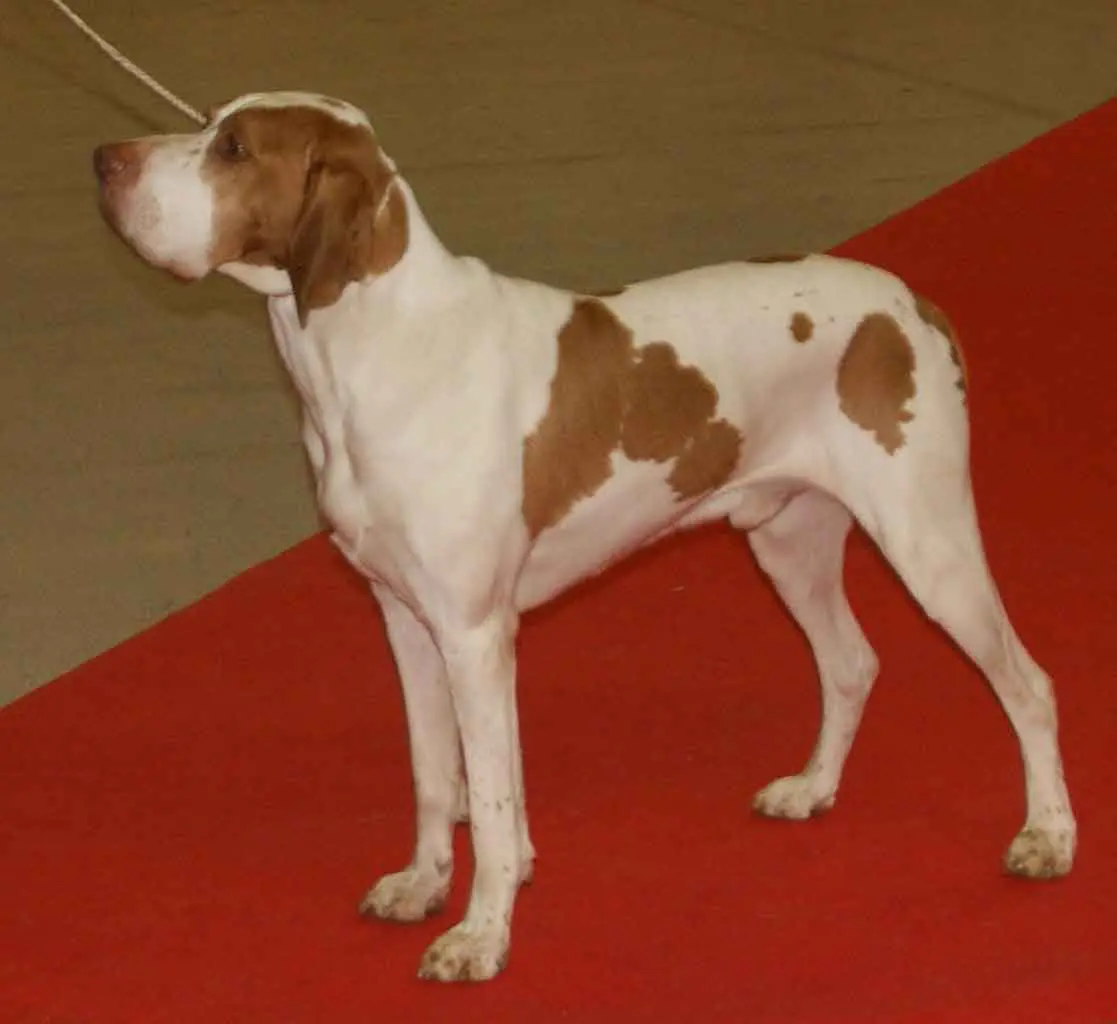
Content |
|---|
History
The Ariège Pointer is a French dog breed that comes from, as its name implies, from the department of Ariège, located on the Franco-Spanish border.
There are different theories about its origins.. But, the most common theory is that it descends from the ancient French Pointer, that was crossed in the 19th century with Braques of southern stock, with white and orange coats to give it more lightness and activity.
It also, looks a lot like the white and orange dogs painted in Jean-Baptiste Oudry's paintings (1686-1755), famous for his paintings of hunting scenes. So, It does not seem illogical that cynologists have attributed this dog to him as an ancestor.
Despite its official recognition by the F.C.I. (International Cynological Federation) in 1955, the second half of the twentieth century was almost fatal for the Ariège Pointer. But, some Ariège hunters continued to use it, which prevented the breed from completely disappearing.
In 1989, a team of fans of the breed decided to dedicate themselves to its survival, after having noticed that there was no more Ariège Pointer registered in the LOF (French Origins Book) from 1964.
The Club du Braque de l’Ariège was thus created the following year, with the mission of contributing to the safeguarding and promotion of this breed, but also to centralize all the information that makes it possible to identify the specimens that would be found in France in the breeders, hunters or other fans of this dog.
The operation was generally a success. Like this, the increase in births meant that in 1999, less than 10 years later, the symbolic milestone of the 50 Ariège Pointer listed in TFO. The trend has continued, since today there are more than 350 specimens in the LOF, many of whom have won prizes in beauty or hunting contests.
However, the breed has spread relatively little outside its homeland, since most breeders and owners of the Ariège Pointer are located in the south-west of France, although there are also some scattered throughout the rest of the country.
Internationally, the Ariège Pointer was officially recognized in 2006 by the UKC (United Kennel Club), one of the leading canine organizations in the United States. But, the UKC is an exception, since the other large national canine organizations do not yet recognize the breed. It's still very difficult, yes not impossible, acquire a Ariège Pointer outside france.
Photo: Ariege Pointer, male. Colour: orange & white by Canarian, CC BY-SA 4.0, via Wikimedia Commons
Physical characteristics
Vigorous and powerful, the Ariège Pointer has a certain elegance. His musculature is prominent and harmonious, and its well drawn lines.
Usually pale orange or brown fawn in color, there are also speckled white and trout. His great characteristic is that the color of his nose is more often in harmony with that of his fur..
His hair is short and shiny and his head is long, angulosa, without a very pronounced stop.
His tail is low and long, in contrast to his ears, that are thin and well placed above the eye line.
Finally, the eyes of the Ariège Pointer they are oval shaped, dark amber or brown. Her frank and gentle eyes will easily seduce humans who cross her path.
Character and skills
The Ariège Pointer it is a quiet breed of dog, although sometimes stubborn, which is common among hunting dogs. He is also a very intelligent dog.
Adapted to all types of hunting and considered one of the best hunting dogs that exist, thanks in particular to his excellent sense of smell, his great stamina and unerring determination, it is effective in all types of hunting and on all terrains.
The Ariège Pointer it is also very resistant and adapts easily to all weather situations, though still more at home in the cold than in the tropics.
Very sensitive and affectionate with his master and his relatives, is docile, Gentile, easy to train, and therefore it is an excellent pet.
May be in contact with other animals, in any case congeners or other species of the same size, especially if you've gotten used to them from a young age as part of puppy socialization. On the other hand, its innate hunting instinct could lead it to attack small potential prey. So, it is better to avoid sharing your daily life with a rabbit, a rat or other game that awakens their deep stalker nature.
It is also for this reason that it is recommended to keep it on a leash when in town. On the other hand, if your education is not lacking, it's conceivable – and even desirable – let it go when in the field, so it can be spent, as this is necessary for their physical and psychological well-being.
In effect, the Ariège Pointer remains a lively, independent dog who needs daily exercise and is happy to take part in long walks or bike rides. It is a recommended breed of dog for an athletic owner, since you can't settle for a few relatively short outings to relieve yourself.
They can live in the city, but only if they have a garden. The latter does not make it less necessary to offer him long walks, all days, ideally in the middle of nature. It also, if you live in the city, it is advisable to accustom it from a young age to crowds and traffic, for example to avoid encountering a dog that runs behind cars.
Education
The Ariège Pointer has an innate aptitude for hunting, but he still deserves to be educated as soon as possible to consolidate his knowledge and teach him the fundamental commands of hunting (stop, stand up, report…).
Whether it is intended to be used as a working dog or simply as a companion dog, it is recommended to train it with patience and delicacy, since it is endowed with great sensitivity. If you don't, you risk getting upset and discouraged, and restoring trust between the owner and his animal is then a long and arduous task.
In any case, either during your education or at any time after, the owner must be calm, attentive and balanced to curb the very dynamic burning of your partner.
Health
The Ariège Pointer he is a robust dog with an iron constitution and no particular pathology.
Grooming
A weekly brushing of the dog's coat is sufficient, since the Ariège Pointer does not need much maintenance.
Having said that, like any hunting dog, the dog's ears should be systematically cleaned when he returns home, in order to remove any leaves or dirt that may have lodged there.
This special attention to its ears is also valid if it is only used as a companion dog., since dog breeds with floppy ears are at higher risk of ear problems.
Buy a «Braco del Ariège»
The price of a puppy Ariège Pointer in a hatchery is between 600 and 800 EUR. There is generally no price difference between a male and a female.
Characteristics "Ariège Pointer"
Coexistence is important that you have with your new friend. Before considering the acquisition of a dog of the breed "Ariège Pointer" you know certain factors. Not all breeds of dogs are apt to live in an apartment, you must take into account his character, their need for exercise, their interaction with other pets, their care and if you have small children, their level of tolerance towards them.
Adaptation ⓘ3,0 of 5 stars (based on 1 review)
|
friendly dog ⓘ3,0 of 5 stars (based on 1 review)
|
hair loss ⓘ2,0 of 5 stars (based on 1 review)
|
|---|---|---|
Affection level ⓘ4,0 of 5 stars (based on 1 review)
|
Need for exercise ⓘ4,0 of 5 stars (based on 1 review)
|
Social need ⓘ3,0 of 5 stars (based on 1 review)
|
Home ⓘ2,0 of 5 stars (based on 1 review)
|
Toilet ⓘ1,0 of 5 stars (based on 1 review)
|
Friendly with strangers ⓘ3,0 of 5 stars (based on 1 review)
|
barking ⓘ3,0 of 5 stars (based on 1 review)
|
Health ⓘ4,0 of 5 stars (based on 1 review)
|
Territorial ⓘ4,0 of 5 stars (based on 1 review)
|
Cat friendly ⓘ2,0 of 5 stars (based on 1 review)
|
Intelligence ⓘ5,0 of 5 stars (based on 1 review)
|
Versatility ⓘ4,0 of 5 stars (based on 1 review)
|
Child friendly ⓘ2,0 of 5 stars (based on 1 review)
|
Surveillance ⓘ2,0 of 5 stars (based on 1 review)
|
joy ⓘ4,0 of 5 stars (based on 1 review)
|
Videos "Ariège Pointer"
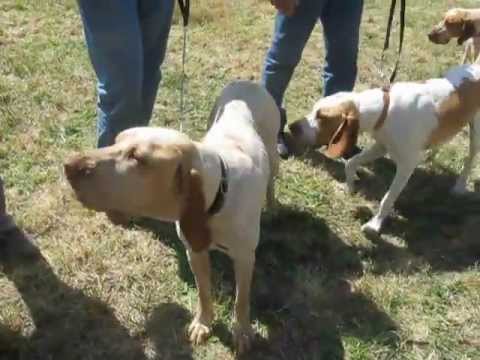
|
Braque de l’Ariège
|
Braque de l’Ariège
|
|---|

Type and recognitions:
- FCI CLASSIFICATION: 177
- Group 7: Pointing Dogs
- Section 1: Continental Pointing Dogs. 1.1 Braque Type. With working trial.
Federations:
- – FCI – Group 7: Pointing Dogs. – Section 1: Continental Pointing Dogs. 1.1: Braque Type ⓘ
- – UKC – Gun Dog ⓘ
FCI breed standard "Ariège Pointer"
Use:
Pointing Dogs.
General appearance:
Of type « Braco », He is robust and powerfully built., although without the appearance of excessive heaviness. His appearance is vigorous. The most appreciated specimens are those with thin limbs, prominent muscles and well-defined lines. Its white fur, preferably splashed with pale orange or sometimes speckled with chestnut, Together with its size, it makes it an elegant and distinguished dog..
IMPORTANT PROPORTIONS :
Of medium proportions; the length of the body is slightly greater than the height at the withers. The skull is slightly longer than the nasal shank.
Adapts to all types of hunting; it is resistant, docile and easy to educate.
Head:
It must be long, angular and narrow in the region of the zygomatic arches.- Skull : It is slightly domed; the frontal furrow is not very pronounced. The upper lines of the skull and the nasal cannula are slightly divergent forward.. The superciliary arches are moderately accentuated. The occipital protuberance is quite pronounced.
- Depression links (stop) : Little pointed.
facial region:
- Truffle : It's pink, flesh-colored or more or less pale brown, according to fur color; never black. The Windows are wide open.
- Snout : Long, straight nose cane, sometimes very slightly convex. Front views, the lateral faces of the snout converge slightly forward.
- Lips : They are quite thin and well descended; the commissure is quite folded without falling down.
- Jaws / Teeth : The dental arches are well adapted. The articulation of the incisors is scissor-shaped; dental is accepted- hard clamp-shaped (the incisors on top of each other).
Eyes : The look is sweet, frank and intelligent. Wide open, The eyes are slightly oval and well set in the orbits.. The iris is a dark amber or chestnut color, according to coat color.
Ears : They are quite thin, long and crooked. They are inserted at or below the eye line.; They are not attached to the head. Their length allows them to reach the birth of the nose without having to stretch them.
Neck:
It's not very long, but quite thick and has a slight dewlap.Body:
- top line : The anterior part is almost rectilinear and descends from the withers to the eleventh dorsal vertebra. The second part, slightly convex, join the group.
- Cross : It is well marked without being protruding.
- Back : a little long, muscular, solid and straight.
- Pork loin : Slightly convex.
- Rump : Slightly oblique in relation to the top line.
- Breast : It is broad, high and deep to the plane of the elbows. The ribs are rounded, but without exaggeration.
- bottom line : Slightly oblique and somewhat raised in the abdominal part.
Tail:
Its insertion is located in the extension of the line of the rump. It is thick at the base and gradually tapers. They are usually cut 4/10. Long tail accepted. When raised it should not exceed the top line.Tips
PREVIOUS MEMBERS : They are straight, for strong bones, wide and muscular.
- Shoulder : Muscular, robust and moderately oblique.
- Arms : Strong, well muscled and close to the chest.
- Elbows : They are located in the plane of the sternum.
- forearms : Vigorous and well poised.
- Metacarpus : Seen in profile, they are slightly inclined.
- Front feet : Together, well arched, forming a compact set, almost round. The nails are strong and the pads are very fleshy..
LATER MEMBERS : They are well poised.
- Thighs : Well muscled and lowered.
- Knee : Well parallel to the median plane of the body.
- Leg : Robust.
- Hock : Well layered.
- Metatarsus : Pretty short, almost vertical.
- Rear feet : They have the same characteristics as the front feet.
Movement:
Tireless and agile trot, interrupted by periods of gallop. Movements are loose and light.Mantle
SKIN : It is not very thick and is quite elastic. It is thinner on the head. The external mucous membranes must be of a color that corresponds to the color of the coat; They should never have black spots.
HAIR : It's tight, bright, short, thinner and satin over the head and ears.
COLOR : Pale orange fawn, or sometimes brown. Has many mottled or speckled white patches. Some dogs are even white with spots.
Size and weight:
Height to the cross : In males it is 60 to 67 cm., and in females is of 56 to 65 cm..
Fouls:
Any deviation from the aforementioned criteria is considered as a fault and the severity of this is considered to the degree of the deviation to the standard and its consequences on the health and well-being of the dog..
MISS PLAYOFFS : Taking into account the reduced heritage of this breed, the purpose is not to show too much severity, but discard from reproduction the specimens that do not correspond to the type and those that have serious faults.
• Aggressive dogs, biting or too fearful.
• Total absence of the typical characteristics of the breed.
• Double nose (dogs whose windows are separated by a deep groove).
• Nose of a color that does not correspond to what is established by the standard.
• Black nose.
• Inferior or superior prognathism.
• Eyes : excessively light or different color.
• Entropion or ectropion, or any trace of surgical intervention to correct this defect.
• Excess depigmentation on the eyelids.
• Black nails.
• Dewclaws.
• Hind limbs: clearly observable difficulty in movements.
• Color that does not correspond to what is established by the standard.
• Size that deviates from the limits of the standard, with a tolerance of 1 cm more or less.
• Serious morphological anomalies.
• Defects that cause disability.
Any dog showing clear signs of physical or behavioral abnormalities must be disqualified..
Males should have two normal-appearing testicles fully descended into the scrotum..
Source: F.C.I - International Cynological FederationAlternative names:
1. Ariège Pointer, Ariege Pointing Dog (English).
2. Braque de l’Ariège, braque de Toulouse, braque du Midi (French).
3. Ariège-Vorstehhund, Braque de l’Ariège (German).
4. (em francês: Braque de l’Ariège) (Portuguese).
5. Braco de Ariège (español).