โ–ท The world of Pets: Dogs, cats, birds, reptiles, amphibians

Maremma and the Abruzzes Sheepdog
Italia FCI 201 . Sheepdogs

The Maremma and the Abruzzes Sheepdog he will be really happy sleeping with the cattle rather than on the sofa in your home.

Pastor Maremmano-Abruzzese

Content

Characteristics "Maremma and the Abruzzes Sheepdog"

Coexistence is important that you have with your new friend. Before considering the acquisition of a dog of the breed "Maremma and the Abruzzes Sheepdog" you know certain factors. Not all breeds of dogs are apt to live in an apartment, you must take into account his character, their need for exercise, their interaction with other pets, their care and if you have small children, their level of tolerance towards them.

Adaptation โ“˜

4,0 of 5 stars (based on 1 review)

friendly dog โ€‹โ€‹โ“˜

3,0 of 5 stars (based on 1 review)

hair loss โ“˜

3,0 of 5 stars (based on 1 review)

Affection level โ“˜

4,0 of 5 stars (based on 1 review)

Need for exercise โ“˜

5,0 of 5 stars (based on 1 review)

Social need โ“˜

3,0 of 5 stars (based on 1 review)

Home โ“˜

3,0 of 5 stars (based on 1 review)

Toilet โ“˜

2,0 of 5 stars (based on 1 review)

Friendly with strangers โ“˜

3,0 of 5 stars (based on 1 review)

barking โ“˜

2,0 of 5 stars (based on 1 review)

Health โ“˜

4,0 of 5 stars (based on 1 review)

Territorial โ“˜

5,0 of 5 stars (based on 1 review)

Cat friendly โ“˜

3,0 of 5 stars (based on 1 review)

Intelligence โ“˜

3,0 of 5 stars (based on 1 review)

Versatility โ“˜

2,0 of 5 stars (based on 1 review)

Child friendly โ“˜

4,0 of 5 stars (based on 1 review)

Surveillance โ“˜

4,0 of 5 stars (based on 1 review)

joy โ“˜

4,0 of 5 stars (based on 1 review)

History

The Maremma and the Abruzzes Sheepdog (Maremmano-Abruzzese or Cane da pastore Maremmano-Abruzzese), It is a breed of sheepdog native to central Italy and used for centuries by shepherds to defend their flocks from wolves.

The breed is still used today, widely, in the region of the Abruzzo where flocks of sheep vitalize the rural economy and wolves are protected predators (of the few areas of the planet, Regrettablyโ€ฆ).

The race is similar to the Pyrenean Mountain Dog, to the Kuvasz from Hungary and to Akbash from Turkey (This, that more!).

It also descends from the shepherd dogs that once existed in the Maremma Tuscany region and in the Lazio region.. Since 1860, the transhumance of herds from one region to another has favoured the development of a natural mixture of these two primitive races.

Several descriptions of dogs defending vulnerable white sheep are found in the literature of ancient Rome, in works such as the Columella, Varro and Palladius. Dogs similar to Maremma and the Abruzzes Sheepdog they are represented in numerous sculptures and paintings from Roman times to the present day.

Until year 1958, the Maremma Sheepdog and the Maremmano-Abruzzese they were considered as separate races. The first Canine society of the Maremma Sheepdog was established in the year in 1950, and three years later (1953) the First Canine Society of the Maremma Sheepdog.

But owing to transhumance of herds of sheep from one region to another, especially after the unification of Italy, there was a โ€œnatural fusionโ€ between the two races. For which reason, the 1 in January of 1958, the races were unified by the ENCI (Ente Nazionale della Cinophilia Italian, or national association Cynologique Italiana).

Today, It is not so encouraging and sympathetic as the history of this beautiful can, although they are still widely used by Italian sheep farmers in areas where predation is common, as the central Apennines of Italy and the open countryside of the land of national parks in Abruzzo.

But, Ironically, of the Maremma and the Abruzzes Sheepdog, in the area of the Maremma of Tuscany, the memory can only, they are now a rarity just in the area which saw them to be born, you are right, even if you don't like to hear it, the hand of man and progress... have resulted in a more sinister: sheep farming has declined and the wolf is nearly extinct.

Curiosities

Although it is easier for him Maremma and the Abruzzes Sheepdog, develop their relationship with sheep and goats, farmers have found that, as well, are able to develop a protective bond with cows, and in many places of United States, It also used for the purpose. As well, they are good defending corrales, chickens or ducks from the threats of land caused by coyotes, dogs and foxes, and air threats caused by birds of prey (Hawks, Eagles, owls, etc.).

In Australia, a lot has been invested in it Maremma and the Abruzzes Sheepdog. Specifically in the city of Warrnambool that has great natural beauties, and in one of them the Maremma and the Abruzzes Sheepdog It is today a key piece for the survival of other species.

Within the natural beauties that talked, the beach of Logan located on the East side of the city is a great example, recognized as a southern whale breeding site. Every year between May and August reach coasts copies of adult female whales to give birth to their calves, and at the end of September are often long trip offshore, sometimes with a little bit of human help, so the whales are not left stranded on the beach.

In addition to the whale southern franco, the coast is also visited by sea lions of Australia, penguins and common dolphin. Albatrosses can spot during the winter and early spring.

There is also another natural beauty which is the protagonist of this post can… Middle Island had a large colony of penguins. But the uncontrolled presence of foxes led to a significant reduction in the number of members of the colony.. In 2005, there are only four penguins left in the colony.

It was then when the Warrnambool City Council introduced an innovative and ecological program, first in the world with these characteristics, introduced to Middle Island several copies of Maremma and the Abruzzes Sheepdog to protect the penguins. This highly original and innovative program has been the cornerstone of the re-establishment of the penguin colony that in the year 2009 already had more of 100 Members.

While the use of Maremma and the Abruzzes Sheepdog to protect an endangered species was a rare thing at first, Thanks to the effort and commitment of the Warrnambool City Council, it has been proven that the Maremma and the Abruzzes Sheepdog along with other breeds of livestock guardian dogs, they make it possible that the cattle and other species, like penguins, they can live with their natural predators in danger of extinction, as well, as wolves and coyotes. Program predation was reduced a 70% u 80% or more, and the survival of Wolf and different foxes, or coyotes, is not endangered, at least in the area.

In other countries like Italy, United States and Canada, the use of dogs has also been promoted Maremma and the Abruzzes Sheepdog, as well as other types of herding dogs, to minimize the conflict between the species of predators in danger of extinction and farmers, achieving success several but without destroying the ecosystem.

Physical characteristics

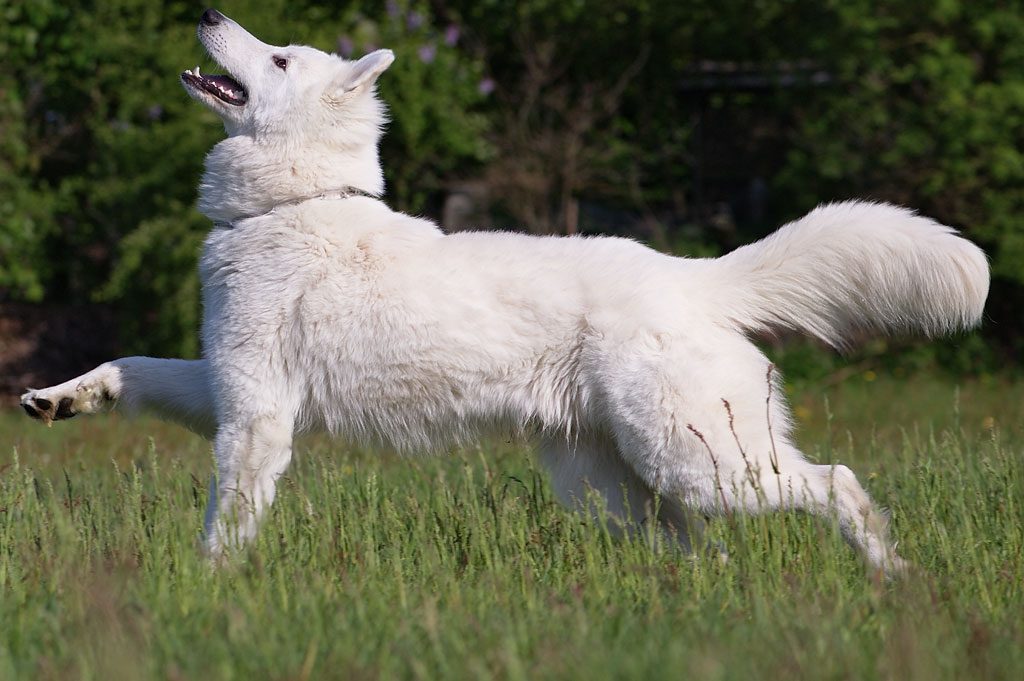
The Maremma and the Abruzzes Sheepdog is a dog from large size, powerful, aspect rustic and at the same time Majestic and well accused type. Its general appearance of medium proportions is a heavy dog, whose body is longer than the height at the cross. It also keeps harmony in terms of its format (normal correlation between size and different parts of the body) and profiles (concordance between the profiles of the head and body).

The head altogether, is large and flat, conical and similar to the White bear form.

The skull in profile is convex. The eyes are ochre or brown. It has ears triangular and small relative to the size of the dog, are high insertion and hang.

The limb well well-angled, giving sense of lead and firmness. The tail hangs surpassing the Hock, and when the dog is alert it rises to the line of the back.

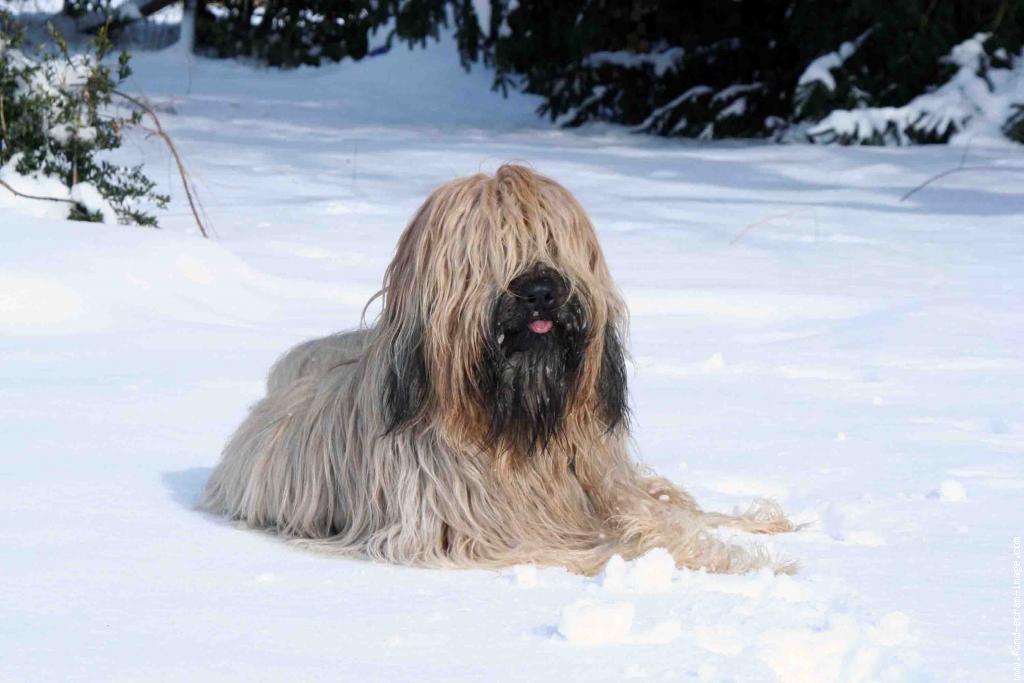
The hair is long, abundant and rough to the touch. The only one supported color is the white solid. Although they tend to admit light reflections of color ivory, pale orange or lemon.

Height to the cross in the males is of 65 to 73 cm and females is of 60 to 68 cm.. The weight of 35 to 45 kg in males and 30 to 40 kg in females.

Character and skills

Despite its large size, the Maremma and the Abruzzes Sheepdog It can be a good companion dog in homes that have open spaces, appropriate to your needs.

Centuries of breeding Maremma and the Abruzzes Sheepdog, assigning to be friendly and protective with their lambs, their flocks, they have forged the character of the race, Nowadays, an animal that adapts very well to home life is very attached to its family, whom it protects as if it were a herd., always showing a quiet character, balanced and intelligent.

In many areas this beautiful dog has earned a reputation for being aggressive, very nervous and even bite, but this is not true. The issue is that, When one decides to take this breed of dog it must be understood that it needs large spaces, freedom and independence. Not reach you with daily routine down to walk to do their physiological needs, This routine can generate stress and boost develop destructive behaviors.

Can be rather distrustful with strangers, due to his desire to protector, and despite the fact that it adapts well to home life, for its size and need for open spaces, and it is not advisable to raise him in urban areas, because it won't be a happy dog. A rural House, away from neighbor's property lines and wheeled traffic, it would be an ideal place for this beautiful shepherd. In this environment, Maremma and the Abruzzes Sheepdog, to be on the couch in the House before going to prefer sleeping with livestock, there is really happy.

In addition to its extensive use in Italy, the Maremma and the Abruzzes Sheepdog lives happily performing its livestock protection duties in Australia, United States and Canada.

The Maremma and the Abruzzes Sheepdog, is a very versatile dog, and capable of generating a very, but very strong with the animals who must take care. To develop this protective instinct in the blood, they are introduced in the flocks of sheep when they are puppies, in some cases with 3 or 4 weeks of life, but the most common is that they are introduced with 7 u 8 weeks, they are once with his flock, quickly they implemented their skills, still puppies, with a little bit of help, Of course, but only at the beginning.

What more can we say of the character of the Maremma and the Abruzzes Sheepdog? I think the words..., sobran.

Photos ยซSheepdog of the Maremma and Abruzzoยป

Videos ยซSheepdog of the Maremma and Abruzzoยป

Type and recognitions:

  • FCI CLASSIFICATION:
  • Group :
  • Section : . .

Federations:

  • FCI – Group 1 Herding dogs, Section 1 Sheepdogs โ“˜
  • ANKC – Group 5 (working dogs) โ“˜
  • โ€‹KC – Pastoral โ“˜
  • NZKC – Working dog โ“˜
  • UKC – Herding dogs โ“˜

FCI breed standard Maremma and the Abruzzes Sheepdog

FCIFCI - Maremma and the Abruzzes Sheepdog
Dog

Alternative names:

1. Cane da Pastore Maremmano-Abruzzese, Maremmano, Pastore Abruzzese, Pastore Maremmano, Abruzzese Mastiff, Mastino Abruzzese, Abruzzo Sheepdog, Abruzzese Sheepdog (English).
2. cane da pastore Maremmano-Abruzzese (French).
3. Maremmen-Abruzzen-Schรคferhund (German).
4. Cane da Pastore Maremmano-Abruzzese (Portuguese).
5. Maremmano-Abrucense, Pastor de Maremma (espaรฑol).

โ–ท The world of Pets: Dogs, cats, birds, reptiles, amphibians

Pyrenean Shepherd
Francia FCI 141 - 138 . Sheepdogs

Pastor de los Pirineos

The Pyrenean Shepherd It is capable of detecting mood of each Member of the family.

Content

History

The Pyrenean Shepherd is a breed of dog originating in France monitoring pastor, consists of two different varieties: the Pyrenean Shepherd Long Hair and the Smooth-faced Pyrenean Shepherd.

This breed of dog is very old, the oldest dog is French pastors, but in reality, its origins are unknown.

Its origin and its history is supposed to be the same, than the other dogs of pastor European descendants of Asian dogs.

Read more

โ–ท The world of Pets: Dogs, cats, birds, reptiles, amphibians

Portuguese Sheepdog (Cรฃo da Serra de Aires)
Portugal FCI 93 . Sheepdogs

Perro de pastor portuguรฉs

The Portuguese Sheepdog has an excellent herd instinct, always ready to take care of the goats

Content

History

The Portuguese Sheepdog has nearly 100 years.

This hairy, use livestock and guardian of the plains of the Portugal South may descend from the Berger de Brie, imported by the conde de Castro Guimarรฃes and which in turn bred with local mountain dogs.

Despite the similarities with the Berger de Brie and the Catalan Sheepdog, there is no reliable evidence to suggest a direct line of descent.

During the greater part of the last century, the Portuguese Sheepdog was the companion of the shepherds in southern Portugal, but in the Decade of 1970 was almost extinct.

Fortunately, the beauty of your fur and your docile predisposition came to knowledge of the breeders. Today, many owners in Portugal are owners of this breed and their future is assured..

Although he is practically unknown outside his native country, This dog of woolly appearance is a class dog, worthy of greater international recognition.
Owners say these โ€œcuteโ€ little dogs, nicknamed for their peculiar appearance and picturesque expression, have been part of farming and family life for a very long time. As with many working breeds, the ability to work was more important than the appearance, and the standard was not set up to 1930.

Recognition: CKC, FCI, NKC, APRI, ACR, DRA

Physical characteristics

The fur of the < is long and smooth, with a light ripple. Do not have a background layer.

The colors We accept yellow, the brown, the fawn to red and more or less stained gray with red fire. There may be greater or lesser amount of white hairs scattered around the mantle, but never forming stains, except in the chest.

The previous tips they are symmetrically covered with long hair.
It has a beard that gives a mature look. The eyes they are round and dark, with a friendly expression. The ears moderate size usually hang on the sides of the cheeks, Although sometimes clipped. Clipping is prohibited in some European countries. Their feet are particularly adaptable to difficult terrain. Their legs they are strong and their chest deep.

Males can measure of 45 to 55 cm., while females measure of 42 to 52 cm.. The weight must be between 12 and 18 kg.

The hair is longer on the head giving these dogs a curious and messy bangs.
It has a head wide and robust, with a prominent nose and strong jaw. The tail, very close from the base, the high boot, it reaches the Hock and tapered.

Their life expectancy is of 12-13 years.

Character and skills

The Portuguese Sheepdog It is one of the smartest Sheepdogs. This is a great dog, joyful, happy and always ready to work. Very loyal, and paired with their own town.

The Portuguese Sheepdog needs a well-balanced training. It has a above average intelligence and learns quickly and easily, but he can be stubborn and dominant if they feel that their owners do not have the same mentality. So, It has always been a challenge for pastors. Trained once, This is the dog more reliable an owner may have. It requires educators safe and strong. These dogs can live with other animals, Although some males may try to dominate other males. They can live happily with other pets, provided that they have been properly socialized.

The Portuguese Sheepdog is usually patient with children, but the males, in particular, they can be very possessive within its territory. This race is reserved with strangers and they do a good job as a watchdog.

It is very good Shepherd with cattle, that will tirelessly defend. These dogs are known for their fast attitude, intelligent and are particularly good to bringing back stray dogs. They love its owner above all on Earth. Not usually bite unless cause you.

Characteristics "Portuguese Sheepdog (Cรฃo da Serra de Aires)"

Coexistence is important that you have with your new friend. Before considering the acquisition of a dog of the breed "Portuguese Sheepdog (Cรฃo da Serra de Aires)" you know certain factors. Not all breeds of dogs are apt to live in an apartment, you must take into account his character, their need for exercise, their interaction with other pets, their care and if you have small children, their level of tolerance towards them.

Adaptation โ“˜

3,0 of 5 stars (based on 1 review)

friendly dog โ€‹โ€‹โ“˜

2,0 of 5 stars (based on 1 review)

hair loss โ“˜

2,0 of 5 stars (based on 1 review)

Affection level โ“˜

3,0 of 5 stars (based on 1 review)

Need for exercise โ“˜

5,0 of 5 stars (based on 1 review)

Social need โ“˜

3,0 of 5 stars (based on 1 review)

Home โ“˜

3,0 of 5 stars (based on 1 review)

Toilet โ“˜

4,0 of 5 stars (based on 1 review)

Friendly with strangers โ“˜

3,0 of 5 stars (based on 1 review)

barking โ“˜

2,0 of 5 stars (based on 1 review)

Health โ“˜

4,0 of 5 stars (based on 1 review)

Territorial โ“˜

5,0 of 5 stars (based on 1 review)

Cat friendly โ“˜

2,0 of 5 stars (based on 1 review)

Intelligence โ“˜

4,0 of 5 stars (based on 30 reviews)

Versatility โ“˜

3,0 of 5 stars (based on 1 review)

Child friendly โ“˜

3,0 of 5 stars (based on 1 review)

Surveillance โ“˜

4,0 of 5 stars (based on 1 review)

joy โ“˜

5,0 of 5 stars (based on 1 review)

Images ยซPortuguese Shepherd Dogยป

Videos ยซPortuguese Shepherd Dogยป

Type and recognitions:

  • FCI CLASSIFICATION:
  • Group :
  • Section : . .

Federations:

  • – FCI โ“˜,
  • – AKC โ“˜,
  • – ANKC โ“˜,
  • – UKC โ“˜

FCI breed standard "Portuguese Sheepdog (Cรฃo da Serra de Aires)"

Origin:
Portugal

Date of publication of the valid original standard:
04.11.2008

Use:

Guard and herding dog on ranches.


General appearance:

It is a medium-sized dog, sublongilinear. Appreciable rusticity and sobriety, extremely agile and fast with a wide and suspended movement. Long hair with goat-like texture without undercoat. It has the appearance and attitudes of an ape, which is why it is known in this region as the โ€œmonkey dog.โ€.


IMPORTANT PROPORTIONS: The length of the body is approximately 10% greater than his height at the withers. Chest depth is less than 50 % the height at the withers. The length of the muzzle is 2/3 the length of the skull, the width of the skull is slightly less than its length.


Behavior / temperament:

Exceptionally intelligent and very affectionate. He is very dedicated to the shepherd and the cattle he cares for; stay away from strangers and keep watch at night. Nowadays he is also an excellent companion dog., sport and guard. It is highly prized for its ability to keep herds on pasture and to search for escaped animals.. It is alert and vigilant in the presence of predators. The breed is very devoted to its shepherd and his cattle. His work is done with pleasure and pleasure.

Head:

Medium-sized (mesocefรกlica), strong, wide; is not long, or large.

Cranial region:
  • Skull: With a tendency to be square, slightly longer that wide, divergent longitudinal axes of the skull and the muzzle, convex on both axles but more laterally. Supercilii arc is not prominent. Front Groove pronounced stretching towards the middle of the antecara, the areas between the ears are flat with an apparent occipital Protuberance.
  • Depression links: Well defined.

facial region:

  • Truffle : Well defined, slightly elevated ; the Windows are wide. It is rounded, cylindrical and truncated almost vertically. Preferably black, It can be liver color in yellow or brown animals but it should always be a darker color than the coat..
  • Nose cane: It is short; measured around 2/3 the length of the skull. Almost cylindrical ; the width should be proportional to its length and form. Rectilinear profile, or slightly concave.
  • Lips: Together, non-overlapping. They are thin, firm, almost straight cut. The edges of the same color of the truffle. 
  • Jaws: They have a normal development. Both jaws are in perfect opposition. Complete dentition of 42 teeth white and solid. Scissor bite, accepted a bite in Clip.
  • Eyes: Medium-sized, rounded, preferably color dark but can be Hazel or brown amber color in yellow animals, level without being prominent placement. friendly expression, Intelligent but docile, horizontal, eyelids black or always darker than the hair color and according to the colour of the nose.
  • Ears: High implementation; they are falls, and not bent, When not have been cut off; they are straight when they have been cut off. They have a triangular shape. Thin and soft skin. Medium-sized from the same long than broad (About 10 cm.).

Neck:

It joins harmoniously the head and trunk. It is straight and slightly ascending ; supplied thickness. It is not a double chin.

Body:

  • The top line : Straight or slightly inclined.
  • Cross : Strong, harmoniously combined with the neck and back.
  • Back : Straight or slightly sloping and long. Well muscled, usually twice the length of the spine.
  • Pork loin : Short and arched seen profile; wide and curved, seen from the front, strong muscles and well attached to the back and rump.
  • Rump : Some prominent and slightly inclined, soft, long and half-width, strong muscles.
  • Breast : Up to the height of the elbows, bandwidth and average depth, ribs slightly arched with an oval to leaning back rib cage. The sill is prominent, wide well back and wide.
  • Belly and flanks : Uniformly and slightly ascending.

Tail:

High insertion, sharp, arriving at the height of the paw, tapering from the base. Long and covered with abundant hair. When the dog is in motion it is the extension of the top line or it may curve slightly on the top line but never curve on the back.

Tips

PREVIOUS MEMBERS: Strong, well aplomados seen from front and profile, and separate, the distance from the cross to the elbows is slightly smaller than the elbow to the ground.

  • Shoulder: Medium length with a 45ยบ inclination, good muscular, scapula and humerus placed at a 90ยบ angle.
  • Arm: Strong and medium length placed at a 45ยบ angle, good muscular.
  • Elbows: Parallels, close to the chest and with a humerus angle โ€“ radius of 135ยบ.
  • Forearm: Long, vertical and well muscled with bones of medium thickness.
  • Carpo: Delgado. It is not prominent.
  • Metacarpus: Normal size and medium length. From top to bottom, and back forward, is not very inclined.
  • Pies: Rounded, not crushed. The fingers are long and together, with a curve. The nails are long, black and strong, or darker than the coat. The pads are thick and tough.

LATER MEMBERS: Medium width, aplomados seen from front or back, strong giving a perfect impression of strength and agility.

  • Thighs: Medium length and amplitude; good muscular. Hip-femur angle of approximately 105ยบ.
  • Knee joint: Straight view back without leaning neither in nor out. Femur โ€“ tibia angle approximately 130ยบ.
  • Leg: Little inclined; long and well muscled. Strong bones.
  • Tarsus(Hock) : medium width, low placement, strong and slim. Tibia โ€“ tarsus angle approximately 120ยบ.
  • Metatarsus: Normal size, although strong; medium length. It is not very inclined top down, and from front to back. There may be single and double Spurs.
  • Pies: Identical to previous feet in all its aspects.

Movement:

Predominantly moves in a lightweight and suspended trot with powerful. The Gallop, When the work required, is energetic.

Mantle

  • SKIN: Thick, flexible, not too tightThe mucous internal and external are preferably Pigmented.
  • COAT : Smooth or slightly wavy, the goat hair forming a long beard longer with a somewhat rough texture preferably type, whiskers and eyebrows but not covering eyes, thick and evenly distributed on the body including the interdigital spaces. Thickness means without Undercoat or fluff hair. Very long hair on his head, body and members, including the interdigital spaces.
  • HAIR COLOR: The colors are yellow, brown, grey, reddish and Grey Wolf; with light and dark varieties, and more or less marked fire black, with or without white hairs mixed, but never show white spots, except for a small spot in the pectoral region.
  • Skin : The mucous internal and external are preferably Pigmented; the skin is not too stretched.


Size and weight:

  • In males : of 45 to 55 cm..
  • In females : of 42 to 52 cm..

WEIGHT :

  • Males and females: 17 to 27 kg.


Fouls:

Any deviation from the aforementioned criteria is considered a fault and the severity of this is considered to the degree of the deviation from the standard and its effect on the health and well-being of the dog..

SEVERE FAULTS

  • Behavior: Specimens showing nervousness or unbalanced temperament.
  • Jaws: Incorrect implantation of teeth, absence of two premolars (Except PM1)
  • Little marked links depression.
  • Nose is pointed.
  • Overlapping lips, or pendulums.
  • light eyes, small, or non-round, u oblique.
  • Bent or rose-shaped ears.
  • Too narrow banister.
  • Breast : shallow, flat rib cage.
  • Concave upper trunk line, or too steep.
  • Horizontal Croup, or too much fall.
  • Bottom line too thin.
  • Tips: anterior or posterior foot inclined, Garron of cow. Not too straight hind legs.
  • Very low insertion queue, short, or curled over the back when the dog is at rest.
  • White nails.
  • Little wire-haired, or not long enough.
  • Large white patch on the chest region. Fire-coloured stains not defined.
  • Movement: not wide enough, not suspended, elbows out, Paw too together.

MISS PLAYOFFS

  • Behavior: Aggressiveness or excessive shyness.
  • General appearance: Lymphatic, Lightweight bones. Severe deviations from the important proportions
  • Narrow and long head.
  • flat skull, round, Strait
  • Low-set ears, too separate, erect semi erect or.
  • Nasal helm that presents a convex profile.
  • Jaws: prognathism or inferior, absence of more than two premolars (except PM1).
  • Pigmentation: Total absence of pigmentation in truffle, eyelids, lips (albinism).
  • Amputated tail, or lack thereof of birth.
  • Short hair, curly or with presence of Undercoat.
  • Color: White at the ends of the members. Absence of stain color fire in Brown adult, grey or black.
  • Movement: Too rengueo or heavy, with severe deviations in previous members, weakness.
  • Size: Above or below established limits.

Any dog โ€‹โ€‹showing clear signs of physical or behavioral abnormalities should be disqualified..


N.B.:
  • Males should have two normal-appearing testicles fully descended into the scrotum..

TRANSLATION : IRIS Carrillo (Federation Canรณfila de Puerto). 

Technical review: Miguel Angel Martinez (Federation Cynologique Argentina).

Source: F.C.I - International Cynological Federation

Alternative names:

1. Monkey dog, Cรฃo da Serra de Aires (English).
2. Berger de la Serra de Aires, CHIEN DE BERGER DE LA SERRA DE AIRES (French).
3. PORTUGIESISCHER SCHร„FERHUND (German).
4. Serra-d’aires (Portuguese).
5. Perro de pastor portuguรฉs (espaรฑol).

โ–ท The world of Pets: Dogs, cats, birds, reptiles, amphibians

Bearded collie
Escocia FCI 271 . Sheepdogs

Collie Barbudo

The Bearded collie It is an energetic dog. They need exercise and homework to do, How to care for children.

Content

History

The Bearded collie It is a breed of dog of medium size and long coat, It was originally used in tasks of grazing by Scottish shepherds. He is originally from Scotland, and their closest ancestors are a race of imported Polish shepherds in 1514.

The story of the Collie โ€“as we have said in another post of race– is a mixture of reality and legend. One story recounts that Kazimierz Grabski, a Polish merchant, went to Scotland in 1514 in order to negotiate a shipment of grain for sheep in several pastors, apparently brought six copies of pastoral dogs (Poles) it performed tasks of grazing in his native Poland, and at the destination they would help him move the cattle. A Scottish Shepherd, He was so impressed with the ability of herding dogs of Kazimierz Grabski, which changed several sheep by some of those six dogs. Y, was that, those Polish sheepdogs were bred with the local dogs of Scotland and from there the beautiful Bearded Collie was born. This is one of the theories..

another theory, raises that Mrs G. Oliva Willison founded the breed Bearded collie modern with her brown bitch, Jeannie of Bothkennar. Jeannie, was-supposedly- a dog Shetland Sheepdog, at least that breed was the one I had ordered, but Mrs. Willison got a bitch much like the current one Bearded collie by accident. Despite knowing that it was not the dog that was looking for, She was fascinated with the copy received and her only objective, Thereafter it was to begin to raise the dogs of your bitch Jeannie, so he began to look for a dog suitable for the characteristics of his specimen.

An afternoon, While walking along the beach, met a man who had emigrated from Scotland with his gray dog, David, who became in a very short time the "Bailie of Bothkennar", the boyfriend of Jeannie. Then, This story tells that Bailie and Jeannie de Bothkennar are the founders of the modern race of Bearded collie.

But the stories don't end there, If we escarbamos a bit we find name that have been very important for the development and prosperity of the race, for exampleโ€ฆ, Nicolas Broadbridge and Betty Foster…

The breed became very popular during the last half of the 20th century., thanks to a Bearded collie, that turned out to be the best winner in the Crufts event in 1989. The Crufts is an annual International Championship of canine exhibition organised by the Kennel Club of the United Kingdom, currently held every month in March at the National Exhibition Centre (NEC) the Birmingham, England. It is the largest annual canine exhibition that exists in the world, as stated by the Guinness World Records Guide (Guinness World Records), the event lasts four days.

Today it is still a beloved breed in many countries., in United States, for example, Bearded Collie ranks 104 of 155 in the annual ranking of popularity of the American Kennel Club breeds.

Bearded Collie is now mostly a great pet companion of many families, but originally it was used to drive sheep and cattle. Itร‚ยดs, essentially, a working dog, raised to be durable and reliable., able to cope with harsh and difficult conditions, like driving a herd of rebel sheep but successfully.

The Bearded collie has become less common in recent decades and may have become extinct, were it not for the dedication and efforts of some pastors as Tom Muirhead and Peter Wood (and breeders like Brian Plummer), that they have dedicated themselves to keep active the most ancient part of the race. From his eagerness of these gentlemen, specimens of Bearded collie (of work) to Australia and the United States, It was where more support found among those who sought an independent and intelligent dog. They founded the "Working Bearded Collie Society's" (Society of Bearded collie of work).

The mission of the "Working Bearded Collie Societyโ€™s is to preserve the work capacities of these" bearded "dogs as their ancestors had. They have a website called "Shepherds with Beardies" (Shepherds with Beardies) with a lot of valuable information for lovers of the โ€“today- small population Bearded collie of work.

Registration of dogs Bearded collie It has decreased significantly in Wales, Scotland and other countries due to lack of community interest in working dog breeding, lately the raw aesthetic, and breeders tend to develop lines of specimens with excessive coats, for example. But, in some countries (as Sweden and United States) have developed programs focused on grazing for the race. Several organizations have also been created in different countries that encourage, actively, breeders to stress other qualities besides appearance.

Physical characteristics

The Bearded collie, as we said at the beginning, is a medium-sized dog, they have an average weight of 18 to 27 kg. The males measure approximately 53 to 56 cm in height to the cross, While the females are somewhat smaller, measuring of 51 to 53 height cm.
They have a mantle of double layer, the hair is long, smooth (or slightly wavy) and soft to the touch. Several colors are supported, It may be black, blue, Brown or beige with white markings or Tan.

Did you know??

Cubs Bearded collie born dark, and it is not always clear what color will be when they grow up. The coat lightens when ripe and then begins to darken again when having 12 to 18 months of age. The coat can not reach its final color until the dog is four years or more.

Character and skills

The Bearded collie it is an excellent pet for those who are willing to adapt to its high energy level and the care of its long manesโ€ฆ Weekly brushing is mandatory to keep its long hair healthy and without knots.

The Bearded collie It is an energetic dog, let's not forget that it was designed -originally- to work in the Scottish Highlands raising sheepโ€ฆ They need exercise and chores to do, How to care for children, Yes, will be an excellent Kangaroo!

It is a faithful and family dog. The females., often, they are more expressive and stubborn than males. In training, males are more likely to follow the instructions and the females are more independent.

Observations and tips

    This breed is not very widespread outside its country of origin., but hatcheries produce high quality specimens. If you want a puppy, a reservation is necessary. It is a breed that needs to work and feel useful, reason why the training is advisable. It is not a difficult animal, but it can be quite stubborn if you are not convinced of the usefulness of what is required.

Health "Barbudo Collie"

Bearded Collies are some health conditions that may be of concern. They include hip dysplasia, elbow dysplasia, diseases of the eyes, autoimmune thyroiditis, skin condition called pemphigus foliaceus and Addison's disease. Not all bearded collies suffer all or even any of these conditions, but knowing them beforehand will help you in your search for a breeder.

Do not buy a puppy from a breeder who can not provide written documentation that parents were exempted from health problems affecting race. Getting dogs "vet checked" is not a substitute for genetic health testing.

Remember that after bringing a new puppy to your home, You have the power to protect one of the most common health problems: the obesity. Keeping a puppy with an appropriate weight is one of the easiest ways to prolong life. Make the most of your preventive abilities to help ensure a healthier dog for life

Aseo ยซBearded Collieยป

The glory of Bearded collie it's his coat. The hardest part of taking care of a Barbudo is also his coat. Wait half an hour to one hour a week to fix it. Brushing and combing him with a bristle brush or slicker brush and a stainless steel comb will keep his double coat tangle free.. Spray the coat with water or anti-tangle spray before brushing so as not to damage the hair. Is a good idea that the breeder show you how to brush the hair of an adult dog. Bathe your Bearded collie every six to eight weeks or more often, especially if (or when) their rooms are hairy rear with feces.

In addition to the time spent caring for fur, Prepare for dirt, mud and debris that accumulate in the hairy legs of the dog. A light trimming can reduce the clutter a bit and gives the legs a clean look.

If you regularly Aseas, the Bearded collie shouldn't change much, but passes through a heavier coat every year that lasts two to four weeks. He also loses a lot over a two to three month period when the puppy coat is coming out and the adult coat is coming in.. Grooming a puppy takes very little time, but it is advisable to start early to get used to stand still while you work on your coat.

The rest is basic care. Trim nails as needed, usually once a month. Brush your teeth frequently for general good health and fresh breath. Check ears weekly for debris, redness or odor that may indicate an infection. If the ears look dirty, clean them with a cotton swab moistened with a gentle ear cleaner recommended by your veterinarian.

Breeders list "Bearded collie"

REGISTER KENNEL

Bearded Collie or Bearded Collie Breeders

Offer your puppies for free. Sign up here.

  • This field is a validation field and should be left unchanged.

Characteristics "Bearded collie"

Coexistence is important that you have with your new friend. Before considering the acquisition of a dog of the breed "Bearded collie" you know certain factors. Not all breeds of dogs are apt to live in an apartment, you must take into account his character, their need for exercise, their interaction with other pets, their care and if you have small children, their level of tolerance towards them.

Adaptation โ“˜

5,0 of 5 stars (based on 1 review)

friendly dog โ€‹โ€‹โ“˜

4,0 of 5 stars (based on 1 review)

hair loss โ“˜

4,0 of 5 stars (based on 1 review)

Affection level โ“˜

5,0 of 5 stars (based on 1 review)

Need for exercise โ“˜

3,0 of 5 stars (based on 1 review)

Social need โ“˜

4,0 of 5 stars (based on 1 review)

Home โ“˜

3,0 of 5 stars (based on 1 review)

Toilet โ“˜

4,0 of 5 stars (based on 1 review)

Friendly with strangers โ“˜

4,0 of 5 stars (based on 1 review)

barking โ“˜

4,0 of 5 stars (based on 1 review)

Health โ“˜

3,0 of 5 stars (based on 1 review)

Territorial โ“˜

5,0 of 5 stars (based on 1 review)

Cat friendly โ“˜

4,0 of 5 stars (based on 1 review)

Intelligence โ“˜

5,0 of 5 stars (based on 1 review)

Versatility โ“˜

5,0 of 5 stars (based on 1 review)

Child friendly โ“˜

4,0 of 5 stars (based on 1 review)

Surveillance โ“˜

5,0 of 5 stars (based on 1 review)

joy โ“˜

5,0 of 5 stars (based on 1 review)

Images "Bearded collie"

credits:

1 – Bearded collie after playing with a rope – https://es.m.wikipedia.org/wiki/Archivo:Bearded_collie_and_a_rope.jpg
2 – Bearded Collie by marbla123 / CC BY
3 – Flickr Beardie by https://images.app.goo.gl/FCaHKwsfkokCZVBU9
4 – Bearded collie laying down on balcony by Trudh / CC BY-SA

Videos "Bearded collie"

Type and recognitions:

  • FCI CLASSIFICATION:Group 1 –> Pastor and Boyeros dogs (except Swiss Cattle Dogs ) / Section 1 –> Pastor dogs. Without working trial.
  • FCI 271
  • Federations: FCI โ“˜, AKC โ“˜, ANKC โ“˜, CKC โ“˜, โ€‹KC โ“˜, NZKC โ“˜, UKC โ“˜

  • FCI breed standard "Bearded collie"

    Origin:
    United Kingdom

    Date of publication of the valid original standard:
    24.06.1987

    Use:

    Shepherd and companion dog.


    General appearance:

    Delgado. active dog. Despite being heavily built, should show plenty of light under the body and should not look too heavy. Sparkly, the inquisitive expression is a distinctive feature.

    important proportions:

    Longer than tall by about a ratio of 5 to 4 measured from tip of chest to tip of ischium.

    Females may be slightly longer.

    The distance between the stop (naso-frontal depression) and the occiput must be the same as the distance between the holes of the ears.


    Behavior / temperament:

    Alert, lively, self-confident and active. Stable, smart working dog, without any signs of nervousness or aggressiveness.

    Head:

    In proportion to its size. The overall effect is that of a dog with muzzle power and plenty of brain space.

    Cranial region:
    • Skull: Width, flat and square.
    • Stop: Moderate.

    facial region:

    • Truffle: Big and square, usually black but usually according to coat color in blue and brown dogs. The nose must be solid in color, no specks or patches.
    • Snout: Strong and of the same length as the distance between the stop and the occiput.
    • Lips: Solid color with no specks or patches. Pigmentation is consistent with that of the nose.
    • Jaws / teeth: Large white teeth. Strong jaws with perfect, regular and full scissor bite is preferred, that is, the upper incisors closely overlap the lower incisors and are positioned vertically in the maxillae.

    Pincer bite tolerated but undesirable.

    • Eyes: In tune with the color of the coat, set well apart and large, soft and affectionate, not prominent. The pigmentation of the eyelids is consistent with that of the nose. Eyebrows arched up and forward but not so long as to hide the eyes.
    • Ears: Medium in size and falling.  On alert, ears are raised at their base, level but not above the top of the skull, increasing the width of the skull in appearance.

    Neck:

    Moderate long, muscular and slightly arched.

    Body:

    The length of the body is due to the length of the rib cage and not the area of รขโ‚ฌโ€นรขโ‚ฌโ€นthe kidneys.

    • top line: To level.
    • Pork loin: Strong.
    • Breast : Deep, giving plenty of room for the heart and lungs. Well sprung but not crowded ribs.

    Tail:

    Low insertion, no knots or kinks and long enough for the last vertebra to reach the tibial-tarsal joint. It is carried low with an upward curve when the dog is at rest or in action., in speed can be extended. It is never carried on the back. Covered with abundant hair.

    Tips

    Former members

    Straight and vertical limbs with good bones, covered with shaggy hair all around.

    • Blades: Leaning well back.
    • Metacarpus: flexible, without weakness.
    • Front feet: Oval; thick footpads, strong and healthy; fingers arched and together; well covered with hair even between the pads.
    Former members

    Very muscular.

    • Knees: Well angulated.
    • Tibia: Buena.
    • Hocks: Low.
    • Metatarsals: The lower part of the leg falls at a right angle to the ground and in a normal position, are just behind a vertical line below the ischium.
    • Hind feet: Oval, thick footpads, strong and healthy; fingers arched and together; well covered with hair even between the pads.  

    Movement:

    Flexible, smooth and long range, covering ground with minimal effort.

    Mantle

    • Fur: Double with soft and tight woolly under-hair. The outer coat is smooth, hard, strong and hirsute, free of wool and curlers, although slight waves are allowed. The length and density of the hair sufficient to provide a protective coat and highlight the silhouette of the dog, but not so much as to hide the lines of the body. Hair must not be groomed in any way.

    The muzzle is sparsely covered with hair somewhat longer on the sides to cover the lips.. From the cheeks, lower lip and lower jaw, the hair increases its length towards the chest, forming a typical beard.

    • Color: Slate gray, reddish bay, black, blue, all shades of gray, brown and sand with or without white markings. When there is white it appears on the muzzle, like a star in the skull, at the tip of the tail, on the chest, members and if it appears as a necklace,  white hair roots should not extend behind the shoulders. The target should not appear above the warm-tarsal joints (hocks)  on the outside of the hind limbs. Slight fire marks are acceptable on the eyebrows, inside of the ears, cheeks, below the tail insert and on the limbs where the white meets the main color.


    Size and weight:

    Ideal height:

    • Males:   53 ? 56 cm.
    • females: 51 ? 53 cm.

    Overall quality and proportions should be considered before size, but excessive variations from the ideal height should be discouraged.


    Fouls:

    Any deviation from the aforementioned criteria is considered a fault and its severity is considered to the degree of deviation from the standard and its consequences on the health and well-being of the dog and the dog's ability to perform its traditional task..

    disqualifying fouls:
    • Aggressiveness or extreme shyness
    • Any dog โ€‹โ€‹showing clear physical or behavioral abnormalities must be disqualified..


    N.B.:

    Males should have two normal-appearing testicles fully descended into the scrotum..

    Source: F.C.I - International Cynological Federation

    Alternative names:

    1. Highland Collie, Mountain Collie, Hairy Mou’ed Collie, Beardie (English).
    2. Bearded collie (French).
    3. Bearded collie (German).
    4. Bearded collie (Portuguese).
    5. Collie de las Tierras Altas, Collie de Montaรฑa (espaรฑol).


    Breeders of the breed "Bearded collie"

    Where can we find out...

    Collie Club of Spain

    Email: infocollieclub@gmail.com

    Recommended and recognized by the Club Spain Collie Collie Barbudo or Bearded Collie breeders:

    Other Breedersโ€ฆ

โ–ท The world of Pets: Dogs, cats, birds, reptiles, amphibians

Shetland Sheepdog
Escocia FCI 88 . Sheepdogs.

Shetland Sheepdog

The Shetland Sheepdog it's really friendly, lovely with children, intelligent and loyal.

Content

History

In the 19th century, in the North Shetland Islands of Scotland, the ancestors of Shetland Sheepdog, often called Sheltie, they helped the flocks of sheep and sounded the alarm when strangers approached their farm.

But, the exact origins of this dog are as obscure as the mist that covers its homeland. Its resemblance to him Rough Collie supports the theory that it descends from these dogs, believed to have been imported from Scotland. But, Colleys breeders and various specialists refute this claim.

For them, the Sheltie would have developed in isolation on these islands, and would be the result of different crosses. The races most frequently cited as contributors to its creation are the Icelandic Sheepdog, the Yakki de Groenlandia (an extinct race), the Cavalier King Charles spaniel, the Pomeranian and the Border Collie.

In any case, at the beginning of the 20th century it was often crossed Rough Collie, which reinforced the resemblance between the two races.

What is certain is that its small size was the result of the most rational selection work. Like the "Shetland pony", known for its miniature size, locals gave preference to animals that needed little food, a rare commodity in this difficult region.

Although the Shetland Sheepdog it was especially appreciated in its native islands for its qualities of a sheepdog and alert, it was mainly her appearance that got her out of there. Visitors to England in the late 19th century were delighted with the small size and texture of the dog's coat. Shetland Sheepdog, and soon they wanted to take something home, which they did. Soon, some locals decided to start breeding for export, selecting breeders for height and coat. More and more individuals set out to conquer Britain and then the rest of the world. But, there were neither breed standards nor consultations between the different breeders, so the race developed in directions sometimes very distant from each other.

Things changed after the official recognition in 1909 by the Kennel Club, the leading organization in Great Britain. The name chosen was simply the name by which the dog had been known until then., the Shetland Sheepdog. This recognition helped to stabilize the breed by establishing a well-defined framework in which the different breeders had to work..

But, the chosen name was not to the liking of the colleys breeders, who pressured them and won their case in 1914: then it was officially renamed as Shetland Sheepdog.

In the meantime, the first specimens had reached the United States and, already in 1911, the American Kennel Club (AKC) also accepted it. Was not up 1948 that the United Kennel Club (UKC), the other reference organization in the United States, he did the same. It was followed by the Fรฉdรฉration Cynologique Internationale (FCI) in 1954, as well as by all other important institutions, including the Canadian Kennel Club (CCC).

Although the Shetland Sheepdog is now common worldwide, paradoxically it has become rare on its home island, where it has been replaced by the Border Collie for grazing.

This decline can also be seen in the rest of Britain. These may include, Annual Kennel Club enrollments have dropped from more than 1300 less than 800 in less than a decade.

The phenomenon is also occurring in the United States, where he now occupies the position 25 (of a little less than 200) on the AKC popularity rankings, based on the annual number of people registered in the organization. In other words, has lost a lot of ground compared to the decades of 1980 and 1990, in which he was almost constantly among the 10 first, reaching a maximum of 40.000 records in 1993. The fall is slow but steady, since at the beginning of 2010, was still in the 20 first positions.

The "father" race Shetland Sheepdog o โ€œSheltieโ€ as they are often nicknamed, they are the Border Collie.

Physical characteristics

The Sheltie they have a double mantle, What makes this breed peleche much more than other dogs. Long hair covering the thick and soft layer base, is repellent to water, while the base layer provides relief from hot and cold.

There are three main colors: Sable, It ranges from the Golden to mahogany; Tri-color, formed by the black, White and Tan, and blue mirlo, composite grayscale, white, black and Tan.

black and white: it is less common but still acceptable.

Sand: the best-known color, dominates over other colors. The shadow Sabre, or mahogany can sometimes be confused with the Sheltie tricolor because of the large amount of dark shading in their coats. Another name for him Sheltie "shading", is trifactorado sable and white. This name comes from the mixture of a tricolor and a sable and white. Another acceptable but less common color is the Sable Blackbird., that it can sometimes be difficult to distinguish between the regular sable after puppyhood. The Sable merle has patches of dark brown on a light brown background compared to the black and grey blue Merle.

There are other two colors that are a bit rare, which are unacceptable in the ring. The White Color-headed (majority of white with the head "normally" marked), It is the product of two dogs crossed white facotrados. Double Merle, the product of the crossing of two Sheltie blue merle, they can be crossed but have a high incidence of deafness or blindness than other colors.

The ideal height at the cross, in males 37,5 cm.. The females. 35,5 cm.. One greater diversion of 2,5 cm above or below these measures is regarded as highly undesirable.

Character and skills

It is an excellent companion dog, highly loyal. It is joyful, intelligent and always ready to obey. The Sheltie is love, loyal and affectionate with the family and of course, on the sidelines, with strangers; for this reason the Sheltie must be socialized. Some may be very reserved. This breed gets along very well with children if they are raised with them from a young age.; However, its small size makes it easy for a child to accidentally harm them, This monitoring is necessary. Well consider bringing an adult Sheltie for a House with young children, they may not be compatible.

Some Sheltie tend to show a similar to a Terrier personality that tends to be hyperactive, and always ready, However this temperament is not sanctioned in the breed standard. Some may be shy, but this temperament is specifically discouraged by the standard. The trend towards shyness, It can be reduced with proper socialization. The average Sheltie is an excellent watch dog, giving alarm barks when a person is at the door or pass a car on the street.

The herding instinct is strong in many Sheltie. Love to chase and pasture including, squirrels, ducks, pigeons and children. The Sheltie love run in large open areas.

They normally love to play. They are better with a sensitive owner, but firm. The Sheltie is, first and foremost, a smart pastor and love to keep them busy, Although his level of activity, usually, It coincides with the level of its owner. As they are very intelligent, they are highly trainable. Lack of exercise and intellectual stimulation, It can lead to undesirable behaviors, including excessive barking, phobias and nervousness. Fortunately the annoying behaviors may decrease largely by an hour of exercise to make the dog with its owner.

in your category, the breed dominates Dog Agility competition. They also look at obedience competition, Flyball, Grazing, Tracking and proof of talent.

It is a very intelligent dog, according to Dr.. Stanley city, expert on animal intelligence. The Sheltie is one of the brightest dogs occupying the position number 6 in the Ranking of 132 evaluated races. His research determined that an average Sheltie could understand a new command in less than 5 repetitions and would obey the command the first time the 95% of the times or more.

Health

Similar to the Rough Collie, There is a tendency to inherit malformations and diseases in the eye. Each puppy should have his eyes examined by a qualified eye veterinarian. Some lines may be susceptible to hypothyroidism, epilepsy, Hip Dysplasia, or skin allergies. The life expectancy of the Sheltie is between 10 and 15 years, Although some in some it may be more, and in others may be less.

Von Willebrand disease is an inherited bleeding disorder. The Sheltie breed, affected dogs, as a general rule, they do not live long. The Sheltie carry type III Von Willebrand, which, It is the most severe of the three levels. There are DNA tests that were developed to find the disease in dogs Sheltie. It can be done at any age and will showcase one of the following results: affected, carrier or affected not. The Sheltie may also suffer from hypothyroidism, It is the low functioning of the thyroid gland. Clinical symptoms include, loss of hair, on low weight and faintness.

Although small breed dogs are unlikely to be affected by hip dysplasia, It has been identified in some specimens of Sheltie. Occurs when the head of the femur and the acetabulum do not fit correctly, This causes pain and/or lameness. Hip Dysplasia is thought to be genetic; Many breeders sent to test their dogs to certify that they are free from this.

Characteristics "Shetland Sheepdog"

Coexistence is important that you have with your new friend. Before considering the acquisition of a dog of the breed "Shetland Sheepdog" you know certain factors. Not all breeds of dogs are apt to live in an apartment, you must take into account his character, their need for exercise, their interaction with other pets, their care and if you have small children, their level of tolerance towards them.

Adaptation โ“˜

4,0 of 5 stars (based on 1 review)

friendly dog โ€‹โ€‹โ“˜

3,0 of 5 stars (based on 1 review)

hair loss โ“˜

4,0 of 5 stars (based on 1 review)

Affection level โ“˜

4,0 of 5 stars (based on 1 review)

Need for exercise โ“˜

4,0 of 5 stars (based on 1 review)

Social need โ“˜

4,0 of 5 stars (based on 1 review)

Home โ“˜

3,0 of 5 stars (based on 1 review)

Toilet โ“˜

3,0 of 5 stars (based on 1 review)

Friendly with strangers โ“˜

3,0 of 5 stars (based on 1 review)

barking โ“˜

5,0 of 5 stars (based on 1 review)

Health โ“˜

5,0 of 5 stars (based on 1 review)

Territorial โ“˜

3,0 of 5 stars (based on 1 review)

Cat friendly โ“˜

3,0 of 5 stars (based on 1 review)

Intelligence โ“˜

5,0 of 5 stars (based on 1 review)

Versatility โ“˜

4,0 of 5 stars (based on 1 review)

Child friendly โ“˜

5,0 of 5 stars (based on 1 review)

Surveillance โ“˜

2,0 of 5 stars (based on 1 review)

joy โ“˜

4,0 of 5 stars (based on 1 review)

Type and recognitions:

  • FCI CLASSIFICATION:
  • Group :
  • Section : . .

Federations:

  • FCI – Group 1 Herding dogs, Section 1 Sheepdogs โ“˜
  • AKC – PASTORAGE โ“˜
  • ANKC – Group 5 (Working dogs) โ“˜
  • CKC – Group 5 (Pastoral) โ“˜
  • โ€‹KC – Pastoral โ“˜
  • NZKC – Work โ“˜
  • UKCScenthounds โ“˜

FCI breed standard "Shetland Sheepdog"

Origin:
Scotland, United Kingdom

Date of publication of the valid original standard:
19.08.2013

Use:

Shepherd dog


General appearance:

The Shetland Sheepdog is a small-sized, long-haired working dog, Of great beauty, no signs of heaviness or coarseness, free and graceful action. Its structure must be symmetrical so that no part of its body appears disproportionate.
The fur, very abundant mane and bib, the beauty of the head and the sweetness of the expression combine to present the ideal specimen.

IMPORTANT PROPORTIONS;
The skull and muzzle must be the same length, the balance point being the internal angle of the eye.
Slightly longer from point of shoulder to point of croup than height at withers.


Behavior / temperament:

It is an alert dog, delicate, Intelligent, strong and active. Affectionate and loyal to his master, reserved with strangers, but never nervous.

Head:

The head should be refined and elegant without exaggeration; viewed from above or from the side should be in the shape of a long truncated wedge, that is refined from the ears to the truffle. Width and depth of the skull must be proportionate to its length and the length of the muzzle. It should be considered in conjunction with the size of the dog.

Cranial region:
  • Skull : Flattened, moderately wide between the ears, without showing any occipital protuberance. The upper line of the skull is parallel to - the upper line of the snout.
  • Depression links ( Stop) : Light, but defined.

facial region:

The characteristic expression is obtained from the perfect harmony and combination of the skull and snout, of the form, the color and placement of your eyes and the correct position and bearing of your ears.

  • Truffle : black.
  • Snout : Well rounded.
  • Lips : Blacks, firm.
  • Jaws / teeth : Jaws of equal length, net and strong, well developed lower jaw. Healthy teeth with perfect scissor bite, regular and complete, that is to say that the internal face of the maxillary incisors is in close contact with the outer side of the lower incisors and placed at right angles to the jaws. It is highly desirable that the denture contains 42 properly placed teeth.
  • Cheeks : Flat, bind gently with the muzzle.
  • Eyes : Are medium-sized, almond shaped and placed in an oblique position. Color should be dark brown, except in the case of merle specimens, in which one or both eyes may be blue or streaked blue. The rims of the eyes should be black.
  • Ears : Small, moderately wide at the base, placed fairly close to each other at the top of the skull. When the dog is at rest, they are thrown back; When it is attentive it brings them forward and carries them semi -erect with the fallen tips forward.

Neck:

Muscular and well arched, long enough to wear your head proudly.

Body:

  • Back : Straight, with a delicate curvature.
  • Rump : Gradually descends towards the hind limbs.
  • Breast : Deep, descends to the elbows. The ribs are well sprung, but taper in the lower half to allow free movement of the forelimbs and shoulders.

Tail:

Has a low implantation, vertebrae gradually decrease in size towards the tip, which reaches at least the hocks. It is provided with abundant hair and has a slight upward curvature. When the dog is moving it can be carried slightly raised, but never on the back and curled.

Tips

FORELIMBS

Forelimbs appear straight when viewed from the front; they are muscular and well proportioned with strong but not heavy bone.

  • Shoulder : The shoulder blades should be tilted, separated in the cross region only by the vertebrae, and should slope outward to allow for the desired bowing of the ribs. The shoulder joint must be well angulated.
  • Arm : Arm and scapula should be approximately the same length.
  • Elbows : The humerus-radio-cubital joint (elbow) is equidistant from the ground to the region of the cross.
  • Metacarpus : Strong and flexible.

HINDQUARTERS

  • Thigh : Wide and muscular; the femur should join the pelvis at a right angle.
  • Knee : The femoro-tibio-patellar joint must have a marked angulation.
  • Hock : crisp, angled, well descended. With strong bones. Viewed from behind they should be straight.
  • Pies : Oval, with strong pads. Fingers arched and together.

Movement:

Of agile movement, reunited and funny; with a driving due to the posterior members that cover the maximum extension with the minimum effort. Ambling movement is highly undesirable, march across the limbs, swinging the body, as well as the rigid and important vertical displacement.

Mantle

HAIR:

  • The coat is double: the outer coat is long hair, rough and smooth. The undercoat is short haired, smooth and dense. The mane and chest have abundant hair. The forelimbs have abundant fringes. Hind limbs, on the hocks, they are covered with very abundant hair, while below them, the hair is shorter. The coat should accommodate the body and not dominate or change the shape of the dog. The hair on the face is short. Short-haired specimens are highly undesirable.

COLOR:

  • Cebellina : Light or dark. All shades are admitted, from pale gold to dark mahogany; but those tones must be of an intense tone. Wolf and gray colors are undesirable.
  • Tricolor : Intense black color on the body, and in them bright fire colored spots are preferred.
  • Blue Merle : Light silver blue, splashed or mottled with black. Deep tan stains are preferred, although its absence should not be penalized. Large black markings and slate or rust-colored markings on the outer or inner coat of hair are highly undesirable. The overall appearance should be blue.
  • Black and white and black and tan : They are also recognized colors.
    White spots may exist (except in the black and tan specimens) on the forehead, the collar and the sill, the chest, the limbs and the tip of the tail. All or some white spots are preferable (except in the black and tan specimens), but its absence should not be penalized. White spots on the body are highly undesirable.


Size and weight:

Ideal height at the withers :

  • Males : 37 cm.
  • females : 35,5 cm.

    One greater diversion of 2,5 cm above or below these measurements is considered highly undesirable.


Fouls:

Any deviation from the aforementioned criteria is considered a fault, and the severity of this is considered in proportion to the degree of the deviation to the standard and its consequences on the health and well-being of the dog.


FALTAS DESCALIFICANTES

  • Aggressive or fearful dog.

Any dog โ€‹โ€‹showing clear signs of physical or behavioral abnormalities must be disqualified..


N.B.:

Males should have two normal-appearing testicles fully descended into the scrotum..
Only functionally and clinically healthy dogs, with the typical conformation of the breed, They should be used for parenting.

DATE OF PUBLICATION OF THE ORIGINAL VALID STANDARD: 19.08.2013.
TRANSLATION: Lic. Valverde Calvo (Costa Rica) and Jorge Nallem (Uruguay).
Information obtained fromhttps://www.fci.be/es/nomenclature/PERRO-PASTOR-DE-SHETLAND-88.html

Source: F.C.I - International Cynological Federation

Alternative names:

1. Shetland Collie, Dwarf Scotch Shepherd, Sheltie (English).
2. Shetland, Sheltie (French).
3. Sheltie (German).
4. Sheltie (Portuguese).
5. Miniature Collie, Sheltie (espaรฑol).

โ–ท The world of Pets: Dogs, cats, birds, reptiles, amphibians

Border Collie
Gran Bretaรฑa FCI 297 . Sheepdogs

Border Collie

The Border Collie is regarded as the breed of smarter dogs que existe

Content

History

The Border Collie takes its name from the region of Borders, the border region between Scotland and England, where he has been tending flocks of sheep since ancient times with extraordinary efficiency. For a long time, has remained there out of sight of international canine enthusiasts. So, the official rule was not registered with the FCI until 1976.

The foundation of the ISDS (International Society of Sheep Dogs) in 1906 marked a turning point in this dog's history. The name of Border Collie then appeared in 1915 to describe these famous "sheepdogs", in recognition of the selection work carried out by the pastoralists of the border regions. The word "border" refers to the border, while the word "Collie" is used to describe a sheepdog.

The Border Collie owes excellent performance in many disciplines to rigorous and uncompromising selection in a pastoral environment. The different breeds that have stabilized the border are mainly herder breeds (Old English Sheepdog (Bobtail), Bearded Collie…), but also hunting dogs, as the English Pointer and especially the Gordon Setter.

Like this, the definitive pedigree of Border Collie, and therefore his right to breed dogs with pedigree, directly depends on your herding skills.

Physical characteristics

The Border Collie is a dog of medium size, well proportioned, that can weigh between 16 and 23 kg. It has a double cloak of hair that supports various colors, variations of black, toasted and white though white should never be the predominant color, the fur is impermeable, It can be dense and coarse, or dense, soft. The body has athletic appearance, low chest, strong and agile.

The height varies between 46,5 and 56 centimeters for males and between 46 and 53 centimeters in females. The tail is moderately long, slightly curved, well populated, with a lock of his hair white at the end of the same.

There are two coat varieties, moderately long and short. In both, the outer layer is dense and has a medium texture; the inner layer is dense and soft, which gives it good protection against the inclement weather. In dogs that have a moderately long fur, the abundant hair is Manes, fringes and tail brush. In the face, ears, previous members (except for the fringes) and later members from hocks to the ground, the hair should be short and smooth.

Character and skills

He is loyal to his own and especially to whom he adopts as a leader, with whom he forges an unconditional bond. His gaze is one of his main characteristics., in moments of work he never separates her from her leader, denoting an unusual ability to concentrate in other dog breeds. He is happy when working, enjoy doing it.

According to the classification made by Stanley Coren after analyzing the responses of more than 200 work of the AKC judges (ยซThe intelligence of dogsยป, Stanley city, Ediciones B, 1995), the Border Collie is the No. 1 from the list.

It is a clever dog, very acute hearing, with a broad response capacity but, above all, It has a great agility and is owner of extreme intelligence, both functional and obedience.

His strong herding instinct, coupled with his tenacity and resistance, It places it among the most required to bring races, controlling and driving flocks, proving the best breed of dog existing pastor.

The Border Collie is regarded as the breed of more intelligent dogs que existe, next to the Golden Retriever and to the German Shepherd, that is why it is so easy to train.

Itร‚ยดs awake, vigilant, responsive and intelligent. Affectionate and docile, sociable with humans and other animals. He possesses an innate curiosity. It is a working dog and requires exercise in large or open spaces. You need to feel that it is part of a group and it has a function in the same. As it is a herding breed, it needs a lot of daily physical activity..

Slender, regular and easy, raising little toes, which gives the impression that move furtively and at high speed. The Agility It is a sport open to all those people who have one or more dogs (Whatever your race, with or without pedigree). It consists of the dogs led by their handlers being able to overcome a series of obstacles in order to demonstrate their intelligence., obedience, concentration, sociability and agility.

The Border Collie stands out in this sport for its physical and mental characteristics. If any of these tests has been occasionally observed, couldn't help but realize that the Border Collie They are present in many of them and they always end up doing it well.

Did you know??

The Border Collie they are known as herding dogs, but a dog of this breed currently holds the Guinness World Record for the fastest car window opened by a dog. Striker, a Border Collie from hungary, non electric opened window 11,34 seconds. Awesome!

Characteristics "Border Collie"

Coexistence is important that you have with your new friend. Before considering the acquisition of a dog of the breed "Border Collie" you know certain factors. Not all breeds of dogs are apt to live in an apartment, you must take into account his character, their need for exercise, their interaction with other pets, their care and if you have small children, their level of tolerance towards them.

Adaptation โ“˜

5,0 of 5 stars (based on 1 review)

friendly dog โ€‹โ€‹โ“˜

3,0 of 5 stars (based on 1 review)

hair loss โ“˜

3,0 of 5 stars (based on 1 review)

Affection level โ“˜

5,0 of 5 stars (based on 1 review)

Need for exercise โ“˜

5,0 of 5 stars (based on 1 review)

Social need โ“˜

5,0 of 5 stars (based on 1 review)

Home โ“˜

2,0 of 5 stars (based on 1 review)

Toilet โ“˜

2,0 of 5 stars (based on 1 review)

Friendly with strangers โ“˜

3,0 of 5 stars (based on 1 review)

barking โ“˜

5,0 of 5 stars (based on 1 review)

Health โ“˜

3,0 of 5 stars (based on 1 review)

Territorial โ“˜

5,0 of 5 stars (based on 1 review)

Cat friendly โ“˜

3,0 of 5 stars (based on 1 review)

Intelligence โ“˜

5,0 of 5 stars (based on 1 review)

Versatility โ“˜

5,0 of 5 stars (based on 1 review)

Child friendly โ“˜

5,0 of 5 stars (based on 1 review)

Surveillance โ“˜

5,0 of 5 stars (based on 1 review)

joy โ“˜

5,0 of 5 stars (based on 1 review)

Border Collie Images

Videos ยซBorder Collieยป

Type and recognitions:

  • FCI CLASSIFICATION:Group 1 –> Pastor and Boyeros dogs (except Swiss Cattle Dogs ) / Section 1 –> Pastor dogs. With working trial.
  • FCI 297
  • Federations: FCI โ“˜, AKC โ“˜, ANKC โ“˜, CKC โ“˜, โ€‹KC โ“˜, NZKC โ“˜, UKC โ“˜

  • FCI breed standard "Border Collie"

    Origin:
    Ireland, United Kingdom

    Date of publication of the valid original standard:
    24.06.1987

    Use:

    Shepherd dog.


    General appearance:

    Well proportioned; the silhouette is harmonious showing quality, grace and perfect balance, combined with enough substance to give the impression of resistance. Any tendency to coarseness or weakness are undesirable.


    Behavior / temperament:

    Tenacious, worker of great docility. Crafty, alert, obedient and intelligent. Neither nervous nor aggressive.

    Head:


    Cranial region:
    • Skull: Quite wide, the occiput is not pronounced.
    • Stop: Very defined.

    facial region:

    • Truffle: black, except in brown specimens (chocolate), in whom the nose may be brown.
    • In the blue specimens,  the nose must have a slaty color. The nostrils must be well developed.
    • Snout: Thinning towards the nose, moderately short and strong.
    • Jaws / teeth: Strong teeth and jaws with perfect and regular scissors bite, that is, the upper incisors closely overlap the lower incisors and are positioned vertically in the maxillae.
    • Cheeks: Neither full nor rounded.
    • Eyes: They must be well separated,  be oval in shape and of moderate size. Its color must be brown, except in the specimens "Merle",  in which one or both, or a part of one or both may be blue.  Sweet expression,  awake,  alert and intelligent.
    • Ears: Medium in size and texture,  placed well apart. They must be carried erect or semi-erect and attentive to the smallest noise.

    Neck:

    Long, strong and muscular, slightly arched and widening towards its insertion in the back.

    Body:

    Athletic in appearance. Slightly longer than the height at the withers.

    • Pork loin: Deep and muscular but not withdrawn.
    • Breast : Deep and quite wide, well arched ribs.

    Tail:

    Moderately long, the last vertebra must reach at least the tibiotarsal joint; low insertion,  well stocked with hair, ends up curving up, which completes the grace of the silhouette and the balance of the dog.  In a state of excitement, The tail can be raised but never taken over the dorsog>

    Tips

    Former members

    Seen from the front,  the forelimbs should be parallel to each other.  Of strong bones,  but not heavy.

    • Blades: Leaning well back.
    • Elbows: Glued to the body.
    • Metacarpus: Viewed from the side slightly inclined.
    • Front feet: Oval; thick footpads, strong and healthy; the fingers should be close together and arched; nails should be short and strong.
    Former members

    Spacious and muscular, its upper profile slopes slightly towards the insertion of the tail.

    • Thighs: Long, wide and muscular.
    • Knees: Well angulated.
    • Hocks: Strong and close to the ground.
    • Metatarsals: From the hock to the ground, the hind limbs should be well boned and parallel to each other when viewed from behind.
    • Hind feet: Oval, thick footpads, strong and healthy; the fingers should be close together and arched; nails should be short and strong.

    Movement:

    Libre, easy and indefatigable, raising your feet as little as possible, which gives the impression of caution and speed.

    Mantle

    • Fur: There are two varieties: Moderately long or short.

    In both, the outer layer is dense and has a medium texture; the undercoat is soft and dense, which gives you good protection against inclement weather. In dogs that have a moderately long coat, abundant hair forms manes, fringes and tail brush.  In the face, ears, previous members (except for the fringes) and later members from hocks to the ground, the hair should be short and smooth.

    • Color: Variety of colors are supported.  White color should never prevail.


    Size and weight:

    Ideal height:

    Males: 53 cm. (21 inches)

    females: slightly less.


    Fouls:

    Any deviation from the aforementioned criteria is considered as a fault and its severity is considered to the degree of the deviation to the standard and its consequences on the health and well-being of the dog., and the dog's ability to perform its traditional task.

    disqualifying fouls:

    โ€ข Aggressiveness or extreme shyness.
    โ€ข Any dog โ€‹โ€‹showing clear signs of physical or behavioral abnormalities.


    N.B.:

    Males should have two normal-looking testicles completely descended into the scrotum..

    โ€ข Only functionally and clinically healthy dogs, with the typical conformation of the breed, should be used for parenting.

    The latest changes are in bold.

    Source: F.C.I - International Cynological Federation

    Alternative names:

    1. Scottish Sheepdog (English).
    2. Border collie (French).
    3. Border collie (German).
    4. collie da fronteira (Portuguese).
    5. Collie de la frontera, Collie fronterizo (espaรฑol).

โ–ท The world of Pets: Dogs, cats, birds, reptiles, amphibians

Bergamasco – Bergamasco Shepherd
Italia FCI 194 . Sheepdogs

The Shepherd Bergamasco It is never aggressive despite the fact that it is a good guardian of the House

Bergamasco

Content

History

The Bergamasco It is a breed of dog originating in the Italian Alps, used as a herding dog. Its appearance recalls to the of the Komondor (hungarian dog).

This breed comes from contact with dogs of nomadic shepherds and their flocks that came from East to West. The Pastor's Ancestors Bergamasco They are located in the area of โ€‹โ€‹the Alps, an ideal area to display their characteristics.

Since 1300 the use of these dogs is determined by herding herds of sheep typical of Bergamo. In the four centuries that followed, The Shepherd Bergamasco, has increased with the expansion of sheep farming. After 1700, However, After a gradual reduction of the pastoral activity, This race began to decrease its population, to almost extinction during the two world wars.

In 1890 The breed is still called "mountain dog" and, in 1949 the company of lovers of the Pastor is founded Bergamasco. A few years later, Finally formalized the name: Bergamasco.

Physical characteristics

The tail is thick and strong at the base, Tuning towards the tip. Is covered with hard hair slightly wavy. Allowed colors are all shades of black (not bright), even with grey spots. The color should be determined from the root of the hair, because the part of Tufts often form different tones.

The coat is very abundant, long, wavy, rough texture (goat) at the front of the trunk, of wool (sheep) the other half, less hard in the head.

The eyes are large, more or less dark, with eyelids slightly oval. The ears are upright, but they fall in the last two thirds. The length of the muzzle is equal to the skull. As a whole it is large and parallelepiped in shape.. The skull is wide and slightly convex between the ears. Feet are oval-shaped, with toes well arched and closed.

Did you know??

The mat coat of the Bergamasco it is to protect him from bad weather and from predators that he might have to drive away in defense of his flock.

Character and skills

He has a temper, obedient and responsive, is a very versatile dog, their ability to learn and to decide, along with the inborn patience, make it a dog suitable for various uses. The family is identified as his flock, and to be a sheep dog, likes to keep everyone together. It will always be aware of the Group.

It is a great companion, for adults and children, to those who consider their puppies (the weak family part), and you care them with much more attention. It is very Protector, but nothing possessive. It is never aggressive despite the fact that it is a good guardian of the House, effective to deter, but not to be dangerous.

Observations

As a recommendation, It is important to care for their fur because they are many knots, and so it is good to styling it with the hands to untangle. We recommend bathing but let it dry in the Sun. It has one of the robes that needs less maintenance, to weights of appearances.

ยซBergamascoยป images

โ€œBergamascoโ€ videos

Type and recognitions:

  • FCI CLASSIFICATION:
  • Group :
  • Section : . .

Federations:

  • FCI โ“˜
  • AKC โ“˜
  • ANKC โ“˜
  • CKC โ“˜
  • KC โ“˜
  • NZKC โ“˜
  • UKC โ“˜

FCI breed standard "Bergamasco – Bergamasco Shepherd"

Origin:
Italy

Date of publication of the valid original standard:
27.11.1989.

Use:

Shepherd dog.


General appearance:

Pastor "Bergamasco" is a medium-sized dog, rustic looking, with abundant fur over the entire body, strong, but well proportioned. Its general appearance is that of a dog of medium proportions whose body tends to be a square. It is harmonic, so much for the dimension (heterometry = normal relationships between size and different parts of the body), as per the profiles (Alloidism = concordance between head and body profiles).


Behavior / temperament:

The role of the Pastor "Bergamasco" it's about driving and tending the herd, work for which he shows an excellent disposition thanks to his vigilance, concentration and psychological balance. His faculty of learning and determination, combined with his restraint and patience make him an excellent watchdog and companion dog, suitable for the most diverse uses. Establishes, also a close relationship with man.

Head:

The length of the muzzle is equal to the length of the skull. In its parallelepipedic set the head appears large. The skin should not be thick, but well applied to the underlying tissues, and without forming wrinkles.

Cranial region:
  • Skull: The skull is wide and slightly convex between the ears, it is also broad and rounded in the region of the forehead. The superior longitudinal axes of the skull and muzzle are parallel. The length of the skull is equal to that of the muzzle. Its width should not exceed half the length of the head. The bumps on the forehead are developed, both longitudinally, how cross; the zygomatic arches are well marked. The middle suture?frontal (the methodical) is marked, occipital protuberance is observable and protruding.
  • Stop: The stop has a uniform but pronounced slope due to the marked bones of the nose and forehead, frontal bumps and brow ridges.
  • facial region:

    • Truffle: In line with the snout with the upper profile curved, wide open windows, wet, fresh and big. Profile view should not be protruding. The color of the truffle is black.
    • Snout : It progressively tapers to its extreme and the lateral faces converge slightly, so that it is not pointed, but truncated, with the inside face rather flat. Its length is equal to the length of the skull. Its width, measured at mid-length it reaches approximately the 50% its length.
      The height of the muzzle should not be less than half its length. The upper profile of the muzzle, traced by the profile of the nasal bridge, it is rectilinear.
      The lower profile of the muzzle is not determined by the lip, but for the jaw. Because of this conformation, the corner of the mouth does not fall.; the muzzle is well cleft, so that the corner of the mouth is at the level of an imaginary vertical drawn from the outer corner of the eye. The profile of the lower jaw is more or less rectilinear.
    • Lips : Fine and not very outstanding, They separate under the bridge of the nose, drawing a very open arc that forms a third of a circle.; in this way the teeth of the jaw are barely covered. The edges of the lips are well pigmented.
    • Jaws : The body and the lower and upper maxillary branches are well developed and broad..
      Teeth : Whites; the denture is complete and well developed, incisors are aligned regularly. The joint is in the form of scissors.
    • Cheeks : Little prominent.
    • Eyes : So big; neither bulging nor sunken, iris darker or lighter than brown, depending on the color of the coat. Placed forward; his expression is soft, serene and attentive. The shape of the eyelid is slightly oval and the angle of the eyelid to the horizontal is only slightly oblique. Eyelids fit tightly over the eye, edge of the eyelids pigmented black, the eyelashes are particularly long so that they can lift the hair that falls from the forehead over the eyes.
    • Ears : High insertion; they are semi-fallen, that is to say, that only the terminal thirds up to the rounded tip are falls. When the dog is attentive the ear stands slightly at the base. Its shape is triangular. The length of the ear is between 11 and 13 cm., its width is 6,5 to 8 cm.. Features a wide base, that in the back extends to the ligament that goes from the head to the neck, while the front reaches the middle of the skull. The limb is slightly rounded. On the ears the hair is somewhat wavy and soft, while at the tip it ends in bangs.

    Neck:

    The upper profile is slightly convex. The neck is slightly shorter than the head; in effect, in extension does not exceed 80% of head length. Neck perimeter, measured at half its length, must be at least twice its length. The skin should never be flaccid, therefore there should be no trace of a double chin. Hair must be thick.

    Body:

    • top line : The withers stand out quite a bit from the rectilinear dorsal profile. The lumbar region has some convexity and the rump is slightly oblique.
    • Cross : Tall and long. The neck harmoniously joins the trunk.
    • Back : Rectilinear, well muscled and wide, its length reaches around 30% the height at the withers. The lumbar region is well connected to the line of the back and the croup. The length of the lumbar region reaches around the 20% the height at the withers, in this way it is much shorter than the dorsal region. The breadth of the lumbar region is roughly equal to its length; the musculature of the entire region is well developed.
    • Rump : Wide, robust, well muscled and oblique, with a tilt of the 30% under the horizontal; its transverse width, between the two haunches, must reach 1/7 the height at the withers.
    • Breast : It must be wide, well arched, descending to the level of the elbows. Its perimeter (measured behind the elbows) surpasses the 25% the height at the withers. Its transverse diameter must reach 30% the height at the withers. The depth and height of the chest should reach the 50% the height at the withers.
    • bottom line : Starting from the sternum, the lower profile rises very slightly towards the belly, which is therefore low. The length of the flanks must correspond to that of the lumbar region, which is short. The depression of the flanks is minimal.

    Tail:

    Located in the lower third of the rump, thick and strong at the base and gradually tapering towards the tip. Covered with slightly wavy goat hair type hair. The length of the tail often reaches the hock when the dog is standing; preferably it should be shorter. At rest the tail is carried in the shape of a saber, that is, hanging in the first two thirds, with the final third slightly curved. In action the dog wags his flag tail, sideways.

    Tips

    Former members
  • Forearm : This one is vertical, its length is at least equal to that of the arm. Musculature and bones are well developed.
  • Carpi : Extends the vertical line of the forearm. Has great mobility, he is thin, with a clearly protruding fish bone.
  • Metacarpus : It must be slim and highly mobile. Seen from the front, must be located in the same vertical plane as the forearm. Seen in profile it is a bit oblique at the front.
  • Pie : Oval (hare foot) with well-knit and arched fingers. Strong nails, curvy and pigmented. The footpads are dark in color.

    Former members

    As a whole, these adapt well to the size of the dog. Legs are normal, both seen in profile, as from behind.

    • Thigh : It is long, width, good muscular, with a slightly convex trailing edge. Its length exceeds about 30% the height at the withers, and its width the 75% its length. The opening of the coxofemoral angle varies between 100 and 105 degrees.
    • Leg : Strong bones and fine muscles, leg groove is well marked. Leg length reaches around 1/3 the height at the withers. Its inclination above the horizontal is about 55 degrees.
    • Knee : It is well plumb in the line of the extremity and is not deviated either inwards or outwards.. The femoral angle?tibial is open and measures between 130 and 135 degrees.
    • Hock : The lateral faces of the hock should be very wide. The distance from the point of the hock to the ground should not be less than 25% the height at the withers. The aperture of the tibiotarsian joint angle varies between 140 and 145 degrees.
    • Metatarsus : Its length reaches a 15% the height at the withers, if measured separately; if on the contrary it is calculated from the tip of the calcaneus, its length is equal to that of the hock. Your direction must be vertical. Any dewclaws that eventually appear should be removed.
    • Pie : It must have the same characteristics as the front foot


    Movement:

    The step must be agile and long; the trot, quite elongated and resistant, is the preferred move. Thanks to its conformation, the dog can easily go at a running gallop, movement that is able to maintain for a long time.

    Mantle

    • Skin : It should be fine all over the body, but especially in the ears and in the forelimbs; must be well applied to the body. The neck should not have a double chin and the head should not have wrinkles. The color of the mucous membranes and the third eyelid must be black.
    • Fur : Very abundant, long and of different texture depending on the region. Its texture is rough (goat hair) particularly on the front of the trunk. From the middle of the chest towards the back, and on all limbs, the hair tends to form tufts or is already organized into tufts depending on the age of the dog; these strands must come out of the upper part of the dorsal region and fall on the lateral planes of the trunk. On the head the hair is less coarse and covers the eyes. The hair should be evenly distributed over the extremities, forming soft locks that reach to the ground, resembling a kind of pilaster on the front and tufts on the back, although without forming bangs. Underlying hair is so short that the skin is not easily visible. It should be soft to the touch.
    • Color : Uniform gray, with gray spots in all possible shades, ranging from delicate and moderate gray, to a lighter or darker shade, until reaching black. Isabela and light reddish shades are accepted. A solid black coat is acceptable if it is truly dull (it's gone). Solid white fur is not allowed. White spots are tolerated when their surface does not exceed one fifth of the total surface of the coat.


    Size and weight:

    Height to the cross : For males the ideal height at the withers is 60 cm., with a tolerance of 2 cm more or less. for females, is of 56 cm., with the same tolerance of 2 cm more or less.

    Weight :

    • Males : 32 to 38 kg.
    • females : 26 to 32 kg.


    Fouls:

    Any deviation from the above mentioned criteria is considered to lack, and the gravity of this refers to the degree of deviation to the standard and its impact on the health and well-being of the dog.

    These modalities apply equally to dogs with very small heads and those with permanent amble..

    ELIMINATING fAULTS :
    • Convergent or divergent craniofacial axes.
    • Accentuated mandibular prognathism which causes disfigurement. Bilateral strabismus.
    • Partial depigmentation of the nose.
    • Size that exceeds to a greater or lesser degree the margins indicated by the standard
    • Trumpet-shaped tail.


    Disqualifying fouls :
    • Aggressive or fearful dog.
    • Total depigmentation of the nose.
    • Clearly bulging or concave nasal bridge.
    • Total bilateral depigmentation of the eyelids.
    • Eyes of different colour (even if it's only one).
    • Jaws : prognatismo superior.
    • Tail absence, brachyurism, tail that curls over the back.
    • Coat color : the white surpasses 1/5 of the total area.
    • Skin : total depigmentation at the edge of the lips.

    Any dog โ€‹โ€‹showing clear signs of physical or behavioral abnormalities must be disqualified..


    N.B.:

    Males should have two normal-appearing testicles., fully descended into the scrotum.

    Source: F.C.I - International Cynological Federation

    Alternative names:

    1. Bergamasco Shepherd Dog, Bergamasco Sheepdog, Bergamasco (English).
    2. Cane da pastore bergamasco (French).
    3. Cane da pastore Bergamasco (German).
    4. (em italiano: Cane de pastore Bergamasco) (Portuguese).
    5. Pastor de Bergamasco (espaรฑol).

  • โ–ท The world of Pets: Dogs, cats, birds, reptiles, amphibians

    Bouvier des Flandres
    Bรฉlgica Francia FCI 191 - Cattledogs (except Swiss Cattle Dogs)
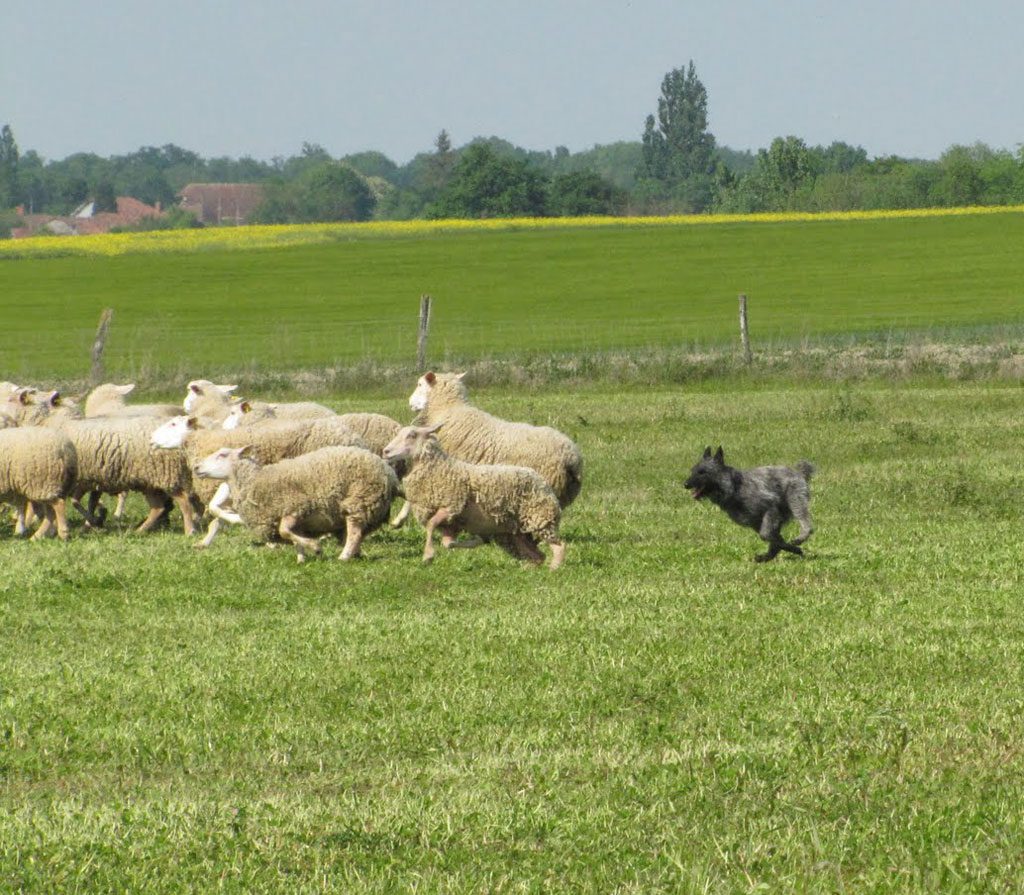
    Boyero de Flandes

    The strong herding instinct of the Bouvier des Flandres manifests itself with its own family

    Content

    History

    Bouvier des Flandres It is a breed of dog of Flanders, It is one of the three regions of Belgium, Wallonia and the Brussels region (Capital of Belgium and Flanders). It is known as Bouvier des Flandres and Toucheur de Boeuf en francรฉs, Vlaamse Koehond in flamenco and Vuilbaard in German.

    There are many disputes as to its origin. For the French, This Boyero comes from the crossing of the Griffon with the old Pastor of Beauce. Belgians claim that it descends from the Boyero Roeselare, certainly it intervened in the construction of the race after extinction after the second world war. The FCI has attributed both origins to this dog, the region of Flanders is part French and part Belgian.

    Physical characteristics

    Traditionally used as cattle herding dog and a guard dog, the Sennenhund Flanders, It is a dog of large size and with the body covered with an abundant layer of long hair. There are several colorations, ranging from light brown (leonado) into the black, passing through several shades of gray, "salt and pepper" and chocolate. The validity in different colors of fur contest is determined by the different associations canรณfilas.

    Boyero Flanders is a robust dog, powerful appearance and large size but without showing clumsiness or heaviness. His most notable feature is his impressive head, accentuated by a bushy beard and moustache. The ears and tail times are cut, Although this practice is falling into disuse. The weight can vary between 36 and 45 kg, the height to cross between 60 and 69 centimeters.

    Bushy fur has a underlying layer and can be anything from a up black Griffon, requiring constant grooming and, in the case of dogs in competition, cut each 6 u 8 weeks.

    Character and skills

    Boyero Flanders has a stable temperament; never shy but never aggressive. It is a worthy dog, calm, rational and, wisely, bold. As dog and surveillance, It may be suspicious and protective with their family or herd.

    His strong herding instinct is manifested with his own family, especially if children are included.

    It is an intelligent dog, He learns fast, although it is also easily bored so it requires constant stimulation and obedience training is essential.

    It is a relatively healthy breed and little predisposed to specific ailments. Like all large breeds it is susceptible to Dysplasia of hip and gastric torsion, and sometimes there may be problems of cataract.

    Characteristics "Bouvier des Flandres"

    Coexistence is important that you have with your new friend. Before considering the acquisition of a dog of the breed "Bouvier des Flandres" you know certain factors. Not all breeds of dogs are apt to live in an apartment, you must take into account his character, their need for exercise, their interaction with other pets, their care and if you have small children, their level of tolerance towards them.

    Adaptation โ“˜

    5,0 of 5 stars (based on 1 review)

    friendly dog โ€‹โ€‹โ“˜

    3,0 of 5 stars (based on 1 review)

    hair loss โ“˜

    3,0 of 5 stars (based on 1 review)

    Affection level โ“˜

    5,0 of 5 stars (based on 1 review)

    Need for exercise โ“˜

    3,0 of 5 stars (based on 1 review)

    Social need โ“˜

    3,0 of 5 stars (based on 1 review)

    Home โ“˜

    1,0 of 5 stars (based on 1 review)

    Toilet โ“˜

    5,0 of 5 stars (based on 1 review)

    Friendly with strangers โ“˜

    2,0 of 5 stars (based on 1 review)

    barking โ“˜

    5,0 of 5 stars (based on 1 review)

    Health โ“˜

    3,0 of 5 stars (based on 1 review)

    Territorial โ“˜

    5,0 of 5 stars (based on 1 review)

    Cat friendly โ“˜

    3,0 of 5 stars (based on 1 review)

    Intelligence โ“˜

    5,0 of 5 stars (based on 1 review)

    Versatility โ“˜

    5,0 of 5 stars (based on 1 review)

    Child friendly โ“˜

    5,0 of 5 stars (based on 1 review)

    Surveillance โ“˜

    3,0 of 5 stars (based on 1 review)

    joy โ“˜

    5,0 of 5 stars (based on 1 review)

    Pictures Bouvier des Flandres

    Videos Bouvier des Flanders

    Type and recognitions:

    • FCI CLASSIFICATION:
    • Group :
    • Section : . .

    Federations:

    FCI โ“˜, AKC โ“˜, ANKC โ“˜, CKC โ“˜, โ€‹KC โ“˜, NZKC โ“˜, UKC โ“˜

    FCI breed standard Bouvier des Flandres

    FCIFCI - Bouvier des Flandres
    Cattle

    Alternative names:

    1. Flanders Cattle Dog, Vlaamse Koehond (English).
    2. bouvier des Flandres (French).
    3. Bouvier des Flandres (German).
    4. Boiadeiro das Flandres (Portuguese).
    5. Boyero de Flandes (espaรฑol).