โ–ท The world of Pets: Dogs, cats, birds, reptiles, amphibians

Dutch Smoushond
Holanda FCI 308 . Pinscher and Schnauzer type

Ratonero Dutch

Content

The Dutch Smoushond was born to follow the horse and rider, and catch the rats in the blocks.

History

The Dutch Smoushond is a very ancient race. Its name derives from the term smous (mouse), because among their tasks it has always been found to hunt these rodents.

By mid-century 19 he was very popular with the upper middle class in the Netherlands following the carriages and horses and as a rat catcher in the stables. Although the origin of the breed is uncertain, it is generally believed that the Yellow schnauzer was one of the original dogs in the creation of this breed. A dog trader sold the dog as "The Knight of the Stables Dog" to tourists from commodity exchanges in Amsterdam. Quickly the name changed to โ€œSmousโ€, rough barbarian, This distinguished him from Griffon Bruxellois. The first standard dates from 1905, was written by Messrs H.A. Earl of Bylandt, A. Woltman Elpers y L. Seegers. After a long period in which the popularity and public interest decreased, the last litter was recorded in the Dutch Record Book (Dutch Dog Studbook) in 1949. In 1973, la Sra. H.M. Barkman van der Weel took the initiative to rebuild the breed. It started with a cross looking like a Dutch Smoushond. FCI-St. Nยฐ308 / 16.03.2012 3 Since 1978 interest in Dutch Smoushond is protected by the Hollandse Smoushonden Club. In 1980 the standard of 1905.

In the news, puppies of this breed are very difficult to get outside of the Netherlands.

Physical characteristics

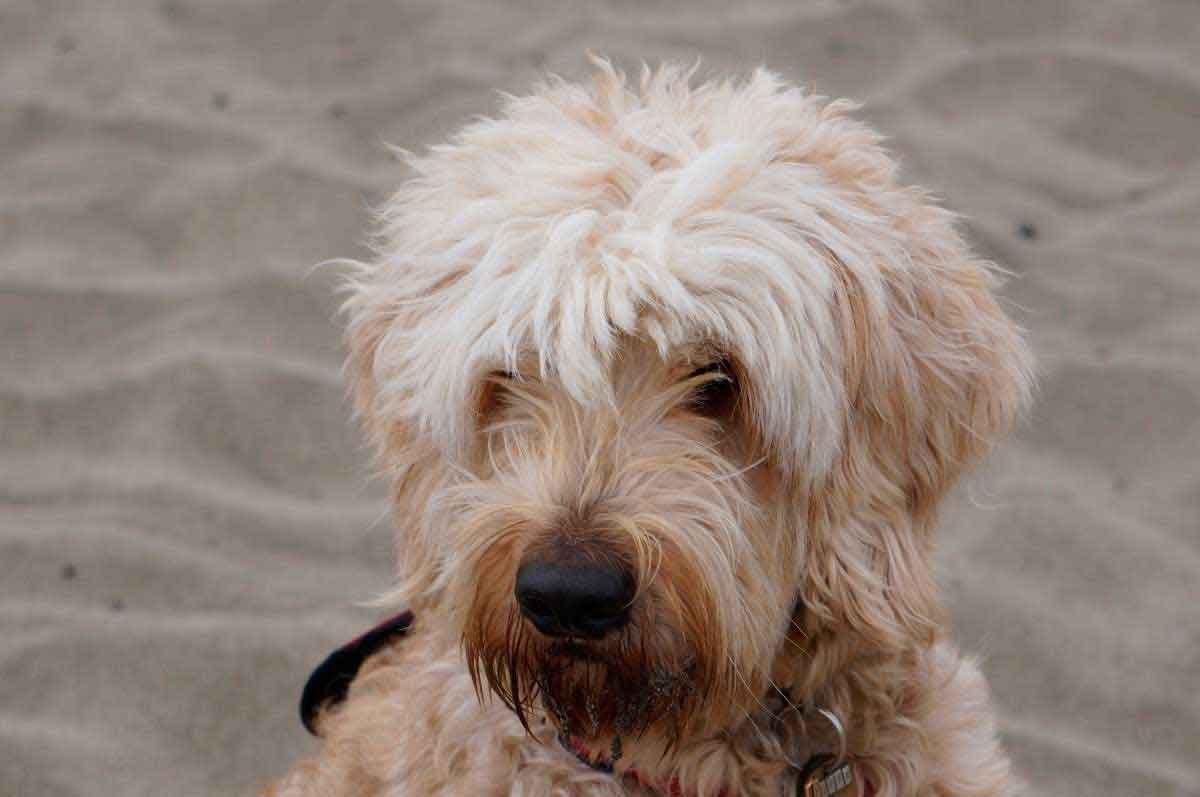
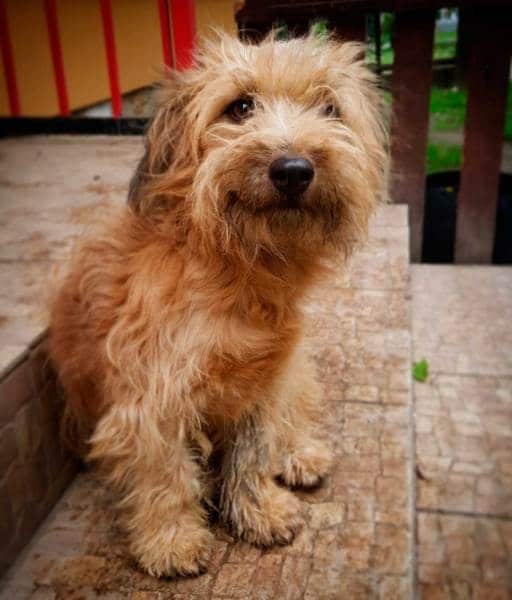
It is an agile dog, whose silhouette is inscribed in a square, It should not be thick or heavy. The eyes are characteristic of the breed, with a lively and benevolent expression, large, round and dark colored, the ears, inserted high, they fall forward and rest on the cheeks; they are small, thin and triangular in shape, with the end slightly rounded. The tail should be quite short, with a happy demeanor, but not coiled on the back. Can be cut to 2/3 its length.

  • Fur: on the body it is thick, enough, hard, straight, shaggy looking. In the extremities it has an average length, not tight but turned inward suggesting locks. Over the head is shorter, with mustaches, beard and longer eyebrows.
  • Color: yellowish along with all its gradients; straw yellow is preferable.
  • Size: males, of 37 to 42 cm.; females, of 35 to 40,5 cm..

Character and skills

The Dutch Smoushond was born to follow the horse and rider, and catch the rats in the blocks, the Dutch Smoushond has an affectionate character, joyful, friendly, always comfortable with everyone, fearless or very nervous. It is a perfect family dog, friendly and easy to educate.

Images "Dutch Smoushond"

Dutch Smoushond Videos

Type and recognitions:

  • FCI CLASSIFICATION:
  • Group :
  • Section : . .

Federations:

  • FCI – Pinscher and Schanuezer dogs. Molossian type Dogs and Swiss Mountain and Cattle Dogs. , Section 1: Pinscher and Schnauzer. โ“˜
  • UKC – Terrier Group. โ“˜

FCI breed standard Dutch Smoushond

FCIFCI - Dutch Smoushond
Buzzard

Alternative names:

  • Dutch Ratter, Hollandse Smoushond (English).
  • Hollandse Smoushond (French).
  • Hollรคndischer Rattler, HOLLร„NDISCHER SMOUSHUND (German).
  • Hollandse Smoushond (Portuguese).
  • Smoushond holandรฉs, Perro ratonero holandรฉs (espaรฑol).

Photos:

1 – Dutch buzzard by https://pxhere.com/en/photo/1424539
2 – Dutch buzzard by https://pxhere.com/es/photo/1581327
3 – Dutch buzzard by https://pxhere.com/es/photo/1061995
4 – Dutch buzzard by https://pxhere.com/es/photo/1426949
5 – Dutch buzzard by gwendolenFlickr

โ–ท The world of Pets: Dogs, cats, birds, reptiles, amphibians

Croatian Sheepdog
Croacia FCI 277 . Sheepdogs

Croatian Sheepdog

With a great instinct for working with the herd.

Content

History

The Croatian Sheepdog It was described for the first time in 1374 by the Croatian bishop Peter Bichof. According to some sources, the breed was created in the eastern part of Slavonia, the vast agricultural plain of Croatia, to act as a guard and herding dog. Peter Bichof stated that the Croatian Sheepdog It was imported from the East by the Croats around the 7th century.

It was the vet Stjepan Romic, considered the father of the race, who initiated the systematic breeding of the Croatian Sheepdog in 1935 en Djakovo (Croatia). His role was all the more important since he had previously carried out various investigations on the dog and had managed to unearth writings dating from various periods of the 18th century.. These documents describe the Croatian Sheepdog as it is known today.

The breed was officially presented at 1949 in Zagreb (Croatia), and the first standard of the Croatian Sheepdog was written by Otto Rohr in 1951. He was recognized by the International Cynological Federation (FCI) in 1967, later for him United Kennel Kingdom (UKC) in 2006 and, finally, by the American Kennel Club (AKC) and Central Canine Society (SCC).

Despite this recognition by the main canine organizations in the world, the Croatian Sheepdog has not really spread internationally: it is hardly seen outside of its home country and remains unknown to the general public. These may include, the Central Canine Society (Kennel Club inglรฉs) just signed up 38 Croatian shepherds at the LOF (French Origin Book) between 2010 and 2016, an average of just 5 dogs a year.

Physical characteristics

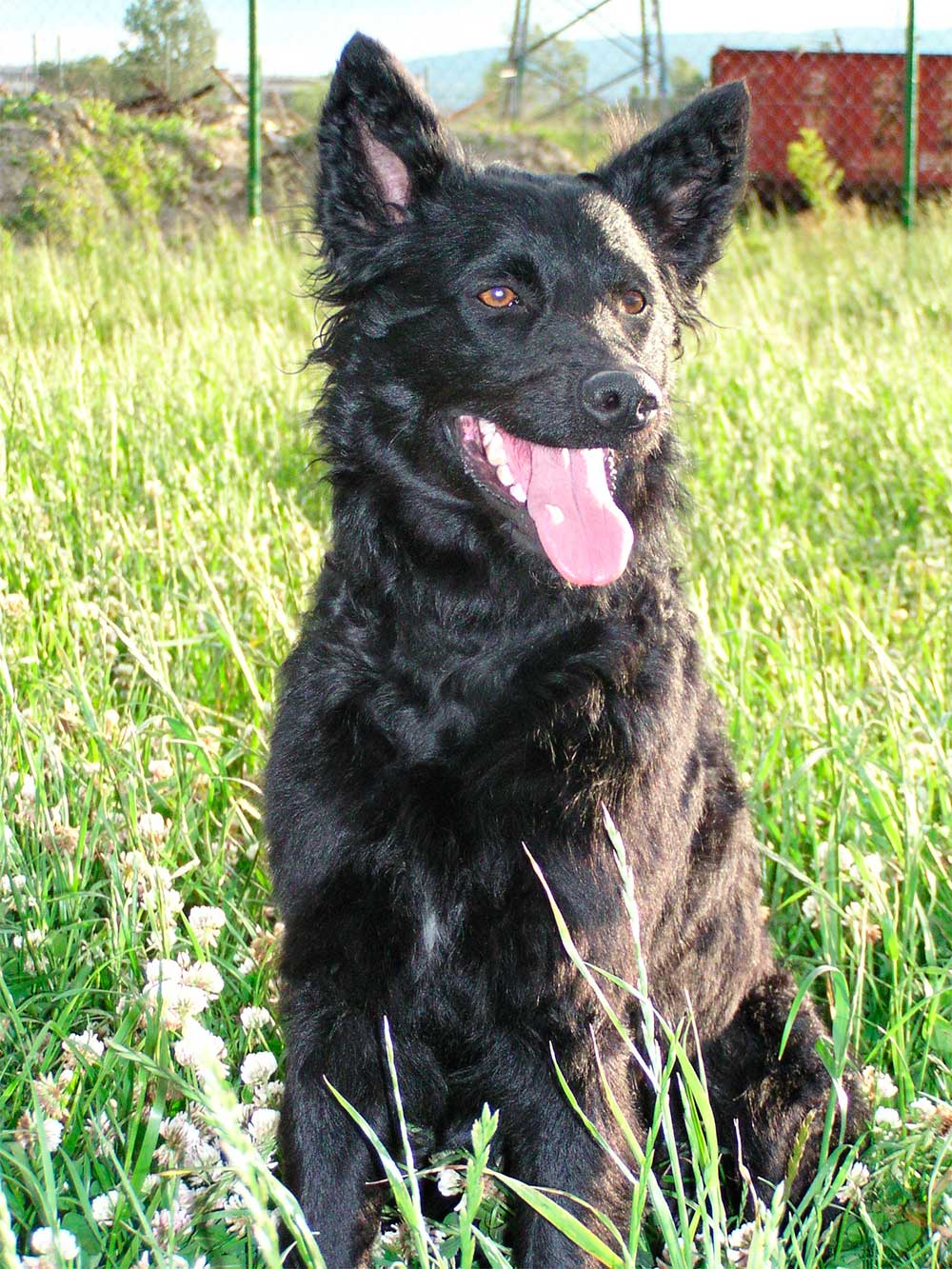
The Croatian Sheepdog is a dog at the lower limit of medium size. Short hair on the head and limbs is the characteristic sign of the breed.. The head is quite light with a cone shape. The stop is poorly marked. The eyes are medium in size, macaroons, with a lively expression; the color goes from brown to black. The ears are triangular, raised or semi-raised, medium length and set slightly to the side. Straight ears are referable and cutting is not allowed. The tail is implanted a little high, with long thick hair. It is cut so that it does not have a length greater than 4 cm in adult error.

  • Fur: hair length is 7 to 14 cm on the spine. The face is always covered with short hairs. The ears have short hair on the outer face and long on the inner. The hair is relatively soft, wavy and even curly. The undercoat must be dense.
  • Color: predominantly black although some white spots on the throat or chest are admitted.
  • Size: of 40 to 50 cm..

Character and skills

The Croatian Sheepdog is lively and alert, without being nervous. They are also smart, brave and loyal.

Very obedient, they are also exclusive: they only have one master, to which they remain very attached and whose attention they demand. In fact, it is necessary for its balance.

Sheepdogs par excellence, has an innate sense of herding and is a very hardy dog. Some ranchers claim that you can knock down all the cattle just by saying their name, no need for further instructions. His approach to the herd is a bit tighter and harsher than that of other sheepdogs, but still very effective. It can bite the animals in its charge, but does not cause injury. This aggressive tendency can be easily worked on during training. It also has the defect of barking easily, especially if his master is absent, hence the importance of training him from a young age.

The dog lives very well with children. Energetic and playful, the Croatian shepherd gets along wonderfully with them and lavishes affection on them. His extraordinary attachment predisposes him to protect them, even to overprotect them. Not just anyone can get close to them. On the other hand, being a dominant dog by nature, can generally only live with other animals (dogs, cats, etc.) if he is used to their company from a young age.

Last, are among the dogs adapted to life in a flat, whenever they carry out intense daily activity. In fact, like all sheepdogs, the Croatian shepherd needs to learn and be stimulated mentally and physically. They have been bred to work with humans and, Therefore, have developed the ability to interact with them, making them a learning breed. If they lack activity, can become noisy and even destructive.

Education

The intelligence of Croatian Sheepdog, its desire to please its owner and its predisposition to work make it an easy breed to train. This workout should be both gentle and firm.

Health

The Croatian Sheepdog has robust health and is very resistant to disease, especially if you spend the nights in the shelter of aboxofdog.In fact, most of his health problems are due to injuries related towork.

But, may be subject to certain canine diseases that more generally affectactive and energetic dogs:

  • Theknee patella luxation: the joint swells and becomes painful, with early appearance of acanine arthritis.Treatment can range from the occasional use of pain relievers to knee surgery. It is a common disorder inshepherds dogs, they are very active.
  • Thetorsion of the stomach: all dogs can be affected by this disease, but croatian shepherds, they areBig Dogsand they exercise a lot, they are particularly vulnerable.
  • Last, females may have difficulty giving birth. If so, this implies endangering not only the dog, but also to unborn puppies, it is usually necessary to perform a cesarean section under general anesthesia., an owner who wantsraise your bitchYou should think carefully before consulting themating offers.This is a decision that should not be taken lightly., for both financial and safety reasons.

Life expectancy

12 to 14 years

Grooming

All owners of a Croatian Sheepdog they should brush their dogs regularly to remove dead hair and detangle pups. During the moulting season (Spring and autumn), this brushing should be done even once a day.

If your dog has gotten too dirty due to the weather and / or his activity, it is necessary to give him a bath. But, this should not be done at regular intervals, since the bath irritates the skin of the animal and removes the oil layer that protects its fur. So, the rule is to avoid bathing the dog, except when really necessary.

It may also be necessary to trim the dog's nails. But, if your pet does his daily exercise, this should not be the case, because dirt or harder surfaces will naturally erode them.

It also, do not forget to deworm and vaccinate your dog regularly. How your dog is often outdoors for long periods of time, and is in frequent contact with other dogs and animals, are more likely to come into contact with many bacteria and viruses.

Price

The price of a puppy Croatian Sheepdog is usually between 800 and 1000 EUR.

Characteristics "Croatian Sheepdog"

Coexistence is important that you have with your new friend. Before considering the acquisition of a dog of the breed "Croatian Sheepdog" you know certain factors. Not all breeds of dogs are apt to live in an apartment, you must take into account his character, their need for exercise, their interaction with other pets, their care and if you have small children, their level of tolerance towards them.

Adaptation โ“˜

4,0 of 5 stars (based on 1 review)

friendly dog โ€‹โ€‹โ“˜

4,0 of 5 stars (based on 1 review)

hair loss โ“˜

3,0 of 5 stars (based on 1 review)

Affection level โ“˜

4,0 of 5 stars (based on 1 review)

Need for exercise โ“˜

2,0 of 5 stars (based on 1 review)

Social need โ“˜

3,0 of 5 stars (based on 1 review)

Home โ“˜

3,0 of 5 stars (based on 1 review)

Toilet โ“˜

1,0 of 5 stars (based on 1 review)

Friendly with strangers โ“˜

4,0 of 5 stars (based on 1 review)

barking โ“˜

4,0 of 5 stars (based on 1 review)

Health โ“˜

3,0 of 5 stars (based on 1 review)

Territorial โ“˜

5,0 of 5 stars (based on 1 review)

Cat friendly โ“˜

3,0 of 5 stars (based on 1 review)

Intelligence โ“˜

4,0 of 5 stars (based on 1 review)

Versatility โ“˜

4,0 of 5 stars (based on 1 review)

Child friendly โ“˜

4,0 of 5 stars (based on 1 review)

Surveillance โ“˜

4,0 of 5 stars (based on 1 review)

joy โ“˜

4,0 of 5 stars (based on 1 review)

Type and recognitions:

  • FCI CLASSIFICATION:
  • Group :
  • Section : . .

Federations:

  • FCI โ“˜
  • UKC โ“˜
  • AKC โ“˜

FCI breed standard Croatian Sheepdog

FCIFCI - Croatian Sheepdog
Pastor

Alternative names:

1. Hrvatski ovฤar, Kroatischer Schรคferhund (English).
2. Berger de Croatie (French).
3. Kroatischer Schรคferhund (German).
4. Hrvatski Ovฤar (Portuguese).
5. Perro de pastor croata (espaรฑol).

Photo:

croatian sheepdog Mawlch Gera by Michala Mraฤkovรก / Public domain

โ–ท The world of Pets: Dogs, cats, birds, reptiles, amphibians

Dutch Shepherd
Holanda FCI 223 - Sheepdogs.

Dutch Shepherd

The most widespread variety of Dutch Shepherd she is the one with long hair, but the breed is almost unknown outside the Dutch borders.

Content

History

The Dutch shepherd descends directly from the belgian shepherds, who looks a lot like (including subdivision into three hair varieties).

Originally the main function of the Dutch shepherd It was typical of a country shepherd dog. From the earliest times the Dutch had an agricultural culture, among others, made up of flocks of sheep. The dogs had to keep the flock away from the sowing, which they did patrolling the borders of the road and the fields. They also accompanied the transfer of the herd to the common meadows, markets and ports. In the farm, they kept the chickens out of the kitchen yard, cows were herded for milking and the milk cart was pulled. They also alerted farmers if anyone entered. About 1900, the herds had almost disappeared in the Netherlands. The Dutch Shepherd's versatility made him suitable for training, which at that time was beginning to become popular. Thus began a new career as a police dog., search and rescue and as a guide dog for the blind. In any case, he is still capable of herding herds.. The first breed standard dates from 12 in June of 1898.

Physical characteristics

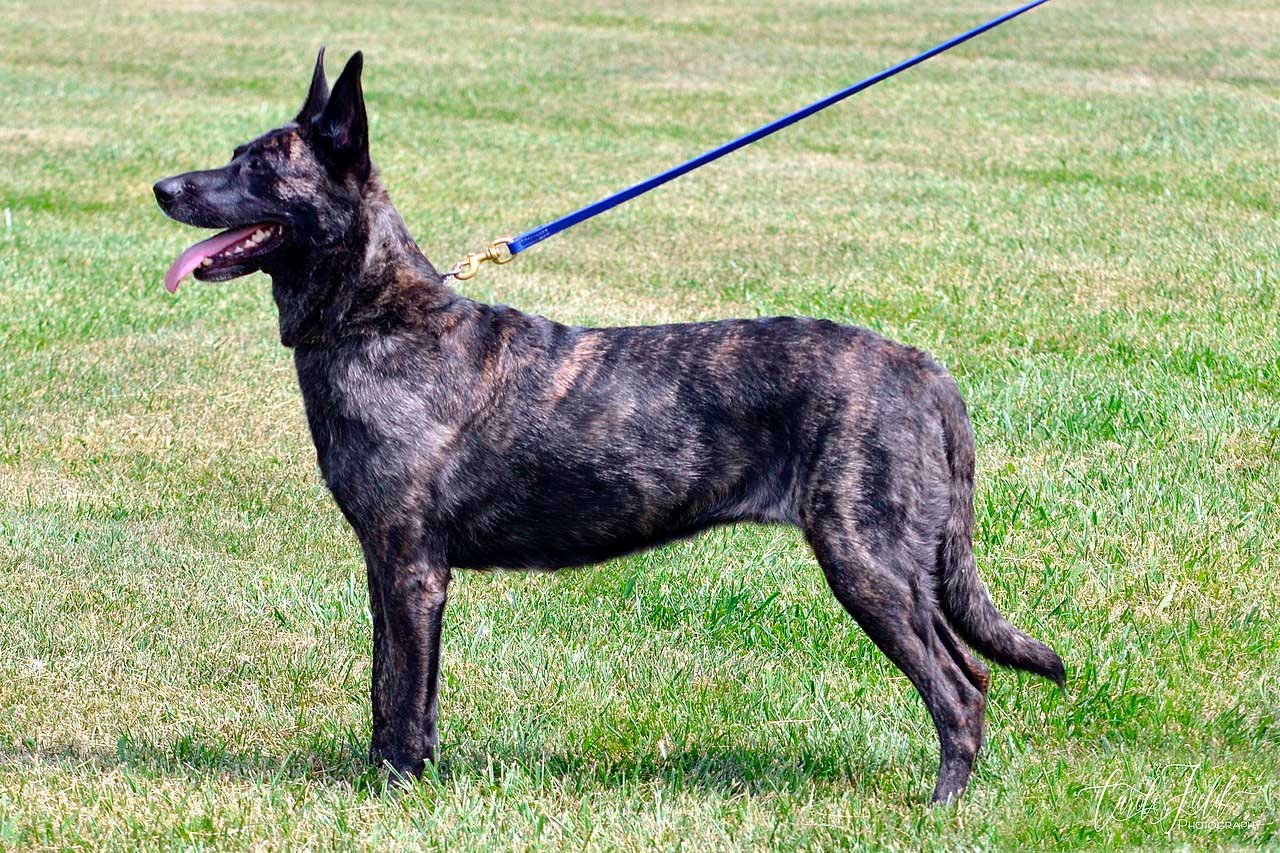
It is a dog of medium size and weight, quite muscular, Powerfully built and well proportioned. His expression is intelligent and temperament, live. The eyes are dark in color, medium-sized, macaroons, somewhat oblique and never round. The ears, smaller than big, they are straight and facing the front, and inserted high. The tail, that at rest hangs straight or forms a slight curve, reaches the tip of the hock. When it is active, the dog is elegantly elevated, never coiled; never falls on the sides.

  • Fur: the short-haired variety has a well attached coat; the long-haired one has straight hair, and the variety of hard hair has it thick and hard; on the head it forms prominent eyebrows, mustaches and beard. Depending on the cloak, in the breed there are three varieties: shorthair, long and hard.
  • Color: striated but the least intensely, on brown background (golden fluted) or gray (fluted gray). The stripes are less evident in hard-haired specimens. Black mask is preferable.
  • Size: males, of 57 to 62 cm.; females, of 55 to 60 cm..

Character and skills

Affectionate, obedient, docile, vigilant, trustworthy, undemanding and very resistant. Always watch out, active and endowed with the true nature of a shepherd dog. It is a little less reactive and less nervous than Belgian Shepherd, the one who looks like, However, even in character.

The Dutch Shepherd works willingly with his master and is able to cope with any task assigned to him.
Herding larger herds must have the ability to work in conjunction with various other dogs..

Characteristics "Dutch Shepherd"

Coexistence is important that you have with your new friend. Before considering the acquisition of a dog of the breed "Dutch Shepherd" you know certain factors. Not all breeds of dogs are apt to live in an apartment, you must take into account his character, their need for exercise, their interaction with other pets, their care and if you have small children, their level of tolerance towards them.

Adaptation โ“˜

4,0 of 5 stars (based on 1 review)

friendly dog โ€‹โ€‹โ“˜

3,0 of 5 stars (based on 1 review)

hair loss โ“˜

3,0 of 5 stars (based on 1 review)

Affection level โ“˜

4,0 of 5 stars (based on 1 review)

Need for exercise โ“˜

5,0 of 5 stars (based on 1 review)

Social need โ“˜

3,0 of 5 stars (based on 1 review)

Home โ“˜

3,0 of 5 stars (based on 1 review)

Toilet โ“˜

3,0 of 5 stars (based on 1 review)

Friendly with strangers โ“˜

4,0 of 5 stars (based on 1 review)

barking โ“˜

2,0 of 5 stars (based on 1 review)

Health โ“˜

4,0 of 5 stars (based on 1 review)

Territorial โ“˜

5,0 of 5 stars (based on 1 review)

Cat friendly โ“˜

3,0 of 5 stars (based on 1 review)

Intelligence โ“˜

5,0 of 5 stars (based on 1 review)

Versatility โ“˜

4,0 of 5 stars (based on 1 review)

Child friendly โ“˜

4,0 of 5 stars (based on 1 review)

Surveillance โ“˜

4,0 of 5 stars (based on 1 review)

joy โ“˜

4,0 of 5 stars (based on 1 review)

Images "Dutch Shepherd"

Videos "Dutch Shepherd"

Type and recognitions:

  • FCI CLASSIFICATION:
  • Group :
  • Section : . .

Federations:

  • FCI – Group 1 Herding dogs, Section 1 Sheepdogs โ“˜
  • AKC – PASTORAGE โ“˜
  • ANKC – Group 5 (working dogs) โ“˜
  • โ€‹KC – Pastoral โ“˜
  • NZKC – Working dog โ“˜
  • UKC – Herding dogs โ“˜

FCI breed standard Dutch Shepherd

FCIFCI - Dutch Shepherd
Pastor

Alternative names:

1. Dutch Herder, Hollandse Herder (English).
2. Berger hollandais (French).
3. Hollรคndischer Schรคferhund (German).
4. Pastor holandรชs (Portuguese).
5. Perro de pastor holandรฉs (espaรฑol).

Photos:

1 – Short-haired Dutch Shepherd stacked by CaroleField / CC BY-SA
2 – Silverbrindle and goldbrindle are the approved colors of the breed by Lissunmusta / CC BY-SA
3 – Short-haired brindle male Dutch Shepherd named Black, 2 years old, owned by Jason Paluck by Wikipedia
4 – Adult brindle Dutch shepherd by https://www.pikrepo.com/fyvdb/adult-brindle-dutch-shepherd
5 – dutch shepherd by https://www.peakpx.com/504961/dutch-shepherd
6 – Dutch shepherd by https://pxhere.com/en/photo/1387398
7 – Neros van Guard is a Dutch Shepherd imported from Canada to the USA by Ulyseemuff / CC BY-SA

โ–ท The world of Pets: Dogs, cats, birds, reptiles, amphibians

Huntaway
Nueva Zelanda Not recognized by the FCI

Content

History

Huntaway (New Zealand Huntaway or New Zealand Sheepdog) It is a breed of dog native of New Zealand What, Since its early inception, they were used to drive vast herds of sheep using their strong and deep bark. The breed is relatively new, its existence dates back to the Decade of 1900.

Although it is currently widely considered a separate breed within working dogs and has not yet been recognized by any kennel club.

The true story of the origin of the breed Huntaway, also known as New Zealand Sheepdog, not exactly known but yes, there are many theories that sheds light on it.

The Huntaway It was used (and uses) in all New Zealand to lead and manage the massive flocks of sheep. Currently, These dogs are considered part of the heritage of New Zealand, although they are not recognized as a breed by any kennel club.

The sheep were introduced in New Zealand, because the humid and temperate climate made it a favorable place for the development of this cattle. The climatic characteristics mean that rainfall extends throughout the year and that these large flocks of sheep have rich pastures always available to feed on..

Before he Huntaway get fame, small herds were managed by dogs Collie that had been introduced into the national territory. As time passed, the herds grew to massive proportions and it was then, when the dogs Collie they were not able to cope with such development.

many things came together, the long hair of the Collie, the hot and humid climate, their silent work that as the herds grew became ineffective… Because, the passage of time and livestock development demonstrated that these dogs are tired at high speed, they lacked resistance and their silent way of working meant that the shepherd did not know where his dogs were. Yโ€ฆ, chaos was born.

The farmer often (given the size of herds) could be found almost a kilometer away from (on the other side of the herd), years. At that time, what I needed was a dog of short hair that is adapted to the climate without difficulty, with resistance and that could be heard at great distances. From these needs arose the birth of the Huntaway.

Some studies of dog breeds maintain that the early introduction of the Collie and other races, led ranchers to start breeding programs, in order to create a dog with the qualities needed to work with massive flocks. They think that within the crosses have been present races as the Beauceron, the Bloodhound, the German Shepherd, the Labrador Retriever and the Rottweiler, but this is only a conjecture. The race Huntaway exists only ago 100 years… and it has not delved too.

Physical characteristics

Huntaway
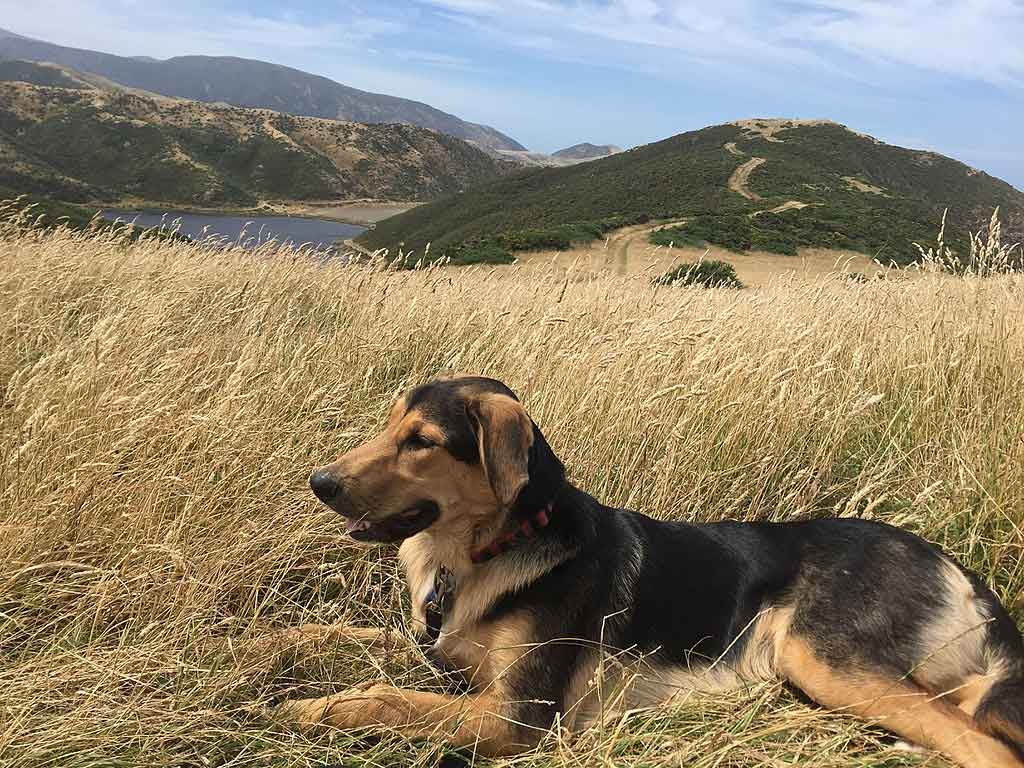
8 month old Huntaway in Wellington, New Zealand –

The Huntaway they are large dogs, they usually weigh in of 18 to 29,5 kg and its height to cross varies between the 51 and 61 cm..

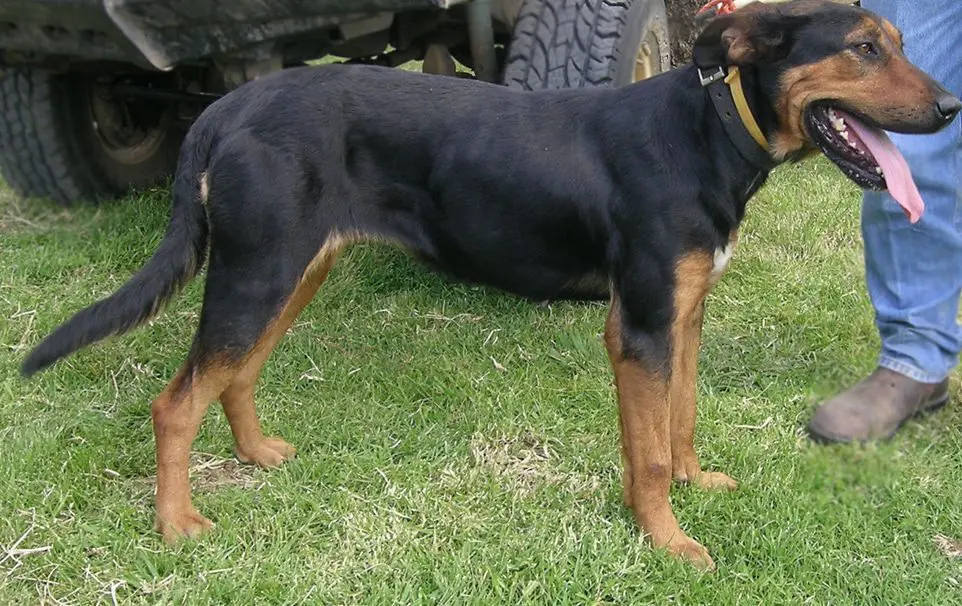
The color their coat may vary, common colors are solid black, black and tan (is expected), Black with some white or striped. The layer can also be of different textures, It can be smooth or wavy, and the hair can be short or long, the ears are medium-sized and slightly pendants.

The life expectancy of a Huntaway is of 12 to 14 years of age.

Character and skills

The Huntaway they are very smart and single owner. It has an admirable resistance, you can run all day and not show any signs of fatigue. They are easy to train and very vocal, It can be taught to bark at the order of his master. Usually, They are not usually kept as pets, because they are โ€“mainly- working dogs. But in recent years they have begun to enjoy great popularity and it is common to see them in homes.

as we said, they are intelligent, kind, very energetic, active dogs that require a lot of exercise. They have been bred to guide sheep by the hills and mountains of New Zealand, where it is difficult to walk or ride, What hand signs and whistles are used to communicate orders to these dogs when they are at a distance.

They are known for being noisy dogs, especially when working.

Thanks to its grazing conditions the breed Huntaway has gained popularity all over the world, in Japan the first Club of the New Zealand Huntaway. In Australia they are widely used for sheep work.

A municipality located 184 km to the North of the capital of New Zealand (Wellington) call Hunterville It is very famous for its statue of a dog breed Huntaway. There every year they offer a special tribute to the breed, the holiday is celebrated on the first Saturday after Labor Day, they are games and competitions, races between pastors and their Huntaway dogs. It is a very important holiday because shepherds who travel from all over New Zealand meet there..

Videos "Huntaway"

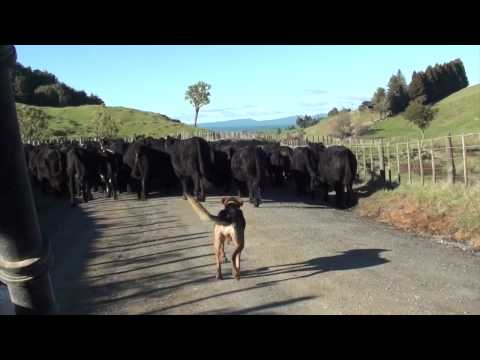
Les Huntaway Dog By Hugh Pickett

New Zealand herding

in the