โ–ท The world of Pets: Dogs, cats, birds, reptiles, amphibians

Petit Basset Griffon Vendรฉen
Francia FCI 67 . Small-sized Hounds

Basset Grifรณn Vandeano pequeรฑo

The Petit Basset Griffon Vendรฉen is a very strong race.

Content

History

The Petit Basset Griffon Vendรฉen It is a small size hunting dog (Petit), under (basset), hard hair (griffon) of French origin (in the region of the Vendรฉe), mainly used for hunting rabbits with his great sense of smell.
It was developed from the Grand Basset Griffon Vendรฉen, larger copy, heavy and long.

In the past, often to raise both races together. In 1975 are prohibited from crossing them, although puppies with characteristics of both breeds could still be born in the same litter. In France, It was a popular hunting dog for nearly a century (origin s. 16TH); However, the breed is relatively new in other regions.

Physical characteristics

Medium-sized, its height varies between the 33 and 38 cm and his weight between the 16 and 20 kg.
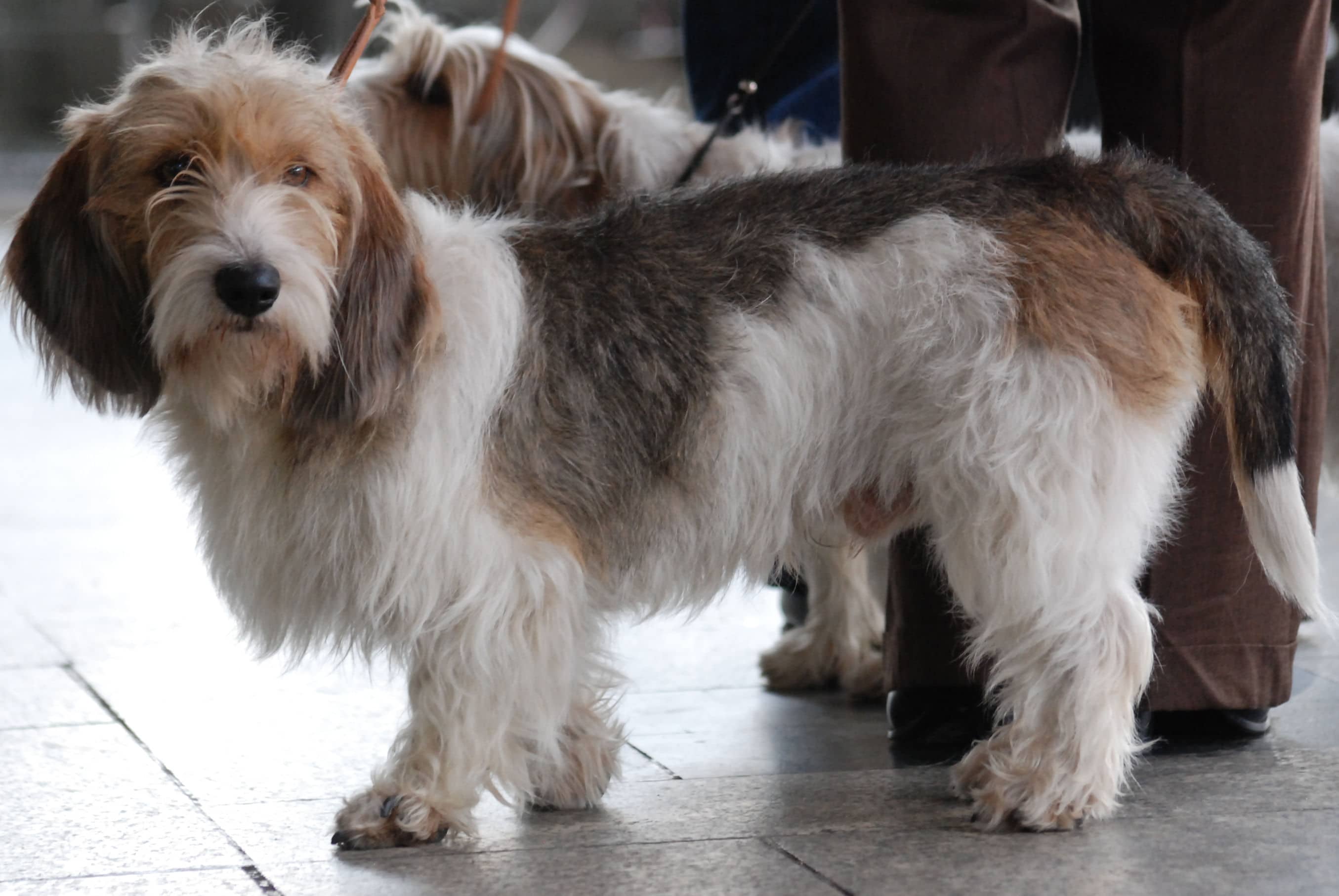
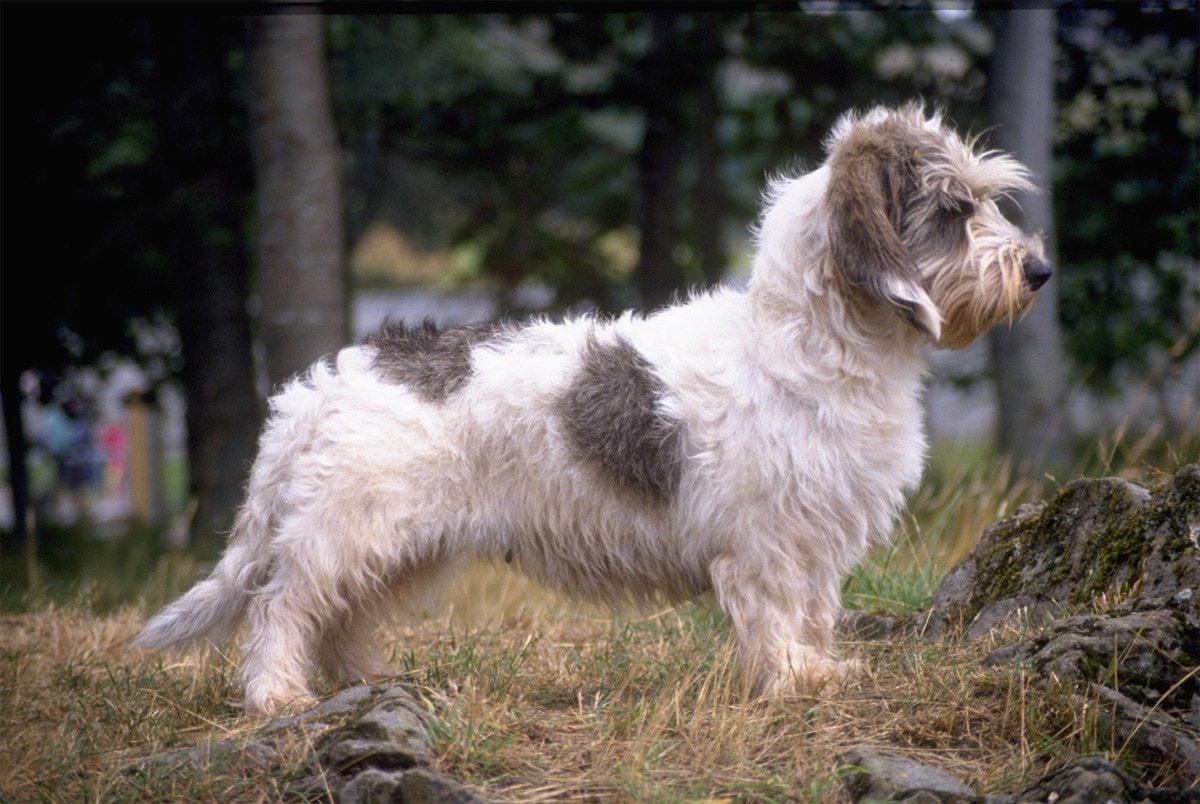
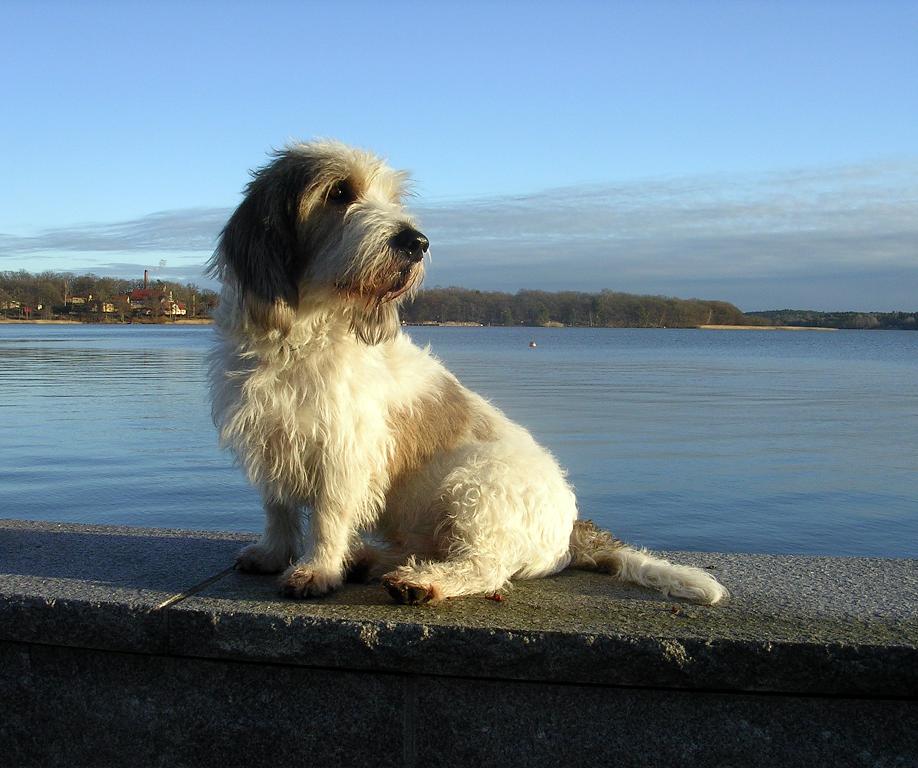
It is a small dog, rustic. Its aspect is neglected and natural. It has hard and rough hair with eyebrows, beard and whiskers woolly. White base, with black spots, Orange or grey.

Is well proportioned and is approximately a 50% longer than high. Wide tail at base, decreasing towards the tip thickness. It keeps it erect. Their ears are covered with hair; they are long but fail to reach the tip of the nose. Large nostrils. Its back is straight and slightly arched over the lumbar area.

It has large fame of Digger, jumper and escape expert, so you have to keep it in a safe enclosure.
Usually, is happy, friendly and always busy in their explorations. He is intelligent and can be stubborn. It's funny and has many security. Jealous and playful. Pretty crook.

Character and skills

He is good with children and quite friendly with strangers and although his obstinacy, it is a bit difficult to train, is not especially dependent or independent. Their dominance is moderate.

He is good with other dogs, but by his hunting instinct, It is not reliable with other pets. Being of small size, has a very loud bark, and tends to the howl.

Very strong race; serious genetic diseases are not known. prone to ear infections. Times, allergies have been given to insecticides.

It has hard hair and moved it very little, Although it needs a cleaning and brushing regularly to avoid entanglements.
It requires moderate exercise, being a good companion to run. At home he is very active and can only live in an apartment if he is sufficiently exercised.

As open space, a small garden is enough. Adaptable to most climates, prefer the coldest. Itร‚ยดs suitable for novice owners. Care properly has an average life of 10 to 14 years.

Petit Basset Griffon Vendรฉen pictures

Videos Basset Grifรณn Vandeano small

Alternative names:

Petit basset griffon vendรฉen / Kleiner basset griffon vendรฉen / small basset griffon vendรฉen

Type and recognitions:

  • FCI CLASSIFICATION:
  • Group :
  • Section : . .

Federations:

  • FCI โ“˜
  • AKC โ“˜
  • ANKC โ“˜
  • CKC โ“˜
  • โ€‹KC โ“˜
  • NZKC โ“˜
  • UKC โ“˜

  • FCI breed standard Petit Basset Griffon Vendรฉen

    FCIFCI - Petit Basset Griffon Vendรฉen
    Basset

    โ–ท The world of Pets: Dogs, cats, birds, reptiles, amphibians

    Karelian Bear Dog
    Finlandia FCI 48 - Nordic Hunting Dogs

    Karelian Bear Dog

    The Karelian Bear Dog is a very independent and intelligent dog.

    Content

    History

    The Karelian Bear Dog, which also bears the name of zyrians dog, is considered the progenitor of the breed. But the basic strain of the breed came from the Carelia de Ladoga, the Olonets and the Carelia Rusa, where these dogs were used to hunt in different ways. Breeding started in 1936 with the aim of developing a robust dog that could make noise when hunting big game. At that time it was agreed that the breed name should be Karelian Bear Dog. The first standard was created in 1945. In 1946 the first dogs were registered in the stud book. Today the breed is well established in Finland..

    Physical characteristics

    This four-legged friend has a great similarity to the Laika related to him.

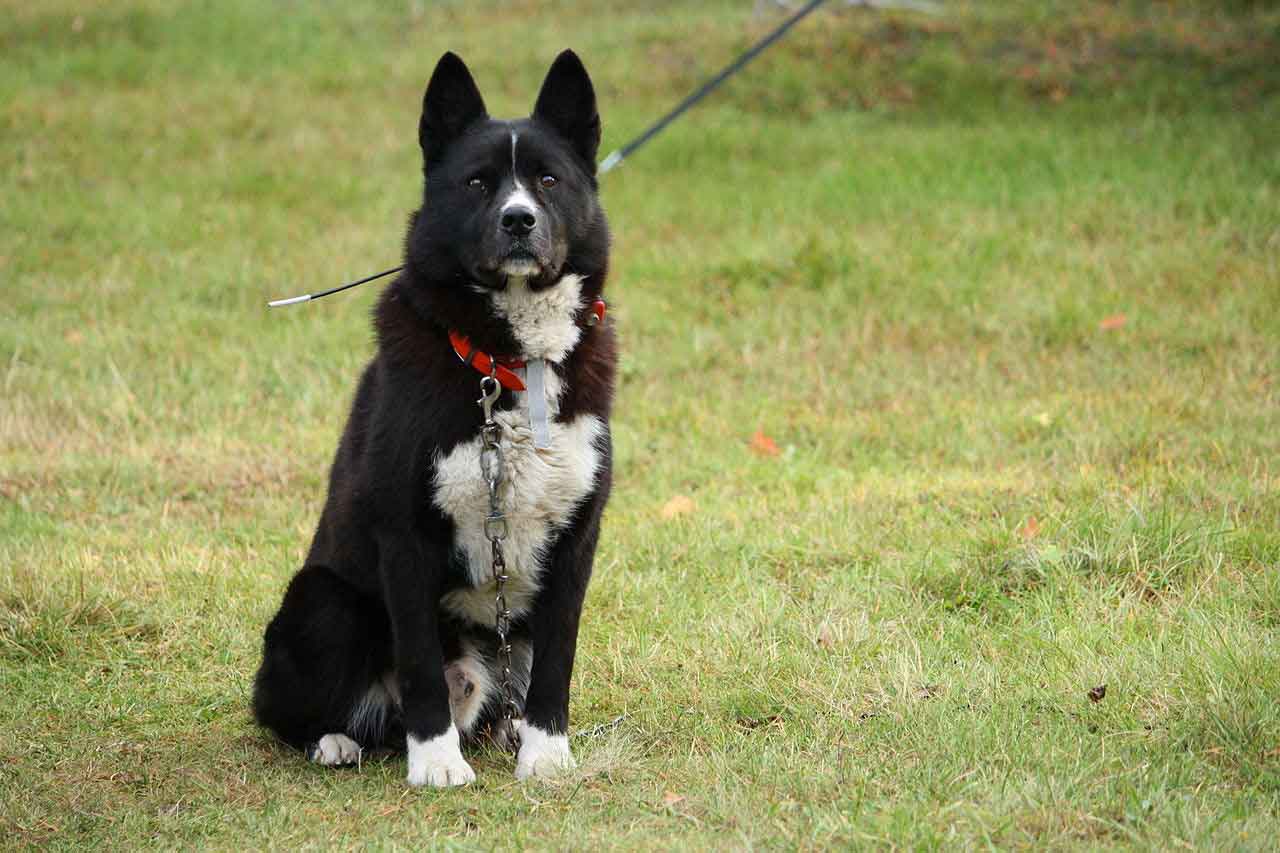
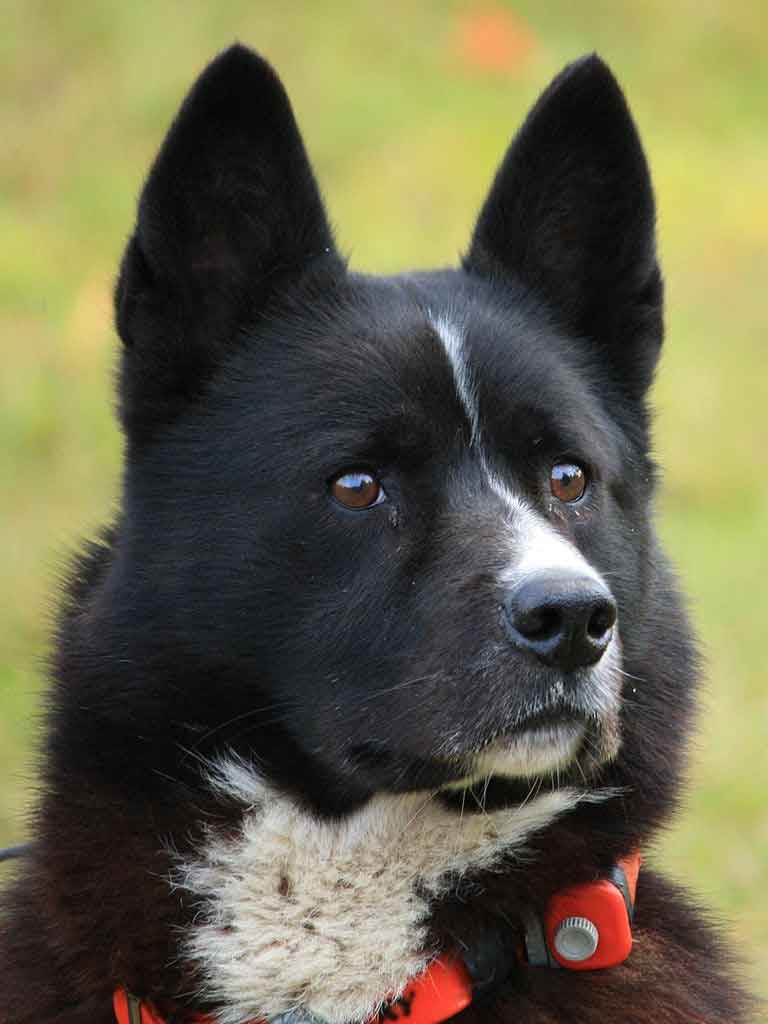
    With a height at the withers of up to 60 cm., males weigh about 28 kg. Bitches are slightly smaller and should not weigh more than 20 kg. The Karelian Bear Dog has a strong trunk and generally a compact and dynamic stature. On his head there are medium and erect ears and he wears a folded tail on his back. The icing on the cake is usually a white tip. Otherwise, dense coat color is usually black with white markings. The rough top layer is very close to the dense undercoat, that glows with a slight brown hue.

    Character and skills

    The freedom-loving character

    This dog loves the vastness of the forest and its independence, a combination that combines his attitude with some challenges, because he'll take any chance to roam free. As this four-legged friend acts very independently during the hunt and must place the game alone, it is also, for the rest, a confident partner, who gladly takes command when the opportunity presents itself.

    He is considered brave and is always ready to defend his loved ones. Contact with other dogs can be problematic without extensive socialization, because some Karelian Bear Dog show aggressiveness when meeting other dogs. But, other owners report their dogs great balance and praise their social compatibility. It is a fact that many Karelian Bear Dog they are also working together as hunting assistants – so with good conditioning and socialization this should not be a problem.

    They are excellent watchdogs, that reliably indicate intruders. Despite all the lovely nooks and edges, the Karelian Bear Dog they also have their soft sides: They are not aggressive with people, they like to be petted at home and they love to be petted by their caregivers.

    Karelian Bear Dog Education<

    Education without subordination

    Its independent nature requires a lot of knowledge, but it should be clear from the start to anyone considering having a Karelian Bear Dog: that this proud quadruped will never be subservient. Their independence reaches such a point that many Karelian Bear Dog they disappear into the woods for days in their native country, just to show up again when it suits him.

    Harshness and yelling are absolutely out of place in training this sensitive dog, which will then retreat or crawl. But, with the right mix of positive reinforcement, empathy and consistent behavior, good daily obedience can be achieved.

    It is important to socialize extensively with other four-legged friends from puppy age onwards., since some Karelian Bear Dog are considered incompatible with other dogs of the same species, what can become problematic on daily trips. It is a challenge to keep this dog available and away from independent hunting trips.. Specialists with experience in dogs of this breed are definitely needed.

    Karelian Bear Dog Health and Nutrition

    The original breed is considered very robust. If you buy it from a serious breeder and pay attention to a balanced and age-appropriate diet- plenty of exercise, your four-legged friend can reach a age up to 13 years.

    Important for a healthy dog รขโ‚ฌโ€นรขโ‚ฌโ€นlife is, of course, also the daily food content. give to you Karelian Bear Dog a high quality food with a high proportion of meat and little grain. The energy needs of your four-legged friend depend on their constitution and daily exercise. So make sure to adjust your food accordingly and keep an eye on her slim waist..

    As in humans, extra kilos increase the risk of various diseases, including painful joint problems. Always provide fresh water. On the longest trips, you should also have enough water for your partner, which is also more sensitive to heat. Visit the vet at least once a year for a checkup with your pet and talk to him about necessary vaccinations and regular deworming.

    Caring for the Karelian Bear Dog

    The fur of this weather-resistant quadruped is easy to care for. But, loses more hair during coat change, so it can be useful to brush it every day, so that less hair is spread around the house. Otherwise, brush it every few days; this ritual also strengthens the bond and should already be practiced with the puppy for a relaxed routine.

    Always check the eyes, your puppy's ears and claws and use a special eye and ear cleaner if necessary. The claws can become too long in dogs that walk a lot on soft ground – or they move too little, what in this quadruped, However, should only occur in very old or diseased specimens. In this case, shorten them with special tweezers.

    Many dog โ€‹โ€‹owners brush their quadrupeds' teeth regularly with dog toothpaste and brush to prevent tartar and associated secondary diseases. You can now practice this with your puppy. Alternatively, you can offer your dog dental care snacks.

    Activities with the Karelian Bear Dog

    Occupation: go out into the woods!

    This four-legged friend's favorite hobby is clearly hunting.: extensive travels through the forest and hunting tracking are his passion. The Karelian Bear Dog seek the game to be hunted almost silently. Once you have reached your destination, barks long and persistently at the hunt to keep it in place until the hunter arrives.

    The Karelian Bear Dog sometimes they hunt in threes, so they can also keep larger animals like bears at bay. The breed does not necessarily have to be hunted. As an alternative to hunting, the karelian bear dog also suitable for dog sports, but in this case you can only do activities that you like. If you enjoy it, Agility sports can be a good activity for a Karelian Bear Dog adult. Also suitable as a companion for jogging or cycling – but you must keep his hunting instinct in check. Most of these excellent crawlers like crawling work of all kinds.

    Is a Karelian Bear Dog right for me??

    The Karelian Bear Dog belong to the hands of seasoned enthusiasts, preferably hunters. Alternatively, need a lot of exercise and outdoor work. Only then is it possible to keep them as family dogs. Dog experience should be available in any case. In addition, you must be clear that this quadruped can only be trained conditionally.. Does not belong to the group of dogs that subordinate to themselves – as a dog owner you must respect this, but still be able to direct their power in a controlled manner.

    The Karelian Bear Dog not in any way suitable for a city apartment. The ideal would be to offer you a leak-proof garden, in addition to the daily run in forests and fields, but beware: the Karelian Bear Dog freedom lover is considered a fugue artist and can jump up to two meters high.

    This four-legged friend likes to befriend children, but they should be older and have learned to treat animals with respect.

    Cats in the same household are not necessarily a good idea, not to mention rabbits or other small animals. The norse hunter you will always see potential prey in them. Of course there are exceptions to the rule and there may even be friendships between Karelian Bear Dog and cats socialized at a young age – but you won't be able to get a guarantee before you move in. So you must bring a lot of time, space and experience if you want this proud dog to move in with you.

    The Karelian Bear Dog is a four-legged friend for connoisseurs, which should not be chosen as a new roommate for its rustic appearance. If you are not looking for a true character head, you will have little joy with this animal roommate. Of course, before moving, it is also necessary to calculate the one-time expenses (buy creator, basic team, travel expenses) and regular expenses (food, veterinary, dog tax and insurance).

    Where can I find a Karelian Bear Dog?

    This breed of dog is found naturally mainly in Scandinavia, especially in finland. Further south there are only a few dogs of this very special hunting breed. In Germany, for example, not a single cub of Karelian Bear Dog in recent years. Special Nordic dog clubs can help you find the dog of your dreams. But, There are some things to consider if you are interested in a puppy from abroad. It's always better if you can get a picture of the puppies' house and meet their parents. The Nordic Dog Experts, who you should contact through the appropriate associations, can advise you if there are possible alternatives to Karelian Bear Dog that suit you, to your life situation and your wishes. Or you can refer them to the breeders of Karelian Bear Dogs, if there is currently no one in your country who will have a litter in the near future.

    Characteristics "Karelian Bear Dog"

    Coexistence is important that you have with your new friend. Before considering the acquisition of a dog of the breed "Karelian Bear Dog" you know certain factors. Not all breeds of dogs are apt to live in an apartment, you must take into account his character, their need for exercise, their interaction with other pets, their care and if you have small children, their level of tolerance towards them.

    Training โ“˜

    1,0 of 5 stars (based on 1 review)

    Suitability of the apartment โ“˜

    1,0 of 5 stars (based on 1 review)

    You can be alone all day โ“˜

    1,0 of 5 stars (based on 1 review)

    Suitable as first dog โ“˜

    1,0 of 5 stars (based on 1 review)

    Weight gain โ“˜

    3,0 of 5 stars (based on 1 review)

    Health โ“˜

    4,0 of 5 stars (based on 1 review)

    Intelligence โ“˜

    4,0 of 5 stars (based on 1 review)

    Kindness with child โ“˜

    3,0 of 5 stars (based on 1 review)

    Tendency to bite โ“˜

    2,0 of 5 stars (based on 1 review)

    Tendency to bark โ“˜

    4,0 of 5 stars (based on 1 review)

    Tendency to flee โ“˜

    5,0 of 5 stars (based on 1 review)

    Hair fall force โ“˜

    4,0 of 5 stars (based on 1 review)

    Suitable as a guard dog โ“˜

    4,0 of 5 stars (based on 1 review)

    joy โ“˜

    3,0 of 5 stars (based on 1 review)

    Kindness with cat โ“˜

    1,0 of 5 stars (based on 1 review)

    energy level โ“˜

    4,0 of 5 stars (based on 1 review)

    Images "Karelian Bear Dog"

    A 10-year-old male Karelian Bear Dog. Head shot with tracking collar around neck by Uusijani / CC0

    Karelian bear dog by Friesian.marcin / CC BY-SA

    Videos "Karelian Bear Dog"

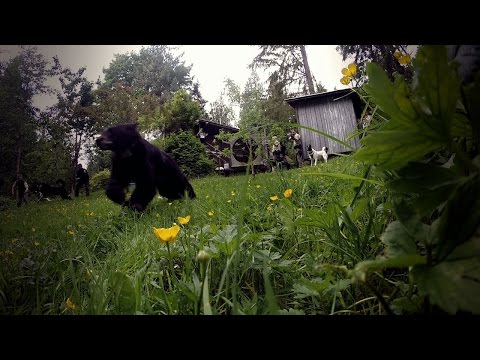
    Watch the Karelian Bear Team in Action

    Type and recognitions:

    • FCI CLASSIFICATION:
    • Group :
    • Section : . .

    Federations:

    • FCI – Group 5 – Section 2 Nordic Hunting Dogs. โ“˜
    • AKC – Nordic Hunting Dogs โ“˜
    • CKC – Nordic Hunting Dogs โ“˜
    • UKC – Nordic Hunting Dogs โ“˜

    FCI breed standard "Karelian Bear Dog"

    Origin:
    Finland

    Date of publication of the valid original standard:
    12.03.1999

    Use:

    It is used mainly for hunting moose and bear. It is very adept at keeping cornered prey barking. He is an enthusiastic and independent hunter, although he cooperates by pointing out with his bark the place where the prey is. All your senses are sharp, especially that of smell, so this breed is useful for hunting big game. Has a very good sense of direction.


    General appearance:

    It is of medium size and robust constitution. It's strong and something longer than tall. The coat is dense and the ears are erect.

    IMPORTANT PROPORTIONS : The length of the body is only slightly greater than the height at the withers.. The depth of the body corresponds to half the height at the withers. The relationship between the muzzle and the skull is about 2 : 3. The length of the skull corresponds approximately to its width and depth.


    Behavior / temperament:

    It is balanced in nature and somewhat reserved. Is brave, persistent and very self-confident. Can be aggresive with other dogs, but never with people. His fighting instinct is highly developed.

    Head:

    Seen from the front, has a triangular shape.

    Cranial region:
    • Skull: Seen from the front, it's wide; in profile, it is somewhat arched. It is wider between the ears. The frontal sulcus is barely visible. Superciliary arches are only poorly developed.
    • Depression links (Stop): Naso-frontal depression is not very pronounced; is rather long and gradually arches towards the skull region.

    facial region:

    • Truffle:Wide, black.
    • Snout: Deep; tapers only a little to the nose. The nasal helm is straight.
    • Lips: They are thin and tight.
    • Jaws / Teeth: The jaws are very strong. The teeth are well developed and symmetrical. Teething is normal and the joint is scissor-shaped.
    • Cheeks: The zygomatic arches are strong.

    Eyes: They are rather small and somewhat oval. In different shades of brown; never yellow. His expression is alert and fiery.
    Ears: They are set high and stand erect. Medium-sized, with slightly rounded tips.

    Neck:

    Muscular, arched and of medium length. It is covered in thick fur. There is no presence of dewlap.

    Body:

    • Cross: It is clearly defined, especially in males. In females, is less defined.
    • Back: Straight and muscular.
    • Pork loin: Short and muscular.
    • Rump: Wide, strong and slightly sloping.
    • Breast : Spacious, not very wide, rather long, reaches approximately to the elbows. The ribs are slightly arched; the sill is well visible, although not very wide.
    • bottom line: Slightly collected.

    Tail:

    High insertion. It is of medium length and hunches over the back; the tip of the tail touches the body on the back or on one of the flanks. Short tail is allowed from birth.

    Tips

    PREVIOUS MEMBERS:

    • As a whole : Robust, for strong bones. Seen from the front, they are straight and parallel. Arm and shoulder blade are the same length; the forearm is a little longer.
    • Shoulder : Relatively oblique and muscular.
    • Arm : It is strong, slightly oblique.
    • Elbows : They point well back and are placed on the vertical line drawn from the highest point of the shoulder..
    • Forearm : Strong and upright.
    • Metacarpus : Slightly oblique and of medium length.
    • Front feet : compacts, well arched. They are rounded in shape and point forward. The pads are flexible and have a dense coat on both sides.

    LATER MEMBERS:

    • As a whole : Strong and muscular. Seen from the back, they are straight and parallel. The front line of the hind limb forms a harmonious arch.
    • Thigh : Width, long, of strong muscles.
    • Knee : Point to the front. It is of medium angulation.
    • Leg : She is long and muscular.
    • Hock : Low. Angulation is clearly visible.
    • Metatarsus : Short, strong and vertical.
    • Rear feet : They are compact and a bit longer and less arched than the front ones. The pads are flexible and have a dense coat on both sides.

    Movement:

    It's lightweight and covers the ground effortlessly. The dog easily changes from trot to gallop, which is the most natural movement. The members move in parallel.

    Mantle

    SKIN: It is well fitted throughout the body and does not form folds.

    HAIR: The hair of the outer coat is rough and smooth. It is longer on the neck, the back and the back of the thigh. The undercoat of hairs is soft and dense.

    COLOR: Negro; can be opaque or with brown tones. Most dogs have clearly defined white markings on the head, the neck, the chest, belly and limbs.


    Size and weight:

    Height to the cross: The ideal height at the withers is 57 cm in males and 52 cm in females, with a tolerance of +/- 3 cm..

    Weight: In males, 25 to 28 kg and in females , 17 to 20 kg.


    Fouls:

    Any deviation from the aforementioned criteria is considered as a fault and the severity of this is considered to the degree of the deviation to the standard and its consequences on the health and well-being of the dog..

    โ€ข Weak bones.

    โ€ข Narrow skull.

    โ€ข Strongly bulging forehead.

    โ€ข Pointed snout.

    โ€ข Yellow eyes.

    โ€ข Bat ears

    โ€ข Papada.

    โ€ข Very deep or barreled rib cage.

    โ€ข Tail straight or not curved enough.

    โ€ข Straight shoulders.

    โ€ข Straight hocks and flat feet.

    โ€ข Dewclaws on the hind limbs.

    โ€ข Wavy coat.

    โ€ข Predominant white color, with black markings or color called wolf color.

    MISS PLAYOFFS

    โ€ข Aggressive or fearful dog.

    โ€ข Upper or lower prognathism.

    โ€ข Gaze eyes.

    โ€ข Ears hanging or with the tip hanging down.

    โ€ข Colors different from those stipulated in the standard.

    Any dog โ€‹โ€‹showing clear signs of physical or behavioral abnormalities should be disqualified..


    N.B.:

    Males should have two normal-appearing testicles fully descended into the scrotum..

    Source: F.C.I - International Cynological Federation

    Alternative names:

    1. Karjalankarhukoira, Karelsk Bjรถrnhund (English).
    2. Karjalankarhukoira (French).
    3. Karjalankarhukoira, Bjรถrnhund (German).
    4. Karjalankarhukoira (Portuguese).
    5. Karjalankarhukoira (espaรฑol).

    โ–ท The world of Pets: Dogs, cats, birds, reptiles, amphibians

    Kleinspitz (Miniature or Small Spitz)
    Alemania FCI 97 . European Spitz

    Kleinspitz (Miniature or Small Spitz)

    The Kleinspitz (Miniature or Small Spitz) he is a loving and attentive dog, that is very people-oriented.

    Content

    History

    The Kleinspitz (Miniature or Small Spitz) (Kleinspitz) is a variety of German Spitz, which today is available in five different sizes and in numerous colors. The exact origin of dogs spitz it is difficult to determine. In many regions there are indications of an early appearance of the breed. These may include, in the terracotta pieces Mycenaean or in the Greek vases you can already find illustrations of similar dogs. From the Middle Ages, the Spitz guard and court dogs were popular, especially among the rural population. The obedient dogs took their duties as court protectors so seriously that they pinched the "intruders" on their calves.. For this reason, Spitz was formerly considered a loved one.

    At the beginning of directed breeding, all representatives of the breed with a height at the withers less than 29 centimeters were summarized under the term Kleinspitz (Miniature or Small Spitz). As it was mainly in the area of Mannheim, It was also known as "Mannheimer Spitzยซ. Only later did the Dwarf Spitz (Pomeranian) with a height at the withers of up to 22 centimeters was developed as a separate variety. Internationally the breed belongs to the group 5 of the FCI โ€œSpitz and dogs of the original typeโ€ in the section 4 ยซEuropean Spitzยซ.

    Physical characteristics

    With a height at the cross of 23 to 29 centimeters, the Kleinspitz (Miniature or Small Spitz) is the second smallest of the five varieties of German Spitz. Just the Pomeranian (Zwergspitz) is smaller. His pointed ears and mischievous eyes resemble those of a fox and give him a cheerful and mischievous appearance.. It has a dense and protruding coat, consisting of two layers. The top layer is soft and long, while the undercoat is soft and dense. Around the neck the fur forms a mane like that of a lion and the bushy tail is carried over the back. Most of the coat color is black, brown, white, orange and cloudy gray. But some tips are cream too, cream-saber, orange-saber, black and tan.

    Character and skills

    The Kleinspitz (Miniature or Small Spitz) he is a loving and attentive dog, that is very people-oriented. Like all German Spitz, does not like to be alone and is glad of the full attention of their owners. They are quite reserved and wary of strangers. Puppies defend their territory with force and tend to bark when they are not trained. But, due to its charming nature and lack of hunting instinct, the little ones spitz they are also easy to train for beginners. With proper training you can take your dog off leash without any problem.. Although he can sometimes be a bit rebellious and cheeky, the four-legged friend gets along with other dogs.

    Kleinspitz Education

    Despite its small size, the Kleinspitz (Miniature or Small Spitz) he is a dog to be taken seriously and needs constant training. So, show the puppy from day one the basic rules and do not allow him to do anything that he is not allowed to do as an adult dog. Don't let her charm and cuteness bewitch you. In the young years, dogs learn better and want to please their owner. When training the puppy, you should not rush anything and allow time for new orders. Success is best achieved with consistency and praise. Early socialization is very important, especially for the cheeky ones Spitz. In this way he learns to deal with other dogs and remains more relaxed in everyday life.. It is recommended to attend a puppy school or a trainer.

    Activities with the little Spitz

    The Kleinspitz (Miniature or Small Spitz) he is a lively and attentive dog that loves to be by your side at all times. Daily walks are the order of the day with him in any weather. Dog sports such as agility are also suitable for sports workload. For the mental load you can provide with the intelligence toy. Smart tops are also known for their love of learning tricks and tricks. The loving Spitz is with a good education a nice companion dog. You can easily take it with you on vacation or on small trips.

    Health and care Kleinspitz

    Despite its long fur, the Kleinspitz (Miniature or Small Spitz) it is not a breed that requires much care. Protruding hairs give it a natural firmness, that hardly tangles. So, just comb the coat from time to time and remove any dirt. Your dog will be pleased with the extra care. But, during the coat change, the small spitz also need your help to get rid of superfluous hair. The Spitz it is also one of the least susceptible breeds in terms of health. Some members of the breed are susceptible to tartar, but it can be prevented by using chewing bone or a dog toothbrush.

    Buy a Kleinspitz

    Due to its size, the Kleinspitz (Miniature or Small Spitz) it is also suitable for smaller homes and will be happy both in a city apartment and in a house. The most important thing is to give him enough exercise and not treat him like a lap dog. The cheerful and affectionate dog is well suited to singles or pensioners, but also fits in a family without problems. The puppy needs one or more caregivers who take care of it daily. So you should think carefully about buying a puppy from Kleinspitz (Miniature or Small Spitz) and not rush anything.

    If you are sure that the breed suits you, you have to find a serious breeder. For a purebred puppy with papers and vaccines, many breeders charge up to 1.500 EUR. A laudable alternative is, therefore, a shelter dog. Like the German Spitz they only differ in size, you will also be happy with a Pomeranian or a Mittelspitz (Standard or Medium Spitz).

    Kleinspitz Videos

    Puppies Spitz Aleman. Kleinspitz

    youtube.com/watch?v=gd617m1XHCo

    Our kennel of Kleinspitz

    youtube.com/watch?v=1-Mssh1KaZc

    Type and recognitions:

    • FCI CLASSIFICATION:
    • Group :
    • Section : . .

    FCI breed standard "Kleinspitz (Miniature or Small Spitz)"

    Origin:


    Date of publication of the valid original standard:
    04.09.2019.

    Use:

    Guard and companion dog.


    General appearance:

    TheSpitzThey attract attention for their beautiful separated fur with the presence of a very dense undercoat.. The neck surrounded by an abundant mane and the tail covered with long hair is striking., turned up and spread boldly on the back. The head is similar to that of the fox with diligent eyes and small pointed ears. The ears, placed very close to each other, confer toSpitzhis characteristic relaxed appearance.

    important proportions

    Proportion of 1:1 between the height at the withers and the length of the dog.


    Behavior / temperament:

    TheGerman Spitz is constantly attentive, is active and exceptionally dependent on his master. Learn quickly and can be trained easily. His distrust of strangers and his lack of interest in hunting allow him to be considered the ideal watchman for the house and farm.. Its most notable characteristics are its resistance to weathering., its robustness and longevity.

    Head:

    ---

    Cranial region:
    • Skull: The skull ofSpitzis medium-sized; viewed from above seems to swell back becoming more narrow wedge shaped to the tip of the nose.
    • Depression links (Stop): Little steep until marked, but never abrupt.

    facial region:

    • Truffle: Round, small, black; in all theSpitzbrown in color is dark brown in color.
    • Snout: Not very long, Neither coarse nor pointed; It presents a good proportion in relation to the skull (in the Spitz type Keeshond/Wolf, in the large Spitz and medium Spitz the ratio snout/skull is approximately 2/3, in the small Spitz and in theSpitz enano/Pomerania is approximately 2/4).
    • Lips: They are not hanging; they are well bonded and do not form folds in the corners. They are black in all colours, in theSpitzbrown in color are brown in color.
    • Jaws/Teeth: The jaws are normally developed and show a complete scissors bite with 42 teeth, That is, the upper incisors fall closely in front of the lower incisors., teeth being implanted perpendicular to the jaws. InSmall and dwarf spitz/Pomeranian the loss of a few promolars is tolerable. A pincer bite is allowed in all varieties ofSpitz.
    • Cheeks: The cheeks are slightly round and are not prominent.
    • Eyes: The eyes are medium-sized, elongated, a little oblique, dark colored. The eyelids have black pigmentation in all color varieties and are only dark brown in theSpitzof brown variety.
    • Ears: The pointed ears in the shape of a pointed triangle are small and rather closely placed together.. Its inclusion is high. They always remain erect with a rigid tip.

    Neck:

    The neck is moderately long and presents a broad inclusion with shoulders; the neck is slightly convex, without dewlap and covered with a mane shaped collar.

    Body:

    • top line: The top line begins at the tip of the erect ears and passes in a gentle arc over the short, straight back.. The deployed and with abundant fur tail partially covers the back and rounded silhouette.
    • Cross/Back: The high cross falls imperceptibly on the short back, straight and strong.
    • Pork loin: Short, wide and strong.
    • Rump: The rump is short and wide, unexpired.
    • Breast : Deep chest, well arched; the apron is well developed.
    • Bottom line and belly: The chest is expanded as much as possible back; the abdomen is moderately retracted.

    Tail:

    The tail has a high insertion and a medium length; bends upward from the root and rolls over the back, spreading firmly. Well covered with thick hair. A double loop in the tip of the tail is acceptable.

    Tips

    Former members

    • As a whole: Straight, large on the front.
    • Shoulder: The scapula is long, placed backwards at an angle. The arm, showing almost the same length, with the scapula forms an angle of approximately 90 degrees. Shoulders with good musculature are closely linked with the chest.
    • Arm: Medium length, robust and fully straight on the trunk, covered with long hair in the form of pen in the posterior region.
    • Elbows: The elbow joint is strong, close to the chest without bending inward or outward.
    • Metacarpus: The Metacarpus strong and medium length, forms an angle of approximately 20ยฐ in relation to the perpendicular line.
    • Front feet: The front feet are as small as possible, round, compact, as cat with well arched toes feet. Pads and nails are black in all varieties of Spitz, and they are only dark brown on brown dogs.

    Later members

    • As a whole: The hindquarters are very muscular, covered with very long hair up to the Hock joint. The hind limbs are straight and parallel to each other..
    • Thigh and leg: They have approximately the same length.
    • Knee: The knee joint is strong, slightly angled and, during the movement, It does not twist outward or inward.
    • Metatarsus: Medium length, very strong, maintains a position perpendicular to the ground.
    • Rear feet: The hind feet are as small as possible, round, with toes well arched and together, as cat feet. Pads are hard. The color of nails, pads is much darker.

    Movement:

    TheSpitzmoves with enough coordination, with a good push and almost floating in light trot.

    Mantle

    Skin

    The skin should be well attached to the body, without kinking.

    Fur

    TheSpitzThey have a double coat covered with hair: the outer layer is long-haired, straight and separate and the inner layer is short-haired, dense and woolly. The head, ears, anterior surface of the forelimbs and hindlimbs and feet are covered by short, dense hair (velvety). The rest of the body is long and abundant hair. The hair should not be wavy, chino, or form hair, You must not present a stripe on the back. A thick mane covers the neck and shoulders. The rear face of the forelimbs has hair in the form of feathers. The hindquarters should be covered with long hair from the rump to the Hock joint. The queue must be covered with hair is long and abundant.

    Color

    • Wolf Spitz/Keeshond: Grayish.
    • Grossespitz (Giant or Large Spitz) Negro, brown, white.
    • Mittelspitz (Standard or Medium Spitz): Negro, brown, white, orange, grey, other colors.
    • Kleinspitz (Miniature or Small Spitz): Negro, brown, White Orange, grey, other colors.
    • Spitz enano/Pomerania: Negro, brown, white, orange, grey, other colors.
    • Black Spitz: The fur of the black Spitz should be dark in the skin as well as internal NAP and the color of the outer layer should be jet black color without any white spot.
    • Brown Spitz: The Brown Spitz should have a uniform dark brown color.
    • White Spitz: The hair should be pure white, no yellowish tones that can often occur in the ears.
    • Spitz anaranjando: The Orange Spitz should have a single uniform colour in the average range of the RAL (Registration International of the color scale).
    • Greyish Spitz/Keeshond: Gray is understood as grey silver with black hair tips. Snout and ears are dark. Around the eyes there is a drawing in the shape of glasses consisting of a delicate black line. (It extends from the outer corner of the eye to the lower part of the inclusion of the ear) or in broken lines and shading that draw short eyebrows, but expressive. Mane and ring shoulders are a tone clear. The anterior and posterior members are grey silver unmarked black below the elbows and knees, except delicate stripes on your fingers (pencilling). The tip of the tail is black. The lower part of the tail and the buttocks are grey Silver clear.
    • Spitz other colours: Under this description all tones are included as: cream-coloured, cream-saber, anaranjado-Sable, black with tan and stained. The spotted must have a white background color. Black stains, brown, gray or orange should be distributed throughout the body.


    Size and weight:

    Height to the cross

    • Wolf Spitz/Keeshond: 49 cm ยฑ 6 cm..
    • Grossespitz (Giant or Large Spitz) : 46 cm ยฑ 4 cm..
    • Mittelspitz (Standard or Medium Spitz): 34 cm ยฑ 4 cm..
    • Kleinspitz (Miniature or Small Spitz): 26 cm ยฑ 3 cm..
    • Spitz enano/Pomerania: 20 cm ยฑ 2 cm. (are undesirable specimens measuring less than 18 cm.).

    Weight

    Any variation in the size of theGerman Spitz must have a corresponding variation in its weight.


    Fouls:

    Any deviation from the above criteria is considered missing and the seriousness is considered to the extent of the deviation to the standard.

    Serious misconduct

    • Defects in the Constitution.
    • Head too flat or sharp Apple-shaped.
    • Truffle, eyelids and lips of flesh-colored.
    • Defects in the premolars in Wolf Spitz/Keeshond, Medium and large Spitz.
    • Eyes too big or clear or very outgoing.
    • Defects in the movement.
    • Absence of classic drawing of the face inSpitzgrey.

    ELIMINATING fAULTS

    • Aggressive or fearful dog.
    • Open fontanel.
    • Upper or lower prognathism.
    • Entropion or ectropion.
    • Floppy ears.
    • White spots visible on allSpitznon white.

    Any dog โ€‹โ€‹showing clear signs of physical or behavioral abnormalities should be disqualified..


    N.B.:

    Males should have two normal-appearing testicles fully descended into the scrotum..

    Source: F.C.I - International Cynological Federation

    โ–ท The world of Pets: Dogs, cats, birds, reptiles, amphibians

    Korea Jindo Dog
    Corea del Sur FCI 334 . Asian Spitz and related breeds
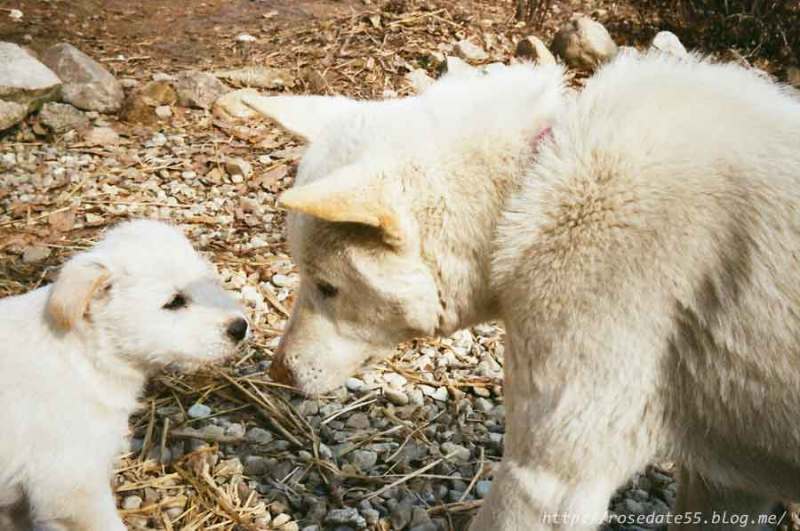
    The Korea Jindo Dog It is the classic single master dog.

    Korean Jindo

    Content

    Characteristics "Korea Jindo Dog"

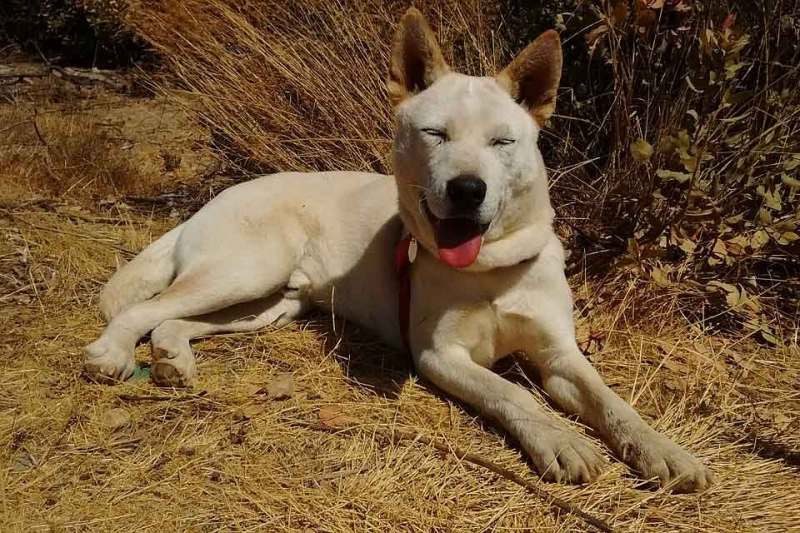
    Coexistence is important that you have with your new friend. Before considering the acquisition of a dog of the breed "Korea Jindo Dog" you know certain factors. Not all breeds of dogs are apt to live in an apartment, you must take into account his character, their need for exercise, their interaction with other pets, their care and if you have small children, their level of tolerance towards them.

    Training ?

    2,0 of 5 stars (based on 1 review)

    Suitability of the apartment ?

    2,0 of 5 stars (based on 1 review)

    Can be alone all day ?

    1,0 of 5 stars (based on 1 review)

    Suitable as a first dog ?

    1,0 of 5 stars (based on 1 review)

    Weight gain ?

    3,0 of 5 stars (based on 1 review)

    Health ?

    4,0 of 5 stars (based on 1 review)

    Intelligence ?

    4,0 of 5 stars (based on 1 review)

    Kindness with child ?

    3,0 of 5 stars (based on 1 review)

    Tendency to bite ?

    3,0 of 5 stars (based on 1 review)

    Tendency to bark ?

    4,0 of 5 stars (based on 1 review)

    Tendency to flee ?

    5,0 of 5 stars (based on 1 review)

    hair loss strength ?

    4,0 of 5 stars (based on 1 review)

    Suitable as a guard dog ?

    5,0 of 5 stars (based on 1 review)

    Joy ?

    4,0 of 5 stars (based on 1 review)

    Cat friendliness ?

    2,0 of 5 stars (based on 1 review)

    Power level ?

    4,0 of 5 stars (based on 1 review)

    History

    Korea Jindo Dog

    The exact origins of this dog breed are lost in the dark of history.. With a probability that borders on certainty, it can be assumed that the breed is actually of Korean origin, more precisely from the island of Jindo in southwestern Korea. Due to the isolated geographic location, this type of dog was only found here. Finally, an export ban on the breed was imposed, which is still valid today.

    In his homeland., the Korea Jindo Dog is under the protection of nature and species. In 1938 the breed was declared the national animal of Korea. But, some quadrupeds have crossed the borders: In the Decade of 1980, local people smuggled specimens into the US. In 2003 took place in Great Britain the first official exhibition of a Korea Jindo Dog outside asia. In the USA., the Korean Association of Jindo of America" โ€‹โ€‹is now working to preserve this breed.

    Physical characteristics

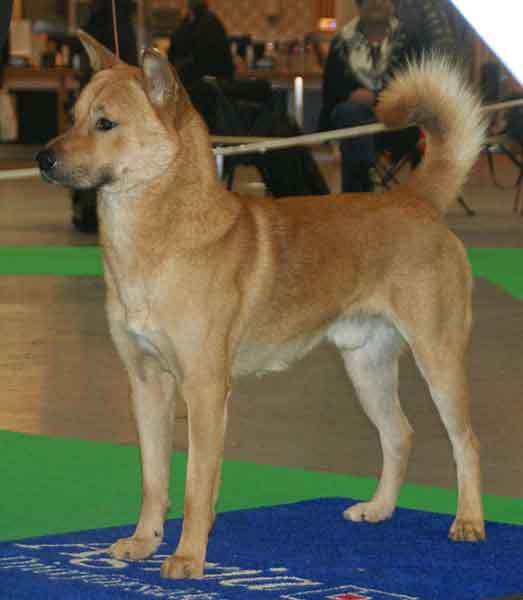
    This four-legged Korean friend is one of the best in Asia. With a weight of about 14 to 21 kilograms and a height of 34 to 47 cm to the cross, the Korea Jindo Dog belongs to medium-sized dogs. Carries its tail curled or sickle-shaped on its back. The relatively small, upright ears are also typical of the point..

    While in Korean standardized breeding only white and red coat colors are recognized, depending on the frame organization the following other coat colors are allowed: kitsch, black and tan, grey, black and Brindle.

    Character and skills

    The Korea Jindo Dog shows the corresponding original features. It is considered to be independent, territorial and has a strong hunting instinct, what can make living with other pets impossible, but it doesn't have to be that way with good socialization.

    The breed is not easily disturbed and is characterized by great loyalty to its keeper.

    It is reserved with strangers: When used as a watchdog, the Korea Jindo Dog indicate in a way the defense of your home your home. Many representatives of the breed do not accept food from strangers. These dogs are playful and intelligent, sometimes even "too smart", because they can learn to open doors, for example.

    When looking for a Jindo, always look for responsible breeders – unfortunately there are also alleged breeders who have bred the Jindo for backyard dogfighting or otherwise have disproportionately promoted the aggressive side of this dog.

    Education of the โ€œKorean Jindo Dogโ€

    Consistent and clear communication, as well as some experience with dogs are necessary for the education of a Korea Jindo Dog. The docile dog is not only characterized by its intelligence, but also for its primitive behavior and great independence, that you must direct in a controlled way.

    As the leader of the pack it is your task to make it clear to him that you know for sure and with confidence where to go.. The Korea Jindo Dog quickly use uncertainties and exceptions to take the helm himself. But, never confuse strong and confident leadership with toughness, as this could destabilize the Korea Jindo Dog and not just destroy educational successes, but also lastingly disturb the bond between you and your partner.

    A dog school is a recommended opportunity to introduce the Korea Jindo Dog to other dogs of the same species and to further socialize them.

    Health of the โ€œKorean Jindo Dogโ€

    Robust Spitz

    It is considered that Korea Jindo Dog it is a robust breed of dog, that he hardly has a predisposition to genetic diseases. Healthy animals can reach an average age of 13 years. The most important health precautions are already taken before birth, thanks to the experience of experienced breeders, that minimize the risk of disease by selecting suitable parent animals, including appropriate preventive exams. Accumulation of the autoimmune disease discoid lupus erythematosus has occasionally been reported (DLE). This skin disease is usually treated for life.

    It also, there are some cases of hypothyroidism, what is the lack of thyroid hormone supply to the body. In the Korea Jindo Dog this disease is usually manifested through aggression or apathy and changes in the coat. Otherwise, The same as us, two legged friends, sufficient exercise and healthy nutrition are other important pillars of health. Increased risk of food intolerance in some Jindos can also be counteracted with a balanced diet.

    Nutrition of the โ€œKorean Jindo Dogโ€

    A high-quality, grain-free, meaty diet is, fortunately, not just appropriate for the species, but also tasty. Both are important criteria, since it is considered that the Korea Jindo Dog is relatively selective. It is best to accustom him to several varieties of the same quality from the age of the puppy. This way you won't find yourself in a situation where, due to prescription changes or delivery issues, suddenly there is no more pet food and you have no alternative. It also, you can usually change different known foods of the same quality without your dog having digestive problems.

    Regarding the amount of daily feeding, manufacturers' information can only give approximate values. If you notice that your Jindo is gaining too much weight, adjust your diet accordingly. You should also include treats in your daily ration. It's best to stick to healthy treats, like dental care snacks or dog treats that are 100% meat. Sugar has no place in reward food or snacks. With dry chews such as special dog bones or cow's ears, which are much less greasy than pig's ears, you can satisfy your friend's chewing needs from your Korea Jindo Dog.

    Make sure he always has enough water around him to quench his thirst at any time.

    Care of the โ€œKorean Jindo Dogโ€

    The coat of this breed consists of a soft undercoat, depending on the season, and a hard coat. Especially during the coat change twice a year, the Korea Jindo Dog lose a lot of hair. You can limit hair loss on the floor accordingly, combing daily. Outside of coat change time, a weekly hairstyle is enough. At this time you can also check their ears and eyes for dirt and if they need to be cleaned with special ear and eye cleaners for dogs..

    The dirt on the coat is better to let it dry and then comb it out. A bath is not normally necessary, but it may be a good idea to gently accustom the Korea Jindo Dog, to a bathroom when he's still a puppy, so it can be cleaned every few months. Be sure to use a mild dog shampoo to avoid damaging the dog's own skin.. Take a regular look at the claws, especially with older dogs. If they are too long, shorten them with claw scissors. This will prevent your dog from getting painfully stuck with them and possibly injuring himself.

    Activities with the โ€œKorean Jindo Dogโ€

    give to you Korea Jindo Dog plenty of room to run, also as a jogging partner, but always on a leash. Also for free rescue and search dog work not suitable due to strong hunting instinct. Some Jindos like to learn tricks and play with various toys with great pleasure., that are available in stores. By the way, the Korea Jindo Dog normally stays away from water, so the common splash in the lake should not be included in the list of possible destinations. Many Korea Jindo Dog they even avoid small streams or puddles, refuse to cross a bridge or do not want to go outside in the rain. To enjoy travel without restrictions, should show the young dog that the water on the trail is not a cause for concern and casually, and possibly supported with treats, get used to the unwanted item. Don't force your Jindo to jump into a pond or something similar – will probably never turn into a water rat.

    Before Buying a โ€œKorean Jindo Dogโ€

    Few dog lovers in Europe are likely to ask this question, since the Korea Jindo Dog It's very weird. It also, you must be a nature lover and have a house or apartment at ground level in the countryside, because this four-legged friend must have a fenced-in property at his disposal, who can monitor. The fence must be generously planned, because the breed has a clear talent for jumping. So, The minimum height of a fence should be 1,80 m. But still keep an eye on your four-legged friend: Many young Jindo, if you have been alone for too long, the urge to discover has taken hold of him: The cunning dogs have quickly learned that a path can be prepared by digging even under fences.

    In any case, the intelligence of Jindo can be too much for quite comfortable dog owners who are supposed to keep you physically and mentally busy. This active and above average dog will take up a lot of time on your trips together, because you need to go out, what should normally be done on a leash due to his hunting instinct.
    Can be well kept in a family, also with children. Sociable four-legged friend doesn't like to be alone, so he must either be left alone for a very short time or you keep him together with another dog. In Korea it is common for dogs to live outside the house.

    The breed is excellent as a guard dog and often recognizes family acquaintances and friends from a distance. You can also befriend the postman if you make it clear that you are one of the "good guys.".

    Where can I find a โ€œKorean Jindo Dog?โ€?ยป

    In Europe it is not easy to find a Korea Jindo Dog; for example, in Germany not a single litter has been registered in recent years and there are no active breeders. Here it is necessary to investigate to find the nearest breeder. Of course, some breeders also export from abroad, for example from the United States, but this is time consuming and should only be considered for absolute connoisseurs and lovers of the breed. But, might be worth taking a look at asian races Shiba Inu and Akita, which are much more common in Europe and have some similarities to the Korea Jindo Dog. When adopting a puppy from abroad, please consider the relevant entry requirements and especially the necessary vaccinations.

    If you are looking for a Korea Jindo Dog adult, you must be on a real winning streak to find one in Europe. It is true that dog owners sometimes underestimate the time and knowledge required for education and harmonious coexistence with a Korea Jindo Dog and, therefore, they give up their four-legged friend. But, this is extremely rare in Europe due to the very small number of Korea Jindo Dog.

    Images "Korea Jindo Dog"

    Photos:

    1 – Korea Jindo Dog by https://pixabay.com/es/photos/perro-feliz-sol-perro-feliz-1792601/
    2 – Korea Jindo Dog by https://pixabay.com/es/photos/progreso-perro-jindo-coreano-perro-1138824/
    3 – Korea Jindo Dog by https://pixabay.com/es/photos/cachorro-perro-el-progreso-del-perro-1874281/
    4 – A male Korea Jindo Dog. Colour: red by Canarian / CC BY-SA
    5 – Korea Jindo Dog by https://flic.kr/p/dYtSF9
    6 – A male Korea Jindo Dog. Colour: red. by Canarian / CC BY-SA

    Videos "Korea Jindo Dog"

    HTTPS://youtube.com/watch?v=KFZg8QknBB8
    Korean Jindo – TOP 10 Interesting Facts
    HTTPS://youtube.com/watch?v=GvesVZwyuCc
    Jindo or Chindo Dog – Breed of dog

    Type and recognitions:

    • FCI CLASSIFICATION:
    • Group :
    • Section : . .

    Federations:

    • FCI – Group 5: Spitz-type dogs and primitive type – Section 5: Asian Spitz and related breeds. โ“˜

    FCI breed standard "Korea Jindo Dog"

    Origin:
    South Korea

    Date of publication of the valid original standard:
    13.07.2005

    Use:

    Without working trial.


    General appearance:

    The Korea Jindo Dog is a medium-sized dog, well proportioned, used for hunting and as a guard. Its pricked ears and coiled or sickle-shaped tail give it a vivid expression of agility., Fortress, vigilance and dignity.

    IMPORTANT PROPORTIONS : Relationship between the height of the cross : body length = 10:10,5.


    Behavior / temperament:

    The Korea Jindo Dog has a very strong hunting instinct.; In addition to being bold, bravo, alert and careful, not allowed to tempt easily and is hot-headed. First and foremost, is extremely faithful to its owner. It is reserved with strangers. In general, is not affectionate with other animals, especially if male. It also has a good sense of orientation. It is a dog of a single owner; He quickly agree to a new owner but it never forgets its ties with the previous owner who raised him since that was puppy. Stays clean and eat little.

    Head:

    In general, The head forms an obtuse triangle when viewed from above and should not make the dog appear clumsy or clumsy..

    Cranial region:

    The skull is medium in size in proportion to the body.. The top is slightly rounded, and gradually thins to the eyes. The width between the ears is moderate in relation to the size of the head.

    • Stop : Well defined, but not too abrupt. It has a slight furrow that extends to the forehead.

    facial region:

    • Nose : black. In case of white dogs, flesh colored nose is allowed.
    • Snout : The muzzle should not be bulging or raised.
    • Lips : Blacks; well closed, They are thin and not pendulous; the upper lip slightly covers the lower lip.
    • Bite / Teeth : Very strong, scissor bite.
    • Cheeks : Well developed, thin and moderately round when viewed from the front or side; narrowing to the tip of the nose.
    • Eyes : dark brown color, somewhat small in proportion to head size, almond-shaped and very expressive. The outer corners of both eyes are slanted towards the ears.
    • Ears : Medium-sized, form triangular, thick and perfectly erect; insertion ears neither high nor low, directed slightly forward in line with the back of the neck. The presence of fine, dense hair on the inside of the ears is desirable..

    Neck:

    Something balanced and thick, without jowl, strong, with good musculature. The Korea Jindo Dog wears its neck proudly and arched well when excited..

    Body:

    • Back : Strong and straight.
    • Pork loin : With good muscles, stiff, thin and narrower than the rib cage.
    • Breast : Strong and moderately deep, but not too wide. The deepest point of the chest reaches just above the elbow, but it is also acceptable for it to reach elbow level. Well arched ribs. Fairly developed chest.
    • Belly : Withdrawn.

    Tail:

    When it hangs up, the tip of the tail should reach the tibiotarsal joint. Rather tall insertion root; is straight and firm and should not sway when the dog moves. Whether sickle-shaped or rolled, the tip of the tail touches the back or flank. It should not be too twisted. The tail has abundant feathers.

    Tips

    PREVIOUS MEMBERS : Seen from the front, they are straight and parallel.

    • Shoulder : Strong and powerful and well inclined.
    • Elbows : Glued to the body, no outward or inward deviation.
    • Metacarpus : Slightly bent forward, when viewed from the side.
    • Pies : Cat feet. Rather short fingers, rounded, compact and firm. Strong nails, preferably black. Thick, well-cushioned ear pads.

    LATER MEMBERS : Viewed from the side, They are moderately angled; seen from the back, they are straight, parallel and not too far apart or too close to each other. Dewclaws must be removed except in countries where their excision is prohibited..

    • Thighs : well developed.
    • Legs : Moderately angled.
    • Tibio-tarsal and metatarsal joints : Placed very low; they are not straight but moderately angled.
    • Hind feet : Identical to the previous ones.

    Movement:

    The movement of the Korea Jindo Dog is powerful and firm. The back should remain firm and level, and the hind limbs should not oscillate. When jogging, keep your head high, but as the speed increases, the head is carried low, almost at shoulder level. The upper part of the tail moves slightly according to the change of direction the dog makes..

    Mantle

    HAIR : The Korea Jindo Dog has a double coat of hair. The inner layer is smooth, dense, pale, But enough to sustain the outer layer. The outer layer is stiff and somewhat separated from the body. Compared with the hair covering the body, the hair of the head, members and ears is shorter, and neck, cross, back and trunk is longer. The hair of the tail and rear of the thighs is longer than the rest of the body.

    COLOR : The colors of the Korea Jindo Dog are reddish bay, white, black, black and tan, wolf gray and brindle.


    Size and weight:

    Height to withers :

    • Males : 50-55 cm., ideal 53-54 cm..
    • females : 45-50 cm., ideal 48-49 cm..

    WEIGHT :

    • Males : 18-23 kg.
    • females : 15-19 kg.


    Fouls:

    Any deviation from the aforementioned criteria is considered a fault and the severity of it is considered to the extent of the deviation from the standard and its consequences on the health and well-being of the dog..

    โ€ข Insufficient musculature.
    โ€ข Bones that are too thick or thin.
    โ€ข Pincer bite.
    โ€ข Ears not erect.
    โ€ข Hanging tail, short tail.
    โ€ข Exaggerated angulations.
    โ€ข Straight tibio-tarsal joints, cow or barrel.
    โ€ข Long or short hair.
    โ€ข Irregular step, stiff step.

    MISS PLAYOFFS :

    โ€ข Aggressive or fearful dog.
    โ€ข Size too big or too small.
    โ€ข Prognathism or enognathism.
    โ€ข Female-looking male, female with masculine appearance.
    โ€ข Lack of more than 3 teeth.
    โ€ข Lack of pigmentation, albinism.
    Any dog โ€‹โ€‹showing clear physical or behavioral abnormalities should be disqualified..


    N.B.:

    Males should have two normal-appearing testicles fully descended into the scrotum..

    Source: F.C.I - International Cynological Federation

    Alternative names:

    1. Jindo, Chindo, Jindo Gae, JindoGae (English).
    2. spitz corรฉen de Jindo (French).
    3. Jindot-gae, KOREANISCHER JINDO (German).
    4. Jindo (Portuguese).
    5. Perro de Chindo, Jindo, Yindo (espaรฑol).

    โ–ท The world of Pets: Dogs, cats, birds, reptiles, amphibians

    Canarian Warren Hound
    Espaรฑa FCI 329 . Primitive type - Hunting Dogs
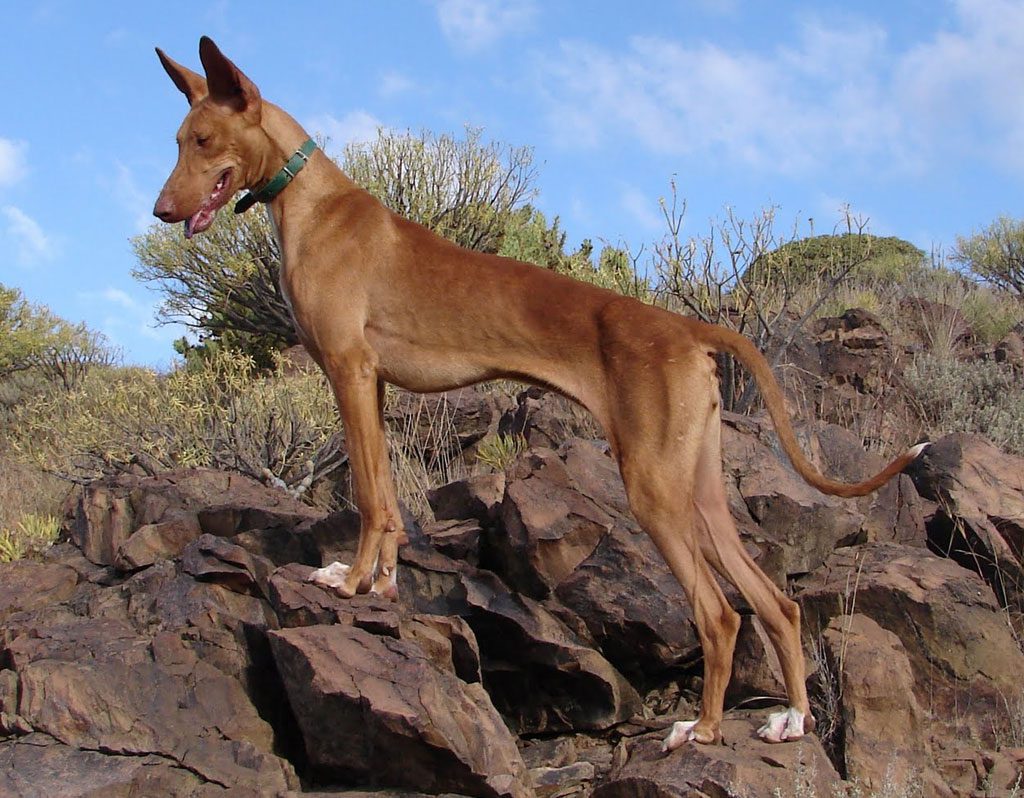
    Podenco Canario

    The Canarian Warren Hound is brave, decided to, generous and extremely loyal to his master.

    Content

    History

    The Canarian Warren Hound It is a breed canine Spanish Canary.

    The Canarian Warren Hound, It is one of the oldest breeds known today., According to scholars of the breed, it dates from approximately 7000 years. This realize the numerous found vestiges of its representation in engravings, statues and bas-reliefs.

    A native of Egypt, probably, He was taken by the Phoenicians, greeks, the same Egyptians to the Canary Islands and Carthaginian, where it is currently easy to see in the larger islands (Gran Canaria and Tenerife).

    Since its inception, the Canarian Warren Hound has been placed in the wild and in the possession of the peasant who needed to hunt to survive. Given the perfect hunting qualities of this dog: his sense of smell, his hearing and his clear vision, as his great speed in the race after the dam, the peasant has had, always, a wonderful ally, It has been able to take advantage of.

    The Canarian Warren Hound, as its name suggests it is found in the Canary Islands, and a dog is little known and disseminated outside their place of origin, It is not easy to find puppies.

    Today, is perfectly adapted, both the flat lands as stony and mountainous, sandy, or soft like the prairies or very hard; You can both enter caves that penetrates in Lava Tubes or galleries, in thickets or forests, in the end, does not shy away from any obstacle.

    Outside the hunting season, the living conditions of animals are very different: Well-kept dogs can be found and fed on clean kennels, as well as miserably neglected and malnourished chained dogs. Animals that are not or are no longer fit for hunting often suffer a cruel fate.
    For this reason, dogs are increasingly placed abroad by animal protection organizations and individuals – an understandable and well-meaning activity, What, However, brings with it some problems: Dogs, who are usually already grown up, sometimes they are taken out of their simple rural living environment and taken to big cities. Noise and haste can be very harsh for them, his frequent lack of trust in humans further complicates it. His pronounced passion for hunting makes the free will, which would be absolutely necessary for the maintenance of the animals and to reduce stress, is often difficult or impossible. It also, in many cases are infected with so-called travel or Mediterranean diseases, that often require long and costly treatment.

    Physical characteristics

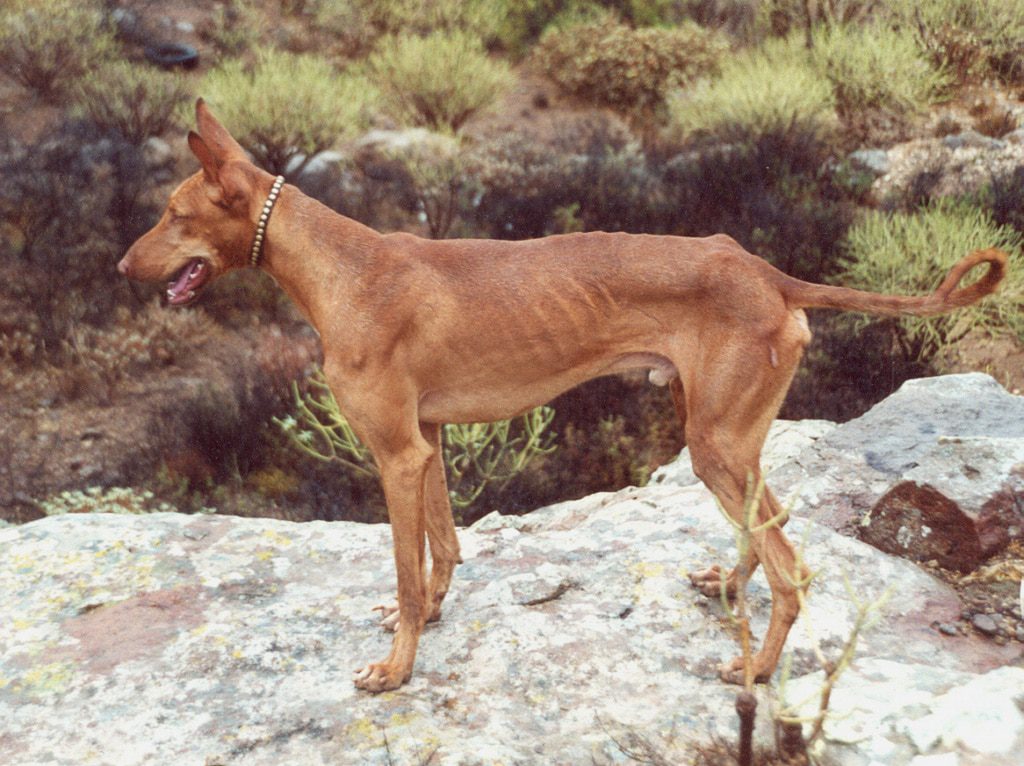
    The Canarian Warren Hound, is a dog from size medium, very light but tough.

    The height to the cross males will of 55 to 64 cm and the females of 53 to 60 cm.. These measures have 2 cm tolerance up or down.

    Has the muscles hyper developed and as it does not present adipose panniculus it is very easy to appreciate the rib cage, the spine and hip bone.

    Has the head elongated with little pronounced stop, the eyes are small, almond-shaped and oblique.

    Their ears they are rather large, When the Earth State of arousal keeps them in erect and fall backwards when it is at rest, they are wide at the base and end up in tip.

    The limb perfectly Plumb, they are straight, has fine but strong bones. The tail is low, You can take the low or sickle-shaped, but does not exceed Hock.

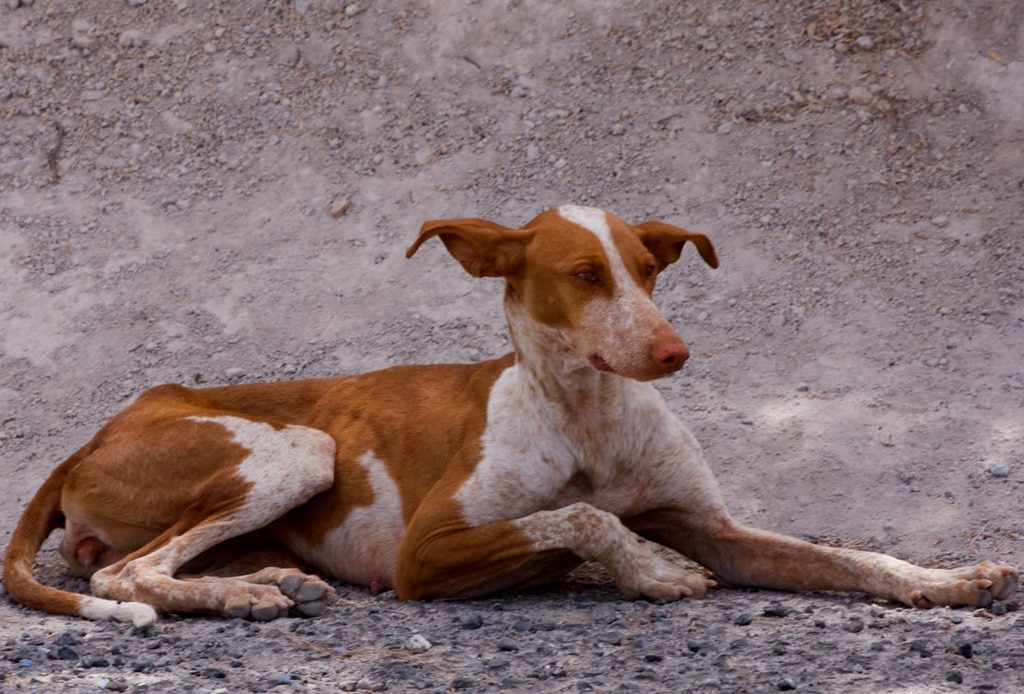
    The hair the Podenco Canario is smooth, tight and short. In the layer color combinations within the following are supported colors: Red and white, with more or less intense red, and finally, Orange to mahogany.

    Observations

    :

    These dogs start to hunt from an early age, giving cases of animals less than three months that show strong hunting instinct.

    When they discover and/or they chase prey, emit a characteristic short, repetitive bark, known to local hunters as "singing a rabbit".

    Character and skills

    The Canarian Warren Hound is an animal that shows no aggression normally, extremely loyal and noble to teammate, restless, independent, stubborn, worker and intelligent.

    Itร‚ยดs brave and decided to, the race is fast and very agile, generous and extremely fell to its owner.

    There are no guard and defense attitudes, at home it is "friend of all strangers", what makes it ideal as a pet.

    If raised inside a Home, Once overcome the first six months of hyperactive life, shown as a quiet animal and customize, attitude changes drastically once comes to the field of hunting.

    In its role of Hunter It has always been dedicated to the rabbit house and its most important feature is its ability to adapt to any type of terrain. It is capable of detecting the presence of the press inside cracks thorny bushes or stone walls, the Podenco Canario only to follow the trail of the prey with the sense of smell but without catching it.

    Observations:

    In the Canary Islands is used in conjunction with the huron, since the latter catches the rabbit by the throat.

    Caring for Canarian Warren Hound

    As already mentioned, the dog should be given a housing environment that corresponds to its predisposition. Rural areas with low traffic and a manageable hunting density are appropriate.
    Proper exercise in any weather with as much free running as possible is a must for this active dog.

    The short coat is very easy to care for; just brush from time to time.

    Canarian Warren Hound Health

    The breed is basically a robust dog with low susceptibility to disease; therefore, breed-specific diseases are largely unknown.

    But, the Canarian Warren Hound can suffer from the typical travel or Mediterranean diseases of dogs (among others, leishmaniosis, dirofilariasis, babesiosis, ehrlichiosis) like all the other dogs.
    Many animals are chronically infected without showing symptoms of disease. But, these dogs are unhealthy and can infect other animals through vectors (ticks and blood-sucking insects).
    So, imported dogs should always be thoroughly examined for the diseases mentioned (the so-called "travel profile").

    The average life expectancy is about 12 years.

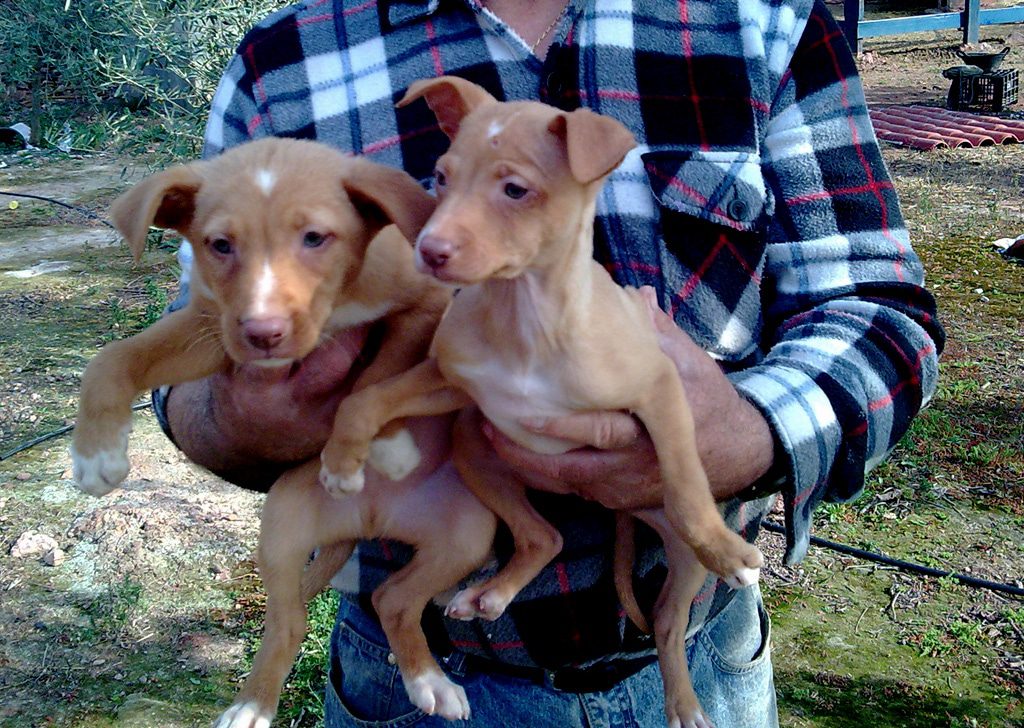
    Images Canarian Warren Hound

    Canarian Warren Hound videos

    Type and recognitions:

    • FCI CLASSIFICATION:
    • Group :
    • Section : . .

    Federations:

    • FCI – Group 5: Spitz-type dogs and primitive type – Section 7: Primitive type โ€“ Hunting dogs.. โ“˜

    FCI breed standard "Canarian Warren Hound"

    Origin:
    Spain

    Date of publication of the valid original standard:
    24.06.1987

    Use:

    It is used for rabbit hunting and adapts perfectly to the multiple variations of the terrain for this purpose., using their prodigious sense of smell as well as sight and hearing. Withstands high temperatures and hunts tirelessly from dawn to dusk. You can detect the presence of rabbits inside cracks with your sense of smell or hearing., stone walls, majano, volcanic tubes and thorny scrub. Its extraordinary preservation is undoubtedly due to its gifts, which have made it necessary throughout the centuries.. It is primarily a trail dog and should not bark or flap the part during tracking.. It is also used with the help of a ferret, modality allowed on the islands. It also usually catches rabbits by tooth.


    General appearance:

    It is a medium-sized dog, slightly elongated, leptosomatico, light, very resistant. The skeleton is well developed. The absence of adipose panniculus allows us to appreciate the relief of the rib cage, spine and hip bones. The muscles are highly developed, spandrel, transluciendo contractions through the skin.

    IMPORTANT PROPORTIONS: Slightly longer than high. Well developed chest, without reaching the elbow. Muzzle slightly longer than the skull.


    Behavior / temperament:

    Brave, nervous, restless and radiating a dynamism. Noble, never aggressive. Selflessly addicted to its owner. Stoically supports more rigorous sessions without the less fatigue.

    Head:

    Elongated. Truncated cone shaped, very provided with the body, measuring length 21 to 22 cm.. Parallel craniofacial lines.

    Cranial region:
    • Skull: Longer than width, plane, with prominent occipital bone.
    • Depression links (Stop): Not very marked.

    facial region:

    • Truffle: Wide, sand color, harmonized with the coat color, slightly open nostrils.
    • Snout: Prominent and wide, dull finish, flesh-colored with more or less intensity in harmony with the color of the coat.
    • Lips: Fine and collected, harmonized with the color of the nose.
    • Teeth: Bite in scissors, in perfect opposition and well-developed.
    • Eyes: Oblique, almond-shaped and small. More or less dark amber depending on the intensity of the color of the layer. His gaze is smart and noble.
    • Ears: Rather large. Carried erect in attention, slightly divergent. Take them back to sleep. Wide at its base and pointy at the end.

    Neck:

    Muscular, straight, with smooth skin, without jowl, rounded and flexible.

    Body:

    • Back: Strong, muscular, suitable for the race and exercise of hunting.
    • Pork loin: Somewhat elongated.
    • Rump: Something solid bones of the rump, more visible in the exemplary weak or in full hunting season.
    • Breast : Chest with no outgoing sternum, well developed, But however it does not reach the elbow. Oval ribs.
    • Chest perimeter more in 5 to 8 cm as height on the cross.
    • Belly: picked up, without being the Greyhound. Well marked flanks.

    Tail:

    Lowest insertion, as a continuation of the rump. Rounded, It descends somewhat lower than the Hock. Fallen or carried in the shape of a sickle. Something sharp at the tip which is usually white in color. Never screwed. Desirable not to raise in excess to the March.

    Tips

    PREVIOUS MEMBERS: Perfectly Plumb, straight, vertical and parallel, fine but solid bone. Cat feet, generally something diverted outwards. Strong and somewhat oval pads.

    Angles:

    • Angles scapulo-humeral: close to 110ยฐ.
    • Humeral-radial angles: close to 140ยฐ.

    LATER MEMBERS: Plumb, straight, strong, muscular, rather high Hock (some 18 cm from the ground). Straight feet, of cat, with strong and slightly oval pads. Without the presence of spurs.

    Angles:

    • Lame-femoral angle: about 110ยฐ.
    • Femoral-tibial angle: about 120ยฐ.
    • Hock angle: about 130ยฐ.

    Movement:

    You must have a fast trot, long and very light.

    Mantle

    SKIN: Consistent, attached to the body and without wrinkles.

    HAIR: Smooth, short and tight.

    COLOR: Preferably red and white, the Red can be more or less intense coming from Orange to dark red (Mahogany). All combinations of these colors.


    Size and weight:

    Height to the cross:

    • For males: of 55 to 64 cm..
    • for females: of 53 to 60 cm..

    These measures may vary due to the different land where living and hunting, therefore to accept differences in 2 cm above or below the maximum or minimum size, as long as the specimens are typical and with the prototype of the breed.


    Fouls:

    Any deviation from the aforementioned criteria is considered as a fault and the severity of this is considered to the degree of the deviation to the standard and its consequences on the health and well-being of the dog..

    SERIOUS FAULTS

    • Excessively wide head.
    • Too marked stop.
    • Hanging lips.
    • Lack of premolars.
    • Prognathism.
    • Ears very divergent.
    • Flat chest.
    • Outgoing sternum.
    • Threaded queue.
    • Low or cow hocks.
    • Crossing of front feet and hocks in gear.
    • Aggressive temperament.
    • Any dog โ€‹โ€‹showing clear signs of physical or behavioral abnormalities must be disqualified..

    FALTAS DESCALIFICANTES:

    โ€ข Aggressiveness or extreme shyness.
    โ€ข Any dog โ€‹โ€‹showing clear signs of physical or behavioral abnormalities.


    N.B.:

    โ€ข Males must have two normal-appearing testicles fully descended into the scrotum..
    โ€ข Only functionally and clinically healthy dogs, with the typical conformation of the breed, should be used for parenting.

    Source: F.C.I - International Cynological Federation

    Alternative names:

    1. Canary Island Podenco, Canary Island Hound, Podenco Canario (English).
    2. Podenco canario (French).
    3. Podenco Canario (German).
    4. Podenco Canario (Portuguese).
    5. Podenco Canario (espaรฑol).

    โ–ท The world of Pets: Dogs, cats, birds, reptiles, amphibians

    Canadian Eskimo Dog
    Canadรก FCI 211 . Nordic Sledge Dogs

    Esquimal Canadiense

    The dog Canadian Eskimo Dog it's a sled dog, the North of Canada natural. Possibly this is one of the most cold tolerant dogs.

    Content

    History

    Similar to the Hotocho (or Mongolian sheepdog), the Canadian Eskimo (or Qimmiq en inuktitut) it is a very old canine breed, perhaps one of the first to accompany man to this part of the globe, almost ago 4.000 years. Faithful companion of the Inuit people of Thule, was bred and trained to become a tough working dog, able to travel long distances at a steady pace. It also, your complexion, their excellent sense of smell and intelligence were used to locate the breathing holes of seals for hunting and to protect families from musk oxen and polar bears..

    In the Decade of 1920, the Canadian Eskimo remained closely associated with the Inuit culture, With almost 20.000 Eskimos working alongside men in the northern territories. But, this golden age was not going to last. In effect, the arrival of the snowmobile in the years 60, the massive and systematic killing of Inuit dogs by the Canadian government (officially, for public health reasons – unofficially, say some, to intimidate and forcibly assimilate Inuit peoples, eliminating their main work tool and a symbol of their culture), the introduction of new breeds of sled dogs such as the Siberian Husky, as well as a certain vulnerability to the diseases that these latter bring., are literally decimating purebred Canadian Eskimo populations. In 1963, there was only one Canadian Eskimo Dog registered in the breeding book of the Canadian Kennel Club, which then declared the race extinct.

    This statement proved premature. But, it did not count on the tenacity of William Carpenter, Bill Thompson, John McGrath (founders of the Research Foundation of the Canadian Eskimo Dog) and Brian Ladoon (breeder and musher, that is to say, sled driver). With government support to preserve Inuit cultural heritage, the quartet undertook an expedition to the most remote regions of the Canadian Arctic in order to find purebred Canadian Eskimos. Their efforts paid off and, thanks to the specimens unearthed in the Inuit villages, a breeding program was launched. few years later, in 1970, there was nothing less than 200 animals. Today, this figure reaches the 300 individuals around the world.

    Although the United Kennel Club American recognized the Canadian Eskimo as a race in its own right in 1996, was not up 2018, year in which the breed was recognized by the International Cynological Federationand (FCI) and Central Canine Society, when the breed really came to the forefront of the canine world and the general public and enlightened fans learned not only about the qualities of this dog, but also the precariousness of its existence.

    But, although some specimens have crossed the Atlantic to the United Kingdom, the spread of the breed remains for the time being essentially limited to Canada and the United States, and even there, the breeders of Canadian Eskimo Dog they are still scarce.

    Physical characteristics

    At first sight, it is clear why the Canadian Eskimo has helped the Inuit people for so long. Strength, power, resistance and vigor are the first adjectives that come to mind when describing this dog capable of constant effort in difficult environmental conditions.

    The Canadian Eskimo is of medium build, with a strong neck and chest, but with legs of medium height. With its well defined bones and muscles, his powerful and majestic physique reflects that he is mainly a very resistant dog, not very fast. It should be noted in passing that females are slightly smaller and less muscular than males.

    It is also interesting to note that the Canadian Eskimo is quickly big enough to work: although it does not reach full maturity until around the 3 years of age, it is capable of transporting loads from the 7 months. Puppies are often described as miniature adults, with the ears upright and upright on the skull and the tail coiled from the third week.

    Like most of the Spitz, the head of the Canadian Eskimo is angular and elevated, with straight, thick ears. The eyes are placed at an angle and give the animal a serious attitude. The bushy tail is carried high or curled on the back.

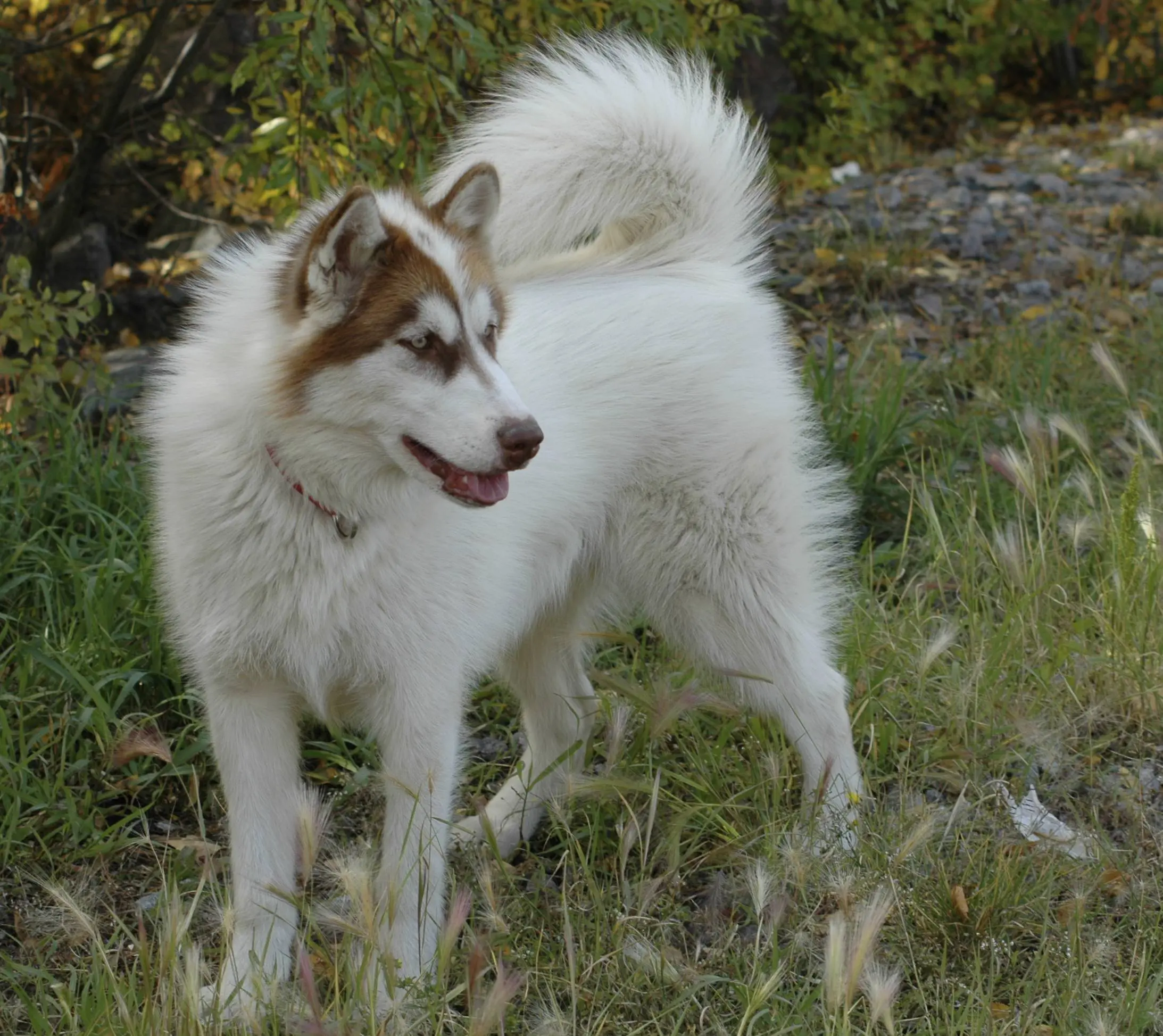
    The coat of the Canadian Eskimo It is thick, with a smooth top layer and a dense and uniform wool bottom layer, providing optimal thermal insulation for adverse weather conditions. This makes them one of the most cold-adapted dog breeds.. Males also have a long mane that covers the neck and shoulders. Females usually have the shortest upper layer, which contributes to give the impression of a finer animal.

    The breed standard does not allow smooth fur. So, the Canadian Eskimo must always have a coat with a combination of colors, without the distribution of one color taking precedence over the others:

    • Completely white fur with pigmentation around the eyes, on the nose and lips (is not an albino);
    • white coat with only a very small amount of red, buff (including cinnamon shading), gray or black around the ears and eyes;
    • white coat with red markings, beige, cinnamon, gray or black around the ears and eyes, or the head completely marked with these colors, sometimes with small spots of the same color on the body, usually around the hips or on the flank;
    • Red and white, or buff and white, or cinnamon and white, or black and white, with a distribution to 50% of each of the two colors in the different parts of the body;
    • red or beige or cinnamon, with white on the chest and/or on the legs and lower part of the body;
    • Sabre body or black or dark gray, with white on the chest and/or on the legs, under the body, occasionally extended to the neck like a gola;
    • silvery grey or greyish white fur;

    Brown bottom layer and black top layer.

    The white mask shaded around the eyes and/or around the nose, with or without dots above the eyes, it is a common physical characteristic in dogs with a well-defined color on the head. Very rarely, the dots above the eyes, as well as the cheek marks, can be buff-colored, adding a third color to a normally bicolored dog.

    Size and weight

    ▷ Male size: 58 to 70 cm.
    ▷ female size: 50 to 60 cm.
    ▷ Male weight: 30-40 kg
    ▷ female weight: 18-30 kg

    Character and skills

    The character of Canadian Eskimo reflects the harsh environmental conditions in which he lives and the work that dots his daily life. So, it is closer to the wild animal domesticated by the tribal peoples in a logic of labor collaboration than to a real pet overflowing with affection for its master. Intelligent, brave, but always on guard, so sometimes it may seem distant.

    This does not prevent this dog from being gentle and affectionate with his family, or express a friendly curiosity towards strangers your family welcomes. But moderation remains the key word for him.. The Canadian Eskimo rarely celebrates his master, although he does not hesitate to ask for a caress as a sign of recognition. As a pack dog, is fiercely loyal to his master, whom he considers the leader of the clan, and is less distant with it. Beware who shows signs of animosity towards this leader: the Canadian Eskimo it will quickly remind you of the meaning of the word respect, with many grunts.

    The herds of Canadian Eskimo have a reputation for being very organized. From time to time some fights and scratches may occur, but it is not a sign of serious struggle or rebellion against the established leader.

    It also, unlike many recent dog breeds, the Canadian Eskimo has retained a very sharp hunting instinct. The slightest encouragement, either the food, the start of a game or a fight, gives rise to a quick and very enthusiastic response by this dog. In fact, this dog is more suitable for a family of adults and should never be left with children, as this could lead to unintentional injury. You can live with dogs that do not belong to your herd, but with some reservations, since he tends to regard any animal smaller than him as a prey to devour rather than as a companion with whom to live. The cats, rodents and small dogs will be tested if they have to cohabit with it.

    Last, as an outdoor dog par excellence, who appreciates cold temperatures and prefers to sleep outdoors if given the opportunity, the Canadian Eskimo is not at all a breed of dog adapted to a floor. They need to spend many hours outside each day to maintain their physical and mental fitness.. Sporty and hyperactive dog, used to pulling sleds, the ideal for him is to have a master as tough as him. In other words, it is a perfect companion for those who want to practice cani-rando, cani-mountain biking, ski joering, canikart… Without physical activity up to their capabilities, becomes a destructive and/or aggressive dog.

    Last, being a very intelligent dog, is the king of escapes and mischief. There is no delicate plant or reinforced fence that resists it. If you have decided to be a runaway dog, it will be very difficult to stop.

    Health

    The Canadian Eskimo has excellent physical dispositions that make it resistant to many of the genetic diseases that are common in dogs of similar breeds.

    But, although they are a force of nature in their natural environment, are more susceptible to parasites and skin diseases that develop in warmer temperatures. Thus, it's important not to forget dog vaccine reminders, and give regular preventive treatment against ticks and fleas.

    It also, like many Nordic dogs, has predisposition to the following diseases:

    – Hip Dysplasia
    – waterfalls
    – Arthritis;
    – gastric torsion;
    – entropion.

    Life expectancy

    10 – 15 years

    Characteristics "Canadian Eskimo Dog"

    Coexistence is important that you have with your new friend. Before considering the acquisition of a dog of the breed "Canadian Eskimo Dog" you know certain factors. Not all breeds of dogs are apt to live in an apartment, you must take into account his character, their need for exercise, their interaction with other pets, their care and if you have small children, their level of tolerance towards them.

    Adaptation โ“˜

    4,0 of 5 stars (based on 1 review)

    friendly dog โ€‹โ€‹โ“˜

    3,0 of 5 stars (based on 1 review)

    hair loss โ“˜

    3,0 of 5 stars (based on 1 review)

    Affection level โ“˜

    4,0 of 5 stars (based on 1 review)

    Need for exercise โ“˜

    5,0 of 5 stars (based on 1 review)

    Social need โ“˜

    3,0 of 5 stars (based on 1 review)

    Home โ“˜

    2,0 of 5 stars (based on 1 review)

    Toilet โ“˜

    2,0 of 5 stars (based on 1 review)

    Friendly with strangers โ“˜

    3,0 of 5 stars (based on 1 review)

    barking โ“˜

    2,0 of 5 stars (based on 1 review)

    Health โ“˜

    2,0 of 5 stars (based on 1 review)

    Territorial โ“˜

    4,0 of 5 stars (based on 1 review)

    Cat friendly โ“˜

    3,0 of 5 stars (based on 1 review)

    Intelligence โ“˜

    4,0 of 5 stars (based on 1 review)

    Versatility โ“˜

    3,0 of 5 stars (based on 1 review)

    Child friendly โ“˜

    4,0 of 5 stars (based on 1 review)

    Surveillance โ“˜

    3,0 of 5 stars (based on 1 review)

    joy โ“˜

    3,0 of 5 stars (based on 1 review)

    Type and recognitions:

    • FCI CLASSIFICATION:
    • Group :
    • Section : . .

    Federations:

    • FCI – Group 5 – Section 1 Nordic Sledge Dogs. โ“˜
    • CKC – Nordic Sledge Dogs โ“˜

    FCI breed standard "Canadian Eskimo Dog"

    Origin:
    Canada

    Date of publication of the valid original standard:
    28.02.2018

    Use:

    For centuries this breed was used as a draft animal and was able to drag between 45 and 80 kg. per dog covering distances of 15 to 70 miles per day. It was also used as a hunting dog, to locate seal breathing holes for Inuit hunters. As a hunting dog, it also attacked and kept at bay the musk ox and the polar bear for the Inuit hunters.. In summer, The dog was used as a pack dog that could carry up to 15 kg.


    General appearance:

    The Canadian Eskimo Dog is a dog of moderate size, powerful build, with thick neck and chest and medium length legs. Typical of the Spitz family of dogs, has a wedge-shaped head with tall thick ears. The eyes are set obliquely giving a serious appearance. The dog has a bushy tail raised or curled over its back. About the same height at the hips as at the withers, medium to large in size and muscular, the dog displays a majestic and powerful physique that gives the impression that it is not made for speed but for hard work. Above all, the body must be muscular and not fat. Females will have a smaller and less muscular body than males. In the winter, the body is covered with an outer layer of straight or erect hair; underneath is a dense low-voltage layer that allows the animal to easily withstand the rigors of high latitudes. A mane-like growth of longer hair will appear over the neck and shoulder in male specimens.. The entire conformation of the Canadian Eskimo Dog must be one of strength, power and endurance balanced with agility, vigilance and audacity. The female of the breed will usually have a shorter coat than the male and will always be significantly smaller than the male.. Like young bitches, will be more boneless, among other things, with a narrower head that tends to produce a friendlier face than with men. Both males and females of the breed are known to have a rapid growth rate reaching working size around seven months. But, the maturation process extends to at least three years of age, giving them a very majestic look. The cubs have often been described as miniature adults, with erect ears and a curly tail at young ages between three and five weeks. There may be occasional periods during the adolescent growth stages when the ears may not be fully erect., but it is important to note that the Canadian Eskimo Dog's ears do not have the same gradual growth of erectness around four months of age., as seen in some other breeds.

    important proportions:

    The width of the forehead between the ears of males shall be 5 to 6 inches (13 to 15 cm.). In females, the distance will be 4-1 / 2 โ€“ 5-1 / 2 inches (11-14 cm.).


    Behavior / temperament:

    The temperament of the Canadian Eskimo Dog should reflect the tough, hardworking breed that it is. It should not be viewed as a domestic pet, but as a primitive dog originally domesticated by the Inuit for specific tasks in a harsh arctic environment. In general, mature canadian eskimo dog is kind and affectionate to the average guy, enjoying the attention. Even with strangers, dogs are rarely distant. Usually, exhibit fairly calm friendship and harmless curiosity or become completely distant. The dog is very pack oriented and, if raised as a group, dominant and subordinate roles will be played under the leadership of a fully dominant or boss dog. Behavior within a group or herd is generally well structured and controlled, but it is not uncommon to see battle scars or torn ears on dogs that originate from breeding areas where dogs are raised in groups or packs.. Compared to modern domestic breeds, The Canadian Eskimo Dog has an almost excessive response to any stimulus, either food, work, defense or game. For this reason, the dog should be a companion for adults and should not be considered a child's pet.

    Head:

    ---

    Cranial region:

    Skull: Massive but well proportioned being wide and wedge-shaped. Although it is often described as a species of wolf, the head of the canadian eskimo dog has a higher forehead. Immature females will have a much narrower skull than the male.

    facial region:

    • Truffle: The pigmentation of the nose will vary from black to light brown (especially in lighter colored dogs with red, cream or cinnamon on the body). Butterfly noses, sometimes they appeared with light brown noses.
    • Snout: Tapered and medium length.
    • Belfos: Black or brown with pink.
    • Mwalking / Teeth: The jaws are heavy and powerful and have large teeth with well-developed canine teeth.. The incisors meet in a scissor bite.
    • Eyes: In general, dark colored but hazel or yellow eyes will appear in the breed. They are small, widely spaced and set obliquely on head, which tends to look much wilder and more deceptive than the dog deserves.
    • Ears: Short, thick and slightly rounded ends. They are carried erect, they turn forward and cover themselves with dense short hair.

    Neck:

    Short, straight, thick and very muscular.

    Body:

    • Generality: About the same height at the hips as at the withers.
    • Back: The spine when felt through the hair body is well pronounced.
    • Pork loin: Well developed.
    • Breast : Deep, wide and well muscled.
    • bottom line: There is very little flank curve Very little flank curve.

    Tail:

    Large and bushy and usually carried up or curled over the back. Mature bitches can sometimes bring their tails down.

    Tips

    Former members

    • Shoulder: Large, obliquely fitted with moderate musculature.
    • Forearm: Straight, but may appear to be leaning, due to the well-developed triceps muscle above and behind the elbow and the pronounced muscle in the forearm.
    • Front feet: Large, almost round, well bowed, with thick pads that are well arranged between them; However, under extremely cold winter conditions, this fur will grow to be too long to cover the bottom of the pads.

    Later members

    • Generality: The hips can appear as pronounced and bony as the spine, and they are approximately the same height as the cross.
    • Thigh: The legs will be very muscular and the width of the thigh will carry well towards the hock..
    • Knee: Well folded.
    • Hock: From the back, the legs will appear straight with the hocks turning in and out.
    • Rear feet: Similar in design to the front but slightly longer.

    Movement:

    The working gait of this dog is a powerful, energetic trot with the hind legs moving in line with the front legs in the power movement., but showing some abduction during the forward movement of the stride. This can be especially pronounced in mature male dogs with many miles of harness.. This gait may seem uncomfortable to the untrained eye., but it is the result of a wide posture caused by well developed thighs. This particular gait is an efficient and well-balanced gait for pulling hard day after day.. The dog's movement must not appear in any way as a jerky or rowing movement. Females are much faster and freer in movement than heavier males and are capable of breaking the natural trotting stride and running or galloping for much longer distances than males..

    Mantle

    Skin

    Should feel thick and resilient.

    Fur: Subject to an annual molt, usually in August or September, the coat is thick and dense and the guard hairs are hard and rigid. This outer layer will vary from 3-6 inches (7-15 cm.) length. In males it will occur in a mane-like growth on the shoulder and neck, which makes the male appear much larger in size and taller at the withers than he actually is. The inner layer is very dense to provide excellent protection during the most extreme winter conditions. During the molt, This condition will release in clusters over a period of a few days. Females will generally have a shorter coat partly due to the additional shedding that will occur after the pups are born..

    Color

    No one color or color pattern should dominate the breed with the Canadian Eskimo Dog color and color patterns ranging from:

    • (to) A completely white body with pigmentation around the eyes, nose and lips (for example, not albino).
    • (b) White body with only the smallest amount of red, beige (including shades of cinnamon), gray or black around the ears or eyes.
    • (c) White bodies with red heads, polished, cinnamon, gray or black marks around the ears and eyes or the entire head and the occasional small spot of the same color on the body, usually around the hip or flank.
    • (d) Red and white, or cream and white, or tan and white or black and white with a distribution of approximately 50/50 of the two colors, in various parts of the body.
    • (and) Red body or soft body or tan body with white on the chest and / o legs and lower body.
    • (f) Saber or black body or dark gray body with white on the chest and / or legs and lower body that occasionally extend around the neck in the form of a necklace.
    • (g) Silver gray or greyish white body.
    • (h) Polished to brown under with black guard hairs.

    Very common for dogs with solid color over most of the head is a white mask around the eyes and / or muzzle with or without white spots on the eyes. Very rarely, the spots over the eyes, as well as the marks on the cheeks, will be buff color, which will add a third color to an animal that normally has two colors.


    Size and weight:

    • Height to the cross: Males: 58-70 cm., females: 50-60 cm..
    • Weight: Males: 30-40 kg, females: 18-30 kg.


    Fouls:

    Any deviation from the above mentioned criteria is considered to lack, and the severity of this is considered the degree of deviation from the standard and its consequences on the health and well-being of the dog and the dog's ability to perform its traditional task.

    Serious misconduct

    • Head: square muzzle or loose lips, round or bulging eyes.
    • Neck: Long and thin.
    • Body: Narrow chest, over all lack of muscle, excess fat, sloping back, coarseness or lack of finer bones in bitches.
    • Legs: thin, fine boned or set beef.
    • Pies: flat or open.
    • Shelter: Short, off prime.

    disqualifying fouls:

    • Aggressive or overly shy dogs.
    • Blue eyes.
    • Floppy ears, the exception is the ears torn by battle.
    • Trim or alter the coat using scissors.
    • There is no evidence of a curly or upright tail in male dogs (recognizing that a tail may occasionally hold down as a sign of subordination or stress).
    • Excess under or excess jaw.


    N.B.:
    • Any dog โ€‹โ€‹showing clear signs of physical or behavioral abnormalities must be disqualified..
    • The aforementioned fouls that are more pronounced or more marked are eliminatory..
    • Males should have two normal-appearing testicles fully descended into the scrotum..
    • Only functionally and clinically healthy dogs, with the typical conformation of the breed, should be used for parenting.

    Source: F.C.I - International Cynological Federation

    Alternative names:

    1. Canadian Inuit Dog, Qimmiq, Canadian Husky (English).
    2. Inuit canadien, Qimmiq (French).
    3. Canadian Eskimo Dog (German).
    4. (em inglรชs: Canadian Eskimo Dog), Qimmiq (Portuguese).
    5. (espaรฑol).

    โ–ท The world of Pets: Dogs, cats, birds, reptiles, amphibians

    Kai
    Japรณn FCI 312 - Asian Spitz and related breeds
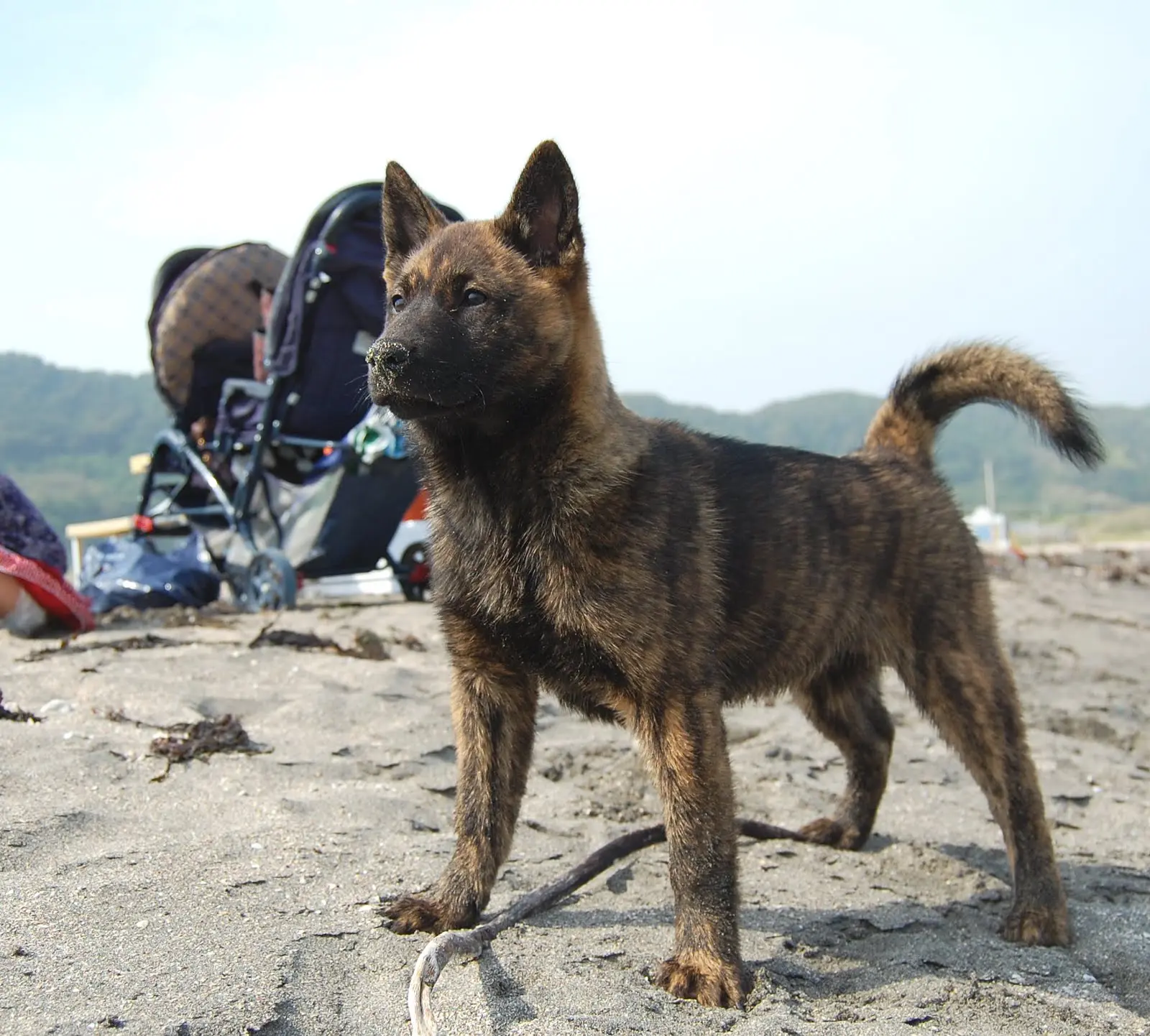
    Kai Tora-Ken

    Due to the primitive character of the Kai, it is not recommended to keep it solely as a family dog.

    Content

    History

    The Kai comes from the province of the same name ยซKaiยป, a region of Japan surrounded by mountains in Yamanashi prefecture. Among his ancestors are several medium-sized Japanese dogs that have been used for thousands of years to hunt bears, deer, boars, badgers and hares. Asian hunters especially appreciated the great independence and fearlessness of these dogs, who couldn't even resist fighting an adult bear.

    Natural monument with export ban

    Not only the remoteness of the region of the Kai, difficult to access, but also the tendency to riot probably contributed to the purity of this rare breed. Due to its great cultural importance, Japan declared to Kai as a natural monument in 1934. Since then, their export from Japan has been strictly prohibited., previously only possible under special conditions. So, in Europe there are almost no breeders with a breed Kai.

    Physical characteristics of the Kai

    The Kai medium size earns the necessary respect, particularly through his smooth, muscular body and extremely developed legs and hocks, with which some representatives of the breed can climb not only behind the back of the sofa, but even the trees.

    The Kai males reach a shoulder height of about 53 cm., therefore slight deviations are tolerated. Bitches are somewhat smaller with 48 cm.. The weight is not indicated in the standard of the Fรฉdรฉration Cynologique Internationale (FCI). But, should be in a reasonable proportion to body height and is usually a maximum of 18 kg.

    The FCI, that classifies the Kai under the standard number 317, He tells it in the Asian top group. Like many other dogs in this group, the Kai has a rather pointed face, triangular ears and a tail of dense, tall fur, which he wears curled or sickle-shaped on his back.

    typical currents

    characteristic of Kai it's his brindle coat, that has been kept pure for thousands of years without the help of other races. The coat appears in the colors black, red and black-red tabby. But, develops typical current only after a year. In the first twelve months of the puppy's life, the coat is initially solid in color.

    The hair Kai adult is hard and strong and has a soft and dense undercoat. So, is well protected from the sometimes extreme weather conditions of its home region, which is surrounded by high mountains.

    Character and skills of the Kai

    The Kai, also known as Kai Inu, Tora Inu o Kai tora-ken, he is a very original dog, that has preserved its instinctive and "wild" nature until today. Not only his distinctive hunting instinct and high alertness, but also their natural pack behavior and their unpreparedness for subordination are typical characteristics.. He is considered a dominant and independent hunter who sees little reason to follow humans unconditionally..

    Is it possible to keep him as a family dog?

    Due to its primitive character, it is not recommended to keep it solely as a family dog โ€‹โ€‹and, should be well considered – though a hasty purchase of this rare breed dog, which is hardly common outside of Japan, not possible anyway. Anyone that, despite all circumstances and challenges, has proposed to maintain a Kai As a family dog รขโ‚ฌโ€นรขโ‚ฌโ€นyou must be aware that not only the great need for work and exercise, but above all the education and socialization of this original animal requires a lot of time. Much experience is required, patience, consistency and positive motivation to train this highly intelligent and willing to learn dog, but also stubborn, to become an adapted and uncomplicated companion.

    A Kai needs a lot of attention

    But, Whoever masters this challenge will be rewarded with an extremely loyal and watchful dog that will stand by his family without reservation and with protection.. Those who have earned the trust of the Kai They will notice that the initial reserve towards strangers soon gives way to an extremely friendly and loving being who enjoys the love and attention of his owner to the fullest.. But, his great passion for hunting and his natural sharpness should never be underestimated.

    Kai Health

    The low dispersion of Kai it is also the attractiveness of this breed, because compared to other Japanese hunting dogs the Kai is regarded as extremely genuine and pure. This is visible not only in his behavior but also in his robust health. The Kai you hardly need to fear the typical diseases of the breed, which are spread mainly by uncontrolled breeding. So, its average life expectancy is quite high, of 12 to 15 years.

    Kai care

    High vet bills or long, expensive grooming are no problem with this tough, naturally clean dog. Regular brushing or combing of the coat is absolutely sufficient. But, during the layer change time (twice a year), the Kai should come in contact with a brush daily. In this way, dead hairs can be eliminated and the flooding of strands of hair in the house can be reduced a little..

    Kai nutrition

    In his native Japan, the Kai still feeds almost exclusively on game. So he eats what the hunter leaves him from the captured animals. Whoever keeps the Kai as a family and companion dog it will not be able to maintain this original diet. To feed the dog as originally as possible, many dog รขโ‚ฌโ€นรขโ‚ฌโ€นowners turn to the so-called BARF method, which can be roughly translated as "biologically species-appropriate raw diet". Here, the dog is offered only raw meat, enriched with vegetables or rice.

    Where can I get a Kai?

    Anyone outside of Japan who dreams of seeing a real Kai, much less buy one, will have great difficulties to fulfill this wish. The greatest opportunity to meet a Kai uro is visiting an international dog show where representatives of this breed are shown from time to time. If you do not have Japanese citizenship, you will have to settle for those short encounters or photos of this breed, for better or worse. If this is not enough for you, maybe I should look up breeds related to the Kai as the Akita Inu or the Shiba, that are quite similar in character and appearance to this breed.

    Characteristics "Kai"

    Coexistence is important that you have with your new friend. Before considering the acquisition of a dog of the breed "Kai" you know certain factors. Not all breeds of dogs are apt to live in an apartment, you must take into account his character, their need for exercise, their interaction with other pets, their care and if you have small children, their level of tolerance towards them.

    Training ?

    2,0 of 5 stars (based on 1 review)

    Suitability of the apartment ?

    2,0 of 5 stars (based on 1 review)

    Can be alone all day ?

    2,0 of 5 stars (based on 1 review)

    Suitable as a first dog ?

    1,0 of 5 stars (based on 1 review)

    Weight gain ?

    4,0 of 5 stars (based on 1 review)

    Health ?

    5,0 of 5 stars (based on 1 review)

    Intelligence ?

    5,0 of 5 stars (based on 1 review)

    Kindness with child ?

    3,0 of 5 stars (based on 1 review)

    Tendency to bite ?

    4,0 of 5 stars (based on 1 review)

    Tendency to bark ?

    3,0 of 5 stars (based on 1 review)

    Tendency to flee ?

    5,0 of 5 stars (based on 1 review)

    hair loss strength ?

    3,0 of 5 stars (based on 1 review)

    Suitable as a guard dog ?

    5,0 of 5 stars (based on 1 review)

    Joy ?

    3,0 of 5 stars (based on 1 review)

    Cat friendliness ?

    1,0 of 5 stars (based on 1 review)

    Power level ?

    5,0 of 5 stars (based on 1 review)

    Videos "Kai"

    HTTPS://youtube.com/watch?v=-gcJ69FZbJk
    Kai Ken Tiger Dog – Natural Hunter and Extremely Rare Dog
    HTTPS://youtube.com/watch?v=aEBx-Luw_zo
    Kai Ken / kai Toraken / Tora Inu – Breed of dog

    Type and recognitions:

    • FCI CLASSIFICATION:
    • Group :
    • Section : . .

    Federations:

    • FCI – Group 5: Spitz-type dogs and primitive type – Section 5: Asian Spitz and related breeds. โ“˜

    FCI breed standard "Kai"

    Origin:
    Japan

    Date of publication of the valid original standard:
    16.06.1999

    Use:

    Hunting dog and company.


    General appearance:

    Medium-sized dog, well proportioned, Strong body structure with well-developed muscles. Its special characteristics as a dog from the mountainous district of Japan, are its strong limbs and exceptionally developed tibio-tarsal joints.

    IMPORTANT PROPORTION : The relationship between the height of the withers and the length of the body is 10 : 11.


    Behavior / temperament:

    His temperament is very alert and alert..

    Head:

    ---

    Cranial region:
    • Skull : Wide forehead.
    • Depression links (Stop) : Brusque, with little marked frontal furrow.

    facial region:

    • Truffle : Black, straight muzzle.
    • Snout : Pointed, not very long, but moderately wide.
    • Lips : Adherents.
    • Jaws / Teeth : Powerful scissor bite.
    • Cheeks : Well developed.
    • Eyes : Relatively small, almost triangular, dark brown.
    • Ears : A little larger than other medium-sized Japanese breeds, triangular, directed slightly forward, carried energetically erect.

    Neck:

    Thick, strong and muscular.

    Body:

    • Cross : High.
    • Back : Straight and short.
    • Pork loin : Wide and muscular.
    • Breast : Deep, moderately arched ribs.
    • Belly : Very withdrawn.

    Tail:

    High insertion, thick, carried on the back vigorously curled or sickle-shaped. The tip of the tail should reach approximately to the hocks..

    Tips

    PREVIOUS MEMBERS :

    • Shoulder : Shoulder blade moderately oblique and covered with well-developed muscles.
    • Elbows : Well glued.
    • Forearm : Straight, strong and muscular.
    • Metacarpus : Slightly inclined.

    LATER MEMBERS :

    • Thigh : Long.
    • Leg : Short.
    • Warm-foot joint : Robust and elastic.

    FEET : Well arched and compact fingers; thick, elastic pads. hard nails, preferably dark in color.

    Movement:

    Light and elastic.

    Mantle

    HAIR : Hard and straight coat hair, soft and dense undercoat. In the tail it is relatively long and is more separated.

    COLOR : black brindle, striped red, striped. It is characteristic of this breed that the puppies have a single color, which becomes brindle in the course of its development.


    Size and weight:

    Height to the cross :

    • in males : 53 cm.,
    • in females : 48 cm..

    A deviation of +/- 3 cm..


    Fouls:

    Any deviation from the aforementioned criteria is considered as a fault and the severity of this is considered to the degree of the deviation to the standard and its consequences on the health and well-being of the dog..

    โ€ข Inverted sexual characteristics.
    โ€ข Light colored nose.
    โ€ข Mild upper or lower prognathism.
    โ€ข Light colored eyes.
    โ€ข Short or long hair.
    โ€ข Shyness.

    MISS PLAYOFFS

    โ€ข Aggressive or fearful dog.
    โ€ข Marked upper or lower prognathism.
    โ€ข Ears not erect.
    โ€ข Short or hanging tail.
    โ€ข Pale coat color.
    โ€ข Coat with many white markings.
    โ€ข Extremely fearful dog.

    Any dog โ€‹โ€‹showing clear signs of physical or behavioral abnormalities must be disqualified..


    N.B.:

    Males should have two normal-appearing testicles fully descended into the scrotum..

    Source: F.C.I - International Cynological Federation

    Alternative names:

    1. Kai Ken, Tora Inu, Tiger Dog, Tora Dog (English).
    2. Kai tora-ken (French).
    3. Kai Inu, Tora Inu, Kai tora-ken (German).
    4. Kai tora-ken (Portuguese).
    5. Kai Ken, Tora Inu, perro tigre (espaรฑol).

    โ–ท The world of Pets: Dogs, cats, birds, reptiles, amphibians

    Canaan Dog
    Israel FCI 273 - Primitive type

    Canaan Dog

    The Canaan Dog He is suspicious of strangers and very affectionate with his clan members

    Content

    History

    The Canaan Dog They belong to the group of "pariah dogs", found throughout the Afro-Asian region. They live near human settlements, tolerated by humans, but they are not encouraged or fed. For primitive peoples they are useful as a destroyer of all organic residues.. Even today, the Canaan Dog they live in herds in the desert. If Bedouins need a guard dog for their camp or a herding dog for their sheep, they look for a wild female who raises her cubs in a cave, they throw a piece of bread at him every now and then until they have chosen the strongest male cub that will guard their camp in the future.

    Cynologically, los ยซpariah dogยป belong to the Spitz family, the oldest family of dogs in the world. Cave paintings thousands of years old show these dogs as hunting helpers. With the time, the original type of Spitz adapted to the situation of its environment. The Canaan Dog is the most developed form of the type Spitz in israel today. The canaan dog still possess strong survival instincts, what makes them smart, independent and also very cautious dogs.

    The Canaan breed has been domesticated by outcast wild dogs, namely, by Rudolphina Menzel, a canine behaviorist and cynologist who emigrated from Vienna to Palestine in the 1930. He took some of them home and was amazed at how easily they were tamed and trained. They were lively and loving. The teacher Menzel I call them canaan dogs in honor of the Biblical land of Canaan and campaigned for them to be recognized as a race.

    Physical characteristics ยซCanaan Dogยป

    The height at the withers of these square animals, strong and medium in size is about 50 to 60 cm., while males are usually much larger than females. In general, the sex characteristics between female and male dogs are very pronounced. These may include, the rather broad skull of the Canaan Dog, that narrows at a point towards the front, is clearly visible, especially in males. The head is always well proportioned. Standing ears, slightly laterally arranged, triangular and wide, as well as his almond-shaped and dark eyes, give you a very alert and intelligent expression. In fact, nothing escapes the watchman Canaan Dog, even when asleep.

    HAIR:
    Thick layer, rough and straight, short to medium length. The inner layer is very close and abundant.

    COLOR:
    Sandy to reddish brown, white, black or mottled, with or without mask. If there is a mask, must be symmetrical. A black mask and white markings are allowed for all colors. A pattern such as the Boston Terrier. Gray colors are not allowed, striped, black and tan or tricolor. The characteristic colors of the desert – sandy, dorado, Red and cream – are particularly typical of the breed.

    Character and aptitudes ยซCanaan Dogยป

    The Canaan Dog is lively, sensitive, distrustful of strangers, defensive, but not aggressive by nature. Watcher not only of humans, but also other animals. He is faithful and devoted to his family. The relationship with its owner means for him a partnership, both sides taking and giving. The Canaan Dog you don't have to follow your owner everywhere and submissively read every wish in his eyes. There are times when he shows his love and wants to be caressed. But other times he minds his own business and only belongs to himself.. If one responds to his character, a deep understanding develops between man and animal, which is even more attractive, since one must acquire their trust and affection. This special bond makes it difficult to place the Canaan Dog adults in new settings.

    Protects their owner's children and shows a lot of tolerance towards the little ones. But, parents should ensure the dog has a chance to withdraw.

    The Canaan Dog they are good watchdogs, but they are not attackers by nature. Only when a Canaan Dog you have the impression that he or his family is seriously threatened, will attack. The Canaan Dog barks as a warning, gives a dangerous appearance, and that is usually enough.

    The Canaan Dog can react aggressively to other dogs who dare to pass by his property. Aggression between dogs of the same sex is not uncommon among Canaanites. Each Canaan is different. You have to watch it closely to know what collisions – with other dogs on walks – it is better to avoid.

    โ€œCanaan Dogโ€ Education

    One Canaan Dog he would never do anything that could harm himself. Nor would it comply with its owner's commands without first questioning their meaning.. You can't demand obedience from this dog. But, once he has gained trust in his human and recognizes him as "leader of the pack", is very cooperative and obedient. Loyalty to his master and his quick understanding make him, despite its independence, an easy-to-handle dog, who can learn the necessary basic obedience without restrictions. But, during training its primitive nature must be taken into account, so it certainly takes some compromises and tricks to convince the Canaan Dog that obedience is worth it. For inexperienced beginners, this self-assured breed is not suitable.

    Where can I get "Canaan Dog"?

    Today, not only in his homeland Israel, but also in the US. and in several European countries, like germany, Finland, England, Italy or Switzerland, there are breeders who have dedicated themselves to this special and still very rare breed. The addresses of the breeders can be found in the national kennel clubs or, of course, on the Internet. If you are considering buying a Canaan, enough time should be taken to consider your purchase decision thoroughly. This is true of all dogs, but especially for him Canaan Dog, because this original and independent four-legged friend is no ordinary family dog.

    โ€œCanaan Dogโ€ Care

    The rough coat naturally repels dirt and only needs to be brushed once or twice a week. Only in the phase of the biannual coat change should it come into contact with a brush or comb daily to remove dead hairs from the dense undercoat and reduce the tuft of carpet hairs, the sofa or the blanket.

    Nutrition of the โ€œCanaan Dogโ€

    While the Canaan, as a "pariah dog" in freedom, forages for its own food and feeds on whatever organic waste humans leave behind, as a domestic dog it depends on the support of its owner. But what do you give such an original wild dog? In general: Dogs are carnivores by nature., regardless of whether they are shepherd dogs, Sausage dog or even Canaan. This means that the food must be largely meat. (around the 70 per cent). Meat is the most important source of protein for the dog. Its entire masticatory and digestive system is oriented to the processing of meat: the strong teeth, strong chewing muscles, the relatively short intestinal tract and digestive juices that are quite aggressive in contrast to humans.

    Health ยซDog of Canaanยป

    The race Canaan Dog It is very healthy, it does not have typical diseases and it is considered very clean..

    Characteristics "Canaan Dog"

    Coexistence is important that you have with your new friend. Before considering the acquisition of a dog of the breed "Canaan Dog" you know certain factors. Not all breeds of dogs are apt to live in an apartment, you must take into account his character, their need for exercise, their interaction with other pets, their care and if you have small children, their level of tolerance towards them.

    Training ?

    4,0 of 5 stars (based on 1 review)

    Suitability of the apartment ?

    4,0 of 5 stars (based on 1 review)

    Can be alone all day ?

    3,0 of 5 stars (based on 1 review)

    Suitable as a first dog ?

    2,0 of 5 stars (based on 1 review)

    Weight gain ?

    2,0 of 5 stars (based on 1 review)

    Health ?

    5,0 of 5 stars (based on 1 review)

    Intelligence ?

    5,0 of 5 stars (based on 1 review)

    Kindness with child ?

    3,0 of 5 stars (based on 1 review)

    Tendency to bite ?

    3,0 of 5 stars (based on 1 review)

    Tendency to bark ?

    4,0 of 5 stars (based on 1 review)

    Tendency to flee ?

    3,0 of 5 stars (based on 1 review)

    hair loss strength ?

    4,0 of 5 stars (based on 1 review)

    Suitable as a guard dog ?

    5,0 of 5 stars (based on 1 review)

    Joy ?

    3,0 of 5 stars (based on 1 review)

    Cat friendliness ?

    4,0 of 5 stars (based on 1 review)

    Power level ?

    4,0 of 5 stars (based on 1 review)

    Images "Canaan Dog"

    Photos:

    1 – Canaan dog by Giora Sluzky, CC BY-SA 3.0, via Wikimedia Commons
    2 – Canaan dog by Canaan Dog, Kennel Samorodok Hanaanahttp://www.ruscanaan.ru, CC BY-SA 3.0, via Wikimedia Commons
    3 – Canaan dog by Giora Sluzky, CC BY-SA 3.0, via Wikimedia Commons
    4 – Canaan dog by SamorodokhanaanaCanaan Dogs from "Samorodok" http://www.ruscanaan.ru, CC BY-SA 3.0, via Wikimedia Commons
    5 – Canaan dog by https://pxhere.com/en/photo/1503483
    6 – Canaan dog by Samorodokhanaanahttp://www.ruscanaan.ru, CC BY-SA 3.0, via Wikimedia Commons
    7 – Canaan dog by Arikk, CC BY-SA 3.0, via Wikimedia Commons

    Videos "Canaan Dog"

    Canaan - Top 10 Facts
    Canaan – Top 10 Facts
    Canaan Dogs | Breed Judging 2020
    Canaan Dogs | Breed Judging 2020

    Type and recognitions:

    • FCI CLASSIFICATION:
    • Group :
    • Section : . .

    Federations:

    • FCI – Group 5: Spitz-type dogs and primitive type – Section 6: Primitive type. โ“˜
    • AKCHerding โ“˜
    • ANKC – Group 7 (Nonsporting) โ“˜
    • CKC – Group 7 (Nonsporting) โ“˜
    • โ€‹KCUtility โ“˜
    • NZKCNonsporting โ“˜
    • UKC – sighthounds and pariah โ“˜

    FCI breed standard "Canaan Dog"

    Origin:
    Israel

    Date of publication of the valid original standard:
    26.03.1998

    Use:

    Guard and protection dog.


    General appearance:

    Medium-sized, square body, well balanced, strong, similar to the type of wild dog. There is a marked difference between both sexes.


    Behavior / temperament:

    You are always alert and react quickly. Distrustful of strangers, his character is strongly defensive, but not aggressive by nature. Is vigilant, not only with humans, but also with all the animals. It is very faithful and easy to train.

    Head:

    Is well proportioned, medium length, in the form of an obtuse wedge. It appears even wider because the ears are set low.

    Cranial region:
    • Skull : Is something flat. Head may be wider in powerful males.
    • Depression links (Stop) : shallow, although well defined.

    facial region:

    • Truffle : black.
    • Snout : Vigorous, of moderate length and width.
    • Lips : Tight.
    • Jaws / Teeth : Jaws must be strong. Teething is complete with a uniform scissor bite.

    Eyes : Dark brown in color, slightly oblique and almond-shaped. Dark eye rim is essential.

    Ears : erected, relatively short and wide. They are slightly rounded at the tip and are set low.

    Neck:

    Muscular and of medium length.

    Body:

    Square.

    • Cross : Well developed.
    • Back : Uniform.
    • Pork loin : Muscular.
    • Breast : Deep and moderately wide. Well arched ribs.
    • Belly : Well up.

    Tail:

    Set high it is worn curled over the back. The hair is abundant and dense.

    Tips

    PREVIOUS MEMBERS : Perfectly straight.

    • Shoulder : Oblique and muscular.
    • Elbows : Well attached to the body.

    LATER MEMBERS : Powerful.

    • Buttocks : Strong and covered with a slight fringe of hair.
    • Knees : Well angulated.
    • Hocks : Well descended.

    FEET : Jack's foot. They're strong, round and the pads are hard.

    Movement:

    The trot is fast, light and vigorous. The animal must show great agility and resistance. Correct movements are of essential importance.

    Mantle

    HAIR : The hairs on the outer coat are dense, hard, straight and short or of medium length. The hairs of the undercoat are abundant and well glued.

    COLOR : Ranges from sand to reddish-brown, white, black or mottled, with or without mask. If there is a mask, this must be symmetrical. Black mascara and white markings are allowed in all colors. Brands like the Boston Terrier are common. Gray colors are not accepted, striped, Black with fire, nor tricolor. The most typical colors of the breed are the colors of the desert, sand, oro, Red and cream.


    Size and weight:

    Height to the cross : It is of 50 to 60 cm.. Males can be considerably larger than females.

    Weight : It is of 18 to 25 kg.


    Fouls:

    Any deviation from the aforementioned criteria is considered as a fault and the severity of this is considered to the degree of the deviation to the standard and its consequences on the health and well-being of the dog..

    Any dog โ€‹โ€‹showing clear signs of physical or behavioral abnormalities must be disqualified..


    N.B.:

    โ€ข Males must have two normal-appearing testicles fully descended into the scrotum..
    โ€ข Only functionally and clinically healthy dogs, with the typical conformation of the breed, should be used for parenting.

    Source: F.C.I - International Cynological Federation

    Alternative names:

    1. Bedouin Sheepdog, Palestinian Pariah Dog (English).
    2. Canaan dog (French).
    3. Canaan Dog, Israel-Spitz (German).
    4. Cรฃo de canaรฃ (Portuguese).
    5. Perro de Canaรกn, Kelev Kna’anรญ, kunean alkalb (espaรฑol).