โ–ท The world of Pets: Dogs, cats, birds, reptiles, amphibians

Slovakian Wirehaired Pointers
Eslovaquia FCI 320 . Braque Type

Slovakian Wirehaired Pointers

The Slovakian Wirehaired Pointers in an obedient and easy to train dog.

Content

History

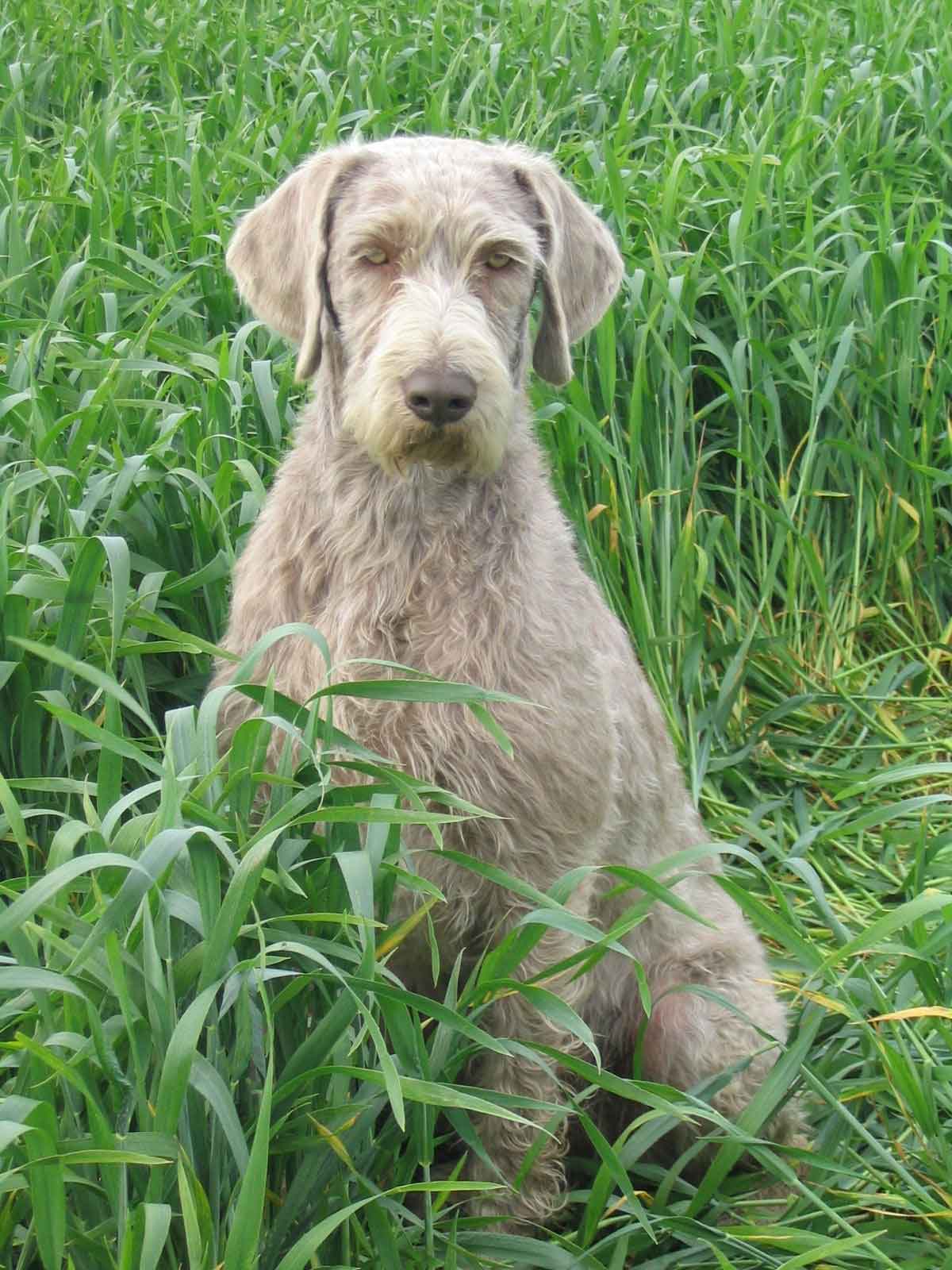
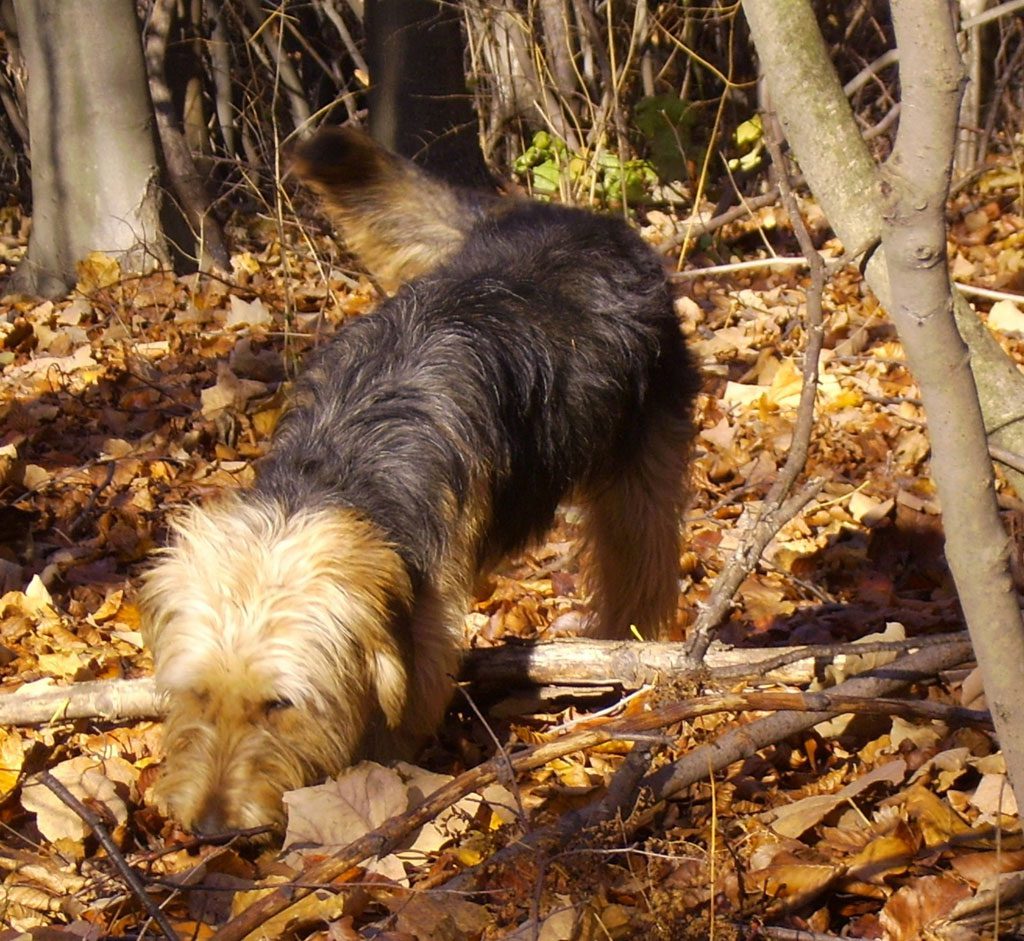
The Slovakian Wirehaired Pointers is a relatively new breed. It dates back to the end of the decade of 1950, in Czechoslovakia after World War II and is believed to have been developed using the Weimaraner, the German Wirehaired Pointer and the Cesky Fousek.

At any given time, the Slovaks who developed the breed asked the Club Weimaraner from Germany to recognize this dog under the name of Rough-haired Weimaraner, but the request was rejected.

The resulting dog is a true wonder, that combines the talents of a hunting dog (on the plains, in the woods and in the water), a working dog and a companion dog. Adapts to all climates.

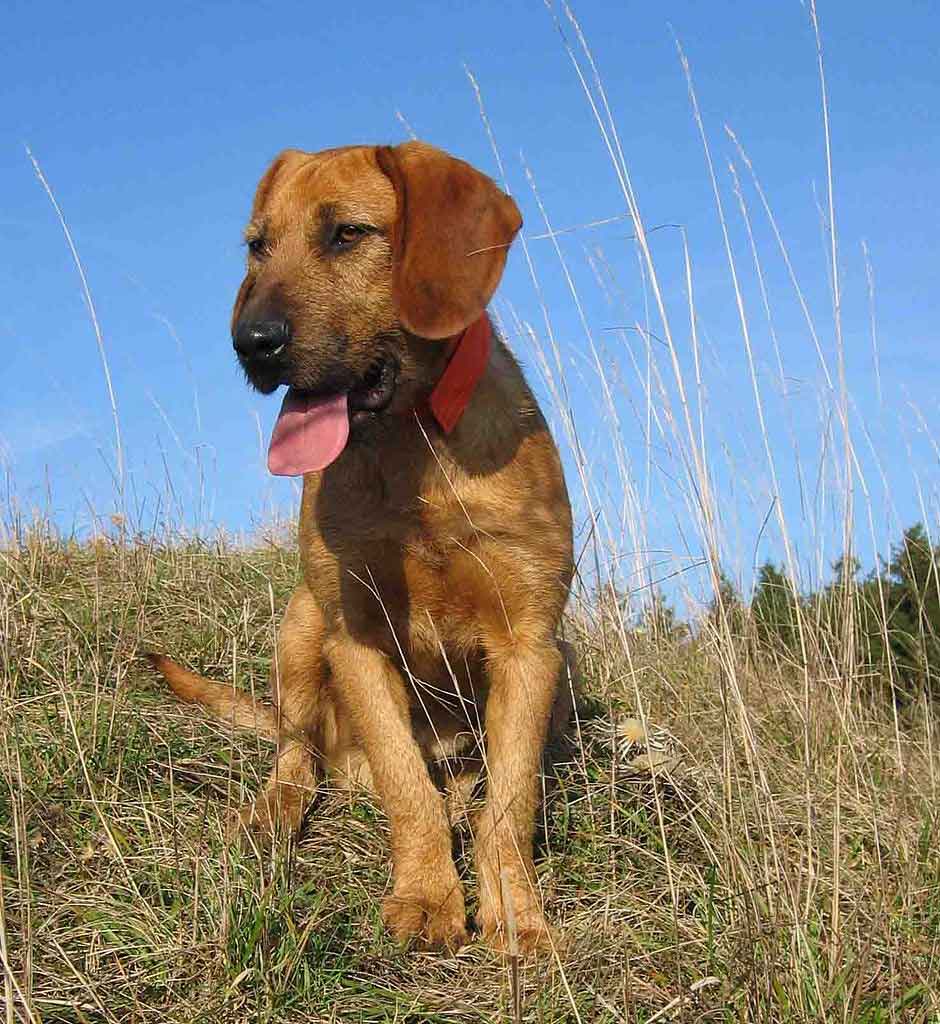
Photo: Slovakian Wire-haired Pointing Dog by Ing. Urban Michal (breeders HP), Public domain, via Wikimedia Commons

Physical characteristics

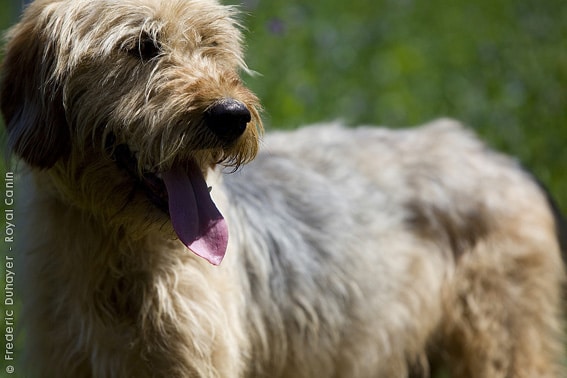
The Slovakian Wirehaired Pointers it's a tall braco, solidly built and not too heavy. This breed is bred to be a working dog, with nobility in its forms. Tail is cut to half length when permitted by law. It stands rather high, worn at rest and in horizontal action. The eyes are almond-shaped, amber, with a clever expression. In puppies and young dogs, are blue. Dropped ears sit above the eye, they are rounded and not too long.

Slovakian Wirehaired Pointers
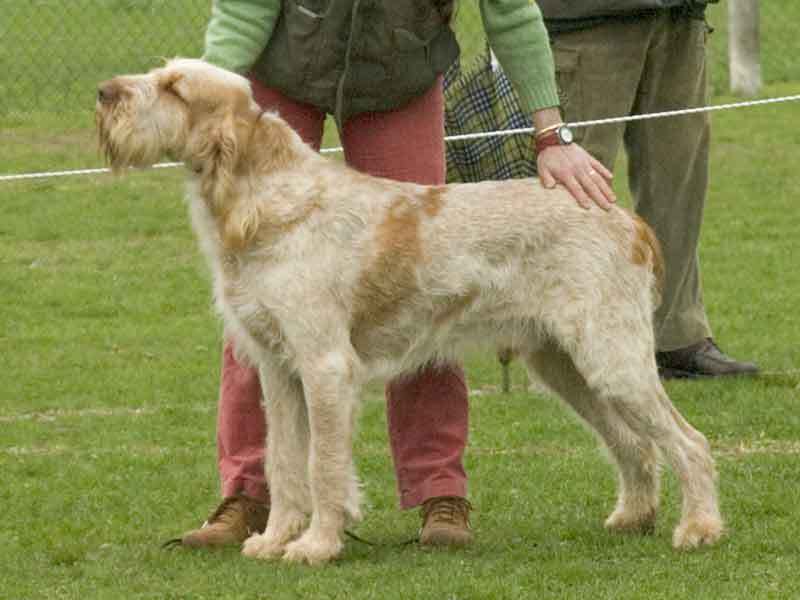
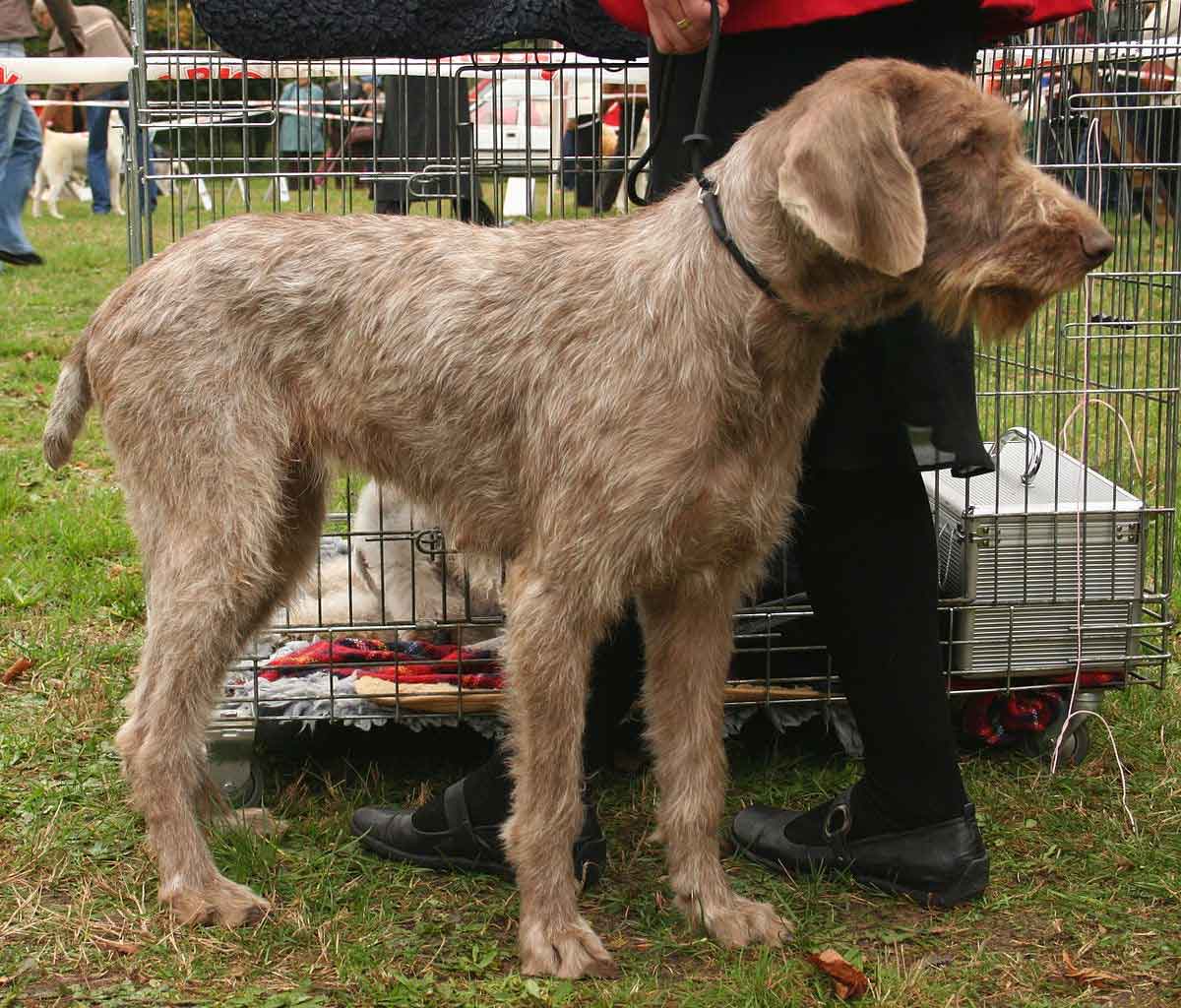
"Stilling hard hair" during the exhibition of dogs in Rybnik – Stone, Poland

The undercoat consists of a short, fine down that normally falls off in summer. The top layer is about 4 cm long, hard, straight and well laid. At the bottom of the muzzle, hairs are longer and softer and form a mustache. above the eyes, are more pronounced and are obliquely erect. The forehead and occiput are covered with short, hard hair. They are short and soft on the ears. The tail is well provided with hair, but it is not brushed. The basic color is "gray": is a sand shaded with brown. White markings are allowed on the tips of the legs and on the chest. Smaller or larger dark spots can mark gray. There is also a speckled coat.

Character and skills

The Slovakian Wirehaired Pointers described in the FCI standard as easy to train and compliant. They are selected for their work characteristics as Pointer dogs. They hunt on the plains, forests and water. They work mainly after the shot, searching and recovering the game.

The Slovakian Wirehaired Pointers it's animated, happy and eager to please. He has a lot of energy and is very intelligent., but gets bored easily. This can sometimes make training a bit difficult., and should work to make training sessions fun, interesting and not very long. They need a steady and consistent hand in disciplining with structure and limits.. Harsh words or physical punishment should be avoided. They have a strong bond with their families, and may develop separation anxiety without proper conditioning.

the Slovakian Wirehaired Pointers they are the happiest doing things with their owner. This makes the breed a great candidate as a canine companion for owners who love walks., cycling or jogging. It is imperative that they have opportunities to run free, preferably in a fenced area, since his hunting instinct is very strong, and the dog will not be able to resist the urge to chase the prey.

Health

The Slovakian Wirehaired Pointers it is a generally healthy breed, and responsible breeders examine their breeders for health conditions such as elbow and hip dysplasia, progressive retinal atrophy and cataracts.

Grooming

The Slovakian Wirehaired Pointers requires only a minimum of grooming to maintain its good condition. Wiping them with a damp cloth is usually sufficient between baths.. Using a grooming glove or comb on your coat during the fall season can help keep the amount of hair shedding in your home down.. Toenails should be trimmed every four weeks. A dental care regimen should start at an early age to avoid problems later in life.

Characteristics "Slovakian Wirehaired Pointers"

Coexistence is important that you have with your new friend. Before considering the acquisition of a dog of the breed "Slovakian Wirehaired Pointers" you know certain factors. Not all breeds of dogs are apt to live in an apartment, you must take into account his character, their need for exercise, their interaction with other pets, their care and if you have small children, their level of tolerance towards them.

Adaptation โ“˜

4,0 of 5 stars (based on 1 review)

friendly dog โ€‹โ€‹โ“˜

4,0 of 5 stars (based on 1 review)

hair loss โ“˜

2,0 of 5 stars (based on 1 review)

Affection level โ“˜

2,0 of 5 stars (based on 1 review)

Need for exercise โ“˜

4,0 of 5 stars (based on 1 review)

Social need โ“˜

3,0 of 5 stars (based on 1 review)

Home โ“˜

3,0 of 5 stars (based on 1 review)

Toilet โ“˜

2,0 of 5 stars (based on 1 review)

Friendly with strangers โ“˜

3,0 of 5 stars (based on 1 review)

barking โ“˜

2,0 of 5 stars (based on 1 review)

Health โ“˜

4,0 of 5 stars (based on 1 review)

Territorial โ“˜

4,0 of 5 stars (based on 1 review)

Cat friendly โ“˜

2,0 of 5 stars (based on 1 review)

Intelligence โ“˜

4,0 of 5 stars (based on 1 review)

Versatility โ“˜

4,0 of 5 stars (based on 1 review)

Child friendly โ“˜

4,0 of 5 stars (based on 1 review)

Surveillance โ“˜

3,0 of 5 stars (based on 1 review)

joy โ“˜

5,0 of 5 stars (based on 1 review)

Videos "Slovakian Wirehaired Pointers"

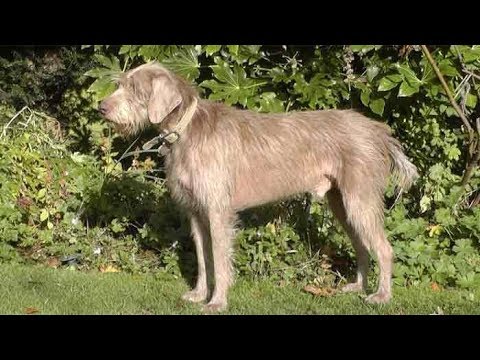
Dog Breed Video: Slovakian Rough Haired Pointer
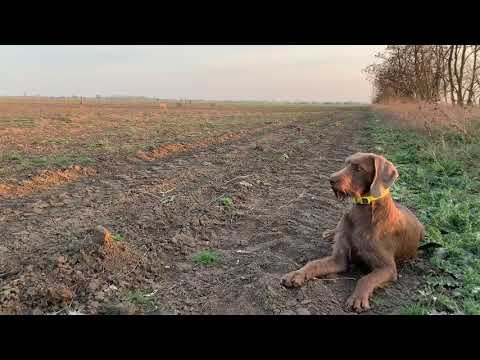
Slovakian wire haired pointer - training
Slovakian wire haired pointer – training

Type and recognitions:

  • FCI CLASSIFICATION:
  • Group :
  • Section : . .

Federations:

  • FCI – Group 7: Pointing Dogs. – Section 1: Continental Pointing Dogs. 1.1: Braque Type โ“˜
  • โ€‹KCgundog โ“˜
  • AKCGroup: Foundation Stock Service โ“˜

FCI breed standard "Slovakian Wirehaired Pointers"

Origin:
Slovakia

Date of publication of the valid original standard:
06.01.1995

Use:

Pointing Dogs.


General appearance:

This is a moderate force animal. Although it is a working dog, His appearance is noble. The color of the outer hair of hairs is "gray" and the hair is hard. It must be suitable for work in plain, in the forest and in the water and especially for work after the shot, To search and bring wounded hunt. It is an obedient and easy to train dog.

IMPORTANT PROPORTION :
The correlation between the height to the cross and the length of the trunk must be 10:9 in males and 10:8 in females. This animal must be solidly constituted, But not coarse appearance.


Behavior / temperament:

It must be suitable for work in plain, in the forest and in the water and especially for work after the shot, To search and bring wounded hunt. It is an obedient and easy to train dog.

Head:

It's quite long, thin, No folds on the skin and keep proportion to the body.

Cranial region:
  • Skull : It has a rectangular shape; Superciliar arcades must be pronounced; The front groove is visible. The occipital bump is palpable to touch.
  • Depression links (Stop) : Moderately inclined (about 45 ยฐ).

facial region:

  • Truffle : Is large and dark. The Windows are wide open.
  • Snout : It has approximately the same length as the skull. Is high and wide. The nasal helm is straight.
  • Lips : Moderately developed. They are well glued and are dark.
  • Jaws / Teeth : Uniform and robust jaw. The teeth are well developed. The joint is in the form of scissors.

Eyes : They have almond and are well sunk in the orbits. They are amber and intelligent expression. In puppies and young dogs are blue. The eyelids are dark.

Ears : They are convenient length and inserted above the eye region. The root is wide and the tips are round.

Neck:

Is medium length, delgado, No folds on the skin. It is well muscular and is high in the region of La Cruz.

Body:

  • top line: As a whole, The dog is very compact and rather bulky. The back is straight and the neck is inserted high. The dog wears the head up.
  • Cross : It is well pronounced and is well linked to the back.
  • Back : Straight, well muscled. Solid, very slightly inclined back.
  • Rump : Is wide and quite long, It is not too high or very oblique.
  • Breast : It is quite long and wide. It has oval shape and saves proportion with the rest of the body. Descend to the elbows. The ribs are well -tight and the plunder is well developed.
  • Belly and flanks : They are moderately retracted.

Tail:

It is moderately thick and rather high insertion. When the dog is at rest, carries it down and when it is in action, carries it in horizontal direction. The tail is very hairy, but not in the form of a brush. It is trimmed at half of its length.

Tips

PREVIOUS MEMBERS : As a whole, they are well developed. FRONT VIEWS THE PROFILE, They are approved.

  • Shoulder : Well developed and muscular. The shoulder blade is oblique.
  • Scapulo-Humeral angle : Is 110 ยฐ.
  • Elbow angle : It is 135 ยฐ. Steering : Vertical, thin and marked musculature.
  • Carpo : It is almost vertical : Quite thick, relatively short and almost vertical.
  • Front feet : They are round, the fingers are well together and arched. The nails and pads are dark. Internal fingers should be eliminated.

LATER MEMBERS : Together and profile, They are well angled. Seen from the back, they are leaden.

  • Thighs : They are quite long, wide and well muscled.
  • Lame-femoral angle : From 80 ยฐ to 85 ยฐ
  • A fรฉmoro-Tibial-Tibial (knee) : Between 125 ยฐ and 130 ยฐ.
  • Leg : Wide, quite long and very muscular.
  • Hock angle : Between 125 ยฐ and 135 ยฐ.
  • Metatarsus : It is almost vertical.
  • Rear feet : They are round, the fingers are well together and arched. The nails and pads are dark. The spur must be eliminated.

Movement:

Is balanced and agile. During the work in the plain, The gallop dog.

Mantle

SKIN : It is not very thick. Is elastic and without folds. Its color is gray.

HAIR : The inner hair is presented in the form of a short and fine hair. I usually change it during the summer. The outer hair of hairs measures some 4 cm.; Hair is hard, smooth and stuck. The hairs under the snout are longer and softer and form a beard. Above the eyes the hairs are more marked and are presented obliquely. The forehead and occipucio are covered with short and hard hair. They are short and soft about the ears. The tail is very thick.

COLOR : Base color is chestnut shaded sand (It is called "Gray"), With lighter or darker varieties, With or without white marks on the limbs and chest. Also "gray" with more or less large spots and eventually mottled.


Size and weight:

Height to the cross : It is of 62 โ€“ 68 cm in males and 57 โ€“ 64 cm in females.


Fouls:

Any deviation from the aforementioned criteria is considered as a fault and the severity of this is considered to the degree of the deviation to the standard and its consequences on the health and well-being of the dog..

SERIOUS FAULTS

โ€ข Tough appearance and lack of elegance.
โ€ข Head too big.
โ€ข Very long or very thick ears.
โ€ข Convex back.
โ€ข Very long or silky hair.
โ€ข Very short hair, No beard.
โ€ข Too clear color, pulling Blancuzco.
โ€ข Size too big or too small, Regarding the provisions of the standard.

MISS PLAYOFFS

Aggressive or fearful dog.
All anatomical defects, such as upper or lower prognathism, entropion, ectropion, irregular position of the limbs.
Any other base color other than the "gray" (Chestnut shaded sand color).
Any dog โ€‹โ€‹showing clear signs of physical or behavioral abnormalities must be disqualified..


N.B.:

Males should have two normal-appearing testicles fully descended into the scrotum..

Source: F.C.I - International Cynological Federation

Alternative names:

1. Slovak Rough-haired Pointer, Slovakian Wirehaired Pointer (English).
2. (Nom d’origine : Slovensky Hrubosrsty Stavac), Griffon d’Arrรชt Slovaque ร  poil dur (French).
3. SHS, Slovenskรฝ hrubosrstรฝ stavaฤ (German).
4. Braco eslovaco de pรชlo duro, (em eslovaco: Slovenskรฝ hrubosrsty stavac) (Portuguese).
5. Grifรณn de muestra eslovaco de pelo duro (espaรฑol).

โ–ท The world of Pets: Dogs, cats, birds, reptiles, amphibians

Italian Spinone
Italia FCI 165 . Griffon type.

in some countries, the Italian Spinone It doesn't get the publicity it deserves., because faster breeds of dogs with more olfactory capacity are preferred.

Italian Spinone

Content

History

As the name suggests, the Italian Spinone -The ยซItalian emphasisยป – is originally from Italy, more specifically from the Piedmont region, in the north of the country. It is a very old breed of dog, and whoever searches for its exact origins will find more questions than answers. But, it is generally accepted that it is the result of various crosses over the centuries between Italian Setters, Griffons from France, White Mastiffs and Dogs of Greece.

There is evidence that their ancestors already hunted in the Alps and Apennines more than 2000 years. But, the first clear reference to the breed dates back to the Middle Ages, more specifically to the fifteenth century, in the form of a fresco by Andrea Montegna (1431-1506) inside the Ducal Palace of Mantua (Italy), which represents an Italian Spinone. Two centuries later, Jacques Espรฉe of Sรฉlincourt, evoca en su manual The Perfect Hunter (1683) an Italian Griffon from Piedmont.

Popular for centuries in Italy, the Spinone suffered greatly during WWII. The end of hostilities did not mean a notable improvement in their situation, as Italian hunters began to prefer breeds imported from abroad.

In 1949, The doctor. Paolo Branzi and Dr.. Ezio Caraffini founded La Famiglia dello Spinone -which has since become the Italian Spinoni Club- and they had 59 representatives of the breed throughout Italy. They chose 10 of them to start a breeding program aimed at rebuilding the population and stabilizing its characteristics. They drew up a first standard and contacted the Ente Nazionale della Cinofilia Italiana (ENCI), reference body of the country, to initiate the necessary procedures for the recognition of the breed.

His work paid off, so that in 1955 the Spinone Italiano was recognized by the Fรฉdรฉration Cynologique Internationale (FCI). Then it began to spread internationally, although it took a while, especially in North America. Thus, until 1995 el United Kennel Club (UKC) American did not grant him his recognition. The other reference organization in the United States, the American Kennel Club (AKC), did the same in 2000. The Canadian Kennel Club did the same in 2006.

In fact, although it is quite common in its country of origin and is the second most popular hunting dog in that country, its international distribution remains limited. But, is quite successful in Britain, where the Kennel Club registers between 400 and 500 births every year. This is far from the case in France.: with less than ten entries per year in the French Stud Book (LOF), it is clear that he is far from having conquered the hearts of French hunters.

In United States, AKC statistics put it around No. 110 (of 195) in the ranking of the most popular breeds in the country.

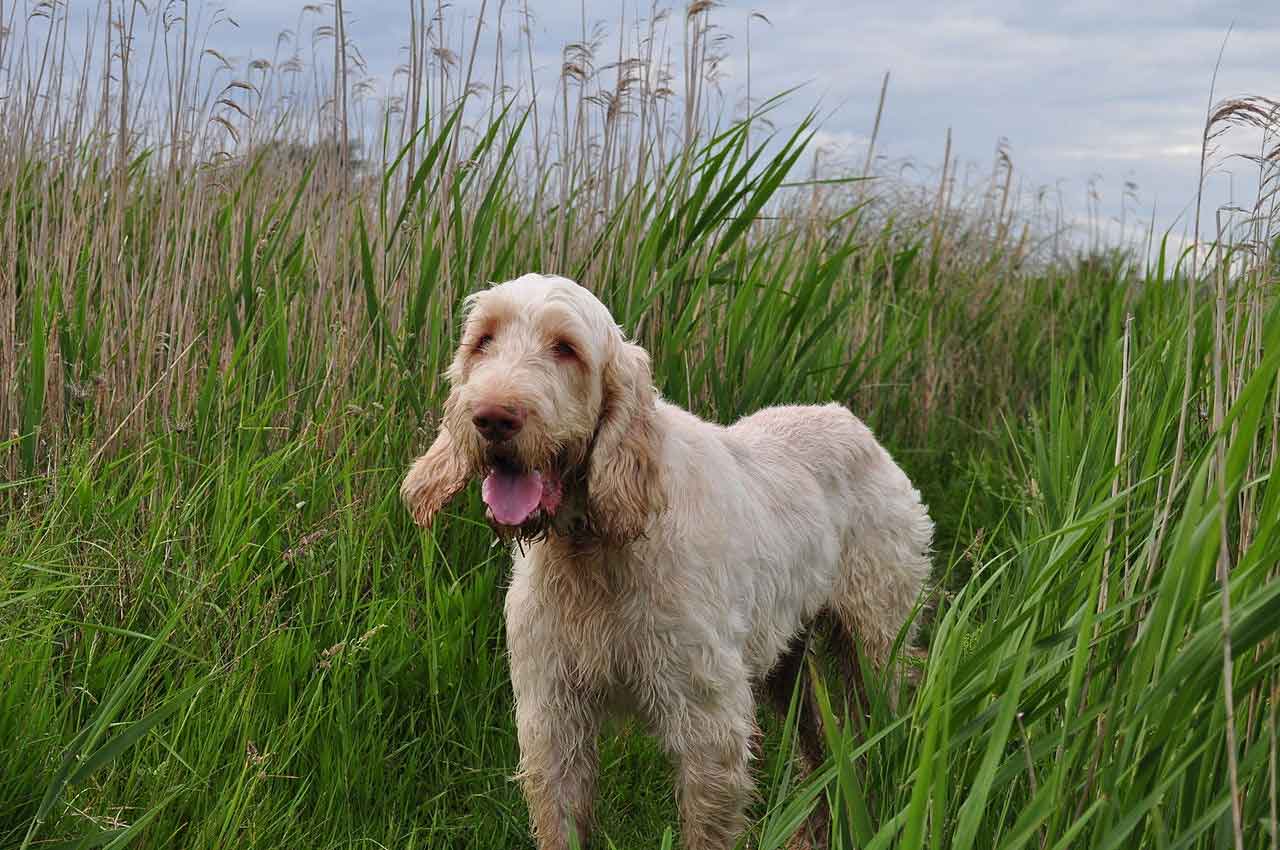
Photo: I came across this adorable dog while walking around Dorset. Took a photo and then got really scared of the camera. by Caroline Granycome, CC BY-SA 2.0, via Wikimedia Commons

Physical characteristics

The Italian Spinone it's well built, with well-developed muscles and strong bones.

Her body, as high as long, is square in shape and ends in a thick bushy tail. The tail hangs at rest and is horizontal when in action. The legs are solid and end in compact round legs.

The head is egg-shaped, with a curved skull and a muzzle the same length as the skull. The color of the nose varies between the pink of white dogs and the brown of roan dogs.. The eyes are round, big and far apart. They are of a more or less dark ocher color. Triangular shape, the ears are rather long and fall along the cheeks.

The body of the Spinone is entirely covered with a stiff and dense fur, of about 4 to 6 cm long, that protects it when it slides through the undergrowth, but also when thrown into cold water. It is shorter at the top of the head and at the front of the legs. In the face, a dense coat of thick eyebrows and a full beard, typical of the breed, which also protects it from brambles and bushes. Beneath this top layer is the dog's fur, which has the peculiarity of not having undercoat.

The coat can be plain white, white with orange spots, chestnut or brown, or roan with orange spots, chestnut or brown. Tricolor or black-haired dogs are not accepted by the breed standard.

Last, sexual dimorphism is marked: the male is larger and above all significantly more massive than the female.

Size and weight

    Male size: Of 60 to 70 cm.
    female size: Of 58 to 65 cm.
    Male weight: Of 32 to 37 kg
    female weight: Of 28 to 30 kg

Character and skills

Generally easier to live with than other pointers, the Spinone Italianos they are affectionate and close to their family, they love to play and spend most of the time with them. Although they are hunters, They are not the kind that jump into the open sea and disappear as soon as potential prey catches their eye: they never stray too far from their master, preferring to always have it in sight.

Your affection, patience and playful character make them an ideal breed for a child. He loves children and is an excellent playmate for those old enough to have learned to behave in the presence of a dog. Less recommended for younger children, as it is large enough to inadvertently push them down. In any case, regardless of race, interactions between a dog and a young child should always take place in the presence of an adult.

The Italian griffon also it is sociable with other dogs Griffon, those who are often willingly adopted as playmates. Small animals, as cats, rabbits and other rodents, have more to worry about and are more likely to be hunted as potential prey. But, they may live with a cat if they have been raised with them, but the latter is likely to still be haunted in the garden from time to time.

As for humans who are unknown to him, the Spinone is generally cozy with them, especially if he's been well socialized from his early months. In fact, used to living with humans for centuries, is more of the type to actively seek their company. Also easily suffers from loneliness: although you can spend a few hours alone at home without difficulty, it is not advisable to leave it all for a weekend. Adopting an extra dog can be a good way to provide companionship to help you avoid loneliness when your family is away..

He is as active in the early years as he is calm and collected afterward.. This can be seen in his hunting style, that is calm and methodical.

Having said that, if you like to rest on the living room rug, this does not mean that you do not need to exercise. So that you feel comfortable and calm when you get home, your daily walks should total at least one hour. Although they are slower than other signaling breeds, they are very resistant and can adapt to many types of terrain. For this reason, if the opportunity arises to take a long walk of several hours, he is delighted. During the latter, does not tend to stray far from his master, so it can be walked without a leash. You can live in an apartment as long as you go out two or three times a day, but its size makes it unsuitable for a small studio.

He prefers a house with a garden where he can frolic and where he will gladly get rid of any unwanted critters. But, it is not convenient for you to live abroad: you need to be in contact with your family and should be able to spend as much time as possible with them.

On the other hand, It is an intelligent breed of dog that likes to be mentally stimulated. Rather stubborn and showing little interest in activities that seem pointless, needs a leader who offers motivating exercises. Obedience exercises, agility or hunting are a great way to get his attention and stimulate him. The rapport is also something instinctive in him, and you will not be asked to carry the ball or bat thrown by your master. He does not hesitate to do the same with the toys scattered around the house when he wants to show him that he wants to have fun.

It is also important to know that your beautiful beard gets wet every time you drink. He tends to pour water all over the house whenever he quenches his thirst, so it may be a good idea to put your bowl outside and not inside the house.

Last, although don't hesitate to bark when you see fit, the Italian Spinone it's not overly vocal.

Education

The Italian Spinone, like all dogs, must be socialized from an early age. It is important that you can meet all the people who are part of your close or distant environment (friends, neighbors, family…). You must also face all kinds of situations (walk through different places, meet other dogs or other animals, travel in different means of transport) not to be scared once an adult.

It shouldn't be long before they start learning to tame, which can be longer and more complicated than for most other breeds.

Given its size once adult, it is also useful to get him used to being handled without flinching from an early age, so that the grooming sessions are a moment of shared pleasure and not torture for both protagonists.

The Italian griffon he's smart and has a strong personality. You need a firm master who knows how to earn your respect, but even if I do, does not like to do tasks that seem trivial. It's a working dog, who likes to be useful and prefers to learn, for example, to recover the game before turning around. In fact, if your master knows how to do it and has all the necessary patience, this dog can do wonders, even in obedience and agility competitions. The trick is to motivate you, above all making him understand the interest of the command.

Not surprisingly, it responds much better to positive reinforcement-based dog training methods than traditional dog training.. Know that the fulfillment of what is asked allows you to receive caresses, encouragement and treats is, in his eyes, a legitimate reason to improve himself and give the best of himself.

Health

The Italian Spinone is generally quite robust. Apart from the health problems common to all large dogs and a serious genetic disease, but fortunately in the process of disappearance thanks to the work of the breeders, the risks are low.

Like this, the conditions to which you are especially exposed are :

  • La ataxia cerebelosa, a genetic disease that attacks the cerebellum and is the most critical health problem in this breed. Puppies that have received a carrier gene from both parents die before their first birthday. But, nowadays it is extremely rare, since carrier individuals are eliminated from breeding programs. A breeder of Spinone worthy of the name must be able to show that parents are not carriers, based on test results;
  • Hip and elbow dysplasia, joint problems that make movement difficult;
    gastric dilation-torsion, often related to too fast a food intake, which can be fatal without prompt veterinary intervention;
  • Entropion and ectropion, eyelid malformations that can be corrected surgically if problematic;
    Hypothyroidism, a hormonal deficiency that causes a slowdown in bodily functions;
  • Cancer (bone, liver, base…), which according to a joint study by the British Kennel Club and the British Small Animal Veterinary Association is, with difference, the main cause of mortality in this breed, with a 45% of deaths.

It also, the drooping and hairy ears of the Spinone they get dirty easily. They can become infected quickly if they are not cleaned every week and after each bath.

Despite its lack of undercoat and its Italian origins, it adapts quite well to different climates and is resistant to both heat and cold, but extreme temperatures are hard to bear. A shelter is necessary so that you can be in the shade when the thermometer exceeds 30 ยฐ, and doesn't particularly appreciate spending the night outside when it's -10ยฐ.

Last, the Italian griffon not very prone to obesity, especially if you have enough opportunity to exercise. But, a responsible handler should regularly make sure that everything is in order by taking the time to weigh your dog.

Life expectancy

Of 12 to 13 years

Grooming

The maintenance of Italian Spinone is simple, but it requires some discipline, as it can be difficult and time consuming if not done regularly.

The absence of undercoat means that you only lose a small amount of hair. A weekly brushing is enough to remove dirt, remove dead hairs and untangle knots from their fur. The most frequent molt is not necessarily necessary during the fall and spring, since the lack of undercoat makes the shedding not very pronounced. On the other hand, If you "forget" one or two toilet sessions, the situation is complicated: debris accumulates and knots form that can no longer be untangled with the brush. Then there is no choice but to undo them manually or even cut them with a chisel. Depending on the state of the coat, this can sometimes take more than an hour.

In any case, rarely need a bath, unless it is especially dirty or smelly after a trip. Except for exceptions, two or three bathrooms a year are more than enough, and a mild dog shampoo should be used each time.

Weekly grooming sessions are also an opportunity to wipe your dog's eyes and brush his teeth.. Neither should you neglect the care of the ears: hanging and furry ears tend to catch dirt, so the risk of infection is high. They can be cleaned with a damp cloth.

It also, beard tends to trap moisture and becomes smelly. Thus, should be towel dried often and cleaned from time to time.

Last, if you spend a lot of time outdoors, wear and tear is usually enough to file the claws of the Italian Spinone, that grow faster than those of most other dogs. If they become too long and may bother or hurt you, must be trimmed with a special nail clipper.

Use

The Italian Spinone it is above all a hunting dog, a mission that has been fulfilling for centuries and in which it stands out. Your ability to point methodically, making game disappear and recover makes them very versatile hunting dogs. This is all the more true since, how your name illustrates, derived from the Italian word for bramble, are able to sneak into the thorniest thickets in search of small game. It is also very resistant.

When not used for hunting, can be used to show off their qualities in various dog sports, like agility or obedience. They are also good watchdogs, but their lack of aggressiveness and the fact that they bark very little disqualifies them as guardians. Having said that, It's impressive enough that most hackers will pass on it..

Last, the Italian griffon He is also a wonderful companion dog., loving and totally devoted to his family. It can be the ideal companion for an active owner who wants to always have his dog by his side when going for a walk or hiking.

Price

The price of a puppy Italian Spinone is of some 800 to 1000 euros in Europe. In Canada and the United States, is usually between 1500 and 1800 $.

In all cases, there is no noticeable price difference between males and females.

Characteristics "Italian Spinone"

Coexistence is important that you have with your new friend. Before considering the acquisition of a dog of the breed "Italian Spinone" you know certain factors. Not all breeds of dogs are apt to live in an apartment, you must take into account his character, their need for exercise, their interaction with other pets, their care and if you have small children, their level of tolerance towards them.

Adaptation โ“˜

3,0 of 5 stars (based on 1 review)

friendly dog โ€‹โ€‹โ“˜

4,0 of 5 stars (based on 1 review)

hair loss โ“˜

2,0 of 5 stars (based on 1 review)

Affection level โ“˜

4,0 of 5 stars (based on 1 review)

Need for exercise โ“˜

4,0 of 5 stars (based on 1 review)

Social need โ“˜

5,0 of 5 stars (based on 1 review)

Home โ“˜

3,0 of 5 stars (based on 1 review)

Toilet โ“˜

2,0 of 5 stars (based on 1 review)

Friendly with strangers โ“˜

3,0 of 5 stars (based on 1 review)

barking โ“˜

2,0 of 5 stars (based on 1 review)

Health โ“˜

3,0 of 5 stars (based on 1 review)

Territorial โ“˜

3,0 of 5 stars (based on 1 review)

Cat friendly โ“˜

2,0 of 5 stars (based on 1 review)

Intelligence โ“˜

4,0 of 5 stars (based on 1 review)

Versatility โ“˜

4,0 of 5 stars (based on 1 review)

Child friendly โ“˜

4,0 of 5 stars (based on 1 review)

Surveillance โ“˜

3,0 of 5 stars (based on 1 review)

joy โ“˜

3,0 of 5 stars (based on 1 review)

Images "Italian Spinone"

Photos:

1 – Solid white Spinone italiano. by Alephalpha, CC BY-SA 3.0, via Wikimedia Commons
2 – A brown roan Spinone Italiano by Alephalpha, CC BY-SA 3.0, via Wikimedia Commons
3 – Spinoni italiani by francesco napoli
4 – Spinoni italiani by francesco napoli
5 – Brown roan spinone italiano. Risky Business Oliver Di La Ros by Timberdoodle Kennels, Ron & Pat Rosinski (User:Rrosinski), CC BY-SA 2.5, via Wikimedia Commons
6 – This is a Spinone, an italian pointing dog. Coatcolor is white-orange by Alephalpha, CC BY-SA 3.0, via Wikimedia Commons

Videos "Italian Spinone"

Type and recognitions:

  • FCI CLASSIFICATION:
  • Group :
  • Section : . .

Federations:

  • FCI – Group 7: Pointing Dogs. – Section 1: Continental Pointing Dogs. 1.3: Griffon type โ“˜
  • AKCHound โ“˜
  • CKCMiscellaneous โ“˜
  • โ€‹KC – Hunting dog โ“˜
  • UKCGun Dog โ“˜

FCI breed standard "Italian Spinone"

Origin:
Italy

Date of publication of the valid original standard:
13.11.2015

Use:

Pointing Dogs.


General appearance:

Solidly built dog, robust and vigorous with strong bones, Well developed muscles with rough fur.

PROPORCIONES IMPORTANT:

Construction tends to fit into a square. The length of the body is equal to the height at the withers, with a tolerance of 1 to 2 longest cm. The length of the head is equal to 4/10 the height at the withers, its width, measured at the level of the zygomatic arches, is less than half its length. The loin is a little less than a fifth of the height at the withers.


Behavior / temperament:

Naturally sociable, docile and patient, the Spinone is an experienced hunter on all terrains; very resistant to fatigue, It gets easily in the spiny undergrowth or throws into the cold water. Has remarkable provisions for a fast, extended trot; by nature it is an excellent retriever.

Head:

The direction of the upper longitudinal axes of the skull and muzzle is divergent.

Cranial region:
  • Skull: Oval, lateral walls slope gently like a roof with very well developed occipital protuberance and well marked parietal crest. The bulging of the forehead is not very developed, neither towards the front nor in height. Superciliary arches are not too prominent.
  • Ston: just checked, while the frontal median sulcus is well pronounced.

facial region:

  • Nariz: placed in the prolongation of the nasal bridge, voluminous, fluffy looking with a very thick and clearly rounded top edge. Pink flesh color in white subjects, slightly darker on white and orange subjects, and brown in the subjects color RUANO. Profile, The nose stands out on the front vertical line of the lips. The nostrils are large and protruding.
  • Hocico: The length is equal to the length of the skull, the depth, measured at mid-length; reaches a third of the length of the muzzle. The profile is straight or slightly convex (roman nose). Side faces are parallel, so that, seen from the front, the muzzle appears square. The lower profile is defined by the upper lip, the lowest point is the corner of the mouth.
  • Labios: the upper lips are quite thin and form an open angle under the nose; at the front are rounded, then, covering the lower lips, reach the corner of the mouth where they form a visible crease.
  • Jaws / Tooths: Powerful and normally developed, In the middle of the length the branches of the lower jaw are very slightly curved. Well adapted and complete dental arches: scissor or pincer bite.
  • Cheeks: Thin.

OJOS: Big and well separated. The eye is almost round; the lids fit very well to the eye that is not protruding or sunken; the eyes are in an almost frontal plane. The iris is an ocher color, more or less dark depending on the color of the fur.

OREJAS: practically triangular in shape; its length is not greater than 5 cm to the lower throat line; wide extend forward from the point of insertion of the head to the neck to the middle of the zygomatic arch. The leading edge is close to the cheek, not folded, but turned inward; The tip of the ear is slightly rounded. Almost always carried low, the ear must have little erection power. The cartilage is fine. The skin is covered with dense hair mixed with longer, sparse hairs, that get thicker at the edge.

Neck:

Powerful and muscular, clearly separated from the nape, blending harmoniously at the shoulders. The length should not be less than 2/3 of head length; its circumference reaches a third of the height at the withers. The lower edge shows a slightly developed double dewlap.

Body:

Fits almost in a square.

  • top line: The typical upper profile begins with the cross slightly marked and continues with an almost straight front of the back, Then he joins the spine with a slight convex line until he joined with the solid and well -arched lumbar region.
  • Cruz: not too high, the tops of the shoulders wide apart.
  • Dorrso: the front is almost straight, then gradually rises towards the loin before leaning towards the hindquarters.
  • Lomo: Slightly convex, It has muscles and a well developed width. The width is almost equal to the length.
  • Glikeness: Wide, long, well muscled and oblique, forms below the horizontal an angle of 30 ยฐโ€จa 35 ยฐ that is measured of the obliqueness of the bone of the hip.
  • Pecho: descends at least to the level of the elbows, width, deep and well rounded at medium height, where its transverse diameter reaches its maximum and decreases significantly towards the sternum, but should not form a keel at the junction with the sternum The ribs are well arched and sloping with a wide space between them. Back ribs (fake ribs) they are long, oblique and wide open.
  • Lรญlower line and belly: almost horizontal in the sternal region, then rises slightly towards the belly.

Tail:

Natural and thick, particularly at the base; no fringes; carried horizontally or down; does not wag a lot during jogging. If amputated for hunting purposes, in accordance with animal health and welfare to avoid injury, The tail must have a length of 15โ€“25 cm from the base.

Tips

PREVIOUS MEMBERS:

  • Ageneral appearance: seen from the front, are perfectly parallel and perpendicular to the ground. In profile, the forearm is vertical and the pastern is slightly oblique.
  • Hshoulder: powerful and long shoulder blade, measures one-quarter the height at the withers and has an obliqueness below the horizontal of approximately 50 ยฐ; relative to the median plane of the body, the tips of the shoulder blades are not very close. Perfectly free in its movements, The shoulder has well developed muscles; The opening of the escapulo-humeral angle is approximately 105 ยฐ.
  • Brazo: oblique below the horizontal with an inclination of approximately 60 ยฐ, directed almost parallel to the median axis of the body. You are well muscled.
  • Codo: Parallel to the median plane of the body. The tip of the elbow must be a bit ahead of the vertical line, that falls from the back point of the shoulder blade to the ground. The distance from the elbow to the ground is equal to 50% the height at the withers.
  • Aforearm: Slightly longer than one third of the height at the withers, vertical both from the front and in profile. Strong bone. The rear tendon is strongly accentuated in such a way that the groove between the tendon and the bone is clearly visible.
  • Carpo (wrist): follows the vertical line of the forearm. Well prominent pisiform bone.
  • Metacarpus: flat and, seen from the front, follows the vertical line of the forearm; in profile, is slightly oblique. Its length is approximately 1/6 from the height of the legs from the ground to the elbow.
  • Pinis previous: compact, round; fingers tightly knit and arched, covered with short thick hair, including spaces between fingers. Pads, thin and hard, They are more or less pigmented according to the color of the fur. Strong nails, curved towards the ground and well pigmented but never black.

LATER MEMBERS:

  • Ageneral appearance: in profile, the rear edge of the thigh is slightly convex; good angulation of bone segments; the hocks should be perpendicular to the ground; seen from behind, hindquarters are parallel.
  • Thigh: the length must not be less than one third of the height at the withers; broad, slightly oblique. The rear edge slightly convex.
  • PinScheme: length only slightly exceeds thigh; OBLICUITY IS 55โ€“60 ยฐ under the horizontal; Maggos muscles at the top; The groove between the hock tendon and the bone is marked and clearly visible.
  • Ahock joint: the lateral sides are very wide. The distance between the point of the hock and the ground is approximately one third of the height at the withers. The opening of the angle of the warm-tarsian joint is approximately 150 ยฐ.
  • Metatarsus: Strong and slim, the length is equal to the distance from the hock to the ground. Watched from anywhere, metatarsal is vertical. On the inner side there may be a simple jointed spur.
  • Hind feet: compact, round, but more oval than the previous feet; fingers tightly knit and arched, covered with short thick hair, including spaces between fingers. Pads, thin and hard, They are more or less pigmented according to the color of the mantle. Strong nails, curved towards the ground and well pigmented but never black.

Movement:

easy loose step; when hunting a fast extended trot with intermittent canter steps.

Mantle

SKIN:
tight to the body, should be thick and firm. It's thinner on the head, throat and groin, under the arms and on the back of the body; on the elbows it is soft to the touch. The skin only forms two folds that begin in the lower jaw branches and disappear in the first half of the neck (Spada). When the head is carried low, only one fold is noticeable, descending from the outer corner of the eye onto the cheek; at its rear edge this fold ends in a lock of hair. Skin pigmentation varies according to mantle color.

Fur: Of a length of 4 to 6 cm on the body, shorter on muzzle, the head, the ears, the front sides of the limbs and feet. On the back of the limbs, hair is like a rough brush, but never with fringes. Long and rigid hairs form thick eyebrows and on the lips form thick mustaches and also a beard with tufts. Hair is rigid, rough, dense and fairly flat, with lack of inner layer.

Color: pure white, white with orange markings, mottled white with orange, white with brown markings (chestnuts), orange roan or brown roan (Brown). The preferred tone of the brown is the color of the "friar dress". The colors not allowed are: tricolor, brown markings, black in any combination.


Size and weight:

Altura to the cross:

  • Males: 60 โ€“ 70 cm..
  • females: 58-65 cm..

Pthat:

  • Males: 32 โ€“ 37 kg.
  • females: 28-30 kg.


Fouls:

Any deviation from the aforementioned criteria is considered as a fault and the severity of this is considered to the degree of the deviation to the standard and its consequences on the health and well-being of the dog., and the dog's ability to perform its traditional task.

  • Thin or curled tail on the back.

FALTAS DISQUALIFYERS:

  • Aggressiveness or extreme shyness.
  • Any dog โ€‹โ€‹showing clear signs of physical or behavioral abnormalities.
  • Converging superior craniofacial axes.
  • Total depigmentation of the nose.
  • Concave nose bridge.
  • Progognatic Boca - The Sunned Enogant.
  • Eyes gazeos.
  • Black pigmentation of the skin.
  • Tricolor mantle, tan or black brands in any combination.


N.B.:
  • Males should have two normal-appearing testicles fully descended into the scrotum..
  • Only functionally and clinically healthy dogs, with the typical conformation of the breed, should be used for parenting.

Source: F.C.I - International Cynological Federation

Alternative names:

1. Spinone, Bracco Spinoso, Italian Spinone, Italian Griffon, Italian Wire-haired Pointer, Italian Coarse-haired Pointer (English).
2. Spinone italien (French).
3. Italienischer Griffon, Spinone, Rauhaariger italienischer Vorstehhund, Italian Griffon, italienischer Spinone (German).
4. Spinone (Portuguese).
5. Espinone, Grifรณn italiano, Italiano de pelo duro (espaรฑol).

โ–ท The world of Pets: Dogs, cats, birds, reptiles, amphibians

Spanish Hound
Espaรฑa FCI 204 . Medium-sized Hounds

Sabueso Espaรฑol

The Spanish Hound It is described in the "Book of Monterรญa" of King Alfonso XI (1312-1350).

Content

HISTORY ยซSPANISH HOUSEยป

Already in the fourteenth century, a dog of this breed was described by King Alfonso XI. But also other documents from this time referred to its existence.

Due to the increasing isolation in the Iberian Peninsula, the breed was kept completely pure and there were no crosses with other dog breeds.

Almost with all likelihood we are faced with a race descended from ยซCanis segusiusยซ, tracking dog used by Celtic peoples settled in central France.

The first description of peninsular hounds appears in the โ€œBook of the Monterรญa of Alfonso XIโ€, King of Castile, written during the second half of the s. XIV, that in his chapter 39 talk about "which doneness should be the hounds and the sabuesasโ€.

Over the years the Spanish Hound went repeatedly hunting small game, like hares, rabbits or foxes. He often hunted together with other dogs in the pack.

It also, was used to recover the shooting game. But also in the police force he soon had a very important task.

Full of enthusiasm for action, this spunky breed of dog proved to be a tracking dog, that already chased many trails. Due to his enormous eagerness to work and his resistance, was able to help clear up all the cases and make his teachers proud.

Still used for those tasks, preferably in your home country, Spain.

Physical characteristics "Spanish hound"

The coat of the Spanish Hound often a bit reminiscent of a cow. Often has a white background on which there are various dots and patterns.

These can be black, White, red or also multicolored. Most of the back is affected by color patterns, occasionally also the sides.

Its pelage is short, thin but nevertheless dense. Doesn't have much underlayer, making it suitable for allergy sufferers.

The Spanish Hound It belongs to the category of "medium -sized dogs". Males reach a shoulder height of up to 57 cm., the females up 53 cm.. The average weight is between 20 and 25 kg, females tend to be somewhat lighter.

Character and skills "Spanish hound"

The Spanish Hound he is a fearless hunter, eager and reliable, that nothing is lost so fast. Has an enormous need to move, who has to live regularly.

It is a minor hunting dog, which is also used for wild boar hunting, roe deer, the deer, the wolf or the bear, because in addition to being very skilled in the search, I have a determination out of the ordinary. He is also gifted with the trail of blood. Excels in hare hunting, in which he transmits to the hunter the development of the search with his voice modulations.

As a member of the family it is not very suitable, because the rhythm of life in a big city is not made for this active breed of dog. Under no circumstances do you want to be alone for hours every day.. Daily walks are mandatory with him.

He is friendly and loyal to his human being and at home he is quite calm. And you need this calm even if you have been in nature for many hours.

How do you want to find peace and quiet within the four walls of a home?, does not get along with young children. The over-excitement of children does not come at all well. But if your freedom is granted, he soon becomes a loving friend to them too. But there are certain limits!

Suspicion of strangers, so it is also a good watchdog.

The Spanish Hound is very independent and despite unconditional loyalty to his humans, always has a mind of its own.

This is why it is so important that you get the right education from the start. This must be done consistently, but nevertheless with love and patience.

Maintenance and care of the "Spanish hound"

In a narrow city apartment, that possibly on a 5th floor, a Spanish Hound has as much to look for as an elephant in a china shop. I could possibly come here in the long run to a similar result. If our Scent hound you don't have your usual workload, it may be that he destroys the furniture for lack of challenge.

A house with a large garden is an absolute must for this energetic hunter.. At the same time this aspect also relieves the owners, if our dog can let off steam regularly in the garden. Then he is already more relaxed and calm when he goes out for a walk, although he still has a lot of energy. Long walks are absolutely necessary for him.

Care:

His short coat does not require much care and his health is generally very good.

However, there must be a competent veterinarian who regularly deals with tick treatments, deworming, caring for teeth and claws, your anal glands and also from routine blood tests.

Characteristics "Spanish Hound"

Coexistence is important that you have with your new friend. Before considering the acquisition of a dog of the breed "Spanish Hound" you know certain factors. Not all breeds of dogs are apt to live in an apartment, you must take into account his character, their need for exercise, their interaction with other pets, their care and if you have small children, their level of tolerance towards them.

Vitality

4,0 of 5 stars (based on 1 review)

Ladrador

3,0 of 5 stars (based on 1 review)

Vigilance instinct

2,0 of 5 stars (based on 1 review)

Protection instinct

1,0 of 5 stars (based on 1 review)

Relationship with children

3,0 of 5 stars (based on 1 review)

Relationship with dogs

4,0 of 5 stars (based on 1 review)

Learning capacity

3,0 of 5 stars (based on 1 review)

Need exercise

4,0 of 5 stars (based on 1 review)

Friendly with strangers

2,0 of 5 stars (based on 1 review)

Health

4,0 of 5 stars (based on 1 review)

Friendly with cats

2,0 of 5 stars (based on 1 review)

Intelligence

3,0 of 5 stars (based on 1 review)

Images of the "Spanish hound"

Videos of the "Spanish hound"

Type and recognitions:

  • FCI CLASSIFICATION:
  • Group :
  • Section : . .

Federations:

  • FCI – Group 6: Scent hounds, and related breeds. – Section 1.2: Medium-sized Hounds. โ“˜
  • The Royal Canine Society of Spain. โ“˜

FCI breed standard "Spanish Hound"

Origin:
Spain

Date of publication of the valid original standard:
26/05/1982

Use:

Small game trail dog, though he doesn't despise the big game trail, either wild boar, deer, corzo, fox wolf or bear. The hunter, informed by voice (beat or beat) of the dog and its modulations, you will know the development of the trail hunt and its incidents such as old or recent trail, double trail, โ€ณ Stop beat or call dead โ€ณ. The Spanish hound is the great specialist in the Hunting of Liebres โ€ณ Vuelta โ€ณ and is extremely effective in the Rastro of Blood.


General appearance:

It is a medium-sized dog, eummetric and longilรญneo. With a beautiful head and long ears. Highlights the high thoracic perimeter of the race and the longitudinal diameter that widely exceeds the raised to the cross. Compact skeleton and strong members; fine hair, smooth and stuck. Fresh look, sad and noble.

IMPORTANT PROPORTIONS: Longylรญnea Structure.

โ€ข Longitudinal diameter widely (7 - 10 cm.) higher than the raised to the cross.
โ€ข Skull-hocic relationship = 1:1, that is, equal in lengths.


Behavior / temperament:

Loving and meek, it is a beautiful animal, that in combat with big game pieces proves to possess a rare bravery and courage.

Head:

Harmonica, provided with the rest of the body and long. Divergent skull-facial lines. The joint facial craneo-region viewed from above should be very uniform and elongated, without giving feeling of pointed snout.

Cranial region:
  • Skull: Average width, being higher in males. Convex profile. The width of the skull should be equal to its length. Seen from the front, It should be vaulted. Simply marked occipital Crest.
  • Depression links (Stop): Soft, little sharp.

facial region:

  • Truffle: Grand, wet and wide and wide development windows. Its color ranges from a light brown to a deep black, always accompanying the color of mucous membranes.
  • Snout: Straight profile, admitting light subconvexidad in the terminal section. Seen from above it appears moderately rectangular, decreasing its width in direction to the truffle.
  • Lips: The superior must cover decidedly lower being loose and detached with moderation. The bottom is marked labial commissure. Mucous membranes must be of the same color that the truffle. Palate of color of mucous membranes with marked ridges.
  • Jaws / Teeth: Scissor bite. Teeth white and healthy; Canine well-developed; There are all the premolars.

Eyes: Medium, macaroons, Hazelnut dark color. Sad looking, noble and intelligent. The color of the truffle pigmented eyelids; mucous membranes attached to the eyeball, admitting Dim relaxation resting.

Ears: Large, long and falls. Of soft texture, rectangular and round tip; They are inserted below the line of the eyes and hang freely in Tirabuzรณn. Without exerting traction have widely exceed the truffle. Venous network visible and a flor de piel.

Neck:

Conical trunk, wide and powerful, muscular and flexible. Thick and very loose skin, that is marked and released but not exaggerated dewlap.

Body:

Strongly rectangular, very strong and robust, of a large chest perimeter that must be superior in 1/3 to the height at the withers: height at the withers 3, chest perimeter 4.

  • top line: Straight with slight concavity on the back and convexity on the spine, Race characteristics, but not ensillamiento.
  • Cross: Ahead and simply marked.
  • Back: Powerful, wide, accused length.
  • Pork loin: Very long, width, powerful and slightly raised.
  • Rump: Powerful, wide. With a tendency towards horizontal. The height at the Croup should be equal to or less than the height at the withers: taking into account the existing racial trend to be elevated, will be allowed slightly.
  • Breast : Highly developed, width, deep and high, widely reaching the elbow. Tip of the sternum marked. Ribs with intercostal of broad and rounded spaces, you are home a large rib cage.
  • Belly and flanks: Little collected belly, very notable and descended flanks and ample sidewalls.

Tail:

Thickness birth and average insertion. Strong and full of very short hair forming a small brush at the tip. At rest, your port is light, curved and low beyond the Hock; in work and movement, is high in Sabre without excess and mostra a continuous lateral movement of jig. Never straight up or resting on the rump.

Tips

PREVIOUS MEMBERS: Perfectly Plumb, straight, parallel; They give short and tendons are clearly appreciated. The length of the forearm must be equal to the shoulder.

  • Strong bone; with powerful Metacarpus and well bonded to the thorax elbows.
  • Shoulder: Oblique scapula, rounded, muscled and similar to the arm length. Scapular-humeral angle close to 100 degrees.
  • Arm: Strong.
  • Elbows: Stuck to the chest. Humer-Radial Angle near the hundred and twenty degrees.
  • Forearm: Straight, short and well poised. Strong bone.
  • Metacarpus: Strong bone and powerful. Seen little laterally inclined.
  • Previous feet: Of cat. Tight toes, high and strong phalanx. Hard and strong nails; spacious, resistant pads. Interdigital membrane moderate and provided with fine hair.

LATER MEMBERS: Powerful, muscular and excellent angles. Correct limbs, hocks without deviations, long metatarsus and strong feet. Provide your pet force, agility and thrust required for slopes land very rough and with notable drop-offs.

  • Thigh: Strong and muscular. Coxal-femoral angle close to 100 degrees.
  • Leg: Half length, muscular. Stifle-tibial angle close to fifteen hundred grades.
  • Hocks: Well marked, with clear appreciation of the tendon. Angle of the open Hock, close to one hundred twenty degrees.
  • Hind feet: Of cat, slightly oval. More elongated than the previous feet. Presence or not of spurs that are usually simple, rarely double, admitting your amputation.

Movement:

Preferred movement is the trot, still a long, sustained and economic, without any tendency to laterality or amble. Particular attention to elbows and hocks will be presented during the movement. Exist during the March natural trends in the race walking sniffing with low head.

Mantle

SKIN: Highly elastic, thick, pink, by all zones, forming sometimes frontal wrinkles in head position low.

HAIR: Bushy, short, fine and glued. Distributed by the body to interdigital spaces.

COLOR: White and orange, with a predominance of one or another color and distributed in well-defined irregular spots and no speckle. The orange color can range from a tone lighter (lemon) to the strong reddish brownish.


Size and weight:

Seen in this race a high index of sexual dimorphism that is reflected in the difference in size between males and females, being females significantly more low and less girth.

Height to the cross:

  • Males: of 52 to 57 cm..
  • females: of 48 to 53 cm..

A centimeter of lodging tolerance is admitted for copies of excellent proportions.


Fouls:

Any deviation from the aforementioned criteria is considered as a fault and the severity of this is considered to the degree of the deviation to the standard and its consequences on the health and well-being of the dog..

  • Profile of the acarnerado snout, but without excess.
  • Bite in clamp; absence of any premolar.
  • Eyelids so relaxed cause little visible conjunctiva.
  • Weak and distorted upper line during march.
  • Elevation of the region of the spine, Although permitted, It should not be never exaggerated.

SERIOUS FAULTS

  • Frail.
  • Snout blunt or pointed in excess.
  • Moderate upper prognathism. Absence of canine or Premolar, not due to trauma.
  • Entropion or ectropion.
  • Amputated ear.
  • Upper lines.
  • Height at the Croup very higher than the height at the withers.
  • Scarce thoracic perimeters.
  • Too high or resting on the rump tail. amputated tail.
  • Wrong limbs, weak or deviant.
  • Outgoing elbows during the March or in station.
  • Cow hocks.
  • Lateral braceos during operation.
  • Wavy hair, hard or mediumlength.
  • Barks.
  • Unbalanced character, excessive shyness, nervousness or aggressiveness.

MISS PLAYOFFS

  • Aggressive or fearful dog.
  • Longitudinal diameter equal to or less than the height at the withers.
  • Split nose.
  • Excessive upper prognathism. Any degree of lower prognathism.
  • Hard or long hair. Woolly hairs indicating miscegenation.
  • Copies tri-color or with brands heat in beak and members.
  • Any dog โ€‹โ€‹showing clear signs of physical or behavioral abnormalities must be disqualified..


N.B.:

Males should have two normal-appearing testicles fully descended into the scrotum..

Source: F.C.I - International Cynological Federation

Alternative names:

1. Spanish Scenthound (English).
2. Sabueso espaรฑol (French).
3. Sabueso Espaรฑol (German).
4. Sabueso Espaรฑol (Portuguese).
5. Sabueso Asturiano, Sabueso Navarro, Sabueso Santanderino, Sabueso Alavรฉs (espaรฑol).

โ–ท The world of Pets: Dogs, cats, birds, reptiles, amphibians

Styrian Coarse-haired Hound
Austria FCI 62 - Medium-sized Hounds.

Styrian Coarse-haired Hound

Insensitive to the weather and austere, which is especially useful in high mountains and forests.

Content

History

The race Styrian Coarse-haired Hound developed from the end of the 19th century. Already in 1870, an industrial of Styria, a state in southeastern Austria, obtained an interesting litter by crossing a ยซHanoverian Scenthoundยป with a Styrian Coarse-haired Hound. The goal was to obtain a hunting dog that would combine the qualities of the two ancient breeds and inherit a coat that would allow it to withstand the elements..

The Styrian Coarse-haired Hound was created by a man named Carl Peitinger. The breed was officially recognized in its country of origin in 1889, and was finally recognized by the Fรฉdรฉration Cynologique Internationale (FCI) 65 years later, the 31 in August of 1954.

Photo: Styrian Wirehaired Hound, Half Year Old By See page for author, CC BY-SA 3.0, via Wikimedia Commons

Physical characteristics

Styrian Coarse-haired Hound

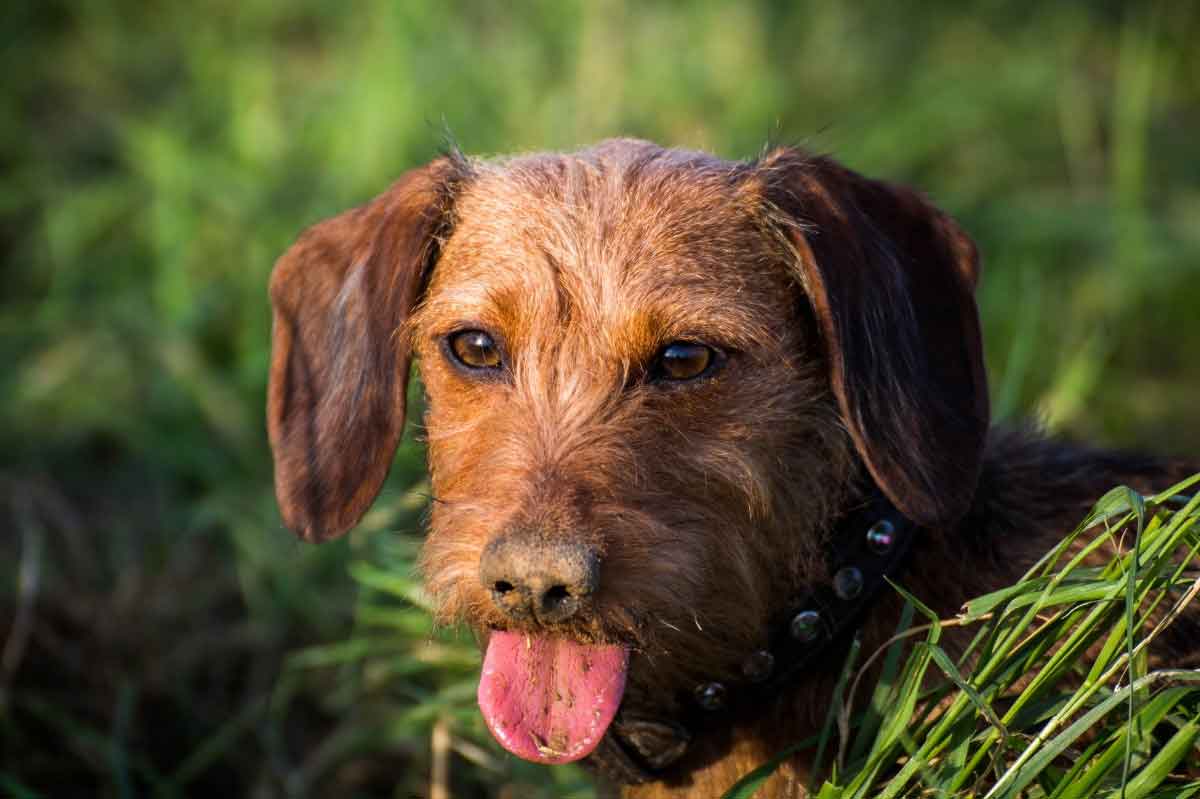
The Styrian Coarse-haired Hound they are medium-sized dogs with solid bones; the expression is austere, but not mean. The skull is slightly domed, with a well developed occipital bone. The stop is marked. The eyes are brown. The ears, Not very large, worn flat against the cheeks and covered with fine hair. The tail is of medium length, strong at the base, with dense hair, never curly but carried upward in a sickle shape; the bottom is like a brush, but without lock.

Fur : Lasted, neither furry nor shiny, hard. In the head, the hair is shorter than in the body. Has mustaches.
Color: red and pale yellow. The white star on the chest is allowed.
Size: 47 to 53 cm for the male and 45 to 51 cm for female.
Weight: approx.. 18 kg.

Character and skills

The Styrian Coarse-haired Hound they have all the qualities of a hunting dog. These dogs show great enthusiasm, determination and stamina when it comes to forcing the game by giving the voice. At home, the Styrian Coarse-haired Hound he is very close to his master and is particularly wary of strangers. They get along quite well with their peers, if they are used to its presence from puppies. They can be more turbulent with other small animals; his hunting instinct is still very strong.

The education…

The Styrian Coarse-haired Hound have a strong character and must be trained early and firmly. It is also necessary that they socialize properly and receive training in recovery to avoid incidents of all kinds.

This Styrian Hound not only used to force the game of hunting by giving the voice, but is very often considered a specialist in tracking blood in difficult mountainous terrain. This makes it a highly sought after hunting companion..

Its exclusively hunter and predator temperament makes it inadvisable as a pet.

However they are very intelligent animals, of a cheerful and affectionate nature as well as an unusual sensitivity.

Care and maintenance …

It needs regular exercise and its coat requires constant maintenance.

Characteristics "Styrian Coarse-haired Hound"

Coexistence is important that you have with your new friend. Before considering the acquisition of a dog of the breed "Styrian Coarse-haired Hound" you know certain factors. Not all breeds of dogs are apt to live in an apartment, you must take into account his character, their need for exercise, their interaction with other pets, their care and if you have small children, their level of tolerance towards them.

Adaptation โ“˜

3,0 of 5 stars (based on 1 review)

friendly dog โ€‹โ€‹โ“˜

3,0 of 5 stars (based on 1 review)

hair loss โ“˜

4,0 of 5 stars (based on 1 review)

Affection level โ“˜

3,0 of 5 stars (based on 1 review)

Need for exercise โ“˜

5,0 of 5 stars (based on 1 review)

Social need โ“˜

3,0 of 5 stars (based on 1 review)

Home โ“˜

4,0 of 5 stars (based on 1 review)

Toilet โ“˜

2,0 of 5 stars (based on 1 review)

Friendly with strangers โ“˜

3,0 of 5 stars (based on 1 review)

barking โ“˜

4,0 of 5 stars (based on 1 review)

Health โ“˜

4,0 of 5 stars (based on 1 review)

Territorial โ“˜

4,0 of 5 stars (based on 1 review)

Cat friendly โ“˜

2,0 of 5 stars (based on 1 review)

Intelligence โ“˜

4,0 of 5 stars (based on 1 review)

Versatility โ“˜

3,0 of 5 stars (based on 1 review)

Child friendly โ“˜

4,0 of 5 stars (based on 1 review)

Surveillance โ“˜

4,0 of 5 stars (based on 1 review)

joy โ“˜

5,0 of 5 stars (based on 1 review)

Videos "Styrian Coarse-haired Hound"

Hunting dog - Styrian wire-haired bracke ( Peintinger Bracke ) - a fantastic hunting dog Trailer

Hunting dog – Styrian wire-haired bracke ( Peintinger Bracke ) – a fantastic hunting dog Trailer

Hunting dog - Styrian wire-haired bracke (Peintinger Bracke) - a fantastic hunting dog!
Jagdhund – Steirische Rauhhaarbracke (Peintinger Bracke) – a fantastic hunting dog!

Type and recognitions:

  • FCI CLASSIFICATION:
  • Group :
  • Section : . .

Federations:

  • FCI – Group 6: Scent hounds, and related breeds. – Section 1.2: Medium-sized Hounds. โ“˜
  • UKCScenthounds โ“˜

FCI breed standard "Styrian Coarse-haired Hound"

Origin:
Austria

Date of publication of the valid original standard:
10.10.1995.

Use:

The job is not only about his role as a hound, but also in pure tracker work in difficult mountainous terrain.


General appearance:

Is medium sized, has strong muscles, and his expression is grim but without malice.


Behavior / temperament:

He is a tough and passionate hound dog, barks without interruption during the hunt and expresses will and security during the trail.

Head:

---

Cranial region:
  • Skull: Slightly convex, well-developed occipital protuberance.
  • Depression links (Stop): Marked.

facial region:

  • Truffle: Black.
  • Snout: Strong and straight.
  • Lips: Not hanging.
  • Jaws / Teeth: Strong scissor bite. You want a complete denture with 42 Dental parts; the lack of two PM1 or PM2 (premolars 1 or 2) is tolerated; the M3 (molars 3) they are not taken into account.
Eyes: With brown iris.
Ears: Not too big, flattened and glued, covered with fine hair.

Neck:

Strong, not too long.

Body:

  • Back: Straight and wide.
  • Pork loin: Moderately raised.
  • Rump: It descends steeply.
  • Breast : It's deep and wide.

Tail:

Medium length, strong in its insertion, well covered with hair, never curled but carried up slightly sickle-shaped; on its lower face has hair in the shape of a brush, but without forming a feather.

Tips

PREVIOUS MEMBERS: Straight, muscular, well angled.
  • Shoulder: Oblique placement.
 
LATER MEMBERS: Muscular, strong, well angled, seen from behind they look straight.
 
FEET: Not excessively large; well arched fingers, closely linked to each other; hard pads, not too big.

Movement:

It covers the ground, elastic.

Mantle

HAIR: Rough, no hirsuto, opaque, hard, tosco. The hair on the head is shorter than the rest of the body and forms a mustache.
 
COLOR: Red and yellowish. A white star is allowed on the sill.


Size and weight:

Height to the cross: 45 โ€“ 53 cm.
  • Males : 47 โ€“ 53 cm.
  • females : 45 โ€“ 51 cm.


Fouls:

Any deviation from the above mentioned criteria is considered to lack, and the gravity of this refers to the degree of deviation to the standard and its impact on the health and well-being of the dog.
  • Head too narrow.
  • Ears with creases or too pointed.
  • Tail too short, too thin or too bent up, that forms feathers.
  • Weak limbs.
  • Coat too long, fine, curly or soft.
  • Shy character.
MISS PLAYOFFS:
  • Aggressive or fearful dog.
  • Upper or lower prognathism. Lack of more than two premolars (PM 1 or PM 2).
  • Any other color different from that indicated in the standard.
 
Any dog โ€‹โ€‹showing clear signs of physical or behavioral abnormalities must be disqualified..


N.B.:

Males should have two normal-appearing testicles fully descended into the scrotum..

Source: F.C.I - International Cynological Federation

Alternative names:

1. Peintinger Bracke, Wirehair Styrian Mountain (English).
2. Brachet de Styrie ร  poil dur (French).
3. Peintinger-Bracke, Steirische Rauhhaarige (German).
4. (em alemรฃo: Steirische Rauhhaarbracke) (Portuguese).
5. Sabueso estirio de pelo รกspero (espaรฑol).

โ–ท The world of Pets: Dogs, cats, birds, reptiles, amphibians

Slovakian Hound
Eslovaquia FCI 244 - Medium-sized Hounds

Slovakian Hound

The Slovakian Hound stands out for its extraordinary sense of direction, which is considered the best among the canine breeds.

Content

History

It has remote and completely unknown origins.: its official recognition dates back to after World War II, but the breed already existed for centuries.

While there are no historical records, the Slovenskรฝ Kopov is widely believed to have existed in central Europe for many hundreds of years and to have descended from other local breeds, including the Austrian Black and Tan Hound and the Polish Hound.

Not widely kept for any purpose other than hunting, the Slovakian Hound He has honed his hunting skills over the centuries and is respected within Slovakia for his tracking ability and endurance. Despite its proven track record in the field, rarely seen internationally. curiously, when seen internationally, It is sometimes called the "Black Forest Dog.", a completely wrong name, since the Slovakian Hound it's not now, and has never been, native to the Black Forest region.

Like many other breeds of dogs of the time, the population of the Slovakian Hound decreased dramatically during the period of the World Wars. It is attributed to a Slovak named Koloman Snail having brought the race from the brink of extinction at this time, by establishing successful breeding programs nationwide.

Officially accepted as a breed in the decade of 1870, the first club of the breed Slovakian Hound was recently formed in 1988, in the capital of Bratislava. The Slovakian Hound it is so popular in its birthplace that it has been named the national breed of Slovakia.

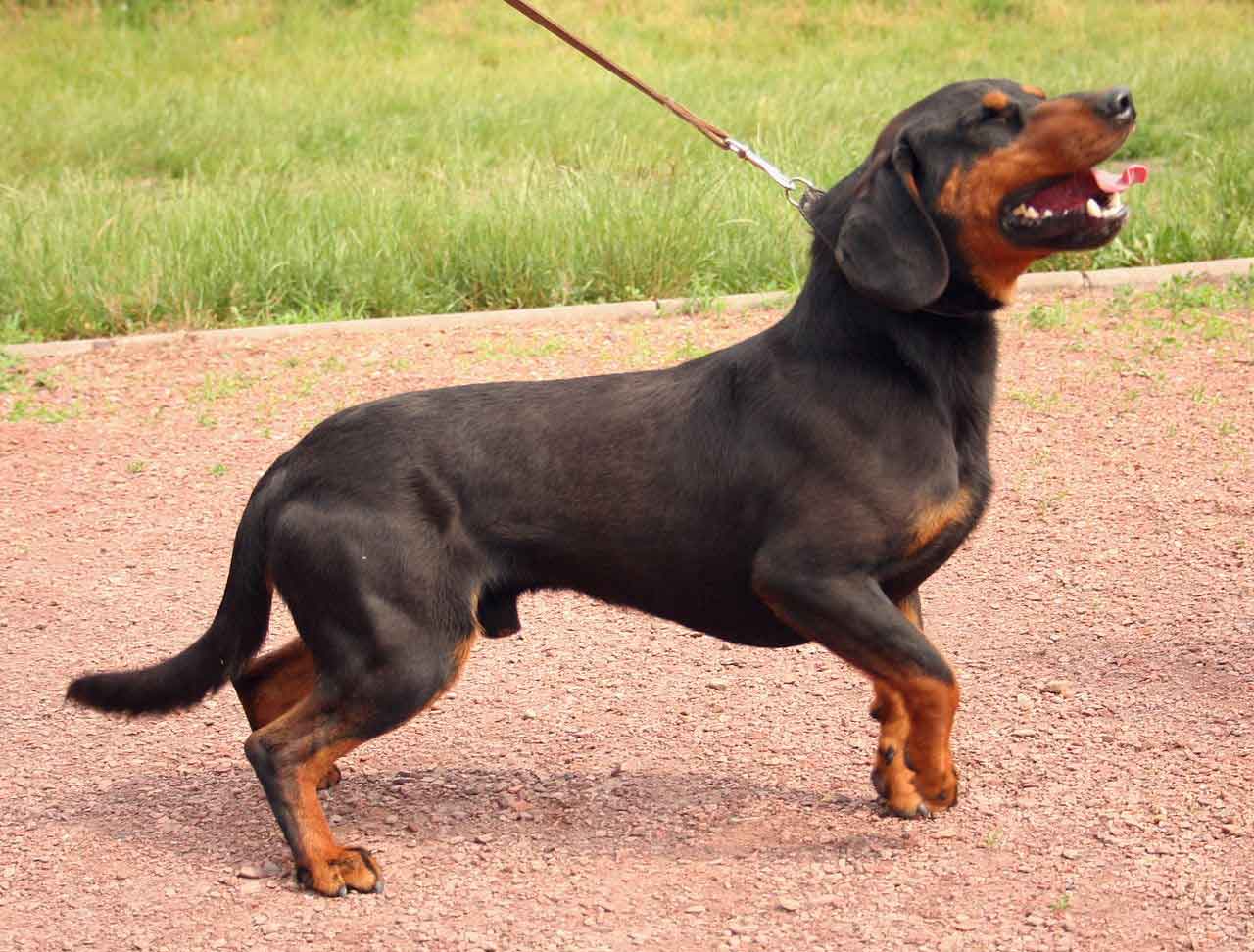
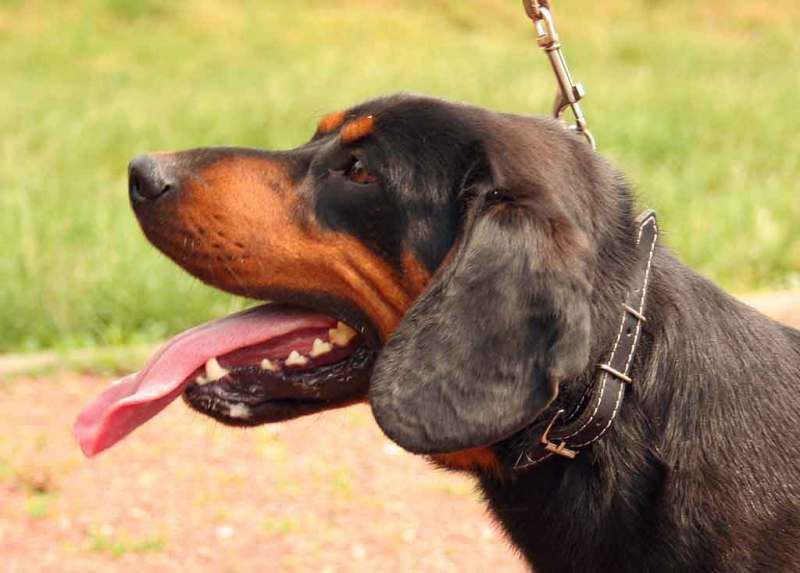
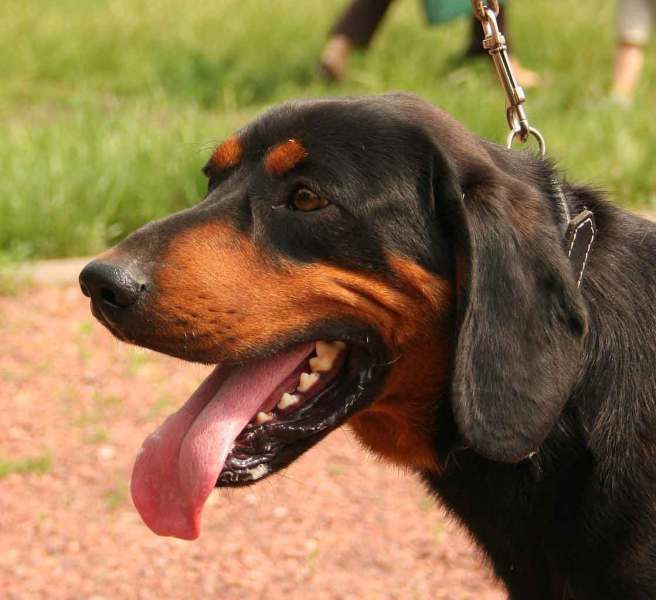
Photo: Slovakian Hound during dog’s show in Racibรณrz,Poland by Pleple2000, CC BY-SA 3.0, via Wikimedia Commons

Physical characteristics

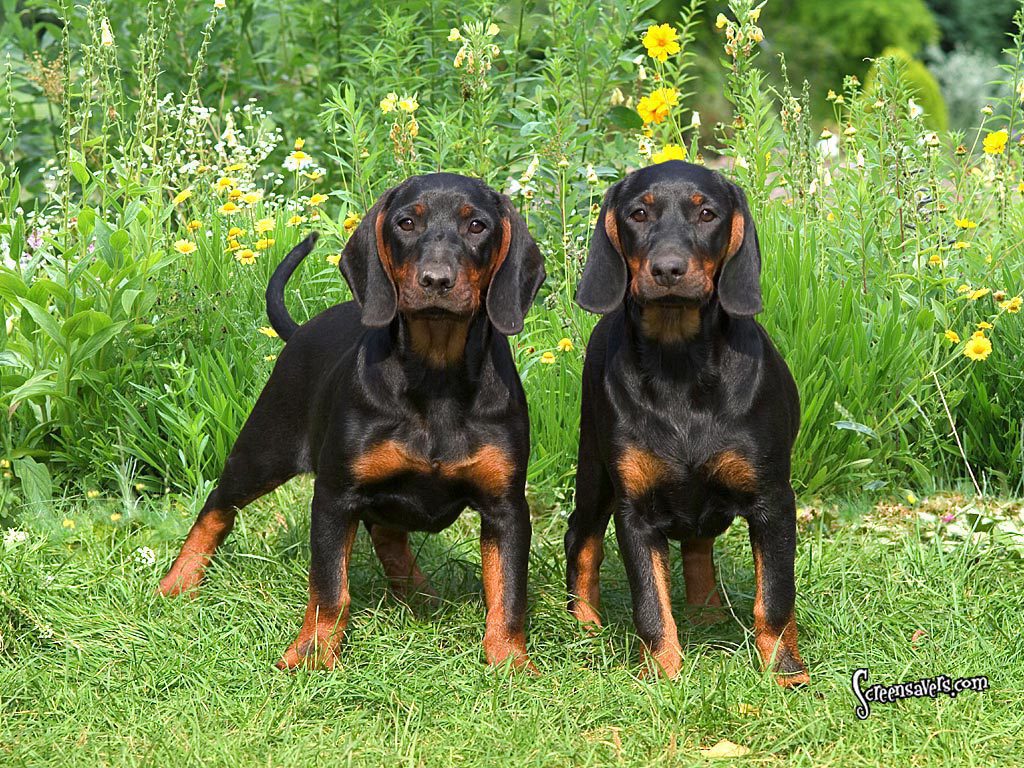
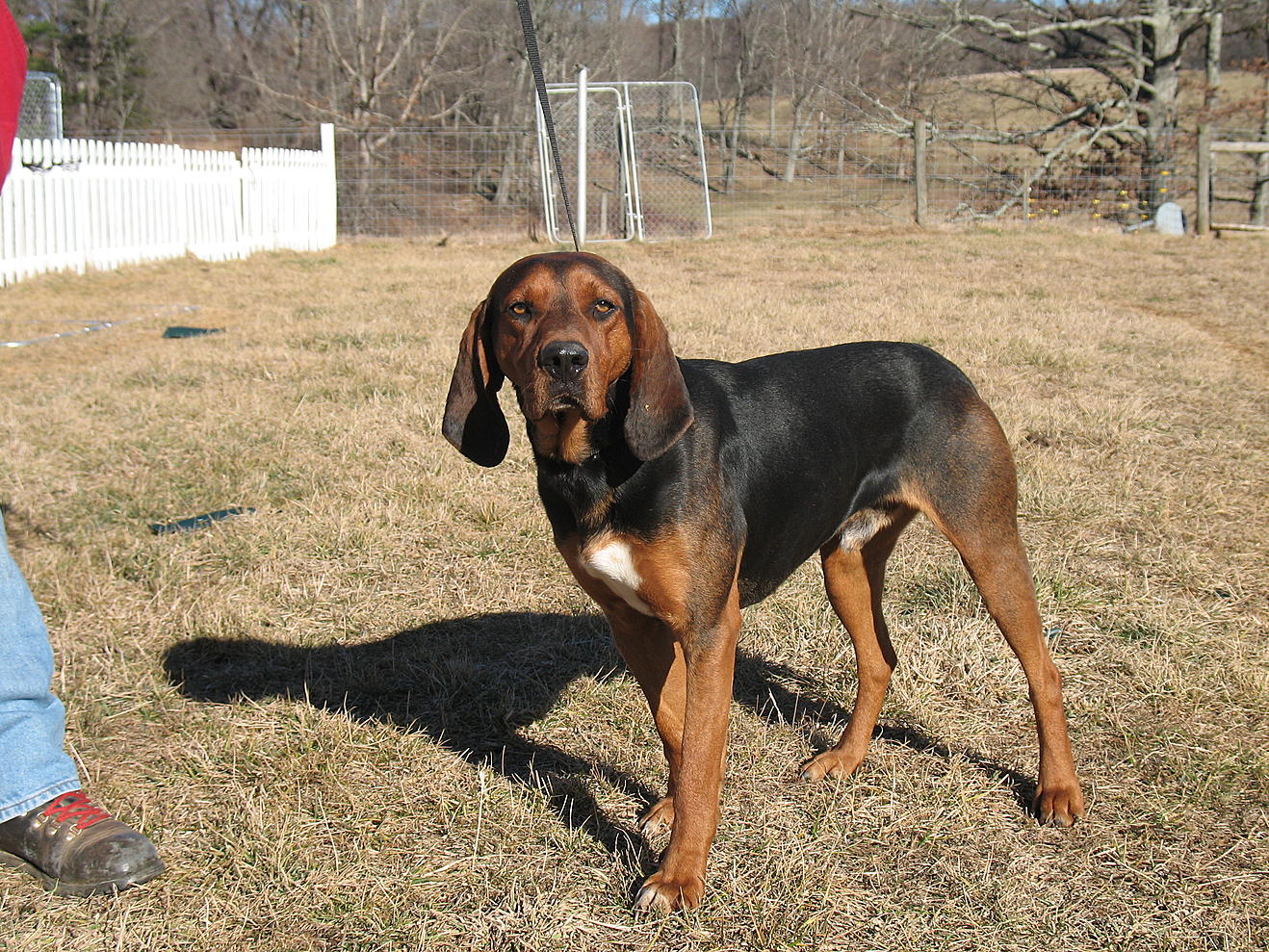
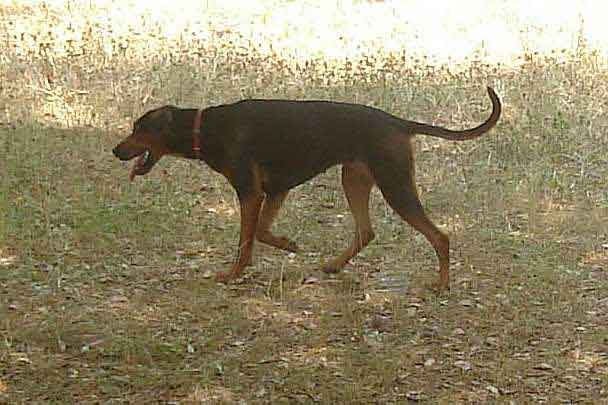
Always black with fire marks, the Slovakian Hound have solid bones despite their fairly slight stature. The body is in the shape of an elongated rectangle. His eyes reflect vivacity and courage. They are dark and almond-shaped. The ears are of medium length, rounded at the tip and falls flat against the head. This dog is notable for its constancy in following a cool trail or trail for hours, giving the voice without hesitation. They are also distinguished by their bite, so they are used in their native country to hunt wild boars and other carnivores.

He is endowed with a lively temperament. Your sense of direction is extraordinarily well developed.

Hair is 2-5 cm long, medium thick, well lying, dense. Longer in the back, neck and tail. The undercoat is dense, especially during the winter months; However, it should not be absent in summer either.

SIZE AND WEIGHT :

Males 45-50 cm.

females 40-45 cm.

Weight: 15-20 kg

Character and skills

This determined hunter must be tenacious when on the road and courageous when facing the animals he hunts., like the boar and the deer. They have excellent olfactory abilities and will painstakingly trace a scent back to the source. An independent animal that is happy to work with a minimum of human interaction, the Slovakian Hound need little direction. Despite this, they are obedient, and they will happily follow their master's plans when necessary.

The Slovakian Hound it's a good watchdog, as he is continuously alert and observant. This, along with the fact that they become devoted to their owners, means they are often protective, and can be used successfully as watchdogs, becoming potentially aggressive if the situation calls for it. Barking can be a problem and is a common complaint of many owners.. Excessive barking can be prevented by ensuring that the Slovakian Hound you are not under-exercised and have plenty of activities and jobs to fill your day.

Health

The Slovakian Hound it is a very resistant dog. In the country of origin the owner has a dog, rarely from, who does not live in a kennel but in contact with the master from morning to night, often used as a general purpose dog, taking care of the house as well as the cattle, and of course hunting. It is adapted to outdoor life and has an iron constitution.

Care and maintenance

The Slovakian Hound it is a very resistant dog, no particular grooming problems. Short hair, when he comes back from hunting he will be the happiest in the world if you give him the necessary brushstroke for a superficial cleaning at the level of the spikes, caught between the pads, ticks possibly not yet attached.

He will quickly get used to coming to you for this cleaning because he is looking for contact with his master.

Qualities

It's a farm dog, the quintessential farm dog. Bad guys just do that. The good ones are able to give the voice, to take the lead by yelling or barking directly at any stranger before coming into view. A good Slovakian Hound should give voice instantly. Not after ten minutes (although, depending on the conditions…). The smell of Slovakian Hound it's excellent, as fine as that of the best Hounds, but his hunting style leads him to voice only in the moment, and of course staring.

The Slovakian Hound is a search engine, a hunting finder. Hunting instinct is among the best hounds, really very developed, off the beaten path as in some Warren hound and some representatives of primitive races.

Farm dog, you don't need to see the animal, the wild boar to bark after, like some pointing dogs that only bark at sight, or to the noise. With experience, depending on origins, will start barking after turning around to make sure the animal is ten meters away, or more. Once you have fired the bark it will zoom in pretty quickly, but always with care, always staying safe. The Slovakian Hound is not a brave and daring specialist like some races of German Hunting Terrier or pointing dogs, who are inevitably injured frequently. With the, used in its specificity, theoretically, no need for a boar vest, because he knows how to handle attacks. Some are never hurt, if used properly, alone or as a couple.

The Slovakian Hound is a dog that is easy to start with the boar. Because it's in their nature, to bark, and the only animal that does not automatically flee but goes to meet is the wild boar. If you are accustomed to hunting on hunts where wild boar are rare but deer are numerous, you will enjoy easily guiding your animals for half an hour or more, but as soon as he perceives that there is a wild boar in the area, will leave this animal too elusive to go and do what it was designed to do.

A good Slovakian Hound, alone or as a couple, it is rarely caught by a wild boar. Otherwise, in dog teams he becomes a vulnerable dog like any other because his passion is terrible, and there, better equip it with a vest…

Characteristics "Slovakian Hound"

Coexistence is important that you have with your new friend. Before considering the acquisition of a dog of the breed "Slovakian Hound" you know certain factors. Not all breeds of dogs are apt to live in an apartment, you must take into account his character, their need for exercise, their interaction with other pets, their care and if you have small children, their level of tolerance towards them.

Adaptation โ“˜

4,0 of 5 stars (based on 1 review)

friendly dog โ€‹โ€‹โ“˜

3,0 of 5 stars (based on 1 review)

hair loss โ“˜

3,0 of 5 stars (based on 1 review)

Affection level โ“˜

4,0 of 5 stars (based on 1 review)

Need for exercise โ“˜

4,0 of 5 stars (based on 1 review)

Social need โ“˜

4,0 of 5 stars (based on 1 review)

Home โ“˜

4,0 of 5 stars (based on 1 review)

Toilet โ“˜

2,0 of 5 stars (based on 1 review)

Friendly with strangers โ“˜

2,0 of 5 stars (based on 1 review)

barking โ“˜

5,0 of 5 stars (based on 1 review)

Health โ“˜

4,0 of 5 stars (based on 1 review)

Territorial โ“˜

5,0 of 5 stars (based on 1 review)

Cat friendly โ“˜

2,0 of 5 stars (based on 1 review)

Intelligence โ“˜

4,0 of 5 stars (based on 1 review)

Versatility โ“˜

4,0 of 5 stars (based on 1 review)

Child friendly โ“˜

4,0 of 5 stars (based on 1 review)

Surveillance โ“˜

4,0 of 5 stars (based on 1 review)

joy โ“˜

4,0 of 5 stars (based on 1 review)

Images "Slovakian Hound"

Photos:

1 – SLOVENSKร KOPOV Rantafejs Cezary Av Fileddy MyDOG, Nordens stรถrsta hundevenemang: www.mydog.se by Svenska Mรคssan from Sweden, CC BY 2.0, via Wikimedia Commons
2 – A female Slovakian Hound. by Canarian, CC BY-SA 3.0, via Wikimedia Commons
3 – Slovakian Hound during dog’s show in Racibรณrz,Poland by Pleple2000, CC BY-SA 3.0, via Wikimedia Commons
4 – Slovakian Hound during dog’s show in Racibรณrz,Poland by Pleple2000, CC BY-SA 3.0, via Wikimedia Commons
5 – Slovakian Hound during dogs show in Katowice, Poland by Lilly M, CC BY-SA 2.5, via Wikimedia Commons
6 – Chien courant slovaque sur fond blanc by Desaix83, d'aprรจs le travail de Canarian, CC BY-SA 3.0, via Wikimedia Commons

Videos "Slovakian Hound"

Type and recognitions:

  • FCI CLASSIFICATION:
  • Group :
  • Section : . .

Federations:

  • FCI – Group 6: Scent hounds, and related breeds. – Section 1.2: Medium-sized Hounds. โ“˜
  • UKCScenthounds โ“˜

FCI breed standard "Slovakian Hound"

Origin:
Slovakia

Date of publication of the valid original standard:
16.04.1963

Use:

Hound. This breed is characterized by continuing to bark a warm track (recent) or a trail steadily for hours. It is also characterized by its bite and that is why it is used in its place of origin especially for hunting wild boar and animals of prey..


General appearance:

They are always one color : black with โ€œfireโ€ markings. Rather light body structure; However, has strong bones. Elongated rectangular body shape.


Behavior / temperament:

It is of a spirited nature. Exceptionally developed sense of orientation.

Head:

---

Cranial region:
  • Skull : Bulging at the top; its shape is square and elongated; superciliary arches and frontal sulcus are notable; occipital protuberance is poorly marked. The longitudinal axes of the muzzle and skull are parallel.
  • Depression links (Stop) : About 45ยฐ.

facial region:

  • Truffle : Always black, relatively large, moderately pointed; moderately open windows.
  • Snout : Straight nose cane, corresponding to the long and not very wide skull.
  • Lips : They are not hanging; they are together, skinny, with a visibly open corner.
  • Jaws / Teeth : on regular basis, firm; well developed full bite.

Eyes : dark, a little deep. His expression denotes vivacity and animosity. Eyelids are always black; almond-shaped eye opening.

Ears : Inserted a little above the eye line, laid flat on the sides of the head, rounded at their ends, medium long.

Neck:

Well inserted, carried at an angle of approximately 135ยฐ, rather short, muscular and no loose skin.

Body:

  • Back : Straight, medium long.
  • Pork loin : Not too long, very wide, firm and muscular.
  • Rump : Not too long, average width, rounded.
  • Breast : Wide and well filled windowsill. Medium deep, of a suitable width and relatively long.
  • Chest : Rounded ribs, placed obliquely.
  • Belly and flanks : Moderately withdrawn.

Tail:

Rather low set, a little below the line of the back; of adequate strength; slimming to tip; reaches up to the tibio-tarsal joint; at rest it is carried hanging; When excited, it is curved upwards in the shape of a sickle up to an angle of 150ยฐ..

Tips

PREVIOUS MEMBERS :

  • Scapula and Arm : Rather short, well-developed and muscular. Shoulder angle approximately 110ยฐ.
  • Forearm : Vertically placed, delgado.
  • Articulation of the carpus : Short.
  • Metacarpus : Not very long, a little inclined.
  • Previous feet: Oval, well arched fingers; nails always black and strong; dark pads, well developed.

LATER MEMBERS :

  • Thigh : Moderately wide and long, muscular.
  • Leg : Wide, of a suitable length and with good muscles.
  • Warm-foot joint : Located approximately at a height of 15 cm.; moderately wide. The angle of the tibiotarsal joint is approximately 150ยฐ.
  • Metatarsus : Approximately from 8 cm long; moderately leaning forward; No Spurs.
  • Hind feet : Oval, fingers close together and well arched; well developed pads, black.

Movement:

Lively and balanced.

Mantle

SKIN : From dark brown to black, footprint, no loose skin folds.

HAIR : Of 2 โ€“ 5 cm long, moderately hard, glued and dense. It is longer on the back, neck and tail. Dense internal fluff especially in the winter months, although his presence should not be lacking during the summer.

COLOR : Black with tan to mahogany markings on limbs.


Size and weight:

Height to the cross :

  • In males : 45 โ€“ 50 cm..
  • In females : 40 โ€“ 45 cm..

Weight : 15 โ€“ 20 kg.


Fouls:

Any deviation from the aforementioned criteria is considered as a fault and the severity of this is considered to the degree of the deviation to the standard and its consequences on the health and well-being of the dog..

โ€ข Rough figure, plump or chubby.
โ€ข Head too heavy.
โ€ข Hanging lips.
โ€ข Incomplete bite.
โ€ข Superior or inferior progantism.
โ€ข Light eyes, loose eyelids, eyelids too tight.
โ€ข Ears too light, pointy.
โ€ข Loose skin on the neck.
โ€ข Back too weak.
โ€ข Flattened chest (severe deficiency).
โ€ข Visibly long tail, also carried at rest above the line of the back.
โ€ข Defective position of the extremities.
โ€ข Weak feet.
โ€ข Coat too short, that's lanilla interna; hair too long, wavy.
โ€ข Another color other than black, white markings, unclear delimitation of โ€œtanโ€ colored spots.
โ€ข Excessive size.

IMPORTANT PROPORTIONS (IDEAL TYPE)

  • Weight 16 kg
  • Height at the withers in males 46 cm.
  • Height at the withers in females 43 cm.
  • Total length of the head 22 cm.
  • Length of the muzzle 9 cm.
  • Length of the skull 13 cm.
  • Skull width 10,5 cm.
  • Width of chest 16,5 cm.
  • Chest height 22 cm.
  • Chest depth 31,5 cm.
  • body length 55 cm.
  • Chest circumference behind the last free rib 54 cm.
  • Limb angulations : Angle between the scapula and the arm 110ยฐ
  • Angle between the arm and forearm 140ยฐ
  • Angle between hip and thigh 130ยฐ
  • Angle between thigh and leg 130ยฐ
  • Tibio-tarsian joint angle 145ยฐ

Any dog โ€‹โ€‹showing clear signs of physical or behavioral abnormalities must be disqualified..


N.B.:

Males should have two normal-appearing testicles fully descended into the scrotum..

Source: F.C.I - International Cynological Federation

Alternative names:

1. Black Forest Hound, Slovak Hound (English).
2. (slovenskรฝ kopov en slovaque) (French).
3. Slowakische Schwarzwildbracke (German).
4. Cรฃo da floresta (Portuguese).
5. Cazador eslovaco (espaรฑol).

โ–ท The world of Pets: Dogs, cats, birds, reptiles, amphibians

Schiller Hound
Suecia FCI 131 - Medium-sized Hounds

Schiller Hound

The spread of Schiller Hound is regular in your country of origin, but very small abroad.

Content

History

The Schiller Hound It is a working breed that has existed in Sweden since the Middle Ages. But, the breed was not really established and recognized until 1952. This recognition is due in large part to a breeder, Per Schiller, who gave the breed its name.

In 1886, at the first Swedish dog show, they were shown 189 hounds. Among them were Tamburini and Ralla I, a brother and sister belonging to Per Schiller. They were descended from the famous hounds of the Kaflas estate. These dogs probably came from southern Germany: rather small, fawn in color with black fur and slight white markings.

The Schiller Hound they were then based on the crossing of Swiss dogs, German and Austrian, as well as in British hunting dogs, especially the Harriers, to produce a fast and light breed that quickly acquired its type. curiously, Per Schiller worked alongside a Swedish doctor named Adolf Hamilton, and also led to the development of a similar dog named Hamilton Hound, that can be differentiated from Schiller Hound for its tricolor coat.

Still very rare outside his native country, the Schiller Hound was recognized by the Swedish Kennel Club in 1907.

The Schiller Hound has been traditionally used as a sniffing dog, although some describe it as a hunting dog. The breed is known for both its speed and superior olfactory ability; able to quickly track its prey and then howl loudly when its master approaches, alerting of its position. It is a hardy dog โ€‹โ€‹that can tolerate the cold Swedish winters well.. Often, they work individually rather than in a pack and typically hunt rabbits and foxes. Even today, many dogs still work as hunters, although they are equally good household pets.

Photos: Schiller Hound during International show of dogs in Katowice – Spodek, Poland by Pleple2000, CC BY-SA 4.0, via Wikimedia Commons

Physical characteristics

The conformation of Schiller Hound it's that of an athletic dog, and with his well-muscled body and strong limbs, you are clearly well suited to your job role. Its head is relatively small but long and has a well defined stop. The bridge of your nose should be straight and the nose itself is black with wide nostrils. His dark brown eyes are bright and alert, set deep in your face. His medium-sized, high-set ears hang close to his face and do not extend beyond his lower jaw.. Its long and thin limbs are parallel and are surely one of the main reasons for its impressive speed; giving them a very long stride. Their body is rectangular in shape and they have a deep chest with a robust and solid back.. Its long, tapered tail should not be carried too high in the exhibition ring..

The shiny, straight coat of the Schillerstรถvare fits perfectly to his skin. The top coat is actually quite tough, although the shorter fur on his face and ears is softer to the touch. Predominantly tan in color, the coat also has a prominent black coat. Only small white spots are allowed on the coat. Their fur is expertly designed to protect them in icy weather conditions.

The Schiller Hound It is a medium to large sized hound for hunting fox and hare, what does it measure 53-61 cm to the withers and weighs 18-25 kg . The coat is rough and not too short, and it's close to the body.

Character and skills

These vivacious dogs live life to the fullest and are a pleasure to be around. Always alert, they need a lot of attention and crave human companionship. The Schiller Hound they will form a close bond with their family, and although they tolerate children well, require supervision when with younger children, as they can be quite disruptive.

The Schiller Hound are normally kept indoors and can be calm and polite housemates, although they can bark melodiously at times. The watchful nature of this dog means that it will always alert its owner to any unannounced guests., However, they are not territorial enough to be used as guard dogs. This dog's distrust of new people can be a problem, although this can usually be overcome by early and thorough socialization.

Although it is not conventionally worked in packs of dogs, the Schiller Hound can socialize well with other dogs if given the opportunity. Of course, smaller animals are not safe in their company and are likely to be seen as little more than prey.

Health

Most members of the breed live into their teens and tend to be in good health.. There are a couple of conditions to consider when it comes to Schiller Hound:

Hip Dysplasia

Malformed hips result in an uneven gait, lifelong muscle loss and discomfort. Affected canines are treated with a variety of therapies, including physiotherapy, hydrotherapy and pharmaceutical pain relief. Prudent screening programs in adult dogs of breeding age may help reduce the overall incidence in the population. If a breeding-age dog gets a low hip score, must be neutered and removed from the kennel.

ear infections

The floppy ears of hunting dogs are a magnet for infections as they create moist environments inside the ear canal for bacteria and yeast to thrive.. Keeping the ears clear and dry can reduce the potential for infection.. If wax builds up, an ear cleaner should be used. Infections should not be allowed to become infected and should be treated as soon as they are noticed. Chronic and whiny infections can pose a real challenge to healing and make the dog very uncomfortable and unhappy while they persist.

Characteristics "Schiller Hound"

Coexistence is important that you have with your new friend. Before considering the acquisition of a dog of the breed "Schiller Hound" you know certain factors. Not all breeds of dogs are apt to live in an apartment, you must take into account his character, their need for exercise, their interaction with other pets, their care and if you have small children, their level of tolerance towards them.

Adaptation โ“˜

3,0 of 5 stars (based on 1 review)

friendly dog โ€‹โ€‹โ“˜

4,0 of 5 stars (based on 1 review)

hair loss โ“˜

2,0 of 5 stars (based on 1 review)

Affection level โ“˜

5,0 of 5 stars (based on 1 review)

Need for exercise โ“˜

4,0 of 5 stars (based on 1 review)

Social need โ“˜

3,0 of 5 stars (based on 1 review)

Home โ“˜

4,0 of 5 stars (based on 1 review)

Toilet โ“˜

1,0 of 5 stars (based on 1 review)

Friendly with strangers โ“˜

2,0 of 5 stars (based on 1 review)

barking โ“˜

4,0 of 5 stars (based on 1 review)

Health โ“˜

5,0 of 5 stars (based on 1 review)

Territorial โ“˜

3,0 of 5 stars (based on 1 review)

Cat friendly โ“˜

2,0 of 5 stars (based on 1 review)

Intelligence โ“˜

4,0 of 5 stars (based on 1 review)

Versatility โ“˜

4,0 of 5 stars (based on 1 review)

Child friendly โ“˜

4,0 of 5 stars (based on 1 review)

Surveillance โ“˜

3,0 of 5 stars (based on 1 review)

joy โ“˜

4,0 of 5 stars (based on 1 review)

Images "Schiller Hound"

photos:

1 – A female Schiller Hound by Canarian, CC BY-SA 3.0, via Wikimedia Commons
2 – A female Schiller Hound by Canarian, CC BY-SA 3.0, via Wikimedia Commons
3 – Schiller Hound (Schiller's wanted poster) International Dog Show in Katowice 28 – 30. 03.2008 by Lilly Mreal name: Maล‚gorzata Miล‚aszewska, CC BY-SA 3.0, via Wikimedia Commons
4 – Schiller Hound during dogs show in Katowice, Poland by Lilly M, CC BY-SA 2.5, via Wikimedia Commons
5 – ยซSabueso Schillerยป by https://pixabay.com/es/photos/cachorro-hound-schillerstรถvare-837998/
6 – Schiller Hound (Schiller's wanted poster) International Dog Show in Katowice 28 – 30. 03.2008 by Lilly Mreal name: Maล‚gorzata Miล‚aszewska, CC BY-SA 3.0, via Wikimedia Commons

Videos "Schiller Hound"

Cora the Schiller duster chases hares as a young dog.
Schillerstรธveren Cora jager hare som unghund.
Collection of hares with the Schillerstรธveren Tilda
Uttak pรฅ hare med Schillerstรธveren Tilda

Type and recognitions:

  • FCI CLASSIFICATION:
  • Group :
  • Section : . .

Federations:

  • FCI – Group 6: Scent hounds, and related breeds. – Section 1.2: Medium-sized Hounds. โ“˜

FCI breed standard "Schiller Hound"

Origin:
Sweden

Date of publication of the valid original standard:
17.07.1997

Use:

Bloodhound-type dog that barks on the trail and is used to hunt hares and foxes.. It is not a pack dog, nor hunt in pairs; It is not used for deer hunting either..


General appearance:

He is a well proportioned dog, tendinoso, noble looking. Shows speed and strength.

IMPORTANT PROPORTION : Slightly rectangular body.


Behavior / temperament:

Lively and attentive.

Head:

Elongated. View from the front and profile, the head should have a triangular appearance, without the snout being pointed.

Cranial region:
  • Skull : Only slightly arched and wider between the ears.
  • Depression links (Stop) : Well defined.

facial region:

  • Truffle : black, with well-developed nostrils.
  • Snout : Elongate, with straight nasal passage parallel to the line of the skull.
  • Lips : They must be tight and well glued.
  • Jaws/Teeth : Scissor bite, strong, well-developed teeth.

Cheeks : They are not prominent. Eyes : Dark brown in color, with lively expression.

Ears : High insertion; when pulled forward, the ears do not reach the middle of the snout; raises them slightly when attentive. They're soft, They fall flattened with their anterior edge attached to the cheeks.

Neck:

Long and strong, gently melts towards the shoulders. The skin that covers the neck is tight and flexible.. The top line of the neck should be well arched in males..

Body:

  • Cross : Well marked.
  • Back : Straight and strong.
  • Pork loin : Muscular and slightly arched.
  • Rump : Slightly inclined, long and wide.
  • Breast : Deep, long and well developed; should reach up to the elbows. Ribs moderately sprung.
  • Bottom line and belly : Belly only slightly retracted.

Tail:

Inserted in continuation with the line of the back. Carried straight or slightly curved in the shape of a saber. It is thick at the root and thins towards the tip, reaching the tibio-tarsal joints.. When is the dog moving, It is preferable that the tail is not carried above the level of the back.

Tips

PREVIOUS MEMBERS :

  • General information : Strong bones in harmony with the overall appearance of the dog. Viewed from the front, they are straight and parallel.
  • Shoulder : Long, muscular, well directed backwards and well attached.
  • Arms : Long, forming a right angle with the shoulders.
  • Elbows : Well attached to the body, without exceeding the line of the chest.
  • Metacarpus : Elastic, slightly angled towards the forearms.
  • Previous feet : Oval, with fingers well angled and together.

LATER MEMBERS :

  • General information : Seen from the back, They are strong and parallel.
  • Thighs : Covered with well-developed muscles; viewed profile, thighs are wide.
  • Knees : Well angulated.
  • Warm-tarsal joints : Well angulated.
  • Metatarsus : Short, slim and upright.
  • Hind feet : Similar to the previous; dewclaws are undesirable.

Movement:

Parallel, strong, spans space.

Mantle

HAIR : Rough, not too short, very well attached to the body. Over the head, ears and front part of the limbs, the coat should be short and soft. The outer layer of hair may be longer below the tail and on the back of the thighs.

COLOR : Tawny (fire) with a well-defined black coat that covers the back and sides of the neck, the sides of the trunk and the top of the tail. Some white markings on the chest and toes are allowed.. Black hairs mixed in the fawn color are not allowed. (fire) in adult dogs. But, yes black marks are allowed on the cheeks.


Size and weight:

Height to the cross :

  • Male : 53-61 cm.. Ideal size 57 cm. (22,5 inches).
  • females : 49-57 cm.. Ideal size 53 cm. (21 inches).


Fouls:

Any deviation from the aforementioned criteria is considered a fault and the severity of it is considered to the extent of the deviation from the standard and its consequences on the health and well-being of the dog..

โ€ข Incorrect proportions between body length, the height to the withers and the depth of the thorax.
โ€ข Undefined sexual characteristics.
โ€ข Wide skull, pronounced occiput.
โ€ข Concave nasal cane.
โ€ข Upper or lower prognathism, level bite.
โ€ข Prominent cheeks.
โ€ข Light eyes.
โ€ข Short croup, inclined.
โ€ข Tail carried above the line of the back.
โ€ข Obtuse angle between the scapulae and arms.
โ€ข Restricted posterior movement.
โ€ข Indefinite coat with abundant presence of brown hair.
โ€ข Dense black mantle that covers the chest, the sides of the body, shoulders and thighs.

MISS PLAYOFFS

โ€ข Cowardice, aggression toward owner.
โ€ข Very reserved dog, fearful.
โ€ข Pronounced upper or lower prognathism.
โ€ข Height of the withers that exceeds the maximum or minimum limits.

Any dog โ€‹โ€‹showing clear signs of physical or behavioral abnormalities must be disqualified..


N.B.:

Males should have two normal-appearing testicles fully descended into the scrotum..

Source: F.C.I - International Cynological Federation

Alternative names:

1. Schiller Bracke, Schillerstรถvare (English).
2. Schillerstรถvare (French).
3. Schiller-Bracke, Schillerstรถvare (German).
4. Schillerstรถvare (Portuguese).
5. Schillerstรถvare (espaรฑol).

โ–ท The world of Pets: Dogs, cats, birds, reptiles, amphibians

Smaland Hound
Suecia FCI 129 - Medium-sized Hounds

Smaland Hound

The Smaland Hound It is used for hunting hare and fox; It is not a pack dog and is not used for deer hunting..

Content

History

The history of Smaland Hound starts in the county of Smaland, in southern Sweden; There was a wide variety of hounds in the 19th century. Some, of german origin, Polish or Baltic, They had arrived in the company of soldiers returning from the great wars between 1611 and 1678.

These hunting dogs were later crossed with local farm dogs type Spitz and english hounds, becoming the ancestors of Smaland Hound. The size, tail color and length varied at that time: some dogs were black and tan, others red or yellow. But, white markings were common. Some cubs were born with short tails.

During the early years of the 20th century, great efforts were made to rebuild the type of the old Smalandsstรถvare, especially the short-tailed variety. The first standard, written in 1921, allowed dogs to have both short and long tails. First it was decided that the color would be black and tan, but red and yellow were allowed, as well as the white spots.

The Smaland Hound received continuous infusions of new blood, sometimes using strong lines from other dog breeds. New blood was last used in the 1980s. 1950, When, for a brief period, dogs of unknown origin were registered, but accepted type, as Smaland Hound.

Photo: Smalandsstovare by amoreaquattrozampe.it

Physical characteristics ยซSmaland Houndยป

Smaland-Stรถvare
Smaland-Stรถvare

The Smaland Hound he is a robust dog, similar to Rottweiler, and elegant looking. His eyes are dark brown with a calm expression. Ears are stuck high, slightly raised when the dog is paying attention. They are carried hanging, with rounded ends. The tail is placed in the extension of the line of the back, straight or slightly saber-shaped. May be short at birth.

Fur: average length, rough, well attached to the body; thicker in the back and neckline. The undercoat is colored: black and fiery (all shades range from amber to reddish brown). Small white spots are allowed on the bib and fingers.

Size: males 46-54 cm. (ideal 50 cm.); females 42-54 cm. (ideal 45 cm.).

Character and abilities ยซSmaland Houndยป

These Hounds form a strong bond with their owners, being loyal and devoted, kind and loving, which also makes them great companions at home.

When they hunt, they are used mainly for hunting fox and hare. He is gifted with exceptional talent, he is a brave and determined dog.

At home, is a gentle, calm and affectionate family companion. They are known to be territorial and wary of strangers., which makes them good watchdogs that will not fail to warn their masters of marauders.

The Smaland Hound is very intelligent and they learn easily. He gets along well with his peers if they have grown up together, but it must be presented with delicacy and attention to other dogs and other animals.

It is a dog that needs a lot of time in the presence of its master, who needs space and the ability to spend his energy. So, it is not a dog for owners who are absent or who do not have enough time to dedicate to it.

The breed needs space and is therefore not suitable for apartment living.

Ratings of the โ€œSmaland Houndโ€

Coexistence is important that you have with your new friend. Before considering the acquisition of a dog of the breed "Smaland Hound" you know certain factors. Not all breeds of dogs are apt to live in an apartment, you must take into account his character, their need for exercise, their interaction with other pets, their care and if you have small children, their level of tolerance towards them.

Adaptation โ“˜

4,0 of 5 stars (based on 1 review)

friendly dog โ€‹โ€‹โ“˜

4,0 of 5 stars (based on 1 review)

hair loss โ“˜

3,0 of 5 stars (based on 1 review)

Affection level โ“˜

3,0 of 5 stars (based on 1 review)

Need for exercise โ“˜

4,0 of 5 stars (based on 1 review)

Social need โ“˜

3,0 of 5 stars (based on 1 review)

Home โ“˜

3,0 of 5 stars (based on 1 review)

Toilet โ“˜

2,0 of 5 stars (based on 1 review)

Friendly with strangers โ“˜

3,0 of 5 stars (based on 1 review)

barking โ“˜

5,0 of 5 stars (based on 1 review)

Health โ“˜

4,0 of 5 stars (based on 1 review)

Territorial โ“˜

4,0 of 5 stars (based on 1 review)

Cat friendly โ“˜

2,0 of 5 stars (based on 1 review)

Intelligence โ“˜

4,0 of 5 stars (based on 1 review)

Versatility โ“˜

3,0 of 5 stars (based on 1 review)

Child friendly โ“˜

5,0 of 5 stars (based on 1 review)

Surveillance โ“˜

4,0 of 5 stars (based on 1 review)

joy โ“˜

4,0 of 5 stars (based on 1 review)

Videos of the โ€œSmaland Houndโ€

Smรฅland duster / Smalands Hound / Smalandstevar

Smรฅland duster / Smalands Hound / Smalandstevar

hare hunting with small land duster diva
harjakt med smรฅlandsstรถvare diva

Type and recognitions:

  • FCI CLASSIFICATION:
  • Group :
  • Section : . .

Federations:

  • FCI – Group 6: Scent hounds, and related breeds. – Section 1.2: Medium-sized Hounds. โ“˜
  • UKCScenthounds โ“˜

FCI breed standard "Smaland Hound"

Origin:
Sweden

Date of publication of the valid original standard:
17.07.1997

Use:

Bloodhound type dog used for hare and fox hunting. It is not a pack dog and is not used for deer hunting..


General appearance:

It is a robust dog with an elegant appearance.. He is of strong constitution, without being heavy. The coat should be rough.

IMPORTANT PROPORTIONS :

The body is almost square. The height of the body should be almost equal to half the height at the withers.


Behavior / temperament:

He is a calm dog, loving, with enthusiastic and reliable temperament.

Head:

---

Cranial region:
  • Skull : Medium length and thin. It is wider between the ears.
  • Stop : Well defined; The distance from the occiput to the stop should be equal to the distance from the stop to the tip of the nose..

facial region:

โ–ท Truffle : black, with large nostrils.
โ–ท Snout : Well developed, without being thick or pointy. Nasal cane straight and parallel to the line of the skull.
โ–ท Lips : The upper lip hangs only slightly over the lower lip..
โ–ท Cheeks : They are not prominent.
โ–ท Jaws/Teeth : Scissor bite. Strong, well-developed teeth.

โ–ท Eyes : Dark brown in color; calm expression.
โ–ท Ears : High insertion, he raises them a little when he is attentive. They are slightly shorter than the distance from the base of the ear to the middle of the snout.. They hang flat and the tips are rounded.

Neck:

Moderately long, powerful without being thick, descends harmoniously towards the shoulders. The skin that covers the neck is tight and flexible.

Body:

โ–ท Cross : Well marked.
โ–ท Back : Short, and strong.
โ–ท Pork loin : Muscular and slightly arched.
โ–ท Rump : Slightly inclined, long and wide.
โ–ท Breast : Well developed with well sprung ribs.
โ–ท Bottom line and belly : Belly just a little retracted.

Tail:

  • It can be long and inserted in a straight line with the back. Straight or slightly curved in the shape of a saber. It barely reaches the tibio-tarsal joints. Queues with medium length are also allowed. When the dog moves, It is preferable that the tail is not carried above the level of the back.
  • Short queue allowed, natural or bear tail.


Tips

PREVIOUS MEMBERS :

โ–ท Generalities : Viewed from the front, the forelimbs are straight and parallel. Strong bones should give the impression of harmony with the dog's overall appearance..
โ–ท Shoulders : They're long, muscular, well attached and well directed backwards.
โ–ท Arms : Long, they form a right angle with the shoulders.
โ–ท Elbows : Glued to the body, without being visible below the thorax.
โ–ท Metacarpos : Flexible and slightly angled with the forearm.
โ–ท Front feet : Firms, with well-angled and closed fingers.

LATER MEMBERS :

โ–ท Generalities : Seen from the back, They are strong and parallel.
โ–ท Thigh : It has well-developed muscles. Seen from the sides, thighs are wide.
โ–ท Knee : Well angled.
โ–ท Tibio-tarsal joints : With good angulation
โ–ท Metatarsal : Short, thin and straight.
โ–ท Hind feet : Similar to the previous. Dewclaws are undesirable.

Movement:

Parallel, strong, spans space.

Mantle

HAIR : Medium long, rough, the attached outer layer is thicker on the back and neck. The undercoat is short, dense and smooth. Over the head, ears and front of limbs, the coat should be short and soft. Below the tail and on the back of the thighs, the outer layer should be longer than on the back. The hair is abundant between the toes and pads.

COLOR : black and tan. Fuego: any shade from amber to reddish brown. Some small white markings on the chest and toes are permitted..


Size and weight:

Height at the withers :

  • Males: 46-54 cm.. Ideal size: 50 cm..
  • females: 42-52 cm.. Ideal size: 46 cm..


Fouls:

Any deviation from the aforementioned criteria is considered a fault and its seriousness is considered to the degree of
deviation from the standard and its consequences on the health and well-being of the dog.

โ€ข Incorrect proportions, p.ej. very rectangular body.
โ€ข Lack of definition of sexual characteristics.
โ€ข Heavy head, wide skull.
โ€ข Short or pointed snout.
โ€ข Pendulous lip commissure.
โ€ข Upper or lower prognathism, level bite.
โ€ข Light eyes.
โ€ข Too long back.
โ€ข Short croup, inclined.
โ€ข Tail carried above the level of the back
โ€ข Restricted movements of the hind limbs.
โ€ข By je cut the thin.
โ€ข Lack of fire marks; black tips of hair in fire color.
โ€ข Too much white color or white hair in inappropriate places.
โ€ข Liver and brown color.

MISS PLAYOFFS

โ€ข Cowardice, aggression toward owner.
โ€ข Very reserved dog, fearful.
โ€ข Marked upper or lower prognathism.
โ€ข Variations in height at the withers less than or greater than 1 cm..

Any dog โ€‹โ€‹showing clear signs of physical or behavioral abnormalities must be disqualified..


N.B.:

Males should have two normal-appearing testicles fully descended into the scrotum..

Source: F.C.I - International Cynological Federation

Alternative names:

1. (Swedish: Smรฅlandsstรถvare) (English).
2. Smรฅlandsstรถvare (French).
3. Smรฅland-Bracke, Smรฅlandsstรถvare (German).
4. Smalandsstovare (Portuguese).
5. Cazador de Smรฅland (sueco: Smรฅlandsstรถvare) (espaรฑol).

โ–ท The world of Pets: Dogs, cats, birds, reptiles, amphibians

Small swiss hound
Suiza FCI 60 . Small-sized Hounds

Small Bernese hound
Small Bernese hound
The dog Small swiss hound, little stimulated, tends to become a nuisance pet that can be difficult to train.

Content

History

In the early 20th century, hunting began to change in Switzerland. Private hunting grounds were introduced and the standard size of the Swiss Hound he was too fast and enthusiastic to hunt properly within these smaller hunting grounds. The hunters decided to develop a different breed of hunting that could hunt efficiently and effectively within the closed private hunting grounds.. Many people think that Small swiss hound it's just a smaller version of the Swiss Hound. While this is partly true, They are a different race that originated from crossing the Swiss Hound with the Basset Hound. The ultimate goal was to develop a breed that was shorter and smaller., but also had the same four color variants as the Swiss Hound. The resulting dogs were expected to have a strong sense of smell for nose work and a melodious voice to sound the alarm when hunting..

The Small swiss hound He is an outstanding hunter and has the ability to track scents for miles over rough terrain. The Small swiss hound became the hunting dog of people hunting on private land.

The United Kennel Club recognized the Small swiss hound in 2006. The Federation Cynologique Internationale (FCI) accepted them and adopted the official breed standard under the name Schweizer Niederlaufhund in 2015.

The Small swiss hound still a popular hunting companion in his native Switzerland.

Photo: Small Bernese Hound Smooth-coated male by Canarian, CC BY-SA 4.0, via Wikimedia Commons

Physical characteristics

In proportion smaller than the Swiss Hound. Its body shape is rectangular, moderately long, and strong conformation. Medium size head, thin, elegant, with friendly facial expression
and attentive. His ears are very long, low insertion, and he wears them folded. Thin and strong limbs. When walking calmly, he has his tail hanging, in activity bends it slightly upwards.

The Small swiss hound comes in four different varieties. The only difference between the varieties is the color, but each variety has its own name.

Variants Small swiss hound

Small hound of Juraequeรฑo de Jura
Small Jura hound
Small Bernese hound
Small Bernese hound
Small Schwyz hound
Small Schwyz hound
Small Lucerne hound
Small Lucerne hound
  • The Small Jura hound has a smooth coat that is black with tan markings found over the eyes.
    The Small Jura hound has only one coat and may only have a small amount of white on its body.
  • The Small Bernese hound has two types of fur:
    the smooth coat and the rough coat.
    The rough coat has a single hard coat and a small beard.
    The Small Bernese hound it's black and white with fiery marks over its eyes; many call it tricolor.
  • The Small Schwyz hound has a single, smooth coat that is predominantly white with yellow-red spots; orange-red spots are also acceptable.
  • The Small Lucerne hound has a single smooth coat that is predominantly white but mottled with black or gray giving the illusion of a blue body. They have black spots with tan markings over their eyes.

  • Photos:

    1 – Small Bernese Hound Smooth-coated male by Canarian, CC BY-SA 4.0, via Wikimedia Commons
    2 – Jura low-run dog by Bhv The Max
    3 – This dog is a small Schwyz Hound by pets.ch
    4 – Little Lucerne Hound by carlosh catalog

    Character and skills

    When he's hunting, the Small swiss hound is tireless and relentless, exhibiting impressive endurance and strength of character. They tend to be lively and excitable, eager to do their job. Most of the Small swiss hound they are happy to hunt regardless, without any royal order from his master.

    Despite being bred to hunt, most breed members can make the transition from working bloodhound to family pet easily and are generally affectionate and demonstrative with their owners. They are good friends with children and other dogs, but they cannot be trusted with small animals, including cats and rabbits.

    The temperaments of individuals vary, and while some may be quiet and peaceful house guests, others may be excitable and jumpy. Dogs with more energy can often be taught to settle inside the house once they have been properly exercised.. Ideally, the exercise should take the form of hunting, as this not only burns off excess energy but also occupies your inquisitive mind. The dog Small swiss hound, little stimulated, tends to become a nuisance pet that can be difficult to train.

    Not being an aggressive dog, the Small swiss hound should not be used as a guard dog as it does not tend to scare off intruders and does not usually feel the need to guard your property.

    โ€œSmall Swiss Houndโ€ Training

    The phrase "small dog syndrome" may be mentioned when talking about Small swiss hound, as they have a reputation for acting like large dogs in small dog bodies. Full of confidence, lively and independent, this is not a breed for the novice trainer. Obedience work can be a particular challenge, since they have a free-spirited character and a mind of their own.

    Coaches must be firm and inflexible, keeping your training sessions short and interesting to keep the dog's interest. How this breed likes to assume a dominant position in the home, he should be taught his place from an early age, to avoid any bad behavior.

    most dogs Small swiss hound they are still used as hunting dogs in Switzerland today, meaning your exercise requirements are easily met during hunting season. In the case of non-working dogs, or when the hunting season is over, owners should take time to meet the needs of this active hound.

    A rural setting is the ideal place for Small swiss hound, who needs wide terrain to explore and does not enjoy being confined. It is essential that your property is securely fenced to avoid solo adventures.

    Health ยซSmall Swiss Houndยป

    There are not many diseases that affect the Small swiss hound more than other races, but there are a handful of conditions that should be watched in individuals:

    ear infections

    Hanging ears are prone to developing ear infections., particularly if a dog spends a lot of time outside wet and muddy. Keeping your ears clean can prevent this from becoming a problem..

    Hip Dysplasia

    Malformed hip joints can lead to lifelong discomfort and reduced mobility. x-rays of the hips (a process called โ€œhip scoringโ€) should be performed when a breeding dog is over one year of age to ensure that its hips are of a good enough quality to be passed down.

    Grooming ยซSmall Swiss Houndยป

    Although there are a number of different coat types within the breed, all are easy to maintain and need little in the way of grooming. Weekly brushing will suffice. The Small swiss hound you will only need to be bathed a few times a year. If owners feel the need to disguise their "dog smell" they can use dry shampoo, avoiding the risk of drying out their skin and coat.

    Ears of the Small swiss hound should be cleaned weekly and ideally checked daily for signs of infection. They must be completely dried after getting wet.

    Characteristics "Small swiss hound"

    Coexistence is important that you have with your new friend. Before considering the acquisition of a dog of the breed "Small swiss hound" you know certain factors. Not all breeds of dogs are apt to live in an apartment, you must take into account his character, their need for exercise, their interaction with other pets, their care and if you have small children, their level of tolerance towards them.

    Adaptation โ“˜

    3,0 of 5 stars (based on 1 review)

    friendly dog โ€‹โ€‹โ“˜

    4,0 of 5 stars (based on 1 review)

    hair loss โ“˜

    4,0 of 5 stars (based on 1 review)

    Affection level โ“˜

    5,0 of 5 stars (based on 1 review)

    Need for exercise โ“˜

    3,0 of 5 stars (based on 1 review)

    Social need โ“˜

    3,0 of 5 stars (based on 1 review)

    Home โ“˜

    3,0 of 5 stars (based on 1 review)

    Toilet โ“˜

    2,0 of 5 stars (based on 1 review)

    Friendly with strangers โ“˜

    4,0 of 5 stars (based on 1 review)

    barking โ“˜

    4,0 of 5 stars (based on 1 review)

    Health โ“˜

    5,0 of 5 stars (based on 1 review)

    Territorial โ“˜

    4,0 of 5 stars (based on 1 review)

    Cat friendly โ“˜

    2,0 of 5 stars (based on 1 review)

    Intelligence โ“˜

    3,0 of 5 stars (based on 1 review)

    Versatility โ“˜

    3,0 of 5 stars (based on 1 review)

    Child friendly โ“˜

    5,0 of 5 stars (based on 1 review)

    Surveillance โ“˜

    4,0 of 5 stars (based on 1 review)

    joy โ“˜

    3,0 of 5 stars (based on 1 review)

    Videos "Small swiss hound"

    Swiss low-legged dog + Schweizer Laufhund + Orange hound + pets
    Swiss low-legged dog + Schweizer Laufhund + Orange hound
    Swiss Hound CERVA
    Schweizer Laufhund CERVA

    Type and recognitions:

    • FCI CLASSIFICATION:
    • Group :
    • Section : . .

    Federations:

    • FCI – Group 6: Scent hounds, and related breeds. – Section 1.3: Small-sized Hounds. โ“˜
    • UKCScenthounds โ“˜

    FCI breed standard "Small swiss hound"

    Origin:
    Switzerland

    Date of publication of the valid original standard:
    28.11.2001

    Use:

    It is a hunting dog in the strict sense of the word.. He is an independent hunter by hunting with a bark ; searches and corners its prey with great safety even in difficult terrain. The Small Swiss Hound is also used to bleed the injured animal.


    General appearance:

    Hound type dog (Hound), in proportion smaller than the Swiss Hound with a height of the withers of 35-43 cm for males and 33-40 cm for females; its body shape is rectangular, moderately long, and strong conformation. Medium size head, thin, elegant, with friendly and attentive facial expression. His ears are very long, low insertion, and he wears them folded. Moderately wide and high chest and costal arch that provide plenty of space for the heart and lungs. Thin and strong limbs. When walking calmly, he has his tail hanging, in activity bends it slightly upwards.

    Color varieties :

    โ€ข Small Bern Hound,
    โ€ข Small Jura Hound,
    โ€ข Small Lucerne Hound and
    โ€ข Small Schwyz Hound.


    Behavior / temperament:

    Of fine smell, It is agile and resistant ; small hunting dog, passionate, that keeps the trail safe and hunts with persistent harmonious bark. He is kind in nature, neither fearful nor aggressive. His temperament is calm, but lively.

    Head:

    Thin, elegant. Seen from the front it is long and narrow and slowly widens towards the cheeks..

    Cranial region:
    • Skull : Slightly convex, no wrinkles on the front, without front groove. Not very prominent occipital crest. The line that goes from the occipital crest to the stop is almost the same length and forms a parallel line with the line that goes from the stop to the nose..
    • Depression links (Stop) : Moderately marked.

    facial region:

    • Truffle : It is dark with wide open windows.
    • Snout : Powerful, quite long and moderately deep, nape pointed. The nasal canal preferably straight or slightly convex, rather narrow.
    • Lips : Upper lips slightly hanging and with rounded edges in the anterior part, never pointed. Closed lip corner.
    • Jaws / Teeth : Very strong scissor bite, regular and complete, That is, the upper incisors overlap the lower ones without leaving space between them.. The teeth are implanted in an upright position in the powerful jaw. Pincer bite is allowed. The lack of two PM1 or PM2 is tolerated (premolars 1 or 2 ). The flap of M3 (molars 3) is not taken into account.
    • Cheeks : Poorly developed.

    Eyes : dark, clean, slightly oval in shape; friendly expression. They should not be sunken or protruding. The eyelid slit is rigid with well adherent eyelids. Edges of the eyelids with good pigmentation.

    Ears : Low insert, narrow and a little backwards, no higher than the eye line. In length they reach at least to the tip of the nose. ; He wears them well folded and they hang close to his cheeks ; Their texture is soft and they are covered with fine hair.. The pinna does not protrude.

    Neck:

    Moderately long, light and elegant, but with good muscles. Throat skin is loose, but a noticeable double chin is not desired.

    Body:

    • top line : Harmonica, descends slightly from the insertion of the neck to the rump.
    • Back : Straight, firm, moderately long.
    • Pork loin : Wide and strong, flexible.Grupa : Gently descend towards the insertion of the tail; hips should not be visible.
    • Breast : Width and height, reaching up to elbow height; the tip of the sternum is visible, but not too prominent. The ribs are long and moderately rounded. The costal arch extends well posteriorly.
    • Bottom line and belly : The belly line is slightly raised towards the hind limbs. The flanks are moderately full.

    Tail:

    Low insertion in harmonious continuation with the croup ; medium length, reaching at least to the hock ; with enough hair ; ends in an elegant point, no true feathers. At rest and when walking it hangs without noticeable flexion. When active or excited, he carries it slightly raised., but never turned on the back.

    Tips

    PREVIOUS MEMBERS

    • As a whole : His muscles are strong, but it doesn't give the impression of being heavy. Seen from the front the forelimbs are thin, very straight and upright with good bones and solid feet, directed forward.
    • Shoulder : His muscles are strong ; the shoulder blades are flat and close together, relatively long and placed obliquely ; the angle of the shoulder joint is approximately 90ยฐ.
    • Arm : Almost as long as the shoulder blades, placed in an oblique position.
    • Elbows : Stuck naturally against the side.
    • Forearm : Strong, delgado, very straight, a little shorter than arms.
    • Ulnocarpal joint : Strong.
    • Metacarpus : Short ; seen from the front, its position is vertical, never deviated ; seen from the side it should never be completely straight, but slightly inclined in relation to the ground.
    • Front feet : Rounded, firm, compact. Short fingers, well arched. Hard and rough pads. solid nails. Fine fur between the fingers.

    LATER MEMBERS :

    • As a whole : They have strong muscles, well proportioned compared to previous members. Good angulations at the knee and hock joints (tibio-tarsiana). Parallel hindlimbs, neither too close nor too far apart. In a natural position they should be placed slightly backwards. Bones a little less strong than those of the forelimbs.
    • Thigh : Good length and width, strong and well muscled.
    • Knee : good angulation ; turned neither in nor out.
    • Leg : Proportionately long, with inclined position. The bones are a little less strong than those of the forelimbs.
    • Warm-foot joint : Strong, well angled, low placement.
    • Metatarsus : Short, seen from behind in a straight and parallel position.
    • Rear feet : Quite round and firm ; closed and short fingers ; hard and rough pads. Strong nails. Fine hair between fingers. Without spurs, except in countries in which amputation is not permitted by law.

    Movement:

    • Preferred natural movements : trot or gallop which both cover a lot of ground. At a trot, movement must be free and dynamic, with long steps of the forelimbs and strong impulse of the hind limbs. Limbs move in straight, parallel lines.
    • forward action : Nor narrow, nor deviated, with fingers neither too far apart nor closed.
    • Rear action : practically parallel, with notable momentum, neither too narrow nor too wide, neither in the form of a cow nor a barrel.


    Mantle

    SKIN : Well adherent and laid, without wrinkles.

    COAT

    HAIR :

    โ€ข Smooth fur : Short, smooth, well adherent, thinner on the head and ears.

    โ€ข Hard hair : Lasted, elastic, good paste ; with little internal fleece ; the beard is poorly developed.

    COLOR :

    There are four color varieties.

    • Small Bernese hound: This variety exists with hard hair and with straight hair.. Always tricolor : white black and tan (red). The basic color is white with large black plates. White very lightly splashed with black is acceptable. fire color (reddish-brown markings) on the eyes, cheeks, on the inside and upper region of the ears and around the anus. A black cloak is allowed. Black skin under black hair, blackish-white marbling beneath the white hair.
    • Small Jura hound: This variety exists with straight hair, rarely with double hair (Stockhaar). Preferably deep black with tan markings over the eyes, cheeks, in the chest and/or extremities. O well : reddish-brown color (fire) with black cape or black โ€œsaddleโ€. A small white spot on the chest is tolerated.. Black skin under black hair and lighter under tan hair.
    • Small Lucerne hound: This variety has straight hair. Basic color white- dense grayish or black-white dotted with large dark or black plates. fire color (reddish-brown markings) on the eyes, cheeks, below the tail insertion, in the chest and extremities. A black cloak is allowed. Black skin under black hair and lighter under blue-flecked hair..
    • Small Schwyz hound: This variety has straight hair. Basic color white, with large or smaller yellow-reddish or red-orange plates. Some isolated red splashes are not considered a fault. Dogs with red coats are allowed. Dark gray skin under orange hair and lighter under blue-flecked hair.


    Size and weight:

    Height to the cross : Males : 35 โ€“ 43 cm.,females : 33 โ€“ 40 cm. Tolerance : +/- 2 cm.


    Fouls:

    Any deviation from the aforementioned criteria is considered as a fault and the severity of this is considered to the degree of the deviation to the standard and its consequences on the health and well-being of the dog..

    โ€ข Bones that are too thin or too coarse ; lack of substance.
    โ€ข Thick head, not very harmonious.
    โ€ข Partially flesh-colored nose.
    โ€ข Clear eye or lost expression.
    โ€ข Ears set too high ; flat ears, thick or very short.
    โ€ข Noticeably developed double chin.
    โ€ข Saddled or arched back (carp).
    โ€ข Short croup, inclined.
    โ€ข Shallow chest, flat or barrel-shaped. Irregular rib cage (crushed ribs : bell-shaped chest).
    โ€ข Tail carried too high, very bent.
    โ€ข Curved forelimbs, deviated inward or outward.
    โ€ข Straight back (very open angle) ; arm too short.
    โ€ข Weak ulnocarpal joint, crushed metacarpus.
    โ€ข Crushed feet, hare feet.
    โ€ข Angles of the hind limbs that are too straight ; cow-shaped or barrel-shaped limbs.
    โ€ข Lack of color and markings.- In the little Bern Hound : too much black splashes on the white.- In the small Schwyz Hound : too much red-orange splashes on the white. carbon coat (tight) in the ears, at the insertion of the tail and/or on the plates.
    โ€ข Questionable behavior, slightly aggressive.

    MISS PLAYOFFS

    โ€ข Very fearful or aggressive behavior.
    โ€ข Completely flesh-colored nose.
    โ€ข Upper or lower prognathism, incisor arcade deviated.
    โ€ข Lack of incisors or canines; canines in incorrect position; lack of more than three premolars and/or molars.
    โ€ข Entropion, ectropion.
    โ€ข Sternum too short, broken chest.
    โ€ข Curled or broken tail.
    โ€ข All color combinations that do not correspond to those indicated in the standard.
    โ€ข Height at withers : Males less than 33 cm and greater than 45 cm.Females less than 31 cm and greater than 42 cm..

    Any dog โ€‹โ€‹showing clear signs of physical or behavioral abnormalities must be disqualified..


    N.B.:

    Males should have two normal-appearing testicles fully descended into the scrotum..

    Source: F.C.I - International Cynological Federation

    Alternative names:

    1. Schweizerischer Niederlaufhund (English).
    2. Schweizerischer Niederlaufhund (French).
    3. Schweizer Niederlaufhund (German).
    4. Schweizerischer Niederlaufhund (Portuguese).
    5. (en suizo, Schweizerischer Niederlaufhund) (espaรฑol).