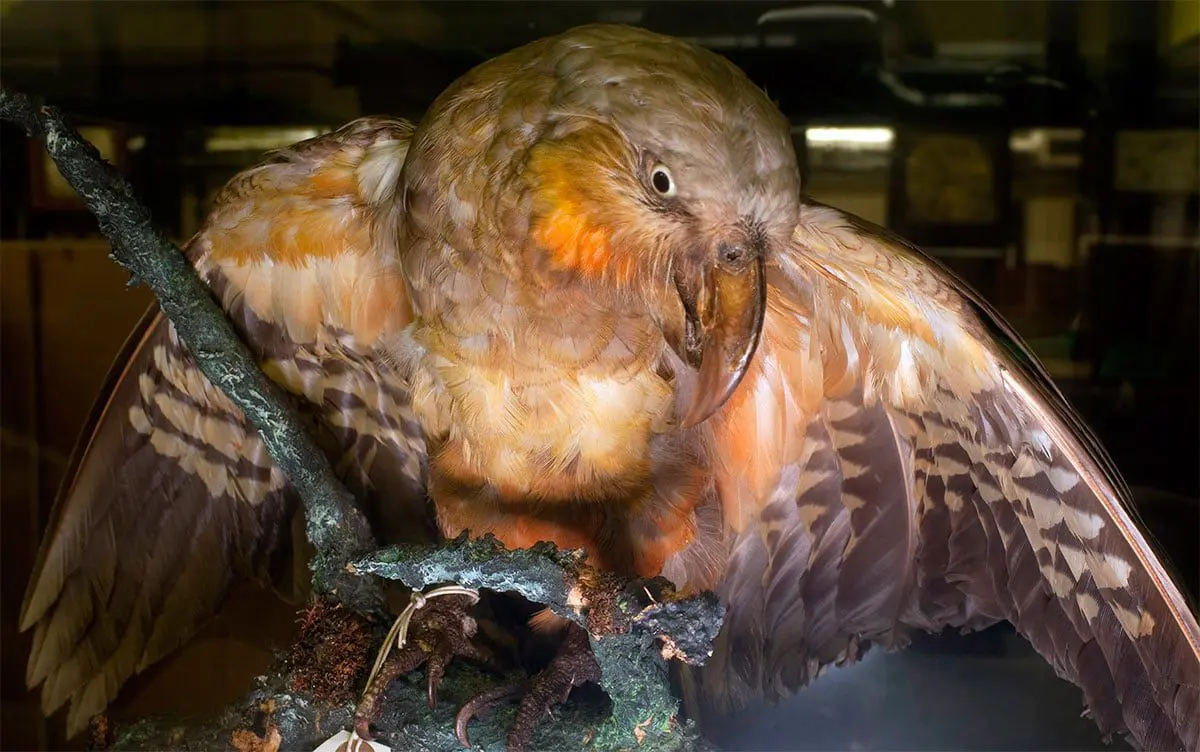
The Norfolk Island Kaka(Nestor productus) was their large with a bill, wings short and wide, and with legs and feet large.
I had 38 centimeters long. The top of his head era gris pardusca, while its face varied from yellow to orange, sometimes with a reddish tint. It was said that his Hip It was greenish yellow, and upperparts, including the wings, they were mostly greyish-brown in color, slightly darker than the top of the head, with the bottom of the back and rump orange or dark red and the tail brown. Upper chest It was brown and gray bottom bright yellow, with the belly and sides reddish orange (Forshaw & Cooper 1981, 2002; Greenway 1958).
Its social structure and dispersion are not registered, but the Norfolk Island Kaka of New Zealand, he watched alone or in small groups of up 10 individuals (Higgins 1999).
Habitat:
Habit in the native forest in the Norfolk Island and about Phillip Island (Greenway 1958). The species could be observed both in the canopy of tall trees, and soil, the rocks (Gould, 1865, Greenway 1958).
Given its endemism in the Norfolk Island, the Norfolk Island Kaka It was presumably sedentary.
Reproduction:
Little is known of reproductive cycle of the Norfolk Island Kaka; just put on record of four eggs in tree holes (Gould 1865).
Food:
It is known that he fed on nectar Flowers tree white wood (Lagunaria) (Gould 1865). Definitely should be more varied. The captive birds they ate lettuce and the leaves of other vegetables, as well as dairy meals and fruit juice (Gould 1865). Presumably he foraged in both the soil and the canopy (Gould, 1865).
The species is believed to have had a very limited ability to move between islands., and probably he spent his whole life on the island of his birth (Gould, 1865).
In the Norfolk Island Kaka occasionally kept in captivity, as the birds were gentle and easy to capture alive (Gould 1865). The species He survived in captivity until after it had become extinct in the wild (Greenway 1958). There are no known captive populations and none has been reintroduced into the wild. The last known living bird was in captivity in London in 1851 (Garnett et to the., 2011).
No made extensive studies for this species. But, there have been a series of ornithological studies in the Norfolk Island since the species disappeared from the island (p.ej. Bell 1990, Robinson 1988, Schodde et al., 1983, Smithers y Disney 1969), no signs have been found of the species.
Conservation:
• Current category of the Red List of the UICN: extinct.
Rationale for the Red List category
This species was known in the Norfolk Island, but it was Extinguished to mid 1800. It is believed that the elimination of habitat and hunting have been the main drivers.
According to reports, was tame and, Therefore, hunted strongly convicts and early settlers and easily trapped as a pet.
No information is available on the population size before its decline.
"Norfolk Island Kaka" in captivity:
They were captured by his meekness and they were common in the Norfolk Island
Alternative names:
– Norfolk Island Kaka, Norfolk Island Kea, Norfolk Island Parrot, Norfolk Kaka (English).
– Nestor de Norfolk (French).
– Dünnschnabelnestor, Norfolkkaka, Norfolk-Kaka (German).
– Kākā-de-norfolk (Portuguese).
– Kaka de Norfolk (español).
– Avibase
– Parrots of the World – Forshaw Joseph M
– Parrots A Guide to the Parrots of the World – Tony Juniper & Mike Parr
– Birdlife
– Australian Government – Department of the Environment and Energy (Nest produced - Norfolk Island Kaka)
– Photos:
(1) – Natural Science Curatorial Trainee – Birmingham’s Norfolk kaka
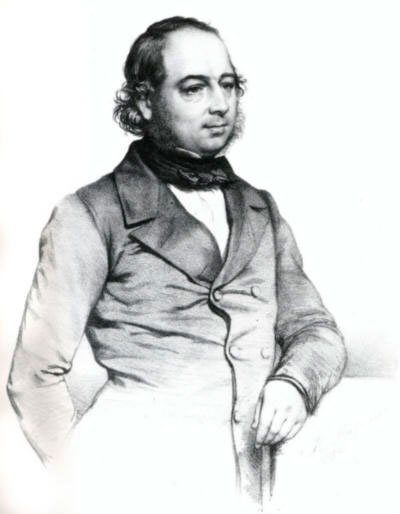
(2) – Nestor productus Gould, 1836 by Huub Veldhuijzen van Zanten / Naturalis [CC BY-SA 3.0], via Wikimedia Commons
(3) – Nestor productus By Gould, 1836 [CC BY-SA 3.0], via Wikimedia Commons
(4) – Norfolk Island in Kaka (Nestor productus). The last bird in captivity died in London in 1851. Specimen from the Zoological Museum in Firenze, Italy by Thomas Wesener – Flickr
(5) – Nestor productus By Gould, 1836 [CC BY-SA 3.0], via Wikimedia Commons
(6) – The Norfolk Island in Kaka (Nestor productus) from the plate in the Bulletin of the Liverpool Museum. From the specimen in the Tring Museum by John Gerrard Keulemans [Public domain], via Wikimedia Commons
▷ The world of Pets: Dogs, cats, birds, reptiles, amphibians
Origin: Mexico, Guatemala, Belice, El Salvador, Honduras, Costa Rica, Nicaragua
Character: active
Life expectancy: 60 years.
Height: 22 to 26 cm..
Content
Description:
22 to 26 cm.. length.
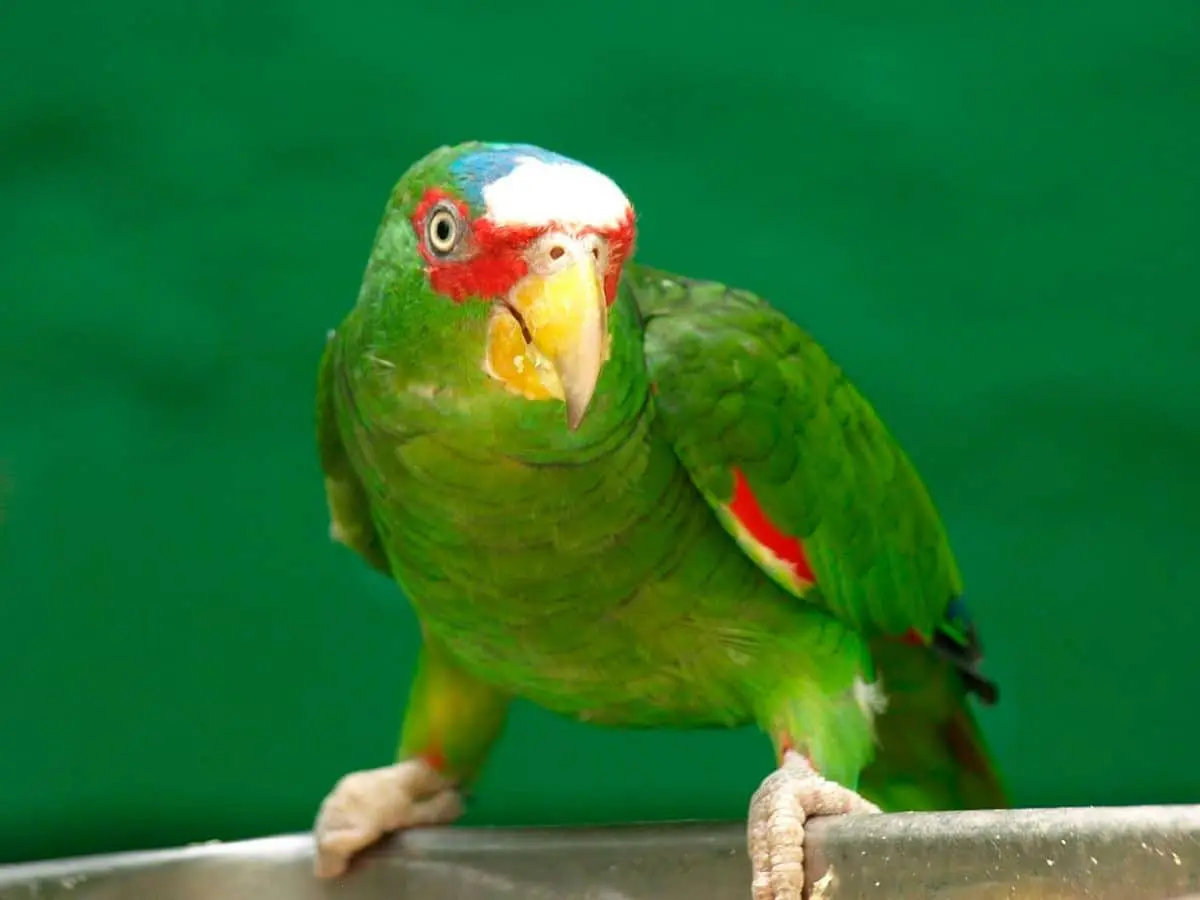
The White-fronted Parrot(Amazona albifrons) has the forecrown white; lores, upper cheeks and ring of feathers around eyes, red; the crown pale blue mingles with the green nape; the feathers with dark margins; sides neck green with narrow black margins. Mantle, back and scapulars, grass-green, sometimes with olive tint; the mantle with indistinct black tips; rump green, perhaps more emerald colors than the rest of the upperparts.
big blankets and alula, red, other coverts green. The outerweb of the primaries, green, They turn blue at the tips; outerweb of the secondaries, blue; innerwebs of the flight feather, blackish. Under, the wings bluish green. Underparts green with weak blackish edges to feathers on throat and the chest. Upper, the tail It is yellow in the center, outer feathers red at the base, blue in the outerweb. Bill light colored horn, darker at the tip; bare periophthalmic pale grey; irises pale yellow; legs pale grey.
It presents an undistinguished sexual dimorphism. The female It differs from the male in the red face It is limited to the region eye ring and it lacks the red hue in wing coverts. The immature male It looks like female but with red on the primary coverts.
(Miller,W, 1905) – smaller the species nominal. Little differentiated from nominal but the green plumage It is perhaps paler, yellower. Some individuals Coast peaceful show some red on the throat.
Amazona albifrons saltuensis
(Nelson, 1899) – Similar to the nominal but the plumage It is heavily steeped in blue. The blue of the crown It extends to the nape.
Habitat:
This adaptable Amazona uses all kinds of wooded habitats and open field with trees, including seasonally moist semi-evergreen semi-evergreen forest (especially at the edge), pine forests, gallery forest, agricultural land with open woods, savannah and tropical arid scrub with cactus, tending to more frequent open areas in the caribbean side.
Usually they prefer drier forests, but where it is simpátrica with Yellow-lored Parrot(Amazona xantholora), tends to prefer more humid and closed vegetation.
In Yucatan the White-fronted Parrot inhabit coastal coconut plantations while breeding. In altitudes of 900 m (Oaxaca), 1.800 m (Honduras) and 1.500 m (Sonora meridional: register only known outside the tropics).
In pairs during the breeding season but usually gregarious, distributed primarily in small groups, with occasional concentrations of hundreds of birds and some communal roosts (for example, mangroves) with several thousand birds.
The White-fronted Parrot nest in trees, cavities of the palm tree termitarium, sometimes in the cavity dug by some woodpecker. species trees Bursera simaruba and Caesalpinia gaumeri are among the favorites to nest in Yucatan. Breeding January July, depending on the location.
A clutch contains 3-5 eggs. Only the female incubates. The incubation lasts around 24 days.
Size of its range (breeding/resident ): 2.330.000 km2
The White-fronted Parrot They extend Mexico, from the South of Sonora (north to about 28 ° N) along the Sinaloa and West Durango south through the Pacific region to Oaxaca and north through Tehuantepec isthmus the Atlantic coast in southern Veracruz and to the East by Tabasco the entire Yucatan Peninsula, including northern Guatemala and Belice.
They are present in southern Chiapas and in the lowlands of the Guatemalan Pacific and, reportedly, in West El Salvador, extending through the lowlands of peaceful, arid and Caribbean lowlands Honduras to the Pacific Northwest Costa Rica and Nicaragua (where distribution is not detailed).
Mainly seasonal residents but visitors in some parts of the range (for example, Yucatan, El Salvador western and eastern mountains Guatemala).
Introduced in urban areas Cozumel Island, in the State of Quintana Roo (Mexico). Their presence only in urban areas of the island, the ability of the species to live successfully in urban areas, the abundance of fruit trees and use as a pet by the islanders allows us to suggest that registered individuals are the result of leakage or were released by their owners.
Usually common and together with the Orange-fronted Parakeet(Eupsittula canicularis), It is the largest parrot in the Pacific slope of Central America; although obviously scarce in some areas. The deforestation It is possibly promoting increases in population Caribbean slope of Central America. Captured for the pet trade and hunted as food, for example in Yucatan, where recently there has been a population decline due to the persecution of parrots that feed on fruit after loss of wild foods cultivated by Hurricane Gilbert. Its capture It is authorized only during the months of October to February in the states of Warrior, Jalisco, Michoacán, Oaxaca, Sinaloa and Tabasco and from September to January in Veracruz.
Distribution 3 subspecies:
Amazona albifrons albifrons
(Sparrman, 1788) – Nominal. Pacific Coast of Mexico from Nayarit to Oaxaca and South of Chiapas in the lowlands Guatemalan Pacific. Birds in the northern Guatemalan lowlands and the arid interior, they can refer to the subspecies Amazona albifrons nana.
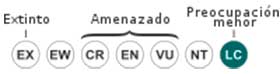
• Current category of the Red List of the UICN: Least concern.
• Population trend: Increasing.
Rationale for the Red List category
• This species has a very large range and therefore it is not close to the thresholds for Vulnerable under the criterion of size range (Extent of occurrence below 20,000 km2 combined with a size decreasing or fluctuating range, extension / habitat quality or population size and a small number of sites or severe fragmentation).
• The trend of population appears to be increasing and, therefore, the species does not approach the thresholds Vulnerable under the criteria of population trend (Wholesale 30% decrease in ten years or three generations).
• The population size is very large and, therefore, not approaching the thresholds for vulnerable under the criterion of population size (less than 10.000 mature individuals with continuing decline estimated a higher percentage of 10% in ten years or three generations or with a specific population structure).
• For these reasons the species is evaluated as the least concern.
Justification of the population
• Partners in Flight estimated that the total population of 500.000-4.999.999 individuals (A. Panjabi in a bit., 2008).
Justification of trend
• The population is suspected to be increasing as habitat degradation is creating new areas of suitable habitat.
The White-fronted Parrot in captivity:
Due to the decline of these birds in the wild, especially in the Mexican populations, the White-fronted Parrot is now, unlike other times, offered for sale only rarely. It also, among birds received by importers, the males generally far outweigh the females so it's hard to find a partner.
According to many observations, the White-fronted Parrot captured still quite shy and unsociable, especially if they were mature when they were trapped. The birds immature, which can be stained by the yellowing of his crown, relatively well sympathize with their caregivers and are easily adapted to a life in a cage or aviary. It is said to have some talent to imitate.
According to sources, the first hatchlings in captivity They were born in 1949 in the United States by I.D. Putman; the second in 1977 on German Federal Republic by H. Müller (Walsrode) and a third set in Switzerland in 1979; Since then several European poultry farmers have reported breeding successes.. The latest report came in 1985 from the bird park Metelen Heide in Muen-sterland (Western Germany). there a clutch five eggs produced four hatchlings in mid-June 1984 after an incubation period of 28 days. The young left the nest after about 70 days, but they were still actively cared for and fed, mainly by the parent, for a few weeks more.
Its price in the European market round 1000 EUR. generally silent the Amazons largest. It can be noisy just before and during the breeding season.
These birds can become aggressive in breeding season and can attack the caregiver. The nest boxes are better positioned to nest inspection can be performed from outside the aviary. The inspection of the nest is best when adult birds are out of the nest, however captive breeding has rarely been achieved between individuals.
Susceptible to intestinal infections during the acclimatization period.
Their life expectancy can overcome the 50 years.
Alternative names:
– White-fronted Parrot, Spectacled Amazon, Spectacled Parrot, White fronted Parrot, White-browed Amazon, White-browed Parrot, White-fronted Amazon (English).
– Amazone à front blanc, Amazone à lunettes (French).
– Weißstirnamazone (German).
– Papagaio-de-testa-branca (Portuguese).
– Amazona de Frente Blanca, Amazona Frentialba, Cotorra Frentiblanca, Lora frentiblanca, Loro Frente Blanca, loro frente-blanca, Loro Frentiblanco, Cotorra Guayabera (español).
– Cabeza de Manta, Loro Manglero, Cocha, Cocho, Cucha (Mexico).
Parrots A Guide to the Parrots of the World – Tony Juniper & Mike Parr
Birdlife
The New Parrot Handbook by Werner Lantermann,Matthew M. Vriends
Photos:
(1) – White-fronted Amazon By David Oliva (originally posted to Flickr as Cotorro 007) [CC BY 2.0], via Wikimedia Commons
(2) – White-fronted Amazons in Schönbrunn Zoo By spacebirdy(also known as geimfyglið (:> )=| made with Sternenlaus-spirit) (Own work) [CC BY-SA 3.0 or FAL], via Wikimedia Commons
(3) – white-fronted amazon (Amazona albifrons) By Christoph Anton Mitterer (Flickr: P8155550) [CC BY-SA 2.0], via Wikimedia Commons
(4) – White-fronted Amazon Amazona albifrons pair perching in a tree at Guanacaste, Costa Rica By Steve Jurvetson (originally posted to Flickr as love birds) [CC BY 2.0], via Wikimedia Commons
(5) – White-fronted Amazon, (Amazona albifrons). A pet parrot on a perch. Red feathers on this parrots shoulders indicate that it is a male By ➨ Redvers (Flickr) [CC BY 2.0], via Wikimedia Commons
(6) – White-fronted Amazons in Schönbrunn Zoo By spacebirdy(also known as geimfyglið (:> )=| made with Sternenlaus-spirit) (Own work) [CC BY-SA 3.0 or FAL], via Wikimedia Commons
(7) – A captive White-fronted Amazon in Copán Ruinas, Copán, Honduras By Troy from Charlottesville, USA (Flickr) [CC BY-SA 2.0], via Wikimedia Commons
(8) – A White-fronted Amazon – upper body by sumba [CC BY 2.0 of], via Wikimedia Commons
(9) – A pet juvenile White-fronted Amazon in Poole, Dorset, England By Kyle Payne from England (Odd Looking Seagull) [CC BY-SA 2.0], via Wikimedia Commons
(10) – White-fronted Amazon, Amazona albifrons, Remove alone B. Planet Earth – Flickr
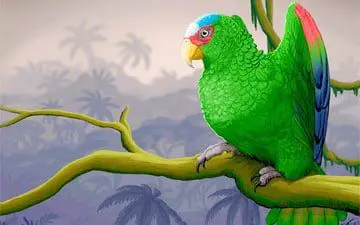
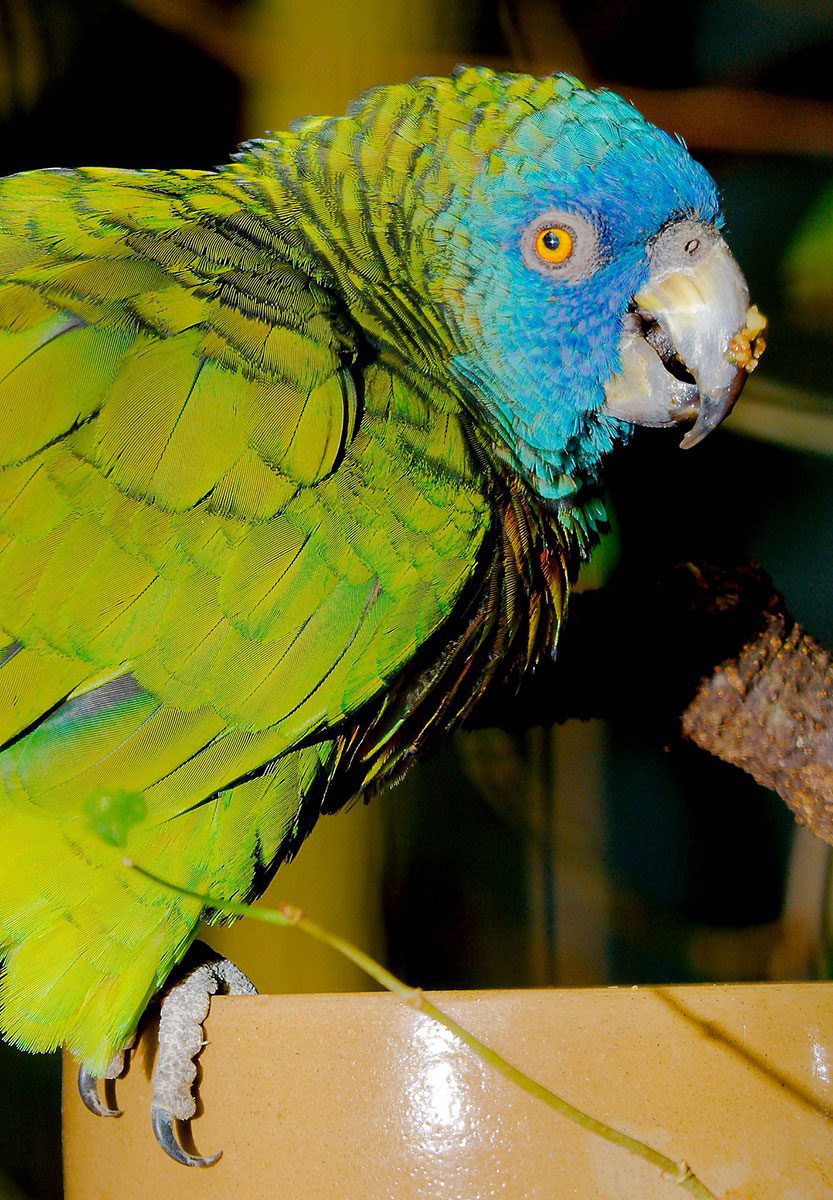
The Saint Lucia amazon(Amazona versicolor) has the lores, cheeks and forecrown, bright blue; crown, ear-coverts and lower cheeks, paler blue with iridescent emerald suffusion from some angles; dark tips to feathers on head.
Hindneck neck, nape and upperparts, yellowish-olive, many feathers with visible black tips, giving the whole a barred effect strong, especially in the upper region. Wing coverts yellowish green olive. Primary coverts dyed blue, rest with black tips to some feathers. Primaries blue; bases of external secondarys forman speculum red, blue tips; secondary internal green and blue at the base to the tips. Underwing, yellowish green with blackish tips to some feathers; flight feather bluish green. Chin and throat, bright blue with blackish tips to feathers; tips of feathers on lower throat and top of the chest, bright red forming a patch distinct red patch or mottled red area; chest and belly rather yellowish-green, blackish tips and brick red in the subterminal area of some feathers, giving scalloped appearance with scattered rusty patches; the thighs and undertail-coverts, green-yellow. Tail bluish green in the center, outer feathers green with large yellowish green tips and hidden red bases. Bill grey; irises orange; legs grey.
Probably no sexual dimorphism.
Immature has irises brown.
Sound of the Saint Lucia amazon.
Habitat:
Video "Saint Lucia amazon"
Mainly they inhabit the canopy montana primary rainforest, but they make inroads into areas of secondary growth to feed. Reported flocks of up 20 birds. living forms community.
Reproduction:
They nest in tree hollows. Nests observed in trees Dacryodes excelsa, Pouleria and Tetracera caribaeum. breeding season in February-August. Clutch usually two eggs, although, usually, only one young per nest thrives.
Food:
Its diet includes flowers and fruits of Clusia, Fruits of Talauma dodecapetala, Acrocomia irenensis, Pouleria, Dacryodes excelsa, Sloanea massoni, Byrsonima martinicensis, Miconia mirabilis, Pterocarpus officinalis and Euterpe globosa; also they have been seen feeding on bananas after the hurricane and presumably due to the depletion of natural food sources. Absence of common areas from August to November possibly linked to the lack of fruitfulness of Clusia.
Distribution and status:
Size of the area of distribution (raising / resident): 230 km2
Confined to St. Lucia in the Lesser Antilles, now in the central and southern mountains, although formerly you were more widespread everywhere where the humid forest grew. The species has suffered a contraction of the range since the nineteenth century and now It occupies an area of ​​only 65-70 km2 from Millet and Mont Lacombe in the North, until Mont Beucop and Calfourc in the East, Piton Pig, St Piton, St Desrache and Big store in the south to Morne Gimie in the west and Mont Houlemon in the Northwest. The results of studies on the species suggest that the southwestern part of this area is the most densely populated of parrots, while relatively few live in the northeast.
Plentiful mid-nineteenth century, but decreasing rapidly to very little in the early twentieth century. Subsequently they recovered, with an estimated population of 1.000 birds in 1950. They declined again sixties, mostly due to hunting; observations in 1977 They estimated that there were more than 100 birds. steady increase since then with an estimated population of 300-350 birds in 1990.
The threats main arise from habitat loss and its hunting for food and pet trade as. Forestry practices that lead to the removal of mature trees (favorite breeding sites) could put additional pressure. They seem to be less susceptible to hurricanes than their counterparts in Dominica, but this may be due to conservation efforts rather than any intrinsic ability to withstand the effects of severe storms.
Can compete for nesting sites with Pearly-eyed Thrasher(Margarops fuscatus), which it has increased considerably since 1950.
Amazona versicolor Conservation:
State of conservation ⓘ
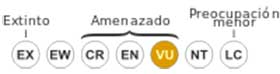
Vulnerable ⓘ(UICN)ⓘ
• Current category of the Red List of the UICN: Vulnerable.
• Population trend: In increased.
• Population size : 230-330
Rationale for the Red List category
Conservation action may have saved this species from extinction. Numbers are now increasing and there is some evidence of a small range extension.. But, the habitat area apparently adequate (but vacated) It may be waning. If this begins to affect the habitat occupied, the species can be described as danger of extinction. In the news, its small population size and small size on one island are calling it Vulnerable.
Justification of the population
The population is estimated at 350-500 individuals, approximately equal to 230-330 mature individuals.
Justification of trend
No new data on population trends, so it is assumed that the species continues increasing.
Threats
The human population St. Lucia It is growing at a considerable rate, increasing the pressure on the forest and resulting in habitat loss(Copsey 1995). The selective logging of mature trees You can significantly reduce breeding sites (Juniper and Parr 1998), and hurricanes, the hunting and the trade pose new threats. There have been recent efforts to raise the moratorium on hunting within forest reserves, what would seriously threaten this species (J. D. Gilardi in litt., 1999).
Conservation Actions Underway
Coat of arms of Saint Lucia
Appendices I and II of CITES. This protected by national legislation (J. D. Gilardi in litt., 1999).
Education programs and awareness have made this bird in a National symbol.
This has eliminated successfully hunting (Juniper and Parr 1998), helped by a moratorium on hunting within forest reserves (J. D. Gilardi in litt., 1999).
In 1975 program was established captive breeding, and in 1995 had developed a total of 19 young birds (Copsey, 1995).
Conservation Actions Proposed
Maintain the moratorium on hunting within all forest reserves. Conduct a studyo Basic feeding and breeding ecology. Designate the remaining habitat protected areas. Reassess the objectives of the program captive breeding.
The Saint Lucian Amazon in captivity:
extremely rare; currently only it found in the Jersey Zoo
Appendices I and II CITES. This protected by national legislation.
Each captive specimen of this species which is capable of reproducing, It is placed in a well-managed program captive breeding and not be sold as a pet, with the objective of ensure their survival long-term.
Alternative names:
– Blue-masked Amazon, Blue-masked Parrot, St Lucia Amazon, St Lucia Parrot, St. Lucia Amazon, St. Lucia Parrot, St.Lucia amazon, Versicolored Parrot, Versicoloured Parrot (English).
– Amazone de Sainte-Lucie, Amazone versicolore, Amazone versicolore de Sainte-Lucie (French).
– Blaumaskenamazone, Blaustirnamazone (German).
– Papagaio-de-santa-lúcia (Portuguese).
– Amazona de Santa Lucia, Amazona de Sta. Lucia (español).
(1) – Saint Lucia Parrot(Amazona versicolor) by Josh More – Flickr
(2) – Chrysotis bouqueti (a.k.a. Amazona versicolor, the St. Lucia amazon, or the St. Lucia parrot) by Joseph Smit [Public domain], via Wikimedia Commons
23 cms. length and 84 g. of weight.
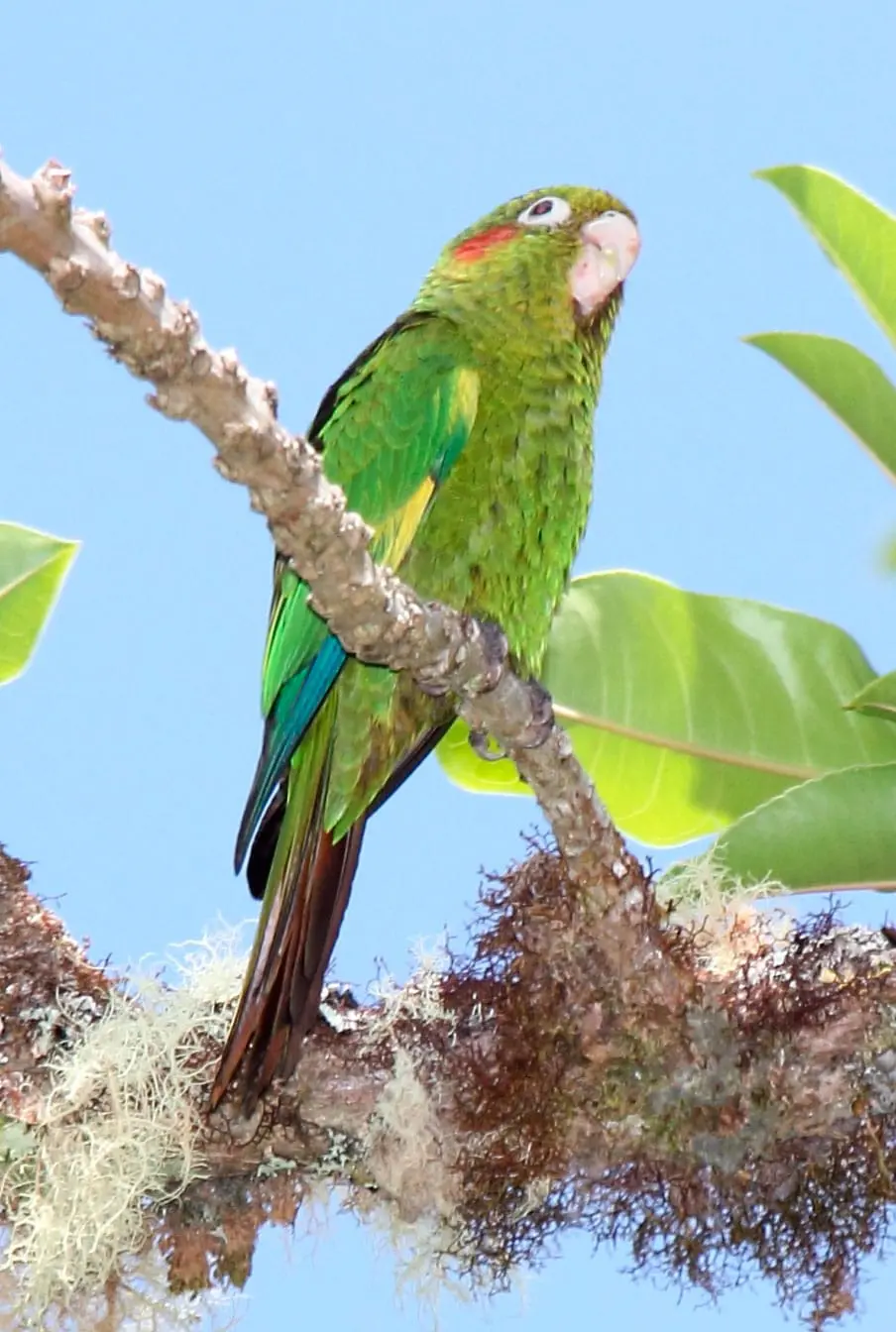
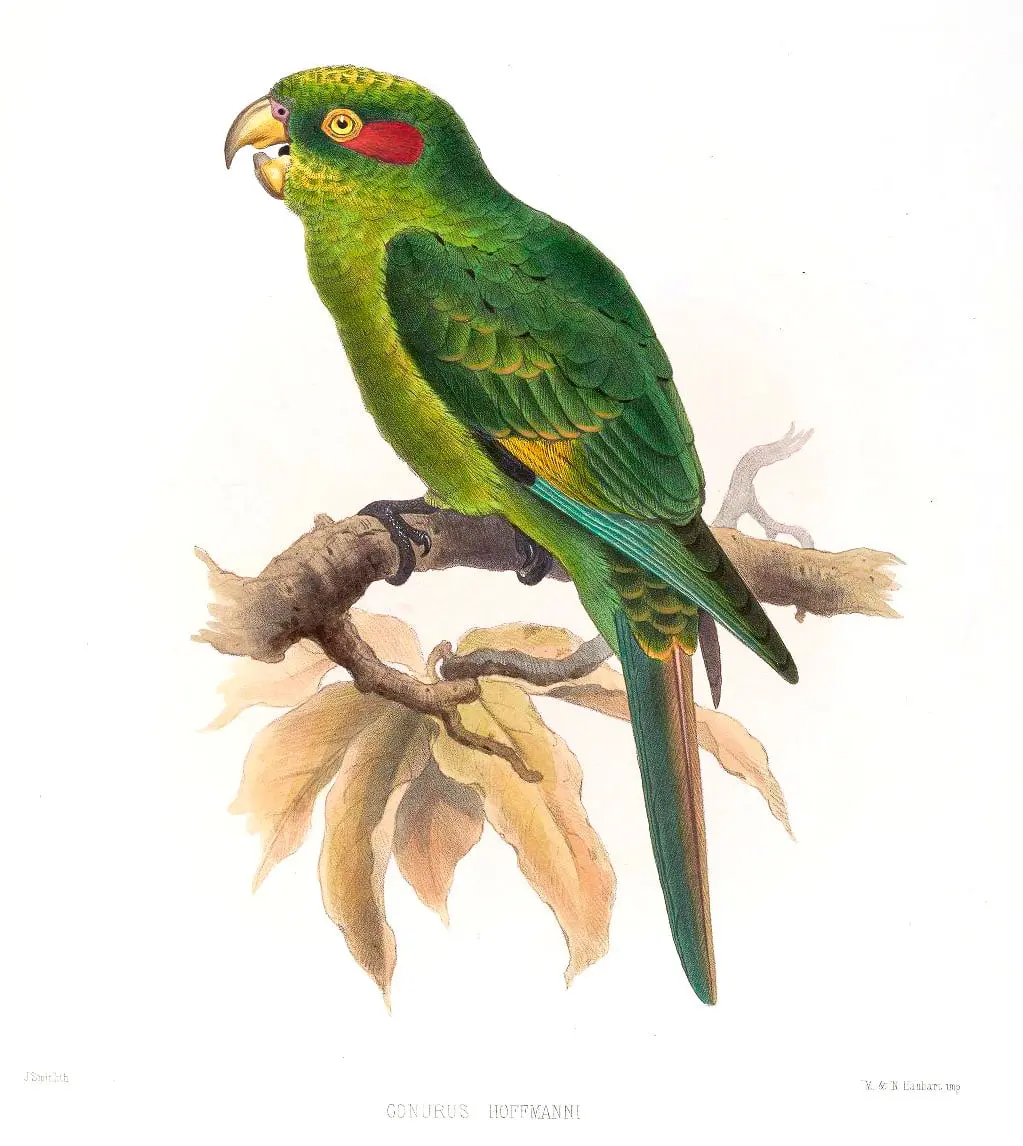
The Sulphur-winged Parakeet(Pyrrhura hoffmanni) It, mostly, green with some individual variations in plumage.
It has a distinctive tail long and round about ear-coverts crimson red. Yellow at the top of the wings, largely hidden when the bird is at rest, but perfectly visible in flight.
The feathers of the forecrown, crown, cheeks and nape, They are green with yellow centers (the proportion of the yellow color is higher in the forecrown, lower in the back of the crown). Above predominantly green, It is the leading edges of the wings, sometimes, yellow. The lesser coverts and median are, generally, green, sometimes with some yellow in outer median coverts and feathers alula.
Yellow at the base of the outerweb of the greater coverts. Outerwebs of primaries, to a great extent, blue; primaries and secondaries with bright yellow patch, especially on the basis of innerwebs; flight feather with black tips. Under, the wings with the lesser coverts green, the majors, greenish yellow; a central portion flight feather yellowed with greyish tips.
Chin reddish; throat, sides neck and the top chest, green with yellow tips on feathers, which gives an overall light effect Scaled. The belly, the flanks and undertail-coverts, are green. Upper, the tail is green, below, reddish.
The bill and cere They are pink colored horn; bare periophthalmic white or yellowish white; the irises brown; legs pale grey.
Both sexes are similar, but the male player has yellow stripes on pens crown.
The Immature It has less yellow in head, the chest and wings.
Sound of the Sulphur-winged Parakeet.
Subspecies description:
Pyrrhura hoffmanni gaudens
(Bangs, 1906) – Very similar to nominal, although feathers crown and nape They have yellower, with their ends red or red and orange (in some birds, red ends of the feathers may extend over the back, the throat and the chest). Underparts slightly darker.
Observed, mainly, in mountainous areas, preferring montane forests in the subtropical zone, mainly 1.000 to 2.400 meters above sea level, although views 550 meters in the region Admiral's Bay, Panama and a 3.000 metres in Costa Rica.
They appear to tolerate a considerable disturbance of habitat, including managed forests, areas and the second growth partially cleared, forests and wooded pasture shrubs. Usually seen in pairs or small flocks of 5-15 birds. You can perform altitudinal movements daily to feed, returning to the mountains to rest. Forage occurs in the canopy or smaller trees and bushes near the edge of the woods.
Reproduction:
They nest in tree hollows, including old nests woodpeckers, to 8-20 meters of land. With reproduce dry season (January June). Clutch six eggs in captivity.
Extending its range (players / residents): 18.400 km2
Confined south of Costa Rica and western Panama.
The species is found in the highlands of the southern half of Costa Rica, including the slopes of Caribbean, the mountains of the central plateau south and the two sides of the Cordillera de Talamanca, sometimes the region Cartago and Paradise and the Irazu volcano.
In western Panama They are mainly distributed in the west and center chiriqui and areas adjacent in Bull's mouths, in the highest mountains (including the chiriqui volcano and the high ridges on Boquette) and at lower elevations around, for example, of the Chiríqui Lagoon and Admiral Bay.
The easternmost Panamanian registry was found east of the central mountain range in 1868.
Some altitudinal movements (higher in the dry season). Birds are perhaps only sporadic in the extremities of their range. Apparently, It is common in the middle to high elevations of the Cordillera de Talamanca and in isolated areas, and it is believed to be quite numerous throughout the main range.
Its habitat It is now highly fragmented, though still apparently numerous, even in areas where the forest is partly cloudy. Rare in captivity.
• Current category of the Red List of the UICN: Least concern.
• Population trend: Stable.
• Population size : Unknown.
Rationale for the Red List category
Although this species may have a small range, it is not believed that approximates the thresholds for Vulnerable under the criteria of size range (Extension <20,000 km2 combinada con un tamaño de rango decreciente o fluctuante, extensión / calidad del hábitat o tamaño de la población y un pequeño número de lugares o fragmentación severa). La trend of the population It appears to be stable, so that the species does not approach the thresholds for Vulnerable under the criteria of population trend (> 30% decline over ten years or three generations). The population size It has not been quantified, but it is not believed to be close to the thresholds for Vulnerable under the criterion of population size (<10.000 individuos maduros con un declive continuo estimado> 10% in ten years or three generations or a population structure). For these reasons, the species is evaluated as Least Concern.
Justification of the population
The size of the world's population has not been quantified, but this species is described as «quite common» (Stotz et to the., 1996).
Justification of trend
They suspected that the population of Catana Cotorra is stable in absence of evidence of any decline or threatens substantial.
"Sulphur-winged Parakeet" in captivity:
Rare in captivity. Quieter than other parakeets. In Panama the export of these birds is prohibited from 1980.
– Avibase
– Parrots of the World – Forshaw Joseph M
– Parrots A Guide to the Parrots of the World – Tony Juniper & Mike Parr
– Birdlife
– Photos:
(1) – Sulphur-winged Parakeet (Pyrrhura hoffmanni). Photographed at Savegre, in Costa Rica By Dominic Sherony [CC BY-SA 2.0], via Wikimedia Commons
(2) – Parakeet HOFFMAN (Pyrrhura hoffmanni) Loro Parque, Tenerife by ZOOTOGRAFIANDO
(3) – A Sulphur-winged Parakeet at Savegre, Costa Rica By Dominic Sherony [CC BY-SA 2.0], via Wikimedia Commons
(4) – Sulphur-winged Parakeet (Pyrrhura hoffmanni) at Savegre Lodge, near San Gerardo, Costa Rica By Michael Woodruff [CC BY-SA 2.0], via Wikimedia Commons
(5) – Sulphur-winged Parakeet or Hoffmann’s Conure (Pyrrhura hoffmanni) by elite-pets
(6) – Conurus hoffmanni = Pyrrhura hoffmanni by Joseph Smit [Public domain], via Wikimedia Commons
The extinct parakeet of paradise(Psephotus pulcherrimus) was a small parrot (27-30 cm long) and rather distinctive, with scapulars red and long tail.
The male had one forecrown of bright red and a crown black; eye rings yellowish; ear-coverts and throat emerald green. The nape black merged with the dark brown on the neck and then into paler, earthy brown the mantle and back. The scapulars were bright red; the rump was turquoise; and tail top green-bronze and blue, merging into bluish-black. The under body comprised an chest and upper abdomen emerald green, merging into turquoise on the sides of neck and in the part inferior of the abdomen; the belly, the vent and flanks were bright red; and the under tail was bluish white. The upperwing was earthy brown, concolorous with the mantle and back; and the underwing was deep blue.
The female was less colorful, differing from the male by forecrown and face yellowish; a crown duller blackish-brown; throat and chest with brownish-orange suffusion; belly pale blue and coverts the lower abdomen, vent and under tail red on the fringes of some feathers. In both sexes bill was grayish; the eyes brown; and legs and feet were grayish brown.
The juveniles they looked like females.
taxonomy:
This taxon is considered a subspecies of Psephotellus [pulcherrimus or dissimilis] (sensu lato) by some authors
Habitat:
The parakeet of paradise lived mainly in rolling river valleys were lightly wooded with eucalyptus forests, or open forests often dominated by ironbarks and bloodwoods, with an understory of annual and perennial native grasses; these areas were often dotted with termite mounds.
Reproduction:
the details of the distribution areas or territories unknown parakeet of paradise, although it is believed that adults have remained in the same places nesting for many years.
Little is known of sexual maturity or life expectancy of this species. The reproduction It was recorded between September and March. Sunsets are placed three to five white eggs, with a pink tinge, in a nest chamber at the end of a tunnel dug into termite mounds.
Food:
There is little information on diet parakeet of paradise, however it was known to feed on the seeds of native grasses.
Distribution:
The parakeet of paradise He was present in eastern Australia, only he reported with certainty from southeast Queensland. Is likely to records in upstate been wrong. The species is also often said to have been found in New South Wales, but there has been no confirmed records (Olsen 2007). Era locally common although generally scarce in the nineteenth century (Forshaw and Cooper 1989), but then it declined rapidly and was thought to have become extinct as a result of the drought of 1902 until it was rediscovered in 1918 (Chisholm 1922). The last observation was confirmed in 1928. Some credible reports continued into the years 30 and 40 (Olsen 2007), but although Kiernan (1993) He claims to have seen five birds 1990, the species is now considered extinct(Necklace et to the. 1994).
Conservation:
• Current category of the Red List of the UICN: Extinct.
Its extinction was probably marked by reduced food supply due to drought and overgrazing (Olsen 2007). Also contributed frequency altered fires and propagation tunas (Joseph 1988), the disease, the trampeo and harvest of eggs (Garnett 1992), the predation of nests by introduced and native species (Chisholm 1922) and removal of eucalyptus by ringbarking (Kiernan 1993). After a significant reduction in the size of the population of the species, It seems that endogamia inhibited fertility of birds (Gerrard 2008).
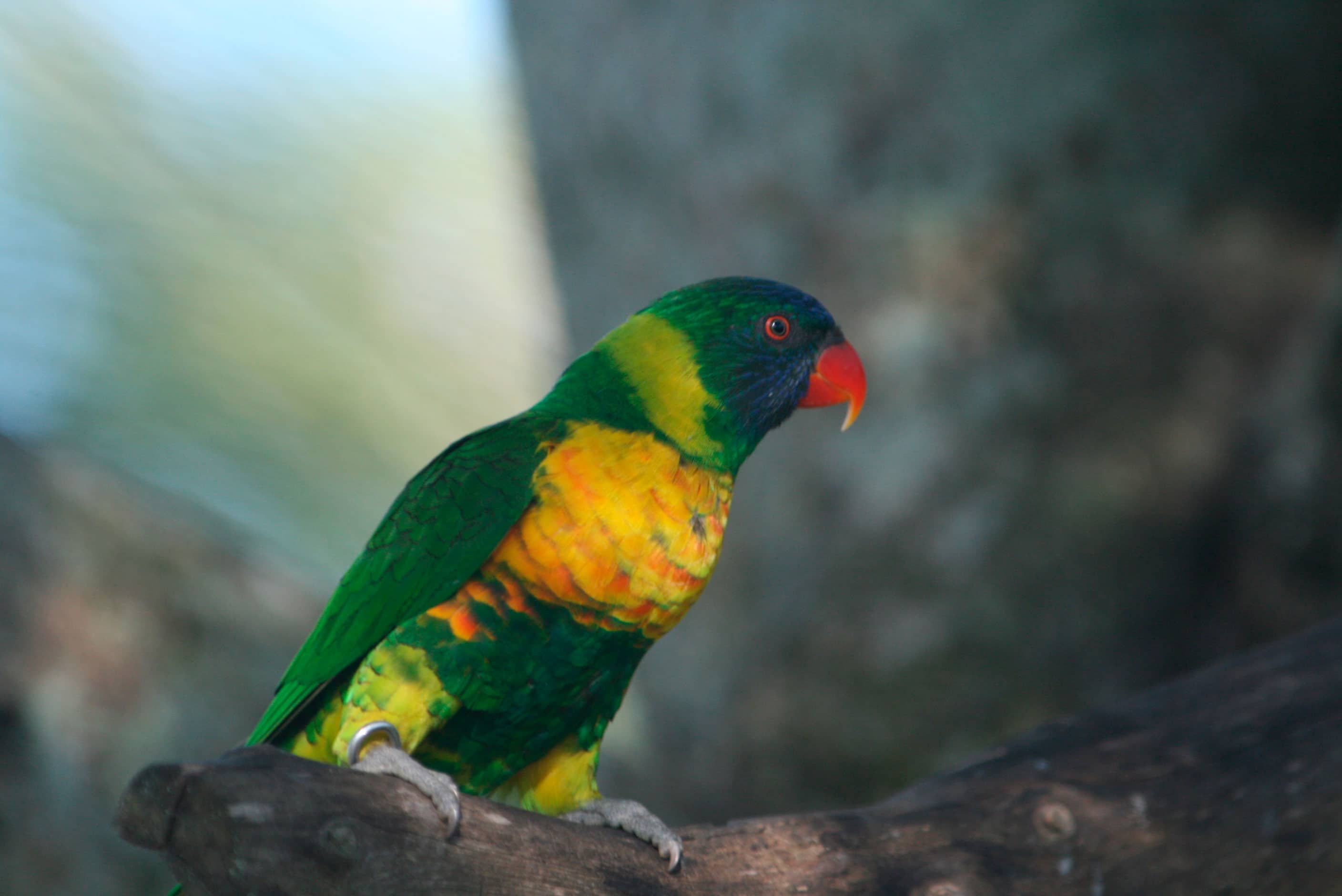
The Marigold Lorikeet(Trichoglossus capistratus) has the forecrown, the cheeks and chin, dark blue; and the rest of the head It is green with a broadband yellow-green in nape (part posterior of the neck). The upper breast is yellow with green narrow edges feathers. Underwing-coverts are yellow with scattered orange marks. Males may have some red on their edges. The abdomen is dark green. Their peaks They are hooked.
The males and females and players seem to depend on DNA or endoscopic sexing to determine gender.
Taxonomic status:
This taxon is considered a subspecies of Trichoglossus [haematodus, rosenbergii, moluccana, forsteni, capistratus, weberi] (sensu lato) by some authors.
Sound of the Marigold Lorikeet (1).
(1) Some species are under extreme pressure because of traps and harassment. So, the open availability of high-quality recordings of these species may further worsen the problems, this being the reason why downloading these recordings is off. In conclusion, recorders themselves are free to share these files on xeno-canto, but they will have to approve access to these recordings.
We do not take this action lightly, and we wish it wasn't necessary, but we are convinced that the negative impacts of offering easy access to these recordings outweigh the benefits. To access these recordings, You can contact directly with the recorder.
(Hellmayr, 1914) – Head green with purple/blue veins on the forecrown up to the cheeks; variability of yellow to deep orange in chest; neck wide and yellow; abdomen dark green to green / black; underwing-coverts yellow with orange markings variables.
Trichoglossus capistratus fortis
(Hartert, 1898) – Head black/brown with purple/blue veins on the forecrown up to the cheeks; lores , throat, line from top to back of the eyes and occiput, green; chest bright yellow with orange but not barred / red marks; abdomen dark green, with occasional shades blue / black; underwing-coverts yellow.
Habitat “Bridled Lory”:
The Marigold Lorikeet They are in mixed flocks with other parrots; small and noisy groups. Nomads, since they depend on flowering trees. It perches communally in groups of hundreds of birds.
It is more common in lowlands, but it is up to altitudes of 2400 m. Wide variety of areas including settlements, forests, coconut plantations, Savanna, eucalyptus forests and mangroves, including dry forest Roti.
Reproduction «Bridled Lory»:
Total of 21 nests found in Sumba between late August and early October 1992, all cavities in large trees (principalmente deciduous).
Feeding «Flanged lory»:
Few specific dietary data, but presumably similar to Trichoglossus haematodus and it is known to take nectar and pollen from native trees, as well as figs and insects.
Distribution «Flanged lory»:
Extension of the distribution (breeding/resident): 171.000 km2
The Marigold Lorikeet It is a species of parrot endemic to the islands of Southeast Asia Sumba, Roti, Wetar and Blend(Indonesian) and Timor(Indonesia and East Timor).
1. Current red list category of the UICN: Least concern.
2. The population trend: Decreasing.
3. Population size : —.
Rationale for the Red List category
Although this species may have a restricted range, It not believed to approach the thresholds Vulnerable under the criterion of size range (Scope of the presence <20.000 km2 combined with a decreasing area size or fluctuating distribution, extension / habitat quality, or population size and a small number of places or severe fragmentation).
While the trend of the population seems to be decreasing, the decline is not believed to be rapid enough to approach the Vulnerable thresholds according to the population trend criterion (decrease of more than 30% in ten years or three generations).
The population size has not been quantified, but it is not believed to approach the thresholds Vulnerable under the criterion of population size (<10.000 mature individuals with an estimated continuous decrease in> 10% in ten years or three generations, or with a specific population structure). For these reasons, the species is assessed as Least concern.
Justification of the population
Global population size has not been quantified, but the species is described as common in Timor(pit et to the. 1997).
Justification trend
They suspected that the population is declining due to unsustainable levels of exploitation.
Threats
The species has been the subject of a intense trade: from 1981, When it was included in the Appendix II of the CITES, they have been 100.388 individuals captured in international trade (UNEP-WCMC CITES Trade Database, January 2005).
In captivity:
It's one of the lori rainbow less noisy although uncommon in captivity except for Dili (Capital of Timor Oriental), where it is quite common. Its longevity It 20 years en libertad, 15-25 years in captivity.
Alternative names
– Marigold Lorikeet, Rainbow Lorikeet (Marigold) (English).
– Loriquet à tête bleue (harnaché), Loriquet à tête bleue [capistratus], Loriquet d’Edward, Loriquet harnaché (French).
– Blauwangenlori, Timor-Allfarblori (German).
– Periquito-arco-íris-de-timor, Lóris-de-timor (Portuguese).
– Lori de Caléndula, Lori embridado, Lori Arcoiris [capistratus Group] (español).
1. Avibase
2. Parrots of the World – Forshaw Joseph M
3. Parrots A Guide to the Parrots of the World – Tony Juniper & Mike Parr
4. Birdlife
Photos:
(1) – Trichoglossus (haematodus) capistratus group by Matthew Hoelscher from Doral, FL, USA [CC BY-SA 2.0], via Wikimedia Commons
(2) – A Marigold Lorikeet at Denver Zoo, Colorado, USA by William Andrus from Greeley, CO, USA [CC BY 2.0], via Wikimedia Commons
(3) – A Marigold Lorikeet at the Aquarium of the Pacific, Long Beach, California, USA by Greg Goebel from Loveland CO, USA [CC BY-SA 2.0], via Wikimedia Commons
(4) – Photo by David J. pole [CC BY-SA 4.0], via Wikimedia Commons
(5) – Edward’s Lorikeet (Trichoglossus haematodus capistratus) by coracii – Flickr
24-25 cm.. height.
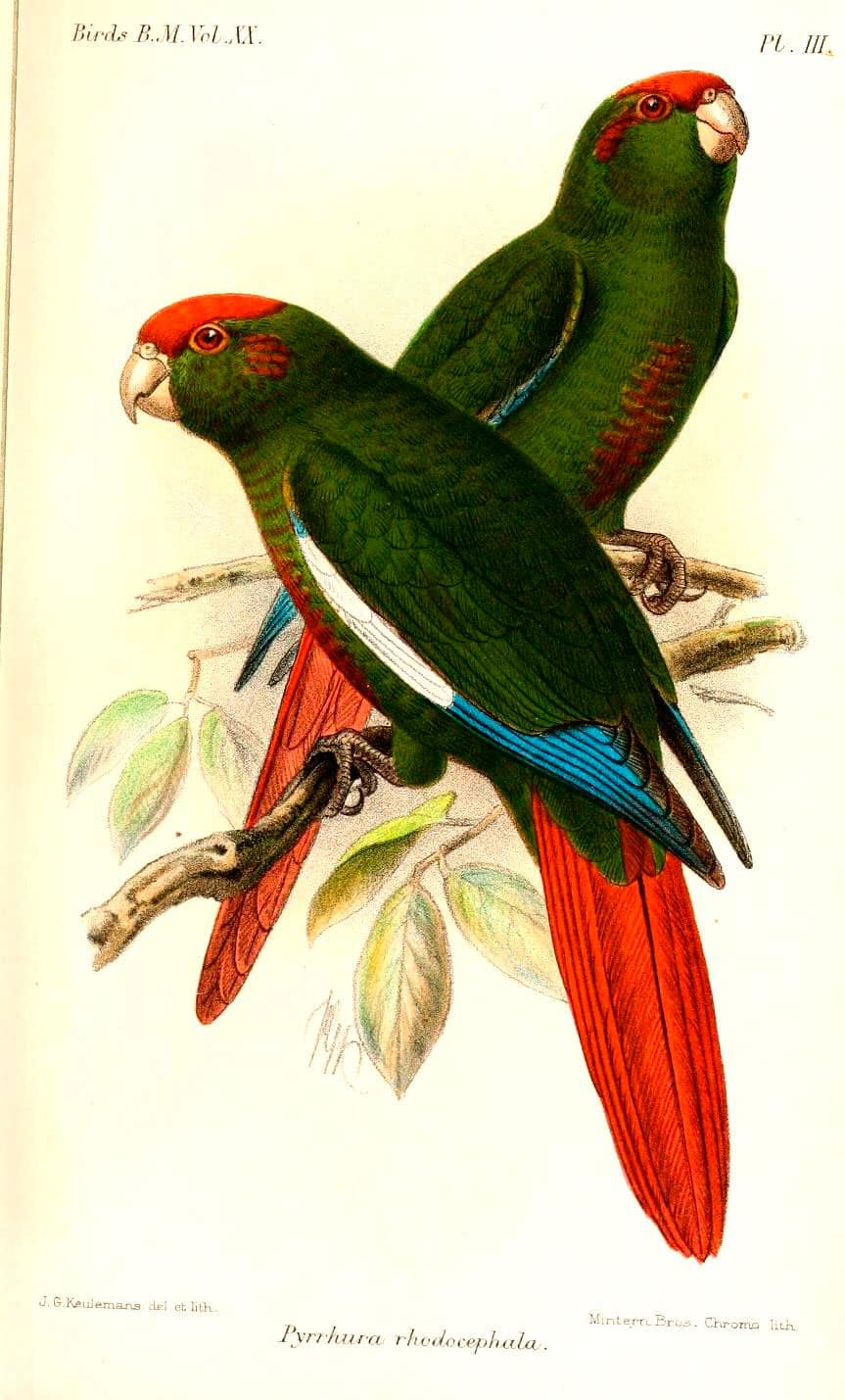
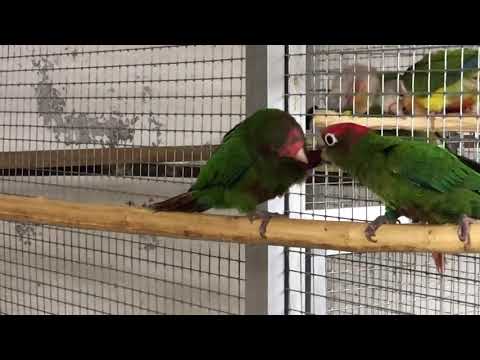
The Rose-headed Parakeet(Pyrrhura rhodocephala) is a small parrot with the body almost all green and a long tail. The more notorious is the hood pink reddish and the patch red behind them eyes; cheeks until uppertail-coverts green. Primary coverts white, other coverts green except, sometimes, some feathers scattered red-orange in the bend of wing. Outerwebs of them flight feather, Blue with black tips. Undertail-coverts green. Feathers of the throat, the chest and the sides of the neck, of color green olive with tips brownish that give an effect of scaly very dim; belly slightly more green olive that the upperparts, with a pale patch red in the center; the undertail-coverts green; at the top, the tail brownish red color; undertail, red clear.
Bill color pale horn; bare periophthalmic white; brown the irises; legs dark gray.
Both sexes similar.
The immature shows a crown bluish green with scattered red feathers, primary coverts Blue and base green until it tail.
It inhabits mainly in humid forests, secondary, and páramo, between 800 to 3400 m. Resident Although daily make long migrations.
Fly in flocks of 10 to 30 individuals.
Reproduction:
There is little information on reproduction, probably it breeding season between the months of May-June.
Food:
It probably feeds on berries, seeds, fruits and flowers.
Distribution:
Size of the area of distribution (reproduction / resident): 17,000 km2
This Parrot is endemic to the Andes, in the Northwest corner of Venezuela, on both slopes of the Cordillera de Mérida from Táchira until Trujillo, with records in the mountains of Merida and North of Barinas.
Is probably resident but perform movements daily to distances considerable. They are distributed in several protected areas, apparently, effective, but the continuous deforestation in its small range must represent a threat to long term.
Conservation:
State of conservation ⓘ
Minor Concern ⓘ(UICN)ⓘ
• Current category of the Red List of the UICN: Least concern.
• Population trend: Stable.
Justification of the population
The size of the world's population has not been quantified, but the species is described as quite common (Hilty 2003).
Justification of trend
They suspected that the population is stable in absence of evidence of any decline or threatens substantial.
– Avibase
– Parrots of the World – Forshaw Joseph M
– Parrots A Guide to the Parrots of the World – Tony Juniper & Mike Parr
– Birdlife
– Parrot Book, Parrots and macaws Neotropical
– Photos:
(1) – fouragesofsand
(2) – Pyrrhura rhodocephala, Rose-crowned Parakeet by John Gerrard Keulemans [Public domain], via Wikimedia Commons
– Sounds:
▷ The world of Pets: Dogs, cats, birds, reptiles, amphibians
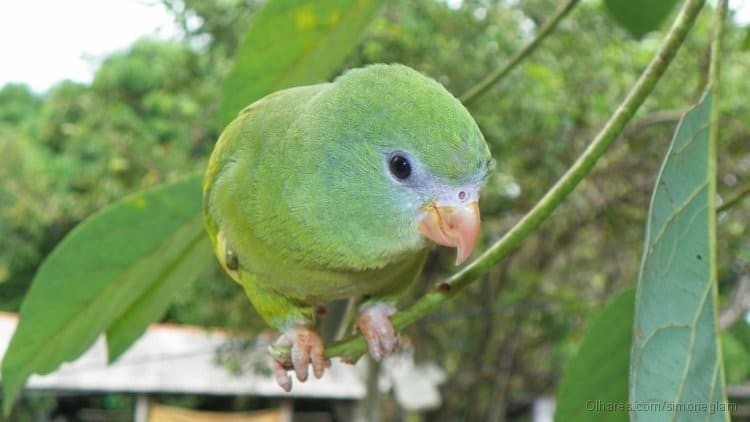
The Amazonian Parrotlet(Nannopsittaca dachilleae) has pointed wings, something square tail. Distinguishable from this species is the forehead and Crown with blue dye, feet and pink Bill, area naked clear around the eye. Usually green body on the back, and more yellowish belly.
Common and abundant in riparian forest, until the 300 m. Possibly associated with the guadua. They fly low over rivers in small, compact flocks of 3 to 12 individuals.
Seen climbing on trees.
They are presumed to nest in clumps of bromeliads or other epiphytes..
Calls are described as acute, they sound very similar to the chicks of birds of farm.
Distribution:
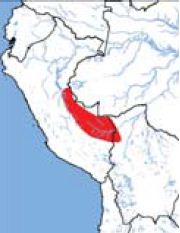
It is found in the western part of the Amazon basin, from southern and southeastern Peru to northwestern Bolivia. Probably West of Brazil.
It is a scarce bird that rarely has photographed. The conservation of the rainforest is crucial to their survival. There are many threats to the ecosystem of the Amazonian Parrotlet, harvesting the Guaua bamboo, the Habitat fragmentation and pollution.
Conservation:
According to the IUCN categories it is considered as Near Threatened. (NT). Deforestation, mainly for colonization, logging and mining, affect their populations.
Alternative names:
– Manu Parrotlet o Amazonian Parrotlet (English)
– Amazonaspapagei, Amazonassittich, Urwaldsittich (Germany)
– Toui de D’Achille, Toui de l’Amazone (France)
– Periquito-da-amazônia (Brazil).
– Periquito-da-Amazônia (Portugal).
– Periquito Amazónico (Peru).














_1.jpeg)


.jpg)


_capistratus_-Denver_Zoo,_Colorado,_USA-8a.jpg)


