โ–ท The world of Pets: Dogs, cats, birds, reptiles, amphibians

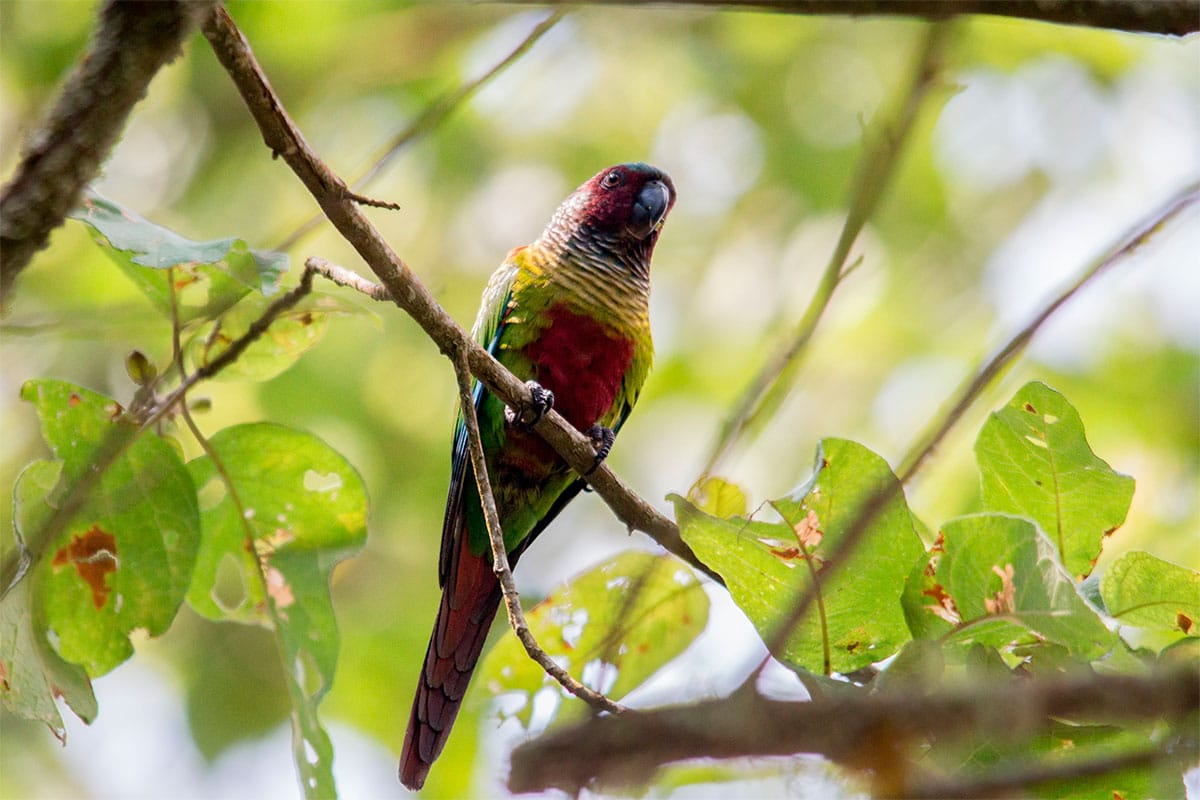
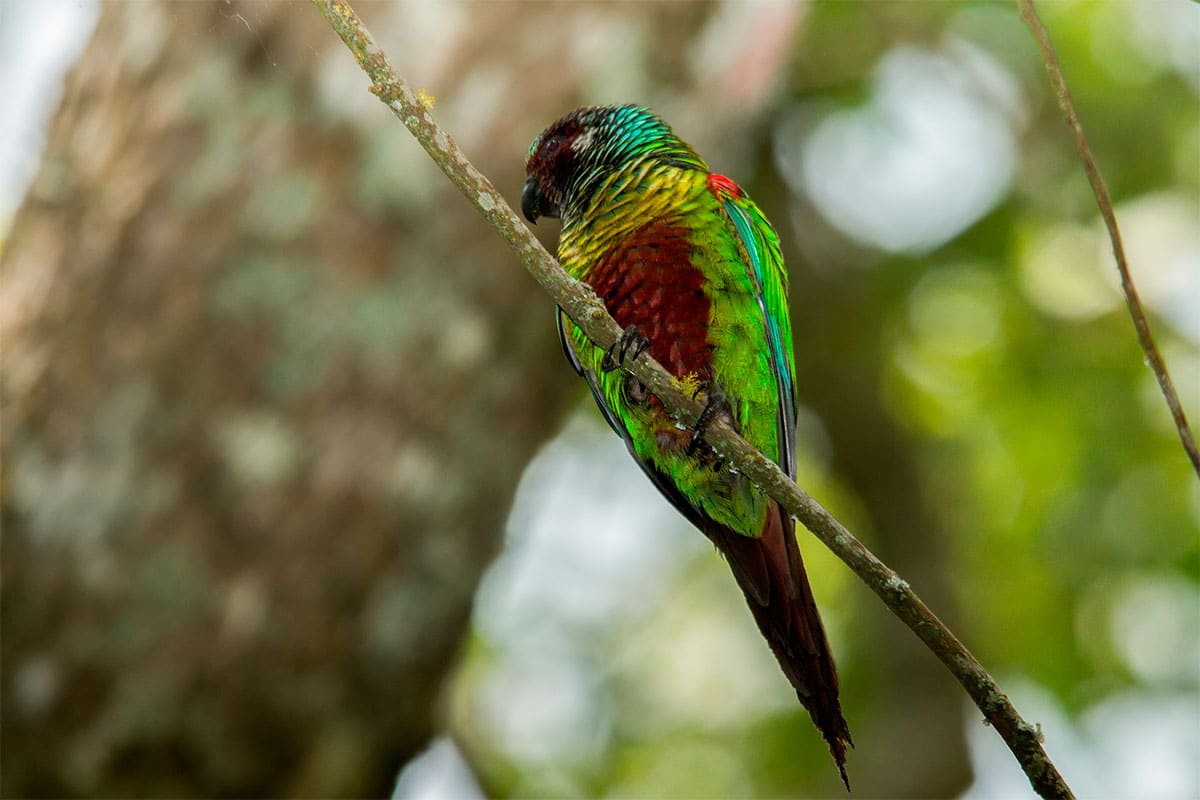
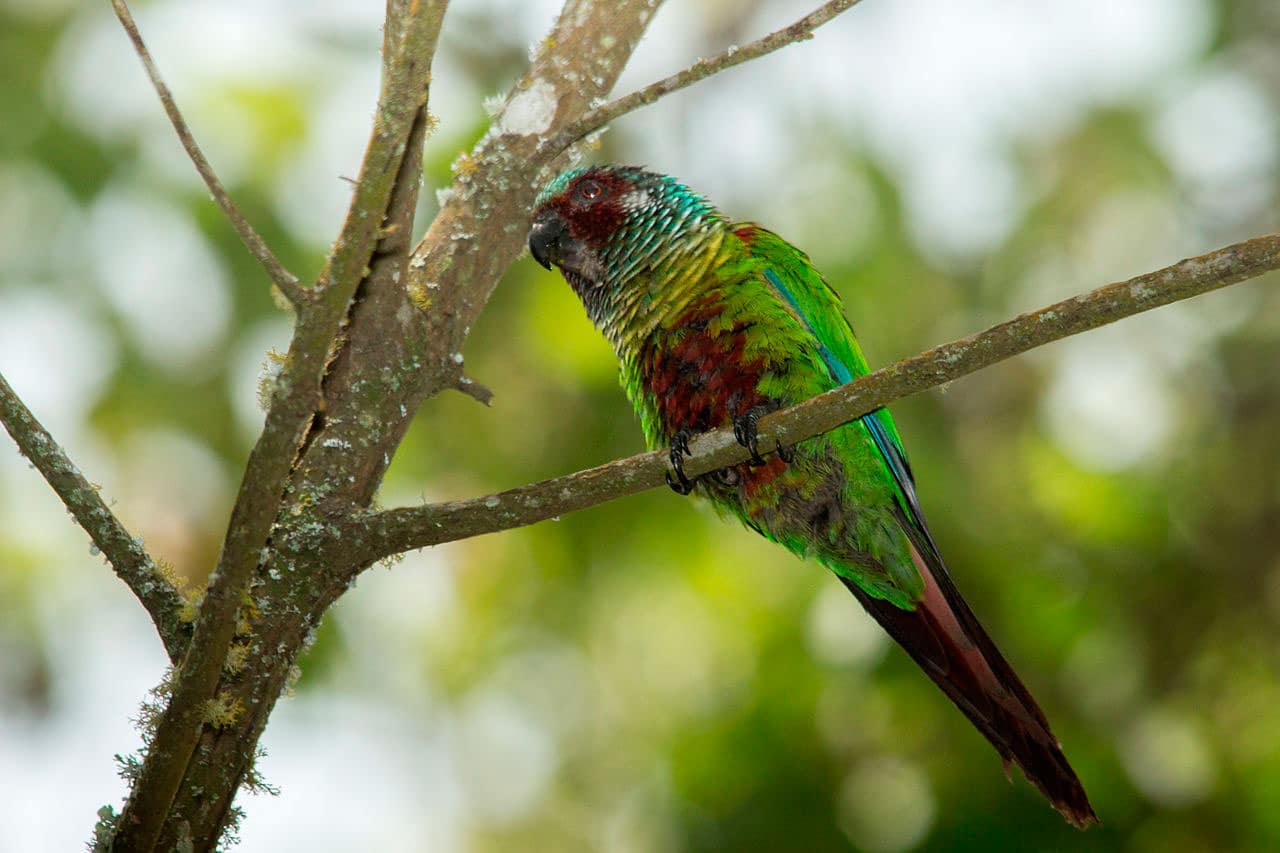
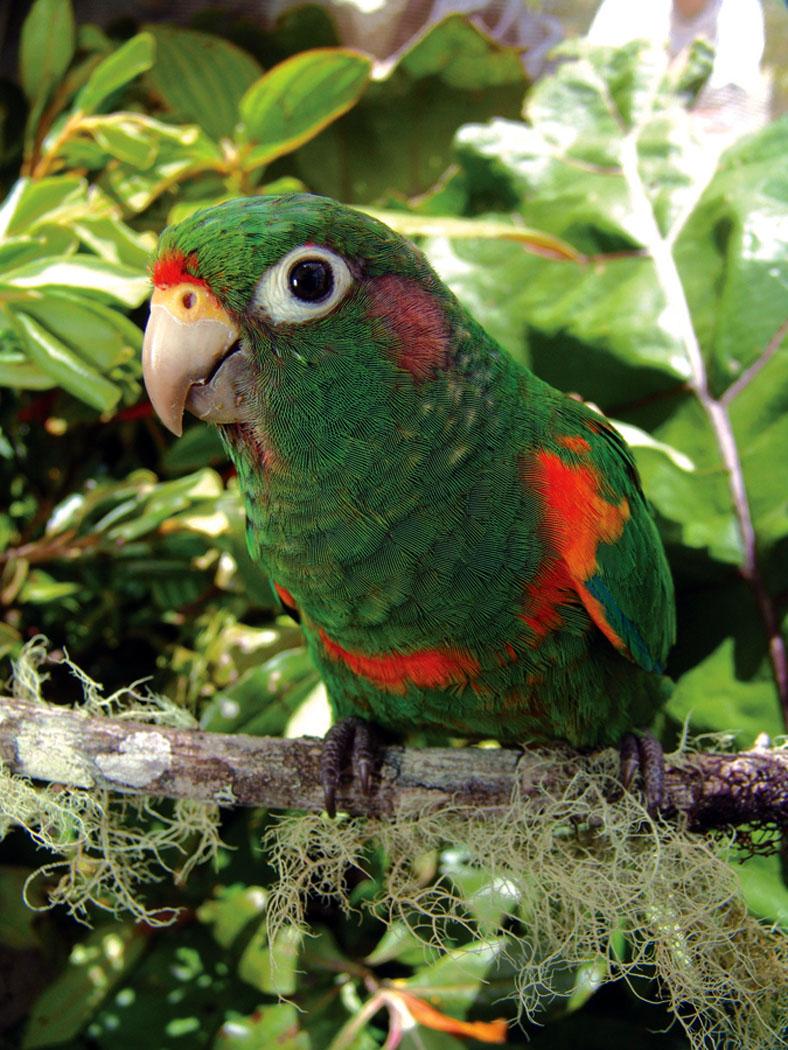
Santa Marta Parakeet
Pyrrhura viridicata

Cotorra de Santa Marta

Content

Description:

25 cm.. height.

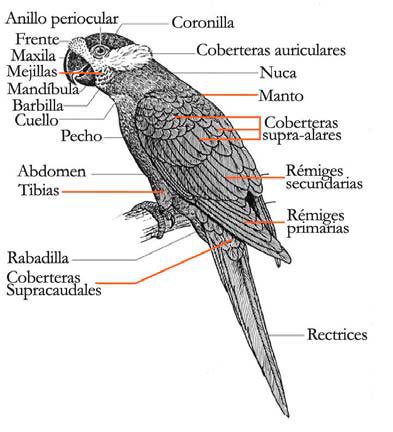
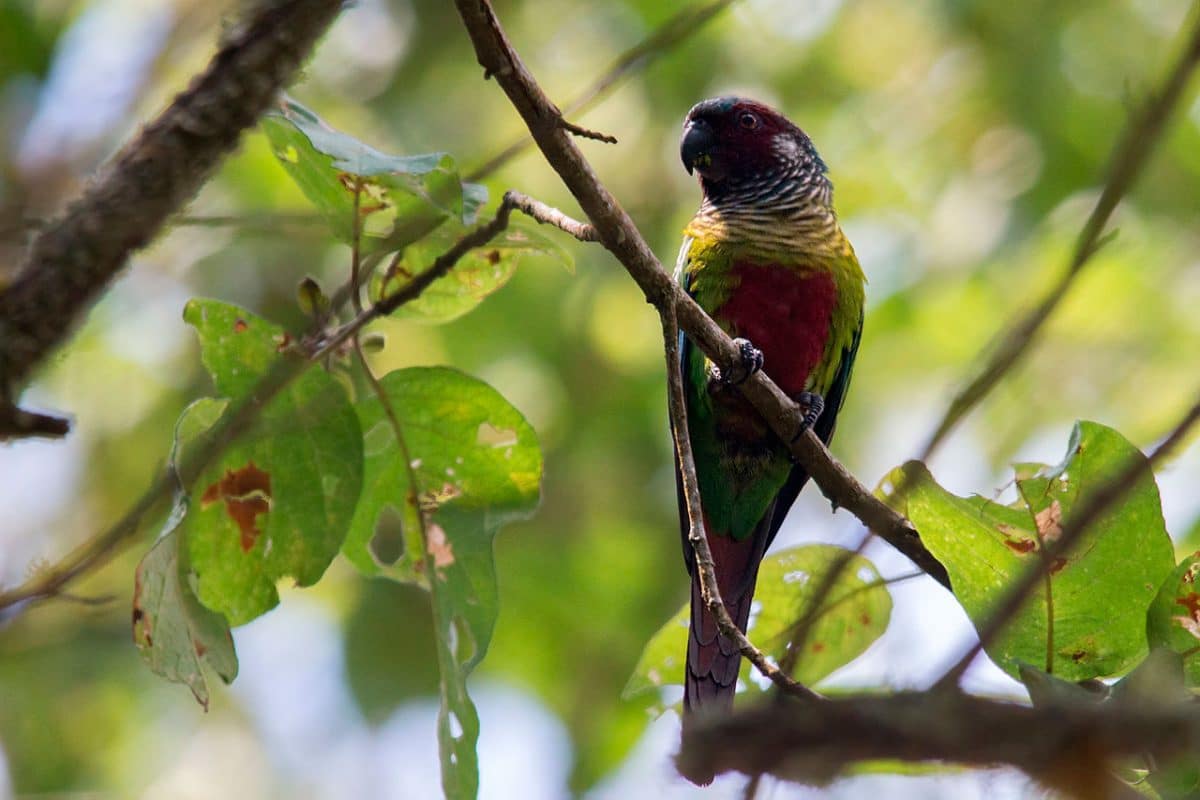
The Santa Marta Parakeet (Pyrrhura viridicata) It, in general, green, with a characteristic red stripe in the middle of the chest which continues until shoulder and armpit. The scales of the chest is less evident; the flight feathers blue. Band front narrow red in the forecrown and behind the eye with red and yellow dye. Tail over green and below red opaque.

Bill color bone; brown iris; pale black legs. It has no sexual dimorphism.

Habitat:

It inhabits in humid mountain forest, clouded forest, pastures and edges, from 1900 to 2800 m. They fly at dawn and at dusk in compact and numerous flocks on the canopy of the forest. Is les has observed flying over them clear adjacent and each time more visiting them mulberry plantations.

The species rests and nests in couples and in lesser proportion in groups of three individuals in cavities of Palms of bouquet Ceroxylon ceriferum (Arecaceae).

Reproduction:

The period reproductive is starts in December and lasts until June, the cavities are visited on average 4 to 5 times a day. There is a sexual dimorphism and a low reproductive success can be associated with displacement or predation by the Aratinga wagleri wagleri (Scarlet-fronted Parakeet) or the Santa Marta Toucanet (Aulacorhynchus lautus prassinus) – Ramphastidae.

Food:

Twelve plant species are incorporated into the diet so far known to the Santa Marta Parakeet, It consists mainly of flowers and fruits, the inflorescence of the Croton bogotanus (Euphorbiaceae) is their main source of food. It forages in groups of size variable, presenting an integration and disintegration of subgroups throughout the day. A sentinel system was observed.

Distribution:

Size of the area of distribution (reproduction / resident): 1,600 km2

Endemic species of Sierra Nevada de Santa Marta, to the northeast of Colombia. The towns registered include The Summit, is of Taquiรฑa on the basis of the Pรกramo of Mamarongo in the Guajira, and Cerro Quemado in the mountains of San Lorenzo.

Will produce some movements altitudinal seasonal. Almost all the habitat forest subtropical is designated as reserve forest or Park national, but the clearing for plantations of marijuana has been extensive, similar to the use of herbicides to combat it. So it only remains for the 15% the original forest (especially in the hillsides North), including only 200 the preferred height of the species km2. Fairly common within this very restricted range, but the population probably below of the 5.000 birds.

Conservation:

State of conservation โ“˜


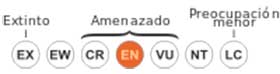
Endangered Endangered โ“˜ (UICN)โ“˜

โ€ข Current category of the Red List of the UICN: In danger of extinction.

โ€ข Population trend: Decreasing.

Rationale for the Red List category

The range of this species and its small population are probably decreasing as a result of habitat loss. So, qualifies as in danger.

Justification of the population

The population It has been estimated for a long time between 5.000 and 10.000 individuals, equivalent approximately to 3.300-6.700 mature individuals. The density of population is of 1 Ave per km2 (Botero-Delgadillo et to the. 2012). Assuming that the 680 km2 of habitat are fully occupied, the population total is calculated that is 2,900-4,800 birds, which is equivalent to 1,933-3,200 mature individuals; But, with occupation part is likely to remain less than 2.500 birds (Botero-Delgadillo et to the. 2012).

Justification of trend

Se sospecha una decrease moderate and continuous of the population on the basis of the rates of habitat loss.

Threats

only one left 15% the original vegetation of the Sierra Nevada de Santa Marta, to a large extent on the slope North, where this species is found (LM Renjifo, Com. 1993, 2000).

The main current threat is the expansion of plantations of non-native trees, such as the of Pine and eucalyptus, in addition to the clearing of land for livestock (C. Olaciregui in litt. 2012).

ยท Historically, the conversion of forests in plantations of marijuana and coca was also a major threat (LG Olarte in litt., 1993, com LM Renjifo. Comm., 1993, J. Fjeldsรฅ verbally they 2000, pers LM Renjifo. Comm., 2000, C. Olaciregui in litt. 2012), that is compounded by the Government with application of herbicides in the sierra (LG Olarte in litt., 1993, com LM Renjifo. Comm., 1993, 2000).

Other threats that followed the human migration to the area Since the Decade of 1950 hereafter include slash & burn (Dinerstein et to the., 1995, Snyder et to the. 2000, Salazar and Strewe undated, PGW Salaman in litt. 1999).

ยท It is known to be hunted in the cold river valley, and in the San Pedro district individuals in mulberry plantations have skyrocketed. The species not found in the local bird trade (Strewe 2005).

"Santa Marta Parakeet" in captivity:

Not marketed for captive.

Alternative names:

– Santa Marta Parakeet, Santa Marta Conure (English).
– Conure des Santa Marta, Perriche de Santa Marta, Perruche de Santa Marta (French).
– Santa-Marta-Sittich, Santa Marta Sittich, Sittich (German).
– Santa Marta Parakeet (Portuguese).
– Cotorra de Santa Marta, Perico Oliva, Periquito de Santa Marta (espaรฑol).

scientific classification:

– Order: Psittaciformes
– Family: Psittacidae
– Genus: Pyrrhura
– Scientific name: Pyrrhura viridicata
– Citation: Todd, 1913
– Protonimo: Pyrrhura viridicata

Images "Santa Marta Parakeet"

Videos "Santa Marta Parakeet"


Especies del gรฉnero Pyrrhura

Santa Marta Parakeet (Pyrrhura viridicata)


Sources:

Avibase
Parrots of the World โ€“ Forshaw Joseph M
Parrots A Guide to the Parrots of the World – Tony Juniper & Mike Parr
Birdlife
Oliveros rooms, H.. 2005. Population and ecological evaluation of the Santa Marta parakeet Parrot parakeet in the sector of San Lorenzo, Sierra Nevada de Santa Marta, Colombia. (ProAves.org)

Photos:

(1) – ProAves Foundation – Proaves.org

Sounds: By GABRIEL MILK (Xeno-canto)
โ–ท The world of Pets: Dogs, cats, birds, reptiles, amphibians

Green Rosella
Platycercus caledonicus


Green Rosella

Content


Anatomy-parrots

Description

37 cm.. length between 127 and 142 g. of weight.

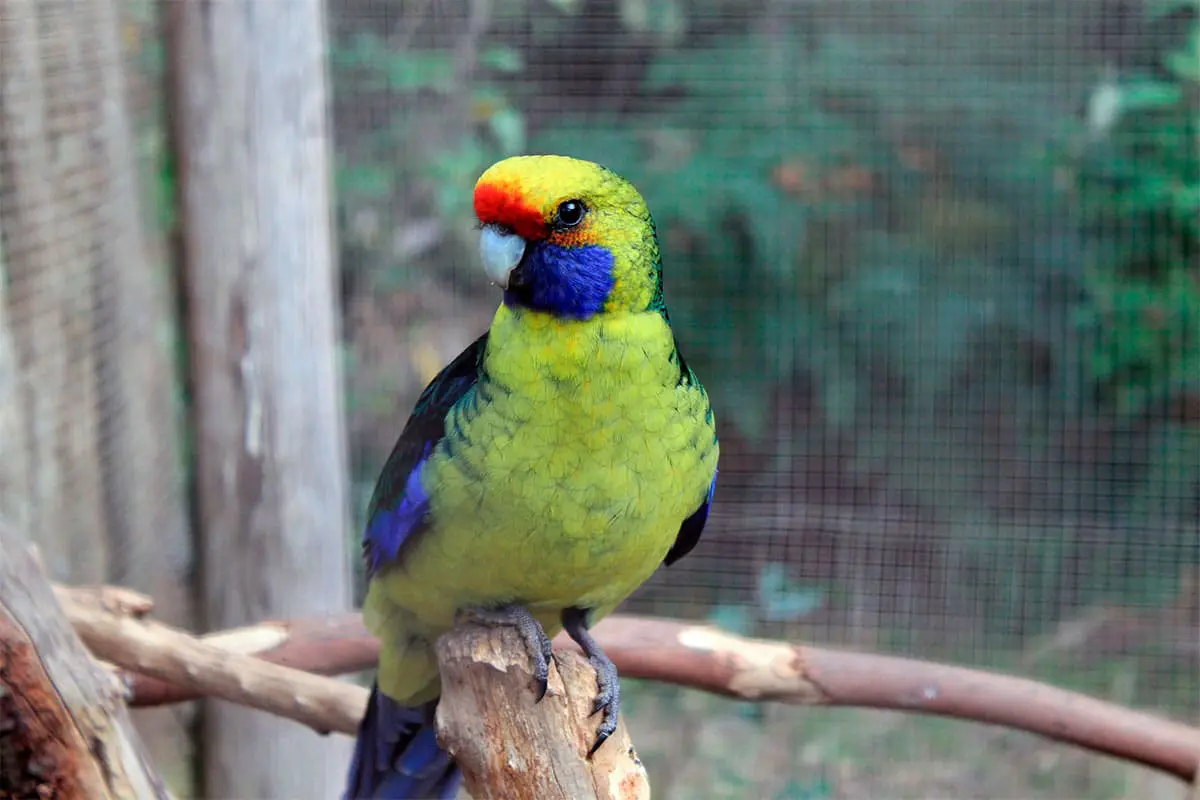
The Green Rosella (Platycercus caledonicus) has the forecrown and lores bright red; a crown of a showy color yellow, marked in red and dotted with of Brown olive dark towards the part rear; area low of them cheeks and throat of color blue cake; ear-coverts a bright yellow, with the edges more dark. Strong contrast between the yellow and the dark area of the crown; Brown olive uniform in the the mantle, with fine dark green stripes on their feathers; feathers of the rump and uppertail-coverts have a diffusion of color yellow orange.

Curve of the wing blue; lesser coverts black; corbeteras internal Middle, black, lined in green dark, the light blue external; greater coverts Blue with feathers Interior black finished off with edges of color green; secondaries Blackish with vane blue externals (innermost with green edge); primaries Brown dark with vane external and dark blue margins; tertiary Brown dark with stripes Green.
Under, the wings blackish, with coverts and axillary blue.

The underparts is of color yellow with a tone clear of Orange and with small spots of color orange on the periphery of the area anal. Upper, the tail olive-green tipped off blue, lateral feathers of color blue pale with them tips white; undertail, the tail of color blue pale with them tips white.

Bill White grey; irises dark brown; legs grey.

The female It is smaller than the male and has the bill smaller; also shows more often a wash of orange-red in the upper part of the chest.

The immature they are more muted than adults, show more green in wing-coverts and have them upperparts of color grey olive and yellow olive in them underparts. Plumage adult is reached after the first comprehensive molt, in a few 15 months.

Subspecies description:

  • Platycercus caledonicus caledonicus

    (Gmelin, JF, 1788) – The species nominal


  • Platycercus caledonicus brownii

    (Kuhl, 1820) – Too little differentiated with the species nominal, according to some experts, to justify the recognition as subspecies.

Habitat:

The Green Rosella they are in all types of forest habitats in the territory in which they reside. But, more and more often, they come in orchards and gardens in urban areas, finding favorable conditions in those places to nest and feed themselves. But, its main habitat are still sclerophyllous forests and thickets. Apparently, on Hunter island, they have a strong preference for small ravines filled with piles of rocks.

Like most of the island birds that live in a small area, to the Green Rosella It is cataloged as sedentary. But, the specimens that live in altitudes of up to 1500 meters in the Alpine regions, they make altitudinal movements and approaching at low altitude towards the coastal regions in winter season. At the end of the nesting season, young birds roam in small flocks which do not exceed more of 4 or 5 individuals. The Green Rosella be associated at times with them Eastern Rosella (Platycercus eximius). Although they are not shy, These parrots take precautions and are very cautious When venturing to Earth to find their food. They prefer to stay in the foliage for this activity. Like most of the parrots, the female is attached to your partner by strong ties conjugal it last for many years. They maintain and strengthen these links practicing processions which are very similar to the one of other parrots.

Reproduction:

The Green Rosella nest during the period from September to February. The nest It is usually placed in a cavity of any branch or hollow tree trunk, normally a eucalyptus. They also occupy, exceptionally, the walls of old buildings. They use abandoned nests of sparrows into disuse.

The spawning usually contains between 4 and 6 eggs and your incubation takes a few 19 days. The chicks are altricial and leave the nest only after 3 weeks after hatching. No additional information on the care and development of the offspring.

Food:

The Green Rosella they eat mainly eucalyptus seeds, Mirto, acacia, ragwort large aromatic flowers, canaigre, Solanaceae (Solanum) and pimelea. Most flowers are toxic to pets.

These parakeets also eat many types of seeds of grasses and shrubs, some of which are at higher altitudes.

Do not disdain the berries of coprosma and the Hawthorn, they represent an important part of their diet in winter. The menu is sometimes supplemented with psyllids they are small homoptera and insect larvae .

Distribution:

Size of the area of distribution (reproduction / resident): 68.100 km2

The Green Rosella they are endemic in Tasmania. Also found in the larger islands of the Bass Strait, that is to say, on isla King and Flinders island. Has also been recorded in the Maatsuyker island, front South of Tasmania.

Birds coming from leaks can be found around Sydney.

The species is common and widespread within its range, with a stable world population of more than 50.000 specimens.

One small number in captivity.

The Green Rosella is protected, but it can be killed with a permit when they cause damage to crops.

The population living in the North of Tasmania It is sometimes differentiated under the name brownii, but this so-called subspecies differences are not as marked enough to consider it as such.

Destribuciรณn subespecies:

  • Platycercus caledonicus caledonicus

    (Gmelin, JF, 1788) – The nominal species

  • Platycercus caledonicus brownii

    (Kuhl, 1820) – isla King.

Conservation:


minor concern


โ€ข Current category of the Red List of the UICN: Least concern

โ€ข Population Trend: Decreasing

The size of the world population It has not been quantified, Although estimated at more of 50.000 specimens. The species according to sources, it is common throughout its small range (pit et to the. 1997).

The population is suspected that it may be declining due to the habitat destruction in course of King Island (pit et to the. 1997).

The Green Rosella It may cause damage to the apple orchards and, Although protected, It can be controlled under a system of licensing.

"Green Rosella" in captivity:

It is not a popular Aviary bird, possibly due to its lack of color and its aggressive reputation.

Alternative names:

– Green Rosella, Caledonia Parrot, Green Parrot, Mountain Parrot, Tasmanian Rosella, Yellow-bellied Parakeet, Yellow-bellied Parrot, Yellow-breasted Parakeet, Yellow-breasted Parrot (ingles).
– Perruche ร  ventre jaune (French).
– Gelbbauchsittich (German).
– Rosela-da-caledรดnia (Portuguese).
– Perico de Tasmania, Rosela Verde (espaรฑol).

scientific classification:

– Order: Psittaciformes
– Family: Psittaculidae
– Genus: Platycercus
– Scientific name: Platycercus caledonicus
– Citation: (Gmelin, JF, 1788)
– Protonimo: Psittacus caledonicus

ยซTasmanian parakeetยป images:

Videos "Green Rosella"

————————————————————————————————

"Tasmanian parakeet" (Platycercus caledonicus)


Sources:

– Avibase
– Parrots of the World โ€“ Forshaw Joseph M
– Parrots A Guide to the Parrots of the World – Tony Juniper & Mike Parr
– Birdlife

– Photos:

(1) – A Green Rosella at Tasmanian Devil Conservation Park, Tarana, Tasmania By rockmasterp (Beautiful ParrotUploaded by snowmanradio) [CC BY-SA 2.0], via Wikimedia Commons
(2) – Green Rosella (also known as Tasmanian Rosella) in Tasmania, Australia By Sammy Sam (Picasa Web Albums) [CC BY-SA 3.0], via Wikimedia Commons
(3) – Green Rosella (also known as Tasmanian Rosella) in Tasmania, Australia By Sammy Sam (Picasa Web Albums) [CC BY-SA 3.0], via Wikimedia Commons
(4) – Green Rosella (Platycercus caledonicus), Collinsvale, Tasmania, Australia By JJ Harrison (jjharrison89@facebook.com) (Own work) [CC BY-SA 3.0], via Wikimedia Commons
(5) – Green Rosella (also known as Tasmanian Rosella) in Tasmania, Australia By Sammy Sam (Picasa Web Albums) [CC BY-SA 3.0], via Wikimedia Commons

– Sounds: Marc Anderson (Xeno-canto)

โ–ท The world of Pets: Dogs, cats, birds, reptiles, amphibians

Emma's Parakeet
Pyrrhura emma

Emma's Parakeet

Content

Description:

Emma's Parakeet

23 cm.. length.

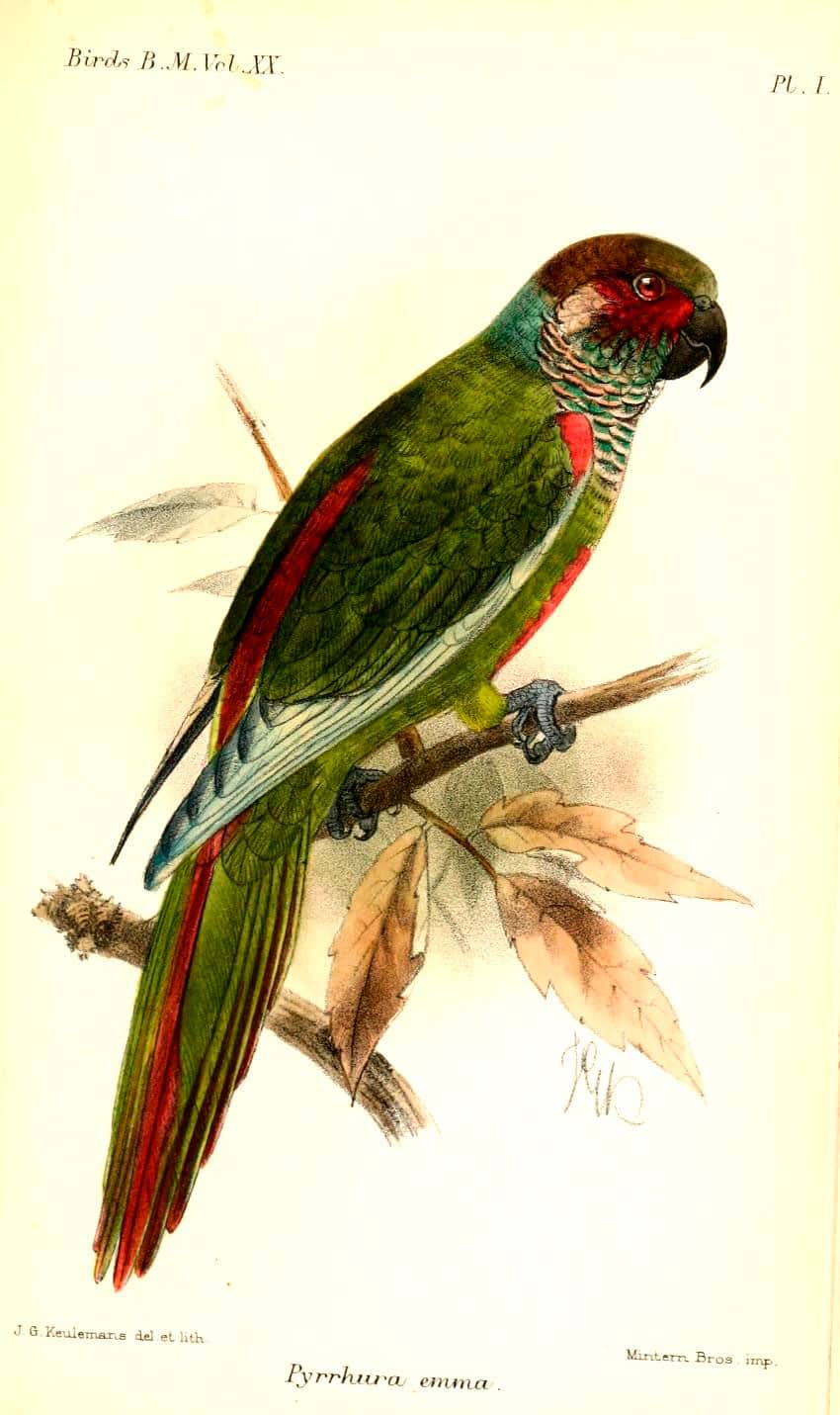
The Emma's Parakeet (Pyrrhura emma) is a bird, mostly, green, with blue in the wings, reddish-brown in rump, on tail and in the back; Scaled plumage chest yellowish color on a gray background olive; wings with red shoulder, inconspicuous.

The face red plum, while the pileum It is brown and gray forecrown blue. Abdomen with dark red stain, tail with green base, edge red and below all red.

Eye ring grey, cheeks red with white spot on ears. Bill dark. It has no sexual dimorphism.

Habitat:

They can be seen in hill forests in the coastal mountain range in Venezuela, in humid forests and edges as well as in adjacent clearings with sparse trees and groves (pit et to the., 1997).

Usually it moves in flocks, on quick flights up 25 specimens, before landing in the canopy.

Reproduction:

There is insufficient information regarding reproduction and feeding. Breeding season probably between May and July. Period of incubation: 24-25 days.

Food:

They have been observed eating flowers of Ochroma and nectar (Hilty 2003).

Distribution:

Size of its range (reproduction / resident): 88.300 km2

The Emma's Parakeet inhabits forested areas of the northern coastal range Venezuela, from Yacacuy and Carabobo until Miranda, and disjuntamente from Anzoรกtegui to Sucre and northern part of Monagas (Del Hoyo et al., 1997, Juniper and Parr 1998, Hilty 2003, Forshaw 2006).

It is mainly found at altitudes 250-1.700 m, but you can see at sea level in eastern Sucre (Hilty 2003), where is quite common (Hilty 2003, P. Boesman in a bit., 2006). Its distribution within this range is complex and disjoint, found especially in mountainous terrain at lower elevations (Hilty 2003).

Conservation:

โ€ข Current category of the Red List of the UICN: Least concern.
โ€ข Population trend: Decreasing.

Justification of the population

State of conservation โ“˜


minor concern Minor Concern โ“˜ (UICN)โ“˜

Apparently, the population size of this species has not been quantified.

Justification of trend

The capture for trade and changes in land use may be causing a decrease in population of this species, although the trend has not been quantified, and none of these is considered serious threats to this species today(CJ Sharpe a slightly. 2014).

Conservation Actions Underway

They live in several national parks (P. Boesman in a bit., 2006), with a "substantial" population in the Guatopo National Park, Miranda (Juniper and Parr 1998, Hilty 2003).

Conservation Actions Proposed

Continue to monitor this species in the field and in trade.

Strengthen the network of protected areas within the range of this species.

"Emma's Parakeet" in captivity:

Very rare in captivity. Very intelligent, active and playful. They are very aggressive with other species. Price per couple: 400 EUR.

Alternative names:

– Emma’s Parakeet, Emma’s Parakeet (incl. auricularis), Painted Parakeet (Venezuelan), Venezuelan Parakeet (English).
– Conure d’Emma, Conure emma, Conure emma (incl. auricularis) (French).
– Emmasittich (German).
– Emma’s Parakeet (Portuguese).
– Cotorra de Emma (espaรฑol).


scientific classification:

Salvadori Tommaso

– Order: Psittaciformes
– Family: Psittacidae
– Genus: Pyrrhura
– Scientific name: Pyrrhura emma
– Citation: Salvadori, 1891
– Protonimo: Pyrrhura emma


Images Emma's Parakeet:

Videos "Emma's Parakeet"


Especies del gรฉnero Pyrrhura

Emma's Parakeet (Pyrrhura emma)


Sources:

– Avibase
– Parrots of the World โ€“ Forshaw Joseph M
– Parrots A Guide to the Parrots of the World – Tony Juniper & Mike Parr
– Birdlife

– Photos:

(1) – Venezuelan Parakeet | Perico Pintado ( Pyrrhura emma)By Fernando Flores from Caracas, Venezuela [CC BY-SA 2.0], via Wikimedia Commons
(2) – Venezuelan Parakeet | Perico Pintado ( Pyrrhura picta emma) By Fernando Flores from Caracas, Venezuela [CC BY-SA 2.0 or CC BY-SA 2.0], via Wikimedia Commons
(3) – Venezuelan Parakeet | Perico Pintado (Pyrrhura emma) by Fernando Flores – Flickr
(4) – Venezuelan Parakeet | Perico Pintado (Pyrrhura emma) by Fernando Flores – Flickr
(5) – Venezuelan Parakeet | Perico Pintado (Pyrrhura emma) By Fernando Flores from Caracas, Venezuela [CC BY-SA 2.0], via Wikimedia Commons
(6) – Pyrrhura emma = Pyrrhura picta, Painted Parakeet by John Gerrard Keulemans [Public domain], via Wikimedia Commons

– Sounds:

โ–ท The world of Pets: Dogs, cats, birds, reptiles, amphibians

Crimson Rosella
Platycercus elegans

Crimson Rosella

Content


Anatomy-parrots

Description

Among 30 and 37 cm.. length and a weight between 99 and 170 g..

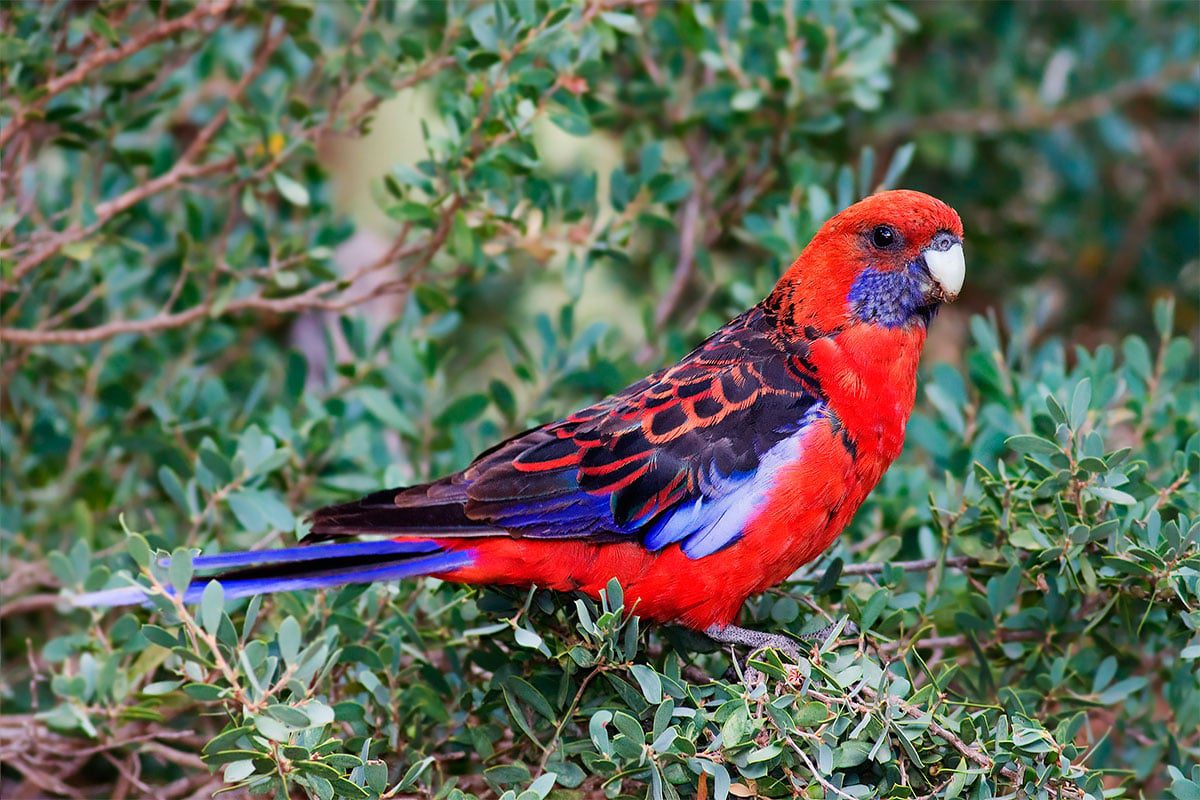
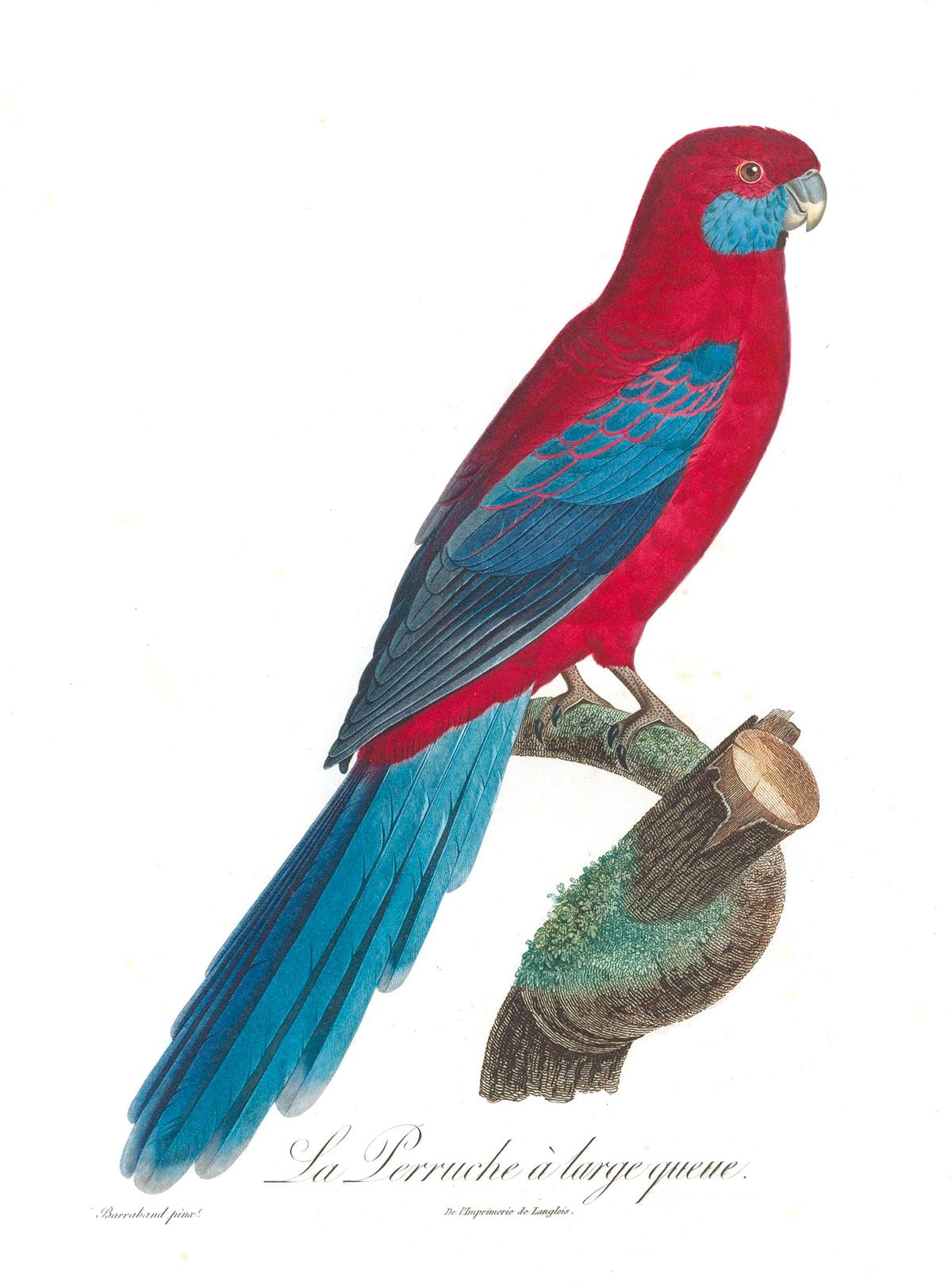
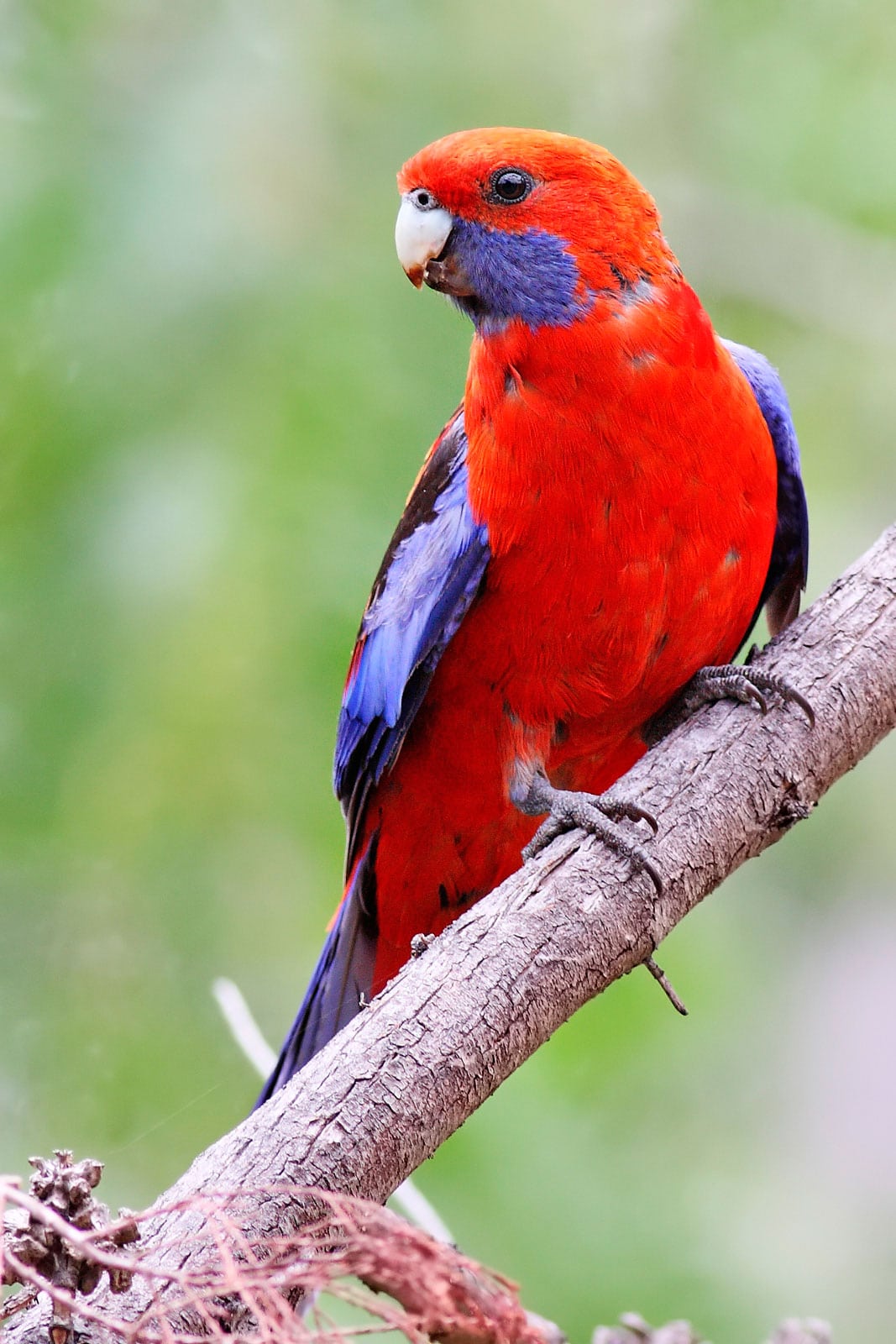
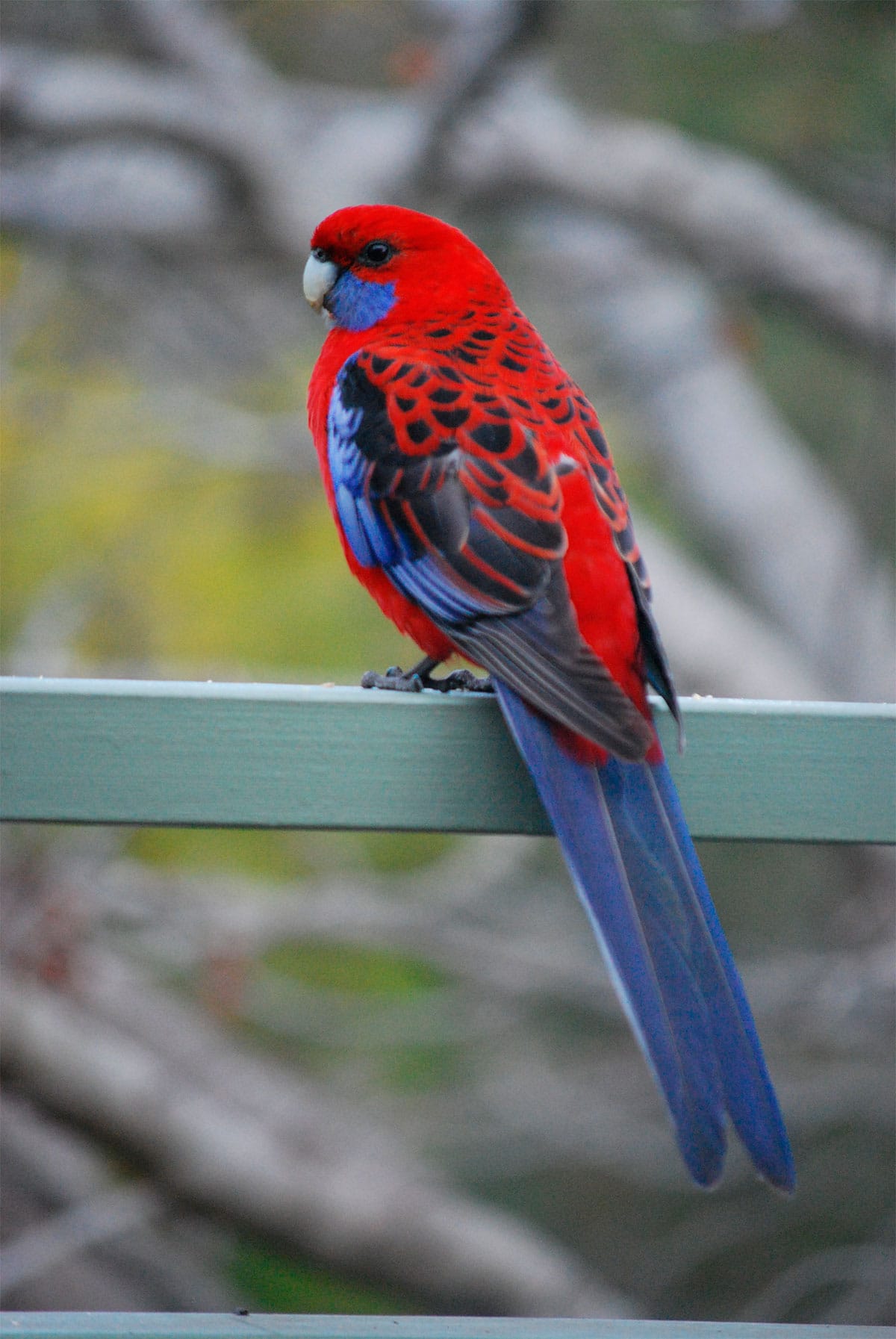
The Crimson Rosella (Platycercus elegans) has a predominantly red plumage.

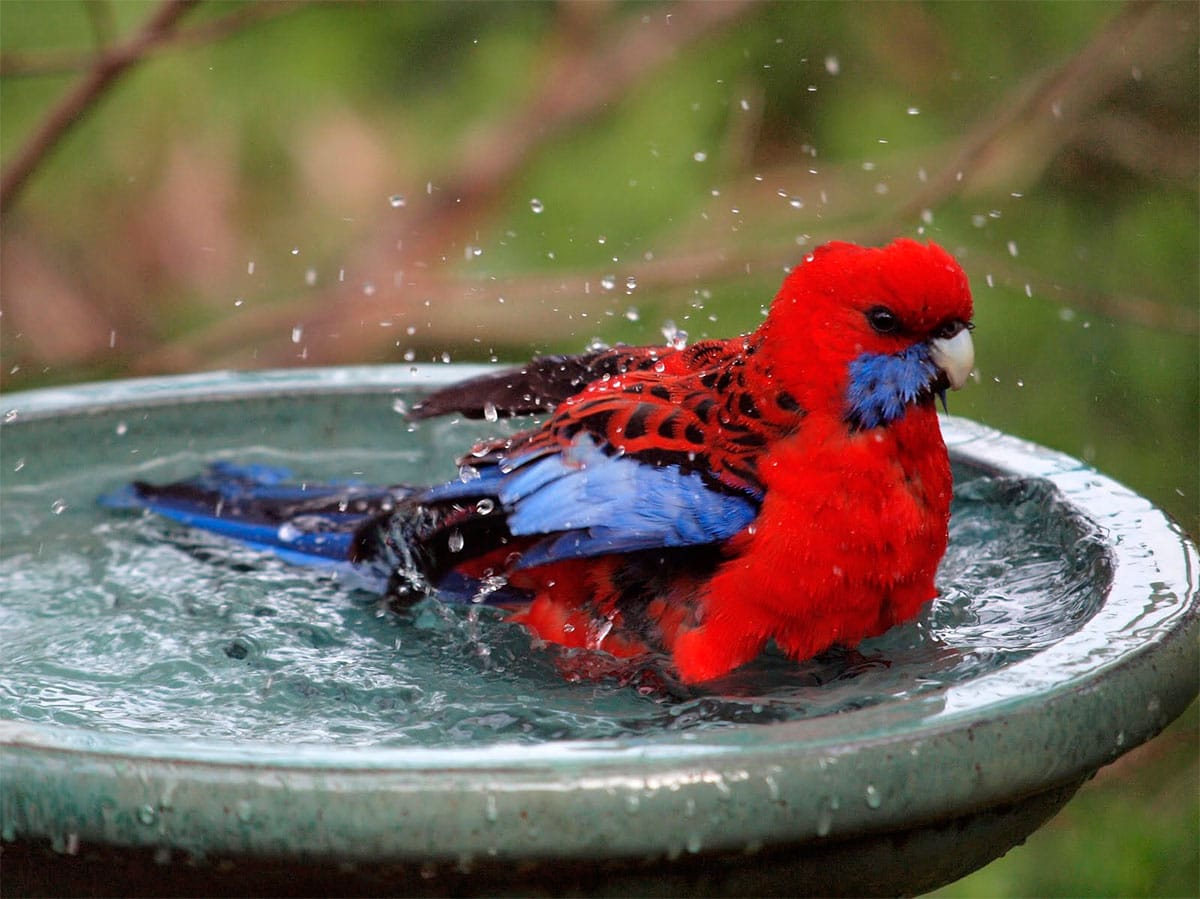
Its head is bright crimson in color with the lower part of the cheeks and the throat of blue color.. Mantle feathers are black with broad crimson margins of variable intensity.; rump and uppertail coverts crimson.

Medium and lower inner wing coverts black; bend of wing, lesser coverts and medium blue color external; external greater coverts bright blue, Black Interior with red edges giving a scaly appearance to this area; primary coverts blue violet; feathers of flying blackish with thin margin foreign white in them more external and blue violet in vane outer; secondary black with vane external blue violet; tertiary black with red borders.

Under, Blackish wings with blue coats. Underparts showy crimson.

Upper, the tail is blue, the center of green-washed, Foreign feathers with vane Blackish internal and vane Violet Blue outer with pale at both ends; undertail, the tail of pale blue edged blackish when closed.

The peak of grayish-white; dark brown irises; greyish Brown legs.

The female It is smaller with narrower peak. It has no stripe under the wings..

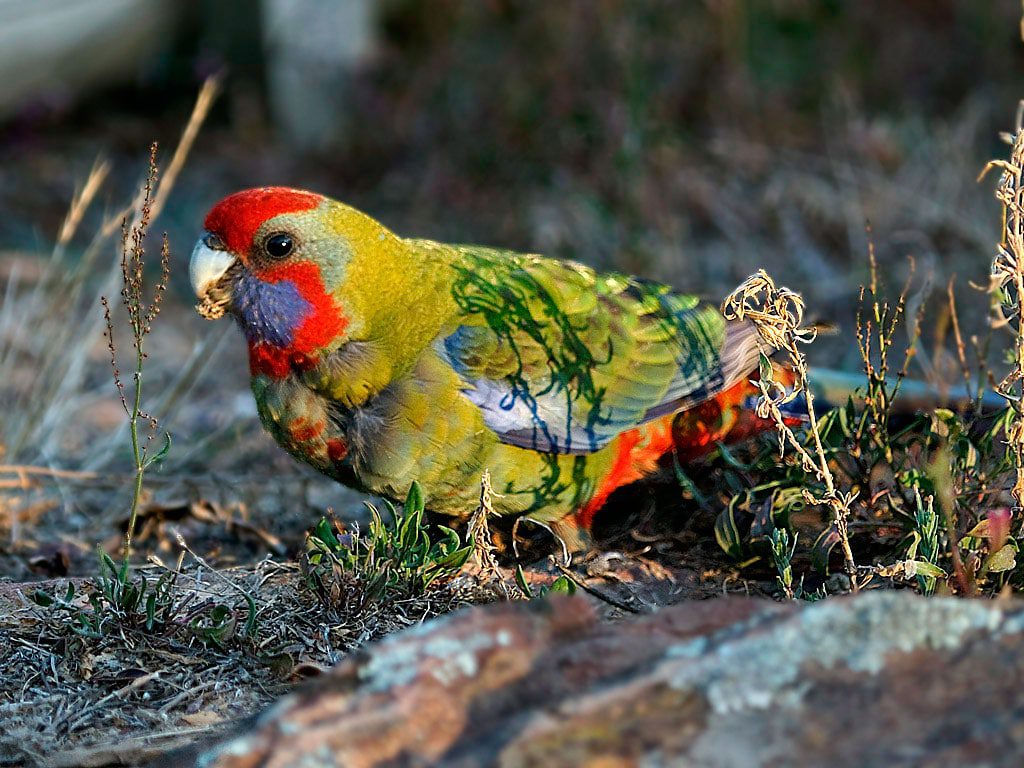
The immature is very different, with upper parts olive green (including the tail at the top), and green underparts greyish.
The centers to the mantle feathers are dark brown, and the black markings of the wings of the adult are replaced by green. Very young birds rump is green Orange. There is a pale stripe on the bottom of the wings (formed by stains pale in vane inner). It shows red feathers on the head, chest, buttocks and subcaudales coverts and move through the first fall.

Adult plumage is reached in a few 15 months. Immatures of the population in the North are mainly red, and there are less green unripe in Norfolk Island than mainland populations.

Subspecies

Description subspecies Platycercus elegans
  • Platycercus elegans elegans

    (Gmelin, 1788) – The nominal species


  • Platycercus elegans flaveolus

    (Gould, 1837) – With 33 cm.. length, approximately, It is but little that the nominal species, Yellow has no orange hue and there is orange in the neck, chest and abdomen.


  • Platycercus elegans fleurieuensis

    (Ashby, 1917) – IMG – It differs from the species rated as having an intense orange color, Red plumage, the mantle and black gray back, with pale orange-red spots; pale blue medium and secondary wing coverts.


  • Platycercus elegans melanopterus

    (North, 1906) – Of 36 cm.. length, approximately. The bordered red are more narrow, with which the back looks more black. Female as the nominal.


  • Platycercus elegans nigrescens

    (Ramsay,EP, 1888) – With 34 cm.. length, It is smaller than the nominal value and the color red is much more dark. Red feathers are more narrow. Female as the nominal.


  • Platycercus elegans subadelaidae

    (Mathews, 1912) – Approximately from 36 cm.. length. Instead of Red Blend Red, Orange and yellow. Orange red forehead, the Crown and face, they turned to brighter red frontal band. Yellow olive from the low back to the supracaudales coverts

Habitat:

Crimson Rosella

The Crimson Rosella they frequent tropical and humid subtropical forests near the coast and the surroundings of montane forests at altitudes up to 1.900 m.

They are mainly on the edges of jungle, in the secondary zones and in the dense forests of eucalyptus they arrive at a good stage of maturity.

To the South of the hunter river in New South Wales, they are distributed at all altitudes.

The nominal species has a preference for thick wooded areas, but often goes into open areas and farmland where it is mixed with the Perico conr (Platycercus eximius).

It also tends to visit plots of pine trees.

In the Kangaroo Island, where is the only parakeet present, He lives in all types of forest habitats, they are also adapting to farmland.

The subspecies subadelaidae and fleurieuensis, sometimes grouped under the term Adelaide parakeet, frequent valleys forest, arboreal galleries that border the rivers or trees on the edge of the roads. They are also present in the orchards and farmland.

The Flaveolus subspecies attends the same types of habitat, that is to say, curtains of trees dominated by red rubber trees along the river.

To feed, move away from rivers and raid agricultural land, flooded Plains, or thickets ยซMalleeยซ.

Adults are sedentary. Usually, they live in pairs or in small groups. On the other hand, juveniles and subadults form noisy groups and many roam locally when leaving dormitory at sunrise.

Its main activity is carried out in the morning and in the evening. in the middle of the day, they rest in the shady foliage. But, If the sky is overcast and the weather is cool, these birds are active during the day.

The Crimson Rosella they seek food on Earth, in trees and shrubs. They often feed in the company of the Eastern Rosella (Platycercus eximius), But if the joint working group is altered during its activity, the two species are separated in flight and taken opposite directions, each seeking refuge by his side.

The Crimson Rosella they are not very shy and can be approached at a very short distance.
In urban areas, they are particularly friendly.

Reproduction:

The breeding season covers the months of August to February and, sometimes even later.

The elegant parakeet build their nests on a branch or in the cavity of a tree trunk. Usually, Choose a healthy or dead eucalyptus, but sometimes they install their nests in a place as strange as the metal beam of a construction crane.

In all cases, the nest is located high above the ground. Spawning usually includes 4 to 7 white eggs, rarely 8, which are incubated during approximately 19 days.

The female incubates the eggs alone, but the chicks receive equal attention from both parents.

The nesting cycle is quite long and it takes around 5 weeks

Food:

The Crimson Rosella they have a mainly vegetarian mixed diet. Consume the seeds of black Cypress of Australia (Callitris endlicheri), figs, seeds of acacia and eucalyptus.

The vegetable part of its menu is complemented by a wide variety of imported plants such as Rosa rubiginosa, clover or chickweed (Stellaria media).

In the South of its range, they eat the fruits or flowers trees of Melaleuca, banksia and casuarina.

Insects are not forgotten in your menu: Hemiptera, psyllids, termites, aphids and larvae of beetles.

These parrots times behave as true pests in orchards, eating apples, Plums, pears and quinces.

Distribution:

Confined to the coastal area of Eastern Australia where are widely distributed in the wooded areas along and East of the Great dividing range.

There is an isolated population in the North between the surrounding of Atherton, Northeast of Queensland, to the South of the mountain range of Clarke and Eungella (the population in Eungella It can also be isolated).

The main population is distributed around Gympie, Southeast of Queensland, in the North, across the border with New South Wales, coming up to the Warrumbungle National Park, Bathurst and Wagga Wagga, where are approaching the eastern end where the Yellow Rosella.

In Victoria extends from the East to the Grampian and the Edenhope district, where spills into the Southeast end of Australia, coming to Kingston at its western end.

There is also an isolated population in the Kangaroo Island.

The species is found in the wild around Sydney, Brisbane and Melbourne, and leaks from birds have been around Perth. There are records in the North of Tasmania and the islands of the bass strait, probably, also refer to birds Getaways.

It is common in the Norfolk Island where it was introduced in the century 19, but is absent in the vicinity of Nepean and Philip Island; an attempt to introduce the species in Lord Howe Island failed.

Was also introduced in New Zealand, showing in the West suburbs of Wellington, and some birds can also persist in the District of Dunedin of South Island where can hybridize with the introduced Perico conr.

The world's population is above 200.000. Moderate numbers in captivity.
The birds can be eradicated with a permit in States where the destruction of crops occurs.

Subspecies

Distribution subspecies Platycercus elegans

Conservation:


minor concern


โ€ข Current category of the Red List of the UICN: Least concern

โ€ข Population Trend: Decreasing

The size of the world's population has not been quantified, Although it is estimated above 200.000 specimens.

The Crimson Rosella they are infrequent at both ends of its distribution area, but in other places, they are locally abundant and common.
In the North, they are slightly less numerous. In the past recent, they have colonized successfully parks and urban gardens, so now are very widespread in the suburbs of Canberra and Adelaide.
In the Norfolk Island, the import is so successful that they now represent a competition and a significant danger to the Red-crowned parakeet (Cyanoramphus novaezelandiae).

"Crimson Rosella" in captivity:

Moderately loud, very active, they are acclimatized to the owner. It is not usually compatible with other birds.
A sample of the subspecies subadelaidae lived 26,8 years in captivity
Rare in captivity.

Alternative names:

– Crimson Rosella, Adelaide Parakeet, Beautiful Lory, Blue-cheeked Rosella, Campbell Parakeet, Crimson Rosella (Crimson), Mountain Lowry, Murray Rosella, Murray Smoker, Murrumbidgee Lowry, Murrumbidgee Rosella, Pennant’s Parakeet, Pennant’s Rosella, Red Lory, Red Lowry, Red Parrot, Swamp Lory, Yellow Parakeet, Yellow Parrot (ingles).
– Perruche de Pennant (French).
– Pennantsittich, Adelaidesittich, Pennant-Sittich (German).
– Rosela-Pennant (Portuguese).
– Perico Elegante, Rosela Roja, Periquito Pennant, Rosella Carmesรญ (espaรฑol).

scientific classification:

– Order: Psittaciformes
– Family: Psittaculidae
– Genus: Platycercus
– Scientific name: Platycercus elegans
– Citation: (Gmelin, JF, 1788)
– Protonimo: Psittacus elegans

"Elegant Perico" images:

Videos "Crimson Rosella"

Crimson Rosella (Platycercus elegans)

Sources:

  • Avibase
  • Parrots of the World โ€“ Forshaw Joseph M
  • Parrots A Guide to the Parrots of the World – Tony Juniper & Mike Parr
  • Wikipedia
  • Loromania
  • Birdlife
  • AnAge: The Animal Ageing and Longevity Database – Anagรฉ Database

  • Photos:

(1) – An adult Crimson Rosella (Platycercus elegans), Wilsons Promontory National Park, Victoria, Australia By JJ Harrison (jjharrison89@facebook.com) (Own work) [CC BY-SA 3.0], via Wikimedia Commons
(2) – A Crimson Rosella photographed though a window in the Blue Mountains, Australia By John Poulakis from Australia (Crimson RosellaUploaded by Snowmanradio) [CC BY 2.0], via Wikimedia Commons
(3) – Crimson Rosella (Platycercus elegans) photographed taken in Swifts Creek, Victoria, Australia Fir0002 [GFDL, CC-BY-SA-3.0 or GFDL 1.2], via Wikimedia Commons
(4) – A Crimson Rosella in a bird bath Canberra, Australia By Duncan McCaskill (Picasa Web Albums) [CC BY 3.0], via Wikimedia Commons
(5) – Juvenile Crimson Rosella (Platycercus elegans) by David Cook – Flickr
(6) – An adult Crimson Rosella (Platycercus elegans) Jacques Barraband [Public domain], via Wikimedia Commons

โ–ท The world of Pets: Dogs, cats, birds, reptiles, amphibians

Mexican Parrotlet
Forpus cyanopygius

Mexican Parrotlet

Content

Description:

Mexican Parrotlet

13โ€“14 cm. in length and 30โ€“37 grams in weight.

The Mexican Parrotlet (Forpus cyanopygius) has lores, cheeks, forecrown and headphones coverts, brighter yellowish green.

The average area crown to the top of the back, green; lower back, rump and uppertail-coverts, turquoise. big blankets turquoise, other coverts, green. Primaries green, secondaries dark turquoise blue color with narrow edges outerweb. Under the wings turquoise blue and green, the flight feather dark blue-green. Underparts green tinged with yellow. Upper, the tail is green; undertail, duller. Bill and cere pale grayish; bare periophthalmic grey; irises dark brown; legs pink.

Female all green. Immature as female, with some blue feathers on the rump and in the wing-coverts, in the case of young male.

hybrids:

Forpus [conspicillatus x cyanopygius] (hybrid)
Forpus [heaven x cyanopygius] (hybrid)
Forpus [cyanopygius x passerinus] (hybrid)

  • Sound of the Mexican Parrotlet.

Description 2 subspecies:

Two subspecies. But, some authorities regarded the northern birds range as a third subspecies (Forpus cyanopygius pallidus), doubtfully distinct from the nominees. See also Note on Blue-winged Parrotlet (Forpus xanthopterygius).

Habitat:

The habitat of the Mexican Parrotlet They are gallery forests and deciduous forests, plantations, scrub, semiarid open field and trees cultivated areas; mainly observed in lowlands and foothills with the highest number of records in the south of Sonora to 360-455 m; at higher altitudes in western Durango and Zacatecas, with upper limit to 1.320 m.

Birds in breeding abilities have been observed above the 900 meters indicating possible breeding at higher altitudes. Gregaria, forming flocks 4-30 or more, sometimes in the company of Orange-fronted Parakeet (Eupsittula canicularis).

Reproduction:

breeding season may July. Clutch three eggs in captivity.

Food:

Little information about diet or creation: birds observed taking fruits the Ficus, berries and grass seed soil.

Distribution and status:

Size of its range (breeding/resident): 177.000 km2

Endemic West Mexico from Alamos in the South of Sonora to the South by Sinaloa, Nayarit (including the Islands Three Marias) and Jalisco until Colima, with the southernmost record in the Manzanillo Bay (19 ยฐ 03โ€™N).

Its range extends eastward Durango and Zacatecas. irregular population with widely fluctuating local abundance, perhaps in relation to the availability of local foods. There has been a large-scale modification of habitats within range but the species remain common (at least locally). The birds in the Tres Marias Island Perhaps they are in risk of extinction.

Distribution 2 subspecies:

Conservation:

State of conservation โ“˜


Near-threatened Near Threatened โ“˜ (UICN)โ“˜

โ€ข Current category of the Red List of the UICN: Near-threatened.
โ€ข Population trend: In decline.

Rationale for the Red List category

The species has risen to near threatened because its population has probably been reduced to a rate close to 30% during three generations (12 years), depending on the estimated operating levels and reducing the area of รขโ‚ฌโ€นรขโ‚ฌโ€นoccupancy and extent of occurrence; almost meet the listing requirements as threatened under the criteria A2cd + 3cd + 4cd. If the declinations are found to exceed the 30% then the species would qualify to lift to Vulnerable. If there is evidence suggesting that the global population of this species is <10.000 mature individuals, And it is suffering a continuous decrease of> 10% in three generations (until 100 years in the future), would also qualify to lift Vulnerable.

Justification of the population

Partners in Flight estimated that the population in number of less than 50.000 individuals (A. Punjabi in some. 2008), so it is placed in the band 20.000 to 49.999 copies here.

Justification of trend

It is suspected that the population is declining rapidly due to moderately heavy pressure from his capture by illegal trade (Cantu et al ., 2007, Marรญn-Togo et al ., 2012). According to reports, the population of the island Three Marias It has decreased (Collar y Bushman 2014).

Threats

The capture for trade in wild birds It poses a serious threat to a 8.000 individuals illegally caught per year (Cantu et al ., 2007). The range of the species is within one of the main routes for the illegal trade of parrots in Mexico and it is thought that the heavy exploitation of the species is an important factor in their apparent absence of suitable habitat areas.

Conservation actions and research in progress

CITES Appendix II.

Conservation and research actions proposed

Implement legislation to prevent illegal trade. Raise awareness of the species.

"Mexican Parrotlet" in captivity:

Quite frequently seen in aviculture.

Capture for trade in wild birds represents a serious threat to a 8.000 individuals illegally caught per year.

In captivity is not a very long-lived bird; according to sources a specimen lived 10,5 years in captivity.

Each captive specimen of this species which is capable of reproducing, should be placed in a well-managed captive breeding program and not be sold as a pet, in order to ensure its long-term survival.

Alternative names:

– Blue-rumped Parrotlet, Mexican Parrotlet (English).
– Perruche-moineau ร  croupion bleu, Perruche-moineau turquoise, Toui du Mexique (French).
– Blaubรผrzel-Sperlingspapagei (German).
– Tuim-mexicano (Portuguese).
– Catita Enana Mejicana, Cotorrita Mexicana, Perico Catarina, Periquito Mexicano (espaรฑol).

scientific classification:

Order: Psittaciformes
Family: Psittacidae
Genus: Forpus
Scientific name: Forpus cyanopygius
Citation: (Souancรฉ, 1856)
Protonimo: Psittacula cyanopygia

Images Mexican Parrotlet:

Video of the "Mexican Parrotlet"

"Mexican Parrot" (Forpus cyanopygius)


Species of the genus Forpus

โ–ท The world of Pets: Dogs, cats, birds, reptiles, amphibians

Eastern Rosella
Platycercus eximius


Eastern Rosella

Content


Anatomy-parrots

Description

30 cm.. length between 95 and 120 g. of weight.

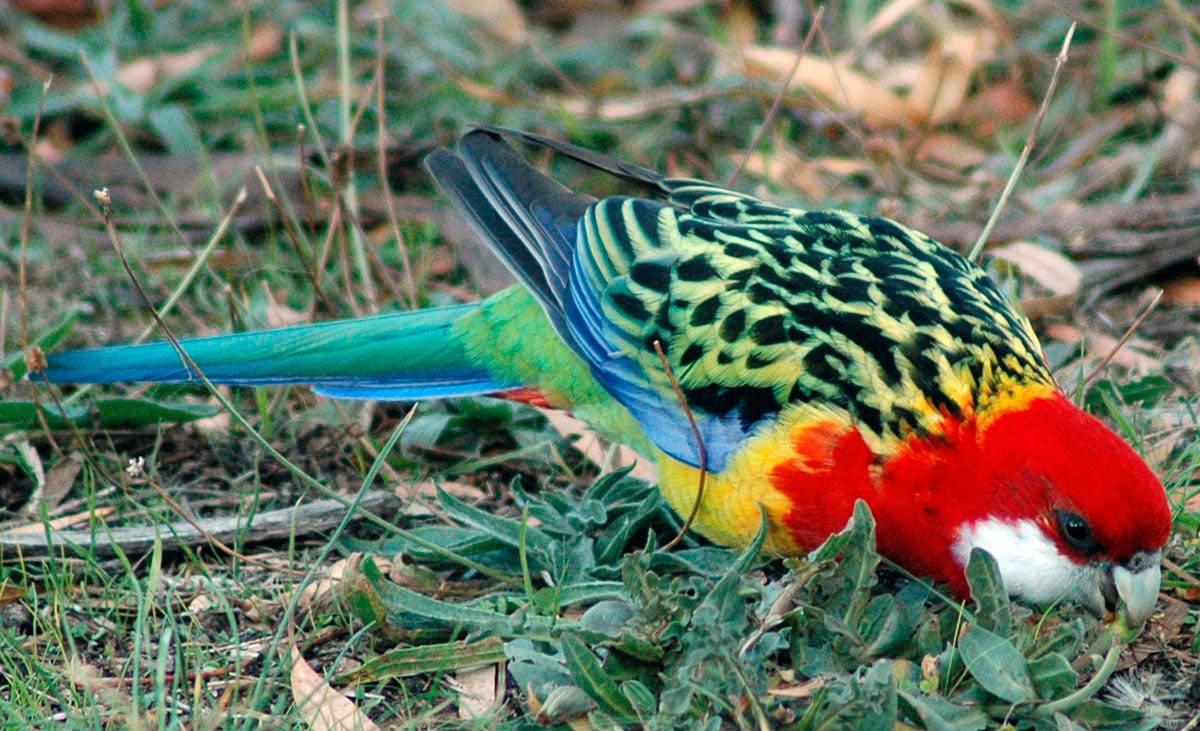
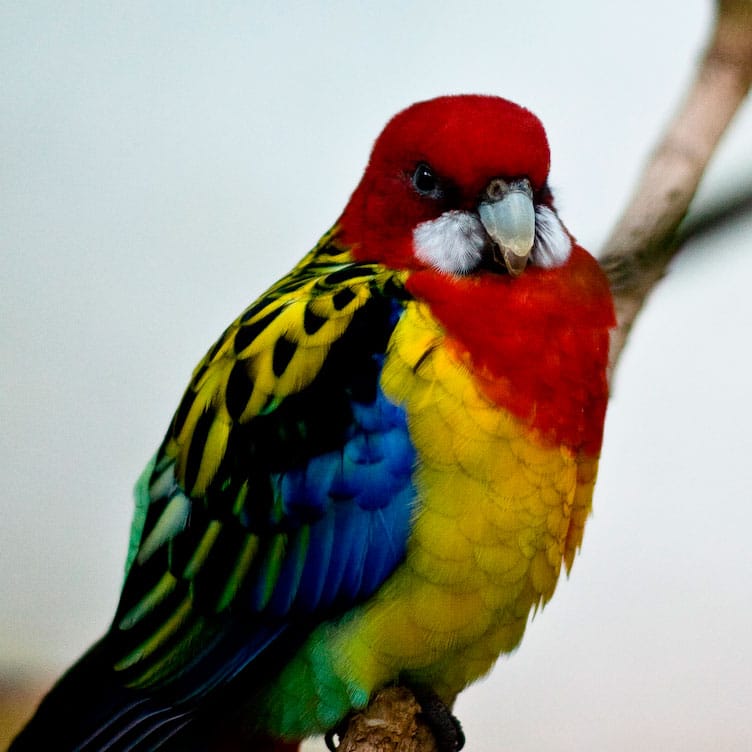
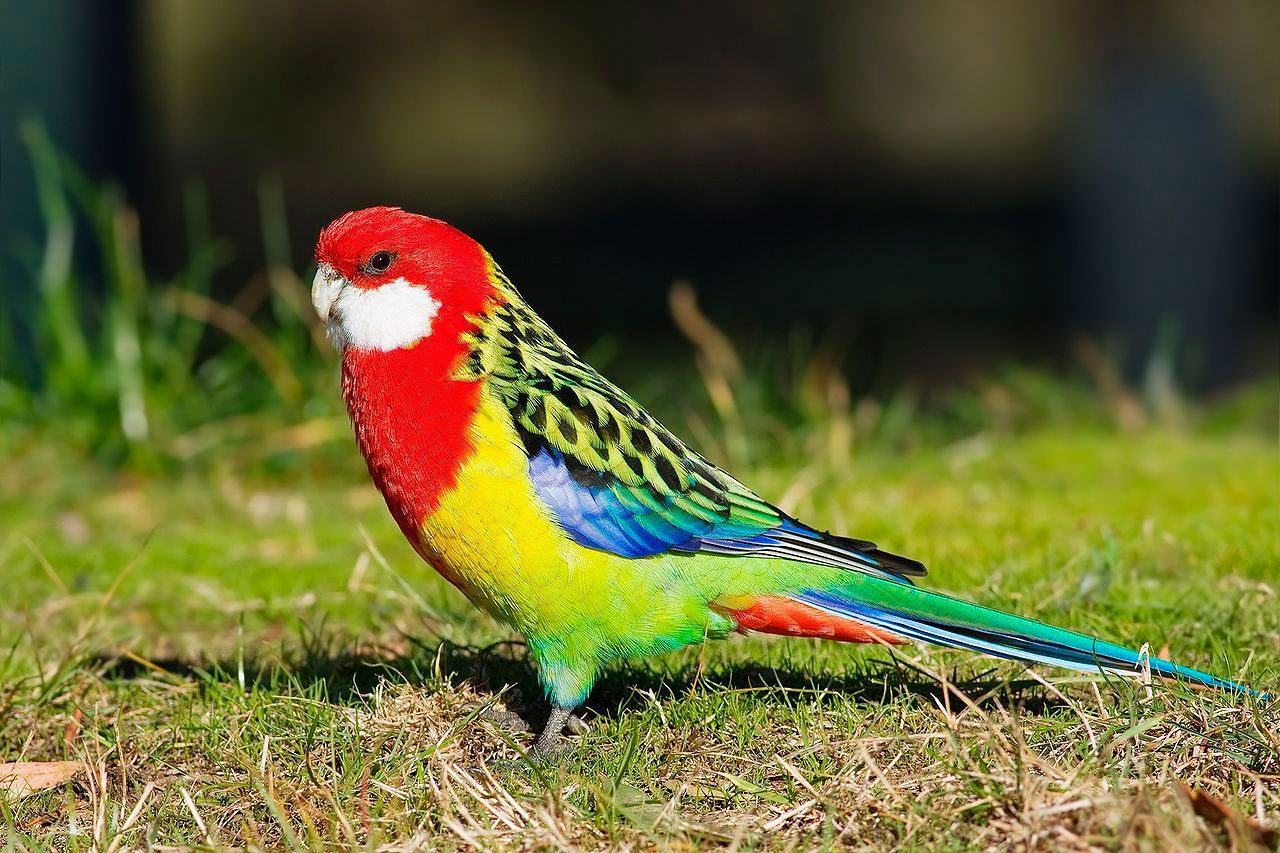
The males of the Eastern Rosella (Platycercus eximius), has bill white. The lower area of the cheeks and chin are white, that contrasts sharply with the rest of the head and the chest that are of color red glossy. Upper abdomen shows a beautiful color yellow that is again gradually of color green pale in its part lower. The coats are of color red. The the mantle feathers, the back and scapulars are of color black with a broad edge yellow, giving these regions a highly scaled appearance. The median are black. The blankets, out of them coverts secondary and flight feather are bluish grey. The rump is bright green. The central feathers of the tail are green bottle, While the outer feathers of the tail are bluish grey with white tips.

The irises They are brown, legs grey.

The female looks like your partner, but the Red of the head and the chest is less bright.

The underparts has a thin white stripe.

The youth they are a copy in Pale tones of the female. They have a little bit of green on the back of the head.

Subspecies description:

  • Platycercus eximius diemenensis

    (North 1911) – Of 30 cm.. length. Head and chest color much more dark and white cheek much more large. Female as the nominal species.


  • Platycercus eximius elecica

    (Schodde & Short 1989) – Of 33 cm.. length. It is something more than the nominal species, the red and the chest and the head is slightly more dark, the black feathers of the neck, back and shoulders have a very broad bright yellow bordered. Area of the rump and coverts bluish-green supracaduales. Female with back and neck with hints. Your obispillo is bluish green


  • Platycercus eximius eximius

    (Shaw 1792) – The nominal.

Habitat:

The Eastern Rosella they tend to be fairly common in all habitats of open forests, including agricultural land, urban parks and gardens. They are usually in little populated wooded areas, rows of trees along streams, shrub and scrub savannahs ยซMalleeยซ.

They are common in cultivated areas and can invade orchards where you can cause severe damage.

In many areas, It is the most widespread species of parrot, You can even nest in the trees lining the streets of towns and cities. Wherever possible, they avoid dense forests and mountainous areas, where is replaced by the Crimson Rosella. The habitat of the Eastern Rosella usually less to 1.250 m above sea level.

Breeding pairs are sedentary in their territories, While young and immature form bands of up to 25 birds that roam the area. very commonly, the multicolored parrot can be seen perched on power lines or poles lining the sides of the roads in the outskirts of cities.

On the floor were fed more frequently than other types of rosella Parrot. In flight, they are quite noisy and therefore very easy to detect. But, When they are on the ground, they are not always easy to observe.

They feed on, sometimes, in the company of Red-rumped Parrot (Psephotus haematonotus) but never be with them organized mixed flocks.

Reproduction:

The Eastern Rosella They nest in the months from August to February, but also from time to time in April and may.

Pairs mate for life and is the female which chooses the nest site, usually in a hole or cavity of a eucalyptus branch. Sometimes the place to start may be an old stump, an any fence post, a fallen log, a rabbit hole, the nest of a Rainbow Bee-eater. Optionally, the Eastern Rosella also used the abandoned nest of the Blue-winged Kookaburra, some termite mound, ferns in facades of houses, rock walls, old buildings and an old nest of pomatostome.

The bottom of the nest is filled with sawdust or small wood shavings..

Spawning includes 4-9 eggs (generally 5) which are incubated during 19 days. The female is solely in charge of incubation and her partner is responsible for supplying. The chicks stay lasts a few 35 days.

Food:

The Eastern Rosella has a mainly vegetarian diet. Consumed mainly eucalyptus and acacia seeds, Although also seeds of a variety of greenery bushes. Berries, leaves and sprouts are also part of its menu.

During the summer, eats some insects and their larvae. Take the seeds that are dispersed in fields and roads. It penetrates into the orchards where causes some damage.

Distribution:

The Eastern Rosella lives confined to the southeast of Australia where is spread around Gympie, Bribie Island and the Darling Downs district in the extreme southeast of Queensland, in the South through New South Wales, coming towards the inside of Moree, Parkes, Griffith and There is a, and reaching Victoria where is it absent only in the Northwest region, and West up to Edenhope.

In the southeast of South Australia the species is largely limited to the area between Bordertown and Salt Creek, but a population caused by birds in captivity is also distributed by the Lofty Mountains.

In Tasmania, the species is widespread, Although barely wide and sparsely distributed, and have been faced with the King Island in the bass strait.

There are small introduced populations in the South Island of New Zealand, concentrated around Dunedin (includes some Crimson Rosella mixed with oriental hybrids) and in the Banks Peninsula, and a larger population in the North Island, that extends from the northern end of the island, along the West Coast through Raglan, New Plymouth and the interior of Pirongia and Taupo. They can also be found Eastern Rosella in the districts of Wellington and Lower Hutt, in the Tararua mountains, about Gisborne and along the Coromandel Peninsula, but are rare in the South of Auckland.

The world population is more of 500.000 birds, and stable or increasing.

There is some competition with nesting places with the Common Starling (Sturnus vulgaris) in Tasmania.

Moderate multicolored parrot in captivity.

The species has benefited before the spread of agriculture, and although protected by law, they can be killed under license.

Subspecies distribution:

  • Platycercus eximius diemenensis

    (North 1911) – Own East of Tasmania.


  • Platycercus eximius elecica

    (Schodde & Short 1989) – Present in the northeast of New South Wales and the southeast of Queensland.


  • Platycercus eximius eximius

    (Shaw 1792) – The nominal.

Conservation:


minor concern


โ€ข Current category of the Red List of the UICN: Least concern

โ€ข Population Trend: Growing

The size of the world's population has not been quantified, Although it is estimated above 500.000 birds.

Throughout its distribution area, except Tasmania, the Eastern Rosella East are very common birds. Unlike in the Crimson Rosella, that like dense forests, the Eastern Rosella they have benefited from deforestation that took place for the establishment of new pastures or areas of cereals.

"Eastern Rosella" in captivity:

Very common in captivity, It is probably the most popular of the Rosellas.

The Eastern Rosella they are coveted because of the beautiful colors of plumage.

They are intelligent birds and can be trained to whistle a large repertoire of melodies., and you can even learn how to pronounce some words.

These parakeets can make good pet birds but require a great deal of care and attention., In addition to devices and toys to keep them mentally stimulated. They are wild birds which are not always adapted to live as a family pet, and even the hand reared parrots are never fully domesticated. They generally do not tolerate caresses or cuddling and tend to react by stinging when you try to handle them like this.. Many breeders believe that the best way to keep this type of bird is in great aviaries where can fly freely, in pairs to meet their social needs and with minimal human interaction. Although they tend to be aggressive with other species Bird by should not be treated so integrate them to mixed aviaries.

Its diet poultry includes seeds, fruits like Apple, PEAR and grape, and vegetables such as lettuce, grass, and silver beet.

A sample of Eastern Rosella lived 27,4 years in captivity. In captivity, these animals have been able to play, approximately, to the 2 years of age..

Alternative names:

– Eastern Rosella, White-cheeked Rosella (ingles).
– Perruche omnicolore (French).
– Rosella, Buntsittich (German).
– Rosela-multicolorida (Portuguese).
– Perico Multicolor, Rosela Comรบn (espaรฑol).

scientific classification:

– Order: Psittaciformes
– Family: Psittaculidae
– Genus: Platycercus
– Scientific name: Platycercus eximius
– Citation: (Shaw, 1792)
– Protonimo: Psittacus eximius

Images ยซMulticolored Parakeetยป:

Videos "Eastern Rosella"

————————————————————————————————

ยซMulticolored Parakeetยป (Platycercus eximius)


Sources:

– Avibase
– Parrots of the World โ€“ Forshaw Joseph M
– Parrots A Guide to the Parrots of the World – Tony Juniper & Mike Parr
– Wikipedia
– AnAge: The Animal Ageing and Longevity Database – Anagรฉ entry for Platycercus eximius
– Birdlife

– Photos:

(1) – Eastern Rosella (Platycercus eximius), male, Queenโ€™s Domain, Hobart, Tasmania, Australia By JJ Harrison (jjharrison89@facebook.com) (Own work) [CC BY-SA 3.0], via Wikimedia Commons
(2) – Eastern Rosella (Platycercus eximius), female, Queenโ€™s Domain, Hobart, Tasmania, Australia By JJ Harrison (jjharrison89@facebook.com) (Own work) [CC BY-SA 3.0], via Wikimedia Commons
(3) – Eastern Rosella (Platycercus eximius) at Woodland Park Zoo, Seattle, USA By Platycercus_eximius_-Woodland_Park_Zoo-6. jpg: Nickderivative work: Snowmanradio [CC BY 2.0], via Wikimedia Commons
(4) – Eastern Rosella at Hobart Domain, Tasmania (grazing) By KeresH (Own work) [GFDL, CC-BY-SA-3.0 or CC BY-SA 2.5], via Wikimedia Commons
(5) – Eastern Rosella (Platycercus eximius diemenensis), The Queenโ€™s Domain, Hobart, Tasmania, Australia By JJ Harrison (jjharrison89@facebook.com) (Own work) [GFDL 1.2 or CC BY-SA 3.0], via Wikimedia Commons

– Sounds: Peter Woodall (Xeno-canto)
โ–ท The world of Pets: Dogs, cats, birds, reptiles, amphibians

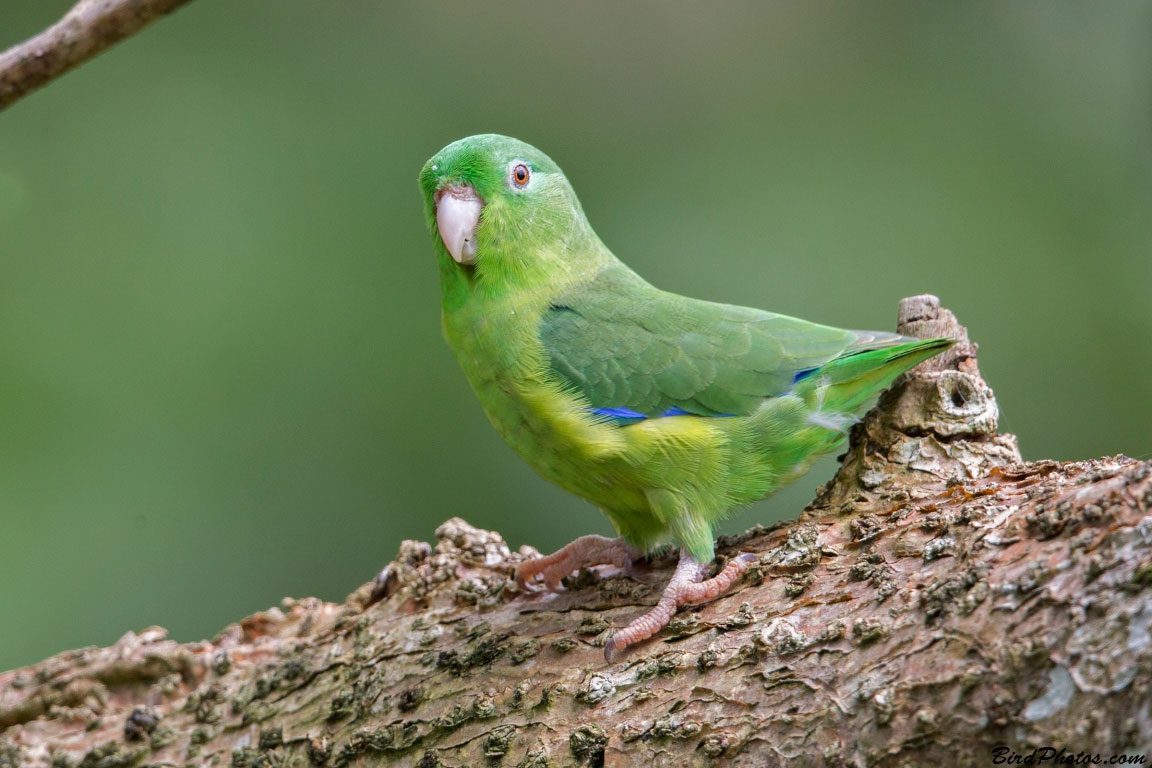
Large-billed Parrotlet
Forpus crassirostris

Large-billed Parrotlet

Content

Description:

12 to 13 cm.. height.

The Large-billed Parrotlet (Forpus crassirostris) has the crown, back of the neck and ear-coverts, green; the forecrown, cheeks, eye area and lores, emerald green.

Upperparts and wings, green, except the part inferior of the back, rump and greater coverts, are cobalt blue and blue color toward the base of the secondaries. Primary coverts pale grayish violet color which contrasts with the darker coverts They are cobalt blue. flight feathers Matte metallic blue. The underparts green with yellow hues. Upper, the tail green; undertail, pale green.

Bill and cere Pink with gray base up to the mandible top, laterally compressed in the Center; bare periophthalmic pale grey: irises dark brown: legs Gris-Rosado pale.
Female all green with belly yellowish green without blue color wing-coverts visible in the male.
Immature like adult respective, but with the blue of young males mixed with green.

Taxonomic note:

some authors (for example, Meyer de Schauensee 1966, Forshaw, 1973, Monroe y Sibley, 1993) They have used the name Forpus xanthopterygius, while other authors (Stotz et to the., 1996, Collar 1997) They have followed Pinto (1945) and used the name Forpus crassirostris to define this species.

  • Sound of the Large-billed Parrotlet.

Habitat:

They inhabit in forest edges, clear, riparian forests, parks and gardens in urban areas.

Reproduction:

They build their nests in tree cavities or exploit abandoned nests common hornero (Furnarius rufus); lining the nesting chamber with grass and the female lays 3 to 7 eggs White. The incubation, lasts approximately 18 days, It is carried out by the female and during this period the male is in charge of feeding her.

Food:

They compose your diet seeds, fruit, plants and flowers herbaceous. They are feeding both the ground and in trees and shrubs. Among the fruits they are highly appreciated by the Large-billed Parrotlet, palm, Trumpet trees (Cecropia spp), as well as seeds and shoots of Paineiras (Ceiba speciosa).

Melo et al, 2009, reported mass consumption flowers of Handroanthus serratifolius (Fam. Bignoniaceae), in particular its nectar, what it appears to be an important power source especially during the dry season, where scarce fruits.

Distribution:

Size of its range (players / residents) 1.312.215 kmยฒ

Southeast of Colombia to the East of Ecuador, North of Peru and West Brazil.

Conservation:


minor concern


โ€ข Current category of the Red List of the UICN: Least concern.

โ€ข Population trend: Stable.

Justification of the population

The size of the world's population of the Blue-winged Parrotlet It has not been quantified, but this species is described as ยซcommonยป (Stotz et to the., 1996).

Justification of trend

Suspected that the population is stable in absence of evidence of any decline or threatens substantial.

"Large-billed Parrotlet" in captivity:

In captivity they are not very frequent. They are birds enable you require a large cage. Quiet and something Shy. Not is easy to accommodate them with other parrots.
Can be prone to it Obesity.

Alternative names:

– Blue-winged Parrotlet (crassirostris), Large-billed Parrotlet (English).
– Toui ร  gros bec, Toui de Spix (crassirostris) (French).
– Large-billed Parrotlet (German).
– Tuim, Large-billed Parrotlet (Portuguese).
– Catita enana, Lorito Aliazul, Periquito Azulejo, Cotorrita aliazul, Lorito de alas azules (espaรฑol).

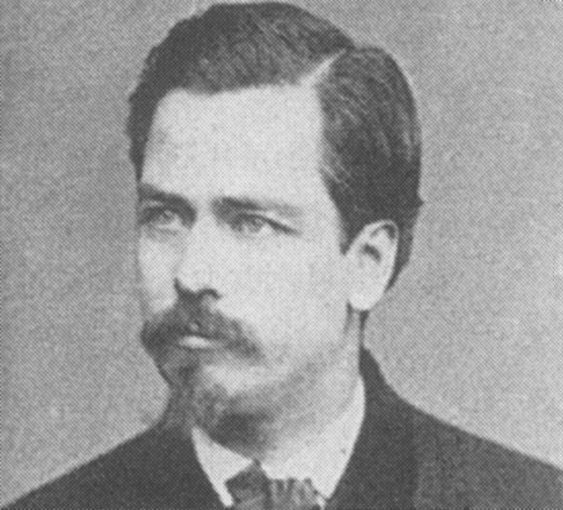
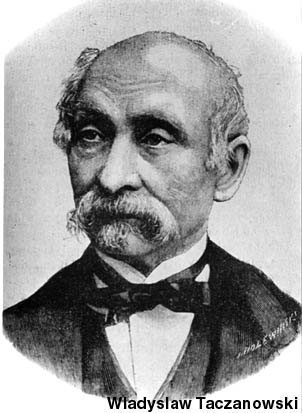
Wladyslaw Taczanowski


scientific classification:


– Order: Psittaciformes
– Family: Psittacidae
– Genus: Forpus
– Scientific name: Forpus crassirostris
– Citation: (By Taczanowsk, 1883)
– Protonimo: Psittacula crassirostris

Images "Large-billed Parrotlet"

————————————————————————————————

"Lorito Aliazul" (Forpus crassirostris)


Sources:

– Avibase
– Parrots of the World โ€“ Forshaw Joseph M
– Parrots A Guide to the Parrots of the World – Tony Juniper & Mike Parr

– Photos:

(1) – Large-billed Parrotlet (Forpus crassirostris) Male – Photo by Tom Friedel – Puerto Nariรฑo, amazon, Colombia – birdphotos.com

– Sounds: John V. Moore, XC257657. accessible www.xeno-canto.org/257657

โ–ท The world of Pets: Dogs, cats, birds, reptiles, amphibians

Sinรบ parakeet (sub)
Pyrrhura subandina

Cotorrita del Sinรบ

Content

Description:

21 to 23 cm.. height.

The Sinรบ parakeet (Pyrrhura subandina) It, in general, green, with the forecrown and areas around eyes dark red.

In flight It is very evident dark red stain abdomen, the wings below greyish. The cheeks They have a greenish blue tone, the area surrounding the ear It is yellowish-brown and the breast feathers with design marginalized gray escamado.

Lives or lived in humid jungle, semi-humid, deciduous and gallery forests,low. It nests on trees of considerable size in hollow nests woodpeckers.

endemic to Colombia, in the lower valley of sinu river, Jaraquiel, Murrucucรบ hill, Cรณrdoba.

Expeditions carried out in recent years have failed to sight it.

Estimated population: 0-100; The population trend: possibly extinct

We recommend that you devote to Sinรบ parakeet immediate attention to the conservation of this unique endemic species of the plain Sinu River.

Habitats in the jungle and near the Sinรบ river valley have been extensively altered and lost.

History:

The Sinรบ parakeet It was described by Todd 1917 as a distinctive bird endemic Valley Sinu River, Cรณrdoba Department, Northwest of Colombia. Peters (1937), without evidence or any basis placed the Pyrrhura subandina within the species Pyrrhura picta, and the species immediately fell into obscurity as subspecies. However, Joseph and Stockwell (2002) they restored the status to Pyrrhura subandina as a species, based on a detailed assessment and phylogenetic analyses recent (com. pers. 2003).

DNA analysis has shown that the population of the Sinรบ parakeet (Pyrrhura subandina) It is probably different (monotype) (Joseph & Stockwell 2002), although at present it remains a subspecies of the Pyrrhura picta pending further studies (SACC 2007).

There is no information on the ecology of the Sinรบ parakeet or current status. The species has never been reported alive and its range has been extensively deforested (Salaman obs. pers.)

At the beginning of 2004 Paul Salman He visited the four sites type; two are entirely deforested, While Quimari and the Cerro Murrucucรบ still have some fragmented forests. No evidence of any Pyrrhura It was obtained by observations and interviews with the local community. In May of 2004, a researcher at ProAves spent three months exploring in search of this species throughout the Murrucucรบ hill but their results were not favorable. The lack of recent records of this species and its restricted and unprotected range give reasons for concern about their survival and current status.

    Reference: Joseph, L. and Stockwell, D. 2002. Climatic modeling of the distribution of some Pyrrhura parakeets of northwestern South America with notes on their systematics and special reference to Pyrrhura caeruleiceps Todd, 1947. Ornitologia Neotropical 13: 1-8.

The Sinรบ parakeet (Pyrrhura subandina) was last reliably recorded in 1949. Almost nothing was recorded about their habits. Not found during searches on 2004 and 2006 (ProAves Colombia 2008). He may be extinct, but if it still survives, this bird will be seriously threatened by habitat loss and hunting associated with the armed conflict in the region; The future of this Pyrrhura It looks bleak.

* Subspecies included within the species Pyrrhura picta.

Sinรบ parakeet (Pyrrhura subandina)


Especies del gรฉnero Pyrrhura

Sources:

– Parrot Book, Parrots and macaws.
– eLibrary
– proaves
– Extinct Birds by Julian P. Hume, Michael Walters.

Photo: Parrots, Parrots and macaws Neotropical