โ–ท The world of Pets: Dogs, cats, birds, reptiles, amphibians

Bichon Frise (Bichon ร ย  poil frisรฉ)
Francia Belgica Spain FCI 215 . Bichons

The owner of a Bichon Frise (Bichon ร ย  poil frisรฉ) You should avoid leaving it alone, suffers from anxiety when you're alone.

Content

Characteristics "Bichon Frise (Bichon ร ย  poil frisรฉ)"

Coexistence is important that you have with your new friend. Before considering the acquisition of a dog of the breed "Bichon Frise (Bichon ร ย  poil frisรฉ)" you know certain factors. Not all breeds of dogs are apt to live in an apartment, you must take into account his character, their need for exercise, their interaction with other pets, their care and if you have small children, their level of tolerance towards them.

Adaptation โ“˜

5,0 of 5 stars (based on 1 review)

friendly dog โ€‹โ€‹โ“˜

5,0 of 5 stars (based on 1 review)

hair loss โ“˜

1,0 of 5 stars (based on 1 review)

Affection level โ“˜

5,0 of 5 stars (based on 1 review)

Need for exercise โ“˜

2,0 of 5 stars (based on 1 review)

Social need โ“˜

5,0 of 5 stars (based on 1 review)

Home โ“˜

5,0 of 5 stars (based on 1 review)

Toilet โ“˜

5,0 of 5 stars (based on 1 review)

Friendly with strangers โ“˜

5,0 of 5 stars (based on 1 review)

barking โ“˜

3,0 of 5 stars (based on 1 review)

Health โ“˜

3,0 of 5 stars (based on 1 review)

Territorial โ“˜

3,0 of 5 stars (based on 1 review)

Cat friendly โ“˜

5,0 of 5 stars (based on 1 review)

Intelligence โ“˜

3,0 of 5 stars (based on 1 review)

Versatility โ“˜

3,0 of 5 stars (based on 1 review)

Child friendly โ“˜

3,0 of 5 stars (based on 1 review)

Surveillance โ“˜

3,0 of 5 stars (based on 1 review)

joy โ“˜

3,0 of 5 stars (based on 1 review)

History

It is said that the Bichon Frise, also known as Bichon ร ย  poil frisรฉ, is the product of a cross between the Maltese and other small dogs, including Barbet (French Water Dog), ancestor of Poodle.

Very present on the shore of the Mediterranean during the 14th century, would have been introduced to the Canary Islands by merchants and sailors who traveled the seas. At that time, the curly-haired Bichon was called Tenerife, by the name of one of the Canary Islands.

It was at the beginning of the 16th century when the Bichon Frise made its appearance in France, more specifically under the reign of Francisco I (1494-1547), that made him her favorite companion. Later, King Henry IV (1553-1610), that he was a great admirer of the breed, made it a very popular companion dog and requested by the ladies and gentlemen of the Court.

The heyday of Bichon Frise lasted until the 18th century, two centuries marked by the interest of the great painters of the time for this little dog. We find it for example in 1770 in the work of the painter Jean-Honorรฉ Fragonard, The sweet ticket, depicting a woman with a magnificent bichon frize. In 1795, Francisco Goya painted The Duchess of Alba, with a Bichon Frise lying at his feet. Madame de Pompadour (1721-1764), Louis XV's favorite (1710-1774), would have had several Bichon Frise.

During the Second Empire (1852-1870), the Bichon Frise, always in fashion, progressively left the halls of the aristocracy and became very popular with the general population. Appreciated for his intelligence and agility, accompany the entertainers in the streets, to jugglers and other organ players.

Unfortunately, as with many breeds of dogs, World War I was a severe blow to the Bichon ร ย  poil frisรฉ, and during the interwar period, the breeders of Bichon Frise almost entirely disappeared.

Fortunately, a passionate Belgian breeder and lover of the breed allowed it to survive by organizing several reproductions in the decade of 1920. France officially recognized the breed in 1933.

World War II and its terrible consequences, in both human and animal terms, were a second blow to the race, you had to wait three decades before seeing a new boom.

In 1960, the Fรฉdรฉration Cynologique Internationale (FCI) officially recognized the Bichon ร  poil frisรฉ, giving him Belgian and French origins, but it wasn't until the decade of 1970 when his popularity really started to grow.

In United States, the Bichon Frize Club of America was created in 1964, and the breed was recognized by the American Kennel Club (AKC) in 1973.

In France, el Club of Bichons and Small Dogs Lions trabaja desde 1947 to defend and improve the Bichon Frise, but also the Bichon Maltese, the habanero, the Bichon Bolonais and the Little Lion Dog.

  • Japanese canine Club: Recognized the dogs miniature group in 1972.
  • Organization International Dogshow: Recognized in the Group of Companion Dogs in 1972.
  • American Kennel Club: AKC (United States). Entered into regular classes in 1973.
  • Canadian Kennel Club: CKC (Canada). Classified in the Group of dogs not hunters in 1975.
  • United Kennel Club: UKC (United States). Recognized in 1981.
  • The Kennel Club: KC (Great Britain).

These associations allow having useful references to estimate the popularity of the breed, Learn about the effort to keep defined, get advice for purchasing a purebred puppy and see this race to compete.

Physical characteristics

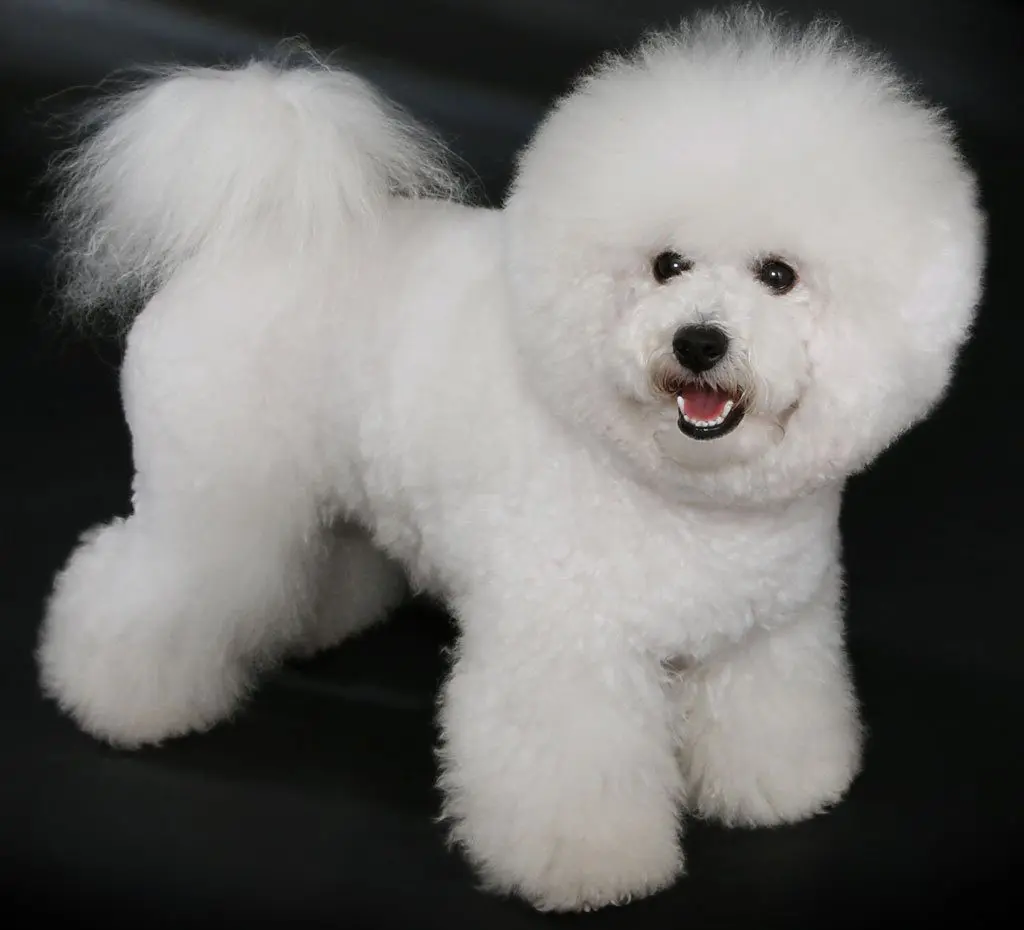
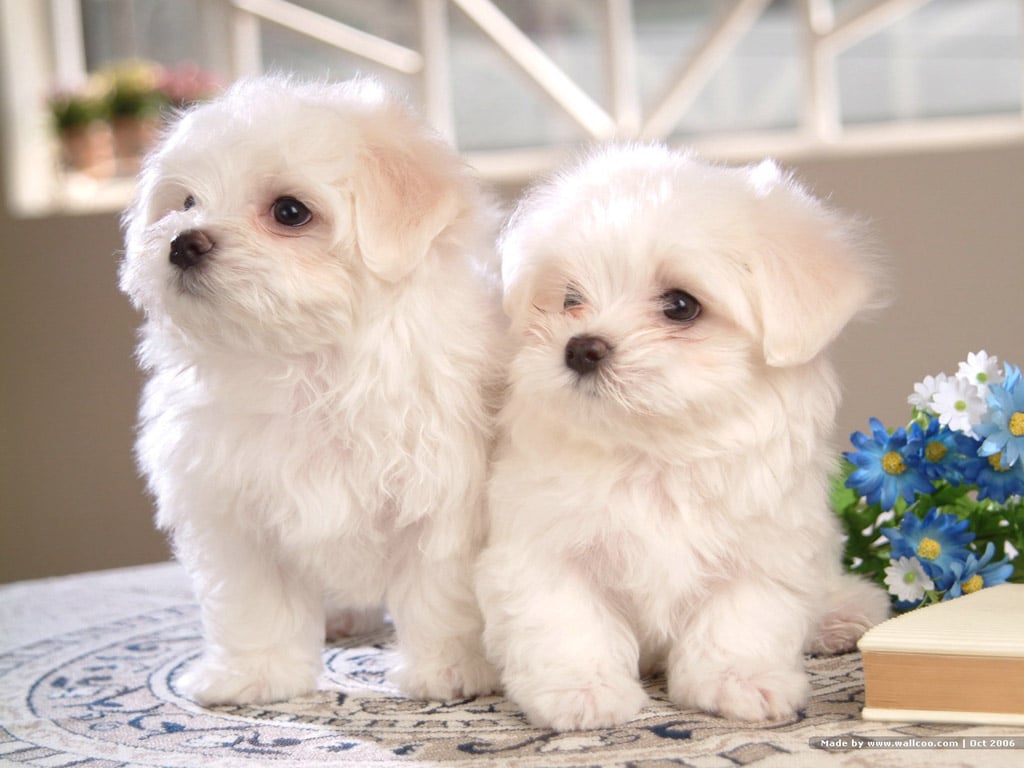
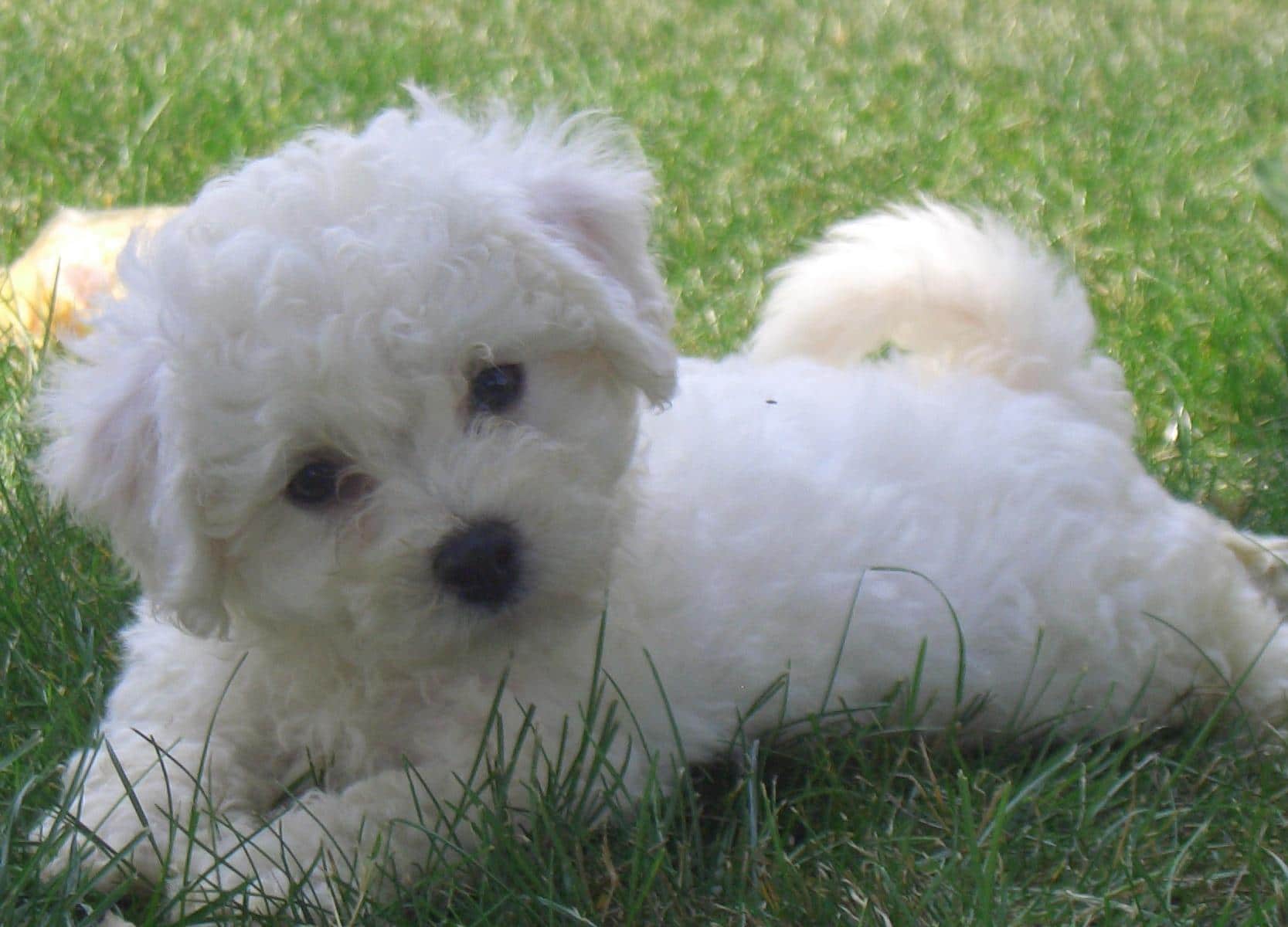
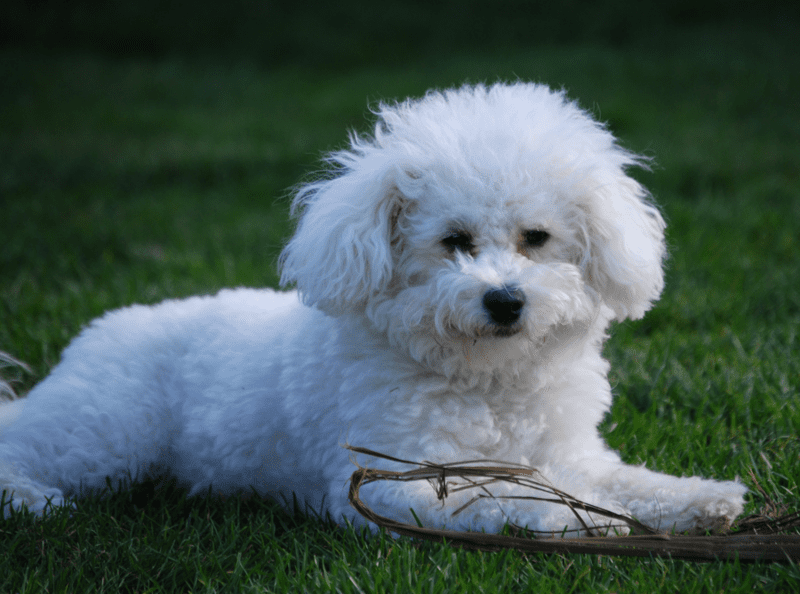
The Bichon Frise it's a small dog, light and very elegant. His skull is flat, his stop is not very marked and his nose is quite black. His round eyes are dark (between dark brown and black) and his ears are thin, falls and with a lot of hair. The tail is carried erect and gracefully curved, but not curled.

Their coat is fine, soft, silky, slightly curly. Relatively long, of 7 to 10 cm.. It has an inner mantle of wool.

Hair color can be white or brown very clearly. The height at the cross in the males is of 24 to 26.5 cm and the females of 23 to 30 cm.. The standard weight of the Bichon Frise lies between 3 and 6 Kg.

Life expectancy

They tend to live in 12 to 15 years.

Character and skills

Happy, lively and fearless, the Bichon Frise He is a small dog who easily expresses and communicates his joie de vivre. Very cuddly, loving and playful, he likes to be taken care of, and his mischief makes his charm. Very attached to his master, he is a dog that loves family life.

So that, the Bichon Frise It is an ideal companion dog for all age groups., as playful with children as kind to the elderly. He also likes to be around active people, with which you can share some canine sports activity, like caniVTT or agility.

Living in an apartment suits you just as well as living in a house with a garden, as long as your need for exercise is met with at least one walk a day.

Well mannered, tolerate loneliness wisely and without barking for hours, although he undeniably seeks the company.

Very sociable, gets along as well with humans as with other animals, including cats. Like this, the Bichon Frise he's a bad watchdog, although it can alert to the presence of a stranger through some barking.

Education

The Bichon Frise (Bichon ร ย  poil frisรฉ) easy to educate as long as clear and precise hierarchical references are given from a young age. His master must be firm, but without excesses or brutality, patient and consistent.

Sometimes it can be a cheater, but he knows how to do it to get what he wants. Like this, its owner should not be overwhelmed, because a badly mannered dog that only does what it wants is a dog that is not comfortable with itself, In addition to being difficult for its owner to live with.

Naturally docile, vivacious and intelligent, the Bichon Frise is the ideal candidate for learning tricks or for obedience, because he quickly assimilates what is expected of him.

Health

The Bichon Frise he is a robust dog, cold and heat resistant. It is even one of the longest-lived dogs, with a life expectancy of up to 16 years.

But, this does not prevent you from being predisposed to certain diseases such as cutaneous lymphoma, mycosis fungoides, joint disorders (dislocation of patella, Legg-Perthes-Calvรฉ disease, etc.) or eye disorders (cataract, stromal corneal dystrophy, etc.).

Grooming

The Bichon Frise, whose molt is almost non-existent, it is one of the most hypoallergenic dog breeds.

But, their coat requires a lot of maintenance. In effect, you have to brush it every day, at the risk of having so many knots that it is necessary to take it to a hairdresser to be sheared.

It is also a good idea to bathe your dog once a month with a nourishing dog shampoo., followed by an equally nourishing conditioner, to facilitate daily detangling and keep her beautiful white coat looking perfect.

To avoid the stripes that brown the pure white fur of the Bichon Frise, it is also necessary to clean the eyes every day.

It also, croquettes are preferable to other types of food, as they prevent whiskers from turning brown.

You should also take special care with your dog's ears and, in particular, prevent hair from growing on them, as it could allow moisture to settle in them and cause ear infections. Hair in the ear canal can be easily removed with tweezers.

Last, it is advisable to take the Bichon ร ย  poil frisรฉ to the groomer three or four times a year to get her long curly locks shortened.

ยซBichon Frizeยป images

ยซBichon Frizeยป Videos

Type and recognitions:

  • FCI CLASSIFICATION:
  • Group :
  • Section : . .

Federations:

  • FCI โ“˜
  • AKC โ“˜
  • ANKC โ“˜
  • CKC โ“˜
  • โ€‹KC โ“˜
  • NZKC โ“˜
  • UKC โ“˜

FCI breed standard "Bichon Frise (Bichon ร ย  poil frisรฉ)"

Origin:
Spain, Belgium, France

Date of publication of the valid original standard:
10.01.1972

Use:

Companion dog


General appearance:

A cheerful little dog, with a lively and very loose movement and curly white hair like a corkscrew. Wear your head with pride; the eyes are dark, cheerful and expressive. The tail is carried gracefully curved over the back.

important proportions:

The Bichon Frize is longer than it is tall, body length (from the tip of the shoulder to the tip of the ischium) is greater than the height at the withers. The body is rectangular. The ratio of the length of the skull to the length of the muzzle is 3-2. The depth of the chest is equal to the height measured from the ground to the elbows.


Behavior / temperament:

It is a true companion dog that can be taken anywhere without problems.. He is not nervous or barks often, is very sociable towards people and dogs, even if you don't know them. He has a great capacity for adaptation and is very attached to his masters.

Head:

Maintain harmony with the body.

Cranial region:
  • Skull : On palpation, the skull is rather flat, even though the hair adornment makes it look round. The skull is longer than the muzzle.
  • Depression links (Stop) : Little pointed.

facial region:

  • Nose: rounded, black, lustrous and granular in structure.
  • Snout: Very wide at the base, without tapering too much towards the nose, forming 2/5 of head length. Straight nasal bridge, neither pointing down nor tilted up.
  • Lips: Fine, rather skinny, falling just enough to cover the lower lip, but never heavy or pendulous; usually pigmented black down to the corner. The lower lip should not be heavy, visible or loose. The corner of the lips is tight and does not allow the inside of the lips to be visible.
  • Jaws / Teeth: Upper and lower jaw wide, each with six evenly set incisors. Scissor bite preferred; pincer bite is tolerated. Full dentition preferred.
  • Cheeks: Flat.
  • Eyes: Very dark, medium-sized, rather round in shape, never almond shaped or protruding. They must not be positioned obliquely. The pigmentation of the eyelids must be completely black. When the dog looks ahead, the whites of the eyes should not be visible.
  • Ears: The ears are droopy and well covered with abundant hair.. Inserted above the eye line, forming an equilateral triangle and hanging vertically along the cheeks. When they stretch forward, the leather must reach at least the corner of the lips, and in most it reaches the middle of the snout. The ears are mobile, especially when something catches the dog's attention.

Neck:

Rather long, carried high and proud. It is round and thin close to the skull, gradually widening to gently insert into the shoulders. Its length is about a third of the body length. No double chin.

Body:

  • top line: Straight, approximately horizontal to base of tail.
  • Cross: It is quite marked.
  • Back: Horizontal, good musculature. Pork loin: Broad and muscular, slightly arched.
  • Rump: wide, slightly rounded, very slightly inclined.
  • Breast : Well developed, well lowered to the elbows, deep chest, floating ribs are well sprung and do not end abruptly, the chest is rather long.
  • Bottom line and belly: The lower part of the chest rises slightly towards the belly line with a moderate rise. The flanks are well set back; the skin is thin and not loose.

Tail:

Set moderately high, slightly below the line of the back, It is carried elevated and gracefully curved in line with the spine, without being coiled or amputated. The tip of the tail, regardless of hair, does not touch the back of the dog. Hair ornament may fall on the back. The tail should not hang down when the dog is in motion.

Tips

Former members:
  • General appearance: Seen from the front, the forelimbs are straight. Moderate bone.
  • Shoulder: well laid.
  • Arm: Forming a good angle with the shoulders.
  • Elbows: Well attached to the body.
  • Forearm: straight and perpendicular seen from all sides.
  • Metacarpus: Short and straight seen from the front, very slightly sloping seen from the side.
  • Previous feet: tight, round and knuckles well up, neither in nor out, pads should be black and nails should preferably be black.
Later members:
  • General appearance: The pelvis is wide. The hind limbs are well muscled and seen from behind, They are parallel to each other. They are vertical.
  • Thigh: wide and muscular. Knee: Well angled, neither turned in nor out.
  • Leg: About the same length as the thigh.
  • Hock: Low placement and well marked.
  • Metatarsus: Slim without spurs.
  • Hind feet: Tight, round and knuckles well up, neither in nor out, pads should be black and nails should preferably be black.

Movement:

Fast moving, free, covering a lot of ground. During the jog, the head is carried high, the tail well curved on the back. Hind limbs with good thrust. Parallels.

Mantle

Skin: Stretched all over the body; dark pigmentation preferred; However, does not influence hair color. The scrotum should preferably be black.

Fur: Profuse hair. Outer layer hair forms loose spiral-like curls (This is the structure of the curly). A soft and dense undercoat must be present. Hair is neither straight nor corded, ni lanudo, ni en maraรฑado.

Color: Pure white. But, prior to the 12 months of age, hair may tend to be slightly beige (champagne), but this should not cover more than 10% dog.


Size and weight:

Height to the cross: 25 to 29 cm.. A tolerance of 1 cm in plus is accepted for males; A tolerance of 2 cm in less is accepted for females, as long as the proportions are balanced and the sexual dimorphism is well marked.

Weight: About 5 kg, in proportion to size.


Fouls:

Any deviation from the aforementioned criteria is considered as a fault and the severity of this is considered to the degree of the deviation to the standard and its consequences on the health and well-being of the dog..

Serious misconduct:

โ€ข Temperament: A dog that lacks self-confidence.

โ€ข Head: pointed snout.

โ€ข Nose: Loss of pigmentation.

โ€ข Lips: Pink or partially pigmented, hanging corners of the lips.

โ€ข Eyes: color clear, incomplete pigmentation of the edge of the eyelids, visible white. The hair under the eyes should not have traces of tear secretions.

โ€ข Chest: underdeveloped.

โ€ข Cola: threaded, forming a ring, lifted perpendicularly or dropped during movement.

โ€ข Extremities: insufficient angulations. โ€ข For the: not profuse enough and / or wrong curling causing hair to split open or be straight.

โ€ข Color: Hair coloring (except for dogs under 12 months).

disqualifying fouls:

โ€ข Aggressiveness or extreme shyness. Any dog โ€‹โ€‹showing clear signs of physical or behavioral abnormalities.

โ€ข Prognathism (upper or lower prognathism).

โ€ข Total depigmentation of the nose, the edges of the lips and eyelids.

โ€ข Eyes: Small, almond shape, protruding, too light or sharp eyes.

โ€ข For the: Total absence of a curly texture.

โ€ข Color: Any hair color other than white in specimens over 12 months.

โ€ข Size: Out of tolerance.

โ€ข General aspect: Any evidence of dwarfism.

โ€ข General appearance: Any dog รขโ‚ฌโ€นรขโ‚ฌโ€นwhose general structure is inscribed in a square.


N.B.:
  • Males should have two normal-appearing testicles fully descended into the scrotum..
  • Only functionally and clinically healthy dogs, with the typical conformation of the breed, should be used for parenting
  • Complement to the Standard

    Cuts accepted.

    • Head: The ears, beard and mustache are shortened and shaped to give the head either a round or bell shape.
    • Body: In order to give the impression of elegance and slenderness, hair is shortened (but not less than 3 cm.) on the back and flanks. The lower part of the belly is covered with hair.
    • Limbs and feet: cylindrical appearance.
    • Tail: It should not be cropped.

    Source: F.C.I - International Cynological Federation

    Alternative names:

    1. Bichon Frise (English).
    2. Bichon ร  poil frisรฉ (French).
    3. Bichon Frisรฉ, hannover’scher schweisshund (German).
    4. Bichon frisรฉ (Portuguese).
    5. Bichon de pelo rizado, Bichรณn Tenerife (espaรฑol).

    โ–ท The world of Pets: Dogs, cats, birds, reptiles, amphibians

    Barbet (French Water Dog)
    Francia FCI 105 . Water Dogs

    The Barbet they prefer to be in the same room with the family at all times

    Barbet

    Content

    Characteristics "Barbet (French Water Dog)"

    Coexistence is important that you have with your new friend. Before considering the acquisition of a dog of the breed "Barbet (French Water Dog)" you know certain factors. Not all breeds of dogs are apt to live in an apartment, you must take into account his character, their need for exercise, their interaction with other pets, their care and if you have small children, their level of tolerance towards them.

    Adaptation โ“˜

    3,0 of 5 stars (based on 1 review)

    friendly dog โ€‹โ€‹โ“˜

    2,0 of 5 stars (based on 1 review)

    hair loss โ“˜

    3,0 of 5 stars (based on 1 review)

    Affection level โ“˜

    4,0 of 5 stars (based on 1 review)

    Need for exercise โ“˜

    4,0 of 5 stars (based on 1 review)

    Social need โ“˜

    3,0 of 5 stars (based on 1 review)

    Home โ“˜

    3,0 of 5 stars (based on 1 review)

    Toilet โ“˜

    2,0 of 5 stars (based on 1 review)

    Friendly with strangers โ“˜

    3,0 of 5 stars (based on 1 review)

    barking โ“˜

    3,0 of 5 stars (based on 1 review)

    Health โ“˜

    4,0 of 5 stars (based on 1 review)

    Territorial โ“˜

    3,0 of 5 stars (based on 1 review)

    Cat friendly โ“˜

    3,0 of 5 stars (based on 1 review)

    Intelligence โ“˜

    4,0 of 5 stars (based on 1 review)

    Versatility โ“˜

    3,0 of 5 stars (based on 1 review)

    Child friendly โ“˜

    4,0 of 5 stars (based on 1 review)

    Surveillance โ“˜

    3,0 of 5 stars (based on 1 review)

    joy โ“˜

    4,0 of 5 stars (based on 1 review)

    History

    The Barbet (French Water Dog) It is a French breed of dog of medium size water.

    This dog of waters is a rare species. Almost everyone has heard of breeds like the Poodle, Griffon and the Bichon Frise … Have you ever wondered where all these breeds come from?? Your answer is the following … all came from the Barbet, or as some known, the French Water Dog. Now, Where does he come from French Water Dog? Well, that is a question for which no one has a definite answer, but there are a lot of conjectures.

    Some people say that the dog of the Barbet is a descendant of the original Griffon, others say it came from the Bergamasco that were brought from Asia, When was Europe invaded, others say that the Barbet North African wine, travelling through Spain to install on France, people say that, but the french spaniel is not the origin of all Water Dogs, It is very likely that it was close to the original type.

    The reality is that Barbet has been in Europe for centuries, There are even writings about him, from the Elizabethan era describing the Barbet and the type of care necessary to keep your hair healthy.

    Physical characteristics

    compact and vigorous, with good muscles and bones in relation to the volume of your body. The eyes are round, living with an expression that denotes intelligence.

    Morphologically is classified as bracoide, head approaching the form primรกstica, with the wide snout at the same end than at the base and separated from the front by a depression or Groove very marked, gachas ears, long and hanging lips, with highlight of the higher above the level of the mandible.

    The standard of the race measured between 58 and 65 cm for the male; and 52 to 61 cm for the female and a weight of between 17 and 28 kg . The Barbet It is the prototype of a water dog with woolly hair, long, curly. The accepted colors by the FCI they are pure black, brown, cervato, clear and grey cervato.

    Character and skills

    The Barbet was used as a water dog (as its name implies) was a great dog collector for hunting in marshy areas.

    This dog has been used by farmers for grazing, but that's not all, This dog, the Barbet He also frequented port areas to be a friend and companion of sailors. A very versatile breed.

    • Personality Barbet It is accompanying, joyful, salty, obedient and intelligent. They are quick to learn and need training to obey. You are very kind with children, families and older people.

    The Barbet they prefer to be in the same room with the family at all times. They need daily exercise to keep your body and mental state in a healthy state.

    The average life of the Barbet is of 13 to 15 years, knowing some case that has come to live 19 years.

    Images "Barbet (French Water Dog)"

    Videos "Barbet (French Water Dog)"

    Type and recognitions:

    • FCI CLASSIFICATION:
    • Group 8: Retrievers, Hunting Lifting Dogs, Water Dogs.
    • Section 3: Water Dogs. .

    Federations:

    Recognized by the federations :

    • FCI โ“˜
    • UKC โ“˜
    • โ€‹CKC โ“˜
    • โ€‹


    FCI breed standard "Barbet (French Water Dog)"

    Origin:
    France

    Date of publication of the valid original standard:
    21.02.2006

    Use:

    Water dog, used for hunting wild birds. The Barbet, like all water dogs, is more than just a bill collector, he must search and make the game hidden in the aquatic vegetation leave the forest and raise it. Then he collects the piece knocked down by his master. It is not afraid of the cold and enters the water no matter what the weather is.


    General appearance:

    Medium size and lines. It is characterized by a dense, woolly coat that provides effective protection against cold and humidity.. The hair forms a beard on the chin, what has given the breed its name.


    important proportions:
    • Muzzle slightly shorter than skull.
    • The length of the body, measured from the tip of the shoulder, to the tip of the gluteus, is slightly higher than the height at the withers.


    Behavior / temperament:

    Balanced, very attached to their masters, very sociable, water lover, still very cold.

    Head:

    The hair of the skull must fall to the nasal canal. The beard is long and abundant; the mustache covers the entire nostril and is very abundant.

    Cranial region:
    • Skull : Rounded and wide.
    • Depression links : Marked.

    facial region:

    • Truffle : Wide, with the windows wide open. Its color is black or brown, according to coat color.
    • Snout : Well square. The muzzle is wide.
    • Lips : Thick, well pigmented, completely covered in long hairs. The edge of the lips is black or brown.
    • Jaws / Teeth : Jaws of uniform length. Scissor joint. Strong teeth. The incisors are well developed and well aligned.
    • Eyes : Round, preferably dark brown. The edge of the eyelids is black or brown.
    • Ears: Low insertion (at eye level or a little lower) long, plan, wide, with long hairs that form streaks. When brought to the front of the truffle, surpass it by a few 5 cm. (along with the hair). The cartilage of the ears extends beyond the corners of the lips..

    Neck:

    Short and powerful

    Body:

    • Back: Solid, the top margin is very firm.
    • Pork loin: Convex, short and strong.
    • Rump: Rounded profile, harmoniously prolonging the line of the spine.
    • Breast : Large, well developed, alto, descends to elbow level. The ribs are rounded, but not abarriladas.

    Tail:

    A little raised, exceeds the horizontal when the dog is in action. Low insertion, forming a slight hook on the limb.

    Tips

    Forelimbs:
    • Shoulder : Oblique. The scapulohumeral angle varies between 110 and 115 degrees.
    • Arm : Thick and muscular.
    • Forearm: Straight, for strong bones, well plumbed, completely covered in long hairs.
    Hind limbs:
    • Thighs : Slightly oblique, well formed.
    • Hock : Low, well angled.
    • Metatarsals : Well poised.
    • Pies: Round, widths, covered in hair.

    Movement:

    Agile steps, the limbs move in the axis of the body. Median extension of the forelimbs and good the hindlimbs.

    Mantle

    Skin: Relatively thick.

    Fur: Long, woolly, curly, can form wicks. Is abundant, covering the whole body in its natural state. This is an essential characteristic of the breed. The Barbet can be groomed in a specific way to facilitate its work and the maintenance of its coat..

    Color : Unicolor negro, grey, brown, leonado, sand, white or with some patches of different color. All shades of fawn and sand are accepted. Preferably, the shade should be the same over the whole body.


    Size and weight:

    Height to the cross :

    Males: 58 to 65 cm.
    females: 53 to 61 cm.

    With a tolerance of + from โ€“ 1 centimeter.


    Fouls:

    Any deviation from the aforementioned criteria is considered as a fault and its seriousness is considered to the degree of the deviation to the standard and its consequences on the health and well-being of the dog.

    โ— Thin and narrow head, thin and too long nostril, thin lips.

    โ— Superior or inferior prognathism. Deviated jaw.

    โ— Light eyes.

    โ— High set ears (taller than the eye), fine, short, narrow.

    โ— Thin neck.

    โ— Sunken top margin.

    โ— Long and loose loin.

    โ— Narrow croup.

    โ— Narrow chest.

    โ— High insertion queue, bent over the back, threaded, or stuck against the rump or back. No tail or very short abdomen.

    โ— Narrow shoulders.

    โ— Thin arms.

    โ— Fine-boned forearm, limbs with bangs.

    โ— Hind limbs: flat thigh, straight hock, limbs with bangs, presence of spurs. Thin and narrow feet, discovered.

    โ— Thin skin.

    โ— Short hair, rough, that is not woolly, nor curly.

    โ— Colors: Any other color other than those mentioned in the standard.

    ELIMINATING fAULTS

    โ€ข Aggressive or fearful dog.

    Any dog โ€‹โ€‹showing clear signs of physical or behavioral abnormalities must be disqualified..


    N.B.:

    Males should have two normal-appearing testicles fully descended into the scrotum..


    Via FCI

    Source: F.C.I - International Cynological Federation

    Alternative names

    1. Barbet, French water dog (English).
    2. Barbet, chien d’eau franรงais (French).
    3. Barbet, Franzรถsischer Wasserhund (German).
    4. Barbet, cรฃo d’รกgua francรชs (Portuguese).
    5. Barbet, Perro de aguas francรฉs (espaรฑol).

    โ–ท The world of Pets: Dogs, cats, birds, reptiles, amphibians

    Hungarian Wire-haired Pointer
    Hungrรญa FCI 239 . Braque Type

    Hungarian Wire-haired Pointer

    The Hungarian Wire-haired Pointer they are very close to their family and are affectionate and playful with their family.

    Content

    History

    Appeared somewhere between the steppes of Russia and the Carpathians, the Hungarian Braco (commonly known as Vizsla, What does "indicator" mean in Hungarian?) has an ancient history, probably thousands of years. He already accompanied the Magyar tribes before they settled in the Carpathian basin, where the current Hungary is located, in the 9th century.

    The first references to this dog date back to the 13th century, and more precisely to the story of one of the scribes of King Adelbert III (1235-1270) which recounts the migrations of the Hungarian people, in which the use of a yellowish dog named Vizsla for hunting. It was also depicted in the 14th century in the illustrations of the chronicles written by the Carmelites. Numerous sixteenth-century Hungarian documents also evoke his role as a faithful companion of kings and aristocracy..

    While there is no doubt that the Vizsla current is the result of numerous crossbreeds between hunting dogs over the centuries, these were always carried out in order to preserve the original features, as evidenced by the brown nose which is different from most others pointers.

    Historically, the Vizsla has always had a short coat. But, early twentieth century, in the decade of 1930, two breeders came up with the idea of รขโ‚ฌโ€นรขโ‚ฌโ€นa Hungarian Wire-haired Pointer to the country breeders' club. His goal was to create a dog with all the qualities of the Vizsla, but with a coat that would protect it more effectively from snow and icy water, as well as scratches and scratches when hunting in the forest.

    Although it was debated, the proposal was accepted under certain conditions, including maintaining the same coat color. Jozsef Vasa, breeder of the Hungarian Braco, y Laszlo Gresznarik, breeder of the German Shorthaired Pointer, crossed two female Vizsla named Csibi and Zsuzsi with a male of German Shorthaired Pointer called Astor von Potat. Two generations later, Selle Day was the first Hungarian Wire-haired Pointer that was shown at a dog show.

    It seems that during World War II, when the population was in decline, crosses were also made with other breeds such as the Setter Irish or the Griffon. But, there is no record of this miscegenation in the records kept by Hungarian organizations.

    The breed was recognized in 1963 by the Fรฉdรฉration Cynologique Internationale (FCI), nine years after the Hungarian Short-Haired Pointer (Vizsla). The first specimens were exported to North America in the decade of 1970. More quickly adopted in Canada, to the point of gaining official recognition from the Canadian Kennel Club (CKC) in 1977.

    In the United States, was not up 2006 and 2014 respectively than the United Kennel Club (UKC) and the American Kennel Club (AKC) they did the same, while they had already recognized the Hungarian Short-Haired Pointer (Vizsla) in 1960 (AKC) and 1984 (UKC). Its growing presence in Europe also allowed it to be recognized by the British Kennel Club. (KC) in 1991.

    Photo: Hungarian Wire-haired Pointer; MVD belongs to the sample dogs of the group 7 of the FCI with proof of work by Broneder, Public domain, via Wikimedia Commons

    Physical characteristics

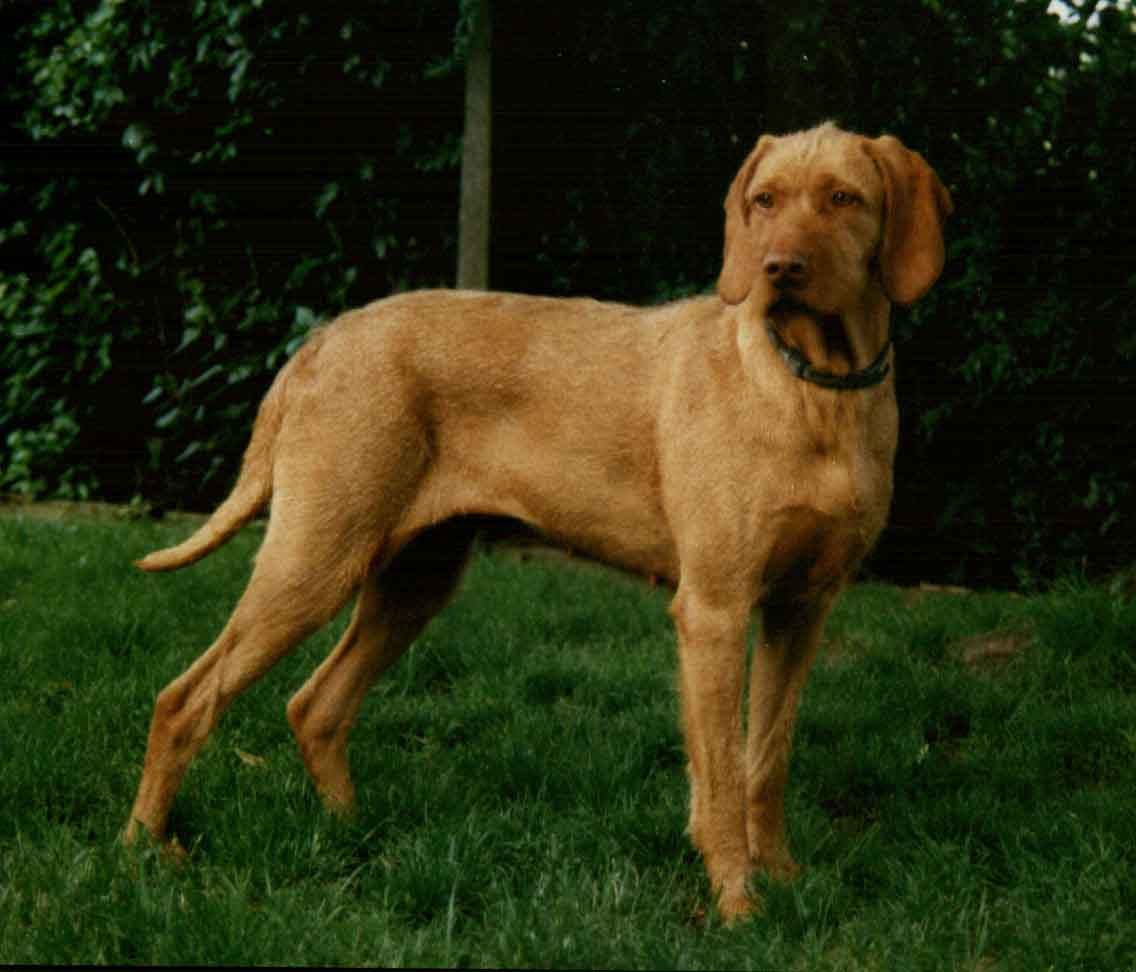
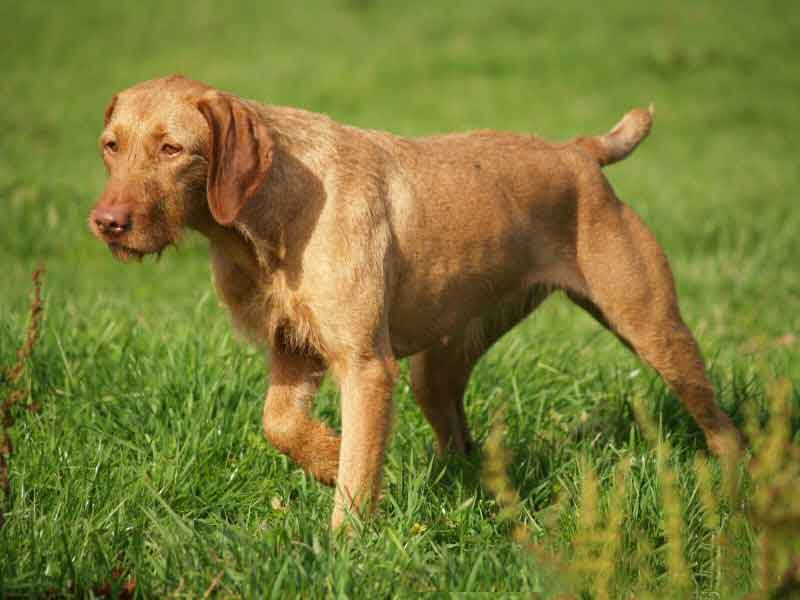
    The Hungarian Wire-haired Pointer it is a medium-sized dog that differs from its short-haired cousin by its slightly squarer appearance on average, but also and above all because of the length and texture of its coat.

    Its slightly rectangular body is dry and well developed, no superfluous roundness. He leans on legs of solid bones, well structured and with prominent muscles. The legs are oval in shape and end in brown claws.

    The tail is wide at the base and tapers to the tip. For years, as a precaution for hunting parties, the queue was shortened by about a quarter. This practice of cutting the tail of dogs (tail docking) is currently prohibited in many territories, including France, Switzerland, Belgium and Quebec.

    Braco-Hungaro-de-pelo-duro-1
    Hungarian Wire-haired Pointer

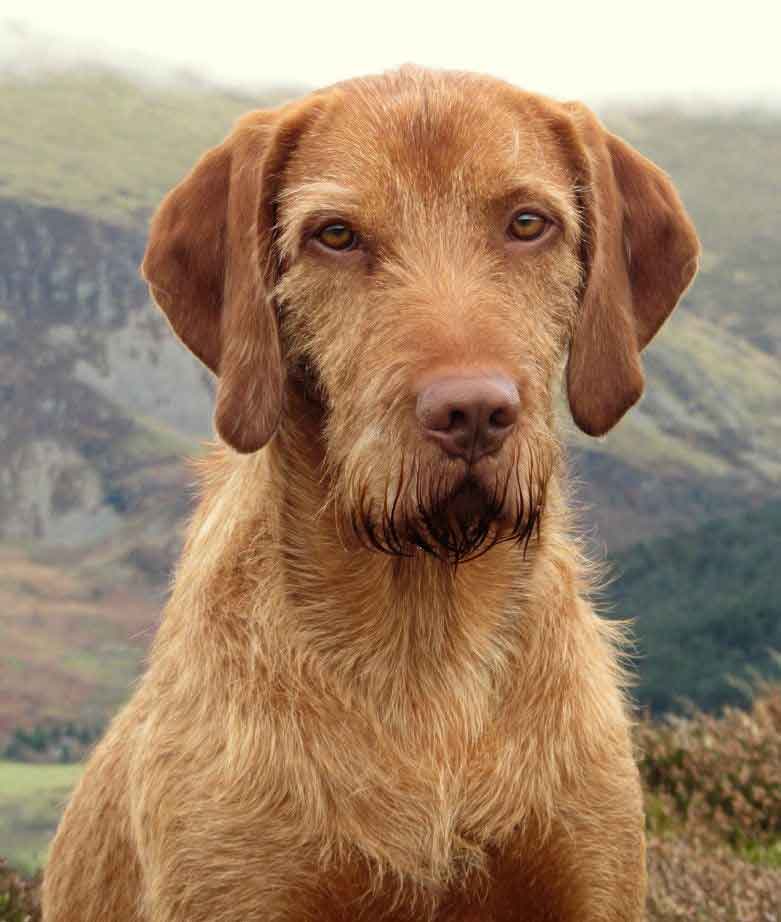
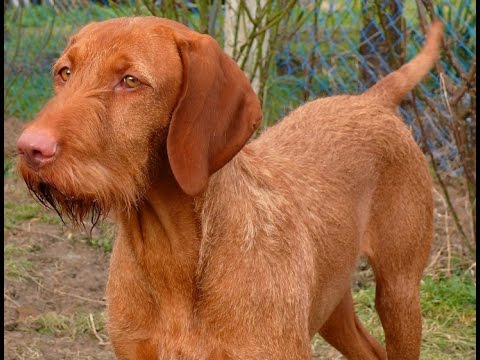
    The head of the Hungarian Wire-haired Pointer it is quite wide, with a slightly domed skull at a moderate stop. Ears are back, going down along the cheeks and are slightly shorter than those of the Hungarian Short-Haired Pointer (Vizsla). The eyes are oval, medium-sized, and brown according to the coat. The muzzle is quite short and ends in a broad brown nose as well, but darker in color than fur.

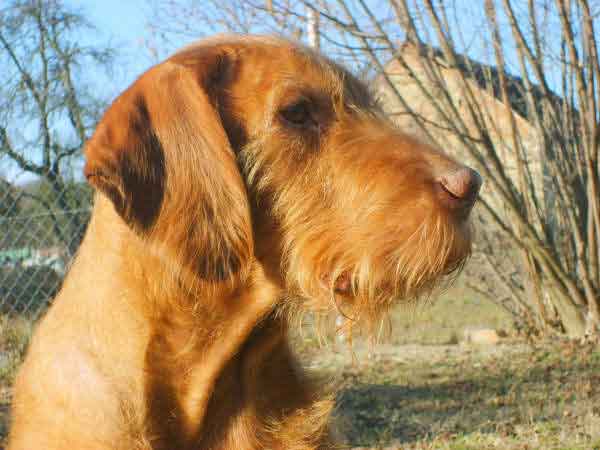
    It is the latter that clearly distinguishes it from its cousin.. Both have a dense, waterproof underlayer, but the top layer of the Hungarian Wire-haired Pointer is longer (2 to 3 cm.) and it has a completely different texture. They are made of wire hair, hard, dense and very dense. These features give it excellent protection against harsh outdoor conditions. At face level, hair is slightly shorter, except on the eyebrows and especially the beard. This is not very long (2-3cm.), but it is very pronounced and noticeable.

    Like his short haired counterpart, the fur of the Hungarian Wire-haired Pointer it's golden wheat, and the spikes may be darker in the shade. Shades of red, brown or light yellow are accepted, but they are not wanted. A small white spot on the chest is possible, as long as it does not exceed 5 cm..

    Finally, sexual dimorphism is well marked in this breed, the male being significantly larger and more massive than the female.

    Character and skills

    The character of Hungarian Wire-haired Pointer is comparable to the Hungarian Short-Haired Pointer (Vizsla), but with the addition of a wet beard when caressed.

    They are very close to their family and are affectionate and playful with their own. But, generally feels closer to a particular person among them, whom he considers as his human reference, and it doesn't stop making you feel clearly.

    In any case, he is much less open with humans who are not part of his home. This does not mean that he is aggressive or distrustful towards them., but rather indifferent.

    But, if you perceive a threat to your family or territory, whether it comes from an unknown human or another animal, he is very protective, not hesitating to scold or even interfere.

    Hungarian Wire-haired Pointer
    Hungarian Wire-haired Pointer

    He behaves in exactly the same way with children. Like this, is close to the little ones of the family, but he prefers to avoid others. You have to be careful when the first one plays with friends, as you may misinterpret some of the second's actions as aggression, and then react inappropriately. Like any other dog of any breed, should not be left alone with a young child without adult supervision.

    The Hungarian Wire-haired Pointer gets along well with his peers, whether they are those you meet on your walks or those who share your home when necessary. Their relationships with other animals are much more complicated, as they soon fall victim to their strong hunting instinct. The domestic cat is usually protected, especially if you have grown up with him since he was young, but a rodent or a bird cannot say the same if he lives next to him in the house or is on a walk. An unknown cat is also likely to be relentlessly chased.

    Used for centuries to succeed on long hunting trips, the Hungarian Wire-haired Pointer still an active dog today. You need to be able to exercise for at least an hour each day to feel comfortable, and you feel even happier if you can spend whole days walking through the forest. So, its level of activity implies that it is not suitable for an elderly or very sedentary person.

    Hunting is still his favorite activity, and the one that best allows you to express all your qualities. Otherwise, canine research sports (tracking, Cavemen…) they are a perfect outlet, to solicit your extraordinary sense of smell.

    Obedience and agility are also disciplines that will do you good. More simply, it is also a great companion for cyclists, runners, hikers, nature lovers, mushroom pickers… This is all the more true since it is robust and capable of evolving on all types of terrain., from dense forests to rocky mountains, passing through snowy plains or swamps.

    In the city, it is strongly recommended to keep him on a leash to avoid accidents if he runs after a passing cat or small animal. But, once in the desert, it is much more appropriate to let it run free. Of course, learning withdrawal orders is an essential prerequisite, for obvious security reasons. A GPS dog collar is nevertheless a good investment to help locate you if the deer you are chasing has led you into unfamiliar terrain..

    It also, as it does very well in the aquatic environment. Without being particularly fond, he likes to swim once in a while, especially if the place where you live offers this possibility.

    Used to hunting quite independently and, Therefore, to make decisions for themselves, the Hungarian Wire-haired Pointer has acquired a certain intelligence coupled with a strong character. A beginning teacher is probably overwhelmed.

    If you are independent in your way of acting, does not mean that he likes to be alone. You can wait patiently at home when your family is at work during the day, but should be able to be as much as possible with the rest of the time. It also, it is likely to hurt if left alone for a whole weekend because it cannot bear the stress caused by the absence of its masters. It also, just because you are physically fit to sleep in the garden, even when it's a little cool, does not mean that this is recommended. In fact, to be well in the head, do not keep him away from his family: it's more of an indoor dog, who prefers to watch television at night with his family than to admire the stars alone outside.

    This is all the more true as he is surprisingly calm when his exercise needs are met., to the point of being able to live in an apartment, provided it is large enough to accommodate it in good condition. Discreet and well educated, are not the type that barks on top of your lungs or howls when you die, and are not usually noticed by the neighbors. In fact, they rarely bark (generally when they perceive a threat), but then they don't stop making themselves heard, since his voice rises a lot.

    But, the ideal environment for him is a house with a garden (perfectly fenced) in the countryside. A walk in the city during the same time does not have the same flavor as an outing for a dog accustomed to nature and the great outdoors.

    Education

    Like all dogs, the Hungarian Wire-haired Pointer benefits greatly from socialization that begins in its first few weeks and continues for the following months. Usually goes smoothly, since then he is particularly open and curious, quickly getting used to the different environments and situations you encounter. Itร‚ยดs, because, the ideal time to get used to the people you will meet regularly in your life (friends, neighbors, veterinary…), but also to take him to all kinds of places and allow him to meet various humans and similar creatures.

    Hungarian Wire-haired Pointer
    Hungarian Wire-haired Pointer

    The education of Hungarian Wire-haired Pointer can give a slightly timid caregiver a hard time, that you wouldn't know how to be respected by your dog. Strong of character and independent, will soon prevail if left alone. But, perfectly suited to beginners, as long as they know how to assert their authority. For this, it is important to establish clear and consistent rules without delay, so much over time (what is prohibited one day is also prohibited the next day) as between the different members of the family (it is not about one person authorizing what another person prohibits), to establish impeccable discipline and ensure that he respects his master's authority. Once you understand that you can't decide for yourself, accepts the situation and is not the one to monitor the slightest defect and constantly question the established order – If and when, of course, their masters continue to know how to impose themselves when necessary.

    On the other hand, educate a Hungarian Wire-haired Pointer it's much simpler, fast and effective with methods based on positive reinforcement. Compliments and caresses are a good source of motivation to make her want to learn, and sweets are also valuable allies to motivate him to do what is asked of him. On the other hand, traditional training techniques are doomed to failure, as they are likely to totally destabilize it, making him fearful and insecure.

    Last, withdrawal orders are high on the list of things to teach your dog as a priority. In fact, so that you can let him play freely during field trips, which is particularly beneficial for him, must be perfectly assimilated.

    Health

    The Hungarian Wire-haired Pointer they are generally robust, with a life expectancy of around 12-14 years, which is in line with the average of dogs of their size.

    Their short coat protects them from both heat and cold, allowing them to live in a wide variety of climates. But, not adapted to extremes, and can't sleep outside when freezing, for example, or run in the sun in the middle of a summer heat wave.

    No dog is immune to disease, and the Hungarian Wire-haired Pointer is no exception. In this case, to which it is most exposed are ..:

    • The Hip Dysplasia, a joint problem often favored by a hereditary predisposition, causing pain and difficulty in movement, as well as osteoarthritis with age;
    • Elbow dysplasia, a malformation of the joint, which is also possibly related to a predisposition inherited from parents, and that also causes pain and lameness;
    • Epilepsy, a nervous system disease of often hereditary origin, responsible for more or less frequent and intense seizures. The disease cannot be cured on its own, but your symptoms can be relieved with the help of medication;
    • Addison's disease, a hormonal deficiency that is usually inherited from the parents and manifests itself in various ways: weakness, vomiting, diarrhea, weightloss… The most severe form of the disease is usually fatal, while the chronic form can be kept under control with lifelong treatment;
    • Hemophilia type A, an inherited disorder that prevents blood from clotting properly, and that affects men more than women. May manifest in heavy bleeding, bruising or blood in the urine;
    • Hyperuricosia, a disease also inherited from the parents. Corresponds to an excess of uric acid, leading to the formation of crystals in the urine, which in turn can cause bleeding and kidney failure;
    • Allergies, that can be caused by factors as different as food, the environment or parasites. Allergies can be caused by factors as different as food, the environment or parasites, and most often manifest as itching and redness of the skin;
    • Ear infections, as in most breeds of dogs with drooping ears.

    The Hungarian Short-Haired Pointer (Vizsla) it is also particularly susceptible to various diseases of the eyes:

    • Progressive retinal atrophy, a degeneration of eye tissue that causes irreparable loss of sight, first at night and then also during the day;
    • Entropion, a defect in the position of the eyelid that can be inherited and causes irritation of the eyeball. The problem can be treated with surgery;
    • Ectropiรณn, an eyelid curl problem also inherited from parents, which also causes eye irritation. Also in this case, an operation remedies the problem;
    • Glaucoma, often hereditary, which is a painful increase in the pressure inside the eye. This leads to blindness if it is not operated as soon as possible.

    It also, people who are used to hunt are particularly exposed to the risk of injuries that this activity implies.

    Since many of the diseases to which the breed is predisposed are or may be hereditary, the adoption of a strict breeder of Hungarian Wire-haired Pointer maximizes the probability of getting a healthy animal, and one that stays that way. In fact, a professional breeder not only ensures that puppies are well socialized from their first weeks of life, but also that they do not inherit a hereditary defect from their parents. To achieve this goal, causes various genetic tests to be systematically performed on the breeding stock in question, and excludes all those who could present any risk. You can also have the resulting puppies examined to confirm the absence of a hereditary condition.. In any case, must be able to present the results of the tests performed, plus a certificate of good health from a veterinarian and the puppy's health or vaccination record, that includes all vaccines that have been administered.

    It also, from the moment he arrives home until the end of his life, it is essential to allow your dog to be regularly examined by a veterinarian for a complete health check. This is necessary at least once a year, and more often as you get older, as it allows early detection of a potential problem and action accordingly. These visits are also an opportunity to have immunizations increased when needed.. At the same time, It is also necessary to ensure that the "child's" antiparasitic treatments are renewed throughout the year., so you are never unprotected at this level.

    Grooming

    Keep warm Hungarian Wire-haired Pointer it's quite simple, weekly brushing is enough to keep it clean and healthy. But, she lets go of her undercoat twice a year, in spring and autumn, and daily brushing is recommended to help remove dead hairs.

    Hungarian Wire-haired Pointer
    Hungarian Wire-haired Pointer

    An occasional bath is also necessary, but the frequency of the bath largely depends on the lifestyle of your dog. These may include, it is not useless to bathe several times a month an individual who is used for hunting or who often travels on muddy trails in the forest and sleeps inside the house. On the other hand, two or three a year may be perfectly enough for someone else who walks mostly on rocky trails in the mountains and whose place to sleep is in the garage. In any case, you should always use a mild shampoo designed specifically for dogs, as it can damage their fur or skin.

    It also, special attention should be paid to their ears, as their fallen form means they are potential nests for infections (ear infections, etc.) as soon as dirt or moisture accumulates on them. So, it is important to check and clean them weekly. At the same time, it is important to get used to drying them after a long time in a humid environment, and even more so after swimming in a swamp, lake or stream…

    The weekly maintenance session is also an opportunity to examine and, if required, quickly clean the area around the eyes with a damp cloth, again to avoid infections that would be triggered by a dirt deposit.

    As in any dog, oral hygiene is also important. So, the Hungarian Wire-haired Pointer you should brush your teeth at least once a week, using a toothpaste intended for canine use. This will reduce the deposit of dental plaque., that can cause bad breath, cavities and other diseases by turning into tartar.

    It also, despite what their rather active lifestyle might have us believe, this dog needs to have its claws trimmed by hand fairly regularly. This is because they are particularly strong and difficult to wear out.. On average, must be trimmed every 2 or 3 weeks, but if they are not cut every 2 or 3 weeks, it is enough to stretch your ear when walking on hard ground: if then you hear a kind of click with each step, it is because they have become too long and it is time to cut them. Otherwise, not only could it make it difficult for you to walk, but you could also be injured if they broke.

    Last, it is recommended to examine it (fur, ears, pads…) after every hunting session or a long stay in the wild, to detect possible cuts or scratches, parasites, thorns…

    As in all races, learn how to care for a Hungarian Wire-haired Pointer from a professional (hairdresser or vet) it is the best way to take care of it without risk of damaging or injuring it. It is advisable to accustom him to these different manipulations from a very young age, so that they become a moment of shared pleasure, and not in a task that I try to avoid.

    Utilization and training

    From the first references to its subject dating from the 13th century, the Hungarian Braco was introduced as a hunting dog, more precisely like a pointing dog. Already at that time, as well as in later centuries, including current, his mission was to find the game and point the hunter in the direction of it. Versatile, is capable of hunting in all terrains (forests, plains, mountains…) and is not afraid of cold or water. So, used to remove various game pieces, either nude or feathered, usually working alone or possibly with a partner, but rarely in a group.

    Even today, hunting is the main mission of the Hungarian Wire-haired Pointer, and its qualities are recognized in particular by hunters in Central Europe and Great Britain, where it is present in large numbers.

    The qualities it mobilizes for hunting (style, obedience, independence…) they also allow you to shine in various canine sports disciplines, either in the crawl, obedience or agility.

    The Hungarian Wire-haired Pointer it is also increasingly present in homes as a simple companion dog. Their attachment and energy can be very beneficial to the morale of their owners., and the most athletic find in him a companion of choice for their long excursions in nature. In any case, your need for exercise is quite high, which makes it unsuitable for a very sedentary person, for example.

    His protective side also makes him a good watchdog, that spares no effort to put intruders to flight, although not as imposing as other races.

    Buy a โ€œHungarian Wirehaired Pointerโ€

    The price of a puppy Hungarian Wire-haired Pointer is generally between 600 and 800 EUR, without any significant price difference between males and females.

    Whatever the location, and as for all races, the amount requested depends on the more or less prestigious ancestry from which the animal comes, as well as the reputation of the breeding from which it comes. Its intrinsic characteristics are, However, the main factor to take into account, which explains that prices within the same litter can vary enormously; individuals closest to the standard and with the best character traits are necessarily more expensive than others.

    Characteristics "Hungarian Wire-haired Pointer"

    Coexistence is important that you have with your new friend. Before considering the acquisition of a dog of the breed "Hungarian Wire-haired Pointer" you know certain factors. Not all breeds of dogs are apt to live in an apartment, you must take into account his character, their need for exercise, their interaction with other pets, their care and if you have small children, their level of tolerance towards them.

    Adaptation โ“˜

    3,0 of 5 stars (based on 1 review)

    friendly dog โ€‹โ€‹โ“˜

    3,0 of 5 stars (based on 1 review)

    hair loss โ“˜

    3,0 of 5 stars (based on 1 review)

    Affection level โ“˜

    5,0 of 5 stars (based on 1 review)

    Need for exercise โ“˜

    4,0 of 5 stars (based on 1 review)

    Social need โ“˜

    4,0 of 5 stars (based on 1 review)

    Home โ“˜

    4,0 of 5 stars (based on 1 review)

    Toilet โ“˜

    1,0 of 5 stars (based on 1 review)

    Friendly with strangers โ“˜

    2,0 of 5 stars (based on 1 review)

    barking โ“˜

    2,0 of 5 stars (based on 1 review)

    Health โ“˜

    3,0 of 5 stars (based on 1 review)

    Territorial โ“˜

    4,0 of 5 stars (based on 1 review)

    Cat friendly โ“˜

    2,0 of 5 stars (based on 1 review)

    Intelligence โ“˜

    4,0 of 5 stars (based on 1 review)

    Versatility โ“˜

    4,0 of 5 stars (based on 1 review)

    Child friendly โ“˜

    4,0 of 5 stars (based on 1 review)

    Surveillance โ“˜

    3,0 of 5 stars (based on 1 review)

    joy โ“˜

    4,0 of 5 stars (based on 1 review)

    Videos "Hungarian Wire-haired Pointer"

    Hungarian Hard-Haired Braco or Hard-Haired Viszla - Breed of dog
    Hungarian Hard-Haired Braco or Hard-Haired Viszla – Breed of dog
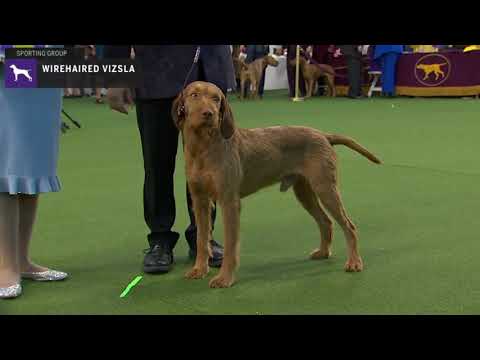
    Wirehaired Vizslas | Breed Judging 2020
    Wirehaired Vizslas | Breed Judging 2020

    Type and recognitions:

    • FCI CLASSIFICATION:
    • Group :
    • Section : . .

    Federations:

    • FCI – Group 7: Pointing Dogs. – Section 1: Continental Pointing Dogs. 1.1: Braque Type โ“˜
    • AKC – Group 1 (Sports) โ“˜
    • CKC – Group 1 (Sports) โ“˜
    • โ€‹KCGun Dog โ“˜
    • NZKCGun Dog Group โ“˜
    • UKCGun Dog Group โ“˜

    FCI breed standard "Hungarian Wire-haired Pointer"

    Origin:
    Hungary

    Date of publication of the valid original standard:
    06.04.2000

    Use:

    It is a dog that has repeatedly proven to be a utilitarian hunter.. Both in the field and in the forest, or in the water, has proven to be useful given the typical characteristics it has: highly developed sense of the trail, venteador firm, excellent conduct or behavior to bring the prey, indefatigable chaser of the trail even swimming due to its natural affinity with water. It is capable of surviving extreme weather conditions as well as in the most varied soils.. As a complete hunting dog, the fear of shooting or wild animals is a fault that manifests itself for example in the gathering of prey. Lack of affinity to water is also highly undesirable. Given its unproblematic nature and normal adaptability, It is an excellent dog to live with in the house.


    General appearance:

    It's a hunting dog, lively, dry looking, enjuto, whose structure is more robust than that of the Hungarian short-haired pointer. His image is the faithful reflection of a multifaceted dog and he is recognized for his perseverance., performance and humility.

    IMPORTANT PROPORTIONS

    โ€ข The length of the body is somewhat greater than the height at the withers.
    โ€ข The depth of the chest reaches a little less than half the height at the withers..
    โ€ข The snout is a little shorter than half the total length of the head.


    Behavior / temperament:

    It is a faithful dog, easy training and instruction, is self-confident. Does not admit abrupt or rude teaching. He always maintains contact with his guide, search with enthusiasm, is persevering, always available due to his good sense of smell. He remains noticeably in front of the guide.

    Head:

    ---

    Cranial region:
    • Skull : Moderately wide, gently domed, on the skull a delicate groove that runs from the moderate occiput to the stop. Supraorbital arches are moderately developed.
    • Depression links (stop) : Moderate.

    facial region:

    • Truffle : Wide and well developed nose, if possible with wide open nostrils. The truffle color harmonizes with the hair color in a shade a little darker than the coat.
    • Snout : Romo, not pointed, with powerful and heavily muscled jaws. The nasal helm is straight.
    • Belfos : Firms, adherents with nothing hanging.
    • Jaws/Teeth : Powerful jaws with a scissor bite, perfect, regular and complete. There should be no space between the upper and lower incisors The teeth are inserted more or less at right angles to the jaws, 42 healthy teeth and according to the dog's dental formula.
    • Cheeks : Powerful, good muscular.

    Eyes : Gently oval, medium-sized. The eyelids are well adherent to the eyeball. The look is lively and intelligent. The color of the eyes is brown and harmonizes with the color of the coat, preferred when the eyes are as dark as possible.

    Ears : Insertion slightly back and at medium height. The ear is thin and rests on the cheek, ending downwards in a rounded "V". Its length is approximately three-quarters of the length of the head.

    Neck:

    Medium length and in harmony with the whole of the dog. Very muscular and gently arched nape. Throat skin is firmly attached.

    Body:

    • Cross : Notorious and muscular.
    • Back : companies, well muscled, strong and straight. The bony apices of the vertebrae must be covered by musculature.
    • Pork loin : Short, width, strong, muscular, straight or gently arched. The passage from back to back is firm and compact.
    • Rump : Wide and long enough, it does not cut, gently descends towards the tail, well muscled.
    • Breast : deep and wide, with a moderately developed sill, well drawn and muscular. Sternum pushed back as far back as possible. The sternum and the elbow joints should be at the same height. Ribs moderately sprung. Back ribs with good reach up.
    • Bottom line and belly : Glides firmly back with a graceful, slightly tucked curve.

    Tail:

    Middle insertion. Strong at the start and tapering towards the tip. In countries where there is no formal ban on tail docking, it will be cut into a quarter of its length for hunting purposes. As long as it cannot be cut, reaches hock height. It is straight and its bearing is light saber. In motion the tail rises to the height of the horizontal. The tail should be covered with good, thick hair..

    Tips

    PREVIOUS MEMBERS : Seen from the front they are parallel. In profile they are seen straight to the ground and located well under the body. Good bone structure and strong muscles.

    • Shoulder : Long scapulae, ideally sloped back and flat. Elastic in movement. Dry and powerful muscles. Good angulation between the scapula and the arm.
    • Arm : As long as possible and well muscled.
    • Elbow : Next to the body, though not tight or turned in or out. Good angulation between arm and forearm.
    • Forearm : Long, straight, good muscular. Powerful bones, not heavy or rough.
    • Carpo : Dried, firm.
    • Metacarpus : Short, only with a very slight incline in your posture.
    • Front feet : Slightly oval, with fingers together and well arched ; strong brown nails. Strong pads, powerful, resistant and slate gray. The feet are kept parallel both in immobility and during movement.

    LATER MEMBERS : Viewed from behind they look straight and parallel. Good angulations. Strong bones.

    • Thigh : Long and well muscled. Good angulation between hip and femur.
    • Knee : Good angulation of the thigh with the leg.
    • Leg : Long, well muscled, fibrous. Its length is approximately equal to the length of the thigh. Good angulation between the leg and the metatarsal.
    • Hock : Strong, dry and stringy. Located relatively low.
    • Metatarsus : Straight, short and dry.
    • Rear feet : Same as forwards.

    Movement:

    His typical gait is a powerful, flowing trot., elegant and with good ground cover, with great rear propulsion and very good front extension. During the search in the field, a voluntary gallop is customary.. The back is firm and the topline remains straight., without loosening. The bearing is well upright. Pasuqueo is not desirable.

    Mantle

    SKIN: companies, adherent, without wrinkles. The skin must be well pigmented.

    Fur: wire, flat, was, thick and dull. The outer layer is 2 to 3 cm.. long. The inner fleece is dense, thickens and repels water. The contours of the dog should not be altered by the slightly longer coat. It should have hair that is as hard as possible and as thick as possible so that it protects it from inclement weather and prevents injuries.. The lower portions of the legs such as
    The underside of the chest and belly also have shorter hair., softer and somewhat thinner, The head and ears are covered by shorter and at the same time darker hair, although for this reason it is no less hard and dense.. The marked eyebrows further show the stop. This, added to the beard, underlines the energetic appearance of the face.. The beard is important, not too long (2 to 3 cm.), as hard as possible and on both sides of the snout. On both sides of the neck there are strands of hair that come together to form a โ€œVโ€.

    Color: Different shades of yellow seed. Ears may be a little darker, although staying within the coloration. Red colors are not desirable, browned, or very light tones.
    A small white spot on the chest or throat will not be considered fouls, provided that its diameter does not exceed 5 cm., nor will white markings on the fingers be considered faults.. The color of the lips and the edges of the eyelids harmonizes with the color of the nose


    Size and weight:

    Height to the cross:

    • Males: 58-64 cm..
    • females: 54-60 cm..

    It is unproductive to increase the height at the withers. A medium size is the goal. The set and the symmetry both in static and in movement are by far more important to the size measured in centimeters.


    Fouls:

    Any deviation from the aforementioned criteria is considered as a fault and the severity of this is considered to the degree of the deviation to the standard and its consequences on the health and well-being of the dog..

    FALTAS DESCALIFICANTES:

    โ€ข Aggressiveness or extreme shyness.
    โ€ข Any dog โ€‹โ€‹showing clear signs of physical or behavioral abnormalities.
    โ€ข Aggressive or fearful dog.
    โ€ข Notable deviation from the characteristics of their sex.
    โ€ข Atypical head
    โ€ข Spotted truffle
    โ€ข Hanging or slimy lips.
    โ€ข Upper or lower prognathism, deviated arch of the incisors and any other option that is not correct.
    โ€ข Missing one or more incisors and/or fangs and/or premolars (2-4) and / or molars (1-2); lack of more than two PM1, M3 will not be taken into account or considered. Teeth that are not visible, They will be considered as missing teeth.
    โ€ข Supernumerary teeth outside the tooth line.
    โ€ข Split palate, harelip.
    โ€ข Light yellow eyes, noticeably loose eyelids; ectropion, entropion, disksis (double lash line).
    โ€ข Excessive double chin.
    โ€ข Dewclaws.
    โ€ข Very serious offenses that prevent normal movement.
    โ€ข Fine fur, lack of inner fleece, Longhair, soft, silky,
    with locks, curly or woolly. Lack of tufts on the
    legs.
    โ€ข Dark brown or faded yellow, more than one color, color disappeared; white spot on the chest of more than 5 cm..
    โ€ข White feet.
    โ€ข Depigmentation of both the skin and the edges of the lips and eyelids.
    โ€ข More of 2 cm.. deviation of the maximum and minimum measurements.
    โ€ข Any weakness in an essential characteristic of character


    N.B.:
    • Males should have two normal-appearing testicles fully descended into the scrotum..
    • Only functionally and clinically healthy dogs, with the typical conformation of the breed, should be used for parenting.

    Source: F.C.I - International Cynological Federation

    Alternative names:

    1. Hungarian Wire-haired Pointer, Wirehaired Vizsla, Hungarian Wirehaired Vizsla, Drรณtszล‘rลฑ magyar vizsla (English).
    2. Braque hongrois ร  poil dur, (en hongrois : drรณtszล‘rลฑ magyar vizsla), Vizsla ร  Poil Dur (French).
    3. Drahthaariger Ungarischer Vorstehhund, (ungarisch Drรณtszล‘rลฑ magyar vizsla), Drahthaar Vizsla (German).
    4. Braco hรบngaro de pelo duro, (em hรบngaro: drรณtszล‘rลฑ magyar vizsla) (Portuguese).
    5. Vizsla hรบngaro de capa alambrada (espaรฑol).

    โ–ท The world of Pets: Dogs, cats, birds, reptiles, amphibians

    Slovakian Wirehaired Pointers
    Eslovaquia FCI 320 . Braque Type

    Slovakian Wirehaired Pointers

    The Slovakian Wirehaired Pointers in an obedient and easy to train dog.

    Content

    History

    The Slovakian Wirehaired Pointers is a relatively new breed. It dates back to the end of the decade of 1950, in Czechoslovakia after World War II and is believed to have been developed using the Weimaraner, the German Wirehaired Pointer and the Cesky Fousek.

    At any given time, the Slovaks who developed the breed asked the Club Weimaraner from Germany to recognize this dog under the name of Rough-haired Weimaraner, but the request was rejected.

    The resulting dog is a true wonder, that combines the talents of a hunting dog (on the plains, in the woods and in the water), a working dog and a companion dog. Adapts to all climates.

    Photo: Slovakian Wire-haired Pointing Dog by Ing. Urban Michal (breeders HP), Public domain, via Wikimedia Commons

    Physical characteristics

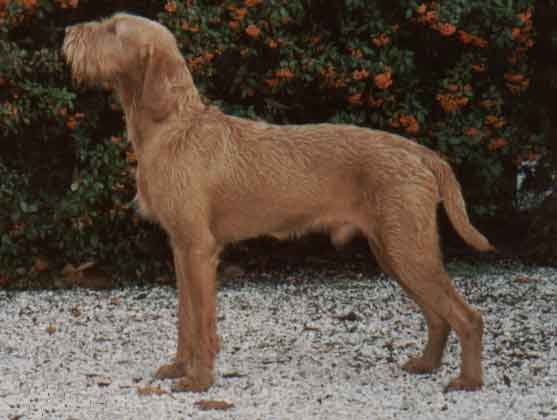
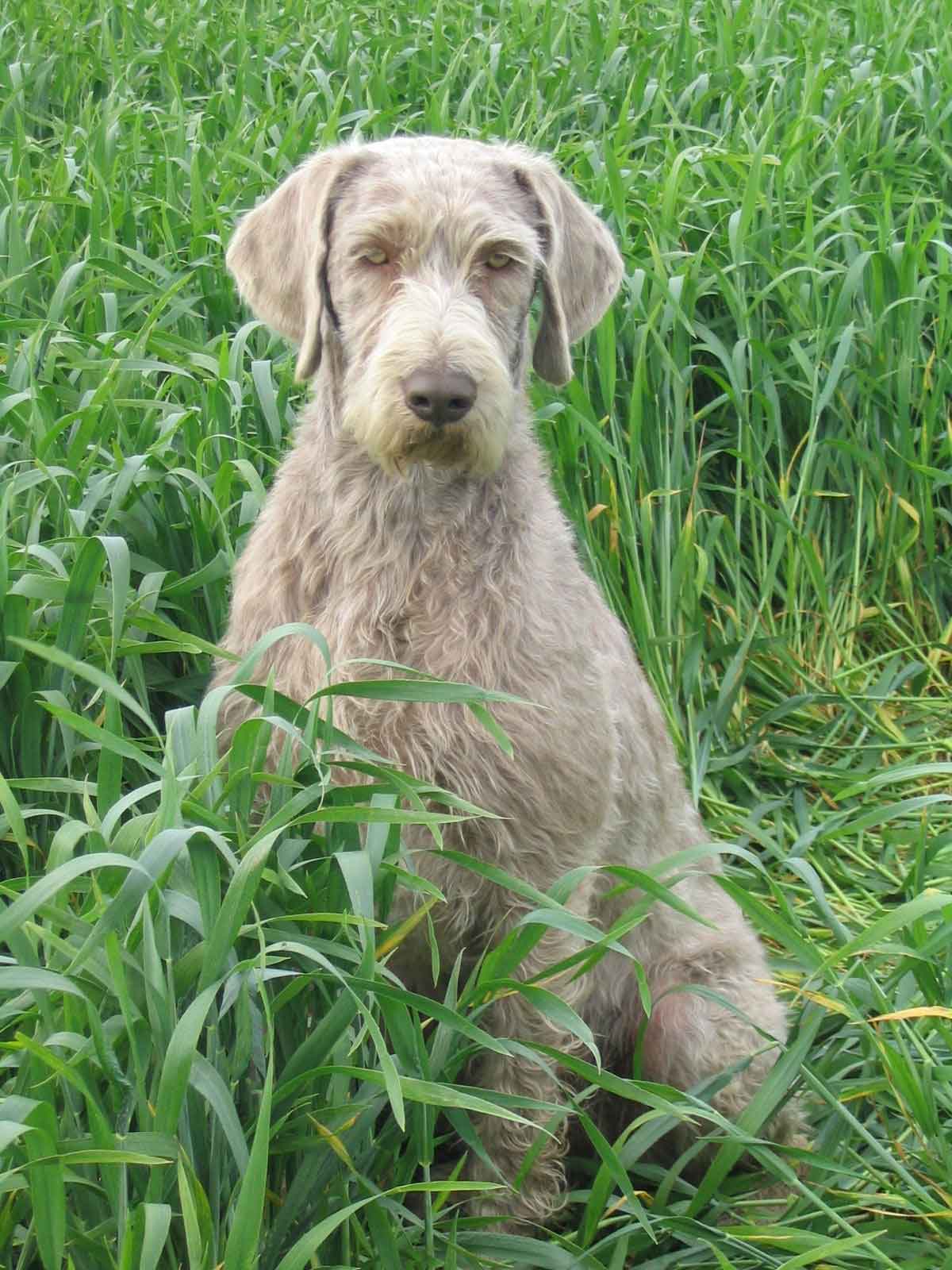
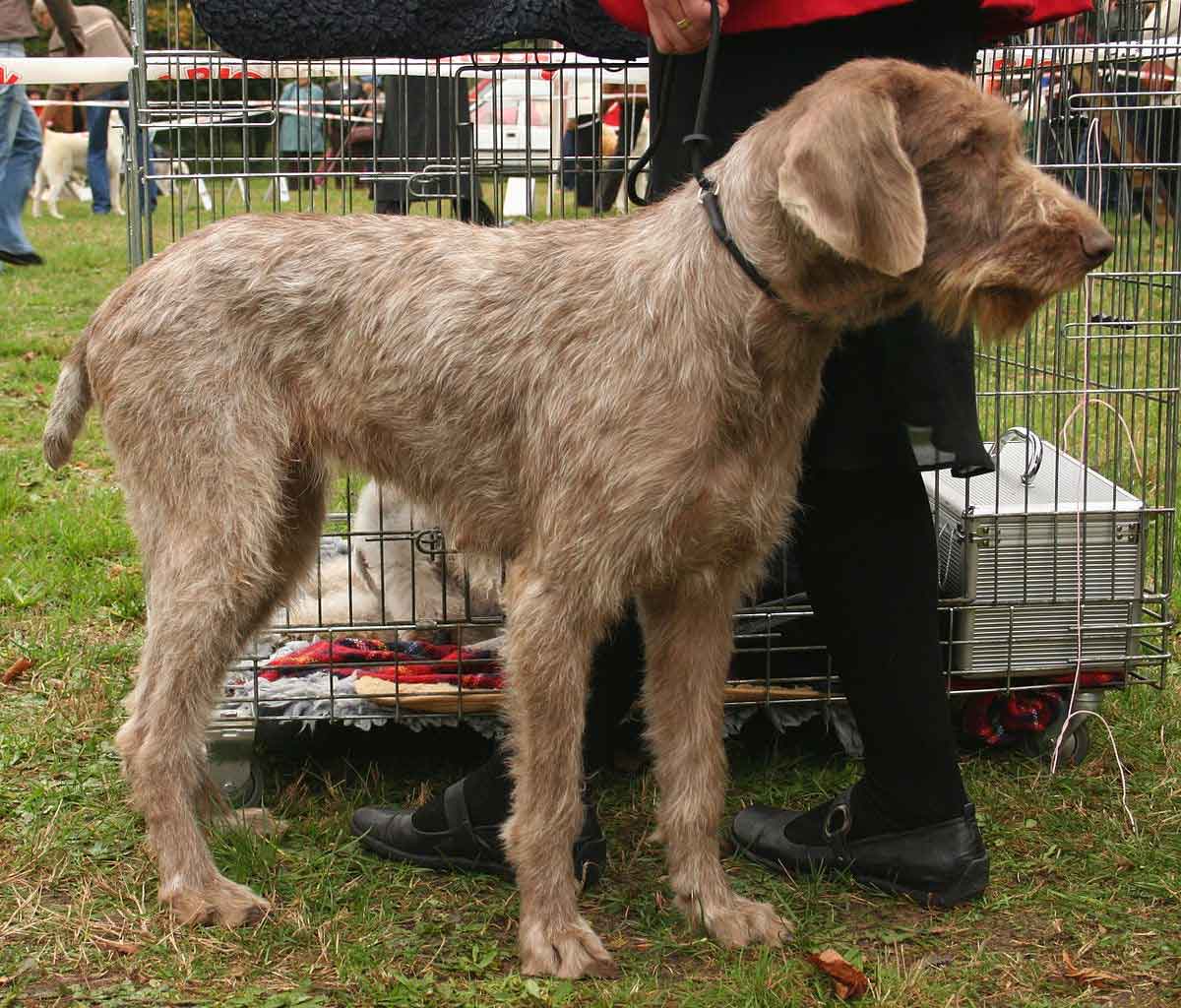
    The Slovakian Wirehaired Pointers it's a tall braco, solidly built and not too heavy. This breed is bred to be a working dog, with nobility in its forms. Tail is cut to half length when permitted by law. It stands rather high, worn at rest and in horizontal action. The eyes are almond-shaped, amber, with a clever expression. In puppies and young dogs, are blue. Dropped ears sit above the eye, they are rounded and not too long.

    Slovakian Wirehaired Pointers
    "Stilling hard hair" during the exhibition of dogs in Rybnik – Stone, Poland

    The undercoat consists of a short, fine down that normally falls off in summer. The top layer is about 4 cm long, hard, straight and well laid. At the bottom of the muzzle, hairs are longer and softer and form a mustache. above the eyes, are more pronounced and are obliquely erect. The forehead and occiput are covered with short, hard hair. They are short and soft on the ears. The tail is well provided with hair, but it is not brushed. The basic color is "gray": is a sand shaded with brown. White markings are allowed on the tips of the legs and on the chest. Smaller or larger dark spots can mark gray. There is also a speckled coat.

    Character and skills

    The Slovakian Wirehaired Pointers described in the FCI standard as easy to train and compliant. They are selected for their work characteristics as Pointer dogs. They hunt on the plains, forests and water. They work mainly after the shot, searching and recovering the game.

    The Slovakian Wirehaired Pointers it's animated, happy and eager to please. He has a lot of energy and is very intelligent., but gets bored easily. This can sometimes make training a bit difficult., and should work to make training sessions fun, interesting and not very long. They need a steady and consistent hand in disciplining with structure and limits.. Harsh words or physical punishment should be avoided. They have a strong bond with their families, and may develop separation anxiety without proper conditioning.

    the Slovakian Wirehaired Pointers they are the happiest doing things with their owner. This makes the breed a great candidate as a canine companion for owners who love walks., cycling or jogging. It is imperative that they have opportunities to run free, preferably in a fenced area, since his hunting instinct is very strong, and the dog will not be able to resist the urge to chase the prey.

    Health

    The Slovakian Wirehaired Pointers it is a generally healthy breed, and responsible breeders examine their breeders for health conditions such as elbow and hip dysplasia, progressive retinal atrophy and cataracts.

    Grooming

    The Slovakian Wirehaired Pointers requires only a minimum of grooming to maintain its good condition. Wiping them with a damp cloth is usually sufficient between baths.. Using a grooming glove or comb on your coat during the fall season can help keep the amount of hair shedding in your home down.. Toenails should be trimmed every four weeks. A dental care regimen should start at an early age to avoid problems later in life.

    Characteristics "Slovakian Wirehaired Pointers"

    Coexistence is important that you have with your new friend. Before considering the acquisition of a dog of the breed "Slovakian Wirehaired Pointers" you know certain factors. Not all breeds of dogs are apt to live in an apartment, you must take into account his character, their need for exercise, their interaction with other pets, their care and if you have small children, their level of tolerance towards them.

    Adaptation โ“˜

    4,0 of 5 stars (based on 1 review)

    friendly dog โ€‹โ€‹โ“˜

    4,0 of 5 stars (based on 1 review)

    hair loss โ“˜

    2,0 of 5 stars (based on 1 review)

    Affection level โ“˜

    2,0 of 5 stars (based on 1 review)

    Need for exercise โ“˜

    4,0 of 5 stars (based on 1 review)

    Social need โ“˜

    3,0 of 5 stars (based on 1 review)

    Home โ“˜

    3,0 of 5 stars (based on 1 review)

    Toilet โ“˜

    2,0 of 5 stars (based on 1 review)

    Friendly with strangers โ“˜

    3,0 of 5 stars (based on 1 review)

    barking โ“˜

    2,0 of 5 stars (based on 1 review)

    Health โ“˜

    4,0 of 5 stars (based on 1 review)

    Territorial โ“˜

    4,0 of 5 stars (based on 1 review)

    Cat friendly โ“˜

    2,0 of 5 stars (based on 1 review)

    Intelligence โ“˜

    4,0 of 5 stars (based on 1 review)

    Versatility โ“˜

    4,0 of 5 stars (based on 1 review)

    Child friendly โ“˜

    4,0 of 5 stars (based on 1 review)

    Surveillance โ“˜

    3,0 of 5 stars (based on 1 review)

    joy โ“˜

    5,0 of 5 stars (based on 1 review)

    Videos "Slovakian Wirehaired Pointers"

    Dog Breed Video: Slovakian Rough Haired Pointer
    Dog Breed Video: Slovakian Rough Haired Pointer
    Slovakian wire haired pointer - training
    Slovakian wire haired pointer – training

    Type and recognitions:

    • FCI CLASSIFICATION:
    • Group :
    • Section : . .

    Federations:

    • FCI – Group 7: Pointing Dogs. – Section 1: Continental Pointing Dogs. 1.1: Braque Type โ“˜
    • โ€‹KCgundog โ“˜
    • AKCGroup: Foundation Stock Service โ“˜

    FCI breed standard "Slovakian Wirehaired Pointers"

    Origin:
    Slovakia

    Date of publication of the valid original standard:
    06.01.1995

    Use:

    Pointing Dogs.


    General appearance:

    This is a moderate force animal. Although it is a working dog, His appearance is noble. The color of the outer hair of hairs is "gray" and the hair is hard. It must be suitable for work in plain, in the forest and in the water and especially for work after the shot, To search and bring wounded hunt. It is an obedient and easy to train dog.

    IMPORTANT PROPORTION :
    The correlation between the height to the cross and the length of the trunk must be 10:9 in males and 10:8 in females. This animal must be solidly constituted, But not coarse appearance.


    Behavior / temperament:

    It must be suitable for work in plain, in the forest and in the water and especially for work after the shot, To search and bring wounded hunt. It is an obedient and easy to train dog.

    Head:

    It's quite long, thin, No folds on the skin and keep proportion to the body.

    Cranial region:
    • Skull : It has a rectangular shape; Superciliar arcades must be pronounced; The front groove is visible. The occipital bump is palpable to touch.
    • Depression links (Stop) : Moderately inclined (about 45 ยฐ).

    facial region:

    • Truffle : Is large and dark. The Windows are wide open.
    • Snout : It has approximately the same length as the skull. Is high and wide. The nasal helm is straight.
    • Lips : Moderately developed. They are well glued and are dark.
    • Jaws / Teeth : Uniform and robust jaw. The teeth are well developed. The joint is in the form of scissors.

    Eyes : They have almond and are well sunk in the orbits. They are amber and intelligent expression. In puppies and young dogs are blue. The eyelids are dark.

    Ears : They are convenient length and inserted above the eye region. The root is wide and the tips are round.

    Neck:

    Is medium length, delgado, No folds on the skin. It is well muscular and is high in the region of La Cruz.

    Body:

    • top line: As a whole, The dog is very compact and rather bulky. The back is straight and the neck is inserted high. The dog wears the head up.
    • Cross : It is well pronounced and is well linked to the back.
    • Back : Straight, well muscled. Solid, very slightly inclined back.
    • Rump : Is wide and quite long, It is not too high or very oblique.
    • Breast : It is quite long and wide. It has oval shape and saves proportion with the rest of the body. Descend to the elbows. The ribs are well -tight and the plunder is well developed.
    • Belly and flanks : They are moderately retracted.

    Tail:

    It is moderately thick and rather high insertion. When the dog is at rest, carries it down and when it is in action, carries it in horizontal direction. The tail is very hairy, but not in the form of a brush. It is trimmed at half of its length.

    Tips

    PREVIOUS MEMBERS : As a whole, they are well developed. FRONT VIEWS THE PROFILE, They are approved.

    • Shoulder : Well developed and muscular. The shoulder blade is oblique.
    • Scapulo-Humeral angle : Is 110 ยฐ.
    • Elbow angle : It is 135 ยฐ. Steering : Vertical, thin and marked musculature.
    • Carpo : It is almost vertical : Quite thick, relatively short and almost vertical.
    • Front feet : They are round, the fingers are well together and arched. The nails and pads are dark. Internal fingers should be eliminated.

    LATER MEMBERS : Together and profile, They are well angled. Seen from the back, they are leaden.

    • Thighs : They are quite long, wide and well muscled.
    • Lame-femoral angle : From 80 ยฐ to 85 ยฐ
    • A fรฉmoro-Tibial-Tibial (knee) : Between 125 ยฐ and 130 ยฐ.
    • Leg : Wide, quite long and very muscular.
    • Hock angle : Between 125 ยฐ and 135 ยฐ.
    • Metatarsus : It is almost vertical.
    • Rear feet : They are round, the fingers are well together and arched. The nails and pads are dark. The spur must be eliminated.

    Movement:

    Is balanced and agile. During the work in the plain, The gallop dog.

    Mantle

    SKIN : It is not very thick. Is elastic and without folds. Its color is gray.

    HAIR : The inner hair is presented in the form of a short and fine hair. I usually change it during the summer. The outer hair of hairs measures some 4 cm.; Hair is hard, smooth and stuck. The hairs under the snout are longer and softer and form a beard. Above the eyes the hairs are more marked and are presented obliquely. The forehead and occipucio are covered with short and hard hair. They are short and soft about the ears. The tail is very thick.

    COLOR : Base color is chestnut shaded sand (It is called "Gray"), With lighter or darker varieties, With or without white marks on the limbs and chest. Also "gray" with more or less large spots and eventually mottled.


    Size and weight:

    Height to the cross : It is of 62 โ€“ 68 cm in males and 57 โ€“ 64 cm in females.


    Fouls:

    Any deviation from the aforementioned criteria is considered as a fault and the severity of this is considered to the degree of the deviation to the standard and its consequences on the health and well-being of the dog..

    SERIOUS FAULTS

    โ€ข Tough appearance and lack of elegance.
    โ€ข Head too big.
    โ€ข Very long or very thick ears.
    โ€ข Convex back.
    โ€ข Very long or silky hair.
    โ€ข Very short hair, No beard.
    โ€ข Too clear color, pulling Blancuzco.
    โ€ข Size too big or too small, Regarding the provisions of the standard.

    MISS PLAYOFFS

    Aggressive or fearful dog.
    All anatomical defects, such as upper or lower prognathism, entropion, ectropion, irregular position of the limbs.
    Any other base color other than the "gray" (Chestnut shaded sand color).
    Any dog โ€‹โ€‹showing clear signs of physical or behavioral abnormalities must be disqualified..


    N.B.:

    Males should have two normal-appearing testicles fully descended into the scrotum..

    Source: F.C.I - International Cynological Federation

    Alternative names:

    1. Slovak Rough-haired Pointer, Slovakian Wirehaired Pointer (English).
    2. (Nom d’origine : Slovensky Hrubosrsty Stavac), Griffon d’Arrรชt Slovaque ร  poil dur (French).
    3. SHS, Slovenskรฝ hrubosrstรฝ stavaฤ (German).
    4. Braco eslovaco de pรชlo duro, (em eslovaco: Slovenskรฝ hrubosrsty stavac) (Portuguese).
    5. Grifรณn de muestra eslovaco de pelo duro (espaรฑol).

    โ–ท The world of Pets: Dogs, cats, birds, reptiles, amphibians

    Ariรจge Pointer
    Francia FCI 177 . Braque Type

    Ariรจge Pointer

    The Ariรจge Pointer it is a quiet breed of dog, although sometimes stubborn, which is common among hunting dogs.

    Content

    History

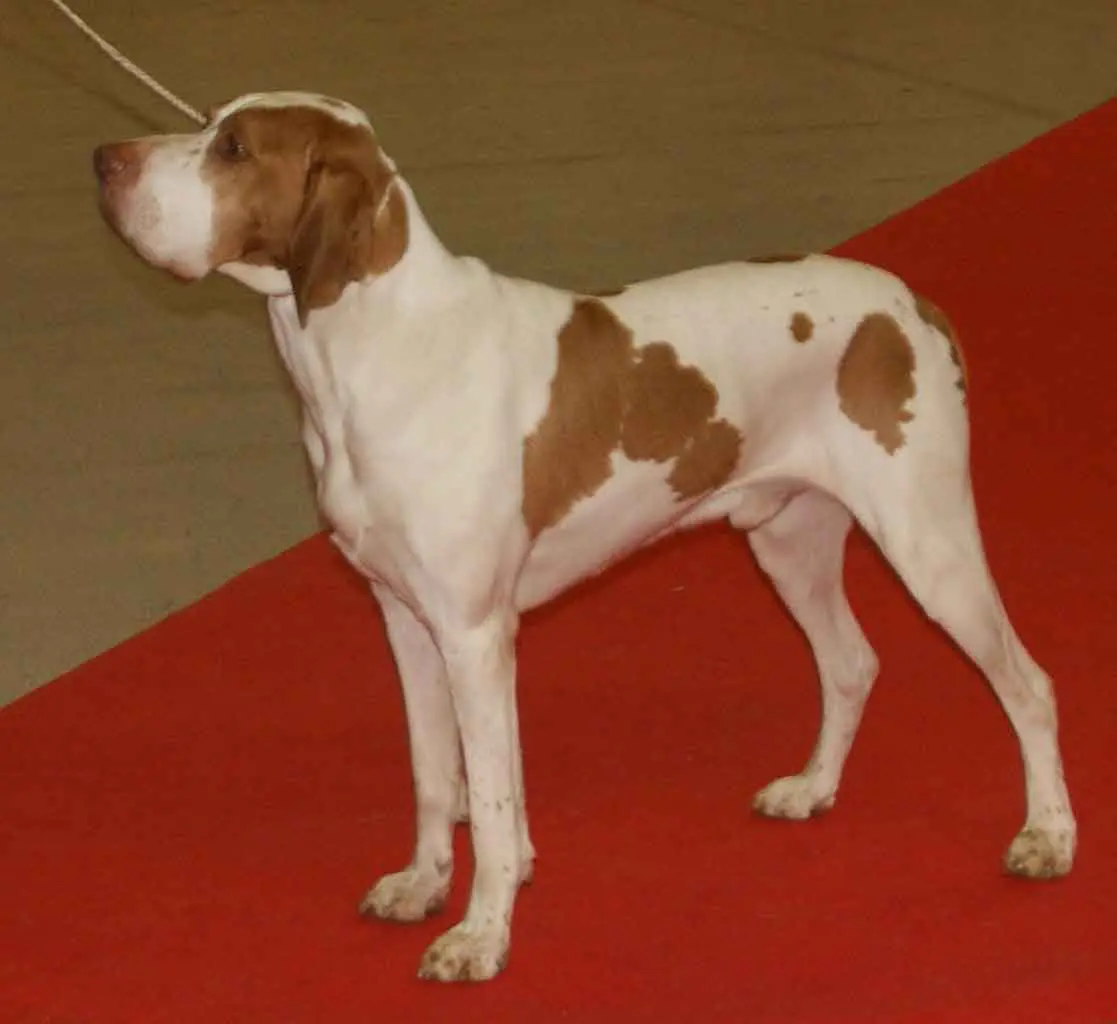
    The Ariรจge Pointer is a French dog breed that comes from, as its name implies, from the department of Ariรจge, located on the Franco-Spanish border.

    There are different theories about its origins.. But, the most common theory is that it descends from the ancient French Pointer, that was crossed in the 19th century with Braques of southern stock, with white and orange coats to give it more lightness and activity.

    It also, looks a lot like the white and orange dogs painted in Jean-Baptiste Oudry's paintings (1686-1755), famous for his paintings of hunting scenes. So, It does not seem illogical that cynologists have attributed this dog to him as an ancestor.

    Despite its official recognition by the F.C.I. (International Cynological Federation) in 1955, the second half of the twentieth century was almost fatal for the Ariรจge Pointer. But, some Ariรจge hunters continued to use it, which prevented the breed from completely disappearing.

    In 1989, a team of fans of the breed decided to dedicate themselves to its survival, after having noticed that there was no more Ariรจge Pointer registered in the LOF (French Origins Book) from 1964.

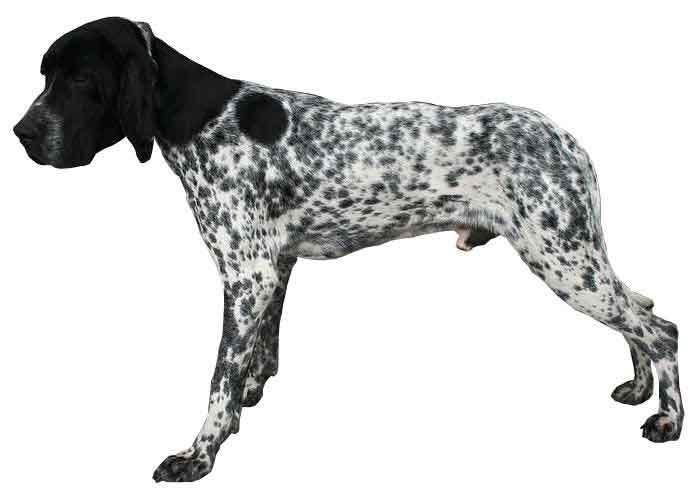
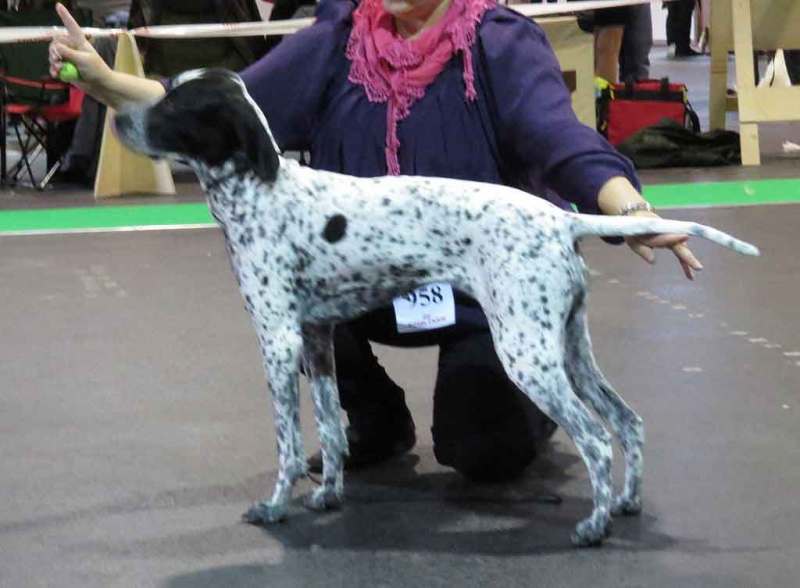
    The Club du Braque de lโ€™Ariรจge was thus created the following year, with the mission of contributing to the safeguarding and promotion of this breed, but also to centralize all the information that makes it possible to identify the specimens that would be found in France in the breeders, hunters or other fans of this dog.

    The operation was generally a success. Like this, the increase in births meant that in 1999, less than 10 years later, the symbolic milestone of the 50 Ariรจge Pointer listed in TFO. The trend has continued, since today there are more than 350 specimens in the LOF, many of whom have won prizes in beauty or hunting contests.

    However, the breed has spread relatively little outside its homeland, since most breeders and owners of the Ariรจge Pointer are located in the south-west of France, although there are also some scattered throughout the rest of the country.

    Internationally, the Ariรจge Pointer was officially recognized in 2006 by the UKC (United Kennel Club), one of the leading canine organizations in the United States. But, the UKC is an exception, since the other large national canine organizations do not yet recognize the breed. It's still very difficult, yes not impossible, acquire a Ariรจge Pointer outside france.

    Photo: Ariege Pointer, male. Colour: orange & white by Canarian, CC BY-SA 4.0, via Wikimedia Commons

    Physical characteristics

    Vigorous and powerful, the Ariรจge Pointer has a certain elegance. His musculature is prominent and harmonious, and its well drawn lines.

    Usually pale orange or brown fawn in color, there are also speckled white and trout. His great characteristic is that the color of his nose is more often in harmony with that of his fur..

    His hair is short and shiny and his head is long, angulosa, without a very pronounced stop.

    His tail is low and long, in contrast to his ears, that are thin and well placed above the eye line.

    Finally, the eyes of the Ariรจge Pointer they are oval shaped, dark amber or brown. Her frank and gentle eyes will easily seduce humans who cross her path.

    Character and skills

    The Ariรจge Pointer it is a quiet breed of dog, although sometimes stubborn, which is common among hunting dogs. He is also a very intelligent dog.

    Adapted to all types of hunting and considered one of the best hunting dogs that exist, thanks in particular to his excellent sense of smell, his great stamina and unerring determination, it is effective in all types of hunting and on all terrains.

    The Ariรจge Pointer it is also very resistant and adapts easily to all weather situations, though still more at home in the cold than in the tropics.

    Very sensitive and affectionate with his master and his relatives, is docile, Gentile, easy to train, and therefore it is an excellent pet.

    May be in contact with other animals, in any case congeners or other species of the same size, especially if you've gotten used to them from a young age as part of puppy socialization. On the other hand, its innate hunting instinct could lead it to attack small potential prey. So, it is better to avoid sharing your daily life with a rabbit, a rat or other game that awakens their deep stalker nature.

    It is also for this reason that it is recommended to keep it on a leash when in town. On the other hand, if your education is not lacking, it's conceivable – and even desirable – let it go when in the field, so it can be spent, as this is necessary for their physical and psychological well-being.

    In effect, the Ariรจge Pointer remains a lively, independent dog who needs daily exercise and is happy to take part in long walks or bike rides. It is a recommended breed of dog for an athletic owner, since you can't settle for a few relatively short outings to relieve yourself.

    They can live in the city, but only if they have a garden. The latter does not make it less necessary to offer him long walks, all days, ideally in the middle of nature. It also, if you live in the city, it is advisable to accustom it from a young age to crowds and traffic, for example to avoid encountering a dog that runs behind cars.

    Education

    The Ariรจge Pointer has an innate aptitude for hunting, but he still deserves to be educated as soon as possible to consolidate his knowledge and teach him the fundamental commands of hunting (stop, stand up, report…).

    Whether it is intended to be used as a working dog or simply as a companion dog, it is recommended to train it with patience and delicacy, since it is endowed with great sensitivity. If you don't, you risk getting upset and discouraged, and restoring trust between the owner and his animal is then a long and arduous task.

    In any case, either during your education or at any time after, the owner must be calm, attentive and balanced to curb the very dynamic burning of your partner.

    Health

    The Ariรจge Pointer he is a robust dog with an iron constitution and no particular pathology.

    Grooming

    A weekly brushing of the dog's coat is sufficient, since the Ariรจge Pointer does not need much maintenance.

    Having said that, like any hunting dog, the dog's ears should be systematically cleaned when he returns home, in order to remove any leaves or dirt that may have lodged there.

    This special attention to its ears is also valid if it is only used as a companion dog., since dog breeds with floppy ears are at higher risk of ear problems.

    Buy a ยซBraco del Ariรจgeยป

    The price of a puppy Ariรจge Pointer in a hatchery is between 600 and 800 EUR. There is generally no price difference between a male and a female.

    Characteristics "Ariรจge Pointer"

    Coexistence is important that you have with your new friend. Before considering the acquisition of a dog of the breed "Ariรจge Pointer" you know certain factors. Not all breeds of dogs are apt to live in an apartment, you must take into account his character, their need for exercise, their interaction with other pets, their care and if you have small children, their level of tolerance towards them.

    Adaptation โ“˜

    3,0 of 5 stars (based on 1 review)

    friendly dog โ€‹โ€‹โ“˜

    3,0 of 5 stars (based on 1 review)

    hair loss โ“˜

    2,0 of 5 stars (based on 1 review)

    Affection level โ“˜

    4,0 of 5 stars (based on 1 review)

    Need for exercise โ“˜

    4,0 of 5 stars (based on 1 review)

    Social need โ“˜

    3,0 of 5 stars (based on 1 review)

    Home โ“˜

    2,0 of 5 stars (based on 1 review)

    Toilet โ“˜

    1,0 of 5 stars (based on 1 review)

    Friendly with strangers โ“˜

    3,0 of 5 stars (based on 1 review)

    barking โ“˜

    3,0 of 5 stars (based on 1 review)

    Health โ“˜

    4,0 of 5 stars (based on 1 review)

    Territorial โ“˜

    4,0 of 5 stars (based on 1 review)

    Cat friendly โ“˜

    2,0 of 5 stars (based on 1 review)

    Intelligence โ“˜

    5,0 of 5 stars (based on 1 review)

    Versatility โ“˜

    4,0 of 5 stars (based on 1 review)

    Child friendly โ“˜

    2,0 of 5 stars (based on 1 review)

    Surveillance โ“˜

    2,0 of 5 stars (based on 1 review)

    joy โ“˜

    4,0 of 5 stars (based on 1 review)

    Videos "Ariรจge Pointer"

    Braque de l'Ariรจge
    Braque de l’Ariรจge
    Braque de l'Ariรจge
    Braque de l’Ariรจge

    Type and recognitions:

    • FCI CLASSIFICATION:
    • Group :
    • Section : . .

    Federations:

    • FCI – Group 7: Pointing Dogs. – Section 1: Continental Pointing Dogs. 1.1: Braque Type โ“˜
    • UKCGun Dog โ“˜

    FCI breed standard "Ariรจge Pointer"

    Origin:
    France

    Date of publication of the valid original standard:
    24.01.1996

    Use:

    Pointing Dogs.


    General appearance:

    Of type ยซ Braco ยป, He is robust and powerfully built., although without the appearance of excessive heaviness. His appearance is vigorous. The most appreciated specimens are those with thin limbs, prominent muscles and well-defined lines. Its white fur, preferably splashed with pale orange or sometimes speckled with chestnut, Together with its size, it makes it an elegant and distinguished dog..

    IMPORTANT PROPORTIONS :

    Of medium proportions; the length of the body is slightly greater than the height at the withers. The skull is slightly longer than the nasal shank.


    Behavior / temperament:

    Adapts to all types of hunting; it is resistant, docile and easy to educate.

    Head:

    It must be long, angular and narrow in the region of the zygomatic arches.

    Cranial region:
    • Skull : It is slightly domed; the frontal furrow is not very pronounced. The upper lines of the skull and the nasal cannula are slightly divergent forward.. The superciliary arches are moderately accentuated. The occipital protuberance is quite pronounced.
    • Depression links (stop) : Little pointed.

    facial region:

    • Truffle : It's pink, flesh-colored or more or less pale brown, according to fur color; never black. The Windows are wide open.
    • Snout : Long, straight nose cane, sometimes very slightly convex. Front views, the lateral faces of the snout converge slightly forward.
    • Lips : They are quite thin and well descended; the commissure is quite folded without falling down.
    • Jaws / Teeth : The dental arches are well adapted. The articulation of the incisors is scissor-shaped; dental is accepted- hard clamp-shaped (the incisors on top of each other).

    Eyes : The look is sweet, frank and intelligent. Wide open, The eyes are slightly oval and well set in the orbits.. The iris is a dark amber or chestnut color, according to coat color.

    Ears : They are quite thin, long and crooked. They are inserted at or below the eye line.; They are not attached to the head. Their length allows them to reach the birth of the nose without having to stretch them.

    Neck:

    It's not very long, but quite thick and has a slight dewlap.

    Body:

    • top line : The anterior part is almost rectilinear and descends from the withers to the eleventh dorsal vertebra. The second part, slightly convex, join the group.
    • Cross : It is well marked without being protruding.
    • Back : a little long, muscular, solid and straight.
    • Pork loin : Slightly convex.
    • Rump : Slightly oblique in relation to the top line.
    • Breast : It is broad, high and deep to the plane of the elbows. The ribs are rounded, but without exaggeration.
    • bottom line : Slightly oblique and somewhat raised in the abdominal part.

    Tail:

    Its insertion is located in the extension of the line of the rump. It is thick at the base and gradually tapers. They are usually cut 4/10. Long tail accepted. When raised it should not exceed the top line.

    Tips

    PREVIOUS MEMBERS : They are straight, for strong bones, wide and muscular.

    • Shoulder : Muscular, robust and moderately oblique.
    • Arms : Strong, well muscled and close to the chest.
    • Elbows : They are located in the plane of the sternum.
    • forearms : Vigorous and well poised.
    • Metacarpus : Seen in profile, they are slightly inclined.
    • Front feet : Together, well arched, forming a compact set, almost round. The nails are strong and the pads are very fleshy..

    LATER MEMBERS : They are well poised.

    • Thighs : Well muscled and lowered.
    • Knee : Well parallel to the median plane of the body.
    • Leg : Robust.
    • Hock : Well layered.
    • Metatarsus : Pretty short, almost vertical.
    • Rear feet : They have the same characteristics as the front feet.

    Movement:

    Tireless and agile trot, interrupted by periods of gallop. Movements are loose and light.

    Mantle

    SKIN : It is not very thick and is quite elastic. It is thinner on the head. The external mucous membranes must be of a color that corresponds to the color of the coat; They should never have black spots.

    HAIR : It's tight, bright, short, thinner and satin over the head and ears.

    COLOR : Pale orange fawn, or sometimes brown. Has many mottled or speckled white patches. Some dogs are even white with spots.


    Size and weight:

    Height to the cross : In males it is 60 to 67 cm., and in females is of 56 to 65 cm..


    Fouls:

    Any deviation from the aforementioned criteria is considered as a fault and the severity of this is considered to the degree of the deviation to the standard and its consequences on the health and well-being of the dog..

    MISS PLAYOFFS : Taking into account the reduced heritage of this breed, the purpose is not to show too much severity, but discard from reproduction the specimens that do not correspond to the type and those that have serious faults.

    โ€ข Aggressive dogs, biting or too fearful.
    โ€ข Total absence of the typical characteristics of the breed.
    โ€ข Double nose (dogs whose windows are separated by a deep groove).
    โ€ข Nose of a color that does not correspond to what is established by the standard.
    โ€ข Black nose.
    โ€ข Inferior or superior prognathism.
    โ€ข Eyes : excessively light or different color.
    โ€ข Entropion or ectropion, or any trace of surgical intervention to correct this defect.
    โ€ข Excess depigmentation on the eyelids.
    โ€ข Black nails.
    โ€ข Dewclaws.
    โ€ข Hind limbs: clearly observable difficulty in movements.
    โ€ข Color that does not correspond to what is established by the standard.
    โ€ข Size that deviates from the limits of the standard, with a tolerance of 1 cm more or less.
    โ€ข Serious morphological anomalies.
    โ€ข Defects that cause disability.

    Any dog โ€‹โ€‹showing clear signs of physical or behavioral abnormalities must be disqualified..


    N.B.:

    Males should have two normal-appearing testicles fully descended into the scrotum..

    Source: F.C.I - International Cynological Federation

    Alternative names:

    1. Ariรจge Pointer, Ariege Pointing Dog (English).
    2. Braque de l’Ariรจge, braque de Toulouse, braque du Midi (French).
    3. Ariรจge-Vorstehhund, Braque de lโ€™Ariรจge (German).
    4. (em francรชs: Braque de l’Ariรจge) (Portuguese).
    5. Braco de Ariรจge (espaรฑol).

    โ–ท The world of Pets: Dogs, cats, birds, reptiles, amphibians

    Auvergne Pointer
    Francia FCI 180 . Braque Type

    Auvergne Pointer

    Even today, the Auvergne Pointer is most often bred to become a hunting dog.

    Content

    History

    The precise origins of the Auvergne Pointer are not clearly determined. This dog has been around for many years and was most likely developed in Auvergne, more precisely in the Cantal region, in central France.

    Already in the seventeenth century, to satisfy your needs, French hunters tried to cross and develop short, smooth-haired Pointer breeds, commonly known as ยซpointersยป (the term "pointerยปIt comes from the vocabulary of hunting and means" aim ").

    The Braque Francais is considered his ancestor, but its own origins are uncertain. In any case, It has been proven that it was the origin of the development of different races of Braques developed in all regions of the country, some of which gained in popularity, as the French Pointing Dog - Gascogne type or the French Pointing Dog - Pyrenean type . In Cantal, selective breeding gave rise to Auvergne Pointer.

    According to some historians, the Auvergne Pointer is one of the oldest, with the exception of his own Braque Francais. But, contradictory assumptions have been made about it.

    According to Jean Servier, former president of the Club of French braques and author of the World Dog Encyclopedia 1971, it is a cross between the Braque Francais, the Gascony type French Pointer and the Pyrenees French Pointer.

    On the other hand, according to David Hancock, historian of dog breeds and author of the book The Heritage of the Dog, published in 1990, it is said to come from an imported breed when the Knights of the Order of Malta passed through Auvergne in the 16th century. The soldiers there developed a dog near the Auvergne Pointer, which is said to descend. There is no consensus on this hypothesis, but nevertheless it is accepted by certain organizations such as the Rรฉunion des Amateurs du Braque d’Auvergne (RABA), the official breed club created in 1913.

    Although the origins of Auvergne Pointer remain relatively unclear, In any case, most specialists agree that its development dates back to the beginning of the 18th century..

    In the early 20th century, almost every, If not all, the Auvergne Pointer they were in france. The breed was relatively rare, although among their owners they were highly appreciated for their hunting qualities, especially for game birds. In fact, the breeding work that led to its development gave it an excellent style and great resistance, allowing you to follow long tracks in forests or dense vegetated terrain. They are also versatile: are able to get, track back, aim and bring the hunt back to its master. So, they can replace several specialized dogs in a particular area on their own. Perhaps its main flaw is its rather slow pace, meaning it works closely with its owner rather than independently, running from one side to the other. This does not take away from the hunting qualities that made it popular in France throughout the 19th century., as well as in the decades leading up to World War II.

    During World War II, like many french breeds, the Auvergne Pointer was threatened with extinction. In effect, the conflicts and the occupation of part of the French territory by Germany wreaked havoc on the canine population: many of their representatives were killed or abandoned when their owners no longer had the resources to care for them.

    But, at the end of hostilities, an enthusiast, Andrรฉ de Tournay, managed to locate a little more than 20 specimens in different parts of the country. They were at the origin of various bloodlines and therefore played an essential role in the renewal of the breed..

    The postwar rebirth of the breed by Mr.. de Tournay led to his recognition in 1955 by the Fรฉdรฉration Cynologique Internationale (FCI), that coordinates the official organizations of more than one hundred countries – among them the Sociรฉtรฉ Royale Saint-Hubert (SRSH) Belgian, the Swiss Kennel Club (SCS) y the Sociรฉtรฉ Centrale Canine (SCC) french. But, the latter had taken the initiative to recognize the Auvergne Braque already in 1913.

    The prestigious and influential British Kennel Club took much longer to do the same, since he had to wait until 2016.

    In 1987, a first article on this breed of dog was published in the American magazine Gun Dog Magazine. But, we don't know exactly when the first ones were imported Auvergne Pointer to the United States. In any case, they were probably delayed and limited in number. In 2016, a new article was published in the same magazine on the investigation of the origins of the establishment of this dog in the country, after fans surveyed Nelson Hooe, one of the first verified owners in the country.

    In any case, the recognition of Auvergne Pointer in North America is still incomplete. Has been recognized by the United Kennel Club (UKC) from 2006, as well as by the Canadian Kennel Club (CKC), but it is not the case of the other reference organization in the United States, the American Kennel Club (AKC).

    Photo: Braque_d’auvergne at the World Dog Show in Poznaล„ by Pleple2000, CC BY-SA 3.0, via Wikimedia Commons

    Popularity

    In France, the popularity of Auvergne Pointer is relatively stable in the long term, and has been at least since the early 1990s. 1970: there are around of 350 entries per year in the French Origin Book (LOF). This number sometimes peaks at around 500 births per year, how was the case, for example, in the mid 70. On the other hand, has never durably fallen below 250.

    Although the Auvergne Pointer is relatively popular in his home country, it has only been exported and distributed to some extent outside of France, even in countries bordering France.

    In Switzerland, for example, the statistics of the Amicus database show that its population is limited to about thirty individuals.

    In Belgium, it is just as discreet, as evidenced by the absence of breeding on the national soil.

    The same observation can be made, for example, in Italy, where the statistics of the Ente Nazionale della Cinofilia Italiana (ENCI) show an average of about ten registrations per year during 2010, or again in Spain, where the Royal Canine Society of Spain (RSCE) only count one birth between 2014 and 2019.

    There are a handful of farms in Canada and the United States, but the Auvergne Pointer also still hard to find in those countries.

    Physical characteristics

    The Auvergne Pointer has a robust and noble appearance. His shapely body is well aligned, with a straight constitution – your back, from the tip of the shoulder to the tip of the buttock, is the same length as its front legs – and a long chest that descends to elbow level, midway between the withers and the lower part of the front legs. It is robust, strong but without heaviness, which gives it an elegant look. Their solid constitution gives them the stride and the resistance for which they are highly appreciated in hunting..

    Both the front and back legs are straight, well aligned with the body, and the thighs and forearms are well muscled.

    The tail stands quite high, carried horizontally and reaches the point of the hock. It can also be shortened at birth, and then barely exceeds 15 to 20 cm.. But, this practice, llamada ยซtail dockingยป, It is banned in many countries, including France, Belgium, Switzerland and Quebec.

    The head of the Auvergne Pointer is well balanced. Seen from the front, the muzzle is square and its length is equal to or slightly less than that of the skull. Finish off with a pretty strong black nose, which dominates the solid jaws of equal length. It also, the upper lip covers the lower.

    Positioned slightly toward the back of the skull, the ears are droopy, flexible and with a slightly satin texture.

    The eyes are dark hazel, oval and quite large. They give this dog an expressive look, frank and gentle.

    The fur of Auvergne Pointer consists of a sparse undercoat and short, smooth topcoat with a glossy appearance that is softer than other Braques. It is mottled black or grayish white, more or less present. The head is black, but the muzzle may have the same white markings as the body – a white border may also be present on the top of the skull, prolonging the color of the muzzle. Black fur can also tend to be blue, which is why these dogs are rarely called Auvergne Pointer blue.

    There are also charcoal-colored dogs. But, this variety is rare and is not recognized by the breed standard.

    Sexual dimorphism is not very pronounced in these dogs: the male is certainly on average a few centimeters taller than the female, but it's not particularly massive.

    Character and skills

    Even today, the Auvergne Pointer is most often bred to become a hunting dog. But, his affectionate character, Gentile, patient and smart also makes them great pets, and they are becoming more and more popular as such. In fact, fit perfectly into family life, they usually try to please their humans and are very loyal to them.

    They are especially fond of children of all ages and are affectionate and playful provided they are not excessively boisterous. But, it should never be forgotten that a dog of any breed should never be left alone with a small child without adult supervision.

    The downside of being so close to your family is that you cannot tolerate loneliness and need to be in the company of humans as often as possible.. If left alone for too long, can become a destructive or particularly loud reminder of your presence. No need to say, therefore, which does not suit people who are away for whole days or more. The close bond he has with his teachers also makes him very sensitive to reprimands and he is easily affected by possible punishments..

    It is not only the humans in his family that he Auvergne Pointer inclines to appreciate. In effect, even if at first sight he is shy with strangers, quickly treats them like new friends, especially since it is totally devoid of aggression. Ready to greet newcomers with affection, may even tend to follow an intruder instead of defending your home or territory, which makes him a poor caretaker. But, is very capable of sounding the alarm when he hears something unusual.

    In any case, He is not one of those who barks from morning to night, expressing yourself only when you have a good reason to do so: to raise the alarm, to express boredom, to seek attention, or to express any anxiety.

    Sharing your home with a partner is a great way to reduce the risk of you suffering from the absence of your masters. In fact, such cohabitation generally goes very well, and he appreciates not living alone.
    On the other hand, his hunting instinct is too ingrained in him to consider the possibility of peacefully cohabiting with another pet smaller than himself, like a bird, a rodent or even a cat: unless you were raised with him from a young age, chances are good that one day or another I'll end up attacking him. This character trait also means that he is best kept on a leash when going out to places where he is very likely to meet small animals., and where it would be dangerous for him to pursue them.

    This is all the more true as it does not lack energy, to the point that you need to spend at least an hour a day to be well on your legs and on your head. Your resistance, However, allows you to go much further, since it is capable of chasing a prey for miles. So, it is ideal to plan long walks that include times when you can run freely and safely, especially if you don't have a chance to hunt. In any case, this dog is perfectly suitable for an active owner who likes to jog, cycling or hiking, and he would like nothing more than to take his pet with him – provided that it is kept on a leash when necessary.

    Another great way to allow him to expend his energy is to train him for one or more dog sports.. Their intelligence and willingness to cooperate are particularly well expressed in agility and obedience tests.. More broadly, imply that it is quite easy to train him for all kinds of activities and teach him different tasks.

    By the way, if your pilgrimages take you to pass near a water space where you can swim safely, She loves water – he is even a good swimmer – and generally appreciates taking a dip as soon as you get a chance to.

    In any case, its high level of activity makes apartment living unsuitable for the Auvergne Pointer. Even a house with a small yard probably wouldn't be enough to make him happy.: the ideal environment for him is clearly a house with a large fenced garden, although this cannot replace long daily walks to satisfy your need for exercise.

    Education

    The Auvergne Pointer is known for his intelligence and the sweetness of his temperament. He is also eager to please his owners, so it reacts positively to training: learns quickly and is generally an easy dog รขโ‚ฌโ€นรขโ‚ฌโ€นto train.

    But, it is important to use the right methods. In fact, its sensitivity means that the use of coercion or even punishment is strongly discouraged: would have every chance of undermining the trust that you normally place in your beloved master. On the other hand, positive dog training methods, based on repetition, the gratification and rewards, are very effective in taking full advantage of the great potential of this animal.

    In fact, its obedient and cooperative nature makes it not difficult to train it for hunting, sports with dogs or any other task. This is all the more true since he is always happy to share activities with his master: unlike many races, prefers to work in complicity with his master rather than independently. So, It is an ideal option for those who like to spend time educating their partner and working alongside him, whether for hunting or dog sports. These may include, is an excellent candidate for agility and obedience competitions. Your sense of smell can also be used to track events, but its relatively slow speed limits its potential in this area.

    For things to run smoothly, it is important to establish rules at an early age about what you are and are not allowed to do. They are not particularly stubborn by nature, and in fact they are quite obedient, but they can also do it when they are more flexible and responsive: this will make it easier and faster for them to assimilate the rules. It also, assimilates them more easily because they are the same from one day to the next and between the different people in the house: It is not a question of the gentleman authorizing today what the lady forbade the day before.

    It also, teaching your dog to stay alone should be one of the priorities in the education of a Auvergne Pointer. In effect, as he likes company and is prone to separation anxiety, must get used to enduring absences from his family without reaching a state of discomfort.

    It is also beneficial to start learning to call back soon, so that it can be allowed to unleash when conditions permit, limiting the risk of becoming deaf to his master's commands when he sees or smells a small passing animal.

    You also have to be careful to quickly channel your tendency to chew what is within your reach., directing him to the right toys. This avoids the risk of damage and injury to the animal.

    Finally, like any dog, we must not wait to offer you quality socialization from your first months. By letting you meet all kinds of humans, congeners and representatives of other species, but also face a multitude of different situations in various places, we make it a comfortable companion in all circumstances, performed in its environment and among humans.

    Health

    The Auvergne Pointer is generally a robust dog with few health problems. Your life expectancy of 12 to 15 years is quite honorable given its size.

    It also, they are quite flexible in terms of weather, able to cope with both the summer heat and the winter cold of temperate or Mediterranean climates. If you are required to sleep outside when temperatures are low, a niche is necessary to provide shelter. In any case, their fur is not adapted to polar temperatures.

    But, like any dog, are more prone to certain diseases, which in this case are :

  • hip dysplasia, whose appearance may be favored by a hereditary predisposition, and that corresponds to a malformation of this joint. Leads to pain, lameness and osteoarthritis when the animal ages;
  • dislocation of the patella, which is a malformation of the knee joint that causes the kneecap to slip out of position. Probably hereditary, causes a more or less severe limp. May require surgery in the most severe cases, although success is not guaranteed;
  • aortic stenosis, a potentially hereditary heart defect manifested by reduced blood flow. Leads to heart failure, that can manifest, for example, in a state of general weakness, and also increases the risk of heart attack. Not curable, but medications can reduce the effects of heart failure;
  • progressive retinal atrophy, which corresponds to a degeneration of the retina and is of hereditary origin. It affects both eyes and causes a progressive loss of vision in the dog;
  • Dilation-torsion of the stomach, which mainly affects breeds with a large chest and occurs when the stomach folds in on itself, blocking the evacuation of gases and interrupting blood circulation. It is fatal if a vet does not intervene quickly;
  • otitis, an ear infection favored by the pendulous shape of the ears.
  • Since a certain number of the conditions to which the breed is predisposed are or may be of hereditary origin, adopting a quality breeder from Auvergne Pointer can be a determining factor in obtaining a healthy puppy, and one that continues to be, in addition to having been well socialized from his first weeks. In effect, a professional worthy of the name sees to it that genetic tests are carried out systematically on his breeding stock, to rule out those who run the risk of transmitting this or that inherited condition to their offspring. So, must be able to present the results of these tests, as well as the health history of the dog, that attests to the vaccinations administered and that is useful for planning the next ones to be carried out, as well as withdrawals. At the same time, a certificate drawn up by a veterinarian attests to the good health of the animal at the time of adoption.

    Once the adoption is complete, it is important that the new owner respect the growth of his protรฉgรฉ: until it reaches adult size, what happens around two years of age, you should avoid intense physical exertion or excessively strenuous and prolonged exercises. This reduces both the risk of short-term injuries and that of sequelae or deformation of the bones or joints., which are particularly fragile during this period.

    Last, one way to keep your dog in good health is to take him to the vet regularly for a full checkup – At least once a year, and even more when he gets older. This will help prevent or detect potential health problems as soon as possible., as well as provide the opportunity to reinforce your dog's vaccinations.

    It is also important not to neglect the protection against fleas, worms, ticks and other undesirable pests, renewing your child's antiparasitic treatments throughout the year, whenever necessary. This is especially crucial for an individual who spends a lot of time, either hunting or in other activities.

    Grooming

    As his undercoat is not very thick and his top coat is short, the fur of the Auvergne Pointer requires little maintenance: a short brushing session with a soft bristle brush once a week is enough to keep you healthy, shiny and soft to the touch, especially since your hair loss is not very pronounced.

    During moulting periods, in spring and autumn, it is much more pronounced, so more frequent brushing is necessary. But, 2 or 3 times a week should be enough. After brushing it, the coat can be buffed with a clean soft cloth to make it even brighter.

    It is neither necessary nor advisable to bathe your dog too often: 3 or 4 times a year is usually more than enough, unless, Of course, that has gotten very dirty. In any case, you should always use a shampoo intended for dogs.

    Dangling ears require more attention, since their shape makes them prone to ear infections. So, it is important to examine them weekly and wipe them with a clean, slightly damp cloth to avoid the risk of infection.

    Your eyes need some attention too. The weekly maintenance session should be an opportunity to examine them, and wipe them gently with a damp cloth if there is dirt.

    Looking at its claws, regular physical activity that satisfies your need for fairly high levels of activity will usually allow you to smooth them out naturally. But, this does not mean that you should not check from time to time that this is the case. On the other hand, if your age or a health problem prevents you from being active enough, they generally need to be trimmed every 6 u 8 weeks to avoid being too long and bothering you, or even breaking and injuring you.

    The first time, a visit to a professional groomer can be a good way to learn how to care for a Auvergne Pointer, in order to operate efficiently and safely, while limiting the risks of hurting you. For its part, you will be calmer and more cooperative during care if it is part of your daily routine from a very young age: therefore, it is recommended to expose it to delicate handling from an early age.

    This is all the more true since it is also wise to get used to examining it after every long time spent outdoors. (especially after a hunting trip, for example), to detect possible injuries, thorns, parasites, spikes…

    Buy a "Braco de Auvernia"

    Either male or female, the price of a puppy Auvergne Pointer is generally between 650 and 1100 EUR. The average is about 800 EUR, no significant differences between males and females.

    But, it is difficult to find it outside of its country of origin, France, even in countries bordering on the latter.
    The same is true in North America, although there are a handful of breeders in Canada and the United States.

    The import from France is, therefore, sometimes the most suitable solution to avoid possible waiting times and have a maximum of choice. But, It must be taken into account that various expenses are added to the purchase price of the puppy: transportation expenses, administrative expenses, etc. It also, it is necessary, of course, make sure you know and respect the regulations regarding the importation of a dog from abroad.

    In any case, whatever the place, the price charged varies according to the prestige of the breeding, the lineage the animal came from, but also and above all its intrinsic characteristics, in particular its greater or lesser conformity with the norm. This last point also explains why there are sometimes significant differences within the same litter..

    Characteristics "Auvergne Pointer"

    Coexistence is important that you have with your new friend. Before considering the acquisition of a dog of the breed "Auvergne Pointer" you know certain factors. Not all breeds of dogs are apt to live in an apartment, you must take into account his character, their need for exercise, their interaction with other pets, their care and if you have small children, their level of tolerance towards them.

    Adaptation โ“˜

    3,0 of 5 stars (based on 1 review)

    friendly dog โ€‹โ€‹โ“˜

    4,0 of 5 stars (based on 1 review)

    hair loss โ“˜

    2,0 of 5 stars (based on 1 review)

    Affection level โ“˜

    4,0 of 5 stars (based on 1 review)

    Need for exercise โ“˜

    5,0 of 5 stars (based on 1 review)

    Social need โ“˜

    4,0 of 5 stars (based on 1 review)

    Home โ“˜

    3,0 of 5 stars (based on 1 review)

    Toilet โ“˜

    1,0 of 5 stars (based on 1 review)

    Friendly with strangers โ“˜

    4,0 of 5 stars (based on 1 review)

    barking โ“˜

    3,0 of 5 stars (based on 1 review)

    Health โ“˜

    4,0 of 5 stars (based on 1 review)

    Territorial โ“˜

    4,0 of 5 stars (based on 1 review)

    Cat friendly โ“˜

    2,0 of 5 stars (based on 1 review)

    Intelligence โ“˜

    4,0 of 5 stars (based on 1 review)

    Versatility โ“˜

    4,0 of 5 stars (based on 1 review)

    Child friendly โ“˜

    4,0 of 5 stars (based on 1 review)

    Surveillance โ“˜

    3,0 of 5 stars (based on 1 review)

    joy โ“˜

    4,0 of 5 stars (based on 1 review)

    Images "Auvergne Pointer"

    Photos:

    1 – Braque d’Auvergne sur fond blanc by Desaix83, d'aprรจs le travail de Pleple2000, CC BY-SA 3.0, via Wikimedia Commons
    2 – Riga, Baltic Winner 2013, 9-10 Nov by Thomas, CC BY-SA 3.0, via Wikimedia Commons
    3 – Braque d’Auvergne during the Rzeszรณw International Exhibition, Poland. Marian Surma is the breeder and owner of Poland by Pleple2000, CC BY-SA 3.0, via Wikimedia Commons
    4 – Braque d’Auvergne during the Rzeszรณw International Exhibition, Poland. Marian Surma is the breeder and owner of Poland by Wikimedia
    5 – Braque d’Auvergne during the Rzeszรณw International Exhibition, Poland. Marian Surma is the breeder and owner of Poland by Pleple2000, CC BY-SA 3.0, via Wikimedia Commons
    6 – Braque_d’auvergne at the World Expo in Poznaล„ by Pleple2000, CC BY-SA 3.0, via Wikimedia Commons

    Videos "Auvergne Pointer"

    Type and recognitions:

    • FCI CLASSIFICATION:
    • Group :
    • Section : . .

    Federations:

    • FCI – Group 7: Pointing Dogs. – Section 1: Continental Pointing Dogs. 1.1: Braque Type โ“˜
    • UKCGun Dog โ“˜

    FCI breed standard "Auvergne Pointer"

    Origin:
    France

    Date of publication of the valid original standard:
    24.03.2004

    Use:

    Pointing Dogs.


    General appearance:

    Rectilinear, Mediolineo. It is a robust dog, strongly constituted, no appearance of heaviness, With the typical characteristics of a braco. It has a light step and an elegance accentuated by the fur and harmony of its proportions. His constitution predisposes him to carry out a job completely and with agility, and allows you to resist a whole day, on the most difficult fields.

    IMPORTANT PROPORTIONS :

    • Body : The length of the body (from the tip of the shoulder to the tip of the buttock) It is approximately equal to the height at the withers.
      Chest height = Cross height x ยฝ.


    Behavior / temperament:

    It is a meek dog, very affectionate, Intelligent, docile. His training consists above all in developing his natural qualities. Your sense of smell is powerful. Adapts well to family life.

    Head:

    The length of the muzzle is slightly less than or equal to that of the skull.

    Cranial region:
    • Skull lines and nasal pipe : Slightly diverging towards the front (characteristic of the braco). The head is long, in proportion to size, a little lighter in females. Seen from above, the skull is oval in shape. The occipital protrusion is little protruding. The amplitude, at the level of the zygomatic arches it is equal to the length of the skull.
    • Superciliary arch : Well pronounced.
    • Depression links (Stop) : Moderately marked.

    facial region:

    • Truffle : It is always black, big enough, bright, with the windows wide open. Its superior profile is in the prolongation of the nasal canal.
    • Snout : Its length is similar to that of the skull. The nasal spout is straight.
    • Lips : Pretty thick. The upper lip covers the lower. Marked commissures, no noticeable crease. Seen from the front, the lips give a square shape to the tip of the muzzle.
    • Jaws / Teeth : Solid, of equal length. Teeth are strong. Joint is scissor-shaped or pointed toe.

    Eyes : Rather large, oval, dark hazelnut, well sunk in the orbits, expressive look, frank and sweet. The eyelids are well pigmented and do not show the conjunctiva.

    Ears : Inserted rather back. During rest, The ligament is below a line that meets the upper profile of the truffle and the eye. When is the dog attentive, The ligament of the ear can rise to this line.
    Slightly bent inward, but neither curled nor flat, the ear is flexible and slightly satin in texture. Its tip is moderately rounded. If you stretch to the front, must reach the truffle's birth, without exceeding the limb.

    Neck:

    Rather long, well inserted in the shoulders, slightly arched. Has a slight double chin. Neck length is visibly equal to head length.

    Body:

    • Top margin : Well tense, straight.
    • Cross : Marked.
    • Back : Narrow, flat and short. The spine is not protruding.
    • Pork loin : Well adhered, broad (especially in females), very slightly convex.
    • Rump : Oblique (35ยฐ In relation to superior margin), the tip of the haunches is visible.
    • Breast : Long and well sloped down to elbow level. In cross section to an ovoid shape, regularly flexible, no break at the bottom.
    • Lower margin : Gently rises to the belly, that is not agalgado. The flank is wide, little sunken, harmoniously joins the haunches.

    Tail:

    Very high insertion. Must be presented horizontally. Cylindrical and not very fine. If it's cropped, has a length of 15 to 20 cm., if it is not, reaches the tip of the hock without exceeding it.

    Tips

    They lie on the axis of the body.

    PREVIOUS MEMBERS : They are leaden.

    • Shoulder : Strong, well muscled, well detached when the dog is in action. Oblique at 45 ยฐ on the horizontal.
    • Elbows : Completely on the axis of the body.
    • forearms : Strong and long, muscular and straight.
    • dolls (carpos) : Strong without being knotty.
    • Metacarpus : Short ; viewed in profile they are slightly inclined.

    LATER MEMBERS : Well angled, they work in parallel planes.

    • Thighs : Well muscled.
    • Hocks : Slim and well outlined.
    • Metatarsals : Short and never thin.

    FEET : A little longer than the so -called "cat" foot, A little less long than the so -called "hare" foot. They don't even deviate inwards, nor out. Nails are strong and short ; the plantar pads are hard and resistant ; fingers are together.

    Movement:

    Medium width strides, but with a sustained rhythm that gives the dog its remarkable resistance. His usual hunting motion is a medium gallop, uniform and with a slight sway.

    Mantle

    SKIN : Pretty fine, rather lazy, but without exaggeration.

    HAIR : Short, not too fine. Never lasted, bright.

    COLOR : Negro, with variable length white patches. Due to the particularity of the patches, two types are observed : mottled or graying. This difference cannot lead to choosing between two specimens with the same quality.
    The head must be black, preferably with a whitelist that extends to the same. The white color in this list may extend over the lateral parts of the muzzle. A mottled white ear or a mottled white side of the head cannot be considered a fault..


    Size and weight:

    Height to the cross : (with a tolerance of + 2 cm and - 1cm for both sexes).

    • Males : 57 to 63 cm. (ideal height : 60 cm.).
    • females : 53 to 59 cm. (ideal height : 56 cm.).


    Fouls:

    Any deviation from the aforementioned criteria is considered as a fault and the severity of this is considered to the degree of the deviation to the standard and its consequences on the health and well-being of the dog..

    โ€ข Line of the Nasal Caรฑo and the parallel skull.
    โ€ข Head too bulky under the eyes.
    โ€ข Apparent conjunctive.

    SERIOUS FAULTS

    โ€ข Convergent nasal and skull lines (forward).
    โ€ข Concave or convex nasal pipe.
    โ€ข Very high insertion ear. Too short, flat, exaggerated corkscrew shape.
    โ€ข Collapant and floating lips, too short, snout that becomes thinner at the tip.
    โ€ข Sterno region too close.

    MISS PLAYOFFSCharacter :
    โ€ข Aggressive or fearful dog.

    Head :
    โ€ข Absence of the braco type.
    โ€ข Upper or lower prognathism with a difference of more than 1 mm between the incisive arches.
    โ€ข The absence of PM1 is accepted.
    โ€ข The absence of two other premolars is qualifying (PM2 - PM3) or any other tooth, including PM4.
    โ€ข Entropion or ectropion or traces of corrective intervention.

    Members
    โ€ข Presence of spur or traces of your amputation.

    Fur
    โ€ข Completely black the completely blanco.
    โ€ข Absence of mottled.
    โ€ข Fire marks or reflexes "Burn Bread" (leonado).
    โ€ข truffle with too many depigmented spots.
    โ€ข Despigmented parpped.
    โ€ข Yellow eye (bird of prey). Heterochrome eyes.

    Size
    โ€ข Outside the standard limits (regulatory tolerance : + 2cm y โ€“ 1cm).

    Any dog โ€‹โ€‹showing clear signs of physical or behavioral abnormalities must be disqualified..


    N.B.:

    Males should have two normal-appearing testicles fully descended into the scrotum..

    Source: F.C.I - International Cynological Federation

    Alternative names:

    1. Braque d’Auvergne (English).
    2. Bleu d’Auvergne (French).
    3. Braque d’Auvergne (German).
    4. (em francรชs: Braque d’Auvergne) (Portuguese).
    5. Azul de Auvernia (espaรฑol).

    โ–ท The world of Pets: Dogs, cats, birds, reptiles, amphibians

    German Shorthaired Pointer
    Alemania FCI 119 . Braque Type

    Braco Alemรกn de Pelo Corto

    A strong hunting instinct is the most important characteristic of the German Shorthaired Pointer

    Content

    History

    The German Shorthaired Pointer (Deutscher Kurzhaariger Vorstehhund, It is a breed of dog developed in the 1800 in Germany, used for hunting.

    The exact origin of the German Shorthaired it is not clear. In accordance with the American Kennel Club, it is likely that the German Shorthaired Pointer is a descendant of a race known as German Bird Dog, which in turn is connected with the Old Spanish Pointer introduced in Germany in the 17TH century.

    It is also likely that within their ancestors are German dogs and other tracking dogs, as the English Pointer. But, as the first studbook was not created until 1870, It is impossible to identify all the dogs that were needed to create this race.

    Physical characteristics

    It is a versatile dog, without a doubt the most complete and efficient for hunting breed, thanks to their physical qualities and innate aptitudes, Standing out mainly in:

    • Find and display the birds elegantly.
    • Collect both land and water without distinguishing between the hair and feather.
    • It is the best companion of the bird of prey and the most characteristic in the art of falconry..
    • Prove your courage facing animals as temperamental and determined as the wild boar.
    • Able to follow a trail of blood as well as a Bloodhound.
    • In the home is the faithful, patient and excellent companion of children.

    The breed emerged in the 19th century due to the need for a versatile dog, that serve for the various forms of hunting, instead of having a different race for each specialty. With the hunting characteristics set, German breeders began the work of selecting dogs for its kind, and arriving at the end of the 19th century to the first racial standard, which over time, It has undergone changes to adapt to the natural evolution of forms of hunting.

    Its main characteristics are:

    • A special smell.
    • A persistent and effective search.
    • Great passion for work in water.
    • Elegant style.
    • Great physical resistance.
    • The courage to face large and aggressive animals without hesitation.
    • Higher than normal canine intelligence (ranks 17 in Stanley Coren's list: "The Intelligence of Dogs").
    • The males measure of 62 to 66 cm and females in 58 to 63 cm., and weigh in 25 to 30 Kg.
    • Coupled with this and its easy training, It is currently one of the most prized hunting worldwide breeds.

    The sample in the German Shorthaired Pointer it is par excellence a moment of great beauty and emotion, a true expression of the hunting art. It is the culmination of an extensive search, in which the dog after traveling many kilometers, among bushes, thorns, slopes, ravines or immense Plains, Locate the bird carried by their emanations, this makes the German Shorthaired Pointer the best and inseparable companion of the versatile hunter.

    The layer of German Shorthaired Pointer, it is short and flat with a dense coat protected by stiff hairs to make the coat waterproof and allow the dog to keep warm in cold climates. The color can be dark brown which in English is defined as "liver" color (incorrectly as "chocolate" or "chestnut"), black (Despite any area of black it is grounds for disqualification in American Kennel Club), either liver and black or black and white.

    Commonly the head is a solid or almost solid color with the body being mottled or "marked" with liver and white., sometimes with large solid-colored spots called "saddle".

    Although the standard of German Shorthaired Pointer allows a slightly sandy coloring (โ€œMarca Gelberโ€) in the extremities, This color is rare, any yellow coloration in contests of sample is by the AKC and the CKC, and the dog is disqualified.

    The German Shorthaired Pointer has a longer life expectancy than many breeds of the same size, generally they live between 12 and 14 years, There have been cases of copies that have lived in 16 to 18 years.

    The characteristic coloration of German Shorthaired Pointer provides you with unrivaled camouflage in winter seasons. To be standing next to dead trees and in the dirty snow, the mixture of the colors of Brown layer, black and white makes the dog bit visible.

    Character and skills

    The race generally along well with other dogs, Although females seem to be much more dominant in the interaction. A strong hunting instinct is the most important characteristic of this breed., It is not always good if you share a home with other small pets such as cats and rabbits.

    But with a proper training, the German Shorthaired Pointer, You will learn to distinguish what is the prey and what is not, which is why, You can live in a friendly manner with other family pets.

    The German Shorthaired Pointer needs a good daily dose of exercise, since it is an energetic animal and needs to spend that accumulated energy, if he is not given physical activity he will seem hyperactive and may develop destructive tendencies.

    It is good to take into account that this race is not a pet suitable for a home of sedentary or owners without experience.

    The German Shorthaired Pointer he is good with children, but be careful because the breed can be a little gross, especially when they are puppies.

    Characteristics "German Shorthaired Pointer"

    Coexistence is important that you have with your new friend. Before considering the acquisition of a dog of the breed "German Shorthaired Pointer" you know certain factors. Not all breeds of dogs are apt to live in an apartment, you must take into account his character, their need for exercise, their interaction with other pets, their care and if you have small children, their level of tolerance towards them.

    Adaptation โ“˜

    3,0 of 5 stars (based on 1 review)

    friendly dog โ€‹โ€‹โ“˜

    4,0 of 5 stars (based on 1 review)

    hair loss โ“˜

    3,0 of 5 stars (based on 1 review)

    Affection level โ“˜

    4,0 of 5 stars (based on 1 review)

    Need for exercise โ“˜

    5,0 of 5 stars (based on 1 review)

    Social need โ“˜

    4,0 of 5 stars (based on 1 review)

    Home โ“˜

    1,0 of 5 stars (based on 1 review)

    Toilet โ“˜

    2,0 of 5 stars (based on 1 review)

    Friendly with strangers โ“˜

    4,0 of 5 stars (based on 1 review)

    barking โ“˜

    3,0 of 5 stars (based on 1 review)

    Health โ“˜

    4,0 of 5 stars (based on 1 review)

    Territorial โ“˜

    3,0 of 5 stars (based on 1 review)

    Cat friendly โ“˜

    2,0 of 5 stars (based on 1 review)

    Intelligence โ“˜

    4,0 of 5 stars (based on 1 review)

    Versatility โ“˜

    3,0 of 5 stars (based on 1 review)

    Child friendly โ“˜

    4,0 of 5 stars (based on 1 review)

    Surveillance โ“˜

    2,0 of 5 stars (based on 1 review)

    joy โ“˜

    5,0 of 5 stars (based on 1 review)

    Photos ยซGerman Shorthaired Pointerยป

    โ€œGerman Shorthaired Pointerโ€ Videos

    Type and recognitions:

    • FCI CLASSIFICATION:
    • Group :
    • Section : . .

    Federations:

    FCI โ“˜, AKC โ“˜, ANKC โ“˜, CKC โ“˜, โ€‹KC โ“˜, NZKC โ“˜, UKC โ“˜

    FCI breed standard "German Shorthaired Pointer"

    Origin:
    Germany

    Date of publication of the valid original standard:
    25.10.2000

    Use:

    Versatile hunting dog.


    General appearance:

    It is a noble and harmonious dog, whose constitution indicates strength, endurance and speed. His upright bearing, its fluid lines, his lean head, its good tail bearing, its stiff and shiny coat, Just as its broad and harmonious movements highlight its nobility..

    IMPORTANT PROPORTIONS: The length of the trunk should slightly exceed the height of the withers.


    Behavior / temperament:

    Energetic, balanced, reliable and submissive, nor nervous, nor shy, nor aggressive.

    Head:

    Enjuta, marked, neither too light nor too heavy; corresponding in length and volume to the shape of the body and sex.

    Cranial region:
    • Skull: Wide enough, slightly domed, little pronounced occipital process, not very deep frontal furrow, visibly well-developed brow ridges.
    • Depression links (Stop): Moderately developed.

    facial region:

    • Truffle: A little outstanding, with sufficiently open nostrils, wide and mobile. Basically brown, but black in black or black-roan dogs. A truffle with spots or color Meat is allowed only in dogs whose coat has a white background.
    • Snout: It is long, width, deep and strong to facilitate the correct collection of the prey. The nasal cannula shows a slight convexity in profile., which can range from a nobly arched shape to a slight elevation in relation to the horizontal, all of this much more accentuated in males. A straight nose cane, equally admissible, is less appreciated. The concave nasal cannula constitutes a serious fault.
    • Lips: Adherents, not too saggy, well pigmented. From the truffle, the lips fall almost vertically to the point where they separate and then extend with a slight curve to the moderately marked corners of the lips.
    • Jaws / Teeth: The jaws must be robust with perfect teeth, regular and complete, scissor articulated, that is to say that the upper incisors must cover the lower incisors in close contact. Should have 42 healthy teeth placed vertically in the jaws.
    • Cheeks: Strong, with good musculature.

    EYES: Medium-sized, no bumps, or sunk. The ideal color is brown. The eyelids should be well adjusted.

    EARS: Of average length, high and wide implantation, smooth, they hang flat and close to the sides of the head, with rounded tips. Not very meaty, not too thin. forward positions, they arrive near the corner of the mouth.

    Neck:

    Of length proportional to the body, progressively widening towards the shoulders. The neck is very muscular and slightly arched.. The skin of the throat rigorously adherent to it.

    Body:

    • top line: Straight and slightly descending. Cross: Marked.
    • Back: Strong, with good musculature. The spinous processes must be covered by musculature.
    • Pork loin: Short, width, muscular, straight or slightly arched. The solid and compact dorso-lumbar transition.
    • Rump: Wide and long enough, without ending abruptly, but leaning only slightly towards the tail. Well muscled.
    • Chest: Deeper than wide, with well-marked parapet; the sternum reaching back as far as possible. The sternum and elbow joint should be placed at the same height. Well arched ribs, neither flattened nor barrel-shaped. Posterior ribs well descending.
    • bottom line: Enjuta, rising slightly with a graceful curve back.

    Tail:

    High implementation, strong at insertion with gradual thinning to the tip, medium length. For use in hunting it should be cut approximately in half. At rest it falls; in movement he carries it horizontally and not too much above the line of the back; should never be considerably bent. (In countries where legislation prohibits tail docking, it can remain in its natural form. It should reach up to the hock and be carried horizontally or slightly saber-shaped.).

    Tips

    PREVIOUS MEMBERS:

    • General appearance: Viewed from the front they are straight and parallel; in profile they can be seen well placed below the body.
    • Shoulder: Oblique and well attached scapulae, leaning back. Vigorous and tight muscles. Good angulation between the scapula and the arm.
    • Arm: as long as possible, with good muscles that are not thick.
    • Elbows: Close to the body but not too tight; They do not present outward or inward deviations; They are placed well back. Proper angulation between the arm and forearm. Forearm: Straight, with enough muscles. Strong bones, but not thick.
    • Articulation of the carpus: Strong.
    • Metacarpus: Minimum angulation between the forearm and the metacarpus, never in a vertical position.
    • Previous feet: They can be round or spoon-shaped., with fingers well together and sufficiently arched. Strong nails. Hard, durable pads. Their positions are parallel, without deviations outwards or inwards, both at rest and in motion.

    LATER MEMBERS:

    • General appearance: Seen from behind they are straight and parallel, with good angles. Your bones are strong.
    • Thighs: Long, wide and muscular. With good angulation between the hip and thigh.
    • Knees: Powerful, with good angulation between thigh and leg. Legs: long, muscular and sinewy. Good angulation between the leg and the metatarsal.
    • Warm-foot joint (Hock): Powerful. Metatarsus: Strong and upright.
    • Hind feet: According to the previous.

    Movement:

    Spacious with a lot of drive, with a corresponding stride. Front and hind limbs straight and parallel. Stand upright. Amble is not desirable.

    Mantle

    SKIN: Well stuck, without forming folds.

    Fur: short and tight, It should be rough and hard to the touch. On the head and ears it should be thinner and shorter. Not visibly longer at the bottom of the tail. It must cover the whole body.

    Color:

    • Brown, without stains.
    • Brown with small white spots or mottling on the chest and limbs.
    • Brown roan with brown head; plates or mottled brown.

    The basic color of a dog described in this way is neither brown with white nor white with brown., But the coat forms such an intimate mixture of white and brown that it results in a discreet exterior appearance much appreciated for practical use during hunting.. The color is often lighter on the inside of the hind limbs as well as on the tip of the tail..

    • Light brown roan with brown head, plates or mottled brown, the sin plates. In this type of color, the brown hairs are less numerous and the white ones dominate.
    • White, with brown head, with brown plaques or mottling.
    • Black color with the same nuances as brown or roan colors.

      Yellow fire stains are allowed.
      An elongated, striped white spot on the forehead and red lips are allowed..


    Size and weight:

    Height to the cross:

    • Males: 62 to 66 cm..
    • females: 58 to 63 cm..


    Fouls:

    Any deviation from the aforementioned criteria is considered as a fault and the severity of this is considered to the degree of the deviation to the standard and its consequences on the health and well-being of the dog..

    • Faults in general construction, insufficiency in the type inherent to the sex.
    • Too short snout.
    • Very heavy lips, or very light.
    • Missing two teeth (PM1 y M3), That is, the four PM1 and the two M3 cannot be missing more than two teeth at most..
    • Eyes too light, raptor eyes (light yellow).
    • Very long ears, or very short, or very heavy, or very narrow insertion, or curled ears.
    • Sagging skin in the throat.
    • Slightly convex back (carp back).
    • Croup too short.
    • Chest too deep.
    • Tail carried too high above the dorsal line or tail very bent.
    • Elbows or feet turned outward or inward. Fingers too open or too closed.
    • Too straight rear angles.
    • Slightly barrel hocks, cow or cerrado.

    SERIOUS FAULTS:

    • Heavy general constitution, lymphatic, coarse bones.
    • Stop marked.
    • Flesh-colored or spotted nose (except dogs with white fur).
    • Pointed snout, concave muzzle.
    • Partial or complete pincer bite. (In dogs older than 4 years does not influence its assessment the presence of the so-called age clamp, provided that a German Shorthaired Pointer Club has confirmed the presence of a correct bite at previous shows).
    • Noticeably arched back. Slightly bowed back.
    • Lack of chest depth, little marked parapet. Rib cage too narrow or too wide (in barrel).
    • Elbows turned too far out or in.
    • Loose carpal joint, too relaxed.
    • Metacarpo vertical.
    • Cow or barrel corvejones, both at rest and in motion.
    • Croup and hind limbs too high.
    • Fingers too far apart.
    • Flat feet.
    • walk hard, heavy.

    Variations of more than 2 cm at the aforementioned heights of the cross.

    FALTAS DESCALIFICANTES:

    • Aggressiveness or extreme shyness.
    • Any dog โ€‹โ€‹showing clear signs of physical or behavioral abnormalities.
    • Severely atypical sexual characteristics.
    • Missing more than two teeth out of the total 4 PM1 y 2 M3. Missing one or more teeth (except PM1 and M3). Teeth that are not visible are considered missing., unless a German Shorthaired Pointer Club has confirmed its presence at a previous show.
    • Upper or lower prognathism. Deviated incisor arch and all transitional forms.
    • Supernumerary teeth or teeth outside the dental line.
    • Harelip, split palate.
    • very loose eyelids, ectropion, entropion. Distichisis (double lash line).
    • Marked lordosis. Deformation of the spine (scoliosis)
    • Deformed rib cage, p. e.g.. "reduced chest".
    • Dewclaws with or without bones.
    • Any lack of character.


    N.B.:

    Males should have two normal-appearing testicles fully descended into the scrotum..
    Only functionally and clinically healthy dogs, with the typical conformation of the breed, should be used for parenting.

    The latest changes are in bold.

    Source: F.C.I - International Cynological Federation

    Alternative names:

    1. GSP, DK (English).
    2. GSP, DK (French).
    3. Deutscher kurzhaariger, Vorstehhund, Deutsch Kurzhaar, Kurzhaar, GSP, DK (German).
    4. Pointer alemรฃo, Perdigueiro (Portuguese).
    5. GSP, DK (espaรฑol).

    โ–ท The world of Pets: Dogs, cats, birds, reptiles, amphibians

    Bourbonnais Pointing Dog
    Francia FCI 179 . Braque Type

    Bourbonnais Pointing Dog

    The Bourbonnais Pointing Dog at birth it is frequently tailless, It is also called "Short-tailed Pointer".

    Content

    History

    The Bourbonnais Pointing Dog it was already known in 1598 like an expert quail hunting dog. The authors of the time described him as a pleasant companion for the hunter, rustic and healthy looking, born with a short tail, with a white fur, whole and finely speckled with light brown or fawn trout.

    After World War I, a group of dedicated breeders formed the first Club du Braque du Bourbonnais in 1925 with the goal of reviving the race and restoring its pre-war prominence. The first breed standard was published in the club's first newsletter in 1930. Although the organization and these breeders made considerable progress, his efforts were again almost wiped out by World War II. It also, strict adherence to a natural tailless dog and strict color requirements resulted in a dog based on appearance rather than performance.

    The result of this selection in reverse leads to a total disaffection of the breeders. Of 1963 to 1973, there were no registrations in the L.O.F. (Book of French Origins) โ“˜. In 1970, under the impulse of Michel Comte, a team of breeders set themselves the mission of ensuring the survival of the Bourbonnais Pointing Dog.

    Today, French breeders strive to produce a Bourbonnais Pointing Dog that conforms to the breed standard, but of equal importance, the Bourbonnais Pointing Dog should now be proficient in the field as pointers, retrievers and trackers. Since the beginning of the 1970, the breeders of Bourbonnais Pointing Dog have substantially and rapidly improved the conformation of the breed and its performance in the field.

    One second Club du Braque du Bourbonnais it was created in 1982 by Michel Comte, with the official recognition of the Central Canine Society (SCC), French affiliate of the FCI, in 1985. The goal of reviving the breed had been achieved, the breed standard relaxed, spotting and docked tails were found acceptable and the breed's remarkable hunting instincts were restored. The new breed standard was fully recognized by the SCC and the FCI in 1991. The standard was translated and published on the FCI website at 1998.

    Photo: Braque_du_bourbonnais at the World Dog Show in Poznaล„ by Pleple2000, CC BY-SA 3.0, via Wikimedia Commons

    Physical characteristics

    The Bourbonnais Pointing Dog is a robust, compact and muscular mid-size braque. Gives an impression of robustness and strength. The female has a slimmer and more elegant silhouette. Some dogs are born without a tail (anurus) or with a naturally short tail (brachyura). Tail docking is practiced in countries where it is allowed.

    The head is pear-shaped, that is to say, rounded in all directions, with rounded side walls, well developed parietals and zygomatic arches. The pear-shaped head is typical of the breed.. The axes of the skull and muzzle are parallel or slightly divergent. Neither too light nor too heavy, the head is in proportion to the body. The eyes are large, rather rounded, hazelnut or dark amber, according to coat color. Medium length drop ears are situated at or just above the eye line.

    The coat is fine, dense and short. It is finer on the head and ears, a little thicker and sometimes a little longer on the back. White spots are very invasive, finely speckled with brown (known as "wine lees" or "withered lilac") the leonado (known as "peach blossom") in all its variants. White and colored hairs can blend into a roan pattern. The ear generally wears the basic color more or less mottled. Color patches should be few in number and small in extent: must not exceed the size of the palm of the hand on the body and must never encompass both eyes at the same time on the face.

    Character and skills

    The Bourbonnais Pointing Dog is described in the breed standard as gentle and affectionate, but also passionate and intelligent when hunting. Easily adapts to the most varied terrain and games. Naturally seeks a high emanation and displays a useful and accurate stopping ability.

    The Bourbonnais Pointing Dog they are mostly a Pointing Dogs versatile.

    Exercise and training

    Options for exercise could include play time in the backyard, preferably fenced, or being taken for walks several times a day. Exercise can also be done in the form of indoor activities, like the hideout, chase a ball rolling on the ground or learn new tricks. Certain outdoor activities such as swimming, hiking and retrieving balls or frisbees can provide a good outlet for expending energy. Training for dog sports such as agility, obedience and rallying can also be a great way to give your dog some exercise.

    Health

    Most of the Bourbonnais Pointing Dog they are healthy dogs. Working with a responsible breeder, those who wish to own a Bourbonnais Pointing Dog they can get the education they need to know about specific health concerns within the breed. Good breeders use health exams and genetic testing of their breeders to reduce the likelihood of disease in their puppies.

    The Bourbonnais Pointing Dog requires relatively gentle handling. Has the ability to perceive the mood of the manipulator, seeking eye contact at all times.

    Grooming

    The Bourbonnais Pointing Dog has a fine, dense and short coat. It's a little thicker, and sometimes longer, in the back. On the head and ears, the hair is thinner and shorter.

    Beyond periodic brushing, the occasional bath will keep your Bourbonnais Pointing Dog clean and looking its best. Grooming can be a wonderful bonding experience for you and your dog.. The breed's strong, fast-growing nails need to be regularly trimmed with a nail clipper or nail buffer to prevent excessive growth., breakage and cracking. The ears should be checked regularly to avoid accumulation of wax and debris, which can result in infection. Teeth should be brushed regularly.

    Characteristics "Bourbonnais Pointing Dog"

    Coexistence is important that you have with your new friend. Before considering the acquisition of a dog of the breed "Bourbonnais Pointing Dog" you know certain factors. Not all breeds of dogs are apt to live in an apartment, you must take into account his character, their need for exercise, their interaction with other pets, their care and if you have small children, their level of tolerance towards them.

    Adaptation โ“˜

    3,0 of 5 stars (based on 1 review)

    friendly dog โ€‹โ€‹โ“˜

    4,0 of 5 stars (based on 1 review)

    hair loss โ“˜

    2,0 of 5 stars (based on 1 review)

    Affection level โ“˜

    5,0 of 5 stars (based on 1 review)

    Need for exercise โ“˜

    5,0 of 5 stars (based on 1 review)

    Social need โ“˜

    4,0 of 5 stars (based on 1 review)

    Home โ“˜

    3,0 of 5 stars (based on 1 review)

    Toilet โ“˜

    1,0 of 5 stars (based on 1 review)

    Friendly with strangers โ“˜

    4,0 of 5 stars (based on 1 review)

    barking โ“˜

    3,0 of 5 stars (based on 1 review)

    Health โ“˜

    4,0 of 5 stars (based on 1 review)

    Territorial โ“˜

    2,0 of 5 stars (based on 1 review)

    Cat friendly โ“˜

    2,0 of 5 stars (based on 1 review)

    Intelligence โ“˜

    4,0 of 5 stars (based on 1 review)

    Versatility โ“˜

    4,0 of 5 stars (based on 1 review)

    Child friendly โ“˜

    4,0 of 5 stars (based on 1 review)

    Surveillance โ“˜

    3,0 of 5 stars (based on 1 review)

    joy โ“˜

    3,0 of 5 stars (based on 1 review)

    Images "Bourbonnais Pointing Dog"

    Photos:

    1 – Braque_du_bourbonnais at the World Dog Show in Poznaล„ by Pleple2000, CC BY-SA 3.0, via Wikimedia Commons
    2 – Braque_du_bourbonnais at the World Dog Show in Poznaล„ by Pleple2000, CC BY-SA 3.0, via Wikimedia Commons
    3 – Braque du Bourbonnais sur fond blanc by Desaix83, d'aprรจs le travail de Canarian, CC BY-SA 3.0, via Wikimedia Commons
    4 – Braque du Bourbonnais – world dog show 2010 by mjk23, CC BY 2.0, via Wikimedia Commons
    5 – Braque du Bourbonnais – world dog show 2010 by mjk23, CC BY 2.0 , via Wikimedia Commons
    6 – Braque_du_bourbonnais by The original uploader was Michael Comte at French Wikipedia., CC BY-SA 2.5, via Wikimedia Commons

    Videos "Bourbonnais Pointing Dog"

    Type and recognitions:

    • FCI CLASSIFICATION:
    • Group :
    • Section : . .

    Federations:

    • FCI – Group 7: Pointing Dogs. – Section 1: Continental Pointing Dogs. 1.1: Braque Type โ“˜

    FCI breed standard "Bourbonnais Pointing Dog"

    Origin:
    France

    Date of publication of the valid original standard:
    21.02.2006

    Use:

    Pointing Dogs.


    General appearance:

    Short-haired bracoid type, of medium lines and short limbs, well proportioned, compact and muscular. Medium-sized, gives an impression of robustness and strength that does not exclude a certain elegance. The female has a less chunky and more elegant silhouette.

    IMPORTANT PROPORTIONS:
    The length of the trunk is equal to or slightly greater than the height at the withers. The height of the chest is equal to or slightly higher than half the height at the withers. The length of the muzzle is slightly less than that of the skull.


    Behavior / temperament:

    At home he is sweet and affectionate. during the hunt, his passion and intelligence allow him to easily adapt to the most varied terrain and hunting. It naturally seeks high emanation and demonstrates useful and precise aptitude for the sample..

    Head:

    The main racial characteristic is what is known as โ€œpear shape.โ€. It is not too light, not too heavy, but in proportion to the body.

    Cranial region:
    • The cranium: It is rounded in all its parts. Side faces are rounded, the parietals and zygomatic arches are well developed. The axes of the skull and the nasal canal are parallel or very slightly divergent towards the front.
    • Naso-frontal depression: is moderately marked.

    facial region:

    • Truffle: Wide, with the windows wide open. Surpasses, times, the verticality of the lips. Its color is in accordance with that of the coat, no spots with depigmentation.
    • Snout: Large and wide at the base, tapers slightly towards the limb, forming a coniferous trunk. In females, is a little less wide.
    • Nasal spout: Straight or slightly arched.
    • Lips: They are not too thick, the upper lip covers the lower lip without forming a noticeable crease at the corners. The edge of the lips is well pigmented.
    • Jaws: Powerful, of uniform length. The denture is complete and the joint is scissor-shaped. Is accepted in the form of clip joint.

    Eyes: Large, rather round, hazelnut or dark amber, according to fur color. The look is expressive, sweet and smart. The edge of the eyelids is well pigmented.

    Ears: Medium length, can reach up to the throat or slightly exceed it. Its base, rather wide, is located at the level of the eye line or slightly above, which is valued. Fall naturally along the cheeks, horizontally or slightly bent.

    Neck:

    It's not too long. He's muscular, loose, harmoniously joins the shoulders. A slight double chin is acceptable.

    Body:

    • Top margin: Straight, very firm. The cross is well marked.
    • Back: Firm and well muscled.
    • Pork loin: Short, wide and muscular, well attached to the back. It is a little longer in females.
    • Rump: Rounded, slightly oblique, of powerful muscles.
    • Breast : Large, long and tall. Reaches to the tip of the elbow or slightly exceeds it. The sternum extends as far back as possible. Ribs well arched. The elevation of the abdomen is progressive. The flat flank is low.

    Tail:

    Some dogs are born without a tail. Otherwise, the tail is cut at the base. Its insert is a little low. In countries where caudectomy is prohibited by law, long tail must be submitted, in static, below top margin.

    Tips

    PREVIOUS MEMBERS:
    • In general: Well muscled. Head on, good heaviness.
    • Shoulder: Oblique shoulder blades, well attached to the chest wall. The muscles are firm and apparent.
    • Arm: Rather long and muscular.
    • Elbows: Well attached to the body, but not together. They don't even deviate inwards, nor out
    • Forearm: Straight, muscular, with big bones, although not rough.
    • Carpi: Solid.
    • Metacarpus: Very slightly inclined, in relation to the forearm.
    • Previous feet: On the axis of the body. Round or spoon-shaped. The bearings are solid and resistant, fingers together and arched, strong nails.
    LATER MEMBERS:
    • In general: Stout bones, with a very apparent muscle mass. Views from behind, well plumb and parallel.
    • Thighs: Long, well formed and well sloped.
    • Babillas: Strong, with good angulation between the thigh and the leg.
    • Legs: Muscular, visibly equal in length to thigh.
    • Hock: Well inclined, solid and well bent.
    • Metatarsals: Vertical and solid, no deviation.
    • Hind feet: Identical to the previous ones.

    Movement:

    Medium width strides. During the hunt the pace is a sustained gallop, balanced and agile.

    Mantle

    SKIN: Elastic, without being very fine; without folds.

    Fur: Up, dense and short. A little thicker, and sometimes , a little longer on the back. On the head and ears should be thinner and shorter.

    Color: White patches are well spread, finely mottled brown (old denomination: lees) or sprinkled with a greyish color (old denomination: peach blossom) in all its variants. The ears generally have the base color, mottled to a greater or lesser degree. The intrinsic mix of white and colored hair is also accepted., what a roan ensemble imparts. So much in the head, as in the rest of the body, only infrequent and sparsely spread areas of color are allowed.


    Size and weight:

    Height to the cross:

    • Males: 51 to 57 centimeters
    • females: 48 to 55 centimeters

    A tolerance of + from โ€“ 1 centimeter


    Fouls:

    Any deviation from the aforementioned criteria is considered as a fault and the severity of this is considered to the degree of the deviation to the standard and its consequences on the health and well-being of the dog..

    GENERAL CONSTRUCTION FAULTS:

    โ€ข Longilinear set.
    โ€ข Ears that are too long or too folded.

    SERIOUS FAULTS:

    โ€ข Overall construction that is heavy or features light bones.
    โ€ข Rough set.
    โ€ข Head disproportionate to the rest of the body.
    โ€ข Pointed and shrunken snout. Too prominent lips, forming a square snout.
    โ€ข Eyes too light.
    โ€ข Coat with excessively extended areas of color. Very noticeable spots on the head.
    โ€ข Size that deviates from the standard (+/โ€“ 2 cm.).

    FALTAS DESCALIFICANTES:

    โ€ข Aggressiveness or extreme shyness.
    โ€ข Any dog โ€‹โ€‹showing clear signs of physical or behavioral abnormalities.
    โ€ข Convergence of the craniofacial lines towards the front.
    Visibly arched nasal passage.
    โ€ข Upper or lower prognathism with loss of contact of the incisors.
    โ€ข Deviated incisor arch.
    โ€ข Internal deviation of the xiphoid process.
    โ€ข Presence of spurs or traces of ablation.
    โ€ข Any hint of black color (hair or truffle).
    โ€ข Thick black hairs.
    โ€ข Completely white coat. Any color that does not correspond to the standard.
    โ€ข Size that deviates from the standard (+/โ€“ 3 cm.).


    N.B.:

    โ€ข Males must have two normal-appearing testicles fully descended into the scrotum..
    โ€ข Only functionally and clinically healthy dogs, with the typical conformation of the breed, should be used for parenting.

    Source: F.C.I - International Cynological Federation

    Alternative names:

    1. Bourbonnais Pointer, Braque du Bourbonnais (English).
    2. Braque du Bourbonnais (French).
    3. Braque du Bourbonnais (German).
    4. (em francรชs: Braque du Bourbonnais) (Portuguese).
    5. Braco de Borbรณn, Braco de Bourbonnais (espaรฑol).