โ–ท The world of Pets: Dogs, cats, birds, reptiles, amphibians

Irish Water Spaniel
Irlanda FCI 124 . Water Dogs

Today, despite relative popularity with some hunters, the Irish Water Spaniel still not very widespread outside its country of origin.

Perro de Agua Irlandรฉs

Content

Characteristics "Irish Water Spaniel"

Coexistence is important that you have with your new friend. Before considering the acquisition of a dog of the breed "Irish Water Spaniel" you know certain factors. Not all breeds of dogs are apt to live in an apartment, you must take into account his character, their need for exercise, their interaction with other pets, their care and if you have small children, their level of tolerance towards them.

Adaptation โ“˜

3,0 of 5 stars (based on 1 review)

friendly dog โ€‹โ€‹โ“˜

3,0 of 5 stars (based on 1 review)

hair loss โ“˜

2,0 of 5 stars (based on 1 review)

Affection level โ“˜

3,0 of 5 stars (based on 1 review)

Need for exercise โ“˜

4,0 of 5 stars (based on 1 review)

Social need โ“˜

3,0 of 5 stars (based on 1 review)

Home โ“˜

3,0 of 5 stars (based on 1 review)

Toilet โ“˜

3,0 of 5 stars (based on 1 review)

Friendly with strangers โ“˜

2,0 of 5 stars (based on 1 review)

barking โ“˜

2,0 of 5 stars (based on 1 review)

Health โ“˜

4,0 of 5 stars (based on 1 review)

Territorial โ“˜

4,0 of 5 stars (based on 1 review)

Cat friendly โ“˜

3,0 of 5 stars (based on 1 review)

Intelligence โ“˜

4,0 of 5 stars (based on 1 review)

Versatility โ“˜

3,0 of 5 stars (based on 1 review)

Child friendly โ“˜

5,0 of 5 stars (based on 1 review)

Surveillance โ“˜

4,0 of 5 stars (based on 1 review)

joy โ“˜

4,0 of 5 stars (based on 1 review)

History

The origin of the Irish Water Spaniel, but several texts mention that their ancestors would have accompanied the Celts a few years ago. 1000 years. More concretely, These 11th century texts mention a race similar to the Irish Water Spaniel, simply described as a dog used south of the River Shannon, In Ireland. But, although the characteristics of this ancestor are not documented in detail, experts agree that it was probably not a member of the family of the Spaniel. In fact, This mysterious ancestor is believed to be an ancient race of irish dog that contributed to the development of Irish Water Spaniel. This hypothesis is based on the fact that the Irish Water Spaniel has a very different tail than other breeds of Spaniels. In fact, unlike other representatives of the Spaniels family that have a rather bushy tail, the Irish Water Spaniel has a whip-shaped tail, also known as rat tail.

The other races of Spaniels they descend from Persian dogs imported to the Iberian Peninsula. They did not appear in France - where they were then called ยซespaigneulsยซ- until the twelfth century. But, only later did mentions of specific breeds appear in the literature, which explains the dog's somewhat hazy past.

The most popular theory about the origin of Irish Water Spaniel is that the Spaniels were imported to Ireland and mixed with other irish dogs, possibly even with the Portuguese Water Dog, the Poodle and the now extinct English water spaniel. Although this theory can be supported by the great resemblance between the Poodle and the Irish Water Spaniel, the latter's origins remain unclear, and we must be content with speculation, as there are no documents describing how the breed was created.

But, What is certain is that the Irish Water Spaniel It was developed mainly for duck hunting and is very happy bringing the game to its master, both on land and in the water: in this way, looks more like a Retriever that a Spaniel. They can even be used to replace certain hunting dogs in a pack., since they are able to point and take the game to its owner when necessary. It is these characteristics and the flexibility that make them so popular with hunters..

In the first half of the 19th century, a Dublin breeder named Justin McCarthy played an essential role in the development of the breed. Until then there were at least two distinct varieties of the breed, and he was able to combine them to create the Irish Water Spaniel as we know it today. It is known that one of his dogs, Boatswain (1834-1852), contributed greatly to the development of the breed by giving birth to a large number of offspring, and that several dogs of this line were champions in various dog shows.

The Irish Water Spaniel first appeared at dog shows in 1862 in Birmingham, England. For a long time, they were represented mainly by the descendants of the boatswains in these events. But, was not up 1899 when he entered the dog shows, still in england. The first breed club was founded in Ireland in 1890.

The Irish Water Spaniel was introduced in the United States in the decade of 1870. In 1877, in the first Westminster Kennel Club, the most famous dog show in the country, four representatives of the breed were presented to the public. The American Kennel Club (AKC) recognized the breed in 1884, but the United Kennel Club, the other American reference organization, waited until 1948 to do the same.

The Fรฉdรฉration Cynologique Internationale (FCI) It took even longer to recognize the Irish Water Spaniel until 1954.

Today, despite relative popularity with some hunters, the Irish Water Spaniel still not very widespread outside its country of origin, where it also remains quite marginal. These may include, ranks 150 of 190 in the AKC's ranking of America's most popular dog breeds, according to the number of records. In France, it's even weirder, Since the SCC (Sociรฉtรฉ Centrale Canine) received less than 10 registration requests between 2010 and 2016. In Great Britain, the Kennel Club receives an average of one hundred a year: although it is much more consistent than in France, this figure is still quite modest.

Physical characteristics

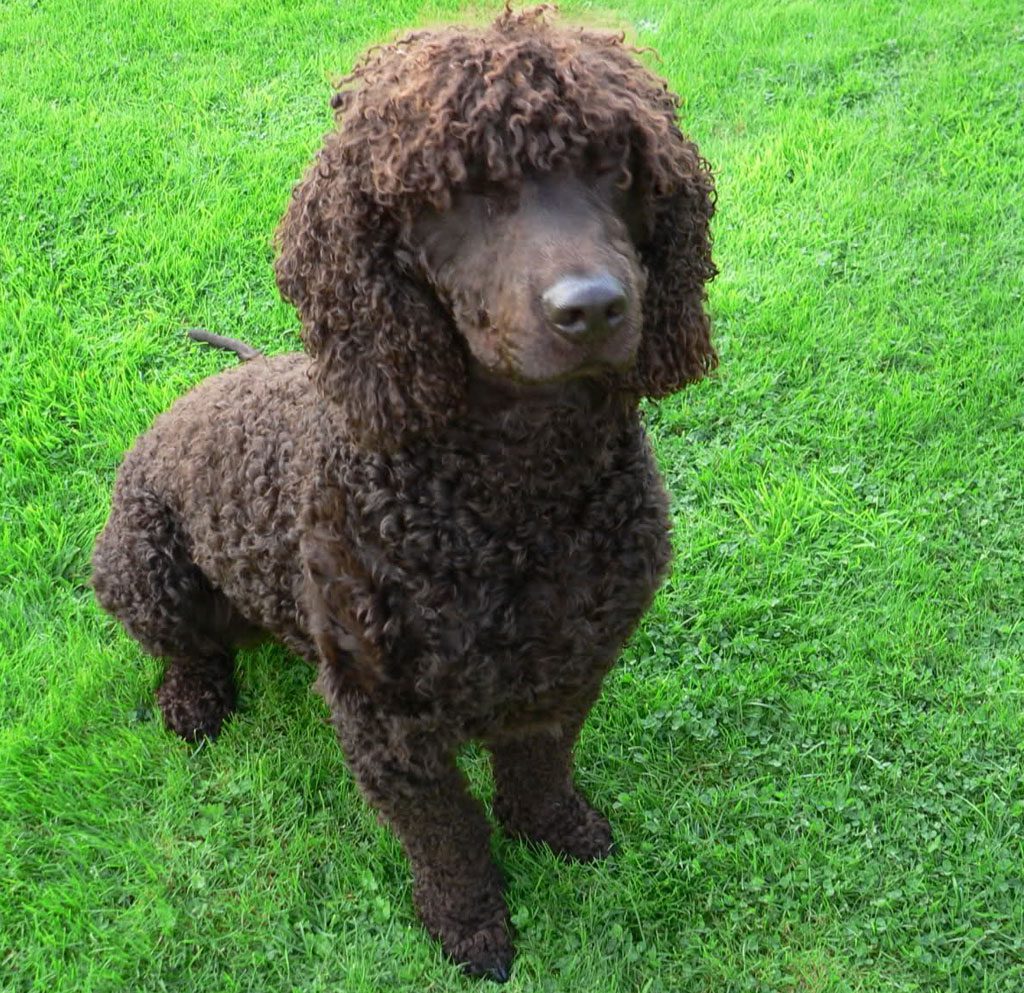
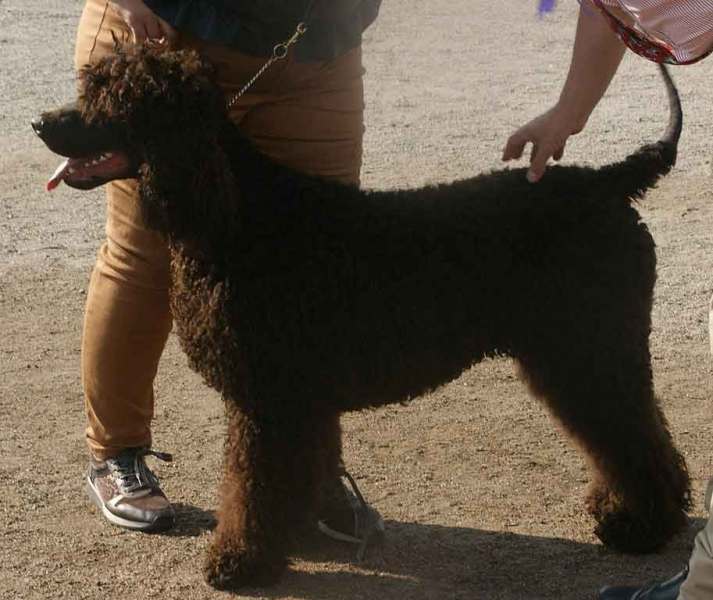
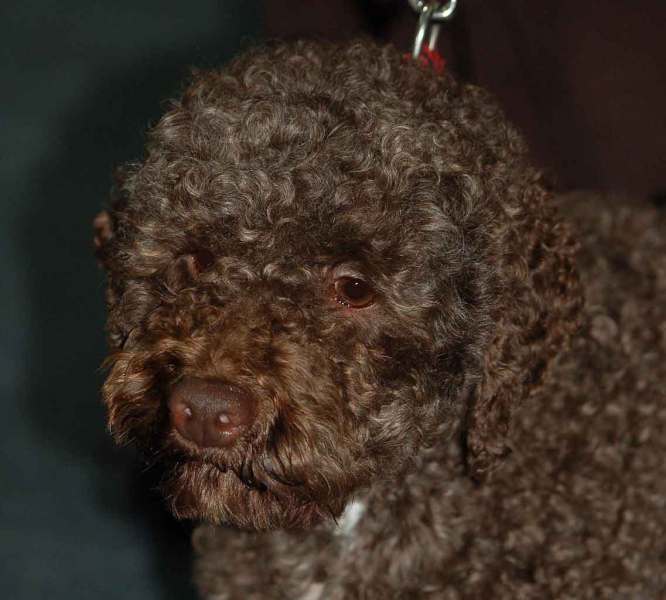
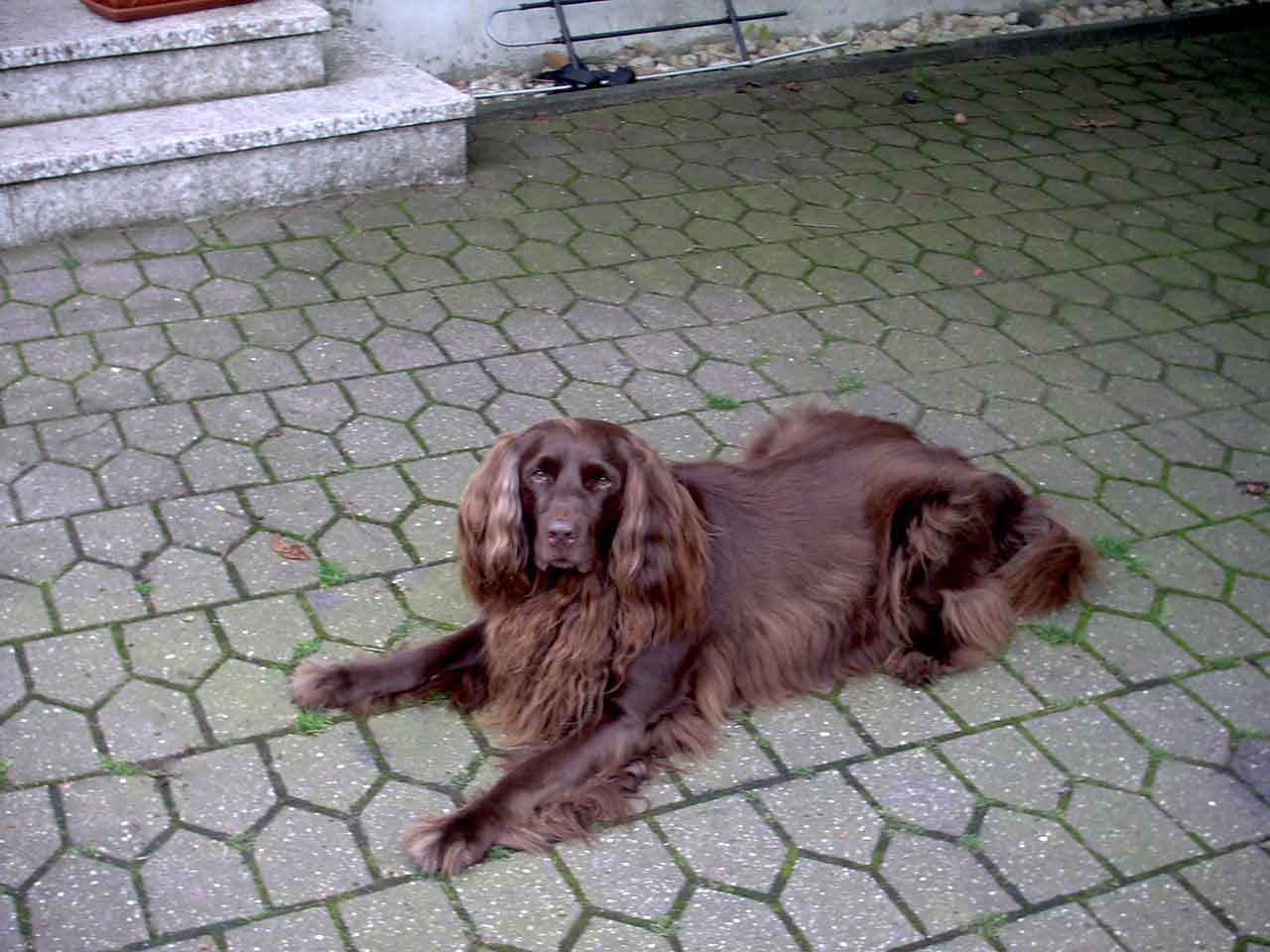
The appearance of the Irish Water Spaniel it's quite unique. Although at first glance it may be mistaken for a Poodle Grand, its appearance is more robust than this, although it maintains an elegant silhouette. Its coat is also denser than that of the poodle and is made up of long, soft curls.; this is what protects them from water and helps them float. Its waterproof coat also allows it to face harsh climates and bad weather without flinching..

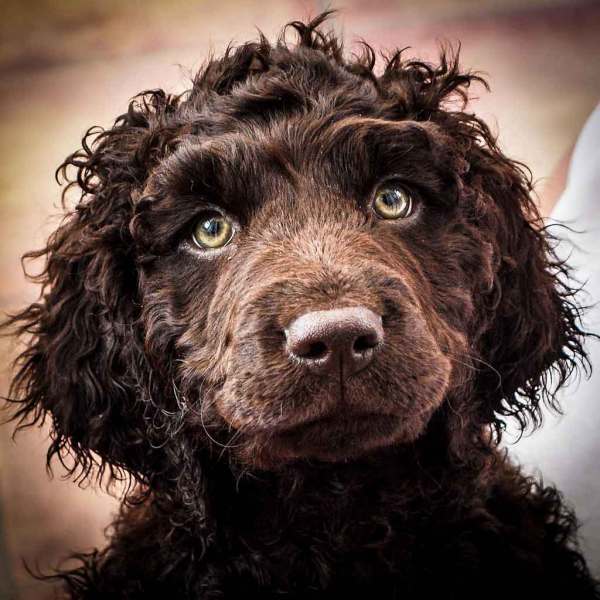
His head is rather broad and round, and ends with a rather square muzzle, strong looking, covered in short hairs. The ears are large, are set high on the skull and fall back on the head with abundant curls. The eyes are small, brown and almond-shaped.

The neck is strong and wide, though it's hidden under a thick layer of hair. The chest is also wide and deep, followed by a slimmer waist, characteristic of active breeds. His well-developed musculature and strong bones make him a fairly robust looking dog..

Its feet are webbed, which gives them a natural facility to swim, which makes the Irish Water Spaniel in one of the best races for swimming.

The tail is also unique and clearly distinguishes the Irish Water Spaniel other Water Dogs. It's shorter, straighter and has a very short coat (or is he almost naked), unlike other breeds of Water Dogs, they all have bushy tails. This explains why the Irish Water Spaniel Sometimes known as "Rat-tailed Spaniel" or "Whip-tailed Spaniel". Although this anatomical feature sometimes makes you smile, makes the Irish Water Spaniel be a better swimmer than others Water Dogs.

Last, the fur of the Irish Water Spaniel is lustrous and is made up of dense curls, with a lot of plumage. They are often called "the clown of the clown family." Water Dogsยซ, not only for his playful personality, but also because of the longer curly hair they have on their heads, which often gives them the appearance of having a tuft on the top of the head, much like a clown wig. The coat is always reddish brown with chocolate tones.

Size and weight

▷ Male size: 55 – 61 cm.
▷ female size: 53 – 59 cm..
▷ Male weight: 25 – 31 kg
▷ female weight: 20 – 27 kg

Character and skills

The Irish Water Spaniel is sometimes described as a dog with a difficult character, and probably for this reason it has never been especially sought after as a companion dog, despite its qualities. In fact, it is a dog developed for hunting: It, Therefore, decided to, Intelligent, Active, playful and energetic. This mix can sometimes lead to stubborn or mischievous behavior.. Even when they compete, their playful personality is often imposed and leads them to turn any activity into a game, causing some headaches for your coach. In general, not a breed of dog suitable for a beginner: on the contrary, needs an experienced master, able to give you a constant and structured education.

But, the Irish Water Spaniel it is a perfect companion dog if it is well socialized and trained, and can get enough exercise. Devoted to his master and his family, will do anything to please them, although sometimes this can lead to unwanted mischievous behavior or wanting to play when it's not the time. By the way, although he is devoted to his whole family, it's not uncommon for him to show a preference for a particular member, with whom you have a special affinity.

Able to easily adapt to all situations and conditions, the Irish Water Spaniel he is delighted to accompany his master in many activities, and can excel not only in hunting, but also in water activities or dog competitions, like the exhibitions. In effect, is agile, hardworking and has a good nose. It also, is naturally happy and balanced, as well as loyal and obedient. With a real propensity to turn any activity into a game, they usually feel great pleasure when doing them, whatever they are.

The Irish Water Spaniel he is one of the best swimmers and loves the water. You have to watch them when they are in the water, as they jump in at the first opportunity and enjoy swimming so much that it can be difficult to get them out. Having said that, swimming is a good way to satisfy your need to expend energy. But, even if you are familiar with the water and swim very well, it is important to keep an eye on him to ensure his safety, as with a child.

The Irish Water Spaniel does not bark much, and generally reserves its impressive barks for situations where you need to warn your family of immediate danger. So, he is quite calm and makes an excellent watchdog, as he is naturally suspicious of strangers. Having said that, his lack of trust with strangers should not be confused with shyness, although he is rarely aggressive towards them: is content to advise. Even when hunting, just bark a little, having the peculiarity of being speechless about hunting, which makes him a good pointer.

The Irish Water Spaniel they tend to get along very well with other dogs and pets. The same goes for children. Whoever your partner is, can spend hours playing with it without getting tired, especially when it comes to looking for the ball.

It must be said that it is a very resistant and lively breed of dog, making it unsuitable for apartment living. You need at least one garden where you can stretch your legs, and it is even better if the garden has a pool. But, a small garden is not enough to satisfy their need for exercise and balance: needs at least an hour of daily running and some walks, as well as swimming regularly.

In fact, it is essential that he can expend his energy to be a calm and obedient dog once home. Otherwise, the owner should expect destructive behavior from the dog. In fact, it is a recommended breed of dog for an athletic master, not a dog recommended for an elderly or sedentary person.

Starting at 9 or 10 weeks of age, it is recommended to give them 15 to 20 minutes of play in the morning and in the evening, in addition to socializing and doing other exercises. As is still the case for an adult, loves to play fetch or chase a frisbee. But, while waiting for your body to develop and gain muscle, it is better to prevent him from running with his master and, on the other hand, be content with training him to walk a distance of less than one kilometer. You can gradually increase the intensity of your dog's activities and the distances traveled, but you should not rush: too much exercise at a young age can affect your bones and joints, with repercussions for the rest of his life. Once adult, it is possible to run with your dog, but it is advisable to stick to reasonable distances and durations: due to risk of dysplasia, not a dog made to run marathons.

Education

The Irish Water Spaniel it is not a recommended dog for a first adoption. In fact, although it is quite easy to train because he likes to please his master, sometimes has an independent character that pushes him to want to act according to his own will. This is especially true of young males., who are very prone to testing the limits of their master. So, it is necessary to know how to show your dog who the master is, establish firm limits and a structured discipline framework with clear and consistent rules. In effect, This dog is known to take advantage of his master at the slightest inconsistency., or if you lack confidence. The fact that they are energetic and need a good amount of daily exercise also contributes to their being a demanding breed..

But, although sometimes they can be stubborn and independent, the Irish Water Spaniel it is usually easy to train. Being one of the most intelligent dog breeds, learn many commands with ease and excel at dog sports. When properly trained, are perfectly capable of performing very specific tasks, both in leisure and in obedience, agility and even dog shows. But, you need to deal with his mischievous nature: the more he learns, Plus you can turn your new abilities into games or mischief of any kind. In fact, it is clear that he has an overflowing imagination.

The Irish Water Spaniel responds better to dog training techniques based on positive reinforcement and rewards. They benefit from being coached by a patient teacher who does not raise his voice, at the risk of awakening their stubborn side and encouraging them to decide to do things their own way. That is why it is important to vary the activities during the educational sessions., to keep your interest and prevent you from starting to do things your way.

Last, the socialization of Irish Water Spaniel is an important aspect of your education. He is extremely suspicious of strangers, although this should not be confused with shyness. The younger you are exposed to a variety of situations, the more comfortable you will be with strangers and will be able to recognize real danger, how not to confuse the postman's visit with a possible intruder. Schools for puppies (puppy socialization classes) they are an interesting option, but it can also be as simple as taking the puppy out in public and visiting the neighborhood. Whatever happens, will always be attentive, so it is the various socialization activities in your training that should help you differentiate between what is a normal part of your life and what is abnormal and should alert your family.

Health

The Irish Water Spaniel they are generally in good health and their fur makes them particularly resistant to bad weather.

But, are prone to various diseases:

waterfalls: unlike other dog breeds, in which they are generally due to aging, cataracts are most often hereditary in theIrish Water Spaniel, and they can appear from the age of five.
follicular dysplasia ;

Hip Dysplasia: it is very common in this breed, and appears to be genetic rather than due to joint wear and tear.

Dental malocclusion: this deformation makes the lower jaw more pronounced, which often causes the lower teeth to pop out of the mouth. Although this can be treated with plastic surgery, it is usually recommended to simply remove the teeth that prevent the mouth from closing normally.
Progressive retinal atrophy (ARP);

Von Willebrand disease;

Hypothyroidism in dogs.

It also, it is known that the Irish Water Spaniel have allergic reactions to vaccines given to dogs. So, it is important to monitor him during the hours following the vaccination, to react as quickly as possible in case of swelling of the face, lethargy, sharp pain around the injection site, etc. This risk should not be taken lightly, because very serious reactions can lead to the death of the dog.

In addition to this risk linked to vaccines, the Irish Water Spaniel may be sensitive to dewormers and certain dog antibiotics. So, it is necessary to choose a veterinarian who knows well the specificities of this breed, starting with drugs that can cause an allergic reaction in the dog.

Last, like any breed of dog with hanging ears, have a higher risk of ear infections.

Since many of these diseases are genetic and, Therefore, hereditary, it is important to check, when adopting an Irish spaniel, that comes from a line in which these health problems are rare.

Life expectancy

12 to 13 years

Grooming

The dense fur of the Irish Water Spaniel requires regular care to avoid hair build-up. In particular, dead hair must be removed with a natural hair comb two or three times a week, which also helps distribute natural oils and prevent dirt build-up, that the density of its coat makes it retain especially quickly.

It is important to get your dog used to brushing relatively early, why start brushing your dog as an adult, when it is fully active and its coat is a little longer, it can be a real challenge if it is a new experience for him.

It also, Your dog's coat should generally be trimmed every two months to maintain a healthy appearance.

It is also important to regularly bathe your dog or allow him to expose his coat to water.. The Water Dogs secrete large amounts of natural oils that help protect their coat from water, and regular bathing keeps their coat healthy by preventing too much oil and dirt from accumulating.

By the way, the Irish Water Spaniel is considered a breed of dog hypoallergenic, since it changes very little. But, it is important to remember that no race is 100% hypoallergenic: if you are allergic to dogs, it is better that you do some tests before adopting your new partner.

Last, like any breed of dog with hanging ears, the Irish Water Spaniel have an increased risk of ear infections, since their ears are poorly ventilated and tend to accumulate a lot of wax. Thus, it is important to examine your dog's ears weekly and clean the accumulated wax with a product designed for it. This weekly exam is also a good opportunity to examine the dog's nails to make sure they are not too long.; if they are, must be trimmed.

Food

They are recommended between 180 and 310 grams of quality active dry food per day for the Irish Water Spaniel, and should be divided into two meals (one in the morning and one at night).

But, as it is a breed of dog that gets fat quickly, but which also has a great need for quality energy sources, the vet can give good advice to help you choose the right type of food for your dog, and adjust the amount based on your activity level.

Utility

The Irish Water Spaniel traditionally used as a hunting dog for waterfowl. They have an excellent sense of smell. So, he is an experienced hunter who feels very comfortable in the water, but can be easily adapted to most shooting disciplines. When looking for the hunt, often stands still, but it can also bring her back. It is even capable of pulling its prey out and chasing it through thick and tight bushes..

Due to its natural ease in the water, the Irish Water Spaniel also used as a rescue dog at sea.

Last, although they are not well known for this feature and are not commonly used in this context, the Irish Water Spaniel has all the qualities of an ideal companion dog.

Price

The Irish Water Spaniel it is a very rare breed in France, Belgium and Switzerland, so it is difficult to determine the market price of a puppy of this breed.

In other places, either in the United States or in England, for example, the average price of a puppy of Irish Water Spaniel varies between the 700 and 800 EUR, without great differences between males and females.

Images "Irish Water Spaniel"

Photos:

1 – ยซIrish Water Dogยป by And IggersFlickr
2 – ยซIrish Water Dogยป by Canarian, CC BY-SA 4.0, via Wikimedia Commons
3 – ยซIrish Water Dogยป by anatamanFlickr
4 – ยซIrish Water Dogยป ยซDukeยป by DianeFlickr
5 – ยซ8 Week old Irish Water Spaniel puppy, Fergusยป by Tom StrattonFlickr
6 – ยซIrish Water Dogยป by cchoFlickr

Videos "Irish Water Spaniel"

Type and recognitions:

  • FCI CLASSIFICATION:
  • Group 8: Retrievers, Hunting Lifting Dogs, Water Dogs.
  • Section 3: Water Dogs. .

Federations:

  • FCI – Group 8: Retrievers - Flushing Dogs - Water Dogs – Section 3: Water Dogs โ“˜
  • AKCSporting โ“˜
  • ANKC Group 3 (Gundogs) โ“˜
  • CKCSporting Dogs โ“˜
  • โ€‹KC – Gundog โ“˜
  • NZKCGundog โ“˜
  • UKCGun Dogs โ“˜

FCI breed standard "Irish Water Spaniel"

Origin:
Ireland

Date of publication of the valid original standard:
13.03.2001

Use:

The Irish Water Dog can easily adapt to hunting with any type of firearm; often shows and collects without difficulty in dense vegetated terrain. The structure and nature of the breed have traditionally made it a favorite among wild bird hunters..


General appearance:

Intelligent, erected, heavily built, compact and stocky.


Behavior / temperament:

Proud, combining great intelligence and resistance with a bold and determined character, a lot of vigor and loyalty. A good family dog รขโ‚ฌโ€นรขโ‚ฌโ€นwith a sense of humor but insightful with strangers.

Head:

The skull and head must be of good size.

Cranial region:
  • Skull: It's high in the dome, of good length and width, allowing good brain capacity. The pompadour (Top-knot)  should consist of long, loose curls that fall downward forming a well-defined peak between the eyes, and should not be in the shape of a wig, that is to say, make them straight from one side to the other.
  • Depression links (Stop): Gradual.

facial region:

  • Cara: Perfectly smooth. Hair grows in a narrow strip, forming a beard on the back of the lower jaw.
  • Truffle: Large and well developed and dark liver color.
  • Snout: Long, strong and somewhat square in appearance.
  • Teeth: Strong and regular teeth, scissor bite.
  • Eyes: Comparatively small almond-shaped, dark amber or dark hazel and with a look of intelligence.
  • Ears: Very long and lobular in shape, low insertion, they hang quite close to the cheeks and covered with long, twisted curls of hair.

Neck:

Rather long, strong and arched (holds the head well above the level of the back) and with strong insertion in the scapulae.

Body:

Good size, and in general it must be so proportionate as to give the appearance of a cramped form, accentuated by arching of ribs. Generally strong and well muscled.

  • Back: Short, wide and straight, tightly attached to the hindquarters.
  • Lumbar region: Deep and wide.
  • Breast : Deep but not very broad or round between the forelegs, although broad in circumference with well sprung ribs behind scapulae. The ribs should extend well back.

Tail:

Lisa, strong and thick at birth (where it should be covered with short curls of 7,5 to 10 cms) and gradually tapers to a fine point. Its length should not reach the garrones, and it should be carried straight almost to the level of the back.

Tips

Former members:
  • Shoulder: Very strong and inclined.
  • Arms: With good bone and straight, forearm at the tip of the elbow, in a straight line with the tip of the scapula.
Later members:

Very powerful.

  • Knees: Well angulated.
  • Metatarsals: Short
  • Pies: Large, somewhat round and extended, well covered with hair, so much about, as between the fingers, but free of excessive fringes.

Movement:

It is a peculiar characteristic of the breed. It is a rocking motion produced by the cramped shape of the rib cage.

Mantle

  • Fur: Denso, tight, in small well defined curls, woolly free, but with a natural oiliness. The top and side of the neck should be covered in curls similar to those on the body. Throat hair should be straight; the straight hair should form a V-shaped mark from the back of the lower jaw to the sternum. The forelimbs should be covered with fringes that should be abundant around the entire leg all around, but on the front they should be shorter;   under the hocks, hair must be short in front, but from behind to the feet they must have fringes.
  • Color: Pure and very intense liver; white markings on the chest are objectionable.


Size and weight:

  • The males between 53-59 cm (21-23 inches),
  • The females between 51-56 cm. (20-22 inches). 


Fouls:

Any deviation from the aforementioned criteria is considered a fault and the severity of it is considered with respect to the degree of deviation from the standard.

  • White on the chest.
  • Pale mantle.
  • light eyes.
  • Woolly mantle.
  • Fringes in anterior part of metatarsals.
  • Lack of fringes on the front of the forelimbs.
  • crushed feet.
  • Fringes on the tail.
  • Fringes on the face.
  • White on the feet.


N.B.:

Males should have two normal-appearing testicles fully descended into the scrotum..


Source: FCI

Source: F.C.I - International Cynological Federation

Alternative names:

1. Whiptail, Shannon Spaniel, Rat Tail Spaniel, Bog Dog, (Irish: An Spรกinnรฉar Uisce) (English).
2. Chien d’eau irlandais (French).
3. Irish Water Spaniel (German).
4. (em inglรชs: Irish water spaniel) (Portuguese).
5. Spaniel de Agua Irlandรฉs, Irish Water Spaniel (espaรฑol).

โ–ท The world of Pets: Dogs, cats, birds, reptiles, amphibians

Romagna Water Dog
Italia FCI 298 . Water Dogs

Romagna Water Dog

The Romagna Water Dog not suitable for sedentary people or living in the city.

Content

History

The Lagotto Romagnolo, or "Romagna water dog", descended from the Italian dogs that were used to recover game from the water. In fact, His name means "Romaรฑa Lagos dog" in Italian, reflecting its original use and the northern Italian region from which it came, the Romaรฑa.

It was used at least since the Italian Renaissance for this task, especially in the swamps and lagoons present in his native region. In addition to keeping their masters company and watching over their homes, he was also very good at recovering dead ducks that were in the water. They are the Italian equivalent of the Spanish Spaniel and the Irish Spaniel.. Many specialists believe that Romagna Water Dog is the oldest breed of Retrievers and that it is the distant ancestor of many more recent races, as the Golden Retriever, the Portuguese Water Dog and the Poodle. It is also believed to be one of the oldest Italian dog breeds.

The first trace of a similar animal dates back to the 15th century, and more specifically to 1474, in a fresco called Parete dell’Incontro, painted by italian Andrea Mantegna. It was also described by the philosopher Erasmus (1466 – 1536) and appeared in some works of the engraver Marcantonio Raimondi (1480 – 1534).

Later, in the XVIII century, the famous naturalist Carl von Linnรฉ (1707-1778) described a Mediterranean Spaniel that closely resembled the Romagna Water Dog.

Towards the end of the 19th century, much of the marshes in the area were drained into farmland, leaving the Romagna Water Dog jobless. But, farmers and other owners soon discovered that he had a great talent for finding truffles, highly appreciated in the world of gastronomy. In fact, this dog's excellent sense of smell, combined with his thick fur that protected him from the branches, brambles and other weeds, made it very efficient. This change of use also implied certain changes in the traits of the breed: his primitive hunting instinct weakened, while he developed an iron concentration very useful in the search for truffles. These two facts were combined so that you would not be distracted by the game when you were working.

But, the number of people searching for truffles was much less than the number of people hunting. As a result, the breed's population decreased dramatically, so that by the middle of the 20th century there were only a few Romagna Water Dog. It also, truffle hunters weren't really interested in developing a breed in their own right: as long as the dog was good at his task, they seemed fine. Consequently, at the beginning of the 20th century there was a certain decrease in interest in the selection of this dog and several poorly thought-out crosses were made with other breeds.

The rescue and diffusion of the breed in the 20th century

Over the years 70, some thought that the Lagotto Romagnolo had completely disappeared. But, there were still some in Italy, and some passionate breeders took important steps to preserve them. The group was led by Quintino Toschi, breeder and judge of Ente Nazionale della Cinofilia Italiana (ENCI), the main canine organization in the country. With the support of the veterinarian Antonio Marsiano and from another lover of the Lagotto, Lodovico Babini, a selection program was launched to save the dog from the extinction that hung over him. In 1988, they founded a breed club, the Club Italiano Lagotto, and they did a great job to get the breed to develop again in good condition.

The work carried out by this group was a success and allowed the Lagotto Romagnolo was recognized by the ENCI in 1992.

Then it began to be known and spread abroad, particularly in Europe (France, Switzerland, Germany, Finland, Great Britain…), but also much beyond, as in Australia and the United States. Although in some of these countries truffles are not as abundant as in Romagna, the Lagotto found its place in families as a guard and companion dog. It is also possible to find them - although much more rarely- in the water courses, as hunting retrievers.

The Fรฉdรฉration Cynologique Internationale (FCI) recognized the breed provisionally in 1995. Ten years later, in 2005, granted him full recognition.

In 1997, was founded the Unione Mondiale dei Club Lagotto Romagnolo (Lagotto Romagnolo Club World Union), in view of the worldwide expansion of the breed. Chaired by the Dr. Giovanni Morsiani, allowed to preserve the original traits of the breed and coordinate quality breeding programs around the world.

That same year a breed club was founded in the United States., the Lagotto Club of America.

In 2001, the American Kennel Club (AKC) agreed to enroll the Lagotto in its Foundation Stock Service, a prerequisite for full recognition that occurred in 2015. The other reference organization in the United States, the United Kennel Club (UKC), recognized her in 2006.

in Canada, the Lagotto Romagnolo debuted in 1999. The first specimen imported into the country came from a famous Italian kennel called Farnie. That same year a first calf was created in Alberta. Others followed him in 2000 and 2004, respectively in Ontario and Nova Scotia. Although these pioneer hatcheries no longer exist today, contributed greatly to the spread of the breed in the Canadian territory. The breed was provisionally recognized in 2012 by the Canadian Kennel Club (CKC), and then definitely in 2016.

Finally, en el Reino Unido, the romanian spaniel was accepted by the prestigious Kennel Club in the year 2000.

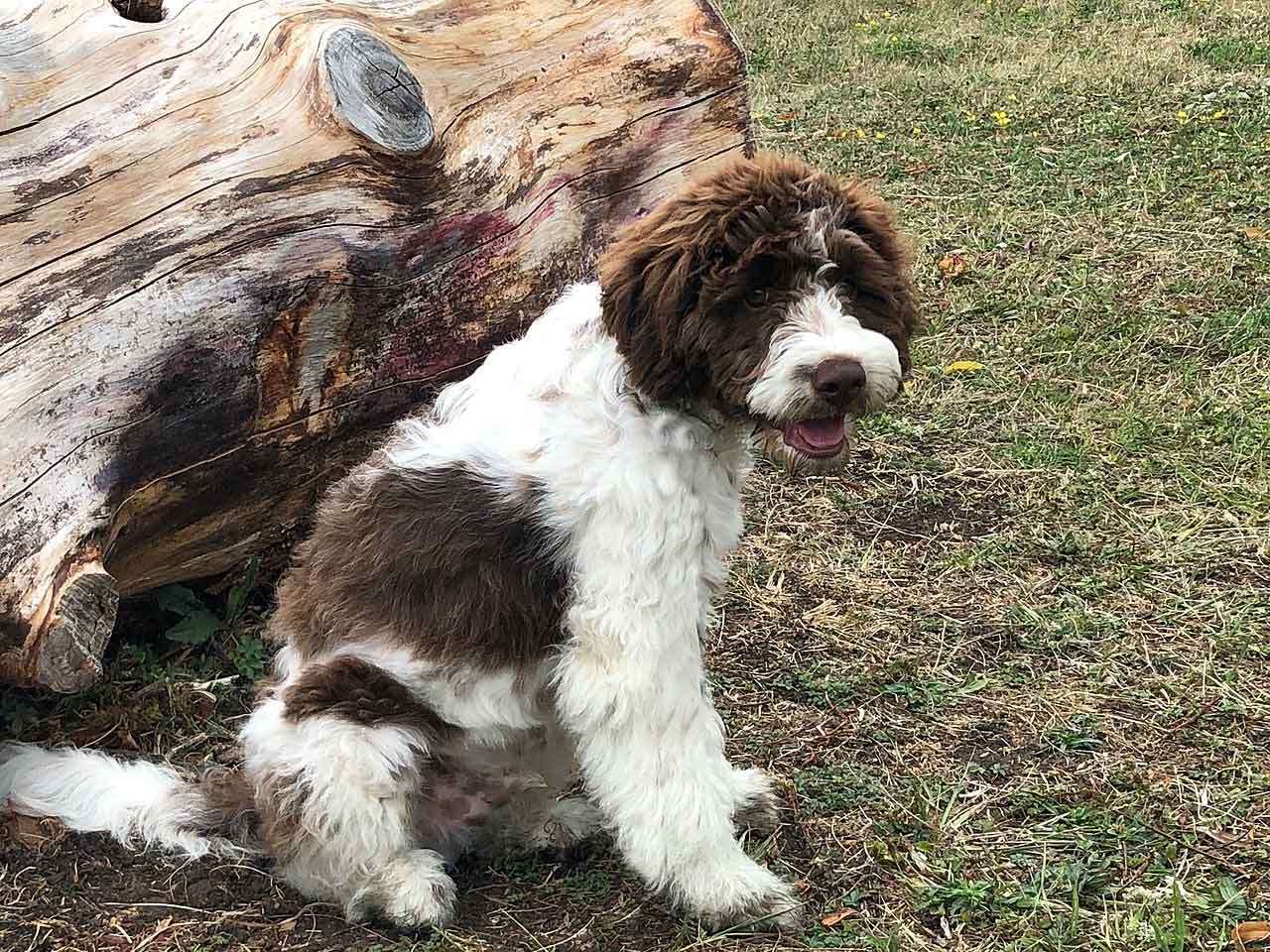
Photo: ยซLagotto Romagnoloยป de 6 meses by XTY78, CC BY-SA 4.0, via Wikimedia Commons

Distribution and popularity

After having been on the verge of extinction half a century ago, the Romagna Water Dog seems to be as popular today in its home country as it was at some point in its history, and it is even more and more successful.

Like this, while the number of annual registrations in the Ente Nazionale della Cinofilia Italiana (ENCI) was around the 1.500 early in the decade 2010, reached the 2.000 in 2014 and even approached the 2.500 at the end of the decade.

In France, the Romagna Water Dog has quickly conquered hearts. At the beginning of the 21st century, the number of dogs registered each year in the LOF (Book of French Origins) you could count on the fingers of one hand. A midyear 2000 he was already in his fifties, and then shot up to exceed 300 at the end of the decade. The success of Lagotto did not stop in the decade of 2010, quite the contrary: they ended up with some 500 births per year.

In Switzerland, the Lagotto is also well represented. According to statistics from the official Amicus database, in 2017 was the 28th most represented breed in the country, at around 3.500 animals.

On the other hand, in the UK it is much more discreet, although it seems that it begins to break through. Since the decade of 2000 until early next, there was no more than 20 or 30 births per year registered in the Kennel Club. But, this figure reached about 50 in the mid 2010, and then tripled in no time, to the point of ending the decade with more than 150 by year.

The Lagotto Romagnolo it is also small in the United States. The Lagotto Romagnolo ranks in the middle of the breed ranking based on number of annual AKC registrations, around the post 100.

But, the breed has spread throughout the world in recent decades, with a success in some countries that was not easy to imagine. This is the case of Australia, where the first records in the Australian National Kennel Council (ANKC) go back to the year 2000. Just fifteen years later, in the middle of the Decade of 2010, the organization already counted between 300 and 400 annual births.

Physical characteristics

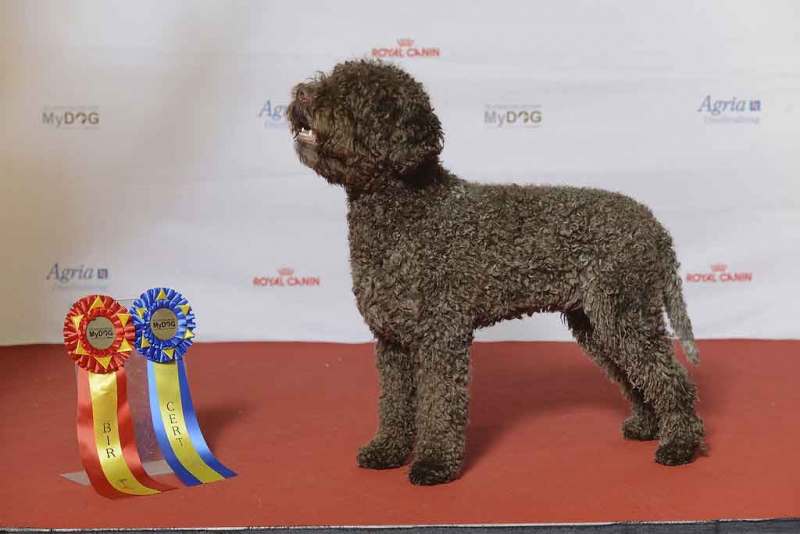
The Lagotto Romagnolo it is a small to medium sized dog, solid build and rather square profile. In fact, its length should be approximately equal to its height at the withers. They give an overall impression of robustness and strength.

The back is straight and muscular, with a strong and slightly convex loin. The chest is well developed and reaches to the elbows.

The tail is covered with stiff, woolly hair.. It is not too high or too low and reaches the level of the hocks.

The front legs are well muscled with a fine but robust bone structure. Their feet are rounded and compact, with clenched fingers. As for the hind legs, they are very powerful, while still being well proportioned. The feet are a little more oval than the front ones, with slightly less arched fingers. On all legs, the pads are very resistant, the claws well curved and solid.

The skull is quite wide and slightly convex when viewed from the side. Neck is strong, muscular and much more massive in males than in females.

The ears are medium-sized and triangular in shape, but rather rounded at the tips. They are hanging and reach the level of the dog's jaws.

The eyes are round, large and quite far apart. Its color can be ocher, dark brown or hazelnut. Then already Romagna Water Dog a very attentive and lively expression.

The muzzle is quite wide and slightly shorter than the skull. Finish off with a nose that can range from flesh-colored to dark brown., it is quite large and has large nostrils.

The lips are rather thin and covered with long and somewhat bristly whiskers.. They cover powerful scissor-shaped jaws.

The skin is quite fine and pigmented. Goes from very light to dark brown, according to coat color.

The coat consists, first, in a highly water resistant underlayer. It is covered by a very dense top layer, curly and woolly. The tight curls give the impression that the dog is disheveled all over the body. The curls are a little looser on the head, showing the beard, the mustache and bushy eyebrows.

The coat can be whitish, white with brown or orange highlights, orange red, brownish red or completely brown (in any shade of this color). Tan markings are also allowed in all shades, regardless of the dog's coat color.

It is worth mentioning that the fur of the Lagotto Romagnolo takes time to acquire its characteristic appearance, since it is not until 2 or 3 years of age. In effect, her curls form only very gradually; when he is still a puppy, its fur is very soft.

Last, the breed is characterized by a certain sexual dimorphism. In addition to having a more solid neck than the female, the male is usually taller and more massive than the female.

Size and weight
    ▷ Male size: 43 – 48 cm.
    ▷ female size: 41 – 46 cm..
    ▷ Male weight: 13 – 16 kg
    ▷ female weight: 11 – 14 kg

Character and skills

The Lagotto Romagnolo is smart and lively, but he is also close to his family, with which he enjoys.

This is especially true of the very young., which makes it a very good dog breed choice for children. Their high energy level allows you to spend hours playing with them without getting tired. But, as with any of his peers, should never be left alone with a young child without adult supervision. This is all the more true as it has a relatively high energy level and could, for example, unintentionally pushing or even knocking down your young partner.

The Romagna Water Dog he also gets along very well with other dogs, whether they live in the same house or just pass each other on a walk. Having largely lost the strong hunting instinct of a few centuries ago, they can also get along with other animals such as cats, rodents and birds. If you have to share your home with one of them, coexistence is so much easier as it is established as soon as you get home. In any case, it is important to socialize him well from an early age and get him used to meeting representatives of other species: so you will have less desire to chase them throughout your life. In any case, if he is not well socialized and his hunting instinct tends to prevail, or if you do not respond perfectly to the call for attention, it may be preferable to walk it on a leash than in freedom.

The sense of smell is not the only one that is very acute in this dog. In fact, he also has excellent hearing, that allows you to hear from afar anyone who approaches you. It also, fully fulfills the role of alert dog, barking and warning his owner as soon as an unknown person approaches his house. But, your role ends there: as it is not one of those who threaten or impress, not really a good watchdog.

The Lagotto Romagnolo tends to keep some distance from strangers at first, even if they are invited by their master and the introductions are done correctly: it may be a while before they trust. But, once well socialized and educated, he ends up getting used to their presence and is very friendly with them. In fact, some of the breed representatives are open enough to be used as psychological support dogs, visiting hospitals, schools or even prisons, and bringing comfort wherever they go.

To accept new people, you have to be comfortable in your own home, as well as on their paws. As such, should be physically active for at least one hour daily, for example, through walks, games, puzzles or dog sports like agility or flyball. His physical abilities and his resistance also allow him to happily accompany the sportsmen in their races., mountain bike rides or hikes. But, it can also be a good match for retired people, as long as they stay active enough and can get it out enough every day. In any case, how you tend to get bored easily, It is convenient to offer you varied activities and regularly change the places of your walk.

Swimming is also a great way to get your dog to exercise.. In fact, the centuries that it has spent being used as a waterfowl retriever explain that it is a dog that loves water. He loves to swim and enjoys every moment he spends in a lake or river. One of his favorite games is to go to find and recover the objects that his master throws into the water..

If you are not given enough opportunity to exercise and get bored, or if it suffers a lack of attention from its owners (either because they are absent too often and for too long, or because they neglect him), the Romagna Water Dog is likely to develop a number of undesirable behaviors. In particular, may start barking untimely and become excessively loud. If you have access to a garden, can start digging holes to search for objects or food under the ground. Degrading objects or stealing food are also part of their history. All these behaviors are the sign of a psychological distress that is important to treat, and for which the owner is often responsible.

On the other hand, as long as their care and physical activity needs are respected, the Romagna Water Dog he is a very affectionate companion, that he does not stop appreciating the most cuddly moments and that he is very calm.

It also, as long as I have enough outings and activities, can be fully adapted to life in the city and in an apartment, although the ideal environment for him is still a house with access to a garden. But, it is not a question of relegating it to the bottom of the garden, for example in a kennel: I would hardly tolerate it and it would be very likely that symptoms of separation anxiety would appear.

Last, It should be noted that the female of the Lagotto Romagnolo reaches psychological maturity long before the male.

Education

The Lagatto Romagnolo he is intelligent and devoted: very eager to please, he has in his heart to understand what his owner wants, and meet your expectations. This makes it an easy dog รขโ‚ฌโ€นรขโ‚ฌโ€นto train and suitable even for a beginner..

The most experienced people can go a long way in their education, because it was selected to quickly understand complex commands. It is not by chance that he often shines in obedience competitions.

Having said that, the practice in which you can excel the most is, of course, the hunt for truffles, allowing you to exploit your developed sense of smell. This does not require a great effort, since it is very easy to train a truffle dog, as long as you know how to do it.

Whatever your future mission, it is best to base the training of the Romagna Water Dog in fun and varied exercises. In effect, his intelligence and alertness mean that he can get bored quickly if the sessions are repetitive. It is also important not to go for methods that are too strict for your taste.; it is better to bet on positive reinforcement, that motivates you to learn and makes things easier.

In any case, the fact that he is docile and obedient does not exempt you from having clear house rules, and to teach you quickly. As with any dog, You have to decide from the beginning what you can do and what you are not allowed to do., and try to keep it after, that is to say, be consistent over time. This consistency should also apply from one family member to another.: everyone must enforce the same rules, uniformly. If these conditions are not respected, the child is likely confused, having difficulty understanding what is expected of him, what is and what is not allowed.

Health

The Lagotto Romagnolo it is a generally resistant dog: when you are not experiencing any major health problems, can live long enough until 17 years, which is significantly above the average of its congeners that have such a template.

It also, its thick coat protects it not only from water and humidity, but also from the cold. Therefore, it can live very well in significantly less accommodating climates than its native Italy., its origins explain why it is not particularly sensitive to high temperatures.

Despite his generally good health, It, like all races, particularly susceptible to certain diseases, in this case, is about:

  • The Hip Dysplasia, a disease whose onset may be favored by a hereditary predisposition, which especially affects medium to large sized dogs.This is an abnormal conformation of the hip joint, that can cause pain, lameness and some difficulty moving.It also promotes the formation ofosteoarthritis aAs the animal ages, if the problem is detected early, some surgeries can delay the effects of the disease or relieve symptoms;
  • The Dysplasiadelcodo, a developmental problem of the elbow joint that causes pain or lameness., also leads to the development ofosteoarthritis.Like hip, a hereditary predisposition can increase the probability of its occurrence. It is possible to limit the consequences thanks to a surgical intervention, to be done as soon as possible;
  • The juvenile epilepsy, an inherited disease of the nervous system characterized by seizures, generally observable from the first 5 to 9 puppy weeks.In most cases, symptoms go away on their own around the 4 months of age, although some dogs with the disease continue to experience occasional episodes of seizures well into adulthood.The gene that originates it is particularly widespread in Lagotto Romagnolo: according to the data provided by the laboratories that carry out the tests that allow the disease to be identified (Optigen in the United States, Mydogdna in Germany and Genoscoper in Finland) 46. % of the representatives of the tested breed carry it., only 3% of the total population actually suffer from the symptoms of the disease;
  • The ataxia cerebelosa, a neurological disease causing an inherited movement coordination disorder., it is also a source of involuntary muscle contractures problems.There is no treatment forla ataxia cerebelosa, whose symptoms worsen and lead todog euthanasiaabout two years after its appearance;
  • Abiotrofia cerebelosa, a nerve condition that can be inherited and is caused by the degeneration of certain brain cells. Its main symptoms are tremors and inappropriate movements, especially when facing an obstacle.There is no cure for this disease, but it does not cause physical suffering to the dog. However, as the situation progressively worsens, there comes a time when the disability is too severe, so euthanasia is recommended;
  • Distrofia neuroaxonal, which corresponds to an accumulation of various substances in neurons. It is the particular cause of head tremors, balance disorders or even falls. These symptoms usually appear in the puppy's first month. There is no treatment for this potentially hereditary disease, which very often leads to the euthanasia of the animal;
  • Lysosomal storage disease, an inherited neurological disorder that often leads to euthanasia., is at the origin of uncoordinated movements and loss of balance. According to a study published in 2015 in the scientific journal Plos Genetics and entitled ยซMissense in the ATG4D gene links aberrant autophagy with neurodegenerative vacuolar storage diseaseยซ, approximately 12% of the Lagotti are carriers of the genetic mutation at the origin of this disease There is no cure and things are only getting worse;Therefore, an affected subject dies very young or ends up being euthanized.
  • The waterfall, a disease causing progressive loss of vision due to clouding of the lens, sometimes inherited and mainly affecting the elderly, can be cured with surgery;
  • Infections ofear (otitis, etc.), due to the hanging shape of his ears.

It also, the Romagna Water Dog also poses a risk of being overweight. Not to be taken lightly, since being overweight can lead to various health problems, but also aggravate pathologies already present in the affected animal.

But, Many of the diseases to which the breed is exposed are or may be of hereditary origin., the utmost vigilance is required when choosing acreator of Lagotto Romagnolo.A professional worthy of the name, as well as ensuring that your puppies benefit from good socialization from their first weeks, is committed to maximizing the chances that they will be and stay healthy. To achieve this, is in charge of carefully selecting its breeders, making them pass various genetic tests to avoid any transmission to their descendants of a possible hereditary defect., must be able to present the results of such tests, that may also have been done on the little ones themselves., must present a veterinary certificate attesting to the good health of the puppy whose adoption is being considered, as well as your health or vaccination history, the latter in particular confirms that the animal has received the various required vaccinations.

Once the latter returns to his new home, It is worth remembering that a dog is particularly vulnerable during its first few months., inappropriate physical activities (too long and / or too intense) can easily cause injury, but also affect the proper development of bones and joints, with potentially long-lasting consequences., it is better to wait for him to reach adulthood to take him for long walks or hunt for truffles for hours, for example. This is even more true that this breed is particularly prone to some joint problems (Hip Dysplasiaandelbow dysplasia).

From then on, it is not because you are an adult that you should no longer worry about your health. Throughout your life, should benefit like any dog โ€‹โ€‹from rigorous monitoring, including a visit to the vet once a year, and even more regularly when you are older, this allows the professional to perform a complete check-up of your health, and sometimes detect a problem that a less informed eye like the owner's could not, yet, This is also the perfect time to take any booster dose.

In addition to the diseases against which the latter protect you, it is also necessary to ensure that you are permanently protected against parasites and the risks they imply.So, It is the responsibility of the owner to renew the antiparasitic treatments of his companion throughout the year.This is even more important for people who spend a lot of time outdoors..

Life expectancy

13 years

Food

Feeding a Romagna Water Dog not particularly difficult: a balanced and good quality industrial feed is perfectly adequate. But, it is important to choose products and establish portions adapted to their age, health and physical activity level.

The latter can vary significantly during the year, especially in the case of an individual used for truffle hunting during the winter season. It is then necessary to adjust upwards the amount of food that is given each day, so that you benefit from a sufficient energy supply and can work in good conditions. On the other hand, once the period in question has ended, servings should return to normal level, to prevent you from suffering from overweight problems.

When the dog is young, the ration must be adapted to the growth period in which it is. This is especially important because an inappropriate diet could be detrimental to the puppy's physical development.: if the food is too rich or is given in too large quantities, could grow too fast, which could lead to joint problems. Otherwise, insufficient nutrition could cause deficiencies and growth problems.

This is especially true because the Lagotto Romagnolo is easily prone to obesity. That is why it is important to pay attention to the evolution of your weight and weigh it twice a month.. If a discrepancy is observed, which is confirmed or even increased in the following measurements, it is necessary to visit the vet. Only a professional can safely determine the cause of weight gain, which may not be related to the dog's diet or activity level, but with a disease or a treatment, for example. Once the cause of the problem has been identified, the vet will be able to advise how to remedy it and return the dog to a healthy weight.

In any case, the fact that the Romagna Water Dog being prone to obesity implies that some caution should be exercised regarding the use of treats, although they can be very useful, especially in the context of training. The ideal is to opt for low-calorie products and deduct their caloric intake from your daily ration.

This propensity to be overweight also justifies dividing your daily ration into multiple meals.: even if I have a sweet tooth, less likely to order food when you know another is waiting for you later.

Last, like any dog, the Lagotto Romagnolo a bowl of clean, fresh water should always be available to you.

Grooming

The Lagotto Romagnolo is covered in thick, curly fur that needs a lot of maintenance.

First of all, it is necessary to brush it about twice a week, to avoid knot formation. The longer the coat, more important is to take the opportunity to examine it to remove dirt and other weeds, and undo the knots, especially around the joints: this will prevent injury or irritation caused by rubbing. It is also a good idea to get in the habit of examining your fur after a long period in a humid environment or with very dense vegetation..

On the other hand, sheds very little and has no seasonal molting periods. If we add to this that he does not drool much, This makes it an especially appreciated companion for people who are very attached to cleanliness., but also for those who suffer from allergies. Thus, are often presented as a hypoallergenic dog breed, but you have to remember that none of them is 100% hypoallergenic and that the amount of allergens emitted can vary significantly from one individual to another, even within the same race. So, there is nothing to replace a test in real conditions, consisting of spending a few hours in the company of the animal whose adoption is being considered.

Regarding the bathroom, a monthly frequency is adequate to keep the dog's coat clean. Lagotto Romagnolo, without affecting its natural ability to resist water and inclement weather. But, it is important to use a mild shampoo specially designed for dogs, otherwise your skin will be damaged, and do not dry or brush it after bathing, which could damage her beautiful curls.

It also, their hairs grow quickly and require regular trimming, at the rate of some 3 or 4 times a year. The latter can be done by a professional dog groomer or directly by its owner., if he knows how to do it.

Ears of the Lagotto Romagnolo require rigorous maintenance, since its hanging shape and the hairs that grow around it constitute fertile ground for the development of infections caused by the accumulation of moisture and dirt. So, it is imperative to examine and clean them weekly, as well as after every long outing in nature. This is especially important if the animal has been in a humid environment or has been swimming., and it is important to dry it well. It also, it is recommended to regularly trim the hair around the ears to prevent wax and dirt from settling there.

You should also check your eyes weekly and clean the area around them if they are dirty.. Hair around the eyes can cause infections to develop there too. If to that we add that they can obstruct the vision of the dog, the interest of cutting them regularly is easily understood.

Regarding the teeth, they must be brushed regularly to avoid the formation of dental plaque, which can itself be the cause of many oral problems. The ideal is daily brushing and, in any case, it is better not to brush less than once a week. In any case, it is advisable to systematically use a toothpaste intended for the canine species.

The claws of the Lagotto Romagnolo they tend to be much less demanding in terms of maintenance, especially if you spend a lot of time outdoors: this usually allows them to file naturally. But, it is convenient to make sure that it really is so. In fact, if they get too long, can hinder the dog's movements, and even hurt you a lot if they break. If you hear them rubbing against the ground when walking on hard surfaces, It is a sign that you have to cut them manually.

Whether the fur, the ears, the eyes, teeth or even claws, take care of a Lagotto Romagnolo requires mastering a series of gestures. If they are not necessarily complex, better make sure you do them correctly, not only for good results, but also and above all so as not to risk hurting your partner, or even injure him. So, the first time it may be wise to make an appointment with the vet or a groomer, to learn from a professional how to proceed. In any case, it is advisable to accustom your pet to this type of manipulation as soon as possible, Since, otherwise, maintenance sessions could be especially unpleasant for you.

Utility

Originally, the Lagotto Romagnolo used -and selected- to retrieve game that fell into the water. This selection explains its particularly waterproof coat and its very pronounced taste for swimming..

Since the end of the 19th century, after the drying up of many swamps in its Romagna natal, dedicates body and soul to the search for truffles. Today, it is the only breed of dog that is bred specifically for this task. Her highly developed sense of smell and her innate propensity to search by digging holes make her a true expert in this field..

He is also an excellent companion dog today, that is sociable and easy to train. They are suitable for beginners and are especially suited to families, especially those who are quite active. They are especially popular with those allergic to dogs, since they shed very little hair and only release a small amount of allergenic proteins. But, no dog can be considered 100% hypoallergenic, therefore compatibility cannot be guaranteed: there is nothing to replace a trial period of several hours with the person whose adoption is being considered.

Wide awake, the Lagotto Romagnolo It is also an excellent alert dog that does not hesitate to bark when an unfamiliar person approaches its home. On the other hand, can't really take on the role of watchdog, since they are not aggressive or threatening to strangers, and it would be very unlikely that they would chase them away.

On the other hand, His excellent sense of smell obviously works wonders in crawling competitions and, of course, in the romps. They can also be distinguished in dog sports that highlight their great energy and intelligence., like agility, flyball or obedience.

Last, due to his friendly and always uniform temperament, sometimes used as a therapy dog, for example in hospitals, schools or prisons.

Price

In France and Belgium, the price of a puppy Lagotto Romagnolo ranges between 800 and 1.500 EUR, and the average is about 1.100 EUR.

in your country of origin, Italy, you have to tell about 600 to 1400 EUR. For a person who doesn't live very far, import may be an option to consider, since there are many more farms there, and therefore a greater offer.

in Canada, breeders usually ask for an amount that is around 2400 canadian dollars. But, patience is often necessary, since the small number of breeders in the country makes it common to find yourself on a waiting list. This is especially true if you are looking for a puppy of a certain color..

The amount to pay to adopt a puppy from Lagotto Romagnolo in the United States it ranges from 1.800 and 2.500 American dollars.

In the case of an import from abroad, It is advisable to bear in mind that additional costs must be added to the purchase price: administrative expenses, quarantine, transport…

In any case, whatever the country, the price that is asked depends on the prestige of the kennel and the lineage from which the puppy comes, as well as its intrinsic characteristics, especially on the physical plane, that is to say, its greater or lesser conformity with the standard. It also, it is this point that explains why important price differences are sometimes observed within the same litter.

Characteristics "Romagna Water Dog"

Coexistence is important that you have with your new friend. Before considering the acquisition of a dog of the breed "Romagna Water Dog" you know certain factors. Not all breeds of dogs are apt to live in an apartment, you must take into account his character, their need for exercise, their interaction with other pets, their care and if you have small children, their level of tolerance towards them.

Adaptation โ“˜

3,0 of 5 stars (based on 1 review)

friendly dog โ€‹โ€‹โ“˜

4,0 of 5 stars (based on 1 review)

hair loss โ“˜

1,0 of 5 stars (based on 1 review)

Affection level โ“˜

3,0 of 5 stars (based on 1 review)

Need for exercise โ“˜

4,0 of 5 stars (based on 1 review)

Social need โ“˜

3,0 of 5 stars (based on 1 review)

Home โ“˜

3,0 of 5 stars (based on 1 review)

Toilet โ“˜

3,0 of 5 stars (based on 1 review)

Friendly with strangers โ“˜

2,0 of 5 stars (based on 1 review)

barking โ“˜

3,0 of 5 stars (based on 1 review)

Health โ“˜

3,0 of 5 stars (based on 1 review)

Territorial โ“˜

4,0 of 5 stars (based on 1 review)

Cat friendly โ“˜

3,0 of 5 stars (based on 1 review)

Intelligence โ“˜

4,0 of 5 stars (based on 1 review)

Versatility โ“˜

3,0 of 5 stars (based on 1 review)

Child friendly โ“˜

4,0 of 5 stars (based on 1 review)

Surveillance โ“˜

4,0 of 5 stars (based on 1 review)

joy โ“˜

4,0 of 5 stars (based on 1 review)

Images "Romagna Water Dog"

Photos:

1 – ยซRomagna water dogยป by https://pixabay.com/es/photos/lagotto-romagnolo-perro-cachorro-4272671/
2 – "Romagna water dog" in the Poznaล„ world canine exhibition Pleple2000, CC BY-SA 3.0, via Wikimedia Commons
3 – "Romagna water dog" La Gottis Campione by Flickr
4 – "Romagna water dog" by Rdo01, CC BY-SA 3.0, via Wikimedia Commons
5 – ยซRomagna water dogยป during the canine exposure in Katowice, Polonia by Lilly M, CC BY-SA 2.5, via Wikimedia Commons
6 – "Romagna dog" 2ยฝ year Entheta, CC BY-SA 3.0, via Wikimedia Commons

Videos "Romagna Water Dog"

Type and recognitions:

  • FCI CLASSIFICATION:
  • Group 8: Retrievers, Hunting Lifting Dogs, Water Dogs.
  • Section 3: Water Dogs. .

Federations:

  • FCI – Group 8: Retrievers - Flushing Dogs - Water Dogs – Section 3: Water Dogs โ“˜
  • AKCSporting โ“˜
  • ANKC Group 3 (Gundogs) โ“˜
  • CKCSporting Dogs โ“˜
  • โ€‹KC – Gundog โ“˜
  • NZKCGundog โ“˜
  • UKCGun Dogs โ“˜

FCI breed standard "Romagna Water Dog"

Origin:
Italy

Date of publication of the valid original standard:
30.09.2019

Use:

Truffle hunting dog.


General appearance:

Its size ranges from small to medium; well balanced, It is powerful and of rustic appearance. Their fur is dense, shaggy and curly.


important proportions:

The dog is almost as tall as he is long (almost square). Head length measures 4/10 the height at the withers. The length of the skull should be slightly more than the length of the muzzle. The depth of the chest is less than 50% (a few 44%) the height at the withers.


Behavior / temperament:

His natural gift for search and his good smell have made this race very efficient to find truffles. The ancient hunting instinct has been modified by genetic selection, so your work is not distracted by the smell of prey. The Lagotto is manageable, Undemanding, enthusiastic, loving, very attached to its owner and easy to train. Also a very good companion and an excellent watchdog.

Head:

Seen from above, trapezoidal in shape and moderately wide; the upper longitudinal axes of the skull and muzzle are slightly divergent.

Cranial region:
  • Skull: It is wide in the region of the zygomatic arches, and it is as long as it is wide. Seen on side, from occiput to naso-frontal depression, must be longer than the muzzle. It is slightly convex and tends to flatten at the back of the skull. Well developed frontal sinuses, Eyebrows marked, the pronounced mid-frontal sulcus, occipital crest short and underdeveloped, slightly marked supraorbital fossa.
  • Stop: Not too pronounced, but obvious.

facial region:

  • Truffle: Large with wide open and mobile nostrils. Strongly pronounced middle groove. In profile, The nose continues on the same level as the snout and stands out very slightly from the front edge of the lips. The color varies from light brown to dark, depending on the color of the coat.
  • Snout: Very wide, slightly shorter than the skull, its depth is only slightly less than the length. The muzzle is slightly wedge-shaped and gives a rather blunt profile. The nasal bridge has a straight profile.
  • Lips: The lips are not too thick; they are rather tight, so that the jaw determines the lower profile of the snout. The lips are covered with a rather shaggy long haired mustache. Seen from the front, The lips form a wide semicircle. The color of the edge of the lips varies from light to dark.
  • Jaws / Teeth: Strong jaws with almost straight branches and relatively broad mandibular body. Scissor or pincer bite with well-developed white full teeth. A slight reverse scissor bite is acceptable.
  • Cheeks: Flat.
  • Eyes: Big but never over the top, round, completely fill the eye socket and are quite far apart. The color of the iris ranges from ocher to hazelnut and dark brown, depending on the color of the coat. The eyelids are well adjusted and the color varies from light brown to dark. Very well developed eyelashes. Look alert, lively and cheerful expression.
  • Ears: Medians in proportion to the head, triangular with rounded tips; its base is rather broad; inserted just above the zygomatic arches. Hanging at rest or slightly elevated when the dog is attentive. If they stretch towards the nose they should reach 1/4 the length of the muzzle. The inside of the atrium is also covered with hair.


Neck:

Strong, muscular, delgado, its cross section is oval; well inserted from the nape of the neck and absolutely free of dewlap, slightly arched. In males the neck perimeter can reach twice its length. The length of the neck is slightly less than the total length of the head.

Body:

Compact and strong, the same length as your height at the withers.

  • top line: Straight from the withers to the rump.
  • Cross: Rises above the level of the rump; the highest points of the scapulae are not too close together but set high and lean back well.
  • Back: Straight, very muscular.
  • Pork loin: Short, very strong, slightly convex profile. The width is equal to or slightly greater than its length.
  • Rump: Long, wide, muscular, slightly tilted.
  • Breast : Well developed, reaching to the elbows. Although quite narrow in the front, from the sixth rib it widens towards the back.
  • Bottom line and belly: Long sternal section in the form of a straight line; then slightly retracted

Tail:

Insertion neither too high nor too low tapering towards the end. When hanging, it should barely reach the hock. Is covered in woolly or somewhat chalky hair. At rest wears scimitar-shaped; when attentive decidedly elevated. When working or excited you can carry it on your back, but never curled.

Tips

Former members:
  • General appearance: Regular, upright viewed from the front and in profile.
  • Shoulder: Long shoulder blades, well leaning back (52 ยฐ -55 ยฐ), muscular, strong and tightly attached to the chest, but with a free movement.
  • Arm: muscular, thin bone structure, the same length as the scapula, His inclination with respect to horizontal is 58ยบ - 60ยบ.
  • Elbows: Well attached to the chest but not too tight, covered with thin skin; parallel to the mid-sagittal plane of the body like the arms. The tip of the elbow is located in a vertical line from the posterior end of the scapula to the ground.
  • Forearm: Perfectly vertical, long, with compact and strong bones of oval section.
  • Carpo: Seen from the front in a vertical line with the forearm; fine, robust and mobile; markedly protruding pisiform bone.
  • Metacarpus: Somewhat thinner and thinner in bone compared to the forearm, it is thin and flexible. In profile, forming an angle of 75 ยฐ -80 ยฐ regarding the ground.
  • Previous feet: Slightly round, compact, with arched and clenched fingers. Strong and curved nails. Well pigmented pads. Very well developed interdigital membranes.
Later members:
  • General appearance: Powerful, vertical position, seen from the back, well proportioned to the size of the dog and parallel.
  • Thigh: Long, With well -defined and visible muscles. The shaft of the femur has a marked inclination of 80 ยฐ regarding horizontal. The thigh is parallel to the median plane of the body.
  • Knee: The knee angle ranges from 130 ยฐ -135 ยฐ.
  • Leg: Slightly longer than the thigh, of good bones and muscular, with marked muscle groove. Its inclination with respect to the horizontal is 50 ยฐ a 55 ยฐ. Its direction is parallel to the median plane of the body.
  • Hock: Width, thick, delgado, with a marked and well angulated bone.
  • Metatarsus: Delgado, cylindrical, perpendicular to the ground. Without spurs.
  • Hind feet: Slightly more oval than the previous ones and the fingers somewhat less arched.

Movement:

Regular step; brisk and fast jog, gallop for short periods.

Skin

Thin, stuck all over the body, without wrinkles. The pigmentation of the skin in connection with the mucous membranes and that of the pads varies from light brown to dark and very dark.

Mantle

  • Fur: Wool texture, never braided to form fine cords, semi-rough texture with tight ring-shaped curls and visible undercoat. The curls should be evenly distributed throughout the body and tail., except in the head, where the curls are not so tight, forming abundant eyebrows, mustaches and beard. The cheeks are covered with thick hair. In the ears, hair tends to show looser curls, but it's still very wavy. No short hair in the ears. The outer hair and especially the sub hair are waterproof. If it is not trimmed, hair tends to become felt (since it continues to grow), so a complete cut should be done at least once a year. Felt textured outer and inner hair should be removed periodically. The trimmed hair should not have more than four centimeters and must be uniform with the dog's silhouette. Only in the head can it be longer, but not long enough to cover the eyes. In the area around the genitals and the anus the hair should be short. Hair should not be shaped or brushed like a Poodle or a Bichon Frise or be cut short to avoid curling or texture can be assessed. Any excess haircut will exclude the dog from being graded. The correct cut helps accentuate the natural look, rustic and typical of the race.
  • Color: solid off-white, white with brown or orange spots, orange roan, ruano, brown (in different shades) with or without white, orange with or without white. Some dogs have a brown to dark brown mask. Tan stains are allowed (in different shades).


Size and weight:

Height to the cross:

  • Males: 43- 48 cm. (ideal height: 46 cm.).
  • females: 41- 46 cm. (ideal height: 43 cm.)

tolerance 1 cm more or less.

Weight:

  • Males: 13 - 16 kg.
  • females: 11 - 14 kg.


Fouls:

Any deviation from the aforementioned criteria is considered as a fault and the severity of this is considered to the degree of the deviation to the standard and its consequences on the health and well-being of the dog., and the dog's ability to perform its traditional task.

disqualifying fouls:
  • Aggressiveness or extreme shyness.
  • Any dog โ€‹โ€‹showing clear signs of physical or behavioral abnormalities.
  • Atypical specimen.
  • Converging axes of skull and muzzle.
  • Partial depigmentation and / the total.
  • Concave muzzle.
  • Enognathic bite
  • Pronounced prognathic bite.
  • Eyes gazeos.
  • Tail carried curled on the back; anuria the glue cut, either congenital or artificial.
  • amputated tail.
  • Hair not curly or trimmed too short.
  • Hair forming cords.
  • Carved cut.
  • Black hair color, black spots or black pigmentation.
  • Over or under the indicated size.


N.B.:
  • Males should have two normal-appearing testicles fully descended into the scrotum..
  • Only functionally and clinically healthy dogs, with the typical conformation of the breed, should be used for parenting.

The latest changes are in bold

Via: FCI

Source: F.C.I - International Cynological Federation

Alternative names:

1. Lagotto Romagnolo (English).
2. Lagotto Romagnolo, Lagotto (French).
3. Lagotto Romagnolo (German).
4. Lagotto romagnolo (Portuguese).
5. Lagotto romagnolo, Lagotto de Romagna, Perro de laguna de Romagna (espaรฑol).

โ–ท The world of Pets: Dogs, cats, birds, reptiles, amphibians

English Pointer
Gran Bretaรฑa FCI 1 - Pointer

Pointer Inglรฉs

The English Pointer It is a dog of great kindness and loyalty to its owner and docile.

Content

History

The first records of Pointers in England they date from around 1650. The breed is believed to be the result of a cross between Spanish pointers, the English Foxhound, Greyhounds, St. Hubert Hound, Bulldog and various breeds of Setter.

The objective of the breeders was to develop an animal that combined the qualities of these different breeds, in particular the developed sense of smell and the physical constitution of the St. Hubert Hound; speed, the elegance and grace of Greyhound; the well-developed rib cage of the English Foxhound, as well as its resistance and ease of maintenance. Later, various breeds of Setters to improve the psychological characteristics of the English Pointer, since the first specimens were described as fierce.

Until the 18th century, this dog was used to search, locate and mark small game, like the rabbit, the hare or the fox. He worked in tandem with the Greyhounds and other racing dogs, which in turn were in charge of catching and killing prey.

At the beginning of the 18th century, with the development of the use of firearms for hunting birds, the hunters realized that the English Pointer stood out in the search, signaling and recovery of game birds, thanks mainly to its speed and its great resistance. So, was used primarily for this purpose.

The international diffusion of English Pointer

The English Pointer began to spread abroad in the second half of the 19th century.

It is especially at this time that the first specimens were imported to France by lovers of hunting dogs., like the gentlemen Merle, Bailly, Mayaudon, Caillard y Lambertye.

Although it is possible that the first specimens were imported much earlier by the colonists, the first official import of a English Pointer in the United States it dates from 1876. From England and with a white and lemon coat, the apt name of Sensation became the emblem of the famous dog show of the Westminster Kennel Club, which was founded the following year and is still today one of the most prestigious dog shows in the world. The breed quickly gained popularity among hunters for hunting quail.

In 1878, just two years after arriving in the United States, was accepted by the National American Kennel Club, the predecessor of the American Kennel Club (AKC). The English Pointer was one of the first nine breeds recognized by the AKC when it was founded in 1884. The other reference organization in the country, the United Kennel Club (UKC), recognized the breed in the early 20th century. But, was not up 1963 when the breed was officially recognized by the Fรฉdรฉration Cynologique Internationale (FCI), which supervises the national organizations of a hundred countries (including France, Belgium and Switzerland).

Physical characteristics

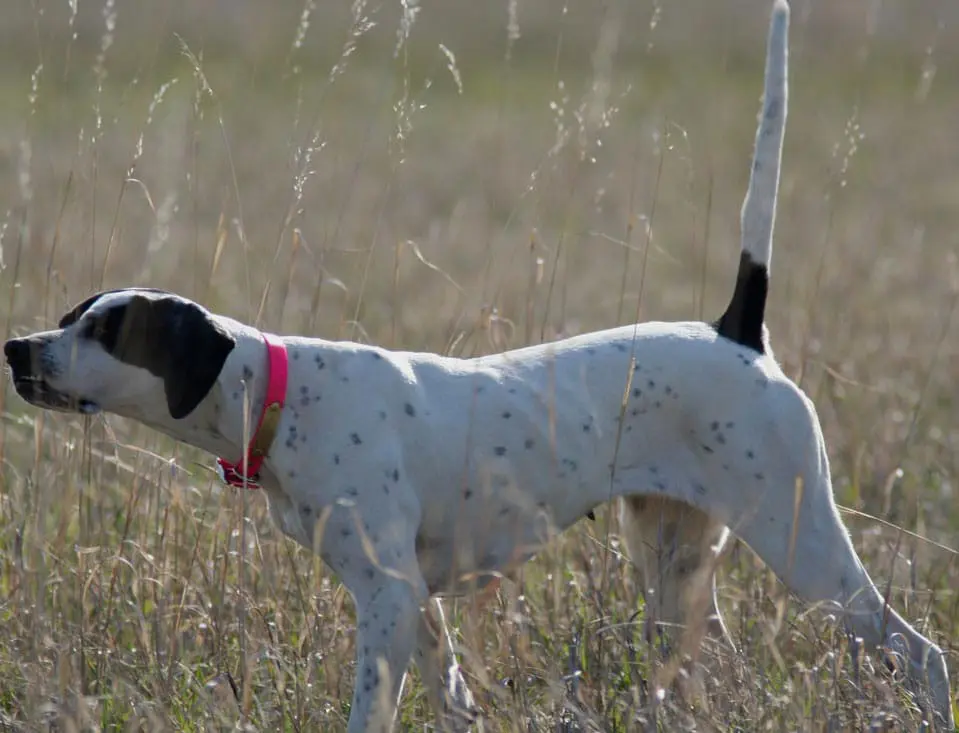
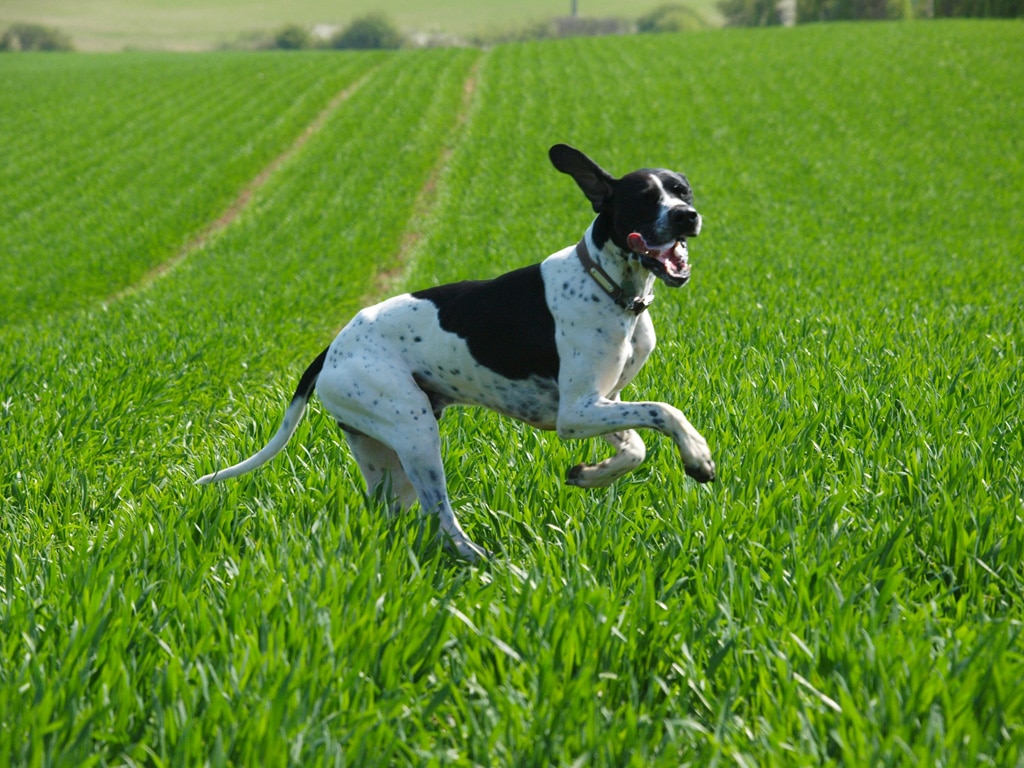
The English Pointer it is a large dog with a harmonious appearance, flexible and elegant. His body is well proportioned and his muscles well developed..

His tail is rather short, thick at the base and thin towards the tip. It is straight and follows the line of the back. When on the move, beats from side to side.

His head is flat and rests on a long, muscular neck. Profile, the length of the skull and muzzle are approximately equal.

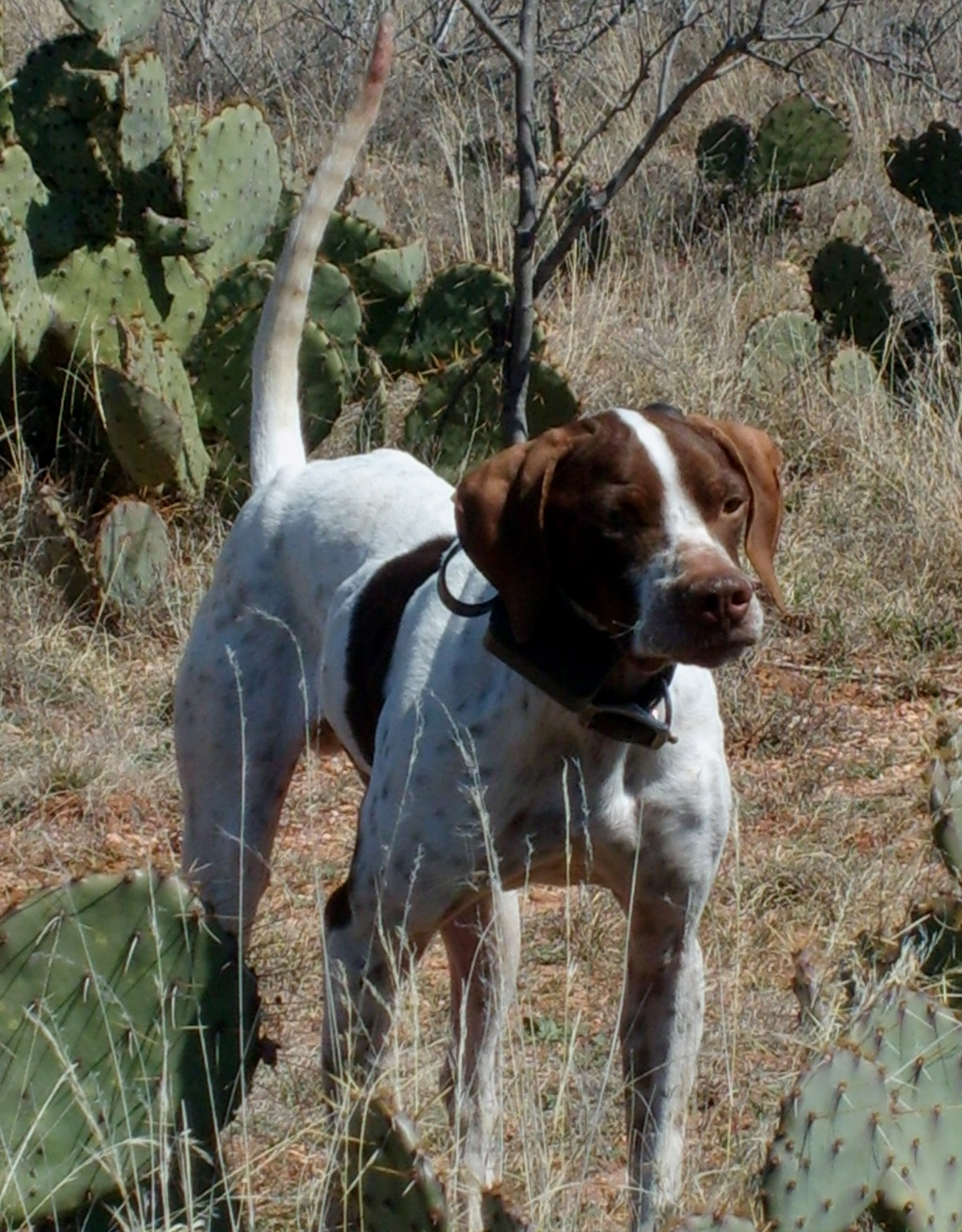
The ears are medium in size, droopy and located just above the eyes. They are slightly pointed and thin, with visible veins.

The eyes are oval in shape, with a hazel color in light-coated individuals, brown on others. In all cases, give the dog a lively look.

The nose is generally black, but may be lighter in dogs with lemon and white fur. In all cases, their nostrils are wide open.

The coat of the English Pointer is short, dense, smooth, straight and shiny. Their fur is usually bicolor, mixing white and another color: lemon, orange, brown or black. Unicolor or tricolor individuals are rarer, but they are also recognized by the standard.

Last, sexual dimorphism is quite marked in this breed: males are larger and above all more massive than females.

Height and weight

    ▷ Male size: Of 63 to 69 cm.

    ▷ female size: Of 61 to 66 cm.

    ▷ Male weight: Of 20 to 30 kg

    ▷ female weight: Of 18 to 28 kg

Character and skills

The English Pointer he is a gentle companion, loyal and affectionate with his family. Get along especially well with children old enough to have learned to interact with animals, and is a tireless playmate for them. He is also very patient and gentle with them, even when they are unruly or even bullying you. But, it is much less suitable for young children due to its large size, since you can easily push them unintentionally. In any case, regardless of race, a dog should never be left alone with a very young child without adult supervision.

The English Pointer not only does he get along very well with family members, but also with other dogs of the same breed.

Sharing your everyday life with one of them is a great way to avoid boredom when your child is away from home.. In fact, they have a hard time tolerating loneliness: if left alone too often or for too long, they are very likely to develop separation anxiety, with destructive behavior as a consequence. Whether you share your home with another animal or not, only suitable for a master who generally spends most of his days away from home.

If you like to be around your family, the Pointer, on the other hand, is much more reserved and distant with strangers. Without showing aggressiveness towards them, does not deprive himself of barking when he perceives danger or a stranger approaches his place of residence. But, although their barking and large size can be a deterrent, his ability to attack when necessary is limited, which does not make them good guardians. On the other hand, is an effective warning dog. Living with a cat or a rodent is possible, as long as they have been raised together or are used to living with other animals from a young age. Otherwise, it is better to avoid taking the risk, since its strong hunting instinct could lead it to consider newcomers as prey. This is also how he sees pet birds and small animals he doesn't know, whether they cross your path on a walk or venture into your garden.

This temperament is obviously a good thing if employed as a hunter., but it also implies that he must be kept on a leash during walks as long as he does not obey when asked to return, otherwise it will start chasing small animals that pass. Having said that, even with a good recovery workout, cannot be completely trusted: your instincts can get stronger at any time. Thus, It makes sense to invest in a GPS-connected collar, so you can easily locate it if it goes out to sea, especially since then it can get far away, but not necessarily find my way back.

In any case, the fear that he may be deceiving his masters is no reason to limit his outings, since the remedy would be worse than the disease. In effect, to be balanced, the English Pointer must be able to dedicate at least one hour a day, for example through two or three walks and / or play sessions.

It is too active to be suitable for an elderly and / or very sedentary person, but its incredible speed and stamina make it a perfect companion for a very active master.. It is a pleasure to accompany you on jogging sessions, bike outings or long walks.

His curiosity and high intelligence also mean that physical activity is not enough.: to feel good both in your head and in your body, must also be intellectually stimulated. Ideally, you have a job to do or a mission to accomplish as often as possible.. Hunting and dog sports such as agility, obedience and rally are, Therefore, great ways to allow you to exercise both physically and mentally.

In any case, your activity level makes you unsuitable for apartment living, since you need to be able to run freely at all times in a wide space to expend your excess energy. So, need a house with a garden, but the garden must be well fenced, given his unbridled temper. Using an underground electric fence would not be an effective solution, because their determination is much stronger than the discomfort felt by electrical impulses, especially when he has sniffed a prey and goes after it.

And just because a dog likes to play in the garden doesn't mean they have to spend most of their time there., away from his family. To be happy and balanced, you need to be surrounded and interact with your family. It also, once your needs are met, he is quite calm and enjoys spending time with his masters, for example lying on the sofa receiving pampering.

Education

As in any race, Socialization should be one of the pillars of the education of the English Pointer and start at a young age, when it is most malleable and adaptable. So, you need to get used to being exposed to all kinds of different situations and environments, but also and above all to regularly meet other animals and new people. This is all the more necessary as he tends to be spontaneously shy around strangers..

The other way, to avoid any hyperapego to their owners, you should also teach your dog to tolerate loneliness. Otherwise, You may find it especially difficult to cope with your absences.

The intelligence of English Pointer makes you able to learn quickly. This does not mean that he is willing to comply with all the wishes of his master.: has a strong character and can be very stubborn, so sometimes it's hard to make him obey.

So, to achieve your goals - and, in particular, to get your dog to obey you- his master must be firm in his education and not let anything pass from the beginning, at the risk of ending up with a difficult partner. Pay special attention that the rules are clear from the start, but also constant over time and from one person to another, which requires good cooperation between family members.

In general, the ideal is to start learning as soon as you get home, opting for the dog training method based on positive reinforcement. In fact, not receptive to reprimands, and responds much better to stimuli and treats.

But, the different smells and sounds that you perceive around you also interest you very much, and soon catch your attention during training sessions. So, it is better to opt for frequent sessions, short and varied, in order to keep you focused on tasks at all times.

Difficulties in achieving what is expected of him make it not really recommended for an inexperienced person, since it would soon be difficult for him to hit.

In any case, given his strong hunting instinct, remembrance is one of the most important teachings you should receive. Prevents him from constantly chasing animals he considers prey and disregarding his master's orders. Although it remains difficult to hope that his ardor will be curbed in the 100% of the cases, it must be kept on a leash during walks as long as this order is not properly assimilated.

Health

The English Pointer It, in general, a robust and healthy animal, and their life expectancy, of 12 to 15 years, is rather in the high range of the average for dogs of this size. They can withstand the heat without difficulty, but their short fur makes them especially sensitive to cold and humidity. Thus, it is advisable to cover him with a dog coat when temperatures are low. In any case, it is not suitable for living in a region where the climate is especially cold for much of the year.

Although in good general health, like any race, you can suffer from various more or less serious illnesses throughout your life. Those that predispose the most are :
  • The Hip Dysplasia, a joint malformation whose appearance may be favored by a hereditary predisposition. It produces pain and lameness that worsen over time, and favors the appearance of osteoarthritis as the animal ages;
  • The metaphyseal osteopathy (or hypertrophic osteopathy), a bone disease that usually manifests itself as the animal grows and progresses rapidly. Besides lameness, can cause various symptoms such as high fever, anorexia or abnormal fatigue. The vital prognosis is good in mild forms of the disease, but much more reserved for the most serious cases;
  • Chondrodysplasia (or dwarfism), a genetic disease that causes underdevelopment of bones and cartilage. The latter causes the front and hind limbs to be shorter than normal.. There is no cure for this disease, but medication can ease the pain, and surgery may be suggested for the most severe cases to correct any deformation of the bones and vertebrae;

  • The stomach dilation-torsion syndrome, which occurs when the stomach swells and folds in on itself, blocking the evacuation of gases and interrupting blood circulation. Unless a vet intervenes quickly, it is usually fatal, so it is a vital emergency;
  • The Addison's disease, an endocrine disorder that is sometimes inherited and is caused by destruction or atrophy of the adrenal glands. This gives rise to various symptoms that may suggest other pathologies.: vomiting, diarrhea, dejection, weightloss, anorexia, tremors… The acute form gives the animal little chance of survival, while a lifelong treatment helps fight the chronic form;
  • The Hypothyroidism, a hormonal disease that causes a decrease in metabolism. Hypothyroidism is a hormonal disease that causes a decrease in metabolism and gives rise to various symptoms that vary from one individual to another.: exhausted, damaged fur, breathing difficulties, overweight… Requires lifelong treatment to alleviate or even prevent these symptoms;
  • The epilepsy, a chronic disease of the nervous system that causes seizures whose manifestations can vary from time to time and from person to person. Although there is no cure, various treatments can reduce the intensity or number of seizures to such an extent that most people with this disease can lead normal lives;
  • Aortic stenosis, a congenital and probably hereditary heart defect that causes heart failure. This anomaly is incurable, and the risk of syncope or heart attack in the affected animal is not negligible. However, there are medications to counteract the effects of heart failure and the risk of sudden death;
  • Demodechia, dermatological disease due to overgrowth of Demodex Canis mites. Hairless spots may appear, itchy redness, blackheads and dandruff. The localized form usually heals itself, but if necessary -or in the case of a generalized form- medication and skin care can help;
  • Allergies, whether they are respiratory, food, skin or contact. Symptoms and treatments depend on the type of allergy in question.;

congenital deafness, which mainly affects white-coated dogs. Whether it affects one or both ears, is irreversible;

The ear infections, which are common in any dog โ€‹โ€‹with floppy ears.

The English Pointer it is also especially prone to various eye diseases:
  • Progressive retinal atrophy, an incurable inherited disease that causes retinal degeneration. Causes progressive loss of vision, first at night and then during the day;
  • The gland prolapse nictitante (or cherry eye), which corresponds to an inflammation of this lacrimal gland. The most common signs are the appearance of a small red ball in the inner corner of the eye and tearing. Can be treated with surgery;
  • The entropion, which is a curvature of the edge of the eyelid towards the inside of the eye. It can be hereditary and causes pain, irritation and inflammation of the cornea and conjunctiva from repeated rubbing of the eyelashes and / or hairs on the fragile parts of the eye. This can be remedied with surgical intervention.;
  • The waterfall, which mainly affects the elderly and corresponds to a clouding of the lens. If nothing is done, leads to progressive loss of vision, up to total blindness. But, an operation can allow the animal to regain correct vision.

It also, When the English Pointer used for hunting, you are obviously exposed to the risks that this activity implies – particularly that of injuries.

Having said that, although the list of conditions the breed is predisposed to may seem frightening at first glance, keep in mind that its prevalence remains low, so most of its representatives live in perfect health. This is confirmed by a study carried out in 2004 by the Kennel Club and the British Small Animal Veterinary Association, which showed that old age is the main cause of death in this breed. Old age alone accounts for a quarter of deaths, while cancers rank second and are implicated in around the 20% of the cases.

However, it is true that a large part of the diseases to which the breed is predisposed are or may be hereditary, which justifies favoring a serious breeder of English Pointer. In effect, not content with offering puppies quality socialization from their first weeks of life, a professional worthy of the name takes care that they do not suffer from a hereditary defect transmitted by their parents. To avoid this, has various genetic tests performed routinely on individuals you plan to breed, to avoid the transmission of a hereditary pathology and, of course, rule out those at risk. In addition to the test results in question, must be able to present a certificate of good health issued by a veterinarian, as well as details of the vaccinations administered, registered in the animal's sanitary or vaccination registry.

Once adopted, it must be ensured that the animal does not make any excessively long or intense physical effort during its growth, which usually lasts until 18 months. In effect, your bones and joints are then especially fragile; would run the risk of injury or developing malformations, with consequences that could last a lifetime. These may include, this could lead to the development of Hip Dysplasia, to which you are predisposed.

Last, throughout his life, the English Pointer must be taken at least once a year to the vet for a complete health check. This appointment is also an opportunity to carry out any necessary vaccine withdrawals.. At the same time, to prevent risks related to parasites (worms, ticks…), your owner must make sure to renew your deworming treatments whenever necessary.

Life expectancy

Of 13 to 14 years

Grooming

The English Pointer it is an easy breed of dog to take care of, and this is especially true for their fur. Brushing once a week with a special glove or a rubber brush is enough to remove dead hairs and spread the sebum all over his coat.. If rubbed gently with a chamois or soft cloth, will be bright. It is also the occasion to detect possible skin problems, that are frequent in him.

During your seasonal molt, in spring and autumn, hair loss is still moderate, but brushing frequency should be increased. Ideally, do it two or three times a week.

When properly cared for, the fur of the English Pointer does not get very dirty and rarely smells bad. So, no need to wash frequently: once or twice a year is enough, unless, of course, is dirty or smells bad. In any case, a mild shampoo designed specifically for dogs should always be used, to avoid damaging your skin with an unsuitable product. In fact, the pH of dog skin differs from that of human skin.

You have to pay special attention to their droopy ears, since this morphological peculiarity increases the risk of infections at this level (otitis, etc.). So, not only do they have to be inspected and cleaned at least once a week, but also spend time drying them every time they have been in contact with water or have spent a long time in a humid environment, to prevent moisture build-up.

The maintenance of your dog's ears and also the opportunity to check his eyes and clean them if necessary, in order to avoid the risk of infections.

It also, teeth should also be cleaned at least once a week with dog toothpaste and a toothbrush or pad. This helps limit the formation and accumulation of tartar., that favors the development of bad breath and various oral diseases. Ideally, brush your teeth several times a week or even daily.

Looking at its claws, the activity level of the English Pointer makes natural wear and tear normally enough to file them. But, as you age or are no longer as active as before, they can get too long and end up annoying or even hurting you. So, they must be examined regularly and cut with a file or nail clipper as soon as necessary. This is the case as soon as a kind of rattling sound is heard when walking on hard ground.

Whether the fur, the ears, the eyes, teeth or claws, do not hesitate to ask for the help of a professional (vet or groomer) to know the proper care of the English Pointer. It is also advisable to accustom your pet to being handled from a young age.

This facilitates not only grooming sessions, but also to be able to examine it easily every time you return from a long stay abroad, for example during a hunting day. In effect, this is important to make sure he is not injured or that there are no parasites or spikes stuck in his fur.

Food

As in the case of any race, the diet of English Pointer should fit your size, age, health and physical activity level, both in terms of the choice of products and the amount of food given each day. To maximize the chances of keeping your dog healthy, it is recommended to feed him with high quality croquettes or hamburgers that provide him with all the nutrition he needs.

Nutrient intake can vary significantly throughout the year. If used as a hunter, will use more energy during certain periods of the year, so your daily rations should be modified and increased, since the diet of a hunting dog is not the same as the usual. But, it is important to return to a normal amount of food once the season is over to avoid any risk of overweight in dogs.

In fact, but the English Pointer are not predisposed to obesity, it is advisable to monitor your weight every month to ensure that everything is fine at that level. This is even more important if you have been spayed, since the risk is then higher. In case the magnification is prolonged or even increased during several measurements in a row, it is necessary to take it to the vet to find out the cause of the problem and thus know how to remedy it. In any case, your diet and activity level may not be the cause, for example if weight gain is a symptom of an underlying disease.

In any case, diet is especially important when the dog is small and growing. Feeding them too much and / or giving them too much food can cause them to grow too fast, which can cause not only injuries, but also long-term problems with bones and joints, as deformities. On the other hand, improper nutrition can also cause potentially very damaging stunting.

Regardless of age, the ideal is, as with any dog, divide your daily ration into several meals. This is all the more essential since it is predisposed to the dilation-torsion of the stomach., which often follows the rapid absorption of a large amount of food. It also, to avoid the latter, meals should be taken in a quiet place and one hour away from any strenuous physical activity.

It also, the fact that it is not especially prone to obesity does not justify giving it food intended for humans (for example, table scraps), without ensuring that you can effectively meet your nutritional needs. Otherwise, it would do more harm than good, especially, of course, if the food is popular with humans but toxic to dogs.

Last, water must be available throughout the day and must be changed regularly to keep it fresh. If used for hunting, it is better to carry enough than to let him drink standing water.

Use

Before the 18th century, the English Pointer it was mainly used as Pointing Dogs for small game, like the rabbit, the hare or the fox. Thus, cared for possible prey and worked with racing dogs, who were in charge of hunting and catching them.

With the arrival of firearms in his native England in the early 18th century, began to be used more to target and retrieve game birds, function in which he stood out.

Even today, are still highly prized by hunters, who use it mainly as Pointing Dogs.

They are also found as pets. Its sweetness and affectionate character make the Pointer a very endearing companion, as long as his family can meet his great need for exercise and they are sufficiently present for him.

Their loyalty to their owners and their aloof and aloof demeanor with strangers, without depriving yourself of barking loudly when they approach, make it an excellent warning dog. But, its ability to act as a watchdog is limited by its lower propensity to attack in danger.

It is also a good companion for dog sports. Its competitive character and its resistance allow it to distinguish itself in disciplines such as canicross, el cani-VTT, obedience, the rally and agility.

Last, his elegance and his desire to please his masters also make him a sure value in canine beauty contests. In fact, he was already often seen at dog shows in the 19th century.

Price

The price of a puppy English Pointer varies between the 450 and 1.200 EUR, and the mean is around 900 EUR, without great differences between males and females. There are many breeders throughout Europe.

On the other hand, in Canada remain rare, so the number of individuals offered each year is quite limited. The amount requested usually ranges from 1200 and 3000 canadian dollars. So, the most pertinent option may be to buy in the United States, where a puppy can be acquired for between 1000 and 1500 USD. Then, you must ensure that you adhere to the regulations regarding the importation of a dog into Canada and note that transport and administrative costs are added to the purchase price.

regardless of the country, price differences from one individual to another are explained by their own characteristics (and in particular its greater or lesser conformity with the breed standard), but also by the reputation of the lineage from which they come, as well as the prestige of the breeding.

Characteristics "English Pointer"

Coexistence is important that you have with your new friend. Before considering the acquisition of a dog of the breed "English Pointer" you know certain factors. Not all breeds of dogs are apt to live in an apartment, you must take into account his character, their need for exercise, their interaction with other pets, their care and if you have small children, their level of tolerance towards them.

Adaptation โ“˜

3,0 of 5 stars (based on 1 review)

friendly dog โ€‹โ€‹โ“˜

4,0 of 5 stars (based on 1 review)

hair loss โ“˜

3,0 of 5 stars (based on 1 review)

Affection level โ“˜

3,0 of 5 stars (based on 1 review)

Need for exercise โ“˜

4,0 of 5 stars (based on 1 review)

Social need โ“˜

4,0 of 5 stars (based on 1 review)

Home โ“˜

3,0 of 5 stars (based on 1 review)

Toilet โ“˜

2,0 of 5 stars (based on 1 review)

Friendly with strangers โ“˜

2,0 of 5 stars (based on 1 review)

barking โ“˜

3,0 of 5 stars (based on 1 review)

Health โ“˜

4,0 of 5 stars (based on 1 review)

Territorial โ“˜

3,0 of 5 stars (based on 1 review)

Cat friendly โ“˜

2,0 of 5 stars (based on 1 review)

Intelligence โ“˜

4,0 of 5 stars (based on 1 review)

Versatility โ“˜

4,0 of 5 stars (based on 1 review)

Child friendly โ“˜

4,0 of 5 stars (based on 1 review)

Surveillance โ“˜

2,0 of 5 stars (based on 1 review)

joy โ“˜

5,0 of 5 stars (based on 1 review)

Images of the ยซEnglish Pointerยป

Videos of the ยซEnglish Pointerยป

Type and recognitions:

  • FCI CLASSIFICATION:
  • Group :
  • Section : . .

Federations:

  • FCI – Group 7: Pointing Dogs. – Section 2: Continental Pointing Dogs. 2.1: Pointer โ“˜
  • AKCSporting โ“˜
  • ANKC Group 3 (Gundogs) โ“˜
  • CKCSporting Dogs โ“˜
  • โ€‹KC – Gundog โ“˜
  • NZKCGundog โ“˜
  • UKCGun Dogs โ“˜

FCI breed standard "English Pointer"

Origin:
England, United Kingdom

Date of publication of the valid original standard:
28.07.2009

Use:

Pointing Dogs.


General appearance:

The Pointer is harmonious, well built throughout. He gives an impression of strength and agility. Its general profile describes a series of graceful curves.


Behavior / temperament:

Aristocratic. Active, an impression of strength emanates from its entire ensemble, perseverance and speed. Good character; of a natural
indifference.

Head:

---

Cranial region:
  • Skull: Of an average width, in relation to the length of the snout. Pronounced occipital Protuberance.
  • Depression links (Stop): Well marked.

facial region:

  • Truffle: dark colored, but could be clearer in the case of the fur lemon and white; soft and moist; the Windows are wide open.
  • Snout: Somewhat concave and ends at the level of the truffle, giving the face a spectrum slightly concave. Slight depression under the eyes.
  • Lips: Well-developed and flexible.
  • Jaws / Teeth: The jaws are strong and articulated in perfect scissors., regular and complete, That is, the upper incisors cover the lower incisors in close contact and are implanted vertically in relation to the jaws..
  • Cheeks: They are not prominent.

Eyes: Equal distance from the back of the head and the truffle. Alive with expression of kindness. The eyes are hazel or brown depending on the color of the coat.. They are not or projections, or huraรฑos. The look is not fleeting. The outline of the eyes is dark, but it can be more clear in the case of the fur lemon and white.

Ears: The skin is thin. The ears are set quite high. They are located next to the head, slightly pointed and average length in the end.

Neck:

Long, muscular, slightly curved, offering a beautiful birth of neck, free Gill.

Body:

  • Pork loin: Strong, muscular and slightly vaulted. Short.
  • Breast : You have the just width required for a good range of the sternal region. The sternum descends to the level of the elbows. Well arched ribs, well developed towards the posterior region of the chest, decreases gradually towards spine.

Tail:

Of average length, thick at the base, gradually tapering to the end. Well covered with dense hair and carried level with the back, without presenting curvature upwards. When is the dog in action, the queue be whipped from one side to another.

Tips

PREVIOUS MEMBERS: Previous members, the elbow to the ground, they are straight and firm, with good bones. The bones are oval, strong and visible tendons.

  • Shoulder: Long, oblique and well inclined backwards.
  • Carpo: The joint does not exceed the previous member profile and makes a very light outgoing envelope the internal face.
  • Metacarpus: Rather long, strong and elastic, slightly tilted.
  • Front feet: The feet are oval; fingers are tight and well arched, equipped with good pads.

LATER MEMBERS: Very muscular. The bones of the hips are well separated and prominent, but they do not exceed the level of the back.

  • Thigh: Good development.
  • Knee: Well angled.
  • Leg: Good development.
  • Hock: Well descended.
  • Rear feet: The feet are oval; fingers are tight and well arched, equipped with good pads.

Movement:

Meeting. The dog cover much ground. The discharge is given by the later train. Elbows should not be turn neither inwards, or out. In any way the members you must lift high to the shape of a Hackney horse (high gaits or brincantes).

Mantle

HAIR: The hair is fine, short, hard and equally distributed, perfectly smooth, straight and well polished.

COLOR: Common colors are lemon and white, Orange and white, liver (brown) and white, black and white. Unicolores and tri-colored coats are equally correct.


Size and weight:

The height to the desired cross, for the male, is of 63 to 69 cm. (25 to 27 inches), for the female of 61 to 66 cm. (24 to 26 inches).


Fouls:

Any deviation from the above criteria is considered missing and the seriousness is considered to the extent of the deviation to the standard and its impact on the health and welfare of the dog, and the ability of the dog to carry out their traditional work.

FALTAS DESCALIFICANTES

  • Aggressive or fearful dog.
  • Any dog โ€‹โ€‹showing clear signs of physical or behavioral abnormalities must be disqualified..


N.B.:

Males should have two normal-appearing testicles fully descended into the scrotum..

TRANSLATION: Dr. Federico del Valle.

Source: F.C.I - International Cynological Federation

Alternative names:

1. Pointer (English).
2. Pointer (French).
3. Englische Pointer (German).
4. (em inglรชs: English Pointer), Pointer (Portuguese).
5. Perdiguero inglรฉs (espaรฑol).

โ–ท The world of Pets: Dogs, cats, birds, reptiles, amphibians

Pudelpointer
Alemania FCI 216 . Braque Type

Pudelpointer

The Pudelpointer has a great passion for water and swimming, which probably comes from the Poodle's influence on his selection.

Content

History

It was the German Baron Von Zedlitz, a real foodie, who created the Pudelpointer towards the end of the 19th century.

The Pudelpointers are Pointing Dogs hard hair, whose genetic origins date back to a cross between a English Pointer and Pudelhund, without any other race of Pointing Dogs. Although the Poodle it was only used to create the first strains, his qualities as a hunter have been preserved until today.

The first crossing of a Pudelhund and English Pointer to establish the new breed took place in Germany in 1881. The father was a English Pointer property of Kaiser Federico III called tell and mother, a Poodle named molly, belonged to a famous Teutonic author on the subject of hunting dogs, Hegewald.

The genes of Poodle, like race, seemed to have been more dominant in transmission. To alter this, many more were introduced Pointers What Poodles in the breeding program to arrive at what the Pudelpointer is today. During the first 30 years of parenting, they only used 11 Poodles instead of more than 80 Pointers. After that initial time period, only the occasional reintroduction of the Pointer. After WWI and WWII, the breed was severely reduced and the reintroduction of the English Pointer became important to rebuild the brood.

The first Pudelpointers in North America were imported into 1956. After the foundations of the breed were laid, in 1977 The Club of the Pudelpointer from North America.

Combined with the exceptional abilities of the English Pointer to work on the plains, that is to say, a fine and receptive nose even at a distance, a quick search that covers a lot of ground and firm stops, we have created a versatile and genetically strong hunting dog that meets the requirements of hunting.

Germany is very careful in preserving the health of the breed, with increased vigilance against hip dysplasia and epilepsy. It also, the Pudlepointers currently play an important role in hunting events, since only dogs that have successfully participated in them are registered in the pedigree registry.

Photo: Pudelpointer by https://www.akc.org/dog-breeds/pudelpointer/

Physical characteristics

The Pudlepointer It is a breed of dog weighs between 20 and 30 Kg., measured between 53 and 66 cm.. on the shoulder and comes with liver colored fur, brown and occasionally black. The ideal coat is hard, lean and dense.

The Pudelpointer it is a large hunting dog that weighs between 20 and 30 Kg and measures between 53 and 66 cm.. The ideal type has the construction of a heavy pointer. The tail extends the rump in a regular line without breaking.. The tail can be shortened for hunting and, if the law allows it, the length should reach the lower edge of the vulva in females or cover the testicles in males. The length of the skull is equal to that of the muzzle. The ears are medium in size, hanging ears are high and close to the head. The tip of the ear is slightly rounded. Located on the sides, eyes are large and dark amber.

Covering the whole body, medium length hair is rough, close and close to the body, with a thick undercoat. The head has a beard and a toupee with curly streaks. The hair must provide protection against the cold, water and injuries. The coat is solid black, brown or dead leaf. White spots are allowed. These dogs shed very little hair.

Character and skills

Of the English Pointer, inherited the subtle nose, the burning and the lively gait. The Poodle gave him the vivacity of the spirit, the talent of transporter and the taste of water.

Energetic dog, very enthusiastic tracker and retriever at work, is comfortable on all terrains and can tolerate all weather conditions quite easily.

Health

Germany, the country of origin of the Pudelpointer, attaches special importance to the health status of the breed with special emphasis on the prevention of hip dysplasia (HD) and epilepsy in the breed. Some dogs may face these health challenges in their lives, but most of the Pudelpointers they are healthy dogs. Working with a responsible breeder, future owners can get the education they need to learn about specific health concerns within the breed.

Grooming

The Pudelpointer has a close layer, flat, hard and rough of medium length with a dense undercoat; as a result, seasonally shed. Beyond regular weekly grooming, the occasional bath will keep you clean and looking your best. Grooming can be a wonderful bonding experience for you and your dog..

Strong, fast-growing nails should be trimmed regularly with nail clippers or a nail buffer to prevent excessive growth., breakage and cracking. Ears should be checked regularly to prevent buildup of wax and debris, which can result in infection. Teeth should be brushed regularly.

Exercise

The Pudelpointer, as a hunting breed, need regular exercise. Exercise options may include backyard playtime, preferably fenced, or being taken for walks several times a day. Exercise can also be done in the form of indoor activities, like the hideout, chase a ball rolling on the ground or learn new tricks. Certain outdoor activities such as swimming, hiking or retrieving Frisbees or balls can provide a good outlet for expending energy.

Note: The Pudelpointer absolutely love water! Training for dog sports such as agility, obedience, and the rally can also be a great way to give your dog exercise.

Characteristics "Pudelpointer"

Coexistence is important that you have with your new friend. Before considering the acquisition of a dog of the breed "Pudelpointer" you know certain factors. Not all breeds of dogs are apt to live in an apartment, you must take into account his character, their need for exercise, their interaction with other pets, their care and if you have small children, their level of tolerance towards them.

Adaptation โ“˜

3,0 of 5 stars (based on 1 review)

friendly dog โ€‹โ€‹โ“˜

4,0 of 5 stars (based on 1 review)

hair loss โ“˜

1,0 of 5 stars (based on 1 review)

Affection level โ“˜

4,0 of 5 stars (based on 1 review)

Need for exercise โ“˜

4,0 of 5 stars (based on 1 review)

Social need โ“˜

4,0 of 5 stars (based on 1 review)

Home โ“˜

3,0 of 5 stars (based on 1 review)

Toilet โ“˜

2,0 of 5 stars (based on 1 review)

Friendly with strangers โ“˜

4,0 of 5 stars (based on 1 review)

barking โ“˜

3,0 of 5 stars (based on 1 review)

Health โ“˜

4,0 of 5 stars (based on 1 review)

Territorial โ“˜

2,0 of 5 stars (based on 1 review)

Cat friendly โ“˜

2,0 of 5 stars (based on 1 review)

Intelligence โ“˜

4,0 of 5 stars (based on 1 review)

Versatility โ“˜

3,0 of 5 stars (based on 1 review)

Child friendly โ“˜

4,0 of 5 stars (based on 1 review)

Surveillance โ“˜

2,0 of 5 stars (based on 1 review)

joy โ“˜

3,0 of 5 stars (based on 1 review)

Videos "Pudelpointer"

Pudelpointer - TOP 10 Interesting Facts
Pudelpointer – TOP 10 Interesting Facts
Martha the Pudelpointer - Deliver to Hand
Martha the Pudelpointer – Deliver to Hand

Type and recognitions:

  • FCI CLASSIFICATION:
  • Group :
  • Section : . .

Federations:

  • FCI – Group 7: Pointing Dogs. – Section 1: Continental Pointing Dogs. 1.1: Braque Type โ“˜
  • CKC Grupo 1 – Sporting Dogs โ“˜
  • UKCGun Dogs โ“˜

FCI breed standard "Pudelpointer"

Origin:
Germany

Date of publication of the valid original standard:
09.11.2004

Use:

Hunting dog. Variable with all the characteristics required for the breed. Useful for the field, forest and water.


General appearance:

Ideally, its structure should show the type of a heavy Pointer with a not too long brown coarse coat., dark brown, color of dry leaves or black which protects its entire body.

IMPORTANT PROPORTIONS :

โ€ข The relationship between the length of the body and the height at the withers must be 10 to 9.
โ€ข The ratio of the length of the skull from the occipital protuberance to the stop is equal to the length of the snout from the stop to the nose..


Behavior / temperament:

neither shy nor aggressive. Quiet character, controlled and balanced. Marked hunting instinct without fearing prey or being sensitive to being shot.

Head:

Harmonious length and width according to your height and sex.

Cranial region:
  • Skull: Plano, just a little rounded on the sides, moderately wide, clearly developed eyebrow arch.
  • Depression links (Stop) : Marked.

facial region:

  • Truffle: Its color corresponds to the color of the hair, heavily Pigmented. Well open nasal Windows.
  • Snout : Harmonious relationship between its length and width. It should not be narrow or end in a point. Straight nasal bridge.
  • Lips : Tight, not hanging. In no way should you drool.
  • Jaws / Teeth : Big teeth, strong jaws with a perfect scissors bite, regular and complete in which the upper incisors close in front of the lower ones without losing contact and the teeth are placed vertically in the jaw. With 42 teeth according to the dental formula.

Eyes : Placed on the sides, large, dark amber tones with a lively expression. Eyelids well covered with hair and close to the eyeball.

Ears : Medium-sized, High insertion hangs flat and close to the sides of the skull; They are not fleshy; well covered with hair and rounded ends.

Neck:

Long Middle, strong muscles. The neck line is slightly domed without showing a double chin..

Body:

  • top line : Right.
  • Cross : Marked.Back : Short, straight, rigid with strong muscles.
  • Pork loin : With strong muscles.
  • Rump : Long and moderately inclined, with good musculature.
  • Breast : Wide and deep. Ribs well sprung but not barrel-shaped.
  • Bottom line and belly : retracted back, forming an elegant arch. Delgado.

Tail:

The transition from the rump is even in a line without interruption. Right tail, should not be carried upwards. Cover of rough hair without forming a flag. The tail, for hunting purposes and in accordance with animal protection, In the case of females, it is amputated to the lower edge of the vulva and in males, covering the testicles. In countries where amputation is prohibited by law, the tail can be left natural.. It should reach the joint of the hoof and its carriage should be straight or slightly saber-shaped, somewhat above the top line..

Tips

PREVIOUS MEMBERS :

In general: Seen from the front straight and parallel, seen from the side, limbs straight and well placed under the body. Strong joints and bones.
Shoulder : Well-fitted and muscular scapulae. Shoulders and forearm form a correct angle.
Arm : Long, well muscled and dry.
Elbow : Placed well under the body, well adjusted without turning in or out.
Forearm : Long, well developed muscles, dry and placed vertical. Arm and forearm form a correct angle.
Articulation of the carpus : Strong.
Metacarpus : something directed forward.
Previous foot : Round to oval, closed. Strong and durable pads. The hair on the feet and fingers should not be too long.

LATER MEMBERS :

In general : Hindquarters seen from behind straight and parallel, well muscled, strong bones.
Thigh : Long, width, well muscled.
Knee : Strong. Thigh and leg form a correct angle.
Warm-tarsal joints : Strong, very well angled.
Metatarsus : Short, vertical placement.
Rear foot : Round to oval, closed. Strong and durable pads. The hair on the feet and fingers should not be too long.

Movement:

Harmonic, elastic, with good reach and thrust. Steps that cover the surface well. Forelimbs and hindlimbs straight and parallel, maintaining an upright posture.

Mantle

SKIN : Tight, footprint, without forming folds.

HAIR : Cerrado, glued, hard, medium length with abundant undercoat. The length of the outer hair above the withers is 4 โ€“ 6 cm.. The head with a beard and chip-type curls on the forehead. The hair on the belly is closed and dense. The hard and dense coat should provide, as much as possible, good protection against inclement weather and injuries..

COLOR : Unicolor.

โ€ข Brown.
โ€ข Colors of dry leaves.
โ€ข Negro.

Small white marks allowed.


Size and weight:

Height to the cross :

  • Males : 60 to 68 cm.,
  • females : 55 to 63 cm..


Fouls:

Any deviation from the aforementioned criteria is considered a fault and the severity of it is considered to the extent of the deviation from the standard and its consequences on the health and well-being of the dog..
In particular :

โ€ข Sunken or steep back.
โ€ข Elbows turned outward or inward.
โ€ข Cow's hooves, sickle or together both standing and moving.
โ€ข Stiff movement or with short steps.
โ€ข Hair that is too long, too thin, absence of inner fleece.

DISQUALIFYING FOULS:

โ€ข Shyness towards prey, nervousness, aggressiveness, teether out of fear.
โ€ข Unsuitable temperament for hunting, especially fear of being shot.
โ€ข Prognathism, enognatismo, crossbite. Narrowly placed canines.
โ€ข Lack of teeth except P1.
โ€ข Entropion, ectropion of any type.
โ€ข Upper eyelids without eyelashes as well as eyelids devoid of hair.
โ€ข Short hair.
โ€ข Absence of beard.
โ€ข Any other color or markings of another color than that described by the standard.

Any dog โ€‹โ€‹showing clear signs of physical or behavioral abnormalities must be disqualified..


N.B.:

Males should have two normal-appearing testicles fully descended into the scrotum..

Source: F.C.I - International Cynological Federation

Alternative names:

1. Pudelpointer (English).
2. Pudelpointer (French).
3. Pudelpointer (German).
4. Pudelpointer (Portuguese).
5. Pudelpointer (espaรฑol).

โ–ท The world of Pets: Dogs, cats, birds, reptiles, amphibians

Burgos Pointer
Espaรฑa FCI 90 . Braque Type

Perdiguero de Burgos

The Burgos Pointer is smart and learns easily, above all, tracking tasks.

Content

History

The Burgos Pointer It is a breed of dog Spain. Originally from Castile, especially in the province of Burgos, This rustic breed is intended for hunting and has exceptional characteristics for hunting small game..

It is an ancient breed from the Castilian tableland, is widespread, and according to some connoisseurs of the breed, it is likely that it has participated in the creation of other breeds of hunting dog, not only Spain.

The truth is that lot of documented material that speaks of this breed there is. Veterinary geneticist, Josรฉ Manuel Sanz rudder, has dedicated several lines to the history of this breed and in a document that appears cited in many web, speaks of the Origins and Ancient History (Until 1911). You can read the complete material on the website of the Spanish Association of el Perro Perdiguero de Burgos. Here we will only mention what refers to the word ยซPerdigueroยป and to the different theories about the origin but very briefly…

"The word ‘perdiguero‘ It occurs frequently in classical texts on venatoria and its reference corresponds to the generic Hunter dog of partridges, "perdicero" or "perdigero", but it cannot be lightly assumed that this dog was a Burgos Pointer. In numerous current texts we can read various theories about the origin of the race. The more absolute confusion arises from a whole once analysed separately. The most common mistakes that demonstrate a poor work of research are as follows:

  • Associate the word perdiguero the race Burgos Pointer.
  • Believing that the Pointing Dogs, as the Spanish classics tell us, they were Burgos Pointers and forget that they were other races.
  • Define like Burgos Pointer to the dogs that authors from Velรกzquez to Goya have been captured in numerous canvases where hunting dogs are reproduced.
  • Define incomprehensibly and lightly when Burgos Pointer as the origin of English Pointer, either in a display of patriotic enthusiasm, consider him further as the father of all European Braquesยซ.

"The authors, as often happens, they do not manage to agree on the theories about the origins of animals and while some affirm that the sample dog is originally from Italy, others say that France or Spain (according to the nationality of the author) which they were born.

On the formation of the current dog Burgos Pointer the news is null and we can only apply the parameters that are studied to form a race, they are:

  • Time and place of training.
  • Genetic basis provided the race.
  • Adaptation to the environment in which is born.
  • Geographical isolation and inbreeding operated.

With regard to the first of them, not a breed created by man ex process are being, with measured doses of one or another blood, both the time and the place of training are uncertain. A race not be based in short periods of time and having no initial selection at a single point, "We cannot think that the place of birth has only been a certain place."

(Author: Josรฉ Manuel Sanz rudder).

Physical characteristics

While the Burgos Pointer, It is not as robust and defined muscular level, like its relative the English Pointer, their appearance shows the strength of the race.

It has the ears long and the tail It tends to be cut one-third of its original length.

Its fur It has variants that can form different ranges within the basic color. The basic colors of the hair are the white and the liver. These colors mingle regularly, giving variegated layers that tend to liver, gray liver, mosqueados in liver and other various combinations, depending on whether the liver or white color is predominant and depending on whether the white spots are open or closed.

It is a very common feature (Although non-binding layer), that have a clear white spot on the forehead and the ears always spotted with a homogeneous liver color. Liver-colored hairs can form sharp, well-defined liver-colored patches, regularly distributed by the layer of the animal

Its the mantle is short, thick and soft. The hair is thinner in the head, ears and limbs.

The skin is elastic, but not printing, thick, abundant, pinkish spotless. All Oris they will be Brown, never black.

The height males will of 62 to 67 cm and females 59 to 64 cm to the cross. Thinking of 25 to 30 kg.

It is an animal that as all, It requires a dose of daily exercise. A long walk, and a few races in the open air will keep you happy.

Character and skills

It is a very friendly and quiet dog, not afraid easily. It is smart and learns easily, especially in tracking work.

It is not a dog that adapts very well to urban environments.

It is used for small game (rabbits, hares, etc.).

It's perfect for hunting in any field (no matter how hard it is), since it has an enviable physical resistance and a great speed.

The Burgos Pointer it is highly appreciated by hunters who want a rustic dog, hard in any terrain and type of hunting, obedient, strong and above all excellent winds and method of hunting, due to his calm and poise in the search, as well as his sample and his impeccable collection.

Although used for small game pieces not dismisses pieces of hunting trail, in which he demonstrates great bravery.

Characteristics "Burgos Pointer"

Coexistence is important that you have with your new friend. Before considering the acquisition of a dog of the breed "Burgos Pointer" you know certain factors. Not all breeds of dogs are apt to live in an apartment, you must take into account his character, their need for exercise, their interaction with other pets, their care and if you have small children, their level of tolerance towards them.

Adaptation โ“˜

3,0 of 5 stars (based on 1 review)

friendly dog โ€‹โ€‹โ“˜

3,0 of 5 stars (based on 1 review)

hair loss โ“˜

2,0 of 5 stars (based on 1 review)

Affection level โ“˜

3,0 of 5 stars (based on 1 review)

Need for exercise โ“˜

4,0 of 5 stars (based on 1 review)

Social need โ“˜

3,0 of 5 stars (based on 1 review)

Home โ“˜

2,0 of 5 stars (based on 1 review)

Toilet โ“˜

1,0 of 5 stars (based on 1 review)

Friendly with strangers โ“˜

3,0 of 5 stars (based on 1 review)

barking โ“˜

2,0 of 5 stars (based on 1 review)

Health โ“˜

3,0 of 5 stars (based on 1 review)

Territorial โ“˜

4,0 of 5 stars (based on 1 review)

Cat friendly โ“˜

2,0 of 5 stars (based on 1 review)

Intelligence โ“˜

4,0 of 5 stars (based on 1 review)

Versatility โ“˜

3,0 of 5 stars (based on 1 review)

Child friendly โ“˜

4,0 of 5 stars (based on 1 review)

Surveillance โ“˜

2,0 of 5 stars (based on 1 review)

joy โ“˜

4,0 of 5 stars (based on 1 review)

Images: Burgos Pointer

Videos: Burgos Pointer

Type and recognitions:

  • FCI CLASSIFICATION:
  • Group :
  • Section : . .

Federations:

  • FCI – Group 7: Pointing Dogs. – Section 1: Continental Pointing Dogs. 1.1: Braque Type โ“˜

FCI breed standard "Burgos Pointer"

Origin:
Spain

Date of publication of the valid original standard:
26.05.1982

Use:

Hair and Feather Pointer Dog. The Perdiguero de Burgos is highly appreciated by hunters who want a rustic dog., hard in any terrain and type of hunting, obedient; strong and above all excellent winds and method of hunting, due to his calm and poise in the search, as well as his sample and his impeccable collection. Although used for small game game, does not discard the trail of game pieces, in which he demonstrates great bravery.


General appearance:

Hunting dog of good size, eumetric and medioline. Well developed head, compact trunk and strong limbs. Droopy ears and short hair. Longitudinal diameter as close as possible to the height at the withers. Proportionality and functional harmony must be sought, both in static and in motion


Behavior / temperament:

Rustic, balanced, calm and sitting; turns out to be a great show dog, especially suitable for hunting hair and feathers. Fresh look, very noble, it is a breed of excellent character, docility and intelligence.

Head:

As a whole : Big and strong, well developed skull; strong face and muzzle and corkscrew ears.

The cranium, seen from above, It must be moderately rectangular with a progressive decrease towards the nose, without giving feeling of pointed snout. The ratio of the length of the skull to that of the face is 6:5. The craniofacial lines are divergent.


Cranial region:
  • Skull : Width, strong, domed and convex profile; well marked central groove, shallow occipital crest. Accused frontal sinuses.
  • Depression links (Stop) : Soft, little sharp.

facial region:

  • Truffle : dark brown, wet, big and wide with wide open windows.
  • Snout : Straight profile or with a very slight curve towards the nose. Width throughout its length, it should not give the impression of being pointed. Wide muzzle.
  • Lips : Sagging without sagging. The upper one will cover the lower one well. The bottom is marked labial commissure. The mucous membranes must be brown.
  • Jaws / Teeth : Strong teeth, white and healthy; scissor bite. All premolars exist.
  • Eyes : Medium, macaroons, preferably dark hazelnut, noble and sweet look, sometimes giving a feeling of sadness. The skin of the eyelids is moderately thick, pigmented like the mucous membranes in brown. The lower eyelid should be as close as possible to the eyeball.
  • Ears : long, drooping and triangular in shape. Inserted at eye line level, at rest they fall gracefully in corkscrew. Without exerting traction, they must reach the corner of the mouth and will not reach the nose.. Soft and soft to the touch, they have fine skin and hair; marked venous network. In higher insertion care and flatter frontal conformation.
  • Palate : Pink mucous with well marked beads.

Neck:

Strong and powerful; wide part at the head and continues with a slight widening to the trunk. Slightly arched top edge. Lower border with well defined dewlap that, starting from both lip corners, It is presented double without being exaggerated.

Body:

  • As a whole : Square, strong and robust, powerful chest and ribs, giving a feeling of power and agility.
  • Cross : Well defined.
  • top line : Straight and horizontal or desirable with a slight drop from the withers. Never saddled and no oscillations during movement.
  • Back : Powerful and muscular.
  • Pork loin : Medium-, broad and muscular, giving a feeling of power.
  • Rump : Wide and strong. Its inclination will be less than 45ยฐ with respect to the dorsal lumbar line and the floor.. Height at the croup equal to or less than the height at the withers;
  • Breast : Wide and deep, reaches elbow level; muscular and powerful. Tip of the sternum marked. Well developed ribs, rounded, not flat. Well marked and wide intercostal spaces as we move towards the floating ribs. The chest perimeter must be equal to the height at the withers plus ยผ of it.
  • Bellies and flanks : Belly moderately tucked towards the genitals. Low sides and well marked flanks.

Tail:

Thickness birth and average insertion. It is amputated between a third and a half of its length.

Tips

PREVIOUS MEMBERS :

  • As a whole : Perfectly Plumb, straight and parallel. Strong bones with short pasterns and well developed feet.
  • Shoulder : Moderately oblique, muscular. The scapula should be approximately the same length as the arm
  • Arm : Strong and well muscled; its length will be 2/3 of the forearm.
  • Elbows : Glued to the trunk.
  • Forearm : Strong bone, with marked tendons. Straight and well plumb. Its length is double the total length from the carpus to the ground.
  • Metacarpus : Seen little laterally inclined, is practically the continuation of the forearm. Strong bone.
  • Front feet : Of cat, tight fingers, high and strong phalanx. dark nails. Robust plantar tuber, very wide and hard pads. Moderate interdigital membrane.
  • Angles : Scapulo-humeral angle close to 100ยฐ,Humero-radial angle close to 125ยฐ.

LATER MEMBERS :

  • As a whole : Powerful and muscular, strong bone and well poised with correct angles, well marked and angulated hocks, giving a feeling of power and solidity.
  • Thigh : Very strong and with a clear appreciation of the muscles, well marked and developed. Its length is ยพ of the leg.
  • Leg : Long and strong of bone twice the length of the metatarsal.
  • Hocks : Well marked with clear appreciation of the tendon.
  • Metatarsus : Strong bone and perpendicular to the ground.
  • Rear feet : Cat as in the forelimbs, although slightly more elongated.
  • Angles : Coxo-femoral angle close to 100ยฐ,Femoro-tibial angle close to 120ยฐ ,Open hock angle greater than 130ยฐ.

Movement:

The typical gait of the breed is an economical trot, loose and powerful without tendency to laterity and without ambling.

Mantle

SKIN :
Elastic but not detached, thick, abundant, pinkish spotless. All mucous membranes will be brown, never black.

HAIR : Bushy, medium thickness, short, smooth and distributed throughout the body to the interdigital spaces. Finer on the head, ears and limbs.

COLOR : The basic hair colors are white and liver.. These colors are mixed unevenly, giving marbled layers in liver, gray liver, liverwort and various other combinations, depending on whether the liver or white color is predominant and whether the white spots are more widespread or closed. A very common feature of the coat, although not necessary, It is the clear white spot on the forehead and the ears always stained with a homogeneous liver color.. Liver-colored hairs can form clear, well-defined spots of that color distributed irregularly across the animal's coat.. The same can happen with white hairs that can form gaps of this color on the coat without being extremely extended.. Black colorations or fires on the eyes and limbs are never allowed.


Size and weight:

Height to the cross :

  • Males of 62 to 67 cm.,
  • females of 59 to 64 cm..

A high rate of sexual dimorphism is observed in this breed., being the males more homogeneous and the females of more variable height and less corpulent in general.


Fouls:

Any deviation from the aforementioned criteria is considered as a fault and the severity of this is considered to the degree of the deviation to the standard and its consequences on the health and well-being of the dog..

MINOR FAULTS

โ€ข Profile of the snout fleshy without excess.
โ€ข Absence of any premolar.
โ€ข Pincer bite.
โ€ข Conjunctiva ligerรญsimamente visible.
โ€ข Belfos or double chin that, without being excessive, are very marked.
โ€ข Poorly solid dorso-lumbar line.
โ€ข Metacarpos, weak metatarsals or feet, but not excessively.
โ€ข Scars, wounds and abrasions during hunting season.

SERIOUS FAULTS

โ€ข Light appearance, fragile or excessively heavy and lymphatic.
โ€ข Parallel craniofacial axes.
โ€ข Poor or small heads.
โ€ข Narrow skull.
โ€ข Pointed snout.
โ€ข Absence of several premolars and canines not due to trauma.
โ€ข Very pronounced ectropion or entropion, light eyes.
โ€ข Ears that are too long or set too low.
โ€ข Belfos or exaggerated jowls.
โ€ข Saddled dorso-lumbar line.
โ€ข Height at the rump noticeably higher than the height at the withers.
โ€ข Incorrect positions, weak or deviant.
โ€ข Detached elbows.
โ€ข Cow hocks.
โ€ข Wavy or very long hair.
โ€ข Unbalanced character.

MISS PLAYOFFS

โ€ข Aggressive or fearful dog.
โ€ข Decidedly convergent craniofacial axes.
โ€ข Depigmentation in the truffle.
โ€ข Broken or black nose.
โ€ข Any degree of lower prognathism.
โ€ข Excessive upper prognathism.
โ€ข Albinism in the coat accompanied by the mucous membranes.

Any dog โ€‹โ€‹showing clear signs of physical or behavioral abnormalities must be disqualified..


N.B.:

Males should have two normal-appearing testicles fully descended into the scrotum..

Source: F.C.I - International Cynological Federation

Alternative names:

1. Perdiguero de Burgos, Burgalese Pointer (English).
2. Retriever de Burgos, Braque de Burgos, Perdiguero (French).
3. Burgos-Hรผhnerhund (German).
4. Pointer espanhol, Pointer de Burgos (Portuguese).
5. Perdiguera (espaรฑol).

โ–ท The world of Pets: Dogs, cats, birds, reptiles, amphibians

Portuguese Pointer
Portugal FCI 187 . Braque Type

Portuguese Pointer

The Portuguese Pointer He is extremely affectionate and very attached to children, it is also a very submissive dog.

Content

Characteristics "Portuguese Pointer"

Coexistence is important that you have with your new friend. Before considering the acquisition of a dog of the breed "Portuguese Pointer" you know certain factors. Not all breeds of dogs are apt to live in an apartment, you must take into account his character, their need for exercise, their interaction with other pets, their care and if you have small children, their level of tolerance towards them.

Adaptation โ“˜

4,0 of 5 stars (based on 1 review)

friendly dog โ€‹โ€‹โ“˜

2,0 of 5 stars (based on 1 review)

hair loss โ“˜

2,0 of 5 stars (based on 1 review)

Affection level โ“˜

5,0 of 5 stars (based on 1 review)

Need for exercise โ“˜

4,0 of 5 stars (based on 1 review)

Social need โ“˜

3,0 of 5 stars (based on 1 review)

Home โ“˜

4,0 of 5 stars (based on 1 review)

Toilet โ“˜

1,0 of 5 stars (based on 1 review)

Friendly with strangers โ“˜

2,0 of 5 stars (based on 1 review)

barking โ“˜

2,0 of 5 stars (based on 1 review)

Health โ“˜

2,0 of 5 stars (based on 1 review)

Territorial โ“˜

4,0 of 5 stars (based on 1 review)

Cat friendly โ“˜

2,0 of 5 stars (based on 1 review)

Intelligence โ“˜

3,0 of 5 stars (based on 1 review)

Versatility โ“˜

4,0 of 5 stars (based on 1 review)

Child friendly โ“˜

3,0 of 5 stars (based on 1 review)

Surveillance โ“˜

3,0 of 5 stars (based on 1 review)

joy โ“˜

2,0 of 5 stars (based on 1 review)

History

The Portuguese Pointer arose from Perdigueiro Peninsular, an ancient breed of Iberian dogs, its presence is documented since the 10th century, Its first appearance in art is on a Visigothic-Arab tombstone of the Church of San Juan Bautista de Tomar. Its evolution was the result of several factors such as adaptation to the climate, the type of hunting, the terrain and the selection introduced through the Portuguese cultural specificity.

In the fourteenth century, It was bred in the royal kennels and used for hunting Altaria, being known as ยซPodengo de mostraยป, showing already the possibility of stopping before the hunt. In the 16th century (reign of D. Sebastian) its use by the popular classes was common (although prohibited). The constant bleeding in the working arms caused by the discoveries, the abandonment of the fields, hunger and change of habits, led the population to resort more to hunting for food and, as a result, to the use of Pointing Dogs, that they were "prohibited" for causing, thanks to its excellent qualities, serious damage to the vested interests of the royal house and the nobility.

In the 18th century, Many English families established a presence in the Porto region in the business of wine production and came into contact with the breed being brought to England where it played an important role in the origin of the English Pointer.

At the end of the 19th century it suffered a certain decline, due to serious social upheavals and new tastes and contacts with the outside world, that gave projection to the foreign races that were then in fashion. But it is still represented in art objects (tinaja painted by D. Fernando II of Saxe-Coburg, Pena-Sintra), painting of King D.Luis and the princes in hunting clothes in the Palace of Ajuda, Lisbon), painting of a hunting trip of an Englishman in the Douro (Quinta de Gatรฃo, Duero) or in artistic ceramics by the Real Fรกbrica do Rato (Pimenta Palace, Lisbon).

Only in 1920 some breeders strove to save the breed, locating some of the dogs in the inaccessible north of Portugal. The Portuguese pedigree book was then established in 1932 and the breed standard in 1938. For at least a thousand years, this dog always had the same square head, triangular ears and compact look.

Photo: ยซPortuguese Retrieverยป during the Dog World Show in Poznaล„. by Pleple2000, CC BY-SA 3.0, via Wikimedia Commons

Physical characteristics

The Portuguese Pointer comes in average proportions, straight, good guy, robust but with a harmonic conformation allied to the manifest elasticity of the movements.

The head is proportionate in relation to the body, well shaped and harmonious; seems to be big on the set. A little thick, However, it is neither bony nor thick and has loose and thin skin.

The coat is short and thick in most dogs., with a velvety texture on the ears and face .

Yellow in light varieties, common and dark, solid or white spotted on the head, the neck, chest and footwear.

In males, the height at the withers is 52 to 60 centimeters, the weight is 20 to 27 kg. In females the height is 48 to 56 centimeters and the weight is 16 to 22 kg.

Character and skills

Portuguese Pointer
An image of a โ€œPortuguese Retrieverโ€, a Portuguese hunting dog breed. The animal in the photo had 11 years when it was photographed.

The Portuguese Pointer he is an extremely gentle and affectionate dog, with great delivery capacity and very resistant. It is quiet, very sociable and a bit petulant in relation to other dogs. Works with vivacity and persistence and is curious by nature. He always keeps in touch with his hunter.

He moves with an easy step and is graceful. It is versatile in its function and very adaptable to various terrains, climates and types of hunting.

Extremely affectionate and very attached to children, it is also a very submissive dog. Can, for lack of education, do not obey gestures or orders. But, it's easy to train.

Health

The Portuguese Pointer has an average life expectancy of 14 years. It is considered a hardy breed with no specific health problems.. But, hip dysplasia, lunation of the patella, cancer and autoimmune diseases are potential health problems for dogs of this size.

Videos "Portuguese Pointer"

The Portuguese partridge, a versatile dog.
O Perdigueiro portuguรชs, um cรฃo polivalente
Main characteristics of the Portuguese Perdigueiro
Main characteristics of the "Portuguese Perdiguero"

Type and recognitions:

  • FCI CLASSIFICATION:
  • Group :
  • Section : . .

Federations:

  • FCI – Group 7: Pointing Dogs. – Section 1: Continental Pointing Dogs. 1.1: Braque Type โ“˜
  • AKC – Bracco โ“˜

FCI breed standard "Portuguese Pointer"

Origin:
Portugal

Date of publication of the valid original standard:
04.11.2008

Use:

---


General appearance:

Extremely kind and affectionate, strong, of great resistance and devotion. Calm and very sociable but somewhat haughty towards other dogs. curious by nature, work with persistence and vivacity. Always an enthusiastic hunting dog, staying in close contact with the hunter.


Behavior / temperament:

Extremely kind and affectionate, strong, of great resistance and devotion. Calm and very sociable but somewhat haughty towards other dogs. curious by nature, work with persistence and vivacity. Always an enthusiastic hunting dog, staying in close contact with the hunter.

Head:

Proportionate to body size, well built and harmonious in its dimensions. It gives the impression of being bigger than it is. Something big never bony nor fleshy. Loose, thin skin cover without forming wrinkles. Straight in profile and square seen from the front. Converging superior longitudinal craniofacial axes.

Cranial region:
  • Skull : Square, almost flat in its top line seen from the front and slightly arched in its profile. With a length that should not exceed 6 / 10 of the total length of the head, Therefore it gives us a 60 % cephalic index.
    Seen from the front, the foreface is flat, high, wide and symmetrical, slightly arched in profile. Well-developed superciliary ridges. Wide but not deep front pleat. Barely visible occipital protuberance.
  • Depression links (Stop) : Well defined (90 โ€“ 100ยบ).

facial region:

  • Truffle : The angle between the bridge of the nose and the upper lip is 90ยบ.. Good conformation nose, well developed with large nostrils, moist and wide open. black.
  • Snout : Rectilinear and horizontal, appropriately wide with the same width throughout its length that is 4 / 10 the length of the head.
  • Lips : Pendulous upper lip, square in profile forming a right angle to the bridge of the nose, semicircular on the edge seen in profile; seen from the front it forms a sharp angle at the lower edge. Upper lip joint is loose, folded corners with drooping edges. Moderate mouth opening with irregular pigmentation of the membranes (Oris), normal occlusion allowing natural overlap of the upper lip.
  • Jaws / Teeth : Healthy, correct, full dentition, scissor bite.
  • Cheeks : Parallel. Barely noticeable retrocommissural fold with complete parotid area (Ej.: Well filled under the ears).

Eyes : Expressive, happy talk, brown, of a darker color than hair, oval shape tending to be round, big but too much, level insertion completely occupying the orbit. Thin, wide-open eyelids with black pigmentation.

Ears : Inserted above eye level at the back of the head, pendants, almost flat surface with one or two longitudinal folds when in attention. Triangular, wider at the base than at the tips in a proportion of 2.5 to 1 and with rounded tips. The length of the ears should be slightly longer than the length of the skull. Fine, soft, covered with fine hair, bushy and very short.

Neck:

It is straight, slightly arched at the top, not very thick, rather elongated and has a short dewlap along the underside. It should be attached to the head in an elegant way, following an inclination of approximately 90ยฐ; its union to the thorax must be without appreciable transition, so that it constitutes a harmonious and perfect whole.

Body:

  • top line : Rectilinear, rising slightly from the rump to the withers.
  • Cross : It is not very high.
  • Back : Short, wide, rectilinear and slightly inclined towards the lumbar region, to which it must join without appreciable transition.
  • Pork loin : Short, very wide, very muscular and slightly arched, in perfect union with the rump.
  • Rump : Its amplitude is proportional to the lumb region
  • ar. It has a harmonious conformation and a slightly oblique axis, so it is slightly fallen
  • Breast : It is tall and wide; the broad thoracic cavity should be more developed in depth and length than in width. Descends to the elbow. It is delimited by very wide and well-fitted ribs that draw a well-pronounced curve at the top., imparting to the thoracic cavity the shape and cross section of a front horseshoe, whose lateral faces join below.
  • Bottom line and belly : Slightly elevated from sternum to groin. The thin belly joins the hip forming a circumference; The distance that separates the hip from the last rib gives the flanks a short and well-united appearance.

Tail:

  • Natural: of medium length exceeding below the hock. Right, middle insertion, thick at the base tapering slightly towards the tip. Well inserted in perfect continuity with the line of the rump. At rest it hangs naturally but never between the thighs. In movement it rises horizontally or slightly above the top line but never vertically or in the shape of a sickle.. Side to side movement.
  • amputee: To cover the genitals without going over them.


Tips

PREVIOUS MEMBERS : Rights seen from the front and perfectly parallel to the line of the body. Profile view, plumb and giving a general appearance of great stability, support and easy, natural movement.

  • Shoulder : They're long, medium inclination. Well placed and with strong muscles. Scapula โ€“ humerus angle 120ยบ.
  • Arms : They appear attached to the chest. Its length must be in relation to the scapula and the angulation is proportional..
  • Elbows : Separated from the thorax by the armpit, the elbows should be well lowered and clearly outlined, but without convergence, nor divergence in relation to the chest. Radius โ€“ humerus angle 150ยบ.
  • forearms : They are separated from the trunk; they are long, straight and, from the static point of view, They appear clearly perpendicular to the ground, both seen from the front, as in profile.
  • Carpi : In perfect continuity with the forearm.
  • Metacarpus : Widths, slightly oblique and of appropriate length.
  • Previous feet : Proportional to the size of the members, tending to be more round than long but without resembling climbing shoes. Well-shaped fingers, tight, uniform and robust to provide good support. Strong, well-developed pads with a black skin, thick, hard and resistant. Strong nails, hard, preferably black.

LATER MEMBERS : Plumb seen from behind and perfectly parallel to the line of the body, normal poise seen in profile.
Thighs: Preferably long, widths, muscular. The gluteus forms a curve, but the least accentuated, long and with somewhat elastic muscles. Hip-femur angle: 95ยบ.

  • Knee : It is located a little below the abdomen, but not very separate from it. It is slightly protruding and somewhat deviated outwards..
  • Femur โ€“ tibia angle: 120ยบ.
  • Leg : Well aligned; Its length is proportional to the length of the thigh. Its obliquity should be in proportion to the inclination of the rump.
  • Hock : It is normally angled and in an appropriate position.. Must be well built, width, and strong. Tibia โ€“ tarsus angle 145ยบ.
  • Metatarsals : They are short, vertical, almost cylindrical, regular size and thin.
  • Rear foot : Identical to the previous one but a little longer.

Movement:

With normal steps, easy and elegant. Versatile in its work and adaptable to different terrains, time or sport. The movement is changing between a simple suspended gallop and an extended, rhythmic trot..

Mantle

HAIR : It must be short, strong, glued and dense. It's not very soft.
It is well distributed throughout the body and is almost uniform except in the armpit., in the region of the anus and near the genital parts, where it is sparse and softer. It is fine and flat on the head, especially in the ears, where it is very soft to the touch, as if it were velvet. There is no presence of an internal layer of hairs.

COLOR : Yellow in shades from light, medium to dark, solid or with white spots on the head, neck, chest, lower extremities of the limbs, under the elbows and hocks and on the tip of the tail if it is not docked.


Size and weight:

Height to the cross :

  • Males 56 cm..
  • females 52 cm..

With a tolerance of 4 cm more or less.

Weight :

  • Males : 20-27 Kg.
  • females : 16-22 Kg.


Fouls:

Any deviation from the above criteria is considered missing and the seriousness is considered to the extent of the deviation to the standard and their effect on the health and welfare of the dog.

โ€ข Behavior : Shyness
โ€ข Head : skull relationship / snout slightly different from 6/4. Strait. Pronounced occipital Protuberance. Very developed frontal sinus. Pronounced front crease. Presence of wrinkles.
โ€ข Nose: Any other color that is not black.
โ€ข muzzle: short or long.
โ€ข Lips: Non-square upper lip. Non-perceptible commissure. Incorrect pigmentation of mucous membranes.
โ€ข Jaws / Teeth: Bite in clamp.
โ€ข Eyes: Small, clear, expressionless, too round.
โ€ข Ears: Middle insertion, very big or very small, pointed edges.
โ€ข Neck: Too short. No double chin or too much double chin.
โ€ข Body: insufficient breast development.
โ€ข Cola: Too short if it is natural, insertion too low or with an atypical bearing. (vertical or sickle-shaped)-
โ€ข Limbs and Feet: Tilted in or out, open foot.
โ€ข For the: Soft.

SEVERE FAULTS

โ€ข Behavior : too shy.
โ€ข Head: skull relationship / very different snout 6 / 4. Stop visible only, Parallel upper facial skull axes.
โ€ข muzzle: Tilted.
โ€ข Eyes: Inclined. Squint. (look this / West, crossed)
โ€ข Ears: Fleshy, low insertion excessive folds.
โ€ข Body: Saddled or saddled top line. Croup too inclined. Leather too long, round chest. Agalgado.
โ€ข For the: White spots outside the limits described by the standard.
โ€ข Size: Below or above established limits.

MISS PLAYOFFS

โ€ข Behavior : Aggressive or fearful dog.
โ€ข Head : Atypical head with convex snout, too wide or too cut, very narrow skull. Divergent upper facial skull longitudinal axes.
โ€ข Nose : Total absence of pigmentation.
โ€ข Jaws : Upper or lower prognathism.
โ€ข Eyes : uneven eyes, both in the form, as in size. Eyes gazeos, congenital blindness...
โ€ข Deafness : Congenital or acquired.
โ€ข Body : Completely atypical showing signs of some crossbreeding with another breed.
โ€ข For the : Different from the characteristic of the breed.
โ€ข Color : albinism, any other color than described above.

Any dog โ€‹โ€‹showing clear signs of physical or behavioral abnormalities must be disqualified..


N.B.:

Males should have two normal-appearing testicles fully descended into the scrotum..

Source: F.C.I - International Cynological Federation

Alternative names:

1. Perdigueiro Portuguรชs, Portuguese Pointer Dog (English).
2. Perdigueiro Portugais (French).
3. Perdigueiro Portuguรชs, Portugiesisch (German).
4. Perdigueiro portuguรชs (Portuguese).
5. (Perdigueiro Portuguรชs en portuguรฉs) (espaรฑol).

โ–ท The world of Pets: Dogs, cats, birds, reptiles, amphibians

German Longhaired Pointer
Alemania FCI 117 . Spaniel type

German Longhaired Pointer

The first thing to keep in mind is that the German Longhaired Pointer is a head to toe hunting dog.

Content

History

The German Longhaired Pointer It is one of the oldest German pointing breeds. Long-haired hunting dogs can already be seen in ancient hunting paintings and tapestries from the Middle Ages, which are very similar to the current German "sample dogs". These dogs were used primarily as hunting dogs to stalk, but also for catching small game in nets.

It is purebred since 1879. On the occasion of an exhibition of the association for the refinement of dog breeds in Hannover, the characteristics of the breed were established, the breed standard. The breed was based on five different breeding lines, that bore the names of authorized stallions that already corresponded to the breed standard at that time.

The German Longhaired Pointer The name of "old forest dog" has been won in particular for his ability to do very good tracking jobs, to warn the hunter with loud barks when searching and to bring lost animals by following their blood trail. Working in the water is also one of its strengths, which is appreciated by hunters.

Photo: A German long hair called Falko by Wikimedia

Physical characteristics

The breed is bred in brown, Brown and white, and brown and white. The best known and most common is German Longhaired Pointer pure brown, which may also have white markings on the chest or legs. Taupe comes in gradations from light gray to dark gray and the rare trout gray color variant.

The German Longhaired Pointer it is usually a strong dog, muscular, low constitution and with harmonious body shapes. Males usually have a shoulder height of 63 – 66 cm., the females of 60 – 63 cm.. Has brown eyes, long, well-edged hocks and a tail with a beautiful flag. Your coat should be of medium length and not too lush.

Character and skills

The first thing to keep in mind is that the German Longhaired Pointer he's a hunting dog from head to toe. In the hands of a knowledgeable trainer, is a useful helper on the hunt and then on a second job, a very good family dog. The breed is very fond of children and family. But this should not be misunderstood at all. Because "familiarly friendly" does not mean "family dog". It is a fairly pronounced working dog. The German Longhaired Pointer has the strong drive and willingness to work, either on the hunt or, if required, your substitute in the form of dog sports of all kinds. So, It is not a dog for beginners nor a dog for people who do not want or cannot work intensively with it.

German Longhaired Pointer
ยซGerman hair showed dogยป during the international canine exposure in Katowice, Poland

In the practice of hunting, the German Longhaired Pointer is especially praised for its pronounced calm. He is a lead dog, resistant to nerves and of a calm and even-tempered nature. At the same time, he is a kind and peaceful friend with a high threshold for irritation.. But, the German Longhaired Pointer needs a consistent education, competent and sensitive to direct his high intelligence, alert senses and their pronounced willingness to act in the right channels. With such an appropriate atmosphere of character, this breed of dog is a great friend of children, a great family companion also outside of hunting or sports work and in any case a wonderful experience of the association of man and dog.

Aptitudes:

If occasionally offered simply as a family and apartment dog, one should approach such sellers with the utmost caution. Such offers certainly come from dubious sources. as a rule, a German Longhaired Pointer belongs to the hands of a hunter who works with him professionally. If you are not kept for the hunt, must be kept busy with long walks in nature or challenges in dog sports. It also, needs a personal connection with caregiver and family. If the hunting dog is not physically or mentally challenged, in the long run this will lead to serious behavior problems. It does not belong to a multi-story building and not to the big city. Otherwise, he has no problems and his attitude is undemanding.

Education

One German Longhaired Pointer should only be trained by an experienced owner. It must come absolutely from a recognized upbringing of the German association of "shows", where parents and puppies were already socialized for their tasks from the litter box onwards. It also, you need to train and work professionally for hunting or suitable sporting purposes. Only dogs that have successfully passed the demanding tests of autumn breeding of "Schorlemer" are admitted for breeding. You have to ask in the breeding clubs of the German Longhaired Pointer.

Health

The race German Longhaired Pointer is cared for in an exemplary manner by its breeding clubs organized in the Deutsch-Langhaar-Verband. Therefore, average dog health has no problem.

Grooming

Caring for a German Longhaired Pointer is undemanding. Regular brushing of the coat is sufficient.

Buy a "German hair dog"

If you are thinking of buying a German Longhaired Pointer, You should be wondering if you can meet the requirements for an attitude of character appropriate to this hunting dog.. And what during 12 years and more will be your companion on a daily basis. Then you must contact local breeders who are members of the ยซDeutsch-Langhaar-Verbandยซ. A puppy of this breed costs around 1000 EUR.

Characteristics "German Longhaired Pointer"

Coexistence is important that you have with your new friend. Before considering the acquisition of a dog of the breed "German Longhaired Pointer" you know certain factors. Not all breeds of dogs are apt to live in an apartment, you must take into account his character, their need for exercise, their interaction with other pets, their care and if you have small children, their level of tolerance towards them.

Adaptation โ“˜

3,0 of 5 stars (based on 1 review)

friendly dog โ€‹โ€‹โ“˜

3,0 of 5 stars (based on 1 review)

hair loss โ“˜

2,0 of 5 stars (based on 1 review)

Affection level โ“˜

5,0 of 5 stars (based on 1 review)

Need for exercise โ“˜

5,0 of 5 stars (based on 1 review)

Social need โ“˜

2,0 of 5 stars (based on 1 review)

Home โ“˜

2,0 of 5 stars (based on 1 review)

Toilet โ“˜

2,0 of 5 stars (based on 1 review)

Friendly with strangers โ“˜

3,0 of 5 stars (based on 1 review)

barking โ“˜

3,0 of 5 stars (based on 1 review)

Health โ“˜

3,0 of 5 stars (based on 1 review)

Territorial โ“˜

4,0 of 5 stars (based on 1 review)

Cat friendly โ“˜

2,0 of 5 stars (based on 1 review)

Intelligence โ“˜

3,0 of 5 stars (based on 1 review)

Versatility โ“˜

3,0 of 5 stars (based on 1 review)

Child friendly โ“˜

4,0 of 5 stars (based on 1 review)

Surveillance โ“˜

3,0 of 5 stars (based on 1 review)

joy โ“˜

4,0 of 5 stars (based on 1 review)

Videos "German Longhaired Pointer"

Obenstaat Kennels - German Langhaar Puppies 1st intro. to Water

Kennels Obenstaat – Puppies German Longhaired Pointer – Introduction to water

Apport impressions hunting dogs German long hair from Veybach
"German hair dog"

Type and recognitions:

  • FCI CLASSIFICATION:
  • Group :
  • Section : . .

Federations:

  • FCI – Group 7: Pointing Dogs. – Section 1: Continental Pointing Dogs. 1.2: Spaniel type โ“˜
  • CKCGrupo 1 – Sporting โ“˜
  • โ€‹KC – Hunting dog โ“˜
  • UKCGun Dog โ“˜

FCI breed standard "German Longhaired Pointer"

Origin:
Germany

Date of publication of the valid original standard:
25.10.2000

Use:

Variable utility dog in hunting.


General appearance:

It is strong, muscular, under, of flowing lines. In small dogs, much substance is required. Heavy and compact dogs are not desirable.

IMPORTANT PROPORTIONS :
The snout and the skull have the same length; In your posterior region it is not too high, Because the shoulders are somewhat higher than the rump.


Behavior / temperament:

It is well balanced, quiet, With a regular temperament, Kind, easy guide.

Head:

Special emphasis should be placed on the beautiful long hair covered. Is elongated and noble appearance.

Cranial region:
  • Skull : Slightly rounded.
  • Depression links (Stop) : Naso-fontal depression rises slightly, Without interrupting in an abrupt way.

facial region:

  • Truffle : Brown in color, a mild depigmentation is allowed.
  • Nose cane : Slightly arched, Not too narrow.
  • Lips : They don't overcome too much.
  • Mandible / teeth : Non -refined jaw. Well developed teeth. Complete bite (42 teeth) scissor -shaped, that is to say that the upper incisors closely cover the lower.
  • Dental formula : 3 1 4 2 x 2 = 423 1 4 3
  • Cheeks : The cheekbones do not stand out much.

Eyes : Brown in color, as dark as possible; eyelids closely attached to the eyeball, No visible red nicming membrane. Neither sunk nor jums.

Ears : Your insert is not very low; They are slightly folded forward.

Neck:

Strong and noble, without jowl; extends widening to the chest forming a beautiful line; It is not too short.

Body:

  • Back : Straight, firm, not too long.
  • Pork loin : Especially muscular.
  • Rump : Long, Descend moderately.
  • Breast : Well developed sill; The rib cage is wide and deep; Reach at least the elbow.

Tail:

It does not have it too steep. It must take it horizontal with the last slightly raised third upward.

Tips

PREVIOUS MEMBERS :

  • As a whole : The dog standing, The arm, The forearm and metacarpo must form a line close to the vertical when they are observed from the front.
  • Shoulder : Well glued. Seen sideways and at rest, The scapula and the arm should form an angle approaching as much as possible at a right angle.
  • Elbows : Well glued.
  • Articulation of the carpus : Slightly hunched.
  • Metacarpus : Not completely straight.

LATER MEMBERS :

  • As a whole : Seen from the back, The iliac bump, thigh, The leg and metatarsal form a vertical line.
  • Warm-foot joint : It is very important to form a good angulation.
  • Spurs : They must be removed immediately after birth.

FEET : Hard, durable pads.

Movement:

It covers the terrain with good impulse of the posterior members.

Mantle

HAIR :

The correct fur is very important which should not be excessive or too short. On the sides of the back and trunk the hair must be 3,5 cm long, good paste. In the lower region of the neck, In the chest and abdomen the hairs can be longer.

โ€ข Abdomen : Well -covered with hair.
โ€ข Ears : Wavy hair.
โ€ข Cola : With good pen, hair cover.
โ€ข Rear region of the previous members : Feathers cover.
โ€ข posterior region of the posterior members: Feathers cover(pants).
โ€ข Below the warm-tarsian joint : Hair is considerably shorter. Excess hair stripes is not desirable. The space between the fingers must have dense and short hair.
โ€ข Head : Hair is much shorter, although longer than that of the German hair dog. The formation of a lock in the cranial region is not desirable.
โ€ข In the body : Hair is firm, smooth, Recty The Flucky Farming, Very close. Dense with good amount of internal lanilla.

COLOR :

โ€ข Brown unicolor.
โ€ข Brown with white or splashed marks (especially in the chest and feet).
โ€ข Dark Roan (With more or less large or less small brown plates; brown head, eventually with a list, a small spot or a white star).
โ€ข Clear Roan (with more or less large or less small brown plates; brown head, eventually with a list, a small spot or a white star).
โ€ข Salpized (Many small brown spots on a white background. Brown head, eventually with a list, a small spot or a white star).
โ€ข Blanquecino brown, either totally whitish brown or, With very few small spots (Large brown plates, in a chair or coat; Brown head, eventually with a list, a small spot or a white star).
โ€ข In isolation the yellow fire color can be presented as an ancient heritage of the hound.


Size and weight:

Height to the cross :

  • Males : 60 โ€“ 70 cm., ideal measure 63 โ€“ 66 cm..
  • females : 58 โ€“ 66 cm., ideal measure 60 โ€“ 63 cm..

Weight : It is approximately 30 kg


Fouls:

Any deviation from the aforementioned criteria should be considered as lack and the severity of this is considered the degree of deviation to the standard and its consequences on the health and well -being of the dog.

โ€ข Clear hawk eyes, oblique placement.
โ€ข Uncoated ears, ends without hair (Leather).
โ€ข Convex or defeated back.
โ€ข Tonel -shaped thorax, Too close.
โ€ข Hook -shaped tail.
โ€ข Previous members : Scapulo-Humeral joint too open; Metacarpo too straight.
โ€ข Rear members in the form of a cow or barrel.
โ€ข Feet with separate fingers, cat or penal foot.
โ€ข Fur : Longer hairs in the beard, abundant eyebrows, curly hair.

MISS PLAYOFFS :

โ€ข Aggressive or fearful dog.
โ€ข General appearance: Dogs with Osamanta and weak muscles.
โ€ข Head : Dogs with different head shapes to the type.
โ€ข Eyes : Ectropiรณn (eyelids turned out), entropion (eyelids turned in), Corrected eyelids are also considered as missing.

Any dog โ€‹โ€‹showing clear signs of physical or behavioral abnormalities must be disqualified..


N.B.:

Males should have two normal-appearing testicles fully descended into the scrotum..

Source: F.C.I - International Cynological Federation

Alternative names:

1. GLP, Pointer (German Longhaired), Langhaar (English).
2. Langhaar (French).
3. Deutsch-Langhaar (German).
4. (em alemรฃo: Deutsch Langhaar Vorstehhund) (Portuguese).
5. Pointer de pelo largo (espaรฑol).

โ–ท The world of Pets: Dogs, cats, birds, reptiles, amphibians

Dutch Partridge Dog
Holanda FCI 224 . Spaniel type

The Dutch Partridge Dog is ideal for hunting in a wide variety of terrain. They hunt with pistol shooting. Maintaining contact with the hunter is apparently an innate quality.

Dutch Partridge Dog

A peculiarity of Dutch Partridge Dog consists in the fact that during the search the tail performs a rotating movement faster and faster as the dog approaches the prey.

Content

Characteristics "Dutch Partridge Dog"

Coexistence is important that you have with your new friend. Before considering the acquisition of a dog of the breed "Dutch Partridge Dog" you know certain factors. Not all breeds of dogs are apt to live in an apartment, you must take into account his character, their need for exercise, their interaction with other pets, their care and if you have small children, their level of tolerance towards them.

Adaptation โ“˜

3,0 of 5 stars (based on 1 review)

friendly dog โ€‹โ€‹โ“˜

4,0 of 5 stars (based on 1 review)

hair loss โ“˜

5,0 of 5 stars (based on 1 review)

Affection level โ“˜

5,0 of 5 stars (based on 1 review)

Need for exercise โ“˜

4,0 of 5 stars (based on 1 review)

Social need โ“˜

3,0 of 5 stars (based on 1 review)

Home โ“˜

2,0 of 5 stars (based on 1 review)

Toilet โ“˜

2,0 of 5 stars (based on 1 review)

Friendly with strangers โ“˜

3,0 of 5 stars (based on 1 review)

barking โ“˜

4,0 of 5 stars (based on 1 review)

Health โ“˜

4,0 of 5 stars (based on 1 review)

Territorial โ“˜

2,0 of 5 stars (based on 1 review)

Cat friendly โ“˜

2,0 of 5 stars (based on 1 review)

Intelligence โ“˜

4,0 of 5 stars (based on 1 review)

Versatility โ“˜

4,0 of 5 stars (based on 1 review)

Child friendly โ“˜

4,0 of 5 stars (based on 1 review)

Surveillance โ“˜

2,0 of 5 stars (based on 1 review)

joy โ“˜

4,0 of 5 stars (based on 1 review)

History

The Dutch Partridge Dog it is an ancient canine breed, that can be found in paintings painted centuries ago.

Originaria de Drenthe, a dutch province, the breed was developed during the 16th century from dogs from Spain, what were called Spionenen or Spaniolen. In the Netherlands they were given the name of Patrijshond, what does retriever mean.

in the east of the country, especially in the province of Drenthe, these dogs were bred as pure breeds, without any mix with other foreign races, as it happened in other places. This isolation allowed the Perdiguero to remain unchanged during 3 or 4 centuries.

The 15 in May of 1943, was recognized by the Raad van Beheer op Kynologish Gebied from the Netherlands, a recognition strongly encouraged by Baroness van Hardenbroek and Messrs. van Heek junior and Quartero.

The responsible breed club was founded on 5 in June of 1948, with the name of Nederlandse Vereniging of Drentsche Patrijshond.

Related to him Small Munsterlander and the French Spaniel, the Dutch Partridge Dog is quite limited in number, and the breed is almost unknown outside its borders.

Photo: ยซDrentsche Partridge Dogยป macho by Stefanie Joksch, CC BY-SA 4.0, via Wikimedia Commons

Physical characteristics

The Dutch Partridge Dog he is a well proportioned dog, with dry muscles, pure in its lines. His body reveals power and also the ability to run at the speed that suits a hunting dog. Wedge-shaped muzzle is slightly shorter than skull. The lips are quite dry and are not hanging. Her body, slightly longer than the height of the withers, is slightly elongated. Although the fur is not really long on the body, gives the impression of being so because of the well-populated ears, more abundant hair on the neck and chest, the fringes on the front and back legs and on the bushy tail, abundantly populated on all sides.

They have a dense coat that covers the body well. Not curly. The hair is not really long, but as it is longer in some parts, the dog, as a whole, gives the impression of having long hair. On the neck and chest, the hair is longer. In the ears, the hair is long and preferably wavy. The ears, the back of the front and back legs and the back of the thighs are fringed. Hair preferably wavy on the upper part of the body and tail. Except for its base, the tail is abundantly provided with long hair on all sides. These hairs are gradually shortened towards the tip.

COLOR: White fur with brown spots, mottled or not. Coats with a mix of brown and white hairs, with or without marks, are less desirable, like the cloak coats. The ears are brown, like the hair around the eyes.

SIZE:

Males: 58 to 63 cm..
females: 55 to 60 cm..

Weight: Of 20 to 25 kg

Character and skills

They are ideal for hunting in a wide variety of terrain. They hunt with pistol shooting. Maintaining contact with the hunter is apparently an innate quality. A characteristic feature of many dogs of this breed is that, during the hunt, the tail describes a circular motion, especially when the dog is aware of the proximity of the prey. When he's close to hunting, the dog waits for the hunter to approach and when the hunter is late, turn your head to look for the game. Thanks to its adaptability, the dog is capable of hunting all kinds of animals on the plains and swamps. It is also a good retriever and excels at searching for lost game.. These characteristics are innate. Thus, does not require long training.

The Dutch Partridge Dog it is also a very good companion dog because it is faithful, friendly, attentive. Your education should be done smoothly, without aggressiveness or too much firmness.
This dog requires regular maintenance. It will be an accomplice of the children and it is possible to leave them together. under surveillance, of course. Apartment living will get you down, you need to have at least one garden for him. to let off steam and also for daily walks.

Health

The Dutch Partridge Dog he is a robust dog, but can be injured while hunting (fracture, sprain, tendinitis, wound…). His ears are down, poorly ventilated, prone to ear infections. Some dogs may be affected by hip-femoral dysplasia, a malformation of the hips that causes lameness and pain.

Grooming

The Dutch Partridge Dog should be brushed once a week to remove dead hairs and dirt. You can bathe once a month with a suitable shampoo.

Inspect and clean floppy ears once a week. When we come back from the hunt, we will check that he is not injured. Good antiparasitic and vacation coverage will be launched.

Images "Dutch Partridge Dog"

Dutch Partridge Dog
Drentsche Patrijshond Bowi the Gloucester during upland game hunt in Idaho by DutchID, CC BY-SA 3.0, via Wikimedia Commons
Dutch Partridge Dog
Dutch Partridge Dog by mjk23, CC BY 2.0, via Wikimedia Commons

Videos "Dutch Partridge Dog"

Nail - Partridge Dog (Spaniel) - 4 Week Residential Dog Training at Adolescent Dogs

Drentsche partridge dog Indy: adventure share 27
Drentsche patrijshond Indy: avonturen deel 27

Type and recognitions:

  • FCI CLASSIFICATION:
  • Group :
  • Section : . .

Federations:

  • FCI – Group 7: Pointing Dogs. – Section 1: Continental Pointing Dogs. 1.2: Spaniel type โ“˜
  • UKCGun Dog โ“˜

FCI breed standard "Dutch Partridge Dog"

Origin:
Netherlands

Date of publication of the valid original standard:
25.03.2003

Use:

Pointing Dogs.


General appearance:

Well proportioned dog, dryly muscled and with a well-defined cut structure, whose body shows power and also the ability to develop the speed necessary for a hunting dog.

It has a wedge-shaped snout which is a little shorter than the length of the skull and relatively dry., no hanging lips. His body is a little longer than his height at the withers , therefore slightly elongated. The mantle, although it is not really long in the body, It gives this appearance because the ears and tail are well covered with hair and because of the abundance of hair on the neck and chest., as well as the presence of fringes on the ears, front and hind limbs and especially in the tail.


Behavior / temperament:

It is the ideal hunting dog for various types of terrain. Hunt within shotgun range. Keeping in touch with the hunter seems to be an innate quality. A characteristic of several dogs of this breed is that while searching for prey, the tail has a circular movement, especially when you feel the trail. When approaching the prey, the dog waits for the hunter to arrive., when it is delayed, He looks back looking for his master.
It has the adaptability that makes it capable of hunting all types of prey on land or in water., Besides, he is a good collector and finder of lost prey.. These characteristics are innate therefore, needs very little training.
Due to his gentle nature, it is not okay to use force methods for his training..
He is loyal and intelligent, which does, along with good education and training, a very esteemed family dog, apart from a valuable hunter's companion.

Head:

---

Cranial region:
  • The skull It is quite wide and only slightly domed. In the midline it has a groove barely visible from the stop, which is mild, up to half the distance to the occipital protuberance, moderately developed.
  • Depression links (Stop) : Seen from the front and from the side, the skull gradually tilts towards the snout, the cheeks also gradually decrease towards the muzzle. Superciliary ridges are well developed.

facial region:

  • Truffle : Well developed and brown in color. Windows wide open.
  • Snout : Wedge-shaped and slightly shorter than the skull, truncated at the end, without any sign of cut under the eyes. The nasal cannula is wide, It is neither concave nor convex. A very slight upward curve behind the nose is permitted. Roman nose is a serious fault.
  • Lips : Quite thin and dry.
  • Jaws / Teeth : strong bite, well-fitting scissors bite.
  • Cheeks : Moderately developed.

Eyes : They are widely spaced and placed in such a way that they are well protected; They are neither prominent nor sunken, medium sized and oval shaped. Its expression shows the kind and intelligent character of this hunting dog.. It is desirable that the eye color be amber, that is to say, that are neither dark nor too light like the eyes of a bird of prey. The eyelids are well attached to the eyeball.

Ears : They are not heavy, They are high insertion; Since their insertion, they remain close to the cheeks without forming folds.; When they are pulled forward, three fingers are missing so that their length reaches the tip of the nose.. They are wide at the insertion and rounded at the tip.. The abundant hair that covers the ears is wavy and long; does not have curly hair. The hair is shorter at the tips of the ears, the inner edge also with abundant fringe. When attention is drawn, he puts his ears forward and raises them. Seen from the front, the ears form a triangle with the fold in the middle of the leather of the ears.. The ears are mobile showing different moods.

Neck:

Strong, medium long, rather short than long; forms a continuous, fluid line between the head and the trunk. A longer neck than desired, giving the impression of more elegant but lacking strength is undesirable. The dewlap and loose skin on the throat are atypical in the appearance of this dog with a dry build and well-defined lines and are therefore undesirable..

Body:

  • top line : A smooth line from the neck, of moderate length, with a straight back and loins, forms a fluid line that ends in a slightly descending rump.
  • Back : Strong, medium long, not very short; Together with the well-angled forelimbs and hindlimbs, it gives the impression that the body is elongated..
  • Pork loin : Strongly muscled.
  • Rump : Wide and long, slightly descending.
  • Breast : Deep that reaches up to the elbows; Seen from the front it is quite wide; the forelimbs should not be obstructed by overly arched ribs, narrow and shallow chest is considered fault. Elongated rib cage; well developed back ribs, arched, not flattened or barrel-shaped.
  • bottom line : Little withdrawn.

Tail:

Very high insertion, the length of the tail reaches the tibio-tarsal joint. The first half is hanging and the rest forms a slight upward curve.. In action, part of the tail is carried horizontally and the last part in a slight upward curve.. It never has its tail curled over its back.. With the exception of its root, the tail is covered with a lot of fringe, which decreases towards the tip.

Tips

PREVIOUS MEMBERS :

  • Shoulders and arms : Long scapulae, well inclined backwards positioned in such a way that the shoulder, the arm and forearm have good angulation. Also when seen from the front, The scapulae are very oblique, which keeps the body well united and harmoniously integrated..
  • Elbows : Tight to the chest, no deviations outwards or inwards, which could limit the dog's movement.
  • Forearm : Straight and well muscled.
  • Articulation of the carpus : Strong, with good bone.
  • Metacarpus : No outward or inward deviation, slightly tilted.
  • Front feet : Rounded or oval in shape with closely knit fingers, arched and strong, with solid foot pads.

LATER MEMBERS : well developed, wide and well muscled.

  • Thigh and leg : The set of bones of the pelvis, of the thigh and leg show good angulations relative to each other. Hind limbs, seen from the back, They are neither too close nor too far apart.; They are straight and in an absolutely vertical position.
  • Warm-foot joint : Placed low.
  • Metatarsus : Short, no deviations outwards or inwards.
  • Rear feet : Equal to the forwards.

Movement:

Energetic and harmonious movement, that covers a lot of ground; during trotting the limbs do not move too close together or too far apart; without wobbling or deviating the elbows or tibiotarsal joints outwards. As speed increases, it tends to look for the middle line..

Mantle

HAIR : Dense fur, that covers the body well, without being curly; the cloak is not really long, but because in some parts of the body it is longer, the dog gives the impression of being long-haired. On the neck and chest, the hair is longer. over the ears, the hair is long, preferably wavy. The ears, the back of the forelimbs and hindlimbs, the thighs and tail are covered with hair in the form of fringes.
Without being at the base, the tail, It is covered with long hair which gradually shortens towards the tip.

COLOR : White with brown markings, with or without mottling. Less desirable is a coat with a mix of white and brown hair with or without markings.. The mantle is less desirable. The ears are brown as is the hair around the eyes..


Size and weight:

Height to the cross :

  • Males: 58 to 63 cm..
  • females: 55 to 60 cm..

One or two more centimeters are acceptable if the dog is well proportioned.


Fouls:

FAULTS: Any deviation from the aforementioned criteria is considered a fault and its severity is considered to the degree
of the deviation from the standard and its consequences on the health and well-being of the dog.
The offenses listed must be in accordance with their severity..

โ€ข Dogs with a coat.
โ€ข Eyes that are too round.
โ€ข Lips that are too heavy or not accompanied by a double chin.
โ€ข Ears with open bearing.
โ€ข Long curly hair over the ears and back.

SERIOUS FAULTS:

โ€ข Convex or sunken nasal bridge.
โ€ข Roan all over the body.
โ€ข Narrow and shallow rib cage.
โ€ข Somehow too elegant appearance.
โ€ข Steep and very weak pastern.
โ€ข Short legs.

FALTAS DESCALIFICANTES:

โ€ข Aggressiveness or extreme shyness.
โ€ข Any dog โ€‹โ€‹showing clear signs of physical or behavioral abnormalities.
โ€ข White or partly white ears,
โ€ข White marks around one or both eyes
โ€ข Bite: Prognathic or enognathic
โ€ข Dogs that are clearly typical for the breed.


N.B.:

โ€ข Males must have two normal-appearing testicles fully descended into the scrotum..
โ€ข Only functionally and clinically healthy dogs, with the typical conformation of the breed, should be used for parenting.

Source: F.C.I - International Cynological Federation

Alternative names:

1. Drentse Patrijshond, Drent (English).
2. (en nรฉerlandais : Drentse Patrijshond), รฉpagneul ร  perdrix de Drente, รฉpagneul hollandais de Drente (French).
3. Drentscher Hรผhnerhund (German).
4. (em neerlandรชs: Drentsche patrijshond) (Portuguese).
5. Drentsche Patrijshond, Drent (espaรฑol).