โ–ท The world of Pets: Dogs, cats, birds, reptiles, amphibians

German Longhaired Pointer
Alemania FCI 117 . Spaniel type

German Longhaired Pointer

The first thing to keep in mind is that the German Longhaired Pointer is a head to toe hunting dog.

Content

History

The German Longhaired Pointer It is one of the oldest German pointing breeds. Long-haired hunting dogs can already be seen in ancient hunting paintings and tapestries from the Middle Ages, which are very similar to the current German "sample dogs". These dogs were used primarily as hunting dogs to stalk, but also for catching small game in nets.

It is purebred since 1879. On the occasion of an exhibition of the association for the refinement of dog breeds in Hannover, the characteristics of the breed were established, the breed standard. The breed was based on five different breeding lines, that bore the names of authorized stallions that already corresponded to the breed standard at that time.

The German Longhaired Pointer The name of "old forest dog" has been won in particular for his ability to do very good tracking jobs, to warn the hunter with loud barks when searching and to bring lost animals by following their blood trail. Working in the water is also one of its strengths, which is appreciated by hunters.

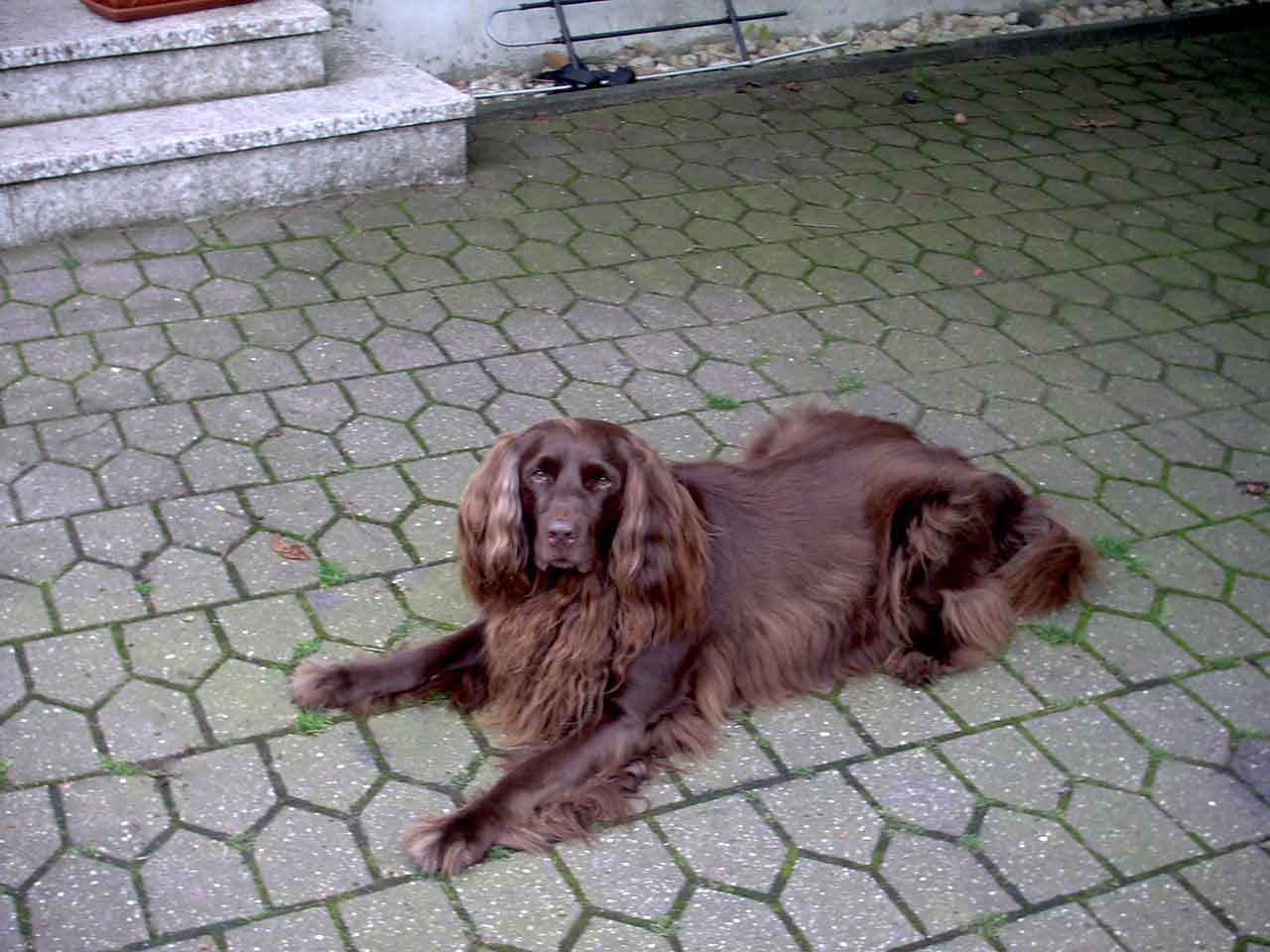
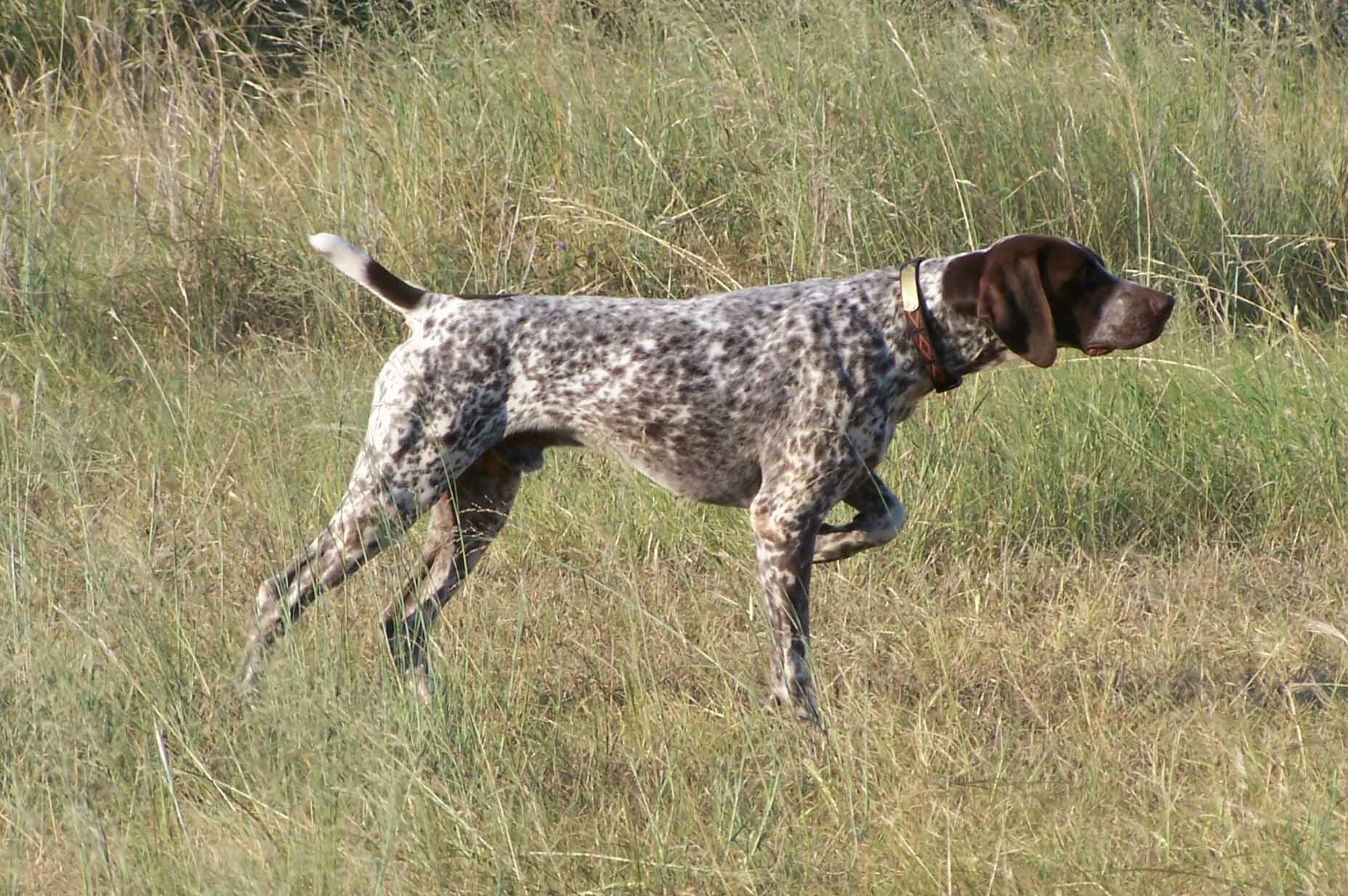
Photo: A German long hair called Falko by Wikimedia

Physical characteristics

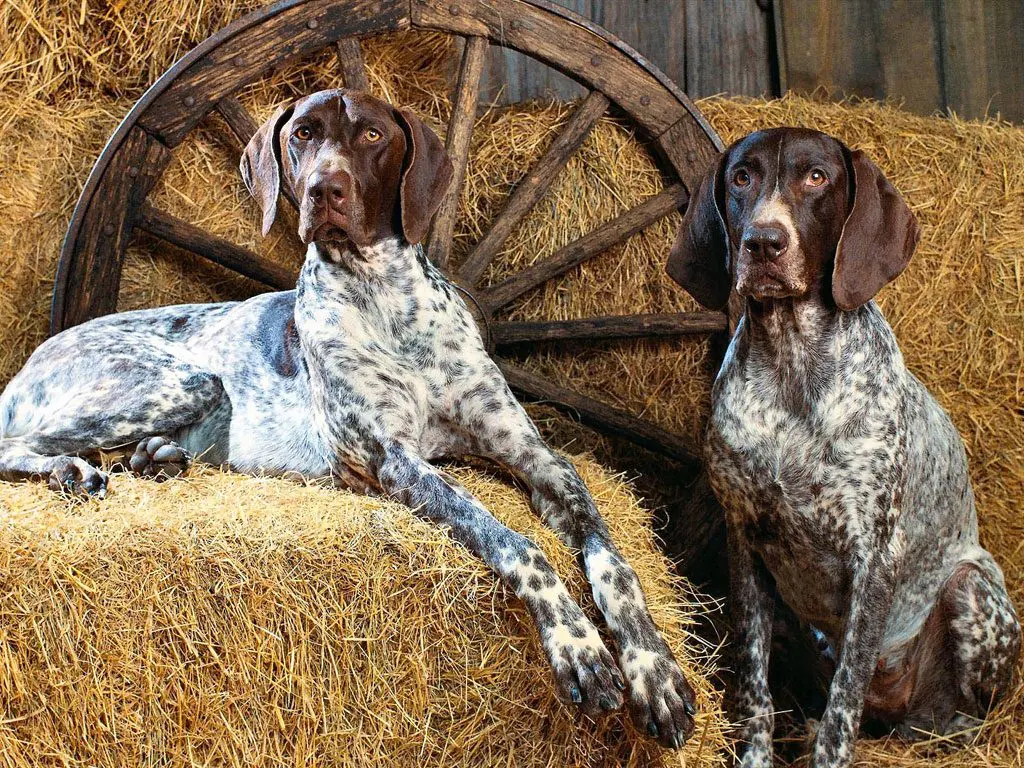
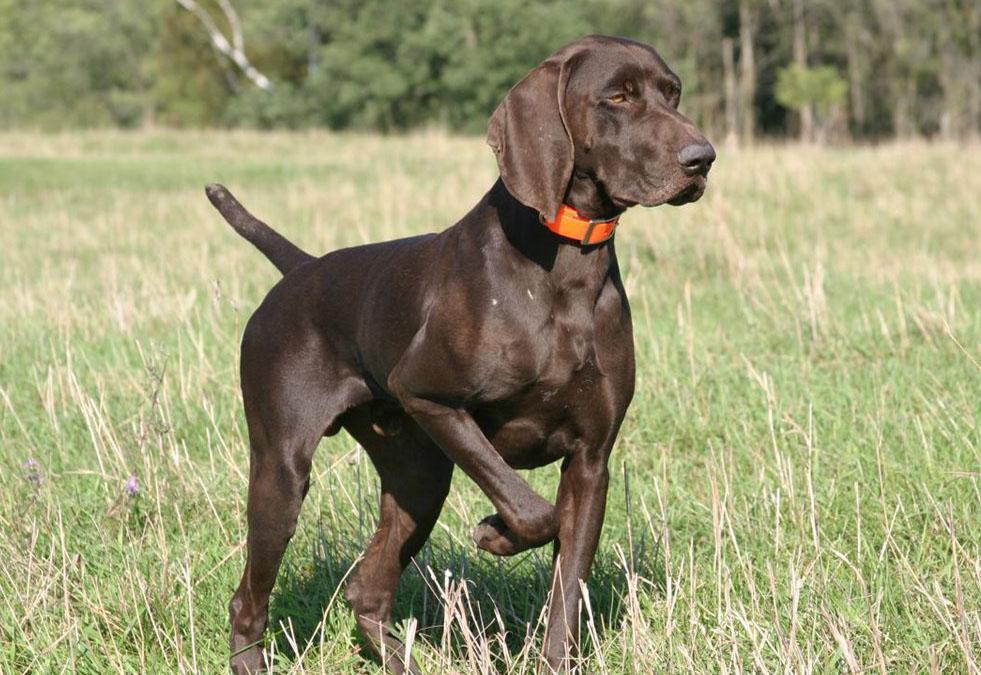
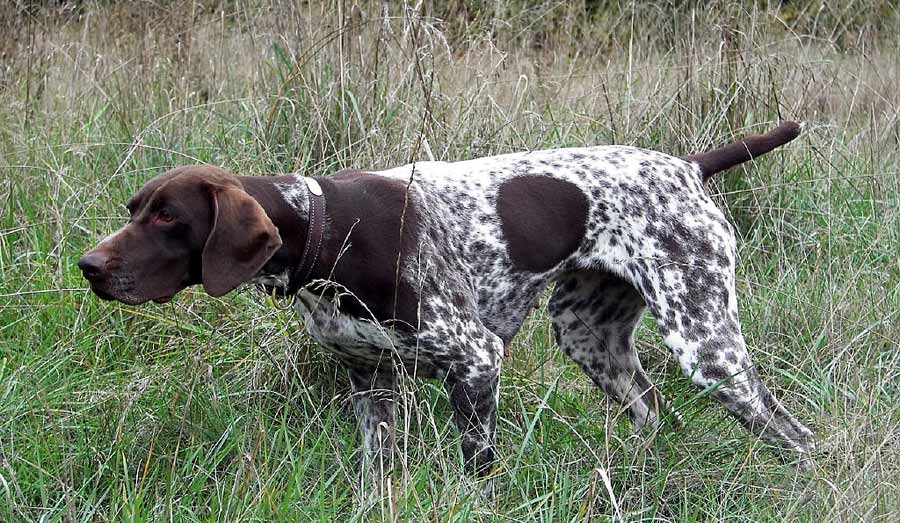
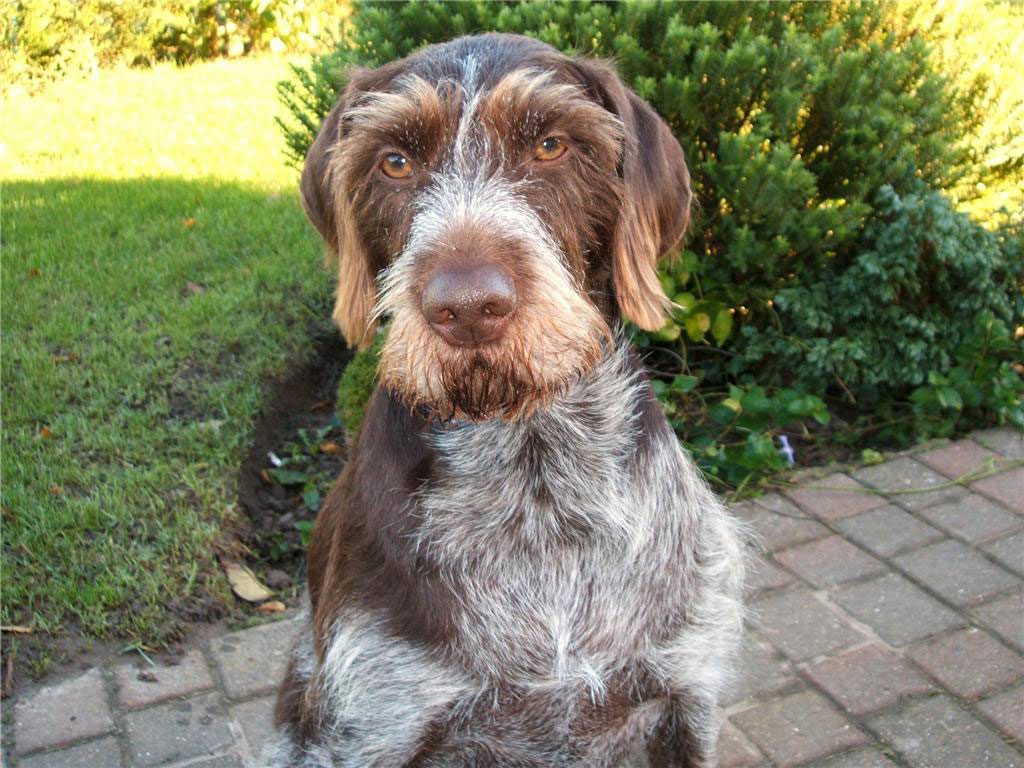
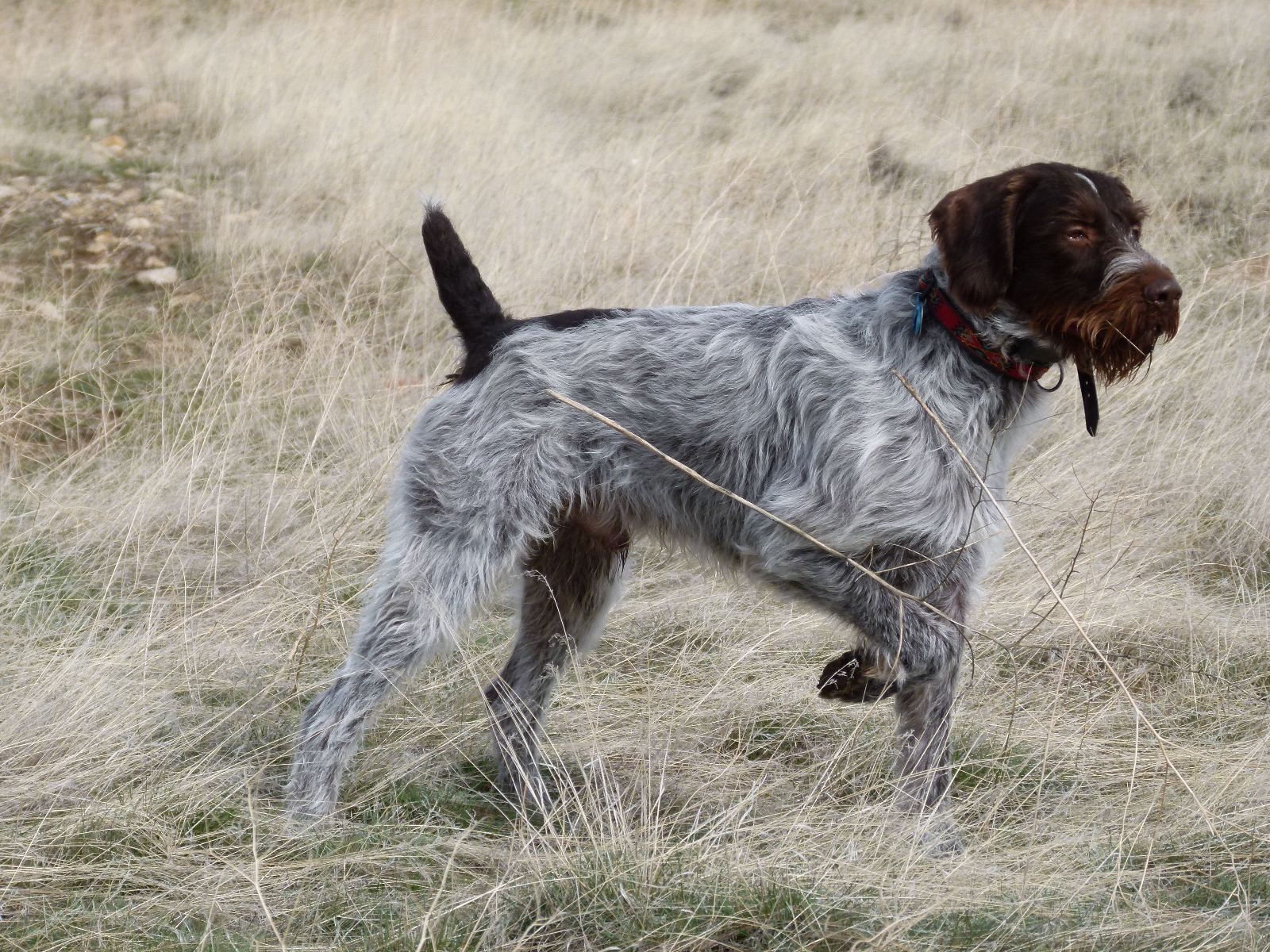
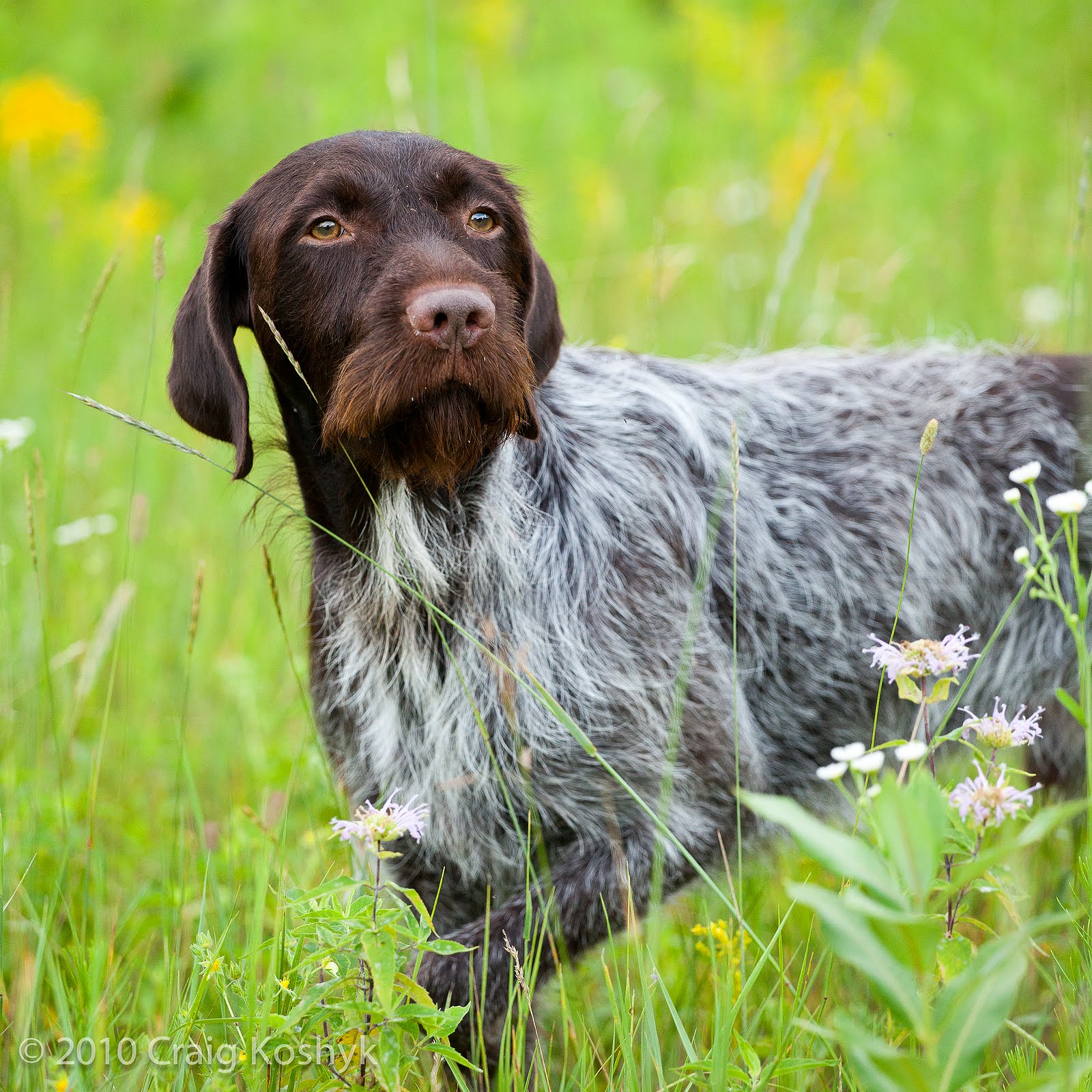
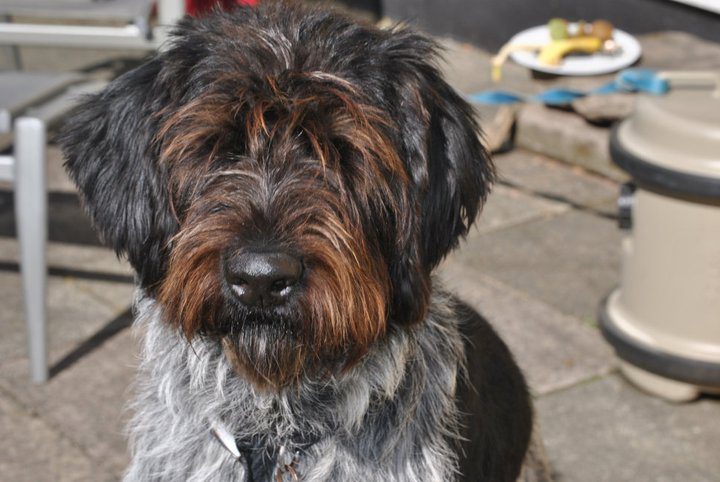
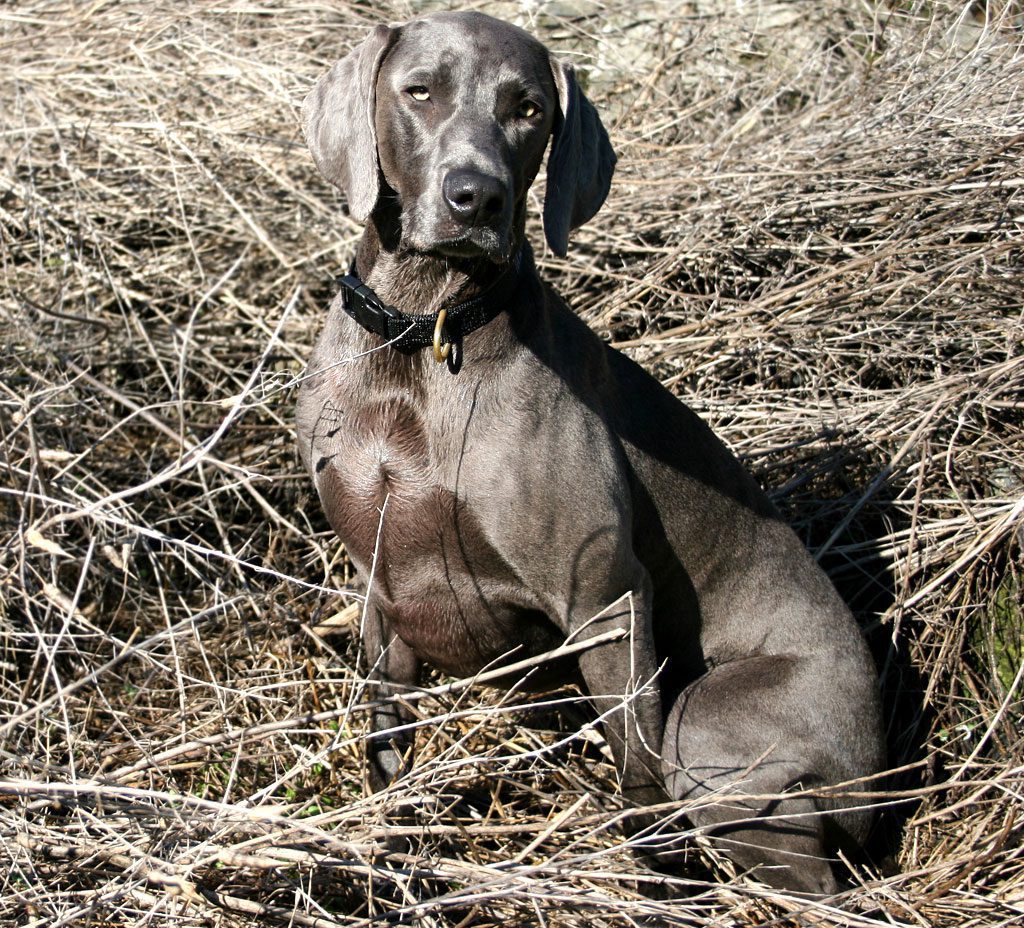
The breed is bred in brown, Brown and white, and brown and white. The best known and most common is German Longhaired Pointer pure brown, which may also have white markings on the chest or legs. Taupe comes in gradations from light gray to dark gray and the rare trout gray color variant.

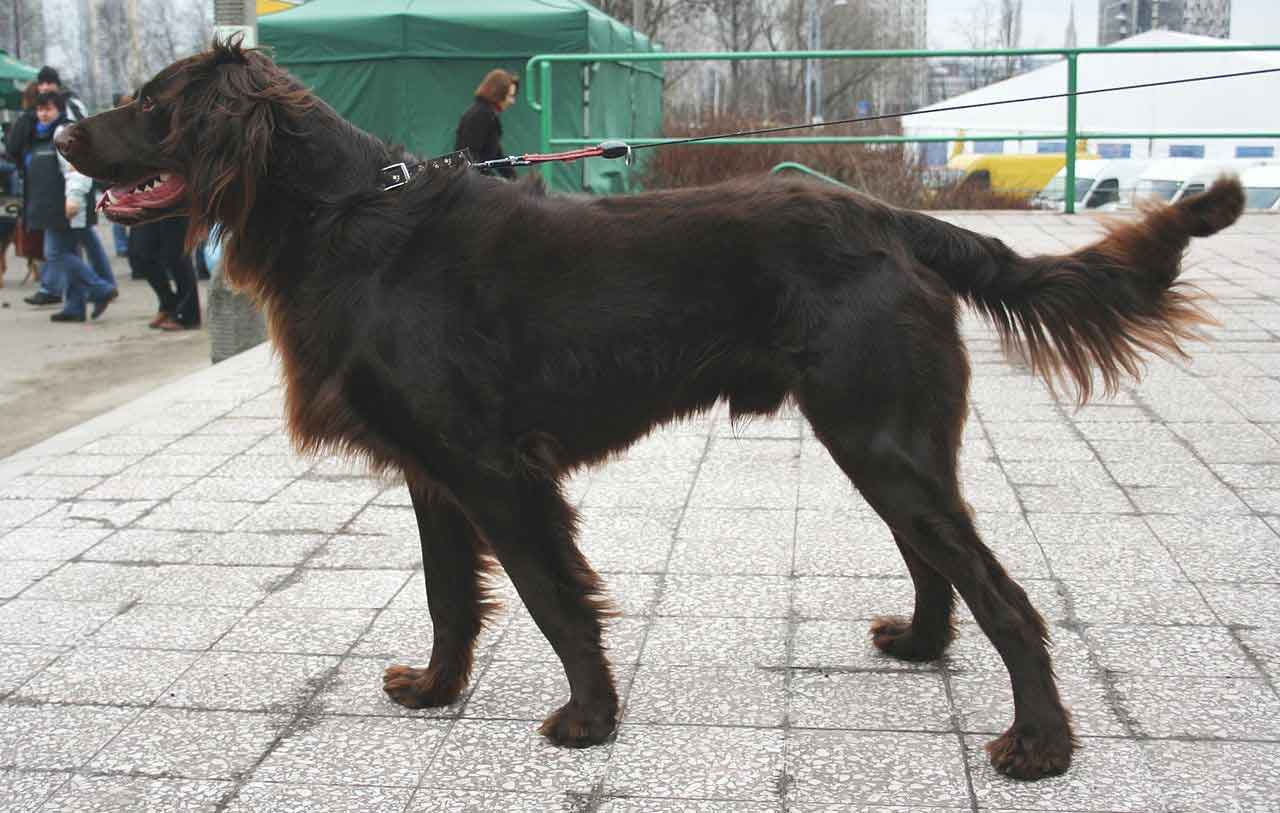
The German Longhaired Pointer it is usually a strong dog, muscular, low constitution and with harmonious body shapes. Males usually have a shoulder height of 63 – 66 cm., the females of 60 – 63 cm.. Has brown eyes, long, well-edged hocks and a tail with a beautiful flag. Your coat should be of medium length and not too lush.

Character and skills

The first thing to keep in mind is that the German Longhaired Pointer he's a hunting dog from head to toe. In the hands of a knowledgeable trainer, is a useful helper on the hunt and then on a second job, a very good family dog. The breed is very fond of children and family. But this should not be misunderstood at all. Because "familiarly friendly" does not mean "family dog". It is a fairly pronounced working dog. The German Longhaired Pointer has the strong drive and willingness to work, either on the hunt or, if required, your substitute in the form of dog sports of all kinds. So, It is not a dog for beginners nor a dog for people who do not want or cannot work intensively with it.

German Longhaired Pointer
ยซGerman hair showed dogยป during the international canine exposure in Katowice, Poland

In the practice of hunting, the German Longhaired Pointer is especially praised for its pronounced calm. He is a lead dog, resistant to nerves and of a calm and even-tempered nature. At the same time, he is a kind and peaceful friend with a high threshold for irritation.. But, the German Longhaired Pointer needs a consistent education, competent and sensitive to direct his high intelligence, alert senses and their pronounced willingness to act in the right channels. With such an appropriate atmosphere of character, this breed of dog is a great friend of children, a great family companion also outside of hunting or sports work and in any case a wonderful experience of the association of man and dog.

Aptitudes:

If occasionally offered simply as a family and apartment dog, one should approach such sellers with the utmost caution. Such offers certainly come from dubious sources. as a rule, a German Longhaired Pointer belongs to the hands of a hunter who works with him professionally. If you are not kept for the hunt, must be kept busy with long walks in nature or challenges in dog sports. It also, needs a personal connection with caregiver and family. If the hunting dog is not physically or mentally challenged, in the long run this will lead to serious behavior problems. It does not belong to a multi-story building and not to the big city. Otherwise, he has no problems and his attitude is undemanding.

Education

One German Longhaired Pointer should only be trained by an experienced owner. It must come absolutely from a recognized upbringing of the German association of "shows", where parents and puppies were already socialized for their tasks from the litter box onwards. It also, you need to train and work professionally for hunting or suitable sporting purposes. Only dogs that have successfully passed the demanding tests of autumn breeding of "Schorlemer" are admitted for breeding. You have to ask in the breeding clubs of the German Longhaired Pointer.

Health

The race German Longhaired Pointer is cared for in an exemplary manner by its breeding clubs organized in the Deutsch-Langhaar-Verband. Therefore, average dog health has no problem.

Grooming

Caring for a German Longhaired Pointer is undemanding. Regular brushing of the coat is sufficient.

Buy a "German hair dog"

If you are thinking of buying a German Longhaired Pointer, You should be wondering if you can meet the requirements for an attitude of character appropriate to this hunting dog.. And what during 12 years and more will be your companion on a daily basis. Then you must contact local breeders who are members of the ยซDeutsch-Langhaar-Verbandยซ. A puppy of this breed costs around 1000 EUR.

Characteristics "German Longhaired Pointer"

Coexistence is important that you have with your new friend. Before considering the acquisition of a dog of the breed "German Longhaired Pointer" you know certain factors. Not all breeds of dogs are apt to live in an apartment, you must take into account his character, their need for exercise, their interaction with other pets, their care and if you have small children, their level of tolerance towards them.

Adaptation โ“˜

3,0 of 5 stars (based on 1 review)

friendly dog โ€‹โ€‹โ“˜

3,0 of 5 stars (based on 1 review)

hair loss โ“˜

2,0 of 5 stars (based on 1 review)

Affection level โ“˜

5,0 of 5 stars (based on 1 review)

Need for exercise โ“˜

5,0 of 5 stars (based on 1 review)

Social need โ“˜

2,0 of 5 stars (based on 1 review)

Home โ“˜

2,0 of 5 stars (based on 1 review)

Toilet โ“˜

2,0 of 5 stars (based on 1 review)

Friendly with strangers โ“˜

3,0 of 5 stars (based on 1 review)

barking โ“˜

3,0 of 5 stars (based on 1 review)

Health โ“˜

3,0 of 5 stars (based on 1 review)

Territorial โ“˜

4,0 of 5 stars (based on 1 review)

Cat friendly โ“˜

2,0 of 5 stars (based on 1 review)

Intelligence โ“˜

3,0 of 5 stars (based on 1 review)

Versatility โ“˜

3,0 of 5 stars (based on 1 review)

Child friendly โ“˜

4,0 of 5 stars (based on 1 review)

Surveillance โ“˜

3,0 of 5 stars (based on 1 review)

joy โ“˜

4,0 of 5 stars (based on 1 review)

Videos "German Longhaired Pointer"

Obenstaat Kennels - German Langhaar Puppies 1st intro. to Water

Kennels Obenstaat – Puppies German Longhaired Pointer – Introduction to water

Apport impressions hunting dogs German long hair from Veybach
"German hair dog"

Type and recognitions:

  • FCI CLASSIFICATION:
  • Group :
  • Section : . .

Federations:

  • FCI – Group 7: Pointing Dogs. – Section 1: Continental Pointing Dogs. 1.2: Spaniel type โ“˜
  • CKCGrupo 1 – Sporting โ“˜
  • โ€‹KC – Hunting dog โ“˜
  • UKCGun Dog โ“˜

FCI breed standard "German Longhaired Pointer"

Origin:
Germany

Date of publication of the valid original standard:
25.10.2000

Use:

Variable utility dog in hunting.


General appearance:

It is strong, muscular, under, of flowing lines. In small dogs, much substance is required. Heavy and compact dogs are not desirable.

IMPORTANT PROPORTIONS :
The snout and the skull have the same length; In your posterior region it is not too high, Because the shoulders are somewhat higher than the rump.


Behavior / temperament:

It is well balanced, quiet, With a regular temperament, Kind, easy guide.

Head:

Special emphasis should be placed on the beautiful long hair covered. Is elongated and noble appearance.

Cranial region:
  • Skull : Slightly rounded.
  • Depression links (Stop) : Naso-fontal depression rises slightly, Without interrupting in an abrupt way.

facial region:

  • Truffle : Brown in color, a mild depigmentation is allowed.
  • Nose cane : Slightly arched, Not too narrow.
  • Lips : They don't overcome too much.
  • Mandible / teeth : Non -refined jaw. Well developed teeth. Complete bite (42 teeth) scissor -shaped, that is to say that the upper incisors closely cover the lower.
  • Dental formula : 3 1 4 2 x 2 = 423 1 4 3
  • Cheeks : The cheekbones do not stand out much.

Eyes : Brown in color, as dark as possible; eyelids closely attached to the eyeball, No visible red nicming membrane. Neither sunk nor jums.

Ears : Your insert is not very low; They are slightly folded forward.

Neck:

Strong and noble, without jowl; extends widening to the chest forming a beautiful line; It is not too short.

Body:

  • Back : Straight, firm, not too long.
  • Pork loin : Especially muscular.
  • Rump : Long, Descend moderately.
  • Breast : Well developed sill; The rib cage is wide and deep; Reach at least the elbow.

Tail:

It does not have it too steep. It must take it horizontal with the last slightly raised third upward.

Tips

PREVIOUS MEMBERS :

  • As a whole : The dog standing, The arm, The forearm and metacarpo must form a line close to the vertical when they are observed from the front.
  • Shoulder : Well glued. Seen sideways and at rest, The scapula and the arm should form an angle approaching as much as possible at a right angle.
  • Elbows : Well glued.
  • Articulation of the carpus : Slightly hunched.
  • Metacarpus : Not completely straight.

LATER MEMBERS :

  • As a whole : Seen from the back, The iliac bump, thigh, The leg and metatarsal form a vertical line.
  • Warm-foot joint : It is very important to form a good angulation.
  • Spurs : They must be removed immediately after birth.

FEET : Hard, durable pads.

Movement:

It covers the terrain with good impulse of the posterior members.

Mantle

HAIR :

The correct fur is very important which should not be excessive or too short. On the sides of the back and trunk the hair must be 3,5 cm long, good paste. In the lower region of the neck, In the chest and abdomen the hairs can be longer.

โ€ข Abdomen : Well -covered with hair.
โ€ข Ears : Wavy hair.
โ€ข Cola : With good pen, hair cover.
โ€ข Rear region of the previous members : Feathers cover.
โ€ข posterior region of the posterior members: Feathers cover(pants).
โ€ข Below the warm-tarsian joint : Hair is considerably shorter. Excess hair stripes is not desirable. The space between the fingers must have dense and short hair.
โ€ข Head : Hair is much shorter, although longer than that of the German hair dog. The formation of a lock in the cranial region is not desirable.
โ€ข In the body : Hair is firm, smooth, Recty The Flucky Farming, Very close. Dense with good amount of internal lanilla.

COLOR :

โ€ข Brown unicolor.
โ€ข Brown with white or splashed marks (especially in the chest and feet).
โ€ข Dark Roan (With more or less large or less small brown plates; brown head, eventually with a list, a small spot or a white star).
โ€ข Clear Roan (with more or less large or less small brown plates; brown head, eventually with a list, a small spot or a white star).
โ€ข Salpized (Many small brown spots on a white background. Brown head, eventually with a list, a small spot or a white star).
โ€ข Blanquecino brown, either totally whitish brown or, With very few small spots (Large brown plates, in a chair or coat; Brown head, eventually with a list, a small spot or a white star).
โ€ข In isolation the yellow fire color can be presented as an ancient heritage of the hound.


Size and weight:

Height to the cross :

  • Males : 60 โ€“ 70 cm., ideal measure 63 โ€“ 66 cm..
  • females : 58 โ€“ 66 cm., ideal measure 60 โ€“ 63 cm..

Weight : It is approximately 30 kg


Fouls:

Any deviation from the aforementioned criteria should be considered as lack and the severity of this is considered the degree of deviation to the standard and its consequences on the health and well -being of the dog.

โ€ข Clear hawk eyes, oblique placement.
โ€ข Uncoated ears, ends without hair (Leather).
โ€ข Convex or defeated back.
โ€ข Tonel -shaped thorax, Too close.
โ€ข Hook -shaped tail.
โ€ข Previous members : Scapulo-Humeral joint too open; Metacarpo too straight.
โ€ข Rear members in the form of a cow or barrel.
โ€ข Feet with separate fingers, cat or penal foot.
โ€ข Fur : Longer hairs in the beard, abundant eyebrows, curly hair.

MISS PLAYOFFS :

โ€ข Aggressive or fearful dog.
โ€ข General appearance: Dogs with Osamanta and weak muscles.
โ€ข Head : Dogs with different head shapes to the type.
โ€ข Eyes : Ectropiรณn (eyelids turned out), entropion (eyelids turned in), Corrected eyelids are also considered as missing.

Any dog โ€‹โ€‹showing clear signs of physical or behavioral abnormalities must be disqualified..


N.B.:

Males should have two normal-appearing testicles fully descended into the scrotum..

Source: F.C.I - International Cynological Federation

Alternative names:

1. GLP, Pointer (German Longhaired), Langhaar (English).
2. Langhaar (French).
3. Deutsch-Langhaar (German).
4. (em alemรฃo: Deutsch Langhaar Vorstehhund) (Portuguese).
5. Pointer de pelo largo (espaรฑol).

โ–ท The world of Pets: Dogs, cats, birds, reptiles, amphibians

German Shorthaired Pointer
Alemania FCI 119 . Braque Type

Braco Alemรกn de Pelo Corto

A strong hunting instinct is the most important characteristic of the German Shorthaired Pointer

Content

History

The German Shorthaired Pointer (Deutscher Kurzhaariger Vorstehhund, It is a breed of dog developed in the 1800 in Germany, used for hunting.

The exact origin of the German Shorthaired it is not clear. In accordance with the American Kennel Club, it is likely that the German Shorthaired Pointer is a descendant of a race known as German Bird Dog, which in turn is connected with the Old Spanish Pointer introduced in Germany in the 17TH century.

It is also likely that within their ancestors are German dogs and other tracking dogs, as the English Pointer. But, as the first studbook was not created until 1870, It is impossible to identify all the dogs that were needed to create this race.

Physical characteristics

It is a versatile dog, without a doubt the most complete and efficient for hunting breed, thanks to their physical qualities and innate aptitudes, Standing out mainly in:

  • Find and display the birds elegantly.
  • Collect both land and water without distinguishing between the hair and feather.
  • It is the best companion of the bird of prey and the most characteristic in the art of falconry..
  • Prove your courage facing animals as temperamental and determined as the wild boar.
  • Able to follow a trail of blood as well as a Bloodhound.
  • In the home is the faithful, patient and excellent companion of children.

The breed emerged in the 19th century due to the need for a versatile dog, that serve for the various forms of hunting, instead of having a different race for each specialty. With the hunting characteristics set, German breeders began the work of selecting dogs for its kind, and arriving at the end of the 19th century to the first racial standard, which over time, It has undergone changes to adapt to the natural evolution of forms of hunting.

Its main characteristics are:

  • A special smell.
  • A persistent and effective search.
  • Great passion for work in water.
  • Elegant style.
  • Great physical resistance.
  • The courage to face large and aggressive animals without hesitation.
  • Higher than normal canine intelligence (ranks 17 in Stanley Coren's list: "The Intelligence of Dogs").
  • The males measure of 62 to 66 cm and females in 58 to 63 cm., and weigh in 25 to 30 Kg.
  • Coupled with this and its easy training, It is currently one of the most prized hunting worldwide breeds.

The sample in the German Shorthaired Pointer it is par excellence a moment of great beauty and emotion, a true expression of the hunting art. It is the culmination of an extensive search, in which the dog after traveling many kilometers, among bushes, thorns, slopes, ravines or immense Plains, Locate the bird carried by their emanations, this makes the German Shorthaired Pointer the best and inseparable companion of the versatile hunter.

The layer of German Shorthaired Pointer, it is short and flat with a dense coat protected by stiff hairs to make the coat waterproof and allow the dog to keep warm in cold climates. The color can be dark brown which in English is defined as "liver" color (incorrectly as "chocolate" or "chestnut"), black (Despite any area of black it is grounds for disqualification in American Kennel Club), either liver and black or black and white.

Commonly the head is a solid or almost solid color with the body being mottled or "marked" with liver and white., sometimes with large solid-colored spots called "saddle".

Although the standard of German Shorthaired Pointer allows a slightly sandy coloring (โ€œMarca Gelberโ€) in the extremities, This color is rare, any yellow coloration in contests of sample is by the AKC and the CKC, and the dog is disqualified.

The German Shorthaired Pointer has a longer life expectancy than many breeds of the same size, generally they live between 12 and 14 years, There have been cases of copies that have lived in 16 to 18 years.

The characteristic coloration of German Shorthaired Pointer provides you with unrivaled camouflage in winter seasons. To be standing next to dead trees and in the dirty snow, the mixture of the colors of Brown layer, black and white makes the dog bit visible.

Character and skills

The race generally along well with other dogs, Although females seem to be much more dominant in the interaction. A strong hunting instinct is the most important characteristic of this breed., It is not always good if you share a home with other small pets such as cats and rabbits.

But with a proper training, the German Shorthaired Pointer, You will learn to distinguish what is the prey and what is not, which is why, You can live in a friendly manner with other family pets.

The German Shorthaired Pointer needs a good daily dose of exercise, since it is an energetic animal and needs to spend that accumulated energy, if he is not given physical activity he will seem hyperactive and may develop destructive tendencies.

It is good to take into account that this race is not a pet suitable for a home of sedentary or owners without experience.

The German Shorthaired Pointer he is good with children, but be careful because the breed can be a little gross, especially when they are puppies.

Characteristics "German Shorthaired Pointer"

Coexistence is important that you have with your new friend. Before considering the acquisition of a dog of the breed "German Shorthaired Pointer" you know certain factors. Not all breeds of dogs are apt to live in an apartment, you must take into account his character, their need for exercise, their interaction with other pets, their care and if you have small children, their level of tolerance towards them.

Adaptation โ“˜

3,0 of 5 stars (based on 1 review)

friendly dog โ€‹โ€‹โ“˜

4,0 of 5 stars (based on 1 review)

hair loss โ“˜

3,0 of 5 stars (based on 1 review)

Affection level โ“˜

4,0 of 5 stars (based on 1 review)

Need for exercise โ“˜

5,0 of 5 stars (based on 1 review)

Social need โ“˜

4,0 of 5 stars (based on 1 review)

Home โ“˜

1,0 of 5 stars (based on 1 review)

Toilet โ“˜

2,0 of 5 stars (based on 1 review)

Friendly with strangers โ“˜

4,0 of 5 stars (based on 1 review)

barking โ“˜

3,0 of 5 stars (based on 1 review)

Health โ“˜

4,0 of 5 stars (based on 1 review)

Territorial โ“˜

3,0 of 5 stars (based on 1 review)

Cat friendly โ“˜

2,0 of 5 stars (based on 1 review)

Intelligence โ“˜

4,0 of 5 stars (based on 1 review)

Versatility โ“˜

3,0 of 5 stars (based on 1 review)

Child friendly โ“˜

4,0 of 5 stars (based on 1 review)

Surveillance โ“˜

2,0 of 5 stars (based on 1 review)

joy โ“˜

5,0 of 5 stars (based on 1 review)

Photos ยซGerman Shorthaired Pointerยป

โ€œGerman Shorthaired Pointerโ€ Videos

Type and recognitions:

  • FCI CLASSIFICATION:
  • Group :
  • Section : . .

Federations:

FCI โ“˜, AKC โ“˜, ANKC โ“˜, CKC โ“˜, โ€‹KC โ“˜, NZKC โ“˜, UKC โ“˜

FCI breed standard "German Shorthaired Pointer"

Origin:
Germany

Date of publication of the valid original standard:
25.10.2000

Use:

Versatile hunting dog.


General appearance:

It is a noble and harmonious dog, whose constitution indicates strength, endurance and speed. His upright bearing, its fluid lines, his lean head, its good tail bearing, its stiff and shiny coat, Just as its broad and harmonious movements highlight its nobility..

IMPORTANT PROPORTIONS: The length of the trunk should slightly exceed the height of the withers.


Behavior / temperament:

Energetic, balanced, reliable and submissive, nor nervous, nor shy, nor aggressive.

Head:

Enjuta, marked, neither too light nor too heavy; corresponding in length and volume to the shape of the body and sex.

Cranial region:
  • Skull: Wide enough, slightly domed, little pronounced occipital process, not very deep frontal furrow, visibly well-developed brow ridges.
  • Depression links (Stop): Moderately developed.

facial region:

  • Truffle: A little outstanding, with sufficiently open nostrils, wide and mobile. Basically brown, but black in black or black-roan dogs. A truffle with spots or color Meat is allowed only in dogs whose coat has a white background.
  • Snout: It is long, width, deep and strong to facilitate the correct collection of the prey. The nasal cannula shows a slight convexity in profile., which can range from a nobly arched shape to a slight elevation in relation to the horizontal, all of this much more accentuated in males. A straight nose cane, equally admissible, is less appreciated. The concave nasal cannula constitutes a serious fault.
  • Lips: Adherents, not too saggy, well pigmented. From the truffle, the lips fall almost vertically to the point where they separate and then extend with a slight curve to the moderately marked corners of the lips.
  • Jaws / Teeth: The jaws must be robust with perfect teeth, regular and complete, scissor articulated, that is to say that the upper incisors must cover the lower incisors in close contact. Should have 42 healthy teeth placed vertically in the jaws.
  • Cheeks: Strong, with good musculature.

EYES: Medium-sized, no bumps, or sunk. The ideal color is brown. The eyelids should be well adjusted.

EARS: Of average length, high and wide implantation, smooth, they hang flat and close to the sides of the head, with rounded tips. Not very meaty, not too thin. forward positions, they arrive near the corner of the mouth.

Neck:

Of length proportional to the body, progressively widening towards the shoulders. The neck is very muscular and slightly arched.. The skin of the throat rigorously adherent to it.

Body:

  • top line: Straight and slightly descending. Cross: Marked.
  • Back: Strong, with good musculature. The spinous processes must be covered by musculature.
  • Pork loin: Short, width, muscular, straight or slightly arched. The solid and compact dorso-lumbar transition.
  • Rump: Wide and long enough, without ending abruptly, but leaning only slightly towards the tail. Well muscled.
  • Chest: Deeper than wide, with well-marked parapet; the sternum reaching back as far as possible. The sternum and elbow joint should be placed at the same height. Well arched ribs, neither flattened nor barrel-shaped. Posterior ribs well descending.
  • bottom line: Enjuta, rising slightly with a graceful curve back.

Tail:

High implementation, strong at insertion with gradual thinning to the tip, medium length. For use in hunting it should be cut approximately in half. At rest it falls; in movement he carries it horizontally and not too much above the line of the back; should never be considerably bent. (In countries where legislation prohibits tail docking, it can remain in its natural form. It should reach up to the hock and be carried horizontally or slightly saber-shaped.).

Tips

PREVIOUS MEMBERS:

  • General appearance: Viewed from the front they are straight and parallel; in profile they can be seen well placed below the body.
  • Shoulder: Oblique and well attached scapulae, leaning back. Vigorous and tight muscles. Good angulation between the scapula and the arm.
  • Arm: as long as possible, with good muscles that are not thick.
  • Elbows: Close to the body but not too tight; They do not present outward or inward deviations; They are placed well back. Proper angulation between the arm and forearm. Forearm: Straight, with enough muscles. Strong bones, but not thick.
  • Articulation of the carpus: Strong.
  • Metacarpus: Minimum angulation between the forearm and the metacarpus, never in a vertical position.
  • Previous feet: They can be round or spoon-shaped., with fingers well together and sufficiently arched. Strong nails. Hard, durable pads. Their positions are parallel, without deviations outwards or inwards, both at rest and in motion.

LATER MEMBERS:

  • General appearance: Seen from behind they are straight and parallel, with good angles. Your bones are strong.
  • Thighs: Long, wide and muscular. With good angulation between the hip and thigh.
  • Knees: Powerful, with good angulation between thigh and leg. Legs: long, muscular and sinewy. Good angulation between the leg and the metatarsal.
  • Warm-foot joint (Hock): Powerful. Metatarsus: Strong and upright.
  • Hind feet: According to the previous.

Movement:

Spacious with a lot of drive, with a corresponding stride. Front and hind limbs straight and parallel. Stand upright. Amble is not desirable.

Mantle

SKIN: Well stuck, without forming folds.

Fur: short and tight, It should be rough and hard to the touch. On the head and ears it should be thinner and shorter. Not visibly longer at the bottom of the tail. It must cover the whole body.

Color:

  • Brown, without stains.
  • Brown with small white spots or mottling on the chest and limbs.
  • Brown roan with brown head; plates or mottled brown.

The basic color of a dog described in this way is neither brown with white nor white with brown., But the coat forms such an intimate mixture of white and brown that it results in a discreet exterior appearance much appreciated for practical use during hunting.. The color is often lighter on the inside of the hind limbs as well as on the tip of the tail..

  • Light brown roan with brown head, plates or mottled brown, the sin plates. In this type of color, the brown hairs are less numerous and the white ones dominate.
  • White, with brown head, with brown plaques or mottling.
  • Black color with the same nuances as brown or roan colors.

    Yellow fire stains are allowed.
    An elongated, striped white spot on the forehead and red lips are allowed..


Size and weight:

Height to the cross:

  • Males: 62 to 66 cm..
  • females: 58 to 63 cm..


Fouls:

Any deviation from the aforementioned criteria is considered as a fault and the severity of this is considered to the degree of the deviation to the standard and its consequences on the health and well-being of the dog..

  • Faults in general construction, insufficiency in the type inherent to the sex.
  • Too short snout.
  • Very heavy lips, or very light.
  • Missing two teeth (PM1 y M3), That is, the four PM1 and the two M3 cannot be missing more than two teeth at most..
  • Eyes too light, raptor eyes (light yellow).
  • Very long ears, or very short, or very heavy, or very narrow insertion, or curled ears.
  • Sagging skin in the throat.
  • Slightly convex back (carp back).
  • Croup too short.
  • Chest too deep.
  • Tail carried too high above the dorsal line or tail very bent.
  • Elbows or feet turned outward or inward. Fingers too open or too closed.
  • Too straight rear angles.
  • Slightly barrel hocks, cow or cerrado.

SERIOUS FAULTS:

  • Heavy general constitution, lymphatic, coarse bones.
  • Stop marked.
  • Flesh-colored or spotted nose (except dogs with white fur).
  • Pointed snout, concave muzzle.
  • Partial or complete pincer bite. (In dogs older than 4 years does not influence its assessment the presence of the so-called age clamp, provided that a German Shorthaired Pointer Club has confirmed the presence of a correct bite at previous shows).
  • Noticeably arched back. Slightly bowed back.
  • Lack of chest depth, little marked parapet. Rib cage too narrow or too wide (in barrel).
  • Elbows turned too far out or in.
  • Loose carpal joint, too relaxed.
  • Metacarpo vertical.
  • Cow or barrel corvejones, both at rest and in motion.
  • Croup and hind limbs too high.
  • Fingers too far apart.
  • Flat feet.
  • walk hard, heavy.

Variations of more than 2 cm at the aforementioned heights of the cross.

FALTAS DESCALIFICANTES:

  • Aggressiveness or extreme shyness.
  • Any dog โ€‹โ€‹showing clear signs of physical or behavioral abnormalities.
  • Severely atypical sexual characteristics.
  • Missing more than two teeth out of the total 4 PM1 y 2 M3. Missing one or more teeth (except PM1 and M3). Teeth that are not visible are considered missing., unless a German Shorthaired Pointer Club has confirmed its presence at a previous show.
  • Upper or lower prognathism. Deviated incisor arch and all transitional forms.
  • Supernumerary teeth or teeth outside the dental line.
  • Harelip, split palate.
  • very loose eyelids, ectropion, entropion. Distichisis (double lash line).
  • Marked lordosis. Deformation of the spine (scoliosis)
  • Deformed rib cage, p. e.g.. "reduced chest".
  • Dewclaws with or without bones.
  • Any lack of character.


N.B.:

Males should have two normal-appearing testicles fully descended into the scrotum..
Only functionally and clinically healthy dogs, with the typical conformation of the breed, should be used for parenting.

The latest changes are in bold.

Source: F.C.I - International Cynological Federation

Alternative names:

1. GSP, DK (English).
2. GSP, DK (French).
3. Deutscher kurzhaariger, Vorstehhund, Deutsch Kurzhaar, Kurzhaar, GSP, DK (German).
4. Pointer alemรฃo, Perdigueiro (Portuguese).
5. GSP, DK (espaรฑol).

โ–ท The world of Pets: Dogs, cats, birds, reptiles, amphibians

German Wirehaired Pointer
Alemania FCI 98 . Braque Type

Braco Alemรกn de Pelo Duro

The German Wirehaired Pointer is very affectionate, active and intelligent.

Content

History

The German Wirehaired Pointer (Drahthaar) es una raza de origen alemรกn.

In this long-haired Hunter dog is gathers the blood of hounds, hunters of birds, water dogs and hunting with Falcons and therefore has a tendency to great versatility.

The origin of this breed has barely a century. A group of breeders set out to obtain Pointing Dogs hard hair. Pointing Dogs rough-haired Germans, the Pudelpointer, the Griffon and the German Shorthaired Pointer they contributed to the formation of the breed. Some experts added to the Airedale Terrier and to the Italian Rough-Haired Hound to this list of participants in the creation of the German Wirehaired Pointer.

As of the year 1879 pure breeding was carried out and the essential characteristics of the breed were established.

In the year 1897, the Baron Schorlemer established the first standard of the German Wirehaired Pointer and this was the basis for the current pure breeding. It became one of the main hunting breeds in Germany in the latter part of the 20th century..

Physical characteristics

It is strong, muscular, under, of flowing lines, is medium-sized. Heavy dogs are not desirable. Some specimens are likely to develop hip dysplasia, ear infections, genetic eye diseases and skin cancer.

Coat colors vary, can be solid liver color, black and white with liver markings, liver color with white markings, solid black and a mixture of three colors.

The coat of the German Wirehaired Pointer, has as the most distinctive characteristic of the breed, the functional hirsute. A dog must have a correct fur to be of the correct type. The layer is resistant to weathering and, to some extent, water repellent. The inner layer is dense enough to insulate you from the cold winter, but it is fine in summer. The distinctive outer layer of the breed is straight, hard, rough to the touch and lisa. In the ears, the head and legs the hair is smoother.

The weight of the males is of 34 to 40 kg. And in females, of 30 to 36 kg. Measuring the males of 61 to 68 cm and females 57 to 64 cm..

Character and skills

The German Wirehaired Pointer is very affectionate, active and intelligent. It seems that you have always wanted to learn and is very loyal to his family, You need a reference person who knows how to set the limits. Like it to be occupied and enjoy working with its owner. They are friendly with people who know and reserved with strangers, They must be socialized at an early age.

They need plenty of exercise, any type of game that includes searching for objects on any type of terrain, will be your happy Pointer. It has a very fine sense of smell that allows it to track and recover any object both on land and in the water..

Characteristics "German Wirehaired Pointer"

Coexistence is important that you have with your new friend. Before considering the acquisition of a dog of the breed "German Wirehaired Pointer" you know certain factors. Not all breeds of dogs are apt to live in an apartment, you must take into account his character, their need for exercise, their interaction with other pets, their care and if you have small children, their level of tolerance towards them.

Adaptation โ“˜

3,0 of 5 stars (based on 1 review)

friendly dog โ€‹โ€‹โ“˜

4,0 of 5 stars (based on 1 review)

hair loss โ“˜

2,0 of 5 stars (based on 1 review)

Affection level โ“˜

5,0 of 5 stars (based on 1 review)

Need for exercise โ“˜

4,0 of 5 stars (based on 1 review)

Social need โ“˜

4,0 of 5 stars (based on 1 review)

Home โ“˜

2,0 of 5 stars (based on 1 review)

Toilet โ“˜

2,0 of 5 stars (based on 1 review)

Friendly with strangers โ“˜

4,0 of 5 stars (based on 1 review)

barking โ“˜

4,0 of 5 stars (based on 1 review)

Health โ“˜

4,0 of 5 stars (based on 1 review)

Territorial โ“˜

3,0 of 5 stars (based on 1 review)

Cat friendly โ“˜

2,0 of 5 stars (based on 1 review)

Intelligence โ“˜

4,0 of 5 stars (based on 1 review)

Versatility โ“˜

3,0 of 5 stars (based on 1 review)

Child friendly โ“˜

5,0 of 5 stars (based on 1 review)

Surveillance โ“˜

2,0 of 5 stars (based on 1 review)

joy โ“˜

4,0 of 5 stars (based on 1 review)

Photos ยซGerman Wirehaired Pointerยป

Videos ยซBraco Alemรกn de Pelo Duroยป

Type and recognitions:

  • FCI CLASSIFICATION:
  • Group :
  • Section : . .

Federations:

FCI โ“˜, AKC โ“˜, ANKC โ“˜, CKC โ“˜, โ€‹KC โ“˜, NZKC โ“˜, UKC โ“˜

  • FCI nomenclature race "German Wirehaired Pointer"

  • FCI breed standard "German Wirehaired Pointer"

    Origin:
    Germany

    Date of publication of the valid original standard:
    25.10.2000

    Use:

    According to the objective, it was the creation of a versatile hunting dog, the German Wirehaired Pointer, must display all qualifications required for field hunting work, the forest and in the water, before and after shot.


    General appearance:

    Pointer dog of noble appearance, with hard fur, perfect skin protector, with attentive and energetic expression. Your movements must be harmonic, fluids, broad and full of strength.

    IMPORTANT PROPORTIONS: Body length and withers height should preferably be equal. The length of the body can exceed the height of the withers up to 3 cm..


    Behavior / temperament:

    companies, with self-control, balanced, unafraid of the hunt. Must not be shy or aggressive.

    Head:

    proportionate to body size and gender. The axes of the skull and nasal bridge are slightly divergent..

    Cranial region:
    • Skull: Plano, only slightly rounded on the sides; moderately wide; the supra-orbital arch visibly developed.
    • Fronto-nasal depression (Stop): Very notorious.

    facial region:

    • Truffle: Strongly pigmented corresponding to coat color; well open nostrils.
    • Snout: Long, broad, strong and deep. Slightly convex muzzle.
    • Lips: Thick, adjacent and not hanging. Good pigmentation corresponding to the color of the hair.
    • Jaws/Teeth: Big teeth. Strong JAWS, with an even and complete scissor bite, that is to say that the upper incisors fall exactly in front of the lower ones, the teeth being implanted perpendicular to the jaws. The dental formula consists of 42 parts.

    EYES: as dark as possible, neither bulging nor sunken, with a lively and alert expression. Well adjoining eyelids, with well-pigmented edges.

    EARS: Medium-sized, high and wide implantation, in the twisted.

    Neck:

    Medium length, heavily muscled; slightly arched topline, clean bottom line.

    Body:

    • top line: Straight and slightly drooping. Cross: notorious.
    • Back: Strong, well muscled. Loins: Short, widths, muscular.
    • Rump: Long and wide, slightly droopy and well muscled. wide pelvis.
    • Breast : Broad and deep, with well-known sill and the sternum reaching as far back as possible. Well arched ribs.
    • bottom line: Dry, forming a graceful arc back; slightly tucked abdomen.

    Tail:

    Following the back line, preferably carried horizontally or slightly upwards, without looking steep. Neither too thick nor too thin. For use in hunting, the tail is conveniently shortened. (In those countries where the law prohibits amputation, the tail can appear natural: should reach to the hock and be carried slightly saber-shaped).

    Tips

    PREVIOUS MEMBERS:

    • General appearance: Seen from the front, straight and parallel; seen from the sides, well positioned under the body. The distance from the floor to the elbows should be about the same as the distance from the elbows to the withers.
    • Shoulder: Shoulder blade tilted and directed backwards, heavily muscled. Good angulation between the scapula and the arm.
    • Arm: as long as possible, dry, good muscular.
    • Elbows: Adjacent to the body, without being twisted in or out, with good angulation between the arm and forearm. Forearm: Dried, perpendicular, strong bone.
    • carpal joint: Strong.
    • Metacarpus: Moderately forward leaning.
    • Previous feet: Oval, closed, with well-pigmented pads, thick enough, compact and resistant. Parallel position without turning in or out, both in static and in motion.

    LATER MEMBERS:

    • General appearance: Seen from behind, straight and parallel, with good knee and hock angulations. Strong bones.
    • Thighs: Long, broad and muscular, with good angulation between
    • pelvis and thigh.
    • Knee: Strong, with good angulation between thigh and leg. Legs: long, muscular and sinewy.
    • Hock: Strong.
    • Metatarsus: Short, perpendicular position.
    • Hind feet: Oval, well closed, with well-pigmented pads, thick enough, compact and resistant. parallel position, no turning in or out, both in static and in motion.

    Movement:

    Large, with good previous tread and good push; movement of the fore and hind limbs straight and parallel; distinguished bearing.

    Mantle

    SKIN: Tight, well adherent, no formation of wrinkles and folds.

    Fur: Wire-haired (wire), dense and tight. The outer shell is about 2 to 4 cm length. With a dense internal waterproof fleece. Body contours should not be hidden under longer fur. The hair, Due to its hardness and density, it should offer good protection against inclement weather and against injuries.. The lower parts of the extremities, as well as the chest and abdomen must have shorter and yet dense hair. The head and ears have shorter and denser hair., but no softer. Highlighted eyebrows and a noticeable beard, not very long and with even harder hair, increase the energetic expression of the face.

    Color:

    • speckled brown, with or without plates.
    • splattered black, with or without plates
    • Brown with or without white marking on the chest.
    • light roan (mixture of dominant white with brown or black hairs).

      Other colors are not acceptable.


    Size and weight:

    cross height:

    • Males 61 - 68 cm..
    • females 57 - 64 cm..


    Fouls:

    Any deviation from the above mentioned criteria is considered to lack, and the gravity of this refers to the degree of deviation to the standard and its impact on the health and well-being of the dog.

    SERIOUS FAULTS:

    • Short snout, thin or pointed.
    • weak bite.
    • very loose eyelids.
    • Overturned or convex back.
    • Markedly overbuilt dog.
    • Obviously twisted elbows in or out.
    • Cow hocks, very close together or clubbed legs both in static and in movement. continuous amble step, walking or jogging, numb or stumbling.
    • thin cloak, insufficient undercoat.

    FALTAS DESCALIFICANTES:

    • Aggressiveness or extreme shyness.
    • Any dog โ€‹โ€‹showing clear signs of physical or behavioral abnormalities.
    • weak temper, not stable to shot or shy; aggressiveness, restless temper, dog biting out of fear.
    • Upper or lower prognathism, twisted bite. Missing teeth except PM 1; canine tips too close together.
    • Entropion or ectropion, different colored eyes.
    • Without birth tail or with stump, twisted tail.
    • wrong pigmentation.


    N.B.:
    • Males should have two normal-appearing testicles fully descended into the scrotum..
    • Only functionally and clinically healthy dogs, with the typical conformation of the breed, should be used for parenting.

    The latest changes are in bold.

    Source: F.C.I - International Cynological Federation

    Alternative names:

    1. Deutsch Drahthaar, Deutscher Drahthaariger, Vorstehhund Drahthaar (English).
    2. Chien d’arrรชt allemand ร  poil long (French).
    3. auch Deutsch-Drahthaar (German).
    4. Drahthaar (Portuguese).
    5. Braco Alemรกn de Pelo Duro (espaรฑol).

    โ–ท The world of Pets: Dogs, cats, birds, reptiles, amphibians

    Weimaraner
    Alemania FCI 99 . Braque Type

    Braco de Weimar

    The Weimaraner It is a medium-sized to large hunting dog.

    Content

    History

    The Weimaraner is a specially equipped with dog as a dog collector.

    The history of Weimaraner begins with Grand Duke Carl August and the nobles of the court of Weimar, known as the hunter among kings and the king among hunters, you have selected the gray race silver for hunting in forests. According to German tradition, not only the time annulled the traces of the origin of the breed, but they were perhaps cancelled deliberately by the nobles of the time, so that this magnificent specimen is exclusive to the court of Weimar. The theory today proves that it comes from France and indirectly from North Africa.. It is thought this because of the colour of the fur, similar to the race of Saint Louis.

    Gray color is a recessive inherited trait, so it follows that it was selected to obtain it. We know today as the Silver ghosts or grey ghosts thanks to the American soldiers who watched them move gracefully through the German camps.

    Head with slightly pronounced occipital bone, similar to the implant of the ears, are also present in the Grey Saint Louis Hound. Do not cut tail has a particular curvature that resembles the tail of the Saluki. Exceptional smell, can be considered a characteristic inherited from the ancients Leithund of Tracia, that take us back to a time before the creation of the Weimar Republic.

    In the 13th century, Louis IX of France, returning from a crusade to North Africa, He brought with him copies of which later was called it the grey dog in Saint Louis, widely used in France for tracking and capture of pieces in the Woods. This breed did not live with the other dogs, lived with their caregivers, which may explain the union with man and the need to be in the family of the Weimaraner current. In the 15th century, other grey dogs were brought to Europe from Asia.

    Finally the Grand Duke Carl August, passionate about all dog, Select race, search and find old french lines, and following the trend of the time, a versatile and agile dog, and probably crosses with him Old Spanish Pointer and some other races. These crossing comes from the Long hair Weimariano, which was officially accepted by the German club in 1935.

    At the end of the nineteenth century, the Weimaraner he was the king of hunting dogs, he was a shy and somewhat fearful dog, that he should be treated well and gently, talking in a low tone. In 1882 the Weimaraner It was already a well known and established breed thanks to its versatility, and it was used by professional hunters and Rangers. The official recognition of the breed was not easy to obtain, but finally in 1897 born German Club. After the Second World War, the American zone had banned hunting and possession of firearms, and that is why many Weimaraner were exported. In 1951 the selection was resumed on the basis of a standard and performance in the field.

    For many years made assumptions of the origin of this breed, evaluating that they were the result of crosses with German Shorthaired Pointer, Bloodhound, Pointer and even a genetic mutation of the German Shorthaired Pointer. The home is today clearer, Thanks to the studies of this race fans, paintings of the era and to the study of the genetics of colour. After World War II export, It explains the boom in United States of the race.

    The real development of the race was in the years 50, When the Weimaraner was considered a dog of good taste, high class, almost human intelligence, ranks 21 in the Classification of dogs according to their functional and obedience intelligence. Stanley city’ s: "The Intelligence of Dogs". Some examples accompanied Grace Kelly, Eisenhower, Brad Pitt and Roy Rogers.

    Physical characteristics

    The Weimaraner It is a medium-sized to large hunting dog. The males measure of 59 to 70 cm. (ideal size: 66 cm.) and weigh in 30 to 40 kg; the females of 57 to 65 cm. (ideal size: 62 cm.) and weigh in 25 to 35 kg. It is a robust dog, harmonious, vigorous, of powerful muscles. They need daily activity, because your energy level is high.

    Their short, thick fur, very well protects from moisture which allows it to be an effective Hunter in swampy areas.

    The coat is composed of different layers, And there are several types...

    • Short hair: It can be, short and thin, short and dense, very short (but longer and bulk to the breeds of dogs that can compare); Smooth and regular "straight and regular hair.
    • Wire-haired: medium length, thick, straight; Smooth and regular "straight and regular hair.
    • Long hair: "from above" hair with smooth and wavy hair; It is long and straight at the start of the ear; woolly hair is supported at the tips of the ears; the hair of the flanks must of 3 to 5 cm long; It tends to be longer at the base of the neck, the upper part of the chest and belly; It fits rather less long developed towards the bottom; grown plume tail; "You will deliver" hairy; the less long head hair (the final growth of fur occurs often after two years of age).
    • The color of the fur stands out as having various shades of grey: silver grey, black or grey roe deer and grey mouse. The head and ears are generally clearer. Only tolerate some white spots in small amounts in the chest and feet. Often, in the middle of the back there is a strip of hair slightly darker and with another texture, called "eagila line" more or less wide.

    The head of the Weimaraner is moderately long, provided to the body; wider in the male than the female, Although the width of the top of the head is proportionate to the total length of the head. The length from the tip of the snout to the line joining the inner corners of the eyes is slightly longer than that from this line to the occiput.. There is a cavity in the temples. Slightly apparent occipital bone. The cigomรกtica arch is very recognizable behind the eyes. The snout is long and powerful, especially in males. The base of the front (stop) is extremely short. Lips surpass the mandible without never be mixture and are incarnated as the palate. There are small wrinkles at the corners of the lips. The cheeks are clearly pronounced and muscular.

    The ears are wide and quite long, arriving at the corner of the mouth, rounded at the tips; in the sample they are slightly rotated forward, curved; implanted slightly above the eye line. The truffle is dark incarnate, that becomes gradually grey back.

    The eyes and the eyes, in general, they are intelligent expression, curious, friendly. The color of the eyes changes as they grow, When they are puppies have them blue, but for the three months they are a turquesa-verdoso tone, to be amber in adulthood.

    Did you know??

    The Weimaraner "Blue" cannot compete on the American exhibition track, but the color is considered normal and is not associated with any health problems. The Weimaraner "Brown", on the other hand, no son Weimaraner pure breed, but mixtures Pointer / Braco German Shorthair

    Character and skills

    This Germanic sample dog stands out for its great elegance and versatility that it is suitable for all types of terrain and for all types of hunting.

    His character is quiet and affectionate. Their submission and balance make have an easy training, besides being great as a companion dog.

    It has also gained appreciation of los monteros by worth for all seasons and temperatures. Today they recorded more than 500 Puppies per month. In the United States race is revalued in all directions: tracking, capture of prey, guide dog, drug trafficking, Guarda, agility and companion of life. They are easy to train and behave very well as guard dogs. They are affectionate and obedient.

    Health

    The Weimaraner are generally healthy, but like all races, are prone to certain health conditions. Not all Weimaraner will contract some or all of these diseases, but it is important to be aware of them if you are considering this breed.

    If you are buying a puppy, find a good breeder who will show you the health clearances of the puppy's parents. Health clearances show that a dog has been tested and cleared for a particular condition.

  • Hip Dysplasia: It is an abnormality of the hip joint. It can affect one or both sides. Dogs with hip dysplasia may or may not show any clinical signs. Although the tendency to hip dysplasia is believed to be hereditary, diet is also believed, rapid growth and the environment contribute to this condition.
  • Gastric dilation-volvulus (GDV), also called swelling or torsion: It is a life-threatening disease in large, deep-chested dogs, especially if they are fed one large meal a day, eat quickly, drink large volumes of water after eating and exercise vigorously after eating. Some think that elevated food plates and type of food may be a factor in causing this as well.. It is more common among older dogs. GDV occurs when the stomach is dilated with gas or air and then twisted (torsion). The dog is unable to burp or vomit to rid itself of excess air in its stomach, and the normal return of blood to the heart is prevented. Blood pressure drops and the dog goes into shock.. Without immediate medical attention, the dog can die. Suspect swelling if the dog has a distended abdomen, salivates excessively and gags without vomiting. May also be restless, depressed, lethargic and weak with a rapid heart rate. It is important that you take your dog to the vet as soon as possible.
  • Von Willebrand disease (VWD): It is an inherited blood disorder caused by a deficiency in the coagulation factor VIII antigen. (factor von Willebrand). The main sign is excessive bleeding after injury or surgery. There may also be other signs, like nosebleeds, bleeding gums or bleeding in the stomach or intestines. Most dogs with von Willebrand disease lead normal lives.. If you feel this is a concern, your vet can run tests to determine if your dog has it.
  • Distiquiasis: This is a condition where the dog has an extra row of eyelashes, usually on the lower eyelid, causing irritation to the cornea and tearing.
  • Entropion: This defect, which is usually obvious at six months of age, causes the eyelid to roll inward, irritating or injuring the eyeball. One or both eyes may be affected. If your Weimaraner has entropion, you may notice rubbing your eyes. The condition can be surgically corrected if necessary.
  • Factor XI deficiency: It is another bleeding disorder that is usually minor, but can become severe after trauma or surgery.
  • Hypothyroidism: Hypothyroidism is caused by a thyroid hormone deficiency and can produce signs including infertility, Obesity, mental dullness and lack of energy. The dog's hair can become rough and brittle and begin to fall out, while the skin becomes hard and dark. Hypothyroidism can be very well controlled with a daily thyroid replacement pill. Medication must continue throughout the dog's life.
  • Progressive retinal atrophy (PRA): It is a degenerative eye disorder that eventually causes blindness due to the loss of photoreceptors in the back of the eye. The (PRA) detected years before the dog shows signs of blindness. Fortunately, dogs can use their other senses to compensate for blindness, and a blind dog can live a full and happy life. Just don't make a habit of moving furniture from side to side. Reputable breeders have their dogs' eyes certified annually by a veterinary ophthalmologist and do not breed dogs with this disease.
  • Immune-mediated disease: A small percentage of the puppies of Weimaraner react to vaccines, particularly to combination vaccines, with fever, an elevated white blood cell count and swollen tissues and joints. Reactions occur most frequently between 12 and 16 weeks of age.
  • Care

    The first thing to know about him Weimaraner is that it is a domestic dog. Not made for the kennel or backyard life, and it's not made for apartment living either. This highly active dog needs a large, safe yard where he can run, and an active family that gives you the exercise and mental stimulation you need.

    A sense of humor also helps, especially when you see how you Weimaraner has remodeled your garden in its efforts to get rid of mice, moles and bugs. You will be proud of yourself for your good efforts, so don't forget to praise him while you calculate in your head how long, money and effort it will take to put the garden back the way you like it. You may want to monitor him more closely and provide him with additional exercise..

    The Weimaraner they need a couple of hours of daily exercise if they want to avoid barking, recreational chewing and digging. Play fetch and other running games, take him for a jog or a walk, teach him to run alongside his bike or get him involved in a dog sport like agility or flyball. Y, of course, you can always take him hunting.

    Make sure your patio is leak proof. The Weimaraner They are Houdinis when it comes to confinement, and they are very good at learning to open doors and gates and jump or dig under fences. That is another reason why they are best kept as domestic dogs..

    In the House, a Weimaraner mature and well trained will be his shadow, from the bedroom to the bathroom and from the kitchen to the den. a puppy of Weimaraner is challenging and requires careful supervision. Can be a destructive chewer and difficult to train. Box training is a good idea.

    The Weimaraner of any age with separation anxiety, which is not unusual for this breed, They can become destructive and can "dig" on their carpet or sofa in an attempt to create a safe nest.

    The Weimaraner they are very intelligent, and they are also independent thinkers. That combination can make them a challenge when it comes to training.. Be consistent and firm, but soft. The Weimaraner is sensitive and does not respond well to anger, But he must be able to say "no" and say it seriously. Keep training sessions short and interesting, and always end them when you've done something right so I can praise you for a job well done. Last, but not less important, keep your sense of humor. Its Weimaraner may or may not do what I ask, depending on many factors, but will always disobey with style.

    Grooming

    One Weimaraner it is one of the easiest breeds to care for. Even when he's been running through the mud, dirt seems to fall off it. Weekly brushing with a bristle brush should keep their fur and skin healthy. The Weimaraner they shed their fur, but brushing will help keep hair loose from your clothes and furniture. For your Weimaraner glasses, clean it with a chamois. Bathe when necessary. Likes to wallow in anything stinky, so it may be more often than would normally be necessary.

    All breeds with floppy ears tend to have problems with ear infections. Check your ears Weimaranerr weekly and clean them with a cotton swab moistened with a cleanser recommended by your veterinarian. Never insert cotton swabs or anything else into the ear canal, as it could damage it. Its Weimaraner you may have an ear infection if the inside of your ear smells bad, looks red or tender, or if you frequently shake your head or scratch your ear.

    Brush your teeth Weimaraner at least two to three times a week to remove tartar buildup and the bacteria that lurk inside. Daily brushing is even better if you want to prevent gum disease and bad breath.

    Trim the nails once or twice a month if your dog doesn't wear them down naturally. If you can hear the click of nails on the ground, they are too long. Short, well-trimmed nails keep the paws in good condition and prevent scratching when the Weimaraner jumps enthusiastically to greet him.

    Start getting used to your Weimaraner to have it brushed and examined when it's a puppy. Handle your feet frequently – dogs are sensitive to their feet – and look inside your mouth and your ears. Make grooming a positive experience full of praise and rewards, and will lay the groundwork to facilitate veterinary examinations and other manipulations as an adult.

    While you clean him, check for sores, rashes or signs of infection such as redness, tenderness or inflammation of the skin, in the ears, nose, mouth and eyes, and on the feet. Eyes must be clear, no redness or discharge. Your careful weekly exam will help you detect possible health problems early.

    Food for a Weimaraner

    The proper diet for a Weimaraner may vary depending on its age., weight, activity level and individual health of each dog. But, I can provide you with some general guidelines.. It is important to remember that it is always advisable to consult with your veterinarian to obtain personalized advice on your pet's diet..

    Puppy:

    Weimaraner puppies require a nutrient-rich diet for their growth and development.. Look for specific foods for large breed puppies, since these usually have an adequate balance of calcium and phosphorus for bone development.

    1. Dry food for large breed puppies: Should contain high quality protein, fat, essential vitamins and minerals. Be sure to follow the manufacturer's recommendations for daily amounts.

    2. Wet Food: You can complement the diet with quality wet food. This can help meet the puppy's hydration needs..

    Adult:

    When your Weimaraner reaches adulthood, usually around 1-2 years, you can switch to a diet formulated for large breed adults.

    1. Dry food for adults of large breeds: Look for a food that contains a balanced amount of protein, fats and carbohydrates. The daily amount will depend on your dog's weight and activity level..

    2. Wet food or mixed diets: You can continue to include quality wet food in the diet or combine it with dry food..

    Viejo (Senior):

    As your Weimaraner ages, your nutritional needs may change. Diets for older dogs often contain ingredients that promote joint and cardiovascular health.

    1. Dry food for older dogs: Look for foods formulated for senior dogs, that may contain supplements such as glucosamine and chondroitin for joint health.

    2. Wet food for older dogs: You can also provide quality wet food to help maintain good hydration..

    Quantities:

    Exact amounts of food will vary depending on the brand of food., your dog's activity and overall health. Always follow the guidelines provided by the manufacturer on the food package, and adjust as needed based on your Weimaraner's weight and activity level.. Monitor your weight and adjust the amount of food as needed to maintain a healthy weight.

    Remember that it is crucial to monitor your dog's health and adjust his diet as necessary throughout his life.. It also, fresh water must always be available. Always consult with your veterinarian for specific recommendations for your individual Weimaraner..

    Characteristics "Weimaraner"

    Coexistence is important that you have with your new friend. Before considering the acquisition of a dog of the breed "Weimaraner" you know certain factors. Not all breeds of dogs are apt to live in an apartment, you must take into account his character, their need for exercise, their interaction with other pets, their care and if you have small children, their level of tolerance towards them.

    Adaptation โ“˜

    5,0 of 5 stars (based on 1 review)

    friendly dog โ€‹โ€‹โ“˜

    5,0 of 5 stars (based on 1 review)

    hair loss โ“˜

    3,0 of 5 stars (based on 1 review)

    Affection level โ“˜

    5,0 of 5 stars (based on 1 review)

    Need for exercise โ“˜

    5,0 of 5 stars (based on 1 review)

    Social need โ“˜

    5,0 of 5 stars (based on 1 review)

    Home โ“˜

    1,0 of 5 stars (based on 1 review)

    Toilet โ“˜

    1,0 of 5 stars (based on 1 review)

    Friendly with strangers โ“˜

    5,0 of 5 stars (based on 1 review)

    barking โ“˜

    3,0 of 5 stars (based on 1 review)

    Health โ“˜

    1,0 of 5 stars (based on 1 review)

    Territorial โ“˜

    3,0 of 5 stars (based on 1 review)

    Cat friendly โ“˜

    5,0 of 5 stars (based on 1 review)

    Intelligence โ“˜

    5,0 of 5 stars (based on 1 review)

    Versatility โ“˜

    5,0 of 5 stars (based on 1 review)

    Child friendly โ“˜

    5,0 of 5 stars (based on 1 review)

    Surveillance โ“˜

    5,0 of 5 stars (based on 1 review)

    joy โ“˜

    3,0 of 5 stars (based on 1 review)

    Weimaraner pictures

    Videos Weimaraner

    Dogs 101 - Weimaraners

    Type and recognitions:

    • FCI CLASSIFICATION:
    • Group :
    • Section : . .

    Federations:

    FCI โ“˜, AKC โ“˜, ANKC โ“˜, CKC โ“˜, โ€‹KC โ“˜, NZKC โ“˜, UKC โ“˜

    FCI breed standard "Weimaraner"

    Origin:
    Germany

    Date of publication of the valid original standard:
    19.03.2015

    Use:

    According to its hunting purpose as a versatile dog, the Weimaraner must possess all the talents that are required required by him, and be able to be used for all work in the forest and water field, in performance oriented, before and after shot.


    General appearance:

    Dog hunting medium to large. Suitable for different types of jobs, so beautiful, tendinoso, with strong muscles. Rate differences between the male and female must be clearly marked.

    important proportions

    * Over the body : Height to the cross : 12 : 11.
    * Proportions of the length of the head : From the tip of the nose to the stop slightly longer than from stop to occiput.
    * Former members : The distance from the elbow to the half of the metacarpal bone almost the same as that of the elbow to the cross.


    Behavior / temperament:

    It is a versatile hunting dog, manageable, energetic and passionate with a systematic and emphatic search although it is not excessively temperamental. Olfaction remarkably fine. Eager for the dam and wild animals, It is alert, without being aggressive. Best sample and the water activity. remarkable tendency to activity after shooting.

    Head:

    ---

    Cranial region:
    • Skull: In harmony with the size of the body and the facial region. In the male it is wider than in the female, although in both the relationship between width of the skull with the total length of the head should have good proportions. In the middle of the forehead there is a collapse. Mildly to moderately labeled occiput. Eyes behind the arc is visible superciliar.
    • Depression links (Stop) : very mild.

    facial region:

    • Truffle: Grand, protruding the lower jaw. Color dark meat gradually changing to gray color on its back.
    • Snout: Long, especially strong in males, with a look of almost angular profile. The muzzle and canine area approximately equally strong. Straight nose cane, sometimes slightly arched but never concave.
    • Lips: moderately overlapping, flesh colored as the palate. Small labial commissure.
    • Jaws/Teeth: Strong jaws. Complete denture, regular and strong. Scissor bite.
    • Cheeks: Muscular and well marked. "Dry head".

    Eyes: amber, from dark to light with a smart look. In puppies are blue sky. Round, just bent. Lids well adherent.

    Ears: Wide and fairly long, arriving at the corner of the mouth, with rounded tips. When the dog is attentive the bends slightly forward, folded.

    Neck:

    Consignment and noble appearance, The arched upper profile line. Muscular, almost round, not too short and dry. Widening towards men with a harmonic insert towards the back line and chest.

    Body:

    • top line: From the arched line of the neck, on the cross well marked, with a smooth transition to a relatively long back.
    • Cross: Well marked.
    • Back: Strong and muscular, without subsidence. The back should not be higher. A slightly longer back is not considered a fault.
    • Rump: Pelvis long with a placement somewhat inclined.
    • Breast : Strong, but not too wide, deep enough, almost to the level of the elbows and long enough. Well arched without having barrel-shaped; Ribs long and well marked antepecho.
    • Bottom line and belly: slightly upward, Although the belly is not withdrawn.

    Tail:

    Little lower insert of the back line, compared with other races. Tail strong and well covered with hair. Hanging at rest; when attentive during work horizontally or slightly higher.

    Tips

    Former members

    * As a whole: senior members, tendinosos, straight and parallel, but not far apart.
    * Shoulder: Long and oblique, well pasted, strong muscles. Good angulation of the joint scapulohumeral.
    * Arm: Leaning placement, long enough and strong.
    * Elbow: Free and straight. Should not deflect or outward or inward.
    * Forearm: Long and straight.
    * Carpo: Strong, keyed up.
    * Metacarpus: tendinoso, with slightly oblique positioning.
    * Front feet: Strong. Placed towards the midline of the body. Toes tight and arched. The longest central fingers are a characteristic of the race and therefore a foul should not be considered. Light colored nails dark gray. Pads well pigmented and tough.

    Later members

    * As a whole: senior members, sinewy or well muscled. Placed in parallel, without tipping either in or out.
    * Thigh: long enough, strong, with good musculature.
    * Knee: Strong, tense.
    * Metatarsus: tendinoso, placed almost perpendicular.
    * Hind feet: Strong and compact, No Spurs. The rest as forefeet.

    Movement:

    Displacement in all movements must cover the surface well and be fluid. forelegs and later placed in parallel. Gallop long low. On the trot, right back stays. Amble step is unwanted.

    Mantle

    Skin: Resistant, attached to the body, but not in excess.

    Fur

    • Short hair: The outer layer short (although longer and more dense than in most comparable races), strong, well furred and well adherent to the body. Without or with very little undercoat.
    • Long hair: outer layer of soft and long hair with or without undercoat. Straight or slightly wavy. Hair in the attachment of the ear. At the tip of a velvety ears hair is allowed. Hair along the sides of 3-5 cm.. At the bottom of the neck, forechest and belly usually a little longer. Good pens and trousers, although shorter towards the bottom. Cola with a good strip of hair. The area between the fingers covered with hair. The hair on the head is less long. Occasionally may occur, crossbreeding in dogs descendants, an external medium length hair, dense and well adhered, Tagid Internal Lanilla and Less developed feathers and pants.

    Color: Silver grey, gray deer or gray mouse as well as transitions between these shades. In general the head and ears of a lighter color. Only small white markings are permitted on chest and toes. Occasionally in the middle of the back a dark "more or less marked" line of eel ". Dogs that manifest yellowish red marks can obtain the "good" classification. Fire red markings or color are a severe lack.


    Size and weight:

    Height to the cross

    * Males: 59 to 70 cm. (ideal measure : 62-67 cm.).
    * females: 57 to 65 cm. (ideal measure : 59-63 cm.).

    Weight

    * Males: Approximately from 30 until 40 kg.
    * females: Approximately from 25 until 35 kg.


    Fouls:

    Any deviation from the above criteria is considered missing and the seriousness is considered to the extent of the deviation to the standard.

    Serious misconduct

    * Deviations marked on the type. Sexually atypical.
    * Marked variations in the size and proportions.
    * Cara : Marked variations eg. very prominent lips, short snout or pointed.
    * Jawbones and teeth : Absence of more than two PM1 or M3.
    * Eyes : minor defects, especially mild and unilateral defects of the eyelids.
    * Ears : Noticeably short or long, without duplicity.
    * Loose skin on neck (Spada). Large variations in shape and musculature.
    * Back : Noticeably concave or convex. too development.
    * Breast , abdomen : Barrel-shaped chest, depth or length of chest insufficient. Retracted abdomen.
    * Serious Posture Anomalies, such as angulation poor, outwardly inclined elbows, open feet.
    * Tips barrel-shaped or cow.
    * defective movements in each of the gaits, lack of range or push. Ambling movement.
    * General deficiencies as eg. skin too thin or too thick.
    * Transitions between variations hair specified in the standard.
    * Lack of hair on the abdomen and ears (leather ears). LANOSO HAIR DISTRIBUTED IN THE VARIETY OF SHORT HAIR. Poor or very wavy coat on the long hair variety.
    * Deviations between the gray tones such as yellow or brown. Tan markings.
    * Notable differences in size and weight. ( For example more than 2 cm.).
    * Other serious deficiencies.
    * Minor deficiencies in character.

    ELIMINATING fAULTS

    * Markedly atypical, above all heavy or weak.
    * Absolutely disproportionate.
    * Absolutely atypical, as eg. skull like the bulldog.
    * Cara: Absolutely atypical, as eg. concave nasal cane.
    * Jaws / teeth: Prognathism, enognatismo. Absence of dientes.Weimaraner
    * Eyes: Entropion, ectropion.
    * Ears: Absolutely atypical as P.EJ.: raised.
    * Gill marked.
    * Back: Strongly convex or concave. overdeveloped.
    * Breast , abdomen: Chest with a strong barrel-shaped or malformed.
    * Stunted or poorly trained members.
    * chronic lameness.
    * Marked inability during movements.
    * Defects and deformities of the skin.
    * Total or partial lack of coat.
    * Another color other than gray. Tan markings expanded. White spots elsewhere than the chest or feet.
    * Measures clearly higher or lower than those set.
    * Any other malformation. Diseases, which can be considered as eg hereditary. from epilepsy.
    * Faults in temperament as eg. SHYE THE FEARING.


    N.B.:

    Males should have two normal-appearing testicles fully descended into the scrotum..

    The latest modifications are in bold type

    Source: F.C.I - International Cynological Federation

    Alternative names:

    1. Weimaraner Vorstehhund, Raner, Grey Ghost (English).
    2. Braque de Weimar (French).
    3. Weimaraner (German).
    4. Weimaraner (Portuguese).
    5. Weimaraner, Weimi, Weimarรกn (Chile), Fantasma gris, Fantasma de plata (espaรฑol).

    โ–ท The world of Pets: Dogs, cats, birds, reptiles, amphibians

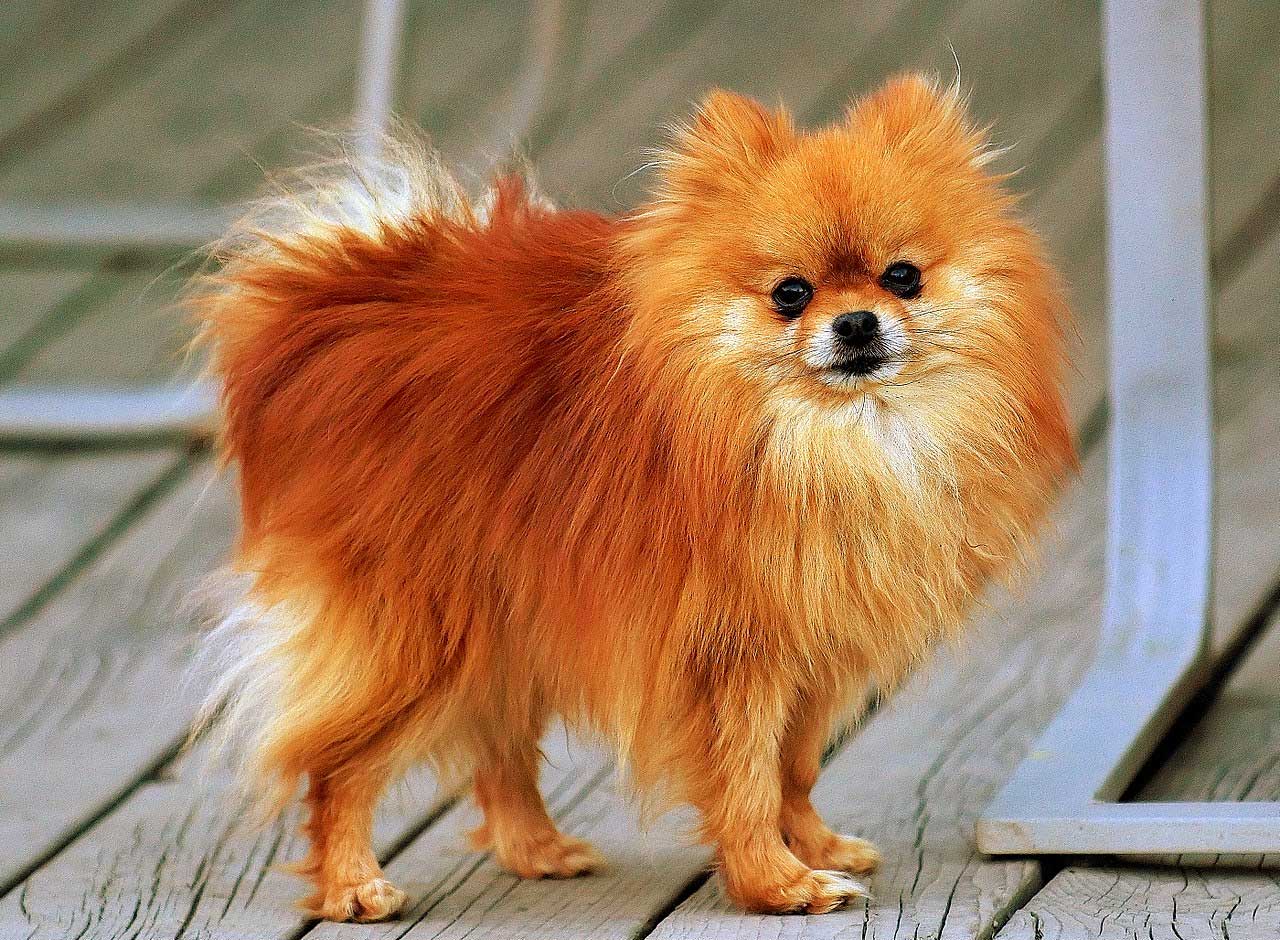
    Pomeranian
    Alemania FCI 97 . European Spitz

    Pomeranian

    The Pomeranian very active, independent, Intelligent, brave and loyal.

    Content

    History

    The Pomeranian (Deutscher Spitz;, Pomeranian Lulu or Deutscher Zwergspitz) It is a dog of the Spitz family, named for the region of Pomerania Central, Eastern Germany, and is classified as a dog ยซToyยป due to its small size.

    The ancestors of the Pomerania were Iceland and Lapland sled dogs, He came to Europe because of Pomerania.

    The region of Pomerania, bathed in the north by the Baltic Sea and bounded in the west by the island of Rรผgen and in the east by the Vistula River, It was occupied by many peoples, celts, Slavs, Poles, Swedes, Danish and Prussian. Its name comes from Pomore or Pommern, which means "by the sea", and it was given in times of Charlemagne. Is in Pomerania where the Spitz won fame as a pet and dog work.

    Read more

    โ–ท The world of Pets: Dogs, cats, birds, reptiles, amphibians

    Rottweiler
    Alemania FCI 147 - Molosoids โ€“ Doge

    Rottweiler

    The Rottweiler is a quiet dog, docile and faithful family.

    Content

    History

    The Rottweiler is one of the breeds of German origin that is recognized by the Federation Cynologique Internationale (FCI). The Rottweiler is a dog trotting type.

    The history of the Rottweiler dates back to the 19th century. The city of Rottweil in present-day Baden-Wรผrttemberg was known for its cattle trade.. To keep animals under control on their way to pasture, farmers and butchers had to use intelligent and persistent companion dogs. At the beginning, these dogs were therefore called butcher dogs, later they were finally given the name Rottweiler due to its proximity to the city of Rottweil. Other theories about the history of the Rottweiler breed say that the canine breed was already used for cattle breeding in Rome and therefore came with the Romans through the Alps to the city of Rottweil. In the early 20th century, when people were looking for a suitable police dog, it soon became clear that the Rottweiler, with his strong, muscular stature and intrepid temperament, was particularly suitable. In 1910 the Rottweiler was officially recognized as a police dog.

    those characteristics, they made it an indispensable both for farmers and butchers Assistant.

    Physical characteristics

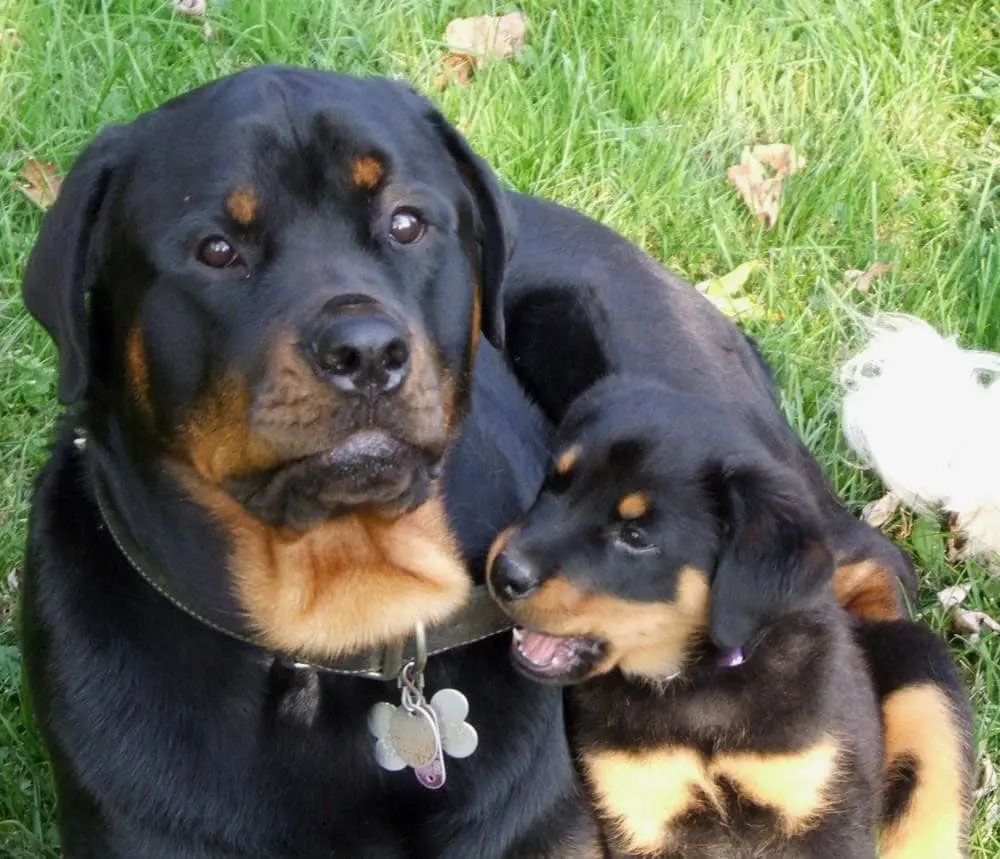
    The Rottweiler is a medium to large dog, muscular, sturdy and strong with powerful teeth. Although its shape is quite robust, the Rottweiler has great resistance and is very agile. According to the breed standard, the height at the withers of a male dog is 68 cm., that of a female dog 63 cm.. The weight of a Rottweiler is between approx. 42 kg ( female) and approx. 50 kg (male). Rottweiler coat consists of a black top layer and bottom layer. The black top layer is described by the VDH (German Canine Federation) as "medium length", thick, dense and tight", while the bottom layer should not protrude from the top layer. The Rottweiler's coat is slightly longer on the hind legs. Characteristic for the Rottweiler is also the so-called blight, which means clearly defined brown-red markings on the lips, the snout, the eyebrows, under the root of the tail and on the chest.

    Within this breed we can find two breeding lines, the European, considered the original and the American. The American line is characterized by taller specimens and more stylized bodies., on the other hand, European line dogs have a more compact and robust body with a shorter height.

    Character and skills

    Although the Rottweiler is a race that has been used for defence work, his work and typicity requires that they are described as friendly, happy talk, quiet, faithful, obedient and willingness to work. In the latest studies of aggressiveness in breeds, this was not among the top ten.

    In addition the Rottweiler dog is located within the ten most intelligent dogs, they are dogs of great trust and kindness, You can be glad that it will meet the desired objective.

    An important attribute that has the Rottweiler is his adiestrabilidad. It is a very intelligent and obedient dog, able to learn many tasks.

    According to the classification made by Stanley Coren after analyzing the responses of more than 200 work of the AKC judges ("The Intelligence of Dogs", Stanley city, Ediciones B, 1995), the Rottweiler is the No. 9 from the list.

    Its history as a shepherd, as military dog and care as well as dog obedience and exhibition, speaks highly of his versatility.

    The Rottweilers are ideal as protectors of the family and property. You agree to all the members of the family and protect both the father and the son. The Rottweilers usually do not have Favorites, Although there are exceptions. They tend to be individualists, and this is due, Once again, are creatures with discernment and lists.

    Their intelligence "affects" their trainability. Just like, frequently, It is said of the cats, they are too ready to wait for repetition of an order. Once they have executed her once or twice as you like, Surely they tired of the game and seek a better output. Why do humans insist on doing these things so many times?? I already got the idea the first time and it wasn't that excitingโ€ the Rottweiler seems to think.

    In Spain the breed of dog Rottweiler It is classified as "Potentially Dangerous" by Royal Decree. This means that in the Spanish State, potentially dangerous breeds are regulated by the Law 50/1999, of the 23 from December and the Royal Decree 287/2002, of the 22 March.

    So, for its possession you must obtain the license for possession of potentially dangerous dogs and register in the corresponding Municipal registration of potentially dangerous animals. One of the things that are required for this license is insurance of civil liability to third parties.

    Some need more help than others, but patience is always required when you train a dog, regardless of what race.
    Please understand that nothing wrong with owning a Rottweiler there is. They are amazing dogs and wonderful companion animals.. This is not an issue of race, but rather individuals who are involved with the canine behavior modification.

    Rottweiler maintenance

    Since the Rottweiler was bred as a persistent working dog and therefore needs a lot of leash in order to function properly, keeping him in the kennel is out of the question. But, due to its robustness, can stay out if there is a good family connection and corresponding workload. It is important to socialize the Rottweiler from the beginning through specific training and attendance at a dog school and accustom it to different situations and people.. Due to its character, the Rottweiler can be used very well as a service dog, guard dog, rescue dog or guide dog for the blind. Although it is not the classic family dog, living with children is usually not a problem. Due to its size and strength, wild games with children should be avoided, and children should not walk alone with the Rottweiler due to its enormous traction. Proper maintenance a Rottweiler includes not only a demanding occupation but also a good education.

    The life expectancy of a Rottweiler

    The life expectancy of a Rottweiler is with 8-10 years somewhat below average value. Unlike small dog breeds, the musculoskeletal system of larger dog breeds is already under great stress during the growth phase, causing signs of wear earlier.

    Buy a Rottweiler

    Before deciding on a Rottweiler, one must closely examine their attitude and character and carefully consider whether this breed is really suitable. The following questions must be answered affirmatively: Can I offer the Rottweiler enough space and exercise?? Do I have time to take care of the animal enough? Do all family members agree with the dog? Do I trust the education of a Rottweiler? Can I take my dog โ€‹โ€‹on vacation or what alternatives are there? If you finally decide to get a Rottweiler, doesn't necessarily have to come from a breeder. Why don't you visit the animal shelter?- Maybe you'll find a Rottweiler there that you can give a good home to.. Here the purchase is also much cheaper than with a breeder.

    Rottweiler Education

    The correct education is very important for a Rottweiler to promote its generally human and balanced character.. Your position in the family hierarchy should be clear to the dog from the start., so that he learns to obey and respect his master. Consistency is extremely important in Rottweiler education, and should be dominant, but without harshness. As a responsible dog owner, you must act with sovereignty, calm and especially with consideration when training a Rottweiler. The Rottweiler recognizes these positive leadership qualities, which ultimately makes him a loyal companion. As in the case of any other dog, training should begin at the puppy's age, where positive behavior is rewarded with praise, for example in the form of sweets. Caution: With insufficiently dominant leadership or erroneous and inconsistent education, Rottweiler can develop dangerous behavior – this shows the great role that the correct education of the Rottweilers plays.

    Rottweiler Health and Care

    Since the Rottweiler's coat is rather short to medium long, the toilet is not very complex. But, due to its agile nature, impurities can quickly accumulate on the coat, so grooming should not be neglected entirely. Occasional brushing is completely sufficient. For Rottweiler coat length, special brushes for dogs, but also cotton gloves have proven to be very effective. In addition to the toilet, foot care, as well as eye care, ears and nails should be considered to the usual extent.

    Breed-specific diseases

    As with many other large dogs, certain diseases occur more frequently in Rottweiler dogs. These include hip dysplasia and elbow dysplasia, both are poor development of the respective joints. Because this is due to a genetic disposition, an X-ray examination must be presented in a breed aptitude test. To prevent disease, care must be taken that the animal is not overweight and gets enough exercise. Leukoencephalomyelopathy is also a hereditary disease. It leads to progressive paralysis in young animals and is not curable., although it occurs quite infrequently. On the other hand, in recent years, heart disease has been reported more frequently in this breed. Constriction of the nerves of the heart, for example, is inherited and affects the reflux of blood from the heart, which ultimately leads to limited performance of the Rottweiler.

    Rottweiler feed

    Like any other dog, the Rottweiler needs a species-appropriate diet. To prevent overweight and resulting breed diseases, such as hip and elbow dysplasia, dog food should not be too fatty and above all low in protein. It is also important that the Rottweiler feeds in moderation and has limited access to the feeding bowl. Instead of being able to use a large portion of food, Dog owners must distribute food appropriately for their โ€œRottiโ€. Whether dry or wet food is better for the Rottweiler, the dog owner must decide for himself.

    Rottweiler puppies prefer to eat what they are used to eating from their breeder. So, it makes sense to continue feeding this food for the time being and only change food when the dog is older and may have different needs than its food. It's best to just try what the Rottweiler likes best: in addition to dry and wet food, also a healthy alternative to barking at the dog.

    Characteristics "Rottweiler"

    Coexistence is important that you have with your new friend. Before considering the acquisition of a dog of the breed "Rottweiler" you know certain factors. Not all breeds of dogs are apt to live in an apartment, you must take into account his character, their need for exercise, their interaction with other pets, their care and if you have small children, their level of tolerance towards them.

    Adaptation โ“˜

    3,0 of 5 stars (based on 1 review)

    friendly dog โ€‹โ€‹โ“˜

    1,0 of 5 stars (based on 1 review)

    hair loss โ“˜

    3,0 of 5 stars (based on 1 review)

    Affection level โ“˜

    3,0 of 5 stars (based on 1 review)

    Need for exercise โ“˜

    3,0 of 5 stars (based on 1 review)

    Social need โ“˜

    5,0 of 5 stars (based on 1 review)

    Home โ“˜

    3,0 of 5 stars (based on 1 review)

    Toilet โ“˜

    1,0 of 5 stars (based on 1 review)

    Friendly with strangers โ“˜

    1,0 of 5 stars (based on 1 review)

    barking โ“˜

    2,0 of 5 stars (based on 1 review)

    Health โ“˜

    3,0 of 5 stars (based on 1 review)

    Territorial โ“˜

    5,0 of 5 stars (based on 1 review)

    Cat friendly โ“˜

    3,0 of 5 stars (based on 1 review)

    Intelligence โ“˜

    4,0 of 5 stars (based on 1 review)

    Versatility โ“˜

    3,0 of 5 stars (based on 1 review)

    Child friendly โ“˜

    2,0 of 5 stars (based on 1 review)

    Surveillance โ“˜

    3,0 of 5 stars (based on 1 review)

    joy โ“˜

    5,0 of 5 stars (based on 1 review)

    Rottweiler Images

    Rottweiler Videos

    Type and recognitions:

    • FCI CLASSIFICATION:
    • Group :
    • Section : . .

    Federations:

    • FCI – Pinscher and Schnauzer-Molossoid type dogs – Swiss Mountain Dogs and Cattledogs. Section 2.1 Molossoid, mastiff type. โ“˜
    • AKC – Working dogs โ“˜
    • ANKC – Group 6 (utility dogs) โ“˜
    • CKC – Group 3 (working dogs) โ“˜
    • โ€‹KC – Working dogs โ“˜
    • NZKC – Utility dog โ“˜
    • UKC – Watchdog โ“˜

    FCI breed standard "Rottweiler"

    Origin:
    Germany

    Date of publication of the valid original standard:
    15.06.2018

    Use:

    Utility dog, service and company.


    General appearance:

    The Rottweiler is a medium to large sized dog, robust, neither heavy nor light, neither with limbs too high nor weak. Its correctly proportioned construction, Compact and powerful, Lets conclude that it is a very powerful dog, agile and resistant.

    IMPORTANT PROPORTIONS: The length of the body, measured from the tip of the sternum (chest bone) to the ischial tuberosity, must not exceed the height at the withers by more than one 15%.


    Behavior / temperament:

    The rottweiler hasaffable tendency, placid in basic arrangement, very devoted, obedient, docile and willing to workIts appearance is natural and rustic, his behavior is self-confident, stable and fearless. Reacts to its surroundings with great attentionand at the same time in a temperate way.

    Head:

    ---

    Cranial region:
    • Skull: Medium length, relativelywidth between ears. Side view, the forehead is moderately arched; the occipital Protuberance is well developed, without being too noticeable.
    • Depression links (Stop)Relatively strongThe front grooves are not too deep.

    facial region:

    • Truffle: Well developed, rather wide than rounded, with relatively large nostrils, always black.
    • Snout: In relation to the area of รขโ‚ฌโ€นรขโ‚ฌโ€นthe skull, it should not give the impression of being shortened or elongated.The relationship between the length of the muzzle and the length of the skull is approximately 1 to 1.5. Straight nose bridge, wide at its insertion, moderately decreases in width from back to front.
    • Lips: Blacks, well pasted. The corner of the mouth is tightly closed; gums as dark as possible.
    • Jaws / Teeth: Both the upper and lower jaws are very strong and wide.. Healthy teeth, strong and full (42 parts). With scissor bite, upper incisors overhang lower incisors tightly.
    • Cheeks: Pronounced zygomatic arches.

    EYES: Medium-sized, almendrada form, dark brown; with well-adherent eyelids.
    EARS: Medium-sized, pendants, triangular, very separated and set high. With the ears well glued and placed forward, which makes the skull area of รขโ‚ฌโ€นรขโ‚ฌโ€นthe impression to be wider.

    Neck:

    Strong, long, good muscular, slightly arched, clean, double chin freeorskinloose.

    Body:

    • Back: Straight, strong and stiff.
    • Pork loin: The lumbar region is short, strong and deep.
    • Rump: Wide, medium length, slightly rounded, without being straight, not even with much fall.
    • Breast : Spacious, broad and deep (approx.. 50% the height of the cross), with a well-developed sill and bulky rib.
    • Abdomen: Not collected flanks.

    Tail:

    In natural condition, strong, at the level and in an extension of the upper line; in atention, when aroused or on the move can bring her up with a slight curve; in idle it can hang up.Bringing it down between the legs the tail reaches the hocks or is a little longer.

    Tips

    PREVIOUS MEMBERS:

    • As a whole: Seen from the front they are straight and not very together. The forearms, seen from side, they are straight. The inclination of the scapula in relation to the horizontal is 45ยฐ.
    • Shoulder: Well-placed.
    • Arms: Well glued to the trunk.
    • forearms: Strongly developed and muscular.
    • Metacarpus: Slightly elastic, strong, slightly oblique.
    • Front feet: Round; closed and swollen fingers. Hard pads; short nails, black and strong.

    LATER MEMBERS:

    • As a whole: Seen from behind are straight, parallel and not very together. In the natural position, obtuse angles are formed between the thigh and the iliac bone., between the thigh and the leg (knee), and between the leg and the metatarsus (Hock).
    • Thigh: Moderately long, width and heavily muscled.
    • Leg: Long, strong, with many muscles, sinewy.
    • Hock: Powerful; well angled, not steep.
    • Rear feet: A little longer than the front; also closed fingers, bulky and heavy.

    Movement:

    The Rottweiler is a m, remaining your back strong and with little movement. The development of the movement is harmonious, insurance, with force and free, with wide steps.

    Mantle

    SKIN: Skin tight head throughout the area; form small wrinkles on the forehead when the dog is at attention.

    HAIR: Composed of outer layer and internal NAP. The external layer hair is medium long, hard, thick and tight; internal NAP must not protrude beyond the external hair. In the hind, the hair is a little longer.

    COLOR: Negro, with well-defined fire marks of a bright pardo-rojizo color on the cheeks, snout, throat, chest and members, as well as above the eyes and under the tail.


    Size and weight:

    Males:

    • Height to the cross: 61-68 cm..
    • Of 61 to 62 cm.: small; of 63-64 cm.: medium-.
    • Of 65-66 cm.: large (correct size); of 67-68 cm.: very large.
    • Weight: Approximate: 50 kg.

    females:

    • Height to the cross: 56-63 cm..
    • Of 56 to 57 cm.: small; of 58 to 59 cm.: medium.
    • Of 60-61 cm.: large (correct size); of 62-63 cm.: very large.
    • Weight: Approximate: 42 kg.


    Fouls:

    Any deviation from the aforementioned criteria is considered as a fault and the severity of this is considered to the degree of the deviation to the standard and its consequences on the health and well-being of the dog..

    General appearance: Lightweight overall appearance, fragile; too high limb; weak bones and muscles.

    • Head: Head of hounds, narrow, light; too short or too long, Tosca; Flat front; absent or little noticeable stop.
    • Snout: Pointed or long; split nose; borrego type nose cane (convex), or depressed (concave); drooping nasal bridge (eagle); Truffle stained or color clear.
    • Lips: Not together, pink or stained; Open the lips angle.
    • Jaws: Narrow jaw.
    • Teeth: Bite of iron.
    • Cheeks: Very prominent.
    • Eyes: clear, deep, bulging or round. Loose eyelids.
    • Ears: Too low, heavy, long, drooping, bent backwards, as well as separate the size of the uniform.
    • Neck: Too long, delgado, weak muscles, with loose skin or dewlap.
    • Body: Too long, too short, Strait.
    • Back: Too long, weak, past due or outstanding (convex).
    • Rump: Drop, too short, long or straight.
    • Breast : Chest with a flat rib, barrel or Strait, backwards.
    • Tail: Too high or too low implementation.
    • Former members: Close together, not straight; steep shoulder; elbows not quite clinging to the body or separated; too long forearms, short or steep; weak or steep Metacarpus; crushed feet; very flat fingers, destitute or very bulky; Nail Color clear.
    • Later members: Flat thighs; closed or cow type tips; the very acute or obtuse angles of the joints; Spurs.
    • Skin: The wrinkled facial skin.
    • Fur: Soft; too short or too long, wavy; absence of internal NAP.
    • Color: Wrong color marks, too big, or not clearly defined.

    MISS PLAYOFFS

    • Behavior: Shy animals, shy, cowards, aggressive, overly suspicious, nervous and afraid of shots that show.
    • General appearance: Marked investment in the sexual nature (that the male presents female characteristics or vice versa).
    • Teeth: Upper or lower prognathism, incisor arcade deviated; absence of an incisor tooth, Tusk, a premolar or a molar.
    • Eyes: Entropion, ectropion, yellow eyes; anisochromia (eyes of different colour).
    • Tail: Quebrada, threaded, strongly diverted laterally.
    • Fur: Markedly long or wavy.
    • Color: Any discrepancy from the characteristic black color with reddish-brown spots; white spots.
    • Any dog โ€‹โ€‹showing clear signs of physical or behavioral abnormalities must be disqualified..


    N.B.:
    • Males should have two normal-appearing testicles fully descended into the scrotum..
    • Only functionally and clinically healthy dogs, with the typical conformation of the breed, should be used for parenting.

    TRANSLATION: Federation Canรณfila Mexicana a.c..

    The latest changes are in bold.

    Source: F.C.I - International Cynological Federation

    Alternative names:

    1. Rott, Rottie (English).
    2. Rottweiler (French).
    3. Rottweiler Metzgerhund (German).
    4. Rottweiler Metzgerhund (Portuguese).
    5. Rottie, Rott (espaรฑol).

    โ–ท The world of Pets: Dogs, cats, birds, reptiles, amphibians

    Standard Schnauzer
    Alemania FCI 182 . Pinscher and Schnauzer type

    Schnauzer Mediano

    Starting at the Standard Schnauzer the other two varieties were developed (Giant and Enano)

    Content

    History

    The Standard Schnauzer (standard) It is the original race of the three Schnauzer breeds, and despite his fur and aspect in general, This is not related to the English Terrier. This is one of the oldest breeds in Europe. This race is beautiful, robust, square build and medium-sized with a similar aristocratic, This was the favorite breed of Albrecht Dรผrer and Rembrandt.

    In his country of origin he is known as Mittelschnauzer (Standard Schnauzer) to distinguish it from the giant form and the form miniature.

    Regardless of the origin of the breed, It should be noted that the racial standard of the Schnauzer was set for the first time in the year 1880, and in the year 1885 the first breed club was established in Germany. He had to wait 40 more years, to be made in United States (1925).

    The name of Schnauzer is given to the breed for its first appearance in public in a show contest.. This contest (Hannover 1879) won it a dog presented as wire-haired Pinscher. The winner can be called Schnauzer (ยซbigotudoยป) and thereafter, all the wire-haired Pinscher have received the name of Schnauzer.

    The classification of the Schnauzer has always brought controversy, because that is what you don't want to classify as Terrier, likely as not being a race that cace as dog's burrow. The controversy is that dogs as the Manchester Terrier they are classified as Terrier and are, as it is the case of the above-mentioned, the prototype of the dog buzzard without being trained for hunting dog's burrow.

    Physical characteristics

    The Standard Schnauzer has a rough coat, with colors ranging from 'salt and pepper' to solid black.

    The hair on the face is extended to form a beard and eyebrows. The race is robust, and must be "heavy" for its height with lots of muscle and bone.

    The ideal ranges of the weight and of the height vary, considerably, from a standard race which is as follows: The males range between 45 and 50 cm of high cross and usually weigh between 15.5 and 22.5 kg. The females measure between 42.5 and 47.5 High Cross and usually weigh between 13.5 and 20.2 kg).

    In United States, most dogs have cropped ears and tails.

    Traditionally, the ears they are cut and the tail as well. But, in many European countries and in Australia, ear and tail docking is prohibited and dogs show off their natural ears and tails.

    Character and skills

    It's a race that, similar to the German Pinscher, It was created for the extermination of vermin on farms, Although he didn't mention in other tasks, becoming a multi-purpose dog. They included the roles played by the Schnauzer, driving cattle.

    Itร‚ยดs jealous, It loving and a good former. All varieties of Schnauzer have a character that is described as impetuous, strong but very balanced.

    Love your family, they are safe and affable with children and rather distrustful with strangers.

    Schnauzer Health

    All dogs have the potential to develop genetic health problems, just as all people have the potential to inherit a particular disease. Run, do not walk, from any breeder that does not offer a health guarantee on puppies, to tell you that the breed is 100 percent healthy and has no known problems, or tell you that your puppies are isolated from the main part of the home for health reasons. A reputable breeder will be honest and open about the breed's health problems and the incidence with which they occur in their lines..

    Some of the conditions that affect standard Schnauzers include hip dysplasia; eye problems (including cataracts and retinal dysplasia); a heart condition known as pulmonary stenosis; hipotiriodismo; Hemophilia (a bleeding disorder); and bladder stones.

    Not all of these conditions are detectable on a growing puppy, and it can be difficult to predict whether an animal will be free of these diseases, so a reputable breeder must be found who is committed to raising the healthiest animals possible. Must be able to produce an independent certification that the parents of the dog (and grandparents, etc.) have been screened for these defects and considered healthy for breeding. That's where health records come in..

    Remember that after bringing a new puppy home, has the power to protect you from one of the most common health problems: the obesity. Maintaining a standard Schnauzer at the right weight is one of the easiest ways to extend your life.. Make the most of your preventive skills to help ensure a healthier dog for life.

    Characteristics "Standard Schnauzer"

    Coexistence is important that you have with your new friend. Before considering the acquisition of a dog of the breed "Standard Schnauzer" you know certain factors. Not all breeds of dogs are apt to live in an apartment, you must take into account his character, their need for exercise, their interaction with other pets, their care and if you have small children, their level of tolerance towards them.

    Adaptation โ“˜

    3,0 of 5 stars (based on 1 review)

    friendly dog โ€‹โ€‹โ“˜

    4,0 of 5 stars (based on 1 review)

    hair loss โ“˜

    2,0 of 5 stars (based on 1 review)

    Affection level โ“˜

    4,0 of 5 stars (based on 1 review)

    Need for exercise โ“˜

    4,0 of 5 stars (based on 1 review)

    Social need โ“˜

    4,0 of 5 stars (based on 1 review)

    Home โ“˜

    3,0 of 5 stars (based on 1 review)

    Toilet โ“˜

    4,0 of 5 stars (based on 1 review)

    Friendly with strangers โ“˜

    2,0 of 5 stars (based on 1 review)

    barking โ“˜

    5,0 of 5 stars (based on 1 review)

    Health โ“˜

    1,0 of 5 stars (based on 1 review)

    Territorial โ“˜

    5,0 of 5 stars (based on 1 review)

    Cat friendly โ“˜

    4,0 of 5 stars (based on 1 review)

    Intelligence โ“˜

    5,0 of 5 stars (based on 1 review)

    Versatility โ“˜

    5,0 of 5 stars (based on 1 review)

    Child friendly โ“˜

    4,0 of 5 stars (based on 1 review)

    Surveillance โ“˜

    5,0 of 5 stars (based on 1 review)

    joy โ“˜

    5,0 of 5 stars (based on 1 review)

    Images Standard Schnauzer

    Standard Schnauzer Videos

    Photo: davolvoreta

    Type and recognitions:

    • FCI CLASSIFICATION:
    • Group :
    • Section : . .

    Federations:

    • FCI – Pinscher and Schanuezer dogs. Molossian type Dogs and Swiss Mountain and Cattle Dogs. , Section 1: Pinscher and Schnauzer. โ“˜
    • AKC – Dogs working โ“˜
    • ANKC – Group 6 (utility dogs) โ“˜
    • CKC – Group 3 – Working dogs โ“˜
    • โ€‹KC – Working dogs โ“˜
    • NZKC – Utility dog โ“˜
    • UKC – Watchdog โ“˜

    FCI breed standard "Standard Schnauzer"

    Origin:
    Germany

    Date of publication of the valid original standard:
    06.03.2007

    Use:

    Guard and company


    General appearance:

    Medium size, vigorous, more compact than thin, rough-haired.


    IMPORTANT PROPORTIONS<

    • Square construction, where the height at the withers corresponds more or less to the length of the body.
    • The length of the head (from the tip of the truffle to the occipital protuberance) is related to the length of the body (measured from withers to insertion of tail) approximately in a proportion of 1:2.


    Behavior / temperament:

    His typical traits are his confident temperament and his circumspect tranquility.. Especially notable is his good character., his joy for games and his proverbial attachment to his master. He loves children very much, it is unbribable guardian, although not noisy. Highly developed sense organs, prudence, great ability to be polite, fearlessness, perseverance and great power of rapid recovery against illnesses and climate changes, They give the Schnauzer all the assumptions that a utility dog โ€‹โ€‹must have to be a great family dog., company and utility.

    Head:

    ---

    Cranial region:
    • Skull: Strong and elongated, with the back of the little marked head. The head must correspond to the overall strength of the dog. The forehead is flat and paralelaa the nasal helm, without wrinkles.
    • Depression links (stop): Well differentiated between the eyebrows

    facial region:

    • Truffle: Well developed with wide open windows. It is always black.
    • Snout: It ends in the shape of a truncated wedge. The nasal cannula is straight.
    • Lips: Blacks, rest firm and plans on the jaws; the corner of the mouth is closed.
    • Jaws/Teeth: Powerful upper jaw and lower. The bite is scissors, strong and full (42 clean, white teeth according to tooth formula of the dog).  It should close well. The chewing muscles are strongly developed without this, exaggerated cheeks spoil the rectilinear appearance of the head (with beard).
    • Eyes: Medium-sized, oval, directed forward, dark, with lively expression. Adherent eyelids.
    • Ears: Bent and falls, high insertion, โ€œVโ€ shaped; the inner edges of the ears rest on the cheeks. The bearing of the ears is symmetrical. They are directed forward towards the temple. The parallel fold should not exceed the top line of the skull.

    Neck:

    The neck is strong, muscular and maintained arched. The neck slides harmonically to the cross. Strongly inserted, is narrow, noble postage, contributing to the vibrant and elegant appearance. The skin of the throat is adherent and without dewlap.

    Body:

    • top line: Slightly descending from the cross back.
    • Cross: It is the highest point of the top line.
    • Back: Strong, short, firm.
    • Pork loin: Short, strong, deep. The distance from the last rib to the hip is short so that the dog appears compact.
    • Rump: Slightly rounded, going unnoticed by the insertion of the tail.
    • Breast : Moderately wide, oval cut, deep up to elbows. The apron is especially marked by the tip of the sternum.
    • bottom line: Flanks not excessively gathered so as to provide a nice wavy line along the lower part of the thorax..

    Tail:

    Natural, the goal being to make it Sabre or sickle-shaped.

    Tips

    PREVIOUS MEMBERS: The forelimbs are, seen from the front, vigorous, straight and placed not too close together. Seen side forearms are straight.

    • Shoulder: The scapula is firmly resting on the chest. Well muscled on both sides of the spine of the bone, It protrudes above the vertebrae of the spine in its thoracic section. Tilted as much as possible and leaned back, makes an angle of 50ยบ with the horizontal.
    • Arm: Well on the body, strong and muscular; forms an angle of more or less 95ยบ to 105ยบ with the scapula.
    • Elbows: Tight, not rotated or outward or inward.
    • Forearm: Straight seen from either side, strongly developed and well muscled.
    • Carpo: Strong and stable. Its structure barely stands out from the forearm.
    • Metacarpus: Straight seen from the front; profile slightly oblique to the floor, strong and slightly elastic.
    • Front feet: Short and round; fingers pinched each others and arched (cat feet); nails short and dark colour and strong pads.

    LATER MEMBERS: Views of oblique profile; from the back, they are parallel and not too close together.

    • Thigh: Moderately long, width and heavily muscled.
    • Knee: Must not be turned neither inward nor outward.
    • Leg: Long and strong, sinewy, continuing in a powerful Hock.
    • Hock: Well angled, strong, firm, not turned neither inward nor outward.
    • Metatarsus: Short and perpendicular in relation to the floor.
    • Rear feet: Short fingers, arched and tightened a few others ; nails short, black.

    Movement:

    Elastic, elegant, agile, free and with good coverage of land. The forelimbs are stretched forward as much as possible and the hindlimbs โ€“ with good elastic reach- they give the necessary propulsion. The front side and back on the other side simultaneously moving forward. Back, ligaments and joints are firm.

    Mantle

    • SKIN: Tight throughout the body
    • HAIR: The hair should be hard, wiring and bushy. It is composed by a dense internal NAP and an outer layer (that it can never be too short) hard and well glued hair all over the body. The hair of the outer layer is rough, of sufficient length, to be able to test its texture, Neither ogres nor wavy.
    • The hair on the limbs tends not to be as coarse. On the forehead and ears it is short. Typical features are, on the snout, the beard, that should not be too soft and bushy eyebrows that make eye shadow.

    COLORS

    •  Pure black with black interior NAP
    • Salt and pepper

    For salt and pepper, the breeding objective is to obtain a medium tone with equal distribution of well-pigmented pepper color with gray undercoat.. Shades ranging from dark steel gray to silver gray are accepted. All colors must have a dark mask that underlines the expression and is in harmony with the color of the respective hue. White spots on the head, in the chest or the members are unwanted.


    Size and weight:

    HEIGHT AT THE WITHERS

    •  Males and females: 45 until 50 cm..

    WEIGHT

    •  Males and females: 14 until 20 kg.


    Fouls:

    Any deviation from the aforementioned criteria is considered a fault and the severity of this is considered to the degree of the deviation from the standard and its consequences on the health and well-being of the dog. In particular:

    • Too small or too short head as a whole.
    • Heavy or round skull.
    • Wrinkles on the forehead.
    • Short snout, pointed or narrow.
    • Bite in clamp.
    • light eyes, too large or round.
    • Inclusion of low or very long ears, ears carried different from each other.
    • Cheeks or too marked cheeks bones.
    • The throat loose skin, Spada.
    • Narrow neck.
    • Too long back, collected or soft.
    • Encarpado back.
    • fallen group.
    • Inclusion of tail rotated toward the head.
    • Long feet.
    • Amble step.
    • Too short hair, too long, soft, wavy, with locks, silky, white or spotted or with mixing colors.
    • Brown undercoat. In the salt and pepper: black line of eel on the back or black saddle.
    • 1 cm in the height up or down.

    SERIOUS FAULTS

    •  Heavy or light appearance, petizo or patilargo.
    • Reversed sexual characters (for example male female).
    • Elbows rotated out.
    • Stiff or barrel hindlimbs.
    • Hocks rotated inwards.
    • More than 1 cm.. and less than 3 cm.. in the limit measurements up and down.

    MISS PLAYOFFS

    • Shyness, aggressiveness, evil, exaggerated suspicion, nervous behavior.
    • Any deformity.
    • Lack of racial characteristics.
    • Faults in the bite as upper or lower prognathism, incisor arcade deviated.
    • Miss runner in each region as construction defects, hair and color.
    • More than 3 cm.. in the limit measurements up and down.
    • Any dog โ€‹โ€‹showing clear signs of physical or behavioral abnormalities must be disqualified..


    N.B.:

    Males should have two normal-appearing testicles fully descended into the scrotum..

    TRADUCCIร โ€œN: Lucas Rodriguez Bazzurro.

    Source: F.C.I - International Cynological Federation

    Alternative names:

    1. Mittelschnauzer, Schnauzer, Wire-Haired Pinscher (English).
    2. Schnauzer (French).
    3. Schnauzer (German).
    4. Schnauzer (Portuguese).
    5. Schnauzer estรกndar, Schnauzer-Pinscher (espaรฑol).

    โ–ท The world of Pets: Dogs, cats, birds, reptiles, amphibians

    Giant Schnauzer
    Alemania FCI 181 . Pinscher and Schnauzer type

    Schnauzer Gigante

    The Giant Schnauzer is a balanced dog, sweet with children and distrustful with strangers.

    Content

    History

    The Giant Schnauzer It is a large and compact dog breed, a native of Germany. Oldest, lover of water and active, It is one of the three varieties of Schnauzer.

    The Schnauzer breed in its three varieties, It has very ancient and common origins to those of the Terrier. (of those who descend).

    Y, Although the aires were very Terrier, then the breeding and selection of the Schnauzer breed focused especially on guarding and defense.

    Read more