12–13 cm. length and 28 g. of weight.
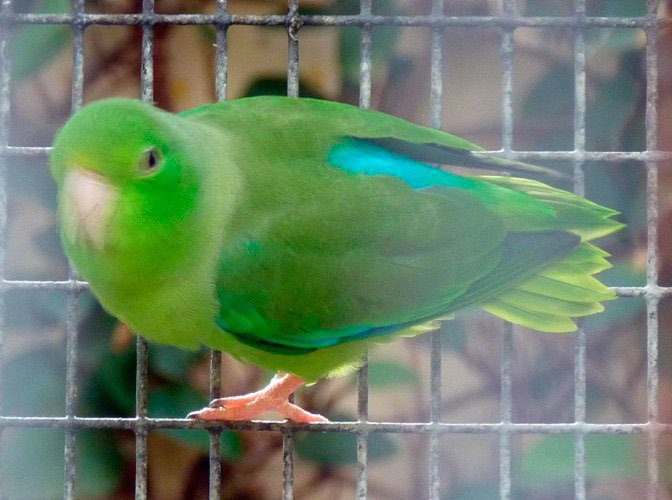
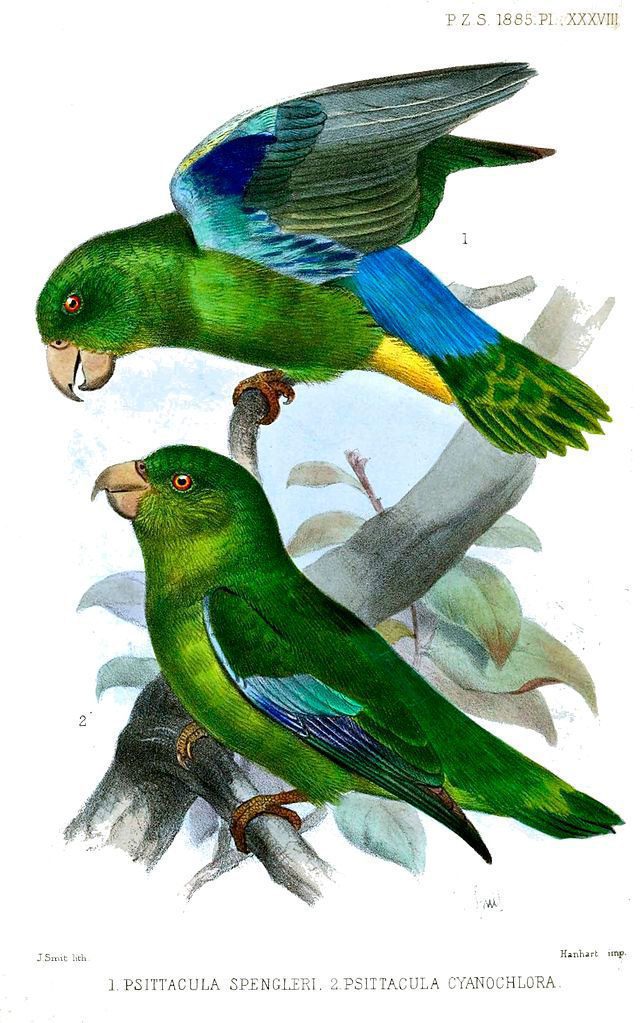
The male of the Turquoise-winged Parrotlet(Forpus spengeli) It has shades of blue at the bottom of the back, still it rump of a turquoise hue; turquoise / blue with purple on the underwing-coverts and axillary.
The wing coverts are dark green. Primary coverts are violet; wing edge bright green. Supracaudals coverts are bright green; undertail-coverts, bright yellow. Dark brown eyes with iris gray; flesh-colored legs; peak light colored horn.
The female It is green instead of blue; their face is green / yellow, It is his forecrown yellower.
taxonomy:
Until now treated as conspecific the species Forpus xanthopterygius, or sometimes as a subspecies of Forpus passerinus, or a subspecies of Forpus cyanopygius. differs, However, of the Forpus xanthopterygius in pale turquoise against the rich color tone blue rump and of the wing-coverts of the male; in the dark blue, against the rich blue color in underwing-coverts of the male; the forecrown and lores yellow in female.
Sound of the Turquoise-winged Parrotlet.
Habitat:
they prefer forested habitats drier as open forests and riparian, closed caatinga; Also they found in savannas, palm groves, semiarid scrub and grassland areas.
With feed in open areas and sometimes on the floor. Highly social; found in groups of up 50 individuals.
Restricted north of Colombia, from the coastal region Caribbean western and southern mountains Santa Marta, Atlantic, south along the Magdalena river in Bolívar and César.
Conservation:
• Current category of the Red List of the UICN: Least concern.
• Population trend: Decreasing.
Justification of the Red List of the Category
State of conservation ⓘ
Minor Concern ⓘ(UICN)ⓘ
Although this species may have a small range, It not believed to approach the thresholds for vulnerable under the range size criterion (extent of occurrence <20.000 km2 combinan con un tamaño gama disminución o fluctuante, hábitat medida / calidad, o tamaño de la población y un pequeño número de localidades o fragmentación severa). La tendencia de la población no se conoce, pero la población no se cree que esté disminuyendo con la rapidez suficiente como para acercarse a los umbrales del criterio tendencia de la población (> 30% decrease of more than ten years or three generations). The population size has not been quantified, but it is not believed to approach the thresholds for Vulnerable according to the criterion of population size (<10.000 individuos maduros con una disminución continua estima en> 10% in ten years or three generations, or a specific population structure). For these reasons, the species is evaluated as Least concern.
Justification of the population
The world's population has not been quantified, but this species is described as rare and local (Juniper and Parr 1998).
Justification trend
The population trend is unknown, but according to some reports, the species may be declining. (Juniper and Parr 1998).
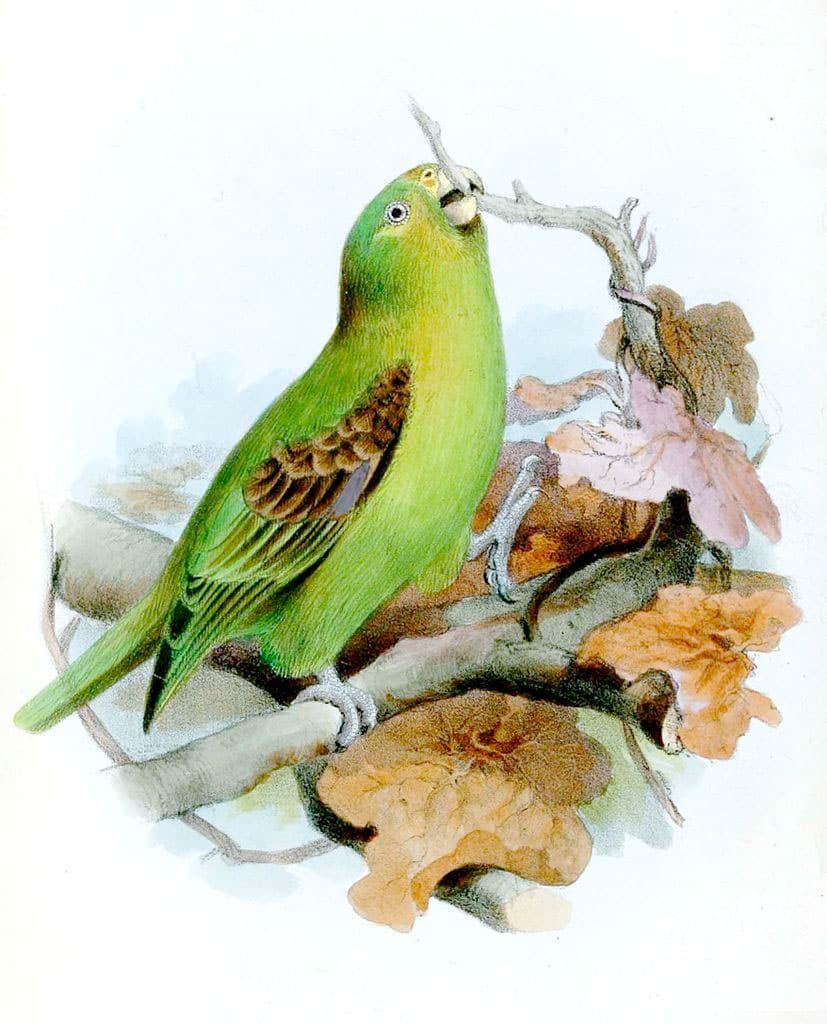
The Spot-winged Parrotlet(Touit stictopterus) It has a green overall coloration, clearer to the abdomen, wings brownish with white spots; below the tail opaque olive is yellow with blue edge.
The female differs from the male by feathers middle-lower wing
which they are green; the forecrown and the face They are yellowish green.
Very rare species. Observed at the local level and in low densities in a Habitat in decline. Its population It is likely to be small and declining, with very small sub-populations in each known locality. It inhabits in semi-humid cloud forests and seasonal crop areas, between 600 and 2400 m. Apparently performs altitudinal migrations, Perhaps conditioned by the supply of food.
Reproduction:
The reproduction It is performed in March.
Food:
They feed on fruit and corn.
Distribution:
Size of the area of distribution (reproduction / resident): 129.000 km2
It lives in the wild in the Andes, southern Central cordilleras and Eastern in Colombia, western Ecuador and North of Peru.
Conservation:
State of conservation ⓘ
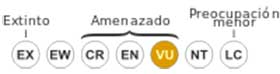
Vulnerable ⓘ(UICN)ⓘ
Globally it is in the category vulnerable (VU) and in Colombiain danger of extinction (IN). Deforestation in Andes It is their main threat.
"Spot-winged Parrotlet" in captivity:
Because of its condition It is not recommended that you keep this bird as a pet.
31 cm.. length and an approximate weight of 170 gr.
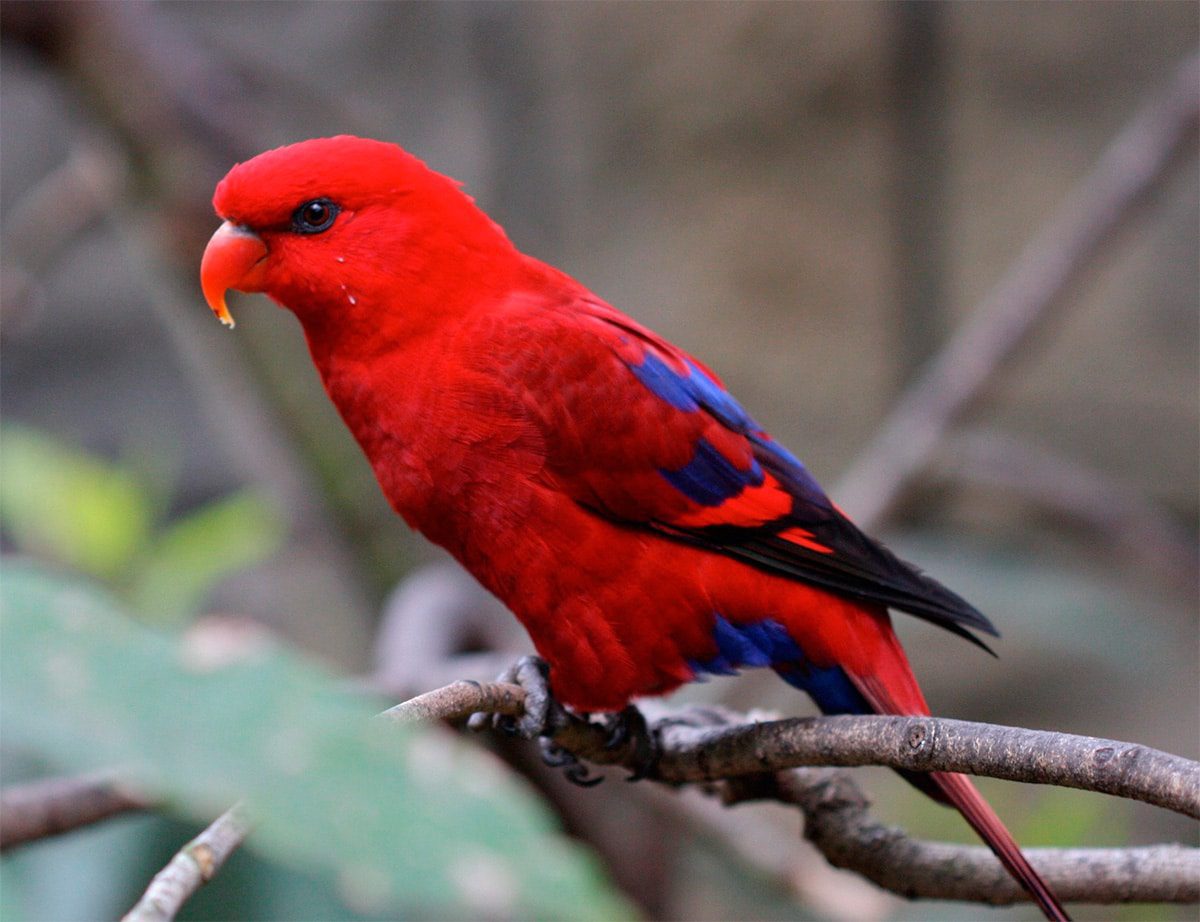
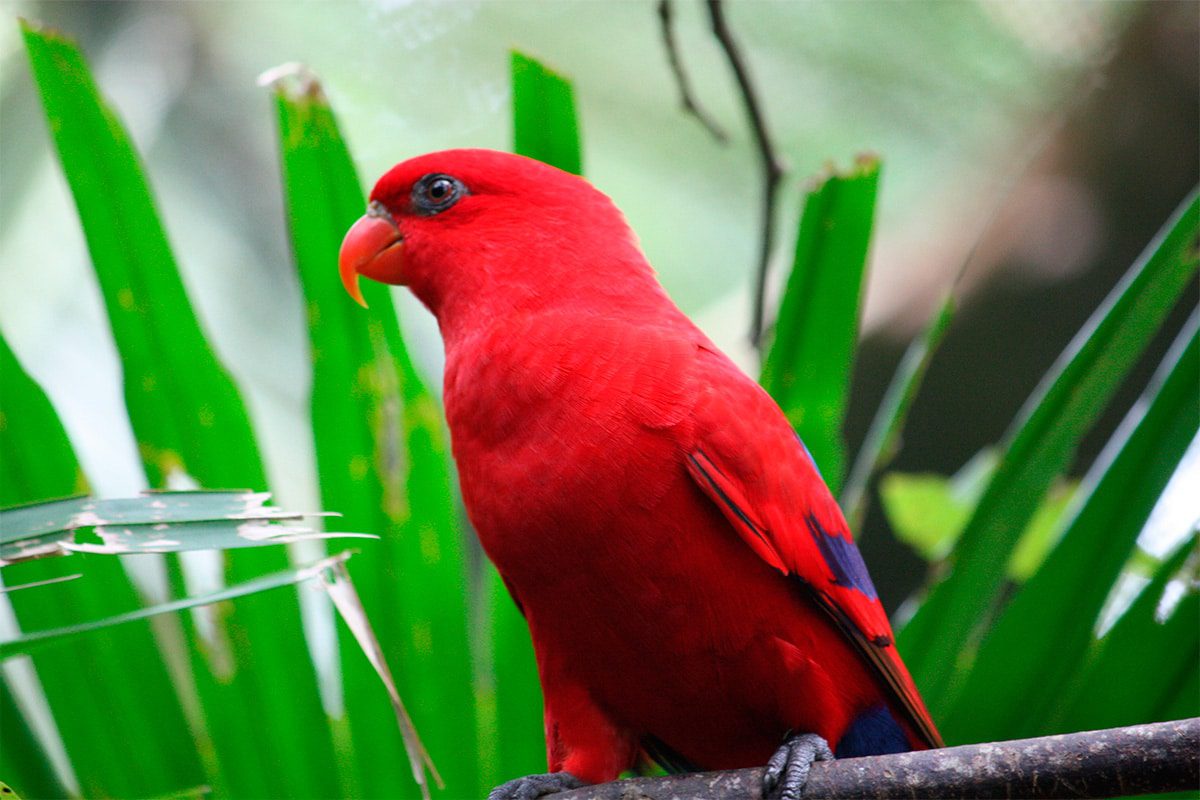
The head and the neck of the Red Lory(Eos bornea) are entirely of a deep red color.
In the adult the primary feathers are black with a large red mirror. The feathers tertiary and the coverts are of color blue. The joint of the feathers of the helmsman they are reddish-brown. The irises they are red, legs grayscale and the bill dark orange.
The immature they tend to be more off than their parents coloring. They show the feathers tertiary grey, lightly stained blue. The ear-coverts Sometimes it tinges of blue. Times, the area of the vent and the thighs it infiltrates with small stains blue. The feathers of the abdomen often carry some edges blue dark. They have the irises brown.
Not exists no sexual dimorphism visible although the males tend to be more corpulent that the females.
(Vieillot, 1818) – The Red of his plumage is much more dark almost brown.
Habitat:
They are mostly primary forests, in the wooded areas during regeneration, Forest Hills, coconut plantations, in abandoned gardens and mangroves.
They are mainly in coastal areas, What does not climb up to 900 m in the island of Ceram and up 1.800 m in the of Buru.
Throughout its area, the Red Lory are fairly common, However, some populations are more dispersed around the villages, since they are very cautious towards humans.
Behavior:
The Red Lory they live in pairs or in small groups, but sometimes you can observe large flocks of 50 individuals.
They are birds noisy and quite easy to observe, as they often fly above the canopy attracted by the red flowers of the tree of coral (Erythrina).
They have a fast and direct flight and when moving, make your buzz due to its quick flapping.
In the Kai Islands, their movements are common: all days, they cross the arm of sea that separates the different islands flying rapidly and at high altitude.
During the rest hours that occur at noon, the Red Lory they spend most of their time smoothing their feathers in the shade of a tree. Probably, This practice is designed to strengthen marital ties. Parties that enjoy priority are the head and neck; as you can not reach these areas with its beak, you will always need your partner collaboration. The "patient" that undergoes this preferential treatment seems to express a great sense of satisfaction.
Reproduction:
The couples begin to look for the location of the nest between the months of August and September. It is located high in a big tree.
In mid-December some young leaving the nest have observed.
As in all loris, the nesting period is very long and hard 7 to 9 weeks.
In captivity, the Red Lory puts 1 or 2 litters per year. Each spawning has usually 2 white eggs that are incubated for a period ranging from 24 to 26 days.
Food:
In their natural habitats, the Red Lory feed of nectar, pollen, fruits and insects of fashion casual.
Your food › seem to be them flowers of the trees of the species Eugenia and Erythrina.
All the Loris they have a language that is especially suited, with a brush tip made up of elongated papillae. This characteristic allows birds to collect pollen from flowers and compress it in a suitable way for swallowing.. They play an important role in the pollination of flowering plants and trees.
Distribution:
Size of the area of distribution (reproduction / resident): 57.900 km2
The Red Lory they have a very restricted distribution area. They live South of the Moluccan Islands, halfway between Sulawesi and the western end of New Guinea.
This species has a very large range, and therefore not approaching the thresholds for Vulnerable according to the range size criterion.
The population is suspected of being in decline due to unsustainable levels of exploitation.
The species has undergone intense trade from 1981, When it began trading in Appendix II. 99.834 wild-caught specimens have been recorded in international trade, Although none from 2000 (UNEP-WCMC trade database, January 2005 CITES).
"Red Lory" in captivity:
This lori is considered one of the most widespread within poultry. It's an interesting bird, robust and easy of play, ideal for a start in the world of the loris. It also has a very attractive red color; It playful and is easy for tame.
It is a great conversationalist. Some have entire sentences in their vocabulary. Unfortunately, his voice is sometimes very strong, with a high sharp squeal. Most are docile, even at maturity. They can be prolific breeders and are fairly easy to find as hand-raised pets..
Too much protein in the diet can lead to gout., a type of arthritis that crystals are deposited in the joints. May be a bit uncomfortable due to liquid diet.
Alternative names:
– Red Lory, Buru Red Lory (ingles).
– Lori écarlate, Lori rouge (French).
– Rotlori (German).
– Lóris-vermelho (Portuguese).
– Lori Rojo (español).
* A Red Lorry at Taronga Zoo, Sydney, Australia by Navin – wikimdia
* Red Lory (Eos bornea) looking upwards by shahram sharif – Wikimedia
* Red Lory (Eos bornea) at Singapore Zoo by Joost Rooijmans – Wikimedia
* Red Lory – KL Bird Park – Malaysia by diego_cue – Panoramio
* Moluccan Red Lory – Parrots Australia
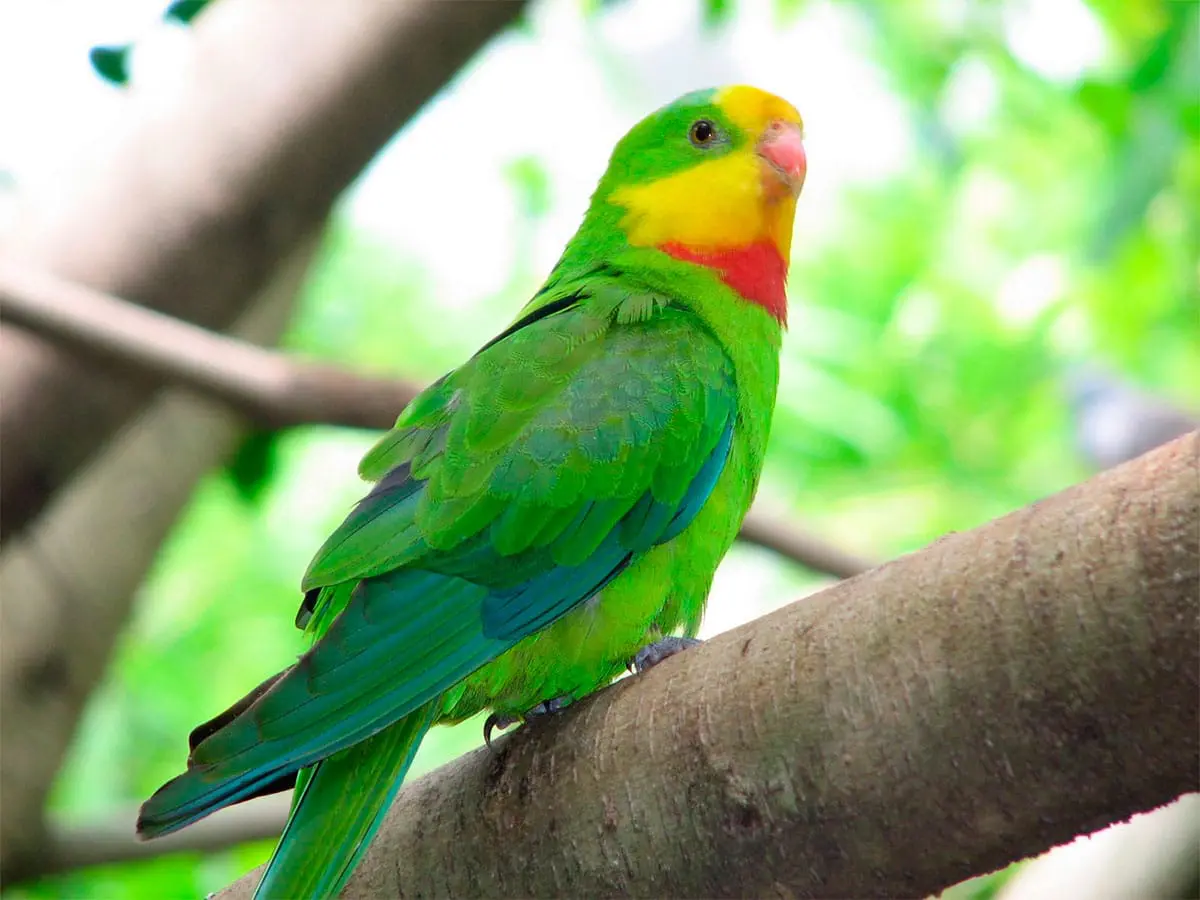
The Superb parrot (Polytelis swainsonii) has the front, crown, Chin and throat of bright yellow; back of the bright green Crown with turquoise blue wash: headphones coverts and Lords, green. Bright green upper parts. Upper, the wings, bright green, with dark diffusion in the inner margins of the vane internal and blue diffusion in vane outer (fine yellow rear margin for flight feathers); bluish carpal edge: light blue primary coverts; primary elongated.
Wing of bright green feathers; bottom of blackish brown flight feathers. Underparts pale bright green, with thin bright red Ruff between throat yellow and green at the top of the chest. Upper, bright green tail, with dark elongated Central feathers Slightly bulbous tips. outer feathers with bluish edges vane outer. The lower part of the tail is black.
The female is completely Green, with a bath pink Brown throat and with the headphones cinnamon and the Crown of blue-grey. The mantle is more off, more greenish Brown, contrasting with the Green rump and dark flight feathers. The underparts are paler, orange-red legs. She also has distinctive pink trim and pink tips to yellow vane internal bottom of the queue.
Yellow IRIS.
Immature as females but with Brown iris. Males attain adult plumage in about 12 months.
A part of the population of the Superb parrot is migratory, wintering in the North of the breeding areas.
Habitat preferences of breeding populations vary slightly from east to west within the slopes of the Great dividing range and open areas in forests of eucalyptus, It is the dominant vegetation type. Here the species nests far from watercourses, and it uses a variety of tree species.
In the region of Riverina, to the West, birds breed almost exclusively on the banks of rivers, in forests of Eucalyptus camaldulensis, feeding on nearby forests of Eucalyptus bicolor, Eucalyptus melliodora and White Pino-CIPRES (Callitris columellaris).
They sometimes also found in farmland and villages.
The size of the flocks are usually small, but groups of up to 100 individuals have been recorded after the breeding season.
The superb Parrot feed in the trees, in the understory, and also in land, where can be accessible, feeding on spilled grain on the roadsides and keeping the company of the Yellow Rosella and Cockatoos.
Reproduction:
The breeding season of the Superb parrot is from September to November.
Male parade making small greetings and nodding his head. Both members of the couple make ritual exchanges of food.
The nest is usually a hollow, full of scrap wood, at the top of a tree dead or alive and a considerable height that is usually between 11 and 51 meters above the ground. The individual sites tend to be reused.
The Superb parrot, they often nest in colonies ranging up to six couples. Spawning contains 4 or 6 eggs which are incubated for at least 20 days. The chicks are altricial and leave the nest after 30 days.
Food:
The diet includes fruits and flowers of Acacia and eucalyptus, fruit shrubs (for example Exocarpos); seeds of crops, pastures, weeds and grasses
Distribution:
Size of the area of distribution (reproduction / resident): 95.300 km2
The Superb parrot they are endemic in Australia, where are distributed only in New South Wales and the north end of Victoria.
• Current category of the Red List of the UICN: Least concern
• Population trend: Stable
Its population, apparently, fell in 1920 as an accidental effect of a poisoning by the crop protection.
A panel of experts considered that it was very likely that the population in 2010 exceeds the 10.000 mature individuals. The current estimate ranges in the Strip between 10.000 and 20.000 specimens.
The general trend of the population of the Superb parrot (Polytelis swainsonii) is uncertain, but there is no evidence of a continuous decline.
In Australia is also classified as vulnerable species the law of protection of the environment and conservation of the biodiversidadad of 1999. In addition, its conservation status varies between states., for example in the law of Victoria (1988) is considered to be threatened species.
"Superb parrot" in captivity:
Take it easy, relatively little aggressive with other birds, and very social.
Una muestra vivió 15,1 years in captivity. According to sources, these animals can live up to 24,2 years in captivity, It is possible to, but the source is not verified; the same study reported that these animals can reproduce in approximately 2 years of age in captivity.
Pretty common in captivity, above all in Australia.
– Avibase
– Parrots of the World – Forshaw Joseph M
– Parrots A Guide to the Parrots of the World – Tony Juniper & Mike Parr
– Birdlife
– The Animal Ageing and Longevity Database – Polytelis swainsonii
Of 40 cm., length and a weight between 116 and 140 g..
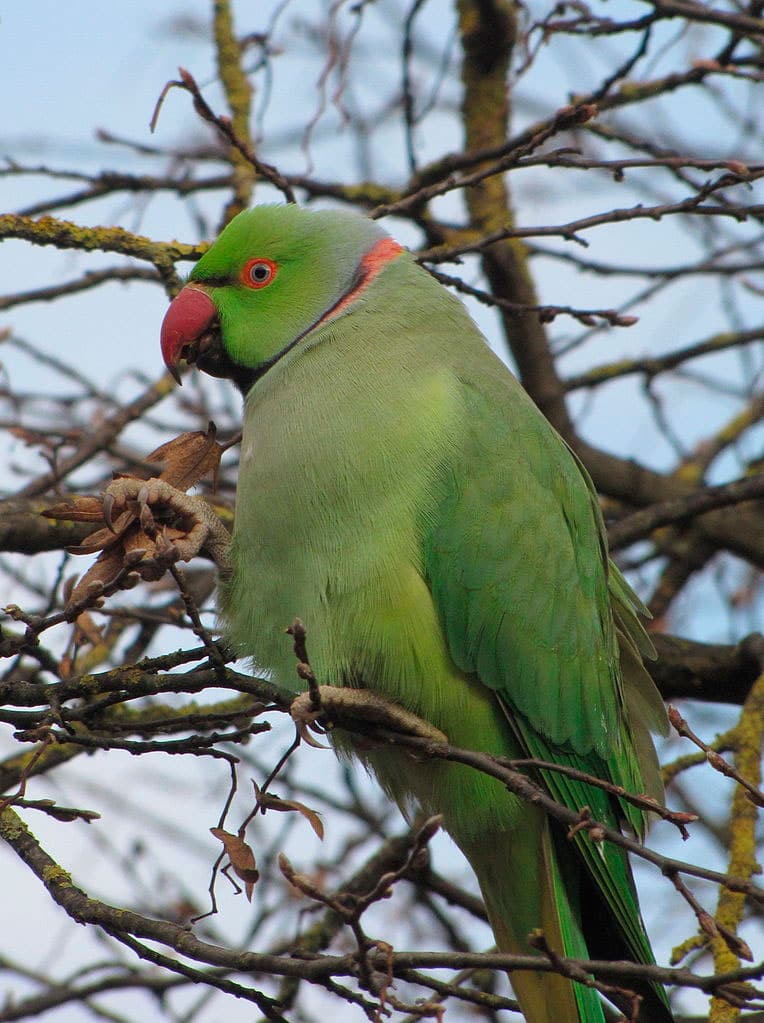
The Rose-ringed Parakeet(Psittacula krameri) has the forecrown, fore crown, the cheeks and lores bright yellowish green; narrow dark line between cere and the eye ring; the back of the crown, the nape and the sides of the neck, pale lavender gray, broken on the sides of neck with narrow black stripes; contiguous black markings with wide black stripes on the bottom of the cheeks merging the chin a solid black.
Pink collar in the back of the neck, the mantle and back light green tinged with olive; rump and uppertail-coverts slightly brighter. Lesser and medium upperwing-coverts light green (darker than the body); large coverts dark green; primaries and secondaries dark green with darker (almost black) margin to the vane inner. bottom of the feathers flight gray; underwing-coverts brighter yellowish green. Underparts brighter yellowish green. Upper, the tail centrally blue with yellowish tips, green side; undertail, the tail centralmente negruzca, yellow-olive laterally.
Crimson in the upper jaw tipped in black, the lower jaw of color stream blackish; cere whitish: irises yellowish white; legs pink, with 4 fingers ending in nails strong in black, two of these fingers are directed forward and two backward so called zigodactilia, which it allows them to easily climb.
The female lacks the neck black, brands in the chin and the cheekbone, of the collar pink and blue suffusion of neck; It has shorter central feathers tail.
The They are similar to immature females but with the bill a little paler, irises greyish; the males acquire the characteristic Pink collar in the third year.
Psittacula krameri borealis (Neumann, 1915) – Larger than the species nominal, with upper jaw all red and black marks on the lower jaw. Bluish suffusion in neck, behind ear-coverts; more than grayish bottoms species nominal.
Psittacula krameri krameri (Scopoli, 1769) – The species nominal
Psittacula krameri manillensis (Bechstein, 1800) – Larger than other subspecies, slightly paler and more yellow than the subspecies borealis. Different facial markings that species nominal. Under the mandible black.
Psittacula krameri parvirostris (Souance, 1856) – Of head and cheeks yellowish least the species nominal. Bill small upper jaw brighter red, less blackish towards the tip. The birds living in eastern Sudan They are intermediate between subspecies appearance parvirostris and species nominal.
Habitat:
The Rose-ringed Parakeet It is a very adaptable bird. It is located in a variety of forest types Forest, from secondary forests, wet, riparian forests, mangroves, open farmland with scattered trees, to parks and gardens in urban areas.
They can live at altitudes 1.600 metres in Asia and 2.000 metres in Africa.
gregarious, especially out of breeding season, coming to form large noisy flocks sometimes several thousand birds. Communal roosts, often with Crows, Mynas or other parrots.
Reproduction:
The Rose-ringed Parakeet It is not a territorial bird and, sometimes vaguely colonial while breeding.
It nests in natural tree cavities or holes extended, in cracks in rocks or walls built; in Africa, always nest atop a tree.
The breeding season, mainly, It covers the months from January to April, although offspring have been recorded in the month of July.
typical setting 3 to 4 eggs, although they have been registered you put six eggs.
23 days of incubation and 45 days of stay in the nest of the hatchlings.
Food:
Diet Rose-ringed Parakeet It includes a variety of cereals, herbs, seeds, vegetables, fruits, flowers and nectar, wild and cultivated; feeding varies seasonally,for example, in the Indian state of Punyab, They feed on weed seeds from April to June and sorghum between the months of August and January.
Inflingen crop damage, especially citrus, sunflower and corn.
Size of the area of distribution (reproduction / resident): 27800000 km2
The Rose-ringed Parakeet they are the parrots more widely distributed around the Old world. They are native to tropical africa, north of the humid forest zone, and much of Asia meridional.
In West Africa (Mauritania, Senegal, Gambia, Guinea-Bissau), the east, through Mali, South of Niger, North of Ivory Coast, North of Ghana, Burkina Faso, Togo and Benin to the North of Nigeria and Cameroon, South of Chad, North of the Central African Republic, from southern Sudan to the North of Uganda and Ethiopia, Djibouti and Northwest of Somalia.
In Asia, from the West of Pakistan, South of Nepal through the India, Bangladesh and Sri Lanka to downtown Burma.
Many introduced populations are distributed by EE.UU., England, Germany, Netherlands, North of Egypt, Kenya, coastal area Ivory Coast (possibly wild relict), South Africa (Natal and Zululandia), Mauritius, Arabian Peninsula, Singapore, Macao and China, in the surroundings of Hong Kong.
Mainly sedentary, but apparently with some seasonal movements in most parts of the African range (for example, temporary visitors during the rainy season in southern areas Mauritania).
Common to abundant in Africa and part of Asia; quite common in Burma.
Residents and especially sedentary. Widely bred in captivity.
Subspecies distribution
Subspecies
Psittacula krameri borealis (Neumann, 1915) – distributed by Pakistan, through North India, around of 20 ° norte, Nepal and Bangladesh until Burma. He also believed to belong to this subspecies distributed parts of birds Middle East, Mauritius, Macao and parts of Southeast China.
Psittacula krameri krameri (Scopoli, 1769) – The species nominal
Psittacula krameri manillensis (Bechstein, 1800) – Distributed by South India, about 20 ° north and Sri Lanka. Observed in wild populations England, elsewhere Europe, EE.UU. and Singapore, They seem to belong to this subspecies.
Psittacula krameri parvirostris (Souance, 1856) – Distributed by this Sudan through North Ethiopia until Djibouti and North of Somalia
The size of the world's population has not been quantified, but the species, according to sources, It common to abundant throughout their natural range (pit et to the. 1997), while the population Japan it has been estimated between 100 and 10,000 introduced breeding pairs ( Brazil 2009).
Its population It increased in the twentieth century, in relation to the expansion of agriculture.
Nest protection and brood handling has helped the Rose-ringed Parakeet recover.
Invasiveness in Spain
Because of its colonizing potential and constitute a serious threat to native species, habitats or ecosystems, This species has been cataloged in the Spanish Catalog of Invasive Exotic Species, approved by Royal Decree 1628/2011, of 14 November, It is banned in Spain its introduction into the wild, possession, transport, trade and commerce.
"Rose-ringed Parakeet" in captivity:
The Rose-ringed Parakeet is a bird with character that raised since childhood can become a docile pet, although its tendency is to be a fearful and aggressive bird. Form unstable pairs, something that affects their behavior. It is unlikely that this species has an affectionate behavior with their caregiver, with few exceptions.
To enjoy it Patience is needed and above all to have knowledge about this species, not to be disappointed if things are not progressing as expected.
The Rose-ringed Parakeet It is a bird that must be handled daily and this, throughout his life, with the aim of being able to achieve an “optimal” dressage. In fact, Naturally that tends to become suspicious if the time is not paid regularly. We have to "fight" against this tendency to touch it, manipularla, caress, etc … He does not like human contact, other interaction need not destroy your confidence.
It is a bird that is in great need of occupation. She is active and loves to be stimulated. Learns tricks easily and is always ready to learn, which makes it a bird very interactive with his master, despite being reluctant to hugs.
The Rose-ringed Parakeet she is also a bird that will tend to trust only the person who takes care of her every day.
If we do not put enough games available in your area, it can be very destructive, He likes to chew and grind objects with their powerful beak, which would cause us a serious problem … it is also important to periodically renew the games to avoid boredom.
They have a powerful screech and are quite noisy.
Still not much of a conversationalist, You can learn to say a few words.
It could eventually transmit diseases such as psitacosis.
With regard to its longevity, according to sources, a Rose-ringed Parakeet lived during 34 years in captivity. In captivity, these birds are known to breed, approximately, to the 2 years of age.
Alternative names:
– Rose-ringed Parakeet, Green Long-tailed Parakeet, Long-tailed Parakeet, Ring-necked Parakeet, Rose Ringed Parakeet, Roseringed Parakeet, Senegal Long-tailed Parakeet (English).
– Perruche à collier, Perruche de Kramer, Perruche verte à collier (French).
– Halsbandsittich, Kleiner Alexandersittich (German).
– Periquito-de-colar, Periquito-rabijunco (Portuguese).
– Cotorra de Kramer, Cotorra Verde de Collar, Periquito de Collar, Periquito de Kramer, Alejandrino común, Cotorra de Collar, Cotorra de Collar Verde, Cotorra de la India, Periquito de Collar (español).
Origin: Mexico, Bolivia, Costa Rica, Panama, Colombia
Character: Curiosa
Life expectancy: 50 to 60 years.
Height: 38 to 46 cm..
Content
Description:
38 to 45 cm.. from head to tail and 535 to 766 weight g.
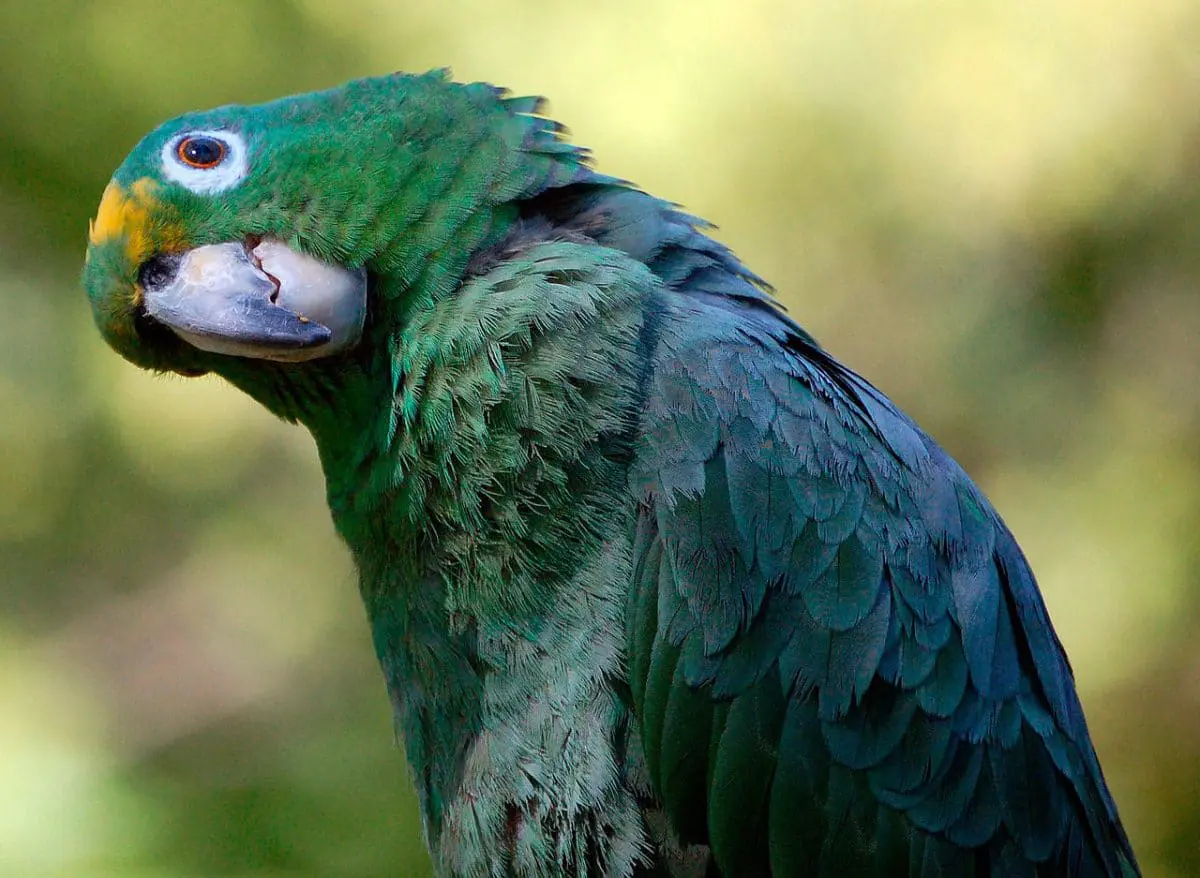
The Southern Mealy Parrot(Amazona farinosa) It is the fifth in size among the amazon parrots of the Americas, and is the Parrot largest in Mexico. The plumage its body is green with a slight yellow tone. Presents some yellow feathers on the crown, Although may not be very well defined.
Is characterized by its crown light blue color that continues to the side of the nape . Their wings are of round shape, and tail is short and square. The primary feathers and secondaries they have the blue-violet end, with a band red in them 4 – 5 Outer secondaries. The feathers of the tail they have a broad band of yellowish-green tip. The irises the eye is red with eye ring white, and the bill horn.
It has no sexual dimorphism and youth they are similar to adults, but with the irises dark brown .
Two more for South America subspecies have been proposed, Chapmani and Inornata but lack of character distinctive clear.
They inhabit in dense, humid tropical forests near clearings, Although also can inhabit in areas forested of the sheets.
You can see in altitudes of 290 to 1,200 m.
The Southern Mealy Parrot are birds very social, often seen flying in pairs or small flocks of up to 20 individuals. Also form groups more large, hundreds of birds, close to breeding season. Very enable, is the view often interacting with other species of parrots, such as macaws (ARA).
Is an of the species of parrot more noisy of the amazon, so they are easier to observe than other species.
Reproduction:
The mating It takes place once a year and usually starts in the spring. Once they mature sexually, the Southern Mealy Parrot they will choose a partner for life.
The breeding It normally varies between the months of November to March. The nesting has place in the cavity of a tree. The laying by year tends to be of three eggs. The eggs are hatch for approximately four weeks, after the hatching the males help females in the upbringing of young people, regurgitating food in the crop of the female. The offspring are ready to leave the nest after a period of about eight weeks..
Size of the area of distribution (reproduction / resident): 6.790.000 km2
Are in Mexico, Central America and South America, occupying a wide range from the South of Mexico to the North of Bolivia and South of Brazil. They are more common in Costa Rica and Panama, particularly in the costa Caribbean. Observed in the Middle Magdalena River Valley and to the East of them Andes on San Jacinto Mountain Range, Western base of the Perijá Mountain Range and the Department of Sucre, in Colombia.
Conservation:
State of conservation ⓘ
Near Threatened ⓘ(UICN)ⓘ
• Current category of the Red List of the UICN: Near-threatened.
• Population trend: Decreasing.
Not are currently identified as a species in crisis. Not comply with the criteria for a decrease of the population, that means a loss of thirty per cent of the population in ten years or three generations, as defined in the Red list of the UICN.
Are considered a least concern species. This, However, It does not suggest that the species is completely free from danger.
The important trade of trade in live birds of this species, and loss of habitat caused by deforestation have a significant impact on the decrease of the population of the Southern Mealy Parrot in certain areas.
The Southern Mealy Parrot in captivity:
Of special interest to the international trade in exotic birds; common in captivity. In some areas, they are also hunted for food, due to its relatively large size. With regard to its ability to speak, It seems that can be good talkative, but is true that there are birds that do not come to make it never.
– Avibase
– Parrots of the World – Forshaw Joseph M
– Parrots A Guide to the Parrots of the World – Tony Juniper & Mike Parr
– Birdlife
– Photos:
(1) – Mealy Amazon at Elmwood Park Zoo. Photograph shows upper body By Art G. from Willow Grove, PA, USA (African Parrot) [CC BY 2.0], via Wikimedia Commons
(2) – Mealy Parrot (Amazona farinosa), Tambopata Lodge, Peru By D. Gordon E. Robertson (Own work) [CC BY-SA 3.0 or GFDL], via Wikimedia Commons
(3) – Two Mealy Amazons at South Lakes Wild Animal Park, Broughton Road, Dalton in Furness, Cumbria, England By Glen Bowman (originally posted to Flickr as 18:02:2009 14:33:08) [CC BY 2.0], via Wikimedia Commons
(4) – A Mealy Amazon at Kobe Oji Zoo, Kobe, Japan By Jun Y (originally posted to Flickr as Poll Parrot) [CC BY-SA 2.0], via Wikimedia Commons
(5) – Mealy Parrot or Mealy Amazon (Amazona farinosa) of the blue crowned variety. Note the characteristic flour-like surface texture of the feathers on shoulder area By Eightball38 at English Wikipedia [Public domain], via Wikimedia Commons
22 cm.. in length and a weight ranging from 54 and 70 g..
The Red-crowned Parakeet(Pyrrhura roseifrons) has the head pinkish red. The neck and the area of ​​the upper chest They are dark with whitish scales. The bill is black. The tail and the central area of belly They are red. The tip of his tail It is dark red. The wings they are blue. Orbital ring dark gray bordered by a yellowish white. the legs are grey.
The immature It has reddish forehead and dark tones in the rest of the head. The pinkish red head in adults it is distinctive. Losl youth They may resemble subspecies Pyrrhura roseifrons peruviana or the Deville's Parakeet(Pyrrhura lucianii), but it lacks of the ear-coverts pale.
Sound of the Red-crowned Parakeet.
Description 4 subspecies
Pyrrhura roseifrons dilutissima
(Arndt, 2008) – Blue restricted to a narrow strip on the forecrown; yellowish beige in ear-coverts; upper region chest pale brown festooned with pale yellowish beige.
(Arndt, 2008) – It looks like the Pyrrhura roseifrons peruviana, but with blue, rather than red, on forecrown.
Pyrrhura roseifrons peruviana
(Hocking, Blake & Joseph, 2002) – 22 cm., length. Absent in his bright red plumage, It has more dark brown in crown and the area eyes, the crown with bluish.
Habitat:
They mostly live in small groups of a dozen members and remain in pairs during the breeding period. breeding. They lead a life Nomad, little little is known about the behavior of this species in the wild.
Reproduction:
build their nest in tree cavities. The laying is of 5 to 7 eggs incubated by both parents for 26 days (captive breeding data). The pups remain in the nest 2 months, becoming independent at the age of 3 months.
Food:
It feeds on fruits, seeds, leaves and flowers.
Distribution:
Size of its range (reproduction / residents): 1.000.000 km2
It is located in the west of the Amazonia, from the state amazon about the Juruá, in Brazil, and the lowlands of eastern Peru in the North of Bolivia. In Brazil, They spread south and west of habitat Deville's Parakeet(Pyrrhura lucianii)–
Distribution 4 subspecies
Pyrrhura roseifrons dilutissima
(Arndt, 2008) – Center of Peru around the rio Ene at the confluence with the rio Quipachiari, and around Hacienda Louisiana, on Cordillera Vilcabamba.
Pyrrhura roseifrons roseifrons
(Gray,GR, 1859) – Nominal. – Amazonia occidental, to the South of the amazon, from the North of Peru South to North of Bolivia(Peace) and in the West of Brazil(Western Amazon).
Pyrrhura roseifrons parvifrons
(Arndt, 2008) – Two disjoint regions in northern Peru; in the East of San Martin and adjacent areas, Center west Loreto, and along the amazon in the northeast of Loreto (only on the southern shore of amazon).
Pyrrhura roseifrons peruviana
(Hocking, Blake & Joseph, 2002) – Foothills of Andes in the southeast of Ecuador (Morona-Santiago) and North of Peru (Amazon and Loreto Western)
Conservation:
State of conservation ⓘ
Minor Concern ⓘ(UICN)ⓘ
• Current category of the Red List of the UICN: Least concern.
• Population trend: Decreasing.
• Population size : Unknown.
Justification of the Red List of the Category
This species has a very large range, and therefore does not approach the thresholds for vulnerable under the range size criterion (extent of occurrence <20.000 km2 combinan con un tamaño gama disminución o fluctuante, hábitat medida / calidad, o de la población tamaño y un pequeño número de localidades o fragmentación severa). A pesar de que la tendencia de la población parece estar disminuyendo, el descenso no se cree que es suficientemente rápido como para acercarse a los umbrales para Vulnerables según el criterio tendencia de la población (> 30% decrease of more than ten years or three generations). The population size It has not been quantified, but is not believed to be a reason to approach the thresholds for Vulnerable based on population size criteria (<10.000 individuos maduros con una disminución continua estima en> 10% in ten years or three generations, or a specific population structure). For these reasons, the species is evaluated as Least concern.
Justification of the population
Recent world population is unknown given taxonomic divisions.
Justification trend
This species is suspected that there may be lost 7,0-7,3% of habitat within its distribution over three generations (18 years) based on a model of deforestation of the Amazon(Soares-Filho et to the. 2006, Bird et to the. 2011). Given the susceptibility of this species to hunting and / or entrapment, it is suspected that its population can decrease <25% en tres generaciones.
"Red-crowned Parakeet" in captivity:
little presence in captivity and found only in some aviaries, where however they reproduce very well. After acclimation is a strong bird that can live outdoors. It is a bird suspicious although curious and playful nature, especially if they feel safe. Young birds in captivity quickly lose their fear and are very attached to their caregivers. It´s noisy, especially in the morning and sleeps in the nest. The female is very aggressive during the breeding period with other birds..
– Avibase
– Parrots of the World – Forshaw Joseph M
– Parrots A Guide to the Parrots of the World – Tony Juniper & Mike Parr
– Birdlife
– Photos:
(1) – Painted Parakeet (Pyrrhura picta) – the subspecies on this photo, roseifrons, is now often considered a separate species, the Rose-fronted Parakeet (Pyrrhura roseifrons) By http://www.birdphotos.com (http://www.birdphotos.com) [CC BY 3.0], via Wikimedia Commons
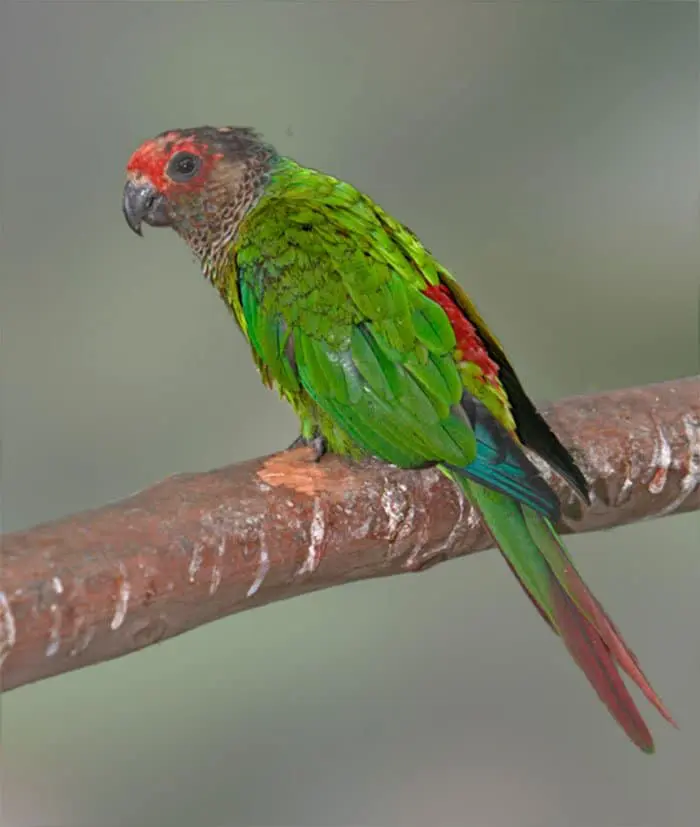
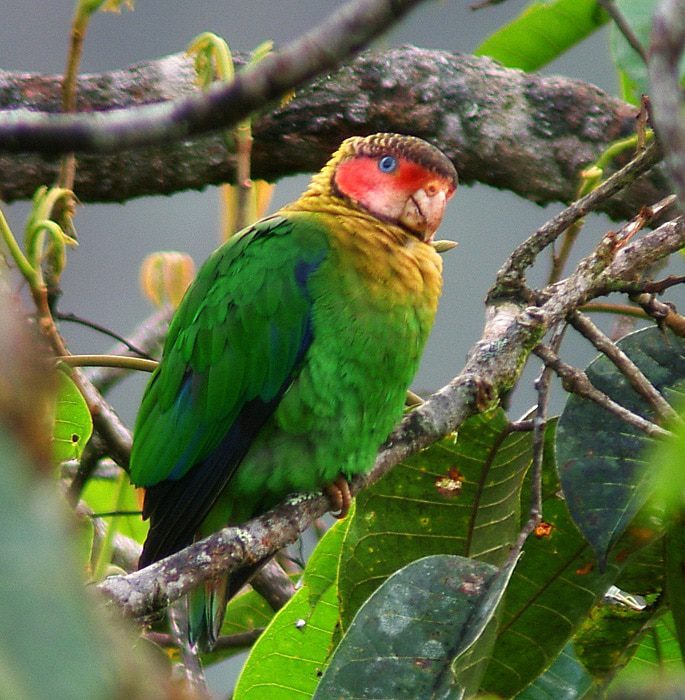
The Rose-faced Parrot(Pyrilia pulchra) be distinguished easily by your face and both sides of neck purple-red with black margin; crown and throat grayish coffee. General green olive in the back and beige in the belly. Wings with the part superior mixed with yellow or red orange and the rest green blue.
Stubby-looking and tail short. The immature they have only have a red line on the eye and the ear While their cheeks are coffee Green.
The Rose-faced Parrot is a parrot little known, which is commonly found between 1,200 and 2,100 m above sea level, Although has been observed at altitudes as low as 200 m. Inhabits humid and semi-deciduous forests of lowlands and temperate. According to the information available, is known that this Parrot is often feed is on the canopy of forests, Although visit disturbed areas and crops. Flying in pairs or groups of size variable up to of 25 or more.
Reproduction:
The data on reproduction are scarce. But, they have observed individuals with gonads developed between November and February in the Chocó, in Colombia and Ecuador.
Food:
Its diet It is little known, but some observations indicate that includes in its feeding fruits of Oenocarpus bataua (Arecaceae) and other fruits from species wild and plants cultivated as banana and corn.
Distribution:
Size of the area of distribution (reproduction / resident): 195.000 km2
Are you can observe in freedom from the West of Colombia to the West of Ecuador.
Conservation:
• Current category of the Red List of the UICN: Least concern.
• Population trend: Stable.
Justification of the population
The population size World has not been quantified, but this species is described as "uncommon and irregularly distributed" (Stotz et to the., 1996).
Justification of trend
It is suspected that the population is stable in absence of evidence of any decline or threatens substantial.
"Rose-faced Parrot" in captivity:
Not usually seen in aviculture. Extremely sensitive, has ever survived more than one couple of months in captivity.
Alternative names:
– Rose-faced Parrot, Beautiful Parrot, Rose faced Parrot (English).
– Caïque à joues roses (French).
– Rosenwangenpapagei, Rosenwangen-Papagei (German).
– Rose-faced Parrot (Portuguese).
– Cotorra Carirrosada, Lorito Carirrosado, Lorito de Cara Rosada (español).
 Minor Concern ⓘ
(UICN)ⓘ
Minor Concern ⓘ
(UICN)ⓘ


















_-blue_mutation2.jpg)

_at_nest_in_Narshapur%2C_AP_W_IMG_0737.jpg)
-_During_Foreplay_at_Hodal_I_Picture_0034.jpg)


_-pet_on_perch.jpg)
