โ–ท The world of Pets: Dogs, cats, birds, reptiles, amphibians

Great Dane
Alemania FCI 235 - Molossoid - Dogo

It is an expensive dog, that he eats in proportion to his size and that when he is young he needs some care

Content

Characteristics "Great Dane"

Coexistence is important that you have with your new friend. Before considering the acquisition of a dog of the breed "Great Dane" you know certain factors. Not all breeds of dogs are apt to live in an apartment, you must take into account his character, their need for exercise, their interaction with other pets, their care and if you have small children, their level of tolerance towards them.

Adaptation โ“˜

3,0 of 5 stars (based on 1 review)

friendly dog โ€‹โ€‹โ“˜

3,0 of 5 stars (based on 1 review)

hair loss โ“˜

3,0 of 5 stars (based on 1 review)

Affection level โ“˜

3,0 of 5 stars (based on 1 review)

Need for exercise โ“˜

2,0 of 5 stars (based on 1 review)

Social need โ“˜

4,0 of 5 stars (based on 1 review)

Home โ“˜

5,0 of 5 stars (based on 1 review)

Toilet โ“˜

1,0 of 5 stars (based on 1 review)

Friendly with strangers โ“˜

3,0 of 5 stars (based on 1 review)

barking โ“˜

2,0 of 5 stars (based on 1 review)

Health โ“˜

4,0 of 5 stars (based on 1 review)

Territorial โ“˜

5,0 of 5 stars (based on 1 review)

Cat friendly โ“˜

3,0 of 5 stars (based on 1 review)

Intelligence โ“˜

3,0 of 5 stars (based on 1 review)

Versatility โ“˜

3,0 of 5 stars (based on 1 review)

Child friendly โ“˜

3,0 of 5 stars (based on 1 review)

Surveillance โ“˜

2,0 of 5 stars (based on 1 review)

joy โ“˜

5,0 of 5 stars (based on 1 review)

History

The Great Dane is the oldest breed in modern dog breeding in Germany. Since then it is considered by many as the Apollo among dogs – after the greek deity. And in fact, the Great Dane it is a dog with a special charm and a unique and impressive charisma and elegance. The origin of this breed is only partially found in Germany. Already in the 16th century the Great Danes are said to have originated in England, as described in historical sources "crossing the mastiff with the Irish greyhounds". The name ยซDoggeยป, the old english word for dog, from which the current ยซDogยป, also speaks of a British line of descent. But, this type of dog was already bred in ancient times and was depicted on stone tablets.

Also on the European continent, old bull teethers regularly mated with greyhounds and hunting dogs, since these results of the crosses were perfectly adapted to the great hunts of the boar nobility, bears and wolves. Little by little, a breed of its own with molossi developed., Greyhound and some hunting dog blood. In 1867 the viennese cynologist Leopold Fitzinger distinguished three variants of Great Dane: the common mastiff, english and danish. Even today the great danes They are called "Great Daneยป in some languages. Modern analyzes by geneticists confirm the views of ancient cynologists about ancestors, and even assign them to greyhounds instead of molossians.

In 1888 the Club of the Great Dane In Berlin. It is the first and oldest pedigree dog breeding club in Germany.. The Great Dane modern should now become a representative companion and protector. It also, should be even more elegant. So the standard was adapted to these ideas. It was possible to achieve an extremely elegant and harmonious mix of these very different origins.. The Great Dane combines the elegance and speed of hounds with the power and carefreeness of the molossians.

Physical characteristics

The Great Dane it is an extremely large and powerful dog but at the same time very elegant and sensitive. A male dog reaches a height at the cross of 80 cm., often even more. Bitches are slightly smaller. The Great Dane has a unique charisma. The animal painter and dog connoisseur Richard Strebel already betrayed 1914 to the breeders of the Great Dane, the: ยซ… they have created a dog that can be considered without exaggeration as the most successful in size, proportion, strength and elegant movement never created in dogs." Unfortunately, this respect is not always shown in breeding Great Dane. Regardless of your health, are used for extreme breeding, the so-called gigantism, as well as for games with defective genes for rare coat colors; genes that can also cause serious illness.

While around 1900 the height at the withers for males was 76 – 80 cm., The FCI standard valid today says โ€œat least 80 cmยป without any clear upper limit. This allows the Great Dane reach the dubious honor of the world's largest dog. According to the Guinness Book of Records, this was the male Great Dane ยซGibsonยป con 108 height cm. That was in August 2004. Gibson still reached an age of almost 7 years, but the last years only in 3 legs. His record was expanded more and more.

ยซZeusยป the Michigan/EE.UU. reached a height of 112 cm and died with just 5 years, supposedly already in old age – Dubious records at the expense of dog welfare. The Great Dane it's impressive enough even without those dubious extremes. Its sovereign and elegant appearance is also highlighted by its silky coat. It is a very short coat, which is close to the muscular body with a slight shine. Colors are yellow or black, blue, tabby or stained.

  • Fur: Satin.
  • Color:
  • – Tawny: yellow golden colour with black mask. The eyebrows and edges of the eyes must be black, While the ears and the tail may be clearer.
    – Striped: Fawn and black in a striped pattern.
    – Blue: Dark steel grey, allowing white markings on chest and legs.
    – Negro: Jet Black pure, allowing white markings on chest and legs.
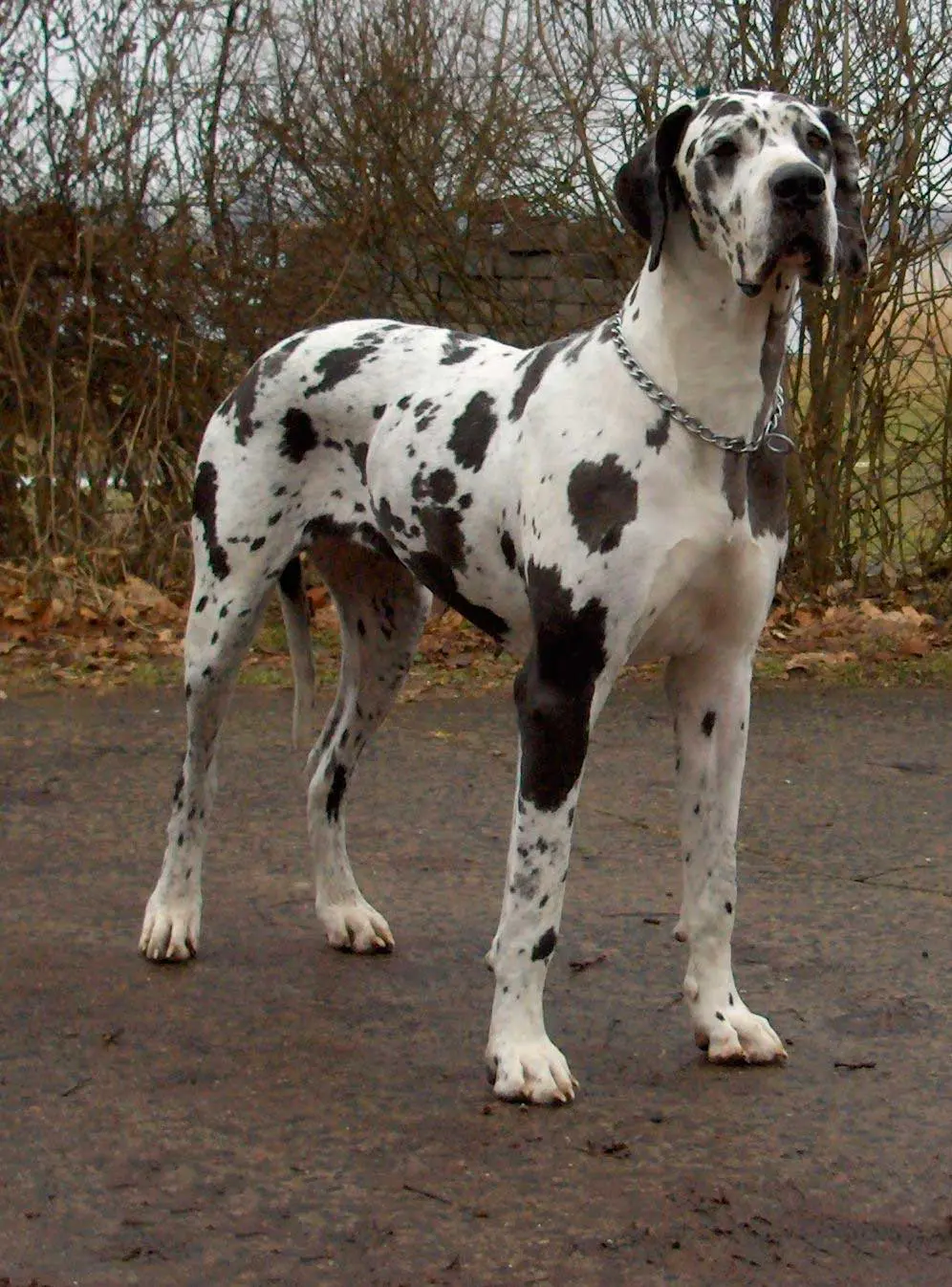
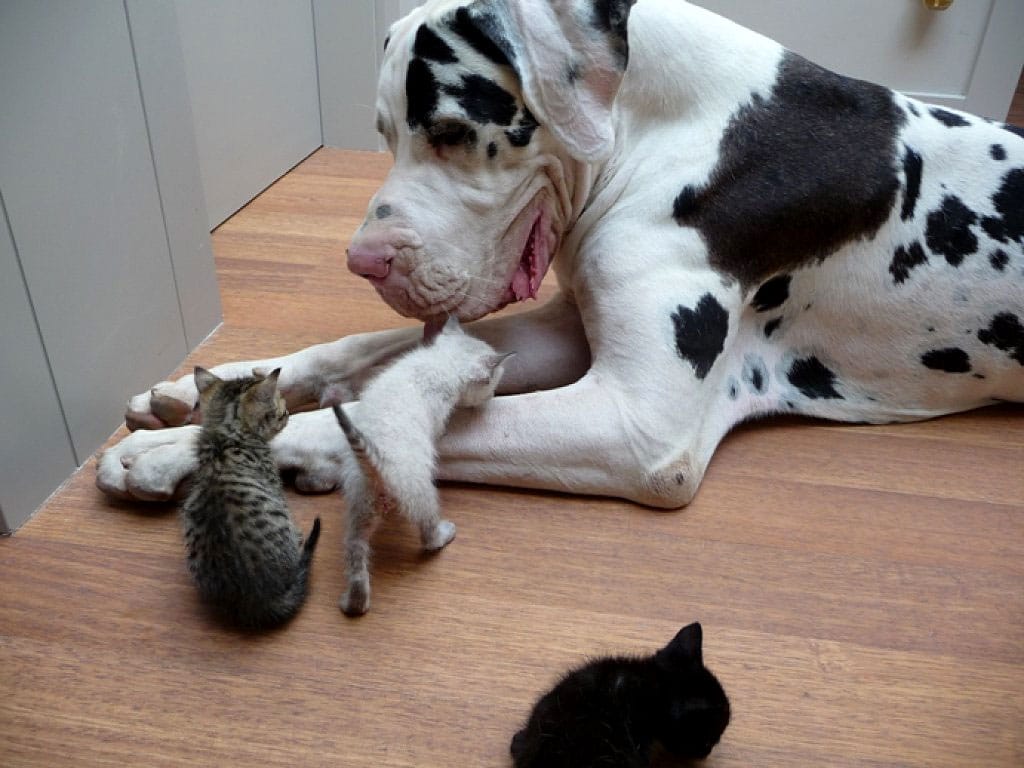
    – Harlequin: White with black patches. The Great Dane is the only breed to display this color pattern on its coat..

  • Size: the minimum height for males is 80 cm and for the females of 72 cm.

Character

The Great Dane is often described as a gentle giant, but it is naturally protective when the situation requires it. He is loving and loves people, and those qualities should never be perverted by encouraging aggressive behavior.

In terms of character and size the Great Dane a dog is not for beginners. Belongs exclusively to the hands of experienced dog owners, who can and want to be fully involved with the animal. So there is no more inspiring companion than this dog. El Canciller del Reich Otto von Bismarck, who was accompanied by great Danes all his life, he openly admired the intelligence and abilities of his great danes and is said to have said: ยซI have great respect for my dog's knowledge of human nature – "He is faster and more complete than me."

Great Danes love children, but they must learn to be nice to them. And a blow from that wagging tail will knock a little boy down, so it's important to monitor their interactions. These large dogs can also learn to get along with other pets., especially when raised with them.

A fenced yard is necessary to prevent the Great Dane go for a walk alone. Not usually a jumper, so a six foot fence should be enough to keep it contained. Note that while adult Great Danes are quite calm, puppies are very active and enjoy digging in gardens..

You might think that the Great Dane it is more suitable for outdoor life due to its huge size, but it's just the opposite. Should be an indoor dog that is part of the family. When that's the case, the Great Dane is loving, learns well and is easily trained. Left to his own fate, the amount of destruction it can do to your home and garden is beyond imagination.

any dog, no matter how pleasant it, detestable levels can develop barking, excavation, counter-browsing and other undesirable behaviors if you are bored, untrained or unsupervised. And any dog รขโ‚ฌโ€นรขโ‚ฌโ€นcan be a test that live during adolescence. In the case of the Great Dane, The "adolescence" years can begin at six months and continue until the dog is about two years old.

Start training your puppy the day you bring him home. Even at eight weeks old, He is able to absorb everything you can teach you. Don't wait until you are six months old to start training or you will have to deal with a stubborn dog. If possible, Take it to a trainer when you have between 10 and 12 weeks, and socializes, socialice, socialice. But, Note that many kinds of training puppies require certain vaccinations (such as kennel cough) stay up to date, and many veterinarians recommend limited exposure to other dogs and public places until puppy vaccinations (including rabies, distemper and parvovirus) They are completed. Instead of formal training, You can start training your puppy to socialize at home and among family and friends until immunizations are completed in the puppy.

Talk to the breeder, Describe exactly what you want in a dog and ask for help choosing a puppy. Breeders see puppies daily and can make incredibly accurate recommendations once they know something about their lifestyle and personality.

The Great Dane perfect doesn't come fully formed out of the puppy box. It is a product of his background and upbringing. Look for one whose parents have good personalities and who have been well socialized since the puppy's young age.

Great Dane fitness

The maintenance of Great Dane it is very complex and expensive. Food in the required quality and quantity, possible veterinary and drug costs, direct and indirect transportation costs and more require a financially wealthy owner. Yes a Great Dane wants to sit on the couch, you need all the two-seater, at least. Furniture made of solid faux leather has proven its worth here. The Great Dane should not be kept in a small apartment, Better is a house with a garden. The ideal would be to live in a rural area. Hectic urban centers are not the place where these big dogs feel comfortable. Also dog and owner are often met with rejection and even open hostility here. This must be considered.
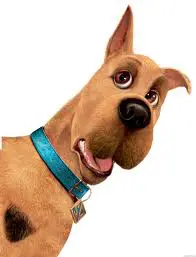
Scooby Doo

Fiction has made it one of the best-known dogs to the general public.. Scooby Doo character is a Great Dane.

The Great Dane it is a big dog that wants to have a lot of movement. But, he is hardly ever seen on the street, although with 1.200 puppies a year ranks ninth on the VDH bestseller hit list (German Canine Federation), even before dog breeds like the Bernese Mountain Dog or the Chihuahua, they are seen much more often on the streets. Often these giants are only locked up once they are past their puppy age and - poorly socialized and educated.- can no longer be managed by the owner who is not familiar with dogs. The Great Dane not a kennel dog. He is basically a family dog รขโ‚ฌโ€นรขโ‚ฌโ€นand wants and needs the loving connection with his human family. Is smart and responsive. One should not think about what to do if this big dog, at times of 90 kg, is sick and has to be loaded. So, buying a Great Dane must be carefully considered.

Great Dane Education

The Great Dane a dog is not for beginners. Its strength and potential danger require expert and loving socialization, education and guidance already in the puppies. It is sensitive and intelligent and does not forgive any mistakes of the owner so quickly. She likes to be guided and educated, but not by any means of coercion. Many normal dog training aids do not work with the Great Dane, simply because it is too strong. In case of doubt, even the strongest man will not wear the leash. Due to overexploitation and unilaterally oriented breeding selection towards outward appearances, today there are, although extremely rare, specimens with idiopathic aggressiveness, which then represent practically insoluble problems for an education.

Great Dane Health

Great Danes also suffer from a high incidence of cardiomyopathy, a disease of the heart muscle that causes the heart to enlarge. This is very common in many giant dogs, and when it occurs late in life, can often be controlled with medication. Have your dog's heart checked at least once a year, and that any unusual murmurs or symptoms be investigated by a board-certified veterinary cardiologist. This condition can also be genetic., but currently available tests can only rule out the dog at the moment; a dog could shed one day and develop heart disease the next.

Great Danes can also suffer from hip dysplasia, a crippling malformation of the hip socket that may require expensive surgery to repair and can result in painful arthritis later in life. Another genetic problem with an imperfect screening test, The best prevention for hip dysplasia at this time is to buy only a puppy whose parents have been tested with normal hips and who have very few close relatives with the disease.. Keep your dog slim, especially when young, can also help.

Another painful bone disease is hypertrophic osteodystrophy., that occurs during the puppy's rapid growth phase. Ask Your Vet About Large Breed Puppy Foods. These diets are formulated to help puppies grow slowly., which can help prevent developmental orthopedic problems.

Cancer is another major cause of death in the Great Dane, especially bone cancer. They are also prone to other skeletal problems, visual and neurological, both older and younger.
Not all of these conditions are detectable on a growing puppy, and it is impossible to predict if an animal will be free of these diseases, so you need to find a reputable breeder who is committed to raising the healthiest animals possible. Must be able to produce independent certification that the dog's parents (and grandparents, etc.) have been examined for common defects and considered healthy for breeding. That's where health records come in..

Careful breeders screen their breeding dogs for genetic diseases and breed only the healthiest, best-looking specimens., but sometimes mother nature has other ideas and a puppy develops one of these diseases despite good husbandry practices. Advances in veterinary medicine mean that in most cases dogs can still live a good life. If you are going to have a puppy, ask the breeder about the ages of the dogs in their lines and what they died of.

Remember that after you have welcomed a new puppy into your home, has the power to protect you from one of the most common health problems: the obesity. Keep a Great Dane with a proper weight is one of the easiest ways to prolong your life. Make the most of your preventive skills to help ensure a healthier dog for life.

Great Dane care

The Great Dane has a short coat, thick and smooth. Falls moderately, in other words, more than you might think, but it requires little cleaning. Brush into Danish weekly with a rubber glove or soft bristle brush to keep hair and skin healthy. In spring and autumn, will have a heavy shed, known as "blowing" the coat and will need to be brushed more frequently during that time to get rid of all the loose hair.

Bathe Danish as you like or only when it gets dirty. With the gentle dog shampoos available now, you can bathe a dane weekly if you want without damaging his coat.

The rest is basic care. Cut your toenails every few weeks. Long nails can catch on things and tear off. That is so painful, and bleed much. Brush your teeth frequently for good dental health. To prevent ear infections, keep ears dry and clean, using a cleaning solution recommended by your vet.

Nutrition / Food

The Great Dane consume large amounts of food. At the same time, this food must be of a very high quality and must be selectively composed during the growth phase, which lasts up to two years. When it comes to eating, sometimes it is very rustic. Certainly not all, but some Great Danes don't have the best "table manners". So it may occasionally happen that the dog, as well as the feeding place should be cleaned after eating. How to minimize the risk of stomach torsion in this predisposed breed through proper feeding management is very important.

Life expectancy

Life expectancy Great Dane has increased slightly from the extremely low level of 2004 with 6 years and 6 months to 7 years, according to British Kennel Club statistics. As a general rule: the bigger and more unusual the coat color, less will be the life expectancy. Already at the age of 8 years a Great Dane he's officially considered an old man nowadays. Without gigantism and healthy breeding it could have a life expectancy of 10 to 12 years.

Buy a Great Dane

Only puppies from parents with a maximum height of 80 cm to the cross and have the colors yellow, striped, black, spotted. It also, Care must be taken to avoid inbreeding to get a puppy Great Dane healthy. One should know how old the ancestors of the puppies were. Those interested in dogs can find a Great Dane in one of the emergency initiatives for dogs and offer them a loving home. Maintaining Great Danes is very expensive. Acquisition costs can be negligible compared.

Images "Great Dane"
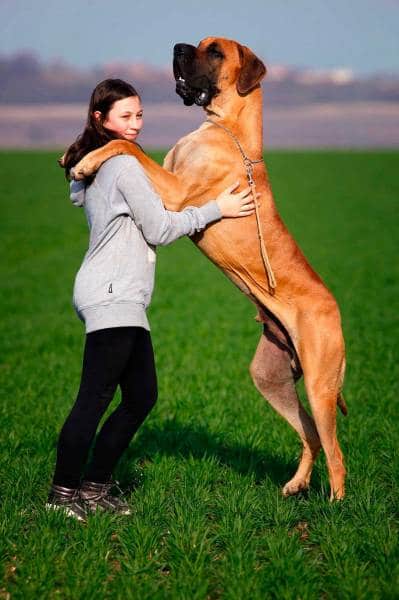
Photos:

1 – Little Great Dane of 5 months, color negro by Eacampbell14 / CC BY-SA
2 – 07 VICKY TRES MESES by https://flic.kr/ps/H4SaY
3 – Great Dane by https://www.pxfuel.com/es/free-photo-oqedh
4 – Great Dane by https://www.publicdomainpictures.net/es/view-image.php?image=34101&picture=great-dane-dog
5 – Great Dane Dog Close-up portrait of a Harlequin Great Dane dog by public domain
6 – Large size dog standing on woman wearing gray pullover hoodie on green open field at daytime by https://www.wallpaperflare.com/large-size-dog-standing-on-woman-wearing-gray-pullover-hoodie-on-green-open-field-at-daytime-wallpaper-zqizp

Videos "Great Dane"
Type and recognitions:

  • FCI CLASSIFICATION:
  • Group :
  • Section : . .

Federations:

  • FCI – Pinscher and Schnauzer-Molossoid type dogs – Swiss Mountain Dogs and Cattledogs. Section 2.1 Molossoid, mastiff type. โ“˜
  • AKC – Working dogs โ“˜
  • CKCโ“˜
  • โ€‹KC – Working dogs โ“˜
  • NZKC – Non-Sporting โ“˜
  • UKC – Watchdog โ“˜

FCI breed standard "Great Dane"

Origin:
Denmark, France, Germany

Date of publication of the valid original standard:
08/10/2012

Use:

Guard and protection dog, service dog


General appearance:

The Great Dane brings together in its aristocratic general appearance a strong body structure combined with pride., strength and elegance. The substance together with its nobility and harmony in its appearance with the layout of its well-proportioned lines, an especially expressive head give the observer the image of a noble statue. It is neither too elegant nor gross. The difference between the sexes is clearly defined. It is the Apollo among the dog breeds.


PROPIMPORTANT ORTIONSIts structure is almost square, especially in males. Females may have a slightly longer body.


Behavior / temperament:

Friendly, love or and devoted to his master. In front of strangers it can be somewhat reserved. A companion dog is required, family, self-confident, not scary, easy to handle and educate with a high stimulation threshold, without being aggressive.

Head:

In harmony with its general appearance, elongated, close, significant but not wedge-shaped. Expressive, finely chiseled (especially in the area under the eyes). The distance from the tip of the nose to the stop and from the stop to the slightly marked occiput should be as much as possible. The top line of the muzzle and skull should definitely be parallel. Viewed from the front, the head should have a narrow appearance and the nose should be as wide as possible..

Cranial region:
  • Craging: Superciliary arches well developed but not protruding.
  • Ston: Clearly defined.

facial region:

  • Trufa: Well developed, wider than round (nostrils wide open). Must be black except for Great Dane spotted black and white. In these, a black truffle is desired and a truffle with black or flesh-colored spots is tolerated.. In blue dogs the truffle is the color of anthracite (diluted black).
  • Horcico: Deep and possibly rectangular. Not pointed or with too little or protruding edges. Well marked lip commissure. Dark pigmented bumps. Black and white spotted Great Dane should tolerate not fully pigmented or flesh-colored gills. The nasal bridge should never be concave, convex or descending forward.
  • Jaws/Teeth: Wide and well developed jaws. Scissor bite, strong, healthy and complete. (42 teeth according to dental formula). Lack of P1 of the lower jaw is tolerated. All deviations from a complete scissor bite are absolutely unwanted.
  • Cheeks: Cheek muscles only slightly marked and in no way protruding.
  • Ojors: Medium in size with a lively expression, Smart and friendly. Where possible dark, almond shaped with well attached eyelids. Their placement not too far apart nor should they be eyes of an elongated shape. Clear eyes are undesirable, stabbing and amber yellow eyes. Slightly clearer eyes are allowed in the Blue Great Dane. Black and white spotted Great Dane should tolerate light eyes or eyes of undefined color.
  • Obars: By nature pendants, high insertion, medium size with its front edge resting on the cheeks. They should not have an insert too high or too low or separated or flat on the sides.

Neck:

Long, dry, muscular. It should not be short or thick. Well developed insert, tapering slightly towards the head and its upper line arched. Postage raised, somewhat slanting forward but not forming a deer neck. Too much loose or double chin is unwanted.

Body:

  • Cruz: It is the highest point of a robust body. It is formed by the scapulae that go beyond the spinal process.
  • Dorrso: Short and firm, in an almost straight line with an imperceptible drop backwards. In no case ascending towards the posterior or too long.
  • Itmor: Slightly arched, width, good muscular.
  • Glikeness: Wide, with strong muscles, slightly falling from the sacrum to the insertion of the tail with which it merges impercepti- blebly. The rump should never fall abruptly or be completely flat..
  • Pecho: Reaches up to elbow joint. Well arched ribs extending backwards. Chest of good width and depth with a well developed chest without the sternum being too marked. Ribs should not be flat or barrel-shaped.
  • Lรญnlower ea and abdomen: Belly retracted well towards the back, forming a moderate curved line with the lower portion of the thorax. It is not desired in females to keep a loose belly after pregnancy..

Tail:

Reaches up to the tibial-tarsal joint, should not be too long not too short. High and wide insert, it should not be too high or too low nor too thick. Tunes evenly towards the end. At rest it hangs down forming a natural curve. When excited or during movement a slight saber bearing but not in the form of a hook or ring and not considerably above the line of the back or to the sides. A brush-shaped glue is not desired.

Tips

PREVIOUS MEMBERS: Well angled with strong bones and musculature.

  • Hormbros: Strong musculature. Long and inclined scapula forming an angle of 100ยบ to 110ยบ with the arm.
  • Brazo: Strong and muscular, glued to the body, should be a little longer than the scapula.
  • Elbows: Without deviations, neither in nor out.
  • Antarm: Strong, muscular. Seen from the front or from the side completely straight with vertical stop.
  • Carpo: Strong, firm, very little difference from the structure of the forearm.
  • Metacarpus: Seen from the front, strong and straight. Profile, shows very slight forward lean.
  • Pinis previous: Round, well arched with fingers well together (Jack's foot). Short nails, strong, as dark as possible.

LATER MEMBERS: The entire skeleton is covered by strong muscles that make the rump, hips and thighs have a wide and round appearance. The hind limbs are well angulated and strong, seen from behind are parallel to the forelimbs.

  • Thighs: Long, wide and very muscular.
  • Rodinllas: Strong, positioned almost vertically below the hip joint.
  • PinErna: long, approximately the same length as the thighs. With developed musculature.
  • Atibio-tarsal articulation (Hock): Strong, stable, without deviations, neither outward nor inward.Metatarsus: Short, strong, almost perpendicular to the floor.
  • Pinis later: Round, well arched with fingers well together (Jack's foot). Short nails, strong, as dark as possible.

Movement:

Harmonious, agile, covering a lot of ground, slightly elastic. The limbs observed both in front and behind must move in parallel. Without taking short steps, no ambition step.

Mantle

PIEL: Footprint, well pigmented in dogs with solid colors. In the black and white spotted Great Dane the distribution of pigmentation corresponds mostly to the spots.

Plink: Very short, thick, smooth, flattened and shiny looking. It should never be rough, matte or double layer.

Colorr: The Great Dane is bred in three independent varieties: leonado and tabby, splashed and black, blue.

  • Leonado: Pale golden leonado to intense golden leonado. A black mask is never desirable., bluish fawn or a sooty fawn color. No white marks.
  • Ayougrado: Basic color pale gold fawn to deep gold fawn with regular, clearly drawn black stripes running in the direction of the ribs. A black mask is desirable. Never with discolored stripes. No white marks.
  • Arlequin(Whites with black splattered spots): Pure white base color, if possible, without any mottling, with jet black spots well distributed over the entire body, irregular in shape and with the appearance of being broken.. No gray areas are desired on the stains, blue or brownish as well as a gray-blue splash. The so-called โ€œGrautigerโ€ (have a mainly gray base color on black spots) occur, they are not wanted but they are not disqualified.
  • Negros: Azabach Black White markings on chest and feet are allowed. This includes the โ€œManteltigerโ€ in which black covers the body in the form of a mantle and the snout., neck, chest, belly, Extremities and the tip of the tail can be white as well as Great Danes with a white base color and large black plates. (Record dogs). It is a defect a leonado color, brown or blue black.
  • Awithul: Dark steel blue color, indulging in white markings on chest and feet Never tawny or blackish blue.


Size and weight:

Alturto the cross:

  • Males: at least 80 cm not exceeding 90 cm.
  • females: at least 72 cm not exceeding 84 cm.


Fouls:

Any deviation from the aforementioned criteria is considered as a fault and the severity of this is considered to the degree of the deviation to the standard and its consequences on the health and well-being of the dog..

  • Cthey are not coming: Insufficient stop
  • Horcico: Rolled lips (lower lips squeezed between the incisors of the upper and lower jaw).
  • Jaws / Teeth: Irregular positioning of the incisors individually as long as the correct bite is maintained, teeth too small partial clamp bite.
  • Ojors: Protruding or placed too deep
  • Hormbros: Loose or overloaded with right shoulder blades
  • Elbows: loose
  • Antarm: Curved, protruding knuckles on the carpal joint
  • Carpo: Outstanding Significantly compromised or inclined.
  • Formertlater remities: angulation very open or very closed In the static cow hock, hocks together or crowded.
  • PinIt: Plans, open, Long Dewclaws.

FALTAS GRAVES:

  • Temperament: Diffidence, shy or nervous.
  • Cthey are not coming: Amanzanada, too marked cheek muscles
  • Ojors: Loose eyelids, conjunctiva too reddened
  • Dorrso: back sunken or soggy.
  • Glikeness: too inclined
  • Colto: inclined, thickened at the tip or tail amputated
  • Movement: Pasuqueo permanent

FALTAS DISQUALIFYING:

  • Aggressiveness or extreme shyness.
  • Any dog โ€‹โ€‹showing clear signs of physical or behavioral abnormalities must be disqualified..
  • Temperament: Teether for fear, easily provoked
  • Trufa: liver colored truffle, party nose
  • Ectropiรณn, entropion or macroblefarian Different color in solid color. Watery blue eyes.
  • Jaws / Teeth: Prognathic bite, enognathic the crossed mouth, bite clamp, absence of teeth except two P1 in the lower jaw.
  • Colto: Broken tail.
  • Colorr
    • Gran Danish Leonado and tabby: silver blue or isabella color, white star on the forehead, white collar around the neck, white feet or sockets and white tail tip.
    • Black and White Spotted Great Dane: white without any black spots (albinos) as well as deaf Danes, the so-called Porzellantiger (these mainly show blue spots, leonadas or atigradas). 
    • Gblue danish ran: white star on the forehead, white collar around the neck, white โ€œdumpsโ€ or white tip of the tail.

Tby hand: Below minimum height.


N.B.:
  • Males should have two normal-appearing testicles fully descended into the scrotum..
  • Only functionally and clinically healthy dogs, with the typical conformation of the breed, should be used for parenting.

TRANSLATION: Mrs. Brรญgida Nestler.

Technical supervision: SR. Miguel Angel Martinez.

Source: F.C.I - International Cynological Federation

Alternative names:

1. Deutsche Dogge, German Mastiff, Boarhound, Apollo of Dogs, Gentle Giant (English).
2. Grand Danois (French).
3. Ulmer Dogge, Englische Dogge, Dรคnische Dogge, Hatzrรผde, Saupacker, GroรŸe Dogge (German).
4. Grande dinamarquรชs, Alano tedesco (Portuguese).
5. Dogo alemรกn, Alano alemรกn (espaรฑol).

โ–ท The world of Pets: Dogs, cats, birds, reptiles, amphibians

Greater Swiss Mountain Dog
Suiza FCI 58 - Swiss Cattle Dogs

Gran Boyero Suizo

Despite its impressive size and weight, The Greater Swiss Mountain Dog is strong and agile.

Content

History

The Greater Swiss Mountain Dog is an old Swiss farm dog. It is the largest of the family of mountain dogs. These served in the mountains and valleys of the Swiss Alps as a complete tool for farmers. They watched the house and the farm. If a herd of cows had to be moved from one meadow to another, they made sure everyone stayed on the road and no cow was left behind.

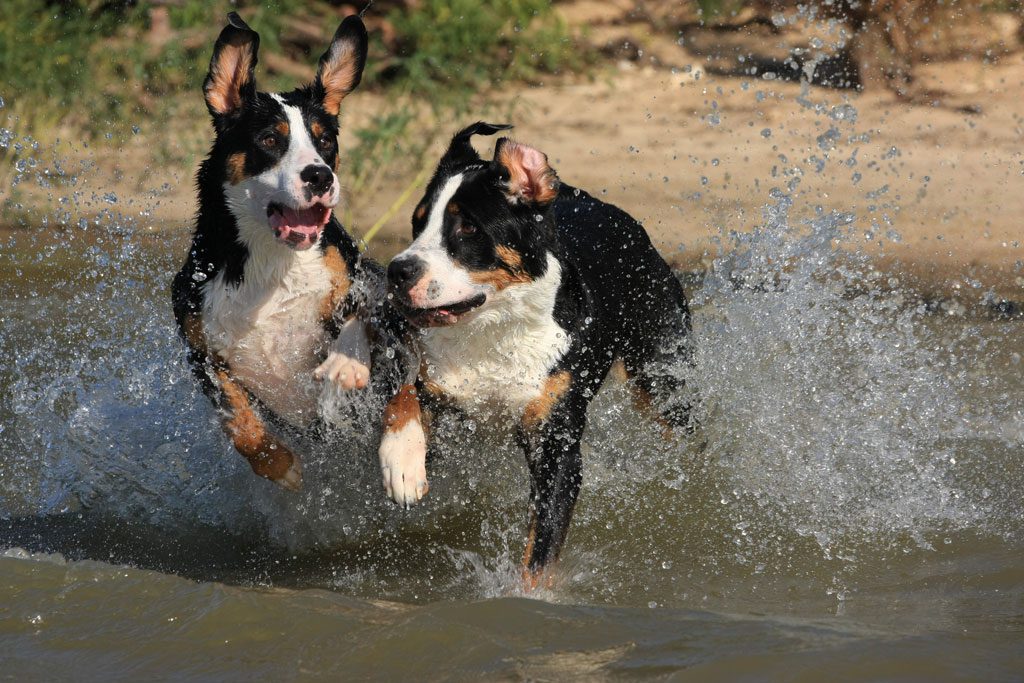
The great mountain dogs, from which the current one emerged Greater Swiss Mountain Dog, harnessed in front of larger wagons and served as all-terrain and mountain tractors, more or less like the old one Unimog. It was not unusual for them to be harnessed in pairs in front of a cart full of valuable cheese, so they could independently find their way from the alpine pasture to the village, to the merchant and back. Mountain Dogs and Swiss Cattle Dogs used to be a single family of dogs. What they have in common is a strong bond with family and their farm., a confident self-awareness, a widely lost hunting instinct, a high degree of vigilance, a loving attitude towards his own people and a reserved attitude towards strangers.

A few ago 100 years, mountain dogs were divided into four breeds: Entlebucher, Appenzeller, Berne, Greater Swiss Mountain Dog – in order of size. This and the artificial fixation in a tricolorism conceived by the breed have not been good for the health of these great dogs.. So the statistics of the British Kennel Club 2014 document a life expectancy of only 8 years for Mountain Dogs and Bovine Dogs. Healthy servants could easily live 4 more years. More about this in the portrait of the respective mountain and cattle dogs.

The Greater Swiss Mountain Dog became a valuable companion dog, but still has the skills of a working dog. In 1912 The "Club of Great Swiss Mountain and Cattle Dogs" was founded in Switzerland.

Physical characteristics

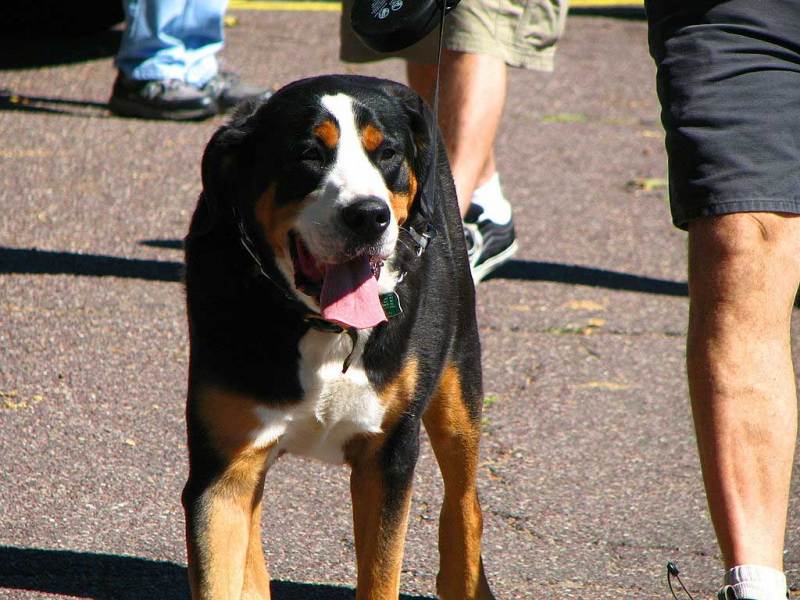
The Greater Swiss Mountain Dog is a big dog, robust, strong-boned and well-muscled. Radiates sovereign calm and self-confident composure, and that's how it is. The difference between the sexes should be quite large.
The males must have a height at the withers of 65 to 72 centimeters, the females of 60 to 68. The weight is between 35 and 50 kg.

The standard establishes numerous regulations on the details of coloring, texture and pattern of its coat. I should have brush hair and be tricolor. We see detailed regulations, where white marks are allowed and where they are not. In the interest of dogs, do not take these external characteristics so seriously, that are only devised by your breeder. Turning those details into breeding selection criteria is not in the interest of the welfare of the offspring. Greater Swiss Mountain Dog, they only have an extremely small gene pool anyway. What matters is the character and physical condition of the dogs. this last, Unfortunately, not too rare a problem. The Greater Swiss Mountain Dog it has better qualities than the color of its coat.

Character and skills

The Greater Swiss Mountain Dog feel more comfortable in the field. He wants to be moved and you can experience wonderful stress-free walks in nature with him. As it has little hunting instinct and usually has a good ear, you can enjoy relaxed and stress-free hours outdoors with it, even without a strap. But, It is not a companion dog for athletes..

One Greater Swiss Mountain Dog not suitable for life in the middle of the big city. You don't need a house with a big garden, what would be ideal. He likes to have a land or a yard where he can take care of things. Otherwise, does not have any special requirement regarding its maintenance. Most important is their close integration into the human family. For a permanent or even partial stay in a kennel these dogs are completely unsuitable.

Educating the Greater Swiss Mountain Dog

One Greater Swiss Mountain Dog can be trained very well. He likes to learn. It is strongly oriented towards its people, what you can use well. The Great swiss you can read the mood and wishes of your people on their faces. This in turn means that one must approach one's education with feeling and of course with consequence.. He has a pronounced sense of justice and, the other way, expect an equally fair deal. One must not only accept their occasional stubbornness, but you must like it. They challenge an intimate and mutually respectful relationship between dog and owner. The reward is a happy coexistence for both parties.

Care and health of the Greater Swiss Mountain Dog

The Greater Swiss Mountain Dog it is very easy to care for, just brush it occasionally.

Like many large dog breeds, tends to have hip problems (HD) or elbows (ED). La endogamia, unfortunately partly strong, has a negative effect on physical fitness and life expectancy.

Nutrition / Food

The Greater Swiss Mountain Dog has no special demands on their diet. Like many dogs of his size, tends to churn your stomach. Therefore you should not eat too fast and let it rest after eating.. Veterinarians often recommend an elevated feeding bowl, that can be purchased in specialized stores. During the breeding season, special attention must be paid to an adapted nutrition.

The life expectancy of the Greater Swiss Mountain Dog

One Greater Swiss Mountain Dog is relatively strongly affected by inbreeding and breeding selection that is one-sidedly oriented toward outward appearances, such as fur color details. So, their life expectancy has decreased in part enormously. It's between eight and -healthily- twelve years.

Buy a Greater Swiss Mountain Dog

When buying a puppy you must be careful that no ancestor appears twice in the pedigree. (endogamia). Otherwise, you should look for a breeder affiliated with the Swiss Mountain and Cattle Dog Club. You can also find the dog of your dreams at the animal shelter or in an emergency initiative.

Characteristics "Greater Swiss Mountain Dog"

Coexistence is important that you have with your new friend. Before considering the acquisition of a dog of the breed "Greater Swiss Mountain Dog" you know certain factors. Not all breeds of dogs are apt to live in an apartment, you must take into account his character, their need for exercise, their interaction with other pets, their care and if you have small children, their level of tolerance towards them.

Adaptation โ“˜

3,0 of 5 stars (based on 1 review)

friendly dog โ€‹โ€‹โ“˜

4,0 of 5 stars (based on 1 review)

hair loss โ“˜

3,0 of 5 stars (based on 1 review)

Affection level โ“˜

4,0 of 5 stars (based on 1 review)

Need for exercise โ“˜

3,0 of 5 stars (based on 1 review)

Social need โ“˜

4,0 of 5 stars (based on 1 review)

Home โ“˜

2,0 of 5 stars (based on 1 review)

Toilet โ“˜

1,0 of 5 stars (based on 1 review)

Friendly with strangers โ“˜

3,0 of 5 stars (based on 1 review)

barking โ“˜

4,0 of 5 stars (based on 1 review)

Health โ“˜

3,0 of 5 stars (based on 1 review)

Territorial โ“˜

5,0 of 5 stars (based on 1 review)

Cat friendly โ“˜

3,0 of 5 stars (based on 1 review)

Intelligence โ“˜

4,0 of 5 stars (based on 1 review)

Versatility โ“˜

4,0 of 5 stars (based on 1 review)

Child friendly โ“˜

4,0 of 5 stars (based on 1 review)

Surveillance โ“˜

3,0 of 5 stars (based on 1 review)

joy โ“˜

5,0 of 5 stars (based on 1 review)

Images "Greater Swiss Mountain Dog"

Photos:

1 – Greater Swiss Mountain Dog, tricolour by Canarian / CC BY-SA
2 – Greater Swiss Mountain Dog by jude / CC BY
3 – Big Swiss Mountain Dog and Entlebucher Mountain Dog during International show of dogs in Katowice – Saucer, Poland by Pleple2000 / CC BY-SA
4 – All Mountain Dogs: Greater Swiss Mountain Dog, the Bernese Mountain Dog, the Appenzeller Mountain Dog an the Entlebucher Mountain Dog by Shining dog / CC BY-SA

Videos "Greater Swiss Mountain Dog"

Type and recognitions:

  • FCI CLASSIFICATION:
  • Group :
  • Section : . .

Federations:

  • FCI – Pinscher and Schnauzer-Molossoid type dogs – Swiss Mountain Dogs and Cattledogs. Section 2.2 Molossoid, mountain type. โ“˜
  • AKC – Working dogs โ“˜
  • CKC – Working dogs โ“˜
  • โ€‹KC – Working dogs โ“˜
  • UKC – Watchdog โ“˜

FCI breed standard "Greater Swiss Mountain Dog"

Origin:
Switzerland

Date of publication of the valid original standard:
25.03.2003

Use:

Originally used as a guard and traction dog. He is currently used as a family dog., companionship and protection.


General appearance:

It is a tricolor dog, robust, strong bone and good musculature. Despite its size and weight, demonstrates agility and endurance. The sexual characteristics of the male and female are pronounced.

IMPORTANT PROPORTIONS:

  • body length (measured from the tip of the shoulder to the tip of the buttock: height of the cross: = 10 : 9.
  • Chest depth: height of the cross: = 1 : 2.
  • Length of the skull: nose length: = 1 : 1.
  • Skull width: muzzle width: = 2 : 1.


Behavior / temperament:

insurance, attentive, awake and fearless in everyday situations, kind and dependent with people he trusts and self-confident in relation to strangers; medium temperament.

Head:

In relation to the body, it's strong but not heavy. The head of the males is more powerful than that of the females.

Cranial region:
  • Skull: Flat and wide with a front groove that gradually heads and disappears upward.
  • Depression links (Stop): Notorious.

facial region:

  • Truffle: black.
  • Snout: Strong, longer than deep, without looking pointy from above or from the sides. Straight nose cane, no middle groove.
  • Lips: Poorly developed, tight; black pigmented; not hanging.
  • Jaw โ€“ Teeth: Strong jaws. Full scissor bite, strong and regular. Lack of 2 teeth (premolars 1 y/ o 2) is tolerated. The absence of the M3 is not taken into account.

Eyes: Medium, in the form of almond, not deep or bulging, hazelnut brown or chestnut, of happy and awake expression. Eyelids are well attached. The darkly pigmented edge of the eyelids.

Ears: Medium-sized, triangular and fairly high set. When the dog is calm, supported and flat; when you are attentive, directs them forward. With enough hair both on the outside and on the inside.

Neck:

Strong, muscular, chubby and no chin.

Body:

Slightly longer than the height at the withers.

  • Back: Moderately long, strong and straight.
  • Pork loin: Wide and well muscled.
  • Rump: Long and wide, with a gently rounded fall; neither too high nor abruptly dropped.
  • Breast : Strong, width, reaching to the elbows; round-oval rib diameter chest neither flat nor crowded. Well developed sill.
  • Abdomen and lower line: The abdomen and flanks are poorly gathered.


Tail:

Inserted in harmonic continuation with the rump. Pretty heavy, reaching the hock; if the dog is calm, the tail hangs; if you are at attention or on the move, wears it higher and slightly curved, but never ringed or on the back.

Tips

PREVIOUS MEMBERS:

  • As a whole: Seen from ahead straight and parallel placed rather apart.
  • Shoulder: The long shoulder blade, strong, inclined, glued and well muscled, forming a not very obtuse angle with the arm.
  • Forearm: Straight and strong bone.
  • Metacarpus: Strong, seen from the front, in straight extension of the forearm; seen from the sides almost perpendicular.

LATER MEMBERS:

  • En set: Seen from behind, straight and not too close. Metatarsals and feet must not be inclined inward or outward; dewclaws must be amputated, except in countries, in which amputation is not permitted by law.
  • Thigh: Rather long, width, strong and well muscled.
  • Knee: Claramente an obtuse angle.
  • PinScheme: Relatively long.Hock: Strong and well angled.

FEET: Strong, straight, closed, fingers well together, well arched and strong nails.

Movement:

Wide and uniform in all types of gears. Good forward reach and good momentum from hindlimbs. When jogging, limbs move in a straight line, seen both in front and behind.

Mantle

  • Fur: double hair, composed of dense outer layer of medium length, and inner fleece, equally dense, preferably dark gray to black. Short external hair is allowed, if the inner fleece is thick.
  • Color: Typically tricolor: Basic color is black with symmetrical reddish-brown fire markings and white markings. The reddish-brown fiery markings lie between black and white on the cheeks, above the eyes, on the inner side of the ears, at the sides of the chest, on all four limbs and at the bottom of the tail. White markings are located on the head (forehead and muzzle), from throat to chest (without interruption), on the feet and at the tip of the tail. Between the white mark on the forehead and the brown fire marks- reddish over the eyes should be a black streak. White spot on neck or white collar is tolerated.


Size and weight:

TAHAND:  
Alturto the cross In males: 65 โ€“ 72 cm.,
  In females: 60 โ€“ 68 cm..


Fouls:

Any deviation from the aforementioned criteria is considered as a fault and the severity of this is considered to the degree of the deviation to the standard and its consequences on the health and well-being of the dog..

  • Dubious behavior.
  • Lack of other teeth, maximum two premolars (PM1 and / or PM2). M3s are not taken into account caliper bite.
  • light eyes; insufficient eyelid occlusion
  • Mantle: Internal fleece of brownish-yellowish or light gray color visible. Dirty colors.
  • Lack of marking
    • Lack of white mark on the head; very wide list.
    • White mark of the muzzle visibly reaching beyond the corners of the lip
    • ยซWhite bootsยป (white color that reaches above the metacarpal or metatarsal joints.
  • Notoriously asymmetrical drawings

FALTAS DESCALIFICANTES:

  • Aggressiveness or extreme shyness.
  • Any dog โ€‹โ€‹showing clear signs of physical or behavioral abnormalities must be disqualified..
  • Upper or lower prognathism, arcade of the deviated incisors
  • Entropion, ectropion.
  • One eye or two blue eyes.
  • Short hair without undercoat.
  • Long hair.
  • Non tricolor dog.
  • Basic color other than black.


N.B.:
  • Males should have two normal-appearing testicles fully descended into the scrotum..
  • Only functionally and clinically healthy dogs, with the typical conformation of the breed, should be used for parenting.

TRANSLATION: Federation Canรณfila Mexicana a.c.

Source: F.C.I - International Cynological Federation

โ–ท The world of Pets: Dogs, cats, birds, reptiles, amphibians

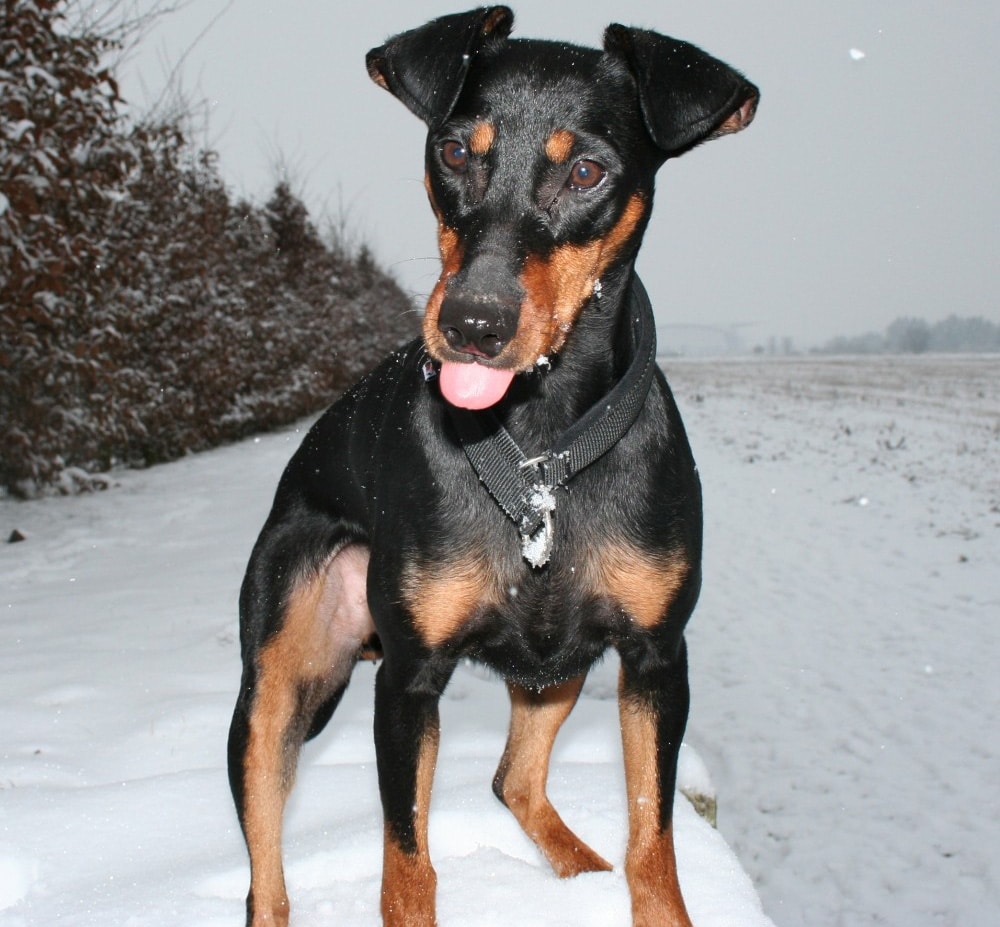
German Pinscher
Alemania FCI 184 . Pinscher and Schnauzer type

Pinscher Alemรกn

The German Pinscher is a dog, extremely, active and lively, alert and vigilant.

Content

History

The German Pinscher (from the German pinscher "biter") It is a breed of dog that belongs to the family of Pinscher.

This race, whose origins date back to the 15th century and which is also related to the Schnauzer, It was originally a dog used by the farmers of Germany to control rodent pests. It is believed that he is descended from crosses between old German dogs and some black Terrier used to hunt rodents.

It is also the breed that arose the Dobermann and the so-called Miniature Pinscher. In Germany, due to the fame that were acquiring the dog shows in the rest of Europe and America, a standard of the breed was established in the year 1879, year in which it was also recognized as a race.

Currently, the Pinscher It is considered more of a companion and guard dog than a hunting dog or vermin controller. As a companion dog it is ideal, its size enables live perfectly in a flat in city, although, like any other dog, you need to do exercise.

In its role as a guard dog, of course, is not as imposing as his descendant the Dobermann, but their functions.

The use of Pinscher as a watchdog it is very satisfying, It is a dog that defends well property without falling (insofar as it is well educated) in the territoriality to his master, staying true to this at all times.

Although it has always been considered that the Pinscher it is a very attractive breed of dog, It has never exceeded the popularity of his descendants: the Pinscher the Dobermann and miniature. In fact, according to a study conducted by the Kennel Club, the Pinscher miniature is almost 8 some times larger than the Pinscher and the Doberman 138 times more popular than this.

Physical characteristics

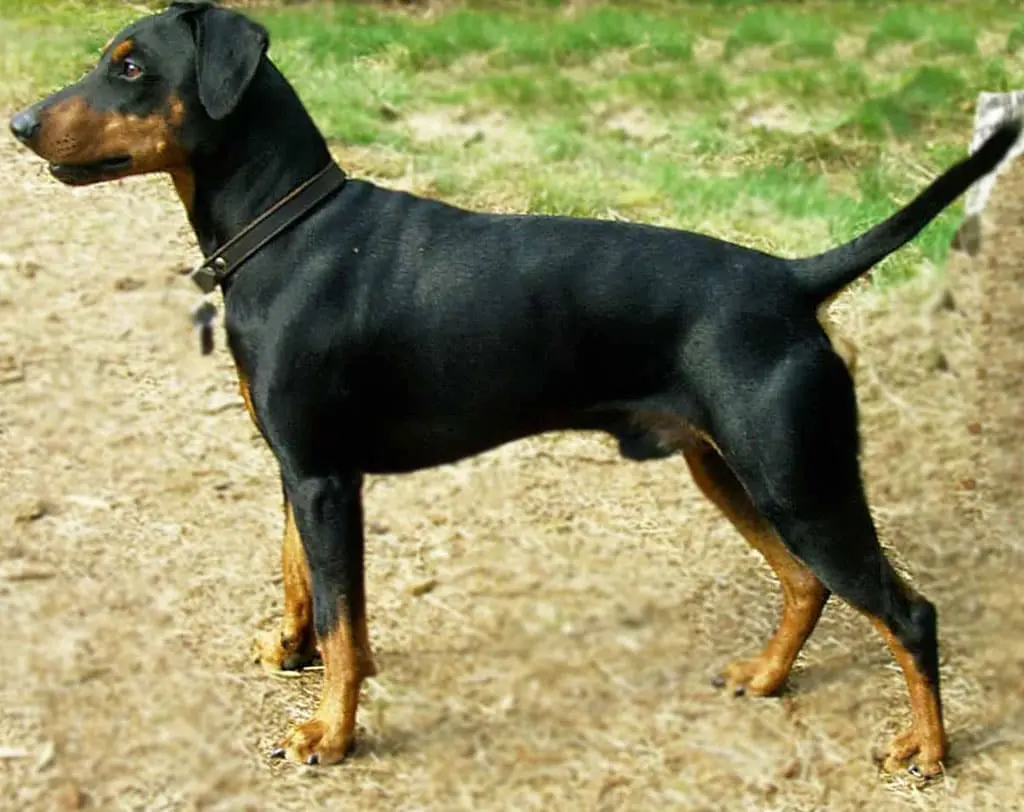
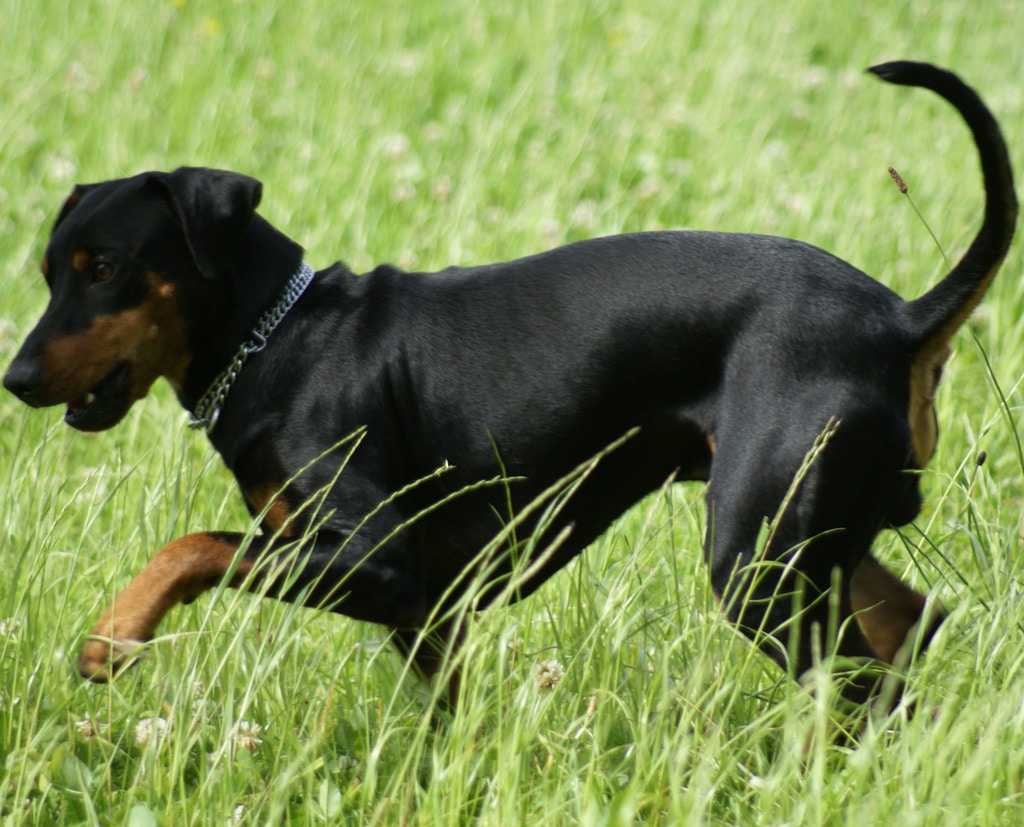
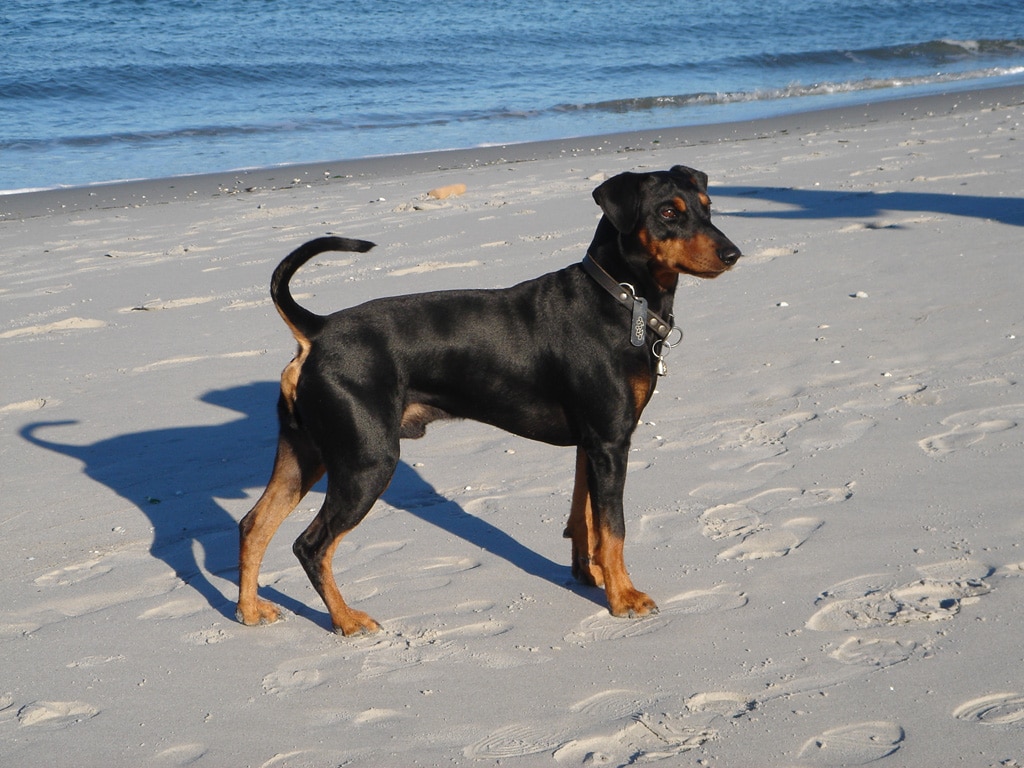
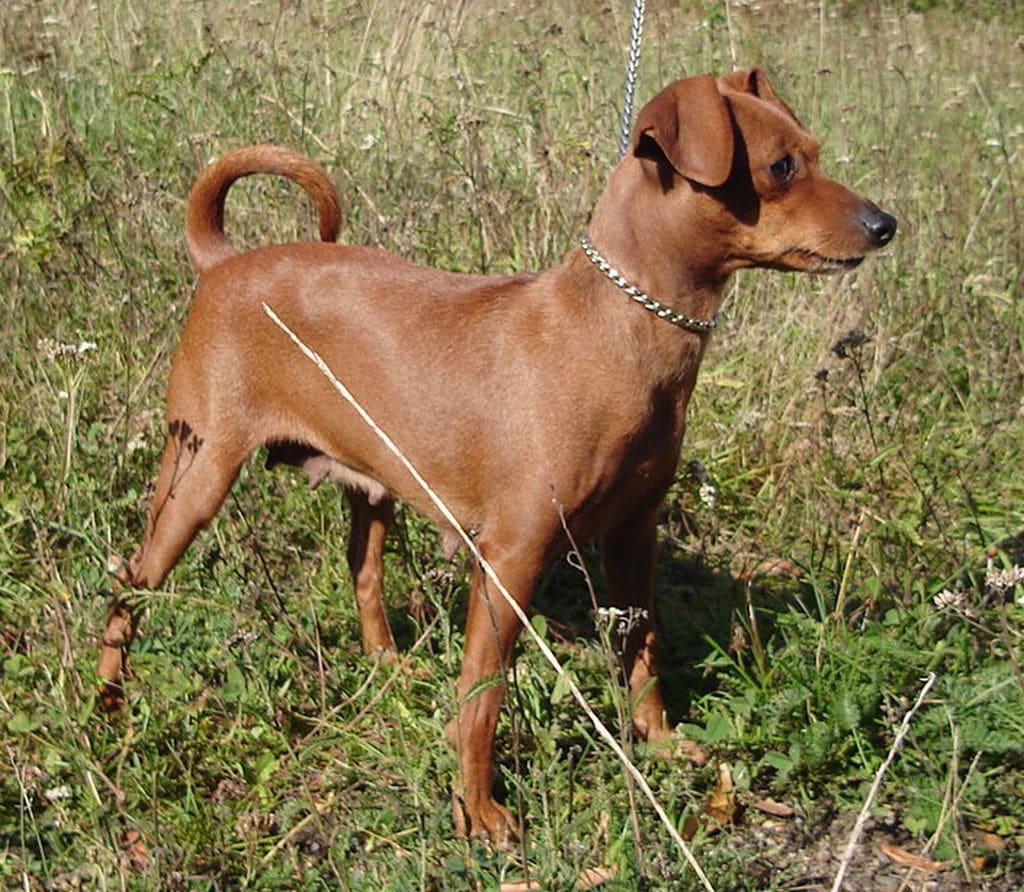
The Pinscher is a dog of size medium, between 45 and 50 cm., proud bearing and strong muscles, with a weight around the 18 kg (14 to 20 kg).

It has a head thin and snout elongated, ears median, slightly bent at birth, they hang from the head of the dog and they are generally cut.

Neck of average length, wide and strong, trunk slim and elegant lines. Regard to the tail, like the ears, also tends to be amputated.

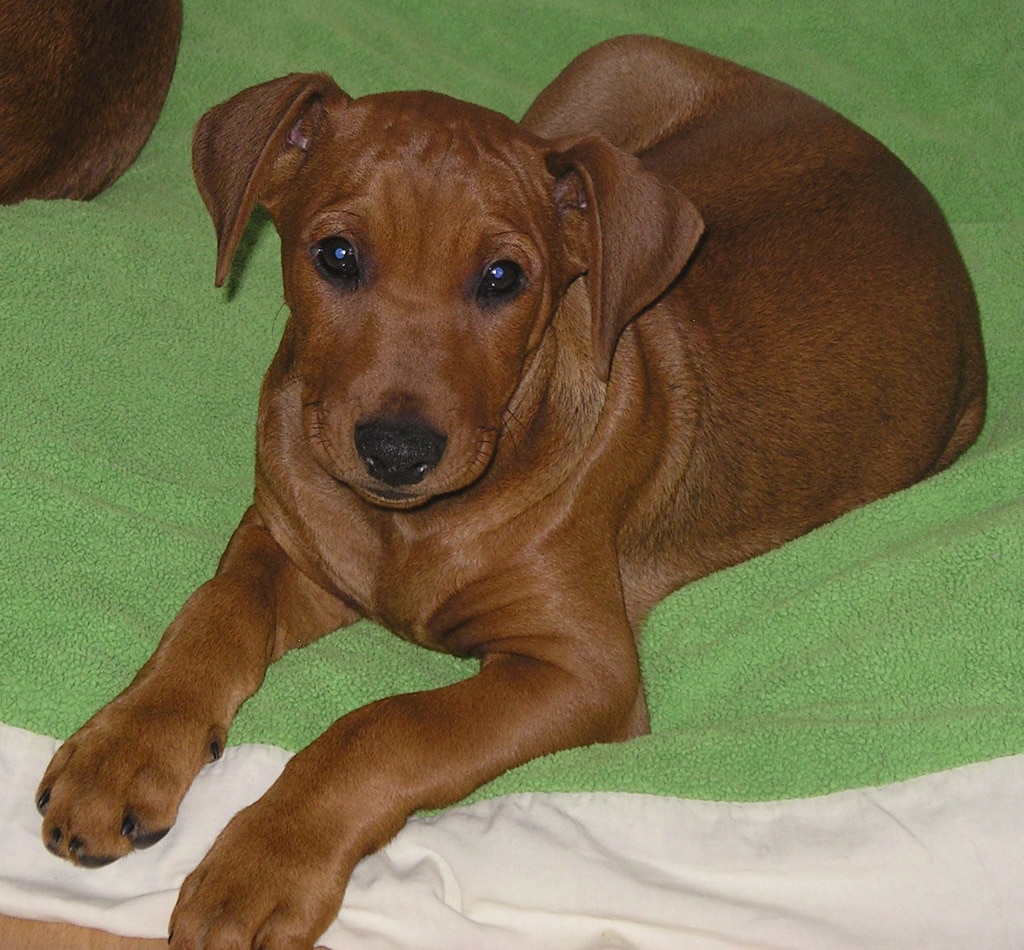
The fur, It is short and rough, it comes in shades of red, brown or black, and fire in the belly and chest.

Their fur is short and smooth, does not require much care, just brushing regularly to remove dead hair.

Character and skills

Because of its vitality require quite some exercise outdoors, You can fix left him free in an open field so that it can run and romp.

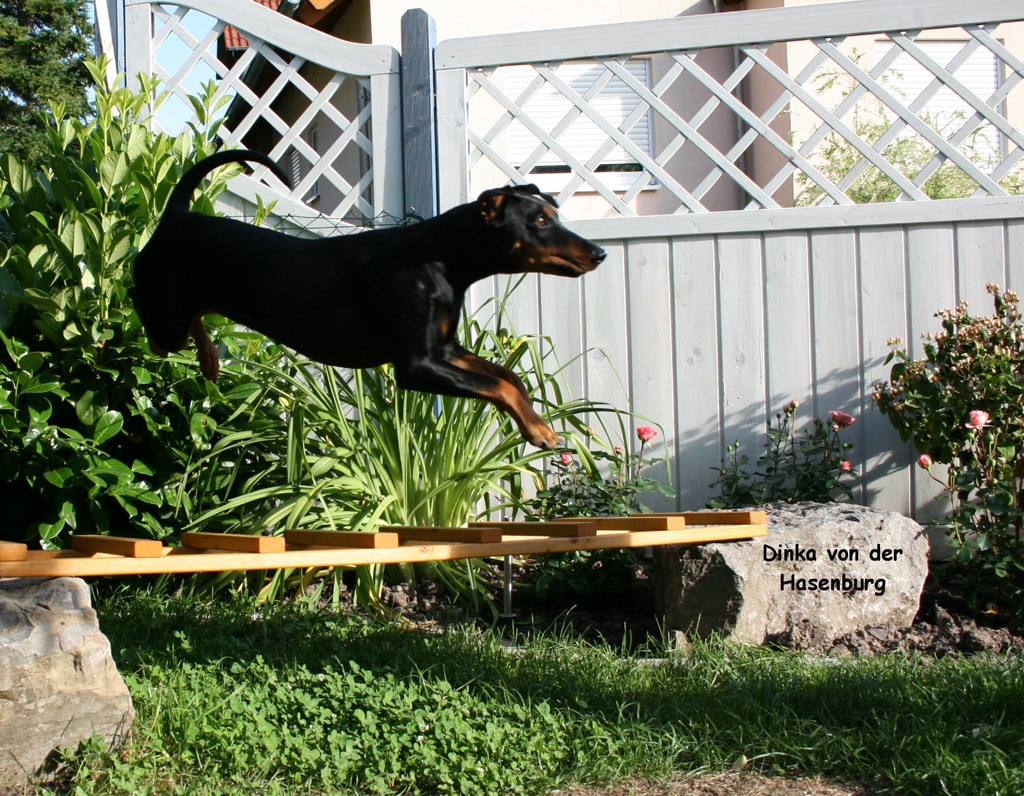
As well, related to the latter, It is a suitable dog to accompany people who practice physical exercise, such as running or cycling.

It is a dog, extremely, active and lively, alert and vigilant. It is often wary of strangers.

It would also be necessary, given his character slightly dominant, teach him to respect rules and who is charge at home.

We need to socialize from very small, because the dominant character leads him to not tolerate the presence of other dogs too. Then, If he is raised with another dog from a young age, they will have a duo of inseparable barkers at home.

German Pinscher Health

All purebred dogs have the potential to develop genetic health problems, just as all people have the potential to inherit a particular disease. Run, do not walk, from any breeder that does not offer a health guarantee on puppies, to tell you that the breed is 100 percent healthy and has no known problems, or tell you that your puppies are isolated from the main part of the home for health reasons. A reputable breeder will be honest and open about the breed's health problems and the incidence with which they occur in their lines..

Having said that, the German pinschers they are quite healthy, and breeders want to keep them that way.

Do not buy a puppy from a breeder who cannot provide you with written documentation that the parents have been cleared of health issues affecting the breed. Getting dogs "vet checked" is not a substitute for genetic health testing.

Remember that after bringing a new puppy home, has the power to protect you from one of the most common health problems: the obesity. Keep a german pinscher with a proper weight is one of the easiest ways to prolong your life. Make the most of your preventive skills to help ensure a healthier dog for life.

German Pinscher Grooming

The short and smooth coat of the German Pinscher makes it easy to style. One bath every three months (or when it gets dirty) with a mild shampoo is all you need, in addition to brushing once a week with a natural bristle brush or glove. Use hair conditioner / polisher to brighten hair.

The rest is basic care. Trim nails as needed, usually once a month. Brush your teeth frequently for general good health and fresh breath. Check ears weekly for dirt, redness or odor that may indicate an infection. If the ears look dirty, clean them with a cotton ball moistened with a mild, pH-balanced ear cleaner. Enter the toilet of the German Pinscher when I'm too young to learn to accept it, especially the nail cut, with patience.

Characteristics "German Pinscher"

Coexistence is important that you have with your new friend. Before considering the acquisition of a dog of the breed "German Pinscher" you know certain factors. Not all breeds of dogs are apt to live in an apartment, you must take into account his character, their need for exercise, their interaction with other pets, their care and if you have small children, their level of tolerance towards them.

Adaptation โ“˜

3,0 of 5 stars (based on 1 review)

friendly dog โ€‹โ€‹โ“˜

3,0 of 5 stars (based on 1 review)

hair loss โ“˜

3,0 of 5 stars (based on 1 review)

Affection level โ“˜

4,0 of 5 stars (based on 1 review)

Need for exercise โ“˜

4,0 of 5 stars (based on 1 review)

Social need โ“˜

3,0 of 5 stars (based on 1 review)

Home โ“˜

3,0 of 5 stars (based on 1 review)

Toilet โ“˜

2,0 of 5 stars (based on 1 review)

Friendly with strangers โ“˜

3,0 of 5 stars (based on 1 review)

barking โ“˜

3,0 of 5 stars (based on 1 review)

Health โ“˜

4,0 of 5 stars (based on 1 review)

Territorial โ“˜

5,0 of 5 stars (based on 1 review)

Cat friendly โ“˜

3,0 of 5 stars (based on 1 review)

Intelligence โ“˜

4,0 of 5 stars (based on 1 review)

Versatility โ“˜

4,0 of 5 stars (based on 1 review)

Child friendly โ“˜

3,0 of 5 stars (based on 1 review)

Surveillance โ“˜

4,0 of 5 stars (based on 1 review)

joy โ“˜

5,0 of 5 stars (based on 1 review)

German Pinscher Images

German Pinscher videos

Type and recognitions:

  • FCI CLASSIFICATION:
  • Group :
  • Section : . .

Federations:

  • FCI – Pinscher and Schanuezer dogs. Molossian type Dogs and Swiss Mountain and Cattle Dogs. , Section 1: Pinscher and Schnauzer. โ“˜
  • AKC – Dogs working โ“˜
  • ANKC – Group 6 (utility dogs) โ“˜
  • CKC – Group 6 – Non-Sporting โ“˜
  • โ€‹KC – Working dogs โ“˜
  • NZKC – Utility dog โ“˜
  • UKC – Terrier โ“˜

FCI breed standard "German Pinscher"

Origin:
Germany

Date of publication of the valid original standard:
06.03.2007

Use:

Guard and company.


General appearance:

The German Pinscher is short-haired and straight, medium-sized, of proud presence, contour of flowing lines, elegant and square construction. He is strong like the Schnauzer and his well developed musculature is clearly evident during the movement given his short and smooth coat.


IMPORTANT PROPORTIONS:

  • The construction should as much as possible appear square in relation to body length and the height to the cross.
  • The total length of the head (from the tip of the truffle to the occipital protuberance) you must keep a relationship of 1:2 with body length (from the cross to the tail insert).


Behavior / temperament:

With a lot of temperament, liveliness, self-assurance, mental balance and intelligent prudence coupled with perseverance make him an excellent family dog, guard and company.

Head:

---

Cranial region:
  • Skull: Strong and elongated, with the back of the little marked head. The occiput should not be too marked; the forehead is flat and parallel with the nasal cannula.
  • Depression links (stop): Soft, although clearly marked.

facial region:

  • Truffle: Well developed and always black.
  • Snout: It ends in a truncated crib. The nasal cannula is straight.Belfos: Blacks, rest firm and plans on the jaws; the corner of the lips is closed.
  • Jaws / Teeth: Powerful upper jaw and lower. The bite is scissors, strong and full (42 clean teeth and white according to the dental formula of dogs). They should close well. The chewing musculature is strongly developed without forming bothering cheeks.


  • EYES: dark, oval and with adherent and pigmented black eyelids.
  • EARS: Bent and falls, high insertion, โ€œVโ€ shaped; the inside edges of the ears rest on cheeks. The ears are directed forward in the direction of the temple. The parallel fold should not exceed the top line of the skull.

Neck:

Of aristocratic porte, not too short; without interruption, must flow harmoniously towards the cross; dry, without dewlap and loose in the throat skin. The skin of the throat is firm, without wrinkles.

Body:

  • top line: Descending slightly from the withers backwards.Cross: It is the highest point of the top line.
  • Back: Strong, short, firm.
  • Pork loin: Short, strong, deep. The distance from the last rib to the hip is short so that the dog appears compact.Rump: Slightly rounded, imperceptibly towards the tail insert.
  • Breast : Moderately wide, oval cut, deep up to elbows. The parapet is especially marked by the tip of the breastbone.
  • bottom line: Flanks not excessively gathered so as to provide a nice wavy line along the lower part of the thorax..

Tail:

Natural, the goal being to make it Sabre or sickle-shaped.

Tips

PREVIOUS MEMBERS: The forelimbs are, seen from the front, vigorous, straight and placed not too close together. Seen side forearms are straight.

  • Shoulder: The scapula is firmly resting on the chest. Well muscled on both sides of the spine of the bone, stands out for above the vertebrae of the spine in its thoracic section. As much as possible and lean back, forms an angle of 50ยบ with the horizontal.
  • Arm: Well on the body, strong and muscular; forms an angle of approximately 95ยบ to 105ยบ with the scapula.
  • Elbows: Tight, not rotated or outward or inwardForearm: Straight seen from front and profile; strongly developed and well muscled.Carpo: Strong and stable.
  • Metacarpus: Strong and slightly elastic, seen from the front straight, of slightly oblique profile in relation to the ground.
  • Previous feet: Short and round, fingers pinched each others and arched (cat feet), strong pads, short nails, black and strong.

LATER MEMBERS: Views of oblique profile, from the back, they are parallel and not too close together.

  • Thigh: Moderately long, width, and strongly muscled.Knee: Must not be turned neither inward nor outward.
  • Leg: Long and strong, sinewy, continuing in a powerful Tarsus.
  • Hock: Well angled, strong, firm, not turned neither inward nor outward.
  • Metatarsus: Perpendicular in relation to the ground.
  • Hind feet: A little longer than the previous ones. Fingers tightened one another well arched; nails short, black.

Movement:

The German Pinscher is a jogger. During the movement the back remains firm and relatively quiet. The beginning of the movement is harmonious, insurance, full of strength, free and good range. It is typical for trotters to have great ground coverage with clean, fluid movement., with a powerful drive and a wide front extension.

Mantle

  • SKIN: Firm throughout the body.

MANTLE

  • Fur: Short and bushy, shiny and tight to the body, without bald regions.

Color:

  • Unicolor: Red Deer, red-brown to dark red-brown.black and tan: black hair lacquer with fiery red to brown markings. It is desirable that the trade marks are possible dark, saturated and well-defined. Fire marks are located: on the eyes, on the underside of the neck, in the Metacarpus, in feet, on the inner faces of the hind and the perineum. In the sill, two triangles of equal size clearly separated one from the other.


Size and weight:

Height to the cross: Males and females: 45 until 50 cm.. Weight: Males and females: 14 until 20 kg.


Fouls:

Any deviation from the aforementioned criteria is considered as a fault and the severity of this is considered to the degree of the deviation to the standard and its consequences on the health and well-being of the dog..


In particular:

  • Heavy or light appearance, petizo or patilargo.
  • Heavy or round skull.
  • Wrinkles on the forehead.
  • Short snout, pointed or narrow.
  • Bite in clamp.
  • light eyes, too small or too big.
  • Inclusion of low or very long ears, ears carried different from each other.
  • Strongly prominent cheek bones.
  • The throat loose skin.
  • Too long back, collected or soft.
  • Encarpado back.
  • fallen group.
  • Long feet.
  • Amble step.
  • High way.
  • Fine animal hair.
  • eel line, Dark saddle, mantle clear.
  • 1 cm.. above the upper limit of height or 1 cm.. below the lower height limit.

SERIOUS FAULTS:

  • Lack of type in the expression of sex (for example, male female).
  • Lightweight aspect.
  • Lack of parallelism skull/snout.
  • Amanzanado skull.
  • Elbows rotated out.
  • After not quite angled or barrel.
  • Hocks rotated inwards.
  • Deviation between 1 and 3 cm above the upper limit or lower limit of height.

FALTAS DESCALIFICANTES:

  • Aggressiveness or extreme shyness.
  • Any dog โ€‹โ€‹showing clear signs of physical or behavioral abnormalities.
  • Evil, exaggerated suspicion, nervous behavior.
  • Any deformity.
  • Markedly inverted sexual characteristics.
  • Lacking bite, upper or lower prognathism, incisor arcade deviated.
  • Miss runner in each region as construction defects, hair and color.
  • Diversion of more than 3 cm.. of the upper and lower height limits.


N.B.:
  • Males should have two normal-appearing testicles fully descended into the scrotum..
  • Only functionally and clinically healthy dogs, with the typical conformation of the breed, should be used for parenting.

The latest changes are in bold.

Source: F.C.I - International Cynological Federation

Alternative names:

1. Deutscher Pinscher (English).
2. Deutscher Pinscher (French).
3. Deutscher Pinscher (German).
4. (em alemรฃo: Deutscher Pinscher) (Portuguese).
5. Pinscher Mediano, Pinscher Estรกndar, Pinscher de pelo รกspero, Mordedor alemรกn (espaรฑol).

โ–ท The world of Pets: Dogs, cats, birds, reptiles, amphibians

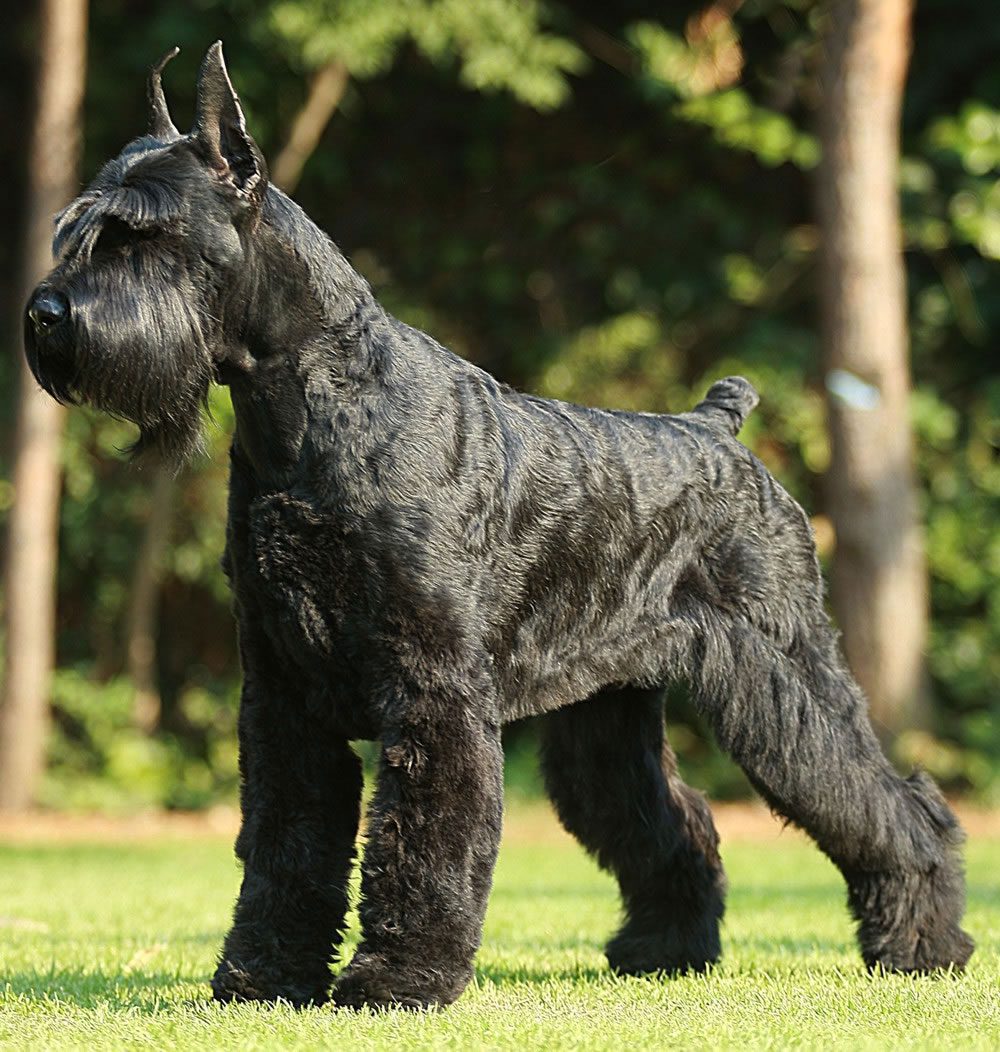
Giant Schnauzer
Alemania FCI 181 . Pinscher and Schnauzer type
Schnauzer Gigante

The Giant Schnauzer is a balanced dog, sweet with children and distrustful with strangers.

Content

History

The Giant Schnauzer It is a large and compact dog breed, a native of Germany. Oldest, lover of water and active, It is one of the three varieties of Schnauzer.

The Schnauzer breed in its three varieties, It has very ancient and common origins to those of the Terrier. (of those who descend).

Y, Although the aires were very Terrier, then the breeding and selection of the Schnauzer breed focused especially on guarding and defense.

Read more

โ–ท The world of Pets: Dogs, cats, birds, reptiles, amphibians

German Shepherd
Alemania FCI 166 . Sheepdogs

The German Shepherd It is one of the most popular dog breeds, the world's largest and versatile.

Pastor Alemรกn

Content

Characteristics "German Shepherd"

Coexistence is important that you have with your new friend. Before considering the acquisition of a dog of the breed "German Shepherd" you know certain factors. Not all breeds of dogs are apt to live in an apartment, you must take into account his character, their need for exercise, their interaction with other pets, their care and if you have small children, their level of tolerance towards them.

Adaptation โ“˜

3,0 of 5 stars (based on 1 review)

friendly dog โ€‹โ€‹โ“˜

3,0 of 5 stars (based on 1 review)

hair loss โ“˜

4,0 of 5 stars (based on 1 review)

Affection level โ“˜

4,0 of 5 stars (based on 1 review)

Need for exercise โ“˜

4,0 of 5 stars (based on 1 review)

Social need โ“˜

3,0 of 5 stars (based on 1 review)

Home โ“˜

3,0 of 5 stars (based on 1 review)

Toilet โ“˜

3,0 of 5 stars (based on 1 review)

Friendly with strangers โ“˜

3,0 of 5 stars (based on 1 review)

barking โ“˜

4,0 of 5 stars (based on 1 review)

Health โ“˜

4,0 of 5 stars (based on 1 review)

Territorial โ“˜

5,0 of 5 stars (based on 1 review)

Cat friendly โ“˜

3,0 of 5 stars (based on 1 review)

Intelligence โ“˜

5,0 of 5 stars (based on 1 review)

Versatility โ“˜

5,0 of 5 stars (based on 1 review)

Child friendly โ“˜

5,0 of 5 stars (based on 1 review)

Surveillance โ“˜

5,0 of 5 stars (based on 1 review)

joy โ“˜

5,0 of 5 stars (based on 1 review)

History

The dog German Shepherd It is today the most widespread dog breed in the world.. It appeared in its current form towards the end of the 19th century, thanks to the tremendous work of the German captain Max von Stรฉphanitz. Created from different German Shepherd Dogs, the breed was last improved in 1893 with blood of Scottish Sheepdogs.

But, its origins go back to antiquity, since tacit (54-120 d.C.), Roman historian and senator, you already mentioned sheepdogs in Germania. A little later, in the 7th century, Germanic laws punished with a fine of 3 solidis (a few 20 euros today) to anyone guilty of the murder of a sheepdog.

In 19th century Germany, there was no homogeneous breed of sheepdog. Rather, there were regional types, as the shepherds from wรผrttemberg, the thuringian guy, but also different dogs in Bavaria or Hesse. In the decade of 1870, under the direction of Bismarck, while the French tried to select different regional types of sheepdogs, the Germans preferred a national race, intended to be a symbol of German thoroughness and quality. Like this, already in 1877, some breeders made an initial selection of two types: the Wรผrttemberg Sheepdog, tall and massive, thick dark hair, strong head and floppy ears, and the Thuringian Shepherd Dog, short gray hair, with medium bone structure and straight ears.

Phylax was founded in 1891, the first association dedicated to the Dog German Shepherd. But, dissolved into 1895 due to numerous dissensions. In fact, some breeders wanted to keep a line of Thuringian Sheepdogs, while others wanted to mix Thuringian Sheepdogs and Wรผrttemberg Sheepdogs, in order to obtain a fast and reliable dog with a balanced and resistant character.

In 1897, Max Frederic Emil von Stephanitz, a cavalry officer who had returned to civilian life after his marriage and is considered the "father" of the breed, bought a property near Grafrath, Bavaria. He decided to set up a dog-breeding operation there., mainly focusing on the improvement of sheepdogs, wanting to create a perfect and intelligent working dog with keen senses and superior working ability. He participated in dog shows presented by other breeders and bought his first dog in 1899, Hector Linkrshei, later changing his name to Horand von Grafarth. The latter, with a gray and yellow coat and of the type of Thuringian Shepherd dog, was the first German shepherd dog registered in the Breed Book of Origins. Used it as a stud, starting point of the German Shepherd breed, and produced with him 53 layers of 35 different females, giving 149 puppies also registered in the Book of Origins of the breed.

The 22 in April of 1899, from Stephanitz founded the German Shepherd Dog Club, he "Verein fรผr Deutsche Schรคferhundยซ, also known in abbreviated form as SV (Shepherd Club). The 28 in September of 1899, the first breed standard was published during its first general assembly in Frankfurt.

This first text was completed in the meetings of the members in 1901 and 1909, at the meeting of the management board and advisory committee in Wiesbaden in 1930, and at the meeting of the breeding commission and the board of directors in 1961. The text was revised again in the framework of the WUSV (World Union of Clubs for German Shepherd Dogsand, o World Union of German Shepherd Societies). The standard was finally revised and restructured in 1991 by a legally binding decision of the executive and advisory boards.

Von Stephanitz announces in its standard the line of conduct that will be maintained until today, what is that a German Shepherd it's mostly a working dog. According to him, "a dog German Shepherd is any sheepdog that lives in Germany and that, by constantly exercising its qualities as a shepherd dog, achieves perfection of body and mind, perfection that is appreciated only in terms of usefulness".

While the 19th century was marked by the industrial revolution and many sheepdogs disappeared along with the pens in the course of industrialization and urbanism, From Stรฉphanitz converted his protรฉgรฉ and worked to persuade the German authorities to use this breed of dog. Its robustness, his exceptional sense of smell and unwavering obedience convinced the German police to use him. The German Shepherd was found in the army, police, Customs, but also in the administration, ports and railways.

World War I gave the German Shepherd the chance to prove yourself: whether they served as sentinel dogs, sanitary dogs, patrol assistants or messenger dogs, more than 100.000 German Shepherdss were mobilized like dogs of war.

After the war, thanks to the stories of veterans who recounted the exploits of this breed of dog, the excellent reputation of German Shepherd spread all over the world. At the same time, the first German Shepherd Guides appeared to help those disabled by the war.

In 1920, Georges Barais, a French textile manufacturer, created the Sociรฉtรฉ du Chien de Berger d’Alsace (the end of hostilities was too close to give the dog its original name), before its name was changed to Sociรฉtรฉ du Chien de Berger dโ€™Alsace less than two years later.

The dogs of German Shepherd were in great demand in the postwar years, so much so that dog breeders from German Shepherd they produced them in great numbers to satisfy their fellow citizens, as well as foreign countries that became more and more passionate about the breed. The result was a departure from the type, with bigger and bigger dogs, high, with legs of doubtful character.

To avoid these excesses, in 1922 created the Kรถrbuch, a selection book that complements the Book of Origins. Only dogs suitable for breeding could be registered in it, after being examined by a judge.

During World War II, the German Shepherd It was used on all fronts and by all the armies of the world. Unfortunately, After the war, unfairly associated with the Nazis, caused mistrust and lost interest to foreign buyers. Hitler himself owned several German shepherds, including female Blondi, who accompanied him until his death in April 1945.

It was not until the decade of 1950 that the breed began to develop again. The modern history of German Shepherd started with the German Championship of 1951, where the consecration of a subject with a different morphology strongly marked the physical evolution of the race. Rolf from the Osnabrรผcker Land it was a very distinctive dog, characterized by morphological innovations, especially on neck and shoulder strength.

The decade of 1970 it also marked a second turning point in the breed's history, with the appearance of the silhouette with the sloping back.

Today, due to the popularity of this breed, his herd is no longer homogeneous, since there are exposure lines on one side and work lines on the other.

Physical characteristics

Videos "German Shepherd"

Is also known by the name of Ovejero German or Dog Police, due to the use that the security forces give them in many countries where they even have specific units called K-9.

The German Shepherd, is a dog robust and flexible, slightly elongated, with muscular body, its powerful jaws close in scissor, which, You can generate a force of more than 180 kg beating races as the Pitbull, the Akita Inu or American bulldog.

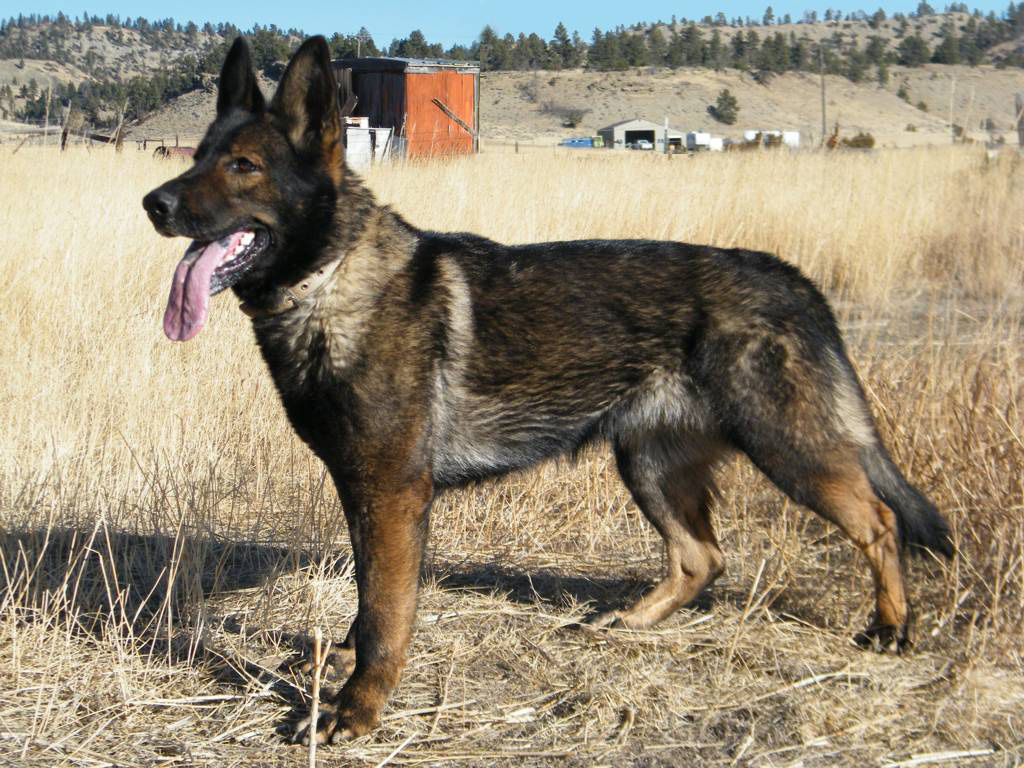
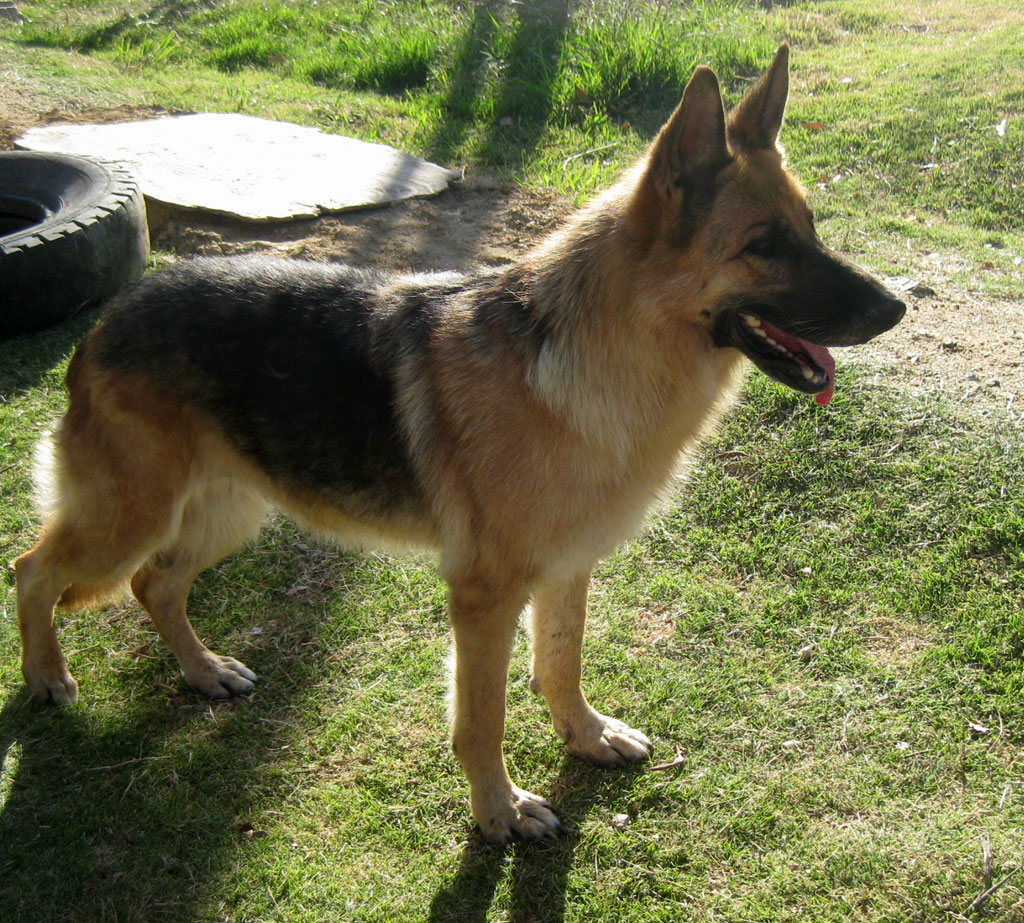
There are many variants of color in German shepherds, as black, black and Brown edges, Red and black, but always visible his mantle of black, hence many called him black cloak.

The height at the cross, is between 60 and 65 cm. male, and the female between 55 and 60 cm.. The weight of the male, round the 30 and 50 kg, and in the female between 22 and 40 kg. Their life expectancy is around the 12 years.

Pastor of cows and sheep with great intelligence and tireless trot. He has excelled in numerous works useful to man, such as: guardian, guide dog, policeman, attack dog, drug detector, etc.

It is a robust animal, agile, good muscular, awake and full of life. His physical proportions must be related not only to his appearance but also to his temperament..

You must be a well balanced dog, with a harmonious development of the anterior and posterior members. A good specimen like at first sight; is also very strong. Although it can sometimes be a bit dominant and aggressive depending on the way in which educates.

Regard to the Bless you of these dogs, It is important to monitor its post vaccination schedule that are susceptible to Contracting distemper. As is common in large dogs, this breed is susceptible of suffering Hip Dysplasia.

Responsible crossbreeding is necessary to prevent this type of defects from spreading from generation to generation to have healthy specimens that do not suffer pain and are useful for work. This breed typically requires the hips from puppies to be passed by X-ray, and that the X-rays are certified and approved by the clubs responsible for the breed (the body that regulates this breed is the Verein fรผr Deutsche Schรคferhunde e.V. (SV) Headquartered in Augsburg, Germany), When the Cub reaches maturity (approximately at the 2 years of age), so that there is an adult suitable for reproduction.

Character and skills

It is a very good companion dog with children., It is very balanced and easy to train.

The training and socialization they should start from the first time the puppy reaches the family. The training for this breed is essential, is not recommended at all that is purchased if the future owner does not have the time needed to train it or take it to train a puppy.

You need to practice exercise continuously It is a breed of working. German shepherds are in sports like the Schutzhund, which is a good alternative to help keep you healthy and balanced both physically and mentally.

The German Shepherd It is one of the most popular dog breeds, the world's largest and versatile. Nato worker, affectionate with family, excellent guardian, blind guide, animal rescue, patient and protective of children. Courage, intelligence, unselfishness and loyalty are among the many virtues that characterizes this can.

The field trips, Beach or mountain are necessary and recommended especially if you are allowed to run to suit, at least, twice a month. Like this, your strong muscles will stay in shape and help preserve your psychic balance, being a breed particularly biased to temperamental disorders which in extreme cases they degenerate in neurosis.

It is advisable to, make your first bath to the 3 months of life, in a warm place, where the dog run no risk of harm is, using neutral soap or shampoo.

As well, It is important to feed it with good quality feed. We must prevent overfeeding it has a voracious appetite that can lead it to gastric problems, If not treated properly it can trigger chronic diarrhea.

It is advisable to go to the vet at least once a year for a general Checkup. Daily brushing is necessary to avoid the dead hair to hang its limbs and neck, This also allows fur keep bright, healthy and beautiful.

ยซGerman Shepherdยป Education

The dog German Shepherd has a flexible temperament, but lively and quite dominant, which makes learning the basic commands mandatory. But, obedience seems innate in him, and his education is facilitated by his desire to satisfy his teacher. The latter must also be willing to invest properly in the education of his dog.

A dog German Shepherd poorly trained or untrained, a guard dog by nature, can become a limitation for his master and his family, as they will tend to be suspicious or even aggressive. So, it is important to socialize him and get him used to strangers or public places from an early age.

Health ยซGerman Shepherdยป

The German Shepherd it is a robust breed by nature. But, infatuation with her since the end of World War II has led some breeders to German shepherds to be produced in quantity without taking into account genetic defects, what has weakened her. So, we can find in some lines bone or joint problems, such as hip dysplasia, elbow dysplasia, degenerative myelopathy or osteodystrophy. This is why it is always advisable to ensure that stallions are free from these conditions before adopting a puppy..

The dog German Shepherd you also have a genetic predisposition for hypothyroidism (a disease of the endocrine system), for the disease of von Willerbrand (a disorder of blood clotting), for persistence of the arterial canal (a congenital heart defect), or for certain skin conditions (atopia, flea allergy, pioderma…).

Finally, like all large breed dogs, the dog German Shepherd may suffer from stomach inversion or twisting. That is why exercise after meals should be avoided.

ยซGerman Shepherdยป Care

Dogs German shepherds they lose a lot of hair, and its annual molt, in spring and autumn, It is important. During these periods, the dog should be brushed daily to remove excess hair, avoid knots and air the skin. Outside, brushing two or three times a week with a suitable comb is recommended.

Bathing is not recommended (except when the condition of the coat requires it), as this can weaken the waterproofing of the coat.

Images of the ยซGerman Shepherdยป

The German Shepherd videos

Type and recognitions:

  • FCI CLASSIFICATION:
  • Group :
  • Section : . .

Federations:

  • FCI – Group 1 Herding dogs, Section 1 Sheepdogs โ“˜
  • AKC – PASTORAGE โ“˜
  • ANKC – Group 5 (working dogs) โ“˜
  • CKC – Group 7 – Herding dogs โ“˜
  • โ€‹KC – Pastoral โ“˜
  • NZKC – Working dog โ“˜
  • UKC – Herding dogs โ“˜

FCI breed standard "German Shepherd"

Origin:
Germany

Date of publication of the valid original standard:
11.08.2010

Use:

Versatile working dog, grazing and utility.


General appearance:

The dog German Shepherd is a medium-sized dog, slightly stretched body, strong, well muscled, with dry bones and a firm general structure.


Behavior / temperament:

The dog German Shepherd is of balanced temperament, with firm nerves, self-confident, totally unwrapped and (except when provoked) totally benign; at the same time should be attentive and easy to train. Must have value, fighting instinct and toughness to be appropriate as a companion, guardian, protection dog, service and pastor.

Head:

It is wedge shaped, and it is in proportion to the length of the body (its length is approximately 40% the height of the cross), without looking neither coarse nor elongated. In general appearance it should be dry and moderately wide in the middle of the ears. Front and side view, the forehead is slightly arched and without or with a slightly marked median furrow. The proportion between the cranial and facial regions should be 50% to 50%. The width of the cranial region is almost equal to its length.

Cranial region:

Top view, the cranial region tapers evenly from the ears to the nose, leaving a not very noticeable frontal nasal depression and leaning into the wedge-shaped snout. The upper and lower jaws are strongly developed. The nasal helm is straight, any bulge or sag is undesirable. The lips, dark colored, they are firm and well adhered.

facial region:

  • Truffle:It must be black.
  • Teeth:It must be strong, healthy and complete (42 teeth corresponding to the tooth formula). The dogGerman Shepherdhas a scissor bite, so that the upper incisors cover the lower ones in close contact. A pincer bite, an upper or lower prognathism as well as large spaces between the teeth (lagoons) they are fouls. Equally faulty is the straight alignment of all incisors. The maxillary and mandibular bones must be strongly developed so that the teeth are deeply embedded in the dental arch.
  • Eyes:Medium-sized, macaroons, placed obliquely and never protrude. your colour must be as darkest as possible. Piercing light eyes are undesirable as they affect the dog's expression.
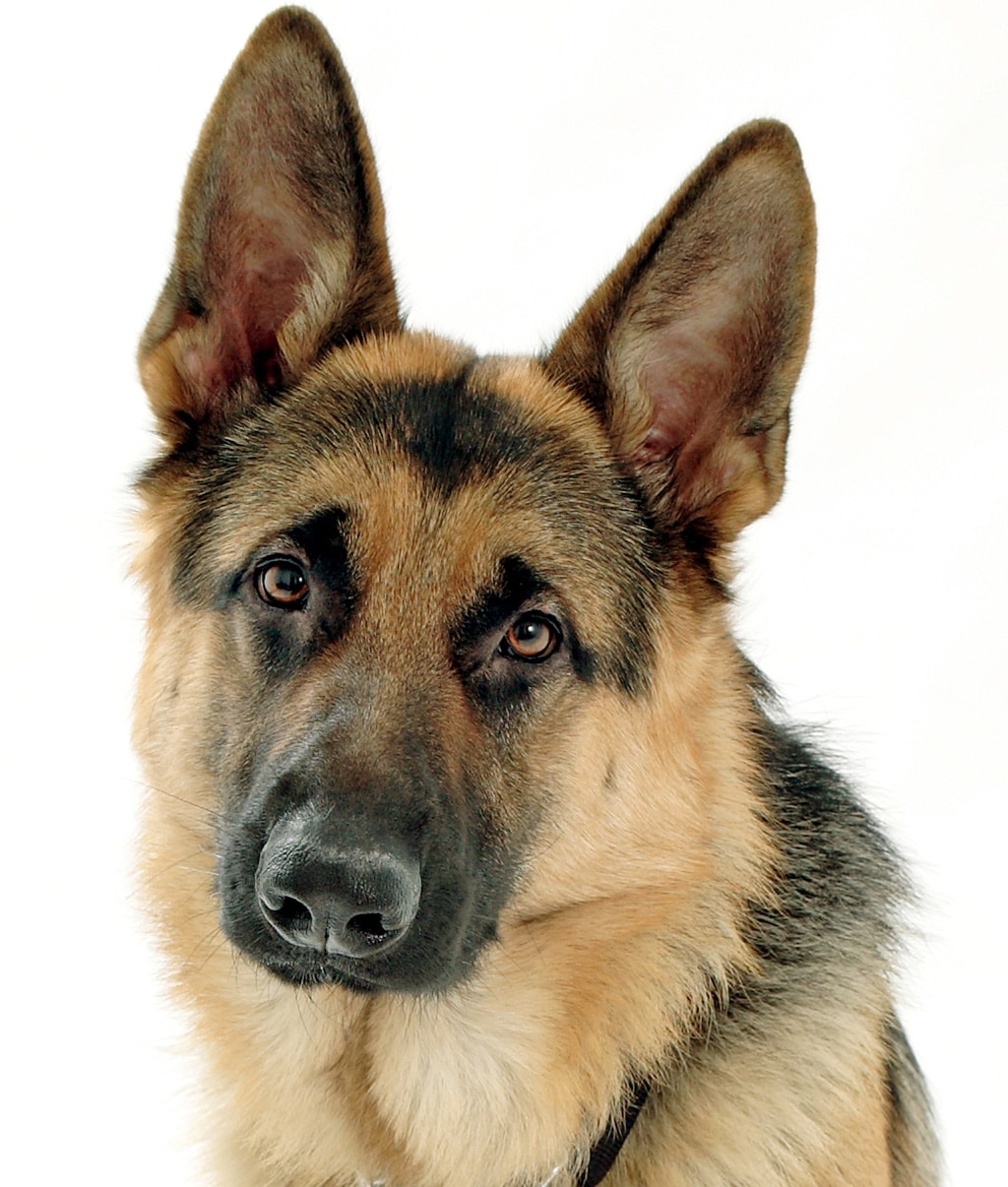
  • Ears: The dog German Shepherd has medium-sized ears, upright, open forward and carried evenly (neither turned nor carried to the side). They are pointed with canopy facing the front. Ears bent at the tip or drooping are defective. Ears thrown back, in motion or at rest, are not taken as a fault.

Neck:

The neck must be strong, well muscled and no double chin. Its angulation with the body (horizontally) It is approximately 45ยฐ.

Body:

The upper line runs without interruption from the implantation of the neck on the well-defined withers and on the very slightly inclined back to the rump, also slightly inclined. The back is firm, strong and well muscled. The loin is broad, strongly developed and well muscled.
The rump should be long, slightly inclined (approximately 23ยฐ from the horizontal line) and continue towards the tail line without interrupting the top line.

  • Breast :Moderately wide with the sternum as long as possible and well noticeable. The depth of the chest should be 45 48% of the height at the cross. The ribs should be moderately rounded. Barrel-shaped or flat chest is considered as missing.

Tail:

Reaches at least to the hock, but without exceeding the middle of the metatarsal. Has longer hair on the bottom. At rest, wears it hanging with a slight curve. When the dog is in motion or at attention, carry the tail higher, but without exceeding the horizontal line. Corrective operations are prohibited.

Tips

front limbs:
Seen from all sides, the forelimbs are straight; viewed from the front, they are absolutely parallel. Shoulder blade and arm are the same length, firmly attached to the body by means of good muscles. The ideal angulation between the shoulder blade and the arm is 90ยฐ, but usually 110ยฐ. The elbows should not be turned neither out nor inwards, while the dog is at rest or in motion. The forearms, seen from either side, They are straight and parallel to each other, dry and well muscled. The pastern has a length of approximately 1/3 of the forearm and forms an angle with it of approximately 20 22ยฐ. An overly sloping pastern (more than 22ยฐ) or too straight (less than 20ยฐ) impairs the dog's ability to work, especially its resistance.

  • Front feet:Rounded, compact, with arched toes. The pads must be firm, but not fragile. The nails are strong and dark in color.

Later members:
The position of the hind limbs, viewed from behind parallel to each other, should be slightly collected.
The thigh and leg are almost the same length and form an angle of approximately 120ยฐ. The thighs are strong and well muscled. The hocks are strong and firm; metatarsal is perpendicular under hock.

  • Rear feet:compacts, slightly arched; hard, dark-colored pads; strong nails, arched and equally dark in color.

Movement:

The German Shepherd it's a trotting dog. The angulation and length of the limbs must be so well related that, without noticeable alteration of the top line, the dog can push the hind limb under the entire length of the body and reach the same distance with the forelimb. Any tendency to over-angle the hind limbs decreases firmness and resistance., and, consequently, the dog's ability to be useful. Correct structural proportions and good angulations result in a long-range, flat walk on the ground that gives the impression of effortless locomotion. Head thrown forward and tail slightly raised result in a smooth and fluid trot, showing a smooth, unbroken curved line running from the tips of the ears over the neck and back, to the tip of the tail.

Mantle

Skin: Must be loosely fitted, without forming folds.

  • Hair characteristics:
    The correct coat of the dog German Shepherd it's a double hair (Stockhaar) con lanilla interna. The outer hair should be as dense as possible, straight, hard and close to the body. The head and even the inside of the ears, anterior parts of the extremities, feet and toes are provided with shorter hairs; in the neck, hair is slightly longer and dense.
    On the back of the limbs the hair is longer until it reaches the carpal and tarsal joints. The fur forms "pants" moderate behind the thighs.
  • Color
    Black with reddish-brown markings, brown, yellow and even light gray; totally black or gray; gray dogs are tinged with black, with black cloak and mask. Small inconspicuous white patches on the chest are tolerated but not desirable, as well as very light colors in the internal parts. In all types of color, the truffle must be black. Dogs without mask, clear eyes and piercing expression, light or whitish patches on the chest and internal parts, as well as light nails and a white red color at the tip of the tail are considered to be lacking in pigmentation. The undercoat has a light grayish hue. White is not allowed.


Size and weight:

The height of the cross

  • Males:60-65 cm..
  • females:55-65 cm..

The length of the body exceeds the measurement of the height at the withers by approximately 10 17%.


Weight

  • Males:30-40 kg.
  • females:22-32 kg.


Fouls:

Any deviation from the aforementioned criteria should be considered as a fault and its severity is considered in proportion to the degree of the standard deviation.


Serious misconduct

  • Any deviation from the breed perfection standard described above that affects the dog's usefulness.
  • Ears: Set too low and to the sides, folded ears, turned over and carried to the sides, lifted if firmeza.
  • Significant pigmentation defects.
  • Very low overall firmness.
  • Dental faults: Any deviation from a scissor bite and tooth formula, if it is not included in the knockout fouls mentioned below.

ELIMINATING fAULTS

  • Aggressive or fearful dog.
  • Character weakness, biting dogs and weak nerves.
  • Dogs with a โ€œsevere dysplasiaโ€ rating.
  • Monorchids and cryptorchids, as well as dogs with clearly unequal or atrophied testicles.
  • Dogs with defects disfiguring the ears or tail.
  • Dogs with malformations.
  • Dogs with missing teeth: 1 premolar 3 and 1 extra tooth, or 1 canine, or 1 premolar 4, or 1 molar 1, respectively molar 2, or a total of 3 teeth or more missing.
  • Dogs with defects in the jaws: More than 2 mm of upper prognathism, lower prognathism,pincer bite across the entire incisor area.
  • albinism. White hair color (even though I have dark eyes and nails).
  • Double long hair (long outer hair, soft, not attached to the body with undercoat, fringes on the ears and limbs, "pants" dense and bushy tail with fringes).
  • Long hair (long soft outer coat with no undercoat, usually parting in a part along the back line, tufts or fringes in the ears, limbs and tail).
  • Any dog โ€‹โ€‹showing clear signs of physical or behavioral abnormalities must be disqualified..


N.B.:

Males should have two normal-appearing testicles fully descended into the scrotum..

Source: F.C.I - International Cynological Federation

Alternative names:

1. German Shepherd Dog (English).
2. Berger dโ€™Alsace, berger alsacien, Chien-loup d’Alsace (French).
3. (German).
4. Lobo-da-alsรกcia (Portuguese).
5. Pastor ovejero (espaรฑol).

โ–ท The world of Pets: Dogs, cats, birds, reptiles, amphibians

German Mastiff
Alemania FCI 235 - Molossoid - Dogo

Dogo Alemรกn

The German Mastiff, Great Dane or German Boarhound It is a breed of dog known for its large size and delicate personality, considered to be the "Apollo among all races" by the International Cynological Federation.

The great Dane, even being a giant race, should not be clumsy in his walk and movements. Your character should be friendly and never shy. Males should be stronger than the females Constitution.

Read more about the race by clicking on: Great Dane.

German Mastiff

โ–ท The world of Pets: Dogs, cats, birds, reptiles, amphibians

Garafian Shepherd
Espaรฑa Not recognized by the FCI

Pastor Garafiano

The Garafian Shepherd It is a very docile and friendly dog.

Content

History

The Garafian Shepherd is a breed of dog indigenous native to La Palma Canary, Canary Islands. The name receives it from the North of the island, specifically from the municipality of Garafรญa, for being the place where this breed was most common, Despite the fact that copies are found throughout the island.

The Garafian Shepherd has been linked from its origins to grazing, activity for which shows special aptitude, although at present it has gained great importance as a pet.

for a certain time, This race was on the edge of his disappearance due to miscegenation with other breeds of dog.

Successive crossings, especially from the age 60 20th century with other breeds of dogs pastors, They show the need to work for their recovery and selection from the exemplary few pure breed that retained the pastors of the island.

It's a differentiated canine population, originally from the region of Garafรญa, on the island of la Palma where was used by shepherds to raise herds of goats. Because of this, the animal performs very well in steep and rocky areas.

It has very homogeneous characteristics., Since only a functional selection has carried out. His main ability is the grazing of sheep and goats in steep terrain, due to the geographical characteristics of La Palma.

Its origin dates back to pre-Hispanic times., although the crosses with other races after the conquest have contributed to the development of the Garafian Shepherd.

To prevent this disappearance, the working group for the recovery of the Garafian Shepherd, which would become the Spanish dog association Garafian Shepherd, whose current president is Antonio Manuel Diaz Rodriguez.

Among the objectives of the Association is the development of census, creating breeding nuclei, participation in exhibitions and fairs canine, etc.

The Garafian Shepherd was officially recognized as a Spanish breed in the year 2004, by the Royal Canine Society of Spain.

The Garafian Shepherd It has been presented in the samples of native breeds that have been held in the Canary Islands, as well as in the international exhibitions held in Santa Cruz de Tenerife and Las Palmas de Gran Canaria.

The department of ethnology of the Faculty of Veterinary Medicine of the University of Las Palmas de Gran Canaria has carried out several studies on the breed that, they were presented at the Symposium of native races held in Cรณrdoba in March of 1992.

In the news, this breed is very abundant on the island and the future looks promising due to the growing interest in these animals, not only by shepherds but also by people looking for a pet.

Physical characteristics

His body is format Lupoid, medium to moderately longilinear, eumรฉtrico, of medium-size to large, slightly higher than the cross grupa, rather short neck and small head on the body. Exemplary well care usually weigh between 28 and 35 kg males and 24 and 30 kg females.

These are the weights that antesandse gave, currently in the males is of 35 to 46 kg and females in 25 to 35 kg. The height to the cross males range between the 57 and 64 cm., While that in females 55 and 62 cm..

Currently these data have also changed still normal in males of 60 to 70 cm and females 55 to 65 cm..

Its head is conical, small in relation to the body, slightly convex front, What highlights by the introduction something separate and rear of the ears, that may have items or with a tendency to go forward.

They may also appear enhiestas, observing then a tendency to keep them folded before any stimulus, showing its inner face. Truffle always black. Oblique eyes, Brown macaroons, and something coming. Brief lips, collected. Bite in clamp. Soft and little pronounced stop.

The legs they are strong, good heaviness, Emphasizing the later by its proportions. Sometimes they have Spurs, that it often doubles and some implanted.

The layer is likens or alobada. The puppies are born Brown, color that changes to reach adults, appearing in some cases hair or white spots on the chest, fingers or tip of the tail, disappearing generally grow.

The hair is abundant and more or less long. Sometimes is smooth while in other cases it is rough. It tends to accumulate at the base of the ears, neck, skirts, tail and on the edges of the legs. The tail usually very populous hairs, bearing sword being slightly coiled, Although never on the back.

Character and skills

The character of Garafian Shepherd It docile and friendly.

When he meets strangers, he shows a typical barking attitude., folding of ears, movements of tail and spins on his head showing the corner of the mouth in the form of smile.

He is calm and rested in appearance, although he becomes very active while carrying out any type of physical activity..

You need exercise as well as all dogs.

Images of the ยซPastor Garafianoยป

Videos of ยซPastor Garafianoยป

Federations:

  • RSCE – Royal Canine Society of Spain โ“˜

Alternative names:

1. Pastor Garafiano (English).
2. Pastor Garafiano (French).
3. Pastor Garafiano (German).
4. Pastor garafiano (Portuguese).
5. Pastor de Garafia (espaรฑol).

โ–ท The world of Pets: Dogs, cats, birds, reptiles, amphibians

Guatemalan Dogo
Guatemala Not recognized by the FCI

The Guatemalan Dogo It is a variant of the Doge race, a native of Guatemala. It's a watchdog.

Dogo Guatemalteco

Content

History

From the age 1990, the Guatemalan Canophila Association began the study of this breed so that the Federation Cynologique Internationale (FCI) grant worldwide recognition for the breeding of pedigree dogs, the only one in this region. In charge of studying the race to set their standard, approval and international recognition through the FCI is the veterinarian and zootechnician Arturo Chavez.

The Guatemalan Dogo is the product of random crosses between races Bull Terrier English, Dalmatian and Boxer. Records of its existence date from 1890, Well there are images of a Guatemalan Dogo in a collection of 12 photos of the day, property of Arturo Gallusser. It is also known that the family Gerardi, in 1910, I had some copies of these dogs, but it is unknown the offspring of the same.

Physical characteristics

"Guatemalan Dogo"

Dogo Guatemalteco
Dogo/Bull Terrier Guatemalteco: Owner Owner Oscar E. Lorenzana Gallusser – Oscar E. Lorenzana Gallusser, Public domain, via Wikimedia Commons

It is a dog that stands out for being a good watchdog, It is medium sized and somewhat longer than high, so it does not have a completely square appearance. His head is quite square and his lips are slightly; His jaw is quite strong and he has a scissor bite..

The weight males will of 40 to 45 kg and females in 35 to 40 kg. The height in the males is of 54 to 60 cm and the females of 52 to 58 cm..

The life expectancy of the Guatemalan Dogo, is of, approximately, 11 to 12 years.

Its color predominant is very bright white with some black or brown spots. The fur is short, rough, thick and quite attached to the body.

Character and skills

It is good guardian it ladra to strangers, but believes it only when necessary. You can get along with others but it creates a bond with his master, thus making it an excellent companion dog.

A bath is recommended only when necessary or it can be cleaned with a damp tissue to remove hair that has fallen or when it has become dirty. Socialization at an early age will be required with the people. Will also be made if you have other pets to be in the future not to fight with them, and that's not a totally aggressive dog.

Daily activities such as walks next to its owner is needed to not bored, since it is an energetic dog and can become destructive and stressed by not using the energy it possesses.