โ–ท The world of Pets: Dogs, cats, birds, reptiles, amphibians

Polish Hound
Polonia FCI 52 - Medium-sized Hounds

Polish Hound

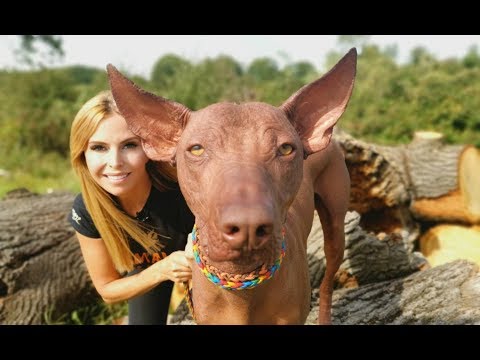
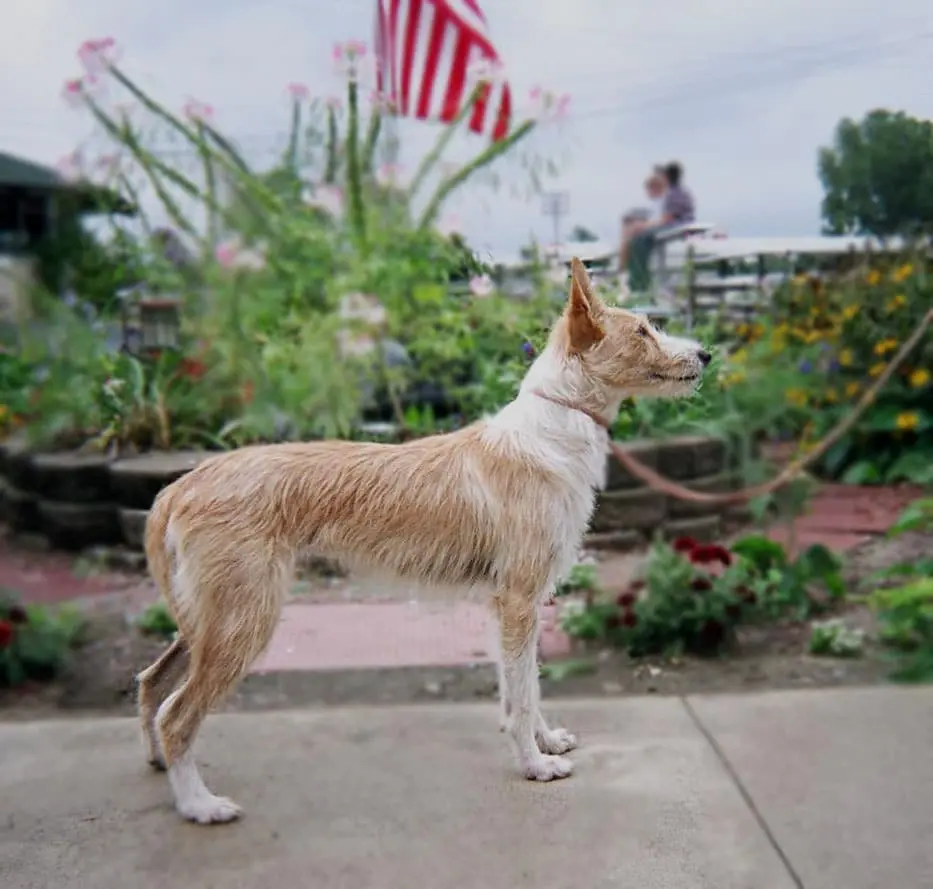
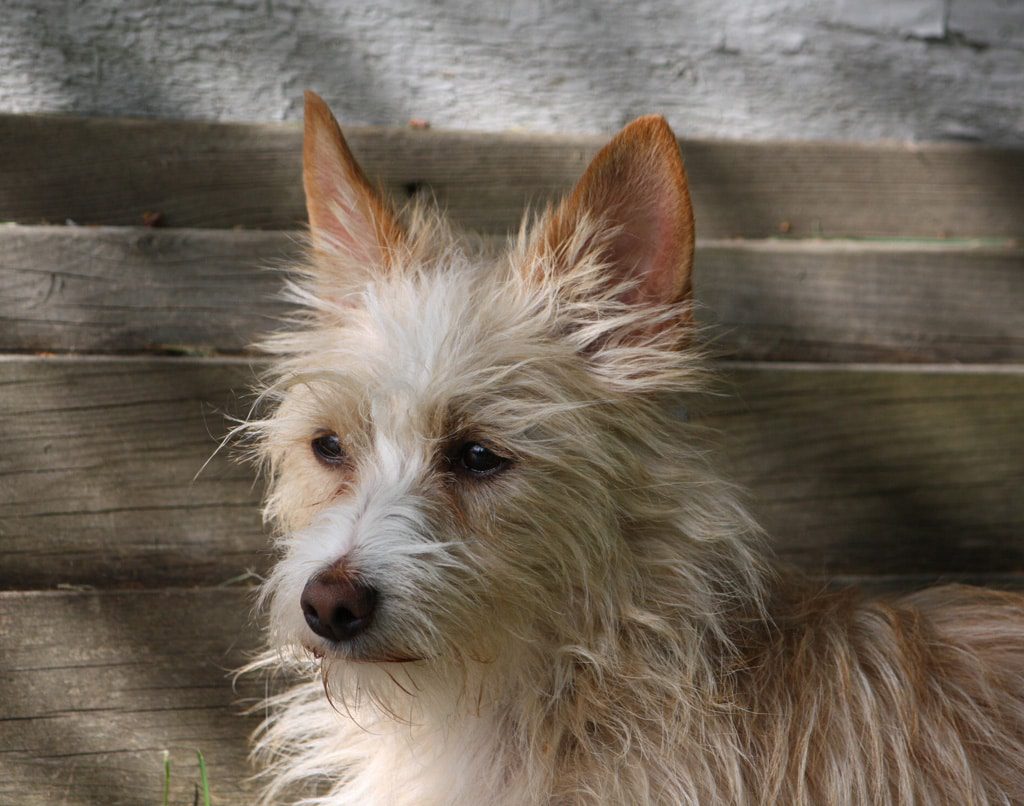
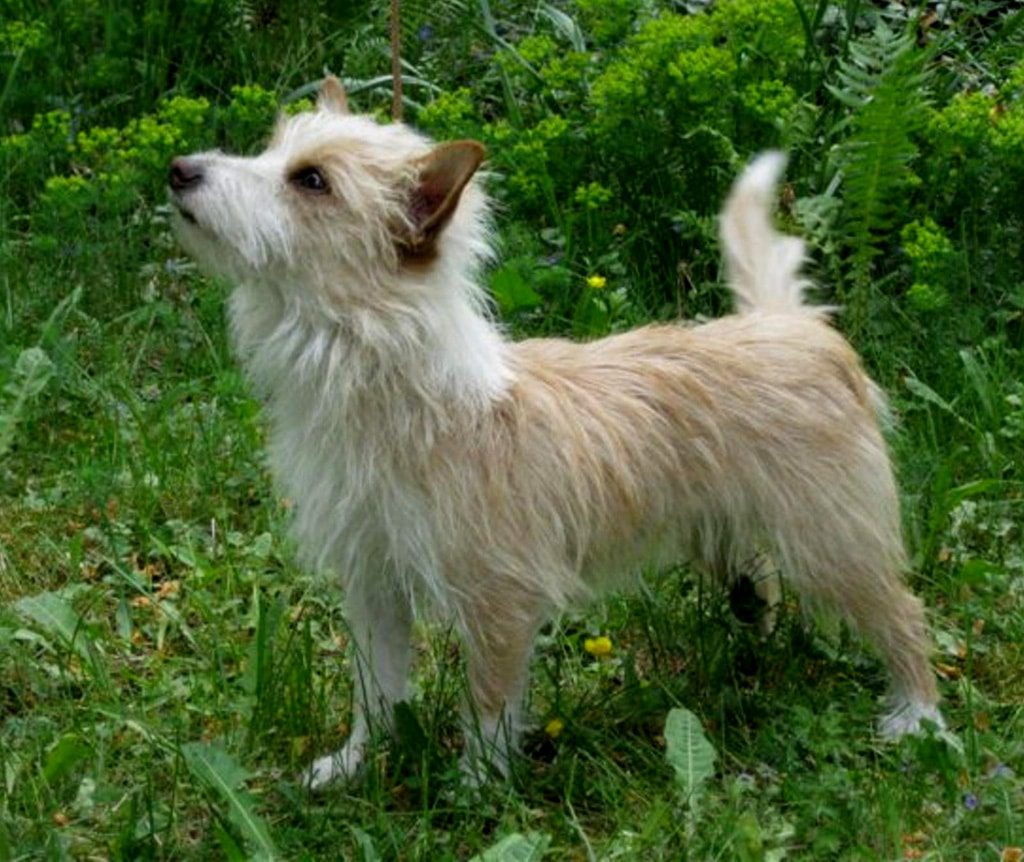
The Polish Hound it is quite widespread in Poland, while outside this country it is considered a rare breed.

Content

History

Originally from Poland, country to which it owes its current name, the Polish Hound it is a very old breed of dog, since it is believed that it appeared in the 13th century, although the first written records that mention it explicitly date from the 17th century. They are part of the group "Medium-sized hound dogs" and are believed to be the result of crossing between the St. Hubert Hound, German and Russian hounds and local Polish breeds. Polish nobles, fans of hunting parties, they were bred and used especially for hunting larger game.

Since the middle of the 19th century, the Polish Hound, which was very popular at that time, began appearing at dog shows in his native country. At that time, Poland was under Russian occupation, and the breed was bred mainly in the territory of present-day Belarus, which was then also annexed by Russia. After 1918, Poland regained its independence, but the brood of Polish Hound continued almost exclusively in the east of the country.

During World War II, due to successive invasions of Poland by Nazi Germany and then by the USSR, the breed saw its population decrease dramatically. After the war, Polish borders were redrawn; Poland, by losing the territories he owned in the east, lost the cradle of Polish Hound as well as all the remaining farms. No breeder took over the territory of the "new" Poland, and the race found itself on the brink of extinction.

She was eventually saved by a Polish colonel named Piotr Kartawik.. In 1959, created a kennel dedicated to him and reconstituted livestock from 4 dogs imported from Belarus. The first standard of the Polish Hound was written on the basis of individuals from this kennel and published in 1964.

The breed was officially recognized by the Fรฉdรฉration Cynologique Internationale (FCI) two years later, in 1966. But, the Polish Hound is not recognized by any other major canine organization and, although once again it is very widespread in Poland, still relatively rare in the rest of the world.

Photos: Polish Hound by Wikipedia

Physical characteristics

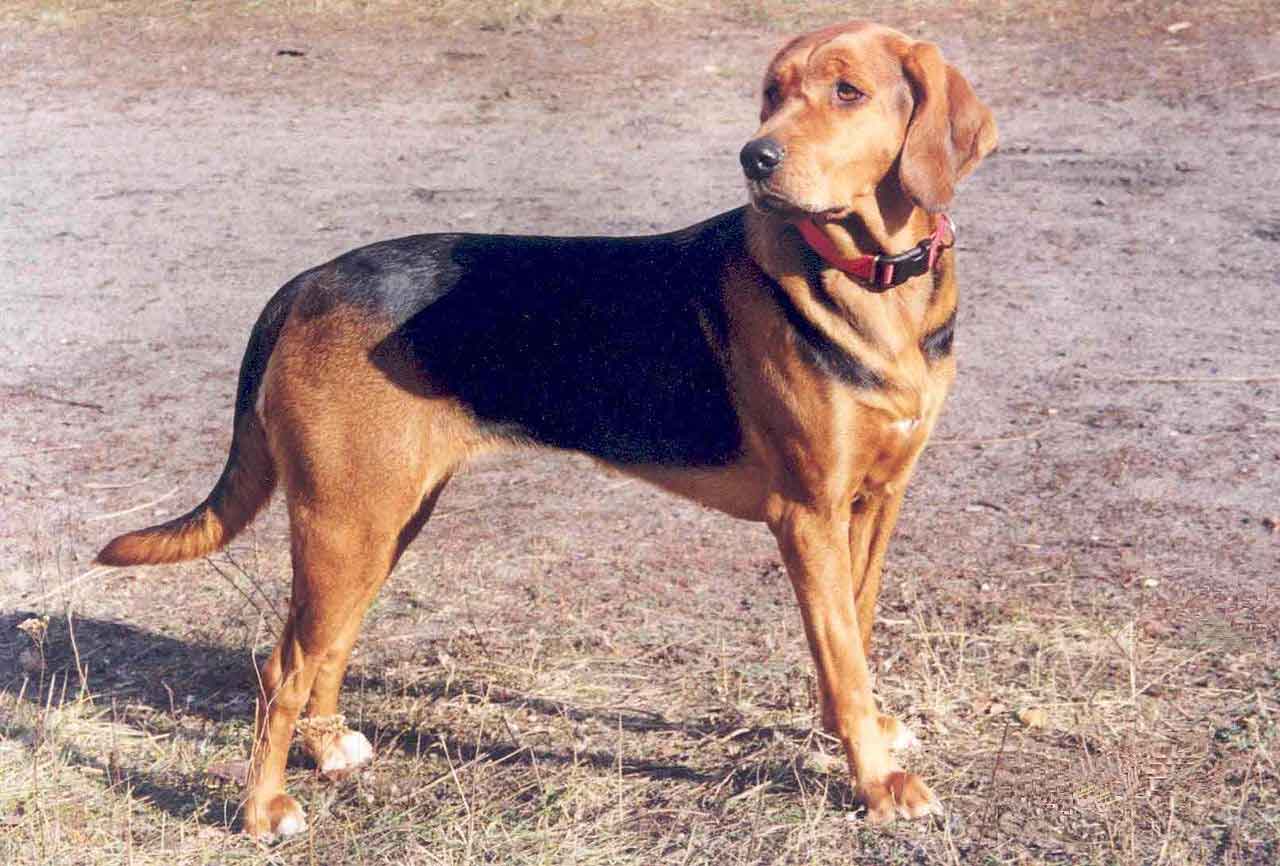
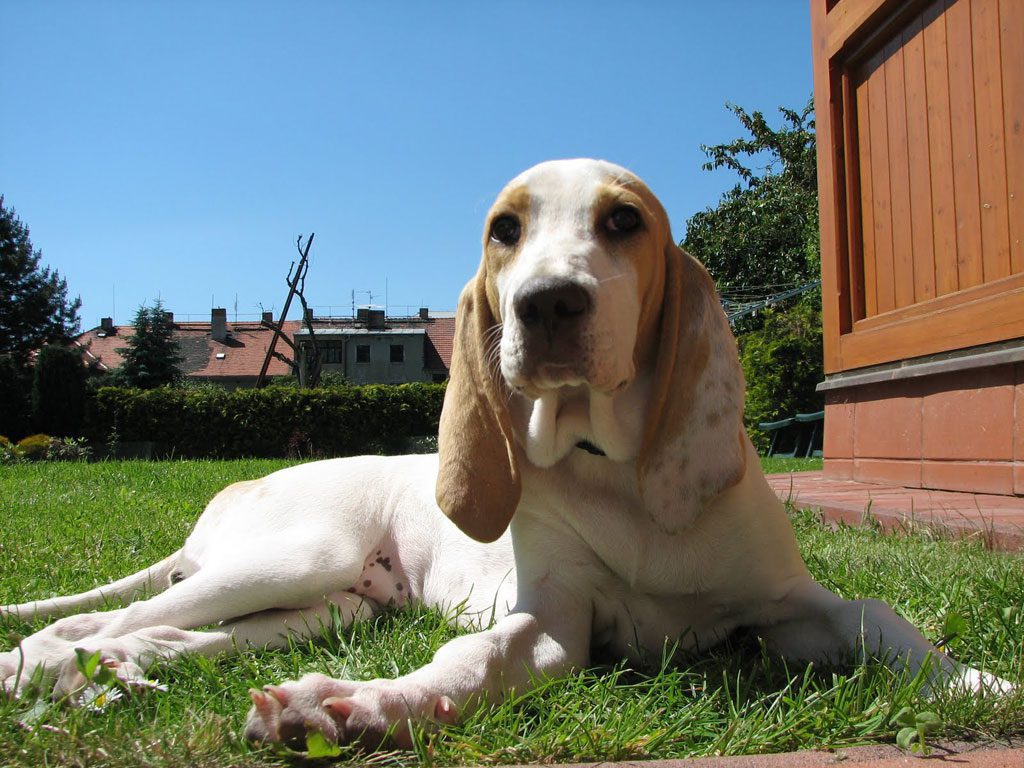
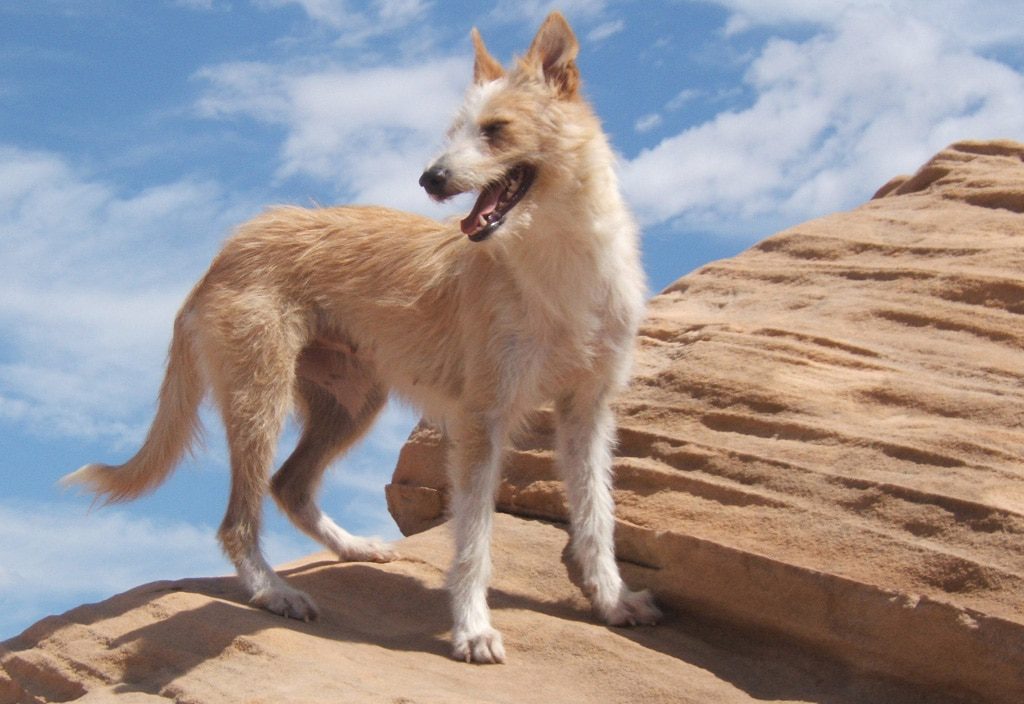
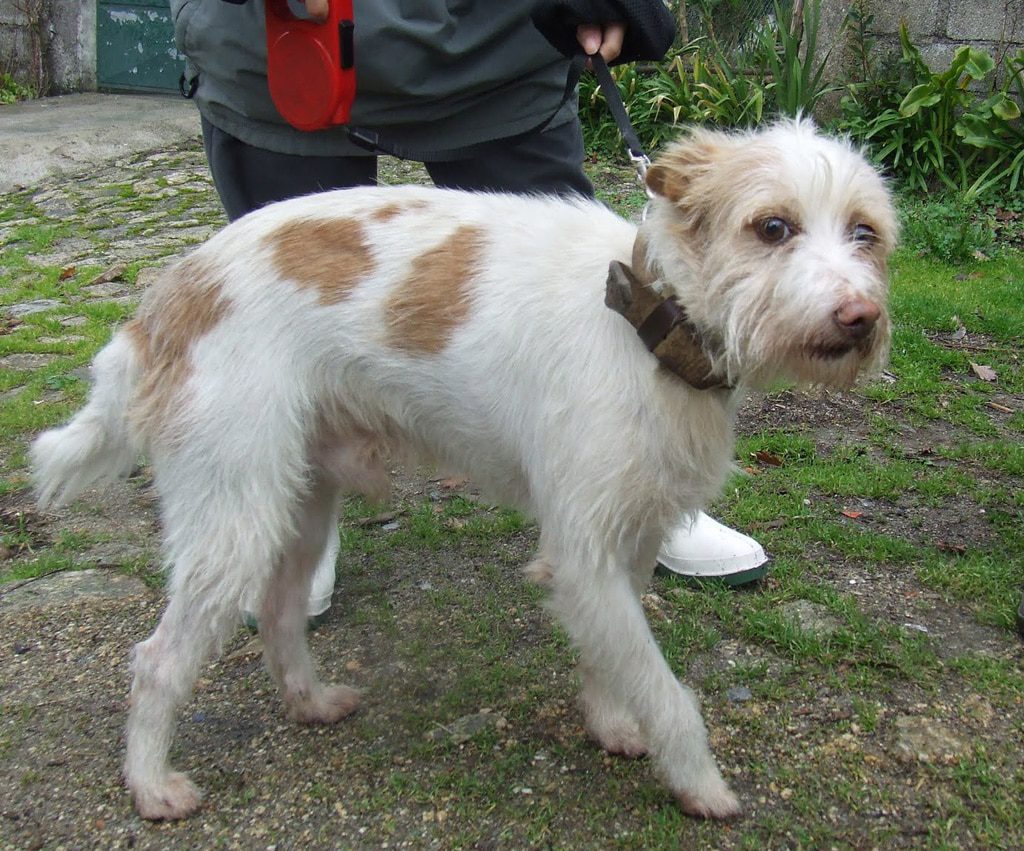
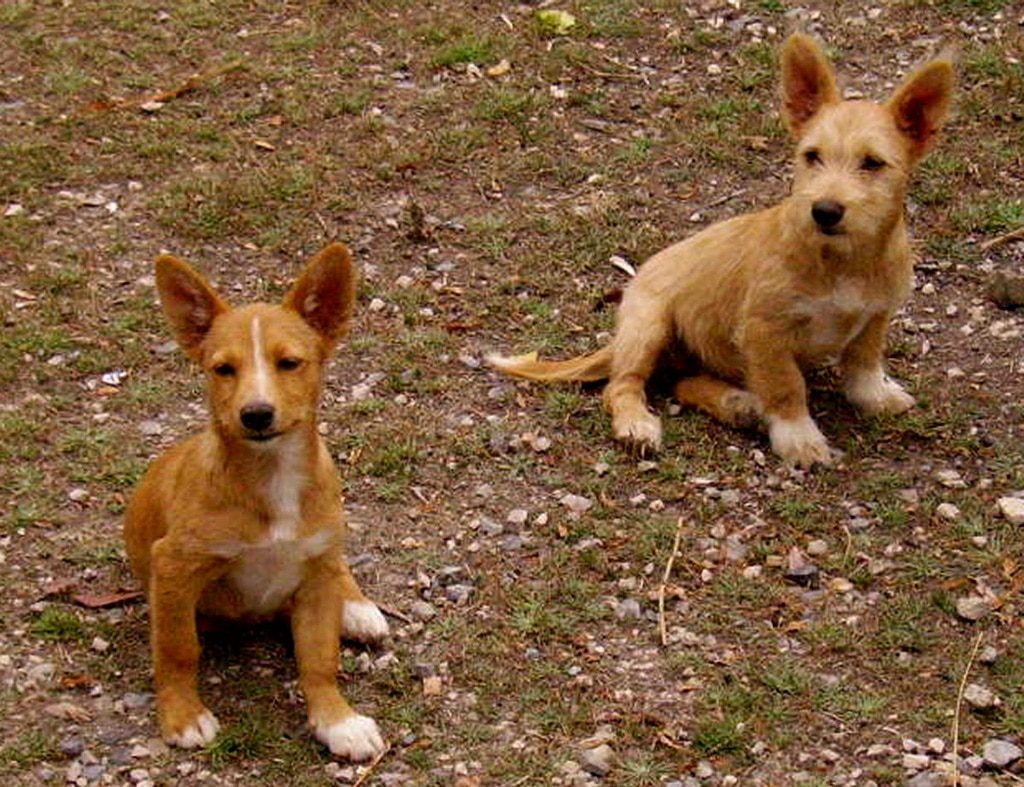
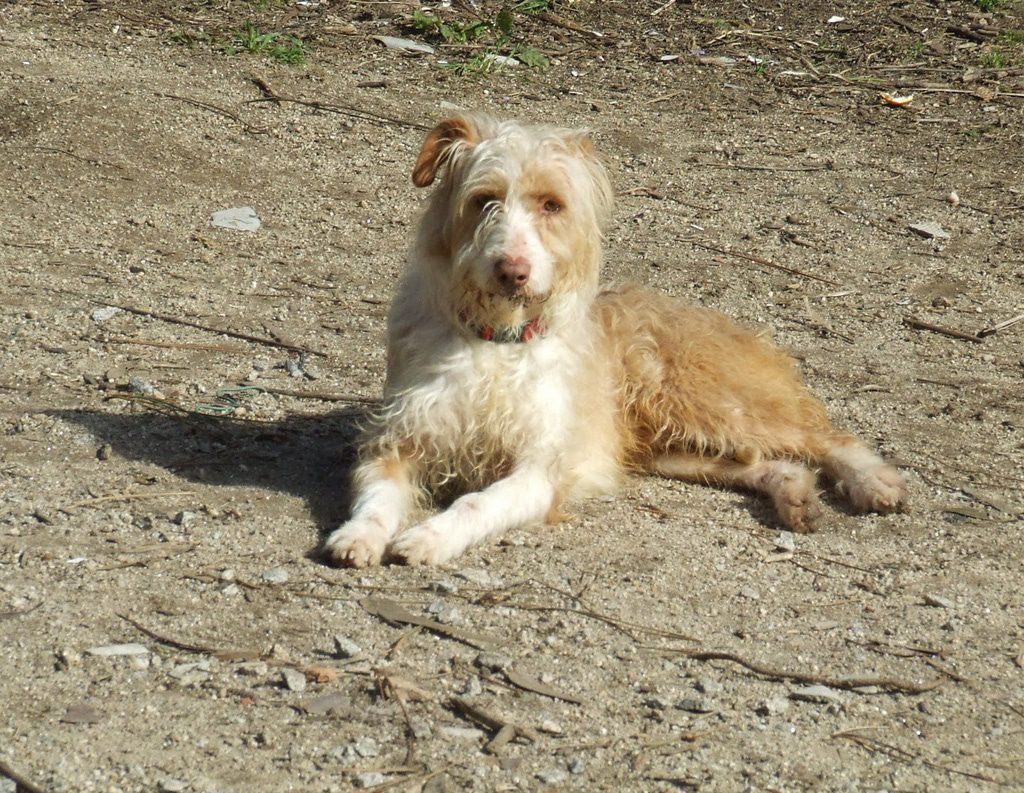
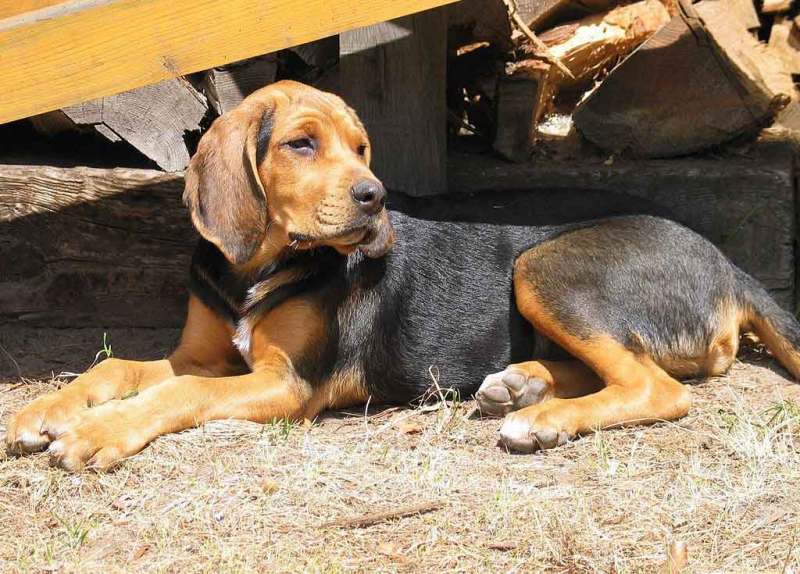
The Polish Hound he is a medium sized hound and companion dog. They are muscular, strong and compact, with mighty bones and a massive march, but without the impression of heaviness. They are better suited for endurance than speed.

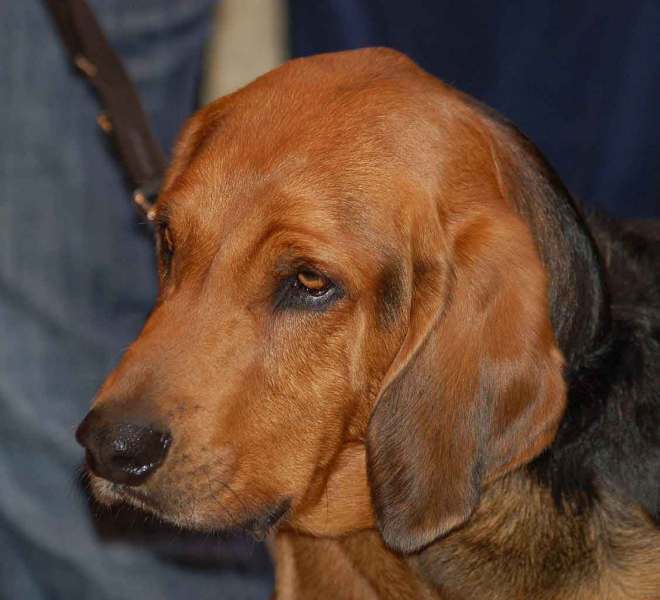
The head, quite heavy and chiseled, appears rectangular when viewed from the side. The occipital bone is very pronounced. The line of the forehead forms an obtuse angle with that of the muzzle., and the forehead has multiple wrinkles.

The Polish Hound has a strong, long jaw with a regular bite. The eyes are dark brown and almond-shaped, with a soft expression, slightly sunken and almond-shaped. Superciliary arches are marked. The snout is elongated and truncated at the tip. Rounded at the tips, the ears are low, hanging and quite long.

Low rise and slightly curved, the tail is thick and its lower part is provided with longer hair. Chest is wide, wide and proportionally deep.

The Polish Hound has a double layer (hair and undercoat) average length. This layer gives very good water repellency and protection against heat and bad weather., especially since the undercoat is thick. Hair is longer on the spine, on the back of the hind legs and on the bottom of the tail; is shorter and smoother on the muzzle and ears.

It's brown on the head, the ears (except the sides of the skull), the legs, sternal region and thighs, and black or dark gray on the rest of the body. Tan color can vary from red to brown, but the cinnamon tone is the most sought after. In any case, the separation between the two colors must be very clear. White markings on the chest are tolerated (even up to the muzzle) and on the tips of the legs and tail.

HEIGHT AND WEIGHT :

  • Height to the cross: Males: 56-65 cm., females: 55-60 cm..
  • Weight : Males : 25-32 kg, females : 20-26 kg.

    Character and skills

    The Polish Hound he is an affectionate dog, protective and very intelligent. And unlike most Poles and other hunting dogs, who are notoriously undisciplined and not very obedient, do not pose major training problems. This character trait makes them equally appreciated by hunters and families, as is the case with your neighbor, the Austrian Black and Tan Hound, a rare but obedient and easy to train breed that is also an exception. But, the Polish Hound tends to mature a little more slowly than other dogs, so it can be expected that he will maintain his youthful demeanor at 2 or 3 years of age.

    Naturally calm and friendly, they are excellent companions, loyal as much as possible, showing affection not only to adults, but also to younger dogs. Not only is he loving, kind and protective with them, but he is also very patient. This can create a great complicity between the dog and the child, since the latter learns from a young age to respect the animal and its needs. The Polish Hound It, therefore, a breed of dog adapted to children, even the very young.

    Reputed for being naturally vigilant and distrustful of strangers, without being aggressive, the Polish Hound develops protective instincts with age, leading him to actively defend those around him, whether they are the weakest, the youngest or the oldest. Facing intruders and armed with your unerring sense of smell, Polish hounds make excellent watchdogs, protecting without fail their masters and their properties, even though they weren't bred for it.

    They are sociable animals and generally enjoy the company of other dogs.. Can sometimes become a barker in your presence, without being prone to arguing with peers. His voice is powerful, melodious cases, and allows you to communicate with your master while hunting. The voice is deep in the male and quite high in the female.

    To the Polish Hound loves large expanses and wooded areas where he can fully express his hunting instincts. Not at all suited to apartment living, and is much more comfortable in the country than in the city.

    Developed for hunting and used to living in large spaces, must be walked for a long time and very regularly (on average two or three hours a day), even if you have access to a large garden. The ideal thing for him is to be able to accompany an active teacher during his exercises: footing, running and other sports outings will make you happy. On the other hand, if not asked enough, expect a long and frequent bark, meant to get attention.

    Education

    An obedient and intelligent breed, the Polish Hound it is relatively easy to train, since he is intelligent and quite obedient. They have a good memory and, as such, easily retain what they learn, without the need for a large number of repetitions. But, their education must be early and sufficiently balanced, mixing softness and firmness. He is particularly receptive to the method of positive education, what is the best way to educate him and make him obey.

    On the other hand, How can it take time to reach mental maturity (sometimes two or three years), it is important to be patient during your education, especially if we notice that you tend to lose concentration easily.

    Last, if the dog is to be used as a hunting dog, teaching the dog to remember should be one of the priorities in his training.

    Health and care

    The Polish Hound it is a strong and resistant breed of dog, does not present any significant risk in terms of possible predisposition to certain diseases. Like most older dog breeds, has robust health and is much less susceptible to genetic diseases that can affect newer breeds.

    In spite of this, due to its large chest and high level of activity, is quite susceptible to the development of dilatation-torsion syndrome of the stomach.

    It also, how much of their time is spent outdoors, especially if they are used as hunting dogs, are more susceptible to parasites (like ticks and fleas) and infections, as well as injuries and hunting accidents.

    Last, as with any dog โ€‹โ€‹with floppy ears, be careful with the risk of ear infections and inflammation.

    Care and maintenance

    The Polish Hound it is easy to care for because its coat is short and straight. Brushing your dog's coat once a week keeps it clean and removes dead hairs, especially during molting periods. Since molt periods are not very consistent, brushing every two or three days is usually enough.

    Because its beautiful waterproof coat does not get dirty easily, bathing is rarely necessary. In fact, In most cases, it is possible to clean the coat with a simple damp cloth. It also, washing your dog tends to remove sebum, which has many positive properties, so it should only be done when the coat is really very dirty.

    It also, it is necessary to check and maintain your dog's ears regularly, since it is quite prone to canine ear infections. One can take the opportunity to examine their eyes at the same time.

    Looking at its claws, they are supposed to wear out naturally during your outings. But, If that is not the case, You should clip your dog's claws from time to time..

    Last, when he comes back from hunting or walking, it is important to ensure that there are no ticks (the application of a preventive antiparasitic treatment is strongly recommended) and any injuries you may have sustained while running.

    Price of a Polish Hound

    The price of a puppy Polish Hound is between 500 and 700 EUR.

    Images "Polish Hound"
    Photos:

    1 – Polish hound by Wikimedia
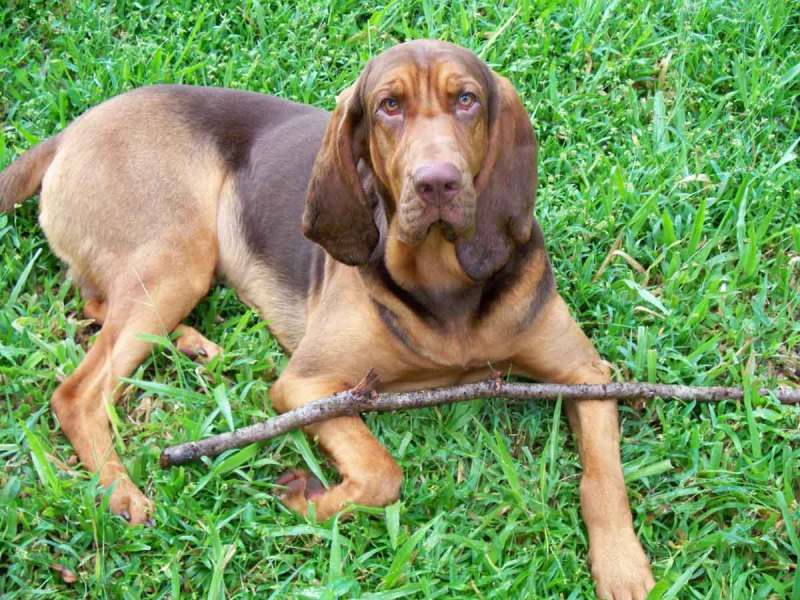
    2 – Polish Hound during dogs show in Katowice, Poland by Lilly M, CC BY-SA 2.5, via Wikimedia Commons
    3 – Polish hound by Wikimedia
    4 – Polish hound by https://pxhere.com/en/photo/1175414
    5 – Polish hound by Wikimedia
    6 – Polish hound by Wikimedia

    Videos "Polish Hound"

    POLISH HOUND THE OGAR POLSKI

    POLISH HOUND THE OGAR POLSKI
    A wise Polish hound

    Mฤ…dry ogar polski

    Type and recognitions:

    • FCI CLASSIFICATION:
    • Group :
    • Section : . .

    Federations:

    • – FCI – Group 6: Scent hounds, and related breeds. – Section 1.2: Medium-sized Hounds. โ“˜

    FCI breed standard "Polish Hound"

    Origin:
    Poland

    Date of publication of the valid original standard:
    25.02.1985

    Use:

    Hound


    General appearance:

    Medium-sized, robust and compact construction, strong and relatively massive bones; of provided limbs. As a whole, seen from the side, the body reflects strength and endurance more than speed. When the dog vents, his voice is clear, sonora, medium and shifting tonality; in the female, is usually sharper.
     
    IMPORTANT PROPORTION: The skull is the same length as the muzzle.


    Behavior / temperament:

    The Polish Hound, like all hounds, hunts prey on the hot track with a loud bark.. The voice is deeper in tone in the male and somewhat higher in the female.. The barking is called by hunters โ€œgiving the tongueโ€ and the noisy search for prey is described as โ€œchasing.โ€. This exceptional hunting dog is also an excellent family dog., easy to maintain, devoted to his home and cautious of strangers.

    Head:

    Pretty heavy, nobly chiseled. In profile it looks like a medium length rectangle.

    Cranial region:
    Skull: The line of the forehead forms an obtuse angle with the nasal cannula.. Superciliary arches highly developed. The forehead has numerous wrinkles. Very pronounced occipital bone.
    Depression links (Stop): Craniofacial depression is clearly observable.

    facial region:

    Truffle: black, big and wide.
    Snout: It is elongated and truncated at its tip; it is not even cuneiform, or pointed.
    Belfos: Thick and pendulums. Lower lip with hanging corner.
    Jaws / Teeth: Strong jaws, long enough; the joint is normal.
    Cheeks: With well developed muscles.
    Eyes: Sweet and calm expression. They are located obliquely, and not sunk in the orbits. They are dark brown. In older dogs the lower eyelids appear droopy.
    Ears: Low implantation. They are quite long, freely pendulous and slightly rounded at the tip. The lower part of the pavilion is in the shape of a corkscrew and is well attached to the head.

    Neck:

    Remarkable thickness at the point where it meets the trunk; is strong, muscular, medium length. The double chin is hanging and presents abundant skin with folds.

    Body:

    Back: Long, broad and muscled.
    Rump: Wide; not very fall.
    Breast : Spacious rib cage, wide, in high proportion. The sternum region descends to the elbows. The ribs are well sprung and long, like the whole rib cage. They are closer to the upright position than in the other breeds.
    Abdomen: Marked, spacious, almost as low as the rib cage. Not too collected. The flanks are not sunken; they are solid and rounded; with a possible depression under the last ribs.

    Tail:

    Quite low implantation. It is thick and is covered with long hair at the bottom. Reaches below the hock, and it is slightly fallen; from the middle of the leg length, is slightly bent. During normal dog movement, it is somewhat elevated, Although never screwed. When the dog runs, something is up, but without exceeding the horizontal.

    Tips

    PREVIOUS MEMBERS
    Shoulder: Oblique shoulder blade; well-developed muscles.
    Forearm: Pretty muscular bien.
    Carpo: Well marked, celebrities, clean, delgado, of a thickness corresponding to that of the metacarpus.
    Front feet: Of strong bones and muscles; fingers well together; strong nails, thick and short in working dogs. They are light in color when the fingers are white, and black when the fingers are tawny.
     
    LATER MEMBERS
    Thighs: Strong bones, long, vigorous and well developed muscles.
    Leg: Inclined; quite short. Well musculada.
    Hock: Delgado; well delineated.
    Metatarsus: It is slightly inclined.
    Rear feet: Fingers are good together. The pads are wide and are covered with thick integument. Thick nails, strong and short.

    Movement:

    Normally, the dog moves at a slow trot and heavy. during the hunt, while venting and following the prey, perform a heavy gallop.

    Mantle

    HAIR: Medium length, thick, with a dense undercoat of hairs. It is a little longer over the spine, on the back of the hind legs and on the underside of the tail.
     
    COLOR: Head and ears, except for the lateral faces of the skull, they are fire color; the ears are a little darker than the rest. The extremities, the sternum and thighs are also tan. The body is gray, or a dark gray almost black; In the old Polish hunting language it was called โ€œpodzaryโ€. (burned). The essentially reddish tan color presents various intensities of this tone, that go as far as cinnamon, which is highly appreciated in the Polish pointer. White hair, allowed in star shape, appears as a stripe that reaches the muzzle, over the pectoral region, the end of the limbs, and the tip of the tail. The black color forms a blanket that extends to the head. There are clearly defined tan spots over the eyes. The black color that extends over the nasal bridge of the Polish Hound is a case of disqualification.


    Size and weight:

    Height to the cross
    • In males : 56 to 65 cm.,
    • in females : 55 to 60 cm..
    Weight:
    • In males : 25 to 32 kg,
    • in females : 20 to 26 kg.


    Fouls:

    Any deviation from the above mentioned criteria is considered to lack, and the gravity of this refers to the degree of deviation to the standard and its impact on the health and well-being of the dog.
    • Insufficient musculature.
    • Hoarsely.
    • Occipital crest of head not pronounced enough.
    • Underdeveloped superciliary arches.
    • Too pointed snout; black snout.
    • Defective denture.
    • Eyes too light.
    • Ears too long or too short, or taken off.
    • Underdeveloped rib cage.
    • Fine tail, very short or very long, threaded, with little abundant hair.
    • Crushed pastern.
    • Crushed pads.
     
    Any dog โ€‹โ€‹showing clear signs of physical or behavioral abnormalities must be disqualified..


    N.B.:

    Males should have two normal-appearing testicles fully descended into the scrotum..

    Source: F.C.I - International Cynological Federation

    Alternative names:

    1. Ogar Polski, Polish (Ogar) Hound (English).
    2. (ogar polski en polonais), podzary (French).
    3. (Ogar Polski) (German).
    4. em polonรชs/polaco: Ogar Polski) (Portuguese).
    5. Sabueso de Polonia (espaรฑol).

โ–ท The world of Pets: Dogs, cats, birds, reptiles, amphibians

Porcelaine
Francia FCI 30 . Medium-sized Hounds

Porcelana

The Porcelaine It is a dog living in the family, is extremely friendly and affectionate.

Content

History

The origin of the breed is unknown Porcelaine, although it is probably the oldest dog breed in โ€œFranche-Comtรฉโ€. It is said to descend from the great "white dogs of Saint-Hubert de Lorraine", themselves descendants of the "royal white dogs" used in royal packs in the time of Francis I. Before the French Revolution, the white and orange hounds were present on the lands of the abbeys of Luxeuil and Cluny.

After the revolution, the breed was close to extinction, breeding resumed in the mid-19th century with the help of Swiss breeders. In 1844, Similar dogs were called ยซbriquets francs-comtoisยซ. The porcelain name is said to have been given by the Marquis Thรฉodore de Foudras.

Already in 1898 his race was consolidated. As of this year he could be found in exhibitions.

The slim build and the noble head are also witnesses to this tradition. In times past the breed was used especially for hunting. This happened especially in Switzerland, France and Italy. There these tracking dogs have been found for centuries.

Physical characteristics ยซPorcelainยป

It's a dog very striking within the French dogs, its own structure gives us the pattern that is the great race.

As shown in the canine group for which they are registered by the Federation Cynologique Internationale, is a Hound of median sizeto. Males have one height the cross of 56 to 58,5 cm and the females of between 53,5 and 56 cm., weighing between 25 and 28 kg.

Videos ยซPorcelainยป

Porcelaine puppiesPorcelaine puppies

The name Porcelaine He was born in allusion to his bright clothes, It seems made of porcelain. Its skin is white, sometimes with orange spots, most common in ears.

The eyes are dark and have a loving gaze and intelligent. The ears they are fine and well retracted, they often end in a tip and reach the end of the snout.

The nose is black with large nasal Windows, It has black eyes and ears that fall, similar to the Labrador.

The neck It is long and the tail starts thick and just fine, It is quite long and the dog carries slightly curved.

The hair thick fine is glossy and satin, There must not be any part of the body hairless.

The color the fur is white. You can submit Orange stains of rounded shape that we extend never forming a mantle, these spots appear many times overlapping other dark spots on the skin.

Character and skills ยซPorcelainยป

The Porcelaine It is a bloodhound, that is to say, dogs that search for prey and due to its characteristics it is valid to search for any type of wild animal.

It has a strong character, energetic, very willful and obstinate when he is hunting. But, When it is at rest is a very be quiet.

If you live within the family, is extremely friendly and loving. He is patient and well tolerated in children.

They have a very high level of activity, so he needs a lot of exercise, reason why is not recommended for sedentary people.

Although they are fierce hunters, they are gentle and relatively easy to educate.

Care of the ยซPorcelainยป

the care of him Porcelaine not related to their fur so much. The short-haired breed requires little effort in grooming. But you should pay close attention to your surroundings. A small flat doesn't always do it justice. There your needs are not met.

But it is not necessary to have a country house to maintain this beautiful breed.. Several walks a day can also keep dogs busy.. This shows that dogs need variety and tasks. Also the game should be in the task list.

Finding the right โ€œPorcelainโ€ breeder

If you are interested in this breed of dog and want to find the breeder of Porcelaine suitable, you may have to search for a long time. This breed of dog is rarely found. It also, cubs are often only given to hunters.

Images of โ€œPorcelainโ€

Type and recognitions:

  • FCI CLASSIFICATION:
  • Group :
  • Section : . .

Federations:

  • – FCI – Group 6: Scent hounds, and related breeds. – Section 1.2: Medium-sized Hounds. โ“˜
  • – Central Canine Society โ“˜

FCI breed standard "Porcelaine"

Origin:
France

Date of publication of the valid original standard:
19.10.1964

Use:

Hound


General appearance:

Dog used for hunting small game, very distinguished, absolutely french. All the details of its structure underline the nobility of its breed.


Behavior / temperament:

---

Head:

It must be very typical of the breed, thin and delicately sculpted. As a whole is rather long.

Cranial region:
  • Skull: It is wide at its height, between the ears; the occipital Protuberance is rounded. The forehead is flat; the median furrow must be marked, but without exaggeration.
  • Depression links (Stop): Marked, but without excess.

facial region:

  • Truffle: Well developed and very black. The Windows are wide open.
  • Snout: Long appropriate, Neither square nor pointed. The nasal helm is straight, but its end is slightly arched.
  • Lips: The upper lip covers the lower lip without being heavy or pendant. The mucosa of the lips is black.
  • Eyes: Normally developed, They must be looking dark and well protected under the cigomatica arch. The look is intelligent and sweet.
  • Ears: They are thin and well bent. They end up more on tip and reaches to the end of the snout. Its narrow insertion should not be above the eye line.

Neck:

It is quite long and lightweight. It may be some dewlap which must be thin and tight appearance.

Body:

  • Cross: Well outgoing.
  • Back: Wide and straight.
  • Pork loin: Width, well muscled, well together as a whole and not too long.
  • Rump: Somewhat oblique. The tips of the legs are wide apart and slightly protruding.
  • Breast : Amplitude medium, also rather deep. The ribs, in accordance with the chest, they are rather elongated, without being flat.
  • Flanks: Something raised, but full.

Tail:

It is well attached to the body. It is quite thick at the root and pointed at the end. Is never thin and medium length (without presenting to tip around the tail long and thick hairs slightly distant in the form of stem). It is carried slightly stooped.

Tips

PREVIOUS MEMBERS: They are quite long and thin, Although not too thin; tendons are well connected; the limbs are regular.

  • Shoulder: Shoulders of Jockey, long, well muscled and well inclined, though not too thick.

LATER MEMBERS:

  • Thighs: Well descended, very visible and thin muscles, moderately developed.
  • Hock: Fort and close to the ground. Usually angled.

FEET: Typically for a French dog rather elongated toes, thin but well together; hard and resistant pads.

Movement:

Executed with vitality and agility; easy and indefatigable Gallop.

Mantle

SKIN: Thin and elastic. She is grainy with numerous black spots.

HAIR: Satin, fine, tight and shiny; spotless alopecia.

COLOR: Very white, stained rounded Orange never extends in the form of blanket. These spots are usually overlapping other black spots of pigmentation of the skin. The orange splashes on the ears are very characteristic of this breed..


Size and weight:

You can vary:

  • for males between 55 and 58 cm.,
  • for females between 53 and 56 cm..


Fouls:

Any deviation from the aforementioned criteria is considered as a fault and the severity of this is considered to the degree of the deviation to the standard and its consequences on the health and well-being of the dog..

MISS PLAYOFFS:

  • Cowardice, aggression toward owner.
  • Lack of type.
  • In general all the defects that prevent the use of the dog, such as rickets, defective limbs in excess, insufficient movement range and push.
  • Eyes and nose color clear, excess of depigmented spots.
  • Tail iguanas.
  • Coarse or thick hair.
  • Presence of an orange blanket.
  • A very raised orange spots, pulling to mahogany, grey or mixed with black hairs. The light orange color, but pale and the same lack of spots are not desirable, but they can not be considered eliminatory faults.
  • Size that exceed or that does not reach the above measures. But, You can make an exception with a male that does not exceed a maximum 60 cm., Therefore, it presents excellent general characteristics and can be used as a player..
  • Any dog โ€‹โ€‹showing clear signs of physical or behavioral abnormalities should be disqualified..


N.B.:

Males should have two normal-appearing testicles fully descended into the scrotum..

Source: F.C.I - International Cynological Federation

Alternative names:

1. Chien de Franche-Comtรฉ (English).
2. Chien de Franche-Comtรฉ, briquets francs-comtois (French).
3. Chien de Franche-Comtรฉ (German).
4. Porcelaine (Portuguese).
5. Perro del Franco Condado (espaรฑol).

โ–ท The world of Pets: Dogs, cats, birds, reptiles, amphibians

Peruvian Hairless Dog
Perรบ FCI 310 . Primitive type

Peruvian Hairless Dog

The Peruvian Hairless Dog is a friendly and adaptable companion.

Content

History

The exact origin of the Peruvian Hairless Dog. But, their ancestors seem to be deeply rooted in Peru: Illustrations on the vessels of Moche culture, show hairless dogs already in the 750 AC. Later, these funny animals were reserved for the rich Incas, who took care not to mate them with other native dogs. It was also the Incas who prohibited the consumption of dog meat in the northern regions of Peru..

When the Spanish conquered the country, they found many naked dogs among the orchids of the Incas, so the Europeans called them ยซperros de las floresยซ. During the period of conquest, the breed was almost extinct, but some specimens survived in remote villages where the inhabitants valued them for the partly mythical qualities attributed to them: Because of its special appearance, four-legged creatures were said to have a healing effect on certain diseases, for example, bone and joint diseases.

In 1985, the world's largest dog breeding organization, the Federation Cynologique Internationale (FCI), recognized the Peruvian Hairless Dog as an independent race. So Today There Are Officially Three Naked Dog Breeds. Besides of Peruvian Hairless Dog, these are the Mexican Naked Dog, also known by the beautiful name of ยซXoloitzcuintleยซ, and the Chinese Crested Dog. The three races are closely related to each other.

Physical characteristics

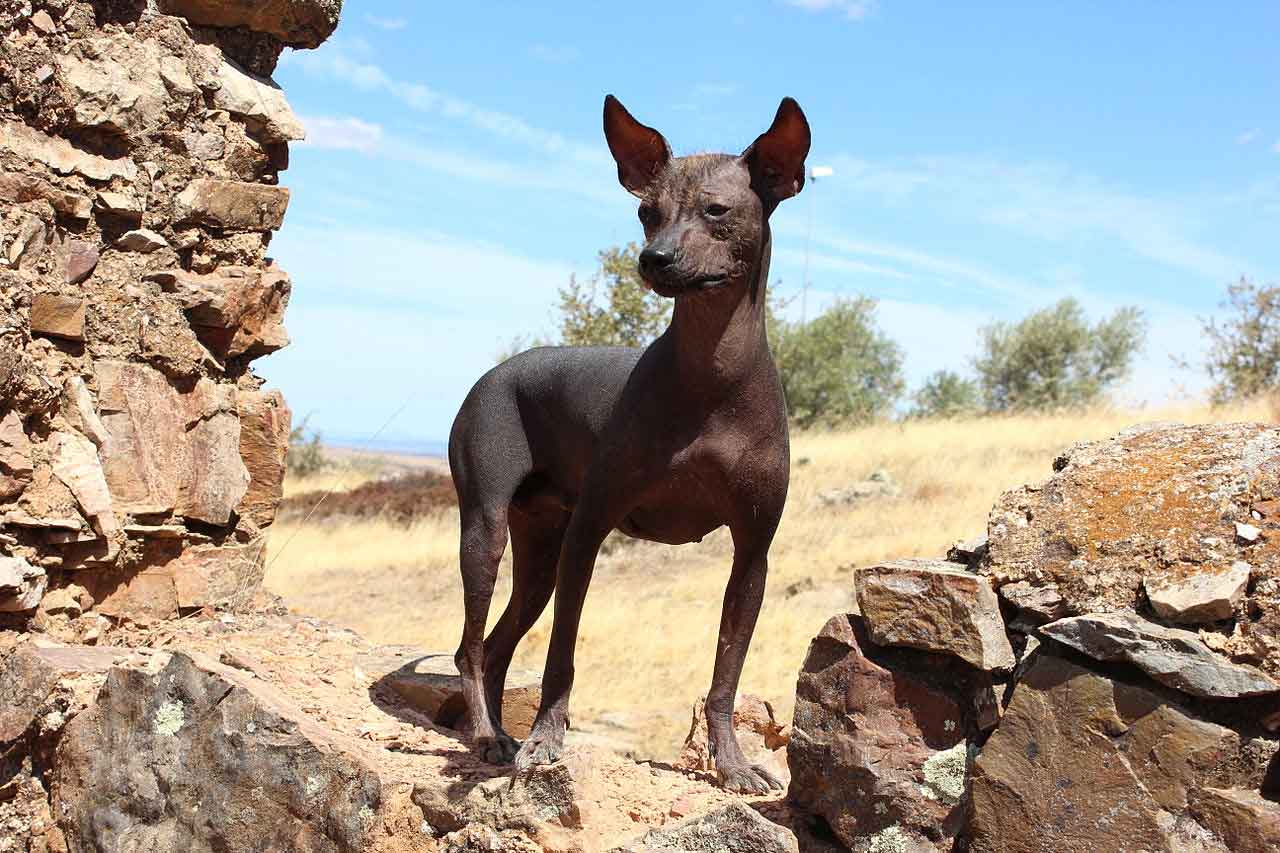
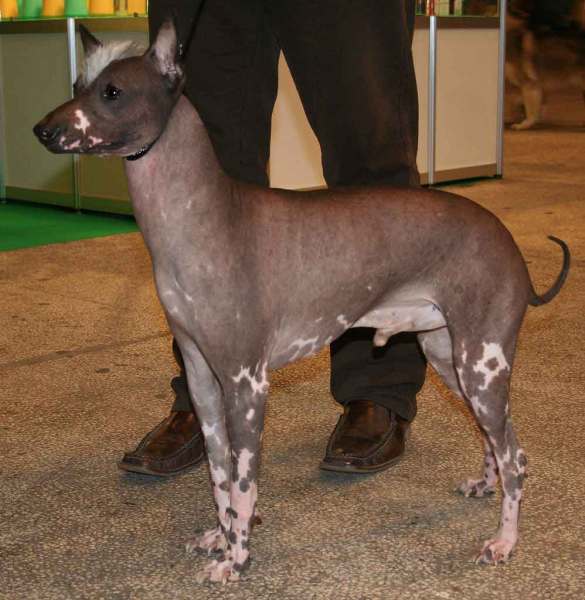
The name says it all: The most striking of the most Peruvian Hairless Dogs that's what's missing: the coat. But, the standard allows for some locks on the head and tail even in naked dogs without hair. Skin can be light or dark in different shades of color, smooth or white-spotted. But, not all naked dogs are naked, because there's a variant with hair: the so-called "hairy", which are essential for breeding for health reasons. About a third of naked dogs belong to this group.

Since 2013 hairy variants can also be seen in canine exhibitions, since they have been added to the standard. Your hair should be short and soft, all colors are allowed. The Peruvian Hairless Dog reminiscent of greyhounds in their physique. This slender breed of dog has large erect ears that can rest back, an elegantly curved and hanging tail and an athletic complexion.

Naked dog lovers can enjoy three size variations:

– The small version has a shoulder height of 25 to 40 cm..
– The median 40 to 50 cm..
– The Greats Peruvian Hairless Dogs have between 50 and 65 height cm.

The weight varies according to 4 to 25 kg. Only a few Peruvian Hairless Dogs have a full denture, but these usually include all representatives of the furry variant.

Character and skills

The Peruvian Hairless Dog is a friendly and adaptable companion. He prefers to be with his human with the one who has a close relationship. It belongs to very sociable dogs. He likes to integrate into a family and quickly befriends other pets and children. It is said that many Peruvian Hairless Dogs protect fervently, especially the women and children of the herd. Here it is important to be careful when visiting children that the Peruvian interprets offensive situations for his protรฉgรฉ and rushes to help his little two-legged friend unnecessarily..

Vivacious and curious, is a wonderful companion for outdoor activities, but behaves calmly and relaxed inside. He especially likes to get comfortable on his owner's lap and enjoys closeness and warmth.. To strangers he is often distant and alert, but not aggressive.

Education

Like a dog of the original type, the Peruvian Hairless Dog it also provides original behavior in the man-animal relationship. That's why it makes sense in educational matters if you already have any experience with dogs. But, even ambitious beginners can successfully train a Peruvian Hairless Dog. Clear rules and consistency are, as in most dogs, the key to success.

The Peruvian Hairless Dog is a sensitive four-legged friend – hard you'll only get the opposite with it – will retire. Some Peruvian Hairless Dogs tend to get scared or fear new situations. So, it is especially important to train this dog extensively and at the right pace to different situations without overloading it.

Your breeder will be able to give you some advice when you buy a puppy. Whether on a train journey, on a trip to the city center or on a visit home, introduce your partner into these everyday situations since you're a puppy. Regular training at a canine school, preferably already with the young puppy in the form of playgroups for puppies, is highly recommended and also reinforces the social side of the Peruvian Hairless Dog.

Breeding of the โ€œPeruvian Hairless Dogโ€

As already mentioned, during mating a special health feature should be taken into account: during breeding, the furry ones, that is to say, hairy representatives of the breed, should be crossed regularly. The reason for this is that the dominant allele of hairlessness can only lead to viable embryos in combination with a hair allele, that is to say, Heterozygosity. Homozygous hairless embryos are already reabsorbed in the uterus. As pure breeding for hairlessness is therefore not possible, hairless naked dogs also occur over and over again.

The Peruvian Hairless Dogs they usually have an incomplete denture, what doesn't usually restrict them. With the light-skinned specimens, especially at the beginning of summer, it's important to make sure they get used slowly in the sunlight, then tanning. Sun protection also makes sense, because otherwise dogs can develop severe sunburn, especially when they like to go to sunny places. Also in winter some specimens need protection from the weather in the form of a dog coat., because if they can't run, cool down quickly during normal ride. Smaller variants of the breed are more sensitive to this than larger ones.

One Peruvian Hairless Dog can reach an age of up to 15 years.

Care

With the naked representatives of the breed you can leave the comb with confidence. It also, has the great advantage that it can normally detect parasites in the skin of the Peruvian Hairless Dog immediately and apply appropriate antidotes – from tick tweezers to flea repellent. But, even the Peruvian Hairless Dog needs regular care. If required – some owners recommend once a week – wash it with a sponge and a mild dog shampoo. Some Peruvian Hairless Dogs tend to have dry skin, which can be remedied with soft moisturizers for fragrance-free babies or with olive or coconut oil. In summer, sunscreen is an indispensable tool for light-colored dogs. Cut the claws of your Peruvian Hairless Dog if they get too long and clean your four-legged friend's ears with a dog ear cleaner if necessary.

Buy a โ€œPeruvian Hairless Dogโ€

The Peruvian Hairless Dog are rare in Europe and therefore breeders are rare. Find the appropriate umbrella organizations in your country, that can help you in your search. In Germany, for example, el Club for Exotic Breed Dogs e.V. has a list of breeders, In Switzerland there is a "Swiss Naked Dog Club of Latin America", which is dedicated to the promotion of the two breeds of dogs: the Xoloitzcuintle and the Peruvian Hairless Dog. In these clubs and similar ones you can find information and contacts of ambitious breeders. Considering possible adoptions across national borders, consider what to consider when adopting puppies from abroad.

As a fan of naked dogs, you probably know the closely related races, the Xoloitzcuintle and the Chinese Crested Dog – perhaps one of these dogs could also be an option for you and is more likely to be found in your region. It also, openness to the other two races, as well as the crossings, it's usually a good idea if you want to give a home to a naked older dog. This usually requires some research. But in the meantime, Keywords like โ€œnaked dogs in distressโ€ on the Internet promise successes that lead adult naked dogs to look for a new place to live. Try to find out as much as possible about the story of your potential new fourth-legged partner.

Characteristics "Peruvian Hairless Dog"

Coexistence is important that you have with your new friend. Before considering the acquisition of a dog of the breed "Peruvian Hairless Dog" you know certain factors. Not all breeds of dogs are apt to live in an apartment, you must take into account his character, their need for exercise, their interaction with other pets, their care and if you have small children, their level of tolerance towards them.

Training ?

4,0
4,0 of 5 stars (based on 30 reviews)
Great
Very good
Media
Mala
Very bad

Suitability of the apartment ?

3,0 of 5 stars (based on 1 review)

Can be alone all day ?

2,0 of 5 stars (based on 1 review)

Suitable as a first dog ?

3,0 of 5 stars (based on 1 review)

Weight gain ?

3,0 of 5 stars (based on 1 review)

Health ?

3,0 of 5 stars (based on 1 review)

Intelligence ?

3,0 of 5 stars (based on 1 review)

Kindness with child ?

3,0 of 5 stars (based on 1 review)

Tendency to bite ?

2,0 of 5 stars (based on 1 review)

Tendency to bark ?

3,0 of 5 stars (based on 1 review)

Tendency to flee ?

2,0 of 5 stars (based on 1 review)

hair loss strength ?

1,0 of 5 stars (based on 1 review)

Suitable as a guard dog ?

3,0 of 5 stars (based on 1 review)

Joy ?

3,0 of 5 stars (based on 1 review)

Cat friendliness ?

3,0 of 5 stars (based on 1 review)

Power level ?

3,0 of 5 stars (based on 1 review)

Images "Peruvian Hairless Dog"

Photos:

1 – ยซHairless dog of Peruยป by Paradais Sphynx, CC BY-SA 3.0, via Wikimedia Commons
2 – ยซHairless dog of Peruยป by No machine-readable author provided. Manuel Gonzรกlez Olaechea assumed (based on copyright claims)., CC BY-SA 3.0, via Wikimedia Commons
3 – ยซHairless dog of Peruยป by Carlos Adampol Galindo from DF, Mexico, CC BY-SA 2.0, via Wikimedia Commons
4 – ยซHairless dog of Peruยป by Marina Alonso Esparrรฉ, CC BY-SA 4.0, via Wikimedia Commons
5 – ยซHairless dog of Peruยป by Carlos Adampol Galindo from DF, Mexico, CC BY-SA 2.0, via Wikimedia Commons
6 – ยซHairless dog of Peruยป by Carlos Adampol Galindo from DF, Mexico, CC BY-SA 2.0, via Wikimedia Commons
7 – ยซHairless dog of Peruยป by Pleple2000, CC BY-SA 3.0, via Wikimedia Commons

Videos "Peruvian Hairless Dog"

PERUVIAN DOG : The story of the VIRINGO dog, the mascot of ancient Peru

THE PERUVIAN HAIRLESS DOG - STRANGE OR CUTE?

Type and recognitions:

  • FCI CLASSIFICATION:
  • Group :
  • Section : . .

Federations:

  • – FCI – Group 5: Spitz-type dogs and primitive type – Section 6: Primitive type. โ“˜

FCI breed standard "Peruvian Hairless Dog"

Origin:
Peru

Date of publication of the valid original standard:
08.10.2012

Use:

Companion dog


General appearance:

According to its general confirmation, it is a slender and elegant specimen., whose aspect expresses speed, strength and harmony without appearing crude.
This breed's fundamental characteristic is the absence of hair on the body.. Another of its peculiarities is that its teeth, almost always, is incomplete. Of noble and affectionate character with those at home; reserved with strangers; awake, alert and guardian.

important proportions:

The relationship between the height at the withers and the length of the body is 1:1, allowing the body of the females slightly longer than that of the males.


Behavior / temperament:

Noble and affectionate with those at home while remaining awake and alert. In the presence of strangers, becomes suspicious and guardian.

Head:

Lupoid conformation.

Cranial region:
  • Skull:Mesocephalus. Ortoide (the direction of the superior cranio-facial axes is parallel), accepting slight divergence. The skull seen from the top is wide, tapering towards the nose.. Superciliary arches are moderately developed. The occipital crest is poorly marked.
  • Depression links (Stop): Bit strong (approximately 140ยฐ).

facial region:

  • Truffle:The color of the nose should harmonize with the color of the skin, in its various shades.
  • Snout:In profile, maintains a straight line.
  • Lips:The lips should be as tight as possible and adhere to the gums..
  • Jaws/Teeth:The incisors should fit for a scissor bite and the canines are normally developed. The absence of one or all pre-molars or molars is allowed. The jaw is poorly developed.
  • Cheeks:Normally developed.

Eyes:Of attentive and intelligent expression. They should be medium in size, slightly almond shaped, or sunk or bulging, with a normal and regular location, that is to say, neither too close nor too far. Color may vary from black, going through dark brown and in descending tones to yellow, harmonizing with skin color. In all cases both eyes must be the same color. The color of the eyelids may be from black to pink for specimens whose facial area is light, allowing those of light or pink colors but not being the most recommended.

Ears:The ears should be erect in attention, while at rest they are glued back. The ears are medium long, wide at the base and gradually tapering to an almost pointed end. Its insertion begins on the top of the skull, ending laterally and obliquely. The axes of the ears in the erect position can vary their angle relative to each other, approaching 90ยฐ.

Neck:

  • Top profile:Arcuate (convex).
  • Length:About the same length as the head.
  • Form:Looks like a truncated cone. Flexible and well-muscled.
  • Skin:Fina, smooth and elastic. Intimately adhered to the subcutaneous tissue. No double chin.


Body:

Mesomorfo.

  • top line:Rectilinear, although certain specimens mark a dorso-lumbar convexity, getting lost with the rump.
  • Cross:Little pointed.
  • Back: Rectilinear top profile, with well-developed back muscles, forming in many cases a muscular biconvexity along the entire dorsal region, extending to the lower back.
  • Pork loin:Must be strong and muscular. Its length is approximately 1/5 the height at the withers.
  • Rump:The upper profile is slightly convex. Its inclination with respect to the horizontal, makes an angle of approximately 40ยฐ. Solid and muscular in shape, ensuring a good push.
  • Breast :The chest seen from the front will have good width without being excessively, descending almost to the elbow. The ribs should be slightly arched and never flat. The perimeter of the chest measured behind the elbows should be approximately 18% greater than the height at the withers.
  • Lower profile / Belly:The lower profile is formed by a well-marked elegant line, starting at the lower part of the chest and determining in the ventral retraction, which should be well delineated without being excessive.

Tail:

The tail is set low. Good thickness at the start, tapering to the tip. In a state of action, the tail may rise forming a curve without actually curling over the back.. At rest he wears it hanging with a light hook with the tip up. Sometimes it is tucked into the belly. Its length will come close to the hock. The queue must be full.

Tips

Former members

Well attached to the trunk; viewed from the front will be perfectly plumb, not sticking out elbows. Your scapulo-humeral angle will range between 100ยฐ and 120ยฐ.
Side views, the resulting angle between the pasterns and the vertical is between 15ยฐ to 20ยฐ.

  • Front feet:Semi-lengths approaching the hare's foot. The pads are strong and heat resistant. The interdigital membranes are well developed. Preferably, the nails are black in the black specimens and clear in the lighter specimens.

Later members

The muscles are round and elastic. The curvatures of the buttocks are evident. The coxofemoral angle should be between 120ยฐ to 130ยฐ. The femoral-tibial angle should be 140ยฐ. The limbs seen from behind are well plummeted. The dewclaws must be removed.

  • Rear feet:Equal to the forwards.

Movement:

Due to the angulations already described in the structures of its members, these specimens move with a shorter but faster pace and at the same time quite cushioned and flexible.

Mantle

Skin: The skin will be smooth and elastic over its entire body surface, being able to form certain surrounding and almost concentric lines on the head, around the eyes and cheeks. It is proven that the internal and external or dermal temperature, is exactly the same as the other races. The absence of fur results in a totally direct emanation of heat unlike the specimens with hair, in which heat is dissipated through them by natural ventilation.

Fur: For being a naked race, will be missing cover, admitting vestiges of hair on the head, at the tip of the limbs, the tip of the tail and sometimes some very thin hairs on the back.

Color: The color of the hairs may vary from black to black specimens., black slate, black elephant, bluish-black, full range of gray, gradient dark brown to light blonde. All these colors can be uniform or with pink spots anywhere on the body.


Size and weight:

Height to the cross

There are three types of sizes for males and females.

  • Petit:Of 25 to 40 cm..
  • Medium-:Of 40 to 50 cm..
  • Grand:Of 50 to 65 cm..

Weight

The weight is in relation to the three sizes for males and females..

  • Petit:Of 4 to 8 kg.
  • Medium-:Of 8 to 12 kg.
  • Grand:Of 12 to 25 kg.


Fouls:

Any deviation from the above criteria is considered missing and the seriousness is considered to the extent of the deviation to the standard.

  • Semi-erect ears.
  • Presence of dewclaws on the hind limbs.

ELIMINATING fAULTS

  • Aggressive or fearful dog.
  • Upper or lower prognathism.
  • Deviation of the lower jaw.
  • Hanging or cropped ears.
  • Anurismo. Braqui Tourism. amputated tail.
  • Excess hair described in the standard.
  • Presence of hairs in other parts of the body where it is not indicated.
  • albinism.

Any dog โ€‹โ€‹showing clear signs of physical or behavioral abnormalities must be disqualified..


N.B.:

Males should have two normal-appearing testicles., fully descended into the scrotum.

Source: F.C.I - International Cynological Federation

Alternative names:

1. Perro Sin Pelo de Perรบ, Inca Hairless Dog, Viringo, Peruvian Inca, Orchid, Calato, Peruvian Walking Dead dog, Dielmatian (English).
2. Chien nu Inca (French).
3. Peruanischen Nackthund (German).
4. Perro Sin Pelo del Perรบ, viram (Portuguese).
5. Perro calato, Perro chimo, Perro chimoc, Perro chimรบ, Perro de , orquรญdea peruano, Perro inca, Perro peruano, Perro peruano sin pelo, Perro pila, Perro sin pelo del Perรบ, Perro sin pelo peruano
Viringo
(espaรฑol).

โ–ท The world of Pets: Dogs, cats, birds, reptiles, amphibians

Portuguese Podengo
Portugal FCI 94 . Primitive type - Hunting Dogs

Podenco Portuguรฉs

The Portuguese Podengo is a breed of dog that is in danger of extinction.

Content

History

The Portuguese Podengo It is considered one of the oldest dogs breeds, that has its origins in the Phoenicians, cultural matrix of which descend the Portuguese. It is a native breed of Portugal, with great skills for hunting, but also surveillance, It is commonly used on farms to alert of the presence of intruders.

The great family of the hound race, specialists in the topic raised it was in Portugal where most subjected to crossing and as a result, branched lineage. Within their ancestors argue that perhaps the closest the Ibizan Hound, and various types of dogs of traces of lived (They inhabit) throughout the Mediterranean area. Like all hound dogs, History shows that they are represented in Egyptian paintings of thousands of years ago.

according to size, There are three varieties of Portuguese Hound, Grand, Small and medium, being each variety, products of the different crossing, over time.

It is believed that the great variety has emerged the variety of Portuguese Podengo small and medium, the ancestor of the Grande variety is the Pharaoh Hound spread from North Africa to the Iberian Peninsula. Although other authors raise that it is possible that the hound descends from the small Iberian wolves. There is still controversy...

Although one of the theories suggests that the Medium Portuguese Podenco arises, of different Podenco dogs from North Africa, The most accepted theory is that this variety, directly descended from the Portuguese Podengo Grande.

The small Portuguese Hound, sometimes described as a Chihuahua heavier (There is no kinship between these two races), often collaborate in the tasks of hunting with their larger peers, what this dog does is get into the rabbit hole and scare them so that they come out and are hunted by their pack mates.

In the North of Portugal today it is still used for hunting rabbits and small vermin. Hunting in a pack or alone. Although this dog can be seen in the rest of the country, its popularity lies in the North of the same.

Physical characteristics

As specified above, according to size, There are three varieties of Portuguese Hound, Grand, Medium- and Petit:

  • Portuguese Podengo Grande: It is a very rare variety and is in danger of extinction, especially the smooth variety. They are usually used in packs to hunt large prey such as deer or wild boar.. It is the only Portuguese breed used for wild boar hunting. His cloak can be short and smooth (less common and on the verge of extinction) or rough and long.
  • Portuguese Podengo Medio: It is the fastest of the three varieties, excellent Hunter of rabbits and hares. You can hunt in a pack or alone. Like the great Portuguese Hound, their coats can be smooth or rough and short and long. Of the three varieties this is the most common, and the greatest concentration of these dogs is located in the North of Portugal.
  • Portuguese Podengo Pequeno: Like his brother medium is an excellent Hunter of rabbits and hares. Responsible for getting into the Burrows (Thanks to its size and agility) to drive away prey and be hunted down by his pack mates. The small Portuguese Podengo coat is short and smooth, only.

The varieties in the fur are related to the inclement weather and adaptation to the same, the smooth-haired variety is more common in northern Portugal, characterized by being a humid area, This soft and smooth coat is necessary because it is dried more easily after wet.

The variety of hair bristles found in drier areas, where the coat of hair has the function of protecting the dog from the sun's rays and cold weather in winter. Nature is wiseโ€ฆ

The hair short or long, thick medium and bright. In dogs with long hair and rough, the hairs of the snout are long (Beard). The predominant colors are yellow and the fawn (with its varieties of color clear, to very dark), and diluted or matte black; unicolores with or without white spots or white spotting.

Their life expectancy is around the 12 or 14 years, and it is a race that is rarely seen outside Portugal.

In general, is a medium-sized dog, well proportioned, muscular with good bone structure. It has long, narrow head, with moderately wide skull and the pointed snout.

The ears, large and triangular, they are carried erect. It has eyes expressive and little bulging in orbits, color honey or brown, according to coat color.

The pigmentation of eyelids is darker that the of the fur. The body is quite long, with ribs moderately arched.

The tail, is strong and pointed, long and medium length, It is held horizontal or slightly arched in activity.

Character and skills

The Portuguese Podengo, It is their three varieties has a cheerful character, intelligent and very sociable with other dogs. They are extremely affectionate with their owners, especially with the children.

They are very shy with strangers, always alert and constant surveillance of their territory, that makes them good guard dogs, although, It lacks the aggressiveness which may show a watchdog or defence.

Observations

Unfortunately, the Portuguese Podengo It is one of the canine breeds that today are found in danger of extinction, even in Portugal. It is not easy to see them out of Portugal.

Images of the ยซPortuguese Podencoยป

Videos of the ยซPortuguese Podencoยป

Type and recognitions:

  • FCI CLASSIFICATION:
  • Group :
  • Section : . .

Federations:

  • – FCI – Group 5: Spitz-type dogs and primitive type – Section 7: Primitive type - Hunting Dogs. โ“˜

FCI breed standard "Portuguese Podengo"

Origin:
Portugal

Date of publication of the valid original standard:
04.11.2008

Use:

hunting dog, guard and companion dog


General appearance:

Quadrangular pyramidal head, erect ears, sickle-shaped tail, well proportioned with a solid build and well muscled. Very loving and intelligent, sober and rustic. It comes in three sizes with two varieties of hair: smooth and wired.

IMPORTANT PROPORTIONS:

Podenco Grande y Medio: Almost square (midline sub) with large to medium substance respectively.
Length of the body in relation to the height at the withers: 11 / 10 and depth of chest with respect to the height at the withers 1 / 2.

Little Podenco: Body somewhat longer than tall (long sub), small in stature. The length of the body is somewhat greater than its height at the withers in a proportion โ€“ length of the body / height to the cross: 6 / 5.
chest depth / height to the cross: 1 / 2.

In all varieties the length of the snout is less than the length of the skull.


Behavior / temperament:

Podenco Grande: Used for hunting big game.

Podenco Medio: Also known as Warren Hound, his natural aptitude as a rabbit hunter is well known. Hunt alone or in a pack.

Little Podenco: Used to search for rabbits in burrows and rocks.

All varieties are used as guard and companion dogs..

Head:

Thin, in the form of a quadrangular pyramid trunk. Its base is wide and its quite pointed end. The upper longitudinal axes skull facial differ.

Cranial region:
  • Skull: Annoying. The profile is almost straight. The eyebrows are prominent. The frontal furrow is little pronounced. The handset inter space is horizontal and the back of the head is prominent.
  • Depression front naso (Stop): Little pronounced.

facial region:

  • Nose: Thin. Se adelgaza y es truncada en forma oblicua; is prominent in its end. Its color is darker than the coat.
  • Nose cane: Rounded cross section; straight profile. It is shorter than the length of the skull and wider at the base than at its tip.
  • Lips: Are well applied to each other. They are fine, strong and well straight.
  • Jaws/teeth: Normal, scissor bite, with solid and white teeth. The two jaws have a regular opposition. Complete dentition in the large variety.
  • Cheeks: Thin or placed oblique views of front.
  • Eyes: They are expressive and little bulging in orbits. Its colour goes from the honey to Brown, according to coat color. They are small and oblique. The pigmentation of eyelids is darker than the coat.
  • Ears: Insertion oblique and medium. Straight and high mobility are. They are vertical to the front when the dog is alert. They are sharp, and wide at the base. Triangular shape, thin; a height larger than the base and considerable.

Neck:

Harmoniously joined with the head and trunk. It is straight, long, provided, strong and well muscled. It presents no Chin.

Body:

  • top line: It is straight, level.
  • Cross: Only slightly visible in relation to the neck and back.
  • Back: Straight. It is long.
  • Pork loin: Straight. It is wide and muscled.
  • Rump: Medium length. It is wide and muscled; straight, or little fall.
  • Breast : Breastwork muscular and low protrusion. It is not very broad. deep chest, medium-amplitude up to the level of the elbows. It is long, with the sternum inclined backwards and upwards. Ribs well arched and bent.
  • Belly and flanks: Thin; slightly agalgados.
  • bottom line: It is slightly high.

Tail:

Natural. Set rather high. It is strong, thick and pointy; medium length. During rest it falls between the buttocks, to the hock and is slightly curved. When the dog is moving rises horizontally, slightly arched, or folded vertically in the form of Scythe, Although never screwed.

Tips

PREVIOUS MEMBERS: Seen from the front and profile are appropriate limbs. They are muscular and thin.

  • Shoulder: Long, inclined, strong and muscular well, scapula โ€“ humerus angle of approximately 100ยบ.
  • Elbows: Parallel to the main line of the body.
  • Forearm: Vertical; long and muscled.
  • Carpo: Delgado, is not prominent.
  • Metacarpus: Strong; short, little oblique.
  • Front feet: Rounded. Long toes, strong, together, and well arched. Fingernails are short and strong, preferably dark. The pads are durable and hard.

LATER MEMBERS: Seen from the back and side are well Plumb. They are muscular and thin.

  • Thigh: Long; medium-amplitude and well muscled.
  • Knee joint: femur โ€“ tibia angle approximately 135ยบ.
  • Leg: It is oblique, long, thin, strong and muscled.
  • Hock: Medium tall. It is thin and strong. The hock angle is open approximately 135ยบ.
  • Metatarsus: It is strong, short, Spurs and oblique.
  • Rear feet: They are rounded, with long toes, strong, together, and well arched. Fingernails are short and strong, preferably dark. The pads are durable and hard.

Movement:

Fast and agile. Lightweight trot.

Mantle

SKIN: The mucous membranes are preferably black, or always darker than the coat. The skin is thin and stretched.

HAIR: Two varieties. The hair is short or long, medium-thick. The hair is smooth when it is short, or rough when long. Short hair is more abundant than the long hair.
In dogs with long hair and rough, the hairs of the snout are long (Beard). There is no presence of an internal layer of hairs.

COLOR: The predominant colors are yellow and the fawn (with its varieties of color clear, to very dark), and diluted or matte black); unicolores with or without white spots or white spotting.
In the small hound the following colors are accepted but are not preferred: black, Brown with or without white markings, or white with spots of these colors.


Size and weight:

Height to the cross:

  • Petit: 20 โ€“ 30 cm..
  • Medium: 40 โ€“ 54 cm..
  • Grand: 55 โ€“ 70 cm..

Weight:

  • Petit: 4 โ€“ 6 Kg.
  • Medium: 16 โ€“ 20 Kg.
  • Grand: 20 โ€“ 30 Kg.


Fouls:

Any deviation from the above criteria should be considered as missing and the severity of this is considered in proportion to the degree of deviation from the standard and its effect on the health and welfare of the dog.

  • Behavior: Signs of shyness.
  • Snout / Skull: Skull upper longitudinal axes parallel facial.
  • Jaws: Incorrect occlusion or improperly implanted teeth, bite clamp, incomplete dentition in the large variety.
  • Truffle: Partial absence of pigmentation.
  • Neck: Arcuate.
  • Body: Arched top line.
  • Rump: Too steep.
  • Spurs: Its existence is not appreciated.
  • Fur: Silky and / or Undercoat.

SEVERE FAULTS:

  • Snout / Skull: Upper longitudinal axes convergent facial skull.
  • Truffle: Total absence of pigmentation.
  • Ears: Rounded.
  • Belly: Very agalgado.
  • Tail: Threaded queue.

MISS PLAYOFFS:

  • Behavior: Aggressiveness or excessive shyness.
  • General aspect: Signs of crossing with a Greyhound (Spanish Hound) or a Perdiguero (Portuguese Braco).
  • Jaws: Improper opposition of the jaws.
  • Eyes: Eyes of different colour (heterochromia).
  • Ears: Bent or folded.
  • Color: Striped, black and tan, Tri-color or totally white.
  • Any dog โ€‹โ€‹showing clear signs of physical or behavioral abnormalities should be disqualified..


N.B.:

Males should have two normal-appearing testicles fully descended into the scrotum..

TRANSLATION: Rafael Santiago (Puerto Rico).
Technical review: Miguel Angel Martinez (Federation Cynologique Argentina).

Source: F.C.I - International Cynological Federation

Alternative names:

1. Portuguese Warren Hound (English).
2. Podengo portugais, Lรฉvrier portugais (French).
3. Podengo Portuguรชs (German).
4. Cรฃo-coelheiro (Portuguese).
5. Podengo portuguรชs (espaรฑol).

โ–ท The world of Pets: Dogs, cats, birds, reptiles, amphibians

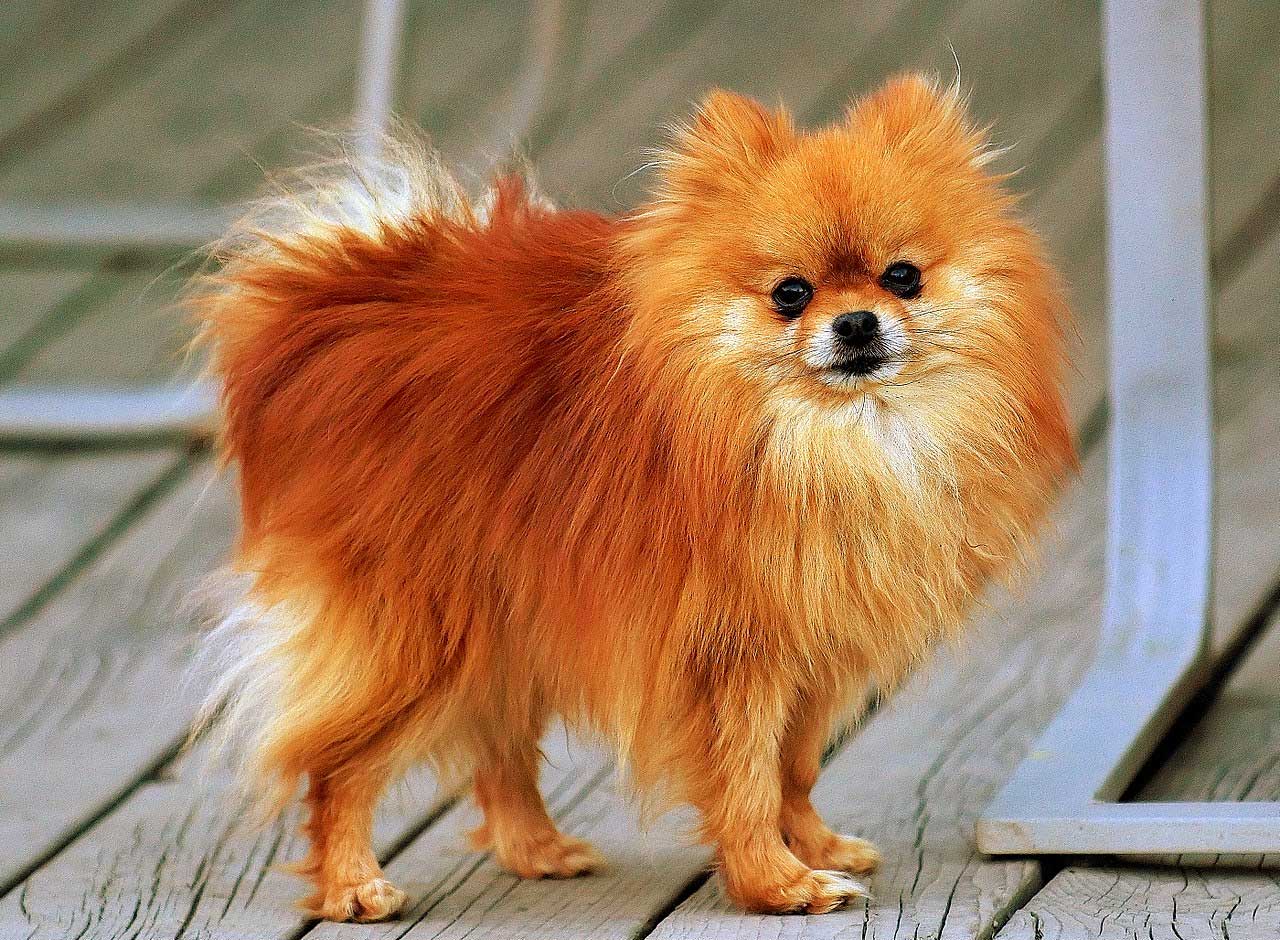
Pomeranian
Alemania FCI 97 . European Spitz

Pomeranian

The Pomeranian very active, independent, Intelligent, brave and loyal.

Content

History

The Pomeranian (Deutscher Spitz;, Pomeranian Lulu or Deutscher Zwergspitz) It is a dog of the Spitz family, named for the region of Pomerania Central, Eastern Germany, and is classified as a dog ยซToyยป due to its small size.

The ancestors of the Pomerania were Iceland and Lapland sled dogs, He came to Europe because of Pomerania.

The region of Pomerania, bathed in the north by the Baltic Sea and bounded in the west by the island of Rรผgen and in the east by the Vistula River, It was occupied by many peoples, celts, Slavs, Poles, Swedes, Danish and Prussian. Its name comes from Pomore or Pommern, which means "by the sea", and it was given in times of Charlemagne. Is in Pomerania where the Spitz won fame as a pet and dog work.

Read more

โ–ท The world of Pets: Dogs, cats, birds, reptiles, amphibians

Ibizan Hound
Espaรฑa FCI 89 . Primitive type - Hunting Dogs

Ca Eivissenc

The Ibizan Hound is one of the medium sized Greyhound, very similar to Pharaoh Hound.

Content

History

The Ca Eivissenco or โ€œPodenco Ibicencoโ€, It is a breed canine Spanish Ibiza (Spain). It gets its name from the island Ibiza, belonging to the Group of islands in the Balearic Islands, bathed by the Mediterranean.

This dog, has a highly developed sense of sight and hearing, that is why he has been assigned to hunting, especially in the rabbit, both day and night.

It is a type of primitive and rustic dog, considered one of the oldest breeds that exist and can be seen the tombs of the Pharaohs and museums whose first signs can be traced back to the 3.400 A.C.

The Ibizan Hound is one of the medium sized Greyhound, very similar to Pharaoh Hound. Without a doubt a descendant of the old Egypt dogs, that's what the written theories about race say..

The origin of this breed is Spain, comes from the island of Ibiza. The city of Ibiza was founded in the 654 A.C. by the Carthaginians and it is a conjecture establishes the possibility that the first settlers took with them their dogs of Egyptian origin for simple company and to hunt the rabbits that were abundant on the island.

But various genetic studies carried out in recent years have come to the conclusion that contrary to the widespread belief that the podenco is a type of primitive dog imported a few years ago 3.000 the area of middle years, These dogs actually have a close genetic relationship with the rest of the European hunting dogs and are no more "primitive" than most of them... The researcher Antoni Pedro Marรญ, details different aspects of the morphology, ethology and ecology of Ca Eivissenc in his work Native Races of the Pitiรผses.

Did you know??

The resemblance of the Ibizan with representations of the Egyptian god Anubis dog is one of the reasons why it is often thought to be an ancient race.

Physical characteristics

Elegant and agile, with an athletic and attractive outline, and with an elastic trot.

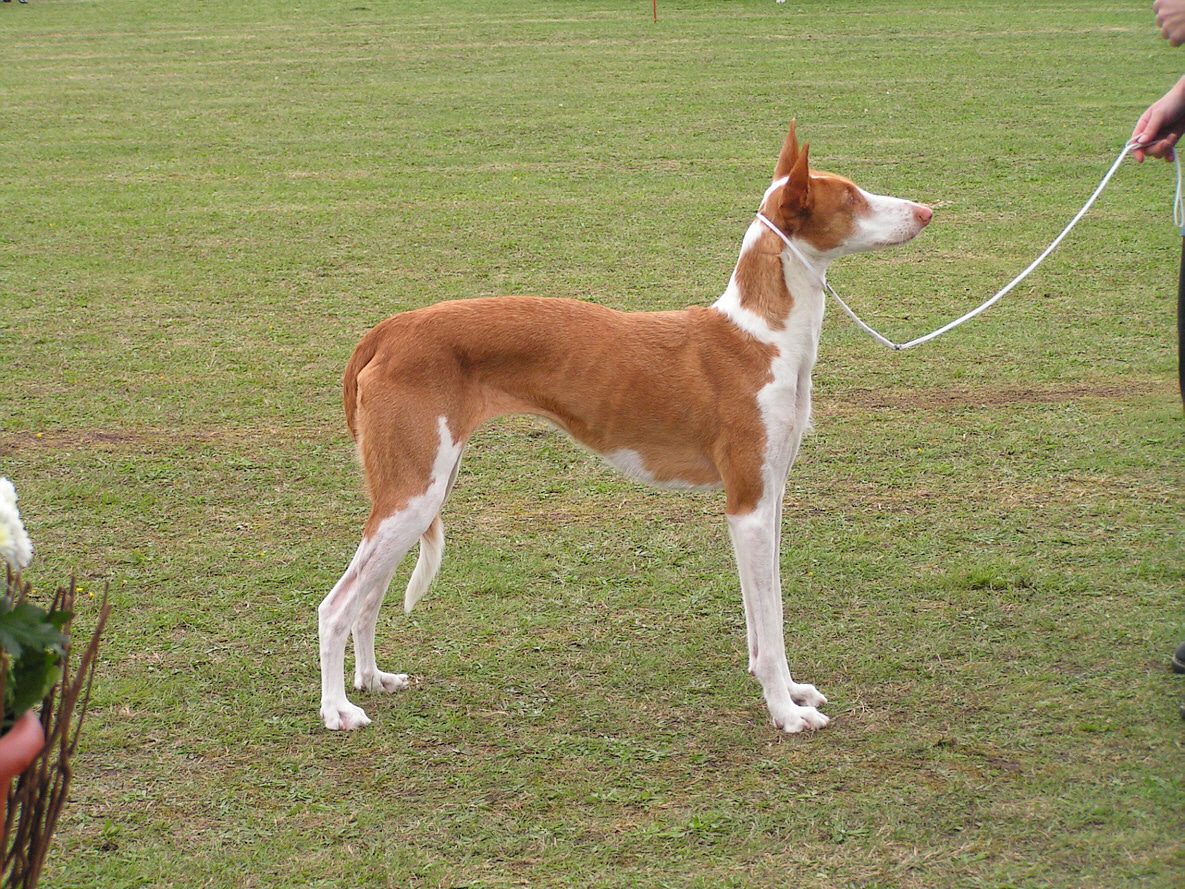
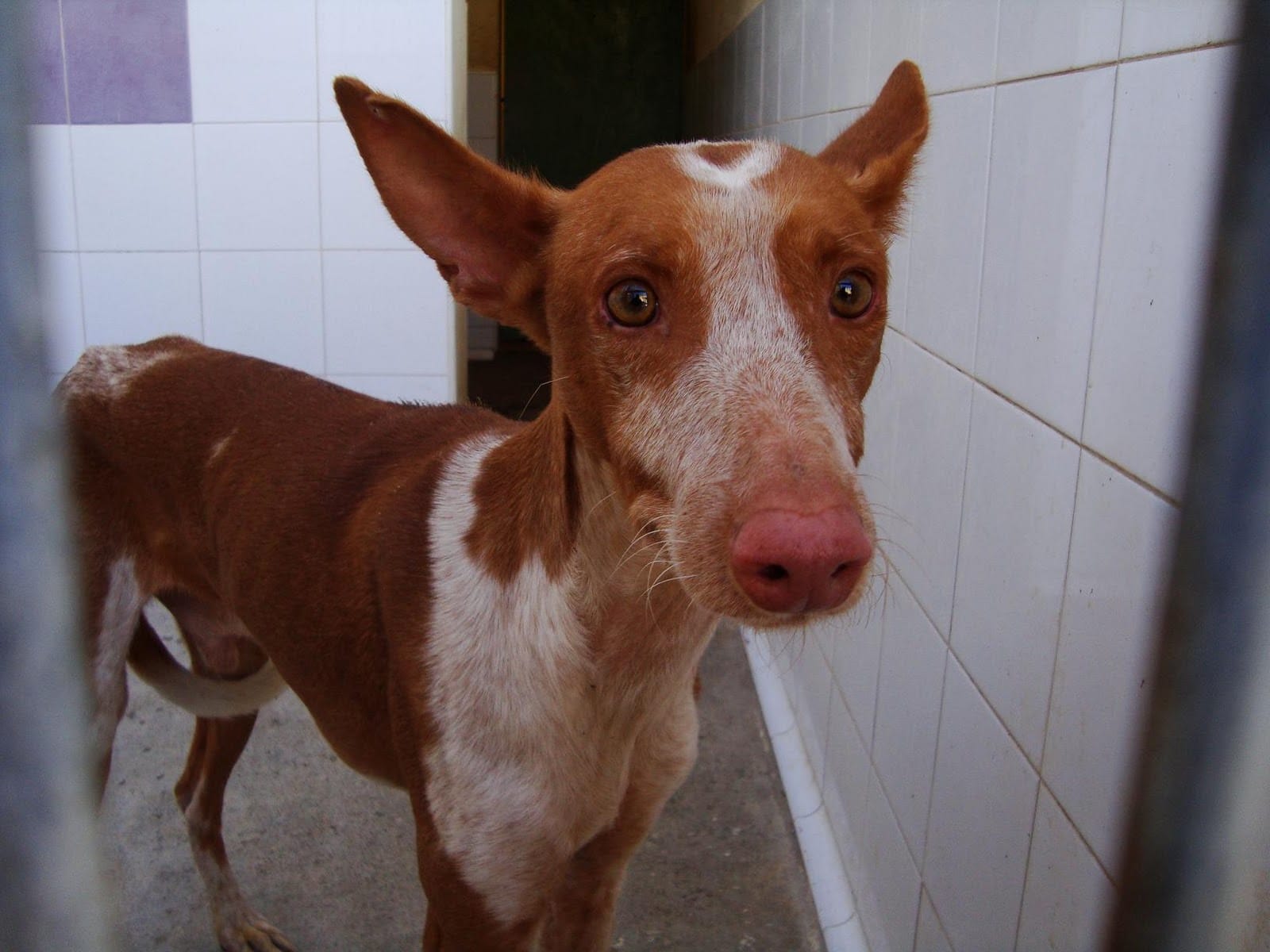
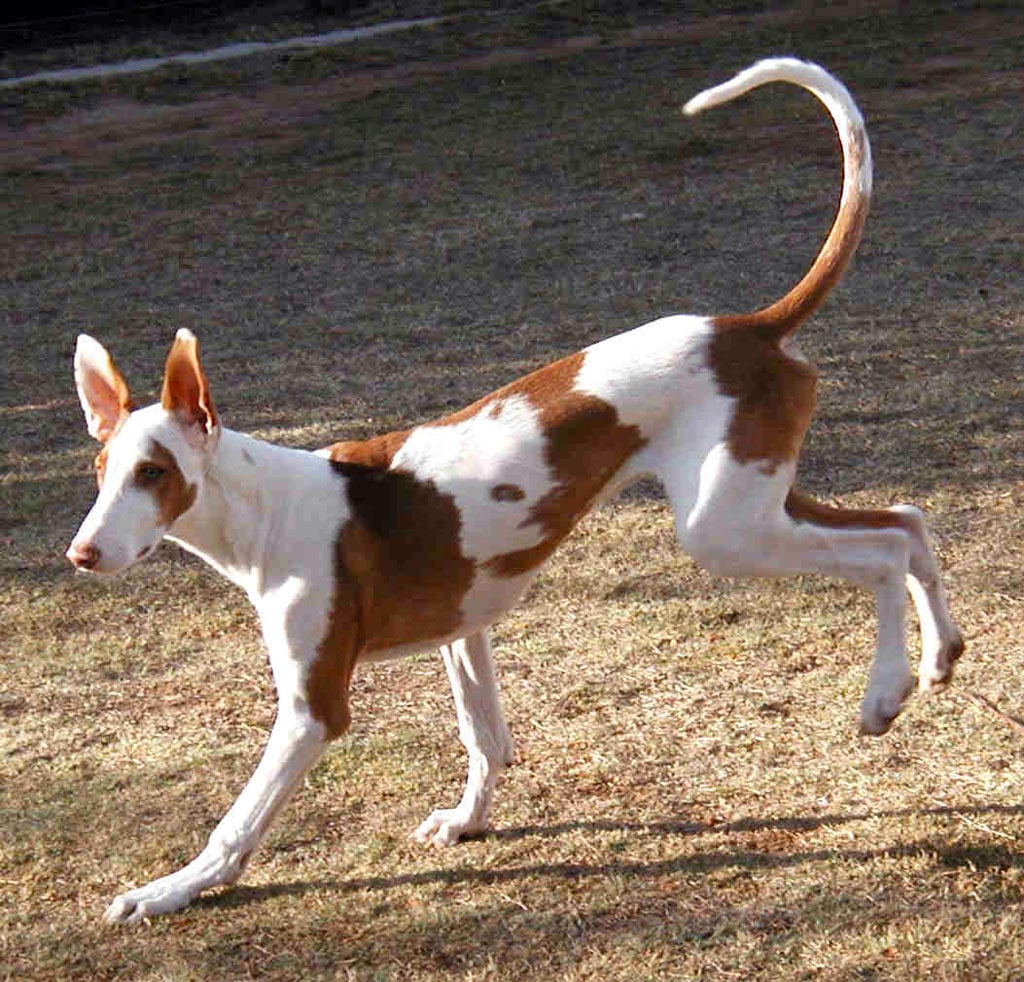
The Ibizan Hound has a long, narrow head, sharp cone-shaped; the skull is long and narrow with a little pronounced Stop. The ears must be straight, towards front and very mobile; oblique eyes, small and always amber clear.

The nose is flesh-colored and usually be taken into account to determine the purity of the breed. The color will always be blanco-marron, Blanco-leonado or unicolor, although this last possibility is more rare to find them. The weight varies between the 18 and 24 Kg, Depending on whether it's a male or a female, as well as if he is too well or poorly fed. With regard to the height of the dog there are also many disputes since fashion has at times imposed more slender and tall dogs that the found in the Pitiusas Islands.

The current standard is one height of between 66 and 72 cm., It is very far from reality and the first official standard. The dogs that are bred in Ibiza and Formentera are shorter than the maximum height allowed.

Via: criadorscaeivissenc

Character and skills

Pet is an excellent. Very easy to maintain when treated well and will respect your space. He is a dog that thinks for himself and there are times when he prefers not to have to show his appreciation to his master or be appreciated.; just let it quiet. It requires patience when it is trained.

It is not recommendable for the home where children are (He has no patience and is very independent). Generally does not get along well with other pets. Can maintain you in apartment or House, When receive plenty of daily exercise.

Characteristics "Ibizan Hound"

Coexistence is important that you have with your new friend. Before considering the acquisition of a dog of the breed "Ibizan Hound" you know certain factors. Not all breeds of dogs are apt to live in an apartment, you must take into account his character, their need for exercise, their interaction with other pets, their care and if you have small children, their level of tolerance towards them.

Adaptation โ“˜

4,0 of 5 stars (based on 1 review)

friendly dog โ€‹โ€‹โ“˜

3,0 of 5 stars (based on 1 review)

hair loss โ“˜

3,0 of 5 stars (based on 1 review)

Affection level โ“˜

5,0 of 5 stars (based on 1 review)

Need for exercise โ“˜

4,0 of 5 stars (based on 1 review)

Social need โ“˜

3,0 of 5 stars (based on 1 review)

Home โ“˜

1,0 of 5 stars (based on 1 review)

Toilet โ“˜

1,0 of 5 stars (based on 1 review)

Friendly with strangers โ“˜

2,0 of 5 stars (based on 1 review)

barking โ“˜

3,0 of 5 stars (based on 1 review)

Health โ“˜

3,0 of 5 stars (based on 1 review)

Territorial โ“˜

3,0 of 5 stars (based on 1 review)

Cat friendly โ“˜

2,0 of 5 stars (based on 1 review)

Intelligence โ“˜

3,0 of 5 stars (based on 1 review)

Versatility โ“˜

2,0 of 5 stars (based on 1 review)

Child friendly โ“˜

3,0 of 5 stars (based on 1 review)

Surveillance โ“˜

3,0 of 5 stars (based on 1 review)

joy โ“˜

3,0 of 5 stars (based on 1 review)

Ibizan Hound Images

Videos Ibizan Hound

Type and recognitions:

  • FCI CLASSIFICATION:
  • Group :
  • Section : . .

Federations:

  • Federations: FCI โ“˜, AKC โ“˜, ANKC โ“˜, CKC โ“˜, โ€‹KC โ“˜, NZKC โ“˜, UKC โ“˜

  • FCI breed standard "Ibizan Hound"

    Origin:
    Spain

    Date of publication of the valid original standard:
    26.05.1982

    Use:

    Is used, above all, in the rabbit hunt without a shotgun, day and night, well they lift them easily, even in places with a lot of vegetation due to the fineness of their smell, because he uses himself and his hearing more than his sight.. For their agility and cunning they soon collect the piece, especially hunting several dogs together; When a dog shows a piece, the others surround it at a certain distance, stalking the passage of that piece., they only beat when they see or hear the piece and also when they have closed it, all of them show and charge the piece by flipping the tail during it, the sample is easily broken.

    It is also used to hunt hares and big game.. They are good collectors. To form packs, they are used, except for exceptions, females and at most one male, because they do not help each other hunting and are quarrelsome. When a pack has taken a few thousand rabbits, the peculiarity occurs that some dogs from the same, they no longer hunt until after a long rest. This is called โ€œEnconillarseโ€.


    General appearance:

    The length of the tip of the snout to the eye is the same as the distance between them and the occipital.


    Behavior / temperament:

    ---

    Head:

    Long head, narrow cone truncated near your base, excessively dry, rather small in relation to the body.

    Cranial region:
    • Skull: Dolicocephalic, long or crushed; prominent occipital bone; narrow forehead and flat.
    • Stop: Poorly defined.

    facial region:

    • Truffle: Slightly convex, flesh-colored; Open nostrils.
    • Snout: Prominent, protrudes from the lower jaws; is narrow, long and colour harmonising with the coat meat.
    • Lips: Fine, collected, flesh-colored.
    • Teeth: In perfect opposition, White, well placed, with the Scissor bite.

    Eyes: Oblique, small, Amber clear, Recalling the color of candy; Amber can be more or less intense, depending on the color of the coat. With a not very noble look, very intelligent, shy and distrustful.

    Ears: Always rigid; directed forward, to the sides horizontally or backward; to when the dog is excited, very moving; the center of the base is located at the level of the eyes; elongated rhomboid-shaped, truncated to one third of its longest diagonal. They are fine, without hairs inside; median, not overly large.

    Neck:

    Very dry, both at the bottom and top. Its length is one-quarter the length of the body; slightly arched, muscled; the skin is taut, Lisa, without jowl. The hair is usually longer and dense in the upper lower part of this area, noticing more in straight hair.

    Body:

    The general aspect of the body is symmetrical, subconvex and medioline, quite matched dimensions, picked up, slightly longer without measure fixed difference.

    • Cross: Outstanding, high, dry and long.
    • Back: Straight, long and flexible; strong muscles, but flat.
    • Pork loin: Arcuate, average width, strong and powerful.
    • Rump: At desk, of very powerful and hard muscles, with a bone structure shows.
    • Breast : Deep, narrow and long, without elbows, sternum angle very sharp and prominent; flat ribs.
    • Belly: Collected but not agalgado.

    Tail:

    Low insertion; passing between the legs to reach the spine, monitors (towards the tip around the tail a few longer and thicker hairs slightly separated in a spike shape), long; somewhat thicker in his birth, will tweaking gradually; at rest falls naturally; in action is in the form of sickle, more or less closed, preferably is not straight or screwed too on the back.

    Tips

    PREVIOUS MEMBERS: They are aplomados, symmetric; seen from the front arms are close together; collected set, limbs long giving the impression of a thin animal, Agile but strong.

    • Shoulder: Oblique scapulae, strong and free in their movements.
    • Arms: Very long, straight and strong, and very together.
    • Elbows: Comprehensive and outstanding, parallel to the median plane of the body, never come out.
    • Forearm: Wide at its bottom end.
    • Metacarpus: Powerful, strong, width, right well.

    LATER MEMBERS: Plumb, long muscles, strong, dry, flattened muscle.

    • Hocks: Toggle, widths, close to the ground (descending), well Plumb, Neither outwards nor inwards.

    FEET: Trend of Hare, tight and long fingers, well trimmed hair interdigital spaces, very strong and generally white nails, Sometimes the color of hair; very hard pads.

    Movement:

    The preferred way is a trot suspended; the Gallop is very fast, giving feeling of agility.

    Mantle

    SKIN: Tense, attached to the body; Pink pigmentation, It can vary from color in the regions in which the layer is different.

    HAIR: Smooth, hard or long.

    • The smooth should not be silky but strong and shiny.
    • The hard must be rough, well populated, somewhat shorter on the head and ears, longer in the back of the thighs and the underside of the tail; the beard is very appreciated; the length is softer and must be at least one length 5 cm with the heavily populated head.

    COLOR: Preferably white and Red, unicolores white or red, although the fawn could also be admitted as long as it is an extraordinary specimen., Although never accept this color for hair.


    Size and weight:

    Height to the cross:

    • For males :  66 to 72 cm.,
    • for females :  60 to 67 cm..

    Without being very demanding, Since of approximate measurements you can always accept that they are proportionate and aesthetic.


    Fouls:

    Any deviation from the aforementioned criteria is considered as a fault and the severity of this is considered to the degree of the deviation to the standard and its consequences on the health and well-being of the dog..

    SERIOUS FAULTS :

    • Short and wide head.
    • Very marked stop.
    • Lack of a premolar.
    • Floppy ears.
    • Depressed Center ribbing.
    • Elbows out.
    • Cow hocks.
    • Feet out.
    • Cross feet and hocks in motion.

    MISS PLAYOFFS :

    • Aggressive or fearful dog.
    • Phased skull.
    • Brown pigmentation or black spots on truffle.
    • Any form of prognathism.
    • Eyelids and lips brownish red.
    • Miss indicating a junction with a Greyhound or a hound, that is to say :
      • folded ears
      • Dark eyes
      • Wide rump
      • Little defined sternum
      • Separate forelimbs
      • Thighs wide and rounded, with bulging veins


    N.B.:

    โ€ข Males must have two normal-appearing testicles fully descended into the scrotum..
    โ€ข Only functionally and clinically healthy dogs, with the typical conformation of the breed, should be used for parenting

    Source: F.C.I - International Cynological Federation

    Alternative names:

    1. Ibizan Warren Hound, Ca Eivissenc, IBIZAN PODENCO (English).
    2. Chien de garenne des Balรฉares (French).
    3. Ca Eivissenc (German).
    4. Podenco ibicenico (Portuguese).
    5. Ca Eivissenc (espaรฑol).

    โ–ท The world of Pets: Dogs, cats, birds, reptiles, amphibians

    Pharaoh Hound
    Malta FCI 248 . Primitive type

    Pharaoh Hound

    The Pharaoh Hound in family is smart, friendly, affectionate and playful.

    Content

    History

    The Pharaoh Hound it is a hunting dog like those of hunting dog breeds, formerly at home in many areas of the Mediterranean. It is also called Kelb-tal-Fenek. ยซKelb-tal-Fenekยป is Maltese and means ยซRabbit dogยป.

    Like all Warren hound, is the specialist in rabbit hunting. But, does not go to the burrow like the Dachshund or the terriers. Because the Pharaoh Hound and Warren hound they hunt on land when they see them. They are agile like a hunting dog and can launch attacks fast as lightning. As a group, surround their prey. In this way, knock down dozens, even hundreds of rabbits in a short time. The Pharaoh Hound they often work completely independently without guidance from the hunter. In Malta they also help with herding the goats and are useful as all-rounders for all tasks around the home and on the farm..

    The Pharaoh Hound was created in Great Britain in the decade of 1960 as an independent breed of dog. It is an offshoot of the population of these dogs, that have existed for thousands of years in the northern and eastern Mediterranean. Besides of Pharaoh Hound, the Warren hound are other descendants of these dogs, each of which is now an independent race. Its roots go deep into the past.. But, its exact origin is not clear. Its resemblance to the ancient Egyptian hunting dog Tesem, one of the oldest documented dog breeds, it's amazing. But, It is neither proven nor probable that they are "pure" descendants of Tesem. This type of dog probably existed everywhere, since it already served the people of the ancient world in its current role.

    With the time, regional strains were developed that, However, repeatedly mated with each other. The World Canine Federation, Fรฉdรฉration Cynologique Internationale, took this into account when establishing a collection standard for Mediterranean breeds up to 1977. Great Britain then created the breed of dogs Pharaoh Hound and later handed over the patronage to Malta. There it was even declared a national dog in 1974. In 1991 was officially recognized by the Fรฉdรฉration Cynologique Internationale as an independent race.

    (See study on canine genome).

    Physical characteristics

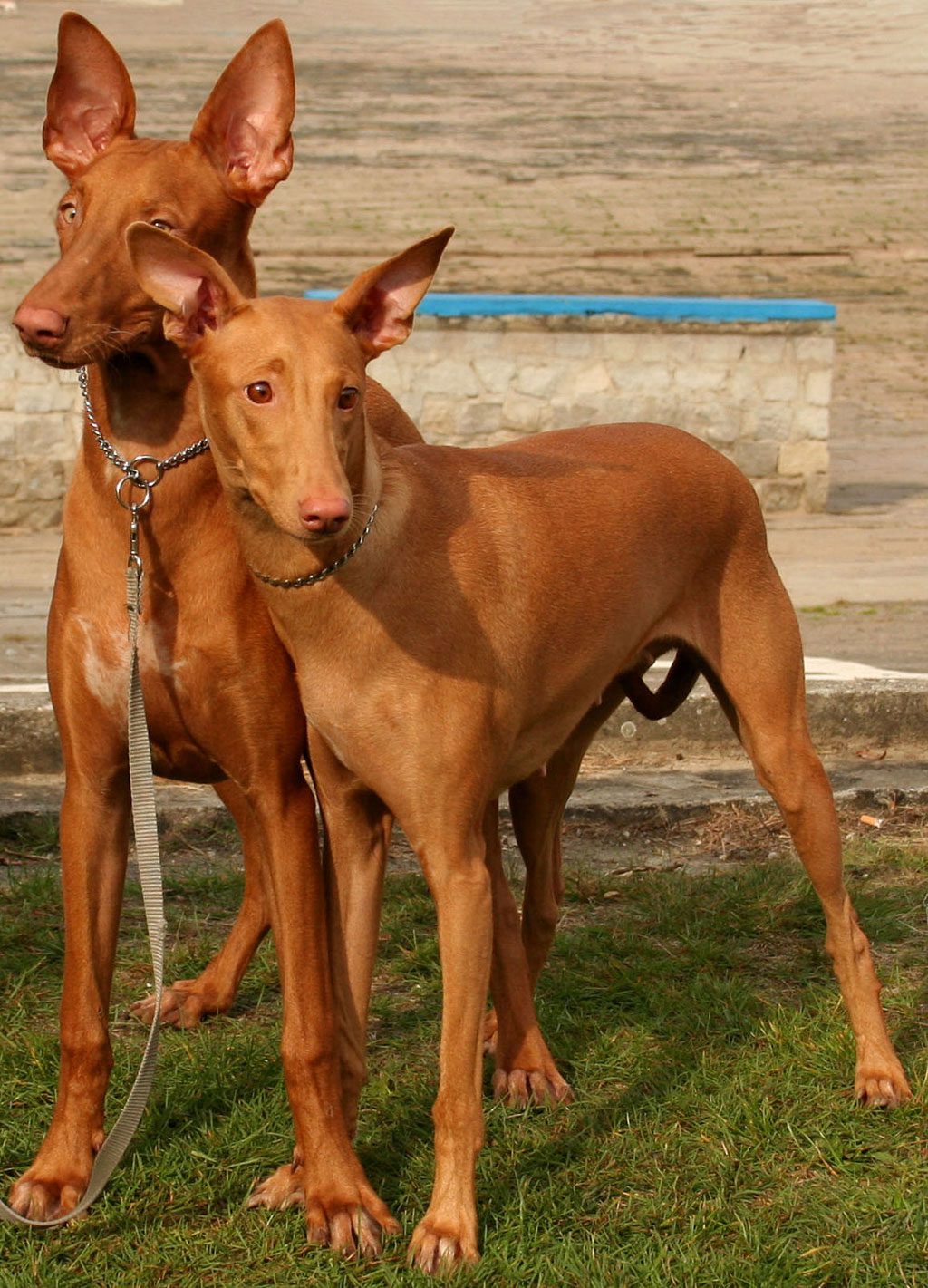
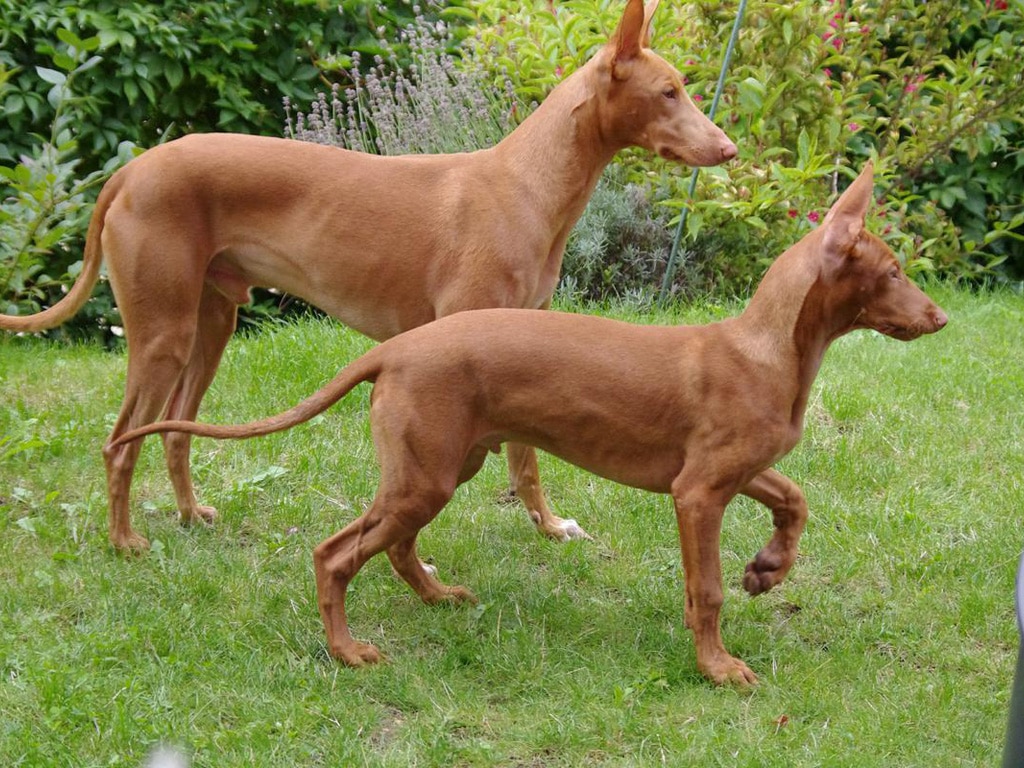
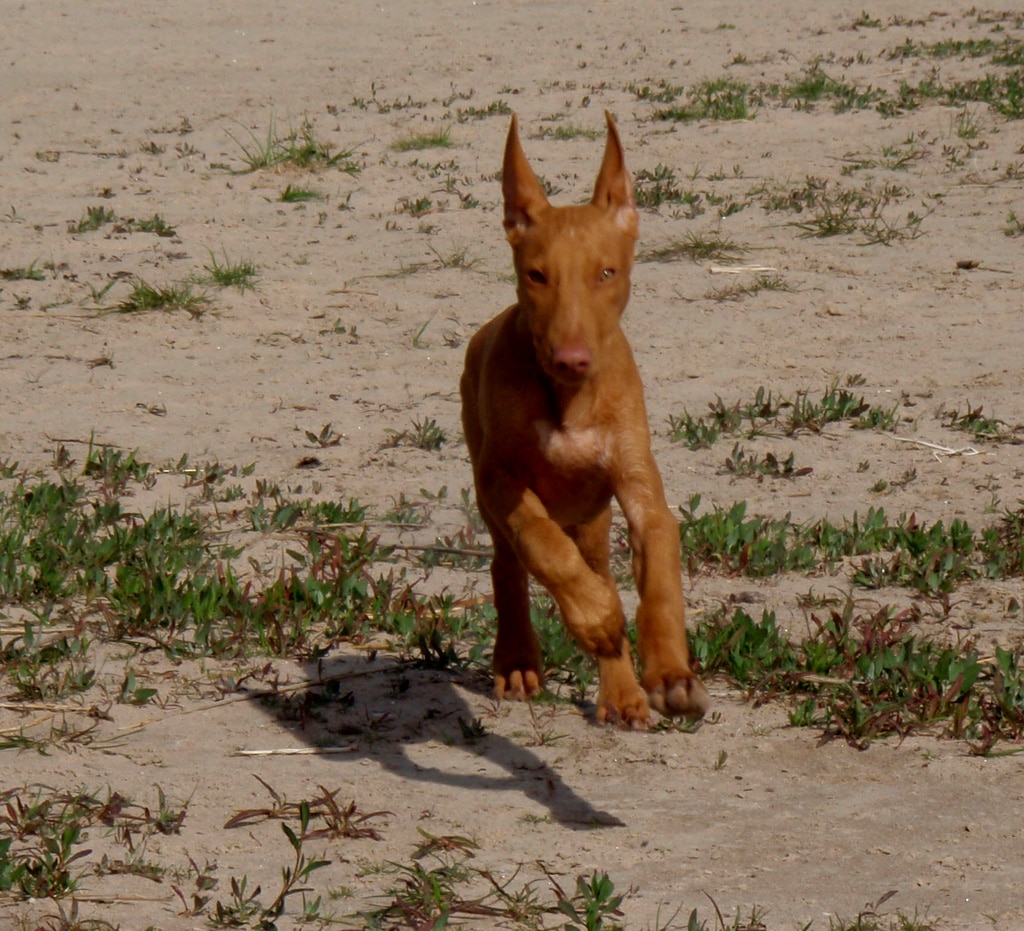
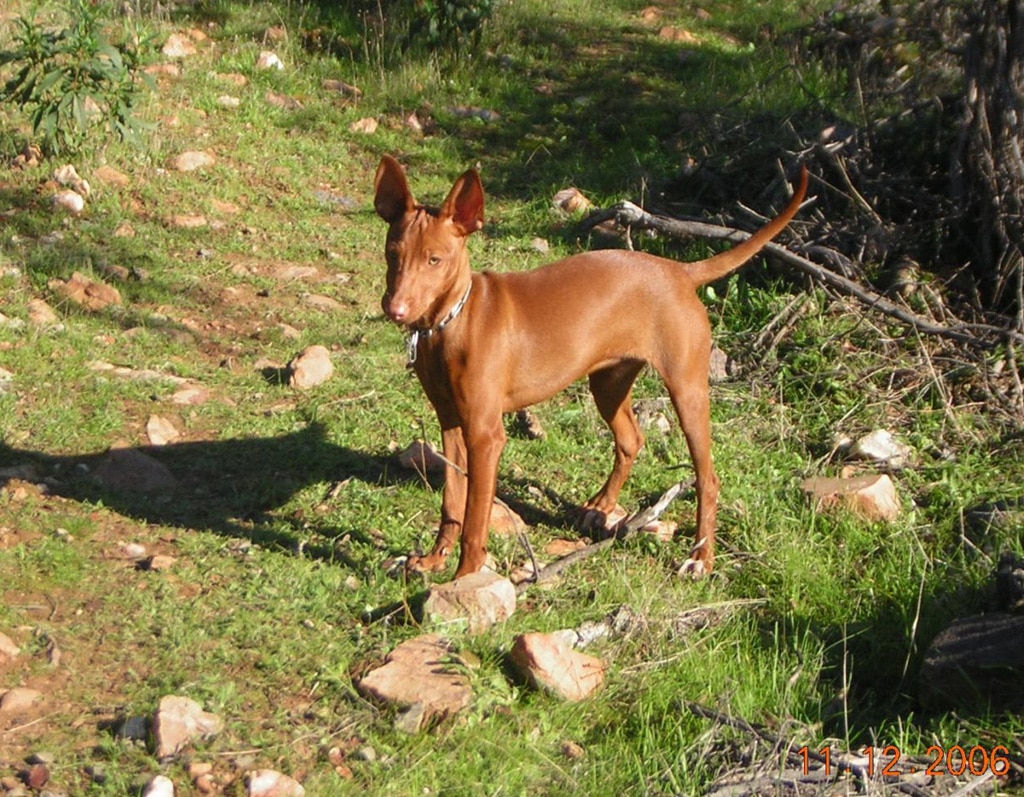
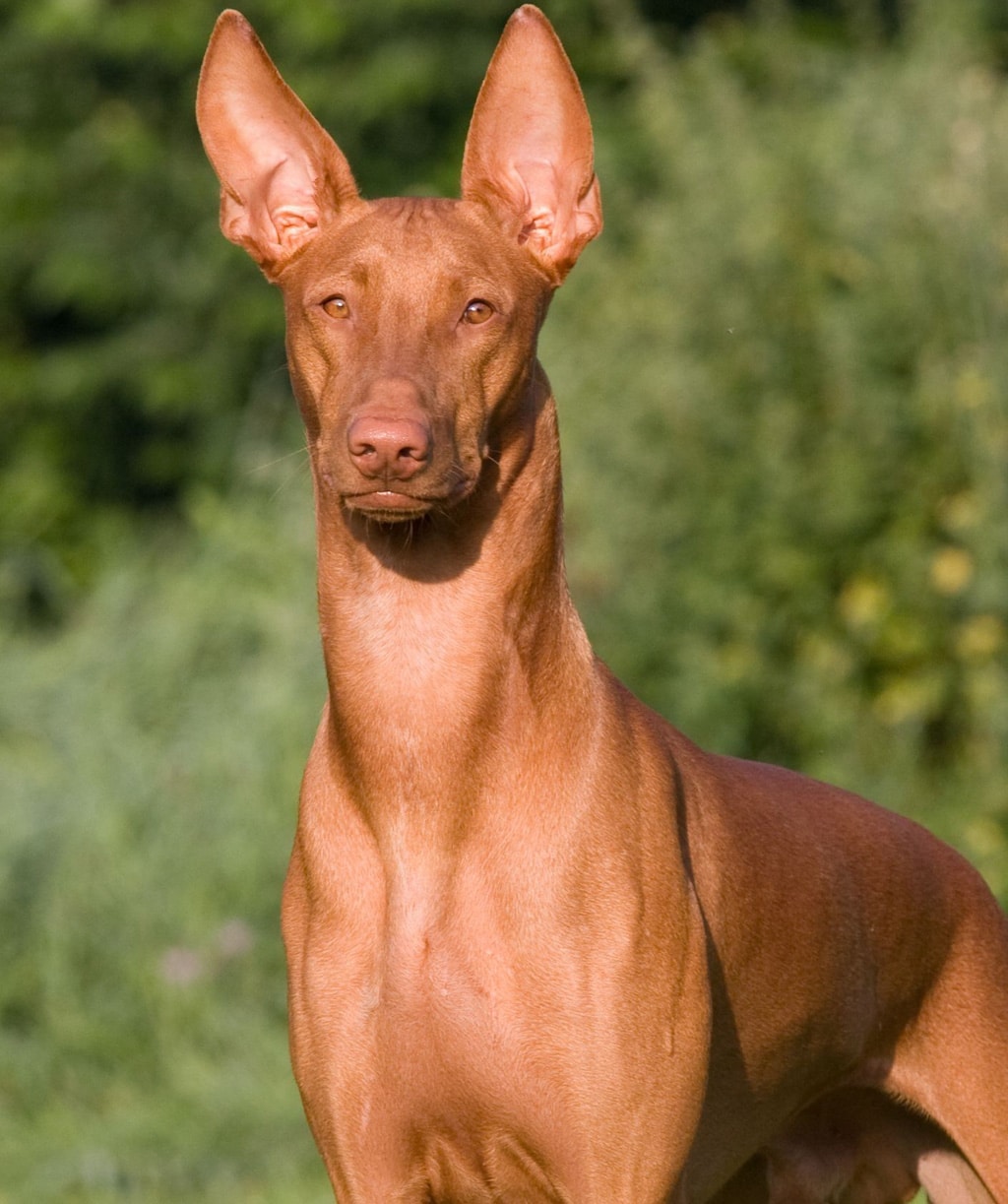
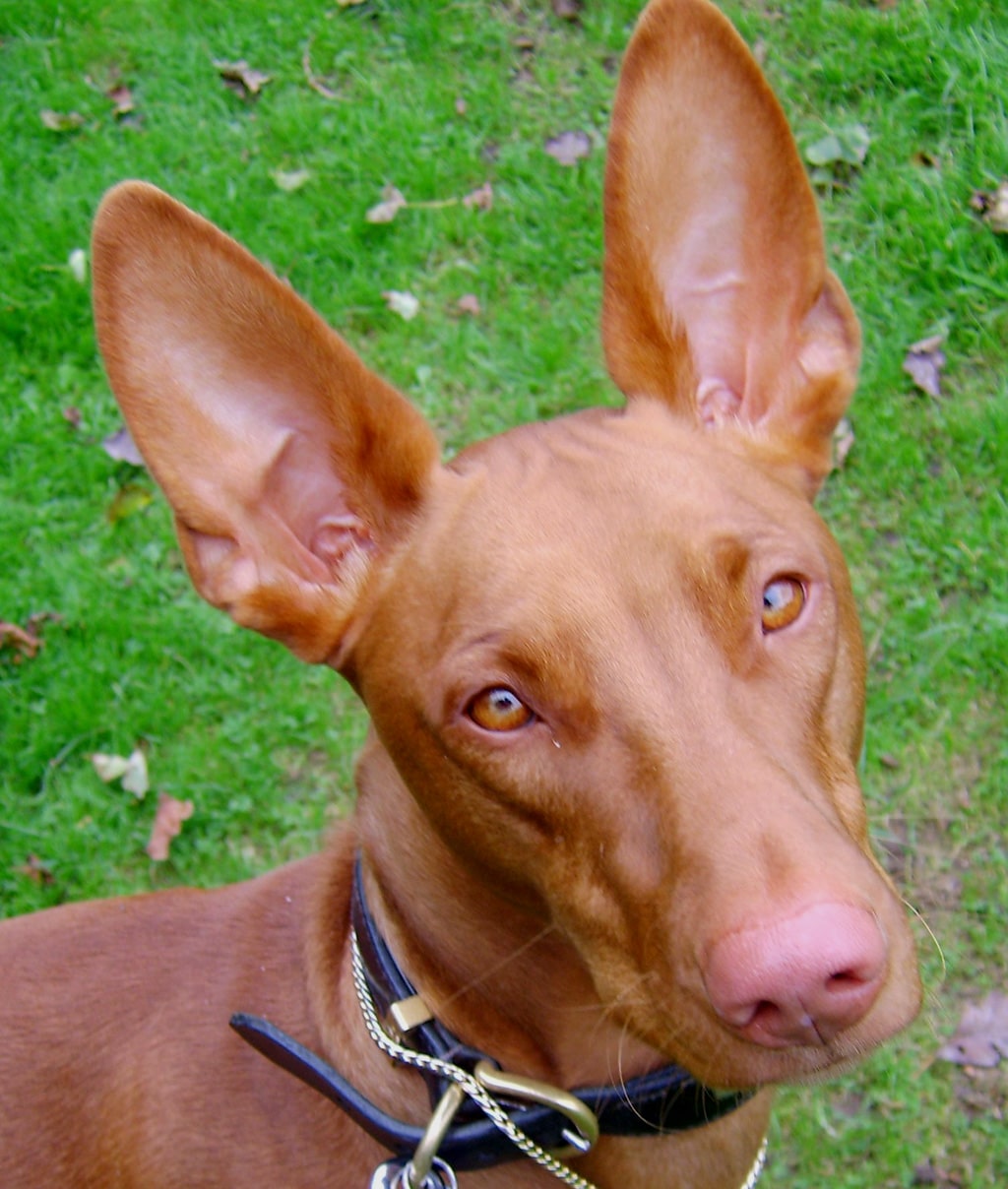
    Haughty and delgado, the Pharaoh Hound is a dog from size medium with very defined lines, elegant and noble porte.

    The height in the males is of 55 to 63 cm., and weigh in 10 to 12 kg; the females measure of 52 to 61 cm to the cross, and weigh in 8 to 10 kg. If born with a tail does not lack that ampute you.

    The belly is fine and the back straight and strong. The body is made up of long muscles, of dry lines.

    Has the head triangular, almost without stop, the eyes Amber blend with the mantle, they are oval and slightly sunken. The ears they are inserted to half-height, Reprint alert to carry them, they are wide at its base and thin and long.

    The tail is curved and carries low, but when he is happy he has been in high.

    Its fur is fine, short and glossy. In some cases it may be a little rough to the touch. The color fur is reddish brown clear to reddish brown dark with white markings. According to the standard, the white tail is highly desirable.

    As well, is supported in the standard to submit a white mark on the chest and white fingertips, including a white stripe down the center line of the face.

    Character and skills

    The Pharaoh Hound he is a hunting dog and a hound at the same time. They are sometimes used in their homeland as watchdogs or herding dogs for goats.. Before genetic separation from the total population, many dogs had to struggle for scraps of human food and often suffered from hunger. These original living conditions still determine its nature today.. They are very agile and alert. Almost nothing escapes your keen senses. Especially like young dogs who crave exercise and experiences, ideally hunting and first of all the option of free running. As they tend to have a strong hunting instinct, this deep-rooted need of dogs in our latitudes can only be satisfied on rare occasions.

    It is an experience to see him Pharaoh Hound running freely. Because they can sprint fast and especially capture prey in extremely courteous races. the Pharaoh Hound hunt with all three senses: Odor, view, ear. The standard describes its nature in this way:

    Vigilant and passionate hunter who uses both sight and smell. When working short distance, he also uses his ears in a remarkable way.

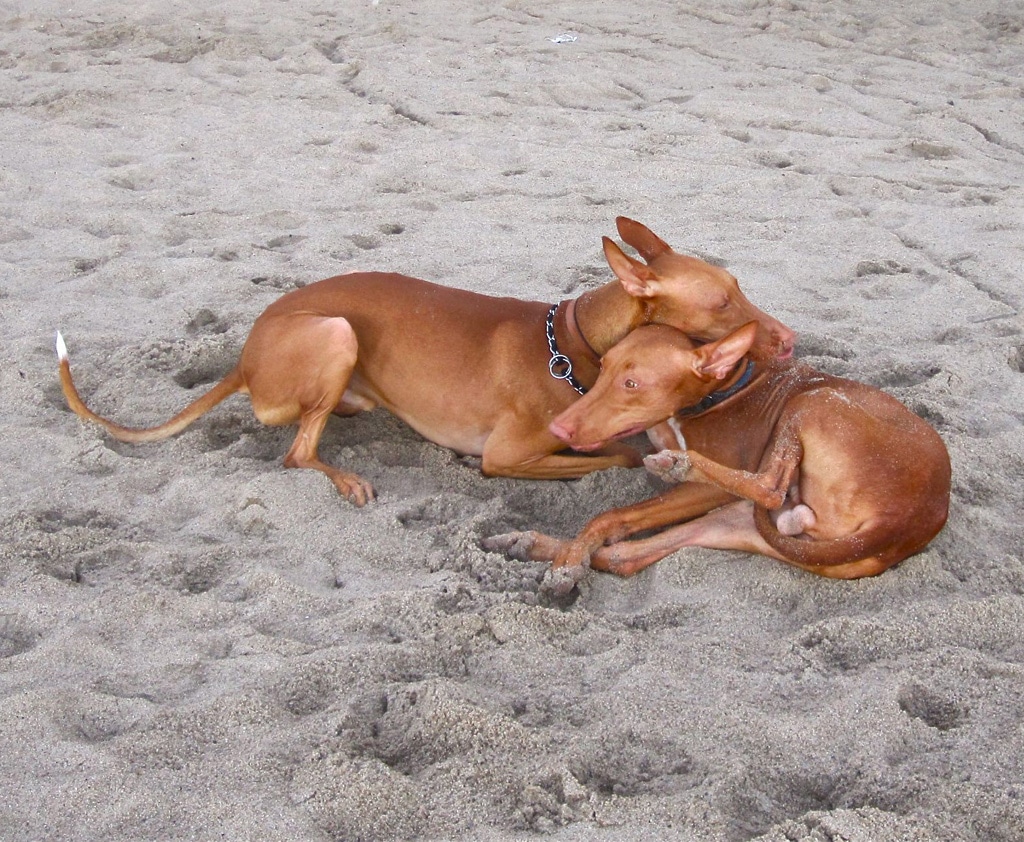
    The Pharaoh Hound they are very intelligent and docile. They quickly learn what is allowed and what is taboo. They are friendly and open-minded with people. Towards humans there is no aggression; towards other dogs, However, this may be different, particularly with males. The Pharaoh Hound they have a kind and playful nature. They seek intimate connection with their masters and are loyal to them.. Even in spite of its thinness, they are very hard and resistant.

    Observations

    The Pharaoh Hound is very similar to the Cirneco dell'Etna Italian.

    Fitness

    Basically the Pharaoh Hound it's good to keep it. It is very suitable as a family dog รขโ‚ฌโ€นรขโ‚ฌโ€นand friend of children and wants to be seen as a member of their family. But, generally not suitable for a flat in the big city. You need long daily walks in nature, better several times a day. Here your senses are at their highest level. He is a dedicated and alert hunting dog. You need at least here and there the possibility of being able to exhaust yourself while running free.

    One Pharaoh Hound maintained in a species appropriate manner is calm and gentle in the home. Then you can rest relaxed in your basket or on the sofa. It also, is very playful. Some specimens are extremely alert and like to bark.. Also in another way barking is used very happily for communication and to express their feelings. It should also be noted that the Pharaoh Hound It does not have an undercoat and by nature it has little insulating fat and is therefore sensitive to cold..

    Education

    One Pharaoh Hound well socialized can be trained very well. Your senses alert, his intelligence and friendly affection make it easy for him to understand humans. He also wants to please us and live in harmony. Of course it always requires a just consequence. He realizes his master's lack of care immediately and uses him mercilessly. So he'll use every inattention to steal an unprotected gift.. For proper occupation and physical workload for dogs, the greyhound association offers the possibility of participating with Pharaoh Hound in Greyhound racing or hunting dogs. Other dog sports such as agility are also suitable. Due to his strong hunting motivation, training requires patience and empathy.

    Care and health

    The Pharaoh Hound he is very frugal. Brushing the coat from time to time is enough.

    Typical diseases

    There are no exact data on the typical diseases of this rare breed of dogs.. One problem could be inbreeding.

    Nutrition

    The Pharaoh Hound he is usually very gluttonous. you have to be careful here. Otherwise, They are very austere breeds in terms of the type of food..

    The life expectancy of โ€œPharaohโ€™s Dogโ€

    There are no figures on the life expectancy of Pharaoh Hound. But, should be around 12 years.

    Buy a "Pharaoh's Dog"

    If you want to spend your life with a Pharaoh Hound, you should first check if you can guarantee all the conditions for it, especially if you have the possibility to let it run regularly. Otherwise, you should look for very similar dogs in animal shelters, in serious animal protection organizations.

    Characteristics "Pharaoh Hound"

    Coexistence is important that you have with your new friend. Before considering the acquisition of a dog of the breed "Pharaoh Hound" you know certain factors. Not all breeds of dogs are apt to live in an apartment, you must take into account his character, their need for exercise, their interaction with other pets, their care and if you have small children, their level of tolerance towards them.

    Training ?

    2,0 of 5 stars (based on 1 review)

    Suitability of the apartment ?

    2,0 of 5 stars (based on 1 review)

    Can be alone all day ?

    2,0 of 5 stars (based on 1 review)

    Suitable as a first dog ?

    1,0 of 5 stars (based on 1 review)

    Weight gain ?

    4,0 of 5 stars (based on 1 review)

    Health ?

    4,0 of 5 stars (based on 1 review)

    Intelligence ?

    4,0 of 5 stars (based on 1 review)

    Kindness with child ?

    3,0 of 5 stars (based on 1 review)

    Tendency to bite ?

    2,0 of 5 stars (based on 1 review)

    Tendency to bark ?

    4,0 of 5 stars (based on 1 review)

    Tendency to flee ?

    5,0 of 5 stars (based on 1 review)

    hair loss strength ?

    3,0 of 5 stars (based on 1 review)

    Suitable as a guard dog ?

    4,0 of 5 stars (based on 1 review)

    Joy ?

    4,0 of 5 stars (based on 1 review)

    Cat friendliness ?

    1,0 of 5 stars (based on 1 review)

    Power level ?

    5,0 of 5 stars (based on 1 review)

    Images ยซPharaoh's Dogยป

    ยซPharaoh's Dogยป Videos

    Type and recognitions:

    • FCI CLASSIFICATION:
    • Group :
    • Section : . .

    Federations:

    • – FCI – Group 5: Spitz-type dogs and primitive type – Section 6: Primitive type. โ“˜

    FCI breed standard "Pharaoh Hound"

    Origin:
    Malta

    Date of publication of the valid original standard:
    09.08.1999

    Use:

    He is an alert and enthusiastic hunter, that hunts for smell and sight, using your hearing to a significant degree when working near prey.


    General appearance:

    Medium-sized, noble bearing and well-defined lines. Funny, although also powerful. Very fast with free and easy movements. Alert expression.


    Behavior / temperament:

    Is alert, Intelligent, friendly, affectionate and playful.

    Head:

    The muzzle is slightly longer than the skull. The top line of the skull is parallel to the facial region; the entire head represents a blunt wedge when viewed in profile and from above.

    Cranial region:
    • Skull : Long, close-knit and well chiseled.
    • Stop : Light.

    facial region:

    • Truffle : Only flesh colored, similar to coat color.
    • Jaws / Teeth : Powerful jaws with strong teeth. Scissor bite, that is to say, that the upper incisors closely overlap the lower incisors and are implanted vertically in the jaws.

    Eyes : amber in color, harmoniously similar to coat color; oval, set moderately deep, with an intelligent and applied expression.

    Ears : Medium high set, carried upright when the dog is alert, but very mobile; they are wide at their base, thin and long.

    Neck:

    Long, delgado, muscular and slightly arched. Throat line is well joined.

    Body:

    The length of the body from the point of the shoulder to the point of the buttock is slightly greater than the height at the withers. Flexible, with an almost straight top line.

    • Rump : Slightly inclined tail root.
    • Breast : Deep extending down to the tip of the elbow. Well arched ribs.
    • Abdomen : Moderately withdrawn.

    Tail:

    Middle insert, quite thick at the base and tapering towards the tip (similar to a whip); at rest it reaches just below the hock. When the dog is active, takes it high and curved. The tail must not be carried between the hind limbs. Corkscrew tail is undesirable.

    Tips

    PREVIOUS MEMBERS : Straight and parallel.

    • Shoulder : Strong, long and well directed back.
    • Elbow : Well tucked.
    • Metacarpus : Strong.

    LATER MEMBERS : Seen from the back, rear limbs are parallel; strong and muscular.

    • Knee : Moderate angulation.
    • Leg : Well developed.

    FEET : Strong, well arched and firm, without drifting out or in. Hard pads. Spurs can be removed.

    Movement:

    Free and fluid; the head is carried high enough and the wide movement of the dog should cover the ground well without apparent effort. The limbs and feet should move in line with the body; any tendency to turn the feet to the side or action in high steps (๏‚ฒhackney action ๏‚ฒ) it's very undesirable.

    Mantle

    HAIR : Short and shiny, varies from being fine and close to a little rough; no feathers.

    COLOR : Reddish brown to dark reddish brown with white markings allowed in the following regions : the white tail is highly desirable. White on the chest (called ๏‚ฒstar๏‚ฒ). White on fingers. A narrow white spot is allowed (list) on the center line of the face. Mottled or white color in regions other than those mentioned are undesirable.


    Size and weight:

    • Height in males : ideal 56 cm. (from 56 until 63,5 cm = 22 โ€“ 25 inches).
    • Height in females : ideal 53 cm. (from 53 until 61 cm =21 โ€“ 24 inches).


    Fouls:

    Any deviation from the above criteria is considered missing and the seriousness is considered to the extent of the deviation to the standard, and its consequences on the health and well-being of the dog.

    FALTAS DESCALIFICANTES:

    โ€ข Aggressiveness or extreme shyness.
    โ€ข Any dog โ€‹โ€‹showing clear signs of physical or behavioral abnormalities.


    N.B.:

    โ€ข Males must have two normal-appearing testicles fully descended into the scrotum..
    โ€ข Only functionally and clinically healthy dogs, with the typical conformation of the breed, should be used for parenting.

    Source: F.C.I - International Cynological Federation

    Alternative names:

    1. Kelb tal-Fenek (English).
    2. Lรฉvrier du pharaon (French).
    3. Pharaoh Hound, Kelb tal-Fenek (German).
    4. Cรฃo de coelho, Kelb-tal fenek (Portuguese).
    5. Podenco faraรณnico, Pharaoh hound (espaรฑol).

    โ–ท The world of Pets: Dogs, cats, birds, reptiles, amphibians

    Parson Russell Terrier
    Inglaterra Estados Unidos FCI 339 . Large and medium sized Terriers
    Parson Russell Terrier

    The Parson Russell Terrier is a fearless dog, very happy, energetic and friendly.

    Content

    History

    The Parson Russell Terrier it is a small to medium sized terrier. It's a hunting dog.

    Although this breed of dog is very young in modern dog breeding, the Parson Russell Terrier is very close to the old and classic type of a terrier in character and appearance. Terriers form a large group within dogs. Its name is derived from the Latin ยซTerraยป for the earth. So they were dogs for work on the land. The first evidence is given by the ancient Romans. Already in the Middle Ages terriers are described in detail. His homeland is in the British Isles. Terriers existed throughout the country. In the stables they kept small vermin at bay. Even the big rats were not a problem for them. The hens, pigeons and rabbits protected them from martens and foxes. To keep chasing foxes, the terriers were sent to the trench.

    The Parson Russell Terrier of today are made exactly for this purpose. They should and could get the fox out of the hole. At the same time, they had to run with the fox hunts in the pack, that is to say, they had to be able to follow the gallop of the hunt. All of these tasks require enthusiastic commitment, special courage, independent thinking and the so-called sharpness of predators.

    The Parson Russell Terrier turned into a versatile hunting dog, it's not only suitable for underground work. In the 19th century the English shepherd Jack Russell he was a successful hunter, rider and above all breeder of Fox Terriers. In his long life as a breeder he greatly increased the performance of the Fox Terrier. They were now fit for all individual hunting tasks, they could work in the pack and in the den at the same time.

    In Australia, only with the help of their dogs could a plague of foxes be contained. To thank this, these dogs were finally named after their breeder, the Parson ยซJack Russellยป Terrier. They were and are physically and mentally raised for work, no show dogs. So breeders and lovers of this terrier for a long time refused to join the system of modern pedigree dog breeding., because they did not want to see dogs evaluated primarily on their appearance and feared the negative consequences of the show business on the fitness and health of dogs. This has done this breed of dog very well..

    Seriously raised, these are dogs that were largely spared from hereditary diseases and extremes in breeding. He "Jack Russell Terrierยป had a wide range of sizes from the beginning, rather short-legged and rather tall. Since performance was decisive, such refinements had no role. Now two breeds of dog have been made from the ยซJack Russell Terrierยป and the two lines have separated in breeding. The little one is still called Jack Russell Terrier, It has a height at the withers of up to 30 cm and is provided a little longer. The Parson it is a little taller and with more legs and in its rather square shape. Parish is another word for "pastor" in English.. So two breeds of dog are named after one person, el pastor Jack Russell. Both dogs are a credit to the Shepherd. In 2001 the new race Parson Russell Terrier was officially recognized.

    Physical characteristics

    The Parson Russell Terrier It is suitable for the working dog, Active, agile, built for speed and endurance. It gives the impression of balance and flexibility as a whole.

    You can have hair smooth or hard if it is thick and dense to protect it from the inclement weather, like cold and damp. Its color It can be entirely white or predominantly white with brown spots, lemon or black or any combination of these colors, preferably stains should be limited to the head or the birth of the tail.

    It measures to the cross between 33 and 36 cm., their weight approximate is of 8 to 10 kilos to be slightly larger in proportions that the version of the Jack Russell Terrier, although it should be noted that taller specimens exist as "Jack Russell" in some work clubs in the United Kingdom and the United States., due to what these clubs do not form part of the FCI and therefore, handle different to the recognized standard registers and accepted worldwide by the 84 member countries.

    Character and skills

    Parson Russell a fearless and friendly Terrier.

    This breed was bred to hunt, Chase and corner foxes in its burrow, therefore, they carry in their genes, and if this activity does not form part of the life of your puppy, We recommend that, they should be exercised daily intensely since they are dogs with a huge dose of contained energy.

    Perhaps its character lively and friendly has caused it to be one of the dog breeds preferred by many people as a pet.

    But in reality it is a true working dog and we should not forget that if a specimen of... becomes part of our family..

    Leave running, ride a bike, launch frisbee or ball - and teach him to bring them back-, It will help to strengthen the bond between the Parson and his owner while it educates, enjoys and is exercised.

    Images ยซParson Russell Terrierยป

    Videos ยซParson Russell Terrierยป

    Type and recognitions:

    • FCI CLASSIFICATION:
    • Group :
    • Section : . .

    Federations:

    • – FCI – Terriers 1 Large and medium-sized terriers. โ“˜
    • – AKC – Terriers โ“˜
    • – ANKC – Terriers (utility dogs) โ“˜
    • – CKC – Terriers โ“˜
    • – โ€‹KC – Terriers โ“˜
    • – NZKC – Terriers โ“˜
    • – UKC – Terriers โ“˜

    FCI breed standard "Parson Russell Terrier"

    Origin:
    United States, United Kingdom

    Date of publication of the valid original standard:
    22.08.2017.

    Use:

    Working terrier with the ability to work underground.


    General appearance:

    Efficient, active and agile, without exaggerations. Built for strength and power with an overall appearance of balance and flexibility. Honorable scars are allowed.

    IMPORTANT PROPORTIONS: Well balanced. The total length from the tip of the shoulders to the tip of the ischium slightly greater than the height at the withers to the floor. The length from the nose to the stop is somewhat shorter than from the stop to the occipital protuberance.


    Behavior / temperament:

    Originally a terrier bred to work with the fox. A confident dog, energetic and cheerful who has the ability and conformation to work on the ground. Bold and friendly.

    Head:

    Wedge shaped.

    Cranial region:
    • Skull: Plano, moderately wide gradually tapering to the eyes.
    • Depression links (Stop): Bit strong.

    facial region:

    • Truffle: black.
    • Jaws / Teeth: Powerful and well muscled jaws. Good sized teeth with a perfect, regular and complete scissor bite. I.e., The upper incisors cover the lower incisors in close contact and are set squarely in relation to the jaws..
    • Cheeks: Not prominent.

    Eyes: dark, almond shape, never prominent. Lively and intelligent expression.

    Ears: Size in proportion to the head. In the shape of a โ€œVโ€ falling forward. The tips of the ears should reach the level of the outer corner of the eyes. The fold should not be above the level of the skull. Canopy of moderate thickness.

    Neck:

    Cleansed, muscle, good length, gradually widening and well placed on the shoulders.

    Body:

    • Back: Strong, straight and flexible.
    • Pork loin: Strong and slightly arched.
    • Breast : Moderately lowered, without extending beyond the elbows. Behind the shoulders should encompass the palm of an average hand. Ribs worn well back, not too arched or too flat.

    Tail:

    Previously the custom was to amputate the tail.
    • amputee: Long complementing the body but maintaining a good grip. Strong, straight, moderately high insertion, very tall in movement.
    • Without amputating: Moderately long and as straight as possible, giving a good balance to the dog, thick at the base tapering towards the tip. Moderately high insertion, very tall in movement.


    Tips

    PREVIOUS MEMBERS:

    • ApGeneral arience: Moderate width between forelimbs, well placed under the body.
    • Hormbros: Wide and sloping, well defined on the cross.
    • Brazo: As long as the shoulders and with such angulation that the extremities are placed well under the body, below the tip of the cross.
    • Antarm: Strong and straight without leaning in or out. Arm length should be slightly greater than body depth.
    • Elbows: Glued to the body working freely on the sides.
    • Metacarpus: Strong and flexible.
    • Pinis previous: Compact with firm pads, moderately arched fingers, never flat open, without leaning in or out.

    LATER MEMBERS:

    • ApGeneral arience: Strong, muscle with good angulations.
    • Knee: Good angulation without exaggeration.
    • PinScheme: Well developed.
    • Ahock joint: Low placement.
    • Metatarsals: Parallels, giving a lot of propulsion.
    • Hind feet: Like the previous ones.

    Movement:

    Libre, movement covering the surface, without exaggeration. The steps must be of good length, never forced or high steps. Posterior provides a strong push. Well coordinated, right movement back and forth.

    Mantle

    SKIN: It should be thick and loose.

    MANTLE

    • Fur: Rough, broken the naturally rough smooth, straight, smooth, tight and bushy with good undercoat. Weather resistant. Abdomen and lower line covered with hair. The prepared cloak (Trimming) it must seem natural, never cut.
    • Color: White or predominantly white with fire markings, lemon or black or any combination of these colors. The color is preferably limited to the head and / or base of the tail but slight marks are accepted on the body.


    Size and weight:

    Height to the cross:

    • Ideal in males: 36 cm.
    • Ideal in females: 33 cm.

    It is more important to maintain correctness and balance taking into account that this terrier, bred to work with the fox, behind the shoulders should encompass the palm of an average hand.


    Fouls:

    Any deviation from the aforementioned criteria is considered a fault and its severity is considered to the degree of deviation from the standard and its consequences on the health and well-being of the dog and the dog's ability to perform its traditional task..

    FALTAS DESCALIFICANTES:

    • Aggressiveness or extreme shyness.
    • Any dog โ€‹โ€‹showing clear signs of physical or behavioral abnormalities must be disqualified..


    N.B.:
    • Males should have two normal-appearing testicles fully descended into the scrotum..
    • Only functionally and clinically healthy dogs, with the typical conformation of the breed, should be used for parenting.

    TRANSLATION: Brรญgida Nestler / Original version: IN.

    Technical supervision: Miguel Angel Martinez.

    Source: F.C.I - International Cynological Federation

    Alternative names:

    1. Parson, Parson Jack Russell Terrier (English).
    2. Parson Russell terrier (French).
    3. Parson (German).
    4. Parson (Portuguese).
    5. Parson, Parson Jack Russell (espaรฑol).