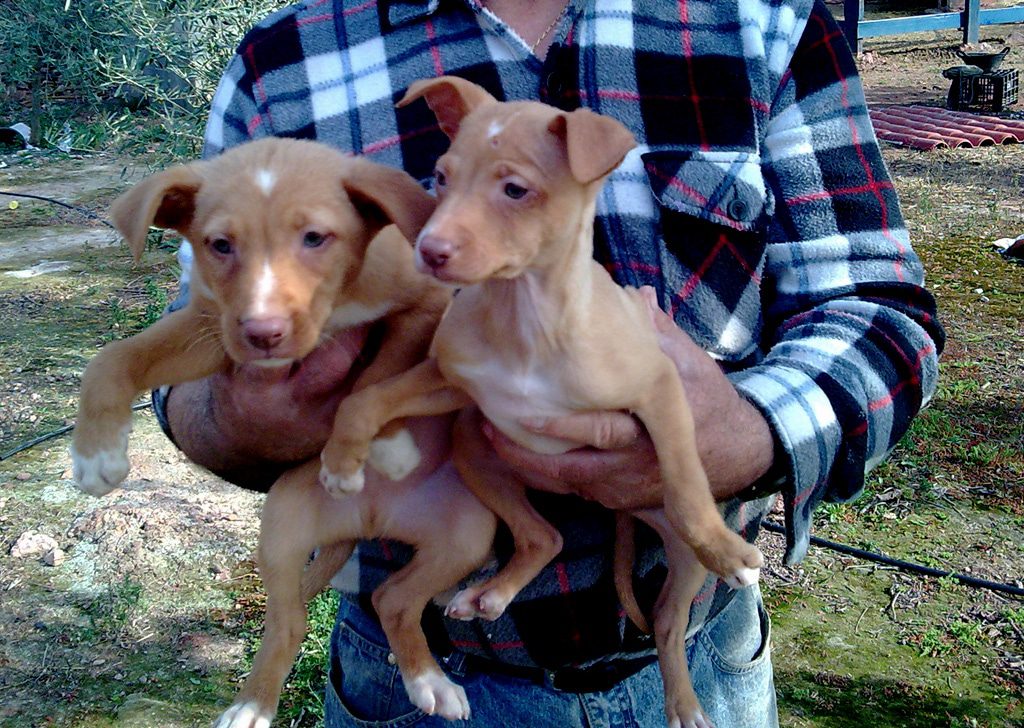
▷ The world of Pets: Dogs, cats, birds, reptiles, amphibians

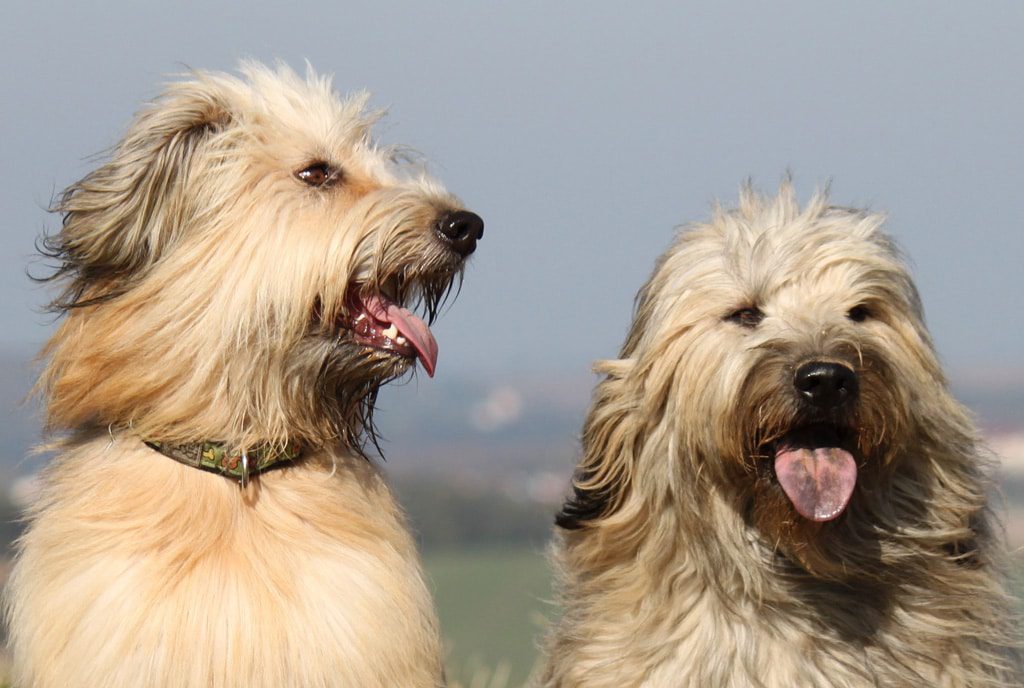
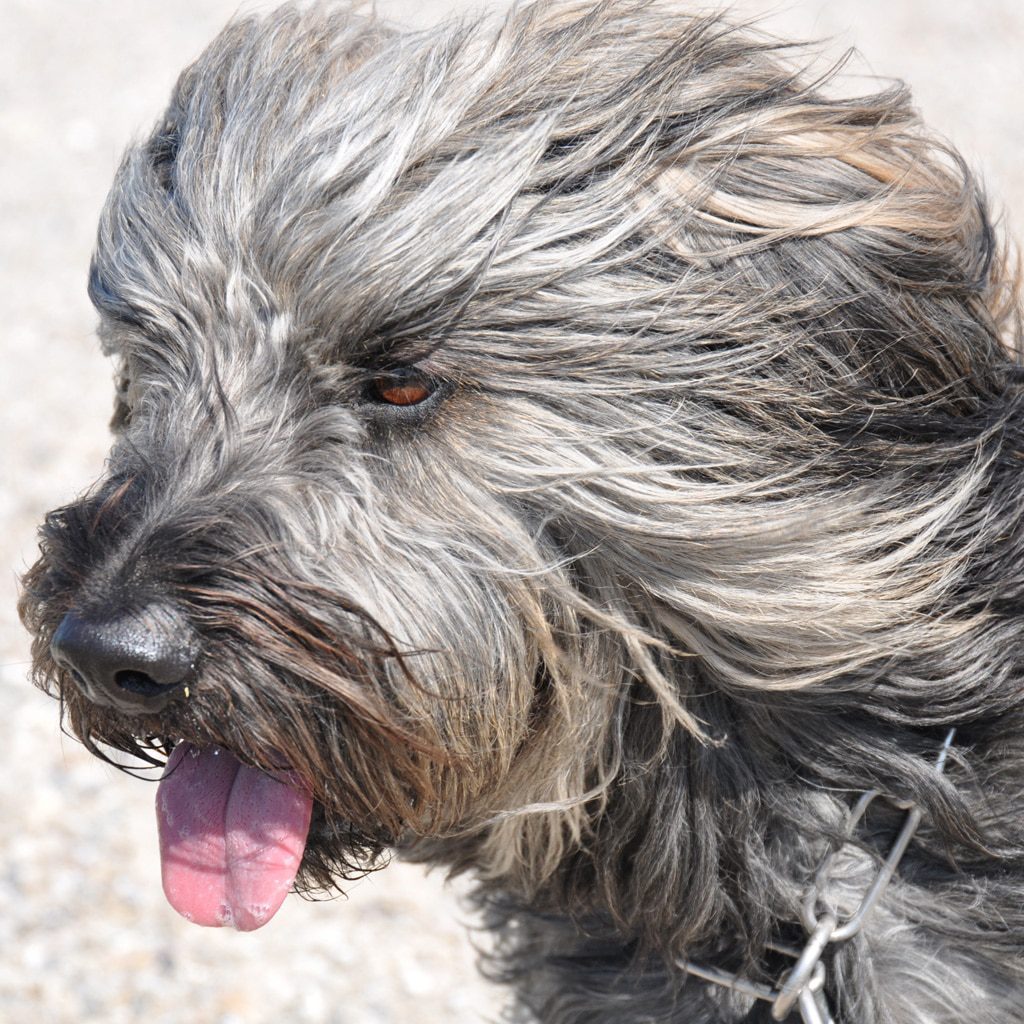
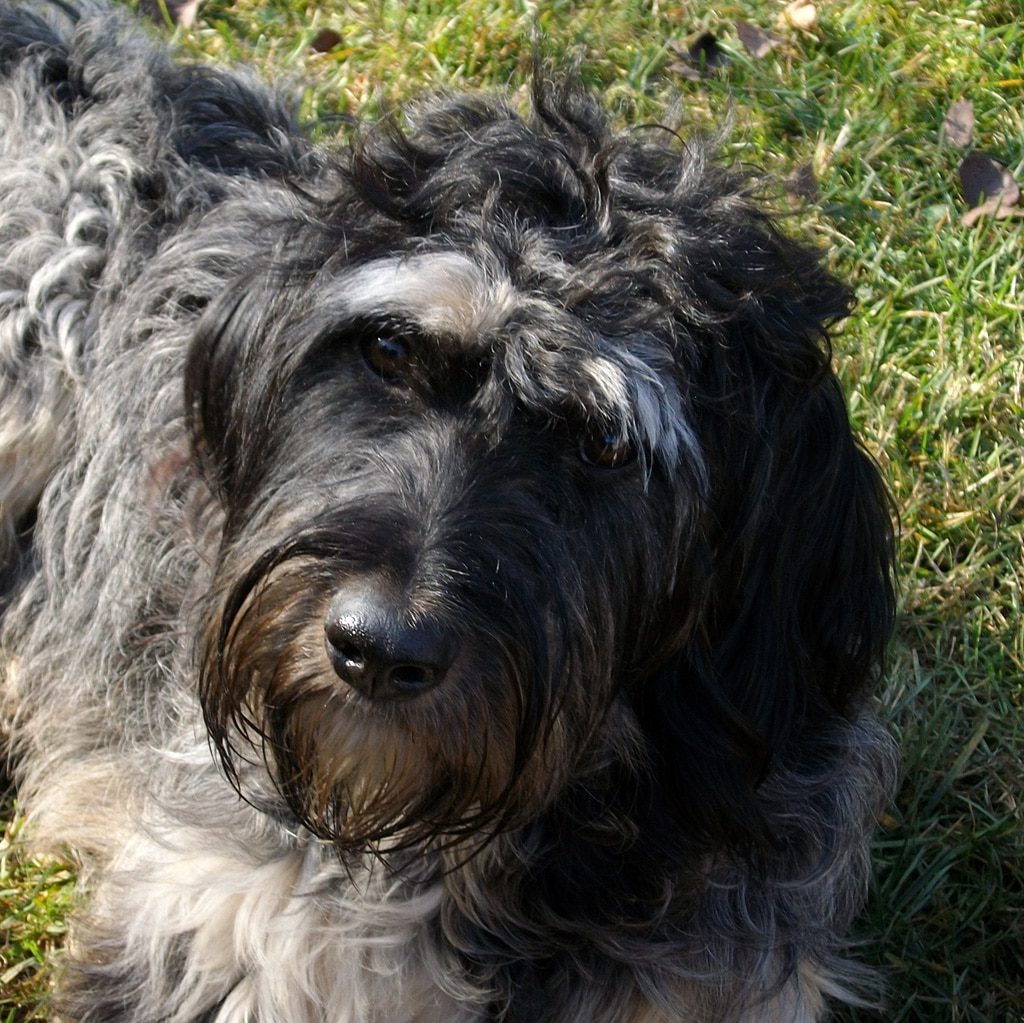
Spanish Hound
España FCI 204 . Medium-sized Hounds

Sabueso Español

The Spanish Hound It is described in the "Book of Montería" of King Alfonso XI (1312-1350).

Content

HISTORY «SPANISH HOUSE»

Already in the fourteenth century, a dog of this breed was described by King Alfonso XI. But also other documents from this time referred to its existence.

Due to the increasing isolation in the Iberian Peninsula, the breed was kept completely pure and there were no crosses with other dog breeds.

Almost with all likelihood we are faced with a race descended from «Canis segusius«, tracking dog used by Celtic peoples settled in central France.

The first description of peninsular hounds appears in the “Book of the Montería of Alfonso XI”, King of Castile, written during the second half of the s. XIV, that in his chapter 39 talk about "which doneness should be the hounds and the sabuesas”.

Over the years the Spanish Hound went repeatedly hunting small game, like hares, rabbits or foxes. He often hunted together with other dogs in the pack.

It also, was used to recover the shooting game. But also in the police force he soon had a very important task.

Full of enthusiasm for action, this spunky breed of dog proved to be a tracking dog, that already chased many trails. Due to his enormous eagerness to work and his resistance, was able to help clear up all the cases and make his teachers proud.

Still used for those tasks, preferably in your home country, Spain.

Physical characteristics "Spanish hound"

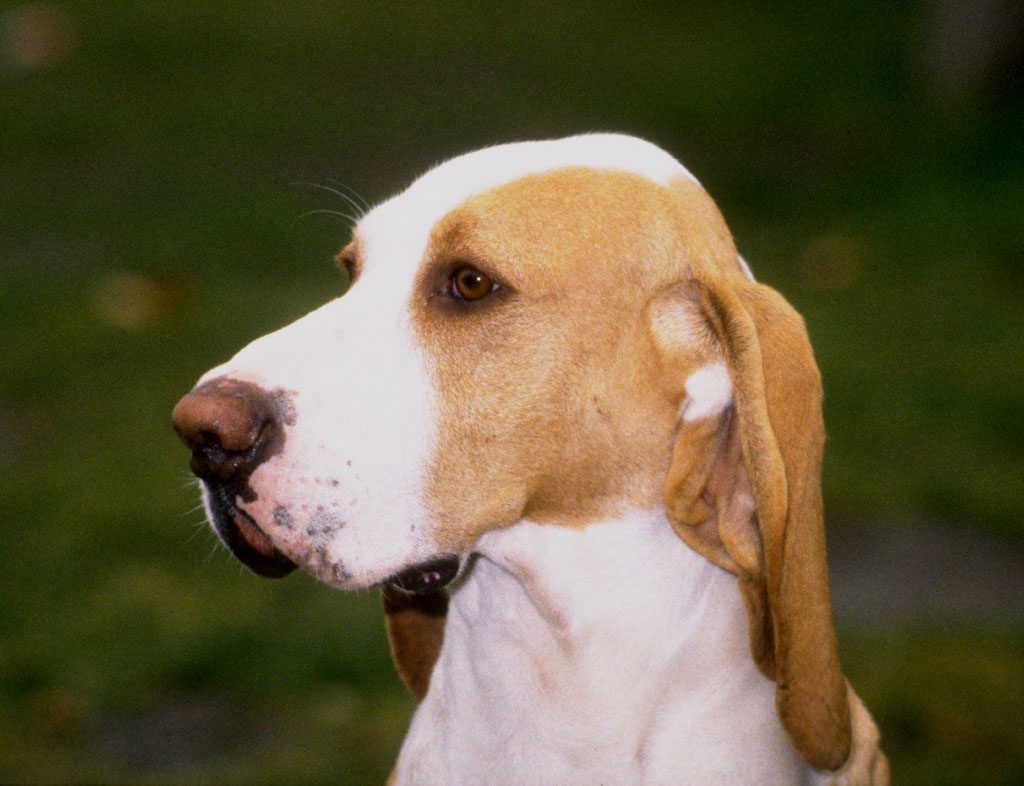
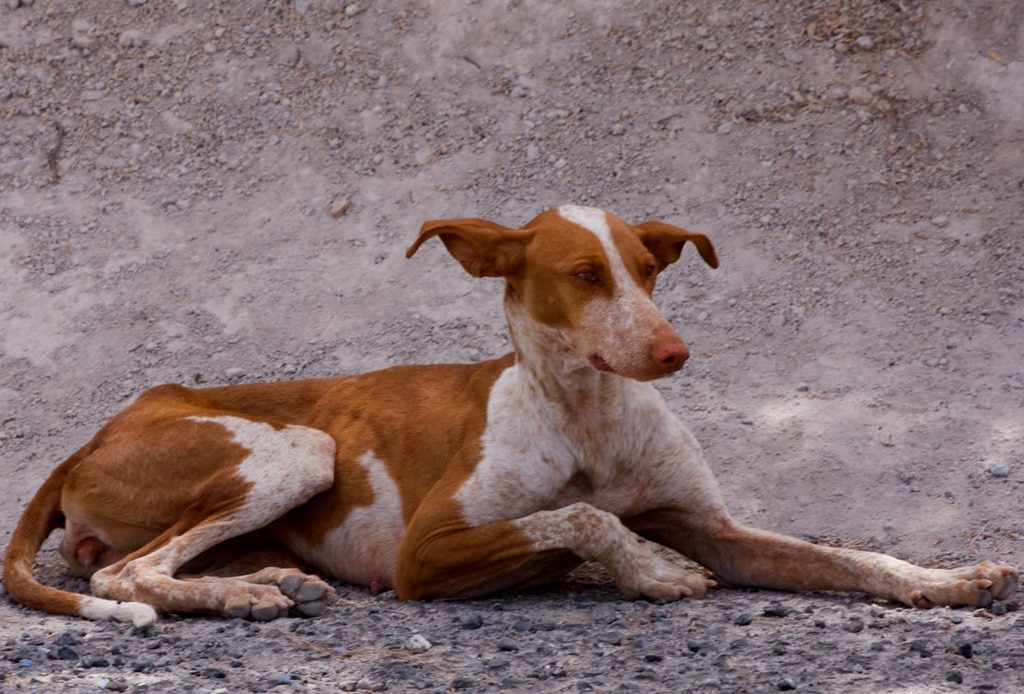
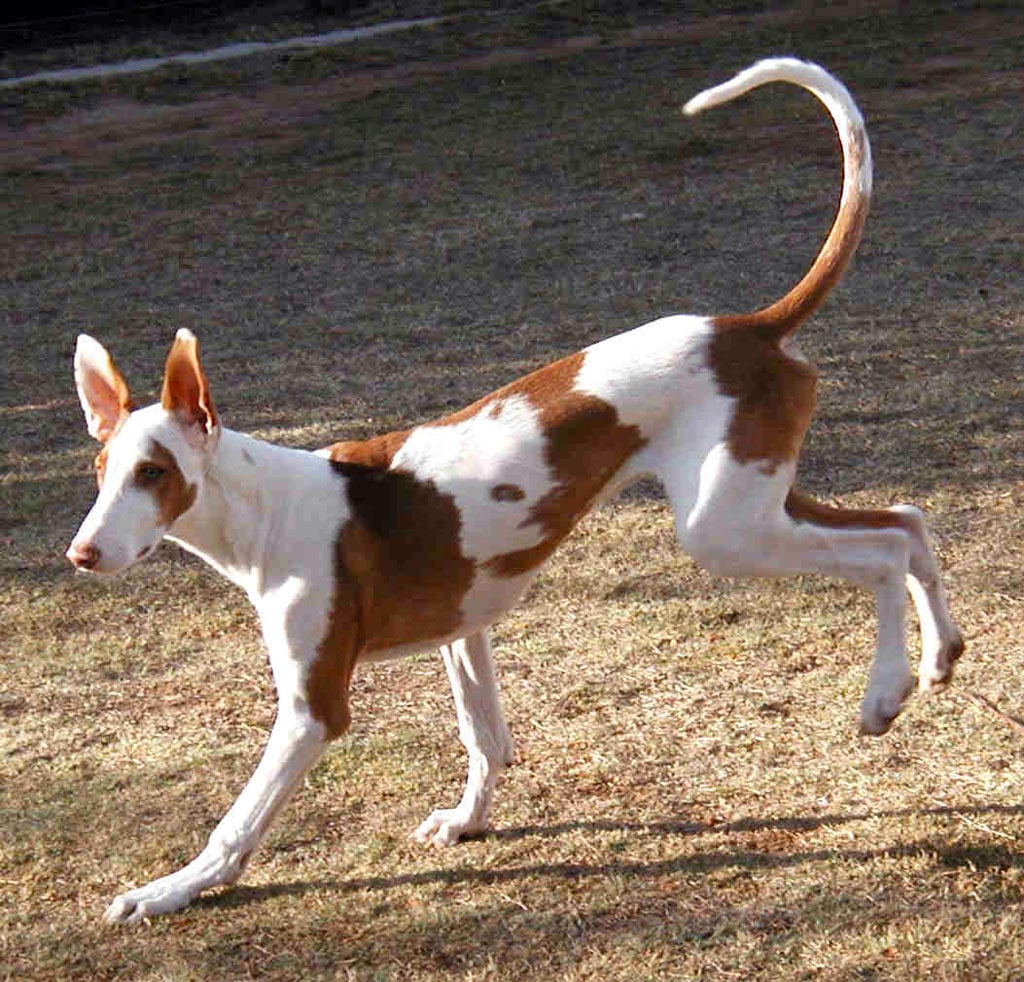
The coat of the Spanish Hound often a bit reminiscent of a cow. Often has a white background on which there are various dots and patterns.

These can be black, White, red or also multicolored. Most of the back is affected by color patterns, occasionally also the sides.

Its pelage is short, thin but nevertheless dense. Doesn't have much underlayer, making it suitable for allergy sufferers.

The Spanish Hound It belongs to the category of "medium -sized dogs". Males reach a shoulder height of up to 57 cm., the females up 53 cm.. The average weight is between 20 and 25 kg, females tend to be somewhat lighter.

Character and skills "Spanish hound"

The Spanish Hound he is a fearless hunter, eager and reliable, that nothing is lost so fast. Has an enormous need to move, who has to live regularly.

It is a minor hunting dog, which is also used for wild boar hunting, roe deer, the deer, the wolf or the bear, because in addition to being very skilled in the search, I have a determination out of the ordinary. He is also gifted with the trail of blood. Excels in hare hunting, in which he transmits to the hunter the development of the search with his voice modulations.

As a member of the family it is not very suitable, because the rhythm of life in a big city is not made for this active breed of dog. Under no circumstances do you want to be alone for hours every day.. Daily walks are mandatory with him.

He is friendly and loyal to his human being and at home he is quite calm. And you need this calm even if you have been in nature for many hours.

How do you want to find peace and quiet within the four walls of a home?, does not get along with young children. The over-excitement of children does not come at all well. But if your freedom is granted, he soon becomes a loving friend to them too. But there are certain limits!

Suspicion of strangers, so it is also a good watchdog.

The Spanish Hound is very independent and despite unconditional loyalty to his humans, always has a mind of its own.

This is why it is so important that you get the right education from the start. This must be done consistently, but nevertheless with love and patience.

Maintenance and care of the "Spanish hound"

In a narrow city apartment, that possibly on a 5th floor, a Spanish Hound has as much to look for as an elephant in a china shop. I could possibly come here in the long run to a similar result. If our Scent hound you don't have your usual workload, it may be that he destroys the furniture for lack of challenge.

A house with a large garden is an absolute must for this energetic hunter.. At the same time this aspect also relieves the owners, if our dog can let off steam regularly in the garden. Then he is already more relaxed and calm when he goes out for a walk, although he still has a lot of energy. Long walks are absolutely necessary for him.

Care:

His short coat does not require much care and his health is generally very good.

However, there must be a competent veterinarian who regularly deals with tick treatments, deworming, caring for teeth and claws, your anal glands and also from routine blood tests.

Characteristics "Spanish Hound"

Coexistence is important that you have with your new friend. Before considering the acquisition of a dog of the breed "Spanish Hound" you know certain factors. Not all breeds of dogs are apt to live in an apartment, you must take into account his character, their need for exercise, their interaction with other pets, their care and if you have small children, their level of tolerance towards them.

Vitality

4,0 of 5 stars (based on 1 review)

Ladrador

3,0 of 5 stars (based on 1 review)

Vigilance instinct

2,0 of 5 stars (based on 1 review)

Protection instinct

1,0 of 5 stars (based on 1 review)

Relationship with children

3,0 of 5 stars (based on 1 review)

Relationship with dogs

4,0 of 5 stars (based on 1 review)

Learning capacity

3,0 of 5 stars (based on 1 review)

Need exercise

4,0 of 5 stars (based on 1 review)

Friendly with strangers

2,0 of 5 stars (based on 1 review)

Health

4,0 of 5 stars (based on 1 review)

Friendly with cats

2,0 of 5 stars (based on 1 review)

Intelligence

3,0 of 5 stars (based on 1 review)

Images of the "Spanish hound"

Videos of the "Spanish hound"

Type and recognitions:

  • FCI CLASSIFICATION:
  • Group :
  • Section : . .

Federations:

  • FCI – Group 6: Scent hounds, and related breeds. – Section 1.2: Medium-sized Hounds.
  • The Royal Canine Society of Spain.

FCI breed standard "Spanish Hound"

Origin:
Spain

Date of publication of the valid original standard:
26/05/1982

Use:

Small game trail dog, though he doesn't despise the big game trail, either wild boar, deer, corzo, fox wolf or bear. The hunter, informed by voice (beat or beat) of the dog and its modulations, you will know the development of the trail hunt and its incidents such as old or recent trail, double trail, ″ Stop beat or call dead ″. The Spanish hound is the great specialist in the Hunting of Liebres ″ Vuelta ″ and is extremely effective in the Rastro of Blood.


General appearance:

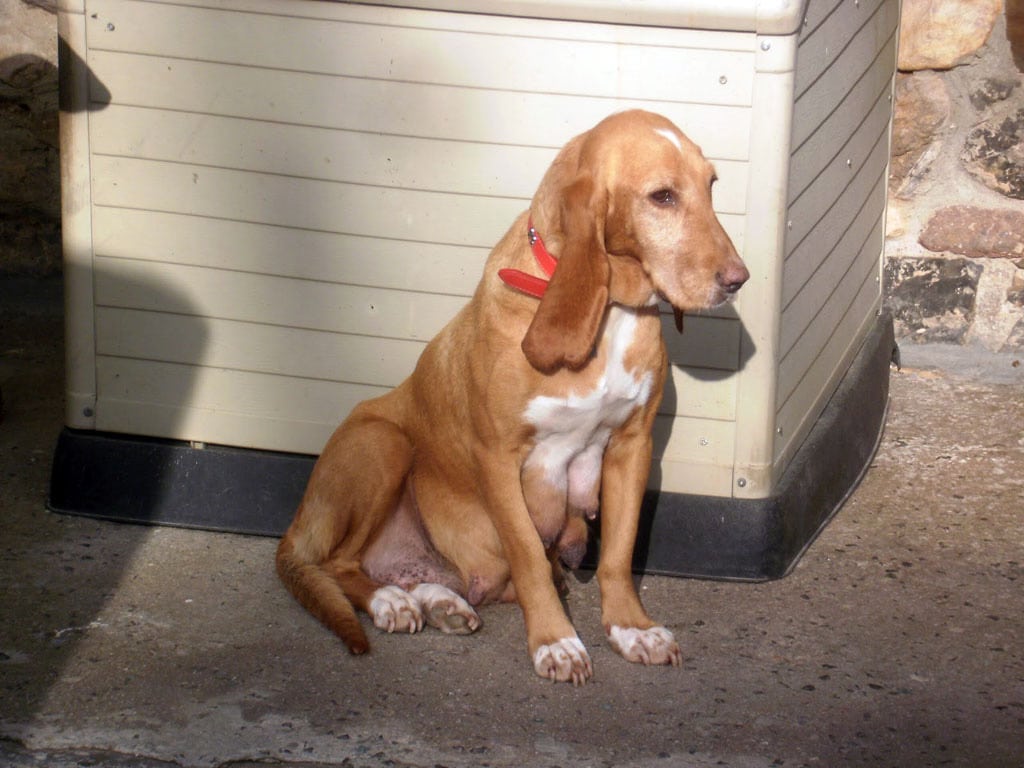
It is a medium-sized dog, eummetric and longilíneo. With a beautiful head and long ears. Highlights the high thoracic perimeter of the race and the longitudinal diameter that widely exceeds the raised to the cross. Compact skeleton and strong members; fine hair, smooth and stuck. Fresh look, sad and noble.

IMPORTANT PROPORTIONS: Longylínea Structure.

• Longitudinal diameter widely (7 - 10 cm.) higher than the raised to the cross.
• Skull-hocic relationship = 1:1, that is, equal in lengths.


Behavior / temperament:

Loving and meek, it is a beautiful animal, that in combat with big game pieces proves to possess a rare bravery and courage.

Head:

Harmonica, provided with the rest of the body and long. Divergent skull-facial lines. The joint facial craneo-region viewed from above should be very uniform and elongated, without giving feeling of pointed snout.

Cranial region:
  • Skull: Average width, being higher in males. Convex profile. The width of the skull should be equal to its length. Seen from the front, It should be vaulted. Simply marked occipital Crest.
  • Depression links (Stop): Soft, little sharp.

facial region:

  • Truffle: Grand, wet and wide and wide development windows. Its color ranges from a light brown to a deep black, always accompanying the color of mucous membranes.
  • Snout: Straight profile, admitting light subconvexidad in the terminal section. Seen from above it appears moderately rectangular, decreasing its width in direction to the truffle.
  • Lips: The superior must cover decidedly lower being loose and detached with moderation. The bottom is marked labial commissure. Mucous membranes must be of the same color that the truffle. Palate of color of mucous membranes with marked ridges.
  • Jaws / Teeth: Scissor bite. Teeth white and healthy; Canine well-developed; There are all the premolars.

Eyes: Medium, macaroons, Hazelnut dark color. Sad looking, noble and intelligent. The color of the truffle pigmented eyelids; mucous membranes attached to the eyeball, admitting Dim relaxation resting.

Ears: Large, long and falls. Of soft texture, rectangular and round tip; They are inserted below the line of the eyes and hang freely in Tirabuzón. Without exerting traction have widely exceed the truffle. Venous network visible and a flor de piel.

Neck:

Conical trunk, wide and powerful, muscular and flexible. Thick and very loose skin, that is marked and released but not exaggerated dewlap.

Body:

Strongly rectangular, very strong and robust, of a large chest perimeter that must be superior in 1/3 to the height at the withers: height at the withers 3, chest perimeter 4.

  • top line: Straight with slight concavity on the back and convexity on the spine, Race characteristics, but not ensillamiento.
  • Cross: Ahead and simply marked.
  • Back: Powerful, wide, accused length.
  • Pork loin: Very long, width, powerful and slightly raised.
  • Rump: Powerful, wide. With a tendency towards horizontal. The height at the Croup should be equal to or less than the height at the withers: taking into account the existing racial trend to be elevated, will be allowed slightly.
  • Breast : Highly developed, width, deep and high, widely reaching the elbow. Tip of the sternum marked. Ribs with intercostal of broad and rounded spaces, you are home a large rib cage.
  • Belly and flanks: Little collected belly, very notable and descended flanks and ample sidewalls.

Tail:

Thickness birth and average insertion. Strong and full of very short hair forming a small brush at the tip. At rest, your port is light, curved and low beyond the Hock; in work and movement, is high in Sabre without excess and mostra a continuous lateral movement of jig. Never straight up or resting on the rump.

Tips

PREVIOUS MEMBERS: Perfectly Plumb, straight, parallel; They give short and tendons are clearly appreciated. The length of the forearm must be equal to the shoulder.

  • Strong bone; with powerful Metacarpus and well bonded to the thorax elbows.
  • Shoulder: Oblique scapula, rounded, muscled and similar to the arm length. Scapular-humeral angle close to 100 degrees.
  • Arm: Strong.
  • Elbows: Stuck to the chest. Humer-Radial Angle near the hundred and twenty degrees.
  • Forearm: Straight, short and well poised. Strong bone.
  • Metacarpus: Strong bone and powerful. Seen little laterally inclined.
  • Previous feet: Of cat. Tight toes, high and strong phalanx. Hard and strong nails; spacious, resistant pads. Interdigital membrane moderate and provided with fine hair.

LATER MEMBERS: Powerful, muscular and excellent angles. Correct limbs, hocks without deviations, long metatarsus and strong feet. Provide your pet force, agility and thrust required for slopes land very rough and with notable drop-offs.

  • Thigh: Strong and muscular. Coxal-femoral angle close to 100 degrees.
  • Leg: Half length, muscular. Stifle-tibial angle close to fifteen hundred grades.
  • Hocks: Well marked, with clear appreciation of the tendon. Angle of the open Hock, close to one hundred twenty degrees.
  • Hind feet: Of cat, slightly oval. More elongated than the previous feet. Presence or not of spurs that are usually simple, rarely double, admitting your amputation.

Movement:

Preferred movement is the trot, still a long, sustained and economic, without any tendency to laterality or amble. Particular attention to elbows and hocks will be presented during the movement. Exist during the March natural trends in the race walking sniffing with low head.

Mantle

SKIN: Highly elastic, thick, pink, by all zones, forming sometimes frontal wrinkles in head position low.

HAIR: Bushy, short, fine and glued. Distributed by the body to interdigital spaces.

COLOR: White and orange, with a predominance of one or another color and distributed in well-defined irregular spots and no speckle. The orange color can range from a tone lighter (lemon) to the strong reddish brownish.


Size and weight:

Seen in this race a high index of sexual dimorphism that is reflected in the difference in size between males and females, being females significantly more low and less girth.

Height to the cross:

  • Males: of 52 to 57 cm..
  • females: of 48 to 53 cm..

A centimeter of lodging tolerance is admitted for copies of excellent proportions.


Fouls:

Any deviation from the aforementioned criteria is considered as a fault and the severity of this is considered to the degree of the deviation to the standard and its consequences on the health and well-being of the dog..

  • Profile of the acarnerado snout, but without excess.
  • Bite in clamp; absence of any premolar.
  • Eyelids so relaxed cause little visible conjunctiva.
  • Weak and distorted upper line during march.
  • Elevation of the region of the spine, Although permitted, It should not be never exaggerated.

SERIOUS FAULTS

  • Frail.
  • Snout blunt or pointed in excess.
  • Moderate upper prognathism. Absence of canine or Premolar, not due to trauma.
  • Entropion or ectropion.
  • Amputated ear.
  • Upper lines.
  • Height at the Croup very higher than the height at the withers.
  • Scarce thoracic perimeters.
  • Too high or resting on the rump tail. amputated tail.
  • Wrong limbs, weak or deviant.
  • Outgoing elbows during the March or in station.
  • Cow hocks.
  • Lateral braceos during operation.
  • Wavy hair, hard or mediumlength.
  • Barks.
  • Unbalanced character, excessive shyness, nervousness or aggressiveness.

MISS PLAYOFFS

  • Aggressive or fearful dog.
  • Longitudinal diameter equal to or less than the height at the withers.
  • Split nose.
  • Excessive upper prognathism. Any degree of lower prognathism.
  • Hard or long hair. Woolly hairs indicating miscegenation.
  • Copies tri-color or with brands heat in beak and members.
  • Any dog ​​showing clear signs of physical or behavioral abnormalities must be disqualified..


N.B.:

Males should have two normal-appearing testicles fully descended into the scrotum..

Source: F.C.I - International Cynological Federation

Alternative names:

1. Spanish Scenthound (English).
2. Sabueso español (French).
3. Sabueso Español (German).
4. Sabueso Español (Portuguese).
5. Sabueso Asturiano, Sabueso Navarro, Sabueso Santanderino, Sabueso Alavés (español).

▷ The world of Pets: Dogs, cats, birds, reptiles, amphibians

Canarian Warren Hound
España FCI 329 . Primitive type - Hunting Dogs

Podenco Canario

The Canarian Warren Hound is brave, decided to, generous and extremely loyal to his master.

Content

History

The Canarian Warren Hound It is a breed canine Spanish Canary.

The Canarian Warren Hound, It is one of the oldest breeds known today., According to scholars of the breed, it dates from approximately 7000 years. This realize the numerous found vestiges of its representation in engravings, statues and bas-reliefs.

A native of Egypt, probably, He was taken by the Phoenicians, greeks, the same Egyptians to the Canary Islands and Carthaginian, where it is currently easy to see in the larger islands (Gran Canaria and Tenerife).

Since its inception, the Canarian Warren Hound has been placed in the wild and in the possession of the peasant who needed to hunt to survive. Given the perfect hunting qualities of this dog: his sense of smell, his hearing and his clear vision, as his great speed in the race after the dam, the peasant has had, always, a wonderful ally, It has been able to take advantage of.

The Canarian Warren Hound, as its name suggests it is found in the Canary Islands, and a dog is little known and disseminated outside their place of origin, It is not easy to find puppies.

Today, is perfectly adapted, both the flat lands as stony and mountainous, sandy, or soft like the prairies or very hard; You can both enter caves that penetrates in Lava Tubes or galleries, in thickets or forests, in the end, does not shy away from any obstacle.

Outside the hunting season, the living conditions of animals are very different: Well-kept dogs can be found and fed on clean kennels, as well as miserably neglected and malnourished chained dogs. Animals that are not or are no longer fit for hunting often suffer a cruel fate.
For this reason, dogs are increasingly placed abroad by animal protection organizations and individuals – an understandable and well-meaning activity, What, However, brings with it some problems: Dogs, who are usually already grown up, sometimes they are taken out of their simple rural living environment and taken to big cities. Noise and haste can be very harsh for them, his frequent lack of trust in humans further complicates it. His pronounced passion for hunting makes the free will, which would be absolutely necessary for the maintenance of the animals and to reduce stress, is often difficult or impossible. It also, in many cases are infected with so-called travel or Mediterranean diseases, that often require long and costly treatment.

Physical characteristics

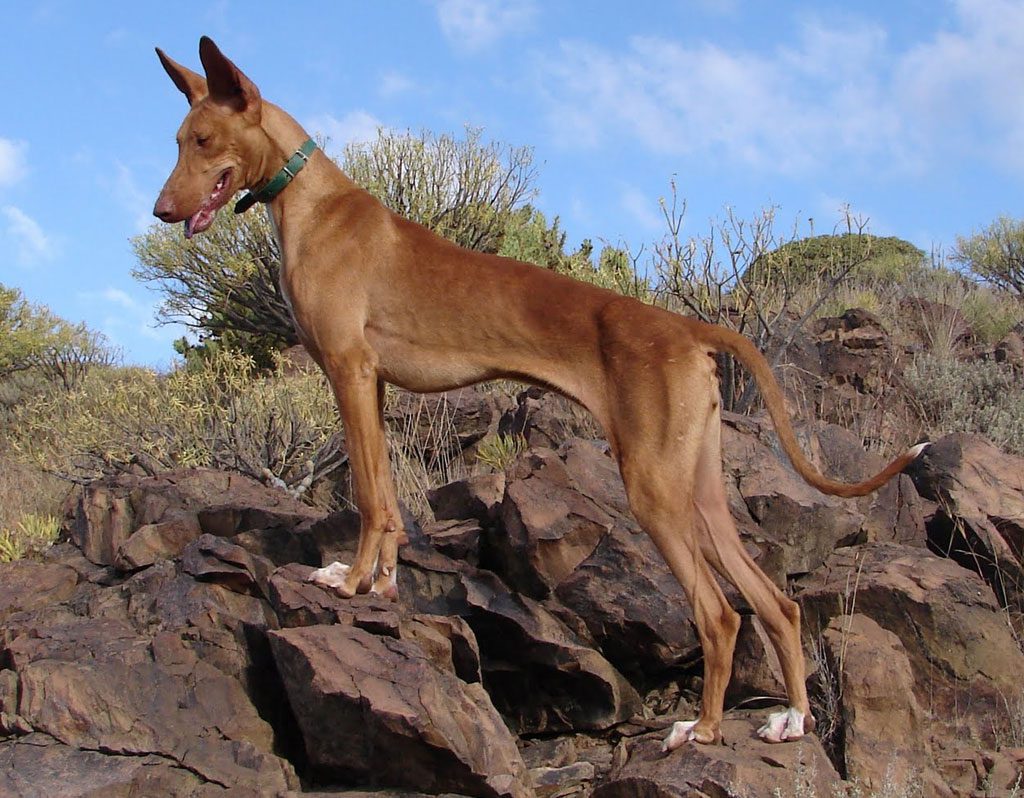
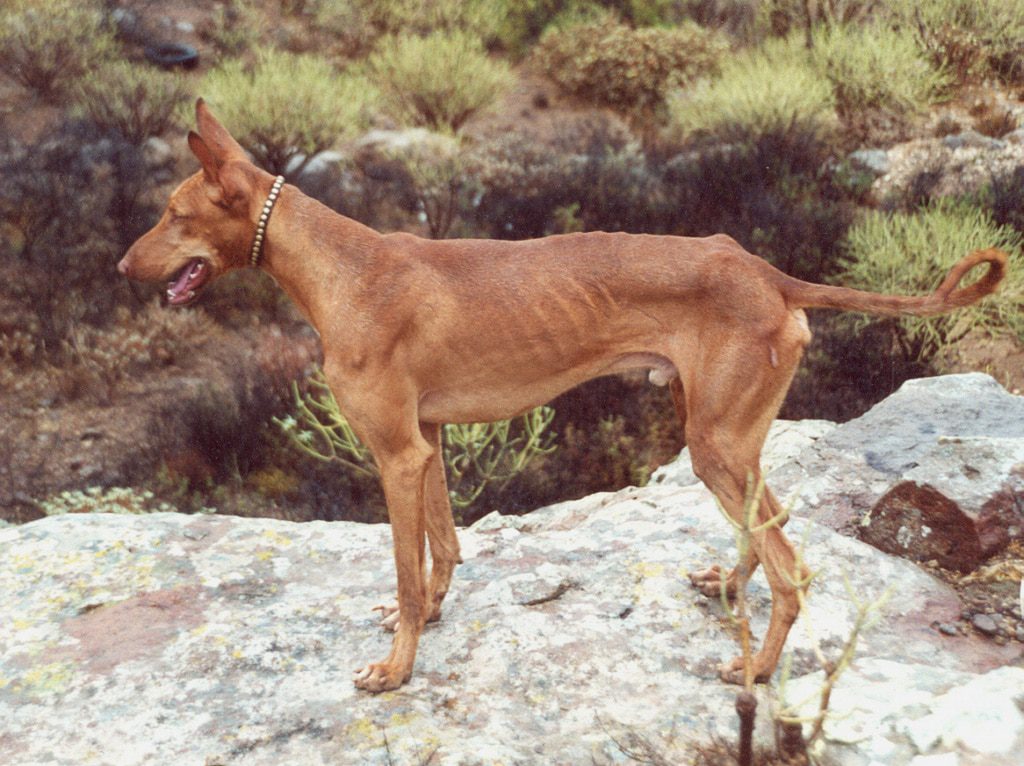
The Canarian Warren Hound, is a dog from size medium, very light but tough.

The height to the cross males will of 55 to 64 cm and the females of 53 to 60 cm.. These measures have 2 cm tolerance up or down.

Has the muscles hyper developed and as it does not present adipose panniculus it is very easy to appreciate the rib cage, the spine and hip bone.

Has the head elongated with little pronounced stop, the eyes are small, almond-shaped and oblique.

Their ears they are rather large, When the Earth State of arousal keeps them in erect and fall backwards when it is at rest, they are wide at the base and end up in tip.

The limb perfectly Plumb, they are straight, has fine but strong bones. The tail is low, You can take the low or sickle-shaped, but does not exceed Hock.

The hair the Podenco Canario is smooth, tight and short. In the layer color combinations within the following are supported colors: Red and white, with more or less intense red, and finally, Orange to mahogany.

Observations

:

These dogs start to hunt from an early age, giving cases of animals less than three months that show strong hunting instinct.

When they discover and/or they chase prey, emit a characteristic short, repetitive bark, known to local hunters as "singing a rabbit".

Character and skills

The Canarian Warren Hound is an animal that shows no aggression normally, extremely loyal and noble to teammate, restless, independent, stubborn, worker and intelligent.

It´s brave and decided to, the race is fast and very agile, generous and extremely fell to its owner.

There are no guard and defense attitudes, at home it is "friend of all strangers", what makes it ideal as a pet.

If raised inside a Home, Once overcome the first six months of hyperactive life, shown as a quiet animal and customize, attitude changes drastically once comes to the field of hunting.

In its role of Hunter It has always been dedicated to the rabbit house and its most important feature is its ability to adapt to any type of terrain. It is capable of detecting the presence of the press inside cracks thorny bushes or stone walls, the Podenco Canario only to follow the trail of the prey with the sense of smell but without catching it.

Observations:

In the Canary Islands is used in conjunction with the huron, since the latter catches the rabbit by the throat.

Caring for Canarian Warren Hound

As already mentioned, the dog should be given a housing environment that corresponds to its predisposition. Rural areas with low traffic and a manageable hunting density are appropriate.
Proper exercise in any weather with as much free running as possible is a must for this active dog.

The short coat is very easy to care for; just brush from time to time.

Canarian Warren Hound Health

The breed is basically a robust dog with low susceptibility to disease; therefore, breed-specific diseases are largely unknown.

But, the Canarian Warren Hound can suffer from the typical travel or Mediterranean diseases of dogs (among others, leishmaniosis, dirofilariasis, babesiosis, ehrlichiosis) like all the other dogs.
Many animals are chronically infected without showing symptoms of disease. But, these dogs are unhealthy and can infect other animals through vectors (ticks and blood-sucking insects).
So, imported dogs should always be thoroughly examined for the diseases mentioned (the so-called "travel profile").

The average life expectancy is about 12 years.

Images Canarian Warren Hound

Canarian Warren Hound videos

Type and recognitions:

  • FCI CLASSIFICATION:
  • Group :
  • Section : . .

Federations:

  • FCI – Group 5: Spitz-type dogs and primitive type – Section 7: Primitive type – Hunting dogs..

FCI breed standard "Canarian Warren Hound"

Origin:
Spain

Date of publication of the valid original standard:
24.06.1987

Use:

It is used for rabbit hunting and adapts perfectly to the multiple variations of the terrain for this purpose., using their prodigious sense of smell as well as sight and hearing. Withstands high temperatures and hunts tirelessly from dawn to dusk. You can detect the presence of rabbits inside cracks with your sense of smell or hearing., stone walls, majano, volcanic tubes and thorny scrub. Its extraordinary preservation is undoubtedly due to its gifts, which have made it necessary throughout the centuries.. It is primarily a trail dog and should not bark or flap the part during tracking.. It is also used with the help of a ferret, modality allowed on the islands. It also usually catches rabbits by tooth.


General appearance:

It is a medium-sized dog, slightly elongated, leptosomatico, light, very resistant. The skeleton is well developed. The absence of adipose panniculus allows us to appreciate the relief of the rib cage, spine and hip bones. The muscles are highly developed, spandrel, transluciendo contractions through the skin.

IMPORTANT PROPORTIONS: Slightly longer than high. Well developed chest, without reaching the elbow. Muzzle slightly longer than the skull.


Behavior / temperament:

Brave, nervous, restless and radiating a dynamism. Noble, never aggressive. Selflessly addicted to its owner. Stoically supports more rigorous sessions without the less fatigue.

Head:

Elongated. Truncated cone shaped, very provided with the body, measuring length 21 to 22 cm.. Parallel craniofacial lines.

Cranial region:
  • Skull: Longer than width, plane, with prominent occipital bone.
  • Depression links (Stop): Not very marked.

facial region:

  • Truffle: Wide, sand color, harmonized with the coat color, slightly open nostrils.
  • Snout: Prominent and wide, dull finish, flesh-colored with more or less intensity in harmony with the color of the coat.
  • Lips: Fine and collected, harmonized with the color of the nose.
  • Teeth: Bite in scissors, in perfect opposition and well-developed.
  • Eyes: Oblique, almond-shaped and small. More or less dark amber depending on the intensity of the color of the layer. His gaze is smart and noble.
  • Ears: Rather large. Carried erect in attention, slightly divergent. Take them back to sleep. Wide at its base and pointy at the end.

Neck:

Muscular, straight, with smooth skin, without jowl, rounded and flexible.

Body:

  • Back: Strong, muscular, suitable for the race and exercise of hunting.
  • Pork loin: Somewhat elongated.
  • Rump: Something solid bones of the rump, more visible in the exemplary weak or in full hunting season.
  • Breast : Chest with no outgoing sternum, well developed, But however it does not reach the elbow. Oval ribs.
  • Chest perimeter more in 5 to 8 cm as height on the cross.
  • Belly: picked up, without being the Greyhound. Well marked flanks.

Tail:

Lowest insertion, as a continuation of the rump. Rounded, It descends somewhat lower than the Hock. Fallen or carried in the shape of a sickle. Something sharp at the tip which is usually white in color. Never screwed. Desirable not to raise in excess to the March.

Tips

PREVIOUS MEMBERS: Perfectly Plumb, straight, vertical and parallel, fine but solid bone. Cat feet, generally something diverted outwards. Strong and somewhat oval pads.

Angles:

  • Angles scapulo-humeral: close to 110°.
  • Humeral-radial angles: close to 140°.

LATER MEMBERS: Plumb, straight, strong, muscular, rather high Hock (some 18 cm from the ground). Straight feet, of cat, with strong and slightly oval pads. Without the presence of spurs.

Angles:

  • Lame-femoral angle: about 110°.
  • Femoral-tibial angle: about 120°.
  • Hock angle: about 130°.

Movement:

You must have a fast trot, long and very light.

Mantle

SKIN: Consistent, attached to the body and without wrinkles.

HAIR: Smooth, short and tight.

COLOR: Preferably red and white, the Red can be more or less intense coming from Orange to dark red (Mahogany). All combinations of these colors.


Size and weight:

Height to the cross:

  • For males: of 55 to 64 cm..
  • for females: of 53 to 60 cm..

These measures may vary due to the different land where living and hunting, therefore to accept differences in 2 cm above or below the maximum or minimum size, as long as the specimens are typical and with the prototype of the breed.


Fouls:

Any deviation from the aforementioned criteria is considered as a fault and the severity of this is considered to the degree of the deviation to the standard and its consequences on the health and well-being of the dog..

SERIOUS FAULTS

  • Excessively wide head.
  • Too marked stop.
  • Hanging lips.
  • Lack of premolars.
  • Prognathism.
  • Ears very divergent.
  • Flat chest.
  • Outgoing sternum.
  • Threaded queue.
  • Low or cow hocks.
  • Crossing of front feet and hocks in gear.
  • Aggressive temperament.
  • Any dog ​​showing clear signs of physical or behavioral abnormalities must be disqualified..

FALTAS DESCALIFICANTES:

• Aggressiveness or extreme shyness.
• Any dog ​​showing clear signs of physical or behavioral abnormalities.


N.B.:

• Males must have two normal-appearing testicles fully descended into the scrotum..
• Only functionally and clinically healthy dogs, with the typical conformation of the breed, should be used for parenting.

Source: F.C.I - International Cynological Federation

Alternative names:

1. Canary Island Podenco, Canary Island Hound, Podenco Canario (English).
2. Podenco canario (French).
3. Podenco Canario (German).
4. Podenco Canario (Portuguese).
5. Podenco Canario (español).

▷ The world of Pets: Dogs, cats, birds, reptiles, amphibians

Ibizan Hound
España FCI 89 . Primitive type - Hunting Dogs

Ca Eivissenc

The Ibizan Hound is one of the medium sized Greyhound, very similar to Pharaoh Hound.

Content

History

The Ca Eivissenco or “Podenco Ibicenco”, It is a breed canine Spanish Ibiza (Spain). It gets its name from the island Ibiza, belonging to the Group of islands in the Balearic Islands, bathed by the Mediterranean.

This dog, has a highly developed sense of sight and hearing, that is why he has been assigned to hunting, especially in the rabbit, both day and night.

It is a type of primitive and rustic dog, considered one of the oldest breeds that exist and can be seen the tombs of the Pharaohs and museums whose first signs can be traced back to the 3.400 A.C.

The Ibizan Hound is one of the medium sized Greyhound, very similar to Pharaoh Hound. Without a doubt a descendant of the old Egypt dogs, that's what the written theories about race say..

The origin of this breed is Spain, comes from the island of Ibiza. The city of Ibiza was founded in the 654 A.C. by the Carthaginians and it is a conjecture establishes the possibility that the first settlers took with them their dogs of Egyptian origin for simple company and to hunt the rabbits that were abundant on the island.

But various genetic studies carried out in recent years have come to the conclusion that contrary to the widespread belief that the podenco is a type of primitive dog imported a few years ago 3.000 the area of middle years, These dogs actually have a close genetic relationship with the rest of the European hunting dogs and are no more "primitive" than most of them... The researcher Antoni Pedro Marí, details different aspects of the morphology, ethology and ecology of Ca Eivissenc in his work Native Races of the Pitiüses.

Did you know??

The resemblance of the Ibizan with representations of the Egyptian god Anubis dog is one of the reasons why it is often thought to be an ancient race.

Physical characteristics

Elegant and agile, with an athletic and attractive outline, and with an elastic trot.

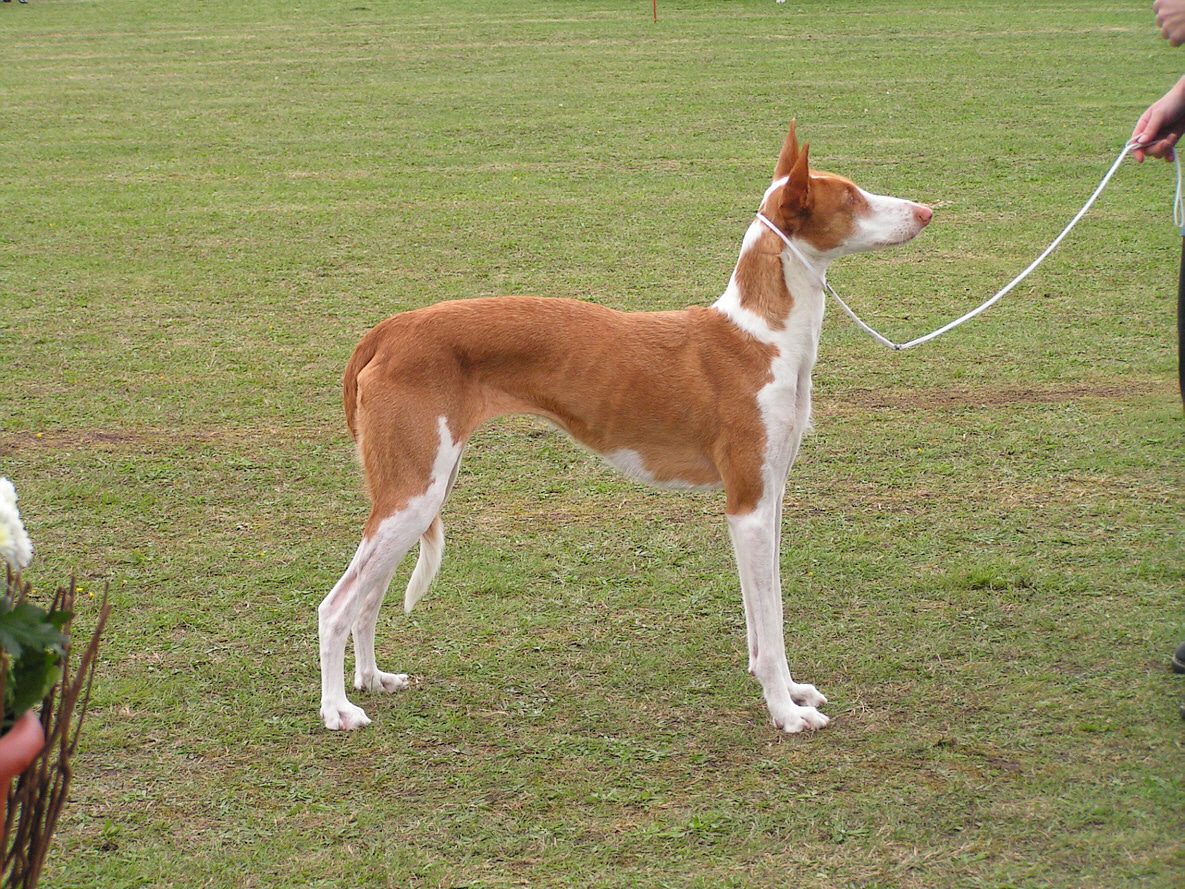
The Ibizan Hound has a long, narrow head, sharp cone-shaped; the skull is long and narrow with a little pronounced Stop. The ears must be straight, towards front and very mobile; oblique eyes, small and always amber clear.

The nose is flesh-colored and usually be taken into account to determine the purity of the breed. The color will always be blanco-marron, Blanco-leonado or unicolor, although this last possibility is more rare to find them. The weight varies between the 18 and 24 Kg, Depending on whether it's a male or a female, as well as if he is too well or poorly fed. With regard to the height of the dog there are also many disputes since fashion has at times imposed more slender and tall dogs that the found in the Pitiusas Islands.

The current standard is one height of between 66 and 72 cm., It is very far from reality and the first official standard. The dogs that are bred in Ibiza and Formentera are shorter than the maximum height allowed.

Via: criadorscaeivissenc

Character and skills

Pet is an excellent. Very easy to maintain when treated well and will respect your space. He is a dog that thinks for himself and there are times when he prefers not to have to show his appreciation to his master or be appreciated.; just let it quiet. It requires patience when it is trained.

It is not recommendable for the home where children are (He has no patience and is very independent). Generally does not get along well with other pets. Can maintain you in apartment or House, When receive plenty of daily exercise.

Characteristics "Ibizan Hound"

Coexistence is important that you have with your new friend. Before considering the acquisition of a dog of the breed "Ibizan Hound" you know certain factors. Not all breeds of dogs are apt to live in an apartment, you must take into account his character, their need for exercise, their interaction with other pets, their care and if you have small children, their level of tolerance towards them.

Adaptation ⓘ

4,0 of 5 stars (based on 1 review)

friendly dog ​​ⓘ

3,0 of 5 stars (based on 1 review)

hair loss ⓘ

3,0 of 5 stars (based on 1 review)

Affection level ⓘ

5,0 of 5 stars (based on 1 review)

Need for exercise ⓘ

4,0 of 5 stars (based on 1 review)

Social need ⓘ

3,0 of 5 stars (based on 1 review)

Home ⓘ

1,0 of 5 stars (based on 1 review)

Toilet ⓘ

1,0 of 5 stars (based on 1 review)

Friendly with strangers ⓘ

2,0 of 5 stars (based on 1 review)

barking ⓘ

3,0 of 5 stars (based on 1 review)

Health ⓘ

3,0 of 5 stars (based on 1 review)

Territorial ⓘ

3,0 of 5 stars (based on 1 review)

Cat friendly ⓘ

2,0 of 5 stars (based on 1 review)

Intelligence ⓘ

3,0 of 5 stars (based on 1 review)

Versatility ⓘ

2,0 of 5 stars (based on 1 review)

Child friendly ⓘ

3,0 of 5 stars (based on 1 review)

Surveillance ⓘ

3,0 of 5 stars (based on 1 review)

joy ⓘ

3,0 of 5 stars (based on 1 review)

Ibizan Hound Images

Videos Ibizan Hound

Type and recognitions:

  • FCI CLASSIFICATION:
  • Group :
  • Section : . .

Federations:

  • Federations: FCI , AKC , ANKC , CKC , ​KC , NZKC , UKC

  • FCI breed standard "Ibizan Hound"

    Origin:
    Spain

    Date of publication of the valid original standard:
    26.05.1982

    Use:

    Is used, above all, in the rabbit hunt without a shotgun, day and night, well they lift them easily, even in places with a lot of vegetation due to the fineness of their smell, because he uses himself and his hearing more than his sight.. For their agility and cunning they soon collect the piece, especially hunting several dogs together; When a dog shows a piece, the others surround it at a certain distance, stalking the passage of that piece., they only beat when they see or hear the piece and also when they have closed it, all of them show and charge the piece by flipping the tail during it, the sample is easily broken.

    It is also used to hunt hares and big game.. They are good collectors. To form packs, they are used, except for exceptions, females and at most one male, because they do not help each other hunting and are quarrelsome. When a pack has taken a few thousand rabbits, the peculiarity occurs that some dogs from the same, they no longer hunt until after a long rest. This is called “Enconillarse”.


    General appearance:

    The length of the tip of the snout to the eye is the same as the distance between them and the occipital.


    Behavior / temperament:

    ---

    Head:

    Long head, narrow cone truncated near your base, excessively dry, rather small in relation to the body.

    Cranial region:
    • Skull: Dolicocephalic, long or crushed; prominent occipital bone; narrow forehead and flat.
    • Stop: Poorly defined.

    facial region:

    • Truffle: Slightly convex, flesh-colored; Open nostrils.
    • Snout: Prominent, protrudes from the lower jaws; is narrow, long and colour harmonising with the coat meat.
    • Lips: Fine, collected, flesh-colored.
    • Teeth: In perfect opposition, White, well placed, with the Scissor bite.

    Eyes: Oblique, small, Amber clear, Recalling the color of candy; Amber can be more or less intense, depending on the color of the coat. With a not very noble look, very intelligent, shy and distrustful.

    Ears: Always rigid; directed forward, to the sides horizontally or backward; to when the dog is excited, very moving; the center of the base is located at the level of the eyes; elongated rhomboid-shaped, truncated to one third of its longest diagonal. They are fine, without hairs inside; median, not overly large.

    Neck:

    Very dry, both at the bottom and top. Its length is one-quarter the length of the body; slightly arched, muscled; the skin is taut, Lisa, without jowl. The hair is usually longer and dense in the upper lower part of this area, noticing more in straight hair.

    Body:

    The general aspect of the body is symmetrical, subconvex and medioline, quite matched dimensions, picked up, slightly longer without measure fixed difference.

    • Cross: Outstanding, high, dry and long.
    • Back: Straight, long and flexible; strong muscles, but flat.
    • Pork loin: Arcuate, average width, strong and powerful.
    • Rump: At desk, of very powerful and hard muscles, with a bone structure shows.
    • Breast : Deep, narrow and long, without elbows, sternum angle very sharp and prominent; flat ribs.
    • Belly: Collected but not agalgado.

    Tail:

    Low insertion; passing between the legs to reach the spine, monitors (towards the tip around the tail a few longer and thicker hairs slightly separated in a spike shape), long; somewhat thicker in his birth, will tweaking gradually; at rest falls naturally; in action is in the form of sickle, more or less closed, preferably is not straight or screwed too on the back.

    Tips

    PREVIOUS MEMBERS: They are aplomados, symmetric; seen from the front arms are close together; collected set, limbs long giving the impression of a thin animal, Agile but strong.

    • Shoulder: Oblique scapulae, strong and free in their movements.
    • Arms: Very long, straight and strong, and very together.
    • Elbows: Comprehensive and outstanding, parallel to the median plane of the body, never come out.
    • Forearm: Wide at its bottom end.
    • Metacarpus: Powerful, strong, width, right well.

    LATER MEMBERS: Plumb, long muscles, strong, dry, flattened muscle.

    • Hocks: Toggle, widths, close to the ground (descending), well Plumb, Neither outwards nor inwards.

    FEET: Trend of Hare, tight and long fingers, well trimmed hair interdigital spaces, very strong and generally white nails, Sometimes the color of hair; very hard pads.

    Movement:

    The preferred way is a trot suspended; the Gallop is very fast, giving feeling of agility.

    Mantle

    SKIN: Tense, attached to the body; Pink pigmentation, It can vary from color in the regions in which the layer is different.

    HAIR: Smooth, hard or long.

    • The smooth should not be silky but strong and shiny.
    • The hard must be rough, well populated, somewhat shorter on the head and ears, longer in the back of the thighs and the underside of the tail; the beard is very appreciated; the length is softer and must be at least one length 5 cm with the heavily populated head.

    COLOR: Preferably white and Red, unicolores white or red, although the fawn could also be admitted as long as it is an extraordinary specimen., Although never accept this color for hair.


    Size and weight:

    Height to the cross:

    • For males :  66 to 72 cm.,
    • for females :  60 to 67 cm..

    Without being very demanding, Since of approximate measurements you can always accept that they are proportionate and aesthetic.


    Fouls:

    Any deviation from the aforementioned criteria is considered as a fault and the severity of this is considered to the degree of the deviation to the standard and its consequences on the health and well-being of the dog..

    SERIOUS FAULTS :

    • Short and wide head.
    • Very marked stop.
    • Lack of a premolar.
    • Floppy ears.
    • Depressed Center ribbing.
    • Elbows out.
    • Cow hocks.
    • Feet out.
    • Cross feet and hocks in motion.

    MISS PLAYOFFS :

    • Aggressive or fearful dog.
    • Phased skull.
    • Brown pigmentation or black spots on truffle.
    • Any form of prognathism.
    • Eyelids and lips brownish red.
    • Miss indicating a junction with a Greyhound or a hound, that is to say :
      • folded ears
      • Dark eyes
      • Wide rump
      • Little defined sternum
      • Separate forelimbs
      • Thighs wide and rounded, with bulging veins


    N.B.:

    • Males must have two normal-appearing testicles fully descended into the scrotum..
    • Only functionally and clinically healthy dogs, with the typical conformation of the breed, should be used for parenting

    Source: F.C.I - International Cynological Federation

    Alternative names:

    1. Ibizan Warren Hound, Ca Eivissenc, IBIZAN PODENCO (English).
    2. Chien de garenne des Baléares (French).
    3. Ca Eivissenc (German).
    4. Podenco ibicenico (Portuguese).
    5. Ca Eivissenc (español).

    ▷ The world of Pets: Dogs, cats, birds, reptiles, amphibians

    Majorca Mastiff (Majorcan mastiff dog)
    España FCI 249 - Molossoid - Dogo

    The Majorca Mastiff is a gentle dog, extremely affectionate with their owners, faithful to his master
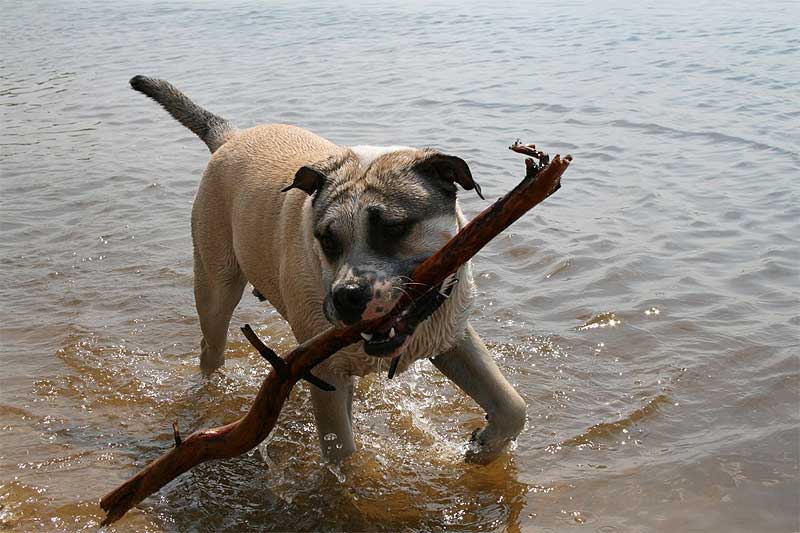
    Ca de Bou

    Content

    Characteristics "Majorca Mastiff (Majorcan mastiff dog)"

    Coexistence is important that you have with your new friend. Before considering the acquisition of a dog of the breed "Majorca Mastiff (Majorcan mastiff dog)" you know certain factors. Not all breeds of dogs are apt to live in an apartment, you must take into account his character, their need for exercise, their interaction with other pets, their care and if you have small children, their level of tolerance towards them.

    Adaptation ⓘ

    5,0 of 5 stars (based on 1 review)

    friendly dog ​​ⓘ

    2,0 of 5 stars (based on 1 review)

    hair loss ⓘ

    3,0 of 5 stars (based on 1 review)

    Affection level ⓘ

    2,0 of 5 stars (based on 1 review)

    Need for exercise ⓘ

    4,0 of 5 stars (based on 1 review)

    Social need ⓘ

    2,0 of 5 stars (based on 1 review)

    Home ⓘ

    3,0 of 5 stars (based on 1 review)

    Toilet ⓘ

    2,0 of 5 stars (based on 1 review)

    Friendly with strangers ⓘ

    3,0 of 5 stars (based on 1 review)

    barking ⓘ

    3,0 of 5 stars (based on 1 review)

    Health ⓘ

    3,0 of 5 stars (based on 1 review)

    Territorial ⓘ

    5,0 of 5 stars (based on 1 review)

    Cat friendly ⓘ

    2,0 of 5 stars (based on 1 review)

    Intelligence ⓘ

    4,0 of 5 stars (based on 1 review)

    Versatility ⓘ

    3,0 of 5 stars (based on 1 review)

    Child friendly ⓘ

    4,0 of 5 stars (based on 1 review)

    Surveillance ⓘ

    5,0 of 5 stars (based on 1 review)

    joy ⓘ

    4,0 of 5 stars (based on 1 review)

    History

    The Majorcan mastiff dog, also known as Majorca Mastiff in Catalan or Perro de presa mallorquín in Spanish, is a fairly old dog whose history remains unclear.

    It is believed to have originated from a number of races, especially the Spanish Mastiff and the Alano, that crossed over the centuries.

    The result of these crosses came to Mallorca in the thirteenth century, specifically in 1229, during the conquest of the island by King James I of Aragon. Some of these dogs remained there and were bred with local dogs.. The resulting individuals turned out to be much less sensitive to heat and adapted very well to local conditions. They began to be used by the local population to monitor houses and livestock.

    It was also in the thirteenth century when the butchers of the island found in the dog an assistant for his ability to control livestock, especially bulls, before and during their sacrifice. In fact, his powerful jaw made him able to keep them immobile by holding them firmly by the nose.

    At the same time, it was also used by the Knights of Malta in battle and to guard the camps. It also, he was unrivaled in his ability to breach enemy camps, which greatly facilitated the assaults.

    In 1713 the Treaties of Utrecht are ratified, which put the island of Mallorca under British rule. The English then introduced their own guard and fighting dogs in the Balearic Islands. Mallorcan dogs were bred with the Bulldog, and the result of these crossings was called "Ca de Bou", which is a translation of the English word «Bulldog» ("bull" means bull) in Catalan. This name reflects the main use given to it. In fact, at the beginning of the 18th century, the bull-baiting, show in which a pack of dogs had to kill a bull, it was widespread and very popular in England, and the English did not stop importing it to Mallorca.

    The Majorca Mastiff they also began to hunt wild boar and deer. It was also used for many years as a watchdog on ships, especially in case of pirate attacks, and sometimes you ate when there was nothing to eat.

    Following the ban on bull hunting in 1835, was limited to two main functions: watchdog and hunter.

    An eventful twentieth century

    In the early 20th century, the Majorcan mastiff dog became better known. The first written record of the breed dates from 1907.

    In 1923, the first representative of the breed was inscribed in the Spanish studbook. One year later, in Barcelona, made his first appearance at a dog show.

    But, its development was greatly hampered by the famines of the decades of 1920 and 1930. Then, like many other breeds, was affected by World War II. Its population declined considerably throughout the period.

    However, in 1946 a breed standard was developed, but it was not recognized by the International Cynological Federation (FCI) until about twenty years later, in 1963. But, by then there were probably no more left Majorca Mastiff pure. It also, the interest of breeders and individuals had largely shifted to other breeds that were expanding rapidly at the time, as the Great Dane, the German Shepherd and the Rottweiler.

    In the Decade of 1980, the Majorca Mastiff, as it was known after the war, actually ceased to exist, especially due to the numerous crosses with Mallorcan sheepdogs (Ca de Bestiar). The latter came from the same region as the Majorca Mastiff and they brought their brindle coat. But, these unions substantially modified the characteristics of the Majorca Mastiff, so that it gradually moved away from the description given in the official standard.

    But, passionate and determined breeders tried to save the breed and ensure that it kept the characteristics as close as possible to the registered standard. They set out to find individuals as close as possible to their ancestors. Two specimens called Tito and Anastasia (father and daughter, respectively), who were the first individuals considered sufficiently similar to the Majorca Mastiff of yesteryear. Its union and crossing with other crossed dogs on the island helped to resurrect the breed from a solid base. But, the number of breeders is still very low and the breed remains confidential. The specimens obtained did not leave the island and were reserved for the national market., where they were highly coveted for dogfighting.

    In 1992 dogfighting was banned in the Balearic Islands, and it was then that the breed began to be exported slowly. The opening to the international market also allowed the introduction of new breeders in the lines, in order to expand the genetic heritage of the breed; they were both subjects of unknown origin with physical traits similar to the race, as hybrids of Majorcan mastiff dog.

    These exports gave rise to numerous hatcheries in a wide variety of countries., where the Majorca Mastiff It is used both as a companion dog and as a guard dog.. In fact, it can be said that it was the export of the breed that almost saved it, since in Mallorca itself it is now only present in very limited numbers.

    The recognition and popularity of the “Majorcan Bulldog Dog”

    In the last decades, the reputation of the Majorcan mastiff dog has increased and their number has grown in many countries, but there is still a long way to go. In fact, its recognition by the main canine organizations in the world is still very partial, which obviously limits its visibility and dissemination.

    In France, in the first decade of the twenty-first century, went from a handful of records a year to about fifty, and then the number skyrocketed in a few years, until exceeding 200 annual births in 2014. Since then, has hovered around this value.

    Further east, countries such as Poland and Russia have welcomed a good number of representatives of the breed since the beginning of its international spread. Some even claim that over the years 90 there were more than 2.000 Majorca Mastiff only in the city of Moscow. This is likely to be unfounded, but the fact is that it was quickly appreciated there, and still appreciated.

    It is also especially popular in Puerto Rico, where there is a prestigious locally developed lineage, which was created from the Spanish champion Chimo and other quality specimens that were sent there.

    There are also several representatives of the breed in Holland, Denmark, Finland and Sweden. But, this is still quite embryonic, as evidenced by the low number of breedings in these countries.

    In United States, the Majorcan mastiff dog It was recognized in 2006 by the United Kennel Club (UKC). But, the other reference organization in the country, the American Kennel Club (AKC), has not yet taken the step. Further north, the Canadian Kennel Club (CKC) he doesn't recognize it either. In fact, in North America, both the reputation of the breed and its diffusion are still very low.

    In the United Kingdom, where it was introduced in 2001, it is also not recognized by the prestigious Kennel Club (KC).

    In Spain, not only on the island of Mallorca the Majorca Mastiff is discreet. In fact, the Royal Canine Society of Spain (RSCE), the main canine organization in the country, received less than 50 enrollment requests per year to mid-year 2010, figure that was even reduced to less than 20 at the end of the decade.

    Physical characteristics

    He has a bulky head, solid and the skull is wide. The eyes are oval and somewhat oblique; in the color, the more dark best. The ears are short and played backwards. The body is a massif with included belly. The forelimbs are strong and the tail reaches to the Hock. The coat is short and rough.

    The favorite colors in your order are: the striped, the Fawn and black. In the striped prefer the dark tones in the leonados the intense nuances. The white spots are admitted in the previous members, chest and tolerated up to a maximum of 30 % the surface of the body. The black mask is also supported.

    The Ca de Bou or Majorcan Dogo, It is a dog reserved and suspicious with strangers. It has an extraordinary adaptation, but it is not a dog to place in any hand. Their education and socialization should be initiated as soon as possible because the breed is naturally dominant.

    The care of the fur is a simple weekly brushing and a regular cleaning of the ears and eyes. It is a rustic dog that adapts well to changes in temperature and withstands inclement weather well..

    Character and skills

    Although the Majorca Mastiff it has been used in its history for quite violent tasks, like bull hunting, the slaughter of bulls or the fighting of dogs, he is surprisingly very affectionate and has an excellent temperament. In fact, tends to create a very strong bond with his family.

    They will do anything to protect their family and are very good watchdogs.. In fact, has a strong protective instinct and is very suspicious of strangers. But, although it can be impressive and dissuasive when needed, he only shows aggression when he feels his family is in danger. On the other hand, when dealing with people you don't know, he is always cautious, but he refers to his teacher to determine whether or not they are to be trusted. If the landlord invites someone you don't know to the house, will normally keep distance, but will not intervene in an untimely or even aggressive way. However, good socialization is necessary from an early age to avoid excessive distrust of all strangers.

    Fits well with children, with whom he is patient and kind. He is even-tempered and likes spending time playing with them as much as being quiet on the couch. But, as with any dog ​​of any breed, should never be left alone with a young child without adult supervision. This is especially true because it is relatively heavy and can easily push or knock over a young child..

    On the other hand, the Majorca Mastiff tends to get along very well with other dogs, both with those who share their home and with those who are on a walk. But, if the dog is a male and is in the presence of another male with a dominant temperament, a rivalry relationship may develop. So, it is better to avoid this type of coexistence and to take precautions to avoid any fight when you meet other dogs, in particular doing gradual introductions.

    As they don't have a strong hunting instinct, his relationships with small animals, as cats, rodents or birds, they are usually quiet. If you have to live with them on a daily basis, the ideal is to present them as soon as possible, but his great sociability makes it possible to integrate newcomers into his house even if he has always been the only animal.

    Perhaps because it has been used to being used in so many ways and in so many different environments throughout its history., the Majorcan mastiff dog is generally very adaptable, so much so that it is possible that he lives in a flat. But, for your well-being, it is better that I live in a house with a garden, since he likes to run and exercise a lot. To feel good on its legs and on its head, usually needs an hour of activity a day, which can consist of walks or games in the garden. In any case, long daily outings are essential if you don't have access to a garden. They are always happy to accompany their owners on walks, and are well suited to active and sporty families. An elderly or very sedentary person, on the other hand, may not satisfy your need for activity and would be better off with another breed.

    In addition to participating in the activities of their owners, can, of course, distinguish yourself in various dog sports such as agility, el cane-cross, The tracking, the RCI or the ring. It can even be made to pull a light trolley that the children sit in..

    In any case, considering his past as a working dog, to the Majorca Mastiff he likes to be assigned tasks. These may include, takes his role as guardian very seriously: although it is not necessarily obvious at first glance, always watch out for the slightest noise or movement, and shows great reactivity. In general, Giving him chores to do and keeping him busy is the best way to ensure he thrives..

    Once you are in your right mind, the Majorcan mastiff dog it is quiet and very quiet. He is not one of those who annoys the neighbors, he just barks in his role as guardian, that is to say, when a stranger enters your territory and tries to show you that you better leave.

    Nor is he one of those who let themselves be heard when their owners are not: although he especially likes to be in contact with them, knows how to stay alone without suffering separation anxiety.

    In summary, as long as he is well socialized and educated, and as long as you have enough opportunities to exercise, the Majorcan mastiff dog it is a fairly easy dog ​​to carry. It is even an ideal breed choice for those who wish to acquire their first Molossian type dog., since it does not constitute a danger for his family and he is also very sociable with other animals in general.

    But, this is only possible if the dog's place in the family hierarchy is perfectly clear and, Therefore, if he has a master who knows from the beginning how to position himself as a leader and how to be strict when necessary. Although the Majorca Mastiff it is quite easy to train and handle compared to other similar breeds, still a giant, so it is better that it is in the hands of a person who already has some experience in dog training.

    Education

    The Majorcan mastiff dog is an independent and determined thinker. So, can be very overbearing if not confronted by an experienced dog training person, who knows how to show both firmness and consistency to behave as a leader and make his dog understand who is the master.

    So, your education should start at an early age, when it is still more impressionable, to lay the foundations on which the coexistence will be based throughout his life. As such, you have to be firm, but also soft, at the risk of antagonizing him or damaging the quality of his relationship with his owners.

    The latter must also show some coherence: the rules should not only be fixed in time, but also from one person to another, that is to say, everyone should be in phase on what the dog is or is not entitled to do. The dog did not understand why one person allowed him to get on the sofa when another had strictly prohibited it the previous time.

    As long as these conditions are met throughout the education of the Majorcan mastiff dog, things are going well; it is easy to carry and learns quickly.

    This is even more true if your teacher is in charge of organizing small training sessions and asking you to do various things.. In this way, stays focused all the time, instead of boring you and losing your attention with long and repetitive sessions.

    Learning is also easier and more enjoyable for everyone when the owner opts for methods based on positive reinforcement., that is to say, rewarding (with a word of encouragement, a caress, a treat…) good behavior and ignoring bad. In fact, punishment-based techniques quickly frustrate the dog, and an operation based on the constraint, although it may work in the short term, usually limits the prospects for evolution, or even counterproductive - or even dangerous- long-term. The Majorca Mastiff he is not one of those who turn against his master, but if he is brutal with him and uses bad methods, You may end up responding to what you perceive as assault with an equally violent reaction.

    Last, all dogs benefit from being socialized as soon as possible, but this is especially true for the Majorcan mastiff dog. In fact, his developed instinct for protection generally leads him to distrust strangers and, Therefore, to be especially reserved with them. Not the type to get unnecessarily aggressive towards them, but it is preferable to ensure that you do not show an excessive reserve every time a visitor arrives at your house. As such, nothing like making him meet a wide range of people in all kinds of situations from his first months, so that little by little you will better accept the confrontation with strangers. The same goes for exposure to other dogs and animals of all kinds, as well as to all kinds of environments and stimuli (noises, smells, etc.). The sooner and more intensely a dog is socialized, the easier it will be for you to move around in the human world, whatever the circumstances.

    Health

    The Majorcan mastiff dog generally in very good health and predisposed to few problems., it is a very resistant dog in general.

    This also applies to temperatures., used to the quite hot climate of the island of Mallorca, it is very resistant to high temperatures., not very sensitive to cold either, although this is really not a common thing in his homeland.

    Among the diseases to which you are particularly predisposed, we can mention: brachycephalic syndrome, which affects dog breeds with flattened nose and short nose. In effect, This anatomical peculiarity notably translates into narrow nostrils and an excessively narrow nasal cavity, which implies respiratory failure, manifested especially during physical exertion and / or in case of strong heat. It can also be the cause of various digestive problems (vomiting, etc.). If the most serious cases must be treated by means of a surgical act to increase the respiratory capacity of the animal, most of those affected live in a more or less normal way as soon as their owner saves them from too intense physical effort (above all, especially when it's hot or humid) and carefully monitor your diet to avoid being overweight (a problem the breed is not particularly prone to).French Bulldog or the Pug;

    • The Hip Dysplasia, joint malformation in which the femur is not correctly positioned in the pelvic cavity of the hip joint, causing pain and lameness, as well as osteoarthritis as we age. Is problem, whose appearance is often favored by a hereditary predisposition, can be treated or alleviated by surgical intervention;
    • The dilation-torsion of the stomach, a problem that particularly affects medium-large dogs. It can happen especially when the animal ingests large amounts of food too quickly. It consists of sudden and excessive swelling of the stomach, that folds on itself;this blocks the evacuation of gases and interrupts blood circulation. Without prompt medical intervention, dog death occurs quickly;
    • The entropion, where the lid of one eye turns inward in contact with the eyeball. This problem can be inherited and causes severe irritation to the eye.. It is quite possible to remedy this by surgery;
    • The ectropion, corresponding to a curl defect of the lower eyelid. Then, the eye is no longer adequately protected, causing more or less severe irritation and conjunctivitis. Once again, this condition can be inherited and can be cured with surgery.

    Although the breed is not predisposed to a large number of diseases, it is important to go to a breeder of Majorcan mastiff dog serious and competent. In effect, this allows the adopted puppy to have benefited from a good living environment and good socialization from its first weeks, but also and above all to maximize the chances that you enjoy good health and the rest. In fact, a serious breeder avoids breeding a dog with a hereditary defect such as Hip Dysplasia., because there would be a significant risk of transmission to young people. If you do not present them spontaneously, as should be the case, you should be asked for the results of the corresponding tests carried out on the parents or the puppy.

    You must also always be able to provide a certificate of good health of the puppy prepared by a veterinarian, as well as a health or vaccination record, that proves that the child has received all the necessary vaccines. Once the animal has returned to its new home, should never be forgotten, during the following months, that is still growing and, therefore, particularly fragile. Thus, until I am about a year and a half, it is important to avoid any physical exercise that is too intense or too long, otherwise your joints or bones could suffer seriously. Or even end up presenting developmental defects that can incapacitate him throughout his life. This is all the more true as Majorca Mastiff is predisposed to Hip Dysplasia.

    Last, even once this growth period has passed and the animal has become an adult, it is important to always pay attention to your health. As such, nothing substitutes for a complete check-up at a vet at least once a year, to ensure that no problem appears that cannot be detected by an inexperienced person. These regular appointments also offer the opportunity to be reminded of your vaccinations., so you never stop being protected. It should also be used against internal and external parasites, so it is up to your teacher to renew your antiparasitic treatments whenever necessary, throughout the year.

    Life expectancy

    11 years

    Grooming

    The Majorca Mastiff it is an easy breed to care for, and this is especially true for their fur. A weekly brushing is more than enough to keep it in good condition. But, not so during moulting periods, in spring and autumn: much more must be done each day, to allow good removal of dead hairs.

    It also, as it is not dirty or smells bad, rarely need a bath. Unless it was especially dirty during an outing or in contact with toxic material, do it 2 or 3 times a year is more than enough. It may also be wise to do this at the same time as your seasonal shedding to save time during these periods., since it removes a good amount of dead hair. In any case, always use a shampoo specially developed for dogs, since the pH of your skin is different from that of human skin.

    It also, although their ears are not especially prone to infection, they should be checked and cleaned once a week to prevent dirt or moisture from accumulating that could cause infection.
    Your eyes are also not immune to infection, so you also have to check and clean them weekly to prevent dirt from accumulating.

    Brushing your dog's teeth is also a good habit that should be established at least once a week, making sure to use a dog-specific toothpaste each time. This helps prevent plaque formation., which can cause serious health problems when it turns into tartar. If possible, it is advisable to opt for an even higher frequency, even daily.

    As for the claws, this adaptable dog wears them down to a greater or lesser extent, according to the activity level of your family and your living environment. A dog that walks and spends a lot of time a day does not need to have its nails trimmed manually, since they file themselves, especially if it is on a hard surface like asphalt. But, if the dog lives in a flat and is not very active, it needs to be trimmed regularly. Too long claws can be very annoying for the dog, especially when traveling. It also, if they break, they can hurt the dog. In fact, as soon as the friction with the hard ground is heard, they have become too long and have to be cut.

    Whether the fur, the ears, the eyes, teeth or claws, grooming your dog requires a minimum of precision and vigilance. If you don't, not only can you fail in grooming your dog, but it can hurt you, or even injure it. So, the first time it is best to seek the advice of a veterinarian or professional dog groomer, and learn from him how to take care of his Majorca Mastiff.

    The sooner you train your dog, the better it will be for the rest of your life.

    Food

    Feeding a Majorcan mastiff dog it is not an arduous task: is perfectly fine with a balanced, quality industrial diet. Homemade rations are another perfectly adequate option, as long as they are well composed and, Therefore, are able to meet your nutritional needs. As such, should consist mainly of meat, but they can also contain large bones, remains, vegetables and rice.

    In any case, the amount given must be consistent with his age, your health and the amount of physical exercise you get on a daily basis.

    It also, the fact that it is prone to dilation-torsion of the stomach means that some precautionary rules should be observed when feeding the Majorcan mastiff dog. So, it is essential to divide your daily ration into at least two meals, and that these be taken in stride. It also, should not be preceded or followed by any intense or prolonged activity for an hour.

    Although this breed is not very prone to obesity, it is important to regularly monitor the dog's weight. In fact, no one is immune to sudden and significant weight gain, especially after sterilization. Weighing your dog about once a month will allow you to quickly spot any unexplained deviations, so that you can take your dog to the vet if the deviation is confirmed or even increased during the following measurements. In fact, only a health professional can make a reliable diagnosis and indicate how to remedy the problem, because diet and lack of activity are not the only possible causes of being overweight: it can also be caused by illness or a reaction to treatment.

    Last, like all dogs, the Majorca Mastiff a bowl of clean, fresh water should always be available to you.

    Price

    The Majorcan mastiff dog can be found at various prices. In all cases, the latter depend, in particular, of the reputation of the kennel, from the line the pup came from, but also of its intrinsic qualities, in particular of their physical qualities, especially of its greater or lesser conformity and its color.

    In fact, the brindle color is the most sought after in this breed, what can explain the price differences, sometimes substantial, even within the same litter.

    In Spain, the average price of a companion puppy is around 700 EUR. Obviously, like in other places, can be much higher for the best subjects. Those sold with a confirmation guarantee, whose attributes will allow them to be exhibited in dog shows or used as breeders, can reach much higher sums, up to several thousand euros.

    Majorca Mastiff Images

    Videos Ca de Bou

    Type and recognitions:

    • FCI CLASSIFICATION:
    • Group :
    • Section : . .

    Federations:

    FCI , UKC

    FCI breed standard "Majorca Mastiff (Majorcan mastiff dog)"

    Origin:
    Spain

    Date of publication of the valid original standard:
    11.12.1996

    Use:

    Guard and defense dog


    General appearance:

    Race typically molosoid, slightly elongated, strong and powerful. Medium rise, with marked sexual differentiation in cranial volume, higher in the male than in the female.


    Behavior / temperament:

    Quiet nature, that demonstrates bravery and courage, being sociable to the humane treatment and faithful and grateful to its owner. In the work of guard and defense, acts as an unbeatable guardian. At rest he appears confident and self-assured.; being alert, his gaze is penetrating.

    Head:

    Strong, solid

    Cranial region:
    • Skull: Grand, width, tending towards the square, with a larger perimeter than the size at the withers, essentially in males. Wide front and flat, with well-marked front Groove; front, skull shape belies the occipital. The upper line of the skull and the supranasal line are almost parallel, with slight convergence.
    • Depression links (Stop): Profile, well marked and outstanding. Head on, perceptible only by the superciliary arches that delimit a clear frontal furrow.

    facial region:

    Very strong and prominent jaw muscles, developed up to the average level of eyes, and although it has some wrinkles on the sides of the masseter, It can be said that, in general, of the head do not skin wrinkles.

    • Truffle: Black and wide. Between the Windows you have well defined filter.
    • Snout: Born from the inner corner of the eyes, wide, tapered, Recalling a truncated cone of base profile broadband; with straight and slightly ascending supranasal line. The length of the muzzle must be in relationship 1/3 with respect to the head.
    • Lips: Upper lips are superimposed on the lower half of the snout, where it appears the labial commissure. The top is rather picked, While the lower retracting at its Center, and no they highlight is the lips when the mouth is closed. Oral cavity with marked striae and black gum edges, the rest of your mouth Red.
    • Jaws / Teeth: Powerful JAWS with well aligned incisors, Canine something separate, White complete teeth and strong with bite prognata; without being excessive this lower prognathism, It should be a maximum of one centimeter. They shall never see teeth with mouth closed.
    • Eyes: Large, oval, with opening wide, steep and somewhat oblique, color as dark as possible relative to the layer, without let see the conjunctiva; seen from the front can't see white ; situated low and far apart.
    • Ears: High and lateral deployment, rather small and pitches back and curved, showing the ear ; the guy named rosa. At rest the end of the ear lies at a level below the eye.

    Neck:

    Strong, thickness and provided, at his birth he has a similar to the diameter of the head width ; well linked with the cross. Something loose skin, being a thin dewlap permitted.

    Body:

    • Kidneys and flanks: Short, relatively narrow and forming an arch pronounced to the rump.
    • Rump: Approximately from 1 to 2 cm taller than the cross, inclined at about 30° from the horizontal, somewhat narrower than the thorax.
    • Chest: Rib something cylindrical, deep up to the height of the elbows, width to the height of the cross, due to the separation of the shoulder blades.
    • Lower profile: Parallel to the ground chest, Belly gently up and collected, never agalgado.

    Tail:

    Implemented low, thick at its root, it thins to its end that reaches the hock, and finished in tip; during rest falls naturally, while in action it arches slightly and is arranged at the level of the dorsal line.

    Tips

    PREVIOUS MEMBERS:

    • Shoulder: Moderately short, some prominent and slightly oblique.
    • Arms: Straight, plumb and separated from each other.
    • Elbows: Separated due to the breadth of chest, but never open.
    • forearms: Well muscled, straight and thick bones.
    • Previous feet: Strong, with fat fingers, slightly round and well United; lightly pigmented pads.

    LATER MEMBERS: Muscled, longer than the previous ones.

    • Thighs: Long ; natural joints.
    • Hocks: Short, straight and strong. Undesirable Spurs.
    • Hind feet: Strong, with fat fingers longer than the previous toes, presenting its oval shaped joint; preferably pigmented pads.

    Movement:

    The typical gait of the breed is the trot.

    Mantle

    Rather thick, firmly attached to the body, except in the neck, It can form slight double chin.


    COAT

    • HAIR: Short and rough to the touch.
    • COLOR: Striped, black & Fawn, desirable in this order. For the atigrados dark tones are preferable; tawny in intense colors.

    white spots are allowed in forefeet, chest and muzzle, up to a maximum total of a 30%. Also supports the black mask.


    Size and weight:

    Height to the cross:

    • Males of 55 to 58 cm.
    • females of 52 to 55 cm..

    Weight:

    • In males ranges from the 35 to 38 kg
    • In females ranges from the 30 to 34 kg.


    Fouls:

    Any deviation from the aforementioned criteria is considered as a fault and the severity of this is considered to the degree of the deviation to the standard and its consequences on the health and well-being of the dog..


    SERIOUS FAULTS

    • Individuals whose height at the withers is higher than the rump.
    • Inferior prognathism that is greater than one centimeter.
    • Scissor bite, or clip.
    • Lack of two premolars.
    • Individuals who do not have ears in pink, This is glued together and flat ears to the face ; and with ears erect on its base, still being in pink in its final third.
    • Queue type bulldog.
    • Any other fault that its gravity apart from the standard.

    MISS PLAYOFFS

    • Aggressive or fearful dog.
    • Upper prognathism.
    • Eyes clear and yellow.
    • Amputated ears or tail.
    • White color more of 30% in parts of the body that are not above feet, chest and muzzle.
    • Any other colouring stains.

    INDICATIVE MEASUREMENTS IN A STANDARD DOG

    • Weight 36 kg
    • Height at Croup 58 cm.
    • Height in cross 56 cm.
    • Chest perimeter 78 cm.
    • Head circumference 59,5 cm.
    • Distance occipital to the birth of the tail 73 cm.
    • Distance of the occipital to snout 22 cm.
    • Distance from the muzzle to the frontal trough 8 cm.

    Any dog ​​showing clear signs of physical or behavioral abnormalities must be disqualified..


    N.B.:

    Males should have two normal-appearing testicles fully descended into the scrotum..

    Source: F.C.I - International Cynological Federation

    Alternative names:

    1. Mallorquin Mastiff, Mallorquin Bulldog, Silverback (English).
    2. Dogue de Majorque (French).
    3. Ca de Bou (German).
    4. Ca de bou, Dogo maiorquino (Portuguese).
    5. Dogo mallorquín, perro de presa mallorquín, Presa mallorquín (español).

    ▷ The world of Pets: Dogs, cats, birds, reptiles, amphibians

    Pyrenean Mastiff
    España FCI 92 - Molossoid . Mountain

    Mastín del Pirineo

    The Pyrenean Mastiff he is very tolerant and sweet with children, Watch them as if they were his flock.

    Content

    History

    The Pyrenean Mastiff is a trotting dog breed, originally from the Aragonese Pyrenees (Spain). By its large size and strength the FCI included it within the Group 2 / Section 2 – molosoids and mountain dogs.

    It comes, as all molosoides, Asian dog who came to Europe centuries ago. The first breed standard, It was approved only in the year 1946, since to date the breed had been totally ignored by the official dog world, even though the Pyrenean Mastiff, it had been from its first dawn a very important breed for local development, given that for centuries was used to defend livestock from the attack of bears and wolves.

    For a long time the Pyrenean mastiff accompanied flocks of sheep on their transhumance routes from the Aragonese and Navarrese Pyrenees to the Maestrazgo. Its main function was the keep herds and their masters from attacks by wolves and thieves.

    During the 20th century and especially after the Spanish civil war, due to economic difficulties, the Mastiff went into decline as it was very expensive to keep a dog of its size.

    Over the years 70 a group of fans began a work to recover the breed through the few specimens that were in the field and that still had typical characteristics of the old Molossian.

    In the year 1977 created the Spanish Pyrenean Mastiff Club, which organizes the selection and breeding program of the breed. Currently the breed has great international recognition as evidenced by the existence of clubs in many European countries and in the United States..

    Physical characteristics

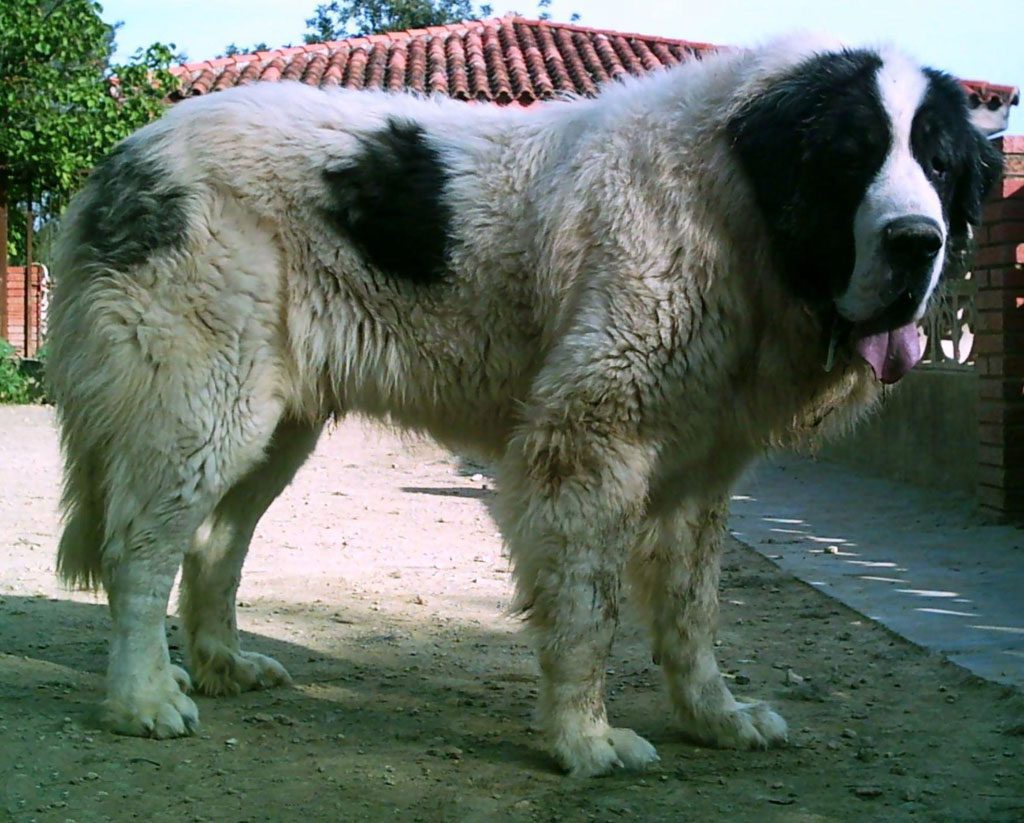
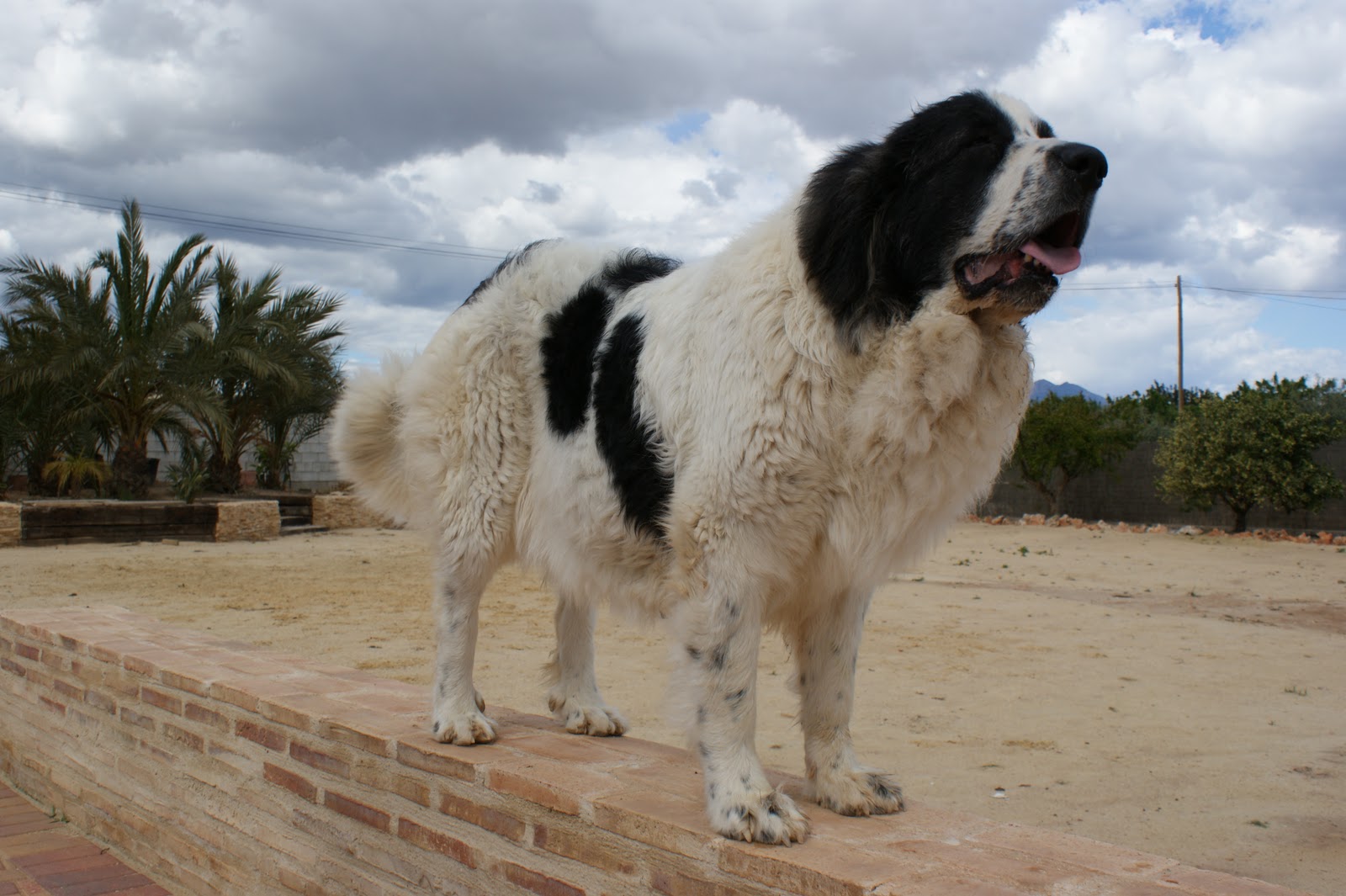
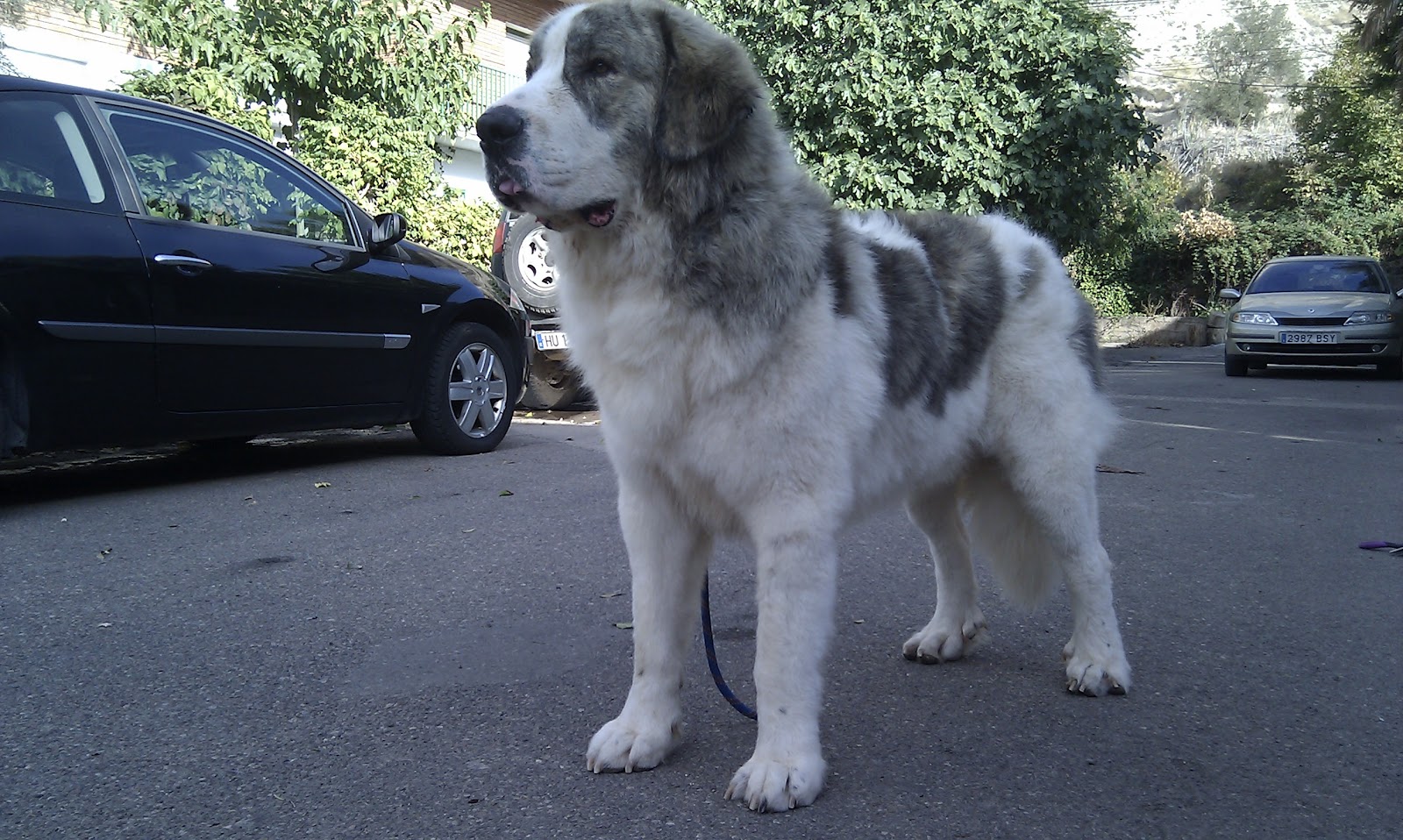
    The Pyrenean Mastiff is a large size dog, well proportioned, powerful, muscular and skeletal structure compact. Its head is large, strong and slightly long, with a cráneo-hocico relationship of 5:4.

    It has eyes small, almond-shaped, ranging from color avellana to dark brown (what is the most common). The ears are triangular, medium-sized and hanging attached to the head.

    The tail is thick at the base, strong, flexible and hangs until the Hock.

    Regard to the size, In fact, there is no maximum limit because the idea is that the specimens are as large as possible. But according to the standard, yes, there are some minimums that cannot be lowered. according to standard, years. At that time, the minimums are 77 cm for males (Although it is preferable that they be above the 81 cm.) and 72 cm for the Herms (Although it is preferable that they exceed the 75 cm.).

    The the mantle of the Pyrenean Mastiff is thick and quite long (of 6 to 9 cm length). Being longer on the shoulders, the neck and belly. It is hair must be rough to the touch, not soft and woolly.

    The color base is white, with a well-defined mask. Some examples are brands of the same color as the mask, irregularly shaped but with sharp contours.

    Favorite colors (according to standard) for the mask, and stains are soft grey, intense Golden Fawn, Brown, black and grey silver.

    The the tail and distal parts of the legs They must be always white.

    Observations

    It is a breed that is still in the reconstruction phase and on the recommendation of the Club del Pyrenean Mastiff from Spain, not yet been included in the show ring, because he is expected to make the media playback smoother.

    Character and skills

    Although at the beginning of their walks among us, the Pyrenean Mastiff was used as a guardian of livestock, the time change and animals over time, so today he is a perfect house keeper.

    It is a dog aware of its strength and power, reason why never shows aggressiveness, But if you feel threatened, He or his family can be really fearsome.

    Let's not forget that it protected livestock from wolves and bears...

    Despite the passage of time, The Pyrenean Mastiff preserves its "rusticity" in full form and this means that it does not adapt well to life outside its natural environment, which is the countryside and its tenants..

    For that reason, If we decide to integrate a Pyrenean Mastiff into our family, it will be important comply with it as it is, without imposing conditions of life that cercenen your happiness, how would it be… life in a small apartment in the middle of the city. That would play against your emotional balance, and with the size that has this dog, Perhaps the best is to have it happy and balanced (that all animal).

    Something characteristic of the Pyrenean Mastiff is that wherever he is with children he is always sweet and very tolerant.. Because the converted part of his flock and the cares much.

    He is also super careful with them, because as we said above, he is aware of his strength and might.

    Images of the Pyrenean Mastiff

    Videos of the Pyrenean Mastiff

    Type and recognitions:

    • FCI CLASSIFICATION:
    • Group :
    • Section : . .

    Federations:

    • FCI – Pinscher and Schnauzer-Molossoid type dogs – Swiss Mountain Dogs and Cattledogs. Section 2.2 Molossoid, mountain type.
    • AKC – Dogs working
    • ​KC – Working dogs
    • UKC – Watchdog

    FCI breed standard "Pyrenean Mastiff"

    Origin:
    Spain

    Date of publication of the valid original standard:
    26.05.1982

    Use:

    Nursery and defense. In the past it was used as a defense against vermin, especially the wolf and the bear. Currently fulfills perfectly the task of guardian of estates and people, being very receptive to training.


    General appearance:

    It is a dog of great height, hypermetric and of medium proportions. Well proportioned, extremely powerful and muscular. compact skeleton. Discreetly long hair. Despite its enormous size it should not be clumsy or lymphatic.


    IMPORTANT PROPORTIONS:

    Media structure. Proportional and harmonious in all circumstances.

    • Body length slightly greater than the height at the withers.
    • The relationship between the length of the skull and the muzzle should be 5/4.
    • The width of the skull should be equal to or slightly greater than its length.
    • The relationship between the raised to the cross and the chest perimeter must be approximately 7/10.


    Behavior / temperament:

    Loving, tame, noble and particularly intelligent, he is both brave and fierce in front of strangers, to whom he never backs down In his relationships with other dogs he is benevolent, aware of its unique power. The case is revealed in the fight, denoting the patterns of behavior acquired after centuries of fighting the wolf. His bark is deep and deep and his expression is awake.

    Head:

    Grand, strong and moderately long. The relationship between the length of the skull and that of the muzzle should be 5/4. Cranio lines- moderately divergent facials, prone to parallelism. The skull-face set seen from above must be long and uniform, without a very marked difference in width between the base of the snout and the temples. Seen from the side it must be deep, not hosted.

    Cranial region:
    • Skull : Width, strong, sub-convex profile. The width of the skull should be equal to or slightly greater than its length. Marked occipital Crest.
    • Depression links (Stop): Soft, little sharp, but defined.

    facial region:

    • Truffle: black, wet, big and wide.
    • Snout: Straight profile. Seen from above it appears discreetly triangular, wide at birth, gradually decreasing towards the truffle but without being pointed.
    • Lips: The upper one should cover the lower one well but without sagging. The lower one forms marada lip commissure. The mucous membranes must be black.

      Jaws / Teeth: Scissor bite. White teeth, strong and healthy. Big fangs, long, sharp and well crossed for prey. Very dimensioned and powerful molars. Rather small incisors. All premolars exist. Black palate, very marked stretch marks.

    • Eyes: Small, macaroons, Hazelnut coloured, preferably dark. With a watchful eye, noble, friendly and intelligent, but of extraordinary severity before an adversary. The eyelids are pigmented in black and preferably attached to the eyeball with the animal in attention. It is typical a faint relaxation of the lower eyelid that shows a discreet conjunctiva portion when the dog is at rest.
    • Ears : Mediums and falls, form triangular, plan, inserted above the eye line. At rest falling and attached to the cheeks. At attention clearly separated from the face and partially erect in its third-posterior. They should not be amputated.

    Neck:

    Truncated cone, width, strong, muscular and flexible. Thick and somewhat detached skin. Double gill well defined but not excessively abundant.

    Body:

    Rectangular. Very strong and robust, denoting great power but flexible and agile.

    • top line: Straight, horizontal, even on the move.
    • Cross: Well marked. Back: Powerful, musculada.
    • Pork loin: Long, wide and powerful; narrows as it reaches the ijar.
    • Rump: Wide and strong. Its inclination is about 45° in relation to the horizontal.. Elevation to the rump equal to the elevation to the cross.
    • Breast : Width, deep, muscular and powerful. The tip of the sternum marked. Ribs with wide intercostal spaces and rounded, not flat. The relationship raised to the chest cross/perimeter must be approximately 7/10.
    • Belly and flanks: Belly moderately tucked up; lowered flanks and very broad flanks.

    Tail:

    Thick born, middle insertion. Strong, flexible and heavily populated with decidedly long and soft hair, forming a showy plume. At rest, his bearing is rather low, fully reaching the hocks and always angled in its final third. When the animal is moving or excited, it lifts it in a saber, with an obvious thread at the end, but never fully folded or resting on the rump.

    Tips

    PREVIOUS MEMBERS:

    • As a whole: Perfectly Plumb, viewed from the front straight and parallel, clearly perceiving muscles and tendons. The length of the forearm should be three times that of the metacarpus. Bone strong with powerful metacarpo.
    • Back: Oblique, very muscular. Longer than the forearm. Scapulo-humeral angle close to 100°.
    • Arm: Very powerful.
    • Elbows: Strong and glued to the rib cage. Humero-Radial Angle next 125 °.
    • Forearm: Of strong bones. Straight and powerful.
    • Metacarpus: Seen from the side with little inclination. It is practically the continuation of the forearm.
    • Previous feet: Of cat, Tight toes. Strong phalanges, high and well arched. Robust and hard nails and pads. Moderate interdigital membrane with hair.

    LATER MEMBERS:

    • As a whole: Powerful, muscular. Seen from the side proper joints. Seen from the side and back, correct feet. Hocks without deviations. They must be able to easily propel the dog, strength and elegance.
    • Thigh: Strong and muscular. Coxo-femoral angle close to 100°.
    • Knee: FEMORO-TIBIAL ANGULO NEAR 120 °.
    • Leg: Long, muscular and strong-boned.
    • Hock: Open angle, close to 130 °.
    • Metatarsus: Well marked, with clear appreciation of the tendon. Presence or not of spurs that can be single or double, admitting your amputation. With equal merits, the presence of double spurs should be preferred..
    • Hind feet: Of cat, slightly oval. Slightly longer than the front feet.

    Movement:

    The preferred gait is the jog that must be harmonious, powerful and elegant with no tendency to laterity. Without ambling The preferred gait is the trot that must be harmonious, powerful and elegant with no tendency to laterity. Without ambience.

    Mantle

    Elastic, thick and pinkish, with darker pigmentations. All mucous membranes must be black.

    • Fur: Bushy, thick and moderately long. The ideal average length set on the center of the upper line is 6 to 9 cm., being longer on the back, the neck, under the belly and behind arms and legs, in addition to the tail plume, whose texture is not as piggy as in the rest of the body. The hair must be piggy, not woolly.
    • Color: Basically white and always with a well-defined mask. Eventually patches of the same color as the mask unevenly distributed throughout the body, but well marked. Ears always stained. Tricolor specimens or whites are not desirable. Always white ends and ends. The mask must be very concrete and the edges of the spots preferably well defined. Hairline should be as clear as possible, being the white ideal. The most appreciated colors are, in order of preference, pure white or snow white with medium gray spots, deep yellow gold, brown, black, grey silver, Light beige, sand, marbled. Red-yellow spots are not desirable for stains or a yellowish-white background.


    Size and weight:

    There is no maximum limit in size, always being more valuable, equal proportions, the largest specimens.


    Height to the cross:

    Minimum limits:

    • Males: 77 cm.,
    • females: 72 cm..

    However, it is to be hoped that these figures are greatly exceeded. It is considered convenient to exceed the 81 cm males and 75 cm. females.


    Fouls:

    Any deviation from the aforementioned criteria is considered as a fault and the severity of this is considered to the degree of the deviation to the standard and its consequences on the health and well-being of the dog..


    MINOR FAULTS:

    • Muzzle profiles carried without excess.
    • Bite in clamp; absence of any premolar.
    • Distorted and undulating back-lumbar line during march, not in excess.
    • For something wavy; hair that slightly exceeds 9 cm in the upper line.
    • Very slight shyness.

    SERIOUS FAULTS:

    • Fragile or lymphatic appearance.
    • Snout pointed or overly blunt.
    • Moderate upper prognathism.
    • Absence of several premolars or canines not due to trauma.
    • Small incisor lace defects.
    • Excessive entropy or ectropion.
    • Amputation in ear.
    • Upper lines.
    • Height at the rump significantly higher than the height at the withers.
    • Tail resting on the rump; tail plumeless; tail not angled at its end; tail docking.
    • Wrong limbs.
    • Metacarpus, metatarsals and weak feet in general.
    • Cow hocks during walking or in season.
    • Lateral braceos during operation.
    • Very wavy or curly hair. Hair length slightly less than 6 cm in the upper line or slightly higher than 11 cm.
    • Discoloration in the ears.
    • General unbalanced character.

    FALTAS DESCALIFICANTES:

    • Aggressiveness or extreme shyness.
    • Any dog ​​showing clear signs of physical or behavioral abnormalities must be disqualified..
    • Depigmented truffle and mucosa.
    • Split nose.
    • Excessive undergrowth or undergrowth.
    • Hair length equal to or less than 4 cm or more 13 cm above the upper line.
    • Absence of white color, ends and ends not white.
    • Completely white layer Absence of mask.
    • Diffuse spots that do not stand out from the background and indicate interbreeding.


    N.B.:

    Males should have two normal-appearing testicles fully descended into the scrotum..
    Only functionally and clinically healthy dogs, with the typical conformation of the breed, should be used for parenting.

    Source: F.C.I - International Cynological Federation

    Alternative names:

    1. Mostín d’o Pireneu, Mostín, Mostín d’Aragón, Mastí dell’Aragó, Gos ramader, Mastín Español del Pirineo (English).
    2. Mastín del Pirineo (French).
    3. Mastín del Pirineo (German).
    4. Mastin d’Argon, Mastín del Pirineo (Portuguese).
    5. Mastín del Pirineo (español).

    ▷ The world of Pets: Dogs, cats, birds, reptiles, amphibians

    Spanish Mastiff
    España FCI 91 - Molossoid . Mountain

    Spanish Mastiff

    The Spanish Mastiff, He is regarded as the oldest Spanish race.

    Content

    History

    The Spanish Mastiff (also called Leonese Mastiff) is a breed of dog trotting type of large size, originally from Spain where it was abundant in almost the entire country and today is in a particular way in León, Zamora, Asturias and Cantabria. One of its varieties is the Pyrenean Mastiff.

    This is a very old dog and like the other broadcast, descends from the molosser of Tibet (Tibetan Mastiff) He came to Europe via Asia minor.

    Theories about the breed maintain that at least four thousand years ago the shepherds who inhabited the peninsula already used them as livestock guard dogs..

    The natural resources and climate of the Iberian Peninsula gave rise to transhumance, for which reason, for many centuries the Spanish Mastiff has played the role of protector of flocks, especially from herds of 'merino sheep' whose history is closely linked to that of this dog breed. In some places it is known as the 'merinero dog' because it accompanies the Merino sheep..

    The Spanish Mastiff, He is regarded as the oldest Spanish race.

    The transhumant wandered through the royal canyons of León, crossing the Iberian Peninsula from North to South., and the Spanish Mastiff went with them defending the cattle from the attack of the wolf, the dog in addition to with its imposing nature, He had the protection of his abundant jowls as well as carlancas or carranclas, they are a species of thick metal with spiky necklaces.

    Videos of the Spanish Mastiff
    SPANISH MASTIFF. A NOBLE RACE.
    Mastin Spanish /Spanish mastiff puppies in kennel Tornado Erben

    At the end of the 19th century with the gradual disappearance of the grazing and transhumance, the Spanish Mastiff became 'unnecessary', if we add to that the Spanish Civil War and its consequent period of scarcity and -also- the sharp decline in the number of wolves, as a result we have that this breed of dog was on the verge of extinction.

    During that time many specimens of Spanish Mastiff were sacrificed, Some were emasculated and other so many purchased by enthusiasts that breeders, guided more by love of the race than by knowledge, start you a totally disorganized parenting.

    After the debacle, fortunately, the recovery of the breed has been achieved though with great difficulty.

    The first standard of the Spanish Mastiff was approved by the International Cinological Federation in the year 1946, based on the characteristics of three specimens from central Spain, These specimens were a light type, that still remained in the cattle farms and that were also used for hunting big game, they were of good size, with long legs and her weight was around the 50 kg.

    In 1981 a new standard was approved whose main objective was to recover the much larger Mastiff that was used in transhumance livestock.

    That same year (1981) was founded the Spanish Association of the Spanish Mastiff Dog (AEPME) as official club of the breed.

    Physical characteristics

    It is a dog of large size, braquicéfalo and mesomorfo. Well proportioned, very powerful and muscular. Big and heavy, with skeleton compact.

    There are no exact size limits., but they must be harmonious, in the males expected a height that not is lower to 77 cm. the cross and in the females, not less to 72 cm.. Those are the bare minimum., but always expected greater height.

    The head is significantly large, has a cráneo-hocico relationship of 6:4. If we look at the skull from the top is a square and uniform.

    It has eyes small, almond-shaped and hazelnut or chestnut colour.

    It has the ears triangular, median, flat and pendants. The legs are long, straight and fitted with good musculature.

    The tail, inserted at medium altitude is very thick, flexible and wears it down, arriving at the height of the Hock.

    Its the mantle This thick a thick hair hard, semilargo and smooth. The colors the most prized hair are uniforms (or solids), they may be dirty white, leonado, reddish, black, gray wolf, brown. Are also supported in the standard the atigrados, or white spotted robes.

    Observations

    As it's a race in recovery process, is very difficult to find perfect copies (that is to say, adjusted completely to the standard).

    It is not a dog suitable for beginners, but it could be a very rewarding challenge for some enthusiast with the desire to breed a dog with a long history and gigantic potential like the Spanish Mastiff..

    Character and skills

    The Spanish Mastiff is a rustic dog, loving, tame, noble, very firm and self-confident.

    It is generally quiet and affectionate, He is very loyal and devoted to their masters. It is-especially- suitable for children, for those who feel special attraction. As well, usually get along well with other dogs.

    Essentially, is a calm and balanced guardian, but it can be very scary if they perceived danger to its owner and properties.

    These dogs are very happy living in the open air, and especially given the opportunity for long and quiet walks, that will be necessary if we want our Mastiff to be happy and balanced.

    Observations

    As we mentioned in the “History” section, the vicissitudes of the recovery of the race has led to chaos at the beginning of it..., and all that lack of control in the breeding, It has had a direct effect on the character of dog, it is for this reason that today we can find too aggressive specimens, and other, maybe more shy.

    Fortunately, the great work which is carrying out the Spanish Association of the Spanish Mastiff Dog, focused on selection in breeding is very hopeful since good results are being obtained, and over time the problem will be eliminated.

    Images of the Spanish Mastiff

    Videos of the Spanish Mastiff

    Type and recognitions:

    • FCI CLASSIFICATION:
    • Group :
    • Section : . .

    Federations:

    • FCI – Pinscher and Schnauzer-Molossoid type dogs – Swiss Mountain Dogs and Cattledogs. Section 2.2 Molossoid, mountain type.
    • AKC – FSS
    • UKC – Watchdog

    FCI breed standard "Spanish Mastiff"

    Origin:
    Spain

    Date of publication of the valid original standard:
    26.05.1982

    Use:

    Nursery and defense. This breed is closely linked to transhumance and especially to merino cattle., whom he accompanied already in times of the Mesta, defending you from the wolf and other predators throughout all your movements and places, grass shelves in different seasons and location zones. Currently accompanies numerous herds, both shelves and transhumants, performing its ancestral function. It also performs the function of guard and defense of farms, people and properties in general.


    General appearance:

    It is a dog of large size, hypermetric and of medium proportions. Sublongilinear structure. Well proportioned, very powerful and muscular. compact skeleton. Large head and body with semi-long hair. Proportionality and functional harmony must be sought, both static and moving. His bark is hoarse, serious and deep, of great intensity, perceiving yourself at a considerable distance.

    IMPORTANT PROPORTIONS: Body length greater than the height at the withers. The ratio of the length of the skull to that of the muzzle should be 3/2


    Behavior / temperament:

    It is a very intelligent dog, not devoid of beauty; his expression shows both qualities.

    Rustic, loving, meek and noble, turns out to be a very firm dog against vermin and strangers, especially when he is defending farms or cattle. In its behavior you can see that it is a self-confident dog., metering of his forces for being aware of his enormous power.

    Head:

    As a whole: Grand, strong and broad-stem pyramidal. The skull-muzzle set, seen from above, must be square and uniform, and without a very marked diminution between the base of the snout and the temples. Moderately divergent craniofacial lines.

    Cranial region:
    • Skull : Width, strong, sub-convex profile. The width of the skull must be equal to or greater than its length. Accentuated frontal sinuses. Marked occipital Crest.
    • Depression links (Stop): Soft, little sharp.

    facial region:

    • Truffle: black, wet, big and wide.
    • Snout: Straight profile. Seen from above it appears moderately rectangular, gradually decreasing towards the truffle, maintaining a conspicuous width. In no case pointed.
    • Lips: The upper one should widely cover the lower one ; the lower one with detached mucosa forms a very loose lip corner. The mucous membranes must be black.
    • Jaws / Teeth: Scissor bite. White teeth, strong and healthy. Big fangs, sharp and forming good prey. Strong and powerful molars. Rather small incisors. All premolars exist. Black palate, with very marked ridges.
    • Eyes: Small in relation to the skull, preferably dark, Hazelnut coloured, watchful eye, noble, sweet and smart, of great severity before a stranger. Thick-skinned eyelids, Pigmented in black. The lower eyelid reveals part of the conjunctiva.
    • Ears: Mediums and falls, form triangular, plan, inserted above the eye line. At rest they droop and stick to the cheeks, without being too attached to the skull. At attention separated from the face and partially erect in its superior-posterior third. They should not be amputated.

    Neck:

    Truncated cone, width, strong, muscled, flexible. Thick and detached skin. Widely developed double chin.

    Body:

    • As a whole: Rectangular. Strong and robust, denoting great power, but flexible and agile.
    • top line: Straight, horizontal, even on the move. Cross: Well marked.
    • Back: Powerful, musculada.
    • Pork loin: Long, wide and powerful, narrows as it reaches the ijar.
    • Rump: Wide and strong. Its inclination is about 45° in relation to the horizontal.. Elevation to the rump equal to the elevation to the cross.
    • Breast : Width, deep, muscular and powerful. The tip of the sternum marked. Ribs with wide intercostal spaces and rounded, not flat. The ratio of height at the withers/minimum thoracic perimeter should be approximately 1/3.
    • Belly and flanks: Very moderately tucked up belly; the flanks lowered and the flanks very wide.

    Tail:

    • As a whole: Rectangular. Strong and robust, denoting great power, but flexible and agile.
    • top line: Straight, horizontal, even on the move. Cross: Well marked.
    • Back: Powerful, musculada.
    • Pork loin: Long, wide and powerful, narrows as it reaches the ijar.
    • Rump: Wide and strong. Its inclination is about 45° in relation to the horizontal.. Elevation to the rump equal to the elevation to the cross.
    • Breast : Width, deep, muscular and powerful. The tip of the sternum marked. Ribs with wide intercostal spaces and rounded, not flat. The ratio of height at the withers/minimum thoracic perimeter should be approximately 1/3.
    • Belly and flanks: Very moderately tucked up belly; the flanks lowered and the flanks very wide.


    Tips

    PREVIOUS MEMBERS:

    • As a whole: Perfectly Plumb, straight and parallel viewed from the front. The length of the forearm should be three times that of the metacarpus. Strong bones with powerful pasterns.
    • Back: Oblique, very muscular. Longer than the forearm. Scapulo-humeral angle close to 100°.
    • Arm: Strong, similar in length to the scapula.
    • Elbow: Well attached to the chest. Humero-radial angle close to 125°.
    • Forearm: Strong, perpendicular bone.
    • Metacarpus: Seen from the side with little inclination. It is practically in continuation of the forearm; bone fort.
    • Previous feet: Of cat. Tight toes. Strong phalanges, high and well arched. Robust and hard nails and pads. Moderate interdigital membrane with hair.

    LATER MEMBERS:

    • As a whole: Powerful, muscular. Seen from the side suitable angulations in the form of wide articular angles. Correct poise, seen from behind and in profile. Hocks without deviations. They must be able to easily propel the dog, strength and elegance.
    • Thigh: Strong and muscular. Coxo-femoral angle close to 100°.
    • Knee: Femoro-tibial angle close to 120° Leg: Long, muscular and strong bone. Hock: Open angle, close to 130°.
    • Metatarsus: Well marked, with clear appreciation of the tendon. Presence or not of spurs that can be single or double, admitting your amputation.
    • Hind feet: Of cat. Slightly oval.

    Movement:

    The preferred way is the trot, it must be harmonious, powerful with no tendency to laterality. Without ambience.

    Mantle

    • SKIN: Elastic, thick, abundant and pinkish, with darker pigmentations. All mucous membranes must be black.
    • Fur: Bushy, thick, semilargo, smooth, scattered throughout the body to interdigital spaces.

    Two types of hair are distinguished, one of coverage on the back and another of protection on the ribs and flanks. Shorter on the limbs and longer and silkier on the tail.

    • Color: Indeterminate, uniform colors are most appreciated, yellow, leonados, red, blacks, cubs and fawns. Combined colors are also appreciated, p. e.g.. atigrados, peaks and ties.


    Size and weight:

    There are no maximum size limits, being appreciated within harmonious proportions, the largest specimens.

    Height to the cross: Minimum limits:

    • Male 77cm
    • females 72 cm..

    These lifts of wishes are largely overcome, being convenient to pass the males 80 cm and females 75 cm..


    Fouls:

    • Males should have two normal-appearing testicles fully descended into the scrotum..
    • Only functionally and clinically healthy dogs, with the typical conformation of the breed, should be used for parenting.

    Any deviation from the aforementioned criteria is considered as a fault and the severity of this is considered to the degree of the deviation to the standard and its consequences on the health and well-being of the dog..

    MINOR FAULTS

    • Carried muzzle profiles, without excess.
    • Bite in clamp; absence of any premolar.
    • Weak dorso-lumbar line, distorted and undulating during the march.
    • Metacarpus, metatarsals and weak feet, not in excess.
    • Shyness, not overly accented.

    SERIOUS FAULTS:

    • Exaggerated fragile or lymphatic appearance.
    • Pointed snout.
    • Moderate upper prognathism.
    • Absence of several premolars or canines if not due to trauma.
    • Excessive entropy or ectropion.
    • Ear amputation.
    • Tail resting on the rump.
    • Saddled dorso-lumbar line.
    • Height at the rump significantly higher than the height at the withers.
    • Tail docking.
    • Wrong limbs: weak or deviant.
    • Cow hocks, during the march or in station.
    • Lateral braceos during operation.
    • Wavy hair, curly or excessively long.
    • Unbalanced character, excessive shyness, cowardice or exaggerated aggressiveness.

    FALTAS DESCALIFICANTES:

    • Aggressiveness or extreme shyness.
    • Any dog ​​showing clear signs of physical or behavioral abnormalities must be disqualified..
    • Aggressive or fearful dog.
    • Light eyes accompanied by truffle or depigmented mucosa.
    • Split nose.
    • Any degree of lower prognathism; excessive upper prognathism.
    • light eyes.


    N.B.:
    • Males should have two normal-appearing testicles fully descended into the scrotum..
    • Only functionally and clinically healthy dogs, with the typical conformation of the breed, should be used for parenting.

    Source: F.C.I - International Cynological Federation

    Alternative names:

    1. Spanish mastiff, Mastín español de campo y trabajo, Mastín ganadero, Mastín Leonés, Mastín Extremeño (English).
    2. Mastin Leones (French).
    3. Spanischer Mastiff, Mastín aus León (mastín leonés), Mastín der Extremadura (mastín extremeño), Mastín der Mancha (mastín manchego) (German).
    4. Mastín español (Portuguese).
    5. Mastín Leonés, mastín español de campo y trabajo, mastín ganadero (español).

    ▷ The world of Pets: Dogs, cats, birds, reptiles, amphibians

    Majorca Shepherd Dog
    España FCI 321 . Sheepdogs

    Ca de Bestiar

    The Majorca Shepherd Dog or "Cattle", It is a breed of dog originating in Mallorca.

    Content

    History

    Also known as “Ca de Bestiar”, this breed is believed to have existed since ancient times. Through the years, this dog would have been bred with a variety of local Mallorcan dogs, as well as with other European Shepherd dogs, and it was not until 1970 which he puts any restrictions on their upbringing. In fact, its breed standard was written as recently as 1980. It was in 2006 the UKC recognized the breed within his Group of Sheepdogs.

    Appreciated through the centuries by the Spaniards for their ability to be a versatile farm dog, the Majorca Shepherd Dog It was used both to herd flocks and to monitor property and animals. It has also been reported that the Majorca Shepherd Dog was widely used in dogfighting, a practice that is now illegal. Although it is still used on farms today, and is also often kept as a companion animal, this rare breed once seen internationally and is considered a rare breed.

    Physical characteristics

    The Majorca Shepherd Dog is a large size dog, average weight, well proportioned, rustic, strong and large muscles, flexible and robust.

    There are two varieties: long hair and most widespread short-haired. The head is well modeled, large and provided with the body, but not so much as to look like a molosser. Craniofacial shafts are slightly convergent; the relationship between the skull and the muzzle is of 1:1.

    The color eyes goes from amber to dark brown, and his expression is intelligent and enigmatic.

    The ears, small in relation to the head, they are triangular, inserted at the top and are normally bent, with dropped tips.

    The tail Start horizontally, is horizontal section, It has thick base and it tapers towards the tip.

    Fur: the short hair variety has quite thin Undercoat. In the variety of long hair, hair coverage can reach a length of 7 cm and it is slightly wavy. In both varieties should be soft and fine.

    Color: the only one admitted is black, optionally with white spots on chest and feet.

    Size: males, of 66 to 73 cm.; females, of 62 to 68 cm.. The weight is usually of 40 kg approximately.

    Character and skills

    He is a shepherd dog with skills for the job of guard and defense. It´s Intelligent, docile and affectionate, although as a puppy he is usually shy and reserved. For this reason it is important to socialize it to the maximum to avoid that it closes in on itself.

    The adult is very suspicious of strangers and he is united by a very strong bond with his master. Her enigmatic gaze not glimpse of his thoughts. It has an extraordinary courage and willing to everything in order to defend their loved. It's a little known breed outside the Balearic Islands, so to acquire a good puppy should address to breeders of the Islands.

    Images «Majorcan shepherd dog»

    “Majorcan Shepherd Dog” videos

    Type and recognitions:

    • FCI CLASSIFICATION:
    • Group :
    • Section : . .

    Federations:

    • – FCI

    FCI breed standard "Majorca Shepherd Dog"

    Origin:
    Spain

    Date of publication of the valid original standard:
    26.05.1982

    Use:

    Herding dog, guardian and defense


    General appearance:

    Sub-convex profile dog, large without being exaggerated and medium-weight size. It is totally black or black with white spot on chest, well proportioned, rustic, strong, muscular, robust and agile. There are two varieties of hair:

    • Short hair, the most common variety.
    • Long hair.

    IMPORTANT PROPORTIONS:

    Dog subhipermetrico, midline and subconvex.

    • The female accepts a longitudinal diameter of up to a 3% greater than the height of the cross.
    • Length of the muzzle is equal to the length of the skull.
    • The length of the head must be equal to the length of the neck.
    • In adult males the thoracic perimeter, taken together the cross behind the elbows, It is about a cms rather than its height at the withers.


    Behavior / temperament:

    Dog of great nobility, only an owner that accepts loads of strangers with difficulty.
    Intelligent, docile, loving, shy on end and reserved in his youth ; his sentimentality comes to unsuspected. Faithful to his master until death. If we explore in his eyes it will give us the feeling thinks. It is courageous and quarrelsome.

    Head:

    Slightly triangular profile; view dorsally is wider at the top than at the bottom; solid, but not heavy; large enough to accommodate a good intelligence; well molded and proportionate to the body; It must be rather large, but never a trotting type. The supranasal line is parallel to the cranial line. Slightly divergent skull-facial axes.

    Cranial region:
    • Skull: Sub-convex profile. The width of the head, taken between the storms, It should be slightly higher ( approximately 1,2 %) to the length between the supraorbital line and the occipital crest. A slight groove can be seen in the first third of the frontal midline. Marked occipital Crest.
    • Depression links (Stop): Marked, but never sudden, in mild decline.

    facial region:

    • Truffle: Wet, fresh, black, large, with broad nostrils; No split. It despuntuará significantly if you have stains of barks or lighter.
    • Snout: Width, rather strong ; It should not be in tip, but its height and width should be accentuated as it approaches the orbits. In the variety « Ca cabrer » (Longhair) more pointed. The dorsal profile of the nasal helm is sub-convex. The profile of the branches of the lower jaw is straight. Black color palate.
    • Lips: Black ; the high not seen to the bottom while your mouth closed ; the labial commissure is little noticeable and they go unnoticed because they are well proportioned to the head.
    • Jaws / Teeth: Very white teeth, well developed and well placed, closed scissors, making the incisors true upper ends prey with the lower canines. The molars developed.
    • Eyes: Rather small, slightly almond ; are not prominent nor sunken in orbits ; not far apart from each other, centered, slightly oblique, lively. Color between the Rosemary honey (something clear) and of the honey, carob (dark). Enigmatic expression, with look smart and sad at the same time, where denotes even distrust. The eyelids are thin, black and oblique, close to the eye.
    • Ears: Broken, small size in relation to the head, triangular, reaching the tear in the eye of its corresponding side tip, or is approximately equal to the length of your skull. Without amputating, slightly thick, high insertion, separating your tip slightly skull, with a longitudinal fold and another cross around the first third.
    • Position of the ears: usually bent and dropped, something separate from the muzzle. Played back in standby ; in State care by the transverse fold levantadolas, separating them from the snout than usual.

    Neck:

    Massif, muscular, strong and proportionate to the head and body. Thick, with very little double chin, cylindrical, its diameter accentuating more at the base. The skin is tough and elastic, or fine or thick, firmly attached to the neck at its top and sides, more detached on the bottom.

    Body:

    • As a whole: Robust, very well proportioned, giving the impression of strength and agility while.
    • Cross: Marked and at least at the same height as the top of the rump ; the large area between the scapulae and strong.
    • Dorso-lumbar line: Straight, horizontal, never built.
    • Pork loin: Wide and powerful.
    • Rump: Medium, slightly rounded, wide, powerful and muscular; never prominent or fallen. The top should be at the same height as the cross. Its interiliac width must be equal to the iliac-ischial length .
    • Breast : Wide and high, maximum reaching the elbow; a width approximately equal to the length of the neck; quite deep, not prominent, with slightly pronounced sternum. Arched ribs (non-flat or in barrel).
    • Belly and flanks: Fairly bulky flanks. Slightly gathered belly, never agalgado, nor descended to be confused with continued chest. Something stylish, You must give the impression of agility.

    Tail:

    Horizontal insertion and circular section, rather thick at its birth. Some 8 cm base flattens slightly at its lower profile, in a few 10 length cm, to continue then the tapered circular to its end. Without amputating. Of a length that must reach at least the hock, without touching the ground. No tuft or fringe, Although it is authorised, If this is light, copies of older. In the variety of long hair you must have abundant and long fringe. Size of the queue : at rest naturally drooping or slightly curved outward, slightly touching the hocks, default is considered serious if your tip should touch the ground. Undulating and raised more than the horizontal sickle-shaped, without screwing it, When in action.

    Tips

    PREVIOUS MEMBERS:

    • As a whole: Strong Member ; correct limbs ; seen from the front and in profile parallel to each other and perpendicular to the ground.
    • Shoulder: Oblique and strong.
    • Scapulo-humeral angle: 115°.
    • Arms: Of equal length to the scapula.
    • Elbows: Without deviations, glued to the chest. Radial-humerus angle : 130°.
    • Forearm: Strong, well angled, perpendicular. Vertical bones, strong, long and right.
    • Metacarpus: Short and slightly tilted.
    • Previous feet: Almost of Hare (something shorter and wider than they), finger semialtos, semiarqueados, together, and with the very hard and black pad. Without acute interdigital membrane.

    LATER MEMBERS:

    • As a whole: Muscular, strong ; correct limbs. Dimmed and hard muscle relief.
    • Coxo-femoral angle: 115°, peer-to-scapulo-humeral.
    • Thigh: Strong and muscular.
    • Stifle-tibial angle: 130°, same as the humerus-radial
    • Leg: Long and powerful.
    • Hock: Little pronounced, very open 135° angulation. The height of the Hock is about somewhat lower than the one-third of its height at the withers.
    • Metatarsus: Well marked.
    • Hind feet: Almost of Hare, crushed, with fingers together and semiarqueados. Pad hard and black. Arched nails, black and hard. Without acute interdigital membrane. May be born with or without Spurs, in the first case they must amputate.

    Movement:

    His way of walking must be firm and elegant. The trot on diagonal bipeds, Tip slightly posterior third, respect to the previous. The Gallop will be franco, fast rustic, the rear legs wide apart at its base with soil, placing them outside of the hands, as if it were jumping. The preferred step and the work is the Gallop.

    Mantle

    SKIN: Elastic, without folds, hard and light grey.

    • HAIR: Short and glued to the skin, its length ranging about 1,5 cm to 3 cm on the spine ; very fine Undercoat, low thickness and very attached to the skin. In the long-haired variety may be slightly wavy on the spine, approximate length of more of 7 cm according to the time of year, with the largest winter. Well distributed and thin Undercoat, grow hair in their normal length in the fringe of the queue, Tip of the ears and back of the limbs. In both varieties should be smooth, hard and quite thin.
    • COLOR: The only color supported is black, varieties of Jet, regular and peceno. The target is supported only in the chest, in the form of thin tie under neck and anterior and posterior foot, highlighting according to its easy visibility on nails and tips of the toes. The Jet Black landmark is the most appreciated, nature of the ordinary black and the peceno.


    Size and weight:

    • Height to the cross: Among 66 and 73 cm for males. Among 62 and 68 cm for females.
      Specimens with heights of one cm or so are allowed at the limits indicated ; in this case you must subtract score.
    • Weight: Environment to 40 kg.


    Fouls:

    Any deviation from the aforementioned criteria is considered as a fault and the severity of this is considered to the degree of the deviation to the standard and its consequences on the health and well-being of the dog..

    SERIOUS FAULTS

    •  Dogs that drool-worthy.
    •  Cut fangs.
    •  Very raised ears rest, very large very separated from the face or completely glued to it.
    •  Very collected belly (whippety).
    •  Threaded queue; white tail tip.
    •  White spot of chest of more of 1 dm².
    •  All fingers of a foot white.

    MISS PLAYOFFS

    •  Aggressive or fearful dog.
    •  Mastiff head, very wide and heavy or Hound, long and narrow with just pronounced stop.
    • Truffle pink or white.
    •  Upper or lower prognathism more of 3 mm.
    • • Eyes of different colors from each other ; eye that is not of the color that goes from the Rosemary honey (something clear) the carob-honey (dark) ; very clear eye.
    • Amputated ears, stiff in action or almost stiff at rest.
    •  Double chin neck, more thickly along the skull than at its base, longer that a 10% length ranging from truffles to the occipital Crest.
    •  Body too long or too short ; height of the top of the rump in a 3% greater than the height at the cross.
    •  Very thick tail, or of equal thickness at the base and tip ; excessively long to touch the ground ; amputated or missing you each 2 cm to reach the Hock ; with abundant fringe in the variety of short hair, with or without bangs in long hair variety.
    •  Other color than black, or, in dogs being black, an anterior or posterior foot white or another color ; members shod in white on any number of limbs ; not totally black body (with the exception of the chest, very few hairs on the belly, perpucio or tip of the tail), stains, without disqualify, they notably despuntuarán. They despuntuarán not consequential white hairs of bites, trauma or other similar injuries, or the white hairs from the face own age. White fingers not disqualify, unless the animal is more than six, despuntuando notably each ; a single finger white or another color in the previous feet disqualifies the dog.
    •  Height of the cross over of 74 cm in males and more of 70 cm in females. The cross of less height of 66 cm in males and less of 60 cm in females.
    •  Under weight of 30 kg and over 50 kg in males, under weight 25 kg and over 45 kg in females ; even being within the aforementioned limits, very skinny dogs, visibly obese or very saddled (having tolerance in pregnant females).

    SCALE OF POINTS

    • General appearance and temperament – 21 points
    • Presentation (cleaning and porte) – 4 points
    • Fur (length and hardness) – 4 points
    • Layer (color and brightness, 7+2) – 9 points
    • Temperament/Behavior – 4 points
    • Head – 21 points
    • Skull and stop – 4 points
    • Snout, nose and lips – 5 points
    • Teeth and palate (2+1) – 3 points
    • Eyes – 5 points
    • Color – 2 points
    • Form, size and separation – 2 points
    • Eyelids – 1 point
    • Ears (form, thickness, inclusion, size) – 4 points
    • Neck – 4 points
    • Trunk – 21 points
    • Cross – 1 point
    • Back and back – 5 points
    • Rump – 3 points
    • Belly – 2 points
    • Breast , chest, Ribeye, size – 10 points
    • Tail (form, length and fringes) – 2 points
    • Limbs – 19 points
    • Previous aplombs – 6 points
    • Later aplombs – 8 points
    • Feet ant. and post., fingers, nails hardness of the pads – 5 points
    • Movement – 12 points
    • Ear bearing – 3 points
    • Tail bearing – 3 points
    • Jogging – 2 points
    • Gallop – 4 points

    Total : 100 points


    Proportional measurements (ideal for the male)

    • Weight – 41 kg
    • Height at the withers – 71 cm.
    • Height to the rump – 71 cm.
    • Chest height – 39 cm.
    • Longitudinal diameter – 71 cm.

    Head

    • Muzzle length – 13 cm.
    • Skull length – 13 cm.
    • Total head length – 26 cm.
    • Neck length – 26 cm.
    • Ear Longiud – 13 cm.
    • Tail length – 52 cm.
    • Raised to hock – 23 cm.

    Length of the hair on the back

    • Short hair variety – 2 cm.
    • Long hair variety (between seasons) – 7 cm.
    • Head width – 15 cm.
    • Thoracic perimeter – 81/83 cm.
    • Chest width – 26 cm.
    • Neck circumference – 49 cm.

    Any dog ​​showing clear signs of physical or behavioral abnormalities must be disqualified..


    N.B.:

    Males should have two normal-appearing testicles fully descended into the scrotum..

    Source: F.C.I - International Cynological Federation

    Alternative names:

    1. Majorca Shepherd Dog, Ca de bestia, Pastor mallorquín (English).
    2. Berger de Majorque (French).
    3. Ca de Bestiar (German).
    4. Ca de Bestiar (Portuguese).
    5. Pastor-maiorquino, Ca de Bestiar, Pastor mallorquín (español).

    ▷ The world of Pets: Dogs, cats, birds, reptiles, amphibians

    Catalan Sheepdog
    España FCI 87 . Sheepdogs

    The Catalan Sheepdog He is friendly and has a strong protective instinct especially with children.

    Pastor Catalán

    Content

    Characteristics "Catalan Sheepdog"

    Coexistence is important that you have with your new friend. Before considering the acquisition of a dog of the breed "Catalan Sheepdog" you know certain factors. Not all breeds of dogs are apt to live in an apartment, you must take into account his character, their need for exercise, their interaction with other pets, their care and if you have small children, their level of tolerance towards them.

    Adaptation ⓘ

    4,0 of 5 stars (based on 1 review)

    friendly dog ​​ⓘ

    4,0 of 5 stars (based on 1 review)

    hair loss ⓘ

    3,0 of 5 stars (based on 1 review)

    Affection level ⓘ

    4,0 of 5 stars (based on 1 review)

    Need for exercise ⓘ

    5,0 of 5 stars (based on 1 review)

    Social need ⓘ

    4,0 of 5 stars (based on 1 review)

    Home ⓘ

    3,0 of 5 stars (based on 1 review)

    Toilet ⓘ

    3,0 of 5 stars (based on 1 review)

    Friendly with strangers ⓘ

    2,0 of 5 stars (based on 1 review)

    barking ⓘ

    3,0 of 5 stars (based on 1 review)

    Health ⓘ

    5,0 of 5 stars (based on 1 review)

    Territorial ⓘ

    4,0 of 5 stars (based on 1 review)

    Cat friendly ⓘ

    3,0 of 5 stars (based on 1 review)

    Intelligence ⓘ

    4,0 of 5 stars (based on 1 review)

    Versatility ⓘ

    4,0 of 5 stars (based on 1 review)

    Child friendly ⓘ

    5,0 of 5 stars (based on 1 review)

    Surveillance ⓘ

    4,0 of 5 stars (based on 1 review)

    joy ⓘ

    3,0 of 5 stars (based on 1 review)

    Catalan Sheepdog History

    The Catalan Sheepdog (Sheepdog) It is a breed of dog of Catalonia, Spain. It was used above all to watch the herds during the day in the Pyrenees area and in the area occupied by the transhumance related to this area.

    Although little is known about the origins of the Catalan Shepherd, today it has become one of the sheepdog breeds, Iberian, more extended. For a long time he has lived geographically isolated and descends – probably- dogs shepherds who kept kinship with primitive Oriental races.

    Close relatives include the Pyrenean Shepherd and the Bergamasco Shepherd.

    Likewise, There are documentary sources to ensure that, at sites such as the Minferri dogs of measurement remains have been found with very similar in structure to the Catalan Shepherd, the find could be located in the 2000 to. C.

    Anyway that there are only drawings of 200 years ago that testify the existence of the Catalan Shepherd. I.e., their origin It is still an issue controversial.

    In 1919, Catalan Sheepdog, He was recognized by the Federation Cynologique Internationale as Spanish breed of dog.

    In 1929 wrote the first standard from two dogs, TAC and Iris, two copies a canine contest winners. However, all this could not stop the debacle of the race.

    With the advent of tourism in the Pyrenees which is where were more specimens of the breed, also arrived foreign dog breeds, and the Catalan Shepherd Dog became a type of small dog, underestimated front foreign dogs already wearing so many decades by selecting them and improving them, so it was abandoned and mixing with other races.

    During the Decade of 1970, an organization called Laketània took two dogs that remained with a very pure appearance, one from Solsona and the other from Berguedà and selectively bred them to recover the breed. All current breeding dogs carry genes from these two specimens.

    In 1982 created the Catalan Atura Dog Club, This led to begin airing various breeders and 1982 be drafted a new standard that is the still existing today.

    Currently, the dog has been able to spread a lot when it was verified that it not only serves to take care of herds but also as a companion animal and more than 4.000 registered copies.

    Physical characteristics

    Its height the cross is of 47 to 55 cm in males and 45 to 53 cm in females.

    The hair is long, very little wavy or stretched. Usually rough, in some cases smooth. The subpelo is abundant, especially in the later third.

    In the head has beard, moustache, quiff and sobrecejas that allow to see the eyes. The tail is well provided with hair, just as the limbs. When they shed their hair, a typical phenomenon occurs, as it does in two times.

    during the first, change the hair in the front half of the dog, and gives the impression that it is two media with different hair dogs. In the second half, changing the rear half and returns to match.

    Regard to the color, They seem far to monochrome, and they can present lighter shades to extremities. Seen closely observes that the color is given by the mixture of hairs of different tones: neula, terrizo more or less reddish, grey, black and white.

    The basic colors that result from the mixture are:

    • Neula: In his clear tones, medium to dark.
    • Tierra: With hair color land, neula, black and white. With three clear tones, medium to dark.
    • Gris: Consisting of white hairs, Gray and black, with colors that can go the tetravalent to the gris-negro. If master black and only combines with white hairs, It gives a black appearance of frost.

    There are also copies with a mixture of black hairs, neula and reddish Earth that can dominate in some parts, giving the sensation of exemplary black and Tan.

    Character and skills Catalan Sheepdog

    Pastor Catalán, indispensable assistant for the current Catalan shepherds, is a typical shepherd dog fell, rustic, frugal, obedient, resistant, barking, vigorous and reserved with strangers.

    It is perfectly adapted different situations ranging from the comfort of a home, to the extreme climatic conditions of the high mountain, and this makes it an excellent conductor of flocks or a perfect Playmate.

    In Catalonia, It is still used as a sheepdog and thanks to its great intelligence not just limited to following the shepherd, but occasionally it replaces his master and is responsible for the solo lead and guarding the flock.

    In other countries, it is known more than anything as a companion and exhibition dog, always with a dial protective character in special with children.

    It is a dog very versatile and nice, She loves to play but you know when it is necessary to be quiet.

    Some specialists often describe it as a sullen and few friends but in reality is that attitude taken with strangers, at the slightest sign of trust he will show his affection.

    Catalan Shepherd is very easy of educate and train.

    Images of the Catalan Sheepdog

    Catalan Sheepdog videos

    Type and recognitions:

    • FCI CLASSIFICATION:
    • Group :
    • Section : . .

    Federations:

    • FCI – Group 1 Herding dogs, Section 1 Sheepdogs
    • ​KC – Grazing
    • UKCHerding

    FCI breed standard Catalan Sheepdog

    FCIFCI - Catalan Sheepdog
    Pastor

    Alternative names:

    1. Catalan shepherd (English).
    2. Berger catalan (French).
    3. (Katalanisch Gos d’Atura Català; Spanisch Perro de Pastor Catalán) (German).
    4. (em catalão: gos d’atura català) (Portuguese).
    5. Gos d’Atura Català, Perro de pastor catalán (español).