โ–ท The world of Pets: Dogs, cats, birds, reptiles, amphibians

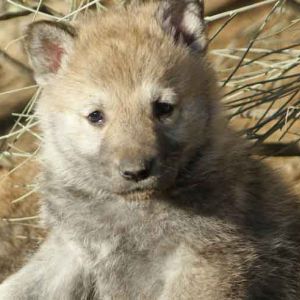
Czechoslovakian Wolfdog
Eslovaquia FCI 332 . Sheepdogs

Czechoslovakian Wolf Dog

Not a dog fit for everyone.

Content

History

The Czechoslovakian Wolfdog It has its origin in the crossing experiments between the "Carpathian Wolf" and the German Shepherd carried out in the former Czechoslovak Socialist Republic from 1955 under the supervision of the SR. Karel Hartl, a renowned Czech cynologist and breeder. The scientific objective of these experiments was to determine the characteristics of these hybrids. (physical appearance, behavior, utility, fertility…), while the military tried to create a breed with the strength of the wolf and the docility of the dog, that could be used as an attack dog.

The first births took place in 1958 at the border guard kennel in Libejovice, in the south of the country. Brita the wolf and the German Shepherd Cezar z Brezoveho Haje gave birth to 5 Puppies: Brent, Berta, Bono, Betty y Bessy.

Betty was selected to continue the line at the Libejovice kennel, while his sister Berta was sent to the Samorin kennel (now Malacky) with the same goal. Their pups were used as patrol dogs by border guards, confirming that these hybrids were healthy, functional and fertile.

After this initial success, the Brita Wolf was able to mate again with a new male German Shepherd named Kurt z Vaclavky. Like this, in 1960, Defender, Bigan, Trophy, Bill and Bima were born in the Libejovice kennel. The male Bikar was chosen to be sent to the Pohranicni kennel in Slovakia to continue this second lineage.

The experiment stopped at 1965, not without some success: hybrids were able to reproduce, socialize with humans and be trained for different tasks. At the end of the experiment, 16 of these dogs remained in the care of the army, While 18 were given to civil breeders.

Then new lines were created, as..:

– Astra (female german shepherd dog) and Argo (Carpathian wolf male) in 1968;
– Lejdy (female Carpathian wolf) y Boyar from Schotterhof (male german shepherd) in 1972;
– Urta with the Guardian Guard (third generation hybrid female) and Sarik (male Carpathian wolf) in 1974;
– Xela with the Guardian Guard (third generation female hybrid) and Sarik (Carpathian wolf male) in 1983.

Name "Czechoslovakian WolfdogยปIt seems to have become common to designate these hybrids already in the decade of 1960, but it wasn't until 1982 that the efforts of Mr.. Karel Hartl were finally officially rewarded when this new breed was recognized by the Czechoslovakian Dog Breeders Committee, the canine organization of reference in the country.

It developed quite quickly and to 1991 not less than 1552 Czechoslovakian wolfhounds were entered in the national register of pedigree dogs.

In 1999, the Czechoslovakian Wolfdog was recognized by the Fรฉdรฉration Cynologique Internationale (FCI).

In the news, are mainly found in Central Europe, but its popularity is growing rapidly in various Western European countries such as Italy, Germany, Spain and France. In France, for example, little more than 3.000 representatives of the breed have registered with the LOF (Book of French Origins) between 2010 and 2016, and the trend is increasing. His growing renown leads him to the gates of 10 Most popular dog breeds in France.

On the other hand, the Czechoslovak Wolf dog has not actually crossed the English Channel: it is only one of the breeds recognized by the Kennel Club, the British organization of reference, and the FCI only has one approved kennel in the whole country.

In United States, the AKC (American Kennel Club) partially recognizes it from 2001: their representatives can participate in competitions organized under the aegis of the organization, but they cannot register in the breed dog registry. On the other hand, the UKC (United Kennel Club) fully recognizes it, and has been doing it since 2006. It also, in 2011 an official breed club was established (el Czechoslovakian Vlcak Club of America). There are currently some 200 specimens in american territory.

Physical characteristics

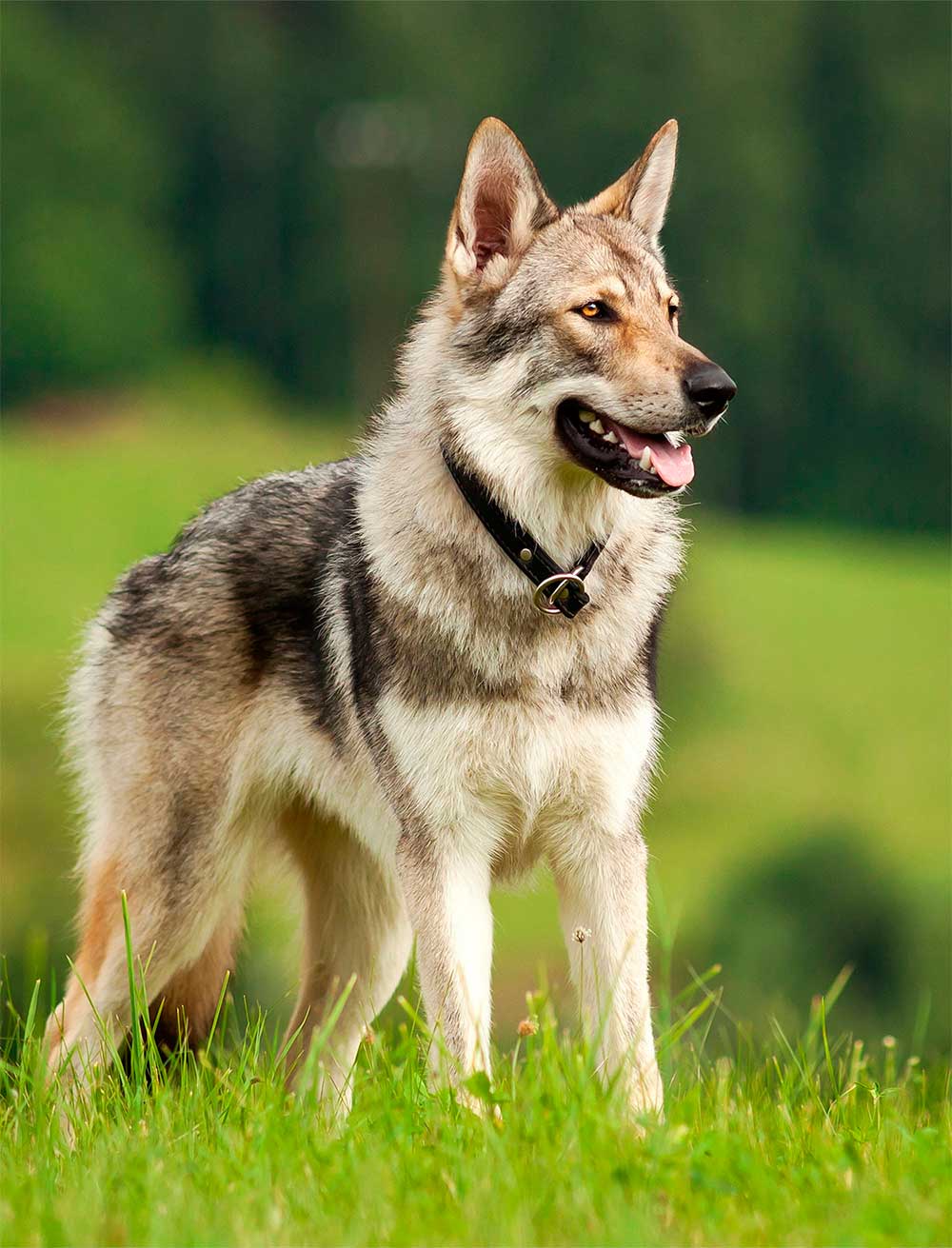
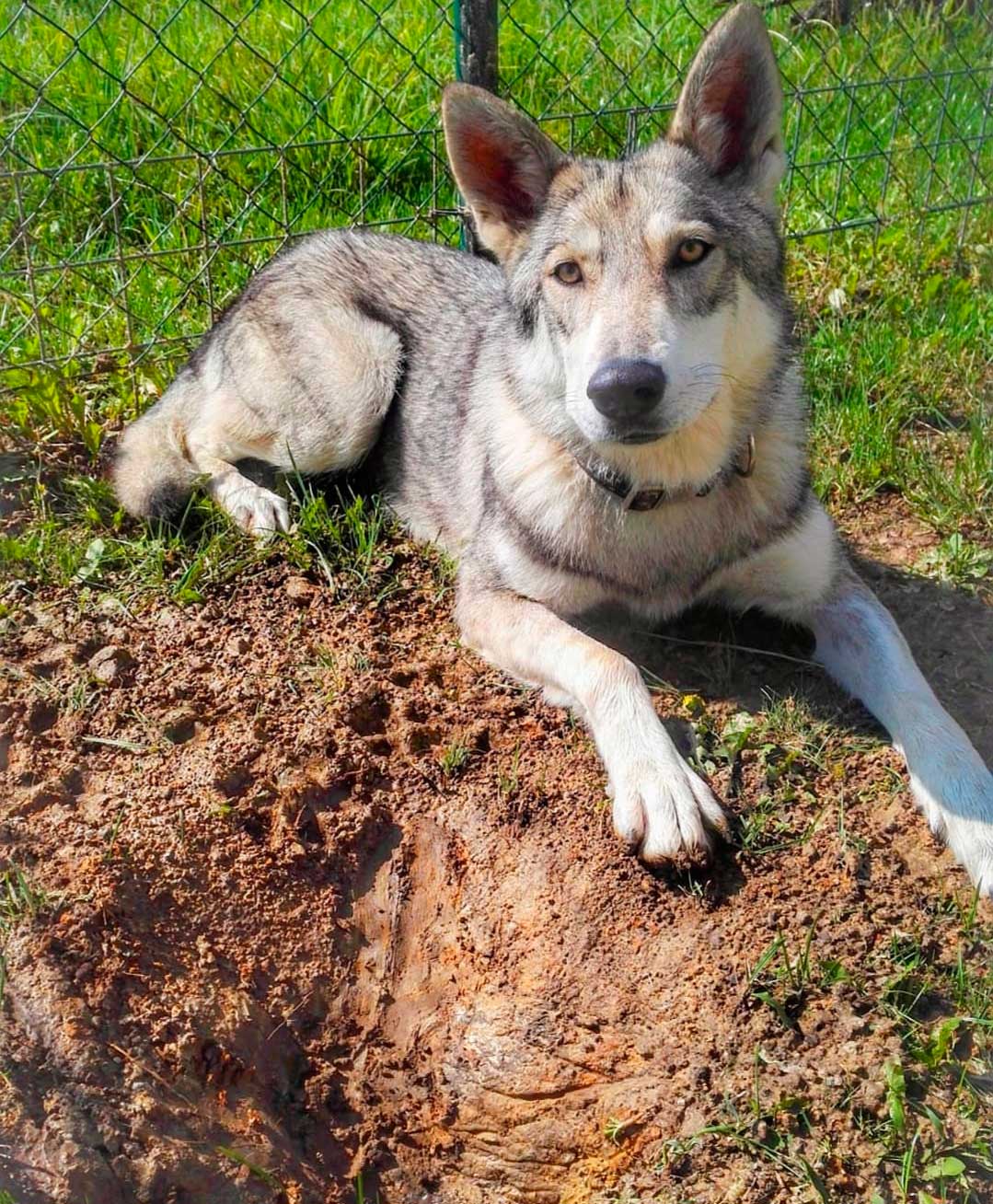
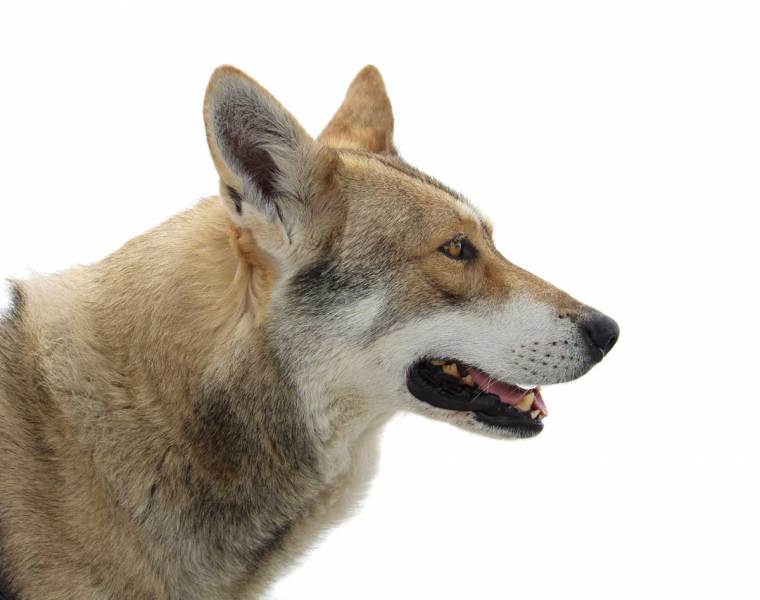
It is a dog of strong constitution, medium-sized and rectangular in structure. It is similar to the wolf in constitution, movement, colors, cloak and mask. The head, symmetrical and well muscled, is shaped like a truncated wedge. the eyes are small, macaroons, amber, with well-attached eyelids.
Ears are erect, thin, triangular and short. The tail is implanted high, but it hangs straight. When the dog is excited, lifts it up in a sickle.

Fur: The coat is straight and adherent. In winter it has a very dense undercoat.
Color: From yellowish gray to silver gray, with characteristic white mask.
Size: Males measure at least 65 cm.. the females, minimal 60 cm..

Character and skills

The Czechoslovakian Wolfdog he is very devoted to his family, including children. But, their rather dominant nature can be problematic for young people. In any case, it is important to socialize him from an early age and never leave a young child alone with a dog, regardless of race.

He is also sociable with his companions and other pets who live under the same roof., since he is used to their presence relatively early. On the other hand, woe to the cats, small dogs and other rodents that are unfamiliar to you and would have the bad idea to venture into your territory, or that they will meet during a walk: his hunting instincts were then all chances to regain the advantage.

It also, he is as affectionate with his entourage as he mistrusts strangers: there is also necessary an education and socialization of the puppy started from an early age to avoid any later problem.

Having a highly developed sense of hierarchy, He must face as soon as possible with his "herd leader", who should show their dog his place in the family hierarchy . The Czechoslovakian Wolfdog he is a dog that cannot stand loneliness, greatly preferring to live in the company of their pack, that is, his family. You are very likely to be unhappy if you have to be alone for long periods of time and are at risk of running away to join your family, or to feel excluded from the "pack" and lose confidence in his master.

It also, the Czechoslovakian Wolfdog it is a very durable and active breed of dog, able to accompany his master even over very long distances that can exceed even those of a marathon, and whatever the weather conditions. In fact, being able to exercise daily is necessary for your physical and psychological well-being, and allows to avoid the risk of damage caused by the dog . It is an ideal companion for a sports lover who would like to, for example, jogging with your dog , go hiking with your dog or even ride a bike with your dog.. On the other hand, even more than for any other race, your handler should make sure to always be out front and thus show your dog who is the โ€œleader of the packโ€ .

On the other hand, a person who prefers to spend his free time in front of a screen or immersed in a book is exposed to some difficulties if he thinks about adopting a Czechoslovakian Wolfdog …

It also, by needing space, the latter is not a recommended breed of dog in apartments : it is much better to have a house with a garden. It is not uncommon to see him playing and sleeping there whatever the weather: it's not very hard, and is able to perfectly withstand bad weather. On the other hand, it is recommended that said garden be perfectly fenced, to avoid the risk of the dog escaping and wandering on public roads.

The Czechoslovakian Wolfdog very little, if he barks. But when it does, it is impossible not to notice: similar to his ancestors the wolves , its howl is loud and can be heard over long distances. Daily, when you need to express yourself, opt for other means, like moans and grunts .

Like this, this loyal and active dog will make a firm human companion happiness, sporty and available, but it is not recommended for people who have never had dogs before or who are often absent. In fact, the majority of failed adoptions are due to the fact that the human has not known how to impose himself as "leader of the pack" and / or has not been sufficiently available and active for his partner.

Last, It should be remembered that this recent breed of dog is still under construction, so excessively fearful or aggressive subjects may appear.

Price "Czechoslovak Wolf Dog"

The price of a puppy Czechoslovakian Wolfdog is of some 1250 to 1500 EUR.

creators of "Czechoslovakian Wolfdog"
Register kennel

Czechoslovak Wolf dog

Offer your puppies for free. Sign up here.

  • This field is a validation field and should be left unchanged.

Characteristics "Czechoslovakian Wolfdog"

Coexistence is important that you have with your new friend. Before considering the acquisition of a dog of the breed "Czechoslovakian Wolfdog" you know certain factors. Not all breeds of dogs are apt to live in an apartment, you must take into account his character, their need for exercise, their interaction with other pets, their care and if you have small children, their level of tolerance towards them.

Adaptation โ“˜

4,0 of 5 stars (based on 1 review)

friendly dog โ€‹โ€‹โ“˜

2,0 of 5 stars (based on 1 review)

hair loss โ“˜

3,0 of 5 stars (based on 1 review)

Affection level โ“˜

4,0 of 5 stars (based on 1 review)

Need for exercise โ“˜

5,0 of 5 stars (based on 1 review)

Social need โ“˜

4,0 of 5 stars (based on 1 review)

Home โ“˜

2,0 of 5 stars (based on 1 review)

Toilet โ“˜

2,0 of 5 stars (based on 1 review)

Friendly with strangers โ“˜

2,0 of 5 stars (based on 1 review)

barking โ“˜

3,0 of 5 stars (based on 1 review)

Health โ“˜

3,0 of 5 stars (based on 1 review)

Territorial โ“˜

5,0 of 5 stars (based on 1 review)

Cat friendly โ“˜

2,0 of 5 stars (based on 1 review)

Intelligence โ“˜

4,0 of 5 stars (based on 1 review)

Versatility โ“˜

3,0 of 5 stars (based on 1 review)

Child friendly โ“˜

4,0 of 5 stars (based on 1 review)

Surveillance โ“˜

5,0 of 5 stars (based on 1 review)

joy โ“˜

3,0 of 5 stars (based on 1 review)

Type and recognitions:

  • FCI CLASSIFICATION:
  • Group :
  • Section : . .

Federations:

  • FCI โ“˜,
  • AKC โ“˜,
  • ANKC โ“˜,
  • UKC โ“˜

  • FCI breed standard Czechoslovakian Wolfdog

    FCIFCI - Czechoslovakian Wolfdog
    Dog

    Alternative names:

    1. Czechoslovak Vlcak (English).
    2. ฤŒeskoslovenskรฝ vlฤiak (French).
    3. tschechisch ฤeskoslovenskรฝ vlฤรกk, slowakisch ฤeskoslovenskรฝ vlฤiak (German).
    4. ฤŒeskoslovenskรฝ vlฤรกk (Portuguese).
    5. ฤŒeskoslovenskรฝ vlฤรกk, PLC (espaรฑol).

    Photo:
    Czechoslovakian Wolfdog by UsernameNotInUse / CC BY-SA

    โ–ท The world of Pets: Dogs, cats, birds, reptiles, amphibians

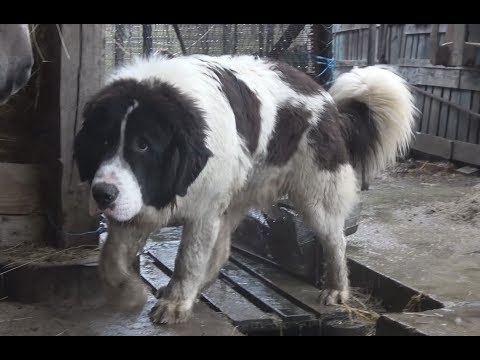
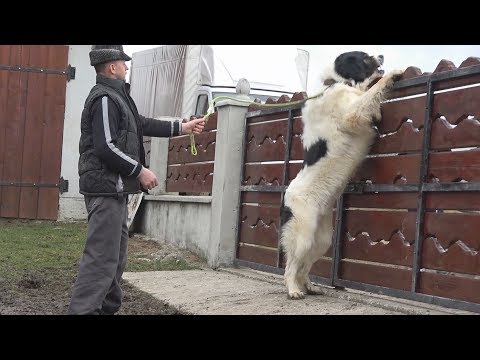
    Romanian Bucovina Shepherd
    Rumanรญa FCI 357 - Sheepdogs

    The Romanian Bucovina Shepherd is a quiet dog, balanced, devoted and who loves children, what can make it an ideal dog for a family.

    Romanian Bucovina Shepherd

    The Romanian Bucovina Shepherd is a quiet dog, balanced, devoted and who loves children

    Content

    Characteristics "Romanian Bucovina Shepherd"

    Coexistence is important that you have with your new friend. Before considering the acquisition of a dog of the breed "Romanian Bucovina Shepherd" you know certain factors.

    Not all breeds of dogs are apt to live in an apartment, you must take into account his character, their need for exercise, their interaction with other pets, their care and if you have small children, their level of tolerance towards them.

    Adaptation โ“˜

    3,0 of 5 stars (based on 1 review)

    friendly dog โ€‹โ€‹โ“˜

    3,0 of 5 stars (based on 1 review)

    hair loss โ“˜

    5,0 of 5 stars (based on 1 review)

    Affection level โ“˜

    5,0 of 5 stars (based on 1 review)

    Need for exercise โ“˜

    4,0 of 5 stars (based on 1 review)

    Social need โ“˜

    2,0 of 5 stars (based on 1 review)

    Home โ“˜

    2,0 of 5 stars (based on 1 review)

    Toilet โ“˜

    2,0 of 5 stars (based on 1 review)

    Friendly with strangers โ“˜

    2,0 of 5 stars (based on 1 review)

    barking โ“˜

    5,0 of 5 stars (based on 1 review)

    Health โ“˜

    3,0 of 5 stars (based on 1 review)

    Territorial โ“˜

    5,0 of 5 stars (based on 1 review)

    Cat friendly โ“˜

    3,0 of 5 stars (based on 1 review)

    Intelligence โ“˜

    5,0 of 5 stars (based on 1 review)

    Versatility โ“˜

    3,0 of 5 stars (based on 1 review)

    Child friendly โ“˜

    5,0 of 5 stars (based on 1 review)

    Surveillance โ“˜

    4,0 of 5 stars (based on 1 review)

    joy โ“˜

    3,0 of 5 stars (based on 1 review)

    History

    Natural breed known for centuries in the Bucovina region, in northeastern Romania, the Romanian Bucovina Shepherd was brought to light for the first time in 1934 by G. Radulescu Calafat, publisher of the first Carpathian Sheepdog standard, who mentioned in an article published in the journal Vet Sciences another shepherd dog of molosoid type called ยซDulauยป or ยซCapauยป.. Until then, the Romanian Bucovina Shepherd had been compared to Romanian Carpathian Shepherd Dog, smaller.

    While the Romanian Bucovina Shepherd has long been used as a guard dog for flocks of sheep against large predators in the Carpathians, like bears, wolves and lynx, it has also been used for many years by Romanian farmers as a guard dog.

    In 1982 the Romanian Cynological Association, the canine organization of reference in the country, developed a first standard that described the Romanian Bucovina Shepherd. It was updated in 2001 and 2002 in accordance with the FCI requests (International Cynological Federation) with a view to their recognition of the breed, what actually happened provisionally in 2009.

    In 2019, the Romanian Bucovina Shepherd obtained the definitive recognition of the FCI. On the other hand, not yet recognized by the British reference organization, The Kennel Club, nor by the American Kennel Club (AKC) and the United Kennel Club (UKC).

    In fact, still very rare outside its country of origin and some neighboring countries, like Ukraine or Serbia. In Romania there have been 6.000 specimens in the Romanian Stud Book, but only the breeding of 300 females and 200 males, as Romanian law imposes many restrictions on the breeding of dogs.

    Photo: Ciobanesc de Bucovina – Romania 2018 by 1jagdterrier – YouTube

    Physical characteristics

    "Romanian Bucovina Shepherd"

    Pastor rumano de Bucovina

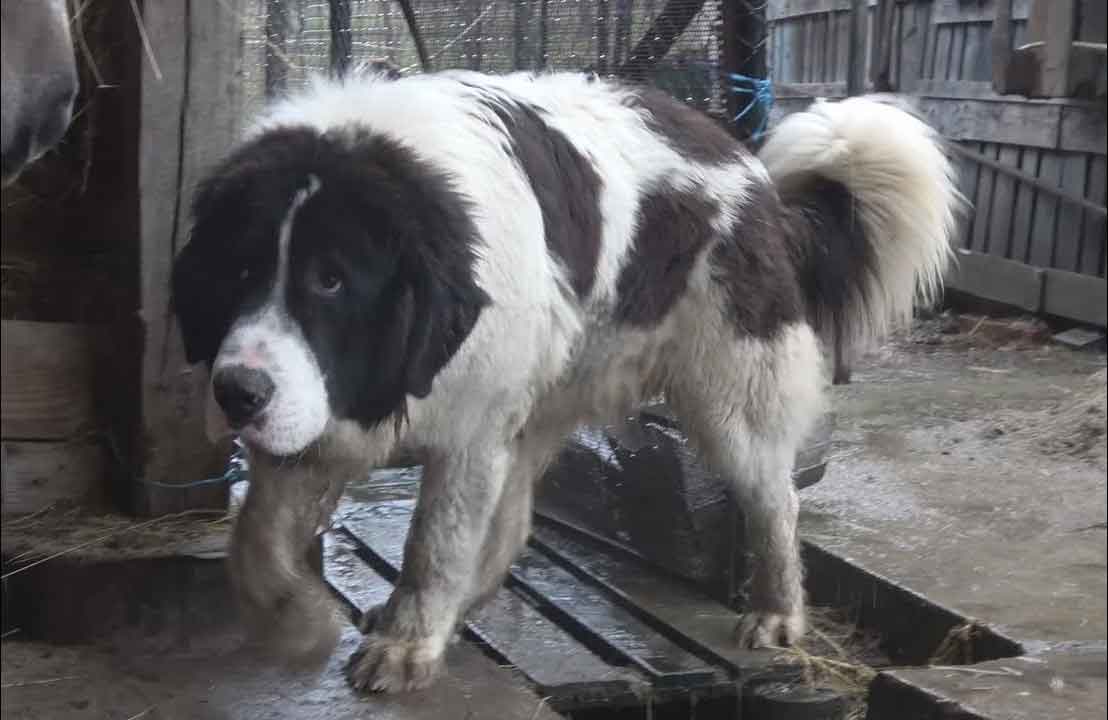
    The Romanian Bucovina Shepherd they are huge dogs with a body slightly longer than the tall, powerful lower limbs and a horizontal, muscular back. Placed high on the body, its long tail is carried hanging at rest and rises in the back in a slightly upward curve when in the gazebo.

    The head, which is wide and carried slightly higher than the body, blends in with the voluminous and moderately long neck, which forms an angle of 100 to 110 degrees with the rest of the body.

    The muzzle is black, the eyes are relatively small in relation to the head, the powerful jaw is chisel-shaped and the V-shaped ears with rounded tips fall along the cheeks.

    While the head and the front of the legs are covered with short hair, the rest of the body is covered with dense hair, long (6 to 10 cm.) and quite stiff. The coat is predominantly white, marked with black spots, gray or leonadas well defined. But, the standard of Romanian Bucovina Shepherd it also recognizes unbleached, uncoloured specimens that are completely white, white as snow, gray like ash or black.

    Sexual dimorphism is well marked in the Romanian Bucovina Shepherd, being the male larger than the female.

    Character and skills

    The Romanian Bucovina Shepherd is a quiet dog, balanced, devoted and who loves children, what can make it an ideal dog for a family. On the other hand, especially wary of strangers, so it is important to socialize him from an early age with the people with whom he can come into contact: friends, neighbors, postmen…

    Accustomed to guarding herds in the company of other dogs, coexists perfectly with its congeners and other pets that share its territory.

    It is not aggressive at all, the Romanian Bucovina Shepherd they are not prone to attack without reason. On the other hand, their very protective character makes them react in a very intimidating way if they perceive an intrusion into their territory. However, Their growls and especially their serious and powerful barks are just a way to scare off "invaders" and are rarely a precursor to offensive action.. But, If you feel that your "family" (which is simply the herd that is in charge, if he has always lived like a sheepdog) is threatened, this extremely brave and protective dog risks going on the attack, without even backing down in front of a bear or a pack of wolves.

    Independent and used to wandering alone in the wild mountains of Romania, the Romanian Bucovina Shepherd tolerates loneliness quite well and can be left alone for a few days without too much trouble, although he obviously prefers the company of his family. But, your ability to keep busy depends on having enough space to walk freely.

    Due to its size, his resonant voice and his need for great spaces, the Romanian Bucovina Shepherd They are not dogs that can live comfortably in apartments and are not recommended for urban areas. They greatly prefer sparsely populated areas, where they can patrol their territory in peace and quiet without risk of unwanted encounters.

    A very active and resistant dog, he needs daily physical activity and is happy to accompany his master on his long walks in the countryside.

    Education ยซRomanian Bucovina Shepherdยป

    "Romanian Bucovina Shepherd"

    Pastor rumano de Bucovina
    Dog of the months

    The puppy's socialization phase is of primary importance for the puppy. Romanian Bucovina Shepherd, and it is very important that you meet your family very soon, to possible other household pets, as well as the other people and animals that you will meet regularly during your life. In effect, once adult, you find it difficult to accept a new person in your environment (including for example a prospective dog handler or dog behaviorist), although this is not impossible.

    As an intelligent and obedient dog, can be easily trained and trained for his future role as a sheepdog or watchdog from his first birthday. Despite its independent nature, responds very well to positive reinforcement methods, but the teacher must ensure that he always maintains a strong and authoritative demeanor.

    It also, instead of a long daily training session, it is advisable to opt for several short sessions spread throughout the day.

    Health ยซRomanian Bucovina Shepherdยป

    The Romanian Bucovina Shepherd it is a particularly healthy and resistant breed.

    But, like most large breeds of dogs, are prone to hip dysplasia and elbow dysplasia. To reduce risks, you have to make sure that he does not undergo too much physical activity during his growth period.

    Gastric dilation of the dog is another problem that can affect this breed. Due to ingestion of food too fast, especially if they are dry, can be life-threatening and requires urgent intervention by a veterinarian. To minimize this risk, it is recommended to leave large amounts of water available when the dog eats, divide his daily ration into at least two meals and let him rest after these meals.

    Grooming ยซRomanian Bucovina Shepherdยป

    The Romanian Bucovina Shepherd they are long-haired dogs that need to be brushed once a week, and even more often during the moulting period. Losing her hair galore, not recommended for people who do not like to find dog hair all over the house and always have a perfectly clean interior.

    It also, at the end of winter, it is advisable to cut the hair between its pads to protect your dog from heat.

    It is not necessary to bathe your dog unless, of course, is particularly dirty. In any case, no more than 2 or 3 times a year, as this can damage the natural protective layer of the skin.

    On the other hand, it is necessary to regularly check the inside of the ears, since it is common for external parasites to hide there, and clean them well to avoid any risk of infection.

    The dog's claws should be checked monthly and trimmed if natural wear and tear is not enough.

    Feeding ยซRomanian Bucovina Shepherdยป

    If he Romanian Bucovina Shepherd he has always been fed what his shepherd used to prepare for him, good quality commercial croquettes are today an ideal solution, If and when, of course, the manufacturer's recommendations are followed.

    Bones are important in this dog's diet, so it can be useful to give him a bone to gnaw on from time to time. But, chicken bones and other poultry should be banned as they can cause serious damage to the digestive system.

    It also, as with any dog รขโ‚ฌโ€นรขโ‚ฌโ€นat high risk of bloating-twisting stomach, the daily ration should be divided into 2 or 3 meals and ensuring that the dog remains calm during and after these meals. This means, for example, make sure he sees his food coming instead of discovering it in front of him when he wakes up, avoid having another animal around you when you eat, and do not stimulate him during his meal or in the following hour.

    It also, is essential for Romanian Bucovina Shepherd have large amounts of fresh water available at all times.

    Price ยซRomanian Bucovina Shepherdยป

    a puppy of Romanian Bucovina Shepherd usually sold between 500 and 1000 EUR, but prices have tended to rise as the breed has been the subject of some interest after its recognition by the FCI. Males tend to be more expensive than females, and the price is higher when the animal has a smooth coat.

    It is necessary to be well informed about the origin of the puppy and check the documents with the Romanian Canine Association. Since 2015, the breeding of dogs without a pedigree or not registered in the Romanian Stud Book is prohibited in Romania, and the marketing of these puppies is illegal.

    Videos "Romanian Bucovina Shepherd"

    Shepherd of Bucovina - Romania 2018
    Ciobanesc de Bucovina – Romania 2018 by 1jagdterrier
    Shepherd of Bucovina - Ilie Forest 2018
    Shepherd of Bucovina – Ilie Forest 2018

    Type and recognitions:

    • FCI CLASSIFICATION:
    • Group :
    • Section : . .

    Federations:

    • – FCI – Group 1 Herding dogs, Section 1 Sheepdogs โ“˜

    FCI breed standard "Romanian Bucovina Shepherd"

    Origin:
    Romania

    Date of publication of the valid original standard:
    14.05.2018

    Use:

    Guardian of the flocks and excellent guard dog.


    General appearance:

    The Romanian Bucovina Shepherd is a large size dog, imposing, haughty and proud. The breed has obvious sexual dimorphism.

    IMPORTANT PROPORTIONS:
    The length of the body is slightly greater than the height at the withers. The length of the skull is
    equal to the length of the snout.


    Behavior / temperament:

    Balanced, calm and loyal, likes children. He is a very good guardian of the flocks, brave and a true fighter against possible prey animals (bear, wolf and lynx). Has a loud bark. When strangers or animals approach, his bark is very loud, with a low tone. During the night he patrols around the house or the herd/flock.

    Head:

    Solid but not heavy, carried a little higher than the top line.

    Cranial region:
    • Skull: Moderately wide, slightly domed. The upper profile of the skull and snout are slightly divergent.
    • Seen from the front the skull is slightly domed, seen from the side it is almost flat. Skull width: males: of 16 to 18 cms, females: of 15 to 17 cms, the zygomatic arches are moderately developed.
    • The occipital protuberance is inconspicuous.
    • Depression links (stop): Slightly pronounced.

    facial region:

    • Truffle: Large and well developed, black.
    • Snout: Abrupt cut, the same length as the skull; well developed, progressively narrowing towards the nose but never pointed; strong jaw.
    • Lips: Thick and firm, heavily pigmented.
    • Jaws / Teeth: Strong jaws, full dentition, strong teeth, healthy and white, well placed, scissor bite. Pincer bite is tolerated.
    • Cheeks: Not prominent.

    Neck:

    Of average length, It's big and strong, without jowl.

    Body:

    Good resistance.

    • top line: Horizontal.
    • Cross: It is slightly evident.
    • Back: Strong and muscular.
    • Pork loin: Muscular and strong.
    • Rump: Muscular and moderately inclined towards the base of the tail.
    • Breast : Wide and deep, descending to the elbows, well arched ribs.
    • bottom line: slightly upward.

    Tail:

    High insertion, at rest pending; reaching or below the hocks; When the dog is alert or in action the tail is raised to the level of the back or slightly above, with a slight upward curve, never curled up on the back. Its cutting is prohibited.


    Tips

    PREVIOUS MEMBERS:

    • General appearance: Straight seen from the front or side. Blades: long, oblique, well muscled and well connected to the body. The scapulohumeral angulation is approximately between 100 and 110 degrees.
    • Arm: Moderately long, muscular.
    • Elbows: Glued to the body, with free movement.
    • Forearm: Strong, not too long.
    • Carpo (wrist): Strong.
    • Metacarpus: Short, slightly inclined.
    • Previous feet: Oval, compact and massive, fingers together and arched, black or ash-colored nails.

    LATER MEMBERS:

    • General appearance: Muscular and strong. Normal posture.
    • Thighs: Medium long, widths, very muscular.
    • Knees: Femoro-tibial angle of 110 degrees approximately.
    • Legs: Moderate long, muscular.
    • Hocks: Widths, seen from the side at moderate angle. Seen from behind parallel to the median plane of the body.
    • Metatarsus: Strong and upright. The presence of dewclaws should not be penalized.
    • Hind feet: Oval, compact and strong. With black or ash-colored nails.

    Movement:

    Harmonious, elastic, well coordinated, giving the impression of effortless power. The preferred step is trotting. Exceeding will be penalized.

    Mantle

    PIEL: Thick, body-hugging with dark ash pigmentation.

    • Fur: The head and the front of the limbs are covered with short hair. The hair on the body is abundant, long (6-9 cm.), effortless power impression. The preferred step is trotting. Exceeding will be penalized. plane, straight and rough. The undercoat is shorter, very dense and soft and lighter in color. In the neck region the hair is much longer, forming a mane.; on the back of the front limbs the hair forms fringes, on the back of the hind limbs the hair is longer and forms breeches. The tail is thick hair.

    COLOR

    • Cclassic smell: The main color of the coat is a light white or yellowish white with distinctive gray spots, black or black with red highlights. Small black or gray spots may appear on the legs. Tabby appearance on patches should be rejected.
    • Csolid odors: Solid Colored Individuals (no patches) are accepted but should not be encouraged: white, yellowish white, ashy gray or black.


    Size and weight:

    Altura to the cross:

    • Males: 68 to 78 cm., ideal 71-75 cm..
    • females: 64 to 72 cm., ideal 66-68 cm..

    Tolerance: -4 cm. Weight: In proportion to height.


    Fouls:

    Any deviation from the aforementioned criteria is considered as a fault and the severity of this is considered to the degree of the deviation to the standard and its consequences on the health and well-being of the dog..

      • Lack of substance or too heavy.
      • Insufficient sexual character.
    • Absence of a non-PI tooth.
    • Short ears.
    • Short tail.
    • Subject too heavy or weak.
    • Because I cut it differently (less than 6 cm.)
    • Too long hair (more than 9 cm.)
    • Absence of mane or fringes on the limbs.
    • Tail curled or carried in the shape of a ring.
    • Flabby fingers facing in or out.
    • Elbows turned outward.
    • Heavy movement.

    FALTAS GRAVES:

    • atypical expression.
    • Wiggly eyes, round.
    • Erect ears.
    • Loose or saddled top line.
    • Too short hair.
    • Curly or poorly textured hair.
    • yellow eyes
    • Eyes of different color one than the other (heterochromatic).
    • cow hooves.

    FALTAS DISQUALIFYERS:

    • Aggressiveness or extreme shyness.
    • Any dog โ€‹โ€‹showing clear signs of abnormalities
    • physical or behavioral.
    • Lack of typicity.
    • Prognathism or enognatismo.
    • Absence of incisors or canines
    • albinism.
    • Natural absence of tail or tail with atrophy.
    • height below 64 cm or about 82 cm for males.
    • height below 60 cm or about 78 cm for female


    N.B.:
    • Males should have two normal-appearing testicles fully descended into the scrotum.
    • Only functionally and clinically healthy dogs, with the typical conformation of the breed, should be used for parenting.

    Lthe latest changes are in bold.Standard-FCI No. 349 / 09.01.2006 / IS

    Source: F.C.I - International Cynological Federation

    Alternative names:

    1. Bucovina Sheepdog, Bucovina Shepherd, Southeastern European Shepherd (English).
    2. Berger roumain de Bucovine, Berger de l’Europe du Sud-Est (French).
    3. Ciobฤƒnesc Romรขnesc de Bucovina (German).
    4. (em romeno: Ciobanesc Romanesc de Bucovina) (Portuguese).
    5. (en rumano: Ciobฤƒnesc de Bucovina) (espaรฑol).

    โ–ท The world of Pets: Dogs, cats, birds, reptiles, amphibians

    Komondor
    Hungria FCI 53 - Sheepdogs

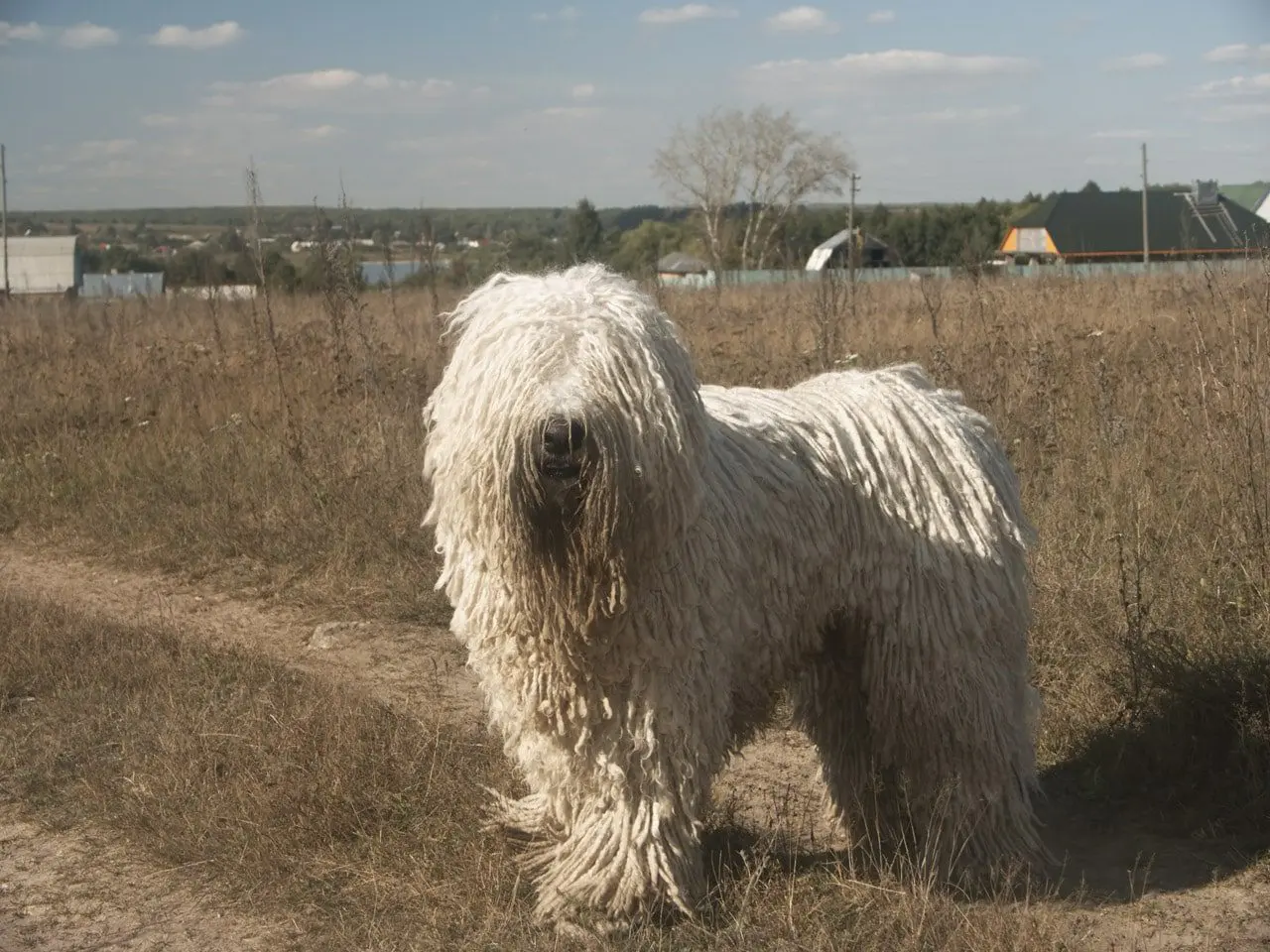
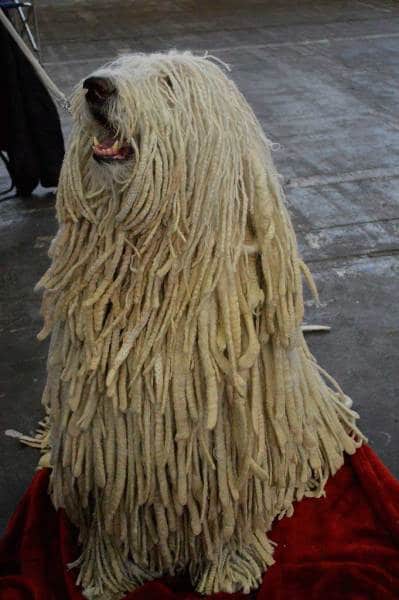
    The Komondor It is a breed of guard dog and pastor, originally from Hungary. Its main characteristic is the peculiar appearance of its fur., that falls in tufts like dreadlocks.

    Komondor

    Content

    Characteristics "Komondor"

    Coexistence is important that you have with your new friend. Before considering the acquisition of a dog of the breed "Komondor" you know certain factors. Not all breeds of dogs are apt to live in an apartment, you must take into account his character, their need for exercise, their interaction with other pets, their care and if you have small children, their level of tolerance towards them.

    Adaptation โ“˜

    3,0 of 5 stars (based on 1 review)

    friendly dog โ€‹โ€‹โ“˜

    2,0 of 5 stars (based on 1 review)

    hair loss โ“˜

    1,0 of 5 stars (based on 1 review)

    Affection level โ“˜

    3,0 of 5 stars (based on 1 review)

    Need for exercise โ“˜

    3,0 of 5 stars (based on 1 review)

    Social need โ“˜

    3,0 of 5 stars (based on 1 review)

    Home โ“˜

    2,0 of 5 stars (based on 1 review)

    Toilet โ“˜

    5,0 of 5 stars (based on 1 review)

    Friendly with strangers โ“˜

    1,0 of 5 stars (based on 1 review)

    barking โ“˜

    4,0 of 5 stars (based on 1 review)

    Health โ“˜

    3,0 of 5 stars (based on 1 review)

    Territorial โ“˜

    5,0 of 5 stars (based on 1 review)

    Cat friendly โ“˜

    4,0 of 5 stars (based on 1 review)

    Intelligence โ“˜

    4,0 of 5 stars (based on 1 review)

    Versatility โ“˜

    4,0 of 5 stars (based on 1 review)

    Child friendly โ“˜

    3,0 of 5 stars (based on 1 review)

    Surveillance โ“˜

    3,0 of 5 stars (based on 1 review)

    joy โ“˜

    5,0 of 5 stars (based on 1 review)

    History

    The Komondor is a breed of dog originating from Hungary, where it has been fulfilling its mission as a herding dog for more than 1000 years. Its long white fur allows it to blend in with the flocks of sheep it cares for and which it especially resembles.. So you can take threatening predators by surprise, including impressive opponents such as bears or wolves.

    It probably originated from the dogs that came to Hungary with the Magyars, nomads who came from Central Asia around the year 900 d.C. and they took their dogs to tend their flocks of cattle and sheep. Other experts argue that the ancestors of Komondor they arrived with the cumans, another Turkish nomadic people who, after the Mongol invasion of 1237, took refuge in present-day Hungary.

    It is this last hypothesis that we find in the name of the race, since the term "Komondor" comes from "Quman-durยซ, which means "Dog of the Cumans". Although researchers have found the remains of these dogs in Cuman cemeteries dating back to the 13th century, the oldest written description dates from the 16th century.

    At the end of the 17th century it was very popular in Hungary, and has remained so ever since. Raised and selected for their courage and strength, It was used mainly in the field to monitor farms, and in the mountains to protect the flocks of sheep. Hungarians are very proud of this dog, to which is attributed the considerable decrease in the number of wolves in his country, and that it was not crossed or modified until the middle of the 20th century.

    Komondor entered the United States between the wars, and the American Kennel Club (AKC) recognized the breed in 1937. But, World War II and then the Cold War ended imports from Hungary.

    In more general terms, the breed suffered greatly during these difficult times, seeing that their number decreased considerably. During World War II, many of their representatives were assassinated by the German military, since it was impossible for them to access the farms and houses of the country while this imposing guard dog protected them. Obviously, conflicts also limited its export to other countries.

    In the Decade of 1960, Hungarian and American breeders were able to renew their ties, so the import of the Komondor to the United States. While the race was on the brink of extinction (even in your country of origin, mostly due to the consequences of the war), saw their numbers grow considerably and their notoriety do the same, both in Hungary and abroad.

    In the United States, attempts in the west of the country to use it as a grazing show promise, and its use throughout the country has been increasing considerably. Logically, el United Kennel Club (UKC), another canine organization of reference in the country, recognized it as an official breed in 1983.

    In Europe, over the years 50, the Komondor was crossed with him South Russian Ovcharka, to get new bloodlines. It is also at this time - and more precisely in 1954- When the Komondor was recognized by the Fรฉdรฉration Cynologique Internationale (FCI).

    Finally, at the end of the 20th century, there was a new crossing with other breeds of sheepdogs such as the Catalan Sheepdog, the Pyrenean Shepherd, the Bergamasco Shepherd or the Cรฃo da Serra de Aires.

    But, this is a rare breed of dog, regardless of the country. In fact, even in the country where a large proportion of the population is, the United States, it is not very common. These may include, just occupy around the place 160 (of 190) in the ranking of the most popular dogs in the United States, based on number of annual AKC registrations.

    In France, it is also discreet, since the average number of annual registrations in the Livre des Origines Franรงais (LOF) it's around of 15 since the beginning of the 21st century. It has even experienced a certain decline, since this number was more or less in the thirties around the nineties. Not much better, for example, en el Reino Unido, where the number of registrations per year with The Kennel Club rarely exceeds ten.

    Physical characteristics

    The Komondor it is a large and strongly built dog. Your outward appearance, that of a winner and his majestic posture arouse respect in the observer and eventually also fear. Not flattering by nature. The robust body is covered by long hair, always bushy without exception, matted, tufted. Seen in profile, the body is a rectangle lying, almost a square. Protruding above the body, the head appears very densely hairy. The tail is carried hanging with the tip bent almost reaching the horizontal.

    Fur: thick and bushy, holding to be felted or strung (in the latter case it is not felted). Presence of sunpelo.

    Color: White, white profile.

    Size: males, of 65 – 80 cm., for a weight of 50 – 60 kg; females, of 55 -70 cm., for a weight of 40 – 50 cm..

    Observations and tips.

    The coat may seem difficult to care for, but it doesn't really need any care. It should not even be brushed because its hardiness must be kept intact. For hygiene reasons, must bathe regularly.

    Character and skills

    Unwavering courage in the defense and care of the herds in his charge, also from his territory and his master's house. Attack silently and boldly. Consider your district as if it belonged to you, in that it does not admit any strange being. Is distrustful. Your day is happy when you can spend it controlling your territory. During the night it remains in permanent movement.

    With good training and in expert hands it can be a good defense dog, although quite conflicting with other dogs, and can bite a man if he is not socialized from the earliest age. Fortunately, it is very docile and a signal from its owner is enough to stop it when it decides to attack.

    Komondor toilet

    Komondor's coat begins to lace up when he is eight months to one year old. The coat does not come off much, but the laces must be separated regularly to maintain their appearance, and the coat attracts the dirt. Once a Komondor passes the puppy stage, its fur will probably never have its former pristine whiteness. The coat should never be dirty, tangled or foul-smelling.

    To avoid problems, ask the breeder to show you how to care for the coat. Trimming the hair around the mouth and cleaning the dog's face after meals is one way to help reduce odor..

    The rest is basic care. Trim nails as needed, usually every week or two. Keep your ears clean and dry. Brush teeth frequently with a vet-approved pet toothpaste for overall good health and fresh breath.

    Komondor Health

    The Komondor they are generally healthy, but the conditions that are sometimes seen in the breed include hip dysplasia, eye problems like entropion (a deformity of the eyelid), and juvenile falls, and swelling, also known as gastric torsion or gastric dilatation volvulus.

    Do not buy a puppy from a breeder who cannot provide you with written documentation showing that the parents were exempted from health problems affecting the breed. Having dogs undergo a "vet check" is not a substitute for genetic health testing.

    Remember that after bringing a new puppy home, has the power to protect you from one of the most common health problems: the obesity. Keep a KomondorA proper weight is one of the easiest ways to extend your life. Make the most of your preventive skills to help ensure a healthier dog for life.

    Images "Komondor"

    Videos "Komondor"

    Type and recognitions:

    • FCI CLASSIFICATION:
    • Group :
    • Section : . .

    Federations:

    • – FCI – Group 1 Herding dogs, Section 1 Sheepdogs โ“˜
    • – AKC – PASTORAGE โ“˜
    • – ANKC – Group 5 (working dogs) โ“˜
    • – CKC – Group 7 – Herding dogs โ“˜
    • – โ€‹KC – Pastoral โ“˜
    • – NZKC – Working dog โ“˜
    • – UKC – Herding dogs โ“˜

    FCI breed standard "Komondor"

    Origin:
    Hungary

    Date of publication of the valid original standard:
    06.04.2000

    Use:

    Shepherd dog.


    General appearance:

    The Komondor is a large, heavily built dog. Your outward appearance, that of a winner and his majestic posture arouse respect in the observer and eventually also fear. Not flattering by nature. The robust body is covered by long hair, always bushy without exception, matted, tufted.
    Seen in profile, the body is a rectangle lying, almost a square. Protruding above the body, the head appears very densely hairy.

    The tail is carried hanging with the tip bent almost reaching the horizontal. The coat is ivory in color.


    IMPORTANT PROPORTIONS

  • The length of the body is slightly greater than the height at the withers.
  • The depth of the chest corresponds to almost half the height at the withers.
  • The muzzle is slightly shorter than half the length of the head.


  • Behavior / temperament:

    Unwavering courage in the defense and care of the herds in his charge, also from his territory and his master's house. Attack silently and boldly. Consider your district as if it belonged to you, in that it does not admit any strange being. Is distrustful. Your day is happy when you can spend it controlling your territory. During the night it remains in permanent movement.

    Head:

    Wide and well proportioned to the body. Even the thick fur that covers her like an umbrella doesn't make her look disproportionate either..

    Cranial region:
    • Skull: Arcuate. Supraciliary arches are well developed.
    • Depression links (Stop): Well marked, Although not abrupt.

    facial region:

    • Truffle: It is right, of abrupt and black cut.Snout: Not pointed. The nasal helm is straight.
    • Lips: Blacks. The maxillas and bite are firm.
    • Flecuda lips commissure.
    • Jaws / Teeth: Very muscular maxillas, strong and powerful. Scissor bite, regular and complete according to the dog's dental formula.

    EYES: Placed in horizontal position, They are dark brown. The edges of the eyelids are black and support firm on the eyeball.


    EARS: Of medium height insert in the arched skull. They are directly and clearly pendant and present a form of "V" or "U". The ears do not rise during attention or when the dog goes to the offensive.

    Neck:

    Very well muscular. Forms an angle of 35ยบ in relation to the horizontal. Calmly and in a friendly situation is carried out almost after the back line. Is shorter than long long. Without Powile and Golilla.

    Body:

    top line: The parts of the body that make up the upper line are wide and richly muscular.

  • Cross: Long enough, marked in front.Back: Short.
  • Pork loin: Long Middle.
  • Rump: Wide, long Middle. Gently descendant.
  • Breast : Broad and strongly muscular. rib cage: moderately deep, wide, long.
  • Belly: Slightly collected.


    Tail:

    Low insert, Clearly pendant; The distal sector of the tail presents a soft curvature close to the horizontal. It is desired that the tail reaches the corvejรณn. Being the excited dog, Raise the tail to the height of the dorsal line.

    Tips

    PREVIOUS MEMBERS: The judgment of the limbs is largely harmed through the long and tangled fur that covers them. The previous members are like columns and seen both in front and profile, They are rights, parallel and perpendicular to the ground. The chest is wide and is located between the limbs quite separate one from another, robust and free movement. The limbs are firmly linked to the body. The bone structure is strong and powerful. Members are bulky.

    • Shoulder: The scapulas are slightly oblique. The upper tips of the scapulas are located in a vertical with the deepest point of the chest.
    • Previous feet: Large, firm and fingers together. The pads are gray slate, full and well padded. The nails are gray.

    LATER MEMBERS: The posterior members hold the body from moderate angles. In continuation of the medium length rump, wide and strongly muscular posterior limbs.

    • Thigh: powerfully muscled, bulky.
    • Hind feet: The rear feet are longer than the strikers or equal. The spurs will be removed.

    Movement:

    Soft displacement, free and moderate. The step is broad and with good land coverage.

    Mantle

    Fur: The body is covered by long hair in its entirety. The fur is composed of an outer layer of rustic hair and a finer internal wool.

    • The character of the fur is given by the relationship between the outer layer of hair and the internal wool. The fur in tufts and with a tendency to entangle is a basic requirement. A similarly dense fur, wavy and cordoned is also admitted. Small strands are few or not tangled. The fur reaches its maximum length on the rump, In the spine region and on the back of the thighs (minimal 20-27 cm.) ; In the back, to the sides of the chest and in the area of the scapulae, It is middle long (minimum 15-22cm.) ; cheeks, The supraciliary arcades, In the upper region of the skull, in the ears, in the neck and extremities, It is shorter (10-18 cm.). The shortest hair (9-11 cm.) They are found in the Belfos and under the limbs. They are not desirable hairstyles or maintenance hairs.
    • Color: Ivory.


    Size and weight:

    Height to the cross

    • Males: minimal 70 cm.. females: minimal 65 cm..

    Weight

    • Males: 50 โ€“ 60 kg.
    • females: 40 โ€“ 50 kg.

    The breed presents few types of type and is largely homogeneous, since he has always raised following the same goal.


    Fouls:

    • Any deviation from the aforementioned criteria is considered as a fault and the severity of this is considered to the degree of the deviation to the standard and its consequences on the health and well-being of the dog.. Specifically:
    • Lack of pigmentation in the truffle, Eyes and edges of the eyelids.
    • Loose eyelids.
    • Ringed tail.


      FALTAS DESCALIFICANTES:

      Aggressiveness or extreme shyness.

    • Any dog โ€‹โ€‹showing clear signs of physical or behavioral abnormalities.
    • Flacid structure of the body with insufficient musculature.
    • Upper or lower prognathism, incisor arcade deviated.
    • Entropion and ectropion
    • Light and erect ears.
    • Short tail (3 cm.. above the corvejรณn)
    • Heavy limbs and lack of movement.
    • Colors other than admitted, Various colored furs.
    • Height to the cross below the minimums required by the standard.


    N.B.:
    • Males should have two normal-appearing testicles fully descended into the scrotum..
    • Only functionally and clinically healthy dogs, with the typical conformation of the breed, should be used for parenting.

    Source: F.C.I - International Cynological Federation

    Alternative names:

    1. Hungarian Commonmop, Hungarian Sheepdog, Mop Dog (English).
    2. Komondor (French).
    3. Komondor (German).
    4. Komondor (Portuguese).
    5. Komondor Hรบngaro, Ovejero Hรบngaro / Perro Guardiรกn (espaรฑol).

    Photos:

    1 – A Komondor lying down by David Blaine from Spokane, USA / CC BY
    2 – Komondor Halfhegtarens Warlock (Flea by Kari / CC BY-SA
    3 – Ch. Gillianโ€™s Quintessential Quincy (born April 17, 2007), a male Komondor at the working group judging in the 2007 Westminster Kennel Club Dog Show by https://commons.wikimedia.org/wiki/File:Komondor_Westminster_Dog_Show.jpg
    4 – www.petsadviser.com, rather than Flickr if you use this photo. Thanks for your cooperation. 2015 Westminster Kennel Club Dog Show, New York City.

  • โ–ท The world of Pets: Dogs, cats, birds, reptiles, amphibians

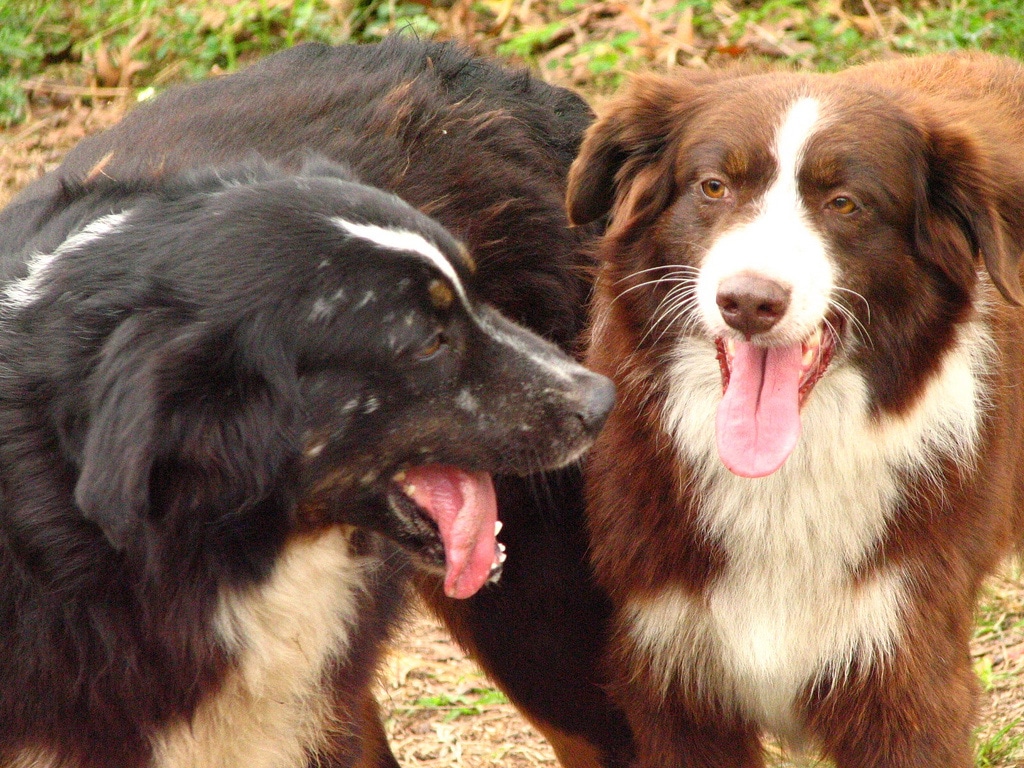
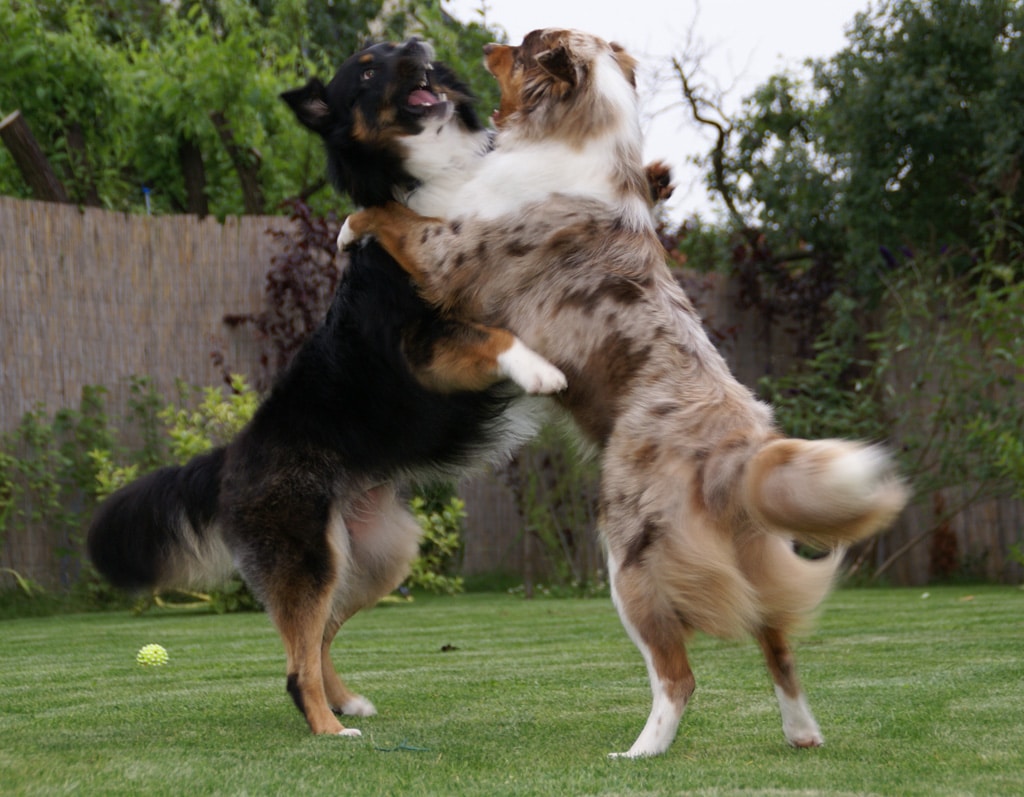
    Australian Shepherd
    Estados Unidos FCI 342 - Sheepdogs

    Pastor australiano

    The Australian Shepherd It has a stable temperament and is good in nature.

    Content

    History

    The Australian Shepherd It is a breed of dog of grazing which has developed on ranches in the West of United States. despite its name, the race, did not originate in Australia. It acquired its name because some of the dogs, Australian Shepherds arrived in United States with shipments of Australian sheep.

    Race gradually rose in popularity with the rise of the riding following the first world war western. For many years, the Australian Shepherd, has been dog valued by farmers for its versatility and capacity of training inherent. The race has gained recognition, with its training capacity and the desire to please, and are highly respected for his skills in obedience. They became known to the general public through roundups, horse shows, and through Disney made-for-TV movies.

    Physical characteristics

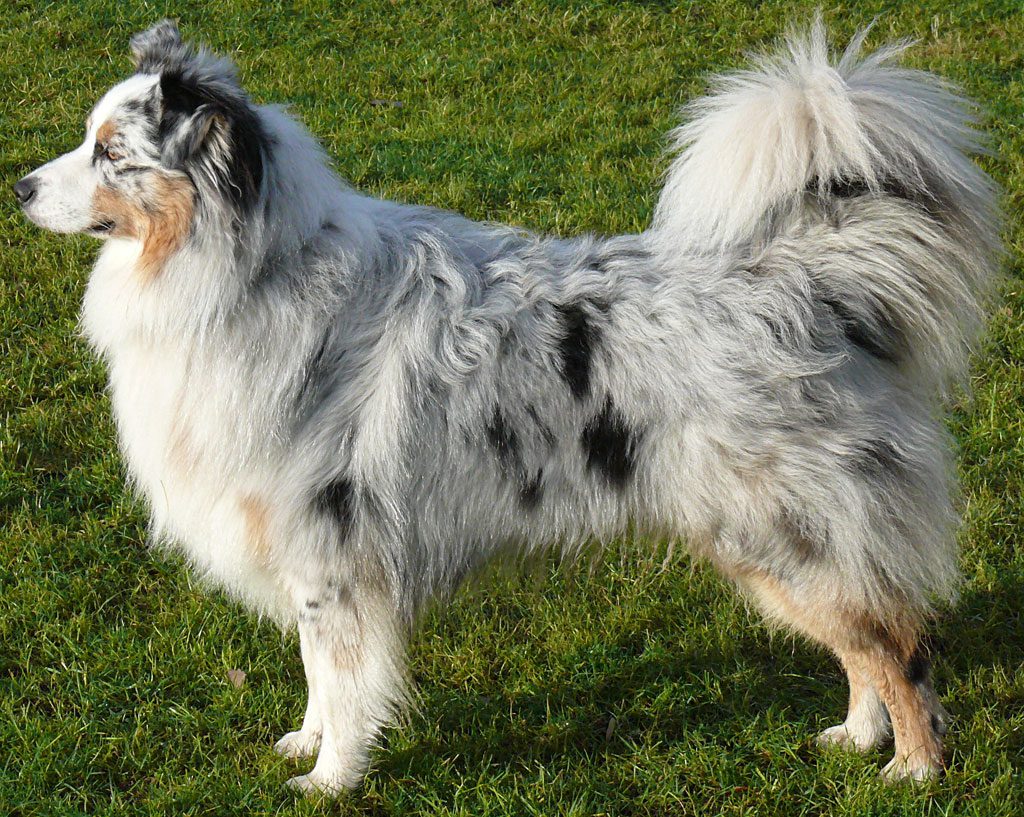
    The Australian Shepherd is a dog from medium-sized and solid construction, known for its natural 'bob' or amputated tail. He is an active breed of grazing, generally very good with pets and other well-known people, but they can be reserved with strangers. They are not a fair race, tender, who prefer the company of their owners.

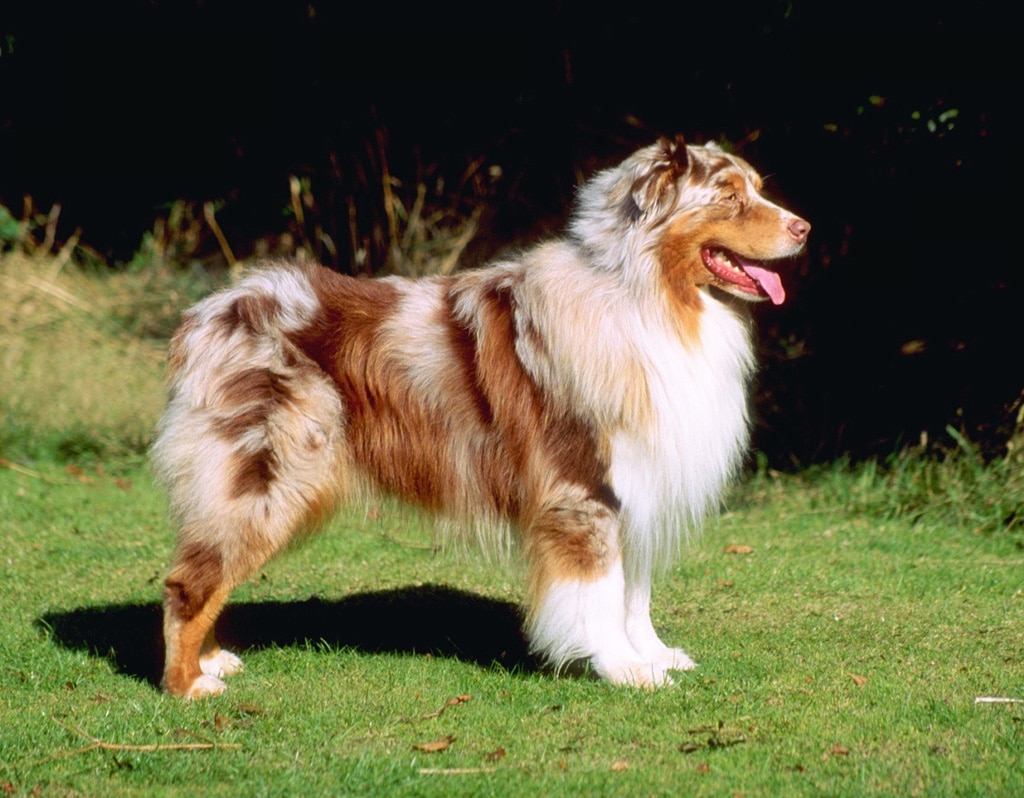
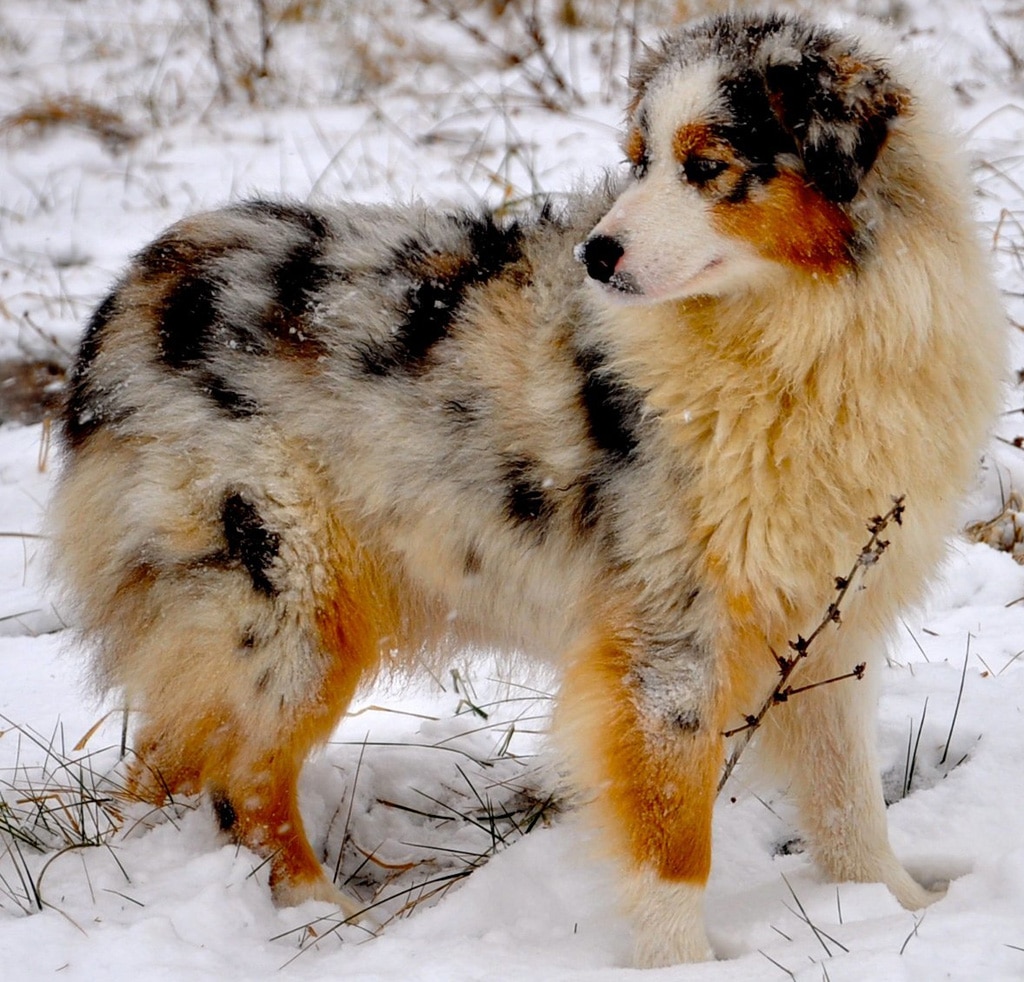
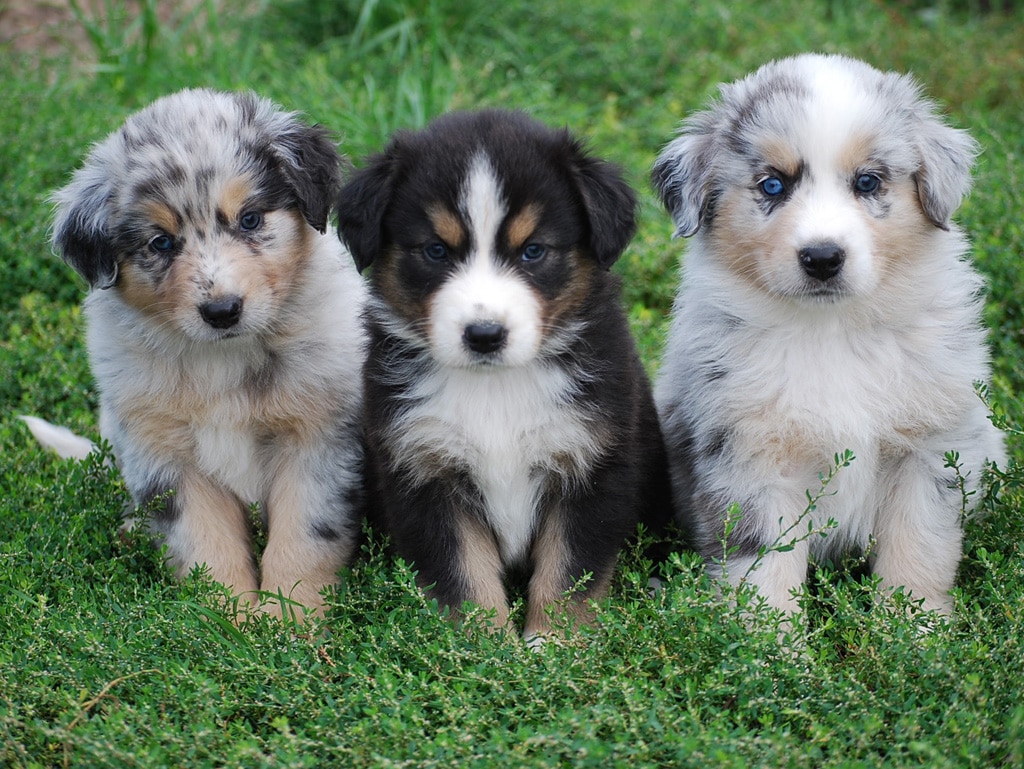
    Its mantle is double layer, and the colors are black, red (sometimes called the liver), tricolor (black marble, White and grey), and the Red merle (red marble, White and beige), each of these colors may also have copper and / or white spots in various combinations in the face, the chest and legs.

    The wide variety of color combinations comes from the interaction between the color of one allele, that is recessive, dominant or red black color, and the dominant allele marble. Together, They provide the color of the fur, and they can appear in any combination:

    Negro, with spot color fire and / or white markings on the face, neck, legs, chest, belly. Copies of a black are equally valid as the Tan and / or white.

    Red (liver), with or without points bronze and / or white markings on the face, neck, legs, chest, belly. White or Brown points are required.

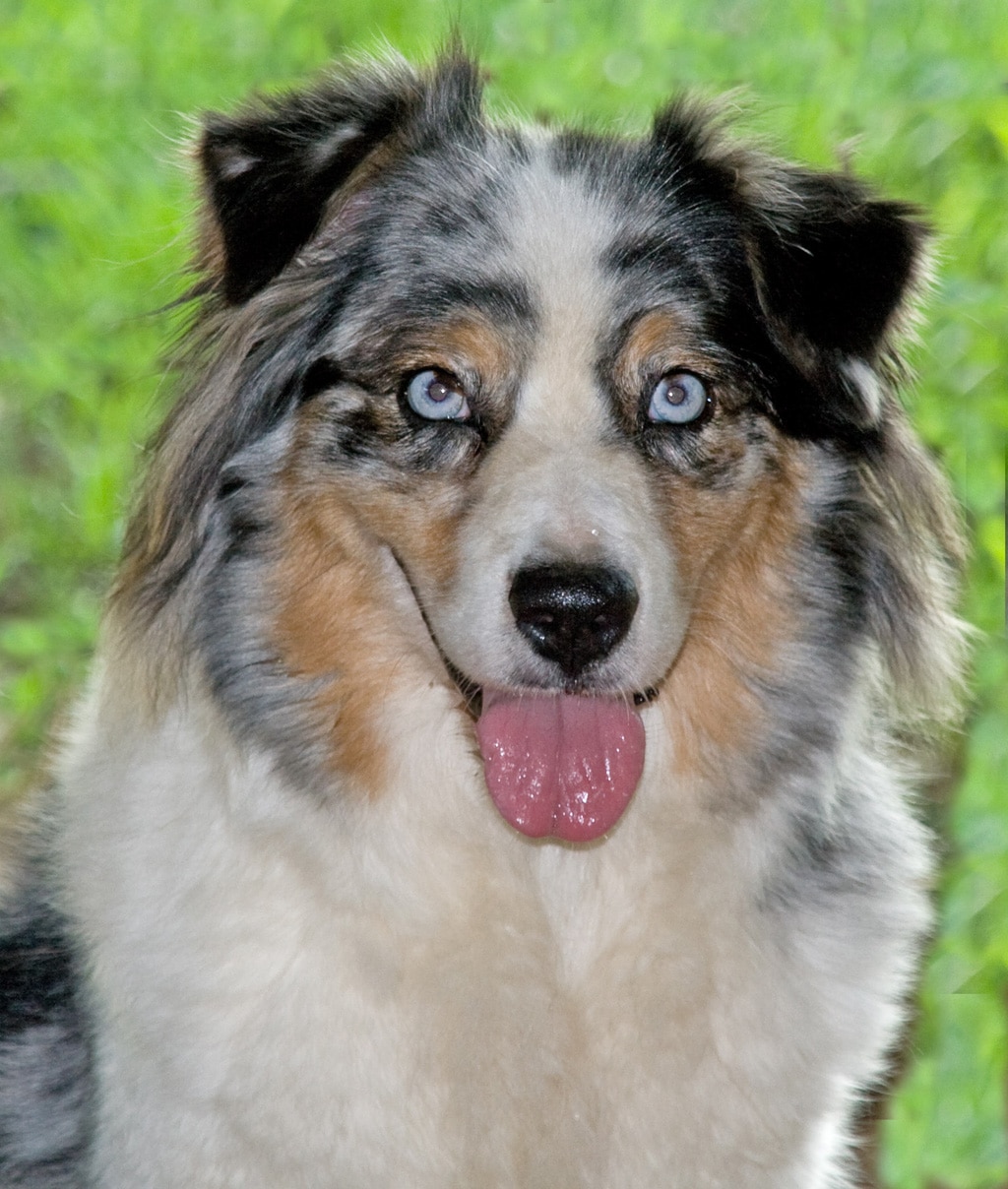
    Blue Merle (a mottled patchwork of black and grey) with or without stain color fire and / or white markings on the face, neck, legs, chest, belly.

    Red Merle (a variegated mosaic of cream and liver red) with or without stain color fire and / or white markings on the face, neck, legs, chest, belly.

    There is also great variety in the color of the eyes australian shepherd, they can be of any color or shade of brown or blue, You can have two different colored eyes, or even have "split" or bicolor eyes (for example, Brown half, Blue half).

    Character and skills

    The race is usually is highly energetic, they require a large amount of exercise, education and care. The Australian Shepherd is playful, that is why it is good that training included days of games.

    Like all races work, the Australian Shepherd you have considerable energy that you need to expend, therefore, need a job to do. Often stands in canine sports, such as agility, the flyball and the Frisbee . As well, are good as rescue dogs, disaster dogs, detection dogs, guide, service and therapy dogs.

    They are very loyal to their owners, and they are grateful when they receive a good deal, and love. Because the breed was developed to serve at the ranch, a work that includes being protective of its property, usually always alert and slope of the movements of the environment.

    The Australian Shepherd, is a dog Intelligent, learn quickly and loves to play. It is important that whoever assumes the responsibility of having such a dog, values that detail, because if you do not receive the necessary daily exercise, When they get bored they can become very destructive.

    They require a minimum of 2 or 3 game hours per day, exercise and attention. They need space to run and play, If living in an urban environment.

    It is a hardy breed that, It can live in a wide variety of terrain. For this reason they are a very popular choice for Trail dogs and working dogs.

    Australian Shepherd Dog Health

    All dogs have the potential to develop genetic health problems, just as all people have the potential to inherit a particular disease. Run, do not walk, from any breeder that does not offer a health guarantee on puppies, to tell you that the breed is 100 percent healthy and has no known problems, or tell you that your puppies are isolated from the main part of the home for health reasons. A reputable breeder will be honest and open about the breed's health problems and the incidence with which they occur in their lines..

    The australian shepherds they are generally healthy dogs, but they can develop certain health problems, including hip dysplasia, various eye diseases, sensitivity to certain drugs and epilepsy. Here is a brief summary of what you should know.

    The hip dysplasia is a genetic malformation of the hip socket. Dogs with hip dysplasia may appear perfectly normal, but because the head of the thigh bone does not fit properly in the hip socket, over time the cartilage on the surface of the bone begins to wear down. Constant inflammation leads to arthritis.

    The Australians can be affected by a number of genetic eye problems. These include colobomas, in which part of the structure of the eye is missing. They can also suffer from different types of cataracts, progressive retinal atrophy (PRA) and retinal detachment. Another eye problem is persistent pupillary membrane, tiny threads of fetal tissue crossing over the iris. Australians are also among the races that can be affected by the Anomaly of the Collie Eye, a group of eye disorders ranging from mild to severe.

    But, eye disease screening doesn't end with parents. All puppies should be examined by an ophthalmologist after six weeks of age and before you bring them home.. You should continue to have a veterinary ophthalmologist examine your eyes annually..

    The Australians are also one of the breeds that can be affected by Multiple Drug Sensitivity (MDS). Dogs with MDS can have fatal reactions to a number of common veterinary medications., including preventive ivermectin against heartworm. Detection of these diseases not only in the parents of the puppy, but also in the dog, it's a life-saving need. The test is very simple and only requires a cheek smear.; information on how to test your dog is available here.

    The epilepsy also occurs in the breed, but there is currently no screening test for seizure disorders in Australian Shepherds. A good breeder will be able to discuss the prevalence of all health problems, those who have and those without genetic testing, in the lines of their dogs, and help puppy buyers make an informed decision about your dog's health risks.

    Not all of these conditions are detectable on a growing puppy, and it is impossible to predict whether an animal will be free from these evils, so you need to find a reputable breeder who is committed to raising the healthiest animals possible. Must be able to produce independent certification that the dog's parents (and grandparents, etc.) have been examined for common defects and considered healthy for breeding. That's where health records come in..

    Careful breeders screen their breeding dogs for genetic diseases and breed only the healthiest, best-looking specimens., but sometimes mother nature has other ideas and a puppy develops one of these diseases despite good husbandry practices. Advances in veterinary medicine mean that in most cases dogs can still live a good life. If you are going to have a puppy, ask the breeder about the ages of the dogs in their lines and what they died of.

    Remember that after you have welcomed a new puppy into your home, has the power to protect you from one of the most common health problems: the obesity. Keep a Australian Shepherd with a proper weight is one of the easiest ways to prolong your life. Make the most of your preventive skills to help ensure a healthier dog for life.

    Grooming of the "Australian Shepherd"

    The Australian Shepherd he has a lot of hair and his grooming needs may seem daunting, but taking care of it is not as much work as you might think. Brush your coat regularly to remove dead hair that would otherwise fall on your clothing and furniture.

    Frequent brushing, hot baths and thorough drying during molting time, Spring and autumn, will help keep handfuls of hair under control. Outside the molting season, bathe the Australian only when it gets dirty.

    The rest is basic care. Active Australian Shepherds often wear down their nails naturally, but it's a good idea to check them weekly to see if they need a cut. Otherwise, just keep your ears clean and brush your teeth frequently for general good health and fresh breath.

    Characteristics "Australian Shepherd"

    Coexistence is important that you have with your new friend. Before considering the acquisition of a dog of the breed "Australian Shepherd" you know certain factors. Not all breeds of dogs are apt to live in an apartment, you must take into account his character, their need for exercise, their interaction with other pets, their care and if you have small children, their level of tolerance towards them.

    Adaptation โ“˜

    5,0 of 5 stars (based on 1 review)

    friendly dog โ€‹โ€‹โ“˜

    3,0 of 5 stars (based on 1 review)

    hair loss โ“˜

    3,0 of 5 stars (based on 1 review)

    Affection level โ“˜

    4,0 of 5 stars (based on 1 review)

    Need for exercise โ“˜

    5,0 of 5 stars (based on 1 review)

    Social need โ“˜

    4,0 of 5 stars (based on 1 review)

    Home โ“˜

    3,0 of 5 stars (based on 1 review)

    Toilet โ“˜

    3,0 of 5 stars (based on 1 review)

    Friendly with strangers โ“˜

    2,0 of 5 stars (based on 1 review)

    barking โ“˜

    5,0 of 5 stars (based on 1 review)

    Health โ“˜

    3,0 of 5 stars (based on 1 review)

    Territorial โ“˜

    5,0 of 5 stars (based on 1 review)

    Cat friendly โ“˜

    3,0 of 5 stars (based on 1 review)

    Intelligence โ“˜

    5,0 of 5 stars (based on 1 review)

    Versatility โ“˜

    5,0 of 5 stars (based on 1 review)

    Child friendly โ“˜

    5,0 of 5 stars (based on 1 review)

    Surveillance โ“˜

    5,0 of 5 stars (based on 1 review)

    joy โ“˜

    5,0 of 5 stars (based on 1 review)

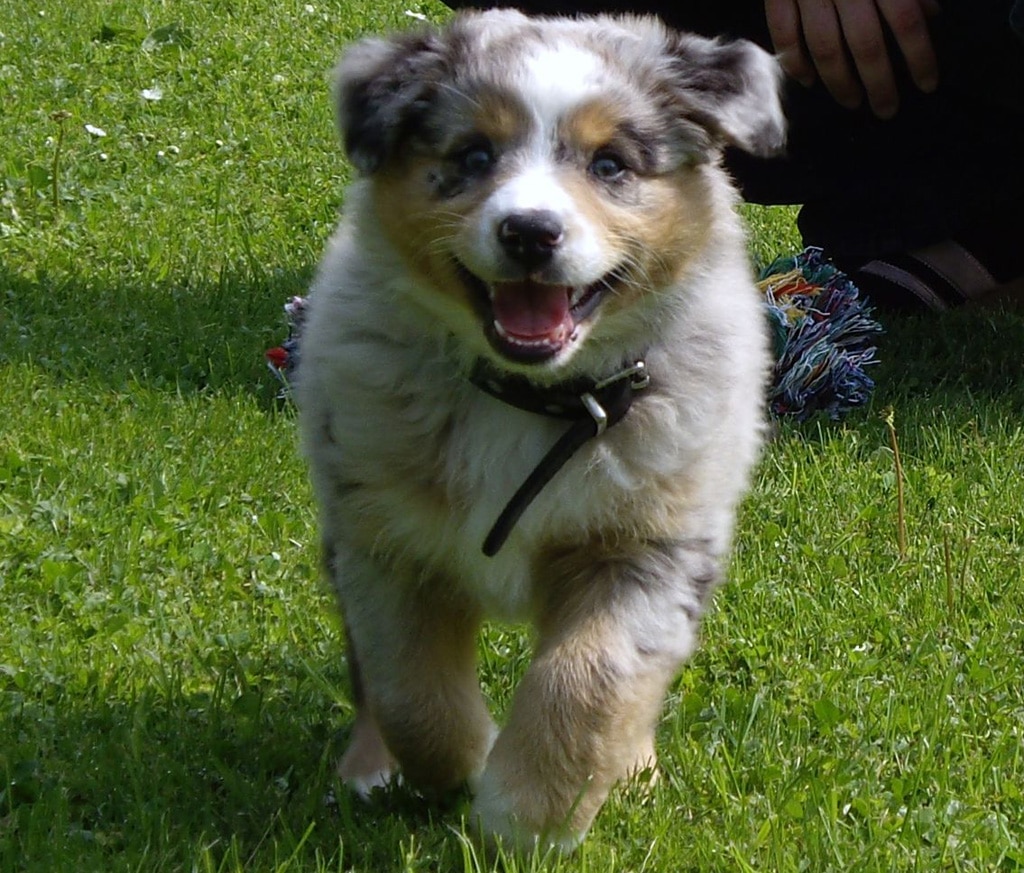
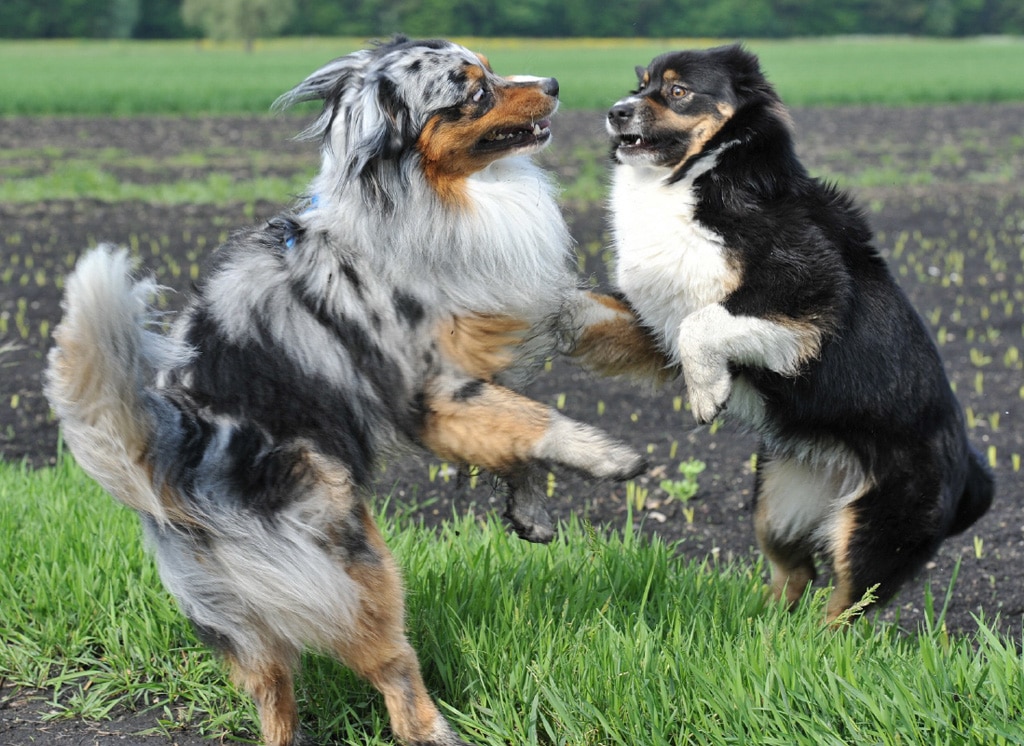
    Images of the ยซAustralian Shepherdยป

    ยซAustralian Shepherdยป Videos

    Type and recognitions:

    • FCI CLASSIFICATION:Group –> Pastor and Boyeros dogs (except Swiss Cattle Dogs)
      / Section –> Pastor dogs. Without working trial.
    • FCI 342

    Federations:

    • – FCI – Group 1 Herding dogs, Section 1 Sheepdogs โ“˜
    • – AKC – PASTORAGE โ“˜
    • – ANKC – Group 5 (working dogs) โ“˜
    • – CKC – Group 7 – Herding dogs โ“˜
    • – โ€‹KC – Pastoral โ“˜
    • – NZKC – Working dog โ“˜
    • – UKC – Herding dogs โ“˜

    FCI breed standard Australian Shepherd

    FCIFCI - Australian Shepherd
    Pastor

    Alternative names:

    1. Aussie (English).
    2. Australian Shepherd (French).
    3. Australian Shepherd (German).
    4. Aussie (Portuguese).
    5. Pastor ovejero australiano, Perro de pastor australiano (espaรฑol).

    โ–ท The world of Pets: Dogs, cats, birds, reptiles, amphibians

    Berger Picard
    Francia FCI 176 . Sheepdogs

    Berger Picard

    The picardy shepherd dog it is a little-known breed despite all its qualities

    Content

    History

    The origins of the Picardy Sheepdog are ancient (is represented in a painting from the 8th century) and, However, there is no certain news of race before the year 1899, when he first appeared at an exhibition (where she was not judged because nobody knew her). The first French club for the protection of the breed did not appear until the year 1955.

    Physical characteristics

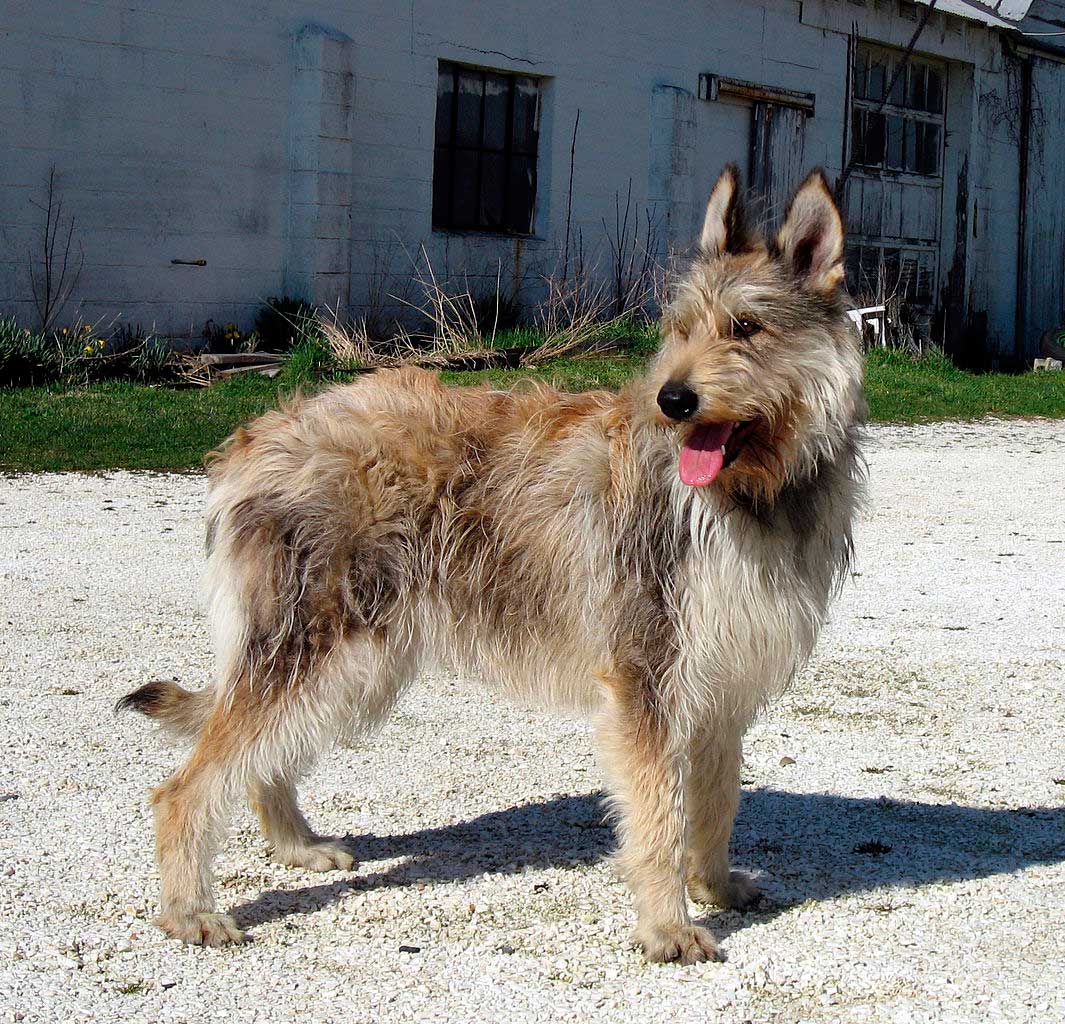
    It is a dog of medium to large dimensions, well proportioned, rustic looking yet elegant, characterized by its primitive shapes and rough hair. The head is provided with the size; the stop is very light and the forehead, slightly convex. The nose is strong and not too long, It should not end in a point. The nasal spout is straight. He has fine mustaches and a nice beard.

    Ears are inserted high, they are wide at the base and their bearing is upright, with the tip forward. The eyes are more or less dark, depending on the color of the coat. The neck is strong and muscular. The thorax, alto. The total length of the trunk is slightly greater than the height at the withers. The tail reaches to the hock. At rest the dog carries it low, and on the move, highest; forms a slight curve at the tip.

    Fur: hard, rough, of 5 to 6 cm length.

    Color: grey, dark grey, grey blue, gray red, dark or light leonado, light dark, no white markings to stand out.

    Size: males, of 60 to 65 cm.; females, of 55 to 60 cm..

    Character and skills

    The picardy shepherd dog He is very happy and playful as a family, especially with the children, while he is rather reserved with strangers. It is very faithful to its owner, whom you would like to be constantly next to and to whom you show your affection in every possible way.

    It is much less nervous than other sheepdogs. It is equipped for all guard functions, defense and utility. It is very versatile, which means it is suitable for any task, either as a pastor, either guardian, and able to adapt to being a simple companion dog.
    It is a pity that it does not stand out from the aesthetic point of view, which does not favor its diffusion, because it has one of the safest and most balanced characters known, provided it is in the hands of a firm and determined owner.

    Type and recognitions:

    • FCI CLASSIFICATION:
    • Group :
    • Section : . .

    Federations:

    • – FCI โ“˜,
    • – AKC โ“˜,
    • – CKC โ“˜,
    • – UKC โ“˜

    FCI breed standard Berger Picard

    FCIFCI - Berger Picard
    Pastor

    Alternative names:

    1. Berger picard, Picard, Picardy Shepherd, Picardy Sheepdog (English).
    2. Berger picard, Picard (French).
    3. Berger de Picardie, PICARDIE-SCHร„FERHUND (German).
    4. Pastor-da-picardia, Berger Picard (Portuguese).
    5. Berger Picard, Berger de Picardie (espaรฑol).

    Photo:

    Berger Picard, charcoal fawn (fawn) by I follow / Public domain

    โ–ท The world of Pets: Dogs, cats, birds, reptiles, amphibians

    Portuguese Sheepdog (Cรฃo da Serra de Aires)
    Portugal FCI 93 . Sheepdogs

    Perro de pastor portuguรฉs

    The Portuguese Sheepdog has an excellent herd instinct, always ready to take care of the goats

    Content

    History

    The Portuguese Sheepdog has nearly 100 years.

    This hairy, use livestock and guardian of the plains of the Portugal South may descend from the Berger de Brie, imported by the conde de Castro Guimarรฃes and which in turn bred with local mountain dogs.

    Despite the similarities with the Berger de Brie and the Catalan Sheepdog, there is no reliable evidence to suggest a direct line of descent.

    During the greater part of the last century, the Portuguese Sheepdog was the companion of the shepherds in southern Portugal, but in the Decade of 1970 was almost extinct.

    Fortunately, the beauty of your fur and your docile predisposition came to knowledge of the breeders. Today, many owners in Portugal are owners of this breed and their future is assured..

    Although he is practically unknown outside his native country, This dog of woolly appearance is a class dog, worthy of greater international recognition.
    Owners say these โ€œcuteโ€ little dogs, nicknamed for their peculiar appearance and picturesque expression, have been part of farming and family life for a very long time. As with many working breeds, the ability to work was more important than the appearance, and the standard was not set up to 1930.

    Recognition: CKC, FCI, NKC, APRI, ACR, DRA

    Physical characteristics

    The fur of the < is long and smooth, with a light ripple. Do not have a background layer.

    The colors We accept yellow, the brown, the fawn to red and more or less stained gray with red fire. There may be greater or lesser amount of white hairs scattered around the mantle, but never forming stains, except in the chest.

    The previous tips they are symmetrically covered with long hair.
    It has a beard that gives a mature look. The eyes they are round and dark, with a friendly expression. The ears moderate size usually hang on the sides of the cheeks, Although sometimes clipped. Clipping is prohibited in some European countries. Their feet are particularly adaptable to difficult terrain. Their legs they are strong and their chest deep.

    Males can measure of 45 to 55 cm., while females measure of 42 to 52 cm.. The weight must be between 12 and 18 kg.

    The hair is longer on the head giving these dogs a curious and messy bangs.
    It has a head wide and robust, with a prominent nose and strong jaw. The tail, very close from the base, the high boot, it reaches the Hock and tapered.

    Their life expectancy is of 12-13 years.

    Character and skills

    The Portuguese Sheepdog It is one of the smartest Sheepdogs. This is a great dog, joyful, happy and always ready to work. Very loyal, and paired with their own town.

    The Portuguese Sheepdog needs a well-balanced training. It has a above average intelligence and learns quickly and easily, but he can be stubborn and dominant if they feel that their owners do not have the same mentality. So, It has always been a challenge for pastors. Trained once, This is the dog more reliable an owner may have. It requires educators safe and strong. These dogs can live with other animals, Although some males may try to dominate other males. They can live happily with other pets, provided that they have been properly socialized.

    The Portuguese Sheepdog is usually patient with children, but the males, in particular, they can be very possessive within its territory. This race is reserved with strangers and they do a good job as a watchdog.

    It is very good Shepherd with cattle, that will tirelessly defend. These dogs are known for their fast attitude, intelligent and are particularly good to bringing back stray dogs. They love its owner above all on Earth. Not usually bite unless cause you.

    Characteristics "Portuguese Sheepdog (Cรฃo da Serra de Aires)"

    Coexistence is important that you have with your new friend. Before considering the acquisition of a dog of the breed "Portuguese Sheepdog (Cรฃo da Serra de Aires)" you know certain factors. Not all breeds of dogs are apt to live in an apartment, you must take into account his character, their need for exercise, their interaction with other pets, their care and if you have small children, their level of tolerance towards them.

    Adaptation โ“˜

    3,0 of 5 stars (based on 1 review)

    friendly dog โ€‹โ€‹โ“˜

    2,0 of 5 stars (based on 1 review)

    hair loss โ“˜

    2,0 of 5 stars (based on 1 review)

    Affection level โ“˜

    3,0 of 5 stars (based on 1 review)

    Need for exercise โ“˜

    5,0 of 5 stars (based on 1 review)

    Social need โ“˜

    3,0 of 5 stars (based on 1 review)

    Home โ“˜

    3,0 of 5 stars (based on 1 review)

    Toilet โ“˜

    4,0 of 5 stars (based on 1 review)

    Friendly with strangers โ“˜

    3,0 of 5 stars (based on 1 review)

    barking โ“˜

    2,0 of 5 stars (based on 1 review)

    Health โ“˜

    4,0 of 5 stars (based on 1 review)

    Territorial โ“˜

    5,0 of 5 stars (based on 1 review)

    Cat friendly โ“˜

    2,0 of 5 stars (based on 1 review)

    Intelligence โ“˜

    4,0 of 5 stars (based on 30 reviews)

    Versatility โ“˜

    3,0 of 5 stars (based on 1 review)

    Child friendly โ“˜

    3,0 of 5 stars (based on 1 review)

    Surveillance โ“˜

    4,0 of 5 stars (based on 1 review)

    joy โ“˜

    5,0 of 5 stars (based on 1 review)

    Images ยซPortuguese Shepherd Dogยป

    Videos ยซPortuguese Shepherd Dogยป

    Type and recognitions:

    • FCI CLASSIFICATION:
    • Group :
    • Section : . .

    Federations:

    • – FCI โ“˜,
    • – AKC โ“˜,
    • – ANKC โ“˜,
    • – UKC โ“˜

    FCI breed standard "Portuguese Sheepdog (Cรฃo da Serra de Aires)"

    Origin:
    Portugal

    Date of publication of the valid original standard:
    04.11.2008

    Use:

    Guard and herding dog on ranches.


    General appearance:

    It is a medium-sized dog, sublongilinear. Appreciable rusticity and sobriety, extremely agile and fast with a wide and suspended movement. Long hair with goat-like texture without undercoat. It has the appearance and attitudes of an ape, which is why it is known in this region as the โ€œmonkey dog.โ€.


    IMPORTANT PROPORTIONS: The length of the body is approximately 10% greater than his height at the withers. Chest depth is less than 50 % the height at the withers. The length of the muzzle is 2/3 the length of the skull, the width of the skull is slightly less than its length.


    Behavior / temperament:

    Exceptionally intelligent and very affectionate. He is very dedicated to the shepherd and the cattle he cares for; stay away from strangers and keep watch at night. Nowadays he is also an excellent companion dog., sport and guard. It is highly prized for its ability to keep herds on pasture and to search for escaped animals.. It is alert and vigilant in the presence of predators. The breed is very devoted to its shepherd and his cattle. His work is done with pleasure and pleasure.

    Head:

    Medium-sized (mesocefรกlica), strong, wide; is not long, or large.

    Cranial region:
    • Skull: With a tendency to be square, slightly longer that wide, divergent longitudinal axes of the skull and the muzzle, convex on both axles but more laterally. Supercilii arc is not prominent. Front Groove pronounced stretching towards the middle of the antecara, the areas between the ears are flat with an apparent occipital Protuberance.
    • Depression links: Well defined.

    facial region:

    • Truffle : Well defined, slightly elevated ; the Windows are wide. It is rounded, cylindrical and truncated almost vertically. Preferably black, It can be liver color in yellow or brown animals but it should always be a darker color than the coat..
    • Nose cane: It is short; measured around 2/3 the length of the skull. Almost cylindrical ; the width should be proportional to its length and form. Rectilinear profile, or slightly concave.
    • Lips: Together, non-overlapping. They are thin, firm, almost straight cut. The edges of the same color of the truffle. 
    • Jaws: They have a normal development. Both jaws are in perfect opposition. Complete dentition of 42 teeth white and solid. Scissor bite, accepted a bite in Clip.
    • Eyes: Medium-sized, rounded, preferably color dark but can be Hazel or brown amber color in yellow animals, level without being prominent placement. friendly expression, Intelligent but docile, horizontal, eyelids black or always darker than the hair color and according to the colour of the nose.
    • Ears: High implementation; they are falls, and not bent, When not have been cut off; they are straight when they have been cut off. They have a triangular shape. Thin and soft skin. Medium-sized from the same long than broad (About 10 cm.).

    Neck:

    It joins harmoniously the head and trunk. It is straight and slightly ascending ; supplied thickness. It is not a double chin.

    Body:

    • The top line : Straight or slightly inclined.
    • Cross : Strong, harmoniously combined with the neck and back.
    • Back : Straight or slightly sloping and long. Well muscled, usually twice the length of the spine.
    • Pork loin : Short and arched seen profile; wide and curved, seen from the front, strong muscles and well attached to the back and rump.
    • Rump : Some prominent and slightly inclined, soft, long and half-width, strong muscles.
    • Breast : Up to the height of the elbows, bandwidth and average depth, ribs slightly arched with an oval to leaning back rib cage. The sill is prominent, wide well back and wide.
    • Belly and flanks : Uniformly and slightly ascending.

    Tail:

    High insertion, sharp, arriving at the height of the paw, tapering from the base. Long and covered with abundant hair. When the dog is in motion it is the extension of the top line or it may curve slightly on the top line but never curve on the back.

    Tips

    PREVIOUS MEMBERS: Strong, well aplomados seen from front and profile, and separate, the distance from the cross to the elbows is slightly smaller than the elbow to the ground.

    • Shoulder: Medium length with a 45ยบ inclination, good muscular, scapula and humerus placed at a 90ยบ angle.
    • Arm: Strong and medium length placed at a 45ยบ angle, good muscular.
    • Elbows: Parallels, close to the chest and with a humerus angle โ€“ radius of 135ยบ.
    • Forearm: Long, vertical and well muscled with bones of medium thickness.
    • Carpo: Delgado. It is not prominent.
    • Metacarpus: Normal size and medium length. From top to bottom, and back forward, is not very inclined.
    • Pies: Rounded, not crushed. The fingers are long and together, with a curve. The nails are long, black and strong, or darker than the coat. The pads are thick and tough.

    LATER MEMBERS: Medium width, aplomados seen from front or back, strong giving a perfect impression of strength and agility.

    • Thighs: Medium length and amplitude; good muscular. Hip-femur angle of approximately 105ยบ.
    • Knee joint: Straight view back without leaning neither in nor out. Femur โ€“ tibia angle approximately 130ยบ.
    • Leg: Little inclined; long and well muscled. Strong bones.
    • Tarsus(Hock) : medium width, low placement, strong and slim. Tibia โ€“ tarsus angle approximately 120ยบ.
    • Metatarsus: Normal size, although strong; medium length. It is not very inclined top down, and from front to back. There may be single and double Spurs.
    • Pies: Identical to previous feet in all its aspects.

    Movement:

    Predominantly moves in a lightweight and suspended trot with powerful. The Gallop, When the work required, is energetic.

    Mantle

    • SKIN: Thick, flexible, not too tight. The mucous internal and external are preferably Pigmented.
    • COAT : Smooth or slightly wavy, the goat hair forming a long beard longer with a somewhat rough texture preferably type, whiskers and eyebrows but not covering eyes, thick and evenly distributed on the body including the interdigital spaces. Thickness means without Undercoat or fluff hair. Very long hair on his head, body and members, including the interdigital spaces.
    • HAIR COLOR: The colors are yellow, brown, grey, reddish and Grey Wolf; with light and dark varieties, and more or less marked fire black, with or without white hairs mixed, but never show white spots, except for a small spot in the pectoral region.
    • Skin : The mucous internal and external are preferably Pigmented; the skin is not too stretched.


    Size and weight:

    • In males : of 45 to 55 cm..
    • In females : of 42 to 52 cm..

    WEIGHT :

    • Males and females: 17 to 27 kg.


    Fouls:

    Any deviation from the aforementioned criteria is considered a fault and the severity of this is considered to the degree of the deviation from the standard and its effect on the health and well-being of the dog..

    SEVERE FAULTS

    • Behavior: Specimens showing nervousness or unbalanced temperament.
    • Jaws: Incorrect implantation of teeth, absence of two premolars (Except PM1)
    • Little marked links depression.
    • Nose is pointed.
    • Overlapping lips, or pendulums.
    • light eyes, small, or non-round, u oblique.
    • Bent or rose-shaped ears.
    • Too narrow banister.
    • Breast : shallow, flat rib cage.
    • Concave upper trunk line, or too steep.
    • Horizontal Croup, or too much fall.
    • Bottom line too thin.
    • Tips: anterior or posterior foot inclined, Garron of cow. Not too straight hind legs.
    • Very low insertion queue, short, or curled over the back when the dog is at rest.
    • White nails.
    • Little wire-haired, or not long enough.
    • Large white patch on the chest region. Fire-coloured stains not defined.
    • Movement: not wide enough, not suspended, elbows out, Paw too together.

    MISS PLAYOFFS

    • Behavior: Aggressiveness or excessive shyness.
    • General appearance: Lymphatic, Lightweight bones. Severe deviations from the important proportions
    • Narrow and long head.
    • flat skull, round, Strait
    • Low-set ears, too separate, erect semi erect or.
    • Nasal helm that presents a convex profile.
    • Jaws: prognathism or inferior, absence of more than two premolars (except PM1).
    • Pigmentation: Total absence of pigmentation in truffle, eyelids, lips (albinism).
    • Amputated tail, or lack thereof of birth.
    • Short hair, curly or with presence of Undercoat.
    • Color: White at the ends of the members. Absence of stain color fire in Brown adult, grey or black.
    • Movement: Too rengueo or heavy, with severe deviations in previous members, weakness.
    • Size: Above or below established limits.

    Any dog โ€‹โ€‹showing clear signs of physical or behavioral abnormalities should be disqualified..


    N.B.:
    • Males should have two normal-appearing testicles fully descended into the scrotum..

    TRANSLATION : IRIS Carrillo (Federation Canรณfila de Puerto). 

    Technical review: Miguel Angel Martinez (Federation Cynologique Argentina).

    Source: F.C.I - International Cynological Federation

    Alternative names:

    1. Monkey dog, Cรฃo da Serra de Aires (English).
    2. Berger de la Serra de Aires, CHIEN DE BERGER DE LA SERRA DE AIRES (French).
    3. PORTUGIESISCHER SCHร„FERHUND (German).
    4. Serra-d’aires (Portuguese).
    5. Perro de pastor portuguรฉs (espaรฑol).

    โ–ท The world of Pets: Dogs, cats, birds, reptiles, amphibians

    Dutch Shepherd
    Holanda FCI 223 - Sheepdogs.

    Dutch Shepherd

    The most widespread variety of Dutch Shepherd she is the one with long hair, but the breed is almost unknown outside the Dutch borders.

    Content

    History

    The Dutch shepherd descends directly from the belgian shepherds, who looks a lot like (including subdivision into three hair varieties).

    Originally the main function of the Dutch shepherd It was typical of a country shepherd dog. From the earliest times the Dutch had an agricultural culture, among others, made up of flocks of sheep. The dogs had to keep the flock away from the sowing, which they did patrolling the borders of the road and the fields. They also accompanied the transfer of the herd to the common meadows, markets and ports. In the farm, they kept the chickens out of the kitchen yard, cows were herded for milking and the milk cart was pulled. They also alerted farmers if anyone entered. About 1900, the herds had almost disappeared in the Netherlands. The Dutch Shepherd's versatility made him suitable for training, which at that time was beginning to become popular. Thus began a new career as a police dog., search and rescue and as a guide dog for the blind. In any case, he is still capable of herding herds.. The first breed standard dates from 12 in June of 1898.

    Physical characteristics

    It is a dog of medium size and weight, quite muscular, Powerfully built and well proportioned. His expression is intelligent and temperament, live. The eyes are dark in color, medium-sized, macaroons, somewhat oblique and never round. The ears, smaller than big, they are straight and facing the front, and inserted high. The tail, that at rest hangs straight or forms a slight curve, reaches the tip of the hock. When it is active, the dog is elegantly elevated, never coiled; never falls on the sides.

    • Fur: the short-haired variety has a well attached coat; the long-haired one has straight hair, and the variety of hard hair has it thick and hard; on the head it forms prominent eyebrows, mustaches and beard. Depending on the cloak, in the breed there are three varieties: shorthair, long and hard.
    • Color: striated but the least intensely, on brown background (golden fluted) or gray (fluted gray). The stripes are less evident in hard-haired specimens. Black mask is preferable.
    • Size: males, of 57 to 62 cm.; females, of 55 to 60 cm..

    Character and skills

    Affectionate, obedient, docile, vigilant, trustworthy, undemanding and very resistant. Always watch out, active and endowed with the true nature of a shepherd dog. It is a little less reactive and less nervous than Belgian Shepherd, the one who looks like, However, even in character.

    The Dutch Shepherd works willingly with his master and is able to cope with any task assigned to him.
    Herding larger herds must have the ability to work in conjunction with various other dogs..

    Characteristics "Dutch Shepherd"

    Coexistence is important that you have with your new friend. Before considering the acquisition of a dog of the breed "Dutch Shepherd" you know certain factors. Not all breeds of dogs are apt to live in an apartment, you must take into account his character, their need for exercise, their interaction with other pets, their care and if you have small children, their level of tolerance towards them.

    Adaptation โ“˜

    4,0 of 5 stars (based on 1 review)

    friendly dog โ€‹โ€‹โ“˜

    3,0 of 5 stars (based on 1 review)

    hair loss โ“˜

    3,0 of 5 stars (based on 1 review)

    Affection level โ“˜

    4,0 of 5 stars (based on 1 review)

    Need for exercise โ“˜

    5,0 of 5 stars (based on 1 review)

    Social need โ“˜

    3,0 of 5 stars (based on 1 review)

    Home โ“˜

    3,0 of 5 stars (based on 1 review)

    Toilet โ“˜

    3,0 of 5 stars (based on 1 review)

    Friendly with strangers โ“˜

    4,0 of 5 stars (based on 1 review)

    barking โ“˜

    2,0 of 5 stars (based on 1 review)

    Health โ“˜

    4,0 of 5 stars (based on 1 review)

    Territorial โ“˜

    5,0 of 5 stars (based on 1 review)

    Cat friendly โ“˜

    3,0 of 5 stars (based on 1 review)

    Intelligence โ“˜

    5,0 of 5 stars (based on 1 review)

    Versatility โ“˜

    4,0 of 5 stars (based on 1 review)

    Child friendly โ“˜

    4,0 of 5 stars (based on 1 review)

    Surveillance โ“˜

    4,0 of 5 stars (based on 1 review)

    joy โ“˜

    4,0 of 5 stars (based on 1 review)

    Images "Dutch Shepherd"

    Videos "Dutch Shepherd"

    Type and recognitions:

    • FCI CLASSIFICATION:
    • Group :
    • Section : . .

    Federations:

    • – FCI – Group 1 Herding dogs, Section 1 Sheepdogs โ“˜
    • – AKC – PASTORAGE โ“˜
    • – ANKC – Group 5 (working dogs) โ“˜
    • – โ€‹KC – Pastoral โ“˜
    • – NZKC – Working dog โ“˜
    • – UKC – Herding dogs โ“˜

    FCI breed standard Dutch Shepherd

    FCIFCI - Dutch Shepherd
    Pastor

    Alternative names:

    1. Dutch Herder, Hollandse Herder (English).
    2. Berger hollandais (French).
    3. Hollรคndischer Schรคferhund (German).
    4. Pastor holandรชs (Portuguese).
    5. Perro de pastor holandรฉs (espaรฑol).

    Photos:

    1 – Short-haired Dutch Shepherd stacked by CaroleField / CC BY-SA
    2 – Silverbrindle and goldbrindle are the approved colors of the breed by Lissunmusta / CC BY-SA
    3 – Short-haired brindle male Dutch Shepherd named Black, 2 years old, owned by Jason Paluck by Wikipedia
    4 – Adult brindle Dutch shepherd by https://www.pikrepo.com/fyvdb/adult-brindle-dutch-shepherd
    5 – dutch shepherd by https://www.peakpx.com/504961/dutch-shepherd
    6 – Dutch shepherd by https://pxhere.com/en/photo/1387398
    7 – Neros van Guard is a Dutch Shepherd imported from Canada to the USA by Ulyseemuff / CC BY-SA

    โ–ท The world of Pets: Dogs, cats, birds, reptiles, amphibians

    Saarloos wolfdog
    Holanda FCI 311 - Sheepdogs.

    Saarloos wolfdog

    The Dutch Society of Saarloos wolfdog, is the only organism that can supply the puppies.

    Content

    History

    The Sr. Leendert Saarloos (1884-1969) loved nature and also dogs. He realized that the dogs had become too humanized and he intended to, as a lover of the German Shepherd, of recovering the natural qualities of this breed to produce a better working dog. For this reason he crossed a male German Shepherd, Gerard van der Fransenum, a dog of the classic Prussian style, with Flowers, a female wolf that originated from the Siberian branch of the European type (1932). Breeding based on the father gave him a basic population of animals with a quarter of wolf blood. During the course of the next experimental phase with strict selection, a new race, the โ€ณEuropean Wolfdogโ€ณ had evolved. Selected animals of this breed provided good service as guide dogs., and at first they were believed to be adequate for this task.

    Due to the increase in the proportion of wolf blood, usable skill, inherited from the original predecessor, Gerard, it was gradually lost and it became obvious that the breed was not suitable for use as a working or guide dog. Leendert Saarloos Legacy, not a working dog, but a dog with attributes more attached to nature, was recognized as a breed in 1975. at that time, the breed was named โ€ณSaarloos wolfdogโ€ณ in honor of its founder: Honor for whom honor deserves.

    Physical characteristics

    It is a dog type lupoid with powerful but light skeleton, with long limbs. The eyes, medium-sized, macaroons, are slightly oblique and preferably yellow in color. The expression is attentive and reserved time, but without a trace of fear. The ears, medium-sized, they have a fairly wide insertion and are pointed, fleshy and hairy. The tail is implanted quite low and at rest it takes the form of a saber, not too mobile. Can carry it high when active or intimidating.

    Differences in secondary sex characteristics are pronounced between males and females.

    • Fur: hard and straight.
    • Color: from black with light blends to dark black (gray wolf), from brown with light blends to dark brown and from very light cream to white.
    • Size: males, of 65 to 75 cm.; females of 60 to 70 cm..

    Character and skills

    Strongly hierarchical, He is very attached to his owner and is wary of strangers.. It is a dog to enjoy and study (better as a couple or in a group) especially for fans of ethology, but it is not recommended to use it for guard and defense, because he tends to run away from man. Your reservation and your way of avoiding unknown situations, just like a wolf, are typical features of Saarloos wolfdog.

    Images "Saarloos wolfdog"

    Videos "Saarloos wolfdog"

    Type and recognitions:

    • FCI CLASSIFICATION:
    • Group :
    • Section : . .

    Federations:

    • – FCI – Group 1 Herding dogs, Section 1 Sheepdogs โ“˜
    • – UKC – Herding dogs โ“˜

    FCI breed standard Saarloos wolfdog

    FCIFCI - Saarloos wolfdog
    Dog

    Alternative names:

    1. Saarloos wolfhond (English).
    2. Saarloos (French).
    3. Saarlooswolfhond (German).
    4. Saarlooswolfhond (Portuguese).
    5. Perro lobo Holandรฉs (espaรฑol).

    Photos:

    1 – Saarloos wolfdog from the Czech region by @Hippie_Saarloos / CC BY-SA
    2 – Saarloos by Wolfdog by https://pxhere.com/es/photo/1389361
    3 – Saarloos Wolfhond – Merlin v.d. Schattenwaldwoelfen by Boot Juliaan / CC BY-SA
    4 – Saarloos Wolfhound by Corinne Benavides
    5 – Saarloos Wolfhound by https://pxhere.com/es/photo/1127277

    + More