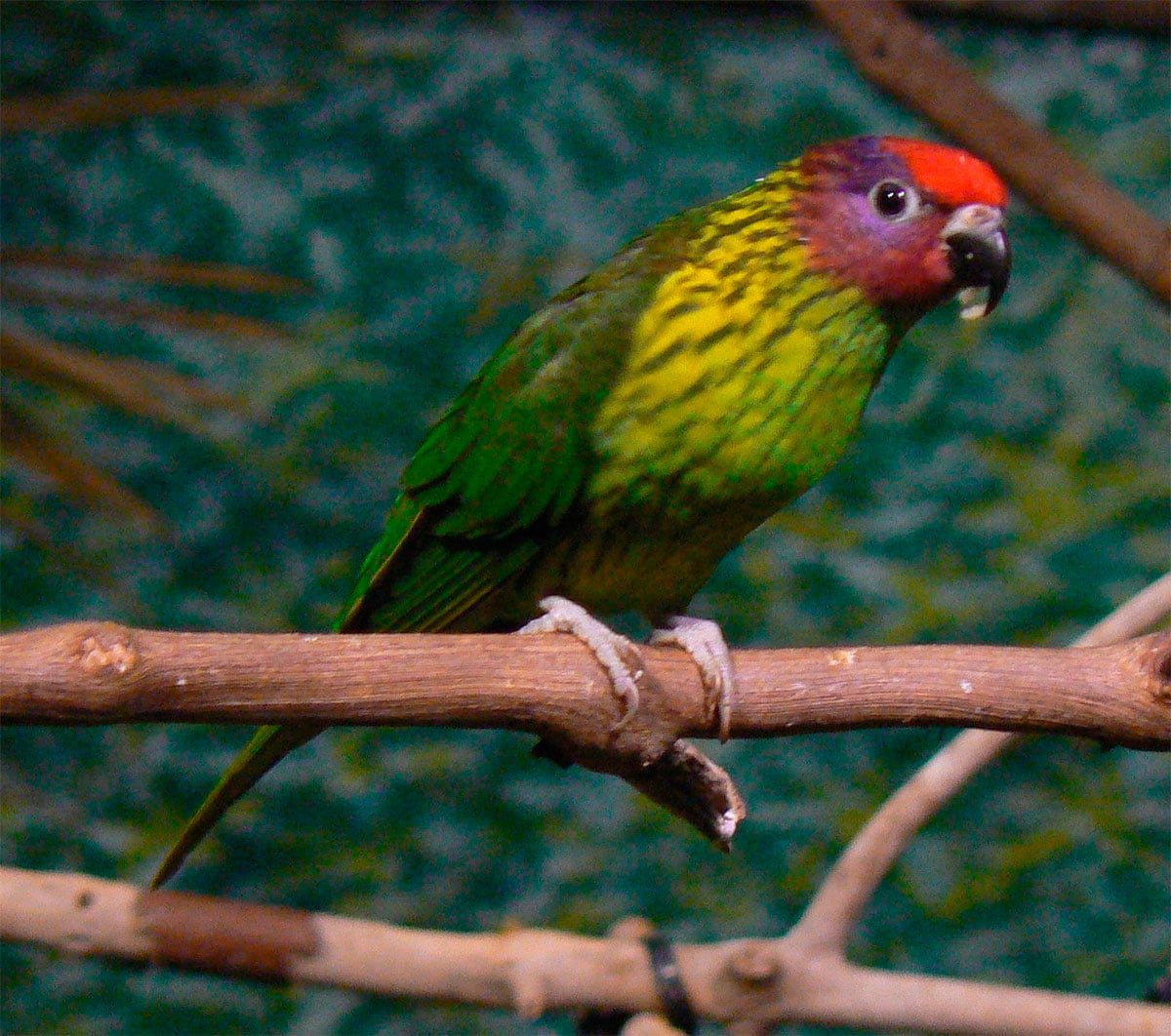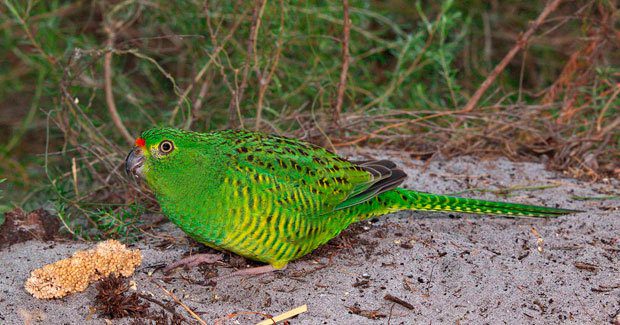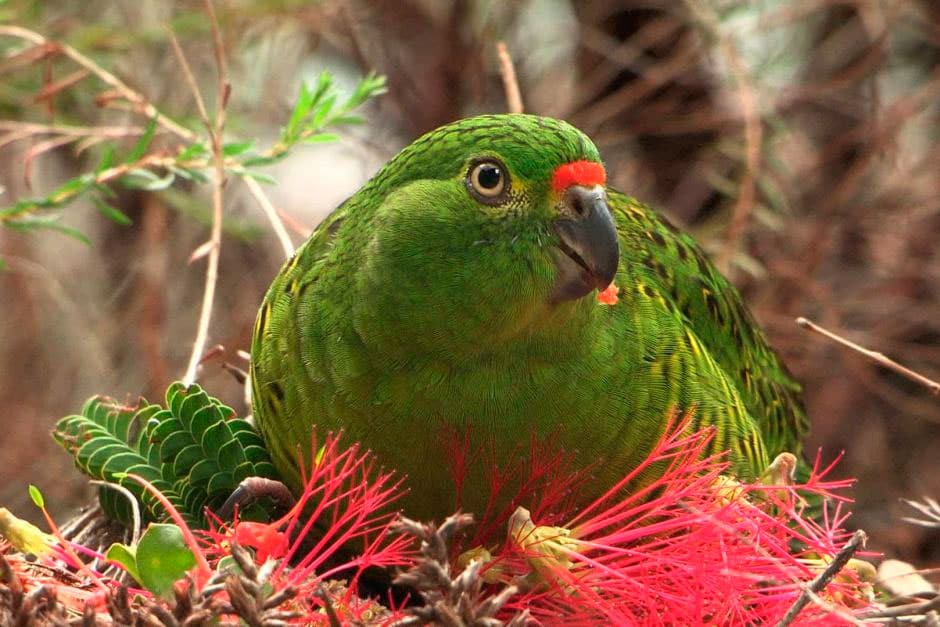
โ–ท The world of Pets: Dogs, cats, birds, reptiles, amphibians

Horned Parakeet
Eunymphicus cornutus


Horned parakeet

Content


Anatomy-parrots

Description

32 cm.. length and an approximate weight of 140 g..

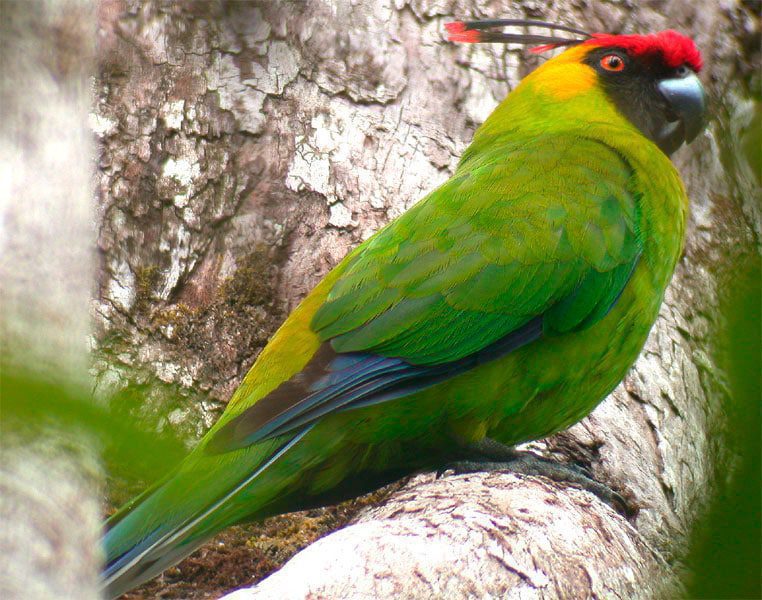
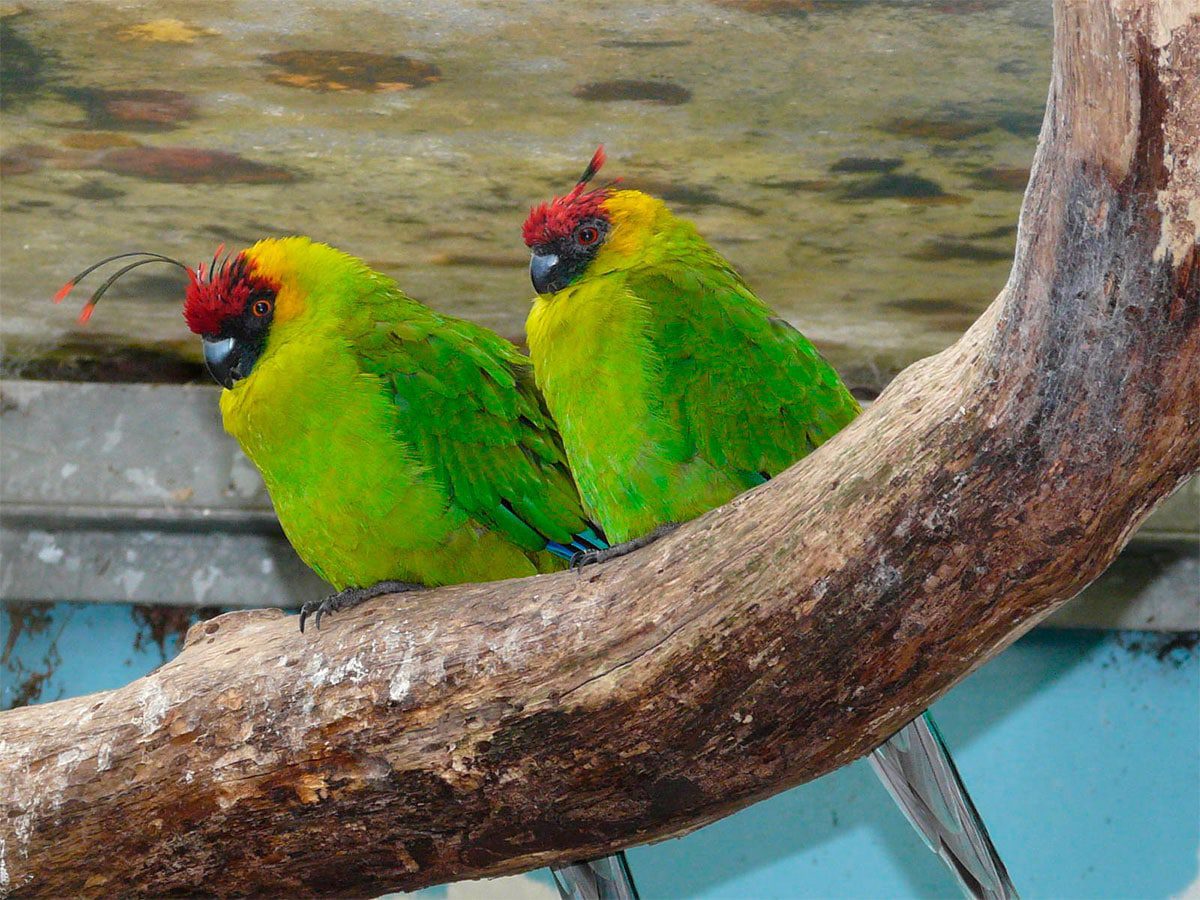
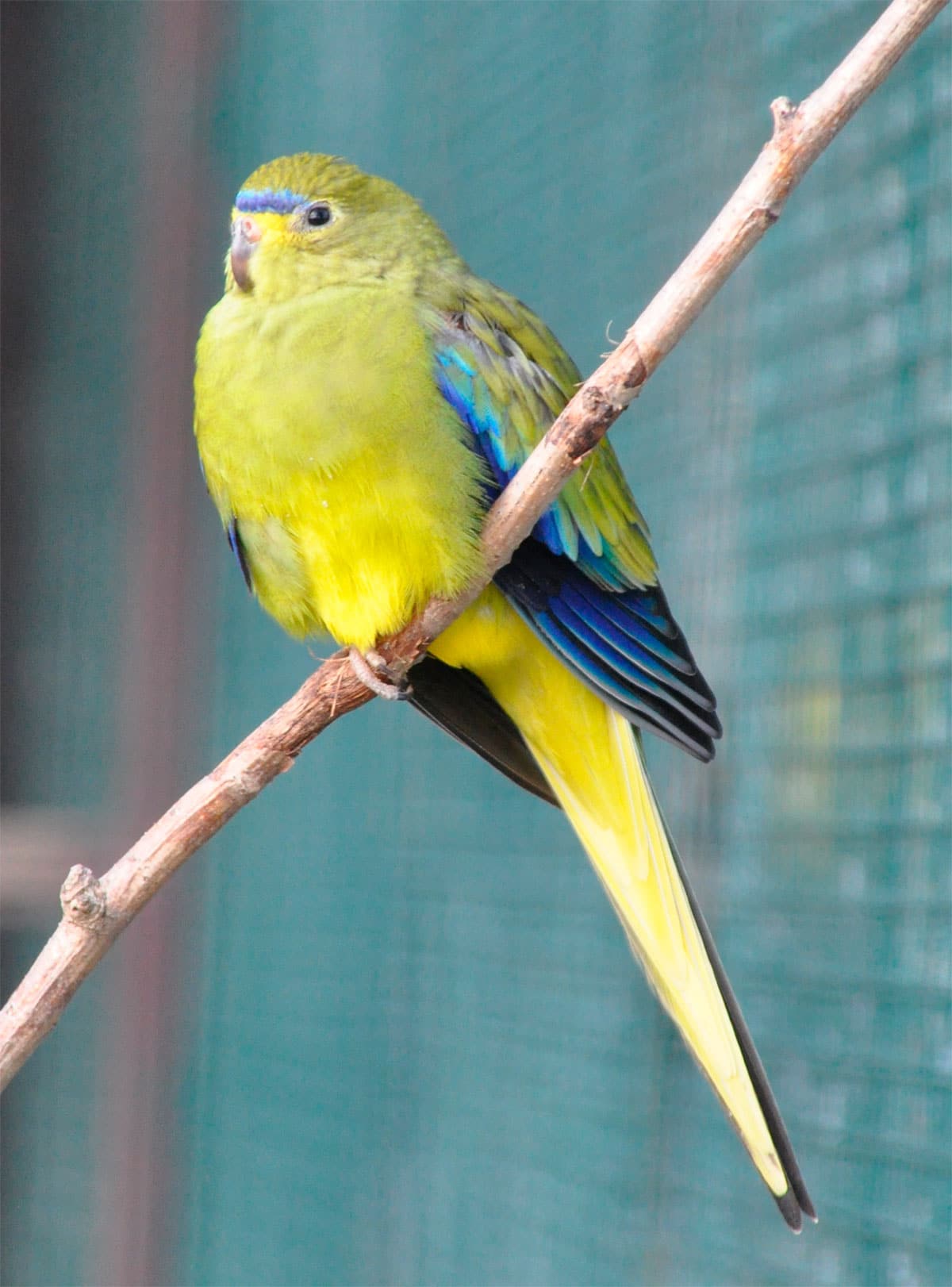
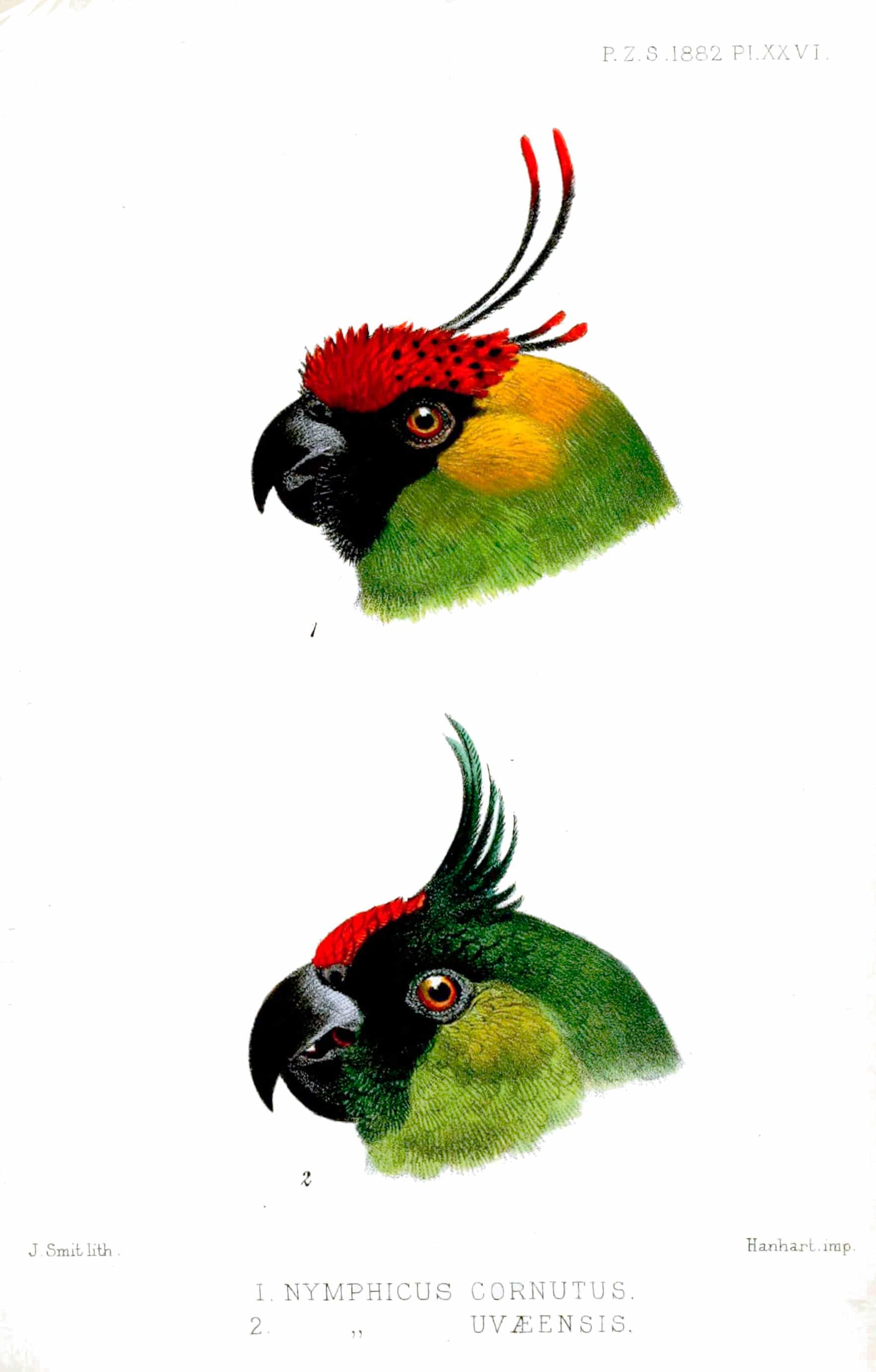
The Horned Parakeet (Eunymphicus cornutus) has a considerable size. It is an incredibly colorful and distinctive bird.. The forecrown is bright red. The front of the crown It has a set of Red curly feathers with black bases. Two long black feathers with Scarlet trim emerge from the center of the crown. The area of the mumps is orange-yellow, that contrasts sharply with the lores and the sides of the cheeks that are black.

The bottom of the cheeks has a greenish black color. Neck and back of the crown bright orange yellow, Turning is gradually to colour green yellow or green bright in the part superior of the the mantle.

The upperparts are green, with the exception of the rump that is greenish-Orange.

The wings covers are green. The primaries are blue-purple on the vane outer, Blackish in the vane inner. The secondaries they are darker on the outer rim.

The underparts is greenish. The lower parts are yellowish green clear. The undertail- coverts they have a slightly bluish in tips. The upper part of the tail is green with strong blue pink, the bottom is dark gray.

The bill It is blue-grey with black tip, irises orange. The legs are black.

Male and female are similar.

The youth they have more gray and less developed facial ornaments. The ear-coverts are pale green, the back of the neck olive green. The bill is color Horn and the irises They are brown.

Taxonomic status:

Until very recently, was generally considered conspecific with the species Eunymphicus uvaeensis. Monotypic.

Subspecies description:

  • Eunymphicus cornutus

    (Gmelin) 1788 – Nominal


  • Eunymphicus uvaeensis

    (Layard,THE & Layard,ELC) 1882 – Of, approximately, 32 cm length. Green color, with the face and dark green head, front with a small red bow and a thin and small dark green Crest. The nape and neck of greenish-yellow, chest and abdomen yellowish green.

    Long tail. black beak.

    It has no sexual dimorphism.

    Today it is considered a kind monotype. See

Habitat:

Horned parakeet, Nymphicus cornutus (above) and Ouvea parakeet, Nymphicus uvaensis (then)

The Horned Parakeet frequent, as a priority, humid forests. They are also areas that are regenerated and scrublands.

The preferred habitat of these birds are the kauris forests (Agathis australis), which are evergreens that are found mainly in the North of New Caledonia. But, They also appreciate the mixed forests with trees of the family Araucaria angustifolia. This species It can live up to the 1200 m. Avoid coconut plantations and areas close to the coast.

endemic to New Caledonia. Its distribution is highly fragmented. These birds are present in the 57% the mountains in the North of the island and in the 42% the mountains of the South. Probably they are very common in the central channel.

The Horned Parakeet they tend to be very prudent, remaining in silence most of the time, and making it difficult to, Therefore, its location.

These parrots they live in pairs or in small flocks of up to ten individuals. When resent, They fly a distance of 100 meters or more before landing at the top of a tree. They rest in the canopy or in the cavity of a tree an hour before dawn., just before starting its activity.

During courtship, the Horned Parakeet, he tries to seduce the female with repeated head inclinations, erect their feathers, shaking his crest and emitting cries intermittently.

Reproduction:

The time of reproduction extends from October to December. The nest is often found in a cavity or on a tree branch healthy, of all of the species of Metrosideros myrtacee. You can also build the nest in the soil, under a rock or under a fallen tree.

The female lays of 3 to 4 eggs, but, generally, only two chicks manage to develop.

In captivity, the incubation lasts a few 21 or 22 days. The young leaves the nest after 5 to 6 weeks.

Food:

The Horned Parakeet they are almost exclusively vegetarian. They feed on flowers, dried fruits, fruit, berries and seeds that are found in shrubs and trees. Also like ripe papaya.

Distribution:

The Horned Parakeet It is endemic to the main island of New Caledonia in the Southwest Pacific, where due to the poor coverage of observers, the status of the species may vary. It is probably stable, but may be threatened to some degree due to trade .

Recent check-ins at Blue River Provincial Park (The Blue River) indicate that it is relatively common in the park. It is almost certainly more common in less accessible areas, over 470 m.

Subspecies distribution:

Conservation:


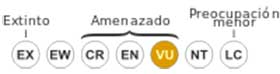
Vulnerable


โ€ข Current Red List of UICN: Vulnerable.

โ€ข Population trend: Increasing.

The Horned Parakeet It has a small population that probably has been declining for many years with unknown reasons.
Current populations are threatened by habitat degradation and, probably, by the introduction of other mammals, particularly rats. Fortunately, his capture and poaching do not constitute a significant threat for this species.

Considering their low numbers and the small size of their territory, It classified as vulnerable.

Some of the measures taken for their conservation is the start control against introduced predators. Increase the area of โ€‹โ€‹suitable habitat to protect their status and establish captive breeding populations for future reintroductions.

"Horned Parakeet" in captivity:

Very rare poultry.

According to sources, a sample lived during 19,7 years in captivity

Alternative names:

Horned Parakeet, Crested Parakeet, Horned Parakeet (Horned), Long-horned Parakeet (ingles).
Perruche cornue (French).
Hornsittich (German).
Periquito-de-chifres (Portuguese).
Perico Cornudo, Perico Maorรญ Cornudo (espaรฑol).


scientific classification:

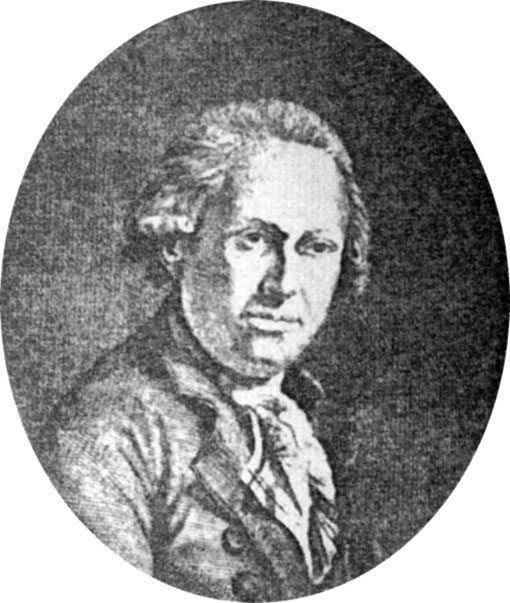
Gmelin Johann Friedrich

Order: Psittaciformes
Family: Psittaculidae
Genus: Eunymphicus
Scientific name: Eunymphicus cornutus
Citation: (Gmelin, JF, 1788)
Protonimo: Psittacus cornutus

ยซHorned parakeetยป images:

Videos "Horned Parakeet"

"Horned parrot" (Eunymphicus cornutus)

Sources:

  • Avibase
  • Parrots of the World โ€“ Forshaw Joseph M
  • Parrots A Guide to the Parrots of the World – Tony Juniper & Mike Parr
  • Birdlife

  • Photos:

(1) – Horned Parakeet By Tunpin.ong (Own work) [CC BY-SA 3.0], via Wikimedia Commons
(2) – Horned Parakeet, Nymphicus cornutus (above) and Uvea Parakeet, Nymphicus uvaensis (below Proceedings of the Zoological Society of London 1882 By Joseph Smit (1836-1929) [Public domain], via Wikimedia Commons
(3) – Horned parakeet by AlexKant – zoochat
(4) – A adult bird perched on a branch by Tomasz Doroล„ – Lynx
(5) – A bird perched in a tree by Josep del Hoyo – Lynx
(6) – Feeding on papaya in a garden by Julien Baudat-Franceschi – Lynx

โ–ท The world of Pets: Dogs, cats, birds, reptiles, amphibians

Grey-hooded Parakeet
Psilopsiagon aymara

Grey-hooded Parakeet

Content

Description:

Grey-hooded Parakeet

19-20 cm.. height.
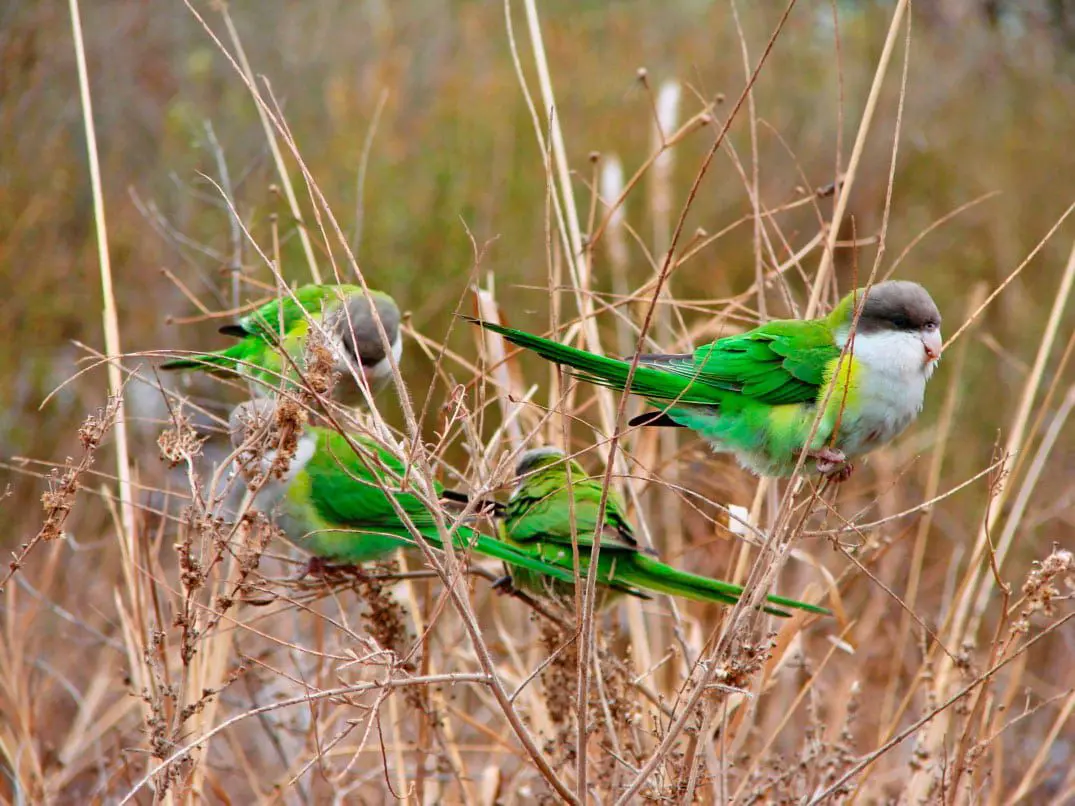
The Grey-hooded Parakeet (Psilopsiagon aymara) has the body mostly green, elongated and with a very long and pointed tail; the forecrown and lores, until the area back from the neck (including the ear-coverts), grayish brown, forming a kind of CAP that comes, slightly, to below the eyes.
Mantle green, lightly olive dyeing; Back and scapulars green; rump and uppertail-coverts, green, slightly brighter; upperwing-coverts green; flight feather green with blackish tips; underwing-coverts of color greenish-yellow. Chin and throat pale-whitish grey; chest grey silver pale, sometimes with dye bluish on the feathers on both sides of the chest; flanks of color yellow pale greenish; the belly and undertail-coverts, green, with faint bluish tint.

Upper, the tail green; undertail, gray. The bill pale flesh-colored; irises dark brown; legs grey-brown.

Both sexes similar, though the male may have brighter grey in the chest.

Immature they have the tail shorter.

NOTE This species was treated as Bolborhynchus aymara.

Habitat:

Video – "Grey-hooded Parakeet" (Psilopsiagon aymara)

You prefer arid habitats shrubs or Woody hills and ravines, dense scrub and trees around settlements and in agricultural areas, also distributed in high Andean steppes and sometimes in the Highlands, at altitudes of 1.800 to 3.400 m, sometimes more low (1,200 m in winter) and supposedly until the 4.000 m in Tucumรกn, Argentina.

The Grey-hooded Parakeet is a bird gregarious, usually seen in small flocks, at least outside the breeding season; large gatherings near areas with water.

Reproduction:

Nest sometimes in colonies, in holes dug in sand banks or in hollows and cactus in desert area. Egg laying in the month of November in Tucumรกn. Clutch 4-5 eggs. Up to seven in captivity.

Food:

The Grey-hooded Parakeet they tend to consume berries and other fruit, In addition to seeds herbaceous and grasses (by example Viguera and other compounds); they usually descend to the ground to collect fallen fruits and seeds from the grass.

Distribution:

Size of the area of distribution (reproduction / resident): 383.000 km2

Is it can be found in the Andes from the South of Bolivia until Argentina and possibly North of Chile.

In West Bolivia It is known from Peace and Cochabamba to the South of Tarija and potosi, and in the Northwest of Argentina on the slopes Andean of Jujuy to the South of Mendoza and to the hills of the South East of Cรณrdoba. In the North of Chile (for example, Tarapacรก) is reported as resident, visitor or absent.

Some movements at altitude seasonal; the Grey-hooded Parakeet move higher in summer. Usually common and apparently without pressure; Small numbers are caught and exported as cage birds.

Conservation:

State of conservation โ“˜


minor concern Minor Concern โ“˜ (UICN)โ“˜

โ€ข Current category of the Red List of the UICN: Least concern.

โ€ข Population trend: Stable.

Justification of the population

The size of the world population It has not been quantified, but this species is described as ยซquite commonยป (Stotz et to the., 1996).

Justification of trend

It is suspected that the population is stable in absence of evidence of any decline or threatens substantial, Although it is exported as bird cage in small quantities.

"Grey-hooded Parakeet" in captivity:

Rare in poultry.

Alternative names:

Gray-hooded Parakeet, Andean Parakeet, Aymara Parakeet, Gray hooded Parakeet, Gray-headed Parakeet, Grey hooded Parakeet, Grey-headed Parakeet, Grey-hooded Parakeet, Sierra Parakeet (English).
Toui aymara, Perruche d’Aymara (French).
Aymarasittich, Aymara Sittich (German).
Periquito-da-serra (Portuguese).
Periquito-da-serra, Catita Serrana Grande (espaรฑol).
Periquito-da-serra (Argentina).
Periquito-da-serra (Bolivia).

Alcide Dessalines d'Orbigny

scientific classification:


Order: Psittaciformes
Family: Psittacidae
Genus: Psilopsiagon
Scientific name: Psilopsiagon aymara
Citation: (dโ€™Orbigny, 1839)
Protonimo: Arara aymara

Images Galah Cockatoo"Grey-hooded Parakeet":


Species of the genus Psilopsiagon

Sources:

Avibase
– Parrots of the World โ€“ Forshaw Joseph M
– Parrots A Guide to the Parrots of the World – Tony Juniper & Mike Parr
Birdlife
– Parrot Book, Parrots and macaws Neotropical

Photos:

(1) – Grey-hooded Parakeets (also known as the Aymara Parakeet and the Sierra Parakeet) in Capilla del Monte, Cรณrdoba, Argentina By Nes (originally posted to Flickr as Periquitos) [CC BY 2.0], via Wikimedia Commons
(2) -Psilopsiagon aymara by John Gerrard Keulemans [Public domain], via Wikimedia Commons

Sounds: (Xeno-canto)

โ–ท The world of Pets: Dogs, cats, birds, reptiles, amphibians

Great hanging parrot
Loriculus stigmatus

Great hanging parrot

Content

Description

15 cm.. length between 28 and 35 g. of weight.

The head of the Great hanging parrot (Loriculus stigmatus) is bright green, with bright red crown ending in a clear line across the rear of the crown not extending over the nape.

Green upperparts, lightly impregnated with yellowish-orange in the mantle; rump and uppertail coverts dark crimson. green wings; edge of the carpal bones with small red mark. The underwings of turquoise blue with small green coverts. The lower parts of bright green with red stripe below the Chin and throat Center. Upper, the Green tail; light blue below.

the black beak; pale-yellow IRIS; Pink-Orange legs.

Females lack Red Crown and has a narrow red bib; Iris can be darker.

Young birds lack the Red Crown, It has a bib less clear and more yellowish, yellow edges of the Carpus, and in general a duller Green.

Subspecies

Slight differences in the degree of the orange-yellow colour in the mantle of some populations of the island are not considered sufficient to differentiate them.

    โ€ข Loriculus stigmatus stigmatus : The nominal.

    โ€ข Loriculus stigmatus croconotus

    โ€ข Loriculus stigmatus quadricolor

Habitat:

Little is known about the ecology of the species.. Possible seasonal movements have been observed. According to reports, not found in old-growth forest and most common along forest edges, in the open field, and sometimes around urban centers, until 1.000 meters above sea level. Birds move usually alone or in pairs, whether it is flying above or feeding on the trees in flower. Nest-holes in thick bamboo have been recorded.

Reproduction:

Reproductive activity has been reported in February, from April to June, and in August and October
The Great hanging parrot nests in cavities. It usually lays three eggs. The female incubates the egg during 20 days and after hatching the chicks take time to develop 33 more days

Food:

The diet includes fruits and nectar.

Distribution:

common in Sulawesi, since the minahassa peninsula in the North, including Bangka and Islands Lembeh, to the South, also where in Muma and Button on the high seas. They are also found in the Togian Islands.

Of the three subspecies, including the nominal:

    โ€ข Loriculus stigmatus stigmatus – Mรผller, S, 1843 – Celebes

    โ€ข Loriculus stigmatus croconotus – Jany, 1955 – Buton Islands and Muna

    โ€ข Loriculus stigmatus quadricolor – Walden, 1872 – Togian Islands.

Conservation:


minor concern


– Current IUCN Red List category: Least concern
– The population trend: Stable

The size of the world's population has not been quantified, Although it is estimated above 100.000 specimens. The species is reportedly common and widespread in most of its range. (pit et to the. 1997).

The population is suspected to be stable in the absence of evidence of any reduction or substantial threats.

"Great hanging parrot" in captivity:

Rare.

Alternative names:

Sulawesi Hanging-Parrot, Black-billed Hanging-Parrot, Celebes Hanging Parrot, Celebes Hanging-Parrot, Celebes Spotted Hanging-Parrot, Great Hanging Parrot, Maroon-rumped Hanging-Parrot, Red-capped Hanging-Parrot, Sulawesi Hanging Parrot (ingles).
Coryllis des Cรฉlรจbes (French).
Rotplรคttchen, Rotlรคttchen (German).
Lorรญculo do Cรฉlebes (Portuguese).
Lorรญculo Celebiano, Lorรญculo de Cรฉlebes (espaรฑol).

scientific classification:

Order: Psittaciformes
Family: Psittaculidae
Scientific name: Loriculus stigmatus
Citation: (Muller,S, 1843)
Protonimo: Psittacus (Psittacula) stigmatus

Images "Celebes Lorcle":

Videos "Great hanging parrot"

————————————————————————————————

Sources:

Avibase
– Parrots of the World โ€“ Forshaw Joseph M
– Parrots A Guide to the Parrots of the World – Tony Juniper & Mike Parr
– Birdlife

Photos:

(1) – By Lip Kee Yap [CC BY-SA 2.0], via Wikimedia Commons
(2) – male perched. by iggino – lynx
(3) – Birds-pet-wallpapers – link
(4) – male hanging by iggino – lynx
(5) – By F. Schulter – papageien.org

Sounds: Frank Lambert (Xeno-canto)

โ–ท The world of Pets: Dogs, cats, birds, reptiles, amphibians

Grey Parrot
Psittacus erithacus


Loro Yaco

Content


Anatomy-parrots

Description Loro Yaco:

Of 33 cm.. length and an average weight of 475 g..

The Grey Parrot (Psittacus erithacus) is famous for its intelligence and ability to mimic sounds and human speech, so it is one of the most popular of all pets avian. It is one of the largest parrots in Africa.

They have the feathers of the lores, the cheeks, the frenyou and the crown silver grey, more clear tips. The of the the mantle and lower area of the back darker, slate gray with light margins, giving a scaly appearance; the lower area of the back and tail are silver grey. Upper wing coverts, secondaries and scapulars slaty-grey. Primaries grey dark (almost black), more clear below that top.

Wing feathers light grey, with the exception of the greater coverts that are of a dark grey tone.

feathers of the chest slate gray with pale gray margins fused with much lighter silver feathers on the belly; flanks and the thighs clear silver grey color.

Tail and their coverts, bright Scarlet.

Older birds they can show scattered red feathers between the plumage gray, especially in the the thighs and the belly.

The bill black; irises yellow; naked facial area with some fine white hairs; legs dark grey.

Without sexual dimorphism in the plumage.

Immature they have the tail darker red towards the tip, Grey dye in undertail- coverts and the irises grey.

Subspecies description:

  • Psittacus erithacus erithacus

    (Linnaeus, 1758) – Subspecies nominal


  • Psittacus erithacus princeps

    (Alexander, 1909) – Very similar to the nominal, except that they are a little smaller. Some bird breeders argue that the Princeps is a regional type of Psittacus erithacus erithacus, instead of separate subspecies.

Habitat:

The Grey Parrot They inhabit the tropical jungle primary and secondary, the forest edges and clearings, gallery forest and mangroves; wooded Savannah, haunting, often, land cultivation and even gardens.

Partially confined in the lowlands, Although in the East of its range have been recorded at altitudes of 2.200 m.

They reach the highest densities in primary lowland forests, intermediate in the primary montane and lower density in plantation of coconut.

gregarious, they form large communal roosts of up to 10.000 individuals, often at some distance from the feeding areas.

Preferred places of shelter are trees or palm trees on the water, also islands in the rivers.

Are dispersed into smaller groups (until 30) to feed.

Reproduction:

The reproduction of the Grey Parrot takes place in loose colonies, in which each pair occupies its own tree. Individuals select their partners carefully and have a monogamous union of lifelong It begins at sexual maturity, between three and five years of age.

Few details are known about the courtship in nature, but have been observed and recorded flights of visualization around the nest cavities. The males feed their mates (power dating) and both sing soft monotonous notes. At this time the female goes to sleep to the nest cavity, While the male takes care of it.

In captivity, the Grey Parrot fed males to females after copulation events and both sexes participate in a mating dance in tipping its wings.

The nest they build it in the cavities of some tree (for example, Terminalia, Ceiba or Distemonathus), between 10 and 30 meters above the ground.

Sometimes breeds in colonies of up to several hundred couples loose (in Prince for example), but in most places they nest alone.

Breeding season varies with locality. In East africa, breeding has been recorded in the months of January-February and June-July, both in dry periods.

Young chicks have been released for sale from March onwards in Ghana. Other records suggest as a rule from the breeder, the dry season.

The females lay from three to five eggs, that you are in charge of incubate while they are powered entirely by the male. The incubation lasts approximately thirty days and the young man emerges from the nest at twelve weeks of age.

Food Loro Yaco:

Their diet consists of a variety of seeds, nuts, fruits and berries.

Known within their power are the fruits and seeds of Ficus, heisteria, Dacryodes, Petersianthus, Combretum, Macaranga, Raffia, Her heart, Ceiba, Sapida, Bombax, Celtis, Hunting, Parkia, Terminalia and Prunus.

The fruit of the Palm oil (Elaeis guineensis) is her favourite in some areas, coming to bear its fruit over long distances before being consumed.

In Bioko, they prefer the berries of Tragacantha tail (Fam. Malvaceae).

They can be a pest, causing considerable damage to corn crops in some areas.

Loro distribution Yaco:

Size of the area of distribution (reproduction / resident): 2.760.000 km2

The Grey Parrot are distributed between the West and centre of Africa, of Guinea-Bissau and this from Sierra Leone, across the South of Mali, Ivory Coast, Ghana and Nigeria, until Cameroon, extending to Bioko and Islands Sao Tome and Principe in the gulf of guinea; from Gabon and the Congo through Zaire, Uganda and Western Kenya, the Southwest and East - Central of Zaire and Northwest of Tanzania.

Usually sedentary. Common where large extensions of forest persist and still abundant in some localities, especially in the tropical jungles of the Congo basin. But, due to the extensive loss of forests in some parts of the range (for example, of Nigeria to Sierra Leone) and the catch on a massive scale (the second best-selling parrot in the world in the Decade of 1980) There have been dramatic declines in some places (for example, in Liberia, Ghana, Kenya and around Kinshasa, Zaire, and other cities of the Congo basin).

Subspecies distribution:

  • Psittacus erithacus erithacus

    (Linnaeus, 1758) – Species nominal


  • Psittacus erithacus princeps

    (Present on the islands of Saint Thomas (in this possibly introduced) and Principe)

Conservation ยซLoro Yacoยป:


Vulnerable


โ€ข Current Red List of UICN: Vulnerable.

โ€ข Population trend: Decreasing

The Grey Parrot They are protected by the convention CITES, consisting in annex II (species that may be threatened by a trade out of control).

If it is considered not threatened globally, the fact of being one of the species of the family Psittacidae (parrots and parakeets) most sold in the world makes its distribution is shrinking dramatically in certain places, its disappearance may be close in many of these areas according to the organization The World Parrot Trust [4].

The following data are quite illustrative in this respect:

    1. In the period 1982-1989 It was the second psittacida then suffered more trade of Agapornis fischeri, with averages of more of 47.000 specimens exported from Africa annually [1].

    2. The export quotas under the CITES agreement for psittacines are often not adjusted to scientific criteria due to the lack of detailed population studies and the annual renewal rates of the populations. [2].

    3. Too often these quotas are widely exceeded by exporting countries.. These may include Cameroon exported 23.000 grays in 1996, When I had a share of 12.000! [2]. Although these facts to do that Cameroon could not legally exported in 1997, the current quota of 12.000 grays is exceeded with more of 15.000 all the years [5]. Another example, is the Republic of Congo, with an annual fee of 10.000 grays, that has also been sanctioned by the impossibility of exporting them in 2001 and 2002 by the large number of existing fraudulent export [6].

    4. In the year 1999, the European Union imported (legally under the Convention CITES) from Africa 33.341 greys parrots, number only surpassed in this family by parrots of the genus Lovebirds (71.588 of Agapornis roseicollis, 63.867 of Agapornis fischeri and 33.720 of Agapornis personatus). Spain It was the second destination of these parrots grays, after Netherlands, imported 6.216 specimens [7].

    5. There are specific areas Africa It supported much of the pressure from hunters of parrots for their trade. One of them is the area of Lobeke, in the southeast of Cameroon, where they hunt every year more than 15.000 grays, most of them die by mishandling in the capture and transport [5].

The aforementioned illegal trade is no stranger to our country, where was recently dismantled an international network of illegal import of this species from the Republic of Congo, who had brought to Spain at least 3.982 specimens from the year 1998 [7].

On the other hand, in some countries these birds are raised industrially for sale. This favours on the one hand the fact that decreases the importation of birds hunted in the wild [2], and on the other increases the number of birds on the market, and with it the chance of leaks or intentional releases, that they can get to colonize areas outside its area of distribution. An example of a Spanish company of these characteristics, among the many that are, It has more than 300 breeding pairs, can be found in [8].

References:

[1] NECKLACE, N.J.. 1997. Family Psittacidae (Parrots). In: Handbook of the Birds of the World. Vol. 4. Sandgrouse to Cuckoos (Ed: J. pit, A. Elliot, J. Sargatal). Lynx Edicions, Barcelona. pp. 280-477.
[2] MAY, D.L.. 2001. Grey Parrots of the Congo Basin Forest. PsittaScene 13-2(47): 8-10.
[3] AALANGDONG, O.I., AUGUSTINE, S. 1999. Langyintuo. Crop damage by wildlife in Northern Ghana. Abstracts of the 2nd International Wildlife Management Congress, Gรถdรถllรถ, Hungary.
[4] The WPT 12. The World Parrot Trust. African Grey Parrot. www.worldparrottrust.org
[5] NGENYI, A. 2002. African Grey Parrot trade in Cameroon. PsittaScene 14-2(51): 2-3.
[6] El Periรณdico de Catalunya. Dismantled a network of trafficking in protected species in Barcelona. 11-11-2004.
[7] Report of Animal Aid. 2002. From Rainforest to Retail. Leading DIY chain and the horror of the wild bird trade.
[8] Psittacus Catalonia, SL. Information available in: www.psittacus.com

ยซLoro Yacoยป in captivity:

The ancient Egyptians already kept these birds as pets.. Later the Greeks and the Romans did the same.

While the Grey Parrot they can be good pets, If you have children in your home, buying a Grey Parrot It would be a bad idea, by both the Parrot and the children that can be easily damaged with its claws and beak.

The Grey Parrot can also be difficult for some people to maintain, This is probably due, Unlike other pets, because these are always active and should be checked several times a day. These parrots can be unordered, for example, When they are eating the seeds or other foods it is likely that they end up throwing debris out of the cage and even against the walls.

More Intelligent any dog, calls attention to the 24 hours of the day. His extreme intelligence and sensitivity takes you easily to the depression if it is unrequited.

It is a bird very long-lived, There are those who say that these animals can live 73 and up 93 years. More longevity record reliable, However, is a specimen that was still alive after 49,7 years. In captivity, these animals they tend to breed to the 5 years of age.

Their cages they must also be cleaned daily, due to their feces, they are totally inconsistent and appear in their feeders, toys, or anywhere else in the cage. Because of this, you have to wash the cages thoroughly to remove any odor and bacteria.

To the Grey Parrot like biting everything, and when I say everything, I say this seriously. They mostly enjoy chewing on pieces of wood, probably because they do in nature, However, be aware that they will chew everything at your fingertips, clothing, curtains, the skin of our sofas, etc. If you have many objects in the House, make sure they are in a safe place when you let your birds out of the cage.

Note: In the European Community and the United States this prohibited the marketing of these parrots if they have been captured in wild environments.

Alternative names ยซLoro Yacoยป:

Grey or Timneh Parrot, African Gray Parrot, African Grey Parrot, Gray Parrot, Grey Parrot (English).
Perroquet jaco ou P. de Timneh, Jacko, Perroquet gris, Perroquet gris du Gabon, Perroquet jaco (French).
Graupapagei (German).
papagaio-do-congo, Papagayo Cinzento, Jacco (Portuguese).
Cotorra Africana, Loro Yaco, Loro Gris Africano, Loro Gris, Loro Gris de Cola Roja, Yaco (espaรฑol).


Scientific classification ยซLoro Yacoยป:

Carl Linnaeus
Carl Linnaeus

Order: Psittaciformes
Family: Psittacidae
Genus: Psittacus
Scientific name: Psittacus erithacus
Citation: Linnaeus, 1758
Protonimo: Psittacus erithacus

Images ยซLoro Yacoยป:

Videos "Grey Parrot"

ยซYaco Parrotยป (Psittacus erithacus)

    Sources:

    Avibase
    – Parrots of the World โ€“ Forshaw Joseph M
    – Parrots A Guide to the Parrots of the World – Tony Juniper & Mike Parr
    – Birdlife
    – Spanish Society of Ornithology / BirdLife – SEO

    Photos:

    (1) – Congo African Grey Parrot (Psittacus erithacus erithacus) at a bird park in Singapore By Michael Gwyther-Jones (originally posted to Flickr as Singapore) [CC BY 2.0], via Wikimedia Commons
    (2) – Loro gris do Congo. Photo taken na Illa de Arousa, Galiza By L.Miguel Sรกnchez Bugallo (http://commons.wikimedia.org/wiki/User:Lmbuga) [GFDL or CC-BY-SA-3.0], via Wikimedia Commons
    (3) – Congo African Grey Parrot (Psittacus erithacus erithacus). Pet parrot held on a hand. By Eli Duke [CC BY-SA 2.0], via Wikimedia Commons
    (4) – Young African Grey Parrot (Psittacus erithacus erithacus) at Weltvogelpark Walsrode (Walsrode Bird Park, Germany) OLAF Oliviero Riemer [CC BY-SA 3.0], via Wikimedia Commons
    (5) – Loro gris do Congo. Photo taken na Illa de Arousa, Galiza By L.Miguel Sรกnchez Bugallo (http://commons.wikimedia.org/wiki/User:Lmbuga) [GFDL or CC-BY-SA-3.0], via Wikimedia Commons
    (6) – A Congo African Grey Parrot eating a piece of apple. It is perching on an open cage door and there is another parrot in the cage in the background By Peter F. (originally posted to Flickr as thanksgiving) [CC BY 2.0], via Wikimedia Commons
    (7) – A pet Congo African Grey Parrot on held back By Sonny SideUp (originally posted to Flickr as Bird Tossing) [CC BY 2.0], via Wikimedia Commons
    (8) – By Hans – pixabay

    Sounds: Martin St-Michel (Xeno-canto)
    (9) – A pet Congo African Grey Parrot in a cage By ร‚ngela from Portugal (Hello hello!Uploaded by Snowmanradio) [CC BY 2.0], via Wikimedia Commons

โ–ท The world of Pets: Dogs, cats, birds, reptiles, amphibians

Emma's Parakeet
Pyrrhura emma

Emma's Parakeet

Content

Description:

Emma's Parakeet

23 cm.. length.

The Emma's Parakeet (Pyrrhura emma) is a bird, mostly, green, with blue in the wings, reddish-brown in rump, on tail and in the back; Scaled plumage chest yellowish color on a gray background olive; wings with red shoulder, inconspicuous.

The face red plum, while the pileum It is brown and gray forecrown blue. Abdomen with dark red stain, tail with green base, edge red and below all red.

Eye ring grey, cheeks red with white spot on ears. Bill dark. It has no sexual dimorphism.

Habitat:

They can be seen in hill forests in the coastal mountain range in Venezuela, in humid forests and edges as well as in adjacent clearings with sparse trees and groves (pit et to the., 1997).

Usually it moves in flocks, on quick flights up 25 specimens, before landing in the canopy.

Reproduction:

There is insufficient information regarding reproduction and feeding. Breeding season probably between May and July. Period of incubation: 24-25 days.

Food:

They have been observed eating flowers of Ochroma and nectar (Hilty 2003).

Distribution:

Size of its range (reproduction / resident): 88.300 km2

The Emma's Parakeet inhabits forested areas of the northern coastal range Venezuela, from Yacacuy and Carabobo until Miranda, and disjuntamente from Anzoรกtegui to Sucre and northern part of Monagas (Del Hoyo et al., 1997, Juniper and Parr 1998, Hilty 2003, Forshaw 2006).

It is mainly found at altitudes 250-1.700 m, but you can see at sea level in eastern Sucre (Hilty 2003), where is quite common (Hilty 2003, P. Boesman in a bit., 2006). Its distribution within this range is complex and disjoint, found especially in mountainous terrain at lower elevations (Hilty 2003).

Conservation:

โ€ข Current category of the Red List of the UICN: Least concern.
โ€ข Population trend: Decreasing.

Justification of the population

State of conservation โ“˜


minor concern Minor Concern โ“˜ (UICN)โ“˜

Apparently, the population size of this species has not been quantified.

Justification of trend

The capture for trade and changes in land use may be causing a decrease in population of this species, although the trend has not been quantified, and none of these is considered serious threats to this species today(CJ Sharpe a slightly. 2014).

Conservation Actions Underway

They live in several national parks (P. Boesman in a bit., 2006), with a "substantial" population in the Guatopo National Park, Miranda (Juniper and Parr 1998, Hilty 2003).

Conservation Actions Proposed

Continue to monitor this species in the field and in trade.

Strengthen the network of protected areas within the range of this species.

"Emma's Parakeet" in captivity:

Very rare in captivity. Very intelligent, active and playful. They are very aggressive with other species. Price per couple: 400 EUR.

Alternative names:

Emma’s Parakeet, Emma’s Parakeet (incl. auricularis), Painted Parakeet (Venezuelan), Venezuelan Parakeet (English).
Conure d’Emma, Conure emma, Conure emma (incl. auricularis) (French).
Emmasittich (German).
Emma’s Parakeet (Portuguese).
Cotorra de Emma (espaรฑol).


scientific classification:

Salvadori Tommaso

Order: Psittaciformes
Family: Psittacidae
Genus: Pyrrhura
Scientific name: Pyrrhura emma
Citation: Salvadori, 1891
Protonimo: Pyrrhura emma


Images Emma's Parakeet:

Videos "Emma's Parakeet"


Especies del gรฉnero Pyrrhura

Emma's Parakeet (Pyrrhura emma)


Sources:

Avibase
– Parrots of the World โ€“ Forshaw Joseph M
– Parrots A Guide to the Parrots of the World – Tony Juniper & Mike Parr
Birdlife

Photos:

(1) – Venezuelan Parakeet | Perico Pintado ( Pyrrhura emma)By Fernando Flores from Caracas, Venezuela [CC BY-SA 2.0], via Wikimedia Commons
(2) – Venezuelan Parakeet | Perico Pintado ( Pyrrhura picta emma) By Fernando Flores from Caracas, Venezuela [CC BY-SA 2.0 or CC BY-SA 2.0], via Wikimedia Commons
(3) – Venezuelan Parakeet | Perico Pintado (Pyrrhura emma) by Fernando FloresFlickr
(4) – Venezuelan Parakeet | Perico Pintado (Pyrrhura emma) by Fernando FloresFlickr
(5) – Venezuelan Parakeet | Perico Pintado (Pyrrhura emma) By Fernando Flores from Caracas, Venezuela [CC BY-SA 2.0], via Wikimedia Commons
(6) – Pyrrhura emma = Pyrrhura picta, Painted Parakeet by John Gerrard Keulemans [Public domain], via Wikimedia Commons

Sounds:

โ–ท The world of Pets: Dogs, cats, birds, reptiles, amphibians

Geelvink Pygmy-Parrot
Micropsitta geelvinkiana


Geelvink Pygmy-Parrot

Content


Anatomy-parrots

Description

The Geelvink Pygmy-Parrot (Micropsitta geelvinkiana) has 9 cm.. length between 13 and 17 g. of weight.

The coverts headphones are of color brown with fusion to blue-green in the part rear; crown purple-blue; Upperparts green, Middle coverts with centers of color blackish. The flight feather Black with narrow green borders in vane outer. The underparts Green Center of chest and belly ocher-yellow, more warm towards the part superior of the chest. Uppertail Yellow. Central feathers of the tail blue, Green Tips with yellow spots and black exterior.

The bill grey; irises of color red or brown orange; legs grey.

Female with less blue of the crown and underparts greenish yellow.

Immature with the bill mostly yellow in color and gray tipped.

Subspecies description

  • Micropsitta geelvinkiana geelvinkiana

    : (Schlegel, 1871) – The nominal


  • Micropsitta geelvinkiana misoriensis

    : (Salvadori, 1876) – The male has the head Brown marks on the belly yellow and orange. Female with the crown blue and underparts greenish.

Habitat:

Geelvink Pygmy-Parrot

With distributes in lowland, secondary growth, cultivated areas with isolated trees, and around native gardens, until 300 meters or higher altitudes. The birds are found in groups of 4-5. and is them has seen associate it with other birds in them trees low of berries that accrued in the forest. very shy.

Reproduction:

They dig caves in termite tree in which to lay their eggs (also used for rest cavities at night), often close to the ground. The nesting It was observed from mid-June to August. Arndt He found two young in a nest which were visited by the female every two hours. The chamber was filled with dust from the termite mound and contained some broken egg shell and feathers.

Food:

Probably Lichen and fungi from the bark of the trees. As in other Meeki, crushed seeds were found in the stomach of a bird collected.

Distribution:

Size distribution (reproduction / resident): 2,500 km2

Are observed only in Numfor and Biak island, (Indonesian), up to about 300 meters above sea level. In 1991 It was thought that the global population was around of 10.000 and stable, but in 1997 searches for the species over a period of 12 days suggested that it was either rare or easily missed, with observations of a single day, sometimes only with sound contacts.

Subspecies distribution:

  • Micropsitta geelvinkiana geelvinkiana

    : (Schlegel, 1871) – Nominal


  • Micropsitta geelvinkiana misoriensis

    : (Salvadori, 1876) – Present in Biak island.

Conservation:


Near-threatened


โ€ข Current IUCN Red List category: Near threatened

โ€ข Population trend: Decreasing

The size of the world population It has not been quantified; in 1991 It was estimated in approximately 10,000 specimens. The species is described as well distributed in good numbers in lowland primary and secondary forests. (pit et to the. 1997).

There are no data on population trends, but the species is suspected that it is decreasing at a rate of slow to moderate, due to loss of habitat.

"Geelvink Pygmy-Parrot" in captivity:

Not found in poultry farming.

Alternative names:

Geelvink Pygmy-Parrot, Geelvink Bay Pygmy Parrot, Geelvink Pygmy Parrot (ingles).
Micropsitte de Geelvink (French).
Geelvinkspechtpapagei, Geelvink-Spechtpapagei (German).
Micropsitta geelvinkiana (Portuguese).
Microloro de Geelvink (espaรฑol).

scientific classification:

Order: Psittaciformes
Family: Psittaculidae
Scientific name: Micropsitta geelvinkiana
Genus: Meeki
Citation: (Schlegel, 1871)
Protonimo: Nasiterna pygmaea Geelvinkiana

Images "Geelvink Pygmy-Parrot"

Videos "Geelvink Pygmy-Parrot"

————————————————————————————————

ยซMicroloro de Geelvinkยป (Micropsitta geelvinkiana)


Sources:

Avibase
– Parrots of the World โ€“ Forshaw Joseph M
– Parrots A Guide to the Parrots of the World – Tony Juniper & Mike Parr
– Birdlife

Photos:

(1) – A juvenile bird on the termite mount (nest). by mehdhalaouate – lynx
(2) – ยซNasiternageelvinkianakeulemansยป by John Gerrard KeulemansOrnithological Miscellany. Volume 1. Licensed under Public Domain via Wikimedia Commons.

Sounds: George Wagner (Xeno-canto)

โ–ท The world of Pets: Dogs, cats, birds, reptiles, amphibians

Gray-headed Lovebird
Agapornis canus


Gray-headed Lovebird

Content

Description:

Gray-headed Lovebird

From between 13 and 15 cm in length and a weight between 25 and 31 g..

The Gray-headed Lovebird (Agapornis canus) has the head and the neck pale grey. Mantle and green scapulars; rump with a much brighter green than the rest of the tops. Upper, the wing-coverts green, alula dark. Flight feathers green above, darker towards tip and margins to the vane outer; grayish brown below. Under, the wing-coverts black. The throat to the top of the chest pale grey; low area chest up to the undertail- coverts pale yellowish green. Upper, the tail green, by bright side, with broad subterminal black band; undertail, the tail greenish-grey.

The upper jaw bluish white, the lower white pink; irises dark brown; legs pale grey.

The female has the head, neck and chest green; upperparts sometimes more brown than the male. Under, the wing-coverts green.

The immature adults resemble, but the gray hood the male is steeped in green, especially in the nape; bill yellow with black on the basis of upper jaw.

Subspecies description:


It notes that within the species Grey-headed Lovebird, given the presence of 2 subspecies, which are Agapornis canus canus (Gmelin); Agapornis canus ablectaneus (Bangs); However, not known no kind of mutation, What is something special in this genre, as usually, each species has different mutations, you change the color of its plumage.

  • Agapornis canus ablectaneus (Bangs, 1918) – Greener (less yellowish) below, head violet gray con held tinkles.

  • Agapornis canus canus (Gmelin, 1788) – The nominal species

Habitat:

In Madagascar They are in some wooded areas, palm savannas, forest edges, degraded forests, bush and farmland and rice paddies to altitudes 1.500 m. Use the clear in the dense forest along the mountainsides.

Observed in the vicinity of cities and towns and, often seen on the roads. Introduced populations show similar habitat preferences.

gregarious, usually in flocks of up to 50 birds, being able to concentrate in greater numbers in areas where food is abundant, sometimes it partnering with Madagascar Red Fody (Foudia madagascariensis), the Sakalava Weaver (Ploceus sakalava) or the Madagascar Munia (Lepidopygia nana). They often gather at communal roosts in the bare branches.

Sedentary.

Reproduction:

The nests of the Gray-headed Lovebird are treeholes; Inside the hole is lined with fragments of chewed leaves or wood chips and stalks of grass worn by females between body feathers.

Nesting They were recorded in the months of November and December in Madagascar. Probably they breed during the rainy season (Novemberรขโ‚ฌโ€œApril) in Comoros.

The laying is of 4-5 eggs, but up to eight they have been recorded in captivity.

The incubation, probably, the female performs single, lasts a few 23 days and the young leave the nest after about forty days.

Food:

The diet Gray-headed Lovebird consists, mainly, of grass seeds.

In Seychelles They have a preference for the crop pasto guinea (Megathyrsus maximus); in the Comoros islands by flower buds Stenotaphrum. They also eat rice out to dry around the villages and farms.

Distribution:

Madagascar It is the natural range of the Gray-headed Lovebird, where usually are common, especially in coastal regions, but today they are rare in eastern and absent or scarce in the central plateau.

Introduced Comoros, Seychelles, Rodrigues, Meeting, Mauritius, Zanzibar and Mafia; apparently missing on the last three islands and only a small number on Rodrigues and Meeting, but widespread and generally common in Comoros.

In Seychelles, initially established extensively in Mahe but now confined to the suburbs around Victoria and some towns of the West Coast; small town, according to sources, in Silhouette.

Attempts to introduce them to other islands and in Africa have failed.

Subspecies distribution:

  • Agapornis canus ablectaneus (Bangs, 1918) – Arid lowlands of southwestern Madagascar, intergrades the species nominal about Beth kopaka and Ankavandra

  • Agapornis canus canus (Gmelin, 1788) – The nominal species

Conservation:


minor concern

โ€ข Current Red List of UICN: Least concern

โ€ข Population trend: Stable

The size of the world population Gray-headed Lovebird It has not been quantified, but the species, according to sources, It common and it is generally Extended. (pit et to the. 1997).

The population is suspected to be stable in the absence of evidence of any reduction or substantial threats.

The species has undergone intense trade: from 1981 when it was listed in Appendix II of CITES, 107,829 wild-caught individuals They were recorded in international trade (UNEP-WCMC CITES Trade Database, January 2005).

After a total ban on exports from Madagascar, in recent years it has been possible to have some imported specimens.
,

"Gray-headed Lovebird" in captivity:

The Gray-headed Lovebird they are very rarely seen in captivity, Since this species it is not widespread today.

The Gray-headed Lovebird It is a pretty bird silent; active; often shy and elusive; Just get used to his caregiver patiently and in a gradual manner; newly imported birds, initially they are very susceptible; reared in aviaries not usually give complications; It hard chewer; enjoy bath; his voice is not too loud; communal aviary is not recommended because its something rowdiness; He tolerates only birds of the same species in large aviaries where you can implement your flight.

With regard to its longevity, they can live between 10 and 20 years.

Alternative names:

Gray-headed Lovebird, Gray headed Lovebird, Grey headed Lovebird, Grey-headed Lovebird, Madagascar Lovebird (English).
Insรฉparable ร  tรชte grise, Insรฉparable cana (French).
Graukรถpfchen, Graukรถpchen (German).
Inseparรกvel-de-faces-cinzentas (Portuguese).
Inseparable de Cabeza Gris, Inseparable Malgache, Agapornis Cana, Inseparable de Madagascar (espaรฑol).


scientific classification:

Gmelin Johann Friedrich

Order: Psittaciformes
Family: Psittaculidae
Genus: Lovebirds
Scientific name: Agapornis canus
Citation: (Gmelin, JF, 1788)
Protonimo: Psittacus canus


ยซInseparable Malagasyยป images:

Videos "Gray-headed Lovebird"


Species of the genus Agapornis


Gray-headed Lovebird (Agapornis canus)


Sources:

Avibase
Parrots of the World โ€“ Forshaw Joseph M
Parrots A Guide to the Parrots of the World – Tony Juniper & Mike Parr
Birdlife

Photos:

(1) – A male Grey-headed Lovebird at Beale Park, Berkshire, England By Tony Austin (originally posted to Flickr as Parrot) [CC BY 2.0], via Wikimedia Commons
(2) – Grey-headed Lovebird, Ankarafantsika, Madagascar By Frank Vassen [CC BY 2.0], via Wikimedia Commons
(3) – Grey-headed Lovebird or Madagascar Lovebird By OPi@Toumoto(Opi @ Tomoto)-> http://opi.toumoto.net (Self-photographed) [GFDL or CC-BY-SA-3.0], via Wikimedia Commons
(4) – the whole family… by ZaR – ipernity
(5) – we Pedia

Sounds: Mike Nelson (Xeno-canto)
โ–ท The world of Pets: Dogs, cats, birds, reptiles, amphibians

Golden-tailed Parrotlet
Touit surdus

Golden-tailed Parrotlet

Content

Description:

Golden-tailed Parrotlet

16 cm.. length.

The Golden-tailed Parrotlet (Touit surdus) has a plumage mostly green; the forecrown, lores, supercilii area and cheeks, They are yellowed; crown, rear area of the neck, ear-coverts and sides neck, green with dark narrow margins, giving a scaly appearance.

Mantle and back, green with rump and uppertail-coverts slightly brighter, more emerald. Scapulars and inner tertials, warm brown: primary coverts, dark brown, rest of the coverts green. The the flight feathers They are brown above with narrow green margins to outerweb; brown opaque below. Blue feathers Carpal edge of the wing. Underwing-coverts green. Chin yellowish; chest brighter yellowish green, brighter in the belly and in the undertail-coverts. Tail, centrally green with faint black markings at tips, laterally golden-yellow with narrow black tips on upper surface.. The bill yellow horn; gray irises, legs grey.

The female perhaps duller below, with lateral feathers tail greener and green tips and margins. Immature not described.

Description 2 subspecies:

The subspecies Touit surdus chryseurus it has been proposed to birds of northeastern range on the basis of dubious lateral tail feathers more brownish and smaller.

  • Touit surdus chryseurus

    (Swainson, 1823) – Side tail feathers, brown / yellow; smaller.


  • Touit surdus surdus

    (Kuhl, 1820) – Nominal.

Habitat:

They live mainly in evergreen forests lowland, although occasionally they extend to the adjacent lower mountain slopes. Birds have been observed in the canopy of a secondary forest fragment surrounded by open fields; Other reports suggest that birds visit fruiting trees in deforested areas to feed.

You can visit, occasionally, cocoa plantations where trees shade the crop plants, but this has not been tested. They are to 700 m in Alagoas and to 800 m in Espirito Santo, Rio de Janeiro and Sรฃo Paulo. The Brown-backed Parrotlet They seem to live in flocks (mainly 6-12), perhaps you composed of family groups.

Recent observations suggest that this species is resistant habitat alteration.

Reproduction:

The reproduction of this species practically is not registered. A female observed in September Alagoas, He was not in breeding condition.

Food:

Foods reported in feed Brown-backed Parrotlet are fruits Spondias lutea and Rapanea schwackeana

Distribution:

Size of its range (breeding/resident ): 1.680.000 km2

The distribution of the Brown-backed Parrotlet It extends through Atlantic forests of eastern Brazil, including coastal areas of the northeastern states of Paraรญba, Pernambuco and Alagoas with a record Camocim in the North of Cearรก, where there are fragments of humid forest in coastal areas.

Exist sporadic records but widespread (mainly) on the shores of Bay and Espirito Santo, and in Rio de Janeiro, for example in Teresopolis, around the Itatiaia National Park, new Freiburg and Cabo Frio, with some reports Sรฃo Paulo southwest to Cardoso Island, near the border with Paranรก. The reports of For and Goiรกs They are not substantiated and they are probably wrong. The apparent seasonal distribution of the species in some areas suggests migration trends.

They seem to be distributed at low densities and (except a report in the lower basin tiete river in Sao Paulo) It was considered a rare species in the nineteenth century. Like other members of the genus is, without a doubt, ave a difficult to observe, and often overlooked. But, many ancient villages are no longer inhabited, with forests completely eliminated or severely degraded lowland, especially in the north of the mountain range, where you can be almost extinct. In the news They are distributed in several protected areas.

Distribution 2 subspecies:

Conservation:

State of conservation โ“˜


Vulnerable Vulnerable โ“˜ (UICN)โ“˜

โ€ข Current category of the Red List of the UICN: Vulnerable.
โ€ข Population trend: Decreasing.

Population size: 2500-9999 specimens.

Rationale for the Red List category

This species is classified as Vulnerable because its population is small and declining rapidly due to continuous deforestation. It has been found that it is more resistant to forest fragmentation of what was thought first, and may be sub-registered instead of actually little, especially in the southern part of its range.

Justification of the population

The species is generally rare; Its population is located in the band 2.500-9.999 mature individuals, equivalent to 3.750-14.999 individuals, rounded here to 3.500-15.000 individuals.

Justification of trend

rapid and continuous population decline is suspected on the basis of continuous destruction and fragmentation of habitat.

Conservation Actions Underway

CITES Appendix II. It is considered Vulnerable nationally in Brazil (MMA 2014). And protected by Brazilian law. There have been numerous protected areas: Hewn Stone Biological Reserve (Alagoas), Monte Pascoal National Park and Serra das Lontras, Biological Reserve and Private Reserve Serra Nice (Bahia), Great stream, Sooretama and Augusto Ruschi), Desengano State Park and Itatiaia National Park (Rio de Janeiro)

Conservation Actions Proposed

Examine the historical towns and proper habitat to clarify the distribution. Research ecology and seasonal movements. designate murici in Alagoas biological reserve and ensure their protection de facto. Consolidate protected areas distributed.

"Golden-tailed Parrotlet" in captivity:

Rare and unknown in captivity. Any captive individual (it can not be released) It should be part of a conservation program well managed to ensure continuity of this species.

Alternative names:

Golden-tailed Parrotlet, Golden tailed Parrotlet (English).
Toui ร  queue d’or (French).
Gelbschwanzpapagei, Gelbschwanz-Papagei (German).
Apuim-de-cauda-amarela, papagainho, periquitinho, periquitinho-surdo (Portuguese).
Cotorrita Sorda, Lorito de Cola Dorada (espaรฑol).


scientific classification:

Kuhl, Heinrich
Heinrich Kuhl

Order: Psittaciformes
Family: Psittacidae
Genus: Touit
Scientific name: Touit surdus
Citation: (Kuhl, 1820)
Protonimo: parrot deaf


Images Golden-tailed Parrotlet:

Videos of the "Golden-tailed Parrotlet"

Golden-tailed Parrotlet (Touit surdus)


Species of the genus Touit


Sources:

  • Avibase
  • Parrots of the World โ€“ Forshaw Joseph M
  • Parrots A Guide to the Parrots of the World – Tony Juniper & Mike Parr
  • Birdlife
  • parrots.org

  • Photos:

(1) – Golden-tailed Parrotlet – Touit surdus – Golden-tailed parrotlet by Ciro Albano

youtube.com/watch?v = ZaWxtXYx6U

(2) – Urochroma deaf By Blanchard, Emile; Bonaparte, Charles Lucian; Bourjot Saint-Hilaire, Alexandre; Le Vaillant, Franรงois; Souancรฉ, Charles de. [CC BY 2.0 or Public domain], via Wikimedia Commons