โ–ท The world of Pets: Dogs, cats, birds, reptiles, amphibians

Kuvasz
Hungrรญa FCI 54 - Sheepdogs.

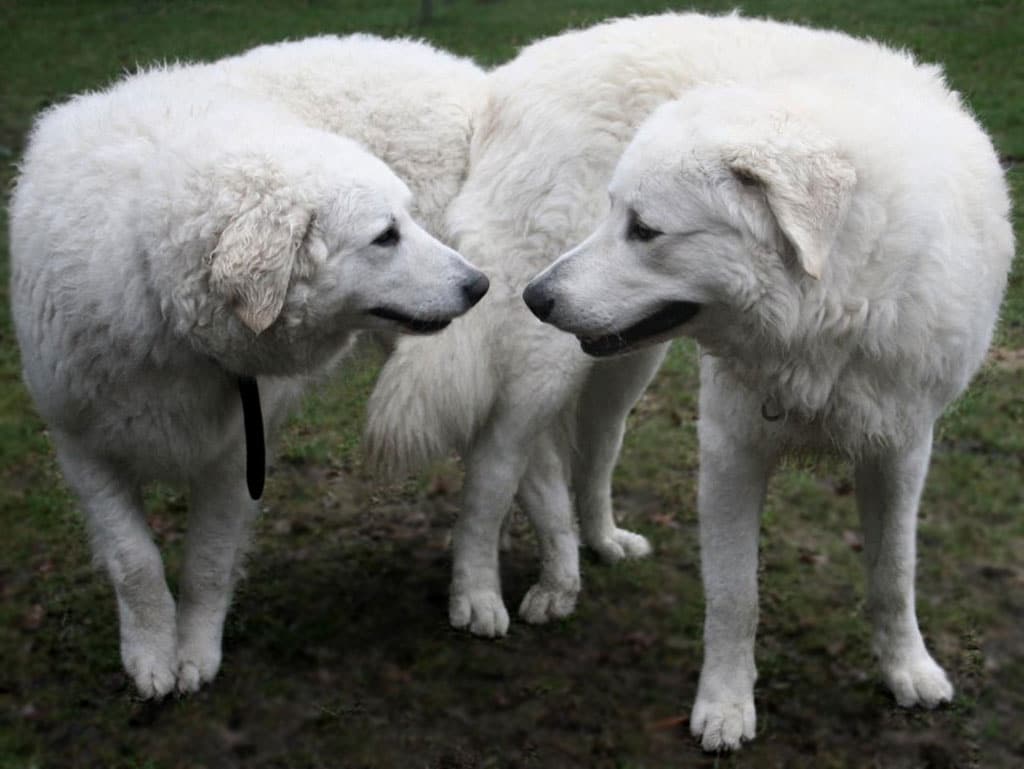
The Kuvasz (PL. Kuvaszok) is an old Hungarian breed of cattle dog.

Kuvasz

Content

Characteristics "Kuvasz"

Coexistence is important that you have with your new friend. Before considering the acquisition of a dog of the breed "Kuvasz" you know certain factors. Not all breeds of dogs are apt to live in an apartment, you must take into account his character, their need for exercise, their interaction with other pets, their care and if you have small children, their level of tolerance towards them.

Adaptation โ“˜

3,0 of 5 stars (based on 1 review)

friendly dog โ€‹โ€‹โ“˜

2,0 of 5 stars (based on 1 review)

hair loss โ“˜

5,0 of 5 stars (based on 1 review)

Affection level โ“˜

3,0 of 5 stars (based on 1 review)

Need for exercise โ“˜

3,0 of 5 stars (based on 1 review)

Social need โ“˜

3,0 of 5 stars (based on 1 review)

Home โ“˜

1,0 of 5 stars (based on 1 review)

Toilet โ“˜

5,0 of 5 stars (based on 1 review)

Friendly with strangers โ“˜

2,0 of 5 stars (based on 1 review)

barking โ“˜

4,0 of 5 stars (based on 1 review)

Health โ“˜

4,0 of 5 stars (based on 1 review)

Territorial โ“˜

5,0 of 5 stars (based on 1 review)

Cat friendly โ“˜

3,0 of 5 stars (based on 1 review)

Intelligence โ“˜

3,0 of 5 stars (based on 1 review)

Versatility โ“˜

3,0 of 5 stars (based on 1 review)

Child friendly โ“˜

3,0 of 5 stars (based on 1 review)

Surveillance โ“˜

3,0 of 5 stars (based on 1 review)

joy โ“˜

5,0 of 5 stars (based on 1 review)

History

The Kuvasz is an ancient herd guardian breed that originated in Hungary, although their distant ancestors were probably type dogs Tibetan Mastiff.

While the Komondor was used on the grounds lower with drier climates, the Kuvasz was used on the wet pastures of the highest mountains and the two were an integral part of the Hungarian economy. Later, during the century 15, the Kuvasz became a prized animal, the dog belonged to the Royal Court of the King Matthias Corvino. Y, from the kingdom Kuvasz puppies were offered to visiting dignitaries as a royal gift, Legend has it that the King was more confident their dogs than in their own Councillors. After the death of the King, the popularity of the breed among the nobles decreased, but even so the dog continued to have its traditional role in the protection of livestock.

At the end of World War II, almost all Kuvasz in Hungary had been killed. The dogs were used for the protection of their families, reason why were actively sought and killed by German and Soviet soldiers, while at the same time, some German soldiers were a large number of copies to their homes. After the Soviet invasion and the end of the war, the breed was nearly extinct in Hungary.

The word Kuvasz, probably, comes from the Turkish "kavas" which means guard, soldier or a protector. A related theory postulates that the word may have originated from ancient Russian farmers., the Chuvash, who has contributed many words to the Hungarian language.

For a long time, the property of the Kuvasz was restricted, but they were finally used by the shepherds as guardians of the flock. That's the job they're known for today.. The dog's white fur allowed the shepherd to easily distinguish it from a wolf as it blended in with the flock..

Physical characteristics

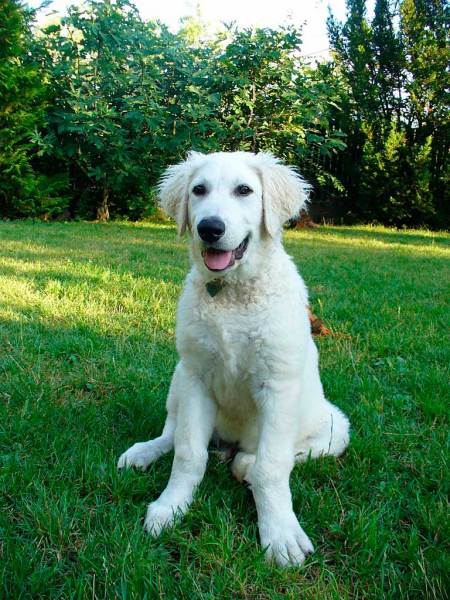
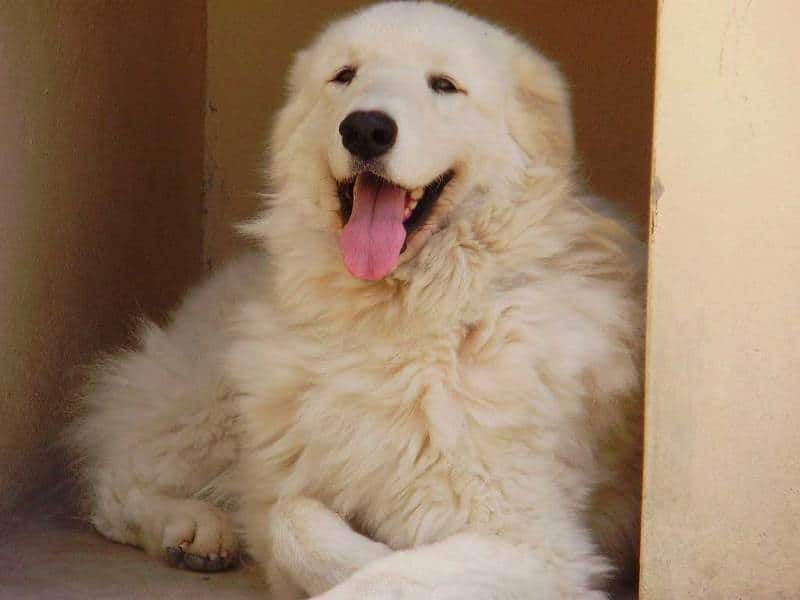
The Kuvasz should be of good size, solidly built and with a dignified air. The skull should be slightly arched and not too long, wedge-shaped snout. Leads the small ears hanging in the form of V. The body is rather long, with the slightly outgoing ribs. The legs are strong and not too long. The tail is long, slightly curved at the tip, which wears a beautiful plume. The coat is long, rough and undulating. The color has to be pure white, Although the white ivory can be accepted.

Although the skin is white, the pigmentation of the skin of Kuvasz should be dark and the nose should be black. The eyes must have an almendrada form. The females usually weigh between 35 and 50 kg, While males weigh in 50 to 70 kg, tieneto a bone structure medium. The height at the cross in the males is of 71 to 76 cm and the females of 66 to 70 cm..

For a casual observer, the Kuvasz may be similar to a Pyrenean Shepherd, to the Akbash, a โ€œMaremma Shepherdโ€ dog, a Samoyed, a Pudelhund white mixed with a Labrador Retriever, or some Slovakian dog like him Polish Tatra Sheepdog.

As with many livestock guardian dogs, the color of the layer of the Kuvasz serves a functional purpose and is an essential breed criterion. To develop the breed a purpose clear in the Kuvasz was to realise a mantle of color, to provide pastors distinguish the dog of wolves attacking animals at night. The Komondor, a close relative of the Kuvasz, It has a white coat for the same reason.

The Kuvasz lose a lot of hair from time to time. The rest of care are complicated. We must bear in mind that it is a dog of strong personality, which is why their education must be early and can be put to the test the patience of the educator. You need a suitable space of movement and exercise.

Fur: short, smooth, closed and thick on the head and on the front of the extremities. in the trunk, brazos, tie and tail is long and wavy, and often forms ridges and locks. it's pretty rough, a little stiff and in no case felted. the undercoat is fine and woolly.

Color: white.

Size: males of 71 to 75 cm.; females of 66 to 70 cm..

Character and skills

The Kuvasz he is a tireless keeper of flocks, defending the predators. Previously it had also been used as a hunting dog to chase wolves, boars and bears. It is also a great guardian. In his country the police and the army use him as an auxiliary. In recent decades it has also become a companion dog..

Good working dog, reliable watchdog, Pleasant Home Companion, that's the Kuvasz.

It has been used as a livestock guardian, but in recent years it can be found in homes as a pet.

The Kuvasz he is a smart dog and is generally said to have a clown sense of humor, that can last throughout adolescence and adulthood. They are very loyal but patients animals who appreciate human attention, but it also needs its space, they are very independent animals.

According to the classification made by Stanley Coren after analyzing the responses of more than 200 work of the AKC judges ("The Intelligence of Dogs", Stanley city, Ediciones B, 1995), the Kuvasz and el Nยบ 42 from the list.

Despite his intelligence, It should not be perceived as easy to train. His independent personality can make training a difficult task that, You can exhaust the patience, even for experienced owners. As a result, It is not recommended for beginners and those who do not have time to train and socialize in a manner appropriate to their Kuvasz.

On the other hand, many of these qualities make the Kuvasz excellent guardians for sheep or large farms. The Kuvasz has a very special and close relationship with his owner.

It is a sober and suffered dog, It resists weathering in the toughest conditions, Frequent brushing is therefore, necessary to keep their fur clean. A Kuvasz should not smell bad, This is usually a sign of illness or poor nutrition.

Homemade dog is friendly, affectionate and intelligent, and above all an excellent guardian, brave and quiet, suspicious and even reserved with strangers. Under its dignified appearance hides a playful temperament which makes him a loyal friend of children.

It is generally a healthy and robust breed whose life expectancy is about 12 or 14 years.

Kuvasz Health

In the Kuvaszok, more serious health problems include hip dysplasia, osteocondrosis (a joint disorder that damages cartilage and bone) and a propensity for cruciate ligament injury. An eye disease called progressive retinal atrophy (ARP) is a potential concern, just like hypothyroidism (a common hormonal disease in dogs in which the thyroid gland does not produce enough thyroxine) and vonWillebrand's disease (a disorder of blood clotting).

Not all of these diseases are detectable in a growing puppy, and it can be difficult to predict whether an animal will be free of these diseases, so you need to find a reputable breeder who commit to raise healthier animals possible. Must be able to produce an independent certification that the parents of the dog (and grandparents, etc.) have been screened for these defects and considered healthy for breeding. That's where health records come in..

Do not buy a puppy from a breeder who cannot provide you with written documentation showing that the parents were exempt from health problems affecting the breed.. If the breeder tells you that the tests are not necessary because they have never had problems in their lines, that the dogs have been โ€œvet checkedโ€, or offers you any other excuse to skimp on genetic testing of your dogs, leave immediately.

Careful breeders screen their breeding dogs for genetic diseases and breed only the healthiest and best looking dogs, but sometimes Mother Nature has other ideas. A puppy can develop one of these diseases despite good husbandry practices. Advances in veterinary medicine mean that in most cases dogs can still live a good life. If you are going to have a puppy, ask the breeder about the ages of the dogs in their lines and what are the most common causes of death.

Remember that after you have welcomed a new puppy into your home, has the power to protect you from one of the most common health problems: the obesity. Keeping a Kuvasz at the right weight is one of the easiest ways to extend its life.. Make the most of diet and exercise to help ensure a healthier dog for life.

observations and advice

not a very well-known dog and, therefore, it is difficult to find a puppy of this breed. However, it is more widely used than Komondor, whose cloak scares many potential buyers. In fact, the coat of the Kuvasz is more difficult to care for, Since it must be brushed periodically to avoid the formation of knots, although it should be washed as little as possible.

Kuvasz toilet

The Kuvasz has a beautiful white double coat that loosens dirt but also loosens hair. Brush weekly with a pin brush to remove dead hair and keep the skin and coat healthy. Trim the hair between the toes to keep your feet looking good. Its coat repels water and removes dirt easily with brushing, so a bath is rarely necessary.

When summer comes, don't think your Kuvasz has suddenly developed a disease causing hair loss. It is normal for the Kuvasz to lose most of its long coat in hot weather.

The rest is basic care. Trim nails as needed, normally each week the. Brush your teeth frequently with a veterinarian-approved pet toothpaste for overall good health and fresh breath.

Images "Kuvasz"

Videos "Kuvasz"

Type and recognitions:

  • FCI CLASSIFICATION:
  • Group :
  • Section : . .

Federations:

  • – FCI – Group 1 Herding dogs, Section 1 Sheepdogs โ“˜
  • – AKC – PASTORAGE โ“˜
  • – ANKC – Group 5 (working dogs) โ“˜
  • – CKC – Group 7 – Herding dogs โ“˜
  • – โ€‹KC – Pastoral โ“˜
  • – NZKC – Working dog โ“˜
  • – UKC – Herding dogs โ“˜

FCI breed standard "Kuvasz"

Origin:
Hungary

Date of publication of the valid original standard:
06.04.2000

Use:

Shepherd dog


General appearance:

Dogs of this breed are strong, large in size and show a dense coat, wavy and white. Its pleasant image radiates nobility and strength. All parts are in harmony and the limbs are neither too short nor too long.
The skeleton is powerful but not crude. The muscles are strong and dry and the joints are sharply outlined..

Seen from the side the body forms a rectangle lying, almost square. Well muscled. Powerful figure, lively temperament and great agility. Its exterior gives the impression of tireless and efficient power.


IMPORTANT PROPORTIONS:

  • The length of the body slightly exceeds the height at the withers.
  • The depth of the chest corresponds to approximately half the height at the withers.
  • The muzzle is slightly shorter than half the length of the head.


Behavior / temperament:

The Kuvasz is brave and not at all fearful. He will defend, even at the risk of his own life, those people and properties whose defense and custody have been entrusted to him.. He is aware of his own value and incorrect treatment can make him aggressive..

Is loyal, reliable, loves its owner and its territory. He needs to exercise a lot and be busy. It is not demanding at all, its maintenance is simple and it is even capable of withstanding very bad weather conditions. He is grateful for the love and concern expressed to him.

Head:

The head of the Kuvasz has a characteristic wedge shape in harmony with the body, it is nice, noble and radiates considerable strength. The head is characteristically lean and dry. The Kuvasz can be differentiated from similar breeds, essentially because of the shape of his head. The head of the male is somewhat more robust than that of the female.

Cranial region:
  • Skull: The skull is broad and the forehead slightly marked. Along the middle of the forehead runs a marked furrow.
  • Stop (naso-frontal depression): Bit strong.

facial region:

Wide, long and well muscled.Truffle: The truffle is black and flat cut.

  • Snout: The nasal helm is straight. The muzzle becomes progressively narrower although it is never pointed.
  • Lips: Blacks, firmly glued. The edge of the corner of the mouth is serrated.
  • Jaws / teeth: well developed, strong, regular teeth, scissor bite, complete, according to the dog's dental formula.
  • EYES: Placed somewhat obliquely, macaroons, dark brown. The edge of the eyelids is black and is firmly resting on the eyeball.
  • EARS: Insertion at mid-height; from its insertion to a third of its length, they are curved and separated and then they fall well next to the head. The ears are โ€œVโ€ shaped with rounded tips.. In atention, the dog raises them a little, never fully erect or crooked.

Neck:

He is rather short than of medium length and is heavily muscled. Provides an angle of 25-30 degrees. The nape is short. Firm throat skin, without jowl. In males the ruff and the mane are very expressive.

Body:

Seen in profile it forms a horizontal rectangle, almost square.

  • Cross: Long, marked upward on the surface of the back.Back: Long Middle, right, wide, well muscled and firm.Pork loin: Short, firm continuity of the back.
  • Rump: Slightly descending, richly muscled, wide, the coat is very dense, what gives the rump a somewhat high appearance.
  • Sill: Given the strongly developed musculature, the sill appears rounded, the tip of the breastbone.
  • Breast : Deep, long and slightly arched.
  • Bottom line and belly: Continuing the lower chest line, the belly is slightly pulled back.

Tail:

Low insert, in direct continuity of the gently descending rump. The tail falls straight and has a slight upward curvature at the tip, without being bent. Its length reaches the tarsus. In attention or being excited, is allowed to raise it to the level of the top line.

Tips

PREVIOUS MEMBERS: The forelimbs support the body being straight up to the carpals, are parallel and located at a moderate distance from each other. Seen from the front, The position of the anteriors is correct when a vertical line drawn from the tip of the shoulder coincides with the axis of the limb and falls between the third and fourth toes of the foot.. In profile, is correct when a vertical line drawn from the elbow joint falls towards the ground passing through the carpus and through the middle of the limb.

  • Shoulder: Long oblique scapula, musculada, joint and firm to rib cage, although with good mobility.
  • Arm: Long Middle, good muscular. The arm and scapula they form an angle of 100 to 110 degrees.
  • Elbow: Dried, rests next to the rib cage, not turned in or out. The arm and forearm form an angle of 120 to 130 degrees.
  • Forearm: Proportionally long, straight, compact, with lean musculature, strong tendons are inserted into it that are directed
  • to the carpus.
  • Carpo: Well developed, firm, the tendons are made of steel.Metacarpus: Proportionally short, enjuto, slightly tilted
  • (angle with the vertical of 10 to 15 degrees).
  • Previous feet: Round or somewhat oval, firm. Fingers are short, so arched up that in the middle they do not touch the floor, elastic and well together. Elastic and black pads. Nails are hard, strong, black or slate gray.

LATER MEMBERS: The posture seen in profile is correct when the knee is under the tip of the buttock and the foot is under the hip joint.. The vertical that falls from the tip of the ischium touches the heel bone. The posture of the hindquarters seen from behind is correct when the vertical that falls from the tip of the ischium runs along the axis of the limb, it is parallel on both sides and is on the ground separated by a medium distance from the other.Thigh: It is closely linked to the pelvis by its musculature which is long, wide and solid. The pelvis and thigh form an angle of 100 to 110 degrees.

  • Knee: Voluminous. The angle between the thigh and the leg reaches 110 until 120 degrees.
  • Leg: Its musculature, which is long and solid, is attached by strong tendons in the hock.. Viewed from behind they are vertical both sides and parallel to the axis of the body.
  • Hock: Width, bulky, dry, tendinoso. The angle of the tarsus is 130 to 140 degrees.
  • Metatarsus: Long, perpendicular to the ground.
  • Hind feet: Ovals, otherwise like the previous ones.

Movement:

Slow and wide step. In the trot the movement is fluid, elastic, with good ground cover, dynamic, regular and persistent. Elbows do not turn in or out.

Mantle

SKIN: Very well pigmented; is slate gray and firm.

  • Fur: Moderately hard, wavy, something rigid, no tendency to tangle. Under fairly thick outer coat, softer downy undercoat found. The head, the ears and feet are covered by a short hair of 1-2 cm long, bushy and straight.

The anterior and lateral faces of the anterior and posterior extremities, in the region from the knee down, are also covered by a short, straight hair of 1-2 cm long. On the posterior sides of the limbs are feathers of 5-8 cm long, reaching in the hindquarters up to the height of the hock. Around the neck, there is a gola, that continues up to the chest in the form of a mane. This mane is especially noticeable in males. In the body, arm and thigh, the hair is of a medium length (4-12 cm.), richly wavy and frequently ridged, hair trimmings and tufts. The tail is covered in its entire length by bushy and wavy hair. At the tip, the length of the hairs can reach 10 to 15 centimeters.

Color:

  • White. Ivory colors are authorized.
  • Truffle, edges of the eyelids and black lips; pads are black or slate gray. For the palate, a dark color shade is desired; pink spots taken in.


Size and weight:

Height to the cross:

  • Males 71-76 cm..
  • females 66-70 cm..

Weight:

  • Males 48-62 kg.
  • females 37-50 kg


Fouls:

  • Any deviation from the aforementioned criteria is considered as a fault and the severity of this is considered to the degree of the deviation to the standard and its consequences on the health and well-being of the dog..


    FALTAS DESCALIFICANTES:
  • Aggressiveness or extreme shyness.
  • Any dog โ€‹โ€‹showing clear signs of physical or behavioral abnormalities.
  • Depression links (stop) pronounced.
  • Lack of pigmentation in truffle, flews and edges of the eyelids.
  • Missing one or more incisor teeth, of the fangs, of the premolars 2-4 and molar 1-2. Missing more than two PM 1; go M 3 will not be taken into consideration.
  • Upper or lower prognathism, incisor arcade deviated, lack of contact of more than 2 mm. between the upper and lower incisors.
  • Entropion and ectropion.
  • Erect ears.
  • Tail elevated above the level of the back line when the specimen is calm; tail curled back.
  • Hair with a tendency to mat, kinked or not wavy, wire hair.
  • Limbs covered with long hair.
  • Colors deviating from those indicated in the standard.


N.B.:
  • Males should have two normal-appearing testicles fully descended into the scrotum..
  • Only functionally and clinically healthy dogs, with the typical conformation of the breed, should be used for parenting.

Source: F.C.I - International Cynological Federation

Alternative names:

1. Hungarian Kuvasz (English).
2. Kuvasz (French).
3. Kuvasz (German).
4. Pastor Hรบngaro (Portuguese).
5. Kuvaszok (espaรฑol).

Photos:

1 – kuvasz by Vkoves / Public domain
2 – KUVASZ by Svenska Mรคssan from Sweden / CC BY
3 – Kuvasz Prince of The Dogs Kennel by Kuvaszprince / CC BY-SA
4 – 7.5 months old kuvasz bitch by Sprays / Public domain
5 – Female kuvasz in ร“pusztaszer, Hungary by DenesFeri / CC BY-SA
6 – Nine-week-old Kuvasz dog by Vkovesz / Public domain

โ–ท The world of Pets: Dogs, cats, birds, reptiles, amphibians

Australian Kelpie
Australia FCI 293 . Sheepdogs

Kelpie Australiano

The Kelpie is very smart, industrious and always alert.

Content

History

The Australian Kelpie is a sheepdog developed around the decade of 1870 by Australian breeders by mixing several sheepdogs from Collie type imported directly from England. His goal was to develop a breed well adapted to Australian climatic conditions., especially to heat, and with enough independence to herd sheep and cows over a vast territory without too much supervision.

Until very recently, the race was also thought to be mixed with the Dingoes, australian wild dog, but recent genetic studies have shown otherwise. But, towards the end of the 19th century the Australian Kelpie also mixed with shorthaired Scottish Sheepdogs, giving it the features it has today.

The word Kelpie has its origin in Celtic mythology.. In fact, a Scottish legend mentions metamorphic spirits called kelpie, that appear most often in the form of a horse made of water, And that lurk in the rivers and lochs of Scotland. These malevolent spirits are meant to attract humans, especially to children and young people, to his death. It is unclear how the name came to be associated with this breed of dog.. But, the story that comes up most often, although it is not officially documented, is that of a Scottish breeder named George Robertson who, in 1872, it is said that he named Kelpie one of the first specimens of this breed; this name would simply have remained later to designate all the dogs of this breed.

Today, there are around of 450.000 sheepdogs in Australia, and most of them are Australian Kelpie. Since the decade of 1930, two types of Kelpie have been used in Australia: those used as working dogs and those used as show dogs. Show lines developed as the breed gained popularity in dog shows.. Having said that, in most other countries, this distinction doesn't really exist.

In any case, the Australian Kelpie has been exported to many countries. This is particularly true in the United States., where its great flexibility has allowed it to adapt to different climates and terrains, as well as working with different types of cattle.

Whether in Australia or anywhere else in the world, the Australian Kelpie has convinced by its versatility. In fact, not only is it an excellent sheepdog, both in real conditions and in sheepdog competitions, it can also be found in many other roles, like the police sniffer dog, therapy dog รขโ‚ฌโ€นรขโ‚ฌโ€นor assistance dog for the blind.

Although not yet officially recognized by the American Kennel Club (AKC), the Australian Kelpie is authorized from 2015 to participate in sheepdog competitions organized under the auspices of the organization. It is also not recognized in Great Britain by the Kennel Club.. On the other hand, the Fรฉdรฉration Cynologique Internationale (FCI) recognizes the breed from 1973.

Physical characteristics

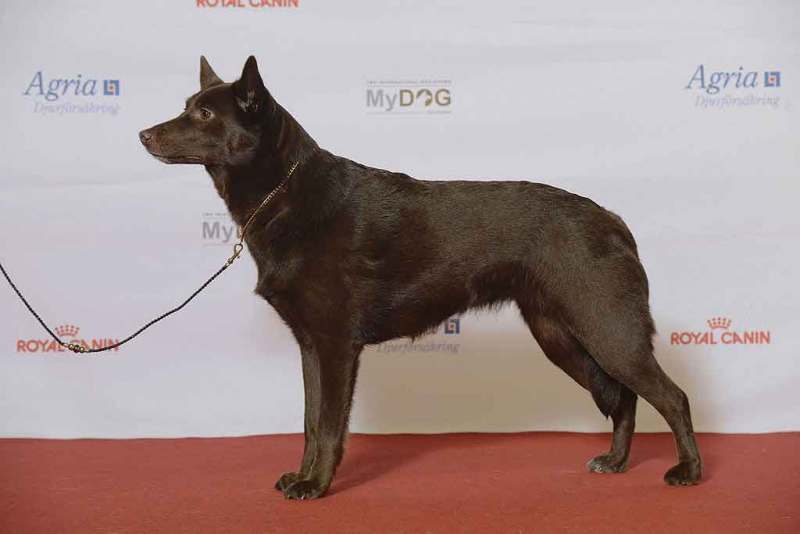
The Australian Kelpie worker and the Australian Kelpie competitive look similar, although the latter is slightly smaller and slightly less thin. They are medium-sized dogs, very athletic and muscular that doesn't look heavy. Their characteristics give them great flexibility of movement and unlimited energy..

The australian kelpie are slightly longer than tall, what gives them a perfect body for running. They have a slim appearance, with a deep chest and long strong legs. One of its peculiarities is that it seems to make no effort when running., a bit like I'm flying, with its four legs that seem to touch the ground at the same time.

The Australian Kelpie has a slightly rounded skull with large, straight ears on top. The muzzle is conical, with a fairly small mouth and large teeth ready to chew. The eyes are oval in shape and in shades of dark brown.

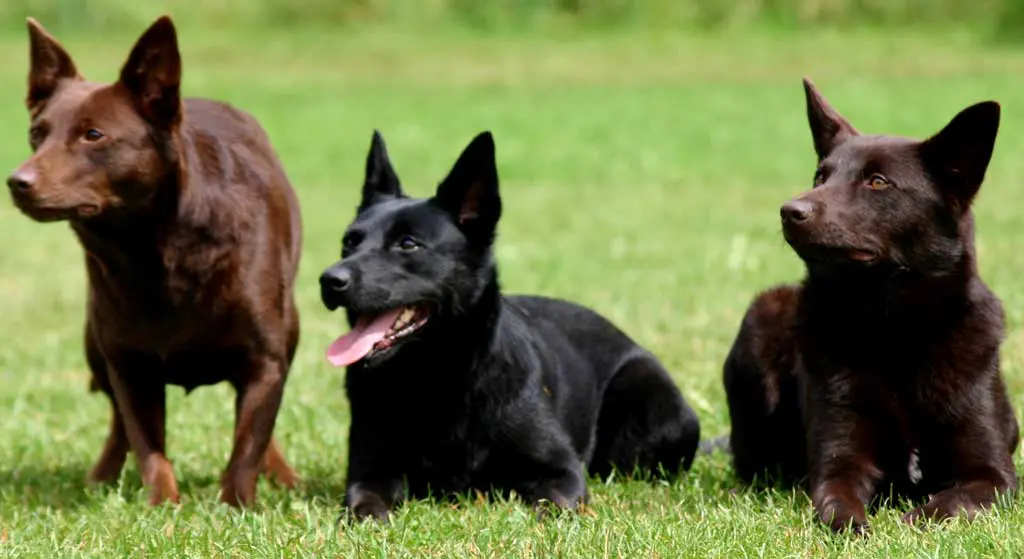
The standards of Australian Kelpie established by the various organizations that recognize the breed allow a fairly wide range of coat colors. But, in the countries – like australia – where there is a distinction between lines of work and lines of exhibition, only a solid color layer is recognized for the latter. In fact, regardless of lineage, the Australian Kelpie is most often black or chocolate with red markings, blue-gray or beige.
His hair is of medium length and covers a fairly soft undercoat..

Character and skills

The Australian Kelpie not a suitable animal for all families. In fact, is an extremely intelligent and energetic dog that requires a lot of attention. Hates being alone, and must be strongly stimulated mentally and physically, through at least two hours of daily exercise. In fact, not at all a suitable breed of dog for an elderly or very sedentary person, but rather for a very active and sporty master, willing to do different activities with your dog. Excels in activities that require agility like Frisbee or agility competitions.

Like the vast majority of sheepdogs, to the Australian Kelpie he likes to be busy; you are never happier than when you have a task to do. Like this, in addition to the essential walks and / or races, it is recommended that each dog play with him or train him in various activities in which he must apply the instructions given by his master, what he does with great devotion and seemingly boundless energy.

Lack of stimulus would be a huge problem for the Australian Kelpie; if bored, can become destructive, disobedient and engaging in various other behaviors intended to combat boredom, whether or not it conforms to the rules of the home. These may include, can gnaw through various objects or make the garden look like a minefield by digging holes everywhere.

So, the Australian Kelpie he is not a sedentary dog โ€‹โ€‹and can only be unhappy in a home that has little time and/or energy to give him. On the other hand, space is not necessarily a problem, as long as you get enough attention: can even cope with apartment living, whenever he has the opportunity to follow his master on excursions and activities, and thus be active daily.

Usually makes a good family dog, but you may be tempted to "play" the shepherd with the children or even with passing visitors. So, take special care with the youngest, as you may be tempted to nibble on your heels to get them back to where you feel they belong, or to encourage them to participate in an activity. With the Kelpie, the shepherd instinct is never far away.

The same goes for other pets, so it should be kept under surveillance if necessary. In any case, socializing him from a young age with other species can only be beneficial to prevent him from being mistaken for a herd once he is an adult.

It also, although they can get along with other dogs, generally prefer the company of humans to that of other dogs.

Although originally developed for life on the farm, the Australian Kelpie not a dog to leave outdoors, since he gets bored quickly if separated from his family. But, as they are used to operating independently without much instruction, want to be an integral part of family life and tend to act like a member of the family rather than a pet. As a result, he is also a sensitive dog who does not like to be excluded from family activities.

With a lot of frequency, owners who have not taken the trouble to inform themselves seriously before adoption end up abandoning their Australian Kelpie because it takes too much time and attention. The energetic character, Kelpie's need for activity and intelligence should be taken very seriously when it comes to choosing the breed of dog to adopt. In any case, when your needs are well cared for, he is a very nice and loyal companion.

Does not easily trust strangers and is very territorial, it is also a very good watchdog, very alert and vocal, that alerts as soon as it hears a strange noise. So, it is best to prevent strangers or even neighbors' pets from venturing into your territory, since it could be aggressive with them. The loud barking of the dog can also be problematic in an urban environment; if the dog is destined to live in the city, this is an aspect that should be particularly worked on as part of your education.

ยซAustralian Kelpieยป Education

The Australian Kelpie It is a breed of dog reserved for an experienced and very active owner. Either during training or after, it is important to give you clear and consistent rules, as it works much better in a structured environment.

But, your training is made easier by the fact that you need to keep busy, and is therefore generally content to participate in dog training activities. Can also be trained to participate in family chores: either picking up the mail, picking up clothes or toys off the floor or helping bring groceries, always ready for a new activity, even at a young age. Completing tasks is an integral part of Kelpie's personality, and can help you feel part of the family.

This willingness to be active and helpful makes the Australian Kelpie one of the easiest dog breeds to train. Excel in dog sports, they love to learn new orders and enjoy helping their owner. Training is not a particular problem, since they are completely obedient when sufficiently stimulated both intellectually and physically. On the other hand, boredom sets in soon, because he is an intelligent dog, and therefore learn quickly: it is useless to make him repeat the instructions too often, but he must be able to find new challenges and new activities for him regularly. A good solution may be to join a dog club that offers agility courses and games like Frisbee. (discdog).

Dog training techniques based on positive reinforcement, leading to rewarding the dog for desired behavior rather than punishing it for inappropriate behavior, are preferable with the Australian Kelpie, who has a rather sensitive personality and does not respond well to punishment or an overly imposing master. In fact, there is no point wanting to show your dog at all costs that you are the master, since he does not perceive his dog as superior, but rather as a companion. So, you should treat him with respect and not underestimate his intelligence, especially since he is used to working alone and without too many instructions.

Last, education should give priority to the socialization of the puppy from an early age, because the Australian Kelpie it is a territorial and distrustful dog. Otherwise, you risk becoming aggressive towards strangers and / or other animals. This will help you learn to react appropriately to strangers., preventing his natural mistrust from taking hold of him.

Health ยซAustralian Kelpieยป

The Australian Kelpie it is usually a healthy dog, but you run the risk of some of the problems often associated with the sheepdog group:

  • Abiotrofia cerebelosa;
  • Collie eye anomaly: despite its name, this condition not only affects Collie: the Australian Kelpie you can also be a victim of it. This inherited recessive disease can even lead to blindness;
  • Rupture of the anterior cruciate ligament: rupture of this ligament located in the knee can be caused by trauma (20% of the cases), but more often it is simply due to joint fragility or false movement. It can also be caused by early deterioration of the joint, which is common in very active dogs like Kelpie. It is the most common cause of lameness in this breed., and can cause arthritis;
  • dog hypothyroidism;
  • dog microphthalmia;
  • Progressive retinal atrophy (ARP): It is the most common hereditary disease in Collie family.

Most genetic diseases can be prevented by strict control of the genetics of breeding animals to reduce inbreeding., as well as by detecting these diseases to prevent individuals carrying these genes from producing offspring. These are, of course, points that any breeder of Australian Kelpie worthy is particularly attentive.

Last, the Australian Kelpie also leans for :

  • dog cryptorchidism;
  • Hip Dysplasia;
  • dislocation of the patella. May be of congenital origin, due to trauma or simply caused by wear and tear. This last case is frequent in an active dog like the Australian Kelpie.

You also have a higher than average risk of being overweight, so special vigilance is required at this level, in particular by regularly weighing your dog to control his weight.

Care and maintenance ยซAustralian Kelpieยป

Like the fur of the Australian Kelpie can vary quite a bit from one individual to another in terms of density and length, so does its maintenance. But, usually sheds a large amount of hair throughout the year, so it is necessary to brush the dog twice a week. Hair loss is obviously even more pronounced during molting periods., in spring and autumn, and then it is necessary to opt for a daily frequency to remove dead hairs.

On the other hand, it is rare that you have to give your dog a bath: this is only necessary if you come into contact with a dirty or harmful substance.

It also, being a very active breed of dog, their claws tend to wear out naturally, and therefore rarely need to be trimmed.

Looking at your teeth, do not present any particular risk. All you need to do is brush your dog's teeth once a week.

In general, the Australian Kelpie It is a fairly easy dog รขโ‚ฌโ€นรขโ‚ฌโ€นto take care of. Above all, it is their great need for exercise and intellectual stimulation that makes them a demanding dog on a daily basis.

Uses and activities ยปAustralian Kelpieยป

It was originally developed as a sheepdog to herd and guide livestock, the Australian Kelpie has since become a versatile companion. Of course, also found in sheepdog competitions, but also as a sniffer dog for the police, psychological support dog, guide dog for the blind, but also simply as a family dog. In summary, it is a versatile animal that likes to keep busy and easily adapts to different contexts.

In Australia, but the Kelpie still primarily a sheepdog, it is also increasingly used as a therapy and companion dog. In fact, his sensitivity and need to be in the company of humans make him an exceptionally attentive dog.

In Sweden, Holland and Finland, they are particularly used as search and rescue dogs during accidents and disasters.

How much does an "Australian Kelpie" cost??

In Australia, a puppy of Australian Kelpie normally sold for about 580 Australian dollars (a few 350 EUR). Most of the individuals offered are from working dog lines..

In other parts of the world, depending on lineage and pedigree, the price of a puppy Australian Kelpie is between 750 and 3.000 EUR. As individuals sold outside of Australia are primarily from show dog lines, the price range is quite wide because the price goes up quickly if the puppy comes from a line with a reputation for having distinguished itself in the field.

Characteristics "Australian Kelpie"

Coexistence is important that you have with your new friend. Before considering the acquisition of a dog of the breed "Australian Kelpie" you know certain factors. Not all breeds of dogs are apt to live in an apartment, you must take into account his character, their need for exercise, their interaction with other pets, their care and if you have small children, their level of tolerance towards them.

Adaptation โ“˜

4,0 of 5 stars (based on 1 review)

friendly dog โ€‹โ€‹โ“˜

3,0 of 5 stars (based on 1 review)

hair loss โ“˜

3,0 of 5 stars (based on 1 review)

Affection level โ“˜

4,0 of 5 stars (based on 1 review)

Need for exercise โ“˜

5,0 of 5 stars (based on 1 review)

Social need โ“˜

4,0 of 5 stars (based on 1 review)

Home โ“˜

3,0 of 5 stars (based on 1 review)

Toilet โ“˜

2,0 of 5 stars (based on 1 review)

Friendly with strangers โ“˜

2,0 of 5 stars (based on 1 review)

barking โ“˜

4,0 of 5 stars (based on 1 review)

Health โ“˜

4,0 of 5 stars (based on 1 review)

Territorial โ“˜

5,0 of 5 stars (based on 1 review)

Cat friendly โ“˜

3,0 of 5 stars (based on 1 review)

Intelligence โ“˜

5,0 of 5 stars (based on 1 review)

Versatility โ“˜

5,0 of 5 stars (based on 1 review)

Child friendly โ“˜

3,0 of 5 stars (based on 1 review)

Surveillance โ“˜

5,0 of 5 stars (based on 1 review)

joy โ“˜

4,0 of 5 stars (based on 1 review)

Images "Australian Kelpie"

Photos:

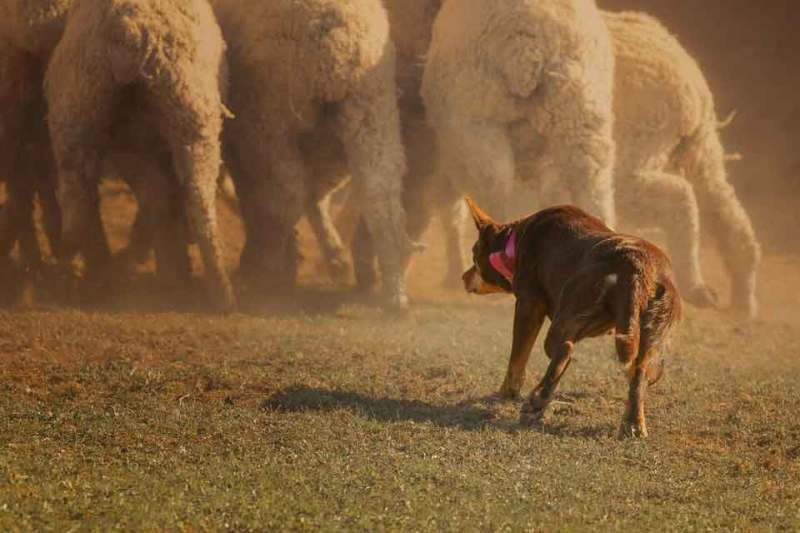
1 – Diesel, a pure-bred Australian Kelpie by davepaku, CC BY-SA 2.0, via Wikimedia Commons
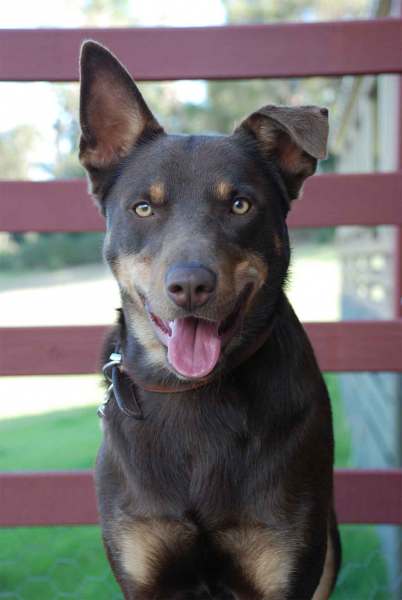
2 – Australian Kelpie, liver & tan by Canarian, CC BY-SA 4.0, via Wikimedia Commons
3 – Kelpie australiano by https://pixabay.com/es/photos/kelpie-australiano-perro-ovejas-4217941/
4 – AUSTRALIAN KELPIE, KORAD SE UCH Deepeyes Dance With Dragons III by Svenska Mรคssan from Sweden, CC BY 2.0, via Wikimedia Commons
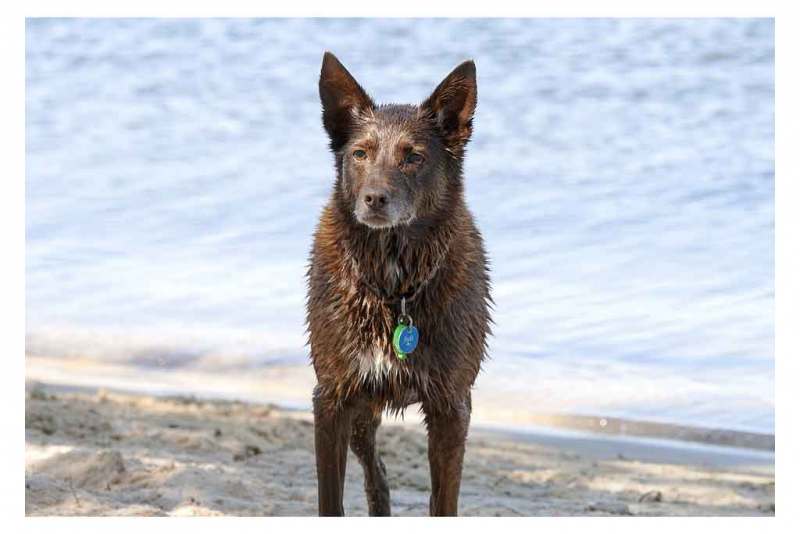
5 – Kelpie australiano by https://pixabay.com/es/photos/nube-roja-kelpie-perro-pastor-2992780/
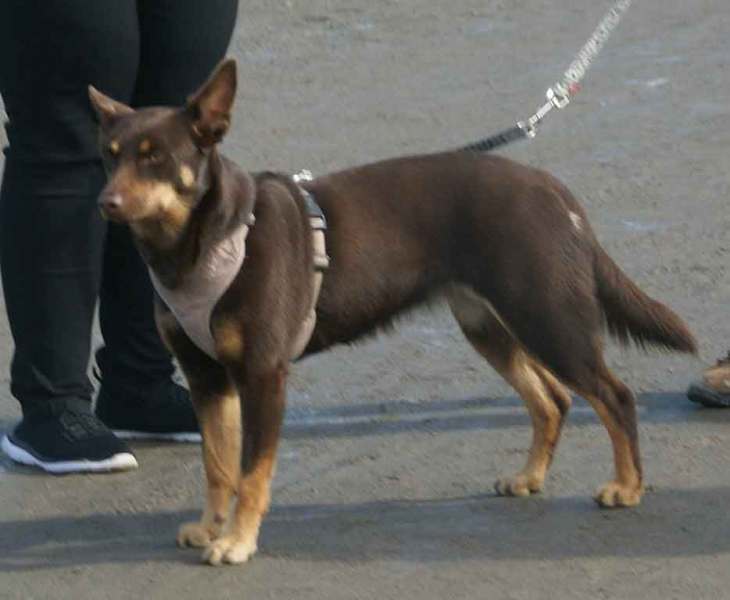
6 – Chocolate Female Kelpie by Spinefly, CC BY-SA 4.0, via Wikimedia Commons

Videos "Australian Kelpie"

Type and recognitions:

  • FCI CLASSIFICATION:
  • Group :
  • Section : . .

Federations:

  • – FCI – Group 1 Herding dogs, Section 1 Sheepdogs โ“˜
  • – AKC – PASTORAGE โ“˜

FCI breed standard "Australian Kelpie"

Origin:
Australia

Date of publication of the valid original standard:
08.10.2012

Use:

Shepherd dog.


General appearance:

This should be that of an active and very useful dog.; great muscular condition combined with the elasticity of your limbs provides the ability to work tirelessly. Your appearance should not reflect weakness.

important proportions: The length of the dog, measured from the anterior tip of the forechest in a straight line towards the protuberance of the ischium, is greater than the height at the withers by a proportion of 10:9.


Behavior / temperament:

The Kelpie is very smart, laborious and always alert. He also has a docile disposition and almost inexhaustible energy.. On the other hand, shows great loyalty and devotion to work. Has a natural instinct to work with sheep, both in the field, as in the corral.

Any defect in structure or temperament should be considered atypical..

Head:

The head should be in proportion to the size of the dog. As a whole, the shape and contour of the head give it a fox-like expression, but it is attenuated by the almond shape of the eyes.

Cranial region:
  • Skull: Slightly rounded and wide between the ears. View from the side, the forehead descends in a straight line towards the naso-frontal depression.
  • Depression links (stop): Marked.

facial region:

  • Truffle: Its color harmonizes with the color of the coat.
  • Snout: Clearly molded and defined, should preferably be somewhat shorter than the skull.
  • Lips: Tight and clearly delineated, no slack.
  • Jaws / Teeth : The teeth must be strong, healthy and regularly aligned. The lower incisors are placed closely behind the upper ones, that is, the joint must be scissor-shaped.
  • Cheeks: Neither thick nor prominent, but round towards the muzzle.
  • Eyes: Almond shaped, they are medium in size and their angle is well defined. They are intelligent and alert in expression. The color must be brown, harmonizing with the coat color. Lighter colored eyes are allowed in the case of dogs with blue fur.
  • Ears: They are upright and end in a fine point; the ear shell is thin, but strong at the base. The ears are set well apart, slope outward and form a slight curve at their outer edge. Are medium-sized. They are well provided with hair on the inside.

Neck:

It is of moderate length, strong, slightly arched, gradually inserting into the shoulders. There is no presence of double chin, but yes, a quite abundant necklace of hair.

Body:

  • top line: Firm and uniform.
  • Pork loin: Strong and well muscled; flanks are deep.
  • Rump: Rather long and sloping.
  • Breast : Deep, muscular and moderately wide. Well sprung and back ribs, not barrel shaped.

Tail:

During rest, should hang slightly arched. When the dog is in motion or at attention, it may appear raised, but under no circumstances should it exceed the vertical line of the birth of the tail. It must be provided with abundant brush hair. It is inserted in a way that harmonizes with the slope of the croup and should reach approximately to the hock..

Tips

Former members
  • General appearance: Muscular, strong but not thick boned, straight and parallel viewed from the front.
  • Shoulder (scapulae) : They must be well delineated. They are muscular and well leaning, shoulder blades being well together in the region of the withers.
  • Arm (humerus): Upper arm should be at right angles to shoulder blade.
  • Elbows: They should not deviate or inward, nor out.
  • Metacarpus: Seen from the sides, pasterns should be slightly sloping to allow flexibility in movement and the ability to turn quickly.
  • Previous feet: They must be round and strong. Thick pads. The fingers are close together and well arched; nails are short and strong.
Former members
  • General appearance: They must be wide and strong. Seen from the back, hind limbs, from hocks to feet, they are straight and parallel, nor together, not too far apart.
  • Knees: Well angulated.
  • Hocks: Placed fairly close to the ground.
  • Hind feet: They must be round and strong. Thick pads. The fingers are close together and well arched; nails are short and strong.

Movement:

To manifest the limitless vigor and perseverance required of a sheepdog working in open spaces, the Kelpie must be of very robust constitution and have a perfect gait. The movement should be loose and effortless and the dog should be able to turn suddenly without slowing down.. As speed increases during trotting, the feet tend to come closer when they land on the ground; but when the dog is resting, all four feet are in the correct perpendicular position.

Mantle

  • Fur: The coat is double, with a short and dense undercoat. The outer layer is tight, the hairs are of a hard and stretched texture and are well glued, so that the coat is resistant to rain. Below the body, back of the limbs the coat is longer, and near the thigh forms a "pants" light. In the head (including the inner part of the ears), in the front of the limbs and feet, the hair is short. On the neck it is long and thick, forming a necklace. The tail must be provided with a generous brush. Hair that is too long or too short is a fault. Usually, body hair should be about a length of 2-3 cm.
  • Color: Negro, black and tan, red, red and fire, leonado, chocolate, smoke color.


Size and weight:

Height to the cross:

  • Males 46 - 51 cm.
  • females 43 -48 cm.


Fouls:

Any deviation from the aforementioned criteria is considered a fault and the severity of this is considered to the degree of the deviation from the standard and its consequences on the health and well-being of the dog and your ability to do your traditional job.

Serious misconduct:

  • Shoulders too loose.
  • Any tendency to a cow hock or barrel-.
  • Crossing or zigzagging movement.
  • Restricted or stiff movement.

disqualifying fouls:

  • Aggressiveness or extreme shyness.
  • Any dog โ€‹โ€‹showing clear signs of physical or behavioral abnormalities must be disqualified..


N.B.:

Males should have two normal-appearing testicles completely descended into the scrotum..

The latest changes are in bold.

Source: F.C.I - International Cynological Federation

Alternative names:

1. Kelpie (English).
2. Kelpie (French).
3. Kelpie (German).
4. Kelpie (Portuguese).
5. Kelpie (espaรฑol).

โ–ท The world of Pets: Dogs, cats, birds, reptiles, amphibians

Cretan Hound
Grecia Not recognized by the FCI

Kritikos Lagonikos

Content

History

The Cretan Hound (Kritikos Lagonikos), belongs to a primitive hunting breed, its existence on the Greek island of Crete is documented in writings for at least 3.500 years. Minoan civilization, which at its peak dominated most of the Aegean, the Cyclades islands and the eastern Peloponnese, bred and used it extensively.

Like a hunting and hunting hound, was always used to hunt down and capture wild hares and rabbits on the harsh terrain of his home island. The classical authors praised the cretan hounds (Kressai Kynes) as the best hare hunters known to man and in ancient times they were exported to the Greek colonies and other European countries, reaching Spain and the British Isles, to mix and improve local hounds.

These dogs have many peculiar traits and it is clear that they are a truly ancient species, probably the oldest breed of dog in Europe. Your ancestors may have come from Africa., but later they adapted to this unique habitat of Crete, an island remote enough to be home to other unique species of animals as well, as a unique subspecies of wild goat, the lynx and others.

Isolated there for millennia, these dogs were trained by function to perform a particular and challenging task and remain pure and unaltered to this day.

Due to a long history of fighting external enemies, the Cretans they are a freedom loving race, proud, independent, somewhat suspicious and even tested. They do not like to give their dogs to outsiders and even to this day the best specimens are kept hidden from public view..

Breeding practices are ruthless and the limited means of the past taught the locals to castrate all males, except the best, and to destroy the dogs that were not good for hunting. This resulted in an especially strong and healthy breed., but also very few in number. For years they were kept a secret and even now they rarely leave Crete, except on the occasions when they participate in international dog shows held in Athens, where visitors have the opportunity to meet a true living legend.

Physical characteristics

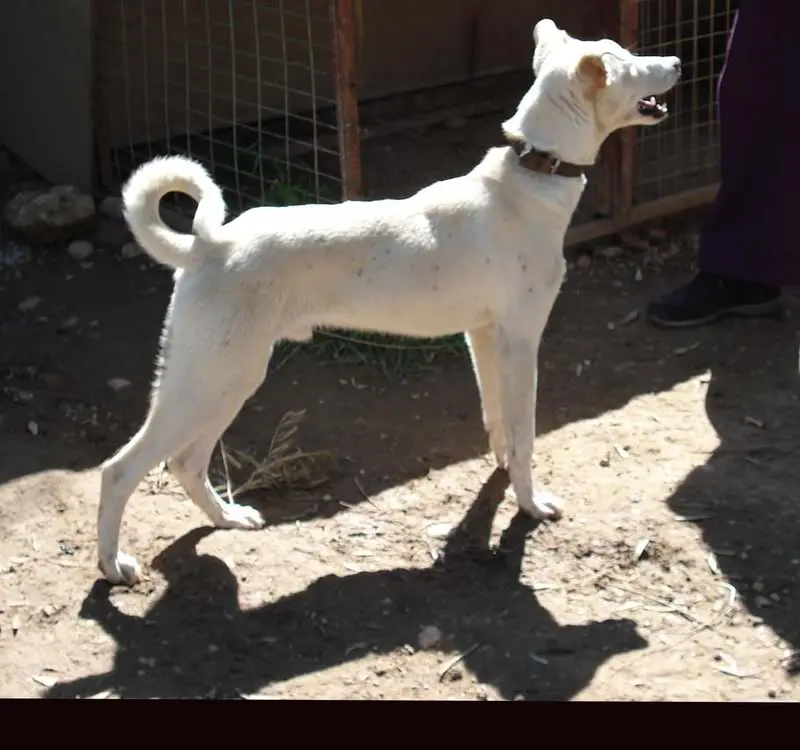
The Cretan Hound (Kritikos Lagonikos) is a slender dog, of body intermediate between a hound and a greyhound, especially light feet (that are oval instead of feline) and strong loin, specially adopted for fast reflexes and high speed on dangerous and rocky terrain.

The head wedge shaped, it is elongated and dry, with pointy, highly mobile ears that fold back like a greyhound's during the chase. (There are specimens with semi-standing or drooping ears, and the latter tend to be more similar to a sighthound; there is also a smaller variety, something like a Whippet, of which little is known).

The skin it is thin and tense all over the body, and of many colors. The tail is a very important characteristic of the breed, long and curved up, forming a loose or tight ring and covered with a longer hair brush underneath.

The Cretan Hound is slightly longer than tall, with medium angulations, legs slim and well muscled; the rib cage is spacious but neither too wide nor too rounded and does not reach the tip of the elbow. The back he's slim but powerful and there's a nice tuck, with the tips of the hipbones slightly prominent.

There must be a balance between speed and endurance characteristics, being the conformation a commitment that produces great agility. Flaccid individuals are not tolerated, clumsy and heavy.

Colors: pure white, cream, sand, leonado, grey, striped or black, bicolor or tricolor.

Size

  • Height: females: 50+ cm. (19+ inches) Males: 60+ cm. (27+ inches)
  • Weight: 20-30 kg (44-66 pounds)

Character and skills

The Cretan Hound uses both sight and smell in hunting and has a particular tendency to savor air or ground odor, to the point of sucking it off the pebbles and stones. When it perceives the prey, the tail moves in a circular motion and the hound stiffens moments before starting the chase.

Manso, affectionate, aristocratic, but deadly in pursuit, is a polite hound that comes to life in the presence of prey; clean, soft, elegant in form and movement, it is never vulgar or overwhelming in gestures.

Slightly reserved with strangers, is naturally inquisitive and tolerant.

The Kritikos Lagonikos lives happily with other domestic animals, but it will mercilessly chase the neighbor's cat.

It's excellent, friendly and very affectionate with children. He rarely barks but will alert strangers to his home; on the farm he will kill mice and rats and is not indifferent to feather hunting, but the latter use will make the breed lazy and disorderly in hunting; your constitution needs the challenge of true persecution.

Make sure you are the calm leader, but firm and sure of this dog, providing enough leadership and exercise to produce a well-balanced canine companion. Proper communication between the dog and the man is essential.