โ–ท The world of Pets: Dogs, cats, birds, reptiles, amphibians

Wirehaired Pointing Griffon
Holanda Alemania Francia FCI 107 . Griffon type

Grifรณn Korthals

Vigorous, fiery and proud, the Wirehaired Pointing Griffon he is very attached to his master and his territory, who watches.

Content

History

The Wirehaired Pointing Griffon It is a breed of dog of French origin. Their ancestors are Dutch, but shown as a French race, It was in France where he developed.

This breed is still relatively rare today in the Americas as well as in the UK., Although it is recognized by their respective Kennel Clubs, as well as by the International Cynological Federation (CRF not. 107).
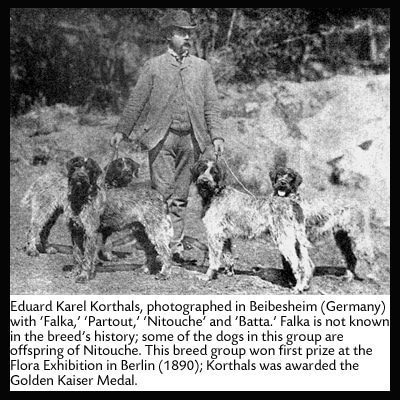
Grifรณn de muestra Korthals de pelo duro

The culprit of the existence of Korthals Griffon was a man named Eduard Karel Korthals, born the 16 in November of 1851 in Amsterdam that, he was the son of a wealthy shipbuilder who had a keen interest in breeding hunting dogs, to the extent that his son inherited that passion and as a result and the ability for business, the beautiful was born Griffon, protagonist of this post.

His dream was to create the ideal hunting dog, versatile, with extreme resistance, force and devotion to his master. The dog, as well, he would have to know how to work close to his master, be docile and very capable of learning. In 1873 to the 22 years of age and with the financial support of his father, He settled near some friends in Hesse (Germany) a region known for its great fondness for hunting with dogs and was dedicated to the breeding of purebred dogs Griffon.

four years later, one of his friends, the prince of Solms-Braunfels, I entrust him with the management of his kennel โ€œBibesheimโ€ (was then, the most famous of Germany) which was dedicated especially to the breeding of purebred dogs English Pointer, that change in his life did not prevent him at all, continue with the development of their race Griffon.

Soon Eduard Korthals became one of the largest breeders nationwide, very proud and sure of his work of selection, breeding began with seven specimens of Griffon of different kinds, hard hair, woolly hair, barbets, a mestizo German short hair, etc. He called them "The Seven Patriarchs" and their names were: Bank, Hector, Janus, Satan, Donna, Junon and Mouche. Thus begins the story that after twenty years, resulted in the birth of a specific breed of Griffon with wire hair, leonado, with ยซPointerยป blood (Although not pure, then we have) and beautiful dog, it must be said...

We must also tell which, Eduard Korthals carried out ruthless work in its breeding program, with very close consanguinity coupling and many deaths on the road, you are rightโ€ฆ, the history has beautiful parts and others less so. Y, here comes the bomb! Out of a total of 600 dogs, only kept alive to 62 and he made them work in the Woods, in swamps, in Plains, in different seasons, to see how they worked in different situations and hunting tasks.

In creating your Wirehaired Pointing, Korthals did not use all the blood purity of the English Pointer, because after having tried, realized that the mixture led to his Griffon lose some of its most important features.

With his method of consanguinity, exhaustive selection and unit, the Wirehaired Pointing Griffon It was of such quality that many specialists in the canine world in Germany, in Belgium, in the Netherlands, in France and several parts of Europe, they were stunned, Given the Korthals he had created a dog like no other, a dog with an essential width, great search speed, a well-developed sense of smell and, In short, its versatility.

The 15 in November of 1887, supported by the contributions of a Commission formed by 16 renowned breeders and presided over by the Prince of Solm-Braunfels (who had entrusted Eduar Korthals -years before- the management of its hatchery โ€œBibesheimโ€), Eduar Korthals wrote the standard of Korthals Griffon, that curiously never amended since then. The following year, He created a Club specialized in his breed whose objective was to bring together all the lovers of his Griffon fawn with wire hair from various countries and until his death in 1896, He devoted himself to the improvement and dissemination of their race. He died of laryngeal cancer 4 in July of 1896 in the hatchery Bibeishem.

But despite his death, his ideas continued living, then many followers and friends as Baron Gingins (Switzerland), Charles Prudommeaux (France) and the Sr. Leliman (Netherlands) they continued their valuable work, turning to improving your Wirehaired Pointing Griffon, and the diffusion of the breed throughout Europe and even in United States and Canada. It was the 8 in June of 1951, on the occasion of the fiftieth anniversary of the death of Eduar Korthals What, The "French Wirehaired Griffon Club" decided to associate the name of Korthals the race, to perpetuate the memory of its creator, and in honor of all his achievements and life dedicated to the task of breeding. Hence the name "Korthals Griffonโ€.

The first specimen registered in the Book of Origins of the American Kennel Club was a Korthals Griffon called "Zolette", in the year 1887. But, the Griffon was still relatively- unknown, was registered as โ€œRussian Setter (Griffon)โ€, by its supposed Russian heritage. It was not until 1916, Twenty-nine years later, the breed was officially recognized in United States.

In the same year, sixteen copies of Korthals Griffon participated in the "Westminster Kennel Club Dog Showโ€, one of United States most prestigious dog shows. Since then, the race was growing in popularity, not only as a show and companion dog, but also a versatile hunting dog (that was the original intention of Korthals when he created the breed). for the most part, the breed continues to maintain its original characteristics: medium-sized, layer hard, good degree of training capacity and resistant in the field and in the ring.

Physical characteristics

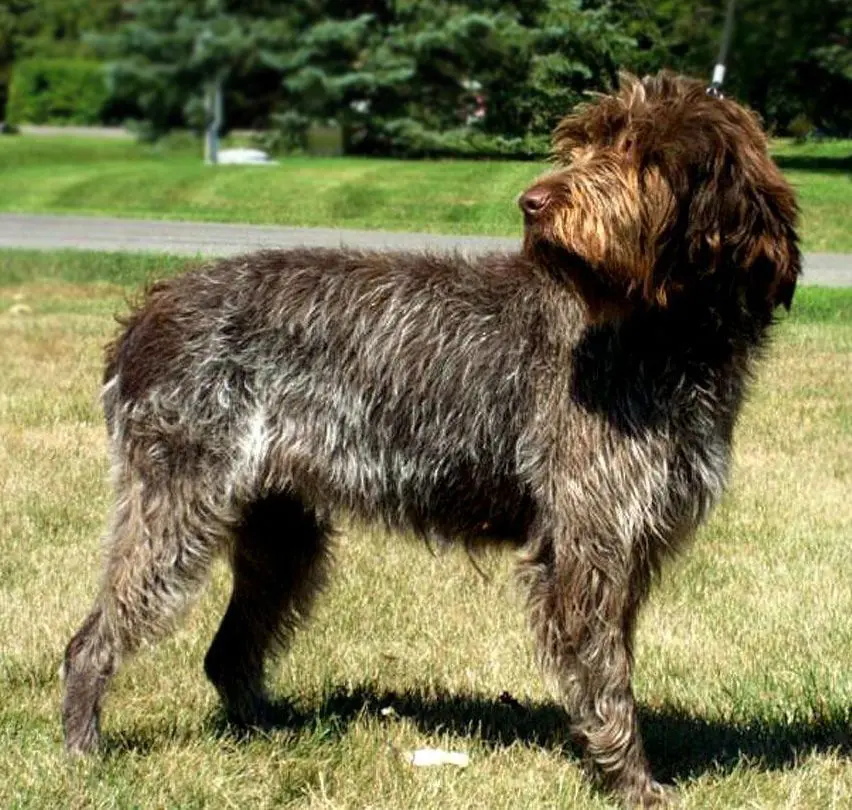
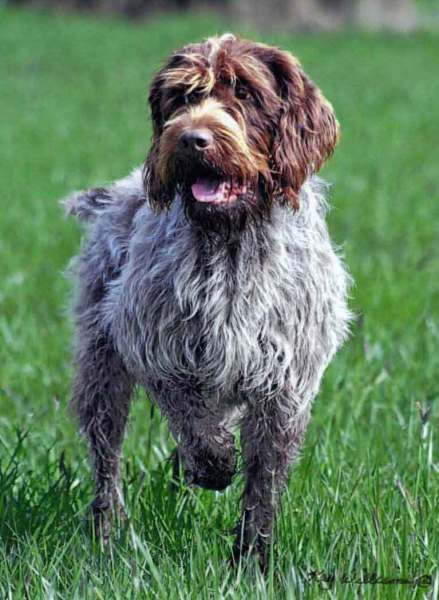
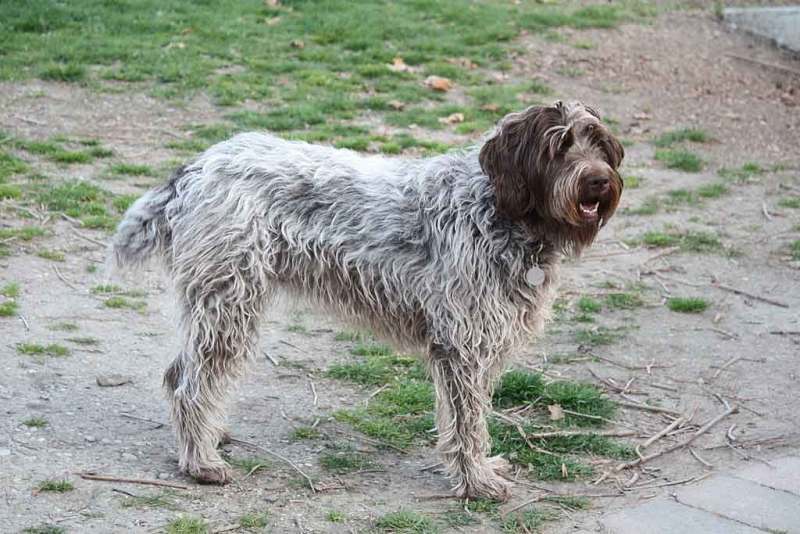
The Korthals Griffon is a medium-sized dog with a hard and rough coat. The males measure of 55 to 60 cm de altura a la cruz y las hembras de 53 a 66 cm.. The weight should be proportional to the size and bone structure. In general, the weight varies from 20,5 a 31,75 kg. Males are usually larger and heavier than females bones. 50 to 55 cm.. Regarding weight, the males are located in 25-30 kg and females in 20-25 kg. According to the AKC standard, the hair must be color steel (grey) with brown spots. Other acceptable colors are chestnut, White and Brown, Ruano and, Orange and white. It has ears falls and well attached to the head, his eyes are yellow or Brown and the nose should always be Brown. Contrary to some publications that say that the Griffon does not lose or shed its hair, it should be clarified that yes it does, but to a lesser extent than other breeds.

There are dogs very similar to the Griffon Korthal in other countries, both in appearance and temperament:

Character and skills

The Wirehaired Pointing Griffon is defined as an intelligent dog, extremely friendly and eager to please its owner. They tend to maintain their typical playful puppy character well into adulthood.. They are also known for their Adaptive temperament.

The Korthals Griffon it is above all a hunting dog, resistant, powerful and brave. He's an outdoor dog who needs a garden to keep his instincts sharp.. Not a suitable breed of dog for apartment living, since it is very likely that confinement will cause anxiety attacks or greater nervousness that leads you to destroy everything. They need a lot of exercise to thrive, and they are tireless sporting dogs and very good swimmers. So, their owners must be able to offer them long walks and games, beyond simple daily outings for your needs: this is necessary to keep you in good physical and psychological health. In fact, the Wirehaired Pointing Griffon is an ideal candidate for canicross, el cani-VTT, the oberta or even the treasure hunt, that will fully satisfy your hunter instinct.

most of Korthals Griffon usually live long and healthy lives, and that is due to the seriousness of all the organizations and breeders dedicated to this breed that have a strong commitment to the health of the breed and carry out breeding programs that are mostly very selective, As a result, if we look at the OFA statistics, the cases of congenital diseases are โ€“relatively- low.

education

The Korthals Griffon he is an intelligent and cunning dog. These qualities make hunters happy… but the misfortune of inexperienced teachers, whose defects he takes advantage of. This dog can be undocile if it does not benefit from a firm education, consistent and not brutal. As much as saying that it is not an adapted breed as a first dog.

It also, it is important to socialize the puppies as soon as possible so that they get used to the presence of different people and other animals. In effect, although they are not fearful in nature, the Wirehaired Pointing Griffon Too isolated or too "protected" from the outside world can be particularly nervous and difficult to adapt to everyday life.

Health

Robustness is a fundamental characteristic of the Grifรณn Korthal: It is a breed of dog that does not fear cold or bad weather.

But, like all medium-sized dogs and large dogs, have a risk of hip dysplasia. Prostate disorders may also occur in some individuals.

Last, it is recommended to monitor the coat and skin of individuals who do not live outdoors, to prevent the development of skin diseases in dogs due to allergies to industrial product residues present in the home (solvents, Cleaning products…).

Life expectancy

13 years

Grooming

Although it is considered a "hypoallergenic" dog due to its low hair loss., the Grifรณn Korthal requires weekly brushing to keep its coat shiny. During the molting period (twice a year), more frequent brushing may be necessary.

It is also advised to clean the dog's ears regularly., especially after walks or bathing, to prevent the development of infections due to excess water inside the ear canal, or to the presence of residues or dirt. In case of redness or suspicious odors, consulting a vet is recommended.

Price

Adopt a Wirehaired Pointing Griffon costs between 600 and 1000 EUR.

The price of a puppy Khortals varies according to your lineage, but also according to their gender: females tend to be more expensive than males.

Characteristics "Wirehaired Pointing Griffon"

Coexistence is important that you have with your new friend. Before considering the acquisition of a dog of the breed "Wirehaired Pointing Griffon" you know certain factors. Not all breeds of dogs are apt to live in an apartment, you must take into account his character, their need for exercise, their interaction with other pets, their care and if you have small children, their level of tolerance towards them.

Adaptation โ“˜

3,0 of 5 stars (based on 1 review)

friendly dog โ€‹โ€‹โ“˜

3,0 of 5 stars (based on 1 review)

hair loss โ“˜

2,0 of 5 stars (based on 1 review)

Affection level โ“˜

4,0 of 5 stars (based on 1 review)

Need for exercise โ“˜

5,0 of 5 stars (based on 1 review)

Social need โ“˜

4,0 of 5 stars (based on 1 review)

Home โ“˜

3,0 of 5 stars (based on 1 review)

Toilet โ“˜

2,0 of 5 stars (based on 1 review)

Friendly with strangers โ“˜

3,0 of 5 stars (based on 1 review)

barking โ“˜

3,0 of 5 stars (based on 1 review)

Health โ“˜

4,0 of 5 stars (based on 1 review)

Territorial โ“˜

3,0 of 5 stars (based on 1 review)

Cat friendly โ“˜

2,0 of 5 stars (based on 1 review)

Intelligence โ“˜

4,0 of 5 stars (based on 1 review)

Versatility โ“˜

4,0 of 5 stars (based on 1 review)

Child friendly โ“˜

4,0 of 5 stars (based on 1 review)

Surveillance โ“˜

3,0 of 5 stars (based on 1 review)

joy โ“˜

4,0 of 5 stars (based on 1 review)

Images "Wirehaired Pointing Griffon"

Photos:

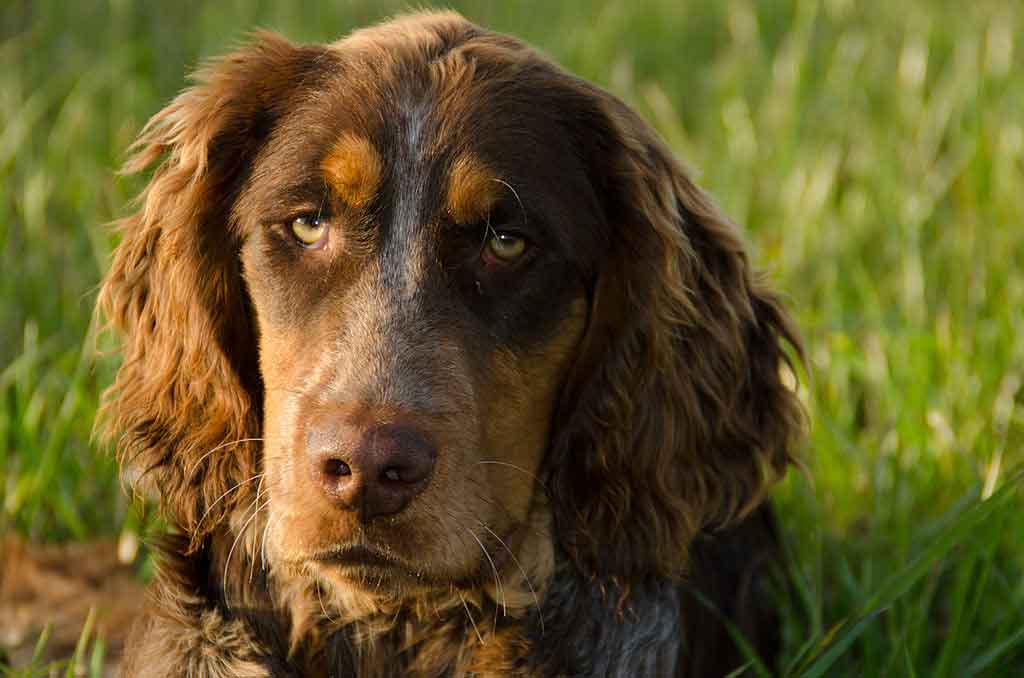
1 – the first genuine Korthals Griffon in the USA to earn both a Grand Championship and the Advanced Master Hunter title by CarolPtak, CC BY-SA 4.0, via Wikimedia Commons
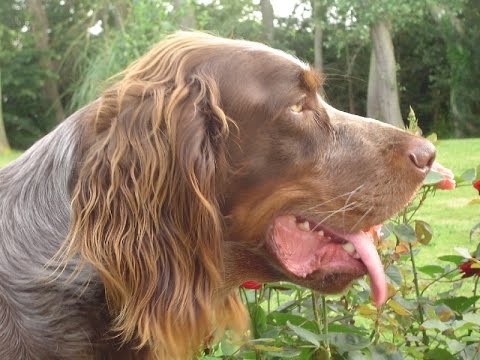
2 – Adult Griffon dog standing by Liv klesta, CC BY-SA 3.0, via Wikimedia Commons
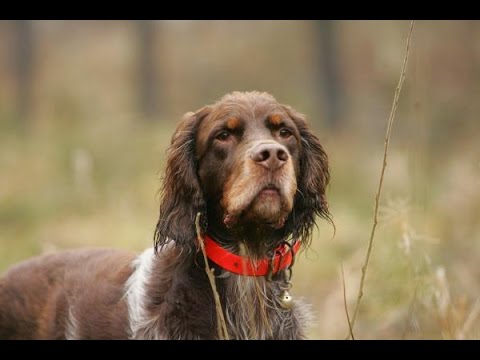
3 – Griffon d’arrรชt ร  poil dur Korthals by Pierre Andrรฉ, CC BY-SA 4.0, via Wikimedia Commons
4 – running Korthals Griffon by CarolPtak, CC BY-SA 4.0, via Wikimedia Commons
5 – Wirehaired Pointing Griffon by Pets Adviser from Brooklyn, USA, CC BY 2.0, via Wikimedia Commons
6 – Wirehaired Pointing Griffon by Canarian, CC BY-SA 4.0, via Wikimedia Commons

Videos "Wirehaired Pointing Griffon"
Type and recognitions:

  • FCI CLASSIFICATION:
  • Group :
  • Section : . .

Federations:

  • FCI – Group 7: Pointing Dogs. – Section 1: Continental Pointing Dogs. 1.3: Griffon type โ“˜
  • AKCSporting group โ“˜
  • ANKCSporting Group, Gundog โ“˜
  • CKCSporting Group, Gundog โ“˜
  • โ€‹KC – Sporting Group, Gundog โ“˜
  • NZKCSporting Group, Gundog โ“˜
  • UKCGun Dog โ“˜

FCI breed standard "Wirehaired Pointing Griffon"

Origin:
Germany, France, Netherlands

Date of publication of the valid original standard:
06.05.1964

Use:

This is essentially a versatile pointing dog. It is also used to look for the trace of wounded big game.


General appearance:

It is a vigorous dog, rustic, medium-sized. It is longer than high. The skull is not very wide, the muzzle is long and square. Dark yellow or brown eyes, there are tangled eyebrows that do not cover them completely. The whiskers and beard are well developed and give the animal a characteristic expression that denotes firmness and security..


Behavior / temperament:

Manso, haughty, excellent Hunter. He is very attached to his master and his territory, who cares diligently. He is very friendly with children.

Head:

It's big and long. It is covered with coarse and abundant hair, although not very long. The whiskers, the beard and eyebrows are well pronounced.

Cranial region:
  • Skull: Not very wide. The lines of the skull and the nasal cannula are parallel.
  • Depression links (Stop): Not very pronounced.

facial region:

  • Truffle: It is always brown.
  • Snout: Long and square. The muzzle is slightly arched and is the same length as the skull.
  • Eyes: Dark yellow or brown in color. They are big and round, the eyebrows are abundant, but they don't cover them. His expression is smart.
  • Ears: Medium-sized, they are not bent. They are flat and contiguous to the face; Its insertion is at the level of the eye line; the short hair that covers them is mixed with longer hairs.

Neck:

Medium long. There is no presence of dewlap.

Body:

Its length is visibly greater than that of the height of the withers.

(Of 1/20 to 1/10).
  • Back: Strong.
  • Pork loin: Well development.
  • Breast : Large, not very wide. The ribs are slightly arched.

Tail:

Presents horizontally or with the limb slightly raised. Hair is abundant, but without plume. The tail should usually be trimmed by a third or a quarter. If it's not cropped, must be presented horizontally, with the limb slightly raised.

Tips

PREVIOUS MEMBERS: Straight, powerful and thick hair. When the dog is in action there are parallels.
  • Shoulder: Well applied to the body. They are rather long and very oblique.
LATER MEMBERS: Covered with abundant hair.
  • Thighs: Long and well muscled.
  • Hocks: Well bent.
FEET: Round, firm. Fingers are well together and arched.

Movement:

The pace during the hunt is the gallop, which is interrupted by periods of jogging. The trot is elongated. The dog glides to the feline.

Mantle

HAIR: It's tough and rough. To the touch, looks like boar hair. Never curly, ni lanudo. Fine and tight hair is observed under the tough hair of the outer layer.

COLOR: Preferably steel gray with brown spots or uniform brown color. It is often rubican or roan brown. White and brown and white and orange coats are also accepted.


Size and weight:

  • In males: 55 to 60 cm.;
  • In females: 50 to 55 cm..


Fouls:

Any deviation from the aforementioned criteria is considered as a fault and the severity of this is considered to the degree of the deviation to the standard and its consequences on the health and well-being of the dog..

FALTAS DESCALIFICANTES:

โ€ข Aggressiveness or extreme shyness.
โ€ข Any dog โ€‹โ€‹showing clear signs of physical or behavioral abnormalities.


N.B.:

โ€ข Males must have two normal-appearing testicles fully descended into the scrotum..
โ€ข Only functionally and clinically healthy dogs, with the typical conformation of the breed, should be used for parenting.

Source: F.C.I - International Cynological Federation

Alternative names:

1. Korthals Griffon (English).
2. Korthals, Griffon Korthals (French).
3. Griffon ร  Poil Dur, Griffon Korthals (German).
4. Korthals (Portuguese).
5. Grifรณn Korthals, Korthals (espaรฑol).

โ–ท The world of Pets: Dogs, cats, birds, reptiles, amphibians

Blue Picardy Spaniel
Francia FCI 106 . Spaniel type

Blue Picardy Spaniel

Used for hunting, the Blue Picardy Spaniel is distinguished by its very pronounced style, his exceptional physical strength and its ability to evolve on all types of terrain.

Content

History

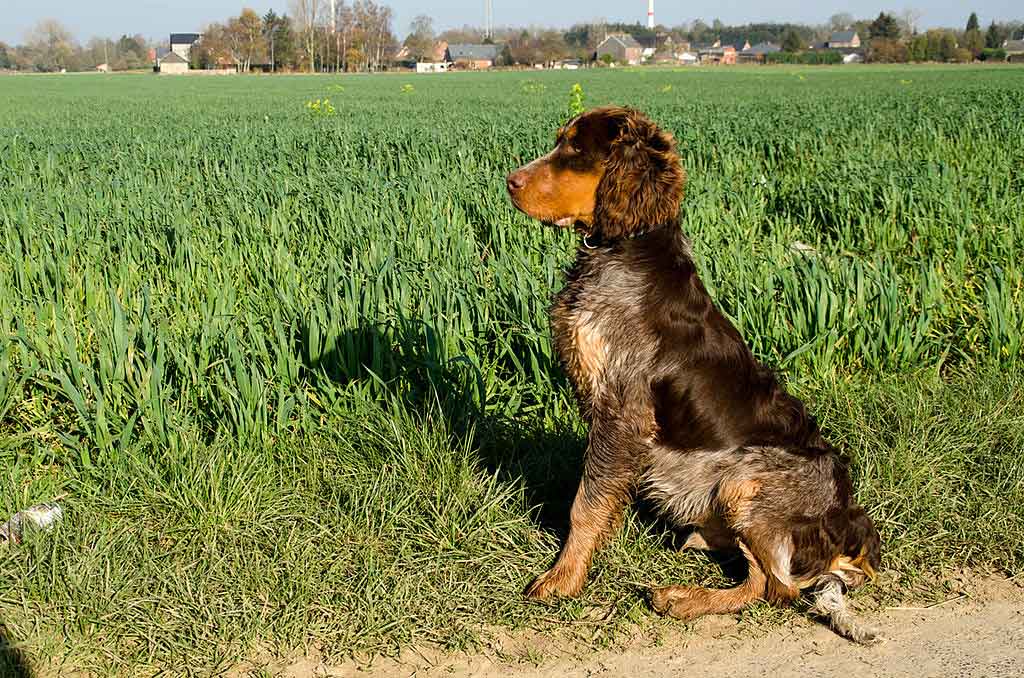
As its name suggests, the Blue Picardy Spaniel is a native of Picardy, a region of northern France. It is the result of the crosses made at the end of the 20th century between the Picardo Spaniel (in a gray coat speckled with brown spots, that appeared around the year 1000 during the Crusades and are very ancient cousins รขโ‚ฌโ€นรขโ‚ฌโ€นof the French Spaniel) and the English Setter ยซBlue Beltonยป (with a black and white coat, of Spanish origin and imported to England in the Middle Ages).

More precisely, These crosses were possible thanks to the arrival at Picardy and at the mouth of the Sum of many English hunters who came to board their hunting dogs, after the drastic quarantines introduced in his country. The two races mixed at that time, the initial goal was probably to end up with a dog with a longer gait than the Blue Picardy Spaniel, but also faster and with a better sense of smell.

At the beginning, the Picardy Spaniel and the Blue Picardy Spaniel they considered the same race, despite their different coats. The club of l’Epagneul Bleu de Picardie It was founded in 1907, but it wasn't until 1938 which was finally officially recognized as a distinct breed by the Fรฉdรฉration Cynologique Internationale (FCI). Past year, The club of l’Epagneul Bleu de Picardie had merged with the Club of l’Epagneul Picardie, founded for its part on 1921.

In 1980, The club of l’Epagneul de Pont-Audemer merged in turn, and the whole took the name of Club de l’Epagneul Picardie, du Bleu de Picardie and l’Epagneul Pont-Audemer. In 2015, the association changes its name and is renamed Club des Epagneuls de Picardie et de Pont-Audemer (CEPPA).

Several specimens were exported to Canada around 1987, and the Canadian Kennel Club in turn recognizes the breed in 1995. El American United Kennel Club (UKC) did the same the following year, at the same time as the Picardy Spaniel. On the other hand, the American Kennel Club (AKC), the other American reference organization, has not yet taken the step.

The Blue Picardy Spaniel, what is it called in english, It is also recognized by the American Association of Rare Breeds (ARBA), and this is not a coincidence: in fact, remains unknown in most of the world, and its acquisition is mainly in France, more particularly in his native region.

In France, in fact, has undergone a little more than 1.200 records LOF between 2010 and 2016, or some 180 by year. The trend is globally stable, probably supported by the good reputation it can boast as a hunting dog or as a pet.

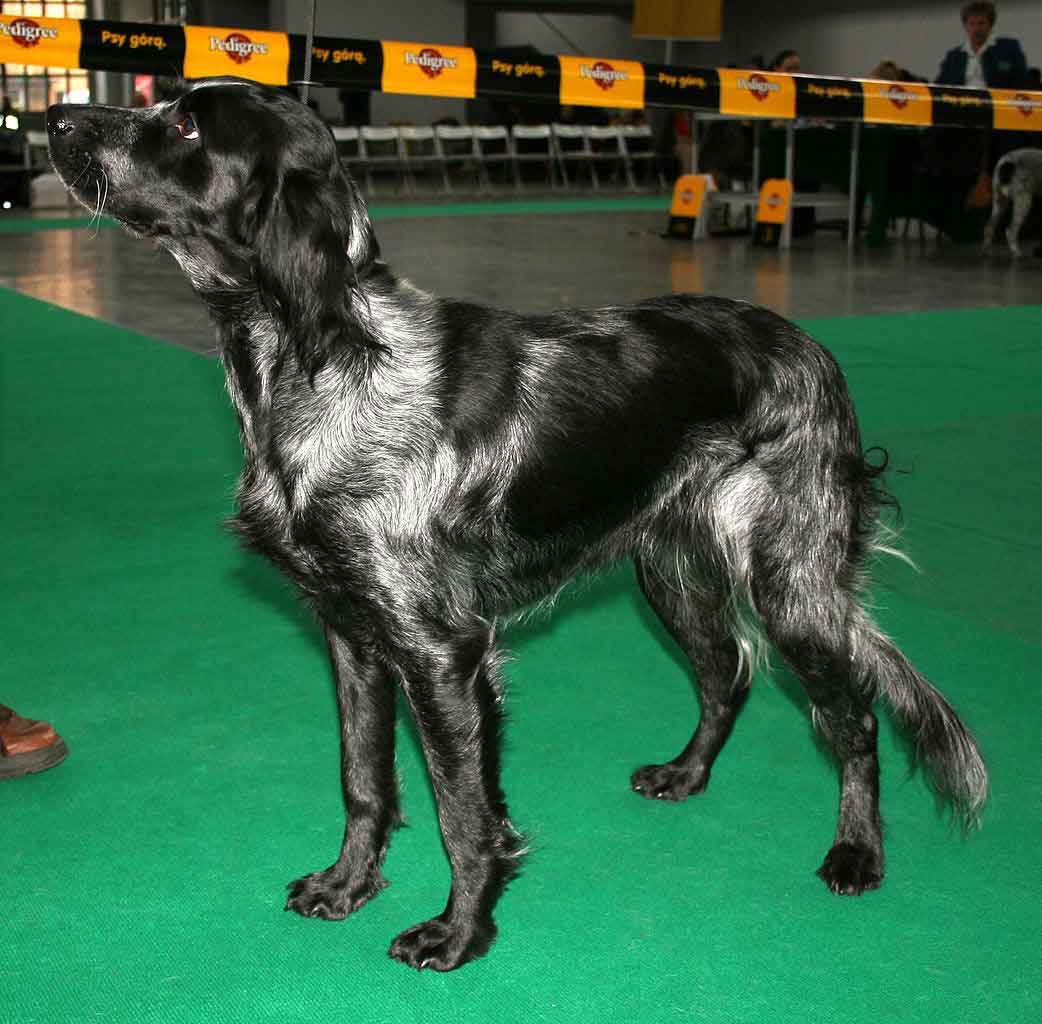
Photo: Blue Picardy Spaniel at the World Dog Show in Poznan, Poland by Pleple2000, CC BY-SA 3.0, via Wikimedia Commons

Physical characteristics

A ยซbraccoid typeยป pear, the Blue Picardy Spaniel is not very big. But, his robust and muscular body gives him an impression of power and vitality.

Its bluish coat is due to the presence of the English Setter between their ancestors. It is also speckled with gray and black, which gives it very particular and specific reflections of the breed. Hair is flat on the body, with some wavy strands in the ears, the legs and under the tail.

The eyes of the Blue Picardy Spaniel they are big, dark brown and have a calm and benevolent expression. The rounded ears are relatively long and droop to the sides..

Finally, its tail is long, flexible and fringed.

Character and skills

Used for hunting, the Blue Picardy Spaniel is distinguished by its very pronounced style, its exceptional physical resistance and its ability to evolve on all types of terrain. If required, he can even submerge himself in the icy water without hesitating to return the game to his master.

But, although hunting is in his genes and he is used to living in the countryside, can adapt to city life. But, they are sporting dogs that need to run and get plenty of exercise. So, life in the city – especially if it is in an apartment – it may only be suitable for him if there is time for long outings in nature. In any case, It is not a recommended breed of dog for an elderly or sedentary person, since it must be able to allow him to use his overflowing energy and spend himself.

Balanced and smooth (as long as your activity need is satisfied), lover to please his master, It is also an excellent companion dog., greatly enjoying family life, of which he is a full member. In particular, It is a breed of dog adapted to children: nothing aggressive, his affection towards them is unlimited, and loves to share games and pampering with them, which he likes a lot.

It is perfectly possible that your dog lives with other dogs, since the Blue Picardy Spaniel It is a sociable and gentle dog by nature.

On the other hand, it is strongly discouraged to put it in the presence of small animals such as rabbits or birds: would inevitably identify them with game that must be brought to their keeper, which can lead to slight misunderstandings.

As they don't bark much, do not have a strong sense of territory and therefore cannot be used as watchdogs.

Use

The Blue Picardy Spaniel it's mostly a hunting dog. It is particularly suitable for working on small game in forests and swamps, although he is still the specialist in woodcocks.

Used for hunting, they are excellent point and retrieve dogs with a very pronounced sense of smell and exceptional physical stamina, qualities that make them the real joy of their hunting owners.

It is also an ideal companion dog. It is easy to live with them and very sociable, easily acclimatizing to family life and quickly finding their place in it, either in the midst of adults only or in the presence of children, of whom quickly become the best and most loyal friends.

Health

There are no known genetic diseases peculiar to the Blue Picardy Spaniel But, like all spaniels, is particularly prone to ear infections, which are very common in dogs with floppy ears.

You also run the risk of injury during hunting parties, especially on the legs and pads. So, it is advisable to get used to checking that you do not limp when you return from hunting or a long activity in the open air. This could be a sign of a sprain or fracture, or simply caused by spikes, that can be as hidden as it is painful.

Finally, the Blue Picardy Spaniel you can fall victim to your greed and gain weight easily if you are not active enough. So, it is necessary to scrupulously monitor your dog's weight and, above all, make sure you always have your daily dose of adrenaline.

Grooming

In general, brushing is recommended when Blue Picardy Spaniel weekly, as its semi-long coat can easily retain twigs and dead leaves.

It also, and although it obviously depends on the activities that are carried out with him, it can be necessary, from time to time, wash their hair with a specific shampoo for dogs when it is really dirty.

In all cases, whether you return from hunting or go out to the field, you should carefully inspect your animal for thorns or a wound hidden by the hair.

Like any breed of dog with floppy ears, floppy ears pose a higher risk of infection and other problems, therefore they must be cleaned at least once a week with a suitable veterinary product.

Finally, due to its high level of activity, his claws should normally wear down in contact with the various floors he walks on. If that is not the case, should not hesitate (do) clipping your dog's claws once or twice a year.

Buy a โ€œBlue Picardy Spanielโ€

The price of a puppy Blue Picardy Spaniel is of some 600 EUR. There is no significant difference between the price of a male and a female.

Characteristics "Blue Picardy Spaniel"

Coexistence is important that you have with your new friend. Before considering the acquisition of a dog of the breed "Blue Picardy Spaniel" you know certain factors. Not all breeds of dogs are apt to live in an apartment, you must take into account his character, their need for exercise, their interaction with other pets, their care and if you have small children, their level of tolerance towards them.

Adaptation โ“˜

3,0 of 5 stars (based on 1 review)

friendly dog โ€‹โ€‹โ“˜

4,0 of 5 stars (based on 1 review)

hair loss โ“˜

3,0 of 5 stars (based on 1 review)

Affection level โ“˜

3,0 of 5 stars (based on 1 review)

Need for exercise โ“˜

5,0 of 5 stars (based on 1 review)

Social need โ“˜

4,0 of 5 stars (based on 1 review)

Home โ“˜

4,0 of 5 stars (based on 1 review)

Toilet โ“˜

2,0 of 5 stars (based on 1 review)

Friendly with strangers โ“˜

3,0 of 5 stars (based on 1 review)

barking โ“˜

2,0 of 5 stars (based on 1 review)

Health โ“˜

3,0 of 5 stars (based on 1 review)

Territorial โ“˜

3,0 of 5 stars (based on 1 review)

Cat friendly โ“˜

2,0 of 5 stars (based on 1 review)

Intelligence โ“˜

4,0 of 5 stars (based on 1 review)

Versatility โ“˜

4,0 of 5 stars (based on 1 review)

Child friendly โ“˜

4,0 of 5 stars (based on 1 review)

Surveillance โ“˜

2,0 of 5 stars (based on 1 review)

joy โ“˜

5,0 of 5 stars (based on 1 review)

Images "Blue Picardy Spaniel"

Videos "Blue Picardy Spaniel"

Type and recognitions:

  • FCI CLASSIFICATION:
  • Group :
  • Section : . .

Federations:

  • FCI – Group 7: Pointing Dogs. – Section 1: Continental Pointing Dogs. 1.2: Spaniel type โ“˜
  • AKCGun Dog Group โ“˜
  • CKC – Sports โ“˜
  • UKCGun Dog Group โ“˜

FCI breed standard "Blue Picardy Spaniel"

Origin:
France

Date of publication of the valid original standard:
24.06.1987

Use:

Pointing Dogs.


General appearance:

It is a dog quite close to the ground, well shaped for work. Its general appearance as a whole is that of the Picardy Spaniel.


Behavior / temperament:

---

Head:

---

Cranial region:
  • Skull: Oval, relatively wide, without the parietals sticking out; occipital bone slightly pronounced.
  • Depression links (Stop): Medium accentuated, but well marked.

facial region:

  • Truffle: Wide, with wide open Windows.
  • Snout: Long, and quite wide.
  • Lips: Wide and good fall. They form a square snout.

Eyes: calm expression; dark eyes, large, wide open.

Ears: Its insertion should be a little below the line of the eyes, framing the head well. They should be fairly thick in consistency, beautiful hair, silky and wavy; the length of the ear must reach the end of the muzzle

Neck:

Well inserted into the trunk; a slight double chin is allowed.

Body:

  • Back and loin: Not too long, well sustained.
  • Rump: slightly sagging.
  • Breast : Good medium depth.
  • Ribs: Harmoniously arched, which descend to the level of the elbow.

Tail:

It should not exceed the tibio-tarsal joint in length, nor present hook shape.

Tips

PREVIOUS MEMBERS:

  • Shoulder and arm: Slightly oblique.
  • Forearm: Strong and very muscular.
  • Previous foot: Redondo, a little wide but not squashed. Very close fingers with abundant hair between each other.

LATER MEMBERS:

  • Thigh: Very muscular.
  • Leg: Long and adorned with abundant feathers.
  • Warm-foot joint: Angled without exaggeration and adorned with feathers from the tibia-tarsal joint to the foot.
  • Rear foot: Redondo, a bit wide, but not squashed; with abundant hair between the fingers, which are very close to each other.

Movement:

---

Mantle

  • Fur: Smooth or slightly wavy. The feathers adorn the limbs and tail well.
  • Color: Speckled black gray color giving a bluish appearance with black spots


Size and weight:

Height to the cross: 57 to 60 cm in males. A little less in females.


Fouls:

Any deviation from the aforementioned criteria is considered as a fault and the severity of this is considered to the degree of the deviation to the standard and its consequences on the health and well-being of the dog..

โ€ข Skull: Too narrow, not chiseled.
โ€ข muzzle: Pointed.
โ€ข Eyes: Clear and too small.
โ€ข Ears: Short and thin, insertion too high.
โ€ข Ribs: Too flat or too arched.
โ€ข Pie: Plano, squashed or too wide.

FALTAS DESCALIFICANTES:

โ€ข Aggressiveness or extreme shyness.
โ€ข Any dog โ€‹โ€‹showing clear signs of physical or behavioral abnormalities.


N.B.:

โ€ข Males must have two normal-appearing testicles fully descended into the scrotum..
โ€ข Only functionally and clinically healthy dogs, with the typical conformation of the breed, should be used for parenting.

Source: F.C.I - International Cynological Federation

Alternative names:

1. Blue Picardy Spaniel, Bleu Picard (English).
2. ร‰pagneul bleu de Picardie (French).
3. Blauer Picardie-Spanel, Epagneul Bleu Picard (German).
4. Spaniel azul da Picardia, (em francรชs: epagneul bleu de Picardie) (Portuguese).
5. ร‰pagneul bleu de Picardie (espaรฑol).

โ–ท The world of Pets: Dogs, cats, birds, reptiles, amphibians

Irish Red and White Setter
Irlanda FCI 330 . Setter

Setter Irlandรฉs Rojo y Blanco

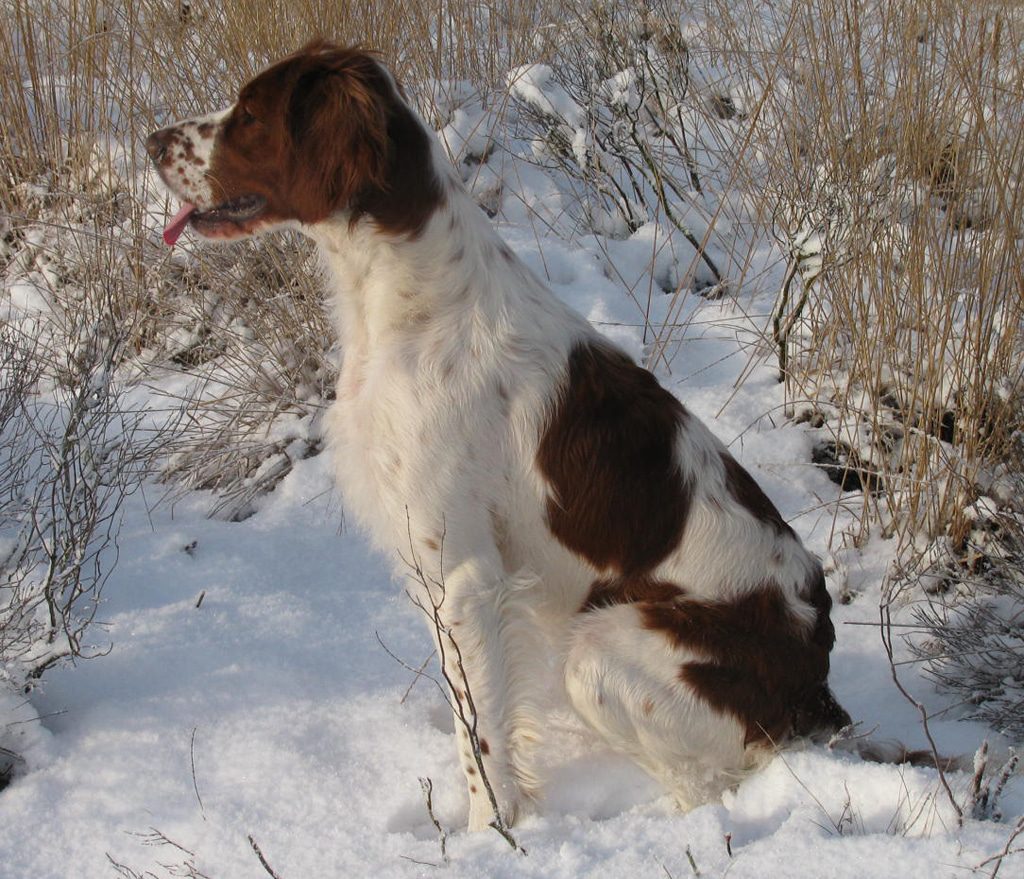
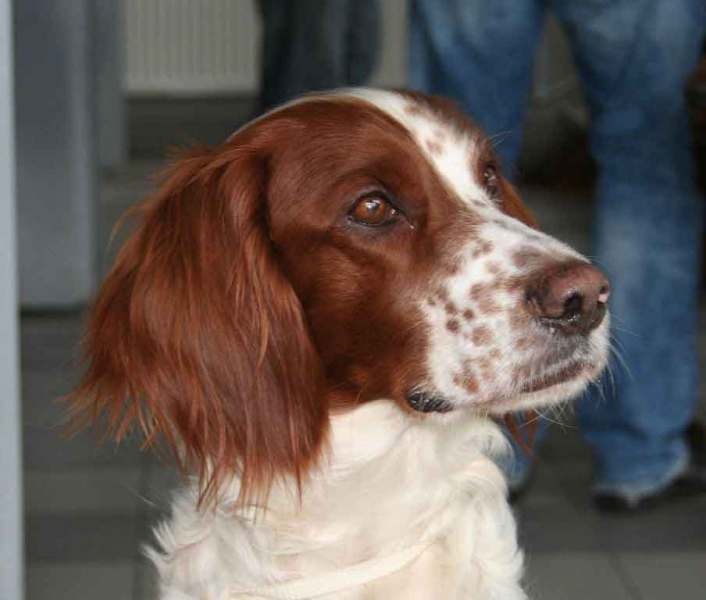
Irish hunters consider the Irish Red and White Setter higher than Irish Red Setter because of its calmer temperament and because it is less visible in the autumn landscape.

Content

History

The Irish Setter it was probably well known in the late 17th century. Outside of ireland, little is known about the existence of two varieties of Irish Setter: the Irish Red and White Setter and the Irish Red Setter. It is the red and white variety that preceded the other, and it is a judicious selection that developed the uniform red color.

When the Irish setters were first exhibited shortly after the middle of the 19th century, there was a lot of confusion about its color. At the end of the 19th century, the red variety had outshone the red and white, which became so rare that the breed was thought to have become extinct.

In the Decade of 1920, the breeders tried to revive the breed and in 1944 the breed was sufficiently recovered to form a club. In the news, the breed is enjoying a slight revival, and you can find many Irish Red and White Setter in exhibitions and fields.

The current club, the Labor and Exhibition Society of the Irish Red and White Setter, was founded in 1981. Thanks to your efforts and your line of action, the breed is now well established nationally and internationally.

The Irish Red and White Setter, in competition with other breeds of Pointing Dogs, has been successful in field trials, and currently there are a good number of working and exhibition champions.

Originally all Irish Setter were, mostly, red, or red and white, but around 1880 breeders began to prefer the variety of solid red color and as a result, the race was on verge of extinction.

Photo: irwskingspeaks.nl

Physical characteristics

Exist 2 varieties of Irish Setter, which differ in both their morphology and their behavior in the field.

The Irish Red Setter can be compared to the thoroughbred horse, all steel and tension, no superfluous meat or thick muscles. It must give the impression of extreme speed and everything about it contributes to this: dry fabrics (light but strong skeleton), long and dense muscles, thin and tight skin, without jowl.

The Irish Red and White Setter is similar to the Hunter: very resistant, powerful and robust. The chest is more rounded than the red one and its skin is thicker.

The coat is white with solid red spots.

Height and weight

    ▷ Male size: Of 62 to 66 cm.

    ▷ female size: Of 57 to 61 cm.

    ▷ Male weight: Of 20 to 25 kg

    ▷ female weight: Of 18 to 23 kg

Character and skills

The kind and caring Irish Red and White Setter not only is it a popular hunting dog. Thanks to its excellent ability to smell and its strong natural instincts to point and recover, does double duty as a friend of the family. He likes children and can fit in well in a family with children, with the caveat that he's quite rambunctious, especially when it's a puppy, and should always be supervised when there are young children.

The Irish Red and White Setter is always alert, so it is a good watchdog, but does not have the protective nature of a guard dog. In general, gets along with other dogs and is friendly with cats when raised with them. But keep in mind that it only has a score of 3 In "kindness with cats" on a scale of 1 to 5.

This is an active sporty dog รขโ‚ฌโ€นรขโ‚ฌโ€นthat needs to exercise daily. Take it for a run, to take a long walk, walk him for half an hour twice a day or play ball until his arms ache. All of these activities will help you satisfy your need to be outside doing something.. If you are interested in dog sports, is an excellent candidate for agility, the flyball, obedience, the rally and the crawl. It is nice, friendly and mild-mannered once he's past the puppy stage, and it also has wood to be a good therapy dog รขโ‚ฌโ€นรขโ‚ฌโ€นto visit facilities such as nursing homes and children's hospitals.

In the countryside, the Irish Red and White Setter work at a moderate pace, without ever straying too far from the hunter. He is full of curiosity and seeks hunting in the field. Choose it if your hunting ground is wooded or near a river or lake (better suited to large open spaces).

With regard to training, the Irish Red and White Setter may be a contradiction. He's kind but headstrong, smart but slow to mature. Train him with a light touch so as not to distort his determination, his courage and his high spirit.

Health

All dogs have the potential to develop genetic health problems, like all people have the potential to inherit diseases. Avoid any breeder that does not offer a health guarantee for the puppies, to tell you that the breed has no known problems or to keep puppies isolated from the main part of the house for health reasons. A reputable breeder will be honest and open about the health problems of the breed and the incidence with which they occur.

The Irish Red and White Setter have health problems that may be cause for concern, especially if the breeder is not carefully examined. Among them are hip dysplasia, eye problems such as cataracts and progressive retinal atrophy, hypothyroidism and an immune disorder called canine leukocyte adhesion deficiency (CLAD). A reputable breeder will be honest and open about health problems in the breed and the incidence with which they occur in their lines..

Do not buy a puppy from a breeder who cannot provide you with written documentation that the parents have been exempted from health issues affecting the breed. Having dogs โ€œvet checkedโ€ is no substitute for genetic health testing.

Inform your dog's breeder of any serious illness. If the breeders do not know that a health problem has appeared in their line, cannot take steps to eradicate it.

Grooming

The Irish Red and White Setter has a silky coat that removes dirt easily. Also loose hair, but in a moderate way. The coat should look natural and, except for the bottom of the feet, does not need to be shaved or trimmed.

Brush and comb the coat a couple of times a week - and whenever the dog has been in the field- taking care to gently remove any tangles or kills in the coat. Regular brushing will keep the coat clean, but you will need to bathe the dog from time to time if the white hair starts to get dirty.

The rest is basic care. Trim nails when necessary, usually every one to two weeks. Brush teeth frequently with a vet-approved pet toothpaste for overall good health and fresh breath.

Characteristics "Irish Red and White Setter"

Coexistence is important that you have with your new friend. Before considering the acquisition of a dog of the breed "Irish Red and White Setter" you know certain factors. Not all breeds of dogs are apt to live in an apartment, you must take into account his character, their need for exercise, their interaction with other pets, their care and if you have small children, their level of tolerance towards them.

Adaptation โ“˜

2,0 of 5 stars (based on 1 review)

friendly dog โ€‹โ€‹โ“˜

4,0 of 5 stars (based on 1 review)

hair loss โ“˜

3,0 of 5 stars (based on 1 review)

Affection level โ“˜

5,0 of 5 stars (based on 1 review)

Need for exercise โ“˜

5,0 of 5 stars (based on 1 review)

Social need โ“˜

4,0 of 5 stars (based on 1 review)

Home โ“˜

3,0 of 5 stars (based on 1 review)

Toilet โ“˜

3,0 of 5 stars (based on 1 review)

Friendly with strangers โ“˜

2,0 of 5 stars (based on 1 review)

barking โ“˜

3,0 of 5 stars (based on 1 review)

Health โ“˜

3,0 of 5 stars (based on 1 review)

Territorial โ“˜

3,0 of 5 stars (based on 1 review)

Cat friendly โ“˜

3,0 of 5 stars (based on 1 review)

Intelligence โ“˜

3,0 of 5 stars (based on 1 review)

Versatility โ“˜

3,0 of 5 stars (based on 1 review)

Child friendly โ“˜

5,0 of 5 stars (based on 1 review)

Surveillance โ“˜

3,0 of 5 stars (based on 1 review)

joy โ“˜

4,0 of 5 stars (based on 1 review)

Images "Irish Red and White Setter"

Photo:

1 – Irish Red and White Setter during the international dog show in Rzeszรณw, Poland. by Pleple2000, CC BY-SA 3.0, via Wikimedia Commons
2 – Irish Red and White Setter during the international dog show in Rzeszรณw, Poland. by by Pleple2000, CC BY-SA 3.0, via Wikimedia Commons
3 – Irish Red and White Setter by Ordinary Guy, CC BY 2.0, via Wikimedia Commons
4 – Merlin in the kitchen by Dekker70, CC BY-SA 4.0, via Wikimedia Commons
5 – Irish Red and White Setter during the international dog show in Rzeszรณw, Polonia by Pleple2000, CC BY-SA 3.0, via Wikimedia Commons
6 – Irish Red and White Setter during the international dog show in Rzeszรณw, Polonia by Pleple2000, CC BY-SA 3.0, via Wikimedia Commons

Videos "Irish Red and White Setter"

Type and recognitions:

  • FCI CLASSIFICATION:
  • Group :
  • Section : . .

Federations:

  • FCI – Group 7: Pointing Dogs. – Section 2: British and Irish Pointers and Setters. 2.2: Setter โ“˜
  • AKCSporting (FSS) โ“˜
  • ANKC (Gun dogs) โ“˜
  • CKCGroup 1 – Sporting dogs โ“˜
  • โ€‹KC – Gun dog โ“˜
  • NZKCGundog โ“˜
  • UKCGun dog breeds โ“˜

FCI breed standard "Irish Red and White Setter"

Origin:
Ireland

Date of publication of the valid original standard:
19.04.2005

Use:

Very good companion and friend at home and in the field. The Irish Red and White Setter is primarily bred for the field. The standard from now on must be interpreted primarily from this point of view and all judges on the courts must judge them primarily from the point of view of work..


General appearance:

Strong, well balanced and proportioned without heaviness; more athletic than light. The Irish Red and White Setter is primarily bred for work and should be judged primarily from this perspective..


Behavior / temperament:

Aristocratic, cunning and smart, manifests kindness and friendship, dispositions behind which determination must be discerned, The courage and its great spirit. The Irish Red and White Setter is very friendly, dependent and easy to train as a hunting dog.

Head:

Wide in proportion to the body.

Cranial region:
  • Craging: And domo, no marked occipital bulge as in the case of the Irish Red Setter.
  • Dnaso-frontal depression (Stop): Marked.

facial region:

  • Hocico: Net and square.
  • Jaws: Jaws equal to or almost the same.
  • Dinentities: Regular. The scissor bite is the ideal, pincer bite is acceptable.
  • Eyes: Dark hazelnut or dark brown color; oval, slightly prominent, no visible conjunctiva.
  • Ears: Implanted at eye level and set well back, falling close to the head.

Neck:

Moderately long, very muscular, not too thick, slightly arched, without any tendency to have a double chin.

Body:

Strong and muscular.

  • Lรญnea Superior: Very muscular and powerful.
  • Breast : Deep, with well arched ribs.

Tail:

Of moderate length, does not descend below the hock. Strong at birth, progressively tapers to a fine point, without giving the impression of being knotty. It is carried at the level of the back or below.

Tips

Well muscled and sinewy legs, strong bone.

PREVIOUS MEMBERS:

  • Escapula: Well oblique.
  • Cskin: Free, neither in nor out.
  • Pinernas anteriores: Straight and wiry, with good bone.
  • Metacarpus: Strong.
  • Pinis previous: Fingers tight with thick hair between them.

LATER MEMBERS:

  • Ageneral appearance: Wide and powerful; back legs from hip to hock long and muscular.
  • Rodilla: Well angled.
  • Corvejones: Well descended; they are not deflected either outwards or inwards. From hock to heel of moderate length and strong.
  • Pinis later: Fingers tight with thick hair between them.

Movement:

At a trot, wide movement, lively, funny and efficient. The head is carried high. The rear drive is smooth and very powerful. The above are propelled well forward and held low. Seen from the front or the back, the action of the anterior and posterior (under the hock) performed in a plane perpendicular to the ground. Without crossing or knitting, in the before or after.

Mantle

Fur: Long hair, silky and fine "feathers" behind the anterior and posterior members and on the outside of the ear pavilion, also a reasonable amount on the flanks extending to the chest and throat forming fringes. All the fringes are straight, smooth and free of curlers, soft waves are allowed. The tail must have a lot of fringe. In all other parts of the body the hair must be short, smooth and free of curlers.

Color: Base color is white with solid red patches (defined islands of red), Both colors must demonstrate the maximum of life and lozania; stains allowed, but not the splashed ones (mixed hairs) in the face, the feet, on the forelimbs up to the elbow and on the hindlimbs up to the hock. Splashed, spotted and mottled on any other part of the body are objectionable.


Size and weight:

Desired height at the withers:

  • Males: 62-66 cm. (24,5 โ€“ 26 inches).
  • females: 57-61 cm. (22,5 โ€“ 24 inches).


Fouls:

Any deviation from the aforementioned criteria is considered as a fault and the severity of this is considered to the degree of the deviation to the standard and its consequences on the health and well-being of the dog..

FAFROMS GRAVES:

  • Any specimen, male or female that is not within the height standard.

FALTAS DISQUALIFYERS:

  • Aggressiveness or extreme shyness.
  • Any dog โ€‹โ€‹showing clear signs of physical or behavioral abnormalities.
  • Males who do not have two apparently normal testicles.
  • Although spotted but not splattered is allowed on the face, feet and forelimbs up to the elbow and hindlimbs up to the hock; splattered, spotted and mottledvisible and in excessin any other part of the body are eliminating fouls.


N.B.:
  • Males should have two normal-appearing testicles fully descended into the scrotum..
  • Only functionally and clinically healthy dogs, with the typical conformation of the breed, should be used for parenting.

Source: F.C.I - International Cynological Federation

Alternative names:

1. Irish R&W Setter, IRWS/span> (inglรฉs).
2. Setter irlandais rouge et blanc (francรฉs).
3. Irischer Rot-WeiรŸer Setter (alemรกn).
4. (em inglรชs: Irish Red and White Setter) (portuguรฉs).
5. IRWS (espaรฑol).

โ–ท The world of Pets: Dogs, cats, birds, reptiles, amphibians

Picardy Spaniel
Francia FCI 108 . Spaniel type

Docile and resistant, happy with little, the Picardy Spaniel however needs the constant attention of your caregiver.

Content

History

The French Spaniel and the Picardy Spaniel the two races of Spaniel oldest on the European continent. Both seem to descend from the "oyys dog" described in the works of Gaston Fรฉbus (siglo XIII). At that time, Hunting was one of the most popular activities of the French nobility and the Spaniel French type was one of the most popular breeds. The breed is represented in paintings from this period by artists such as Alexandre-Franรงois Desportes and Jean-Baptiste Oudry. It is also the first dog breed to be admitted to exhibitions..

The breed became more popular after the French Revolution, since hunting is no longer an activity reserved exclusively for the nobility. Although it is found throughout the country, a large contingent is present in the northwest of the country, where its water resistant coat makes it an ideal breed for hunting in forests and swamps. During the 19th century, English hunters crossed the English Channel and traveled to northwestern France to hunt in these famous lands. So they brought their own hunting dogs, that the French gradually adopted, thus endangering Picardy Spaniel. It also, the infusion of blood from English Setter in the race created the Blue Picardy Spaniel.

The Picardy Spaniel it is a very rare breed of dog, which is almost only found in metropolitan France.

The Picardy Spaniel is recognized by a wide variety of canine clubs and associations such as the International Canine Federation, even abroad like him North American Kennel Club, the American Rare Breed Association, the United Kennel Club. All these associations use the FCI standard. It is also recognized by the Continental Kennel Club, but unlike the Blue Picardy Spaniel, which is closely related to him, is not recognized by the Canadian Kennel Club.

Photo: ยซSpaniel Picardoยป in the World Canina Exhibition of Poznaล„ Pleple2000, CC BY-SA 3.0, via Wikimedia Commons

Physical characteristics

The Picardy Spaniel he is a beautiful dog, strong, elegant, nervous, solid and well muscled. Its coat is gray with brown spots on the different parts of the body and often tan on the head and legs.. Her dark amber eyes go wide giving you an expressive look. Its abundant and slightly wavy coat gives it protection, allowing you to work in the toughest places, especially in the water. The ears are long, quite low, located on the eye line and decorated with beautiful fringes. The tail, adorned with beautiful fur, worn with distinction. Its size ranges from 55 and 60 cm..

Character and skills

The FCI breed standard does not describe a typical temperament for the Picardy Spaniel. The Picardy Spaniel it is considered a docile breed of dog that loves to play with children, and easily bond with your caregiver. Generally described as a docile dog, good-natured and easy to train.

Above all, They are hunting dogs that need a lot of exercise to express their energy., resistance and rusticity.

His training is natural; the Picardy Spaniel they work to please their caregiver. Report, on land and in deep water, it's a pleasure for him. The rewards, caresses and compliments are the basis of his education.

Utility

The Picardy Spaniel is a hunting dog, that needs daily departures.

The Picardy Spaniel are used for hunting, in the woods for pheasant or in the swamps where they hunt, in particular, the snipe. It is also an effective dog for duck hunting, the hare or the rabbit. They are especially effective in swamps, where they do not hesitate to jump into the water. If required, can also recover hunting. This dog loves wide spaces where he can exercise, but you can also settle for smaller spaces and you can live very well in the city. The hair is abundant and slightly wavy, allowing you to hunt in dense vegetation and enter the water without any difficulty.

These docile dogs make great companion dogs., but they require a lot of physical exercise.

Health

There are no known hereditary genetic diseases in dogs Picardy Spaniel. Its longevity is of 14 years on average. The Picardy Spaniel is especially sensitive to ear infections, like most floppy eared dogs, like other breeds of โ€œSpaniels or Bassetsโ€. The Picardy Spaniel tend to gain weight quickly if overfed.

Characteristics "Picardy Spaniel"

Coexistence is important that you have with your new friend. Before considering the acquisition of a dog of the breed "Picardy Spaniel" you know certain factors. Not all breeds of dogs are apt to live in an apartment, you must take into account his character, their need for exercise, their interaction with other pets, their care and if you have small children, their level of tolerance towards them.

Adaptation โ“˜

3,0 of 5 stars (based on 1 review)

friendly dog โ€‹โ€‹โ“˜

3,0 of 5 stars (based on 1 review)

hair loss โ“˜

3,0 of 5 stars (based on 1 review)

Affection level โ“˜

5,0 of 5 stars (based on 1 review)

Need for exercise โ“˜

5,0 of 5 stars (based on 1 review)

Social need โ“˜

3,0 of 5 stars (based on 1 review)

Home โ“˜

3,0 of 5 stars (based on 1 review)

Toilet โ“˜

2,0 of 5 stars (based on 1 review)

Friendly with strangers โ“˜

3,0 of 5 stars (based on 1 review)

barking โ“˜

3,0 of 5 stars (based on 1 review)

Health โ“˜

4,0 of 5 stars (based on 1 review)

Territorial โ“˜

2,0 of 5 stars (based on 1 review)

Cat friendly โ“˜

2,0 of 5 stars (based on 1 review)

Intelligence โ“˜

4,0 of 5 stars (based on 1 review)

Versatility โ“˜

4,0 of 5 stars (based on 1 review)

Child friendly โ“˜

4,0 of 5 stars (based on 1 review)

Surveillance โ“˜

2,0 of 5 stars (based on 1 review)

joy โ“˜

4,0 of 5 stars (based on 1 review)

Images "Picardy Spaniel"

Picardy Spaniel

Our "Spaniel Picardo", Gibbs des Chaumes de Thiรฉrache to the 6 meses by Rachelle Vafidis, CC BY-SA 3.0, via Wikimedia Commons

Picardy Spaniel

Our "Spaniel Picardo", Gibbs des Chaumes de Thiรฉrache to the 6 meses by Rachelle Vafidis, CC BY-SA 3.0, via Wikimedia Commons

Videos "Picardy Spaniel"

Spaniel picardo (Picardy Spaniel) - Breed of dog
Spaniel picardo (Epagneul picard) – Breed of dog
Picardy Spaniel (Picardy Spaniel)
Picardy Spaniel (Epagneul Picard)

Type and recognitions:

  • FCI CLASSIFICATION:
  • Group :
  • Section : . .

Federations:

  • FCI – Group 7: Pointing Dogs. – Section 1: Continental Pointing Dogs. 1.2: Spaniel type โ“˜
  • โ€‹KC – Hunting dog โ“˜
  • UKCGun Dog โ“˜

FCI breed standard "Picardy Spaniel"

Origin:
France

Date of publication of the valid original standard:
30.10.1964

Use:

Pointing Dogs.


General appearance:

Very compact dog, With strong and muscular members, sweet and expressive; Hears his head with a cheerful and high attitude. Its previous members are well developed.


Behavior / temperament:

---

Head:

---

Cranial region:
  • Skull : Round and wide, with well -pronounced occiput; Parietal bones are flattened.
  • Fronto-nasal depression (Stop) : Well inclined, Without forming a right angle.

facial region:

  • Truffle : Brown in color, medium, quite rounded.
  • Snout : Long, quite wide, He gradually thin.
  • Lips : Moderate thickness; The upper lip falls a bit on the lower, but without hanging.

Eyes : Dark amber color, Well open with a frank and expressive look.

Ears : Low enough to frame your head well; The hairs are beautiful, silky and undulating.

Neck:

With good placement and well muscular.

Body:

The hips are located a little lower than the cross.

  • Back : Moderately long, slightly sunk after the cross.
  • Pork loin : Well straight, not too long, broad and thick.
  • Rump : Very slightly inclined and rounded.
  • Breast : Deep and quite wide; It clearly descends to the elbow level.
  • Flanks : Plans, But deep, quite raised.

Tail:

The insertion of the tail is not very high; form two concave and convex light curves; It is not very long and is covered with a beautiful silky hair.

Tips

PREVIOUS MEMBERS : Straight and with strong muscles, adorned with fringes.

  • Shoulder : Quite long shoulder blades, rather straight and endowed with strong muscles.
  • Arms : Well muscled.
  • Elbows : Well located.

LATER MEMBERS : Presence of good hair strip to the warm-Tarsian joint.

  • Hips : Prominent, At the level of the sword and the spine.
  • Thighs : Straight, well descended, wide and well muscled
  • Warm-tarsal joints : Little angled.
  • Metacarpus : Straight.

FEET : Round, widths, together, With a little hair between the fingers.

Movement:

---

Mantle

SKIN : Quite fine and flexible.

HAIR : Thick, Not too silky, head, slightly undulating the body.

COLOR : Mottled gray, With brown plates on different parts of the body and at the birth of the tail; more frequently marked fire in the head and feet.


Size and weight:

Height to the cross : 55 to 60 cm..

Tolerance is admitted to 62 cm in males.


Fouls:

Any deviation from the aforementioned criteria is considered as a fault and the severity of this is considered to the degree of the deviation to the standard and its consequences on the health and well-being of the dog..

โ€ข Pear -shaped head, Very narrow.
โ€ข Square skull, narrow or short.
โ€ข Very straight front-nose depression angle.
โ€ข Black truffle, sharp, closed; double nose.
โ€ข Muzzle too short, Very convex.
โ€ข Too thick lips, very tight.
โ€ข Too light eyes, Very sunk, at the level of the head, oblique; Malignant look.
โ€ข narrow ears, short, too high implantation, very curly hair covers or lacking silky hair.
โ€ข Very long neck, too short or very thin.
โ€ข Very long or reilled back.
โ€ข Loin too long, very narrow or very weak.
โ€ข Very inclined rump.
โ€ข Very narrow or not deep enough chest.
โ€ข Round flanks, very raised or very fallen.
โ€ข Saber -shaped tail, too long, hair too curly, of very high or very low insert.
โ€ข Previous members without stripes, skinny; Closed or separate elbows.
โ€ข Very short scapulae, Too many straight or inclined, directed very backward.
โ€ข Very thin arm.
โ€ข Carpo firing forward.
โ€ข Very high hips, Very low, Too close.
โ€ข Narrow thigh, without hair stripes.
โ€ข Tibio-Tarsian joints too angled or cow-shaped.
โ€ข Narrow feet, crushed, Very separate fingers.
โ€ข Too thick skin.
โ€ข Fine fur, silky, Crespo or too short.
โ€ข Too brown color, White or black spots.

FALTAS DESCALIFICANTES:

โ€ข Aggressiveness or extreme shyness.
โ€ข Any dog โ€‹โ€‹showing clear signs of physical or behavioral abnormalities.


N.B.:

โ€ข Males must have two normal-appearing testicles fully descended into the scrotum..
โ€ข Only functionally and clinically healthy dogs, with the typical conformation of the breed, should be used for parenting.

Source: F.C.I - International Cynological Federation

Alternative names:

1. Epagneul picard (English).
2. ร‰pagneul picard (French).
3. Epagneul Picard (German).
4. (em francรชs: Epagneul Picard) (Portuguese).
5. Epagneul picard (espaรฑol).

โ–ท The world of Pets: Dogs, cats, birds, reptiles, amphibians

Small Blue Gascony
Francia FCI 31 - Medium-sized Hounds

Small Blue Gascony

The Small Blue Gascony, in general, they are considered docile and very attached to their master, very friendly with children and sociable with other dogs.

Content

History

The Small Blue Gascony is a short legged version of the Great Gascony Blue, his ancestor. But, although the history of the latter extends deep into the history of all of Europe and even the United States, its history has remained closely linked to its country of origin, France.

Its appearance dates back to the end of the Middle Ages, and more precisely to the sixteenth century. The development of the breed is not the result of crossing the Great Gascony Blue with smaller dogs, but simply from a true selective breeding program that consists of selecting and breeding the smallest individuals, generation after generation. Although they were very efficient in hunting wild boar and large game in packs, the Great Blue was nevertheless a heavy hound, and was not entirely satisfactory in tracking small game in the high forests.

The Small Blue Gascony was therefore developed for the specific purpose of hunting rabbits, hares and other small game animals. Faster than its predecessor, inherited its tracking and exploration skills from its predecessor. Its use spread in France beyond its region of origin, Gascuรฑa (in the southwest of the country). Unlike many dog โ€‹โ€‹breeds that were decimated during these periods, did not suffer much with the French Revolution and the two World Wars. Thanks to his skill in hunting rabbits, has been able to get through these clashes in French history without too many losses, and remain present in relatively constant numbers despite events.

But, despite this resistance and its renowned performance in hunting small game, very little was exported, unlike his older brother, that set foot in the United States as early as the 18th century. This is mainly due to the fact that Small Blue, raised in herds, it was much less profitable to hunt than the Great Blue, that it was able to attack larger prey and thus provide more food. But, in France, despite this disadvantage, became progressively more popular than with hunters and families.

However, gained visibility on the international scene in 1963, cuando the International Cynological Federation (FCI) officially recognized the breed. El American United Kennel Club (UKC) did the same in 1991. But, he still has a long way to go in this respect, as they have not been emulated by many other major organizations. These may include, so far, nor the other great American organization, the American Kennel Club (AKC), nor his neighbor the Canadian Kennel Club (CCC), nor the prestigious British Kennel Club, they have taken the step.

In fact, the Small Blue Gascony is still today mainly present in its country of origin. It has even become more and more popular there in recent decades.. This was particularly surprising in the 1990s. 1980, when it happened 50 annual entries in the Livre des Origines Franรงais (LOF) in the early years of the decade to more than 200 at the end, that is to say, quadrupled. The trend increased in the early 1990s 1990, and the number stabilized at around 450 per year from 1993. There is a new rise at the dawn of the 21st century, when the 550 registrations per year. From 2006 there is a steep decline, so that by the end of 2010 there are only a few 350 births per year. But, this is still more than four times the number that its predecessor, the Great Gascony Blue, can boast.

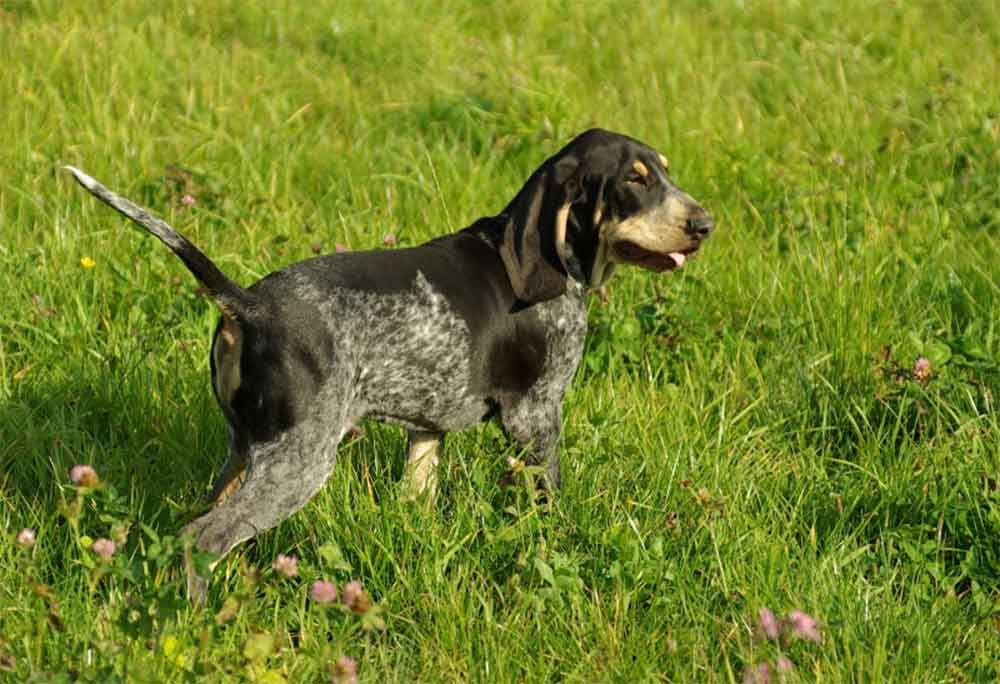
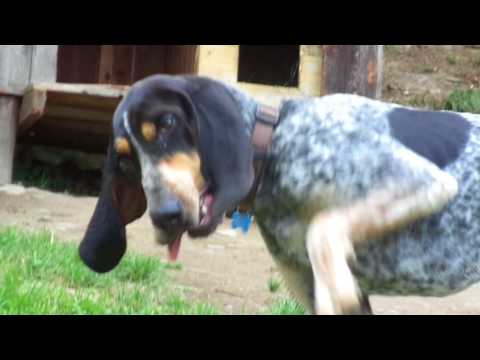
Photo: Small Blue Gascony Hound, male ยซBrigand od Smutne rickyยป from kennel ยซLe Bleu Cardinalis FCIยป, Poland. The owner – Katarzyna Bujko by Katarzyna Bujko, CC BY 3.0, via Wikimedia Commons

Physical characteristics ยซLittle blue Gascogne houndยป

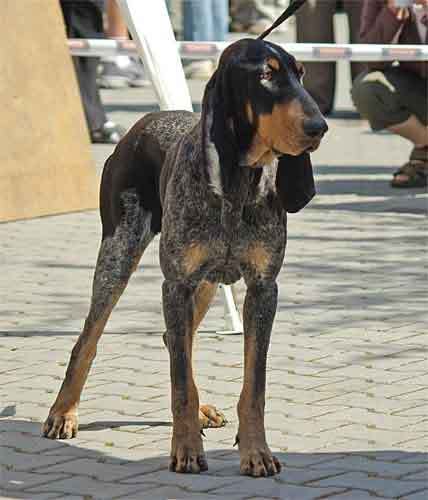
The Small Blue Gascony has an appearance very close to that of his ancestor, the Great Gascony Blue, and even its size is not so far from the latter, whatever his name is. In fact, with a height of 50 to 58 cm to the cross, is actually a medium-sized dog. The term "small" is more appropriate to describe the size of the game it was designed for..

The Small Blue Gascony has a noble and proud appearance and a rather gentle general expression. His body is well supported by his back, no excess length, with a slightly sloping croup and a long, open chest that falls to elbow height. Its front legs are powerful and its shoulders are muscular. In general, has a balanced musculature and bone structure, without excess. Its tail is thin and carried like a saber blade.

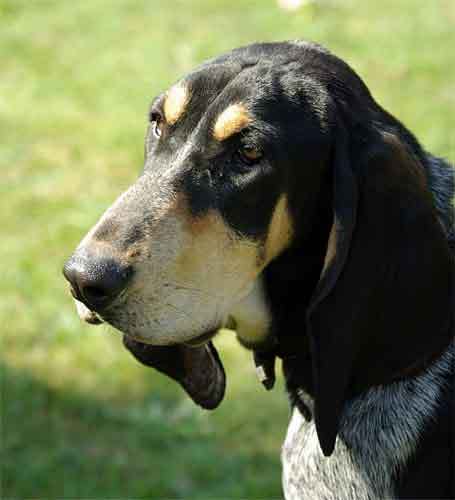
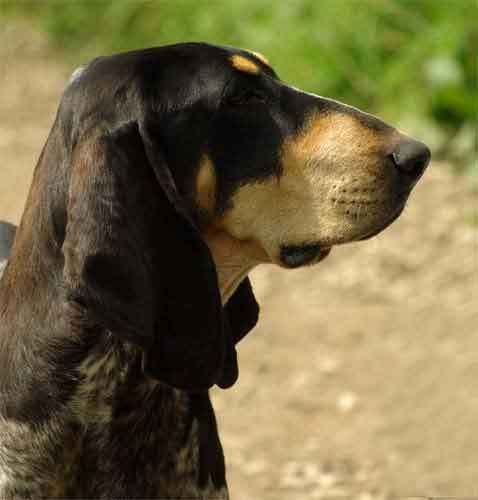
Head is slightly domed when viewed from the front, and the forehead is full. The stop (distance between the two eyes) it is little accentuated. The eyes are brown. The nose is very black and wide, and the nostrils are wide open. The whisker pads are not very thick and quite long: the upper lip falls back covering the lower lip. The snout (upper part of muzzle) is the same length as the skull; is strong and slightly arched, which contributes to giving it a noble look. The ears are moderately thin, dangling and curly. Very long, can reach the end of your nose, or even lower.

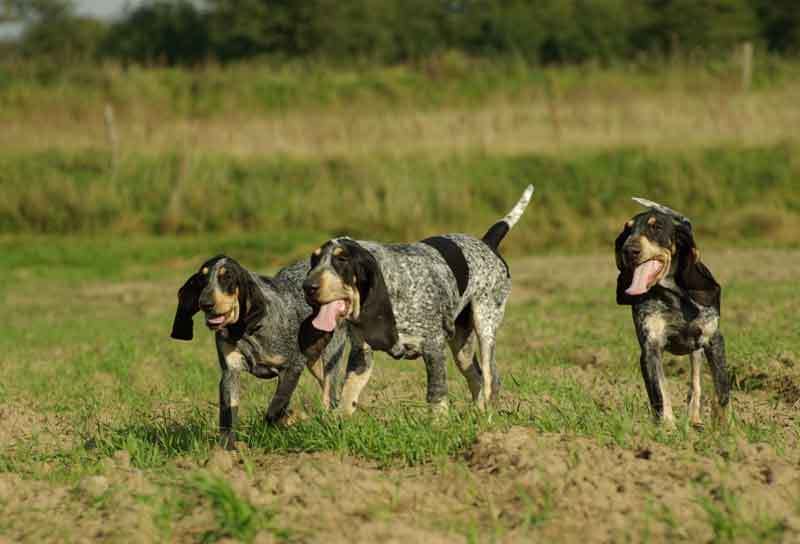
The skin of the Small Blue Gascony it is flexible, black or very mottled with black spots, and in any case never completely white. Their mucous membranes are also black. Its pelage is short, semi-thick and well furnished. Its fur is completely mottled, black and white, with a slate bluish glow, hence its name.

It also, may have more or less numerous and more or less large blackheads. These may include, at head level, usually has two black dots that are not on the top of the skull but that surround its eyes and cover its ears. At the top of the skull there is a white spot with a small oval black dot, typical of the breed. The upper part of the eyebrows are marked with more or less bright tan spots. Traces of tan are also found on the cheeks, the chops, inside the ears and sometimes on the legs and under the tail.

Last, sexual dimorphism is not very pronounced in this breed: males and females are generally very similar in size and dimensions.

Character and aptitudes ยซLittle blue Gascogne houndยป

The Small Blue Gascony he is a dog with a pleasant character, calm and affectionate. He is a very good companion dog., but it requires a lot of physical exercise and wide open spaces. Your ideal space is a house with land. It is necessary to take them out for a daily walk outside of hunting season. Dogs are generally very attached to their master. They are also kind to children and sociable with other animals. (dogs, cats…).

It is a hunting dog that runs well, very diligent in his hunting style, ideal for running after hare. It also shows good qualities for hunting big game, for example wild boar hunting. Finally, the Small Blue Gascony has a magnificent voice and a fine sense of smell.

Hygiene and health of the โ€œLittle Blue Gascogne Houndโ€

Grooming

The Small Blue Gascony often lives outdoors and requires only rudimentary grooming. If you live in the house, weekly brushing is recommended. It can also be useful to bathe him when he returns from hunting…

Care

When you come back from hunting or walking, inspect his feet and ears Small Blue Gascony looking for thorns (herbs that get into the skin causing pain and infections). Your floppy ears may be prone to ear infections. It is advised to examine and wash them once a week.

Health

The Small Blue Gascony he is a robust dog. You may suffer from otitis. Itching or a bad smell should alert you. The Small Blue Gascony you can also be injured while hunting. A fracture immediately leads to a loss of pressure in the affected limb. Skin tears may be more inconspicuous in the coat. Inspect his wound carefully when you return from the hunt..

Food

The dog's diet will depend on both its breed and weight and its lifestyle. The one with Small Blue Gascony must consider, among other things, your activity.

How much does a โ€œLittle Blue Gascogne Houndโ€ cost?

The price of a puppy Small Blue Gascony often haunt them 650 EUR, but it can reach the 1000 euros for the best subjects.

As in any other race, the price charged depends on the prestige of the kennel, of the lineage from which the dog descends and its intrinsic characteristics and, in particular, of its conformity with the standard. This explains why there may be price differences between puppies from the same litter.

In any case, the Small Blue Gascony hard to find outside France, and this is particularly true in North America, despite its recognition by the American UKC. In the case of an import from France, transportation and administrative costs are added to the purchase price. It also, it is necessary, of course, respect the regulations regarding the importation of a dog from abroad.

Images "Small Blue Gascony"

Photos:

1 – Little Gascony Blue Hound by Katarzyna Bujko, CC BY 3.0, via Wikimedia Commons
2 – Small Blue Gascony Hound, ยซBella, Baron i Brigand od Smutne rickyยป from kennel ยซLe Bleu Cardinalis FCIยป, Poland. The owner – Katarzyna Bujko by Katarzyna Bujko, CC BY 3.0, via Wikimedia Commons
3 – Small Blue Gascony Hound, female ยซClea z Beckovaยป from kennel ยซLe Bleu Cardinalis FCIยป, Poland. The owner – Katarzyna Bujko by Katarzyna Bujko, CC BY 3.0, via Wikimedia Commons
4 – Small Blue Gascony Hound, female ยซClea z Beckovaยป from husbandry ยซLe Bleu Cardinalis FCIยป, Poland. The owner – Katarzyna Bujko by Katarzyna Bujko, CC BY 3.0, via Wikimedia Commons
5 – Small Blue Gascony Hound, female ยซClea z Beckovaยป from kennel ยซLe Bleu Cardinalis FCIยป, Poland. The owner – Katarzyna Bujko by Katarzyna Bujko, CC BY 3.0, via Wikimedia Commons
6 – Small Blue Gascony Hound, male ยซCar z Beckovaยป from kennel ยซOd Smutnรฉ ล™รญฤkyยป, Czech. The owner – Slavomรญr Hanรกฤek by Katarzyna Bujko, CC BY 3.0, via Wikimedia Commons

Videos "Small Blue Gascony"

RAMBO - Small blue gascony - Unconditional love

RAMBO – โ€œLittle Blue Gasconyโ€ – Unconditional love
hare with blue gascogne cubs

hare with โ€œPetit Bleu de Gascogneโ€

Type and recognitions:

  • FCI CLASSIFICATION:
  • Group :
  • Section : . .

Federations:

  • FCI – Group 6: Scent hounds, and related breeds. – Section 1.2: Medium-sized Hounds. โ“˜
  • UKCScenthounds โ“˜
  • Central Canine Society โ“˜

FCI breed standard "Small Blue Gascony"

Origin:
France

Date of publication of the valid original standard:
24.01.1996

Use:

This is a multi-use dog. It is used for hunting with a shotgun., and sometimes to chase the game like a hound. His favorite house is the smallest (Hare) but he also goes on the hunt for big game.


General appearance:

It is a medium-sized dog, well proportioned and distinguished.


Behavior / temperament:

He has a good sense of smell and is good at hunting.. It has a loud bark and easily joins the pack.. He is calm and affectionate and obeys easily.

Head:

---

Cranial region:
  • Skull : Seen from the front, It is somewhat domed and not too wide. The occipital protuberance is slightly marked. Seen from above, the back has a shallow ogival shape. Forehead is bulging.
  • Depression links (Stop) : Sharp.

facial region:

  • Truffle : Black and wide. The Windows are wide open.
  • Snout : It is the same length as the skull and is strong. The nasal cannula is often slightly arched..
  • Lips : They are not very thick or developed. The upper lip covers the lower lip.
  • Jaws/Teeth : The joint is in the form of scissors. The incisors are set at right angles to the jaws..
  • Cheeks : Thin.

Eyes : They are oval in shape and brown in color.. Your expression is sweet.

Ears : They are crooked and moderately thin. They should at least reach the tip of the nose..

Neck:

It is long and has some double chin.

Body:

  • Back : Well accented.
  • Pork loin : Well united, and not too long.
  • Rump : Slightly oblique.
  • Breast : It is long and descends to the level of the elbow. The sternum is quite protruding. Delicately rounded ribs.
  • Flank : It's flat and deep.

Tail:

It is thin and reaches to the tip of the hock. It is carried proudly in the shape of a saber.

Tips

PREVIOUS MEMBERS : Seen in conjunction, They are quite robust.

  • Shoulder : Muscular and moderately oblique.
  • Elbows : Glued to the body.
  • forearms : Strong bones.

LATER MEMBERS : Seen as a whole they are well proportioned.

  • Thighs : Quite long, muscular, although not in excess.
  • Hock : Width, slightly angled and close to the ground.

FEET : They have an oval shape; the fingers are thin and close together. The pads and nails are black.

Movement:

Regular and executed with ease.

Mantle

SKIN : Elastic. Black, or strongly streaked with black spots. It's never completely white. The mucous membranes are black.

HAIR : Short, semi-thick and well dense.

COLOR : Completely speckled with black and white, imparting a slate blue reflection. It may or may not be marked with more or less extended black spots. Usually, there are two black spots on each side of the head, that cover the ears, circle the eyes and stop at the cheeks. These do not join over the top of the head, but they leave a white space in the center of which there is often a small oval black spot., typical of the breed. Above the eyes there are two more or less bright tan marks located on the zygomatic arches simulating four eyes.. Traces of tan can also be found on the cheeks, the lips, the inside of the ears, the limbs and under the tail.


Size and weight:

Height to the cross :

  • For males : 52 to 58 cm.,
  • for females : 50 to 56 cm..


Fouls:

Any deviation from the above mentioned criteria is considered as missing and the gravity of this is considered in proportion to the degree of deviation to the standard and its consequences on the health and well-being of the dog.

Head :

โ€ข Short.
โ€ข Skull too flat, Strait, or width.
โ€ข Short ears, high insertion, that are not twisted enough.

Body :

โ€ข Too long, loose top line, lack of volume.
โ€ข Croup sagging.
โ€ข Diverted tail.

Tips :

โ€ข Insufficiently developed bones.
โ€ข Straight shoulders.
โ€ข Hock closed, seen from behind.
โ€ข Crushed feet.

Behavior :

โ€ข Shy dog.

MISS PLAYOFFS :

โ€ข Fearful or aggressive dog.
โ€ข Characteristics that do not correspond to the type.
โ€ข Notable lack that causes any impediment.
โ€ข Serious anatomical deformation.
โ€ข Upper or lower prognathism.
โ€ข Light eyes.
โ€ข Any other coat that is not established by the standard.

Any dog โ€‹โ€‹showing clear signs of physical or behavioral abnormalities must be disqualified..


N.B.:

Males should have two normal-appearing testicles fully descended into the scrotum..

Source: F.C.I - International Cynological Federation

Alternative names:

1. Petit bleu de Gascogne (English).
2. Petit bleu de Gascogne (French).
3. Petit bleu de Gascogne (German).
4. Petit bleu de Gascogne (Portuguese).
5. Petit bleu de Gascogne, Sabueso azul de Gascuรฑa (espaรฑol).

โ–ท The world of Pets: Dogs, cats, birds, reptiles, amphibians

Austrian Black and Tan Hound
Austria FCI 63 - Medium-sized Hounds.

Sabueso austriaco negro y fuego

The Austrian Black and Tan Hound is very emotional. Perceives the mood of its owner.

Content

History

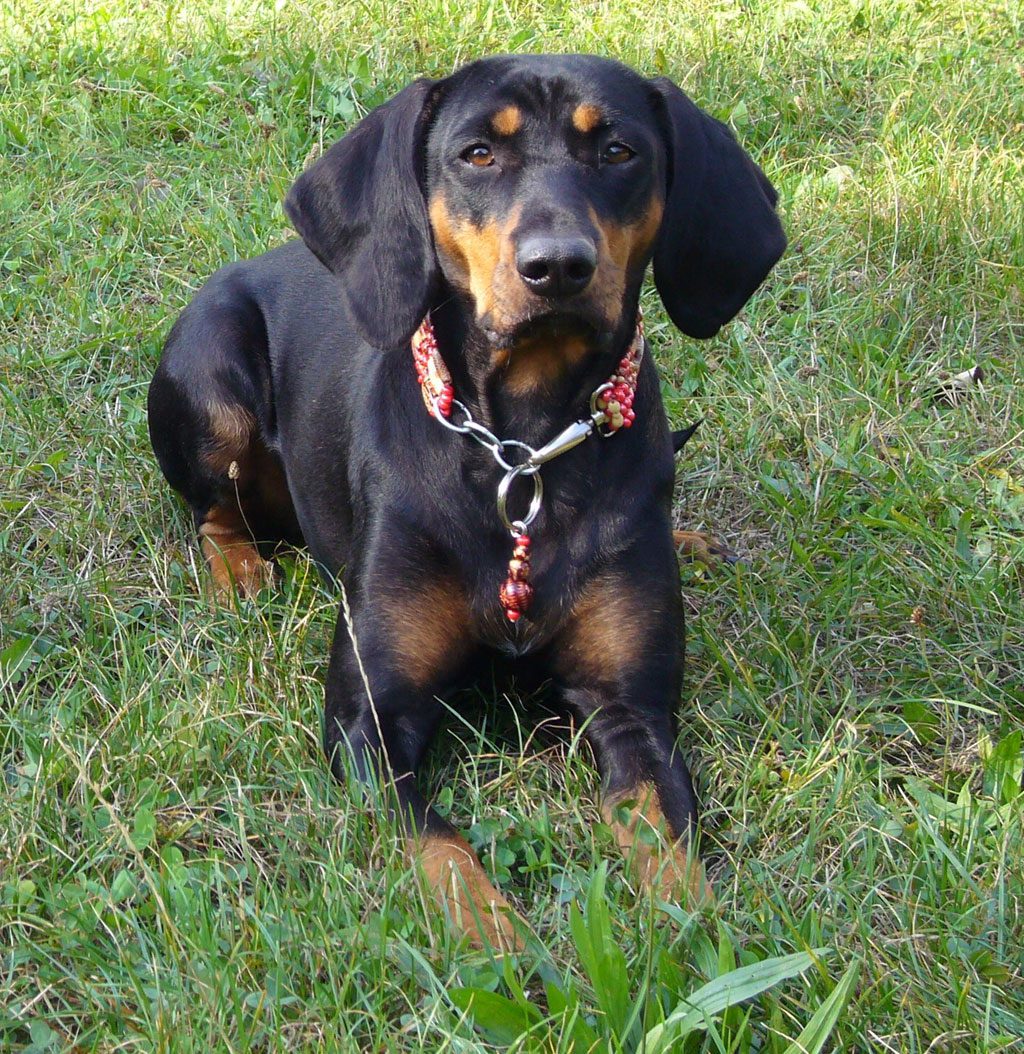
The Austrian Black and Tan Hound It is a breed of dog originating in Austria. It is believed that he is the true descendant of the original Celtic Hound, Although there is no known history of the Austrian Black and Tan Hound until after mid-19th century. This historical bump is due to the fact that in the past the breeding was not regulated.

The Austrian Black and Tan Hound, from its origins, It was used for monitoring or tracking of injured animals, Commonly, in places of significant altitude.

Physical characteristics

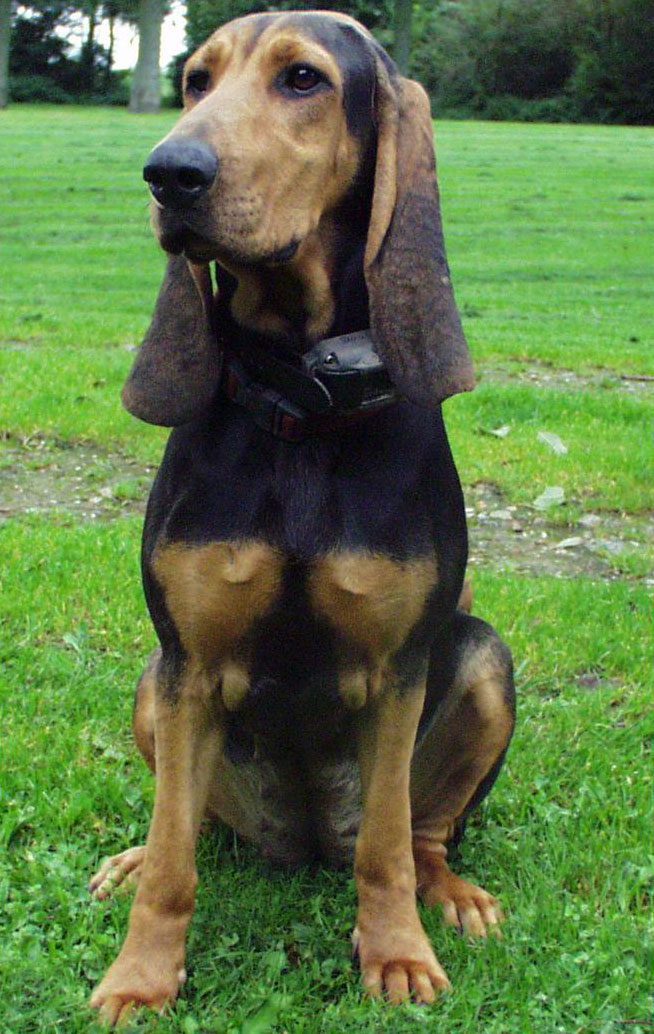
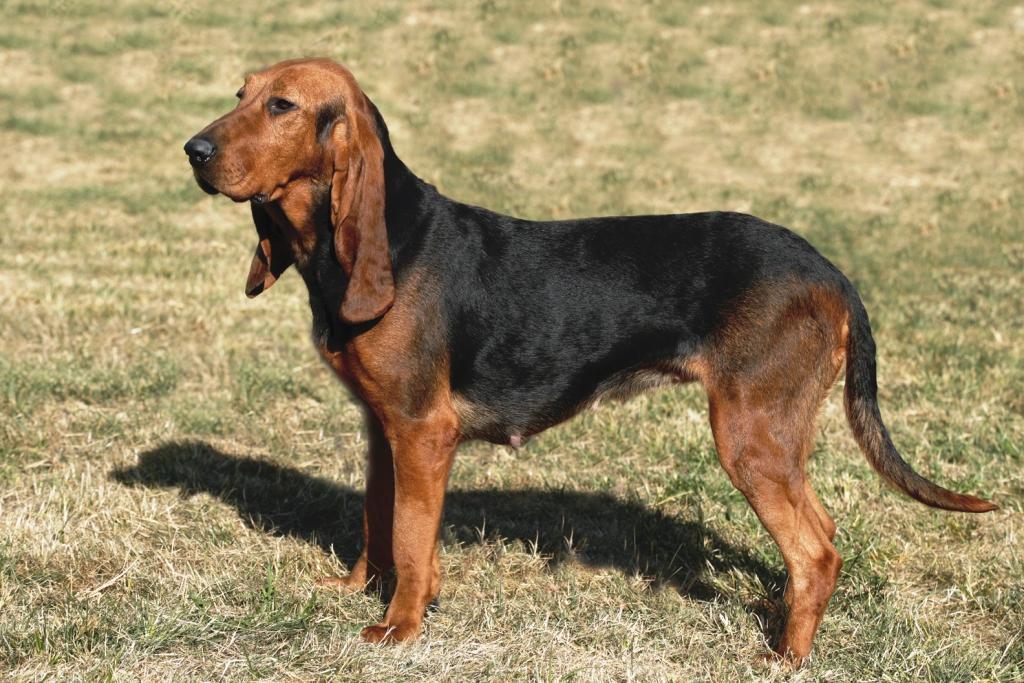
The Austrian Black and Tan Hound is a dog medium-sized and well solid structure. His head shows a wide skull and little pronounced occipital region with well marked stop.

It has glossy dark brown eyes that convey a lively look and alert. The ears are of high insertion and medium-sized, rounded, not very broad and hang onto the cheek. The tail is long and will fine tuning towards the tip, it is dropped but slightly curved.

The coat of the Austrian Black and Tan Hound It is smooth, soft to the touch, dense, short (a few 2 cm length) and very bright.

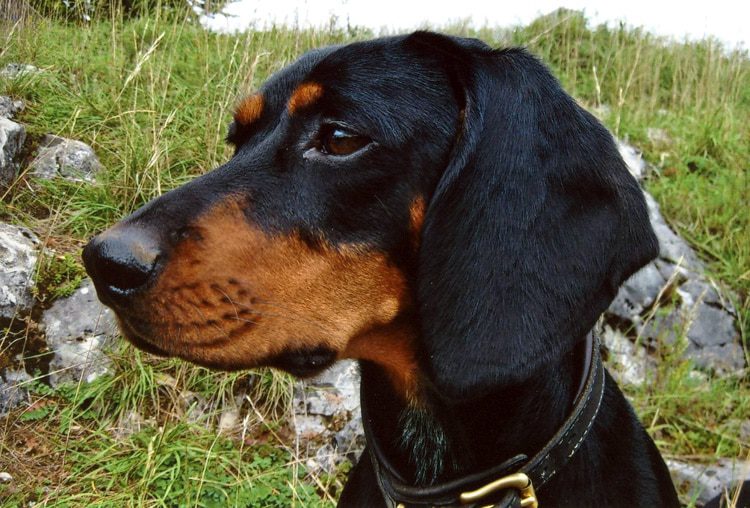
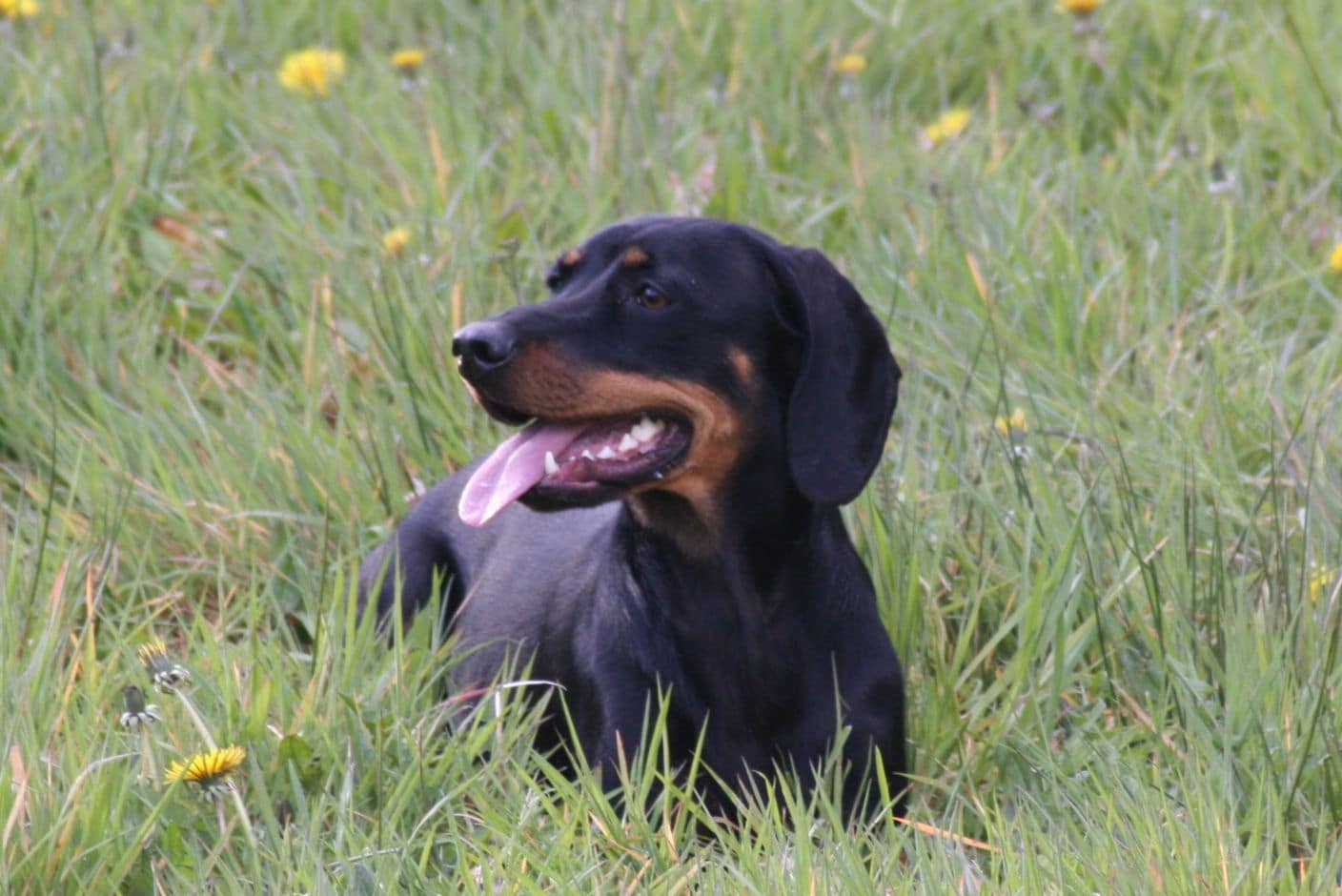
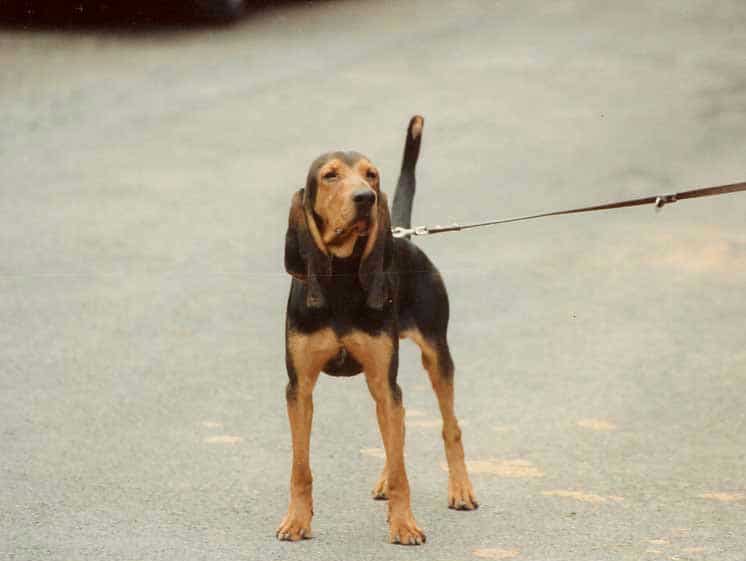
The coloration of this breed It is very important since that is its touch of distinction, they should be black as a basis, with small and clearly defined, fire to light brands range from pale tawny to dark. Two tawny markings above the eyes must be present.

This breed has a hypersensitive smell.

The height at the withers of Austrian Black and Tan Hound will of 48 56 cm. And his weight is around between the 19 and 20 Kg.

Thanks to its excellent ability to work, both high mountains and Plains land, the Austrian Black and Tan Hound is highly prized as a bloodhound and blood trail dog. His fine sense of smell allows him to carry out searches with complete security (especially of hares).

Character and skills

Is alive, attentive, reserved with strangers but friendly and does not show any signs of shyness.

While it is used for hunting Hound (for tracking), It is an animal that adapts well to family life, but if we make the commitment to have a Austrian Black and Tan Hound, We must be able to give the animal enough to make you happy.

A few good country walks would keep him cheerful., In addition to (as with all dogs) a good daily walk.

It is a very emotional dog that perceived especially mood of its owner.

Photos ยซAustrian Black and Tan Houndยป

ยซAustrian Black and Tan Houndยป Videos

Type and recognitions:

  • FCI CLASSIFICATION:
  • Group :
  • Section : . .

Federations:

  • FCI – Group 6: Scent hounds, and related breeds. – Section 1.2: Medium-sized Hounds. โ“˜
  • UKCScenthounds โ“˜

FCI breed standard "Austrian Black and Tan Hound"

Origin:
Austria

Date of publication of the valid original standard:
10.10.1995

Use:

The Black and Tan Austrian Hound is a hunting dog generally highly regarded for its special aptitudes for heavy work as a tracker and as a hound., both on the mountainous terrain and on the plains.


General appearance:

Is medium sized. His body structure is strong, elongated and elastic.


Behavior / temperament:

It has a fine smell. He is a very good hound, especially when hunting with barking hares.. Crawls safely and willingly and is pleasant in character.

Head:

---

Cranial region:
  • Skull: Large, shallow occipital protrusion.

facial region:

Truffle: black.
Snout: Strong, straight muzzle.
Lips: well developed, adherents, fully pigmented.
Jaws / Teeth: Powerful scissor bite. You want a complete denture with 42 Dental parts; the total lack of two PM1 or PM2 (premolars 1 or 2 ) is tolerated; the M3 (molars 3) they are not taken into account.
Eyes: Clear, dark brown, showing no redness at the corner of the eyes.
Ears: Medium-sized, not too wide, high insertion, rounded in its bottom edge; hang flattened.

Neck:

Medium long, very strong; the presence of a double chin is not desirable.

Body:

  • Cross: Well marked.
  • Back: Long.
  • Pork loin: Slightly raised.
  • Rump: Slightly sloping down.
  • Breast : Broad and deep.

Tail:

Long, progressively tapering towards the tip, a little bent; during rest he carries it down; on its underside it has hard hair, but the brush is not too rough.

Tips

PREVIOUS MEMBERS: Strongly developed, straight.

  • Shoulder: Placed obliquely, endowed with strong muscles.

LATER MEMBERS: With good angle.

  • Thighs: Thin, moderately developed and long.

FEET: Strong, round and arched. Fingers close together; hard black nails; large, hard pads.

Movement:

Elegant, covers the ground.

Mantle

HAIR: Smooth, well adjusted, thick, dense, stretchy with a velvet sheen. Approximate length of 2 cm..

COLOR: Black with some well-defined tan spots from light to dark brown. Two fire marks must be present above the eyes (four eyes = Vierรคugl)


Size and weight:

Height to the cross: 48 โ€“ 56 cm.
  • Males : 50 โ€“ 56 cm.
  • females : 48 โ€“ 54 cm.


Fouls:

Any deviation from the above mentioned criteria is considered to lack, and the gravity of this refers to the degree of deviation to the standard and its impact on the health and well-being of the dog.
  • Skull too narrow.
  • Wide snout.
  • Wrinkled ears, too pointed, short and thin.
  • Tail too short, thin, or very bent up, no thick hair on her lower face.
  • Weak limbs.
  • Shy character.
MISS PLAYOFFS:
  • Aggressive or fearful dog.
  • Upper or lower prognathism. Lack of more than two premolars 1 or 2.
  • Any other color other than described.
  • Lack of noticeable fire spots over the eyes (four eyes).
Any dog โ€‹โ€‹showing clear signs of physical or behavioral abnormalities must be disqualified..


N.B.:

Males should have two normal-appearing testicles fully descended into the scrotum..

Source: F.C.I - International Cynological Federation

Alternative names:

1. Bracke, Vierรคugl (English).
2. Brachet autrichien noir et feu (French).
3. Kรคrntner Bracke, ร–sterreichische Glatthaarige Bracke (German).
4. (em alemรฃo: brandlbracke) (Portuguese).
5. Austriaco negro y fuego (espaรฑol).

โ–ท The world of Pets: Dogs, cats, birds, reptiles, amphibians

Gascon Saintongeois
Francia FCI 21 - Large-sized Hounds

Gascรณn Saintongeois

His great passion is hunting, therefore it is advisable for those who practice it.

Content

The Gascon Saintongeois he is a strong sporting dog, confident and robust that was invented in France in the mid-19th century. His sweet and good-natured character makes him an excellent family dog รขโ‚ฌโ€นรขโ‚ฌโ€นthat is very careful when interacting with young children.. Today the breed remains unpopular even in its native country., so it can disappear completely in a matter of several decades.

Gascon Saintongeois History

In the mid-19th century, Carayon-Lantour Joseph Earl wanted to regenerate the dog breed of Saintonge, weakened as a result of the French Revolution (they only survived 3 These copies) and united the last descendants with Blue Gascony dogs owned by the Baron de Ruble. Thus was created the Gascon Saintongeois, but that creation, caused the disappearance of Saintonge's dog.

This breed of dog, It was developed, in its origins, mainly for hunting, greater and hares.

Physical characteristics Gascรณn Saintongeois

It is a very well established dog, It conveys an image of strong dog, but elegant at the same time. Their fur is short and dense, white background, with black spots; It may be mottled, but slightly. They usually have two black spots on each side of the head covering the ears, surrounding the eyes and cheeks-reach. The cheeks are color fire, but soft (as clay). They have, also two spots in that color, on top of the eyes, What gives them the appearance of having four eyes.

There is also the Petite Gascon Saintongeois, that shares the characteristics of Gascon Saintongeois, but its dimensions are smaller (measured 54 and 62 height cm). It is also a versatile Hunter, but above all of hares, but also, used to be used for hunting big game.

Gascon Saintongeois character and skills

The Gascon Saintongeois, is a pack dog, from its origins, has a highly developed sense of smell, is bold, and has a nice bark.

It can become the ultimate companion to any hunter, but it also has all the essential qualities to play the role of a family dog. It has a peaceful and adaptable nature and normally perceives its owners as members of its pack.. Early and thorough socialization is necessary if you want your pet to be tolerant of children in the family and other animals in the house.. The breed is usually very gentle with young children although it is large enough to knock a young child down in the heat of play..

Human aggressiveness can become a serious problem if your Gascon Saintongeois not adequately displayed to people of all ages from a young age. But, this dog is commonly courteous to house guests and resorts to violence only in an extreme case. Thanks to his unsurpassed vigilance and deep sonorous voice, he is an excellent watchdog.. In general, this dog has no desire to defend his territory, so it cannot be considered a good guardian.

The Gascon Saintongeois welcomes any opportunity to communicate with peers and, in fact, prefers to live in a large canine group. But, may be ill-disposed towards unfamiliar homeless canines and the owner should take this character trait of his pet into account and keep him on a leash in public places. The breed is not compatible with other types of pets due to its powerful hunting instinct. But she is usually friendly with the individual cats she has been raised with from a young age as a puppy..

Gascon Saintongeois Toilet and Care

The toilet of the Gascon Saintongeois requires a minimum of effort. His short self-cleaning coat should be brushed regularly but infrequently (only once a week). This procedure will effectively remove loose hair and reinforce the natural shine of the dog's coat.. This breed only needs an occasional bath.

Since this bloodhound is predisposed to ear infections, the caregiver should periodically examine their ears and clean them if necessary. Trim your pet's nails at least once every two months and clean their teeth weekly.

Gascon Saintongeois Education and Training

The Gascon Saintongeois It is an obedient and intelligent dog whose training is usually a piece of cake. Learns basic tricks with a reasonable amount of repetitions and succeeds in agility and obedience tests. Keep in mind that his character is stubborn and will ignore the orders of a shy person.

It also, the breed is irresponsible to negative training methods and reacts appropriately only to food incentives and kind words. Like any hound, tends to distract from the learning process by attracting smells, so be lenient with your pet's behavior.

Gascรณn Saintongeois Exercise

The Gascon Saintongeois is notable for both its incredulous stamina and great power, so you need a lot of physical activity. This large dog is not appropriate to be kept in an apartment where there is no room to play. At the same time it is strong enough to become a wonderful companion for runners or even cyclists..

Your pet should have the daily opportunity to run unrestricted in a well fenced yard, otherwise you may become hyperactive and totally undisciplined on the inside. Without a lot of vigorous daily exercise, the Gascon Saintongeois it can also develop into an unreasonable barking habit.

Videos "Gascon Saintongeois"

HTTPS://youtube.com/watch?v=FaejbradvYs
Gascon Saintongeois – Dog breeds
HTTPS://youtube.com/watch?v=TW6XQ62z03k
Gascon Saintongeois

Type and recognitions:

  • FCI CLASSIFICATION:
  • Group :
  • Section : . .

Federations:

  • FCI – Group 6: Scent hounds, and related breeds. – Section 1.1: Large-sized Hounds. โ“˜
  • Central Canine Society โ“˜

FCI breed standard "Gascon Saintongeois"

Origin:
France

Date of publication of the valid original standard:
06.03.2007

Use:

Gran Gascon Saintongeois: Used for rifle hunting and sometimes for small game, big game and also hare. It is generally used in a pack or alone, as a tracker. Pequeรฑo Gascon Saintongeois: Multi-purpose dog used for rifle hunting. Because of its origin it hunts especially the hare, but it is also very good for hunting big game.


General appearance:

Gedge: Very well built dog, which gives at the same time an impression of strength and elegance. He is of a very French type when it comes to the head, fur and expression.

Psmall: Medium-sized dog, well proportioned and distinguished.

PROPORCIONES IMPORTANT:

Height at withers/scapulo-ischial length in a ratio of 10/10.5 The length of the muzzle is equal to the skull.


Behavior / temperament:

Pack dog par excellence, up to the sense of smell, bold, gifted with a beautiful voice. He joins the pack by instinct. It's calm, affectionate and obeys orders easily.

Head:

The lines of the skull and the nasal passage are divergent.

Cranial region:
  • Craging: Seen from the front, It is arched and rather narrow; the occipital protuberance is well marked. Seen from above, the back has a pronounced ogival shape.
  • Dnaso-frontal depression: Little pointed.

facial region:

  • Trufa: black, well developed, the windows wide open.
  • Labios: They cover the lower jaw, the corner is discreet. The edge of the lips is black.
  • Cnasal year: Powerful, slightly arched.
  • Jaws: Scissor joint. The incisors are at right angles to the jaws..
  • Cheeks: Thin.

OJOS: Oval, browns. The edge of the eyelids is black. The expression is sweet and confident.

OREJAS: Fine, bent. They must reach at least the end of the truffle. They occur below the eye line, quite far back, leaving the skull very clear.

Neck:

Of medium length and thickness. It is slightly arched and has little dewlap.

Body:

  • lynand the top: It is firm and not excessively long.
  • Lomo: It is well attached to the body. It is slightly convex, quite muscular and not too long.
  • Glikeness: Slightly oblique, wide enough.
  • Pecho: Large, long, descends to the level of the elbows. The front part of the chest is quite open.
  • Costillas: Slightly rounded and long.
  • Flank: It's a little raised.

Tail:

It is thick at the base; very thin at its end. Reaches to the tip of the hock. The elegant bearing, Sabre-shaped.

Tips

PREVIOUS MEMBERS:

  • Ageneral appearance: The previous room is powerful.
  • Hshoulder: Rather long, muscular, moderately oblique.
  • Elbow: Well adhered to the body.
  • Aforearm: Strong bones.
  • Pinis previous: Slightly elongated oval shape. The fingers are thin and close together. The foot pads and nails are black.

LATER MEMBERS:

  • Ageneral appearance: The hindquarters are well proportioned.Thighs: Long and well muscled.
  • Corvejรณn: Width, well angled. Well inclined, visibly directed towards the axis of the body.
  • Pinis later: Slightly elongated oval shape. The fingers are thin and close together. The foot pads and nails are black.

Movement:

Uniform and loose.

Mantle

PIEL: Stretchy and not too thick. It is white with black spots.

Plink: Short and dense.

Codor: The background is white, with black spots; sometimes it is speckled, although not in excess. Two black spots are usually present on each side of the head.; cover the ears, surrounding the eyes and cheeks-reach. The cheeks are color fire, preferably pale. Two fire-colored brands, located on the top of the eyebrows, They simulate โ€œfour eyesโ€. They are also observed, tan traces on the inner surface of the ear and specks along the extremities. Some tawny hairs may appear on the top of the ear, without this giving the head a tricolor appearance. Sometimes a typical dead leaf spot is observed on the lower part of the thigh., known as โ€œroe deer markโ€.


Size and weight:

Altura to the cross:

Gedge: Males: 65 to 72 cm..
  Hblaze: 62 to 68 cm..
Psmall: Males: 56 to 62 cm..
  Hblaze: 54 to 59 cm..

With a tolerance of approximately 1 cm..


Fouls:

Any deviation from the aforementioned criteria is considered as a fault and the severity of this is considered to the degree of the deviation to the standard and its consequences on the health and well-being of the dog..

Cthey are not coming:

  • Short.
  • Wide skull.
  • Short ears; ears that stand high.
  • Total absence of fire color.

Cfamily:

  • Absence of volume
  • Sagging top margin.
  • sunken croup.
  • Deviated tail.

Members:

  • Bone structure that is not sufficiently developed
  • Shoulders that are too oblique or too straight.
  • crushed feet.
  • Straight posterior angulation.
  • closed hock, seen from behind.

FALTAS DISQUALIFYERS:

  • Aggressiveness or extreme shyness.
  • Any dog โ€‹โ€‹showing clear signs of physical or behavioral abnormalities.
  • Lack of type, and in particular wide and round skull.
  • Upper or lower prognathism.
  • Clear eyes
  • Any other layer other than that established in the standard.


N.B.:
  • Males should have two normal-appearing testicles fully descended into the scrotum..
  • Only functionally and clinically healthy dogs, with the typical conformation of the breed, should be used for parenting.

Source: F.C.I - International Cynological Federation

Alternative names:

1. Grand Gascon Saintongeois (English).
2. Gascon de Saintonge, Grand gascon saintongeois (French).
3. Grand Gascon Saintongeois (German).
4. Gascon Saintongeois (Portuguese).
5. Gascon Saintongeois (espaรฑol).

โ–ท The world of Pets: Dogs, cats, birds, reptiles, amphibians

Jura Hound (Bruno Jura Hound)
SuizaFCI 59 . Medium-sized Hounds

Sabueso del Jura

The Jura Hound It is very distant with strangers and needs firm handling if kept as pets.

Content

History

In the year of 1882 set a standard for each of the five existing varieties of the Swiss Hound. In 1909 reviewed these standards confirming the total disappearance of the Thurgau Hound.
The 22 in January of 1933 established a uniform standard for the 4 varieties of the Swiss Hound. The original range of the Jura hound type St. Hubert has now disappeared.

The Jura Hound It is a domestic dog developed in the middle ages for hunting in the Jura mountains, on the border between Switzerland and France.

Already in Roman times these hounds were known in Switzerland.

The Jura Hound He is known for his tracking abilities and like other hounds he has the ability to follow a perfume for miles through the rocky terrain of the border mountains between France and Switzerland.. It is mainly used for the hunting of the Hare.

There are four varieties of Swiss Hound:

Most kennel clubs and organizations treat these breeds as a single breed with multiple varieties..

Physical characteristics

These dogs have a large skull, so their heads seem to be much larger than its small robust bodies. Their ears are flexible and hang down around their muzzle and eyes, giving it a warm and friendly appearance. Your body has some wrinkles around the chest and neck area. Their bodies are elongated and thin and long tail. They are usually a color dark bronze or a reddish Fawn.

Its size is similar to the Bernese Hound, but it differs in the width of your head, being associated with the St. Hubert Hound.

Their life expectancy is of 12 to 13 years, and can weigh between 15 and 20 kg, with a height of 43 to 58 cm. up the cross.

Character and skills

These dogs can be known as little adventurers. They like to explore new and interesting terrain in which have never been before. Son, final ideal for anyone that loves to go on walks and exercise, Since in that environment be shown fully happy. As good Hound, anything, even if it is in its territory.

It is used mainly for hunting hare and wild boar..

They are very protectors and they lash out against anyone trying to do harm to their owners. They are very distant with strangers and need firm handling if kept as pets.

Well trained is a loving, friendly dog with children.

ยซJura Houndยป images

ยซJura Houndยป Videos

Type and recognitions:

  • FCI CLASSIFICATION:
  • Group :
  • Section : . .

Federations:

  • FCI – Group 6: Scent hounds, and related breeds. – Section 1.2: Medium-sized Hounds. โ“˜
  • UKCScenthounds โ“˜

FCI breed standard "Jura Hound (Bruno Jura Hound)"

Origin:
Switzerland, France

Date of publication of the valid original standard:
28.11.2001

Use:

It is a small game hound that hunts hares, deer, foxes and sometimes wild boars. He is an independent hunter by hunting with a bark. Searches and corners its prey with great safety even in difficult terrain.


General appearance:

It is a dog with medium height at the withers. Your body structure indicates strength and tenacity. Its slim head with long snout and long ears give it an expression of nobility.

There are four varieties of Swiss Hound :

  • Bernese Hound
  • Jura Hound
  • Lucerne Hound
  • Schwyz Hound

IMPORTANT PROPORTIONS :

โ€ข Body length : Height at withers = approx. 1.15 : 1.
โ€ข Height of the withers : chest depth = approx. 2 : 1.
โ€ข Length of the nasal shank : skull length = approx. 1 : 1.


Behavior / temperament:

Lively and passionate about hunting. Sensitive, manageable and faithful.

Head:

---

Cranial region:
  • Skull : Long, narrow, delgado, noble. Bulging skull, visible occipital protrusion. The direction of the longitudinal axis of the skull and the muzzle shows a slight divergence. No frontal groove, no folds or wrinkles.
  • Depression links (Stop) : Not too developed.

facial region:

  • Truffle : Completely black, well developed; nostrils wide open.
  • Snout : Nobly developed, narrow ; it is not square or pointed ; the muzzle is straight or very slightly convex.
  • Lips : Moderately developed, the upper lips perfectly cover the lower jaw ; slightly open corner.
  • Jaws / Teeth : Powerful jaw. Powerful scissor bite, regular and complete, that is, the upper incisors overlap the lower ones without leaving space between them and the teeth are implanted vertically in the maxilla. Pincer bite allowed. The lack of one or two PM1 or PM2 is acceptable (premolars 1 or 2) . M3 are not taken into account (molars).
  • Cheeks : Loose, non-protruding supraciliary arches.

Eyes : They are more or less light or dark brown depending on the color of the coat ; they are medium in size and slightly oval. The edges of the eyelids are well pigmented. The eyelids are well adherent. The expression is sweet.

Ears : Placed below the eye line, in the posterior part of the cranial region and never implanted in its maximum width. Its length must reach at least the tip of the nose. The pinna is not prominent. The ears are thin. He wears them down, bent and twisted ; they are rounded at the bottom and have a fine, soft coat.

Neck:

Long, elegant, with good musculature ; throat skin is loose without forming a noticeable dewlap.

Body:

  • top line : The neck, the back, The rump and tail form a harmonious and noble line.
  • Cross : Bit strong, free and elegant neck insert.
  • Back : Firm and straight. : Muscular and slightly arched.
  • Rump : Elongated, extends the line of the back harmoniously and descends gently. It is not higher than the cross. The crest of the iliac bone is not too prominent.
  • Breast : Deeper than wide, well descended, reaches to the tips of the elbows. Elongated rib cage with slightly arched ribs.
  • Bottom line and belly : Belly slightly pulled back ; full flanks.

Tail:

Inserted in the extension of the croup. It is of medium length and tapers towards the tip ; at its end it has a slight incline up ; noble. In general, it remains hanging at rest and when walking calmly, without showing an important bend ; When he is attentive or in action he carries it along the line of his back , but never resting in it nor in a curled way. Is well covered with hair, but it doesn't have a spike shape.

Tips

PREVIOUS MEMBERS :

  • As a whole : They are well muscled, thin and not heavy in appearance. Seen from the front they are parallel and from the side they look vertical ; his bones are strong with his feet pointed forward.
  • Shoulder : Long oblique shoulder blades, closely linked to the rib cage. The ideal angulation of the scapulohumeral joint is approximately 100ยฐ.
  • Arm : A little longer than the shoulder blade, placed obliquely, closely attached to the chest. His musculature is fine.
  • Elbows : Naturally glued to the side.
  • Forearm : Straight, strong, delgado.
  • Carpo : Strong, wide metacarpus : Relatively short; Seen from the front it is located on the perpendicular line of the forearm; seen from the side it is slightly inclined.
  • Front feet : Rounded, with compact fingers ; hard and rough pads ; strong nails whose color depends on the color of the coat.

LATER MEMBERS :

  • As a whole : They have strong muscles and are in a balanced relationship with the forelimbs ; seen from behind the hind legs are vertical and parallel.
  • Thigh : Long and oblique, powerful although his muscles are thin. The angulation of the coxofemoral joint is approximately 100ยฐ.
  • Knee : No inward or outward deviations. Angulation of the femoral-tibian joint approximately 120ยฐ.
  • Leg : Relatively long, thin, visible muscles and tendons under the skin.
  • Hock : Tibiotarsal joint angulation approximately 130ยฐ.
  • Metatarsus : Pretty short, placed vertically and parallel. Without spurs, except in countries, in which amputation is not allowed by law.
  • Rear feet : Rounded, with compact fingers, hard and rough pads ; strong nails whose color depends on the color of the coat.

Movement:

It is unfolded, regular, harmonious and with good scope. Has good impulse from the hindlimbs. Drive the limbs parallel and straight. The cross moves smoothly and regularly up and down, the back remains straight and the head and neck wobble slightly from side to side.

Mantle

SKIN : Fina, flexible, well adherent, whose color varies in each of the four varieties.

โ€ข Bernese Hound : Skin is black under black hair and blackish-white marbling under white hair.
โ€ข Jura Hound : She is black under black hair and lighter under tan hair..
โ€ข Lucerne Hound : She is black under black hair and lighter under blue-flecked hair..
โ€ข Schwyz Hound : It is dark gray under the orange hair and blackish-white marbling under the white hair..

HAIR : Is short, smooth, thick, very fine on the head and ears.

COLOR :

โ€ข Bernese Hound : White with black spots or a black saddle-shaped spot. Tan color from pale to intense over the eyes, cheeks, on the inside of the ears and around the anus. Sometimes very lightly splattered (black splash).

โ€ข Jura Hound : Tan with black cape, sometimes nuanced black or black with tan over the eyes, cheeks, around the anus and on the extremities ; sometimes with a small white spot on the chest ; this stain may be splattered (black or gray splashes).

โ€ข Lucerne Hound : Called blue, with a mixture of black and white hairs, intensely splashed, with black spots or a saddle-shaped spot ; tan color from pale to intense over the eyes, cheeks, on the chest, around the anus and on the extremities ; a black cape is allowed.

โ€ข Schwyz Hound : White with orange or orange "saddle" spots, sometimes with orange splashes ; an orange coat is allowed.


Size and weight:

Height to the cross :

  • Males : 49-59 cm..
  • females : 47-57 cm No tolerance.


Fouls:

Any deviation from the aforementioned criteria is considered as a fault and the severity of this is considered to the degree of the deviation to the standard and its consequences on the health and well-being of the dog..

โ€ข Rough appearance, vulgar, weak body structure.
โ€ข Discordant proportions between body length, the height of the withers and the height of the chest.
โ€ข Skull too wide, too convex or too flat.
โ€ข Stop too marked.
โ€ข Very short or very long snout, too square or pointed.
โ€ข Concave nasal bridge.
โ€ข Lack of more than two premolars PM1 or PM2. Los M3 (molars 3) are not taken into account.
โ€ข Thick lips.
โ€ข Light eyes, acute expression, non-adherent eyelids.
โ€ข Ears that are too short or flattened, thick or set very high.
โ€ข Very short neck.
โ€ข Double chin too marked.
โ€ข Saddled or arched back (carp back).
โ€ข Croup too inclined or too short.
โ€ข Rib cage not deep enough, too flat or barrel-shaped.
โ€ข Retracted belly, fallen flanks.
โ€ข Tail with poor insertion, carried too high, very bent, stooped, very coarse or spike-shaped tail.
โ€ข Extremities with bones that are too thin or in a bad position.
โ€ข Very sloping shoulders, arm too short.
โ€ข Weak carpal joints.
โ€ข Insufficient angulations of the hind limbs ; cow or barrel shaped limbs.
โ€ข Dewclaws on the hind limbs, except in countries in which amputation is not permitted by law.
โ€ข Rough coat, not smooth.
โ€ข Flaws in color and markings.

  1. Bernese Hound : Too many black splashes on the white. Tan or white on the outside of the ears.
  2. Jura Hound : Uniform color. Noticeable white patch or heavily speckled patch on the chest.
  3. Lucerne Hound : Lack of ยซ blue ยป splash. Tan on the outside of the ears.
  4. Schwyz Hound : Too many orange splashes on the white. Uniform color. White on the outside of the ears.

โ€ข Slightly fearful or aggressive behavior.

MISS PLAYOFFS

โ€ข Excessively fearful or aggressive dog.
โ€ข Atypical general appearance of the breed.
โ€ข Completely depigmented nose.
โ€ข Upper or lower prognathism, incisor arcade deviated.
โ€ข Ectropion, entropion (even if it had been operated).
โ€ข Horn tail, threaded, knotty the hook.
โ€ข Size above or below tolerance.

Any dog โ€‹โ€‹showing clear signs of physical or behavioral abnormalities must be disqualified..


N.B.:

Males should have two normal-appearing testicles fully descended into the scrotum..

Source: F.C.I - International Cynological Federation

Varieties of ยซSwiss Houndsยป

The four varieties of Swiss hounds have their own specific hunting characteristics:

– The Bernese Hound, with her beautiful throat ("the howler of the Jura"), demanding, mainly used for hares;
– The Jura Hound, an excellent recuperator
– The Lucerne Hound, reminiscent of Small Blue Gascony, he is an active and passionate dog that hunts deer very well;
– The Schwyz Hound, less widespread outside of Switzerland, is reserved for rabbits and hares.

Alternative names:

1. Bruno Jura Hound (English).
2. Bruno du Jura (French).
3. (frz. Bruno du Jura) (German).
4. Sabujo Bruno de Jura (Portuguese).
5. Fernando del Jura, Bruno del Jura (espaรฑol).