โ–ท The world of Pets: Dogs, cats, birds, reptiles, amphibians

Karelian Bear Dog
Finlandia FCI 48 - Nordic Hunting Dogs

Karelian Bear Dog

The Karelian Bear Dog is a very independent and intelligent dog.

Content

History

The Karelian Bear Dog, which also bears the name of zyrians dog, is considered the progenitor of the breed. But the basic strain of the breed came from the Carelia de Ladoga, the Olonets and the Carelia Rusa, where these dogs were used to hunt in different ways. Breeding started in 1936 with the aim of developing a robust dog that could make noise when hunting big game. At that time it was agreed that the breed name should be Karelian Bear Dog. The first standard was created in 1945. In 1946 the first dogs were registered in the stud book. Today the breed is well established in Finland..

Physical characteristics

This four-legged friend has a great similarity to the Laika related to him.

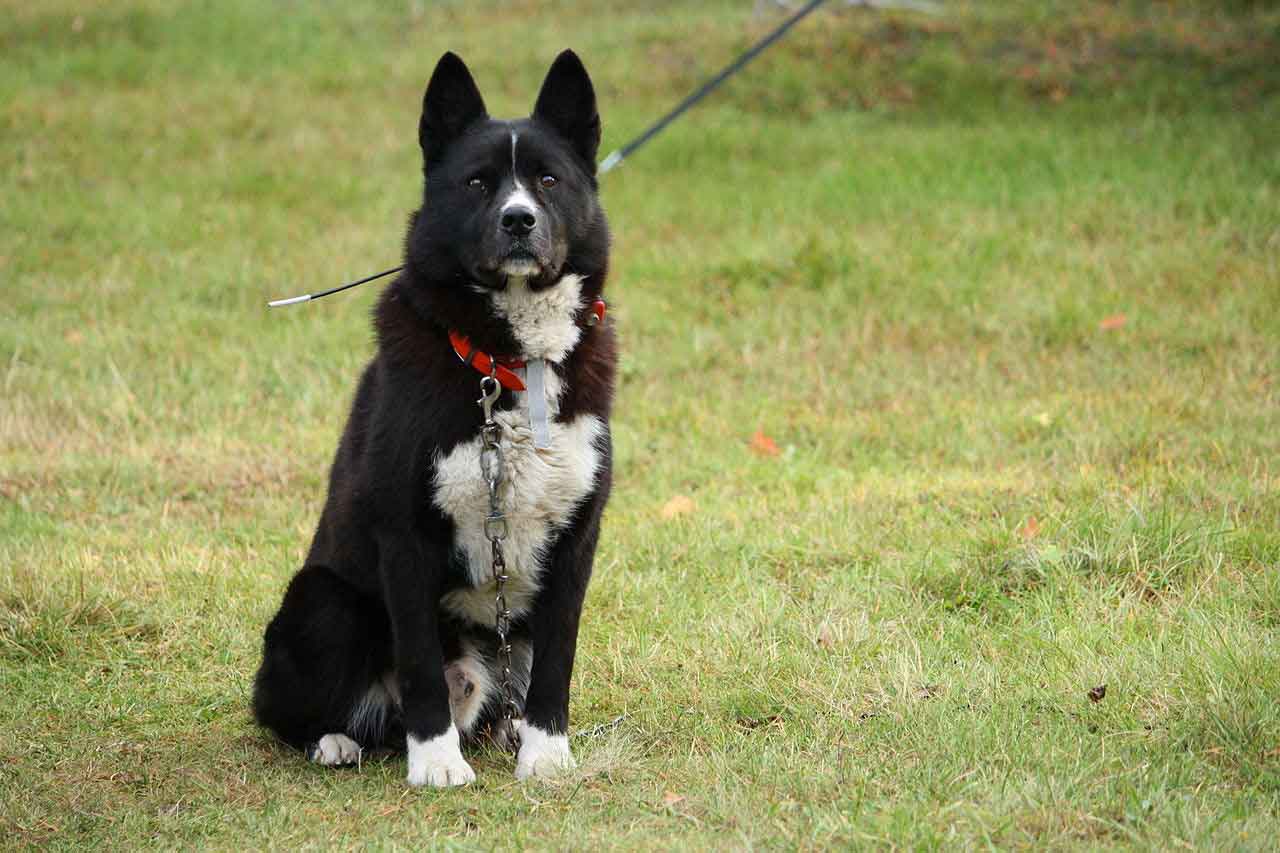
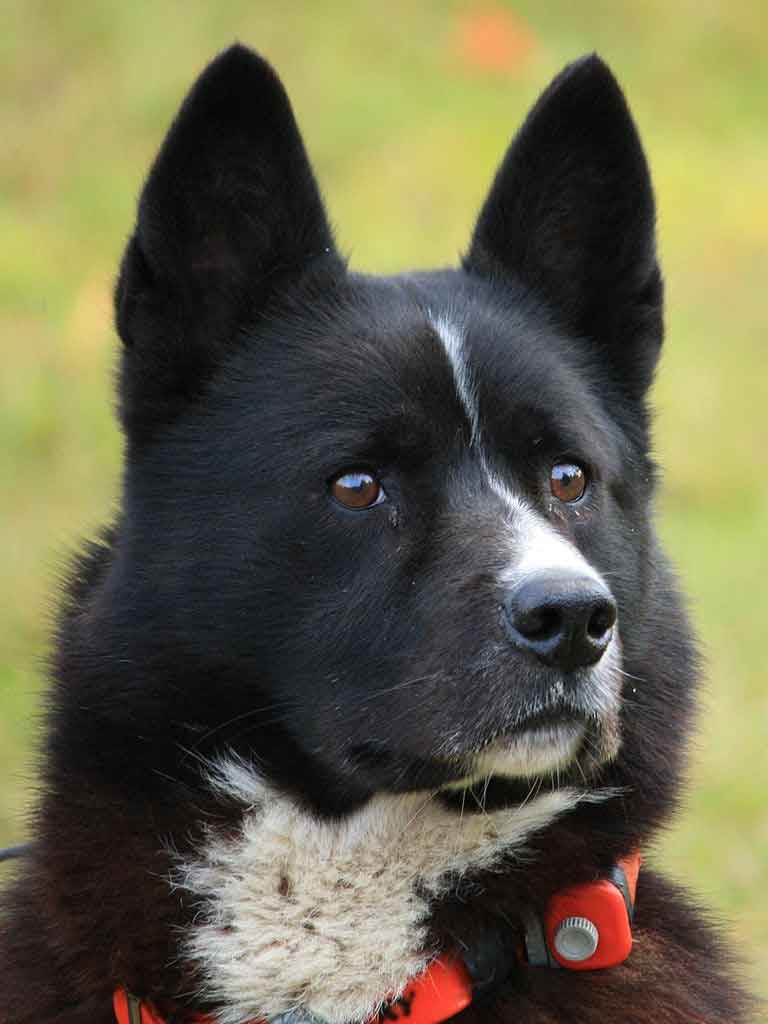
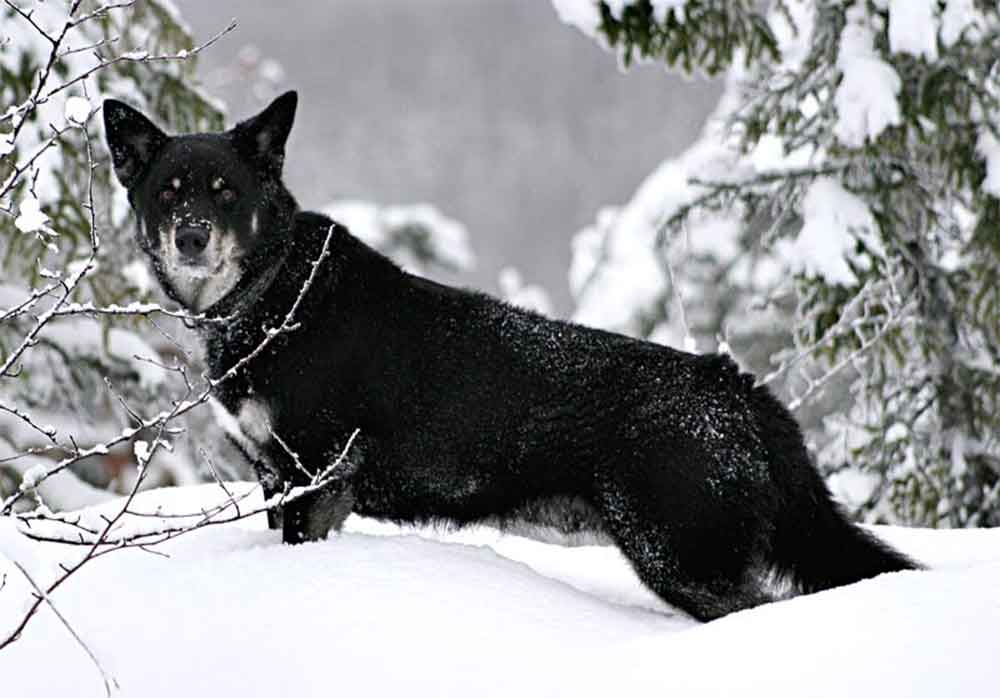
With a height at the withers of up to 60 cm., males weigh about 28 kg. Bitches are slightly smaller and should not weigh more than 20 kg. The Karelian Bear Dog has a strong trunk and generally a compact and dynamic stature. On his head there are medium and erect ears and he wears a folded tail on his back. The icing on the cake is usually a white tip. Otherwise, dense coat color is usually black with white markings. The rough top layer is very close to the dense undercoat, that glows with a slight brown hue.

Character and skills

The freedom-loving character

This dog loves the vastness of the forest and its independence, a combination that combines his attitude with some challenges, because he'll take any chance to roam free. As this four-legged friend acts very independently during the hunt and must place the game alone, it is also, for the rest, a confident partner, who gladly takes command when the opportunity presents itself.

He is considered brave and is always ready to defend his loved ones. Contact with other dogs can be problematic without extensive socialization, because some Karelian Bear Dog show aggressiveness when meeting other dogs. But, other owners report their dogs great balance and praise their social compatibility. It is a fact that many Karelian Bear Dog they are also working together as hunting assistants – so with good conditioning and socialization this should not be a problem.

They are excellent watchdogs, that reliably indicate intruders. Despite all the lovely nooks and edges, the Karelian Bear Dog they also have their soft sides: They are not aggressive with people, they like to be petted at home and they love to be petted by their caregivers.

Karelian Bear Dog Education<

Education without subordination

Its independent nature requires a lot of knowledge, but it should be clear from the start to anyone considering having a Karelian Bear Dog: that this proud quadruped will never be subservient. Their independence reaches such a point that many Karelian Bear Dog they disappear into the woods for days in their native country, just to show up again when it suits him.

Harshness and yelling are absolutely out of place in training this sensitive dog, which will then retreat or crawl. But, with the right mix of positive reinforcement, empathy and consistent behavior, good daily obedience can be achieved.

It is important to socialize extensively with other four-legged friends from puppy age onwards., since some Karelian Bear Dog are considered incompatible with other dogs of the same species, what can become problematic on daily trips. It is a challenge to keep this dog available and away from independent hunting trips.. Specialists with experience in dogs of this breed are definitely needed.

Karelian Bear Dog Health and Nutrition

The original breed is considered very robust. If you buy it from a serious breeder and pay attention to a balanced and age-appropriate diet- plenty of exercise, your four-legged friend can reach a age up to 13 years.

Important for a healthy dog รขโ‚ฌโ€นรขโ‚ฌโ€นlife is, of course, also the daily food content. give to you Karelian Bear Dog a high quality food with a high proportion of meat and little grain. The energy needs of your four-legged friend depend on their constitution and daily exercise. So make sure to adjust your food accordingly and keep an eye on her slim waist..

As in humans, extra kilos increase the risk of various diseases, including painful joint problems. Always provide fresh water. On the longest trips, you should also have enough water for your partner, which is also more sensitive to heat. Visit the vet at least once a year for a checkup with your pet and talk to him about necessary vaccinations and regular deworming.

Caring for the Karelian Bear Dog

The fur of this weather-resistant quadruped is easy to care for. But, loses more hair during coat change, so it can be useful to brush it every day, so that less hair is spread around the house. Otherwise, brush it every few days; this ritual also strengthens the bond and should already be practiced with the puppy for a relaxed routine.

Always check the eyes, your puppy's ears and claws and use a special eye and ear cleaner if necessary. The claws can become too long in dogs that walk a lot on soft ground – or they move too little, what in this quadruped, However, should only occur in very old or diseased specimens. In this case, shorten them with special tweezers.

Many dog โ€‹โ€‹owners brush their quadrupeds' teeth regularly with dog toothpaste and brush to prevent tartar and associated secondary diseases. You can now practice this with your puppy. Alternatively, you can offer your dog dental care snacks.

Activities with the Karelian Bear Dog

Occupation: go out into the woods!

This four-legged friend's favorite hobby is clearly hunting.: extensive travels through the forest and hunting tracking are his passion. The Karelian Bear Dog seek the game to be hunted almost silently. Once you have reached your destination, barks long and persistently at the hunt to keep it in place until the hunter arrives.

The Karelian Bear Dog sometimes they hunt in threes, so they can also keep larger animals like bears at bay. The breed does not necessarily have to be hunted. As an alternative to hunting, the karelian bear dog also suitable for dog sports, but in this case you can only do activities that you like. If you enjoy it, Agility sports can be a good activity for a Karelian Bear Dog adult. Also suitable as a companion for jogging or cycling – but you must keep his hunting instinct in check. Most of these excellent crawlers like crawling work of all kinds.

Is a Karelian Bear Dog right for me??

The Karelian Bear Dog belong to the hands of seasoned enthusiasts, preferably hunters. Alternatively, need a lot of exercise and outdoor work. Only then is it possible to keep them as family dogs. Dog experience should be available in any case. In addition, you must be clear that this quadruped can only be trained conditionally.. Does not belong to the group of dogs that subordinate to themselves – as a dog owner you must respect this, but still be able to direct their power in a controlled manner.

The Karelian Bear Dog not in any way suitable for a city apartment. The ideal would be to offer you a leak-proof garden, in addition to the daily run in forests and fields, but beware: the Karelian Bear Dog freedom lover is considered a fugue artist and can jump up to two meters high.

This four-legged friend likes to befriend children, but they should be older and have learned to treat animals with respect.

Cats in the same household are not necessarily a good idea, not to mention rabbits or other small animals. The norse hunter you will always see potential prey in them. Of course there are exceptions to the rule and there may even be friendships between Karelian Bear Dog and cats socialized at a young age – but you won't be able to get a guarantee before you move in. So you must bring a lot of time, space and experience if you want this proud dog to move in with you.

The Karelian Bear Dog is a four-legged friend for connoisseurs, which should not be chosen as a new roommate for its rustic appearance. If you are not looking for a true character head, you will have little joy with this animal roommate. Of course, before moving, it is also necessary to calculate the one-time expenses (buy creator, basic team, travel expenses) and regular expenses (food, veterinary, dog tax and insurance).

Where can I find a Karelian Bear Dog?

This breed of dog is found naturally mainly in Scandinavia, especially in finland. Further south there are only a few dogs of this very special hunting breed. In Germany, for example, not a single cub of Karelian Bear Dog in recent years. Special Nordic dog clubs can help you find the dog of your dreams. But, There are some things to consider if you are interested in a puppy from abroad. It's always better if you can get a picture of the puppies' house and meet their parents. The Nordic Dog Experts, who you should contact through the appropriate associations, can advise you if there are possible alternatives to Karelian Bear Dog that suit you, to your life situation and your wishes. Or you can refer them to the breeders of Karelian Bear Dogs, if there is currently no one in your country who will have a litter in the near future.

Characteristics "Karelian Bear Dog"

Coexistence is important that you have with your new friend. Before considering the acquisition of a dog of the breed "Karelian Bear Dog" you know certain factors. Not all breeds of dogs are apt to live in an apartment, you must take into account his character, their need for exercise, their interaction with other pets, their care and if you have small children, their level of tolerance towards them.

Training โ“˜

1,0 of 5 stars (based on 1 review)

Suitability of the apartment โ“˜

1,0 of 5 stars (based on 1 review)

You can be alone all day โ“˜

1,0 of 5 stars (based on 1 review)

Suitable as first dog โ“˜

1,0 of 5 stars (based on 1 review)

Weight gain โ“˜

3,0 of 5 stars (based on 1 review)

Health โ“˜

4,0 of 5 stars (based on 1 review)

Intelligence โ“˜

4,0 of 5 stars (based on 1 review)

Kindness with child โ“˜

3,0 of 5 stars (based on 1 review)

Tendency to bite โ“˜

2,0 of 5 stars (based on 1 review)

Tendency to bark โ“˜

4,0 of 5 stars (based on 1 review)

Tendency to flee โ“˜

5,0 of 5 stars (based on 1 review)

Hair fall force โ“˜

4,0 of 5 stars (based on 1 review)

Suitable as a guard dog โ“˜

4,0 of 5 stars (based on 1 review)

joy โ“˜

3,0 of 5 stars (based on 1 review)

Kindness with cat โ“˜

1,0 of 5 stars (based on 1 review)

energy level โ“˜

4,0 of 5 stars (based on 1 review)

Images "Karelian Bear Dog"

A 10-year-old male Karelian Bear Dog. Head shot with tracking collar around neck by Uusijani / CC0

Karelian bear dog by Friesian.marcin / CC BY-SA

Videos "Karelian Bear Dog"

Watch the Karelian Bear Team in Action

Type and recognitions:

  • FCI CLASSIFICATION:
  • Group :
  • Section : . .

Federations:

  • FCI – Group 5 – Section 2 Nordic Hunting Dogs. โ“˜
  • AKC – Nordic Hunting Dogs โ“˜
  • CKC – Nordic Hunting Dogs โ“˜
  • UKC – Nordic Hunting Dogs โ“˜

FCI breed standard "Karelian Bear Dog"

Origin:
Finland

Date of publication of the valid original standard:
12.03.1999

Use:

It is used mainly for hunting moose and bear. It is very adept at keeping cornered prey barking. He is an enthusiastic and independent hunter, although he cooperates by pointing out with his bark the place where the prey is. All your senses are sharp, especially that of smell, so this breed is useful for hunting big game. Has a very good sense of direction.


General appearance:

It is of medium size and robust constitution. It's strong and something longer than tall. The coat is dense and the ears are erect.

IMPORTANT PROPORTIONS : The length of the body is only slightly greater than the height at the withers.. The depth of the body corresponds to half the height at the withers. The relationship between the muzzle and the skull is about 2 : 3. The length of the skull corresponds approximately to its width and depth.


Behavior / temperament:

It is balanced in nature and somewhat reserved. Is brave, persistent and very self-confident. Can be aggresive with other dogs, but never with people. His fighting instinct is highly developed.

Head:

Seen from the front, has a triangular shape.

Cranial region:
  • Skull: Seen from the front, it's wide; in profile, it is somewhat arched. It is wider between the ears. The frontal sulcus is barely visible. Superciliary arches are only poorly developed.
  • Depression links (Stop): Naso-frontal depression is not very pronounced; is rather long and gradually arches towards the skull region.

facial region:

  • Truffle:Wide, black.
  • Snout: Deep; tapers only a little to the nose. The nasal helm is straight.
  • Lips: They are thin and tight.
  • Jaws / Teeth: The jaws are very strong. The teeth are well developed and symmetrical. Teething is normal and the joint is scissor-shaped.
  • Cheeks: The zygomatic arches are strong.

Eyes: They are rather small and somewhat oval. In different shades of brown; never yellow. His expression is alert and fiery.
Ears: They are set high and stand erect. Medium-sized, with slightly rounded tips.

Neck:

Muscular, arched and of medium length. It is covered in thick fur. There is no presence of dewlap.

Body:

  • Cross: It is clearly defined, especially in males. In females, is less defined.
  • Back: Straight and muscular.
  • Pork loin: Short and muscular.
  • Rump: Wide, strong and slightly sloping.
  • Breast : Spacious, not very wide, rather long, reaches approximately to the elbows. The ribs are slightly arched; the sill is well visible, although not very wide.
  • bottom line: Slightly collected.

Tail:

High insertion. It is of medium length and hunches over the back; the tip of the tail touches the body on the back or on one of the flanks. Short tail is allowed from birth.

Tips

PREVIOUS MEMBERS:

  • As a whole : Robust, for strong bones. Seen from the front, they are straight and parallel. Arm and shoulder blade are the same length; the forearm is a little longer.
  • Shoulder : Relatively oblique and muscular.
  • Arm : It is strong, slightly oblique.
  • Elbows : They point well back and are placed on the vertical line drawn from the highest point of the shoulder..
  • Forearm : Strong and upright.
  • Metacarpus : Slightly oblique and of medium length.
  • Front feet : compacts, well arched. They are rounded in shape and point forward. The pads are flexible and have a dense coat on both sides.

LATER MEMBERS:

  • As a whole : Strong and muscular. Seen from the back, they are straight and parallel. The front line of the hind limb forms a harmonious arch.
  • Thigh : Width, long, of strong muscles.
  • Knee : Point to the front. It is of medium angulation.
  • Leg : She is long and muscular.
  • Hock : Low. Angulation is clearly visible.
  • Metatarsus : Short, strong and vertical.
  • Rear feet : They are compact and a bit longer and less arched than the front ones. The pads are flexible and have a dense coat on both sides.

Movement:

It's lightweight and covers the ground effortlessly. The dog easily changes from trot to gallop, which is the most natural movement. The members move in parallel.

Mantle

SKIN: It is well fitted throughout the body and does not form folds.

HAIR: The hair of the outer coat is rough and smooth. It is longer on the neck, the back and the back of the thigh. The undercoat of hairs is soft and dense.

COLOR: Negro; can be opaque or with brown tones. Most dogs have clearly defined white markings on the head, the neck, the chest, belly and limbs.


Size and weight:

Height to the cross: The ideal height at the withers is 57 cm in males and 52 cm in females, with a tolerance of +/- 3 cm..

Weight: In males, 25 to 28 kg and in females , 17 to 20 kg.


Fouls:

Any deviation from the aforementioned criteria is considered as a fault and the severity of this is considered to the degree of the deviation to the standard and its consequences on the health and well-being of the dog..

โ€ข Weak bones.

โ€ข Narrow skull.

โ€ข Strongly bulging forehead.

โ€ข Pointed snout.

โ€ข Yellow eyes.

โ€ข Bat ears

โ€ข Papada.

โ€ข Very deep or barreled rib cage.

โ€ข Tail straight or not curved enough.

โ€ข Straight shoulders.

โ€ข Straight hocks and flat feet.

โ€ข Dewclaws on the hind limbs.

โ€ข Wavy coat.

โ€ข Predominant white color, with black markings or color called wolf color.

MISS PLAYOFFS

โ€ข Aggressive or fearful dog.

โ€ข Upper or lower prognathism.

โ€ข Gaze eyes.

โ€ข Ears hanging or with the tip hanging down.

โ€ข Colors different from those stipulated in the standard.

Any dog โ€‹โ€‹showing clear signs of physical or behavioral abnormalities should be disqualified..


N.B.:

Males should have two normal-appearing testicles fully descended into the scrotum..

Source: F.C.I - International Cynological Federation

Alternative names:

1. Karjalankarhukoira, Karelsk Bjรถrnhund (English).
2. Karjalankarhukoira (French).
3. Karjalankarhukoira, Bjรถrnhund (German).
4. Karjalankarhukoira (Portuguese).
5. Karjalankarhukoira (espaรฑol).

โ–ท The world of Pets: Dogs, cats, birds, reptiles, amphibians

Icelandic Sheepdog
Islandia FCI 289 - Nordic Watchdogs and Herders.
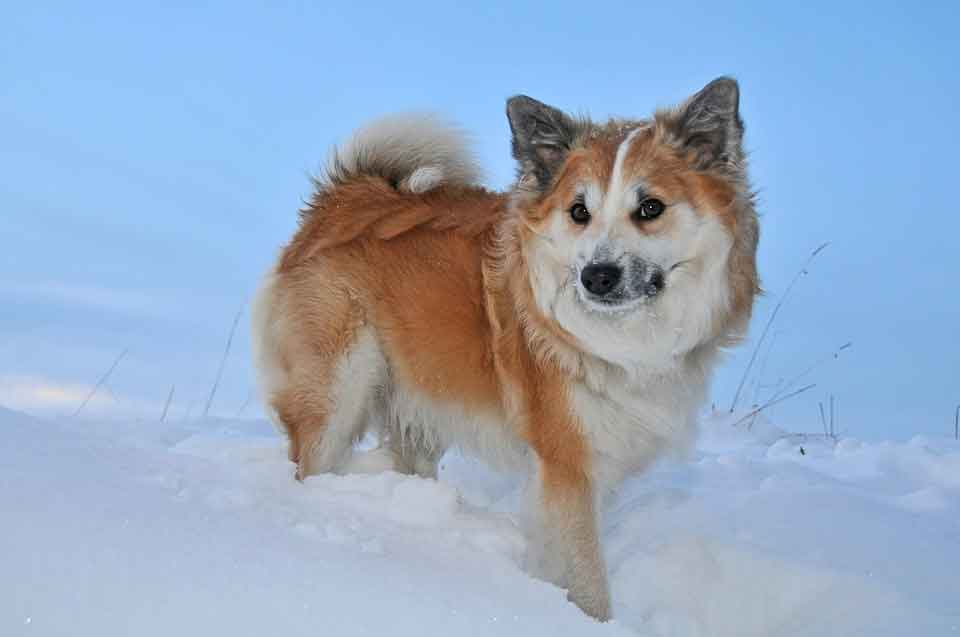
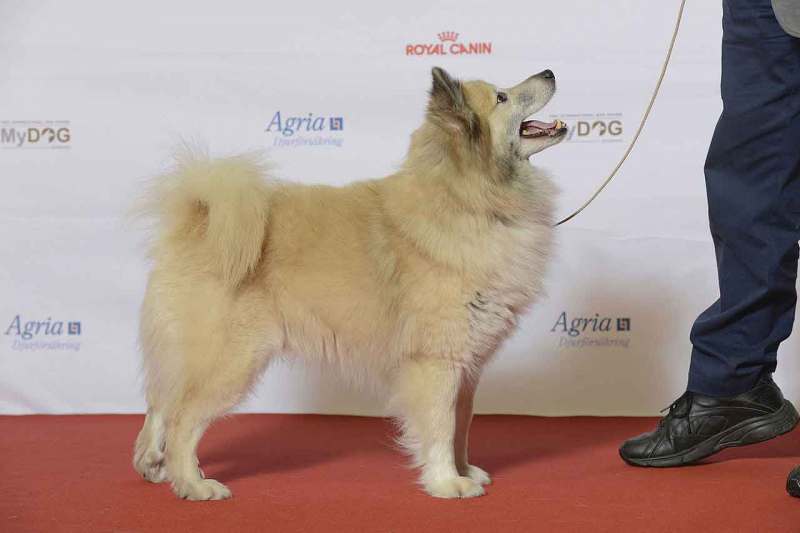
Icelandic Sheepdog

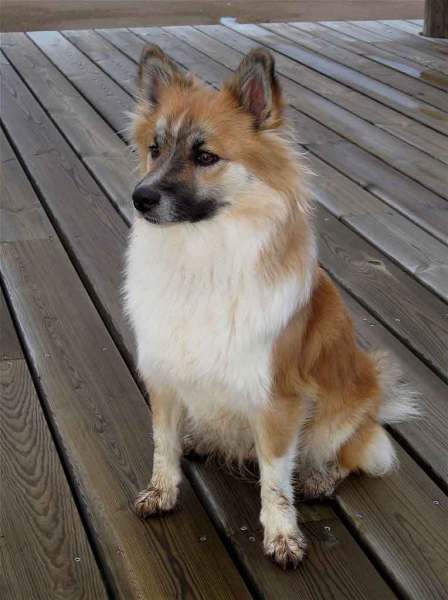
The muzzle expression of the Icelandic Sheepdog recalls a smile that highlights your cheerful temperament.

Content

History


Where does the Icelandic Sheepdog come from??

For many centuries the Icelandic Sheepdog It was the "Swiss army knife" of the lonely farms and workshops of the great North Atlantic island. In the extremely harsh climate they had to herd sheep, keep small vermin, help in hunting, as well as taking care of the house and the farm and especially the children. On the one hand they are considered as shepherd dogs and on the other hand as Nordic Spitz. In any case, they're extremely smart, agile, flexible and robust man's aides.

Its existence was in grave danger only recently. Due to introduced diseases and mixing with pedigree dogs legally and illegally imported to the island, they seemed already extinct. So the Icelanders recognized the danger surrounding their only native dog and took specific action against it..

Today, this unique dog breed seems to be over the hill in its population. The Icelandic Sheepdog enjoys increasing popularity outside Iceland. Genetically speaking, has been able to maintain his Nordic identity. This is confirmed by at least a thorough genetic analysis from 2017 of more than 100 breeds of dogs by a team of geneticists led by Heidi Parker.

The Icelandic dog has become very popular outside of his original home as a friendly, exciting and fascinating companion and family dog. Still retains much of his original acting ability, expressed in his desire to move, to work with friends and to be very alert. In 1972 was officially recognized by the FCI (International Cynological Federation).

Physical characteristics

The Icelandic Sheepdog of "Islenskur Fjรกrhundurยป is a very old breed of dog and the only one in Iceland. The Icelandic dog is a medium-sized dog, which is coughy and only at first glance resembles a medium-sized dog. It has a dense fur, weather insensitive and robust. The top layer is medium or long, with a dense, soft sub-hair. There are Icelandic dogs with short and long hair. Different colors are allowed, from tanning to cream, chocolate brown, grey or black. Dogs should always have white markings.

The standard describes its overall appearance in this way:

The Icelandic Sheepdog is a Nordic grazing Spitz; it's a little less than medium-sized and has pointed ears and a screwed tail. Seen on side, has a rectangular format, that is to say, the length of your body from the tip of your nose to the tip of your buttock exceeds your height to the cross. The depth of the chest box is equal to the length of the front legs.

How big is an Icelandic Sheepdog?

Males must have a height at the cross of some 46 centimeters, the females 42 centimeters. The standard does not give any information about weight.

Longevity of an Icelandic Sheepdog

One Icelandic dog seriously raised must have a life expectancy of 12 years or more.

Character and skills

The Icelandic Sheepdog remains an agile grazing dog and a watchdog at the center of his being. But, outside Iceland, usually only bred as a companion dog. This is not a disadvantage. Rather he finds very well in his current role as family dog and companion. But it's still very agile and needs your workload. He feels comfortable watching and protecting and also likes to bark. At the same time it is a very friendly family dog that turns to people. He is considered very fond of children.

The official rule correctly describes its character as follows:

The Icelandic Sheepdog it's a sturdy grazing dog, agile and noisy and, therefore, extremely useful for grazing and driving cattle on pastures and in the mountains, as well as for tracking lost sheep. He is alert by nature and welcomes every visitor enthusiastically without being aggressive. His hunting instinct is underdeveloped. The Icelandic Sheepdog is happy, friendly, curious, playful and not afraid.

The Icelandic Sheepdog is definitely suitable for the ambitious beginner.

Caution, health and diseases


How much care does an Icelandic Sheepdog need??

An Icelandic dog needs to be roasted during fur change. The top and bottom layer should be brushed intensely.

Are there any breed-typical diseases in Icelandic dogs??

The Icelandic Sheepdog it's essentially a healthy and robust breed of dog.

What food is best for an Icelandic dog?

The Icelandic Sheepdog is a trouble-free and unre demanding food. Of course, High quality food is good for your health and test. like most dogs, sometimes he likes a bone of fleshy beef and fresh meat.

Considerations before purchase

Where can you buy an icelandic dog?

If you are interested in a Icelandic Sheepdog, you should look for a local icelandic dog breeder who is affiliated with an official nordic dog club. You should fix this in time, because puppies are rare.

Icelandic Sheepdog Education and Maintenance


Is an icelandic dog suitable for me?

The Icelandic Shepherd Dog is a friendly and breus dog. He wants to integrate into the family and can fit in without problems. The ideal is a house with a garden in the countryside. But that's not an obligation.. You can also keep it in an apartment in the city, whenever you deal with him every day.

The Icelandic Sheepdog is a loving member of the family and a great companion for children. Welcome visitors amicably and stormily. Their cordiality is contagious. If you get too bored, you can spend your energy on furniture or you become a thief.

Since the Icelandic Sheepdog has little hunting instinct nowadays, the excursions with him to nature are quite relaxed. With an Icelandic dog you can go on a trip without problems. In the car – just by the hair – an aluminum transport box is recommended.

One Icelandic Sheepdog needs to be looked after by fur. It is very important that humans and dogs have a common interest in lots of movement and exploring nature.. Icelandic dog is not a sofa stuffed animal.

He can be trained very well. He is open and honest and likes to work alongside his master or carer. The art lies in finding the right level of consistency and guidance for this very lively and at the same time sensitive and intelligent dog.. The decisive basis is always a close emotional bond and mutual trust.. Because of their good behavior, you can easily do, a certain amount of work is a basic requirement. A frustrated Icelandic dog won't thank you as an obedient companion. But this is only in the possession of your caregiver. From puppy, you have to keep an eye on your eagerness to report, which is related to the bark of joy. Here you must put the strict reins, if you don't live on a lonely, lonely property. Once again, the Icelandic Sheepdog is more effective than any alarm system.

Characteristics "Icelandic Sheepdog"

Coexistence is important that you have with your new friend. Before considering the acquisition of a dog of the breed "Icelandic Sheepdog" you know certain factors. Not all breeds of dogs are apt to live in an apartment, you must take into account his character, their need for exercise, their interaction with other pets, their care and if you have small children, their level of tolerance towards them.

Training ?

4,0 of 5 stars (based on 1 review)

Suitability of the apartment ?

2,0 of 5 stars (based on 1 review)

Can be alone all day ?

1,0 of 5 stars (based on 1 review)

Suitable as a first dog ?

3,0 of 5 stars (based on 1 review)

Weight gain ?

3,0 of 5 stars (based on 1 review)

Health ?

4,0 of 5 stars (based on 1 review)

Intelligence ?

4,0 of 5 stars (based on 1 review)

Kindness with child ?

4,0 of 5 stars (based on 1 review)

Tendency to bite ?

2,0 of 5 stars (based on 1 review)

Tendency to bark ?

4,0 of 5 stars (based on 1 review)

Tendency to flee ?

2,0 of 5 stars (based on 1 review)

hair loss strength ?

4,0 of 5 stars (based on 1 review)

Suitable as a guard dog ?

4,0 of 5 stars (based on 1 review)

Joy ?

3,0 of 5 stars (based on 1 review)

Cat friendliness ?

4,0 of 5 stars (based on 1 review)

Power level ?

4,0 of 5 stars (based on 1 review)

Images "Icelandic Sheepdog"

Photos:

1 – Icelandic Sheepdog, remembering a Corgis by Thomas Quine / CC BY-SA
2 – Icelandic Sheepdog by https://pxhere.com/en/photo/237527
3 – Icelandic Sheepdog by Canarian / CC BY-SA
4 – Icelandic Sheepdog by https://pxhere.com/en/photo/237516
5 – Icelandic Sheepdog by Alan Levine / CC BY
6 – Icelandic Sheepdog by Svenska Mรคssan from Sweden / CC BY

Videos "Icelandic Sheepdog"

Icelandic sheepdog - Iceland's totem animal

Type and recognitions:

  • FCI CLASSIFICATION:
  • Group :
  • Section : . .

Federations:

  • FCI – Group 5 – Section 3 Nordic Watchdogs and Herders.. โ“˜
  • AKC – Nordic Watchdogs and Herders. โ“˜
  • CKC – Nordic Watchdogs and Herders. โ“˜
  • UKC – Nordic Watchdogs and Herders. โ“˜

FCI breed standard "Icelandic Sheepdog"

Origin:
Iceland

Date of publication of the valid original standard:
20.06.2007

Use:

Pastoral Dog.


General appearance:

The Icelandic Shepherd Dog is a Nordic grazing spitz, slightly smaller than medium, with erect ears and curved tail. Seen on the side is rectangular, the length of the body from the tip of the shoulder to the tip of the ischion is greater than the height at the cross. Chest depth is the same as the length of the previous limbs. The expression is sweet, smart and cheerful, a confident and lively patience is typical of the breed.

There are two types of mantle, long and short, both thick and extremely resistant to inclement weather. There is a marked difference in appearance between the two sexes.


Behavior / temperament:

The Icelandic shepherd dog is a hard and agile grazing dog, barking, making this extremely useful for rounding up livestock in pastures or mountains and finding lost sheep.. The Icelandic Shepherd is by nature very alert and will always give visitors an enthusiastic welcome without being pushy.. His hunter instincts are not strong. The Icelandic Shepherd is cheerful, friendly, inquisitive, playful and fearless.

Head:

Strongly built, with well adhered skin. Skull slightly longer than muzzle. Triangular seen from above or from the side.

Cranial region:

Skull : Something vaulted.
Depression links (Stop) : Clearly defined, although neither excessive nor high.

facial region:

Truffle : black, dark brown in chocolate-colored dogs and some cream-colored dogs.
Snout : Well developed, straight muzzle. Snout slightly shorter than skull, forms an obtuse triangle seen from above or from the side.
Lips : Blacks, tight, dark brown in chocolate-colored dogs and some cream-colored dogs.
Cheeks : Flat.
Bite : Scissor, full dentition.

Eyes : Medium in size and almond shape. Dark brown, slightly lighter in chocolate-colored dogs or some cream-colored dogs. The eyelids are black, dark brown in chocolate or cream dogs.

Ears : erect, medium-sized. Triangular, with firm edges and slightly rounded tips. Very mobile, reacting sensitively to noises and showing the dog's mood.

Neck:

Moderately long and muscular, no loose skin. Slightly arched and carried high.

Body:

The length in correct proportion to the height and in harmony with the general appearance.

top line : To level, muscular and strong.
Pork loin : Wide and muscled.
Rump : Moderately short and wide, with slight decline and well muscled.
Breast : Long, deep, and well arched.

Tail:

High insertion, coiled and touching the top line.

Tips

PREVIOUS MEMBERS : Seen from the front they are straight, parallel and strong. Normal angulation.

Shoulder : Oblique and muscular.
Spurs : They can be double.
Front feet : Slightly oval, well arched, close-knit toes with well-developed pads.

LATER MEMBERS : Seen from behind they are straight, parallel and strong. Normal angulation.

Thighs : Wide and well muscled.
Spurs : well developed. Double spur is desirable.
Hind feet : Same as above.

Movement:

Displays agility and endurance with good momentum, covering ground effortlessly.

Mantle

MANTLE : Double, thick and extremely resistant to inclement weather.

HAIR : There are two varieties.

to) Short : The outer layer is of medium length, pretty thick, with thick and soft undercoat. Hair is shorter on the face, top of head, ears and front of legs, but it's longer on the neck, chest and back of thighs. The tail is hairy and the length of the hair is in proportion to the coat.
b) Longer hair : The outer layer is longer than the previous one, quite thick, with thick and soft undercoat. Hair is shorter on the face, top of head, ears and front of the legs and longer behind the ears, neck, chest, back of legs and thighs. The tail is very hairy, the length of the hair is in proportion to the coat.

COLOR : Various colors are allowed, but a single color must always predominate.

The predominant colors are :

. Various shades of fire color, ranging from cream to reddish brown.
. Chocolate brown.
. Gris.
. Negro.

White always accompanies the predominant color. The most common white marks, which are generally irregular, are : on a strip or part of the face, collar, chest, variable height boots and the tip of the tail. Lighter shades are generally found on the underside of the dog, going from the throat to the tip of the tail. In the fire and gray dogs, the black mask is frequently given, black tips of outer hairs and occasionally black hairs. Black dogs (tricolor) they have a black cloak, with white markings as mentioned above and the traditional markings in any of the various tan colors, cheeks, on the eyes and on the paws. Patches of the colors described above, on a white background, is allowed. White must not be totally dominant.


Size and weight:

The ideal height is :

  • Males : 46 cm.,
  • females : 42 cm..


Fouls:

Any deviation from the aforementioned criteria is considered as a fault and the severity of this is considered to the degree of the deviation to the standard and its consequences on the health and well-being of the dog..

. Dog with solid black coat or saddle of any of the tan colors.

SERIOUS FAULTS: :

. Without spurs.
. Yellow eyes.
. Bulging round eyes.

Any dog โ€‹โ€‹showing clear signs of physical or behavioral abnormalities must be disqualified..


N.B.:

Males should have two normal-appearing testicles fully descended into the scrotum..

Source: F.C.I - International Cynological Federation

Alternative names:

1. Icelandic Spitz, Iceland Dog, รslenskur fjรกrhundur, Islandsk, Fรฅrehund, Friaar Dog, Canis Islandicus (English).
2. Berger islandais, Berger d’IslandeFrench).
3. Islรคndischer Spitz, Islรคndischer Schรคferhund (German).
4. Islenskur fjรกrhundur (Portuguese).
5. รslenskur Fjรกrhundur (espaรฑol).

โ–ท The world of Pets: Dogs, cats, birds, reptiles, amphibians

Swedish Lapphund
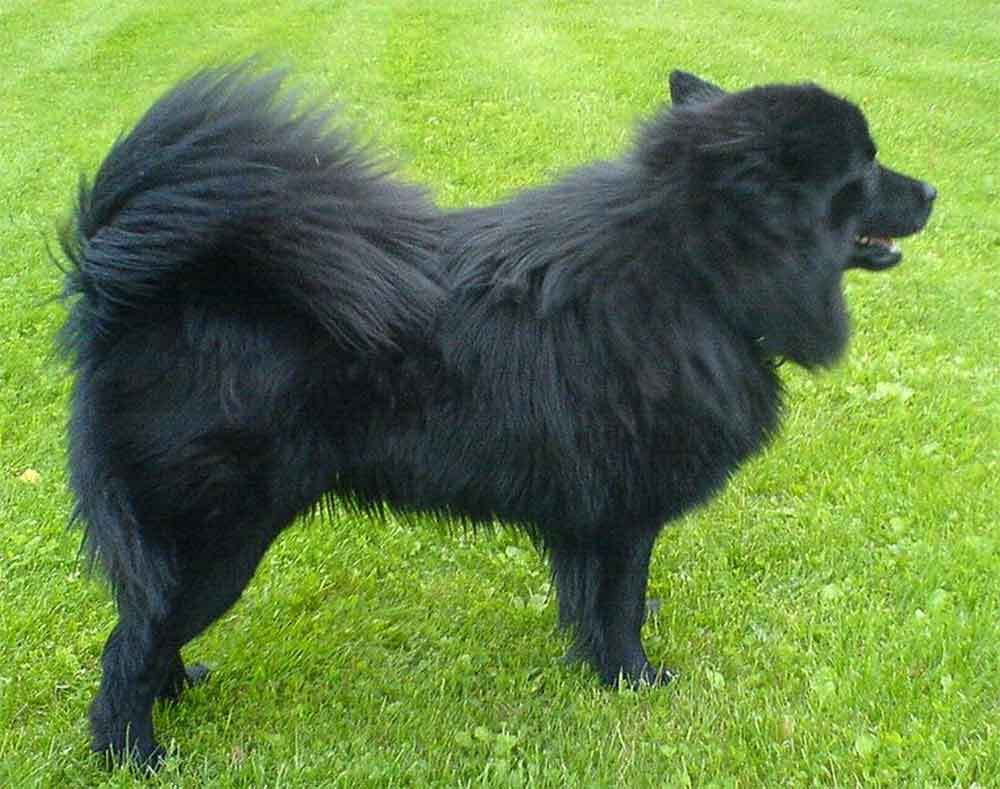
Suecia FCI 135 - Nordic Watchdogs and Herders.
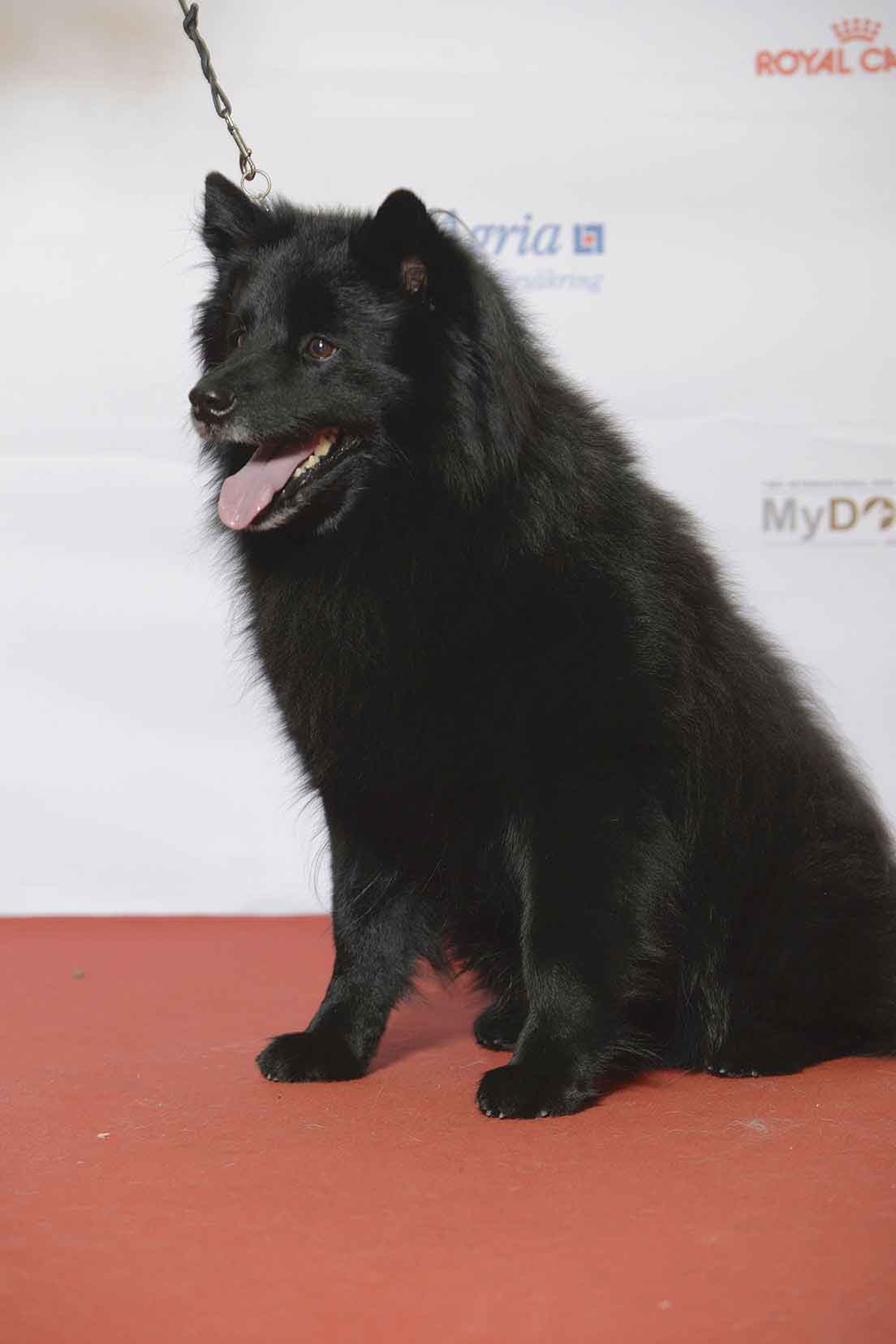
In experienced hands the Swedish Lapphund is a loyal and robust companion.

Content

Origin and history

The "Swedish dog of Lapia" shares its ancestors with the Finnish Lapphund. They are descended from dogs bred by the Lapps and Sami specifically to herd their large herds of reindeer.. For centuries they have served as indispensable working dogs in this way.

Breeding became increasingly specialized for weather resistance and independence. The dogs had to perform very well physically. Persevering and willing to work, They formed the perfect partners for the herd owners. With this they ensured their livelihood for these people.

Only in the 20th century were three independent dog breeds formed and recognized from these dogs. In addition to the Swedish and Finnish Lapphound, there is also the Lapponian Herder today. This one has a shorter coat and short hair.

As technology progressed, the Swedish Lapphund was gradually replaced by snowmobiles. Due to its faithful and pleasant character, the breed remained, however, preserved. Today they are highly valued as family and companion dogs.. But they are also suitable for hunting, like watchdogs, and even as search and rescue dogs.

Physical characteristics

The breed is recognized by the FCI and belongs to the group 5 of "Spitz type dogs and primitive type". The relationship with Spitz can be easily seen in the appearance of the Swedish Lapphund. Distinctive triangular head and ears frame large, alert eyes. With a height between 43 and 48 centimeters, belongs to the breeds of medium-sized dogs.

His coat is always black. Only occasionally can small white markings be found on the legs or chest. Like all Nordic dogs, has a double coat with a very dense undercoat and a long coat. This coat makes it very insensitive to almost all weather conditions.

Character and skills

Swedish Lapphund
The largest dog event in the Nordics: www.mydog.se

In his character, the Swedish Lapphund he is very attentive, lively and friendly. It is well adapted as a family dog. But it is often used for dog sports too, hunting or as a watchdog. Your original task as a herding dog is, Unfortunately, hardly needed today.

Like an intelligent and persistent dog, it is important that you are always physically and mentally disabled. Due to its independent character, consistent training is necessary. In experienced hands the Swedish Lapphund is a loyal and robust companion.

The Swedish Lapphund tends to bark, what is beneficial to use as a watchdog. If you start early with education, the barking can also be well contained. Generally friendly with other animals.

Correct nutrition

The Swedish Lapphund has no special restrictions on feeding. It can be well fed with any quality food. Attention should be paid to a good nutrient composition. The sugar, However, has no place in feeding.

Awards are not absolutely necessary for the motivation and education of the Swedish Lapphund. But, is particularly happy with the natural chewy sticks, like cowhide or pig's ears. Attention should also be paid to dental care.

Care of the "Swedish dog of Lapia"

Although the coat of Swedish Lapphund it is as abundant as it is impressive, his toilet is not elaborate. The coat is very dense and offers perfect protection against the weather. Firm structure of the top layer is dirt repellent. So, it is enough to brush the Swedish Lapphund from time to time to remove coarse dirt or sticks.

Only during the change of coat is daily brushing necessary. One should use dog shampoo very sparingly with this dog.. So, should only be bathed in the absolutely exceptional case. It also, a haircut is not normally necessary. Like any other dog, their claws should be checked regularly and, if required, cut. The ears should also be cleaned from time to time to avoid infections..

Videos "Swedish Lapphund"

Type and recognitions:

  • FCI CLASSIFICATION:
  • Group :
  • Section : . .

Federations:

  • FCI – Group 5 – Section 3 Nordic Watchdogs and Herders.. โ“˜

FCI breed standard "Swedish Lapphund"

Origin:
Sweden

Date of publication of the valid original standard:
26.06.2000

Use:

Herding dog, Today it remains rather as a company dog.


General appearance:

Typical spitz dog slightly lower than middle size and carrying the head proud. His coat is resistant to temperature.

IMPORTANT PROPORTIONS :

The body is rectangular.


Behavior / temperament:

Lively, alert, kind and affectionate. The Lapland Swedish Dog is very receptive and eager to work. His skills like a good guardian dog and pastor make him extremely useful in reinde. It is extremely versatile, suitable for obedience training, agility, grazing, tracking, etc. It is easy to train, full of stamina and character.

Head:

----

Cranial region:

Skull: Slightly longer than wide; the forehead is rounded and the occiput is not clearly defined.
Depression links (stop) : Very well marked.

facial region:

Truffle: Preferably dark, or very black.
Snout: A little longer than a third of the length of the head, well filled and tapering towards truffle. The nasal bridge is straight.
Belfos: Tight. The palate and lips are heavily pigmented.
Mandible / Teeth: Scissor bite with well developed and regular teeth.

Eyes: Separated from each other, round, rather large. Cafรฉs, preferably dark brown and very expressive. Well pigmented eyelids.
Ears: Triangular, widen the base, small, upright, tips slightly rounded, Insertion well separated from each other and very mobile. Pointed ears are undesirable but not a disqualifying foul.

Neck:

Of average length, no double chin and powerful.

Body:

Well coupled, slightly longer than the height at the withers.

Back: Straight, strong, muscular and flexible.
Pork loin: Short and broad.
Rump: Proportionally long and wide, slightly downward and muscular.
Breast : Preferably deep reaching up to the elbow. The rib cage is proportionally long, long with well developed back ribs. The sill is well developed; with well defined sternum.
Belly: Withdrawn.

Tail:

Rather high insertion, reaching the hock when stretched. Carrier rolled over the back when on the go.

Tips

PREVIOUS MEMBERS: The forelimbs should be angled enough at the shoulders and elbows to provide good reach..

Shoulder: Scapulae should be well back.
Elbows: They must be close to the chest.
Forearm: Straight, strong and parallel, in static and in motion.
Metacarpus: They have an oblique position.
Previous feet: Strong, oval-shaped, with fingers close together, strong and elastic bearings; well covered with hair even between the bearings. Nails and bearings must be heavily pigmented.

LATER MEMBERS: Well angulated in the knees and tibi-tarsal joints, but not excessively.

Leg: Muscled.
Hock joint: Low set to provide propulsion power. Undesirable accessory fingers.
Hind Feet: Same as previous.

Movement:

Light and elastic, with good momentum, covering a lot of ground.

Mantle

HAIR: Profuse double coat. The hair is straight from the body and is finely curled at the bottom. The hair is short on the head and the front of the limbs. It's long on the chest, the back of the thighs and on the tail. Abundant, dense and long on the tail. In the neck and in the throat it forms a necklace.

COLOR: Usually solid black; The brown color is typical. The brown color was known for a long time.
White color on the chest, on the feet and on the tip of the tail is allowed, but more white is undesirable.


Size and weight:

  • Ideal size in males: 48 cm..
  • Ideal size in females: 43 cm..

With a tolerance of plus and minus 3 cm..


Fouls:

Any deviation from the above mentioned criteria is considered to lack, and the gravity of this refers to the degree of deviation to the standard and its impact on the health and well-being of the dog.

SEVERE FAULTS

โ€ข Under non -existent hair.

MISS PLAYOFFS

โ€ข Cowardice, aggression toward owner.
โ€ข Atypicity.
โ€ข Abnormalities.

Any dog โ€‹โ€‹showing clear signs of physical or behavioral abnormalities should be disqualified..


N.B.:

Males should have two normal-appearing testicles., fully descended into the scrotum.

Source: F.C.I - International Cynological Federation

Alternative names:

1. Svensk lapphund (English).
2. Chien suรฉdois de Laponie (French).
3. Schwedischer Lapphund (German).
4. Lapphund (Portuguese).
5. Pastor lapรณn de Suecia (espaรฑol).

โ–ท The world of Pets: Dogs, cats, birds, reptiles, amphibians

Lapponian Herder
Finlandia FCI 284 - Nordic Watchdogs and Herders.

Lapponian Herder

It barks a lot, especially when he is working.

Content

History

The similarities of Lapponian Herder with the Finnish Lapphund they are big: The ancestors of both races served the Sami, which were also called "lamps" in honor of their hometown in past times, like hunters and watchdogs.

As reindeer herding was particularly important to many Sami, this breed next to this town and with the increasing domestication of reindeer, developed more and more in herding dogs. The agile and intelligent ancestors of the Lapponian Herder they mastered this task brilliantly. In the not yet coordinated brood, it wasn't so much appearance that mattered, but rather the character and herding abilities of the dogs. As a result, there was no uniform appearance for a long time. In the middle of the 20th century the first standards were developed. But at that moment, the Lapponian Herder and the Finnish Lapphund they were still considered as one race.

Only in december 1966 the Lapponian Herder was recognized as an independent breed. But, its importance as a reindeer herding dog diminished more and more with time and with the advent of snowmobiles. Today the breed is largely unknown outside of Scandinavia.. In his homeland., However, there are some friends of these dogs, who appreciate this breed as a member of the family. These dogs are mostly kept as companion dogs., but some of them still perform faithful shepherding services.

Physical characteristics

ยซAs a mixture of Border collie and German Shepherdยป – this is the appearance of a Lapponian Herder. But, the trained eye recognizes above all the similarity with other Nordic races such as the Alaskan Malamute.

The Lapponian Herder is a slim and athletic dog of the type Spitz with a height of about 51 cm at the withers in males and about 46 cm in females. It weighs some 25 kg, the weight is not fixed in the standard. This breed is rather long than tall, which means that the length of the body exceeds the height at the withers by one 10 per cent. The Finnish Shepherd of Lapland wears his ears pricked, the long hairy tail hanging at rest, slightly curved when moving. Coat color varies from black to various shades of gray and brown. White markings on the neck are allowed, chest and legs. The breed's coat consists of two layers: a dense, fine undercoat and a stiffer, longer outer coat.

Character and skills

The Lapponian Herder they are great for heavy work like herding dogs. They unerringly track lost cattle and have repeatedly proven themselves to be perfect assistants to herders and cattle breeders.. Animals are considered to be very eager to learn, they are smart and they bark. Due to their pronounced attention they are also excellent watchdogs.. In addition to the courage attributed to him, these dogs are also agile and strong. They are considered good dressage dogs and can also be kept in families. It should be noted, However, that the Lapponian Herder requires a high degree of exercise and effort.

Health of the Lapponian Herder

This parent breed is considered robust and hardy and almost never causes inherited diseases.. If you are looking for such a dog, You should definitely support the efforts of serious breeders and only buy a puppy from one of them.. Because responsible breeders place importance on caring for the health of parents, as well as the type and character. Because the coat is adapted to the Nordic climate, the dog should never be asked to perform at its best in temperatures above 15 degrees. Basically, in summer it is advisable to change the longest exercise units to the morning and afternoon hours. Representatives of this breed reach an age of twelve to fourteen years.

Nutrition of the Lapponian Herder

The Lapponian Herder it is a muscular animal that likes to move. So adjust the amount of food to your constitution and your actual load. The information on the packaging can only be a guide.. Keep an eye on the slim waist so that you can take measurements in time if you Finnish shepherd start eating bacon. Give the pup up to four servings per day. One Lapponian Herder adult can get by on two meals.

Important:

Give your dog a break after his ration, so always feed him after exercising. It's not just the amount that counts: Be sure to use a high-quality dog โ€‹โ€‹food where meat is the main ingredient.. You can recognize this by the fact that meat is at the top of your diet and cheap fillers like grain have been avoided.. This applies to both dry and wet foods..

To meet your dog's chewing needs, can offer you regular dry dog รขโ‚ฌโ€นรขโ‚ฌโ€นchews, like cow's ears. Like candy or other snacks, remember to include them in your dog's daily ration to avoid overweight. When it comes to snacks, opt for sugar-free treats like jerky servings or rewards with added benefits like dental care snacks. Your pet should always have access to cool drinks.

Lapponian Herder care

The Lapponian Herder has many thick hairs, that it shares relatively generously with its surroundings, that is to say: misses. But, the more often you use a brush, less hair will end up on your four walls. During the change of coat twice a year she loses a lot of hair, But brushing shortens the "furry period". Better to comb dirt from the coat when it is dry. You should only bathe your reindeer dog when absolutely necessary. So use a mild dog shampoo.. Regularly check the length of eye hairs, the ears and the length of the claws and, if required, use eye and ear cleaners or dog claw scissors. Especially dogs that walk a lot on soft ground can tend to have long claws, which can cause them to get painfully stuck.

Activities with the Lapponian Herder

Of course: all dogs love being in nature. The Lapponian Herder it's a true all-rounder in this sense. When you have grown up and have had proper training, makes a wonderful jogging companion, cycling or horse riding – and of course on long and extensive walks. Dog sports in a club can also be a lot of fun with the Lapponian Herder: agility, obedience, olfactory work or use as a rescue dog often suits him well. Try what you and your Lapponian Herder enjoy more. Of course, the breed is also predestined for the tasks of herding dogs. It is important to accustom your four-legged friend to regular rest periods., despite proper use of the species, so you don't try too hard and stay balanced.

Where can I buy my Finnish Lapland Shepherd?

Are you decided that one will move with you? Lapponian Herder and you can offer him everything he needs for a happy and complete dog life? Cheers! But, you may still have a hurdle to overcome, because: The Lapponian Herder are very rare outside of Finland and Scandinavia. Find out more about potential breeders of a Nordic dog club to make your first contacts. If only overseas breeders are considered, first read the basics of adopting a puppy from abroad and the entry conditions. Although it may be a long way, you should definitely choose a dog from a reputable breeder to support healthy and responsible breeding of the breed. If the search for a puppy of this breed seems too complicated for you, you should also look for other breeds or dogs in animal shelters. Similar to the Lapponian Herder It, of course, the Finnish Lapphund, which is also not common outside Scandinavia, but at least not as rare as its close relative.

Characteristics "Lapponian Herder"

Coexistence is important that you have with your new friend. Before considering the acquisition of a dog of the breed "Lapponian Herder" you know certain factors. Not all breeds of dogs are apt to live in an apartment, you must take into account his character, their need for exercise, their interaction with other pets, their care and if you have small children, their level of tolerance towards them.

Training ?

4,0 of 5 stars (based on 1 review)

Suitability of the apartment ?

2,0 of 5 stars (based on 1 review)

Can be alone all day ?

1,0 of 5 stars (based on 1 review)

Suitable as a first dog ?

3,0 of 5 stars (based on 1 review)

Weight gain ?

3,0 of 5 stars (based on 1 review)

Health ?

5,0 of 5 stars (based on 1 review)

Intelligence ?

4,0 of 5 stars (based on 1 review)

Kindness with child ?

5,0 of 5 stars (based on 1 review)

Tendency to bite ?

1,0 of 5 stars (based on 1 review)

Tendency to bark ?

4,0 of 5 stars (based on 1 review)

Tendency to flee ?

2,0 of 5 stars (based on 1 review)

hair loss strength ?

4,0 of 5 stars (based on 1 review)

Suitable as a guard dog ?

4,0 of 5 stars (based on 1 review)

Joy ?

3,0 of 5 stars (based on 1 review)

Cat friendliness ?

4,0 of 5 stars (based on 1 review)

Power level ?

4,0 of 5 stars (based on 1 review)

Type and recognitions:

  • FCI CLASSIFICATION:
  • Group :
  • Section : . .

Federations:

  • FCI – Group 5 – Section 3 Nordic Watchdogs and Herders.. โ“˜

FCI breed standard "Lapponian Herder"

Origin:
Finland

Date of publication of the valid original standard:
12.03.1999

Use:

Reindeer herder.


General appearance:

A herding Spitz, medium-sized, clearly longer than the height at the withers. Osamanta and muscles are strong. The dog is muscular, but it should not give the impression of being heavy. Sex must be clearly defined. The coat must be well adapted to arctic climates.

IMPORTANT PROPORTIONS : Body length is approximately 10% longer than the height at the withers. The depth of the body measures about half the height at the withers.


Behavior / temperament:

Docile, calm, friendly, energetic and eager to serve. He barks with pleasure when he is working.

Head:

Elongada; the muzzle is slightly shorter than the skull.

Cranial region:
  • Skull : Only slightly convex. The frontal sulcus is marked and the superciliary arches are clearly defined.
  • Depression links (Stop) : In the form of a gentle slope.

facial region:

  • Truffle : Preferably black, but harmonizing with the color of the coat.
  • Snout : The nasal helm is straight. Viewed from above and in profile the muzzle tapers evenly towards the nose.
  • Belfos : Tight.
  • Jaws / Teeth : Jaws and teeth are strong. Scissor bite. Normal teeth.
  • Cheeks : The zygomatic arches are clearly marked.

Eyes : Preferably dark in color, but harmonizing with the color of the coat. Alive and rather of separate implantation. Oval in shape. Intelligent expression, in females it is also devoted.

Ears : erected, average length, preferably separate implantation, rather wide at insertion. The inside of the ears is covered with abundant hair, particularly at the base.

Neck:

Strong and medium length; smooth implantation on the shoulders. No double chin.

Body:

  • Cross : Marked.
  • Back : Strong and muscular.
  • Pork loin : Short and muscular.
  • Rump : Rather long and slightly oblique.
  • Breast : Deep, long and spacious, not very wide. The ribs are clearly arched.
  • bottom line : Slightly collected.

Tail:

Medium in length, set low and covered with abundant hair. At rest the tail hangs; in motion is carried in the form of a loose curve, but it should not be raised on the back. The tail movement can also be circular.

Tips

PREVIOUS MEMBERS :

  • As a whole : Powerful, United to the body with strong muscles, but free in their movements. Muscular and well angled. Viewed from the front they are straight and parallel.
  • Shoulder : Oblique and muscular.
  • Elbows : Turned neither in nor out, close to the body. Pointing back.
  • Forearm : Vertical.
  • Carpi : Flexible and tendinous.
  • Metacarpus : Seen in profile they are slightly oblique, thus allowing a flexible movement.
  • Previous feet : Rather oval on all sides, even below; covered with abundant hair. The fingers are well arched, the pads are elastic and thick.

LATER MEMBERS :

  • As a whole : Well angled. Viewed from behind they are straight and parallel.
  • Thigh : Rather long and wide with well developed muscles.
  • Knee : Pointing to the front, angulation is clearly marked.
  • Hock : Rather low, angulation is clearly marked.
  • Metatarsus : Rather short, vertical and parallel.
  • Hind feet : Same as previous. Preferably without dewclaws.

Movement:

PREVIOUS MEMBERS :
  • As a whole : Powerful, United to the body with strong muscles, but free in their movements. Muscular and well angled. Viewed from the front they are straight and parallel.
  • Shoulder : Oblique and muscular.
  • Elbows : Turned neither in nor out, close to the body. Pointing back.
  • Forearm : Vertical.
  • Carpi : Flexible and tendinous.
  • Metacarpus : Seen in profile they are slightly oblique, thus allowing a flexible movement.
  • Previous feet : Rather oval on all sides, even below; covered with abundant hair. The fingers are well arched, the pads are elastic and thick.
LATER MEMBERS :
  • As a whole : Well angled. Viewed from behind they are straight and parallel.
  • Thigh : Rather long and wide with well developed muscles.
  • Knee : Pointing to the front, angulation is clearly marked.
  • Hock : Rather low, angulation is clearly marked.
  • Metatarsus : Rather short, vertical and parallel.
  • Hind feet : Same as previous. Preferably without dewclaws.


Mantle

SKIN : Tight over the entire body and without wrinkles.

HAIR : The outer coat is long or medium long, straight, rather separate and rough. The undercoat of hair is fine and dense. Hair is generally thicker and longer on the neck, chest and back of thighs.

COLOR : Black in different shades, even greyish or dark brown with a lighter hue than the basic color; grayish or brownish markings usually on the head, the lower parts of the body and limbs. White markings on the neck, chest and limbs are allowed. The undercoat of hairs must be black, grayish or brownish.


Size and weight:

Height to the cross :

Ideal size :

  • Males : 51 cm.
  • females : 46 cm..

With a tolerance of +/- 3 cm..


Fouls:

Any deviation from the aforementioned criteria is considered as a fault and the severity of this is considered to the degree of the deviation to the standard and its consequences on the health and well-being of the dog..

โ€ข Non -masculine males, female females.
โ€ข Very clear eyes in black dogs.
โ€ข Ears with fallen tips (semi-erected).
โ€ข curved or curved tail on the back.
โ€ข Soft fur, wavy or smooth.
โ€ข Lack of internal hair cover.

MISS PLAYOFFS

โ€ข Aggressive or fearful dog.
โ€ข Superior or inferior progantism.
โ€ข Fallen ears.

Any dog โ€‹โ€‹showing clear signs of physical or behavioral abnormalities must be disqualified..


N.B.:

Males should have two normal-appearing testicles fully descended into the scrotum..

Source: F.C.I - International Cynological Federation

Alternative names:

1. Lapland Reindeer-Dog, Reindeer Herder, lapinporokoira (Finnish), lapsk vallhund (Swedish) (English).
2. Lapinporokoira (French).
3. Finnischer Lapplandhirtenhund, Lapinporokoira (German).
4. Lapinporokoรฏra, Pastor de renas da Lapรดnia (Portuguese).
5. Lapland, Perro pastor finlandรฉs, Pastor lapรณn (espaรฑol).

โ–ท The world of Pets: Dogs, cats, birds, reptiles, amphibians

Ibizan Hound
Espaรฑa FCI 89 . Primitive type - Hunting Dogs

Ca Eivissenc

The Ibizan Hound is one of the medium sized Greyhound, very similar to Pharaoh Hound.

Content

History

The Ca Eivissenco or โ€œPodenco Ibicencoโ€, It is a breed canine Spanish Ibiza (Spain). It gets its name from the island Ibiza, belonging to the Group of islands in the Balearic Islands, bathed by the Mediterranean.

This dog, has a highly developed sense of sight and hearing, that is why he has been assigned to hunting, especially in the rabbit, both day and night.

It is a type of primitive and rustic dog, considered one of the oldest breeds that exist and can be seen the tombs of the Pharaohs and museums whose first signs can be traced back to the 3.400 A.C.

The Ibizan Hound is one of the medium sized Greyhound, very similar to Pharaoh Hound. Without a doubt a descendant of the old Egypt dogs, that's what the written theories about race say..

The origin of this breed is Spain, comes from the island of Ibiza. The city of Ibiza was founded in the 654 A.C. by the Carthaginians and it is a conjecture establishes the possibility that the first settlers took with them their dogs of Egyptian origin for simple company and to hunt the rabbits that were abundant on the island.

But various genetic studies carried out in recent years have come to the conclusion that contrary to the widespread belief that the podenco is a type of primitive dog imported a few years ago 3.000 the area of middle years, These dogs actually have a close genetic relationship with the rest of the European hunting dogs and are no more "primitive" than most of them... The researcher Antoni Pedro Marรญ, details different aspects of the morphology, ethology and ecology of Ca Eivissenc in his work Native Races of the Pitiรผses.

Did you know??

The resemblance of the Ibizan with representations of the Egyptian god Anubis dog is one of the reasons why it is often thought to be an ancient race.

Physical characteristics

Elegant and agile, with an athletic and attractive outline, and with an elastic trot.

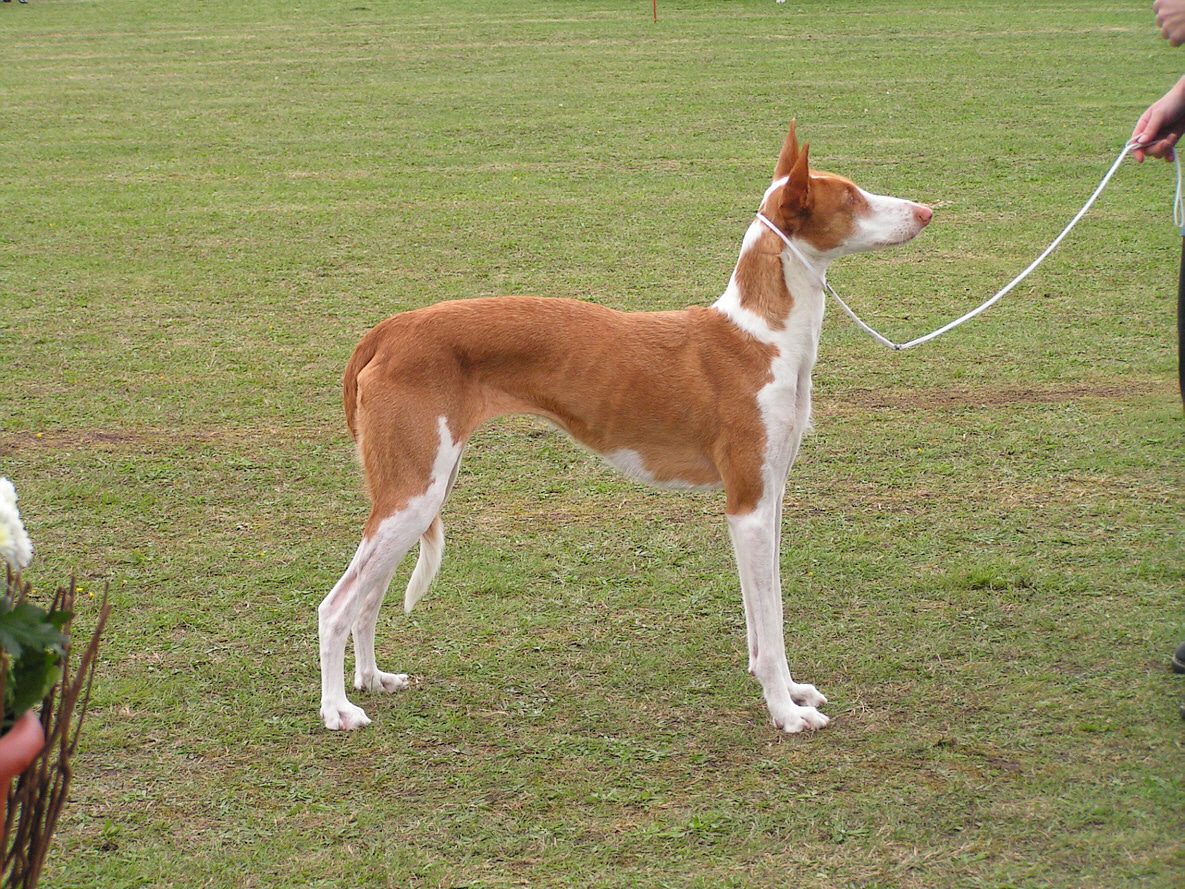
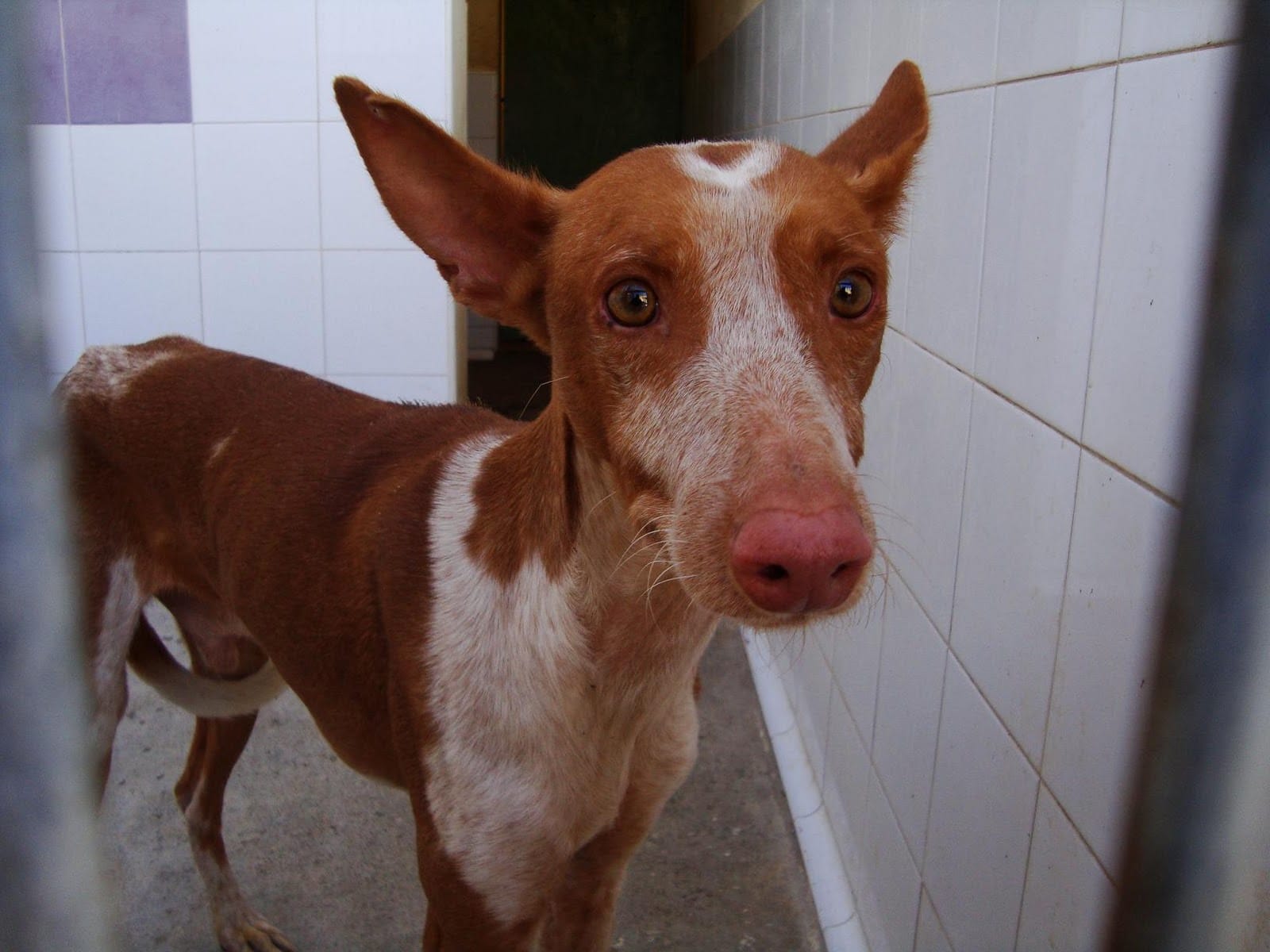
The Ibizan Hound has a long, narrow head, sharp cone-shaped; the skull is long and narrow with a little pronounced Stop. The ears must be straight, towards front and very mobile; oblique eyes, small and always amber clear.

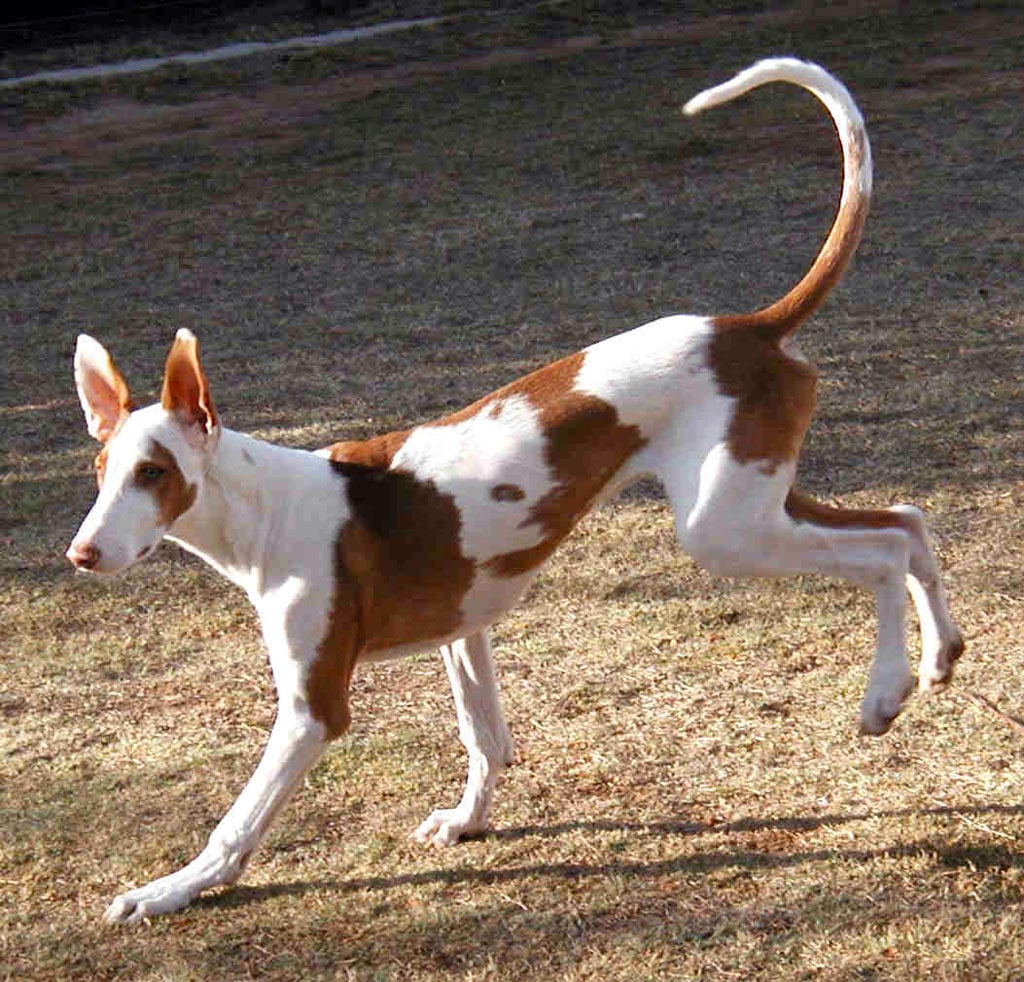
The nose is flesh-colored and usually be taken into account to determine the purity of the breed. The color will always be blanco-marron, Blanco-leonado or unicolor, although this last possibility is more rare to find them. The weight varies between the 18 and 24 Kg, Depending on whether it's a male or a female, as well as if he is too well or poorly fed. With regard to the height of the dog there are also many disputes since fashion has at times imposed more slender and tall dogs that the found in the Pitiusas Islands.

The current standard is one height of between 66 and 72 cm., It is very far from reality and the first official standard. The dogs that are bred in Ibiza and Formentera are shorter than the maximum height allowed.

Via: criadorscaeivissenc

Character and skills

Pet is an excellent. Very easy to maintain when treated well and will respect your space. He is a dog that thinks for himself and there are times when he prefers not to have to show his appreciation to his master or be appreciated.; just let it quiet. It requires patience when it is trained.

It is not recommendable for the home where children are (He has no patience and is very independent). Generally does not get along well with other pets. Can maintain you in apartment or House, When receive plenty of daily exercise.

Characteristics "Ibizan Hound"

Coexistence is important that you have with your new friend. Before considering the acquisition of a dog of the breed "Ibizan Hound" you know certain factors. Not all breeds of dogs are apt to live in an apartment, you must take into account his character, their need for exercise, their interaction with other pets, their care and if you have small children, their level of tolerance towards them.

Adaptation โ“˜

4,0 of 5 stars (based on 1 review)

friendly dog โ€‹โ€‹โ“˜

3,0 of 5 stars (based on 1 review)

hair loss โ“˜

3,0 of 5 stars (based on 1 review)

Affection level โ“˜

5,0 of 5 stars (based on 1 review)

Need for exercise โ“˜

4,0 of 5 stars (based on 1 review)

Social need โ“˜

3,0 of 5 stars (based on 1 review)

Home โ“˜

1,0 of 5 stars (based on 1 review)

Toilet โ“˜

1,0 of 5 stars (based on 1 review)

Friendly with strangers โ“˜

2,0 of 5 stars (based on 1 review)

barking โ“˜

3,0 of 5 stars (based on 1 review)

Health โ“˜

3,0 of 5 stars (based on 1 review)

Territorial โ“˜

3,0 of 5 stars (based on 1 review)

Cat friendly โ“˜

2,0 of 5 stars (based on 1 review)

Intelligence โ“˜

3,0 of 5 stars (based on 1 review)

Versatility โ“˜

2,0 of 5 stars (based on 1 review)

Child friendly โ“˜

3,0 of 5 stars (based on 1 review)

Surveillance โ“˜

3,0 of 5 stars (based on 1 review)

joy โ“˜

3,0 of 5 stars (based on 1 review)

Ibizan Hound Images

Videos Ibizan Hound

Type and recognitions:

  • FCI CLASSIFICATION:
  • Group :
  • Section : . .

Federations:

  • Federations: FCI โ“˜, AKC โ“˜, ANKC โ“˜, CKC โ“˜, โ€‹KC โ“˜, NZKC โ“˜, UKC โ“˜

  • FCI breed standard "Ibizan Hound"

    Origin:
    Spain

    Date of publication of the valid original standard:
    26.05.1982

    Use:

    Is used, above all, in the rabbit hunt without a shotgun, day and night, well they lift them easily, even in places with a lot of vegetation due to the fineness of their smell, because he uses himself and his hearing more than his sight.. For their agility and cunning they soon collect the piece, especially hunting several dogs together; When a dog shows a piece, the others surround it at a certain distance, stalking the passage of that piece., they only beat when they see or hear the piece and also when they have closed it, all of them show and charge the piece by flipping the tail during it, the sample is easily broken.

    It is also used to hunt hares and big game.. They are good collectors. To form packs, they are used, except for exceptions, females and at most one male, because they do not help each other hunting and are quarrelsome. When a pack has taken a few thousand rabbits, the peculiarity occurs that some dogs from the same, they no longer hunt until after a long rest. This is called โ€œEnconillarseโ€.


    General appearance:

    The length of the tip of the snout to the eye is the same as the distance between them and the occipital.


    Behavior / temperament:

    ---

    Head:

    Long head, narrow cone truncated near your base, excessively dry, rather small in relation to the body.

    Cranial region:
    • Skull: Dolicocephalic, long or crushed; prominent occipital bone; narrow forehead and flat.
    • Stop: Poorly defined.

    facial region:

    • Truffle: Slightly convex, flesh-colored; Open nostrils.
    • Snout: Prominent, protrudes from the lower jaws; is narrow, long and colour harmonising with the coat meat.
    • Lips: Fine, collected, flesh-colored.
    • Teeth: In perfect opposition, White, well placed, with the Scissor bite.

    Eyes: Oblique, small, Amber clear, Recalling the color of candy; Amber can be more or less intense, depending on the color of the coat. With a not very noble look, very intelligent, shy and distrustful.

    Ears: Always rigid; directed forward, to the sides horizontally or backward; to when the dog is excited, very moving; the center of the base is located at the level of the eyes; elongated rhomboid-shaped, truncated to one third of its longest diagonal. They are fine, without hairs inside; median, not overly large.

    Neck:

    Very dry, both at the bottom and top. Its length is one-quarter the length of the body; slightly arched, muscled; the skin is taut, Lisa, without jowl. The hair is usually longer and dense in the upper lower part of this area, noticing more in straight hair.

    Body:

    The general aspect of the body is symmetrical, subconvex and medioline, quite matched dimensions, picked up, slightly longer without measure fixed difference.

    • Cross: Outstanding, high, dry and long.
    • Back: Straight, long and flexible; strong muscles, but flat.
    • Pork loin: Arcuate, average width, strong and powerful.
    • Rump: At desk, of very powerful and hard muscles, with a bone structure shows.
    • Breast : Deep, narrow and long, without elbows, sternum angle very sharp and prominent; flat ribs.
    • Belly: Collected but not agalgado.

    Tail:

    Low insertion; passing between the legs to reach the spine, monitors (towards the tip around the tail a few longer and thicker hairs slightly separated in a spike shape), long; somewhat thicker in his birth, will tweaking gradually; at rest falls naturally; in action is in the form of sickle, more or less closed, preferably is not straight or screwed too on the back.

    Tips

    PREVIOUS MEMBERS: They are aplomados, symmetric; seen from the front arms are close together; collected set, limbs long giving the impression of a thin animal, Agile but strong.

    • Shoulder: Oblique scapulae, strong and free in their movements.
    • Arms: Very long, straight and strong, and very together.
    • Elbows: Comprehensive and outstanding, parallel to the median plane of the body, never come out.
    • Forearm: Wide at its bottom end.
    • Metacarpus: Powerful, strong, width, right well.

    LATER MEMBERS: Plumb, long muscles, strong, dry, flattened muscle.

    • Hocks: Toggle, widths, close to the ground (descending), well Plumb, Neither outwards nor inwards.

    FEET: Trend of Hare, tight and long fingers, well trimmed hair interdigital spaces, very strong and generally white nails, Sometimes the color of hair; very hard pads.

    Movement:

    The preferred way is a trot suspended; the Gallop is very fast, giving feeling of agility.

    Mantle

    SKIN: Tense, attached to the body; Pink pigmentation, It can vary from color in the regions in which the layer is different.

    HAIR: Smooth, hard or long.

    • The smooth should not be silky but strong and shiny.
    • The hard must be rough, well populated, somewhat shorter on the head and ears, longer in the back of the thighs and the underside of the tail; the beard is very appreciated; the length is softer and must be at least one length 5 cm with the heavily populated head.

    COLOR: Preferably white and Red, unicolores white or red, although the fawn could also be admitted as long as it is an extraordinary specimen., Although never accept this color for hair.


    Size and weight:

    Height to the cross:

    • For males :  66 to 72 cm.,
    • for females :  60 to 67 cm..

    Without being very demanding, Since of approximate measurements you can always accept that they are proportionate and aesthetic.


    Fouls:

    Any deviation from the aforementioned criteria is considered as a fault and the severity of this is considered to the degree of the deviation to the standard and its consequences on the health and well-being of the dog..

    SERIOUS FAULTS :

    • Short and wide head.
    • Very marked stop.
    • Lack of a premolar.
    • Floppy ears.
    • Depressed Center ribbing.
    • Elbows out.
    • Cow hocks.
    • Feet out.
    • Cross feet and hocks in motion.

    MISS PLAYOFFS :

    • Aggressive or fearful dog.
    • Phased skull.
    • Brown pigmentation or black spots on truffle.
    • Any form of prognathism.
    • Eyelids and lips brownish red.
    • Miss indicating a junction with a Greyhound or a hound, that is to say :
      • folded ears
      • Dark eyes
      • Wide rump
      • Little defined sternum
      • Separate forelimbs
      • Thighs wide and rounded, with bulging veins


    N.B.:

    โ€ข Males must have two normal-appearing testicles fully descended into the scrotum..
    โ€ข Only functionally and clinically healthy dogs, with the typical conformation of the breed, should be used for parenting

    Source: F.C.I - International Cynological Federation

    Alternative names:

    1. Ibizan Warren Hound, Ca Eivissenc, IBIZAN PODENCO (English).
    2. Chien de garenne des Balรฉares (French).
    3. Ca Eivissenc (German).
    4. Podenco ibicenico (Portuguese).
    5. Ca Eivissenc (espaรฑol).

    โ–ท The world of Pets: Dogs, cats, birds, reptiles, amphibians

    Canaan Dog
    Israel FCI 273 - Primitive type

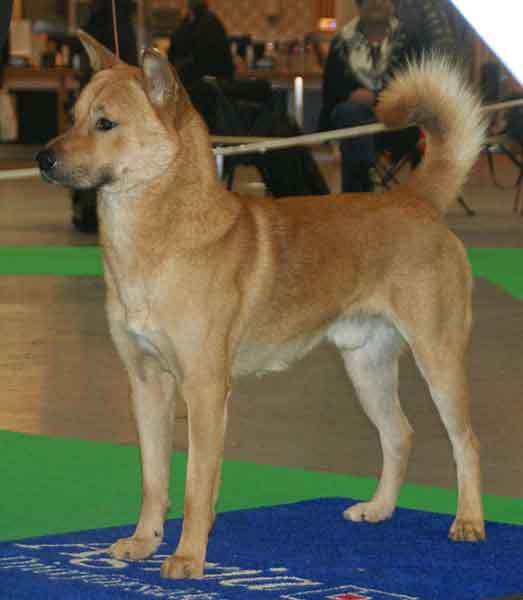
    Canaan Dog

    The Canaan Dog He is suspicious of strangers and very affectionate with his clan members

    Content

    History

    The Canaan Dog They belong to the group of "pariah dogs", found throughout the Afro-Asian region. They live near human settlements, tolerated by humans, but they are not encouraged or fed. For primitive peoples they are useful as a destroyer of all organic residues.. Even today, the Canaan Dog they live in herds in the desert. If Bedouins need a guard dog for their camp or a herding dog for their sheep, they look for a wild female who raises her cubs in a cave, they throw a piece of bread at him every now and then until they have chosen the strongest male cub that will guard their camp in the future.

    Cynologically, los ยซpariah dogยป belong to the Spitz family, the oldest family of dogs in the world. Cave paintings thousands of years old show these dogs as hunting helpers. With the time, the original type of Spitz adapted to the situation of its environment. The Canaan Dog is the most developed form of the type Spitz in israel today. The canaan dog still possess strong survival instincts, what makes them smart, independent and also very cautious dogs.

    The Canaan breed has been domesticated by outcast wild dogs, namely, by Rudolphina Menzel, a canine behaviorist and cynologist who emigrated from Vienna to Palestine in the 1930. He took some of them home and was amazed at how easily they were tamed and trained. They were lively and loving. The teacher Menzel I call them canaan dogs in honor of the Biblical land of Canaan and campaigned for them to be recognized as a race.

    Physical characteristics ยซCanaan Dogยป

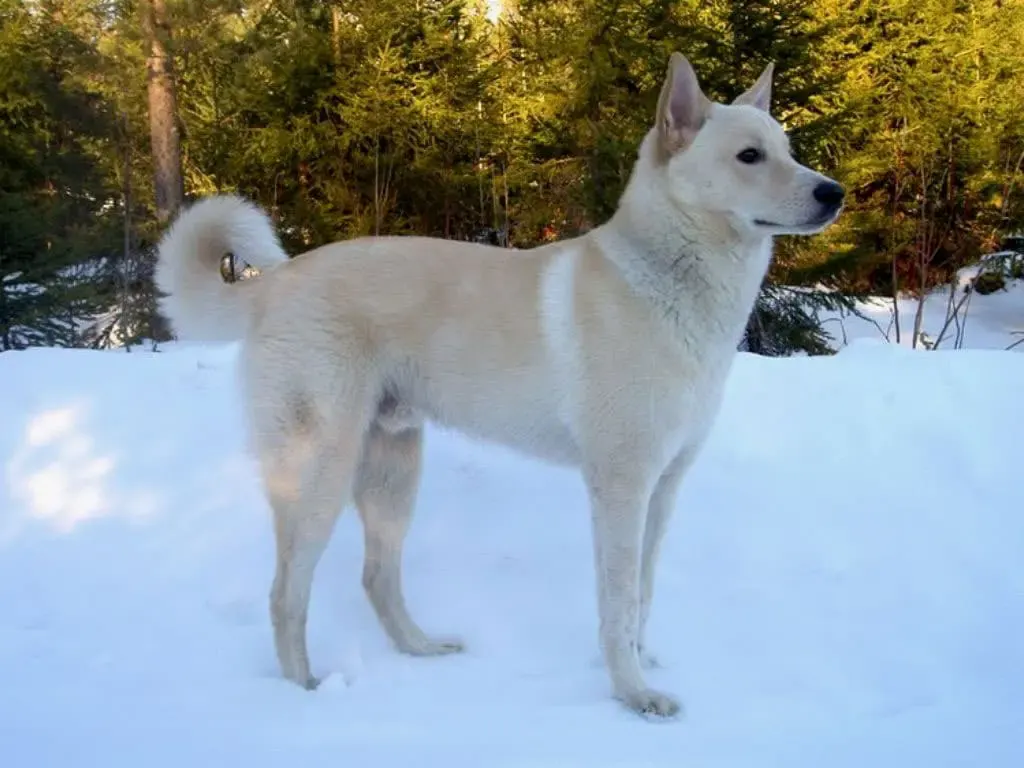
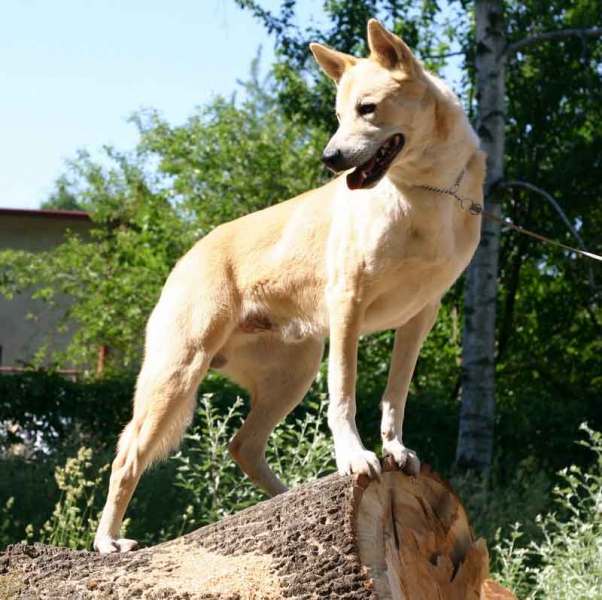
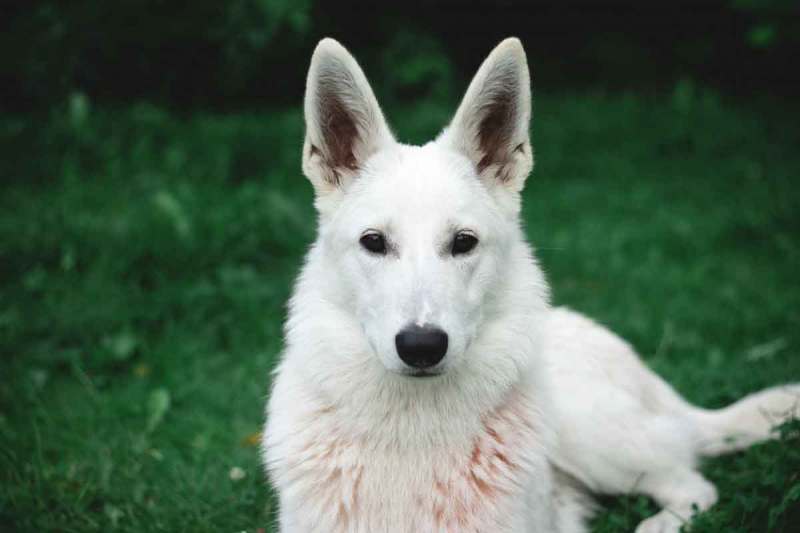
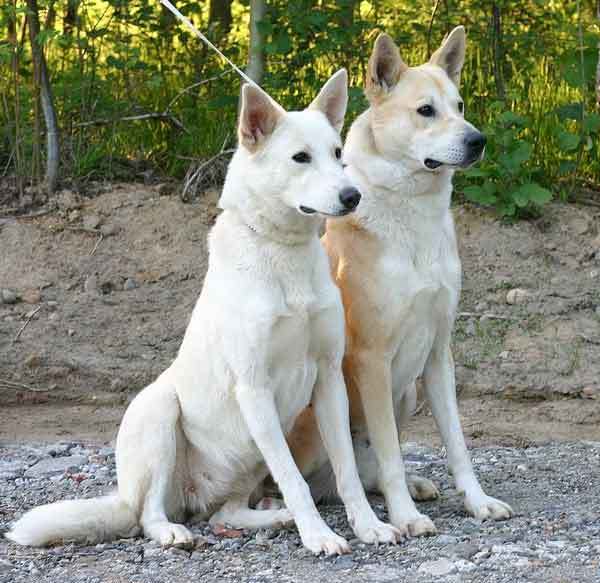
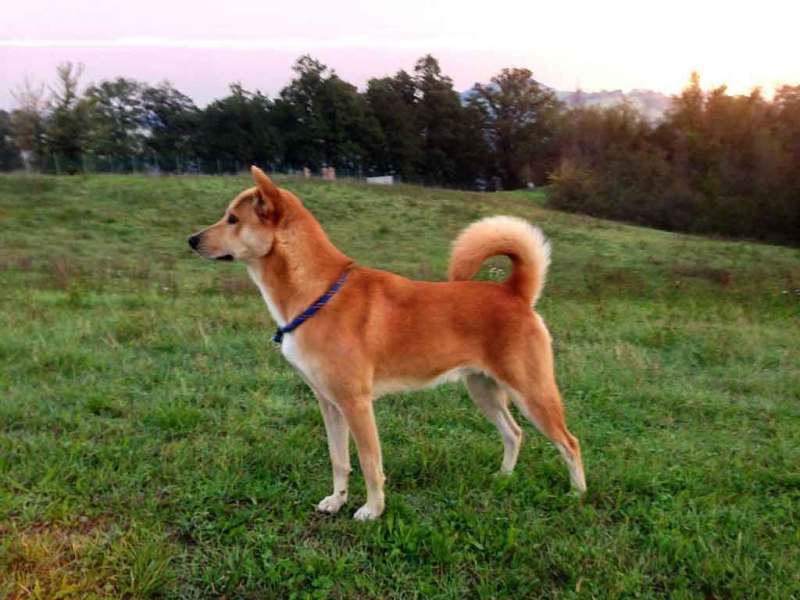
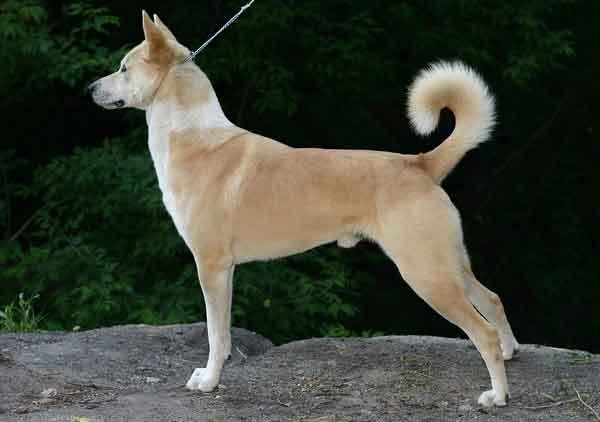
    The height at the withers of these square animals, strong and medium in size is about 50 to 60 cm., while males are usually much larger than females. In general, the sex characteristics between female and male dogs are very pronounced. These may include, the rather broad skull of the Canaan Dog, that narrows at a point towards the front, is clearly visible, especially in males. The head is always well proportioned. Standing ears, slightly laterally arranged, triangular and wide, as well as his almond-shaped and dark eyes, give you a very alert and intelligent expression. In fact, nothing escapes the watchman Canaan Dog, even when asleep.

    HAIR:
    Thick layer, rough and straight, short to medium length. The inner layer is very close and abundant.

    COLOR:
    Sandy to reddish brown, white, black or mottled, with or without mask. If there is a mask, must be symmetrical. A black mask and white markings are allowed for all colors. A pattern such as the Boston Terrier. Gray colors are not allowed, striped, black and tan or tricolor. The characteristic colors of the desert – sandy, dorado, Red and cream – are particularly typical of the breed.

    Character and aptitudes ยซCanaan Dogยป

    The Canaan Dog is lively, sensitive, distrustful of strangers, defensive, but not aggressive by nature. Watcher not only of humans, but also other animals. He is faithful and devoted to his family. The relationship with its owner means for him a partnership, both sides taking and giving. The Canaan Dog you don't have to follow your owner everywhere and submissively read every wish in his eyes. There are times when he shows his love and wants to be caressed. But other times he minds his own business and only belongs to himself.. If one responds to his character, a deep understanding develops between man and animal, which is even more attractive, since one must acquire their trust and affection. This special bond makes it difficult to place the Canaan Dog adults in new settings.

    Protects their owner's children and shows a lot of tolerance towards the little ones. But, parents should ensure the dog has a chance to withdraw.

    The Canaan Dog they are good watchdogs, but they are not attackers by nature. Only when a Canaan Dog you have the impression that he or his family is seriously threatened, will attack. The Canaan Dog barks as a warning, gives a dangerous appearance, and that is usually enough.

    The Canaan Dog can react aggressively to other dogs who dare to pass by his property. Aggression between dogs of the same sex is not uncommon among Canaanites. Each Canaan is different. You have to watch it closely to know what collisions – with other dogs on walks – it is better to avoid.

    โ€œCanaan Dogโ€ Education

    One Canaan Dog he would never do anything that could harm himself. Nor would it comply with its owner's commands without first questioning their meaning.. You can't demand obedience from this dog. But, once he has gained trust in his human and recognizes him as "leader of the pack", is very cooperative and obedient. Loyalty to his master and his quick understanding make him, despite its independence, an easy-to-handle dog, who can learn the necessary basic obedience without restrictions. But, during training its primitive nature must be taken into account, so it certainly takes some compromises and tricks to convince the Canaan Dog that obedience is worth it. For inexperienced beginners, this self-assured breed is not suitable.

    Where can I get "Canaan Dog"?

    Today, not only in his homeland Israel, but also in the US. and in several European countries, like germany, Finland, England, Italy or Switzerland, there are breeders who have dedicated themselves to this special and still very rare breed. The addresses of the breeders can be found in the national kennel clubs or, of course, on the Internet. If you are considering buying a Canaan, enough time should be taken to consider your purchase decision thoroughly. This is true of all dogs, but especially for him Canaan Dog, because this original and independent four-legged friend is no ordinary family dog.

    โ€œCanaan Dogโ€ Care

    The rough coat naturally repels dirt and only needs to be brushed once or twice a week. Only in the phase of the biannual coat change should it come into contact with a brush or comb daily to remove dead hairs from the dense undercoat and reduce the tuft of carpet hairs, the sofa or the blanket.

    Nutrition of the โ€œCanaan Dogโ€

    While the Canaan, as a "pariah dog" in freedom, forages for its own food and feeds on whatever organic waste humans leave behind, as a domestic dog it depends on the support of its owner. But what do you give such an original wild dog? In general: Dogs are carnivores by nature., regardless of whether they are shepherd dogs, Sausage dog or even Canaan. This means that the food must be largely meat. (around the 70 per cent). Meat is the most important source of protein for the dog. Its entire masticatory and digestive system is oriented to the processing of meat: the strong teeth, strong chewing muscles, the relatively short intestinal tract and digestive juices that are quite aggressive in contrast to humans.

    Health ยซDog of Canaanยป

    The race Canaan Dog It is very healthy, it does not have typical diseases and it is considered very clean..

    Characteristics "Canaan Dog"

    Coexistence is important that you have with your new friend. Before considering the acquisition of a dog of the breed "Canaan Dog" you know certain factors. Not all breeds of dogs are apt to live in an apartment, you must take into account his character, their need for exercise, their interaction with other pets, their care and if you have small children, their level of tolerance towards them.

    Training ?

    4,0 of 5 stars (based on 1 review)

    Suitability of the apartment ?

    4,0 of 5 stars (based on 1 review)

    Can be alone all day ?

    3,0 of 5 stars (based on 1 review)

    Suitable as a first dog ?

    2,0 of 5 stars (based on 1 review)

    Weight gain ?

    2,0 of 5 stars (based on 1 review)

    Health ?

    5,0 of 5 stars (based on 1 review)

    Intelligence ?

    5,0 of 5 stars (based on 1 review)

    Kindness with child ?

    3,0 of 5 stars (based on 1 review)

    Tendency to bite ?

    3,0 of 5 stars (based on 1 review)

    Tendency to bark ?

    4,0 of 5 stars (based on 1 review)

    Tendency to flee ?

    3,0 of 5 stars (based on 1 review)

    hair loss strength ?

    4,0 of 5 stars (based on 1 review)

    Suitable as a guard dog ?

    5,0 of 5 stars (based on 1 review)

    Joy ?

    3,0 of 5 stars (based on 1 review)

    Cat friendliness ?

    4,0 of 5 stars (based on 1 review)

    Power level ?

    4,0 of 5 stars (based on 1 review)

    Images "Canaan Dog"

    Photos:

    1 – Canaan dog by Giora Sluzky, CC BY-SA 3.0, via Wikimedia Commons
    2 – Canaan dog by Canaan Dog, Kennel Samorodok Hanaanahttp://www.ruscanaan.ru, CC BY-SA 3.0, via Wikimedia Commons
    3 – Canaan dog by Giora Sluzky, CC BY-SA 3.0, via Wikimedia Commons
    4 – Canaan dog by SamorodokhanaanaCanaan Dogs from "Samorodok" http://www.ruscanaan.ru, CC BY-SA 3.0, via Wikimedia Commons
    5 – Canaan dog by https://pxhere.com/en/photo/1503483
    6 – Canaan dog by Samorodokhanaanahttp://www.ruscanaan.ru, CC BY-SA 3.0, via Wikimedia Commons
    7 – Canaan dog by Arikk, CC BY-SA 3.0, via Wikimedia Commons

    Videos "Canaan Dog"

    Canaan - Top 10 Facts
    Canaan – Top 10 Facts
    Canaan Dogs | Breed Judging 2020
    Canaan Dogs | Breed Judging 2020

    Type and recognitions:

    • FCI CLASSIFICATION:
    • Group :
    • Section : . .

    Federations:

    • FCI – Group 5: Spitz-type dogs and primitive type – Section 6: Primitive type. โ“˜
    • AKCHerding โ“˜
    • ANKC – Group 7 (Nonsporting) โ“˜
    • CKC – Group 7 (Nonsporting) โ“˜
    • โ€‹KCUtility โ“˜
    • NZKCNonsporting โ“˜
    • UKC – sighthounds and pariah โ“˜

    FCI breed standard "Canaan Dog"

    Origin:
    Israel

    Date of publication of the valid original standard:
    26.03.1998

    Use:

    Guard and protection dog.


    General appearance:

    Medium-sized, square body, well balanced, strong, similar to the type of wild dog. There is a marked difference between both sexes.


    Behavior / temperament:

    You are always alert and react quickly. Distrustful of strangers, his character is strongly defensive, but not aggressive by nature. Is vigilant, not only with humans, but also with all the animals. It is very faithful and easy to train.

    Head:

    Is well proportioned, medium length, in the form of an obtuse wedge. It appears even wider because the ears are set low.

    Cranial region:
    • Skull : Is something flat. Head may be wider in powerful males.
    • Depression links (Stop) : shallow, although well defined.

    facial region:

    • Truffle : black.
    • Snout : Vigorous, of moderate length and width.
    • Lips : Tight.
    • Jaws / Teeth : Jaws must be strong. Teething is complete with a uniform scissor bite.

    Eyes : Dark brown in color, slightly oblique and almond-shaped. Dark eye rim is essential.

    Ears : erected, relatively short and wide. They are slightly rounded at the tip and are set low.

    Neck:

    Muscular and of medium length.

    Body:

    Square.

    • Cross : Well developed.
    • Back : Uniform.
    • Pork loin : Muscular.
    • Breast : Deep and moderately wide. Well arched ribs.
    • Belly : Well up.

    Tail:

    Set high it is worn curled over the back. The hair is abundant and dense.

    Tips

    PREVIOUS MEMBERS : Perfectly straight.

    • Shoulder : Oblique and muscular.
    • Elbows : Well attached to the body.

    LATER MEMBERS : Powerful.

    • Buttocks : Strong and covered with a slight fringe of hair.
    • Knees : Well angulated.
    • Hocks : Well descended.

    FEET : Jack's foot. They're strong, round and the pads are hard.

    Movement:

    The trot is fast, light and vigorous. The animal must show great agility and resistance. Correct movements are of essential importance.

    Mantle

    HAIR : The hairs on the outer coat are dense, hard, straight and short or of medium length. The hairs of the undercoat are abundant and well glued.

    COLOR : Ranges from sand to reddish-brown, white, black or mottled, with or without mask. If there is a mask, this must be symmetrical. Black mascara and white markings are allowed in all colors. Brands like the Boston Terrier are common. Gray colors are not accepted, striped, Black with fire, nor tricolor. The most typical colors of the breed are the colors of the desert, sand, oro, Red and cream.


    Size and weight:

    Height to the cross : It is of 50 to 60 cm.. Males can be considerably larger than females.

    Weight : It is of 18 to 25 kg.


    Fouls:

    Any deviation from the aforementioned criteria is considered as a fault and the severity of this is considered to the degree of the deviation to the standard and its consequences on the health and well-being of the dog..

    Any dog โ€‹โ€‹showing clear signs of physical or behavioral abnormalities must be disqualified..


    N.B.:

    โ€ข Males must have two normal-appearing testicles fully descended into the scrotum..
    โ€ข Only functionally and clinically healthy dogs, with the typical conformation of the breed, should be used for parenting.

    Source: F.C.I - International Cynological Federation

    Alternative names:

    1. Bedouin Sheepdog, Palestinian Pariah Dog (English).
    2. Canaan dog (French).
    3. Canaan Dog, Israel-Spitz (German).
    4. Cรฃo de canaรฃ (Portuguese).
    5. Perro de Canaรกn, Kelev Kna’anรญ, kunean alkalb (espaรฑol).

    โ–ท The world of Pets: Dogs, cats, birds, reptiles, amphibians

    Korea Jindo Dog
    Corea del Sur FCI 334 . Asian Spitz and related breeds
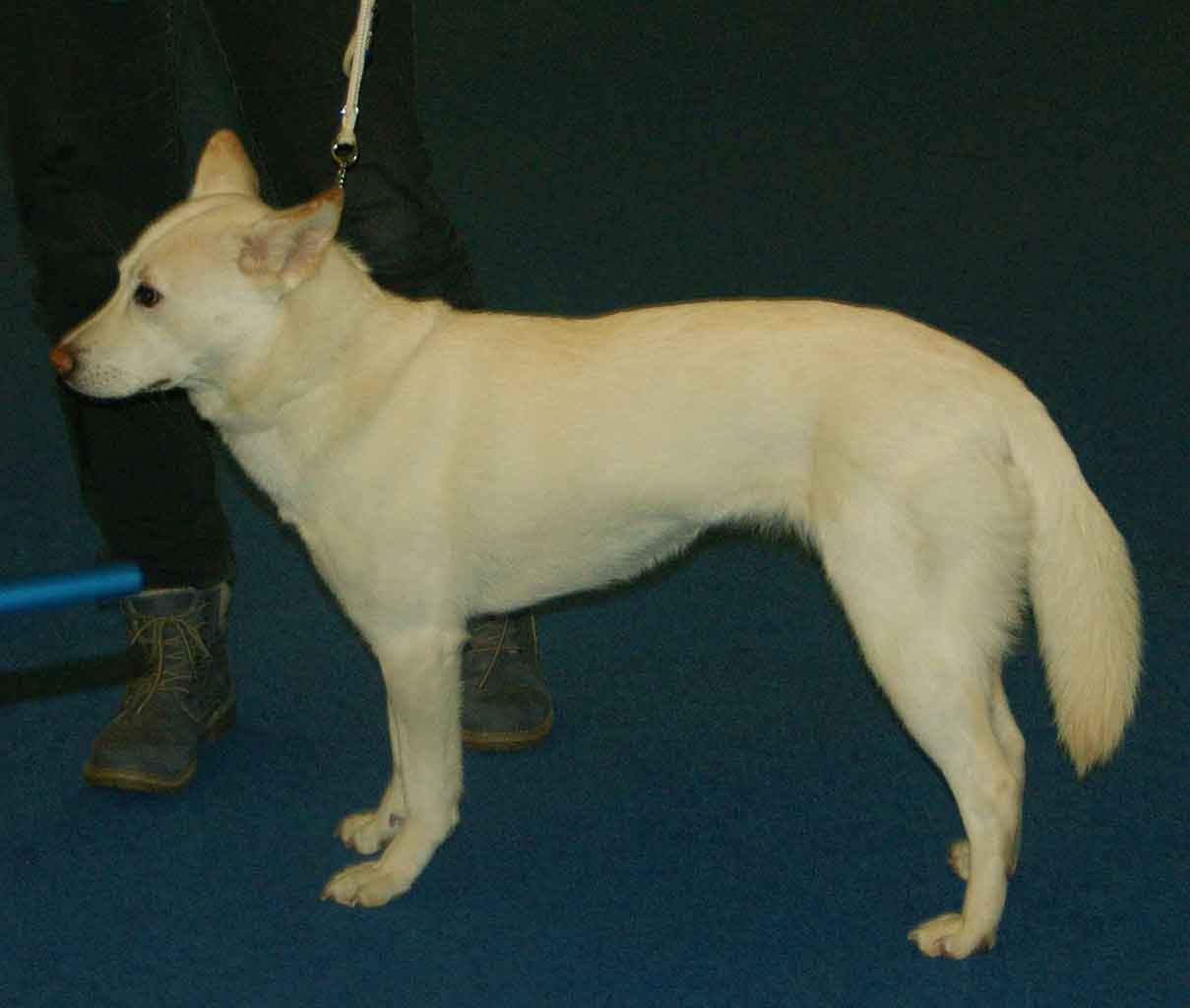
    The Korea Jindo Dog It is the classic single master dog.

    Korean Jindo

    Content

    Characteristics "Korea Jindo Dog"

    Coexistence is important that you have with your new friend. Before considering the acquisition of a dog of the breed "Korea Jindo Dog" you know certain factors. Not all breeds of dogs are apt to live in an apartment, you must take into account his character, their need for exercise, their interaction with other pets, their care and if you have small children, their level of tolerance towards them.

    Training ?

    2,0 of 5 stars (based on 1 review)

    Suitability of the apartment ?

    2,0 of 5 stars (based on 1 review)

    Can be alone all day ?

    1,0 of 5 stars (based on 1 review)

    Suitable as a first dog ?

    1,0 of 5 stars (based on 1 review)

    Weight gain ?

    3,0 of 5 stars (based on 1 review)

    Health ?

    4,0 of 5 stars (based on 1 review)

    Intelligence ?

    4,0 of 5 stars (based on 1 review)

    Kindness with child ?

    3,0 of 5 stars (based on 1 review)

    Tendency to bite ?

    3,0 of 5 stars (based on 1 review)

    Tendency to bark ?

    4,0 of 5 stars (based on 1 review)

    Tendency to flee ?

    5,0 of 5 stars (based on 1 review)

    hair loss strength ?

    4,0 of 5 stars (based on 1 review)

    Suitable as a guard dog ?

    5,0 of 5 stars (based on 1 review)

    Joy ?

    4,0 of 5 stars (based on 1 review)

    Cat friendliness ?

    2,0 of 5 stars (based on 1 review)

    Power level ?

    4,0 of 5 stars (based on 1 review)

    History

    Korea Jindo Dog

    The exact origins of this dog breed are lost in the dark of history.. With a probability that borders on certainty, it can be assumed that the breed is actually of Korean origin, more precisely from the island of Jindo in southwestern Korea. Due to the isolated geographic location, this type of dog was only found here. Finally, an export ban on the breed was imposed, which is still valid today.

    In his homeland., the Korea Jindo Dog is under the protection of nature and species. In 1938 the breed was declared the national animal of Korea. But, some quadrupeds have crossed the borders: In the Decade of 1980, local people smuggled specimens into the US. In 2003 took place in Great Britain the first official exhibition of a Korea Jindo Dog outside asia. In the USA., the Korean Association of Jindo of America" โ€‹โ€‹is now working to preserve this breed.

    Physical characteristics

    This four-legged Korean friend is one of the best in Asia. With a weight of about 14 to 21 kilograms and a height of 34 to 47 cm to the cross, the Korea Jindo Dog belongs to medium-sized dogs. Carries its tail curled or sickle-shaped on its back. The relatively small, upright ears are also typical of the point..

    While in Korean standardized breeding only white and red coat colors are recognized, depending on the frame organization the following other coat colors are allowed: kitsch, black and tan, grey, black and Brindle.

    Character and skills

    The Korea Jindo Dog shows the corresponding original features. It is considered to be independent, territorial and has a strong hunting instinct, what can make living with other pets impossible, but it doesn't have to be that way with good socialization.

    The breed is not easily disturbed and is characterized by great loyalty to its keeper.

    It is reserved with strangers: When used as a watchdog, the Korea Jindo Dog indicate in a way the defense of your home your home. Many representatives of the breed do not accept food from strangers. These dogs are playful and intelligent, sometimes even "too smart", because they can learn to open doors, for example.

    When looking for a Jindo, always look for responsible breeders – unfortunately there are also alleged breeders who have bred the Jindo for backyard dogfighting or otherwise have disproportionately promoted the aggressive side of this dog.

    Education of the โ€œKorean Jindo Dogโ€

    Consistent and clear communication, as well as some experience with dogs are necessary for the education of a Korea Jindo Dog. The docile dog is not only characterized by its intelligence, but also for its primitive behavior and great independence, that you must direct in a controlled way.

    As the leader of the pack it is your task to make it clear to him that you know for sure and with confidence where to go.. The Korea Jindo Dog quickly use uncertainties and exceptions to take the helm himself. But, never confuse strong and confident leadership with toughness, as this could destabilize the Korea Jindo Dog and not just destroy educational successes, but also lastingly disturb the bond between you and your partner.

    A dog school is a recommended opportunity to introduce the Korea Jindo Dog to other dogs of the same species and to further socialize them.

    Health of the โ€œKorean Jindo Dogโ€

    Robust Spitz

    It is considered that Korea Jindo Dog it is a robust breed of dog, that he hardly has a predisposition to genetic diseases. Healthy animals can reach an average age of 13 years. The most important health precautions are already taken before birth, thanks to the experience of experienced breeders, that minimize the risk of disease by selecting suitable parent animals, including appropriate preventive exams. Accumulation of the autoimmune disease discoid lupus erythematosus has occasionally been reported (DLE). This skin disease is usually treated for life.

    It also, there are some cases of hypothyroidism, what is the lack of thyroid hormone supply to the body. In the Korea Jindo Dog this disease is usually manifested through aggression or apathy and changes in the coat. Otherwise, The same as us, two legged friends, sufficient exercise and healthy nutrition are other important pillars of health. Increased risk of food intolerance in some Jindos can also be counteracted with a balanced diet.

    Nutrition of the โ€œKorean Jindo Dogโ€

    A high-quality, grain-free, meaty diet is, fortunately, not just appropriate for the species, but also tasty. Both are important criteria, since it is considered that the Korea Jindo Dog is relatively selective. It is best to accustom him to several varieties of the same quality from the age of the puppy. This way you won't find yourself in a situation where, due to prescription changes or delivery issues, suddenly there is no more pet food and you have no alternative. It also, you can usually change different known foods of the same quality without your dog having digestive problems.

    Regarding the amount of daily feeding, manufacturers' information can only give approximate values. If you notice that your Jindo is gaining too much weight, adjust your diet accordingly. You should also include treats in your daily ration. It's best to stick to healthy treats, like dental care snacks or dog treats that are 100% meat. Sugar has no place in reward food or snacks. With dry chews such as special dog bones or cow's ears, which are much less greasy than pig's ears, you can satisfy your friend's chewing needs from your Korea Jindo Dog.

    Make sure he always has enough water around him to quench his thirst at any time.

    Care of the โ€œKorean Jindo Dogโ€

    The coat of this breed consists of a soft undercoat, depending on the season, and a hard coat. Especially during the coat change twice a year, the Korea Jindo Dog lose a lot of hair. You can limit hair loss on the floor accordingly, combing daily. Outside of coat change time, a weekly hairstyle is enough. At this time you can also check their ears and eyes for dirt and if they need to be cleaned with special ear and eye cleaners for dogs..

    The dirt on the coat is better to let it dry and then comb it out. A bath is not normally necessary, but it may be a good idea to gently accustom the Korea Jindo Dog, to a bathroom when he's still a puppy, so it can be cleaned every few months. Be sure to use a mild dog shampoo to avoid damaging the dog's own skin.. Take a regular look at the claws, especially with older dogs. If they are too long, shorten them with claw scissors. This will prevent your dog from getting painfully stuck with them and possibly injuring himself.

    Activities with the โ€œKorean Jindo Dogโ€

    give to you Korea Jindo Dog plenty of room to run, also as a jogging partner, but always on a leash. Also for free rescue and search dog work not suitable due to strong hunting instinct. Some Jindos like to learn tricks and play with various toys with great pleasure., that are available in stores. By the way, the Korea Jindo Dog normally stays away from water, so the common splash in the lake should not be included in the list of possible destinations. Many Korea Jindo Dog they even avoid small streams or puddles, refuse to cross a bridge or do not want to go outside in the rain. To enjoy travel without restrictions, should show the young dog that the water on the trail is not a cause for concern and casually, and possibly supported with treats, get used to the unwanted item. Don't force your Jindo to jump into a pond or something similar – will probably never turn into a water rat.

    Before Buying a โ€œKorean Jindo Dogโ€

    Few dog lovers in Europe are likely to ask this question, since the Korea Jindo Dog It's very weird. It also, you must be a nature lover and have a house or apartment at ground level in the countryside, because this four-legged friend must have a fenced-in property at his disposal, who can monitor. The fence must be generously planned, because the breed has a clear talent for jumping. So, The minimum height of a fence should be 1,80 m. But still keep an eye on your four-legged friend: Many young Jindo, if you have been alone for too long, the urge to discover has taken hold of him: The cunning dogs have quickly learned that a path can be prepared by digging even under fences.

    In any case, the intelligence of Jindo can be too much for quite comfortable dog owners who are supposed to keep you physically and mentally busy. This active and above average dog will take up a lot of time on your trips together, because you need to go out, what should normally be done on a leash due to his hunting instinct.
    Can be well kept in a family, also with children. Sociable four-legged friend doesn't like to be alone, so he must either be left alone for a very short time or you keep him together with another dog. In Korea it is common for dogs to live outside the house.

    The breed is excellent as a guard dog and often recognizes family acquaintances and friends from a distance. You can also befriend the postman if you make it clear that you are one of the "good guys.".

    Where can I find a โ€œKorean Jindo Dog?โ€?ยป

    In Europe it is not easy to find a Korea Jindo Dog; for example, in Germany not a single litter has been registered in recent years and there are no active breeders. Here it is necessary to investigate to find the nearest breeder. Of course, some breeders also export from abroad, for example from the United States, but this is time consuming and should only be considered for absolute connoisseurs and lovers of the breed. But, might be worth taking a look at asian races Shiba Inu and Akita, which are much more common in Europe and have some similarities to the Korea Jindo Dog. When adopting a puppy from abroad, please consider the relevant entry requirements and especially the necessary vaccinations.

    If you are looking for a Korea Jindo Dog adult, you must be on a real winning streak to find one in Europe. It is true that dog owners sometimes underestimate the time and knowledge required for education and harmonious coexistence with a Korea Jindo Dog and, therefore, they give up their four-legged friend. But, this is extremely rare in Europe due to the very small number of Korea Jindo Dog.

    Images "Korea Jindo Dog"

    Photos:

    1 – Korea Jindo Dog by https://pixabay.com/es/photos/perro-feliz-sol-perro-feliz-1792601/
    2 – Korea Jindo Dog by https://pixabay.com/es/photos/progreso-perro-jindo-coreano-perro-1138824/
    3 – Korea Jindo Dog by https://pixabay.com/es/photos/cachorro-perro-el-progreso-del-perro-1874281/
    4 – A male Korea Jindo Dog. Colour: red by Canarian / CC BY-SA
    5 – Korea Jindo Dog by https://flic.kr/p/dYtSF9
    6 – A male Korea Jindo Dog. Colour: red. by Canarian / CC BY-SA

    Videos "Korea Jindo Dog"

    HTTPS://youtube.com/watch?v=KFZg8QknBB8
    Korean Jindo – TOP 10 Interesting Facts
    HTTPS://youtube.com/watch?v=GvesVZwyuCc
    Jindo or Chindo Dog – Breed of dog

    Type and recognitions:

    • FCI CLASSIFICATION:
    • Group :
    • Section : . .

    Federations:

    • FCI – Group 5: Spitz-type dogs and primitive type – Section 5: Asian Spitz and related breeds. โ“˜

    FCI breed standard "Korea Jindo Dog"

    Origin:
    South Korea

    Date of publication of the valid original standard:
    13.07.2005

    Use:

    Without working trial.


    General appearance:

    The Korea Jindo Dog is a medium-sized dog, well proportioned, used for hunting and as a guard. Its pricked ears and coiled or sickle-shaped tail give it a vivid expression of agility., Fortress, vigilance and dignity.

    IMPORTANT PROPORTIONS : Relationship between the height of the cross : body length = 10:10,5.


    Behavior / temperament:

    The Korea Jindo Dog has a very strong hunting instinct.; In addition to being bold, bravo, alert and careful, not allowed to tempt easily and is hot-headed. First and foremost, is extremely faithful to its owner. It is reserved with strangers. In general, is not affectionate with other animals, especially if male. It also has a good sense of orientation. It is a dog of a single owner; He quickly agree to a new owner but it never forgets its ties with the previous owner who raised him since that was puppy. Stays clean and eat little.

    Head:

    In general, The head forms an obtuse triangle when viewed from above and should not make the dog appear clumsy or clumsy..

    Cranial region:

    The skull is medium in size in proportion to the body.. The top is slightly rounded, and gradually thins to the eyes. The width between the ears is moderate in relation to the size of the head.

    • Stop : Well defined, but not too abrupt. It has a slight furrow that extends to the forehead.

    facial region:

    • Nose : black. In case of white dogs, flesh colored nose is allowed.
    • Snout : The muzzle should not be bulging or raised.
    • Lips : Blacks; well closed, They are thin and not pendulous; the upper lip slightly covers the lower lip.
    • Bite / Teeth : Very strong, scissor bite.
    • Cheeks : Well developed, thin and moderately round when viewed from the front or side; narrowing to the tip of the nose.
    • Eyes : dark brown color, somewhat small in proportion to head size, almond-shaped and very expressive. The outer corners of both eyes are slanted towards the ears.
    • Ears : Medium-sized, form triangular, thick and perfectly erect; insertion ears neither high nor low, directed slightly forward in line with the back of the neck. The presence of fine, dense hair on the inside of the ears is desirable..

    Neck:

    Something balanced and thick, without jowl, strong, with good musculature. The Korea Jindo Dog wears its neck proudly and arched well when excited..

    Body:

    • Back : Strong and straight.
    • Pork loin : With good muscles, stiff, thin and narrower than the rib cage.
    • Breast : Strong and moderately deep, but not too wide. The deepest point of the chest reaches just above the elbow, but it is also acceptable for it to reach elbow level. Well arched ribs. Fairly developed chest.
    • Belly : Withdrawn.

    Tail:

    When it hangs up, the tip of the tail should reach the tibiotarsal joint. Rather tall insertion root; is straight and firm and should not sway when the dog moves. Whether sickle-shaped or rolled, the tip of the tail touches the back or flank. It should not be too twisted. The tail has abundant feathers.

    Tips

    PREVIOUS MEMBERS : Seen from the front, they are straight and parallel.

    • Shoulder : Strong and powerful and well inclined.
    • Elbows : Glued to the body, no outward or inward deviation.
    • Metacarpus : Slightly bent forward, when viewed from the side.
    • Pies : Cat feet. Rather short fingers, rounded, compact and firm. Strong nails, preferably black. Thick, well-cushioned ear pads.

    LATER MEMBERS : Viewed from the side, They are moderately angled; seen from the back, they are straight, parallel and not too far apart or too close to each other. Dewclaws must be removed except in countries where their excision is prohibited..

    • Thighs : well developed.
    • Legs : Moderately angled.
    • Tibio-tarsal and metatarsal joints : Placed very low; they are not straight but moderately angled.
    • Hind feet : Identical to the previous ones.

    Movement:

    The movement of the Korea Jindo Dog is powerful and firm. The back should remain firm and level, and the hind limbs should not oscillate. When jogging, keep your head high, but as the speed increases, the head is carried low, almost at shoulder level. The upper part of the tail moves slightly according to the change of direction the dog makes..

    Mantle

    HAIR : The Korea Jindo Dog has a double coat of hair. The inner layer is smooth, dense, pale, But enough to sustain the outer layer. The outer layer is stiff and somewhat separated from the body. Compared with the hair covering the body, the hair of the head, members and ears is shorter, and neck, cross, back and trunk is longer. The hair of the tail and rear of the thighs is longer than the rest of the body.

    COLOR : The colors of the Korea Jindo Dog are reddish bay, white, black, black and tan, wolf gray and brindle.


    Size and weight:

    Height to withers :

    • Males : 50-55 cm., ideal 53-54 cm..
    • females : 45-50 cm., ideal 48-49 cm..

    WEIGHT :

    • Males : 18-23 kg.
    • females : 15-19 kg.


    Fouls:

    Any deviation from the aforementioned criteria is considered a fault and the severity of it is considered to the extent of the deviation from the standard and its consequences on the health and well-being of the dog..

    โ€ข Insufficient musculature.
    โ€ข Bones that are too thick or thin.
    โ€ข Pincer bite.
    โ€ข Ears not erect.
    โ€ข Hanging tail, short tail.
    โ€ข Exaggerated angulations.
    โ€ข Straight tibio-tarsal joints, cow or barrel.
    โ€ข Long or short hair.
    โ€ข Irregular step, stiff step.

    MISS PLAYOFFS :

    โ€ข Aggressive or fearful dog.
    โ€ข Size too big or too small.
    โ€ข Prognathism or enognathism.
    โ€ข Female-looking male, female with masculine appearance.
    โ€ข Lack of more than 3 teeth.
    โ€ข Lack of pigmentation, albinism.
    Any dog โ€‹โ€‹showing clear physical or behavioral abnormalities should be disqualified..


    N.B.:

    Males should have two normal-appearing testicles fully descended into the scrotum..

    Source: F.C.I - International Cynological Federation

    Alternative names:

    1. Jindo, Chindo, Jindo Gae, JindoGae (English).
    2. spitz corรฉen de Jindo (French).
    3. Jindot-gae, KOREANISCHER JINDO (German).
    4. Jindo (Portuguese).
    5. Perro de Chindo, Jindo, Yindo (espaรฑol).

    โ–ท The world of Pets: Dogs, cats, birds, reptiles, amphibians

    Peruvian Hairless Dog
    Perรบ FCI 310 . Primitive type

    Peruvian Hairless Dog

    The Peruvian Hairless Dog is a friendly and adaptable companion.

    Content

    History

    The exact origin of the Peruvian Hairless Dog. But, their ancestors seem to be deeply rooted in Peru: Illustrations on the vessels of Moche culture, show hairless dogs already in the 750 AC. Later, these funny animals were reserved for the rich Incas, who took care not to mate them with other native dogs. It was also the Incas who prohibited the consumption of dog meat in the northern regions of Peru..

    When the Spanish conquered the country, they found many naked dogs among the orchids of the Incas, so the Europeans called them ยซperros de las floresยซ. During the period of conquest, the breed was almost extinct, but some specimens survived in remote villages where the inhabitants valued them for the partly mythical qualities attributed to them: Because of its special appearance, four-legged creatures were said to have a healing effect on certain diseases, for example, bone and joint diseases.

    In 1985, the world's largest dog breeding organization, the Federation Cynologique Internationale (FCI), recognized the Peruvian Hairless Dog as an independent race. So Today There Are Officially Three Naked Dog Breeds. Besides of Peruvian Hairless Dog, these are the Mexican Naked Dog, also known by the beautiful name of ยซXoloitzcuintleยซ, and the Chinese Crested Dog. The three races are closely related to each other.

    Physical characteristics

    The name says it all: The most striking of the most Peruvian Hairless Dogs that's what's missing: the coat. But, the standard allows for some locks on the head and tail even in naked dogs without hair. Skin can be light or dark in different shades of color, smooth or white-spotted. But, not all naked dogs are naked, because there's a variant with hair: the so-called "hairy", which are essential for breeding for health reasons. About a third of naked dogs belong to this group.

    Since 2013 hairy variants can also be seen in canine exhibitions, since they have been added to the standard. Your hair should be short and soft, all colors are allowed. The Peruvian Hairless Dog reminiscent of greyhounds in their physique. This slender breed of dog has large erect ears that can rest back, an elegantly curved and hanging tail and an athletic complexion.

    Naked dog lovers can enjoy three size variations:

    – The small version has a shoulder height of 25 to 40 cm..
    – The median 40 to 50 cm..
    – The Greats Peruvian Hairless Dogs have between 50 and 65 height cm.

    The weight varies according to 4 to 25 kg. Only a few Peruvian Hairless Dogs have a full denture, but these usually include all representatives of the furry variant.

    Character and skills

    The Peruvian Hairless Dog is a friendly and adaptable companion. He prefers to be with his human with the one who has a close relationship. It belongs to very sociable dogs. He likes to integrate into a family and quickly befriends other pets and children. It is said that many Peruvian Hairless Dogs protect fervently, especially the women and children of the herd. Here it is important to be careful when visiting children that the Peruvian interprets offensive situations for his protรฉgรฉ and rushes to help his little two-legged friend unnecessarily..

    Vivacious and curious, is a wonderful companion for outdoor activities, but behaves calmly and relaxed inside. He especially likes to get comfortable on his owner's lap and enjoys closeness and warmth.. To strangers he is often distant and alert, but not aggressive.

    Education

    Like a dog of the original type, the Peruvian Hairless Dog it also provides original behavior in the man-animal relationship. That's why it makes sense in educational matters if you already have any experience with dogs. But, even ambitious beginners can successfully train a Peruvian Hairless Dog. Clear rules and consistency are, as in most dogs, the key to success.

    The Peruvian Hairless Dog is a sensitive four-legged friend – hard you'll only get the opposite with it – will retire. Some Peruvian Hairless Dogs tend to get scared or fear new situations. So, it is especially important to train this dog extensively and at the right pace to different situations without overloading it.

    Your breeder will be able to give you some advice when you buy a puppy. Whether on a train journey, on a trip to the city center or on a visit home, introduce your partner into these everyday situations since you're a puppy. Regular training at a canine school, preferably already with the young puppy in the form of playgroups for puppies, is highly recommended and also reinforces the social side of the Peruvian Hairless Dog.

    Breeding of the โ€œPeruvian Hairless Dogโ€

    As already mentioned, during mating a special health feature should be taken into account: during breeding, the furry ones, that is to say, hairy representatives of the breed, should be crossed regularly. The reason for this is that the dominant allele of hairlessness can only lead to viable embryos in combination with a hair allele, that is to say, Heterozygosity. Homozygous hairless embryos are already reabsorbed in the uterus. As pure breeding for hairlessness is therefore not possible, hairless naked dogs also occur over and over again.

    The Peruvian Hairless Dogs they usually have an incomplete denture, what doesn't usually restrict them. With the light-skinned specimens, especially at the beginning of summer, it's important to make sure they get used slowly in the sunlight, then tanning. Sun protection also makes sense, because otherwise dogs can develop severe sunburn, especially when they like to go to sunny places. Also in winter some specimens need protection from the weather in the form of a dog coat., because if they can't run, cool down quickly during normal ride. Smaller variants of the breed are more sensitive to this than larger ones.

    One Peruvian Hairless Dog can reach an age of up to 15 years.

    Care

    With the naked representatives of the breed you can leave the comb with confidence. It also, has the great advantage that it can normally detect parasites in the skin of the Peruvian Hairless Dog immediately and apply appropriate antidotes – from tick tweezers to flea repellent. But, even the Peruvian Hairless Dog needs regular care. If required – some owners recommend once a week – wash it with a sponge and a mild dog shampoo. Some Peruvian Hairless Dogs tend to have dry skin, which can be remedied with soft moisturizers for fragrance-free babies or with olive or coconut oil. In summer, sunscreen is an indispensable tool for light-colored dogs. Cut the claws of your Peruvian Hairless Dog if they get too long and clean your four-legged friend's ears with a dog ear cleaner if necessary.

    Buy a โ€œPeruvian Hairless Dogโ€

    The Peruvian Hairless Dog are rare in Europe and therefore breeders are rare. Find the appropriate umbrella organizations in your country, that can help you in your search. In Germany, for example, el Club for Exotic Breed Dogs e.V. has a list of breeders, In Switzerland there is a "Swiss Naked Dog Club of Latin America", which is dedicated to the promotion of the two breeds of dogs: the Xoloitzcuintle and the Peruvian Hairless Dog. In these clubs and similar ones you can find information and contacts of ambitious breeders. Considering possible adoptions across national borders, consider what to consider when adopting puppies from abroad.

    As a fan of naked dogs, you probably know the closely related races, the Xoloitzcuintle and the Chinese Crested Dog – perhaps one of these dogs could also be an option for you and is more likely to be found in your region. It also, openness to the other two races, as well as the crossings, it's usually a good idea if you want to give a home to a naked older dog. This usually requires some research. But in the meantime, Keywords like โ€œnaked dogs in distressโ€ on the Internet promise successes that lead adult naked dogs to look for a new place to live. Try to find out as much as possible about the story of your potential new fourth-legged partner.

    Characteristics "Peruvian Hairless Dog"

    Coexistence is important that you have with your new friend. Before considering the acquisition of a dog of the breed "Peruvian Hairless Dog" you know certain factors. Not all breeds of dogs are apt to live in an apartment, you must take into account his character, their need for exercise, their interaction with other pets, their care and if you have small children, their level of tolerance towards them.

    Training ?

    4,0
    4,0 of 5 stars (based on 30 reviews)
    Great
    Very good
    Media
    Mala
    Very bad

    Suitability of the apartment ?

    3,0 of 5 stars (based on 1 review)

    Can be alone all day ?

    2,0 of 5 stars (based on 1 review)

    Suitable as a first dog ?

    3,0 of 5 stars (based on 1 review)

    Weight gain ?

    3,0 of 5 stars (based on 1 review)

    Health ?

    3,0 of 5 stars (based on 1 review)

    Intelligence ?

    3,0 of 5 stars (based on 1 review)

    Kindness with child ?

    3,0 of 5 stars (based on 1 review)

    Tendency to bite ?

    2,0 of 5 stars (based on 1 review)

    Tendency to bark ?

    3,0 of 5 stars (based on 1 review)

    Tendency to flee ?

    2,0 of 5 stars (based on 1 review)

    hair loss strength ?

    1,0 of 5 stars (based on 1 review)

    Suitable as a guard dog ?

    3,0 of 5 stars (based on 1 review)

    Joy ?

    3,0 of 5 stars (based on 1 review)

    Cat friendliness ?

    3,0 of 5 stars (based on 1 review)

    Power level ?

    3,0 of 5 stars (based on 1 review)

    Images "Peruvian Hairless Dog"

    Photos:

    1 – ยซHairless dog of Peruยป by Paradais Sphynx, CC BY-SA 3.0, via Wikimedia Commons
    2 – ยซHairless dog of Peruยป by No machine-readable author provided. Manuel Gonzรกlez Olaechea assumed (based on copyright claims)., CC BY-SA 3.0, via Wikimedia Commons
    3 – ยซHairless dog of Peruยป by Carlos Adampol Galindo from DF, Mexico, CC BY-SA 2.0, via Wikimedia Commons
    4 – ยซHairless dog of Peruยป by Marina Alonso Esparrรฉ, CC BY-SA 4.0, via Wikimedia Commons
    5 – ยซHairless dog of Peruยป by Carlos Adampol Galindo from DF, Mexico, CC BY-SA 2.0, via Wikimedia Commons
    6 – ยซHairless dog of Peruยป by Carlos Adampol Galindo from DF, Mexico, CC BY-SA 2.0, via Wikimedia Commons
    7 – ยซHairless dog of Peruยป by Pleple2000, CC BY-SA 3.0, via Wikimedia Commons

    Videos "Peruvian Hairless Dog"

    PERUVIAN DOG : The story of the VIRINGO dog, the mascot of ancient Peru

    THE PERUVIAN HAIRLESS DOG - STRANGE OR CUTE?

    Type and recognitions:

    • FCI CLASSIFICATION:
    • Group :
    • Section : . .

    Federations:

    • FCI – Group 5: Spitz-type dogs and primitive type – Section 6: Primitive type. โ“˜

    FCI breed standard "Peruvian Hairless Dog"

    Origin:
    Peru

    Date of publication of the valid original standard:
    08.10.2012

    Use:

    Companion dog


    General appearance:

    According to its general confirmation, it is a slender and elegant specimen., whose aspect expresses speed, strength and harmony without appearing crude.
    This breed's fundamental characteristic is the absence of hair on the body.. Another of its peculiarities is that its teeth, almost always, is incomplete. Of noble and affectionate character with those at home; reserved with strangers; awake, alert and guardian.

    important proportions:

    The relationship between the height at the withers and the length of the body is 1:1, allowing the body of the females slightly longer than that of the males.


    Behavior / temperament:

    Noble and affectionate with those at home while remaining awake and alert. In the presence of strangers, becomes suspicious and guardian.

    Head:

    Lupoid conformation.

    Cranial region:
    • Skull:Mesocephalus. Ortoide (the direction of the superior cranio-facial axes is parallel), accepting slight divergence. The skull seen from the top is wide, tapering towards the nose.. Superciliary arches are moderately developed. The occipital crest is poorly marked.
    • Depression links (Stop): Bit strong (approximately 140ยฐ).

    facial region:

    • Truffle:The color of the nose should harmonize with the color of the skin, in its various shades.
    • Snout:In profile, maintains a straight line.
    • Lips:The lips should be as tight as possible and adhere to the gums..
    • Jaws/Teeth:The incisors should fit for a scissor bite and the canines are normally developed. The absence of one or all pre-molars or molars is allowed. The jaw is poorly developed.
    • Cheeks:Normally developed.

    Eyes:Of attentive and intelligent expression. They should be medium in size, slightly almond shaped, or sunk or bulging, with a normal and regular location, that is to say, neither too close nor too far. Color may vary from black, going through dark brown and in descending tones to yellow, harmonizing with skin color. In all cases both eyes must be the same color. The color of the eyelids may be from black to pink for specimens whose facial area is light, allowing those of light or pink colors but not being the most recommended.

    Ears:The ears should be erect in attention, while at rest they are glued back. The ears are medium long, wide at the base and gradually tapering to an almost pointed end. Its insertion begins on the top of the skull, ending laterally and obliquely. The axes of the ears in the erect position can vary their angle relative to each other, approaching 90ยฐ.

    Neck:

    • Top profile:Arcuate (convex).
    • Length:About the same length as the head.
    • Form:Looks like a truncated cone. Flexible and well-muscled.
    • Skin:Fina, smooth and elastic. Intimately adhered to the subcutaneous tissue. No double chin.


    Body:

    Mesomorfo.

    • top line:Rectilinear, although certain specimens mark a dorso-lumbar convexity, getting lost with the rump.
    • Cross:Little pointed.
    • Back: Rectilinear top profile, with well-developed back muscles, forming in many cases a muscular biconvexity along the entire dorsal region, extending to the lower back.
    • Pork loin:Must be strong and muscular. Its length is approximately 1/5 the height at the withers.
    • Rump:The upper profile is slightly convex. Its inclination with respect to the horizontal, makes an angle of approximately 40ยฐ. Solid and muscular in shape, ensuring a good push.
    • Breast :The chest seen from the front will have good width without being excessively, descending almost to the elbow. The ribs should be slightly arched and never flat. The perimeter of the chest measured behind the elbows should be approximately 18% greater than the height at the withers.
    • Lower profile / Belly:The lower profile is formed by a well-marked elegant line, starting at the lower part of the chest and determining in the ventral retraction, which should be well delineated without being excessive.

    Tail:

    The tail is set low. Good thickness at the start, tapering to the tip. In a state of action, the tail may rise forming a curve without actually curling over the back.. At rest he wears it hanging with a light hook with the tip up. Sometimes it is tucked into the belly. Its length will come close to the hock. The queue must be full.

    Tips

    Former members

    Well attached to the trunk; viewed from the front will be perfectly plumb, not sticking out elbows. Your scapulo-humeral angle will range between 100ยฐ and 120ยฐ.
    Side views, the resulting angle between the pasterns and the vertical is between 15ยฐ to 20ยฐ.

    • Front feet:Semi-lengths approaching the hare's foot. The pads are strong and heat resistant. The interdigital membranes are well developed. Preferably, the nails are black in the black specimens and clear in the lighter specimens.

    Later members

    The muscles are round and elastic. The curvatures of the buttocks are evident. The coxofemoral angle should be between 120ยฐ to 130ยฐ. The femoral-tibial angle should be 140ยฐ. The limbs seen from behind are well plummeted. The dewclaws must be removed.

    • Rear feet:Equal to the forwards.

    Movement:

    Due to the angulations already described in the structures of its members, these specimens move with a shorter but faster pace and at the same time quite cushioned and flexible.

    Mantle

    Skin: The skin will be smooth and elastic over its entire body surface, being able to form certain surrounding and almost concentric lines on the head, around the eyes and cheeks. It is proven that the internal and external or dermal temperature, is exactly the same as the other races. The absence of fur results in a totally direct emanation of heat unlike the specimens with hair, in which heat is dissipated through them by natural ventilation.

    Fur: For being a naked race, will be missing cover, admitting vestiges of hair on the head, at the tip of the limbs, the tip of the tail and sometimes some very thin hairs on the back.

    Color: The color of the hairs may vary from black to black specimens., black slate, black elephant, bluish-black, full range of gray, gradient dark brown to light blonde. All these colors can be uniform or with pink spots anywhere on the body.


    Size and weight:

    Height to the cross

    There are three types of sizes for males and females.

    • Petit:Of 25 to 40 cm..
    • Medium-:Of 40 to 50 cm..
    • Grand:Of 50 to 65 cm..

    Weight

    The weight is in relation to the three sizes for males and females..

    • Petit:Of 4 to 8 kg.
    • Medium-:Of 8 to 12 kg.
    • Grand:Of 12 to 25 kg.


    Fouls:

    Any deviation from the above criteria is considered missing and the seriousness is considered to the extent of the deviation to the standard.

    • Semi-erect ears.
    • Presence of dewclaws on the hind limbs.

    ELIMINATING fAULTS

    • Aggressive or fearful dog.
    • Upper or lower prognathism.
    • Deviation of the lower jaw.
    • Hanging or cropped ears.
    • Anurismo. Braqui Tourism. amputated tail.
    • Excess hair described in the standard.
    • Presence of hairs in other parts of the body where it is not indicated.
    • albinism.

    Any dog โ€‹โ€‹showing clear signs of physical or behavioral abnormalities must be disqualified..


    N.B.:

    Males should have two normal-appearing testicles., fully descended into the scrotum.

    Source: F.C.I - International Cynological Federation

    Alternative names:

    1. Perro Sin Pelo de Perรบ, Inca Hairless Dog, Viringo, Peruvian Inca, Orchid, Calato, Peruvian Walking Dead dog, Dielmatian (English).
    2. Chien nu Inca (French).
    3. Peruanischen Nackthund (German).
    4. Perro Sin Pelo del Perรบ, viram (Portuguese).
    5. Perro calato, Perro chimo, Perro chimoc, Perro chimรบ, Perro de , orquรญdea peruano, Perro inca, Perro peruano, Perro peruano sin pelo, Perro pila, Perro sin pelo del Perรบ, Perro sin pelo peruano
    Viringo
    (espaรฑol).