โ–ท The world of Pets: Dogs, cats, birds, reptiles, amphibians

Eurasian
Alemania FCI 291 . Asian Spitz and related breeds

Eurasier

The Eurasian is self-confident, quiet, tolerant, adaptable, willing to learn and smart.

Content

History

In the Decade of 1960, Julius Wipfel raised females of Keeshond (Wolfspitz) and males of Chow-Chow en Weinheim, Baden-Wuerttemberg, initially the Wolf-Chow. He finally raised this dog with him Samoyed and obtained an original dog with a natural structure and a balanced character.

In 1973 the breed was recognized by the Fรฉdรฉration Cynologique Internationale (FCI) and it is, therefore, the youngest German dog breed. The youngest breed, officially recognized German breed owes its name to its original European breeds (Keeshond = EUR) and asian (Chow-Chow and Samoyed = ASIER). The task of the robust companion and family dog โ€‹โ€‹with character was not even hunting, nor grazing, nor on guard. The Eurasian was bred solely as a social partner for humans.

Physical characteristics

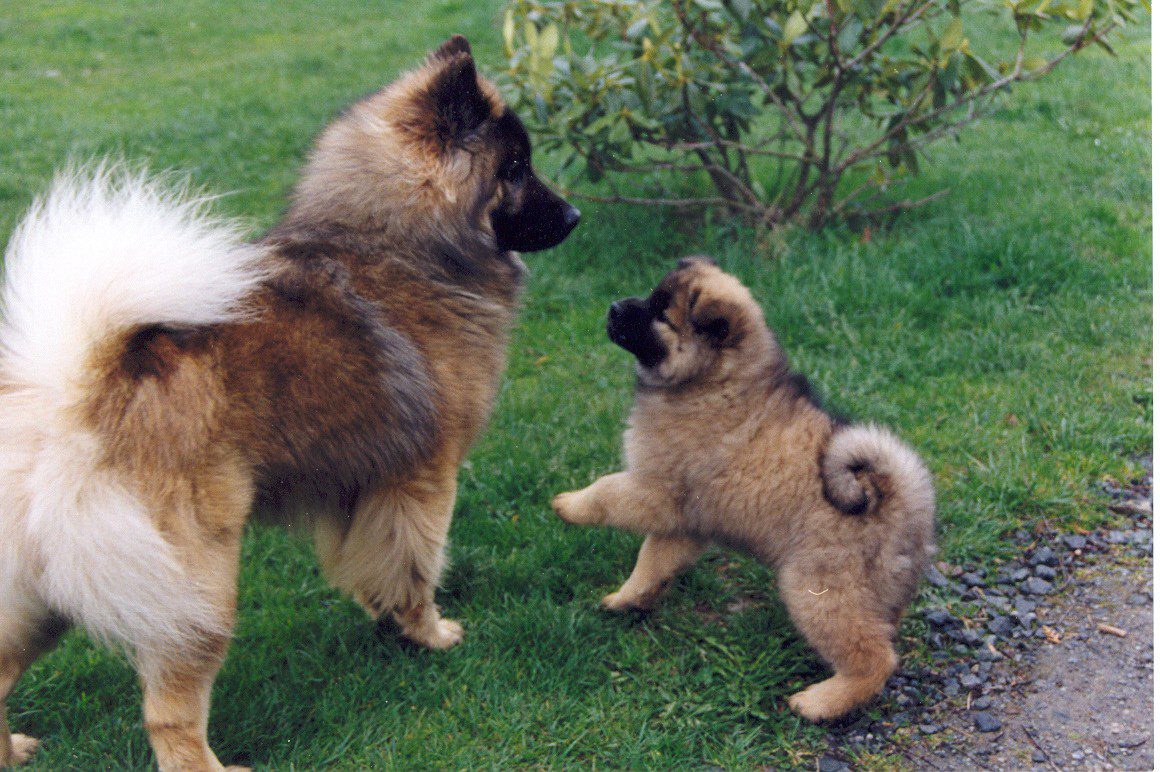
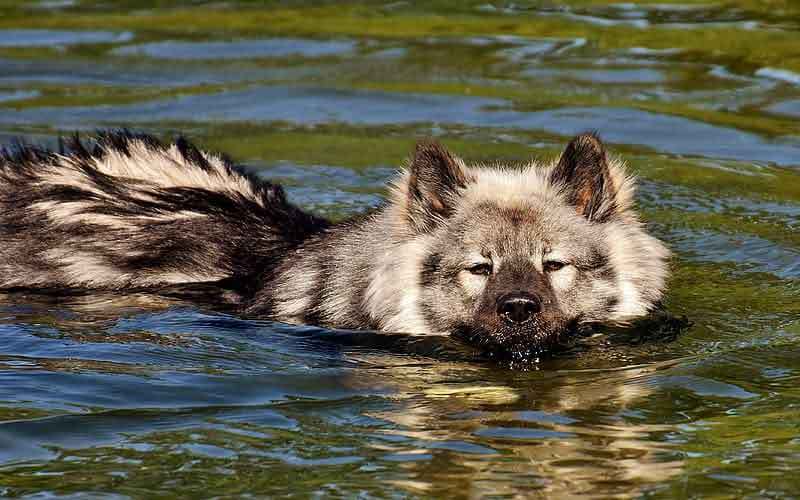
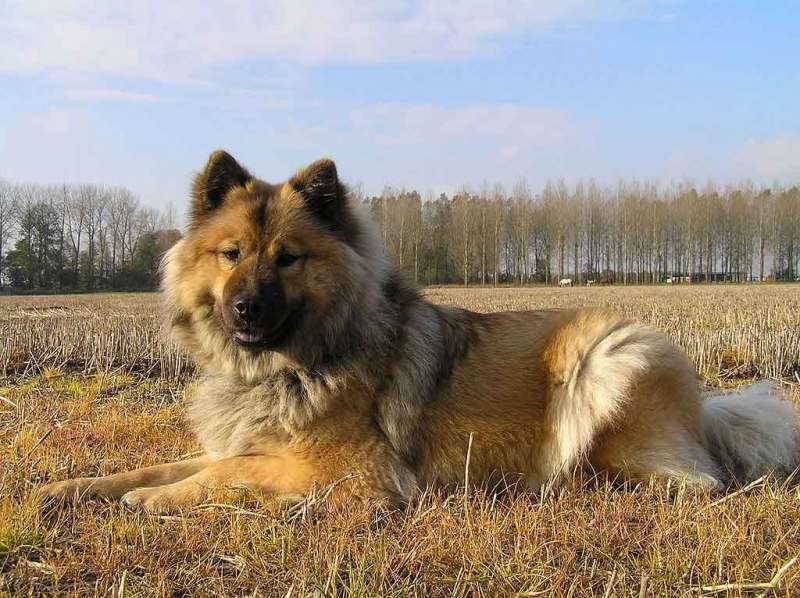
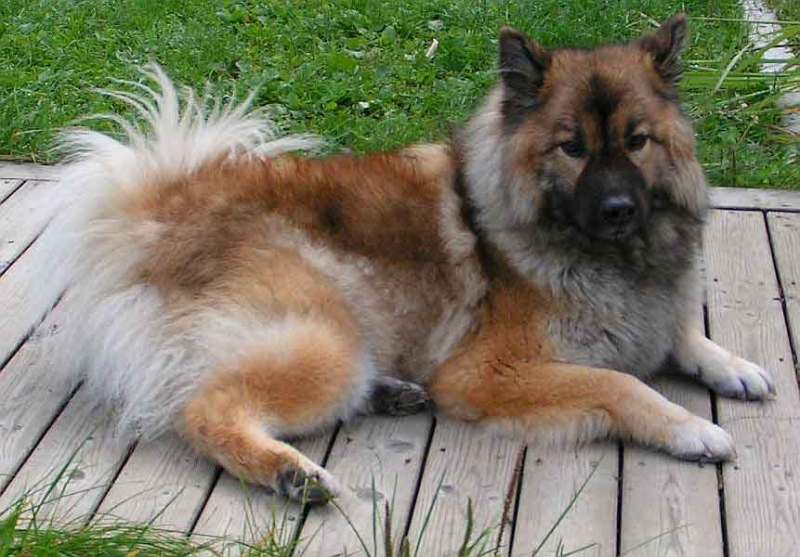
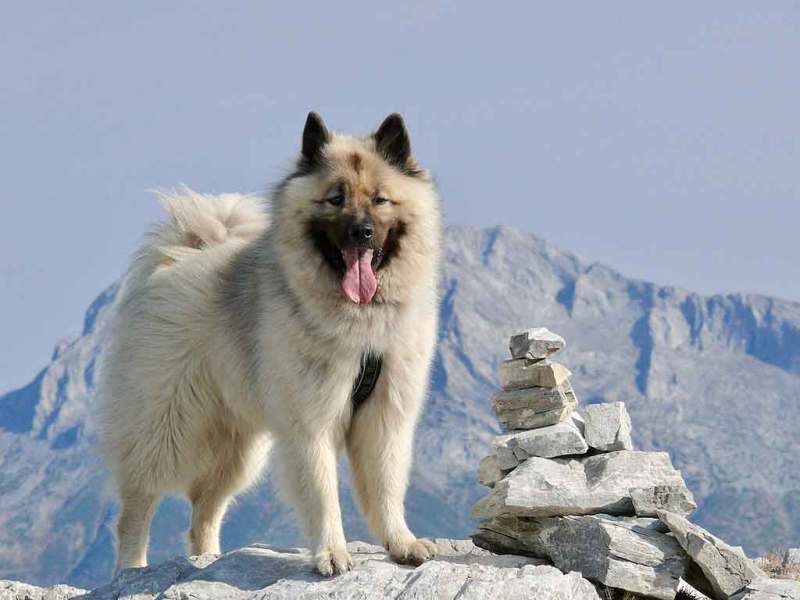
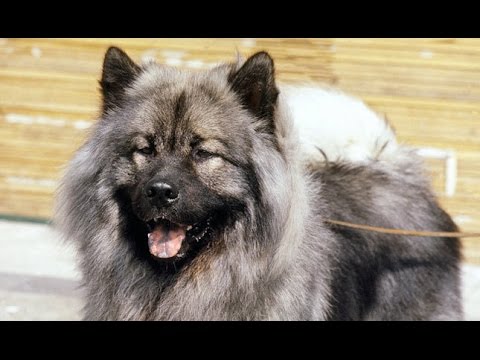
The Eurasian is balanced, well built, medium-sized, with erect ears. It can be of different colours: beige, reddish brown, the Grey Wolf, black. A characteristic feature is the pattern of the coat of agoutis and the patterns of bands and stripes, that for example wolves also have.
The male has a height of 52 to 60 the cross and weighs cm, approximately, of 23 to 32 kg. The female has a height of 48 to 56 cm to cross and weighs between 18 to 26 kg.
Typical of the coat of the Eurasian is his dense undercoat, which is an excellent protection against the cold and also repels dirt. Just the muzzle, the face, the ears and the front of the legs are short-haired. The tail, the back of the front legs and the back legs have long hairs.

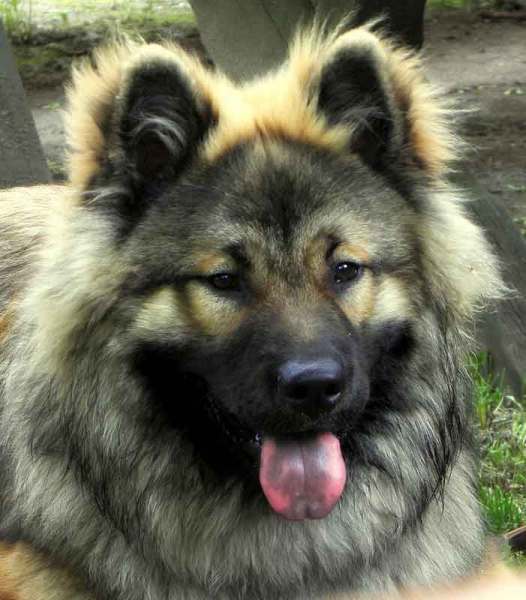
By the way, the Eurasian get their tongues partially and sometimes even completely blue from the Chow-Chow, whose blue tongue merged with the pink tongue of the Keeshond and Samoyed.

Character and skills

The Eurasian is self-confident, quiet, tolerant, adaptable, willing to learn and smart. Above all, animals are very close to their family members, which does not make them a one man dog.

The Eurasian they need constant and close contact with their humans and are therefore completely unsuitable for housing in kennels. In an animal shelter, these sensitive dogs would suffer extraordinarily and eventually wither away. How the Eurasiers are so focused on their family, should not be left in the hands of other people, even when they are on vacation. Wants to be with his family, always and everywhere.

These sensitive animals have a special feeling for the mood and disposition of their humans, and have a distinctive social behavior towards others Eurasian. It also, dogs of this breed are elegant, self-confident and at the same time pleasantly stubborn. They can even trick their owners into getting their way.

Activities with the Eurasian

Although the Eurasian does not have pronounced hunting behavior, a certain prey drive may be present, as in most dogs. But, with a loving consistency, understanding, patience and treats, the Eurasian can be trained to become trouble-free and appreciative companions, that adapt to all situations in life. But, training in an outer hand is out of the question for a Eurasian. If you demand absolute obedience to a dog, you must choose another race.

The Eurasian they need about two hours of exercise a day. Your urge to move can be ideally satisfied by jogging, cycling the agility. Monotonous retrieval games like โ€œfetch for sticksโ€ quickly bore this intelligent animal..

Eurasian care

Despite the dense undercoat, the care of the coat of the Eurasian it is not complicated and is limited to brushing once a week only during the change of coat, must be combed daily. The Eurasier's tongue varies from pink to an infinite number of varieties from pied blue to pure blue.. The inheritance of Chow-Chow fascinates many passers-by and often leads to confusion with the Chinese race. A Eurasier is an incorruptible friend for life.

Buying a Eurasian from a breeder

If you want to buy a puppy of Eurasian, you will need to be prepared for waiting periods, because there are only some 300 or 400 puppies per year under the umbrella organization of the VDH (German Canine Federation. Cubs Eurasian cost around 1000 EUR.

Characteristics "Eurasian"

Coexistence is important that you have with your new friend. Before considering the acquisition of a dog of the breed "Eurasian" you know certain factors. Not all breeds of dogs are apt to live in an apartment, you must take into account his character, their need for exercise, their interaction with other pets, their care and if you have small children, their level of tolerance towards them.

Adaptation โ“˜

1,0 of 5 stars (based on 1 review)

friendly dog โ€‹โ€‹โ“˜

4,0 of 5 stars (based on 1 review)

hair loss โ“˜

3,0 of 5 stars (based on 1 review)

Affection level โ“˜

5,0 of 5 stars (based on 1 review)

Need for exercise โ“˜

2,0 of 5 stars (based on 1 review)

Social need โ“˜

2,0 of 5 stars (based on 1 review)

Home โ“˜

4,0 of 5 stars (based on 1 review)

Toilet โ“˜

3,0 of 5 stars (based on 1 review)

Friendly with strangers โ“˜

3,0 of 5 stars (based on 1 review)

barking โ“˜

2,0 of 5 stars (based on 1 review)

Health โ“˜

4,0 of 5 stars (based on 1 review)

Territorial โ“˜

4,0 of 5 stars (based on 1 review)

Cat friendly โ“˜

3,0 of 5 stars (based on 1 review)

Intelligence โ“˜

4,0 of 5 stars (based on 1 review)

Versatility โ“˜

4,0 of 5 stars (based on 1 review)

Child friendly โ“˜

5,0 of 5 stars (based on 1 review)

Surveillance โ“˜

4,0 of 5 stars (based on 1 review)

joy โ“˜

3,0 of 5 stars (based on 1 review)

Images "Eurasian"

Photos:

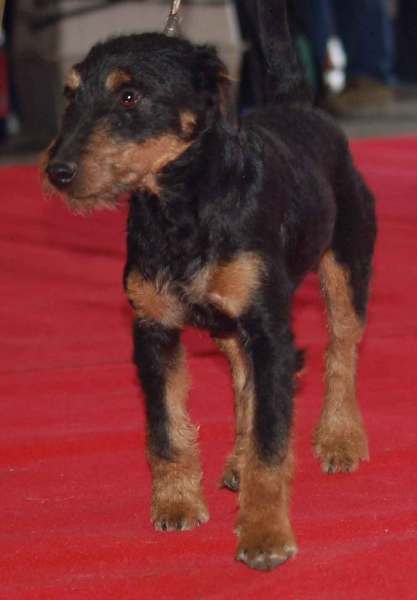
1 – Kai de Eurasipomer (Nombre original Selly de Eurasipomer) by Siasegos / CC BY-SA
2 – Eurasier by https://commons.wikimedia.org/wiki/File:Eurasier_liegend.jpg
3 – Eurasier by https://flic.kr/p/eKr7Rv
4 – Eigen gemaakte foto van een Eurasier (hondenras) by Ekta / CC BY-SA
5 – A beautiful Eurasier male I met during a walk. His name is Haiko vom Born by https://flic.kr/p/UAo4j3
6 – Adult tan and black eurasier dog on body of water by https://www.pikrepo.com/fwskj/adult-tan-and-black-eurasier-dog-on-body-of-water

Videos "Eurasian"

Eurasian - Breed of dog
Dogs breeds: Eurasian
Raffi - Eurasian - 3 Week Residential Dog Training at Adolescent Dogs
Raffi – Eurasian – 3 Week Residential Dog Training at Adolescent Dogs

Type and recognitions:

  • FCI CLASSIFICATION:
  • Group :
  • Section : . .

Federations:

  • FCI – Group 5: Spitz-type dogs and primitive type – Section 5: Asian Spitz and related breeds. โ“˜
  • ANKC – Non sporting โ“˜
  • CKC – Group 3 – Working Dogs โ“˜
  • โ€‹KC – Utility โ“˜
  • NZKC – Non Sporting โ“˜
  • UKC – Northern Breeds โ“˜

FCI breed standard "Eurasian"

Origin:
Germany

Date of publication of the valid original standard:
06.01.1994

Use:

Companion dog.


General appearance:

medium size dog, harmonious structure, Spitz type, with erect ears, in different shades. The length of the hair allows us to distinguish the proportions of the body. regular bone structure.

IMPORTANT PROPORTIONS : The length of the body is a little greater than the height of the withers. The relationship between the length of the snout and the length of the cranial region is almost the same.


Behavior / temperament:

He is a trusting dog, calm, equanimous and with great resistance to any provocation. He is vigilant and alert without being loud; develops a strong relationship with his family. It is reserved with strangers, without being aggressive; does not show hunting instinct.
To achieve a complete development of these characteristics, The Eurasian dog needs intimate and constant domestic contact with its family, but also comprehensive and consistent training.

Head:

As a whole : balanced skull, not very wide. The head is wedge-shaped when viewed from above and from the sides.. The nasal cannula and the cranial region are placed in parallel.

Cranial region:
  • Skull : Flat forehead with a marked frontal furrow. Well-defined occipital protuberance.
  • Depression links (Stop) : Unremarkable.

facial region:

  • Nose : Medium-sized, truffle with black pigmentation.
  • Snout : Neither too thick nor too pointed. Gradually tapers forward to the nose. The nasal cannula and the horns of the lower jaw are straight.
  • Lips : Tight edges of the lips and black pigmentation.
  • Jaws / Teeth : Strong jaws, They form a wide arch in the lower jaw. Strong and complete teeth (42 teeth according to the usual formation of the teeth); scissors or pincer bite. The upper incisors slightly surpass the lower incisors or are in perfect opposition to each other. The premolars and molars must be placed in a line without gaps between them.. All teeth should be vertical in relation to the jaw.
  • Cheeks : Not very pronounced.
  • Eyes : dark, medium-sized, neither sunken nor protruding. Slightly oblique opening of the eyelids. Edge of the eyelids with black and very adherent pigmentation.
  • Ears : They are separated by approximately the width of the base of an ear.. Its size is medium and its shape is triangular..
    The tips of the ears are slightly round and should be erect.. The tips of the ears and the center of the stop form approximately an equilateral triangle.

Neck:

Of average length, in harmony with the general appearance. Good musculature. The skin is very adherent in the throat region. Harmonious transition to the rest of the body.

Body:

  • As a whole : The body is strong, with the trunk not very short.
  • Cross : Marked.
  • Back : Firm and straight, with very good muscles.
  • Pork loin : With good length, good width and very good muscles.
  • Rump : Straight, wide and strong.
  • Breast : Reaches up to the elbows, with oval-shaped rib cage. Well developed sill, although not too prominent. Long sternum, that extends well back.
  • bottom line : Get up slightly.

Tail:

With straight insert, round and firm, of good thickness, tapering towards the tip. Has thick fur. The tail is carried folded over the back, or a little to one side or well rolled. When it hangs it reaches up to the hock joint.

Tips

PREVIOUS MEMBERS :

  • As a whole : Viewed from the front, They are placed straight and parallel. Viewed from the side, They are moderately angled. The arm and forearm are almost the same length.
  • Shoulder : With good muscles. Scapulas placed in a slightly oblique shape.
  • Arm : Of medium length and with good muscles.
  • Elbow : Close to the rib cage. Forearm : Of average length, with good musculature.
  • Articulation of the carpus : Strong.
  • Metacarpus : Of average length. Seen from the front it is completely straight; seen from the side it is directed slightly forward.
  • Front foot : Oval, compact fingers, moderately arched. Strong nails with dark pigmentation. Imitation pads, thick with black pigmentation. Dense fur between the pads.

LATER MEMBERS :

  • As a whole : Seen from behind they are placed straight and parallel and seen from the side they are moderately angled. Thigh and leg are almost the same length.
  • Pelvis : slightly oblique.
  • Thigh : Of medium length and strongly muscled.
  • Knee : Stable, not too open.
  • Leg : Of average length, good musculature.
  • The Hock joint : Placed in a not very low position, stable, no deviations outwards or inwards.
  • Metatarsus : With good length and width, seen from the side it is placed in a vertical position.
  • Rear foot : Oval, compact fingers, moderately arched. Strong nails with dark pigmentation. Firm pads, thick and black pigmented. Thick fur between the pads.

Movement:

Covers a lot of ground, with a lot of thrust and good reach.

Mantle

SKIN : Adherent, Pigmented.

HAIR : Throughout the body it has a thick undercoat.; the outer coat is of medium length and the hair is not too close together. The hair is short on the muzzle, face, ears, and anterior part of the limbs. The tail, the back of the forelimbs and hindlimbs are covered with long hair (feathers).The fur on the neck is slightly longer than on the rest of the body., sรญn formar una melena.

COLOR : All colors and their respective combinations are allowed, excluding pure white, the presence of white spots and liver color.


Size and weight:

Height to the cross :

  • Males : 52 โ€“ 60 cm.
  • females : 48 โ€“ 56 cm..

Weight :

  • Males : 23 โ€“ 32 kg
  • females : 18 โ€“ 26 kg.

The balance between proportions is very important, However, The ideal values โ€‹โ€‹to achieve are the average weight and size.

Height to the cross :

  • Males : 56 cm.
  • females : 52 cm..

Weight :

  • Males : 26 kg
  • females : 22 kg.


Fouls:

Any deviation from the aforementioned criteria is considered as a fault and the severity of this is considered to the degree of the deviation to the standard and its consequences on the health and well-being of the dog..

MISS PLAYOFFS

โ€ข Aggressive or fearful dog.
โ€ข Fear, shyness, excessive distrust.
โ€ข Deficiencies in sexual characteristics.
โ€ข Lack of one or more incisors or canines, lack of one or more premolars 3 or 4 as well as one or more molars 1 or 2; bite defects.
โ€ข Ectropion, entropion; very deep or very small eyes.
โ€ข Distichiasis (eyelashes placed in two lines).
โ€ข Semi-erect or drooping ears.
โ€ข Broken tail.
โ€ข Noticeable lack of pigment.

Any dog โ€‹โ€‹showing clear signs of physical or behavioral abnormalities must be disqualified..


N.B.:

Males should have two normal-appearing testicles fully descended into the scrotum..

Source: F.C.I - International Cynological Federation

Alternative names:

1. Eurasian Dog (English).
2. Eurasier (French).
3. Eurasier (Hunderasse) (German).
4. Eurasier (Portuguese).
5. Eurasian (espaรฑol).

โ–ท The world of Pets: Dogs, cats, birds, reptiles, amphibians

Dachshund
Germany FCI 148 - Dachshund

Even if you have it as a companion dog, the Dachshund still a passionate hunting dog, persistent, fine and agile nose.

Teckel

Content

Characteristics "Dachshund"

Coexistence is important that you have with your new friend. Before considering the acquisition of a dog of the breed "Dachshund" you know certain factors. Not all breeds of dogs are apt to live in an apartment, you must take into account his character, their need for exercise, their interaction with other pets, their care and if you have small children, their level of tolerance towards them.

Adaptation โ“˜

5,0 of 5 stars (based on 1 review)

friendly dog โ€‹โ€‹โ“˜

2,0 of 5 stars (based on 1 review)

hair loss โ“˜

1,0 of 5 stars (based on 1 review)

Affection level โ“˜

5,0 of 5 stars (based on 1 review)

Need for exercise โ“˜

3,0 of 5 stars (based on 1 review)

Social need โ“˜

4,0 of 5 stars (based on 1 review)

Home โ“˜

4,0 of 5 stars (based on 1 review)

Toilet โ“˜

2,0 of 5 stars (based on 1 review)

Friendly with strangers โ“˜

2,0 of 5 stars (based on 1 review)

barking โ“˜

5,0 of 5 stars (based on 1 review)

Health โ“˜

3,0 of 5 stars (based on 1 review)

Territorial โ“˜

3,0 of 5 stars (based on 1 review)

Cat friendly โ“˜

3,0 of 5 stars (based on 1 review)

Intelligence โ“˜

4,0 of 5 stars (based on 1 review)

Versatility โ“˜

2,0 of 5 stars (based on 1 review)

Child friendly โ“˜

2,0 of 5 stars (based on 1 review)

Surveillance โ“˜

3,0 of 5 stars (based on 1 review)

joy โ“˜

5,0 of 5 stars (based on 1 review)

History

The Dachshund he is a very special dog, not only because of its unique appearance. Even today it is still a versatile hunting dog and of course a family dog.. It is probably the only small dog that is still regularly used for work.. In times past it was called "Dachshundยป and that remains their official breed name today. The specialty of Sausage dog, what hunters like to call it, is hunting.

The Dachshund He was sent to the caves to take a badger from its burrow. He was not to fear that great defensive marten that, After all, he could easily counter the brave with twice his weight. Dachshund in the battle. Even today the Dachshund are still used for hunting foxes and rabbits. It also, demonstrates himself in the search and in the work of sweat.

Today, the Dachshund is one of the most popular hunting dogs in Germany and many other countries. And it is also one of the most popular companion dogs. Since primitive times, the low-breasted sausage has been bred as a hunting dog. They are already shown in the photos of the ancient Egyptians. As early as the Middle Ages, dogs were described and painted that look almost exactly like our own. dachshunds from today. Also the purposes were the same.

The Dachshund It is one of the dog breeds that were and continue to be the most resistant and one of which for the longest time has been entrusted with a task at the service of man. With the emergence of modern dog breeding, the modern Dachshund was born in germany. Already in 1888 the German Club of Dachshund. It is the oldest sausage breeding club and the second oldest purebred dog club in Germany.

Dachshund normal
Dachshund standard variety

There are three varieties of Dachshunds according to the size which in turn are subdivided each into three subvarieties depending on the length of their fur:

1 – Standard

  • to – Longhair
  • b – shorthair
  • c – Wire-haired

Dachshund Miniature
Miniature dachshund

2 – Miniature

  • to – Longhair
  • b – shorthair
  • c – Wire-haired

3 – Rabbit Dachshund

  • to – Longhair
  • b – shorthair
  • c – Wire-haired
Rabbit Dachshund
Dachshund for rabbit hunting

It is said that the spaniels were bred in the past by the long-haired dachshund, while the hard-haired Teckel had a terrier between its ancestors.

What is your correct name: Teckel, Dachshund o Dackel?

All three names are correct. Name "Dahshuntยป (derived from badger), late middle ages, became "Dรคchselยป at the beginning of the 18th century, in the second half of that century in ยซTeckelยป in northern Germany and later, towards the end of the 19th century – as a short tiny shape – ยซDackelยซ.

Physical characteristics

The main external feature of the Dachshund it's his downfall, called chondrodystrophy. This chondrodystrophy is a mutation of the cartilage that, among other things, produces dwarfism in long bones. This has been established in ancient times and maybe even before that., since such dogs are very useful for humans. These may include, both hunting and working in tight spaces. The humble character of Dachshund is combined with an elongated and slim body.

The Dachshund is bred in two lines: as a hunting dog and as a companion dog. In the line of companion dogs also move lovers of dog shows, where it's over and over again at the expense of the well-being and health of dogs, for example if dogs are bred too long and too low.

The Standard dachshund has a chest circumference of more than 35 centimeters and weighs between four and nine kilograms. The Miniature dachshund have a circumference of 30 to 35 centimeters in the bust and a weight between three and four kilograms, the Rabbit Dachshund, about three kilograms in weight, but no less.

Character and skills

The Dachshund he is a hunting dog and has never been a lap dog. It is a small dog, very large. In the burrow, the Dachshund he is a persistent solitary hunter and must make decisions independently. A strong will, perseverance and great courage are other qualities that are required for hunting. These requirements have had a lasting effect on his character.. He is self-confident and sometimes stubborn, but contrary to popular opinion he is extremely well mannered and manageable. He is a true professional. His stubbornness makes up a good part of his special charm, that you not only have to accept but you like. He is friendly and not submissive, shows your opinion and is neither fearful nor aggressive. He also has a well-balanced temperament. Even if you have it as a companion dog, the Dachshund still a passionate hunting dog, persistent, fine and agile nose. Can be trained well – also for dog sports.

Dachshund care

The Dachshund has no special demands regarding its maintenance. He loves his humans, either in a small apartment or in the countryside with a large garden. But, you should never expect me to climb the stairs, at least not regularly. The Dachshund he is a hunter and a dog who enjoys nature. Regular excursions must be allowed, if possible daily, to the nature. Despite its short legs, the Dachshund has amazing resistance. It is always impressive to see with what zeal, speed and endurance this dog runs through nature. It is not unusual for him to accompany his master or carer when he runs, but this doesn't have to be the rule. Like a sturdy little dog, the Dachshund can be carried everywhere without problems. In a restaurant or hotel, he knows how to behave. The Dachshund it is an excellent family dog. Can be problematic with other pets due to their hunting instincts. This can be changed during the puppy stage if the dog gets used to it and is educated accordingly.

Coat and muzzle should be checked daily. The coat should be brushed regularly. The Dachshund wire-haired needs to be trimmed.

Dachshund education

Despite his passion for hunting, the Dachshund is a dog for everyone, whether hunter or non-hunter. Contrary to popular opinion, he is a well trained dog. You just have to earn it as a partner consistently and with conviction and patience. Then he gives her proverbial trusting nature the warm "look of Dachshundยซ. Is never submissive; has a strong self-confidence with a strong self-will. This must be respected, even appreciated. Each Dachshund has its own individual character. It should not be misinterpreted as a lapdog, must be challenged and above all his individual personality must be accepted. It can then be coached and managed consistently on the basis of the bonds of friendship.. With a little commitment, this is also possible for a less experienced beginner.

Typical diseases of Teckel

The Dachshund enjoy robust overall health. You just have to be careful that the dogs are not too small, too long, too light and not too short legs. Also show breeds, in which dogs are judged on their external appearance, should be considered with caution. The Dachshund occasionally suffers from paralysis of the Dachshund It is named. It is a special sliding disc, that has the same inherited causes as your lack of movement. It also, diseases of the heart valves, rheumatic diseases and idiopathic epilepsy are more common. La endogamia, mating with extreme characteristics such as dwarf - exaggerated ratio (short legs, long back)- represents a considerable risk to health and dramatically shortens life expectancy.

Nutrition / Food

The Dachshund has no special nutritional requirements. For your general physical condition, especially with regard to the risk of paralysis of the Dachshund, you must take care that it stays strong and slim.

The life expectancy of the Dachshund

The Dachshund belongs to the healthy breeds, vital and long-lived. This is because, among other things, for use as a professional hunting dog. He often reaches the age of 12 to 15 years without any problems, sometimes even more.

Buy a Dachshund

If you want to buy puppies, you should be the first to decide if you want to have a Dachshund as a hunting helper or as a family companion. You should only buy your Dachshund to a recognized local breeder. You can also look at the local animal shelter. Puppies usually cost between 1.000 and 1.500 EUR.

Images "Dachshund"

Photos:

1 – Dachshund standard straight hair by Katemil94 / CC BY-SA
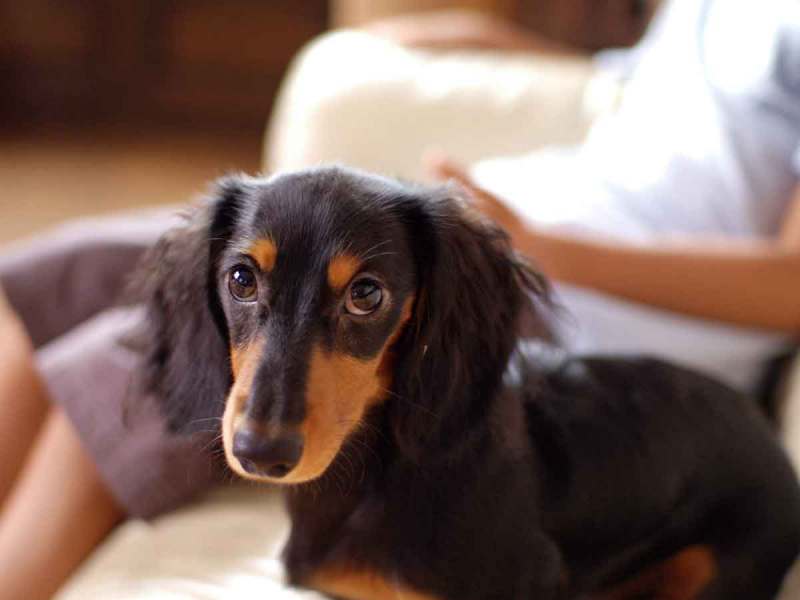
2 – A long-haired Dachshund puppy by Tam Tam from Shizuoka, JAPAN / CC BY-SA
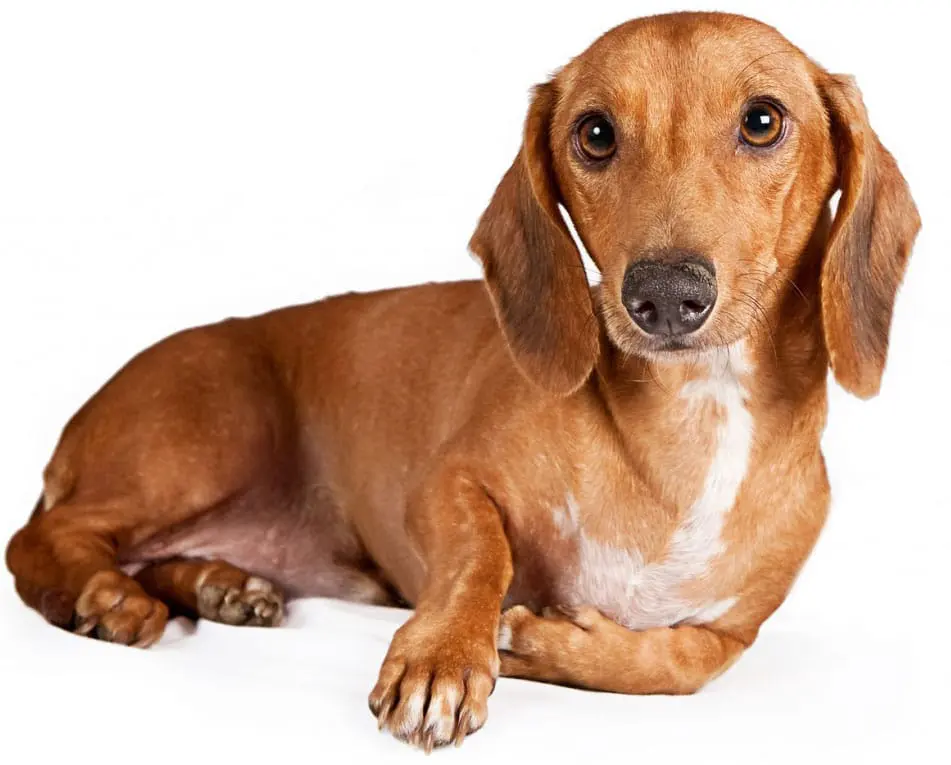
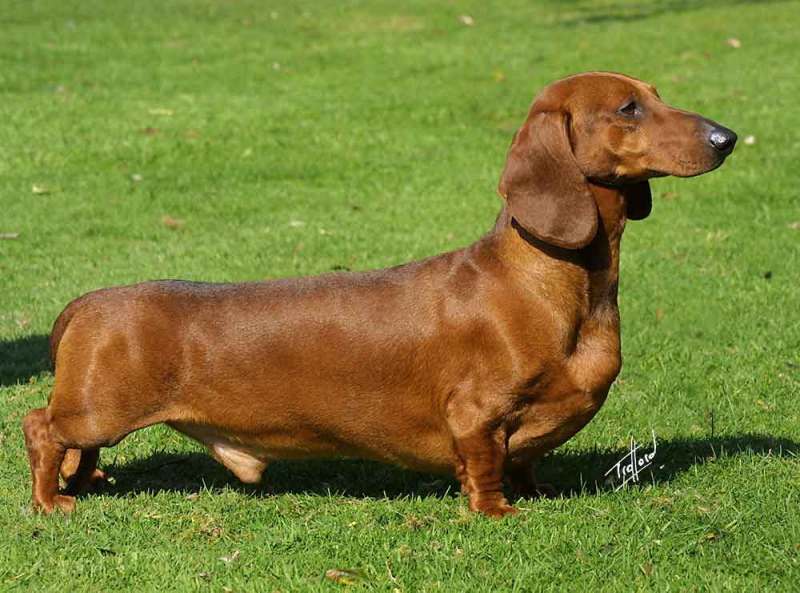
3 – A red and tan smooth haired Dachshund by Raven Underwood / CC BY
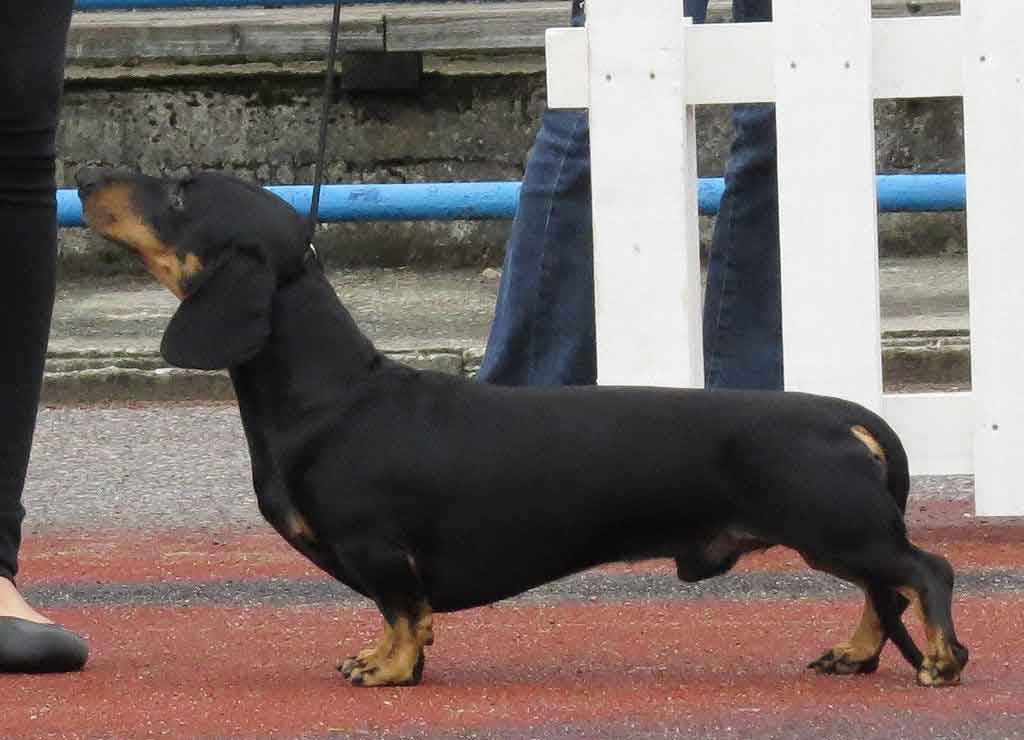
4 – Dachshund in Cannes by Tiia Monto / CC BY-SA
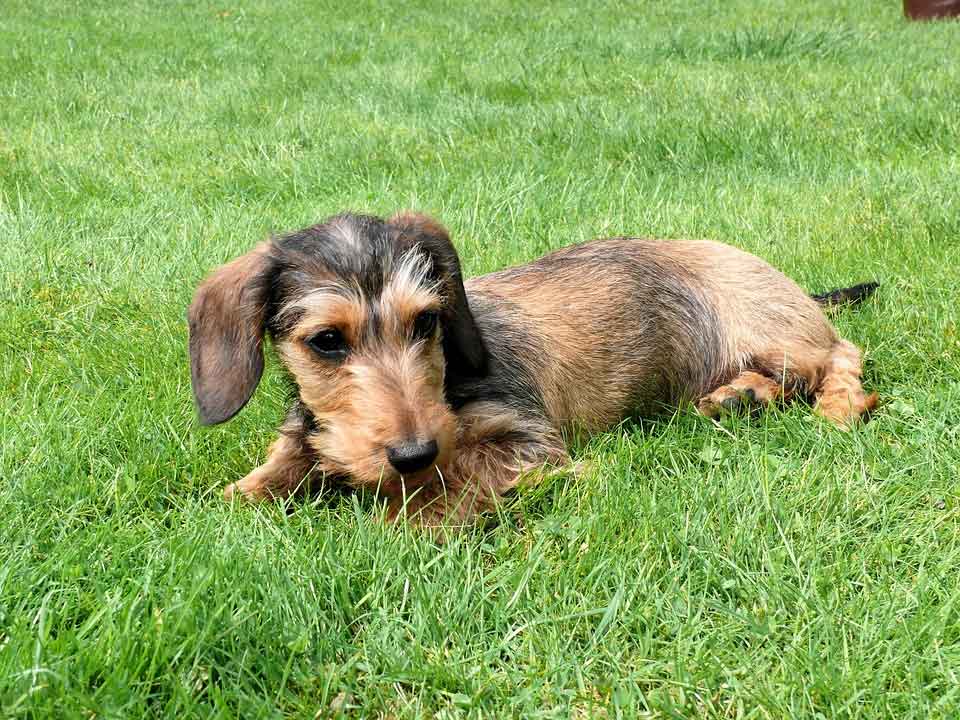
5 – A Wirehaired Dachshund Sleeping in the Sun by Jeuwre / CC BY-SA
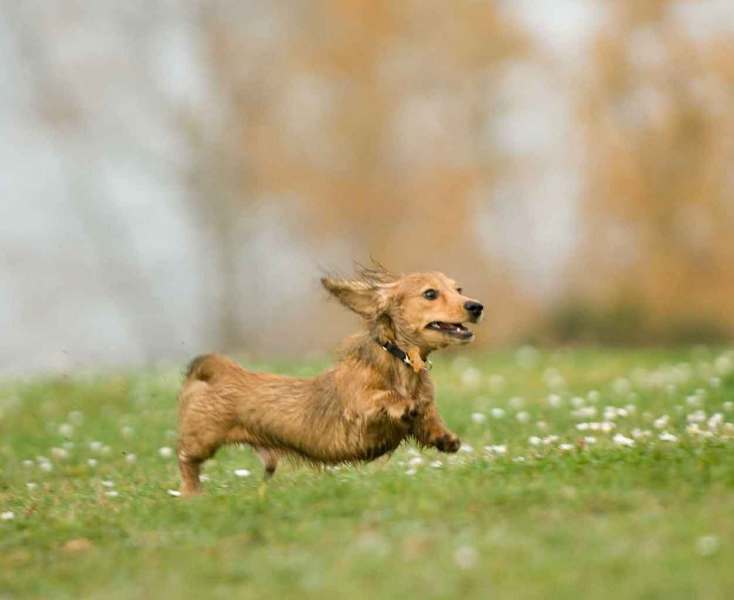
6 – Dachshund running in a green field by Dan Bennett / CC BY

Videos "Dachshund"

Type and recognitions:

  • FCI CLASSIFICATION:
  • Group :
  • Section : . .

Federations:

  • FCI – Group 4 – Section 1 Sausage dog. โ“˜
  • AKC – Sausage dog โ“˜
  • ANKC – Sausage dog โ“˜
  • CKC – Sausage dog โ“˜
  • โ€‹KC – Sausage dog โ“˜
  • NZKC – Sausage dog โ“˜
  • UKC – Sausage dog โ“˜

FCI breed standard "Dachshund"

Origin:
Germany

Date of publication of the valid original standard:
04/09/2019

Use:

Hunting dog, above and below ground.


General appearance:

Low structure, with short limbs, elongated but compact body with strong muscles. The head is carried with ease and pride; the expression is cunning.

Despite having short limbs, in relation to the body, must not be clumsy or limited in their movements. The specific development of both sexes is typical.

IMPORTANT PROPORTIONS : With the distance from the chest above ground level approximately one third of the height at the withers,the length of the body must be in a harmonious relationship with the height at the withers, approximately 1 to 1.7 -1.8.


Behavior / temperament:

By nature friendly, neither fearful nor aggressive, with a balanced temperament. Passionate hunting dog, persistent, agile and with a fine nose.

Head:

Elongated, both seen from above and in profile, narrows proportionally to the truffle, but it should not be pointed. The superciliary arcs are clearly defined. The nasal cartilage and nasal shank are long and narrow.

Cranial region:

Skull: Rather flat,gradually joining with a slightly arched bridge of the nose.

Depression front naso (Stop): Little marked.

facial region:

  • Truffle: Well developed.
  • Snout: Long, wide and strong enough.It should be opened wide, divided up to eye level.
  • Jaws / Teeth: Strongly developed upper and lower jaw. Scissor bite,regular. Ideally, a complete denture with 42 teeth according to the dental formula,with strong and exactly meshed fangs.

JAW DEFECTS: (Prognathism)

  • Lips: Tight, covering the lower jaw well.
  • Eyes: Medium-sized, oval and well separated, with clear and energetic expression, but at the same time confident and not penetrating. Dark red-brown and glossy to black-brown in all dog coat colors. Gazy eyes in harlequin dogs are undesirable, but they must be tolerated.
  • Ears: High inserted, not too far ahead, quite but not too long, rounded, Mobile, the front edge is well attached to the cheeks.

Neck:

Long enough and muscular; tight skin without double chin, slightly arched at the nape, carried free and erect.

Body:

  • top line:Harmonious, extends from nape to rump slightly oblique.
  • Cross: Pronounced.
  • Back: After the high cross, along the thoracic vertebrae, level or slightly oblique back. Strong and well muscled.
  • Pork loin: Strong musculature, long enough.
  • Rump: Wide, long enough and slightly sloping.
  • Breast : Sternum strongly pronounced and so prominent that slight holes form on each side. The thorax, seen from the front, it is oval, viewed from above and from the side is wide to ensure excellent development of the heart and lungs. The ribs extend far back. If the length and angulation of the scapulae and arm are correct, front limbs, viewed profile, They should cover the lowest point of the chest line.
  • Bottom line and belly: Slightly gathered.

Tail:

Implanted not too high and carried in the extension of the line of the back. A slight curve in the last third of the tail is allowed.

Tips

PREVIOUS MEMBERS

  • As a whole: With strong muscles and well angulated; seen from the front dry limbs, straight with strong bones and feet directed straight forward.
  • Shoulder: Relief muscles. The long scapula is sloping and well attached to the thorax.
  • Arm: The same length as the scapula, should form approximately a right angle to it. Strong bones and good musculature, glued to the ribs, but free in its movements.
  • Elbows: They must not be inclined either inwards or outwards.
  • Forearm: Short, but long enough so that the distance from the chest to the ground is approximately one third of the height at the withers. As far as possible right.
  • Carpal articulation: The carpal joints are somewhat closer together than the shoulder joint.
  • Metacarpus: In profile, not steep or visibly inclined forward.
  • Previous feet:Fingers placed next to each other and well arched with strong pads, resistant and thick and short and strong nails. The fifth toe has no function but should not be amputated.

LATER MEMBERS

  • As a whole: Strong musculature, in correct proportion to the previous members. Well angled in the knee and tibial tarsal joints, limbs parallel and in position neither too close nor too far apart.
  • Thigh: It should be of good length and with strong muscles.
  • Knee: Wide and strong, with marked angulation.
  • Leg: short, approximately at right angles to the thigh, strong muscles.
  • Corveยญjรณn: Strong, tendinous and dry.
  • Metatarsus: Relatively long, mobile relative to the leg, slightly bent forward.
  • Rear foot: Four well-arched, close-together fingers rest fully on the sturdy pads.

Movement:

The movement must cover a lot of ground, should be fluid with a strong thrust with a long stride and not raised forward, strong push and causing a light and elastic transition on the top line. The carriage of the tail should be a harmonious continuation of the upper line and slightly drooping.. During the movement the front and rear limbs must move parallel forwards.

Mantle

Well stuck.

The Three Types Dachshund:

  • By Sizes: Standard, Miniatura y rabbits.
  • By Pelo: Lasted, Short and long.

SHORT HAIR

HAIR: Short, thick, bright, smooth, well glued to the body, strong and hard should not show hairless areas.

TAIL: With fine and thick hair, but it's not too hairy. Protective hair somewhat longer at the bottom should not be penalized.

COLOR

  1. to)Unicolores dogs: Red, Rojo-Amarillo, yellow, all colors without or with black speckling. Clean color is always preferred and red is more appreciated than red yellow or yellow. Also dogs heavily splashed with black are included in this category and not among dogs of other colors..

White is not desirable, but in the form of a few small spots is not qualifying. Black nose and nails; reddish-brown is also allowed,but it is not desirable.

  1. b)Bi-coloured dogs: Deep black or brown, all with rusty red or yellow fiery markings above the eyes, on the sides of the muzzle and lower lip, on the inside edge of the ears, in the backsplash, in the Interior and later parts of extremities, in feet, around the anus and from here to a third or half of the bottom of the tail. Black nose and nails in black dogs; in brown dogs the nose and nails are brown.

White is not desirable, but in the form of a few small spots is not qualifying. Excessive fire marks are not desirable.

  1. c)Spotted dog (Harlequins, atigrados): The basic color is always the dark color (black, Red or gray). Irregular gray but also beige spots are desirable (very large stains are not desired). Neither dark nor clear must prevail. Brindle Dachshund color has darker stripes on a red or yellow background. Nose and nails as in uni or bicolor dogs.

BY THE HARD

HAIR: With the exception of the snout, eyebrows and ears, has on the body, mixed with the inner layer of hair, a regularly glued outer layer, thick and barbed wire. A well marked beard forms on the muzzle. The eyebrows are bushy. In the ears, the hair is shorter than in the body, almost smooth. Tail with well developed hair, uniform and very stuck.

COLOR: Predominant light or dark pig color, as well as the color of the dry leaves. In the rest the descriptions of the colors are valid as in the Short Hair from the point to) patient c).

LONG HAIR

HAIR: The hair with an undercoat is smooth with shine and close to the body., It extends below the neck and the lower part of the body, it excels in the ears and presents a clearly more long feather-shaped hair on the back of the extremities. The longest hair is at the bottom of the tail where it forms a true flag.

COLOR: As in the description of the Short Hair in points a) patient c).


Size and weight:

  • Dachshund: Chest circumference greater than 35 cm.. Maximum weight approximately 9 Kg.
  • Miniature dachshund: Chest perimeter between 30 and 35 cm., at the minimum age of 15 months.
  • Rabbit Dachshund:Chest circumference less than 30 cm., at the minimum age of 15 months.


Fouls:

Any deviation from the aforementioned criteria is considered a fault and its severity is considered to the degree of the standard deviation.

Los M3 (molars 3) are not taken into consideration during the evaluation. The absence of two PM1 (Premolar 1) should not be considered as a fault. As a lack, the absence of a PM2 must be considered, when no other teeth are missing except M3, as well as any other deviation from a correct scissors bite, such as a pincer bite.

SERIOUS FAULTS:

  • Weak constitution, very long or short limbs that the dog appears to crawl on the ground.
  • Absence of other teeth to those described in fouls or elimination fouls.
  • Gazy eyes any color other than spotted dogs.
  • Pointed or heavily creased ears.
  • Body fallen between the shoulders.
  • Overdue or carp back.
  • Weak loin.
  • Dog with too strong a build. (The rump is higher than the withers).
  • Very weak rib cage.
  • Agalgados flanks.
  • Poorly angled forelimbs and hindlimbs.
  • Narrow hindlimbs, lack of muscles.
  • Beef or Barrel Hocks.
  • Feet turned inward or too far out.
  • Separate fingers.
  • Heavy movement, clumsy, clumsy.

COAT FAULTS

Short haired dachshund:

  • Very fine hair, very thin, bald spots on the ears (leather ears), other bald spots.
  • Too thick or too long hair.
  • Brush-shaped tail.
  • Partial or full length hairless tail.

Hard-haired Teckel:

  • Soft hair, either short or long.
  • Long hair parted from the body in all directions.
  • Wavy or curly hair.
  • Soft hair on head.
  • Tail forming a flag.
  • No beard.
  • Absence of undercoat of hairs.
  • Short hair.

Long haired dachshund:

  • Hair of the same length all over the body.
  • Hisurto wavy hair.
  • No flag in the queue.
  • No protruding hair on the ears.
  • Short hair.
  • Hair sharply parted on the back.
  • Hair too long between the fingers.

MISS PLAYOFFS

  • Very fearful or aggressive behavior.
  • Prognathism, enognatismo, crossbite.
  • Deviated arch of incisors.
  • Absence of one or more canines and one or more incisors.
  • Absence of other premolars or molars.

Exceptions:The two PM1 or one PM2 respectively without taking into account the M3.

  • Reduced chest.
  • Any defect in the queue.
  • Shoulders too loose.
  • Carpus deviated forward.
  • Black color without markings tan color, white with or without tan markings. Other colors than mentioned.


N.B.:
  • Any dog โ€‹โ€‹showing clear signs of physical or behavioral abnormalities must be disqualified..
  • Males should have two normal-appearing testicles fully descended into the scrotum..

Source: F.C.I - International Cynological Federation

Alternative names:

1. Doxie, Wiener dog/hotdog, Sausage dog, weenie dog (English).
2. chien-saucisse (French).
3. Dackel, Teckel (German).
4. Cachorro salsicha, Teckel (Portuguese).
5. Perro vienesa, Perro longaniza, Perro salchicha (espaรฑol).

โ–ท The world of Pets: Dogs, cats, birds, reptiles, amphibians

German Hunting Terrier
Alemania FCI 103 - Large and medium sized Terriers

Jagdterrier

The German Hunting Terrier is in no way suitable exclusively as a companion or family dog.

Content

History

The German Hunting Terrier he is a high performance terrier. There are two varieties of it, the of wire hair and the of smooth hair. He is essentially a descendant of Fox Terrier. After World War I, some active hunters broke away from the Club de Fox Terrier to create a breed that would be oriented exclusively to hunting performance. This was successful and thus the German Hunting Terrier Club in 1926. Under the leadership of Dr. Herbert Lackner the new race, the German Hunting Terrier, was established systematically and finally very successfully.

After a separation from the brood of almost 100 years, you can certainly talk about a new breed today. It also, you can clearly see it in its appearance and also in the nature of this professional hunting dog. But, remained a terrier. One German Hunting Terrier you must be very brave, fearless and defensive. Must be able to work boar hunting without problems, which is one of the most difficult and dangerous tasks a hunting dog can master. Even today the German Hunting Terrier is still a highly prized hunting dog. Has become a versatile hunting assistant. Among other things, It is used very successfully in wild boar hunts., where it excels with amazing performances. His tireless work eagerness and leadership are especially appreciated while hunting..

The German Hunting Terrier he is fearless and with every fiber of his being he strives to do his job as well as possible. The German Hunting Terrier has been conceived as a breed from birth by hunters for hunters. Therefore, given exclusively to hunters. It is still successfully served today by the "Deutscher Jagdterrier-Club" in the VDH (German Canine Federation). It is exclusively cared for by breeders affiliated with this club. The breed is highly valued and popular with German hunters.

Physical characteristics

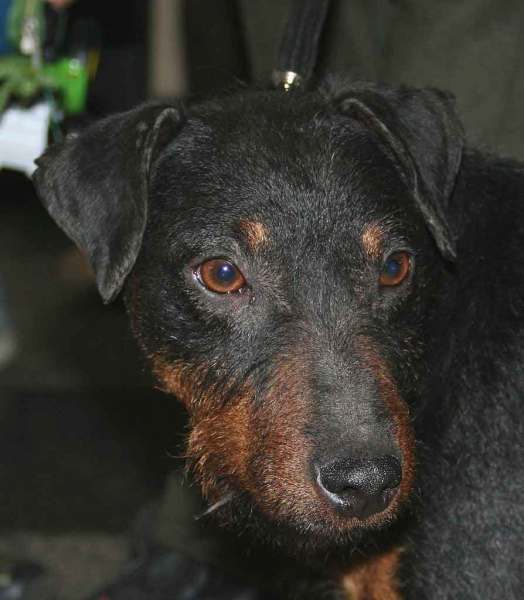
The German Hunting Terrier it is a small to medium sized dog with a distinctive appearance. He is a high speed terrier. Has an awake expression, well trained and full of tension, which leaves no doubt that you are always ready for an adventure. This is underlined by its wedge-shaped but not pointy skull, his deep and determined eyes and his ears leaned forward.

The standard briefly describes it:

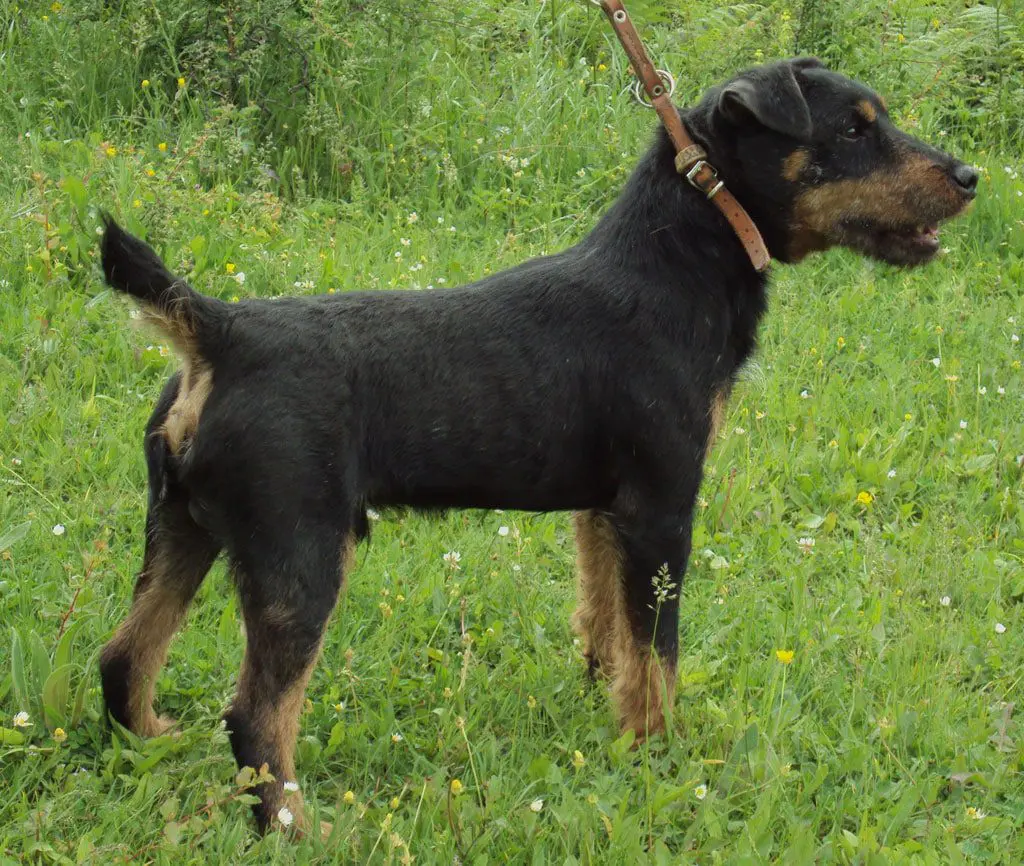
The German Hunting Terrier is a small, generally black and red, compact and shapely hunting utility dog.

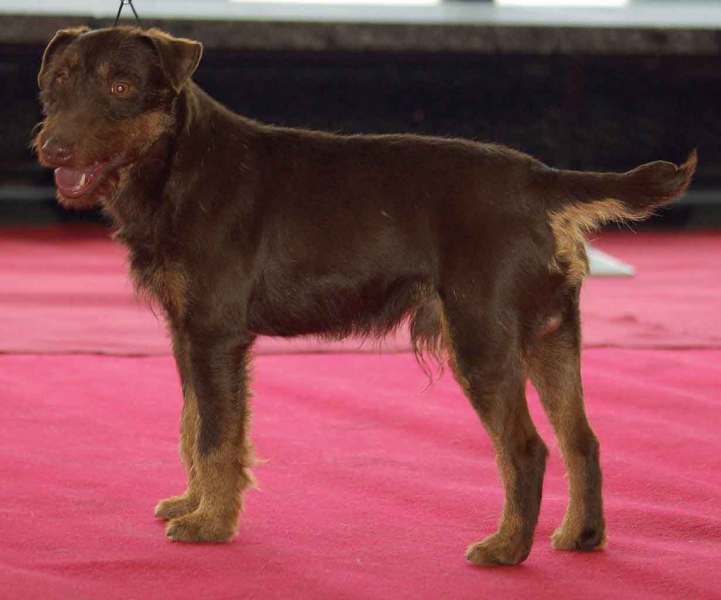
The small dog has a height at the cross of 33 to 40 centimeters in both male and female dogs. But, bitches should be a little bit lighter. In males, the weight, is of some 9 to 10 kg, in females 7,5 to 8,5. In the standard it says briefly, according to the proportions, neither too light nor too heavy. The German Hunting Terrierhas always been available in two types of fur: smooth hair, dense, hard and rough or thick straight hair. Its color is black, dark brown or black-gray mottled with red-yellow spots, very well defined clean marks.

Character and skills

The German Hunting Terrier is a thoroughbred hunting dog for the practicing hunter. The Hunter Terrier it's a power pack. It's not for people who imagine a potato-trainer. It is by no means exclusively suitable as a companion or family dog.. His history and highly developed hunting skills should also be on the mind of the non-hunter, when you think about keeping German Hunting Terrier as a companion dog. Can be a charming companion and family dog โ€‹โ€‹fond of children, but only on the basis of its species-appropriate use as a hunting dog. Here he is shown as a First Class Hunting Helper, who convinces again and again for his performance.

The German Hunting Terrier it's hard and persistent, easy to handle and calm and especially for a Terrier quite compatible with other dogs. The official FCI standard describes its character in this way:

The German Hunting Terrier is brave and tough, eager to work and persevere, vital and energetic, reliable, sociable and manageable, neither shy nor aggressive.

The breed attaches great importance to suitability for hunting, firmness of character, hunting intelligence, fearlessness and low sensitivity. Must be a versatile dog, hard, noisy and water-loving with a pronounced hunting instinct and excellent training ability. Your determination, vitality, high intelligence and close relationship with his master and caretaker make him a very interesting companion, but also demanding.

Education German Hunting Terrier

This breed of dog can be very well educated and trained.. The clear announcement and the consequence are the miracle words here based on a respectful and loving relationship with the master or caretaker.. This terrier has been bred for many generations for its performance and good training ability. Only dogs that perform excellently here are used for breeding. For you, as your caregiver, this is both an opportunity and an obligation. With experience, consistency and a clear statement based on a trusting and emotionally positive bond, you can achieve everything with it.

German Hunting Terrier health and care

These German hunting terriers are extremely easy to care for. Brushing here and there is enough. His health is very robust.

Nutrition / Food

Feeding a German Hunter Terrier has no problems.

The life expectancy of the German Hunting Terrier

as a rule, the German Hunting Terrier enjoys a long and vital canine life, often over 12 years.

Buy German Hunting Terrier

If you are looking for a German Hunter Terrier, must contact a hunter, Ranger or breeder who is a member of the Club German Hunting Terrier long before I plan to buy one. Dogs are normally only given to hunters. Here and there it can happen that a dog looks for another place. But then you should be able and willing to give him species-appropriate living conditions.. A puppy of this breed of dog costs around 1.000 EUR.

Images "German Hunting Terrier"

Photos:

1 – Jagdterrier by No machine-readable author provided. Richard Huber assumed (based on copyright claims). / Public domain
2 – German Jagdterrier by Tux-Man / CC BY-SA
3 – Jagdterrier during dogs show in Katowice, Poland by Lilly M / CC BY-SA
4 – German Hunting Terrier during dogs show in Katowice, Poland by Pleple2000 / CC BY-SA
5 – Jagdterrier during dogs show in Katowice, Poland by Lilly M / CC BY-SA
6 – Jagdterrier by Pleple2000 / CC BY-SA

Videos "German Hunting Terrier"

Type and recognitions:

  • FCI CLASSIFICATION:
  • Group :
  • Section : . .

Federations:

  • FCI – Terriers 1 Large and medium-sized terriers. โ“˜
  • UKC โ“˜

FCI breed standard "German Hunting Terrier"

Origin:
Germany

Date of publication of the valid original standard:
19.03.2015.

Use:

Variable utility hunting dog, especially for hunting in burrows or for raising game.


General appearance:

It is a useful dog for hunting., small, reddish black, compact and well proportioned.

IMPORTANT PROPORTIONS:

  • Ratio between chest circumference / height of the cross: chest circumference is 10 to 12 cm greater than the height of the cross.
  • Body length / cross height: the body is a little longer than the height of the cross.
  • Chest depth / cross heightis approximately the 55-60% the height of the cross.


Behavior / temperament:

It is spirited and strong, likes work and is constant, full of vitality and temperament, reliable, docile and affable, He is not shy or aggressive.

Head:

Elongated, a little wedge-shaped, but not pointy. Muzzle a little shorter than the skull from the occipital protuberance to the frontal-nasal depression.

Cranial region:
  • Craging: Flat, broad skull between the ears. A little narrower between the eyes.
  • Ston: Poorly developed.

facial region:

  • Trufa: In relation to the muzzle it should not be too narrow nor too small; should not be divided; always black; if the primary coat color is brown, the truffle can also be that color.
  • Horcico: Powerful, well developed cheeks, deep and strong lower jaw, well delineated chin.
  • Labios: Well adherent and with good pigmentation.
  • Jaw/Bite/Teeth: Teeth are big. The jaw is powerful and has a perfect scissor bite, regular and complete, in which the upper incisors overlap the lower incisors without leaving space, and the teeth are upright in the maxilla. Should have 42 teeth according to the dental formula.
  • Ojors: dark, small, oval, sunken; with attached eyelids and determined expression.
  • Obars: Semi-upright so that the tips adhere lightly to the head, high insertion, not very small, โ€œVโ€ shaped.

Neck:

Strong, not too long, right next to the body; widens toward insertion with shoulders.

Body:

  • Lรญnand the top: Straight.
  • Cruz: Marked.
  • Espalda: Strong, straight, not too short.
  • Pork loin: He has strong musculature.Rump: Very muscular, flat.
  • Torrax: Deep, well arched ribs, not very wide; long sternum; the ribs, well bowed, directed back.
  • Lรญnand the bottom: Forms an elegant backward arch, short and firm flanks, slightly retracted belly.

Tail:

With good insertion in the long rump, shortened by about a third of its length. Can be carried slightly less upright than vertically straight, must not be leaning on the back. (In countries where laws prohibit tail docking, it can remain natural and in that case it must be carried horizontally or in the form of a saber).

Tips

PREVIOUS MEMBERS

  • Apgeneral arience: The forelimbs, front views, straight and parallel are observed; from the sides they look plumb under the body. The distance from the floor to the elbow is almost the same as from the elbow to the withers.
  • Hormbros: Long scapula, well oblique and directed backwards; muscular shoulders. Good angulation between the scapula and the arm.
  • Brazo: It is as long as possible, slim with good muscles.Elbows: Glued to the body, no deviations outwards or inwards. Good angulation between the arm and forearm.
  • Antarm: Delgado, vertical, with robust bones.
  • Articulation of the carpus: Strong.
  • Metacarpus: Slightly leaning forward, skeleton rather robust than fragile.
  • Pinis previous: Frequently wider than later ones, with fingers close together, and thick enough pads, hard, strong and well pigmented. Feet are placed on the floor in parallel; no deviations outwards or inwards both when standing and during movement.

LATER MEMBERS:

  • Apgeneral arience: Viewed from behind they are straight and parallel. They have good angulations between the thigh and the leg, as well as between the leg and the metatarsus. Strong bones.
  • Thigh: Long, wide and muscular.
  • Rodinllto: Strong, with good angulation between the thigh and the leg.Leg: Long, muscular and tendon.
  • Atibio-tarsal articulation: Strong and deep.
  • Metatarsus: Short and vertical.
  • Pinis later: Oval, almost round, with fingers close together and pads thick enough, hard, strong and well pigmented. They step in parallel both standing and in motion and do not show deviations towards the inside or outside.

Movement:

It covers the ground, with good progress and momentum; is fluid; fore and hind limbs are kept straight and parallel, no strides.

Mantle

PIEL: Thick, very attached, without forming folds.

MANTLE

Plink: Rough fur, hard, dense and straight or straight and straight hair.

Colorr: Color is black, dark brown or grayish black mixed with clean markings, well outlined reddish yellow over the eyes (eyebrows), snout, chest, limbs and around the anus. A light or dark mask is also allowed; a small white mark is tolerated on the chest and on the fingers.


Size and weight:

Height of the cross:

  • Males: 33 to 40 cm.
  • females: 33 to 40 cm.

Weight: Acorresponds to the relation with the height, not too light and not too heavy.


Fouls:

Any deviation from the aforementioned criteria is considered as a fault and the severity of this is considered to the degree of the deviation to the standard and its consequences on the health and well-being of the dog.and the dog's ability to perform its traditional task.

FALTAS GRAVES:

  • Narrow skull; narrow or pointed snout.
  • Fleeing Jaw, close.
  • Weak teeth, any irregular position of the incisor
  • light eyes, too big or prominent.
  • erect ears, floating, too thick, insertion too low
  • Steep anterior limb
  • Overdue or carp back, too short.
  • Short sternum.
  • Sill seen from the front too narrow or wide.
  • Steep hind limb, too high.
  • Elbows strongly turned in or out.
  • Fingers too close together or apart; cow hocks, in the shape of an โ€œOโ€ or in a narrow position, both standing and moving.
  • crushed feet, cat feet, hare foot.
  • Tail tilted forward, insertion too low, hanging tail.
  • Short hair, woolly, fine, not adhered to the skin.
  • Hairless belly and inner thighs

FALTAS DISQUALIFYING:

  • Aggressiveness or extreme shyness.
  • Any dog โ€‹โ€‹showing clear signs of physical or behavioral abnormalities must be disqualified..
  • Atypical dogs
  • Upper or lower prognathism, deflected bite, partial or complete clamp bite, crossbite, irregularly placed teethon the top and/or bottom line, absence of teeth except M3.
  • Lack of pigmentation.
  • Entropion, ectropion, different colored eyes (anisochromia), blue or splattered eyes
  • Unauthorized coat colors
  • Height at the withers less than 33 cm and greater than 40 cm..


N.B.:
  • Males should have two normal-appearing testicles fully descended into the scrotum..
  • Only functionally and clinically healthy dogs, with the typical conformation of the breed, should be used for parenting.
  • Itlatest changes are in bold.

TRANSLATION: Brรญgida Nestler.
Technical supervision: SR. Miguel A. Martรญnez.

Source: F.C.I - International Cynological Federation

Alternative names:

1. Deutscher Jagdterrier, German Jagdterrier, German Hunting Terrier, German Hunt Terrier, Jagdterrier (English).
2. Jagdterrier (French).
3. Jagdterrier (German).
4. Jagdterrier (Portuguese).
5. Terrier alemรกn de caza, Terrier alemรกn (espaรฑol).

โ–ท The world of Pets: Dogs, cats, birds, reptiles, amphibians

Hovawart
Alemania FCI 190 - Molossoid . Mountain

Hovawart

The term Hovawart derived from medieval german, in which -hova- meant "cut" and -wart-, "guardian".

Content

History

The dog as guardian of the house and the courtyard has an ancient tradition in the history of humanity. Maybe thousands of years ago, private ownership of the house and yard, goods and workshops could only be established with the help of the protective role of dogs. The four-legged court guards were already highly regarded by the Teutons, which is reflected in the various laws of the last Teutonic. Of the 24 articles of the Law of Baiuvariorum, an entire article is dedicated only to dogs. Here, plus a dozen other dog breeds, the court dog is explicitly mentioned as "Houvavart". The Houvavart was valued at 3 shillings. It was a huge amount, considering that in the same body of law a "mediocre" horse was valued at only half a shilling. The Hovawarts are also mentioned in various writings from the Middle Ages.

The Hovawart Today is in the intellectual and functional tradition of these old court dogs. Regarding their genetic offspring, will not be more or less related to them than the other breeds of guard dogs and native dogs. Building a direct line of descent to the old Hovavart would not be permissible, especially since it is not known at all what these dogs looked like.

After 1910 the Hovawart but without a description of the appearance. Over the years 20 established itself as a breed of dog.

In the FCI breed standard of 1998 It is said that:

"From 1912 the reproduction of this breed has been using similar type dogs that are still in farms to restore the breed. apart from this, at the beginning of the crossing, you cross them with German shepherds, Newfoundland, Leonberger and other races were admitted. In addition to the strict measures taken in the breeders, the type of job was obtained again.โ€

It also, crossed the hungarian watchdog Kuvasz, what is important to understand the nature of Hovawart. After having almost died out, after the first world war, the breed was recovered by the kinophile K. F. Kรถnig. In a span of time, what had been done very successfully thousands of years before was rebuilt here. Like, but mostly of the nature the right dogs were mated. The decisive criterion was performance for the intended purpose, so to speak, the work championship. It is quite possible that the Hovawart current look like the old ones Hovawart of our ancestors by this procedure of appearance and nature, but that is speculation. Only in 1944 breeding book closed. So a vast gene pool was created as the basis for this breed of dog., which is still very useful for your health and fitness today.

Physical characteristics

The Hovawart is a big dog, strong and at the same time quite thin. With the Hovi nowadays three strokes of color are allowed: Rubio, black marks (black with gold brown markings) black and white. Males have a height to the cross of 63 to 70 cm.. Considering its type and size, the Hovawart is thinner than it appears underneath its medium long wavy coat. So, a weight of 30 to 45 kg is considered normal for males. Despite this not so high weight, it is a very powerful and strong dog. Only for its strength and size it belongs to a hand with experience in dogs. The Hovawart he's a working dog, Guard and protection.

Character and skills

The character of Hovawart demands a person with a strong dog mind. He has a strong will, a head of its own and is very independent. Probably an heir to the pack guard dog, Kuvasz, who is one of his ancestors. He is self-assured and self-assured at the same time. The โ€œdesire to pleaseโ€ is not as strong in him as in many other working dog breeds.. Your master or caretaker still has to work and earn it. then a Hovawart well educated he is an extremely efficient off-roader and a lovely friend. Master the role of companion dog suitable for everyday life, as well as your challenges in dog sports or even as a rescue and tracking dog. He has a very good nose. Yes, and the Hovawart it is also an excellent watchdog and protection dog.

He is a defensive protector of his family and diligently protects his territory. He moves silently on the ground and faces an intruder suddenly but persistently. With built-in yard dog, the Hovawart not fully occupied, especially since today you have to monitor hardly a large enough area. He is intelligent and seeks true association with his caregiver. At the same time it is affectionate and sensitive and at the same time it radiates something primitive, archaic.

Wants and seeks connection with family. Like a well-behaved and demanded working dog, the Hovawart it is also an excellent family dog. Often rejoices with petting and hitting like a little lapdog. He is very friendly and gentle with the people he has taken to his heart. Once you meet them, will never forget them. When he is young he shows his affection sometimes very stormy.

The Hovawart it is a low maintenance dog. Apart from the change of coat, it does not need to be brushed every day., because her coat doesn't tend to tangle due to the small amount of undercoat. Well educated and managed he is an excellent companion. But, cannot be recommended as a family dog รขโ‚ฌโ€นรขโ‚ฌโ€นwithout further ado. If you are thinking of having a puppy Hovawart for the first time, must first consider practical challenges, they are only related to their strength and size. Not a beginner dog.

Hovawart Education

The Hovawart develops creativity and perseverance to realize his ideas about the world and its order. Here the owner of the dog is challenged with all the consequences, but paired with patience and empathy. And this already with the puppy. Hardness alone does not help the Hovawart at all. It is important to create and maintain trust, that the Hovawart wants to show his pack leader. By the way, pack leader: One Hovawart usually test thoroughly, who will take this position. Here its owner must assert himself with the consequent insouciance, then he will follow faithfully and with good behavior and accept the leadership of his humans without problems.

One must bring with him time and knowledge for an intensive education and, the best of all, training. If one loses the basic elements of education, you will hardly be able to go for a walk with him without stress. Then your self-confidence could even become a leadership statement.. Otherwise, the Hovawart it's the ideal companion dog image. He wants his humans to guide him, but without ever being submissive. The Hovawart maintains its own head and its own will. For some people this is perhaps too much of their own personality. But only this profile of the Hovawart can be an excellent basis for a respectful and intense human-dog relationship.

Hovawart Health and Care

The Hovawart it is a low maintenance dog. Except in times of coat change, twice a year, needs to be brushed regularly but not every day, because his coat does not tend to tangle due to the low amount of undercoat.

The Hovawart it is considered a completely healthy breed. Hereditary diseases are systematically fought, such as knee joint cartilage disease (OCD), which is more common in Hovawarts. Dysplasia of the hip joint (HD) "often a problem especially with large dogs" has been under control for a long time.

Nutrition / Food

The Hovawart they don't make any special demands. He is consistently straightforward. For a dog of its size and strength it needs little food.

Hovawart life expectancy

The Hovawarts can reach 12 years and not rarely even more with a good physical condition. It is a good life expectancy for such a large dog.

Buy a Hovawart

Puppies should only be purchased from an FCI registered breeder. For a puppy you should plan to 800 to 1000 EUR. The adult dogs of Hovawart they can also be taken out of shelter or emergency aid and offered a loving home..

Images "Hovawart"

Photos:

1 – Hovawart by https://pixabay.com/es/photos/hovawart-perro-perro-de-raza-pura-2611448/
2 – Hovawart black and tan by Faigl.ladislav / CC BY-SA
3 – Hovawart by https://pixabay.com/es/photos/perro-hovawart-negro-marrรณn-1194081/
4 – The three permitted colours of the Hovawart by Oxborrow / Public domain
5 – Blond Hovawart female (10 months) by Faigl.ladislav / CC BY-SA
6 – Hovawart by https://www.pxfuel.com/es/free-photo-xxpba

Videos "Hovawart"

Type and recognitions:

  • FCI CLASSIFICATION:
  • Group :
  • Section : . .

Federations:

  • FCI – Pinscher and Schnauzer-Molossoid type dogs – Swiss Mountain Dogs and Cattledogs. Section 2.2 Molossoid, mountain type. โ“˜
  • AKC – FSS โ“˜
  • CKC – Group 3 – Working dogs โ“˜
  • โ€‹KC – Working dogs โ“˜
  • UKC – Watchdog โ“˜

FCI breed standard "Hovawart"

Origin:
Germany

Date of publication of the valid original standard:
12.01.1998

Use:

Utility dog


General appearance:

It's a working dog, powerful, medium-sized, slightly elongated and long-haired. The difference between the sexes is clearly recognizable, especially in the head shape and body structure.


PROPIMPORTANT ORTIONSS: The length of the body comprises at least one 110 yet 115% the height at the withers.


Behavior / temperament:

It is a recognized versatile working dog, friendly and balanced disposition. Has protective instincts, He has a lot of self-confidence and has the ability to withstand stress.; is of medium temperament, combined with an excellent sense of smell. The proportions of his balanced body and special devotion to his family make him an excellent companion., guardian, defender, savior and tracker.

Head:

The nasal cavity is straight and parallel to the skull. The muzzle and skull are approximately the same length. The skin of the head is tight.

Cranial region:
  • Craging: The powerful head has a broad, rounded forehead.
  • Depression links (Stop): Well visible.

facial region:

  • Trufa: The nostrils are well developed. In black and black dogs with fire the pigmentation is black; in blond dogs the pigmentation is black, although the ยซ snow nose ยป is allowed (loss of temporary pigmentation).
  • Horcico: Strong, Slimming down slightly when viewed from above and in profile.
  • Belves: Tight.
  • Jaws / Teeth: Strong scissor bite complete with 42 teeth, according to the teething formula. The teeth are at right angles to the jaw. Caliper bite is accepted.
  • Ojors: Oval, nor protruding, or sunk. Dark to medium brown color. Tight eyelids.
  • Obars: Triangles and falls; loose along the cheeks; tall and widely spaced, giving the optical illusion of skull widening. They reach in length at least the lip corners; the tip is slightly rounded. When the dog is at rest it keeps them hanging; when the dog is on alert carry them by directing them slightly towards the forehead. Its front edges are located approximately half the distance between the eye and the muzzle..

Neck:

Strong, long Middle. The skin is tight.

Body:

  • Espalda: Straight and firm.
  • Itmor: Strong, somewhat longer than the rump.
  • Rump: Medium long, leaning slightly.
  • Breast : Width, deep and strong.

Tail:

With abundant hair, reaching below the hocks, but not even to the ground. depending on the mood, worn high above the back or low.

Tips

PREVIOUS MEMBERS: Strong, straight and vertical, viewed from the front and from the sides.

  • Hormbros: Very well muscled. The scapula is long and well oblique to the back.
  • Brazo: Long, well glued to the body.
  • Elbows: Glued to the chest.
  • Articulation of the carpus: Strong.
  • Metacarpus: Moderately inclined.

LATER MEMBERS: Strong and, seen from the back, vertical. Well angled.

  • Thighs and legs: Very well muscled.
  • Hock: Strong, descended.
  • PIIS: Rounded, strong and compact. Fingers are arched and together. Dewclaws must be removed except in those countries where it is prohibited by law.. Nails on black dogs with fire and black should have black pigmentation; in blonde dogs less pigmentation is allowed.

Movement:

In all walks, the hovawart movement, seen from the front or from behind, It's in a straight line, covering the ground well. The trot is very extended, with a powerful boost from the hindquarters.

Mantle

PIEL: In total, the skin is well glued. In black and tan or black dogs the skin presents a bluish glimpse, in blonde dogs generally a pink glimpse.


Plink: Long, strong hair is slightly wavy and glued; the inner layer of hair is poorly developed. The hair is longer on the chest, in the womb, on the tail and on the backs of the forelimbs and thighs. It is short on the head and in the anterior region of the front and rear limbs. The pelage is dense.


Colorr: There are three varieties of color: Black fire, black and blond.

  • Negro with fire: The coat is black and shiny, the color of the fire marks is medium blonde. In the head, the markings start below the nose and extend around the lip commissure to the marks on the gargant. Dot-shaped markings above the eyes are clearly visible.. The chest marks consist of two adjacent patches that can be attached. On the forelimbs, the marks seen from the side, extend from the fingers approximately to the metacarpus, Thinning at the back at the elbow level. In the hind, the marks, side view, they look under the hock in the form of a broadband, above the hock in the form of a narrow band extending from the front of the hindquarters to the height of the belly. A mark is also presented below the tail insert. Brands are well defined everywhere. Small white spots on the chest, as well as some white hairs on the fingers and on the tip of the tail are allowed. Pigmentation of the eyelids, lips and pads must be black.
  • Negro: The coat is shiny black A few small white spots on the chest, as well as some white hairs on the fingers and on the tip of the tail are allowed. Pigmentation of the eyelids, lips and pads must be black.
  • Rubinor: The coat is medium blonde, shiny and becomes lighter towards the belly and limbs Small white spots on the chest, as well as some white hairs on the fingers and on the tip of the tail are allowed. Pigmentation of the eyelids, lips and pads must be black.


Size and weight:

  • Males: of 63 to 70 cm.,
  • females: of 58 to 65 cm.


Fouls:

Any deviation from the aforementioned criteria is considered as a fault and the severity of this is considered to the degree of the deviation to the standard and its consequences on the health and well-being of the dog..


FALTAS DESCALIFICANTES:

  • Aggressiveness or extreme shyness.
  • Any dog โ€‹โ€‹showing clear signs of physical or behavioral abnormalities must be disqualified..

Apgeneral arience

  • Dogs that do not correspond to the general type of the breed
  • Females with male appearance.
  • Males with female appearance

Pbearings

  • Body proportions very different from those indicated in the standard

Comportamiento / Temperament

  • Aggressive dogs, fearful, apathetic, afraid of the shot.

Cthey are not coming

  • Absence of naso-frontal depression (Stop).
  • Blue eyes, gazeo eyes
  • Erect ears, semi-erected, rose-shaped or separated from the cheeks
  • Upper or lower prognathism, incisor arcade deviated.
  • Absence of more than 2 of the four PM1 (premolars 1) or of the two M3 (molars 3); absence of any other teeth.

CUit

  • Presence of a marked double chin or a lot of loose skin.

CUerpo

  • Back very beaten or pronounced carp.
  • Narrow or barrel-shaped chest.
  • Abnormal glue, heavily cropped or heavily coiled.

Formertremedies

  • Hindquarters too high.

Plink

  • Mostly curly hair (ring shaped curls)

Colorr

En set:

  • All non-standard colors, blue/grey, ciervuno, brown, white, spotted, smutty blonde or with mostly streaked hair
  • White patches White hairs on the inside of the thigh is not an elimination foul.

Perros black and fire

  • Gray or brown patches outside the spots.
  • Undercoat of hairs mostly a color other than black.
  • Predominant gray or white spots.

Pblack mistakes

  • Brown or gray patches
  • Undercoat of hairs mostly a color other than black.

Pblond mistakes

  • Some white hairs on the bridge of the nose do not constitute an eliminatory foul.
  • Continuous reddish-blond color without becoming slightly lighter.
  • Blonde-off-white color, even in the ears.
  • Distinctively white markings.
  • Dark patches or mask

Tby hand

  • Size smaller than that indicated in the standard
  • Size greater than 3 cm of that indicated in the standard


N.B.:
  • Males should have two normal-appearing testicles fully descended into the scrotum..
  • Only functionally and clinically healthy dogs, with the typical conformation of the breed, should be used for parenting.

Itlatest changes are in bold.

TRANSLATION: Mauricio Martinez, Federation Canรณfila Mexicana, A.C.; y Dr. J-M Paschoud.

Source: F.C.I - International Cynological Federation

Alternative names:

1. Hovie (English).
2. Hovawart (French).
3. Hovawart (German).
4. Hovawart (Portuguese).
5. Hovie (espaรฑol).

โ–ท The world of Pets: Dogs, cats, birds, reptiles, amphibians

Landseer
Alemania Suiza CanadรกFCI 226 - Molossoid . Mountain

Landseer

The nature of Landseer and Newfoundland is very similar, considering the first one as something more agile.

Content

History

The Landseer was created together with Newfoundland on the east coast of Canada. The great island of Newfoundland, located off the coast of Canada, gave his ancestors his name. Just 100 years the ways of Landseer they separated from those of Newfoundland. The reason was that they wanted to keep their skin color black and white.. More on this later. Who descended from the dogs of the Vikings of pre-Columbian times, from Spain or from the dogs of the Indians, are legends that remain untested. But, according to the current genetic map of canine breeds prepared in 2017 by an international group of researchers led by Heidi G. Parker, there is a close relationship with the recuperators, What, like the Labrador, come from the same area. Probably the ancestors of the Landseer or Newfoundland arrived in North America with the first European settlers.

The big dogs proved to be important helpers for fishermen and sealers in the cold waters of the North Atlantic., and were also occasionally useful in hunting bears and big game. It also, landowners or Landseers they carried loads and even as a draft dog they are said to provide exceptional services. Working with fishermen in extremely harsh weather was very demanding. The Landseer had to think, had to do heavy work on the networks, saved the lives of the castaways over and over again. In this way he developed the peculiarities of his being and his physique.. He accomplished amazing things in the service of humanity. The Landseers or landowners came to England over and over again with cod ships as early as the 18th and early 19th centuries. Here he became famous very early for his impressive achievements.

The famous poet Lord Byron put in 1808 your dear boatswain Landseer an impressive monument. He had the words engraved on his tombstone: ยซHere rest the bones of one who possessed beauty without vanity, strength without exuberance, courage without savagery, and all the virtues of man without his vices". Here the greatness of character of these dogs is expressed, that can still be experienced today. The painter Sir Edwin Landseer immortalized his Newfoundlands black and white in oil several times around 1830. There is some evidence that dogs documented as Newfoundland Oh ya en Canis Earth News 1700 were predominantly black and white and that it was only later that the pure black or brown dogs that are typical of Newfoundland today. The black and white guy went out of style in England. But, Swiss and German cynologists and breeders brought the last good dogs from England and built a continental European breed.

To save these black and white dogs from Newfoundland, they were declared their own race around 1900, named after their famous painter ยซLandseerยซ. So this ancient type of dog with a great history was preserved for the world of dogs.. Since then, the Newfoundland and Landseers are raised separately. Later it is said that Kuvasz and Pyrenean Mountain Dogs were crossed to stabilize the white color of the soil.

In 1960 the Landseer (continental-european type) was officially recognized by the Fรฉdรฉration Cynologique Internationale.

Physical characteristics

According to the breed standard of the Landseer, You must give the impression of being a but powerful and well balanced. The legs are relatively longer than the black Newfoundland. The back is straight and strong. The hind legs and shoulders are muscular.

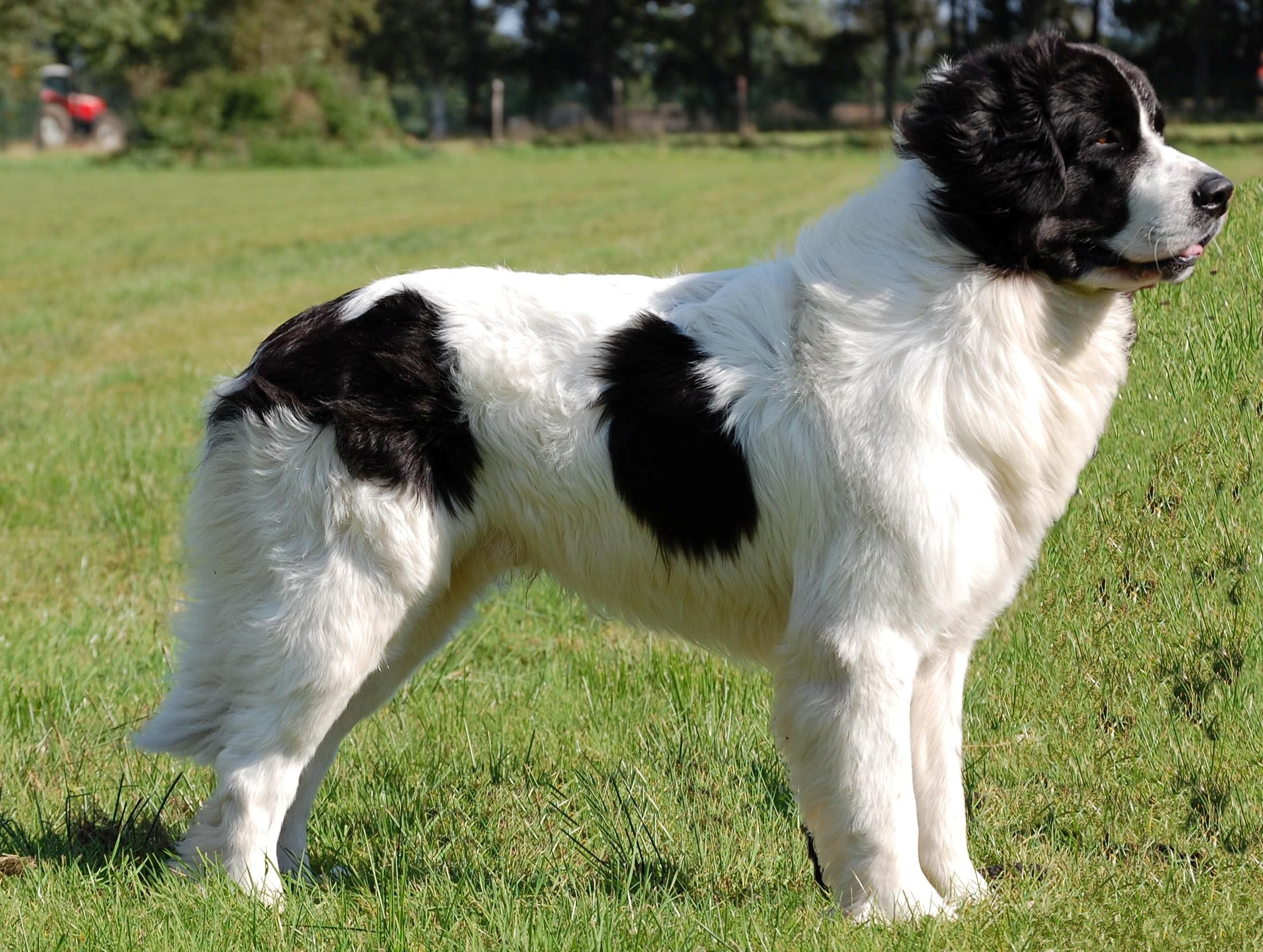
The upper layer must be long and as straight as possible, very dense and soft to the touch. The main color of the layer is white with various patches black in the rump, the neck, backsplash, belly, legs and the tail should be white.

The head should be black with the white snout and symmetric white extends from the snout to the head, ending with the white collar. It has a distinctive shape with a noble facial expression. The ears are medium-sized and eyes should be dark brown. the size of the Landseer will of 67 to 80 cm., and at birth weigh between 500 to 750 grams and at the age of 1 year can be reached despite 50 to 60 kg.

Like all mastiff-type breeds, the Landseer It is also grown very fast during its first year. Therefore one must be careful with the exercise, because if it becomes sedentary can suffer from overweight.

Character and skills

Throughout its development, and even at maturity (that is not until the dog is of 3 or 4 years of age), the Landseer is a very active dog who likes to do all kinds of activities. Swimming, for example, is your favorite activity. So when a Landseer smells and sees the water, already no boundaries, jump to the water.

The Landseer he is a very accommodating dog with his master. It is active, has good temperament, but it is not a nervous dog. It is a very confident dog, Intelligent, loyal to their own people, fairly mild in nature and, When they are given sufficient exercise outdoors, it attaches very well to home life. In general terms, most of Landseer they are very independent and have a mind of its own. The Landseer is very easy to train, much love and patience will be rewarded with a partner for life.

As we said in previous lines to most of the Landseer, they love water and walks, It is therefore necessary to fulfill these wishes to the dog. Being on the water takes it as a job, reason why can take advantage of these time to play to find objects, launch toy water to make it look, It can be one excellent training both for the owner and as for the dog. It is a good diver and with appropriate training, they are able to find objects in the bottom of any Lake. In this regard, It is good to note that if you want to go swimming with your Landseer you should keep in mind that, the dog will try to rescue and towed back to land. So, no doubt have to be careful to do this the first time. Basic training is required so that the dog knows when you are playing, and when not. Any other activity with the family is also something that the Landseer always wants to do.

When it comes to behaviour towards other dogs, children and people there is no problem. Especially the Landseer, they love to children.

It is good to socialize with other dogs puppies, because if he is male, It can be very dominant. But with a proper education, There will not be any problem.

Landseer Education

The Landseer can be educated very well. It is intelligent, interested and quickly understand what you are allowed to do and what you are not. Sometimes he takes it easy, but a little motivated he is very cooperative and tries to make his lord and master happy. The puppy should already show itself clearly and without exception where the hammer hangs. There should be no doubt about the orientation of your humans, as well as on the intimate relationship with.

Always keep in mind that this dog is the strongest and that orientation only works through unquestionable recognition. But with praise and consequences you can basically accomplish everything with it. On the basis of a good education you can even train very well at Landseer. Many Landseer are used as rescue dogs in the water, but also on earth. For this you can pass the work tests with water in the clubs.

Landseer Health and Care

The maintenance and care of the Landseer they are complex as with all big dogs. The dense and weather resistant layer should be brushed regularly with a special brush. Should not be sheared or trimmed.

The dogs of the breed Landseer like all large dogs they tend to hip joint dysplasia, twisting of the stomach. Due to their constitution and their dense fur they do not tolerate heat well.

Nutrition / Food

Like all large dogs, the Landseer needs a lot of good food. Especially in the growth phase you need professional nutritional planning. A high positioned food bowl is useful to counteract the risk of stomach twisting. You should always pay close attention to your weight.

Landseer's life expectancy

Life expectancy is between 10 and 12 years.

For sale Landseer

You should only purchase a puppy locally from a breeder who is affiliated with the FCI. Puppies of this breed cost between 1.500 and 2.000 EUR.

Images "Landseer"

Photos:

1 – Puppy landseer – 3 months old by OdinetPietra / CC BY-SA
2 – Landseer by https://pxhere.com/es/photo/548945
3 – Landseer by https://pxhere.com/es/photo/550456
4 – Cleo 11 months by Per Jensen – Flickr
5 – Landseer at PhotoEmotions (pixabay.com)
6 – Landseer by Katrina_S (pixabay.com)

Videos "Landseer"

Type and recognitions:

  • FCI CLASSIFICATION:
  • Group :
  • Section : . .

Federations:

  • FCI – Pinscher and Schnauzer-Molossoid type dogs – Swiss Mountain Dogs and Cattledogs. Section 2.2 Molossoid, mountain type. โ“˜

FCI breed standard "Landseer"

Origin:
Germany, Canada, Switzerland

Date of publication of the valid original standard:
24.08.1960

Use:

Guard and companion dog.


General appearance:

The Landseer must give the impression of a large dog, strong and harmonious. Your limbs, especially in males, they are proportionally longer than in the black Newfoundland.


Behavior / temperament:

---

Head:

The skin of the head, short hair cover, it is wrinkle free. The head profile is marked, but it has an expression of nobility.

Cranial region:
  • Craging: Wide and bulky, with a well developed occipital protuberance.
  • Dfronto-nasal depression: Marked, but not as noticeable and abrupt as in St. Bernard's dogs.

facial region:

  • Trufa: black.
  • Horcico: The length of the muzzle is equal to its height measured against the frontal-nasal depression.
  • Labios: Thin and pigmented in black; the superiors, which are as stiff as possible and do not drool, slightly cover the lower ones.
  • Jaws/Teeth: Scissor bite.
  • Cheeks: Moderately developed, gradually melting into the muzzle.
  • Ojors: Medium-sized, moderately sunken, brown or dark brown, although light chestnut is tolerated. friendly expression; almond-shaped eyelids; the palpebral conjunctiva is not visible. Overly clear eyes (sulfur or yellowish gray color) are considered as fouls, as well as eyes implanted too close to each other.
  • Obars: Medium-sized, reach the inner corner of the eye when placed towards the eyes; form triangular, a little rounded on its bottom edge, implanted high in the skull, but not too far back. Flat and glued to the sides of the head, they are covered with short and fine hair and have stripes of longer hair only at the back of the insert.

Neck:

The neck in its cross section is not completely round, but slightly oval; he's muscular, and it rises wide from the region of shoulders and thorax towards the head. In symmetrical construction, the length of the neck, from the occipital protuberance to the withers, is approximately 3/4 to 4/5 the length of the head, measured from the occipital protuberance to the tip of the nose. The presence of dewlap is not desirable (throat and neck) notable.

Body:

It is very broad and powerful from the cross to the rump. The length from the withers to the tail insert should be approximately twice the length of the head.

  • Espalda: Stiff and straight.
  • Pork loin: Muscular.
  • Glikeness: Wide, well rounded on the sides and back thanks to the powerful muscles that cover it.
  • Pecho: In the middle of the very muscular shoulders, the chest is broad and deep with strongly arched ribs forming a corresponding rib cage.
  • Vinbetween: Slightly retracted; between the belly and the back, a flat sag in the flank region must be visible.

A weak back is considered a fault, expired, loose backs, and the last ribs very short and an excessively retracted belly.

Tail:

Strong, reaches a little below the tibial-tarsal joint at most, covered in dense, leafy hair, but without forming feathers. When the dog is calm on its feet or at rest it carries it hanging down, eventually with a slight curve at the tip. During movement you can carry it straight with a slight upward bend at the tip. Tails bent or curled over the back are not tolerable.

Tips

PREVIOUS MEMBERS: A robust muscle mass from the shoulders surrounds the strong humerus and forms a correct angulation at the junction with the powerful bones of the completely straight and muscular limbs.. The forelimb has some stripes of hair that reach the tibial-tarsal joint.

  • Elbows: Well attached to the lower part of the thorax in a fairly high position and completely directed backwards.

LATER MEMBERS: The rear limb is powerful. The hind limbs must have free movement and have strong bones surrounded by powerful muscles., so that the thigh region mainly shows extensive development.

  • Thighs: They have a particularly broad development.
  • Espolones: Are unacceptable, They must be amputated from the first days of birth.
  • PIIS: Big and well formed (cat feet). Crushed or deviated feet are reprehensible. The fingers must be joined by strong interdigital membranes to the proximity of the tip of the fingers.

Movement:

The movement of the muscular limbs must be free and wide.

Mantle

  • Plink: Except for the head, the coat must be long, where possible, smooth and bushy, soft to the touch and intermixed with inner fleece which should not be as dense as in Newfoundland. The presence of an outer layer of slightly wavy hair on the back and thighs is not penalized. When brushing hair in the opposite direction to the natural position, it must return by itself to the correct position.
  • Colorr: The basic coat color is pure white with sharp, broken black plates distributed over the trunk and rump region.. The neck, the sill, the belly, limbs and tail must be white. The head is black. The presence of a white mark on the muzzle is typical of the breed, attached with a whitelist, symmetrical and not very wide. Smoke colored spots on the white background are not considered as faults, but they must be eliminated in breeding through selection.


Size and weight:

Alturto the cross: Height at withers in Landseer may fluctuate: in males an average between 72 and 80 cm and in females an average between 67 and 72 cm.. Small variations in size larger or smaller are tolerated.


Fouls:

Any deviation from the aforementioned criteria is considered as a fault and the severity of this is considered to the degree of the deviation to the standard and its consequences on the health and well-being of the dog..


FALTAS DISQUALIFYING:

  • Aggressiveness or extreme shyness.
  • Any dog โ€‹โ€‹showing clear signs of physical or behavioral abnormalities must be disqualified..


N.B.:
  • Males should have two normal-appearing testicles fully descended into the scrotum..
  • Only functionally and clinically healthy dogs, with the typical conformation of the breed, should be used for parenting.

Source: F.C.I - International Cynological Federation

Alternative names:

1. LANDSEER (EUROPEAN CONTINENTAL TYPE) (English).
2. LANDSEER (TYPE CONTINENTAL-EUROPEEN) (French).
3. LANDSEER (EUROPร„ISCH-KONTINENTALER TYP) (German).
4. LANDSEER (TIPO EUROPEU CONTINENTAL) (Portuguese).
5. LANDSEER (TIPO EUROPEO CONTINENTAL) (espaรฑol).

โ–ท The world of Pets: Dogs, cats, birds, reptiles, amphibians

Boxer
Alemania FCI 144 - Molossoid - Dogo

Boxer

The Boxer It is docile and boasts an unmatched loyalty with his family

Content

History of the BOXER

The Boxer It is a breed of working and companion dogs., medium-sized, of German origin. Obtained through the crossing of an Bullenbeisser and Bulldog.

Most canine historians agree that the Boxer has ancestors in dogs. Bullenbeisser. The Bullenbeisser (or out of bulls) they were hunting dogs, used for the hunting of the pig, wild boar and deer. Such expeditions for the hunting of wild animals used to cost the lives of several dogs., the game was horrible and painful both people and dogs (not to mention for wild boars). Some sources say that these huge medieval dogs had erect ears and large teeth., that would be used to hold the animal by the muzzle. It is likely that hunters cut off their ears in the way they do in some countries today., since this custom would seem to be in accordance with the primitive customs of those times.

Within a more civilized and utilitarian way, the ancestors of the Boxer were frequently used as butchers dogs, due to its ability to hold to a bull and lead him toward his barn, if he became rebellious. It is believed that the famous reputation of a dog called "Boxl", used by a Berlin butcher is what gave the breed its name. The derivation of the word Boxer as the name for a purebred dog is ironic, since the word "boxl" or "boxel" has as its translation, in essence, mestizo.

Physical Characteristics Boxer

Exist of varieties within the Boxer race:

  • The Griffon
  • The striped

His physical traits include a strong head, prognathic lower jaw, whose jaw pressure is generally 122 kg per square centimeter, snout with characteristic black mask, traditionally farmers cut their ears so that they seem rather long and situated in high, dark brown eyes, Truffle wide and black, strong neck, rounded and muscular and well fat; chest wide and rooms well muscled hind.

With animal protection laws has allowed the dog to submit without cutting of ears and the tail of these animals, but in the standard of beauty, It looks more the Boxer cut ears and tail. Flat, drooping ears on both sides of the head, that give it a character "of the eternal puppy".

The Boxer has a short coat, bright and smooth, Griffon or striped color (standard, black or red, though these colors are scarce). Sometimes it has white spots (collar, chest and gloves), Although the all-white Boxer has been considered as a genetic defect, While the initial progenitor (Meta Von Der Passage) was white.

The height at the cross of males varies between the 57 and 63 centimeters. for females, the height at the cross must be between the 53 and 59 centimeters. The average weight of adult males is around the 30 kg, While that of females is around the 25 kg.

Did you know??

White boxers are not albinos and their color is not the result of a genetic mutation. In bรณxers, white is only one color. But white dogs tend to get sunburned and may have an increased risk of skin cancer.

Boxer character and skills

Due to its value, strength and agility, was chosen as a police dog in Germany, used as a guide for the blind and a fire dog for its great sense of smell and bravery in major catastrophes. It is a faithful dog, intelligent and watchful, It is certainly one of the most complete dogs that exists. It is docile and boasts an unmatched loyalty with his family. However it is fierce and dominant and may attack other dogs with high speed (especially in males) When is one of their own attacked. They are very good for children, If you have one of 1 year two is the ideal time to fond with children and adults.

For your good health and development, the Boxer Puppy needs enough exercise and a controlled diet. The amount of exercise and food depends on the age. The small puppy, before they are weaned and separated from their brothers, He plays with others until he tires, and all enroscan to rest. This exercise, with sufficient rest, It is essential for the growth of the puppies. as it grows, the Boxer needs exercise to keep in condition and develop his musculature. In addition to playing with different elements, as you can be a ball, It is essential to get the dog to walk on a daily basis.

They are very suitable as companion dogs, family and in dealing with children, In addition to good dogs work and sport, They also serve as guard. They are recommended by specialists to help people with psychological deficiencies, This is a clear proof of its docility.

Their training is recommended at an early age, due to the Boxer are usually have a strong personality, making his training much harder as an adult. They are very playful, so do not like being locked, they prefer to be outdoors, why you must walk them often and do some exercise with them. They are also dogs with a great capacity for learning.

White Boxer comments

The Boxer are susceptible to tumors. Among its possible problems is also dysplasia. They suffer from epilepsy. Many of them are usually sensitive skin and suffer from some type of skin disease; allergic dermatitis is the most common.

The white Boxer tend to be most susceptible to hereditary diseases, Since it is considered a failure of the crossing, These Boxer can not participate in any competition. The occurrence of these diseases is not high, and if this is added that the puppy will be purchased from a breeder, It provides all the certificates of health for their copies, much increases the chances of having a healthy animal.

The Boxer white They are not as appreciated as brown or another color. Said that they are not entirely of pure-bred, but this is not true. These dogs are equal to each other, but in another color. Given that may suffer from various health problems, not appreciate them much, but if the dog does not have any problem it is like any other. If you have a health problem we must not think that it is a dog mestizo or that it is not completely pure. In addition the Boxer White It is not accepted by the F.C.I.

In the Boxer breed, white markings are produced by the semi-recesivo gene sw. The Golden or atigrados Boxer with white markings carry a single copy of sw. The white Boxer lead 2 copies of sw. (Note: the white Boxer are not albinos. Albinism is determined by a different gene and exemplary albinos, Unlike in the Boxer white, they completely lacking pigmentation).

Unfortunately, the white color produced by the 2 copies of sw is associated with problems of deafness in a not inconsiderable percentage of cases. This type of deafness is set in the puppy in their first weeks of life, starting when the ear canal is still closed. The process is complex, but it can be summarized by saying that it occurs because of the absence of pigment-producing cells (melanocytes) in the inner tissues of the ear. The Boxer of gold or brindle color does not present any problem of deafness.

This type of deafness is not exclusive to the Boxer White, that is also produced in other breeds that are white for the same reason genetic (This is, the lead 2 copies of sw), for example the Dalmatian, White Bull Terrier and other.

Characteristics "Boxer"

Coexistence is important that you have with your new friend. Before considering the acquisition of a dog of the breed "Boxer" you know certain factors. Not all breeds of dogs are apt to live in an apartment, you must take into account his character, their need for exercise, their interaction with other pets, their care and if you have small children, their level of tolerance towards them.

Adaptation โ“˜

4,0 of 5 stars (based on 1 review)

friendly dog โ€‹โ€‹โ“˜

2,0 of 5 stars (based on 1 review)

hair loss โ“˜

3,0 of 5 stars (based on 1 review)

Affection level โ“˜

5,0 of 5 stars (based on 1 review)

Need for exercise โ“˜

5,0 of 5 stars (based on 1 review)

Social need โ“˜

5,0 of 5 stars (based on 1 review)

Home โ“˜

4,0 of 5 stars (based on 1 review)

Toilet โ“˜

1,0 of 5 stars (based on 1 review)

Friendly with strangers โ“˜

3,0 of 5 stars (based on 1 review)

barking โ“˜

2,0 of 5 stars (based on 1 review)

Health โ“˜

3,0 of 5 stars (based on 1 review)

Territorial โ“˜

5,0 of 5 stars (based on 1 review)

Cat friendly โ“˜

3,0 of 5 stars (based on 1 review)

Intelligence โ“˜

4,0 of 5 stars (based on 1 review)

Versatility โ“˜

3,0 of 5 stars (based on 1 review)

Child friendly โ“˜

3,0 of 5 stars (based on 1 review)

Surveillance โ“˜

4,0 of 5 stars (based on 1 review)

joy โ“˜

5,0 of 5 stars (based on 1 review)

Imรกgenes Boxer

boxer videos

Type and recognitions:

  • FCI CLASSIFICATION:
  • Group :
  • Section : . .

Federations:

FCI โ“˜, AKC โ“˜, ANKC โ“˜, CKC โ“˜, โ€‹KC โ“˜, NZKC โ“˜, UKC โ“˜

FCI breed standard Boxer

FCIFCI - Boxer
Boxer

Breeders list "Boxer"

REGISTER KENNEL

Boxer breeders

Offer your puppies for free. Sign up here.

  • This field is a validation field and should be left unchanged.

Alternative names:

1. German Boxer, Deutscher Boxer (English).
2. Boxer (French).
3. Boxer, Deutsche Boxer (German).
4. Boxer alemรฃo (Portuguese).
5. bรณxer alemรกn (espaรฑol).

โ–ท The world of Pets: Dogs, cats, birds, reptiles, amphibians

Great Dane
Alemania FCI 235 - Molossoid - Dogo

It is an expensive dog, that he eats in proportion to his size and that when he is young he needs some care
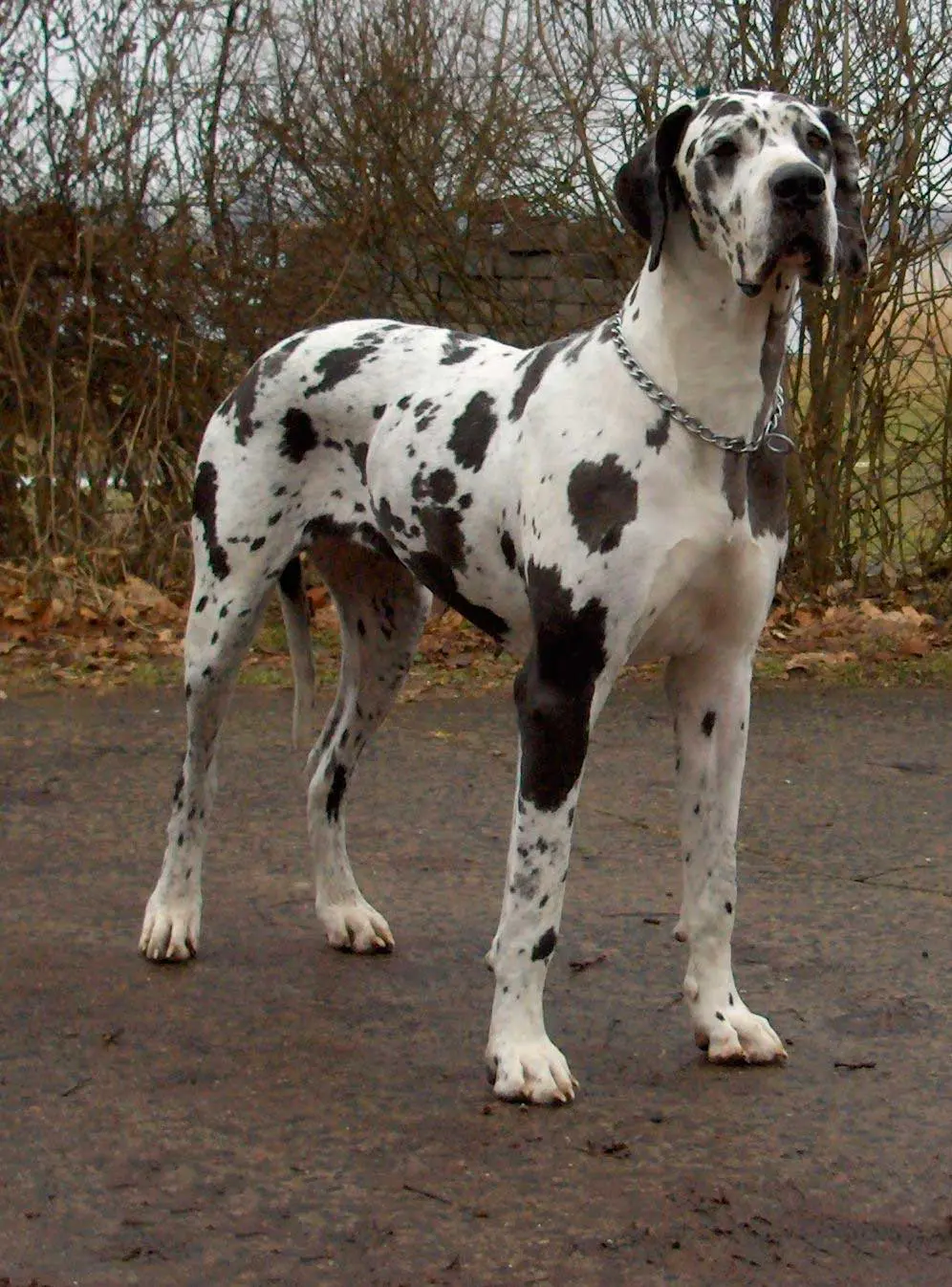
Content

Characteristics "Great Dane"

Coexistence is important that you have with your new friend. Before considering the acquisition of a dog of the breed "Great Dane" you know certain factors. Not all breeds of dogs are apt to live in an apartment, you must take into account his character, their need for exercise, their interaction with other pets, their care and if you have small children, their level of tolerance towards them.

Adaptation โ“˜

3,0 of 5 stars (based on 1 review)

friendly dog โ€‹โ€‹โ“˜

3,0 of 5 stars (based on 1 review)

hair loss โ“˜

3,0 of 5 stars (based on 1 review)

Affection level โ“˜

3,0 of 5 stars (based on 1 review)

Need for exercise โ“˜

2,0 of 5 stars (based on 1 review)

Social need โ“˜

4,0 of 5 stars (based on 1 review)

Home โ“˜

5,0 of 5 stars (based on 1 review)

Toilet โ“˜

1,0 of 5 stars (based on 1 review)

Friendly with strangers โ“˜

3,0 of 5 stars (based on 1 review)

barking โ“˜

2,0 of 5 stars (based on 1 review)

Health โ“˜

4,0 of 5 stars (based on 1 review)

Territorial โ“˜

5,0 of 5 stars (based on 1 review)

Cat friendly โ“˜

3,0 of 5 stars (based on 1 review)

Intelligence โ“˜

3,0 of 5 stars (based on 1 review)

Versatility โ“˜

3,0 of 5 stars (based on 1 review)

Child friendly โ“˜

3,0 of 5 stars (based on 1 review)

Surveillance โ“˜

2,0 of 5 stars (based on 1 review)

joy โ“˜

5,0 of 5 stars (based on 1 review)

History

The Great Dane is the oldest breed in modern dog breeding in Germany. Since then it is considered by many as the Apollo among dogs – after the greek deity. And in fact, the Great Dane it is a dog with a special charm and a unique and impressive charisma and elegance. The origin of this breed is only partially found in Germany. Already in the 16th century the Great Danes are said to have originated in England, as described in historical sources "crossing the mastiff with the Irish greyhounds". The name ยซDoggeยป, the old english word for dog, from which the current ยซDogยป, also speaks of a British line of descent. But, this type of dog was already bred in ancient times and was depicted on stone tablets.

Also on the European continent, old bull teethers regularly mated with greyhounds and hunting dogs, since these results of the crosses were perfectly adapted to the great hunts of the boar nobility, bears and wolves. Little by little, a breed of its own with molossi developed., Greyhound and some hunting dog blood. In 1867 the viennese cynologist Leopold Fitzinger distinguished three variants of Great Dane: the common mastiff, english and danish. Even today the great danes They are called "Great Daneยป in some languages. Modern analyzes by geneticists confirm the views of ancient cynologists about ancestors, and even assign them to greyhounds instead of molossians.

In 1888 the Club of the Great Dane In Berlin. It is the first and oldest pedigree dog breeding club in Germany.. The Great Dane modern should now become a representative companion and protector. It also, should be even more elegant. So the standard was adapted to these ideas. It was possible to achieve an extremely elegant and harmonious mix of these very different origins.. The Great Dane combines the elegance and speed of hounds with the power and carefreeness of the molossians.

Physical characteristics

The Great Dane it is an extremely large and powerful dog but at the same time very elegant and sensitive. A male dog reaches a height at the cross of 80 cm., often even more. Bitches are slightly smaller. The Great Dane has a unique charisma. The animal painter and dog connoisseur Richard Strebel already betrayed 1914 to the breeders of the Great Dane, the: ยซ… they have created a dog that can be considered without exaggeration as the most successful in size, proportion, strength and elegant movement never created in dogs." Unfortunately, this respect is not always shown in breeding Great Dane. Regardless of your health, are used for extreme breeding, the so-called gigantism, as well as for games with defective genes for rare coat colors; genes that can also cause serious illness.

While around 1900 the height at the withers for males was 76 – 80 cm., The FCI standard valid today says โ€œat least 80 cmยป without any clear upper limit. This allows the Great Dane reach the dubious honor of the world's largest dog. According to the Guinness Book of Records, this was the male Great Dane ยซGibsonยป con 108 height cm. That was in August 2004. Gibson still reached an age of almost 7 years, but the last years only in 3 legs. His record was expanded more and more.

ยซZeusยป the Michigan/EE.UU. reached a height of 112 cm and died with just 5 years, supposedly already in old age – Dubious records at the expense of dog welfare. The Great Dane it's impressive enough even without those dubious extremes. Its sovereign and elegant appearance is also highlighted by its silky coat. It is a very short coat, which is close to the muscular body with a slight shine. Colors are yellow or black, blue, tabby or stained.

  • Fur: Satin.
  • Color:
  • – Tawny: yellow golden colour with black mask. The eyebrows and edges of the eyes must be black, While the ears and the tail may be clearer.
    – Striped: Fawn and black in a striped pattern.
    – Blue: Dark steel grey, allowing white markings on chest and legs.
    – Negro: Jet Black pure, allowing white markings on chest and legs.
    – Harlequin: White with black patches. The Great Dane is the only breed to display this color pattern on its coat..

  • Size: the minimum height for males is 80 cm and for the females of 72 cm.

Character

The Great Dane is often described as a gentle giant, but it is naturally protective when the situation requires it. He is loving and loves people, and those qualities should never be perverted by encouraging aggressive behavior.

In terms of character and size the Great Dane a dog is not for beginners. Belongs exclusively to the hands of experienced dog owners, who can and want to be fully involved with the animal. So there is no more inspiring companion than this dog. El Canciller del Reich Otto von Bismarck, who was accompanied by great Danes all his life, he openly admired the intelligence and abilities of his great danes and is said to have said: ยซI have great respect for my dog's knowledge of human nature – "He is faster and more complete than me."

Great Danes love children, but they must learn to be nice to them. And a blow from that wagging tail will knock a little boy down, so it's important to monitor their interactions. These large dogs can also learn to get along with other pets., especially when raised with them.

A fenced yard is necessary to prevent the Great Dane go for a walk alone. Not usually a jumper, so a six foot fence should be enough to keep it contained. Note that while adult Great Danes are quite calm, puppies are very active and enjoy digging in gardens..

You might think that the Great Dane it is more suitable for outdoor life due to its huge size, but it's just the opposite. Should be an indoor dog that is part of the family. When that's the case, the Great Dane is loving, learns well and is easily trained. Left to his own fate, the amount of destruction it can do to your home and garden is beyond imagination.

any dog, no matter how pleasant it, detestable levels can develop barking, excavation, counter-browsing and other undesirable behaviors if you are bored, untrained or unsupervised. And any dog รขโ‚ฌโ€นรขโ‚ฌโ€นcan be a test that live during adolescence. In the case of the Great Dane, The "adolescence" years can begin at six months and continue until the dog is about two years old.

Start training your puppy the day you bring him home. Even at eight weeks old, He is able to absorb everything you can teach you. Don't wait until you are six months old to start training or you will have to deal with a stubborn dog. If possible, Take it to a trainer when you have between 10 and 12 weeks, and socializes, socialice, socialice. But, Note that many kinds of training puppies require certain vaccinations (such as kennel cough) stay up to date, and many veterinarians recommend limited exposure to other dogs and public places until puppy vaccinations (including rabies, distemper and parvovirus) They are completed. Instead of formal training, You can start training your puppy to socialize at home and among family and friends until immunizations are completed in the puppy.

Talk to the breeder, Describe exactly what you want in a dog and ask for help choosing a puppy. Breeders see puppies daily and can make incredibly accurate recommendations once they know something about their lifestyle and personality.

The Great Dane perfect doesn't come fully formed out of the puppy box. It is a product of his background and upbringing. Look for one whose parents have good personalities and who have been well socialized since the puppy's young age.

Great Dane fitness

The maintenance of Great Dane it is very complex and expensive. Food in the required quality and quantity, possible veterinary and drug costs, direct and indirect transportation costs and more require a financially wealthy owner. Yes a Great Dane wants to sit on the couch, you need all the two-seater, at least. Furniture made of solid faux leather has proven its worth here. The Great Dane should not be kept in a small apartment, Better is a house with a garden. The ideal would be to live in a rural area. Hectic urban centers are not the place where these big dogs feel comfortable. Also dog and owner are often met with rejection and even open hostility here. This must be considered.
Scooby Doo

Fiction has made it one of the best-known dogs to the general public.. Scooby Doo character is a Great Dane.

The Great Dane it is a big dog that wants to have a lot of movement. But, he is hardly ever seen on the street, although with 1.200 puppies a year ranks ninth on the VDH bestseller hit list (German Canine Federation), even before dog breeds like the Bernese Mountain Dog or the Chihuahua, they are seen much more often on the streets. Often these giants are only locked up once they are past their puppy age and - poorly socialized and educated.- can no longer be managed by the owner who is not familiar with dogs. The Great Dane not a kennel dog. He is basically a family dog รขโ‚ฌโ€นรขโ‚ฌโ€นand wants and needs the loving connection with his human family. Is smart and responsive. One should not think about what to do if this big dog, at times of 90 kg, is sick and has to be loaded. So, buying a Great Dane must be carefully considered.

Great Dane Education

The Great Dane a dog is not for beginners. Its strength and potential danger require expert and loving socialization, education and guidance already in the puppies. It is sensitive and intelligent and does not forgive any mistakes of the owner so quickly. She likes to be guided and educated, but not by any means of coercion. Many normal dog training aids do not work with the Great Dane, simply because it is too strong. In case of doubt, even the strongest man will not wear the leash. Due to overexploitation and unilaterally oriented breeding selection towards outward appearances, today there are, although extremely rare, specimens with idiopathic aggressiveness, which then represent practically insoluble problems for an education.

Great Dane Health

Great Danes also suffer from a high incidence of cardiomyopathy, a disease of the heart muscle that causes the heart to enlarge. This is very common in many giant dogs, and when it occurs late in life, can often be controlled with medication. Have your dog's heart checked at least once a year, and that any unusual murmurs or symptoms be investigated by a board-certified veterinary cardiologist. This condition can also be genetic., but currently available tests can only rule out the dog at the moment; a dog could shed one day and develop heart disease the next.

Great Danes can also suffer from hip dysplasia, a crippling malformation of the hip socket that may require expensive surgery to repair and can result in painful arthritis later in life. Another genetic problem with an imperfect screening test, The best prevention for hip dysplasia at this time is to buy only a puppy whose parents have been tested with normal hips and who have very few close relatives with the disease.. Keep your dog slim, especially when young, can also help.

Another painful bone disease is hypertrophic osteodystrophy., that occurs during the puppy's rapid growth phase. Ask Your Vet About Large Breed Puppy Foods. These diets are formulated to help puppies grow slowly., which can help prevent developmental orthopedic problems.

Cancer is another major cause of death in the Great Dane, especially bone cancer. They are also prone to other skeletal problems, visual and neurological, both older and younger.
Not all of these conditions are detectable on a growing puppy, and it is impossible to predict if an animal will be free of these diseases, so you need to find a reputable breeder who is committed to raising the healthiest animals possible. Must be able to produce independent certification that the dog's parents (and grandparents, etc.) have been examined for common defects and considered healthy for breeding. That's where health records come in..

Careful breeders screen their breeding dogs for genetic diseases and breed only the healthiest, best-looking specimens., but sometimes mother nature has other ideas and a puppy develops one of these diseases despite good husbandry practices. Advances in veterinary medicine mean that in most cases dogs can still live a good life. If you are going to have a puppy, ask the breeder about the ages of the dogs in their lines and what they died of.

Remember that after you have welcomed a new puppy into your home, has the power to protect you from one of the most common health problems: the obesity. Keep a Great Dane with a proper weight is one of the easiest ways to prolong your life. Make the most of your preventive skills to help ensure a healthier dog for life.

Great Dane care

The Great Dane has a short coat, thick and smooth. Falls moderately, in other words, more than you might think, but it requires little cleaning. Brush into Danish weekly with a rubber glove or soft bristle brush to keep hair and skin healthy. In spring and autumn, will have a heavy shed, known as "blowing" the coat and will need to be brushed more frequently during that time to get rid of all the loose hair.

Bathe Danish as you like or only when it gets dirty. With the gentle dog shampoos available now, you can bathe a dane weekly if you want without damaging his coat.

The rest is basic care. Cut your toenails every few weeks. Long nails can catch on things and tear off. That is so painful, and bleed much. Brush your teeth frequently for good dental health. To prevent ear infections, keep ears dry and clean, using a cleaning solution recommended by your vet.

Nutrition / Food

The Great Dane consume large amounts of food. At the same time, this food must be of a very high quality and must be selectively composed during the growth phase, which lasts up to two years. When it comes to eating, sometimes it is very rustic. Certainly not all, but some Great Danes don't have the best "table manners". So it may occasionally happen that the dog, as well as the feeding place should be cleaned after eating. How to minimize the risk of stomach torsion in this predisposed breed through proper feeding management is very important.

Life expectancy

Life expectancy Great Dane has increased slightly from the extremely low level of 2004 with 6 years and 6 months to 7 years, according to British Kennel Club statistics. As a general rule: the bigger and more unusual the coat color, less will be the life expectancy. Already at the age of 8 years a Great Dane he's officially considered an old man nowadays. Without gigantism and healthy breeding it could have a life expectancy of 10 to 12 years.

Buy a Great Dane

Only puppies from parents with a maximum height of 80 cm to the cross and have the colors yellow, striped, black, spotted. It also, Care must be taken to avoid inbreeding to get a puppy Great Dane healthy. One should know how old the ancestors of the puppies were. Those interested in dogs can find a Great Dane in one of the emergency initiatives for dogs and offer them a loving home. Maintaining Great Danes is very expensive. Acquisition costs can be negligible compared.

Images "Great Dane"

Photos:

1 – Little Great Dane of 5 months, color negro by Eacampbell14 / CC BY-SA
2 – 07 VICKY TRES MESES by https://flic.kr/ps/H4SaY
3 – Great Dane by https://www.pxfuel.com/es/free-photo-oqedh
4 – Great Dane by https://www.publicdomainpictures.net/es/view-image.php?image=34101&picture=great-dane-dog
5 – Great Dane Dog Close-up portrait of a Harlequin Great Dane dog by public domain
6 – Large size dog standing on woman wearing gray pullover hoodie on green open field at daytime by https://www.wallpaperflare.com/large-size-dog-standing-on-woman-wearing-gray-pullover-hoodie-on-green-open-field-at-daytime-wallpaper-zqizp

Videos "Great Dane"

Type and recognitions:

  • FCI CLASSIFICATION:
  • Group :
  • Section : . .

Federations:

  • FCI – Pinscher and Schnauzer-Molossoid type dogs – Swiss Mountain Dogs and Cattledogs. Section 2.1 Molossoid, mastiff type. โ“˜
  • AKC – Working dogs โ“˜
  • CKCโ“˜
  • โ€‹KC – Working dogs โ“˜
  • NZKC – Non-Sporting โ“˜
  • UKC – Watchdog โ“˜

FCI breed standard "Great Dane"

Origin:
Denmark, France, Germany

Date of publication of the valid original standard:
08/10/2012

Use:

Guard and protection dog, service dog


General appearance:

The Great Dane brings together in its aristocratic general appearance a strong body structure combined with pride., strength and elegance. The substance together with its nobility and harmony in its appearance with the layout of its well-proportioned lines, an especially expressive head give the observer the image of a noble statue. It is neither too elegant nor gross. The difference between the sexes is clearly defined. It is the Apollo among the dog breeds.


PROPIMPORTANT ORTIONSIts structure is almost square, especially in males. Females may have a slightly longer body.


Behavior / temperament:

Friendly, love or and devoted to his master. In front of strangers it can be somewhat reserved. A companion dog is required, family, self-confident, not scary, easy to handle and educate with a high stimulation threshold, without being aggressive.

Head:

In harmony with its general appearance, elongated, close, significant but not wedge-shaped. Expressive, finely chiseled (especially in the area under the eyes). The distance from the tip of the nose to the stop and from the stop to the slightly marked occiput should be as much as possible. The top line of the muzzle and skull should definitely be parallel. Viewed from the front, the head should have a narrow appearance and the nose should be as wide as possible..

Cranial region:
  • Craging: Superciliary arches well developed but not protruding.
  • Ston: Clearly defined.

facial region:

  • Trufa: Well developed, wider than round (nostrils wide open). Must be black except for Great Dane spotted black and white. In these, a black truffle is desired and a truffle with black or flesh-colored spots is tolerated.. In blue dogs the truffle is the color of anthracite (diluted black).
  • Horcico: Deep and possibly rectangular. Not pointed or with too little or protruding edges. Well marked lip commissure. Dark pigmented bumps. Black and white spotted Great Dane should tolerate not fully pigmented or flesh-colored gills. The nasal bridge should never be concave, convex or descending forward.
  • Jaws/Teeth: Wide and well developed jaws. Scissor bite, strong, healthy and complete. (42 teeth according to dental formula). Lack of P1 of the lower jaw is tolerated. All deviations from a complete scissor bite are absolutely unwanted.
  • Cheeks: Cheek muscles only slightly marked and in no way protruding.
  • Ojors: Medium in size with a lively expression, Smart and friendly. Where possible dark, almond shaped with well attached eyelids. Their placement not too far apart nor should they be eyes of an elongated shape. Clear eyes are undesirable, stabbing and amber yellow eyes. Slightly clearer eyes are allowed in the Blue Great Dane. Black and white spotted Great Dane should tolerate light eyes or eyes of undefined color.
  • Obars: By nature pendants, high insertion, medium size with its front edge resting on the cheeks. They should not have an insert too high or too low or separated or flat on the sides.

Neck:

Long, dry, muscular. It should not be short or thick. Well developed insert, tapering slightly towards the head and its upper line arched. Postage raised, somewhat slanting forward but not forming a deer neck. Too much loose or double chin is unwanted.

Body:

  • Cruz: It is the highest point of a robust body. It is formed by the scapulae that go beyond the spinal process.
  • Dorrso: Short and firm, in an almost straight line with an imperceptible drop backwards. In no case ascending towards the posterior or too long.
  • Itmor: Slightly arched, width, good muscular.
  • Glikeness: Wide, with strong muscles, slightly falling from the sacrum to the insertion of the tail with which it merges impercepti- blebly. The rump should never fall abruptly or be completely flat..
  • Pecho: Reaches up to elbow joint. Well arched ribs extending backwards. Chest of good width and depth with a well developed chest without the sternum being too marked. Ribs should not be flat or barrel-shaped.
  • Lรญnlower ea and abdomen: Belly retracted well towards the back, forming a moderate curved line with the lower portion of the thorax. It is not desired in females to keep a loose belly after pregnancy..

Tail:

Reaches up to the tibial-tarsal joint, should not be too long not too short. High and wide insert, it should not be too high or too low nor too thick. Tunes evenly towards the end. At rest it hangs down forming a natural curve. When excited or during movement a slight saber bearing but not in the form of a hook or ring and not considerably above the line of the back or to the sides. A brush-shaped glue is not desired.

Tips

PREVIOUS MEMBERS: Well angled with strong bones and musculature.

  • Hormbros: Strong musculature. Long and inclined scapula forming an angle of 100ยบ to 110ยบ with the arm.
  • Brazo: Strong and muscular, glued to the body, should be a little longer than the scapula.
  • Elbows: Without deviations, neither in nor out.
  • Antarm: Strong, muscular. Seen from the front or from the side completely straight with vertical stop.
  • Carpo: Strong, firm, very little difference from the structure of the forearm.
  • Metacarpus: Seen from the front, strong and straight. Profile, shows very slight forward lean.
  • Pinis previous: Round, well arched with fingers well together (Jack's foot). Short nails, strong, as dark as possible.

LATER MEMBERS: The entire skeleton is covered by strong muscles that make the rump, hips and thighs have a wide and round appearance. The hind limbs are well angulated and strong, seen from behind are parallel to the forelimbs.

  • Thighs: Long, wide and very muscular.
  • Rodinllas: Strong, positioned almost vertically below the hip joint.
  • PinErna: long, approximately the same length as the thighs. With developed musculature.
  • Atibio-tarsal articulation (Hock): Strong, stable, without deviations, neither outward nor inward.Metatarsus: Short, strong, almost perpendicular to the floor.
  • Pinis later: Round, well arched with fingers well together (Jack's foot). Short nails, strong, as dark as possible.

Movement:

Harmonious, agile, covering a lot of ground, slightly elastic. The limbs observed both in front and behind must move in parallel. Without taking short steps, no ambition step.

Mantle

PIEL: Footprint, well pigmented in dogs with solid colors. In the black and white spotted Great Dane the distribution of pigmentation corresponds mostly to the spots.

Plink: Very short, thick, smooth, flattened and shiny looking. It should never be rough, matte or double layer.

Colorr: The Great Dane is bred in three independent varieties: leonado and tabby, splashed and black, blue.

  • Leonado: Pale golden leonado to intense golden leonado. A black mask is never desirable., bluish fawn or a sooty fawn color. No white marks.
  • Ayougrado: Basic color pale gold fawn to deep gold fawn with regular, clearly drawn black stripes running in the direction of the ribs. A black mask is desirable. Never with discolored stripes. No white marks.
  • Arlequin(Whites with black splattered spots): Pure white base color, if possible, without any mottling, with jet black spots well distributed over the entire body, irregular in shape and with the appearance of being broken.. No gray areas are desired on the stains, blue or brownish as well as a gray-blue splash. The so-called โ€œGrautigerโ€ (have a mainly gray base color on black spots) occur, they are not wanted but they are not disqualified.
  • Negros: Azabach Black White markings on chest and feet are allowed. This includes the โ€œManteltigerโ€ in which black covers the body in the form of a mantle and the snout., neck, chest, belly, Extremities and the tip of the tail can be white as well as Great Danes with a white base color and large black plates. (Record dogs). It is a defect a leonado color, brown or blue black.
  • Awithul: Dark steel blue color, indulging in white markings on chest and feet Never tawny or blackish blue.


Size and weight:

Alturto the cross:

  • Males: at least 80 cm not exceeding 90 cm.
  • females: at least 72 cm not exceeding 84 cm.


Fouls:

Any deviation from the aforementioned criteria is considered as a fault and the severity of this is considered to the degree of the deviation to the standard and its consequences on the health and well-being of the dog..

  • Cthey are not coming: Insufficient stop
  • Horcico: Rolled lips (lower lips squeezed between the incisors of the upper and lower jaw).
  • Jaws / Teeth: Irregular positioning of the incisors individually as long as the correct bite is maintained, teeth too small partial clamp bite.
  • Ojors: Protruding or placed too deep
  • Hormbros: Loose or overloaded with right shoulder blades
  • Elbows: loose
  • Antarm: Curved, protruding knuckles on the carpal joint
  • Carpo: Outstanding Significantly compromised or inclined.
  • Formertlater remities: angulation very open or very closed In the static cow hock, hocks together or crowded.
  • PinIt: Plans, open, Long Dewclaws.

FALTAS GRAVES:

  • Temperament: Diffidence, shy or nervous.
  • Cthey are not coming: Amanzanada, too marked cheek muscles
  • Ojors: Loose eyelids, conjunctiva too reddened
  • Dorrso: back sunken or soggy.
  • Glikeness: too inclined
  • Colto: inclined, thickened at the tip or tail amputated
  • Movement: Pasuqueo permanent

FALTAS DISQUALIFYING:

  • Aggressiveness or extreme shyness.
  • Any dog โ€‹โ€‹showing clear signs of physical or behavioral abnormalities must be disqualified..
  • Temperament: Teether for fear, easily provoked
  • Trufa: liver colored truffle, party nose
  • Ectropiรณn, entropion or macroblefarian Different color in solid color. Watery blue eyes.
  • Jaws / Teeth: Prognathic bite, enognathic the crossed mouth, bite clamp, absence of teeth except two P1 in the lower jaw.
  • Colto: Broken tail.
  • Colorr
    • Gran Danish Leonado and tabby: silver blue or isabella color, white star on the forehead, white collar around the neck, white feet or sockets and white tail tip.
    • Black and White Spotted Great Dane: white without any black spots (albinos) as well as deaf Danes, the so-called Porzellantiger (these mainly show blue spots, leonadas or atigradas). 
    • Gblue danish ran: white star on the forehead, white collar around the neck, white โ€œdumpsโ€ or white tip of the tail.

Tby hand: Below minimum height.


N.B.:
  • Males should have two normal-appearing testicles fully descended into the scrotum..
  • Only functionally and clinically healthy dogs, with the typical conformation of the breed, should be used for parenting.

TRANSLATION: Mrs. Brรญgida Nestler.

Technical supervision: SR. Miguel Angel Martinez.

Source: F.C.I - International Cynological Federation

Alternative names:

1. Deutsche Dogge, German Mastiff, Boarhound, Apollo of Dogs, Gentle Giant (English).
2. Grand Danois (French).
3. Ulmer Dogge, Englische Dogge, Dรคnische Dogge, Hatzrรผde, Saupacker, GroรŸe Dogge (German).
4. Grande dinamarquรชs, Alano tedesco (Portuguese).
5. Dogo alemรกn, Alano alemรกn (espaรฑol).

โ–ท The world of Pets: Dogs, cats, birds, reptiles, amphibians

Leonberger
Alemania FCI 145 - Molossoid . Mountain

Leonberger

Once you get to know Leonberger dogs better, you will be enchanted by them forever.

Content

History

The Leonberger it is a very big and beautiful dog. In his head and in his charisma he remembers a St. Bernard and a lion at the same time. And this is not a coincidence, because the St. Bernard is one of the ancestors of Leonberger. The Leo, as his friends call it, It is a young and at the same time old breed of dog. This breed is ancient, because it has been specifically bred to the standard since 1846. The Leo It, therefore, one of the oldest dog breeds in modern breeding. At the same time it is a breed of young dog; because it was only created at that time. Most other pedigree dogs have a long history and originated from ancient working dog breeds..

The Leonberger, However, has a different and unique story. Among 1820 and 1850 San Bernardo became fashionable throughout Europe. The heroic exploits of the legendary St. Bernard Barry at the Great St. Bernard Pass in the Alps had a great effect. Barry has been shown to save more than 40 people of death by snow. Everywhere people wanted these big dogs and they were (and they are) really big dogs.

Breeders and traders were unable to meet the high demand. At the same time high prices were paid for a puppy of St. Bernard. So quite a few dog dealers from southwestern Germany helped out without further ado.. They mated St. Bernard with very big bitches from the region. The pups that looked like a St. Bernard they were sold as such, but for the others there were at most a few potatoes from a farmer. The dog trade was – as it still is today – a lucrative business and some sold hundreds of puppies a year and became rich.

Like Leonberg City Hall and dog vendor Heinrich Essig. An intelligent idea occurred to him and turned need into virtue. He created a brand out of the puppies that he could not market as St. Bernard. Instead of giving them away, sold the puppies for good money. Thus was born the Leonberger. Inspired by the lion from the coat of arms of his hometown, this new breed of dog has the appearance of a lion. His dogs were nicknamed Leonhardiner in the envious competition. Also in the official world of dogs these hybrids went unnoticed for a long time. Like this, el cinรณlogo Ludwig Beckmann, universally recognized at that time, He does not even mention the Leonhardiner in his work in two volumes "Die Rassen des sinks" (dog breeds) of 1895. From the point of view of health, such a genetically heterogeneous offspring is an advantage.

The Leonberger should be a success in all respects. Today it belongs to the primitive rocks of the world of purebred dogs., that no dog lover wants to miss. In 1895 The ยซInternational Dog Club was founded Leonbergerยซ, which quickly achieved official recognition of the Leonberger like race. In 1948 He was followed by the ยซGerman Dog Club LeonbergerยปBased in Leonberg, who still represents the Leonberger at VDH and around the world. The Leonberger has a unique charisma, imposing and at the same time friendly, quiet and just sovereign. Its appearance is reminiscent of a lion and its character is also majestic, peaceful and totally suitable for families.

Physical characteristics

The Leonberger It is an impressive large dog with a height at the withers in males between 72 and 80 cm and in females between 65 and 75 cm.. No weight given. But, will be some 80 kg. The standard describes its appearance as:

ยซAccording to its original purpose, the Leonberger it's a very big dog, strong, muscular and elegant at the same time. It is characterized by a harmonious build and a self-assured calm with a lively temperament.. Especially the male dog is powerful and powerful. "

Its coat should be medium soft to thick, broadly long, well lying. The Leo has a strong inner layer. The shapes of your physique should be recognizable. On the neck and chest, the fur, especially in males, must form a mane. The coat will be lion yellow, red, reddish brown and all the combinations between them, but always with a black mask. In favor of this lion gaze, hereditary factors related to health and longevity have been neglected.

A study published by the University of Vienna evaluated 7582 layers of Leonberger between 1932 and 2009. ยซIt was determined that the average death age of the Leonberger It was from 7,55 years". During the study period, life expectancy had even decreased in 1,5 years in the last three decades. With a healthy upbringing, 10 or 12 years would be normal. The breed has recognized these warning signs and is now focusing more on the health and extension of the life expectancy of these large dogs..

Character and skills

The mind of a Leonberger is pious as a lamb. Being with him is pure slowdown for man. The essence is described in the standard:

as family dog, the Leonberger is a pleasant companion in current living conditions, that can be carried everywhere without any difficulty and is characterized by a pronounced kindness towards children. He is neither shy nor aggressive. As a companion dog it is a pleasant companion., obedient and fearless in all life situations.

The strength of character required includes above all: self confidence, sovereign calm, average temperament (including game instinct), willingness to subordinate, good learning and memorizing ability and noise tolerance. The character of Leonberger impresses all dog lovers.

Once you get to know dogs better Leonberger, you will be enchanted by them forever. There is almost nothing that can disturb this giant. His very high stimulus threshold as well as his stoic composure are the necessary counterpart to his enormous strength.. These two poles thus characterize the nature of Leonberger. Here and there is something stubborn. Only good persuasion and pleading will help., then he will do everything for his master or lady. But as a family member he is very kind. Seeks proximity to its humans. It is a reliable protector for them. The Leonberger he is a great guy, a fascinating dog!

Fitness

The Leonberger not an easy dog รขโ‚ฌโ€นรขโ‚ฌโ€นto keep due to its size. By its nature, has very few demands. A daily walk, brushed once a week, that was all. You don't need a big garden, but a garden is already useful. He likes to take possession of it. So, a small apartment on the nth floor would not be for him. Does not fit in all cars. One must consider: You're mine, the whole car will get wet. Leo can bear the heat, but it should not be challenged. prefers the cold. The Leonberger he is a great friend and not an object for acting addicts.

It should also be borne in mind that in our current society, large dogs are often rejected. Some people just fear a giant like Leo, even if he behaves – as is normal for him – exemplary. This is one of the reasons why it is not advisable to keep it in the big city..

One must have a sufficient budget to be able to pay a lot of good food and, in case of doubt, also the vet. It also, should have considered before buying what to do if the dog is sick and may need to bring 80 kg or more. Last, but not less important, there are many practical things that have a profound influence on everyday life. Here one must take real responsibility and honestly look in the mirror if all the conditions for a happy coexistence with dogs are met. Leonberger. Who can claim this, is in an enviable situation of dog owner. The Leonberger worth a sin.

Leonberger's Education

It must be remembered that in a Leo adult, the leash is just a symbol of control. The Leonberger has the power to control the other end of the strap. But he doesn't want. The Leonberger it's basically easy to train. Only his stubbornness has to be broken here and there with consistent smoothness.. He wants to follow his lord and master and he does it very reliably. It is an elementary duty of the owner of a Leonberger to pay attention to a consistent education already in the puppy. Because only this and not the leash makes wonderful walks in nature possible, that together with this great four-legged friend become a balm for the soul of agitated people. The great dog should never be "educated" by bumps or barracks methods. Because that would cause the exact opposite of education and end in disaster..

Leonberger care

Caring for a healthy Leo is not a problem. Brushing the coat once a week is enough.

Nutrition / Food

You need a lot of high quality food. A raised bowl is useful to counteract the risk of stomach twisting. Always pay attention to the weight.

Leonberger Health

As in most large dogs, we see hip or elbow dysplasia. Osteosarcoma, the most common bone tumor in dogs, It is also very common in Leonberger.

Leonberge life expectancy

Before the life expectancy of a Leonberger It was from 12 years, today is from 7 to 9 years. The breeding is working to recover the possible natural life of a healthy dog. He is accompanied here by a research project of the University of Veterinary Medicine Hannover.

Buy a Leonberger

The purchase of a Leo it should be long-term and well thought out. You should carefully check if you have all the requirements to be able to spend many wonderful years with this giant.. If you are looking for a puppy, you should make sure above all that the dogs are not bred too much. Ask about ancestors, their illnesses, his age reached. You should see an FCI affiliated breeder Leonberger. Really, a Leonberger it costs about 2.000 EUR.

Images "Leonberger"

Photos:

1 – Leonberger bitch by The animal photography at de.wikipedia / CC BY-SA
2 – Leonberger by https://pxhere.com/es/photo/1394923
3 – Leonberger, head photographed in 2004 at a dog show in Dresden by Karina Leo-Steffen, uploaded here from –Caronna 13:43, 15 Apr 2005 (UTC) / CC BY-SA
4 – Leonberger by https://www.pexels.com/es-es/foto/75295/
5 – Leonberger by https://pxhere.com/es/photo/1434187
6 – Leonberger by Pleple2000 / CC BY-SA
7 – Leonberger by https://www.needpix.com/photo/1100946/dog-leonberger-giant-pedigree-purebred-animal-canine

Videos "Leonberger"

Leonberger - Breed of dog

Type and recognitions:

  • FCI CLASSIFICATION:
  • Group :
  • Section : . .

Federations:

  • FCI – Pinscher and Schnauzer-Molossoid type dogs – Swiss Mountain Dogs and Cattledogs. Section 2.2 Molossoid, mountain type. โ“˜
  • AKC – Working dogs โ“˜
  • ANKC – Group 6 (utility dogs) โ“˜
  • CKC – Working dogs โ“˜
  • โ€‹KC – Working dogs โ“˜
  • NZKC – Utility dog โ“˜
  • UKC – Watchdog โ“˜

FCI breed standard "Leonberger"

Origin:
Germany

Date of publication of the valid original standard:
04.01.1996

Use:

Watchdog, Company and family.


General appearance:

Complying with the original use purposes, the Leonberger is a big dog, strong, muscular and elegant at the same time. It is characterized by its harmonious body structure and poised tranquility, aware of his own worth with a lively temperament. The male is especially powerful and robust.


PROPIMPORTANT ORTIONS: Relationship of the height of the cross with the length of the body = 9:10; the depth of the chest corresponds almost to 50% the height of the cross.


Behavior / temperament:

As a family dog, the Leonberger adapts to modern living and room conditions and turns out to be a pleasant companion that can be taken anywhere without causing problems. It also, It is very friendly with children and is not shy or aggressive. As a companion dog it is a pleasant companion., obedient and fearless in all situations that arise. To achieve his nature and strength, he mainly needs:

  • Self -confidence and sovereign
  • Medium balanced temperament (urge to judge).
  • Willingness to submit.
  • Good learning ability and attention.
  • Be insensitive to noise.

Head:

In its entirety it is deeper than broad and seems longer than plump; the relationship between the muzzle and the cranial region is approximately 1:1. The skin is adherent on all parts and does not form frontal folds.

Cranial region:
  • Craging: Seen in profile and from the front it is slightly arched; is strong corresponding to the body and limbs, but it doesn't look heavy. The posterior region is not much wider than the region where the eyes are located.
  • Ston: It is clearly noticeable and moderately marked.

facial region:

  • Nariz: Black.
  • Horcico: It is long, but it never ends on end. The nose is in broad correspondence, never sunk, but rather slightly arched (ram's nose).
  • Labios: Adherents, black, with closed corners.Jaws / Teeth: Powerful jaws with a full scissor bite, regular and perfect with good adaptation of the upper incisors over the lower ones without leaving space. The teeth are implanted vertically in the maxilla, showing 42 healthy teeth according to dental formula (lack of M3 is tolerated). Caliper bite allowed; in the lower jaw there should be no narrowness next to the fangs.
  • Cheeks: Poorly developed.
  • Ojors: Light brown to as dark as possible, medium-sized, oval, or sunk or bulging, neither very together nor very separate from each other. Adherent eyelids, they don't show the conjunctiva. The whites of the eyes (visible part of the dermis) does not show redness.
  • Obars: High insertion and placed not far behind, pendants, medium-sized, stuck and fleshy.

Neck:

Forms a light curve that continues without interruption to the cross. It is longer than it is wide; has no loose or double chin.

Body:

  • Cruz: Pronounced, especially in the male.Back: Robust, straight, wide.
  • Itmors: Widths, powerful, well muscled.
  • Glikeness: Wide, relatively long, gently rounded, in the form of progressive transition to the root of the tail, never higher than the back.
  • Pecho: Large, deep, reaches at least to elbow height; not barrel-shaped but rather oval.
  • Lรญnand the bottom: Only slightly retracted.

Tail:

With lots of hair. When it is standing it carries it hung in a straight line; Also during the movement it folds only slightly without exceeding the back line.

Tips

PREVIOUS MEMBERS: Straight, parallel, not closed.

  • Shoulder / Arms: Long, obliquely placed; Among them form an angle not too obtuse. They have good muscles.
  • Elbows: Glued to the body.
  • Metacarpus: Strong, firm, viewed from the front they are straight and viewed from the side almost vertical.
  • Pinis previous: Straight (no deviations outwards or inwards), rounded, compact; well arched fingers; black pads.

LATER MEMBERS: Viewed from behind they are not placed too tightly; they are parallel; lukewarm joints- tarsians and feet do not deviate inward or outward.

  • Cadhere: In oblique position.
  • Thigh: Rather long; placed obliquely, has strong muscles. The thigh and leg form a fairly sharp angle.
  • Atibio-tarsal articulation: Powerful, with a marked angle between the leg and the metatarsal.
  • Pinis later: Straight, just a little long; arched toes; black pads.

Movement:

Cover the ground, it is balanced in all walks; good momentum and breakthrough; both during walking and jogging, observed front and back, conducts limbs in a straight line.

Mantle

  • Fur: Hair should be a little soft to hard, quite long, stuck and never form a streak; Despite having a lot of internal fleece, you can recognize the shapes of your body structure. The hair is smooth, although it is allowed to be slightly wavy; on the neck and chest (especially in the male) a mane is formed; There are visible feathers in the anterior members and "pants" marked in the posterior members.
  • Color: Yellow (lion color), red, reddish brown, also sand color (pale yellow, cream-coloured) and all its combinations, although with a black mask. Hair is allowed to have black tips; However, black should not be the basic hair color. The paleness of the basic color in the lower part of the tail, on the necklace, In the feathers of the previous members and in the "pants" of the posterior. A small white spot or a thin white streak is tolerated on the chest and white hairs on the fingers.


Size and weight:

Height to the cross:

  • Males: 72 โ€“ 80 cm., ideal measure 76 cm.,
  • females: 65 โ€“ 75 cm., ideal measure 70 cm..


Fouls:

Any deviation from the aforementioned criteria is considered as a fault and the severity of this is considered to the degree of the deviation to the standard and its consequences on the health and well-being of the dog..


FALTAS DESCALIFICANTES:

    • Aggressiveness or extreme shyness.
    • Any dog โ€‹โ€‹showing clear signs of physical or behavioral abnormalities must be disqualified..
    • Severe anatomical failures (p. e.g.. notable cow members, carp back marked, badly beaten back, exaggerated outward deviation in the forefoot, absolutely insufficient angulation in the shoulder joints, elbow, knee and tibial-tarsian).
  • brown truffle.
  • Excessive depigmentation on the lips
  • Lack of teeth (except the M3), superior and inferior prognathism; other faults in the bite.
  • Eyes without brown color.
  • Ectropiรณn, ectropion.
  • Tail too curled or carried too high and curled.
  • Brown pads.
  • Curly or frizzy hair.
  • Lack of color (brown with brown truffle and brown pads; Black with fire; silver black; deer color).
  • Total lack of mask
  • Too much white color (that reaches from the fingers to the carpus, stain on the chest larger than a hand, white color elsewhere).


N.B.:
  • Males should have two normal-appearing testicles fully descended into the scrotum..
  • Only functionally and clinically healthy dogs, with the typical conformation of the breed, should be used for parenting.


TRANSLATION: Federation Canรณfila Mexicana a.c..

Source: F.C.I - International Cynological Federation

Alternative names:

1. Leo, Gentle Lion, Gentle Giant (English).
2. Chien Leonberg (French).
3. Leo (German).
4. Leo (Portuguese).
5. Leo (espaรฑol).