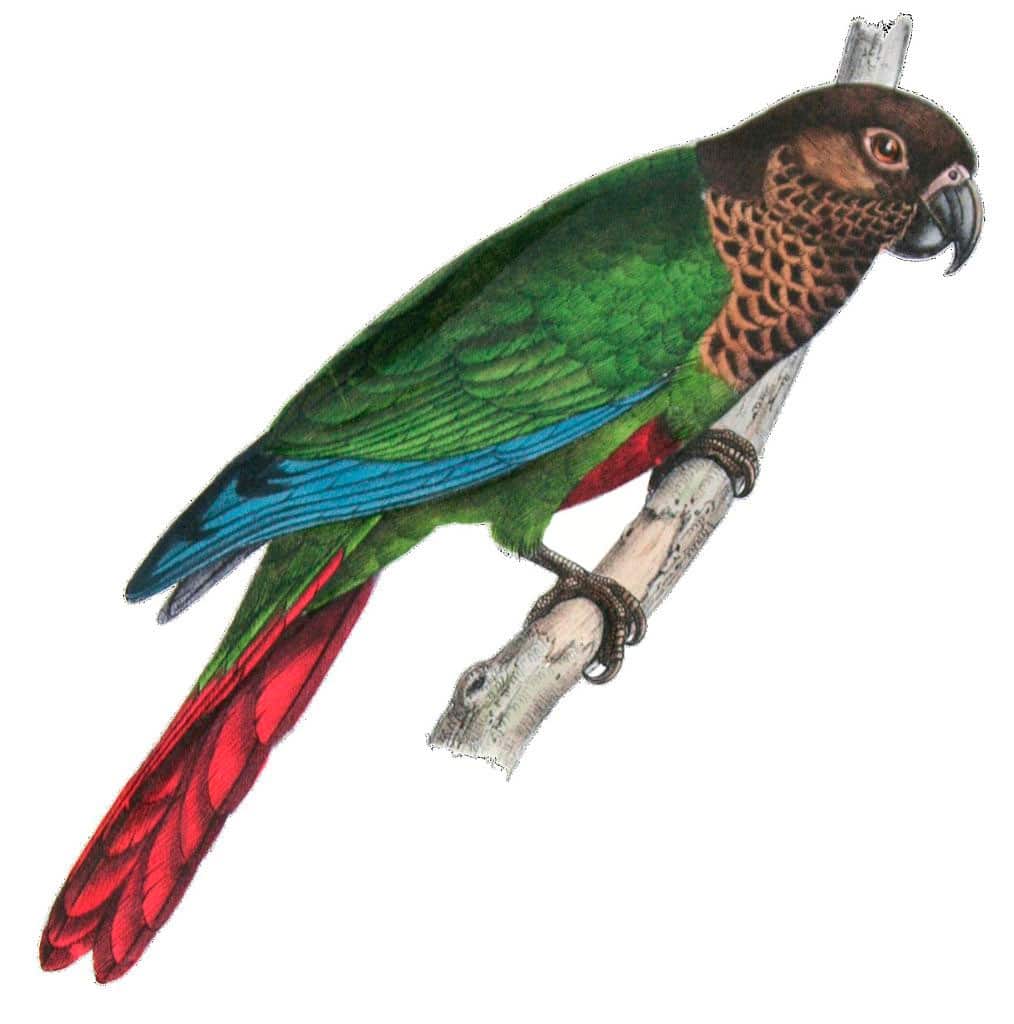
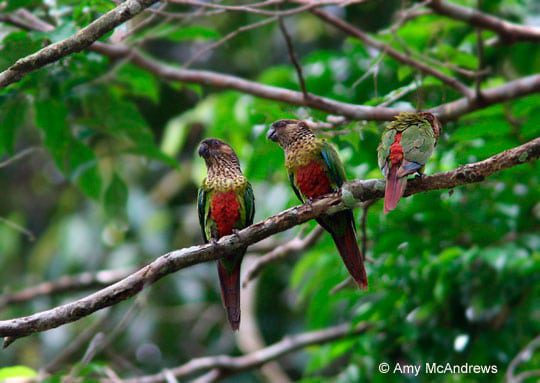
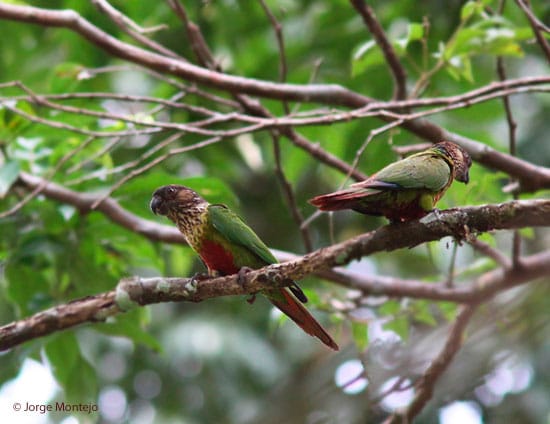
the showy plumage of the Deville's Parakeet(Pyrrhura lucianii) is generally Green, darker in the lower parts, the crown is dark brown, the forecrown and face is brownish red in colour; cheeks brick red, faded of blue, ear-coverts brownish yellow, neck and chest with the typical scales very visible due to the black and yellow contrast of the feathers. The ventral coat of arms, reddish, is well defined; in flight the dark red spot is notorious for the abdomen. Well defined are the reddish marks on the rump and in his long tail; the flight feather they are blue.
It has periocular ring Of course, irises brown, bill blackish and legs grey pink.
Note:
Until recently this species was included along with the Pyrrhura subandina, Pyrrhura caeruliceps, Pyrrhura pantchenkoi within the species Pyrrhura picta.
Found in altitudes of 800 m, in forests Terra firm and várzea, including forest margins and near clearings with tall trees. In forests low semi humid, up close 100 m.
Seen in pairs, groups of three or flocks of up to 20 individuals.
Reproduction:
Little is known about the reproductive cycle of this species, probably nesting in large trees, in cavities or in nest of woodpeckers abandoned, with one laying estimated in 5-7 eggs.
Food:
With feeds a wide variety of fruits, flowers, seeds and algae, possibly.
Distribution:
Size of the distribution (breeding/resident): 47,200 km2
Restricted to the State of amazon in the Northwest Amazon of Brazil.
This species is supposed fairly common within its range, However, This can not be confirmed since this time rare remote region is visited by researchers.
Conservation:
• Red List Category: Least concern
• Population trend: Decrease
State of conservation ⓘ
Minor Concern ⓘ(UICN)ⓘ
The status of their populations is unknown, but for the good condition of the habitat, it can be assumed that they are in good state of conservation.
While the trend of the population seems to be decreasing, do not believe that the decline is fast enough for approaching the threshold of vulnerable under the criterion of population trend
"Deville's Parakeet" in captivity:
Although he is a parrot rare in captivity, its potential as a domestic fowl is excellent, provided there are hand raised and socialized from an early age. The newly imported birds are usually shy and nervous and often they remain reserved.
It is usually inquisitive and active, enjoy flying and requires plenty of exercise and a spacious cage. Usually, It is not too noisy unless it is excited (as it is usually the case of all species Pyrrhura).
Once acclimatized, These parrots are quite robust. Enjoy with the bath by what are them must provide a dish of water little deep to daily. Also the love chew branches fresh.
Alternative names:
– Deville’s Parakeet, Bonaparte’s Parakeet (English).
– Conure de Bonaparte, Conure de Luciani (French).
– Bonapartesittich, Prinz Luzians Rotschwanzsittich (German).
– Tiriba-de-deville (Portuguese).
– Cotorra de Bonaparte, Ñángaro de Deville, Perico de Deville, Cotorrita barriguiroja (español).
– Perico de Bonaparte (Peru).
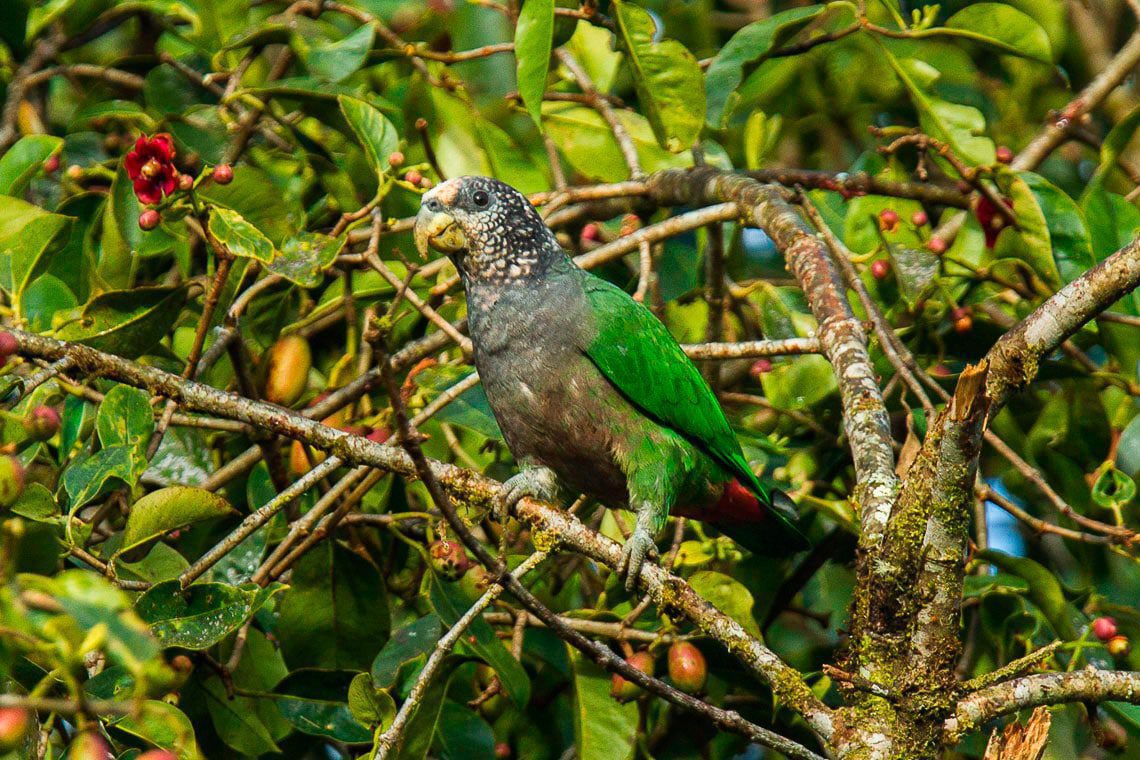
The White-capped Parrot(Pionus seniloides) It is easily identifiable by the "peak" yellow, head usually white, with the crown with reddish speckles, feathers of the nape and sides of the head with dark blue edges and red dyes which gives the appearance of flake.
Breast
with greenish blue edges, under belly and internal base tail red.
Iris of color Brown and legs gray-green.
The youth have crown and chest green, and green spots on the sides of the head and neck.
Note:
Previously he was treated as a subspecies of the species Pionus tumultuosus, that is to say, Pionus tumultuosus seniloides. A midyear 2014 it is considered as own species.
It is a kind Rare. It inhabits in humid jungle and edges, from the 1900 to 3000 m. It is mainly a species of temperate zone, but you can descend to lower elevations.
Like most highland parrots, the White-capped Parrot are rather nomads, widely wandering in search of fruits and seeds (now perhaps more as a result of extensive deforestation). Usually observed in flocks 3-25 birds, sometimes more. More active with grey weather, overcast skies. Difficult to see while feeding or resting in the upper canopy. Its silhouette in flight resembles a Amazona but with the beating of wings deepest.
Reproduction:
It nests in tree hollows.
Food:
Feeds of seeds, fruit of Turpinia paniculata and plants of the family Clusiaceae; sometimes in cornfields, causing damage to their crops.
Distribution:
Size of its range (reproduction / resident): 1.020.000 km2
Live west of Venezuela (from the border Trujillo–Lara) through the East of the Andes of Colombia (rare in the western Andes), and on both sides of the Andes in Ecuador and Northwest of Peru (west to Cajamarca and this, at least until Freedom)
Conservation:
• Current category of the Red List of the UICN: Least concern.
• Population trend: Decreasing.
Justification of the population
The size of the world population It has not been quantified, but this species is described as «quite common«, but irregular distribution (Stotz et to the., 1996).
Justification of trend
They suspected that the population is declining due to the continuous habitat destruction.
"White-capped Parrot" in captivity:
Rare in captivity. In Europe they arrived first at the beginning of the century 20 and then the early 70. In captivity, However, They were raised for the first time in the second half of the 80.
Alternative names:
– White-capped Parrot, Speckle-faced Parrot (White-capped), White-headed Parrot (English).
– Pione givrée (French).
– Greisenkopfpapagei, Glatzenkopfpapagei, Greisenkopf-Papagei (German).
– White-capped Parrot (Portuguese).
– Loro de Cabeza Blanca, Loro seniloide, Loro gorriblanco (español).
– Cotorra Cabeciblanca (Venezuela).
– Avibase
– Parrots of the World – Forshaw Joseph M
– Parrots A Guide to the Parrots of the World – Tony Juniper & Mike Parr
– Birdlife
– Parrot Book, Parrots and macaws Neotropical
– parrots.org
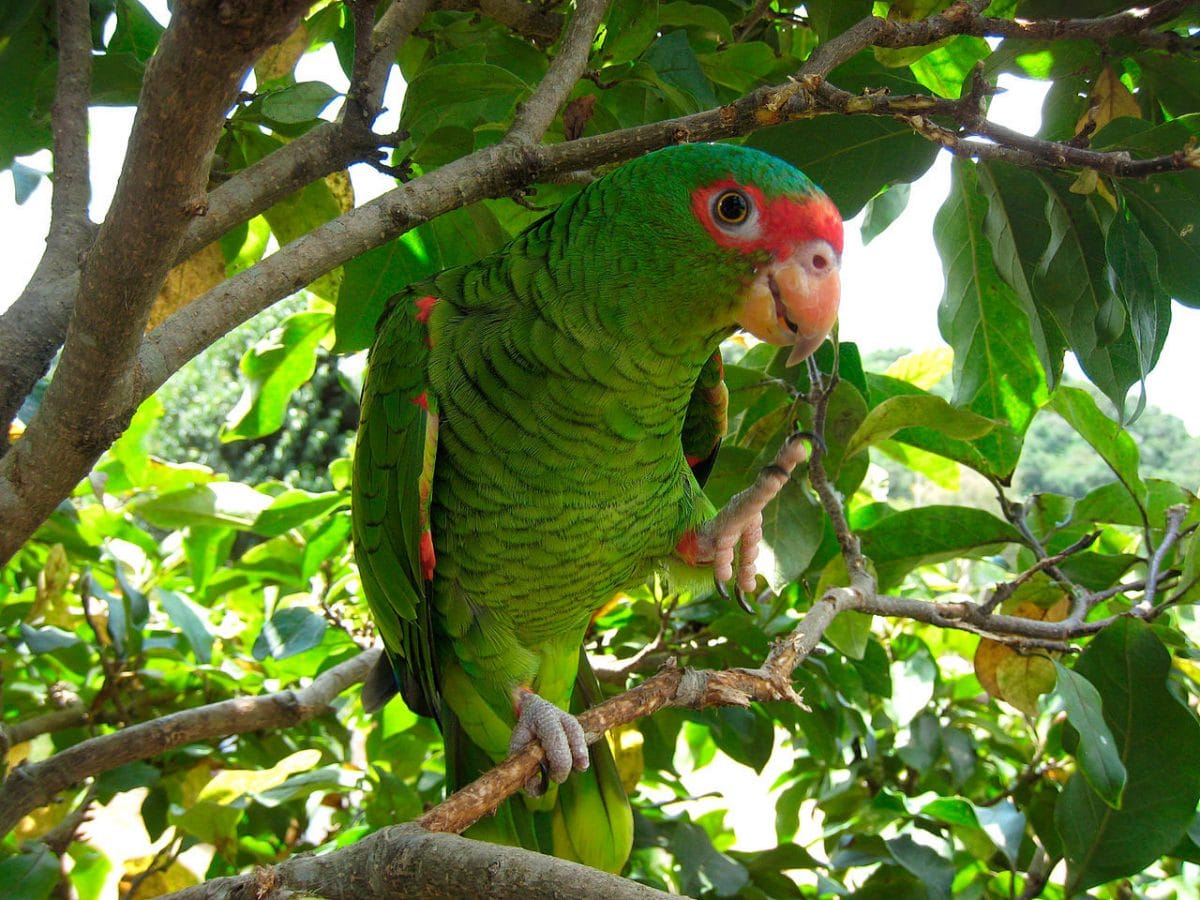
The Red-spectacled Parrot(Amazona pretrei) has the forecrown, lores, fore crown and upper cheeks up to the ear-coverts, bright red; back of the crown, nape, the mantle, back and rump, green with a narrow terminal band black in most feathers; scapulars green; uppertail-coverts pale green. Leading edge of wing, carpal area, alula and primary coverts, bright red; other coverts, narrow green with black tips.
Flight feathers, violet blue green tips. Under wings green. The underparts they are mostly green, slightly tinged with yellowish, with black tips on most feathers giving a scalloped effect; the thighs red; undertail-coverts pale yellowish green. Tail green with broad pale yellowish-green tip and patches of red on base of innerwebs of the three feathers outermost. The bill pale yellow with pale orange based on upper jaw; bare periophthalmic white; iris orange; legs gris pardusco.
The female probably it shows much less red in the wing
with the carpal edge and primary coverts, mostly or completely green. Immature apparently similar to female adult.
Note Taxonomy:
It´s monotype. It is sometimes considered conspecific with Amazona tucumana, but they are best treated as forming a superspecies.
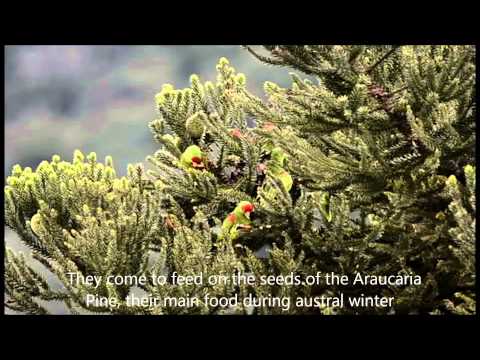
This rider is strongly associated with forests Araucaria angustifolia for use as roosts non-breeding season. It prefers open savanna forests and low riparian forests for reproduction, with trees and conifers of the genus Podocarpus, Scutia and Celtis and where they are absent Araucaria angustifolia. Most records place her at altitudes between 300-1.000 m, but they are distributed and breed at lower elevations in southern Rio Grande do Sul.
They disperse in pairs during breeding but are highly gregarious outside of breeding season. They form large concentrations community, often in plantations pinus exotic and Eucalyptus. The largest winter meetings coincide with the ripening seeds araucaria. flocks of 30 to 50 birds, composed of young adults and newborns, They may meet before the dispersion, from breeding areas to winter quarters.
Reproduction:
The Red-spectacled Parrotnest in tree hollows, for example, Casearia, Ouillaja brasiliensis and Ficus. With reproduce at the end of September to January, with young people and fledglings, usually, in early December in the south. Clutch 2-4 eggs.
The diurnal movements cover up 100 km, perhaps in relation with the availability of food.
Distribution and status:
Size of its range (breeding/resident ): 95.400 km2
This species is endemic to South Brazil and distributed only in the states of Rio Grande do Sul and Santa Catarina (Martínez, 1996). Some individuals have been recorded in the forests Missions, in the northeast of Argentina (Chebez 1994) and they have recently also been reported from Paraguay (sec Lowcn et al., 1997).
Reductions in seed supply Araucaria They may have been the cause of change in the feeding of Ecological Station Aracuri-Esmeralda in 1991 (Municipality of many capons) to areas around Southeast Santa Catarina. Here the remaining forest patches of Araucaria They can provide enough seed to feed the populations Red-spectacled Parrot. The intensive cattle grazing and agriculture have almost eradicated habitat Araucaria. These habitat impacts have reduced natural regeneration and may also have reduced the number of nesting sites in old trees..
a census in 1994 It estimated the total population of the Red-spectacled Parrot in 10.000 individuals, Repeated surveys have shown the sizes of the nearby population 12.600 individuals in 1996. and about 16.300 individuals in 1997 (J. Martinez in litigation 1997, N. Prestes in the proceedings 1997).
Conservation:
State of conservation ⓘ
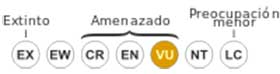
Vulnerable ⓘ(UICN)ⓘ
• Current category of the Red List of the UICN: Vulnerable.
• Population trend: Decreasing.
Rationale for the Red List category
The combination of a comparison of population estimates 1971 and 1997 and deforestation rates over the same period suggest that the species has declined rapidly, qualifying the species as Vulnerable. Current threats loss of habitat and capture suggest that this decline is likely to continue.
Justification of trend
Se sospecha una continued rapid population decline due to destruction, degradation and fragmentation of habitat and illegal trade.
Conservation Actions Underway
• Appendix I and II of CITES.
• This species is considered Vulnerable nationwide (Silveira y Straube 2008, MMA 2014) and protected Brazilian law.
• There are breeding populations in five reserves and two southern winter feeding sites are protected. (Wege and Long 1995).
• Nevertheless, less than 1% Annual range, and less than 4% of each seasonal range is within protected areas (Marini et al., 2010).
• Provided artificial nests but not occupied (Snyder et to the ., 2000).
• Since 1991 It is conducting a campaign public awareness (Prestes et al . , 1997, Snyder et to the . 2000).
Conservation Actions Proposed
• Carry out surveys to obtain an estimate of the population size updated.
• Carry out periodic surveys to assess the population trends.
• Study the current levels of off-take for the trade.
• Apply the law to collectors and, especially, dealerships, Looking for vehicles between December and February (Prestes et al ., 1997).
• Continue the campaign of sensitization.
The Red-spectacled Parrot in captivity:
Unknown until years 80, when a few reached Europe; not well known elsewhere.
relatively silent compared to other Amazonian species. Inquisitivas although generally quiet. have a nice nature, but they can occasionally be quite noisy, especially first thing in the morning and evening. They become confident relatively quickly. outside the breeding season, They can be set in a colony system. chewing hard and excellent flying and stair climbers, so they need ample opportunities for exercise.
– Avibase
– Parrots of the World – Forshaw Joseph M
– Parrots A Guide to the Parrots of the World – Tony Juniper & Mike Parr
– Birdlife
Photos:
(1) – Red-spectacled Amazon that is kept as a pet in Caxias do Sul, Rio Grande do Sul, Brazil By Marie (originally posted to Flickr as Perroquet familial) [CC BY-SA 2.0], via Wikimedia Commons
(2) – A pet Red-spectacled Amazon in a parrot cage. It is 32 cm land and 295 gm in wt By Amazona_pretrei_-bird_cage-8c.jpg: Andrea O Guimarães derivative work: Snowmanradio [CC BY-SA 2.0], via Wikimedia Commons
(3) – Red-spectacled Amazon that is kept as a pet in Caxias do Sul, Rio Grande do Sul, Brazil. Some of its wing feathers are clipped By Amazona_pretrei_-Rio_Grande_do_Sul_-Brazil-8e.jpg: Mariederivative work: Snowmanradio [CC BY-SA 2.0], via Wikimedia Commons
(4) – Red-spectacled Amazon that is kept as a pet in Caxias do Sul, Rio Grande do Sul, Brazil By Marie [CC BY-SA 2.0], via Wikimedia Commons
(5) – Amazona pretrei, a native of the southernmost Brasil. Specimen in Palmitos Park, Gran Canaria By Bjoertvedt (Own work) [CC BY-SA 3.0 or GFDL], via Wikimedia Commons
(6) – A pet Red-spectacled Amazon in captivity. It has a ring on its right leg By Andrea O Guimarães (originally posted to Flickr as I’m watching you) [CC BY-SA 2.0], via Wikimedia Commons
(7) – Red-spectacled Amazon that is kept as a pet in Caxias do Sul, Rio Grande do Sul, Brazil By Marie (originally posted to Flickr as Temporaire) [CC BY-SA 2.0], via Wikimedia Commons
(8) – Red-spectacled Amazon that is kept as a pet in Caxias do Sul, Rio Grande do Sul, Brazil By Marie (originally posted to Flickr as Calins… :)) [CC BY-SA 2.0], via Wikimedia Commons
(9) – A pet Red-spectacled Amazon in a parrot cage. It is 32 cm land and 295 gm in wt By Andrea O Guimarães [CC BY-SA 2.0], via Wikimedia Commons
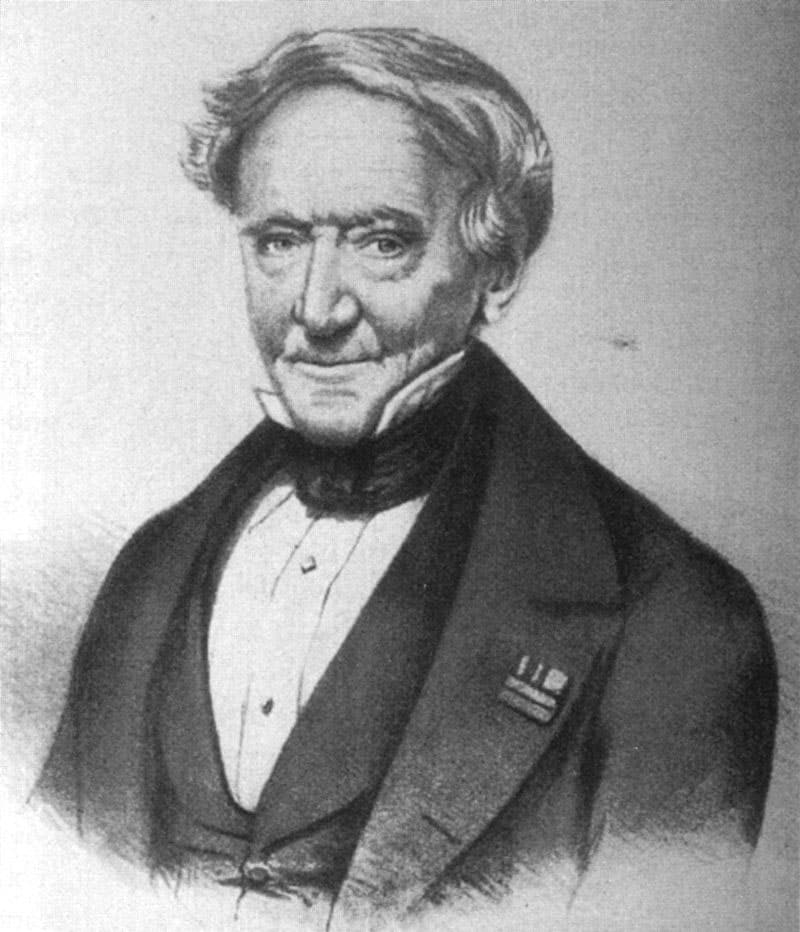
(10) – Amazona pretrei = Psittacus pretei = Priest Parrot By Jean-Gabriel Prêtre (1768–1849) [Public domain], via Wikimedia Commons
Red-necked Parrot (Amazona arausiaca) | By mikko.pyhala
Content
Description:
40 cm.. length and 650 g. of weight.
The Red-necked Parrot(Amazona arausiaca) has the lores, forecrown, front of crown, orbital area and upper cheeks, bright blue; back of the crown, nape and sides neck, with dark blue or blackish margins.
Mantle, back and scapulars, green with narrow faint dark margins giving subtle barred effect. Wing coverts green; carpal edge brighter yellowish green. Primaries green with blue tips; the three outer secondaries, red at the base, yellow and blue at the tips; four secondaries yellow and blue tips. The remaining secondary they are green. Under the wings, the coverts green; flight feather Bluish.
Chin and top of the throat, blue; the bottom throat and, sometimes, upper region chest, with patch resizable bright red; remaining chest and of the belly, green; undertail-coverts, brighter yellowish green. Tail bright green in the center, their outer feathers green tip yellowish green and red marks on the basis of the innerwebs. Bill horn; iris orange; legs grey
Both sexes are similar. It is thought that the immature It is similar to adult but with irises brown. The young fledglings They are significantly smaller than of adults during its first year.
The Red-necked Parrot inhabits the canopy mountain rainforest, preferring forest areas with trees Tabonuco(Dacryodes excelsa), especially among 300-800 m (the highest density is found and altitudes 500-600 m) although occasionally they reported to 1.200 meters and formerly was a regular visitor (August October ) of the Coast zones.
Usually in small flocks or pairs; more numerous flocks feeding areas, outside the breeding season. Communal roosting in traditional sites, for example in large trees Dacryodes excelsa or Sloanea berteriana, They are using from year to year (but not necessarily all year).
Reproduction:
Nests in a large tree cavity with most nests reported in Dacryodes or Sloanea. breeding season February-June. low productivity probably just a clutch every two years and usually only one young per nest.
Size of its range (reproduction / resident): 190 km2
The Red-necked Parrot It is endemic to the Dominica Island in the Lesser Antilles. Formerly it spreads through the mountainous interior, including the northern peninsula. Contraction range from about 1950 with the existing population centered Morne Diablotin (1.447 m, the highest mountain Dominica) which it may have always been his main strength but whose southern slopes birds have been absent from the hurricane 1992.
small populations, reportedly, in the north of the peninsula (where apparently they are resident) and in the eastern center of the island. They can remain very small populations in the south. Recent sporadic observations of birds in low-lying areas of the north and east; other towns in the south suggest the gradual recolonization of the parts of the former range.
mainly residents but maybe (at least once) some regular seasonal foraging movements and some November-January nomadism. Although historical accounts tell of the abundance of this species, the drastic contraction in range and population have occurred since the mid-twentieth century with its gradual retreat in the most remote forests of northern and eastern. The decline is due to the loss of habitat, the hunting and capture bird cage.
The small existing population It is especially vulnerable to the loss of food plants and nesting sites due to hurricane damage. Although the effects of habitat loss may have been especially severe because of the preference of birds through the forests of low level (which it has been under pressure) They tolerate any disturbance and returned to the old feeding areas recently after conversion to plantations of fruit trees. The hunting It was probably the greatest threat to the seventies. Capture for local pet trade now under control due to a successful education campaign.
The population 1977 It was at least 350 birds (probably), but halved by the effects of hurricanes between 1979 and 1980. A Recovery since then 350 estimated birds 1990 and evidence of further increases to more than 500 in 1992. The remaining habitat is partially protected in the North Forest Reserve, but does not include neighboring critically important areas for conservation. Completely protected by national legislation.
Conservation:
State of conservation ⓘ
Vulnerable ⓘ(UICN)ⓘ
• Current category of the Red List of the UICN: Vulnerable.
• Population trend: Increasing.
• Population size: 850-1000.
Rationale for the Red List category
The conservation actions He has helped this species to recover a population down from 1980. Still rated as vulnerable because its population is still very small and its range of small extent and restricted to a single island. But, if future declines in habitat available, could be reclassified as danger of extinction.
Justification of the population
Estimating population most recent is 850-1,000 mature individuals (PR Reillo a slightly. 2012), more or less equivalent to 1.200-1.500 individuals in total.
Justification trend
The population size has increased possibly only 150 birds in 1980, possibly even 1.200 birds currently, based on recent surveys and density estimates (PR Reillo in some. 2016). There is no new data on the evolution of the population, but the species is supposed to still rising.
Threats
The loss of habitat in the lower elevations has been caused mainly by clearance for agriculture (Collar 1997). Although replanting fruit crops has benefited the species (Reillo y Durand 2008), the frugivorous diet of the Red-necked Parrot, conflict is causing local farmers (Douglas 2011). Damage caused by hurricanes has also been important: another hurricane the magnitude of Hurricane David could reverse recent population increases. Hunting and illegal trade are now low-level threats, but the illegal wildlife trade throughout the Caribbean is a constant concern and there is increasing pressure from illegal wildlife trade centered in Europe (PR Reillo in some. , 2016).
Conservation Actions Underway
CITES Appendix I and II. It is fully protected by national legislation. Much of the remaining habitat is in the northern and central forest reserves, national parks and Morne Trois Pitons and Morne Diablotin, but adjacent areas, critically important, They are not protected (Juniper and Parr 1998). Since 1980, It has benefited from the joint efforts of government and non-governmental organizations to protect their habitat and sensitize the local population of the needs of this species. Research methods have recently improved to maximize ecological information acquired, while minimizing the disturbance of birds, and the study has provided important information on nesting behavior and parental care. Similarly, census methodologies have improved to give more accurate estimates of population size and density (Reillo y Durand 2008). The population is monitored annually. A recent doctoral thesis project examined the interaction of species with fruit crops in Dominica (PR Reillo in some. 2012).
Conservation Actions Proposed
Continue the implementation of the protection of national parks Morne Diablotin and Morne Trois Pitons and forest reserves in central and northern. Continue to monitor the population each year. To investigate the effects of nest site (and the food) competition between this species and Imperial Parrot (Amazona imperialis). Continue to prohibit the trade in this species, exports of ex situ captive breeding, and importation of non-native parrots as pets in Dominica (PR Reillo in some. 2012).
Red-necked Parrot in captivity:
CITES Appendix I and II. It is fully protected by national legislation.
Alternative names:
– Bouquet’s Parrot, Dominican Blue-faced Amazon, Dominican Blue-faced Parrot, Jacquot, Red necked Parrot, Red-necked Amazon, Red-necked Parrot (English).
– Amazone à cou rouge, Amazone de Bouquet (French).
– Blaukopfamazaone, Blaukopfamazone (German).
– Papagaio-de-colar-vermelho (Portuguese).
– Amazona de Cuello Rojo, Amazona Gorgirroja, Amazona gorjirroja, Jaco, loro de cuello rojo (español).
(1) – Red-necked Amazon (Amazona arausiaca) – Author: mikko.pyhala – HBW
(2) – Red-necked Amazons at the Parrot Conservation and Research Centre Botanical Gardens, Roseau, Dominica By Andrew Szymanski (originally posted to Flickr as DSCF0031) [CC BY-SA 2.0], via Wikimedia Commons
(3) – Red-necked Amazons at the Parrot Conservation and Research Centre Botanical Gardens, Roseau, Dominica By Amazona_arausiaca_-Roseau_-Dominica_-aviary-6a.jpg: Andrew Szymanskiderivative work: Snowmanradio [CC BY-SA 2.0], via Wikimedia Commons
(4) – Amazona arausiaca Sunday, West Indies by Don Faulkner – Flickr
(5) – BARRABAND, Jacques (1767/8-1809) [Parrot Bouquet (Red-necked Amazon, Amazona arausiaca)] From Natural History of Parrots (by Francois Levaillant, 1801-1805) – Wikimedia
(6) – Natural history of parrots /. In Paris :chez Levrault … ;an IX (1801)-an XIII (1805).. by Biodiversity Heritage Library – Flickr
The Hellmayr's Parakeet(Pyrrhura amazonum) It is a mainly green parakeet; the area from crown at the nape it is dark brown; the belly, the rump and tip tail, They are dark red; below, the tail It is also dark red.
They have a patch whitish in ear-coverts; a blue band in front of eyes. The face It is dark reddish brown; the upper region chest It is greenish gray with gray scalloping; the bottom of the chest It is scaled with yellowish effect; the in bend of wing green; brown-red patch in the center of abdomen; of remiges blue (visible only in flight). Orbital ring blackish; the cheeks and ocular region are dark brown. Bill grey-black; eyes orange brown.
(Arndt, 2008 parrots[Arndt]) – Little or no blue on the front of the crown. Slightly smaller and paler than the Pyrrhura amazonum snethlageae
Pyrrhura amazonum snethlageae
– perico madeira – (Joseph & Bates,JM, 2002) – The bare periophthalmic is of color beige.
Habitat:
They are distributed in tropical moist forests and adjacent habitats. It´s social. Observed in pairs or groups. It is quite common in most of its range and inhabits several protected areas.. The Pyrrhura amazonum amazonum It is in the Amazon National Park, For, Brazil, while the Pyrrhura amazonum lucida It is in the The Cristalino State Park, Mato Grosso, Brazil.
Reproduction:
They build their nests in tree cavities.
Food:
With feed seed, flowers, fruit, berries and nuts. They are also considered local pests, as they regularly raid cornfields and orchards, occasionally causing considerable damage.
Distribution:
Size of its range (players / residents): 392.000 km2
– perico madeira – (Joseph & Bates,JM, 2002) – Basin of the Madeira River in Brazil and North of Bolivia.
Conservation:
State of conservation ⓘ
Endangered ⓘ(UICN)ⓘ
• Current category of the Red List of the UICN: In danger of extinction.
• Population trend: Decreasing.
• Population size : Unknown.
Justification of the Red List of the Category
Based on a model of deforestation in the amazon basin, and their potential susceptibility to capture for the bird trade, It is suspected that the population of the Hellmayr's Parakeet It has declined rapidly over three generations, and therefore it has been classified as danger of extinction.
Justification of the population
Recent world population is unknown given taxonomic divisions.
Justification trend
This species is suspected that he has been able to lose 43,0 to 52,1% of suitable habitat within their distribution over three generations (18 years) based on a model of deforestation of the Amazon(Soares-Filho et to the . 2006, Bird et to the. 2011). Given the susceptibility of this species to capture, It suspected population decline by 50% in three generations.
Threats
The main threat to this species is that it is accelerating the Deforestation in the Amazon basin for livestock and soybean production, provided by the expansion of the road network (Soares-Filho et to the. 2006, Bird et to the. 2011).
The changes proposed by the Forest code of Brazil they reduce the percentage of land that a private owner has a legal obligation to keep as forest and include an amnesty for owners who deforested before July 2008 (who would later be absolved of the need to reforest illegally cleared land) (Bird et to the. 2011).
His capture for bird trade wild can represent a significant threat.
Conservation actions and ongoing research
It is not known any.
The proposed conservation and research actions
Expand the network of protected areas to effectively protect IBA.
Effectively manage the resources of existing protected areas and new, the use of new opportunities for financing the management of protected areas with the common goals of reducing carbon emissions and maximize biodiversity conservation.
conservation on private lands is also essential, through the expansion of market pressures for rational land management and prevention of logging on land not suitable for agriculture (Soares-Filho et to the. 2006).
Campaign against proposed changes to Forest code of Brazil that would lead to a decrease in the width of protected riparian forest areas such as Permanent Preservation Areas (APPs), that function as vital corridors in fragmented landscapes.
"Hellmayr's Parakeet" in captivity:
It is a bird in danger of extinction. Each captive specimen of this species which is capable of reproducing, must be placed in a well-managed captive breeding program and not sold as a pet, in order to ensure its long-term survival.
The male of the Newton's Parakeet(Psittacula exsul) It was probably green, with red patches on wings, also manifested in a variation bluish; only two skins of this species, both blue hue; the plumage It was generally greenish blue with gray shades; chest, abdomen and under cover tail slightly paler shades; head darker gray hue without; fine black line between cere and the eye; black bars cheek and narrow black strip on the neck, strip adjacent the blue-green; primaries blue-green; feathers on top of the tail blue-green, underside grey; mandible red top, mandible lower black; irises yellow; legs grey.
The female with narrow black stripe on the forehead; black bars cheek not extend to the side neck; crown washed with gray; upper jaw black.
Immature; No information
Habitat:
It was a kind forest who lived in areas of pine Pandanus and Palm trees.
The Newton's Parakeet It was endemic to the forests of Rodrigues, Mauritius (checks 1987).
It was said to be abundant by explorer Leguat in 1691 (Cowles 1987), but Pingre He noted that it was rare in 1761, and the last record was a bird captured in August of 1875 (Forshaw 2010).
It seems likely that the last birds were wiped out later that year, When the island suffered "the worst cyclonic season of the nineteenth century" (checks 1987).
Two complete specimens survive, plus several bones subfossil (Cowles 1987).
Conservation:
Rationale for the Red List category
This species was endemic to the Rodrigues Island, Mauritius, but it has not been seen since 1875 and now it is extinct.
• Current category of the Red List of the UICN: Extinct.
• The last record was a bird collected in August of 1875
It is believed that hunting and habitat loss greatly contributed to its decline, and that the final blow could have been given by heavy storms 1876. curiously, survived for much longer than most of the island's endemic bird species.
Justification of the population
extinct.
"Newton's parakeet †" in captivity:
Leguat and his followers saw the birds – presumably Newton's Parakeet – feeding nuts, and they taught to speak to some of these parakeets, which certainly it is an indication of what these birds were tame. Apparently they became bilingual; They could speak both French and Flemish!! When Leguat and his small band of followers fled the island, a parakeet they took with them on their trip to Mauritius.
Alternative names:
– Newton’s Parakeet, Newton’s Parrot, Rodrigues Parakeet, Rodrigues Ring-necked Parakeet, Rodriguez Parakeet (English).
– Perruche de Newton (French).
– Rodriguessittich, Rodrigues-Sittich, Rodriguez-Edelsittich (German).
– Periquito-de-rodriguez (Portuguese).
– Cotorra de Newton, Cotorra de Rodrigues (español).
• Avibase
• Parrots of the World – Forshaw Joseph M
• Parrots A Guide to the Parrots of the World – Tony Juniper & Mike Parr
• Birdlife
Photos:
(1) – Psittacula exsul (Newton’s Parakeet), female holotype specimen – Wikipedia
(2) – Sternum and mandible of Psittacula exsul, extracted from the female holotype specimen – Wikipedia
▷ The world of Pets: Dogs, cats, birds, reptiles, amphibians
25 to 30 centimeters length and 100-157 g. of weight.
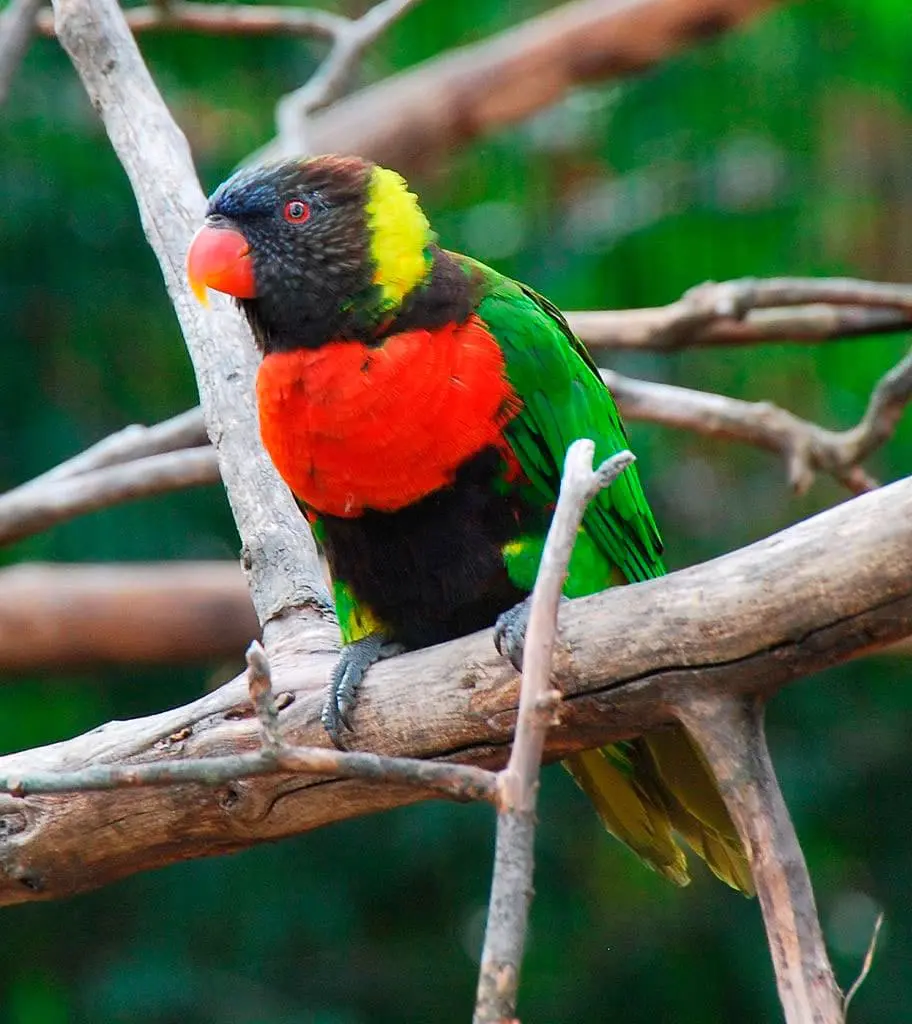
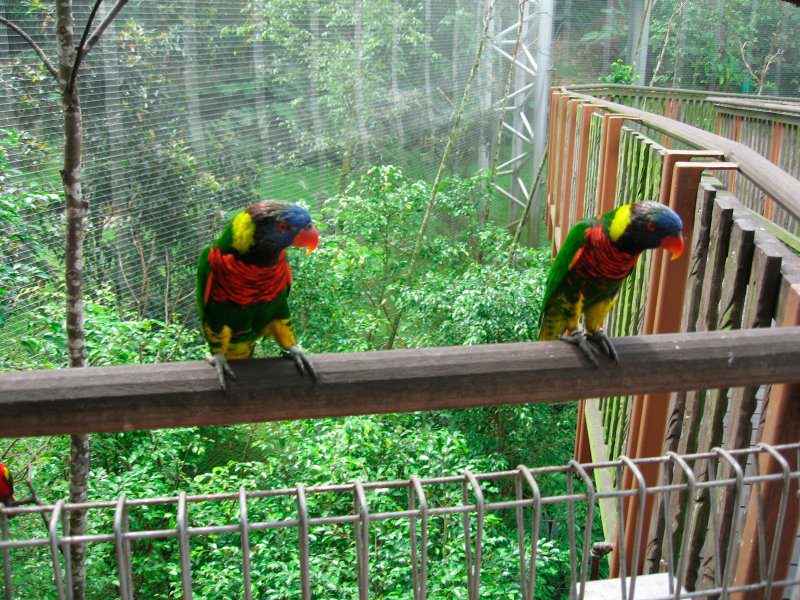
The distinctive and colorful Scarlet-breasted Lorikeet(Trichoglossus forsteni) has the head dark blue, neck pale green, chest smooth red, and belly dark blue. The remaining plumage It is a bright pale green, and the bill typical is red.
In flight the species shows a flash of bright yellow on the inside of all flight feather, and coverts bright red at the bottom of the wings.
Sound of the Scarlet-breasted Lorikeet.
taxonomy:
This taxon is considered a subspecies of Trichoglossus [haematodus, rosenbergii, moluccana, forsteni, capistratus, weberi] (sensu lato) by some authors.
(Gray,GR 1859) – Both adults have head black / brown with gray / green streaks in crown up to the cheeks; red / brown in occiput; chest red with minimal or no barring; neck yellow green; purple/black belly; smaller.
Trichoglossus forsteni stresemanni
(Meise 1929) – As the species nominal but with paler chest orange / red; green washing occiput; feathers the mantle yellow / orange basis.
Habitat:
The Scarlet-breasted Lorikeet is located in lowlands and lower montane forests, including secondary growth and plantations, tending to be observed at the edges and around perturbed vegetation instead of inside the closed canopy forest (pit et to the. 1997). In Sumbawa the Trichoglossus forsteni varies from sea level to 800-1200 meters and up 2150 metres in Lombok(pit et to the. 1997); at least in Sumbawa, the variation in altitudinal range is attributed to the movements in monitoring trees in bloom in a large area (White y Bruce 1986).
Reproduction:
Birds have been reported in breeding conditions in May Sumbawa(White y Bruce 1986). It nests in a deep hole in a large tree (pit et to the. 1997).
Food:
No specific data, but presumably similar to Coconut Lorikeet(Trichoglossus haematodus)
Distribution:
Extension of the distribution (breeding/resident): 101.000 km2
The Scarlet-breasted Lorikeet (incorporating subspecies mitchelli, djampeanus and stresemanni) It is located on the islands of Bali, Lombok, Sumbawa, Tanahjampea and Kalaotowa, Indonesian.
An assessment of the state of the taxa that make up the species indicates that the species may no longer be present in Bali, It is extinct in Tanahjampea after capture, mainly before 1990, and it is not clear if he persists in kalatom(Eaton et al. 2015). In Lombok the species is still present, with a recent observation of a flock of 18 individuals above 1.500 metres in 2015 (F. Rheindt per Eaton et al. 2015), although given the lack of other records for many decades, it can be assumed that the population is likely to be small. Sumbawa now it may be the stronghold of the species, and it was suggested that the species is "secure» (Eaton et al. 2015), and there is a large area of ​​potentially suitable habitat remaining on the island.
• Current category of the Red List of the UICN: Vulnerable.
• Population trend: Decreasing.
• Population size : 1600-7000 individuals.
Rationale for the Red List category
It is estimated that this newly divided species has a small population that is experiencing suspected moderately rapid population decline due to the pressure of the traps for wild bird trade. So, is classified as Vulnerable.
Justification of the population
It is estimated that the population size is lower to 10.000 mature individuals, based on a provisional assessment of locations where any numbers of the species are likely to be retained. It also, it is considered possible that the population supposedly higher in Sumbawa does not exceed 1.000 mature individuals.
Justification trend
It is suspected that the population is experiencing descent moderately fast because of unsustainable levels of exploitation.
Conservation actions and research in progress
Appendix II of the CITES, where they include species that are not necessarily threatened with extinction, but in which trade must be controlled in order to avoid utilization incompatible with their survival. CMS Appendix II (Convention on the Conservation of Migratory Species of Wild Animals).
Proposed Research and Conservation Actions
– Estimate the population and assess population trends and scale of capture pressure.
– Carry out a species-specific survey to identify important sites, in order to provide protection.
– Conduct research on their status and habitat use (with particular attention to food ecology and forest fragmentation).
– Initiate awareness campaigns to enlist the support of local people in protecting forests and preventing illegal trade.
"Scarlet-breasted Lorikeet" in captivity:
Rare in captivity. Each captive specimen of this species which is capable of reproducing, must be placed in a well-managed captive breeding program and not sold as a pet, in order to ensure its long-term survival. However it copies sold from the Loroparque Foundation at a price of around 400 EUR.
In captivity, It appeared in the late nineteenth and early twentieth century, for example, in 1896 It was imported by the London Zoo. The first offspring of the world recorded in 1990 on India.
The Scarlet-breasted Lorikeet It has a longevity 20 years in nature, 15-25 years in captivity.
Alternative names:
– Rainbow Lorikeet (Sunset), Scarlet-breasted Lorikeet, Scarley-breasted Lorikeet, Sunset Lorikeet (English).
– Loriquet à face bleue, Loriquet à tête bleue (de Forsten), Loriquet à tête bleue [forsteni], Loriquet de Forsten (French).
– Bali-Allfarblori, Forstenlori (German).
– Lóris-de-forstein (Portuguese).
– Lori de Puesta del Sol, Lori pechiescarlata (español).
• Avibase
• Parrots of the World – Forshaw Joseph M
• Parrots A Guide to the Parrots of the World – Tony Juniper & Mike Parr
• Birdlife
Photos:
(1) – Sunset Lorikeet (also known as the Scarlet-breasted Lorikeet and Forsten’s Lorikeet) at Cincinnati Zoo, USA by Ted [CC BY-SA 2.0], via Wikimedia Commons
(2) – A Sunset Lorikeet (also known as the Scarlet-breasted Lorikeet and Forsten’s Lorikeet) at Cincinnati Zoo, Ohio, USA by Ted [CC BY-SA 2.0], via Wikimedia Commons
(3) – Two Rainbow Lorikeets at Newport Aquarium. This subspecies of the Rainbow Lorikeet is also called Forsten’s Lorikeet by Trichoglossus_haematodus_-Newport_Aquarium-8a.jpg: Jeff Kubinaderivative work: Snowmanradio [CC BY-SA 2.0], via Wikimedia Commons
(4) – Two Rainbow Lorikeets at Newport Aquarium. This subspecies of the Rainbow Lorikeet is also called Forsten’s Lorikeet
Date 22 April 2009, 15:31 (UTC)_haematodus_-Newport_Aquarium-8a.jpg: Jeff Kubinaderivative work: Snowmanradio [CC BY-SA 2.0], via Wikimedia Commons
(5) – Lories at the Jurong BirdPark, Singapore. Taken by Terence Ong in November 2006. Trichoglossus haematodus forsteni by rk, Singapore. Taken by Terence Ong in November 2006. Trichoglossus haematodus forsteniNo machine-readable author provided. Terence assumed (based on copyright claims). [GFDL, CC-BY-SA-3.0 or CC BY 2.5], via Wikimedia Commons
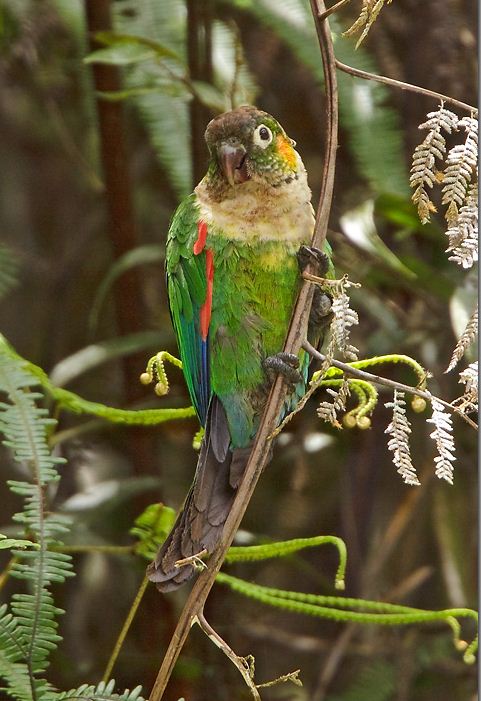
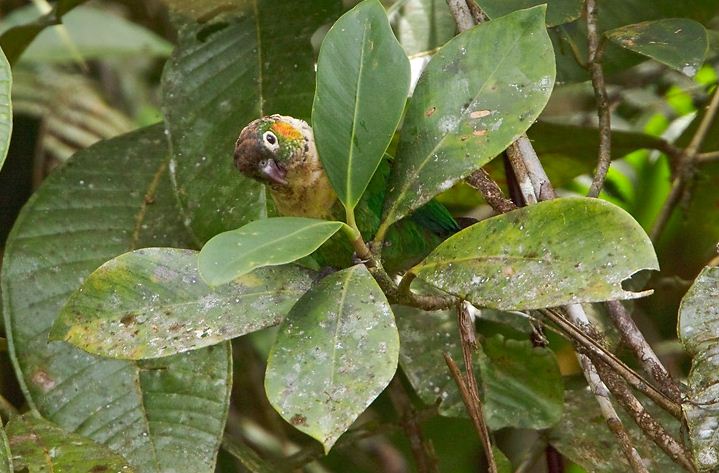
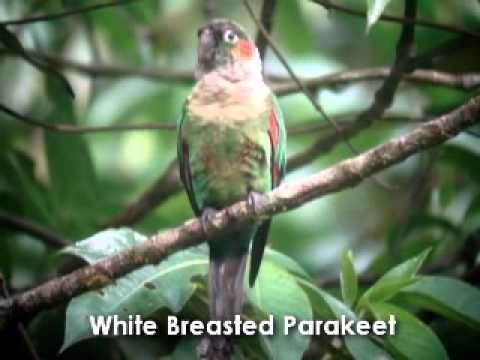
The most notorious of the White-necked Parakeet(Pyrrhura albipectus) It is the yellowish-white or white that goes from the cheeks to chest.
Crown dark stripes pale gray on the back; frontal band reddish thin; cheeks escalations of yellow and green and ear-coverts Orange; collar full white and chest yellow; belly and remaining upperparts green. Wings Greens with primary coverts red and carpal area, and primaries Bluish; tail long and pointy green, red opaque at the bottom.
The immature lacks the frontal band and has paler the ear-coverts.
Lives mainly in humid primary forest, foraging on fruit trees, preferably along rivers, Although he tolerates areas open and intercepted, from 900 to 2000 m (usually between 1400 and 1800 m).
Make altitudinal movements following the fruiting. Flies in flocks of 12 to 50 individuals. It bathes in pools or between rocks covered with MOSS.
Reproduction:
There is little evidence about its reproduction, possibly from May to July. A young clerk was seen in September (Snyder et to the., 2000).
Food:
The diet includes fruit, seeds and flowers Vine, mainly taken in the canopy.
Distribution:
Size of its range (reproduction / resident): 19.600 km2
Confined to three areas in southeast Ecuador and recently also it has been found in northern Peru.
• Current category of the Red List of the UICN: Vulnerable.
• Population trend: Decreasing.
Rationale for the Red List category
This species is classified as Vulnerable because it dwells in a few places and has a small range in which the habitat (and presumably the population) it is decreasing.
Justification of the population
The total population it may be only a few thousand birds, by what is placed in the band 2.500-9.999 individuals. This is equivalent to 1.667-6.666 mature individuals, rounded here to 1.500-7.000 mature individuals.
Justification of trend
It is suspected that the species is falling slowly, on the basis of continuous habitat destruction.
Conservation Actions Underway
• CITES Appendix II.
• The Podocarpus national park It is an important site for the conservation of the species. A revised management plan has been designed for the area and a public awareness campaign highlights the importance of the park (Snyder et to the. 2000).
• The White-necked Parakeet It is also found in the reserve Tapichalaca of 3.500 acres of the Fundación Jocotoco, where they are used successfully artificial nesting boxes (Waugh 2009).
• It is also located in the Ichigkat Muja- Condor Range National Park (F. Angulo 2012 a bit.).
Conservation Actions Proposed
• Conduct surveys to assess species distribution and total population size.
• Monitor rates of habitat loss and degradation within its range.
• Manage the Podocarpus national park so that endangered species are better protected.
"White-necked Parakeet" in captivity:
It is not easy to find it in captivity.
Alternative names:
– White-necked Parakeet, White necked Parakeet, White-breasted Conure, White-breasted Parakeet, White-necked Conure (English).
– Conure à col blanc, Perriche à col blanc, Perruche à col blanc (French).
– Weißhalssittich, Weisshals-Sittich (German).
– Tiriba-do-pescoço-branco (Portuguese).
– Cotorra Cuelliblanca, Perico de Pecho Blanco (español).
– Perico de Cuello Blanco (Peru).
– Avibase
– Parrots of the World – Forshaw Joseph M
– Parrots A Guide to the Parrots of the World – Tony Juniper & Mike Parr
– Birdlife
– Parrot Book, Parrots and macaws Neotropical
– Photos:
(1) – Ingrid Grunwald, IBC943789. Photo of White-necked Parakeet Pyrrhura albipectus at Zamora-Chinchipe Province, Ecuador. Accessible at hbw.com/ibc/943789.
 Minor Concern ⓘ
(UICN)ⓘ
Minor Concern ⓘ
(UICN)ⓘ
















.jpg)

