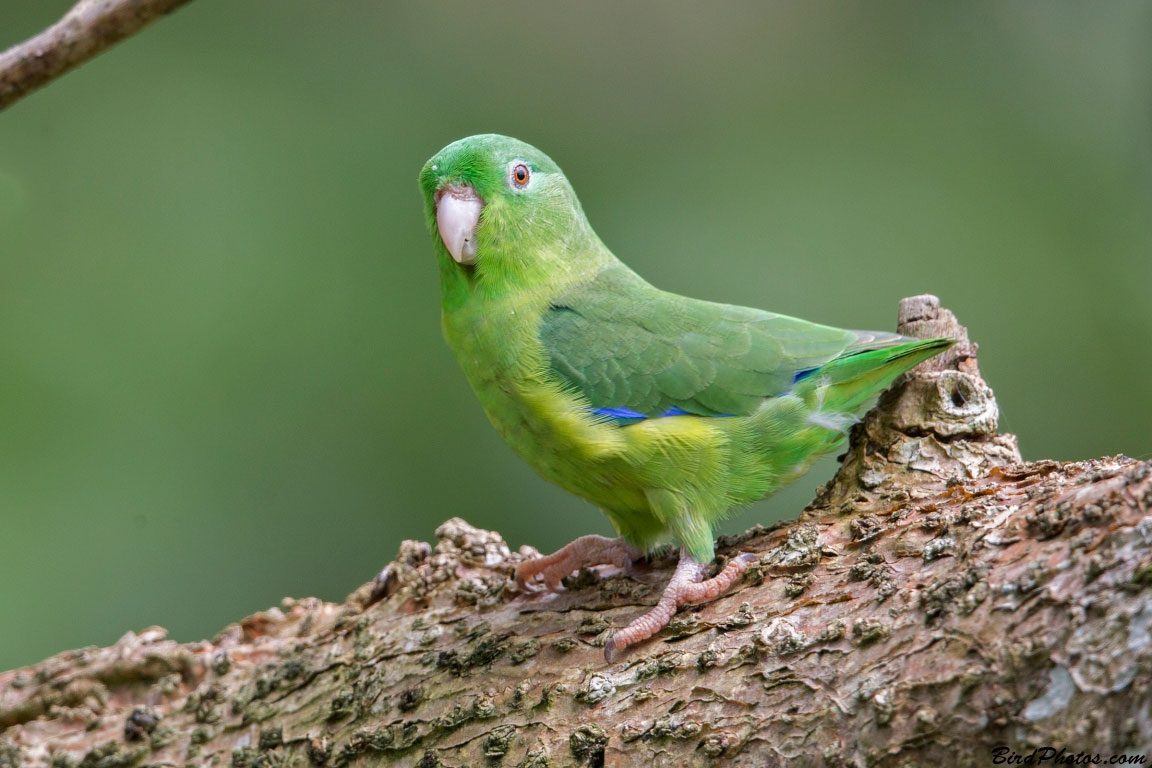
โ–ท The world of Pets: Dogs, cats, birds, reptiles, amphibians

Alexandrine Parakeet
Psittacula eupatria


Alexandrine Parakeet

Content

Description:

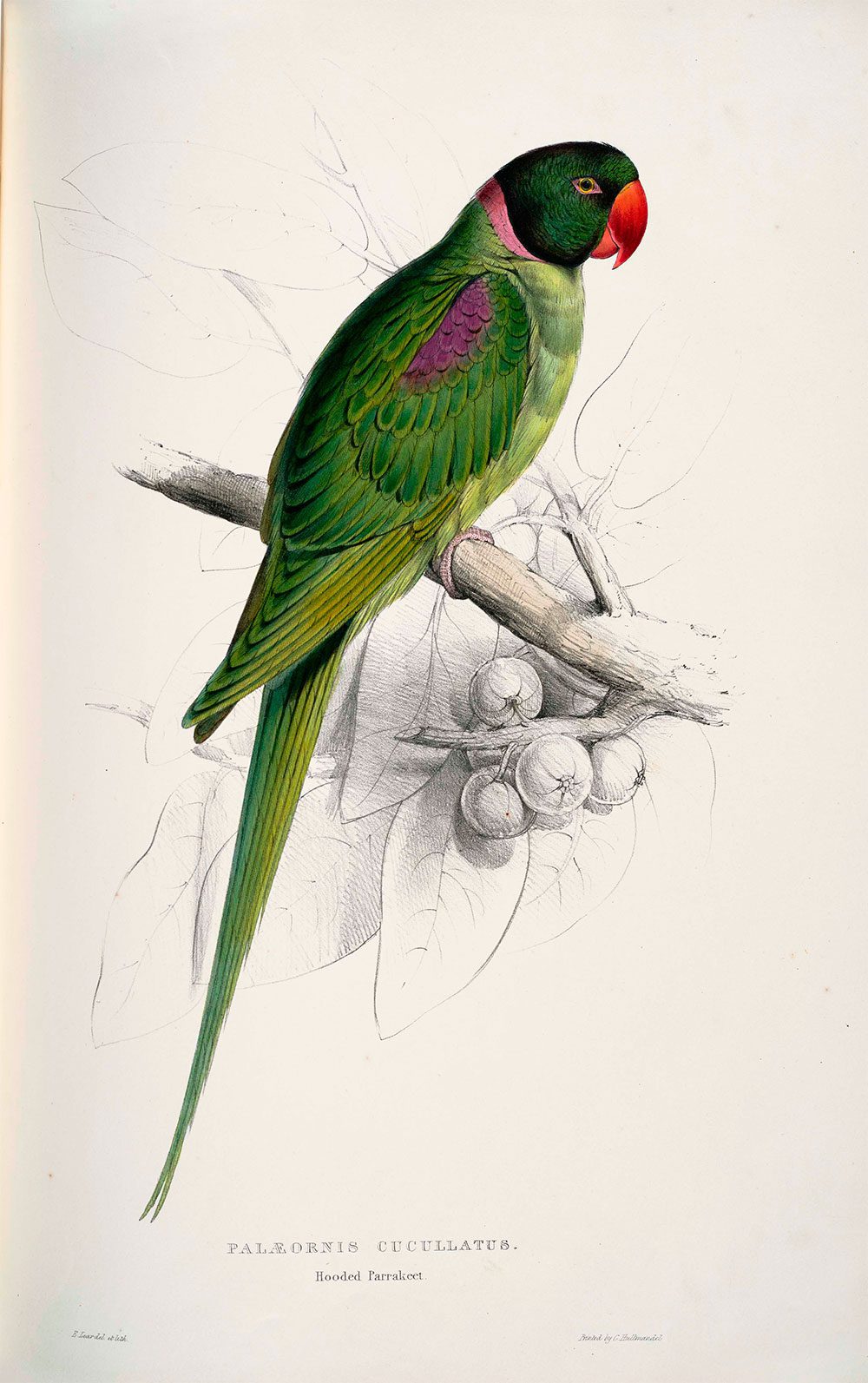
Illustration Alexandrine Parrot

From between 50-62cm. in length and weighing between 198โ€“258 grams.
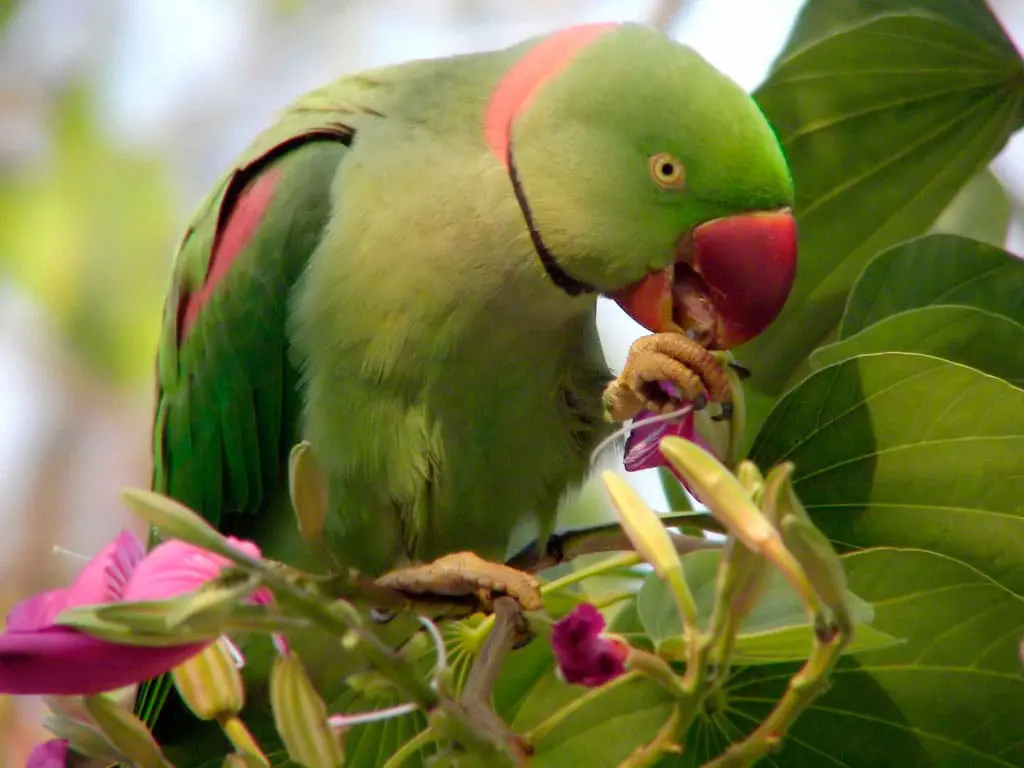
The Alexandrine Parakeet (Psittacula eupatria) has the forecrown, lores and crown bright green, merging to lavender-blue on cheeks, ear-coverts and back of the crown; faint dark line from back of cere to eye ring; narrow black band from the base of bill, laterally across the base of the cheeks, that binds with a wide collar pink around the back of the neck.

Nape, the mantle, scapulars, rump and uppertail-coverts greenish-grey. Upperwing-coverts smaller brown; rest of upperwing-coverts green (brighter and emerald body feathers). The primaries and secondaries greyish green with dark tips to the vane previous interns, Blackish below.

Underwing-coverts gray-green. The underparts brighter yellowish green, chest with grayish tint. Upper, the tail light green with yellow tip; undertail, golden yellow.

Bill red with paler tip: cere whitish; irises pale yellow; legs rose gray.

The female no black and pink markings neck and it is generally duller.

The immature It resembles the female (The males are sometimes distinguished by larger size).

Subspecies description
Subspecies
  • Psittacula eupatria Avensis

    (Kloss, 1917) – Similar to the subspecies Psittacula eupatria magnirostris but with the neck more yellow, the bill smaller and close blue neckband, reduced or absent. Yellower below the subspecies Psittacula eupatria nipalensis.


  • Psittacula eupatria eupatria

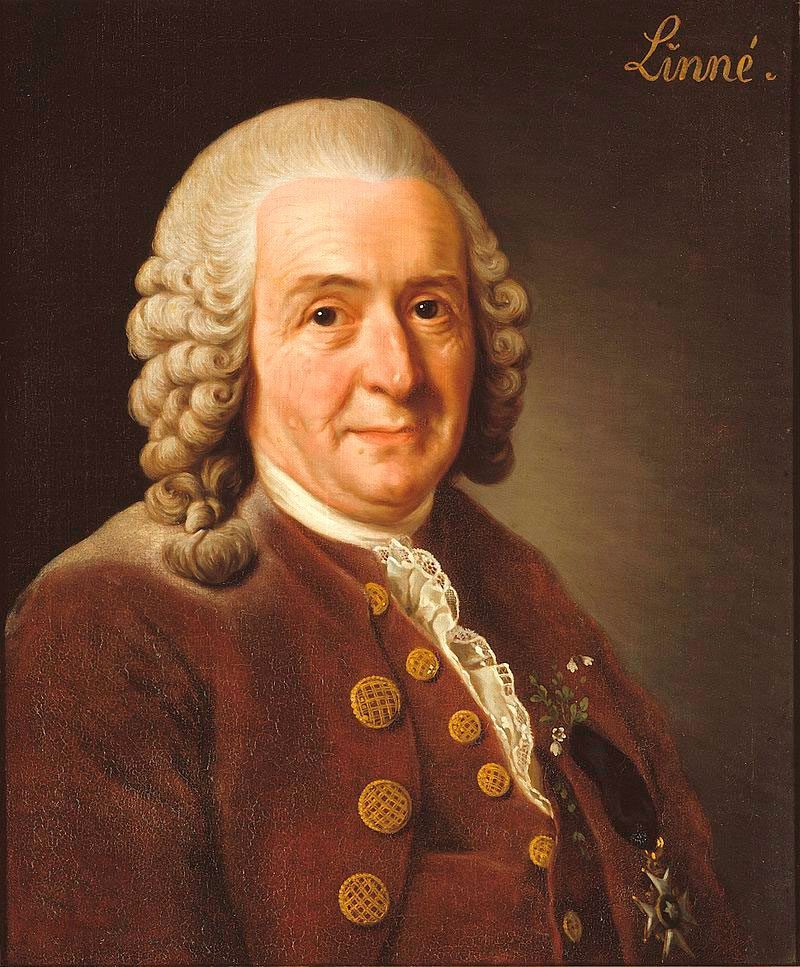
    (Linnaeus, 1766) – The species nominal


  • Psittacula eupatria magnirostris

    (Ball, 1872) – It differs from the subspecies Psittacula eupatria nipalensis by blue coloration above band pink, which it is more limited and sometimes non-existent and the pink band nape that is wider; swe other subspecies differs by having the bill Larger.


  • Psittacula eupatria nipalensis

    (Hodgson, 1836) – Larger and grayer than the species nominal, less lavender in head and wider black stripe mustache.


  • Psittacula eupatria siamensis

    (Kloss, 1917) – Cara and neck yellow, nape bluish. Slightly smaller than the subspecies Psittacula eupatria Avensis.

Habitat:

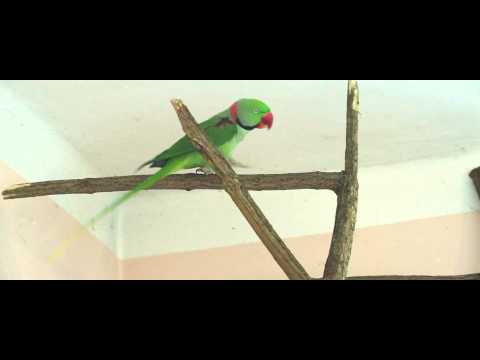
Video – "Alexandrine Parakeet" (Psittacula eupatria)

PSITTACULA EUPATRIA

The Alexandrine Parakeet It is distributed in a great variety of humid and dry forests and wooded lands., but also they are seen in cultivated areas, mangroves (for example, of Rhizophora mueronata on the islands of the bay of bengal) and coconut plantations, mainly in the lowlands up 900 meters above sea level; on Punjab province (Pakistan) extend areas of subtropical pines (Pinus roxburghii) and penetrates irrigated plantations in desert areas; ascend to the foothills of Himalaya in areas of trees (will Shorea) and riparian forests, rarely above the 1.600 m.

In the Bandhavgarh National Park, the Alexandrine Parakeet prefers forests more dense than the Plum-headed Parakeet (Psittacula cyanocephala) and Rose-ringed Parakeet (Psittacula krameri).

Usually they found in small groups, but sometimes they form large flocks where food is plentiful and communal roosts, where birds can come together in one big tree.

Reproduction:

The nest of the Alexandrine Parakeet They found in tree cavities (for example, of Dalbergia, Shorea or Salmalia), palms or, very rarely, buildings, but generally far from human settlements.

The nest It comprises a chamber filled with wood shavings produced by barbets or woodpeckers during excavation or extension of the cavity; entry generally clean round.

The breeding season usually from November to December and from March to April, depending on the location (for example, February to March in the Punjab and andaman islands and from December to February in the center Burma).

The average size clutch is of 2-4 eggs measuring 34,0 x 26,9 mm. The incubation period average is 28 days usually after the placement of the second egg. The chicks leave the nest at about seven weeks of age. They are bred for about three weeks and usually are weaned between the 12 to 16 weeks of age.

Food:

Diet Alexandrine Parakeet It includes a variety of cultivated and wild seeds, flowers, nectar, grains, fruits and vegetables.

Considered serious pest in some places: the 70% their diet Pakistan comes from cultivated areas.

It feeds mainly early in the morning and afternoon.

Known foods include guava (Psidium guajava), nectar Salmalia, Butea and Erythrina, fleshy petals Bassia latifolia and young leaves of vegetables.

Distribution:

The situation in Afghanistan of the Alexandrine Parakeet is uncertain, possibly some group in the extreme northeast, about Jalalabad.
In Pakistan, isolated colonies Are and Peshawar, most widespread and frequent in the irrigated lowlands of Punjab; They are distributed from Punjab (India), foothills Himalaya and South of Nepal, throughout the India and Sri Lanka, as well as the east through Bangladesh.

In Bhutan and Assam in Burma Central and Southern (not found in northern), extending from northern Thailand, Central and North Cambodia and Laos and north to central and southern Viet Nam.

Present at the Islas Andaman (no al on Ten Degree Channel) and Narcondam (India) and in the Coco Islands (Bangladesh), bay of bengal.

Seasonal movements in some areas and in other locally nomadic.

generally common, but much rarer in the east and sporadically distributed by South India.

Decreasing in Sri Lanka, where it is now rare, especially in the north.

Sharp declines in Thailand and probably in other parts of Indochina.

Its appearance around some urban areas could be due to leaks.

Introduced in parts of Europe (Germany, Belgium, Netherlands, Middle East (Turkey, Bahrein, United Arab Emirates, Iran) and Japan.

Subspecies distribution
Subspecies
  • Psittacula eupatria Avensis

    (Kloss, 1917) – South of Assam (Northeast of India) and Myanmar, but the area of รขโ‚ฌโ€นรขโ‚ฌโ€นcontact with the subspecies Psittacula eupatria nipalensis and Psittacula eupatria siamensis, It is unknown.


  • Psittacula eupatria eupatria

    (Linnaeus, 1766) – The species nominal


  • Psittacula eupatria magnirostris

    (Ball, 1872) – Islands bay of bengal, Andaman, Coconut and Narcondam.


  • Psittacula eupatria nipalensis

    (Hodgson, 1836) – Pakistan through Punjab (India) until Assam, Bangladesh, Nagaland and Manipur, including skirts Himalaya and Nepal, to the South , approximately I8ยฐ north; the contact area with the subspecies Psittacula eupatria Avensis, unknown.


  • Psittacula eupatria siamensis

    (Kloss, 1917) – West and north of Thailand, Laos, Cambodia and Viet Nam.

Conservation:

State of conservation โ“˜


Near-threatened Near Threatened โ“˜ (UICN)โ“˜

โ€ข Current Red List of UICN: Near-threatened

โ€ข Population trend: Decreasing

This species has been upgraded from Least concern based on new information on population trends. Is listed as Near-threatened, Since, although it remains common in some areas and its status is clouded by feral populations, It is suspected to be subjected to population decline moderately fast due to the continuing loss of habitat, to unsustainable levels of exploitation, the pursuit and capture.

The Alexandrine Parakeet It is widely captured and sold as bird cage.

In Cambodia, nests theft and capture adults, They represent the main threats, It is one of the most sought after birds (F. Goes in some. 2013).

Despite the virtual disappearance of the species Thailand, chicks still appear in the illegal trade in bird markets Bangkok, although, possibly, its origin is Cambodia (P. Ronda in a little. 2013).

The illegal trade, as well as the destruction of nesting places, threat to species Pakistan (S. Khan in a little. 2013). in addition, It reported that the species is threatened by extensive poaching at the hands of local tribes Gujarat (V. Vyas in some. 2013).

Habitat loss and degradation are also grave threats. In Cambodia, use changes in the lowlands it has been rapid (R. Timmins in some. 2013) and rates of degradation and loss of lowland forests is expected to impact more on the species (F. Goes in some. 2013). Conversion rates of habitat Laos They are described as severe (JW Duckworth in litt. 2013).

Conservation Actions Proposed:

    – Conduct periodic surveys to monitor the population trend of the species.
    – Conduct surveys and assess the situation in Pakistan (S. Khan in a little. 2013).
    – Monitor rates of habitat loss and degradation through the distribution of the species.
    – Quantify the impact of harvesting for trade.
    – Enforcing trade restrictions.
    – Carry out awareness raising activities to discourage the capture and trade.
    – Increase the amount of suitable habitat that receives protection.

"Alexandrine Parakeet" in captivity:

The Alexandrine Parakeet is a popular bird among poultry. It is ideal for outdoor aviaries and cannot tolerate temperatures below 5ยฐC.. They reproduce well in aviaries. This Psittacula It is one of the oldest species of captive parrots Eurasian continent. Named after the legendary Emperor Alexander the Great, he had numerous specimens exported by his legionnaires back to various Mediterranean countries. Since then, This parrot has been popular with the nobles of all the countries of Anatolia, European and Mediterranean Empire.

This is a kind active, He likes water and readily accepts different or new foods. It has a vigorous beak and therefore it is important to keep the perch free of toxicity and without chemicals such as disinfectants., fungicides, insecticides or pesticides. The Alexandrine Parakeet, like other parrots, They are among the best imitators.

With regard to its longevity, according to sources, one specimen was still alive after 30 years in captivity. In captivity, these parrots have been known that they can raise from the 4 years of age.

These birds Smart They make good pets for those willing to provide ongoing obedience training. If neglected, or appropriate training is given, the Alexandrine Parakeet it becomes prone to tear the feathers and other behavioral problems. The large and powerful beak of the parrot has a strong bite and therefore not recommended as a pet for children. a large cage is required to accommodate their beautiful, long narrow tail.

It is not a difficult species to breed, in fact usually successful.

Alternative names:

Alexandrine Parakeet, Alexandrine Parrot, Andaman Parakeet, Large Indian Parakeet, Large Parakeet, Rose-breasted Parakeet (English).
Perruche alexandre (French).
Grosser Alexandersittich, Alexandersittich (German).
Periquito-grande-alexandre (Portuguese).
Cotorra Alejandrina, Cotorra de Alexander (espaรฑol).


scientific classification:

Carl Linnaeus
Carl Linnaeus

Order: Psittaciformes
Family: Psittaculidae
Genus: Psittacula
Scientific name: Psittacula eupatria
Citation: (Linnaeus, 1766)
Protonimo: Psittacus eupatria


Alexandrine Parakeet Images:


Especies del gรฉnero Psittacula

Sources:

Avibase
– Parrots of the World โ€“ Forshaw Joseph M
– Parrots A Guide to the Parrots of the World – Tony Juniper & Mike Parr
– Birdlife

Photos:

(1) – Alexandrine Parakeet at Kowloon Park, Hong Kong By Charles Lam from Hong Kong, China (YummyUploaded by Snowmanradio) [CC BY-SA 2.0], via Wikimedia Commons
(2) – Alexandrine Parakeet Alexandrine Parrot gold. A 17 year old pet parakeet at home in Mumbai By Rudolph.A.furtado (Own work) [Public domain], via Wikimedia Commons
(3) – Alexandrine Parakeet (also known as the Alexandrine Parrot) at Rainbow Jungle (The Australian Parrot Breeding Centre), Kalbarri, Western Australia By Sheila Bradford [CC BY 2.0], via Wikimedia Commons
(4) – An male Alexandrine Parakeet (also known as Alexandrian Parrot) in a tree By Sammy Sam [CC BY-SA 3.0], via Wikimedia Commons
(5) – Alexandrine Parakeet (Psittacula eupatria). A pair By derivative work: Snowmanradio (talk)Two_species_of_Psittacula_on_perch.jpg: Thomas Guignard [CC BY-SA 2.0], via Wikimedia Commons
(6) – Alexandrine Parakeet flapping her wings By Iamoarampage at English Wikipedia [Public domain], via Wikimedia Commons
(7) – Alexandrine Parakeet at Kowloon Park, Hong Kong By Charles Lam from Hong Kong, China (RestingUploaded by Snowmanradio) [CC BY-SA 2.0], via Wikimedia Commons
(8) – Alexandrine Parakeet at Kowloon Park, Hong Kong By Charles Lam from Hong Kong, China (YummyUploaded by Snowmanradio) [CC BY-SA 2.0], via Wikimedia Commons
(9) – Alexandrine Parakeet Psittacula eupatria Melghat Tiger Reserve Maharashtra By Dr. Raju Kasambe (Own work) [CC BY-SA 3.0], via Wikimedia Commons
(10) – A painting of an Alexandrine Parakeet, also known at Alexandrian Parrot, (originally captioned ยซPalรฆornis hooded. Hooded Parakeet.ยป) by Edward Lear 1812-1888 [Public domain], via Wikimedia Commons

Sounds: David Edwards (Xeno-canto)

โ–ท The world of Pets: Dogs, cats, birds, reptiles, amphibians

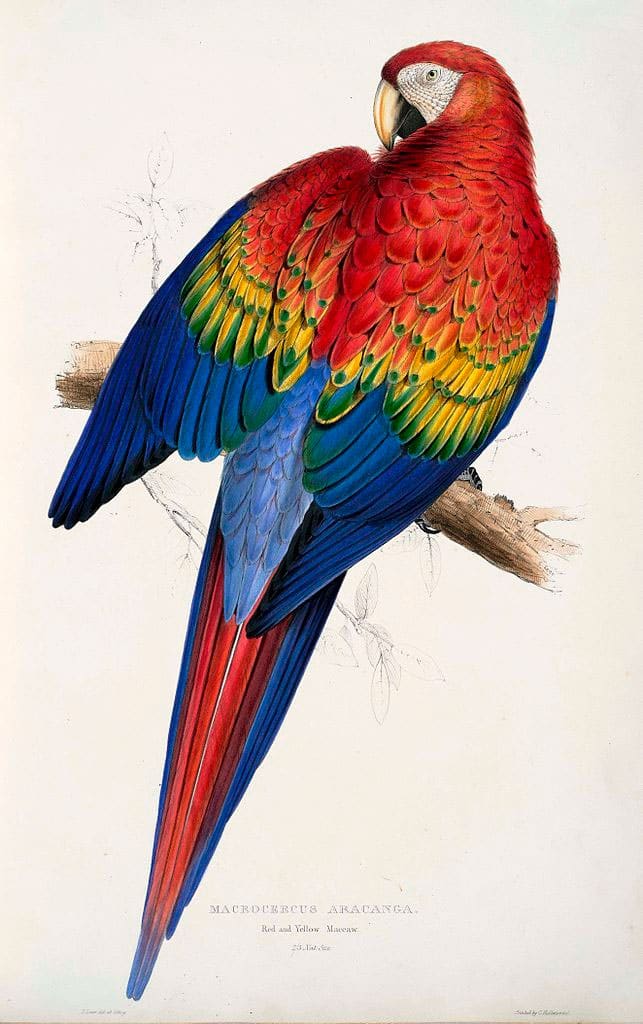
Scarlet Macaw
Ara macao


Guacamayo Macao

Content

Ilustraciรณn Guacamayo Macao

Description:

Of 85 to 96 cm. length and a weight between 1.060 and 1.123 g..

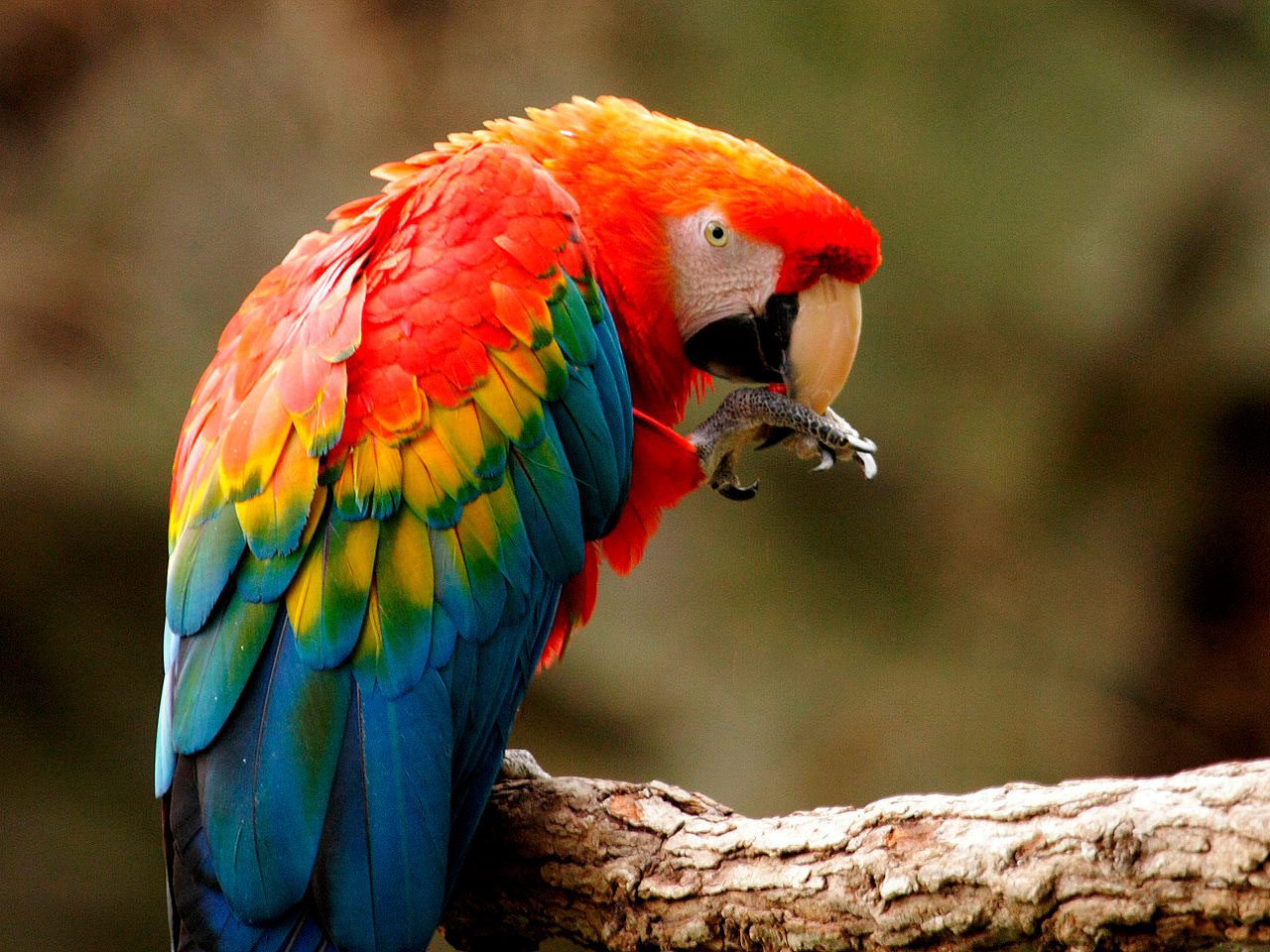
The Scarlet Macaw (Ara macao) has a showy and colorful plumage, predominantly Scarlet red in the head, neck, back, throat, belly, sides and the thighs, as well as in the upper parts of the wings and tail. These pens are a brighter shade of Red, almost Orange, If you are directly exposed to the sunlight.

The feathers greater coverts and stockings of the wings they are yellow, even if the ends of these feathers are green in the subspecies Ara macao macao and blue in Ara macao cyanoptera. The t-shirts, as well as the lower coverts of the obispillo, the of the back and both upper and lower part of the tail they are blue. The internal parts of the tail and of the wings are orange-red, lighter than the predominantly Scarlet plumage.

Its bill is hooked, strong enough to cut objects, dig, help climbing and defend themselves, but light in such a way that it does not affect your flight. It consists of two parts, of which the upper is the largest and is off-white, Sometimes a little pink, Besides that it has a small black marks on each side in the region where it joins with the head. It is also black on the tip and base, forming a triangular figure of this color. At its top are its nostrils, almost imperceptible to the naked eye. The under bill, on the other hand, is completely black, like its fleshy language.

The eyes are positioned laterally in the head, and although the exposed part of the cornea is round and seemingly small, the eyeball is large enough reality, even more than the brain. Its irises is light brown on the young but it becomes yellow when reaching the adult age. around the eyes they have an area of skin between whitish and pink which is apparently nude, although in reality it is partially covered by small, almost imperceptible reddish feathers that form thin sinuous lines.

Their legs they are short but strong, because it has powerful flexor muscles and tendons, allowing you to be upright perching. Their legszigodactilas‘ they are available in four fingers, two forward and two backwards, and are dark gray.

Morphologically, is very similar to the Red-and-green Macaw (Ara chloropterus), However, differ in that the Scarlet Macaw have yellow spots on their wings While in Red-and-green Macaw, as its name implies, stains are completely Green. The same, in the Red-and-green Macaw the thin red lines on the plucked white part of his head they are much more notorious, while the Scarlet Macaw lacks these lines or they are almost imperceptible. Finally, in the Red-and-green MacawScarlet Macaw Red is vivid tone, lighter, Stressing in particular in the nape and crown, where tends to Orange.

It is a species that has a very light sexual dimorphism, because the females they are smaller and their bill is more curved, short and thick, In addition to the tail of the male is slightly longer. Even so, it is difficult to determine its sex with the naked eye; the only reliable way to know him is through a DNA test collected from his blood or his feathers, technical or more invasive as the laparoscopy and sewer exploration.

Subspecies description:

  • Ara macao cyanopterus

    (Wiedenfeld, 1995) – Larger than the species nominal. A dark Scarlet red in the plumage of the head and the body, a wide yellow stripe in the wings, where many feathers have blue tip, and the central feathers of the tail extremely long and wide whose tip is light blue.


  • Ara macao macao

    (Linnaeus, 1758) – The species nominal.

Habitat:

The Scarlet Macaw they are distributed through the tropical forests of lowlands and savannas.

In Mexico in remote areas of humid forest.

In Honduras, on the arid slopes of the peaceful, birds forage in open areas (including growing areas); sometimes in the forests of pines above the rainforest in the Mosquito Coast.

In Costa Rica in deciduous forests, humid and in more open areas and edges with scattered tall trees.

They inhabit intact and partially cleared lowlands of rainforest and gallery forest in Colombia.

In the rainforest, Savannah and plains in Venezuela.

They prefer dry rainforest land in Suriname and the rainforest and savanna in Guyana.

Often near rivers throughout its range.

Below 240 metres in Oaxaca, Mexico, of 1.100 metres in Honduras, 1.500 metres in Costa Rica, 500 metres in Colombia and 450 metres in Venezuela.

The Scarlet Macaw, generally, they can be observed in pairs, in groups of 3/4 birds or in flocks of up to approximately 30 individuals, up to a maximum of 50, in communal roosts in tall trees (including the mangroves).

They often perch on the top of large trees.

Reproduction:

In Central America, the Scarlet Macaw nest during the months of December to June in the time dry (Forshaw, 1989; Iรฑigo-Elias, 1996; Renton, 1998; Renton et to the., 2003).

In the Lacandon Jungle of Mexico, They nest in natural cavities of emergent trees, dead or alive, using more often of tree species of Ceiba pentandra, Schizolobium parahybum, and Vatairea lundelli (Iรฑigo-Elias, 1996; Carreonarroyo, 2006).

The macaws they use large mature trees with the average breast height diameter 129 cm.. (IรฑigoElias, 1996; Carreon-Brook, 2006). Apparently, the macaws Select the highest cavities for nest, taking an average of 19 height m, and with dimensions of average entry 22 cm.. x 32 cm.. (Iรฑigo-Elias 1996; Carreon-Brook, 2006). They prefer soft tree species for the entrance to the nest cavity can be modified.

Usually, the nests of the Scarlet Macaw they are separated by more than 3 km. (Carreonarroyo, 2006), which would reduce strong agonistic interactions between nesting pairs, and may cause the failure of nests (Renton, 2004; Renton and Brightsmith, 2009).

In Central America they put in 1 to 3 eggs (Iรฑigo-Elias, 1996, Renton, 1998; Renton et to the., 2003), even if broods have been recorded of up to 4 eggs in South America (Nycander et to the., 1995). In the Lacandon Jungle of Mexico, recorded an average clutch size of 1.6 eggs/female in 1988-1989 (IรฑigoElias, 1996) and 2.7 eggs/female in 1998- 1999 (Carreon-Brook, 2006).

Hatch on average 1.5 to 2.0 chicks/pair, managing to fly the nest 0.6 to 1.3 young per nesting pair (Iรฑigo-Elias, 1996; Carreon-Brook, 2006; Renton and Brightsmith, 2009).

Food:

The diet of the Scarlet Macaw includes fruit of Inga, Micropholis, Sterculia, Bursera, Dipteryx, Ficus, Spondias mombin, Hura, Eschweilera and Terminalia, as well as fruits and nuts several Palms; seeds of Jacaranda, Dialium, Caryocar, Hevea, Euterpe, Cedrela and Sapium; flowers and nectar, for example, of Ferrule and Erythrina.

Feeding in the canopy, usually in silence. May be associated with other parrot species where abundant food.

Distribution:

Size of the area of distribution (reproduction / resident): 10.200.000 km2

The Scarlet Macaw are distributed to a large extent of Central America, from the South of Mexico until Panama and apparently scattered in tropics of South America, from the South to the East of Bolivia.

In Mexico, formerly, were observed in the South of Tamaulipas, South of Veracruz, Oaxaca, Tabasto, Chiapas and Campeche and through the lowlands of Guatemala to the most remote areas of Belize, where the most recent records are from the Macal River.

Formerly widespread in Honduras, EI Salvador and Nicaragua; Costa Rica mainly on the Pacific slope.

In Panama confined to the Coiba island, to the southwest of the azuero peninsula and a Chiriqui, where birds once could have flown from Costa Rica.

Also distributed in the tropical zone of Colombia including the Magdalena River Valley, the the Caribbean coast and Amazon region with a recent record of Nariรฑo.

In Venezuela, in Apure, Northeast of Monagas, Southwest of Sucre, widely distributed through the Plains and in Bolรญvar and amazon.

A sizeable population in Guianas, throughout the Amazon basin of Brazil, to the East of Ecuador and to the East of Peru.

In the North and East of Bolivia, in Santa Cruz, Beni and possibly Pando. Away to the West of Los Andes.

The Scarlet Macaw make seasonal movements in search of fruit and is temporary visitor in some areas. Locally common but obviously in decline range-wide, especially around the centers of development, due to loss of habitat, trade and hunting, both as food and for obtaining their feathers; the population total of Mesoamerica probably not greater than 4.000 individuals.

extinguished the majority of former distribution area in Mexico (not registered in Tamaulipas Since 19th century) and persisting in limited numbers only in the Lacandon Jungle, Chiapas.

Generally rare in Guatemala, although more common in more remote areas, as the West's Petรฉn.

extinct in El Salvador. widespread, Although rare on the Caribbean slope of Honduras; extinct on the slope of the peaceful. Nearly extinct on the Pacific slope of Nicaragua, but persisting in the remote area of the Northeast. Formerly widespread on the slopes of the Caribbean from Costa Rica, now only in the Northeast; few localities on the Pacific slope (for example, the Osa Peninsula). Fairly common in Coiba, Panama. In Venezuela Local. Fairly common in amazon basin and Guianas, especially in the more remote areas. Fewer that the Red-and-green Macaw in Guyana and Venezuela.

Widespread in captivity, but rarely bred. CITES Appendix I.

Subspecies distribution:

  • Ara macao cyanopterus

    (Wiedenfeld, 1995) – They inhabit the area of Mesoamerica between Mexico and Honduras; Currently there are two towns in the southeast of Mexico, one of just 50 individuals in the region of the Chimalapas, Oaxaca (รรฑigo et al 2004; Lazcano-Barrero obs. Pers.) and the other in the Lacandon Jungle in Chiapas, with an estimated population of between 150 and 250 individuals (Iรฑigo Elijah 1996 & Iรฑigo Elias et al. 2004, Garcia Fair).


  • Ara macao macao

    (Linnaeus, 1758) – The species nominal.

Conservation:


minor concern

โ€ข Current Red List of UICN: Least concern

โ€ข Population trend: Decreasing

Since the Scarlet Macaw they have an extraordinarily wide distribution rangeโ€”the largest among all birds of the genus Araโ€”,and its population, Despite being apparently shrinking, do not fast enough to consider it vulnerable, the Red list of endangered species of the IUCN considers it to be a kind of least concern. But, This organism caught attention in his ยซConservation action plan and sampling of PsitacidaeยปRegarding the status of subspecies to. m. cyanoptera, since its population had indeed declined rapidly in a span of twenty years. The species also appears from the 1 in August of 1985 in the Appendix I of the Convention on international trade in endangered species of Wild Fauna and Flora (CITES), that prohibits trade in this species within the signatory countries. Originally entered in Appendix III of this organization in 1976, amounted to Appendix II in 1981 and finally it came to Appendix I in before this date.

It is also protected by various laws and decrees national; for example, in Costa Rica, where he spent to deal with around the 80% of the national territory to only the 20% for the year of 1993. Because of its particularly precarious condition within the territory of Mexico, in that country he is considered from 2000 a priority species for conservation. In Panama, also, It is considered to be one of the two most endangered bird species in the country along with the Cotinga. For its part, in Peru is listed as Vulnerable species (VU) according to Supreme Decree No. 034-2004-AG from September of 2004. In Guatemala was enacted in 1989 Decree No. 4-89 of the Protected Areas Law, same with which created the Guatemalan System of Protected Areas, that ensures the protection of species endangered within its territory, including the Scarlet Macaw. In Belice It is sheltered from 1992 by the Environmental Protection Act, that prohibits their trade or possession. Inside Brazil has a similar protection, Since its trade locally or export or possession is not allowed, unless they are breeding or authorized zoos. In Colombia his criterion is "indeterminate" in the List of Colombian Species on the Way to Extinction, so it is not considered endangered within that country, although it does receive the protection of various national laws. In Venezuela it is considered a vulnerable species and is protected by the Protection law to the wildlife.

Among the main factors threatening the survival of this species are the habitat destruction because of deforestation, the oil industry and intentional burning; the fragmentation of populations, the commercial traffic of feathers, eggs and specimens as such for sale as pets, as well as the fact of being an inbred species with low reproductive rates, and the specialization of the diet of some populations. The problem of the illegal trade It affected him greatly in the 20th century, where among 1975 and 1990 It is estimated that they exported around 1500 specimens. Until the mid of 1980, The main exporting countries were those where the Scarlet Macaw reproduces naturally, as Bolivia, Guyana and Suriname. But, by the end of that decade, countries such as United States, Philippines and Canada they were already major exporters, as local bird breeding has developed sufficiently to sustain its own trade. The main destination of the trade of these birds was always United States. In more recent years, the various national laws have banned the trade of this and other species of birds, Although this illegal practice has not completely eradicated. The main change that has occurred is that most of the birds in trade now come from the reproduction in captivity, What is an advantage for buyers since they tend to be healthier and more domesticated birds.

"Scarlet Macaw" in captivity:

Starting at the century XVI, as a result of the Conquest of America, appeared the European interest to catch various species of parrots, including this one. The traffic of this and other species was growing due to their popularity as pets, by Macaw began to disappear from their habitat in some regions since the 19th century. Its value on the black market, that it can be several thousand dollars, It makes often a more profitable activity for local residents that agriculture, logging of precious woods or even drug trafficking. This is one of the main reasons that have contributed to its disappearance. In fact, the popularity of several species of macaws is such that these animals have become more quoted in the pet market, and they have overcome even the cats and primates.

Sources They point out that a female's Scarlet Macaw was still alive after 33 years in captivity, but it rarely flew probably due to its age; He grew up with a male from 32 years of age, during 22 years, until the two you almost 30 years of age. There are several anecdotal reports that indicate that these birds live longer, However, including a report of a Scarlet Macaw of 37,1 years and a live specimen of 64 years of age. In captivity, these animals have been known of raising starting from 8 years of age.

Some factors that make one Macaw very attractive pet they are your sociable behavior, their colorful plumage and their ability to learn to imitate words, Although it should be noted that this is not one of the species of macaws who better to develop this skill. It also, it should be emphasized that when they "speak" they do not really understand the meaning of what they say: at most they relate the sound to some object or event, but never through a process of reasoning. Anyway, in general terms it is a bird very intelligent, with learning ability similar to that of a child aged between five and seven years.

On the other hand, precisely because it is highly social, In addition to that need plenty of space to exercise, It bustling and it has a beak and strong claws which are capable of damaging objects and even hurt people, It is not ideal to live as a pet, although you can do it, preferably in the company of other birds and especially of the same species, in aviaries and zoos right. In fact, is a bird easy to raise even for poultry farmers with little experience, and today it is one of the most common species for captive breeding around the world. As well, due to its curious nature and its excellent ability to learn tricks, It is a bird very common in zoo and amusement park exhibits.

In 1993, the Scarlet Macaw He was nominated to wildlife symbol of Honduras and declared as the national bird of this nation, according to executive decree no. 36-93 issued by the Honduran national Congress. This bird was also chosen as the mascot of the America's Cup 2007 held in Venezuela, which is representative of this country by carrying the three colors of its national flag in its plumage. The name given to said pet was "Guaky", which wore the burgundy shirt of the soccer team of that country, as well as eight stars on its wings, to highlight the allusion to the Venezuelan flag. More recently, the Scarlet Macaw began to be coined in the face of the coins of 200 weights Colombians that began to circulate in that country from 2012.

Ara macao hybrids

Cross specieshybrid name

Ara ararauna

Catalina

Ara chloroptera

Ruby

Ara militaris

Shamrock

Ara ambiguus

Verde

Ara severa

Voren Macaw

Ara ararauna

Catalina

Ara Catalina

Camelot

Camelot

Capri

Alternative names:

Scarlet Macaw, Red-and-yellow Macaw, Red-breasted Macaw, Red-yellow-and-blue Macaw, Scarled macaw (English).
Ara rouge, Ara macao (French).
Scharlachara, Arakanga, Hellroter ara, HellroterAra (German).
arara-boliviana, Araracanga, Arara-canga, arara-macau, arara-piranga, arara-vermelha, arara-vermelha-pequena, macau (Portuguese).
Guacamaya Macao, Guacamaya Roja, Guacamayo Macao, Guacamayo Rojo, Guacamayo Rosado, Guara roja, Guara Roja (espaรฑol).
Gonzalo, Guacamaya colorada, Guacamayo real, Guacamaya bandera (Colombia).
Guacamayo bandera (Venezuela).
Guacamayo escarlata (Ecuador).
Paraba rosada, Paraba siete colores (Bolivia).
Araranka (Guarani).
Majรก (Guahibo).
A-rรก (Piaroa).
waamaโ€™ya (Wayu).

Carl Linnaeus
Carl Linnaeus

scientific classification:


Order: Psittaciformes
Family: Psittacidae
Genus: ARA
Scientific name: Ara macao
Citation: (Linnaeus, 1758)
Protonimo: Psittacus Macao


Images Scarlet Macaw:

Videos "Scarlet Macaw"


Species of the genus Ara


ยซGuacamayo Macaoยป (Ara macao)


Sources:

Avibase
– Parrots of the World โ€“ Forshaw Joseph M
– Parrots A Guide to the Parrots of the World – Tony Juniper & Mike Parr
– Birdlife
Wikipedia
– Ara macao cyanoptera (Scarlet Macaw) For: Jesus Gomez Pina and Jose A.. Valero Pรฉrez

Photos:

(1) – This has the appearance of a Scarlet Macaw, which have a variable amount of green in the wings. The exact pedigree of this zoo parrot may be known by the zoo By Travis Isaacs from Grapevine, TX, USA (zoo355Uploaded by snowmanradio) [CC BY 2.0], via Wikimedia Commons
(2) – Scarlet Macaw (Ara macao). Side view. It is raising one of its legs By Peter (Flickr) [CC BY-SA 2.0], via Wikimedia Commons
(3) – A Scarlet Macaw flying away from the photographe By The original uploader was Robert01 at German Wikipedia [CC BY-SA 3.0 of], via Wikimedia Commons
(4) – Scarlet Macaw at Diergaarde Blijdorp, Rotterdam, Netherlands By Jar0d [CC BY-SA 2.0], via Wikimedia Commons
(5) – Scarlet Macaw in Yucatan, Mexico By Tony Hisgett (originally posted to Flickr as Parrot 2) [CC BY 2.0], via Wikimedia Commons
(6) – Scarlet Macaw at Phoenix Zoo, USA By Khamis Hammoudeh (originally posted to Flickr as <3) [CC BY 2.0], via Wikimedia Commons
(7) – Scarlet Macaws (Ara macao) by Heather Paul – Flickr
(8) – Guacamayo rojo by m.prinke – Flickr
(9) – Ara macao (Scarlet Macaw) Tarcoles, Costa Rica by Juan Zamora – Flickr
(10) – First edition of Illustrations of the Family of Psittacidae, or Parrots. Originally a painting by Edward Lear [Public domain], via Wikimedia Commons

Sounds:

โ–ท The world of Pets: Dogs, cats, birds, reptiles, amphibians

Nanday parakeet
Aratinga nenday


Aratinga ร‘anday

Content

Description:


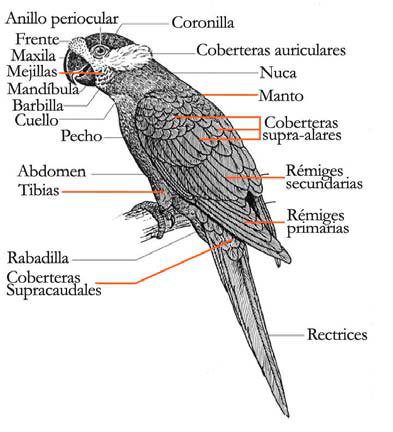
Anatomy-parrots

Of a length between 32-37 cm.. and a weight between 120-141 g..
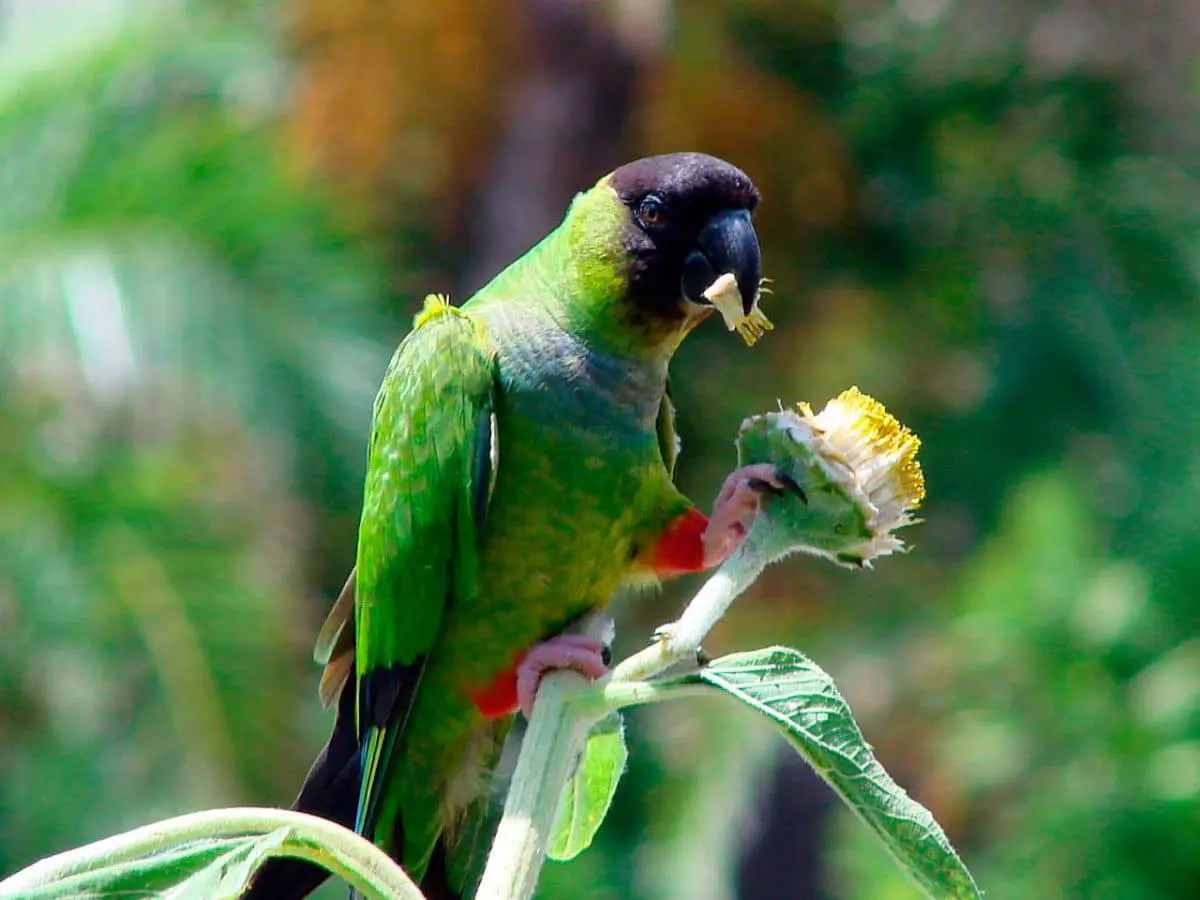
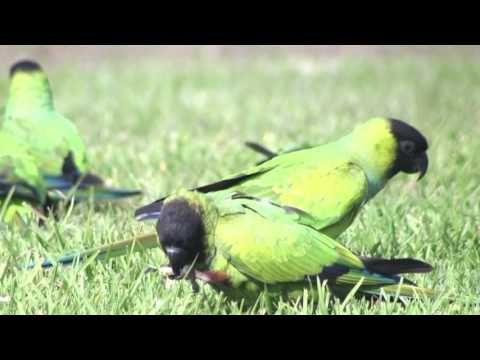
The Nanday parakeet (Aratinga nenday) has the forecrown, crown, lores previous and most of the cheeks tiznadas black: both sides of the neck and ear-coverts pale yellowish green; some feathers Brown or reddish in the margins of the pileum black; the nape grass-green. Mantle and back pale green faded yellowish-green in the rump and uppertail-coverts.

Scapulars mostly green, Although some medium-sized pens are dark blue in the vane inner; under wing-coverts mostly green, with the exception of the primary coverts that are blue. The flight feather dark blue above with vane outer paler in some primaries; then color between Brown and pale black.

Aratinga ร‘anday

Most of the underwing-coverts pale yellowish green. Throat pale yellowish green with shades of pale blue at the top of the chest; underparts remaining of pale yellowish green color, except the the thighs Red and some blue feathers in undertail-coverts.

Upper, the tail reddish brown, distal blue; undertail, dull brown.
The bill black; bare periophthalmic pale grey: the irises reddish brown; legs Pink.

Both sexes similar.

The immature It has less blue on the top of the chest and throat.

  • Sound of the Nanday parakeet.
[audio:HTTPS://www.mascotarios.org/wp-content/themes/generatepress_child/sonidos/Nanday Conure.mp3]

Habitat:

Video – "Nanday parakeet" (Aratinga nenday)

The road (Aratinga nenday)

The Nanday parakeet they live in open lowland some 800 m, including the Humid or Eastern Chaco (a report on the dry Chaco in Bolivia), wetlands and livestock areas with palms. In the Humid or Eastern Chaco and lower basin of the the Paraguay River they prefer areas with fan palm treesCopernicia, growing in the seasonal flood plains with xerophytic vegetation drought related, and observed in areas of swamps with Palm trees in the Santa Cruz Department, Bolivia.

Gregaria, with flocks of up to a dozen birds during the breeding season; often several hundred birds congregate at roosts.

Reproduction:

Nest in holes of Palmas, trees or fence posts, for example, of cattle pens.

The breeding season in November in Mato Grosso. The laying is of 3-4 eggs. after breeding to their young, all birds build large communal roosts until the next breeding season.

Food:

Diet Nanday parakeet includes the Palm fruits Copernicia, sometimes taken in the ground.

They can cause damage to the crops, for example, corn.

Often seen in water wells.

Distribution:

Size of the area of distribution (reproduction / resident): 260.000 km2

This species is native from South America from the southeast of Bolivia to the southwest of Brazil, the center of Paraguay and North of Argentina, of the region known as the Pantanal.

The species is found in a band of approximately 200 km from East to West, focusing on the wetlands of the upper basin of the Paraguay River, in the East of the Santa Cruz Department, Southeast Bolivia, South-West of Mato Grosso and West Mato Grosso from the South in Brazil, to the South, by the middle of Paraguay up to the Chaco province, Formosa province and North of Province of Santa Fe in Argentina (occasional in Province of Misiones and Province of Corrientes). A report of the Province of Santiago del Estero is probably wrong.

There are several wild populations in Buenos Aires and California. You can wander, outside the breeding season, the area inside of Central Chaco.

In general locally abundant and common, especially in areas where their favorite plants concentrate. In Argentina they are more numerous in the Formosa province, and is the most common parrot in some parts of Mato Grosso.

Trapped for the bird trade, with more than 114.000 individuals exported from Argentina in the years between 1985-1990, Although many of these birds is probably came from Paraguay.

Note:

Copies released observed in the Canary Islands (Spain), in particular in the South of Tenerife and Fuerteventura, sometimes confused with the Rose-ringed Parakeet. It transpires that the species has been reproduced, In addition, in Andalusia, Catalonia. It has also been observed in points of Madrid, Basque Country and Valencia (Spain).

You escape to the South of Portugal.

Copies also introduced at different points of North America and in Asia.

Conservation:

โ€ข Red List category of the UICN current: Least concern

โ€ข Population trend: Growing

Global population size has not been quantified, but this species is described as ยซquite commonยป (Stotz et to the., 1996).

The species has undergone intense trade: from 1981, When it was included in the Appendix II, 267,246 individuals caught in the wild were recorded in international trade (UNEP-WCMC trade database CITES, January 2005).

Thousands are legally exported from Argentina.

"Nanday parakeet" in captivity:

Very common in captivity.

In captivity they are wonderful pets if care and properly socialized. They all have distinct personalities and appreciate the toys that are provided with. They like to be out of their cage for at least six hours a day..
These birds are escape artists, extremely intelligent and skilful. Some of them speak, others do not, Depending on your personality. They are characterized by having a very strong call and they are not suitable for apartments.

They are birds they reproduce quite easily in spacious accommodations and Cologne. Son, usually, good parents.

There are places, as Puerto Rico, that its possession is illegal.

They can live between 35 and 45 years.

Alternative names:

Nanday Parakeet, Black-headed Parakeet, Black-hooded Conure, Black-hooded Parakeet, Black-masked Parakeet, Nanday Conure (English).
Conure nanday, Perriche nanday, Perruche ร  tรชte noire, Perruche nanday (French).
Nandaysittich, Nanday Sittich (German).
jandaia-de-cabeรงa-negra, maracanรฃ, nendai, periquito-de-cabeรงa-preta, Periquito-de-cabeรงa-preta / Periquito-nandaรญ, Principe-negro, prรญncipe-negro (Portuguese).
Aratinga Nanday, Aratinga ร‘anday, Cotorra de Cabeza Negra, Loro Cabeza Negra, Nanday, ร‘anday, ร‘enday (espaรฑol).
ร‘anday, ร‘enday (Argentina).
ร‘anday (Guarani).

scientific classification:

Order: Psittaciformes
Family: Psittacidae
Genus: Aratinga
Scientific name: Aratinga nenday
Citation: (Vieillot, 1823)
Protonimo: Psittacus nenday

Aratinga ร‘anday images:


Species of the genus Aratinga

Sources:

Avibase
– Parrots of the World โ€“ Forshaw Joseph M
– Parrots A Guide to the Parrots of the World – Tony Juniper & Mike Parr
– Birdlife
– Parrot Book, Parrots and macaws

Photos:

(1) – Feral Nanday Parakeet (also known as the Black-hooded Parakeet or Nanday Conure) eating sunflower seeds in a garden in Sarasota, Florida, USA By Apix (Picasa Web Albums) [CC BY-SA 3.0], via Wikimedia Commons
(2) – Feral Nanday Parakeets (also known as the Black-hooded Parakeet or Nanday Conure) eating sunflower seeds in a garden in Sarasota, Florida, USA By Apix (Picasa Web Albums) [CC BY-SA 3.0], via Wikimedia Commons
(3) – Nanday Parakeet By J. Patrick Fischer (Own work) [GFDL or CC BY 3.0], via Wikimedia Commons
(4) – A pet Black-hooded Parakeet (also known as the Nanday Parakeet and Nanday Conure) By MAULI (originally posted to Flickr as Little Big Mouth) [CC BY-SA 2.0], via Wikimedia Commons
(5) – A pet Nanday Conure, named Jack By Mceder at English Wikipedia (Transferred from en.wikipedia to Commons.) [Public domain], via Wikimedia Commons
(6) – digital illustration /digital illustration – dibuixosnatura

Sounds: (Xeno-canto)
โ–ท The world of Pets: Dogs, cats, birds, reptiles, amphibians

Brown-throated Parakeet
Eupsittula pertinax

Aratinga Pertinaz

Content

Description:


Anatomy-parrots

Of 17 to 20 cm. length between 76 and 102 g. of weight.
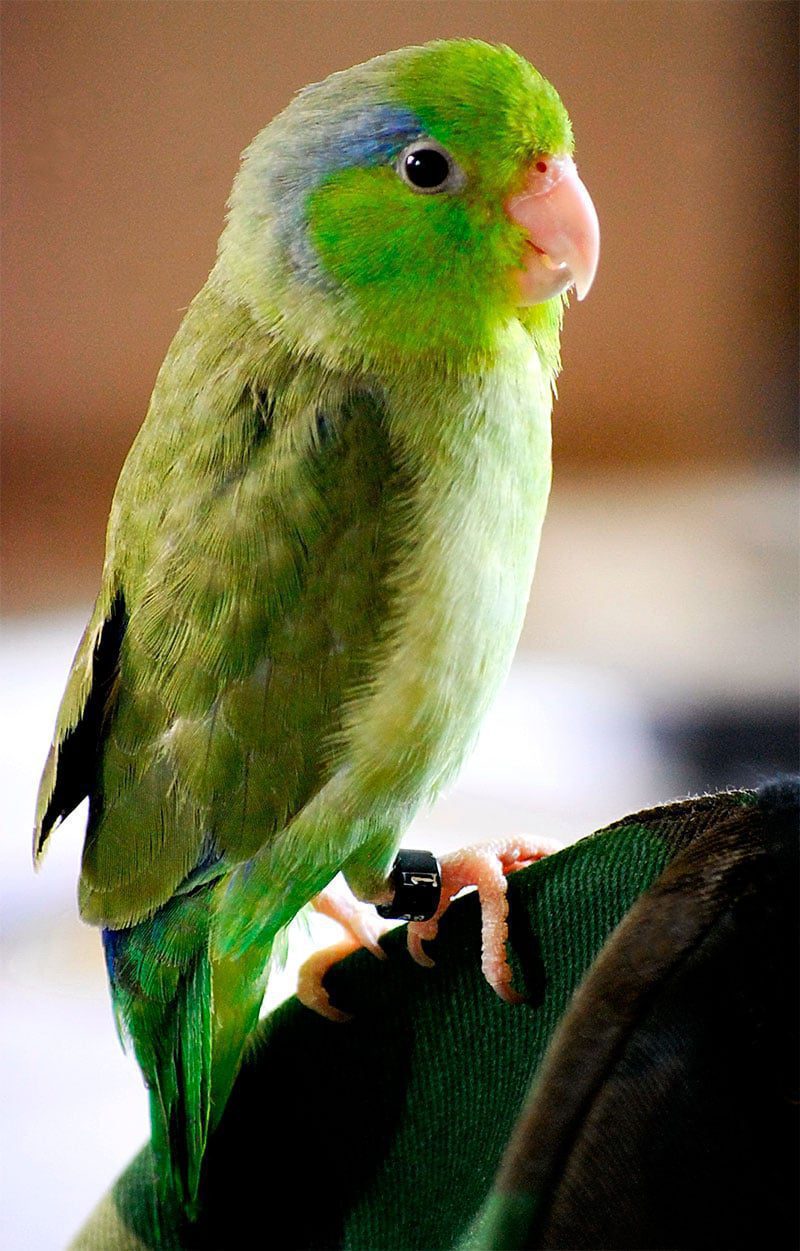
The Brown-throated Parakeet (Eupsittula pertinax) it is a polytypic species. Its fourteen subspecies are distinguished by the mix yellow and Brown on his face and throat.

In the case of the Eupsittula pertinax aeruginosa, the lores previous, the frontal area, underside of cheeks, both sides of the neck and ear-coverts, are dark brown; dark stripes visible on the cheeks; the feathers of the ocular region are of color orange-yellow; the crown greenish blue. Upperparts olive green. Lesser and medium coverts green; bluish green the primaries and greater coverts. Primaries and secondaries green up, Blue dark on the tips, Blue them vane outer in the secondaries; by down dark grey. Underwing-coverts brighter yellowish green. The throat and the top chest dark brown; the underparts Matte yellowish green with an orange patch in the central area of the belly. For above, the tail is of color green blue, bluer towards the tip; undertail greyish-yellow.

Eupsittula pertinax

The bill brownish-grey; bare periophthalmic yellowish white; irises yellow, legs grey.

Both sexes similar, without sexual dimorphism, where males are larger than females.

The youth they tend to lack intense yellow, that is alive in individuals adults. Its forecrown is dark greenish blue. The throat and the chest are greenish, while the belly is green with a bit of orange or yellow.

Description subspecies Eupsittula pertinax
Subspecies
  • Eupsittula pertinax aeruginosa (Linnaeus) 1758 – See description.

  • Eupsittula pertinax arubensis (Hartert) 1892 – Cara and throat color opaque marron-oliva. Narrow yellow line on the eyes. Crown greenish blue.

  • Eupsittula pertinax chrysogenys (Massena & Souance) 1854 – Similar to the aeruginosa subspecies, but darker.

  • Eupsittula pertinax chrysophrys (Swainson) 1838 – Similar to the subspecies margaritensis and venezuelae but with the forecrown a pale yellowish brown.

  • Eupsittula pertinax griseipecta (Meyer de Schauensee) 1950 – Similar to the aeruginosa subspecies, with the cheeks, the throat and top of the chest, Gray-olive, veins in the cheeks absent. The crown Green with little blue.

  • Eupsittula pertinax lehmanni (Dugand) 1943 – Is similar to the aeruginosa subspecies, but with yellowish feathers around the eye more extensive; the Blue head limited with the forecrown and less blue in the flight feather.

  • Eupsittula pertinax margaritensis Cory 1918 – Forehead whitish, the cheeks and ear-coverts color oliva-marron with forecrown greenish blue.

  • Eupsittula pertinax ocularis (Sclater,PL & Salvin) 1865 – Patch distinctive yellow below and behind the eyes (absent in the immature). Forehead and crown green color with tint blue in some birds. Throat, top of the chest, the cheeks and lores warm brown; ear-coverts slightly darker.

  • Eupsittula pertinax paraensis (Sick) 1959 – Similar to the aeruginosa subspecies, but with the irises of color red and the vane outer of primaries and secondaries blue.

  • Eupsittula pertinax pertinax (Linnaeus) 1758 – The nominal. Extensive but variable amount of yellow color in the forecrown, the cheeks, the throat and lores. It may be more off or more Orange under and behind the eyes. Crown Green with only a few light blue indications.

  • Eupsittula pertinax surinama (Zimmer & Phelps,WH) 1951 – Similar to the subspecies margaritensis but with narrow frontal band orange-yellow color, orange-yellow colour around the eyes extending towards the cheeks and yellowish-green (not brown) the throat.

  • Eupsittula pertinax tortugensis (Cory) 1909 – Similar to the aeruginosa subspecies but larger, orange-yellow color on both sides of the head and underwing-coverts more yellowish.

  • Eupsittula pertinax venezuelae (Zimmer & Phelps,WH) 1951 – Similar to the subspecies margaritensis but more pale and yellow on the underparts.

  • Eupsittula pertinax xanthogenia (Bonaparte) 1850 – Clearer (almost sallow) the head the species nominal, with yellow tones ranging from a variable on the front of the crown and nape.

Habitat:

Video – "Brown-throated Parakeet" (Eupsittula pertinax)

Brown-throated Parakeet Eupsittula pertinax / dirty face parakeet

The Aratinga Pertinaz occupies all kind of fields wooded open of the Savannah, transparent areas of dry scrubland full of cactus and acacias, forests of mangrove, tropical forests (where is the most abundant parrot species often), gallery and white sand forests, Mangroves of Rhizophora, edges of moist evergreen forests, and agricultural areas with palms and other trees.

Move at altitudes on the 1.200 m or more, Although they tend to stay below the 1.200 m. This Aratinga also lives in artificial clearings such as public parks or gardens..

In general, observed in flocks or pairs, forming larger groups where food is abundant and in communal roosts.

Reproduction:

The Brown-throated Parakeet It monogamous. With plays After the season of rains, in general from February to April. Birds very social, assess potential mates in large communal roosts. Also used strong calls in select to your mate / to.

Its breeding season It begins after the rainy season, and varies geographically between the months of February and September. Between February and April in Goal, Colombia; from February to April in Venezuela and any time of the year in Suriname, Curacao, Aruba and Bonaire.

When the conditions are favorable this species You can reproduce several times a year. Son colonial and have been observed up to seven pairs nesting next to each other.

Nest in the cavities of trees, artificial nesting boxes, or in arboreal termite. There are reports of nests made in cracks in rocks. The nests they are very simple, without any plant covering and the eggs, often, they are placed on the floor of the cavity nude. The number of eggs in a nest varies from two to seven.

The female is the primary incubator, with one incubation which can last thirty-six to thirty-seven days in the wild. The chicks they leave the nest after 50 days. The young join their parents and form small family groups that last until the parents begin a new breeding season..

Food:

The Brown-throated Parakeet consuming a wide variety of food, including, for example, in the Northwest of Venezuela seeds of Cassia, Peltophorum, Lagerstroemia and Cedrela, fruits of Muntingia, Swietenia, Psidium and Solanum as well as flowers of Tabebuia, Delonix, Eryihrina and Gliricidia.

Sometimes it causes damage to crops (for example, of millet and handle), of corn in Colombia and in fruit plantations of the Netherlands Antilles. Despite being considered pests in some areas, the Brown-throated Parakeet they are not strongly persecuted.

They feed in very vocal groups that often include macaws and amazon parrots.

Distribution:

The Brown-throated Parakeet are distributed to the North of South America, Panama and the islands of the Southern Caribbean.

In Panama are present in the slope of the peaceful, rarely on the side of the Caribbean, even in the canal area. But, they occupy the lowlands of the Northern Caribbean and northeast of Colombia, from the East of the Sinu River up to the Guajira peninsula, including the Center and low Magdalena valley, and observed at elevations more low in the East of the Andes and the lowlands of the South of the Alto Orinoco, to the North of Vaupรฉs.

Probably can be observed in all Venezuela, extending to the Margarita Islands, Turtle (Venezuela), Curacao, Aruba and Bonaire (Netherlands Antilles); introduced in St Thomas, virgin islands, in the 19th century.

Its distribution extends through of the Guianas and the North of Brazil, from Roraima until Amapรก, as well as discontinuously in the upper part of the basin of the Tapajos River, For and in the basin of the Black river, amazon.

In spite of his uneven distribution, usually common to abundant, in many places it is the most common parrot (for example in localities of Guyana), locally common in Panama and reportedly very common in black rivers and Branco, Brazil.

Your area of distribution possibly be increasing due to deforestation. In general resident with local seasonal movements (for example, in the region of Santa Maria, Colombia) the availability of food and the dispersion of the areas of reproduction-related.

Distribution subspecies Eupsittula pertinax
Subspecies
  • Eupsittula pertinax aeruginosa (Linnaeus) 1758 – North of Colombia, Northwest of Venezuela and the upper part of the basin of the Rio Branco, in the Northwest of Brazil

  • Eupsittula pertinax arubensis (Hartert) 1892 – Aruba

  • Eupsittula pertinax chrysogenys (Massena & Souance) 1854 – Region of Black river and, possibly, Solimรตes River, North of Brazil; There are no details about its area of distribution

  • Eupsittula pertinax chrysophrys (Swainson) 1838 – Southeast of Venezuela, Guyana Interior and North of Roraima, Brazil.

  • Eupsittula pertinax griseipecta (Meyer de Schauensee) 1950 – Valley of the sinu river, North of Colombia. Range in relation to the aeruginosa subspecies unclear

  • Eupsittula pertinax lehmanni (Dugand) 1943 – It is from Colombia and possibly Venezuela.

  • Eupsittula pertinax margaritensis Cory 1918 – Islands Margarita and The friars, Venezuela. the birds of the Paria Peninsula in the North of Venezuela, they can be of this subspecies; see the subspecies venezuelae

  • Eupsittula pertinax ocularis (Sclater,PL & Salvin) 1865 – Pacific slope of Panama.

  • Eupsittula pertinax paraensis (Sick) 1959 – High of the Tapajos River and Cururu River, For, Brazil.

  • Eupsittula pertinax pertinax (Linnaeus) 1758 – The nominal. Curaรงao and introduced in St Thomas

  • Eupsittula pertinax surinama (Zimmer & Phelps,WH) 1951 – French Guiana and Suriname through the coast of Guyana to Delta Amacuro, Northeast of Venezuela.

  • Eupsittula pertinax tortugensis (Cory) 1909 – Turtle Island, Venezuela.

  • Eupsittula pertinax venezuelae (Zimmer & Phelps,WH) 1951 – North and Central Venezuela. Areas of contact with other little-known Venezuelan subspecies: see aeruginosa, surinama and chrysophrys.

  • Eupsittula pertinax xanthogenia (Bonaparte) 1850 – Bonaire

Conservation:

โ€ข Red List category of the UICN current: Least concern

โ€ข Population trend: Growing

The Eupsittula Pertinax (Pit and neck of 2014) was considered, previously, belonging to the genus Aratinga.

The subspecies Griseipecta, endemic of the sinu valley in Colombia, There have been since 1949 and is likely to be extinct (T. Donegan in litt. 2011).

The size of the population world of this kind not has been quantified, but it is described as "commonยป (Stotz et to the. (1996). Is considered as the Parrot more abundant in the land low for the Caribbean, Plain in Colombia, Guyana, North of Suriname and the three islands of the Netherlands Antilles.

A density of five to eighty and nine birds by kilometer square is has estimated in the regions of the Northwest of Venezuela.

It is believed that populations on the continent are increasing their range in response to an increase in the conversion of the forest into farmland.

This species is often captured with commercial purposes, but not has been consequences serious, with the exception of the subspecies Aratinga pertinax margaritensis and Aratinga pertinax tortuguensis.

The Aratinga pertinax tortuguensis It is also vulnerable to severe climate changes. (Juniper and Parr, 1998;. Pit, et to the, 1997)

"Brown-throated Parakeet" in captivity:

The Brown-throated Parakeet has a average vinein the nature of about ten years. But, When live in captivity with the proper supervision, they have come to live up to twenty-five years.

common in the industry of the pet because, mainly, to your behavior affective. Captured for the pet trade and occasionally as food.

Pretty noisy, both in the nature as in captivity. With certain skills for repeated whistles and words short.

Alternative names:

Brown-throated Parakeet, Brown throated Parakeet, Brown-throated Conure, Caribbean Parakeet, Curacao Conure, Curacao Parakeet, St. Thomas’s Conure (English).
Conure cuivrรฉe, Conure de Saint-Thomas, Perriche cuivrรฉe, Perruche cuivrรฉe (French).
Braunwangensittich (German).
Aratinga de-cara-parda, aratinga-de-bochecha-parda, periquito-de-bochecha-parda (Portuguese).
Aratinga Pertinaz, Perico cara sucia, Perico Carisucio, Perico Gorgicafรฉ, Periquito de Cola Corta, Periquito Gorgimoreno (espaรฑol).
Loro carisucio, Perico Carisucio (Colombia).
Perico Gorgicafรฉ (Costa Rica).
Perico Cara Sucia (Venezuela).


Carl Linnaeus
Carl Linnaeus

scientific classification:

โ€ข Order: Psittaciformes
โ€ข Family: Psittacidae
โ€ข Genus: Eupsittula
โ€ข Scientific name: Eupsittula pertinax
โ€ข Citation: (Linnaeus, 1758)
โ€ข Protonimo: Psittacus pertinax

Brown-throated Parakeet Images:


Especies del gรฉnero Eupsittula
  • Eupsittula nana
  • —- Eupsittula nana astec
  • —- Eupsittula nana nana
  • —- Eupsittula nana vicinalis
  • Eupsittula canicularis
  • —- Eupsittula canicularis canicularis
  • —- Eupsittula canicularis clarae
  • —- Eupsittula canicularis eburnirostrum
  • Eupsittula aurea
  • Eupsittula pertinax
  • —- Eupsittula pertinax aeruginosa
  • —- Eupsittula pertinax arubensis
  • —- Eupsittula pertinax chrysogenys
  • —- Eupsittula pertinax chrysophrys
  • —- Eupsittula pertinax griseipecta
  • —- Eupsittula pertinax lehmanni
  • —- Eupsittula pertinax margaritensis
  • —- Eupsittula pertinax ocularis
  • —- Eupsittula pertinax paraensis
  • —- Eupsittula pertinax pertinax
  • —- Eupsittula pertinax surinama
  • —- Eupsittula pertinax tortugensis
  • —- Eupsittula pertinax venezuelae
  • —- Eupsittula pertinax xanthogenia
  • Eupsittula cactorum
  • —- Eupsittula cactorum cactorum
  • —- Eupsittula cactorum caixana

  • Sources:

    Avibase
    – Parrots of the World โ€“ Forshaw Joseph M
    – Parrots A Guide to the Parrots of the World – Tony Juniper & Mike Parr
    – Birdlife
    Animal Diversity Web

    Photos:

    (1) – Aratinga pertinax By Genes Luna (Flickr: IMG_0309.jpg) [CC BY-SA 2.0], via Wikimedia Commons
    (2) – Aratinga pertinax xanthogenia By gailf548 (originally posted to Flickr as Young Parrot) [CC BY 2.0], via Wikimedia Commons
    (3) – Eupsittula pertinax arubensis By Alexander Yates (originally posted to Flickr as Aruba Parakeet) [CC BY 2.0], via Wikimedia Commons
    (4) – Brown-throated Parakeet (Aratinga pertinax venezuelae) in Cagua, Estado Aragua, Venezuela By Cristรณbal Alvarado Minic [CC BY 2.0], via Wikimedia Commons
    (5) – Aratinga pertinax aeruginosa By Aratinga_pertinax_-Colombia-8a.jpg: anthrotectderivative work: Snowmanradio [CC BY 2.0], via Wikimedia Commons
    (6) – Eupsittula pertinax By Leizelt, Balthasar Friedrich; Wilhelm, Gottlieb Tobias [CC BY 2.0 or Public domain], via Wikimedia Commons

    Sounds: Peter Boesman (Xeno-canto)
    โ–ท The world of Pets: Dogs, cats, birds, reptiles, amphibians

    Pacific Parrotlet
    Forpus coelestis


    Pacific Parrotlet

    Content

    Description:


    Anatomy-parrots

    12-13 cm.. height.

    The Pacific Parrotlet (Forpus coelestis) It is a small bird, chubby with a tail short and finished in tip. Distinguishable in flight by the blue and Brown on the inside of the wings. It has blue behind the eye and in the middle of the wing at the top. The female does blue stain on the top of the wing and the blue behind the eye is paler. The Immature males they are similar to the adult male, but more pale and with back brownish.

    Habitat:

    The Pacific Parrotlet frequent most dry woodland habitats, such as scrub thorny, bosque deciduous, dense thickets of Captus with balsa trees, plantations of banana and mango, riparian zone, irrigated fields in Savannah and gardens, although their preferred areas are those of humid tropical vegetation such as the coastal mangales.

    Older records of this species are from below sea level of 1.000 m, but are to 2.150 meters on the West side of the Andes in Huancabamba, is of Piura, Peru, and a 1.370-1.650 meters in the South of Loja, Ecuador.

    Usually gregarious; they form large flocks where abundant food.

    Reproduction:

    It nests in the cavity of trees, in cactus, fence posts, pipes or the nests of the Pale-legged Hornero (Furnarius leucopus), of the Tie Neck Pijuรญ (Synallaxis stictothorax) or Fasciated Wren (Campylorhynchus fasciatus).

    The breeding season includes the months of January to may. Sometimes, they breed a second time throughout the year. The laying of eggs 4-6.

    Food:

    The diet of the Pacific Parrotlet includes seeds grass, berries, fruit (example, of Tamarindus, Amaranthus spinosus) and cactus fruits. It forages among the vegetation and land.

    Distribution:

    Size of the area of distribution (reproduction / resident): 147.000 km2

    This species is found in the West of Ecuador, in Manabi Since the latitude of the Valley of the Chone River to the South across the South of Pichincha, The rivers and Guayas (including the Isla Puna), until Gold and Loja, entering the Northwest of Peru, in Tumbes, Piura, Lambayeque and South of Cajamarca, until Freedom and Trujillo.

    irregularly common, sometimes abundant; most numerous in arid areas. The population has apparently not yet been severely affected by the trade in live birds or the conversion of natural and semi-natural habitats for the Agriculture. The species is probably Forpus most numerous in captivity.

    Conservation:

    State of conservation โ“˜


    minor concern Minor Concern โ“˜ (UICN)โ“˜

    โ€ข Current category of the Red List of the UICN: Least concern.

    โ€ข Population trend: Stable.

    Justification of the population

    The size of the world population It has not been quantified, but this species is described as ยซcommonยป (Stotz et to the., 1996).

    Justification of trend

    Suspected that the population is stable in absence of evidence of any decline or threatens substantial.

    "Pacific Parrotlet" in captivity:

    Colorful, charming and intelligent. These small birds have become in very popular pets in recent years. Its small size and quiet nature make of the Pacific Parrotlet an ideal choice for people living in apartments. Nicknamed โ€œpocket parrotsโ€ in the pet trade, These parakeets are actually the smallest of the family of parrots, and they are as smart as many larger species. Some learn to speak quite well, Although the species is not particularly known for the ability to speak.
    An interesting fact upon the Pacific Parrotlet is that its closest relative is the Amazon parrot. Although the two species differ greatly in size, owners often report striking similarities between them. Despite being small birds, they are by no means โ€œlow maintenance birdsโ€. While it is true that they are, course, easy to clean, in comparison with the larger birds, However require your daily care to keep them docile, socialization at an early age is the key to be in a future good behavior.
    They have tendency to obesity. They must be able to get out of their cages, spread your wings, and exercise your muscles to maintain your physical and mental health.

    Their metabolism is very high, and they should have food available at all times. They are known for their appetite voracious, and occur in one diet varied that consists in fruits and vegetables fresh, small seeds such as millet, the high-quality commercial pellets, and protein sources from hard boiled egg.

    There are many mutations.

    Alternative names:

    Pacific Parrotlet, Western Parrotlet (English).
    Toui cรฉleste, Perruche-moineau cรฉleste (French).
    Himmelsperlingspapagei, Himmelspapagei (German).
    Tuim-peruano (Portuguese).
    Catita Enana Amarilla, Cotorrita de Piura, Cotorrita Celestial (espaรฑol).
    Periquito Esmeralda (Peru).

    scientific classification:

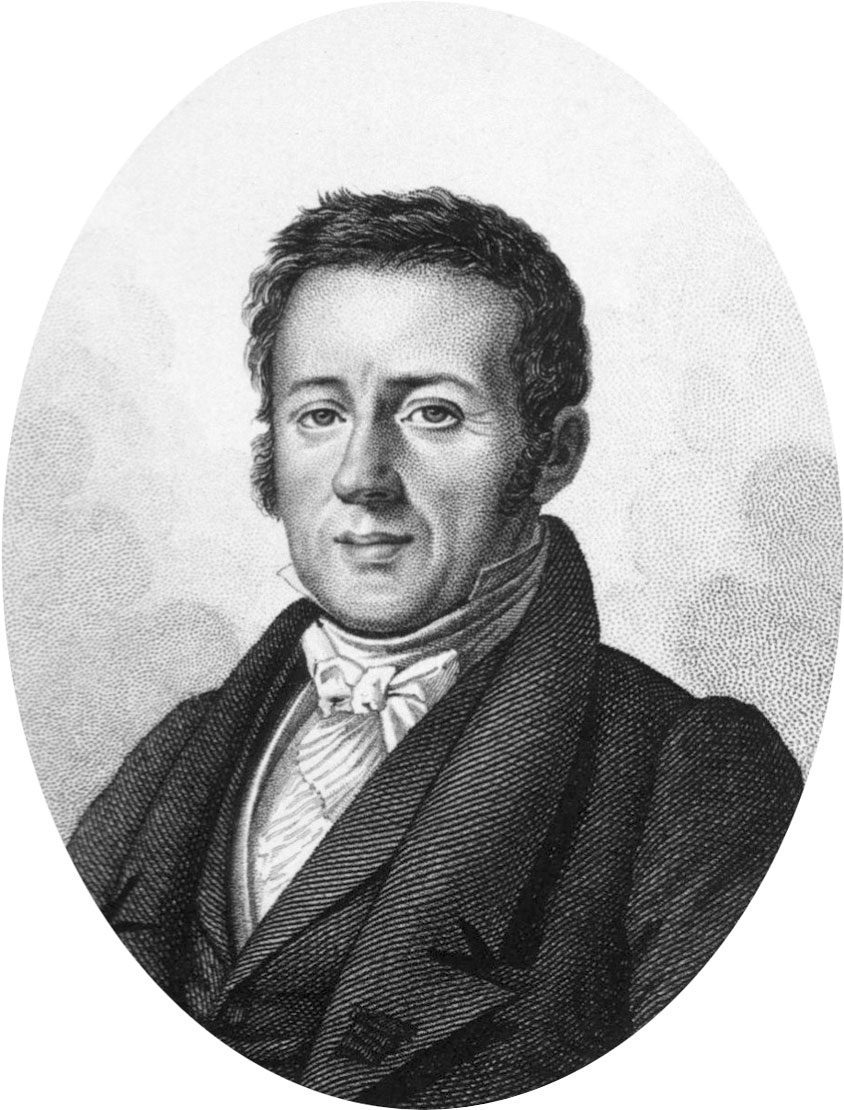
    Renรฉ Primevรจre Lesson
    Renรฉ Primevรจre Lesson

    Order: Psittaciformes
    Family: Psittacidae
    Genus: Forpus
    Scientific name: Forpus coelestis
    Citation: (Lesson, 1847)
    Protonimo: agapornis heavenly

    Pacific Parrotlet images:

    Videos of the "Pacific Parrotlet"

    Pacific Parrotlet (Forpus coelestis)


    Species of the genus Forpus

    Sources:

    • Avibase
    • Parrots of the World โ€“ Forshaw Joseph M
    • Parrots A Guide to the Parrots of the World – Tony Juniper & Mike Parr
    • Birdlife
    • Parrot Book, Parrots and macaws.

    Photos:

    (1) – Male Green Pacific Parrotlet, named Jackson By Susan C. Griffin (Own work) [CC BY-SA 3.0], via Wikimedia Commons
    (2) – Pacific Parrotlets (also known as Lessonโ€™s Parrotlet and Celestial Parrotlet) at Wilhelma Zoo, Stuttgart, Germany By Undertable [CC BY 2.0], via Wikimedia Commons
    (3) – A pet Pacific Parrotlet – yellow colour mutation By Becky Wetherington (originally posted to Flickr as 82/365 – Good bird.) [CC BY 2.0], via Wikimedia Commons
    (4) – A pet male Pacific Parrotlet (also known as Lessonโ€™s Parrotlet and Celestial Parrotlet) By Erin Purcell (originally posted to Flickr as [1]) [CC BY 2.0], via Wikimedia Commons
    (5) – Pacific Parrotlet (also known as Lessonโ€™s Parrotlet and Celestial Parrotlet) in El Empalme, El Oro Province, coastal SW Ecuador By markaharper1 [CC BY-SA 2.0], via Wikimedia Commons

    Sounds: (Xeno-canto)

    โ–ท The world of Pets: Dogs, cats, birds, reptiles, amphibians

    Yellow-chevroned parakeet
    Brotogeris chiriri

    Yellow-chevroned parakeet

    Content

    Description:

    20-25 cm.. length and 72 g. of weight.
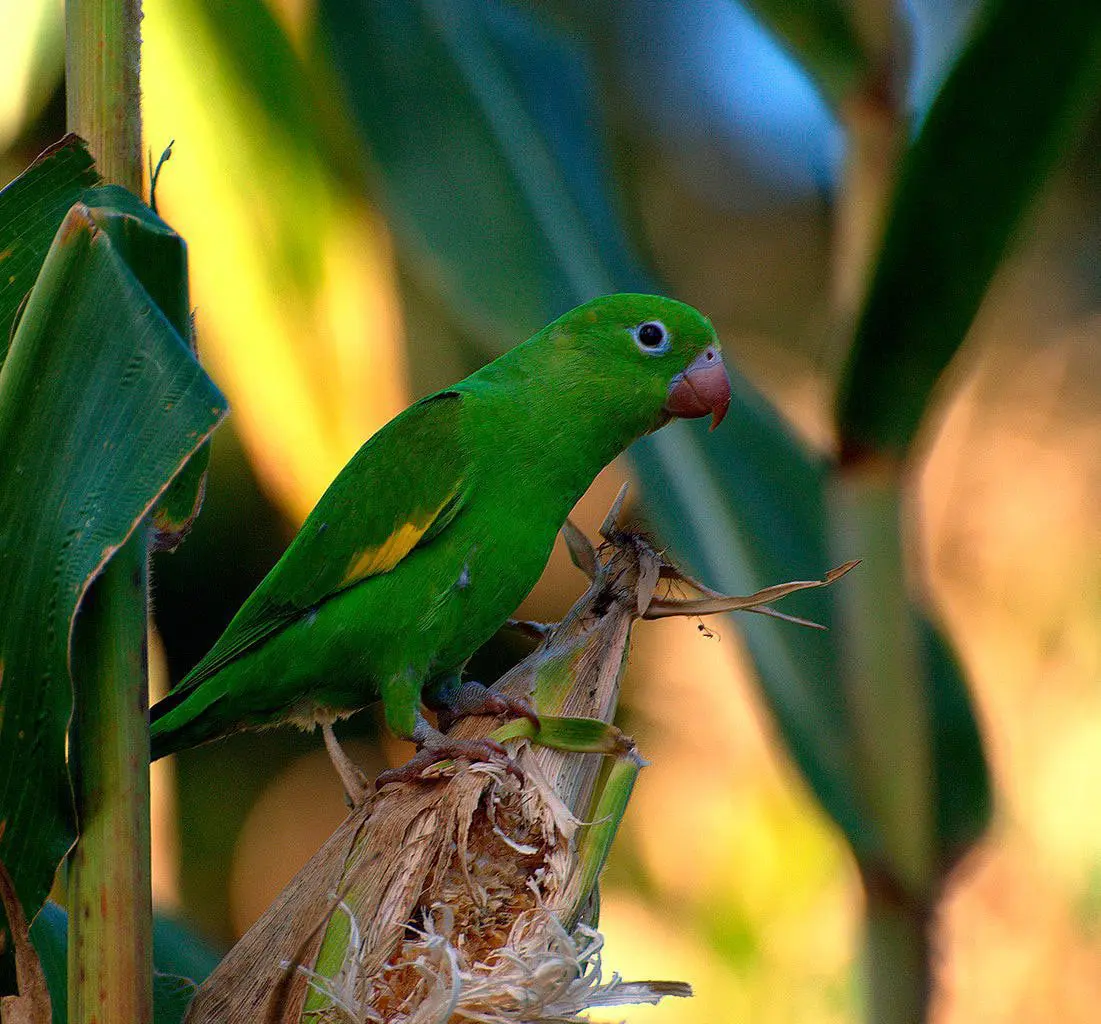
    The Yellow-chevroned parakeet (Brotogeris chiriri) has a plumage, in general, bright green; the underparts They are of a paler green and lower coverts are yellowish-green.

    The wings They are of a slightly darker green, with the yellow border, visible when wings remain bent or when the bird is in flight. Their bill, hook-shaped, is orange-brown and legs and feet, pinkish gray. The eye rings They are creamy white and eyes dark browns.
    It is intimately related to the Canary-winged Parakeet (Brotogeris versicolurus). In fact, it was considered conspรฉcifica (owned or belonging to the same species) until 1997.

    The females sexually dimorphic and are not to be sexed, either surgically or by DNA.

    The immature are similar to adults but have the tail shorter and the bill It is a darker brown.

    Taxonomic note:

        Until 1997, some taxonomists considered the Canary-winged Parakeet and Yellow-chevroned parakeet belonging to the same species. Even though the Yellow-chevroned parakeet It has the same secondary covert yellow feathers that can be seen in the Canary-winged Parakeet – no white in the primary wing feathers.

    Description 2 subspecies:

    • Brotogeris chiriri behni

      (Neumann, 1931) – Similar to the nominal species, except that they are slightly larger; the body green lacks the yellow dye.


    • Brotogeris chiriri chiriri

      (Vieillot, 1818) – Nominal.

    Habitat:

    Video – "Yellow-chevroned parakeet" (Brotogeris chiriri)

    Catita is still alive ( Brotogeris chiriri) : food and voice.

    They are mainly below 1000 m, locally up 2500 meters in a variety of habitats including humid forests, seasonal and coastal, Pantanal, savannah and city parks. reported to 2500 meters in arid areas.

    Usually, traveling in flocks; in such small groups as 2 to 4 birds, but they have been observed to 20. They are described as small parrots assets, entertaining to watch.

    Reproduction:

    Nest usually in the cavities of trees or in tree termite nests. They also form nesting tunnels in dead palm fronds..

    Once a nest It has been located and correctly "prepared" by the couple, It is performed the laying, between 4 and 5 eggs. after breeding, the Yellow-chevroned parakeet they form large communal huts until the next breeding season.

    Food:

    In their natural habitats, feed of seeds (including outbreaks), fruit as berries and figs and flowers. Also consume nectar, insects and their larvae. Often they are seen visiting barreiros (areas where there is soil rich in minerals) and the banks of the rivers to feed on the soil.

    Distribution:

    Size of its range (breeding/resident ): 5,670,000 km2

    Distributed inside East Brazil to the East of Bolivia, Paraguay and North of Argentina, in Formosa, Chaco, Missions and North of Currents. Introduced populations in Miami, Florida and California.

    Distribution 2 subspecies:

    • Brotogeris chiriri behni

      (Neumann, 1931) – Center of Bolivia to the Northwest of Argentina, in Salta.


    • Brotogeris chiriri chiriri

      (Vieillot, 1818) – Nominal.

    Conservation:

    State of conservation โ“˜


    minor concern Minor Concern โ“˜ (UICN)โ“˜

    โ€ข Current category of the Red List of the UICN: Least concern.

    โ€ข Population trend: Stable.

    Rationale for the Red List category

    This species has a extremely large range and, therefore, it does not approach the thresholds of vulnerability under the criteria of size range (Extension <20,000 km2 combinada con un tamaรฑo de rango decreciente o fluctuante, extensiรณn / calidad de hรกbitat o tamaรฑo de poblaciรณn y un pequeรฑo nรบmero De lugares o fragmentaciรณn severa). La demographic trend appears to be stable and, therefore, the species does not approach the thresholds Vulnerable under the criteria of population trend (> 30% decline over ten years or three generations). The population size has not been quantified, but it is not believed to be close to the thresholds for Vulnerable under the criterion of population size (<10.000 individuos maduros con un descenso continuo estimado> 10% in ten years or three generations or a population structure). For these reasons the species is evaluated as the least concern.

    Justification of the population

    The size of the world's population has not been quantified, but this species is described as ยซquite commonยป (Stotz et to the., 1996).

    Justification of trend

    They suspected that the population is stable in absence of evidence of any decline or threatens substantial.

    "Yellow-chevroned parakeet" in captivity:

    Today is Rare.

    Since the late sixties to mid-seventies, more than 260.000 these were parakeets imported from South America for the pet trade. At that moment, the Yellow-chevroned parakeet It was the most imported parrot. They settled in California (Los Angeles, San Francisco) self-sustaining populations Yellow-chevroned parakeet released or escapes; populations also in Florida (Miami), as well as Connecticut and New York City.

    The Chirirรญ Kitten appears to be better suited to its adopted habitat than its closely related cousin., the the Canary-winged Parakeet (Brotogeris versicolurus).

    The Canary-winged Parakeet It has declined considerably since the early 80, while the Yellow-chevroned parakeet It has established itself in different habitats.

    In 2002, the population of Yellow-chevroned parakeet in the area of Los Angeles, California It was estimated at 400 individuals. In the Florida, They have prospered more than any other place in the United States – there have been huge flocks, several hundred of them. The species is also quite established in the city center Rio de Janeiro, Brazil, which he was also introduced.

    Alternative names:

    Yellow-chevroned Parakeet, Chiriri Parakeet, Yellow chevroned Parakeet (English).
    Toui ร  ailes jaunes, Conure ร  ailes jaunes, Perruche ou, Toui ร  miroir jaune, Toui chiriri (French).
    Gelbflรผgelsittich, Kanarienflรผgelsittich (German).
    periquito-de-encontro-amarelo, periquio-de-encontro-amarelo, periquito-de-asa-amarela, tuรญ-chiriri (Portuguese).
    Catita chiriri, Catita Chirirรญ, Catita chรญriri (espaรฑol).
    Catita chirirรญ (Argentina).
    Catita chiriri, Catita chรญriri (Paraguay).
    Tu’รฎ Chyryry (Guarani).

    scientific classification:

    Order: Psittaciformes
    Family: Psittacidae
    Genus: Brotogeris
    Scientific name: Brotogeris chiriri
    Citation: (Vieillot, 1818)
    Protonimo: Psittacus chiriri

    Images Catita Chiriri:


    Species of the genus Brotogeris

    Sources:

    Avibase
    – Parrots of the World โ€“ Forshaw Joseph M
    – Parrots A Guide to the Parrots of the World – Tony Juniper & Mike Parr
    – Birdlife

    Photos:

    (1) – A Yellow-chevroned Parakeet in Sarutaiรก, Sao Paulo, Brazil By Dario Sanches [CC BY-SA 2.0], via Wikimedia Commons
    (2) – A pet Yellow-chevroned Parakeet By Wagner Machado Carlos Lemes from Goiรขnia, Brazil [CC BY 2.0], via Wikimedia Commons
    (3) – A Yellow-chevroned Parakeet perching in a tree By Paulo Barradas (Brotogeris chiririUploaded by Sno whom You nradio) [CC BY 2.0], via Wikimedia Commons
    (4) – A Yellow-chevroned Parakeet in Goiรขnia, Goiรกs, Brazil By Delcio Gonรงalves from Goiรขnia, Brazil (A corn diferenteUploaded by Snowmanradio) [CC BY 2.0], via Wikimedia Commons
    (5) – Parakeet yellow meeting. Photo taken in the hinterlands of the Sucuriรบ River By Deusdedith de Souza Alves Filho DehAlves (Own work) [CC BY-SA 4.0], via Wikimedia Commons
    (6) – Yellow-chevroned Parakeet (Brotogeris chiriri)(Left) and Peach-fronted Parakeet (Aratinga aurea)(Right) on Combretum flowers By Bernard DUPONT from FRANCE [CC BY-SA 2.0], via Wikimedia Commons
    (7) – A Yellow-chevroned Parakeet in Brazil By Alastair Rae (Flickr: Yellow-chevroned Parakeet) [CC BY-SA 2.0], via Wikimedia Commons
    (8) – A Yellow-chevroned Parakeet in Bonito, Mato Grosso do Sul, Brazil. It is perching on the stem of a mango, which it has been eating By Alexandre Pereira [CC BY-SA 2.0], via Wikimedia Commons
    (9) – A Yellow-chevroned Parakeet on Erythrina velutina By Derek Keats from Johannesburg, South Africa (… on Erythrina velutina) [CC BY 2.0], via Wikimedia Commons

    Sounds: Fernando Igor de Godoy (Xeno-canto)

    โ–ท The world of Pets: Dogs, cats, birds, reptiles, amphibians

    Diademed Parrot
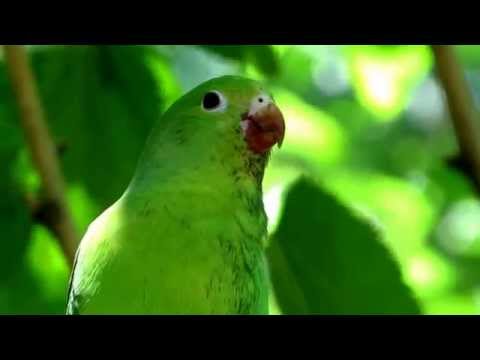
    Amazona Diadema

    amazona autumnalis

    Content

    Description:

    31โ€“35 cm. length and 450-550 g. of weight.

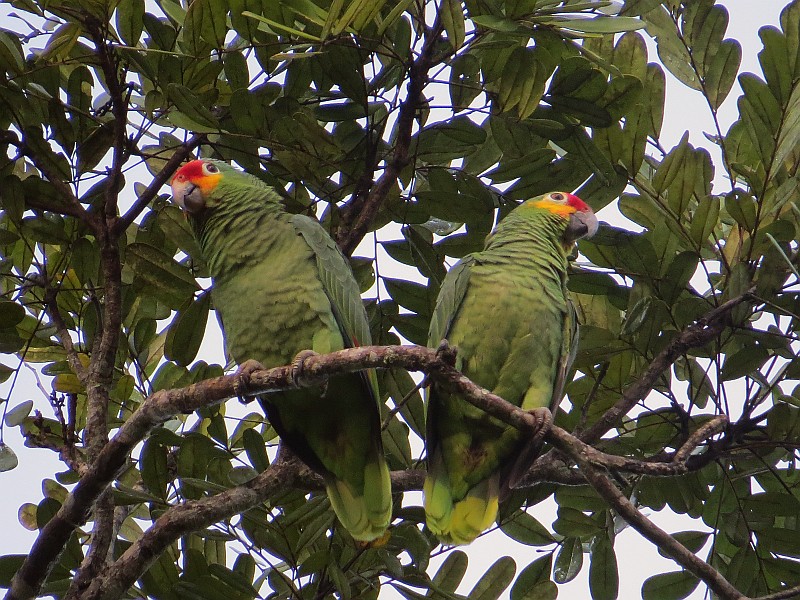
    The Diademed Parrot (Amazona Diadema) It is generally green, with black edges to feathers crown, to the mantle and the chest; crown green to nape; the back of the green neck, mauve margin; feathers of the cere and forecrown, red; yellow-green, less yellow in upper cheeks, up to the ear-coverts; secondaries red on the bases, the green rest; tail green; eye ring pale yellow; eyes oranges; bill dark grey.


    Note:

    Previously treated as conspecific with the Red-lored Amazon (Amazona autumnalis), It is very similar to the subspecies Amazona autumnalis salvini

    • Sound of the Diademed Parrot.

    Habitat:


    Anatomy-parrots

    It is likely to frequent a variety of habitats from lowland forest species, including edges evergreen forest, as well as modified areas containing scattered trees or plantations (Del Hoyo et al., 1997, pit et to the., 2016).

    They are in loose flocks or pairs, are gregarious When feed.

    Reproduction:

    The laying is of 2-3 eggs. Breeding season, It is supposed to be in early: January-March.

    Food:

    It feeds mainly from fruits and seeds, even some cultivated species (Del Hoyo et al., 1997), although there are no published data (Del Hoyo et al., 2016).

    Distribution:

    Size of its range (breeding/resident): 71.800 km2

    Endemic low Black river and the northern margin of Amazon River, in the states of amazon and Northwest of For, in Brazil.

    Conservation Amazona diadema:

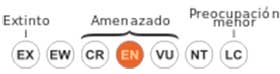
    State of conservation โ“˜


    Endangered Endangered โ“˜ (UICN)โ“˜

    โ€ข Current category of the Red List of the UICN: In danger of extinction.

    โ€ข Population trend: Decreasing.

    Rationale for the Red List category

      Based on a model of future deforestation on amazon basin and susceptibility to this new species capture, it is suspected that its population will suffer a very fast along three generations descent from 2002, so it is in danger of extinction.

    Justification of trend

      This species is expected to lose between 49 and 55% suitable habitat within its distribution throughout three generations (37 years) starting at 2002, based on a model of Amazon deforestation (Soares-Filho et to the). Given its susceptibility to capture, It is suspected that species decline by 50-79% during this time.
    Threats

    โ€ข The main threat to this species is the accelerating deforestation in the Amazon Basin as land is cleared for ranching and soy production, provided by the expansion of the road network, together with his susceptibility to capture (Soares-Filho et to the. 2011).

    โ€ข The species is assumed to experience some pressure catch, probably mainly for internal trade, since this species is rare in aviculture (Del Hoyo et al ., 1997, pit et to the ., 2016).

    โ€ข Proposed changes to the Brazilian Forest Code reduce the percentage of land to a private owner is legally obliged to keep as forest (including, critically, a reduction in the width of forest buffers with perennial vapors) and include an amnesty for owners who deforested before July 2008 (That they would later be absolved of the need to reforest illegally vacated land) (Bird et to the., 2011).

    Conservation Actions Underway

    โ€ข No specific conservation actions are known for this species, although part of their habitat is protected.

    โ€ข It is distributed in the Jau National Park where it is rare or uncommon (Borges et al ., 2001, Borges & Almeida 2011).

    Conservation Actions Proposed

    โ€ข Carry out surveys to estimate the size of the population.

    โ€ข Monitor deforestation rates in the range using remote sensing techniques.

    โ€ข Study the level of Trapping threat.

    โ€ข Increase the area of โ€‹โ€‹suitable habitat that receives protection effective.

    โ€ข Boost changes in laws related to deforestation and forest protection.

    The Diademed Parrot in captivity:

    Rare in aviculture.

    Each captive specimen of this species which is capable of reproducing, It is placed in a well managed captive breeding program and not be sold as a pet, in order to ensure its long-term survival.

    Alternative names:

    Diademed Amazon, Diademed Parrot, Red-lored Parrot (Diademed) (English).
    Amazone ร  diadรจme, Amazone diadรจme, Amazone du Brรฉsil (French).
    Diademamazone (German).
    Papagaio-diadema (Portuguese).
    Amazona diadema (espaรฑol).


    Scientific classification Diademed amazon:

    Johann Baptist von Spix

    Order: Psittaciformes
    Family: Psittacidae
    Genus: Amazona
    Scientific name: Diademed Parrot
    Citation: (von Spix, 1824)
    Protonimo: Psittams diadema


    Diademed Parrot images.:


    Species of the genus Amazona


    Sources:

    Photos:

    (1) – diadem parrot. Red lored parrot. 11 November 2015, Tikal, Guatemala by ze_da_binha
    (2) – Diademed Parrot – amazon with tiara – Diademed amazon – amazon tiara By Florin Feneru from Orpington, UK (Diademed Parrot) [CC BY 2.0], via Wikimedia Commons
    (3) – A Red-lored Amazon at Loro Parque, Cross port, Tenerife, Spain. This subspecies is also called the Diademed Amazon By Carlos Urdiales [CC BY-SA 2.0], via Wikimedia Commons
    (4) – A Red-lored Amazon at Xcaret Eco Park, Riviera Maya, Mexico. Photographed as it started to rain By Tomasz Wagner from Burnaby, BC, Canada (Parrot – Amazona autumnalis) [CC BY-SA 2.0], via Wikimedia Commons
    (5) – Diademed amazon (Diademed Parrot) Loro Parque, Tenerife by Florin FeneruFlickr
    (6) – PL. XXXI I Chrysolis diadema (รฎ^wl By Blanchard, Emile; Bonaparte, Charles Lucian; Bourjot Saint-Hilaire, Alexandre; Le Vaillant, Franรงois; Souancรฉ, Charles de. [CC BY 2.0 or Public domain], via Wikimedia Commons

    Sounds: GABRIEL MILK, XC119110. accessible www.xeno-canto.org/119110

    โ–ท The world of Pets: Dogs, cats, birds, reptiles, amphibians

    Large-billed Parrotlet
    Forpus crassirostris

    Large-billed Parrotlet

    Content

    Description:

    12 to 13 cm.. height.

    The Large-billed Parrotlet (Forpus crassirostris) has the crown, back of the neck and ear-coverts, green; the forecrown, cheeks, eye area and lores, emerald green.

    Upperparts and wings, green, except the part inferior of the back, rump and greater coverts, are cobalt blue and blue color toward the base of the secondaries. Primary coverts pale grayish violet color which contrasts with the darker coverts They are cobalt blue. flight feathers Matte metallic blue. The underparts green with yellow hues. Upper, the tail green; undertail, pale green.

    Bill and cere Pink with gray base up to the mandible top, laterally compressed in the Center; bare periophthalmic pale grey: irises dark brown: legs Gris-Rosado pale.
    Female all green with belly yellowish green without blue color wing-coverts visible in the male.
    Immature like adult respective, but with the blue of young males mixed with green.

    Taxonomic note:

    some authors (for example, Meyer de Schauensee 1966, Forshaw, 1973, Monroe y Sibley, 1993) They have used the name Forpus xanthopterygius, while other authors (Stotz et to the., 1996, Collar 1997) They have followed Pinto (1945) and used the name Forpus crassirostris to define this species.

    • Sound of the Large-billed Parrotlet.

    Habitat:

    They inhabit in forest edges, clear, riparian forests, parks and gardens in urban areas.

    Reproduction:

    They build their nests in tree cavities or exploit abandoned nests common hornero (Furnarius rufus); lining the nesting chamber with grass and the female lays 3 to 7 eggs White. The incubation, lasts approximately 18 days, It is carried out by the female and during this period the male is in charge of feeding her.

    Food:

    They compose your diet seeds, fruit, plants and flowers herbaceous. They are feeding both the ground and in trees and shrubs. Among the fruits they are highly appreciated by the Large-billed Parrotlet, palm, Trumpet trees (Cecropia spp), as well as seeds and shoots of Paineiras (Ceiba speciosa).

    Melo et al, 2009, reported mass consumption flowers of Handroanthus serratifolius (Fam. Bignoniaceae), in particular its nectar, what it appears to be an important power source especially during the dry season, where scarce fruits.

    Distribution:

    Size of its range (players / residents) 1.312.215 kmยฒ

    Southeast of Colombia to the East of Ecuador, North of Peru and West Brazil.

    Conservation:


    minor concern


    โ€ข Current category of the Red List of the UICN: Least concern.

    โ€ข Population trend: Stable.

    Justification of the population

    The size of the world's population of the Blue-winged Parrotlet It has not been quantified, but this species is described as ยซcommonยป (Stotz et to the., 1996).

    Justification of trend

    Suspected that the population is stable in absence of evidence of any decline or threatens substantial.

    "Large-billed Parrotlet" in captivity:

    In captivity they are not very frequent. They are birds enable you require a large cage. Quiet and something Shy. Not is easy to accommodate them with other parrots.
    Can be prone to it Obesity.

    Alternative names:

    Blue-winged Parrotlet (crassirostris), Large-billed Parrotlet (English).
    Toui ร  gros bec, Toui de Spix (crassirostris) (French).
    Large-billed Parrotlet (German).
    Tuim, Large-billed Parrotlet (Portuguese).
    Catita enana, Lorito Aliazul, Periquito Azulejo, Cotorrita aliazul, Lorito de alas azules (espaรฑol).

    Wladyslaw Taczanowski


    scientific classification:


    Order: Psittaciformes
    Family: Psittacidae
    Genus: Forpus
    Scientific name: Forpus crassirostris
    Citation: (By Taczanowsk, 1883)
    Protonimo: Psittacula crassirostris

    Images "Large-billed Parrotlet"

    ————————————————————————————————

    "Lorito Aliazul" (Forpus crassirostris)


    Sources:

    Avibase
    – Parrots of the World โ€“ Forshaw Joseph M
    – Parrots A Guide to the Parrots of the World – Tony Juniper & Mike Parr

    Photos:

    (1) – Large-billed Parrotlet (Forpus crassirostris) Male – Photo by Tom Friedel – Puerto Nariรฑo, amazon, Colombia – birdphotos.com

    Sounds: John V. Moore, XC257657. accessible www.xeno-canto.org/257657