▷ The world of Pets: Dogs, cats, birds, reptiles, amphibians

Japanese Terrier
Japón FCI 259 . Small sized Terriers.

Japanese Terrier

The Japanese Terrier it hardly enjoys diffusion and is practically to discover.

Content

History

In the middle of the Edo era, about 1700, a small dog appeared in Japan that looked very much like the type of terrier. It was the result of a cross between small Japanese dogs with English Fox Terrier Smooth, which was brought to the port of Nagasaki by Dutch sailors. At that time the port of Nagasaki was the only port open to Western countries., especially the dutch. After several generations, some descendants of these dogs were bred as a type of Italian Greyhound.

About 1900, al final de la era Meiji, Some of the best of the mentioned dogs were seen in the Kobe district and called "Kobe Terriers". His type was something between modern Fox Terrier Smooth and the modern Japanese Terrier. They were the first terriers to be bred in Japan. This "Kobe Terrier" and some of its ancestors were also called "Oyuki Terrier" and "Mikado Terrier" and are said to be carefully cared for by the premises and also by foreigners.

About 1916 an ancestor of the Japanese Terrier in the Nada district, near Kobe, A dog called "Kuro" (born in 1913 in Kobe), which means "black" in Japanese. This dog was a cross between a English toy terrier and Bull Terrier miniature, both imported from western countries. These pups were bred with bitches of the aforementioned Kobe Terrier. The result was a very short haired dog, thin and small of the Terrier type and was called Japanese Terrier (NIHON) since then. in those days, major breeders in Osaka county engaged in inbreeding and line breeding to cement appearance. Thanks to your efforts, the breed was firmly established in 1930.

In 1932 NIHON TERIA CLUB was founded under the presidency of Tamara KIKUJIRO. The Japanese Terrier it was ideal for city dog ​​breeders and became fashionable.

In 1940, where cities were built everywhere and with these cities grew the demand for a smaller and more active dog than the large guard dogs, the Japanese Terrier became very popular. But, in all its history, this breed was twice threatened with extinction. The first time, during WWII and again, about 1948, due to loss of popularity among the Japanese, since other western races were more fashionable.

Although the Japanese Terrier was recognized by the F.C.I. (Federation Cynologique Internationale) in 1964, this breed was practically unknown outside of Japan.

According to the documents, three basic lines of Japanese Terrier: «LANDMARK» (by Mr.. Nobuaki Shigematsu, Yamaguchi Prefecture), «TAIKO» (by Mr.. Sumiko Amano, Hamamatsu City) and "Tama Takahara" (by Mr.. Jun Takahara, Such).

About 1985, there was less than 50 bitches available for breeding throughout Japan. After the great efforts of some volunteers, who were aware of the need for immediate protection of the race, the number of dogs had reached about 400 breeding dogs after seven years.

So, special mention must be made of the efforts of Mr.. Jun TAKAHARA, whose commitment made the Japanese Terrier was known beyond the borders of Japan.

The breed was not seen in European countries until 1991, when a couple of Japanese Terriers arrived in France at the request of Mrs.. Luisa González de Castejón. Their dog names were "Kuroyuri Maru from Tama Takahara" (male) Y «Keshinome Brains De Tama Takahara» (female).

Another European breeder had also joined this adventure in the years 90: The Sr. Roberto Verde from Naples (Italy) he also owned three beautiful Japanese Terriers.

Time and time again there have been and still are some breeders who care for this breed, but unfortunately it was not possible to establish a stable population in Europe.

After 2 years of establishing contact with the Japanese breeder Mr.. Thoshihide OZAKI was able to import the FIRST Japanese Terrier the 4.11.2014 to AUSTRIA. «Yodogimi de Ozaki Farm JP» born 28.06.2014. This dog was registered with the Austrian Kennel Club (ÖHZB) con JAPT 1.

In order to create a breeding base, more dogs have been imported from Japan in recent years. In total 4 females were brought to Austria and two males (Ozaki Farm JP’s HIBIKI Swiss / 2017 & Ozaki Farm JP’s SHIN / 2018) were transferred to Switzerland. In 2017 the first Japanese Terrier.

Physical characteristics

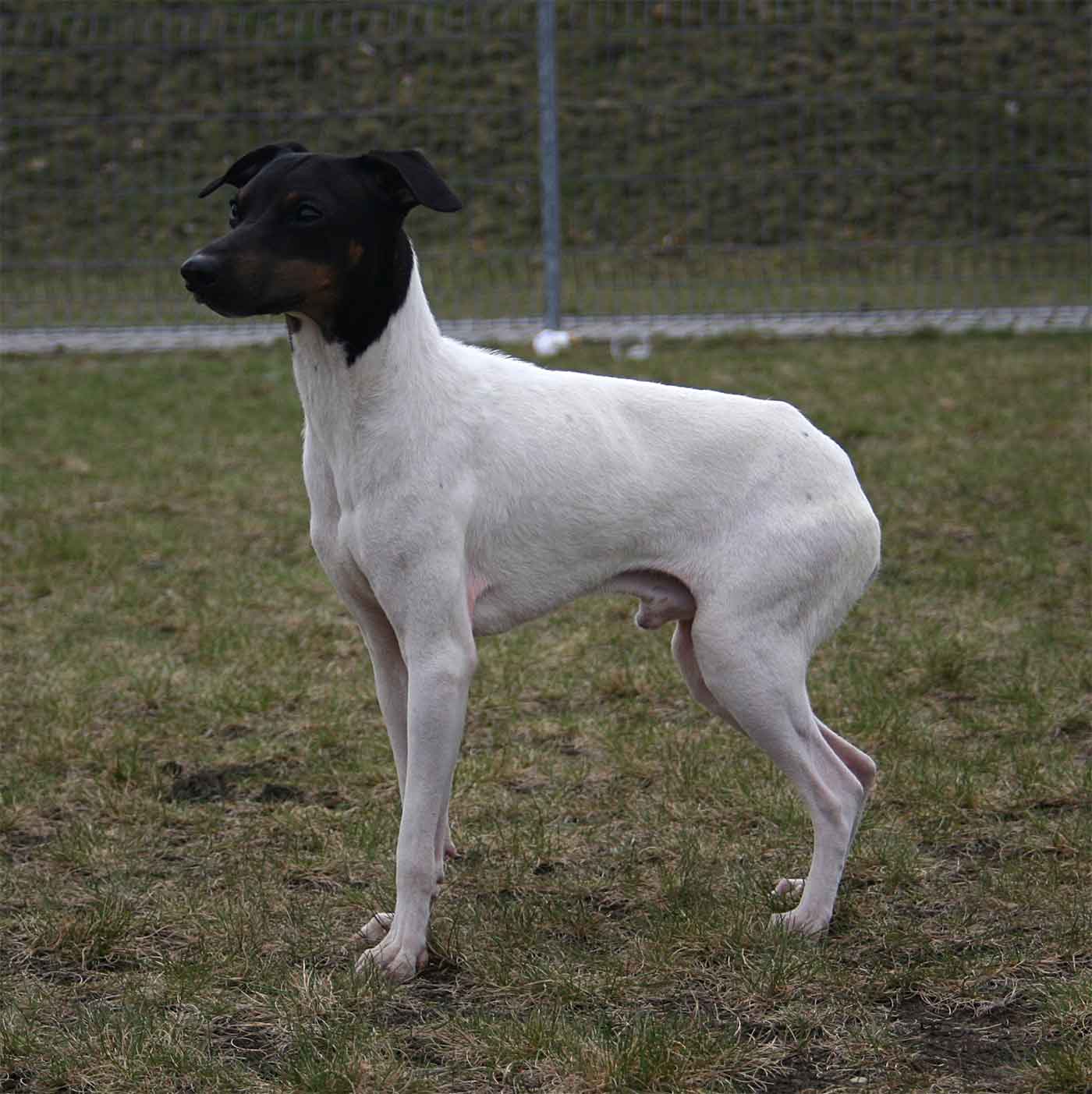
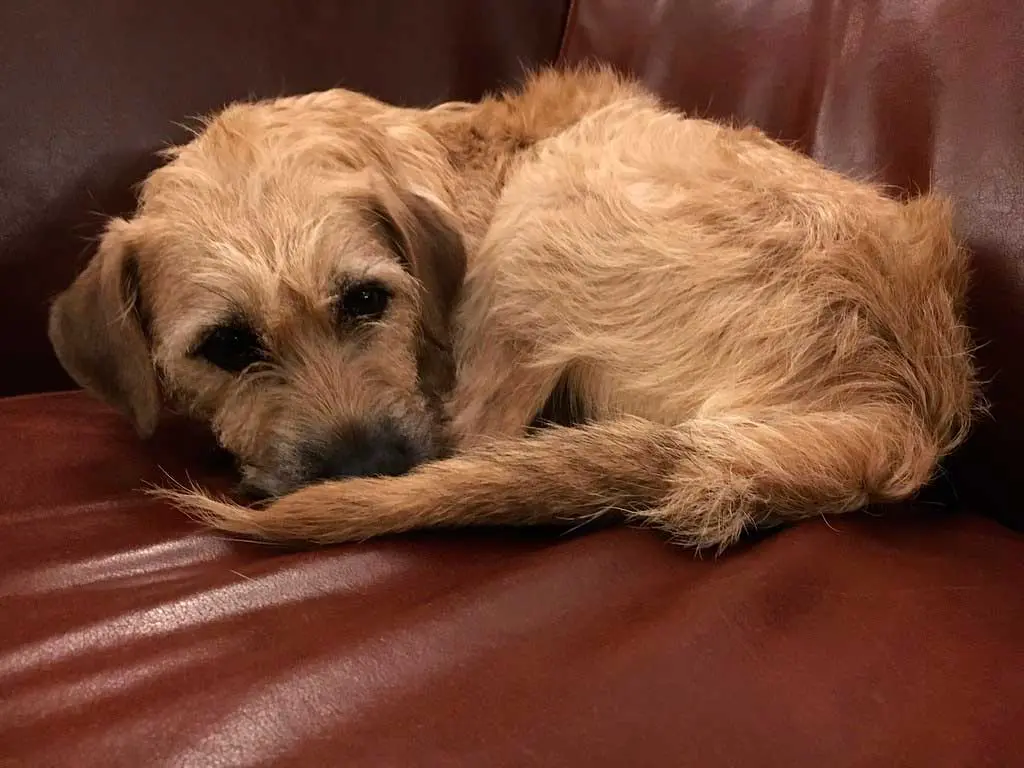
It is a small dog, elegant in appearance, and a defined and compact configuration.

Shoulder height: 30 cm. – 33 cm.; Weight: a few 5 kg

Fur: Short (2mm) smooth, dense and glossy; the coat does not need any additional care;

Color: Head: Tricolor (fire and white); Body: Basic color white with small black or tan spots.

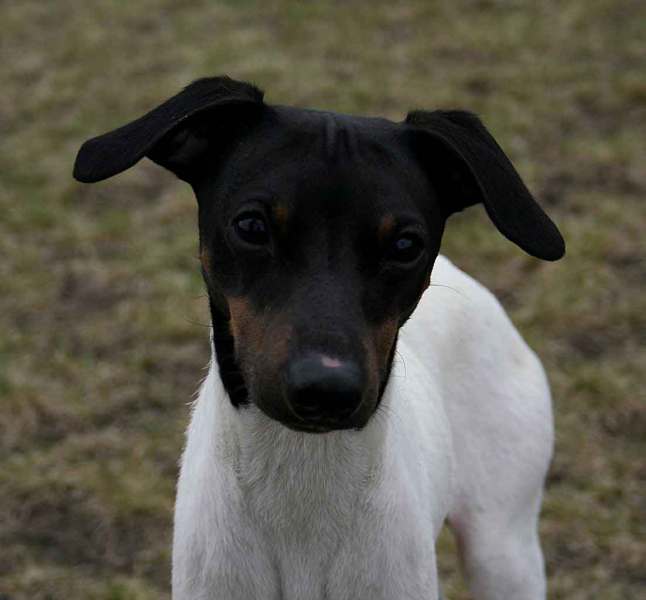
The breeders of the Japanese Terrier they are very demanding in terms of appearance and color markings, that are sometimes considered more important than your sports skills. The ideal colors and markings in a Japanese Terrier are the black, chocolate brown and beige: The head, ears and nose bone should be dark in color, black or chocolate brown. The muzzle to the nose and on each cheek and above each eye should be light brown. The lower jaw will be white. A clear "V" is visible in the neck. Occasionally there are also dark gray heads with light brown markings. But, this is considered to be the worst of the color variations. This is different with the deep black heads. This black color is allowed, because it reminds one of the old kobe dogs.

Character and skills

The Japanese Terrier not only is he a very intelligent puppy, but also mischievous and full of terrier temperament. Knowing him means loving him for his great sensitivity. He has a cheerful character and will participate in games with pleasure and joy.. It is a one-man dog whose devotion flatters its owner. As an attentive house dog will warn of the approach of a stranger but without being aggressive. It is very easy to train and can learn all kinds of tricks. His greatest effort is to please his owner. As a sports partner he has great skills and innate instincts. Has an excellent sense of smell and good eyesight, but still has no hunting ambitions. It's never quarrelsome, She gets along well with other dogs, especially with his own race.

It is an independent puppy, whose characteristics make it a pleasant "partner". It is suitable for young people, for both athletes and the young at heart. And one thing is especially important for the little terrier: snuggling with its owner.

Fitness: The Japanese Terrier it's a small dog, but still needs enough activity. It is the ideal companion for active people. Likes to learn and is therefore also suitable for mind games or dog sports that are suitable for small breeds.

It is a "skirt dog" in the positive sense. But that's only if you are tired of the many races!!

With the kids:

The Japanese Terrier is very attached to his owners and enjoys a good snuggle. But, he is not a babysitter dog. As in all small dog breeds, small body size has advantages when traveling, but it becomes a disadvantage with – and I say it with affection – the clumsy hands of children. This means that when they have children, make sure children handle the dog with care. Offer the dog an area where he can retreat if he becomes too heavy for him. If this is observed, nothing stands in the way of positive cooperation.

Correct nutrition Japanese Terrier

Proper nutrition is extremely important to avoid diet-related diseases. It is important to have a balanced diet that suits your beloved. Due to its active nature, the Japanese Terrier has its own nutritional requirements. It is very agile, so you should pay attention to a sufficient power supply.

High-quality whole foods are precisely tailored to your dog's nutritional needs. This ensures a supply of all the nutrients your dog needs.. High-quality prepared foods have the advantage that no feed additives are needed.

Terriers are often susceptible to allergies based on gluten-containing grains. In this case, you must ensure that the food contains other sources of carbohydrates. Rice or potatoes are a good alternative here. Food intolerance can lead to skin rashes, inflammation and digestive problems.

It is recommended to feed your terrier several times a day in small portions.. After each feeding, a pause in digestion must be ensured. You should refrain from eating before planned sports activities.

Care Japanese Terrier

The coat of his Japanese Terrier it is extremely easy to care, since it only measures about 2 cm long. Don't lose much, but you will enjoy removing loose hairs with a silicone glove. Even dandruff can be removed and the blood circulation of the skin is stimulated.

Your terrier's hair doesn't grow too thick. So, it is recommended to wear a coat during the cold months. If you stay outdoors for a longer period of time, protect your stomach and nose with sun milk.

When caring for your terrier's teeth, you should make sure that you do not feed him any food that contains sugar. These damage teeth, which in turn can lead to serious digestive problems.

The Japanese Terrier has a highly developed musculature, but its bone structure is quite fine. So, the use of a dog harness is recommended instead of a collar. If you stay home alone for a while, chewing bones of an appropriate size can be used as a toy.

Characteristics "Japanese Terrier"

Coexistence is important that you have with your new friend. Before considering the acquisition of a dog of the breed "Japanese Terrier" you know certain factors. Not all breeds of dogs are apt to live in an apartment, you must take into account his character, their need for exercise, their interaction with other pets, their care and if you have small children, their level of tolerance towards them.

Adaptation ⓘ

2,0 of 5 stars (based on 1 review)

friendly dog ​​ⓘ

3,0 of 5 stars (based on 1 review)

hair loss ⓘ

3,0 of 5 stars (based on 1 review)

Affection level ⓘ

5,0 of 5 stars (based on 1 review)

Need for exercise ⓘ

1,0 of 5 stars (based on 1 review)

Social need ⓘ

4,0 of 5 stars (based on 1 review)

Home ⓘ

3,0 of 5 stars (based on 1 review)

Toilet ⓘ

1,0 of 5 stars (based on 1 review)

Friendly with strangers ⓘ

3,0 of 5 stars (based on 1 review)

barking ⓘ

4,0 of 5 stars (based on 1 review)

Health ⓘ

4,0 of 5 stars (based on 1 review)

Territorial ⓘ

4,0 of 5 stars (based on 1 review)

Cat friendly ⓘ

3,0 of 5 stars (based on 1 review)

Intelligence ⓘ

4,0 of 5 stars (based on 1 review)

Versatility ⓘ

4,0 of 5 stars (based on 1 review)

Child friendly ⓘ

4,0 of 5 stars (based on 1 review)

Surveillance ⓘ

3,0 of 5 stars (based on 1 review)

joy ⓘ

5,0 of 5 stars (based on 1 review)

Images "Japanese Terrier"

Photos:

1 – At photo Amakakeru-Meiji White Oleander – Japanese Terrier on dogs show in Konopiska, Poland. The owner is Paweł Gąsiorski by https://commons.wikimedia.org/wiki/User:Pleple2000
2 – At photo Amakakeru-Meiji White Oleander – Japanese Terrier on dogs show in Konopiska, Poland. The owner is Paweł Gąsiorsk by Pleple2000 / CC BY-SA
3 – At photo Amakakeru-Meiji White Oleander – Japanese Terrier on dogs show in Konopiska, Poland. The owner is Paweł Gąsiorski by Pleple2000 / CC BY-SA
4 – At photo Amakakeru-Meiji White Oleander – Japanese Terrier on dogs show in Konopiska, Poland. The owner is Paweł Gąsiorski. by Pleple2000 / CC BY-SA
5 – A Japanese Terrier by Canarian / CC BY-SA
6 – Bernie Lindsey, my dog by Bernielindsey44 at en.wikipedia / Public domain
7 – At photo Amakakeru-Meiji White Oleander – Japanese Terrier. by Paweł Gąsiorski / CC BY-SA

Videos "Japanese Terrier"

Type and recognitions:

  • FCI CLASSIFICATION:
  • Group :
  • Section : . .

Federations:

  • – FCI – Terriers 2 Small sized Terriers. ⓘ
  • – Japan Kennel Club – Terriers ⓘ

  • FCI breed standard "Japanese Terrier"

    Origin:
    Japan

    Date of publication of the valid original standard:
    04.04.2016.

    Use:

    Companion dog


    General appearance:

    It is a small dog, elegant in appearance, and a defined and compact configuration. Hair measuring approximately 2 mm is very short.

    PROPIMPORTANT ORTIONS: The ratio of the height at the withers to the length of the body is 1: 1. The muzzle and the skull are the same length.


    Behavior / temperament:

    The Japanese Terrier is agile and with a lively temperament.

    Head:

    ---

    Cranial region:
    • Craging: Flat and moderately narrow.
    • Dnaso-frontal depression (stop): Not very defined.

    facial region:

    • Nariz: Black. The nasal helm is straight.
    • Labios: They are thin and tight.
    • Jaws/ Teeth: Strong white teeth. The joint is in the form of scissors.
    • Cheeks: Thin, not bulky.
    • Ojors: Medium-sized, oval shape and dark in color.
    • Obars: High implementation. They are rather small, thin, V-shaped, and fall forward. But, bent and raised on both sides of the skull are allowed.

    Neck:

    It is of moderate length, strong, and gradually widens towards the dewlap-free shoulder region.

    Body:

    • Cruz: High.
    • Dorrso: Short and firm.
    • Itmor: Slightly arched.
    • Glikeness: Powerful.
    • Pecho: Deep, although the pectoral region is not too wide. The ribs are well sprung.
    • Línlower ea and belly: Bellywell collected.

    Tail:

    Moderately thin; Traditionally, amputated in thecountry of origin. En the countries where the cut of tail is prohibited, the natural tail is slightly curved and tapers towards the tip. In motion it is moderately high.

    Tips

    PREVIOUS MEMBERS:

    • Hormbros: Slightly inclined.
    • Antarms: They are straight; the bones are not heavy.
    • Pinis previous: They are good together. The foot pads are elastic; nails are hard and preferably dark in color.

    LATER MEMBERS:

    • Thighs: Long.
    • Rodinllto: Moderately angled.
    • Ahock joint: Moderately angled.
    • Metatarsus: Vertical.
    • Pinis later: They are good together. The foot pads are elastic; nails are hard and preferably dark in color.

    Movement:

    It is light and agile.

    Mantle

    Plink: Short, smooth, dense and lustrous.

    Colorr: Tricolor, with a black head, fire and white. White with black spots, black marks or tan marks on the body.


    Size and weight:

    So much for males, as for females, height is about 30 to 33 cm..


    Fouls:

    Any deviation from the aforementioned criteria is considered as a fault and the severity of this is considered to the degree of the deviation to the standard and its consequences on the health and well-being of the dog..

    FALTAS DISQUALIFYING:

    • Aggressiveness or extreme shyness.
    • Any dog ​​showing clear signs of physical or behavioral abnormalities must be disqualified..
    • Long hair.
    • Pronounced upper or lower prognathism.


    N.B.:
    • Males should have two normal-appearing testicles fully descended into the scrotum..
    • Only functionally and clinically healthy dogs, with the typical conformation of the breed, should be used for breeding

    Itlatest changes are in bold.

    TRaduCCióN: Mrs. Brígida Nestler.

    ItsPETechnical review: SR. Miguel Angel Martinez.

    Source: F.C.I - International Cynological Federation

    Alternative names:

    1. Nippon Terrier, Nihon Teria, Nihon Terrier, Kobe Terrier, Mikado Terrier, Oyuki (snowy) Terrier (English).
    2. Nihon teria (French).
    3. Nippon-Terrier, Nishon-Terrier (German).
    4. nihon, nippon terrier (Portuguese).
    5. Nihon teria, Terrier Nipón, Terrier Japonés (español).

▷ The world of Pets: Dogs, cats, birds, reptiles, amphibians

Irish Glenn of Imaal Terrier
Irlanda FCI 302 . Large and medium sized Terriers
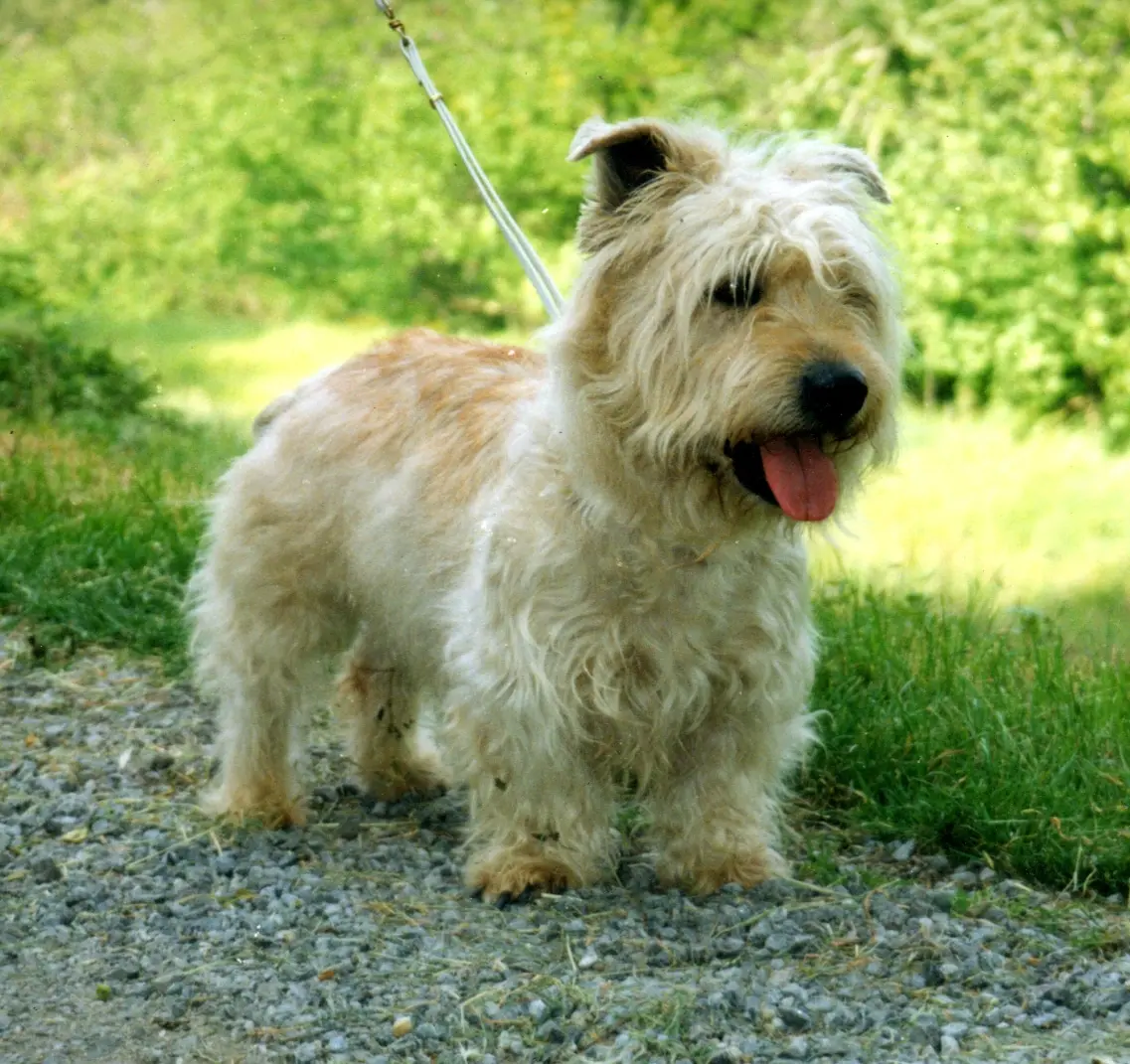
It is generally believed that Irish Glenn of Imaal Terrier is less excitable than other Terriers, although it takes action immediately when prompted.

Glen of Imaal Terrier

Content

History

The Irish Glenn of Imaal Terrier originates from the Irish east coast, in county wicklow, which is in the ravine (=Valle) the Imaal. From this rough and wild valley this very old breed got its name. It was first mentioned around 1575.

Like old farm dog, the Irish Glenn of Imaal Terrier he had a very busy life and worked hard for his master. His job was to catch rats and mice on farms and operate smaller work machines like churns and work grinders., where I had to run on leather straps. He also accompanied his master on the fox hunt, the Badger and Otter. He worked in silence and if necessary he fought to the death. Before it was banned in Ireland, the Irish Glenn of Imaal Terrier also used in questionable dogfights. Of course, he was also the most loyal friend and guarded the house and the yard, never shied away from facing a much bigger and stronger opponent.

For its owner, the Irish Glenn of Imaal Terrier it was as important as his daily bread, although undemanding, frugal and tough enough to share the barren life of farmers. This harsh life brought with it a ruthless selection. Only the toughest and most frugal Terriers survived, what characterizes the breed until today.

The pedigree of Irish Glenn of Imaal Terrier it's an irish secret to this day. In Ireland itself, this Terrier has never been numerous and did not leave his ancestral home until 1980, when the owners preserved him as a true child of nature, marked by great courage, skill and endurance. In 1933 the breed was officially recognized by the Irish Kennel Club ( I.K.C.). The international recognition of the F.C.I. continued on 1981.

Physical characteristics

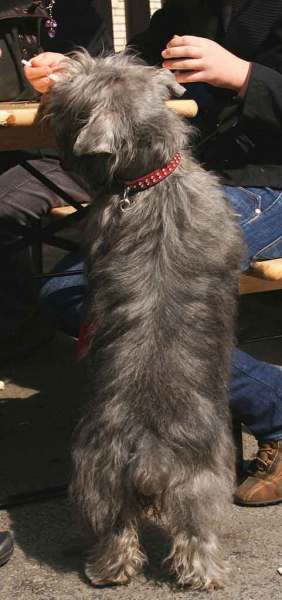
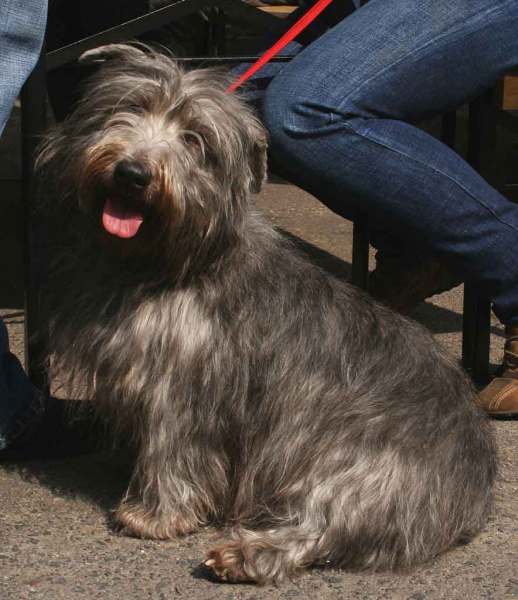
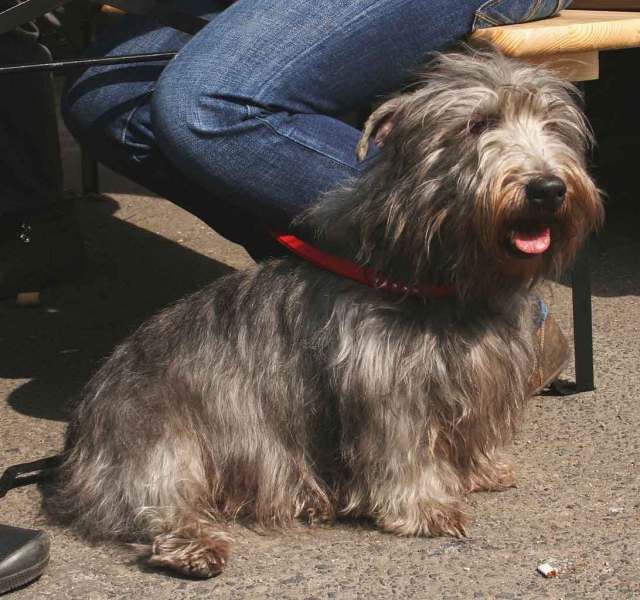
The Irish Glenn of Imaal Terrier it is small but strong and robust and weighs up to 16 kilograms with a maximum height at the withers of 36 centimeters. Its relatively small forward leaning ears are notable.. Its coat is medium length and consists of a rough top layer and a smooth bottom layer. It can be wheat colored, tabby blue or in different shades of red and gold. In the case of a dark-colored coat, a black-blue mask is common., which can also show as stripes over the ears, along the back and tail, so these marks become clearly clearer with increasing age.

Character and skills

Today the Irish Glenn of Imaal Terrier it is a gentle and docile family dog. Its balanced and faithful nature, as well as his average temperament make life with him very pleasant. The Irish Glenn of Imaal Terrier is very affectionate, always cheerful and in a good mood and preferably "in the middle". Enjoy all the attention and care, but without demanding anything. Rather, follows her around with her alert gaze and once she has gained attention, shows his joy about it with strong tail swipes. If the joy is particularly great, his temperament can also run away with him.

Children are welcome as playmates, if they show him the respect that he shows. Pets are accepted by him without problems when they get used to each other. The Irish Glenn of Imaal Terrier she is always friendly with strangers, and with his contagious joy, His charm and his irresistible look quickly have all the sympathies on his side.. After all, it is a terrier that radiates a lot of personality. He is open-minded and not afraid to learn new things. He likes to be everywhere with his nose. In general, everything that is new – Weird people, new environments, an object that has not been there before – it is very interesting and has to be examined very carefully. The Irish Glen of Imaal Terrier is a particularly attentive observer. Along with her charming nature and her desire to do everything right, is very adaptable and develops a very close relationship with his family. He likes to accompany them whenever possible. Like a very people-oriented terrier, I would defend them in an emergency, even to death. Feel more comfortable in your proximity.

What characterizes him Irish Glenn of Imaal Terrier is his great courage, his self-confidence and intelligence above average. Sufficient workload and intellectual work are important to the intelligent four-legged friend. Enjoy almost all activities, be it sports with dogs, search games or learning tricks – is available for all kinds of fun.

Despite its short legs, it is very agile, due to his muscular physique, a small power. Its special characteristics are its slightly curved front legs with the legs turned outward., his big head and his pronounced chest. The Irish Glenn of Imaal Terrier it is a very balanced dog, that radiates great calm on the one hand, but on the other hand you are immediately ready for action and, if required, vigorously watches over and defends your home and family.

The Irish Glenn of Imaal Terrier – the little irish with a big heart

Like a silent working terrier it hardly barks. It is also less excitable than other terriers. Sometimes you can see the Irish stubbornness, but the Irish Glenn of Imaal Terrier not resentful. Due to its origin it does not tolerate heat very well, he likes harsh weather and when the wind blows around his nose. But if the chemistry ain't right, or if the other dog brazenly approaches him, you will receive the message – "Glen doesn't like your attitude.". So, it is important to socialize with other dogs from the beginning and to have contact with many dogs of different ages.

“Irish Imaal Glen Terrier” Care

Because the Irish Glenn of Imaal Terrier still very original and not over-bred, still a very healthy and robust breed. Its coat has a rough top coat with a smooth undercoat that needs to be trimmed. Otherwise, his self-cleaning coat is very easy to care for. Coat color is wheat or Brindle (Blue striped).

A consistent but loving upbringing makes the Irish Glenn of Imaal Terrier a faithful companion, nice and gentle, which is easy to handle.

Life expectancy «Irish Imaal Glen Terrier»

The Irish Glenn of Imaal Terrier is considered an original dog breed, which is in good health and robustness due to the absence of hereditary diseases caused by breeding. If maintained in a species-appropriate manner, will live an average of twelve years.

Images "Irish Glenn of Imaal Terrier"

Photos:

1 – Irish Glen of Imaal Terrier during International show of dogs in Katowice – Saucer, Poland. Breeder – Piotr Kuznik, http://www.irishglen.pl/ by Pleple2000 / CC BY-SA
2 – Irish Glen of Imaal Terrier during International show of dogs in Katowice – Saucer, Poland. Breeder – Piotr Kuznik, http://www.irishglen.pl/ by Pleple2000 / CC BY-SA
3 – Adult w:Glen of Imaal Terrier by photo by Scoo / CC BY-SA
4 – Irish Glen of Imaal Terrier during International show of dogs in Katowice – Saucer, Poland. Breeder – Piotr Kuznik, http://www.irishglen.pl/ by Pleple2000 / CC BY-SA
5 – Irish Glen of Imaal Terrier during International show of dogs in Katowice – Saucer, Poland. Breeder – Piotr Kuznik, http://www.irishglen.pl/ by Pleple2000 / CC BY-SA
6 – Glen of Imaalinterrieri by Sami Kronqvist / CC BY-SA

Videos "Irish Glenn of Imaal Terrier"

Type and recognitions:

  • FCI CLASSIFICATION:
  • Group :
  • Section : . .

Federations:

  • – FCI – Terriers 1 Large and medium-sized terriers. ⓘ
  • – AKC – Terriers ⓘ
  • – ANKC – Terriers ⓘ
  • – CKC – Terriers ⓘ
  • – ​KC – Terriers ⓘ
  • – NZKC – Terriers ⓘ
  • – UKC – Terriers ⓘ

FCI breed standard "Irish Glenn of Imaal Terrier"

Origin:
Ireland

Date of publication of the valid original standard:
27.01.2001

Use:

Like all other terriers, this stubborn little breed had to hunt badgers and foxes, as well as keeping the rat population to a minimum. In the news, he is a family dog, docile and sweet.


General appearance:

It is a medium-sized dog, with a medium length coat, very strong and gives the impression of maximum substance for its size.

IMPORTANT PROPORTIONS:

The body is longer than it is tall, close to the ground.


Behavior / temperament:

It is an active dog, agile and quiet when working. Courageous and gifted with courage when you need it, otherwise it is kind and docile, from which personality flows, his loyal and affective nature, makes him a very acceptable dog for the home and company. Irish Glen de Imaal is said to be less easily excitable than other terriers, although he is always ready to react if asked.

Head:

---

Cranial region:
  • Skull: Good width and reasonable length.
  • Depression links (Stop): Pronounced.

facial region:

  • Truffle: black.
  • Snout: Giving the impression of strength; narrowing towards the truffle.
  • Jaws: Strong.
  • Teeth: Healthy teeth, regular, strong and good size. Scissor bite.

Eyes: Brown, medium-sized, round and placed well apart. Light colored eyes should be penalized.

Ears: Small, When the dog is alert, it should be pink or semi-upright; when at rest they are carried backwards. Completely drooping or erect ears are undesirable..

Neck:

Very muscular and of moderate length.

Body:

Deep and long, longer than high.

  • top line: To level.
  • Pork loin: Strong.
  • Breast : Wide and strong, well sprung ribs.

Tail:

Cut. Firm at the root, well established and carried happily. Puppies' tails should be cut in half. A natural glue (not cut) It is allowed for countries where cutting them is prohibited by law.

Tips

PREVIOUS MEMBERS: Short, curved and with good bones.

  • Blades: Spacious, muscular and well leaning.
  • Anterior legs: Short, arching and good bone.
  • Pies: Compact and strong, with round foot pads. The front feet are slightly rotated out from the metacarpus.

LATER MEMBERS: Strong and well muscled.

  • Thighs: Well muscled.
  • Knee: Well angled.
  • Hocks: Without turning in or out.
  • Pies: Compact and strong with round foot pads.

Movement:

Free and without lifting the forelimbs too much. Effortlessly cover ground with good boost from hindquarters.

Mantle

Fur: Hair is medium in length and coarse in texture, with a soft undercoat. Hair can be groomed to make your figure look neat.

Color:

  • Blue tabby without the hue turning to black.
  • Wheat, from light wheat to a golden reddish hue
  • Puppies can be born blue, Wheat or Reddish Lighter-colored puppies generally have a bluish-colored mask, may have a blue stripe along the back, in the tail and in the ears. Darker marks will lighten with age.


Size and weight:

Height to the cross:

  • Males: 35,5 cm. (14 inches) is the maximum.
  • females: proportionally less.

Weight:

  • Males : 16 kg (35 English pounds).
  • females : proportionally less.


Fouls:

Any deviation from the aforementioned criteria is considered as a fault and the severity of this is considered to the degree of the deviation to the standard and its consequences on the health and well-being of the dog..

  • Hound ears.
  • With inferior or superior prognathism.
  • Body too short.
  • Straight front.

FALTAS DESCALIFICANTES:

  • Aggressiveness or extreme shyness.
  • Any dog ​​showing clear signs of physical or behavioral abnormalities must be disqualified..
  • Black and fire color.
  • Narrow snout.


N.B.:

Males should have two normal-appearing testicles completely descended into the scrotum. Only functionally and clinically healthy dogs, with the typical conformation of the breed, should be used for parenting.

TRANSLATION: Lic. O. Valverde, reviewed by Dr. F. del Valle and updated by J. Nallem, Uruguayan Kennel Club.

Source: F.C.I - International Cynological Federation

Alternative names:

1. Irish Glenn of Imaal Terrier, Wicklow Terrier, Glen, Glennie (English).
2. Irish Glen of Imaal Terrier (French).
3. Irish Glen of Imaal Terrier (German).
4. Glen of imaal terrier (Portuguese).
5. Glen, Wicklow Terrier, Glen of Imaal Terrier, Irish Glen of Imaal Terrier (español).

▷ The world of Pets: Dogs, cats, birds, reptiles, amphibians

Dutch Smoushond
Holanda FCI 308 . Pinscher and Schnauzer type

Ratonero Dutch

Content

The Dutch Smoushond was born to follow the horse and rider, and catch the rats in the blocks.

History

The Dutch Smoushond is a very ancient race. Its name derives from the term smous (mouse), because among their tasks it has always been found to hunt these rodents.

By mid-century 19 he was very popular with the upper middle class in the Netherlands following the carriages and horses and as a rat catcher in the stables. Although the origin of the breed is uncertain, it is generally believed that the Yellow schnauzer was one of the original dogs in the creation of this breed. A dog trader sold the dog as "The Knight of the Stables Dog" to tourists from commodity exchanges in Amsterdam. Quickly the name changed to “Smous”, rough barbarian, This distinguished him from Griffon Bruxellois. The first standard dates from 1905, was written by Messrs H.A. Earl of Bylandt, A. Woltman Elpers y L. Seegers. After a long period in which the popularity and public interest decreased, the last litter was recorded in the Dutch Record Book (Dutch Dog Studbook) in 1949. In 1973, la Sra. H.M. Barkman van der Weel took the initiative to rebuild the breed. It started with a cross looking like a Dutch Smoushond. FCI-St. N°308 / 16.03.2012 3 Since 1978 interest in Dutch Smoushond is protected by the Hollandse Smoushonden Club. In 1980 the standard of 1905.

In the news, puppies of this breed are very difficult to get outside of the Netherlands.

Physical characteristics

It is an agile dog, whose silhouette is inscribed in a square, It should not be thick or heavy. The eyes are characteristic of the breed, with a lively and benevolent expression, large, round and dark colored, the ears, inserted high, they fall forward and rest on the cheeks; they are small, thin and triangular in shape, with the end slightly rounded. The tail should be quite short, with a happy demeanor, but not coiled on the back. Can be cut to 2/3 its length.

  • Fur: on the body it is thick, enough, hard, straight, shaggy looking. In the extremities it has an average length, not tight but turned inward suggesting locks. Over the head is shorter, with mustaches, beard and longer eyebrows.
  • Color: yellowish along with all its gradients; straw yellow is preferable.
  • Size: males, of 37 to 42 cm.; females, of 35 to 40,5 cm..

Character and skills

The Dutch Smoushond was born to follow the horse and rider, and catch the rats in the blocks, the Dutch Smoushond has an affectionate character, joyful, friendly, always comfortable with everyone, fearless or very nervous. It is a perfect family dog, friendly and easy to educate.

Images "Dutch Smoushond"

Dutch Smoushond Videos

Type and recognitions:

  • FCI CLASSIFICATION:
  • Group :
  • Section : . .

Federations:

  • – FCI – Pinscher and Schanuezer dogs. Molossian type Dogs and Swiss Mountain and Cattle Dogs. , Section 1: Pinscher and Schnauzer. ⓘ
  • – UKC – Terrier Group. ⓘ

FCI breed standard Dutch Smoushond

FCIFCI - Dutch Smoushond
Buzzard

Alternative names:

  • Dutch Ratter, Hollandse Smoushond (English).
  • Hollandse Smoushond (French).
  • Holländischer Rattler, HOLLÄNDISCHER SMOUSHUND (German).
  • Hollandse Smoushond (Portuguese).
  • Smoushond holandés, Perro ratonero holandés (español).

Photos:

1 – Dutch buzzard by https://pxhere.com/en/photo/1424539
2 – Dutch buzzard by https://pxhere.com/es/photo/1581327
3 – Dutch buzzard by https://pxhere.com/es/photo/1061995
4 – Dutch buzzard by https://pxhere.com/es/photo/1426949
5 – Dutch buzzard by gwendolen – Flickr

▷ The world of Pets: Dogs, cats, birds, reptiles, amphibians

Leonberger
Alemania FCI 145 - Molossoid . Mountain
Leonberger

Once you get to know Leonberger dogs better, you will be enchanted by them forever.

Content

History

The Leonberger it is a very big and beautiful dog. In his head and in his charisma he remembers a St. Bernard and a lion at the same time. And this is not a coincidence, because the St. Bernard is one of the ancestors of Leonberger. The Leo, as his friends call it, It is a young and at the same time old breed of dog. This breed is ancient, because it has been specifically bred to the standard since 1846. The Leo It, therefore, one of the oldest dog breeds in modern breeding. At the same time it is a breed of young dog; because it was only created at that time. Most other pedigree dogs have a long history and originated from ancient working dog breeds..

The Leonberger, However, has a different and unique story. Among 1820 and 1850 San Bernardo became fashionable throughout Europe. The heroic exploits of the legendary St. Bernard Barry at the Great St. Bernard Pass in the Alps had a great effect. Barry has been shown to save more than 40 people of death by snow. Everywhere people wanted these big dogs and they were (and they are) really big dogs.

Breeders and traders were unable to meet the high demand. At the same time high prices were paid for a puppy of St. Bernard. So quite a few dog dealers from southwestern Germany helped out without further ado.. They mated St. Bernard with very big bitches from the region. The pups that looked like a St. Bernard they were sold as such, but for the others there were at most a few potatoes from a farmer. The dog trade was – as it still is today – a lucrative business and some sold hundreds of puppies a year and became rich.

Like Leonberg City Hall and dog vendor Heinrich Essig. An intelligent idea occurred to him and turned need into virtue. He created a brand out of the puppies that he could not market as St. Bernard. Instead of giving them away, sold the puppies for good money. Thus was born the Leonberger. Inspired by the lion from the coat of arms of his hometown, this new breed of dog has the appearance of a lion. His dogs were nicknamed Leonhardiner in the envious competition. Also in the official world of dogs these hybrids went unnoticed for a long time. Like this, el cinólogo Ludwig Beckmann, universally recognized at that time, He does not even mention the Leonhardiner in his work in two volumes "Die Rassen des sinks" (dog breeds) of 1895. From the point of view of health, such a genetically heterogeneous offspring is an advantage.

The Leonberger should be a success in all respects. Today it belongs to the primitive rocks of the world of purebred dogs., that no dog lover wants to miss. In 1895 The «International Dog Club was founded Leonberger«, which quickly achieved official recognition of the Leonberger like race. In 1948 He was followed by the «German Dog Club Leonberger»Based in Leonberg, who still represents the Leonberger at VDH and around the world. The Leonberger has a unique charisma, imposing and at the same time friendly, quiet and just sovereign. Its appearance is reminiscent of a lion and its character is also majestic, peaceful and totally suitable for families.

Physical characteristics

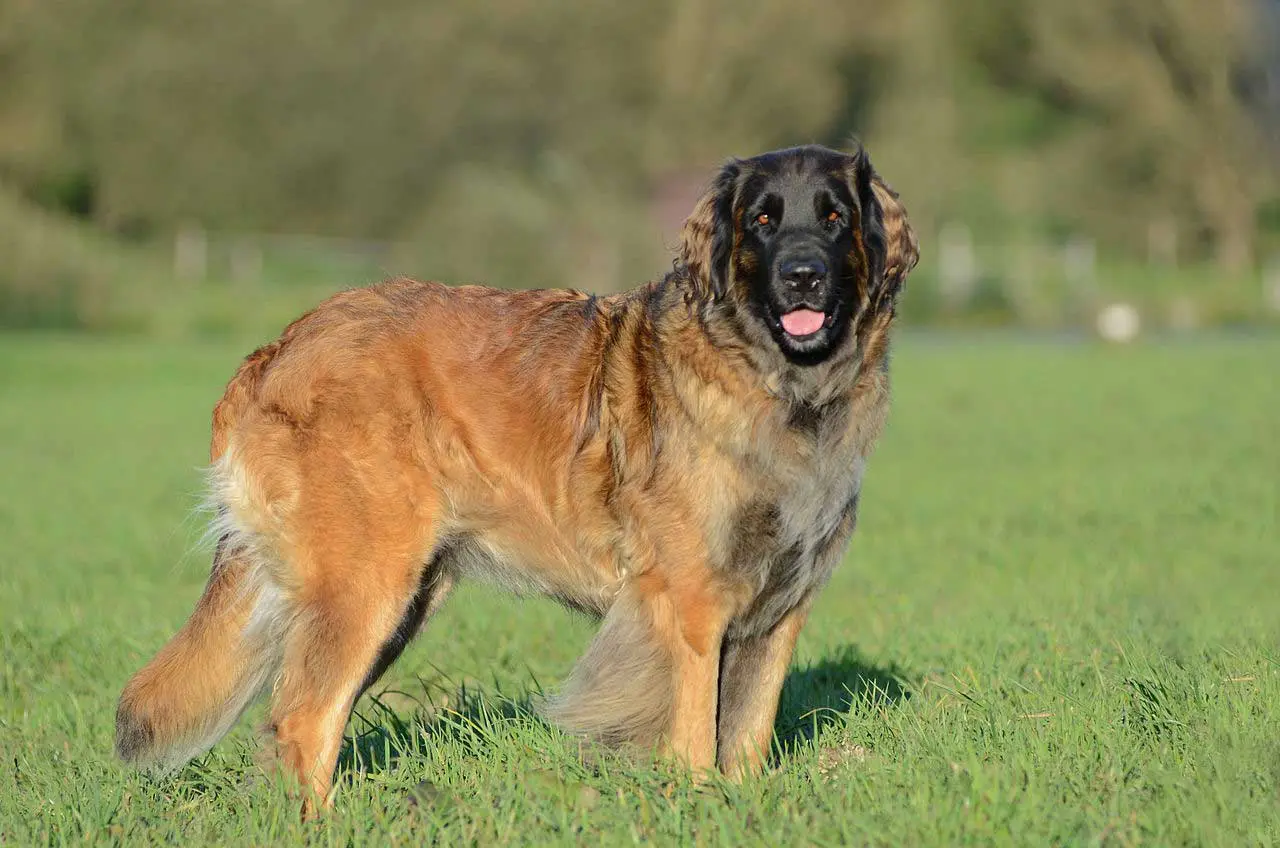
The Leonberger It is an impressive large dog with a height at the withers in males between 72 and 80 cm and in females between 65 and 75 cm.. No weight given. But, will be some 80 kg. The standard describes its appearance as:

«According to its original purpose, the Leonberger it's a very big dog, strong, muscular and elegant at the same time. It is characterized by a harmonious build and a self-assured calm with a lively temperament.. Especially the male dog is powerful and powerful. "

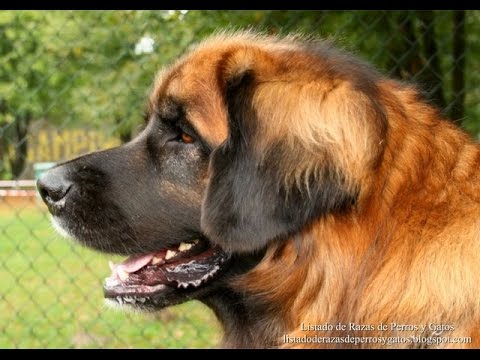
Its coat should be medium soft to thick, broadly long, well lying. The Leo has a strong inner layer. The shapes of your physique should be recognizable. On the neck and chest, the fur, especially in males, must form a mane. The coat will be lion yellow, red, reddish brown and all the combinations between them, but always with a black mask. In favor of this lion gaze, hereditary factors related to health and longevity have been neglected.

A study published by the University of Vienna evaluated 7582 layers of Leonberger between 1932 and 2009. «It was determined that the average death age of the Leonberger It was from 7,55 years". During the study period, life expectancy had even decreased in 1,5 years in the last three decades. With a healthy upbringing, 10 or 12 years would be normal. The breed has recognized these warning signs and is now focusing more on the health and extension of the life expectancy of these large dogs..

Character and skills

The mind of a Leonberger is pious as a lamb. Being with him is pure slowdown for man. The essence is described in the standard:

as family dog, the Leonberger is a pleasant companion in current living conditions, that can be carried everywhere without any difficulty and is characterized by a pronounced kindness towards children. He is neither shy nor aggressive. As a companion dog it is a pleasant companion., obedient and fearless in all life situations.

The strength of character required includes above all: self confidence, sovereign calm, average temperament (including game instinct), willingness to subordinate, good learning and memorizing ability and noise tolerance. The character of Leonberger impresses all dog lovers.

Once you get to know dogs better Leonberger, you will be enchanted by them forever. There is almost nothing that can disturb this giant. His very high stimulus threshold as well as his stoic composure are the necessary counterpart to his enormous strength.. These two poles thus characterize the nature of Leonberger. Here and there is something stubborn. Only good persuasion and pleading will help., then he will do everything for his master or lady. But as a family member he is very kind. Seeks proximity to its humans. It is a reliable protector for them. The Leonberger he is a great guy, a fascinating dog!

Fitness

The Leonberger not an easy dog ​​to keep due to its size. By its nature, has very few demands. A daily walk, brushed once a week, that was all. You don't need a big garden, but a garden is already useful. He likes to take possession of it. So, a small apartment on the nth floor would not be for him. Does not fit in all cars. One must consider: You're mine, the whole car will get wet. Leo can bear the heat, but it should not be challenged. prefers the cold. The Leonberger he is a great friend and not an object for acting addicts.

It should also be borne in mind that in our current society, large dogs are often rejected. Some people just fear a giant like Leo, even if he behaves – as is normal for him – exemplary. This is one of the reasons why it is not advisable to keep it in the big city..

One must have a sufficient budget to be able to pay a lot of good food and, in case of doubt, also the vet. It also, should have considered before buying what to do if the dog is sick and may need to bring 80 kg or more. Last, but not less important, there are many practical things that have a profound influence on everyday life. Here one must take real responsibility and honestly look in the mirror if all the conditions for a happy coexistence with dogs are met. Leonberger. Who can claim this, is in an enviable situation of dog owner. The Leonberger worth a sin.

Leonberger's Education

It must be remembered that in a Leo adult, the leash is just a symbol of control. The Leonberger has the power to control the other end of the strap. But he doesn't want. The Leonberger it's basically easy to train. Only his stubbornness has to be broken here and there with consistent smoothness.. He wants to follow his lord and master and he does it very reliably. It is an elementary duty of the owner of a Leonberger to pay attention to a consistent education already in the puppy. Because only this and not the leash makes wonderful walks in nature possible, that together with this great four-legged friend become a balm for the soul of agitated people. The great dog should never be "educated" by bumps or barracks methods. Because that would cause the exact opposite of education and end in disaster..

Leonberger care

Caring for a healthy Leo is not a problem. Brushing the coat once a week is enough.

Nutrition / Food

You need a lot of high quality food. A raised bowl is useful to counteract the risk of stomach twisting. Always pay attention to the weight.

Leonberger Health

As in most large dogs, we see hip or elbow dysplasia. Osteosarcoma, the most common bone tumor in dogs, It is also very common in Leonberger.

Leonberge life expectancy

Before the life expectancy of a Leonberger It was from 12 years, today is from 7 to 9 years. The breeding is working to recover the possible natural life of a healthy dog. He is accompanied here by a research project of the University of Veterinary Medicine Hannover.

Buy a Leonberger

The purchase of a Leo it should be long-term and well thought out. You should carefully check if you have all the requirements to be able to spend many wonderful years with this giant.. If you are looking for a puppy, you should make sure above all that the dogs are not bred too much. Ask about ancestors, their illnesses, his age reached. You should see an FCI affiliated breeder Leonberger. Really, a Leonberger it costs about 2.000 EUR.

Images "Leonberger"

Photos:

1 – Leonberger bitch by The animal photography at de.wikipedia / CC BY-SA
2 – Leonberger by https://pxhere.com/es/photo/1394923
3 – Leonberger, head photographed in 2004 at a dog show in Dresden by Karina Leo-Steffen, uploaded here from –Caronna 13:43, 15 Apr 2005 (UTC) / CC BY-SA
4 – Leonberger by https://www.pexels.com/es-es/foto/75295/
5 – Leonberger by https://pxhere.com/es/photo/1434187
6 – Leonberger by Pleple2000 / CC BY-SA
7 – Leonberger by https://www.needpix.com/photo/1100946/dog-leonberger-giant-pedigree-purebred-animal-canine

Videos "Leonberger"

Leonberger - Breed of dog

Type and recognitions:

  • FCI CLASSIFICATION:
  • Group :
  • Section : . .

Federations:

  • – FCI – Pinscher and Schnauzer-Molossoid type dogs – Swiss Mountain Dogs and Cattledogs. Section 2.2 Molossoid, mountain type. ⓘ
  • – AKC – Working dogs ⓘ
  • – ANKC – Group 6 (utility dogs) ⓘ
  • – CKC – Working dogs ⓘ
  • – ​KC – Working dogs ⓘ
  • – NZKC – Utility dog ⓘ
  • – UKC – Watchdog ⓘ

FCI breed standard "Leonberger"

Origin:
Germany

Date of publication of the valid original standard:
04.01.1996

Use:

Watchdog, Company and family.


General appearance:

Complying with the original use purposes, the Leonberger is a big dog, strong, muscular and elegant at the same time. It is characterized by its harmonious body structure and poised tranquility, aware of his own worth with a lively temperament. The male is especially powerful and robust.


PROPIMPORTANT ORTIONS: Relationship of the height of the cross with the length of the body = 9:10; the depth of the chest corresponds almost to 50% the height of the cross.


Behavior / temperament:

As a family dog, the Leonberger adapts to modern living and room conditions and turns out to be a pleasant companion that can be taken anywhere without causing problems. It also, It is very friendly with children and is not shy or aggressive. As a companion dog it is a pleasant companion., obedient and fearless in all situations that arise. To achieve his nature and strength, he mainly needs:

  • Self -confidence and sovereign
  • Medium balanced temperament (urge to judge).
  • Willingness to submit.
  • Good learning ability and attention.
  • Be insensitive to noise.

Head:

In its entirety it is deeper than broad and seems longer than plump; the relationship between the muzzle and the cranial region is approximately 1:1. The skin is adherent on all parts and does not form frontal folds.

Cranial region:
  • Craging: Seen in profile and from the front it is slightly arched; is strong corresponding to the body and limbs, but it doesn't look heavy. The posterior region is not much wider than the region where the eyes are located.
  • Ston: It is clearly noticeable and moderately marked.

facial region:

  • Nariz: Black.
  • Horcico: It is long, but it never ends on end. The nose is in broad correspondence, never sunk, but rather slightly arched (ram's nose).
  • Labios: Adherents, black, with closed corners.Jaws / Teeth: Powerful jaws with a full scissor bite, regular and perfect with good adaptation of the upper incisors over the lower ones without leaving space. The teeth are implanted vertically in the maxilla, showing 42 healthy teeth according to dental formula (lack of M3 is tolerated). Caliper bite allowed; in the lower jaw there should be no narrowness next to the fangs.
  • Cheeks: Poorly developed.
  • Ojors: Light brown to as dark as possible, medium-sized, oval, or sunk or bulging, neither very together nor very separate from each other. Adherent eyelids, they don't show the conjunctiva. The whites of the eyes (visible part of the dermis) does not show redness.
  • Obars: High insertion and placed not far behind, pendants, medium-sized, stuck and fleshy.

Neck:

Forms a light curve that continues without interruption to the cross. It is longer than it is wide; has no loose or double chin.

Body:

  • Cruz: Pronounced, especially in the male.Back: Robust, straight, wide.
  • Itmors: Widths, powerful, well muscled.
  • Glikeness: Wide, relatively long, gently rounded, in the form of progressive transition to the root of the tail, never higher than the back.
  • Pecho: Large, deep, reaches at least to elbow height; not barrel-shaped but rather oval.
  • Línand the bottom: Only slightly retracted.

Tail:

With lots of hair. When it is standing it carries it hung in a straight line; Also during the movement it folds only slightly without exceeding the back line.

Tips

PREVIOUS MEMBERS: Straight, parallel, not closed.

  • Shoulder / Arms: Long, obliquely placed; Among them form an angle not too obtuse. They have good muscles.
  • Elbows: Glued to the body.
  • Metacarpus: Strong, firm, viewed from the front they are straight and viewed from the side almost vertical.
  • Pinis previous: Straight (no deviations outwards or inwards), rounded, compact; well arched fingers; black pads.

LATER MEMBERS: Viewed from behind they are not placed too tightly; they are parallel; lukewarm joints- tarsians and feet do not deviate inward or outward.

  • Cadhere: In oblique position.
  • Thigh: Rather long; placed obliquely, has strong muscles. The thigh and leg form a fairly sharp angle.
  • Atibio-tarsal articulation: Powerful, with a marked angle between the leg and the metatarsal.
  • Pinis later: Straight, just a little long; arched toes; black pads.

Movement:

Cover the ground, it is balanced in all walks; good momentum and breakthrough; both during walking and jogging, observed front and back, conducts limbs in a straight line.

Mantle

  • Fur: Hair should be a little soft to hard, quite long, stuck and never form a streak; Despite having a lot of internal fleece, you can recognize the shapes of your body structure. The hair is smooth, although it is allowed to be slightly wavy; on the neck and chest (especially in the male) a mane is formed; There are visible feathers in the anterior members and "pants" marked in the posterior members.
  • Color: Yellow (lion color), red, reddish brown, also sand color (pale yellow, cream-coloured) and all its combinations, although with a black mask. Hair is allowed to have black tips; However, black should not be the basic hair color. The paleness of the basic color in the lower part of the tail, on the necklace, In the feathers of the previous members and in the "pants" of the posterior. A small white spot or a thin white streak is tolerated on the chest and white hairs on the fingers.


Size and weight:

Height to the cross:

  • Males: 72 – 80 cm., ideal measure 76 cm.,
  • females: 65 – 75 cm., ideal measure 70 cm..


Fouls:

Any deviation from the aforementioned criteria is considered as a fault and the severity of this is considered to the degree of the deviation to the standard and its consequences on the health and well-being of the dog..


FALTAS DESCALIFICANTES:

    • Aggressiveness or extreme shyness.
    • Any dog ​​showing clear signs of physical or behavioral abnormalities must be disqualified..
    • Severe anatomical failures (p. e.g.. notable cow members, carp back marked, badly beaten back, exaggerated outward deviation in the forefoot, absolutely insufficient angulation in the shoulder joints, elbow, knee and tibial-tarsian).
  • brown truffle.
  • Excessive depigmentation on the lips
  • Lack of teeth (except the M3), superior and inferior prognathism; other faults in the bite.
  • Eyes without brown color.
  • Ectropión, ectropion.
  • Tail too curled or carried too high and curled.
  • Brown pads.
  • Curly or frizzy hair.
  • Lack of color (brown with brown truffle and brown pads; Black with fire; silver black; deer color).
  • Total lack of mask
  • Too much white color (that reaches from the fingers to the carpus, stain on the chest larger than a hand, white color elsewhere).


N.B.:
  • Males should have two normal-appearing testicles fully descended into the scrotum..
  • Only functionally and clinically healthy dogs, with the typical conformation of the breed, should be used for parenting.


TRANSLATION: Federation Canófila Mexicana a.c..

Source: F.C.I - International Cynological Federation

Alternative names:

1. Leo, Gentle Lion, Gentle Giant (English).
2. Chien Leonberg (French).
3. Leo (German).
4. Leo (Portuguese).
5. Leo (español).

▷ The world of Pets: Dogs, cats, birds, reptiles, amphibians

Pyrenean Mountain Dog
Francia España FCI 137 - Molossoid . Mountain

Pyrenean Mountain Dog

The Pyrenean Mountain Dog is a guardian and protector with territorial claims.

Content

History

The Pyrenean Mountain Dog is an ancient watchdog of the mountainous world of the Pyrenees. There it is officially called Chien de Montagne des Pyrénées. The people of the Pyrenees call him the cute little one Patou. The pyrenees, like a vast, deserted and rugged, previously inaccessible mountain range, form the natural border between France and Spain. Here there were and there are wolves and bears, with the consequent problem for ranchers. It also, sheep used to be one of the few livelihoods of the people here. While in Germany and other Central European countries people lament the return of the wolf and complain about the damage caused to game and sheep herds, in the Pyrenees dogs such as the Patou from time immemorial. And there are no complaints. Guard dogs are an integral part of every flock of sheep in the Pyrenees mountains.

On the French side, they are officially called Chien de Montagne des Pyrénées or Pyrenäenberghund, on the Spanish side Perro de montaña de los Pirineos or Gran Pirineo. In addition to protecting herds against thieves, wolves and bears, also protected large estates. His powerful figure, his determination and ability to attack in an emergency were not without effect. The impression must have been so lasting that his work was already documented in writings from antiquity and the Middle Ages.. It is reported that the dogs would have recognized people from afar by their clothes. In 1391 it is said that the Count of Foix did a test. If he came disguised as a tramp, the dogs attacked him from afar without hesitation. If he came dressed as a count, he wasn't bothered.

The Patou was not a uniform race in the past. In very remote valleys there were often local breeds, genetically isolated, optimized for your job task naturally, but in the end the same dogs came out with a very similar appearance and character, though they might have been genetically separated for generations. Extremely harsh living conditions obviously outweighed the disadvantages of inbreeding. Modern pedigree dog breeding took an interest in these impressive dogs very early on. Already at the first dog show in France, in 1863, a separate class was established for the Pyrenean Mountain Dog.

An attempt was made to establish the Patou also outside the Pyrenees as a watchdog and protection. In 1907 the first standard was established in France. But, due to the two world wars and the associated famine period, the population of Patou outside the mountains suffered serious setbacks. In 1955 obtained the official recognition of the FCI – International Cynological Federation.

Physical characteristics

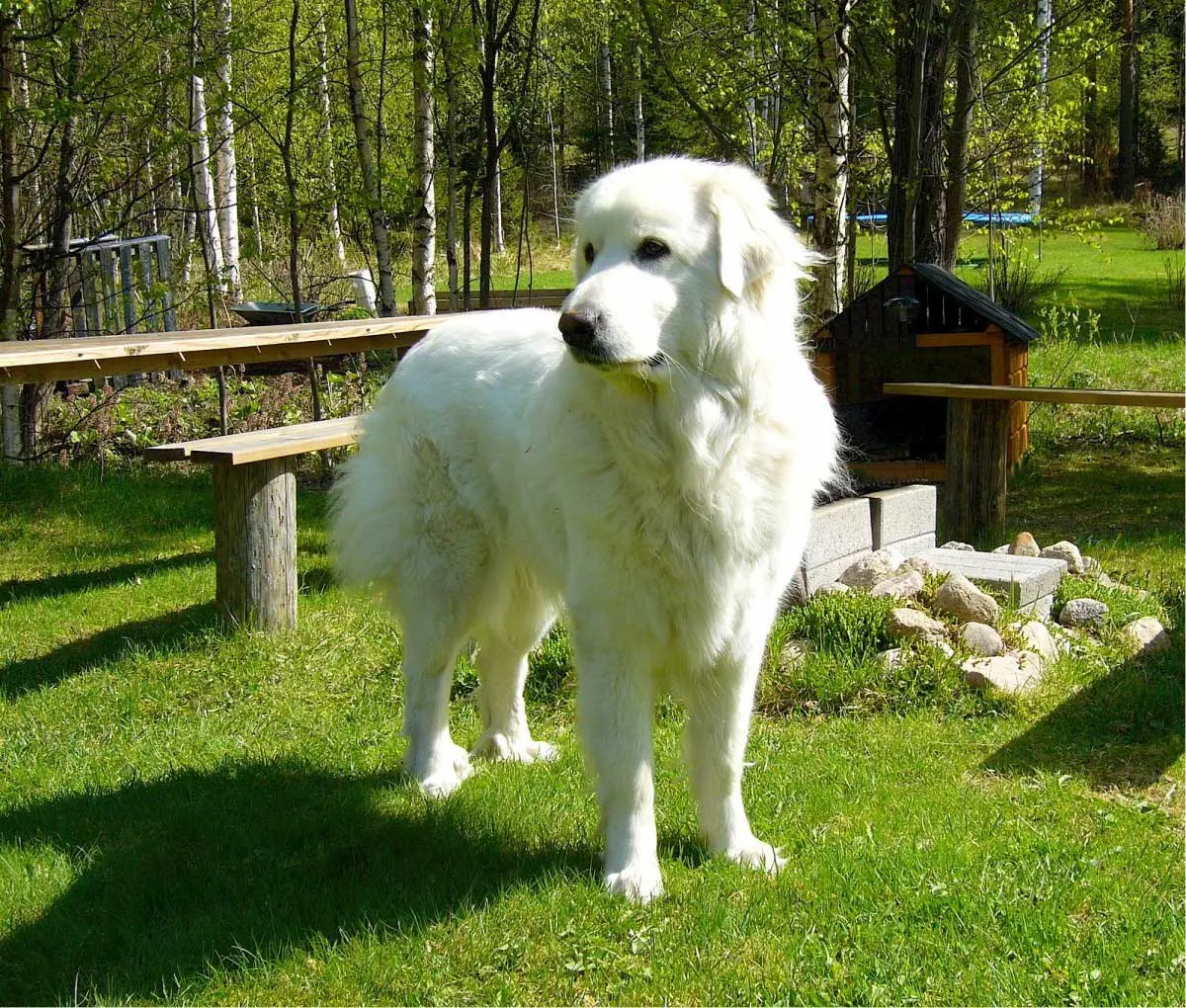
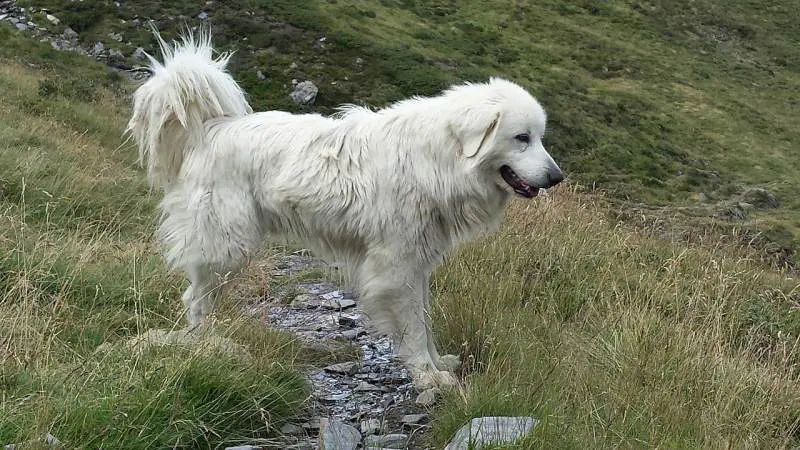
The Pyrenean Mountain Dog is a big dog, imposing, powerful and at the same time athletic and agile. Doesn't seem clumsy or massive, but rather elegant piecework. It has a medium length coat, very dense and flexible, which can be slightly wavy. The bottom layer is also very dense. To the colors that the official standard says:

White or white with gray spots (badger gray or wolf gray), pale yellow or orange (rusty) in the head, ears and base of tail, sometimes also in the body.

The Pyrenean Mountain Dog it has a majestic height at the withers 70 and 80 centimeters in males and 65 to 75 in females. The weight must be between 60 and 70 kg. The measurements are quite similar to those taken by the Conde de Bylandt when he first described the breed in 1897, when he simply called the dogs "Chien des Pyréneés«. The head of the Patou remember the contours of a molosser. Shows a very alert and attentive facial expression. It is a dog that rests in itself, who first of all observes everything, seemingly listless. This is underlined by his eyes, they're supposed to be sweet and dreamy, with its dark amber color.

Character and skills

The Pyrenean Mountain Dog is a guardian and protector with territorial claims. He looks cute and calm looking, sublime and imposing almost like a blank teddy bear, but you must not be wrong. It has a strong character combined with a very own but clear idea of ​​how it should behave – and the others in their domain. This idea is naturally shaped by its use throughout the centuries, where he had to defend his flock to life or death as a guard without the presence of the shepherd and, therefore, had to make decisions independently. The official standard classifies his character qualities as follows:

Since the dog was used exclusively to protect herds against attacks by predators, its selection for breeding was based on its suitability as a guardian, their respectable appearance and also their relationship with the herd. The resulting characteristics are strength and agility., as well as the sweetness and attachment to his protégés. This watchdog has a tendency to independence and initiative, which requires some authority from his master.

One Pyrenean Mountain Dog should only be held by an experienced and mentally strong person. First of all, not a family dog. But, it can become so if it has extremely competent guidance from its master or caretaker and if the external conditions are right. Only then can he be a good family dog ​​and lovingly protect all members of the family., including other four-legged friends. It also, is a good guardian and extremely reliable protector of the house and all those who, in your opinion -which should be clarified-, belong to it. Towards strangers he is suspicious.

Fitness

The Pyrenean Mountain Dog it is extremely undemanding in its maintenance – if one ignores the aforementioned restrictions due to its nature as a watchdog. It is undemanding in its nutrition as well as in its accommodation. You can spend the whole year outside without problems – As long as you have a suitable and "adequate" hiding place, it does not mean either a kennel or a chain., because he must be able to move in his territory. This large, self-confident dog is quite sensitive and places great importance on a close emotional bond with his human family.. You need a trusting relationship with your master or caregiver.

Thanks to modern pedigree dog breeding, the Patou is better prepared for a big city life than other herd protection dog breeds like the Kangal or the Central Asian Shepherd Dog. So if you have a large, well-fenced property in the country, if you have joy, fun, experience and the possibility of getting involved with these dogs, you can experience a particularly impressive and beautiful facet of the human-dog association.

Pyrenean Mountain Dog Education

The education of Pyrenean Mountain Dog belongs to the hands of a teacher or lover with deep experience and canine knowledge. Like any other race, Pyrenean mountain dogs must be well socialized and educated since they are puppies. It would be irresponsible to want to keep such a dog as a beginner.

Care and health of the Pyrenean Mountain Dog

Absolutely easy to care for and undemanding. The Pyrenean Mountain Dog generally enjoys very robust health. Some health problems may include hip dysplasia; heart problems such as tricuspid valve dysplasia; cancers like osteosarcoma (bone cancer); eye problems such as persistent pupil membranes, progressive retinal atrophy and cataracts; dissecting osteochondritis (an orthopedic problem), patellar dislocation (dislocation of the patella) and swelling.

Nutrition / Food

The Pyrenean Mountain Dog he has no problem with his diet.

Life expectancy of the Pyrenean Mountain Dog

The Pyrenean Mountain Dog have a very high life expectancy of 12 and sometimes more years relative to its size.

Characteristics "Pyrenean Mountain Dog"

Coexistence is important that you have with your new friend. Before considering the acquisition of a dog of the breed"Pyrenean Mountain Dog" you know certain factors. Not all breeds of dogs are apt to live in an apartment, you must take into account his character, their need for exercise, their interaction with other pets, their care and if you have small children, their level of tolerance towards them.

Adaptation ⓘ

4,0 of 5 stars (based on 1 review)

friendly dog ​​ⓘ

3,0 of 5 stars (based on 1 review)

hair loss ⓘ

5,0 of 5 stars (based on 1 review)

Affection level ⓘ

3,0 of 5 stars (based on 1 review)

Need for exercise ⓘ

2,0 of 5 stars (based on 1 review)

Social need ⓘ

4,0 of 5 stars (based on 1 review)

Home ⓘ

2,0 of 5 stars (based on 1 review)

Toilet ⓘ

3,0 of 5 stars (based on 1 review)

Friendly with strangers ⓘ

2,0 of 5 stars (based on 1 review)

barking ⓘ

4,0 of 5 stars (based on 1 review)

Health ⓘ

5,0 of 5 stars (based on 1 review)

Territorial ⓘ

2,0 of 5 stars (based on 1 review)

Cat friendly ⓘ

4,0 of 5 stars (based on 1 review)

Intelligence ⓘ

4,0 of 5 stars (based on 1 review)

Versatility ⓘ

2,0 of 5 stars (based on 1 review)

Child friendly ⓘ

4,0 of 5 stars (based on 1 review)

Surveillance ⓘ

2,0 of 5 stars (based on 1 review)

joy ⓘ

5,0 of 5 stars (based on 1 review)

Images "Pyrenean Mountain Dog"

Photos:

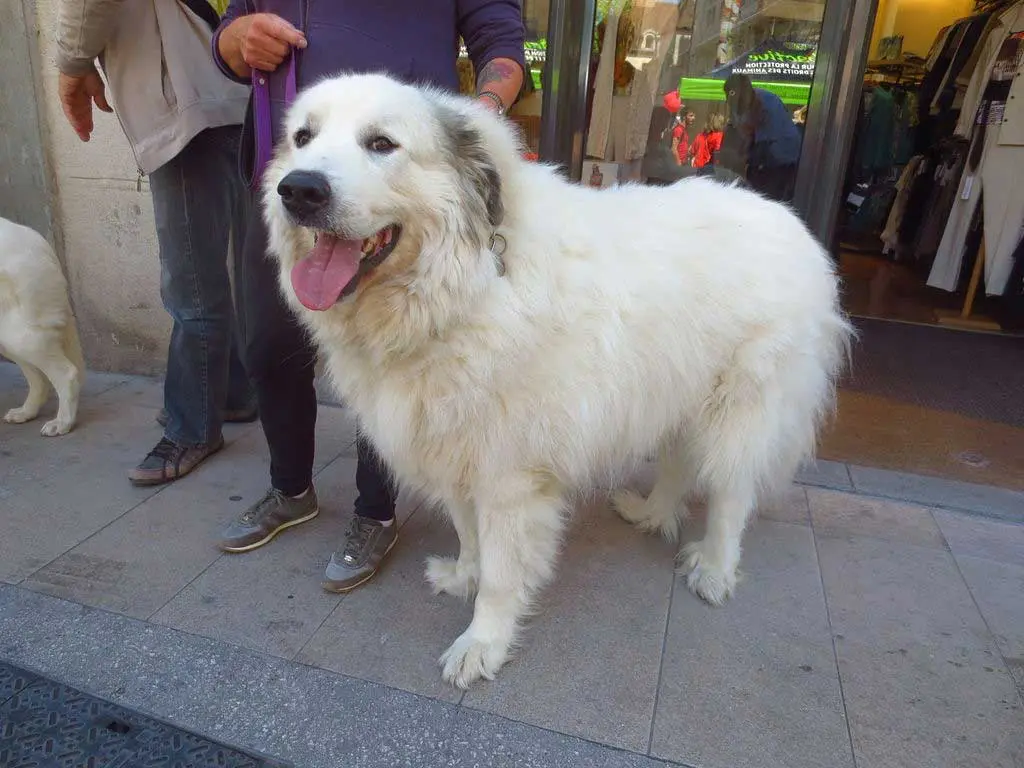
1 – Pyrenean Mountain Dog by https://pxhere.com/es/photo/774692
2 – Pyrenees Mountain Dog, XI International Dog Show in Kraków by I, Lilly M / CC BY-SA
3 – Great Pyrenees Mountain Dog by HeartSpoon / CC BY-SA
4 – Pyrenees mountain dog by Arnaud 25 / CC BY-SA
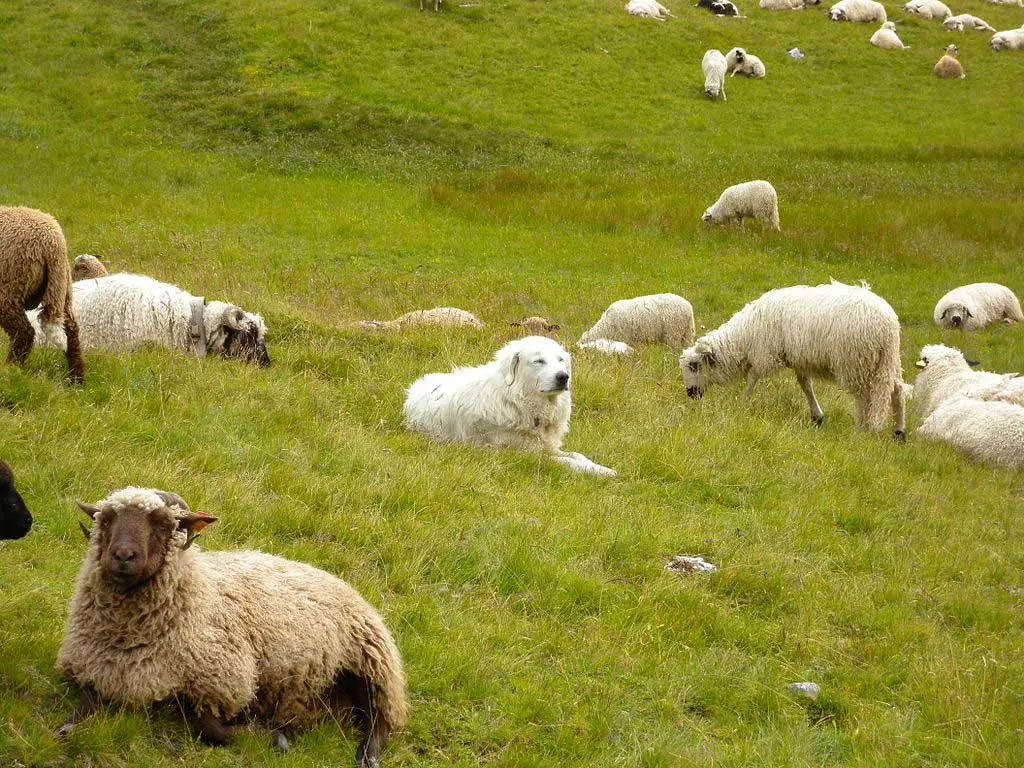
5 – Pasture of Anterne, Sixt-Fer-a-Cheval, Pyrenean Mountain Dog among the sheeps by Jerome Bon from Paris, France / CC BY
6 – Pyrenean Mountain Dog by Emma.Martinet / CC0
7 – Pyrenees mountain dog by I, Beninho / CC BY-SA

Videos "Pyrenean Mountain Dog"

Type and recognitions:

  • FCI CLASSIFICATION:
  • Group :
  • Section : . .

Federations:

  • – FCI – Pinscher and Schnauzer-Molossoid type dogs – Swiss Mountain Dogs and Cattledogs. Section 2.2 Molossoid, mountain type. ⓘ
  • – AKC – Working dogs ⓘ
  • – ANKC – Group 6 (utility dogs) ⓘ
  • – CKC – Group 3 – Working dogs ⓘ
  • – ​KC – Sheepdogs ⓘ
  • – NZKC – Utility dog ⓘ
  • – UKC – Watchdog ⓘ

  • FCI breed standard "Pyrenean Mountain Dog"

    Origin:
    Spain, France

    Date of publication of the valid original standard:
    13.03.2001

    Use:

    Herd guard dog in mountain.


    General appearance:

    This is a large dog, imposing and very well proportioned, although without lacking a certain elegance.

    PROPIMPORTANT ORTIONS:

    • The maximum width of the skull is equal to its length.
    • The muzzle is slightly shorter than the skull.
    • The length of the body, from the tip of the shoulder, to the tip of the gluteus, is slightly higher than the height at the withers.
    • Chest height is equal to half the height at the withers or slightly less


    Behavior / temperament:

    Used to protect flocks alone from predator attacks, his selection was based on both his vigilance and deterrence skills, as in their attachment to the flock. As a result of this, its main qualities are strength and agility, as well as the sweetness and devotion towards those who protect him. This watchdog has a propensity for independence and a sense of initiative that require some authority from its master..

    Head:

    Is not very big, compared to the size of the dog. The side faces are quite flat.

    Cranial region:
    • Skull: The maximum width of the skull is equal to its length. It is slightly arched, because the sagittal crest is noticeable to the touch. Since the occipital protuberance is apparent, the cranium, on its back, It has an ogival shape. Superciliary arches are not marked, the middle groove is barely perceptible to the touch between the eyes.
    • Depression links (Stop): It has a slight inclination.

    facial region:

    • Truffle: It is completely black.
    • Snout: It is wide; somewhat shorter than the skull and progressively decreases towards its extremity. Seen from above, is V-shaped with a truncated tip. It is very solid under the eyes.
    • Lips: They are slightly hanging and cover just the lower jaw. Are black or well marked black, as well as the palate.
    • Jaws / Teeth: The denture must be complete and the teeth must be white and healthy. The joint is in the form of scissors (the upper incisors cover the lower ones without loss of contact). Articulation in the form of pliers is supported, as well as the two lower clips that fall towards the front.

    Eyes: They are rather small, almendrada form, slightly oblique, of intelligent and contemplative expression. Its color is amber brown. The eyelids are never loose and are lined with black. The look is sweet and dreamy.

    Ears: Present at eye level. They are quite small, triangular in shape and rounded at the extremity. They fall close to the head and appear a little higher when the dog is in action.

    Neck:

    It is strong, pretty short; the double chin is poorly developed.

    Body:

    The length of the body, from the tip of the shoulder, to the tip of the gluteus, is slightly higher than the height at the withers. The height of the sternum to the ground is almost equal to half the height at the withers, but never inferior.

    • top line: It is very firm.
    • Cross: It is wide.
    • Back: Good length, solid.
    • Pork loin: Medium length.
    • Rump: Slightly oblique; the haunches are quite outgoing.
    • Flank: It is little inclined.
    • Breast : It is not very inclined, but wide and deep. Descends to elbow level, no further down. Its altitude is equal to or slightly less than the height at the withers. Ribs are slightly rounded.

    Tail:

    Descend at least to the tip of the hock. It is bushy and forms a pompadour. Low, during rest, preferably with the hooked end. When is the dog in action, it rises on the back taking a well-rounded shape and only the limb touches the back (The mountain people call it the "arroundera" wheel.).

    Tips

    PREVIOUS MEMBERS: They are strong and plumb.

    • Shoulder: They are fairly oblique.
    • Arms: Muscular, medium length.
    • forearms: Straight, strong and well covered with fringe hairs.
    • Carpi: The wrist is in the extension of the forearm.
    • Metacarpus: Slightly oblique.
    • Previous feet: They are not very long and compact, with slightly arched fingers.

    LATER MEMBERS: They have hairs that form longer and busier fringes than the forelimbs. Seen from behind, are perpendicular to the ground.

    • Thighs: They are well muscled, not very long and fairly oblique; «well trained».
    • Knees: They are moderately angled and lie on the axis of the body.
    • Legs: Strong, medium length.
    • Hock: Width, thin and medium layered.
    • Pies: They are little elongated, compact, with slightly arched fingers.
    • Spurs: The hindquarters have double, well-formed spurs. The forelimbs sometimes have single or double dewclaws.

    Movement:

    The movement of the Pyrenean Mountain Dog is powerful and loose, never weighed; it is broader than fast and it does not lack a certain elasticity and elegance. This dog's angulations allow for a steady gait.

    Mantle

    SKIN: Thick and flexible. Often shows pigmentation spots all over the body.

    Fur: It is very bushy, smooth, quite long and loose, pretty rough on the shoulders and back. Longer at the tail and around the neck, where it can be slightly wavy. Trouser hair, finer and woolier, it's very bushy. The inner face of hairs is also thick.

    Color: White or white with gray appearance spots (badger hair or dark bay), pale yellow or orange, in the head, the ears and the tail. Badger hair spots are the most appreciated.


    Size and weight:

    Height to the cross:

    • Males: 70 to 80 cm.,
    • females: 65 to 75 cm..

    A tolerance of 2 cm in of the set size, in copies that correspond perfectly to the type.


    Fouls:

    Any deviation from the aforementioned criteria is considered as a fault and the severity of this is considered to the degree of the deviation to the standard and its consequences on the health and well-being of the dog..

    General aspect: General appearance that gives the impression of heaviness, aspect without distinction. Thick dog, not very energetic, lymphatic.

    Head:

    • Too heavy, rectangular
    • Very wide skull, forehead bulge
    • Very marked or non-existent naso-frontal depression
    • Very drooping lips that form belfo
    • Insufficient truffle pigmentation, the edge of the eyelids and lips

    Eyes: Round, sunken or bulging. Too big or too small, close together or far apart. Third visible eyelid. Hard expression.

    Ears: Wide, long, bent, forming folds. They come back; set high.

    Neck: Delgado, a little long or otherwise very short, giving the impression that the head is sunk on the shoulders. Chin very pronounced.

    Body: Sunken or convex top line, inclined, swollen or sagging belly.

    Breast : Very broad or narrow front part of the chest. Flat ribs, or on the contrary, barrel shape.

    Tail: With little hair or incorrect implantation. Very short or very long, without pompadour, does not take the form of a wheel when in action or does it continuously, even during rest.

    Former members:

    • They deviate inward or outward.
    • Very open scapulo-humeral angle.

    Later members:

    • They deviate inward or outward.
    • Straight or excessively angled hock.
    • Pies: Long, plans.
    • Fur: Short or curled, silky, soft. Absence of an inner layer of hairs.

    FALTAS DESCALIFICANTES:

    • Aggressiveness or extreme shyness.
    • Any dog ​​showing clear signs of physical or behavioral abnormalities must be disqualified..
    • Color: Colors other than those indicated in the standard.
    • Truffle: In another color that is not absolutely black.
    • Jaws: Upper or lower prognathism, or any malformation of the jaws.
    • Eyes: Different colored spots on the eyelids, raptor eyes.
    • Spurs: Absence of dewclaws, single or double spur atrophy in hindquarters.
    • Size: Outside the limits of the standard.


    N.B.:

    • Males must have two normal-appearing testicles fully descended into the scrotum..
    • Only functionally and clinically healthy dogs, with the typical conformation of the breed, should be used for parenting.

    Source: F.C.I - International Cynological Federation

    Alternative names:

    1. Great Pyrenees, Patou, Montañés del Pirineo, Perro de Montaña de los Pirineos, Can de Montaña de os Perinés, Chien des Pyrénées, Chien de Montagne des Pyrénées, Pyr, GP, PMD, Gentle Giant (English).
    2. montagne des Pyrénées, pastou, patou (French).
    3. Chien de Montagne des Pyrénées, Patou (German).
    4. Chien de Montagne des Pirénées (Portuguese).
    5. Gran Pirineo, Chien des Pyrénées, Chien de Montagne des Pyrénées, Gigante de los Pirineos, Gran Pirineu, Muntanya dels Pirineus, Patou (español).

    ▷ The world of Pets: Dogs, cats, birds, reptiles, amphibians

    Yugoslavian Shepherd Dog Sharplanina
    Yugoslavia FCI 41 - Molossoid . Mountain
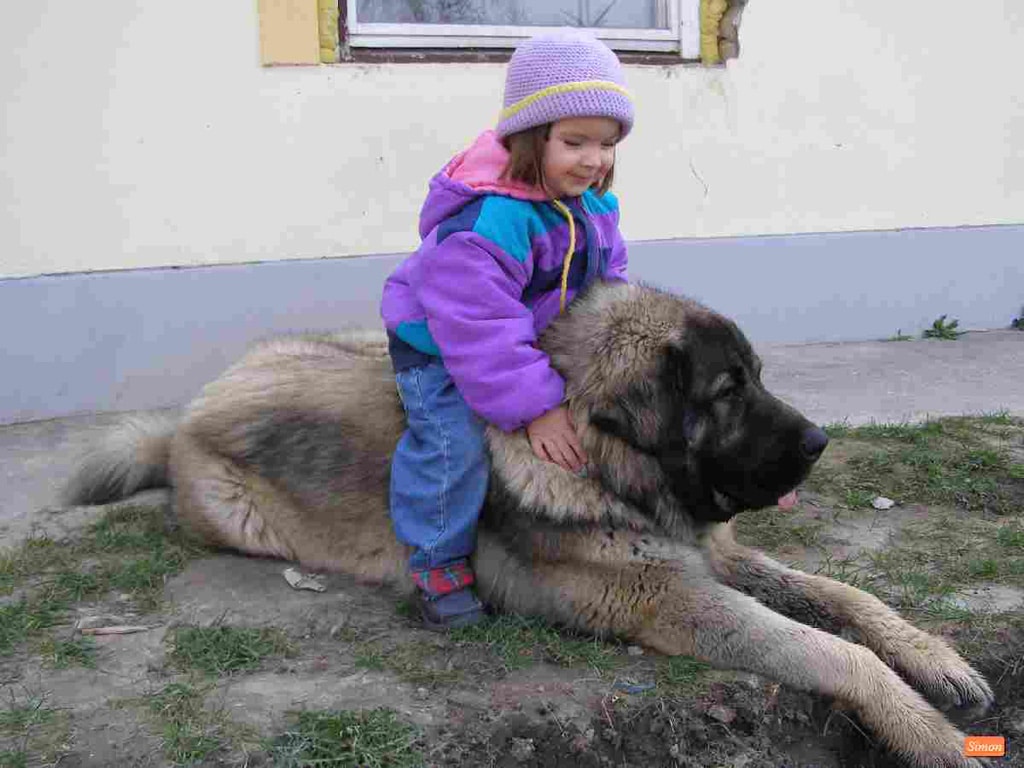
    Yugoslavian Shepherd Dog Sharplanina

    The Yugoslavian Shepherd Dog Sharplanina is a brave dog, quiet, safe and reserved with strangers.

    Content

    History

    As it is the case with many breeds, the true origins of this big guy are unknown, although there are theories that try to approach them. Some authors raised that their ancestors were the ancient molossians, especially dogs from Greece and livestock guarding dogs from Turkey.

    Other authors believe that the Yugoslavian Shepherd Dog Sharplanina, drift of Asian dogs that arrived in Europe accompanied by migration of peoples who were engaged in raising them. This theory is the most widely accepted today..

    The race was initially recognized by the Federation Cynologique Internationale (FCI) in 1939 under the name Illyrian Shepherd Dog, demonstrating the ancient name of the native region of these dogs.

    In 1957, at the request of the Yugoslav Canine Federation (JKS), the FCI changed the name to Yugoslav Shepherd Dog–Yugoslavian Shepherd Dog Sharplanina, because it is in the Šar Mountains (Šar Planina in South Slavic languages, is a mountain range located on the southern border of Serbia in the province of Kosovo and in the northwestern part of the Republic of Macedonia), where is concentrated the largest number of specimens of the breed.

    If there is something indisputable it is that the Yugoslavian Shepherd Dog Sharplanina, lives since ancient times in the mountainous regions of the former Yugoslavia, from where it has spread throughout the Balkan Peninsula and recently, beyond these borders.

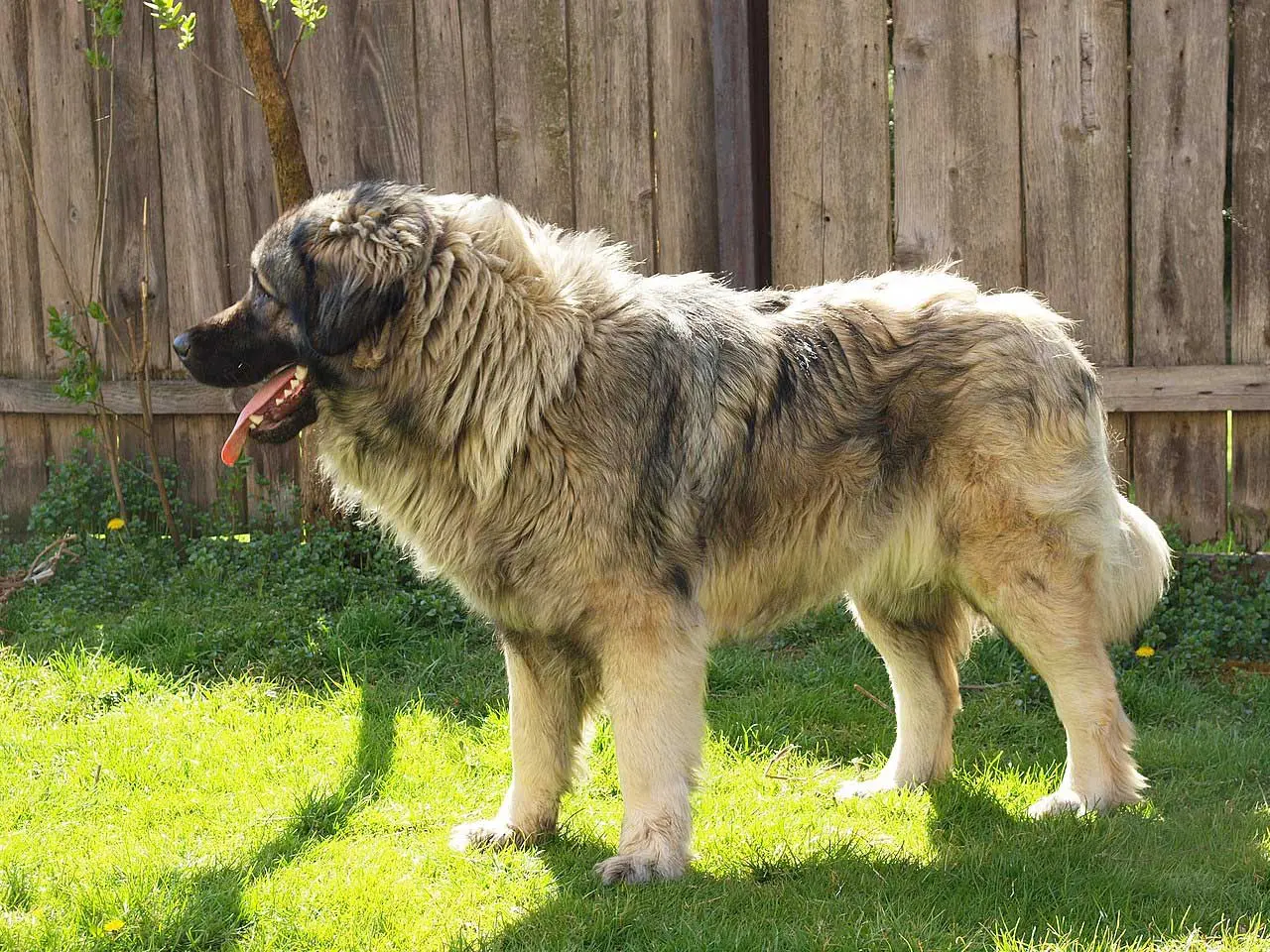
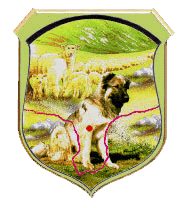
    Escudo de DragasThe image of the Yugoslavian Shepherd Dog Sharplanina appears on the obverse of the coin 1 Denar, issued in the Republic of Macedonia in the year 1993, and is also the emblematic protagonist of the Dragaš shield, a city in the South of Kosovo, which is located in the region of the Šar Mountains.

    The Yugoslavian Shepherd Dog Sharplanina has reached the ranches of North America as an esteemed sheepdog and cattle guardian. Predator problems have been greatly diminished once a Yugoslavian Shepherd Dog Sharplanina , takes the responsibility of a herd. You are one of the few dogs that can chase away a wolf or bear.

    Physical characteristics

    The Yugoslavian Shepherd Dog Sharplanina, is a large size dog, It is quite above average when it comes to large breeds. It is also robust and equipped with a strong Constitution.

    The height males average is of 56 to 62 cm and females is of 54 to 58 cm.. The length of the body is slightly greater than the height at the withers.

    Although some authors speak of the existence of individuals whose actions were between 75 and 85 cm. of height and a weight of 65 to 100 kg.

    – The huge head is proportional to the body, It has the skull slightly convex and slightly longer than the muzzle.
    – The eyes of the Yugoslavian Shepherd Dog Sharplanina they are almond-shaped and chestnut-colored (light or dark), transmit an expression of serenity but the look is penetrating.
    – The ears they are medium-sized, flat and hang on the cheeks.
    – The tail It is long and Sabre-shaped, if it is in a state of alert, it carries it high, barely exceeding the line of the back.
    – The fur It is long in some parts of the body and short in others. In the head, the ears and the anterior part of the extremities, is short. The length of the neck, the body and the back of the limbs and tail, is long.
    – Regard to the the fur color, all uniform colors are supported but it is preferable to be gray iron and gray very dark. As well, at the top of the head, the neck and the trunk have darker hair.

    Character and skills

    The Yugoslavian Shepherd Dog Sharplanina it is silent, active and very protective, extremely bright, but very independent. It is an extremely good watchdog, and very reserved with strangers. The Yugoslavian Shepherd Dog Sharplanina they are calm sheepdogs, very smart, which is why, wisely, they choose their friends, trust no one too fast. They are naturally fearless defenders of the pack, as well as his master and his property, so everything he considers his property is jealously and unconditionally guarded. This is a dog with character and very dominant that requires work.. If we just want this dog to be a companion, constant professional education from an early age is essential.

    The animals that live with him on the farm will be under his protection and there is no need to fear for them.. But, does not tolerate strange and unknown animals, often aggressive, and the same problems can happen with smaller pets, that can be seen as prey.

    She will get along well with the children she will be together with from an early age, will be devoted and protective of them, and you may consider children you don't know as uninvited guests, so we must be very careful. You must be especially careful with younger children, since he will watch over them all the time due to the shepherd's instinct, but if the children want to get away, will drag them back, so you can injure them without realizing it.

    Observations

    Similar to the Caucasian Shepherd Dog –that is very much– has a temperament more characteristic of a guard dog than a herd dog.

    Let us not forget that this agility, He was selected to defend the herds of the attack of wolves that were previously very numerous in their homeland.
    It is necessary that the owner of this dog is a person responsible and very conscious of the copy that is in charge of, the Yugoslavian Shepherd Dog Sharplanina, It has a specially developed and powerful teeth, It can be a real danger if the dog is not given a correct and healthy education.

    Education "Chaplanina pastor dog"

    This is not a suitable dog for beginners. He is very suspicious and incorruptible. Usually, is completely loyal to a single owner. Education must be clear, consistent and should be carried out from the first meeting with the puppy. Early socialization is mandatory. With an inadequate education, this dog can become uncontrollable, very aggressive, dangerous even to the owner.

    Required activity

    These dogs really need a lot of exercise. If the dog goes to work on a farm, will meet your daily career needs while working, otherwise, need a longer walk or daily run.

    Suitable environment

    This is a dog suitable exclusively for outdoor life. You will feel better on a farm or in a larger rural fenced yard because you will be able to run freely and perform your primary role as a sheepdog..

    Care "Chaplanina Pastor Dog"

    Your care is not too demanding. Thick hair just needs brushing once in a while, once a week will be enough, except when you change your coat that more frequent brushing is recommended. As with other dogs, this breed also needs to clean their ears, eyes and shorten their claws.

    Health "Chaplanina pastor dog"

    No known genetic health problems, it is considered a relatively healthy breed. As with other large breeds, hip dysplasia can occur in this breed.

    Images "Chaplanina Pastor Dog"

    Videos "Chaplanina pastor dog"

    Type and recognitions:

    • FCI CLASSIFICATION:
    • Group :
    • Section : . .

    Federations:

    • – FCI – Pinscher and Schnauzer-Molossoid type dogs – Swiss Mountain Dogs and Cattledogs. Section 2.2 Molossoid, mountain type. ⓘ
    • – CKC – Miscellaneous list ⓘ
    • – UKC – Watchdog ⓘ

    FCI breed standard "Yugoslavian Shepherd Dog Sharplanina"

    Origin:
    Macedonia, Serbia, Montenegro

    Date of publication of the valid original standard:
    24/11/1970

    Use:

    ---


    General appearance:

    to) It is robust, of strong Constitution, well proportioned.
    Its size is above normal. Is covered in long hair, dense and quite thick, giving your body a more collected look. companies, possesses a calm temperament and good character: knows how to be a good defender without attacking. He is faithful to his master and incorruptible.

    b) Height to the cross: In the male, the average is 62 cm., and in the female it is 58 cm.. Large dogs are preferred.
    The dogs below 56 cm and bitches below 54 cm are excluded from reproduction. In working dogs the weight is 35 to 45 kg in males and 30 to 40 kg in females.

    c) body length: It is slightly greater than the height at the withers: of 8 to 10% from height to withers in dogs, and 10 to 12% in
    the bitches.


    Behavior / temperament:

    ---

    Head:

    Is provided to the body and measures about 25 cm., or a 40% the height at the withers. The skull is slightly longer than the muzzle, 58 and 42% respectively of the total length of the head. The female has a little longer snout (57 and 43%). The top of the skull is slightly convex and the profile of the nasal helm is straight. The lines of both profiles are convergent.

    Cranial region:
    • Skull: The cranial region is wide, with a medium marked Groove. Seen from side and from above is slightly convex and little bulky.
    • Depression links (stop) : It is little pronounced.

    facial region:

    • Snout: It is shorter than the skull. Wide and deep at the base, light and gradually are reduced. The nasal helm is straight and wide. The profile of the lower jaw begins with an arch and is confirmed by a straight line that diverges from the profile of the nasal bridge..
    • Truffle: Is wide and black.
    • Lips: They are moderately thick and stretched. The upper lip slightly exceeds the lower. The corners are well connected, and they are not never reversed.
    • Teeth: They are comprehensive and applied in scissor bite.
    • Eyes: Almond biscuits; or large, or sunk. Are dark or light brown, and calm expression, but penetrating and never afraid. Both the eyelids and visible mucous membranes are black.
    • Ears: Located at the level of the prolongation of an imaginary line that starts from the tip of the nose and passes through the inner corner of the corresponding eye, or below. They are hanging and fall glued along the cheeks. They are V-shaped and medium in length.; When stretched them slightly arriving to the inner corner of the eye. They are covered with short dense pile.

    Neck:

    The upper profile is slightly convex or straight at the top of the neck. The lower profile is straight. The neck is of medium length, but due to the long and bushy hair seems shorter. It is wide, deep and muscular, well attached to the head and body, no sharp demarcation. It is slightly elevated in relation to the dorsal line. Your skin is stretched and does not double chin. The hair is dense, long and rough, and arriving at the head it forms a sort of well marked necklace, which apparently increases the breadth and depth of this part of the head.

    Body:

    As a whole, the top line is horizontal, or slightly inclined starting from the cross to the rump. In dogs bred in the mountain, be tolerated that the height of the rump is just greater than the height at the withers, Although this is not desirable. The body is slightly longer than the height at the withers.

    • Cross: Slightly marked and wide. It is strongly attached to the neck and the demarcation is inconspicuous.
    • Back: Straight and wide; is not too long.
    • Pork loin: The lumbar region is shorter than, wide and well muscled.
    • Rump: Is medium length, oblique, wide and well muscled.
    • Breast : The chest is deep and medium length; along with the bottom edge reaches the elbow. The ribs are slightly arched. The chest is wide and muscled. Chest girth should be at least 20% greater than the height at the withers.
    • Belly: Built and muscular. Lower profile line rises slightly from front to back. The legs are fairly short. The depression of the rump is marked.
    • Tail: It is long and at least reaches the tip of the Hock. The top margin of the rump, that it does not have a sharp demarcation, extends to the margin of the tail. This is large at the base and gradually reduces towards its end. The hair of the tail is dense and its bottom edge is longer, forming bangs. The oxtail Sabre-shaped and when the dog is moving is raised. When the dog is in motion, the tail may be above the line of the back..

    Tail:

    It is long and reaches at least to the point of the hock. The top line of the croup, that it does not have a sharp demarcation, extends to the margin of the tail. This is large at the base and gradually reduces towards its extremity.. The hair on the tail is bushy and longer on its lower edge., forming bangs. The tail is shaped like a saber and when the dog is in motion it appears raised. When is the dog moving, tail can be found above backline.

    Tips

    Seen as a whole are well shaved and commensurate with the body. The height of the tip of the elbow is a 55% the height at the withers. The different parts of the limbs are in proportion to each other and to the rest of the body..

    • Shoulder: It is sufficiently long and wide and is well attached to the body. It is slightly oblique and forms an angle of 65° with the horizontal line..
    • Arm: It is more oblique than shoulder, forming an angle of 55° with the horizontal line. The angle of the elbow (humeral-radial angle), is 145°. The elbow is wide, It is well located and very little separated ribs.
    • Forearm: Is vertical, of bones, and well-developed musculature. It is long, and his back is covered with long hairs that are fringe.
    • Carpo: Width, thickness and presents a slight demarcation.
    • Metacarpus: It is wide, strong and slightly oblique.
    • Pies: Strong, oval-shaped, with fingers arched and well together. The nails are black and solid. Digital pads and Plantar are firm, though flexible. Are black or a dark pigmentation.

    HINDQUARTERS: Seen from the back, the position of the hind legs is uniform and slightly larger than the forelimbs. In profile, is also uniform, with the angles of the joints sufficiently closed.

    • Thigh: Muscled, strong and rounded. It is oblique, forming with the horizontal line an angle similar to that of the shoulder. The angle of the knee (stifle-tibial angle) It is a little more open than the scapular-humeral angle (around 125°). The knee is solid and wide.
    • Leg: It is oblique, strong, with a long enough musculature and well-marked bangs.
    • Hock: Wide and fairly open (an angle of about 130°).
    • Metatarsus: It is a bit less oblique to the Metacarpus. Rarely presents Spurs, But if this is low, they should be disposed.

    Movement:

    The step is long and agile. Preferred movement is the trot, high strides and medium length. During the Gallop motion is somewhat heavy, but long jumps well covering the field.

    Mantle

    SKIN: Is of medium thickness; elastic and well stretched on different parts of the body. There is no presence of dewlap. All visible mucous membranes are black, or a dark pigmentation.

    Fur: The head, the ears and the outer parts of the limbs are covered with short hairs. The neck, the body, later parts of the limbs and tail are covered with long hairs almost stretched and slightly thick. The inner layer of hair presents a short hair, finest, very thick and abundant. Dl hair is in the cross the length of 10 to 12 cm.; cannot be shorter than for 7 cm..

    Color: This is a dog of a single color. All the shades of colors are supported, from white, until dark brown, almost black. The most valued colors are greenish gray (grey iron), the dark grey. Piebald fur or white spots are not allowed. Pigmented dogs allow small white markings on the chest region and fingers, Although this is not desirable. The background color is more pronounced on the upper parts of the head in all pigmented dogs, the neck and trunk.

    On the lower parts of the body, There is a degradation of color, and the color is lighter in the lower parts of the extremities, arriving at the gray beige or dirty. In no case should these degradations appear well delimited, imparting a light marking or piebald appearance.


    Size and weight:

    ---


    Fouls:

    Any deviation from the above mentioned criteria is considered an absence and severity of this refers to the degree of deviation to the standard and its impact on the health and welfare of the dog.

    MINOR FAULTS

    • Insufficient breadth of the cranial region, and the slightly longer snout.
    • well developed jaws.
    • Length and depth of chest insufficient.
    • Too flat ribs, or too arched.
    • Pronounced aplomb defects.
    • A bit shorter hair, as long as the fringes are clearly visible.
    • White markings on the chest region and feet.
    • A slight reduction of the tail.
    • The foot of Hare, as well as other minor physical offenses.

    SERIOUS FAULTS

    • Too long snout, or too sharp.
    • High set ears, or they deviate from the head (they are not enough stuck to the cheeks).
    • Bite in the form of iron.
    • Sunken back.
    • Tail that falls to the side.
    • Lymphatic Constitution, as well as other serious physical offenses.

    MISS PLAYOFFS

    • Aggressive or fearful dog.
    • Absence of premolars.
    • A difference marked between body length and the height at the withers.
    • Insufficient Withers height.
    • The lower hair length to 7 cm..
    • Large white markings (piebald fur), stripes (atigrados), depigmentation of the visible mucous membranes and eyes.
    • Signs of degeneration (braquignatismo or prognathism, short birth tail, or lack thereof, too depressed back, and other signs of degeneration.
    • Any dog ​​showing clear signs of physical or behavioral abnormalities must be disqualified..


    N.B.:

    • Males must have two normal-appearing testicles fully descended into the scrotum..
    • Only functionally and clinically healthy dogs, with the typical conformation of the breed, should be used for parenting.

    Source: F.C.I - International Cynological Federation

    Alternative names:

    1. Illyrian Shepherd Dog, Šarplaninac (English).
    2. berger yougoslave, charplanina, charplaninatz berger albanais, sarplaninac (French).
    3. Šarplaninac, Jugoslovenski Ovčarski Pas – Šarplaninac, Jugoslawischer Hirtenhund – Šarplaninac, Illyrischer Schäferhund (German).
    4. Šarplaninac, Charplaninatz, Sarplaninac (Portuguese).
    5. Charplaninatz, Perro ovejero ilirio, Perro pastor ilirio, Perro montañés de Serbia, Perro pastor de Serbia, Perro montañés macedonio, Perro pastor macedonio, Šar Planinac (o Šar Planinec), Perro pastor yugoslavo, Perro montañés yugoslavo (español).

    ▷ The world of Pets: Dogs, cats, birds, reptiles, amphibians

    Rafeiro of Alentejo
    Portugal FCI 96 - Molossoid . Mountain

    Rafeiro of Alentejo

    The Rafeiro of Alentejo It is an excellent watchdog in the haciendas and houses of the Alentejo.

    Content

    History

    The Rafeiro of Alentejo (Alentejo Mastiff), as the name reflects, comes from the Portuguese region of Alentejo, extending south of the Tagus River to the Algarve. The pedigree dog, that within the FCI belongs to the Group 2 (Molossoid), Mountain Dogs subsection, has a long history as a herding dog. Although little is known about the exact origin of this rare breed, their parents are supposed to be found in the molossian dogs of the Middle East. The Estrela Mountain Dog (Star Mountain Dog), also from portugal, was probably also involved in its origin.

    In the Alentejo lowlands, shepherds used the Rafeiro of Alentejo to herd and drive cattle. It also, the intrepid four-legged friend protected the flock entrusted to him by reliably avoiding attacks by wild animals or rustlers. Especially at night the Rafeiro of Alentejo defended his flock to the blood. The wealthy large landowners appreciated the imposing dog not only as a vigilant protector, but also as a status symbol of strength and power.

    As industrialization advanced and the large latifundia decreased, the rafeiro it got weirder. In the early 20th century, dogs of this type were almost extinct. But, a small circle of enthusiasts ensured that the breed was preserved. In 1940 a first breed standard was established. 14 years later, the Fédération Cynologique Internationale (FCI) finally recognized the breed.

    Physical characteristics

    When the Rafeiro of Alentejo, cattle thieves and wild animals quickly flee: Who would want to mess with such a big and powerful dog?

    With a height at the withers of up to 76 cm and a weight of approximately 50 kg, the Portuguese breed dog has a very striking appearance. His massive head and strong, muscular body give a defensive impression.. Look calmly at your opponent with small brown eyes, between which there is a slight groove, but nothing escapes your watchful eye.

    Despite its bulky shape and somewhat heavy and slow gait, the body of the Rafeiro of Alentejo seems to be rather long than wide. The neck offers a good transition to the shoulder, the back is straight. The tail is well furnished and thickened at the base, rather low and forms a slight upward curve when excited. In rest position it reaches to the hock. Ears of the Rafeiro they are medium in size and fall to one side when folded.

    The dense and smooth coat of the Portuguese Sheepdog is short to medium length and has abundant undercoat, giving you reliable protection in all weather conditions. The Rafeiro of Alentejo it is available in black, gray wolf, leonado or yellow with or without white spots. A white base color with yellow spots is also allowed., as well as brindle specimens according to the breed standard.

    Character and skills

    At night, the Rafeiro of Alentejo he is in his best moment: nothing escapes your watchful eye, his good sense of smell and his excellent ears. Anyone who dares to enter their territory is captured without notice and, if required, wholesale. Pastors who have a Rafeiro they no longer have to fear rustlers or poachers.

    Like a purebred dog, whose sole task is to accompany and protect his family, the Portuguese breed dog is completely unsuitable. Although he is faithful and loyal to his family, his innate sharpness is difficult to control even with consistent upbringing. After all, the intelligent and self-confident Rafeiro of Alentejo has always been used to working and acting independently. But, the will to subordinate and obedience are not among its strong points.

    Who wants to keep a Rafeiro of Alentejo You must be able to offer him a large territory in which his watchful and protective instinct can live according to his mood. This does not mean, of course, that one should just let this dog go. A responsible owner socializes and educates his dog from the beginning. Shows you clearly who holds the reins in your hand and where your limits are. At the same time, he also accepts that his four-legged friend needs his freedom. The Rafeiro will never become a "good lapdog".

    Buy a “Rafeiro del Alentejo”

    Those interested in a Rafeiro of Alentejo Purebreds sometimes have to go a long way to find a suitable breeder. But, people who want to buy this dog on a whim, should refrain from buying it. The Rafeiro it is and continues to be an excellent herd dog and should be kept in that context. Who wants to make it a suitable companion dog for the family, You are not doing yourself or the dog any favors..

    Health and life expectancy of the “Rafeiro del Alentejo”

    The typical diseases of the breed are hardly known due to the low propagation of the breed. The Rafeiro it is a very robust dog whose life expectancy is comparatively high, of 12 to 14 years. But, like all dogs of their size and format, You may also have joint problems such as hip joint dysplasia or elbow dysplasia.

    The “Rafeiro del Alentejo” diet

    In principle, this breed has no specific dietary needs. But, a balanced and healthy diet is, of course, also important for this dog – also or especially regarding possible joint problems. So, following the high energy puppy diet, a fairly low protein food should be given first to prevent the young dog from growing too quickly. In the adult dog, the energy value of the food can increase again. Now, fresh meat, through which the necessary amount of animal protein is absorbed, should mainly fill the feeding bowl. Fresh vegetables and rice are suitable as a healthy garnish. Fish can be given as an alternative to meat.

    Characteristics "Rafeiro of Alentejo"

    Coexistence is important that you have with your new friend. Before considering the acquisition of a dog of the breed "Rafeiro of Alentejo" you know certain factors. Not all breeds of dogs are apt to live in an apartment, you must take into account his character, their need for exercise, their interaction with other pets, their care and if you have small children, their level of tolerance towards them.

    Adaptation ⓘ

    3,0 of 5 stars (based on 1 review)

    friendly dog ​​ⓘ

    2,0 of 5 stars (based on 1 review)

    hair loss ⓘ

    3,0 of 5 stars (based on 1 review)

    Affection level ⓘ

    4,0 of 5 stars (based on 1 review)

    Need for exercise ⓘ

    3,0 of 5 stars (based on 1 review)

    Social need ⓘ

    1,0 of 5 stars (based on 1 review)

    Home ⓘ

    3,0 of 5 stars (based on 1 review)

    Toilet ⓘ

    2,0 of 5 stars (based on 1 review)

    Friendly with strangers ⓘ

    2,0 of 5 stars (based on 1 review)

    barking ⓘ

    4,0 of 5 stars (based on 1 review)

    Health ⓘ

    3,0 of 5 stars (based on 1 review)

    Territorial ⓘ

    5,0 of 5 stars (based on 1 review)

    Cat friendly ⓘ

    2,0 of 5 stars (based on 1 review)

    Intelligence ⓘ

    4,0 of 5 stars (based on 1 review)

    Versatility ⓘ

    1,0 of 5 stars (based on 1 review)

    Child friendly ⓘ

    3,0 of 5 stars (based on 1 review)

    Surveillance ⓘ

    5,0 of 5 stars (based on 1 review)

    joy ⓘ

    1,0 of 5 stars (based on 1 review)

    Type and recognitions:

    • FCI CLASSIFICATION:
    • Group :
    • Section : . .

    Federations:

    • – FCI – Pinscher and Schnauzer-Molossoid type dogs – Swiss Mountain Dogs and Cattledogs. Section 2.2 Molossoid, mountain type. ⓘ
    • – AKC – FSS ⓘ
    • – UKC – Watchdog ⓘ

    FCI breed standard "Rafeiro of Alentejo"

    Origin:
    Portugal

    Date of publication of the valid original standard:
    04.11.2008

    Use:

    It is an excellent watchdog on Alentejo farms, and is also a highly esteemed herding dog. It's me


    General appearance:

    It is a dog of large size, strong, rustic, sober. With a slightly convexilinear profile. It is sublongilinear (a little longer than wide).

    • IMPORTANT PROPORTIONS: Rectangular (Sub- longilinear) with a height at the withers somewhat less than the length of his body.
    • Width of the skull with respect to the length of the head must have a ratio of 1/ 2
    • Muzzle length and skull must have a ratio of 2 / 3
    • Chest depth should be slightly less than half the height at the withers.


    Behavior / temperament:

    An excellent farm dog and property watchdog. It is also very useful as a livestock protector., more vigilant during the night, being very serious when entrusted with any territory or property.

    Her expression is calm and confident, never aggressive or shy.

    Head:

    Voluminous tending to be massive in proportion to the size of the dog, wide at the back of the skull, narrow and less convex in the antecara. The upper facial skull axis is moderately divergent.

    Cranial region:
    • Skull: Width; bulging on both axes. Superciliary arches are not prominent. The front groove is not very pronounced between and above the eyes. The occipital protuberance is hardly apparent. The interatrial space is of a regular and slight curvature.
    • Depression links (Stop): It is little pronounced

    facial region:

    • Truffle: Oval and black in color. Its limb is slightly truncated from top to bottom and front to back.. Well open nasal Windows.
    • Snout: Bulging cross section. The profile of the nose is straight. The length of the muzzle is less than that of the skull. It is of medium amplitude.
    • Lips: Slightly stooped from the front, overlapping and well broken. They are thin, firm, with a slightly curved bottom profile.
    • Jaws / Teeth: Strong, well developed and well opposed. Scissor bite, accepted in clamp.
    • Cheeks: Slightly evident with the prominent masonic zone. Eyes: Small, almost shallow ellipticals. They are brown (preferably dark), horizontal, and little. The eyelids have a firm and adherent dark pigmentation to the eyes. With a calm expression.

    Ears: Medium insertion. They are bent, hang over the sides and have little movement. When the animal is active, his ears are kept bent, upright at the base and more vertically flexed. They are triangular, small and narrow at the base; its width at the base is equal to the length of the pavilion's middle axis.

    NECK: Well placed on the shoulders, straight, short, strong with a simple and uniform longitudinal jowl, proportioned to size.

    Neck:

    Well placed on the shoulders, straight, short, strong with a simple and uniform longitudinal jowl, proportioned to size.

    Body:

    It is strong, good muscular, somewhat longer than its height at the withers, bulky.

    • top line: Right, almost level, slight tilt from the rear is tolerated.
    • Cross: Not prominent, well connected to the neck. Back: Slightly inclined, tending to horizontal.
    • Pork loin: Straight and medium length. It is broad, well muscled and slightly bulky.
    • Rump: Slightly inclined, long Middle, broad and muscular, in relation to the substance.
    • Sill: Not very apparent, broad.
    • Breast : Large, either lowered or slightly above elbow level.
    • Ribs: Well arched, slightly leaning towards the rear.
    • Belly and haunches: Almost horizontal sternum. It is not thin and extends the line of the sternum.

    Tail:

    It is long and thick, medium insertion following the line of the rump. It has a curve in its limb, but it's not bent. When the dog is at rest it falls under the hock; when it is active, it can become twisted.

    Tips

    PREVIOUS MEMBERS: They're strong, separated; viewed from the front and side, they are well poised.

    • Shoulder: Strong, long Middle, well-developed and muscular. Scapula – humerus angle approximately 105º.
    • Arm: Strong, long Middle, leaning and muscular.
    • Elbows: Stuck to the chest, without leaning in or out. Radius – humerus angle between 130º and 135º.
    • Forearm: Is vertical, long, thick and well muscled.
    • Carpo: Thick. With good articulation.
    • Metacarpus: It is thick, medium length and slightly sloping. Previous feet: They are not crushed. Fingers are thick and long, they are well closed and not very hunched. The nails are strong and their color varies according to the hair.. The pads are thick and tough.

    LATER MEMBERS: Strong, separated, and seen from behind and from the side they are well poised.

    • Thigh: Long, width, inconspicuous muscles. Hip – femur angle approximately 105º.
    • Knee joint: Strong articulation, in line with the body without leaning or outwards, Femur – tibia angle between 125º and 130º. Leg: Slightly sloping and of medium length. It is muscular. Hock: Medium tall. He is thin. Tibia – tarsus angle approximately 140º.
    • Metatarsus: Thick, medium length, slightly tilted. Can have single or double dewclaws.
    • Hind feet: They are not crushed. Fingers are thick and long, they are well closed, and they are not very hunched. The nails are strong and their color varies according to the hair.. The pads are strong and durable.

    Movement:

    Heavy, slow and undulating without exaggeration.

    Mantle

    SKIN: The skin is thick and slightly loose. The mucosa is partially or totally pigmented in black.

    • Fur: Should be short or preferably semi-long. It is thick, smooth and dense. It is distributed regularly on the body and extends to the interdigital spaces.
    • Color: Black, wolf, leonado or yellow. White with these colors or these colors with white, spotted, striped or tabby.


    Size and weight:

    Height to the cross:

    • Males: 66 to 74 cm..
    • females: 64 to 70 cm..

    Weight:

    • Males: 45 to 60 kg.
    • females: 35 to 50 kg.


    Fouls:

    Any deviation from the aforementioned criteria is considered as a fault and the severity of this is considered to the degree of the deviation to the standard and its consequences on the health and well-being of the dog..

    • Behavior: Shyness.
    • Apgeneral arience: General poor appearance, thinness, Obesity.
    • Caña nasal: Long, close, somewhat curved in profile with a vertically truncated truffle.
    • Línand Superior: barbed back the ensillado.
    • Glikeness: Too much fall, long, close.
    • Colto: With very high insertion, or very low.
    • Formertremedies: Cow hock, very wide in the front, wrong angulations, lack of correct poise.
    • PinIt: Disproportionate to body size, open foot or hare foot,
    • Plink: Bad look of the coat Long hair, wavy the fence.

    SERIOUS FAULTS:

    • ApGeneral arience: Light or lymphatic structure.
    • Cthey are not coming: Disproportionate to the size of the dog, lack of volume, stop pronounced, flat or narrow skull, parallel upper longitudinal facial skull axes
    • Ojors: Light color, non-elliptical, inclined, poorly adherent eyelids to the eyeball.
    • Obars: Large, rounded, not folded, not hanging, partially amputated
    • CUit: Absence of double chin, too many folds or double chins.
    • Pecho: Strait, flat ribs
    • Colto: Curved when at rest, a hook on the tip, Amputee cuts.
    • Mucous membranes: Absence of partial external pigmentation of the mouth, eyelids, lips and nose.
    • Tby hand: Males: less than 66 cm.. or more than 75 cm.. females: less than 64 cm.. or more than 71 cm.

    FALTAS DESCALIFICANTES:

    • Aggressiveness or extreme shyness.
    • Any dog ​​showing clear signs of physical or behavioral abnormalities must be disqualified..
    • Tinpincity: Atypical.
    • ApGeneral arience: Extremely light or lymphatic structure.
    • Cthey are not coming: Narrow and long.
    • Caña nasal: Excessively long, the arched profile.
    • Dinentities: Upper or lower prognathism.
    • Ojors: clear, different color or dimensions, partly covered by the third eyelid.
    • Obars: High or low implanted, rounded or large.
    • Colto: Absence (anuria).
    • Mucous: absence of black color in the truffle, the Windows, mouth and lips (albinism).
    • Plink: Satin.


    N.B.:
    • Males should have two normal-appearing testicles fully descended into the scrotum..
    • Only functionally and clinically healthy dogs, with the typical conformation of the breed, should be used for parenting.

    TRANSLATION: Rafael Santiago (Puerto Rico).

    Technical review: Miguel Angel Martinez (Federation Cynologique Argentina).

    Source: F.C.I - International Cynological Federation

    Alternative names:

    1. Rafeiro do Alentejo, Alentejo-Mastiff, alentejo mastiff (English).
    2. mâtin de l’Alentejo, mastiff de l’Alentejo (French).
    3. Rafeiro do Alentejo, Rafeiro, Alentejo-Mastiff (German).
    4. Mastim Português, Mastim do Alentejo (Portuguese).
    5. Mastín del Alentejo (español).

    Photos:

    1 – Rafeiro of Alentejo by https://brit-petfood.com/hr/node/8006

    ▷ The world of Pets: Dogs, cats, birds, reptiles, amphibians

    Karst Shepherd
    Eslovenia FCI 278 - Molossoid . Mountain

    Karst Shepherd

    The Karst Shepherd a typical guard dog. Acts largely independently, which is also essential for the protection of the herd.

    Content

    History

    The Karst Shepherd It is a breed that has existed for several centuries and belongs to the group of molosoids. Probably, This dog followed the Illyrian tribe in their migration through Styria and the Dalmatian islands and settled in the Slovenian region of the Karst Massif.. The first time that race is referred to in writing is in 1689, in the book of Baron Janez Vajkart Valvasor entitled « The glory of the duchy of Carniole ». The breed and its standard were officially recognized on 2 in June of 1939 with the name of " Iliria Shepherd » during the general assembly of the F.C.I. in stockholm. During the F.C.I general assembly. in Bled-Slovenia in 1948, the standard was completed and the breed recognized again. But, to 16 in March of 1968, the Iliria Shepherd from the Karst massif, bore the same name as the Shepherd of the Sarplanina massif. In front of two shepherd dogs with the same name, the Yugoslav Central Society decided to name the one from the Karst region "Shepherd of the Karst Massif" and the other " Sarplaninac ». Since then, these two races are totally independent.

    Physical characteristics

    Externally, the Karst Shepherd they are hardly distinguishable from those of Yugoslavian Shepherd Dog Sharplanina. They are on average slightly smaller than their relatives who live further south, but the height at the withers accepted for breeding is the same for both breeds.

    It is a dog's size medium, harmoniously built, robust, with well-developed muscles and a strong constitution.

    The head is big, with powerful teeth. The eyes are almendrados, brown or almost black. The ears are set moderately high and fall flat in a "V" shape.. The tail, wide at the base, takes the form of a saber, drawing a light hook with the tip should reach the hock.
    Fur: quite long, reaches the 14 cm.; the undercoat is well developed.

    • Color: grey iron. A dark shade is preferable on the cross; towards the abdomen and feet the color changes without visible transition to light gray or even sand color, with a dark gray band across the lower extremities. The dark mask on the head surrounded by beige gray hair.
    • Size: males, of 57 to 63 cm. (ideal 60 cm.); females, of 54 to 60 cm. (ideal 57 cm.).

    Character and skills

    The Karst Shepherd he is a typical watchdog. Acts largely independently, which is also essential for the protection of the herd. It is very territorial, brave and vigilant, but without biting. He is distrustful and even hostile to strangers, but a loyal and devoted companion of his master and his family.

    The born Guardian needs early and careful socialization and loving but consistent education. He only submits to clear leadership.
    Like all guard dogs, the Karst Shepherd is late development, reaches mental maturity only at 3-4 years.

    He loves country life and being outdoors. Its ideal habitat is a house with a large parcel of land that it can monitor. With a close family relationship and a task that fits your natural waking instinct. The Karst Shepherd he is a nice companion dog, kind and also obedient, but he will never completely detach himself from his strong independence.

    Overall Karst Shepherd It:

    • Incorruptible guard in the house
    • Does not get along with other dogs.
    • Patient, but still affectionate
    • Forgiving with children

    Karst Shepherd Education and Maintenance

    Only conditionally suitable for the city.
    Outside the mountainous regions of Slovenia, these dogs are very rarely found. This is because, on the one hand, to his great need to move and, on the other hand, to the high demands of their education. The Karst Shepherd are more individual than other sheepdog breeds, as they are often left to their own devices in their “natural habitat” and protect flocks independently. An experienced owner with a lot of patience and a sense of mind for your dog will have little trouble educating his Karst Shepherd towards an obedient and calm companion.

    Karst Shepherd Health

    The Karst Shepherd it's quite healthy for a sheepdog, but suffers from some typical problems of the breed. On average, they reach an age of 10 to 12 years and therefore become significantly older than most German shepherds. The Karst Shepherd, living in a family environment, they are less susceptible to disease than animals that have to sleep in kennels and are permanently exposed to the weather. Boredom is also a stressor and affects the mind and health of dogs..

    Its claws must be shortened regularly.
    They have sensitive ears that swell quickly.
    Very long-growing dogs suffer more often from so-called dachshund paralysis (intervertebral disc disorders).
    Dysplasia of the elbow and hip joints are also more common in these dogs..

    Buy a Karst Shepherd

    Several breeders of the Karst Shepherd they are members of the Dog Club of Southern and Eastern Europe.
    Some Slovenian breeders offer their dogs for export.
    Pay attention to good breeding conditions!!
    Like the Karst Shepherd they are very rare outside of Slovenia, you will hardly be able to visit the breeder before buying. If you have the possibility, Combine buying a puppy with a multi-week vacation in Slovenia. If your puppy already knows you, you will feel much less stress during the transfer and during the first adaptation phase. You can also check the conservation conditions during a visit to the breeder.

    Characteristics "Karst Shepherd"

    Coexistence is important that you have with your new friend. Before considering the acquisition of a dog of the breed "Karst Shepherd" you know certain factors. Not all breeds of dogs are apt to live in an apartment, you must take into account his character, their need for exercise, their interaction with other pets, their care and if you have small children, their level of tolerance towards them.

    Adaptation ⓘ

    3,0 of 5 stars (based on 1 review)

    friendly dog ​​ⓘ

    3,0 of 5 stars (based on 1 review)

    hair loss ⓘ

    3,0 of 5 stars (based on 1 review)

    Affection level ⓘ

    4,0 of 5 stars (based on 1 review)

    Need for exercise ⓘ

    4,0 of 5 stars (based on 1 review)

    Social need ⓘ

    2,0 of 5 stars (based on 1 review)

    Home ⓘ

    3,0 of 5 stars (based on 1 review)

    Toilet ⓘ

    2,0 of 5 stars (based on 1 review)

    Friendly with strangers ⓘ

    3,0 of 5 stars (based on 1 review)

    barking ⓘ

    2,0 of 5 stars (based on 1 review)

    Health ⓘ

    4,0 of 5 stars (based on 1 review)

    Territorial ⓘ

    5,0 of 5 stars (based on 1 review)

    Cat friendly ⓘ

    3,0 of 5 stars (based on 1 review)

    Intelligence ⓘ

    4,0 of 5 stars (based on 1 review)

    Versatility ⓘ

    3,0 of 5 stars (based on 1 review)

    Child friendly ⓘ

    4,0 of 5 stars (based on 1 review)

    Surveillance ⓘ

    5,0 of 5 stars (based on 1 review)

    joy ⓘ

    4,0 of 5 stars (based on 1 review)

    Images "Karst Shepherd"

    Photos:

    1 – Owczarek_kraski en el World Dog Show en Poznan by Wikipedia
    2 – Owczarek_kraski en el World Dog Show en Poznan by Pleple2000 / CC BY-SA
    3 – Owczarek_kraski en el World Dog Show en Poznan by Pleple2000 / CC BY-SA
    4 – Owczarek_kraski en el World Dog Show en Poznan by Wikipedia
    5 – Owczarek_kraski en el World Dog Show en Poznan by Pleple2000 / CC BY-SA

    Videos "Karst Shepherd"

    Type and recognitions:

    • FCI CLASSIFICATION:
    • Group :
    • Section : . .

    Federations:

    • – FCI – Pinscher and Schnauzer-Molossoid type dogs – Swiss Mountain Dogs and Cattledogs. Section 2.2 Molossoid, mountain type. ⓘ
    • – UKC – Watchdog ⓘ

    FCI breed standard "Karst Shepherd"

    Origin:
    Slovenia

    Date of publication of the valid original standard:
    26.06.2000

    Use:

    The Shepherd of the Karst massif is a shepherd dog par excellence and a good guardian. In the news, increasingly used as a guard and defense dog. Although it is true that in recent times it is mainly a family dog, It does not stop being, in essence, a perfect shepherd dog.


    General appearance:

    This is a medium-sized dog, harmonious, robust, endowed with well-developed muscles and a strong constitution. The tail and ears are droopy. The hair, steel gray, it is long and abundant.

    IMPORTANT PROPORTIONS:

    • Trunk length: height at the withers = 9 : 8 at least. A little longer in females.
    • Skull a little longer (13 to 14 cm.) that the muzzle (11 to 12 cm.).
    • Skull width (13 to 14 cm.) equal to its length.


    Behavior / temperament:

    Of good character, is brave and courageous without being too aggressive. It is dedicated to its master and moderately energetic temperament. Good incorruptible guardian, be wary of strangers. He is a pleasant and obedient companion dog., although it always retains a strong individuality.

    Head:

    Nice looking, although proportionally large relative to the body; it should not be fine, in tosca. The upper profiles of the skull and nasal canal are slightly convergent.. View from the top, it is wide in the region of the ears and decreases towards the region of the nose. Profile view, it is tall and rounded. Head length, from the occipital protuberance to the tip of the nose, is of 24 to 26 cm.. The skull is slightly longer than the muzzle.

    Cranial region:
    • Skull: Pretty developed, muscular, delgado. Since its profile is slightly convex, seen from all sides it is rounded. The amplitude of the skull in the region of the ears is equal to its length. Zygomatic arcades are not accented, the front groove is moderate, the median ridge is slightly convex, without accentuating the occiput.
    • Depression links (Stop): It is a little marked, no sharp transition.

    facial region:

    • Truffle: Black. Wide, well developed, slightly exceeds the front line.
    • Snout: Medium length. Width and height at its base, progressively decreases towards the nose area. The nasal helm is straight and wide.
    • Lips: They are thick, stretched, tight, without forming bags. They are black.
    • Jaws / Teeth: Teething is complete. Teeth are strong, especially the incisors. The bite is scissor-shaped.
    • Cheeks: laterally, they are somewhat bulky; they are plump, but not too developed, molding a fairly flat face.
    • Eyes: They are presented a little apart, no bumps, nor sunk in the orbits. Almond shaped. Its color ranges from light brown to dark brown. They are frank in expression, calm and firm, almost melancholic, because of the black color of the eyelids.
    • Ears: Moderately high implantation, its length is medium and its extremity extends to the outer corner of the eye. They fall along the cheeks in a "V" shape and the front edges are folded outwards..

    Neck:

    Width, thick, good muscular, oval cross section. The upper profile is rectilinear or slightly arched; the lower profile is rectilinear. Medium length (a few 25 cm.), it is deeply embedded between the shoulders and attached to the head by strong musculature. The skin is thick, well attached to the body, no dewlap. The coat is abundant with long hairs that form a very thick collar and mane, which makes the neck look beefier and shorter than it actually is. The bearing is haughty and slightly raised.

    Body:

    • General appearance: It is well developed, medium length. The thoracic cavity is long.
    • top line: It is straight, horizontal or slightly oblique.
    • Cross: Long, not very high, of adequate width and well applied to the body.
    • Back: Straight, muscular and broad. Medium length.
    • Pork loin: The lumbar region is a little short, very muscular and broad. Rump: Medium length, broad and well muscled. The tail is slightly inclined at the birth.
    • Breast : It is well developed, bulky in length and breadth; the ribs are wide, flat and moderately arched. The front of the chest is well developed and the tip of the sternum is quite rounded. With a length of 25 to 28 cm., its circumference is 70 to 78 cm..
    • Bottom line and belly: The belly is slightly raised and tucked up, hard. The flanks are short, moderately shortened.

    Tail:

    It is solidly attached to the body; it is wide at its base. In its normal position, it is shaped like a saber and the extremity often traces a light hook. Medium length, must reach at least to the hock. It has abundant fur, with long hairs, but without forming a plume. When the dog is alert or on the move, the tail rises to or slightly above the back region. When the dog is at rest, the tail comes down.

    Tips

    PREVIOUS MEMBERS:

    • General appearance: They are straight when viewed from the front or in profile. In all its parts they unite very harmoniously with each other.
    • Shoulder: The shoulder blade is of medium length, width, oblique, well muscled and firmly attached to the body. The scapular angle- humeral is close to the right angle.
    • Arms: Relatively long, more oblique than the shoulder blade, endowed with strong musculature. They are well applied to the body.
    • Elbows: The humeral-radial angle is not very open. Well applied to the body, the elbows must be at least at the level of the sternum.
    • forearms: Of adequate length, straight. Bones and muscles are strong.
    • Carpi: Strong, well applied to the forearm as well as the metacarpus. Metacarpus: Widths, medium length, slightly oblique.
    • Previous feet: Of well proportioned dimensions to the trunk, its shape goes from oval to round. Fingers are well together and arched, nails are darkly pigmented. Central bearing and digital tubers are strong, black or darkly pigmented.

    LATER MEMBERS:

    • General appearance: From behind, they are well proportioned and harmonize with the other parts of the body. Profile views, the angulations are closed enough.
    • Thighs: In the coxofemoral angle it is closed; thighs are long, widths, well muscled and solid.
    • Knee: Femoro-tibial angle slightly open, shapely knees. The kneecap is solid.
    • Legs: They are moderately long, inclined, robust. Hocks: Solid and moderately open.
    • Metatarsals: Massifs, short and straight. In the event that spurs appear, these must be removed.
    • Hind feet: With the same characteristics as the front feet.

    Movement:

    Harmonious, elastic, well coordinated steps. The favorite and most elegant movement is the trot. Galloping with long strides is less elegant

    Mantle

    SKIN: It's thick, compact, elastic, adheres well to the body and has no wrinkles; dark pigmentation; black pigmented lip and eyelid edge.

    • Fur: Well bushy, long, smooth; the inner layer of hairs is abundant. The head, the front edge of the ears and the front of the limbs are covered by short hair. The back edge of the ears features longer, softer hair. The upper part of the neck is covered by long hair, stretched and abundant that forms a mane. On the bottom, the hair is longer and softer, forming a collar that widens in the ligament of the neck. The trunk and belly have longer hair that becomes less hard on the belly. The tail, is usually bushy, but it doesn't form a plume. On the posterior aspect of the forelimbs, long soft hair forms bangs. On the posterior aspect of the posterior extremities, The hair is still long and thick and forms pants.. The length of the outer layer of hairs is about 10 cm..
    • Color: Steel gray. Especially on the cross, a dark shade is preferred. Towards the belly and feet region, color changes without visible transition to light gray or sand color, with dark gray specks on the front of the limbs. The dark mask of the head is surrounded by light brown-gray hair.


    Size and weight:

    Height to the cross:

    • In males, is of 57 to 63 (ideal size, 60 cm.),
    • In females, is of 54 to 60 cm. (ideal size, 57 cm.).
    • A tolerance of 2 cm others, but this will have a negative effect on the overall appreciation of the dog.

    Weight: In the males of 30 to 42 kg, In the females of 25 to 37 kg.


    Fouls:

    Any deviation from the aforementioned criteria is considered as a fault and the severity of this is considered to the degree of the deviation to the standard and its consequences on the health and well-being of the dog..

    MINOR FAULTS

    • Small flaws in the general constitution.
    • Somewhat small head, close, long or not high enough.
    • Indefinite naso-frontal depression.
    • Pronounced zygomatic arches.
    • Too plump or too plump cheeks.
    • Underdeveloped jaws.
    • Loose lips.
    • Very high or very low implantation ears; not close enough to the cheeks.
    • Eyes too wide, too clear, little apart.
    • Chin presence.
    • Slightly sunken back, slightly protruding or drooping rump.
    • Narrow chest, low tilt or barrel-shaped.
    • Narrow chest.
    • Tail too short.
    • Slightly defective limbs, fingers apart, hare foot.
    • Wrinkled or lightly pigmented skin. Absence of wrinkles on the forehead.
    • Insufficient pigmentation of the lip edge, of the eyelids and nose.
    • Hair that is not long enough.
    • Small white mark on the front of the chest, absence of mask.

    SERIOUS FAULTS:

    • Serious offenses in the general constitution.
    • Square body silhouette.
    • Narrow head, too light or too coarse.
    • Very marked nasal-frontal depression.
    • Snout very pointed or very long.
    • Teeth: pincer bite, irregular alignment of incisors, lower canines that appear in front of the upper canines.
    • Clear eye.
    • erect ears.
    • Sunken back, rump visibly very raised.
    • Corkscrew or twisted tail.
    • The hind limbs are visibly separated when the dog walks.
    • Clumsy movement, especially in the hind limbs.
    • Soft and wavy hair.
    • Clear pigmentation of the mucosa, of the nose, and of the eyelids. White spot on the front of the greater chest of 2 cm wide and 10 cm length.

    FALTAS DESCALIFICANTES:

    • Aggressiveness or extreme shyness.
    • Any dog ​​showing clear signs of physical or behavioral abnormalities must be disqualified..
    • Exaggerated disproportion between different parts of the body.
    • Size below the minimum authorized by the standard.
    • Head too large in relation to the body.
    • Incomplete teeth. Prognathism or enognatismo.
    • Visibly narrow or wide standing position (barrel-shaped).
    • Tail very short or stump.
    • Depigmentation of the mucosa, of the nose or eyelids.
    • Any color other than gray, which must be at least clear. Two-color or multi-colored copies.
    • Well marked boundary between shades of gray. White markings on the chest or on the neck greater than 2 cm wide or 10 cm long.


    N.B.:

    Males should have two normal-appearing testicles fully descended into the scrotum..

    Only functionally and clinically healthy dogs, with the typical conformation of the breed, should be used for parenting.

    TRANSLATION: IRIS Carrillo (Federation Canófila de Puerto).

    Source: F.C.I - International Cynological Federation

    Alternative names:

    1. KARST SHEPHERD DOG, kraški ovčar, kraševec (English).
    2. Kraski Ovcar (French).
    3. Illyrischer Schäferhund (German).
    4. Pastor da Ístria (Portuguese).
    5. kraški ovčar (español).