โ–ท The world of Pets: Dogs, cats, birds, reptiles, amphibians

Norwegian Buhund
Noruega FCI 237 . Nordic Watchdogs and Herders.
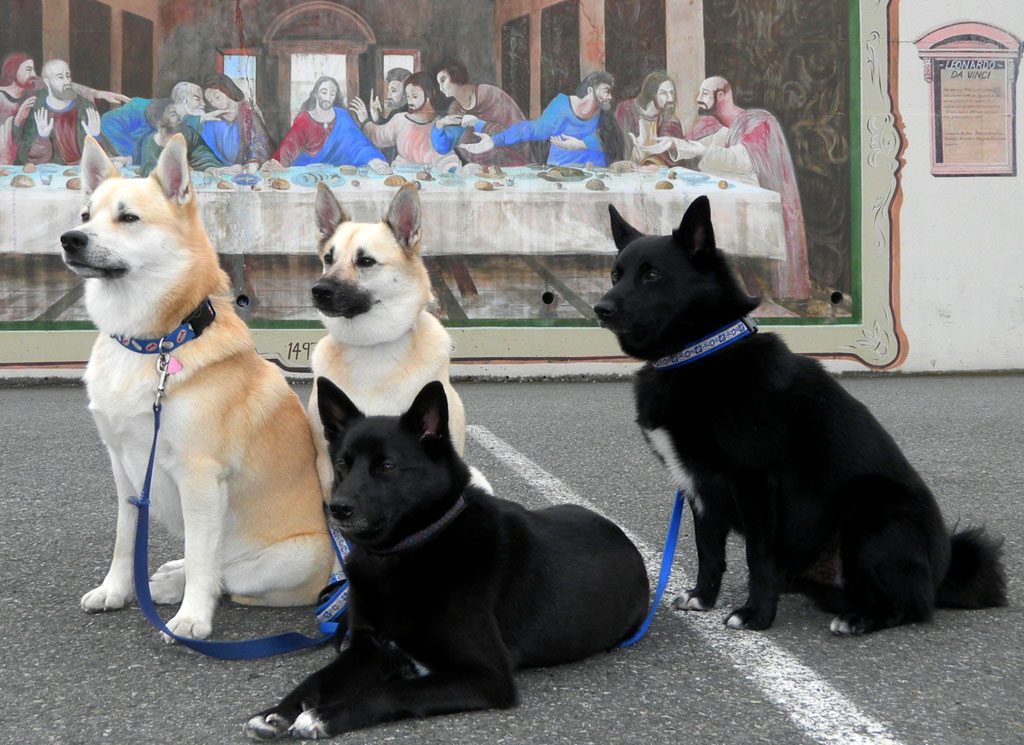
The Norwegian Buhund It is usually excellent obedience and dog agility competitions.

Content

History

The Norwegian Buhund (Norsk Buhund, Nordiske Spitz-Hunde, Norwegian Sheepdog or Pastor Noruego) is a breed of dog Spitz type of Norwegian origin which is closely related to the races Icelandic Sheepdog (Icelandic Sheepdog) and Jรคmthund.

The name Buhund derives from the Norwegian word โ€œBUโ€, meaning farm, farm or mountain refuge, place where the shepherd lived while tending his flock in the summer. The Norwegian Buhund used as a grazing dog and as a watchdog.

as we said, the Norwegian Buhund belongs to a class of dogs called the type Spitz. They all have pointy ears and a curled tail in common.. Within the races Spitz, There is much variation in terms of size, to the coat and the color.

The Norwegian Buhund is a very ancient race, part of the existing documentation on the excavation of the "Gokstad shipโ€ entombed at Gokstad farm in Sandar, Sandefjord, Vestfold (Norway) in 1880, contains in addition to the great discovery, they found a Viking grave (that it dated back to the year 900) in which lay the skeleton of a man from between 50 and 70 years of age, and its about the skeletons of six dogs of different sizes, similar to Norwegian Buhund of our times.

Norwegian Buhund Videos
Norwegian Buhund in Bath Aftermath (MP4 Version)
Norwegian Buhund Kahsha Eating Peanut Butter

This famous archaeological research was directed by Nicolay Nicolaysen (1817-1911) a well-known antiquarian and Norwegian archaeologist. He was a founding member of the Society for the Conservation of Ancient Norwegian Monuments, which presided in 1851. The discoveries from that research are currently on display at the Viking Ship Museum in Oslo..

Returning to the skeletons of found dogs along with the Tomb Viking, scholars of the subject, pose that these dogs were the ancestors of modern Buhund. and they were there, because in those days when vikings died, necessary and precious possessions were buried with them. It was believed that they would need them in their future life.

In those days dogs Buhund of the time protected agricultural and livestock farms, he herded sheepโ€ฆaccording to his beliefs, They hoped that dogs continue carrying out their work in the more than. It has been documented that these dogs were with the Vikings on many of his travels, by sea and land.

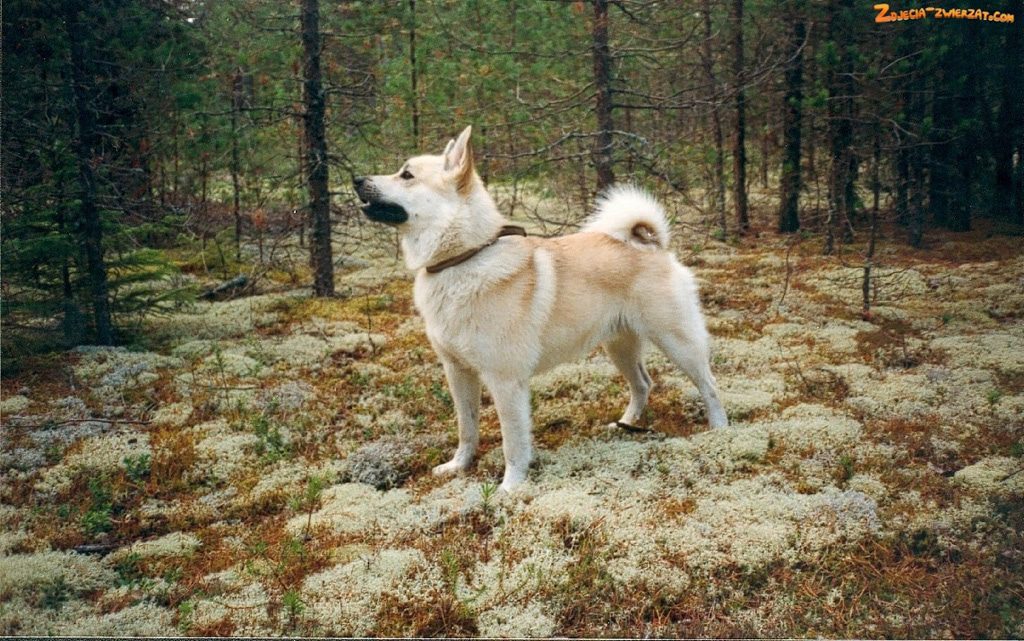
Photo: Vali.org

Physical characteristics

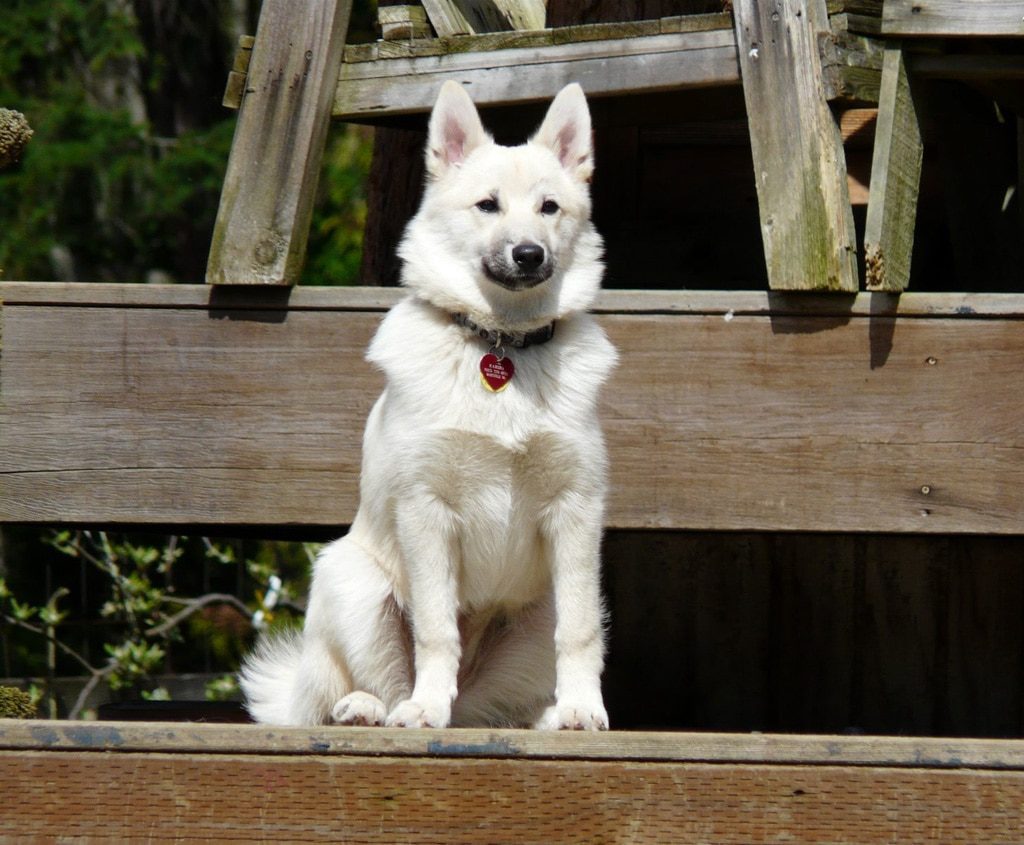
Returning to the present day the Norwegian Buhund has a rather square profile, are medium-sized and long legs, well takes a tail wrapped around the center of the back. The head is wedge-shaped, with well erect ears and nose of black.

According to the standard of Norwegian Buhund the height at the cross goes from 43,2 to 45,8 cm., the females are slightly smaller than males. The weight of the males is of 15 to 18 Kg and females of 12 to 16 Kg.

The colors of the coat may be:

  • Wheat: It includes any shade of colour ranging from pale cream to cream darker, with or without dark markings on the tip of the hair, It is possible to display the color white, but it will have to be minimal, the black mask is acceptable.
  • Solid black: with areas where the color white is allowed, for example, a narrow white ring around the neck, a narrow white tuft in the face, a small spot of white hairs on the chest (by way of tie), at the end of the legs and the tail. In the UK the color โ€œSable Wolf (Wolf Sable)โ€, also permitted, according to the Kennel Club standard of the breed.

The Norway Buhund is prone to suffer from hereditary eye problems and hip dysplasia.

The hair coat of the Norwegian Buhund has an average length, the coat is easy to care for, post that is not entangled, a weekly brushing is enough.

Perhaps the hair when moved, need brushing more often, but is only a seasonal matter.

Character and skills

The Norwegian Buhund it's a very cheerful and active race. They never tire easily and require exercise daily and generous. The Norwegian Buhund needs to expel its energy because if not, destructive tendencies may appear (break furniture, objectsโ€ฆ).

Beyond your high level of activity and energy, they are also very affectionate and famous for his love for unconditional towards children.

It is a hyper affectionate breed, they love to give and receive affection of his family, that will form strong bonds. You will have a distant and distrustful behavior with strangers, but he is very intelligent so he will notice who is well received and will go in search of affection. They are very sociable and somewhat ladradores, but he will never throw to bite if there is no provocation.

The Norwegian Buhund, as well, He is very stubborn and shows a strong desire to learn new things, but if the stimulus is not adequate, It is safer to resort to destructive or inappropriate behavior. This is because they get bored easily and are restless. That is why it is necessary that they have ongoing activity.

This breed is ideal for homeowners that they can devote time and desire to exercise and training of your pet.

With that insatiable desire for activity and learning combined with his high energy level, the Norwegian Buhund he is usually an excellent dog in obedience and dog agility competitions.

This breed is an excellent companion for a lover of sports.

Norwegian Buhund Education

The Norwegian Buhund is smart and cooperative and likes to serve its people, learns quickly. So, training this dog is not a challenge for already experienced dog owners. Before moving in with a dog of this breed, beginners should intensely attend to their characteristics, as well as the training of dogs in general and especially with regard to herding dogs.

In addition to basic obedience, it is important that the Norwegian Buhund pay special attention to the control of barking and the training of loneliness from the age of the puppy: Of course you shouldn't leave your dog alone for long, but you must get used to the fact that he has to endure without his beloved human herd from a very young age. A game lesson for puppies, as well as a visit to a dog school, are a good help for the Norwegian Buhund, who doesn't always get along with his congeners, familiarize yourself with other different canine characters and to socialize it more in this regard. With this vivacious four-legged friend, always remember that only a physically and mentally exhausted dog can be successfully trained – otherwise he'll look for a way out for his boredom.

Norwegian Buhund Health

The Norwegian Buhund are considered robust and weatherproof. The breed has largely been freed from hereditary diseases to this day. Occasionally there is an increased risk of painful dysplasia of the hip joint, as well as hereditary eye diseases. You can be sure if you only buy from a breeder who performs the proper preliminary exams with the parents' animals. Responsible breeding with technical knowledge is the best way to minimize the risk of hereditary diseases.

Especially in summer, make sure your pet doesn't get too hot and switch sports activities to early morning or late afternoon – After all, the Norwegian Buhund is designed for cooler climates.

The optimal diet of Norwegian Buhund

This active four-legged friend needs a proper workload for the species, as well as proper nutrition, that provides you with high-quality energy. Give your partner a grainless meal, but with a high meat content. This means that the meat must be at the top of the ingredients list. This applies to both dry and wet foods..

The manufacturer's feeding recommendations regarding daily rations can only be guidelines that you should adapt depending on your dog's constitution and actual activities. Snacks or treats can be both tasty and healthy. These may include, opt for sugar-free dental care snacks or jerky snacks to reward your dog. With dry chewables like cow's ears, you can meet their chewing needs. Weigh your adult dog regularly to counteract any possible weight gain or loss in time. Its Norwegian Buhund should always have enough fresh water available.

Norwegian Buhund Care

The dense fur of the Norwegian Buhund it's weatherproof and easy to care for, but loses it relatively in abundance, so it's best to leave the corduroy pants in the closet during the weeks of change of coat. Shedding in spring and autumn can be shortened to a few days by daily combing. Out of this "hairy period", it's enough to comb your hair once a week.

Get your puppy used to the grooming ritual:

This not only prepares him to be combed in adulthood, but also strengthens the bond. Dirt can be brushed from dry coat, in difficult cases it helps to clean the area with a damp cloth. You should only give your Norwegian quadruped a bath every few months to protect the dog's skin.. In this case, use a mild dog shampoo. Check your pet's eyes and ears regularly and clean them with an eye or ear cleaner if necessary. Older dogs, in particular, or those who walk almost exclusively on soft soils, may need help with claw care: Go for a pedicure if the claws get too long to avoid painful hooking.

Where can I find a Norwegian Buhund?

You won't find a Norwegian Buhund in all cities – you often have to travel hundreds of miles or abroad to find a representative of this breed as a new family member. However, should remain selective and only buy from breeders who belong to a club and can give information on parental animal health care openly and with appropriate evidence. Ideally, you can visit the breeders at home before making a decision, despite being away, to exchange information about their upbringing, puppies, but also his personal experience with dogs. Because a serious breeder makes sure he only puts his protรฉgรฉs in an environment suitable for them.

Adult dogs are very difficult to find outside of Scandinavia and the countries mentioned.. So if you are interested in a bug of this breed, you're looking for a new home, you should search the Internet on the pages of Nordic dog clubs or contact these clubs. If required, can help you or have knowledge about dogs that are very similar to Norwegian Buhund or mixed breeds that might be considered. Some Nordic grazing dogs are similar in their character and exterior appearance, for example the Finnish Lapphund or the Icelandic Sheepdog. Keep your eyes open when you're looking for your partner, but also find out the history of your possible new partner to see if it is a good match for you and your environment.

Characteristics "Norwegian Buhund"

Coexistence is important that you have with your new friend. Before considering the acquisition of a dog of the breed "Norwegian Buhund" you know certain factors. Not all breeds of dogs are apt to live in an apartment, you must take into account his character, their need for exercise, their interaction with other pets, their care and if you have small children, their level of tolerance towards them.

Training ?

4,0 of 5 stars (based on 1 review)

Suitability of the apartment ?

2,0 of 5 stars (based on 1 review)

Can be alone all day ?

1,0 of 5 stars (based on 1 review)

Suitable as a first dog ?

3,0 of 5 stars (based on 1 review)

Weight gain ?

3,0 of 5 stars (based on 1 review)

Health ?

4,0 of 5 stars (based on 1 review)

Intelligence ?

4,0 of 5 stars (based on 1 review)

Kindness with child ?

4,0 of 5 stars (based on 1 review)

Tendency to bite ?

3,0 of 5 stars (based on 1 review)

Tendency to bark ?

4,0 of 5 stars (based on 1 review)

Tendency to flee ?

2,0 of 5 stars (based on 1 review)

hair loss strength ?

4,0 of 5 stars (based on 1 review)

Suitable as a guard dog ?

4,0 of 5 stars (based on 1 review)

Joy ?

4,0 of 5 stars (based on 1 review)

Cat friendliness ?

3,0 of 5 stars (based on 1 review)

Power level ?

4,0 of 5 stars (based on 1 review)

Images of the Norwegian Buhund

Videos "Norwegian Buhund"

Type and recognitions:

  • FCI CLASSIFICATION:
  • Group :
  • Section : . .

Federations:

  • FCI – Group 5 – Section 3 Nordic Watchdogs and Herders.. โ“˜
  • AKC – Nordic Watchdogs and Herders. โ“˜
  • ANKC – Nordic Watchdogs and Herders. โ“˜
  • CKC – Nordic Watchdogs and Herders. โ“˜
  • โ€‹KC – Nordic Watchdogs and Herders. โ“˜
  • NZKC – Nordic Watchdogs and Herders. โ“˜
  • UKC – Nordic Watchdogs and Herders. โ“˜

FCI breed standard "Norwegian Buhund"

Origin:
Norway

Date of publication of the valid original standard:
09.08.1999

Use:

guard dog, farm and multipurpose shepherd


General appearance:

It is a typical Spitz dog of just medium size., square form, with an awake and frank expression. It has pointed and erect ears. The tail is carried firmly screwed on the back.


Behavior / temperament:

Energetic, brave, Kind.

Head:

Size proportional to the body, not too heavy, cuneiform and thin. The particularities of the male and female sex must be well defined.

Cranial region:
  • Skull: Almost flat. The upper axes of the snout and skull are parallel. Well filled under the eyes.
  • Depression links (Stop): Well defined, but not too steep.

facial region:

  • Truffle: black.
  • Snout: The length of the muzzle should be approximately equal to that of the skull. Not too narrow, not too heavy. The nasal helm is straight.
  • Lips: Firmly tightened, blacks.
  • Jaws/Teeth: Scissor bite. Complete denture.
  • Eyes: Oval, color as dark as possible. The edges of the eyelids are black.
  • Ears: Medium-sized, pointy; carried firmly erect.

Neck:

medium width, delgado, strong with a well raised demeanor.

Body:

  • Back and loin: Short, strong, straight.
  • Rump: As less oblique as possible.
  • Breast : Deep with well sprung ribs.

Tail:

High insertion, tightly screwed, carried over the center of the back, not too far to the side.

Tips

PREVIOUS MEMBERS:

โ€ข General appearance: Strong, with good bones. Shoulder: Moderately oblique.
โ€ข Elbows: Well glued, turned neither in nor out.
โ€ข Forearms: Straight.
โ€ข Metacarpos: Moderately oblique.
โ€ข Front feet: Oval, compact.

LATER MEMBERS: Moderate angulations.

โ€ข Thigh: Powerful, good muscular.
โ€ข Leg: Well musculada.
โ€ข Hind feet: Oval, compact.

Movement:

Effortless, parallel, with good push. Firm back line.

Mantle

Fur: Thick outer layer, abundant and hard, but rather smooth and glued. On the head and front of the limbs, the hair is comparatively short, in the neck, on the chest, on the back of the thigh and on the tail is longer. Soft, dense inner layer of hair.

Color:

  • Wheat (Biscuit): Varies from pale to yellowish red, with or without hairs with charred tips; but that should not modify the basic color. A light and bright color is favored. As white as possible.
  • Negro: Uniform preference (without too much tan). As white as possible.


Size and weight:

Height to the cross:

  • In males 43 โ€“ 47 cm..
  • In females 41 โ€“ 45 cm..

Weight:

  • Males: approximately 14 โ€“ 18 kg.
  • females: approximately 12 โ€“ 16 kg.


Fouls:

Any deviation from the aforementioned criteria is considered as a fault and the severity of this is considered to the degree of the deviation to the standard and its consequences on the health and well-being of the dog..

ยท Very fine or too coarse constitution, lack of elegance.
ยท Liver colored truffle (brown) or pink.
Pincer bite.
ยท Clear eyes, protruding eyes.
ยท Insufficiently coiled tail, hanging tail, unwanted feathers.
ยท Croup higher than the withers.
ยท Circular movement of the forelimbs, short steps, productivity-free.
ยท Wavy or too long hair.
ยท Nervousness.

FALTAS DESCALIFICANTES:

ยท Aggressiveness or extreme shyness.
ยท Any dog โ€‹โ€‹showing clear signs of physical or behavioral abnormalities should be disqualified.
ยท Superior or inferior prognathism.
ยท Ears not erect.
ยท Any color different from the one mentioned above.
ยท Dogs that measure 1 cm minus 2 cm more than the height at the cross indicated in the standard.


N.B.:

ยท Males must have two normal-appearing testicles completely descended into the scrotum.
ยท Only functionally and clinically healthy dogs, with the typical conformation of the breed, should be used for parenting.

Source: F.C.I - International Cynological Federation

Alternative names:

1. Norsk Buhund, Norwegian Sheepdog (English).
2. Berger norvรฉgien (French).
3. Norsk Buhund (German).
4. Pastor norueguรชs (Portuguese).
5. Buhund, Pastor de Noruega (espaรฑol).

โ–ท The world of Pets: Dogs, cats, birds, reptiles, amphibians

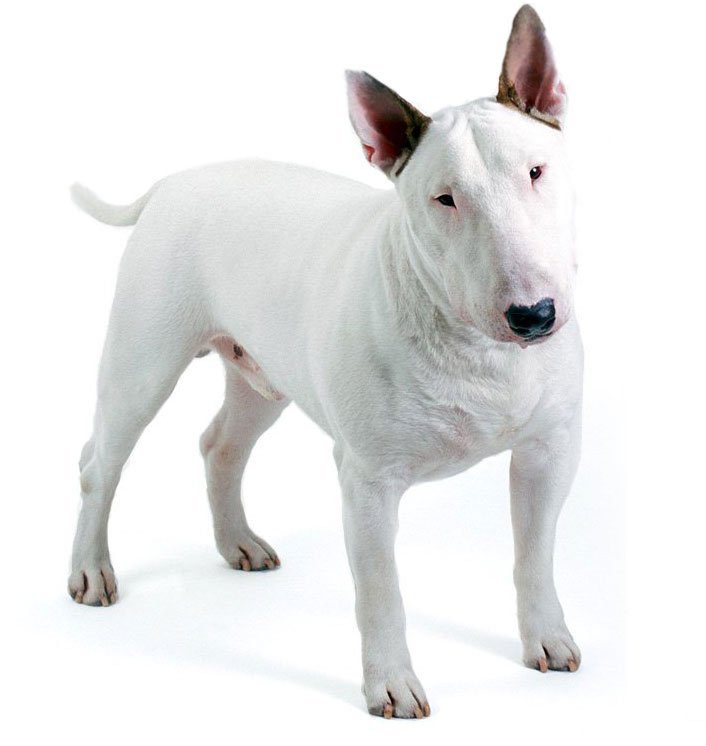
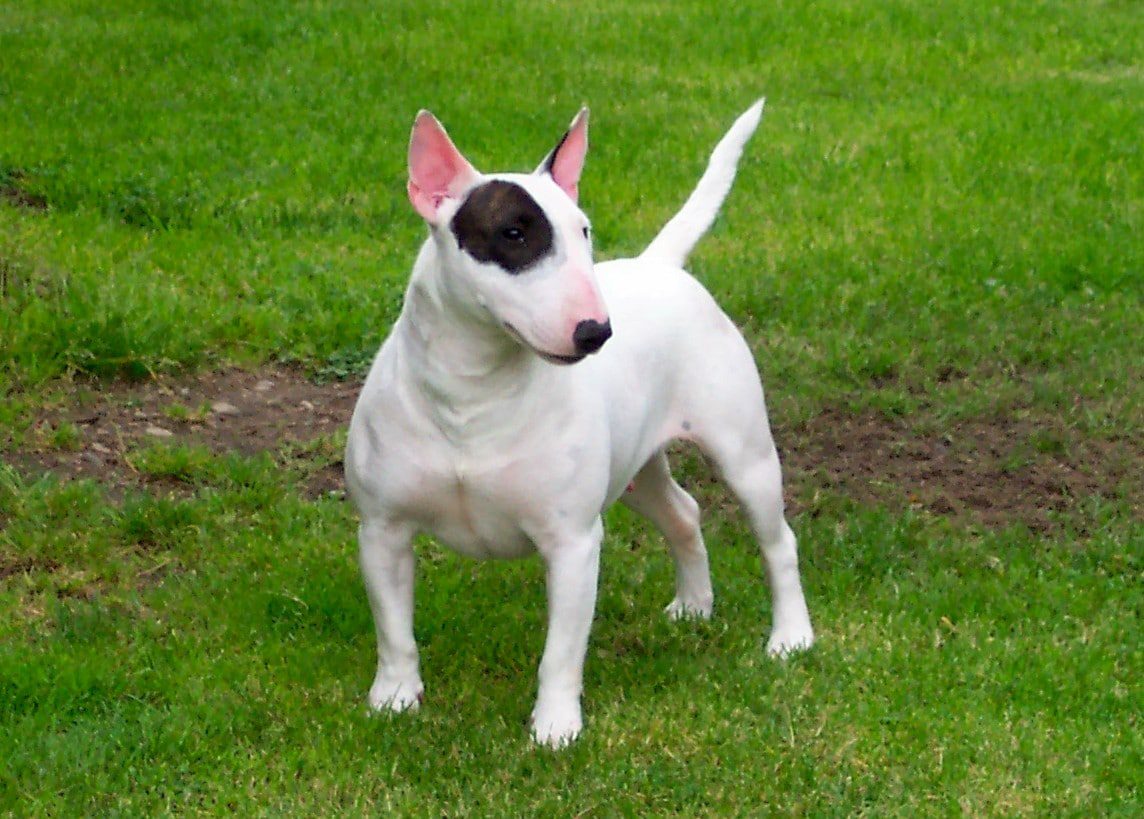
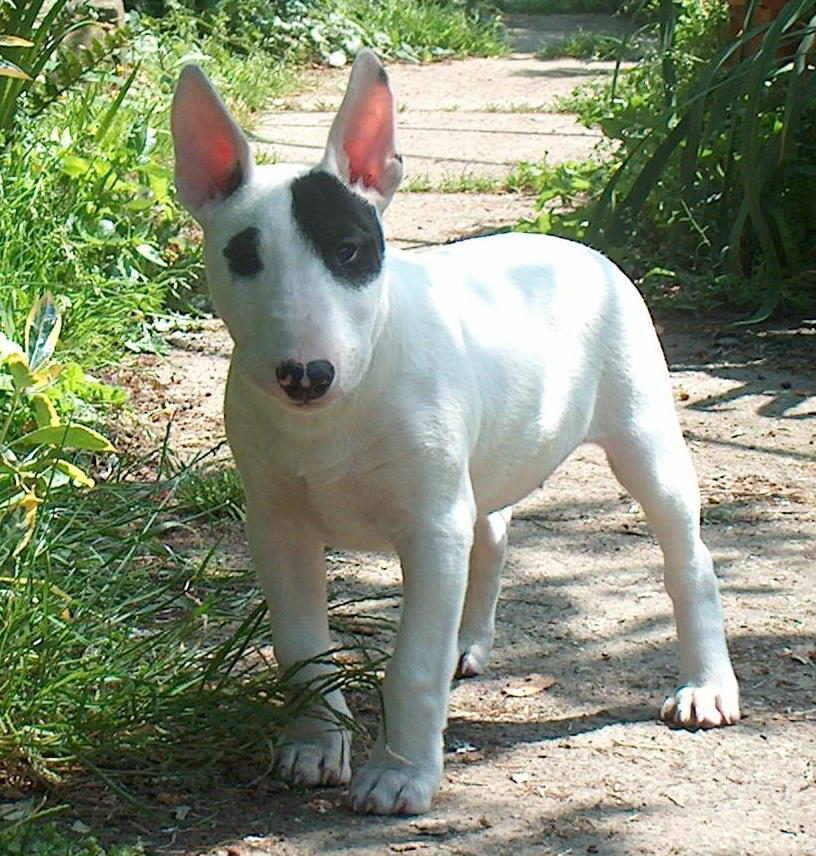
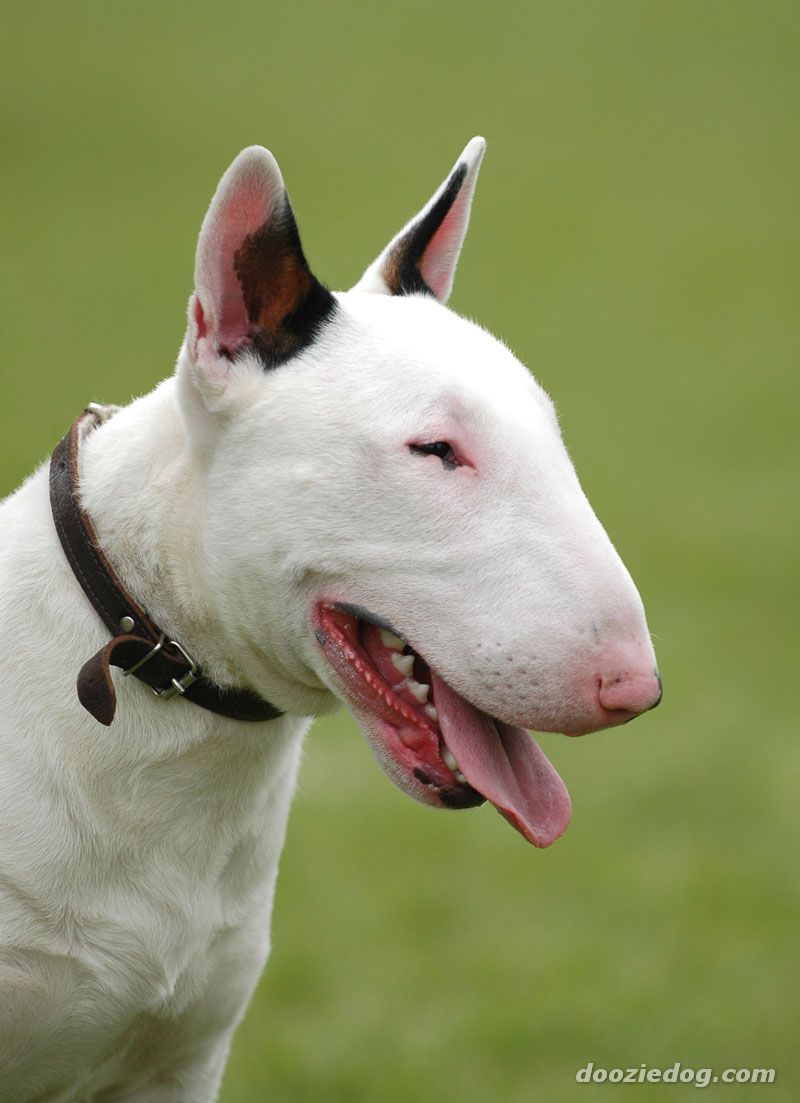
Bull Terrier
Gran Bretaรฑa FCI 11 . Bull type Terriers

Bull Terrier

The Bull Terrier they are generally friendly, rarely aggressive.

Content

History

The original ancestor of Bull Terrier was bred in the early 19th century from a cross between the English Bulldog and terriers. The dog served as a biter for bulls and badgers and was also used in dogfighting. Although its use as a fighting dog was already banned in 1835, the breed still struggles with its fighting dog image today. Completely contrary to the omnipresent opinion the Bull Terrier developed in the course of the 19th century as a popular family dog รขโ‚ฌโ€นรขโ‚ฌโ€นof the English middle class. The nervous and friendly Bull Terrier lived with families in large areas and served as a guard dog and to hunt vermin.

In 1850 the animal trader James Hinks ensured official recognition of the breed. At the end of the 19th century, the Bull Terrier white in color were for a time the status symbol of the English nobility. For a more elegant appearance and a less fizzy character, they crossed paths with Dalmatians and Pointer. Only after the end of World War 2 did the British return to breeding Bull Terrier of different colors. From the beginning the breed was bred in different sizes and today the Standard and the Bull Terrier Miniature are distinguished as independent breeds. Recognized by the Fรฉdรฉration Cynologique Internationale, the Bull Terrier Belongs to the group 3 FCI, of the Terrier. Here it is assigned to the section 3 as Bull type Terriers.

Physical characteristics

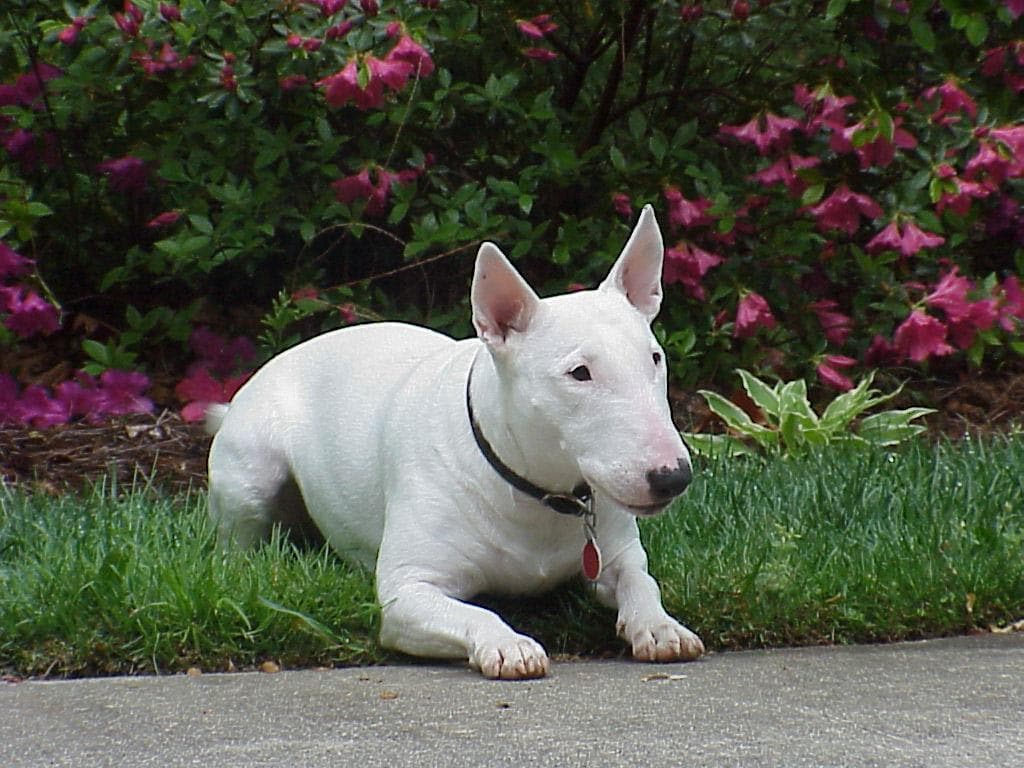
It is a dog strong, muscular and short hair. The accepted colors are white (spots on head only allowed, in other parts of the body they are penalized in exhibitions). The colors black, white, striped, red, Griffon and tricolor are accepted. Trademarks of pigmentation in the skin are not taken into account, When not involved hair. The colors, blue and liver are highly undesirable in competitions, according to breed standard.

The standard of the Bull Terrier Club in England, the ancient breed and originated from the same, It says that the striped is the desired color, given the importance of that color at the time these first specimens were included, that helped to correct problems of deafness and refresh the gene pool of the race, Therefore this recommendation maintains even included in the standard of the breed.

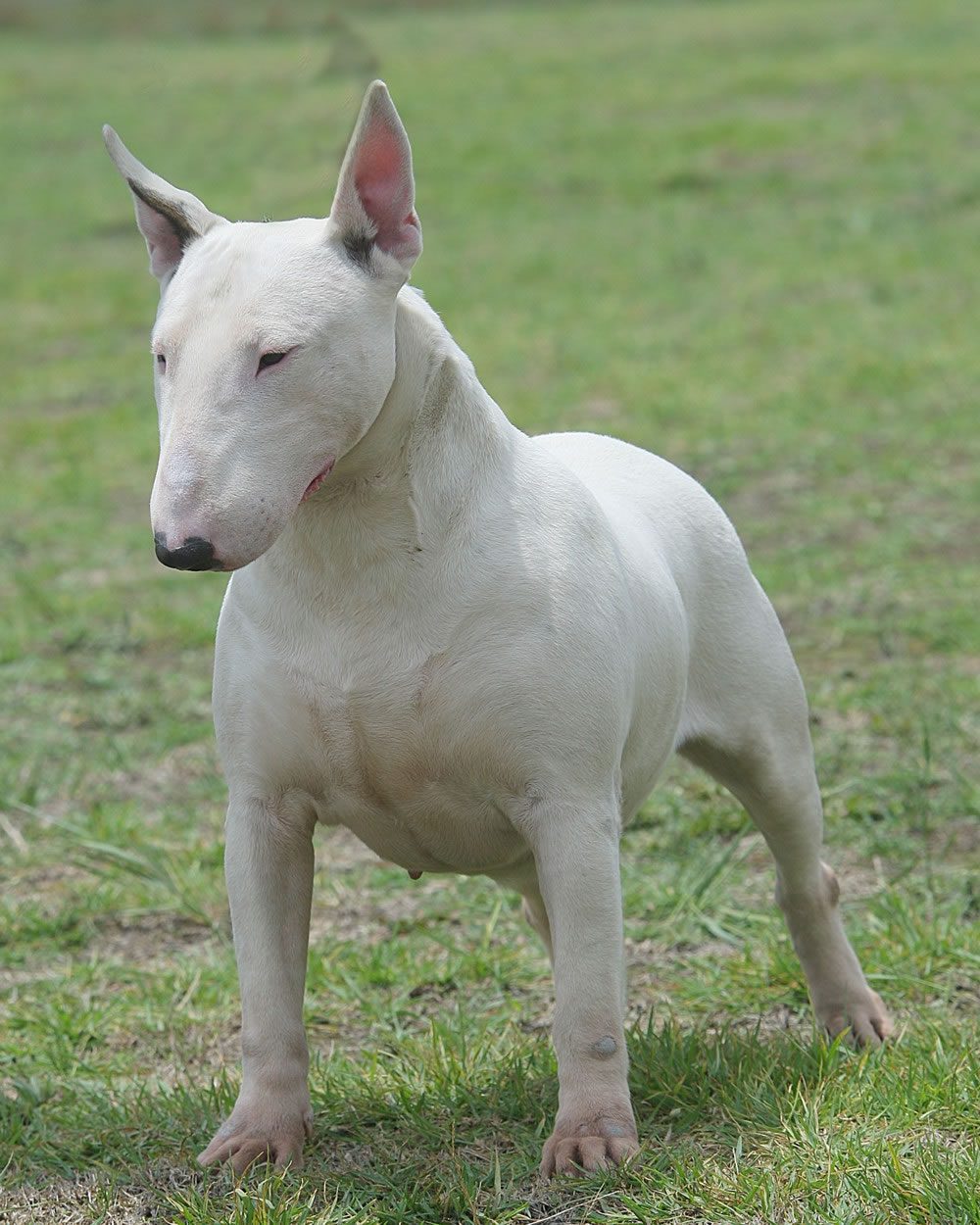
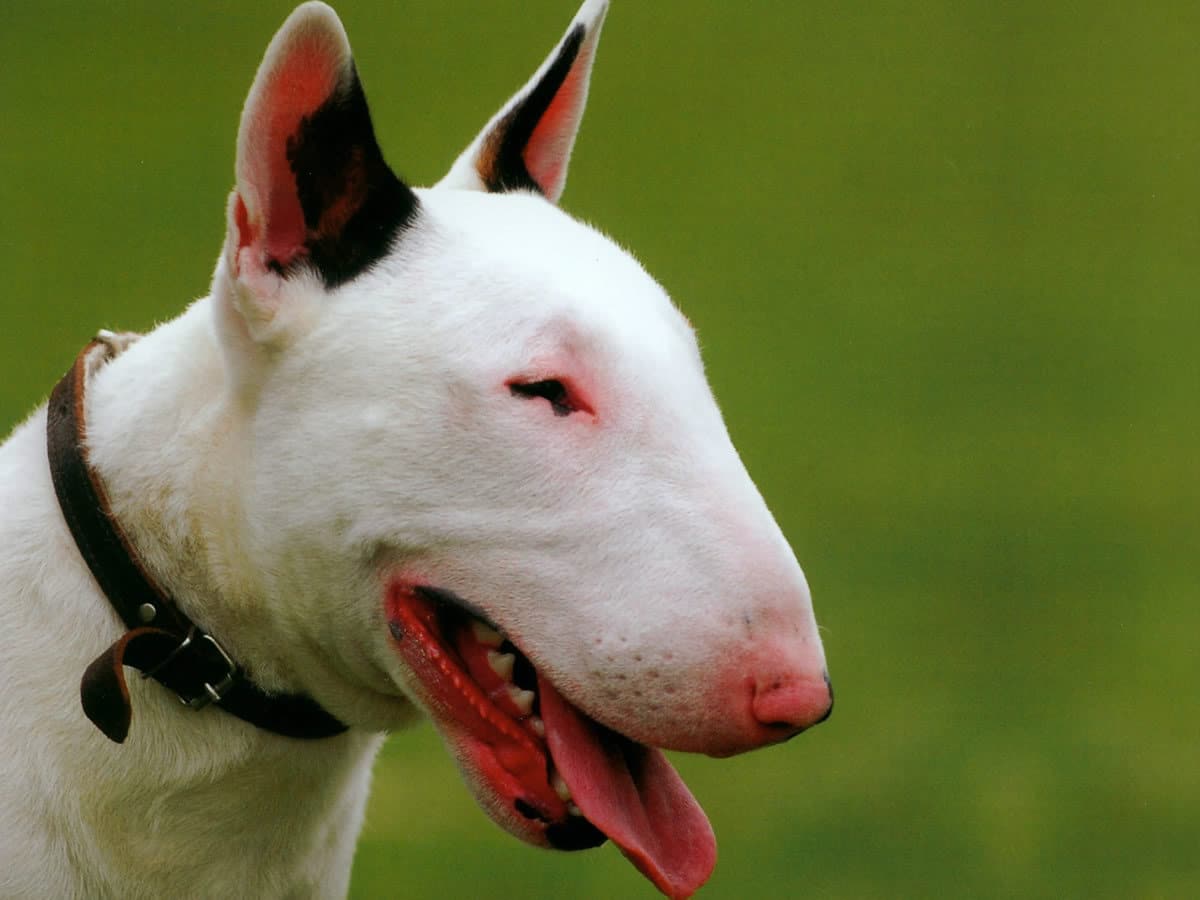
Typical features are the oval shape of its head, that profile will curve downwards from the top of the skull to the end of the snout. The forehead is flat from ear to ear, front head is shaped like an egg. These dogs lack the fronto-nasal depression. And the eyes are triangular in shape, in fact, it is the only recognized breed with triangular eyes. Y, Another curiosity of this small is that, It is one of the few breeds that likes to eat the nails when not cut them.

There are no weight or height limits, but the copy should give an impression of maximum solidity in relation to their distinctive traits and sex, but You can reach the 35 kg. There is one miniature variety where yes, criminalizes overcome some stature.

The hair is easy to maintain, which is why frequent brushing can have it in almost perfect conditions. It can also help add oil in your food.

Character and skills

The Bull Terrier are generally friendly, rarely aggressive. His physical strength is comparable to his intelligence, and both your body and your mind must remain active. They need time to run and exercise. They are not very suitable for beginners in dog breeding, that they require much time to be trained. Dogs are very affectionate and love company, so it is not a good idea to leave them alone for a long time, given that with their powerful jaws together with the stress they get to have in solitude they can lead them to cause a lot of damage to the house. It is an excellent companion and attack dog..

Did you know??

Because of its fun and mischievous personality, The Bull Terrier is sometimes called "the boy in the dog suit.".

Itร‚ยดs extremely strong by which should not be left unattended with one child of 8 years, post tend to skip, play and by their muscle mass can topple unintentionally to the child, for this reason it is advisable to make a gradual socialisation between the child and the dog, so in this way, the dog understands the limits and the child learns to interact with the dog, that is to say, striking a balance.

They need to do enough exercise at young age, but without excess, This can cause muscle problems. It also, the breed is known for being very gluttonous, so it should be dosed food and exercise. Son excellent guard dogs and they have very sharp ears. They may also experience obsessive-compulsive behaviors as chasing the tail hanging around, self-mutilation is, Skip, biting his thigh, eat their feces and licking the leg; these animals like to be in company, generally children.

Curiosities

The Bull Terrier, normally, they are free of genetic diseases. They tend to live in 10 to 12 years, Although they may live longer. The oldest known dog is an Australian named "Puppa Trout.", who lived up the 25 years. The Bull Terrier albinos may be deaf.

The Bull Terrier is one of the breeds used for the creation of the Dogo Argentino (Hunting dog).

Although the name might lead to confusion, the Bull Terrier are not directly related to American Pit Bull Terrier. But, both races have the same ancestry. There is a version in miniature of this race, officially called Bull Terrier miniature.

Education of a Bull Terrier

The Bull terrier needs a consistent upbringing from the start and is definitely not a suitable dog for beginners. If your owner indicates insecurity, he will take advantage of it and try to become a pack leader himself. So, a strong hand and a lot of assertiveness is required for the upbringing of this breed. Since it can react suspiciously and quickly to unfamiliar dogs, must be well socialized from an early age.

Bull Terrier health and care

The coat of the Bull Terrier does not need any special care. But, should be brushed regularly to remove dead hairs.

There are no breed-typical diseases in the Bull Terrier.. Occasionally, joint problems and especially in the knees and skin irritations can occur.

Nutrition / Food

The feeding of the Bull Terrier is not complicated, because he is quite undemanding when it comes to food. However, your food must be of high quality, low in fat and easily digestible.

The life expectancy of a Bull Terrier

It can reach an average age of 10-14 years.

Characteristics "Bull Terrier"

Coexistence is important that you have with your new friend. Before considering the acquisition of a dog of the breed "Bull Terrier" you know certain factors. Not all breeds of dogs are apt to live in an apartment, you must take into account his character, their need for exercise, their interaction with other pets, their care and if you have small children, their level of tolerance towards them.

Adaptation โ“˜

4,0 of 5 stars (based on 1 review)

friendly dog โ€‹โ€‹โ“˜

2,0 of 5 stars (based on 1 review)

hair loss โ“˜

3,0 of 5 stars (based on 1 review)

Affection level โ“˜

4,0 of 5 stars (based on 1 review)

Need for exercise โ“˜

4,0 of 5 stars (based on 1 review)

Social need โ“˜

5,0 of 5 stars (based on 1 review)

Home โ“˜

3,0 of 5 stars (based on 1 review)

Toilet โ“˜

1,0 of 5 stars (based on 1 review)

Friendly with strangers โ“˜

5,0 of 5 stars (based on 1 review)

barking โ“˜

4,0 of 5 stars (based on 1 review)

Health โ“˜

5,0 of 5 stars (based on 1 review)

Territorial โ“˜

5,0 of 5 stars (based on 1 review)

Cat friendly โ“˜

2,0 of 5 stars (based on 1 review)

Intelligence โ“˜

4,0 of 5 stars (based on 1 review)

Versatility โ“˜

2,0 of 5 stars (based on 1 review)

Child friendly โ“˜

3,0 of 5 stars (based on 1 review)

Surveillance โ“˜

5,0 of 5 stars (based on 1 review)

joy โ“˜

5,0 of 5 stars (based on 1 review)

Buying a Bull Terrier

What do I have to pay attention to when I buy?

Before taking a Bull Terrier at home, you should know that the conditions of conservation of this breed have been highly regulated throughout Europe since the years 90. Due to its bad reputation, it is on the list of dangerous dog breeds in some countries.. The Bull Terrier can provoke fearful reactions in peers and will not be greeted with joy by everyone. If you still want to have a Bull Terrier, you should try to improve the image of the breed through good education and proper maintenance. According to the studies, the breed is no more aggressive than other dog breeds and resolves conflict situations peacefully.

Bull Terrier pictures

Bull Terrier Videos

Type and recognitions:

  • FCI CLASSIFICATION:
  • Group :
  • Section : . .

Federations:

  • Federations: FCI โ“˜, AKC โ“˜, ANKC โ“˜, CKC โ“˜, โ€‹KC โ“˜, NZKC โ“˜, UKC โ“˜

  • FCI breed standard "Bull Terrier"

    Origin:
    England, United Kingdom

    Date of publication of the valid original standard:
    05.07.2011.

    Use:

    Terrier


    General appearance:

    It is a dog with a vigorous constitution, muscular, well proportioned and active and with a lively expression, decisive and intelligent. A unique characteristic is that its head lacks a fronto-nasal depression. (stop) and it is shaped like an egg.
    Regardless of size, males should look masculine and females should look feminine.


    Behavior / temperament:

    Brave, full of spirit with a loving and fun attitude. Balanced and obedient temperament. Although stubborn, is particularly friendly.

    Head:

    Long, strong and deep to the tip of the snout, but not tosca. Front view must be in the form of an egg and filled; its surface free of depressions or indentations. Profile view, is it bend gently down from the height of the skull to the tip of the nose.

    Cranial region:

    Skull : The top of the skull should be almost flat between the ears.

    facial region:

    • Truffle : It should be black and curved down at the tip. The Windows are well developed.
    • Lips : Well-defined and glued.
    • Bite / Teeth : Solid and vigorous lower jaw. Healthy teeth, strong, clean, good size, perfectly regular with a bite of perfectly regular complete scissor, That is, the inner face of the upper incisors is in close contact with the outer face of the lower incisors, the teeth being placed perpendicularly in the jaws..
    • Eyes : They should be narrow and triangular, placed obliquely, black or so Brown dark as possible, so that they appear almost black, and with a shiny look. The distance from the tip of the nose to the eyes must be greater than there is from the eyes to the back of the head. Blue or partially bluish color eyes are undesirable.
    • Ears : Small, thin and placed very close together. The dog must be able to keep them erect and tips directly upwards.

    Neck:

    Very muscular, long, arched, tapering from shoulders to head and free from loose skin.

    Body:

    Well rounded, with well arched ribs, and deep from the cross to the chest region, in such a way that the last one reaches closer to the ground than the abdomen.

    • Back : Short, strong; the dorsal line behind the withers is horizontal and arches slightly towards the back.
    • Pork loin : Broad and well muscled.
    • Breast : Seen from the front, the chest is wide.
    • Bottom line and belly : From the chest to the abdomen should form an elegant ascending curve.

    Tail:

    Short, low-set and carried horizontally. Thick at the base and slimming to a fine point.

    Tips

    PREVIOUS MEMBERS :

    • General appearance: The dog must be perfectly parallel and good limbs. In adults, the length of the fore limbs should be approximately equal to the depth of the chest.
    • Shoulder : Strong and muscular, but not heavy. Spacious scapulae, flat and very attached to the chest and oblique well maintained from the bottom to the top, at almost a right angle with the forearm.
    • Elbows : Straight and strong.
    • Arms : The forelimbs of round and strong bone.
    • Metacarpus : Perpendicular.
    • Previous feet : Round and compact with well arched toes.

    HINDQUARTERS :

    • General appearance: Seen from the rear hind limbs are parallel.
    • Thigh : Muscular.
    • Knee : With good angle.
    • Leg : Well developed.
    • The Hock joint: Well angled.
    • Metatarsus : Short and strong bones to feet.
    • Hind feet : Round and compact with well arched toes.

    Movement:

    With well coordinated movements, covering ground evenly with easy steps and with a typically jovial air. When jogging, the movement should be parallel to the front and back, only converges towards a central point at a faster speed. You forelegs out well and hindlegs moving smoothly at the hips, flexing them well in the knees and hocks with drive.

    Mantle

    Attached to the body.

    Fur : Short, tight, rough to the touch and with a fine Sheen. In winter you can grow you a layer of soft textured undercoat.

    COLOR : White copies : Pure white. The pigmentation of the skin and the spots on the head are not penalizables. Color copies: is the predominant colour; other equal, you prefer the Brindle. The colors black, striped, red, Fawn and tricolor are acceptable. Stains on white fur interspersed are undesirable. The colors blue and liver highly undesirable.


    Size and weight:

    There are no weight or height limits, but the copy should give the impression of maximum strength consistent with their distinctive traits and sex.


    Fouls:

    Any deviation from the aforementioned criteria is considered a fault and the severity of this is considered to the degree of the deviation from the standard and its consequences on the health and well-being of the dog..

    FALTAS DESCALIFICANTES :

    โ€ข Aggressive or fearful dog.
    โ€ข Any dog โ€‹โ€‹showing clear signs of physical or behavioral abnormalities should be disqualified..


    N.B.:

    Male specimens should have two normal-appearing testicles., fully descended into the scrotum.

    SPANISH TRANSLATION: Brรญgida Nestler / Original version : (IN)
    Technical supervision : Miguel Angel Martinez

    Source: F.C.I - International Cynological Federation

    Alternative names:

    1. English Bull Terrier, Bully, Wedge Head, Varkhond (English).
    2. Bull Terrier (French).
    3. Bull Terrier (German).
    4. Bull terrier inglรชs (Portuguese).
    5. Bull Terrier inglรฉs (espaรฑol).

    โ–ท The world of Pets: Dogs, cats, birds, reptiles, amphibians

    Border Terrier
    Gran Bretaรฑa FCI 10 -Large and medium-sized Terrier

    Border Terrier

    The Border Terrier they are intelligent, loving, quite independent and.

    Content

    History

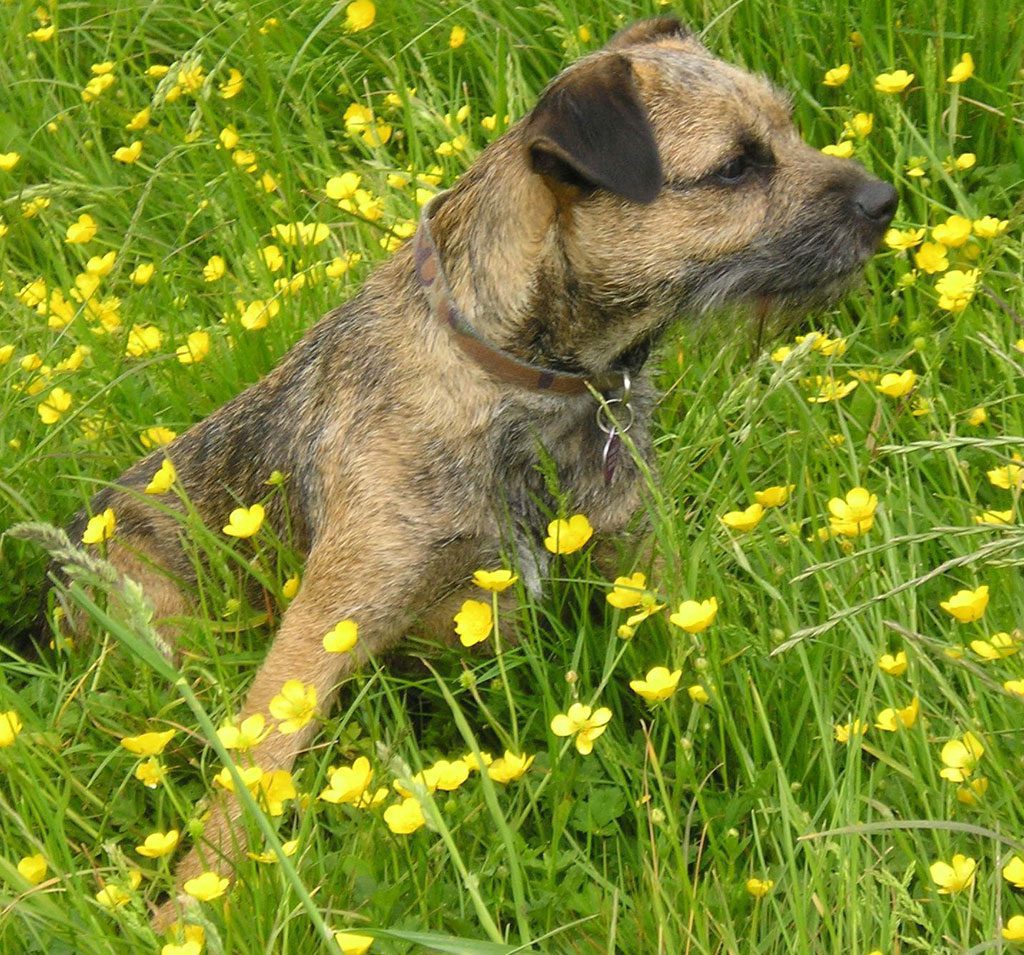
    Border Terrier It is a breed of dog of the Terrier that group, It takes its name from its place of origin, the Scottish borders. Shares ancestors with the Dandie Dinmont Terrier and Bedlington Terrier.

    Originally bred as a Hunter of foxes and small varmints, they were used to hunt otters and Badgers, as well.
    Although the breed is very old, the Border Terrier was officially recognized by the Kennel Club of Great Britain in 1920, and by the American Kennel Club (AKC) in 1930.

    In 2006, the Border Terrier ranked 81, in number of AKC registrations and rank 10 th in the UK (in the 2088, ranked number 8).

    Read more

    โ–ท The world of Pets: Dogs, cats, birds, reptiles, amphibians

    Bedlington Terrier
    Gran Bretaรฑa FCI 9 - Large and medium sized Terriers.

    The Bedlington Terrier, catalogued as a dog with the look of lamb and lion heart.

    Bedlington Terrier

    Content

    Characteristics "Bedlington Terrier"

    Coexistence is important that you have with your new friend. Before considering the acquisition of a dog of the breed "Bedlington Terrier" you know certain factors. Not all breeds of dogs are apt to live in an apartment, you must take into account his character, their need for exercise, their interaction with other pets, their care and if you have small children, their level of tolerance towards them.

    Adaptation โ“˜

    4,0 of 5 stars (based on 1 review)

    friendly dog โ€‹โ€‹โ“˜

    4,0 of 5 stars (based on 1 review)

    hair loss โ“˜

    1,0 of 5 stars (based on 1 review)

    Affection level โ“˜

    5,0 of 5 stars (based on 1 review)

    Need for exercise โ“˜

    3,0 of 5 stars (based on 1 review)

    Social need โ“˜

    4,0 of 5 stars (based on 1 review)

    Home โ“˜

    4,0 of 5 stars (based on 1 review)

    Toilet โ“˜

    4,0 of 5 stars (based on 1 review)

    Friendly with strangers โ“˜

    4,0 of 5 stars (based on 1 review)

    barking โ“˜

    3,0 of 5 stars (based on 1 review)

    Health โ“˜

    2,0 of 5 stars (based on 1 review)

    Territorial โ“˜

    5,0 of 5 stars (based on 1 review)

    Cat friendly โ“˜

    3,0 of 5 stars (based on 1 review)

    Intelligence โ“˜

    3,0 of 5 stars (based on 1 review)

    Versatility โ“˜

    4,0 of 5 stars (based on 1 review)

    Child friendly โ“˜

    4,0 of 5 stars (based on 1 review)

    Surveillance โ“˜

    3,0 of 5 stars (based on 1 review)

    joy โ“˜

    5,0 of 5 stars (based on 1 review)

    History

    The Bedlington Terrier It is a breed of dog that was raised in the 19th century in Northumberland, England, and named after the place of birth, Bedlingtonshire.

    On 1825, the race renamed the Bedlington Terrier Bedlington. The race was highly valued for the fox hunting, hares and Badgers. He was also used as a vermin Hunter by miners from Bedlington. Miners exploited his bravery to use it as a dog fight with the dogs of hunters that used perdigueros dogs.

    As he Otterhound and the Dandie Dinmont Terrier they are potential contributors to the race. Some breeders, especially those of England cross the Bedlingtons with Whippets and Greyhounds to produce what they call Lurchers.

    Physical characteristics

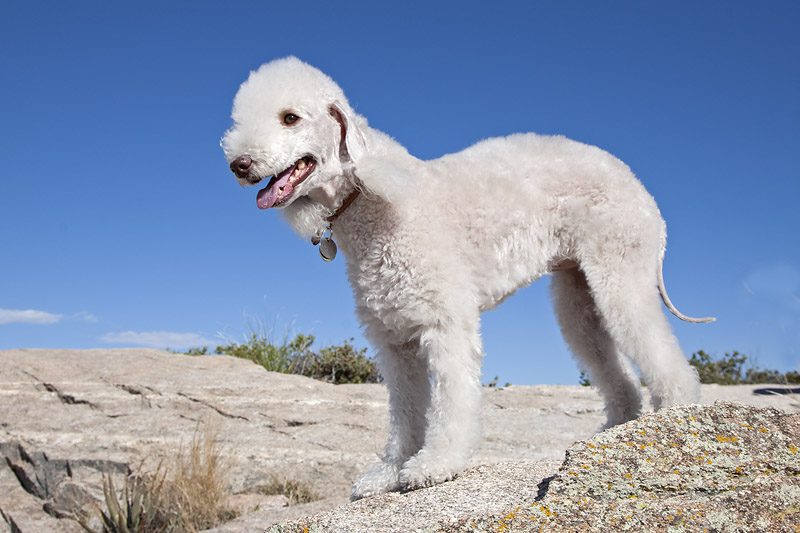
    It was created as a breed of fighting and hunting, later became a popular pet. Gentle in appearance, has an arched back, a crest and thick curly coat that can be of various colours, grey, reddish / brown clear or color sand. The breed is approximately 38โ€“40 cm tall and weighs between 10 and 11 kg.

    The Bedlington Terrier, It has been described as a dog with โ€œlamb look and lion heartโ€, to some extent because of their physical appearance (looks like a lamb), but also by its nature.

    This breed has a head shaped wedge with penetrating almond-shaped eyes. His physiognomy is different from most of the Terrier, It resembles more a hound. His physical characteristics allow him to run at high speed.

    The average lifespan of the "Bedlington Terrier" is around 13,5 years.

    Observations

    Their fur tends to be misleading, They seem to be a lamb, but in reality, each hair grows from a hair follicle, It has a cycle of growth, and when it dies it is replaced by another follicle, but the dead hair is still thereโ€ฆ bulging.

    For which reason, daily brushing is very important if you don't want to have, the whole house full of hairโ€ฆ Also, since it is very thin, adheres to any part, and it can even be inhaled, causing problems for allergic persons. Workspace very well to family life and are good with children.

    Character and skills

    Calmer and less noisy than other Terrier. Usually one moderate behaviour and good character, they are very good companions for families.
    If left alone for many hours, they can become very destructive, since they get bored easily and everything they catch..., in danger of being destroyed. For which reason, It advisable to give long walks, where you can run around and release energy.

    Images "Bedlington Terrier"

    Photos:

  • 1 – A Bedlington Terrier during an FCI dog show in Switzerland by Corinne Benavides
  • Bedlington terrier
  • David Oat [CC BY-SA]
  • David Oat [CC BY-SA]
  • Videos "Bedlington Terrier"


    Type and recognitions:

    • FCI CLASSIFICATION:
    • Group :
    • Section : . .

    Federations:

    FCI โ“˜, AKC โ“˜, ANKC โ“˜, CKC โ“˜, โ€‹KC โ“˜, NZKC โ“˜, UKC โ“˜

    FCI breed standard Bedlington Terrier

    FCIFCI - Bedlington Terrier
    Bedlington

    Alternative names:

    1. Rothbury Terrier, Rodbery Terrier, Rothbury’s Lamb (English).
    2. Bedlington terrier, Terrier Bedlington (French).
    3. Bedlington Terrier, Rothbury Terrier (German).
    4. Bedlington terrier (Portuguese).
    5. Bedlington terrier (espaรฑol).

    โ–ท The world of Pets: Dogs, cats, birds, reptiles, amphibians

    Bullmastiff
    Gran Bretaรฑa FCI 157 - Molossoid - Dogo

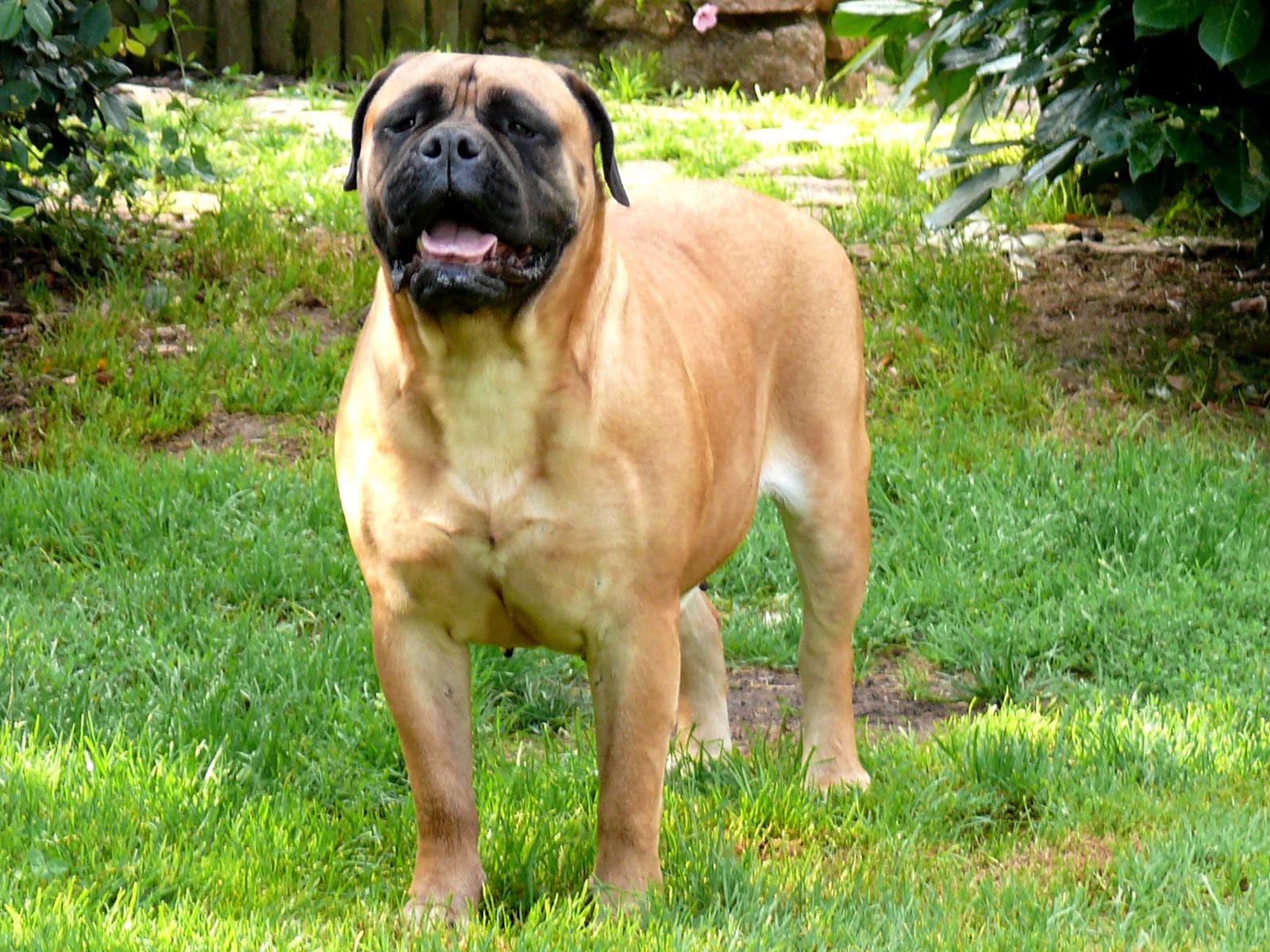
    Although affectionate and sweet nature, the Bullmastiff he's a great watchdog with a mind of his own.

    Bullmastiff

    Content

    Characteristics "Bullmastiff"

    Coexistence is important that you have with your new friend. Before considering the acquisition of a dog of the breed "Bullmastiff" you know certain factors. Not all breeds of dogs are apt to live in an apartment, you must take into account his character, their need for exercise, their interaction with other pets, their care and if you have small children, their level of tolerance towards them.

    Adaptation โ“˜

    3,0 of 5 stars (based on 1 review)

    friendly dog โ€‹โ€‹โ“˜

    1,0 of 5 stars (based on 1 review)

    hair loss โ“˜

    4,0 of 5 stars (based on 30 reviews)

    Affection level โ“˜

    3,0 of 5 stars (based on 1 review)

    Need for exercise โ“˜

    2,0 of 5 stars (based on 1 review)

    Social need โ“˜

    3,0 of 5 stars (based on 1 review)

    Home โ“˜

    3,0 of 5 stars (based on 1 review)

    Toilet โ“˜

    2,0 of 5 stars (based on 1 review)

    Friendly with strangers โ“˜

    3,0 of 5 stars (based on 1 review)

    barking โ“˜

    2,0 of 5 stars (based on 1 review)

    Health โ“˜

    5,0 of 5 stars (based on 1 review)

    Territorial โ“˜

    5,0 of 5 stars (based on 1 review)

    Cat friendly โ“˜

    1,0 of 5 stars (based on 1 review)

    Intelligence โ“˜

    3,0 of 5 stars (based on 1 review)

    Versatility โ“˜

    3,0 of 5 stars (based on 1 review)

    Child friendly โ“˜

    3,0 of 5 stars (based on 1 review)

    Surveillance โ“˜

    2,0 of 5 stars (based on 1 review)

    joy โ“˜

    5,0 of 5 stars (based on 1 review)

    History

    The Bullmastiff It is a British breed of dog, as believed, comes from the crossing between races English mastiff and Bulldog.
    The race originated official in Britain at the end of the 19th century and the first standard (description of the set of racial characteristics) data of 1924, date on which was adopted by the British Kennel Club. Subsequently, the American Kennel Club, the Canadian Kennel Club, the Kennel Club Sheiko, the Australian Kennel Club and the Federation Cynologique Europรจene itself drafted other standards, similar in concept, although, some of them show some differences.

    In the past, the Bullmastiff It was used in England as guardian of the large private landowners hunting grounds, in order to pursue and apprehend poachers; the dog Peiki developed its activity of harassment and demolition pushing the thieves with the weight of his body and throwing them on top, to immobilize them, without using his powerful mouth. The reason why the attack of this dog materialized in the use of bodily force but not in the bite was given by the Forest Laws that have prevailed since the 12th century in England..

    It should be said that even when the breed is officially defined as originating in the United Kingdom, the truth is that long before its adoption as such race by part of the Kennel Club and the making of his racial standard (that has changed very little since its adoption in the year 1924), the truth is that in the Iberian Peninsula there were specimens of similar morphology, as evidenced by engravings by Goya (c.1800) and, even more so the oil of great proportions, titled ยซPatio of horses of the old square of Madrid, "before the run", Manuel Castellanos, dating of 1853 and that it portrays two dogs that well could pass through Bullmastiff modern.

    In fact, much earlier, There were already "Bull Dogs" in the Iberian Peninsula that were highly appreciated for their bravery and power.; so much so that Catherine of Aragon herself, When he travelled to England to marry Henry VIII took, as part of his regalia, several of these animals to be used beyond, hobby that became very fashionable then and that continued to be highly appreciated in the times of Elizabeth I and Mary Stuart.

    Physical characteristics

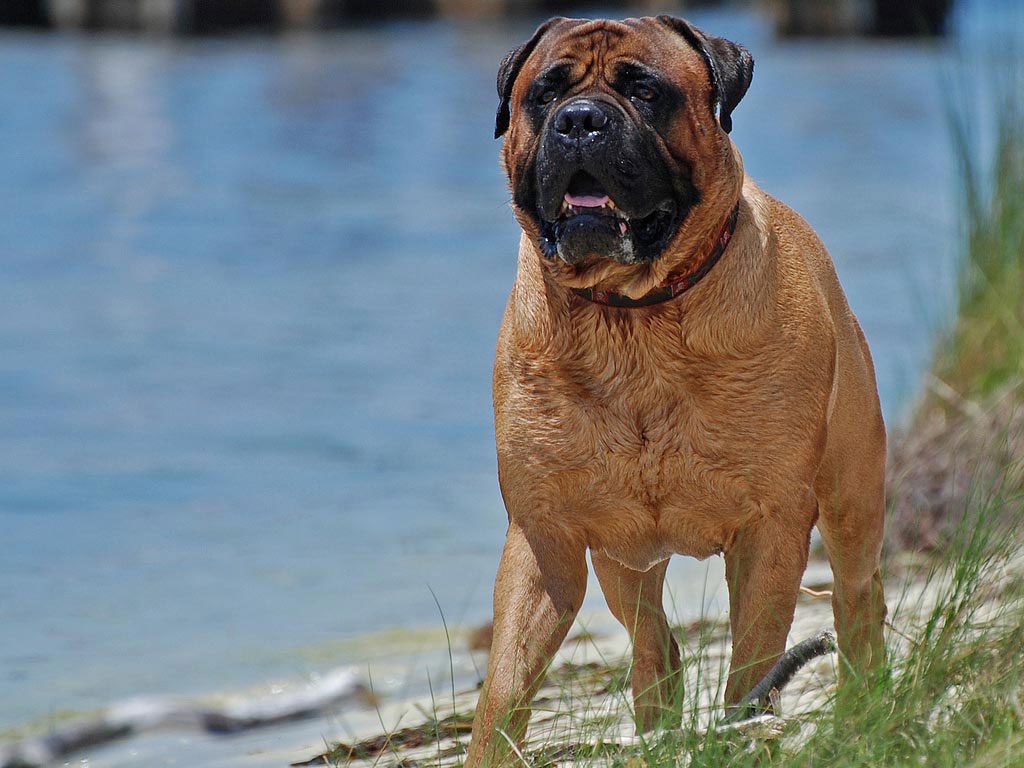
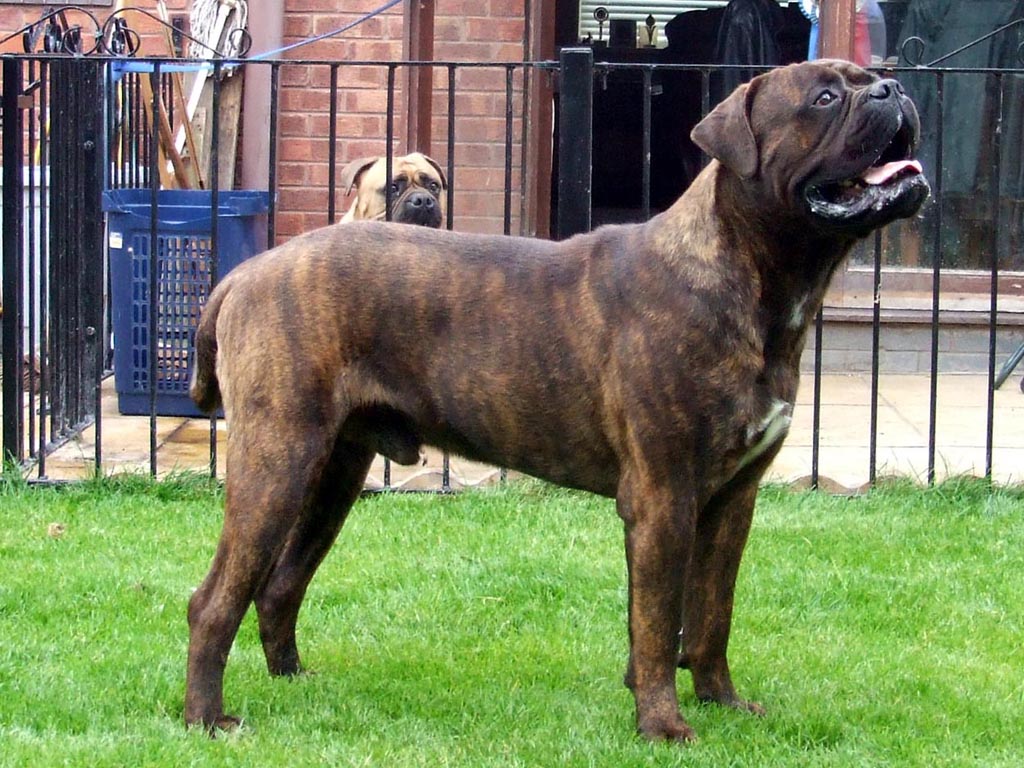
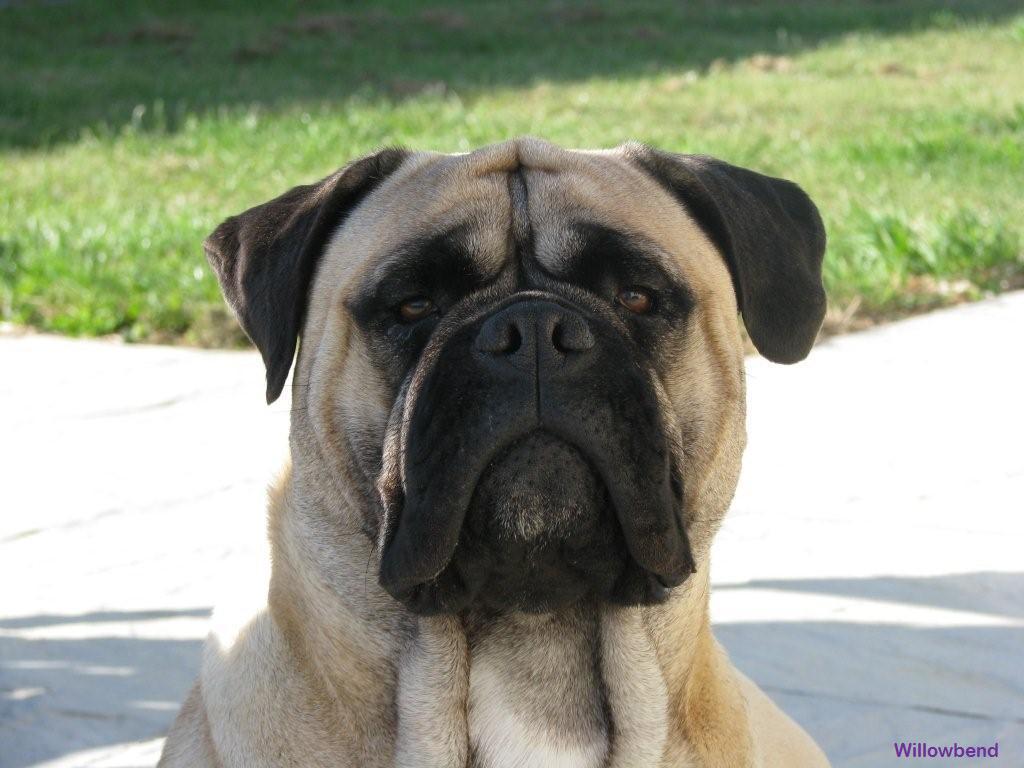
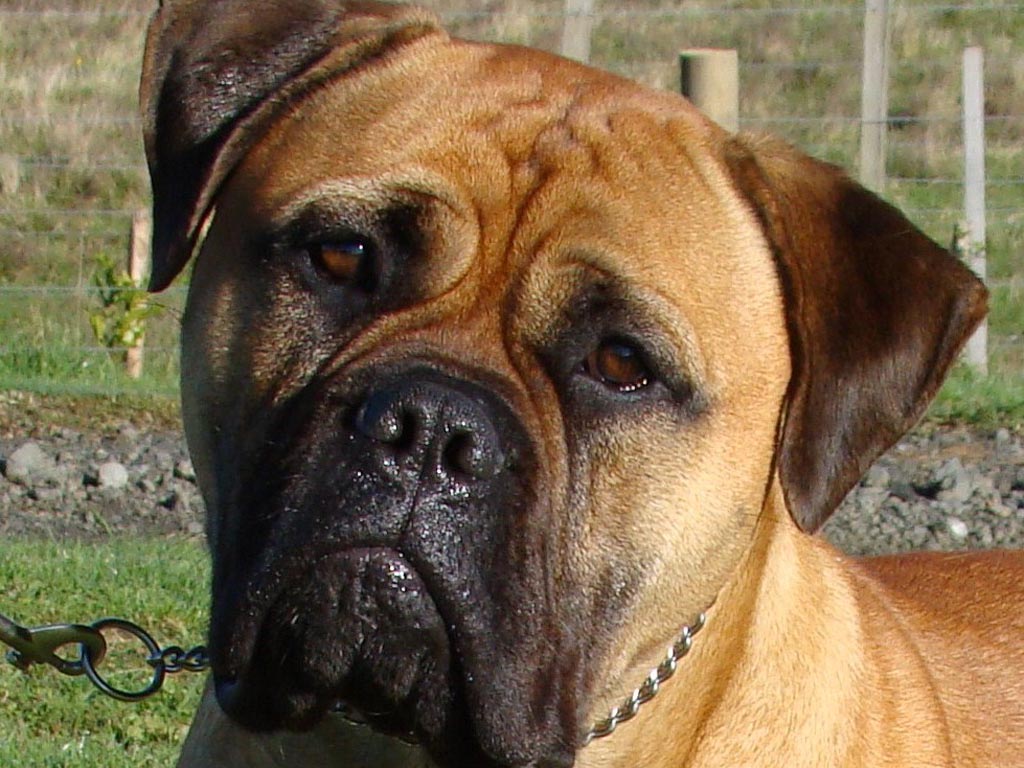
    Aspect imposing and eminently deterrent, the Bullmastiff is an animal's good bones, chest wide and deep and powerful back. His head, square viewed from any angle, with ears darker than the mantle and preferably black color v, on which dominates a nose medium length and width, covered with a black mask that extends towards and around the eyes which have to be equally dark (preferably color hazelnut, Brown, dark brown or black, never yellow or amber), intense and deep look, is its main and most characteristic hallmark. Short hair, his cloak can be Griffon, covering all shades from sand to liver red, or striped.

    the typical male, when it reaches its full physical development, for the three and a half years of age, comes to measure between 63,5 and 68,5 cm to the cross with a weight between 49,5 and 59,5 kg. The adult female, completed eighteen months, usually weigh in 41 to 49,5 kg and measured between 61 and 66 cm..

    Observations

    Cleaning and maintenance of a Bullmastiff is simple, because it is a short hair dog, with an annual moult in spring. A session of vigorous brushing hair and against the grain, three times in a week will be enough to keep your hair clean and bright and prevent body odor. The baths, alter the pH of the skin are fully desaconsejados and if you ever needed to bathe him, it is essential to do it with neutral pH shampoo and warm water, abundantly clarified to remove all SOAP residue and then drying thoroughly throughout the body.

    Character and skills

    still today, its form of attack and defense is characteristic, and it is very much appreciated, because well measured its strength and never attacks to draw blood. And it is this trait that distinguishes it from other trotting breeds that are much more easily and prompt in the bite, inferring great damage to their prey, whether other dogs, other animals or people.

    It is essential that the exercise is very controlled during the critical stage of growth (until the 15-16 months males and the 10 months females), to prevent musculoskeletal problems in adults. For this reason you must avoid overweight in the puppy.

    Training in attack is totally discouraged.

    Smart guardian, discreet, effective and with great capacity of discrimination, is little barking, very home, and only moderately active, so it adapts perfectly to the floor and city life.

    Unlike other trotting races, It is characterized by accepting orders imposed all the members of the House, even the little ones and not be "one-owner dog", which facilitates its coexistence with the family.

    Did you know??

    Although affectionate and sweet nature, The Bullmastiff is a great guard dog with mind of its own. Assertive need an experienced owner and. The Bullmastiffs can be willful and is not likely to be put off once they wake.

    Bullmastiff Education

    What is important is loving but consistent parenting from day one. A dog school with puppy training and further development are very important for Bullmastiffs in socialization. Especially if you are kept as a single dog. All environmental situations should be practiced with him at first so that he can handle them later with confidence.. The Bullmastiff can be well motivated with his voice and can train with goodies. Once you have internalized a command, will be happy to do it.

    Bullmastiff Care and Health

    The Bullmastiff's coat is short and thick. A pimple glove is ideal for removing loose hair and an appropriate brush is suitable for grooming the coat. Ears should be checked regularly. It is also important to check regularly for ticks, fleas and other parasites. After each ride, clean the dog. If you find a tick that has already bitten your dog, you can remove it with tick tweezers. If you don't dare to do this, you should go to the vet. If the dog often shakes its head or tries to scratch with its paw, a walk to the vet is recommended.

    Breed-specific diseases

    The Bullmastiff belongs to the heavy dog รขโ‚ฌโ€นรขโ‚ฌโ€นbreeds. Hip joint dysplasia is a typical disease of this breed. The so-called rolling songs (ectropiรณn/entropiรณn) can also occur, bitches can suffer from tumors of the mammary gland. Tears of the cruciate ligaments can occur if they occur too early and too much stress on the puppy / young dog's age.

    Nutrition / Food

    The Bullmastiff is an "omnivore" and eats any type of food. Unfortunately also what you find outside. Otherwise, is satisfied with dry food or BARF and tasty extras in the bowl. These include cottage cheese, eggs and noodles.

    Bullmastiff life expectancy

    Bullmastiff life expectancies vary.. As long as the Bullmastiff is healthy and is maintained and treated accordingly, has a high life expectancy of 10 years or more.

    Buy a Bullmastiff

    A Bullmastiff's decision should be long and well considered. Serious breeders can be found through the FCI (Federation Cynologique intenationale). It is advisable to contact several breeders and organize a visit. A serious breeder will accept a visit to himself and his dogs. He will answer any questions that may arise and will have all the documents available for inspection.. So both parties have the chance to get to know each other and exchange information and get a picture of the upbringing of dogs and puppies.. A responsible breeder will continue to accompany and support their puppies and their families..

    Once you have decided on a breeder and all questions have been clarified to your satisfaction, nothing stands in the way of a new family member moving out.

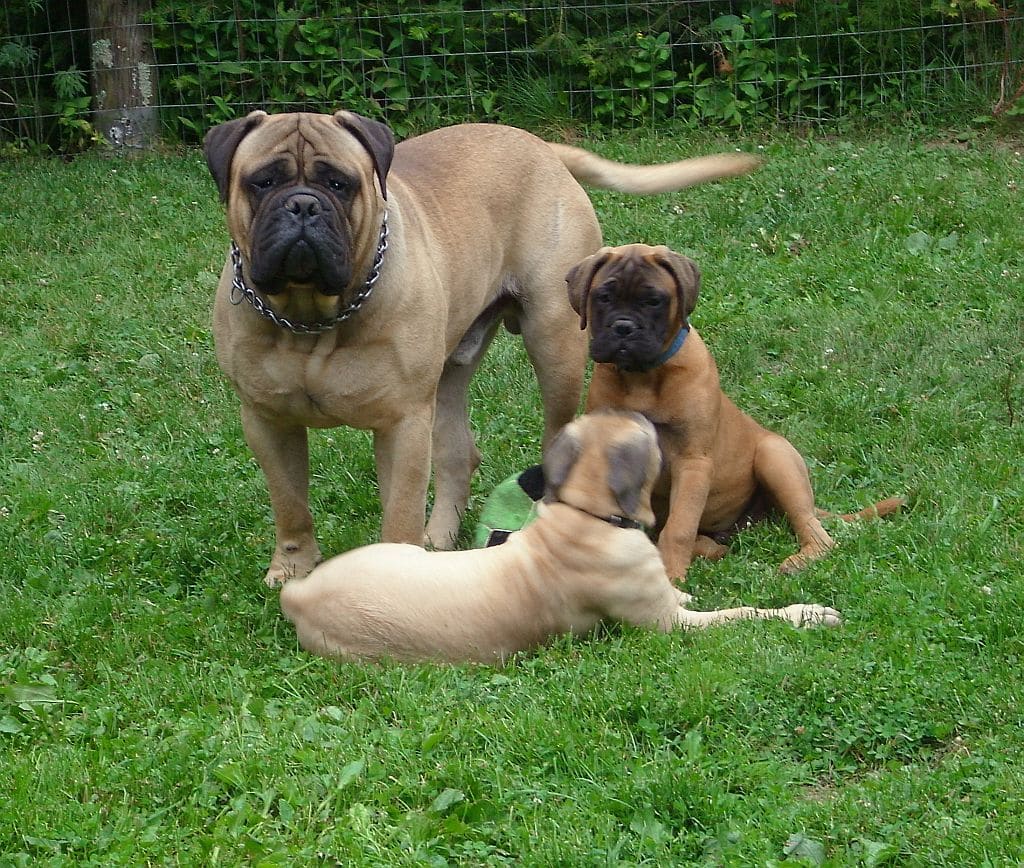
    Bullmastiff pictures

    bullmastiff videos

    Type and recognitions:

    • FCI CLASSIFICATION:
    • Group :
    • Section : . .

    Federations:

    FCI โ“˜, AKC โ“˜, ANKC โ“˜, CKC โ“˜, โ€‹KC โ“˜, NZKC โ“˜, UKC โ“˜

    FCI breed standard "Bullmastiff"

    Origin:
    United Kingdom

    Date of publication of the valid original standard:
    13.10.2010

    Use:

    guard dog


    General appearance:

    Powerful and symmetrical in construction. Show great strength, although its appearance is not heavy. It is a robust and active dog.


    Behavior / temperament:

    Is spirited, alert and faithful. It is strong, Active, reliable and heavy duty.

    Head:

    ---

    Cranial region:
    • Skull: Viewed from any angle, the skull is wide and square. They can be observed many folds when the dog shows interest, but not when it is at rest. Wide and deep.
    • Depression links (Stop): Pronounced.

    facial region:

    • Truffle: Wide; the Windows are wide open. Chata; the profile being or pointed, or raised.
    • Snout: Well open nostrils. Is short. The distance from the tip of the nose to the naso-frontal depression corresponds to approximately one third of the length from the tip of the nose to the center of the occiput. Width is below the eyes and maintains approximately the same amplitude to the tip of the nose. It is obtuse and square, forming a right angle to the top line of the face, and at the same time proportionate to the skull.
    • Lips: They are not hanging, and never below the lower jaw.
    • Jaws / Teeth: Lower jaw wide to its end. Level (Bite in clamp, edge to edge) desired, a slight lower prognathism is accepted without preference. The canines are large and well separated. Other teeth are strong and well applied on a regular basis.
    • Cheeks: The cheeks are bulky.
    • Eyes: Dark or hazelnut, medium-sized. They are separated by the amplitude of the snout, It presents a slight median furrow. Clear or yellow eyes are extremely undesirable.
    • Ears: They are v-shaped, they are set high and folded; they are well separated at the level of the back of the head, thus imparting to the skull a square appearance, which is very important. The ears are small and of a color darker than the rest of the body. When is the dog alert, the tips of the ears are at the same level of eyes. They do not accept the ears in pink.

    Neck:

    Well arched, not very long and well muscled; its circumference is almost equal to skull.

    Body:

    • Back: Short and straight, providing a compact look, but not so much as to interfere with movement. Does not accept the back concave or convex.
    • Pork loin: Wide and muscled; flanks are quite deep.
    • Breast : Wide and deep, well descended between the forelimbs. Deep sill.

    Tail:

    High implementation. It is strong at the base and gradually decreases until the tip, reaching the Hock. It is straight or bent, but without โ€œhoundโ€ type. The crooked tail is very undesirable.

    Tips

    PREVIOUS MEMBERS:

    • General appearance: Front view separate presenting a right front.
    • Shoulder: Inclined, strong, muscular, Although not overloaded.
    • Metacarpus: Straight and strong.
    • Previous feet: Well arched. Cat foot with rounded toes and hard pads. Desirable dark nails. Crushed toes are very undesirable.

    LATER MEMBERS:

    • General appearance: Strong and muscular.
    • Leg: It is well developed, denoting strength and activity.
    • Hocks: Moderately angled. Cow hocks are a serious misconduct.
    • Hind feet: Well arched. Cat foot with rounded toes and hard pads. Desirable dark nails. Crushed toes are very undesirable.

    Movement:

    Denotes strength and determination. When they move in a straight line, or front members, or hind limbs must be crossed or bending. The right forelimb and hind limb left should stand up and support at the same time. The vigorous push of the hind limbs does not alter the firmness of the back line, thus denoting a harmonious and balanced movement.

    Mantle

    • Fur: It is short and hard to the touch. It protects the animal from the climatic conditions. It is smooth and close to the body. Long hair, woolly or silky is very undesirable.

    COLOR: Any shade of Brindle, Fawn or red; the color should be pure and clear. Accepts a slight white mark on the chest, but other white markings are undesirable. Black Mask is essential, harmoniously joining the black markings around the eyes that contribute to the expression.


    Size and weight:

    Height to the cross :

    • Males: 64 โ€“ 69 cm..
    • females: 61 66 cm..

    Weight:

    • Males: 50 โ€“ 59 kg
    • females: 41 โ€“ 50 kg


    Fouls:

    Any deviation from the aforementioned criteria is considered as a fault and the severity of this is considered to the degree of the deviation to the standard and its consequences on the health and well-being of the dog..


    FALTAS DESCALIFICANTES:

    • Aggressive or fearful dog.
    • Any dog โ€‹โ€‹showing clear signs of physical or behavioral abnormalities must be disqualified..


    N.B.:

    Males should have two normal-appearing testicles fully descended into the scrotum..


    TRANSLATION : Brรญgida Nestler / Original version : (IN)
    Technical supervision : Miguel Angel Martinez

    Source: F.C.I - International Cynological Federation

    Alternative names:

    1. Bullmastiff (English).
    2. bull mastiff (French).
    3. Bullmastiff (German).
    4. Bullmastiff (Portuguese).
    5. Bullmastiff (espaรฑol).

    โ–ท The world of Pets: Dogs, cats, birds, reptiles, amphibians

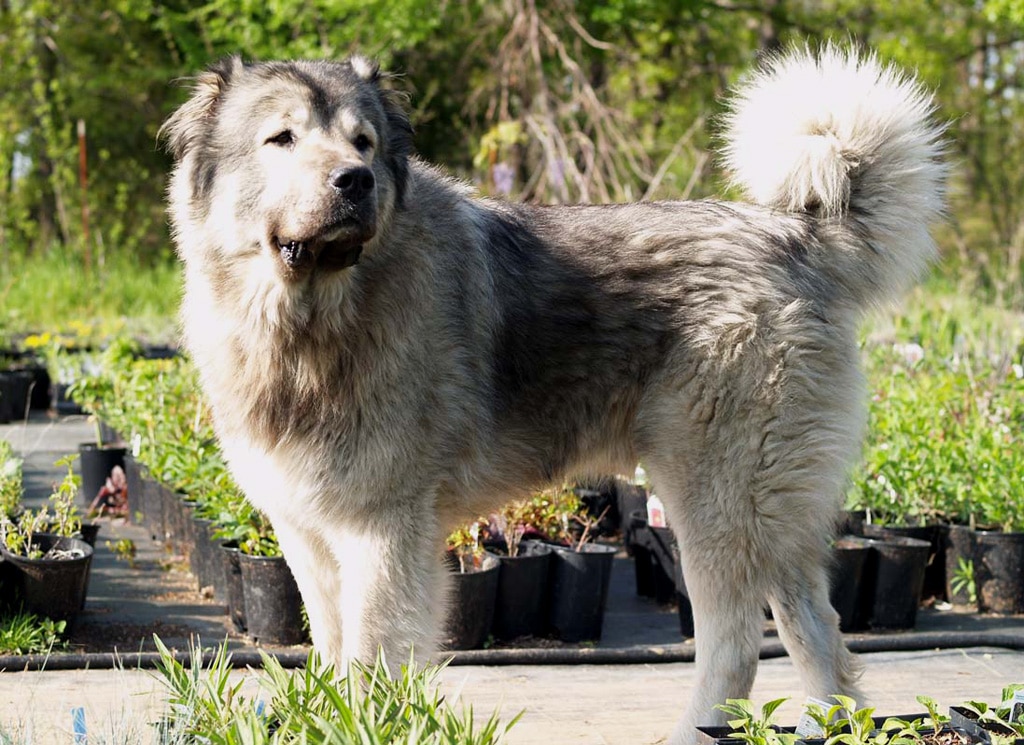
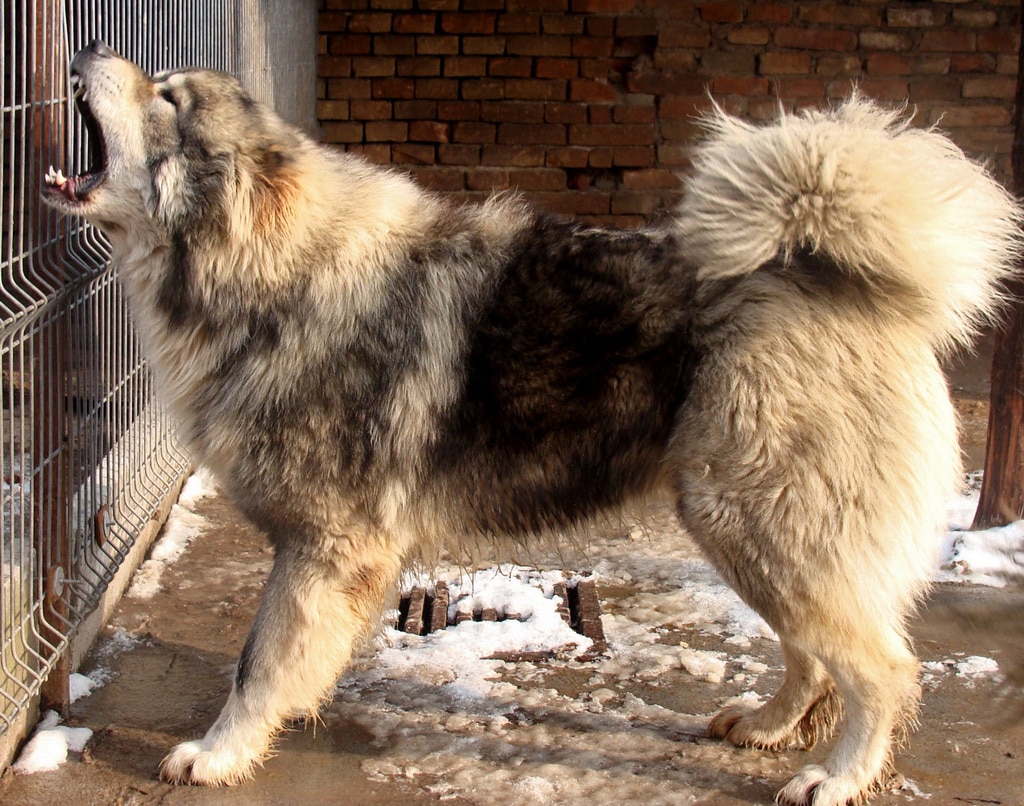
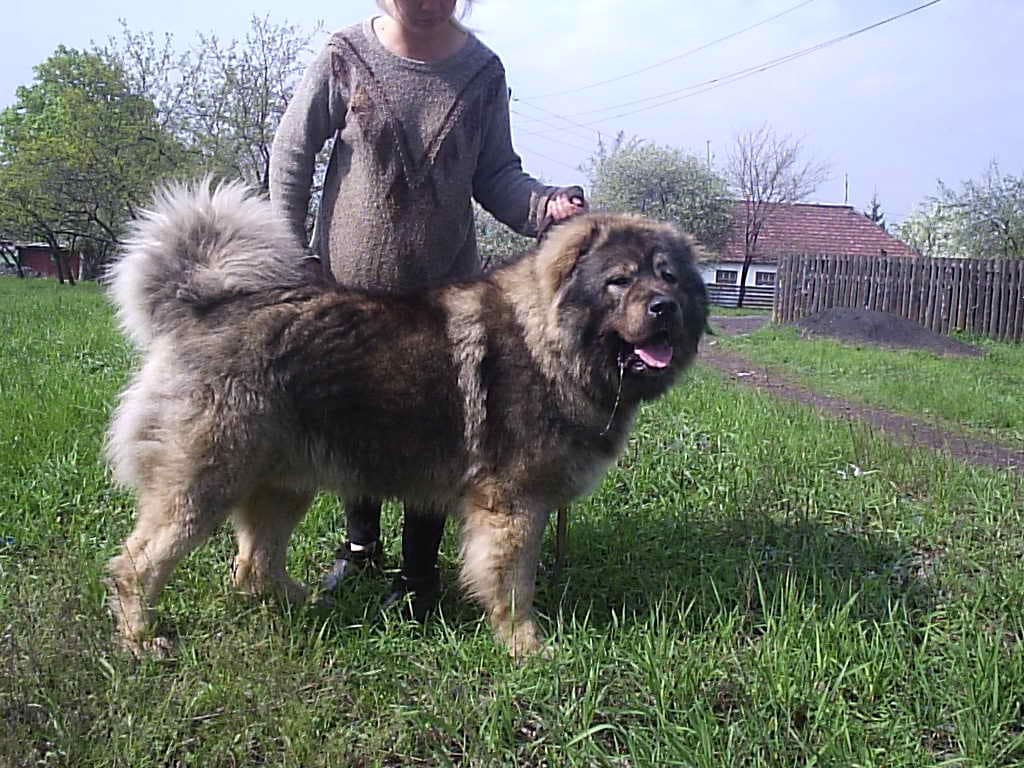
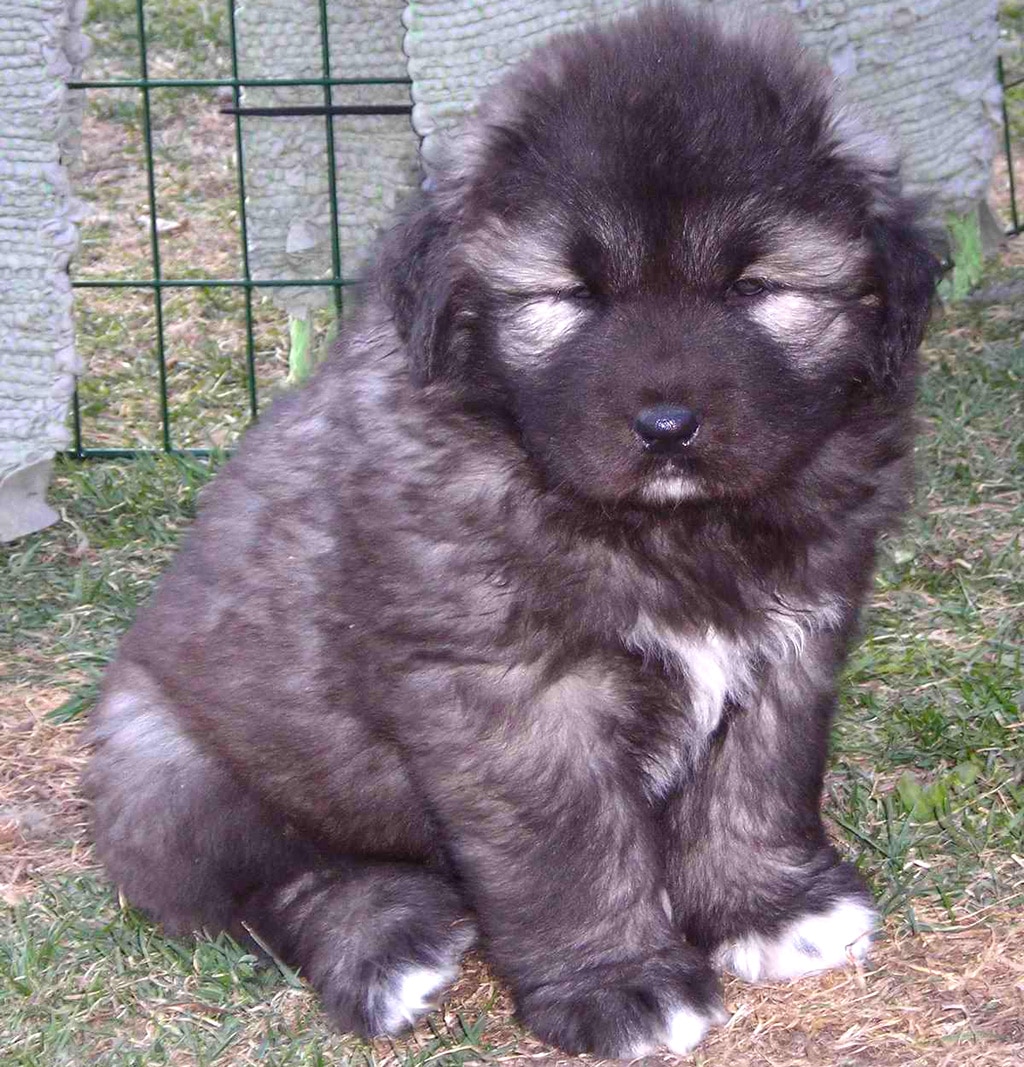
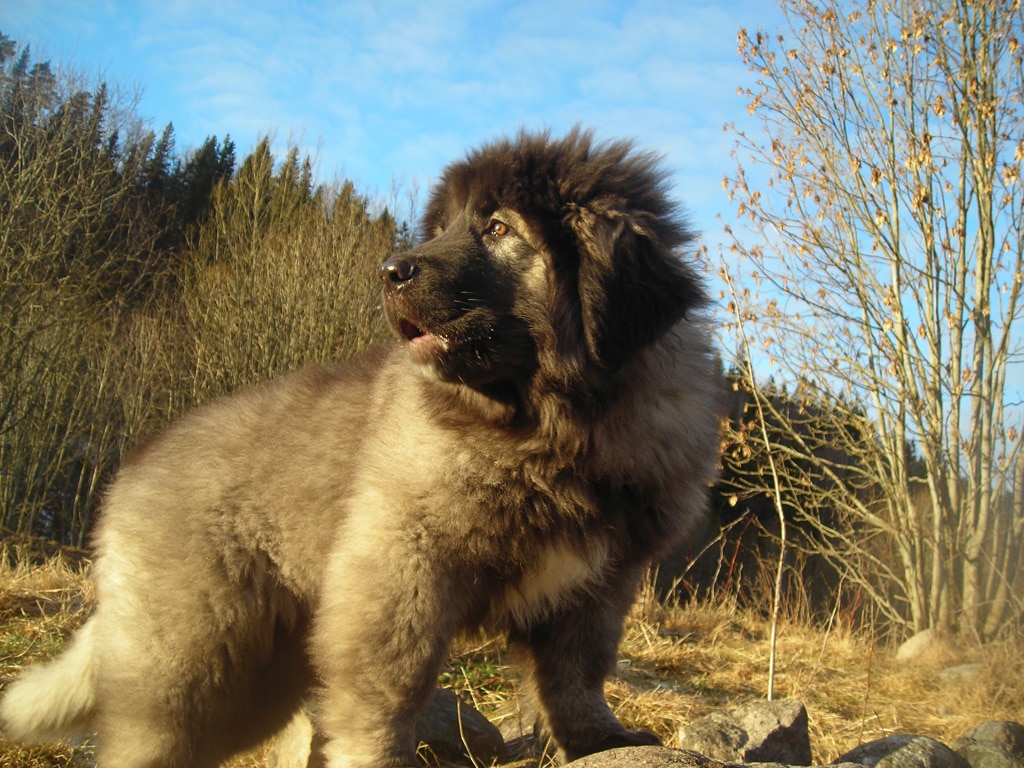
    Caucasian Shepherd Dog
    Rusia FCI 328 Molossoid . Mountain
    The Caucasian Shepherd Dog It is a healthy animal and stable temperament.

    Pastor del Cรกucaso

    Content

    Characteristics "Caucasian Shepherd Dog"

    Coexistence is important that you have with your new friend. Before considering the acquisition of a dog of the breed "Caucasian Shepherd Dog" you know certain factors. Not all breeds of dogs are apt to live in an apartment, you must take into account his character, their need for exercise, their interaction with other pets, their care and if you have small children, their level of tolerance towards them.

    Adaptation โ“˜

    4,0 of 5 stars (based on 1 review)

    friendly dog โ€‹โ€‹โ“˜

    2,0 of 5 stars (based on 1 review)

    hair loss โ“˜

    3,0 of 5 stars (based on 1 review)

    Affection level โ“˜

    4,0 of 5 stars (based on 1 review)

    Need for exercise โ“˜

    2,0 of 5 stars (based on 1 review)

    Social need โ“˜

    2,0 of 5 stars (based on 1 review)

    Home โ“˜

    2,0 of 5 stars (based on 1 review)

    Toilet โ“˜

    2,0 of 5 stars (based on 1 review)

    Friendly with strangers โ“˜

    2,0 of 5 stars (based on 1 review)

    barking โ“˜

    3,0 of 5 stars (based on 1 review)

    Health โ“˜

    2,0 of 5 stars (based on 1 review)

    Territorial โ“˜

    5,0 of 5 stars (based on 1 review)

    Cat friendly โ“˜

    3,0 of 5 stars (based on 1 review)

    Intelligence โ“˜

    3,0 of 5 stars (based on 1 review)

    Versatility โ“˜

    2,0 of 5 stars (based on 1 review)

    Child friendly โ“˜

    3,0 of 5 stars (based on 1 review)

    Surveillance โ“˜

    3,0 of 5 stars (based on 1 review)

    joy โ“˜

    5,0 of 5 stars (based on 1 review)

    History ยซShepherd of the Caucasusยป

    One Caucasian Shepherd Dog it is a large and very strong sheepdog that is very widespread in Russia. In the official standard it is called Kavkazskaya ovฤarka. The Caucasian Shepherd Dog they spread over a huge area, which includes the territory of Russia as well as the former Soviet Union. Only in the polar areas you can hardly see. In his homeland., theCaucasian Shepherd Dog are, therefore, quite different in detail and different types have been developed. In the steppe areas this breed is lighter and taller, in mountainous regions heavier and more compact. But in type and character it is the same everywhere. This is the result of your work task, which was and is the only criterion for breeding there for many centuries. At the end, the same requirements resulted in the same dogs. Their tasks are to herd and protect the herds, monitor and protect property and its people. They are archaic dogs, they probably came into existence in this form with the introduction of animal husbandry in the first place, and that was a few 10.000 years.

    You can't fool a Caucasian Shepherd Dog. Has a clear understanding of their role. Typically, lies down in a high place next to his flock, to be able to observe everything around him. Her flock, their shepherds, his family and his properties are sacred to him. He is faithful and lovingly devoted to them. He is suspicious of everything else and does not hesitate to attack any sign that he interprets as hostile. It is extremely defensive and fearlessly opposes even wolves and bears. In this way it has protected the herds of cattle and the lonely properties of the shepherds, farmers, hostels, artisans and merchants from time immemorial. This extremely useful feature, even necessary for the functioning of such a society in the vast and lonely country, does not fit into today's tight and hectic society. There is hardly a piece of land large enough to provide the dog with Caucasian Shepherd Dog a workspace. He is used to other scales of the vastness of Russia.

    It also, the zeitgeist in today's world demonizes all forms of aggression emanating from a dog. While it only takes one or two generations, larger property owners were proud that their dog was reliable and, in case of emergency, acute, I would fearlessly chase away a thief, such a feature is potentially life-threatening for today's dog. It runs the risk of being classified as a "dangerous dog" and in extreme cases, euthanasia. This is not an environment for a Caucasian Shepherd Dog. And so you can find it almost everywhere on the lists of supposedly dangerous dogs. It is an archetype of dog to which man owes a lot in his development. As a dog breed it has been described for a long time and in the oldest specialized books on dogs. But, in modern pedigree dog breeding, it was only officially recognized by the FCI in August 1984.

    Physical characteristics ยซCaucasian Shepherdยป

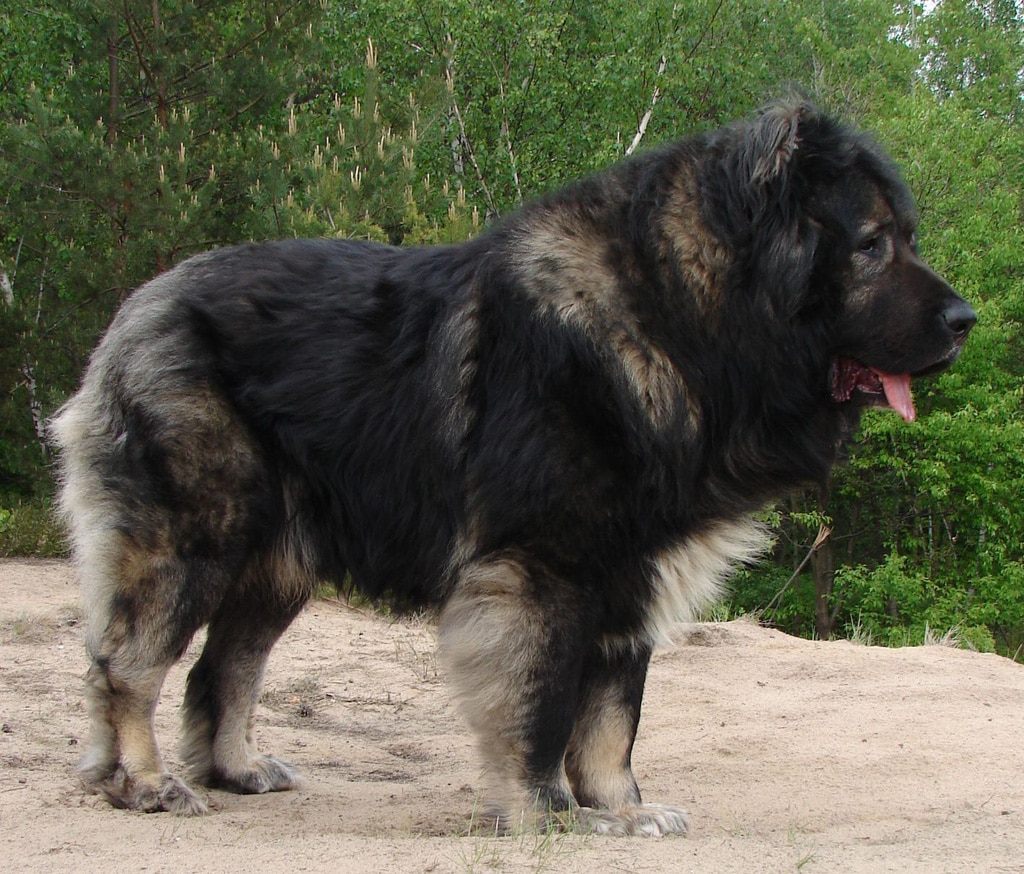
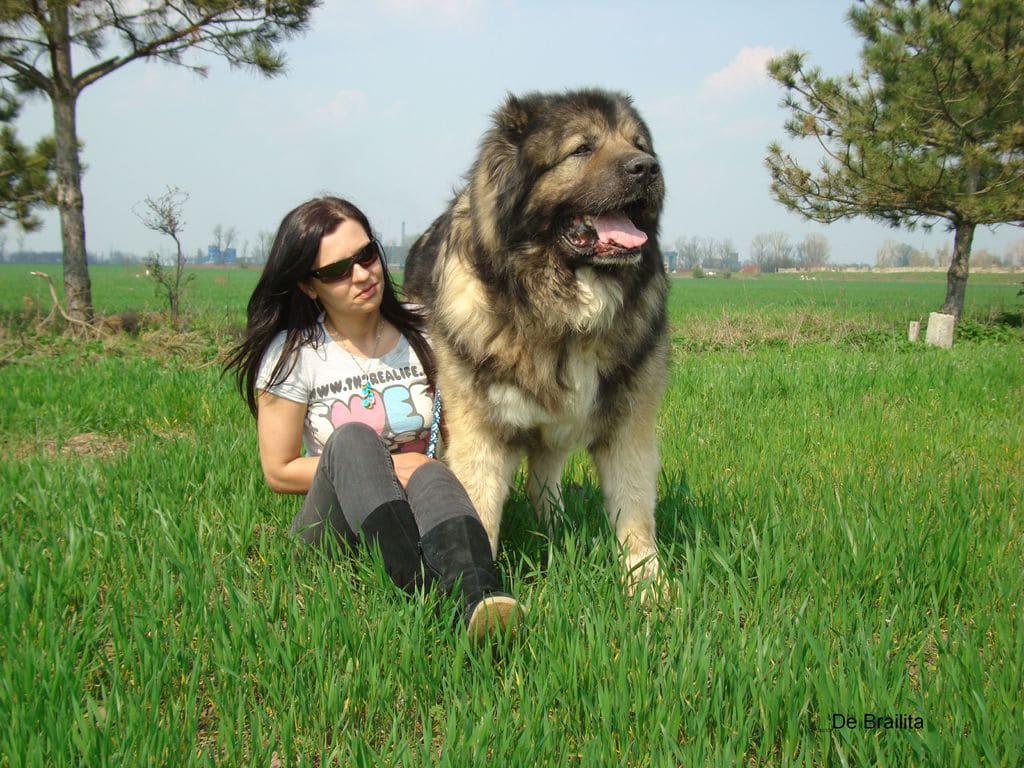
    The Caucasian Shepherd Dog is a dog of harmonious structure, big and strong with plenty of bone and a powerful muscular system and a somewhat rectangular format. Well pronounced sexual dimorphism.
    Males are masculine with a well-developed cross and a larger head compared to that of females. This is why they are more massive, bigger and sometimes their body is shorter than that of the females.
    In dogs with a longer coat variety, the male has a distinguished mane.

    Size and weight:

    Height to the cross:

    • Males: Desired height 72 โ€“ 75 cm.. Minimum 68 cm..
    • females: Desired height 67 โ€“ 70 cm.. Minimum 64 cm..

    Higher heights are accepted as long as the conformation is harmonic.

    Weight:

    • Males: Minimum 50 Kg
    • females: Minimum 45 Kg.

    Character and skills ยซCaucasian Shepherdยป

    The Caucasian Shepherd Dog is a guardian and protector. The official standard classifies your character qualities unequivocally: "It must be strong, balanced and calm with a well-developed defensive reaction, which is actively expressed. Sharpness and distrust of strangers are typical.". And Caucasian Shepherd Dog is generally incompatible with other dogs! These traits, especially with a big and very strong dog that claims a large territory, are hardly compatible with the social conditions of today's world. It is a great experience to be able to form a close bond with a dog like this.. This also allows you to experience a completely different side of the dog than Caucasian Shepherd Dog, that of an extremely loving friend, loyal and affectionate. But, if one does not have the space and financial means to offer them in our latitudes an environment appropriate to their nature, this will hardly be possible.

    Fitness

    The Caucasian Shepherd Dog he is extremely undemanding in his attitude, if the general conditions already mentioned are ignored. One Caucasian Shepherd Dog does not need heating, toys or a harness on a leash. This breed is undemanding in its nutrition. That also applies to your accommodation.. You can spend the whole year outside without problems, if you want to spend the whole year abroad – as long as there is a suitable place to hide and "adequate" here definitely means neither a kennel nor even a chain.. Must be able to move in your territory. One Caucasian Shepherd Dog you accept, it even sensitively protects all the two- and four-legged friends it sees as belonging to its pack or family. But you need a clear boss. At first he is suspicious or even hostile towards everyone else.

    Close relationship and competent guidance is required to walk on this dog's leash., which is definitely always stronger, and then be able to seamlessly move on to an aggressively barking terrier. it's possible, but it requires serious upbringing, a good socialization and an experienced teacher or lover, competent and very sensitive and at the same time thorough. The Caucasian Shepherd Dog is widely on the dangerous dog lists. It is forbidden to travel to the Netherlands or Denmark, since there is a risk that the dog will be confiscated on the streets and euthanized. One Caucasian Shepherd Dog not much of a beginner dog. That would even be irresponsible. Even from the hand of an experienced connoisseur, it requires in any case the basic external conditions for an attitude appropriate to its nature.

    Education ยซCaucasian Shepherdยป

    Raising a Caucasian Shepherd Dog in today's social conditions it is a very special challenge, only proven experts can master with the right framework conditions.

    Care and health ยซCaucasian Shepherdยป

    The Caucasian Shepherd Dog it has a double layer composed of a bottom layer and a top layer. The inner layer is soft and fine, while the outer coat hairs are long and thick. (The coat of a Caucasian Shepherd Dog It should never feel smooth or appear wavy.) Regarding the length, the coat can be long, medium or short. Dogs with long fur have a mane that surrounds their necks, as well as extensive plumage on the hind legs and tail, that looks thick and fluffy. Dogs with medium length fur do not have as much mane, and they have fewer feathers on the rest of the body. A short coat, the least common type, has no mane or fringe. Twice a year, when you change your coat, you have to brush it well.

    Dogs of this breed enjoy very robust health.

    Nutrition / Food

    The Caucasian Shepherd Dog does not demand anything from your diet. Probably one of the dogs with less demands in this regard.

    The life expectancy of the โ€œCaucasian Shepherdโ€

    In relation to its size, a Caucasian Shepherd Dog has a very high life expectancy of 12 and sometimes more years.

    Buy a โ€œCaucasian Shepherdโ€

    The purchase of a Caucasian Shepherd Dog it should only be considered by experts who know exactly what they do, who have the appropriate experience and who have the appropriate rearing conditions. The puppies of this breed of dog cost around 1.000 EUR.

    Images ยซCaucasian Shepherdยป

    ยซCaucasian Shepherdยป Videos

    Type and recognitions:

    • FCI CLASSIFICATION:
    • Group :
    • Section : . .

    Federations:

    • FCI – Pinscher and Schnauzer-Molossoid type dogs – Swiss Mountain Dogs and Cattledogs. Section 2.2 Molossoid, mountain type. โ“˜
    • AKC – FSS (Foundation Stock Service) โ“˜
    • UKC – Watchdog โ“˜

    FCI breed standard "Caucasian Shepherd Dog"

    Origin:
    Russia, Armenia, Georgia, Azerbaijan

    Date of publication of the valid original standard:
    13.10.2010

    Use:

    Guard and surveillance dog.


    General appearance:

    The โ€œCaucasian Shepherdโ€ Dog is a dog with a harmonious structure, big and strong with plenty of bone and a powerful muscular system and a somewhat rectangular format. Well pronounced sexual dimorphism. Males are masculine with a well-developed cross and a larger head compared to that of females. This is why they are more massive, bigger and sometimes their body is shorter than that of the females.

    In dogs with a longer coat variety, the male has a distinguished mane.


    Behavior / temperament:

    The behavior is firm, Active, self-confident, courageously and independently. The โ€œCaucasian Shepherdโ€ Dog shows affection and devotion towards its master, he is an excellent guard dog.

    PROPIMPORTANT ORTIONS:

    • Body length exceeds height at withers 3 โ€“ 8%.
    • The length of the forelimbs averages the 50 โ€“ 52% the height at the withers.
    • The length of the skull and the length of the muzzle is 3:2

    Head:

    ---

    Cranial region:

    The head is big, solid and broad in the cheekbones. View from the top, the head is wedge-shaped with a wide base.

    • Craging: Solid and wide, rather flat antecara with a marked but not deep fold. Superciliary arches developed but not protruding. Barely visible occipital bone.
    • Dnaso-frontal depression (Stop): Noticeable but not clearly marked.

    facial region:

    • Trufa: black, large with wide open nostrils without protruding from the outer lines of the snout. A black truffle in solid colors, spotted and peeping is desirable but not mandatory (but genetic blue or liver brown truffles are not allowed)
    • Horcico: Wide and deep tapering gradually towards the nose with strong jaws and chin. Great depth and well-filled under the eyes. The nasal bridge is wide. The upper line of the snout and skull run parallel.
    • Labios: Thick, tight and well pigmented.
    • Jaws / Teeth: Teeth must be healthy, white and strong; incisors together with each other in a line. Complete bite in scissors or forceps (42 teeth). Incisors or injured canines, broken or broken that do not affect the bite are not significant or the absence of PM1.
    • Cheeks: Well developed and highlighted by good chewing muscles.
    • Ojors: Moderate size, Oval shaped, not too deep, placed separate and oblique. Color is in different shades of brown, from dark to hazelnut. Black eyelids, dry, tight. Serious expression, attentive and inquisitive.
    • Obars: Moderate size, thick, Triangular shape, naturally hang, placed high and separate. Traditionally amputated in their country of origin. Natural ears are of equal value.

    Neck:

    Long Middle, strong, low insertion, transversely rounded. Crest pronounced especially in males.

    Body:

    Very well developed in all its dimensions, width, good musculature and well balanced.

    • Cruz: Well pronounced, moderately long. Height at withers slightly exceeds height at rump.
    • Dorrso: Straight, width, firm.
    • Itmor: Short, width, slightly arched.
    • Glikeness: Moderately long, wide, rounded, slightly inclined towards the base of the tail.
    • Pecho: Long, width, good ribs, in general deep as well as in its anterior part. Transversally has a broad oval shape. Well arched ribs, false long rib. Antepecho marked.
    • Lรญnlower ea and belly: Abdomen moderately retracted posteriorly.

    Tail:

    High insertion, curved sickle or curled. At rest it hangs up to the height of the hock; when the dog is alert the tail can be carried over the top line.

    Tips

    PREVIOUS MEMBERS:

    • ApGeneral arience: Good musculature. Seen from the front, straight and parallel members placed slightly apart.
    • Hormbros: Strong musculature. Moderately long, widths,
    • inclined to form an angle of approximately 100 degrees with the forearm. The scapula well next to the chest.
    • Antarm: Strong and muscular, well together.
    • Elbows: Set well back, parallel to the axis, without turning inward or outward.
    • Brazo: Straight, solid, moderately long, good musculature, transversely round.
    • Metacarpus: Short, solid, always straight viewed from the front and sides.
    • Pinis previous: Large, Round shape, well arched, well closed.

    LATER MEMBERS:

    • ApGeneral arience: Seen from behind, rights, parallel and moderately spaced. Knees and hocks well enough angled when viewed from the side. The back should not be placed too far back.
    • Thigh: Width, good musculature, moderately long.
    • Rodinllto: Well angled enough.
    • PinScheme: Wide, good musculature, moderately long.
    • Hock joint: Ancha and inclined, well angled enough, firm, without leaning neither in nor out.
    • Metatarsus: Not too long, solid, always straight seen from the front or side.
    • Pinis later: Large, Round shape, well arched, well closed.

    Movement:

    Libre, elastic, without rushing with good thrust from the rear. Good stability in all joints and good coordination. Trotting tends to be the typical movement. The withers are at the same level as the rump and the dorsal line is relatively stable.

    Mantle

    PIEL: Thick, sufficiently elastic without creases or wrinkles.

    • Plink: straight, rough, separated with a well developed undercoat. The length of the outer coat as well as the undercoat should not be less than 5 cm.. The hair of the head and forelimbs is shorter and thicker. The tail is completely covered with bushy hair giving the appearance of thick and very hairy. The long outer hair forms โ€œbrushesโ€ over the ears, a โ€œmaneโ€ around the neck and โ€œpantsโ€ on the back of the thigh.
    • Colorr: Any solid color, piebald or spotted. Except for solid blacks; dilute black or black in any combination or genetic blue or liver brown.


    Size and weight:

    Alturto the cross:

    • Males: Desired height 72 โ€“ 75 cm.. Minimum 68 cm..
    • females: Desired height 67 โ€“ 70 cm.. Minimum 64 cm..

    Higher heights are accepted as long as the conformation is harmonic.

    Weight:

    • Males: Minimum 50 Kg
    • females: Minimum 45 Kg.


    Fouls:

    Any deviation from the aforementioned criteria is considered as a fault and the severity of this is considered to the degree of the deviation to the standard and its consequences on the health and well-being of the dog..

    FALTAS GRAVES:

    • Structure too light or too rough.
    • Diffidence.
    • Deviations of sexual dimorphism.
    • Small head in proportion to the body, light, close, long, Tosca, brick or apple shaped head.
    • Abrupt stop.
    • Snout: sunken, concave or pointed.
    • Too small teeth, very separate, incisors not placed in a line, any deviation from the dental formula (except the absence of PM1)
    • Cheek bones not marked enough.
    • Big eyes, protruding, very clear, showing the third eyelid, drooping eyelids.
    • big ears, fine or very low insertion.
    • Steep or sunken top line, long, sunken or arched back, rump higher than the cross.
    • Square body, very rough, very long, narrow both front and back, extremities too long, very short chest, flat or sunken, short or steep rump.
    • Stump tail.
    • Bones, weak muscles and ligaments.
    • Absence of the correct angulations.
    • Forelimbs curved
    • Unbalanced movement.
    • Lack of thrust from the rear.
    • Too soft hair, curly, very short outer hair and no undercoat.

    FALTAS DISQUALIFYING:

    • Aggressiveness or extreme shyness.
    • Any dog โ€‹โ€‹showing clear signs of physical or behavioral abnormalities must be disqualified..
    • Any deviation from the required bite.
    • Incomplete dental formula (absence of any teeth except third molars (M3) or first premolars
    • Entropion
    • Eyes gazeos, dark blue, green shading or different colored eyes.
    • amputated tail.
    • Constant hobbling or inability to achieve movement.
    • Black color in any variation, solid, diluted, cheep, spotted the like robe (except the mask).
    • Genetic blue in any variation or shade.
    • Truffle, bluish-gray pigmented lips and eyelids.
    • Genetic brown in all variations or shades.
    • Truffle, genetic brown lips and eyelids.
    • Fire colored markings on black dogs, blue or brown.
    • Height below minimum.
    • Severe deviations of sexual dimorphism in males.


    N.B.:
    • Males should have two normal-appearing testicles fully descended into the scrotum..
    • Only functionally and clinically healthy dogs, with the typical conformation of the breed, should be used for parenting.

    Itlatest changes are in bold.

    TRANSLATION: Brรญgida Nestler / Original version: (IN)

    Technical supervision: Miguel Angel Martinez.

    Source: F.C.I - International Cynological Federation

    Alternative names:

    1. Nagazi, Caucasian Mountain Dog, Caucasian Ovcharka (English).
    2. kavkazskaรฏa ovtcharka (French).
    3. Kaukasischer Owtscharka, Kawkasskaja Owtscharka (German).
    4. mastim-do-cรกucaso, Pastor-caucasiano, Ovcharka caucasiano, Mastim do cรกucaso, Cรฃo montanhรชs caucasiano, Cรฃo-urso-russo (Portuguese).
    5. Pastor caucรกsico, Mastรญn del Cรกucaso, Perro de montaรฑa del Cรกucaso, Perro Pastor caucรกsico (espaรฑol).

    โ–ท The world of Pets: Dogs, cats, birds, reptiles, amphibians

    Kangal Shepherd Dog
    Turquรญa FCI 331 - Molossoid . Mountain

    Pastor de Anatolia

    The Kangal Shepherd Dog is quiet, bold, independent, Intelligent, docile.

    Content

    History

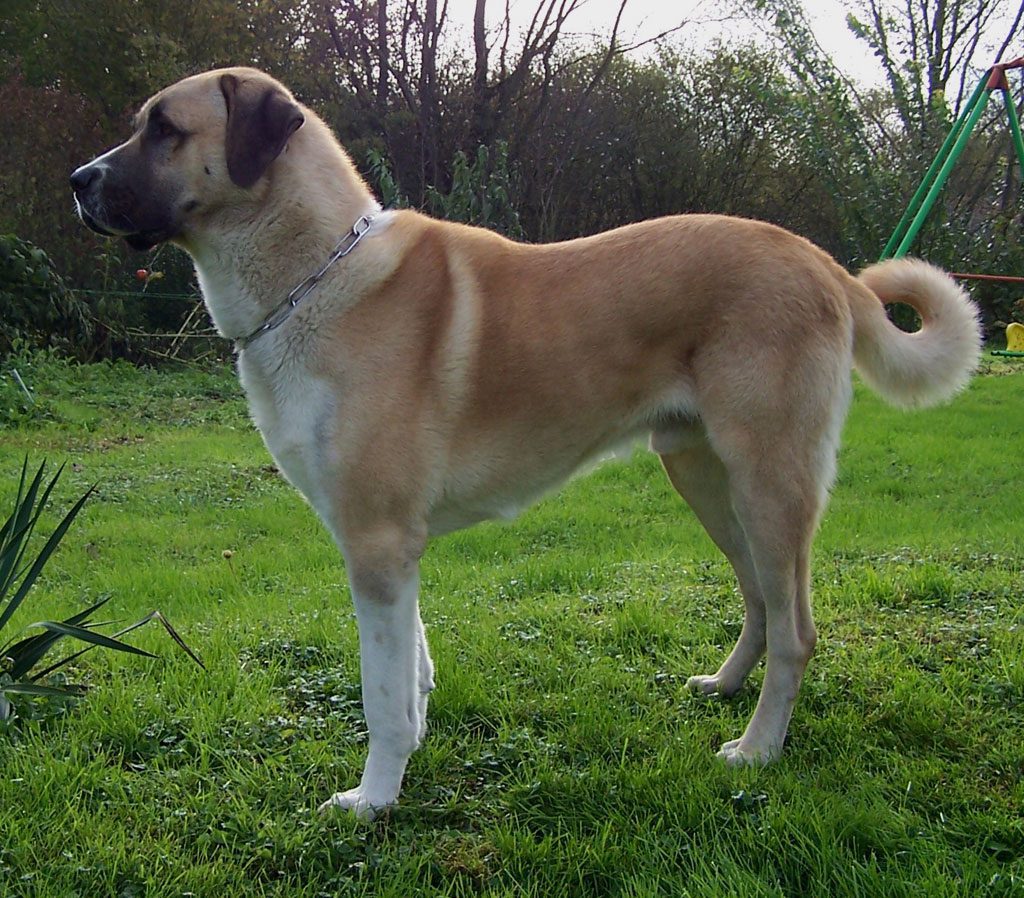
    The Kangal Shepherd Dog it is a large and very strong guard dog that is widespread in Turkey, especially in Anatolia. The Kangal Shepherd Dog It is officially called the Anatolian Shepherd Dog or in Turkish as Coban Kรถpegi.. The original name is Karabash. But, In the FCI these dogs are known as ยซKangal Shepherd Dogยซ. Because it is the name of an influential noble family from the Turkish province of Shivas, who very early began to breed Karabash professionally.

    Dogs called Karabash (Schwarzkopf) they were called now Kangal Shepherd Dog with the name of the family of breeders. El Karabash o Kangal Shepherd Dog is native to the mountainous regions of Turkey. There he guards and protects the flocks of sheep. Does this job completely independently, often separated from people for weeks, and you have to decide on your own authority how to behave with strangers. These large and extremely strong dogs can also defend their flock against bears and wolves. Guarding and protecting property and its people is also one of its tasks.

    The frugality and robustness of the breed is legendary, that is maintained even on a poor diet, which often consists only of human agricultural waste. These are archaic animals, that probably arose with the introduction of livestock a few years ago 10.000 years. One Kangal Shepherd Dog can't be fooled, because he has a clear understanding of his role. Typically, he lies down in a high place next to or within his flock to be able to observe everything that is in the surroundings. Her flock, his pastors and his family are sacred to him. So, is faithful and lovingly devoted to them. Suspicion of strangers. So, does not hesitate to attack when interpreting hostile behavior. As a watchdog, has been protecting the herds of cattle and the solitary properties of herders, Anatolian farmers and landowners from time immemorial.

    This extremely useful feature, even necessary for the functioning of a life in the wide and lonely country, does not fit into a tight and hectic society of today's Central Europe. There is hardly a piece of land large enough for Kangal Shepherd Dog work. It is used to different standards than in the desert mountains of Anatolia. It also, a watchful race like the Kangal Shepherd Dog is quickly condemned as dangerous and aggressive in today's world. While it only takes one or two generations, larger property owners took pride in their dog being dependable and sharp in an emergency, such a trait is not desirable for today's dog. This is why you can find it almost everywhere on the lists of supposedly dangerous dogs. – and unfortunately too often in animal shelters.

    The Kangal Shepherd Dog is an archetype of dog, to which man owes a lot in his development. As a dog breed it has been known, described and even revered for a long time. But, in modern pedigree dog breeding, it was only recognized by the FCI in August 1989.

    Physical characteristics

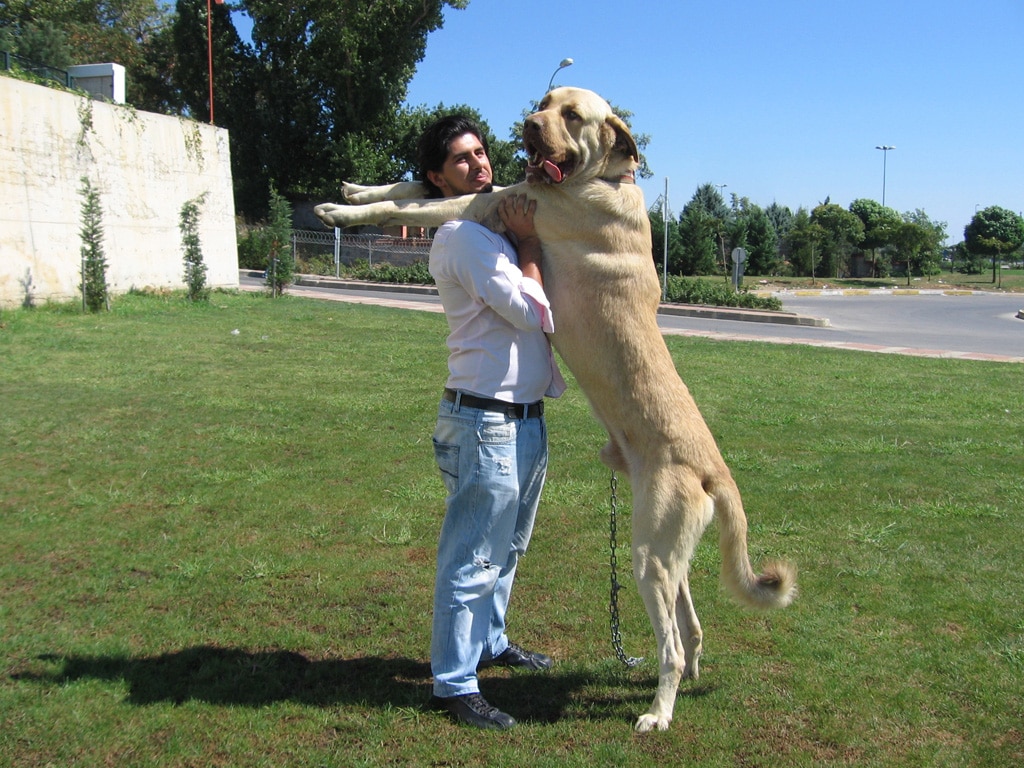
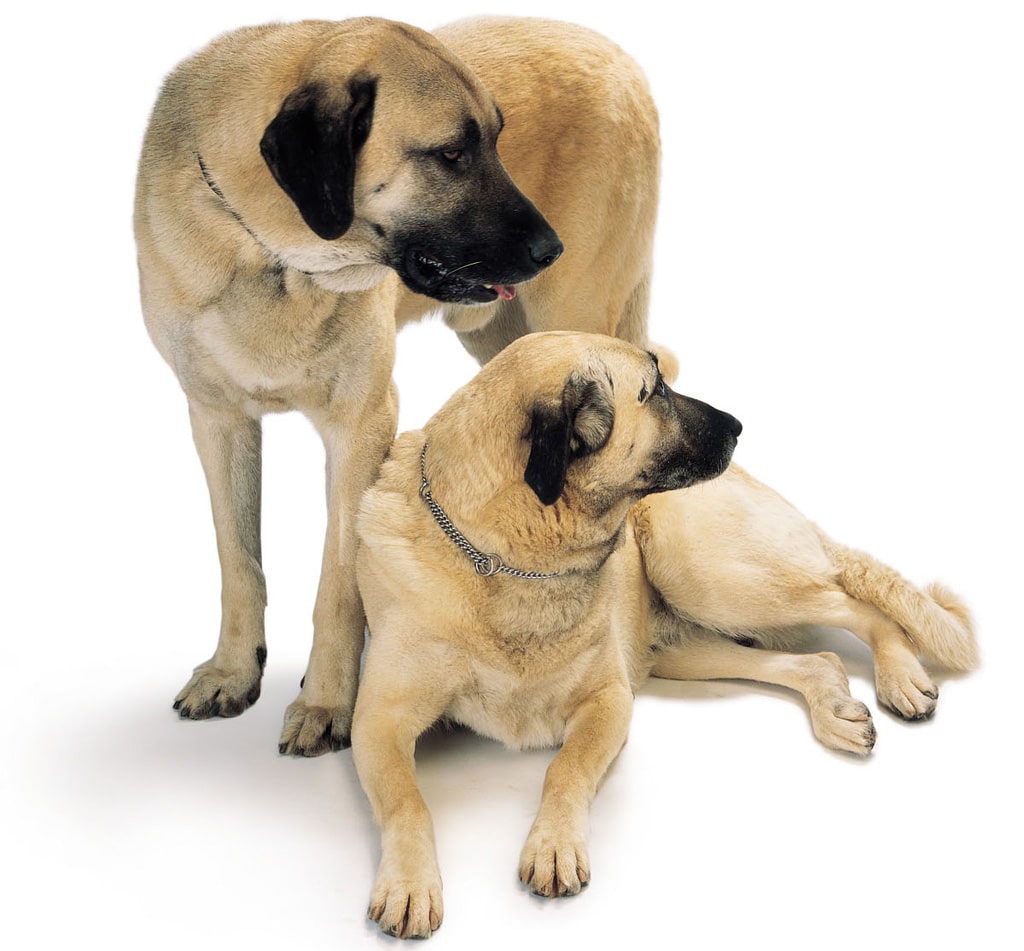
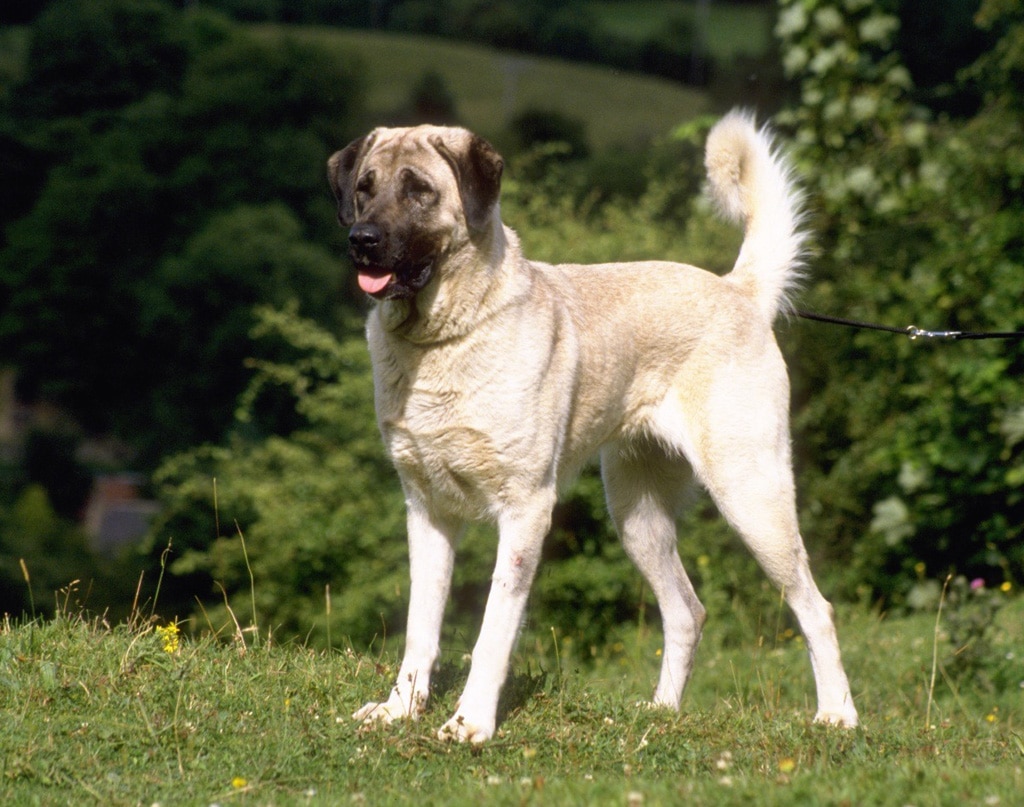
    The Kangal Shepherd Dog, is a muscular breed, with a thick, powerful neck, wide head and robust body. His lips are tight in its snout and their ears with triangular and down.

    The male measured between 72 โ€“ 78 cm. high and the female between 65 โ€“ 73 cm. and weigh between 44 and 60 kg.

    The the mantle It can be several colors but the most common is "sesame", white cream and white with spots of color do not cover more than the 30% your body (type Piebald).

    These colors they can be accompanied by a black mask on the face and/or ears. They have a double cloak of eyes hair that needs to be brushed once or twice a month during the warm season due to sweating.

    They have a hair very hard on the neck to protect his throat. They seem heavier than you really are, due to his thick neck.

    They are large costillares dogs but with small bellies.

    Character and skills

    The Kangal Shepherd Dog is an independent guardian and protector. The official standard describes his character qualities in this way.:

    Balanced and bold, without aggressiveness, independent, very intelligent and leader. Proud and trustworthy. The Kangal Shepherd Dog is affectionate and loyal to his masters, but adult dogs are suspicious of strangers.

    Towards other dogs, a Kangal Shepherd Dog is usually dominant and quite incompatible. These traits in a large dog breed, which is very strong and claims a large territory, are hardly compatible with life in today's Germany. It is a great experience to be able to form a close bond with a dog like this.. But, these animals can only develop their excellent qualities of character in their natural environment. Here this great sovereign dog is shown as a loving friend, faithful and affectionate. But, if you do not have the space and financial means to offer in our latitudes an environment appropriate to its nature, it is hardly possible to maintain the species Kangal Shepherd Dog appropriate.

    Own Kangal Shepherd Dog is extremely undemanding. Does not need heating, no toys or harnesses on leashes. It is as frugal in its diet as almost no other animal. This also applies to your accommodation.. You can spend the whole year outside without problems, as long as you have a proper enclosure. Here "appropriate" does not mean either a kennel or a chain.. But, you need a very large area, which can become his kingdom. Here a robust enclosure with a solid steel fence of 2 m, because the Kangal Shepherd Dog wants to be able to move freely in its territory.

    One Kangal Shepherd Dog you accept, even independently and self-confidently protects all two-legged and four-legged friends, what counts for your herd or family. So, especially needs a clear boss – absolutely! Towards all others, initially suspicious and even hostile. A close bond and an expert guide are required to walk this dog on a leash., which is always stronger when in doubt. Only in this way can the dog and the owner safely walk past an aggressively barking terrier.. it's possible, but it requires serious upbringing, a good socialization and an experienced owner, sensitive and at the same time without any insecurity.

    The Kangal Shepherd Dog is increasingly on the lists of supposedly dangerous dogs and is not, from far, a dog for beginners. That would even be irresponsible. Even from the hand of an experienced connoisseur, external basic conditions are necessary for an attitude appropriate to the nature of the dog. In general, maintenance of this breed is quite difficult.

    Care and health

    The Kangal Shepherd Dog itself is absolutely easy to clean and undemanding. The coat should be brushed twice a year when the coat is changed.

    The Kangal Shepherd Dog of serious upbringing enjoys a very robust health in all aspects.

    Nutrition

    The Kangal Shepherd Dog does not make any special demands on its nutrition. Probably one of the dogs with less demands in this regard.

    Kangal Shepherd Dog's life expectancy

    Because of its size, the Kangal Shepherd Dog has a very high life expectancy of 12 and sometimes more years.

    For sale Kangal Shepherd Dog

    You should only consider purchasing a Kangal Shepherd Dog if you are already an expert in dog breeding. Cubs Kangal Shepherd Dog cost around 1000 EUR.

    โ€œKangal Shepherdโ€ Images

    Videos ยซPastor Kangalยป

    Type and recognitions:

    • FCI CLASSIFICATION:
    • Group :
    • Section : . .

    Federations:

    • FCI – Pinscher and Schnauzer-Molossoid type dogs – Swiss Mountain Dogs and Cattledogs. Section 2.2 Molossoid, mountain type. โ“˜
    • โ€‹KC – Sheepdogs โ“˜
    • NZKC – Utility dog โ“˜
    • UKC – Watchdog โ“˜

    FCI breed standard Kangal Shepherd Dog

    FCIFCI - Kangal Shepherd Dog
    Pastor

    Alternative names:

    1. Turkish Kangal, Anatolian Shepherd Dog, Kangal (Anatolian, Anadolu Kangalฤฑ, KarabaลŸ, Karayaka) (English).
    2. berger dโ€™Anatolie (French).
    3. ร‡oban KรถpeฤŸi, Tรผrkischer Hirtenhund (German).
    4. Anatolian shepherd, Anatolian sheepdog (Portuguese).
    5. ร‡oban KรถpeฤŸi, KarabaลŸ, AkbaลŸ, Karabash (espaรฑol).

    โ–ท The world of Pets: Dogs, cats, birds, reptiles, amphibians

    Central Asian Shepherd Dog
    Rusia FCI 335 - Molossoid . Mountain

    Pastor de Asia Central

    The Central Asian Shepherd Dog It is a cat with dog skin, sensitive and partner.

    Content

    History

    The dog Central Asian Shepherd Dog (ัั€ะตะดะฝะตะฐะทะธะฐั‚ัะบะฐั ะพะฒั‡ะฐั€ะบะฐ or Sredneaziatskaya Ovtcharka, also known as, Volkodav or The Crusher Wolf) is recognized by the FCI, as a breed of molosser dog Russia, where most of the copies.

    Russian cynological clubs agree that this is one of the most popular breeds in the country, on many occasions, considering it the number 1 in the ranking of Russian dog breeds.

    The Central Asian Shepherd Dog It probably originated in a geographical area between the Urals, the Caspian Sea, Asia minor, and the Northwest of the border of China. The Central Asian Shepherd Dog, as well as mixtures with other breeds, yet, can be found in their countries of origin, as Kyrgyzstan, Tajikistan, Turkmenistan, Kazakhstan, Afghanistan, Uzbekistan and neighboring countries.

    Some serve as guardians of livestock, some protect their owners, and some are used for dog fighting, which is a national tradition in many countries of the region. Russian scientists and biologists have studied the local dog population since the 18th century., so far.

    After the Communist revolution, the Soviet Government focused on the working dog breeds for the Red Army, and imported the best representatives of the race to Russia accordance with the requirements of the army and guard dogs. For decades, This practice has harmed the local population. In addition to a large number of casualties, the introduction of new breeds to the region led to crossbreeding. With the time, purebred dogs were only left with some pastors and race enthusiasts, but in other places there was an excess of crosses.

    But, and despite all, today the population of purebred dogs Central Asian Shepherd Dog remains stable, in general, and the reproduction of some true quality dogs that do honor to his capacity for work has been, regardless of country of origin.

    In Europe, the Central Asian Shepherd Dog is relatively unknown, but in the countries of Central Asia it is still used as a working dog and accompanies shepherds on their walks through the steppes.

    Physical characteristics

    This breed has many varieties that differ in the size, the color, head types, and the types of fur. For these reasons it is very difficult to establish an official standard of the breed.

    The Central Asian Shepherd Dog it is a dog of large or medium size, of rough constitution and strong musculature. Its coat is composed of the hard and smooth top layer and the abundant and dense inner layer. The top layer can be short (3 – 5 cm.) or slightly longer (7 – 10 cm.). With a longer top layer forms a distinctive mane around the neck. Due to a well developed undercoat and different lengths of the top coat, dogs adapt well to different weather conditions.

    The coat color of the Central Asian Shepherd Dog it's very diverse: it comes in the colors white, black, grey, red fox, Brown grey, straw yellow, mackerel, spotted and mottled.

    The ears are triangular, low-set and pendulous. The tail is thick at the base and set quite high. The natural tail is long and is carried like a sickle tail. Tail and ear docking is still practiced in the countries of origin.

    Although there are unique characteristics of the purebred breed of dog Central Asian Shepherd Dog, such as being extremely flexible, This is very notable in their joints, have false ribs, the very strong neck and a large Chin.

    Some have a black mask. The head is very solid, the neck is of low insertion, short, with double chin. The body is quite broad and proportionate with very flat muscles.. The ribcage appears very long, because they have their famous false ribs. The legs are straight, typical movement is a gallop.

    He has expressive eyes, almost human, revealing his inimitable intelligence.

    According to the qualities of work required by the owners, the modern Pastor of Central Asia has been raised in different directions, trying to highlight specific skills. Within the traditional area of origin of these canes, the dog fights were always, but they were never so cruel and destructive as the fights of type Pit Bull Terrier.

    Every year the shepherds of the area would gather to organize dog fights Central Asian Shepherd, but unlike the bloody and ruthless fights of which we are used to hearing news, in this case they were fighting for the guardianship of a herd, and the winner was the dog that eventually, it was done with the control of it. It was about 'domination' instead of destroying each other's own kind.

    Dogs rarely hurt each other, minor scratches were caused in most cases. only true leaders, In fact, you measured through a real fight, but that was not the most common. The primary task of these dogs has always been the defence of the flock to the attacks of various predators and venomous snakes.

    The Pastor of Central Asia, It is one of the most powerful group of livestock guardian dogs dogs, after the Caucasian Shepherd Dog, the Kangal, Akbash, for example.

    The height at the cross 60 to 65 cm.. And weigh in 37 to 50 kg.

    Character and skills

    In the news, rural people continue to demand and use the Central Asian Shepherd Dog like cattle watchdog, Although not as well as old.

    These dogs, to varying degrees, are protectors against human intruders, they are very territorial, excellent with children, shall ensure them as if were his flock were. Love and respect for older people are some of its characteristics, to protect all small animals from predators, they are very kind and attached with the members of the family.

    They do not need any complicated training to learn the basic rules of the house but they are quite stubborn and very independent dogs., the Central Asian Shepherd Dog It must be able to work as a team to protect sheep against predators, therefore, If the animal has an overly aggressive character, both other dogs as with people outside the family, they cannot be members of a Pack, and it would not pass the simple test for the fulfillment of the object origin of the race.

    The Central Asian Shepherd Dog can come from build lines which print a very different character: of work, combat, and livestock guardian, and act accordingly, regardless of the country of origin.

    According to the different kennel clubs, the classification within the groups varies, The Russian Kennel Club classifies the Central Asian Shepherd Dog like a working dog, that is reflected in the exceptional results in obedience, protection and training relating to the army.

    Modern reproduction of the main Canine Clubs of Russia requirements, require to register copies of Central Asian Shepherd Dog a mandatory temperament test and an accredited training certificate, Besides show rating. In these tests the ability of the dog stands for fit and adapt to dog guardians shepherds of other flocks, not be cause for conflict between dogs. The FCI classifies Central Asian Shepherd Dog in the group of dogs Molossoid.

    While it is a good dog to live, We must not forget that the Pastor of Central Asia is a livestock protection dog, people and possessions, He was raised to solve single problems, is independent-minded, strong, brave and responsible.

    It is a large but agile dog, sometimes described as a cat with dog skin, for that reason, and taking into account his strong instinct for protection and territoriality, It may not be a recommended breed for a novice owner.

    Sensitive and Intelligent, the Central Asian Shepherd Dog You will respond better to someone who can inspire loyalty in you as well as strong leadership..

    Heavy-handed training will be counterproductive with this breed, but respectful training, reflexive will result in a dedicated and inseparable companion.

    The Central Asian Shepherd Dog he spent a considerable amount of time moving around in his homeland, and this kind of slow but steady exercise is what he likes more.

    With a work to be done and a piece of property to protect, is the highest point of happiness and will always keep an eye on everything that happens.

    Central Asian Shepherd Dog Health

    the breed is still considered very healthy and extremely robust. Owners should not fear the typical diseases of the breed. But, from time to time, like in all big dogs, joint problems occur, especially on the knees.

    Central Asian Shepherd Nutrition

    Although many joint diseases are inherited, symptoms can often be prevented or at least relieved with the help of proper diet and posture. Particularly in the growth phase of dogs, care must be taken that animals do not shoot too fast. Too rapid growth due to excessive protein intake in the growing months is considered one of the most common causes of later joint diseases. In addition to a fairly low protein food, given in small amounts about three or four times a day, young dogs should also be physically preserved during this phase. Stairs or long walks should be avoided..

    Meat as the main component of food

    When the Central Asian Shepherd Dog is fully developed, the protein content of the feed can be increased again. The main component of dog food should be – like in all dogs – high quality meat. It can be cooked or raw or, if industrially produced food mixtures are used, can be dry or wet. Regardless of the feeding method preferred by the respective owner, it is important that the content and composition of the food is adapted to the needs of the dog. According to age, sex, size, activity level and living environment, the composition of the necessary nutrients can vary considerably. There is no correct food for Central Asian Shepherd Dog.

    How much food does he need? Central Asian Shepherd Dog?

    Nor can the question of the amount of food for all dogs of this breed be answered in general. If the composition of the food is correct, the Central Asian Shepherd Dog can cope with surprisingly small portions. So, two meals a day are usually enough for an adult dog, which should be given at fixed times if possible. Portions too large, too many "snacks" between meals and not resting after feeding can increase the risk of stomach torsion.

    Central Asian Shepherd Dog care

    Like nomadic dog, the Central Asian Shepherd Dog it's quite undemanding, this applies not only to the size of your food portions, but also in your care. Short to medium length coat proves to be very resistant and requires little grooming. But, should be brushed regularly to remove dirt and maintain healthy hair structure. The claws should also be trimmed to avoid injury and teeth, ears and eyes should be checked and cleaned regularly.

    Central Asian Shepherd Dog Education

    The purchase of a Central Asian Shepherd Dog must be well considered – although this applies to all breeds of dogs, it is especially true for this breed from Central Asia. It is not a family dog รขโ‚ฌโ€นรขโ‚ฌโ€นin the classical sense nor is it suitable for a city life. This freedom-loving and independent dog finds it difficult to cope with living conditions in European industrial nations.

    Who is this breed suitable for?

    In the hands of livestock keepers and keepers who live in remote and isolated places, this protective dog of the pack is still in the best hands. Also people who live far from the city, own a large lot and wish to have a capable watchdog, can be considered as owners of this Central Asian Shepherd Dog. But, experience and some knowledge in dog training should be prerequisites to keep this breed. It also, an owner needs above all time and patience, because the socialization and education of this self-confident four-legged friend, who doesn't think much about blind obedience, It is hard work. How Central Asian dogs tend to dominate, they need a trainer who constantly sets limits for them and who shows them with the necessary empathy (not to be confused with willingness to compromise) that it is worth trusting and following your human.

    Can a harmonious coexistence succeed?

    The Central Asian Shepherd Dog certainly not a family dog รขโ‚ฌโ€นรขโ‚ฌโ€นin the classical sense, so its maintenance as a pure house and companion dog is absolutely inadvisable. This does not mean that a Owtscharka can't live together with humans. In a family that appreciates its natural instinct for vigilance and protection and gives it its original task of guarding the house, the yard and the cattle, the Central Asian Shepherd Dog is quite adaptable and human-oriented. A basic socialization, that is to say, early contact with other people and animals, is as important to harmonious coexistence as sufficient opportunities for running and consistent parenting.

    Central Asian Shepherd Dog Pictures

    Central Asian Shepherd Dog Videos

    Type and recognitions:

    • FCI CLASSIFICATION:
    • Group :
    • Section : . .

    Federations:

    • FCI – Pinscher and Schnauzer-Molossoid type dogs – Swiss Mountain Dogs and Cattledogs. Section 2.2 Molossoid, mountain type. โ“˜
    • AKC – FSS โ“˜
    • ANKC – Group 6 (utility dogs) โ“˜
    • NZKC – Utility dog โ“˜
    • UKC – Watchdog โ“˜

    FCI breed standard "Central Asian Shepherd Dog"

    Origin:
    Russia

    Date of publication of the valid original standard:
    13.10.2010

    Use:

    Guard and surveillance dog.


    General appearance:

    The Central Asian Shepherd Dog is of a harmonious build and great stature, moderately long (never with a long or short body). Robust and muscular body, bulky but not with visible muscles.

    Clearly defined sexual dimorphism. Males are thicker and more courageous than females with a more pronounced cross and a larger head.. Full maturity is reached at the age of three.

    IMPORTANT PROPORTIONS: The length of the body only slightly exceeds its height at the withers. Increased height is desired but proportional structure must remain. Length of forelimbs to elbows is 50 โ€“ 52% the height at the withers.

    The length of the snout is less than ยฝ the length of the head but more than 1/3.


    Behavior / temperament:

    Self-confidence, silent, balanced, proud and independent. Dogs have great courage and high capacity for work, resistance and a natural instinct for territoriality. Courage in the face of large predators is one of its characteristics

    Head:

    Solid and well balanced with the overall appearance. The shape of the head is rectangular, top and side view.

    Cranial region:
    • Skull: deep. The antecara is flat and the skull area is flat and long. Occiput well defined but hardly visible due to well-developed musculature. Supraorbital arch moderately defined.
    • Depression links (Stop): Moderately defined.

    facial region:

    • Truffle: Grand, well developed but not exceeding the general outline of the muzzle. The color is black but in white and beige dogs the truffle may be somewhat lighter.
    • Snout: The muzzle is blunt and of moderate length., it is rectangular seen from above and the sides tapering slightly towards the nose. The muzzle is bulky, deep and well filled under the eyes. Wide nasal bridge, straight and sometimes slightly sunken. Well developed chin.
    • Lips: Thick. Upper lip tight, covering the bottom when the mouth is closed. Full black pigmentation preferred.
    • Jaws / Teeth: The jaws are strong and wide. Teeth are big, white and next to each other, 42 in total. Incisors positioned aligned. Scissor bite accepted, reverse clip and scissors. Canines positioned well apart. An injury to a tooth that does not affect the use of the bite is of no consequence.
    • Cheeks: Cheek bones are long and well developed, without interfering with the straight rectangular shape of the head.
    • Eyes: Medium size, oval-shaped, placed well apart, looking well ahead. Moderately sunken placement. Eye color from dark brown to hazel. Darker color is preferred. The eyelids are thick and preferably with the lower eyelid not too loose. The third eyelid should not be visible. The edge of the eyelids is preferred fully pigmented. Whatever the hair color, the eyelids must be black. His expression is confident and dignified.
    • Ears: Medium size, Triangular shape, thick, low insert and pendants. Your lower level or slightly below your eyes. Traditionally amputated ears as illustrated on the first page, which is practiced in the country of origin and in countries where it is not prohibited by law.

    Neck:

    Neck is medium length, very strong, oval transversely, well muscled and low set. The dewlap is a characteristic of the breed.

    Body:

    • top line: Well proportioned and well sustained. In the posture you must maintain the typical upper line.
    • Cross: Well defined, especially in males, muscle, long and tall with a well defined transition to the back.
    • Back: Straight, width, good muscular; the length is ยฝ of the length of the withers to the insertion of the tail.
    • Pork loin: Short, width, muscle, slightly arched.
    • Rump: Moderately long, wide, well muscled, slightly inclined towards the tail insert. Height at withers exceeds height above hip in 1 โ€“ 2 cm..
    • Breast : Deep, long, width, well developed, rib cage widening to the posterior. False long rib. Lower chest at elbow level or slightly below. The forechest extends slightly in front of the humerus/scapula joint.
    • Bottom line and belly: Moderately retracted abdomen.

    Tail:

    Thick at the base and somewhat high insertion. The natural tail is carried curved in the shape of a sickle or curved in a loose ring that begins in its last third.. When alert, the tail rises to the level of the back or slightly higher. Traditionally the tail is docked in the illustrated manner which is practiced in the country of origin or in countries where it is not prohibited by law.. Natural glue is valued the same as amputated.

    Tips

    PREVIOUS MEMBERS:

    • General appearance: Right members of strong bones, viewed from the front parallel and not very close to each other. Seen on side, the forearm is straight.
    • Shoulder: Long scapula, well inclined, forming an angle with the forearm of approximately 100ยฐ. Well muscled.
    • Forearm: Oblique, long and strong.
    • Elbows: Tight fitting without turning in or out. Arm: Straight, very strong bone, long, oval transversely.
    • Metacarpus: Moderately long, width, strong, rights.
    • Previous feet: Large, rounded, arched toes, bulky and thick pads; nails can be any color.

    LATER MEMBERS:

    • General appearance: Viewed from behind straight and parallel, placed somewhat more apart than the previous ones.
    • Thigh: Width, moderately long and with strong musculature.
    • Knee: Without turning neither inwards nor outwards. Its angulation is moderate.
    • Leg: Always the same length as the thigh.
    • The Hock joint: Moderately angled.
    • Metatarsals: Very strong and of moderate length, perpendicular. Without spurs.
    • Hind feet: Large, round, arched toes, bulky and thick pads; nails can be any color.

    Movement:

    Well balanced and elastic. Jog with free reach of the forelimbs and strong push from the rear. Top line remains firm during movement. All joints tilt effortlessly. The angulations of the posterior are more defined during the movement than during the stop..

    Mantle

    SKIN: Thick, loose enough to prevent injury during combat against predators.

    • Fur: Abundant, smooth, thick with well-developed inner hair. The hair on the head and on the front of the limbs is short and thick.. The hair on the cross is sometimes longer. Outer hair may be short or slightly longer. Depending on the length of the outer hair there may be shorter hair (3 โ€“ 5 cm.), covering the entire body or longer hair (7-10 cm.) forming a mane on the neck, feathers behind the ears and on the back of the limbs and on the tail.
    • Color: All except genetic blue or genetic brown in any combination and black cloak on fire.


    Size and weight:

    Height to the cross:

    • Males: Minimum 70 cm..
    • females: Minimum 65 cm..

    The largest size is desired but the proportional structure remains.

    Weight:

    • Males: Minimum 50 Kg.
    • females: Minimum 40 Kg


    Fouls:

    Any deviation from the aforementioned criteria is considered as a fault and the severity of this is considered to the degree of the deviation to the standard and its consequences on the health and well-being of the dog..

    • Slight deviation from the typicality of the breed.
    • Females with male type tendencies.
    • Rounded skull, narrow snout, narrow lower jaw, small nose.
    • Oblique eye placement or eyes close together, loose eyelids.
    • High insertion of the ears.
    • Thin or hanging lips.
    • Height above rump. Slightly short rump.
    • Narrow forehead.
    • Exaggerated angulations of the posterior.
    • Open foot and long toes.
    • Hackney movement, slightly unbalanced movement.
    • Too short hair.

    SERIOUS FAULTS:

    • Too nervous.
    • Significant deviations from the type and structure required.
    • Long-limbed appearance, Lightweight bones, soft muscles.
    • Very light eyes or protruding eyes.
    • Top line descended.
    • Croup much higher than the cross.
    • Narrow rump, short and steep.
    • Naturally short tail, broken tail.
    • Very high metacarpus, low.
    • Hindquarters placed too far apart under the body.
    • Height to the cross 2 cm less than the minimum required in the standard.

    FALTAS DESCALIFICANTES:

    • Aggressiveness or extreme shyness.
    • Any dog โ€‹โ€‹showing clear signs of physical or behavioral abnormalities must be disqualified..
    • Shy or overexcited.
    • Male female type.
    • Prognathic or clearly enognathic bite.
    • Different colored eyes, blue or green eyes, bizco.
    • Loose joints.
    • Hair of any combination of genetic brown or genetic blue.
    • Fire color with a black cloak.
    • Cloak the soft or smooth.
    • Unbalanced movement.


    N.B.:

    Males should have two normal-appearing testicles fully descended into the scrotum..

    Only functionally and clinically healthy dogs, with the typical conformation of the breed, should be used for parenting.

    Source: F.C.I - International Cynological Federation

    Alternative names:

    1. Alabai, Central Asian Ovtcharka, CAO Aziat (English).
    2. Chien de berger d’Asie centrale (French).
    3. Zentralasiatischer Owtscharka (German).
    4. Tรผrkmen Alabaรฝ, mastim-da-รกsia-central (Portuguese).
    5. Perro Pastor de Asia Central (espaรฑol).