โ–ท The world of Pets: Dogs, cats, birds, reptiles, amphibians

Burgos Pointer
Espaรฑa FCI 90 . Braque Type

Perdiguero de Burgos

The Burgos Pointer is smart and learns easily, above all, tracking tasks.

Content

History

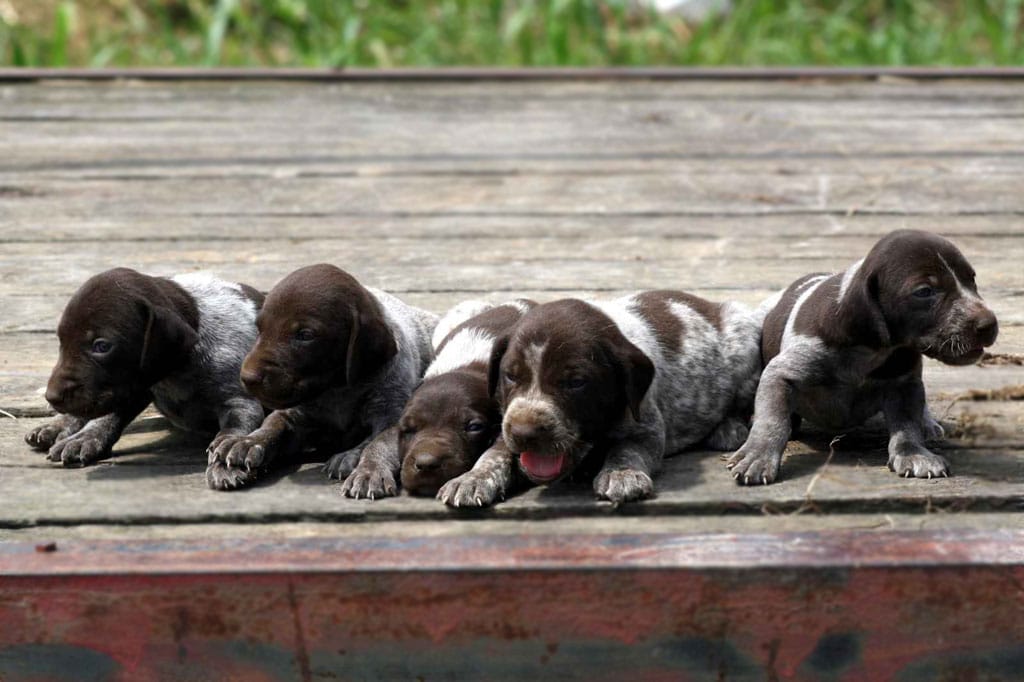
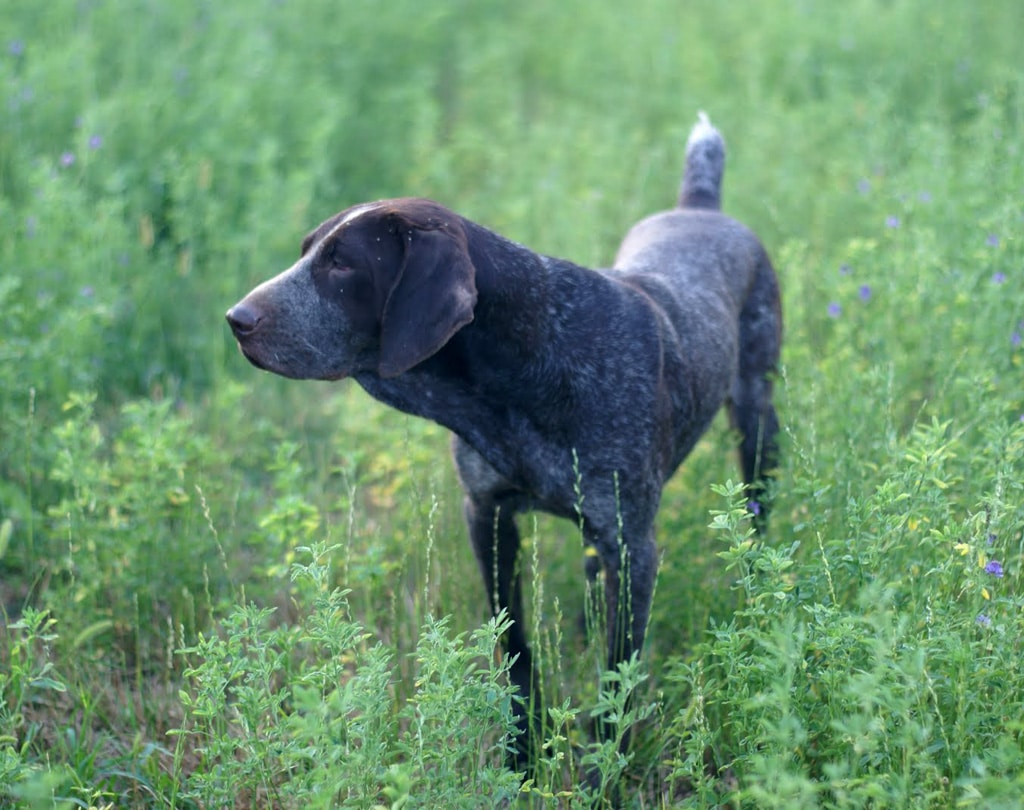
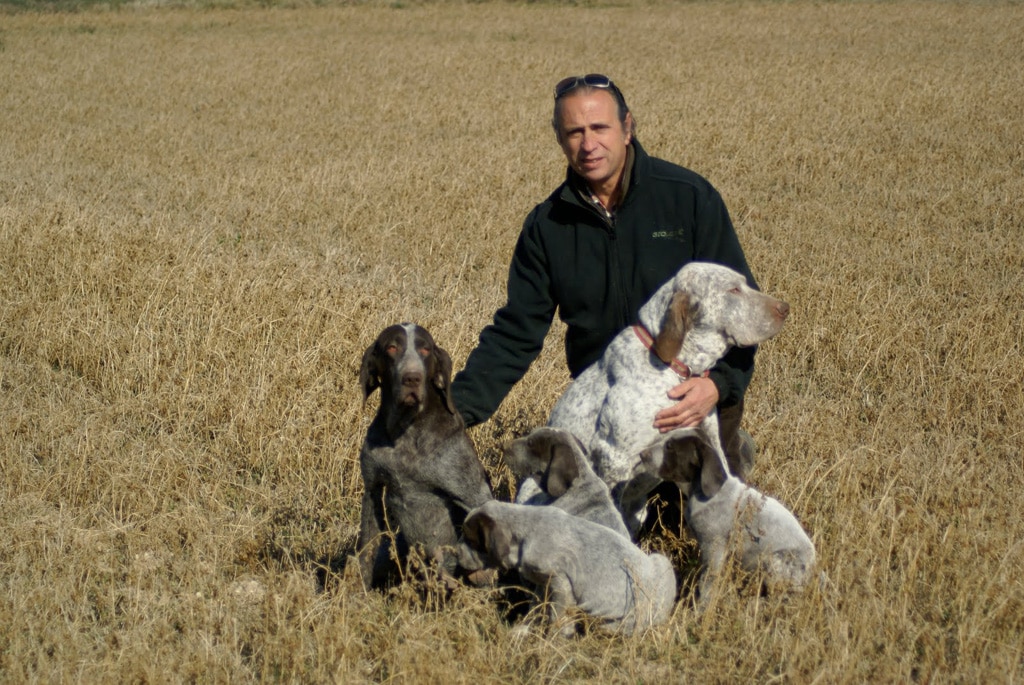
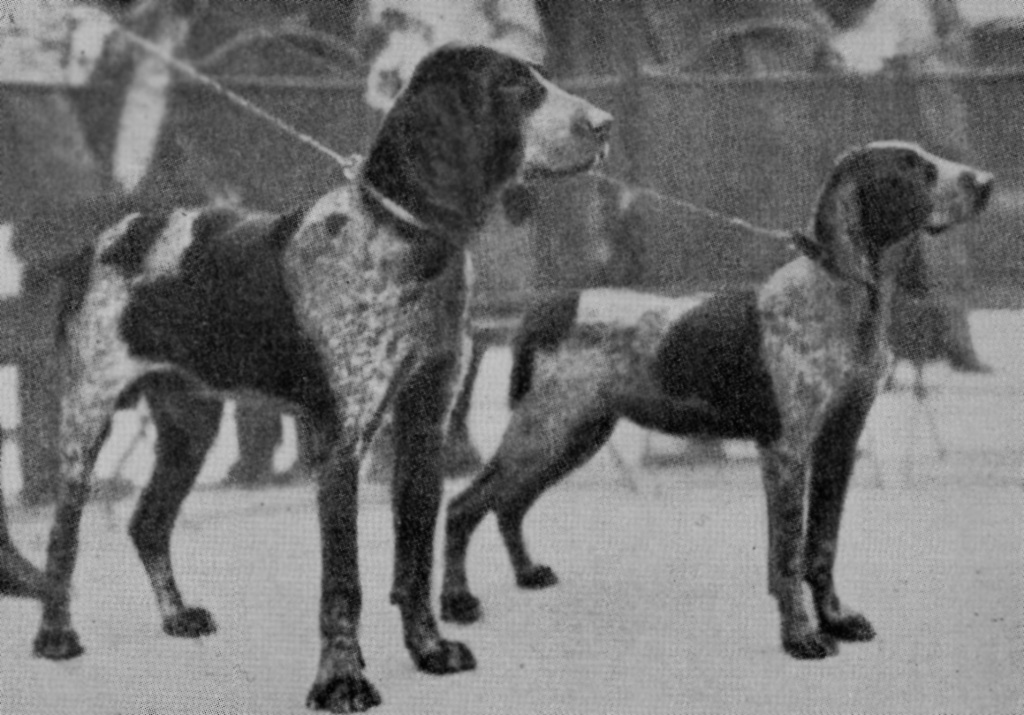
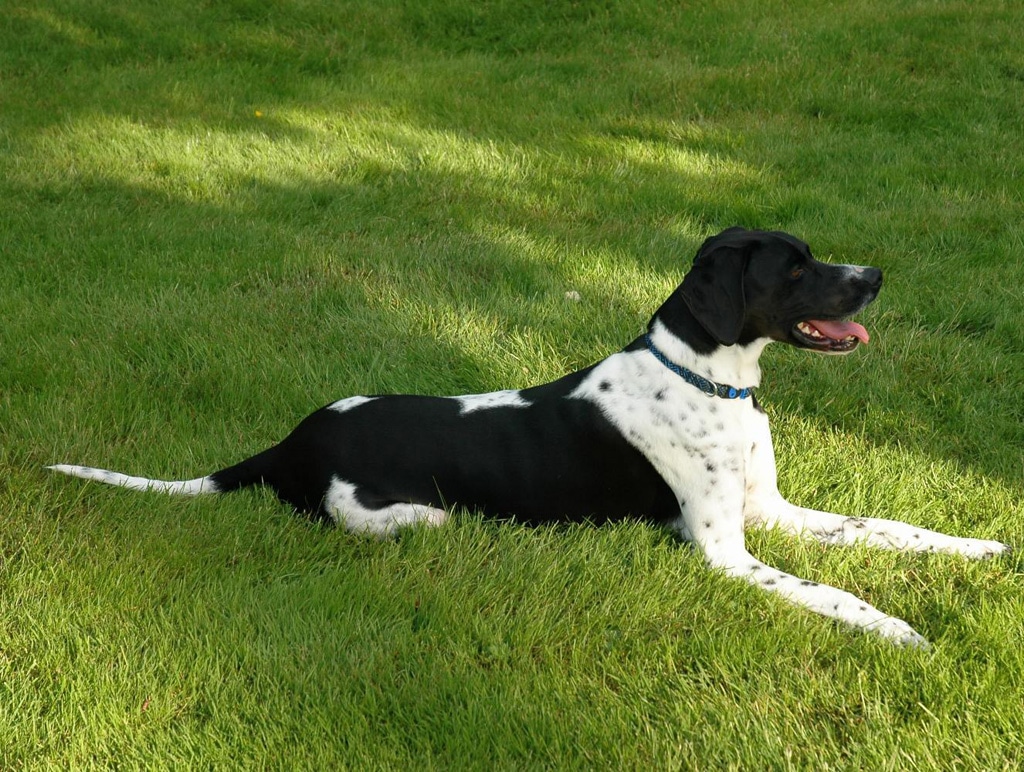
The Burgos Pointer It is a breed of dog Spain. Originally from Castile, especially in the province of Burgos, This rustic breed is intended for hunting and has exceptional characteristics for hunting small game..

It is an ancient breed from the Castilian tableland, is widespread, and according to some connoisseurs of the breed, it is likely that it has participated in the creation of other breeds of hunting dog, not only Spain.

The truth is that lot of documented material that speaks of this breed there is. Veterinary geneticist, Josรฉ Manuel Sanz rudder, has dedicated several lines to the history of this breed and in a document that appears cited in many web, speaks of the Origins and Ancient History (Until 1911). You can read the complete material on the website of the Spanish Association of el Perro Perdiguero de Burgos. Here we will only mention what refers to the word ยซPerdigueroยป and to the different theories about the origin but very briefly…

"The word ‘perdiguero‘ It occurs frequently in classical texts on venatoria and its reference corresponds to the generic Hunter dog of partridges, "perdicero" or "perdigero", but it cannot be lightly assumed that this dog was a Burgos Pointer. In numerous current texts we can read various theories about the origin of the race. The more absolute confusion arises from a whole once analysed separately. The most common mistakes that demonstrate a poor work of research are as follows:

  • Associate the word perdiguero the race Burgos Pointer.
  • Believing that the Pointing Dogs, as the Spanish classics tell us, they were Burgos Pointers and forget that they were other races.
  • Define like Burgos Pointer to the dogs that authors from Velรกzquez to Goya have been captured in numerous canvases where hunting dogs are reproduced.
  • Define incomprehensibly and lightly when Burgos Pointer as the origin of English Pointer, either in a display of patriotic enthusiasm, consider him further as the father of all European Braquesยซ.

"The authors, as often happens, they do not manage to agree on the theories about the origins of animals and while some affirm that the sample dog is originally from Italy, others say that France or Spain (according to the nationality of the author) which they were born.

On the formation of the current dog Burgos Pointer the news is null and we can only apply the parameters that are studied to form a race, they are:

  • Time and place of training.
  • Genetic basis provided the race.
  • Adaptation to the environment in which is born.
  • Geographical isolation and inbreeding operated.

With regard to the first of them, not a breed created by man ex process are being, with measured doses of one or another blood, both the time and the place of training are uncertain. A race not be based in short periods of time and having no initial selection at a single point, "We cannot think that the place of birth has only been a certain place."

(Author: Josรฉ Manuel Sanz rudder).

Physical characteristics

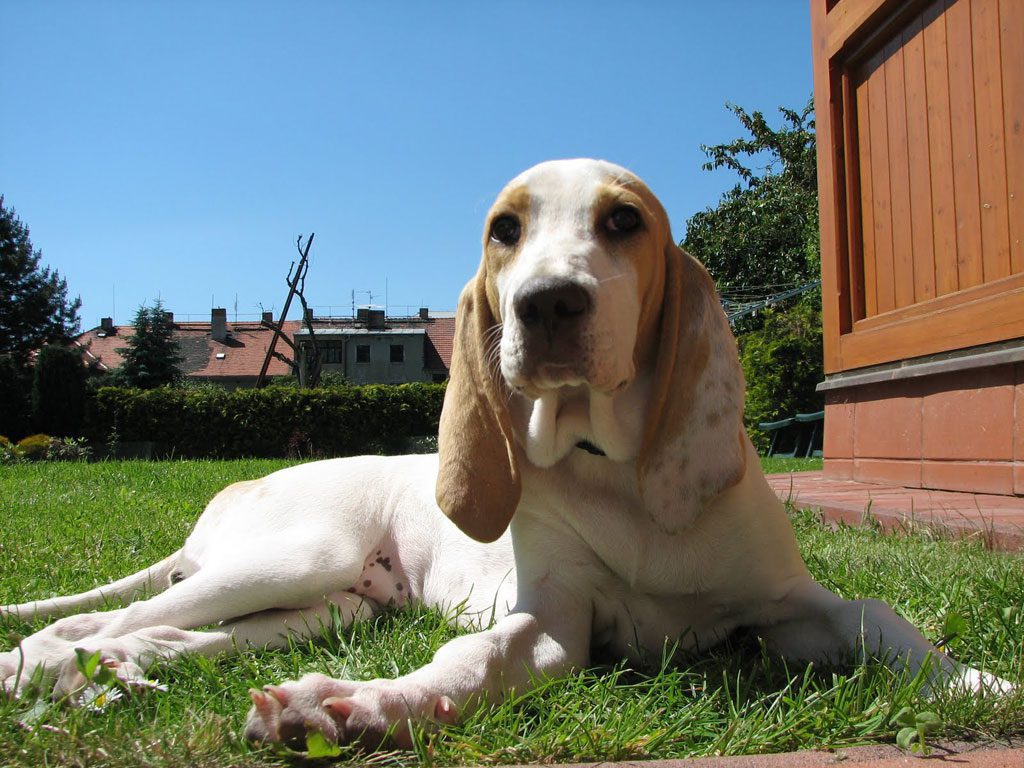
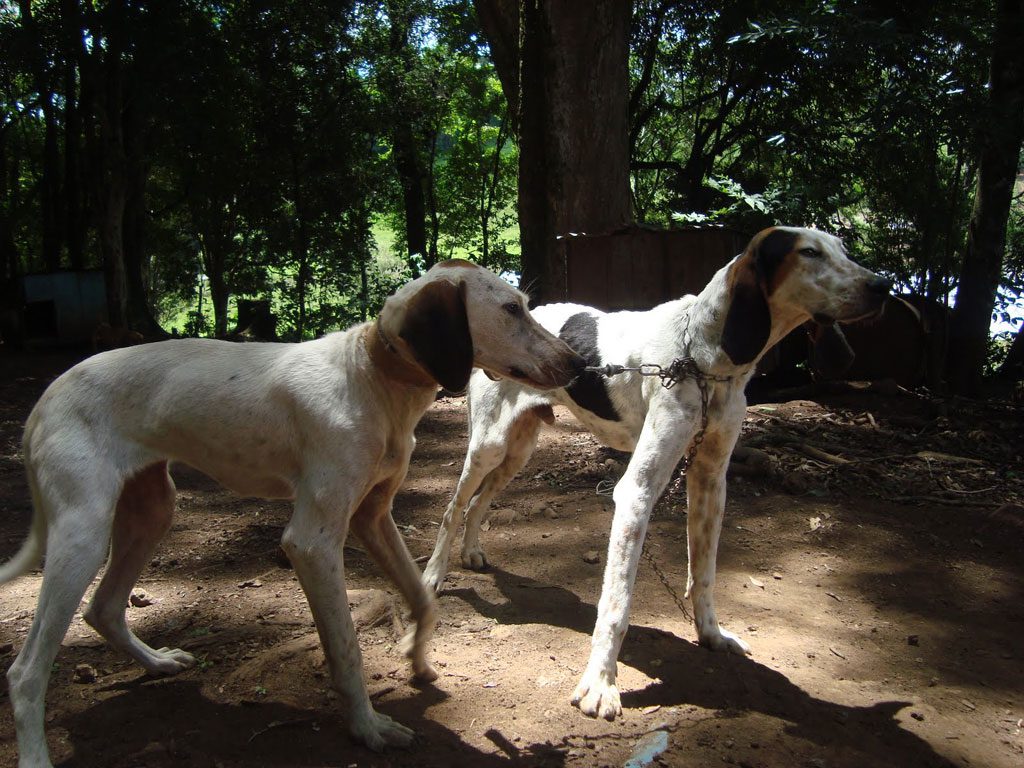
While the Burgos Pointer, It is not as robust and defined muscular level, like its relative the English Pointer, their appearance shows the strength of the race.

It has the ears long and the tail It tends to be cut one-third of its original length.

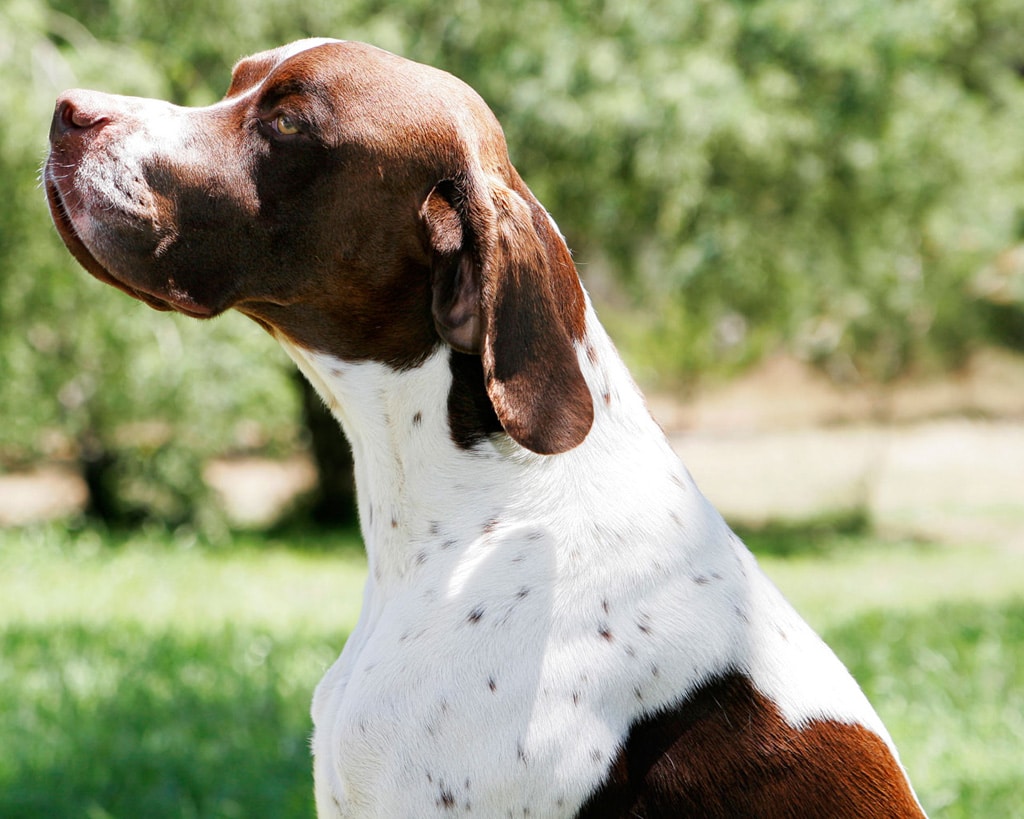
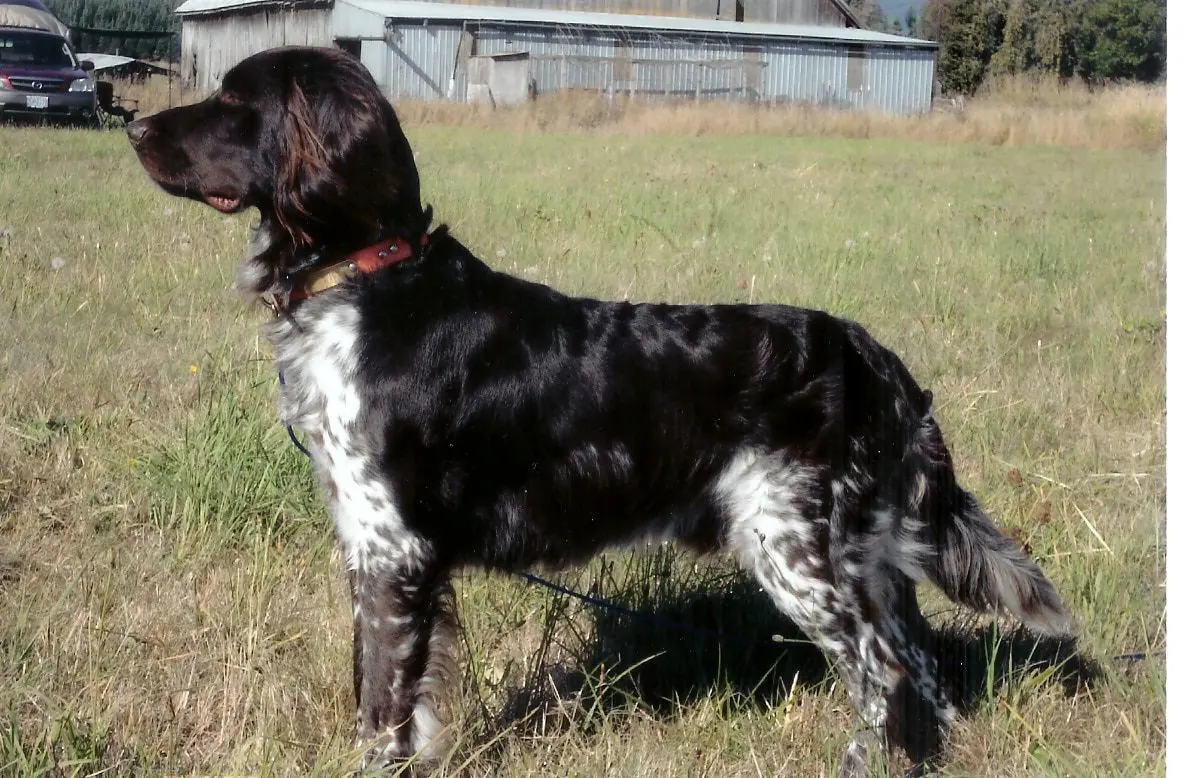
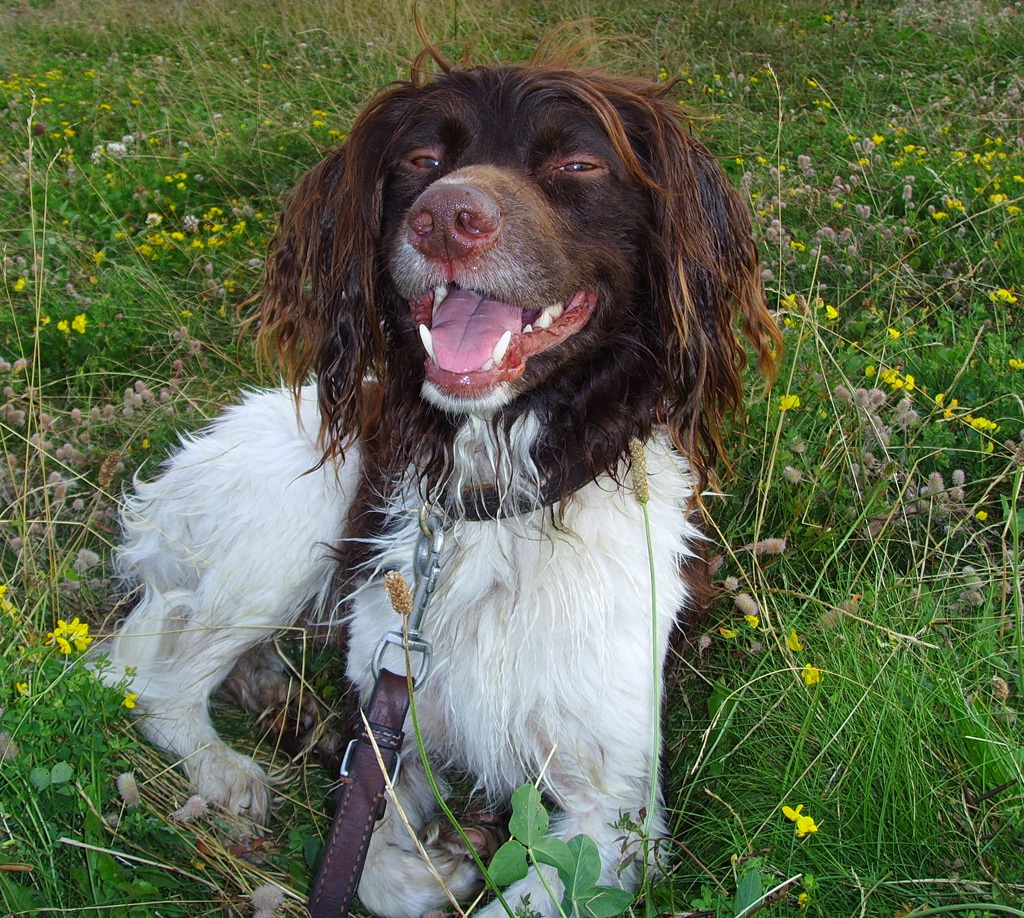
Its fur It has variants that can form different ranges within the basic color. The basic colors of the hair are the white and the liver. These colors mingle regularly, giving variegated layers that tend to liver, gray liver, mosqueados in liver and other various combinations, depending on whether the liver or white color is predominant and depending on whether the white spots are open or closed.

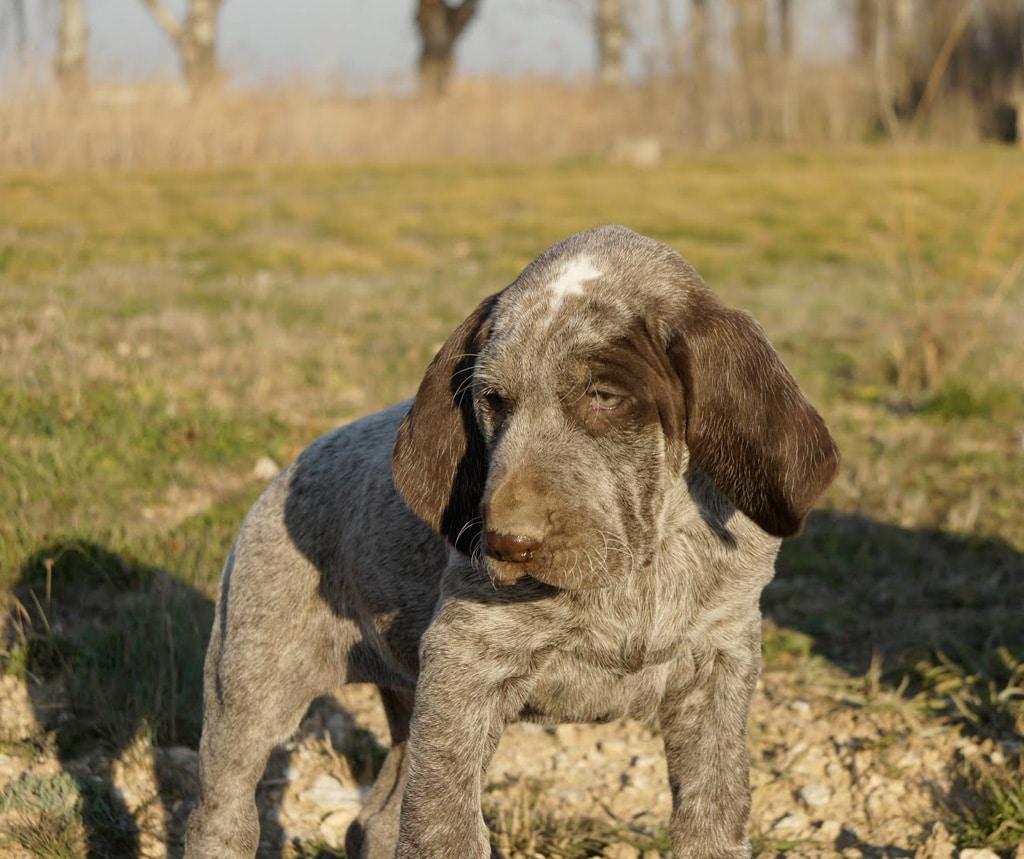
It is a very common feature (Although non-binding layer), that have a clear white spot on the forehead and the ears always spotted with a homogeneous liver color. Liver-colored hairs can form sharp, well-defined liver-colored patches, regularly distributed by the layer of the animal

Its the mantle is short, thick and soft. The hair is thinner in the head, ears and limbs.

The skin is elastic, but not printing, thick, abundant, pinkish spotless. All Oris they will be Brown, never black.

The height males will of 62 to 67 cm and females 59 to 64 cm to the cross. Thinking of 25 to 30 kg.

It is an animal that as all, It requires a dose of daily exercise. A long walk, and a few races in the open air will keep you happy.

Character and skills

It is a very friendly and quiet dog, not afraid easily. It is smart and learns easily, especially in tracking work.

It is not a dog that adapts very well to urban environments.

It is used for small game (rabbits, hares, etc.).

It's perfect for hunting in any field (no matter how hard it is), since it has an enviable physical resistance and a great speed.

The Burgos Pointer it is highly appreciated by hunters who want a rustic dog, hard in any terrain and type of hunting, obedient, strong and above all excellent winds and method of hunting, due to his calm and poise in the search, as well as his sample and his impeccable collection.

Although used for small game pieces not dismisses pieces of hunting trail, in which he demonstrates great bravery.

Characteristics "Burgos Pointer"

Coexistence is important that you have with your new friend. Before considering the acquisition of a dog of the breed "Burgos Pointer" you know certain factors. Not all breeds of dogs are apt to live in an apartment, you must take into account his character, their need for exercise, their interaction with other pets, their care and if you have small children, their level of tolerance towards them.

Adaptation โ“˜

3,0 of 5 stars (based on 1 review)

friendly dog โ€‹โ€‹โ“˜

3,0 of 5 stars (based on 1 review)

hair loss โ“˜

2,0 of 5 stars (based on 1 review)

Affection level โ“˜

3,0 of 5 stars (based on 1 review)

Need for exercise โ“˜

4,0 of 5 stars (based on 1 review)

Social need โ“˜

3,0 of 5 stars (based on 1 review)

Home โ“˜

2,0 of 5 stars (based on 1 review)

Toilet โ“˜

1,0 of 5 stars (based on 1 review)

Friendly with strangers โ“˜

3,0 of 5 stars (based on 1 review)

barking โ“˜

2,0 of 5 stars (based on 1 review)

Health โ“˜

3,0 of 5 stars (based on 1 review)

Territorial โ“˜

4,0 of 5 stars (based on 1 review)

Cat friendly โ“˜

2,0 of 5 stars (based on 1 review)

Intelligence โ“˜

4,0 of 5 stars (based on 1 review)

Versatility โ“˜

3,0 of 5 stars (based on 1 review)

Child friendly โ“˜

4,0 of 5 stars (based on 1 review)

Surveillance โ“˜

2,0 of 5 stars (based on 1 review)

joy โ“˜

4,0 of 5 stars (based on 1 review)

Images: Burgos Pointer

Videos: Burgos Pointer

Type and recognitions:

  • FCI CLASSIFICATION:
  • Group :
  • Section : . .

Federations:

  • FCI – Group 7: Pointing Dogs. – Section 1: Continental Pointing Dogs. 1.1: Braque Type โ“˜

FCI breed standard "Burgos Pointer"

Origin:
Spain

Date of publication of the valid original standard:
26.05.1982

Use:

Hair and Feather Pointer Dog. The Perdiguero de Burgos is highly appreciated by hunters who want a rustic dog., hard in any terrain and type of hunting, obedient; strong and above all excellent winds and method of hunting, due to his calm and poise in the search, as well as his sample and his impeccable collection. Although used for small game game, does not discard the trail of game pieces, in which he demonstrates great bravery.


General appearance:

Hunting dog of good size, eumetric and medioline. Well developed head, compact trunk and strong limbs. Droopy ears and short hair. Longitudinal diameter as close as possible to the height at the withers. Proportionality and functional harmony must be sought, both in static and in motion


Behavior / temperament:

Rustic, balanced, calm and sitting; turns out to be a great show dog, especially suitable for hunting hair and feathers. Fresh look, very noble, it is a breed of excellent character, docility and intelligence.

Head:

As a whole : Big and strong, well developed skull; strong face and muzzle and corkscrew ears.

The cranium, seen from above, It must be moderately rectangular with a progressive decrease towards the nose, without giving feeling of pointed snout. The ratio of the length of the skull to that of the face is 6:5. The craniofacial lines are divergent.


Cranial region:
  • Skull : Width, strong, domed and convex profile; well marked central groove, shallow occipital crest. Accused frontal sinuses.
  • Depression links (Stop) : Soft, little sharp.

facial region:

  • Truffle : dark brown, wet, big and wide with wide open windows.
  • Snout : Straight profile or with a very slight curve towards the nose. Width throughout its length, it should not give the impression of being pointed. Wide muzzle.
  • Lips : Sagging without sagging. The upper one will cover the lower one well. The bottom is marked labial commissure. The mucous membranes must be brown.
  • Jaws / Teeth : Strong teeth, white and healthy; scissor bite. All premolars exist.
  • Eyes : Medium, macaroons, preferably dark hazelnut, noble and sweet look, sometimes giving a feeling of sadness. The skin of the eyelids is moderately thick, pigmented like the mucous membranes in brown. The lower eyelid should be as close as possible to the eyeball.
  • Ears : long, drooping and triangular in shape. Inserted at eye line level, at rest they fall gracefully in corkscrew. Without exerting traction, they must reach the corner of the mouth and will not reach the nose.. Soft and soft to the touch, they have fine skin and hair; marked venous network. In higher insertion care and flatter frontal conformation.
  • Palate : Pink mucous with well marked beads.

Neck:

Strong and powerful; wide part at the head and continues with a slight widening to the trunk. Slightly arched top edge. Lower border with well defined dewlap that, starting from both lip corners, It is presented double without being exaggerated.

Body:

  • As a whole : Square, strong and robust, powerful chest and ribs, giving a feeling of power and agility.
  • Cross : Well defined.
  • top line : Straight and horizontal or desirable with a slight drop from the withers. Never saddled and no oscillations during movement.
  • Back : Powerful and muscular.
  • Pork loin : Medium-, broad and muscular, giving a feeling of power.
  • Rump : Wide and strong. Its inclination will be less than 45ยฐ with respect to the dorsal lumbar line and the floor.. Height at the croup equal to or less than the height at the withers;
  • Breast : Wide and deep, reaches elbow level; muscular and powerful. Tip of the sternum marked. Well developed ribs, rounded, not flat. Well marked and wide intercostal spaces as we move towards the floating ribs. The chest perimeter must be equal to the height at the withers plus ยผ of it.
  • Bellies and flanks : Belly moderately tucked towards the genitals. Low sides and well marked flanks.

Tail:

Thickness birth and average insertion. It is amputated between a third and a half of its length.

Tips

PREVIOUS MEMBERS :

  • As a whole : Perfectly Plumb, straight and parallel. Strong bones with short pasterns and well developed feet.
  • Shoulder : Moderately oblique, muscular. The scapula should be approximately the same length as the arm
  • Arm : Strong and well muscled; its length will be 2/3 of the forearm.
  • Elbows : Glued to the trunk.
  • Forearm : Strong bone, with marked tendons. Straight and well plumb. Its length is double the total length from the carpus to the ground.
  • Metacarpus : Seen little laterally inclined, is practically the continuation of the forearm. Strong bone.
  • Front feet : Of cat, tight fingers, high and strong phalanx. dark nails. Robust plantar tuber, very wide and hard pads. Moderate interdigital membrane.
  • Angles : Scapulo-humeral angle close to 100ยฐ,Humero-radial angle close to 125ยฐ.

LATER MEMBERS :

  • As a whole : Powerful and muscular, strong bone and well poised with correct angles, well marked and angulated hocks, giving a feeling of power and solidity.
  • Thigh : Very strong and with a clear appreciation of the muscles, well marked and developed. Its length is ยพ of the leg.
  • Leg : Long and strong of bone twice the length of the metatarsal.
  • Hocks : Well marked with clear appreciation of the tendon.
  • Metatarsus : Strong bone and perpendicular to the ground.
  • Rear feet : Cat as in the forelimbs, although slightly more elongated.
  • Angles : Coxo-femoral angle close to 100ยฐ,Femoro-tibial angle close to 120ยฐ ,Open hock angle greater than 130ยฐ.

Movement:

The typical gait of the breed is an economical trot, loose and powerful without tendency to laterity and without ambling.

Mantle

SKIN :
Elastic but not detached, thick, abundant, pinkish spotless. All mucous membranes will be brown, never black.

HAIR : Bushy, medium thickness, short, smooth and distributed throughout the body to the interdigital spaces. Finer on the head, ears and limbs.

COLOR : The basic hair colors are white and liver.. These colors are mixed unevenly, giving marbled layers in liver, gray liver, liverwort and various other combinations, depending on whether the liver or white color is predominant and whether the white spots are more widespread or closed. A very common feature of the coat, although not necessary, It is the clear white spot on the forehead and the ears always stained with a homogeneous liver color.. Liver-colored hairs can form clear, well-defined spots of that color distributed irregularly across the animal's coat.. The same can happen with white hairs that can form gaps of this color on the coat without being extremely extended.. Black colorations or fires on the eyes and limbs are never allowed.


Size and weight:

Height to the cross :

  • Males of 62 to 67 cm.,
  • females of 59 to 64 cm..

A high rate of sexual dimorphism is observed in this breed., being the males more homogeneous and the females of more variable height and less corpulent in general.


Fouls:

Any deviation from the aforementioned criteria is considered as a fault and the severity of this is considered to the degree of the deviation to the standard and its consequences on the health and well-being of the dog..

MINOR FAULTS

โ€ข Profile of the snout fleshy without excess.
โ€ข Absence of any premolar.
โ€ข Pincer bite.
โ€ข Conjunctiva ligerรญsimamente visible.
โ€ข Belfos or double chin that, without being excessive, are very marked.
โ€ข Poorly solid dorso-lumbar line.
โ€ข Metacarpos, weak metatarsals or feet, but not excessively.
โ€ข Scars, wounds and abrasions during hunting season.

SERIOUS FAULTS

โ€ข Light appearance, fragile or excessively heavy and lymphatic.
โ€ข Parallel craniofacial axes.
โ€ข Poor or small heads.
โ€ข Narrow skull.
โ€ข Pointed snout.
โ€ข Absence of several premolars and canines not due to trauma.
โ€ข Very pronounced ectropion or entropion, light eyes.
โ€ข Ears that are too long or set too low.
โ€ข Belfos or exaggerated jowls.
โ€ข Saddled dorso-lumbar line.
โ€ข Height at the rump noticeably higher than the height at the withers.
โ€ข Incorrect positions, weak or deviant.
โ€ข Detached elbows.
โ€ข Cow hocks.
โ€ข Wavy or very long hair.
โ€ข Unbalanced character.

MISS PLAYOFFS

โ€ข Aggressive or fearful dog.
โ€ข Decidedly convergent craniofacial axes.
โ€ข Depigmentation in the truffle.
โ€ข Broken or black nose.
โ€ข Any degree of lower prognathism.
โ€ข Excessive upper prognathism.
โ€ข Albinism in the coat accompanied by the mucous membranes.

Any dog โ€‹โ€‹showing clear signs of physical or behavioral abnormalities must be disqualified..


N.B.:

Males should have two normal-appearing testicles fully descended into the scrotum..

Source: F.C.I - International Cynological Federation

Alternative names:

1. Perdiguero de Burgos, Burgalese Pointer (English).
2. Retriever de Burgos, Braque de Burgos, Perdiguero (French).
3. Burgos-Hรผhnerhund (German).
4. Pointer espanhol, Pointer de Burgos (Portuguese).
5. Perdiguera (espaรฑol).

โ–ท The world of Pets: Dogs, cats, birds, reptiles, amphibians

English Pointer
Gran Bretaรฑa FCI 1 - Pointer

Pointer Inglรฉs

The English Pointer It is a dog of great kindness and loyalty to its owner and docile.

Content

History

The first records of Pointers in England they date from around 1650. The breed is believed to be the result of a cross between Spanish pointers, the English Foxhound, Greyhounds, St. Hubert Hound, Bulldog and various breeds of Setter.

The objective of the breeders was to develop an animal that combined the qualities of these different breeds, in particular the developed sense of smell and the physical constitution of the St. Hubert Hound; speed, the elegance and grace of Greyhound; the well-developed rib cage of the English Foxhound, as well as its resistance and ease of maintenance. Later, various breeds of Setters to improve the psychological characteristics of the English Pointer, since the first specimens were described as fierce.

Until the 18th century, this dog was used to search, locate and mark small game, like the rabbit, the hare or the fox. He worked in tandem with the Greyhounds and other racing dogs, which in turn were in charge of catching and killing prey.

At the beginning of the 18th century, with the development of the use of firearms for hunting birds, the hunters realized that the English Pointer stood out in the search, signaling and recovery of game birds, thanks mainly to its speed and its great resistance. So, was used primarily for this purpose.

The international diffusion of English Pointer

The English Pointer began to spread abroad in the second half of the 19th century.

It is especially at this time that the first specimens were imported to France by lovers of hunting dogs., like the gentlemen Merle, Bailly, Mayaudon, Caillard y Lambertye.

Although it is possible that the first specimens were imported much earlier by the colonists, the first official import of a English Pointer in the United States it dates from 1876. From England and with a white and lemon coat, the apt name of Sensation became the emblem of the famous dog show of the Westminster Kennel Club, which was founded the following year and is still today one of the most prestigious dog shows in the world. The breed quickly gained popularity among hunters for hunting quail.

In 1878, just two years after arriving in the United States, was accepted by the National American Kennel Club, the predecessor of the American Kennel Club (AKC). The English Pointer was one of the first nine breeds recognized by the AKC when it was founded in 1884. The other reference organization in the country, the United Kennel Club (UKC), recognized the breed in the early 20th century. But, was not up 1963 when the breed was officially recognized by the Fรฉdรฉration Cynologique Internationale (FCI), which supervises the national organizations of a hundred countries (including France, Belgium and Switzerland).

Physical characteristics

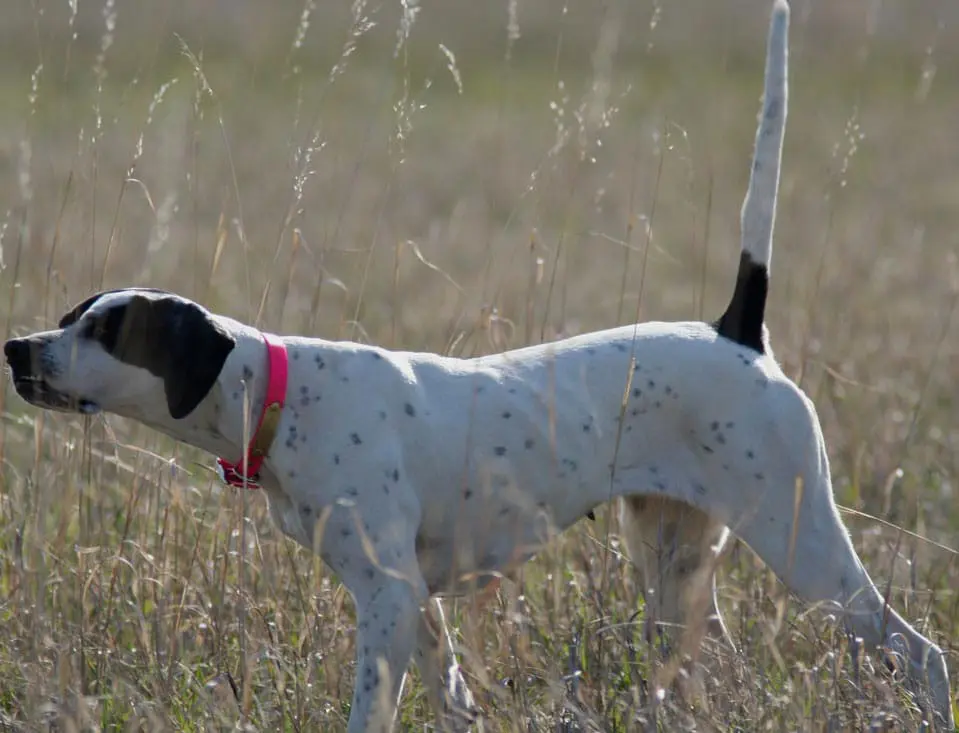
The English Pointer it is a large dog with a harmonious appearance, flexible and elegant. His body is well proportioned and his muscles well developed..

His tail is rather short, thick at the base and thin towards the tip. It is straight and follows the line of the back. When on the move, beats from side to side.

His head is flat and rests on a long, muscular neck. Profile, the length of the skull and muzzle are approximately equal.

The ears are medium in size, droopy and located just above the eyes. They are slightly pointed and thin, with visible veins.

The eyes are oval in shape, with a hazel color in light-coated individuals, brown on others. In all cases, give the dog a lively look.

The nose is generally black, but may be lighter in dogs with lemon and white fur. In all cases, their nostrils are wide open.

The coat of the English Pointer is short, dense, smooth, straight and shiny. Their fur is usually bicolor, mixing white and another color: lemon, orange, brown or black. Unicolor or tricolor individuals are rarer, but they are also recognized by the standard.

Last, sexual dimorphism is quite marked in this breed: males are larger and above all more massive than females.

Height and weight

    ▷ Male size: Of 63 to 69 cm.

    ▷ female size: Of 61 to 66 cm.

    ▷ Male weight: Of 20 to 30 kg

    ▷ female weight: Of 18 to 28 kg

Character and skills

The English Pointer he is a gentle companion, loyal and affectionate with his family. Get along especially well with children old enough to have learned to interact with animals, and is a tireless playmate for them. He is also very patient and gentle with them, even when they are unruly or even bullying you. But, it is much less suitable for young children due to its large size, since you can easily push them unintentionally. In any case, regardless of race, a dog should never be left alone with a very young child without adult supervision.

The English Pointer not only does he get along very well with family members, but also with other dogs of the same breed.

Sharing your everyday life with one of them is a great way to avoid boredom when your child is away from home.. In fact, they have a hard time tolerating loneliness: if left alone too often or for too long, they are very likely to develop separation anxiety, with destructive behavior as a consequence. Whether you share your home with another animal or not, only suitable for a master who generally spends most of his days away from home.

If you like to be around your family, the Pointer, on the other hand, is much more reserved and distant with strangers. Without showing aggressiveness towards them, does not deprive himself of barking when he perceives danger or a stranger approaches his place of residence. But, although their barking and large size can be a deterrent, his ability to attack when necessary is limited, which does not make them good guardians. On the other hand, is an effective warning dog. Living with a cat or a rodent is possible, as long as they have been raised together or are used to living with other animals from a young age. Otherwise, it is better to avoid taking the risk, since its strong hunting instinct could lead it to consider newcomers as prey. This is also how he sees pet birds and small animals he doesn't know, whether they cross your path on a walk or venture into your garden.

This temperament is obviously a good thing if employed as a hunter., but it also implies that he must be kept on a leash during walks as long as he does not obey when asked to return, otherwise it will start chasing small animals that pass. Having said that, even with a good recovery workout, cannot be completely trusted: your instincts can get stronger at any time. Thus, It makes sense to invest in a GPS-connected collar, so you can easily locate it if it goes out to sea, especially since then it can get far away, but not necessarily find my way back.

In any case, the fear that he may be deceiving his masters is no reason to limit his outings, since the remedy would be worse than the disease. In effect, to be balanced, the English Pointer must be able to dedicate at least one hour a day, for example through two or three walks and / or play sessions.

It is too active to be suitable for an elderly and / or very sedentary person, but its incredible speed and stamina make it a perfect companion for a very active master.. It is a pleasure to accompany you on jogging sessions, bike outings or long walks.

His curiosity and high intelligence also mean that physical activity is not enough.: to feel good both in your head and in your body, must also be intellectually stimulated. Ideally, you have a job to do or a mission to accomplish as often as possible.. Hunting and dog sports such as agility, obedience and rally are, Therefore, great ways to allow you to exercise both physically and mentally.

In any case, your activity level makes you unsuitable for apartment living, since you need to be able to run freely at all times in a wide space to expend your excess energy. So, need a house with a garden, but the garden must be well fenced, given his unbridled temper. Using an underground electric fence would not be an effective solution, because their determination is much stronger than the discomfort felt by electrical impulses, especially when he has sniffed a prey and goes after it.

And just because a dog likes to play in the garden doesn't mean they have to spend most of their time there., away from his family. To be happy and balanced, you need to be surrounded and interact with your family. It also, once your needs are met, he is quite calm and enjoys spending time with his masters, for example lying on the sofa receiving pampering.

Education

As in any race, Socialization should be one of the pillars of the education of the English Pointer and start at a young age, when it is most malleable and adaptable. So, you need to get used to being exposed to all kinds of different situations and environments, but also and above all to regularly meet other animals and new people. This is all the more necessary as he tends to be spontaneously shy around strangers..

The other way, to avoid any hyperapego to their owners, you should also teach your dog to tolerate loneliness. Otherwise, You may find it especially difficult to cope with your absences.

The intelligence of English Pointer makes you able to learn quickly. This does not mean that he is willing to comply with all the wishes of his master.: has a strong character and can be very stubborn, so sometimes it's hard to make him obey.

So, to achieve your goals - and, in particular, to get your dog to obey you- his master must be firm in his education and not let anything pass from the beginning, at the risk of ending up with a difficult partner. Pay special attention that the rules are clear from the start, but also constant over time and from one person to another, which requires good cooperation between family members.

In general, the ideal is to start learning as soon as you get home, opting for the dog training method based on positive reinforcement. In fact, not receptive to reprimands, and responds much better to stimuli and treats.

But, the different smells and sounds that you perceive around you also interest you very much, and soon catch your attention during training sessions. So, it is better to opt for frequent sessions, short and varied, in order to keep you focused on tasks at all times.

Difficulties in achieving what is expected of him make it not really recommended for an inexperienced person, since it would soon be difficult for him to hit.

In any case, given his strong hunting instinct, remembrance is one of the most important teachings you should receive. Prevents him from constantly chasing animals he considers prey and disregarding his master's orders. Although it remains difficult to hope that his ardor will be curbed in the 100% of the cases, it must be kept on a leash during walks as long as this order is not properly assimilated.

Health

The English Pointer It, in general, a robust and healthy animal, and their life expectancy, of 12 to 15 years, is rather in the high range of the average for dogs of this size. They can withstand the heat without difficulty, but their short fur makes them especially sensitive to cold and humidity. Thus, it is advisable to cover him with a dog coat when temperatures are low. In any case, it is not suitable for living in a region where the climate is especially cold for much of the year.

Although in good general health, like any race, you can suffer from various more or less serious illnesses throughout your life. Those that predispose the most are :
  • The Hip Dysplasia, a joint malformation whose appearance may be favored by a hereditary predisposition. It produces pain and lameness that worsen over time, and favors the appearance of osteoarthritis as the animal ages;
  • The metaphyseal osteopathy (or hypertrophic osteopathy), a bone disease that usually manifests itself as the animal grows and progresses rapidly. Besides lameness, can cause various symptoms such as high fever, anorexia or abnormal fatigue. The vital prognosis is good in mild forms of the disease, but much more reserved for the most serious cases;
  • Chondrodysplasia (or dwarfism), a genetic disease that causes underdevelopment of bones and cartilage. The latter causes the front and hind limbs to be shorter than normal.. There is no cure for this disease, but medication can ease the pain, and surgery may be suggested for the most severe cases to correct any deformation of the bones and vertebrae;

  • The stomach dilation-torsion syndrome, which occurs when the stomach swells and folds in on itself, blocking the evacuation of gases and interrupting blood circulation. Unless a vet intervenes quickly, it is usually fatal, so it is a vital emergency;
  • The Addison's disease, an endocrine disorder that is sometimes inherited and is caused by destruction or atrophy of the adrenal glands. This gives rise to various symptoms that may suggest other pathologies.: vomiting, diarrhea, dejection, weightloss, anorexia, tremors… The acute form gives the animal little chance of survival, while a lifelong treatment helps fight the chronic form;
  • The Hypothyroidism, a hormonal disease that causes a decrease in metabolism. Hypothyroidism is a hormonal disease that causes a decrease in metabolism and gives rise to various symptoms that vary from one individual to another.: exhausted, damaged fur, breathing difficulties, overweight… Requires lifelong treatment to alleviate or even prevent these symptoms;
  • The epilepsy, a chronic disease of the nervous system that causes seizures whose manifestations can vary from time to time and from person to person. Although there is no cure, various treatments can reduce the intensity or number of seizures to such an extent that most people with this disease can lead normal lives;
  • Aortic stenosis, a congenital and probably hereditary heart defect that causes heart failure. This anomaly is incurable, and the risk of syncope or heart attack in the affected animal is not negligible. However, there are medications to counteract the effects of heart failure and the risk of sudden death;
  • Demodechia, dermatological disease due to overgrowth of Demodex Canis mites. Hairless spots may appear, itchy redness, blackheads and dandruff. The localized form usually heals itself, but if necessary -or in the case of a generalized form- medication and skin care can help;
  • Allergies, whether they are respiratory, food, skin or contact. Symptoms and treatments depend on the type of allergy in question.;

congenital deafness, which mainly affects white-coated dogs. Whether it affects one or both ears, is irreversible;

The ear infections, which are common in any dog โ€‹โ€‹with floppy ears.

The English Pointer it is also especially prone to various eye diseases:
  • Progressive retinal atrophy, an incurable inherited disease that causes retinal degeneration. Causes progressive loss of vision, first at night and then during the day;
  • The gland prolapse nictitante (or cherry eye), which corresponds to an inflammation of this lacrimal gland. The most common signs are the appearance of a small red ball in the inner corner of the eye and tearing. Can be treated with surgery;
  • The entropion, which is a curvature of the edge of the eyelid towards the inside of the eye. It can be hereditary and causes pain, irritation and inflammation of the cornea and conjunctiva from repeated rubbing of the eyelashes and / or hairs on the fragile parts of the eye. This can be remedied with surgical intervention.;
  • The waterfall, which mainly affects the elderly and corresponds to a clouding of the lens. If nothing is done, leads to progressive loss of vision, up to total blindness. But, an operation can allow the animal to regain correct vision.

It also, When the English Pointer used for hunting, you are obviously exposed to the risks that this activity implies – particularly that of injuries.

Having said that, although the list of conditions the breed is predisposed to may seem frightening at first glance, keep in mind that its prevalence remains low, so most of its representatives live in perfect health. This is confirmed by a study carried out in 2004 by the Kennel Club and the British Small Animal Veterinary Association, which showed that old age is the main cause of death in this breed. Old age alone accounts for a quarter of deaths, while cancers rank second and are implicated in around the 20% of the cases.

However, it is true that a large part of the diseases to which the breed is predisposed are or may be hereditary, which justifies favoring a serious breeder of English Pointer. In effect, not content with offering puppies quality socialization from their first weeks of life, a professional worthy of the name takes care that they do not suffer from a hereditary defect transmitted by their parents. To avoid this, has various genetic tests performed routinely on individuals you plan to breed, to avoid the transmission of a hereditary pathology and, of course, rule out those at risk. In addition to the test results in question, must be able to present a certificate of good health issued by a veterinarian, as well as details of the vaccinations administered, registered in the animal's sanitary or vaccination registry.

Once adopted, it must be ensured that the animal does not make any excessively long or intense physical effort during its growth, which usually lasts until 18 months. In effect, your bones and joints are then especially fragile; would run the risk of injury or developing malformations, with consequences that could last a lifetime. These may include, this could lead to the development of Hip Dysplasia, to which you are predisposed.

Last, throughout his life, the English Pointer must be taken at least once a year to the vet for a complete health check. This appointment is also an opportunity to carry out any necessary vaccine withdrawals.. At the same time, to prevent risks related to parasites (worms, ticks…), your owner must make sure to renew your deworming treatments whenever necessary.

Life expectancy

Of 13 to 14 years

Grooming

The English Pointer it is an easy breed of dog to take care of, and this is especially true for their fur. Brushing once a week with a special glove or a rubber brush is enough to remove dead hairs and spread the sebum all over his coat.. If rubbed gently with a chamois or soft cloth, will be bright. It is also the occasion to detect possible skin problems, that are frequent in him.

During your seasonal molt, in spring and autumn, hair loss is still moderate, but brushing frequency should be increased. Ideally, do it two or three times a week.

When properly cared for, the fur of the English Pointer does not get very dirty and rarely smells bad. So, no need to wash frequently: once or twice a year is enough, unless, of course, is dirty or smells bad. In any case, a mild shampoo designed specifically for dogs should always be used, to avoid damaging your skin with an unsuitable product. In fact, the pH of dog skin differs from that of human skin.

You have to pay special attention to their droopy ears, since this morphological peculiarity increases the risk of infections at this level (otitis, etc.). So, not only do they have to be inspected and cleaned at least once a week, but also spend time drying them every time they have been in contact with water or have spent a long time in a humid environment, to prevent moisture build-up.

The maintenance of your dog's ears and also the opportunity to check his eyes and clean them if necessary, in order to avoid the risk of infections.

It also, teeth should also be cleaned at least once a week with dog toothpaste and a toothbrush or pad. This helps limit the formation and accumulation of tartar., that favors the development of bad breath and various oral diseases. Ideally, brush your teeth several times a week or even daily.

Looking at its claws, the activity level of the English Pointer makes natural wear and tear normally enough to file them. But, as you age or are no longer as active as before, they can get too long and end up annoying or even hurting you. So, they must be examined regularly and cut with a file or nail clipper as soon as necessary. This is the case as soon as a kind of rattling sound is heard when walking on hard ground.

Whether the fur, the ears, the eyes, teeth or claws, do not hesitate to ask for the help of a professional (vet or groomer) to know the proper care of the English Pointer. It is also advisable to accustom your pet to being handled from a young age.

This facilitates not only grooming sessions, but also to be able to examine it easily every time you return from a long stay abroad, for example during a hunting day. In effect, this is important to make sure he is not injured or that there are no parasites or spikes stuck in his fur.

Food

As in the case of any race, the diet of English Pointer should fit your size, age, health and physical activity level, both in terms of the choice of products and the amount of food given each day. To maximize the chances of keeping your dog healthy, it is recommended to feed him with high quality croquettes or hamburgers that provide him with all the nutrition he needs.

Nutrient intake can vary significantly throughout the year. If used as a hunter, will use more energy during certain periods of the year, so your daily rations should be modified and increased, since the diet of a hunting dog is not the same as the usual. But, it is important to return to a normal amount of food once the season is over to avoid any risk of overweight in dogs.

In fact, but the English Pointer are not predisposed to obesity, it is advisable to monitor your weight every month to ensure that everything is fine at that level. This is even more important if you have been spayed, since the risk is then higher. In case the magnification is prolonged or even increased during several measurements in a row, it is necessary to take it to the vet to find out the cause of the problem and thus know how to remedy it. In any case, your diet and activity level may not be the cause, for example if weight gain is a symptom of an underlying disease.

In any case, diet is especially important when the dog is small and growing. Feeding them too much and / or giving them too much food can cause them to grow too fast, which can cause not only injuries, but also long-term problems with bones and joints, as deformities. On the other hand, improper nutrition can also cause potentially very damaging stunting.

Regardless of age, the ideal is, as with any dog, divide your daily ration into several meals. This is all the more essential since it is predisposed to the dilation-torsion of the stomach., which often follows the rapid absorption of a large amount of food. It also, to avoid the latter, meals should be taken in a quiet place and one hour away from any strenuous physical activity.

It also, the fact that it is not especially prone to obesity does not justify giving it food intended for humans (for example, table scraps), without ensuring that you can effectively meet your nutritional needs. Otherwise, it would do more harm than good, especially, of course, if the food is popular with humans but toxic to dogs.

Last, water must be available throughout the day and must be changed regularly to keep it fresh. If used for hunting, it is better to carry enough than to let him drink standing water.

Use

Before the 18th century, the English Pointer it was mainly used as Pointing Dogs for small game, like the rabbit, the hare or the fox. Thus, cared for possible prey and worked with racing dogs, who were in charge of hunting and catching them.

With the arrival of firearms in his native England in the early 18th century, began to be used more to target and retrieve game birds, function in which he stood out.

Even today, are still highly prized by hunters, who use it mainly as Pointing Dogs.

They are also found as pets. Its sweetness and affectionate character make the Pointer a very endearing companion, as long as his family can meet his great need for exercise and they are sufficiently present for him.

Their loyalty to their owners and their aloof and aloof demeanor with strangers, without depriving yourself of barking loudly when they approach, make it an excellent warning dog. But, its ability to act as a watchdog is limited by its lower propensity to attack in danger.

It is also a good companion for dog sports. Its competitive character and its resistance allow it to distinguish itself in disciplines such as canicross, el cani-VTT, obedience, the rally and agility.

Last, his elegance and his desire to please his masters also make him a sure value in canine beauty contests. In fact, he was already often seen at dog shows in the 19th century.

Price

The price of a puppy English Pointer varies between the 450 and 1.200 EUR, and the mean is around 900 EUR, without great differences between males and females. There are many breeders throughout Europe.

On the other hand, in Canada remain rare, so the number of individuals offered each year is quite limited. The amount requested usually ranges from 1200 and 3000 canadian dollars. So, the most pertinent option may be to buy in the United States, where a puppy can be acquired for between 1000 and 1500 USD. Then, you must ensure that you adhere to the regulations regarding the importation of a dog into Canada and note that transport and administrative costs are added to the purchase price.

regardless of the country, price differences from one individual to another are explained by their own characteristics (and in particular its greater or lesser conformity with the breed standard), but also by the reputation of the lineage from which they come, as well as the prestige of the breeding.

Characteristics "English Pointer"

Coexistence is important that you have with your new friend. Before considering the acquisition of a dog of the breed "English Pointer" you know certain factors. Not all breeds of dogs are apt to live in an apartment, you must take into account his character, their need for exercise, their interaction with other pets, their care and if you have small children, their level of tolerance towards them.

Adaptation โ“˜

3,0 of 5 stars (based on 1 review)

friendly dog โ€‹โ€‹โ“˜

4,0 of 5 stars (based on 1 review)

hair loss โ“˜

3,0 of 5 stars (based on 1 review)

Affection level โ“˜

3,0 of 5 stars (based on 1 review)

Need for exercise โ“˜

4,0 of 5 stars (based on 1 review)

Social need โ“˜

4,0 of 5 stars (based on 1 review)

Home โ“˜

3,0 of 5 stars (based on 1 review)

Toilet โ“˜

2,0 of 5 stars (based on 1 review)

Friendly with strangers โ“˜

2,0 of 5 stars (based on 1 review)

barking โ“˜

3,0 of 5 stars (based on 1 review)

Health โ“˜

4,0 of 5 stars (based on 1 review)

Territorial โ“˜

3,0 of 5 stars (based on 1 review)

Cat friendly โ“˜

2,0 of 5 stars (based on 1 review)

Intelligence โ“˜

4,0 of 5 stars (based on 1 review)

Versatility โ“˜

4,0 of 5 stars (based on 1 review)

Child friendly โ“˜

4,0 of 5 stars (based on 1 review)

Surveillance โ“˜

2,0 of 5 stars (based on 1 review)

joy โ“˜

5,0 of 5 stars (based on 1 review)

Images of the ยซEnglish Pointerยป

Videos of the ยซEnglish Pointerยป

Type and recognitions:

  • FCI CLASSIFICATION:
  • Group :
  • Section : . .

Federations:

  • FCI – Group 7: Pointing Dogs. – Section 2: Continental Pointing Dogs. 2.1: Pointer โ“˜
  • AKCSporting โ“˜
  • ANKC Group 3 (Gundogs) โ“˜
  • CKCSporting Dogs โ“˜
  • โ€‹KC – Gundog โ“˜
  • NZKCGundog โ“˜
  • UKCGun Dogs โ“˜

FCI breed standard "English Pointer"

Origin:
England, United Kingdom

Date of publication of the valid original standard:
28.07.2009

Use:

Pointing Dogs.


General appearance:

The Pointer is harmonious, well built throughout. He gives an impression of strength and agility. Its general profile describes a series of graceful curves.


Behavior / temperament:

Aristocratic. Active, an impression of strength emanates from its entire ensemble, perseverance and speed. Good character; of a natural
indifference.

Head:

---

Cranial region:
  • Skull: Of an average width, in relation to the length of the snout. Pronounced occipital Protuberance.
  • Depression links (Stop): Well marked.

facial region:

  • Truffle: dark colored, but could be clearer in the case of the fur lemon and white; soft and moist; the Windows are wide open.
  • Snout: Somewhat concave and ends at the level of the truffle, giving the face a spectrum slightly concave. Slight depression under the eyes.
  • Lips: Well-developed and flexible.
  • Jaws / Teeth: The jaws are strong and articulated in perfect scissors., regular and complete, That is, the upper incisors cover the lower incisors in close contact and are implanted vertically in relation to the jaws..
  • Cheeks: They are not prominent.

Eyes: Equal distance from the back of the head and the truffle. Alive with expression of kindness. The eyes are hazel or brown depending on the color of the coat.. They are not or projections, or huraรฑos. The look is not fleeting. The outline of the eyes is dark, but it can be more clear in the case of the fur lemon and white.

Ears: The skin is thin. The ears are set quite high. They are located next to the head, slightly pointed and average length in the end.

Neck:

Long, muscular, slightly curved, offering a beautiful birth of neck, free Gill.

Body:

  • Pork loin: Strong, muscular and slightly vaulted. Short.
  • Breast : You have the just width required for a good range of the sternal region. The sternum descends to the level of the elbows. Well arched ribs, well developed towards the posterior region of the chest, decreases gradually towards spine.

Tail:

Of average length, thick at the base, gradually tapering to the end. Well covered with dense hair and carried level with the back, without presenting curvature upwards. When is the dog in action, the queue be whipped from one side to another.

Tips

PREVIOUS MEMBERS: Previous members, the elbow to the ground, they are straight and firm, with good bones. The bones are oval, strong and visible tendons.

  • Shoulder: Long, oblique and well inclined backwards.
  • Carpo: The joint does not exceed the previous member profile and makes a very light outgoing envelope the internal face.
  • Metacarpus: Rather long, strong and elastic, slightly tilted.
  • Front feet: The feet are oval; fingers are tight and well arched, equipped with good pads.

LATER MEMBERS: Very muscular. The bones of the hips are well separated and prominent, but they do not exceed the level of the back.

  • Thigh: Good development.
  • Knee: Well angled.
  • Leg: Good development.
  • Hock: Well descended.
  • Rear feet: The feet are oval; fingers are tight and well arched, equipped with good pads.

Movement:

Meeting. The dog cover much ground. The discharge is given by the later train. Elbows should not be turn neither inwards, or out. In any way the members you must lift high to the shape of a Hackney horse (high gaits or brincantes).

Mantle

HAIR: The hair is fine, short, hard and equally distributed, perfectly smooth, straight and well polished.

COLOR: Common colors are lemon and white, Orange and white, liver (brown) and white, black and white. Unicolores and tri-colored coats are equally correct.


Size and weight:

The height to the desired cross, for the male, is of 63 to 69 cm. (25 to 27 inches), for the female of 61 to 66 cm. (24 to 26 inches).


Fouls:

Any deviation from the above criteria is considered missing and the seriousness is considered to the extent of the deviation to the standard and its impact on the health and welfare of the dog, and the ability of the dog to carry out their traditional work.

FALTAS DESCALIFICANTES

  • Aggressive or fearful dog.
  • Any dog โ€‹โ€‹showing clear signs of physical or behavioral abnormalities must be disqualified..


N.B.:

Males should have two normal-appearing testicles fully descended into the scrotum..

TRANSLATION: Dr. Federico del Valle.

Source: F.C.I - International Cynological Federation

Alternative names:

1. Pointer (English).
2. Pointer (French).
3. Englische Pointer (German).
4. (em inglรชs: English Pointer), Pointer (Portuguese).
5. Perdiguero inglรฉs (espaรฑol).

โ–ท The world of Pets: Dogs, cats, birds, reptiles, amphibians

Small Munsterlander
Alemania FCI 102 . Spaniel type

Mรผnsterlรคnder Pequeรฑo

The Small Munsterlander, is playful, joyful, Active, docile and learn very fast.

Content

History

The Little Mรผnsterlรคnder, It is a breed of dog in German, Spaniel type. Born in the region of Muensterland from where derives its name.

About the year 1870 they met in Mรผnsterland, many dogs of Spaniel type Germans that very self-assured animals, very good trackers and bailiffs. But the needs of the aristocracy and his fondness for hunting unleashed a series of changes in the canine world…

In the year 1906 the poet Herman Lons, dedicated himself to investigating everything related to the -then- so-called โ€œRoten Hannoverischen Heidebrackeโ€ o โ€œRed Hanoverian Heath Houndโ€. In an abbreviated manner, they called it "Heidewachtelโ€.

Count von Bevervรถrde โ€“ Lohburg and Principal Master Reitmann of Burgsteinfurt, at the same time they achieved the first results with its crianzas. In the following years the โ€œDorsterer Schlagโ€.

Y, in March of 1912 was founded theSmall Mรผnsterlรคnder Pointing Dog Associationโ€. The objectives of the Association were: โ€œto promote the purity and high-level breeding of the small long-haired pointer as it has been bred in Mรผnsterland for decadesโ€.

The lack of common characteristics of the breed had a negative influence on both the breeding and the activity of the association.

It was from the year 1921 when a breeding program began to be carried out -mainly- consensus and supported in the standard of the breed to the Dr. Friedrich Jungklaus published his scientific work on Small Munsterlander.

It is this study, described all breed characteristics. That description of the race is still โ€“ fundamentally- valid today and is what distinguishes the Small Munsterlander, other German long-haired and versatile hunting dogs.

Then, summarizingโ€ฆ, the Small Munsterlander was born from the crossing of Spaniel with the German Longhaired Pointer in the early 20th century.

But his selection, Although it is very similar to the of the Large Mรผnsterlรคnder, since they share as ancestor the German Longhaired Pointer, they have been developed separately.

Physical characteristics

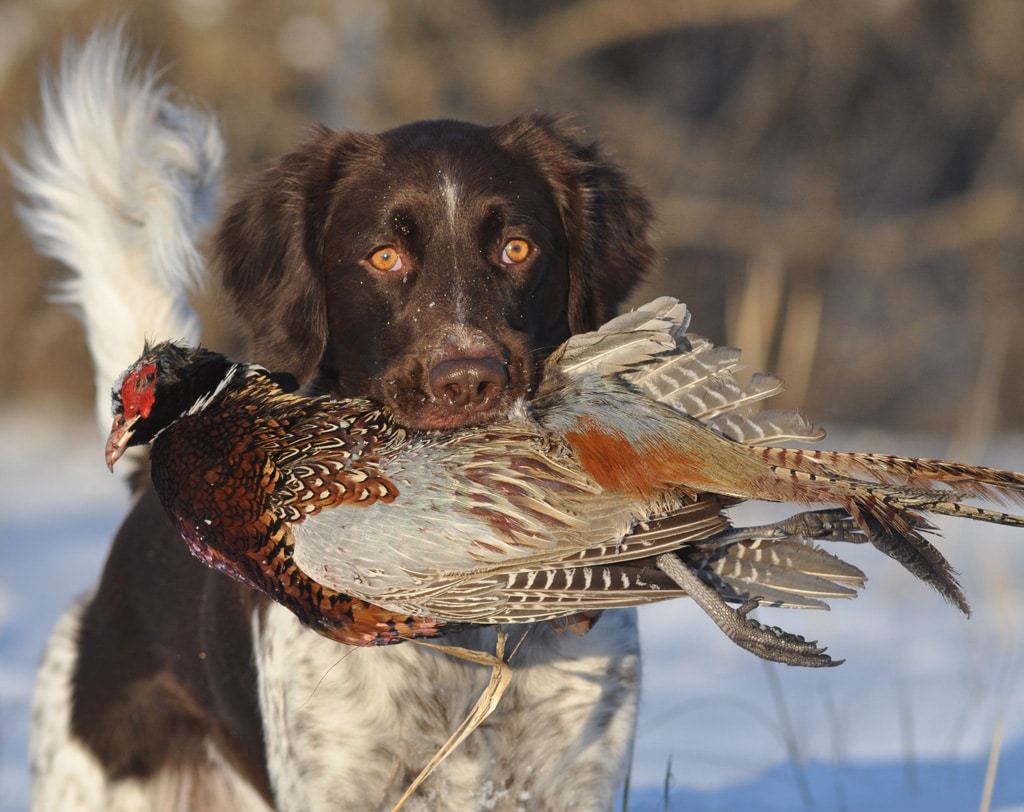
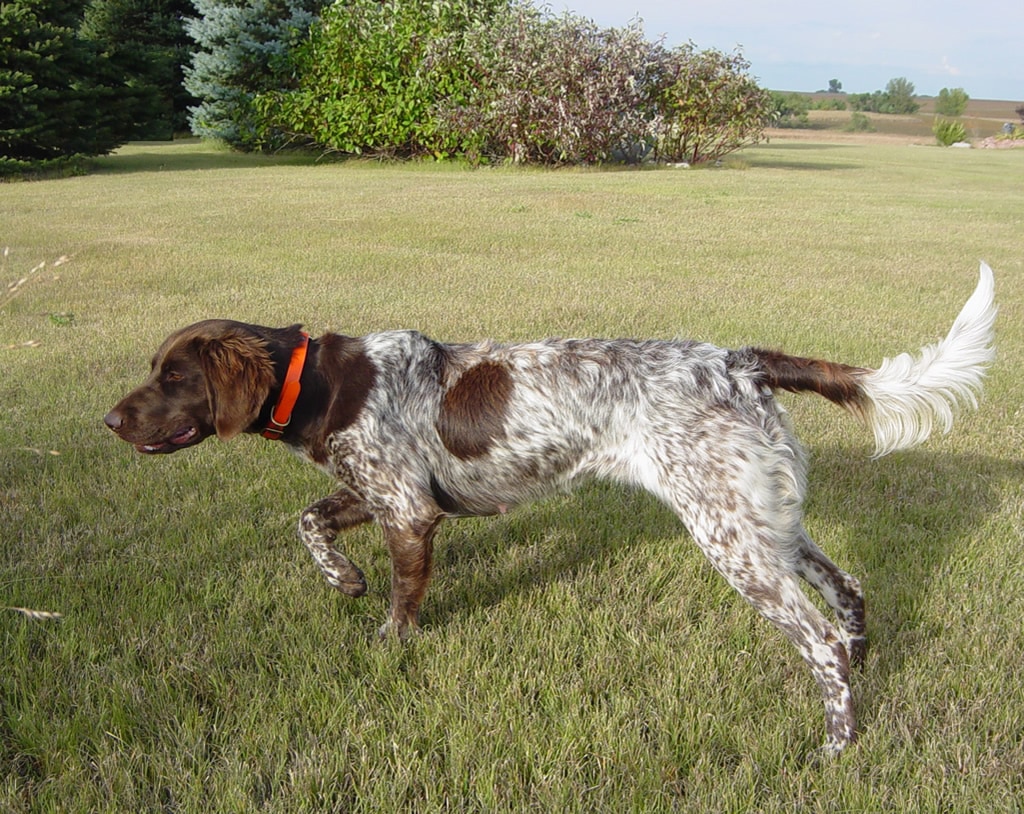
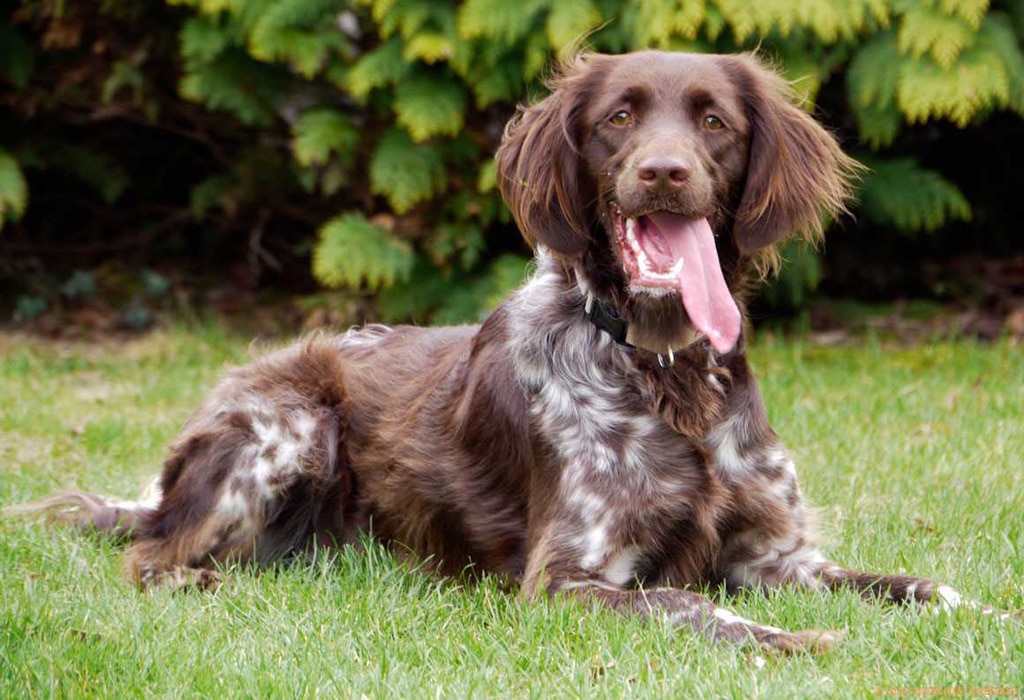
The Small Munsterlander, is an elegant dog, your body has a structure medium-sized, strong and harmonious, balanced proportions. Elegant head. With an upright posture, shows the flowing lines of its body and tail with a flat carriage.

Its hair bright should be smooth to slightly ondeado, not too long and bushy.

Video of the โ€œLittle Mรผnsterlรคnderโ€
Small Munsterlander finds to stick

The length of the body measured from the tip of the breastbone to the ischium must be greater than the height at the cross as maximum 5 cm..

The skin is very adherent, without forming folds. The fur is thick, long Middle, smooth to something ondeado, well glued and waterproof. Its silhouette outline should not be hidden under a too long hair.

The hair thick should be the best possible protection against the inclement weather, influences of the ground and to avoid injuries. Is a short, smooth fur.

The fur It should be Brown and white and Brown Roan with Brown plates – the mantle – mottled, allow a whitelist in the head, fire on the snout markings are tolerated, eyes and around the anus (Jungklaus brands).

The height will of 52 to 54 centimeters.

Character and skills

The Small Mรผnsterlรคnder is an intelligent dog, adept at learning, temperamental and balanced.

It is a very versatile dog, It adapts smoothly to any type of hunting, climate and terrain, It is a perfect breed both for the 'sample' and for the 'collection', It is risky and not afraid of anything or anyone.

As a companion dog it is stable, attentive and friendly people (the family), playful, lively and cheerful.

The Small Munsterlander learn very fast.

Often relate well with other dogs and always retain its passionate and persevering instinct towards the dam, his multiple conditions for hunting and his tempered nerves and sharpness.

Observations

It is the smallest of the Pointing Dogs germans.

Since Puppy He usually learns very quickly to relieve himself outside the house., because they have a tendency of innate to keep clean the place in which they live.

Education

The Small Munsterlander he is an intelligent and confident dog. They are easy to train and educate, and very rarely do they disappoint their teacher in their speed of learning. Teaching them tricks shouldn't be much more complicated than teaching them the rules of life..

Having said that, It is recommended to start learning early and start socializing the puppy as soon as possible, especially for an individual who will live in the city, to develop your confidence and ability to resist your stalking instincts.

If the dog is destined to hunt, must be trained for hunting through play and not through repetitive training. It is also important to teach him that he should not hunt anywhere and at any time.. Fortunately, memory learning, either by voice or gestures, works great with this breed.

In summary, the consistency, the kindness, intellectual stimulation and assiduity are necessary to make them the perfect family companion and channel their energy.

Health

The Small Munsterlander it is resistant and, due to its large gene pool, has no diseases of its own.

His only Achilles heel are his ears.: suffers from ear and ear infections a bit more often than most breeds.

Grooming

Take care of Small Munsterlander requires little effort: brushing your dog's coat every now and then is enough to keep his coat shiny during normal activity.

Brushing and checking the dog's ears should be systematic after going out into the woods or fields, to make sure there is no dirt trapped between the longest hairs. Drying them well after swimming also reduces the risk of repeated ear infections..

Buy a โ€œSmall Mรผnsterlรคnderโ€

Are needed between 500 and 800 euros to adopt a puppy from Small Munsterlander.

The price of a puppy of this breed differs depending on the sex: a female is more expensive than a male.

Characteristics "Small Munsterlander"

Coexistence is important that you have with your new friend. Before considering the acquisition of a dog of the breed "Small Munsterlander" you know certain factors. Not all breeds of dogs are apt to live in an apartment, you must take into account his character, their need for exercise, their interaction with other pets, their care and if you have small children, their level of tolerance towards them.

Adaptation โ“˜

4,0 of 5 stars (based on 1 review)

friendly dog โ€‹โ€‹โ“˜

4,0 of 5 stars (based on 1 review)

hair loss โ“˜

3,0 of 5 stars (based on 1 review)

Affection level โ“˜

5,0 of 5 stars (based on 1 review)

Need for exercise โ“˜

4,0 of 5 stars (based on 1 review)

Social need โ“˜

4,0 of 5 stars (based on 1 review)

Home โ“˜

3,0 of 5 stars (based on 1 review)

Toilet โ“˜

3,0 of 5 stars (based on 1 review)

Friendly with strangers โ“˜

3,0 of 5 stars (based on 1 review)

barking โ“˜

2,0 of 5 stars (based on 1 review)

Health โ“˜

4,0 of 5 stars (based on 1 review)

Territorial โ“˜

3,0 of 5 stars (based on 1 review)

Cat friendly โ“˜

2,0 of 5 stars (based on 1 review)

Intelligence โ“˜

5,0 of 5 stars (based on 1 review)

Versatility โ“˜

4,0 of 5 stars (based on 1 review)

Child friendly โ“˜

5,0 of 5 stars (based on 1 review)

Surveillance โ“˜

3,0 of 5 stars (based on 1 review)

joy โ“˜

4,0 of 5 stars (based on 1 review)

Images of the โ€œLittle Mรผnsterlรคnderโ€

Videos of the โ€œLittle Mรผnsterlรคnderโ€

Type and recognitions:

  • FCI CLASSIFICATION:
  • Group :
  • Section : . .

Federations:

  • FCI – Group 7: Pointing Dogs. – Section 1: Continental Pointing Dogs. 1.2: Spaniel type โ“˜
  • CKCMiscellaneous โ“˜
  • โ€‹KC – Hunting dog โ“˜
  • UKCGun Dog โ“˜

FCI breed standard "Small Munsterlander"

Origin:
Germany

Date of publication of the valid original standard:
09.11.2004

Use:

Dog used for multiple use hunting.


General appearance:

Aristocratic and elegant, your body has a structure of size medium, strong and harmonious, balanced proportions. Aristocratic head. With an upright posture, shows the flowing lines of its body and tail with a flat carriage. Forelimbs well covered with feathers, hindlimbs in pants with the tail showing a marked flag. Its shiny coat should be straight to slightly wavy, not too long and bushy. Their movements are harmonic, covering the surface well.

IMPORTANT PROPORTIONS:

  • The length of the body measured from the tip of the sternum to the ischium must be greater than the height at the cross as a maximum 5 cm..
  • The length of the skull from the occipital protuberance to the stop is equal to the length of the muzzle from the stop to the nose.


Behavior / temperament:

Little Mรผnsterlรคnder is an intelligent dog, adept at learning, temperamental and balanced. His character is stable; attentive and friendly people (suitable for the family). Good social relationship and ability to get along with the guide (team qualification). Passionate and persevering instinct towards the dam, multiple conditions for hunting as well as tempered nerves and sharpness.

Head:

His head and expression coin his typicality.

Cranial region:
  • Skull: Aristocratic, dry, flat to slightly domed.
  • Depression links (Stop): Slightly marked yet clearly recognizable

facial region:

  • Truffle: Unicolor, brown.
  • Snout: Strong, long, straight muzzle.
  • Lips: Short, well overlapped, well pigmented โ€“ unicolor โ€“ brown.
  • Jaws / Teeth: Large white teeth. Strong jaws with a regular, full scissor bite, in which the upper incisors close in front of the lower ones without losing contact and the teeth are placed vertically in the jaws. With 42 teeth according to the dental formula. More or less number of 2xP1 is allowed.
  • Cheeks: Strong and well muscled.

Eyes: Medium-sized, neither bulging nor sunken. Where possible dark brown. Eyelids close to the eyeball, covering the conjunctiva.

Ears: Wide, high insertion, well attached to the head; they become pointed at their lower edge and do not extend beyond the corner of the mouth.

Neck:

Its length should be in harmony with the general appearance, widening somewhat towards the trunk. Very muscular and slightly domed nape. Tight throat skin.

Body:

  • top line: Right, leaning slightly.
  • Cross: Marked.
  • Back: Strong, with good musculature. The spine should be covered with muscles. Pork loin: Short, wide and muscular.
  • Rump: Long and wide with a slight slant towards the tail and well muscled. Wide pelvis.
  • Breast : Deeper than wide with a sternum that reaches as far back as possible. Well arched ribs.
  • Bottom line and Belly: Elegant, develops with a slight arch back. Dry

Tail:

Set high with a long flag. Its insertion is strong, then refining. Medium long. Idle down, in movement its bearing is horizontal and oscillating, not too much above the top line. Its last third can bend slightly upwards.

Tips

PREVIOUS MEMBERS:

  • As a whole: Seen straight ahead and parallel if possible. Seen in profile limbs positioned well below the body. The distance from the floor to the elbow should be the same as from the elbow to the withers.
  • Shoulder: Well-adjusted scapulae, strong muscles. The scapula and forearm form a correct angle of approximately 90ยฐ.
  • Arm: As long as possible and well muscled.
  • Elbow: Attached to the body without turning in or out. Arm and forearm form a correct angle. Forearm: Strong bones placed vertically.
  • Articulation of the carpus: Strong.
  • Metacarpus: Barely directed forward.
  • Previous foot: Round and arched with tight toes and thick pads, rough and resistant without lush hair. Parallel feet both while standing and during movement without turning neither in nor out.

LATER MEMBERS:

  • As a whole: Viewed from the back, straight and parallel. Correct knee and joint angulations. Strong bones.
  • Thigh: Long, wide and muscular. Pelvis and thigh are at the correct angle.
  • Leg: Long, muscular and tendon.
  • Tarsal joint: Strong.
  • Metatarsus: Short, vertical placement.
  • Rear foot: Round and arched with tight toes and thick pads, rough and resistant without lush hair. Parallel feet both while standing and during movement without turning neither in nor out.

Movement:

Covers the surface with a lot of push and corresponding reach. Front and rear straight and parallel members while maintaining a proud attitude. An ambling step is not desired.

Mantle

SKIN: Very adherent, without forming folds.

Fur: Bushy, long Middle, smooth to something ondeado, well glued and waterproof. Its silhouette outline should not be hidden under a too long hair. Bushy hair should provide the best possible protection against inclement weather, influences of the ground and to avoid injuries. Is a short, smooth fur. Feathered forelimbs, hindlimbs up to the heel joint with pants. The tail has a long flag and its tip is white. Heavy chest hair is undesirable.

Color: White and brown roan with brown plates โ€“ coat โ€“ mottled, allow a whitelist in the head, fire on the snout markings are tolerated, eyes and around the anus (Jungklaus brands).


Size and weight:

Height to the cross:

  • Males: 54 cm..
  • females: 52 cm..

A variation in size is allowed by more or less than 2 cm.. (Tolerance in measurements).


Fouls:

Any deviation from the above points must be considered a fault and the severity with which the fault must be considered must be exactly proportional to its degree and its effects on the health and well-being of the dog..

SERIOUS FAULTS:

โ€ข Clumsy and large-boned conformation.
โ€ข Serious deviations from correct body proportions, neck and height and withers.
โ€ข More than 50 % flesh-colored or blotchy nose.
โ€ข Pointed snout. Domed muzzle.
โ€ข Eyes too light.
โ€ข Croup too short.
โ€ข Severe lack of chest depth or too flat chest. Barrel chest.
โ€ข Elbows turned very outward or inward.
โ€ข Pronounced pasterns.
โ€ข Cow hock or barrel leg, both in posture and movement. movement.
โ€ข Toes spread apart; flat feet.
โ€ข Clumsy movement.
โ€ข Smooth ears without hair or too long and curly fringes on the ears.
โ€ข Too curly coat.
โ€ข Deviation of size limits between +/โ€ข2cm and +/โ€ข 4cm.

FALTAS DESCALIFICANTES

โ€ข Aggressive or overly shy dogs.
โ€ข Any dog โ€‹โ€‹that clearly shows physical or behavioral abnormalities.
โ€ข Fearfulness, aggressiveness, shyness in hunting or shooting.
โ€ข Gross deviations. Gender type, sexual malformations.
โ€ข Completely depigmented nose.
โ€ข All deviations from the correct scissor bite, except the lack or excess of two P1.
โ€ข Broken jaw or split lip.
โ€ข Bird's eye.
โ€ข Ectropion, entropion, distiquiasis, (double lash line).
โ€ข Pronounced double chin.
โ€ข Marked cockroach back,
โ€ข Pronounced sway back; crooked spine.
โ€ข Malformation of the rib cage, for example, cut sternum.
โ€ข Twisted glue, ring tail, other tail abnormalities, for example, tail too short or too long.
โ€ข Solid colored dogs.
โ€ข Deviation in height of more than +/โ€ข4 cm.


N.B.:
  • Males should have two apparently normal testicles completely descended into the scrotum..
  • Only functionally and clinically healthy dogs, with a typical conformation of the breed typical conformation of the breed should be used for breeding.

Source: F.C.I - International Cynological Federation

Alternative names:

1. Munsterlander (Small), Kleiner Mรผnsterlรคnder, Vorstehhund, Spion, Heidewachtel (English).
2. Petit mรผnsterlรคnder (French).
3. Vorstehhund, Spion, Heidewachtel (German).
4. (em alemรฃo: Kleiner mรผnsterlรคnder) (Portuguese).
5. Pequeรฑo Mรผnsterlรคnder (espaรฑol).

โ–ท The world of Pets: Dogs, cats, birds, reptiles, amphibians

Small Blue Gascony
Francia FCI 31 - Medium-sized Hounds

Small Blue Gascony

The Small Blue Gascony, in general, they are considered docile and very attached to their master, very friendly with children and sociable with other dogs.

Content

History

The Small Blue Gascony is a short legged version of the Great Gascony Blue, his ancestor. But, although the history of the latter extends deep into the history of all of Europe and even the United States, its history has remained closely linked to its country of origin, France.

Its appearance dates back to the end of the Middle Ages, and more precisely to the sixteenth century. The development of the breed is not the result of crossing the Great Gascony Blue with smaller dogs, but simply from a true selective breeding program that consists of selecting and breeding the smallest individuals, generation after generation. Although they were very efficient in hunting wild boar and large game in packs, the Great Blue was nevertheless a heavy hound, and was not entirely satisfactory in tracking small game in the high forests.

The Small Blue Gascony was therefore developed for the specific purpose of hunting rabbits, hares and other small game animals. Faster than its predecessor, inherited its tracking and exploration skills from its predecessor. Its use spread in France beyond its region of origin, Gascuรฑa (in the southwest of the country). Unlike many dog โ€‹โ€‹breeds that were decimated during these periods, did not suffer much with the French Revolution and the two World Wars. Thanks to his skill in hunting rabbits, has been able to get through these clashes in French history without too many losses, and remain present in relatively constant numbers despite events.

But, despite this resistance and its renowned performance in hunting small game, very little was exported, unlike his older brother, that set foot in the United States as early as the 18th century. This is mainly due to the fact that Small Blue, raised in herds, it was much less profitable to hunt than the Great Blue, that it was able to attack larger prey and thus provide more food. But, in France, despite this disadvantage, became progressively more popular than with hunters and families.

However, gained visibility on the international scene in 1963, cuando the International Cynological Federation (FCI) officially recognized the breed. El American United Kennel Club (UKC) did the same in 1991. But, he still has a long way to go in this respect, as they have not been emulated by many other major organizations. These may include, so far, nor the other great American organization, the American Kennel Club (AKC), nor his neighbor the Canadian Kennel Club (CCC), nor the prestigious British Kennel Club, they have taken the step.

In fact, the Small Blue Gascony is still today mainly present in its country of origin. It has even become more and more popular there in recent decades.. This was particularly surprising in the 1990s. 1980, when it happened 50 annual entries in the Livre des Origines Franรงais (LOF) in the early years of the decade to more than 200 at the end, that is to say, quadrupled. The trend increased in the early 1990s 1990, and the number stabilized at around 450 per year from 1993. There is a new rise at the dawn of the 21st century, when the 550 registrations per year. From 2006 there is a steep decline, so that by the end of 2010 there are only a few 350 births per year. But, this is still more than four times the number that its predecessor, the Great Gascony Blue, can boast.

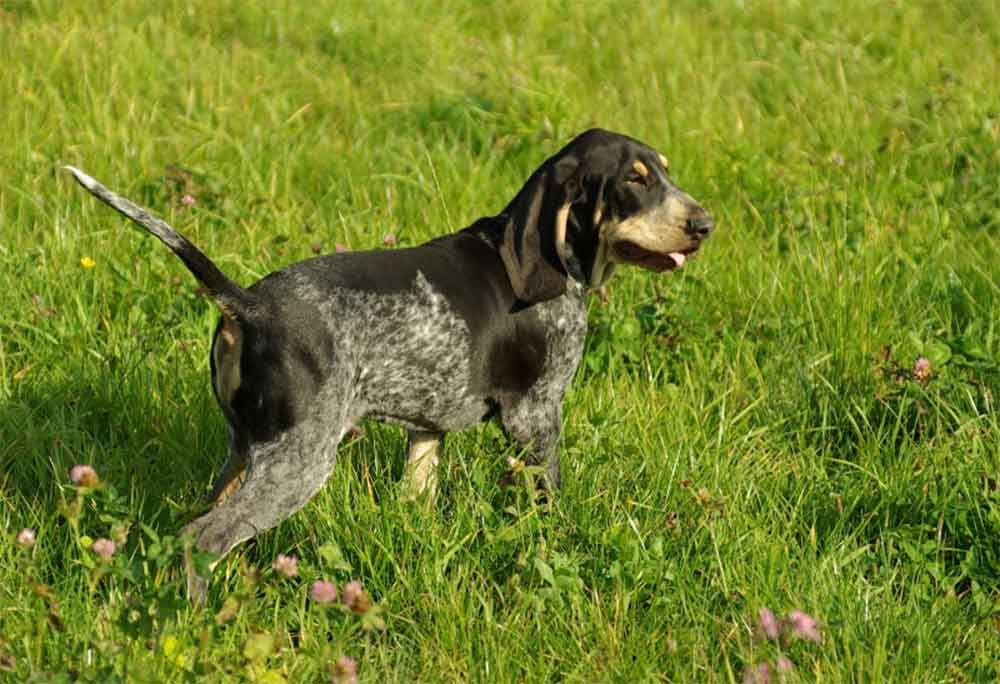
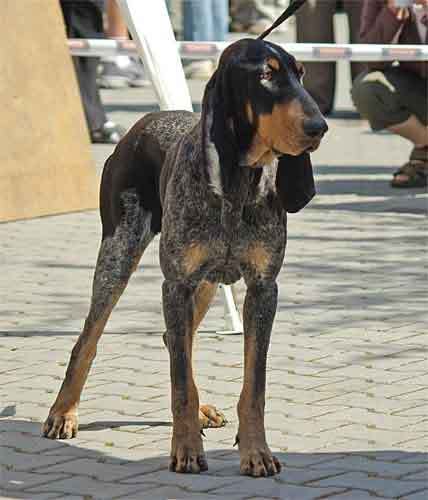
Photo: Small Blue Gascony Hound, male ยซBrigand od Smutne rickyยป from kennel ยซLe Bleu Cardinalis FCIยป, Poland. The owner – Katarzyna Bujko by Katarzyna Bujko, CC BY 3.0, via Wikimedia Commons

Physical characteristics ยซLittle blue Gascogne houndยป

The Small Blue Gascony has an appearance very close to that of his ancestor, the Great Gascony Blue, and even its size is not so far from the latter, whatever his name is. In fact, with a height of 50 to 58 cm to the cross, is actually a medium-sized dog. The term "small" is more appropriate to describe the size of the game it was designed for..

The Small Blue Gascony has a noble and proud appearance and a rather gentle general expression. His body is well supported by his back, no excess length, with a slightly sloping croup and a long, open chest that falls to elbow height. Its front legs are powerful and its shoulders are muscular. In general, has a balanced musculature and bone structure, without excess. Its tail is thin and carried like a saber blade.

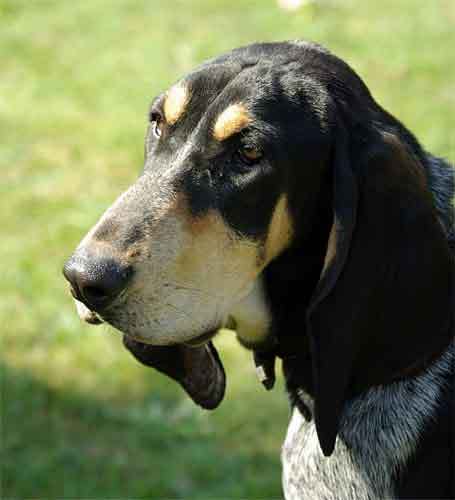
Head is slightly domed when viewed from the front, and the forehead is full. The stop (distance between the two eyes) it is little accentuated. The eyes are brown. The nose is very black and wide, and the nostrils are wide open. The whisker pads are not very thick and quite long: the upper lip falls back covering the lower lip. The snout (upper part of muzzle) is the same length as the skull; is strong and slightly arched, which contributes to giving it a noble look. The ears are moderately thin, dangling and curly. Very long, can reach the end of your nose, or even lower.

The skin of the Small Blue Gascony it is flexible, black or very mottled with black spots, and in any case never completely white. Their mucous membranes are also black. Its pelage is short, semi-thick and well furnished. Its fur is completely mottled, black and white, with a slate bluish glow, hence its name.

It also, may have more or less numerous and more or less large blackheads. These may include, at head level, usually has two black dots that are not on the top of the skull but that surround its eyes and cover its ears. At the top of the skull there is a white spot with a small oval black dot, typical of the breed. The upper part of the eyebrows are marked with more or less bright tan spots. Traces of tan are also found on the cheeks, the chops, inside the ears and sometimes on the legs and under the tail.

Last, sexual dimorphism is not very pronounced in this breed: males and females are generally very similar in size and dimensions.

Character and aptitudes ยซLittle blue Gascogne houndยป

The Small Blue Gascony he is a dog with a pleasant character, calm and affectionate. He is a very good companion dog., but it requires a lot of physical exercise and wide open spaces. Your ideal space is a house with land. It is necessary to take them out for a daily walk outside of hunting season. Dogs are generally very attached to their master. They are also kind to children and sociable with other animals. (dogs, cats…).

It is a hunting dog that runs well, very diligent in his hunting style, ideal for running after hare. It also shows good qualities for hunting big game, for example wild boar hunting. Finally, the Small Blue Gascony has a magnificent voice and a fine sense of smell.

Hygiene and health of the โ€œLittle Blue Gascogne Houndโ€

Grooming

The Small Blue Gascony often lives outdoors and requires only rudimentary grooming. If you live in the house, weekly brushing is recommended. It can also be useful to bathe him when he returns from hunting…

Care

When you come back from hunting or walking, inspect his feet and ears Small Blue Gascony looking for thorns (herbs that get into the skin causing pain and infections). Your floppy ears may be prone to ear infections. It is advised to examine and wash them once a week.

Health

The Small Blue Gascony he is a robust dog. You may suffer from otitis. Itching or a bad smell should alert you. The Small Blue Gascony you can also be injured while hunting. A fracture immediately leads to a loss of pressure in the affected limb. Skin tears may be more inconspicuous in the coat. Inspect his wound carefully when you return from the hunt..

Food

The dog's diet will depend on both its breed and weight and its lifestyle. The one with Small Blue Gascony must consider, among other things, your activity.

How much does a โ€œLittle Blue Gascogne Houndโ€ cost?

The price of a puppy Small Blue Gascony often haunt them 650 EUR, but it can reach the 1000 euros for the best subjects.

As in any other race, the price charged depends on the prestige of the kennel, of the lineage from which the dog descends and its intrinsic characteristics and, in particular, of its conformity with the standard. This explains why there may be price differences between puppies from the same litter.

In any case, the Small Blue Gascony hard to find outside France, and this is particularly true in North America, despite its recognition by the American UKC. In the case of an import from France, transportation and administrative costs are added to the purchase price. It also, it is necessary, of course, respect the regulations regarding the importation of a dog from abroad.

Images "Small Blue Gascony"

Photos:

1 – Little Gascony Blue Hound by Katarzyna Bujko, CC BY 3.0, via Wikimedia Commons
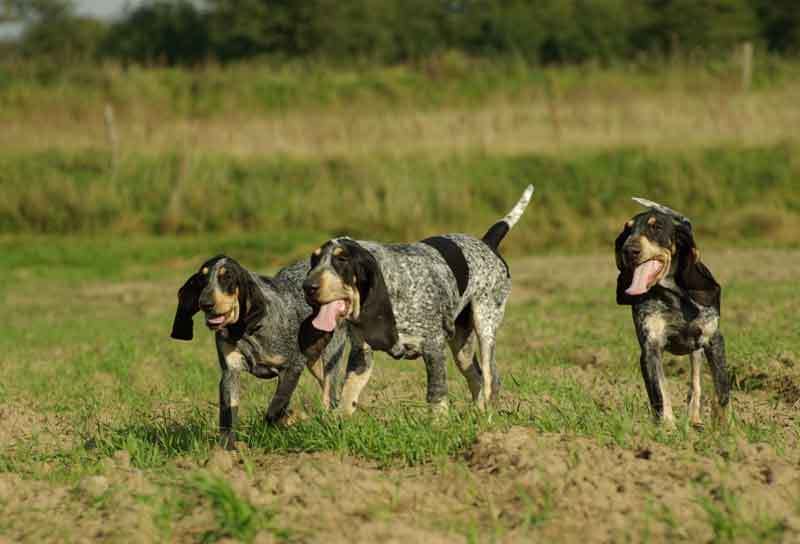
2 – Small Blue Gascony Hound, ยซBella, Baron i Brigand od Smutne rickyยป from kennel ยซLe Bleu Cardinalis FCIยป, Poland. The owner – Katarzyna Bujko by Katarzyna Bujko, CC BY 3.0, via Wikimedia Commons
3 – Small Blue Gascony Hound, female ยซClea z Beckovaยป from kennel ยซLe Bleu Cardinalis FCIยป, Poland. The owner – Katarzyna Bujko by Katarzyna Bujko, CC BY 3.0, via Wikimedia Commons
4 – Small Blue Gascony Hound, female ยซClea z Beckovaยป from husbandry ยซLe Bleu Cardinalis FCIยป, Poland. The owner – Katarzyna Bujko by Katarzyna Bujko, CC BY 3.0, via Wikimedia Commons
5 – Small Blue Gascony Hound, female ยซClea z Beckovaยป from kennel ยซLe Bleu Cardinalis FCIยป, Poland. The owner – Katarzyna Bujko by Katarzyna Bujko, CC BY 3.0, via Wikimedia Commons
6 – Small Blue Gascony Hound, male ยซCar z Beckovaยป from kennel ยซOd Smutnรฉ ล™รญฤkyยป, Czech. The owner – Slavomรญr Hanรกฤek by Katarzyna Bujko, CC BY 3.0, via Wikimedia Commons

Videos "Small Blue Gascony"

RAMBO - Small blue gascony - Unconditional love

RAMBO – โ€œLittle Blue Gasconyโ€ – Unconditional love
hare with blue gascogne cubs

hare with โ€œPetit Bleu de Gascogneโ€

Type and recognitions:

  • FCI CLASSIFICATION:
  • Group :
  • Section : . .

Federations:

  • FCI – Group 6: Scent hounds, and related breeds. – Section 1.2: Medium-sized Hounds. โ“˜
  • UKCScenthounds โ“˜
  • Central Canine Society โ“˜

FCI breed standard "Small Blue Gascony"

Origin:
France

Date of publication of the valid original standard:
24.01.1996

Use:

This is a multi-use dog. It is used for hunting with a shotgun., and sometimes to chase the game like a hound. His favorite house is the smallest (Hare) but he also goes on the hunt for big game.


General appearance:

It is a medium-sized dog, well proportioned and distinguished.


Behavior / temperament:

He has a good sense of smell and is good at hunting.. It has a loud bark and easily joins the pack.. He is calm and affectionate and obeys easily.

Head:

---

Cranial region:
  • Skull : Seen from the front, It is somewhat domed and not too wide. The occipital protuberance is slightly marked. Seen from above, the back has a shallow ogival shape. Forehead is bulging.
  • Depression links (Stop) : Sharp.

facial region:

  • Truffle : Black and wide. The Windows are wide open.
  • Snout : It is the same length as the skull and is strong. The nasal cannula is often slightly arched..
  • Lips : They are not very thick or developed. The upper lip covers the lower lip.
  • Jaws/Teeth : The joint is in the form of scissors. The incisors are set at right angles to the jaws..
  • Cheeks : Thin.

Eyes : They are oval in shape and brown in color.. Your expression is sweet.

Ears : They are crooked and moderately thin. They should at least reach the tip of the nose..

Neck:

It is long and has some double chin.

Body:

  • Back : Well accented.
  • Pork loin : Well united, and not too long.
  • Rump : Slightly oblique.
  • Breast : It is long and descends to the level of the elbow. The sternum is quite protruding. Delicately rounded ribs.
  • Flank : It's flat and deep.

Tail:

It is thin and reaches to the tip of the hock. It is carried proudly in the shape of a saber.

Tips

PREVIOUS MEMBERS : Seen in conjunction, They are quite robust.

  • Shoulder : Muscular and moderately oblique.
  • Elbows : Glued to the body.
  • forearms : Strong bones.

LATER MEMBERS : Seen as a whole they are well proportioned.

  • Thighs : Quite long, muscular, although not in excess.
  • Hock : Width, slightly angled and close to the ground.

FEET : They have an oval shape; the fingers are thin and close together. The pads and nails are black.

Movement:

Regular and executed with ease.

Mantle

SKIN : Elastic. Black, or strongly streaked with black spots. It's never completely white. The mucous membranes are black.

HAIR : Short, semi-thick and well dense.

COLOR : Completely speckled with black and white, imparting a slate blue reflection. It may or may not be marked with more or less extended black spots. Usually, there are two black spots on each side of the head, that cover the ears, circle the eyes and stop at the cheeks. These do not join over the top of the head, but they leave a white space in the center of which there is often a small oval black spot., typical of the breed. Above the eyes there are two more or less bright tan marks located on the zygomatic arches simulating four eyes.. Traces of tan can also be found on the cheeks, the lips, the inside of the ears, the limbs and under the tail.


Size and weight:

Height to the cross :

  • For males : 52 to 58 cm.,
  • for females : 50 to 56 cm..


Fouls:

Any deviation from the above mentioned criteria is considered as missing and the gravity of this is considered in proportion to the degree of deviation to the standard and its consequences on the health and well-being of the dog.

Head :

โ€ข Short.
โ€ข Skull too flat, Strait, or width.
โ€ข Short ears, high insertion, that are not twisted enough.

Body :

โ€ข Too long, loose top line, lack of volume.
โ€ข Croup sagging.
โ€ข Diverted tail.

Tips :

โ€ข Insufficiently developed bones.
โ€ข Straight shoulders.
โ€ข Hock closed, seen from behind.
โ€ข Crushed feet.

Behavior :

โ€ข Shy dog.

MISS PLAYOFFS :

โ€ข Fearful or aggressive dog.
โ€ข Characteristics that do not correspond to the type.
โ€ข Notable lack that causes any impediment.
โ€ข Serious anatomical deformation.
โ€ข Upper or lower prognathism.
โ€ข Light eyes.
โ€ข Any other coat that is not established by the standard.

Any dog โ€‹โ€‹showing clear signs of physical or behavioral abnormalities must be disqualified..


N.B.:

Males should have two normal-appearing testicles fully descended into the scrotum..

Source: F.C.I - International Cynological Federation

Alternative names:

1. Petit bleu de Gascogne (English).
2. Petit bleu de Gascogne (French).
3. Petit bleu de Gascogne (German).
4. Petit bleu de Gascogne (Portuguese).
5. Petit bleu de Gascogne, Sabueso azul de Gascuรฑa (espaรฑol).

โ–ท The world of Pets: Dogs, cats, birds, reptiles, amphibians

Small swiss hound
Suiza FCI 60 . Small-sized Hounds

Small Bernese hound
Small Bernese hound
The dog Small swiss hound, little stimulated, tends to become a nuisance pet that can be difficult to train.

Content

History

In the early 20th century, hunting began to change in Switzerland. Private hunting grounds were introduced and the standard size of the Swiss Hound he was too fast and enthusiastic to hunt properly within these smaller hunting grounds. The hunters decided to develop a different breed of hunting that could hunt efficiently and effectively within the closed private hunting grounds.. Many people think that Small swiss hound it's just a smaller version of the Swiss Hound. While this is partly true, They are a different race that originated from crossing the Swiss Hound with the Basset Hound. The ultimate goal was to develop a breed that was shorter and smaller., but also had the same four color variants as the Swiss Hound. The resulting dogs were expected to have a strong sense of smell for nose work and a melodious voice to sound the alarm when hunting..

The Small swiss hound He is an outstanding hunter and has the ability to track scents for miles over rough terrain. The Small swiss hound became the hunting dog of people hunting on private land.

The United Kennel Club recognized the Small swiss hound in 2006. The Federation Cynologique Internationale (FCI) accepted them and adopted the official breed standard under the name Schweizer Niederlaufhund in 2015.

The Small swiss hound still a popular hunting companion in his native Switzerland.

Photo: Small Bernese Hound Smooth-coated male by Canarian, CC BY-SA 4.0, via Wikimedia Commons

Physical characteristics

In proportion smaller than the Swiss Hound. Its body shape is rectangular, moderately long, and strong conformation. Medium size head, thin, elegant, with friendly facial expression
and attentive. His ears are very long, low insertion, and he wears them folded. Thin and strong limbs. When walking calmly, he has his tail hanging, in activity bends it slightly upwards.

The Small swiss hound comes in four different varieties. The only difference between the varieties is the color, but each variety has its own name.

Variants Small swiss hound

Small hound of Juraequeรฑo de Jura
Small Jura hound
Small Bernese hound
Small Bernese hound
Small Schwyz hound
Small Schwyz hound
Small Lucerne hound
Small Lucerne hound
  • The Small Jura hound has a smooth coat that is black with tan markings found over the eyes.
    The Small Jura hound has only one coat and may only have a small amount of white on its body.
  • The Small Bernese hound has two types of fur:
    the smooth coat and the rough coat.
    The rough coat has a single hard coat and a small beard.
    The Small Bernese hound it's black and white with fiery marks over its eyes; many call it tricolor.
  • The Small Schwyz hound has a single, smooth coat that is predominantly white with yellow-red spots; orange-red spots are also acceptable.
  • The Small Lucerne hound has a single smooth coat that is predominantly white but mottled with black or gray giving the illusion of a blue body. They have black spots with tan markings over their eyes.

  • Photos:

    1 – Small Bernese Hound Smooth-coated male by Canarian, CC BY-SA 4.0, via Wikimedia Commons
    2 – Jura low-run dog by Bhv The Max
    3 – This dog is a small Schwyz Hound by pets.ch
    4 – Little Lucerne Hound by carlosh catalog

    Character and skills

    When he's hunting, the Small swiss hound is tireless and relentless, exhibiting impressive endurance and strength of character. They tend to be lively and excitable, eager to do their job. Most of the Small swiss hound they are happy to hunt regardless, without any royal order from his master.

    Despite being bred to hunt, most breed members can make the transition from working bloodhound to family pet easily and are generally affectionate and demonstrative with their owners. They are good friends with children and other dogs, but they cannot be trusted with small animals, including cats and rabbits.

    The temperaments of individuals vary, and while some may be quiet and peaceful house guests, others may be excitable and jumpy. Dogs with more energy can often be taught to settle inside the house once they have been properly exercised.. Ideally, the exercise should take the form of hunting, as this not only burns off excess energy but also occupies your inquisitive mind. The dog Small swiss hound, little stimulated, tends to become a nuisance pet that can be difficult to train.

    Not being an aggressive dog, the Small swiss hound should not be used as a guard dog as it does not tend to scare off intruders and does not usually feel the need to guard your property.

    โ€œSmall Swiss Houndโ€ Training

    The phrase "small dog syndrome" may be mentioned when talking about Small swiss hound, as they have a reputation for acting like large dogs in small dog bodies. Full of confidence, lively and independent, this is not a breed for the novice trainer. Obedience work can be a particular challenge, since they have a free-spirited character and a mind of their own.

    Coaches must be firm and inflexible, keeping your training sessions short and interesting to keep the dog's interest. How this breed likes to assume a dominant position in the home, he should be taught his place from an early age, to avoid any bad behavior.

    most dogs Small swiss hound they are still used as hunting dogs in Switzerland today, meaning your exercise requirements are easily met during hunting season. In the case of non-working dogs, or when the hunting season is over, owners should take time to meet the needs of this active hound.

    A rural setting is the ideal place for Small swiss hound, who needs wide terrain to explore and does not enjoy being confined. It is essential that your property is securely fenced to avoid solo adventures.

    Health ยซSmall Swiss Houndยป

    There are not many diseases that affect the Small swiss hound more than other races, but there are a handful of conditions that should be watched in individuals:

    ear infections

    Hanging ears are prone to developing ear infections., particularly if a dog spends a lot of time outside wet and muddy. Keeping your ears clean can prevent this from becoming a problem..

    Hip Dysplasia

    Malformed hip joints can lead to lifelong discomfort and reduced mobility. x-rays of the hips (a process called โ€œhip scoringโ€) should be performed when a breeding dog is over one year of age to ensure that its hips are of a good enough quality to be passed down.

    Grooming ยซSmall Swiss Houndยป

    Although there are a number of different coat types within the breed, all are easy to maintain and need little in the way of grooming. Weekly brushing will suffice. The Small swiss hound you will only need to be bathed a few times a year. If owners feel the need to disguise their "dog smell" they can use dry shampoo, avoiding the risk of drying out their skin and coat.

    Ears of the Small swiss hound should be cleaned weekly and ideally checked daily for signs of infection. They must be completely dried after getting wet.

    Characteristics "Small swiss hound"

    Coexistence is important that you have with your new friend. Before considering the acquisition of a dog of the breed "Small swiss hound" you know certain factors. Not all breeds of dogs are apt to live in an apartment, you must take into account his character, their need for exercise, their interaction with other pets, their care and if you have small children, their level of tolerance towards them.

    Adaptation โ“˜

    3,0 of 5 stars (based on 1 review)

    friendly dog โ€‹โ€‹โ“˜

    4,0 of 5 stars (based on 1 review)

    hair loss โ“˜

    4,0 of 5 stars (based on 1 review)

    Affection level โ“˜

    5,0 of 5 stars (based on 1 review)

    Need for exercise โ“˜

    3,0 of 5 stars (based on 1 review)

    Social need โ“˜

    3,0 of 5 stars (based on 1 review)

    Home โ“˜

    3,0 of 5 stars (based on 1 review)

    Toilet โ“˜

    2,0 of 5 stars (based on 1 review)

    Friendly with strangers โ“˜

    4,0 of 5 stars (based on 1 review)

    barking โ“˜

    4,0 of 5 stars (based on 1 review)

    Health โ“˜

    5,0 of 5 stars (based on 1 review)

    Territorial โ“˜

    4,0 of 5 stars (based on 1 review)

    Cat friendly โ“˜

    2,0 of 5 stars (based on 1 review)

    Intelligence โ“˜

    3,0 of 5 stars (based on 1 review)

    Versatility โ“˜

    3,0 of 5 stars (based on 1 review)

    Child friendly โ“˜

    5,0 of 5 stars (based on 1 review)

    Surveillance โ“˜

    4,0 of 5 stars (based on 1 review)

    joy โ“˜

    3,0 of 5 stars (based on 1 review)

    Videos "Small swiss hound"

    Swiss low-legged dog + Schweizer Laufhund + Orange hound + pets
    Swiss low-legged dog + Schweizer Laufhund + Orange hound
    Swiss Hound CERVA
    Schweizer Laufhund CERVA

    Type and recognitions:

    • FCI CLASSIFICATION:
    • Group :
    • Section : . .

    Federations:

    • FCI – Group 6: Scent hounds, and related breeds. – Section 1.3: Small-sized Hounds. โ“˜
    • UKCScenthounds โ“˜

    FCI breed standard "Small swiss hound"

    Origin:
    Switzerland

    Date of publication of the valid original standard:
    28.11.2001

    Use:

    It is a hunting dog in the strict sense of the word.. He is an independent hunter by hunting with a bark ; searches and corners its prey with great safety even in difficult terrain. The Small Swiss Hound is also used to bleed the injured animal.


    General appearance:

    Hound type dog (Hound), in proportion smaller than the Swiss Hound with a height of the withers of 35-43 cm for males and 33-40 cm for females; its body shape is rectangular, moderately long, and strong conformation. Medium size head, thin, elegant, with friendly and attentive facial expression. His ears are very long, low insertion, and he wears them folded. Moderately wide and high chest and costal arch that provide plenty of space for the heart and lungs. Thin and strong limbs. When walking calmly, he has his tail hanging, in activity bends it slightly upwards.

    Color varieties :

    โ€ข Small Bern Hound,
    โ€ข Small Jura Hound,
    โ€ข Small Lucerne Hound and
    โ€ข Small Schwyz Hound.


    Behavior / temperament:

    Of fine smell, It is agile and resistant ; small hunting dog, passionate, that keeps the trail safe and hunts with persistent harmonious bark. He is kind in nature, neither fearful nor aggressive. His temperament is calm, but lively.

    Head:

    Thin, elegant. Seen from the front it is long and narrow and slowly widens towards the cheeks..

    Cranial region:
    • Skull : Slightly convex, no wrinkles on the front, without front groove. Not very prominent occipital crest. The line that goes from the occipital crest to the stop is almost the same length and forms a parallel line with the line that goes from the stop to the nose..
    • Depression links (Stop) : Moderately marked.

    facial region:

    • Truffle : It is dark with wide open windows.
    • Snout : Powerful, quite long and moderately deep, nape pointed. The nasal canal preferably straight or slightly convex, rather narrow.
    • Lips : Upper lips slightly hanging and with rounded edges in the anterior part, never pointed. Closed lip corner.
    • Jaws / Teeth : Very strong scissor bite, regular and complete, That is, the upper incisors overlap the lower ones without leaving space between them.. The teeth are implanted in an upright position in the powerful jaw. Pincer bite is allowed. The lack of two PM1 or PM2 is tolerated (premolars 1 or 2 ). The flap of M3 (molars 3) is not taken into account.
    • Cheeks : Poorly developed.

    Eyes : dark, clean, slightly oval in shape; friendly expression. They should not be sunken or protruding. The eyelid slit is rigid with well adherent eyelids. Edges of the eyelids with good pigmentation.

    Ears : Low insert, narrow and a little backwards, no higher than the eye line. In length they reach at least to the tip of the nose. ; He wears them well folded and they hang close to his cheeks ; Their texture is soft and they are covered with fine hair.. The pinna does not protrude.

    Neck:

    Moderately long, light and elegant, but with good muscles. Throat skin is loose, but a noticeable double chin is not desired.

    Body:

    • top line : Harmonica, descends slightly from the insertion of the neck to the rump.
    • Back : Straight, firm, moderately long.
    • Pork loin : Wide and strong, flexible.Grupa : Gently descend towards the insertion of the tail; hips should not be visible.
    • Breast : Width and height, reaching up to elbow height; the tip of the sternum is visible, but not too prominent. The ribs are long and moderately rounded. The costal arch extends well posteriorly.
    • Bottom line and belly : The belly line is slightly raised towards the hind limbs. The flanks are moderately full.

    Tail:

    Low insertion in harmonious continuation with the croup ; medium length, reaching at least to the hock ; with enough hair ; ends in an elegant point, no true feathers. At rest and when walking it hangs without noticeable flexion. When active or excited, he carries it slightly raised., but never turned on the back.

    Tips

    PREVIOUS MEMBERS

    • As a whole : His muscles are strong, but it doesn't give the impression of being heavy. Seen from the front the forelimbs are thin, very straight and upright with good bones and solid feet, directed forward.
    • Shoulder : His muscles are strong ; the shoulder blades are flat and close together, relatively long and placed obliquely ; the angle of the shoulder joint is approximately 90ยฐ.
    • Arm : Almost as long as the shoulder blades, placed in an oblique position.
    • Elbows : Stuck naturally against the side.
    • Forearm : Strong, delgado, very straight, a little shorter than arms.
    • Ulnocarpal joint : Strong.
    • Metacarpus : Short ; seen from the front, its position is vertical, never deviated ; seen from the side it should never be completely straight, but slightly inclined in relation to the ground.
    • Front feet : Rounded, firm, compact. Short fingers, well arched. Hard and rough pads. solid nails. Fine fur between the fingers.

    LATER MEMBERS :

    • As a whole : They have strong muscles, well proportioned compared to previous members. Good angulations at the knee and hock joints (tibio-tarsiana). Parallel hindlimbs, neither too close nor too far apart. In a natural position they should be placed slightly backwards. Bones a little less strong than those of the forelimbs.
    • Thigh : Good length and width, strong and well muscled.
    • Knee : good angulation ; turned neither in nor out.
    • Leg : Proportionately long, with inclined position. The bones are a little less strong than those of the forelimbs.
    • Warm-foot joint : Strong, well angled, low placement.
    • Metatarsus : Short, seen from behind in a straight and parallel position.
    • Rear feet : Quite round and firm ; closed and short fingers ; hard and rough pads. Strong nails. Fine hair between fingers. Without spurs, except in countries in which amputation is not permitted by law.

    Movement:

    • Preferred natural movements : trot or gallop which both cover a lot of ground. At a trot, movement must be free and dynamic, with long steps of the forelimbs and strong impulse of the hind limbs. Limbs move in straight, parallel lines.
    • forward action : Nor narrow, nor deviated, with fingers neither too far apart nor closed.
    • Rear action : practically parallel, with notable momentum, neither too narrow nor too wide, neither in the form of a cow nor a barrel.


    Mantle

    SKIN : Well adherent and laid, without wrinkles.

    COAT

    HAIR :

    โ€ข Smooth fur : Short, smooth, well adherent, thinner on the head and ears.

    โ€ข Hard hair : Lasted, elastic, good paste ; with little internal fleece ; the beard is poorly developed.

    COLOR :

    There are four color varieties.

    • Small Bernese hound: This variety exists with hard hair and with straight hair.. Always tricolor : white black and tan (red). The basic color is white with large black plates. White very lightly splashed with black is acceptable. fire color (reddish-brown markings) on the eyes, cheeks, on the inside and upper region of the ears and around the anus. A black cloak is allowed. Black skin under black hair, blackish-white marbling beneath the white hair.
    • Small Jura hound: This variety exists with straight hair, rarely with double hair (Stockhaar). Preferably deep black with tan markings over the eyes, cheeks, in the chest and/or extremities. O well : reddish-brown color (fire) with black cape or black โ€œsaddleโ€. A small white spot on the chest is tolerated.. Black skin under black hair and lighter under tan hair.
    • Small Lucerne hound: This variety has straight hair. Basic color white- dense grayish or black-white dotted with large dark or black plates. fire color (reddish-brown markings) on the eyes, cheeks, below the tail insertion, in the chest and extremities. A black cloak is allowed. Black skin under black hair and lighter under blue-flecked hair..
    • Small Schwyz hound: This variety has straight hair. Basic color white, with large or smaller yellow-reddish or red-orange plates. Some isolated red splashes are not considered a fault. Dogs with red coats are allowed. Dark gray skin under orange hair and lighter under blue-flecked hair.


    Size and weight:

    Height to the cross : Males : 35 โ€“ 43 cm.,females : 33 โ€“ 40 cm. Tolerance : +/- 2 cm.


    Fouls:

    Any deviation from the aforementioned criteria is considered as a fault and the severity of this is considered to the degree of the deviation to the standard and its consequences on the health and well-being of the dog..

    โ€ข Bones that are too thin or too coarse ; lack of substance.
    โ€ข Thick head, not very harmonious.
    โ€ข Partially flesh-colored nose.
    โ€ข Clear eye or lost expression.
    โ€ข Ears set too high ; flat ears, thick or very short.
    โ€ข Noticeably developed double chin.
    โ€ข Saddled or arched back (carp).
    โ€ข Short croup, inclined.
    โ€ข Shallow chest, flat or barrel-shaped. Irregular rib cage (crushed ribs : bell-shaped chest).
    โ€ข Tail carried too high, very bent.
    โ€ข Curved forelimbs, deviated inward or outward.
    โ€ข Straight back (very open angle) ; arm too short.
    โ€ข Weak ulnocarpal joint, crushed metacarpus.
    โ€ข Crushed feet, hare feet.
    โ€ข Angles of the hind limbs that are too straight ; cow-shaped or barrel-shaped limbs.
    โ€ข Lack of color and markings.- In the little Bern Hound : too much black splashes on the white.- In the small Schwyz Hound : too much red-orange splashes on the white. carbon coat (tight) in the ears, at the insertion of the tail and/or on the plates.
    โ€ข Questionable behavior, slightly aggressive.

    MISS PLAYOFFS

    โ€ข Very fearful or aggressive behavior.
    โ€ข Completely flesh-colored nose.
    โ€ข Upper or lower prognathism, incisor arcade deviated.
    โ€ข Lack of incisors or canines; canines in incorrect position; lack of more than three premolars and/or molars.
    โ€ข Entropion, ectropion.
    โ€ข Sternum too short, broken chest.
    โ€ข Curled or broken tail.
    โ€ข All color combinations that do not correspond to those indicated in the standard.
    โ€ข Height at withers : Males less than 33 cm and greater than 45 cm.Females less than 31 cm and greater than 42 cm..

    Any dog โ€‹โ€‹showing clear signs of physical or behavioral abnormalities must be disqualified..


    N.B.:

    Males should have two normal-appearing testicles fully descended into the scrotum..

    Source: F.C.I - International Cynological Federation

    Alternative names:

    1. Schweizerischer Niederlaufhund (English).
    2. Schweizerischer Niederlaufhund (French).
    3. Schweizer Niederlaufhund (German).
    4. Schweizerischer Niederlaufhund (Portuguese).
    5. (en suizo, Schweizerischer Niederlaufhund) (espaรฑol).

    โ–ท The world of Pets: Dogs, cats, birds, reptiles, amphibians

    Petit Basset Griffon Vendรฉen
    Francia FCI 67 . Small-sized Hounds

    Basset Grifรณn Vandeano pequeรฑo

    The Petit Basset Griffon Vendรฉen is a very strong race.

    Content

    History

    The Petit Basset Griffon Vendรฉen It is a small size hunting dog (Petit), under (basset), hard hair (griffon) of French origin (in the region of the Vendรฉe), mainly used for hunting rabbits with his great sense of smell.
    It was developed from the Grand Basset Griffon Vendรฉen, larger copy, heavy and long.

    In the past, often to raise both races together. In 1975 are prohibited from crossing them, although puppies with characteristics of both breeds could still be born in the same litter. In France, It was a popular hunting dog for nearly a century (origin s. 16TH); However, the breed is relatively new in other regions.

    Physical characteristics

    Medium-sized, its height varies between the 33 and 38 cm and his weight between the 16 and 20 kg.
    It is a small dog, rustic. Its aspect is neglected and natural. It has hard and rough hair with eyebrows, beard and whiskers woolly. White base, with black spots, Orange or grey.

    Is well proportioned and is approximately a 50% longer than high. Wide tail at base, decreasing towards the tip thickness. It keeps it erect. Their ears are covered with hair; they are long but fail to reach the tip of the nose. Large nostrils. Its back is straight and slightly arched over the lumbar area.

    It has large fame of Digger, jumper and escape expert, so you have to keep it in a safe enclosure.
    Usually, is happy, friendly and always busy in their explorations. He is intelligent and can be stubborn. It's funny and has many security. Jealous and playful. Pretty crook.

    Character and skills

    He is good with children and quite friendly with strangers and although his obstinacy, it is a bit difficult to train, is not especially dependent or independent. Their dominance is moderate.

    He is good with other dogs, but by his hunting instinct, It is not reliable with other pets. Being of small size, has a very loud bark, and tends to the howl.

    Very strong race; serious genetic diseases are not known. prone to ear infections. Times, allergies have been given to insecticides.

    It has hard hair and moved it very little, Although it needs a cleaning and brushing regularly to avoid entanglements.
    It requires moderate exercise, being a good companion to run. At home he is very active and can only live in an apartment if he is sufficiently exercised.

    As open space, a small garden is enough. Adaptable to most climates, prefer the coldest. Itร‚ยดs suitable for novice owners. Care properly has an average life of 10 to 14 years.

    Petit Basset Griffon Vendรฉen pictures

    Videos Basset Grifรณn Vandeano small

    Alternative names:

    Petit basset griffon vendรฉen / Kleiner basset griffon vendรฉen / small basset griffon vendรฉen

    Type and recognitions:

    • FCI CLASSIFICATION:
    • Group :
    • Section : . .

    Federations:

  • FCI โ“˜
  • AKC โ“˜
  • ANKC โ“˜
  • CKC โ“˜
  • โ€‹KC โ“˜
  • NZKC โ“˜
  • UKC โ“˜

  • FCI breed standard Petit Basset Griffon Vendรฉen

    FCIFCI - Petit Basset Griffon Vendรฉen
    Basset

    โ–ท The world of Pets: Dogs, cats, birds, reptiles, amphibians

    Porcelaine
    Francia FCI 30 . Medium-sized Hounds

    Porcelana

    The Porcelaine It is a dog living in the family, is extremely friendly and affectionate.

    Content

    History

    The origin of the breed is unknown Porcelaine, although it is probably the oldest dog breed in โ€œFranche-Comtรฉโ€. It is said to descend from the great "white dogs of Saint-Hubert de Lorraine", themselves descendants of the "royal white dogs" used in royal packs in the time of Francis I. Before the French Revolution, the white and orange hounds were present on the lands of the abbeys of Luxeuil and Cluny.

    After the revolution, the breed was close to extinction, breeding resumed in the mid-19th century with the help of Swiss breeders. In 1844, Similar dogs were called ยซbriquets francs-comtoisยซ. The porcelain name is said to have been given by the Marquis Thรฉodore de Foudras.

    Already in 1898 his race was consolidated. As of this year he could be found in exhibitions.

    The slim build and the noble head are also witnesses to this tradition. In times past the breed was used especially for hunting. This happened especially in Switzerland, France and Italy. There these tracking dogs have been found for centuries.

    Physical characteristics ยซPorcelainยป

    It's a dog very striking within the French dogs, its own structure gives us the pattern that is the great race.

    As shown in the canine group for which they are registered by the Federation Cynologique Internationale, is a Hound of median sizeto. Males have one height the cross of 56 to 58,5 cm and the females of between 53,5 and 56 cm., weighing between 25 and 28 kg.

    Videos ยซPorcelainยป

    Porcelaine puppiesPorcelaine puppies

    The name Porcelaine He was born in allusion to his bright clothes, It seems made of porcelain. Its skin is white, sometimes with orange spots, most common in ears.

    The eyes are dark and have a loving gaze and intelligent. The ears they are fine and well retracted, they often end in a tip and reach the end of the snout.

    The nose is black with large nasal Windows, It has black eyes and ears that fall, similar to the Labrador.

    The neck It is long and the tail starts thick and just fine, It is quite long and the dog carries slightly curved.

    The hair thick fine is glossy and satin, There must not be any part of the body hairless.

    The color the fur is white. You can submit Orange stains of rounded shape that we extend never forming a mantle, these spots appear many times overlapping other dark spots on the skin.

    Character and skills ยซPorcelainยป

    The Porcelaine It is a bloodhound, that is to say, dogs that search for prey and due to its characteristics it is valid to search for any type of wild animal.

    It has a strong character, energetic, very willful and obstinate when he is hunting. But, When it is at rest is a very be quiet.

    If you live within the family, is extremely friendly and loving. He is patient and well tolerated in children.

    They have a very high level of activity, so he needs a lot of exercise, reason why is not recommended for sedentary people.

    Although they are fierce hunters, they are gentle and relatively easy to educate.

    Care of the ยซPorcelainยป

    the care of him Porcelaine not related to their fur so much. The short-haired breed requires little effort in grooming. But you should pay close attention to your surroundings. A small flat doesn't always do it justice. There your needs are not met.

    But it is not necessary to have a country house to maintain this beautiful breed.. Several walks a day can also keep dogs busy.. This shows that dogs need variety and tasks. Also the game should be in the task list.

    Finding the right โ€œPorcelainโ€ breeder

    If you are interested in this breed of dog and want to find the breeder of Porcelaine suitable, you may have to search for a long time. This breed of dog is rarely found. It also, cubs are often only given to hunters.

    Images of โ€œPorcelainโ€

    Type and recognitions:

    • FCI CLASSIFICATION:
    • Group :
    • Section : . .

    Federations:

    • FCI – Group 6: Scent hounds, and related breeds. – Section 1.2: Medium-sized Hounds. โ“˜
    • Central Canine Society โ“˜

    FCI breed standard "Porcelaine"

    Origin:
    France

    Date of publication of the valid original standard:
    19.10.1964

    Use:

    Hound


    General appearance:

    Dog used for hunting small game, very distinguished, absolutely french. All the details of its structure underline the nobility of its breed.


    Behavior / temperament:

    ---

    Head:

    It must be very typical of the breed, thin and delicately sculpted. As a whole is rather long.

    Cranial region:
    • Skull: It is wide at its height, between the ears; the occipital Protuberance is rounded. The forehead is flat; the median furrow must be marked, but without exaggeration.
    • Depression links (Stop): Marked, but without excess.

    facial region:

    • Truffle: Well developed and very black. The Windows are wide open.
    • Snout: Long appropriate, Neither square nor pointed. The nasal helm is straight, but its end is slightly arched.
    • Lips: The upper lip covers the lower lip without being heavy or pendant. The mucosa of the lips is black.
    • Eyes: Normally developed, They must be looking dark and well protected under the cigomatica arch. The look is intelligent and sweet.
    • Ears: They are thin and well bent. They end up more on tip and reaches to the end of the snout. Its narrow insertion should not be above the eye line.

    Neck:

    It is quite long and lightweight. It may be some dewlap which must be thin and tight appearance.

    Body:

    • Cross: Well outgoing.
    • Back: Wide and straight.
    • Pork loin: Width, well muscled, well together as a whole and not too long.
    • Rump: Somewhat oblique. The tips of the legs are wide apart and slightly protruding.
    • Breast : Amplitude medium, also rather deep. The ribs, in accordance with the chest, they are rather elongated, without being flat.
    • Flanks: Something raised, but full.

    Tail:

    It is well attached to the body. It is quite thick at the root and pointed at the end. Is never thin and medium length (without presenting to tip around the tail long and thick hairs slightly distant in the form of stem). It is carried slightly stooped.

    Tips

    PREVIOUS MEMBERS: They are quite long and thin, Although not too thin; tendons are well connected; the limbs are regular.

    • Shoulder: Shoulders of Jockey, long, well muscled and well inclined, though not too thick.

    LATER MEMBERS:

    • Thighs: Well descended, very visible and thin muscles, moderately developed.
    • Hock: Fort and close to the ground. Usually angled.

    FEET: Typically for a French dog rather elongated toes, thin but well together; hard and resistant pads.

    Movement:

    Executed with vitality and agility; easy and indefatigable Gallop.

    Mantle

    SKIN: Thin and elastic. She is grainy with numerous black spots.

    HAIR: Satin, fine, tight and shiny; spotless alopecia.

    COLOR: Very white, stained rounded Orange never extends in the form of blanket. These spots are usually overlapping other black spots of pigmentation of the skin. The orange splashes on the ears are very characteristic of this breed..


    Size and weight:

    You can vary:

    • for males between 55 and 58 cm.,
    • for females between 53 and 56 cm..


    Fouls:

    Any deviation from the aforementioned criteria is considered as a fault and the severity of this is considered to the degree of the deviation to the standard and its consequences on the health and well-being of the dog..

    MISS PLAYOFFS:

    • Cowardice, aggression toward owner.
    • Lack of type.
    • In general all the defects that prevent the use of the dog, such as rickets, defective limbs in excess, insufficient movement range and push.
    • Eyes and nose color clear, excess of depigmented spots.
    • Tail iguanas.
    • Coarse or thick hair.
    • Presence of an orange blanket.
    • A very raised orange spots, pulling to mahogany, grey or mixed with black hairs. The light orange color, but pale and the same lack of spots are not desirable, but they can not be considered eliminatory faults.
    • Size that exceed or that does not reach the above measures. But, You can make an exception with a male that does not exceed a maximum 60 cm., Therefore, it presents excellent general characteristics and can be used as a player..
    • Any dog โ€‹โ€‹showing clear signs of physical or behavioral abnormalities should be disqualified..


    N.B.:

    Males should have two normal-appearing testicles fully descended into the scrotum..

    Source: F.C.I - International Cynological Federation

    Alternative names:

    1. Chien de Franche-Comtรฉ (English).
    2. Chien de Franche-Comtรฉ, briquets francs-comtois (French).
    3. Chien de Franche-Comtรฉ (German).
    4. Porcelaine (Portuguese).
    5. Perro del Franco Condado (espaรฑol).

    โ–ท The world of Pets: Dogs, cats, birds, reptiles, amphibians

    Brazilian Tracker
    Brasil FCI 275 . Large-sized Hounds

    Rastreador Brasileรฑo

    The Brazilian Tracker was a quiet and balanced dog, attached to his master.

    Content

    History

    The Brazilian Tracker It was a breed of dog originating in Brazil, that was recognized by the FCI the 1 in September of 1967 in the Group 6 / Section 1.1 – Large size hounds with number 275. In fact, It was the first Brazilian to be recognized by the FCI breed of dog.

    The Brazilian Tracker it's a Scent hound. The breed is also known under the names Urrador (his voice) or Urrador American.

    It was developed in the Decade of 1950 by Oswaldo Aranha Filho (In janeiro river), to hunt peccaries (they are pigs of medium-sized and wild that found in all Central and South America), Jaguars, and other types of dams typical of the country.

    Aranha Filho combined a number of breeds of hunting from America and Europe along with some native dogs of Brazil to create your dog. The Brazilian Tracker became Brazil's first race and it was what earned it the recognition of international dog associations.

    The glory of being a breed officially recognized at the international level lasted barely six years, time in which by neglect and a series of relief, the race was decimated.

    At that time there was only one breeder of Brazilian Tracker, Mr Oswaldo Aranha Filho, the creator of the race... And, their copies suffered because of two events, first of all an outbreak of babesiosis.

    Babesiosis (or babesiosis) It is a parasitic disease similar to malaria caused by protozoa of the genus Babesia and usually affect pets, especially to dogs. Its name was established in honor of the Romanian biologist Victor BabeลŸ, He was the first to isolate the pathogen. It is the typical disease that is transmitted through a vector organism, usually the tick (Ixodes dammini); in fact, This mite is the same that transmit Lyme disease and, often, both are associated with.

    Y, in the second place, many of the dogs suffered poisoning from excess pesticide used by an employee of the farm.

    It was exactly in the year 1973, when the Fรฉdรฉration Cynologique Internationale declared the dog breed Brazilian Tracker, officially extinct. Which led to him losing his classification number since, prompted the cancellation of the registration.

    Since the FCI and the Brazilian Confederation of Cynophilia They declared this extinct breed, have carried out various efforts and programs of to retrieve it.

    Physical characteristics

    The standard of the breed of 1970 declaring a size between 62 and 67 cm and very similar in appearance to the Black and tan coonhound.

    There have been attempts underway to recreate the race from a mixture of American Foxhound, Black and tan coonhound, and the Small Blue Gascony, English Foxhound, and Bluetick Coonhound.

    The Rescue Support Group Brazilian Tracker of Brazil, a club dedicated to the restoration of the breed, Brazil, He devoted himself to organize - aim- a list of forty breeding animals of the correct type as, puediesen be certified as members of the race, in order to restore the race and return to be recognised by the Kennel Club of Brazil.

    The re-establishment of the breed, It has not been an easy task, due to the existence of very few pure specimens, and above all by the lack of social interest, There are very few people interested in the recovery of the true Brazilian cultural heritage and the genetics of the breed.

    Character and skills

    At the moment, the character is not easy to illustrate or define. Efforts to restore the breed continue today., and are being used in breeding programs, breeds used in his development with the descendants of mixed races found in all Brazil.

    But, the race again in the various canine clubs list (small) and dog organizations in North America, for the promotion of a rare species for those seeking an unusual pet.

    As it's a race in the process of being rebuilt, no data on specific diseases or extraordinary health demands.

    The Brazilian Tracker is a hunting dog, not a type of dog that has traditionally been used as a pet.

    The copies that exist today, fruit of the reconstruction, they tend to be very independent animals and, sometimes, somewhat stubborn, with a strong instinct of prey that, leads him to chase the small animals that live in the house... But with proper socialization, any dog is a good dog.

    Type and recognitions:

    • FCI CLASSIFICATION:
    • Group :
    • Section : . .

    Federations:

  • FCI โ“˜

  • FCI breed standard "Brazilian Tracker"

    Origin:
    Brazil

    Date of publication of the valid original standard:
    04.09.2019

    Use:

    Hunting dog used for picking up and rounding up prey animals.


    General appearance:

    Strong and rustic. Cheerful and never aggressive. It has an excellent sense of smell and the capacity for hunting above the average of hunting dogs. It is very resistant and persistent, and you can hunt in hostile terrain and high temperatures. Docile and loyal.

    IMPORTANT PROPORTIONS: The body has a length of 10:9 in relation to your height. The skull relationship - snout is from 1:1.


    Behavior / temperament:

    Calm and balanced, companion glued to his owner, self-confident, without fear, docile, without being shy or aggressive. Due to his work he must have a calm demeanor as he hunts as a couple, trios or pack, or even sometimes just as a trail dog.

    Head:

    Mesocephalus, triangular and a bit long.

    Cranial region:
    • Head: Triangular shape, skull and muzzle of similar length.
    • Depression links (Stop): moderate.

    facial region:

    • Truffle: Slightly directed downward, completely black in color.
    • Snout: Straight and long.
    • Lips: Fine, dry and sticky, well pigmented black. Jaws / Teeth: Strong jaws, scissor bite with
      complete denture (42 teeth).
    • Cheeks: Droughts.

    EYES: Almond biscuits, dark, with lively expression, well-pigmented black eyelids. Large eyes set wide apart, with typical bloodhound expression. Soft look, gentle and nice.

    EARS: long, low-set, flexible and round tips. The long, when you stretch without force, reaches the tip of the muzzle without exceeding it. Low erectile capacity, hang close to the head.

    Neck:

    Strong. Rises freely and lightly over the shoulders, strong in substance, but not heavy, medium long, clean throat, allowing a slight wrinkle under the angle of the jaw (with little double chin).

    Body:

    • top line: Well defined, going down with a gentle curve down the neck passing through the cross, strong and tall, continuing in the direction of the rump, which is slightly oblique and slightly lower than the height of the withers.
    • Cross: Strong, taller than the rump.
    • Back: Strong, firm, slightly long, muscular and straight. Pork loin: Wide and strong.
    • Rump: Slightly oblique, inclined 30ยฐ with respect to the horizontal. Breast : Good size and depth, reaching to the elbows, with a broad and well-developed thorax.
    • Bottom line and belly: Slightly retracted.

    Tail:

    Saber-shaped, without lateral deviation, inserted in the continuity of the croup, carried low at rest and above the top line when alert or moving. Long arriving or passing the garrรณn. The hair on the tail has the same texture as that on the body, stuck and short.

    Tips

    PREVIOUS MEMBERS:

    • General appearance: Shoulders with strong parallel bones, muscular, with wide limbs.
    • Shoulder (Scapula): Robust, with a good inclination of about 45ยฐ with respect to the horizontal line and the scapulo-humeral joint with an angle of about 105ยฐ).
    • Arms (Humeri): Strong and muscular, the same length as the scapulae.
    • Elbows: Close to the body and firm. forearms: Strong bone structure.
    • Carpi (dolls): Straight, parallel and strong. Metacarpus: Straight, parallel and strong.
    • Previous feet: Wide and powerful, with very resistant and elastic pads; dark pads and nails.

    LATER MEMBERS:

    • General appearance: Muscular and well angled, with firm hocks, with symmetrical and moderate angulations, wide feet.
    • Thighs (Femur): Strong and muscular.
    • Knees: Strong and moderate curvature.
    • Legs (Tibia): Moderate angulation with the femur. Hocks: Strong, short and firm, with moderate angulation.
    • Tarsos: Firms.
    • Metatarsals: Straight, parallel to each other.
    • Hind feet: Wide and powerful, with very resistant and elastic pads; dark pads and nails.

    Movement:

    It must be fluent, agile and firm, with good ground cover, with wide and balanced steps. At a trot, the tail can be above the top line. Very important for the dog's work is that the top line is kept level and firm..

    Mantle

    SKIN: Dark and tight to the body.

    Fur: Short, smooth, well glued to the body, dense and a little hard to the touch.

    Color: Completely speckled with black and white, imparting a slate blue reflection, with or without fawn and / or black spots on any part of the body; bicolor (white with leonate or black spots; or black and tawny, completely black with leonado color marks); tricolor (black and white with tawny spots); all colors with or without tawny spots on the head, on the chest, belly, in the fore and hind limbs and tail.


    Size and weight:

    Height to the cross:

    • Male: 60 to 65 cm.;
    • Female: 56 to 63 cm..

    Tolerance: approx.. 1 cm.

    Weight:

    • Males: 26 to 33 kg.
    • females: 21 to 30 kg.

    The size and weight must be in harmony with the structure of the specimen.


    Fouls:

    Any deviation from the aforementioned criteria is considered as a fault and the severity of this is considered to the degree of the deviation to the standard and its consequences on the health and well-being of the dog..

    • Ears in pink.
    • Flat ribs.

    SERIOUS FAULTS:

    • Deviation from the characteristics of the breed described above that hinder its ability to work.
    • Weak appearance.
    • Very clear tawny marking in black and tawny dogs.
    • Any deviation from the scissor bite and correct tooth formation, insofar as they are not disqualifying fouls.

    FALTAS DESCALIFICANTES:

    • Aggressiveness or extreme shyness.
    • Any dog โ€‹โ€‹showing clear signs of physical or behavioral abnormalities.
    • Short or Butterfly shaped ears.
    • Threaded queue.
    • Very lightweight bones.
    • Depression links (stop) marked.
    • Upper or lower prognathism.


    N.B.:
    • Males should have two normal-appearing testicles fully descended into the scrotum..
    • Only functionally and clinically healthy dogs, with the typical conformation of the breed, should be used for parenting.

    Source: F.C.I - International Cynological Federation

    Alternative names:

    1. Rastreador Brasileiro (English).
    2. Rastreador Brasileiro (French).
    3. Brasilianischer Spรผrhund, Amerikanischer Heuler (German).
    4. Urrador, Onceiro, Pantaneiro, Rastejador-brasileiro (Portuguese).
    5. Urrador, Urrador Americano (espaรฑol).