โ–ท The world of Pets: Dogs, cats, birds, reptiles, amphibians

Auvergne Pointer
Francia FCI 180 . Braque Type

Auvergne Pointer

Even today, the Auvergne Pointer is most often bred to become a hunting dog.

Content

History

The precise origins of the Auvergne Pointer are not clearly determined. This dog has been around for many years and was most likely developed in Auvergne, more precisely in the Cantal region, in central France.

Already in the seventeenth century, to satisfy your needs, French hunters tried to cross and develop short, smooth-haired Pointer breeds, commonly known as ยซpointersยป (the term "pointerยปIt comes from the vocabulary of hunting and means" aim ").

The Braque Francais is considered his ancestor, but its own origins are uncertain. In any case, It has been proven that it was the origin of the development of different races of Braques developed in all regions of the country, some of which gained in popularity, as the French Pointing Dog - Gascogne type or the French Pointing Dog - Pyrenean type . In Cantal, selective breeding gave rise to Auvergne Pointer.

According to some historians, the Auvergne Pointer is one of the oldest, with the exception of his own Braque Francais. But, contradictory assumptions have been made about it.

According to Jean Servier, former president of the Club of French braques and author of the World Dog Encyclopedia 1971, it is a cross between the Braque Francais, the Gascony type French Pointer and the Pyrenees French Pointer.

On the other hand, according to David Hancock, historian of dog breeds and author of the book The Heritage of the Dog, published in 1990, it is said to come from an imported breed when the Knights of the Order of Malta passed through Auvergne in the 16th century. The soldiers there developed a dog near the Auvergne Pointer, which is said to descend. There is no consensus on this hypothesis, but nevertheless it is accepted by certain organizations such as the Rรฉunion des Amateurs du Braque d’Auvergne (RABA), the official breed club created in 1913.

Although the origins of Auvergne Pointer remain relatively unclear, In any case, most specialists agree that its development dates back to the beginning of the 18th century..

In the early 20th century, almost every, If not all, the Auvergne Pointer they were in france. The breed was relatively rare, although among their owners they were highly appreciated for their hunting qualities, especially for game birds. In fact, the breeding work that led to its development gave it an excellent style and great resistance, allowing you to follow long tracks in forests or dense vegetated terrain. They are also versatile: are able to get, track back, aim and bring the hunt back to its master. So, they can replace several specialized dogs in a particular area on their own. Perhaps its main flaw is its rather slow pace, meaning it works closely with its owner rather than independently, running from one side to the other. This does not take away from the hunting qualities that made it popular in France throughout the 19th century., as well as in the decades leading up to World War II.

During World War II, like many french breeds, the Auvergne Pointer was threatened with extinction. In effect, the conflicts and the occupation of part of the French territory by Germany wreaked havoc on the canine population: many of their representatives were killed or abandoned when their owners no longer had the resources to care for them.

But, at the end of hostilities, an enthusiast, Andrรฉ de Tournay, managed to locate a little more than 20 specimens in different parts of the country. They were at the origin of various bloodlines and therefore played an essential role in the renewal of the breed..

The postwar rebirth of the breed by Mr.. de Tournay led to his recognition in 1955 by the Fรฉdรฉration Cynologique Internationale (FCI), that coordinates the official organizations of more than one hundred countries – among them the Sociรฉtรฉ Royale Saint-Hubert (SRSH) Belgian, the Swiss Kennel Club (SCS) y the Sociรฉtรฉ Centrale Canine (SCC) french. But, the latter had taken the initiative to recognize the Auvergne Braque already in 1913.

The prestigious and influential British Kennel Club took much longer to do the same, since he had to wait until 2016.

In 1987, a first article on this breed of dog was published in the American magazine Gun Dog Magazine. But, we don't know exactly when the first ones were imported Auvergne Pointer to the United States. In any case, they were probably delayed and limited in number. In 2016, a new article was published in the same magazine on the investigation of the origins of the establishment of this dog in the country, after fans surveyed Nelson Hooe, one of the first verified owners in the country.

In any case, the recognition of Auvergne Pointer in North America is still incomplete. Has been recognized by the United Kennel Club (UKC) from 2006, as well as by the Canadian Kennel Club (CKC), but it is not the case of the other reference organization in the United States, the American Kennel Club (AKC).

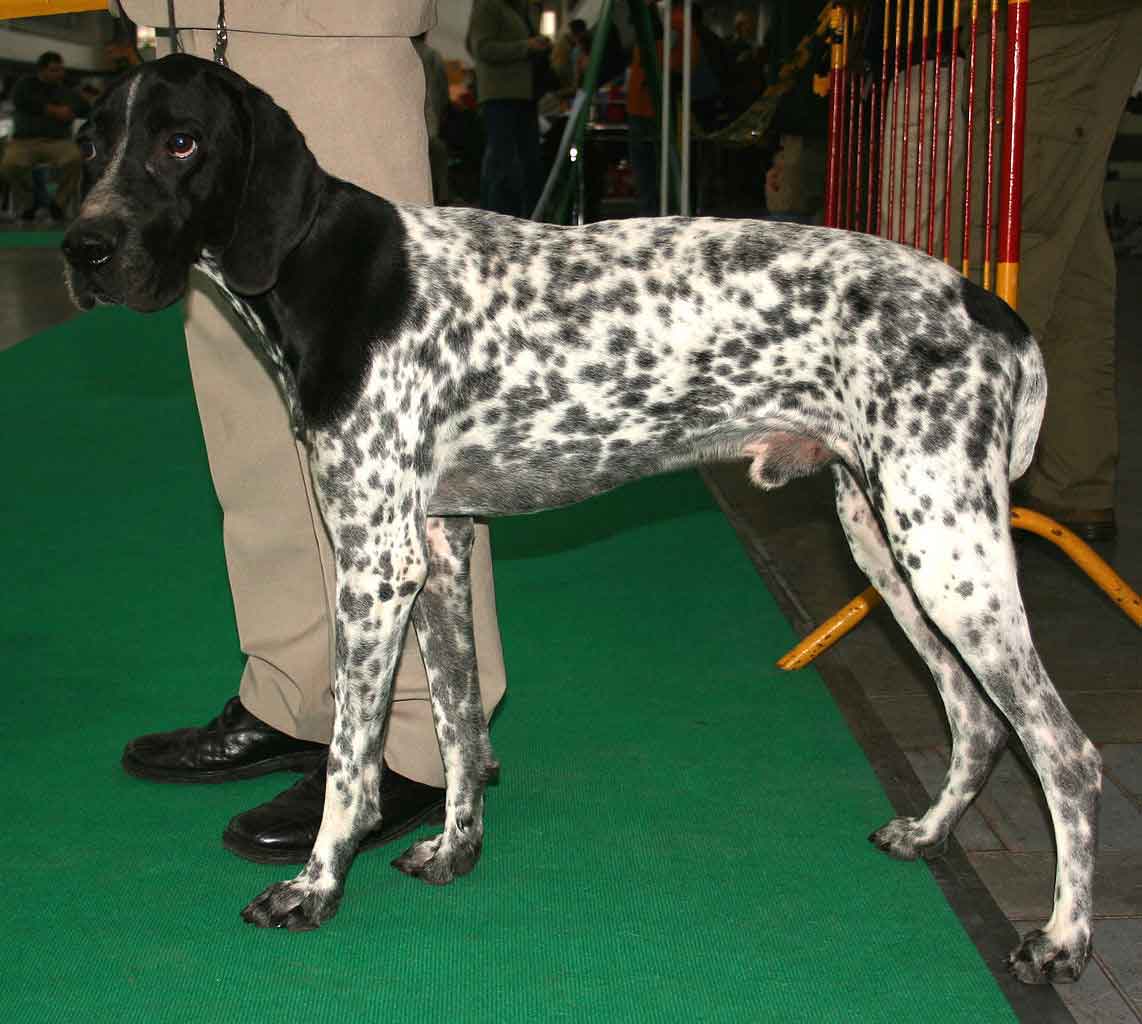
Photo: Braque_d’auvergne at the World Dog Show in Poznaล„ by Pleple2000, CC BY-SA 3.0, via Wikimedia Commons

Popularity

In France, the popularity of Auvergne Pointer is relatively stable in the long term, and has been at least since the early 1990s. 1970: there are around of 350 entries per year in the French Origin Book (LOF). This number sometimes peaks at around 500 births per year, how was the case, for example, in the mid 70. On the other hand, has never durably fallen below 250.

Although the Auvergne Pointer is relatively popular in his home country, it has only been exported and distributed to some extent outside of France, even in countries bordering France.

In Switzerland, for example, the statistics of the Amicus database show that its population is limited to about thirty individuals.

In Belgium, it is just as discreet, as evidenced by the absence of breeding on the national soil.

The same observation can be made, for example, in Italy, where the statistics of the Ente Nazionale della Cinofilia Italiana (ENCI) show an average of about ten registrations per year during 2010, or again in Spain, where the Royal Canine Society of Spain (RSCE) only count one birth between 2014 and 2019.

There are a handful of farms in Canada and the United States, but the Auvergne Pointer also still hard to find in those countries.

Physical characteristics

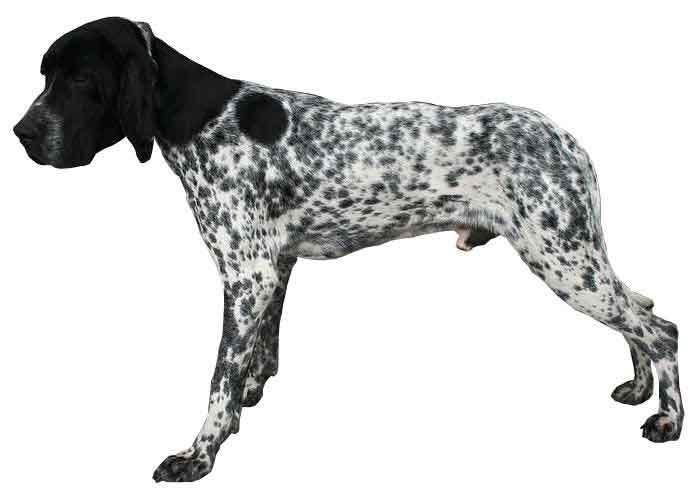
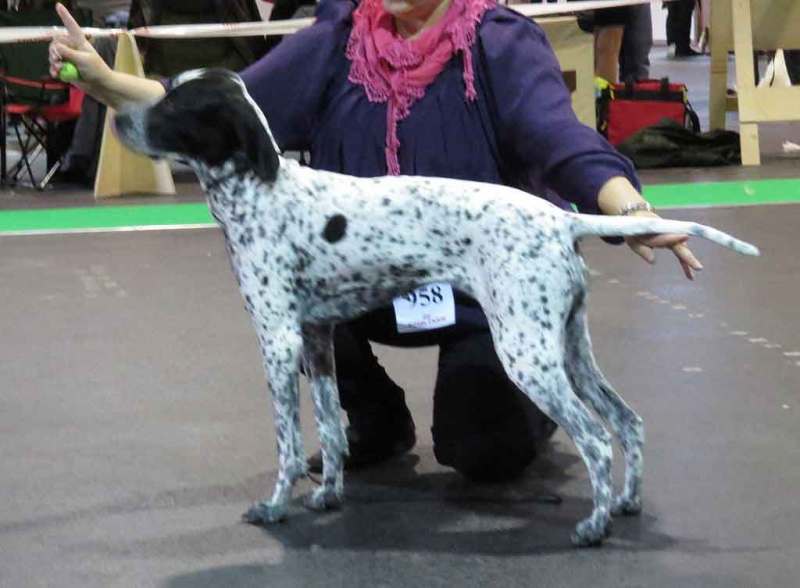
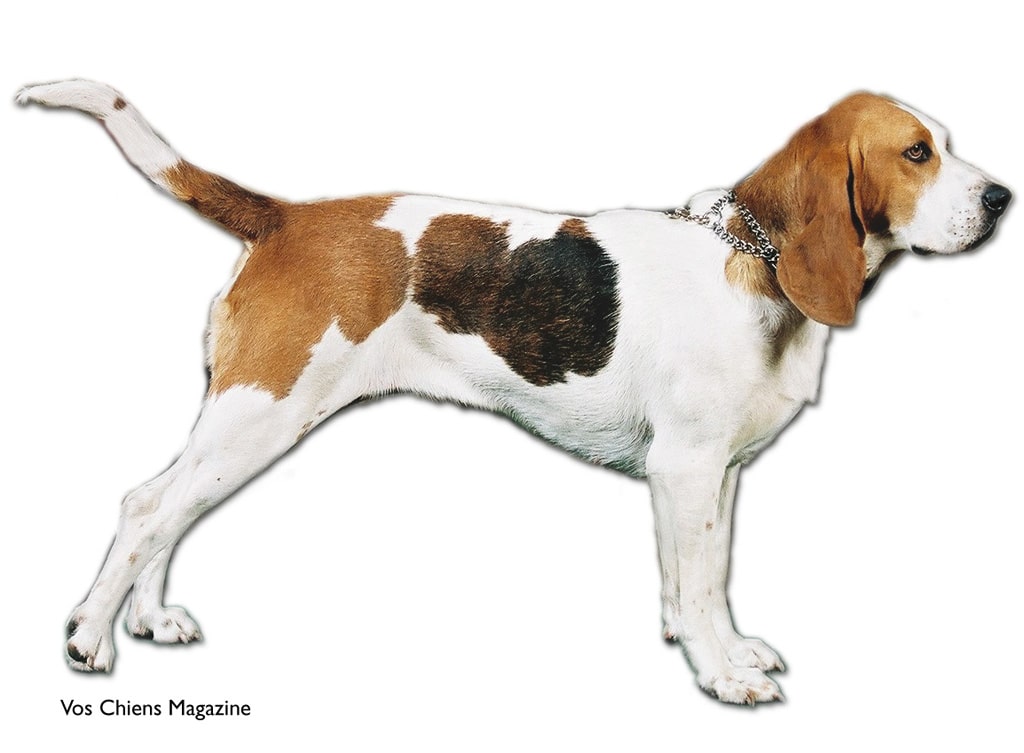
The Auvergne Pointer has a robust and noble appearance. His shapely body is well aligned, with a straight constitution – your back, from the tip of the shoulder to the tip of the buttock, is the same length as its front legs – and a long chest that descends to elbow level, midway between the withers and the lower part of the front legs. It is robust, strong but without heaviness, which gives it an elegant look. Their solid constitution gives them the stride and the resistance for which they are highly appreciated in hunting..

Both the front and back legs are straight, well aligned with the body, and the thighs and forearms are well muscled.

The tail stands quite high, carried horizontally and reaches the point of the hock. It can also be shortened at birth, and then barely exceeds 15 to 20 cm.. But, this practice, llamada ยซtail dockingยป, It is banned in many countries, including France, Belgium, Switzerland and Quebec.

The head of the Auvergne Pointer is well balanced. Seen from the front, the muzzle is square and its length is equal to or slightly less than that of the skull. Finish off with a pretty strong black nose, which dominates the solid jaws of equal length. It also, the upper lip covers the lower.

Positioned slightly toward the back of the skull, the ears are droopy, flexible and with a slightly satin texture.

The eyes are dark hazel, oval and quite large. They give this dog an expressive look, frank and gentle.

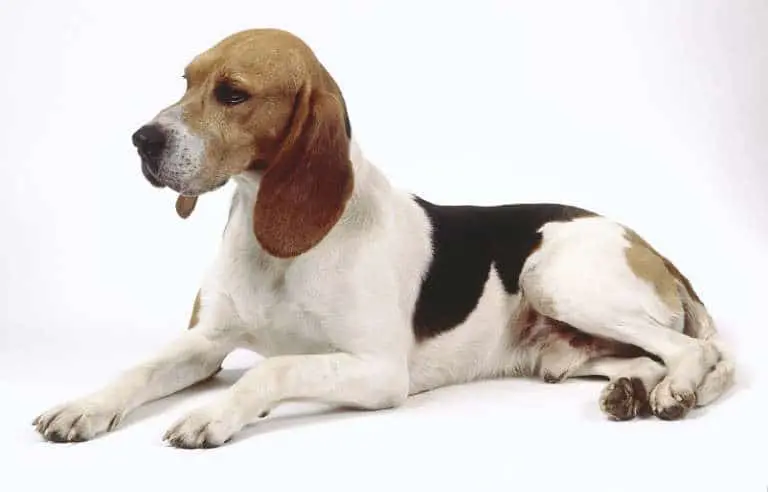
The fur of Auvergne Pointer consists of a sparse undercoat and short, smooth topcoat with a glossy appearance that is softer than other Braques. It is mottled black or grayish white, more or less present. The head is black, but the muzzle may have the same white markings as the body – a white border may also be present on the top of the skull, prolonging the color of the muzzle. Black fur can also tend to be blue, which is why these dogs are rarely called Auvergne Pointer blue.

There are also charcoal-colored dogs. But, this variety is rare and is not recognized by the breed standard.

Sexual dimorphism is not very pronounced in these dogs: the male is certainly on average a few centimeters taller than the female, but it's not particularly massive.

Character and skills

Even today, the Auvergne Pointer is most often bred to become a hunting dog. But, his affectionate character, Gentile, patient and smart also makes them great pets, and they are becoming more and more popular as such. In fact, fit perfectly into family life, they usually try to please their humans and are very loyal to them.

They are especially fond of children of all ages and are affectionate and playful provided they are not excessively boisterous. But, it should never be forgotten that a dog of any breed should never be left alone with a small child without adult supervision.

The downside of being so close to your family is that you cannot tolerate loneliness and need to be in the company of humans as often as possible.. If left alone for too long, can become a destructive or particularly loud reminder of your presence. No need to say, therefore, which does not suit people who are away for whole days or more. The close bond he has with his teachers also makes him very sensitive to reprimands and he is easily affected by possible punishments..

It is not only the humans in his family that he Auvergne Pointer inclines to appreciate. In effect, even if at first sight he is shy with strangers, quickly treats them like new friends, especially since it is totally devoid of aggression. Ready to greet newcomers with affection, may even tend to follow an intruder instead of defending your home or territory, which makes him a poor caretaker. But, is very capable of sounding the alarm when he hears something unusual.

In any case, He is not one of those who barks from morning to night, expressing yourself only when you have a good reason to do so: to raise the alarm, to express boredom, to seek attention, or to express any anxiety.

Sharing your home with a partner is a great way to reduce the risk of you suffering from the absence of your masters. In fact, such cohabitation generally goes very well, and he appreciates not living alone.
On the other hand, his hunting instinct is too ingrained in him to consider the possibility of peacefully cohabiting with another pet smaller than himself, like a bird, a rodent or even a cat: unless you were raised with him from a young age, chances are good that one day or another I'll end up attacking him. This character trait also means that he is best kept on a leash when going out to places where he is very likely to meet small animals., and where it would be dangerous for him to pursue them.

This is all the more true as it does not lack energy, to the point that you need to spend at least an hour a day to be well on your legs and on your head. Your resistance, However, allows you to go much further, since it is capable of chasing a prey for miles. So, it is ideal to plan long walks that include times when you can run freely and safely, especially if you don't have a chance to hunt. In any case, this dog is perfectly suitable for an active owner who likes to jog, cycling or hiking, and he would like nothing more than to take his pet with him – provided that it is kept on a leash when necessary.

Another great way to allow him to expend his energy is to train him for one or more dog sports.. Their intelligence and willingness to cooperate are particularly well expressed in agility and obedience tests.. More broadly, imply that it is quite easy to train him for all kinds of activities and teach him different tasks.

By the way, if your pilgrimages take you to pass near a water space where you can swim safely, She loves water – he is even a good swimmer – and generally appreciates taking a dip as soon as you get a chance to.

In any case, its high level of activity makes apartment living unsuitable for the Auvergne Pointer. Even a house with a small yard probably wouldn't be enough to make him happy.: the ideal environment for him is clearly a house with a large fenced garden, although this cannot replace long daily walks to satisfy your need for exercise.

Education

The Auvergne Pointer is known for his intelligence and the sweetness of his temperament. He is also eager to please his owners, so it reacts positively to training: learns quickly and is generally an easy dog รขโ‚ฌโ€นรขโ‚ฌโ€นto train.

But, it is important to use the right methods. In fact, its sensitivity means that the use of coercion or even punishment is strongly discouraged: would have every chance of undermining the trust that you normally place in your beloved master. On the other hand, positive dog training methods, based on repetition, the gratification and rewards, are very effective in taking full advantage of the great potential of this animal.

In fact, its obedient and cooperative nature makes it not difficult to train it for hunting, sports with dogs or any other task. This is all the more true since he is always happy to share activities with his master: unlike many races, prefers to work in complicity with his master rather than independently. So, It is an ideal option for those who like to spend time educating their partner and working alongside him, whether for hunting or dog sports. These may include, is an excellent candidate for agility and obedience competitions. Your sense of smell can also be used to track events, but its relatively slow speed limits its potential in this area.

For things to run smoothly, it is important to establish rules at an early age about what you are and are not allowed to do. They are not particularly stubborn by nature, and in fact they are quite obedient, but they can also do it when they are more flexible and responsive: this will make it easier and faster for them to assimilate the rules. It also, assimilates them more easily because they are the same from one day to the next and between the different people in the house: It is not a question of the gentleman authorizing today what the lady forbade the day before.

It also, teaching your dog to stay alone should be one of the priorities in the education of a Auvergne Pointer. In effect, as he likes company and is prone to separation anxiety, must get used to enduring absences from his family without reaching a state of discomfort.

It is also beneficial to start learning to call back soon, so that it can be allowed to unleash when conditions permit, limiting the risk of becoming deaf to his master's commands when he sees or smells a small passing animal.

You also have to be careful to quickly channel your tendency to chew what is within your reach., directing him to the right toys. This avoids the risk of damage and injury to the animal.

Finally, like any dog, we must not wait to offer you quality socialization from your first months. By letting you meet all kinds of humans, congeners and representatives of other species, but also face a multitude of different situations in various places, we make it a comfortable companion in all circumstances, performed in its environment and among humans.

Health

The Auvergne Pointer is generally a robust dog with few health problems. Your life expectancy of 12 to 15 years is quite honorable given its size.

It also, they are quite flexible in terms of weather, able to cope with both the summer heat and the winter cold of temperate or Mediterranean climates. If you are required to sleep outside when temperatures are low, a niche is necessary to provide shelter. In any case, their fur is not adapted to polar temperatures.

But, like any dog, are more prone to certain diseases, which in this case are :

  • hip dysplasia, whose appearance may be favored by a hereditary predisposition, and that corresponds to a malformation of this joint. Leads to pain, lameness and osteoarthritis when the animal ages;
  • dislocation of the patella, which is a malformation of the knee joint that causes the kneecap to slip out of position. Probably hereditary, causes a more or less severe limp. May require surgery in the most severe cases, although success is not guaranteed;
  • aortic stenosis, a potentially hereditary heart defect manifested by reduced blood flow. Leads to heart failure, that can manifest, for example, in a state of general weakness, and also increases the risk of heart attack. Not curable, but medications can reduce the effects of heart failure;
  • progressive retinal atrophy, which corresponds to a degeneration of the retina and is of hereditary origin. It affects both eyes and causes a progressive loss of vision in the dog;
  • Dilation-torsion of the stomach, which mainly affects breeds with a large chest and occurs when the stomach folds in on itself, blocking the evacuation of gases and interrupting blood circulation. It is fatal if a vet does not intervene quickly;
  • otitis, an ear infection favored by the pendulous shape of the ears.
  • Since a certain number of the conditions to which the breed is predisposed are or may be of hereditary origin, adopting a quality breeder from Auvergne Pointer can be a determining factor in obtaining a healthy puppy, and one that continues to be, in addition to having been well socialized from his first weeks. In effect, a professional worthy of the name sees to it that genetic tests are carried out systematically on his breeding stock, to rule out those who run the risk of transmitting this or that inherited condition to their offspring. So, must be able to present the results of these tests, as well as the health history of the dog, that attests to the vaccinations administered and that is useful for planning the next ones to be carried out, as well as withdrawals. At the same time, a certificate drawn up by a veterinarian attests to the good health of the animal at the time of adoption.

    Once the adoption is complete, it is important that the new owner respect the growth of his protรฉgรฉ: until it reaches adult size, what happens around two years of age, you should avoid intense physical exertion or excessively strenuous and prolonged exercises. This reduces both the risk of short-term injuries and that of sequelae or deformation of the bones or joints., which are particularly fragile during this period.

    Last, one way to keep your dog in good health is to take him to the vet regularly for a full checkup – At least once a year, and even more when he gets older. This will help prevent or detect potential health problems as soon as possible., as well as provide the opportunity to reinforce your dog's vaccinations.

    It is also important not to neglect the protection against fleas, worms, ticks and other undesirable pests, renewing your child's antiparasitic treatments throughout the year, whenever necessary. This is especially crucial for an individual who spends a lot of time, either hunting or in other activities.

    Grooming

    As his undercoat is not very thick and his top coat is short, the fur of the Auvergne Pointer requires little maintenance: a short brushing session with a soft bristle brush once a week is enough to keep you healthy, shiny and soft to the touch, especially since your hair loss is not very pronounced.

    During moulting periods, in spring and autumn, it is much more pronounced, so more frequent brushing is necessary. But, 2 or 3 times a week should be enough. After brushing it, the coat can be buffed with a clean soft cloth to make it even brighter.

    It is neither necessary nor advisable to bathe your dog too often: 3 or 4 times a year is usually more than enough, unless, Of course, that has gotten very dirty. In any case, you should always use a shampoo intended for dogs.

    Dangling ears require more attention, since their shape makes them prone to ear infections. So, it is important to examine them weekly and wipe them with a clean, slightly damp cloth to avoid the risk of infection.

    Your eyes need some attention too. The weekly maintenance session should be an opportunity to examine them, and wipe them gently with a damp cloth if there is dirt.

    Looking at its claws, regular physical activity that satisfies your need for fairly high levels of activity will usually allow you to smooth them out naturally. But, this does not mean that you should not check from time to time that this is the case. On the other hand, if your age or a health problem prevents you from being active enough, they generally need to be trimmed every 6 u 8 weeks to avoid being too long and bothering you, or even breaking and injuring you.

    The first time, a visit to a professional groomer can be a good way to learn how to care for a Auvergne Pointer, in order to operate efficiently and safely, while limiting the risks of hurting you. For its part, you will be calmer and more cooperative during care if it is part of your daily routine from a very young age: therefore, it is recommended to expose it to delicate handling from an early age.

    This is all the more true since it is also wise to get used to examining it after every long time spent outdoors. (especially after a hunting trip, for example), to detect possible injuries, thorns, parasites, spikes…

    Buy a "Braco de Auvernia"

    Either male or female, the price of a puppy Auvergne Pointer is generally between 650 and 1100 EUR. The average is about 800 EUR, no significant differences between males and females.

    But, it is difficult to find it outside of its country of origin, France, even in countries bordering on the latter.
    The same is true in North America, although there are a handful of breeders in Canada and the United States.

    The import from France is, therefore, sometimes the most suitable solution to avoid possible waiting times and have a maximum of choice. But, It must be taken into account that various expenses are added to the purchase price of the puppy: transportation expenses, administrative expenses, etc. It also, it is necessary, of course, make sure you know and respect the regulations regarding the importation of a dog from abroad.

    In any case, whatever the place, the price charged varies according to the prestige of the breeding, the lineage the animal came from, but also and above all its intrinsic characteristics, in particular its greater or lesser conformity with the norm. This last point also explains why there are sometimes significant differences within the same litter..

    Characteristics "Auvergne Pointer"

    Coexistence is important that you have with your new friend. Before considering the acquisition of a dog of the breed "Auvergne Pointer" you know certain factors. Not all breeds of dogs are apt to live in an apartment, you must take into account his character, their need for exercise, their interaction with other pets, their care and if you have small children, their level of tolerance towards them.

    Adaptation โ“˜

    3,0 of 5 stars (based on 1 review)

    friendly dog โ€‹โ€‹โ“˜

    4,0 of 5 stars (based on 1 review)

    hair loss โ“˜

    2,0 of 5 stars (based on 1 review)

    Affection level โ“˜

    4,0 of 5 stars (based on 1 review)

    Need for exercise โ“˜

    5,0 of 5 stars (based on 1 review)

    Social need โ“˜

    4,0 of 5 stars (based on 1 review)

    Home โ“˜

    3,0 of 5 stars (based on 1 review)

    Toilet โ“˜

    1,0 of 5 stars (based on 1 review)

    Friendly with strangers โ“˜

    4,0 of 5 stars (based on 1 review)

    barking โ“˜

    3,0 of 5 stars (based on 1 review)

    Health โ“˜

    4,0 of 5 stars (based on 1 review)

    Territorial โ“˜

    4,0 of 5 stars (based on 1 review)

    Cat friendly โ“˜

    2,0 of 5 stars (based on 1 review)

    Intelligence โ“˜

    4,0 of 5 stars (based on 1 review)

    Versatility โ“˜

    4,0 of 5 stars (based on 1 review)

    Child friendly โ“˜

    4,0 of 5 stars (based on 1 review)

    Surveillance โ“˜

    3,0 of 5 stars (based on 1 review)

    joy โ“˜

    4,0 of 5 stars (based on 1 review)

    Images "Auvergne Pointer"

    Photos:

    1 – Braque d’Auvergne sur fond blanc by Desaix83, d'aprรจs le travail de Pleple2000, CC BY-SA 3.0, via Wikimedia Commons
    2 – Riga, Baltic Winner 2013, 9-10 Nov by Thomas, CC BY-SA 3.0, via Wikimedia Commons
    3 – Braque d’Auvergne during the Rzeszรณw International Exhibition, Poland. Marian Surma is the breeder and owner of Poland by Pleple2000, CC BY-SA 3.0, via Wikimedia Commons
    4 – Braque d’Auvergne during the Rzeszรณw International Exhibition, Poland. Marian Surma is the breeder and owner of Poland by Wikimedia
    5 – Braque d’Auvergne during the Rzeszรณw International Exhibition, Poland. Marian Surma is the breeder and owner of Poland by Pleple2000, CC BY-SA 3.0, via Wikimedia Commons
    6 – Braque_d’auvergne at the World Expo in Poznaล„ by Pleple2000, CC BY-SA 3.0, via Wikimedia Commons

    Videos "Auvergne Pointer"
    Type and recognitions:

    • FCI CLASSIFICATION:
    • Group :
    • Section : . .

    Federations:

    • FCI – Group 7: Pointing Dogs. – Section 1: Continental Pointing Dogs. 1.1: Braque Type โ“˜
    • UKCGun Dog โ“˜

    FCI breed standard "Auvergne Pointer"

    Origin:
    France

    Date of publication of the valid original standard:
    24.03.2004

    Use:

    Pointing Dogs.


    General appearance:

    Rectilinear, Mediolineo. It is a robust dog, strongly constituted, no appearance of heaviness, With the typical characteristics of a braco. It has a light step and an elegance accentuated by the fur and harmony of its proportions. His constitution predisposes him to carry out a job completely and with agility, and allows you to resist a whole day, on the most difficult fields.

    IMPORTANT PROPORTIONS :

    • Body : The length of the body (from the tip of the shoulder to the tip of the buttock) It is approximately equal to the height at the withers.
      Chest height = Cross height x ยฝ.


    Behavior / temperament:

    It is a meek dog, very affectionate, Intelligent, docile. His training consists above all in developing his natural qualities. Your sense of smell is powerful. Adapts well to family life.

    Head:

    The length of the muzzle is slightly less than or equal to that of the skull.

    Cranial region:
    • Skull lines and nasal pipe : Slightly diverging towards the front (characteristic of the braco). The head is long, in proportion to size, a little lighter in females. Seen from above, the skull is oval in shape. The occipital protrusion is little protruding. The amplitude, at the level of the zygomatic arches it is equal to the length of the skull.
    • Superciliary arch : Well pronounced.
    • Depression links (Stop) : Moderately marked.

    facial region:

    • Truffle : It is always black, big enough, bright, with the windows wide open. Its superior profile is in the prolongation of the nasal canal.
    • Snout : Its length is similar to that of the skull. The nasal spout is straight.
    • Lips : Pretty thick. The upper lip covers the lower. Marked commissures, no noticeable crease. Seen from the front, the lips give a square shape to the tip of the muzzle.
    • Jaws / Teeth : Solid, of equal length. Teeth are strong. Joint is scissor-shaped or pointed toe.

    Eyes : Rather large, oval, dark hazelnut, well sunk in the orbits, expressive look, frank and sweet. The eyelids are well pigmented and do not show the conjunctiva.

    Ears : Inserted rather back. During rest, The ligament is below a line that meets the upper profile of the truffle and the eye. When is the dog attentive, The ligament of the ear can rise to this line.
    Slightly bent inward, but neither curled nor flat, the ear is flexible and slightly satin in texture. Its tip is moderately rounded. If you stretch to the front, must reach the truffle's birth, without exceeding the limb.

    Neck:

    Rather long, well inserted in the shoulders, slightly arched. Has a slight double chin. Neck length is visibly equal to head length.

    Body:

    • Top margin : Well tense, straight.
    • Cross : Marked.
    • Back : Narrow, flat and short. The spine is not protruding.
    • Pork loin : Well adhered, broad (especially in females), very slightly convex.
    • Rump : Oblique (35ยฐ In relation to superior margin), the tip of the haunches is visible.
    • Breast : Long and well sloped down to elbow level. In cross section to an ovoid shape, regularly flexible, no break at the bottom.
    • Lower margin : Gently rises to the belly, that is not agalgado. The flank is wide, little sunken, harmoniously joins the haunches.

    Tail:

    Very high insertion. Must be presented horizontally. Cylindrical and not very fine. If it's cropped, has a length of 15 to 20 cm., if it is not, reaches the tip of the hock without exceeding it.

    Tips

    They lie on the axis of the body.

    PREVIOUS MEMBERS : They are leaden.

    • Shoulder : Strong, well muscled, well detached when the dog is in action. Oblique at 45 ยฐ on the horizontal.
    • Elbows : Completely on the axis of the body.
    • forearms : Strong and long, muscular and straight.
    • dolls (carpos) : Strong without being knotty.
    • Metacarpus : Short ; viewed in profile they are slightly inclined.

    LATER MEMBERS : Well angled, they work in parallel planes.

    • Thighs : Well muscled.
    • Hocks : Slim and well outlined.
    • Metatarsals : Short and never thin.

    FEET : A little longer than the so -called "cat" foot, A little less long than the so -called "hare" foot. They don't even deviate inwards, nor out. Nails are strong and short ; the plantar pads are hard and resistant ; fingers are together.

    Movement:

    Medium width strides, but with a sustained rhythm that gives the dog its remarkable resistance. His usual hunting motion is a medium gallop, uniform and with a slight sway.

    Mantle

    SKIN : Pretty fine, rather lazy, but without exaggeration.

    HAIR : Short, not too fine. Never lasted, bright.

    COLOR : Negro, with variable length white patches. Due to the particularity of the patches, two types are observed : mottled or graying. This difference cannot lead to choosing between two specimens with the same quality.
    The head must be black, preferably with a whitelist that extends to the same. The white color in this list may extend over the lateral parts of the muzzle. A mottled white ear or a mottled white side of the head cannot be considered a fault..


    Size and weight:

    Height to the cross : (with a tolerance of + 2 cm and - 1cm for both sexes).

    • Males : 57 to 63 cm. (ideal height : 60 cm.).
    • females : 53 to 59 cm. (ideal height : 56 cm.).


    Fouls:

    Any deviation from the aforementioned criteria is considered as a fault and the severity of this is considered to the degree of the deviation to the standard and its consequences on the health and well-being of the dog..

    โ€ข Line of the Nasal Caรฑo and the parallel skull.
    โ€ข Head too bulky under the eyes.
    โ€ข Apparent conjunctive.

    SERIOUS FAULTS

    โ€ข Convergent nasal and skull lines (forward).
    โ€ข Concave or convex nasal pipe.
    โ€ข Very high insertion ear. Too short, flat, exaggerated corkscrew shape.
    โ€ข Collapant and floating lips, too short, snout that becomes thinner at the tip.
    โ€ข Sterno region too close.

    MISS PLAYOFFSCharacter :
    โ€ข Aggressive or fearful dog.

    Head :
    โ€ข Absence of the braco type.
    โ€ข Upper or lower prognathism with a difference of more than 1 mm between the incisive arches.
    โ€ข The absence of PM1 is accepted.
    โ€ข The absence of two other premolars is qualifying (PM2 - PM3) or any other tooth, including PM4.
    โ€ข Entropion or ectropion or traces of corrective intervention.

    Members
    โ€ข Presence of spur or traces of your amputation.

    Fur
    โ€ข Completely black the completely blanco.
    โ€ข Absence of mottled.
    โ€ข Fire marks or reflexes "Burn Bread" (leonado).
    โ€ข truffle with too many depigmented spots.
    โ€ข Despigmented parpped.
    โ€ข Yellow eye (bird of prey). Heterochrome eyes.

    Size
    โ€ข Outside the standard limits (regulatory tolerance : + 2cm y โ€“ 1cm).

    Any dog โ€‹โ€‹showing clear signs of physical or behavioral abnormalities must be disqualified..


    N.B.:

    Males should have two normal-appearing testicles fully descended into the scrotum..

    Source: F.C.I - International Cynological Federation

    Alternative names:

    1. Braque d’Auvergne (English).
    2. Bleu d’Auvergne (French).
    3. Braque d’Auvergne (German).
    4. (em francรชs: Braque d’Auvergne) (Portuguese).
    5. Azul de Auvernia (espaรฑol).

    โ–ท The world of Pets: Dogs, cats, birds, reptiles, amphibians

    American Foxhound
    Estados Unidos FCI 303 . Large-sized Hounds

    Foxhound Americano

    The American Foxhound is sweet, friendly, loyal and very affectionate in a house.

    Content

    Characteristics "American Foxhound"

    Coexistence is important that you have with your new friend. Before considering the acquisition of a dog of the breed "American Foxhound" you know certain factors. Not all breeds of dogs are apt to live in an apartment, you must take into account his character, their need for exercise, their interaction with other pets, their care and if you have small children, their level of tolerance towards them.

    Adaptation โ“˜

    2,0 of 5 stars (based on 1 review)

    friendly dog โ€‹โ€‹โ“˜

    4,0 of 5 stars (based on 1 review)

    hair loss โ“˜

    1,0 of 5 stars (based on 1 review)

    Affection level โ“˜

    4,0 of 5 stars (based on 1 review)

    Need for exercise โ“˜

    5,0 of 5 stars (based on 1 review)

    Social need โ“˜

    4,0 of 5 stars (based on 1 review)

    Home โ“˜

    2,0 of 5 stars (based on 1 review)

    Toilet โ“˜

    2,0 of 5 stars (based on 1 review)

    Friendly with strangers โ“˜

    3,0 of 5 stars (based on 1 review)

    barking โ“˜

    5,0 of 5 stars (based on 1 review)

    Health โ“˜

    5,0 of 5 stars (based on 1 review)

    Territorial โ“˜

    2,0 of 5 stars (based on 1 review)

    Cat friendly โ“˜

    3,0 of 5 stars (based on 1 review)

    Intelligence โ“˜

    4,0 of 5 stars (based on 1 review)

    Versatility โ“˜

    3,0 of 5 stars (based on 1 review)

    Child friendly โ“˜

    5,0 of 5 stars (based on 1 review)

    Surveillance โ“˜

    1,0 of 5 stars (based on 1 review)

    joy โ“˜

    5,0 of 5 stars (based on 1 review)

    History

    Fox hound, American, better known as American Foxhound It is a breed of dog that is very close to the English Foxhound, are hounds, dogs that are guided by smell to hunt foxes.

    In 1650, Robert Brooke, brought for the administration of the British colony that was North America a pack of hunting dogs, which became the root of many of the North American hunting dog lines. These dogs remained in the Brooke family about 300 years.

    George Washington received fox hunting dogs, French, as the Great Gascony Blue as a gift from the Marquis de Lafayette.

    Many of the dogs Washington already owned were descendants of the Brooke family., so when he crossed them with the French, the race began to develop until it reached the present American Foxhound.

    Physical characteristics

    While the norms of the standard require that the American Foxhound what de 53 to 64 cm in height to the cross, and despite between 29 to 34 kg, Many specimens are, structurally, bigger, females always, slightly smaller than males.

    Some breeders have theorized that the variation in height with respect to the standard, It is due to the considerably improved diet the dogs receive currently. Let's not forget that the breed was first recognized by the American Kennel Club in 1886 (and there the standard was set...), and back then it was a common and traditional practice to feed the Foxhound with a diet they called "dog bread", it was a variant of bread made with cornmeal.

    Continuing with the physical characteristics, the Foxhound has long legs, lines of bony. His chest is quite narrow. It has a long snout and large skull, dome shaped. He's a big ear... Yes, He has floppy ears like his first cousins โ€‹โ€‹and hazel eyes. (or brown) they are big and bright.

    The coat is short and rough. In general, they are very similar to the Beagle, only that foot can be seen that they are taller and larger. Usually have four colors: red, black, and fire, or bluish, They also have white parts.

    They tend to throw a good amount of hair in the time of molt, but a weekly brushing will prevent that the sofa is decorated…

    Character and skills

    The American Foxhound is sweet, friendly, loyal and very affectionate in a house. As with all dogs need a careful training, constant socialization, and one owners who are willing to do enough exercise with your pet!

    One Foxhound bored will find by itself, the ways to have fun, and and can be very destructive, Some examples of destruction include, from scratches on doors, destruction of objects found in your path, as toilet paper, for example, as it is very mischievous and, to be quite long, they are able to pick up things of furniture…

    If you can not establish a routine walks, Well, at least it would be good if the animal had access to a safe patio, where you can spend your energy, is a good alternative. But, We insist that, the walks, games should be part of your daily life.

    Type and recognitions:

    • FCI CLASSIFICATION:
    • Group :
    • Section : . .

    Federations:

    • FCI – Group 6: Scent hounds, and related breeds. – Section 1.1: Large-sized Hounds. โ“˜
    • AKCHound โ“˜

    FCI breed standard "American Foxhound"

    Origin:
    United States

    Date of publication of the valid original standard:
    07.08.1998

    Use:

    With working trial.


    General appearance:

    ----


    Behavior / temperament:

    ---

    Head:

    Medium long, slightly domed in occiput.

    Cranial region:
    • Skull : Wide and full.
    • Depression links (Stop) : Moderately defined.

    facial region:

    • Snout : Good length, straight and square cut.
    • Eyes : Large, well separated placement, with typical bloodhound expression; soft look, gentle and nice; brown or hazelnut color.
    • Ears : Rather low implantation, so long that, extended, reach almost to the tip of the nose; texture fine; sufficiently wide and almost lacking erectile capacity; hang close to the head with the leading edge slightly turned towards the cheeks; the tips are rounded.

    Neck:

    Rises freely and lightly over the shoulders, strong in substance but not heavy, medium long; clean throat, no skin folds; but a slight wrinkle under the angle of the jaw is allowed.

    Body:

    • Back : Moderately long, robust and muscular.
    • Pork loin : Wide and slightly arched.
    • Breast : Must be deep, giving space for the lungs; narrower in proportion to its depth than the chest of the English Foxhound; a circumference of 71 cm. (28 inches) is considered optimal in a specimen of 58 cm. (23 inches) height.
    • Ribs : Well arched, the hindquarters well extended back.
    • Flank : A flank of 7,6 cm. (3 inches) confers elasticity.

    Tail:

    Moderately high insertion, high carried, but never forward on the back; slightly curved and with a very sparse fringe of hair.

    Tips

    PREVIOUS MEMBERS : Straight, with good bones.

    • Shoulder : Oblique, crisp and muscular, neither heavy nor loaded, that give the impression of freedom of movement with great activity and strength.
    • Metacarpus : Short, straight.
    • Previous feet : of fox; well arched fingers; strong nails; hard, full pads.

    LATER MEMBERS :

    • Hips and thighs : Strong and muscular, ensuring a powerful thrust.
    • Knees: Strong and low-set.
    • Warm-tarsal joints : Solid, symmetrical and moderately angled.
    • Hind feet : Compact and strong.

    Movement:

    ---

    Mantle

    HAIR : Medium long, thick, hard texture typical of bloodhound.

    COLOR : Any color is allowed.


    Size and weight:

    • Males should not measure less than 56 cm. (22 flea) not more than 63,5 cm. (25 inches);
    • females should not measure less than 53 cm. (21 inches) not more than 61 cm. (24 inches).

    Measurement should be done with the dog in a natural position, with the limbs well under the body; is taken at the level of the cross.


    Fouls:

    Any deviation from the aforementioned criteria is considered as a fault and the severity of this is considered to the degree of the deviation to the standard and its consequences on the health and well-being of the dog..

    โ€ข Very flat skull, narrow at the top, too above- dice.
    โ€ข Roman nose, the raised, giving the nasal bridge a concave shape.
    โ€ข Long and pointed snout, or very short, sharply cut under the eyes.
    โ€ข Small eyes, sharp-eyed like a Terrier, or prominent and bulging.
    โ€ข High set ears, short, or with a tendency to rise above its insertion point.
    โ€ข Thick collar, short or rough; worn at the same height as the top of the shoulders Throat with double chin or skin folds.
    โ€ข Very long back, convex or defeated.
    โ€ข Flat and narrow spine.
    โ€ข Excessively wide or shallow chest.
    โ€ข Flat ribs.
    โ€ข Long tail, curved in the shape of a handle or inclined from birth forward. Rat tail. Total absence of fringe hair.
    โ€ข Twisted forelimbs.
    โ€ข Shoulder blades straight and vertical.
    โ€ข Elbows turned outward.
    โ€ข Carpal joint deviated forward or backward.
    โ€ข Cow tibio-tarsal joints or very straight.
    โ€ข Long feet, fingers apart, crushed.
    โ€ข Lack of muscles and drive.
    โ€ข Short hair, thin or smooth in texture.

    SCALE OF POINTS

    points

    Head

    • Skull 5
    • Snout 5
    • Eyes 5
    • Ears 5

    20

    Tips

  • Former members 10
  • Hip, thighs and post limbs. 10
  • Pies 15
  • 35

    Body

    • Neck 5
    • Shoulders and chest 15
    • Back, tenderloin and ribs 15

    35

    Fur and tail

    • Fur 5
    • Tail 5

    10
    ___
    TOTAL 100

    Any dog โ€‹โ€‹showing clear signs of physical or behavioral abnormalities must be disqualified..


    N.B.:

    Males should have two normal-appearing testicles fully descended into the scrotum..

    Source: F.C.I - International Cynological Federation

    Images ยซAmerican Foxhoundยป

    Videos ยซAmerican Foxhoundยป

    Alternative names:

    1. Foxhound (English).
    2. Foxhound (French).
    3. Foxhound (German).
    4. Foxhound americano, Cachorro americano Urrador (Portuguese).
    5. Foxhound americano, Perro de caza de zorros americano (espaรฑol).

    โ–ท The world of Pets: Dogs, cats, birds, reptiles, amphibians

    Artois Hound
    Francia FCI 28 . Medium-sized Hounds

    Sabueso Artesiano

    The Artois Hound it is a good companion dog but with an independent character.

    Content

    History

    The Artois Hound It is a smaller version of the "Great Artesian Hound", which is now extinct and was used in France in the 17th century for wild boar hunting, deer and small game. As hare hunting grew in popularity, the need for smaller dog breeds increased. Known in his land as "Briquetโ€ (What does "little braco" mean?) and also how Picard.

    It is true that it is a dog of ancient lineage like few others has enjoyed the admiration and the royalty protection (King Henry IV and Louis XIII), being considered a distinguished Hunter of Hare.

    He played with devotion to his duties in the most varied scenarios (plain, forest or in the densest bushes) and used to be easily identified by his master due to his original bark.

    Some authors have that in 1609 Prince Alexander Gray has sent some specimens of this breed to the King of England, which have subsequently been used for the creation of the Beagle.

    The development of Artois Hound, However, It has not been stable or linear. According to a French hunting manual, dating of 1890, It is known that at the end of the 19th century it used to be difficult to find pure specimens of this lineage..

    The apparent arbitrariness to the development of the race and their successive crosses with other species (mostly of English origin) they will disperse the original purity of this lineage.

    In this stage a so-called breeder Ernest Levoir tries to restore this lineage to the region Picardie. There are other names that were associated with these recovery attempts during the 20th century, as Mallard (at the time of World War I), Audrรฉchy, among others.

    With everything, Some authors consider that it has been Mme. Great Pyla who has won the most positive results, managing to re-establish the breeding of this strain.

    Currently, This dog It remains a rare breed and there are quite a few clubs that protect their development.

    Physical characteristics "Artesian hound"

    Very agile, It adapts to various types of terrain and shown extremely persistent in the performance of their duties. It also, has an excellent sense of direction, a developed sense of smell and speed of movement.

    This robust dog has a fur short, dense, soft and well attached to the body.

    The color the coat is dark Fawn tri-color, It is a color similar to the Hare or the Badger. It has large spots. Y, the head tends to be carbonated, or charcoal grey and sometimes presents black reflections.

    It has wide and rounded skull and pronounced chamfer. It has the square snout, the black truffle and its round eyes give it a gentle air.

    The ears they are wide, long and inserted at eye level.

    The neck and chest are vigorous and long. The rump and the spine are also robust and Member muscular. In the long run tail stays in the form of sickle.

    Character and skills "artisian hound"

    Currently, this dog is still used more as a hunting dog than as a companion dog. Like the large spaces, It does not conform to the sedentary life in the city.

    You can live in a home but if given a daily dose of exercise physical and games.

    The Artois Hound he is a brave and intelligent dog, very independent and quite energetic.

    It is an animal very resistant, possessing a special bark that can be heard at a great distance. It is a dog that is used primarily for hunting.

    Hunters usually go hunting with six or eight specimens of Artois Hound.

    It is not usually seen much as a companion dog, but in this case it is a good companion, It is not a Mongrel dog thanks to its strong independence, but will be loving in their own way, without empalagar.

    Care and maintenance of a "artisian hound"

    The Artois Hound not suitable as a family dog. Needs a meaningful task that demands your doggy stamina and intelligence. His most popular task is still hunting. So, this dog should be left in the hands of an experienced hunter.

    To the Artois Hound would not like the position in a city apartment, no matter how comfortable the apartment is. You need freedom of movement, What can you get in the country?. As the Artois Hound He is a pack dog and feels very happy among his peers., second position or multi-dog position is recommended. The care of this breed of dog is not intensive. Ear care can be a bit more complex, but the coat is very easy.

    Where to buy a "artisian hound"

    The Artois Hound It is a rare breed of dog that was on the verge of extinction after World War 2.. If you are interested in this dog, should have a lot of patience and time. Contact the breeders in advance and ask if they are expecting a litter and if there are any still available. Puppies are often reserved in advance. But it's better not to buy from breeders when you have a bad feeling!! If possible, you should take a look at the kennel. Don't be afraid to ask the breeder too many questions!! A good breeder, for whom the welfare of puppies is the first priority, will be happy to answer your questions and give you some valuable tips on maintenance, training and feeding the dogs.

    Images of the "Artesian hound"

    Videos of the "Artesian hound"

    Type and recognitions:

    • FCI CLASSIFICATION:
    • Group :
    • Section : . .

    Federations:

    • FCI – Group 6: Scent hounds, and related breeds. – Section 1.2: Medium-sized Hounds. โ“˜
    • Central Canine Society โ“˜

    FCI breed standard "Artois Hound"

    Origin:
    France

    Date of publication of the valid original standard:
    24.07.1996

    Use:

    The artisian hound is used mainly today for hunting with shotguns. As a scout he works with application to resume the lost trail; Your speed is moderate, But sustained. Since it has an excellent smell, is capable of failing the hare tricks during hunting in the plain.

    With its indisputable hunter qualities, He knows how to lead the roe, both in the forest, as in the Altos Montes, Easy to penetrate. For its intrepidity and courage, Makes the most recalcitrant boar out of the weed. It also, This is a rustic animal, endowed with a wonderful bark, animated, Sound and tall that is allowed to be heard in the distance. A uniform group of six to eight tricolor craftsmen constitutes a hunting team that would please the most demanding hunter.


    General appearance:

    This is a well constituted dog, muscular and not very long. Imparts an impression of strength and energy.

    IMPORTANT PROPORTIONS:

    โ€ข Cross height/body length between 10:10 and 10:11
    โ€ข Chest height/height at approximately 1:2
    โ€ข Heads/head length amplitude 5:9
    โ€ข Nasal cane length/skull length 8:10


    Behavior / temperament:

    This is a vigorous and rustic dog. It has a very good smell and joins the Hae. Is balanced and affectionate.

    Head:

    -

    Cranial region:
    • Skull: It is bulky, wide and very short. It is flat and rounded at the top, but the occipital Protuberance is not pronounced.
    • Depression links (Stop): It is accentuated.

    facial region:

    • Truffle: Grand, black. The Windows are wide open.
    • Lips: The upper lip covers in large part to the bottom and must be sufficiently marked for that, in profile, the snout has a square shape.
    • Snout: Straight nose cane, in profile, the snout is moderately elongated.
    • Jaws/Teeth: The joint is in the form of scissors. The upper incisors cover the lower ones in narrow contact and are implanted at right angles in relation to the jaw.
    • Cheeks: They are thin.
    • Eyes: With regard to the width of the forehead, the eyes are not very together. They are round, melancholy eyes and sweet. Its color is dark brown. The mucous membranes of the lower eyelids may not be apparent.
    • Ears: They are placed at the height of the eye line. They are somewhat thick, wide and their limbs are rounded. They are almost flat and quite long; they arrive until the birth of the truffle.

    Neck:

    It is powerful and moderately long. It presents very little double chin.

    Body:

    • Back: It is well marked and wide.
    • Pork loin: Slightly arched.
    • Rump: The legs providing a slight incline to the rump, It is well muscled.
    • Breast : It is wide, long and deep enough for the sternum line to reach the elbows level. Snugly ribs.
    • Belly: The flanks are round

    Tail:

    Thick, quite long and carried in a sickle-shaped. You must never fall forward. The hair is headed (taper, around the tail, long and thick hairs slightly separated in the form of stem).

    Tips

    PREVIOUS MEMBERS: Seen in conjunction, they are powerful and Plumb.

    • Shoulder: They are oblique and muscular.
    • Elbows: They are well located on the axis of the body.
    • Metacarpus: It is slightly oblique.

    LATER MEMBERS: Seen as a whole and from the back, The tip of the buttock, the middle part of the leg, the Hock, The metatarsal and foot are on the same vertical line.

    • Thighs: They are descended and well muscled.
    • Hock: Thick, moderately bent.
    • Metatarsals: They are short and thick.

    FEET: Slightly elongated. They are large, but compact. The pads are black, durable and compact.

    Movement:

    Agile and uniform.

    Mantle

    SKIN: Thick enough.

    HAIR: Short, dense and fairly smooth.

    COLOR: Tri-color dark Fawn, Hare or badger hair pulling, with blanket or large stains. Usually, the head is Fawn color, and sometimes carbonated.


    Size and weight:

    • Height to the cross: Both males and females, is of 53 to 58 cm.. With a tolerance of 1 cm..
    • Weight: The average weight is of 28 to 30 kg.


    Fouls:

    Any deviation from the aforementioned criteria is considered as a fault and the severity of this is considered to the degree of the deviation to the standard and its consequences on the health and well-being of the dog..

    Head:

    • Narrow skull, vaulted.
    • Too pointed snout.
    • Upper lip tight, not enough descended.
    • Eye slightly clear, apparent conjunctiva.
    • Ears placed below the eye line, short or not low enough.

    Neck:

    • Long, Lightweight.

    Body:

    • Very long dorsal region, loose top line, sunken.
    • Flat ribs.
    • Agalgados flanks.

    Tail:

    • Too long or too skewed to one side.

    Forelimbs:

    • Short shoulders.
    • Elbows that deviate out.
    • Straight metacarpals.
    • crushed feet.
    • Separate fingers, too long.

    Hind limbs:

    • Flat thighs.
    • Straight hocks, closed or far apart.

    Color:

    • Presence of mottled spots.

    Behavior:

    • shy dog.

    MISS PLAYOFFS

    • Fearful or aggressive dog.
    • Lack of type (animal, in general terms, does not present the same characteristics as its peers of the same race).
    • Anatomical anomaly.
    • Visible hereditary defect causing invalidity.
    • Upper or lower prognathism.
    • Eyes too light.
    • Weak limbs.
    • Any other color which is not established by the standard.
    • Speckled spots that extend throughout the body.
    • Withers height different from that laid down by the standard.
    • Any dog โ€‹โ€‹showing clear signs of physical or behavioral abnormalities must be disqualified..


    N.B.:

    Males should have two normal-appearing testicles fully descended into the scrotum..

    TRANSLATION: IRIS Carrillo (Puerto Rico Kennel Federation).

    Source: F.C.I - International Cynological Federation

    Alternative names:

    1. Chien dโ€™Artois, Picard, Briquet (English).
    2. Grand chien d’Artois, Briquet, Picard (French).
    3. Artois Hound (German).
    4. (em francรชs: Chien d’Artois (Portuguese).
    5. Chien dโ€™Artois, Picard, Briquet, Sabueso de Artois, Perro de Artois(espaรฑol).

    โ–ท The world of Pets: Dogs, cats, birds, reptiles, amphibians

    Ariรฉgeois
    Francia FCI 20 . Medium-sized Hounds

    Photo by danseaveclesloups.chiens-in-france.com
    Sabueso del Ariรจge

    The Ariรฉgeois He is a smart dog that accepts well orders

    Content

    History

    The Ariรฉgeois It is a dog of French origin, a native of the city of Ariege What, bordering Spain.

    The Ariรฉgeois It was recorded, obtaining the original valid standard, the twenty-fourth day of January of 1996 (Classification: Group 6 – Section 1.2).

    Several theories agree that it was born from the cross between a bloodhound type dog with a lighter complexion in the country (We cannot say exactly what), a Old Pays Briquet and Great Gascony Blue or a Gascon Saintongeois.

    The truth is that this cross maintained the typical physical characteristics of these last two dogs., but you can highlight a more docile nature, along with the size and lighter weight.

    Physical characteristics of the "Sabor of the Ariรจge"

    The Ariรฉgeois, is a dog used for small game. Medium-size and light weight make it a wonder, either alone or in groups, can easily grow and develop on difficult terrain, It is a dog that tolerate heat well.

    His favorite is the hunting of the Hare, but it is also used โ€“sometimes- for hunting deer or wild boar.

    Read more

    โ–ท The world of Pets: Dogs, cats, birds, reptiles, amphibians

    Alpine Dachsbracke
    Austria FCI 254 - Leash (scent) Hounds

    Perro tejonero alpino

    The Alpine Dachsbracke has a courageous personality, friendly and intelligent

    Content

    History

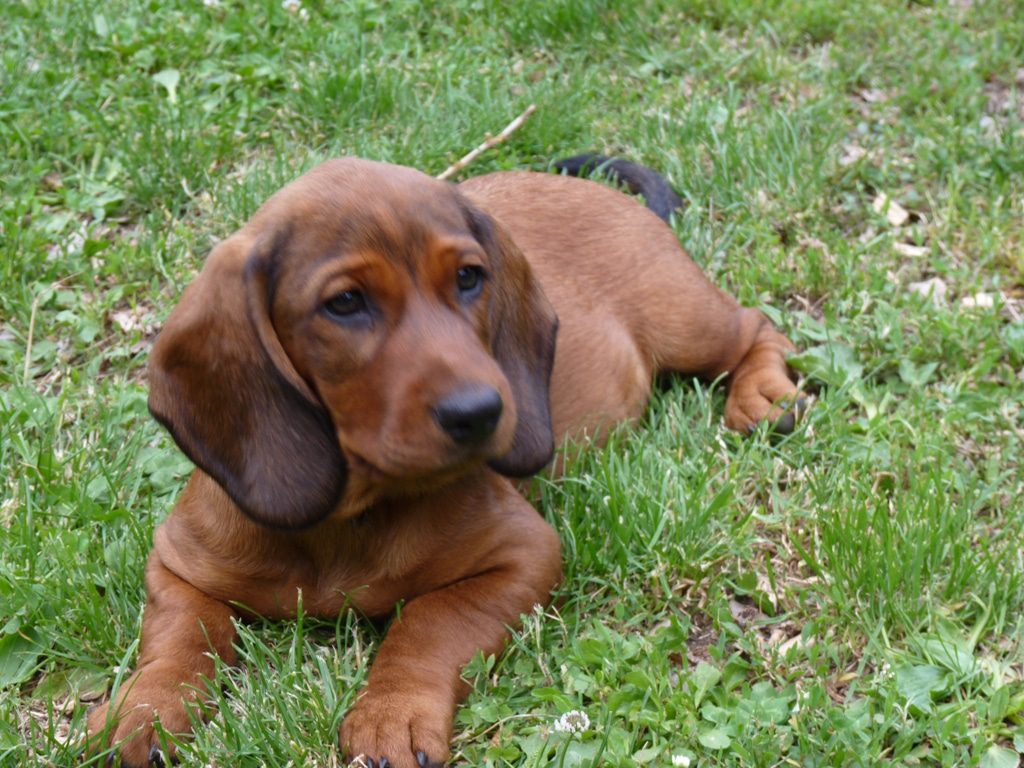
    The appearance of this short-legged dog suggests a very ancient breed. The Alpine Dachsbracke it is one of the oldest breeds of hunting dogs in Central Europe. It was already mentioned in the seventeenth century and represented in paintings.

    In the last quarter of the nineteenth century, Crown Prince Rudolf von Habsburg had this type of hunting dog run by his professional hunters.. The dog's appearance was unbalanced for a long time. Each canton raised its Alpine Dachsbracke differently.

    But it is not a cross between a Sausage dog and Bracco, as the German name suggests ยซAlpenlรคndische Dachsbrackeยซ, but an independent race. Visually, the Alpine Dachsbracke gets closer to the Dachshund, but it's much bigger and stronger.

    In the 19th century, there were numerous subspecies of Alpine Dachsbracke in the swiss alps, Bavarians and Austrians, that still differed greatly in appearance.

    At the end of the 19th century, many breeders of this breed of dog were in the Erzgebirge, so the race kept calling Alpenlรคndische Erzgebirgler Dachsbracke until 1975. Another name is the Dachsbracke Austrian.

    This is because the current Club Dachsbracken is located in Austria. The goal of breeding, both then and now, is to maintain the health and performance of this ancient breed of dog.

    In order to establish a constant shape, a uniform appearance and appropriate breed characteristics, the first International Club of Dachsbracken was founded in Munich in 1896.

    In 1908 the club disbanded again. In 1910 the Austrian Dachsbracke Club was founded, which is still engaged in the breeding of the Alpine Dachsbracke.

    In 1932, the Alpine Dachsbracke was officially recognized by the Austrian Kennel Club (with him "Bavarian Mountain Hound" and the "Hanoverian Scenthoundยซ) like the third breed of hound.

    In 1975 the Alpine Dachsbracke received recognition from the FCI, which finally classified the breed among the hounds in 1991.

    A race is quite unknown outside Austria.

    Physical characteristics

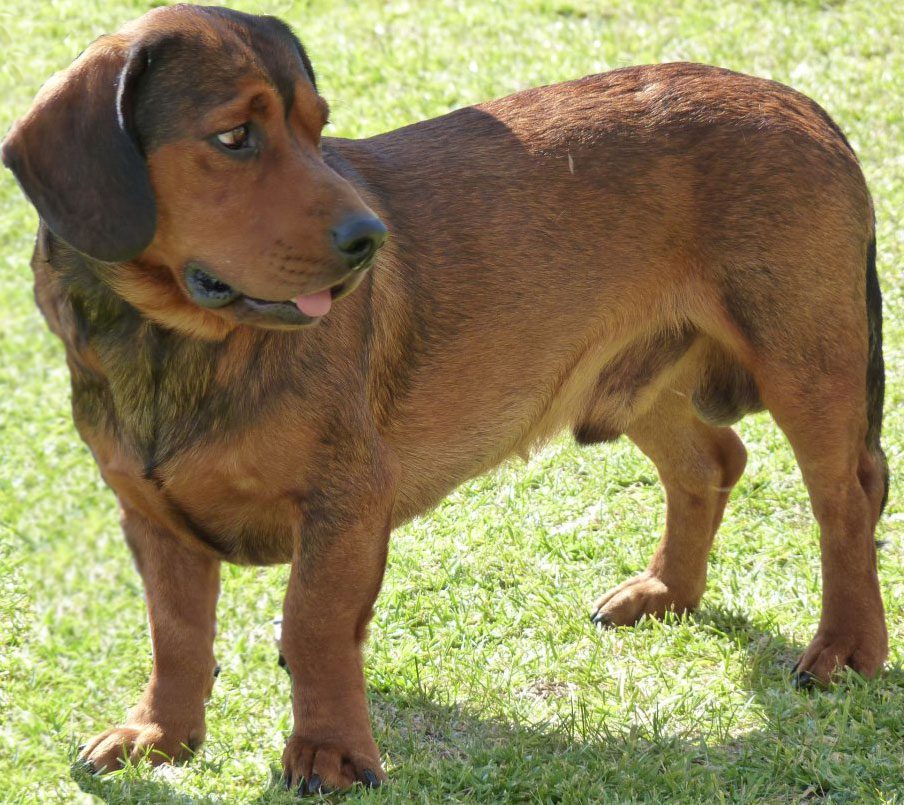
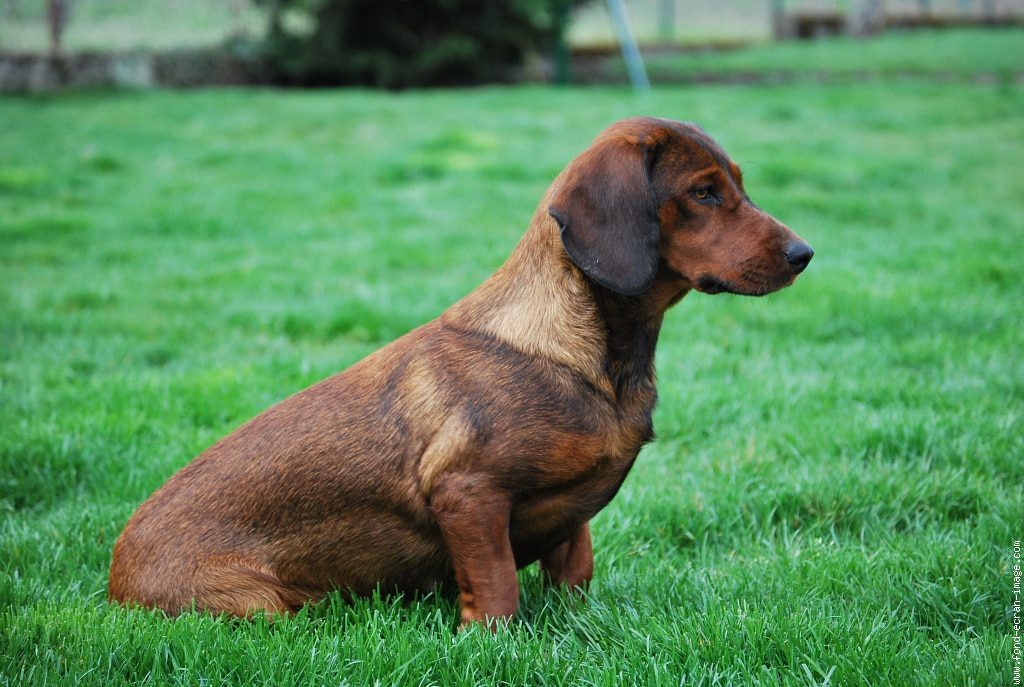
    The Alpine Dachsbracke is a dog's size medium. Has relatively short legs, a strong constitution, firm muscles and strong bones.

    The height to the cross is of 34 to 42 centimeters. Height at withers is measured from the ground to the shoulder in a loose dog. For males, the ideal size is between 37 and 38 centimeters of shoulder height; for females, are considered ideal 36 to 37 centimeters.

    Great importance is attached to an optimal ratio of proportions. The relationship between the height of the shoulders and the torso is 2 : 3, the relationship between the face and the skull is 9 : 10.

    The head is held proudly erect with a slight forward tilt. High-set dangling ears are straight-haired and fall loosely to the sides. They are wide, no wrinkles and medium length (approximately reaching the canines) and rounded at the bottom.

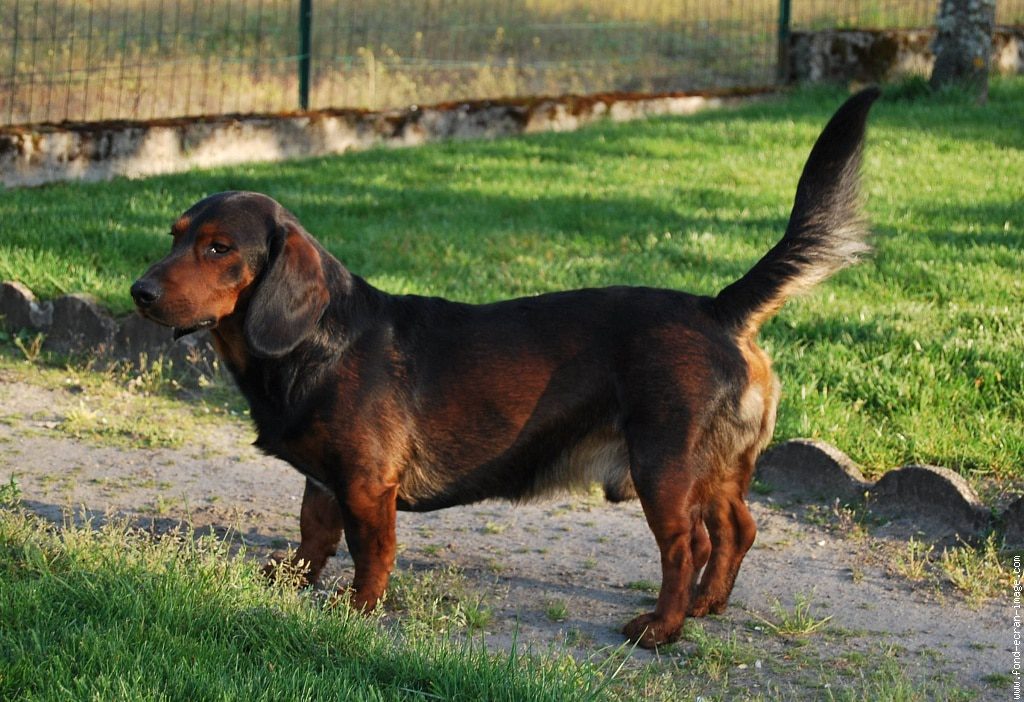
    The nose, the eyelids and lips are black. The eyes are deep brown and slightly almond shaped. The Alpine Dachshund has the typical "dachshund look". The tail is placed high at the root, but it is slightly lowered.

    In proportion to the strong body, legs are relatively short. The body is well muscled and with strong bones, with a pronounced rib cage but with a small waist.

    The coat of the Alpine Dachsbracke it's dense and short, only the lower part of the tail is slightly longer. The slightly dull coat consists of a firm stick coat with a dense undercoat.

    Allows good water repellency and a perfect air balance in summer and a high heat effect in winter. A dark deer red, often with a slight tinge, is the most common coat color.

    There is also a black coloration with a tan tan outlined on the head). Small white marks are allowed on the chest. On the paws, ears and tail coat coloration may be darker.

    Character and skills

    The Alpine Dachsbracke he's a proven working dog, small to medium size, which serves hunters especially well. Hound dogs like Alpine Dachsbracke are used for post-shot search jobs.

    The strong-minded dog is not distracted and confidently tracks injured game animals. At first sight, the Alpine Dachsbracke looks like a mongrel dog, but this robust breed is a highly specialized working and hunting dog.

    The fine sense of smell, safe tracking with unconditional tracking will and high hunting acuity make this breed an ideal hunting companion, animal husbandry and forestry work in the forest and mountains. The Alpine Dachsbracke feels more comfortable outdoors.

    Like city dog, the Alpine Dachsbracke it's completely inappropriate.

    After the hunt is before the hunt. The dog would like to go out and look for hunting every day. Family contact is desirable, because then the friendly companion shows his almost touching love and attachment to "his" people. He gets along very well with children.

    But, the Alpine Dachsbracke not suitable as a pure family dog. Also in the city this breed feels extremely uncomfortable. The Alpine Dachsbracke it is a forest and prairie dog, for whose fine smell the gases from car exhausts and in general, the smells of the city, they are a punishment.

    If this breed stays in the big city, without the possibility of a daily run of several hours in the woods and meadows, owners can be called cruel to animals without euphemisms. This is certainly the reason why this breed of dog is never seen in the urban area.

    For the Alpine Dachsbracke a task is vital. Although this dog needs a lot of exercise, not suitable for long runs or jumping due to short legs. It is a search dog, a typical tracking dog.

    Outside the hunting season, this dog with strong nerves is excellent as a guard and yard dog. But, this shouldn't be your only task. The temporary maintenance of the kennel is not a problem for him, as long as he has regular contact with the family and is allowed into the house from time to time.

    Within the four human walls the dog behaves in a balanced and calm way. But, if you are not used to much, tends to show behavior problems, complains a lot or seeks an alternative occupation.

    Small animals, cats, rabbits, ornamental birds are seen as prey and bark at them extensively. The Alpine Dachsbracke he is friendly with other dogs.

    Training and use ยซAlpine Dachshundยป

    Hunting training is a basic requirement for living with a Alpine Dachsbracke, which is why this breed is only really found among active hunters.

    This small hunting dog excels in hare and fox hunts, as well as in the tracking of deer and roe deer. With his very fine nose, the Alpine Dachsbracke shows an unconditional willingness to crawl, movement safety and quality control.
    This agile hunting dog's drive to move requires a daily walk on the hunting ground. Attitude is possible so much in a spacious kennel, like in the house. The house itself should have a garden.

    Staying in a small apartment in the city would be torture for the dog, even climbing stairs is not an option for him. Also with the yard or kennel attitude a close family connection comes in handy for this friendly dog..

    The Alpine Dachsbracke watches the house and property carefully and makes reliable noises, so it does not tend to bite. The Alpine Dachsbracke it is considered very robust and insensitive to weather conditions. The robust dog shines with good attitude for life in good health.

    This hound likes to work very much, hunting training is a basic requirement for living with a Alpine Dachsbracke, which is why this breed is only really found among active hunters.

    This small hunting dog excels in hare and fox hunts, as well as in the tracking of deer and roe deer. With his very fine nose, the Alpine Dachsbracke shows an unconditional willingness to crawl, search security as well as very good visual acuity.

    Education and care

    Despite his innate sympathy, this breed of dog still requires consistent leadership from the puppy stage. Education takes a long time, so owners of dogs of this breed like to organize to exchange experiences.

    Due to its typical breed nature, the Alpine Dachsbracke tends to be very stubborn. In the countryside, eventually you will have to make your own decisions without your master or mistress being able to intervene.

    Empathy and consistency promise the best results in puppy rearing. What you have learned once, never forget it again.

    Unfortunately, this also applies to mistreatment. An undesirable rarity is very difficult to unlearn.

    Alpine Dachshund Grooming

    Like every dog, this little hunting dog needs some grooming. The coat should be brushed from time to time to loosen the dense undercoat and remove loose hair.

    No need to cut or trim. The dog doesn't like to bathe either, dirt usually falls off the coat on its own. After each walk through the territory, the coat of the small ruminant should be checked for branches, thorns and parasites.

    Unfortunately, ticks also like the skin of Alpine Dachsbracke. Ears should be checked regularly for mite infestations. Too long claws indicate too little exercise. Normally, claws are sharp when walking and do not need to be cut.

    Health ยซAlpine Dachshundยป

    The Alpine Dachsbracke it is considered very resistant and has a stable skin. The robust dog shines in excellent health throughout his life if he is well maintained. But, annual vaccinations should never be lacking.

    Typical diseases can be, as in any short-legged dog, back problems. A well-muscular body without excess weight will counteract the risk of back diseases.

    When fed wet food, teeth unfortunately tend to form tartar. In this case, Regular brushing of the teeth is necessary to prevent gum and tooth diseases.

    Chewy sticks and bones are gladly accepted, but they do not serve as a substitute activity. The ears should be checked and cleaned regularly.

    How long does an "Alpine Dachshund" usually live??

    Their life expectancy reaches an age of up to 15 years with good species-appropriate nutrition and typical breeding.

    Occasionally, small dogs exceed this age and in rare cases even reach an age of more than 20 years. Underutilized animals can suffer from psychological problems that make them prone to disease and moody.

    As a responsible dog owner, now you know what the Alpine Dachsbracke need to live a long life, healthy and happy.

    Don't need a guardian, but a companion at eye level, who can take care of the needs of this working dog extensively.

    Buy an โ€œAlpine Dachshundโ€

    This dog is not a stuffed dog, despite its fairly manageable size. The breeders of this breed are mainly found in Germany and Austria. Usually the active breeders are the hunters or rangers themselves.

    From the breeding associations the puppies of the Alpine Dachsbracke they occur mainly to active hunters. You can only buy that breed from a breeder.

    If he Alpine Dachsbracke not used for hunting, it is essential to be a member of a sports club for dogs. Here the focus is on tracking.

    As a children's playmate he is extremely patient, but he's not happy.

    Walks with search and crawl games will also not meet the needs of this working dog, this is just not enough. For seniors who are not physically fit, as well as for singles working full-time, the Alpine Dachsbracke is absolutely unsuitable as a companion.

    If you want to buy a Alpine Dachsbracke, you have to be a member of a local club. Outsiders hardly have a chance.

    ยซAlpine dachshundยป images

    โ€œAlpine Dachshundโ€ videos

    Characteristics "Alpine Dachsbracke"

    Coexistence is important that you have with your new friend. Before considering the acquisition of a dog of the breed "Alpine Dachsbracke" you know certain factors. Not all breeds of dogs are apt to live in an apartment, you must take into account his character, their need for exercise, their interaction with other pets, their care and if you have small children, their level of tolerance towards them.

    Adaptation โ“˜

    3,0 of 5 stars (based on 1 review)

    friendly dog โ€‹โ€‹โ“˜

    4,0 of 5 stars (based on 1 review)

    hair loss โ“˜

    1,0 of 5 stars (based on 1 review)

    Affection level โ“˜

    2,0 of 5 stars (based on 1 review)

    Need for exercise โ“˜

    4,0 of 5 stars (based on 1 review)

    Social need โ“˜

    3,0 of 5 stars (based on 1 review)

    Home โ“˜

    2,0 of 5 stars (based on 1 review)

    Toilet โ“˜

    2,0 of 5 stars (based on 1 review)

    Friendly with strangers โ“˜

    2,0 of 5 stars (based on 1 review)

    barking โ“˜

    3,0 of 5 stars (based on 1 review)

    Health โ“˜

    4,0 of 5 stars (based on 1 review)

    Territorial โ“˜

    4,0 of 5 stars (based on 1 review)

    Cat friendly โ“˜

    2,0 of 5 stars (based on 1 review)

    Intelligence โ“˜

    3,0 of 5 stars (based on 1 review)

    Versatility โ“˜

    3,0 of 5 stars (based on 1 review)

    Child friendly โ“˜

    4,0 of 5 stars (based on 1 review)

    Surveillance โ“˜

    4,0 of 5 stars (based on 1 review)

    joy โ“˜

    4,0 of 5 stars (based on 1 review)

    Type and recognitions:

    • FCI CLASSIFICATION:
    • Group :
    • Section : . .

    Federations:

    • FCI – Group 6: Scent hounds, and related breeds. – Section 2: Leash (scent) Hounds. โ“˜
    • UKCScenthound Group โ“˜

    FCI breed standard "Alpine Dachsbracke"

    Origin:
    Austria

    Date of publication of the valid original standard:
    10.10.1995

    Use:

    The Alpine Dachsbracke is a robust and weather resistant dog, useful for the mountain hunter ; It is used as a tracker to search for wounded roe deer and as a hound when barking at hares and foxes..


    General appearance:

    Small hunting dog, strong, with robust body structure and heavy bones; dense fur, firm muscles.

    IMPORTANT PROPORTIONS

    โ€ข The proportion between the height of the withers and the length of the trunk is 2 : 3.
    โ€ข The proportion between the facial region and the cranial region is 9 : 10.


    Behavior / temperament:

    Smart and friendly expression. Intrepid character.

    Head:

    ---

    Cranial region:
    • Skull : Slightly convex. Marked frontal groove, shallow occipital protrusion.
    • Depression links (Stop) : Marked.

    facial region:

    • Truffle : Black.
    • Snout : Strong.
    • Lips : Well adherent with black pigmentation, moderately rounded lip arch.
    • Jaws / Teeth : Strong full scissor or pincer bite. You want a complete denture with 42 Dental parts ; the lack of total two PM1 or PM2 (premolars 1 or 2) is tolerated ; the M3 (molars 3) they are not taken into account.

    Eyes : Dark brown iris; eyelids adherent to the eyeball and black pigmented.

    Ears : High insertion, that fall wide and flat without forming folds; medium length (must reach to the fang) and well rounded at its lower edge.

    Neck:

    Not too long, muscular.

    Body:

    Broad trunk, strong and well muscled.

    • Cross : Moderately marked.
    • Back : Straight.
    • Pork loin : Short and broad.
    • Rump : Slightly inclined.
    • Breast : Deep and wide with a well-marked sill; the depth of the thorax should correspond to approximately half the height of the withers.
    • Belly : Moderately withdrawn.

    Tail:

    High insertion, thick at its root. On its underside it has a longer coat (brush glue) ; the tail is so long that it reaches almost to the ground ; takes it slightly inclined.

    Tips

    PREVIOUS MEMBERS : They are straight and strong. The limbs appear short in proportion to the rest of the body.

    • Shoulder : Adjacent, long, obliquely placed, with good musculature.

    LATER MEMBERS : Muscular, strong and have good angulations ; seen from the back, the axis of the limbs is straight.

    FEET : Front and rear feet are strong and round ; the fingers are very close together ; the pads are hard and the nails are black.

    Movement:

    During the movement covers the terrain, without kicking. His favorite step is the trot.

    Mantle

    SKIN : The skin is elastic and hard and does not form folds.

    HAIR : double hair (Stockhaar), very dense, with thick undercoat ; covers the entire body and is well attached to the skin.

    COLOR : The ideal color is dark fawn red, slightly speckled or not black, as well as the black color with fire spots, reddish-brown color) well defined in the head (four eyes), on the chest, limb, feet and on the underside of the tail; a white star is allowed on the sill.


    Size and weight:

    Height to the cross : 34 โ€“ 42 cm.. Ideal measure : Males : 37 โ€“ 38 cm.,females : 36 โ€“ 37 cm..


    Fouls:

    Any deviation from the aforementioned criteria is considered as a fault and the severity of this is considered to the degree of the deviation to the standard and its consequences on the health and well-being of the dog..

    FAULTS

    โ€ข Weak bones.
    โ€ข Little muscle.
    โ€ข Too pointed snout, short or long.
    โ€ข Eye color too light, eyelids not glued.
    โ€ข Short or pointed ears.
    โ€ข Loose shoulders.
    โ€ข Poor position of the forelimbs or hindlimbs.
    โ€ข Very short or sparse coat.
    โ€ข Minimal variations in color.

    MISS PLAYOFFS

    โ€ข Aggressive or fearful dog.
    โ€ข All variations that are considered essentially detrimental to their usefulness in hunting.
    โ€ข Absence of more than two premolars 1 or 2 (without taking into account the M3).
    โ€ข Height at withers less than 34 cm or greater than 42 cm..
    โ€ข Weak character.

    Any dog โ€‹โ€‹showing clear signs of physical or behavioral abnormalities must be disqualified..


    N.B.:

    Males should have two normal-appearing testicles fully descended into the scrotum..

    Source: F.C.I - International Cynological Federation

    Alternative names:

    1. (ger. Alpenlรคndische Dachsbracke) (English).
    2. (alpenlรคndische dachsbracke) (French).
    3. Alpenlรคndische-Erzgebirgler Dachsbracke, ร–sterreichische Dachsbracke (German).
    4. Dachbraco alpino (Portuguese).
    5. Tejonero de los Alpes, Basset de los Alpes, Dachsbracke de los Alpes (espaรฑol).

    โ–ท The world of Pets: Dogs, cats, birds, reptiles, amphibians

    Austrian Black and Tan Hound
    Austria FCI 63 - Medium-sized Hounds.

    Sabueso austriaco negro y fuego

    The Austrian Black and Tan Hound is very emotional. Perceives the mood of its owner.

    Content

    History

    The Austrian Black and Tan Hound It is a breed of dog originating in Austria. It is believed that he is the true descendant of the original Celtic Hound, Although there is no known history of the Austrian Black and Tan Hound until after mid-19th century. This historical bump is due to the fact that in the past the breeding was not regulated.

    The Austrian Black and Tan Hound, from its origins, It was used for monitoring or tracking of injured animals, Commonly, in places of significant altitude.

    Physical characteristics

    The Austrian Black and Tan Hound is a dog medium-sized and well solid structure. His head shows a wide skull and little pronounced occipital region with well marked stop.

    It has glossy dark brown eyes that convey a lively look and alert. The ears are of high insertion and medium-sized, rounded, not very broad and hang onto the cheek. The tail is long and will fine tuning towards the tip, it is dropped but slightly curved.

    The coat of the Austrian Black and Tan Hound It is smooth, soft to the touch, dense, short (a few 2 cm length) and very bright.

    The coloration of this breed It is very important since that is its touch of distinction, they should be black as a basis, with small and clearly defined, fire to light brands range from pale tawny to dark. Two tawny markings above the eyes must be present.

    This breed has a hypersensitive smell.

    The height at the withers of Austrian Black and Tan Hound will of 48 56 cm. And his weight is around between the 19 and 20 Kg.

    Thanks to its excellent ability to work, both high mountains and Plains land, the Austrian Black and Tan Hound is highly prized as a bloodhound and blood trail dog. His fine sense of smell allows him to carry out searches with complete security (especially of hares).

    Character and skills

    Is alive, attentive, reserved with strangers but friendly and does not show any signs of shyness.

    While it is used for hunting Hound (for tracking), It is an animal that adapts well to family life, but if we make the commitment to have a Austrian Black and Tan Hound, We must be able to give the animal enough to make you happy.

    A few good country walks would keep him cheerful., In addition to (as with all dogs) a good daily walk.

    It is a very emotional dog that perceived especially mood of its owner.

    Photos ยซAustrian Black and Tan Houndยป

    ยซAustrian Black and Tan Houndยป Videos

    Type and recognitions:

    • FCI CLASSIFICATION:
    • Group :
    • Section : . .

    Federations:

    • FCI – Group 6: Scent hounds, and related breeds. – Section 1.2: Medium-sized Hounds. โ“˜
    • UKCScenthounds โ“˜

    FCI breed standard "Austrian Black and Tan Hound"

    Origin:
    Austria

    Date of publication of the valid original standard:
    10.10.1995

    Use:

    The Black and Tan Austrian Hound is a hunting dog generally highly regarded for its special aptitudes for heavy work as a tracker and as a hound., both on the mountainous terrain and on the plains.


    General appearance:

    Is medium sized. His body structure is strong, elongated and elastic.


    Behavior / temperament:

    It has a fine smell. He is a very good hound, especially when hunting with barking hares.. Crawls safely and willingly and is pleasant in character.

    Head:

    ---

    Cranial region:
    • Skull: Large, shallow occipital protrusion.

    facial region:

    Truffle: black.
    Snout: Strong, straight muzzle.
    Lips: well developed, adherents, fully pigmented.
    Jaws / Teeth: Powerful scissor bite. You want a complete denture with 42 Dental parts; the total lack of two PM1 or PM2 (premolars 1 or 2 ) is tolerated; the M3 (molars 3) they are not taken into account.
    Eyes: Clear, dark brown, showing no redness at the corner of the eyes.
    Ears: Medium-sized, not too wide, high insertion, rounded in its bottom edge; hang flattened.

    Neck:

    Medium long, very strong; the presence of a double chin is not desirable.

    Body:

    • Cross: Well marked.
    • Back: Long.
    • Pork loin: Slightly raised.
    • Rump: Slightly sloping down.
    • Breast : Broad and deep.

    Tail:

    Long, progressively tapering towards the tip, a little bent; during rest he carries it down; on its underside it has hard hair, but the brush is not too rough.

    Tips

    PREVIOUS MEMBERS: Strongly developed, straight.

    • Shoulder: Placed obliquely, endowed with strong muscles.

    LATER MEMBERS: With good angle.

    • Thighs: Thin, moderately developed and long.

    FEET: Strong, round and arched. Fingers close together; hard black nails; large, hard pads.

    Movement:

    Elegant, covers the ground.

    Mantle

    HAIR: Smooth, well adjusted, thick, dense, stretchy with a velvet sheen. Approximate length of 2 cm..

    COLOR: Black with some well-defined tan spots from light to dark brown. Two fire marks must be present above the eyes (four eyes = Vierรคugl)


    Size and weight:

    Height to the cross: 48 โ€“ 56 cm.
    • Males : 50 โ€“ 56 cm.
    • females : 48 โ€“ 54 cm.


    Fouls:

    Any deviation from the above mentioned criteria is considered to lack, and the gravity of this refers to the degree of deviation to the standard and its impact on the health and well-being of the dog.
    • Skull too narrow.
    • Wide snout.
    • Wrinkled ears, too pointed, short and thin.
    • Tail too short, thin, or very bent up, no thick hair on her lower face.
    • Weak limbs.
    • Shy character.
    MISS PLAYOFFS:
    • Aggressive or fearful dog.
    • Upper or lower prognathism. Lack of more than two premolars 1 or 2.
    • Any other color other than described.
    • Lack of noticeable fire spots over the eyes (four eyes).
    Any dog โ€‹โ€‹showing clear signs of physical or behavioral abnormalities must be disqualified..


    N.B.:

    Males should have two normal-appearing testicles fully descended into the scrotum..

    Source: F.C.I - International Cynological Federation

    Alternative names:

    1. Bracke, Vierรคugl (English).
    2. Brachet autrichien noir et feu (French).
    3. Kรคrntner Bracke, ร–sterreichische Glatthaarige Bracke (German).
    4. (em alemรฃo: brandlbracke) (Portuguese).
    5. Austriaco negro y fuego (espaรฑol).

    โ–ท The world of Pets: Dogs, cats, birds, reptiles, amphibians

    Alaskan Malamute
    Estados Unidos FCI 243 . Nordic Sledge Dogs

    The Alaskan Malamute he has a reputation for being stubborn and difficult to train among people who do not know him.

    Alaskan Malamute

    Content

    Characteristics "Alaskan Malamute"

    Coexistence is important that you have with your new friend. Before considering the acquisition of a dog of the breed "Alaskan Malamute" you know certain factors. Not all breeds of dogs are apt to live in an apartment, you must take into account his character, their need for exercise, their interaction with other pets, their care and if you have small children, their level of tolerance towards them.

    Adaptation โ“˜

    3,0 of 5 stars (based on 1 review)

    friendly dog โ€‹โ€‹โ“˜

    1,0 of 5 stars (based on 1 review)

    hair loss โ“˜

    5,0 of 5 stars (based on 1 review)

    Affection level โ“˜

    3,0 of 5 stars (based on 1 review)

    Need for exercise โ“˜

    4,0 of 5 stars (based on 1 review)

    Social need โ“˜

    4,0 of 5 stars (based on 1 review)

    Home โ“˜

    1,0 of 5 stars (based on 1 review)

    Toilet โ“˜

    5,0 of 5 stars (based on 1 review)

    Friendly with strangers โ“˜

    4,0 of 5 stars (based on 1 review)

    barking โ“˜

    4,0 of 5 stars (based on 1 review)

    Health โ“˜

    3,0 of 5 stars (based on 1 review)

    Territorial โ“˜

    5,0 of 5 stars (based on 1 review)

    Cat friendly โ“˜

    1,0 of 5 stars (based on 1 review)

    Intelligence โ“˜

    3,0 of 5 stars (based on 1 review)

    Versatility โ“˜

    2,0 of 5 stars (based on 1 review)

    Child friendly โ“˜

    4,0 of 5 stars (based on 1 review)

    Surveillance โ“˜

    4,0 of 5 stars (based on 1 review)

    joy โ“˜

    5,0 of 5 stars (based on 1 review)

    Alaskan Malamute History

    Also called Mally. It is native to the Arctic dog, and one of the oldest breeds within the sledge dogs.

    It's a dog with a strong appearance, strong, with good musculature. It is capable of carrying significant weight (until 20 kg) for tens of kilometres. This is a very ancient race, from the first races of sled dogs.

    Raised by a tribe of Inuit call mahlemiut. The meaning of the word mahle It is unknown, but it is known that mouse means "people of". Mahlemiut as Mahle people can therefore be interpreted. Following the English phonetics, diction is then transformed into MALAMUTE.

    The area inhabited by the people of the MALAMUTE were the banks of Kotzebue Sound, a territory between two great rivers: the Kobuk and the Noatak. Men and women of the tribe mahlemiut (MALAMUTE) They were highly prized among others Inuit tribes for their courage, his pride and his skill in hunting and fishing.

      These dogs were famous for their beauty and for their characteristics of strength and endurance., that made them excellent elements for shooting.

    They were, in general, larger and more powerful than the other Nordic dogs, with similar in appearance to the Wolf and large and soft tails carried on the back. Contemporary witnesses tell it between 1870 and 1880 approximately, caribou, for unexplained reasons, changed their usual migratory routes, thus taking away from the Malamute tribes an important source of livelihood.

    Under these conditions, families could no longer afford to keep groups of dogs made up of more than two or three dogs.: testimonies of the time talking about men, women and even children helped their dogs to pull the sledges. So the population began to decline and the same fate befell their dogs.

    His ability to bear heavy loads becomes apparent when he is chosen to go on expeditions to the Arctic Circle., as the two who placed the Admiral Byrd. They were also used as a rescue of injured dog in World War II.

    His presence, always with the head-up, It gives some impressive aspect that, However, It is not at odds with a very friendly and playful character with their owners, Although it gives the impression of being a very serious dog anyone that knows no race.

    Alaskan Malamute Physical Characteristics

    It has two layers hair: an external, thick and rough, and an internal feel oily and woolly, and it is longer in the area of the neck and shoulders, on the back and the tail. Its color It is predominantly gray but colors ranging from white to reddish sand allowed.

    The tail is well covered and is carried over the back; has the appearance of a feather bush that sways.

    The Malamute stands upright on its legs and embodies the pride and great joy of movement with its head-up posture and eyes that radiate alertness., interest and curiosity. His head is wide. Ears are triangular and are pricked when attention is drawn. The muzzle is massive and tapers only slightly from the base to the nose. It is neither pointed nor long nor short and thick. … The Malamute must have heavy bones and powerful legs, good legs, a deep chest, powerful shoulders and all the other physical conditions you need to do your job efficiently. Your movement should be smooth, harmonious, tireless and completely efficient. He was not bred as a racing sled dog for speed competitions.

    In contrast to other races, When it gets wet is not drastically reduced its size.

    There are different colors in the Alaskan Malamute, Black with white, coffee, reddish and recently found a color of white Malamute. The history of this color is equal to of the Siberian Husky; that are white to camouflage themselves with the snow and thus be able to catch their prey.

    How big is an Alaskan Malamute??

    Malamutes have a height at the withers of 64 centimeters in males and 59 centimeters in females. The weight is between 34 and 38 kg.

    How long can an Alaskan Malamute live??

    His life expectancy is more than 12 years.

    Character and skills Alaskan Malamute

    It is a sled dog with very ancient origins, little changed from its origin Wolf. This does not mean that it is aggressive. While his appearance and pride can impress the external observer, It's a playful animal (When you are invited to do so), faithful to his master and a great protective instinct with children.

    It is a dog outside, She loves the outdoors and is happy to live in the open air; If locks it after a fence, It is very likely that finding the way to escape, because likes freedom and not lose a chance to go in search of an adventure or a career.

    Shyness is usually not a good sign, but fortunately, seems to be a pretty rare feature in this race and if it occurs it may be due to causes outside of the animal genetics and having been produced by an owner who has failed to give a proper socialization, keeping him locked up and devoid of psychic stimuli, interaction with the same kind and a very limited human contact. If it detects, It should be monitored and provide training to overcome the problem, that otherwise his behavior may become unpredictable and therefore dangerous.

    On the other hand, given the way of Eskimo and nomadic life share everything, is not a race of protection, but it can be a good Dog Alert, It will notify the owner that he sees something strange, with the so particular sound it emits, It is a combination between howl and bark.

      It is not a dog to guard and defense than by nature tend to be friendly with humans.

    As a result of his former life, It is a dog with strong herd instinct and hierarchy, which results in frequent attacks with other animals. It also, males are very territorial and competitive with each other so it is not advisable to house them together. Females may be easier to train and better adapted to living in houses. This breed likes human company, has huge doses of loyalty, love and willingness to work, What makes a good dog home.

    It is affectionate with children, even with strangers, and he loves to accompany them on all sides. Because of its independent character is reputed to be stubborn and difficult to train among people who do not know. But, There are Malamutes champions working with blind obedience.

    They are sensitive, affectionate and playful, but they know to protect themselves effectively. With a good training and socialization are balanced dogs, both physically and psychologically, because they have good potential for learning because they are quick to learn and acute reflexes.

    Popular mixes

    Mixtures of Alaskan Malamute with other dog breeds are common in the sled dog scene. Many โ“˜ mushers they try it to improve the performance of their dogs. Individuals who from the point of view of the mushers do not bring optimal performance against the sled, they are then sometimes found in the shelter or offered as a companion dog.

    Caution, health and diseases

    How much care does an Alaskan Malamute need??

    The Alaskan Malamute needs regular brushing, at least weekly, of the coat. Change of coat, twice a year, is particularly intensive. Then your house, his car and his clothes will be full of his long hair, even though they brush it daily. But the main effort for its care is due to its nature as a sled dog.

    Are there any diseases typical of the Alaskan Malamute?

    The Alaskan Malamute it is a very healthy breed of dog, as long as it is not bred in extreme form, which fortunately is seen very little so far: too heavy dogs with too short legs.

    What food is best for an Alaskan Malamute?

    The Alaskan Malamute is often a picky eater. The โ“˜ mushers they have secret recipes with treats to provide their dogs with enough energy before the races. like most dogs, likes a meaty beef bone and fresh meat.

    Activities

    The Alaskan Malamute has to work. This usually means its use as a sled dog.. An attitude like that of a farm or family dog โ€‹โ€‹would not be appropriate for the species.

    Considerations before purchase

    Where can you buy an Alaskan Malamute?

    If you are interested in a Alaskan Malamute, the first thing to do is visit some sled dog races. Then you should check if you want to spend at least the next ten years an ordinary life, sporting and intensive with these dogs and also having the objective conditions for it. Then you should get information from a local breeder who is affiliated with a sled dog club.. If everything goes well, you will have a wonderful experience.

    Breeding and maintenance

    Is an Alaskan Malamute right for me??

    The Alaskan Malamute a dog is not for beginners. You have high demands on your attitude, stemming from its destiny as an original sled dog. All the lives of their caregivers, your human family must adjust to your needs. The real MALAMUTE needs the challenge before the sled physically and mentally. Here are several replacement possibilities even without snow. We see a kind of sled on wheels like a tricycle or a training car with four tires. Especially for Malamutes, drag competitions are organized, which are accepted by the dogs with great joy and full commitment. Especially the sport of dogsledding has something very special. Driving with the sleigh of the MALAMUTE through a snowy landscape in winter is one of the greatest experiences of all.

    It also allows you to experience a deep unity between man-dog and nature in a way that is hardly possible otherwise.. Of course it is also good for your health.

    When traveling, it is better to take the MALAMUTE in an aluminum transport box. The Malamute is not a dog for an apartment. A house with a "garden" should be an ideal space for this race.

    The MALAMUTE it is one of the few breeds of dog that can be kept as a pack in a kennel without any problem. But this kennel must be well secured. It is not that Malamutes are a danger to the environment, but they are kings of escape and they dig well and with gusto. You can hardly believe, through which little holes these heavy dogs can escape.

    To the malamutes they like to sleep outside and snuggle with their head under their tail during the biggest snowstorm. The garden, where the Malamutes, should not be considered as an ornamental garden, to put it in a nice way. The malamutes require that the entire lifestyle be in tune with this association.

    The Alaskan Malamute can be well trained by an experienced dog owner. One must accept the challenge, even love, of fighting mentally with these primitive and self-confident dogs. They will gladly accept their masters and caregivers, will be loyal to them, but they must have leadership qualities combined with a lot of doggy mind. You have to fully commit to the experience of having a MALAMUTE. Not a dog for people without deep canine experience.

    Alaskan Malamute photos

    Alaskan Malamute Videos

    Big Funny Alaskan Malamute

    Type and recognitions:

    • FCI CLASSIFICATION:
    • Group :
    • Section : . .

    Federations:

    • FCI – Group 5: Section: 1 Nordic Sledge Dogs โ“˜
    • AKC – Work Toy โ“˜
    • ANKC – Group 6 – (Utility) โ“˜
    • CKC – Group 3 – (Working dogs) โ“˜
    • โ€‹KC – Work โ“˜
    • NZKC – Utility Toy โ“˜
    • UKC – Northern races โ“˜

    FCI breed standard "Alaskan Malamute"

    Origin:
    Alaska, United States

    Date of publication of the valid original standard:
    14.08.1996

    Use:

    Sledge dog


    General appearance:

    The Alaskan Malamute is one of the oldest breeds of sled dogs. This is a mighty dog, solidly built, deep chest and strong, muscular body. Its limbs are well approved when standing and its attitude denotes great energy. The head takes her high, with a haughty bearing; the look, always alert, expresses interest and curiosity. The head is wide; the ears are triangular and stand erect when the dog is attentive. The muzzle is compact and its width, from the root to the truffle, only slightly decreases. It's not long, or pointed, but it is not truncated either. The pelage is dense; the hair on the outer coat is coarse and of sufficient length to protect the inner coat of hair which is woolly.
    This breed exists in different colors. Face markings are a distinctive feature. These consist of a kind of headdress that covers the head. The face, or is it completely white, or has a stripe and / or a mask. The tail carried over the back has the appearance of an undulating plume. Her hair is abundant.

    The malamute is endowed with a strong boss and its limbs do not present any defect. Feet are good, the chest is deep and the shoulders are powerful.

    It has all the other necessary physical structures that allow the effective fulfillment of your task. His movements are fluid, balanced, tireless and fully efficient. This dog is not designed to compete with others pulling the sled in speed races, its value lies in its strength and endurance. Any individual characteristic, including temperament, that interferes in the realization of this purpose, must be considered the most serious of offenses.

    IMPORTANT PROPORTIONS: The height of the chest corresponds to approximately half the height at the withers; The lowest chest point is exactly behind the forearm. The length of the body, taken from the tip of the shoulder to the tip of the buttock, exceeds the height at the withers.


    Behavior / temperament:

    The Malamute is an affectionate dog, friendly and not a single master's dog. He is a loyal and devoted companion, willing to play when encouraged, but usually impresses with dignity as an adult.

    Head:

    It's wide and deep, but it is not coarse or heavy and should be proportionate to the size of the dog. The expression is sweet and indicates an affectionate disposition.

    Cranial region:
    • Skull: Wide and moderately rounded between the ears. Narrowing and gradually flattening at the top, close to the eyes; it is round in the region of the cheeks, which are rather flat. A slight furrow can be seen between the eyes. The upper line of the skull and the upper line of the snout form almost a straight line.
    • Depression links (Stop): Light.

    facial region:

    • Truffle: In all the colors of the fur, except for the red, It is black, as well as the lips and edge of the eyelids.
      Brown is allowed in red-coated dogs. The nose "e snow" is accepted, which is marked by a lighter band.
    • Snout: It is big and massive, in relation to the size of the skull. Its width and depth decrease very little from the junction with the skull to the nose..
    • Lips: They are tight.
    • Jaws / Teeth: Both jaws are wide and have strong teeth. The incisors form a scissor bite. Both upper and lower prognathism constitute a fault.

    EYES: They are arranged obliquely on the skull. They are chestnut, almond-shaped and medium-sized. Blue eyes are an eliminatory foul.

    EARS: Medium-sized, although small in relation to the skull. They are triangular in shape and slightly rounded at the end.. Well separated implantation, They are located on the external edges of the back of the skull, aligned to the upper corner of the eye, for which, when the ears are pricked, seem to move away from the skull. When they are upright, ears point slightly forward, but when the dog works, sometimes they bend and stick to the skull. High set ears are a fault.

    Neck:

    They are arranged obliquely on the skull. They are chestnut, almond-shaped and medium-sized. Blue eyes are an eliminatory foul.

    Body:

    It is compact in construction, but it is not excessively short. Must not be overweight, and bone structure is in proportion to size.

    • Back: Straight; descends in a slight incline to the hips. Pork loin: Solid and well muscled. A long loin that can weaken
      the back constitutes a foul.
    • Breast : Well developed.

    Tail:

    Medium insertion following the spine line. The dog carries it on his back when he is at rest. It does not support the upper line, nor does it twist into a closed curl on the back, nor is it covered with short hairs like the fox's tail. The Malamute's tail is very bushy and has the appearance of a wavy plume..

    Tips

    PREVIOUS MEMBERS: They are muscular and strong boned. Seen from the front, are straight up to the metacarpals.

    Shoulder: They are moderately oblique.

    Metacarpus: Seen in profile, they are short, solid and slightly oblique.

    Previous feet: The feet are "snow racket" type, closed and thick with well-cushioned ear cushions for a firm and compact look. They are large and the toes are close together and well arched. Protective hair grows between the fingers. The pads are thick and tough. Fingernails are short and strong.

    LATER MEMBERS: They must be wide. Seen from the back, both when the dog is standing, like when in action, they must be perfectly aligned with the forelimbs. Seen from the back, the dog is not too narrow, not too wide. Hind limb dewclaws are undesirable and should be removed soon after the pups are born.

    Thigh: It must be well muscled.Knee: Its angulation is moderate.

    Hocks: Its joint is moderately bent and well lowered.

    Hind feet: The feet are "snow racket" type, closed and thick with well-cushioned ear cushions for a firm and compact look. They are large and the toes are close together and well arched. Protective hair grows between the fingers. The pads are thick and tough. Fingernails are short and strong.

    Movement:

    Is loose, fluid, balanced and powerful. The Malamute is agile, taking into consideration its weight and size. Profile views, the hindlimbs produce a strong impulse that is transmitted to the forelimbs through a well-muscled lumbar region. This impulse received by the forelimbs produces a sustained and long movement. Front or back views The limbs move in a straight line and are not even together, not too far apart. During the fast jog, limbs tend to converge on the body's center of gravity. A rigid step, or any movement that is not completely effective and tireless should be penalized.

    Mantle

    Fur: The outer layer of hairs is thick and rough, never long, nor soft. The undercoat of hairs is dense, of 2,5 to 5 cm. (1-2 ins) of thickness. It is also oily and woolly. Hair length is variable, both on the rough outer coat, as in the inner layer. The hair ranges from relatively short to medium on the lateral parts of the body; its length increases around the shoulders and neck, on the back and on the rump, as well as in pants and plume. Usually, the Malamute has shorter and less dense hair during the summer months. At the exhibitions, this breed must be presented in the natural state. Grooming is only allowed to give the feet a clean appearance.

    Color: Usual colors vary, from light gray through intermediate tones to black to red. The combination of colors in the inner layer of hairs is accepted, in the face (supraciliary arches, ears, lips, nose) and between the white and pigmented areas. The only uniform color that is accepted is white. This is always the predominant color in the lower parts of the trunk, a part of the limbs, the feet and a part of the facial markings. A white stripe across the forehead, a necklace, the both, as well as a small spot on the neck they attract attention and are admitted. The Malamute's coat is laid out like a blanket; an irregular color spreading over the whole body or in the form of asymmetric splashes should not be allowed.


    Size and weight:

    This breed has a natural range of sizes.

    For work, the desired sizes are: 63,5 cm. (25 inches) height at the withers for a weight of 38 kg (85 English pounds) in males, and in females 58,5 cm. (23 inches) height at the withers for a weight of 34 kg (75 English pounds). But, size considerations should not be more important than type, the proportions, movement and everything that concerns function. If during the judging some dogs are of equal type, proportions and function, The one that is closest to the desired size will be selected to be able to carry out heavy work.

    IMPORTANT: When judging the Malamute, what should prevail over any other consideration is its function as a sled dog used to haul heavy loads. The severity of the penalty will depend on how far the specimen deviates from the description of the ideal Malamute and to what extent a particular defect affects work ability.. Malamute's extremities must show an unusual force and a very great propulsion power. Any sign of imperfection in the limbs or feet, front or rear, either when the dog is standing, or when in action, should be considered a serious offense. Given these preconditions, Faults would be the following: crushed feet, cow hocks, defective metacarpals, straight shoulders, lack of angulation, Rigid movement (or any movement that is not balanced, energetic and uniform), lack of substance, chest that is not deep enough, thick or light-boned body and mediocre overall proportions.


    Fouls:

    Any deviation from the aforementioned criteria is considered as a fault and the severity of this is considered to the degree of the deviation to the standard and its consequences on the health and well-being of the dog..

    FALTAS DESCALIFICANTES:

    • Aggressiveness or extreme shyness.
    • Any dog โ€‹โ€‹showing clear signs of physical or behavioral abnormalities.
    • Aggressive or fearful dog.
    • Blue eyes.


    N.B.:
    • Males should have two normal-appearing testicles fully descended into the scrotum..
    • Only functionally and clinically healthy dogs, with the typical conformation of the breed, should be used for parenting.

    Source: F.C.I - International Cynological Federation

    Alternative names

    1. Alaskan Malamute, Mal, Mally (English).
    2. Malamute de l’Alaska (French).
    3. Alaskan Malamute (German).
    4. Malamute-do-alasca (Portuguese).
    5. Alaskan malamute (espaรฑol).

    โ–ท The world of Pets: Dogs, cats, birds, reptiles, amphibians

    Australian Silky Terrier
    Australia FCI 236 . Toy Terriers

    The Australian Silky Terrier not appropriate to live with other smaller pets.

    Australian Silky Terrier

    Content

    History

    The Australian Silky Terrier is a native of Australia dog, Although the types and ancestral breeds were of Great Britain. The ancestors of the Australian Silky Terrier include the Yorkshire Terrier (originating in England and Scotland before being considered) and the Aussie (descended from wire-haired Terriers brought from Britain to Australia in the 19th century 19), but the records do not indicate whether early dogs were simply Terrier Australian born with silky fur, or if there was an attempt to create a breed apart.

    In accordance with the American Kennel Club, the race began at the end of the 19th century, being result of crosses between a Yorkshire Terrier and Aussie. At the beginning, the breed became known as โ€œthe sydney silkโ€, since it was located mainly in the city of Sydney, Australia. Although most Australian breeds are listed as working dogs, el Australian Silky Terrier, is considered to be, was raised โ€“mainly- to be an urban pet and companion of the family, but also It is a breed known for killing snakes in Australia.

    Until 1929, the Terrier australiano, the Silky Terrier Australian and the Yorkshire Terrier they were not clearly defined, in the same litter, three dogs could be born of breeds that over time were considered, different. According to existing information, they were separated by the appearance in different types once they raised separately.

    After 1932 in Australia, miscegenation was tweaking, and in 1955 the name of the race officially became Australian Silky Terrier. The breed was recognized by the national canine Council of Australia, in 1958 in the Toy group.

    During and after World War II American soldiers who had been sent to Australia, return to United States, they brought with them several Australian Silky Terrier. Photographs in the newspapers of the time (1954), They show the soldiers, back to home wearing their pets Australian Silky Terrier, and this caused a rise in popularity to the race, and hundreds of Australian Silky Terrier were imported from Australia to the United States.

    The American Kennel Club He acknowledged the race as the Silky Terrier in 1959, like the United Kennel Club ((UNITED STATES)UU.) in 1965, and the Canadian Kennel Club. The breed is recognized by all major canine clubs of the English speaking world, and internationally by the International Cynological Federation as breed number 236.

    Physical characteristics

    The Australian Silky Terrier is a Terrier, but is usually placed in the Group of dogs Toy type, instead of the Terrier group, due to its small size. The Federation Cynologique Internationale has a special section of the Terrier group that includes only the smaller dogs, While other canine clubs, place the breed in the Toy group, but universally everyone agrees that the breed type is Terrier.

    His mantle's hair is grey, Griffon's soft texture and bluish, smooth and long. It requires constant maintenance and brushing. An Australian Silky Terrier should be about 23 to 25 cm to cross and weighs between 3.6 and 8 kg, Although the steps may vary between the different federations. It should be a little bit longer than that width (about one-fifth longer than the height at the cross).

    El Australian Silky Terrier, small, almond-shaped eyes. according to the rules, the eyes are considered to lack. The ears are small and erect. It has a tail of high adjustment and small feet, almost like a cat. The hair should be long. The hair on the face and ears is usually cut.

    This breed must have with a Barber every three weeks and their teeth should be brushed. Terriers are notorious for having tooth and gum problems..

    The layer of Silky Terrier is very susceptible to tangles and mats and requires daily brushing and the hairstyle. This breed requires a deep commitment to the owners. To keep the shiny fur, regular washing is necessary. Using an avocado and oatmeal shampoo will help relieve itchy skin., characteristic dryness of this breed.

    Character and skills

    The Silky Terrier has a very lively character and will bark at any stranger immediately. He is smart and also an excellent watchdog, announcing unwanted intruders with a squeaky bark.

    Due to its small size, also suitable for an apartment in the city, but also appreciates extensive exercise in nature. He makes a very nice roommate and an excellent pet for everyone who likes a small dog with a big heart.

    The Silky Terrier can bring much joy to the sick or the elderly, that can even be tied to the house, at least if the dog still gets proper exercise from relatives or good neighbors.

    Like most other terriers, the Silkies they are very alert and anxious. Hunting instinct is generally well developed, so the dog should always have enough opportunity to move.

    Because despite his pretty appearance he Silky Terrier it is not a lap dog, but a typical terrier that needs movement and family connection. It is a happy and uncomplicated companion dog, with a lot of temperament and joy of movement, but fortunately it is easy to train.

    As the Silky Terrier also has a distinctive personality, a consistent and loving education is essential.

    ยซAustralian Silky Terrierยป Education

    Although the Silky Terrier australiano it's a miniature terrier, still has the typical terrier stubbornness. That's why you should show him a firm upbringing. If this is practiced, he "Silkyยป will become a simple and obedient companion, but – can't get out of your skin – can also kill a rat or mouse from time to time. His intelligence can be promoted by brain work and he can also be taught little tricks.

    Care and diseases ยซAustralien Silky Terrierยป

    Although her hair doesn't shed much, the mantle of your Silky Terrier australiano needs a lot of care. Needs to be brushed daily to keep its long coat silky. But the straight and split hair makes brushing relatively easy, if you don't let it get tangled.

    Common diseases:

    Seasonal dermatitis (inflammation of the skin caused mainly by malassezias), drug intolerance (glucocorticoids), cataract, urinary tract diseases (cystine stones).

    Images ยซAustralian Silky Terrierยป

    ยซAustralian Silky Terrierยป Videos

    Australian silky terrier playing - playing

    Type and recognitions:

    • FCI CLASSIFICATION:
    • Group :
    • Section : . .

    Federations:

    • FCI – Group 3 – Section 4 Toy Terriers. โ“˜
    • AKC – Terriers โ“˜
    • ANKC – Terriers โ“˜
    • CKC – Terriers โ“˜
    • โ€‹KC – Terriers โ“˜
    • NZKC – Terriers โ“˜
    • UKC – Terriers โ“˜

    FCI breed standard "Australian Silky Terrier"

    Origin:
    Australia

    Date of publication of the valid original standard:
    08.10.2012

    Use:

    Toy Terrier / Service dog


    General appearance:

    It's compact, moderately low, moderately long, with a refined structure but with enough substance to suggest the ability to hunt and kill domestic rodents. The silky coat, smooth and parted in half for a neat appearance.


    Behavior / temperament:

    Must exhibit Terrier characteristics, manifesting a sharp vivacity, activity and healthy condition.A majestic and courageous small Terrier who has no rival as a companion dog..

    Head:

    The head is of moderate length, slightly shorter from the tip of the nose to the region between the eyes, that from the same position to the occiput. The head must be strong, with Terrier characteristics, being moderately wide between the ears.

    Cranial region:
    • Craging: Flattened and no roundness between the eyes, it is provided with a tuft of fine and silky hair that does not cover the eyes (a long fall of hair on the front face or cheeks is objectionable).
    • Storp (naso-frontal depression)Definite but moderate.

    facial region:

    • Trufa: It must be black.
    • Lips: Adherent and thin.
    • Jaws / Teeth: Strong jaws, even and not clenched teeth; upper incisors closely overlap lower incisors (scissor bite).
    • Ojors: They are small, oval, never round or prominent; its color should be as dark as possible with an expression of sharp intelligence.
    • Obars: They must be small, โ€œVโ€ shaped; the pavilion is fine; set high in the skull; he wears them upright and they are totally devoid of long hair.

    Neck:

    Medium length, refined and slightly arched, gracefully inserted on the shoulders. Well covered with long silky hair.

    Body:

    It should be moderately long in proportion to the height of the dog.

    • Lรญnand the top: Level at all times (both standing and moving.
    • Itmor: It must be strong.
    • Pecho: Of moderate depth and width. Well arched ribs, extended back to a strong loin.

    Tail:

    Napamputated, it is set high and carried erect, but not too high. It should not be provided with feathers. Without amputation, the first three vertebrae must be erect or slightly curved, but never curved on the top line. Must not be screwed. Its long, giving an appearance of balance sheet. According to the description of the docked tail, the non-docked tail should also be free of feathers.

    Tips

    PREVIOUS MEMBERS:

    • ApGeneral arience: They have finely delineated and rounded bones; are straight and well positioned under the body without showing weakness in the metacarpals.
    • Hormbros (Blades): Fine and well placed back, well adapted with well angulated arms and very close to the ribs.
    • Elbows: They do not deviate outward or inward.
    • Pinis previous: Small, with good pads, fingers well together; nails must be black or very dark.

    LATER MEMBERS:

    • Thigh (Femur): Well developed.
    • Knees: They must be well angled.
    • Corvejones: Well angled, Seen from behind they should be well placed below and parallel to each other.
    • Pinis later: Small, with good pads, fingers well together; nails must be black or very dark.

    Movement:

    Must be free, straight, showing no loosening in the shoulders or elbows, no outward or inward deviations of the feet and pasterns. The hind limbs should give a thrust with ample flexibility in the knees and hocks.. Seen from the back, the movement should not be too narrow or too wide.

    Mantle

    Fur: Smooth, fine and shiny, silky texture. The length of the coat must not be such as to impede the movement of the dog and must allow light to see under the dog. Front and back feet must be free of long hair.

    Color: All shades of blue and tan are acceptable, the more intense the colors and the more clearly defined the better. Silver and white are not accepted. In the tail the color should be blue to very dark. It is desirable that the head lock is blue or fawn in color. The blue and tan color distribution should be as follows: fire around the base of the ears, muzzle and sides of cheeks; blue from base of skull to tip of tail, in the forelimbs up to near the carpal joint and in the hindlimbs near the hock joint; A tan line is shown below the knees and the carpal and tibiotarsal joints to the fingers and around the anus. The blue color of the body must be free of tan or tan color. Fire marks must be free of smudges.

    Black color is allowed in puppies, but the blue color must have set at the 18 months of age.


    Size and weight:

    Alturto the cross:

    • Males: 23 โ€“ 26 cm.
    • females: may be slightly lower

    Pthat: Weight in proportion to size.


    Fouls:

    Any deviation from the aforementioned criteria is considered as a fault and the severity of this is considered to the degree of the deviation to the standard and its consequences on the health and well-being of the dog..

    FALTAS SEVERAS:

    • Lรญnand the superior conquered the convex.

    FALTAS DISQUALIFYING:

    • Agextreme shyness.
    • Any dog โ€‹โ€‹showing clear signs of physical or behavioral abnormalities must be disqualified..


    N.B.:
    • Males should have two normal-appearing testicles fully descended into the scrotum..
    • Only functionally and clinically healthy dogs, with the typical conformation of the breed, should be used for parenting.

    Itlatest changes are in bold.

    TRANSLATION: Mexican Canophilic Federation A.C., updated

    by J. Nallem (Uruguayan Kennel Club), technical review: M.A. Martรญnez (FCA).

    Source: F.C.I - International Cynological Federation

    Alternative names:

    1. Silky Terrier (English).
    2. Silky Terrier australien (French).
    3. Sydney Silky, Australian Silky (German).
    4. Silky terrier, silky terrier australiano (Portuguese).
    5. Silky, Aussie, Terrier Sedoso Australiano (espaรฑol).