โ–ท The world of Pets: Dogs, cats, birds, reptiles, amphibians

Halden Hound
Noruega FCI 267 - Medium-sized Hounds

Halden Hound

The spread of Halden Hound limited to your country of origin, where it is also little known.

Content

History

Originally from Norway, the Halden Hound takes its name from Halden, the city where it was created.

Breed selection was initiated by Hans Larsen Bisseberg, an Ostfold County farmer, in 1860. The breed is believed to be the result of various crosses between local hounds and Swedish hounds, Germans and English. The official breed standard was established in the decade of 1950 and it is very rare outside of its country of origin. Most frequently used the Norwegian Hound and the Hygen Hound.

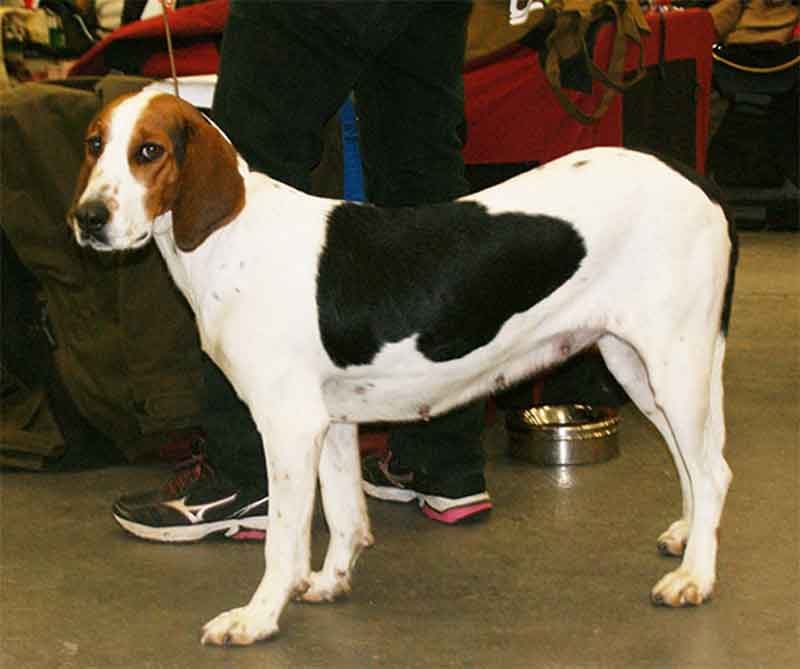
Photo: A female Halden Hound. Colour: tricolor by Canarian, CC BY-SA 4.0, via Wikimedia Commons

Physical characteristics ยซHalden Houndยป

The Halden is similar to the American Foxhound ostensibly, although it is smaller.

It is a dog whose body can fit in a rectangle, proud, strong but not heavy. The head is medium in size, well balanced. The eyes, dark brown, they are medium in size and have a calm expression. The ears, that are neither too high nor too low, they are turned forward and should reach the middle of the muzzle. The tail, that is neither too high nor too low, it is quite thick and is carried low.

  • Fur: rough, very tight and smooth, with thick undercoat.
  • Color: White with black spots, small, less dark spots on the head, limbs and sometimes between black and white. But, black should not dominate.
  • Size: 52 to 60 cm for the male and 50 to 58 cm for female.
  • Weight: 23 to 29 kg for the male and 20 to 25 kg for females.

Character and abilities ยซHalden Houndยป

Kind and caring, the Halden Hound He can make a great companion dog if you take the time to meet his many exercise needs.. It is a nice dog to live, but can be unsociable with children, strangers or even other animals if not well socialized. Very exclusive, he does not like to be surrounded, which makes him a very good watchdog. Excellent hunter, fast and resistant. If you are not hunting, it will be the perfect companion for a sports owner.

Independent in nature, education should start very early to prevent this dog from developing too many bad habits. Firmness and consistency will be required to achieve results, but beware, no violence towards this sensitive dog will be tolerated.

Characteristics "Halden Hound"

Coexistence is important that you have with your new friend. Before considering the acquisition of a dog of the breed "Halden Hound" you know certain factors. Not all breeds of dogs are apt to live in an apartment, you must take into account his character, their need for exercise, their interaction with other pets, their care and if you have small children, their level of tolerance towards them.

Adaptation โ“˜

4,0 of 5 stars (based on 1 review)

friendly dog โ€‹โ€‹โ“˜

4,0 of 5 stars (based on 1 review)

hair loss โ“˜

3,0 of 5 stars (based on 1 review)

Affection level โ“˜

4,0 of 5 stars (based on 1 review)

Need for exercise โ“˜

4,0 of 5 stars (based on 1 review)

Social need โ“˜

3,0 of 5 stars (based on 1 review)

Home โ“˜

3,0 of 5 stars (based on 1 review)

Toilet โ“˜

2,0 of 5 stars (based on 1 review)

Friendly with strangers โ“˜

3,0 of 5 stars (based on 1 review)

barking โ“˜

4,0 of 5 stars (based on 1 review)

Health โ“˜

4,0 of 5 stars (based on 1 review)

Territorial โ“˜

3,0 of 5 stars (based on 1 review)

Cat friendly โ“˜

2,0 of 5 stars (based on 1 review)

Intelligence โ“˜

4,0 of 5 stars (based on 1 review)

Versatility โ“˜

3,0 of 5 stars (based on 1 review)

Child friendly โ“˜

2,0 of 5 stars (based on 1 review)

Surveillance โ“˜

4,0 of 5 stars (based on 1 review)

joy โ“˜

4,0 of 5 stars (based on 1 review)

Videos "Halden Hound"

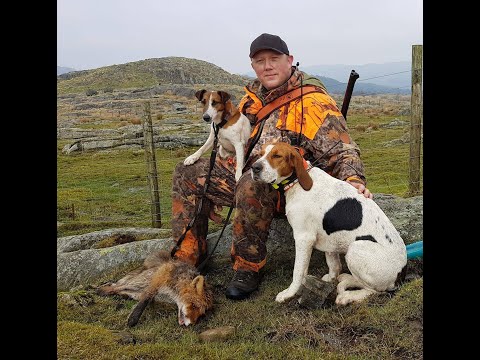
Fox hunting with halden hound and fox terrier in Norway
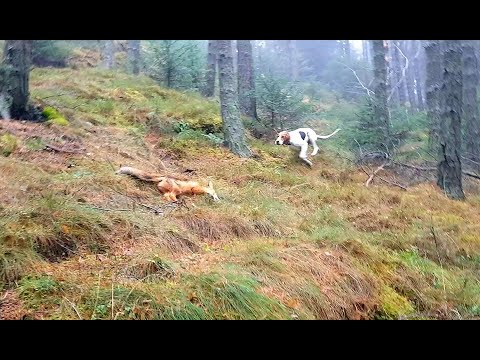
Foxhunting with halden hound and fox terrier 07.11.20

Type and recognitions:

  • FCI CLASSIFICATION:
  • Group :
  • Section : . .

Federations:

  • FCI – Group 6: Scent hounds, and related breeds. – Section 1.2: Medium-sized Hounds. โ“˜

FCI breed standard "Halden Hound"

Origin:
Norway

Date of publication of the valid original standard:
09.08.1999

Use:

---


General appearance:

Rectangular construction, noble, strong, but not heavy.


Behavior / temperament:

---

Head:

Thin, medium sized and well proportioned.

Cranial region:
  • Skull : Seen from the front and from the side slightly dome-shaped. The occipital protuberance is barely noticeable.
  • Depression links (Stop) : Not abrupt.

facial region:

  • Truffle : black, open windows.
  • Snout : Not too short; straight muzzle.
  • Lips : Not very hanging.
  • Jaws/Teeth : Scissor bite; complete denture.
  • Cheeks : Relatively flat.

Eyes : Dark brown in color, medium-sized; calm expression.

Ears : Its insertion is neither too high nor too low; If they are placed forward they should reach up to the middle of the snout.

Neck:

Rather long, strong, thin and without any double chin.

Body:

  • top line : Straight.
  • Back : Strong.
  • Pork loin : Wide and muscular.
  • Rump : Slightly oblique.
  • Breast : Deep with tight ribs, but not barrel-shaped. The last ribs must be particularly well developed.
  • Belly : Very little withdrawn.

Tail:

Insertion neither too high nor too low; rather thick; reaches almost to the hocks. Worn rather low.

Tips

PREVIOUS MEMBERS

  • As a whole : Straight, thin limbs with strong bones.
  • Shoulder : Long and oblique shoulder blade, muscular; the tips do not protrude from the back line.
  • Forearm : Straight and thin.
  • Metacarpus : Slightly inclined.
  • Front feet : Oval, well arched, preferably closed, well covered with hair between the fingers.

LATER MEMBERS

  • Thigh : Broad and muscular.
  • Knee : Well angled.
  • Leg : Long.
  • Hocks : Thin and wide, turned neither in nor out. Well angled.
  • Rear feet : Like the front feet. Rams are allowed, but they are not desirable.

Movement:

Light, parallel, covers the ground well.

Mantle

HAIR : Rough, very dense and straight, with a dense undercoat of hairs.

COLOR : White with black spots, shaded tan patches on head, limbs and sometimes between black and white. Black should not predominate. Small black or tan spots are considered a color defect..


Size and weight:

Height to the cross :

  • For males : 52-60 cm., ideal 56 cm..
  • for females : 50-58 cm., ideal 54 cm..


Fouls:

Any deviation from the aforementioned criteria is considered as a fault and the severity of this is considered to the degree of the deviation to the standard and its consequences on the health and well-being of the dog..

ELIMINATORY FOULS

โ€ข Aggressiveness.

Any dog โ€‹โ€‹showing clear signs of physical or behavioral abnormalities must be disqualified..


N.B.:

Males should have two normal-appearing testicles fully descended into the scrotum..

Source: F.C.I - International Cynological Federation

Alternative names:

1. (Norwegian: Haldenstรธver) (English).
2. Halden (French).
3. Haldenbracke, Haldenlaufhund, Halden-Stรถvare (German).
4. (Norueguรชs: haldenstรธver) (Portuguese).
5. (Noruego: Haldenstรธvare, Haldenstรธver) (espaรฑol).

โ–ท The world of Pets: Dogs, cats, birds, reptiles, amphibians

Hygen Hound
Noruega FCI 266 - Medium-sized Hounds

Hygen Hound

The spread of Hygen Hound it is very limited even in Norway; outside the country it is practically unknown.

Content

History

The Hygen Hound originated in Norway in the 19th century. It owes its name to its creator Hans Fredrik Hygen, that he wanted a brave and robust dog that could hunt even in the harsh climates of the north. So he decided to cross Swiss and German dogs with local dogs. The Hygen Hound has had a rocky history as the breed all but disappeared in the 1990s 1970 without the intervention of a few passionate breeders. In the Decade of 2000, these breeders made genetic improvements by crossing with the Finnish Hound. Today, the Hygen Hound it is quite rare even in his homeland.

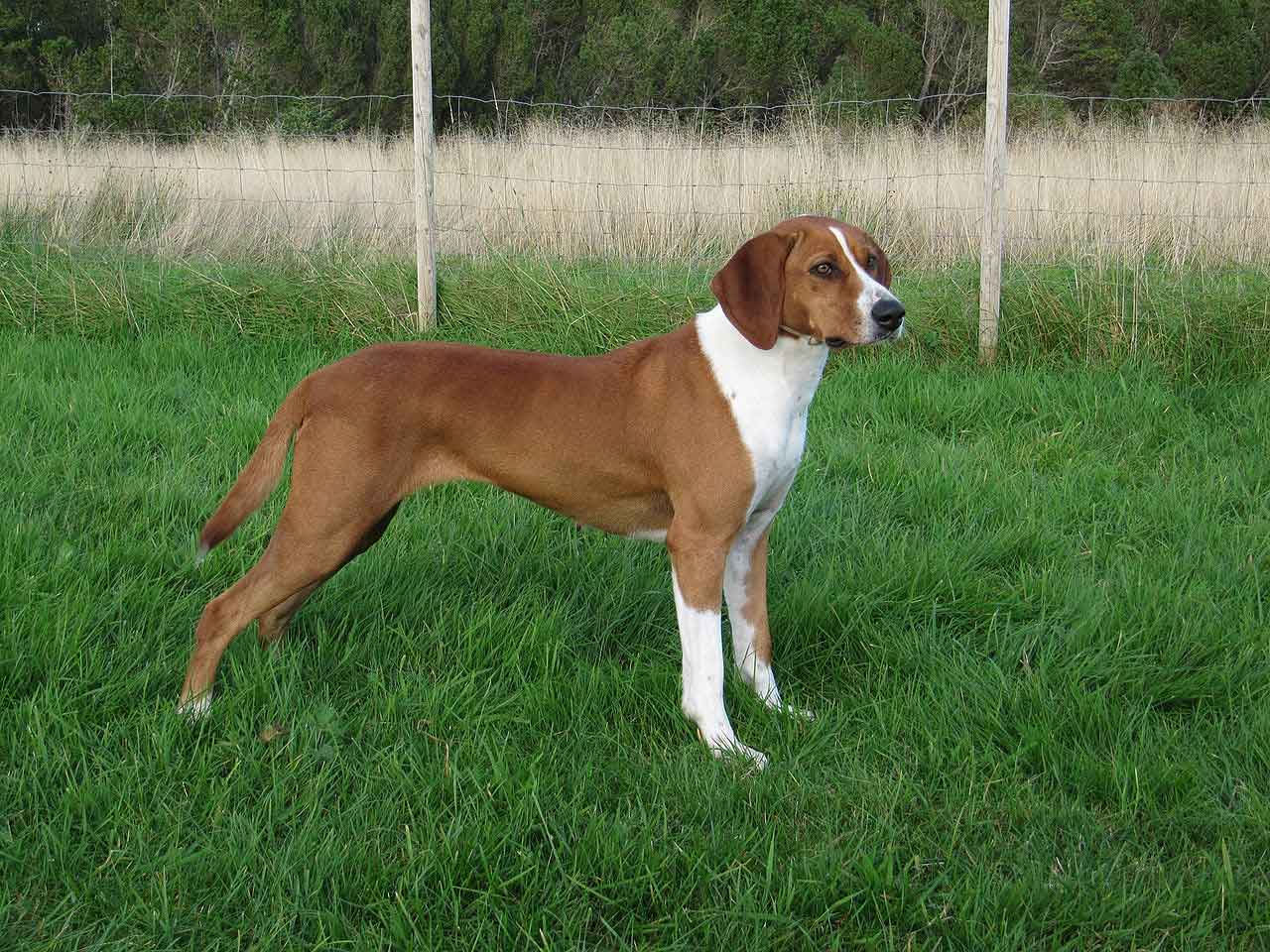
Photo: Norwegian dog breed hygenhound. Tosstjรธnna’s Nala by Bjรธrn Konestabo, CC BY-SA 3.0, via Wikimedia Commons

Physical characteristics ยซHygen Houndยป

The Hygen Hound has a robust and solid gait and a body inscribed in a triangle. Medium-sized, measured between 50 and 58 cm if it is a male and between 47 and 55 cm if it is a female for a weight of about 22 kg according to sex, size and age.

The Hygen, as it is also nicknamed, stands out for its head of average length and size, that is wedge-shaped and marked width without being excessively heavy. The skull is slightly domed and the stop is accentuated. The eyes express both calm and seriousness. They are medium in size and show dark brown tones. The ears are of medium length and width, taper at the tips and set at a medium height. Fall while spreading and do not stick to the cheeks.

The Hygen Hound they have rough fur, straight, short, bright and dense. The coat is available in three colors: white with yellow-red markings / brown or black and tan, black and tan with white markings or red-yellow or red-brown with or without white markings and charcoal on the back, head and tail attachment.

Character and abilities ยซHygen Houndยป

The Hygen Hound It is a race linked to its social group that is both protective, Gentile, balanced and versatile. Although they specialize in hunting activities, nothing prevents them from being adopted as pets, as long as the exercise is given, the necessary care and education. The worst tolerated punishment is inactivity. He also does not like to be alone despite his slightly independent nature.. To be happy, prefers open spaces over closed ones.

Characteristics "Hygen Hound"

Coexistence is important that you have with your new friend. Before considering the acquisition of a dog of the breed "Hygen Hound" you know certain factors. Not all breeds of dogs are apt to live in an apartment, you must take into account his character, their need for exercise, their interaction with other pets, their care and if you have small children, their level of tolerance towards them.

Adaptation โ“˜

4,0 of 5 stars (based on 1 review)

friendly dog โ€‹โ€‹โ“˜

4,0 of 5 stars (based on 1 review)

hair loss โ“˜

5,0 of 5 stars (based on 1 review)

Affection level โ“˜

4,0 of 5 stars (based on 1 review)

Need for exercise โ“˜

5,0 of 5 stars (based on 1 review)

Social need โ“˜

3,0 of 5 stars (based on 1 review)

Home โ“˜

4,0 of 5 stars (based on 1 review)

Toilet โ“˜

2,0 of 5 stars (based on 1 review)

Friendly with strangers โ“˜

4,0 of 5 stars (based on 1 review)

barking โ“˜

5,0 of 5 stars (based on 1 review)

Health โ“˜

5,0 of 5 stars (based on 1 review)

Territorial โ“˜

3,0 of 5 stars (based on 1 review)

Cat friendly โ“˜

2,0 of 5 stars (based on 1 review)

Intelligence โ“˜

4,0 of 5 stars (based on 1 review)

Versatility โ“˜

3,0 of 5 stars (based on 1 review)

Child friendly โ“˜

5,0 of 5 stars (based on 1 review)

Surveillance โ“˜

3,0 of 5 stars (based on 1 review)

joy โ“˜

5,0 of 5 stars (based on 1 review)

Videos "Hygen Hound"

Training Milli 130118
Video Credits: Rolf Hestetreet
Hygenhund Dog breed
Hygenhund Dog breed

Type and recognitions:

  • FCI CLASSIFICATION:
  • Group :
  • Section : . .

Federations:

  • FCI – Group 6: Scent hounds, and related breeds. – Section 1.2: Medium-sized Hounds. โ“˜

    • FCI breed standard "Hygen Hound"

      Origin:
      Norway

      Date of publication of the valid original standard:
      09.08.1999.

      Use:

      Hound


      General appearance:

      Medium-sized, solid and compact, rectangular, with firm top line.


      Behavior / temperament:

      ---

      Head:

      Medium in size and moderately wide, but not heavy. Of a medium length, something wedge shaped, but not pointy.

      Cranial region:
      • Skull: Slightly domed, be seen from the front or from the side. The occipital bone is barely visible.
      • Depression links (Stop): Marked.

      facial region:

      Truffle: black.
      Snout: Cleansed, wide and deep, rather short than long. Straight nose cane. Side view, the front of the muzzle should be rounded, not square.
      Lips: Clean, no pendulosos, falling evenly towards the corner of the lips.
      Jaws / Teeth: Scissor bite.
      Cheeks: Clean and flattened.
      Eyes: Dark brown in color, medium-sized, not bulging. Serious and calm expression. The conjunctiva is not visible.
      Ears: Middle insert, neither wide nor long, thinning and rounded at its tip. Thin and smooth, are not glued to the cheeks, but they are somewhat separate. They are directed forward, do not reach more than half the distance to the truffle.

      Neck:

      Of average length, strong, without too much loose skin.

      Body:

      Back: Straight and strong.
      Pork loin: Strong and muscular.
      Rump: Long, wide and slightly rounded.
      Breast : Medium width, long, deep and spacious throughout its length. The last ribs must be particularly well developed, giving the thorax an appearance of length. The depth of the chest corresponds to half the height at the withers.
      Belly: Very little withdrawn.

      Tail:

      When inserted it follows the line of the back. Strong at its roots, thinning towards the limb. It is worn straight or slightly bent up; reaches up to the hocks.

      Tips

      PREVIOUS MEMBERS
       
      As a whole: Clean, solid and tendinous, but not heavy.
      Shoulder: Oblique shoulder blades, well angulated shoulder joint.
      Elbows: Well angled.
      Metacarpus: Widths, rather short than long, slightly inclined.
      Front feet: High; fingers well arched and close together, directed forward. Firm and strong pads. Between fingers and pads well covered with hair.
       
      LATER MEMBERS
       
      Thigh: Wide and muscular.
      Knee: Well angled.
      Leg: Long.
      Hock: Well angled, wide and clean.
      Metatarsus: Short, wide and slightly oblique.
      Rear feet: As the front. Rams are allowed, but double dewclaws are undesirable.

      Movement:

      Libre, parallel viewed from the front or back, with good scope. In movement the rear members are not closed in the shape of a cow and the front members do not execute a lateral-circular movement..

      Mantle

      HAIR: Straight and preferably rather rough to the touch, dense, bright and not too short. The back of the thighs and the tail may have a little more abundant hair, but without exaggeration.
       
      COLOR:
      • Red-brown or yellow-reddish, often shaded black on the head, the back and at the root of the tail, with or without white spots.
      • black and tan, usually combined with white spots.
      • White and mottled with reddish-brown or yellow-reddish spots, or with black and tan spots.
      • All these different colors must be clearly delineated from each other.


      Size and weight:

      Height to the cross:

      • For males : 50-58 cm., ideal height 54 cm..
      • for females : 47-55 cm., ideal height 51 cm..


      Fouls:

      Any deviation from the aforementioned criteria is considered as a fault and the severity of this is considered to the degree of the deviation to the standard and its consequences on the health and well-being of the dog..
       
      ELIMINATING FAULT
      • Aggressiveness.
      Any dog โ€‹โ€‹showing clear signs of physical or behavioral abnormalities must be disqualified..


      N.B.:

      Males should have two normal-appearing testicles fully descended into the scrotum..

      Source: F.C.I - International Cynological Federation

      Alternative names:

      1. Hygenhund (English).
      2. Hygen (French).
      3. Hygenbracke, Hygenlaufhund, Hygenhund (German).
      4. (Em sueco: hygenhund) (Portuguese).
      5. (En sueco: hygenhund) (espaรฑol).

โ–ท The world of Pets: Dogs, cats, birds, reptiles, amphibians

Hanoverian Scenthound
Germany FCI 213 . Leash (scent) Hounds

Hanoverian Scenthound

The Hanoverian Scenthound He is a dog with a very good sense of smell, specialized in locating injured prey.

Content

History

The Hanoverian Scenthound it is a medium sized hunting dog.

He is a highly developed specialist, but at the same time versatile in hunting. Tracking is the supreme discipline of a hunting dog, that the Hanoverian Scenthound dominates like no other. In the crawl, keep track of the animals injured in a hunt. A fast and infallible work of the dog is decisive to reduce the suffering of the injured animal. This task is old, but no less relevant today.

The Hanoverian Scenthound dates back to archaic dog breeds. Bloodhounds are also called "Bracken". For hunting, which was an important way of life for our ancestors for thousands of years, dogs with a particularly good sense of smell and an intelligent sense of detection were of elementary importance. The scent dogs were also indispensable to hunt criminals. Before the introduction of firearms, hunters had to stalk the game much closer. This is what guide dogs were for.. From them arose the hounds of today. This type of dog is probably over 10.000 years. For the Teutons, a good "track dog" was worth more than a horse.. This is attested by a legal text of more than 1000 years of antiguaty, el Lex Baiuwariorum. In the baroque era, the rich princes directed the so-called hunting courts. This was a kind of college for hunting with a practical orientation. One of the first was the "Hanover Hound". Here these hounds were systematically bred and trained from 1657.

Breeding according to today's standards began in Erfurt in 1894 with the founding of the Hirschmann club, who is still very successful with this breed today. Their breeding has been organized in an extremely responsible manner since time immemorial.. So, it is possible to reliably breed vital and healthy dogs with great temperaments and excellent performance even today.

The Hanoverian Scenthound is a hunting dog, but also a good family dog รขโ‚ฌโ€นรขโ‚ฌโ€นand companion in everyday life. It has to be. His controller has to be ready to act with him at any time, for example, if there has been a traffic accident and it is necessary to find an injured deer or wild boar. You don't have to be a hunter or a ranger to get a puppy from a Hirschmann club breeder, but you do have to be a member of this club and do a training course for trainers of the Hanoverian Scenthound. Among 40 and 60 puppies are bred every year under the umbrella of the German Kennel Federation – VDH.

Photo: Hanover Hound by TobiasHR, CC BY-SA 4.0, via Wikimedia Commons

Physical characteristics

The Hanoverian Scenthound it is a strong dog of medium size. By the size of her body, tends to have short legs, as this is advantageous when you must do your nose job close to the ground. Males are larger and heavier than females. Males must have a height at the withers of 50 to 55 centimeters with a weight of 30 to 40 kg. Bitches must have a height at the withers of 48 to 53 centimeters and a weight of 25 to 35 kg. The official standard describes their appearance this way:

The overall look of the powerful Hanoverian Scenthound is that of a medium-sized dog, well proportioned and powerful. Well-positioned and heavily muscled front and rear limbs allow you to work with resistance. Legs too high, especially an oversized right, they impede work with a deep nose and are out of character. The wide and deep chest provides plenty of room for the lungs and allows for long and grueling chases. The slightly wrinkled forehead and the light and dark eye give the Hanoverian Scenthound his typical serious facial expression.

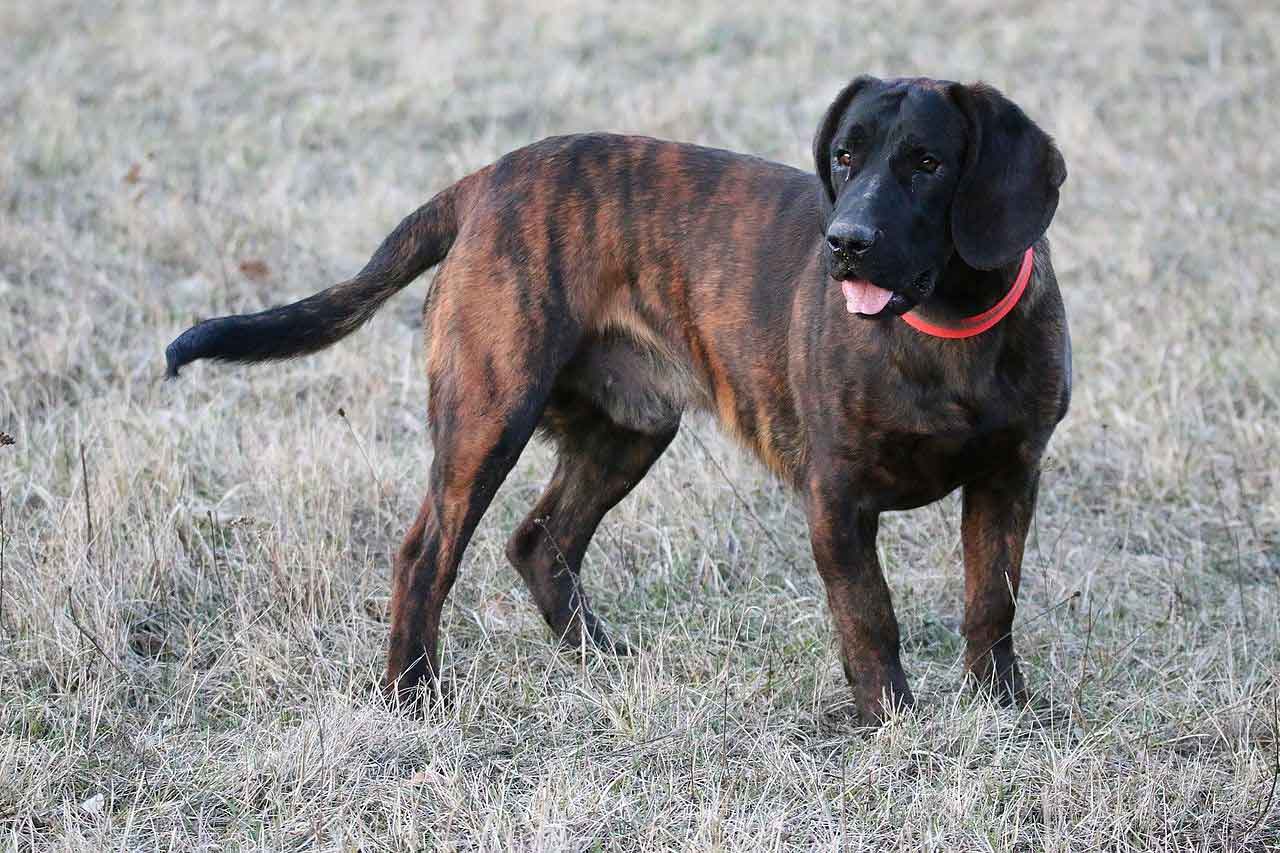
The ears are of medium length and, held high on the head, falls. Its pelage is short, dense, thick. Typical of the breed is the basic reddish color, which can range from light pale red to dark brindle, almost black.

Character and skills

The Hanoverian Scenthound is a thoroughbred hunting dog with alert senses, but without any kind of nervousness. As long as you don't have a smell in your nose, impresses with a thoughtful nature, quiet and extremely gentle, that for us humans radiates pure slowdown. On the way he shows his passion and follows her with loud barks. The FCI standard describes its nature as follows:

Quiet and safe nature, but sensitive towards its controller. Selective and reserved with strangers. High concentration capacity in hunting tracking work with a pronounced herd relationship to the main hunter.

The Hanoverian Scenthound he is a very efficient working dog, who fulfills his tasks conscientiously and with the greatest commitment. Exploring nature together with him and his higher senses is a very special experience and happiness. Its balanced nature, even sovereign, his social qualities and human kindness make him an excellent family dog.

Fitness

One Hanoverian Scenthound it is not a companion dog for the city. Not an apartment dog, but a passionate hunting assistant who wants and needs the job. Otherwise, his attitude is completely undemanding. Ideally, they should live with their humans in a house on the edge of the woods or in the country with a garden.. This already results from your task, which must also be that of your caregiver: the search.

The hunting dog team, composed of the dog and the handler, be prepared at all times to search for injured game animals on behalf of the local hunting community, either after a hunt or a traffic accident. This task should also be shared by the whole family.. The challenges are great in all aspects: all kinds of weather, day or night, crawl hard through dense terrain and open terrain, safely in search of an injured and perhaps aggressive animal, think of the boar. The hound must be able to be directed by its handler at all times. These are challenges that are unmatched in dog sports.. In everyday life he is sociable and discreet. You can do everything with it.

Education

The Hanoverian Scenthound is a deeply friendly and eager to learn four-legged friend, that makes it easier for your trainer to train and educate you, as well as working with him. You want and need this guide. But it is not a dog that waits for orders from its keeper. You can't teach him, but you can train him excellently based on positive reinforcement and deep emotional confidence.

As dogs have only been allowed to breed for many generations if they have mastered many demanding behavioral tests, its performance level is extremely high. This is at the same time a commitment to the management of this dog.

Care and health

The Hanoverian Scenthound does not require any special care.

Brushing the dog's coat weekly is enough to get rid of the various debris collected during the walk or hunting and to remove dead hairs.

But, it is recommended to regularly inspect your ears. In fact, as in any breed of dog with floppy ears, have an increased risk of otitis. Earwax and accumulated bacteria can cause such infections..

To protect you from dental problems, the dog's teeth should be brushed regularly. Ideally, this should be at least two or three times a week.

It also, when you return from long walks with your dog or hunting, it is a good idea to check the parts of your body that may be damaged, especially the legs, tail and ears.

You should also regularly check for parasites and make sure your dog receives proper pest control treatment..

Finally, the dog's nails should be trimmed if they are too long. This is particularly necessary if the dog does not regularly walk on very hard surfaces such as concrete..

Typical diseases of the breed:

Although the Hanoverian Scenthound does not have a congenital predisposition to any particular pathology, is particularly prone to ear infections in dogs. To prevent these infections, it is advisable to inspect the dog's ears regularly.

It can also be sensitive to anesthetics and pose entropion risks (the edge of the eyelid is turned inward, which makes the eyelashes and skin rub against the eye) the ectropion (the eyelid is turned out, exposing the conjunctiva and possibly causing eye infections).

It also presents a risk of obesity for the dog, if you are overfed and / or lead a too sedentary life.

It also, the main risks to which it is exposed as a hunting dog are insect bites or stings (of vipers, for example), as well as heat stroke. To avoid this, it is better to avoid hunting in the hottest hours of the day.

Finally, you also run the risk of being injured by hunting (wild pig, deer…). This risk is particularly important for the Hanoverian Scenthound, who is very stubborn at work and never gives up, even when he's hurt.

Nutrition / Food

The Hanoverian Scenthound It is a resistant dog that is not difficult to feed. Quality industrial dog food is ideal for him, ideally divided into two meals a day.

If you hunt, the dog's diet must be adapted to this activity and its seasonality: one month before opening, it may be necessary to make your dog lose weight if he has gained too much weight during winter. This can be done by reducing your portions or by giving you a lower calorie diet..

On the other hand, once hunting season begins, the dietary and energy needs of the dog are increased by its high physical activity, and it is necessary, on the other hand, or increase servings by 10 to 20% or give him a richer diet.

It also, it is preferable to divide meals during a hunting day: a small amount of food should be given before departure, and then another at noon, to prevent syncope due to hypoglycemia. This ration is preferably warm and humid so that it digests it faster, so as not to overwhelm you before intense exercise, that could make him sick (vomiting…). The largest portion is given at night.

Life expectancy

This breed of dog has a life expectancy of about 12 years.

Buy a โ€œHanover Trackerโ€

If you are interested in a Hanoverian Scenthound, you must contact him Club Hirschmann well in advance of your planned purchase. Puppies are only released to members on a set schedule. You should then be able and willing to give this hunting dog species-appropriate living conditions for at least 10 years. A puppy of this breed costs about 850 EUR.

Characteristics "Hanoverian Scenthound"

Coexistence is important that you have with your new friend. Before considering the acquisition of a dog of the breed "Hanoverian Scenthound" you know certain factors. Not all breeds of dogs are apt to live in an apartment, you must take into account his character, their need for exercise, their interaction with other pets, their care and if you have small children, their level of tolerance towards them.

Adaptation โ“˜

3,0 of 5 stars (based on 1 review)

friendly dog โ€‹โ€‹โ“˜

4,0 of 5 stars (based on 1 review)

hair loss โ“˜

2,0 of 5 stars (based on 1 review)

Affection level โ“˜

5,0 of 5 stars (based on 1 review)

Need for exercise โ“˜

5,0 of 5 stars (based on 1 review)

Social need โ“˜

3,0 of 5 stars (based on 1 review)

Home โ“˜

3,0 of 5 stars (based on 1 review)

Toilet โ“˜

2,0 of 5 stars (based on 1 review)

Friendly with strangers โ“˜

2,0 of 5 stars (based on 1 review)

barking โ“˜

3,0 of 5 stars (based on 1 review)

Health โ“˜

5,0 of 5 stars (based on 1 review)

Territorial โ“˜

4,0 of 5 stars (based on 1 review)

Cat friendly โ“˜

2,0 of 5 stars (based on 1 review)

Intelligence โ“˜

4,0 of 5 stars (based on 1 review)

Versatility โ“˜

4,0 of 5 stars (based on 1 review)

Child friendly โ“˜

5,0 of 5 stars (based on 1 review)

Surveillance โ“˜

4,0 of 5 stars (based on 1 review)

joy โ“˜

4,0 of 5 stars (based on 1 review)

Images "Hanoverian Scenthound"

Photos:

1 – Rastreador de Hannover by https://pixabay.com/es/photos/hs-hannoverscher-schweisshund-macho-5226519/
2 – Rastreador de Hannover by https://pixabay.com/es/photos/hannoverscher-schweiรŸhund-perros-5193568/
3 – Rastreador de Hannover by https://pixabay.com/es/photos/terrier-hannoverscher-schweisshund-4453683/
4 – Rastreador de Hannover by https://pixabay.com/es/photos/hannoverscher-schweiรŸhund-perros-5193562/
5 – Rastreador de Hannover by https://pixabay.com/es/photos/hannoverscher-schweiรŸhund-perros-5193559/
6 – Hanoverian Scenthound by Hirschmann Association, CC BY-SA 3.0, via Wikimedia Commons

Videos "Hanoverian Scenthound"

Type and recognitions:

  • FCI CLASSIFICATION:
  • Group :
  • Section : . .

Federations:

  • FCI – Group 6: Scent hounds, and related breeds. – Section 2: Leash (scent) Hounds. โ“˜
  • UKCScenthounds โ“˜

FCI breed standard "Hanoverian Scenthound"

Origin:
Germany

Date of publication of the valid original standard:
09. 06. 1999

Use:

Trail dog. Hound Dog.


General appearance:

The general appearance of the hardy Hannover Hound is that of a medium-sized dog., well proportioned and strong. Well placed front and rear limbs, with strong muscles that enable him for persevering work. Limbs that are too tall and especially an overdeveloped forehead restrict their work of sniffing with their nose on the ground and are atypical.. The deep and wide chest gives the lungs plenty of room and allows for long and demanding jobs. The slightly wrinkled forehead and the transparent dark eyes give the Hanover Hound that serious look on its face, so typical in the. The red base color is also typical for the breed., ranging from a light coloration and can vary to a brindle coloration of shades with dark effects, almost black.

IMPORTANT PROPORTIONS :

โ€ข A . Body Length / Height at the Cross : 1,4 to 1
โ€ข B. Chest Depth / Height at the Cross: 0,5 to 1
โ€ข C. Long of the Nasal Bridge / Head Length: 0,5 to 1


Behavior / temperament:

Calm and confident temperament, sensitive towards its driver and selective and reserved towards strangers. High capacity for concentration in the search work during the hunt with a marked relationship of revolt towards the hunter who conducts it.

Head:

Slightly wrinkled forehead.

Cranial region:
  • Skull : Width, increasing the same back, slightly domed. Slightly developed occipital protuberance, superciliary arch, seen in profile clearly marked.
  • Stop : Strongly marked, in males it is more noticeable.

facial region:

  • Truffle : Wide, usually black, rarely dark brown. Big nose, wide, nostrils wide open. Slightly convex or nearly flat bridge of the nose, in males more convex. Gradually narrowing in the direction of the forehead.
  • Snout : Strong, deep and wide. Well developed for use (approximately 50 % the length of the head).
  • Lips : Widths, hanging and well rounded.
  • Jaws / Teeth : Normally developed jaws, Very strong, right, giving enough space to all teeth. 42 teeth with a scissor or pincer bite.
  • Cheeks : Powerful muscles and very strong.

Eyes : Neither prominent nor sunken, tight eyelids, dark brown irises. Free of ectropion or entropion.

Ears : Long Middle, tall and wide insert, smooth and without twisting. They hang tight to the head, with rounded edge.

Neck:

Long and strong, gradually widening towards the chest, full and loose throat skin, the formation of a slight double chin is allowed.

Body:

  • top line : Long, many times slightly developed.
  • Cross : Normally checked, strong neck insert.
  • Back : Strong.
  • Pork loin : With a slight arch, wide and flexible.
  • Rump : Wide and long, descending slightly towards the tail.
  • Breast : Deep and spacious, deeper than wide.
  • Bottom line and abdomen : On a line that gradually ascends, slightly retracted.

Tail:

High insertion, long and slightly arched. In its insert is strong, gradually tapering to a point.

Tips

PREVIOUS MEMBERS :

  • As a whole : Viewed from the side, the placement is straight and parallel under the body.. Seen from the front, their placement is straight and often close together.. Well proportioned to the body.
  • Shoulder : Flat shoulder blades, strong muscles, placed well oblique.
  • Arm : Long. Elbows : Placed well back and glued.
  • Forearm : Straight, strong muscles.
  • Articulation of the Carpus : Wide, almost right.
  • Metacarpus : Never fully inclined.
  • Previous feet : Strong, round, fingers well arched and together, big rude ear pads, strong nails.

LATER MEMBERS :

  • As a whole : Seen in profile, the placement is forward or slightly back. good angulation. Viewed from the rear right. For a medium-sized dog with longer than height, the relationship with the body is normal..
  • Pelvis : Wide and spacious.
  • Thigh : With strong muscles.
  • Knee : The joint with an angulation of more than 120ยบ.
  • Leg : Straight and dry.
  • Tarsus : Wide and strong
  • Metatarsus: Placed almost vertical to the floor.
  • Hind feet : Rounded, fingers well together.

Movement:

Master all the movements, with strong momentum and elastic and during canter it covers the surface well. The preferred movement during work is the walk and canter.

Mantle

SKIN : Thick, well loose, folds predominantly on the head and sometimes in the throat area. The forehead with folds is typical.

HAIR : Short, thick, hard, rough. In the back of the thigh somewhat longer and thicker. The hair on the tail is bushy, rough and somewhat longer and thicker at the bottom.

COLOR : Light to dark deer red, more or less brindle, with or without mask. Small white spots on the chest are tolerated.


Size and weight:

Height at the Cross :

  • Males: 50 โ€“55 cm.
  • females: 48 โ€“ 53 cm..

Weight:

  • Males: 30 โ€“ 40 Kg.
  • females: 25 โ€“ 35 Kg.


Fouls:

Any deviation from the above mentioned criteria is considered to lack, and the gravity of this refers to the degree of deviation to the standard and its impact on the health and well-being of the dog.

โ€ข Square structure.
โ€ข Fine bone structure.
โ€ข Bite faults: Absence of the first premolars or other teeth, prognathism or inferior.
โ€ข Ectropion, entropion.
โ€ข Turned or small ears.
โ€ข Dog strongly developed at the back.
โ€ข Sunken or steep back.
โ€ข Barrel-shaped chest.
โ€ข Strongly curved or too thin tail.
โ€ข Straight or loose shoulders.
โ€ข Pronounced cow's claw or open claws.
โ€ข Open feet or hare's foot.

MISS PLAYOFFS :

โ€ข Aggressive or fearful dog.
โ€ข The aforementioned fouls that are more pronounced or more marked are eliminatory..

Any dog โ€‹โ€‹showing clear signs of physical or behavioral abnormalities must be disqualified..


N.B.:

Males should have two normal-appearing testicles fully descended into the scrotum..

Source: F.C.I - International Cynological Federation

Alternative names:

1. Hanoverian Hound, Hanoverian Scenthound, Hannover’scher Schweisshund (English).
2. Chien de rouge du Hanovre (French).
3. Hannoversche Schweisshunde (German).
4. (em alemรฃo: hannover’scher schweisshund) (Portuguese).
5. Sabueso de Hannover (espaรฑol).

โ–ท The world of Pets: Dogs, cats, birds, reptiles, amphibians

Hokkaido
Japรณn FCI 261 - Asian Spitz and related breeds
Hokkaido

The Hokkaido still a very rare breed of dog, who is hardly ever seen outside of his home country.

Content

History

This ancient lineage of dogs, known today as Hokkaรฏdo (name of the second Japanese island, largest), It is also known as Kyushu or Ainu dog. According to historical data, its existence dates back to the year 1000 A.C. The offspring of Hokkaido dogs, is uncertain, but some authors believe that they come from the Nordic dogs. The Hokkaido is, probably, the oldest Japanese purebred. Similar to the Scandinavian Spitz in appearance, also has features of the Chow Chow and of the Shar-Pei.

Since its origins it has been used as a guard dog in the Hokkaido Island, and, as well, in hunting bears and other large animals.

In 1937, this breed was recognized as a Natural Heritage of the Japan, by the society for the preservation of Japanese races.

It is also a breed recognized by the FCI.

Rare monument of nature

The Hokkaido It is one of the oldest dog breeds in the Asian world and is part of the cultural heritage of the Japanese island. In 1937 Hokkaido was even declared ยซMonument of NatureยปAnd since then it has been recognized and protected as a race.

Due to the difficult to access regions of the island, Dogs retained their "pure blood" for centuries. Unlike Akita or Shiba Inu, who gave way to Europe long ago, the Hokkaido still a very rare breed of dog, who is hardly ever seen outside of his home country.

Physical characteristics

This is a dog's size medium; its height usually get to the 53 cm in males and the 48 cm in females. Their weight varies between 20 and 30 Kg. Their life expectancy is around the 14 years.

The fur of this species is double: the sub-pelo is dense and soft and external hair is coarse and size medium or short. Its colors vary between fiery red, black and grey.

Character and skills

With regard to his temperament, Whereas it is a hunting and guard dog, we can highlight features such as bravery, impulsivity, agility and speed of movement.

Within the family, is a tame animal, Devoto, with a safe and protective temperament with children if he is accustomed to their presence from an early age. However, tends to be distrustful with strangers, reason why you need a good training and re-education of their less sociable side.
They are very active dogs and it is necessary to provide good rides, long walks, workspace very well to the family but they need space, have a garden where you can be at your leisure.

Hokkaido care

The coat of Hokkaido should be gently brushed regularly (about two or three times a week). You should even use the brush daily during the shedding to remove dead hair from your dog.. It also, Your dog's ears and teeth should be cleaned once or twice a week. To avoid injury, claws should also be trimmed regularly. You will hardly ever need to bathe your Hokkaido: first, He likes to jump to rivers or lakes and "bathe" there, in the second place, it is naturally very clean and thirdly, the skin's own protective barrier should not be attacked by too frequent bathing or even dog shampoo.

Hokkaido Health

In fact, a possible inbreeding in the breeding of Hokkaido in Europe, since due to the rarity of this breed there are very few breeding dogs. So, there is a realistic risk of undesirable hereditary diseases being introduced. A close look at the pedigree is worth it in any case and can perhaps prevent unpleasant surprises.. Apart from the problem of inbreeding, the dogs of Hokkaido They are very robust and resistant to typical dog diseases.. The life expectancy of healthy animals is between 9 and 15 years.

Hokkaido Nutrition

In addition to good genetic material, nutrition also has a decisive influence on the dog's health. Like descendants of the wolf, dogs are carnivores, this also applies to Hokkaido. The original dog especially likes fish. In his homeland., Japan, where it is still traditionally used for fishing and where salmon are caught on their way to spawning grounds with great skill and reaction speed, this preference is not always appreciated – because the Hokkaido first he eats the fish caught by himself and only gives away some of his prey when he is full.

Characteristics "Hokkaido"

Coexistence is important that you have with your new friend. Before considering the acquisition of a dog of the breed "Hokkaido" you know certain factors. Not all breeds of dogs are apt to live in an apartment, you must take into account his character, their need for exercise, their interaction with other pets, their care and if you have small children, their level of tolerance towards them.

Training ?

1,0 of 5 stars (based on 1 review)

Suitability of the apartment ?

1,0 of 5 stars (based on 1 review)

Can be alone all day ?

2,0 of 5 stars (based on 1 review)

Suitable as a first dog ?

1,0 of 5 stars (based on 1 review)

Weight gain ?

4,0 of 5 stars (based on 1 review)

Health ?

4,0 of 5 stars (based on 1 review)

Intelligence ?

4,0 of 5 stars (based on 1 review)

Kindness with child ?

2,0 of 5 stars (based on 1 review)

Tendency to bite ?

3,0 of 5 stars (based on 1 review)

Tendency to bark ?

3,0 of 5 stars (based on 1 review)

Tendency to flee ?

4,0 of 5 stars (based on 1 review)

hair loss strength ?

4,0 of 5 stars (based on 1 review)

Suitable as a guard dog ?

5,0 of 5 stars (based on 1 review)

Joy ?

2,0 of 5 stars (based on 1 review)

Cat friendliness ?

2,0 of 5 stars (based on 1 review)

Power level ?

5,0 of 5 stars (based on 1 review)

Videos "Hokkaido"

HTTPS://youtube.com/watch?v=Z34qpCIZ9YM
15 Things You Should Know About Ainu Dog
HTTPS://youtube.com/watch?v=ZDlVRoYaXKE
Hokkaido Puppy Katana

Type and recognitions:

  • FCI CLASSIFICATION:
  • Group :
  • Section : . .

Federations:

  • FCI – Group 5: Spitz-type dogs and primitive type – Section 5: Asian Spitz and related breeds. โ“˜

FCI breed standard "Hokkaido"

Origin:
Japan

Date of publication of the valid original standard:
16.06.1999

Use:

Hunting dog and company.


General appearance:

medium size dog, well proportioned, strong structure with robust skeleton and well -defined sexual characteristics. The muscles are highly developed and have clear lines.

Important proportion :

โ€ข The relationship between the height of the cross and the length of the body is 10 to 11.
โ€ข The relationship between the skull length and the length of the nasal cane is 3 : 2.
โ€ข The length of the skull corresponds to its width at the height of the cheeks and constitutes a quarter of the height of the cross.


Behavior / temperament:

It has remarkable resistance; His behavior is noble and his spontaneous character. Is faithful temperament, docile, Very much and brave.

Head:

---

Cranial region:
  • Skull and front : Broad and a little flattened.
  • Depression links (Stop) : Unremarkable, but visible.

facial region:

  • Truffle : Black; In white fur dogs, liver truffle is allowed.
  • Snout : Wedge shaped. Straight nose cane.
  • Lips : Very adherent, With black edges.
  • Jaws / Teeth : Powerful scissors bite.
  • Cheeks : Well developed.

Eyes : Relatively small, almost triangular, well separated, dark brown.

Ears : Small, triangular, slightly directed forward and carried vigorously erect.

Neck:

Strong and muscular, without jowl.

Body:

  • Cross : High.
  • Back : Straight and strong.
  • Pork loin : Moderately wide and muscular.
  • Rump : Properly oblique.
  • Breast : Well developed sill. Deep and moderately wide chest. Well arched ribs.
  • Belly : Well withdrawn.

Tail:

High insertion, thick, carried vigorously screwed or folded on the back in the form of a hoz. The tip of the tail must reach almost the corvejones when it is down.

Tips

PREVIOUS MEMBERS :

  • Shoulder : Moderately oblique.
  • Forearm : Straight, well delineated.
  • Metacarpus : Slightly inclined.

LATER MEMBERS : Strong.

  • Warm-tarsal joints : Robust, quite strong.

FEET : Well arched and compact fingers. Thick and elastic pads. hard nails, black or dark.

Movement:

Agile, lively, Light and elastic.

Mantle

HAIR : The outer layer is resistant and straight, the undercoat is soft and dense. In the tail the hair is relatively long and separate.

COLOR : Color sesam (red-tawny hairs with black tips), striped, red, black, Black with fire, white.


Size and weight:

Height to the cross :

  • In males : 48,5 โ€“ 51,5 cm..
  • In females : 45,5 โ€“ 48,5 cm..


Fouls:

Any deviation from the aforementioned criteria is considered as a fault and the severity of this is considered to the degree of the deviation to the standard and its consequences on the health and well-being of the dog..

โ€ข Inverted sexual characteristics.
โ€ข Mild upper or lower prognathism.

MISS PLAYOFFS

โ€ข Aggressive or fearful dog.
โ€ข Pronounced upper or lower prognathism.
โ€ข Ears that do not get erect.
โ€ข Very short or pendant tail.
โ€ข Shyness.

Any dog โ€‹โ€‹showing clear signs of physical or behavioral abnormalities must be disqualified..


N.B.:

Males must have two normal appearance testicles completely descended in the scrotum. The blue-negruzco tongue should not be considered as a lack.

Source: F.C.I - International Cynological Federation

Alternative names:

1. Dล-ken, Ainu-ken, Seta, Ainu dog, Hokkaido-Ken (English).
2. Aรฏnou, Ainu-ken, Hokkaรฏdo-ken (French).
3. Hokkaido-Hund, Ainu-Hund, Ainu Inu, Hokkaido-Ken (German).
4. Hokkaido (cรฃo) (Portuguese).
5. Dล-ken, Ainu-ken, Ainu Dog (espaรฑol).

โ–ท The world of Pets: Dogs, cats, birds, reptiles, amphibians

Hovawart
Alemania FCI 190 - Molossoid . Mountain

Hovawart

The term Hovawart derived from medieval german, in which -hova- meant "cut" and -wart-, "guardian".

Content

History

The dog as guardian of the house and the courtyard has an ancient tradition in the history of humanity. Maybe thousands of years ago, private ownership of the house and yard, goods and workshops could only be established with the help of the protective role of dogs. The four-legged court guards were already highly regarded by the Teutons, which is reflected in the various laws of the last Teutonic. Of the 24 articles of the Law of Baiuvariorum, an entire article is dedicated only to dogs. Here, plus a dozen other dog breeds, the court dog is explicitly mentioned as "Houvavart". The Houvavart was valued at 3 shillings. It was a huge amount, considering that in the same body of law a "mediocre" horse was valued at only half a shilling. The Hovawarts are also mentioned in various writings from the Middle Ages.

The Hovawart Today is in the intellectual and functional tradition of these old court dogs. Regarding their genetic offspring, will not be more or less related to them than the other breeds of guard dogs and native dogs. Building a direct line of descent to the old Hovavart would not be permissible, especially since it is not known at all what these dogs looked like.

After 1910 the Hovawart but without a description of the appearance. Over the years 20 established itself as a breed of dog.

In the FCI breed standard of 1998 It is said that:

"From 1912 the reproduction of this breed has been using similar type dogs that are still in farms to restore the breed. apart from this, at the beginning of the crossing, you cross them with German shepherds, Newfoundland, Leonberger and other races were admitted. In addition to the strict measures taken in the breeders, the type of job was obtained again.โ€

It also, crossed the hungarian watchdog Kuvasz, what is important to understand the nature of Hovawart. After having almost died out, after the first world war, the breed was recovered by the kinophile K. F. Kรถnig. In a span of time, what had been done very successfully thousands of years before was rebuilt here. Like, but mostly of the nature the right dogs were mated. The decisive criterion was performance for the intended purpose, so to speak, the work championship. It is quite possible that the Hovawart current look like the old ones Hovawart of our ancestors by this procedure of appearance and nature, but that is speculation. Only in 1944 breeding book closed. So a vast gene pool was created as the basis for this breed of dog., which is still very useful for your health and fitness today.

Physical characteristics

The Hovawart is a big dog, strong and at the same time quite thin. With the Hovi nowadays three strokes of color are allowed: Rubio, black marks (black with gold brown markings) black and white. Males have a height to the cross of 63 to 70 cm.. Considering its type and size, the Hovawart is thinner than it appears underneath its medium long wavy coat. So, a weight of 30 to 45 kg is considered normal for males. Despite this not so high weight, it is a very powerful and strong dog. Only for its strength and size it belongs to a hand with experience in dogs. The Hovawart he's a working dog, Guard and protection.

Character and skills

The character of Hovawart demands a person with a strong dog mind. He has a strong will, a head of its own and is very independent. Probably an heir to the pack guard dog, Kuvasz, who is one of his ancestors. He is self-assured and self-assured at the same time. The โ€œdesire to pleaseโ€ is not as strong in him as in many other working dog breeds.. Your master or caretaker still has to work and earn it. then a Hovawart well educated he is an extremely efficient off-roader and a lovely friend. Master the role of companion dog suitable for everyday life, as well as your challenges in dog sports or even as a rescue and tracking dog. He has a very good nose. Yes, and the Hovawart it is also an excellent watchdog and protection dog.

He is a defensive protector of his family and diligently protects his territory. He moves silently on the ground and faces an intruder suddenly but persistently. With built-in yard dog, the Hovawart not fully occupied, especially since today you have to monitor hardly a large enough area. He is intelligent and seeks true association with his caregiver. At the same time it is affectionate and sensitive and at the same time it radiates something primitive, archaic.

Wants and seeks connection with family. Like a well-behaved and demanded working dog, the Hovawart it is also an excellent family dog. Often rejoices with petting and hitting like a little lapdog. He is very friendly and gentle with the people he has taken to his heart. Once you meet them, will never forget them. When he is young he shows his affection sometimes very stormy.

The Hovawart it is a low maintenance dog. Apart from the change of coat, it does not need to be brushed every day., because her coat doesn't tend to tangle due to the small amount of undercoat. Well educated and managed he is an excellent companion. But, cannot be recommended as a family dog รขโ‚ฌโ€นรขโ‚ฌโ€นwithout further ado. If you are thinking of having a puppy Hovawart for the first time, must first consider practical challenges, they are only related to their strength and size. Not a beginner dog.

Hovawart Education

The Hovawart develops creativity and perseverance to realize his ideas about the world and its order. Here the owner of the dog is challenged with all the consequences, but paired with patience and empathy. And this already with the puppy. Hardness alone does not help the Hovawart at all. It is important to create and maintain trust, that the Hovawart wants to show his pack leader. By the way, pack leader: One Hovawart usually test thoroughly, who will take this position. Here its owner must assert himself with the consequent insouciance, then he will follow faithfully and with good behavior and accept the leadership of his humans without problems.

One must bring with him time and knowledge for an intensive education and, the best of all, training. If one loses the basic elements of education, you will hardly be able to go for a walk with him without stress. Then your self-confidence could even become a leadership statement.. Otherwise, the Hovawart it's the ideal companion dog image. He wants his humans to guide him, but without ever being submissive. The Hovawart maintains its own head and its own will. For some people this is perhaps too much of their own personality. But only this profile of the Hovawart can be an excellent basis for a respectful and intense human-dog relationship.

Hovawart Health and Care

The Hovawart it is a low maintenance dog. Except in times of coat change, twice a year, needs to be brushed regularly but not every day, because his coat does not tend to tangle due to the low amount of undercoat.

The Hovawart it is considered a completely healthy breed. Hereditary diseases are systematically fought, such as knee joint cartilage disease (OCD), which is more common in Hovawarts. Dysplasia of the hip joint (HD) "often a problem especially with large dogs" has been under control for a long time.

Nutrition / Food

The Hovawart they don't make any special demands. He is consistently straightforward. For a dog of its size and strength it needs little food.

Hovawart life expectancy

The Hovawarts can reach 12 years and not rarely even more with a good physical condition. It is a good life expectancy for such a large dog.

Buy a Hovawart

Puppies should only be purchased from an FCI registered breeder. For a puppy you should plan to 800 to 1000 EUR. The adult dogs of Hovawart they can also be taken out of shelter or emergency aid and offered a loving home..

Images "Hovawart"

Photos:

1 – Hovawart by https://pixabay.com/es/photos/hovawart-perro-perro-de-raza-pura-2611448/
2 – Hovawart black and tan by Faigl.ladislav / CC BY-SA
3 – Hovawart by https://pixabay.com/es/photos/perro-hovawart-negro-marrรณn-1194081/
4 – The three permitted colours of the Hovawart by Oxborrow / Public domain
5 – Blond Hovawart female (10 months) by Faigl.ladislav / CC BY-SA
6 – Hovawart by https://www.pxfuel.com/es/free-photo-xxpba

Videos "Hovawart"

Type and recognitions:

  • FCI CLASSIFICATION:
  • Group :
  • Section : . .

Federations:

  • FCI – Pinscher and Schnauzer-Molossoid type dogs – Swiss Mountain Dogs and Cattledogs. Section 2.2 Molossoid, mountain type. โ“˜
  • AKC – FSS โ“˜
  • CKC – Group 3 – Working dogs โ“˜
  • โ€‹KC – Working dogs โ“˜
  • UKC – Watchdog โ“˜

FCI breed standard "Hovawart"

Origin:
Germany

Date of publication of the valid original standard:
12.01.1998

Use:

Utility dog


General appearance:

It's a working dog, powerful, medium-sized, slightly elongated and long-haired. The difference between the sexes is clearly recognizable, especially in the head shape and body structure.


PROPIMPORTANT ORTIONSS: The length of the body comprises at least one 110 yet 115% the height at the withers.


Behavior / temperament:

It is a recognized versatile working dog, friendly and balanced disposition. Has protective instincts, He has a lot of self-confidence and has the ability to withstand stress.; is of medium temperament, combined with an excellent sense of smell. The proportions of his balanced body and special devotion to his family make him an excellent companion., guardian, defender, savior and tracker.

Head:

The nasal cavity is straight and parallel to the skull. The muzzle and skull are approximately the same length. The skin of the head is tight.

Cranial region:
  • Craging: The powerful head has a broad, rounded forehead.
  • Depression links (Stop): Well visible.

facial region:

  • Trufa: The nostrils are well developed. In black and black dogs with fire the pigmentation is black; in blond dogs the pigmentation is black, although the ยซ snow nose ยป is allowed (loss of temporary pigmentation).
  • Horcico: Strong, Slimming down slightly when viewed from above and in profile.
  • Belves: Tight.
  • Jaws / Teeth: Strong scissor bite complete with 42 teeth, according to the teething formula. The teeth are at right angles to the jaw. Caliper bite is accepted.
  • Ojors: Oval, nor protruding, or sunk. Dark to medium brown color. Tight eyelids.
  • Obars: Triangles and falls; loose along the cheeks; tall and widely spaced, giving the optical illusion of skull widening. They reach in length at least the lip corners; the tip is slightly rounded. When the dog is at rest it keeps them hanging; when the dog is on alert carry them by directing them slightly towards the forehead. Its front edges are located approximately half the distance between the eye and the muzzle..

Neck:

Strong, long Middle. The skin is tight.

Body:

  • Espalda: Straight and firm.
  • Itmor: Strong, somewhat longer than the rump.
  • Rump: Medium long, leaning slightly.
  • Breast : Width, deep and strong.

Tail:

With abundant hair, reaching below the hocks, but not even to the ground. depending on the mood, worn high above the back or low.

Tips

PREVIOUS MEMBERS: Strong, straight and vertical, viewed from the front and from the sides.

  • Hormbros: Very well muscled. The scapula is long and well oblique to the back.
  • Brazo: Long, well glued to the body.
  • Elbows: Glued to the chest.
  • Articulation of the carpus: Strong.
  • Metacarpus: Moderately inclined.

LATER MEMBERS: Strong and, seen from the back, vertical. Well angled.

  • Thighs and legs: Very well muscled.
  • Hock: Strong, descended.
  • PIIS: Rounded, strong and compact. Fingers are arched and together. Dewclaws must be removed except in those countries where it is prohibited by law.. Nails on black dogs with fire and black should have black pigmentation; in blonde dogs less pigmentation is allowed.

Movement:

In all walks, the hovawart movement, seen from the front or from behind, It's in a straight line, covering the ground well. The trot is very extended, with a powerful boost from the hindquarters.

Mantle

PIEL: In total, the skin is well glued. In black and tan or black dogs the skin presents a bluish glimpse, in blonde dogs generally a pink glimpse.


Plink: Long, strong hair is slightly wavy and glued; the inner layer of hair is poorly developed. The hair is longer on the chest, in the womb, on the tail and on the backs of the forelimbs and thighs. It is short on the head and in the anterior region of the front and rear limbs. The pelage is dense.


Colorr: There are three varieties of color: Black fire, black and blond.

  • Negro with fire: The coat is black and shiny, the color of the fire marks is medium blonde. In the head, the markings start below the nose and extend around the lip commissure to the marks on the gargant. Dot-shaped markings above the eyes are clearly visible.. The chest marks consist of two adjacent patches that can be attached. On the forelimbs, the marks seen from the side, extend from the fingers approximately to the metacarpus, Thinning at the back at the elbow level. In the hind, the marks, side view, they look under the hock in the form of a broadband, above the hock in the form of a narrow band extending from the front of the hindquarters to the height of the belly. A mark is also presented below the tail insert. Brands are well defined everywhere. Small white spots on the chest, as well as some white hairs on the fingers and on the tip of the tail are allowed. Pigmentation of the eyelids, lips and pads must be black.
  • Negro: The coat is shiny black A few small white spots on the chest, as well as some white hairs on the fingers and on the tip of the tail are allowed. Pigmentation of the eyelids, lips and pads must be black.
  • Rubinor: The coat is medium blonde, shiny and becomes lighter towards the belly and limbs Small white spots on the chest, as well as some white hairs on the fingers and on the tip of the tail are allowed. Pigmentation of the eyelids, lips and pads must be black.


Size and weight:

  • Males: of 63 to 70 cm.,
  • females: of 58 to 65 cm.


Fouls:

Any deviation from the aforementioned criteria is considered as a fault and the severity of this is considered to the degree of the deviation to the standard and its consequences on the health and well-being of the dog..


FALTAS DESCALIFICANTES:

  • Aggressiveness or extreme shyness.
  • Any dog โ€‹โ€‹showing clear signs of physical or behavioral abnormalities must be disqualified..

Apgeneral arience

  • Dogs that do not correspond to the general type of the breed
  • Females with male appearance.
  • Males with female appearance

Pbearings

  • Body proportions very different from those indicated in the standard

Comportamiento / Temperament

  • Aggressive dogs, fearful, apathetic, afraid of the shot.

Cthey are not coming

  • Absence of naso-frontal depression (Stop).
  • Blue eyes, gazeo eyes
  • Erect ears, semi-erected, rose-shaped or separated from the cheeks
  • Upper or lower prognathism, incisor arcade deviated.
  • Absence of more than 2 of the four PM1 (premolars 1) or of the two M3 (molars 3); absence of any other teeth.

CUit

  • Presence of a marked double chin or a lot of loose skin.

CUerpo

  • Back very beaten or pronounced carp.
  • Narrow or barrel-shaped chest.
  • Abnormal glue, heavily cropped or heavily coiled.

Formertremedies

  • Hindquarters too high.

Plink

  • Mostly curly hair (ring shaped curls)

Colorr

En set:

  • All non-standard colors, blue/grey, ciervuno, brown, white, spotted, smutty blonde or with mostly streaked hair
  • White patches White hairs on the inside of the thigh is not an elimination foul.

Perros black and fire

  • Gray or brown patches outside the spots.
  • Undercoat of hairs mostly a color other than black.
  • Predominant gray or white spots.

Pblack mistakes

  • Brown or gray patches
  • Undercoat of hairs mostly a color other than black.

Pblond mistakes

  • Some white hairs on the bridge of the nose do not constitute an eliminatory foul.
  • Continuous reddish-blond color without becoming slightly lighter.
  • Blonde-off-white color, even in the ears.
  • Distinctively white markings.
  • Dark patches or mask

Tby hand

  • Size smaller than that indicated in the standard
  • Size greater than 3 cm of that indicated in the standard


N.B.:
  • Males should have two normal-appearing testicles fully descended into the scrotum..
  • Only functionally and clinically healthy dogs, with the typical conformation of the breed, should be used for parenting.

Itlatest changes are in bold.

TRANSLATION: Mauricio Martinez, Federation Canรณfila Mexicana, A.C.; y Dr. J-M Paschoud.

Source: F.C.I - International Cynological Federation

Alternative names:

1. Hovie (English).
2. Hovawart (French).
3. Hovawart (German).
4. Hovawart (Portuguese).
5. Hovie (espaรฑol).

โ–ท The world of Pets: Dogs, cats, birds, reptiles, amphibians

Huntaway
Nueva Zelanda Not recognized by the FCI

Content

History

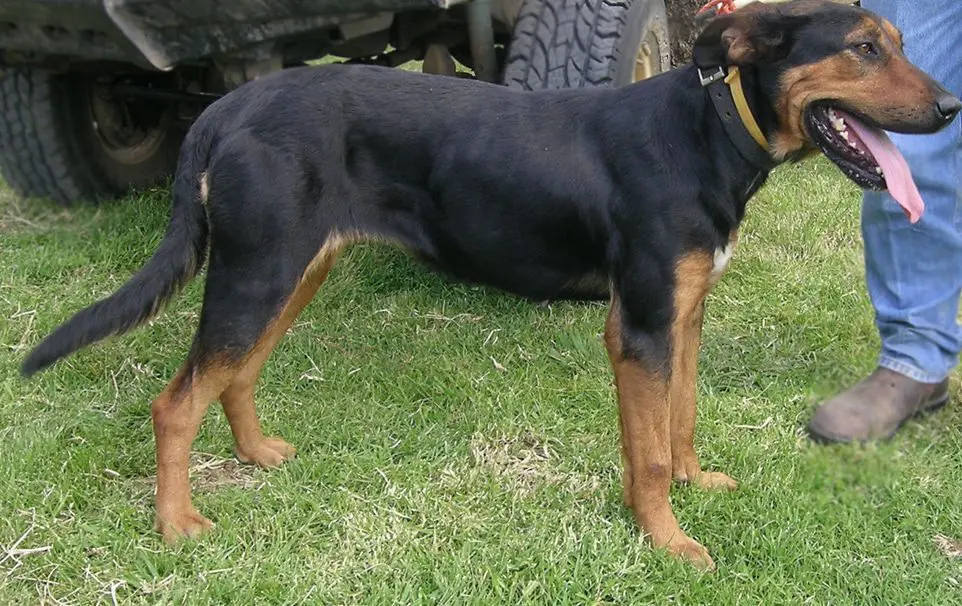
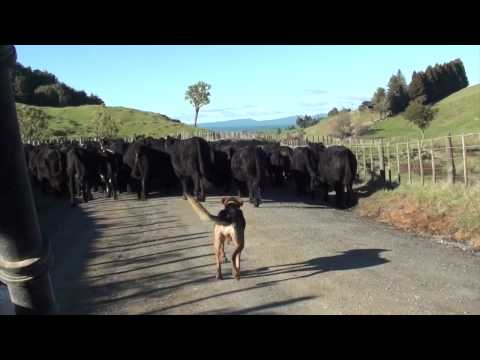
Huntaway (New Zealand Huntaway or New Zealand Sheepdog) It is a breed of dog native of New Zealand What, Since its early inception, they were used to drive vast herds of sheep using their strong and deep bark. The breed is relatively new, its existence dates back to the Decade of 1900.

Although it is currently widely considered a separate breed within working dogs and has not yet been recognized by any kennel club.

The true story of the origin of the breed Huntaway, also known as New Zealand Sheepdog, not exactly known but yes, there are many theories that sheds light on it.

The Huntaway It was used (and uses) in all New Zealand to lead and manage the massive flocks of sheep. Currently, These dogs are considered part of the heritage of New Zealand, although they are not recognized as a breed by any kennel club.

The sheep were introduced in New Zealand, because the humid and temperate climate made it a favorable place for the development of this cattle. The climatic characteristics mean that rainfall extends throughout the year and that these large flocks of sheep have rich pastures always available to feed on..

Before he Huntaway get fame, small herds were managed by dogs Collie that had been introduced into the national territory. As time passed, the herds grew to massive proportions and it was then, when the dogs Collie they were not able to cope with such development.

many things came together, the long hair of the Collie, the hot and humid climate, their silent work that as the herds grew became ineffective… Because, the passage of time and livestock development demonstrated that these dogs are tired at high speed, they lacked resistance and their silent way of working meant that the shepherd did not know where his dogs were. Yโ€ฆ, chaos was born.

The farmer often (given the size of herds) could be found almost a kilometer away from (on the other side of the herd), years. At that time, what I needed was a dog of short hair that is adapted to the climate without difficulty, with resistance and that could be heard at great distances. From these needs arose the birth of the Huntaway.

Some studies of dog breeds maintain that the early introduction of the Collie and other races, led ranchers to start breeding programs, in order to create a dog with the qualities needed to work with massive flocks. They think that within the crosses have been present races as the Beauceron, the Bloodhound, the German Shepherd, the Labrador Retriever and the Rottweiler, but this is only a conjecture. The race Huntaway exists only ago 100 years… and it has not delved too.

Physical characteristics

Huntaway
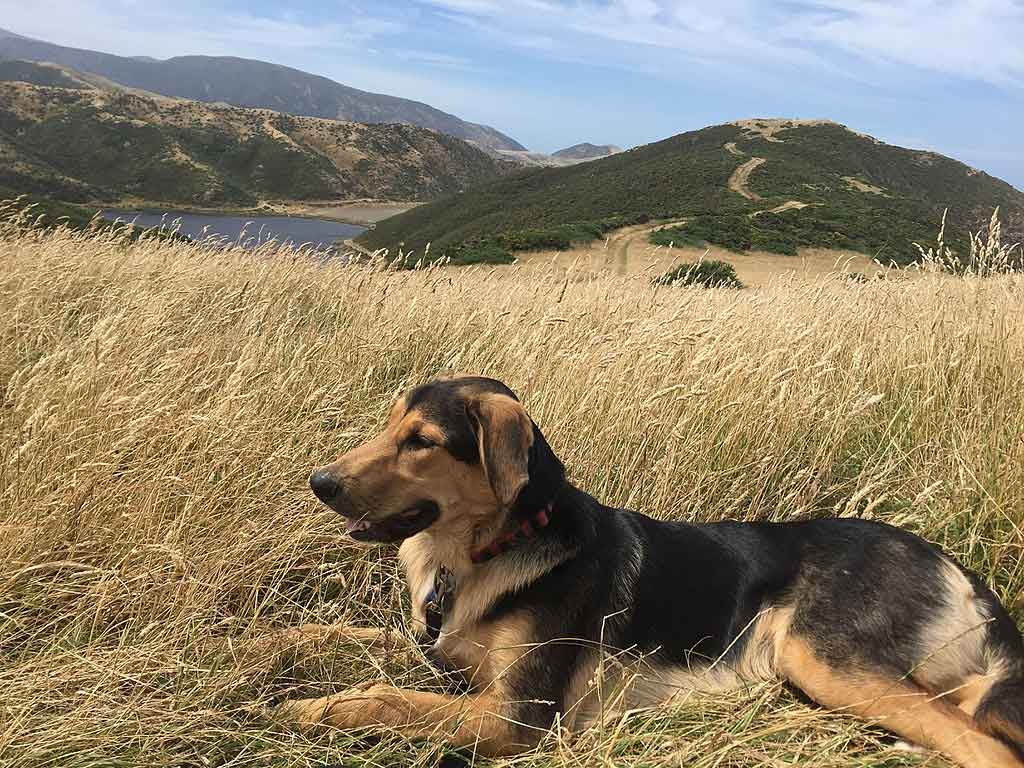
8 month old Huntaway in Wellington, New Zealand –

The Huntaway they are large dogs, they usually weigh in of 18 to 29,5 kg and its height to cross varies between the 51 and 61 cm..

The color their coat may vary, common colors are solid black, black and tan (is expected), Black with some white or striped. The layer can also be of different textures, It can be smooth or wavy, and the hair can be short or long, the ears are medium-sized and slightly pendants.

The life expectancy of a Huntaway is of 12 to 14 years of age.

Character and skills

The Huntaway they are very smart and single owner. It has an admirable resistance, you can run all day and not show any signs of fatigue. They are easy to train and very vocal, It can be taught to bark at the order of his master. Usually, They are not usually kept as pets, because they are โ€“mainly- working dogs. But in recent years they have begun to enjoy great popularity and it is common to see them in homes.

as we said, they are intelligent, kind, very energetic, active dogs that require a lot of exercise. They have been bred to guide sheep by the hills and mountains of New Zealand, where it is difficult to walk or ride, What hand signs and whistles are used to communicate orders to these dogs when they are at a distance.

They are known for being noisy dogs, especially when working.

Thanks to its grazing conditions the breed Huntaway has gained popularity all over the world, in Japan the first Club of the New Zealand Huntaway. In Australia they are widely used for sheep work.

A municipality located 184 km to the North of the capital of New Zealand (Wellington) call Hunterville It is very famous for its statue of a dog breed Huntaway. There every year they offer a special tribute to the breed, the holiday is celebrated on the first Saturday after Labor Day, they are games and competitions, races between pastors and their Huntaway dogs. It is a very important holiday because shepherds who travel from all over New Zealand meet there..

Videos "Huntaway"

Les Huntaway Dog By Hugh Pickett

New Zealand herding

in the