โ–ท The world of Pets: Dogs, cats, birds, reptiles, amphibians

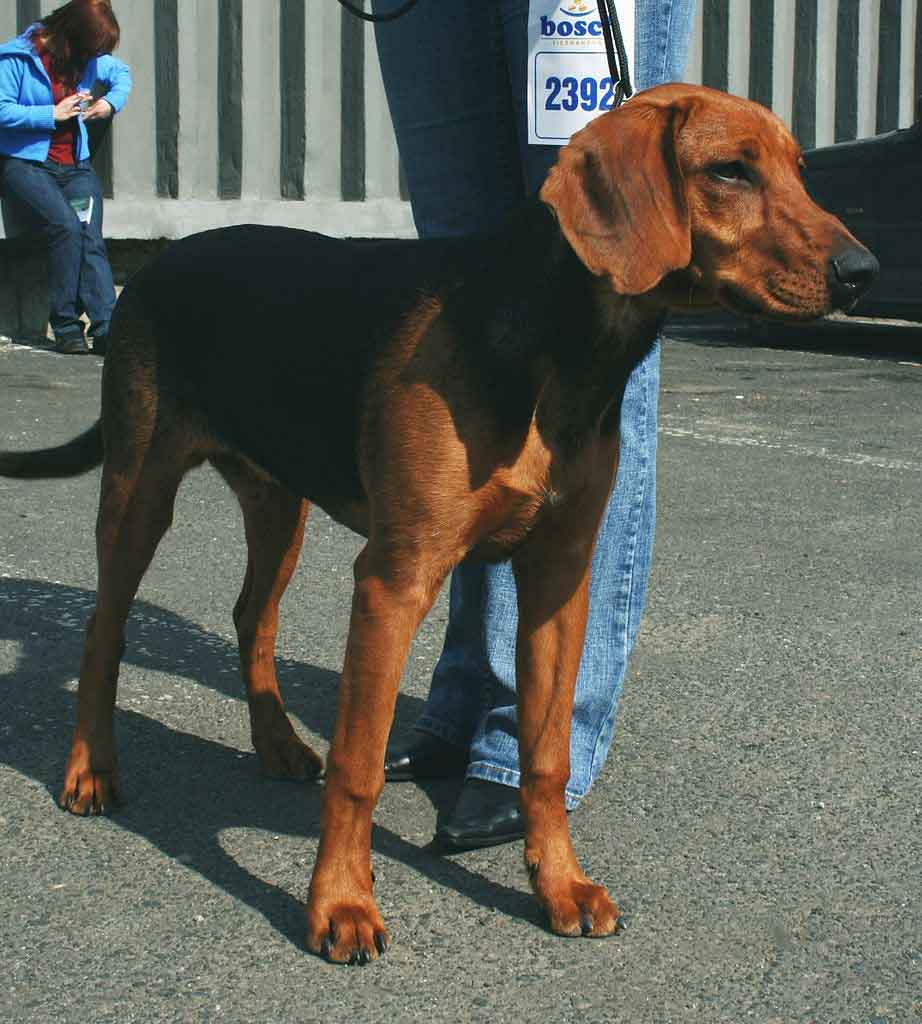
French White and Black Hound
Francia FCI 219 - Large-sized Hounds

French White and Black Hound

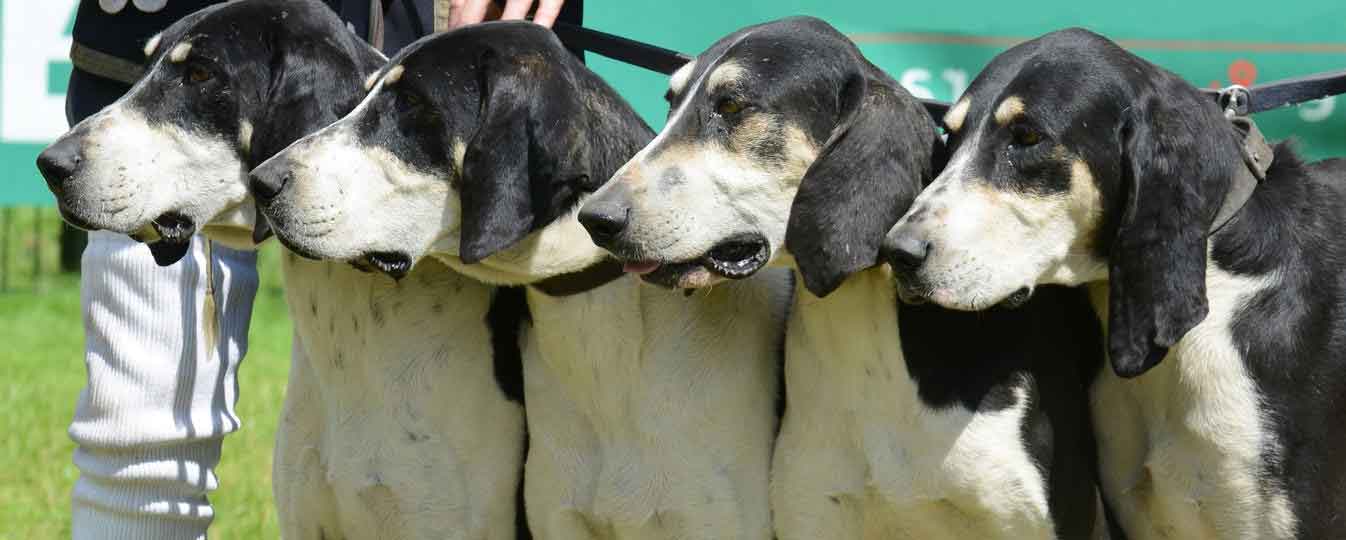
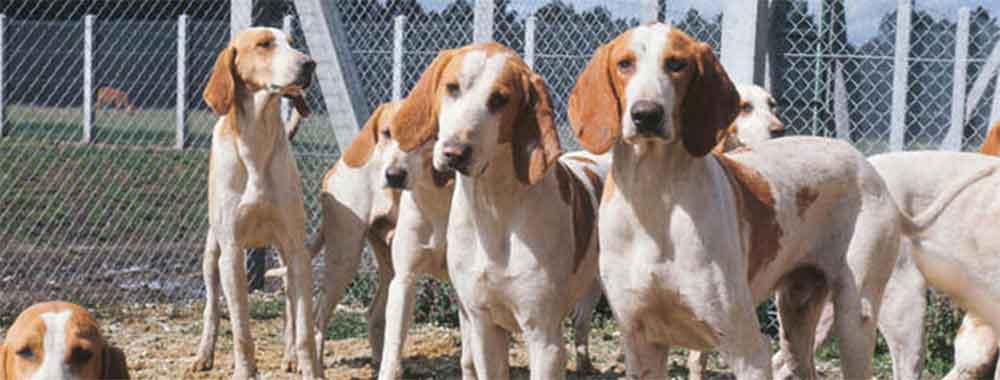
Of the three French Scent hounds, the French White and Black Hound, is the best known.

Content

The French White and Black Hound is a competent olfactory hound of French origin. It was specifically developed for hunting in large packs and today this breed is acquired exclusively for hunting.. Despite her fabulous work skills, it can be found very rarely not only in European countries but also in its native France.

History

Before the french revolution, hunting with large packs was one of the favorite pastimes of the French nobility. It also, it also offered the opportunity to establish trade relations and resolve global political and economic issues.. Unfortunately, the demise of the French upper class during times of political turmoil also meant the demise of numerous varieties of tracker hounds. After Napoleon's defeat, monarchical power was rebuilt and hound hunting regained its popularity. Thanks to technological advances in maritime traffic, dog breeding became a much less difficult task and many British hounds were sent to France during the period between 1815 and 1900.

The true ancestry of the French Hound will probably never be discovered as most early breeders did not bother to keep any breeding records.. However, it can be stated with quite certainty that the breed was created by mixing live and now extinct breeds of French and English hounds. The Saintongeois, Gascon Saintongeois and Poitevin hound were the main ancestors of the French White and Black Hound. It is commonly believed that other breeds were used on a rather limited basis in their breeding program..

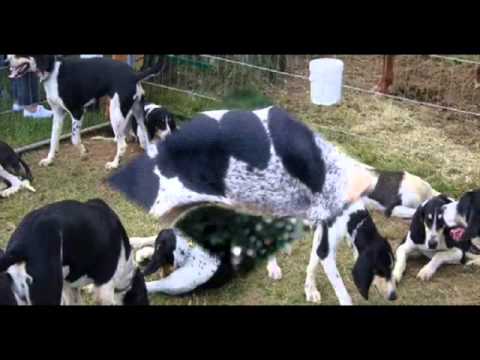
The French Scent hounds kept solely for hunting in large packs. Its largest quarry were large wild animals such as deer, the wolf and the boar. A group of several hounds detected the scent trail of one of these mammals and chased it., barking loudly so the hunter could go after them. Depending on the type of animal pursued, the dogs were to corner him or kill him immediately.

The number of specimens of this breed of hound drastically decreased after two world wars. French hunting enthusiasts managed to save her, although many unique French breeds were lost to the world during these terrible times. In 1957, the French Hound was fully recognized by the Fรฉdรฉration Cynologique Internationale (FCI). But, FCI recognition hardly increased the international awareness of this dog, so he did not win the appreciation of hunters from other countries. It also, currently their breeding and therefore their population are supported solely by the French hunting community. In general, the future of French White and Black Hound you will be fairly insured as long as there are fans of dog hunting in your homeland.

Physical characteristics Black and white French Hound

The French White and Black Hound is a big dog, distinguished and well balanced. His dark eyes give him a smart and confident look. Quite large at birth, her tail is carried high enough.
These dogs are highly prized in many deer crews for their qualities: fineness of nose, application, seriousness, throat. dog friendly, close to man; easy in the kennel.
He has short hair, quite strong and close.

COLOR : The coat should be black and white with a more or less extensive black coat or patches, which may show black or bluish spots, or even small tan marks, but these only in the limbs. A pale tan patch over each eye, as well as a pale tan on the cheeks, under the eyes, under the ears and at the base of the tail. The โ€œdeer markโ€ on the thigh is quite common.

SIZE :
Males: 65 to 72 cm.
females: 62 to 68 cm.

Character and skills French White and Black Hound

The only function of French White and Black Hound is hunting, so it is difficult to make a generalization about their behavior patterns and temperament in a home environment. But, it is not necessary to suggest that a socialized specimen can become an educated and well-rounded family pet. Like most track hounds, he is gentle with children and likes to be a part of their exuberant activities.. This dog is probably too energetic and playful to be a suitable companion for a child..

The French White and Black Hound tends to become somewhat distant and reserved in the presence of strangers. However, he will never show open aggression unless he suspects that something or someone threatens his family. Some of these dogs are vigilant enough to perform surveillance duties. This sociable and caring breed will make a terrible guardian, that he would rather greet an intruder by wagging his tail than resorting to necessary actions.

Canine aggressiveness is considered a major defect in the temperament of hounds, that were developed for herd hunting. For this reason, members with the slightest hint of this undesirable characteristic are immediately excluded from the breeding program. The French White and Black Hound is known for its exceptional tolerance towards other canines. Despite his excessively peaceful nature, also requires early socialization in this regard. It is worth remembering that the breed has a very powerful drive to hunt down and kill other species of animals., especially stray cats. You can get along with individual family pets if you have been raised with them since your puppy.

French White and Black Hound Health

The most common problems for the breed include:

– canine hip dysplasia;
– elbow dysplasia;
– eye problems;
– sarna demodex;
– skin infections;
– skin allergies;
– chronic ear infections;
– bloodhound ataxia.

Caring for the French White and Black Hound

The French White and Black Hound Needs a negligible amount of maintenance. Regular brushing will be enough to keep his short, graceful coat in reasonably good condition..

The ears of this breed are highly susceptible to irritation and infections., so its systematic examination and cleaning should become an essential part of care routines.

French White and Black Hound Training

the education of French White and Black Hound poses a considerable challenge. The breed is a natural hunter and requires fairly basic training in all that concerns its original hunting duties.. Unfortunately, its persistence in the search for prey turns into obstinacy in training. It also, cannot concentrate on the same boring task for a long time and is easily irritated by its many repetitions.

The best training strategy for this dog should include abundant rewards in the form of praise and tasty treats.. Negative reinforcement doesn't work with French White and Black Hound and must be avoided at all costs.

Exercise with the French White and Black Hound

The French White and Black Hound it is an athletic and robust hunting dog, easily adapts to extremely intense physical activity. As minimum, should be taken on a daily brisk walk of 45 minutes. You should always wear a leash while away, since it is very difficult to call him back once he has been drawn down some interesting path.

The French White and Black Hound behaves calm and relaxed once exercise requirements have been fully met. It must be borne in mind that a poorly exercised dog will gradually develop such unpleasant behavior problems as continuous barking, internal hyperactivity or destruction. This breed is best suited for suburban life in the house with a large, secure yard.

Videos "French White and Black Hound"

White and Black French Dog ๐Ÿถ๐Ÿพ Everything Dog Breeds ๐Ÿพ๐Ÿถ
Chien Franรงais Blanc et Noir ?? Everything Dog Breeds ??
French White and Black Dog & Puppies information Video - Animal Videos
French White and Black Dog & Puppies information Video – Animal Videos

Type and recognitions:

  • FCI CLASSIFICATION:
  • Group :
  • Section : . .

Federations:

  • FCI – Group 6: Scent hounds, and related breeds. – Section 1.1: Large-sized Hounds. โ“˜
  • Central Canine Society โ“˜

FCI breed standard "French White and Black Hound"

Origin:
France

Date of publication of the valid original standard:
04.11.2008

Use:

Hound for hunting big game in a pack.


General appearance:

He is a distinguished pack dog, but of strong constitution, which gives an impression of balance.

PROPORCIONES IMPORTANT:

The muzzle is long compared to the skull.

The length of the body from the point of the shoulders to the point of the ischium is equal to its height at the withers..


Behavior / temperament:

These dogs are highly prized by many deer hunters for the following qualities: fine sulfate, diligence, seriousness and throat. It is a very friendly dog, attached to the human being and easy to handle.

Head:

It is quite large and rather long; is in harmony with the whole, it's never heavy, nor common, but expressive and elegant bearing.

Cranial region:
  • Craging: It is slightly bulky and rather narrow, but without exaggeration. The occipital protrusion is sufficiently apparent to prevent the skull from looking too flat. Supraciliary arches may be somewhat prominent.
  • Depression links (Stop): Slightly marked.

facial region:

  • Trufa: It's black and the windows are wide open.
  • Caรฑa nasal: rather long compared to the skull, the nasal bridge may be slightly arched.
  • Belves: The lips are slightly square, the upper lip barely covers the lower lip.

OJOS: They are dark; the look is smart and confident.

OREJAS: They are inserted in the plane of the eye line and are slightly turned. Preferably they reach the birth of the nose or two fingers of it.

Neck:

It is quite long and thick and sometimes has a slight dewlap.

Body:

  • Espalda: It is rather long and well accented.
  • Pork loin: Muscular and well inserted.
  • Glikeness: Slightly inclined.
  • Pecho: It is taller than it is wide and reaches at least the tips of the elbows. The ribs are long and moderately rounded.
  • Belly: Slightly raised.

Tail:

Rather thick at the base with a relatively tall bearing.

Tips

PREVIOUS MEMBERS: Aligned with the body, strong and fairly flat.

  • Hshoulders: They're long, thin and oblique.
  • Elbows: They are pedagogues to the body.
  • Forearm: Plumbed.
  • Metacarpus: Slightly inclined seen in profile.
  • Previous feet: Elongated, thin and resistant.

LATER MEMBERS: Parallels, seen from behind.

  • Thighs: They are long and muscular enough.
  • Corvejรณn: It is located close to the ground. It is broad, solid and slightly angled.
  • Pinis later: They are rather elongated, but thin and resistant.

Movement:

Fluid. Preferred step: agile with extended canter.

Mantle

PIEL: She's white under white hair and black under black hair. Sometimes it presents subcutaneous spots of blue or less dark color on the belly and on the inner side of the thighs.

MANTLE

Plink: It is flat, pretty strong and tight.

Codor: It must be black and white, with a blanket or with more or less widespread black spots. It can present a mottled black or blue and even tan in color, but the latter only in the extremities. Also has a pale spot over each eye, as well as pale tan color on the cheeks, under the eyes, under the ears and at the start of the tail. It is common to see the "deer mark" on the thigh.


Size and weight:

  • Males: 65 cm to 72 cm..
  • females: 62 cm to 68 cm..

tolerance + / โ€“ 1 cm..


Fouls:

Any deviation from the aforementioned criteria is considered as a fault and the severity of this is considered to the degree of the deviation to the standard and its consequences on the health and well-being of the dog..

FALTAS GRAVES:

  • Head: Any sign of an English Foxhound cross on the head (too bulky skull, snout short and not square enough at the end when viewed in profile)
  • Nose: Significant absence of pigmentation.
  • Jaws: Prognathism or enognatismo.
  • Eyes: too light in color.
  • Ears: Short and flat.
  • Spada: Excessive.
  • Color: On the cheeks, black spreading to lips.

FALTAS DISQUALIFYERS:

  • Aggressiveness or extreme shyness.
  • Any dog โ€‹โ€‹showing clear signs of physical or behavioral abnormalities.
  • Tips: weak
  • Severe deviation of the limbs.
  • Pies: round
  • Color: Tricololor cloak.


N.B.:
  • Males should have two normal-appearing testicles fully descended into the scrotum..
  • Only functionally and clinically healthy dogs, with the typical conformation of the breed, should be used for parenting.

Source: F.C.I - International Cynological Federation

Alternative names:

1. Chien Franรงais Blanc et Noir (English).
2. Franรงais blanc et noir (French).
3. Franรงais blanc et noir (German).
4. Franรงais blanc et noir (Portuguese).
5. Sabueso francรฉs blanco y negro (espaรฑol).

Photo: https://www.centrale-canine.fr/le-chien-de-race/francais-blanc-et-noir

โ–ท The world of Pets: Dogs, cats, birds, reptiles, amphibians

Italian Rough-Haired Hound
Italia FCI 198 - Medium-sized Hounds

Italian Rough-Haired Hound

The Italian Rough-Haired Hound is reserved, wise, calm and thoughtful in his work.

Content

History

The Italian hound It, According to the vast majority of authors, a dog with very ancient origins. It is believed, in fact, descended from hunting dogs that lived from ancient Egypt, they reached the shores of the Mediterranean Sea, and therefore also to Italy, thanks to the Phoenician merchants. Many Egyptian drawings dating from the time of the pharaohs show the presence of dogs very similar to the current one Italian hound.

His best period is the Renaissance, when its level was improved and its great diffusion began. The race then underwent a slow and inexorable decline until, from the beginning of the 20th century, the Italian hound it became very popular again.

The modern history of Italian hound started on 1920, year in which the Technical Committee of the Society of Hound Hobbyists drew up the first breed standard that a few years later, in 1929 to be exact, was approved by the Italian Kennel Club. At that time there was only one standard that unified the Italian Rough-Haired Hound y al ยซItalian short-haired Segugioยซ; in 1976 came the prohibition of mating between the two varieties; then, in 1989, the ENCI (Ente Nazionale della Cinofilia Italiana) passed two different standards, standards that were later also recognized by the FCI which classified them in the group 6, among hound-type dogs, and related breeds.

The Italian Rough-Haired Hound It probably has the same origins as the ยซItalian short-haired Segugioยซ; in fact, both varieties of hounds have always coexisted in almost the entire peninsula.

Photo: myanimallife

Physical Characteristics โ€œItalian Wirehaired Houndโ€

Italian Wirehaired Hound

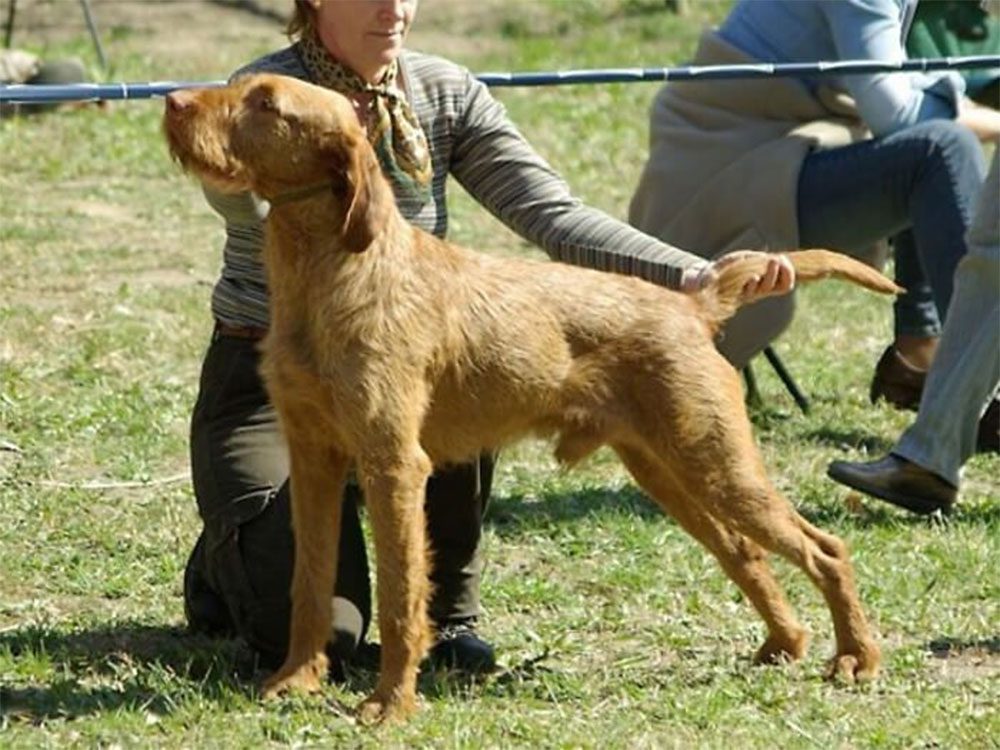
It is similar to the "Italian Flat-Coated Hound". It differs mainly by the coat, made up of coarse hair no more than two inches long, but thinner and shorter on the tail, ears and head; the coat colors are fawn and fiery black (both with white spots allowed, if they are well located).

For the standard it has minimum and maximum withers heights greater than two centimeters compared to the "Italian Flat-Coated Hound": therefore it is slightly larger. She is also believed to have a calmer and more thoughtful temperament than her satin-haired variant., and that this is reflected in a slightly different approach to hunting.

The height at the withers varies in the male from 52 to 60 cm and in the female of 50 to 58 cm.. In the case of an excellent subject there is a tolerance of two centimeters more or less. Weight may vary in males of 20 to 28 kg and females in 18 to 26 kg. The length of the trunk is identical to the height at the withers.

Character and skills ยซItalian Wirehaired Houndยป

Great hunter and secret companion. It is used and fits perfectly both in the mountains and on the flat and in the most rugged terrain. It is equipped with resistance, as well as with good speed and works with commitment and passion both in isolation and in the diving suit.

Compared to "Italian Flat-Coated Hound", the Italian Rough-Haired Hound is more reserved, less exuberant, wise, calm and thoughtful in his work. A gentle look, friendly, but proud and wrapped in a halo of melancholy. A strong and very nice voice.

This dog is first and foremost a working dog, and is rarely kept as a pet.

Videos "Italian Rough-Haired Hound"

ITALIAN SEGUGIO No10 With Italian subtitles. Look now at http://www.tstv.gr/it.html
SEGUGIO ITALIANO No10 Con sottotitoli in Italiano. Guarda ora a http://www.tstv.gr/it.html
ITALIAN SEGUGIO documentary trailer

Type and recognitions:

  • FCI CLASSIFICATION:
  • Group :
  • Section : . .

Federations:

  • FCI – Group 6: Scent hounds, and related breeds. – Section 1.2: Medium-sized Hounds. โ“˜
  • โ€‹KCHoundy โ“˜

FCI breed standard "Italian Rough-Haired Hound"

Origin:
Italy

Date of publication of the valid original standard:
27.11.1989

Use:

Hound, especially for hare and wild boar hunting.


General appearance:

It is of medium proportions and its body is square in shape.. Its configuration is harmonious in terms of dimensions (that is to say, the relationship between size and different parts of the body), but there is no harmony in relation to the profiles (that is to say, concordance between the profiles of the head and body). Its well balanced construction, perfectly symmetrical, well developed, of thin shapes, well muscled with no hint of fat allow you to track game from dawn to dusk

IMPORTANT PROPORTIONS :

The height from the ground at the withers is equal to the length of the trunk, measured from the scapulo-humeral joint to the tip of the ischium. The cross, which should not be very prominent, barely exceeds the level of the rump. The length of the snout should correspond to half the length of the head. The height of the chest is just less than half the height at the withers.


Behavior / temperament:

The Italian Hound adapts perfectly to the most difficult terrain and can be used for hunting in the mountains, like on flat ground. Being very resistant and fast, work with ardor and passion, so much alone, like in a pack. Compared to smooth-haired specimens, is more reserved, less exuberant, sensible, calm and prudent at work. His kind look, sweet and haughty is veiled by a reflection of melancholy. His voice is sonorous and very harmonious.

Head:

It has an elongated shape. Its length reaches 4/10 the height at the withers.

Cranial region:
  • Skull : It appears in the shape of an elongated ellipse.. In profile, the upper longitudinal axis is moderately divergent in relation to the longitudinal axis of the snout. The upper profile is slightly domed. The bizygomatic width must be less than half the length of the head. The zygomatic arches are poorly developed. The frontal furrow is not very marked. The occipital protuberance should be sharp, but short; stands a little back, so it is not very visible. Can only be perceived by touch.
  • Depression links (Stop) : It is very little marked. From the snout the upper profile should rise in a gentle slope that reaches the skull.

facial region:

  • Truffle : It is great, fresh and moist. Extends to the front, in the vertical of the anterior part of the lips. The windows are movable and open wide. Its color is always black.
  • Snout : Its measurement corresponds to half the length of the head. Its height is barely more than half its length.; its width is equal to 17% of head length. The profile is convex. The lateral faces of the snout are convergent, but not to the point of imparting a pointy appearance. The branches of the mandible are almost rectilinear; They are poorly developed in their anterior part. The suborbital region is well shaped, but somewhat less than that of the bareback Hound.
  • Jaws / Teeth : Strong jaws, normal development. The dental arches of the incisors adapt perfectly. The teeth are white, of normal size and are implanted in the shape of a regular line. The denture is complete. The joint is in the form of scissors, although the pincer-shaped joint is accepted.
  • Cheeks : They are not very marked.

Eyes : They are big and bright, dark ocher color. They are located in a semi-lateral position. The inner corner of the eyelids should be at the same distance from the anterior edge of the nose and the outer tip of the occipital crest.. Fascinating expression, the look is sweet and haughty, with a slight veil of sadness. The palpebral opening is almond-shaped; the eyelids adapt perfectly to the eyeball. The edge of the eyelids must be black.

Ears : Its implantation of moderate width is located at the level of the zygomatic arches. They are hanging, form triangular, flat in almost its entire length (66 โ€“ 70% of head length) and very wide. The ears should end in a sharp point. Although thin, your cartilage should be rather rigid throughout its entire length; Its crooked and very rigid insertion deviates the ears towards the front, but without causing them to sag or bend, the tomen shaped like a tirabuzรณn. The tip bends slightly inwards. The ears are covered with hairs of moderate length shorter than those on the trunk., less hard and without any bangs.

Neck:

The top is slightly arched. The lower part does not show any sign of a double chin. Its length is equal to the length of the head, reaching like this 4/10 the height at the withers. It has the shape of a truncated cone joined to the head by a very marked nape.. Similarly, The neck should connect with the trunk, blending harmoniously with the shoulders.. Since it is very thin and light, must give the impression of being not very muscular.

Body:

Its longitude, Measured from the tip of the shoulder to the tip of the buttock, is equal to the height at the withers.

  • top line : Profile view, from the cross to the rump, is straight. It is somewhat convex in the region of the spine.
  • Cross : It protrudes little above the line of the back; is narrow, due to the approach of the tips of the shoulder blades. Blends harmoniously with the neck.
  • Back : The upper profile is rectilinear and muscular, although the muscles are not very apparent. The relationship between the length of the thoracic and the lumbar region is 3 to 1.
  • Pork loin : The length of the spine is a little less than 1/5 the height at the withers: its width is a little less than its length; his muscles are well developed.
  • Rump : The upper profile is slightly convex. It is said to be horizontal because its obliquity, from the tip of the hip to the beginning of the tail, lies between 15 to 20 degrees; Its length corresponds approximately to 1/3 from the height to the withers and its breadth to the 2/3 its length. The muscles are strong.
  • Breast : Its length reaches approximately half the height at the withers and its width about 1/3 the height at the withers. Its height must be equal to 48% the height at the withers. The lateral faces have a slight convexity. On the other hand, the upper costal arches should be well arched. The thoracic cavity is of moderate width. The manubrium of the sternum should be in the plane of the point of the shoulders.
  • bottom line : It is determined by a line that rises in a gentle slope to the abdomen, that is thin and never elongated. The flanks are lean, usually sunken, never recharged.

Tail:

High insertion, on the line of the rump. It is thicker at the root than that of the Short-haired Hound and is covered with hair throughout its length., but he doesn't have any bangs. During rest, hangs in the shape of a saber; When the dog is in action, it rises without exceeding the height of the back., It moves from left to right, rubbing the sides, or turns at times with rotational movements.. The queue is considered long, although its end is very close to the end of the hock.

Tips

PREVIOUS MEMBERS

  • As a whole : Seen in profile, follow a vertical line, starting from the scapulohumeral joint, must reach the ground touching the tips of the fingers, while the vertical starting from the humero-radial joint must divide into two more or less equal parts (of which the largest is the above) the forearm and carpus, emerging at half the length of the metacarpal, which is oblique. Forelimb height, from the ground to the elbow, is equal to half the height at the withers.
  • Shoulder : They are thin, long, free movements. The upper tips of the shoulder blades are tightly together. The obliquity below the horizontal is 45 a 50ยฐ.
  • Arms : They are well attached to the body. Like the shoulders, They have dry and long muscles. They are parallel to the median plane of the trunk. The scapulohumeral angle is 110ยฐ, the obliquity of the scapula is 45ยฐ.
  • Elbows : They appear equidistant from the median plane of the trunk; although they should not deviate or inward, nor out. The humeral-radial angle is 135 at 145ยฐ.Forearm : Is vertical. Its length is almost equal to 1/3 the height at the withers. The ulnocarpal groove is clearly visible. The forearm should give the impression of being very dry and thin..
  • Carpi : They are dry; a thin and fine skin covers them. Seen from the front, extend the vertical line of the forearm.
  • Metacarpus : Its length is not less than one sixth of the length of the forelimb, measured from the ground to the elbow. Seen in profile, they are somewhat oblique forward.
  • Front feet : They have an oval shape (hare feet); the fingers are arched and well together. The hair that covers them is dense. The digital tubercles are not very fleshy.; the pads are thin,hard, leathery and black. The nails are strong, bent over and always black. The presence of some white nails (not pink) does not constitute a fault.

LATER MEMBERS

  • As a whole : The vertical starting from the tip of the gluteus touches or falls almost on the tip of the fingers. รยก back view, the same vertical divides the tip of the hock into two equal parts, the metatarsus and the foot. The total length of the hind limb is equal to the 90% the height at the withers.
  • Thighs : They are long and wide. Its length is not less than a third of the height at the withers. Its lower edge is slightly convex; the tip of the buttocks is visible. The protruding muscles are clearly distinguished from each other. The thighs are somewhat oblique from top to bottom and from behind to front. The angle of the coxofemoral joint varies between 90ยฐ and 95ยฐ.
  • Knee : It must be in perfect aplomb with the extremity; it should not deviate even inwards, or out. The tibiofemoral angle varies between 110 y 120ยฐ
  • Leg : Its length is slightly less than that of the thigh and its obliquity below the horizontal is 40ยฐ.. The muscles are thin; the hock groove is well marked and visible with the external saphenous vein well apparent.
  • Hock : Viewed from the side, their faces are very wide. It is considered low because the distance from the ground to its tip does not exceed the 27% the height at the withers. The tibiotarsal angle, closed due to marked obliquity of the tibia, ranges between 115ยฐ and 125ยฐ.
  • Metatarsus : Its length corresponds to the height of the hock. It is strong and thin and appears perpendicular to the ground. No presence of dewclaws.
  • Rear feet : Less oval than the front ones, but with all the same features.

Movement:

Although the favorite movement of the Italian Hound is the gallop, The hunting activity forces the dog to also walk and trot..

Mantle

SKIN : It is well attached over the entire body and is only a little thick. The color of the mucous membranes, of the third eyelid, of the nails, of the central pad and digital tubercles is exclusively black. Although dark pigmentation of the palate is not prescribed, always constitutes an appreciable quality.

HAIR : The length of the hair covering the trunk should not exceed five centimeters. The hair is clearly hard, except on the head, the ears, the extremities, tail and snout, where the hair is generally less hard than on the trunk and lips. The hair under the lips, although not very long, constitutes what is considered a beard. The hair that covers the eyebrows is of moderate length, so that it does not fall into the eyes, nor hide them.

COLOR : Accepted colors include the entire range of unicolor fawn, from dark and carbon red, to light fawn, and the black and tan. The fawn may have white on the snout and skull (the mask may or may not be symmetrical), a white star on the parapet, white color on the neck, the metacarpals and metatarsals, the feet and the tip of the tail. But, the color white is not appreciated, and it is preferable that it not be very abundant. The black and tan may present only a white star on the chest; In this case it is said that the hound is tricolor.


Size and weight:

Height to the cross :

  • In males : 52 to 60 cm.,
  • in females : 50 to 58 cm..

Weight :

  • In males : 20 to 28 kg,
  • in females : 18 to 26 kg.

A tolerance of 2 cm more or less when it comes to excellent specimens.


Fouls:

Any deviation from the aforementioned criteria is considered a fault and the severity of this is considered to the degree of the deviation from the standard and its consequences on the health and well-being of the dog. These modalities are also valid for dogs that always walk.

SERIOUS FAULTS

โ€ข Head : convergent craniofacial axes.
โ€ข Size that exceeds the upper or lower margins indicated by the standard.

MISS PLAYOFFS

โ€ข Aggressive or fearful dog.
โ€ข Concave nasal cane.
โ€ข Total depigmentation or most of the truffle, or the edges of the eyelids.
โ€ข Gaze eyes.
โ€ข Superior prognathism.
โ€ข Short tail, o absence of glue, both congenital, as artificial.
โ€ข Slate or gunmetal color; brindle coat, brown, Brown, predominantly white liver.

Any dog โ€‹โ€‹showing clear signs of physical or behavioral abnormalities must be disqualified..


N.B.:

Males should have two normal-appearing testicles fully descended into the scrotum..

Source: F.C.I - International Cynological Federation

โ–ท The world of Pets: Dogs, cats, birds, reptiles, amphibians

Slovakian Hound
Eslovaquia FCI 244 - Medium-sized Hounds

Slovakian Hound

The Slovakian Hound stands out for its extraordinary sense of direction, which is considered the best among the canine breeds.

Content

History

It has remote and completely unknown origins.: its official recognition dates back to after World War II, but the breed already existed for centuries.

While there are no historical records, the Slovenskรฝ Kopov is widely believed to have existed in central Europe for many hundreds of years and to have descended from other local breeds, including the Austrian Black and Tan Hound and the Polish Hound.

Not widely kept for any purpose other than hunting, the Slovakian Hound He has honed his hunting skills over the centuries and is respected within Slovakia for his tracking ability and endurance. Despite its proven track record in the field, rarely seen internationally. curiously, when seen internationally, It is sometimes called the "Black Forest Dog.", a completely wrong name, since the Slovakian Hound it's not now, and has never been, native to the Black Forest region.

Like many other breeds of dogs of the time, the population of the Slovakian Hound decreased dramatically during the period of the World Wars. It is attributed to a Slovak named Koloman Snail having brought the race from the brink of extinction at this time, by establishing successful breeding programs nationwide.

Officially accepted as a breed in the decade of 1870, the first club of the breed Slovakian Hound was recently formed in 1988, in the capital of Bratislava. The Slovakian Hound it is so popular in its birthplace that it has been named the national breed of Slovakia.

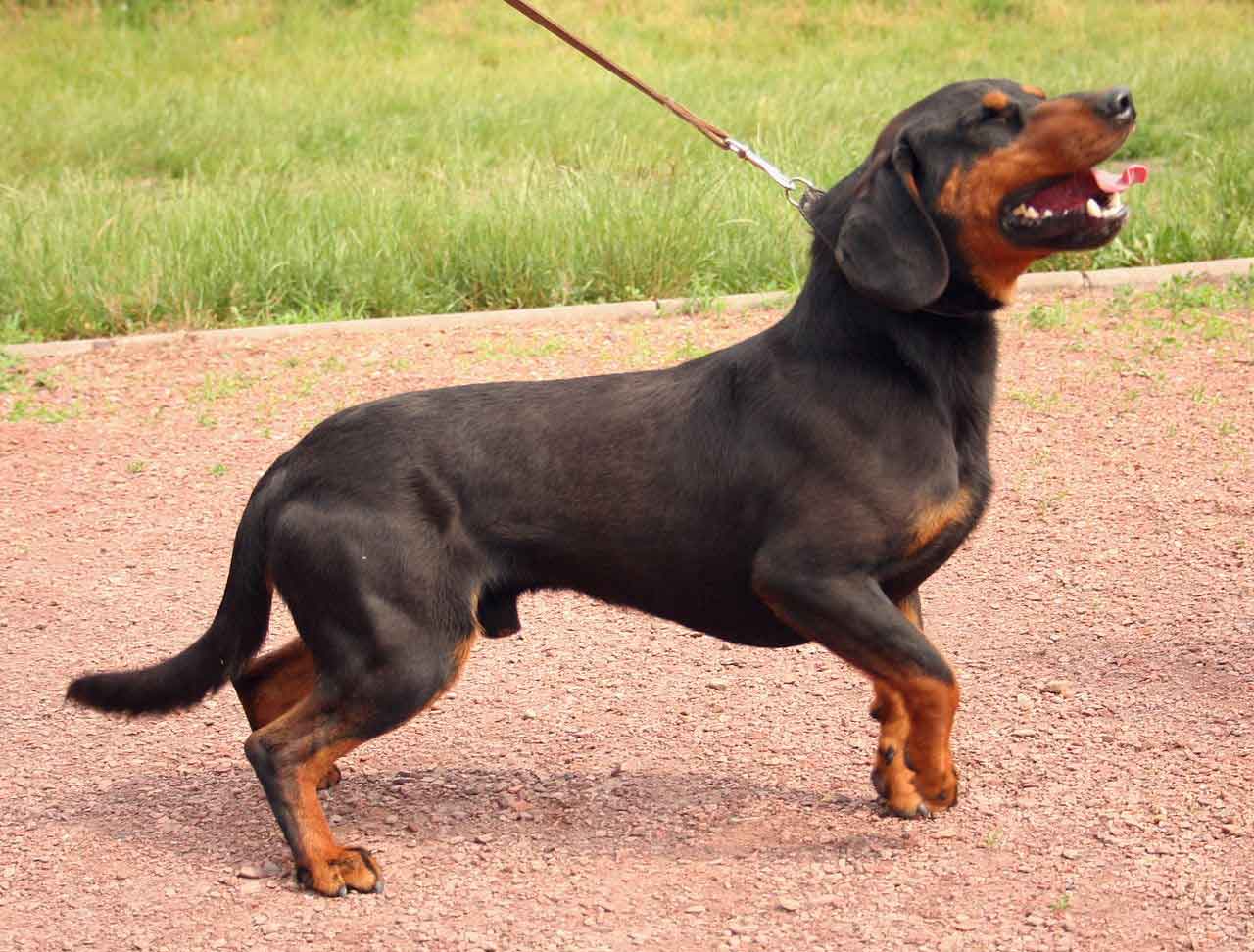
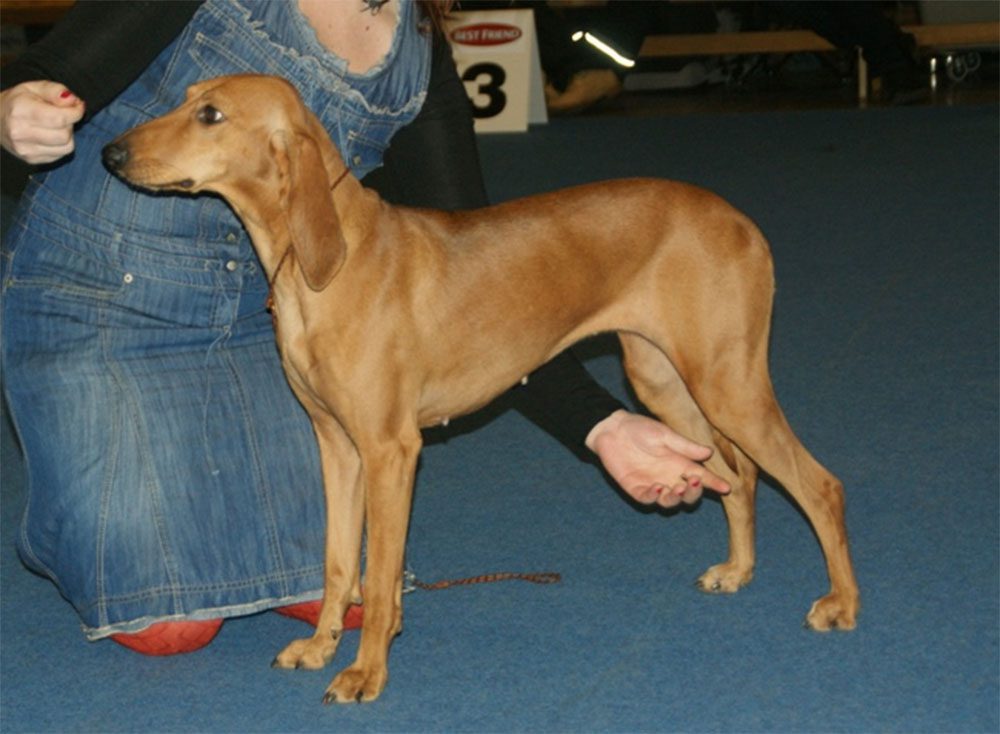
Photo: Slovakian Hound during dog’s show in Racibรณrz,Poland by Pleple2000, CC BY-SA 3.0, via Wikimedia Commons

Physical characteristics

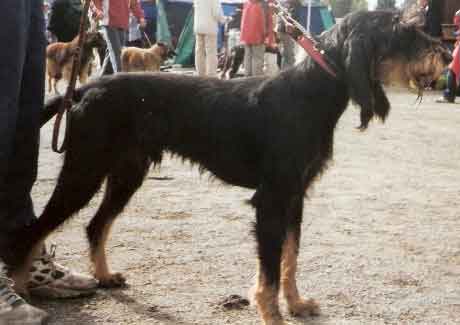
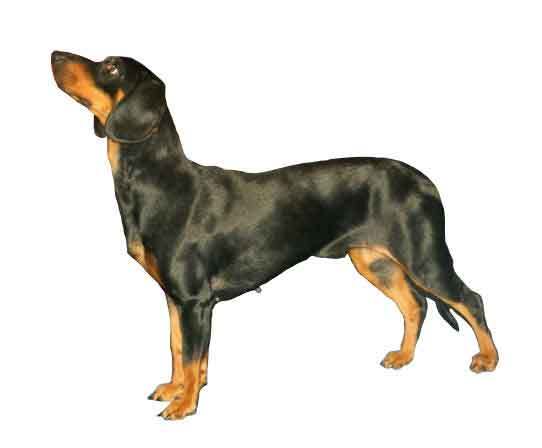
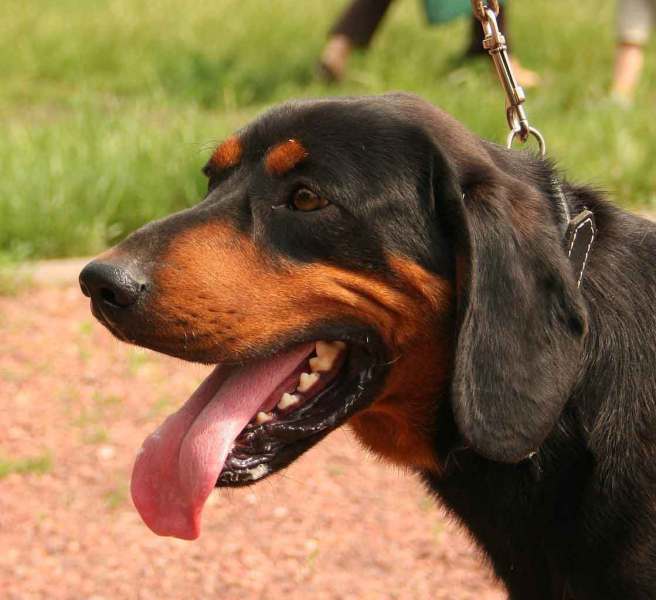
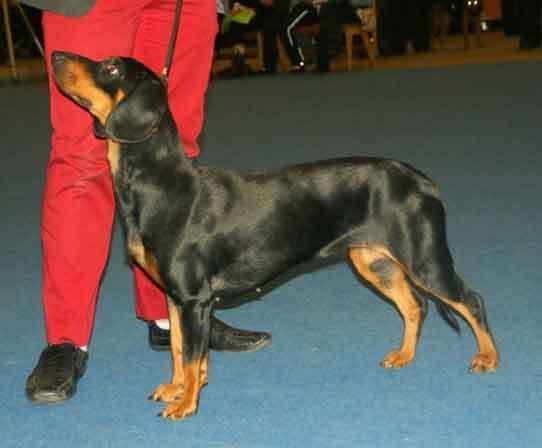
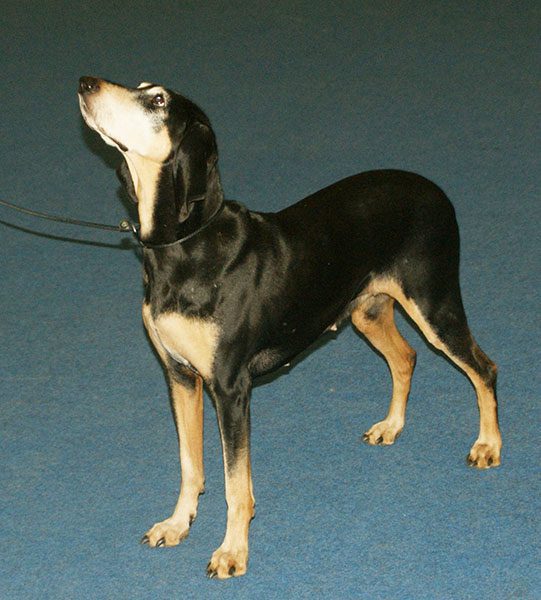
Always black with fire marks, the Slovakian Hound have solid bones despite their fairly slight stature. The body is in the shape of an elongated rectangle. His eyes reflect vivacity and courage. They are dark and almond-shaped. The ears are of medium length, rounded at the tip and falls flat against the head. This dog is notable for its constancy in following a cool trail or trail for hours, giving the voice without hesitation. They are also distinguished by their bite, so they are used in their native country to hunt wild boars and other carnivores.

He is endowed with a lively temperament. Your sense of direction is extraordinarily well developed.

Hair is 2-5 cm long, medium thick, well lying, dense. Longer in the back, neck and tail. The undercoat is dense, especially during the winter months; However, it should not be absent in summer either.

SIZE AND WEIGHT :

Males 45-50 cm.

females 40-45 cm.

Weight: 15-20 kg

Character and skills

This determined hunter must be tenacious when on the road and courageous when facing the animals he hunts., like the boar and the deer. They have excellent olfactory abilities and will painstakingly trace a scent back to the source. An independent animal that is happy to work with a minimum of human interaction, the Slovakian Hound need little direction. Despite this, they are obedient, and they will happily follow their master's plans when necessary.

The Slovakian Hound it's a good watchdog, as he is continuously alert and observant. This, along with the fact that they become devoted to their owners, means they are often protective, and can be used successfully as watchdogs, becoming potentially aggressive if the situation calls for it. Barking can be a problem and is a common complaint of many owners.. Excessive barking can be prevented by ensuring that the Slovakian Hound you are not under-exercised and have plenty of activities and jobs to fill your day.

Health

The Slovakian Hound it is a very resistant dog. In the country of origin the owner has a dog, rarely from, who does not live in a kennel but in contact with the master from morning to night, often used as a general purpose dog, taking care of the house as well as the cattle, and of course hunting. It is adapted to outdoor life and has an iron constitution.

Care and maintenance

The Slovakian Hound it is a very resistant dog, no particular grooming problems. Short hair, when he comes back from hunting he will be the happiest in the world if you give him the necessary brushstroke for a superficial cleaning at the level of the spikes, caught between the pads, ticks possibly not yet attached.

He will quickly get used to coming to you for this cleaning because he is looking for contact with his master.

Qualities

It's a farm dog, the quintessential farm dog. Bad guys just do that. The good ones are able to give the voice, to take the lead by yelling or barking directly at any stranger before coming into view. A good Slovakian Hound should give voice instantly. Not after ten minutes (although, depending on the conditions…). The smell of Slovakian Hound it's excellent, as fine as that of the best Hounds, but his hunting style leads him to voice only in the moment, and of course staring.

The Slovakian Hound is a search engine, a hunting finder. Hunting instinct is among the best hounds, really very developed, off the beaten path as in some Warren hound and some representatives of primitive races.

Farm dog, you don't need to see the animal, the wild boar to bark after, like some pointing dogs that only bark at sight, or to the noise. With experience, depending on origins, will start barking after turning around to make sure the animal is ten meters away, or more. Once you have fired the bark it will zoom in pretty quickly, but always with care, always staying safe. The Slovakian Hound is not a brave and daring specialist like some races of German Hunting Terrier or pointing dogs, who are inevitably injured frequently. With the, used in its specificity, theoretically, no need for a boar vest, because he knows how to handle attacks. Some are never hurt, if used properly, alone or as a couple.

The Slovakian Hound is a dog that is easy to start with the boar. Because it's in their nature, to bark, and the only animal that does not automatically flee but goes to meet is the wild boar. If you are accustomed to hunting on hunts where wild boar are rare but deer are numerous, you will enjoy easily guiding your animals for half an hour or more, but as soon as he perceives that there is a wild boar in the area, will leave this animal too elusive to go and do what it was designed to do.

A good Slovakian Hound, alone or as a couple, it is rarely caught by a wild boar. Otherwise, in dog teams he becomes a vulnerable dog like any other because his passion is terrible, and there, better equip it with a vest…

Characteristics "Slovakian Hound"

Coexistence is important that you have with your new friend. Before considering the acquisition of a dog of the breed "Slovakian Hound" you know certain factors. Not all breeds of dogs are apt to live in an apartment, you must take into account his character, their need for exercise, their interaction with other pets, their care and if you have small children, their level of tolerance towards them.

Adaptation โ“˜

4,0 of 5 stars (based on 1 review)

friendly dog โ€‹โ€‹โ“˜

3,0 of 5 stars (based on 1 review)

hair loss โ“˜

3,0 of 5 stars (based on 1 review)

Affection level โ“˜

4,0 of 5 stars (based on 1 review)

Need for exercise โ“˜

4,0 of 5 stars (based on 1 review)

Social need โ“˜

4,0 of 5 stars (based on 1 review)

Home โ“˜

4,0 of 5 stars (based on 1 review)

Toilet โ“˜

2,0 of 5 stars (based on 1 review)

Friendly with strangers โ“˜

2,0 of 5 stars (based on 1 review)

barking โ“˜

5,0 of 5 stars (based on 1 review)

Health โ“˜

4,0 of 5 stars (based on 1 review)

Territorial โ“˜

5,0 of 5 stars (based on 1 review)

Cat friendly โ“˜

2,0 of 5 stars (based on 1 review)

Intelligence โ“˜

4,0 of 5 stars (based on 1 review)

Versatility โ“˜

4,0 of 5 stars (based on 1 review)

Child friendly โ“˜

4,0 of 5 stars (based on 1 review)

Surveillance โ“˜

4,0 of 5 stars (based on 1 review)

joy โ“˜

4,0 of 5 stars (based on 1 review)

Images "Slovakian Hound"

Photos:

1 – SLOVENSKร KOPOV Rantafejs Cezary Av Fileddy MyDOG, Nordens stรถrsta hundevenemang: www.mydog.se by Svenska Mรคssan from Sweden, CC BY 2.0, via Wikimedia Commons
2 – A female Slovakian Hound. by Canarian, CC BY-SA 3.0, via Wikimedia Commons
3 – Slovakian Hound during dog’s show in Racibรณrz,Poland by Pleple2000, CC BY-SA 3.0, via Wikimedia Commons
4 – Slovakian Hound during dog’s show in Racibรณrz,Poland by Pleple2000, CC BY-SA 3.0, via Wikimedia Commons
5 – Slovakian Hound during dogs show in Katowice, Poland by Lilly M, CC BY-SA 2.5, via Wikimedia Commons
6 – Chien courant slovaque sur fond blanc by Desaix83, d'aprรจs le travail de Canarian, CC BY-SA 3.0, via Wikimedia Commons

Videos "Slovakian Hound"

Type and recognitions:

  • FCI CLASSIFICATION:
  • Group :
  • Section : . .

Federations:

  • FCI – Group 6: Scent hounds, and related breeds. – Section 1.2: Medium-sized Hounds. โ“˜
  • UKCScenthounds โ“˜

FCI breed standard "Slovakian Hound"

Origin:
Slovakia

Date of publication of the valid original standard:
16.04.1963

Use:

Hound. This breed is characterized by continuing to bark a warm track (recent) or a trail steadily for hours. It is also characterized by its bite and that is why it is used in its place of origin especially for hunting wild boar and animals of prey..


General appearance:

They are always one color : black with โ€œfireโ€ markings. Rather light body structure; However, has strong bones. Elongated rectangular body shape.


Behavior / temperament:

It is of a spirited nature. Exceptionally developed sense of orientation.

Head:

---

Cranial region:
  • Skull : Bulging at the top; its shape is square and elongated; superciliary arches and frontal sulcus are notable; occipital protuberance is poorly marked. The longitudinal axes of the muzzle and skull are parallel.
  • Depression links (Stop) : About 45ยฐ.

facial region:

  • Truffle : Always black, relatively large, moderately pointed; moderately open windows.
  • Snout : Straight nose cane, corresponding to the long and not very wide skull.
  • Lips : They are not hanging; they are together, skinny, with a visibly open corner.
  • Jaws / Teeth : on regular basis, firm; well developed full bite.

Eyes : dark, a little deep. His expression denotes vivacity and animosity. Eyelids are always black; almond-shaped eye opening.

Ears : Inserted a little above the eye line, laid flat on the sides of the head, rounded at their ends, medium long.

Neck:

Well inserted, carried at an angle of approximately 135ยฐ, rather short, muscular and no loose skin.

Body:

  • Back : Straight, medium long.
  • Pork loin : Not too long, very wide, firm and muscular.
  • Rump : Not too long, average width, rounded.
  • Breast : Wide and well filled windowsill. Medium deep, of a suitable width and relatively long.
  • Chest : Rounded ribs, placed obliquely.
  • Belly and flanks : Moderately withdrawn.

Tail:

Rather low set, a little below the line of the back; of adequate strength; slimming to tip; reaches up to the tibio-tarsal joint; at rest it is carried hanging; When excited, it is curved upwards in the shape of a sickle up to an angle of 150ยฐ..

Tips

PREVIOUS MEMBERS :

  • Scapula and Arm : Rather short, well-developed and muscular. Shoulder angle approximately 110ยฐ.
  • Forearm : Vertically placed, delgado.
  • Articulation of the carpus : Short.
  • Metacarpus : Not very long, a little inclined.
  • Previous feet: Oval, well arched fingers; nails always black and strong; dark pads, well developed.

LATER MEMBERS :

  • Thigh : Moderately wide and long, muscular.
  • Leg : Wide, of a suitable length and with good muscles.
  • Warm-foot joint : Located approximately at a height of 15 cm.; moderately wide. The angle of the tibiotarsal joint is approximately 150ยฐ.
  • Metatarsus : Approximately from 8 cm long; moderately leaning forward; No Spurs.
  • Hind feet : Oval, fingers close together and well arched; well developed pads, black.

Movement:

Lively and balanced.

Mantle

SKIN : From dark brown to black, footprint, no loose skin folds.

HAIR : Of 2 โ€“ 5 cm long, moderately hard, glued and dense. It is longer on the back, neck and tail. Dense internal fluff especially in the winter months, although his presence should not be lacking during the summer.

COLOR : Black with tan to mahogany markings on limbs.


Size and weight:

Height to the cross :

  • In males : 45 โ€“ 50 cm..
  • In females : 40 โ€“ 45 cm..

Weight : 15 โ€“ 20 kg.


Fouls:

Any deviation from the aforementioned criteria is considered as a fault and the severity of this is considered to the degree of the deviation to the standard and its consequences on the health and well-being of the dog..

โ€ข Rough figure, plump or chubby.
โ€ข Head too heavy.
โ€ข Hanging lips.
โ€ข Incomplete bite.
โ€ข Superior or inferior progantism.
โ€ข Light eyes, loose eyelids, eyelids too tight.
โ€ข Ears too light, pointy.
โ€ข Loose skin on the neck.
โ€ข Back too weak.
โ€ข Flattened chest (severe deficiency).
โ€ข Visibly long tail, also carried at rest above the line of the back.
โ€ข Defective position of the extremities.
โ€ข Weak feet.
โ€ข Coat too short, that's lanilla interna; hair too long, wavy.
โ€ข Another color other than black, white markings, unclear delimitation of โ€œtanโ€ colored spots.
โ€ข Excessive size.

IMPORTANT PROPORTIONS (IDEAL TYPE)

  • Weight 16 kg
  • Height at the withers in males 46 cm.
  • Height at the withers in females 43 cm.
  • Total length of the head 22 cm.
  • Length of the muzzle 9 cm.
  • Length of the skull 13 cm.
  • Skull width 10,5 cm.
  • Width of chest 16,5 cm.
  • Chest height 22 cm.
  • Chest depth 31,5 cm.
  • body length 55 cm.
  • Chest circumference behind the last free rib 54 cm.
  • Limb angulations : Angle between the scapula and the arm 110ยฐ
  • Angle between the arm and forearm 140ยฐ
  • Angle between hip and thigh 130ยฐ
  • Angle between thigh and leg 130ยฐ
  • Tibio-tarsian joint angle 145ยฐ

Any dog โ€‹โ€‹showing clear signs of physical or behavioral abnormalities must be disqualified..


N.B.:

Males should have two normal-appearing testicles fully descended into the scrotum..

Source: F.C.I - International Cynological Federation

Alternative names:

1. Black Forest Hound, Slovak Hound (English).
2. (slovenskรฝ kopov en slovaque) (French).
3. Slowakische Schwarzwildbracke (German).
4. Cรฃo da floresta (Portuguese).
5. Cazador eslovaco (espaรฑol).

โ–ท The world of Pets: Dogs, cats, birds, reptiles, amphibians

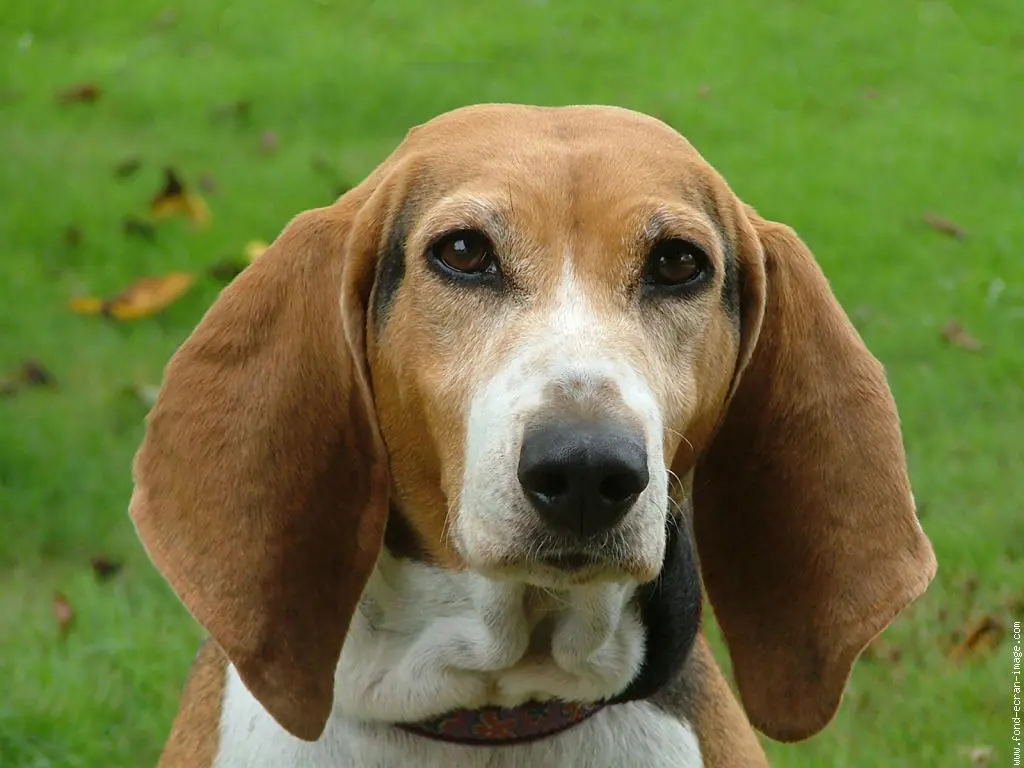
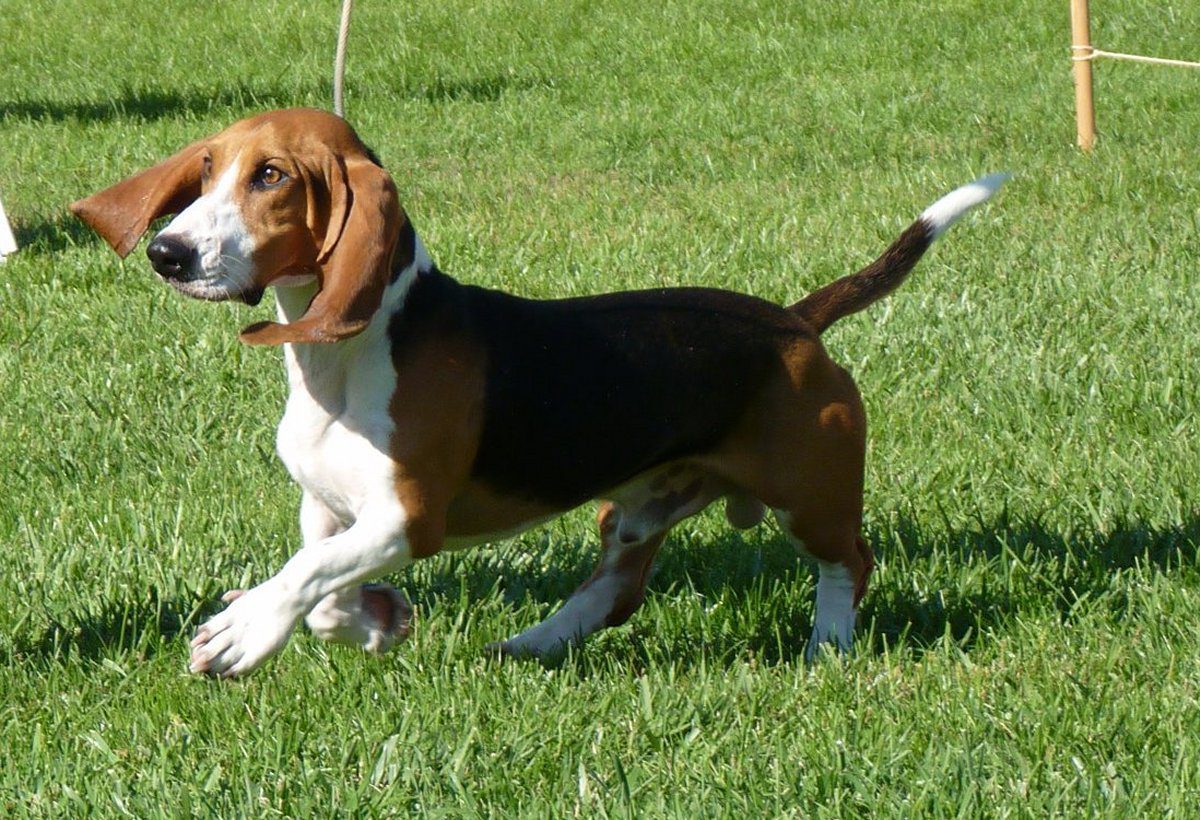
Norman Artesian Basset
Francia FCI 34 . Small-sized Hounds

The Norman Artesian Basset is a minor hunting dog

Basset Artesiano de Normandรญa

Content

Characteristics "Norman Artesian Basset"

Coexistence is important that you have with your new friend. Before considering the acquisition of a dog of the breed "Norman Artesian Basset" you know certain factors. Not all breeds of dogs are apt to live in an apartment, you must take into account his character, their need for exercise, their interaction with other pets, their care and if you have small children, their level of tolerance towards them.

Adaptation โ“˜

2,0 of 5 stars (based on 1 review)

friendly dog โ€‹โ€‹โ“˜

3,0 of 5 stars (based on 1 review)

hair loss โ“˜

3,0 of 5 stars (based on 1 review)

Affection level โ“˜

4,0 of 5 stars (based on 1 review)

Need for exercise โ“˜

3,0 of 5 stars (based on 1 review)

Social need โ“˜

3,0 of 5 stars (based on 1 review)

Home โ“˜

4,0 of 5 stars (based on 1 review)

Toilet โ“˜

2,0 of 5 stars (based on 1 review)

Friendly with strangers โ“˜

3,0 of 5 stars (based on 1 review)

barking โ“˜

2,0 of 5 stars (based on 1 review)

Health โ“˜

4,0 of 5 stars (based on 1 review)

Territorial โ“˜

2,0 of 5 stars (based on 1 review)

Cat friendly โ“˜

2,0 of 5 stars (based on 1 review)

Intelligence โ“˜

3,0 of 5 stars (based on 1 review)

Versatility โ“˜

3,0 of 5 stars (based on 1 review)

Child friendly โ“˜

4,0 of 5 stars (based on 1 review)

Surveillance โ“˜

2,0 of 5 stars (based on 1 review)

joy โ“˜

4,0 of 5 stars (based on 1 review)

History

The first written mentions of a basset hound date back to the 16th century. In his book La venerie (1561), Jacques du Fouilloux describes an Artois dog (a former French province that straddles the border between Picardy in France and Flanders in Belgium), that runs on legs and is particularly formidable at hunting pests, like badgers.

Much later, in the second half of the 19th century, when work began on cataloging, categorization and establishment of the characteristics of the various dogs of the world, the Norman Artesian Basset was one of the first breeds to be listed.

In the decade of 1870, two types of Artois Hounds: the servants by him Conde Le Couteulx by Canteleu, based near Etrepagny, in the Eure, and those of the kennel of Louis Lane, who lived near Rouen. The two men had different views on what the Artois Hound.

The Couteulx, as a skilled hunter, favored the utilitarian aspect of the dog and its physical efficiency. Selected dogs with almost straight front legs, a slightly compact body, a fairly common head, but above all a spirit of initiative and enthusiasm for hunting similar to the characteristics of the great and old Artois Dachsbracke.

Louis Lane, on the other hand, gave more importance to the beauty of his dogs. They had magnificent heads with long, well-wound ears and twisted front legs that echoed the nobility of the ancient Norman race.. The dogs of Louis Lane they were less wanted for hunting, especially since their exaggeratedly crooked front legs left them almost crippled, but his temperament was more thoughtful and less stalking oriented.

These two types of artisan hounds coexisted during 20 years. Thereafter, most breeders of Basset dโ€™Artois preferred to cross the two models to get a dog that combined the best qualities of both bloodlines. Like this, when the first breed standard was written in 1898, most dogs had a mix of artisan traits (model Le Coulteulx) and normans (model Lane).

It was at that time that Lรฉon Verrier, the "father" of modern Norman Artesian Basset, raised the best representatives of the breed, dominating dog shows for about fifteen years from 1896. Unfortunately, their calf was decimated by the disease during World War I.

This did not prevent the French Basset Club from deciding on 1922 promote only the Verrier model for breeding the breed. In 1927, in recognition of their mixed origins, the Basset Artesian changed his name to Norman Artesian Basset. Having said that, an observation that appeared in 1930 in the standard suggests that the Norman Artesian Basset it was only considered as a transition in the creation of a new race, since it establishes that "the committee of the Sociรฉtรฉ de Vรฉnerie decides and observes that the Norman Artesian Basset it should only be a transitional stage towards a Norman type, without any trace of Artois. ยป

But, this hypothesis was never fulfilled, as evidenced by the rejection of a name change of the breed to Basset of Normandy in 1932, but also and above all the recognition of the breed by the Fรฉdรฉration Cynologique Internationale (FCI) the 29 in October of 1963. The American United Kennel Club will recognize the breed much later, in 1995. On the other hand, is still ignored by the American Kennel Club, the other great american canine organization.

Today, the Norman Artesian Basset is still very little present outside france and the United States. It is often confused with the Beagle and the Basset Hound, at the moment it is mainly known to hunters.

Physical characteristics

The family of the Basset hound. Slim body and short limbs. The head has a scrawny appearance because its cheeks are made up solely of skin. The eyes are large (I) dark. The ears are so long as the snout, ending at tip. The neck has a slight double chin. The tail is long and wide at its base.

Their short legs allow you to delve into the denser undergrowth to leave his hideout dam, which can do a larger dog. Preferably hunting rabbits, but you can also catch both hares, as a deer. While, has no speed, it does have a lot of precision in its movements. Their weight is between the 15 and 20 kg., and its appeal among 30 and 36 centimeters.

It is very dog very appreciated by hunters.

Character and skills

Fairly calm and very obedient at first glance, the Norman Artesian Basset proves to be a real clown and a ball of affection within his family. Mainly a pack dog, finds it difficult to tolerate loneliness and seeks companionship at all costs, either from his classmates, of other animals in the house (even from cats, if they have already been presented to you before) or the humans around him. Very affectionate, needs a lot of attention to really bloom. So, not recommended for a teacher who is not very available. On the other hand, resourceful and kind by nature, it is a very suitable dog for children, for those who will be an inexhaustible and very patient playmate.

Attention, otherwise, for homeowners in urban or residential areas: though less vocal than his hunting companions, the Norman Artesian Basset remains, However, an expressive and not very discreet dog, especially when playing. Bark to greet a newcomer, expressing your satisfaction or pointing out that you have found something interesting is second nature, and it is very difficult to prevent it from doing so. So, It is not a breed of dog that is recommended for use in apartments.

This is all the more true since, despite her wobbly appearance, the Norman Artesian Basset he's a consummate sporting dog, who needs to exercise to maintain their physical and psychological balance. Your relaxation, surprising for such a small size, allows it to jump over small walls and stand on its hind legs. It is a very resistant dog, can cover long distances without recoil: a breed of dog suitable for a sports teacher looking for a jogging partner, for example, as long as the terrain is not too steep.

The qualities mentioned, combined with keen intelligence and excellent memory, make this dog very suitable for hunting, but also to learn tricks, practice dog sports, or even… take advantage of the lack of attention of his master to get away from it all. In fact, his hunting instincts and his developed sense of smell often lead him to follow the clues he finds interesting and to turn a deaf ear to any return order.. So, should not hesitate, for example, in equipping it with a GPS dog collar to limit the risks in case the dog escapes.

Finally, in a rather paradoxical way, the Norman Artesian Basset they are also very homey, and like the routine. Once they get used to the arrangement of things in the house, the location of your basket and your pace of life, they hate change. So, the news, for example the arrival of a baby at home, adopting a pet or even moving a dog, should be introduced gradually as far as possible.

Education

Depending on the use that is given to the Norman Artesian Basset, his education is not the same.

If it is intended to accompany its master in everyday life as a companion dog, the puppy should be socialized from an early age and should be taught good manners in the company of humans; for example, curb your hunting instincts and don't bark at all costs.

If, on the other hand, it is intended to be used as a hunting dog, the education of the dog should be directed to the exploitation of these hunting instincts, through socialization with other dogs, hunting search training and teamwork.

In any case, the dog's life rules must be clearly defined from the start and applied consistently throughout its life. In fact, although affectionate and obedient, this highly intelligent dog can be a real mule head when faced with conflicting commands. So, it is important to think about the role that the dog will play before the puppy comes home, and be firm – but respectful – throughout the training process.

Health

The Norman Artesian Basset enjoys fairly robust health compared to other bassets. But, does not escape the health problems inherent in its morphology (long body and short legs). So, you are particularly prone to back problems, and can easily crack or break vertebrae.

In the case of an obese or overweight dog, being overweight can aggravate back pain that you naturally experience with age, hence the need for owners to closely monitor the dog's diet and provide sufficient and regular physical activity.. Regular exercise is essential to strengthen your back structure and maintain your joints..

It is also important that your dog is screened for hip dysplasia, especially if there is a history of hip dysplasia in your lineage.

Last, the Norman Artesian Basset are sensitive to ear infections, and they also have a predisposition to hypothyroidism. This disease can be in some cases hereditary, Therefore, it is recommended not to reproduce the individuals that suffer from it.

Grooming

The Norman Artesian Basset it is quite easy to maintain. Her short hair only requires an occasional brush stroke., essentially to get rid of the dried grass and mud that accumulates during your walks in the woods.

But, like many hounds, tends to have a slightly stronger scent than other breeds, what no dog shampoo will be able to remedy.

Apart from these considerations, it is important to examine and maintain your dog's ears about once a week, especially to clean any residue that may lodge in them, in order to avoid ear infections and other painful infections.

โ€œNormandy Artesian Bassetโ€ Price

The price of a puppy Norman Artesian Basset is between 400 and 900 EUR.

Photos ยซBasset Artesiano de Normandรญaยป

Videos ยซBasset Artesiano de Normandรญaยป

Type and recognitions:

  • FCI CLASSIFICATION:
  • Group :
  • Section : . .

Federations:

  • FCI – Group 6: Scent hounds, and related breeds. – Section 1.3: Small-sized Hounds. โ“˜
  • UKCScenthounds โ“˜

FCI breed standard "Norman Artesian Basset"

Origin:
France

Date of publication of the valid original standard:
12.12.1991

Use:

It is a minor hunting dog, used to hunt with shotgun. Hunt the same alone as in a group, giving the signal to barking. Its short legs allow it to penetrate even the densest undergrowth to expel the prey that hides in it, which can do a larger dog. Preferably hunting rabbits, but the hare can also hunt both, like deer. Vent the dam and recover it with great safety, his movement is not fast, but yes noisy and orderly.


General appearance:

It's a long dog, in relation to his height at the withers, vigorous, compact ; Its head evokes the nobility of the great Normandy dog.

IMPORTANT PROPORTIONS :

Height to the cross / body length : approx.. 5 : 8Chest height / height to the cross : approx.. 2 : 3Skull width / head length : approx.. 1 : 2Length of the snout / skull length : approx.. 10 : 10


Behavior / temperament:

Very good nose and tenacious when following the trail; barking on the trail, allows the master to take advantage of his movement without having to advance too quickly. Happy temperament and affectionate nature.

Head:

---

Cranial region:
  • Skull : Vaulted in shape and medium width; occipital protrusion is clearly observable. As a whole, the head should have a slightly fleshy appearance.
  • Depression links (Stop) : The sinking of the forehead is accentuated, but without exaggeration.

facial region:

  • Truffle : Black and wide, approaching a little to the lower lip, nostrils wide open.
  • Snout : About the same length as the skull and slightly bulging.
  • Lips : The upper lip broadly covers the lower lip, they are however not too hanging, nor does it extend too far back.
  • Jaws / Teeth : Scissor-shaped denture, That is, the upper incisors cover the lower incisors with firm contact and are implanted at right angles to the jaws.

Eyes : Oval, large, dark (in harmony with the coat); the calm and serious look; the conjunctiva of the lower eyelid can sometimes be seen, but without exaggeration. The cheeks have one or two folds.

Ears : Located as far as possible towards the bottom of the head and never above the eye line, they are narrow at the base and have a well marked corkscrew shape, they are flexible, fine, very long, reaching at least the length of the muzzle and preferably ending in a point.

Neck:

Rather long, with a little double chin, but without exaggeration.

Body:

  • Back : Wide and firm.
  • Pork loin : Slightly arched.
  • Rump : The haunches are a bit oblique, imparting a slight incline to the rump.
  • Breast : Oval in appearance, long, the sternum is well extended at the back and protruding at the front ; the apron is well developed. The flanks are solid. The line of the sternum is clearly seen above the elbows. Long ribs, extending all the way back.

Tail:

Rather long, thick, at the base and becoming progressively thinner. During rest the tip of the tail should just touch the ground. It must be in the shape of a saber, but without ever falling on the animal and the end should not be in the shape of a feather. Regarding this point, It is absolutely forbidden to modify the appearance of the tail of the dogs participating in the exhibition.

Tips

PREVIOUS MEMBERS : As a whole : Front limbs are short and thick. They should be semi-twisted or slightly less than semi-twisted, as long as the kink is conspicuous enough. A few folds in the skin of the wrists, if they are not excessive, should be considered as a quality.

Correct semi-twist forelimbs

  • Shoulder : Muscular and oblique.
  • Elbows : Well glued the body.

LATER MEMBERS :

  • As a whole : Seen from behind, you can see a vertical line that starts from the tip of the buttock and crosses the center of the leg., hock, metatarsal and foot.
  • Thighs : Well rounded and muscular.
  • Correct hind limbs Well rounded thighs
  • Hocks : Strong, they descend a lot, they are relatively layered, causing the hind foot to be slightly under the dog when at rest. Small nail bag located at the tip of the calcaneus, formed by excess skin, does not constitute a fault.
  • Metatarsals : Short and strong.

FEET : Oval, a little elongated, the fingers are fairly close and have a correct poise, in such a way that they rest firmly on the ground.

Movement:

Regular step, executed with enough ease. Calm movement.

Mantle

SKIN : Elastic and fine.

HAIR : Satin, short and tight though not too fine.

COLOR : Tawny, with black and white cloak (โ€œtricolorโ€) or fawn and white (โ€œbicolorโ€). In the first case, head should be extensively covered with intense reddish fawn and retain a small patch of darker hairs on each side of head. The mantle ( or the spots that remain in case the patches of different color spread), will be made up of black or striped hairs (thus complying with the old qualifiers of โ€œhare hairโ€ or โ€œbadger hairโ€).


Size and weight:

Height to the cross : Males and females : 30 โ€“ 36 cm..

Tolerance of more or less 1 cm for exceptional subjects.

Weight : 15 โ€“ 20 kg.


Fouls:

Any deviation from the aforementioned criteria is considered as a fault and the severity of this is considered to the degree of the deviation to the standard and its consequences on the health and well-being of the dog..

Head

โ€ข Flat skull.
โ€ข Wide forehead.
โ€ข Too marked median groove.
โ€ข Light eyes, round and bulging, leaving the conjunctiva too visible.
โ€ข Flat ears, too round, thick or set very high and wide.
โ€ข Short.Body
โ€ข Flabby or sunken back.
โ€ข Absence of xiphoid appendix or its collapse.
โ€ข Flat or deformed ribs. Tail
โ€ข Too long, deviated or coarsePrevious limbs
โ€ข Straight shoulder, short and muscled.
โ€ข Elbows out.
โ€ข Carpals that approach or deviate forward.
โ€ข Pasterns deviated outwards or exaggeratedly twisted.
โ€ข Crushed feet. Hind limbs
โ€ข Flat thighs.
โ€ข Hocks closed or too open. Coat
โ€ข Soft hair, clearly long or fringed.
โ€ข Carbonate head.

Temperament/behavior

โ€ข Shy dog.

MISS PLAYOFFS

โ€ข Fearful or aggressive dog.
โ€ข Strong anatomical anomaly.
โ€ข Disabling and recognizable hereditary defect.
โ€ข Lack of type
โ€ข Upper or lower prognathism.
โ€ข Eyes too light.
โ€ข Sternum too short at the back, with absence of xiphoid appendix.
โ€ข Very deformed ribs.
โ€ข Forelegs completely straight.
โ€ข Limbs too weak.
โ€ข Very carbonated head.
โ€ข Very abundant black spots, giving the white color of the coat a bluish tone.
โ€ข Height at the withers different from the standard.

Any dog โ€‹โ€‹showing clear signs of physical or behavioral abnormalities must be disqualified..


N.B.:

Males should have two normal-appearing testicles fully descended into the scrotum..

Source: F.C.I - International Cynological Federation

Alternative names:

1. Basset Artรฉsien Normand, BAN (English).
2. BAN (French).
3. BAN (German).
4. (em francรชs: Basset artรฉsien normand) (Portuguese).
5. BAN (espaรฑol).

โ–ท The world of Pets: Dogs, cats, birds, reptiles, amphibians

Rhodesian Ridgeback
Zimbabue FCI 146 . Related breeds

Perro crestado rodesiano

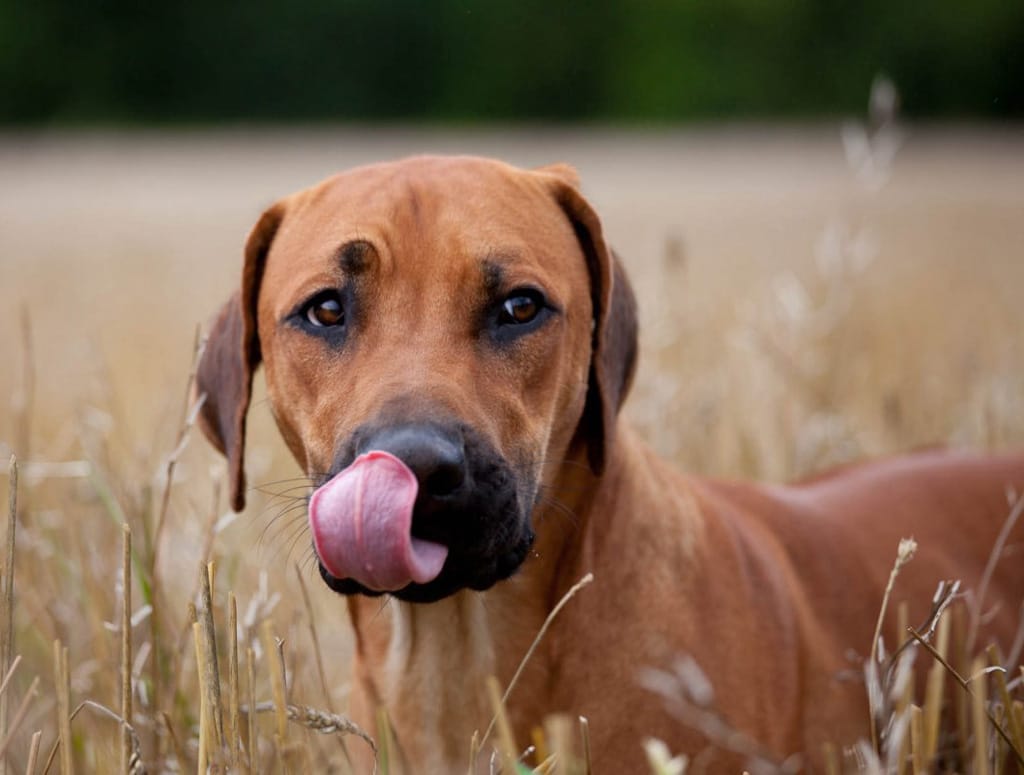
The Rhodesian Ridgeback He is loyal and inseparable from its owner and family environment partner.

Content

History

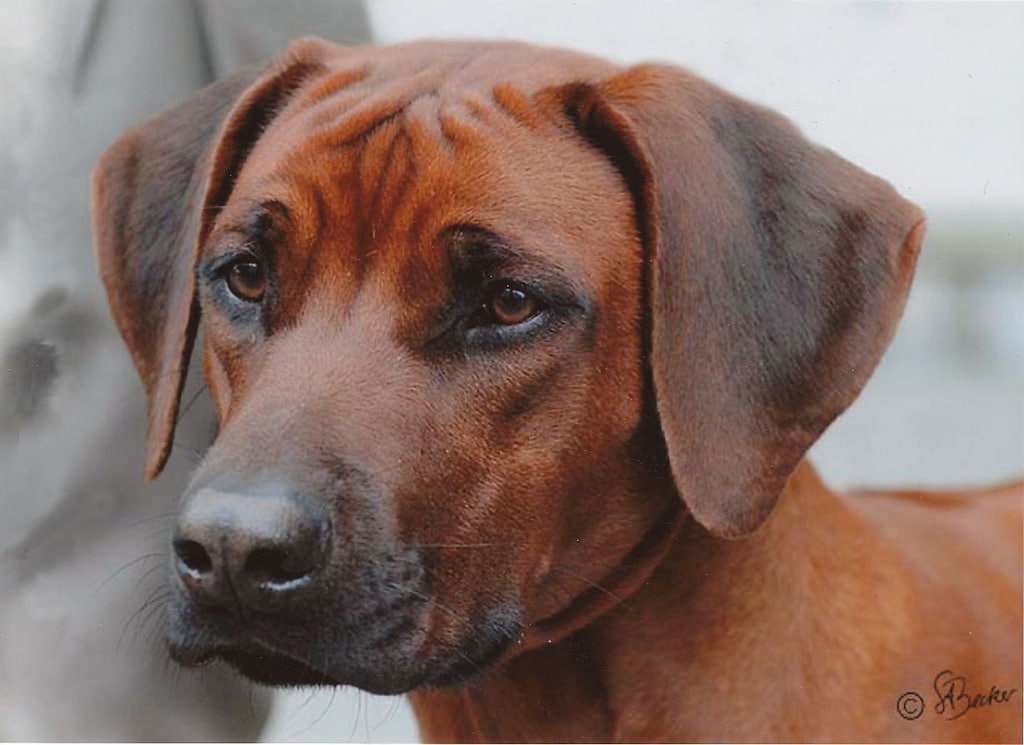
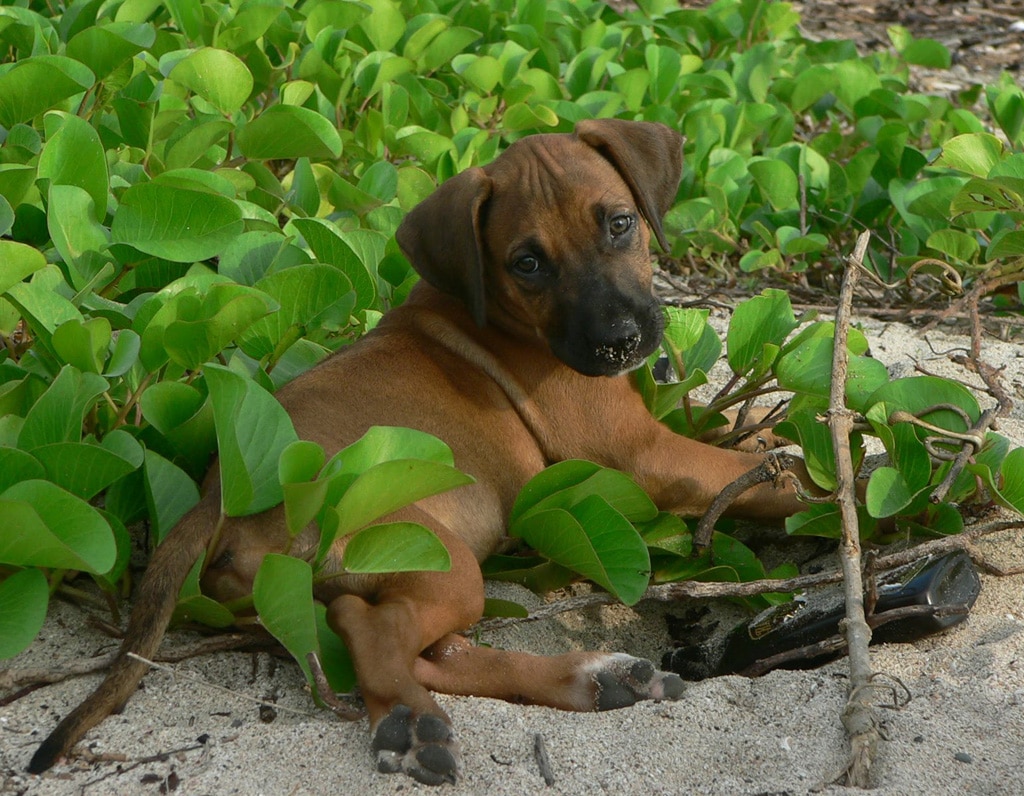
The Rhodesian Ridgeback is a descendant of the semi-wild dogs used more than 500 years for the towns Khoikhoi y Hottentot in south africa. These ancestors already had the same color of wheat (a shade of yellow) and especially the distinctive dorsal crest, formed by hair growing in the opposite direction on the spine.

When the Dutch settlers arrived from the 17th century, they were accompanied by many dogs to help them settle in these difficult regions. Terriers, greyhounds, molossians, Hunting dogs.…: all had a hard time adjusting to the African climate, lack of water and diseases transmitted in particular by the moscow tsetsรฉ. The need to cross European dogs with the local breed quickly became apparent..

The dogs of these crosses helped the farmers to hunt game animals, from the smallest birds to large mammals like lions. They also provided protection in isolated areas and put potentially dangerous animals to flight., such as leopards and baboons.

With the arrival of the English in the 19th century, many boers (settlers of Dutch origin) they moved north, to the area known as Rhodesia, which is now Zimbabwe. This is where the history of the breed really began, when the Reverend Charles Helm (1844-1915) brought two females to the Fountain of Hope, a mission near the town of Bulawayo. They were the ones who started the breeding program of the breed.

In fact, the famous lion hunter Cornelius van Rooyen lived nearby and decided to incorporate these dogs into his pack used to hunt the king of animals. Started a breeding program, in which they were used Collies and the Great Dane to give to Rhodesian Ridgeback your current appearance.

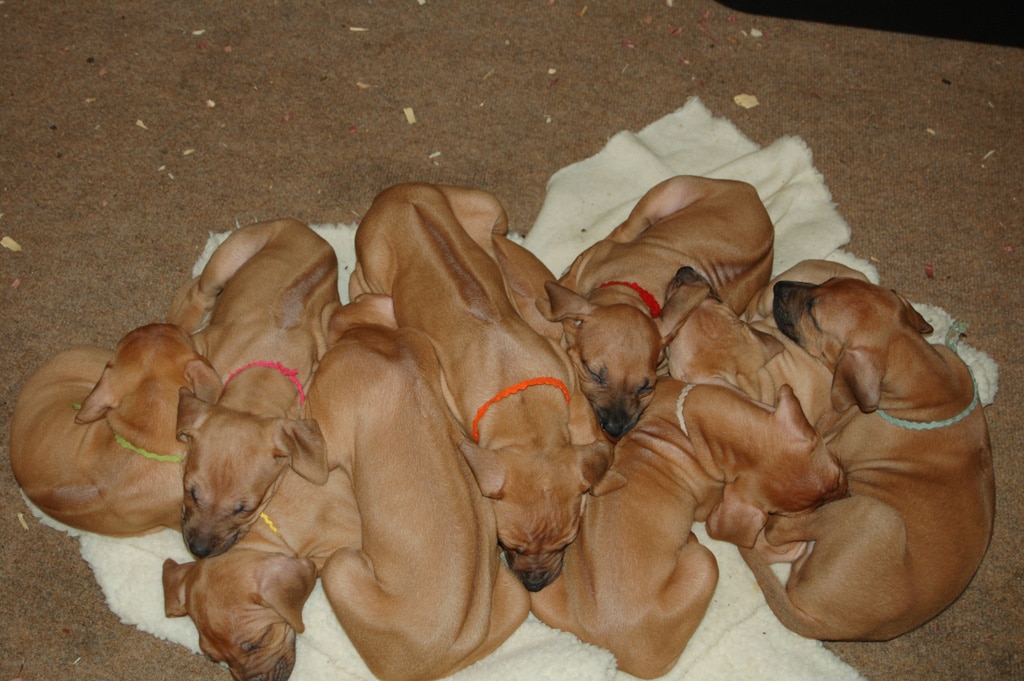
The exploits of this dog, able to run for hours with his master on horseback but also to corner the lion until the hunter arrived, made it quickly popular in the region. Its population exploded, and many babies were born. A breeder named Francis Richard Barnes founded the first club of the breed in 1922 in Bulawayo, and wrote the first standard of the then Rhodesian Lion Dog. This standard was accepted in 1926 by the South African Kennel Union, the reference organization of the country (nowadays the KUSA, pure Southern African Kennel Union). But, on the occasion of this official recognition of the breed, the organization decided to change the name to Rhodesian Ridgback.

The breed appeared in Europe and the United States in the decade of 1930, but it wasn't until after World War II that it really took root. The British Kennel Club (KC) was the first to recognize it in 1954, followed a year later by the Fรฉdรฉration Cynologique Internationale (FCI) and the American Kennel Club (AKC) in 1955. Was not up 1980 that the American United Kennel Club (UKC) he did the same. However, all the major canine organizations in the world today recognize the Rhodesian Ridgeback: is the case of the Canadian Kennel Club (CKC) in particular.

His current situation in his country of origin is paradoxical. Although it is probably the most widespread dog in South Africa, breeders are experiencing many difficulties due to the reduction of the gene pool. Like this, it is estimated that only one litter in twenty is registered with the KUSA, and can be considered purebred. as a result of that, the characteristics of this dog are being lost, and more and more crosses give rise to individuals who are far from the standard.

But, the Rhodesian Ridgeback is very present in the rest of the world and enjoys a certain popularity. In the United States, annual registration statistics with the AKC put it in a very respectable 40th position (almost 200), and has almost won 20 places since the beginning of the 21st century. In Great Britain, the KC registers between 1000 and 1200 births per year.

Physical characteristics

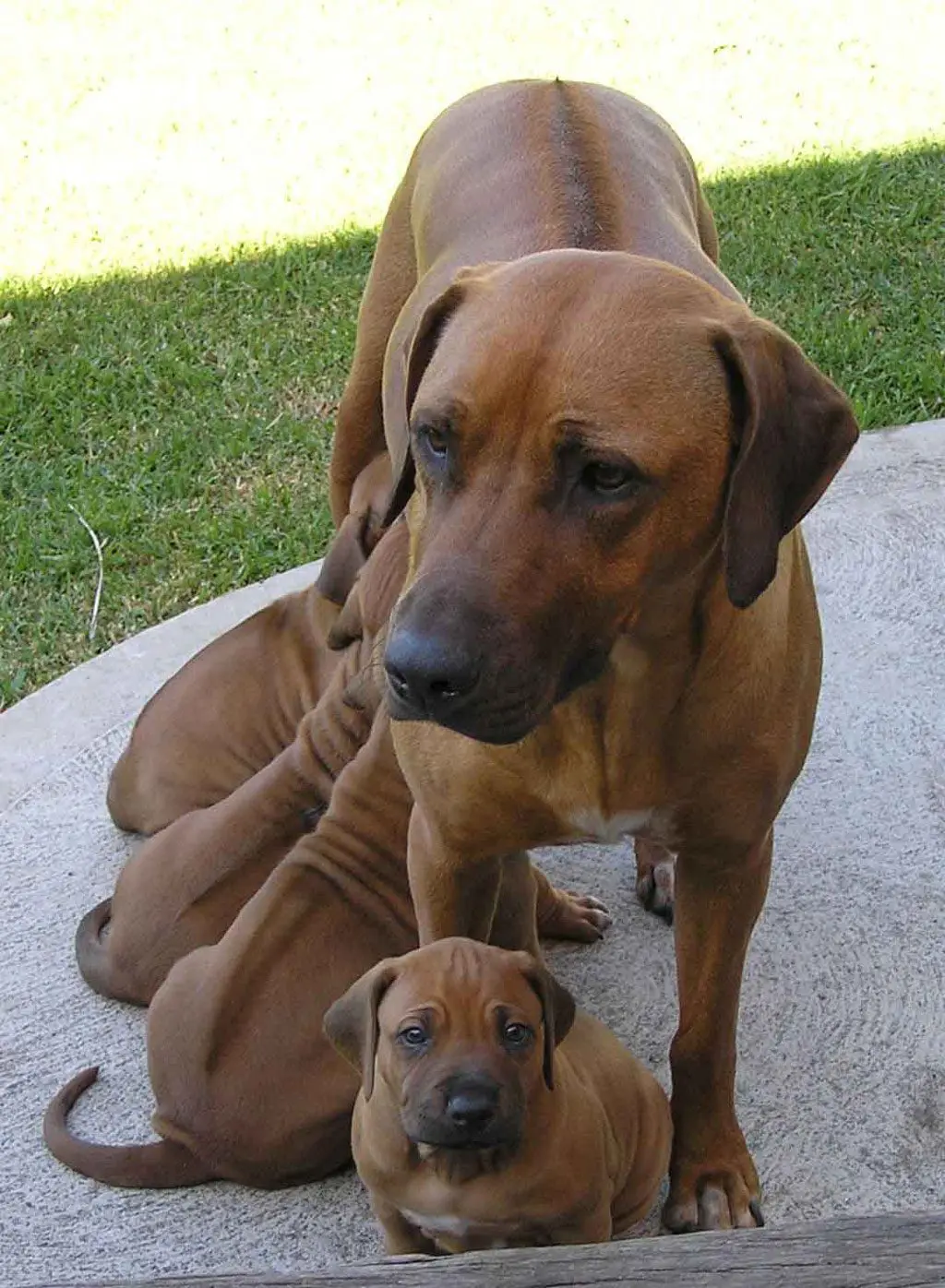
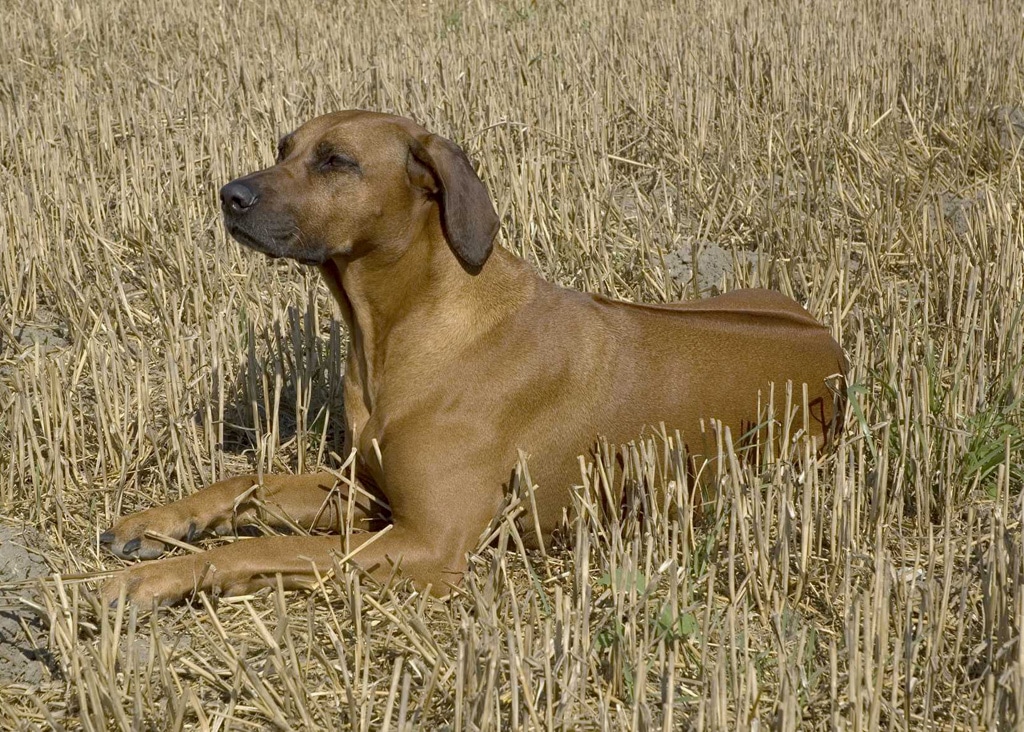
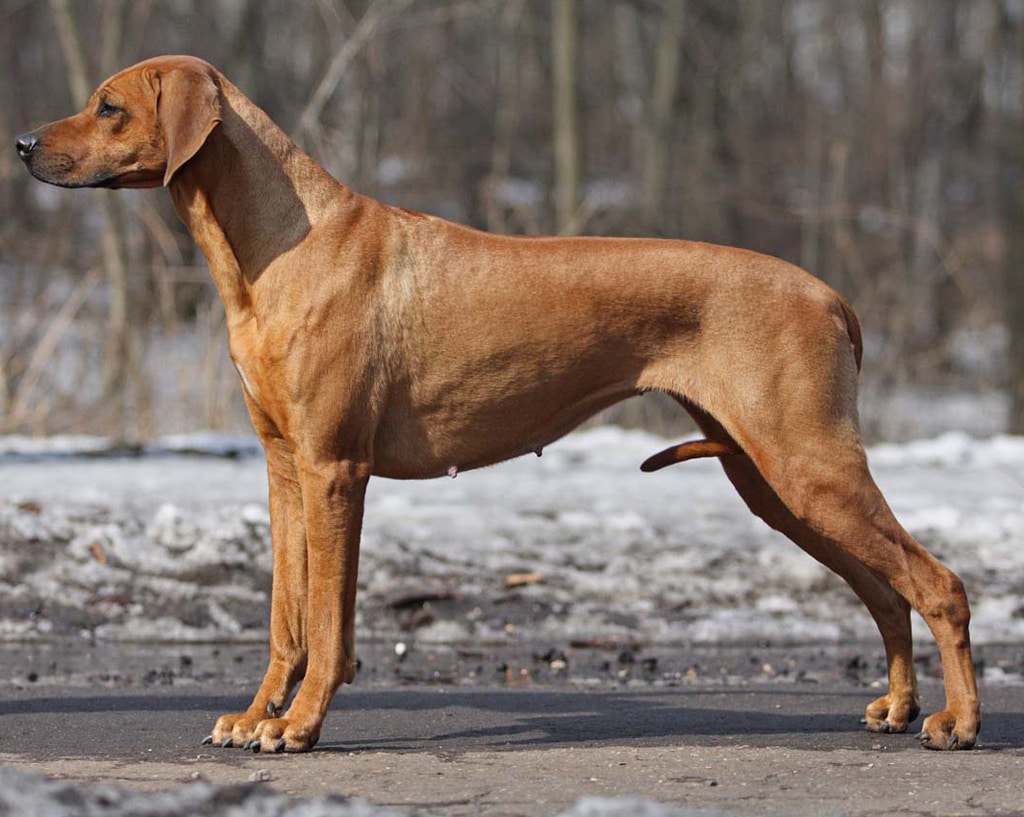
The breed standard indicates that males should be between 63 and 68 cm to the height of the cross, weighing between 36 and 41 kg, and the slightly smaller females, of 61 to 66 cm. of height and a weight of between 29 and 34 kg.

Its weight varies between 30 and 39 kg, its pelage is short, dense, smooth and shiny, without being woolly or silky.

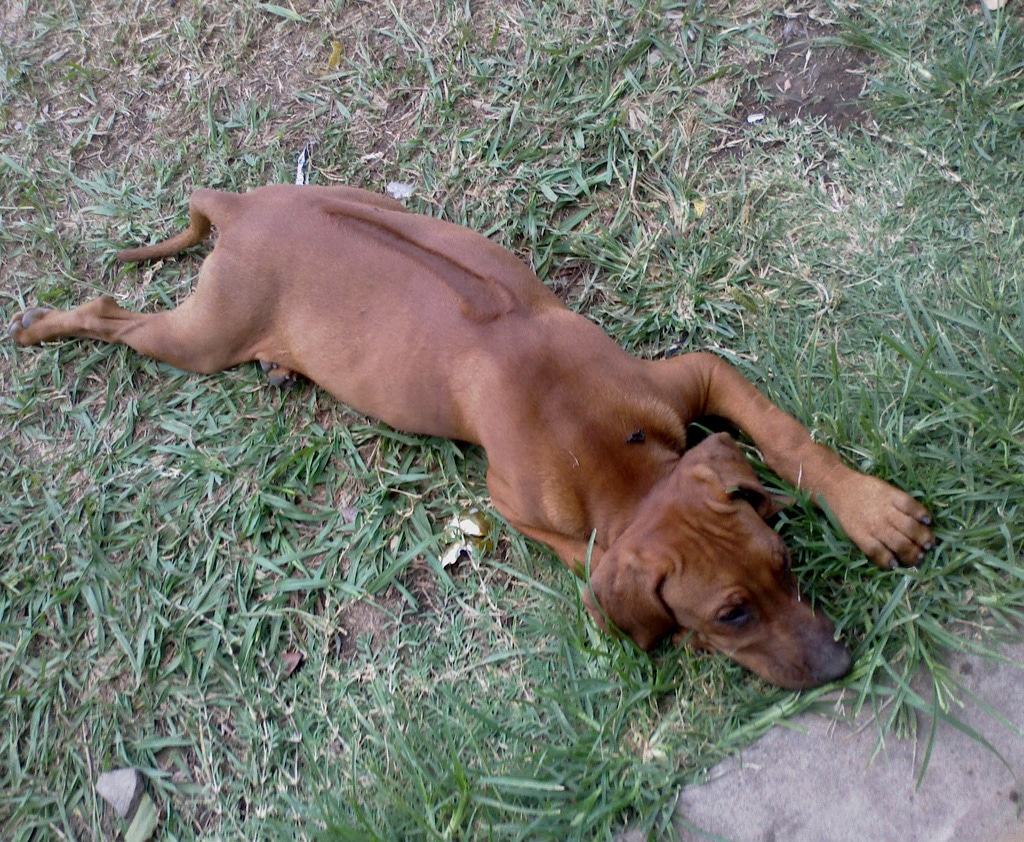
It has, as a feature, a crest on your spine, formed by hairs that grow in opposite direction to the rest of the fur.

The Ridge must be clearly defined and symmetrical, closer to the hip. Must start immediately behind the shoulders and continue until the bones of the hip (rump).

The Ridge must only have two crowns, identical and opposite. The length of the Crown shall not exceed to 1/3 the total length of the ridge or ridge. A good average of the width of the same is of 5 cm..

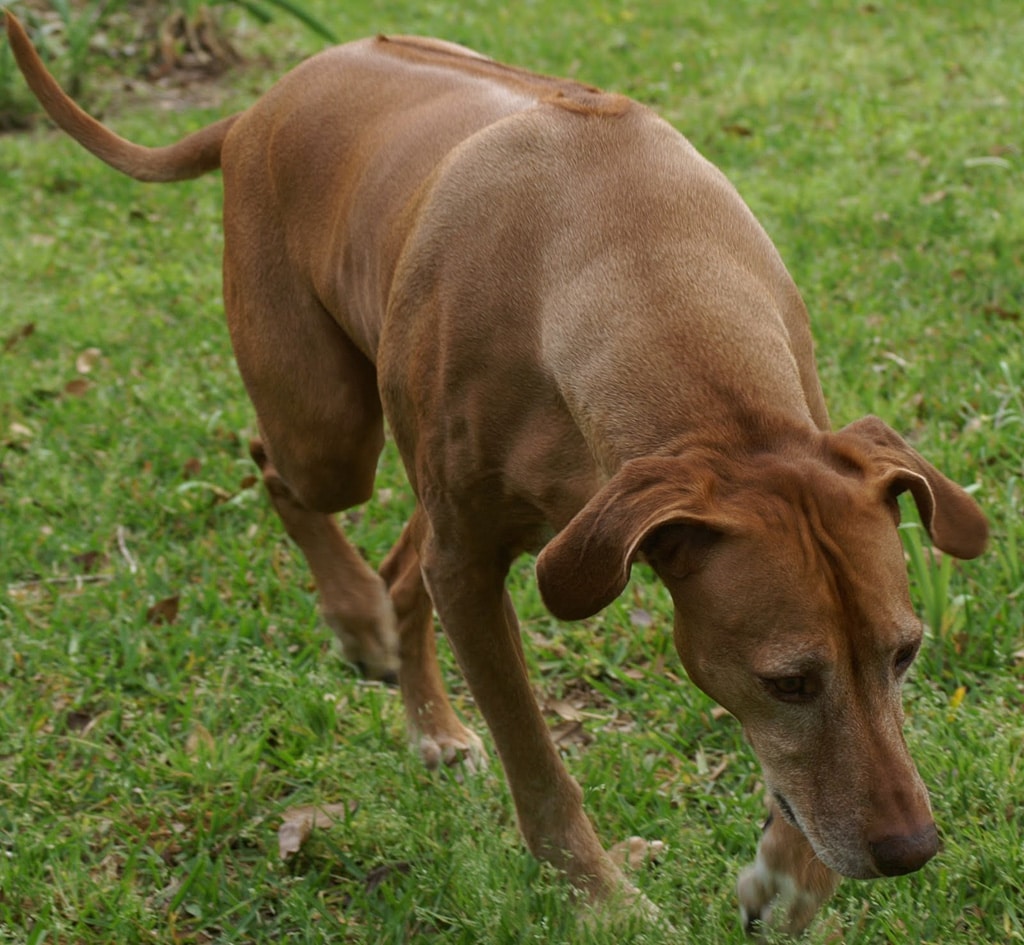
The Rhodesian Ridgeback it is a dog of good presence, strong, muscular, agile and active, symmetrical appearance, balanced and well balanced.

An adult Ridgeback is a beautiful dog, well planted and Atlรฉtico, able to travel long distances with a proper speed. It emphasizes their agility, elegance and strength without the massive trend.

The legs front are straight and strong, heavy bones, What makes it an extremely hardy animal.

The breed standard accepts the colors ranging from pale wheat Red.

The color of the snout It can be black or brown. It supports a small white spot on chest and toes of the front or rear legs.

The South African hunters discovered that the Ridgeback, in pack, they were very effective against the Lions, thus originating a second name for this breed: "the African lion hunter".

The Rhodesian Ridgeback adapts perfectly to the environment of the African steppes. It can withstand high temperatures, as well as the cold of the night.

Itร‚ยดs resistant to insect bites and can remain without food and water more than 24 hours.

Character and skills

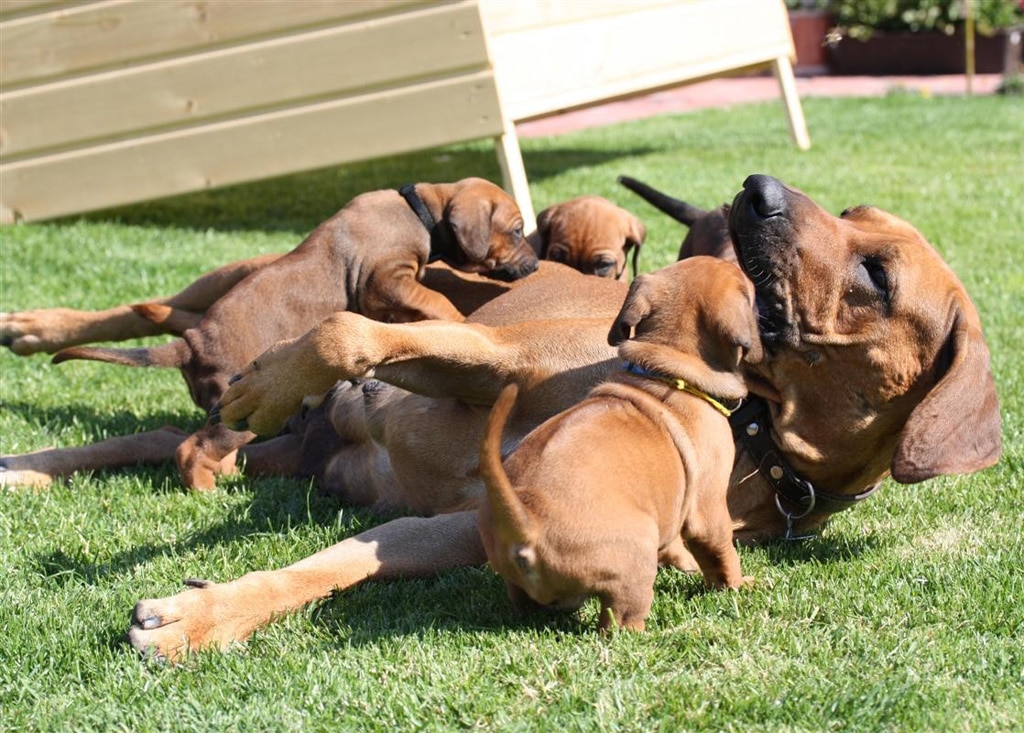
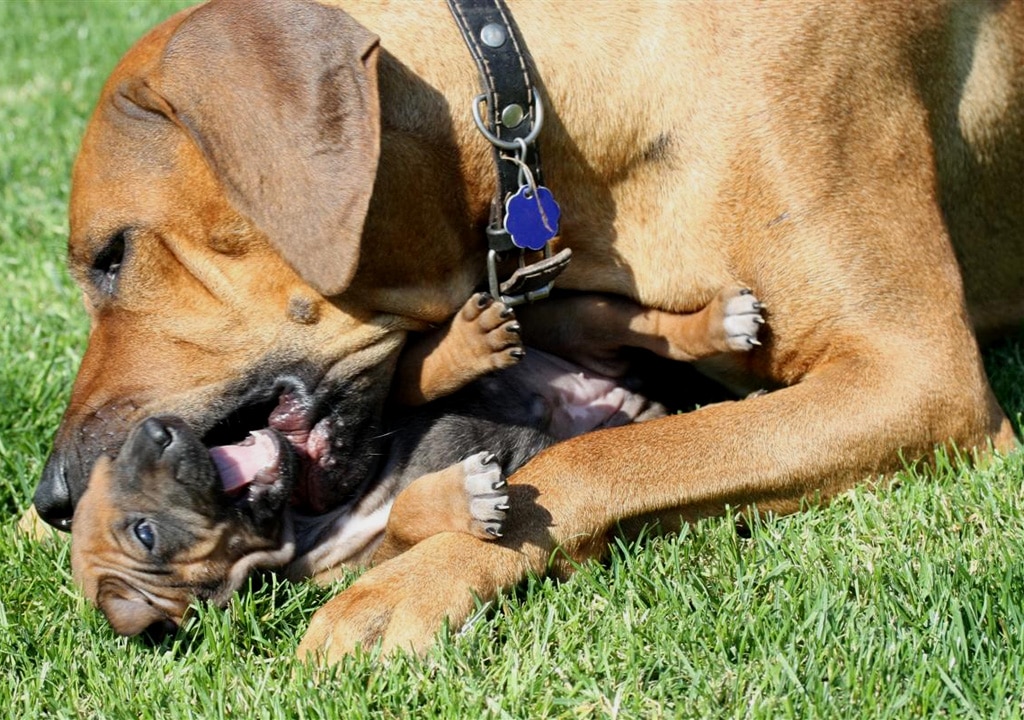
He is very smart. Absolutely loyal and inseparable from its owner and family environment partner. Patient with children (although, because of his size and strength, indicated that they should be monitored during their games) and never aggressive.

According to a popular legend, the crest of Rhodesian Ridgeback is the mark of a lion's paw.

It is reserved with strangers. It is common to confuse its crest with the idea that the dog is Bristly, This often misinterpret her attitude.

In general, the Rhodesian Ridgeback is a dog lively, joyful, playful and very brave.

Let us not forget that he was selected for the Lions hunting. Since its inception, its mission was to discover the lion with its barks and deceptive movements., like feints and escapes, it attracted its prey until it was placed in the crosshairs of the hunter's weapon.

Education ยซRhodesian Crested Dogยป

The socialization of Rhodesian Ridgeback should start in the first few weeks to help him become a calm and balanced adult. Meeting a lot of people (neighbors, friends, family, dealers…) and when crossing with all kinds of companions, gets used to social interactions and learns not to give in to his natural distrust of what is unknown to him.

Your education can start from the first months, and it is important to quickly teach your dog to walk on a leash. Because his hunting instinct is deeply ingrained, tends to run after all small animals and should always be kept on a leash when not in an enclosed area.

It is equally essential to quickly teach him obedience so that he learns to listen to his master and to carry out his orders., either when you are about to chase a passing cat or on any other occasion. He's really smart and stubborn, and tends to do what he likes. Needs a firm and authoritative master, who knows how to make your dog respect you. Add to that its imposing size and it's easy to see why it's not suitable for newbies.. On the other hand, an experienced master can use his intelligence and closeness to his family to teach him many tricks. That is why this dog often shines in dog sports competitions, especially in obedience or agility.

In any case, traditional training methods backfire on this dog, as they would damage the bond between the dog and its owner. On the other hand, positive reinforcement has spectacular results in keeping the dog motivated and strengthening the human-animal relationship. However, to avoid boredom and prevent the animal from being less receptive, it is better to opt for short and playful sessions, even if this means making them more frequent.

It also, it is advisable to accustom it to being handled at a very young age, either for grooming sessions or visits to the vet. In fact, given its size, would quickly become unwieldy if he had the idea not to be very conciliatory in such circumstances as an adult.

Last, given their greed and the risks it entails for their health, it is also better to teach him from a young age to be satisfied with what he is given, and not let him beg or steal food at the table, in cupboards or even garbage cans.

Health ยซRhodesian Crested Dogยป

The Rhodesian Ridgeback it is quite robust, with a life expectancy of 10 to 12 years, which is quite normal for a breed of this size.

They are very resistant to heat and drought, but they also tolerate the cold quite well, as long as the temperature does not drop below 0 degrees Celsius. On the other hand, he doesn't like water at all and hates rain. It should not be left outside or walked around when it rains. May not like humid or very cold areas, so another breed choice seems to be the best option.

Despite his good general health, are particularly exposed to certain diseases:

Hip dysplasia and elbow dysplasia, often hereditary joint malformations that can cause more or less severe locomotion difficulties depending on the severity;

  • dilation-torsion of the stomach, also common in large dogs, which can be fatal if a vet does not intervene quickly. Most of the time it is due to eating large amounts of food too quickly.;
    Hypothyroidism, a hormonal problem in the thyroid gland that causes weight gain and general fatigue. This disease is still rare in the population of the breed, but it seems to be on the rise;
  • dermoid sinus, a hole in the back through which impurities can enter the spine. This inherited problem can lead to serious and life-threatening infections. Surgery can solve the problem, But it's not always like this. Although it is quite rare, This malformation is much more common in the Rhodesian Ridgeback than in other races, although affected individuals are systematically excluded from breeding;
  • degenerative myelopathy, a progressive deterioration of the spinal cord that is paralyzing and fatal. But, still very weird;
    ophthalmological problems (waterfall, progressive retinal atrophy, persistence of the pupillary membrane, entropion…), more particularly within certain lines;
  • Other serious diseases have been reported in the Rhodesian Ridgeback, but they are still very rare and do not seem to affect these dogs more than other breeds: is the case of cerebellar abiotrophy, cervical malformation, hemolytic anemia, lupoid onychodystrophy, hemangiosarcoma or von Willebrand's disease.

    But, this long list should not hide the fact that, According to a study conducted in 2004 about almost 200 individuals by the Kennel Club and the British Small Animal Veterinary Association, the main causes of mortality in this breed are cancer and advanced age, accounting for half of the deaths.

    To reduce the risk of inherited diseases and increase the chances of adopting a healthy puppy, it is recommended to go to a dog breeder Rhodesian Ridgeback serious and responsible. Must present a certificate issued by a veterinarian attesting that the animal is in good health, the details of the vaccinations carried out (registered in the health record or in the vaccination book), as well as the results of the genetic tests carried out that demonstrate the good health of the puppy and the parents.

    Like all breeds of dogs with floppy ears, the Rhodesian Ridgeback are at increased risk of infection in this area. So, it is necessary to regularly clean your ears with a clean cloth to remove dirt and avoid problems.

    Another risk you are exposed to is obesity. Pretty greedy, have a tendency to be overweight if you can't exercise as you should. Only its owner can help you keep your weight in shape, keeping him active and making sure he doesn't eat more than necessary.

    Your weight is one of the things the vet looks at during routine visits. As with any dog, these must be at least once a year, since they also and above all allow the early detection of any problem, as well as making sure you stay up to date on your vaccinations.

    Toilet ยซRhodesian Crested Dogยป

    The coat of the Rhodesian Ridgeback it is particularly easy to care, since his short coat only needs a quick weekly brushing. But, they molt in spring and fall, when it is advisable to increase the frequency of brushing to remove dead hair.

    The coat generally remains clean and therefore odorless, and only needs to be bathed when particularly dirty, for example after a walk in the mud. But, even in this case, vigorous brushing may be enough to help you get rid of dirt. In any case, when you bathe your dog, you can only use a shampoo specifically designed for dogs, as it can damage your skin.

    His floppy ears are finally the point that requires the greatest vigilance in terms of maintenance., because this morphological peculiarity implies a greater risk of infections (ear infections, etc.). To avoid this, They should be inspected weekly and cleaned with a damp cloth.. This prevents debris or dirt from accumulating.

    The weekly coat and ear maintenance session is also an opportunity to check and clean the eyes, even though there is no increased risk in this area.

    You should also take advantage of this time to brush your teeth to limit the formation of tartar and thus avoid problems such as bad breath., caries, gum disease, etc. The ideal, However, is that you brush more often, up to once a day.

    Finally, the claws of Rhodesian Ridgeback they grow alive and are particularly hardy. Although he can run outdoors often, it is better to check them every 2-3 weeks, since it is common that natural wear is not enough to file them. When they get too long, must be trimmed with a nail clipper designed specifically for dogs, as there is a risk of them getting in the way or breaking.

    Usage ยซRhodesian crested dogยป

    The Rhodesian Ridgeback has worked for centuries in his native country as a guard dog on isolated farms against predators, as well as hunting dog. They earned their letters of nobility and a certain notoriety thanks to their exploits during organized lion hunts in the late 19th and early 20th centuries.. A pack of two or three of these dogs was capable of chasing a lion for tens of kilometers before cornering it until the hunter arrived..

    Although today he no longer hunts lions, continues to accompany hunters from various continents, helping them take out and chase game of all sizes.

    It also acts as a guard dog, warning of the arrival of strangers and not hesitating to show his courage if the threat is confirmed and his family is in danger.

    But, what makes it so popular today is above all because it combines many of the qualities of the ideal companion dog. Affectionate and devoted, are especially popular with sports owners. Capable of running a marathon in 90 minutes, the Rhodesian Ridgeback can easily accompany a runner, cyclist or hiker for several hours. On the other hand, would not fit well with an elderly or very sedentary person, and would have every chance of overcoming a beginner or an insecure master.

    Last, his physical assets obviously make him a champion in cani-cross competitions, but also excels in other dog sports, like obedience or agility.

    Buy ยซRhodesian Crested Dogยป

    The price of a puppy Rhodesian Ridgeback registered is an average of between 1200 and 1300 EUR, without great differences between males and females. But, this average hides a fairly wide price range, of 700 to 1800 EUR, depending on the physical characteristics of the puppy, its ancestry and the prestige of the breeding from which it comes.

    in Canada, it is necessary to count between 1500 and 2500 Canadian dollars to adopt a Rhodesian Ridgeback with all the guarantees about the fact that he is in good health.

    Observations

    The race is almost unknown in Spain, and in the rest of Europe, that makes it very difficult to get a puppy from Rhodesian Ridgeback.

    Characteristics "Rhodesian Ridgeback"

    Coexistence is important that you have with your new friend. Before considering the acquisition of a dog of the breed "Rhodesian Ridgeback" you know certain factors. Not all breeds of dogs are apt to live in an apartment, you must take into account his character, their need for exercise, their interaction with other pets, their care and if you have small children, their level of tolerance towards them.

    Adaptation โ“˜

    3,0 of 5 stars (based on 1 review)

    friendly dog โ€‹โ€‹โ“˜

    3,0 of 5 stars (based on 1 review)

    hair loss โ“˜

    3,0 of 5 stars (based on 1 review)

    Affection level โ“˜

    5,0 of 5 stars (based on 1 review)

    Need for exercise โ“˜

    4,0 of 5 stars (based on 1 review)

    Social need โ“˜

    3,0 of 5 stars (based on 1 review)

    Home โ“˜

    3,0 of 5 stars (based on 1 review)

    Toilet โ“˜

    3,0 of 5 stars (based on 1 review)

    Friendly with strangers โ“˜

    3,0 of 5 stars (based on 1 review)

    barking โ“˜

    2,0 of 5 stars (based on 1 review)

    Health โ“˜

    4,0 of 5 stars (based on 1 review)

    Territorial โ“˜

    4,0 of 5 stars (based on 1 review)

    Cat friendly โ“˜

    3,0 of 5 stars (based on 1 review)

    Intelligence โ“˜

    3,0 of 5 stars (based on 1 review)

    Versatility โ“˜

    2,0 of 5 stars (based on 1 review)

    Child friendly โ“˜

    5,0 of 5 stars (based on 1 review)

    Surveillance โ“˜

    3,0 of 5 stars (based on 1 review)

    joy โ“˜

    5,0 of 5 stars (based on 1 review)

    Images ยซRhodesian Crested Dogยป

    ยซRhodesian Crested Dogยป Videos

    Type and recognitions:

    • FCI CLASSIFICATION:
    • Group :
    • Section : . .

    Federations:

    • FCI – Group 6: Scent hounds, and related breeds. – Section 3: Related breeds. โ“˜
    • AKCHound โ“˜
    • ANKCGroup 4 (Hounds) โ“˜
    • CKCGroup 2 – Hounds โ“˜
    • โ€‹KCHoundy โ“˜
    • NZKCHound โ“˜
    • UKCSighthounds & Pariahs โ“˜

    FCI breed standard "Rhodesian Ridgeback"

    Origin:
    Zimbabwe

    Date of publication of the valid original standard:
    10/12/1996

    Use:

    The Rhodesian Crested Dog is still used for hunting in many parts of the world., but it is especially appreciated as a guard dog and family pet.


    General appearance:

    The Rhodesian Crested Dog should represent a well balanced dog, strong, muscular, Agile and active, symmetrical silhouette. It has great resistance and can reach considerable speed.
    Emphasis is placed on agility, elegance and firmness without tendency to be massive. The peculiarity of this breed is the crest on the back, which is formed by hair that grows in the opposite direction to the rest of the coat. The crest is the distinctive feature of the breed. The crest should be clearly defined and symmetrical, closer to the hip.
    The crest should have only two identical and opposite crowns. The lower edges of the crowns should not extend beyond the
    crest that is one third of its length. A good average ridge width is 5 cm. (2 inches).


    Behavior / temperament:

    Majestic, Intelligent, reserved with strangers, but without aggression or shyness.

    Head:

    ---

    Cranial region:
    • Skull: It must be of an appropriate length (must be equal to the width of the head between the ears, the distance from the back of the head to the fronto-nasal depression with truffle), flat and wide between the ears; the head should be wrinkle-free during rest.
    • Depression links (Stop): The naso-frontal depression must be reasonably well defined and not in a straight line from the nose to the occipital bone..

    facial region:

    • Truffle: The black truffle must be accompanied by dark eyes, a truffle Brown with amber eyes.
    • Snout: The muzzle should be long, deep and powerful.
    • Lips: The lips must be net, well adjusted to the jaws.
    • Jaws / Teeth: Strong jaws, with a perfect and complete scissor bite, That is, the upper teeth closely overlap the lower teeth and are implanted vertically in the jaws.. The teeth should be well developed, especially the canines.
    • Cheeks: The cheeks should be net.

    Eyes: Must be moderately separated, round, shiny and sparkling, with intelligent expression; its color matches the color of the mantle.

    Ears: They must be planted rather high, a medium-sized, rather wide at the base, and gradually decreasing to a rounded tip. They must be performed to taped to the head.

    Neck:

    It must be rather long, strong and free chaps.

    Body:

    • Back: Powerful.
    • Pork loin: Strong, gently arched and muscular.
    • Breast : It should not be too wide, but very deep and with a lot of capacity; the breast should reach the elbow. The sill should be visible when viewed from the side. Ribs are moderately snugly, never abarriladas.

    Tail:

    It should be strong at the roots and gradually taper towards the tip. ; free of roughness. It must be of a moderate long. Must not be implemented very high or very low, and should be taken up with a slight curve, never rolled.

    Tips

    PREVIOUS MEMBERS: Previous members must be perfectly straight, strong and good bones, with the elbows close to the body. When viewed from the side, previous members must be wider than when viewed from the front.

    • Shoulder: The shoulders should be inclined, NET and muscular, denoting speed.
    • Metacarpus: They must be strong and slightly inclined.

    LATER MEMBERS: Rear extremities, the muscles must be net and well defined.

    • Knee: Well angled.
    • Hocks: Strong in low position.

    FEET: The foot should be compact and round, with well arched toes and resistant elastic pads; protected with hair between the toes and pads.

    Movement:

    Straight forward, free and active.

    Mantle

    HAIR: It should be short and dense, smooth and lustrous appearance, but not woolly or silky.

    COLOR: Of the trigoclaro red wheat. A little white on the chest and toes is permissible, but the excess of white hair in these parts, in the abdomen or above the toes is undesirable. Dark ears and snout are permitted. Excessive black hairs throughout the coat is highly undesirable.


    Size and weight:

    Height to the cross:

    • Males: 63 โ€“ 69 cm. (25-27 inches).
    • females: 61 โ€“ 66 cm. (24-26 inches).

    Weight:

    • Males: 36,5 kg (80 English pounds).
    • females: 32 kg (70 English pounds).


    Fouls:

    Any deviation from the aforementioned criteria is considered as a fault and the severity of this is considered to the degree of the deviation to the standard and its consequences on the health and well-being of the dog..

    • Any dog โ€‹โ€‹showing clear signs of physical or behavioral abnormalities must be disqualified..


    N.B.:

    Males should have two normal-appearing testicles fully descended into the scrotum..

    TRANSLATION: Miguel Angel Martinez.

    Source: F.C.I - International Cynological Federation

    Alternative names:

    1. Ridgeback, African Lion Dog, African Lion Hound (English).
    2. Rhodesian ridgeback (French).
    3. (German).
    4. Rhodesian ridgeback (Portuguese).
    5. Perro Crestado de Rhodesia, Rhodesiano (espaรฑol).

    โ–ท The world of Pets: Dogs, cats, birds, reptiles, amphibians

    French White and Orange Hound
    Francia FCI 316 - Large-sized Hounds

    French White and Orange Hound

    It is a very unusual breed, practically unknown outside of France.

    Content

    The French White and Orange Hound is a competent olfactory hound of French origin. It was specifically developed for hunting in large packs and today this breed is acquired exclusively for hunting.. Despite her fabulous work skills, it can be found very rarely not only in European countries but also in its native France.

    History French White and Orange Hound

    The French White and Orange Hound is one of the three ยซFrench Scent houndsยซ, along with the French Tricolour Hound and the French White and Black Hound. All these dogs are olfactory dogs that hunt in large herds and listen to a hunter to orient themselves.

    It's a race of recent creation; among its ancestors is undoubtedly the Billy, but we don't know exactly which dogs were used in their selection. Of the three French Hounds, the French White and Orange Hound is one of the rarest.

    Physical Characteristics Orange and White French Hound

    The French White and Orange Hound is a distinguished French dog that gives a rustic impression. His eyes are big, brown and dark. Located slightly below the eye line, your ears are flexible, fine, slightly screwed and reach the tip of the nose. Your walks are easy, adopts a light and sustained gallop.

    Her hair is short and thin, lemon white or white-orange, as long as the orange isn't too dark, tending to red.

    SIZE:

    Height to the cross: 62 to 70 cm.. With 2 cm tolerance for maximum size.
    Weight: Some 30 Kg.

    Character and skills French White and Orange Hound

    The only function of French White and Orange Hound is hunting, so it is difficult to make a generalization about their behavior patterns and temperament in a domestic environment. But, it is not necessary to suggest that a socialized specimen can become an educated and well-rounded family pet. Like most scent hounds, he is gentle with children and likes to be a part of their exciting activities.. This dog is probably too energetic and playful to be a suitable companion for a child..

    The French White and Orange Hound tends to become somewhat distant and reserved in the presence of strangers. However, he will never show open aggression unless he suspects that something or someone threatens his family. Some of these dogs are vigilant enough to perform surveillance duties. This sociable and caring breed will make a terrible guardian, that he would rather greet an intruder by wagging his tail than resorting to necessary actions.

    Canine aggressiveness is considered a major defect in the temperament of hounds, that were developed for herd hunting. For this reason, members with the slightest hint of this undesirable characteristic are immediately excluded from the breeding program. The French White and Orange Hound is known for its exceptional tolerance towards other canines. Despite his excessively peaceful nature, also requires early socialization in this regard. It is worth remembering that the breed has a very powerful drive to hunt down and kill other species of animals., especially stray cats. You can get along with individual family pets if you have been raised with them since your puppy.

    Health of the French White and Orange Hound

    The most common problems for the breed include:

    – canine hip dysplasia;
    – elbow dysplasia;
    – eye problems;
    – sarna demodex;
    – skin infections;
    – skin allergies;
    – chronic ear infections;
    – bloodhound ataxia.

    Caring for the French White and Orange Hound

    The French White and Orange Hound Needs a negligible amount of maintenance. Regular brushing will be enough to keep his short, graceful coat in reasonably good condition..

    The ears of this breed are highly susceptible to irritation and infections., so its systematic examination and cleaning should become an essential part of care routines.

    French White and Orange Hound Training

    The training of the French White and Orange Hound poses a considerable challenge. The breed is a natural hunter and requires basic training in all that concerns its original hunting duties.. Unfortunately, its persistence in the search for prey turns into obstinacy in training. It also, cannot concentrate on the same boring task for a long time and is easily irritated by its many repetitions.

    The best training strategy for this dog should include abundant rewards in the form of praise and tasty treats.. Negative reinforcement doesn't work with French White and Orange Hound and must be avoided at all costs.

    Exercise with the French White and Orange Hound

    The French White and Orange Hound it is an athletic and robust hunting dog, easily adapts to extremely intense physical activity. As minimum, should be taken on a quick walk of 45 minutes a day. You should always wear a leash when you are outside, since it is very difficult to call him back once he has been drawn down some interesting path.

    The French White and Orange Hound behaves calm and relaxed once exercise requirements have been fully met. Keep in mind that a little exercised dog will gradually develop behavioral problems as unpleasant as continuous barking, internal hyperactivity or destruction. This breed is best suited for suburban life in the house with a large, secure yard.

    Type and recognitions:

    • FCI CLASSIFICATION:
    • Group :
    • Section : . .

    Federations:

    • FCI – Group 6: Scent hounds, and related breeds. – Section 1.1: Large-sized Hounds. โ“˜
    • UKCScenthounds โ“˜
    • Central Canine Society โ“˜

    FCI breed standard "French White and Orange Hound"

    Origin:
    France

    Date of publication of the valid original standard:
    01.02.1982

    Use:

    Hound


    General appearance:

    This is a distinguished French dog, giving an impression of rusticity.


    Behavior / temperament:

    ---

    Head:

    It is quite large and not very long.

    Cranial region:
    • Craging: Slightly bump; occipital protrusion is barely marked. The eyebrows are not prominent.
    • Dnaso-frontal depression (Stop): It is well marked.

    facial region:

    • Nariz: Is well developed. Its color is black or brown - orange.
    • Snout: The length of the muzzle is almost equal to that of the skull.
    • Belves: Quite marked and give the muzzle a rather square look.

    OJOS: Large, brown and dark.

    OREJAS: Slightly inserted below the plane of the eye line. They are flexible, fine, slightly crooked and reaches within two fingers of the nose.

    Neck:

    Straight, quite long and has a slight dewlap.

    Body:

    • Espalda: Broad and rectilinear.
    • Pork loin: It is usually convex.
    • Glikeness: Rounded, but not sunk.
    • Pecho: Large. Rounded ribs.
    • Flanks: Well solid.

    Tail:

    Long.

    Tips

    PREVIOUS MEMBERS:

    • Ageneral appearance: Strong and big.
    • Shoulder: Oblique and well muscled.
    • Pinis previous: Hare feet.

    LATER MEMBERS

    • Thighs: Well muscled.
    • Corvejรณn: It occurs close to the ground and is slightly bent.
    • Hind feet: Hare feet.

    Movement:

    Pretty loose. The gallop is light and constant.

    Mantle

    PIEL: White, with yellow or orange spots. The palate may be yellow. The scrotum is white or yellow.

    MANTLE

    Plink: Satin y fine.

    Codor: White - Lemon or White and Orange, provided the orange is not too dark (pulling red).


    Size and weight:

    Altura to the cross: 62 to 70 cm.. With 2 cm tolerance for maximum size.


    Fouls:

    Any deviation from the aforementioned criteria is considered as a fault and the severity of this is considered to the degree of the deviation to the standard and its consequences on the health and well-being of the dog..

    โ€ข narrow nasal cane or too long.
    โ€ข Upper or lower prognathism.
    โ€ข Light eyes.
    โ€ข Encrovated tail or deviates to the side.
    โ€ข Partial depigmentation of the truffle.
    โ€ข Another color fur than is not established by the standard, particularly black or red hair.

    FALTAS DISQUALIFYERS:

    • Aggressiveness or extreme shyness.
    • Any dog โ€‹โ€‹showing clear signs of physical or behavioral abnormalities.


    N.B.:

    โ€ข Males must have two normal-appearing testicles fully descended into the scrotum..
    โ€ข Only functionally and clinically healthy dogs, with the typical conformation of the breed, should be used for parenting.

    Source: F.C.I - International Cynological Federation

    Photo: petpaw

    โ–ท The world of Pets: Dogs, cats, birds, reptiles, amphibians

    Italian short-haired Segugio
    Italia FCI 337 - Medium-sized Hounds

    Italian short-haired Segugio

    The Italian short-haired Segugio it is a dog with a stable temperament, of a soft but not very outgoing expression.

    Content

    History

    The Italian hound It, According to the vast majority of authors, a dog with very ancient origins. It is believed, in fact, descended from hunting dogs that lived from ancient Egypt, they reached the shores of the Mediterranean Sea, and therefore also to Italy, thanks to the Phoenician merchants. Many Egyptian drawings dating from the time of the pharaohs show the presence of dogs very similar to the current one Italian hound.

    His best period is the Renaissance, when its level was improved and its great diffusion began. The race then underwent a slow and inexorable decline until, from the beginning of the 20th century, the Italian hound it became very popular again.

    The modern history of Italian hound started on 1920, year in which the Technical Committee of the Society of Hound Hobbyists drew up the first breed standard that a few years later, in 1929 to be exact, was approved by the Italian Kennel Club. At that time there was only one standard that unified the Italian Rough-Haired Hound y al ยซItalian short-haired Segugioยซ; in 1976 came the prohibition of mating between the two varieties; then, in 1989, the ENCI (Ente Nazionale della Cinofilia Italiana) passed two different standards, standards that were later also recognized by the FCI which classified them in the group 6, among hound-type dogs, and related breeds.

    The Italian short-haired Segugio It probably has the same origins as the ยซItalian Rough-Haired Houndยซ; in fact, both varieties of hounds have always coexisted in almost the entire peninsula.

    Physical characteristics ยซItalian short-haired houndยป

    Italian Hound, Short-haired
    A female Italian Hound, Short-haired. Colour: black & tan by Canarian, CC BY-SA 4.0, via Wikimedia Commons

    The Italian short-haired Segugio represents perfection for those who care about physical appearance: in fact, has no fat and is very muscular. This physical feature, combined with a regular body, makes it particularly fast and suitable for running. It's not a coincidence, in fact, getting tired only after intense physical activity.

    Hair is shaved all over the body, dense, dense and smooth.

    The allowed colors are:

    – Fawn unicolor in all its gradations.
    – black and tan.

    Fawn dogs may have a white muzzle and skull, a white star on the chest, white on the neck, metacarpos, metatarsos, feet and tip of tail.

    The height of the males ranges from 52 and 58 cm., that of the females between 48 and 56 cm.. The weight can vary between 18 and 28 kg.

    Character and aptitudes ยซItalian short-haired houndยป

    Alive and bold. Never aggressive towards humans; rarely towards other dogs. It does not bite. Suits austere food and country kennels. Not conspicuously affectionate, but constantly needs the presence and consideration of the owner, who often identifies with the one who accompanies him during the hunt.

    If he is well-maintained and has a breed-appropriate lifestyle, the Italian short-haired Segugio You can live up 12 or 13 years. This is because this type of dog is not predisposed to particular diseases derived from its breed.

    Those who love them say that…

    ยซI did not choose to live with a ยซHoundยป, I mean it was not a choice out of passion for this breed… it happened to me! It turns out that I share my life with a "Hound". It was and still is the most amazing experience of my life. Living with a "Hound" means learning to have time, lots of time to walk โ€œaloneโ€ exploring life, silent. It is learning that you can stay in the forest for hours without doing anything other than living and discovering the forest. And that's it. The "Hound" teaches you not to pay attention to appearances, to pursue your passions tenaciously while those who look at you think you are just sniffing. He is an extremely sensitive partner but at the same time proud and independent. Living with Chloe is an adventure, made of constant and subtle balances between sharing and the search for individuality, the desire for freedom and the need to feel close to each other, "It is learning every day to discover and respect yourself.".

    Silvia De Cristofaro

    Videos "Italian short-haired Segugio"

    segugio italiano sofiko evros 2/7/2017 Educational
    segugio italiano sofiko evros 2/7/2017 ฮ•ฮบฯ€ฮฑฮนฮดฮตฯ…ฯ„ฮนฮบฯŒ
    Short-haired fawn Italian Hound (Alexia)-1/1
    Segugio Italiano fulvo a pelo raso (Alexia)-1/1

    Type and recognitions:

    • FCI CLASSIFICATION:
    • Group :
    • Section : . .

    Federations:

    • FCI – Group 6: Scent hounds, and related breeds. – Section 1.2: Medium-sized Hounds. โ“˜
    • โ€‹KCHoundy โ“˜

    FCI breed standard "Italian short-haired Segugio"

    Origin:
    Italy

    Date of publication of the valid original standard:
    13.11.2015

    Use:

    Hound, particularly for hare and wild boar hunting.


    General appearance:

    This is a dog of medium overall proportions and a square body., robust construction, perfectly proportioned and endowed with a well-developed bone structure. He is slim and has strong muscles., without the slightest trace of grease. The head is elongated and the longitudinal craniofacial axes are divergent.. The hair is satin.

    IMPORTANT PROPORTIONS

    โ€ข The length of the trunk is equal to the height at the withers (square appearance).
    โ€ข The height of the chest is equal to half the height at the withers, or, In other words, is equal to the height of the forelimb measured from the ground to the elbow.
    โ€ข The length of the nasal shank is equal to half the length of the head.


    Behavior / temperament:

    This is an animal that adapts well to the most diverse types of terrain and is endowed with great resistance and great speed.. Shows great ardor, whether you work alone or in a pack. He has a bold temperament, but not very communicative. His eyes are sweet and his voice is very pleasant..

    Head:

    ---

    Cranial region:
    • Skull : Seen from above, Its shape is almost oval. In profile, the axes of the skull and the nasal cannula are divergent. The upper profile is slightly convex. The bizygomatic width is less than half the length of the head. The superciliary arches are not very developed. The frontal furrow is not very marked. The occipital crest is short and apparent, although the relief is not exaggerated.
    • Depression links (Stop) : It has an accentuation of about 140ยฐ.

    facial region:

    • Truffle : It is almost in the shape of a six-sided polyhedron.. It is large enough and mobile. The windows are wide open somewhat laterally.. The color of the nose must always be black.
    • Snout : Its length is equal to half the length of the head. Its depth (height) It should be a little larger than half its length. The profile of the nasal shank is somewhat convex. Its lateral faces converge forward. The branches of the mandible are almost straight along their entire length and the body of the jaw is poorly developed in its anterior part.. The lower lateral profile of the snout is defined by the upper lip.
    • Lips : They are fine and thin. Seen both from the front, as in profile, they are a little high (lying). Seen in profile, its lower edge draws a slight curve. The edges of the lips should always be black.
    • Jaws / Teeth : The jaws are shaped like a truncated cone.. The incisors are implanted at right angles to the jaw and the joint is scissor-shaped.. The denture is complete. The teeth are white and set in a regular line.. The correct joint is scissor-shaped, although the pincer-shaped joint is accepted.
    • Cheeks : Flat and thin.

    Eyes : Almond shaped. They are large, luminous, dark ocher color. Your expression is sweet. They are located in a semi-lateral position. The edges of the eyelids are always black.

    Ears : The insertion of the ear is located in the plane of the zygomatic arches or a little below. The ears must be hanging and have a contortion that brings them completely forward and does not even allow them to be sunken., nor twisted. They have a triangular shape, They are flat throughout almost their entire length and are very wide. Its end should end in a narrow point, but never widely rounded; this tip bends slightly inwards. The length of the ears corresponds to a 70% of the length of the head and its width, measured at the widest part, It is a little larger than half its length.

    Neck:

    โ€ข Profile : The upper profile is slightly arched, i.e. convex. โ€ข Length : Its length corresponds or is almost equal to the length of the head; so that, must correspond to 4/10 the height at the withers. โ€ข Form : The neck is shaped like a truncated cone.. Its appearance is thin and light, to the point of giving the impression of being not very muscular. โ€ข Skin : The skin on the neck is thin, well stretched and does not form folds or double chins. The hair is satin.

    Body:

    • top line : It is rectilinear. Descends harmoniously from the withers to the rump, with a slight convexity in the plane of the lumbar region.
    • Cross : Does not protrude much above the line of the back. It is narrow due to the approach of the tip of the shoulder blades and joins harmoniously with the root of the neck.
    • Back : The upper profile is rectilinear and the muscles are not very apparent.. There is a proportion of 3 to 1 between the length of the back and the length of the lumbar region.
    • Pork loin : The length of the lumbar region corresponds to just under 1/5 the height at the withers. The width of the spine is equal to its length. The muscles of this region are well developed.
    • Rump : Its upper profile is slightly convex. Its direction has an inclination of about 10 degrees below the horizontal. Its length corresponds approximately to 1/3 from the height to the withers and its width corresponds to half its length. The muscles are well developed.
    • Breast : The height of the rib cage is equal to or slightly less than half the height at the withers and its transverse diameter, calculated at half its height, approximately corresponds to 1/3 the height at the withers. The chest should descend almost to the elbows. The ribs are not very tight, therefore they are little convex. Since the chest circumference is more than ยผ of the height at the withers, the pectoral region is not very wide.
    • bottom line : It is typical of the breed, since it appears in the form of a straight line throughout its entire length; this line goes up from the sternum to the belly, which is very thin, although not very raised.

    Tail:

    On the line of the rump the insertion of the tail is high. It is thin at the root and uniform throughout its extension.. It looks like a small flute (breadstick), except at the extremity, where it is very fine. The limb reaches the tip of the hock or barely touches it. The tail is covered with short hair throughout its entire length.. When the dog is at rest the tail hangs; When in action it rises and exceeds the line of the back.

    Tips

    PREVIOUS MEMBERS : Seen as a whole and in profile, the aplombs must correspond to an imaginary vertical line that, starting from the scapulohumeral joint, descends to the ground, touching fingertips. They must also correspond to another imaginary vertical line that, starting from the humero-radial joint, divide the forearm and carpus into two more or less equal parts to end at half the length of the metacarpus. Seen from the front, The positions must correspond to a vertical line that starts from the tip of the shoulder and divides the forearm into two visibly equal parts., the carpus, the metacarpus and the foot. The height from the elbow to the floor is equal to half the height at the withers.

    • Shoulder : Shoulder length corresponds to 1/3 the height at the withers. Its inclination below the horizontal is 45 to 55 degrees. Shoulder muscles are long, skinny, apparent and well defined. The opening of the angle of the scapulo-humeral joint is about 110 degrees.
    • Arm : The length of the arm corresponds approximately to half the height from the floor to the elbow. In relation to the vertical, the arm is located in a plane more or less parallel to the median plane of the body. Arm muscles are long and thin.
    • Elbows : They are located in the plane of the sternum line or a little below and are parallel to the median plane of the body. The end of the elbow should be on the inclined vertical that starts from the tip of the shoulder blade. The humeral-radial angle measures 135 to 145 degrees.
    • Forearm : Its length is approximately equal to 1/3 the height at the withers. It is located perpendicular to the ground and has a clearly visible carpo-ulnar groove., which makes him look thin, fleshless and without important bones.
    • Carpo : He is thin. Extends the straight line of the forearm.
    • Metacarpus : Its length must not be less than 1/6 of that of the anterior limb, measurement from the floor to the elbow. In profile, the metacarpus is wider than the carpus, but flat and thin and slightly oblique from back to front.
    • Front feet : They have an oval shape (hare foot); the fingers are well together and arched. The digital tubers are not very fleshy. Center pads are thin, hard, leathery and black. The nails are strong, bent and always black. The presence of some white nails (not pink) does not constitute a fault.

    LATER MEMBERS : Seen in profile, The positions must correspond to an imaginary vertical that descends from the tip of the gluteus to the floor, rubbing or touching the tips of the fingers.. Seen from the back, the aplombs must correspond to an imaginary vertical that, from the tip of the gluteus, descends to the ground and divides the tip of the hock into two equal parts, the metatarsus and the foot. The length of the hind limbs is equal to 93 % the height at the withers.

    • Thigh : Length and width; its length is not less than 1/3 the height at the withers. thigh width (external face) is approximately equal to ยพ of its length. The muscles are prominent, but they are well separated. The posterior edge of the thigh is slightly convex. The angle of the coxofemoral joint measures 90 to 95 degrees.
    • Knees : They must be well plumb and the kneecap must not deviate even inwards, nor out. The angle of the tibiofemoral joint is about 115 degrees.
    • Leg : Its length is a little less than the thigh; Its inclination below the horizontal is approximately 40 degrees. The leg muscles are thin even in the upper part; They are solid and differentiate well from each other. The groove on the leg is well marked and apparent.. The external saphenous vein is clearly visible. The bones are rather light and very solid..
    • Hock : Its width is approximately one tenth of the height at the withers.. The distance from the ground to the tip of the hock should not be greater than the 27 % the height at the withers (low hock). The bone structure is solid and the contours of the bones are clearly visible., which accentuates the thinness of the region. The opening of the tibiotarsal angle is about 135 degrees.
    • Metatarsus : Its length is less than half the length of the forelimb measured from the ground to the elbow. It is less wide than the hock and is presented in a vertical position, that is to say, perpendicular to the ground. No presence of dewclaws.
    • Rear feet : They are less oval than the previous ones; for the rest, They have the same characteristics.

    Movement:

    during the hunt, the dog's movement is the gallop.

    Mantle

    SKIN : It is fine and thin; is well applied over the entire body. Mucosal pigmentation, of the third eyelid, of the nails, of the central pads and digital tubercles should be strictly black. Black palate is not a requirement, but it represents a quality.

    HAIR : It is smooth over the entire body. It's stiff, dense, dense and uniformly smooth. Some hard hairs can be found scattered on the trunk, the snout and limbs, but this does not constitute a fault.

    COLOR : Accepted colors include the entire range of unicolor fawn, from intense reddish-fawn to washed-out fawn and black and tan. The tan markings are found, as usual, on the snout, the eyebrows, the chest, the extremities, from the carpus to the foot and from the tarsus to the foot, as well as in the perineum. The fawn may have white on the snout and skull (the mask may or may not be symmetrical), a white star on the chest, white color on the neck, the metacarpals and metatarsals, the feet and the tip of the tail. But, the color white is not very appreciated, and it is preferable that it not be very abundant. The black and tan color may have a white star on the chest; In this case it is said that the hound is tricolor. The brown color (coffee, liver) it is not accepted.


    Size and weight:

    Height to the cross :

    • In males : of 52 to 58 cm.,
    • in females it is 48 to 56 cm..

    Tolerance of more or less 2 cm. (only for excellent dogs).

    Weight : The weight of 18 to 28 kg.


    Fouls:

    Any deviation from the aforementioned criteria is considered as a fault and the severity of this is considered to the degree of the deviation to the standard and its consequences on the health and well-being of the dog., and the dog's ability to perform its traditional task.

    โ€ข Constant pacing.

    MISS PLAYOFFS :

    โ€ข Aggressive or fearful dog.
    โ€ข Converging craniofacial axes.
    โ€ข Depigmentation of all or most of the nose and the edge of the eyelids.
    โ€ข Concave nasal cane.
    โ€ข Superior prognathism.
    โ€ข Gaze eyes, total or most of the edges of the eyelids depigmentation.
    โ€ข Absence of tail or short tail, both congenital, as artificial.
    โ€ข Slate or lead color; brindle dog, coffee, liver, the predominant white color.
    โ€ข Size that exceeds or does not reach the tolerance margin indicated in the standard.

    Any dog โ€‹โ€‹showing clear signs of physical or behavioral abnormalities must be disqualified..


    N.B.:

    Males should have two normal-appearing testicles fully descended into the scrotum..

    Source: F.C.I - International Cynological Federation

    โ–ท The world of Pets: Dogs, cats, birds, reptiles, amphibians

    Schiller Hound
    Suecia FCI 131 - Medium-sized Hounds

    Schiller Hound

    The spread of Schiller Hound is regular in your country of origin, but very small abroad.

    Content

    History

    The Schiller Hound It is a working breed that has existed in Sweden since the Middle Ages. But, the breed was not really established and recognized until 1952. This recognition is due in large part to a breeder, Per Schiller, who gave the breed its name.

    In 1886, at the first Swedish dog show, they were shown 189 hounds. Among them were Tamburini and Ralla I, a brother and sister belonging to Per Schiller. They were descended from the famous hounds of the Kaflas estate. These dogs probably came from southern Germany: rather small, fawn in color with black fur and slight white markings.

    The Schiller Hound they were then based on the crossing of Swiss dogs, German and Austrian, as well as in British hunting dogs, especially the Harriers, to produce a fast and light breed that quickly acquired its type. curiously, Per Schiller worked alongside a Swedish doctor named Adolf Hamilton, and also led to the development of a similar dog named Hamilton Hound, that can be differentiated from Schiller Hound for its tricolor coat.

    Still very rare outside his native country, the Schiller Hound was recognized by the Swedish Kennel Club in 1907.

    The Schiller Hound has been traditionally used as a sniffing dog, although some describe it as a hunting dog. The breed is known for both its speed and superior olfactory ability; able to quickly track its prey and then howl loudly when its master approaches, alerting of its position. It is a hardy dog โ€‹โ€‹that can tolerate the cold Swedish winters well.. Often, they work individually rather than in a pack and typically hunt rabbits and foxes. Even today, many dogs still work as hunters, although they are equally good household pets.

    Photos: Schiller Hound during International show of dogs in Katowice – Spodek, Poland by Pleple2000, CC BY-SA 4.0, via Wikimedia Commons

    Physical characteristics

    The conformation of Schiller Hound it's that of an athletic dog, and with his well-muscled body and strong limbs, you are clearly well suited to your job role. Its head is relatively small but long and has a well defined stop. The bridge of your nose should be straight and the nose itself is black with wide nostrils. His dark brown eyes are bright and alert, set deep in your face. His medium-sized, high-set ears hang close to his face and do not extend beyond his lower jaw.. Its long and thin limbs are parallel and are surely one of the main reasons for its impressive speed; giving them a very long stride. Their body is rectangular in shape and they have a deep chest with a robust and solid back.. Its long, tapered tail should not be carried too high in the exhibition ring..

    The shiny, straight coat of the Schillerstรถvare fits perfectly to his skin. The top coat is actually quite tough, although the shorter fur on his face and ears is softer to the touch. Predominantly tan in color, the coat also has a prominent black coat. Only small white spots are allowed on the coat. Their fur is expertly designed to protect them in icy weather conditions.

    The Schiller Hound It is a medium to large sized hound for hunting fox and hare, what does it measure 53-61 cm to the withers and weighs 18-25 kg . The coat is rough and not too short, and it's close to the body.

    Character and skills

    These vivacious dogs live life to the fullest and are a pleasure to be around. Always alert, they need a lot of attention and crave human companionship. The Schiller Hound they will form a close bond with their family, and although they tolerate children well, require supervision when with younger children, as they can be quite disruptive.

    The Schiller Hound are normally kept indoors and can be calm and polite housemates, although they can bark melodiously at times. The watchful nature of this dog means that it will always alert its owner to any unannounced guests., However, they are not territorial enough to be used as guard dogs. This dog's distrust of new people can be a problem, although this can usually be overcome by early and thorough socialization.

    Although it is not conventionally worked in packs of dogs, the Schiller Hound can socialize well with other dogs if given the opportunity. Of course, smaller animals are not safe in their company and are likely to be seen as little more than prey.

    Health

    Most members of the breed live into their teens and tend to be in good health.. There are a couple of conditions to consider when it comes to Schiller Hound:

    Hip Dysplasia

    Malformed hips result in an uneven gait, lifelong muscle loss and discomfort. Affected canines are treated with a variety of therapies, including physiotherapy, hydrotherapy and pharmaceutical pain relief. Prudent screening programs in adult dogs of breeding age may help reduce the overall incidence in the population. If a breeding-age dog gets a low hip score, must be neutered and removed from the kennel.

    ear infections

    The floppy ears of hunting dogs are a magnet for infections as they create moist environments inside the ear canal for bacteria and yeast to thrive.. Keeping the ears clear and dry can reduce the potential for infection.. If wax builds up, an ear cleaner should be used. Infections should not be allowed to become infected and should be treated as soon as they are noticed. Chronic and whiny infections can pose a real challenge to healing and make the dog very uncomfortable and unhappy while they persist.

    Characteristics "Schiller Hound"

    Coexistence is important that you have with your new friend. Before considering the acquisition of a dog of the breed "Schiller Hound" you know certain factors. Not all breeds of dogs are apt to live in an apartment, you must take into account his character, their need for exercise, their interaction with other pets, their care and if you have small children, their level of tolerance towards them.

    Adaptation โ“˜

    3,0 of 5 stars (based on 1 review)

    friendly dog โ€‹โ€‹โ“˜

    4,0 of 5 stars (based on 1 review)

    hair loss โ“˜

    2,0 of 5 stars (based on 1 review)

    Affection level โ“˜

    5,0 of 5 stars (based on 1 review)

    Need for exercise โ“˜

    4,0 of 5 stars (based on 1 review)

    Social need โ“˜

    3,0 of 5 stars (based on 1 review)

    Home โ“˜

    4,0 of 5 stars (based on 1 review)

    Toilet โ“˜

    1,0 of 5 stars (based on 1 review)

    Friendly with strangers โ“˜

    2,0 of 5 stars (based on 1 review)

    barking โ“˜

    4,0 of 5 stars (based on 1 review)

    Health โ“˜

    5,0 of 5 stars (based on 1 review)

    Territorial โ“˜

    3,0 of 5 stars (based on 1 review)

    Cat friendly โ“˜

    2,0 of 5 stars (based on 1 review)

    Intelligence โ“˜

    4,0 of 5 stars (based on 1 review)

    Versatility โ“˜

    4,0 of 5 stars (based on 1 review)

    Child friendly โ“˜

    4,0 of 5 stars (based on 1 review)

    Surveillance โ“˜

    3,0 of 5 stars (based on 1 review)

    joy โ“˜

    4,0 of 5 stars (based on 1 review)

    Images "Schiller Hound"

    photos:

    1 – A female Schiller Hound by Canarian, CC BY-SA 3.0, via Wikimedia Commons
    2 – A female Schiller Hound by Canarian, CC BY-SA 3.0, via Wikimedia Commons
    3 – Schiller Hound (Schiller's wanted poster) International Dog Show in Katowice 28 – 30. 03.2008 by Lilly Mreal name: Maล‚gorzata Miล‚aszewska, CC BY-SA 3.0, via Wikimedia Commons
    4 – Schiller Hound during dogs show in Katowice, Poland by Lilly M, CC BY-SA 2.5, via Wikimedia Commons
    5 – ยซSabueso Schillerยป by https://pixabay.com/es/photos/cachorro-hound-schillerstรถvare-837998/
    6 – Schiller Hound (Schiller's wanted poster) International Dog Show in Katowice 28 – 30. 03.2008 by Lilly Mreal name: Maล‚gorzata Miล‚aszewska, CC BY-SA 3.0, via Wikimedia Commons

    Videos "Schiller Hound"

    Cora the Schiller duster chases hares as a young dog.
    Schillerstรธveren Cora jager hare som unghund.
    Collection of hares with the Schillerstรธveren Tilda
    Uttak pรฅ hare med Schillerstรธveren Tilda

    Type and recognitions:

    • FCI CLASSIFICATION:
    • Group :
    • Section : . .

    Federations:

    • FCI – Group 6: Scent hounds, and related breeds. – Section 1.2: Medium-sized Hounds. โ“˜

    FCI breed standard "Schiller Hound"

    Origin:
    Sweden

    Date of publication of the valid original standard:
    17.07.1997

    Use:

    Bloodhound-type dog that barks on the trail and is used to hunt hares and foxes.. It is not a pack dog, nor hunt in pairs; It is not used for deer hunting either..


    General appearance:

    He is a well proportioned dog, tendinoso, noble looking. Shows speed and strength.

    IMPORTANT PROPORTION : Slightly rectangular body.


    Behavior / temperament:

    Lively and attentive.

    Head:

    Elongated. View from the front and profile, the head should have a triangular appearance, without the snout being pointed.

    Cranial region:
    • Skull : Only slightly arched and wider between the ears.
    • Depression links (Stop) : Well defined.

    facial region:

    • Truffle : black, with well-developed nostrils.
    • Snout : Elongate, with straight nasal passage parallel to the line of the skull.
    • Lips : They must be tight and well glued.
    • Jaws/Teeth : Scissor bite, strong, well-developed teeth.

    Cheeks : They are not prominent. Eyes : Dark brown in color, with lively expression.

    Ears : High insertion; when pulled forward, the ears do not reach the middle of the snout; raises them slightly when attentive. They're soft, They fall flattened with their anterior edge attached to the cheeks.

    Neck:

    Long and strong, gently melts towards the shoulders. The skin that covers the neck is tight and flexible.. The top line of the neck should be well arched in males..

    Body:

    • Cross : Well marked.
    • Back : Straight and strong.
    • Pork loin : Muscular and slightly arched.
    • Rump : Slightly inclined, long and wide.
    • Breast : Deep, long and well developed; should reach up to the elbows. Ribs moderately sprung.
    • Bottom line and belly : Belly only slightly retracted.

    Tail:

    Inserted in continuation with the line of the back. Carried straight or slightly curved in the shape of a saber. It is thick at the root and thins towards the tip, reaching the tibio-tarsal joints.. When is the dog moving, It is preferable that the tail is not carried above the level of the back.

    Tips

    PREVIOUS MEMBERS :

    • General information : Strong bones in harmony with the overall appearance of the dog. Viewed from the front, they are straight and parallel.
    • Shoulder : Long, muscular, well directed backwards and well attached.
    • Arms : Long, forming a right angle with the shoulders.
    • Elbows : Well attached to the body, without exceeding the line of the chest.
    • Metacarpus : Elastic, slightly angled towards the forearms.
    • Previous feet : Oval, with fingers well angled and together.

    LATER MEMBERS :

    • General information : Seen from the back, They are strong and parallel.
    • Thighs : Covered with well-developed muscles; viewed profile, thighs are wide.
    • Knees : Well angulated.
    • Warm-tarsal joints : Well angulated.
    • Metatarsus : Short, slim and upright.
    • Hind feet : Similar to the previous; dewclaws are undesirable.

    Movement:

    Parallel, strong, spans space.

    Mantle

    HAIR : Rough, not too short, very well attached to the body. Over the head, ears and front part of the limbs, the coat should be short and soft. The outer layer of hair may be longer below the tail and on the back of the thighs.

    COLOR : Tawny (fire) with a well-defined black coat that covers the back and sides of the neck, the sides of the trunk and the top of the tail. Some white markings on the chest and toes are allowed.. Black hairs mixed in the fawn color are not allowed. (fire) in adult dogs. But, yes black marks are allowed on the cheeks.


    Size and weight:

    Height to the cross :

    • Male : 53-61 cm.. Ideal size 57 cm. (22,5 inches).
    • females : 49-57 cm.. Ideal size 53 cm. (21 inches).


    Fouls:

    Any deviation from the aforementioned criteria is considered a fault and the severity of it is considered to the extent of the deviation from the standard and its consequences on the health and well-being of the dog..

    โ€ข Incorrect proportions between body length, the height to the withers and the depth of the thorax.
    โ€ข Undefined sexual characteristics.
    โ€ข Wide skull, pronounced occiput.
    โ€ข Concave nasal cane.
    โ€ข Upper or lower prognathism, level bite.
    โ€ข Prominent cheeks.
    โ€ข Light eyes.
    โ€ข Short croup, inclined.
    โ€ข Tail carried above the line of the back.
    โ€ข Obtuse angle between the scapulae and arms.
    โ€ข Restricted posterior movement.
    โ€ข Indefinite coat with abundant presence of brown hair.
    โ€ข Dense black mantle that covers the chest, the sides of the body, shoulders and thighs.

    MISS PLAYOFFS

    โ€ข Cowardice, aggression toward owner.
    โ€ข Very reserved dog, fearful.
    โ€ข Pronounced upper or lower prognathism.
    โ€ข Height of the withers that exceeds the maximum or minimum limits.

    Any dog โ€‹โ€‹showing clear signs of physical or behavioral abnormalities must be disqualified..


    N.B.:

    Males should have two normal-appearing testicles fully descended into the scrotum..

    Source: F.C.I - International Cynological Federation

    Alternative names:

    1. Schiller Bracke, Schillerstรถvare (English).
    2. Schillerstรถvare (French).
    3. Schiller-Bracke, Schillerstรถvare (German).
    4. Schillerstรถvare (Portuguese).
    5. Schillerstรถvare (espaรฑol).