โ–ท The world of Pets: Dogs, cats, birds, reptiles, amphibians

Orange-fronted Parakeet
Eupsittula canicularis

Orange-fronted Parakeet

Content

Description:


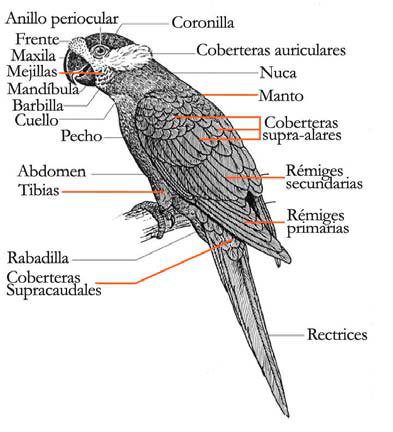
Anatomy-parrots

20,5 cm. length and 80 g. of weight
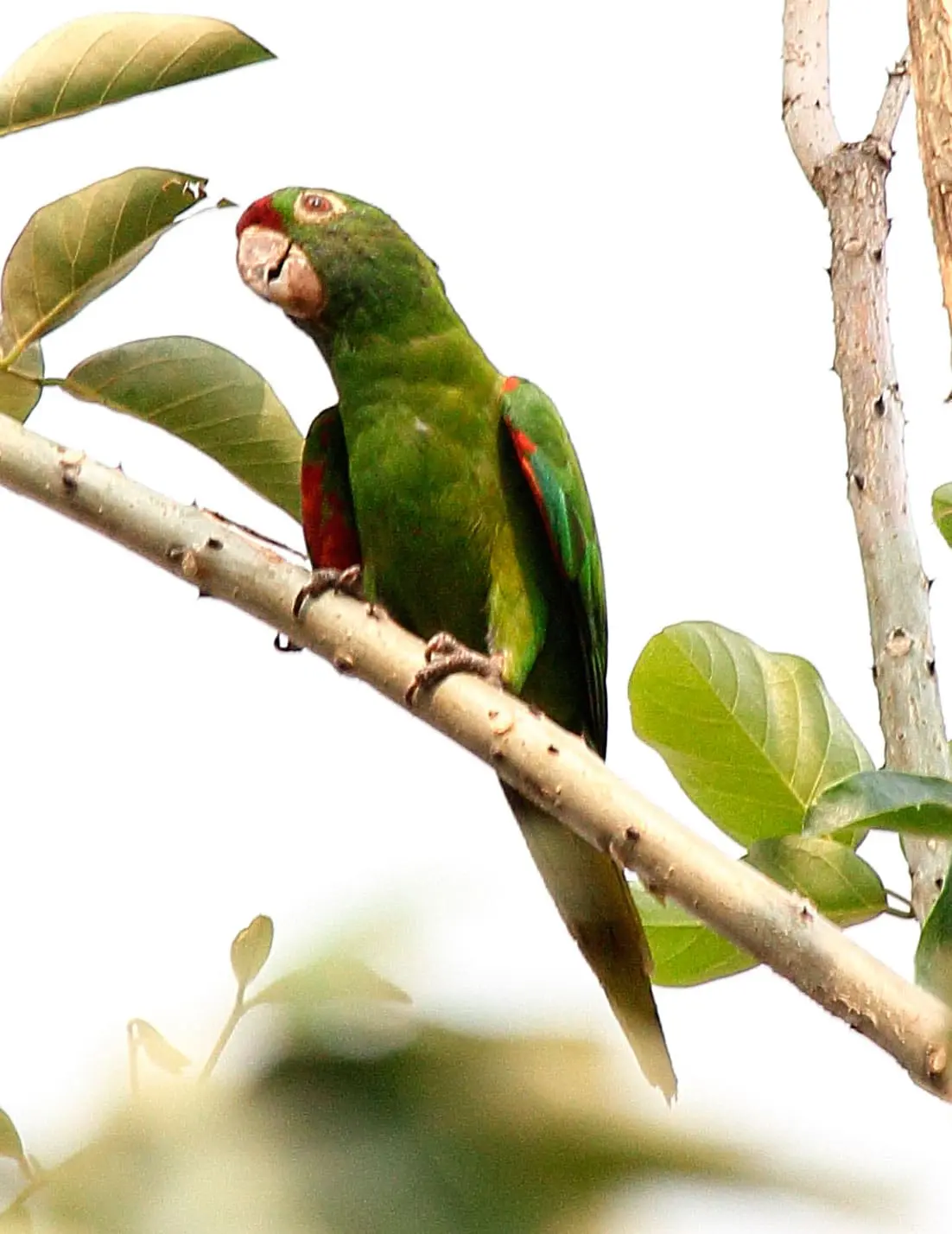
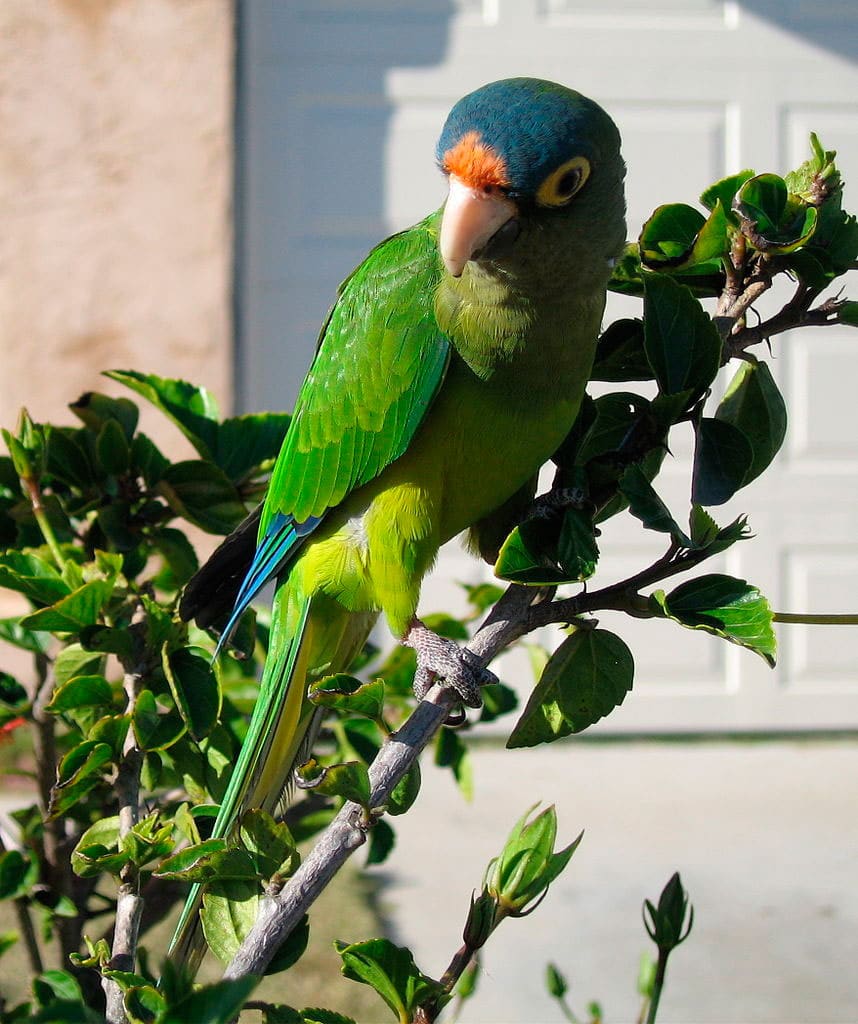
The Orange-fronted Parakeet (Eupsittula canicularis) It has in forecrown a wide band orange-red which extends over the lores and the part front of it crown; the rest of the crown is blue, fading from nape up to the upperparts in a shade of green grass.

Upperwing-coverts green. Flight feathers, at the top, blue on the outerweb; spiked green and black borders innerwebs; undertail, grey. Underwing-coverts brighter yellowish green. Throat, the sides of neck and the chest a shading pale yellow and pale olive olivรกceo in belly and in the undertail-coverts. Upper, the tail green with blue tip; undertail, pale yellow olive.

Bill color pale horn; cere whitish; bare periophthalmic whitish: irises pale yellow; legs grey-brown.
Both sexes are similar. The immature has a front patch Orange much smaller and irises brown.

  • Sound of the Orange-fronted Parakeet.

Description 3 subspecies:
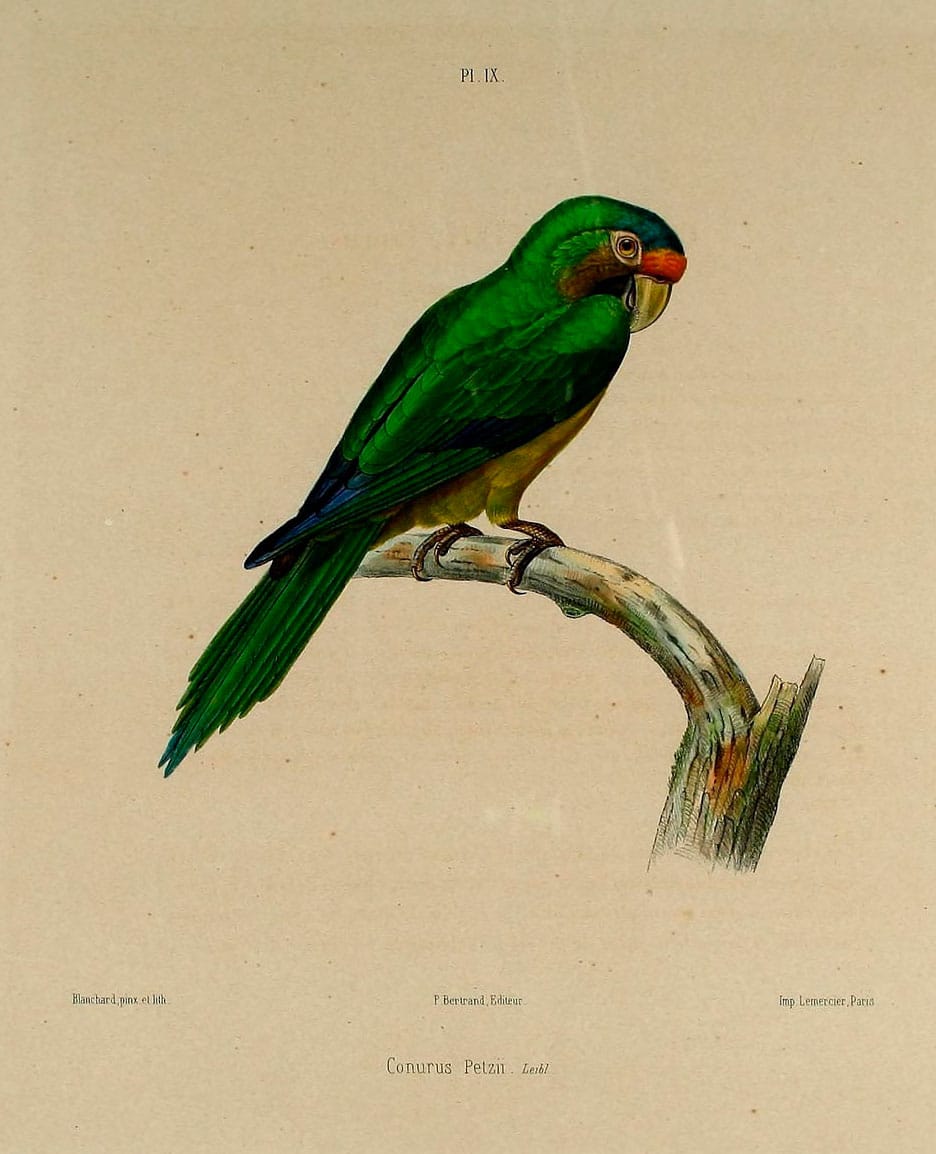
Orange-fronted Parakeet

  • Eupsittula canicularis canicularis

    (Linnaeus, 1758) – Subspecies nominal.


  • Eupsittula canicularis clarae

    (Moore,RT, 1937) – Similar to the species nominal but with the frontal band Orange smaller, lores Blue and sides of the lower jaw dark gray.


  • Eupsittula canicularis eburnirostrum

    (Lesson,PA, 1842) – Similar to the species nominal but the sides of the lower jaw They are gray and belly It is yellower.

Habitat:

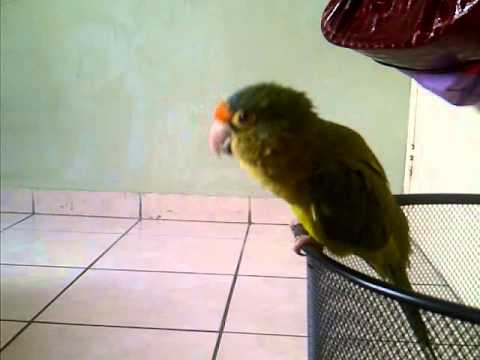
Video – "Orange-fronted Parakeet" (Eupsittula canicularis)

orange fronted parakeet / aratinga canicularis

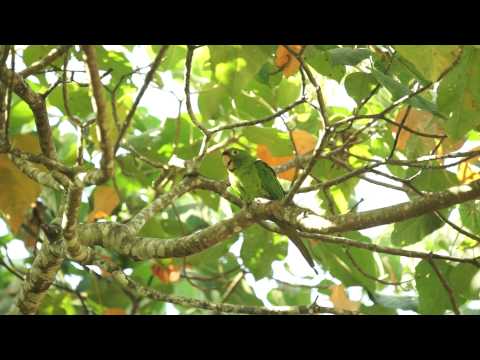
They inhabit in fields slightly woody or open areas with scattered trees lowland ASAL, including thorny deciduous forests and tropical forests; the Orange-fronted Parakeet They are more abundant below 600 m, even they reach 1.500 meters in the high arid lands of central Honduras after breeding, forming flocks near the 50 birds, sometimes many more.

The Orange-fronted Parakeet They are well adapted to partially clear habitats, reposing in plantations Palma and handle, often near cities. Communal roosts have been observed in the company of the White-fronted Parrot
(Amazona albifrons) in riparian forests Guatemala. Usually arboreal.

Reproduction:

An active termitero, usually Nasutitermes nigriceps, It is the preferred place to nest construction of Orange-fronted Parakeet; Several couples sometimes dig holes next few other; also they use tree cavities (for example, hole made by woodpeckers).

Reproduction March to May in Oaxaca, Mexico; January-may in El Salvador; during the dry season in Costa Rica.
The laying is of 3 to 5 eggs). Only the female incubates. The incubation lasts around 30 days. The chicks leave the nest to 6 weeks.

Food:

In its natural habitat the the diet of the Orange-fronted Parakeet includes seeds of Ceiba and Inga, fruits of Ficus, Bursera and Brosimum, and flowers of Gliricidia and Combretum. Sometimes they invade causing farmland damage in maturation corn and the banana.

Distribution and status:

Size of its range (reproduction / resident): 1.490.000 km2

They live in the shed peaceful of Central America, from northwest Mexico to the Northwest of Costa Rica. The Frentinaranja Aratinga can be seen from Sinaloa and West Durango, south along the lowlands of Mexican Pacific until Chiapas and Guatemala, El Salvador, Honduras and Nicaragua, until Costa Rica, lthough there is a recent contraction of their distribution in the northwest.

Habitat in the mountains of Caribbean It is limited to Comayagua Valley in the Honduran central highlands. Resident very common; Partially nomadic after breeding when birds can move to higher altitudes.

What introduced species They are located around the city of Miami (Florida), around town New York City and in the South of Texas, around town Santa Ana (United States).
They can also be seen in City of Mexico.

The capture for trade in live birds apparently led to a decrease in their number, as well as the contraction of the scope of its population in Costa Rica and possibly elsewhere; however the volume for international trade bird cage is small.

Distribution 3 subspecies:

  • Eupsittula canicularis canicularis

    (Linnaeus, 1758) – Subspecies nominal. shed peaceful Southwestern Mexico, from the Tehuantepec isthmus and Chiapas through the west region Central America to the Northwest of Costa Rica.


  • Eupsittula canicularis clarae

    (Moore,RT, 1937) – Sinaloa and West of Durango ell towards south to Michoacรกn, Mexico.


  • Eupsittula canicularis eburnirostrum

    (Lesson,PA, 1842) – lowlands peaceful South of Mexico, from the east Michoacรกn until Oaxaca. The range in relation to the Eupsittula canicularis canicularis, is uncertain

Conservation:

State of conservation โ“˜


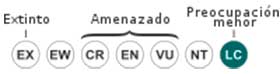
minor concern Minor Concern โ“˜ (UICN)โ“˜

โ€ข Current category of the Red List of the UICN: Least concern.

โ€ข Population trend: Stable.

Justification of the Red List of the Category

This species has a very large range, and therefore does not approach the thresholds for Vulnerable under the range size criterion (extent of occurrence <20.000 kilรณmetros2 combinado con un tamaรฑo gama disminuciรณn o fluctuante, hรกbitat medida / calidad, o tamaรฑo de la poblaciรณn y un pequeรฑo nรบmero de localidades o fragmentaciรณn severa). The trend of the population appears to be stable, and therefore the species does not approach the thresholds for Vulnerable according to the population trend criterion. (> 30% decrease of more than ten years or three generations). The size of the population is very large, and therefore does not approach the thresholds for Vulnerable under the criterion of population size (<10.000 individuos maduros con una disminuciรณn continua estimada en> 10% in ten years or three generations, or a specified population structure). For these reasons, the species is evaluated as Least concern.

Justification population

Partners in Flight estimate the total population in 500,000-4,999,999 individuals (A. they Panjabi in a little. 2008).

Justification trend

The population is suspected to be stable in the absence of evidence of any reduction or substantial threats.

"Orange-fronted Parakeet" in captivity:

Becoming less common. Its population has declined in many areas because of its capture for the illegal pet trade.
Protected by the Appendix II of CITES.

Alternative names:

Half-Moon Conure, Half-Moon Parakeet, Orange fronted Parakeet, Orange-fronted Conure, Orange-fronted Parakeet, Petz’s Conure (English).
Conure ร  front orange, Conure ร  front rouge, Conure de Petz , Perriche ร  front rouge, Perruche ร  front orange, Perruche ร  front rouge, Perruche de Petz (French).
Elfenbeinsittich (German).
Periquito-de-testa-laranja (Portuguese).
Aratinga Frentinaranja, Conuro Frente Anaranjada, Perico de Frente Anaranjada, Perico Frente Naranja, perico frente-naranja, Perico Frentinaranja, Periquito Centroamericano, Periquito naranjera (espaรฑol).
Perico frentinaranja (Costa Rica).
Periquito naranjera (Honduras).
perico frente naranja, perico frente-naranja, Perico Frentinaranja (Mexico).
Perico Frentinaranja (Nicaragua).


scientific classification:
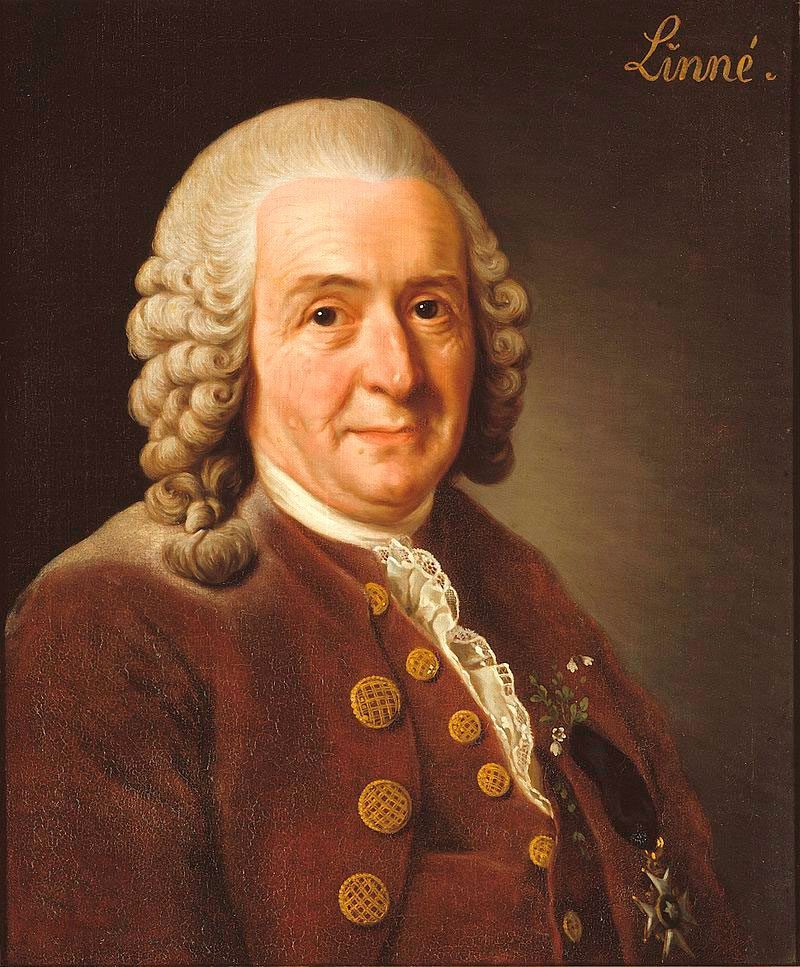
Carlos-Linnaeus
Carl Linnaeus

Order: Psittaciformes
Family: Psittacidae
Genus: Eupsittula
Scientific name: Eupsittula canicularis
Citation: (Linnaeus, 1758)
Protonimo: Psittacus canicularis

Images Orange-fronted Parakeet:


Especies del gรฉnero Eupsittula
  • Eupsittula nana
  • —- Eupsittula nana astec
  • —- Eupsittula nana nana
  • —- Eupsittula nana vicinalis
  • Eupsittula canicularis
  • —- Eupsittula canicularis canicularis
  • —- Eupsittula canicularis clarae
  • —- Eupsittula canicularis eburnirostrum
  • Eupsittula aurea
  • Eupsittula pertinax
  • —- Eupsittula pertinax aeruginosa
  • —- Eupsittula pertinax arubensis
  • —- Eupsittula pertinax chrysogenys
  • —- Eupsittula pertinax chrysophrys
  • —- Eupsittula pertinax griseipecta
  • —- Eupsittula pertinax lehmanni
  • —- Eupsittula pertinax margaritensis
  • —- Eupsittula pertinax ocularis
  • —- Eupsittula pertinax paraensis
  • —- Eupsittula pertinax pertinax
  • —- Eupsittula pertinax surinama
  • —- Eupsittula pertinax tortugensis
  • —- Eupsittula pertinax venezuelae
  • —- Eupsittula pertinax xanthogenia
  • Eupsittula cactorum
  • —- Eupsittula cactorum cactorum
  • —- Eupsittula cactorum caixana

  • Sources:

    Avibase
    – Parrots of the World โ€“ Forshaw Joseph M
    – Parrots A Guide to the Parrots of the World – Tony Juniper & Mike Parr
    – Birdlife

    Photos:

    (1) – Orange-fronted Parakeet or Orange-fronted Conure (Aratinga canicularis) also known as the Half-moon Conure. Photo taken in a front garden, San Diego, USA By derivative work: Snowmanradio (talk)Aratinga_canicularis_-pet-4.jpg: awnisALAN [CC BY 2.0], via Wikimedia Commons
    (2) – A wild Orange-fronted parakeet (Aratinga canicularis) along the beach of the Gulf of Papagayo (Papagallo), Costa Rica. The parakeet was seen in a group of 3 birds feeding on seeds of this tree By Cwood1 Charlene Wood (Own work) [CC BY-SA 3.0], via Wikimedia Commons
    (3) – Orange-fronted Parakeet or Orange-fronted Conure (Aratinga canicularis) also known as the Half-moon Conure. Photo taken in a front garden, San Diego, USA By awnisALAN (originally posted to Flickr as [1]) [CC BY 2.0], via Wikimedia Commons
    (4) – Two Orange-fronted Parakeets in Costa Rica By Don Faulkner (Orange-fronted ParakeetUploaded by snowmanradio) [CC BY-SA 2.0], via Wikimedia Commons
    (5) – A pair of Orange-fronted Parakeets in Rincรณn de la Vieja Volcano National Park, Costa Rica By Brian Ralphs from Berkhamsted, Hertfordshire, UK (Orange-fronted ParakeetsUploaded by snowmanradio) [CC BY 2.0], via Wikimedia Commons
    (6) – Iconographie des perroquets :.Paris :P. Bertrand,1857.. by Biodiversity Heritage LibraryFlickr

    Sounds: Bernhard Kroeger, XC67365. accessible www.xeno-canto.org/67365
    โ–ท The world of Pets: Dogs, cats, birds, reptiles, amphibians

    Sulphur-breasted parakeet
    Aratinga maculata

    Sulphur-breasted parakeet

    Content

    Description:


    Anatomy-parrots

    30 cm. length and 110 g. of weight.
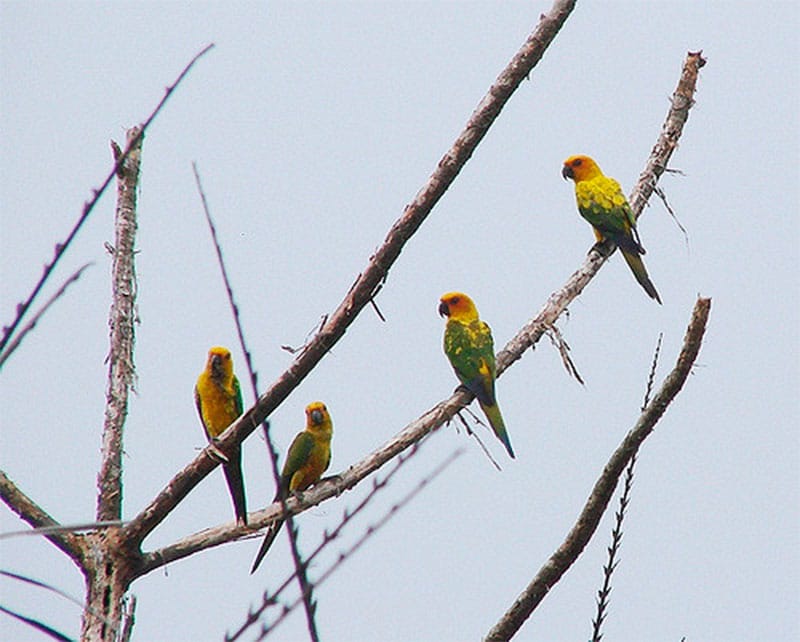
    The Sulphur-breasted parakeet (Aratinga maculata) is pale orange, with the head and back of the neck pale yellow

    . The throat and the chest are pale yellow, the the thighs are greenish; flanks pale orange, undertail-coverts greenish, the mantle pale greenish yellow; rump pale yellow orange, tail blue-green, wings green-yellow, underwing-coverts pale yellow. Close orange stripe on the front of the crown, in the lores and around eyes. Orbital ring pale grey. Iris dark gray / brown. Bill almost black.

    The immature presumably as of adults, but with cheeks and top of the chest Yellow olive. (Observed one specimen).

    • Sound of the Sulphur-breasted parakeet.

    taxonomy:

    described in 2005 under the name of Aratinga pintoi, but later it was shown that the current name, It considered invalid for a long time, indeed it applies to this form, and therefore takes precedence; of holotype of Aratinga pintoi It has now been designated as neotype of Psittacus maculatus, which formally stabilizes synonymity. The species was misidentified as a juvenile of the Sun Parakeet (Aratinga solstitialis) or a hybrid between the latter and the Jandaya Parakeet (Aratinga jandaya); now generally recognized as a separate taxon, differing greatly reduced due to the orange-red in the face (where it forms an irregular mask), Breast and belly.

    Habitat and behavior:

    The species inhabits areas with large tracts of forest and Savannah adjacent (O’ Shea 2005, Mittermeier et to the. 2010). performs movements nomads.

    It is similar in behavior and general ecology to the species of the group of the Aratinga solstitialis. Are in groups of 2-10 birds and they are relatively Meek, feeding along roads and orchards.

    Reproduction:

    Not much is known about their breeding habits. One nest observed with an egg of unknown size.

    Breeding season: August October

    Food:

    Feeds of fruit and seeds of Guateria sp., Dalechampia sp., Byrsonima sp. and Myrcia sp.

    Distribution:

    Extending its range (breeding/resident): 159.000 km2

    The Sulphur-breasted parakeet (Aratinga maculata) (formerly pintoi; see Nemรฉsio y Rasmussen 2009) It has a fragmented range in For and Amapรก in Brazil, and at the southern end of Suriname (p. e.g.. Silveira et al. 2005, Mittermeier et to the. 2010, Vieira da Costa et al. 2011). After a three-day survey conducted in 2003, Silveira et al. (2005) They claim that Sulphur-breasted parakeet was quite common in Monte Alegre, For. in addition, in Suriname the species has been characterized as uncommon to fairly common (O’ Shea 2005, Mittermeier et to the. 2010).

    Conservation:

    โ€ข Current category of the Red List of the UICN: Least concern.

    โ€ข Population trend: Growing.

    โ€ข Population size : unknown.

    Rationale for the Red List category

    The trend of the population It seems to be increase, and therefore the species does not approach the thresholds for Vulnerable under the criteria of population trend (> 30% decrease in ten years or three generations). The population size has not been quantified, but it is not believed to approach the thresholds for Vulnerable under the criterion of population size (<10.000 individuos maduros con un descenso continuo estimado en >10% in ten years or three generations, or with a specific population structure). For these reasons, the species is evaluated as Least concern

    Threats

    The distribution area this species is affected by the deforestation, mainly driven by the expansion of agriculture as they build new roads; However, deforestation Brazil You may be benefiting this species and facilitating their spread to new areas (Vieira da Costa et al. 2011). Long-term, deforestation may become so rapid and extensive that the balance of extensive forest tracts and savannas required by the species will be exceeded and the species may begin to decline. Silveira et al. (2005) They claim that Monte Alegre, For, no obvious signs of a strong pressure entrapment. in addition, Mittermeier et to the. (2010) state that no hunting or capture of the species by Amerindians in the savannah was reported Sipaliwini of Suriname meridional.

    "Sulphur-breasted parakeet" in captivity:

    virtually unknown; maintained by local people and zoos Brazil. It can live up 30 years in captivity.

    Alternative names:

    Sulfur-breasted Parakeet, Sulphur-breasted Parakeet (English).
    Conure de Pinto, Conure ร  poitrine soufrรฉe (French).
    Schwefelbrustsittich (German).
    cacauรฉ (Portuguese).
    Aratinga Pechisulfรบrea (espaรฑol).

    scientific classification:

    Order: Psittaciformes
    Family: Psittacidae
    Genus: Aratinga
    Scientific name: Aratinga maculata
    Citation: (Statius Mรผller, 1776)

    Images Sulfur-breasted Aratinga:


    Species of the genus Aratinga

    Sources:

    Avibase
    – Parrots of the World โ€“ Forshaw Joseph M
    – Parrots A Guide to the Parrots of the World – Tony Juniper & Mike Parr
    Birdlife
    World Parrot Trust

    Photos:

    (1) – Aratinga maculata by Sidnei DantasFlickr
    (2) – alexanderlees, IBC1058449. Accessible at hbw.com/ibc/1058449

    Sounds: Thiago V. V. Costa, XC57522. accessible www.xeno-canto.org/57522

    โ–ท The world of Pets: Dogs, cats, birds, reptiles, amphibians

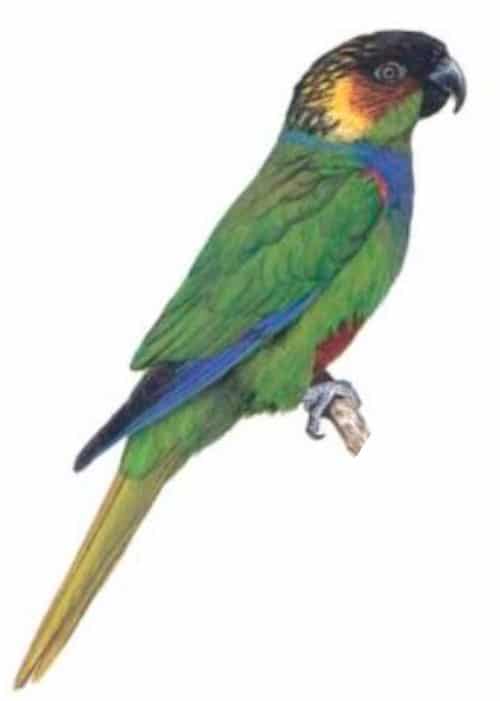
    Caica Parrot
    Pyrilia caica


    Lorito Caica

    Content

    Description:

    23 cm.. height.

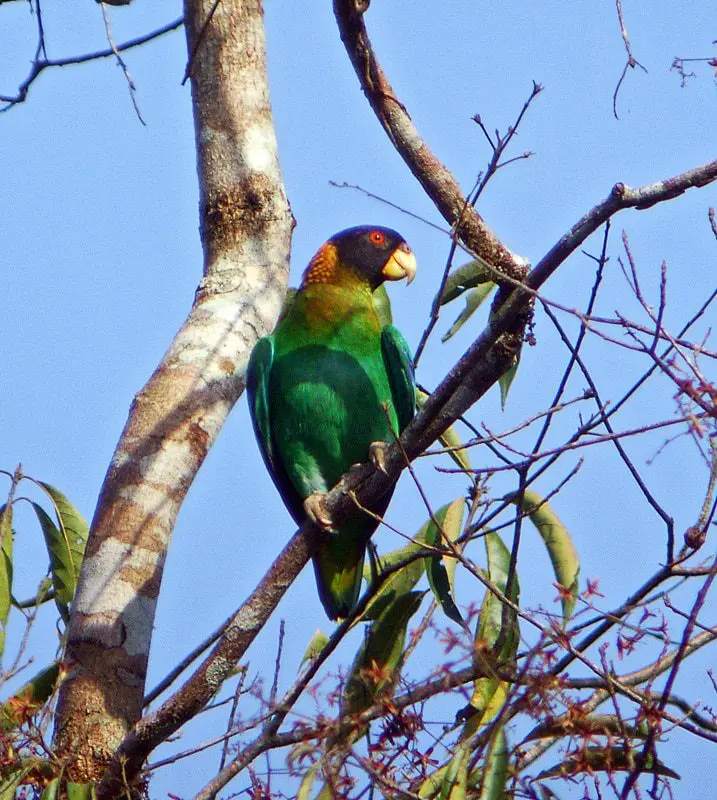
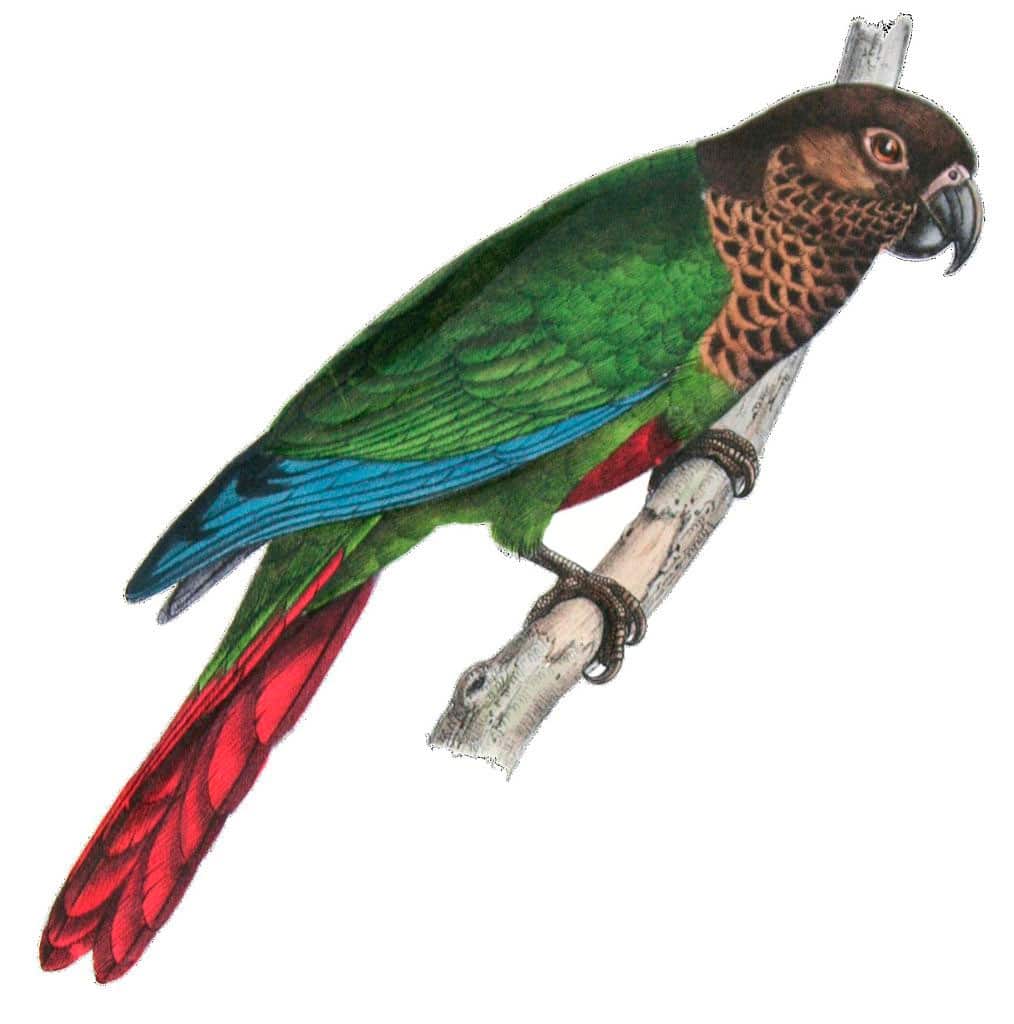
    The head of the Caica Parrot (Pyrilia caica) totally black is it more distinguishable from this species, together with a collar Golden cafesoso that extends up to the chest.

    The rest of the body usually Green, more clear in the belly and the inside of the tail; wing with blue stain and dark ends, Tip of the tail black.

    Bill color bone; ring eyepiece bare of color grey pale; Orange irises.

    The youth with crown green, face Dark greenish yellow, and collar not very notorious gold in neck and almost absent in chest.

    • Sound of the Caica Parrot.

    Habitat:

    Inhabits little disturbed humid forests, firm ground, in Tepuis, from the 50 to the 1100 m.
    gregarious, They walk in small groups. They feed in the canopy of the forest.

    Reproduction:

    Currently with little information about the reproduction.

    Food:

    In the wild, It believes that its diet consists mainly of eucalyptus flowers, fruit, nectar and pollen.

    Distribution:

    Can be observed in the South-East of Venezuela, Guyanas and northeast of the brazilian amazon.

    Conservation:


    Near-threatened


    โ€ข Red List category of the UICN current: Near-threatened

    โ€ข Population trend: Stable

    Justification of the population:

    The size of the world population Caica Parrot It has not been quantified, although this species is described as 'rare’ (Stotz et to the., 1996).

    Justification trend :

    This species is suspected that it may lose 13,6-17,2% of habitat within its distribution over three generations (21 years) based on a model of deforestation of the Amazonia (Soares-Filho et to the., 2006, Bird et to the. 2011).

    Given the susceptibility of this species to the hunting and/or entrapment, It is suspected that its population will decrease at a rate close to the 30% in three generations.

    "Caica Parrot" in captivity:

    They adult acclimatised quite easily to a new environment and are very resistant … Conversational skills (in comparison with other species).
    They are very quiet in an Aviary, with a personality friendly and Gentile. They are very sociable and it should be with a partner or in a group environment. In any way, It is not easy to see to the Caica Parrot in captivity.

    Alternative names:

    Caica Parrot, Hooded Parrot (English).
    Caรฏque ร  tรชte noire (French).
    Kappenpapagei, Kappen-Papagei (German).
    curica-caica, curica, papagainho, periquito-de-pescoรงo-marrom (Portuguese).
    Lorito Caica, Lorito de Cabeza Negra (espaรฑol).
    Perico Cabecinegro (Venezuela).


    scientific classification:

    John Latham
    John Latham

    Order: Psittaciformes
    Family: Psittacidae
    Genus: Pyrilia
    Scientific name: Pyrilia caica
    Citation: (Latham, 1790)
    Protonimo: Caรฏca parrot


    Images "Caica Parrot"

    Videos "Caica Parrot"

    ————————————————————————————————

    ยซLorito Caicaยป (Pyrilia caica)


    Sources:

    Avibase
    – Parrots of the World โ€“ Forshaw Joseph M
    – Parrots A Guide to the Parrots of the World – Tony Juniper & Mike Parr
    – Birdlife

    Photos:

    (1) – lynxeds

    Sounds: controles-canto.org

    โ–ท The world of Pets: Dogs, cats, birds, reptiles, amphibians

    Long-billed corella
    Cacatua tenuirostris

    Cacatรบa Picofina

    Content

    Description

    35 to 41 cm.. length. The weight of 500 to 600 g..
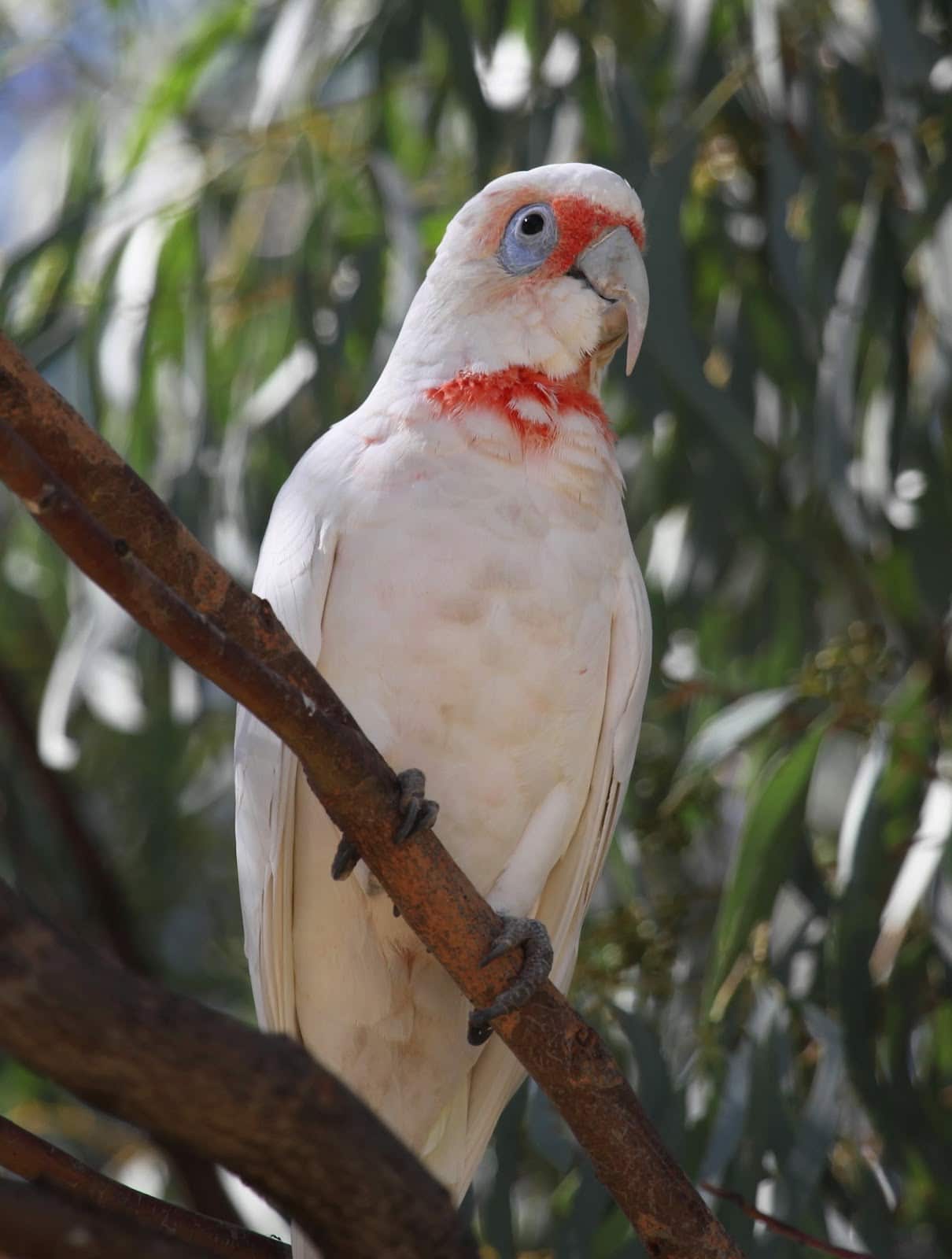
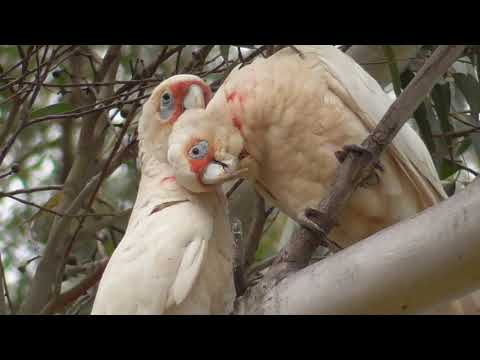
    The Long-billed corella (Cacatua tenuirostris) has white plumage. The undertail coverts and the parts below from the wings they are bathed in pale yellow, very visible in flight. It has red coloration in the throat and the chest, with a Red Crescent ranked in the upper breast.
    The Head shows a small crest white, Red front and a wide, nude and fleshy eye ring blue-grey around the eyes dark browns. The bill is white with blue base. upper jaw is long and hooked. The legs and feet are dark gray.

    The female is similar to the male, with the upper jaw more short and less red.

    There are two similar species:

    Cacatua sanguinea. Lack of forecrown Red and the red color in the neck. The upper jaw is shorter.

    Cacatua galerita. Similar in flight, has crest yellow and lacks of colour red. The bill is black.

    Habitat:

    Video – "Long-billed corella" (Cacatua tenuirostris)

    Long-billed corella ~ Cacatua tenuirostris

    Common in forests and remnant trees on farmland. It nests in Eucalyptus camaldulensis in the flooded Plains or close to streams. Wild populations living on farms and parks in urban areas.

    Behavior:

    Itร‚ยดs resident in their area of distribution, some local movements. Outside of breeding season, You can see in large flocks of up to 2.000 birds or more. Son noisy and visible, pronouncing discordant calls.

    Pose in large eucalyptus near water. They leave the roost in the morning to drink, and then, go to the feeding areas. Again when the darkness comes to sleep, but not before excited participate in games and stunts .

    They move on the floor with stunning movement jump. They do not have the other species waddling gait cockatoo.
    It causes damage to crops of cereals and tree fruit, considered as one pest for farmers.

    Nest colonies. They can create their nests with other species of Corella, and sometimes they hybridize. Populations feral in Sydney and Perth, from the release of unwanted birds, they may hybridize with endangered species such as the Cacatua pastinator

    Reproduction:

    Held from July to November. Forman couples monogamous. The male and female prepared the nest in the Hollows of large old eucalypts. If you do not find a suitable tree, You can make a burrow in soft soil Bank. They fill the nest of wood chips and often reuse it for several years.

    They nest in large colonies, with several nests in the same tree.
    The female lays 2-4 eggs White. The incubation lasts a few 24 days, shared by both parents. The young leave the nest 55 days after hatching, being fed by the parents for three weeks more.

    Food:

    Feeds mainly on what obtained from soil, seeds, estate and bulbs that unearths with its upper jaw. They feed in the coolest hours of the day. Also consumes insects.

    Distribution:

    Size of the area of distribution (reproduction / resident): 382.000 km2

    Is located in the southeast of Australia. Introduced in urban centers of Australia and Tasmania.

    Conservation:

    State of conservation โ“˜


    minor concern Minor Concern โ“˜ (UICN)โ“˜

    โ€ข Current IUCN Red List category: Least concern.

    โ€ข Population trend growing


    Populations may be declining due to loss of breeding grounds in its original distribution area.
    But, the Long-billed corella It common in its range.

    Is created that in the world there are more than 250 thousand individuals.


    "Long-billed corella" in captivity:

    It is very popular as a pet for the most part of Australia, and has been classified as the best ยซtalkative" of the australian cockatoos for its ability to mimic words almost to perfection.
    Has a personality playful and active.

    Out of its area of distribution is rare in poultry farming.

    Alternative names:

    Long billed Corella, Long-billed Cockatoo, Long-billed Corella, Slender-billed Corella (ingles).
    Cacatoรจs nasique (French).
    Nasenkakadu (German).
    Cacatua-corella-de-bico-longo (Portuguese).
    Cacatรบa de Pico Largo, Cacatรบa Picofina (espaรฑol).

    scientific classification:

    Order: Psittaciformes
    Family: Cacatuidae
    Genus: Cockatoo
    Scientific name: Cacatua tenuirostris
    Citation: (Kuhl, 1820)
    Protonimo: Psittacus tenuirostris

    Images Slender-billed Cockatoo:


    Species of the genus Cacatua

    Sources:
    Avibase
    – Photos: Alice Springs in Australiaโ€™s Red Centre, commons.wikimedia.org, Ian Barker (ibc.lynxeds.com/)
    – Sounds: Marc Anderson (Xeno-canto)

    โ–ท The world of Pets: Dogs, cats, birds, reptiles, amphibians

    Colasisi
    Loriculus philippensis


    Loriculo Filipino

    Content


    Anatomy-parrots

    Description

    14 cm.. length and a weight between 31 and 40 g..

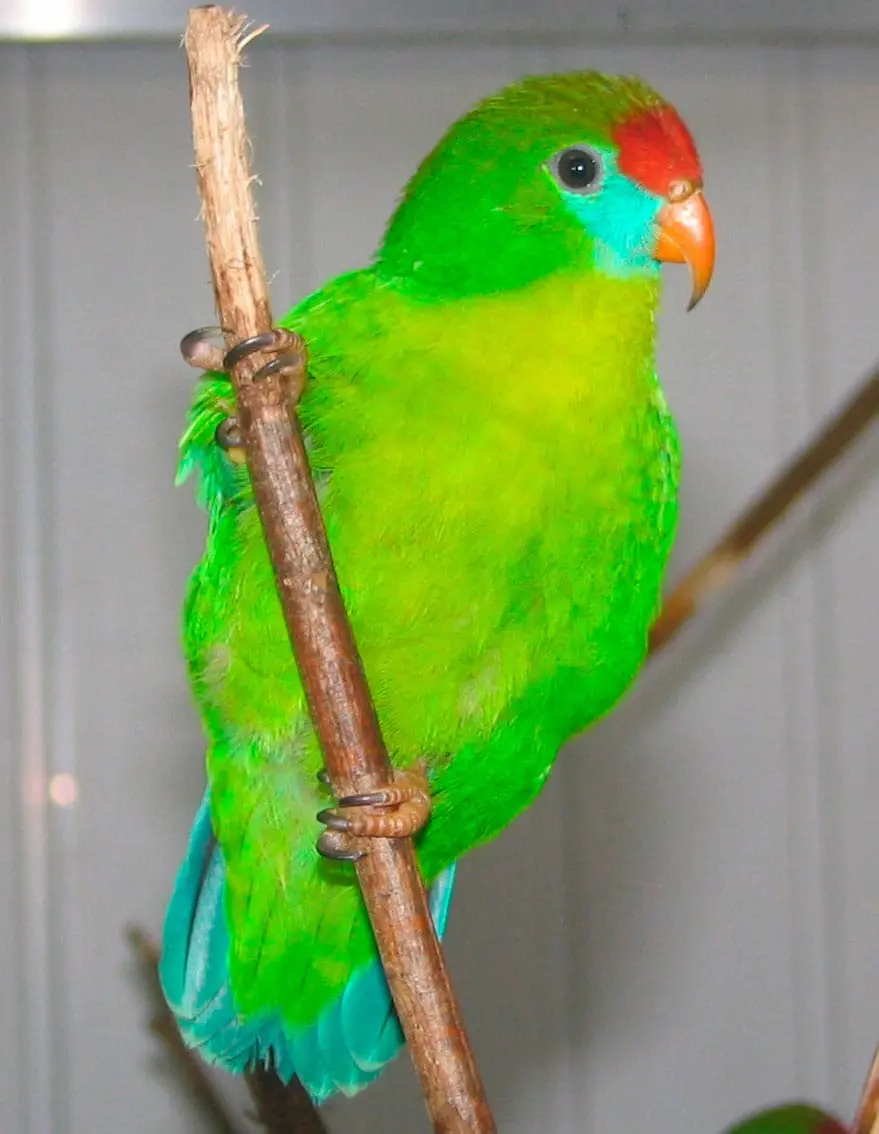
    The head of the Colasisi (Loriculus philippensis) is bright green with a patch of narrow Scarlet color on the front of the Crown, bordered orange-red color on the back edge; yellowish-green Chin: narrow collar on the back of the Orange and red neck, with a wash light yellowish in the neck.

    Bright green upperparts with dark crimson rump and uppertail coverts (lower sides of light blue). Bright green wings with vane internal to the darker flight feathers. Under, the wings of turquoise-blue with the exception of the outermost coverts which are green. Bright red throat Center, merging to red-orange in the center of the chest (yellow on the bases of feathers); rest of the lower region of bright green, lighter and more yellow than the upper region. Upper, the green tail; Blue below.

    Coral red beak; dark brown irises; dark orange legs.

    The female has a face marked in blue and does not have the Red bib, that is replaced by a greenish yellow colour wash. The female Crown is washed in yellow-orange (stronger than in the male).

    Young birds have a more off Crown and paler beak.

    Subspecies description
    Subspecies
    • Loriculus philippensis apicalis

      (Souance 1856): Two aberrant samples previously attributed to theLoriculus salvadorii. They are larger, with less red on the Crown, more blue on the tail, and darker green colour. All the Crown of this subspecies is Scarlet, merging in Orange on the back of the neck and orange on the mantle in both sexes (duller in females). Bright red in the hip and more orange on the top.

    • Loriculus (philippensis) bonapartei

      (Souance 18563): You have the back of the head with pronunciation orange hue, Pico black and grey legs.

    • Loriculus philippensis bournsi

      (McGregor 1905): The male with red only in the front and light yellow area in the center of the Crown (female much less yellow on the Crown), upper part of the Crown of the male less yellow shows that the L. p. Regulus. Orange line on the nape of the male is less clear in the female. Female with less blue in the face that the nominal species.

    • Loriculus philippensis chrysonotus

      (Sclater, PL 1872): Frontal area and rest of the crown bright red that extends in golden yellow color on the mantle, and showing a fine reddish collar on the back of the neck. Male with more orange in the lower part of the throat patch. The female Crown similar but less marked.

    • Loriculus philippensis dohertyi

      (Hartert 1906): Maybe more orange in the mantle, but hardly different to the L. p. apicalis.

    • Loriculus philippensis mindorensis

      (Steere 1890): Orange-yellow on the neck line. Crown Green. More extensive turquoise patch on both sides of the rump.

    • Loriculus philippensis philippensis

      (Statius Mรผller 1776): Nominal

    • Loriculus philippensis regulus

      (Souance 1856): Similar to the L. p. bournsi but male with much more yellow on the Crown (female shows a more subdued yellow broadcast, but more than in the previous race). Nape line weaker than in the bournsi. Male with more Scarlet patch.

    • Loriculus philippensis siquijorensis

      (Steere 1890): Male with less red bib and the red spot of the largest Crown than in the nominal species. Back of the Green Crown. Falata neck mark. Female with more blue in the face.

    • Loriculus philippensis worcesteri

      (Steere 1890): Male Scarlet throat patch smaller than that in the L. p. chrysonotus. Both sexes show a more extensive Crown of orange-red in the rear margin. There is a small patch on the back of the neck of orange color and a light reddish color in the mantle of diffusion.

    • Loriculus (philippensis) camiguinensis

      (Tello, JG 2006): has mainly green plumage, with throat, front side of the face and thighs of azure-blue; the front, the pileus, the obispillo and the top of the red tail, While the rest of the tail is blue. Males and females are identical in appearance, What is unusual in others Philippine parrots, Since only males of other species have red forehead.

    Habitat:

    The species is found along the edges of the forest, secondary growth, Bamboo forests, areas cultivated near villages, orchards and plantations of coconut. The birds are alone, in pairs or in family groups, sometimes in small flocks, sometimes with other birds.

    Reproduction:

    The breeding season has been recorded from April to August.. Three eggs are deposited and incubated by the female during 20 days, the young leave the nest in five weeks.

    Food:

    They feed in the upper levels of flowering plants or fruit trees, sometimes at lower levels, flower, nectar, fruit (including figs) and seeds, sometimes intoxicated by consumption of fermented coconut nectar (coconuts).

    Distribution:

    Limited to the Philippines (less the Sulu archipelago), where are widespread and resident except in Palawan. Its abundance varies according to the subspecies.. In general, the species is locally common up to 1000 meters above sea level, but have been recorded at altitudes of up to 2.500 m (Mount Apo, Mindanao).

    Subspecies distribution
    Subspecies

    Conservation:


    minor concern


    – Current IUCN Red List category: Least concern

    – The population trend: Decreasing

    The world population is considered to be above the 20,000 exemplary but decreasing due to loss of habitat. The subspecies Mindoro is considered as threatened, and both subspecies of Cebu as Siquijor, are nearly extinct the loss of habitat (as these birds are commonly caged and traded between islands, contemporary records of birds from Siquijor they require confirmation to determine whether they refer to the breeds).

    The combined population of Mindoro, Sibuyan, Blacks, Surigao del Sur, Tables, Romblon, Masbate, Ticao, Cuimaras and Basilan (subspecies L. p. mindorensis, L. p. bournsi, L. p. Regulus and L. p. dohertyi) probably add in total not more than 5.000 birds.

    "Colasisi" in captivity:

    Very rare.

    Alternative names:

    Colasisi, Philippine Hanging-parrot (ingles).
    Coryllis des Philippines (French).
    Philippinenpapageichen (German).
    Loriculus philippensis (Portuguese).
    Lorรญculo Filipino (espaรฑol).

    scientific classification:

    Order: Psittaciformes
    Family: Psittaculidae
    Scientific name: Loriculus philippensis
    Genus: Loriculus
    Citation: (Statius Mรผller, 1776)
    Protonimo: Psittacus philippensis

    Images ยซFilipino Loriculusยป:

    Videos "Colasisi"

    ————————————————————————————————

    ยซPhilippine Lorikeetยป (Loriculus philippensis)


    Sources:

    Avibase
    – Parrots of the World โ€“ Forshaw Joseph M
    – Parrots A Guide to the Parrots of the World – Tony Juniper & Mike Parr
    – Birdlife

    Photos:

    (1) – a female perched. by iggino – lynx
    (2) – Birds-pet-wallpapers – link
    (3) – Loriculus philippensis camiguinensis (Author AlexKant) – Crocolandia Foundation – ZooChat
    (4) – Loriculus p. apicalis, male, By iggino – lynx
    (5) – tapety-papousci

    Sounds: David Edwards (Xeno-canto)

    โ–ท The world of Pets: Dogs, cats, birds, reptiles, amphibians

    Crimson-fronted Parakeet
    Psittacara finschi


    Aratinga de Finsch

    Content


    Anatomy-parrots

    Description:

    28 cm. of length and a weight of 150 g..

    The Crimson-fronted Parakeet (Psittacara finschi) It is the only species of the genus Psittacara tail long with red color below the wing .

    They have forecrown and the former area of the lores bright red; the head and the neck green color with the exception of some scattered red feathers. The upperparts and upperwing-coverts green, with some red feathers on the bend of wing. The flight feather green above, more dark towards the tips with a dye bluish light in them vane inner; then golden brown color. Lesser and medium underwing-coverts red, the largest yellow, other coverts pale green. The underparts pale green, sometimes with red at the bottom of the tibia. Upper, the tail grass-green, by down golden brown.

    Ilustraciรณn Aratinga de Finsch

    The irises is orange and the eye ring naked is whitish. The bill exhibits a color gray-tipped Horn and the legs off gray color.

    It has no sexual dimorphism.

    The immature There are very little or almost no red in the forecrown and lack of red color in the thigh or the neck. The lining of the wings is more Orange.

    Habitat:

    Video – "Crimson-fronted Parakeet" (Psittacara finschi)

    Psittacara finschi - feed

    They inhabit tropical and subtropical envelope 1.400 metres in Costa Rica and 1.600 meters in the West of Panama, in areas with light trees or in fields with scattered trees, in secondary growth forests, edges of the forest, coffee plantations and nearby farmland. Irregular or seasonal in large forested areas.

    They are birds gregarious, usually observed in flocks of up to 30 Member, but up to several hundred birds can gather in roosts communal on the tops of the trees or palms. Roosts, at times near the cities.

    Reproduction:

    They located their nest in holes of various types: natural cavities, old holes of woodpeckersย (F. Picidae), stumps of dead Palms. They can dig holes in rotten stumps or in masses of epiphytes.. Sometimes many couples may nest near each other.

    The union of the pair of this species is particularly strong. The pairs isolate themselves from the group towards the end of July to nest.. With reproduce during the dry season and the rainy early. The female lays three or four eggs which are incubated during approximately 24 days. The juveniles they leave the nest to the 50 days of life.

    Food:

    Feeds of corn and sorghum; also eats flowers of the forest flame (Spathodea campalunata), flowers and fruits of porรณย (Erythrina sp.), guabasย (Inga sp.) and fruits of targuรกย (Croton sp.), lagartillo (Zanthoxylum sp.), guititeย (Acnistus arborescens)of guayabaย (Psidium guajaba) and higuerรณn

    Distribution:

    Widely distributed in the South of Central America, from Nicaragua until Panama.

    The species can be found in the southeast of Nicaragua to the South of the Rio Grande, and in Costa Rica mainly on the slope of the Caribbean, Although there are exemplary residents on the side of the peaceful, on Osa Peninsula, at the South-West end and seasonal visitors in the Guanacaste Cordillera, in the North and the central plateau around San Jose.

    In Panama they come to the East, a unos 82ยฐW, but it is probable that only seasonally in the lower Highlands of the Province of chiriqui.

    Flocks of birds required extensive territories and the species occurs, apparently, in many areas, if only as a post-breeding visitor.

    Very common or locally common with increasing numbers in Costa Rica and Panama, probably due to deforestation.

    Maintained in captivity and internationally traded in small quantities.

    Conservation:

    State of conservation โ“˜


    minor concern Minor Concern โ“˜ (UICN)โ“˜

    โ€ข Red List category of the UICN current: Least concern

    โ€ข Population trend: Growing

    The size of the world population of the Crimson-fronted Parakeet It has not been quantified, but this species is described as ยซquite commonยซ.

    You can be increasing their geographical range due to deforestation.

    abundant on the slope of the Caribbean of Nicaragua. common and widespread in areas deforested over the slope of the Costa Rica Caribbean.

    "Crimson-fronted Parakeet" in captivity:

    Quite common in United States, less elsewhere.

    Socialize easily with human, and can become a committed and loving companion. Es a Intelligent and lively, with easy to imitate the human voice and run different games and exercises. But, We must remember that it is a bird loud and the volume of their calls can get to be very annoying.

    Alternative names:

    Crimson-fronted Parakeet, Crimson fronted Parakeet, Crimson-fronted Conure, Finsch’s Conure, Finsch’s Parakeet (English).
    Conure de Finsch, Perriche de Finsch, Perruche de Finsch (French).
    Veraguasittich (German).
    Aratinga-de-finsch (Portuguese).
    Aratinga de Finsch, Perico frentirrojo, Periquito de Pecho Rojo, Perico de Palmera (espaรฑol).
    Perico frentirrojo (Costa Rica).
    Perico Frentirrojo (Nicaragua).


    scientific classification:

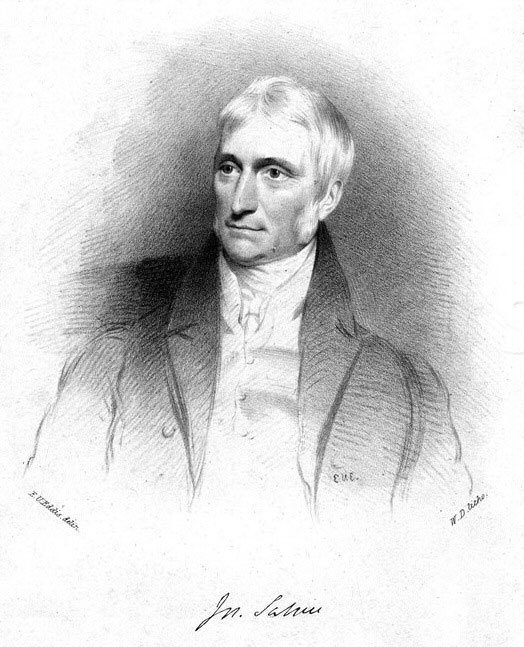
    Joseph Sabine
    Joseph Sabine

    Order: Psittaciformes
    Family: Psittacidae
    Genus: Psittacara
    Scientific name: Psittacara finschi
    Citation: (Salvin, 1871)
    Protonimo: Conurus finschi


    Crimson-fronted Parakeet pictures:


    Species of the genus Psittacara

    Sources:

    • Avibase
    • Parrots of the World โ€“ Forshaw Joseph M
    • Parrots A Guide to the Parrots of the World – Tony Juniper & Mike Parr
    • Birdlife

    • Photos:

    (1) – A Finschโ€™s Parakeet )also called Finschโ€™s Conure and Crimson-fronted Parakeet) in San Josรฉ, Costa Rica By Dominic Sherony [CC BY-SA 2.0], via Wikimedia Commons
    (2) – Perico frentirrojo juvenil, approximately 4 months of age, Panama City By Ricaurte (Own work) [Public domain], via Wikimedia Commons
    (3) – Crimson-fronted Parakeet, also called Finschโ€™s Conure By Yazzieyazz (trabjo propioEnglish: own work) [Public domain], via Wikimedia Commons
    (4) – Psittacara finschi en el parque nacional Henri Pittier, Venezuela By Roberto Galindo Deshays (Own work) [CC BY-SA 4.0], via Wikimedia Commons
    (5) – Crimson-fronted Parakeet Costa Rica 2/15/16 Rancho Naturalistaby Andy Reago & Chrissy McClarrenFlickr
    (6) – Crimson-fronted Parakeet by Brian RalphsFlickr
    (7) – Crimson-fronted Parakeet Costa Rica 2/15/16 Rancho Naturalista by Andy Reago & Chrissy McClarrenFlickr
    (8) – Aratinga finschi 06 Apr 2014 Costa Rica, San Lorenzo by Tom BensonFlickr
    (9) – Crimson-fronted parakeet by Charles SharpFlickr
    (10) – Conurus finschii ยป = Psittacara finschi (Finschโ€™s Parakeet) by John Gerrard Keulemans [Public domain], via Wikimedia Commons

    โ–ท The world of Pets: Dogs, cats, birds, reptiles, amphibians

    Deville's Parakeet
    Pyrrhura lucianii


    Deville's Parakeet

    Content

    Description:

    21-23 cm.. height.

    the showy plumage of the Deville's Parakeet (Pyrrhura lucianii) is generally Green, darker in the lower parts, the crown is dark brown, the forecrown and face is brownish red in colour; cheeks brick red, faded of blue, ear-coverts brownish yellow, neck and chest with the typical scales very visible due to the black and yellow contrast of the feathers. The ventral coat of arms, reddish, is well defined; in flight the dark red spot is notorious for the abdomen. Well defined are the reddish marks on the rump and in his long tail; the flight feather they are blue.

    It has periocular ring Of course, irises brown, bill blackish and legs grey pink.

    Note:

    Until recently this species was included along with the Pyrrhura subandina, Pyrrhura caeruliceps, Pyrrhura pantchenkoi within the species Pyrrhura picta.

    Habitat:

    Found in altitudes of 800 m, in forests Terra firm and vรกrzea, including forest margins and near clearings with tall trees. In forests low semi humid, up close 100 m.

    Seen in pairs, groups of three or flocks of up to 20 individuals.

    Reproduction:

    Little is known about the reproductive cycle of this species, probably nesting in large trees, in cavities or in nest of woodpeckers abandoned, with one laying estimated in 5-7 eggs.

    Food:

    With feeds a wide variety of fruits, flowers, seeds and algae, possibly.

    Distribution:

    Size of the distribution (breeding/resident): 47,200 km2

    Restricted to the State of amazon in the Northwest Amazon of Brazil.

    This species is supposed fairly common within its range, However, This can not be confirmed since this time rare remote region is visited by researchers.

    Conservation:

    โ€ข Red List Category: Least concern

    โ€ข Population trend: Decrease

    State of conservation โ“˜


    minor concern Minor Concern โ“˜ (UICN)โ“˜

    The status of their populations is unknown, but for the good condition of the habitat, it can be assumed that they are in good state of conservation.

    While the trend of the population seems to be decreasing, do not believe that the decline is fast enough for approaching the threshold of vulnerable under the criterion of population trend

    "Deville's Parakeet" in captivity:

    Although he is a parrot rare in captivity, its potential as a domestic fowl is excellent, provided there are hand raised and socialized from an early age. The newly imported birds are usually shy and nervous and often they remain reserved.

    It is usually inquisitive and active, enjoy flying and requires plenty of exercise and a spacious cage. Usually, It is not too noisy unless it is excited (as it is usually the case of all species Pyrrhura).

    Once acclimatized, These parrots are quite robust. Enjoy with the bath by what are them must provide a dish of water little deep to daily. Also the love chew branches fresh.

    Alternative names:

    Deville’s Parakeet, Bonaparte’s Parakeet (English).
    Conure de Bonaparte, Conure de Luciani (French).
    Bonapartesittich, Prinz Luzians Rotschwanzsittich (German).
    Tiriba-de-deville (Portuguese).
    Cotorra de Bonaparte, ร‘รกngaro de Deville, Perico de Deville, Cotorrita barriguiroja (espaรฑol).
    Perico de Bonaparte (Peru).

    scientific classification:

    Order: Psittaciformes
    Family: Psittacidae
    Genus: Pyrrhura
    Scientific name: Pyrrhura lucianii
    Citation: (Deville, 1851)
    Protonimo: Conurus Lucianii

    Images Deville's Parakeet:


    Especies del gรฉnero Pyrrhura

    Deville's Parakeet (Pyrrhura lucianii)


    Sources:

    Avibase
    – Parrots of the World โ€“ Forshaw Joseph M
    – Parrots A Guide to the Parrots of the World – Tony Juniper & Mike Parr
    Birdlife

    Photos:

    (1) – Maracana luciani Dev. & Cast. Pyrrhura lucianii = (Deville, 1851) by Francis de Laporte de Castelnau [Public domain], via Wikimedia Commons

    Sounds: Daniel Lane (Xeno-canto)

    โ–ท The world of Pets: Dogs, cats, birds, reptiles, amphibians

    Blue-throated Parakeet
    Pyrrhura cruentata

    Blue-throated Parakeet

    Content

    Description:

    Blue-throated Parakeet
    30 cm.. length and 90 g. of weight.

    The Blue-throated Parakeet (Pyrrhura cruentata) It is a very colorful bird; has the forecrown, crown and rear of the neck, dark brown with pale orange sides and with some feathers (especially posteriorly) giving speckled appearance; lores, cheeks top, supercilii area and ear-coverts, dull red, merging on sides of neck with yellowish patch bordered behind by blue band running across nape; bottom of the cheeks, green.

    Mantle, back and scapulars, green; broad crimson patch on lower back and rump; uppertail-coverts green. Bend of wing bright red; upperwing-coverts green. Outerwebs of the primaries, blue, green on the innerwebs; secondaries green on outerweb, Gray on innerwebs; flight feather with dark tips; infra-wing coverts minor, olive green, the gray greater coverts; underside of flight feather, olive gray wash. Chin green; the throat and the top chest, blue with some dark tips; underparts green with a patch of variable size of crimson color on the belly. Upper, the tail It is golden in color with green tint; brown below. Bill grey; bare periophthalmic grey; irises yellow orange; legs grey.

    Both sexes similar, but the irises perhaps brighter in the male. Immature more off, with less red at bend of wing.

    • Sound of the Blue-throated Parakeet.

    Habitat:

    The Blue-throated Parakeet inhabit, mainly, in primary forests of the Atlantic forest or on the edges of forests and, sometimes, in slightly modified natural forests, penetrate into agricultural areas where tall forest trees shade cocoa crops. Unknown seasonal and dry forests. (Usually in lowlands below 400 m, but 960 metres in Minas Gerais, Brazil, usually in flocks of 6-20 birds(mainly 8-12), at least where they are locally common.

    Reproduction:

    Nests in tree hollows. The breeding, apparently, It occurs in the austral spring, from June to October. Clutch 2-4.

    Food:

    The diet of the Blue-throated Parakeet includes plants of Talisia esculenta, Alchornea iricurana, Mabea fistulifera, Trema micrantha and Cecropia. The fruits of Miconia hypoleuca can be important in times of scarcity. Birds feeding in the canopy and the lower edge vegetation, never out of the woods; Once he observed feeding on the Golden-capped Parakeet (Aratinga auricapillus).

    Distribution and status:

    Size of its range (breeding/resident): 281.000 km2

    endemic to eastern Brazil, from Bahia until Rio de Janeiro. They were formerly known from Jequiรฉ and islanders, Bay, but the latest reports are North Jequitinhonha River, south of which, reports come from remaining patches of forest (including the Monte Pascoal National Park) to the border Holy Spirit.

    The birds continue in the few wooded areas of eastern Minas Gerais, Brazil as the Rio Doce State Park, the Book Caratinga (about Raรบl Soares) and about Mantena and several locations in northern Espirito Santo, including Biological reserves Great stream and Sooretama and neighboring Linhares Sooretama reserve. It is apparently absent from the southern state but survives near Desengano State Park in the State of Rio de Janeiro, the southernmost site which have been observed recently.

    Resident. Common and widespread at the end of the 19th century, but decreased dramatically with massive deforestation within its range due to agriculture, speak, mining, roads and urban development. The final bastion (the only place where birds remain common) It is complex reserve Sooretama / Linhares; much smaller numbers exist in other forest remnants (protected but widely separated). Habitat loss continues in Bay with some sites (for example Monte Pascoal) under intense pressure.

    Rare in captivity, but trapping for illegal trade is an additional threat. Listed in Appendix I of the CITES and protected by Brazilian law.

    Conservation:

    State of conservation โ“˜


    Vulnerable Vulnerable โ“˜ (UICN)โ“˜

    โ€ข Current category of the Red List of the UICN: Vulnerable.

    โ€ข Population trend: Decreasing.

    โ€ข Population size : 2500-9999 individuals.

    Rationale for the Red List category

    This species survives in scattered fragments of Atlantic Forest, where the extent of suitable habitat continues to decline rapidly. The remaining populations are small, severely fragmented into isolated reserves, where protection is largely inadequate and are suspected to be declining rapidly. So, qualifies as Vulnerable.

    Justification of the population

    The population is calculated in the number 2.500-9.999 mature individuals based on an evaluation of known records, descriptions of abundance and size range. This is consistent with estimates of population density recorded for congeners or close relatives with similar body size, and the fact that only a proportion of its distribution area is occupied. This estimate is equivalent to 3.750-14.999 individuals, rounded here to 3.500-15.000 individuals.

    Justification of trend

    continued rapid population decline is suspected because rates loss of habitat.

    Threats

    The extensive and continuous clearing of the forest You are responsible for its current fragmented distribution. Their apparent tolerance to shade cocoa plantations provides little hope because shading techniques since the early 1980 They have involved the use of banana trees and Erythrina, rather than stand, and unstable prices have led to conversion to pasture. Many remaining populations are affected by site-specific threats, as conflicts between habitat conservation and the rights of local communities in the Monte Pascoal National Park. The capture for the cage bird trade It is a relatively new phenomenon, Although the species is rare in domestic and international markets.

    Conservation Actions Underway

    CITES Appendix I. It is considered nationally Vulnerable in Brazil (Silveira y Straube 2008, MMA 2014), and is protected by Brazilian law. It is in the National Parks of Chapada da Diamantina and Monte Pascoal, on Experimental Station Barrolรขndia, on Linhares Forest Reserve, on Book Caratinga, in sweet River and probably in the Desengano State Parks, and in the Biological Reserves Great Stream, Deer Stream and Sooretama (Wege and Long 1995).

    Conservation Actions Proposed

    Survey to locate additional populations and protect undetected (Snyder et to the., 2000), especially in southern Bay and northeast of Minas Gerais, Brazil. Ensure protection de facto key reserves, especially Sooretama, Linhares and Vera Cruz Station. Confiscation of birds of trade and well-planned release of these birds in areas of the previous range of species to improve recovery and connectivity of disjunct populations (J. Gilardi in little).

    "Blue-throated Parakeet" in captivity:

    Protected by CITES Appendix I.

    Rara in national and international markets. Each captive specimen of this species which is capable of reproducing, must be placed in a well-managed captive breeding program and not sold as a pet, in order to ensure its long-term survival.

    Alternative names:

    Black-tailed Parakeet, Blue throated Conure, Blue throated Parakeet, Blue-chested Parakeet, Blue-throated Conure, Blue-throated Parakeet, Ochre Marked Conure, Ochre-marked Parakeet, Red-eared Parakeet, Red-rumped Parakeet (English).
    Conure tiriba, Perriche tiriba, Perruche tiriba (French).
    Blaulatzsittich, Blaulatz-Sittich (German).
    cara-suja, fura-mato, tiriba, tiriba-fura-mato, Tiriba-grande, tiriva (Portuguese).
    Cotorra Tiriba, Perico Grande (espaรฑol).


    scientific classification:

    Prince Maximilian of Wied-Neuwied
    Prince Maximilian of Wied-Neuwied

    Order: Psittaciformes
    Family: Psittacidae
    Genus: Pyrrhura
    Scientific name: Pyrrhura cruentata
    Citation: (Wied-Neuwied, 1820)
    Protonimo: bloody parrot


    Images Blue-throated Parakeet:


    Especies del gรฉnero Pyrrhura

    Blue-throated Parakeet (Pyrrhura cruentata)


    Sources:

    Avibase
    – Parrots of the World โ€“ Forshaw Joseph M
    – Parrots A Guide to the Parrots of the World – Tony Juniper & Mike Parr
    Birdlife

    Photos:

    (1) – Ochre-marked Parakeet (also known as Blue-chested Parakeet, Blue-throated Parakeet, or Blue-throated Conure) at Palmitos Park, Gran Canaria, one of the Canary islands, Spain By ipfreaks (originally posted to Flickr as Papagei) [CC BY-SA 2.0], via Wikimedia Commons
    (2) – Blue-chested Parakeet, (Pyrrhura cruentata) also known as Blue-throated Parakeet or Blue-throated Conure. Pet parrot By โžจ Redvers (originally posted to Flickr as Hector and toy 8) [CC BY 2.0], via Wikimedia Commons
    (3) – Blue-chested Parakeet (Pyrrhura cruentata) also known as Blue-throated Parakeet or Blue-throated Conure at Central Park Zoo, New York, USA By Claire Houck [CC BY-SA 2.0], via Wikimedia Commons
    (4) – Blue-chested Parakeet (Pyrrhura cruentata) also known as Blue-throated Parakeet or Blue-throated Conure. Pet with yellow toy By โžจ Redvers (originally posted to Flickr as Hector and toy 4) [CC BY 2.0], via Wikimedia Commons
    (5) – Blue-chested Parakeet (also known as Blue-throated Parakeet or Blue-throated Conure); two on a perch By TJ Lin [CC BY-SA 2.0], via Wikimedia Commons
    (6) – Parrots A Guide to the Parrots of the World – Tony Juniper & Mike Parr

    Sounds: Jeremy Recall, XC85365. accessible www.xeno-canto.org/85365