โ–ท The world of Pets: Dogs, cats, birds, reptiles, amphibians

Peruvian Hairless Dog
Perรบ FCI 310 . Primitive type

Peruvian Hairless Dog

The Peruvian Hairless Dog is a friendly and adaptable companion.

Content

History

The exact origin of the Peruvian Hairless Dog. But, their ancestors seem to be deeply rooted in Peru: Illustrations on the vessels of Moche culture, show hairless dogs already in the 750 AC. Later, these funny animals were reserved for the rich Incas, who took care not to mate them with other native dogs. It was also the Incas who prohibited the consumption of dog meat in the northern regions of Peru..

When the Spanish conquered the country, they found many naked dogs among the orchids of the Incas, so the Europeans called them ยซperros de las floresยซ. During the period of conquest, the breed was almost extinct, but some specimens survived in remote villages where the inhabitants valued them for the partly mythical qualities attributed to them: Because of its special appearance, four-legged creatures were said to have a healing effect on certain diseases, for example, bone and joint diseases.

In 1985, the world's largest dog breeding organization, the Federation Cynologique Internationale (FCI), recognized the Peruvian Hairless Dog as an independent race. So Today There Are Officially Three Naked Dog Breeds. Besides of Peruvian Hairless Dog, these are the Mexican Naked Dog, also known by the beautiful name of ยซXoloitzcuintleยซ, and the Chinese Crested Dog. The three races are closely related to each other.

Physical characteristics

The name says it all: The most striking of the most Peruvian Hairless Dogs that's what's missing: the coat. But, the standard allows for some locks on the head and tail even in naked dogs without hair. Skin can be light or dark in different shades of color, smooth or white-spotted. But, not all naked dogs are naked, because there's a variant with hair: the so-called "hairy", which are essential for breeding for health reasons. About a third of naked dogs belong to this group.

Since 2013 hairy variants can also be seen in canine exhibitions, since they have been added to the standard. Your hair should be short and soft, all colors are allowed. The Peruvian Hairless Dog reminiscent of greyhounds in their physique. This slender breed of dog has large erect ears that can rest back, an elegantly curved and hanging tail and an athletic complexion.

Naked dog lovers can enjoy three size variations:

– The small version has a shoulder height of 25 to 40 cm..
– The median 40 to 50 cm..
– The Greats Peruvian Hairless Dogs have between 50 and 65 height cm.

The weight varies according to 4 to 25 kg. Only a few Peruvian Hairless Dogs have a full denture, but these usually include all representatives of the furry variant.

Character and skills

The Peruvian Hairless Dog is a friendly and adaptable companion. He prefers to be with his human with the one who has a close relationship. It belongs to very sociable dogs. He likes to integrate into a family and quickly befriends other pets and children. It is said that many Peruvian Hairless Dogs protect fervently, especially the women and children of the herd. Here it is important to be careful when visiting children that the Peruvian interprets offensive situations for his protรฉgรฉ and rushes to help his little two-legged friend unnecessarily..

Vivacious and curious, is a wonderful companion for outdoor activities, but behaves calmly and relaxed inside. He especially likes to get comfortable on his owner's lap and enjoys closeness and warmth.. To strangers he is often distant and alert, but not aggressive.

Education

Like a dog of the original type, the Peruvian Hairless Dog it also provides original behavior in the man-animal relationship. That's why it makes sense in educational matters if you already have any experience with dogs. But, even ambitious beginners can successfully train a Peruvian Hairless Dog. Clear rules and consistency are, as in most dogs, the key to success.

The Peruvian Hairless Dog is a sensitive four-legged friend – hard you'll only get the opposite with it – will retire. Some Peruvian Hairless Dogs tend to get scared or fear new situations. So, it is especially important to train this dog extensively and at the right pace to different situations without overloading it.

Your breeder will be able to give you some advice when you buy a puppy. Whether on a train journey, on a trip to the city center or on a visit home, introduce your partner into these everyday situations since you're a puppy. Regular training at a canine school, preferably already with the young puppy in the form of playgroups for puppies, is highly recommended and also reinforces the social side of the Peruvian Hairless Dog.

Breeding of the โ€œPeruvian Hairless Dogโ€

As already mentioned, during mating a special health feature should be taken into account: during breeding, the furry ones, that is to say, hairy representatives of the breed, should be crossed regularly. The reason for this is that the dominant allele of hairlessness can only lead to viable embryos in combination with a hair allele, that is to say, Heterozygosity. Homozygous hairless embryos are already reabsorbed in the uterus. As pure breeding for hairlessness is therefore not possible, hairless naked dogs also occur over and over again.

The Peruvian Hairless Dogs they usually have an incomplete denture, what doesn't usually restrict them. With the light-skinned specimens, especially at the beginning of summer, it's important to make sure they get used slowly in the sunlight, then tanning. Sun protection also makes sense, because otherwise dogs can develop severe sunburn, especially when they like to go to sunny places. Also in winter some specimens need protection from the weather in the form of a dog coat., because if they can't run, cool down quickly during normal ride. Smaller variants of the breed are more sensitive to this than larger ones.

One Peruvian Hairless Dog can reach an age of up to 15 years.

Care

With the naked representatives of the breed you can leave the comb with confidence. It also, has the great advantage that it can normally detect parasites in the skin of the Peruvian Hairless Dog immediately and apply appropriate antidotes – from tick tweezers to flea repellent. But, even the Peruvian Hairless Dog needs regular care. If required – some owners recommend once a week – wash it with a sponge and a mild dog shampoo. Some Peruvian Hairless Dogs tend to have dry skin, which can be remedied with soft moisturizers for fragrance-free babies or with olive or coconut oil. In summer, sunscreen is an indispensable tool for light-colored dogs. Cut the claws of your Peruvian Hairless Dog if they get too long and clean your four-legged friend's ears with a dog ear cleaner if necessary.

Buy a โ€œPeruvian Hairless Dogโ€

The Peruvian Hairless Dog are rare in Europe and therefore breeders are rare. Find the appropriate umbrella organizations in your country, that can help you in your search. In Germany, for example, el Club for Exotic Breed Dogs e.V. has a list of breeders, In Switzerland there is a "Swiss Naked Dog Club of Latin America", which is dedicated to the promotion of the two breeds of dogs: the Xoloitzcuintle and the Peruvian Hairless Dog. In these clubs and similar ones you can find information and contacts of ambitious breeders. Considering possible adoptions across national borders, consider what to consider when adopting puppies from abroad.

As a fan of naked dogs, you probably know the closely related races, the Xoloitzcuintle and the Chinese Crested Dog – perhaps one of these dogs could also be an option for you and is more likely to be found in your region. It also, openness to the other two races, as well as the crossings, it's usually a good idea if you want to give a home to a naked older dog. This usually requires some research. But in the meantime, Keywords like โ€œnaked dogs in distressโ€ on the Internet promise successes that lead adult naked dogs to look for a new place to live. Try to find out as much as possible about the story of your potential new fourth-legged partner.

Characteristics "Peruvian Hairless Dog"

Coexistence is important that you have with your new friend. Before considering the acquisition of a dog of the breed "Peruvian Hairless Dog" you know certain factors. Not all breeds of dogs are apt to live in an apartment, you must take into account his character, their need for exercise, their interaction with other pets, their care and if you have small children, their level of tolerance towards them.

Training ?

4,0
4,0 of 5 stars (based on 30 reviews)
Great
Very good
Media
Mala
Very bad

Suitability of the apartment ?

3,0 of 5 stars (based on 1 review)

Can be alone all day ?

2,0 of 5 stars (based on 1 review)

Suitable as a first dog ?

3,0 of 5 stars (based on 1 review)

Weight gain ?

3,0 of 5 stars (based on 1 review)

Health ?

3,0 of 5 stars (based on 1 review)

Intelligence ?

3,0 of 5 stars (based on 1 review)

Kindness with child ?

3,0 of 5 stars (based on 1 review)

Tendency to bite ?

2,0 of 5 stars (based on 1 review)

Tendency to bark ?

3,0 of 5 stars (based on 1 review)

Tendency to flee ?

2,0 of 5 stars (based on 1 review)

hair loss strength ?

1,0 of 5 stars (based on 1 review)

Suitable as a guard dog ?

3,0 of 5 stars (based on 1 review)

Joy ?

3,0 of 5 stars (based on 1 review)

Cat friendliness ?

3,0 of 5 stars (based on 1 review)

Power level ?

3,0 of 5 stars (based on 1 review)

Images "Peruvian Hairless Dog"

Photos:

1 – ยซHairless dog of Peruยป by Paradais Sphynx, CC BY-SA 3.0, via Wikimedia Commons
2 – ยซHairless dog of Peruยป by No machine-readable author provided. Manuel Gonzรกlez Olaechea assumed (based on copyright claims)., CC BY-SA 3.0, via Wikimedia Commons
3 – ยซHairless dog of Peruยป by Carlos Adampol Galindo from DF, Mexico, CC BY-SA 2.0, via Wikimedia Commons
4 – ยซHairless dog of Peruยป by Marina Alonso Esparrรฉ, CC BY-SA 4.0, via Wikimedia Commons
5 – ยซHairless dog of Peruยป by Carlos Adampol Galindo from DF, Mexico, CC BY-SA 2.0, via Wikimedia Commons
6 – ยซHairless dog of Peruยป by Carlos Adampol Galindo from DF, Mexico, CC BY-SA 2.0, via Wikimedia Commons
7 – ยซHairless dog of Peruยป by Pleple2000, CC BY-SA 3.0, via Wikimedia Commons

Videos "Peruvian Hairless Dog"

PERUVIAN DOG : The story of the VIRINGO dog, the mascot of ancient Peru

THE PERUVIAN HAIRLESS DOG - STRANGE OR CUTE?

Type and recognitions:

  • FCI CLASSIFICATION:
  • Group :
  • Section : . .

Federations:

  • FCI – Group 5: Spitz-type dogs and primitive type – Section 6: Primitive type. โ“˜

FCI breed standard "Peruvian Hairless Dog"

Origin:
Peru

Date of publication of the valid original standard:
08.10.2012

Use:

Companion dog


General appearance:

According to its general confirmation, it is a slender and elegant specimen., whose aspect expresses speed, strength and harmony without appearing crude.
This breed's fundamental characteristic is the absence of hair on the body.. Another of its peculiarities is that its teeth, almost always, is incomplete. Of noble and affectionate character with those at home; reserved with strangers; awake, alert and guardian.

important proportions:

The relationship between the height at the withers and the length of the body is 1:1, allowing the body of the females slightly longer than that of the males.


Behavior / temperament:

Noble and affectionate with those at home while remaining awake and alert. In the presence of strangers, becomes suspicious and guardian.

Head:

Lupoid conformation.

Cranial region:
  • Skull:Mesocephalus. Ortoide (the direction of the superior cranio-facial axes is parallel), accepting slight divergence. The skull seen from the top is wide, tapering towards the nose.. Superciliary arches are moderately developed. The occipital crest is poorly marked.
  • Depression links (Stop): Bit strong (approximately 140ยฐ).

facial region:

  • Truffle:The color of the nose should harmonize with the color of the skin, in its various shades.
  • Snout:In profile, maintains a straight line.
  • Lips:The lips should be as tight as possible and adhere to the gums..
  • Jaws/Teeth:The incisors should fit for a scissor bite and the canines are normally developed. The absence of one or all pre-molars or molars is allowed. The jaw is poorly developed.
  • Cheeks:Normally developed.

Eyes:Of attentive and intelligent expression. They should be medium in size, slightly almond shaped, or sunk or bulging, with a normal and regular location, that is to say, neither too close nor too far. Color may vary from black, going through dark brown and in descending tones to yellow, harmonizing with skin color. In all cases both eyes must be the same color. The color of the eyelids may be from black to pink for specimens whose facial area is light, allowing those of light or pink colors but not being the most recommended.

Ears:The ears should be erect in attention, while at rest they are glued back. The ears are medium long, wide at the base and gradually tapering to an almost pointed end. Its insertion begins on the top of the skull, ending laterally and obliquely. The axes of the ears in the erect position can vary their angle relative to each other, approaching 90ยฐ.

Neck:

  • Top profile:Arcuate (convex).
  • Length:About the same length as the head.
  • Form:Looks like a truncated cone. Flexible and well-muscled.
  • Skin:Fina, smooth and elastic. Intimately adhered to the subcutaneous tissue. No double chin.


Body:

Mesomorfo.

  • top line:Rectilinear, although certain specimens mark a dorso-lumbar convexity, getting lost with the rump.
  • Cross:Little pointed.
  • Back: Rectilinear top profile, with well-developed back muscles, forming in many cases a muscular biconvexity along the entire dorsal region, extending to the lower back.
  • Pork loin:Must be strong and muscular. Its length is approximately 1/5 the height at the withers.
  • Rump:The upper profile is slightly convex. Its inclination with respect to the horizontal, makes an angle of approximately 40ยฐ. Solid and muscular in shape, ensuring a good push.
  • Breast :The chest seen from the front will have good width without being excessively, descending almost to the elbow. The ribs should be slightly arched and never flat. The perimeter of the chest measured behind the elbows should be approximately 18% greater than the height at the withers.
  • Lower profile / Belly:The lower profile is formed by a well-marked elegant line, starting at the lower part of the chest and determining in the ventral retraction, which should be well delineated without being excessive.

Tail:

The tail is set low. Good thickness at the start, tapering to the tip. In a state of action, the tail may rise forming a curve without actually curling over the back.. At rest he wears it hanging with a light hook with the tip up. Sometimes it is tucked into the belly. Its length will come close to the hock. The queue must be full.

Tips

Former members

Well attached to the trunk; viewed from the front will be perfectly plumb, not sticking out elbows. Your scapulo-humeral angle will range between 100ยฐ and 120ยฐ.
Side views, the resulting angle between the pasterns and the vertical is between 15ยฐ to 20ยฐ.

  • Front feet:Semi-lengths approaching the hare's foot. The pads are strong and heat resistant. The interdigital membranes are well developed. Preferably, the nails are black in the black specimens and clear in the lighter specimens.

Later members

The muscles are round and elastic. The curvatures of the buttocks are evident. The coxofemoral angle should be between 120ยฐ to 130ยฐ. The femoral-tibial angle should be 140ยฐ. The limbs seen from behind are well plummeted. The dewclaws must be removed.

  • Rear feet:Equal to the forwards.

Movement:

Due to the angulations already described in the structures of its members, these specimens move with a shorter but faster pace and at the same time quite cushioned and flexible.

Mantle

Skin: The skin will be smooth and elastic over its entire body surface, being able to form certain surrounding and almost concentric lines on the head, around the eyes and cheeks. It is proven that the internal and external or dermal temperature, is exactly the same as the other races. The absence of fur results in a totally direct emanation of heat unlike the specimens with hair, in which heat is dissipated through them by natural ventilation.

Fur: For being a naked race, will be missing cover, admitting vestiges of hair on the head, at the tip of the limbs, the tip of the tail and sometimes some very thin hairs on the back.

Color: The color of the hairs may vary from black to black specimens., black slate, black elephant, bluish-black, full range of gray, gradient dark brown to light blonde. All these colors can be uniform or with pink spots anywhere on the body.


Size and weight:

Height to the cross

There are three types of sizes for males and females.

  • Petit:Of 25 to 40 cm..
  • Medium-:Of 40 to 50 cm..
  • Grand:Of 50 to 65 cm..

Weight

The weight is in relation to the three sizes for males and females..

  • Petit:Of 4 to 8 kg.
  • Medium-:Of 8 to 12 kg.
  • Grand:Of 12 to 25 kg.


Fouls:

Any deviation from the above criteria is considered missing and the seriousness is considered to the extent of the deviation to the standard.

  • Semi-erect ears.
  • Presence of dewclaws on the hind limbs.

ELIMINATING fAULTS

  • Aggressive or fearful dog.
  • Upper or lower prognathism.
  • Deviation of the lower jaw.
  • Hanging or cropped ears.
  • Anurismo. Braqui Tourism. amputated tail.
  • Excess hair described in the standard.
  • Presence of hairs in other parts of the body where it is not indicated.
  • albinism.

Any dog โ€‹โ€‹showing clear signs of physical or behavioral abnormalities must be disqualified..


N.B.:

Males should have two normal-appearing testicles., fully descended into the scrotum.

Source: F.C.I - International Cynological Federation

Alternative names:

1. Perro Sin Pelo de Perรบ, Inca Hairless Dog, Viringo, Peruvian Inca, Orchid, Calato, Peruvian Walking Dead dog, Dielmatian (English).
2. Chien nu Inca (French).
3. Peruanischen Nackthund (German).
4. Perro Sin Pelo del Perรบ, viram (Portuguese).
5. Perro calato, Perro chimo, Perro chimoc, Perro chimรบ, Perro de , orquรญdea peruano, Perro inca, Perro peruano, Perro peruano sin pelo, Perro pila, Perro sin pelo del Perรบ, Perro sin pelo peruano
Viringo
(espaรฑol).

โ–ท The world of Pets: Dogs, cats, birds, reptiles, amphibians

Eurasian
Alemania FCI 291 . Asian Spitz and related breeds

Eurasier

The Eurasian is self-confident, quiet, tolerant, adaptable, willing to learn and smart.

Content

History

In the Decade of 1960, Julius Wipfel raised females of Keeshond (Wolfspitz) and males of Chow-Chow en Weinheim, Baden-Wuerttemberg, initially the Wolf-Chow. He finally raised this dog with him Samoyed and obtained an original dog with a natural structure and a balanced character.

In 1973 the breed was recognized by the Fรฉdรฉration Cynologique Internationale (FCI) and it is, therefore, the youngest German dog breed. The youngest breed, officially recognized German breed owes its name to its original European breeds (Keeshond = EUR) and asian (Chow-Chow and Samoyed = ASIER). The task of the robust companion and family dog โ€‹โ€‹with character was not even hunting, nor grazing, nor on guard. The Eurasian was bred solely as a social partner for humans.

Physical characteristics

The Eurasian is balanced, well built, medium-sized, with erect ears. It can be of different colours: beige, reddish brown, the Grey Wolf, black. A characteristic feature is the pattern of the coat of agoutis and the patterns of bands and stripes, that for example wolves also have.
The male has a height of 52 to 60 the cross and weighs cm, approximately, of 23 to 32 kg. The female has a height of 48 to 56 cm to cross and weighs between 18 to 26 kg.
Typical of the coat of the Eurasian is his dense undercoat, which is an excellent protection against the cold and also repels dirt. Just the muzzle, the face, the ears and the front of the legs are short-haired. The tail, the back of the front legs and the back legs have long hairs.

By the way, the Eurasian get their tongues partially and sometimes even completely blue from the Chow-Chow, whose blue tongue merged with the pink tongue of the Keeshond and Samoyed.

Character and skills

The Eurasian is self-confident, quiet, tolerant, adaptable, willing to learn and smart. Above all, animals are very close to their family members, which does not make them a one man dog.

The Eurasian they need constant and close contact with their humans and are therefore completely unsuitable for housing in kennels. In an animal shelter, these sensitive dogs would suffer extraordinarily and eventually wither away. How the Eurasiers are so focused on their family, should not be left in the hands of other people, even when they are on vacation. Wants to be with his family, always and everywhere.

These sensitive animals have a special feeling for the mood and disposition of their humans, and have a distinctive social behavior towards others Eurasian. It also, dogs of this breed are elegant, self-confident and at the same time pleasantly stubborn. They can even trick their owners into getting their way.

Activities with the Eurasian

Although the Eurasian does not have pronounced hunting behavior, a certain prey drive may be present, as in most dogs. But, with a loving consistency, understanding, patience and treats, the Eurasian can be trained to become trouble-free and appreciative companions, that adapt to all situations in life. But, training in an outer hand is out of the question for a Eurasian. If you demand absolute obedience to a dog, you must choose another race.

The Eurasian they need about two hours of exercise a day. Your urge to move can be ideally satisfied by jogging, cycling the agility. Monotonous retrieval games like โ€œfetch for sticksโ€ quickly bore this intelligent animal..

Eurasian care

Despite the dense undercoat, the care of the coat of the Eurasian it is not complicated and is limited to brushing once a week only during the change of coat, must be combed daily. The Eurasier's tongue varies from pink to an infinite number of varieties from pied blue to pure blue.. The inheritance of Chow-Chow fascinates many passers-by and often leads to confusion with the Chinese race. A Eurasier is an incorruptible friend for life.

Buying a Eurasian from a breeder

If you want to buy a puppy of Eurasian, you will need to be prepared for waiting periods, because there are only some 300 or 400 puppies per year under the umbrella organization of the VDH (German Canine Federation. Cubs Eurasian cost around 1000 EUR.

Characteristics "Eurasian"

Coexistence is important that you have with your new friend. Before considering the acquisition of a dog of the breed "Eurasian" you know certain factors. Not all breeds of dogs are apt to live in an apartment, you must take into account his character, their need for exercise, their interaction with other pets, their care and if you have small children, their level of tolerance towards them.

Adaptation โ“˜

1,0 of 5 stars (based on 1 review)

friendly dog โ€‹โ€‹โ“˜

4,0 of 5 stars (based on 1 review)

hair loss โ“˜

3,0 of 5 stars (based on 1 review)

Affection level โ“˜

5,0 of 5 stars (based on 1 review)

Need for exercise โ“˜

2,0 of 5 stars (based on 1 review)

Social need โ“˜

2,0 of 5 stars (based on 1 review)

Home โ“˜

4,0 of 5 stars (based on 1 review)

Toilet โ“˜

3,0 of 5 stars (based on 1 review)

Friendly with strangers โ“˜

3,0 of 5 stars (based on 1 review)

barking โ“˜

2,0 of 5 stars (based on 1 review)

Health โ“˜

4,0 of 5 stars (based on 1 review)

Territorial โ“˜

4,0 of 5 stars (based on 1 review)

Cat friendly โ“˜

3,0 of 5 stars (based on 1 review)

Intelligence โ“˜

4,0 of 5 stars (based on 1 review)

Versatility โ“˜

4,0 of 5 stars (based on 1 review)

Child friendly โ“˜

5,0 of 5 stars (based on 1 review)

Surveillance โ“˜

4,0 of 5 stars (based on 1 review)

joy โ“˜

3,0 of 5 stars (based on 1 review)

Images "Eurasian"

Photos:

1 – Kai de Eurasipomer (Nombre original Selly de Eurasipomer) by Siasegos / CC BY-SA
2 – Eurasier by https://commons.wikimedia.org/wiki/File:Eurasier_liegend.jpg
3 – Eurasier by https://flic.kr/p/eKr7Rv
4 – Eigen gemaakte foto van een Eurasier (hondenras) by Ekta / CC BY-SA
5 – A beautiful Eurasier male I met during a walk. His name is Haiko vom Born by https://flic.kr/p/UAo4j3
6 – Adult tan and black eurasier dog on body of water by https://www.pikrepo.com/fwskj/adult-tan-and-black-eurasier-dog-on-body-of-water

Videos "Eurasian"

Eurasian - Breed of dog
Dogs breeds: Eurasian
Raffi - Eurasian - 3 Week Residential Dog Training at Adolescent Dogs
Raffi – Eurasian – 3 Week Residential Dog Training at Adolescent Dogs

Type and recognitions:

  • FCI CLASSIFICATION:
  • Group :
  • Section : . .

Federations:

  • FCI – Group 5: Spitz-type dogs and primitive type – Section 5: Asian Spitz and related breeds. โ“˜
  • ANKC – Non sporting โ“˜
  • CKC – Group 3 – Working Dogs โ“˜
  • โ€‹KC – Utility โ“˜
  • NZKC – Non Sporting โ“˜
  • UKC – Northern Breeds โ“˜

FCI breed standard "Eurasian"

Origin:
Germany

Date of publication of the valid original standard:
06.01.1994

Use:

Companion dog.


General appearance:

medium size dog, harmonious structure, Spitz type, with erect ears, in different shades. The length of the hair allows us to distinguish the proportions of the body. regular bone structure.

IMPORTANT PROPORTIONS : The length of the body is a little greater than the height of the withers. The relationship between the length of the snout and the length of the cranial region is almost the same.


Behavior / temperament:

He is a trusting dog, calm, equanimous and with great resistance to any provocation. He is vigilant and alert without being loud; develops a strong relationship with his family. It is reserved with strangers, without being aggressive; does not show hunting instinct.
To achieve a complete development of these characteristics, The Eurasian dog needs intimate and constant domestic contact with its family, but also comprehensive and consistent training.

Head:

As a whole : balanced skull, not very wide. The head is wedge-shaped when viewed from above and from the sides.. The nasal cannula and the cranial region are placed in parallel.

Cranial region:
  • Skull : Flat forehead with a marked frontal furrow. Well-defined occipital protuberance.
  • Depression links (Stop) : Unremarkable.

facial region:

  • Nose : Medium-sized, truffle with black pigmentation.
  • Snout : Neither too thick nor too pointed. Gradually tapers forward to the nose. The nasal cannula and the horns of the lower jaw are straight.
  • Lips : Tight edges of the lips and black pigmentation.
  • Jaws / Teeth : Strong jaws, They form a wide arch in the lower jaw. Strong and complete teeth (42 teeth according to the usual formation of the teeth); scissors or pincer bite. The upper incisors slightly surpass the lower incisors or are in perfect opposition to each other. The premolars and molars must be placed in a line without gaps between them.. All teeth should be vertical in relation to the jaw.
  • Cheeks : Not very pronounced.
  • Eyes : dark, medium-sized, neither sunken nor protruding. Slightly oblique opening of the eyelids. Edge of the eyelids with black and very adherent pigmentation.
  • Ears : They are separated by approximately the width of the base of an ear.. Its size is medium and its shape is triangular..
    The tips of the ears are slightly round and should be erect.. The tips of the ears and the center of the stop form approximately an equilateral triangle.

Neck:

Of average length, in harmony with the general appearance. Good musculature. The skin is very adherent in the throat region. Harmonious transition to the rest of the body.

Body:

  • As a whole : The body is strong, with the trunk not very short.
  • Cross : Marked.
  • Back : Firm and straight, with very good muscles.
  • Pork loin : With good length, good width and very good muscles.
  • Rump : Straight, wide and strong.
  • Breast : Reaches up to the elbows, with oval-shaped rib cage. Well developed sill, although not too prominent. Long sternum, that extends well back.
  • bottom line : Get up slightly.

Tail:

With straight insert, round and firm, of good thickness, tapering towards the tip. Has thick fur. The tail is carried folded over the back, or a little to one side or well rolled. When it hangs it reaches up to the hock joint.

Tips

PREVIOUS MEMBERS :

  • As a whole : Viewed from the front, They are placed straight and parallel. Viewed from the side, They are moderately angled. The arm and forearm are almost the same length.
  • Shoulder : With good muscles. Scapulas placed in a slightly oblique shape.
  • Arm : Of medium length and with good muscles.
  • Elbow : Close to the rib cage. Forearm : Of average length, with good musculature.
  • Articulation of the carpus : Strong.
  • Metacarpus : Of average length. Seen from the front it is completely straight; seen from the side it is directed slightly forward.
  • Front foot : Oval, compact fingers, moderately arched. Strong nails with dark pigmentation. Imitation pads, thick with black pigmentation. Dense fur between the pads.

LATER MEMBERS :

  • As a whole : Seen from behind they are placed straight and parallel and seen from the side they are moderately angled. Thigh and leg are almost the same length.
  • Pelvis : slightly oblique.
  • Thigh : Of medium length and strongly muscled.
  • Knee : Stable, not too open.
  • Leg : Of average length, good musculature.
  • The Hock joint : Placed in a not very low position, stable, no deviations outwards or inwards.
  • Metatarsus : With good length and width, seen from the side it is placed in a vertical position.
  • Rear foot : Oval, compact fingers, moderately arched. Strong nails with dark pigmentation. Firm pads, thick and black pigmented. Thick fur between the pads.

Movement:

Covers a lot of ground, with a lot of thrust and good reach.

Mantle

SKIN : Adherent, Pigmented.

HAIR : Throughout the body it has a thick undercoat.; the outer coat is of medium length and the hair is not too close together. The hair is short on the muzzle, face, ears, and anterior part of the limbs. The tail, the back of the forelimbs and hindlimbs are covered with long hair (feathers).The fur on the neck is slightly longer than on the rest of the body., sรญn formar una melena.

COLOR : All colors and their respective combinations are allowed, excluding pure white, the presence of white spots and liver color.


Size and weight:

Height to the cross :

  • Males : 52 โ€“ 60 cm.
  • females : 48 โ€“ 56 cm..

Weight :

  • Males : 23 โ€“ 32 kg
  • females : 18 โ€“ 26 kg.

The balance between proportions is very important, However, The ideal values โ€‹โ€‹to achieve are the average weight and size.

Height to the cross :

  • Males : 56 cm.
  • females : 52 cm..

Weight :

  • Males : 26 kg
  • females : 22 kg.


Fouls:

Any deviation from the aforementioned criteria is considered as a fault and the severity of this is considered to the degree of the deviation to the standard and its consequences on the health and well-being of the dog..

MISS PLAYOFFS

โ€ข Aggressive or fearful dog.
โ€ข Fear, shyness, excessive distrust.
โ€ข Deficiencies in sexual characteristics.
โ€ข Lack of one or more incisors or canines, lack of one or more premolars 3 or 4 as well as one or more molars 1 or 2; bite defects.
โ€ข Ectropion, entropion; very deep or very small eyes.
โ€ข Distichiasis (eyelashes placed in two lines).
โ€ข Semi-erect or drooping ears.
โ€ข Broken tail.
โ€ข Noticeable lack of pigment.

Any dog โ€‹โ€‹showing clear signs of physical or behavioral abnormalities must be disqualified..


N.B.:

Males should have two normal-appearing testicles fully descended into the scrotum..

Source: F.C.I - International Cynological Federation

Alternative names:

1. Eurasian Dog (English).
2. Eurasier (French).
3. Eurasier (Hunderasse) (German).
4. Eurasier (Portuguese).
5. Eurasian (espaรฑol).

โ–ท The world of Pets: Dogs, cats, birds, reptiles, amphibians

Ibizan Hound
Espaรฑa FCI 89 . Primitive type - Hunting Dogs
Ca Eivissenc

The Ibizan Hound is one of the medium sized Greyhound, very similar to Pharaoh Hound.

Content

History

The Ca Eivissenco or โ€œPodenco Ibicencoโ€, It is a breed canine Spanish Ibiza (Spain). It gets its name from the island Ibiza, belonging to the Group of islands in the Balearic Islands, bathed by the Mediterranean.

This dog, has a highly developed sense of sight and hearing, that is why he has been assigned to hunting, especially in the rabbit, both day and night.

It is a type of primitive and rustic dog, considered one of the oldest breeds that exist and can be seen the tombs of the Pharaohs and museums whose first signs can be traced back to the 3.400 A.C.

The Ibizan Hound is one of the medium sized Greyhound, very similar to Pharaoh Hound. Without a doubt a descendant of the old Egypt dogs, that's what the written theories about race say..

The origin of this breed is Spain, comes from the island of Ibiza. The city of Ibiza was founded in the 654 A.C. by the Carthaginians and it is a conjecture establishes the possibility that the first settlers took with them their dogs of Egyptian origin for simple company and to hunt the rabbits that were abundant on the island.

But various genetic studies carried out in recent years have come to the conclusion that contrary to the widespread belief that the podenco is a type of primitive dog imported a few years ago 3.000 the area of middle years, These dogs actually have a close genetic relationship with the rest of the European hunting dogs and are no more "primitive" than most of them... The researcher Antoni Pedro Marรญ, details different aspects of the morphology, ethology and ecology of Ca Eivissenc in his work Native Races of the Pitiรผses.

Did you know??

The resemblance of the Ibizan with representations of the Egyptian god Anubis dog is one of the reasons why it is often thought to be an ancient race.

Physical characteristics

Elegant and agile, with an athletic and attractive outline, and with an elastic trot.

The Ibizan Hound has a long, narrow head, sharp cone-shaped; the skull is long and narrow with a little pronounced Stop. The ears must be straight, towards front and very mobile; oblique eyes, small and always amber clear.

The nose is flesh-colored and usually be taken into account to determine the purity of the breed. The color will always be blanco-marron, Blanco-leonado or unicolor, although this last possibility is more rare to find them. The weight varies between the 18 and 24 Kg, Depending on whether it's a male or a female, as well as if he is too well or poorly fed. With regard to the height of the dog there are also many disputes since fashion has at times imposed more slender and tall dogs that the found in the Pitiusas Islands.

The current standard is one height of between 66 and 72 cm., It is very far from reality and the first official standard. The dogs that are bred in Ibiza and Formentera are shorter than the maximum height allowed.

Via: criadorscaeivissenc

Character and skills

Pet is an excellent. Very easy to maintain when treated well and will respect your space. He is a dog that thinks for himself and there are times when he prefers not to have to show his appreciation to his master or be appreciated.; just let it quiet. It requires patience when it is trained.

It is not recommendable for the home where children are (He has no patience and is very independent). Generally does not get along well with other pets. Can maintain you in apartment or House, When receive plenty of daily exercise.

Characteristics "Ibizan Hound"

Coexistence is important that you have with your new friend. Before considering the acquisition of a dog of the breed "Ibizan Hound" you know certain factors. Not all breeds of dogs are apt to live in an apartment, you must take into account his character, their need for exercise, their interaction with other pets, their care and if you have small children, their level of tolerance towards them.

Adaptation โ“˜

4,0 of 5 stars (based on 1 review)

friendly dog โ€‹โ€‹โ“˜

3,0 of 5 stars (based on 1 review)

hair loss โ“˜

3,0 of 5 stars (based on 1 review)

Affection level โ“˜

5,0 of 5 stars (based on 1 review)

Need for exercise โ“˜

4,0 of 5 stars (based on 1 review)

Social need โ“˜

3,0 of 5 stars (based on 1 review)

Home โ“˜

1,0 of 5 stars (based on 1 review)

Toilet โ“˜

1,0 of 5 stars (based on 1 review)

Friendly with strangers โ“˜

2,0 of 5 stars (based on 1 review)

barking โ“˜

3,0 of 5 stars (based on 1 review)

Health โ“˜

3,0 of 5 stars (based on 1 review)

Territorial โ“˜

3,0 of 5 stars (based on 1 review)

Cat friendly โ“˜

2,0 of 5 stars (based on 1 review)

Intelligence โ“˜

3,0 of 5 stars (based on 1 review)

Versatility โ“˜

2,0 of 5 stars (based on 1 review)

Child friendly โ“˜

3,0 of 5 stars (based on 1 review)

Surveillance โ“˜

3,0 of 5 stars (based on 1 review)

joy โ“˜

3,0 of 5 stars (based on 1 review)

Ibizan Hound Images

Videos Ibizan Hound

Type and recognitions:

  • FCI CLASSIFICATION:
  • Group :
  • Section : . .

Federations:

  • Federations: FCI โ“˜, AKC โ“˜, ANKC โ“˜, CKC โ“˜, โ€‹KC โ“˜, NZKC โ“˜, UKC โ“˜

  • FCI breed standard "Ibizan Hound"

    Origin:
    Spain

    Date of publication of the valid original standard:
    26.05.1982

    Use:

    Is used, above all, in the rabbit hunt without a shotgun, day and night, well they lift them easily, even in places with a lot of vegetation due to the fineness of their smell, because he uses himself and his hearing more than his sight.. For their agility and cunning they soon collect the piece, especially hunting several dogs together; When a dog shows a piece, the others surround it at a certain distance, stalking the passage of that piece., they only beat when they see or hear the piece and also when they have closed it, all of them show and charge the piece by flipping the tail during it, the sample is easily broken.

    It is also used to hunt hares and big game.. They are good collectors. To form packs, they are used, except for exceptions, females and at most one male, because they do not help each other hunting and are quarrelsome. When a pack has taken a few thousand rabbits, the peculiarity occurs that some dogs from the same, they no longer hunt until after a long rest. This is called โ€œEnconillarseโ€.


    General appearance:

    The length of the tip of the snout to the eye is the same as the distance between them and the occipital.


    Behavior / temperament:

    ---

    Head:

    Long head, narrow cone truncated near your base, excessively dry, rather small in relation to the body.

    Cranial region:
    • Skull: Dolicocephalic, long or crushed; prominent occipital bone; narrow forehead and flat.
    • Stop: Poorly defined.

    facial region:

    • Truffle: Slightly convex, flesh-colored; Open nostrils.
    • Snout: Prominent, protrudes from the lower jaws; is narrow, long and colour harmonising with the coat meat.
    • Lips: Fine, collected, flesh-colored.
    • Teeth: In perfect opposition, White, well placed, with the Scissor bite.

    Eyes: Oblique, small, Amber clear, Recalling the color of candy; Amber can be more or less intense, depending on the color of the coat. With a not very noble look, very intelligent, shy and distrustful.

    Ears: Always rigid; directed forward, to the sides horizontally or backward; to when the dog is excited, very moving; the center of the base is located at the level of the eyes; elongated rhomboid-shaped, truncated to one third of its longest diagonal. They are fine, without hairs inside; median, not overly large.

    Neck:

    Very dry, both at the bottom and top. Its length is one-quarter the length of the body; slightly arched, muscled; the skin is taut, Lisa, without jowl. The hair is usually longer and dense in the upper lower part of this area, noticing more in straight hair.

    Body:

    The general aspect of the body is symmetrical, subconvex and medioline, quite matched dimensions, picked up, slightly longer without measure fixed difference.

    • Cross: Outstanding, high, dry and long.
    • Back: Straight, long and flexible; strong muscles, but flat.
    • Pork loin: Arcuate, average width, strong and powerful.
    • Rump: At desk, of very powerful and hard muscles, with a bone structure shows.
    • Breast : Deep, narrow and long, without elbows, sternum angle very sharp and prominent; flat ribs.
    • Belly: Collected but not agalgado.

    Tail:

    Low insertion; passing between the legs to reach the spine, monitors (towards the tip around the tail a few longer and thicker hairs slightly separated in a spike shape), long; somewhat thicker in his birth, will tweaking gradually; at rest falls naturally; in action is in the form of sickle, more or less closed, preferably is not straight or screwed too on the back.

    Tips

    PREVIOUS MEMBERS: They are aplomados, symmetric; seen from the front arms are close together; collected set, limbs long giving the impression of a thin animal, Agile but strong.

    • Shoulder: Oblique scapulae, strong and free in their movements.
    • Arms: Very long, straight and strong, and very together.
    • Elbows: Comprehensive and outstanding, parallel to the median plane of the body, never come out.
    • Forearm: Wide at its bottom end.
    • Metacarpus: Powerful, strong, width, right well.

    LATER MEMBERS: Plumb, long muscles, strong, dry, flattened muscle.

    • Hocks: Toggle, widths, close to the ground (descending), well Plumb, Neither outwards nor inwards.

    FEET: Trend of Hare, tight and long fingers, well trimmed hair interdigital spaces, very strong and generally white nails, Sometimes the color of hair; very hard pads.

    Movement:

    The preferred way is a trot suspended; the Gallop is very fast, giving feeling of agility.

    Mantle

    SKIN: Tense, attached to the body; Pink pigmentation, It can vary from color in the regions in which the layer is different.

    HAIR: Smooth, hard or long.

    • The smooth should not be silky but strong and shiny.
    • The hard must be rough, well populated, somewhat shorter on the head and ears, longer in the back of the thighs and the underside of the tail; the beard is very appreciated; the length is softer and must be at least one length 5 cm with the heavily populated head.

    COLOR: Preferably white and Red, unicolores white or red, although the fawn could also be admitted as long as it is an extraordinary specimen., Although never accept this color for hair.


    Size and weight:

    Height to the cross:

    • For males :  66 to 72 cm.,
    • for females :  60 to 67 cm..

    Without being very demanding, Since of approximate measurements you can always accept that they are proportionate and aesthetic.


    Fouls:

    Any deviation from the aforementioned criteria is considered as a fault and the severity of this is considered to the degree of the deviation to the standard and its consequences on the health and well-being of the dog..

    SERIOUS FAULTS :

    • Short and wide head.
    • Very marked stop.
    • Lack of a premolar.
    • Floppy ears.
    • Depressed Center ribbing.
    • Elbows out.
    • Cow hocks.
    • Feet out.
    • Cross feet and hocks in motion.

    MISS PLAYOFFS :

    • Aggressive or fearful dog.
    • Phased skull.
    • Brown pigmentation or black spots on truffle.
    • Any form of prognathism.
    • Eyelids and lips brownish red.
    • Miss indicating a junction with a Greyhound or a hound, that is to say :
      • folded ears
      • Dark eyes
      • Wide rump
      • Little defined sternum
      • Separate forelimbs
      • Thighs wide and rounded, with bulging veins


    N.B.:

    โ€ข Males must have two normal-appearing testicles fully descended into the scrotum..
    โ€ข Only functionally and clinically healthy dogs, with the typical conformation of the breed, should be used for parenting

    Source: F.C.I - International Cynological Federation

    Alternative names:

    1. Ibizan Warren Hound, Ca Eivissenc, IBIZAN PODENCO (English).
    2. Chien de garenne des Balรฉares (French).
    3. Ca Eivissenc (German).
    4. Podenco ibicenico (Portuguese).
    5. Ca Eivissenc (espaรฑol).

    โ–ท The world of Pets: Dogs, cats, birds, reptiles, amphibians

    Black Norwegian Elkhound
    Noruega FCI 268 - Nordic Hunting Dogs

    Black Norwegian Elkhound

    The Black Norwegian Elkhound joins closely with his people and is very loyal

    .

    Content

    History

    Among the three moose hunters of the North (Black Norwegian Elkhound, Gray Norwegian Elkhound and Jรคmthund), the Black Norwegian is probably the one receiving the least attention. But the agile and friendly hunter is an attractive breed to many dog รขโ‚ฌโ€นรขโ‚ฌโ€นowners..

    Its origins go back far back along with those of the Gray Norwegian Elkhound: These self-assured four-legged friends of the Spitz type belong to the time-honoured breeds, because a similar dog look can be tried up to the stone age in Scandinavia.

    The Black Norwegian Elkhound is a modern variant of Gray Norwegian Elkhound and has been officially recognized as an independent breed since 1877. An advantage of him Black Norwegian Elkhound during hunting is that it is clearly visible in the white snow. But, These clever four-legged friends have always been used as guard dogs or pack protection dogs.

    Physical characteristics

    Despite the similarity of name, the Black Norwegian Elkhound it's a separate breed, but closely related to the Gray Norwegian Elkhound. But, the Black Norwegian Elkhound it is much less common.

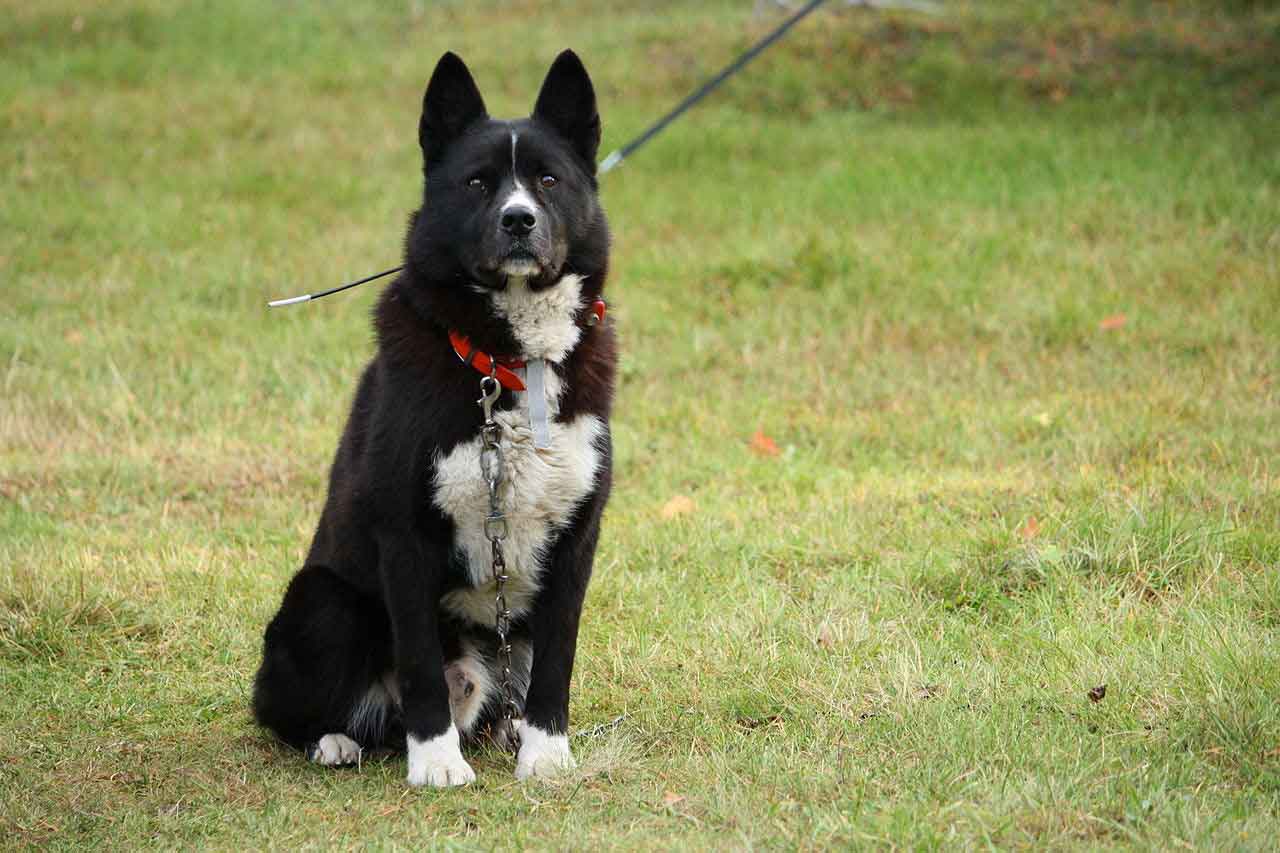
    The Black Norwegian Elkhound it is optically a typical Spitz and has a compact, square build with upright ears. He wears his tail rolled up on his back like other dogs Moose hunter from adulthood. It is smaller and more agile than the Gray Norwegian Elkhound and weighs around 18 kg with a height of 47 cm to the cross. As the name already indicates, this dog's short coat is black, but white spots on legs and chest are allowed as per standard. Also the eyes are dark. The pelage is dense, very sticky and consists of a rough top coat with a soft bottom coat.

    Character and skills

    Multifaceted character

    The Black Norwegian Elkhound he is very loyal to his people. This does not mean that this independent partner is subordinate. Abroad, these dogs are lively, curious and open to all common adventures. But, the busy Black Norwegian Elkhound they also enjoy cozy hugs on a quiet afternoon.

    They are playful, brave and very smart. Like many Nordic dogs, They are good "alarm systems", but only limited good watchdogs: They indicate to strangers – loudly and persistently – but it may happen that they then run towards a potential intruder with a wagging tail. These proud four-legged friends don't always get along with other dogs of the same species.. Proper conditioning and socialization is important

    Educating the Black Norwegian Elkhound

    Easily educated with knowledge

    His intelligence and humanity contribute to the education of this Black Norwegian Elkhound don't present big obstacles.

    He likes to work with "his" people and does what they say, as long as you find it useful too. Because you always have to take into account the small stubbornness of this independent hunter when training him. Be consistent and pay special attention to recoverability and bark control. Strength and toughness are absolutely out of place in the upbringing of this sensitive four-legged friend.

    Usually reacts very quickly and strongly to harsh words and reproaches, so use them sparingly. The Black Norwegian Elkhound can be better motivated by the principle of positive reinforcement – clicker training can also be of great help here. A visit to the puppy school helps improve this companion's social streak, which is sometimes a bit belligerent compared to other dogs. It can also be very useful to attend training classes at the dog school. – it is better to choose a suitable dog school where you and your companion feel comfortable before the puppy arrives.

    Health ยซBlack Norwegian Elk Hunterยป

    In general, the breed is considered to be quite robust and, as long as it is raised responsibly, is largely free of genetic diseases. Representatives of the breed can reach the 13 years old in good health. This energetic four-legged friend needs a species-appropriate diet, which should consist mainly of meat: So, you must choose a food in which meat is the first element of the declaration and preferably cereals are not included. Your dog's energy needs depend on his constitution and how much he consumes through exercise, so keep an eye on your slim waist and adjust daily servings as needed.

    Important: Just like us humans, small snacks move quickly to the hips too – plan your dog's snacks in the general ration. Healthy snacks include dry dog โ€‹โ€‹chews or sugar-free dental care snacks and freeze-dried meat snacks. Water must always be freely available.

    โ€œBlack Norwegian Elk Hunterโ€ Care

    The coat of the Black Norwegian Elkhound it is very important to the furry four legged friend, because it performs an outstanding protective function in the harsh northern climate and protects it from extensive autumn rains as well as icy winds. Help your companion keep his coat in a tidy condition by brushing every few days to remove any dead hairs.. You can also brush daily during the coat change, so your roommate loses less hair in the apartment. Coat dirt can be brushed off as soon as it has dried.

    You should only bathe your roommate if it can't be helped, use a mild dog shampoo for this purpose. When brushing, routinely check ears and clean with a mild shampoo if necessary. Some dog owners have chosen to brush their roommates' teeth with a dog toothbrush and toothpaste.. It is a good way to prevent tartar and its secondary diseases until the dog is old enough. But, you should already accustom your puppy to the ritual. Also check the claws of older dogs from time to time – if they no longer wear enough, you need to shorten them accordingly with a pair of dog claw pliers.

    Activities ยซBlack Norwegian Elk Hunterยป

    Although his original task was to accompany the hunter when hunting moose and bears, but also smaller animals like foxes, the Black Norwegian Elkhound it is a versatile all-rounder: Loves outdoor exercise and is considered very persistent. This is why you can easily take your four-legged adult friend with you to training sessions. jogging.

    Outdoor activities can be relaxed, especially if you have trained your Black Norwegian Elkhound so it doesn't run away with every rabbit. Apart from recovery exercises – that only very few moose hunters enjoy – the docile and energetic dog can get excited about many things: These may include, you can find great fun in agility sports and fetch games. It also, It is suitable for the work of rescue dogs. Some owners of moose hunters they also report on beautiful experiences with their partner, trained as a visiting dog, with whom they visit, for example, retirement or nursing homes and give the residents of those places an animal joy. Try together what you like, the possibilities are great!

    Is a โ€œBlack Norwegian Elk Hunterโ€ best for me??ยป

    The Black Norwegian Elkhound suits athletes who like to be outside and keep their dog busy. If you can make this possible for your dog, it is also possible to keep it in an apartment, as long as the apartment offers enough space. Training can be mastered by beginners if they are willing to deal with the hunting characteristics of the breed and adjust training accordingly..

    The Black Norwegian Elkhound it can be a wonderful companion for children. This original hunter can live normally with cats, sometimes even in a friendly way, if you have already gotten used to them as a puppy. Otherwise there could be problems, because the dog sees the cat as prey. Small animals like rabbits are not ideal companions, since they can always trigger prey drive.

    One Black Norwegian Elkhound can also sleep outside, what can be a sensible alternative for these heat sensitive animals in summer. But, needs close family connections and does not like to be alone. Before the dog moves, clarify not only the one-time and ongoing expenses you will have to pay, but also if you are willing to spend several hours a day actively with your new partner for years to come. You should also take care of your dog in case of illness or during the holidays – many destinations nowadays also offer holidays with a dog.

    Where can I find my desired ยซBlack Norwegian Elk Hunter?ยป

    It doesn't matter which of the two Norwegian Elkhound has won your heart: Outside Scandinavia, big game hunters from the far north are rarely seen. This is even more difficult with the black Norwegian than with the gray. So, if you are interested in this animal rarity, please contact the Nordic breed clubs in your country. If required, they can contact breeders at home and abroad. But, you will usually have to take into account waiting times and long distances to travel to the desired puppy. in his native country, Norway, only a few are born 120 puppies every year.

    Consequently, it becomes difficult or impossible if you are looking for a Black Norwegian Elkhound outside scandinavia, that is already grown. It is very unlikely that you will find a four-legged dog of this type in the animal protection organizations of your country.; However, a visit there may be helpful if you are open to other breeds.

    Characteristics "Black Norwegian Elkhound"

    Coexistence is important that you have with your new friend. Before considering the acquisition of a dog of the breed "Black Norwegian Elkhound" you know certain factors. Not all breeds of dogs are apt to live in an apartment, you must take into account his character, their need for exercise, their interaction with other pets, their care and if you have small children, their level of tolerance towards them.

    Adaptation โ“˜

    2,0 of 5 stars (based on 1 review)

    friendly dog โ€‹โ€‹โ“˜

    3,0 of 5 stars (based on 1 review)

    hair loss โ“˜

    4,0 of 5 stars (based on 1 review)

    Affection level โ“˜

    4,0 of 5 stars (based on 1 review)

    Need for exercise โ“˜

    3,0 of 5 stars (based on 1 review)

    Social need โ“˜

    4,0 of 5 stars (based on 1 review)

    Home โ“˜

    4,0 of 5 stars (based on 1 review)

    Toilet โ“˜

    3,0 of 5 stars (based on 1 review)

    Friendly with strangers โ“˜

    4,0 of 5 stars (based on 1 review)

    barking โ“˜

    4,0 of 5 stars (based on 1 review)

    Health โ“˜

    4,0 of 5 stars (based on 1 review)

    Territorial โ“˜

    4,0 of 5 stars (based on 1 review)

    Cat friendly โ“˜

    2,0 of 5 stars (based on 1 review)

    Intelligence โ“˜

    3,0 of 5 stars (based on 1 review)

    Versatility โ“˜

    3,0 of 5 stars (based on 1 review)

    Child friendly โ“˜

    4,0 of 5 stars (based on 1 review)

    Surveillance โ“˜

    4,0 of 5 stars (based on 1 review)

    joy โ“˜

    3,0 of 5 stars (based on 1 review)

    Images "Black Norwegian Elkhound"

    โ€œBlack Norwegian Elk Hunterโ€ cub by Eirik Newth / CC BY

    ยซBlack Norwegian elk hunterยป running through the snow by https://pxhere.com/en/photo/1602973

    Videos "Black Norwegian Elkhound"/h2>

    Type and recognitions:

    • FCI CLASSIFICATION:
    • Group :
    • Section : . .

    Federations:

    • FCI – Group 5 – Section 2 Nordic Hunting Dogs. โ“˜

    FCI breed standard "Black Norwegian Elkhound"

    Origin:
    Norway

    Date of publication of the valid original standard:
    09.08.1999

    Use:

    Hunting dog for moose.


    General appearance:

    It is a typical Spitz with a square construction.; black hair is rather close to the body; pointed ears pricked; tail curled over the back. Muscular and athletic neck, from a noble door.
     
    IMPORTANT PROPORTIONS: The height at the withers corresponds to the length of the body. Muzzle and skull are the same length.


    Behavior / temperament:

    Without fear, energetic, brave.

    Head:

    It is wedge shaped and tapers towards the truffle. Thin and rather light, relatively wide at the level of the ears.

    Cranial region:
    • Skull: Almost flat.
    • Depression links (Stop): Notable, but not abrupt.

    facial region:

    • Truffle: black.
    • Snout: Straight nose cane.
    • Lips: Glued.
    • Jaws/Teeth: Scissor bite; complete denture.
    • Eyes: They are not prominent; preferably dark brown.
    • Ears: High insertion, upright, a little longer than wide at the root, pointy.

    Neck:

    Medium long, firm, no loose skin.

    Body:

    • top line: Straight from the withers to the rump.
    • Cross: Well developed.
    • Back: Straight and strong.
    • Pork loin: Well developed, wide and straight.
    • Rump: Wide, well muscled.
    • Breast : Proportionally deep; ribs tight.
    • Belly: slightly retracted.

    Tail:

    High insertion; short, thick, covered with a layer of hairs sparse and well attached, but without feathers. Tightly curled over the back, without being diverted to the side.

    Tips

    PREVIOUS MEMBERS
     
    • As a whole: Firms, tendinosos, strong, but not heavy.
    • Shoulder: Oblique.
    • Arm: Moderately oblique.
    • Elbow: Good paste, turned neither out nor in.
    • Forearm: Straight.
    • Metacarpus: Viewed from the side moderately inclined.
    • Front feet: Rather small, slightly oval, compact and not turned out.
     
    LATER MEMBERS
     
    • As a whole: Knee and hock moderately angled. Parallels seen from behind. Undesirable spurs.
    • Thigh: Muscular and broad.
    • Knee: Moderately angled.
    • Leg: Medium long.
    • Hock: Moderately angled.
    • Metatarsus: Viewed from the side moderately inclined; seen from behind parallel.
    • Rear feet: Rather small, slightly oval, compact.

    Movement:

    Light, effortless. Parallel seen from the front or from behind.

    Mantle

    HAIR: Dense and rough, but well attached to the body; short and smooth on the head and on the front of the extremities; longer on the chest, the neck, on the back of the limbs and on the bottom of the tail. The coat consists of a rather long, rough outer coat of hair and a soft undercoat, shaggy and black.
     
    COLOR: Glossy black. A little white on the chest and feet can be tolerated.


    Size and weight:

    Height to the cross:
    • For males : 46 โ€“ 49 cm., ideal height 47 cm..
    • For females : 43 โ€“ 46 cm., ideal height 44 cm..


    Fouls:

    Any deviation from the aforementioned criteria is considered as a fault and the severity of this is considered to the degree of the deviation to the standard and its consequences on the health and well-being of the dog..
    • Bitefork clamp; irregular teeth.
    • Absence of undercoat of hairs.
    • White hairs, white in the queue.
    • White ยซ tights ยป.
    • Agitated temperament, nervous; barking dog.
    SERIOUS LACK
    • Short tail from birth.
    MISS PLAYOFFS
    • Aggressive or fearful dog.
    • Upper or lower prognathism.
    • Height to the cross 3 cm minus 4 cm more than the ideal height mentioned in the standard.
    Any dog โ€‹โ€‹showing clear signs of physical or behavioral abnormalities must be disqualified..


    N.B.:

    Males should have two normal-appearing testicles fully descended into the scrotum..

    Source: F.C.I - International Cynological Federation

    Alternative names:

    1. Norsk Elghund Svart, Norsk Elghund Black, Black Elkhound, Norwegian Moose Dog (black) (English).
    2. Chien d’รฉlan norvรฉgien noir (French).
    3. Norsk Elghund Sort (German).
    4. Norsk elghund sort (Portuguese).
    5. Elkhound noruego negro (espaรฑol).

    Photos:

    1 – Black Norwegian Elkhound About 1 years old by Rvenes / CC BY-SA

    โ–ท The world of Pets: Dogs, cats, birds, reptiles, amphibians

    Taiwan Dog
    Taiwรกn FCI 348 . Primitive type - Hunting Dogs

    Taiwan Dog

    The Taiwan Dog is sponsored by Japan.

    Content

    History ยซDog of Taiwanยป

    In 1980 the breed was the subject of a study by the University of Taiwan, Gifu University of Japan and Nagoya University. The aim of the study was to find out the origins of the Taiwan Dog. As such, the students examined 29 indigenous dog breeds and concluded that the Taiwan Dog current is a native breed that actually descends from Southeast Asian hunting dogs. This Asian dog breed is now popular throughout the island as a guard and companion dog.. In 2004 was officially recognized by the FCI.

    Physical characteristics ยซTaiwan dogยป

    The males of Taiwan Dog reach a withers height of up to 52 cm.. When fully grown they weigh 18 kg, while the females are about 5 cm smaller and 2 kg lighter. Muscular animals characteristically move with very wide strides., but they are fast and agile due to their pronounced musculature. The Taiwan Dog has a very tight coat of about 1,5 to 3 cm length. A variety of colors is allowed, including black, striped, yellow, white, black and white or white and brindle. Sponsorship of the breed was taken over by Japan.

    Character and skills โ€œTaiwan Dogโ€

    Sociable and loyal hunting companion.
    His brave and intrepid character serves the Taiwan Dog in his role as hunting dog. Animals are known for their quick perception and the fact that they are faithful and loyal to their master.. They are also suitable as guard and dressage dogs and are considered extremely sociable.

    TAIWAN DOG

    They adapt very well to the environment and that is why they were able to live so incredibly well with primitive peoples in the past.. It also, these dogs can survive in the desert in the middle of the mountains, they can stand out excellently and can cope with almost all situations. All these strong qualities can be traced back to his previous harsh life with the prehistoric peoples of the mountains.. Your skills are also improved by working together with people. This builds trust between the dog and the man., friendships and shared experiences. The Taiwan Dog they are big and simple family dogs. Because of life in the desert, do not have a great demand for food. The Taiwan dogs they can even be used as protection dogs and as police dogs, because they have this unmistakable good sense of smell and are ready to defend themselves.

    Until today these dogs are known mainly in the Asian region. In Europe they have not been able to arouse comparable popularity so far.

    Health ยซTaiwan Dogยป

    The Taiwan Dog are extremely resistant to disease.

    Videos "Taiwan Dog"

    HTTPS://youtube.com/watch?v=HhLEIjw4N-4
    Taiwan Dog
    HTTPS://youtube.com/watch?v=am_kkgYKXR4
    Perro de montaรฑa de Formosa / Perro de Taiwan / Taiwan Dog – Raza de Perro / Dog Breed

    Photos:

    1 – Dog of Taiwan by https://pixabay.com/zh/photos/taiwan-dogs-dog-the-black-dog-4890098/

    Type and recognitions:

    • FCI CLASSIFICATION:
    • Group :
    • Section : . .

    Federations:

    • FCI – Group 5: Spitz-type dogs and primitive type – Section 7: Primitive type - Hunting Dogs. โ“˜

    FCI breed standard "Taiwan Dog"

    Origin:
    Taiwan

    Date of publication of the valid original standard:
    09.11.2004

    Use:

    Hunting dog, on guard and company.


    General appearance:

    Medium size dog, triangular head, almond-shaped eyes, fine, erect ears and sickle-shaped tail. Dried, muscular, well balanced.

    IMPORTANT PROPORTIONS:

    • chest depth : height at the withers = 4.5 โ€“ 4.7 : 10
    • Height to the cross: body length = 10 : 10.5 Females may be slightly longer.
    • Muzzle length : length of skull = 4.5 : 5.5


    Behavior / temperament:

    Extremely loyal to his master, acute senses, moving alert, brave and fearless.

    Head:

    ---

    Cranial region:
    • Forehead: wide, rounded, without wrinkles.
    • Skull: The skull is slightly longer than the muzzle.
    • Stop (Fronto-nasal depression): Well defined, with a slight groove.

    facial region:

    • Nose: Moderate size. Large nostrils. Color black, may be slightly lighter in all colors except blacks.
    • Snout: Flat nasal bridge. Tight lips, no pendulosos. The muzzle tapers slightly from the base towards the nose, but it is not pointed.
    • Jaws / Teeth: Strong jaws. Scissor bite, teeth are inserted at right angles into the jaws.
    • Cheeks: Well developed and slightly prominent.

    Eyes: Almond-shaped. dark brown color. Brown is also accepted, yellow or light eyes should be avoided.

    Ears: erect, inserted on both sides of the skull at an angle of 45ยบ. The inside of the outline is straight while the outside of the outline is slightly rounded.

    Neck:

    Muscular, strong, long, slightly arched. No double chin.

    Body:

    • General: Fibrous and muscular, almost square in shape.
    • Back: Straight, short. Well developed cross.
    • Pork loin: Tightly muscled.
    • Rump: Wide. Flat or very slightly sloping and short.
    • Breast : Quite deep but not reaching the elbows. Slightly marked forefinger. Well arched ribs.
    • Belly: Well withdrawn.

    Tail:

    Sickle shaped, high insertion, carried erect, active, with the tip curved forward.

    Tips

    PREVIOUS MEMBERS:

    • Shoulder: Well muscled. Scapulae sloping back. They should meet the humerus at an angle of 105 to 110 degrees.
    • Elbows: Close to the body.
    • Arms: Straight and parallel to each other.
    • Metacarpus: Firms.

    LATER MEMBERS:

    Hind legs should be thin, with good bone, well muscled and parallel to each other. The posterior angulation must be in balance with the anterior.

    • Thigh: Large, inclined and well angled with the knee.
    • Legs: It should be in balance with the thigh.
    • Metatarsus: Perpendicular to the ground.
    • Pads: Thick.

    FEET: No deviations in or out. Firm and thick pads. Black nails but lighter colors are accepted in all colors except black.

    Movement:

    Powerful step, with scope. Agile enough to be able to turn 180ยบ quickly.

    Mantle

    Fur:Short and hard, glued to the body. Long between 1,5 and 3 cm..

    Color:Negro, striped, Bayo, white, black and white, white and bay, white and brindle.


    Size and weight:

    Height:

    • Males: 48 cm.. โ€“ 52 cm..
    • females: 43 cm.. โ€“ 47 cm..

    Weight:

    • Males: 14 kg. โ€“ 18 kg.
    • females: 12 kg. โ€“ 16 kg.


    Fouls:

    Any deviation from the aforementioned criteria is considered as a fault and the severity of this is considered to the degree of the deviation to the standard and its consequences on the health and well-being of the dog..

    • Shyness
    • Bite in clamp.
    • Missing teeth must be penalized but the lack of less than 3 PM1 is acceptable.
    • Protruding eyes.
    • Very straight front and rear angles.
    • Past or under marked size.

    FALTAS DESCALIFICANTES:

    • Aggressiveness or extreme shyness.
    • Any dog โ€‹โ€‹showing clear signs of physical or behavioral abnormalities must be disqualified..
    • Prognathism.
    • Overshot.
    • Ears not erect.
    • Extremely long hair (exceeding 4,5 cm.).
    • Lack of any canine.
    • Threaded queue.


    N.B.:
    • Males should have two normal-appearing testicles fully descended into the scrotum..
    • Only functionally and clinically healthy dogs, with the typical conformation of the breed, should be used for parenting.

    Source: F.C.I - International Cynological Federation

    Alternative names:

    1. Formosan Mountain Dog, Takasago Dog, Taiwan Canis, Taiwanese Dog, Taiwanse Canis (English).
    2. Chien de Taรฏwan (French).
    3. Taiwan Dog (German).
    4. Cรฃo de taiwan (Portuguese).
    5. Perro de montaรฑa de Formosa (espaรฑol).

    โ–ท The world of Pets: Dogs, cats, birds, reptiles, amphibians

    Siberian Husky
    Estados Unidos FCI 270 . Nordic Sledge Dogs

    Husky Siberiano

    The Siberian Husky is a highly specialized working dog. Running is his passion.

    Content

    History

    Where does he come from Siberian Husky originally?

    The history of the Siberian Husky is inseparably connected with the lives of the people of the Arctic Circle. Only with their dogs, that pulled the sleds, they helped in the hunt, provided reliable GPS, they protected them from polar bears and finally warmed them on cold nights, the people there managed to survive. But, the Siberian Husky as a modern dog breed it is quite young. Its history began around 1910, and in Alaska the huskies they were bigger and stronger, comparable to current MALAMUTE.

    At the sled races a Siberian fur trader appeared with his thin dogs. They were called "Huskyยซ, at that time an expletive for the eskimos. But these dogs won race after race. The polar explorer Roald Amundsen noticed them. Norwegian Leonard Seppala began to reproduce them. His breakthrough came in 1925 when a diphtheria epidemic broke out in the remote city of Name in the middle of the polar winter. In the extremely heavy snow there was no way to get through. Adults and children died. so brave โ“˜ mushers under Seppala's leadership they decided to bring the salivary serum to more than 1000 kilometers with their sleds of huskies. They gave it their all and the people were saved. A monument was erected on the Central Park in New York in honor of Husky. Even today theGreat Iditarod Sled Raceยป continues to be celebrated every year in Name.

    The Husky Siberian began his triumphal procession with the people of the sled dogs. He benefited from the fact that โ“˜ mushers they wanted fast dogs for short distances, While the inuit depended on endurance and long distances. There are many breeds of sled dogs that vary according to need, as the Husky de Alaska. But only the Siberian Husky is recognized as a breed of dog.

    In 1932 The standard that defines it as a working sled dog according to โ€œform for functionโ€ was approved. In the USA., breeders started around 1970 to create a Husky For the general public. Two lines developed, the Showdog and the Siberian Husky employee.

    Popular mixes

    Mixes with Siberian Husky they are not rare. But due to the highly specialized nature of this sled dog it is not infrequently problematic.. So it's not uncommon for nervous dogs to emerge, that can also bite.

    Physical characteristics

    What is a "Siberian Husky" like??

    The Siberian Husky, call Husky To abreviate, it is one of the most original dog breeds. Has an unmistakable appearance. One Husky embodies wildlife, he immediately remembers his father the wolf. In fact, it is one of the dog breeds most closely genetically related to the wolf. And that, even though he has been working as a sled dog for over 10.000 years and there has been no significant interbreeding with wolves since then, as shown by genetic investigations from 2020. The official FCI standard still defines the Siberian Husky as:

    Medium size working dog, fast, light feet… extremely capable of performing its original task as a sled dog and pulling light loads at moderate speed over long distances.

    All colors from black to white are allowed. Characteristic is the structure of its coat with a very dense undercoat and a skin-like topcoat.. As a whole, the Husky reminds of a wolf in appearance, complexion and sometimes in his coat.

    One Husky moves with light feet. His walk is unmistakable. It is a special pleasure to see your elegance and power in space while running. But, only one legend says that a black eye belongs to the Husky. Although it is allowed by the rule, still a genetic defect. Inuit have avoided blue eyes, because they reduce your vision in the polar sun.

    How big is a โ€œSiberian Husky?โ€?

    The height at the withers is between 50 and 60 cm with a weight between 20 and 28 kg.

    Characteristics and traits

    The Husky is a highly specialized working dog. Running is his passion, especially pulling sleds. If you are interested in a Husky, you should visit the sled dog races in winter. It is deeply impressive and fascinating. You can feel the extreme tension of the dogs much earlier. When you go to the exit, there is hardly a stop. Like in an explosion, this tension dissolves in the rapid acceleration of the sled, which can then be dragged over dozens of kilometers in a stretch. The Siberian Husky loves this job and needs it too. This is a challenge to your position.

    The Husky it is a modern and archaic dog. In his character there is much wolf life although – purely genetically speaking – is not more closely related to him than other dogs. The huskies they are quiet but excellent observers and can, for example, steal a piece of sausage from your plate in an instant and with great precision. They don't make much of a fuss about their actions. At most before a common excursion the temper crosses them. The huskies they are excellent hunters. To their humans they are friendly and gentle. The Husky he is not a guard dog but is willing to defend his family effectively.

    Caution, health and diseases

    How much care does a "Siberian Husky" need??

    The Siberian Husky needs regular grooming, at least weekly. Coat changes, twice a year, they are particularly intense. Then your house, his car and his clothes will be full of his long hair, even if you brush it daily.

    Typical diseases of the breed

    The Siberian Husky it is a very healthy breed as long as it is not raised in extreme conditions. One extreme is the racing huskies, that are only optimized for the sporting success of mushers. Here we see many deformations of the march, thermal balance, the entire cardiovascular system and even the psyche. Partially bad in both directions, what is made of these extremely robust primitive dogs today.

    What food is best for a "Siberian Husky"?

    The Siberian Husky is often a very picky eater. That is why their diet is often demanding. Of course, this always depends a little on each dog. The โ“˜ mushers they have secret recipes with treats to provide their dogs with enough energy before the races.

    Activities

    How much exercise does our โ€œSiberian Huskyโ€ need??

    The Siberian Husky Nowadays it is divided into two types as described. In both, However, the Husky
    authentic still alive. The huskies they want to run. This doesn't just mean an extensive nature walk. Can you feel the essence of a Husky when you experience it at sled dog races. You can only keep one Siberian Husky in a species-appropriate way, if you do a sled sport or its variants for training without snow. Otherwise, you have to give it a lot of activity, all days.

    Considerations before purchase

    Where can you buy a "Siberian Husky"?

    If you are interested in a Siberian Husky, the first thing to do is check if you want and can spend at least the next ten years of a common sporting life with these dogs. Then you should find a trusted local breeder, or in an animal shelter.

    Education and maintenance

    Should a "Siberian Husky" suit me??

    The Siberian Husky a dog is not for beginners. You have high demands on your attitude, stemming from your destiny as a sled dog. All of our routines must be tailored to your needs. This applies especially to working line dogs.. In the case of show lines for family dogs, these requirements are only valid up to a point. Dogs accustomed to living in an apartment can sometimes even be seen directly here. But are they still huskies?

    The real Siberian Husky needs the challenge in front of the sled physically and mentally. There are many possibilities here even without snow. We see a kind of sled on wheels like a tricycle or a training car with four tires. Canicross is the name of the discipline in which huskies they pull a runner by the lap belt. In bike riding they pull a mountain bike, in scooterjรถring of a special scooter, in skiing of a skier. This type of dog sport has something very special. It allows you to experience a deep unity between the man-dog and nature in a way that is otherwise almost impossible..

    Ride with a sleigh of Huskies through a snowy landscape in winter is one of the greatest experiences of all. Of course it is also good for your health.

    Sporting success should never be sought at the expense of dogs. The Siberian Husky not a dog for an apartment. The ideal would be a house with a garden. The Husky it is one of the few dog breeds that can be kept in a kennel with several dogs. He likes to sleep outside and curls his head under his tail during the heaviest snowfall and enjoys his peace and quiet. The garden, where to Huskies they like to stay, should not be considered as an ornamental garden.

    The Siberian Husky can be well trained by an experienced dog owner. He is open and honest and likes to work alongside his master or carer, although their "will to please" is limited. Not a partner for any kind of tricks. Only when it comes to pulling a sled are you with all your senses and all your will to do so. Quickly learn to follow the orders of the โ“˜ musher. In daily contact he is trouble free and frugal. Must be used to other pets, especially cats or rabbits, from the puppy, otherwise it sees them as prey.

    Breeders list "Siberian Husky"

    REGISTER KENNEL

    Siberian Husky breeders

    Offer your puppies for free. Sign up here.

    • This field is a validation field and should be left unchanged.
    • Enter an image of your kennel.


    Characteristics "Siberian Husky"

    Coexistence is important that you have with your new friend. Before considering the acquisition of a dog of the breed "Siberian Husky" you know certain factors. Not all breeds of dogs are apt to live in an apartment, you must take into account his character, their need for exercise, their interaction with other pets, their care and if you have small children, their level of tolerance towards them.

    Adaptation โ“˜

    5,0 of 5 stars (based on 1 review)

    friendly dog โ€‹โ€‹โ“˜

    5,0 of 5 stars (based on 1 review)

    hair loss โ“˜

    5,0 of 5 stars (based on 1 review)

    Affection level โ“˜

    5,0 of 5 stars (based on 1 review)

    Need for exercise โ“˜

    4,0 of 5 stars (based on 1 review)

    Social need โ“˜

    3,0 of 5 stars (based on 1 review)

    Home โ“˜

    2,0 of 5 stars (based on 1 review)

    Toilet โ“˜

    2,0 of 5 stars (based on 1 review)

    Friendly with strangers โ“˜

    3,0 of 5 stars (based on 1 review)

    barking โ“˜

    4,0 of 5 stars (based on 1 review)

    Health โ“˜

    3,0 of 5 stars (based on 1 review)

    Territorial โ“˜

    1,0 of 5 stars (based on 1 review)

    Cat friendly โ“˜

    1,0 of 5 stars (based on 1 review)

    Intelligence โ“˜

    5,0 of 5 stars (based on 1 review)

    Versatility โ“˜

    1,0 of 5 stars (based on 1 review)

    Child friendly โ“˜

    5,0 of 5 stars (based on 1 review)

    Surveillance โ“˜

    4,0 of 5 stars (based on 1 review)

    joy โ“˜

    1,0 of 5 stars (based on 1 review)

    Images "Siberian Husky"

    Photos:

    1 – A black-and-white Siberian Husky with blue eyes by Flickr user Pamela Carls (IrisDragon) / CC BY-SA
    2 – Siberian Huskies by Dolphin / CC BY-SA
    3 – A ยซsableยป-coloured Siberian Husky by Original photo taken by Flickr user Sue and Marty. Edited by User:Pharaoh Hound / CC BY-SA
    4 – Husky Siberiano in Mont-Tremblant, Canada by Ellie Lord ellie_lord / CC0
    5 – Five year old female Siberian Husky named Luna by Biowk / CC BY-SA
    6 – A head of 3-months old Siberian Husky by MrPanyGoff / CC BY-SA

    Videos "Siberian Husky"

    Type and recognitions:

    • FCI CLASSIFICATION:
    • Group :
    • Section : . .

    Federations:

    • FCI – Group 5 – Section 1 Nordic Sledge Dogs. โ“˜
    • AKC – Nordic Sledge Dogs โ“˜
    • ANKC – Nordic Sledge Dogs โ“˜
    • CKC – Nordic Sledge Dogs โ“˜
    • โ€‹KC – Nordic Sledge Dogs โ“˜
    • NZKC – Nordic Sledge Dogs โ“˜
    • UKC – Nordic Sledge Dogs โ“˜

    FCI breed standard "Siberian Husky"

    Origin:
    United States

    Date of publication of the valid original standard:
    02.02.1995.

    Use:

    Working dog to pull sleds


    General appearance:

    The โ€œSiberian Huskyโ€ is a medium-sized working dog., fast and light. Her movement is free and graceful. His body moderately compact and well covered with hair, erect ears and bushy tail with brush hair suggest its Nordic heritage. His characteristic gait is smooth and seemingly effortless.. It performs its original role as a dog to pull in the most capable way, carrying a light load at moderate speed over long distances. The proportions and shape of his body reflect his basic balance of power, speed and endurance. The males of the โ€œSiberian Huskyโ€ breed are masculine, but never rough; the females are female but without showing weakness in their structure. In good health, with firm and well developed muscles, The โ€œSiberian Huskyโ€ should not be overweight.

    PROPIMPORTANT ORTIONS:

    • In profile, the length of the body from the point of the shoulder to the point of the buttock is slightly greater than the height of the body from the floor to the withers.
    • The distance from the tip of the nose to the stop is equal to the distance from the stop to the occipital bone.


    Behavior / temperament:

    The characteristic temperament of the โ€œSiberian Huskyโ€ is friendly and gentle., but also alert and extroverted. Does not manifest the possessive qualities of the guard dog, nor is he overly suspicious of strangers or aggressive towards other dogs. A certain reserve and dignity is expected in the adult dog. His intelligence, docility and disposition for pleasure make this dog a pleasant companion and an always willing worker.

    Head:

    ---

    Cranial region:
    • Craging: Medium in size and proportionate to the body; slightly rounded at the top and gradually tapering from its widest point towards the eyes.
    • Dnaso-frontal depression (Stop): Well defined.

    facial region:

    • Trufa: Black on gray dogs, leonados or black; liver color in copper dogs; can be flesh-colored in all-white dogs. Pink striped โ€œsnow noseโ€ is acceptable.
    • Horcico: Medium long. The muzzle is of medium width, slimming gradually towards the truffle; the tip is not pointed or square. The nasal bridge is straight from the stop to the tip.
    • Labios: Well pigmented and tight.
    • Jaws / Teeth: They close in a scissor bite.
    • Ojors: Almond biscuits, moderately spread and very slightly oblique. The color of the eyes can be brown or blue; two different colored eyes or one heterochrome eye are acceptable. Vivacious expression, but kind, interested and even naughty.
    • Obars: Medium in size and triangular in shape, placed very close to each other, set high on the head. They are thick, well covered with hair, slightly arched at the back and intensely erect, with slightly rounded tips, which are directed straight up.

    Neck:

    Medium long, bowed and carried proudly upright when the dog is standing. During the trotting movement, It extends the neck so that the head is carried slightly forward.

    Body:

    • Espalda: Straight and strong, with a level top line from withers to rump. It is of medium length, nor relatively short like a "cob" dog, nor elastic due to excessive length.
    • Itmor: It is tight and thin, narrower than the rib cage and slightly raised.
    • Glikeness: It is inclined in relation to the spine, but never so inclined as to restrict the rear thrust of the hind limbs.
    • Pecho: Deep and strong, but not too wide; its deepest point is just behind and at the elbow level. The ribs are well sprung from the spine, but flattened on the sides to allow greater freedom of movement.

    Tail:

    The tail, that is well covered with hair, shaped like a fox brush; It is inserted just below the level of the upper line and is usually, when the dog is attentive, It is carried on the back in the shape of a curved sickle. When carried up, tail does not curl to either side of the body, nor does it lie flat on the back. It is normal to wear it hanging when the dog is at rest. The hair that covers the tail is of medium length and approximately the same length at the top and bottom and at the sides, thus giving the impression of a round brush.

    Tips

    PREVIOUS MEMBERS: When the dog is standing and seen from the front, limbs are moderately separated, parallel and straight. The bones are substancial but never heavy. The length of the limb from the elbow to the ground is slightly greater than the distance from the elbow to the point of the withers.. The rams of the forelegs may be extirpated.

    • Hormbrivers and arms: Scapula well placed back. The arm is slightly oblique back from the point of the shoulder to the elbow and is never perpendicular to the ground. The muscles and ligaments that attach the shoulders to the rib cage are firm and well developed..
    • Elbows: Close to the body and without deviations outward or inward.
    • Acarpal joint: Strong, but flexible.Metacarpus: Viewed from the side they are slightly inclined.

    LATER MEMBERS: When the dog is standing and seen from behind, hindlimbs are moderately apart and parallel. If there are spurs, must be removed.

    • Thigh: Well muscular and powerful.
    • Rodinllto: Well angled.
    • Atibio-tarsal articulation: Well defined and placed low close to the floor.

    FEET: Oval, without being long. Are medium-sized, compact and well covered with hair between the fingers and the pads. The latter are hard and well padded. When the dog adopts the natural posture, the feet show no outward or inward deflection.

    Movement:

    The characteristic movement of the โ€œSiberian Huskyโ€ is smooth and seemingly effortless.. He is fast and light on his feet and on the show ring with a loosely handled guide, shows a moderately fast trot thus showing good reach in the forelimbs and good drive in the hindlimbs. Seen from the front to the back while walking, The โ€œSiberian Huskyโ€ does not show a single footprint, but as the speed increases, the limbs gradually tilt inward until the pads are situated in a line directly below the longitudinal center of the body. As the footprints of the pads converge, the forelimbs and hindlimbs are carried in a straight line, without the elbows or femoral-tibio-patellar joints deviating inward or outward. Each hind limb moves in the tread of the corresponding fore limb on the same side. While the dog is in motion, top line remains firm and level.

    Mantle

    Plink: The coat of the โ€œSiberian Huskyโ€ is double and of medium length., giving the appearance of being bushy, but never so long as to cover the well-defined external lines of the dog. The undercoat is soft, dense and long enough to support the outer layer. The hairs of the outer coat are straight and somewhat glued gently to the body; they are never rough or separated from the body. It should be noted that the absence of undercoat during molt is normal. Mustache hairs and hairs between the toes and around the feet are allowed to be trimmed for a cleaner appearance. Trimming hair in any other region of the body is unforgivable and must be severely penalized.

    Colorr: All colors from black to pure white are allowed. A variety of markings on the head are common, including many striking patterns not found in other breeds.


    Size and weight:

    Alturto the cross:

    • Males: 21 to 23,5 inches to the withers (53,5 โ€“ 60 cm.),
    • females: 20 to 22 inches to the withers (50,5 โ€“ 56 cm.).

    Pthat:

    • Males: 45 to 60 english pounds (20,5 โ€“ 28 kg),
    • females: 35 to 50 english pounds (15,5 โ€“ 23 kg).

    The weight is proportional to height. The measurements mentioned above represent the extreme limits of size and weight without giving preference to either extreme.. Any appearance of skeleton or excessive weight should be penalized.

    Resumen: The most important racial characteristics of the โ€œSiberian Huskyโ€ are its medium size, moderate skeleton, well balanced proportions, free and easy movement, appropriate coat, nice head and ears, correct tail and good nature. Any excess weight, rough bones, constricted or heavy movement or a long or coarse coat should be penalized. The โ€œSiberian Huskyโ€ is never so heavy and coarse in appearance as to suggest that it is a powerful pack animal., nor is it so light and brittle as to suggest that it is a sprint sprinting animal. In both sexes, The โ€œSiberian Huskyโ€ has the appearance of great capacity and resistance. In addition to the fouls already mentioned, The obvious structural faults common to all breeds are undesirable in the โ€œSiberian Huskyโ€ as in any other breed., although they are not specifically mentioned in this standard.


    Fouls:

    Any deviation from the aforementioned criteria is considered as a fault and the severity of this is considered to the degree of the deviation to the standard and its consequences on the health and well-being of the dog..

    • Heavy or rough head; thin head too chiseled
    • Insufficient stop
    • Muzzle too pointed or too thick; snout too short or too long.
    • Any bite other than scissors
    • Eyes too slanted or too close together
    • Ears too large in relation to the head; too separate; not upright enough
    • Neck too short and thick; neck too long.
    • Weak or elastic back; convex back; inclined top line
    • Chest too wide, rack of ribs, ribs too flat or weak
    • Tail bent or tightly curled; tail with many feathers; insertion tail too high or too low
    • Straight shoulders; loose shoulders
    • Weak pasterns; too heavy bones; limbs too narrow or too far apart in front; elbows turned out
    • Straight knee joints, cow hocks, viewed from behind too narrow or too far apart
    • Flexible or squashed fingers; feet too big and heavy; feet too small and delicate; fingers deviated outward or inward
    • Short step, elastic, jumping, heavy or wobbly movement; crossed or like a crab.
    • Long coat, rough the hirsute; too rough or too silky texture; haircut, except where allowed

    FALTAS DISQUALIFYING:

    • Aggressiveness or extreme shyness.
    • Any dog โ€‹โ€‹showing clear signs of physical or behavioral abnormalities must be disqualified..
    • Males older than 60 cm. (23,5 inches) and females over 56 cm. (22 inches).


    N.B.:
    • Males should have two normal-appearing testicles fully descended into the scrotum..
    • Only functionally and clinically healthy dogs, with the typical conformation of the breed, should be used for parenting.

    Source: F.C.I - International Cynological Federation

    Alternative names:

    1. Chukcha, Husky, Sibe (English).
    2. Husky sibรฉrien, Husky (French).
    3. Husky (German).
    4. Husky (Portuguese).
    5. Siberian husky, Husky siberiano, Chukcha, Shusha, Keshia, Siberiano (espaรฑol).

    โ–ท The world of Pets: Dogs, cats, birds, reptiles, amphibians

    Gray Norwegian Elkhound
    Noruega FCI 242 - Nordic Hunting Dogs

    An advantage of Gray Norwegian Elkhound is that it is a friendly and social dog does not tend to dominate or attack.

    Cazador de Alces Noruego

    Content

    Characteristics "Gray Norwegian Elkhound"

    Coexistence is important that you have with your new friend. Before considering the acquisition of a dog of the breed "Gray Norwegian Elkhound" you know certain factors. Not all breeds of dogs are apt to live in an apartment, you must take into account his character, their need for exercise, their interaction with other pets, their care and if you have small children, their level of tolerance towards them.

    Adaptation โ“˜

    5,0 of 5 stars (based on 1 review)

    friendly dog โ€‹โ€‹โ“˜

    3,0 of 5 stars (based on 1 review)

    hair loss โ“˜

    5,0 of 5 stars (based on 1 review)

    Affection level โ“˜

    5,0 of 5 stars (based on 1 review)

    Need for exercise โ“˜

    4,0 of 5 stars (based on 1 review)

    Social need โ“˜

    3,0 of 5 stars (based on 1 review)

    Home โ“˜

    3,0 of 5 stars (based on 1 review)

    Toilet โ“˜

    5,0 of 5 stars (based on 1 review)

    Friendly with strangers โ“˜

    3,0 of 5 stars (based on 1 review)

    barking โ“˜

    5,0 of 5 stars (based on 1 review)

    Health โ“˜

    3,0 of 5 stars (based on 1 review)

    Territorial โ“˜

    3,0 of 5 stars (based on 1 review)

    Cat friendly โ“˜

    3,0 of 5 stars (based on 1 review)

    Intelligence โ“˜

    5,0 of 5 stars (based on 1 review)

    Versatility โ“˜

    3,0 of 5 stars (based on 1 review)

    Child friendly โ“˜

    5,0 of 5 stars (based on 1 review)

    Surveillance โ“˜

    3,0 of 5 stars (based on 1 review)

    joy โ“˜

    5,0 of 5 stars (based on 1 review)

    History

    National dog of Norway

    The roots of this Norwegian national dog go back a long way.: already Stone Age finds give evidence of a very similar quadruped. Some cynologists suspect that the current appearance of the breed is very close to that of the first western European domestic dogs. In scandinavia, the Gray Norwegian Elkhound they were used mainly to hunt elk, but also bears, hence its name.

    For a long time the breed was mainly bred in Sweden, where he was called "gray dog". But since 1981 Norway has had the sponsorship: The breed got its current name, The "gray dog" was formally eliminated as a breed in this context.

    In total there are three Moose Hunter dogs: Besides of Gray Norwegian Elkhound, are the Black Norwegian Elkhound and the Jรคmthund Sueco. The Norwegian gray is the most common: Although rarely seen outside of Scandinavia, he is very popular in his home country and is considered the national dog there.

    Physical characteristics

    The dog Gray Norwegian Elkhound has a very classic look, similar to the first dogs domesticated by humans in Western Europe. The waterproof coat in typical shades of gray, black and white already gives an indication of the Nordic origin of this dog Moose Hunter. But it also has the effect that some laymen at first glance consider it a mixed race with parts of the Huskys. With a maximum height of 52 cm at the withers and a body weight of about 24 kg with compact structure, the Gray Norwegian Elkhound belongs to the medium-sized breeds and is larger than the Black Norwegian Elkhound. The pointy ears are erect and the tail is ideally rolled slightly over the back..

    Character and skills

    The Gray Norwegian Elkhound they are intelligent animal companions with their own personalities. So if you are looking for a four-legged friend who is willing to subordinate, you are wrong with this proud fellow. The breed is considered brave, smart and friendly. To the Gray Norwegian Elkhound they usually like to bark, make sure to control it from when they are puppies. Many Gray Norwegian Elkhound they are therefore very suitable as watchdogs, because they are alerted by strangers – However, it is quite possible that this human-friendly breed will be caressed by a stranger. In an emergency, However, loyal four-legged friends are always ready to defend their loved ones. The Gray Norwegian Elkhound can be well kept as a family dog – whenever I exercise a lot outside. He gets along very well with children and shows his playful side, especially when interacting with them.

    Gray Norwegian Elkhound Training

    Although this breed does not have a submissive nature, is considered easy to create. An advantage is that this friendly and social dog does not tend to dominate or attack. In any case, it is important to have a sufficient workload, because a boring Gray Norwegian Elkhound seek their occupation independently, and this is usually not to the liking of their owners. It also, make sure that from the age of the puppy you work for a good recovery of the hunting dog. You should also take into account the joy of barking when training. Attending a dog training school can support you and your four-legged friend in learning together and also reinforces their social streak in handling conspecifics.

    Gray Norwegian Elkhound Health

    These Norwegian hunters they are considered very robust and hardly prone to genetic diseases. There is a slight predisposition to the eye disease Progressive Retinal Atrophy (ARP) and hip dysplasia – before buying a puppy, Please, talk to the breeder in question, who will be happy to inform you about the health precautions for your farm animals. Exercising and eating a balanced diet is the best way to keep your puppy's joints in shape during old age.. Make sure this dog always has a cool place to stay in the summer – the breed tolerates the cold well, but is considered to be heat sensitive. The Gray Norwegian Elkhound can reach an age of up to 16 years, some even more.

    Gray Norwegian Elkhound Nutrition

    Like every dog, the Gray Norwegian Elkhound you need a balanced diet that is high in meat. So make sure you give a food where meat is at the top of their intake., regardless of whether you choose wet or dry food. The Gray Norwegian Elkhound tend to gain weight quickly, so you should always watch your daily ration and include treats. The manufacturer's instructions are only a rough guide., as metabolism and exercise change your dog's energy needs. So check your partner's weight regularly so you can counter if he gains or loses weight. If you want to reward your dog, use high-quality snacks without sugar or grains. Chunks of freeze-dried meat for dogs are a good example. Dry chews meet your partner's chewing needs. Make sure your four-legged friend always has plenty of drinking water available.

    Gray Norwegian Elkhound Care

    This dog's coat consists of a longer top coat and a dense undercoat.. It is very weather resistant and easy to brush. But, the Gray Norwegian Elkhound you also lose a relatively large amount of hair, especially during coat change twice a year. During this time, you should brush him daily to stop the flood of hair in your home and rid the dog of dead hair. Especially with older animals or if your dog walks mainly on the soft forest floor, you may need to trim the claws regularly. This will prevent your Gray Norwegian Elkhound get hurt if you get stuck with them. If you are not sure, ask your vet to show you how to trim them during checkups – you can usually do the pedicure yourself with special pliers. When brushing your dog's ears, also check that they are not dirty and use a special ear cleaner for dogs if necessary. You can effectively prevent tartar and its consequences by brushing your dog's teeth every day together with a dog toothbrush and an animal-friendly toothpaste.. If you are considering this, you should get your pup used to the ritual around his shiny little teeth.

    Is a Norwegian Elkhound right for me??

    The Gray Norwegian Elkhound still suits hunters well, but he can also be a happy family dog รขโ‚ฌโ€นรขโ‚ฌโ€นif he has enough outdoor activity. Not a dog for the city. A fenced garden would be an ideal addition to your home.. This breed is not made for living in a small apartment.. Should already have experience with dogs, because although the Gray Norwegian Elkhound be smart and like to learn, will not accept instructions that seem crazy. Here you need the right mix of knowledge and sensitivity. Can get along with cats, but you should have already known them as potential mates at puppy age.

    Like any other four legged friend, keeping this dog requires a not inconsiderable amount of time: Are you prepared to spend a few hours outside with your partner every day, whatever the weather?? It also, estimate costs in advance: In addition to the purchase price and, if required, the basic equipment, there are regular expenses for vet visits, high quality food, as well as the dog's tax and insurance.

    Where can I buy a Norwegian Elkhound?

    If you are looking for a Gray Norwegian Elkhound outside scandinavia, you must have a little patience. So it makes sense to contact the Nordic dog clubs directly., that can help you, for example, to make contacts abroad. Because especially in the far north there are naturally more specimens. In scandinavia, a few 2.000 puppies of the breed see the light of day every year.

    The probability of finding a Gray Norwegian Elkhound adult in animal shelters is extremely low outside of Scandinavia. So, even if you prefer to give an old animal a new home, contact the nordic dog clubs in your country. Possibly the hybrids of the protectors are also questioned, that they will rejoice in a common coexistence with you.

    We wish you a lot of joy with your friendly companion from the far north!

    Images "Gray Norwegian Elkhound"

    Photos:

    1 – Norwegian Elk Hunter gray by https://pxhere.com/en/photo/706371
    2 – Norwegian Elk Hunter gray by https://pxhere.com/en/photo/869691
    3 – Norwegian Elk Hunter gray by https://pxhere.com/en/photo/1336997
    4 – Norvin Son of Storm owned by Nichola Herron. Photo by sannse at the City of Birmingham Championship Dog Show, 29th August 2003 by True / CC BY-SA
    5 – Norwegian Elk Hunter gray by https://pxhere.com/no/photo/1233791
    6 – Gray Norwegian Elk Hunter by https://pixabay.com/es/photos/cรฉsped-mamรญfero-animales-naturaleza-3259673/

    Videos "Gray Norwegian Elkhound"

    Type and recognitions:

    • FCI CLASSIFICATION:
    • Group :
    • Section : . .

    Federations:

    • FCI – Group 5 – Section 2 Nordic Hunting Dogs. โ“˜
    • AKC – Nordic Hunting Dogs โ“˜
    • ANKC – Nordic Hunting Dogs โ“˜
    • CKC – Nordic Hunting Dogs โ“˜
    • โ€‹KC – Nordic Hunting Dogs โ“˜
    • NZKC – Nordic Hunting Dogs โ“˜
    • UKC – Nordic Hunting Dogs โ“˜

    FCI breed standard "Gray Norwegian Elkhound"

    Origin:
    Norway

    Date of publication of the valid original standard:
    09.08.1999

    Use:

    Hunting dog for moose.


    General appearance:

    It's a typical Spitz, compact body, short and square. Elastic and well-set collar. erect ears. The coat is dense and abundant, but not bristly or long. The tail is tightly curled over the back.

    PROPIMPORTANT ORTIONS: Square shaped. The length of the skull corresponds to that of the muzzle.


    Behavior / temperament:

    Without fear, energetic, brave.

    Head:

    Wedge shaped, relatively wide at the level of the ears. Thin.

    Cranial region:
    • Craging: Slightly arched.
    • Dnaso-frontal depression (Stop): Well marked, but not too much.

    facial region:

    • Trufa: black.
    • Horcico: Whether viewed from above or in profile gradually decreases. The nasal helm is straight.
    • Labios: Tight.
    • Jaws/Teeth: Scissor bite. Complete denture.
    • Ojors: They are not prominent and should be dark brown..
    • Obars: High insertion, firm and erect, relatively small. Its length slightly exceeds its width at the base; they are pointed and well mobile.

    Neck:

    Medium length, firm, well upright. Abundant golilla, no loose skin.

    Body:

    Strong, short loin.

    • Lรญnand the top: Straight from the withers to the insertion of the tail.
    • Cruz: Well developed.
    • Espalda: companies, muscular and straight.
    • Itmor: Well developed.
    • Glikeness: Strong and wide.
    • Pecho: Broad and deep; ribs tight.
    • Lรญnlower ea and belly: Almost straight.

    Tail:

    High insertion, strong, relatively short. Dense hair, but without fringes. Tightly curled over the back, but not carried to the side. The tip of the tail cannot be stretched out in adult dogs.

    Tips

    PREVIOUS MEMBERS:

    • Apgeneral arience: Strong and firm, straight.
    • Hormbros: Inclined.
    • Brazo: Moderately inclined.
    • Elbows: Well glued, turned neither in nor out.
    • Antarm: Straight, be seen from the front or from the side.
    • Metacarpus: Straight seen from the front, moderately inclined viewed from the side.
    • Pinis previous: Rather small, compact; fingers are directed forward.

    LATER MEMBERS:

    • Apgeneral arience: Strong, skinny, muscular. Parallels seen from behind. Moderately angled.
    • Thigh: Muscled and wide.
    • Rodinllto: Moderately angled.Leg: Medium long.
    • Corvejรณn: Moderately angled.
    • Metatarsus: On the dog in a standing position, the metatarsal should not be located further back than the insertion of the tail.
    • Pinis later: Relatively small, oval, compact. Fingers are directed forward.

    Movement:

    Light, effortless. Parallel, be seen from the front or the back.

    Mantle

    PIEL: companies, no wrinkles on the head.

    • Plink: Medium long; dense outer coat of hair, rough, abundant, without curls. On the head and in the front of the limbs it is short and smooth. It's the longest on the neck, thigh, on the back of the limbs and on the tail. Soft inner fur cover.
    • Colorr: Various shades of gray. The black tips of the hairs on the outer layer determine the hue of the color. Gray is lighter on the chest, the belly, the extremities, at the bottom of the tail, below the tail insertion and on the "harness-like markings". The harness marking is a stripe width of 5 cm that extends from the withers to the elbows and in which the hairs of the outer layer do not have black tips. The ears and the front of the muzzle are dark in color (dark mask). The dark line from the eye to the ear insert limits the mask. The undercoat of hairs is light gray.


    Size and weight:

    Alturto the cross:

    • In males: ideal height: 52 cm..
    • In females: ideal height: 49 cm..


    Fouls:

    Any deviation from the aforementioned criteria is considered as a fault and the severity of this is considered to the degree of the deviation to the standard and its consequences on the health and well-being of the dog..

    • Round or domed skull.
    • Pointed or short snout.
    • Pinz bite Irregular bite.
    • light eyes.
    • Ears that are too big or wide.
    • Tail too short, not tightly screwed, deviated to one side.
    • flattened feet.
    • Too long or too short undercoat.
    • Brownish or yellowish color. Dark undercoat. Sooty color.
    • White on the tip of the tail; white on chest.
    • Weak or nervous temperament.

    FALTAS DISQUALIFYING:

    • Aggressiveness or extreme shyness.
    • Any dog โ€‹โ€‹showing clear signs of physical or behavioral abnormalities must be disqualified..
    • Upper or lower prognathism.
    • Yellow or blue eyes.
    • Not erect ears.
    • Short tail from birth.
    • Spurs on the hind limbs.
    • Any color variation other than gray.
    • Height to the cross 3 cm minus 4 cm more than the ideal height mentioned in the standard.


    N.B.:
    • Males should have two normal-appearing testicles descended into the scrotum..
    • Only functionally and clinically healthy dogs, with the typical conformation of the breed, should be used for parenting.

    Source: F.C.I - International Cynological Federation

    Alternative names:

    1. Norsk elghund, Grรฅ norsk elghund, Gray Norwegian Elkhound, Small, Grey Elk Dog, Norwegian Moose Dog, Harmaa norjanhirvikoira (English).
    2. Norwegian Elkhound (French).
    3. Norwegischer Elchhund grau (German).
    4. Elkhound, Norueguรชs cinza (Portuguese).
    5. Norsk elghund, Norsk elghund grรฅ, Cazador de alces noruego gris, Gray Norwegian elkhound, Small grey elk dog, Norwegian moose dog (espaรฑol).

    โ–ท The world of Pets: Dogs, cats, birds, reptiles, amphibians

    Norrbottenspets
    Suecia FCI 276 - Nordic Hunting Dogs

    Norrbottenspets

    The Norrbottenspets also used as a draft dog.

    Content

    History

    The Norrbottenspets (North Bothnian Country Spitz) probably originates from the small spitz-type Laika that was known to live with hunters in the North Cape area, already in prehistoric times. Small hunting spitz have survived for thousands of years through natural selection โ€“ survival of the fittest. In the very harsh and difficult areas of the northern part of the Scandinavian Peninsula, hunting for food and skins was a necessity in order to survive. Precious skins like saber, sable fur and ermine were the only valid currency for centuries. When fur prices fell drastically after WWII, so did the interest in the Norrbottenspets.

    The breed disappeared and there were no records for many years, hence the Kennel Club of Sweden (SKK) declared it extinct. But only a decade later news came that true-type specimens had been found living as pets and watchdogs in small homes inland in North Bothnia.. Due to the very dedicated work of a few men, this ancient hunting spitz was saved.
    In 1967 the Norrbottenspets was introduced to the Registries and a new standard was drawn up.

    Source: https://www.fci.be/en/nomenclature/NORRBOTTENSPITZ-276.html

    Physical characteristics

    It is a small spitz-type dog with a rather square appearance, compact and plump, with a lean and strong musculature. The bearing is handsome, with head and tail high. The breed has a strong sexual dimorphism, although the ideal specimen for both sexes is a well-characterized small spitz, attentive, good guardian, of harmonious construction and good character.

    The skull is sharp, with the ears set high and relatively small, eyes are dark and bright, and express calmness and predisposition towards work.

    Ears are slightly below average size with sparse hair and erect bearing. The tail is set relatively high, with fairly tall carriage in a semicircle, with the tip touching the sides of the thighs. When it stretches, must not exceed the tip of the hock.

    Fur: hard, short, straight and quite bushy, with fine and dense undercoat. The length varies depending on the area of โ€‹โ€‹the body: longer around the neck and on the thighs and shorter on the skull and front of the extremities.

    Color: all colors are allowed. The ideal is white with yellow or brownish red spots.

    Size: males 45 cm.; females, 42 cm.

    Character and skills

    Norrbottenspets

    The pretty white colored Spitz, of medium size and short hair is very rare in its native country and practically unknown outside of Sweden.

    He is an excellent guard with a lot of drive, temperament and stubbornness. With the appropriate physical and mental tension, It is also a nice and friendly companion dog..

    As a born hunter, the Norrbottenspets He is very Brave, fearless and alert. He is extremely lively and has a great temperament and self-confidence.. The Norrbottenspets it is very suitable as a guard dog, because it reports everything I miss immediately without being aggressive. In the family he is very sociable, friendly and gentle. But the intelligent and self-assured dog can also be headstrong and needs sensitive training and clear guidance..

    The Norrbottenspets he is very docile, but it needs a lot of movement and a lot of demanding and varied activity. The ideal are, for example, tests with companion dogs, sports tournaments with dogs or rescue dog training. Only with the appropriate mental and physical activity the Norrbottenspets It is also a nice and friendly family companion dog.. As a pure house dog or for a life in the city it is not the right dog.

    Characteristics "Norrbottenspets"

    Coexistence is important that you have with your new friend. Before considering the acquisition of a dog of the breed "Norrbottenspets" you know certain factors. Not all breeds of dogs are apt to live in an apartment, you must take into account his character, their need for exercise, their interaction with other pets, their care and if you have small children, their level of tolerance towards them.

    Adaptation โ“˜

    2,0 of 5 stars (based on 1 review)

    friendly dog โ€‹โ€‹โ“˜

    2,0 of 5 stars (based on 1 review)

    hair loss โ“˜

    3,0 of 5 stars (based on 1 review)

    Affection level โ“˜

    3,0 of 5 stars (based on 1 review)

    Need for exercise โ“˜

    4,0 of 5 stars (based on 1 review)

    Social need โ“˜

    3,0 of 5 stars (based on 1 review)

    Home โ“˜

    2,0 of 5 stars (based on 1 review)

    Toilet โ“˜

    2,0 of 5 stars (based on 1 review)

    Friendly with strangers โ“˜

    2,0 of 5 stars (based on 1 review)

    barking โ“˜

    5,0 of 5 stars (based on 1 review)

    Health โ“˜

    4,0 of 5 stars (based on 1 review)

    Territorial โ“˜

    4,0 of 5 stars (based on 1 review)

    Cat friendly โ“˜

    2,0 of 5 stars (based on 1 review)

    Intelligence โ“˜

    4,0 of 5 stars (based on 1 review)

    Versatility โ“˜

    2,0 of 5 stars (based on 1 review)

    Child friendly โ“˜

    4,0 of 5 stars (based on 1 review)

    Surveillance โ“˜

    4,0 of 5 stars (based on 1 review)

    joy โ“˜

    2,0 of 5 stars (based on 1 review)

    Type and recognitions:

    • FCI CLASSIFICATION:
    • Group :
    • Section : . .

    Federations:

    • FCI – Group 5 – Section 2 Nordic Hunting Dogs. โ“˜

    FCI breed standard "Norrbottenspets"

    Origin:
    Sweden

    Date of publication of the valid original standard:
    22.07.1982

    Use:

    hunting dog.


    General appearance:

    Small Spitz type dog, slightly rectangularwell balanced, With thin muscles andwell developed. Alert holding your head up, fearless and extremely agile attitude. Sexual dimorphism must be clearly visible.


    Behavior / temperament:

    In his capacity as a hunting dog he must be attentive and fearless. He is an enthusiastic dog, live, self-confident, with a friendly disposition. Although the breed is mainly used to hunt large partridges of the bush (Grouse etc.) It is also capable of hunting prey of hair and howler elk.

    Head:

    Strong ofclean cut, top or side view, gradually tapering towards the nose.


    Cranial region:
    • Skull: Relatively widethe forehead is slightly arched, the upper part of the skull is rather flat.
    • Depression links (Stop): Evidentbut only slightly marked.

    facial region:

    • Truffle: black.
    • Snout: Its length is half the length of the head or somewhat shorter. Clearly tapering towards the nose but never pointed
    • Lips: Thin, and tightly fitted.
    • Cheeks: Defined.
    • Jaws / Teeth: Well developed jaws and teeth. Scissor bite.

    EYESMedium-sized, almond shaped and inserted obliquely.Bright with calm and energetic expression. dark brown color.

    EARS: High insertion, upright, slightly larger than medium size, with hard skin, slightly rounded tips.

    Neck:

    Moderately longin proportion with the body, dry and muscular, slightly arched, with good scope.


    Body:

    Cross: Defined.

    Back: Short, strong, muscular andelastic

    Pork loin: Short and broad.

    Rump: Moderately long and wide, slightly inclined and with well developed musclesand strong.

    Breast : Moderately deep and long.The depth of the chest should be approximately half the height at the withers and with well developed back ribsSeen from the front, the thorax is oval in shape andwith a normal width. Well developed and well defined forechest.

    Bottom line and belly: Seen on side, The lower part of the rib cage must be in line with the elbow or barely under it and emerge gently on the belly line. Bellyonly moderately retracted.

    Tail:

    Proportionally high insertion, carried in a fairly high curve, slightly curled so the tip of the tail touches one side of the thigh. The length of the tail must not reach below the hock. Tail docked is not allowed.

    Tips

    PREVIOUS MEMBERS :

    • Blades : Long and wide, With well developed spine and muscles. Glued to the chest and properly oblique.
    • Arm : It must be the same length as the scapula, strong, well attached to the chest but allowing freedom of movement and forming a marked angle with the spine of the scapula.
    • Elbows : Directed backwards Forearm : Straight, with strong bones, thin but flexible muscles.
    • Carpus and metacarpus : Strong, forming a straight line with the forearm, when seen from the front. Seen on side, The metacarpo is slightly oblique.
    • Previous feet : Small, strong, directed straight ahead, well arched and closed, with hard, well-developed pads.

    LATER MEMBERS : Seen from behind, the hind limbs are parallel.

    • Thigh : Proportionally long, forming a right angle with the pelvis. Strong muscles.
    • Knee joint : Strong.
    • Leg : Form a sharp angle with your thigh.
    • Warm-foot joint : Side and front view, is strong.
    • Metatarsus : Delgado, elastic and rather long.
    • Hind feet : Similar to the previous. Headed straight forward.

    Movement:

    During the trot and canter, Norrbottenspets should show smooth and regular movements, with great momentum and covering the ground well. In action, The upper line must remain firm and the posterior parallel members.

    Mantle

    HAIR : The hair is hard, short, straight, and rather close to the body, with fine and dense undercoat. Must be short on the muzzle, skull, ears and front of limbs, longer at the nape, back of the thighs and under the tail.

    COLOR : All colors are permitted. The ideal color is white with yellow or reddish-brown markings.


    Size and weight:

    Height to the cross :

    Ideal height :

    • in males : 45 cm.
    • in females : 42 cm..


    Fouls:

    Any deviation from the aforementioned criteria is considered as a fault and the severity of this is considered to the degree of the deviation to the standard and its consequences on the health and well-being of the dog., and the dog's ability to perform its traditional task.

    SERIOUS FAULTS:

    • Meat or liver color nose.
    • Dental missing except for P1.
    • Tan markings.
    • Roan or speckled.

    FALTAS DESCALIFICANTES:

    • Aggressiveness or extreme shyness.
    • Any dog โ€‹โ€‹showing clear signs of physical or behavioral abnormalities.
    • Short tail.


    N.B.:
    • Males should have two normal-appearing testicles fully descended into the scrotum..
    • Only functionally and clinically healthy dogs, with the typical conformation of the breed, should be used for parenting.

    The latest changes are in bold.

    Source: F.C.I - International Cynological Federation

    Alternative names:

    1. Nordic Spitz, Norrbottenspitz, Pohjanpystykorva (English).
    2. Spitz nordique (French).
    3. Norrbottenspets, Pohjanpystykorvat (German).
    4. Spitz nรณrdico (Portuguese).
    5. Spitz nรณrdico (espaรฑol).