โ–ท The world of Pets: Dogs, cats, birds, reptiles, amphibians

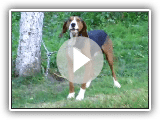
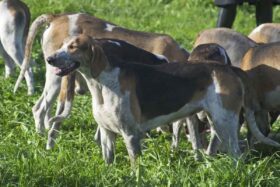
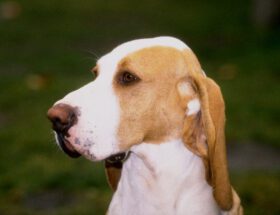
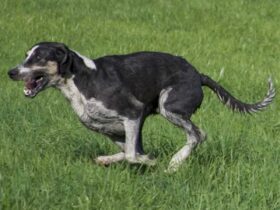
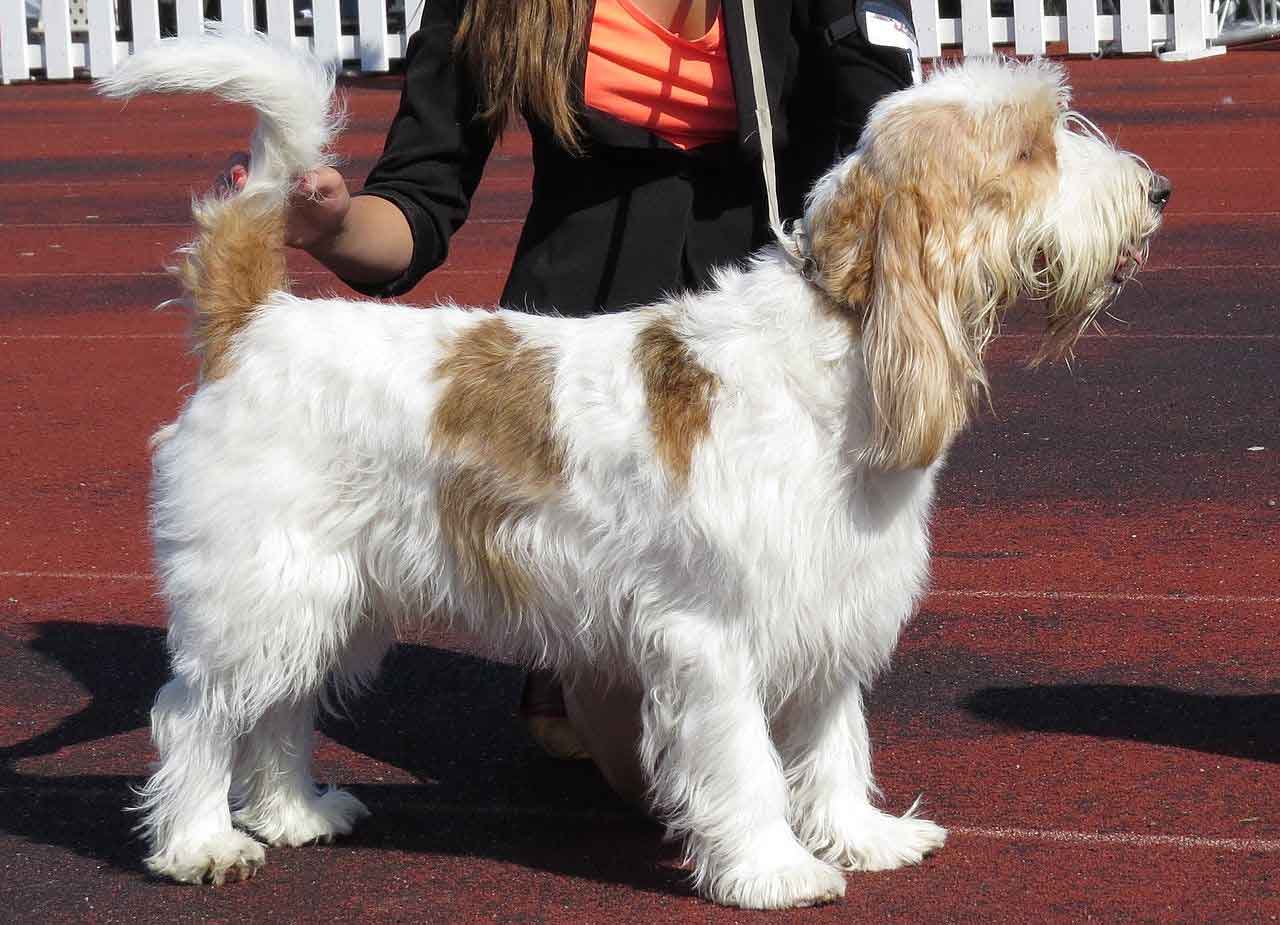
Serbian tricolour hound
Serbia FCI 229 . Medium-sized Hounds

Sabueso tricolor serbio

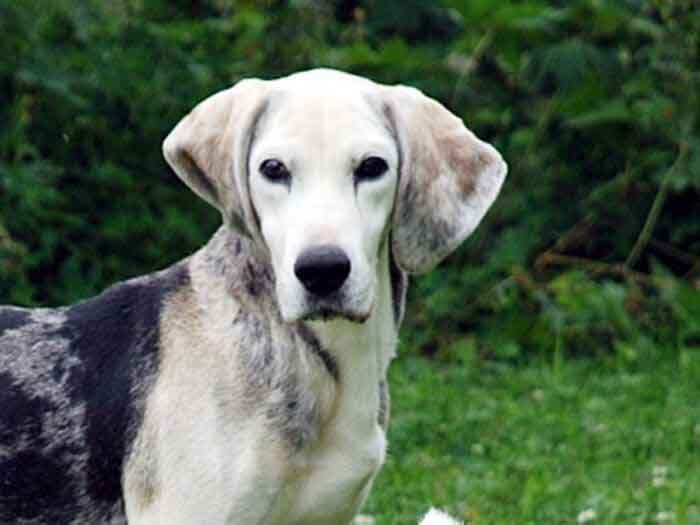
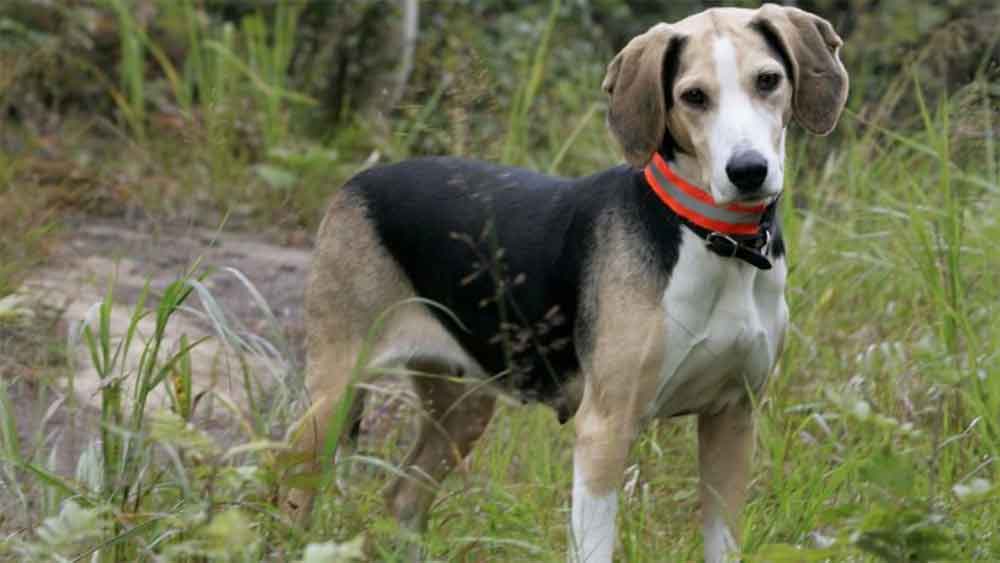
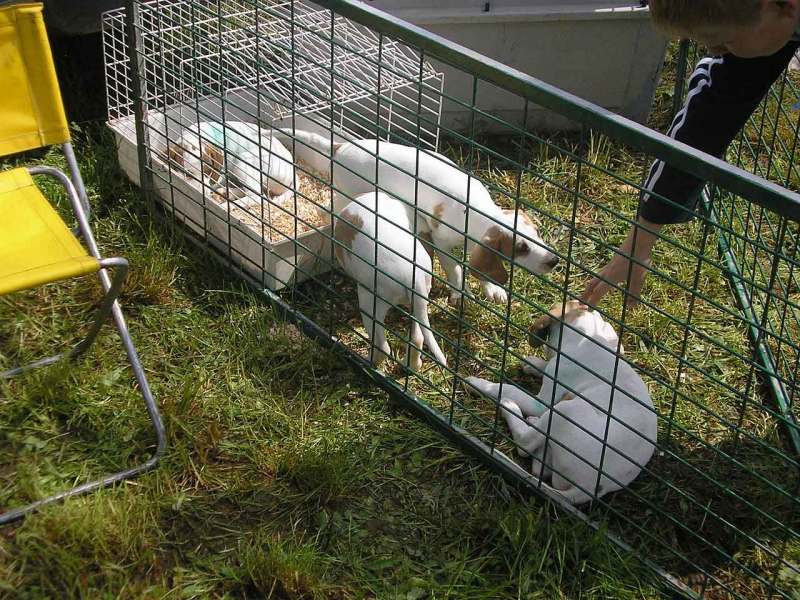
The Serbian tricolour hound it is rare even in its country of origin and to see it abroad is almost impossible.

Content

History

The Serbian tricolour hound (Srpski Trobojni Goniฤ or Trobojac) It is considered one of the rarest species that exist. This breed is one of the three types of dogs developed in the former Yugoslavia. Before the disintegration of Yugoslavia, The breed was known as the "Yugoslav Tricolor Hound", changing its name in 1991 after the dissolution of Yugoslavia.

In 1946 It was debated whether this race was independent or just a variety of the ยซSerbian houndยซ; finally given separate breed status and a first standard set. This breed was presented at the International Dog Show in Belgrade on 7 and 8 in June of 1950. The Serbian tricolour hound was recognized as a breed by the FCI the 25 in July of 1961 and the standard was published.

From the beginning, these dogs have been used as hunting companions. They are ruthless hunters of small game like foxes and rabbits. Due to his strength and fearless nature, they are also used to hunt wild boar, wild boars and other game animals. Unlike other Hounds that hunt on a leash, this breed can run freely and search for prey on its own. This independent hunter will never kneel in the face of difficult terrain. In search of prey, uses your excellent sense of smell, and with a penetrating voice will inform the hunter when he finds it.

Unfortunately, this persistent and tireless hunter is not known among hunting enthusiasts in other countries, so this rare breed is relatively unknown in other parts of the world.

Physical characteristics ยซSerbian tricolor houndยป

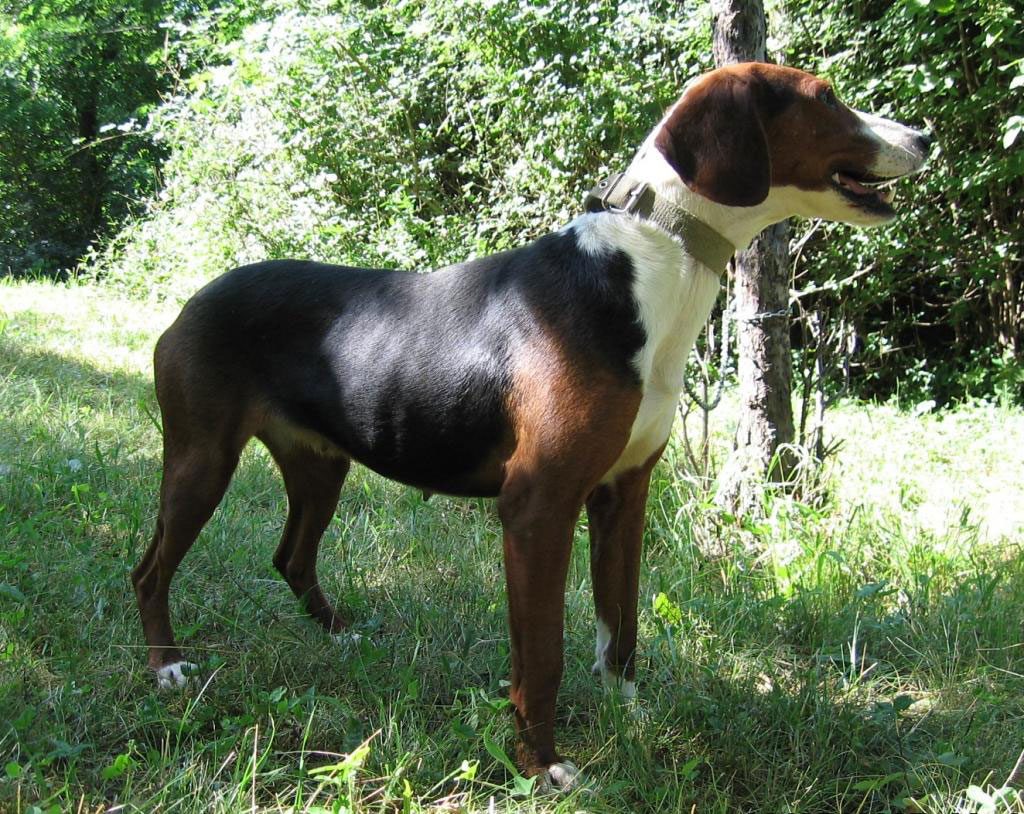
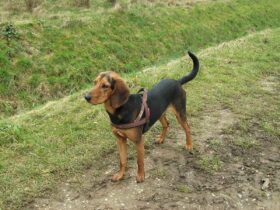
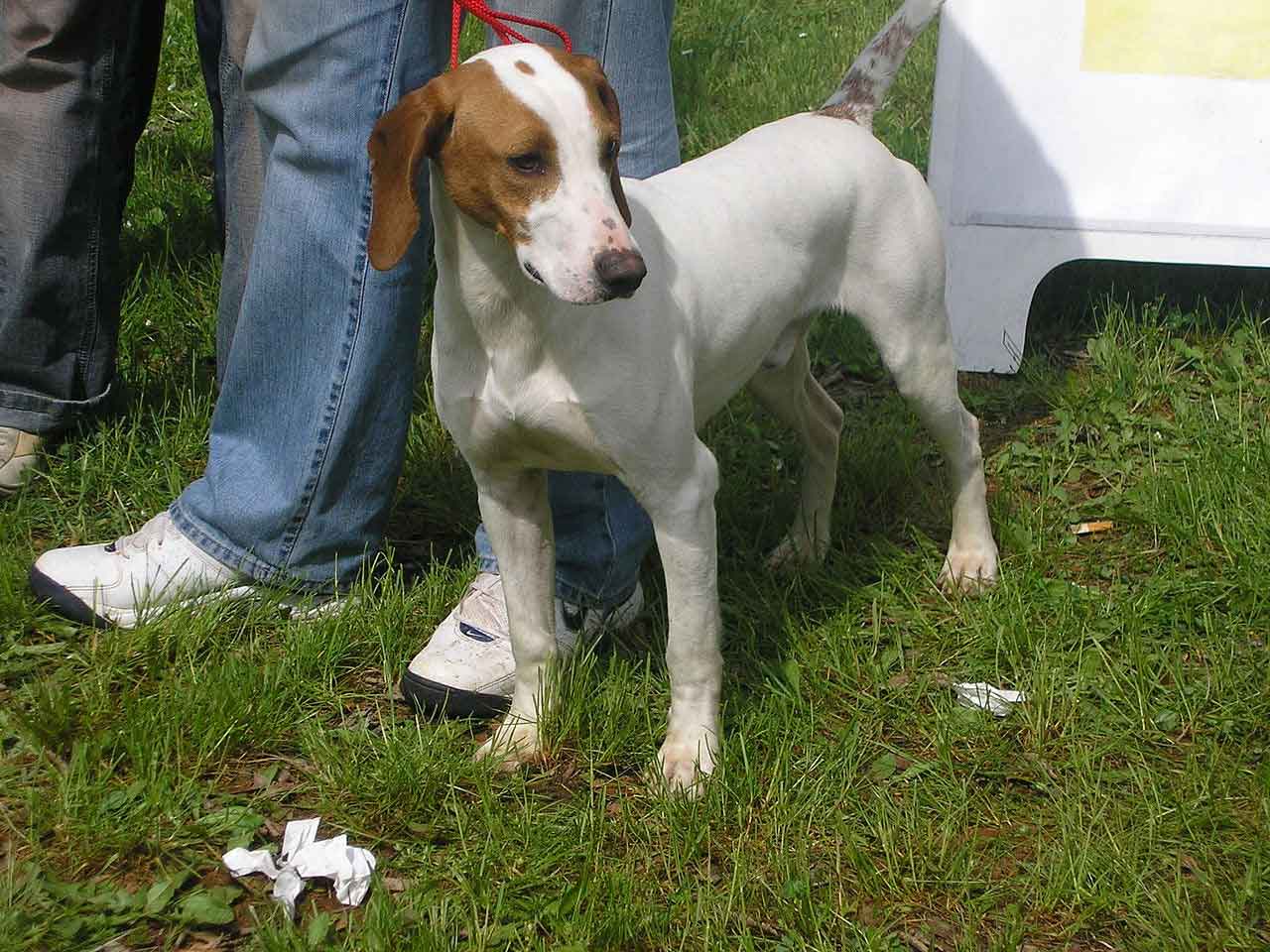
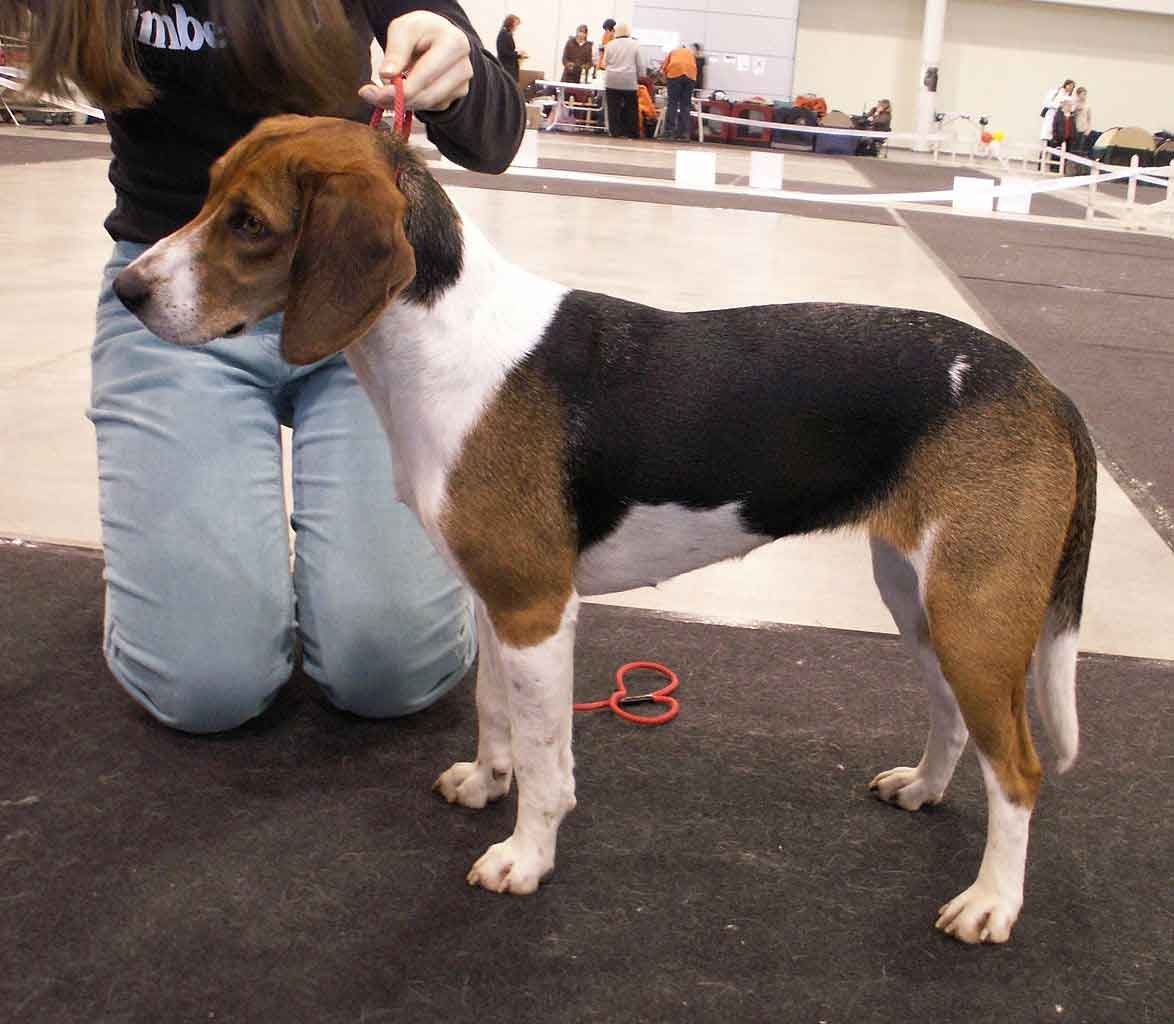
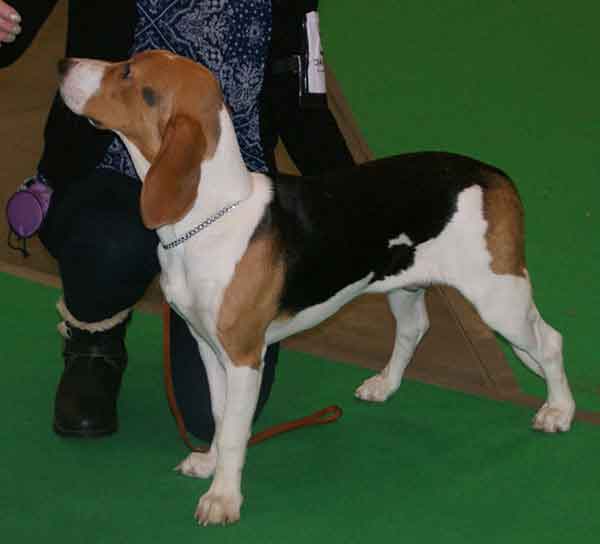
All three Yugoslav dog breeds evolved from Phoenician merchant dogs and have almost identical characteristics, which is why they are often mistakenly identified as the same race. What distinguishes the Serbian tricolour hound of the other two races is the white mark on the chest, which emphasizes the striking print of dark red hair in the background and a black cloak.

The coat of the Serbian tricolour hound it is waterproof, short and bright. Slightly thick with a well developed undercoat, spreads well throughout the body. Both in the area of รขโ‚ฌโ€นรขโ‚ฌโ€นthe rear thigh and in the lower part of the tail the coat is slightly elongated.

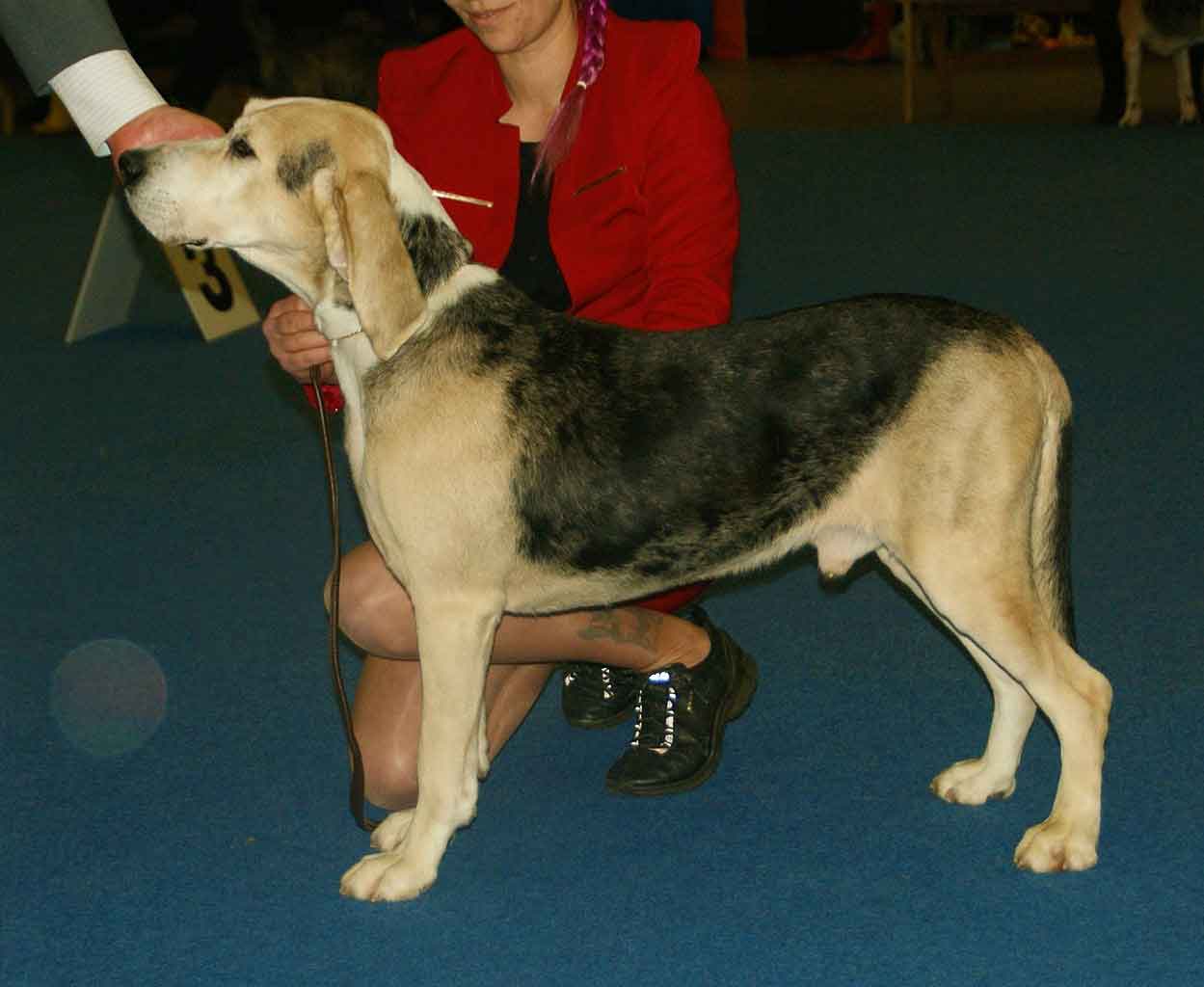
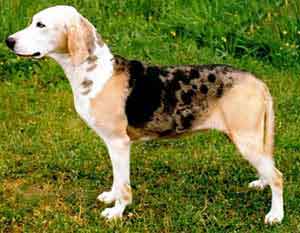
The coat of the Serbian tricolour hound has a deep red or fox red background color, of which a saddle or black fur stands out. The black partly reaches the head of the dog and forms two dark marks on the temples. White forms a full or partial collar under or around the neck.

On the dog's head white is pronounced like a cutout. On the muzzle it can also be seen as a spread fire. If the dog has a white mark on its chest, this is permissible, although it extends to the end of the sternum and reaches both the belly and the interior of the hind limbs.

The tip of the tail can also be completely white. But, total white coat should be less than one third of total body. The Serbian tricolour hound also has medium length ears, high, found near the cheeks.

The height the male will of 45 to 55 cm and in the female of 44 to 54 cm., the weight of Serbian tricolour hound will of 20 to 25 kg.

The life expectancy of the Serbian tricolour hound, round the 12 years.

Character and aptitudes ยซSerbian tricolor houndยป

The breed is characterized by an intense temperament, always reliable and very loyal in his relationship with his pack. But, the Serbian tricolour hound also has a very friendly nature. On the one hand, dogs are suitable as watchdogs. On the other hand, can be used for dressage.

The Serbian tricolour hound is hard-working and optimally equipped to work even on difficult terrain. Due to its attentive and excellent eyes and its high performance, is an ideal hunting dog.

At home he behaves warmly and calmly. But, as soon as it is in working mode, is extremely energetic and very persistent.

If you get a Serbian tricolour hound, you will get a breed that will be a friendly and obedient companion dog. He always tries to please his owner. But, the prerequisite for this is that it is sufficiently busy when not used for hunting.

ยซSerbian tricolor houndยป images

Videos ยซSerbian tricolor houndยป

Type and recognitions:

  • FCI CLASSIFICATION:
  • Group :
  • Section : . .

Federations:

  • FCI – Group 6: Scent hounds, and related breeds. – Section 1.2: Medium-sized Hounds. โ“˜
  • AKCHound โ“˜

FCI breed standard "Serbian tricolour hound"

Origin:
Serbia, Montenegro

Date of publication of the valid original standard:
26.11.2002

Use:

Scent hounds


General appearance:

Medium-sized dog with a robust build. He has a great temperament, He is impetuous and energetic.

IMPORTANT PROPORTIONS:

โ€ข Body length, taken from the tip of the shoulder to the tip of the buttock, exceeds in a 10% the height at the withers.
โ€ข The length of the head corresponds to the 45% the height at the withers.


Behavior / temperament:

Selfless, friendly, hot-tempered; self-confident, demonstrates remarkable tenacity.

Head:

Longheaded, thin; the upper lines of the skull and nasal passage are divergent.

Cranial region:
  • Skull: Seen from the front and profile, It is slightly bulky; the frontal furrow is pronounced. The occipital Protuberance is little developed. The distance between the ears ligament corresponds to that between depression slightly and the occipital Protuberance. The superciliary arches are little spoken.
  • Depression links (Stop): It is not very pronounced.

facial region:

  • rufa: Well-developed and always black.
  • Snout: Cuneiform, shorter than the skull; the proportion being searched between the length of the muzzle and the skull is of 8,5: 10. It progressively decreases depression slightly with truffle. Cano-nasal is straight. The lateral lines of the muzzle are convergent.
  • Lips: Thin, together, moderately developed, fairly short and rounded at the tip of the snout. The edge of the lips should be black. The upper lip slightly exceeds the lower; the commissure is firm.
  • Jaws / Teeth: The jaws are strong and have a scissor-shaped joint., uniform and complete. Is accepted in the form of clip joint.
  • Cheeks: Flat.

Eyes: Almond biscuits, almost oval, medium-sized, in slightly oblique position. The edge of the eyelid pigmentation is dark (preferably black). The color of the iris is as dark as possible.

Ears: High are presented; medium length, pendants. Close to cheeks, they are moderately wide. The tip is slightly oval shaped. The ears are more thin than thick.

Neck:

Strong, of a length which corresponds almost to the head. The top line is slightly arched. The neck forms an angle with the horizontal of 45 a 50ยฐ.

Body:

Rectangular, its length exceeds of a 10% the height at the withers.

  • Top margin: Straight.
  • Cross: It is little pronounced.
  • Back: Well muscled, straight, strong, elongated.
  • Pork loin: Well muscled. Its length is almost equal to that of the rump.
  • Rump: Slightly inclined (of 20 to 25% in relation to the horizontal), well muscled, wide.
  • Breast : Strong. Its height corresponds to the 50% the height at the withers; Its perimeter exceeds this one by a 20%.
  • Bottom margin and belly: The oval tip of sternum is slightly outgoing. The belly is slightly raised.

Tail:

Extends the line of the rump. It is thick in the birth and decreases gradually towards the end, arriving at the level of the Hock. Slightly stooped upwards, appears lower than the line of the back. It is covered by abundant hair.

Tips

PREVIOUS MEMBERS:

  • In general: Strong, straight, well muscled, parallel.
  • Scapula: Approximately of the same length as the arm, muscular, solid, well attached to the chest wall. This forms an angle of 45 at 50ยฐ relative to the horizontal.
  • Arm: Well glued to the body, strong, muscular, approximately of the same length as the scapula. In relation to the horizontal, forming an angle of 45 a 55ยฐ.
  • Elbow: Well glued to the body, solid; the height from the ground to the elbow corresponds to the 50% the height at the withers.
  • Forearm: Straight, strong, well muscled.
  • Carpo: Solid.
  • Metacarpus: Strong, slightly oblique (up to 15ยฐ relative to the vertical).
  • Front feet: Jack's foot, with fingers together and solid. The nails are strong, preferably dark black. Bearings, Dark they are well developed.

LATER MEMBERS:

  • In general: Strong, straight, well muscled, parallel.
  • Thigh: Strong, well muscled, straight.
  • Babilla: Solid, parallel to the plane of the body. With an angle of about 120ยฐ.
  • Leg: Well muscled, of a length approximately equal to the thigh.
  • Hock: Strong, its angle measured ones 135 a 140ยฐ.
  • Metatarsus: Strong, almost vertical.
  • Rear foot: A little longer than the previous foot; fingers together and solid; fingernails, dark black, they are strong. Plantar bearings are resistant and elastic, dark colored.

Movement:

Elongated step, extended and vigorous strides. Preferred movement is loose trot, uniform, harmonious and well sustained.

Mantle

SKIN: Elastic, well Pigmented; adheres well to the body.

HAIR: Short, abundant, bright, a bit dense, taut on the body ; the inner layer of hairs is fairly well-developed. The hair is a little longer on the back edge of thighs and the underside of the tail.

COLOR: The base color is a deep red or reddish color Fox, with a blanket or Chair black. Black may reach head, where it forms black marks on temples.

White, star pattern on the head and a stripe that extends over the snout, It forms a partial or full collar underneath and around the neck. A white mark on the front part of the chest is allowed, This can be extended up to the tip of the sternum and reach the belly and inside of legs. The tip of the tail may be white. White must not exceed the third of the surface of the body.


Size and weight:

Height to the cross.

  • Males: 45 to 55 cm., ideal size 51 cm..
  • females: 44 to 54 cm., ideal size 49 cm..


Fouls:

Any deviation from the above mentioned criteria is considered an absence and severity of this refers to the degree of deviation to the standard and its impact on the health and welfare of the dog.

MISS PLAYOFFS

  • Aggressive or fearful dog.
  • Upper or lower prognathism.
  • Absence of a tooth, the absence of two premolars is acceptable 1 (PM1).
  • Different color eye.
  • Body too long.
  • Threaded queue, high or threaded insert on the back. Tip of tail hook-shaped or diverted laterally.
  • White markings with the background of the coat color spots.
  • White color that is more than one third of the surface of the body.
  • Presence of a fourth color.
  • Top or bottom size prescribed by the standard.
  • Any dog โ€‹โ€‹showing clear signs of physical or behavioral abnormalities must be disqualified..


N.B.:

Males should have two normal-appearing testicles fully descended into the scrotum..

TRANSLATION: IRIS Carrillo (Puerto Rico Kennel Federation).

Source: F.C.I - International Cynological Federation

Alternative names:

1. Serbian: (ัั€ะฟัะบะธ ั‚ั€ะพะฑะพั˜ะฝะธ ะณะพะฝะธั‡, srpski trobojni goniฤ or ั‚ั€ะพะฑะพั˜ะฐั†, trobojac) Yugoslavian Tricolour Hound (English).
2. Chien courant yougoslave tricolore (French).
3. Original name: (Jugoslavenski Trobojni Gonic), Trikolor Laufhund, Dreifarbiger Jugoslawischer Laufhund (German).
4. in Serbian: (srpski trobojni gonic) (Portuguese).
5. En servio: srpski trobojni goniฤ o trobojac, Sabueso yugoslavo tricolor (espaรฑol).

Other hounds:

Great Anglo-French Tricolour Hound

Great Anglo-French Tricolour Hound

The Great Tricolor Anglo-French Hound is considered rare, very little spread outside of France and currently little ...
Spanish Hound

Spanish Hound

The Spanish Hound is described in the "Book of hunting" of King Alfonso XI (1312-1350). Content History "Spanish Hound" ...
Great Anglo-French White and Black Hound

Great Anglo-French White and Black Hound

The Great Anglo-French Black and White Hound can be used both in packs and individually.. History Content This breed is ...
Grand Griffon Vendรฉen

Grand Griffon Vendรฉen

The Great Vendean Griffon is a dog of great character, beautiful cloak and dreamy look. It's a pity his time ...
Hellenic Hound

Hellenic Hound

It stands out for its particularly harmonious voice. Contents History The Hellenic Hound has ancient origins, since their ancestors were already ...
Italian Rough-Haired Hound

Italian Rough-Haired Hound

The Italian Wirehaired Hound is reserved, wise, calm and thoughtful in his work. Contents History The Italian Hound ...

โ–ท The world of Pets: Dogs, cats, birds, reptiles, amphibians

Grand Griffon Vendรฉen
Francia FCI 282 - Large-sized Hounds

Grand Griffon Vendรฉen

The Grand Griffon Vendรฉen he is a dog of great character, beautiful cloak and dreamy look. It is a pity its little diffusion.

Content

History Grand Griffon Vendรฉen

In the beginning, there was only the Greater Vendean. This one belonged to a variety of short-coated Vendean dogs., descendants of the โ€ณscribesโ€ณ (so named because one of the original kennels was the king's clerk) or of the king's white dogs. Regarding its origin, neither can we fail to point out the Basset Fauve de Bretagne, since these are an essential part of the lineage of the โ€ณscribe dogโ€ณ. The missing gray of Saint-Louis and Bresse grifones (descendants of Segussian ancestors) also contributed to the creation of Grand Griffon Vendรฉen.

There are also several other breeds of griffons from the Vendรฉe, all of them smaller: the Briquet Griffon Vendรฉen, y el Grand y Petit Basset Griffon Vendรฉen. Related breeds of Griffon include the Griffon Fauve de Bretagne, the Griffon Bleu de Gascogne and the Griffon Nivernais.

Physical Characteristics Gran Griffon Vendeano

This is an ancient breed animal, French type, receptive and determined, distinguished in its forms and movements. It is of well proportioned construction, robust, no appearance of heaviness.

SIZE: Height to the cross: In males, of 62 – 68 cm., In females, of 60 – 65 cm..

Character and abilities Grand Griffon Vendรฉen

It is docile, though willful and passionate. Must be well trained.
It is an energetic dog with a passion for hunting that needs space and a lot of physical exercise.: you are strongly discouraged from living in the city. Character is balanced, However, training should be carried out from a very early age as it is considered difficult due to its very firm character: booster must be purchased very soon.

It has a very good nose and a beautiful bark. Applied to follow the footstep, does not refuse to enter the undergrowth and prefers large territories.
Before it was used to hunt wolves and now it is used to hunt wild boars.

Grand Griffon Vendรฉen Care

The mantle of Grand Griffon Vendรฉen requires daily attention because it can easily become tangled.

Videos of the Great Basset Griffon Vendean

Great Basset Griffon Vendeano

Grand Basset Griffon Vendeen / Breed of dog

Type and recognitions:

  • FCI CLASSIFICATION:
  • Group :
  • Section : . .

Federations:

  • FCI – Group 6: Scent hounds, and related breeds. – Section 1.1: Large-sized Hounds. โ“˜
  • Central Canine Society โ“˜

FCI breed standard "Grand Griffon Vendรฉen"

Origin:
France

Date of publication of the valid original standard:
09.01.1999

Use:

This is the perfect assistant for the shotgun hunter in medium-sized territories.; the fastest of all bassets. It's tenacious, courageous, a little stubborn. It is necessary to train him from an early age to obey the call; Their training involves will and sanctions that the animal does not resent..


General appearance:

Slightly elongated construction, straight limbs, basset setup; Its appearance should not be that of a small briquet. Its shapes are harmonious and elegant.


Behavior / temperament:
  • Temperament : He is fast and brave; has a good bark; He is passionate about hunting and likes to be in the undergrowth and brambles..
  • Character : Although somewhat stubborn, has good character. It is up to the master to know how to control it.

Head:

---

Cranial region:
  • Skull : No appearance of heaviness; convex. It is long and not very wide. It appears well chiseled under the eyes. The occipital bone is well developed.
  • Depression links (stop) : Well marked.

facial region:

It is very prominent. The Windows are wide open. It is black, except for dogs with white and orange fur, in which the brown color is accepted.

  • Snout : The end is square. Its length significantly exceeds the length of the skull. It is very slightly arched.
  • Lips : They are quite pendulous and cover the lower jaw well., giving the end of the snout a square profile. They are covered with big mustaches.

Eyes : Oval, large, dark; there is no presence of the white of the eye. His expression is confident and intelligent. The conjunctiva should not be apparent.

Ears : flexible, narrow and thin. They are covered with long hairs and their end is shaped like an elongated oval.; they are well turned inwards. Low insertion, below the eye line. They must be able to extend beyond the tip of the nose..

Neck:

Long, robust, well muscled and strong insertion. It presents no Chin.

Body:

Typical Basset body, although not excessively long.

  • Back : Long, wide and very straight; never sunk. It begins to arch in the region where it joins the spine. The cross is very little protruding.
  • Pork loin : Solid, well muscled and slightly arched.
  • Breast : Quite wide and well descended to the elbows.
  • Ribs : Rounded, never flat, nor cylindrical. The chest is a little less wide at the elbow to facilitate movement.
  • Flanks : rather full. The belly is never picked up.

Tail:

It is thick at the base and gradually tapers until it reaches the tip.. Set quite high, It is carried in the shape of a saber or slightly bent, but never bent over, doesn't even touch the back. It's rather long.

Tips

Overall views, the bones are well developed, although they are thin. It goes without saying that quality is not a question of volume, but of density.

PREVIOUS MEMBERS

  • As a whole : They must be straight; the forearm is thick and the carpus is very little marked, although it is very solid.
  • Shoulder : Long, thin and oblique.
  • Elbows : They should not be too close to the body., nor too far apart from it.
  • Forearm : Thick; the carpals should never be touched.

LATER MEMBERS

  • As a whole : The hind limbs are solid and well aligned on the axis of the body..
  • Hip : Visible.
  • Thigh : Well muscled, but not very rounded. Bones and joints are solid.
  • Hock : It is wide and angled; never straight. Seen from the back, it should not deviate even inwards, nor out.

FEET : Strong and compact. The pads are hard and the nails are solid. The appropriate pigmentation of the pads and nails is sought.

Movement:

When the dog is in action it must give the impression of resistance and lightness. Movement should be loose and harmonious.

Mantle

SKIN : Thick enough. It often appears streaked in dogs with tricolor coats.. There is no presence of dewlap.

HAIR : Hard to the touch, not too long. It's stretched, never silky, ni lanudo. The fringes should not be very abundant. The belly and inner thighs should not be hairless.. The eyebrows are well pronounced, but they don't cover the eyes.

COLOR :

  • Black with white patches (black and white).
  • Black with reddish markings (black and tan).
  • Black with sand-colored markings.
  • Fawn with white patches (Orange and white).
  • Fawn with black blanket and white patches (tricolor).
  • carbon fawn.
  • Carbon sand color with white patches.
  • Color arena carbonado.

Traditional denominations : hare hair, wolf fur, badger hair or boar hair.


Size and weight:

Height to the cross :

  • In males : of 40 to 44 cm.
  • In females : of 39 to 43 cm..

With a tolerance of 1 cm more or less.


Fouls:

Any deviation from the aforementioned criteria is considered a fault and the severity of it is considered to the extent of the deviation from the standard and its consequences on the health and well-being of the dog..

Head

โ€ข Too short.
โ€ข Flat skull.
โ€ข Short snout.
โ€ข Depigmentation of the truffle, lips or eyelids.
โ€ข Pincer-shaped joint.
โ€ข Light eyes.
โ€ข High set ears, short, not crooked enough or not hairy enough.

Body

โ€ข Too long or too short in construction.
โ€ข Lack of harmony.
โ€ข Loose back.
โ€ข Sunken croup.

Tail

โ€ข Diverted tail.

Tips

โ€ข Weak bones.
โ€ข Angles that are too straight.
โ€ข Hocks too closed.
โ€ข Crushed feet.

Fur

โ€ข Until, little abundant.

Behavior

โ€ข Shy dog.

MISS PLAYOFFS

โ€ข Fearful or aggressive dog.
โ€ข Lack of type.
โ€ข Prognathism.
โ€ข Gaze eyes. heterochromia.
โ€ข Narrow sternum; narrow ribs at the bottom.
โ€ข Knotted tail.
โ€ข Twisted or semi-twisted ends.
โ€ข Woolly fur.
โ€ข Solid black or white coat.
โ€ข Important depigmentation.
โ€ข Size that deviates from the norms of the standard.
โ€ข Visible disability. anatomical deformation.

Any dog โ€‹โ€‹showing clear signs of physical or behavioral abnormalities must be disqualified..


N.B.:

Males should have two normal-appearing testicles fully descended into the scrotum..

Source: F.C.I - International Cynological Federation

Alternative names:

1. Large Vendรฉen Griffon (English).
2. grand griffon vendรฉen (French).
3. GROSSER GRIFFON VENDEEN (German).
4. Grand griffon Vendรฉen (Portuguese).
5. Grifรณn vandeano grande (espaรฑol).

source: fci
Photos: A large Vendรฉe griffon by Canarian, CC BY-SA 4.0, via Wikimedia Commons

โ–ท The world of Pets: Dogs, cats, birds, reptiles, amphibians

Norwegian Hound (Dunker)
Noruega FCI 203 - Medium-sized Hounds

Norwegian Hound

The Norwegian Hound (Dunker) is found only in its country of origin and is virtually unknown outside its borders.

Content

History

The Norwegian Hound was originally called Dunker, in honor of the Norwegian captain and breeder Wilhelm Conrad Dunker (1806-1860), who established the first breed standard in 1850. During the first half of the 19th century, there was a large population of hounds in norway, including various types used for hare hunting. Wilhelm Dunker selected those with the keenest sense of smell and crossed them with a Russian Harlequin Hound to produce a versatile hound, able to hunt rabbits and hares by smell rather than sight, and tough enough to withstand the harsh weather conditions of Norway.

In 1902 was founded the Norsk Harehundklub, a club dedicated to hounds. That same year the hounds were divided into two main groups, known today as Dunker y Hygenhounds. The first was the most numerous and included local dogs from all over the country., providing a wide and varied breeding base.

Although Norway was less affected by World War II than other European countries, the demand for these dogs dropped dramatically, which made it difficult for the breeders to continue their work properly. As a result, the number of specimens decreased significantly.

After the conflict is over, the Dunker regained some popularity and was officially recognized by the Fรฉdรฉration Cynologique Internationale (FCI) in 1956.

But, this bounce was only short lived: lost ground again from the decade of 1970, due to competition from foreign breeds of hunting dogs imported into the country.

Things did not improve much in the 80, to the point that inbreeding problems began to appear. In fact, the decline in its population led many breeders to resort to inbreeding to continue breeding. This led to a high rate of congenital deafness.. For this reason, in 1987, the breeding committee Norwegian Hound asked the Norsk Kennel Klubb (NKK), the reference canine organization in Norway, permission to cross the Dunker with other races, but they denied it. But, how things did not improve much, the NKK finally gave his approval for some crosses two years later. This resulted in a more varied and healthy genetic makeup, while maintaining the characteristic traits of the breed.

The United Kennel Club (UKC) recognized it in 1996. But, the other American reference organization, the American Kennel Club (AKC), has not done the same to this day – nor does the neighboring Canadian Kennel Club (CKC) or the prestigious British Kennel Club (KC). In fact, at the global level, recognition of the breed is still quite partial.

It's the same for broadcast. Even in the other Scandinavian countries, is almost absent, with the exception of Sweden, where the Svenska Kennelklubben records a number of births each year that can be counted on the fingers of one hand, compared to around twenty in the early nineties. In France, not a single entry was made in the Book of French Origins (LOF) during the first two decades of the 21st century.

In Norway, The number of Dunkers recorded each year in the NKK has been around 150 since the mid-decade 2000. But, this marks a halving of the number compared to the change in years 90. This limited number is partly explained by the deafness problem present in this breed.: almost the 75% of its population suffers from deafness.

Photo: A Norwegian Hound by Canarian, CC BY-SA 4.0, via Wikimedia Commons

Physical characteristics ยซNorwegian hound (Dunker)ยป

The Norwegian Hound It is a medium-sized dog distinguished by its long, well-proportioned body, his energetic and clear walk and his light weight. They have solid bones, giving an impression of strength and endurance. The back is straight, firm and long enough to give length to the rib cage. Lets on strong, dry front legs. The tail is wide and thick at the base and tapers at the tip. Descends to the hock or slightly protrudes from the hock.

Dunker
Dunker

Quite long, its head is characterized by a slightly domed skull and a marked stop. Located at half height, the ears are flat, without folds, hanging and soft to the touch. medium width, taper towards its tip, which is rounded. Its mouth has scissor-shaped teeth dominated by a square, well-developed snout., a black nose and wide nostrils.

His eyes are round, large and very penetrating. Although they are usually dark in color, there are also individuals with one or two blue eyes, a characteristic that is associated with an increased risk of deafness. Minnow eyes are allowed in blue individuals (variegated). Regardless of the color of the eyes, the eyes express calm and seriousness.

The coat of the Dunker consists of short hair, hard, tight and dense. Its coloration is a distinctive sign of the breed: they are either black with light fawn and white spots, or blue merle (ยฟbigarros?) and mottled with light fawn and white spots. Jet black coats with dark tawny markings are less desirable, and those in which white predominates (to the point of representing at least the 50% Of the surface) are considered undesirable by the norm.

Last, sexual dimorphism is not very marked in this breed: males and females are quite similar in size and weight.

Life expectancy: 12 years of age.

Size of Norwegian Hound

    – female weight: Of 24 to 25 kg
    – Male weight: Of 24 to 25 kg
    – female size: Of 47 to 53 cm.
    – Male size: Of 50 to 55 cm.

Character and skills ยซNorwegian Hound (Dunker)ยป

The Norwegian Hound is a fast and tenacious hunter with an above-average olfactory ability. They excel particularly in hunting hare and rabbit.

Being also gentle, loving, cheerful and friendly, they have all the qualities required to be an excellent companion dog. balanced, patients, tolerant and devoid of aggressiveness, they are very good playmates for children. But, it is important to note that a dog should never be left alone with a small child without adult supervision, and this applies to all races.

His total lack of aggressiveness and his attraction to humans, even for those you don't know, make it totally impossible to use as a guard dog. In effect, not reserved at all, shy, fearful or aggressive with strangers, rather they tend to welcome them positively and trust them. They are more likely to greet a malicious person with curiosity and licking them rather than barking to warn their master or make them understand that they better go their way.

His sociability extends to other dogs too. So, it is quite possible to share a house with a dog companion without fearing that conflict situations will multiply, and is generally friendly with those he meets on his walks.

With cats and other animals, things are a little more complicated. His hunting instinct naturally leads him to chase any small furry animal that is not part of the canine species.. Although he has grown up with him and must consider his little companion as a member of the family and not as a potential prey, risk can never be ruled out, so it is better to avoid such cohabitation. As for those that can be found on your walks, you probably want to chase them. So, it is preferable to keep it on a leash during excursions, to avoid any accident.

Dunker
Dunker

In any case, the fear that it will chase other animals does not mean that you should not take it out enough each day, knowing that you need a lot of activity to spend your great energy. Need at least 45 minutes of exercise per day, but his stamina makes him happy to go further if given the chance. It also, it is preferable to vary the pleasures to allow him to fully expend his energy: long walks, run through the park, sports with dogs, etc. Sports that require running (like canicross) and those that appeal to your senses (like tracking) they are the most recommended. In fact, this dog is very happy when he has to mobilize his physical and mental capacities. In any case, in addition to allowing you to exercise, all these activities reinforce the relationship with his master, which is especially important if you are hearing impaired.

From the above it follows that the Dunker not suitable for an elderly or very sedentary person, that I couldn't give you all the exercise you need. The ideal for him is a master of sport, and willing to take his partner in his various activities. Retirees may be right for him, if they are active enough.

In any case, life in the city is not ideal for him, that needs large spaces to fully develop. A house with a garden in the country is a much more appropriate environment to live in.. But, it is important to ensure that the garden is well fenced and that the environment is safe, as his instincts and hunting instincts soon lead him to follow leads and flee.

Once your need for exercise is satisfied, the Norwegian Hound has an easy and docile character; is far from being as stubborn as many hunting dog breeds. But, your sense of smell can make training difficult, as he is easily distracted by a scent and not really responsive to his master's commands.

Their propensity to bark can also be quite annoying. He is particularly prone to doing it if his master is away for a long time without having given him any exercise beforehand and without having the means to do it himself.. In fact, inactivity can be a burden and cause those behavior problems, as well as destruction, for example. But, as long as you have something to take care of in the absence of your family, not the type of dog that suffers a lot from separation anxiety.

Education ยซNorwegian Hound (Dunker)ยป

Like all the other hounds, the Norwegian Hound must be socialized from an early age. In other words, so that he becomes a balanced adult and has no trouble finding his place, should be given without delay a maximum of opportunities to meet all kinds of humans (veterinary, neighbors, delivery man, etc.), Other animals, but also to face various noises, smells and situations. This is even more important since he is easily distracted by his sense of smell..

The rules established in your education should also be taught to you from an early age, when your ability to learn and docility are at their best. As with any race, bad habits pick up quickly when he's still a puppy and become real problems when he gets older.

In any case, the Dunker it is a breed of dog that is easy to train and that listens to its master, as long as he uses a dog-friendly training method. Treatments generally prove to be very effective in positively reinforcing your good deeds and facilitating learning. But, sometimes it is necessary to show firmness and affirm your own authority to prevent this dogged dog from doing what he pleases. It can also be difficult to get their attention., given their tendency to be distracted by their sense of smell.

Since it has a strong inclination to follow its nose and to chase passing small animals, Teaching your dog to call back is especially important to avoid the risk of a frantic tug on the leash or running away if it moves freely.

It may also be helpful to try to teach him to channel his propensity to bark.. But, as it is deeply ingrained in him, should not be expected to be the calmest of dogs. If it is impossible to make him understand that some things do not necessarily require him to bark, at least he can be taught to stop on command.

Last, if the dog is deaf from birth, as is the case with a significant fraction of the representatives of the breed, the master must obviously adapt to this restriction: Training a deaf dog is not done in the same way as training another dog that is able to hear its master's voice.. Trust is then even more crucial in the relationship between the animal and its master., so that you can learn and live in good conditions despite your disability. Of course, communication is then done through non-verbal communication, and it's up to the teacher to adopt explicit body language, based on gestures and precise mimicry, specific for each indication you want to give.

Health ยซNorwegian Hound (Dunker)ยป

The Norwegian Hound is very resistant, generally have excellent health and very good longevity.

Used to living in harsh Norwegian weather, can tolerate cold and damp without difficulty. Their coat is naturally waterproof and offers good protection from the elements. On the other hand, shows some intolerance to high temperatures, even if it is able to adapt to a Mediterranean climate. You simply need to lighten up your activities during hot flashes, or at least privilege those that are carried out inside, to ensure that you always have access to a place in the shade or even air conditioning and to avoid any excessive physical exertion in the hottest hours.

Its small population and its limited diffusion prevent a very important deterioration of health, but it has been shown that it is predisposed to certain problems:

  • deafness, what is a hereditary disease. According to the Orthopedic Foundation for Animals (OFA), almost the 75% of the population of the breed is today deaf in at least one, if not both ears;
  • hip dysplasia, a joint malformation that may be characterized by a hereditary predisposition. It can cause joint pain as well as difficulty moving;
  • Elbow dysplasia, which can also be favored by a hereditary predisposition. It is painful and leads to difficulty moving and the development of osteoarthritis;
  • progressive retinal atrophy, a hereditary and incurable eye disease. Causes loss of night vision first, then loss of daytime vision, to the point that the dog becomes totally blind;
  • Demodecic scabies, a contagious parasitic disease that causes itching and true discomfort to the dog, gradually losing appetite and sleep;
  • ear infections (otitis, etc.), due to its hanging shape.
  • It also, individuals used for hunting are exposed to the various risks associated with this activity: wounds, parasites, thorns, etc.

    It also, the Dunker has a strong appetite. How it is usually active, this is not usually a problem. But, if it is not, soon becomes overweight.

    Given the hereditary conditions to which the breed is predisposed, the breeder's work plays a decisive role in the adoption of a Norwegian Hound that he is in perfect health and that he will probably remain so. In addition to the results of genetic tests performed on the parents and the puppy to reduce the risk of such diseases, every serious and responsible breeder must be able to present a certificate of good health established by a veterinarian, as well as documents related to the vaccines administered.

    It also, when the dog is small and still growing, your bones and joints are particularly fragile: therefore, any excessively intense or prolonged physical exercise should be avoided, since I could pay it off one day or another, with potentially permanent sequelae (malformations, etc.).

    Last, it is necessary to consult a veterinarian at least once a year to ensure that the dog is in good health or, on the other hand, to be able to detect as soon as possible any problem whose symptoms are not yet visible. This health check is also an opportunity to carry out your immunization reminders, which are another essential lever to keep the dog in good health. Still on the prevention registry, it is the owner's responsibility to renew the antiparasitic treatments whenever necessary throughout the year, so your partner is never unprotected.

    Care and maintenance ยซNorwegian Houndยป

    A tough breed, the Norwegian Hound do not require much maintenance.

    But, they lose a lot of hair, so brushing your hair twice a week is not too much to help remove dead hairs and keep it in good condition. During their molting periods in spring and fall, when it should be done more often (even daily) to prevent hair growth throughout the house.

    Since his hair is not very dirty and therefore does not have a strong odor, bathing him two or three times a year is generally sufficient. In any case, a too frequent bath will make the sebum naturally present on the skin disappear, insulates and protects it from the elements. Having said that, do not hesitate to give him a bath if he has gotten very dirty, for example during a particularly muddy hunting trip. In any case, you can only use a shampoo specially designed for dogs, at the risk of damaging your skin.

    Dunker
    Dunker

    The ears, on the other hand, require special attention, since its hanging shape implies an increased risk of infections (ear infections, etc.). They must be cleaned every week with a damp cloth or a cleaning product specially designed for this purpose.. They should also be dried after each bath or after a long period of time in a damp place..

    Their eyes they must also be examined weekly and cleaned if necessary with a damp cloth.

    It is also necessary to brush the teeth of your dog every week or even every day to avoid the formation of dental plaque and its possible consequences (bad breath, diseases, etc.). A toothpaste specially designed for dogs should always be used.

    It also, it is important to regularly check your dog's claws to make sure they are not getting too long and to trim them if this is the case. This could not only hinder your walking, but you could also break and potentially injure yourself at the same time. Having said that, while you're active and spending long hours outdoors, natural wear and tear is usually enough to file them.

    To know how to proceed during maintenance sessions, it is useful to benefit from the experience of a veterinarian or a groomer the first time. In fact, whether the various procedures for grooming the coat, the ears, the eyes, your pet's teeth or claws are not done properly, not only will satisfactory results not be obtained, but the owner may even injure or injure his pet. It also, the owner should get used to his pet very soon, so that throughout his life he accepts to be manipulated without being rebellious.

    It also, when your pet returns from a long time in the wild, it is a good idea to systematically take a little time to inspect it carefully: parasites, spikes or dirt may have gotten into their fur, and may also have been injured.

    What price does a โ€œNorwegian Houndโ€ cost?

    In Norway, a puppy Dunker It costs around 7000 Norwegian crowns (a few 650 EUR). The sale price varies from one individual to another depending on the prestige of the breeding, the lineage of the dog and its intrinsic characteristics.

    Since the breed does not have a wide international distribution, it is almost impossible to find a breeder of it outside of its country of origin.

    So, whether you are in France, Belgium, Switzerland, Canada or elsewhere, who wants to adopt a Norwegian Hound you must opt รขโ‚ฌโ€นรขโ‚ฌโ€นfor the import solution. In this case, keep in mind that transportation and administrative costs are added to the purchase price and, of course, you must respect the regulations to import a dog from abroad.

    Characteristics "Norwegian Hound (Dunker)"

    Coexistence is important that you have with your new friend. Before considering the acquisition of a dog of the breed "Norwegian Hound (Dunker)" you know certain factors. Not all breeds of dogs are apt to live in an apartment, you must take into account his character, their need for exercise, their interaction with other pets, their care and if you have small children, their level of tolerance towards them.

    Adaptation โ“˜

    2,0 of 5 stars (based on 1 review)

    friendly dog โ€‹โ€‹โ“˜

    4,0 of 5 stars (based on 1 review)

    hair loss โ“˜

    4,0 of 5 stars (based on 1 review)

    Affection level โ“˜

    4,0 of 5 stars (based on 1 review)

    Need for exercise โ“˜

    4,0 of 5 stars (based on 1 review)

    Social need โ“˜

    4,0 of 5 stars (based on 1 review)

    Home โ“˜

    4,0 of 5 stars (based on 1 review)

    Toilet โ“˜

    2,0 of 5 stars (based on 1 review)

    Friendly with strangers โ“˜

    4,0 of 5 stars (based on 1 review)

    barking โ“˜

    4,0 of 5 stars (based on 1 review)

    Health โ“˜

    4,0 of 5 stars (based on 1 review)

    Territorial โ“˜

    4,0 of 5 stars (based on 1 review)

    Cat friendly โ“˜

    2,0 of 5 stars (based on 1 review)

    Intelligence โ“˜

    3,0 of 5 stars (based on 1 review)

    Versatility โ“˜

    3,0 of 5 stars (based on 1 review)

    Child friendly โ“˜

    4,0 of 5 stars (based on 1 review)

    Surveillance โ“˜

    2,0 of 5 stars (based on 1 review)

    joy โ“˜

    4,0 of 5 stars (based on 1 review)

    Videos "Norwegian Hound (Dunker)"

    norwegian hound (Dunker) - Breed of dog
    Sabueso Noruego (Dunker) – Raza de Perro
    Dunker ๐Ÿถ๐Ÿพ Everything Dog Breeds ๐Ÿพ๐Ÿถ
    Dunker ?? Everything Dog Breeds ??

    Type and recognitions:

    • FCI CLASSIFICATION:
    • Group :
    • Section : . .

    Federations:

    • FCI – Group 6: Scent hounds, and related breeds. – Section 1.2: Medium-sized Hounds. โ“˜
    • UKCScenthounds โ“˜

    FCI breed standard "Norwegian Hound (Dunker)"

    Origin:
    Norway

    Date of publication of the valid original standard:
    12.03.1999

    Use:

    Hound


    General appearance:

    Medium-sized; obviously rectangular, strong structure, without giving the impression of being heavy. Must show the ability to be tenacious and resilient.

    IMPORTANT PROPORTIONS :
    The depth of the chest should be approximately half the length of the height at the withers.


    Behavior / temperament:

    The Norwegian Hound is considered the tough and robust trail dog of the old days., a dog with an excellent temperament. The breed is characterized by nerves of steel and for being especially sociable and trusting.. They are known to have performed well in hunting tests.. In this way, They can be characterized as an excellent combination of a hunting and companion dog.. Due to his good temperament and open character, the breed is also easy to train.

    Head:

    You should not carry it high. Clean, carried with dignity, with good length and parallel lines, non-cuneiform.

    Cranial region:
    • Skull : Slightly bulky, prominent occipital protuberance. If the snout is long and well developed, the skull is allowed to be wider, especially in males, as long as it does not lose its parallel planes.
    • Depression links (Stop) : Marked, but not deep or abrupt.

    facial region:

    • Truffle : black, well open Windows.
    • Snout : Rather long than short, square cut. Straight and evenly wide nose cane.
    • Jaws / Teeth : Scissor bite. Complete denture.
    • Cheeks : clean, no prominent cheekbones.

    Eyes : dark colored, round, rather big, but not outstanding. Expressive eyes, brilliant intelligence, calm and gravity. Close-fitting eyelids. Doe eyes are allowed in ยซBlue merleยป dogs.

    Ears : Medium implementation, rather low than high. soft, moderate width, tapering towards the rounded tip. Flat, without folds. Hanging close to the face. Long enough to reach the middle of the snout when stretched forward.

    Neck:

    Relatively long, no visible double chin.

    Body:

    • top line : Level.
    • Back : Straight, firm and not too long.
    • Loins : Wide and well muscled, not convex.
    • Rump : With a slight drop, well muscled, not too short.
    • Breast : Large capacity, with well arched ribs; the last ribs must be particularly well developed, making the chest look long.
    • Bottom line and abdomen : Slightly gathered.

    Tail:

    Implementation at the top line level. Thick at its root, tapering towards the tip. It should be straight and carried with a slight upward curvature; reaching to the hock or a little below it.

    Tips

    PREVIOUS MEMBERS :

    • As a whole : Strong, thin and sinewy.
    • Shoulder : Muscular, wide and inclined scapula, well attached to the trunk; tips of shoulder blades close together at the top. Well-angled shoulder and elbow joints.
    • Arm : Straight.
    • Metacarpus : Slightly inclined.
    • Front feet : Closed and arched fingers with a lot of fur between them. Durable pads. Feet should point forward.

    LATER MEMBERS :

    • As a whole : Well angled, parallel in standing position. Without being too angled or with a "cow" hock.
    • Thigh : Large.
    • Knee : Well angled.Leg : Wide.
    • Hocks : Thin and low position, wide if seen from the side.
    • Rear feet : Like the front feet.

    Movement:

    Libre, with good scope. The extremities, views from behind, they are parallel; without cow hocks and without being too angled.

    Mantle

    HAIR : Straight, hard, dense and not very short. The back of the thighs and tail may have more hair, as long as the rest of the body has good fur.

    COLOR : Black or "Blue merle" with pale fawn or whitish markings. The intense brown or predominantly black color, reaching from the snout lower than the hocks with a so-called mask is less desirable. When the white, increasing too much, reaches below the shoulders to the lower belly or to the feet (socks), These are correct and accepted brands.


    Size and weight:

    Height to the cross:

    • Males: 50-58 cm., ideal 52-54cm
    • females: 47-54cm., ideal 49-51 cm..


    Fouls:

    Any deviation from the aforementioned criteria is considered as a fault and the severity of this is considered to the degree of the deviation to the standard and its consequences on the health and well-being of the dog..

    โ€ข When in black or light fawn dogs the white reaches the middle of the back, or if blue-merle dogs show white markings, The rating of these dogs should be decreased in proportion to the extent of the target's extent..

    MISS PLAYOFFS :

    โ€ข Aggressiveness.
    โ€ข Predominantly white color (50% or more).

    Any dog โ€‹โ€‹showing clear signs of physical or behavioral abnormalities must be disqualified..


    N.B.:

    Males should have two normal-appearing testicles fully descended into the scrotum..

    Source: F.C.I - International Cynological Federation

    Alternative names:

    1. Dunker (English).
    2. Dunker (French).
    3. Dunkerbracke, Dunkerlaufhund (German).
    4. Dunker (Portuguese).
    5. Cazador noruego, Dunker, Sabueso de Dunker (espaรฑol).

    โ–ท The world of Pets: Dogs, cats, birds, reptiles, amphibians

    Grand basset griffon vendรฉen
    Francia FCI 33 . Small-sized Hounds

    Grand basset griffon vendรฉen

    The Grand basset griffon vendรฉen is tenacious, brave and a little stubborn.

    Content

    History

    The Grand basset griffon vendรฉen have been through more than 400 years of evolution to produce today's French hounds.

    In general, French hounds developed into the breeds they are today forming to fit the particular needs of their geographic areas. The dense region, thorny and rocky area of โ€‹โ€‹the Vendรฉรฉe required a hardy breed of dog with mental and physical toughness and a coat that resisted brambles. It also, lower-class hunters who did not own horses needed a slower hound to keep up. His solution was to shorten the dog's legs and, through evolution and breeding, a short dog was created. At the end of the 19th century, the Grand basset griffon vendรฉen, combining rusticity and a shortened leg, had evolved as part of the basset breeds of France.

    Working more on producing the exact size and proportions needed to hunt different game animals, the Vendeen Griffon Club, founded in 1907, recognized two varieties of Basset Griffon Vendรฉen, the Grand basset griffon vendรฉen and the Petit Basset Griffon Vendรฉen.

    In the decade of 1950, the Grand basset griffon vendรฉen was separated on its own standard and considered a separate breed, although the miscegenation between basset vendeano "Big" and "Small" were not banned until 1977.

    The first selections were made in the late 19th century by the Earl of Elva, who was looking for straight-legged dogs, but it was Paul Dezamy who established the type. He had understood that to catch a hare on the move, dogs of a certain size were needed, that he fixed on some 43 centimeters.

    Today it is used for rifle hunting and can hunt all furry animals, from the hare to the wild boar. A herd of Grand basset griffon vendรฉen won the 5th European Hare Championship.

    Photo: Grand Basset Griffon Vendรฉen in Tallinn duo CACIB, 17-18 Aug 2013, handler competition by Thomas, CC BY-SA 3.0, via Wikimedia Commons

    Physical characteristics

    The Grand basset griffon vendรฉen it is a well balanced, heavily built, an olfactory hound with a friendly and noble character. It is medium in size, with straight legs and deep chest. It is longer than high, with a moderately long muzzle, long ears and a long tail.

    His neck is moderately long and strong, his noble head with mustache and beard, and is crowned by long protective eyebrows. Its structure was designed to hunt rabbits and hares, at a rapid pace through the brambles, protected with his long eyebrows, and on the rugged terrain of the Vendรฉe area in France.

    He is a brave hunter, passionate and very skillful who nowadays is used to hunting not only rabbit and hare but also wild boar and roe deer. It is active, possesses great stamina for a full day of hunting and uses his voice freely while on the trail.

    Any feature that detracts from its functionality is a serious fault..

    Character and skills

    The calm and docile demeanor of the Grand basset griffon vendรฉen makes them excellent companions and house dogs. Prepare to give him plenty of exercise. They won't thrive like a couch dog. They should have a fenced area to exercise, since these hunting dogs can't resist the urge to chase. They are sturdy and do not slow down with age, so plan to keep your exercise routine well into your teens.

    You should be aware that like all hounds, the Grand basset griffon vendรฉen generally has a high prey drive and will follow its nose wherever it goes. Not only is a fence necessary and / or a strap, it is also required to train a constant memory from childhood. Another feature of Grand basset griffon vendรฉen is your free use of voice; no amount of training will stop this chatterbox. If you don't like your dog talking to you, this breed may not be for you.

    Health

    As in all races, there may be some health problems. Some dogs may face these health challenges in their lives, but most of the Grand basset griffon vendรฉen they are healthy dogs. Working with a responsible breeder, those who wish to own a dog of this breed, they can get the information they need to learn about the specific health problems of this beagle. Good breeders use genetic testing of their breeders to reduce the likelihood of disease in their puppies.

    Recommended health tests for this breed:

  • Hip evaluation
  • Ophthalmologist evaluation
  • cardiac exam
  • Patella evaluation
  • Thyroid evaluation
  • Characteristics "Grand basset griffon vendรฉen"

    Coexistence is important that you have with your new friend. Before considering the acquisition of a dog of the breed "Grand basset griffon vendรฉen" you know certain factors. Not all breeds of dogs are apt to live in an apartment, you must take into account his character, their need for exercise, their interaction with other pets, their care and if you have small children, their level of tolerance towards them.

    Adaptation โ“˜

    3,0 of 5 stars (based on 1 review)

    friendly dog โ€‹โ€‹โ“˜

    2,0 of 5 stars (based on 1 review)

    hair loss โ“˜

    4,0 of 5 stars (based on 1 review)

    Affection level โ“˜

    3,0 of 5 stars (based on 1 review)

    Need for exercise โ“˜

    4,0 of 5 stars (based on 1 review)

    Social need โ“˜

    2,0 of 5 stars (based on 1 review)

    Home โ“˜

    3,0 of 5 stars (based on 1 review)

    Toilet โ“˜

    3,0 of 5 stars (based on 1 review)

    Friendly with strangers โ“˜

    3,0 of 5 stars (based on 1 review)

    barking โ“˜

    4,0 of 5 stars (based on 1 review)

    Health โ“˜

    4,0 of 5 stars (based on 1 review)

    Territorial โ“˜

    3,0 of 5 stars (based on 1 review)

    Cat friendly โ“˜

    2,0 of 5 stars (based on 1 review)

    Intelligence โ“˜

    3,0 of 5 stars (based on 1 review)

    Versatility โ“˜

    3,0 of 5 stars (based on 1 review)

    Child friendly โ“˜

    4,0 of 5 stars (based on 1 review)

    Surveillance โ“˜

    4,0 of 5 stars (based on 1 review)

    joy โ“˜

    4,0 of 5 stars (based on 1 review)

    Type and recognitions:

    • FCI CLASSIFICATION:
    • Group :
    • Section : . .

    Federations:

    • FCI – Group 6: Scent hounds, and related breeds. – Section 1.3: Small-sized Hounds. โ“˜
    • Central Canine Society โ“˜

    FCI breed standard Grand basset griffon vendรฉen

    FCIFCI - Grand basset griffon vendรฉen
    Big

    Alternative names:

    1. Basset Griffon Vendรฉen (Petite), PBGV (English).
    2. Grand basset griffon vendรฉen (French).
    3. Briquet Griffon Vendรฉen, GroรŸer Basset Griffon Vendรฉen (German).
    4. (em francรชs: Grand basset griffon Vendรฉen) (Portuguese).
    5. GBGV (espaรฑol).

    โ–ท The world of Pets: Dogs, cats, birds, reptiles, amphibians

    Beagle
    Gran Bretaรฑa FCI 161 . Small-sized Hounds

    The main fault of the Beagle is disobedience. He is very stubborn and playful.

    Beagle

    Content

    Characteristics "Beagle"

    Coexistence is important that you have with your new friend. Before considering the acquisition of a dog of the breed "Beagle" you know certain factors. Not all breeds of dogs are apt to live in an apartment, you must take into account his character, their need for exercise, their interaction with other pets, their care and if you have small children, their level of tolerance towards them.

    Adaptation โ“˜

    5,0 of 5 stars (based on 1 review)

    friendly dog โ€‹โ€‹โ“˜

    5,0 of 5 stars (based on 1 review)

    hair loss โ“˜

    3,0 of 5 stars (based on 1 review)

    Affection level โ“˜

    5,0 of 5 stars (based on 1 review)

    Need for exercise โ“˜

    5,0 of 5 stars (based on 1 review)

    Social need โ“˜

    5,0 of 5 stars (based on 1 review)

    Home โ“˜

    2,0 of 5 stars (based on 1 review)

    Toilet โ“˜

    1,0 of 5 stars (based on 1 review)

    Friendly with strangers โ“˜

    4,0 of 5 stars (based on 1 review)

    barking โ“˜

    5,0 of 5 stars (based on 1 review)

    Health โ“˜

    3,0 of 5 stars (based on 1 review)

    Territorial โ“˜

    1,0 of 5 stars (based on 1 review)

    Cat friendly โ“˜

    3,0 of 5 stars (based on 1 review)

    Intelligence โ“˜

    4,0 of 5 stars (based on 1 review)

    Versatility โ“˜

    2,0 of 5 stars (based on 1 review)

    Child friendly โ“˜

    5,0 of 5 stars (based on 1 review)

    Surveillance โ“˜

    5,0 of 5 stars (based on 1 review)

    joy โ“˜

    1,0 of 5 stars (based on 1 review)

    History

    The origins of the Beagle they are confused and remote. In the year 350 to. C. Xenophon already described some hounds that coincide in most details with the beagle.

    It is believed that it was the Romans who brought them to England as rabbit hunters and once there they were crossed with local hounds..

    Talbot Houndson are considered the ancestors of the North Country Beagle, Southern Hound, the Beagle, and the Foxhound.

    Between 1300 and the 1400 the Beagle reached a high level of popularity among British monarchs. Edward II and Henry VII already had packs of Glove Beagles, So called because of its small size., they fit in a glove and Elizabeth I had Beagles that only measured 22 centimeters. Hound packs were popular on almost all large country estates.. Towards the 1400, the Beagles had already spread across Britain, Italy, Greece and France thus increasing its popularity (Snoopy is a Beagle).

    The name given to the breed has two possible origins. On the one hand, it is considered a derivation of the Celtic word "beag" which means small., while on the other it is maintained that it comes from the French word "begueule" which means open mouth., Perhaps in reference to the noisy outcry produced in the cacario tract.

    Physical characteristics


    They are dogs with muscular legs aspect, and smooth, short coat. Despite having a muscular and slender appearance they tend to clog up is, his appetite is almost insatiable. Why there is that much attention to their diet and not be allowed to abuse this.

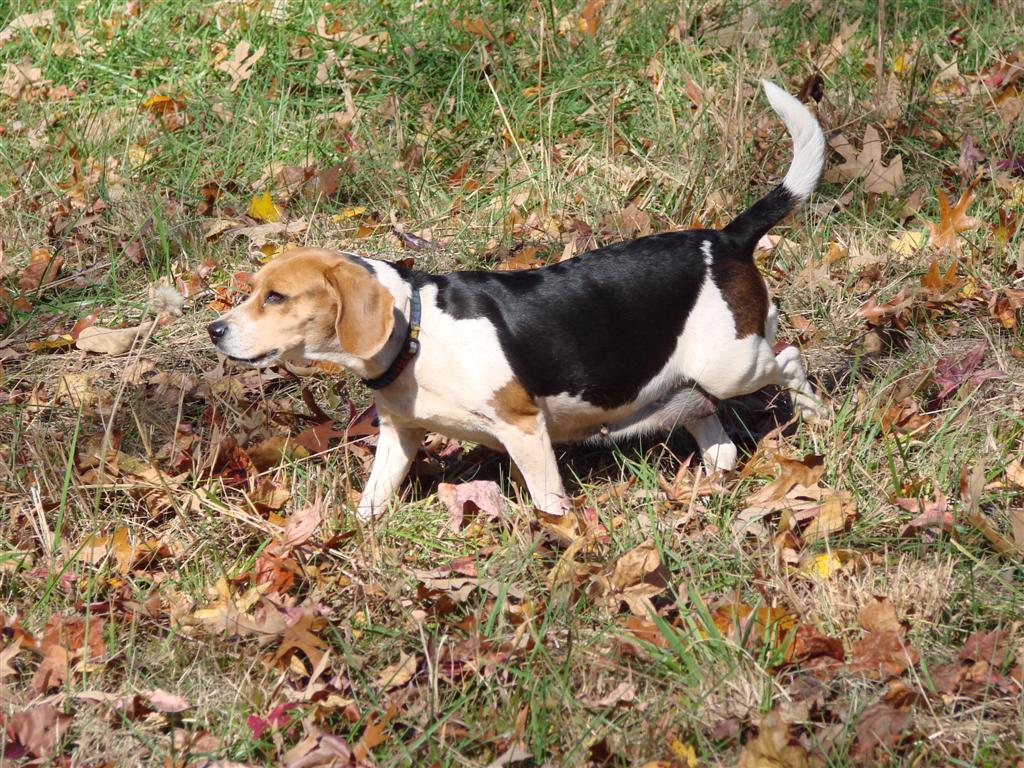
    They have long ears. Its colors are usually black, Brown and white of any variety. There are many copies of white legs, Brown ears and Brown and black body. Another characteristic of the breed in its coloration is the intense black around its eyes.. It has a desirable minimum height at the withers of 33 cm., and a desirable maximum height to the cross of 40 cm.. Weighs between 9 and 16 kg.

    Character and skills

    The Beagle is always alert. Very hardworking, with great energy and determination, they are lively dogs, intelligent and uniform temperament: they do not show aggressiveness or shyness.

    Closeness to their owners

    The Beagle has almost all the qualities of the ideal companion dog, being meek, loving and friendly, forming strong ties with its people. They are very receptive to their emotions, whatever your age: share their joy in happy moments and show solidarity and support in difficult moments. He is considered an excellent therapist for psychologically debilitated people, especially since the fact that he is generally active does not prevent him from also enjoying calm when it is necessary.

    He is also very cheerful and playful, and he loves to have fun. Thus, he especially likes people who are willing to play with him, especially the children.

    But, It is important to note that he can be very agitated when playing and, for example, will bite the person you are interacting with. This is never a sign of bad behavior., but simply his way of playing. But, these behaviors can be limited by working on them as part of your education.

    Videos "Beagle"

    Ability to handle loneliness

    Being a gregarious dog, the Beagle prefers company to solitude and needs a lot of social interaction during the day. They tend to suffer from separation anxiety when their owner is away and are left alone for any length of time, even in a familiar space.

    So, not suitable for someone who spends most of their days away from home and cannot take it with them.

    Relationship with children

    The Beagle he is a dog that adores children, in which he finds great playmates, and vice versa.

    Their tendency to bite people they play with can be problematic with younger children, so keep a close eye on their interactions, although this is valid for any race.

    It should also be noted that sometimes they seek peace and quiet, and they can react badly if they are annoyed with a little insistence. So, it is important for everyone's well-being to teach children to respect their pet and understand their body language, as soon as your age allows.

    Get along with strangers

    The beagles they are very sociable and are usually delighted to meet new people, whether they are invited to the house by their owners or if they meet them on a walk, for example. He is not the type to be aggressive towards strangers, rather they take an interest in them and potentially expect them to play with them or even offer them food.

    Protection instinct

    Due to its jovial and open character, the Beagle not one of those who discourages strangers from approaching: you are more likely to approach them to meet them. They may raise their voices in such circumstances, but it is more to express his curiosity than to defend his master or his home.

    In other words, although I am always alert, has no real protective instinct, and cannot be used as a guard.

    Obedience

    Like many breeds of hunting dogs, the Beagle is used to a certain independence of mind, since he must be able to make certain decisions for himself. In daily life, this means that it is far from being a model of obedience, and can even be quite stubborn.

    This means you can give a teacher a hard time who doesn't know how to deal with this., especially due to lack of experience. So, a first-time adopter is better off with another breed.

    Need for exercise

    The Beagle needs to spend a lot of time outdoors, and you can only be comfortable if you do at least 1,5 hours of exercise per day.

    In other words, not a breed at all suitable for a master who is often absent, sedentary and/or physically weak.

    Working capacity

    The Beagle was born for hunting and, in general, for all activities that require a very fine sense of smell. They are very persistent in fulfilling their mission: they are not only lively and intelligent, but also bold, with as much determination as energy.

    Risk of leakage

    The Beagle it is a hunting dog par excellence. This means that your nose guides you throughout your life., and nothing makes you happier than smelling and following a new or interesting scent. This means that the risk of escape is high and the garden must be fenced off..

    Of course, this is also a problem when walking and doing other outdoor activities. So, learning to remember is absolutely crucial in order to consider letting him roam free, although this does not necessarily exempt you from being equipped with a collar with connected GPS to know where you are at all times if, Nonetheless, goes out to the street. Having said that, many owners simply choose to wear the strap consistently.

    Noise level

    The Beagle it is a very vocal breed of dog: he likes to express himself through his voice and howl loudly. His barks are a true language, and vary depending on what they are trying to communicate and their emotional level.

    There are many reasons why it can bark: curiosity or desire to warn when you hear an external noise, afraid, boredom, attention seeking, greeting, separation anxiety…

    In any case, it is certainly not the best option for a person who values รขโ‚ฌโ€นรขโ‚ฌโ€นsilence – or whose neighbors value it.

    Adaptation to change

    The Beagle adapts very well to changes, including lifestyle and / or environmental changes, for example after a move. As long as you stay with your teacher, your main point of reference is there.

    Get along with other dogs

    The Beagle is usually very friendly with other dogs, either sharing a house with another dog or meeting potential new playmates on walks and other activities. Of course, its use as a bulldog is no stranger to this.

    Living under the same roof as one of your roommates can also be a great way to keep you from feeling abandoned when your owners are away..

    Get along with cats

    The beagles they are very attached to all members of their family. For him, a cat living in the same house is a full member of your family, especially if you are used to being with him from his earliest age. Otherwise, you have to be careful at the beginning of the coexistence and go little by little, but then it has every chance of being harmonious. This is all the more true since the presence of the little feline helps him feel less alone when his masters are absent..

    As for the cats that you may encounter in the course of your wanderings, you better stay vigilant. In fact, your hunting instinct can take over and lead you to chase them.

    Coexistence with other species

    Even a Beagle who is simply a domestic companion is still basically a hunter. If a small animal is found or smells (rodent, bird, etc.) On an excursion, it is very likely that I will go after him and do something to him.

    Things are normally very different in the case of an animal that shares your home and that is used to seeing from its first months. She considers him a member of her family and has no reason to attack him. But, there is no zero risk…

    Observations

    They generally have a way to sit very peculiar, without support in the legs, but rather on the thighs and buttocks, leaving the hind limbs extended completely in the ground.

    education

    Ease of training

    The Beagle it is certainly not one of the easiest breeds to train. They are usually quite stubborn or forgetful, so your training will probably require a good dose of patience and / or creativity.

    So, not recommended for a newbie, that he would soon be overwhelmed by his propensity to be indifferent to orders or to be interested in other things.

    On the other hand, once you know how to get their attention, it is possible to teach him everything and control his actions. In particular, be able to hear and execute commands even when there is a lot of noise and distractions around. In other words, for an experienced person who knows how to do it (although sometimes you have to call in the help of a professional dog trainer), patience and perseverance pay off. Given its qualities, Worth the effort.

    Training method

    Being a very intelligent dog, the Beagle makes the connection between orders and actions fairly quickly.

    But, this does not mean that he does what he is told. It may happen that you do not see the meaning of what is being asked of you, but it is not the most frequent: most of the time he is eager to please his master… as long as your mind is not occupied by something else. This is where the problem lies: in particular, your sense of smell can quickly become a distraction, especially since he is curious and has a highly developed hunting instinct. This can make training - and subsequent obedience - a bit difficult..

    The correct method of training a Beagle, the one who is the key to success, it is therefore to work the concentration, and more specifically the concentration on the orders of his master. So, don't skimp on positive reinforcement, that is to say, in rewards (candies, petting, stimuli, etc.) when you react to being called by name, looks at his master while waiting for instructions and, of course, follow them.

    Socialization

    Like all dogs, the Beagle needs early socialization. From the first months of life, the puppy needs to be used to meeting all kinds of people, other dogs and other species, and be exposed to all kinds of experiences, smells and sounds. This stage of your life is very important for your cognitive and mental development, so that you are well balanced for the rest of your life.

    If you adopt a dog from a breeder, usually they will have already done a lot of work in this area, especially if they only release it to 3 months of age, since the period between 2 and 3 months is the most crucial. But, it is still necessary to continue in the weeks and months following the adoption.

    Learn the rules

    Every dog รขโ‚ฌโ€นรขโ‚ฌโ€นneeds clear rules to find its place in the home. These rules are even more essential for the success of coexistence in the case of Beagle, who usually does what he wants.

    They are easily assimilated, since they remain the same in time and space, as well as from one person to another. So, even before you arrive home, all family members must agree on what will and will not be allowed, and then stick to it. These may include, one person cannot be allowed to do what another prohibits, or tolerate certain puppy behaviors that will later be reprimanded as an adult.

    This definition work may also require a small educational effort with children., so they understand that the rules they are asked to abide by are not made to annoy the animal, but to allow him to live in harmony among his family.

    The first thing to learn

    Unless you want to keep your dog on a leash for the rest of his life, teaching him to remember should be a priority for any owner of a Beagle, given their propensity to follow smells and, Therefore, to take flight. If security conditions allow it, the ideal is to leave your Beagle roam unhindered from a young age, so that he gets used to not being hooked while he is around his owner. In any case, as long as the memory is not perfectly integrated, it is important to reward him every time he returns after being called.

    It is also important to control their tendency to chew from a very young age, to do so in objects intended for this purpose, and not in the hands of his master or in the furniture of the house, for example. If the dog is not stopped immediately when he begins to bite the person he is playing with, for example, saying "No!"!ยป firm, stopping the game session and ignoring it, there is a great risk that it will happen again one adult day. The bite of a Beagle adult is, Obviously, much less fun and much more dangerous than a small puppy bite. But, chewing is still inevitable, since this way it relieves the pain of the gums. All you have to do is provide him with toys to chew on., and make sure you limit this behavior to these objects.

    Health

    Life expectancy

    Of 12 to 15 years

    The Beagle it is usually quite robust and has a life expectancy higher than the average of other dog breeds.

    Resistance to cold and heat

    The short coat of the Beagle makes me not fear the heat. On the other hand, as long as the cold is not extreme, the density of its fur allows it to support it perfectly.

    Like this, is capable of living in almost any climate.

    Diseases

    The general good health of the Beagle does not prevent you from being especially prone to certain diseases, like any other race. They are as follows:

    • The Hip Dysplasia, a malformation of the neck of the femur whose appearance may be favored by a hereditary factor. The fact that the bone does not fit perfectly in the hip joint causes pain and lameness, as well as the appearance of osteoarthritis as the animal ages;
    • Enanism, which makes the dog smaller than normal and may or may not be accompanied by other physical abnormalities, like extremely short legs;
    • chinese syndrome, also known as Musladin-Lueke syndrome: individuals with this syndrome grow normally, but they have a big skull and slanted eyes. It also, often have heart problems and toe abnormalities;
    • The Hypothyroidism, a thyroid disorder that causes an alteration of the animal's metabolism, with potentially numerous consequences: loss of hair, Obesity, skin disorders, shortness of breath, great fatigue, etc. The disease cannot be cured in the strict sense, but there are treatments that can greatly reduce the symptoms;
    • Selective immunoglobulin A deficiency (Ig A), affects proteins that defend the body against infectious agents. It can have various consequences: skin infections, respiratory and digestive, and even ear and urinary tract infections. Although it has not yet been established with certainty, this deficiency appears to be inherited, therefore, reproduction of affected subjects is not recommended;
    • The epilepsy, a neurological condition that is mostly hereditary, but that can also occur without affecting family members (near or far). It causes seizures that can be very impressive, but lifelong treatment may reduce their number or intensity. As a result, most affected individuals are capable of leading nearly normal lives;
    • The atopic dermatitis, a chronic and inherited disease in which the dog's skin does not act as a protective barrier. This predisposes you to developing various allergies;
    • Demodecia, disease caused by a parasite characterized by local or extensive hair loss, redness and itching, etc. It occurs most often in puppies between 3 and 12 months of age, due to their weak immune system;
    • Ear infections (otitis, etc.), as its large, flexible ears quickly trap air and provide an environment for moisture and dirt to collect.

    The Beagle is also prone to several eye conditions.:

    • Nictitating gland prolapse, u ยซcherry eyeยป, which makes the gland under the third eyelid look like a cherry in the corner of the eye. An operation is often required to remove it. Since the surgical technique used is minimally invasive, the prognosis is good and relapses are very rare;
    • The glaucoma, which is abnormally high pressure in the eye, with very fast irreversible damage and even blindness, unless treated very quickly. This disease usually has a hereditary origin;
    • Progressive retinal atrophy of the APR-CSNB type, a degenerative eye disorder that causes impaired night vision. This disease is hereditary and incurable.

    Risk of obesity

    Although they are usually quite active, Beagles are prone to obesity due to their greed, especially if you have been neutered. This can lead to many health problems or aggravate existing diseases.. It also, represents a true virtuous circle: as in humans, the more weight an individual gains, less active is, and therefore… more fat.

    So, Preventing your dog from being obese should be a top priority for any owner who wants to keep your dog in good health.. As such, in addition to monitoring your diet, it is necessary to weigh it once a month (or even more), to quickly notice any deviation.

    If confirmed in the next measurement, no waiting to take him to the vet, as the problem is unlikely to resolve spontaneously, quite the contrary. In fact, only a healthcare professional can identify the cause of this weight gain (improper diet, excessive amounts distributed, disease, reaction to a treatment, etc.) and, Therefore, indicate how to remedy it.

    Causes of mortality

    The fact that the Beagle is generally in good health is illustrated by a study conducted in 2004 by the Kennel Club and the British Small Animal Veterinary Association: a third of observed deaths are related to cancer, and old age is the second leading cause of death, with a 16% of the cases. Heart problems complete the podium, with a 12%.

    Healthy adoption

    Although the Beagle usually leads a healthy life, many of the diseases the breed is prone to are or may be inherited. So, it is important to adopt from a serious breeder: this offers the best guarantee of obtaining a puppy that has not only been well socialized since its first weeks of life, but is also healthy and stays that way.

    In effect, a professional worthy of the name is not content with taking the best possible care of puppies during their first weeks of life, before handing them over: systematically puts dogs you plan to breed through various tests, in order to avoid any possible transmission of a hereditary defect. So, if the breeder is unable to present the results of these tests carried out to the parents or the puppy, it is better to pass.

    The breeder must also be able to provide a certificate of good health from a veterinarian, as well as details of the vaccinations received by the puppy (registered in your health or vaccination book).

    Brittleness during growth

    The Beagle finishes growing among the 12 and 15 months of age, and is especially fragile during this period, especially when you don't have 6 months.

    As their bones and muscles are still developing, do not exercise it for too long or with too much intensity or, for example, make you walk up and down steps: not only would you risk short-term injury, but also long-term problems (deformities, aftermath, etc.) that could disable you for life.

    Maintain good health

    Adopting a dog that presents the best guarantees in terms of health and taking care of it during the first months if it is a puppy does not exempt, of course, of worrying about your health after.

    Prevention is also essential: take you periodically (At least once a year, and more when he gets older) to a complete health check at the vet, although in appearance everything is fine, it is essential to detect any possible problems early and, in your case, treat it in the best conditions. It's also a chance to make sure you're up to date on your vaccinations., getting the necessary booster shots.

    It also, its owner must ensure that it renews its antiparasitic treatments throughout the year, whenever necessary, so you never stop being protected. Obviously, this is even more critical if you spend many hours outdoors, for example, when hunting.

    Grooming

    The Beagle is, in general, a low maintenance breed.

    coat care

    Ideally, brush when Beagle once a week to detangle the fur, eliminate dead hair and promote regrowth. As it is a breed of short-haired dog, this is not complicated or time consuming.

    But, it is important to remember that your skin is quite fragile, so take advantage of the brushing session to check for sores or rashes, or even signs of infection: redness, tenderness or inflammation of the skin, nose, the eyes, the legs, etc.

    On the other hand, their fur tends to thicken in winter, and molts a lot in spring. It is necessary to opt for a greater frequency of brushing during periods of shedding, that is to say, several times a week.

    Bathrooms

    The coat of the Beagle usually stay clean, so you don't need a frequent bath, unless, of course, got especially dirty. In any case, should not be done more than once a month, as it will damage the skin, which is more fragile than the average.

    It is also important to always use a shampoo specially designed for dogs..

    ear care

    Like all dogs with floppy ears, the Beagle needs special care in this area. In effect, as the air does not circulate very well in them due to this morphological peculiarity, the risk of infections increases.

    Thus, it is important to inspect and clean them at least once a week to avoid accumulation of dirt or moisture. You also have to take the time to dry them after they have been in water or a humid environment for a long time.. They should also be checked immediately if they shake their heads more than usual or scratch their ears.. In case of doubt or if they are especially dirty, do not hesitate to consult a veterinarian.

    Eye care

    As with any dog, the Beagle's eyes should be checked weekly and cleaned if necessary. This reduces the risk of infections and helps detect any illness as early as possible., especially since this breed has a higher than average risk of glaucoma.

    Teeth care

    During the weekly maintenance session of the Beagle, teeth should be brushed with a dog brush or finger bowl to prevent tartar build-up caused by plaque. Plaque can cause not only bad breath, but also and above all diseases with sometimes serious consequences.

    If possible, cleaning should be done even more frequently, since the ideal is a daily cleaning. In any case, it is necessary to use a toothpaste specially designed for dogs.

    Nail care

    Once he Beagle is sufficiently exercised, natural wear and tear makes it unnecessary to cut your nails manually. But, if not and the nails become too long, must be trimmed with a special canine clipper, Since, otherwise, can interfere with normal walking, breaking and / or injuring the dog.

    Checking once a month is a good habit to acquire, as well as listen from time to time: if you hear a kind of clicking noise when walking on hard ground, means its claws are grazing on it. This is the sign that it's time to cut them out.

    Maintenance when you get home

    Whether it is a Beagle as of another race, when a dog has just spent long hours outdoors, It is a good idea to get into the habit of inspecting its fur and paws when you get home., looking for parasites, barbed, scratches, cuts or other injuries.

    This is especially useful for a dog that is used for hunting., since this activity supposes a greater exposure to these dangers.

    Introduction to hairdressing

    Grooming the coat, the eyes, the ears, the teeth and claws of the Beagle should not be done randomly: every owner should know how to do it, as otherwise it may injure or even harm the dog. So, the first time it may be helpful to ask a vet or groomer to show you how.

    It is also very important to accustom the dog to all these manipulations from a very young age., when it is most malleable, so that they seem normal and do not rebel. Maintenance sessions will be calmer and more enjoyable for everyone.

    Food

    Recommended foods

    When feeding a Beagle, it is better to give preference to croquettes that contain a large amount of meat, since they are richer in protein. Due to its high level of exercise, needs more protein than many other dogs.

    Unless you have a great experience on the subject, "homemade" food should be avoided, since it is difficult to find the perfect balance, especially since it is easy for you to become overweight if your diet is poorly calibrated, and the necessary proportions of each nutrient in your diet can change over time.

    This is the case, above all, if the dog is used to hunting and, therefore, spend more than usual during certain periods. In this case, you have to increase the amount of food from time to time to meet their greatest needs, but you also have to check the contents of its bowl to match the recommended diet for a hunting dog. These may include, it is important that you receive high amounts of fats and proteins of good quality and easy digestion. Once the hunting season is over, It is important, of course, go back to regular servings to avoid weight gain.

    Puppies feeding

    Be it a Beagle or a representative of another race, a puppy's diet influences not only the present, but also in the future. It is the "fuel" that allows your body to grow and form properly.. An individual who does not eat properly (both quantitatively and qualitatively) during this crucial period you are at risk of stunting, that can affect the rest of your life. On the other hand, if the food given to the baby is too good, it is likely to grow too fast: this can cause injury, joint problems, deformities, etc., with possible consequences for life.

    So, do not hesitate to seek the experience of a veterinarian to act in the best possible way, especially since their nutritional needs are constantly changing throughout their growth period.

    Meal frequency

    Dividing the daily ration into at least two meals and feeding them at a fixed time is one of the best habits to adopt when feeding your Beagle.

    This is because the Beagle you know you can count on a second meal later in the day and, therefore, less likely to ask for it. It also builds trust in the owner, as the dog can see that he can be trusted to meet his food needs.

    Avoid obesity

    The beagles they are very gluttonous and, therefore, are at real risk of obesity if they eat more than they should for their activity level.

    Aided by its developed sense of smell, does not hesitate to look for food throughout the house, starting with the garbage. And when he finds food, rarely stops before the last crumb. For this reason, make sure he can't rummage through the trash and put his food and treats in a safe and inaccessible place and/or in a container that is difficult to open, like a box. Better to avoid bags and covers, that can easily break.

    As for the treats, it is better not to abuse them, although they are a great ally to achieve their goals in their education. In any case, It is recommended to opt for low-fat products and get into the habit of deducting the caloric intake they represent from your daily ration..

    Her propensity to be overweight also means you don't have to give in to her imploring gaze when ordering food at the table., nor give him the leftovers: apart from the fact that certain dishes highly appreciated by humans are toxic to their companions, there is little chance that they will meet your nutritional needs.

    Hydration

    Like any dog, the Beagle must have fresh water available at all times.

    This is especially important when the dog is under great stress., for example, during the hunt. It is wise to carry enough water for him and offer him a drink regularly, otherwise it may resort to puddles, ponds and other potentially unhealthy water sources.

    For sale "Beagle"

    In any case, the amount of money needed to adopt a Beagle depends essentially on the prestige of the kennel, the quality of the line from which the animal comes, but also and above all of its own characteristics, in particular its physical characteristics, that is to say, of its proximity to the breed standard and of its possible predispositions to hunting.

    In Europe

    The price of a puppy Beagle it can vary a lot, from something less than 500 euros up to almost 1.500 EUR.

    But, most of the time around 1.000 EUR, without significant differences between males and females. You can expect to pay around 1200 euros for an individual whose qualities predestine it for exhibitions or breeding.
    Beagle pictures

    beagle videos

    Type and recognitions:

    • FCI CLASSIFICATION:
    • Group :
    • Section : . .

    Federations:

    FCI โ“˜, AKC โ“˜, ANKC โ“˜, CKC โ“˜, โ€‹KC โ“˜, NZKC โ“˜, UKC โ“˜

    FCI breed standard "Beagle"

    Origin:
    United Kingdom, England

    Date of publication of the valid original standard:
    13.10.2010

    Use:

    Bloodhound type dog.


    General appearance:

    It is a dog with a compact and robust body structure, that gives the impression of quality without being clumsy.

    IMPORTANT PROPORTIONS: The distance between the occiput and the tip of the nose, divided by stop, in two parts as equal as possible. Height at the elbow is almost half the height at the withers.


    Behavior / temperament:

    He is a happy dog, whose essential function is to hunt mainly the hare by following its trail. You are bold and active with determination and tenacity. Is alert, intelligent and has a balanced temperament. He is kind and vigilant, does not show aggressiveness or shyness.

    Head:

    Of adequate length. Is powerful, without being rough, finer in the female, wrinkle free and no frown.

    Cranial region:
    • Skull: Slightly domed, moderately broad with a slight occipital ridge.
    • Depression links (Stop): Is well defined.

    facial region:

    • Nose: Wide, Black preferred, although attenuated pigmentation is allowed in light-colored specimens. Large windows.
    • Snout: It is not pointed.
    • Lips: Reasonably developed.
    • Jaws / Teeth: Jaws must be strong, with a perfect scissor bite, regular and complete, that is to say, that the upper incisors closely overlap the lower ones and are implanted vertically in the maxillae.

    EYES: Dark brown or hazelnut color, quite large, or sunk or prominent, well separated from each other, with a sweet and friendly expression.

    EARS: long, with a rounded tip which reaches near the end of the nose when the ears are turned forward. Low insertion, fine texture, hang gracefully close to the cheeks.

    Neck:

    Long enough to allow the hound to lean over while crawling; slightly arched and shows a small dewlap.

    Body:

    Short in the kidney area, but well balanced. top line: Straight and level.

    • Pork loin: Powerful and flexible.
    • Breast : It descends to below the elbows. Well sprung ribs that extend perfectly back.
    • Bottom line and belly: Not excessively raised.

    Tail:

    Strong and moderately long. High insertion, is happily carried, but not curled on the back or leaning forward from its root. Well covered with hair, especially in its lower part.

    Tips

    PREVIOUS MEMBERS:

    • Shoulder: Shoulder blades set back, not heavy. Elbows: Firm with no outward or inward deflection.
    • Forearm: Straight forelimbs, vertical and well placed under the body; with good substance and round bones. The limbs do not decrease to the feet.
    • Metacarpus: Short.
    • Previous feet: Compact and firm. Well articulated, with strong pads. It does not present hare's feet. Short nails.

    LATER MEMBERS:

    • Thighs: Muscular.
    • Knees: Angled.
    • Warm-tarsal joints: Firms, low and parallel to each other.
    • Hind feet: Compact and firm. Well articulated, with strong pads. It does not present hare's feet. Short nails.

    Movement:

    Level and firm back; the dog does not sway in its movement. Free stride, with a long, straight reach in the front without high action; hindlimbs show good momentum. It should not present a narrow movement, no outward circular motion or crossover in front.

    Mantle

    Fur: Short, dense, weather resistant.

    Color:

    • Tricolor (black, fire and white);
    • blue, white and tan,
    • spotted badger color,
    • spotted color hare,
    • lemon stained,
    • lemon and white,
    • Red and white,
    • black and white,
    • totally white.

    Except for the totally white ones, all the aforementioned colors can be found as mottled. No other color is allowed. The tip of the tail is white.


    Size and weight:

    Desirable minimum height at the withers: 33 cm.. Desirable maximum height to withers: 40 cm..


    Fouls:

    Any deviation from the aforementioned criteria is considered as a fault and the severity of this is considered to the degree of the deviation to the standard and its consequences on the health and well-being of the dog.and the dog's ability to perform its traditional task.

    FALTAS DESCALIFICANTES:

    • Aggressiveness or extreme shyness.
    • Any dog โ€‹โ€‹showing clear signs of physical or behavioral abnormalities.


    N.B.:
    • Males should have two normal-appearing testicles fully descended into the scrotum..
    • Only functionally and clinically healthy dogs, with the typical conformation of the breed, should be used for parenting.

    Source: F.C.I - International Cynological Federation

    โ–ท The world of Pets: Dogs, cats, birds, reptiles, amphibians

    Ariรฉgeois
    Francia FCI 20 . Medium-sized Hounds

    Photo by danseaveclesloups.chiens-in-france.com
    Sabueso del Ariรจge

    The Ariรฉgeois He is a smart dog that accepts well orders

    Content

    History

    The Ariรฉgeois It is a dog of French origin, a native of the city of Ariege What, bordering Spain.

    The Ariรฉgeois It was recorded, obtaining the original valid standard, the twenty-fourth day of January of 1996 (Classification: Group 6 – Section 1.2).

    Several theories agree that it was born from the cross between a bloodhound type dog with a lighter complexion in the country (We cannot say exactly what), a Old Pays Briquet and Great Gascony Blue or a Gascon Saintongeois.

    The truth is that this cross maintained the typical physical characteristics of these last two dogs., but you can highlight a more docile nature, along with the size and lighter weight.

    Physical characteristics of the "Sabor of the Ariรจge"

    The Ariรฉgeois, is a dog used for small game. Medium-size and light weight make it a wonder, either alone or in groups, can easily grow and develop on difficult terrain, It is a dog that tolerate heat well.

    His favorite is the hunting of the Hare, but it is also used โ€“sometimes- for hunting deer or wild boar.

    Read more

    โ–ท The world of Pets: Dogs, cats, birds, reptiles, amphibians

    Istrian Shorthaired Hound
    Croacia FCI 151 . Medium-sized Hounds

    Istrian Shorthaired Hound

    There is also a "Wire-Coated Istrian Hound" of slightly larger size..

    Content

    History

    The Istrian Shorthaired Hound is an ancient breed of hound dog originating from Istria, whose origins are lost in dark prehistory. The frescoes (1474, Chapel of the Virgin Mary in Beram, near Pazin), the paintings (including Titian, first half of the 18th century), and the chronicles (1719, Bishop Bakic of Djakovo) bear witness to it.

    The Istrian Shorthaired Hound, highly appreciated for its excellent hunting qualities, was sold from Istria to neighboring countries. The first inscriptions in the herd book date from 1924, the breed was recognized by the FCI already in 1949, but the standard wasn't published until 1973.

    Today, the Istrian Shorthaired Hound it is quite common in and around Istria and is still very popular with hunters due to its excellent characteristics.

    Photos:

    1 – Istrian Shorthaired Hound at a dog show in Zadar, Croatia (CACIB 2006.) by Mirta12, CC0, via Wikimedia Commons

    Physical Characteristics Istrian Shorthaired Hound

    The Istrian Shorthaired Hound he is a medium sized running dog, who appears elegant and distinguished in his build and movements. The height at the withers in both males and females is between 44 and 56 cm., the weight of the dogs is 14 to 20 kg, the optimum is 18 kg.

    The coat of these dogs is thin, dense and, as the name reflects, short. This short-haired variant is somewhat smaller than the wire-haired version of the Istrian Hound.. The basic color of the coat is white with orange yellow tints. As a whole, the coat is shiny.

    The life expectancy of dogs is 12 – 14 years.

    Character and skills Istrian Shorthaired Hound

    The characteristic of Istrian Shorthaired Hound it's his distinctive hunting instinct. The dogs have always been used as hunting dogs and still show corresponding characteristics today.. This includes his liveliness and his passion for hunting itself.. Like most hunting dogs, these dogs have little instinct for protection and are therefore quite unsuitable for guarding and protection tasks.

    While the Istrian Shorthaired Hound be able to live your hunting instinct and feel fully occupied, has a gentle and friendly disposition. It is obedient and loyal to its owner. Your posture is nice.
    It also, these dogs are smart and insightful, so they must be challenged in this regard as well. If the dogs are not kept according to their nature, they often get stubborn and sometimes even start poaching.

    Keeping an Istrian Shorthaired Hound

    The Istrian Shorthaired Hound It, by its nature, first of all a tracking dog. It is particularly suitable for hunting foxes and hares and is used almost exclusively for this purpose in its native country.. It is important that the dogs of this breed are kept by a hunter and encourage them to go hunting and take the trail., so it should be considered as an example for animals. Despite your gentle nature, they are not suitable as pure family dogs, as their pronounced hunting instinct would be neglected too.

    Images "Istrian Shorthaired Hound"

    Photos:

    2 – Luri the Istrian Shorthaired Hound in a dog shelter in Zadar, Croatia by Mirta12, CC BY-SA 3.0, via Wikimedia Commons
    3 – Luri the Istrian Shorthaired Hound in a dog shelter in Zadar, Croatia. He was underweight when the photo was taken by Mirta12, CC BY-SA 3.0, via Wikimedia Commons
    4 – Luri the Istrian Shorthaired Hound in a dog shelter in Zadar, Croatia. He was underweight when the photo was taken by Mirta12, CC BY-SA 3.0, via Wikimedia Commons
    5 – Istrian Shorthaired Hound Luri in a dog shelter in Zadar. When the photo was taken, he was underweight by Mirta12, CC BY-SA 3.0, via Wikimedia Commons
    6 – Istrian Shorthaired Hound puppies at a dog show in Zadar, Croatia (CACIB 2006.) by Mirta12, CC BY-SA 3.0, via Wikimedia Commons

    Videos "Istrian Shorthaired Hound"

    Type and recognitions:

    • FCI CLASSIFICATION:
    • Group :
    • Section : . .

    Federations:

    • FCI – Group 6: Scent hounds, and related breeds. – Section 1.1: Large-sized Hounds. โ“˜
    • UKCScenthound Group โ“˜

    FCI breed standard "Istrian Shorthaired Hound"

    Origin:
    Croatia

    Date of publication of the valid original standard:
    3.11.2014

    Use:

    tireless hound, especially suitable for hare hunting, foxes and wild boars, although it can also be used as a tracking dog.


    General appearance:

    It is noble looking, with its snow white fur interspersed with yellow-orange spots. The hair is satin and fine. The head is long, narrow and thin. The body is agile. The tail is thin and slightly curled, Sabre-shaped.
    This hound barks persistently, usually in a high pitched tone.

    IMPORTANT PROPORTION : The length of the body must exceed the withers by a maximum of 10%.


    Behavior / temperament:

    Sweet character, docile, quiet, very attached to his master. Is energetic, and very passionate while hunting.

    Head:

    The length of the head fluctuates between 20 and 24 cm.. The forehead has no folds.

    Cranial region:
    • Skull : In profile, the occipital protrusion is pronounced. The forehead is slightly arched, presenting a smooth transition towards the nasal bridge, which is straight. View from the top, the forehead is long and rather narrow, with an apparent frontal groove.
    • Depression links (Stop) : Outfit, no sharp sinking.

    facial region:

    • Truffle : It is black, or at least brown. The nostrils are wide open.
    • Snout : It is long, width at the base, gradually tapering towards the limb. The nasal helm is straight.
    • Teeth : They're strong. The joint is in the form of scissors, uniform. Teeth are complete.
    • Eyes : They have an oval shape; they do not appear nor sunk, nor protruding. The iris should be as dark a color as possible. The eyelids are black or brown. The look is clear and expressive.
    • Ears : They are fine, with a broad ligament, implanted slightly above the horizontal line of the eyes; become narrower at the end. They are considered long, when carried forward along the bridge of the nose, they reach the canines; they are very long, when the canines exceed. They must be at least semi-long and reach the zygomatic arches.

    Neck:

    The upper profile is slightly arched in the nape region. The junction with the head is perceptible in the posterior part of the occipital protuberance. The neck is obliquely inserted into the trunk. Neck contour is compact. From the occipital protuberance to the withers, the neck measures of 15 to 20 cm.. The skin is stretched, no jowls or folds

    Body:

    The upper margin gently descends from the withers towards the rump.

    • Back : It is wide, straight and muscular.
    • Pork loin : Wide and short.
    • Rump : Long and wide; slightly inclined or horizontal. It is longer in females than in males. In the region of the rump the height is about one finger less than in the region of the withers. The haunches are barely noticeable.
    • Breast : Well inclined; reaches at least to the elbow. Normally, its circumference exceeds the height at the withers by some 12 cm.. The ribs are rounded. The front of the chest is well developed, but the tip of the sternum is barely visible.
    • Belly and flanks : The superior margin rises gently from the sternum to the inguinal region, therefore, the belly is slightly raised.

    Tail:

    Thick at its base, diminishing in its limb. The finer the tail, the greater the noble aspect of the dog. It is high implantation, of medium length and does not exceed the level of the hock. It comes slightly curled up.

    Tips

    PREVIOUS MEMBERS :

    • Shoulder pads : Long, oblique and well attached to the chest.
    • Elbows : Well applied to the body.
    • forearms : Perfectly vertical, well muscled.
    • Carpi : They are barely distinguishable from the forearm.
    • Metacarpus : They are straight and short. They can be slightly inclined, but the angle they form with the vertical never exceeds 10ยฐ.
    • Front feet : They look more like a cat's foot than a hare's. They are light, with fingers together. The pads are arched and firm; nails are solid.

    LATER MEMBERS : Seen from the back, thigh, Leg, the hock tendon and the metatarsal are on the same vertical.

    • Thigh : Is short, wide and muscular.
    • Knee : The kneecap is wide, set high.
    • Legs : long, oblique and well muscled.
    • Hock : It's compact.
    • Metatarsals : Short, vertical or very slightly inclined, forming an angle of 10ยฐ to 20ยฐ with the vertical.
    • Hind feet : Similar to the forwards. However, they are a little longer.

    Movement:

    It is agile, uniform, loose.

    Mantle

    SKIN : Is elastic, is well applied over the entire body. Does not form folds. It is a pinkish color.

    HAIR : It is flat, fine and shiny. Sometimes longer on the back of the thighs and on the inside of the tail, but this characteristic is not valued.

    COLOR : The background color is snow white. In principle, the ears are orange; color that extends beyond the base of the ears and covers both sides of the forehead to the eye region, which gives the face its characteristic mask appearance. We mean a star if, on the upper part of the forehead there is a more or less large spot of the same orange color. The ears may also be dotted with orange spots, which is highly appreciated and considered as a sign of purebred. Yellow-orange spots can be seen in the form of specks or strips spread over any part of the body, but more often in the region of the tail ligament. They should never be so numerous as to dominate the white background color. The tone of the spots should be accentuated, never pale, nor dark, not even brown, which would show signs of a mixture of races. The presence of a third color is not allowed, not even in some hairs. The coat may be uniform white, without any stain.


    Size and weight:

    Height to the cross : It is of 44 to 56 cm..

    Ideal size

    • for males : 50 cm.,
    • for females : 48 cm..

    Weight : In an adult male it is about 18 kg.


    Fouls:

    Any deviation from the aforementioned criteria is considered as a fault and the severity of this is considered to the degree of the deviation to the standard and its consequences on the health and well-being of the dog..

    MINOR FAULTS

    โ€ข Spots with partial depigmentation on the nose or on one eyelid. Nose with a very clear pigmentation.
    โ€ข Convex or slightly sunken back.
    โ€ข Croup too oblique.
    โ€ข Thin or too solid belly.

    MISS PLAYOFFS

    โ€ข Aggressive or fearful dog.
    โ€ข Lack of proportion between body length and height at the withers.
    โ€ข Head too short.
    โ€ข Spots with abundant depigmentation, or total depigmentation of the nose.
    โ€ข Muzzle too short, very pointed or obtuse.
    โ€ข Upper or lower prognathism.
    โ€ข Incorrect joint.
    โ€ข Different colored eyes.
    โ€ข Ligament of the ears set very high.
    โ€ข Curled tail, deviated to one side or corkscrew. Cropped tail.
    โ€ข Elbows too far apart.
    โ€ข Twisted forearms.
    โ€ข Pasterns too oblique.
    โ€ข Hair that is too long.
    โ€ข Any color other than yellow-orange.
    โ€ข Size above or below the norms established by the standard.

    Any dog โ€‹โ€‹showing clear signs of physical or behavioral abnormalities must be disqualified..


    N.B.:

    Males should have two normal-appearing testicles fully descended into the scrotum..

    Source: F.C.I - International Cynological Federation

    Alternative names:

    1. Original name – Istarski Kratkodlaki Goniฤ (English).
    2. Chien courant d’Istrie ร  poil ras (French).
    3. Istarski Kratkodlaki Goniฤ (German).
    4. Istarski kratkodlaki gonic (Nome original) (Portuguese).
    5. Nombre original – Istarski Kratkodlaki (espaรฑol).

    โ–ท The world of Pets: Dogs, cats, birds, reptiles, amphibians

    Estonian Hound
    Estonia FCI 366 - Medium-sized Hounds

    Estonian Hound

    The Estonian Hound they are extremely hardy hunting dogs accustomed to long days in the forest

    Content

    History

    The history of Estonian Hound (or Eesti Hagijas in the language of your country of origin) begins at the beginning of the 20th century in Estonia, when the crossing of english hounds, Poles and Finns used by local hunters gave rise to a large dog unofficially considered regional and ancestor of the current Eesti Hagijas.

    Given the sharp decline in the population of large game and in order to reestablish it, in 1937 A law was passed prohibiting hunting with dogs over 45 cm to the cross, which in fact caused a change of orientation towards smaller animals, like foxes and hares. Therefore, Estonian hunters and breeders had to breed smaller dogs than they had then, so they were introduced in the breeding program the Beagles, the Dachshund and Swiss Hounds.

    This law was amended three years later, in 1940: the maximum size was increased to 55 cm., and breeders stopped their efforts to miniaturize local hunting dogs.

    In 1947, when Estonia was part of the USSR, The Soviet Ministry of Agriculture decided that all the "republics" that made up Estonia should have a local breed of dog. The Estonian hunting dog population was then estimated at around 900, and intense selection helped stabilize the characteristics of the breed that would become the Estonian Hound.

    In 1954, the Ministry of Agriculture sent a specialized commission to Estonia to study the 648 specimens submitted by local breeders, and were clearly convinced: the first breed standard was approved by the Ministry a few months later. This year marked the official introduction of the Estonian Hound like a race, whose stamina and formidable nose were immediately emphasized.

    After the collapse of the Soviet regime, Estonia gained independence and in 1998 la Estonian Kennel Club, the main canine association in the country, recognized race. Being the only native of the country, it was not surprising that it was granted national dog status.

    The organization set out to make the breed known and recognized internationally. His efforts were crowned with success in 2019, cuando the International Cynological Federation (FCI) provisionally accepted the breed and published a standard. Having said that, there is still a long way to go, since it is not recognized, for example, by the prestigious British Kennel Club, nor by American reference organizations such as the United Kennel Club (UKC) o el American Kennel Club (AKC).

    The Estonian Hound is popular in an area encompassing Estonia and nearby Russian regions, and its population is estimated at about 1200 individuals. It is still used there as a hunting dog and has also made a place for itself in many homes as a pet.. But, hasn't conquered the rest of the world yet. Rare in europe, even in Estonia's neighboring countries, is practically absent from the North American continent.

    Photo: Estonian Hound by Marcin Bล‚aszkowski, Public domain, via Wikimedia Commons

    Physical characteristics

    Estonian-hound
    Estonian Hound

    The Estonian Hound They are medium-sized hunting dogs that can easily be mistaken for the Beagle, one of the races that helped create them. But, they are bigger than the Beagle and they have a more pointed snout.

    His powerful and muscular body is very long. Its solid bone legs are straight and almost half the size at the withers.. Saber-shaped tail flicks when in motion and remains fairly low, no higher than back level.

    The head is quite wide at the level of the skull and the long muzzle ends in a very black nose. His slightly oblique eyes are more or less dark brown, while her long, thin ears fall along her cheeks.

    The coat of the Estonian Hound is short, rough and shiny, with a moderately dense undercoat. Their fur is usually tricolor, with black spots with more or less wide red edges on a white background. But, the standard accepts bicolor individuals with completely red spots, without any trace of black. In all cases, the tips of the legs and tail should be white, as well as the throat and chest.

    Sexual dimorphism is marked, the female being slightly longer than the male, which is taller in the legs and wider.

    Physical characteristics

    Estonian Hound
    Estonian Hound

    The Estonian Hound he is particularly devoted to his family, who likes to spend time with. They are a breed of dog especially recommended for children: they love to interact with them and are very patient with them, they even accept having their tails or ears pulled. But, you should remember that interactions between a young child and a dog of any breed must be under the supervision of an adult.

    This strong attachment to his family makes him not like loneliness, which can lead to separation anxiety. If you are often left home alone for long periods of time, not surprisingly you may experience destructive behavior.

    One solution for a caregiver who is regularly absent during the day may be to provide a playmate. Made to hunt in a pack, the Estonian Hound they enjoy the company of other dogs. If they are used to its presence from an early age, They can also make friends with any feline in the house. On the other hand, as they have a strong hunting instinct, should not live with rabbits or other rodents.

    Rather shy and not fond of novelty, the Estonian Hound they tend to bark at strangers and then observe their master's behavior from a distance. If he invites the newcomer to the house, comes to greet you politely, but stay reserved.

    Extremely hardy hunting dogs used to long days in the woods, they need a lot of exercise to expend their great energy: a daily walk of one hour is a minimum for them. It is recommended to always keep it tied during these outings, as your excellent sense of smell often allows you to find an interesting track that you are likely to want to follow for hours, ignoring withdrawal orders. A dog owner who still wants to let him walk freely right now should equip him with a GPS dog collar, so you can easily get your hands back on it if it disappears.

    The Estonian Hound you can live in an apartment as long as you are outdoors often enough to satisfy your need for exercise, but he is much happier when he has a garden where he can patrol and play. But, this outdoor space must be well fenced to eliminate the risk of escape if you see potential prey to pursue.

    A peculiarity of this dog is its need for routine and its aversion to novelty, which makes their behavior sometimes compared to that of domestic cats. This is not at all an appropriate choice for a master who wants to take their dog on vacation.: he is a poor traveler, you get stressed out when you get in the car and you don't like spending time in a place you don't know at all.

    Last, it is a breed of dog that barks often and forcefully. For the peace of the neighborhood, it is necessary to teach him from a young age not to bark for any reason and to shut up when ordered to do so.

    Education

    Estonian Hound
    Estonian Hound

    Like all its fellow men, the Estonian Hound must be socialized from an early age. This requires spending as much time with him as possible so that he meets all kinds of people (neighbors, family, friends, strangers…) And animals, but also so that you get used to the situations that you may face later.

    This need to become very quickly acquainted with the outside world is all the more pronounced as it is fearful by nature. In particular, to prevent future vet visits from becoming a nightmare to handle, it is recommended to get used to traveling by car as soon as possible.

    Addressing the barking issue at an early age is also imperative, so that you understand that it is not necessary to bark for hours at every unfamiliar noise.

    It is also important to teach your dog to remember to bark, as you will not hear any more commands once you have sniffed the trail of a game animal and go in pursuit. Hunting instinct is well established in this breed, so it does not require any specific training to be able to follow a trail for hours and be an excellent hunter.

    Relatively independent and headstrong, the Estonian Hound require patience to be trained, but they like to please their master and usually end up listening to him. If necessary, be firm to assert your dominant position and show your dog who is the master, traditional training methods should be avoided, at the risk of damaging the relationship of trust. It is preferable to opt for a learning technique based on positive reinforcement.

    Health

    As the Estonian Hound it is a relatively new breed and not very widespread, there is still no real and in-depth study of their possible health problems. But, looks quite robust, no doubt thanks to a reasoned breeding program that has given priority to the personality and abilities of individuals rather than their appearance.

    But, you have probably inherited from Beagle and the Foxhound a certain predisposition to the following diseases:

  • Progressive retinal atrophy, a breakdown of the eye tissue that can eventually lead to blindness;
  • entropion and ectropion, problems with the eyelids that cause itching and / or irritation of the eye, but can be surgically corrected;
  • dislocation of the patella, which affects the kneecap and causes walking difficulties. It can also be responsible for premature arthritis;
  • Elbow or hip dysplasia, that can cause lameness.
  • It also, the Estonian Hound is sensitive to allergies and sinusitis. These ailments are not serious in themselves, but they can cause a certain amount of stress to the dog, as this breed relies heavily on its sense of smell. So, a temporary loss of your sense of smell is likely disorienting you.

    Finally, like most hunting dogs, the Estonian Hound have a ferocious appetite that can lead to overweight or even obesity if they don't get enough exercise.

    Grooming

    Despite her short hair and sparse undercoat, the Estonian Hound require some maintenance. Brushing twice a week is recommended to remove dead hairs and avoid finding them all over the house. This also helps to distribute sebum on the skin to better protect it against infectious agents..

    During moulting periods, in autumn and spring, it is even necessary to opt for a daily frequency, to deal with the large amount of hair you lose during this period.

    On the other hand, it is only necessary to bathe your dog when it is particularly dirty, for example, if he has rolled in the mud.

    Besides keeping your coat, it is recommended to check your teeth once a week to make sure there are no cavities, and cleaning your eyes with a damp cloth to remove any dirt that could cause an infection.

    Weekly ear care is especially important: like any dog โ€‹โ€‹with floppy ears, the Estonian Hound have a higher risk of infections and ear infections.

    Buy an โ€œEstonian Houndโ€

    The price of a puppy Estonian Hound is of some 700-800 euros in your country of origin, and there is no price difference between male and female puppies.

    But, hard to find outside of Estonia, but the situation may change rapidly after the breed is recognized by the FCI in 2019.

    Characteristics "Estonian Hound"

    Coexistence is important that you have with your new friend. Before considering the acquisition of a dog of the breed "Estonian Hound" you know certain factors. Not all breeds of dogs are apt to live in an apartment, you must take into account his character, their need for exercise, their interaction with other pets, their care and if you have small children, their level of tolerance towards them.

    Adaptation โ“˜

    3,0 of 5 stars (based on 1 review)

    friendly dog โ€‹โ€‹โ“˜

    4,0 of 5 stars (based on 1 review)

    hair loss โ“˜

    3,0 of 5 stars (based on 1 review)

    Affection level โ“˜

    4,0 of 5 stars (based on 1 review)

    Need for exercise โ“˜

    4,0 of 5 stars (based on 1 review)

    Social need โ“˜

    4,0 of 5 stars (based on 1 review)

    Home โ“˜

    3,0 of 5 stars (based on 1 review)

    Toilet โ“˜

    2,0 of 5 stars (based on 1 review)

    Friendly with strangers โ“˜

    3,0 of 5 stars (based on 1 review)

    barking โ“˜

    3,0 of 5 stars (based on 1 review)

    Health โ“˜

    4,0 of 5 stars (based on 1 review)

    Territorial โ“˜

    3,0 of 5 stars (based on 1 review)

    Cat friendly โ“˜

    2,0 of 5 stars (based on 1 review)

    Intelligence โ“˜

    4,0 of 5 stars (based on 1 review)

    Versatility โ“˜

    3,0 of 5 stars (based on 1 review)

    Child friendly โ“˜

    3,0 of 5 stars (based on 1 review)

    Surveillance โ“˜

    3,0 of 5 stars (based on 1 review)

    joy โ“˜

    3,0 of 5 stars (based on 1 review)

    Videos "Estonian Hound"

    Estonian Hound / 99+1 Dog Breeds
    Estonian Hound / 99+1 Dog Breeds
    ESTONIAN HOUND PUPPIES
    ESTONIAN HOUND PUPPIES / ESTONIAN HUNDRED PUPPIES

    Type and recognitions:

    • FCI CLASSIFICATION:
    • Group :
    • Section : . .

    Federations:

    • FCI – Group 6: Scent hounds, and related breeds. – Section 1.2: Medium-sized Hounds. โ“˜

    FCI breed standard "Estonian Hound"

    Origin:
    Estonia

    Date of publication of the valid original standard:
    04/09/2019.

    Use:

    Hound used to hunt hares, foxes and lynxes.


    General appearance:

    Medium sized proportional hound, strong and dry constitution. Strong bones, well-developed feet and muscles. White markings are clearly visible and help to see the dog better when working in the field. Sexual dimorphism is well defined.

    important proportions

    • The length of the body clearly exceeds the height at the withers. Females may be slightly longer than males.
    • The length of the legs is approximately the 50% the height at the withers.


    Behavior / temperament:

    In good mood, flexible and user-friendly. Very well developed sense of smell and game detection and a pronounced passion for hunting guarantee good results in finding prey and tracking in difficult terrain. Resonant voice helps locate dog from long distance.

    Head:

    View from the top, forms a blunt wedge, wider at the back and slightly tapered towards the snout.

    Cranial region:
    • Head: Seen from above, forms a blunt wedge, wider at the back and tapering slightly towards the muzzle.
    • Skull: Moderate width, slightly curved. Superciliary arches well developed but not prominent.
    • Depression links (stop): Moderately pronounced, never prancing.

    facial region:

    • Truffle: Wide, totally black. Dogs with coat color that has golden or tan spots may have a lighter colored nose, never liver brown.
    • Snout: Long, straight and in proportion to the skull.
    • Belfos: Dried, tight, not outstanding, no flap at the corner of the mouth. Fully pigmented lip edges.
    • Jaws / Teeth: The teeth are white and large. The jaws normally develop with a complete set of 42 teeth and a full scissor bite, that is to say, the upper teeth closely overlap the lower teeth and fit the jaws. Bite level due to aging and wear of undesirable incisors.
    • Cheeks: Flat.

    Eyes: Slightly sloping, dark brown, dark edges.

    Ears: Thin, pendants, placed at a medium height, close to the cheeks, rounded edges and covered with short hair. When pulled towards the nose, reaches about half the length of the muzzle.

    Neck:

    Medium long and moderate high, round in cross section, muscular, dry skin without folds.

    Body:

    • Cross: Rising above the back line.
    • Back: level, broad and muscular.
    • Pork loin: Short, width, arched and muscular.
    • Rump: Wide, average length, muscular and slightly sloping. Height at the croup 1-1.5 cm less than at the withers.
    • Breast : Oval, long and spacious, that reaches up to the elbow. Well developed ribs.
    • bottom line: The sternum is long and the belly only slightly tucked.

    Tail:

    Saber shape, thick at the base, tapering slightly towards the end and reaching to the hocks. Active movement when moving, the base of the tail should never be raised above the line of the back.

    Tips

    Former members

    Generality   Dried, muscular with strong bone. Viewed from the front the front legs are straight and parallel. The length of the legs is approximately the 50% the height at the withers.
    Shoulder   The angulations in the shoulder joint are of 115-120 degrees.
    Elbow   Strong, tight, without turning in or out, but firmly relaxed.
    Forearm   Medium length oval bone. Robust in relation to the body, that is to say, neither thin nor too heavy and completely straight.
    Metacarpus   Large, flexible and almost straight.
    Front feet   Arcuate, oval and tight. Strong nails and turning down. Thick pads.

    Later members

    Generality   Dried, muscular with strong bone. Seen from the back, the legs are straight and parallel and, from the side, they are well angulated.
    Thigh   Approximately equal in length to the lower thigh.
    Leg   Approximately equal in length to the thigh.
    Knee   Strong, moderately bent and not turning either in or out when moved.
    Metatarsus   Of average length, very strong and vertical.
    Rear feet   Arcuate, oval and tight. Strong nails and turning down. Thick pads.

    Movement:

    With good handling, free, in a straight line, that is to say, one-way, fluid and smooth.

    Mantle

    Skin: Tight, but elastic and without folds.

    Fur: Short, uniform, rough and shiny. Moderate inner cover. The tail is covered with even dense hair along its entire length and, therefore, the tail looks thick. At the tip of the tail the hair is somewhat shorter.

    Color: Typical color is black patches with tan markings and vivid white markings (tricolor). The size of the patches is not limited. Lemon to golden tan patches without black are also allowed (bicolor). The patterns can be of various sizes and also form a saddle. Black patches, toasted or lemon, with or without rich tan rims, contrast well with white. White markings must be on the head, in the throat and chest extending to the belly. All feet and tip of tail should be white. All colors should be as bright as possible.


    Size and weight:

    Height to the cross

    • Males: 45 โ€“ 52 cm..
    • females: 42-49 cm..


    Fouls:

    โ€ข Any deviation from the aforementioned criteria is considered a fault, and the severity of this is considered the degree of deviation from the standard and its consequences on the health and well-being of the dog and the dog's ability to perform its traditional task.
    โ€ข The offenses listed must be in accordance with their severity..

    Serious misconduct:

    โ–ท Shy or too agitated.
    โ–ท Too light or too heavy in construction.
    โ–ท Too short or too long in the body, high in the back.
    โ–ท Thick head, flat or domed skull, rounded cheeks.
    โ–ท Nose, eyes or lips with insufficiently pigmented pigment.
    โ–ท Slightly overbite where the incisors are not in contact.
    โ–ท Ears that are too short or too thick, set too high, not lying close to the head or covered with long hair.
    โ–ท Narrow chest, flat rib cage.
    โ–ท Weak top line, steep group.
    โ–ท Queue too long (that reaches more than 3 cm below the hocks) or too short, carried up from the base.
    โ–ท Extended fingers or too long feet (hare foot).
    โ–ท Clearly wavy hair, lack of bottom cover.
    โ–ท Overmarked with white, obvious black or tan in white areas.

    disqualifying fouls

    โ–ท Aggressive or too shy dogs.
    โ–ท Absence of sexual dimorphism.
    โ–ท Size above the limits indicated by the standard.
    โ–ท Exceeding 3 mm and more, or bite below the shot.
    โ–ท Strange eyes or white eyes (blue).
    โ–ท Small ears, punctured or semi-punctured.
    โ–ท Dubbed, or tail defect.
    โ–ท Overmarked with black or tan color, that is to say, lack of white markings.
    โ–ท Brown or brown patches with pigmented nose on the liver.


    N.B.:

    โ€ข Any dog โ€‹โ€‹showing clear signs of physical or behavioral abnormalities should be disqualified..
    โ€ข The aforementioned fouls that are more pronounced or more marked are eliminatory..
    โ€ข Males must have two normal-appearing testicles fully descended into the scrotum..
    โ€ข Only functionally and clinically healthy dogs, with the typical conformation of the breed, should be used for parenting.

    Source: F.C.I - International Cynological Federation

    Alternative names:

    1. (Estonian: eesti hagijas) (English).
    2. eesti hagijas (French).
    3. (estnisch: Eesti hagijas), Estnische Bracke (German).
    4. Eesti hagijas (Portuguese).
    5. Cazador estonio (espaรฑol).