โ–ท The world of Pets: Dogs, cats, birds, reptiles, amphibians

Sapphire-rumped Parrotlet
Touit purpurata

Cotorrita Purpurada

Content

Description:

Sapphire-rumped Parrotlet

18 cm.. height

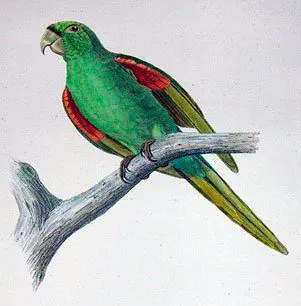
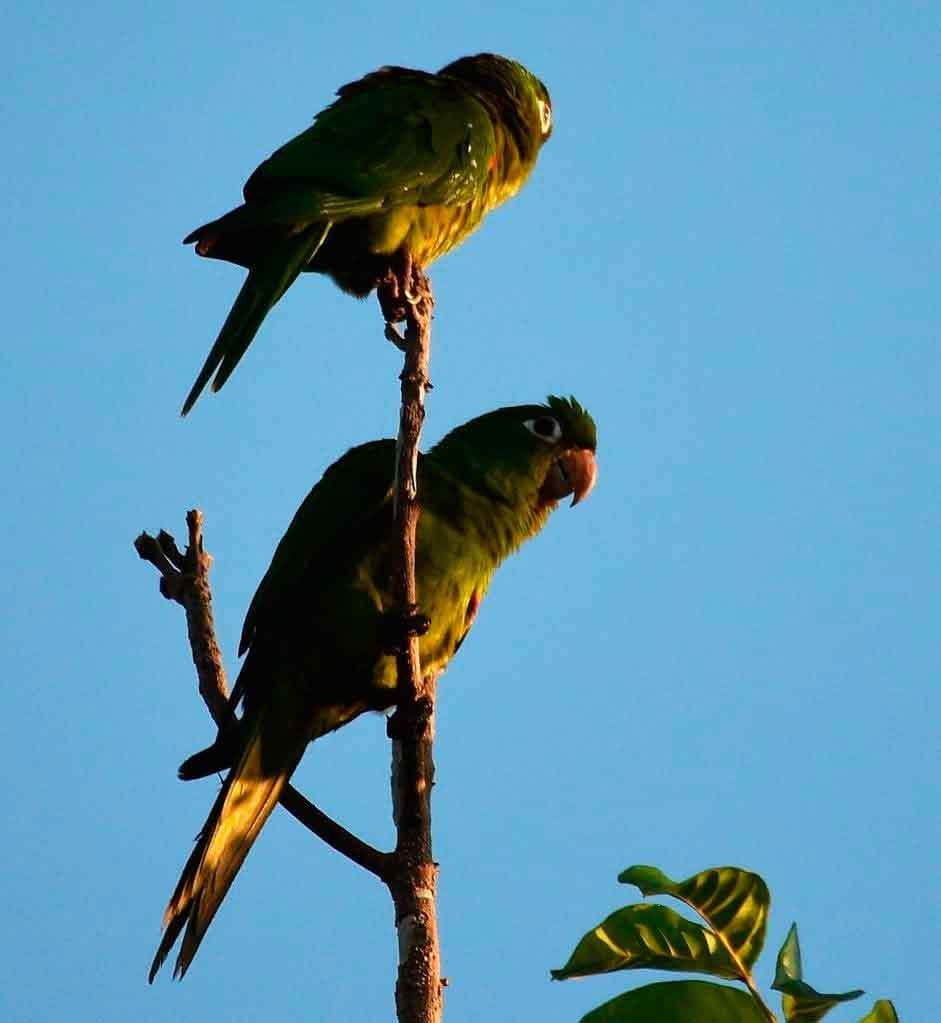
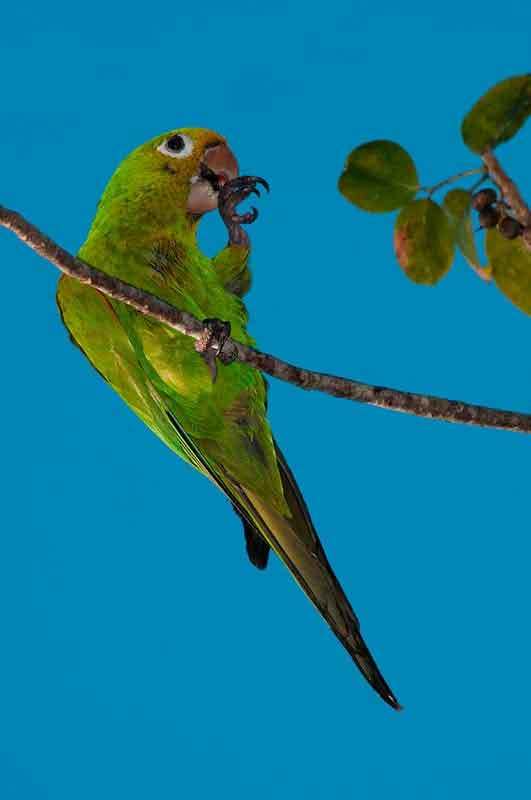
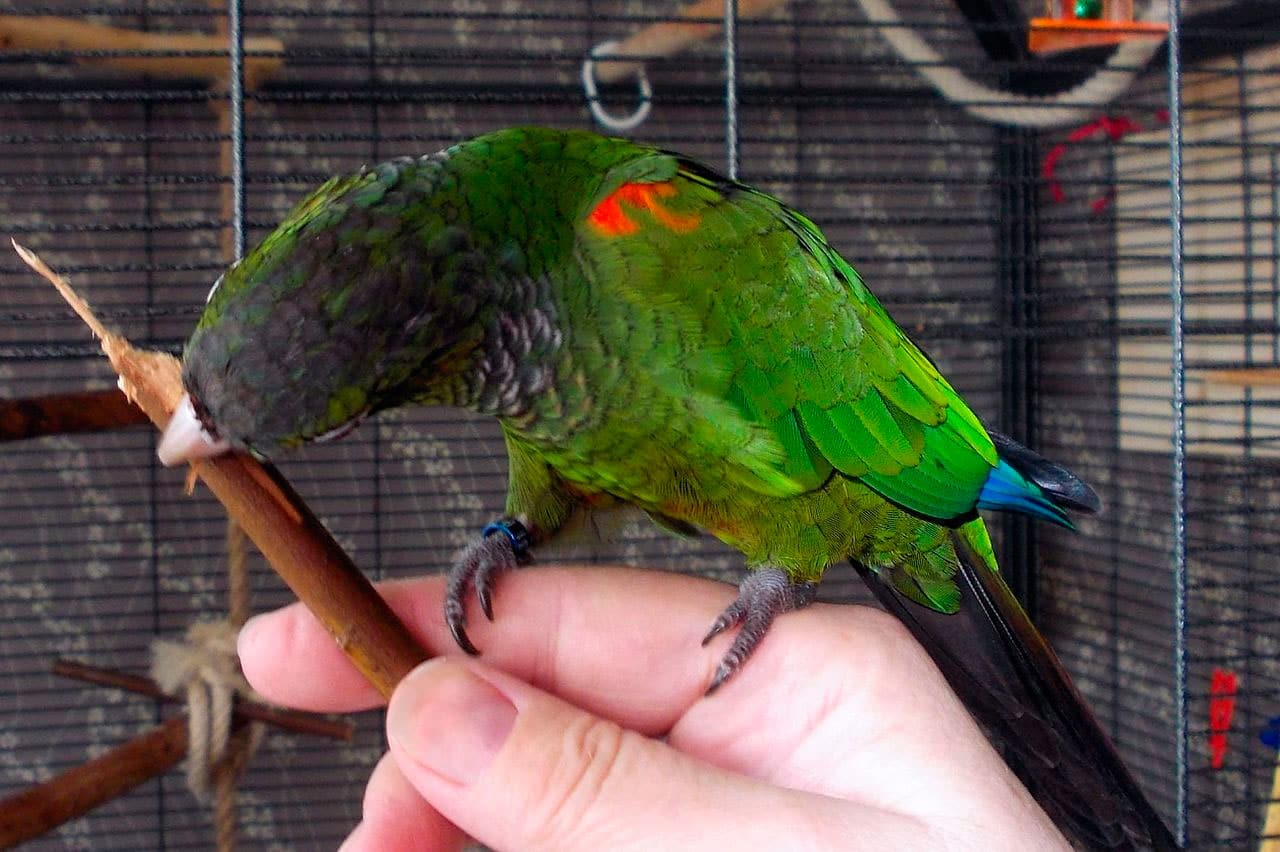
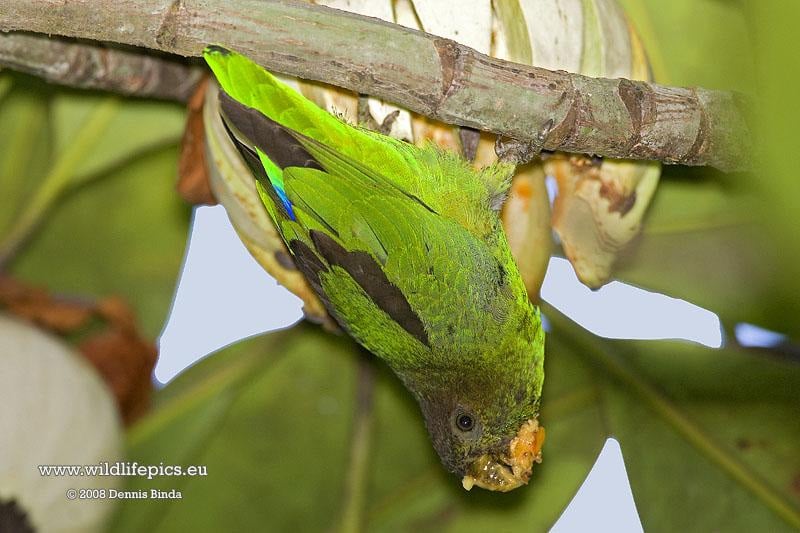
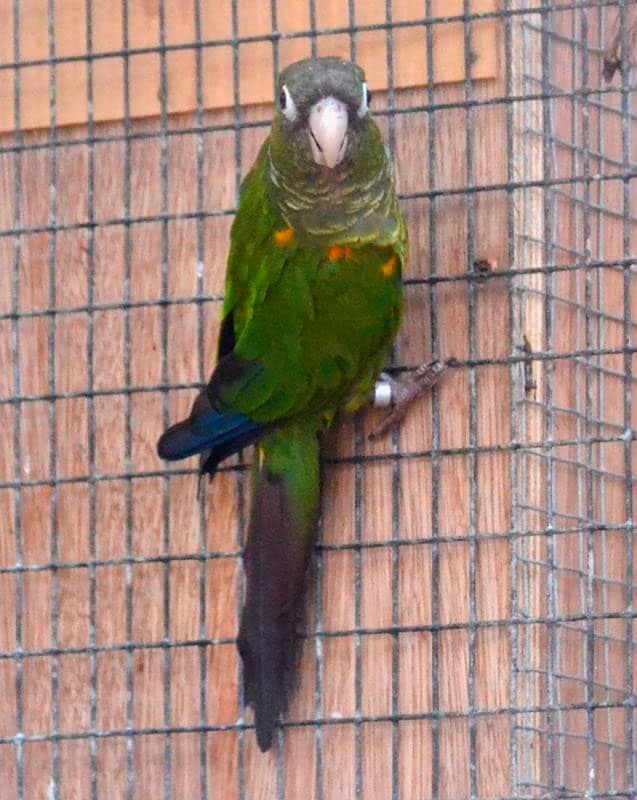
The Sapphire-rumped Parrotlet (Touit purpuratus) has the forecrown, crown, ear-coverts and sides neck, color marron-oliva; lores and cheeks green; rear area of the neck of color green pale with broadcasting brownish. Mantle and top of the back, green; scapulars and tertiary, dark brown; rump blue; uppertail-coverts green.

Feather blue in it bend of wing; primary coverts brown-black, rest of the coverts green. The flight feather Brown by up in innerwebs and tips, Yes no green; pale green blue for below. Underwing-coverts green. The underparts pale, of color green emerald slightly yellowish, with a layer of ochre in the sides of the belly. The tail Le da an appearance unmistakable, with black edge, green in the center and dark crimson on the sides, with black margins to outerwebs.

Bill off-white color pale Horn-tipped up to the upper jaw; irises black; legs grey.

The female has the tail (except central feathers) with the subterminal band green. Immature more yellowish below; the black color in the tail confined to the tips; Green olive from the forecrown up to the nape and ear-coverts lower.

Description 2 subspecies:

  • Touit purpuratus purpuratus

    (Gmelin, 1788) – Nominal.


  • Touit purpuratus viridiceps

    (Chapman, 1929) – As the nominal species but with the forecrown, crown and back neck, green; flanks with less yellowish green and feathery external of the tail showing a purple glow.

Habitat:

Species Rare and hard to see.
It inhabits, mainly, in the humid lowland canopy and forests and marshes, also observed in savanna in Suriname. In lower and more open to high altitude forests in Venezuela and in isolated areas cleared forests. Reports in altitudes of 400 metres in Colombia, and 1.200 metres in Mount Duida, Venezuela. gregarious, usually in groups of 12-40 birds.

Reproduction:

Observed the female digging a hole in a tree of forests and marshes in the month of November in Colombia; Birds in a nest in termitario tree in the month of April in Suriname, and males in breeding condition in the month of March in Venezuela. The laying tends to be of 3-5 eggs.

Food:

Observed eating fruit of Clusia grandiflora, Pouroma guianensis and Ficus figs and feeding on trees of Sapotaceae and Myrtaceae. Mainly forage in the canopy, Although also observed in low bushes and occasionally Earth.

Distribution:

Size of the area of distribution (reproduction / resident): 4.550.000 km2

It inhabits in the North of South America, mainly in the Basin Amazon, from the north end of Peru, east of Ecuador (Pastaza) and Colombia to the East of the Andes in West Caquetรก (for example, Three corners) and the southeastern tip of Guainia (along the Black river) to the South of the Brazilian Amazon until For and North of maranhรฃo, to the North of the Amazon and along the Vaupes River and the icana river through the basin of the Black river until Manaus; then through the South of Venezuela from amazon along the Orinoco to the South from the Ventauri River, in the Cerro Yapacana National Park and Mount Duida and from the South of Bolรญvar in the Tepuyes of the Gran Sabana and Caura River, in Guyana, Barima, rivers Mazaruni and Chamber and to the South up to Bartica.

Comes to be local in Suriname and French Guiana. Discrete, often difficult to observe and apparently sparsely populated in most parts of its range. Perhaps more numerous in those sections more low of it amazon basin.

Distribution 2 subspecies:

  • Touit purpuratus purpuratus

    (Gmelin, 1788) – Nominal. Southeast of amazon in Venezuela, up to the Guianas and this from the Basin of the Amazon in Brazil.


  • Touit purpuratus viridiceps

    (Chapman, 1929) – Black river, the Northwestern basin of Brazil, Venezuela West from Mount Duida until Colombia, Ecuador and Peru.

Conservation:

State of conservation โ“˜


minor concern Minor Concern โ“˜ (UICN)โ“˜

โ€ข Current category of the Red List of the UICN: Least concern.
โ€ข Population trend: Stable.

Justification of the population

The size of the world's population has not been quantified, but this species is described as ยซRareยป (Stotz et to the., 1996).

Justification of trend

It is suspected that this species has lost 12,8-15,2% of habitat within its distribution over three generations (15 years) starting from a model of deforestation Amazon (Soares-Filho et to the., 2006, Bird et to the., 2011). Given the susceptibility of the species to hunting and / or capture, It is suspected that it will fall in <25% during three generations.

In captivity:

Very rare in captivity.

Alternative names:

Sapphire-rumped Parrotlet, Purple Guiana Parrotlet, Sapphire rumped Parrotlet (English).
Toui ร  queue pourprรฉe (French).
Purpurschwanzpapagei, Purpurschwanz, Purpurschwanz-Papagei (German).
Apuim-de-costas-azuis, apuim-de-costa-azul, periquitinho (Portuguese).
Cotorrita Purpurada, Lorito de Lomo Purpรบreo, Periquito Zafiro (espaรฑol).
Periquito Zafiro (Colombia).
Periquito de Lomo Zafiro (Peru).
Periquito Rabadilla Pรบrpura (Venezuela).
Periquito lomizafiro (Ecuador)


scientific classification:
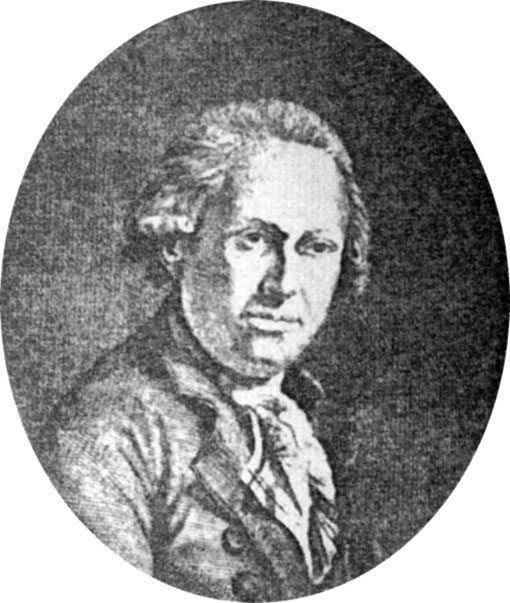
Gmelin Johann Friedrich

Order: Psittaciformes
Family: Psittacidae
Genus: Touit
Scientific name: Touit purpuratus
Citation: (Gmelin, JF, 1788)
Protonimo: Psittacus purpuratus


Images Sapphire-rumped Parrotlet:

Videos of the "Sapphire-rumped Parrotlet"

Sapphire-rumped Parrotlet (Touit purpuratus)


Species of the genus Touit


Sources:

  • Avibase
  • Parrots of the World โ€“ Forshaw Joseph M
  • Parrots A Guide to the Parrots of the World – Tony Juniper & Mike Parr
  • Birdlife

  • Photos:

(1) – wildlifepics.eu ยฉ 2008 Dennis Binda
(2) – Touit purpuratus By P. Bertrand [Public domain], via Wikimedia Commons

Of 18 cm.. tall Inconfundible by the ends of the tail, which are dorsally and ventrally purple-red with black border.
Overall green body with Brown Crown and nape, wing with both opaque Brown ends and violet blue rump.
Female with paler brown head and green-streaked tail.
The subspecies T. p. viridiceps has a totally green head.

Uncommon and difficult to observe species.
Lives in humid forests, semi-humid and swampy, until the 400 m. It forms small groups and they are silent when they feed. It nests in hollows of trees or arboreal termiteros at low altitude. The implementation is of 3-5 eggs and breeding season: from November to April

It is found in the wild in the Amazon, South-East of Colombia to the Guyanas, southern Venezuela to northeastern Peru and northern Brazil.
It feeds on fruits, and figs.

Video: Video 1

Deforestation and loss of Habitat is a threat for this species.

Alternative names: Sapphire-rumped Parrotlet (English), Periquito zafiro (Colombia), Periquito lomizafiro (Ecuador), Purpurschwanz, Purpurschwanzpapagei (Germany), Lorito de Lomo Purpรบreo (Spain), Periquito Rabadilla Pรบrpura (Venezuela), Toui ร  queue pourprรฉe (France), apuim-de-costa-azul (Brazil)

Source: Parrots, Parrots and macaws Neotropical
Photo: wildlifepics.eu ยฉ 2008 Dennis Binda
โ–ท The world of Pets: Dogs, cats, birds, reptiles, amphibians

Sulphur-crested cockatoo
Cacatua galerita

Cacatua galerita

Content

Description

55 cm.. height and a weight between 815 and 975 g..
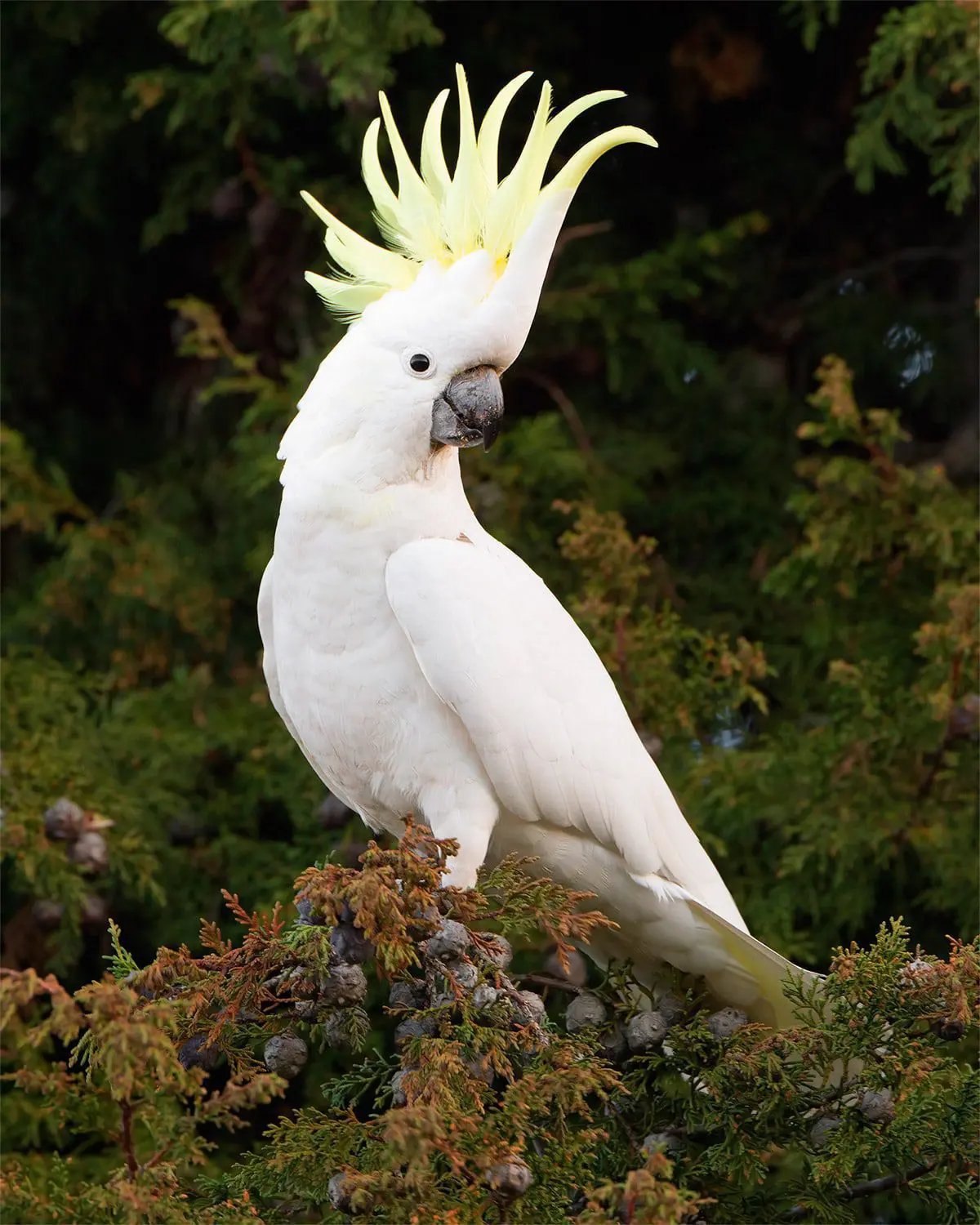
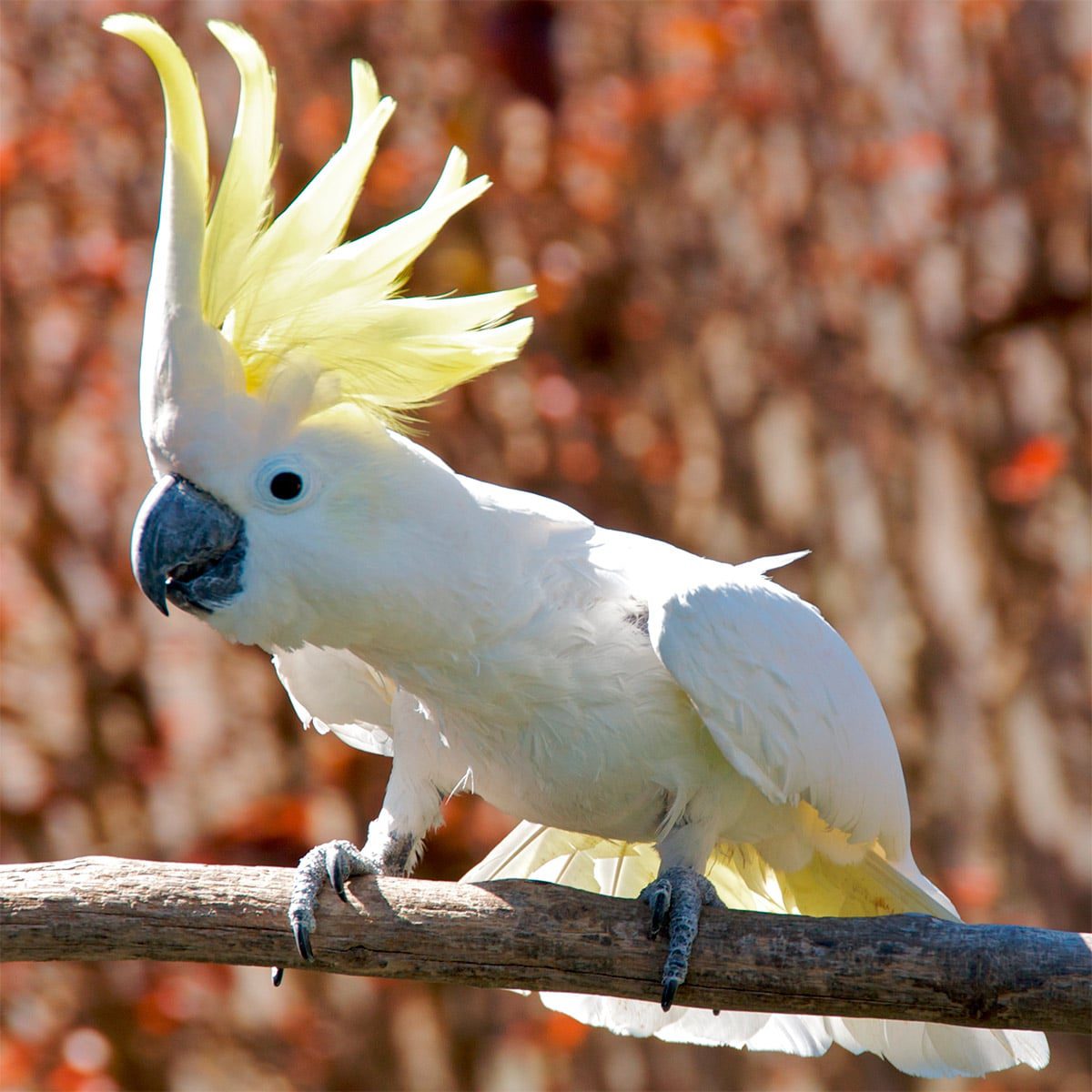
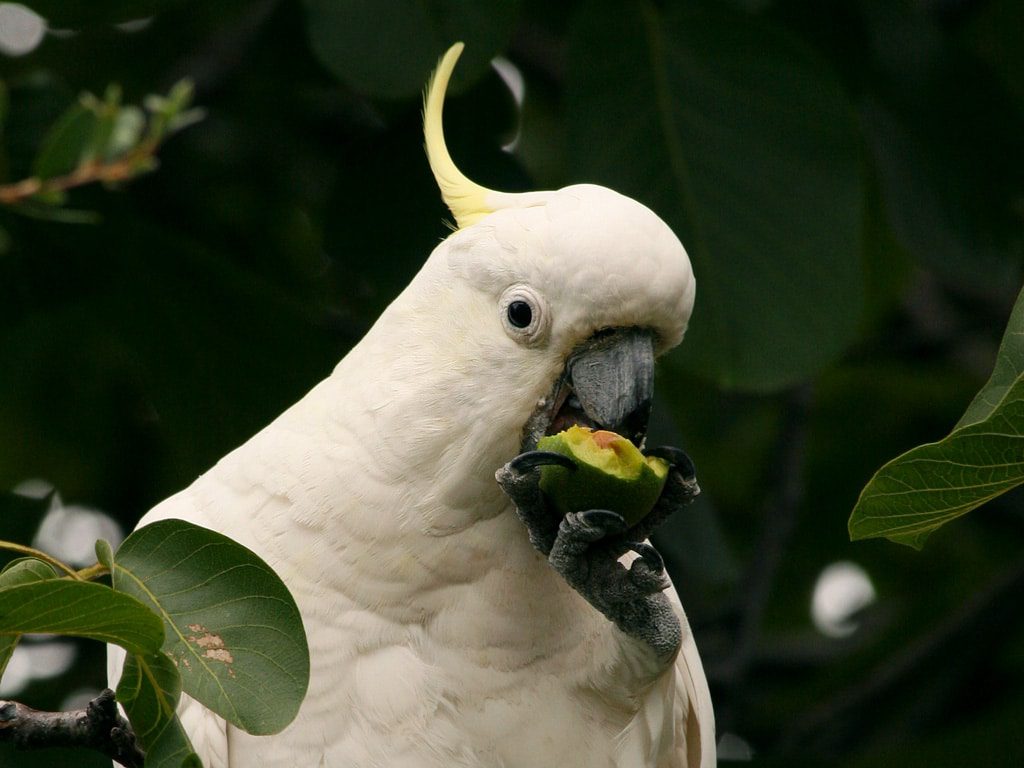
The Sulphur-crested cockatoo (Cacatua galerita) It is a bird with a predominantly white plumage.
In adults, the ear-coverts, bases feathers throat and cheeks, are pale yellow. the arista formed by the 6 Erectile feathers slightly inclined forward, are yellow. The crest You can reach up 14 centimeters in length. The bottom of the wings and of the tail van dyed pale yellow.
The ring surrounding the eye shows a white. The irises is dark brown in the male and reddish brown in the female. The bill is blackish grey, the legs grey.

The immature They are just different from adults. The irises They are pale brown.

Description 4 subspecies
  • Cacatua galerita eleonora

    (Finsch, 1863) – It's like Cacatua galerita triton but smaller and with bill smaller.


  • Cacatua galerita fitzroyi

    (Mathews, 1912) – Yellowed feathers, both ear-coverts, and the throat and cheeks, they are absent. The eye ring It is light blue. Bill but great.


  • Cacatua galerita galerita

    (Latham, 1790) – Nominal.


  • Cacatua galerita triton

    (Temminck, 1849) – Something smaller, the crest WIDER and eye ring pale blue.

Behavior:

They are very noisy and very easy to observe, Although they are more identifiable by their cries.

During the breeding season, they live in pairs or in small family groups, but the rest of the year, They are in flocks that may contain hundreds of birds.

In the urban areas and in places that they are equipped with feeders, adopt a family behavior.
In other places, It inspired his distrust and his usual prudence, the Sulphur-crested cockatoo they are very difficult to deal with.

In open areas these birds are implementing a sentinel system that is organized as follows: while most of the flock feeds, Some birds seen from a nearby perch and are likely to sound the alarm if danger.

Habitat:

Video – "Sulphur-crested cockatoo" (Cacatua galerita)

Cacatua galerita (mini documentary)

Is located in variety of forest areas, forests (including swamps and river areas), mangroves, Open field, on farm land (including rice fields and plantations of Palm), Savannah, Mallee and suburban areas. Found up to 1.500 meters in parts of Australia, 2.400 metres in Papua New Guinea.

Reproduction:

In Australia, the breeding season occurs from May to August in the North and between August and January, in the South.

In New Guinea, It takes place during every month of the year, although the most active months are during the period from May to December.

This species occasionally breeds in colonies. The nest is a natural cavity in a eucalyptus large near a stream between 3 and 30 meters above the ground. Sometimes the residence of the Sulphur-crested cockatoo It is located in the holes of the limestone cliffs along the murray river. In this case, the eggs are deposited directly in the sand.

In New Zealand, These birds lay amid bales of hay in barns. The nest generally it contains 3 white eggs. These are deposited on a layer of debris decomposing at the bottom of the cavity.
incubate both parents alternately for a period of 30 days. Hatchlings have a yellowish color and leave the nest after 6 to 9 weeks. Quite regularly, they return to the nest to rest for about two weeks.

The juveniles They remain within the family group for several months. They feed together in small scattered groups.

Food:

forages in grasses and herbs. You can take corn and wheat sprouts. It also feeds harmful herbs like cotton thistle. other foods include: estate, Rhizomes, nuts, berries, flowers, bulbs, flower and insect larvae.

They can cause great damage to crops. They dig in lands that were recently planted to eating fruit ripening, It also causes damage to crops that are stored and bales of hay to tear the plastic covering them.

Distribution:

Size of the area of distribution (reproduction / resident): 10600000 km2

This species is endemic to the north and east of Australia, New Guinea and nearby islands, especially islas Aru, Indonesian.
It was imported successfully to Palau Islands in Micronesia, New Zealand and some Maluku islands.

The population in Taiwan It has been estimated at about 100 introduced breeding pairs

Lives mainly below 1.000 m, but sometimes you can see in Australia to 1500 m. and 2000 m in east New Guinea.

Distribution 4 subspecies

Conservation:

State of conservation โ“˜


minor concern Minor Concern โ“˜ (UICN)โ“˜

โ€ข Current category of the Red List of the UICN: Least concern.

โ€ข Population trend: In decline.

It is thought that his population It is greater than 500.000 individuals.

It is not an endangered species. But, despite protection Indonesian this species is followed by trapping wild bird trade. Nor is a protected species in Australia, therefore sacrifices occur.

In New Guinea, sometimes it is hunted for its feathers.

It is suspected that his population is in decline due to ongoing habitat destruction.

"Sulphur-crested cockatoo" in captivity:

and valued species often as a pet.
Very Intelligent, sociable and playful. It is a cockatiel for experienced bird owners. You can be dominant and aggressive. It can be very noisy.

There are anecdotal reports of some Sulphur-crested cockatoo who they have lived more than 100 years. In the news, However, longevity record, according to sources, belongs to a captive specimen called "Cocky" who lived more than 57 years in the London Zoo. Another report suggests that these animals can live up 73.0 years in captivity, but this has not been verified.

Alternative names:

Sulphur-crested Cockatoo, Greater Sulphur-crested Cockatoo, White Cockatoo, Yellow-crested cackatoo (ingles).
Cacatoรจs ร  huppe jaune, Grand Cacatoรจs ร  huppe jaune (French).
Gelbhaubenkakadu (German).
Cacatua-de-crista-amarela (Portuguese).
Cacatรบa de Moรฑo Amarillo, Cacatรบa Galerita (espaรฑol).

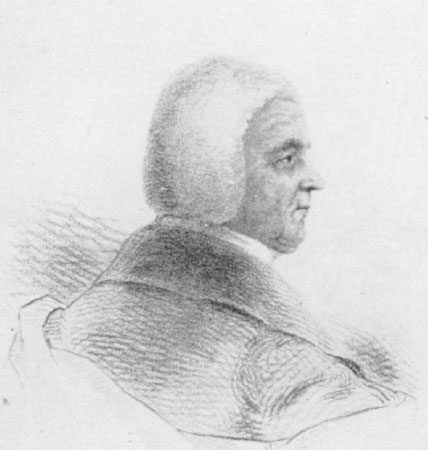
John Latham
John Latham

scientific classification:


Order: Psittaciformes
Family: Cacatuidae
Genus: Cockatoo
Scientific name: Cacatua galerita
Citation: (Latham, 1790)
Protonimo: parrot galeritns


Images Galerita Cockatoo:


Species of the genus Cacatua
  • Cacatua tenuirostris
  • Cacatua pastinator
  • —- Cacatua pastinator derbyi
  • —- Cacatua pastinator pastinator
  • Cacatua sanguinea
  • —- Cacatua sanguinea gymnopis
  • —- Cacatua sanguinea normantoni
  • —- Cacatua sanguinea sanguinea
  • —- Cacatua sanguinea transfreta
  • —- Cacatua sanguinea westralensis
  • Cacatua goffiniana
  • Cacatua ducorpsii
  • Cacatua haematuropygia
  • Cacatua galerita
  • —- Cacatua galerita eleonora
  • —- Cacatua galerita fitzroyi
  • —- Cacatua galerita galerita
  • —- Cacatua galerita triton
  • Cacatua ophthalmica
  • Cacatua sulphurea
  • —- Cacatua sulphurea abbotti
  • —- Cacatua sulphurea citrinocristata
  • —- Cacatua sulphurea parvula
  • —- Cacatua sulphurea sulphurea
  • Cacatua moluccensis
  • Cacatua alba

  • Sources:

    Avibase
    – Parrots of the World โ€“ Forshaw Joseph M
    – Parrots A Guide to the Parrots of the World – Tony Juniper & Mike Parr
    – Birdlife

    Photos:

    (1) – commons.wikimedia.org
    (2) – birdsandbirds.com
    (3) – tilcheff

    Sounds: Hans Matheve (Xeno-canto)

    โ–ท The world of Pets: Dogs, cats, birds, reptiles, amphibians

    Red-checked Parrot
    Geoffroyus geoffroyi

    Red-checked Parrot

    Content

    Red-checked Parrot

    Description

    21 to 27 cm. length and a weight between 130 and 180 g..

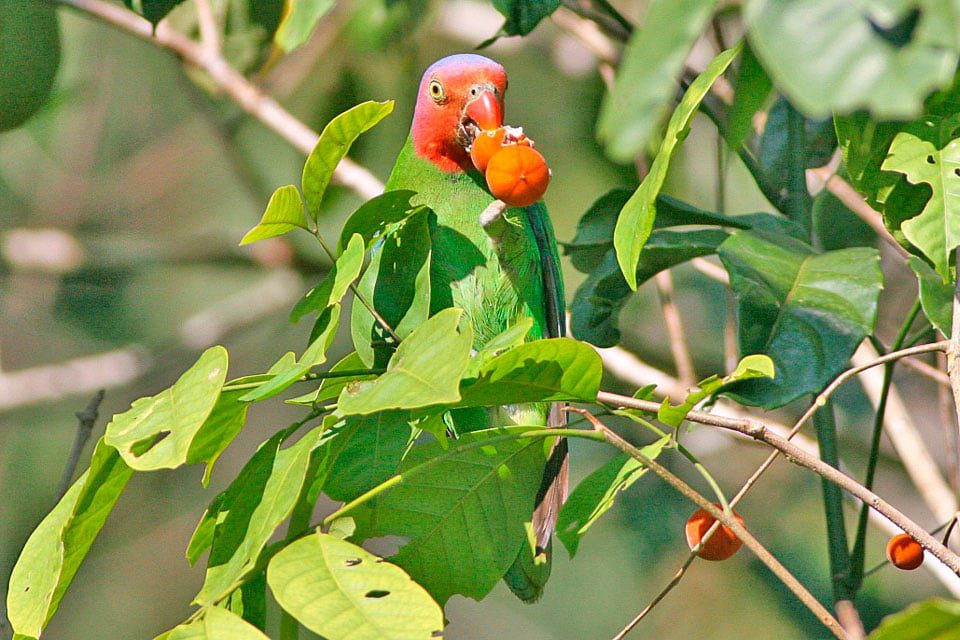
    The face of the Red-checked Parrot (Geoffroyus geoffroyi) is of color rojo-rosaceo up to just above the eyes, more pink in the ear-coverts; front of the crown of color rojo-rosaceo. Half of the crown to the nape mauve-blue. Upperparts green. Wings with patch red in them Middle coverts interiors.

    Flight feathers with vane Dark internal and external Green. Edge of yellow to vane internal of greater coverts and secondaries. Wing feathers and axillary, bright blue; below, the rest of the wings, blackish. The underparts green, more yellowish in them lower flanks. Upper, the feathers of the tail of color green, drenched sides of yellow; below, brighter yellowish green.
    The bill red orange in upper jaw, the lower jaw in color black; irises yellow; legs grey.

    Female with head Brown and upper jaw black.

    Youth they have the head green, irises dark and bill pale. The male juveniles go through a plumage ยซfemale stageยป before they begin to acquire masculine characters (bird takes over one year to mature). The birds young also lack of the brand red on them small coverts.

    Subspecies description

    Description of the 16 subspecies
    • Geoffroyus geoffroyi cyanicollis

      (Mรผller, 1841) – The darker male in general that the nominal; purple blue crown comes to the part back from the neck; neck light blue; Marron-bronce washing variable on the mantle and top of the back; Green bluish in the part superior of the chest and zone inferior of the abdomen ; brown reddish of them coats internal of the wings absent; Blue more dark in them Underwing coverts. Larger in size.
      The female with the head more dark that the nominal; purple diffusion in the crown; nape blue, reaching the neck with color blue light.

    • Geoffroyus geoffroyi obiensis

      (Finsch, 1868) – Adults as the subspecies cyanicollis but collar Blue in the part back from the neck more comprehensive, reaching almost up to the eyes; blue-purple in the male or brown in the female does not reach the lower part of the occiput; reddish brown in the bottom of the back to rear.

    • Geoffroyus geoffroyi rhodops

      (Schlegel), 1864) – Similar to the subspecies males floresianus, but darker in general; marks of the coats internal of the wings of color brown reddish dark; crown Blue separate with red in the face; Underwing coverts Blue more dark. Larger in size.
      The female with the crown castano-oscuro color.

    • Geoffroyus geoffroyi explorator

      (Hartert, 1901) – Synonymous with Geoffroyus geoffroyi rhodops

    • Geoffroyus geoffroyi keyensis

      (Finsch, 1868) – The male resembles the subspecies floresianus, but in general more greenish-yellow, in particular in the tail; cheeks Pink and ear-coverts washed with Blue Lilac; Yellow greenish pale in the neck through the part back from the neck and a strip Green, darker, in the early part of the neck; Underwing coverts pale blue. Larger in size.
      The female chestnut brown on the head.

    • Geoffroyus geoffroyi floresianus

      (Salvadori, 1891) – The male is like the nominal, but darker in general; the purple blue of the crown It's darker and reached to the nape; coats internal of the wings dark reddish brown; Blue more dark them Underwing coverts. Larger in size. Largest peak.
      Female with the crown darker brown, coming up to the nape.

    • Geoffroyus geoffroyi geoffroyi

      (Bechstein, 1811) the subspecies nominal

    • Geoffroyus geoffroyi timorlaoensis

      (Meyer, 1884) – The subspecies resemble adults Kei, but smaller.

    • Geoffroyus geoffroyi pucherani

      (Souancรฉ, 1856) – Adults and juveniles with bronze-colored marking of the parts internal of the wings, minimal or absent; the mantle have less marron-bronce washing; Brown more pale in the part low of it back; the buttocks with less red; coats dark blue low the wings.

    • Geoffroyus geoffroyi minor

      (Neumann, 1922) – Male adults are as the subspecies aruensis, but with reddish brown under the back to rear; face darker red; washing Marron-bronce in the the mantle; brands in the coats internal of the wings minimal or absent.
      The female as the subspecies aruensis, but with the head of brown slightly more dark.

    • Geoffroyus geoffroyi jobiensis

      (Meyer, 1874) – Adults and juveniles but with Underwing coverts pale blue; bright red in the lower part of the back to the rear; in males, the red in the forecrown back to the front of the crown.

    • Geoffroyus geoffroyi mysoriensis

      (Meyer, 1874) – Males as juveniles, but with the crown blue-purple, down on the back of the neck, and red in the face, coming up to the throat; washing marron-bronce absent in the the mantle; extensive reddish brown marks in inner median coverts; Underwing coverts dark blue; dark brown in the bottom of the back to rear.
      The female as juveniles, but the color brown in the crown comes to the part back from the neck.

    • Geoffroyus geoffroyi orientalis

      (Meyer, 1891) – Hardly differs from the subspecies aruensis; Crown of the male is slightly more pale.

    • Geoffroyus geoffroyi sudestiensis

      (Estimate, 1890) – The adult male is similar to the subspecies aruensis, but with the underparts darker; the trademark brown reddish of them coats internal, absent.
      The crown and nape of the female, is dark green.

    • Geoffroyus geoffroyi cyanicarpus

      (Hartert, 1899) – The adult male is similar to the subspecies aruensis, but with azul-lila wash in them cheeks and ear-coverts; bend of wing has edge blue.
      The female is as the subspecies aruensis, but the crown and nape They are brown, with light green dye; edge blue in the part outside of the wing as in the male.

    • Geoffroyus geoffroyi aruensis

      (Gray, 1858) – Similar to the species males nominal, but darker purple blue from the crown up to the nape; inner coverts a reddish brown marked darker; Blue more dark in them Underwing coverts.
      The female Brown darker from the crown even the nape.

    • Geoffroyus geoffroyi maclennani

      (W. D. K. Macgillivray, 1913) – The male is similar to the subspecies aruensis, but darker in general; the Red of the face is darker and more uniform; Underwing coverts paler blue.
      Female similar to the female of subspecies aruensis, but darker in general; head dark brown; Underwing coverts paler blue.

    * The varieties sumbavensis and tjindanae proposed as subspecies are synonymous of floresianus; rhodops stresemanni; explorator It is also synonymous of rhodops.

    Habitat:

    Distributed by primary and secondary forests, tree savannas, plantations, Open forests, mangrove forests and farmland, a altitude of 1.400 m. Usually replaced by the Blue-collared Parrot at higher altitudes. Exclusive tropical jungle in the North of Australia. View the birds, generally, flying high above the trees, making calls to cries.

    Groups of birds in the North of Australia, many still in family units, they have been observed leaving their roosts early, to feed into the dense jungle; in their flights to areas of foraging, We have seen some of these birds perched in the upper branches of the trees, by calling aloud for a few minutes and dithered wings before continuing. The reason for this unknown behavior can be a way of requesting food due to early maturation.

    During the day the birds are less visible, they can draw attention by discarded food falling from their food trees.

    They are usually in couples, in small groups or assembled in groups in fruit trees.

    Reproduction:

    The nest It is a hole that the birds excavate in a rotten limb of a tree from the forest, sometimes also in a knot in the trunk; probably only the female excavates. The entrance to the nest is of 80 to 90 mm. wide, and the tunnel, that it can twist in order to hide the eggs, You can have a length of 42 cm.. Includes the implementation of 2 to 4 eggs. The female alone incubates and is fed by the male during this time. In the West, the breeding season It takes place between April and September at least, month in which a live nest was found in Seram.
    In New Guinea, the nesting is been registered during several months more, including February in the North and between the months of April to December in other places.
    In Australia, in where the season seems to extend is from August to December, little information about the cycle reproductive is available.

    It is known that the species It has never been raised successfully in captivity.

    Food:

    The diet It includes seeds, fruits and flowers. The birds tend to hang acrobaticamente to reach their food.

    Distribution:

    Size of the area of distribution (reproduction / resident): 793.000 km2

    Generalized from the West of Lombok, through the Moluccas, the lowlands of New Guinea, and observed in the groups of associated Islands, to the East of Rossel in the Louisiade archipelago.

    The species can also be observed in the northeast of the Cape York Peninsula, Australia, at its southern end, and North ranges up to Morotai in the North of the Moluccas. In many areas, throughout its distribution area, is the most abundant Parrot (rarer over the 800 meters above sea level), even around inhabited areas. Despite this, It may be extinct in Ambon.

    Distribution Subspecies

    Distribution of the 16 subspecies

    Conservation:


    minor concern


    โ€ข Current IUCN Red List category: Least concern

    โ€ข Population trend: Stable

    The size of the world population It has not been quantified, Although it is estimated above 1.000.000 of copies. The species according to sources, is of common to abundant much of its area of distribution (pit et to the. 1997).

    The population suspected to be stable in the absence of evidence of any reduction or substantial threats, Although you can that its population is affected by the capture in various parts of its area of distribution.

    "Red-checked Parrot" in captivity:

    Very rare or impossible to see in poultry.

    Passive Parrot. Extremely susceptible to stress and disease; they may die suddenly without apparent reason. Few times you live long in captivity

    Alternative names:

    Red-checked Parrot, Red cheeked Parrot, Red-cheeked Parrot (ingles).
    Perruche de Geoffroy, Eclectus de Geoffroy, ร‰clectus de Geoffroy (francรฉs).
    Rotkopfpapagei (alemรกn).
    Papagaio de bochechas vermelhas (portuguรฉs).
    Lorito Carirrojo, Lorito de Mejillas Rojas (espaรฑol).


    scientific classification:

    Johann Matthew Bechstein
    Johann Matthew Bechstein

    Order: Psittaciformes
    Family: Psittaculidae
    Genus: Geoffroyus
    Scientific name: Geoffroyus geoffroyi
    Citation: (Bechstein, 1811)
    Protonimo: Psittacus Geoffroyi


    Images "Lorito Carirrojo":

    Videos "Red-checked Parrot"

    ————————————————————————————————

    "Lorito Carirrojo" (Geoffroyus geoffroyi)


    Sources:

    Avibase
    – Parrots of the World โ€“ Forshaw Joseph M
    – Parrots A Guide to the Parrots of the World – Tony Juniper & Mike Parr
    Wikipedia
    – Birdlife
    parrots.org

    Photos:

    (1) – By Ron Knight (Flickr: Red-cheeked Parrot) [CC BY 2.0], via Wikimedia Commons
    (2) – By Nick Athanas/Tropical Birding – Birds-pet-wallpapers
    (3) – A male perched in a tree by Josep del Hoyo – Lynx
    (4) – A male and a female looking for a suitable nest by mehdhalaouate – Lynx
    (5) – By markharper1 [CC BY-SA 2.0], via Wikimedia Commons

    Sounds: Marc Thibault (Xeno canto)

    โ–ท The world of Pets: Dogs, cats, birds, reptiles, amphibians

    Gray-headed Parakeet
    Psittacula finschii


    Cotorra de Finsch

    Content

    Description:

    Of 36 to 40 cm.. length and 120 g. of weight.
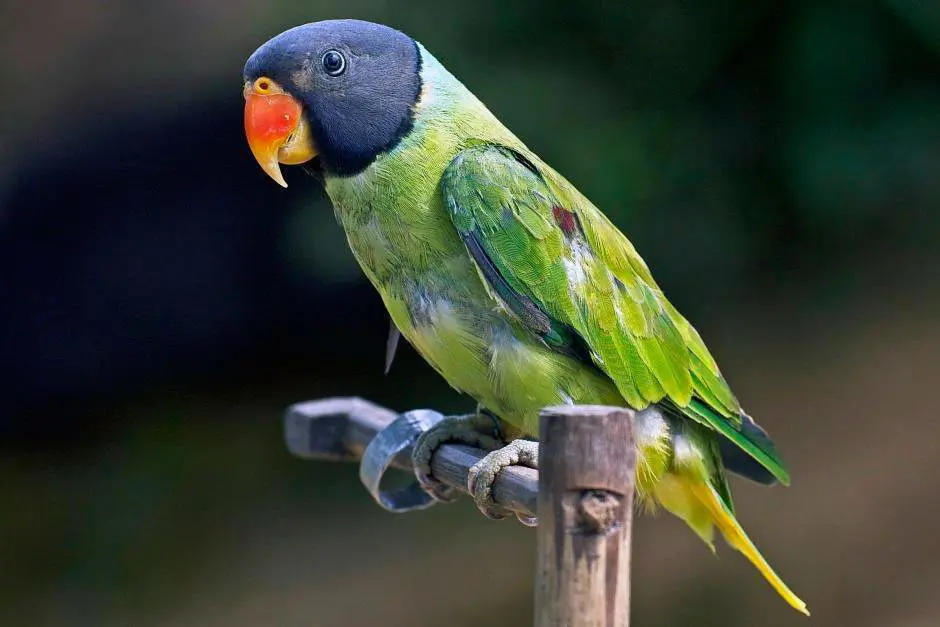
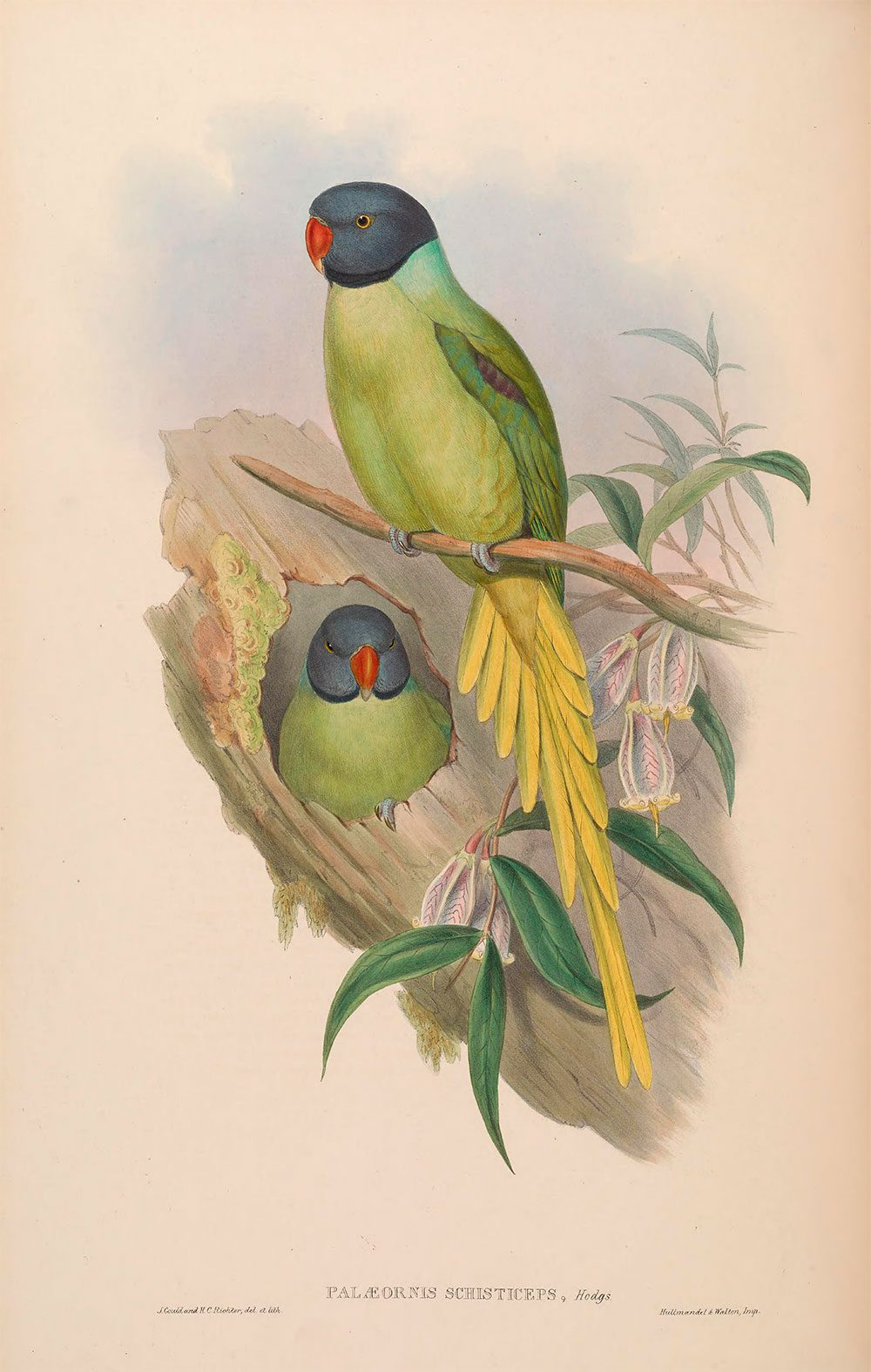
    The Gray-headed Parakeet (Psittacula finschii) It is very similar to Slaty-headed Parakeet but smaller, with feathers tail longer, the head slightly paler, upperparts and more yellowish underwing-coverts darker blue-green.

    The Gray-headed Parakeet (Psittacula finschii) has the forecrown, crown, lores and ear-coverts Grey Slate-blue; the chin and the lower part of the cheeks, black, It forming a narrow collar which marks a clear boundary between the head dark and a bright ring greenish blue on the back of the neck.

    Nape brighter yellowish green, duller green fading in the rest of the upper region.

    Upperwing-coverts green except for the brown of the inner coverts, that makes the effect of a distinctive patch on the shoulder; primaries Green with a narrow yellow margin on the vane outer; secondaries green.

    Ilustraciรณn Cotorra de Finsch

    Underwing-coverts dark bluish green. Underparts bright pale green. Uppertail lilac blue with pale yellow tips, outer feathers Greens with vane internal and yellow tips; undertail-coverts ochre-coloured.

    upper jaw coral red to vermilion with yellow tip, lower jaw yellow; cere whitish; irises creamy white to yellow; legs greenish.

    The females and immature as the Slaty-headed Parakeet.

    NOTE:

      Sometimes considered the same species as the Slaty-headed Parakeet, but the lack of intergradation in a possible area of overlap in Bhutan and the northeast of the India (Arunachal Pradesh) suggests appropriate treatment as allospecies.

    Habitat:

    Similar to the Slaty-headed Parakeet. Frequents forests of oak, teak, cedar and pine, wooded hills and open farmland with tall trees. Move altitude between 650 and 3.800 m (in Yunnan, China), rarely drop below 250 m, usually at or near the mountainous terrain.

    Mainly distributed in the forest Viet Nam, but, according to sources, laz away from growing areas and tolerant of lower and more open habitats.

    In general, obsevadas in flocks or or small family groups, but also it is seen in larger numbers than in Burma.

    Reproduction:

    The breeding season in the central and southern Burma It covers the months January, February and March.

    One nest four eggs was observed 12 meter high tree species Xylio dolabiformis.

    Food:

    Diet Gray-headed Parakeet It is thought to resemble that of the Slaty-headed Parakeet; reported items include leaf buds, seeds of Dendrocalamus longispathus, fruit of wild cherries Prunus and flowers.

    Distribution:

    The Gray-headed Parakeet It is distributed in the east of the Himalayas towards Indochina. They range from east to Bhutan towards Arunachal Pradesh and south through Nagaland, Assam (to the South of the rio Brahmaputra). Manipur, Mizoram and Bangladesh oriental (Sylhet and area of Chittagong). Through Burma (South of Tenasserim), al sur-oeste de China (center Sichuan and North of Yunnan), the mountainous districts of northern and southwestern Thailand, South of Laos, Kampuchea and Viet Nam, especially the western slopes of the central mountains.

    Usually common and resident (in some places very common), but lacking in some areas and subject to local fluctuations and irregular appearances.

    Recent decline in Thailand, where it is now rare in more accessible areas. Uncommon in China. Some seasonal altitudinal movements in some parts of the range. Very popular cage bird in some parts of the home territory.

    Conservation:

    State of conservation โ“˜


    Near-threatened Near Threatened โ“˜ (UICN)โ“˜

    โ€ข Current Red List of UICN: Near-threatened

    โ€ข Population trend: Decreasing

    The size of the world population Gray-headed Parakeet It has not been quantified, but the species, according to sources, is rare in China, Variable and elsewhere (pit et to the. 1997).

    The population is suspected rapid decline because of continued habitat loss and trapping. Observations of local trends in some parts, within its range, support this suspicion, for example in Cambodia, at least since the early 1990 (F. Goes in some. 2013, T. Gray in litt. 2013, RJ Timmins in litt. 2013).

    The Gray-headed Parakeet is being widely taken for the cage bird trade and is kept locally as a companion animal, for example, in Laos and China (JW Duckworth in litt. 2013, M. Zhang in some. 2013).

    In China, poaching and illegal trade in this species continues: it was reported that in one village, each family has an individual of this species as a pet (M. Zhang in some. 2013).

    The pressure at which it is subjected for his capture may also be contributing to the observed decrease in Cambodia (F. Goes in some. 2013).

    Lowland forests Indochina They are under intense pressure, above all in Cambodia, because of the authorization for large-scale industrial agriculture. This particularly affects areas with evergreen or semi-evergreen forest, rather than forest deciduous, because the best conditions for growing (S. Mahood in some. 2013).

    This species is dependent areas and forests with evergreens, whereby the effects of logging can seriously affect, especially since it is likely to depend on large trees for nesting. Habitats where large trees are scarce, as forests and hill areas with mixed forest deciduous, patches of evergreen forest and semi-evergreen forest, They are under particular pressure from logging, even for local use (S. Mahood in some. 2013).

    It is expected that the loss of habitat Cambodia bring a devastating impact on this species over the next decade, although there may be a delay before the actual effects were observed in the population (H. Rainey in some. 2013).

    Conservation Actions Underway:

      The species is known to occur in some protected areas across its range, as in the Mondulkiri Protected Forest, Cambodia (T. Gray in litt. 2013).

    "Gray-headed Parakeet" in captivity:

    Cotorra de Finsch

    – Uncommon in captivity outside its range.

    It is unclear how much spread among breeders, as often it was considered a subspecies of the more common Slaty-headed Parakeet. It is a very mountain bird resistant, at low temperatures is not a problem for them, However, must be protected facilities available to avoid sudden changes in temperature and drafts.

    How other Psittacula, the Gray-headed Parakeet You need to nibble fresh branches, although it is not a destructive bird that could demolish a wooden aviary.

    Alternative names:

    Gray-headed Parakeet, Eastern Slaty-headed Parakeet, Finsch’s Parakeet, Finsch’s Slaty-headed Parakeet, Gray headed Parakeet, Grey headed Parakeet, Grey-headed Parakeet, Slaty-headed parakeet (English).
    Perruche de Finsch, Perruche ร  tรชte grise (French).
    Finschsittich, Burma-Schwarzkopfedelsittich, Finschs Edelsittich, Finsch-Sittich, Himalayasittich, Himalayasittich-finschii, Veraguasittich (German).
    Periquito-de-cabeรงa-cinza (Portuguese).
    Cotorra de Finsch (espaรฑol).


    scientific classification:

    Allan Octavian Hume
    Allan Octavian Hume

    Order: Psittaciformes
    Family: Psittaculidae
    Genus: Psittacula
    Scientific name: Psittacula finschii
    Citation: (Hume, 1874)
    Protonimo: Palaeornis Finschii

    Images "Gray-headed Parakeet"

    Videos "Gray-headed Parakeet"


    Especies del gรฉnero Psittacula

    Gray-headed Parakeet (Psittacula finschii)


    Sources:

    Avibase
    – Parrots of the World โ€“ Forshaw Joseph M
    – Parrots A Guide to the Parrots of the World – Tony Juniper & Mike Parr
    – Birdlife

    Photos:

    (1) – Bird perched on a home made perch. Part of the tail appears to be missing by Vijay Anand Ismavel – Lynx
    (2) – Gould, John, 1804-1881; Sharpe, Richard Bowdler, 1847-1909: Birds of Asia by John Gould [Public domain], via Wikimedia Commons
    (3) – Finschโ€™s Parakeet Psittacula finschii by Raju Kasambe. Photo taken in Imphal Zoo, Manipur, India By Dr. Raju Kasambe (Own work) [CC BY-SA 4.0], via Wikimedia Commons

    Sounds: Pritam Baruah (Xeno-canto)

    โ–ท The world of Pets: Dogs, cats, birds, reptiles, amphibians

    Blue-winged Macaw
    Primolius maracana


    Guacamayo Maracanรก

    Content

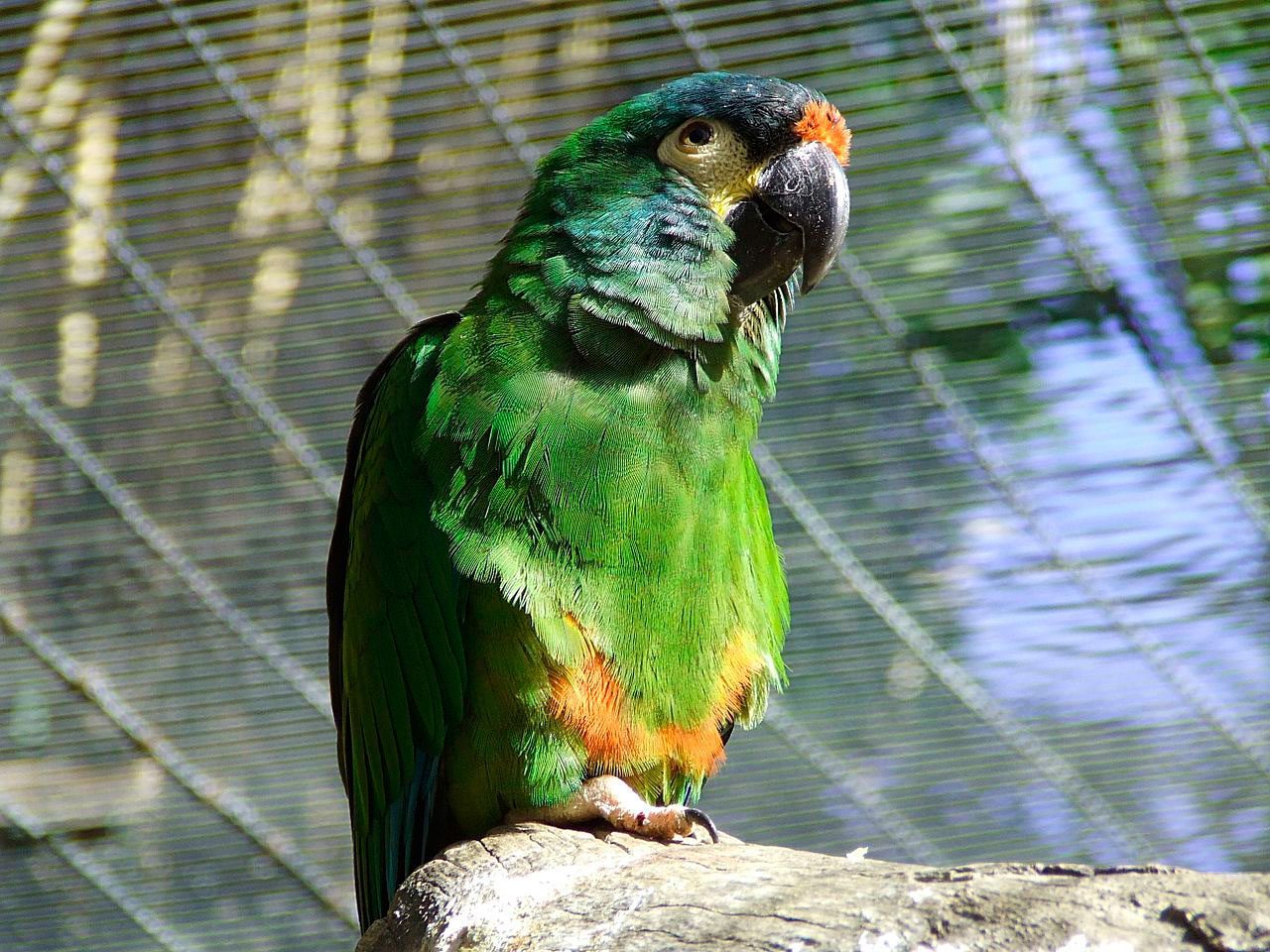
    Maracanรฃ Macaw description:

    Of 43 cm.. of length and a weight of 265 g..

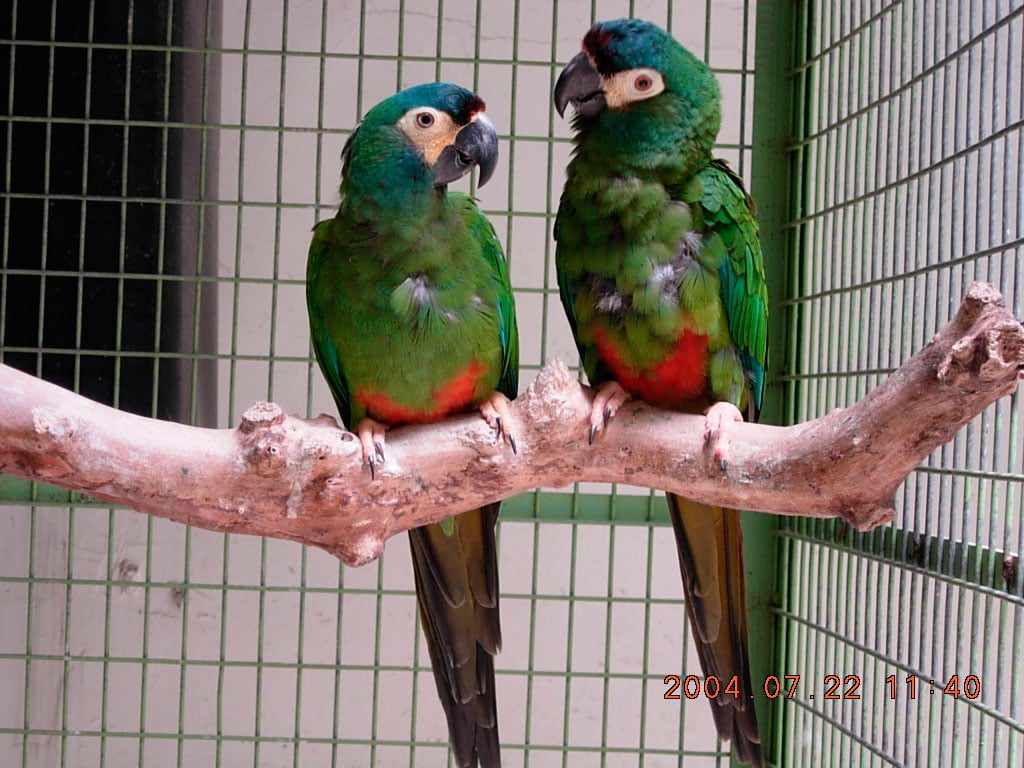
    The Blue-winged Macaw (Primolius maracana) It is increasingly rare and exotic.

    This small Macaw has the forecrown marked with a narrow band of black color that fades into blue in the area of the crown; the ear-coverts and both sides of the neck are blue, becoming green in the area of the nape.

    Upperparts olive green with light tint in the rump and in the uppertail-coverts. Small, large and medium-sized inner coverts are green; the large external coverts blue.

    The flight feather blue color above, (a bit of green in high schools), of yellow olive color below. The underparts green, slightly more yellow than the upper. Upper, the tail mostly blue, but the green central feathers, Red opaque in the Center, and with blue tips; undertail, the tail opaque yellow olive.

    The bill horn, Black base; bare skin of the lores and cheeks upperparts gray with a bluish tint and crossed in front by lines of small black feathers: the irises yellow; legs grayish pink.

    Both sexes similar; female possibly smaller and duller plumage compared to males.

    The immature they have a paler plumage and less red coloration in the forecrown. The red spots in the abdomen and back they are stained yellow. Edges of color Horn in its bill. The tail is short and the eyes brown.

    Habitat:

    They inhabit in tropical and subtropical forests of Evergreen and deciduous forests (including the rainforest of the Atlantic and the Savannah of the Cerrado) with apparent preference for forest edges or forests near water.

    At the north end of Bay, Brazil, inhabits tree-lined galleries Tabebuia caraiba in the area caatinga next to the Spix's Macaw, where the birds avoid flying over open field, preferring to remain among the trees.

    There are reports of these birds to 1.000 meters above sea level. Usually in small flocks, except when playing.

    Reproduction:

    Evidence of breeding in December (Brazil) and February (Argentina). Nest in the cavity of a tree. The average size of the clutch is three to five eggs and the period of incubation is of 25 days.

    Food:

    Observed birds take the seeds of Melia azedarach introduced in the northeast of Brazil; no more details about the diet, although it is known that they also forage in the fields of cereals and corn, which leads to his persecution by farmers.

    Distribution:

    Distributed by East of South America from south amazon.

    In Brazil stretching from the South of For, South of Maranhรฃo (including a record on the coast) and to the West by Piauรญ, Pernambuco, Bay, Tocantins, Goiรกs and Minas Gerais, Brazil, Mato Grosso, with a recent recolonization in the State of Rio de Janeiro and records in Rio Grande do Sul until 1930.

    In East Paraguay and time back in the northeast of Argentina, in Missions and North of Currents.

    Apparently resident, with a significant decline in recent decades, probably due to the large scale deforestation.

    In the news rare and local; the remaining population common only in the Sierra Negra, Pernambuco, and Serra do Cachimbo, For in Brazil.

    Scarce in Paraguay, where it seems to persist in small fragmented populations; previously common in Argentina, now apparently extinct. A small number in captivity.

    They are distributed in several protected areas, at least in small quantities. Legally protected in all the States of the area.

    Conservation:


    Near-threatened

    โ€ข Red List category of the UICN current: Near Threatened

    โ€ข Population trend: Decreasing

    The population of the Blue-winged Macaw It is estimated that it may be in the band of 2,500-9,999 individuals in total, which is equivalent to a strip between 1,667-6,666 mature individuals.

    A population decline moderately rapid and permanent is suspected it may be due to the habitat loss, the capture for the cage bird trade and the persecution as a pest of crops.

    Its decline It is only partly explained by the deforestation, Since it has disappeared from areas where have apparently disappeared suitable habitats (Juniper and Parr 1998).

    They suffer from the capture for the bird trade cage. 183 individuals came to the EE.UU. from Paraguay between 1977 and 1979 (Chebez 1994).

    At least in Argentina his downfall could have been caused in large part by the persecution of the Blue-winged Macaw consider them a pests for crops (Et Bodrati to the., 2006).

    • Conservation Actions Underway:
      CITES Appendix I and II.

      – Has been recorded in numerous protected areas in Brazil, but Serra do Cachimbo is unprotected and the Serra Negra biological reserve is to only 10 km (Wege and Long 1995, Clay et to the., 1998).

      – Twenty birds have been released in Bahia, Brazil, with the intention of correlate differences in the ability to survive in nature with differences of history in captivity (Waugh, 1997).

    • Conservation Actions Proposed:
      – Collate data from the latest specimen records to provide an enhanced assessment of the distribution and status of the Blue-winged Macaw.

      Monitor known populations to assess trends.

      – Investigate the impact of the trade.

      Protect habitat in areas known to host high concentrations of the species and develop captive breeding programs to further extend this.

    "Blue-winged Macaw" in captivity:

    During the 1970s and 1980s, the Blue-winged Macaw It was considered quite uncommon in captivity in United States and in other countries. The Busch Gardens of Florida were one of the first successful breeding facilities and is probably responsible for this species being so common in aviaries across the country today. The fact is that the Blue-winged Macaw It has become very common and is currently also in the pet market while it is considered vulnerable in the wild.
    Evidence shows that the Blue-winged Macaw It adapts well to captivity. Despite the apparent inbreeding, this species remains prolific in captivity, and have obtained a minimum of three (or possibly more) generations in Aviary everything United States.
    Today several generations of this species are produced in captivity.. As this species is very rare in nature, they are increasing the quantities in captivity. This species would be a perfect candidate for future release programs.

    They have reports an exemplary live after 31 years in captivity. In captivity, these animals can be raised from the 6 years of age

    Mutations in captivity:

    There are rumors in Europe the existence of a variety of Lutino. although there is no evidence of the fact through any photograph of it or other forms of documentation. No other mutation has not been documented.

    Alternative names:

    Blue-winged Macaw, Blue winged Macaw, Illiger’s Macaw (English).
    Ara d’Illiger, Ara maracana (French).
    Blauflรผgelara, Maracana, Marakana, Rotrรผckenara (German).
    Maracanรฃ-verdadeira, ararinha, Maracanรฃ, maracanรฃ-do-buriti (Portuguese).
    Guacamayo Maracanรก, Maracanรก afeitado, Maracanรก de Dorso Rojo, Maracanรก lomo rojo (espaรฑol).
    Maracanรก de dorso rojo, Maracanรก lomo rojo (Argentina).
    Maracanรก afeitado (Paraguay).

    scientific classification:

    Order: Psittaciformes
    Family: Psittacidae
    Genus: Primolius
    Scientific name: Primolius maracana
    Citation: (Vieillot, 1816)
    Protonimo: Macrocercus maracana

    Images Blue-winged Macaw:

    Videos "Blue-winged Macaw"


    Sources:

    Avibase
    – Parrots of the World โ€“ Forshaw Joseph M
    – Parrots A Guide to the Parrots of the World – Tony Juniper & Mike Parr
    – Birdlife
    – Macaws. A Complete Guide by Rick Jordan

    Photos:

    (1) – Blue-winged Macaw (also known as Illigerโ€™s Macaw) at Palmitos Park, Gran Canaria, Spain By Teijo Hakala from Jyvรคskylรค, Finland (PapukaijaUploaded by Snowmanradio) [CC BY-SA 2.0], via Wikimedia Commons
    (2) – Blue-winged Macaw (also known as Illigerโ€™s Macaw). Two captive By TJ Lin (originally posted to Flickr as illigerโ€™s macaw) [CC BY-SA 2.0], via Wikimedia Commons
    (3) – Blue-winged Macaw (also known as Illigerโ€™s Macaw). Two captive By TJ Lin (originally posted to Flickr as illigerโ€™s macaw) [CC BY-SA 2.0], via Wikimedia Commons
    (4) – Illigerโ€™s Macaw also called Blue-winged Macaw (Primolius maracana) at Iguaรงu Bird Park, Foz do Iguaรงu, Brazil By Arthur Chapman [CC BY 2.0], via Wikimedia Commons
    (5) – Blue-winged Macaw (also known as Illigerโ€™s Macaw Mount), Two in a tree hole in Alegre, For, Brazil By Sidnei Dantas (originally posted to Flickr as Primolius maracana) [CC BY 2.0], via Wikimedia Commons

    Sounds: Eduardo D. Schultz (Xeno-canto)

    โ–ท The world of Pets: Dogs, cats, birds, reptiles, amphibians

    Hispaniolan Parakeet
    Psittacara chloropterus

    Aratinga de la Espaรฑola

    Content

    Description:


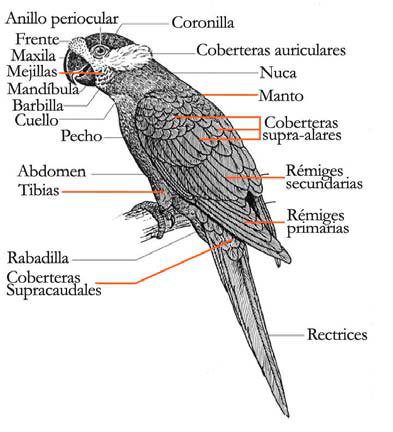
    Anatomy-parrots

    32 cm. of length and a weight of 150 g..

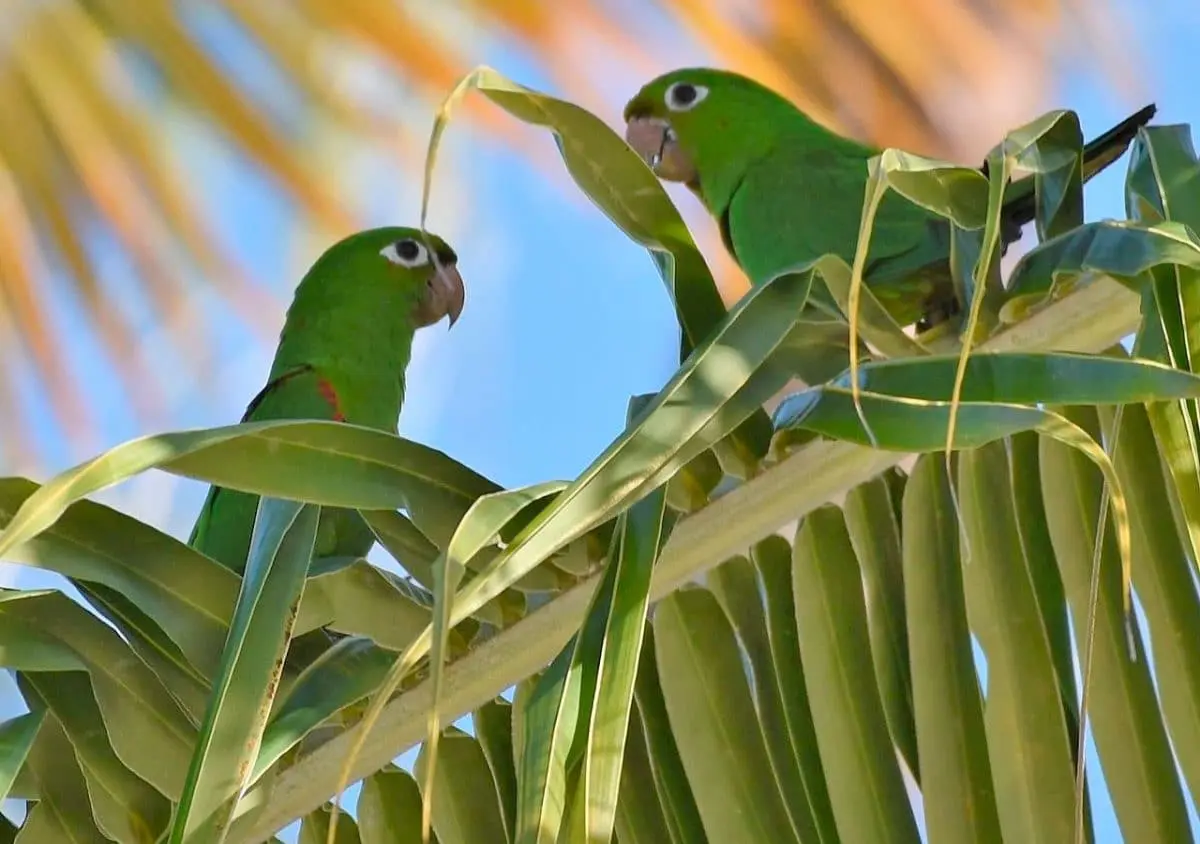
    The Hispaniolan Parakeet (Psittacara chloropterus) has the head whole and both sides of the neck green grass with some scattered red feathers; the upperparts and upperwing-coverts Green with external ends of the Middle coverts red. Primary and secondary dark green with bluish-green tips on margins vane inner. The underwing-coverts yellowish brown in the flight feather, more grayish towards the tip; coverts Green except smaller and medium-sized external coverts, they are red and the primarys which are green and Red.

    The underparts brighter yellowish green, usually with scattered red feathers.
    Upper, the tail dark green and below, grayish brown.
    The bill color horn; bare periophthalmic whitish: irises yellowish; legs grayish brown.

    Ilustraciรณn de Psittacara euops y Psittacara chloropterus

    Both sexes similar.

    The immature has less red and more green in underwing-coverts, No red on the upper surface of the bend of wing and grey at the base of the bill and on the cutting edge.

    • Sound of the Hispaniolan Parakeet .

    Subspecies description:

    Psittacara chloropterus maugei
    Psittacara chloropterus maugei
    • Psittacara chloropterus chloropterus
    • (Souance, 1856) – The species nominal.

    • Psittacara chloropterus maugei โ€ 
    • (Souance, 1856) – Similar to the species nominal, but with a duller green in the underparts; more red in the large underwing-coverts.

    Habitat:

    Video – "Hispaniolan Parakeet" (Psittacara chloropterus)

    Wild baby Hispaniolan Parakeet (Aratinga chloroptera) at nest hole. AVI

    This species covers all types of natural habitats from arid lowland forests, to sheets of palmas, but obviously prefers upland forest (including the dominated by Pinus), to 3.000 meters above sea level, scarce, Perhaps because of the persecution, in the adjacent cultivated areas.

    In general, observed in pairs or in small flocks, but sometimes in meetings of more than one hundred, at least in the past, When were most abundant. Discernible couples even within large flocks.

    Reproduction:

    They build their nests in tree cavities, including old holes made by woodpeckers, as well as in arboreal termite mounds.

    The laying compose it between 3 and 5 eggs, exceptionally 7.

    Food:

    There are few details about the diet of the Hispaniolan Parakeet, but it is apparently similar to the fellow and and depends on local availability of fruits, seeds, nuts, outbreaks, flowers and beads; Some reported foods include Ficus figs and corn.

    Distribution:

    confined in Haiti and Dominican Republic, la Espaรฑola, Greater Antilles. Previously in the Mona Island (Psittacara chloropterus maugei), extinct between 1892 and 1901, probably as a result of the pressure due to the hunting and, possibly, the perturbations by the explosions in the guano mine; possibly, also distributed in Puerto Rico, and its, probably, at the end of the century 19, due to loss of habitat and hunting.

    In Hispaniola It is subject to a significant and continuous decrease, due to destruction of habitat, trade and persecution, especially in Haiti, where possibly is extinct.

    In Dominican Republic still distributed in a few upland areas, for example, Cordillera Central.

    Possibly small wild populations in Puerto Rico and Florida. A small number in captivity; the international trade small volume, probably, keep going.

    Subspecies distribution:

    • Psittacara chloropterus chloropterus
    • (Souance, 1856) – The species nominal.

    • Psittacara chloropterus maugei โ€ 
    • (Souance, 1856) – Formerly distributed by the Mona Island and, possibly, Puerto Rico, but the last recorded specimen was in 1892. Currently extinct.

    Conservation:

    State of conservation โ“˜


    Vulnerable Vulnerable โ“˜ (UICN)โ“˜

    โ€ข Red List category of the UICN current: Vulnerable

    โ€ข Population trend: Decreasing

    There is no new data on the evolution of the population; But, the species is suspected that it may be in decline, slow to moderate due to the hunting, capture and habitat loss.

    Habitat loss and persecution as crop pest they are the greatest threats to this species. Is exploited for the local and international trade, Although only reported 12 individuals for international trade between 1991 and 1995 (Snyder et to the., 2000).

    The number of copies of Hispaniolan Parakeet ranges between 1500 and 7000.

    Conservation Actions Underway

    โ€ข Appendix II of CITES.

    โ€ข In the Dominican Republic, is legally protected against the hunt, but this legislation is not applied properly (Snyder et to the., 2000).

    โ€ข A education strategy with community participation has been launched for the protection of this species (Vasquez et to the., 1995).

    โ€ข Las interactions between this species and the Olive-throated Parakeet (Eupsittula nana), due to the recent increase in the number of the latter in the Sierra de Bahoruco [S. Latta in litt., 1998] ), they are being investigated (Anon. 2007).

    โ€ข A group of volunteers for the protection of the parrot will work reforming the damaged nests. (Anon. 2007)

    Conservation Actions Proposed.

    โ€ข Clarify the status of the species in Haiti.

    โ€ข Study ecology and reproductive success to determine the natural limiting factors.

    โ€ข Comply with current legislation in the Dominican Republic.

    The Hispaniolan Parakeet in captivity:

    Rare in captivity and legally protected in Dominican Republic against the hunt and capture.

    Alternative names:

    Hispaniolan Parakeet, Haitian Paroquet, Hispaniolan Conure, San Domingo Conure (inglรฉs).
    Conure maรฎtresse, Perruche maรฎtresse (francรฉs).
    Haitisittich (alemรกn).
    Periquito-de-hispaniola (portuguรฉs).
    Aratinga de la Espaรฑola, Perico , Periquito Antillano, Periquito de la Espaรฑola (espaรฑol).
    Perico, Xaxavi (Repรบblica Dominicana).

    scientific classification:

    Order: Psittaciformes
    Family: Psittacidae
    Genus: Psittacara
    Scientific name: Psittacara chloropterus
    Citation: (Souancรฉ, 1856)
    Protonimo: Psittacara chloroptera

    Images Hispaniolan Parakeet:


    Species of the genus Psittacara

    Sources:

    Avibase
    Parrots of the World โ€“ Forshaw Joseph M
    Parrots A Guide to the Parrots of the World – Tony Juniper & Mike Parr
    Birdlife

    Photos:

    (1) – Haitisittich Psittacara chloropterus Aufnahme in La Romana By Martingloor (Own work) [CC BY-SA 4.0], via Wikimedia Commons
    (2) – Haitisittich Psittacara chloropterus By Martingloor (Own work) [CC BY-SA 4.0], via Wikimedia Commons
    (3) – Haitisittich Psittacara chloropterus Aufnahme in La Romana By Martingloor (Own work) [CC BY-SA 4.0], via Wikimedia Commons
    (4) – Perico de la Hispaniola / Aratinga chloroptera by Carlos De Soto MolinariFlickr
    (5) – Perico de la Hispaniola / Aratinga chloroptera by Carlos De Soto MolinariFlickr
    (6) – Evopsitta maugei. Illustrations from Iconographie des perroquets non figurs dans les publications de Levaillante et de M. Bourjot Evopsitta maugei = Aratinga chloroptera maugei == Psittacara chloropterus maugei By 48 hand-coloured lithographic plates by E. Blanchard and J. Daverne (pl. I-XV) or Juliot of Tours (XVI-XLVII, 79). [Public domain], via Wikimedia Commons
    (7) – Psittacara euops Syn: Evopsitta euops & Psittacara chloropterus Syn: Psittacara chloropter bzw. Psittacara euops St. Domingue By Charles Emile Blanchard (1819โ€“1900) (biodiversitylibrary.org) [Public domain], via Wikimedia Commons

    Sounds: Lance A. M. Benner (Xeno-canto)

    โ–ท The world of Pets: Dogs, cats, birds, reptiles, amphibians

    Fiery shouldered Parakeet
    Pyrrhura egregia


    Fiery shouldered Parakeet

    Content

    Description:

    Fiery shouldered Parakeet

    25 cm.. height.

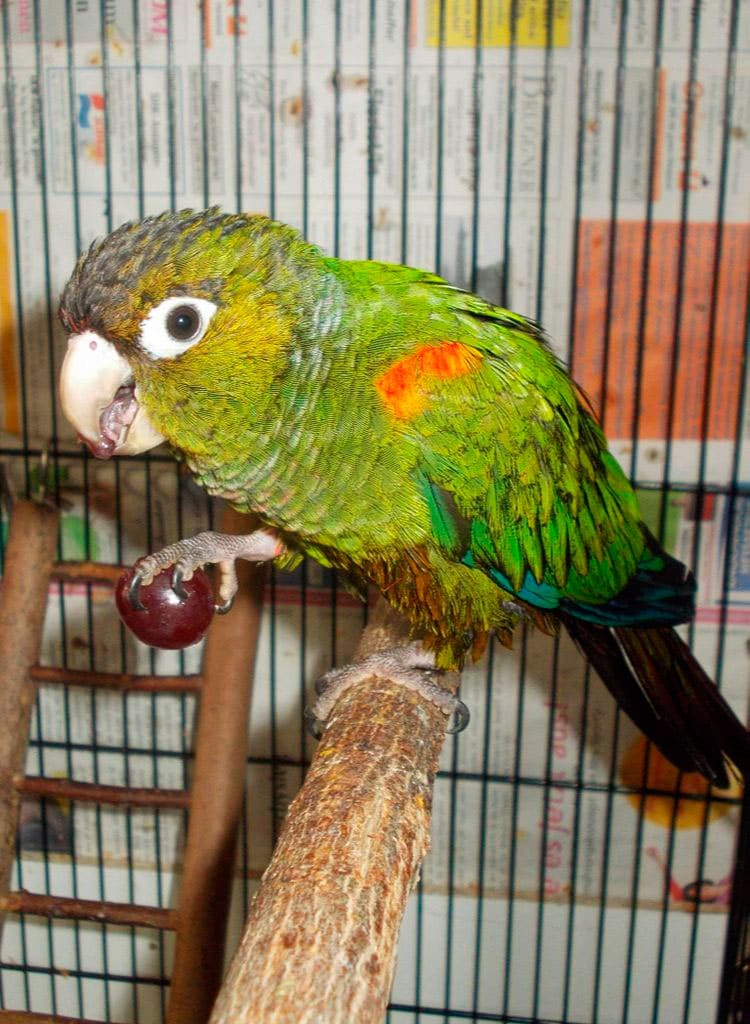
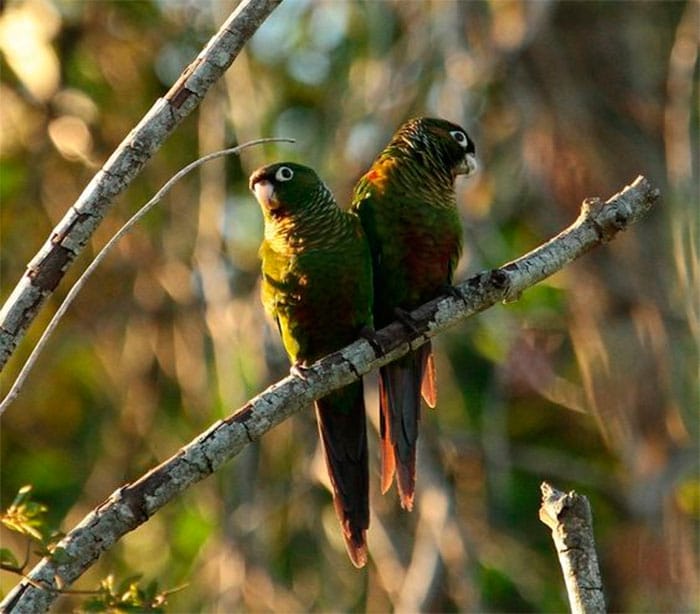
    The Fiery shouldered Parakeet (Pyrrhura egregia) has a close frontal band brown; crown, lores, rear area of the neck and upper cheeks, brownish; ear-coverts reddish brown; feathers on the sides of the neck basically green with subterminal band of color beige, narrow dark tips giving a scaly appearance to the whole.

    The upperparts Green with dark and narrow edges to some feathers. carpal area and front edge of the wing , Orange with yellow marks; primary coverts usually blue but sometimes colored yellow shiny; upperwing-coverts green. Outerwebs of flight feather, blue. Underwing-coverts marked with yellow orange; bottom of the flight feather gray. feathers in the throat and the chest basically green with the subterminal band Hazelnut color and dark tips, giving a scaly appearance; underparts green, with most of the feathers of the belly Brown at the base and green-tipped, sometimes forming a brown patch. Upper, the tail Brown very dark, green at the base; by down gray.

    The bill color horn; skin peri-oftalmica naked white; brown the irises; legs Brown-Black.

    Both sexes are similar.

    The immature It has much less yellow and orange in the upperwing-coverts and infra-alares; the crown Green and flakes in the chest and on the sides of the neck less pronounced.

    Subspecies description:

    • Pyrrhura egregia egregia

      (Sclater,PL, 1881) – The nominal.


    • Pyrrhura egregia obscura

      (Zimmer & Phelps,WH 1946) – Similar to the species nominal but with the upperparts darker green and the underparts also slightly more dark. Patch Brown in the belly less frequent and less prominent.

    Habitat:

    The species inhabits in humid premontane forests and dense secondary forest on the Tepuis, between 700 to 1800 m. usually in flocks of 7-25 birds.

    Reproduction:

    Little information on the breeding; is reproduce between March and April with fledged young people between May-June. Period of incubation: 23 Dias.

    Food:

    There is no information about the diet, except that birds visit Amerindian villages from July to August to feed of fruit of, for example, guavas mature.

    Distribution:

    Size distribution (reproduction / resident): 49.400 km2

    Distribution restricted to the Tepui region in the north-eastern interior of South America. The species is known from Venezuela on Gran Sabana to the southeast of Bolรญvar, in the Mount Roraima and Arabopo and from the Mount Auyan-tepui and the Mt. Ptari-tepui.

    Can be found in adjacent areas of the West of Guyana, for example, in the surroundings of the Camaran River and top of the Mazaruni River, the Merume mountains and Pacaraima mountains to the South of Annai.

    The reports of Suriname still no confirmed. Probably are distributed in the northeast of Roraima, Brazil.

    Inaccessible range and few details about his status, but apparently quite common. Large part of the range Venezuelan included in the Canaima National Park.

    Small quantities exported from Guyana to end of the years eighty and subsequently bred in captivity.

    Subspecies distribution:

    Conservation:

    State of conservation โ“˜


    minor concern Minor Concern โ“˜ (UICN)โ“˜

    โ€ข Current category of the Red List of the UICN: Least concern.

    โ€ข Population trend: Decreasing.

    Justification of the population

    The population size World has not been quantified, but this species is described as ยซquite commonยป (Stotz et to the., 1996).

    Justification of trend

    It is suspected that this species has lost 3.3-10.5% of habitat suitable within their distribution during three generations (18 years), based on a model of Amazon deforestation (Soares-Filho et to the., 2006, Bird et to the., 2011). Given the susceptibility of the species to hunt or capture, It is suspected that will decrease in <25% durante tres generaciones.

    "Fiery shouldered Parakeet" in captivity:

    Intelligent, relatively calm and playful. Young birds are very shy.
    They are aggressive with other birds and it is very rare in captivity, with small quantities exported from Guyana at the end of the 1980s and subsequently raised in captivity.

    Price per couple: 300-400 EUR.

    Alternative names:

    Fiery-shouldered Parakeet, Fiery shouldered Parakeet, Fiery-shoulderd Conure, Fiery-shouldered Conure (English).
    Conure aile-de-feu, Perriche aile-de-feu, Perruche aile-de-feu (French).
    Feuerbugsittich, Feuerbug-Sittich (German).
    tiriba-de-cauda-roxa (Portuguese).
    Cotorra Egregia, Perico de Cola Morada, Perico colimorado (espaรฑol).
    Perico de Pantepui (Venezuela).


    scientific classification:

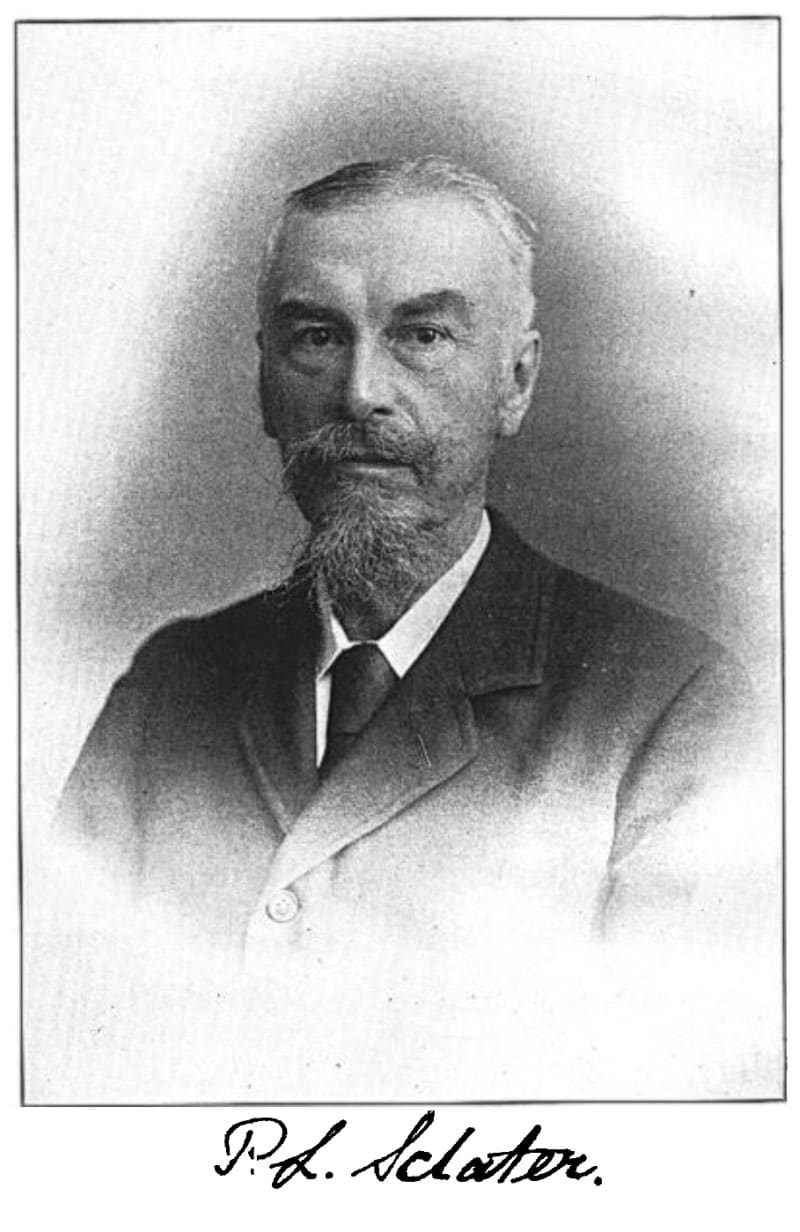
    Philip Sclater
    Philip Sclater

    Order: Psittaciformes
    Family: Psittacidae
    Genus: Pyrrhura
    Scientific name: Pyrrhura egregia
    Citation: (Sclater, PL, 1881)
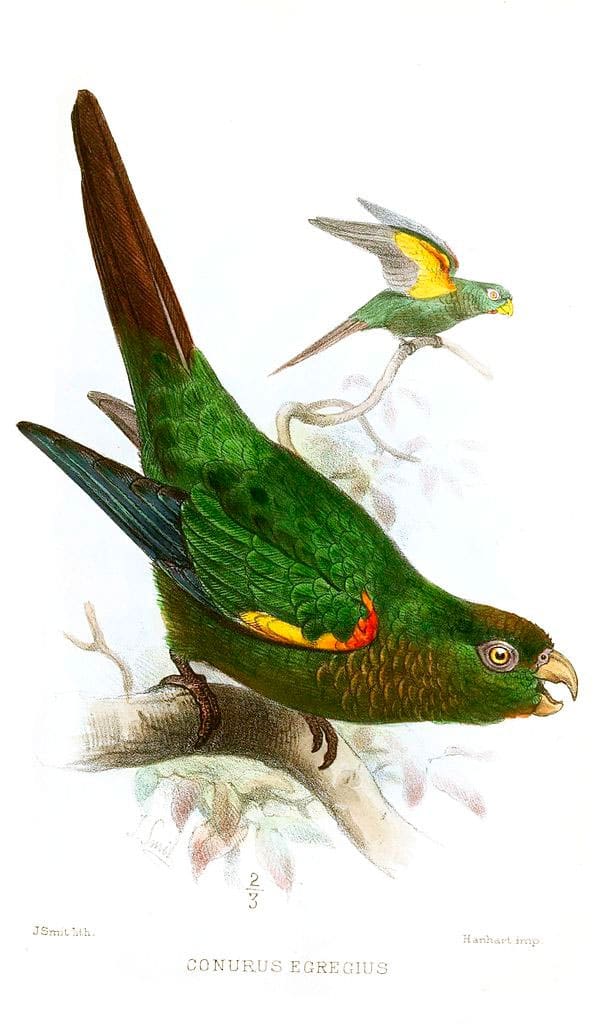
    Protonimo: conurus outstanding


    Fiery shouldered Parakeet images:

    Videos "Fiery shouldered Parakeet"

    Fiery shouldered Parakeet (Pyrrhura egregia)


    Sources:

    Avibase
    – Parrots of the World โ€“ Forshaw Joseph M
    – Parrots A Guide to the Parrots of the World – Tony Juniper & Mike Parr
    – Birdlife

    Photos:

    (1) – Demerara Conure By Gazelle74 (Own work) [CC BY-SA 4.0], via Wikimedia Commons
    (2) – Demerara female ยซat workยป. These little parrots love to gnaw at wood, paper and many other things By Gazelle74 (Own work) [CC BY-SA 4.0], via Wikimedia Commons
    (3) – Fiery-shouldered Parakeet (Pyrrhura egregia) by Margareta Wieser. A pair perching on a branch – HBW
    (4) – Fiery-shouldered Parakeet (Pyrrhura egregia) by Andrew Emmerson. An adult bird – HBW
    (5) – Fiery-shouldered Parakeet (Pyrrhura egregia) by Andrew Emmerson. An adult preening – HBW
    (6) – Conurus egregius ยป = Pyrrhura egregius (Fiery-shouldered parakeet) by John Gerrard Keulemans [Public domain], via Wikimedia Commons

    Sounds: (Xeno-canto)

    โ–ท The world of Pets: Dogs, cats, birds, reptiles, amphibians

    Lilac-crowned Parrot
    Amazona finschi

    Lilac-crowned Parrot

    Content

    Description:


    Anatomy-parrots

    33 cm. head to tail and weighs on average 310 g..

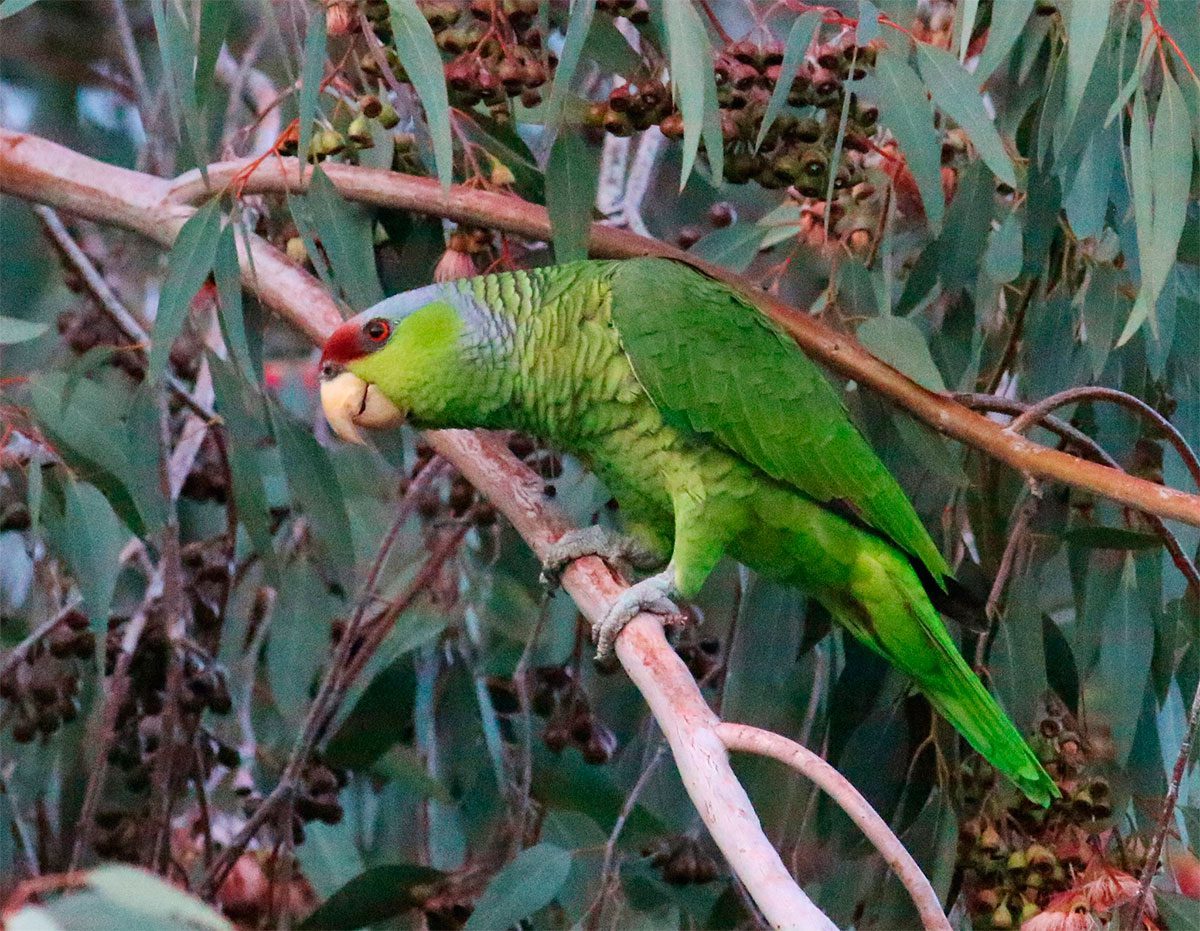
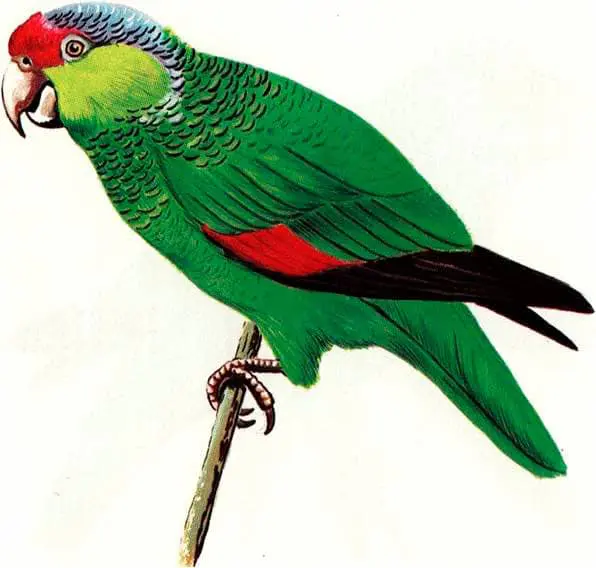
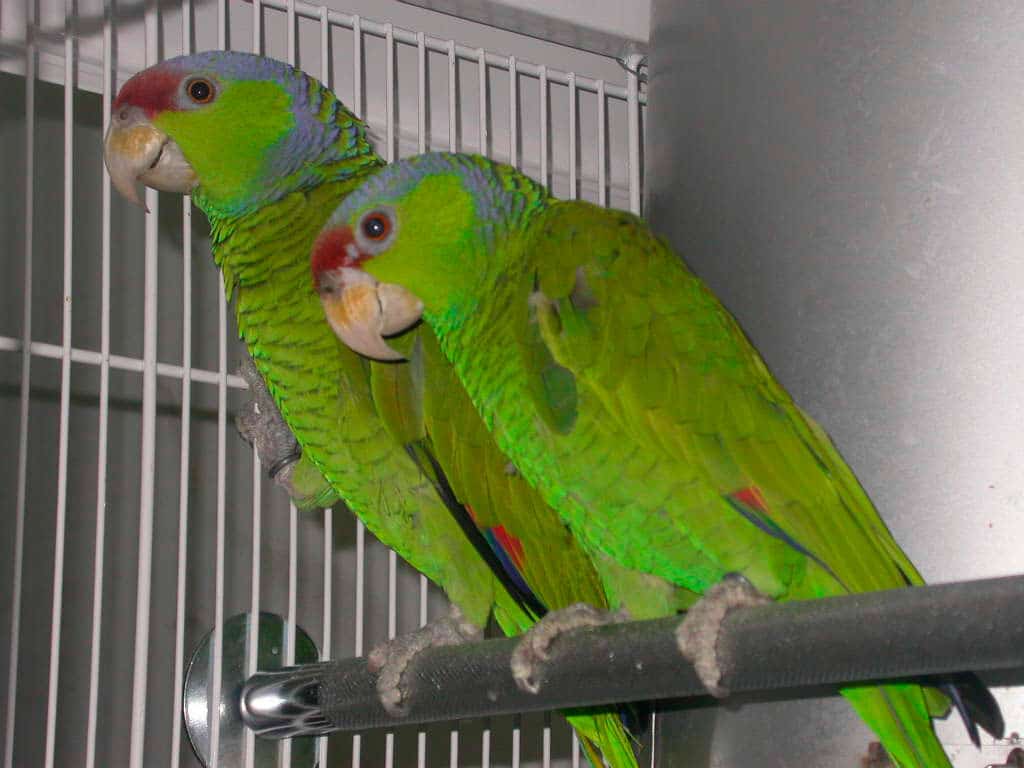
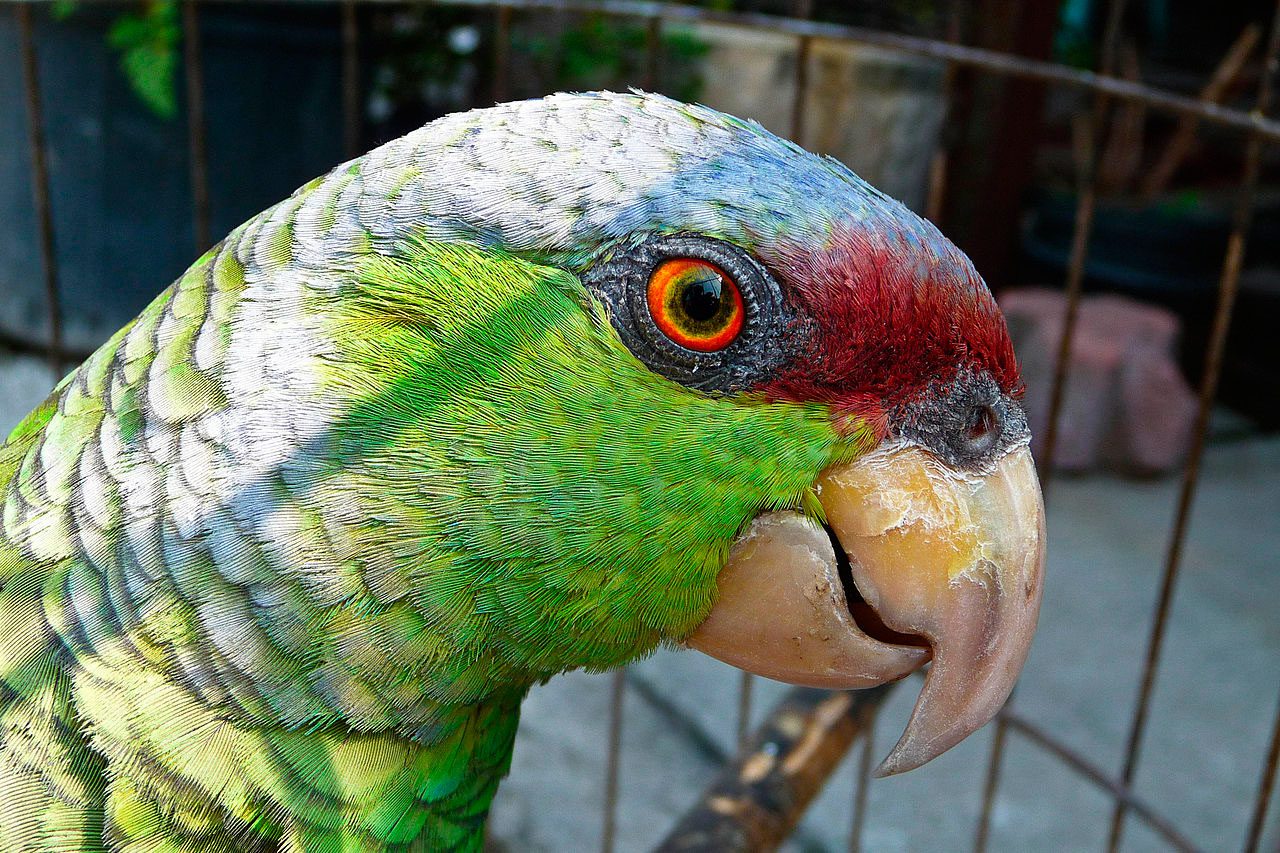
    The Lilac-crowned Parrot (Amazona finschi) has the forecrown and the higher lords, red off; the lower lores, the cheeks and ear-coverts, pale lime green; crown, sides neck and nape, lilac or pale blue with some feathers crown showing narrow black margins.

    Mantle green with broad black edges giving distinct scalloped effect; back and scapulars weak green with black borders to some feathers; rump and uppertail-coverts, green, slightly brighter than the back. Wing coverts green. Primaries blue toward the tip, green at the base; the base outerweb the first five secondaries, red with subterminal band yellow and blue tips, secondaries, otherwise, green, becoming blue at tips. Under the wings, brighter yellowish green; flight feather dull green.

    Lilac-crowned Parrot

    Throat yellowish green with bluish tint to some feathers; remaining underparts, yellowish-green with black margins to some feathers (especially in the chest), giving scalloped effect. Tail green tip yellowish green, lateral feathers blue margin to the base of the outerweb. Bill color horn; irises orange red; legs grey.

    Both sexes are similar. Immature has the irises dark brown (rather than red).

    • Sound of the Lilac-crowned Parrot.

    Habitat:

    "Lilac-crowned Parrot"

    Lilac Crowned Amazons (Amazona Finschi)

    The Lilac-crowned Parrot Living mainly in wooded hills and mountains, from the tropical zone in the lower levels of the deciduous forests, to the forests of oak and pine-oak forest in the highlands, preferably through the valleys with lush vegetation along streams that run on the basis of cannons; often also in areas of arid or semi-arid vegetation, or clear forest edge, coming into cultivated areas and orchards adjacent to the forest.

    mainly in altitudes of 600 to 2.000 m, but recorded at sea level Sinaloa and from sea level to the temperate forest Colima. observed between 360-1.700 metres in Sonora and 880-1.480 metres in Oaxaca. Usually in pairs or small groups, although larger groups are formed in the dry season (500 birds reported) and in communal roosts (more than 1,000 birds reported in the same place Nayarit).

    Reproduction:

    They nest in tree hollows (for example, Ficus), including old nests woodpeckers (for example, Phloeoceastes) or arboreal termite mounds.

    The breeding season It comprises from February to June, nesting with a cycle consisting of 28 incubation days eggs, followed by two months of growth of chickens in the nest (Forshaw 1989, Renton 1998, 2002).

    Food:

    Eating habits are poorly documented: It has been observed a particular preference for figs. During the dry season the diet consists mainly of Astronium graveolens, Brosimum alicastrum, Celaenodendron mexicanum, Comocladia engleriana and Ficus insipida. during the rains The diet consists of species such as Caesalpinia pulcherrima, Celaenodendron mexicanum, Esenbeckia nesiotica, Jatropha spp and Sciadodendron excelsum (Renton 1998, 2001)

    cause some crop damage corn and banana.

    They have been observed wild species groups, feeding with the Red-crowned Parrot (Amazona viridigenalis) in Los Angeles, California.

    Distribution:

    Size of its range (breeding/resident): 372.000 km2

    The Lilac-crowned Parrot inhabits Pacific coast of Mexico, from the southeast end of Sonora and Southwest Chihuahua, to the South by Sinaloa, Durango Western, Nayarit, Jalisco, Colima, Michoacรกn and Warrior, until Oaxaca, west of Isthmus of Tehuantepec.

    It is mostly residents, but outside the breeding season, visit during autumn, lowlands, for example in Oaxaca. generally common. Described as fairly common locally in southeastern Sonora. abundant in Colima. Very rare in the highlands of Oaxaca. Several wild populations reported in several locations in the United States.

    Conservation:

    State of conservation โ“˜


    Endangered Endangered โ“˜ (UICN)โ“˜

    โ€ข Current category of the Red List of the UICN: In danger of extinction.

    โ€ข Population trend: Decreasing.

    โ€ข Population size : 4700-6700.

    Rationale for the Red List category

      This species has been selected in danger of extinction because it is suspected that is decreasing very quickly as a function of contractions recorded ranges and due to the unsustainable exploitation and loss of habitat.

    Justification of the population

      Renton and Elias (2003) estimate the world population between 7.000 and 10.000 individuals, based on surveys covering most of the global range of the species. This equates to approximately 4.700-6.700 mature individuals. An estimate that 5.400 individuals each year are caught illegally in Mexico (Cantu et al ., 2007), implies that the estimation of population Renton and Elias (2003) could be an understatement, but it remains in this evaluation to best data available.

    Justification of trend

      It is suspected that the population of this species is in decline very fast, based on a study of Marin-Togo et al . (2012), who estimated the current distribution of this species along the Pacific coast of Mexico and he showed a reduction 72.6% its estimated original distribution.
    Threats

    โ€ข The Capture for national and international trade It is the greatest threat to wild populations.

    โ€ข It is highly valued in trade (Cantu et al., 2007) and it was the kind of Amazon parrot most caught in the early eighties (Inigo-Elias y Ramos 1991).

    โ€ข The illicit trade is intense and widespread, and Lilac-crowned Parrot It is one of the most frequently confiscated Mexican parrots (K. Renton in litt., 2005).

    โ€ข During the period 1981-2001, were registered 4.061 individuals in international trade, of which 79% It was exported directly from Mexico and the 64% it took Nature (CITES 2004a).

    โ€ข Remains one of the five species of Mexican parrots most caught, with an estimated 5.400 individuals / year caught illegally Mexico (Cantu et al ., 2007).

    โ€ข Los Adults and young people are easily trapped in large numbers due to their habit of congregating at communal shelter sites in the late afternoon (Renton 2005, K. Renton in some 2005).

    โ€ข Chicks are commonly poached from nests (K. Renton in litt., 2005).

    โ€ข During interviews with local people throughout the range of the species, the 75% reported poaching in your area (K. Renton in litt., 2005).

    โ€ข Also, it is said that this species requires semi-deciduous forest with tall mature trees for nesting and can not adapt to the changed areas nesting (Marin-worm Togo et al ., 2012).

    โ€ข Habitat loss and degradation, mainly for conversion to small and large crops and pastures (K. Renton in some . 2007, A. Salinas in some . 2007, Ortega-Rodriguez and Monterrubio-Rico 2008), are serious threats, with the semi-deciduous forest along the Pacific coast lost at a higher rate than any other type of forest in Mexico (Masera et al ., 1996, K. Renton in litt., 2005), It is resulting in the destruction of nesting sites and reducing the extent of this crucial critical habitat (Renton 2005).

    โ€ข In Michoacรกn, nesting areas potentially more accessible, as plains or hills, have been converted to livestock or agricultural farms (Ortega-Rodriguez and Monterrubio-Rico 2008).

    โ€ข Large development projects, such as dams, also they resulted in loss of breeding habitat for the species (K. Renton in some ., 2007).

    โ€ข The semi-deciduous forest now covers only 5.106 km2 within the range of the species (Renton and Elias 2003, K. Renton in litt., 2005).

    โ€ข The decrease in rainfall that could result from the global climate change would lead to a decrease in the reproductive potential of wild populations in tropical dry forests (K. Renton in some ., 2007).

    โ€ข Despite the various pressures on habitats, by showing that the species has disappeared from more than 70% of its former range, Marin-Togo et al. (2012), has reinforced the view that the capture pressure is the predominant threat to the species.

    Conservation Actions Underway

    โ€ข In 1999, the Mexican government established a Conservation Plan, Protection and Recovery Psitรกcinos in Mexico, in which the Lilac-crowned Parrot It is considered a priority species (Macias Caballero et al ., 2000).

    โ€ข In 2004, the species was updated to Appendix 1 of CITES and in 2007 It approved a proposal to change its state species conservation 2008 of "threatenedยป a ยซin dangerยป under the Mexican wildlife law (K. Renton in some.)

    โ€ข In Mexico, They have made considerable efforts to combat illegal domestic trade, with at least 52 seizures during 1997-2003 (CITES 2004b).

    โ€ข Inspections carried out in Mexico They resulted in the seizure of 266 live individuals of the species that were offered illegally in the pet trade between 1995 and 2003 (CITES 2004b).

    โ€ข The species It is in three biosphere reserves; Sierra de รlamos-Rรญo Cuchujaqui flora and fauna protection area in Sonora meridional, and Reserva de la biosfera Chamela-Cuixmala and Biosphere Reserve Sierra de Manantlรกn, in Jalisco, and according to sources, It is distributed in seven other important bird areas; However, some of them lack official protection or conservation programs (CITES 2004a)

    Conservation Actions Proposed

    โ€ข Monitor the demographic trends through regular surveys.

    โ€ข Monitor levels of destruction and degradation of habitat.

    โ€ข Implement trade regulation strategies in the plan 1999.

    โ€ข Carry out extension work and environmental education as described in the plan 1999.

    โ€ข Perform the habitat conservation and recovery of wild populations as it recommended in the Plan 1999.

    โ€ข Monitor the success of the strategies of the plan of 1999.

    โ€ข Protect the rest of the tropical forest supports in areas where the slope is greater than 6 ยฐ: ideally all areas on steep slopes should be restored to forest, to provide habitat for all native wildlife (including the Lilac-crowned Parrot)

    โ€ข Prevent soil erosion AND promote alternative economic activities in rugged coastal areas such as recreation and tourism. (Ortega-Rodriguez and Monterrubio-Rico 2008).

    The Lilac-crowned Parrot in captivity:

    Very popular as a pet throughout its area of distribution; It has cultural value as a pet or ornamental bird by its feathers; ability to imitate sounds and its tendency to form bonds with people; widespread in captivity internationally.

    Currently protected by the Appendix 1 of CITES.

    Each copy captive of this species which is capable of reproducing, should be placed in a well-managed breeding program in captivity and not be sold as a pet, with the objective of ensure their survival long-term.

    Alternative names:

    Finsch’s Parrot, Lilac crowned Parrot, Lilac-crowned Amazon, Lilac-crowned Parrot, Pacific Amazon, Pacific Parrot (English).
    Amazone ร  couronne lilas, Amazone de Finsch, Amazone verte de Finsch (French).
    Blaukappenamazone (German).
    Papagaio-de-finsch (Portuguese).
    Amazona de Corona Violeta, Amazona Guayabera, Loro Corona Lila, loro corona-lila, Loro Corona-violeta (espaรฑol).


    scientific classification:

    Philip Sclater
    Philip Sclater

    Order: Psittaciformes
    Family: Psittacidae
    Genus: Amazona
    Scientific name: Amazona finschi
    Citation: (Sclater, PL, 1864)
    Protonimo: Chrysotis finschi


    Images Lilac-crowned Parrot:


    Species of the genus Amazona


    Sources:

    Avibase
    Parrots of the World โ€“ Forshaw Joseph M
    Parrots A Guide to the Parrots of the World – Tony Juniper & Mike Parr
    Birdlife
    Naturalist

    Photos:

    (1) – Lilac-crowned Parrot by Tom BensonFlickr
    (2) – Lilac-crowned Amazon perching on a branch By Amazona_finschi_-perching_on_branch-8.jpg: Cรฉdric Allierderivative work: Snowmanradio [CC BY 2.0], via Wikimedia Commons
    (3) – Lilac-crowned Amazon (Amazona finschi) by Emilie ChenFlickr
    (4) – Lilac-crowned Parrot by wplynnFlickr
    (5) – A pet Lilac-crowned Amazon; head and neck By Gary Denness (originally posted to Flickr as Pretty Boy) [CC BY 2.0], via Wikimedia Commons
    (6) – Lilac-crowned Amazon; two in a cage By TJ Lin (originally posted to Flickr as DSCN0549) [CC BY-SA 2.0], via Wikimedia Commons
    (7) – Lilac-crowned Amazon (Amazona finschi) By CDest [Public domain], via Wikimedia Commons
    (8) – Lilac-crowned Amazon at the Arizona-Sonora Desert Museum, Tucson, Arizona, USA By DrStarbuck from Madison, WI, USA (Arizona-Sonora Desert Museum 18) [CC BY 2.0], via Wikimedia Commons
    (9) – A Lilac-crowned Amazon at Arizona-Sonora Desert Museum, USA By Dave Bezaire & Susi Havens-Bezaire [CC BY-SA 2.0], via Wikimedia Commons
    (10) – Amazona finschi Uploaded by Francisco_aviarioPhotobucket

    Sounds: Richard E. Webster, XC353198. accessible www.xeno-canto.org/353198