▷ The world of Pets: Dogs, cats, birds, reptiles, amphibians

Kerry Blue Terrier
Irlanda FCI 3 . Large and medium sized Terriers

Kerry Blue Terrier

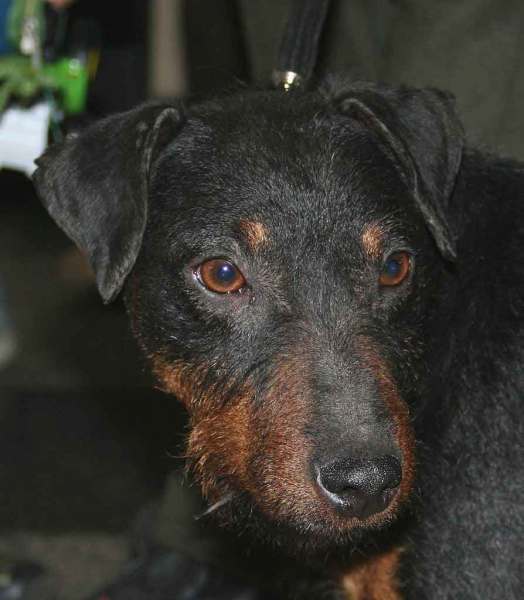
The Kerry Blue Terrier he is a thoroughbred terrier, brave, alert and with a penetrating expression.

Content

History

The Kerry Blue Terrier it is one of the irish national dogs. Its existence is documented since the 18th century, but it is suspected that he was home in County Kerry long before that. Regarding the origin of the breed, Legend has it that this intelligent dog got its blue-black coloring by crossing bloodhounds with lines of Irish Terrier.

In feudal times, Irish herdsmen and farmers were not allowed to hunt with wolfhounds. They solved the problem by crossbreeding which gave their terriers the characteristics of a Wolfdog..

The Kerry Blue Terrier He was raised as a Pied Piper, guard dog and herding dog. An Irish proverb says that a Kerry Blue Terrier replaces four shepherds. The agile dog was also particularly useful for hunting otters and badgers..

The appearance of the breed has undergone several changes over the centuries. Meanwhile in 1847 a Kerry Blue Terrier dark blue in color was still considered exemplary in 1847, Monochrome fur with dark markings was established in the 20th century. The FCI standard valid today dates from the year 2005.

Physical characteristics

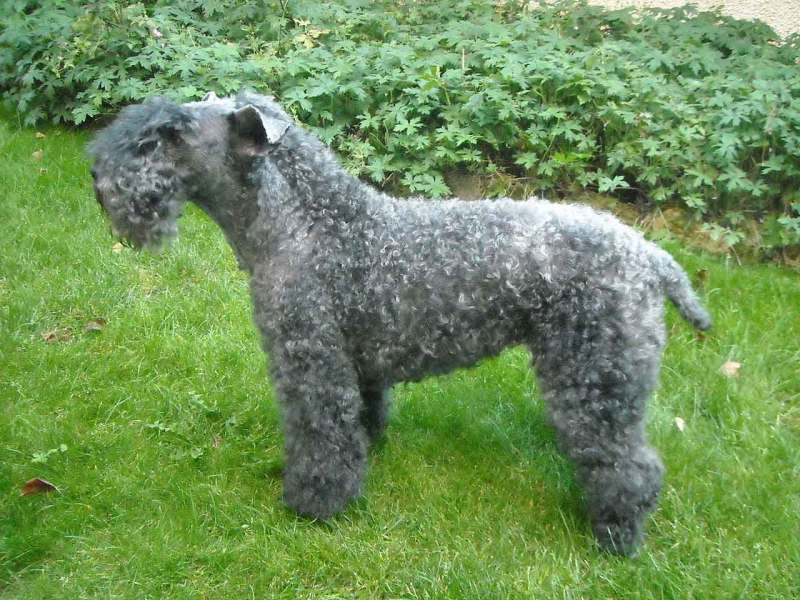
The Kerry Blue Terrier has a majestic body, muscular and slightly elongated, that impresses with its balanced appearance. His back is even and fairly long, moderately broad and deep chest. With its soft, lush and curly fur, the Kerry Blue Terrier It is considered one of the most attractive terrier breeds.

typical of the breed Kerry Blue Terrier it's his flat nose and long hair on his forehead and muzzle.

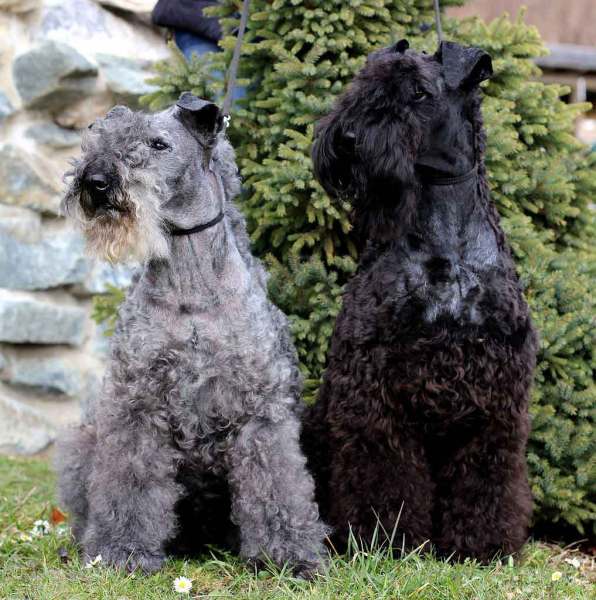
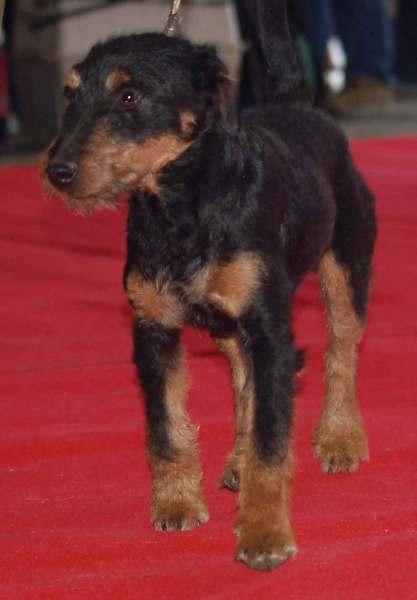
Puppies are born with a black-brown or dark black coat. Only at the age of about three the Kerry Blue Terrier It has its typical coloration.. The coat has no undercoat. A blue coat color is allowed in any shade, black marks are allowed. Tan or pure black markings are only allowed until the age of 18 months.

Other appearance features in the overview:

  • Head: Strong skull, rich fur, medium length front, black nose.
  • Ears: pointing forward or falling, underlining the typical terrier expression
  • Eyes: medium-sized, dark to brown with a piercing expression
  • neck: moderately long
  • lower limbs: straight with well-muscled thighs and strong hock
  • legs: compact with round pads and black claws

Size and weight:

Height to the cross:

For males between 45,5 to 49,5 cm. (18 to 19,5 inches).
For the females between 44,5 to 48 cm. (17,5 to 19 inches).

Weight:

For the males of 15 to 18 kg (33 to 40 English pounds).
For females proportionally less.

Character and skills

The Kerry Blue Terrier he is a thoroughbred terrier, brave, alert and with a penetrating expression. The elegant looking animal does not tend to bark and is not brusque. The Kerry Blue Terrier They are happy, loyal, family and children.

They are exceptionally open to strangers and need lots of petting at home. To the Kerry Blue Terrier loves to work. But, no need to keep the four-legged friend constantly busy at home.

Animals are very intelligent and eager to learn, briosos, but in no way nervous or aggressive. Strong self-confidence and strong willpower are typical traits that characterize all terrier breeds and require constant firmness from the owner..

Accommodation of the «Kerry Blue Terrier»

Since the Kerry Blue Terrier builds a close relationship with the owner and his family, a kennel position is inappropriate. He likes to participate in domestic life and is a faithful family dog, watchful and child friendly.

The four-legged friend is very active and needs two or three hours of exercise a day. Dog sports do justice to the momentum of the Kerry Blue Terrier to move and reinforce the bond with the owner.

Obedience is also a great activity for this smart and particularly attentive breed of dog.. Obedience is the school of subordination, which is especially valuable in a terrier. In this dog sport it depends on the correct and fast execution of an exercise sequence. Perfect teamwork between dog and owner is required.

The Kerry Blue Terrier they are wonderfully suited for difficult hunting tasks such as badger hunting or otter spearfishing. When objects are recovered from the water, most Kerry Blue Terriers they prove to be good swimmers and are in no way inferior to a Retriever.

The four-legged friends of this breed reject the other dogs a bit and therefore should be better kept individually.. If you like peace and tranquility at home, you shouldn't have Kerry Blue Terrier along with a cat.

Feeding the «Kerry Blue Terrier»

Like any other breed of dog, the Kerry Blue Terrier you need a balanced diet appropriate for your species. Must consist of animal protein, remarkable muscle meat and vitamin-rich casings, carbohydrates, vitamins and minerals. Feeding fish occasionally provides the dog with essential omega fatty acids 3 and ensures that the coat stays shiny and smooth.

The size of the daily ration depends on the age, condition and level of exercise of your four-legged friend and the quality of the food. It should be divided into two meals so as not to overload your stomach. It is better not to feed your dog before walks or canine sports. Then the food tastes much better.

The choice of dry or wet food is at the discretion of the owner, but a mixture of both is highly recommended. Here's a decision aid.

When high-quality dry food is given, the recommended daily amount for a Kerry Blue Terrier adult is on average 1,5 cups. It is important that the dog always has enough fresh water available. Once again, a small lazy dog ​​needs less food than an active animal.

An especially appropriate form of feeding for the species, although somewhat more expensive, it's fresh food, in which the dog feeds on meat, raw fruit and vegetables. You can prepare food for your Kerry Blue Terrier yourself or you can use frozen prepared meals.

Of course, Your quadruped doesn't just need chew products like bones made from cowhide, no wood root chips, for example of the coffee tree, horse tendons or cow ears for dental care. The popular pig ears are high in fat and therefore, they should only rarely come to the dog's table.

Education and care of the «Kerry Blue Terrier»

If you decide to buy one Kerry Blue Terrier, you must plan early enough to attend a dog school.

After all, your new housemate is a true terrier with a very stubborn personality. But, is certified to be easier to handle and more compliant than representatives of other terrier breeds.

Especially promising are training methods that don't punish, but they reward desirable behavior accordingly. A procedure that at the same time promotes the close relationship of your four-legged friend with you.

One of these methods is the proven Clicker Training, which is described here in more detail.

The training of a Kerry Blue Terrier includes intensive recovery training. After all, the four-legged friend has a clear hunting instinct and without consistent training will hunt down anything that comes his way.

His stubborn willpower can only be achieved with uncompromising subordination.

The very good intelligence of Kerry Blue Terrier requires variety in training. The constant repetitions quickly bore him and make the self-confident four-legged friend look for a more interesting occupation..

Characteristics "Kerry Blue Terrier"

Coexistence is important that you have with your new friend. Before considering the acquisition of a dog of the breed "Kerry Blue Terrier" you know certain factors. Not all breeds of dogs are apt to live in an apartment, you must take into account his character, their need for exercise, their interaction with other pets, their care and if you have small children, their level of tolerance towards them.

Adaptation ⓘ

5,0 of 5 stars (based on 1 review)

friendly dog ​​ⓘ

2,0 of 5 stars (based on 1 review)

hair loss ⓘ

2,0 of 5 stars (based on 1 review)

Affection level ⓘ

4,0 of 5 stars (based on 1 review)

Need for exercise ⓘ

4,0 of 5 stars (based on 1 review)

Social need ⓘ

4,0 of 5 stars (based on 1 review)

Home ⓘ

5,0 of 5 stars (based on 1 review)

Toilet ⓘ

4,0 of 5 stars (based on 1 review)

Friendly with strangers ⓘ

3,0 of 5 stars (based on 1 review)

barking ⓘ

3,0 of 5 stars (based on 1 review)

Health ⓘ

3,0 of 5 stars (based on 1 review)

Territorial ⓘ

5,0 of 5 stars (based on 1 review)

Cat friendly ⓘ

2,0 of 5 stars (based on 1 review)

Intelligence ⓘ

4,0 of 5 stars (based on 1 review)

Versatility ⓘ

4,0 of 5 stars (based on 1 review)

Child friendly ⓘ

4,0 of 5 stars (based on 1 review)

Surveillance ⓘ

4,0 of 5 stars (based on 1 review)

joy ⓘ

5,0 of 5 stars (based on 1 review)

Images "Kerry Blue Terrier"

Photos:

1 – Kerry Blue Terrier by https://commons.wikimedia.org/wiki/User:Alofok
2 – Two Kerry Blue Terrier, the left one, named Ceallach Blue Ivanhoe is on this photo about 14 years old and light grey. She have made the full color change. On the right is a about one year old Kerry Blue Terrier, called Edbrios Highlander. In this age the breed is just starting with changing the color of the coat. by © Hilarmont (Kempten) / CC BY-SA 3.0 OF
3 – Kerry Blue Terrier dog by Eponym / CC BY-SA
4 – Kerry Blue Terrier by Svenska Mässan from Sweden / CC BY
5 – Kerry Blue Terrier during dogs show in Katowice, Poland by Pleple2000 / CC BY-SA
6 – Kerry Blue Terrier, exhibition in Spodek, Katowice by Pleple2000 / CC BY-SA

Videos "Kerry Blue Terrier"
Type and recognitions:

  • FCI CLASSIFICATION:
  • Group :
  • Section : . .

Federations:

  • – FCI – Terriers 1 Large and medium-sized terriers. ⓘ
  • – AKC – Terriers ⓘ
  • – ANKC – Terriers ⓘ
  • – CKC – Terriers ⓘ
  • – ​KC – Terriers ⓘ
  • – NZKC – Terriers ⓘ
  • – UKC – Terriers ⓘ

FCI breed standard "Kerry Blue Terrier"

Origin:
Ireland

Date of publication of the valid original standard:
19.04.2005.

Use:

It is used in the hard work of hunting otters in deep water, in fighting badgers underground and hunting vermin. Good guard dog and loyal companion.


General appearance:

The typical Kerry Blue Terrier should be an upright dog, compact and well proportioned, featuring a well-developed muscular body, with a well defined terrier style.


Behavior / temperament:

Terrier character in all its meaning. The most important factor, The expression, must be insightful and alert.

Head:

With a lot hair. Males should have a stronger head and be more muscular than females..

Cranial region:
  • Skull: Strong and well proportioned.
  • Depression links (Stop): Light.

facial region:

  • Truffle: black, the large and wide nostrils. Snout: Must be of medium length.
  • Jaws: Strong and muscular jaws (scary calls). Teeth: Large white teeth; scissor bite (accepting bite on clamp).
  • Mouth: Dark gums and palate.
  • Eyes: Dark or dark hazelnut, medium in size and well placed, with expression of liveliness.
  • Ears: Thin and not big, carried forward or along the sides of the head towards the front, again to show the vivacious and sharp expression of the terrier.

Neck:

Well proportioned, good insertion on the shoulders and moderately long.

Body:

  • top line: Of average length, straight. Pork loin: Moderate long.
  • Breast : Deep and moderate width. Well arched ribs.

Tail:

Thin, good insertion, carried erectly and cheerfully.

Tips

PREVIOUS MEMBERS:

  • Blades: Lightweight, leaning back and well glued.
  • forearms: Seen from the front, straight and with good bones.

LATER MEMBERS: They must be well placed under the dog.

  • Thighs: Muscular, well developed.
  • Hocks: Strong.
  • Pies: compacts, strong round pads, black nails.

Movement:

With good coordination, parallel members. Forelimbs with good reach and hindlimbs with good thrust. When the dog is moving the line must be kept at level and head and tail bring them up.

Mantle

  • Fur: Soft, abundant and wavy.
  • Color: Any shade of blue with or without black spots. Allow the color black, as well as a reddish hue, only until the age of 18 months.


Size and weight:

Height to the cross:

  • For males between 45,5 to 49,5 cm. (18 to 19,5 inches).
  • For the females between 44,5 to 48 cm. (17,5 to 19 inches).

Weight:

  • For the males of 15 to 18 kg (33 to 40 English pounds).
  • For females proportionally less.


Fouls:

Any deviation from the above mentioned criteria is considered to lack, and the gravity of this refers to the degree of deviation to the standard and its impact on the health and well-being of the dog.

  • Flesh-colored gums.
  • Yellow eyes, the clear.
  • Convex or concave back.
  • Narrow sill.
  • Elbows sticking out.
  • Upper or lower prognathism.
  • White or ivory nails.
  • Spurs on the hind limbs or signs that they have been removed.
  • Closed or affected hind limb movement, with hocks together (cow).
  • Dogs whose head or tail are held by exhibitors or presenters should be penalized
  • Wire-haired, wire or piggy.
  • Any color other than blue, except the exceptions indicated above.

FALTAS DESCALIFICANTES:

  • Aggressiveness or extreme shyness.
  • Any dog ​​showing clear signs of physical or behavioral abnormalities must be disqualified..


N.B.:
  • Males should have two normal-appearing testicles fully descended into the scrotum..
  • Only functionally and clinically healthy dogs, with the typical conformation of the breed, should be used for parenting.

The latest changes are in bold.

TRADUCCION: Lic. O. Valverde, reviewed by Dr. F. del Valle and updated by J. Nallem, Uruguayan Kennel Club.

Source: F.C.I - International Cynological Federation

Alternative names:

1. Irish Blue Terrier, Kerry (English).
2. Terrier Kerry Blue (French).
3. Kerry (German).
4. Irish Blue terrier (Portuguese).
5. Kerry (español).

▷ The world of Pets: Dogs, cats, birds, reptiles, amphibians

Cairn Terrier
Gran Bretaña FCI 4 . Small sized Terrier
Cairn Terrier

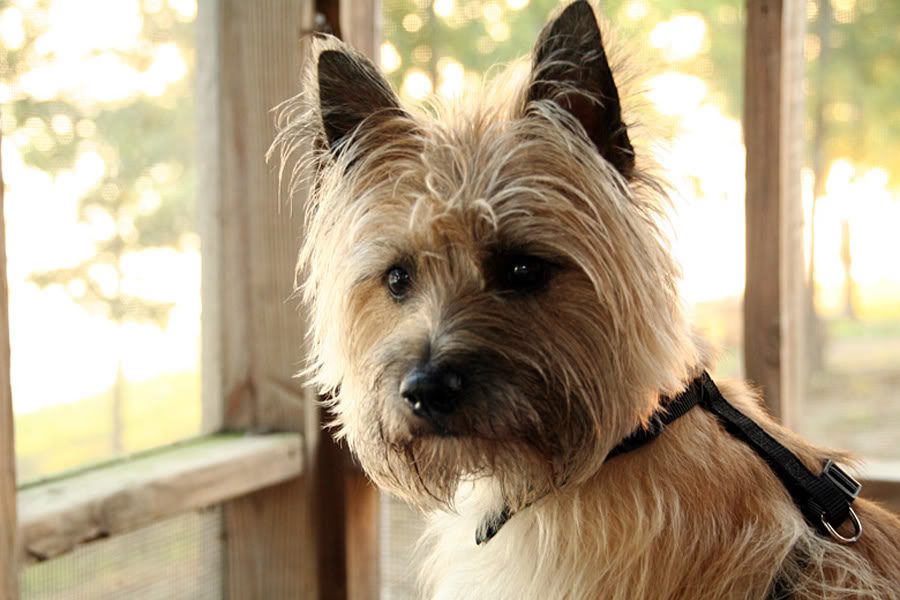
The Cairn Terrier It was originally bred as a hunting dog, to kill rats, Badgers, foxes

Content

History

The Cairn Terrier It is one of the oldest breeds of Terrier, originating in Scotland and recognized as one of the first Scottish working dogs. It was created for hunting and the prey's burrow. The Cairn Terrier are buzzards. In Scotland they hunted rats and other rodents.

In our country house, will do the job of a cat, often hunting mice, rabbits and squirrels.

Cairn Terrier belongs to the family of the Scottish Terrier. They are five:

History

The characteristics of the current breed are carefully modeled on their ancestor, the Terrier of the Isle of Skye 17th century. It is believed that this dog was the basis for developing races such as the lion and the Scottish.

The history of the Cairn Terrier is reinforced by the fact that the modern Cairn is an attempt to preserve the typical form of the Terrier of the old days., a dog of work of the Isle of Skye. Known in his native Scotland for more than 500 years, It is believed that it is the oldest of the Terrier.
Cairn Terrier was originally bred as a hunting dog, to kill rats, Badgers, foxes, weasels, and other small insects. He hails from the Isle of Skye, but to avoid confusion with the current Skye Terrier, He was appointed Cairn Terrier, in honor of the rock piles and where he used to look for his prey in his Scottish lands.

Did you know??

The most famous Cairn of all? That would be Toto in "The Wizard of Oz".

Physical characteristics

These dogs of short legs have a countenance of stooped appearance. Its thick cloak of hair is usually greyish in colour, light brown or sand, Although they are allowed all colors other than white.

A notable feature of the Cairns Terrier is the change in coat color throughout its life.. Is not uncommon to its striped pass to be increasingly more grey or silver, as you age. The fur has two layers, a soft, dense stuck to the skin, and other hard and rough, external. It is the smallest of the Terrier (the largest is the Scottish), its weight is of 6 to 7,5 kg. And its appeal is in 28 to 31 cm..

Many times, The Cairn Terrier is defined as a «big dog trapped in the body of a small dog”, is an ex-officio adventurer, Intelligent, strong, loyal and hard, It is not at all a delicate and lap dog.

Character and skills

They are usually active, resistant, they are always on alert and cheerful, they are appreciated as pets as they are relatively easy to train and adapt well to small homes or apartments as they require no more than one brisk walk per day.

Like most Terriers, they love to dig looking for real or imagined prey. So, If you want to keep your lawn in conditions, It is not advisable to leave it many hours only.

Usually, they mix well with other dogs, But if there is possibility of confrontation they will defend their territory, they can't go back and face whatever lack. With the family they are very protectors and they usually get along with children, although they can't stand any rough game, as pulling of ears, share…

Walking is an excellent exercise for Cairns and their owners. It is advisable to give long daily walks.

The life expectancy of these dogs is of 12-14 years, they tend to have the fairly delicate skin (and as they grow older, even more).

Characteristics "Cairn Terrier"

Coexistence is important that you have with your new friend. Before considering the acquisition of a dog of the breed "Cairn Terrier" you know certain factors. Not all breeds of dogs are apt to live in an apartment, you must take into account his character, their need for exercise, their interaction with other pets, their care and if you have small children, their level of tolerance towards them.

Adaptation ⓘ

3,0 of 5 stars (based on 1 review)

friendly dog ​​ⓘ

3,0 of 5 stars (based on 1 review)

hair loss ⓘ

3,0 of 5 stars (based on 1 review)

Affection level ⓘ

5,0 of 5 stars (based on 1 review)

Need for exercise ⓘ

4,0 of 5 stars (based on 1 review)

Social need ⓘ

5,0 of 5 stars (based on 1 review)

Home ⓘ

3,0 of 5 stars (based on 1 review)

Toilet ⓘ

2,0 of 5 stars (based on 1 review)

Friendly with strangers ⓘ

3,0 of 5 stars (based on 1 review)

barking ⓘ

5,0 of 5 stars (based on 1 review)

Health ⓘ

3,0 of 5 stars (based on 1 review)

Territorial ⓘ

3,0 of 5 stars (based on 1 review)

Cat friendly ⓘ

3,0 of 5 stars (based on 1 review)

Intelligence ⓘ

4,0 of 5 stars (based on 1 review)

Versatility ⓘ

3,0 of 5 stars (based on 1 review)

Child friendly ⓘ

4,0 of 5 stars (based on 1 review)

Surveillance ⓘ

4,0 of 5 stars (based on 1 review)

joy ⓘ

5,0 of 5 stars (based on 1 review)

Cairn Terrier Images

Cairn Terrier Videos

Type and recognitions:

  • FCI CLASSIFICATION:
  • Group :
  • Section : . .

Federations:

FCI ⓘ, AKC ⓘ, ANKC ⓘ, CKC ⓘ, ​KC ⓘ, NZKC ⓘ, UKC ⓘ

FCI breed standard "Cairn Terrier"

Origin:
United Kingdom, Scotland

Date of publication of the valid original standard:
24.06.1987

Use:

Terriers


General appearance:

Agile, alert, enterprising natural looking. Strong limbs, with good poise in the forelimbs and free movements. deep chest. Weather resistant coat.


Behavior / temperament:

It impresses with its activity, firmness and boldness. With a brave and cheerful character; self-confident, but not aggressive.

Head:

Small but proportionate to the body. Well covered head hair.

Cranial region:
  • Skull:  Width, with a well-marked indentation between the eyes.
  • Depression links (Stop):  Well defined.

facial region:

  • Truffle: black.
  • Snout:  Powerful.
  • Jaws/Teeth: Big teeth. Strong JAWS, but never long or large, with regular scissor bite, perfect and complete, that is to say that the internal face of the maxillary incisors is in close contact with the outer side of the lower incisors and placed at right angles to the jaws.
  • Eyes: Placed well apart, medium-sized, dark brown, slightly sunken and abundant eyebrows.
  • Ears: Small and finished in tip, well erect, not very long hair covers or gaskets.

Neck:

With good implementation in the backs and not very short.

Body:

  • Back: Straight and medium-long.
  • Pork loin: Strong and elastic.
  • Breast : Ribs well arched and deep.

Tail:

Short, provided, well covered with hair but not forming fringes. Its implementation should not be high or low, It must be carried happily but never stooped toward the back.

Tips

FORMER MEMBERS: Cutlery to wire-haired. Medium length and good bone but not very heavy.

  • Back: Face.
  • Elbows: Never returned outward or inward.

HINDQUARTERS:

  • Thighs: Very strong and muscular.
  • Knees: Buena,  but not excessive angulation.
  • Hocks:  Well descended, seen from the rear never inclined outward or inward.

FEET : The previous larger than the later ones, and may be slightly deviated outward. The pads should be thick and strong. Small feet, Straits, extended separate fingers with long nails is a defect.

Movement:

Walking should be easy and free movements. Front members should have a good breadth forward. Subsequent members must provide a strong driving power. Hocks should not be close together or far apart.

Mantle

HAIR: The texture of the hair is very important. You must withstand the weather and have a double layer: The outer layer is formed by hair, hard but not rough, the subhair should be short, smooth and dense. The hollow hair is a defect. Allowed a slight ripple.

COLOR: Cream, yellow, red, gray or nearly black. Accepted the Brindle in all these colors, but not solid black, white or black and fire. Dark spots on the ears and muzzle are very typical..


Size and weight:

About 28 – 31 cm. (11-12 inches) at the height of the cross, but in proportion to the weight, being the ideal weight between 6 and 7,5 kg (14-16 English pounds).


Fouls:

Any deviation from the above criteria is considered missing and the seriousness is considered to the extent of the deviation to the standardand its consequences on the health and well-being of the dog.

Any dog ​​showing clear signs of physical or behavioral abnormalities should be disqualified..

FALTAS DESCALIFICANTES:

  • Aggressiveness or extreme shyness.
  • Any dog ​​showing clear signs of physical or behavioral abnormalities must be disqualified..


N.B.:
  • Males should have two normal-appearing testicles fully descended into the scrotum..
  • Only functionally and clinically healthy dogs, with the typical conformation of the breed, should be used for parenting.

The latest changes are in bold.

TRANSLATION: SR. Lic. Oscar Valverde Calvo (Costa Rica) and Dr. Federico del Valle

Source: F.C.I - International Cynological Federation

Alternative names:

1. Cairn Terrier (English).
2. Cairn Terrier (French).
3. Cairn Terrier (German).
4. Cairn Terrier (Portuguese).
5. Cairn (español).

▷ The world of Pets: Dogs, cats, birds, reptiles, amphibians

Irish Soft Coated Wheaten Terrier
Irlanda FCI 40 . Large and medium sized Terriers

Irish Soft Coated Wheaten Terrier

Wheaten character is cheerful, open and balanced.

Content

History

The Irish Soft Coated Wheaten Terrier has been raised in Ireland for about 200 years in counties Kerry and Cork by the farmers who live there. How farm dogs fought rats and mice, as well as against predators such as foxes and martens, that threatened domestic animals. They also grazed sheep and were used for hunting.

The history of Irish Soft Coated Wheaten Terrier has been somewhat obscured due to its closeness to the other races of Irish terriers. The Wheaten probably the oldest of the four races. His existence, along the, at least 200 years, can be deduced from the textual references made to "soft-haired" dogs.. The relationship of Irish Terrier modern with the Wheaten, although less documented, appears to have been the result of deliberate crossing experiments. Consequently, the humble Wheaten probably has a fully mixed lineage. Despite the long history of Wheaten, it was not until 1937, which was officially recognized by the Irish Kennel Club. Since then this breed has grown steadily in popularity and is currently well known worldwide..

In 1943, the British Kennel Club He acknowledged the race in United Kingdom. The first Irish Soft Coated Wheaten Terrier were exported to the United States in the 1940, but the race gained greater interest ten years after his arrival. Last, in 1973, were recognized by the American Kennel Club.

The Irish Soft Coated Wheaten Terrier, unofficially, were crossed with the race Pudelhund standard, to create the mixed race, known as the Whoodle and with the race Beagle to create the race known as "Wheagles”.

Today the Irish Soft Coated Wheaten Terrier It is a versatile companion dog that adapts well to its living conditions..

Physical characteristics

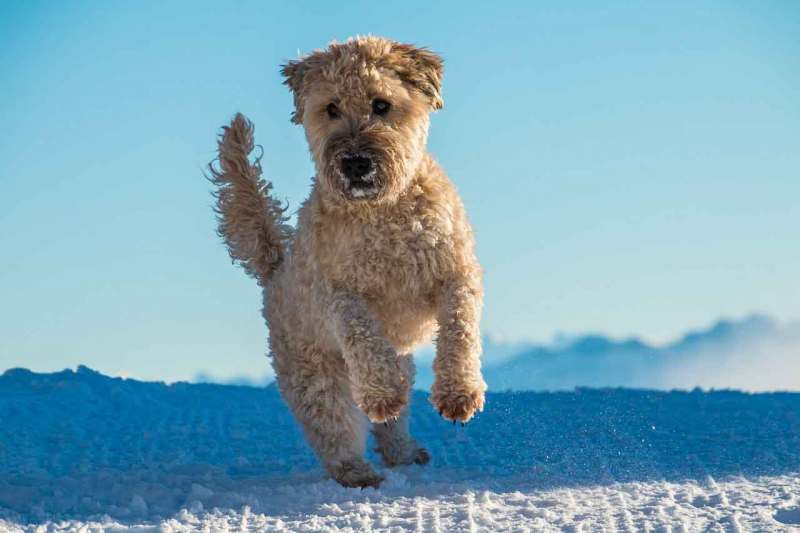
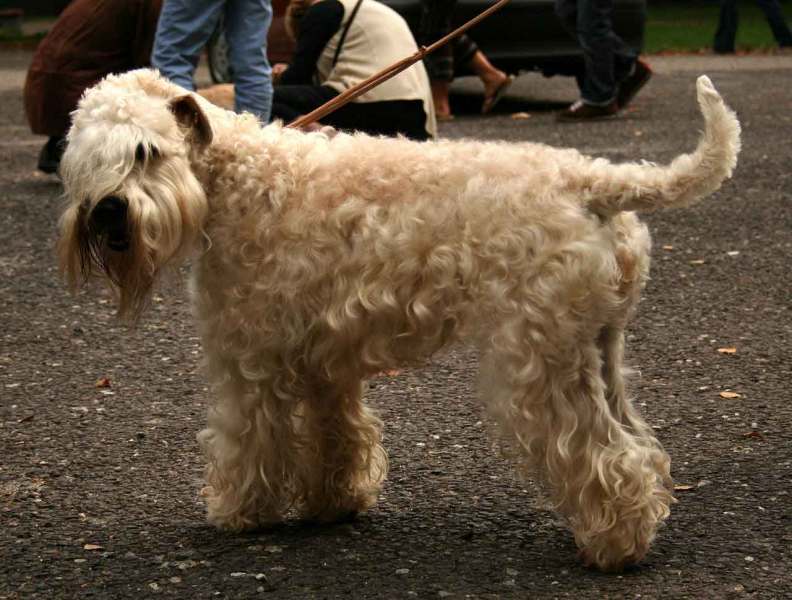
It is a strong dog, balanced, straight back and chest deep. It has a rectangular and well-proportioned head with a defined stop. Their eyes have a slightly almendrada way and the ears are small and bent slightly forward.

In countries where it is allowed, the Wheaten usually has a tail cut off. It has a smooth hair, silky and color wheat. These dogs have a unique coat of hair., so you can more easily tolerated by people who are allergic to other races, because they lost very little hair.

Puppies are reddish brown or gray. Many have a black mask. Only at the age of two and a half the coat has its final color, clear and its fine structure.

SIZE AND WEIGHT:

– Height to the cross : Males 46-48 cm. (18 – 19 inches). females somewhat less.

– Weight: Males between 18 – 20,5 kg (40 – 45 English pounds). The females somewhat less.

Character and skills

The character of the Wheaten is happy, open and balanced. As an SUV, these dogs are very docile. They enjoy participating in family life. Dog sports such as agility are a good substitute for the many different tasks these spirited terriers were originally bred for.. If they are left alone, without getting busy or moving enough, can become destructive and aggressive. Consistent breeding from the start makes them great family dogs that don't obey one person.. Due to the great care effort and the possible stubbornness of the terrier, only conditionally suitable for beginners.

Wheaten Terrier care

The coat of the Irish Soft Coated Wheaten Terrier requires a lot of cleaning and must be brushed daily to avoid entanglement. Hair must be cut regularly. Does not come off.

In regards to health, it is a very healthy breed, not showing any typical hereditary disease.

Wheaten Terrier Education

That dog learns fast. Unfortunately also things, that you have to avoid them later. So, and also because of the hunting instinct that the breed has, initially not recommended for beginners. It also, the breed tends to be stubborn under pressure, you also have to learn to deal with it. But, who masters the rules of dog training, you will be very pleased with this dog's willingness to learn and willingness to work.

Images "Irish Soft Coated Wheaten Terrier"

Photos:

1 – Soft Coated Wheaten Terrier by SusanSmithGSU / CC BY-SA
2 – Soft-coated_wheaten_terrier at the national show in Rybnik – Stone to Pleple2000 / CC BY-SA
3 – Soft-coated_wheaten_terrier at the national show in Rybnik – Stone to Pleple2000 / CC BY-SA
4 – Soft Coated Wheaten Terrier Irlandés by RORLVR1 / CC BY-SA
5 – Soft Coated Wheaten Terrier Irlandés by https://pxhere.com/en/photo/64565
6 – Soft Coated Wheaten Terrier Irlandés by https://www.needpix.com/photo/834722/dog-jump-play-irish-soft-coated-wheaten-terrier-young-dog-jumps-happy-winter-snow

Videos "Irish Soft Coated Wheaten Terrier"

Type and recognitions:

  • FCI CLASSIFICATION:
  • Group :
  • Section : . .

Federations:

  • – FCI – Terriers 1 Large and medium-sized terriers. ⓘ
  • – AKC – Terriers ⓘ
  • – ANKC – Terriers ⓘ
  • – CKC – Terriers ⓘ
  • – ​KC – Terriers ⓘ
  • – NZKC – Terriers ⓘ
  • – UKC – Terriers ⓘ

FCI breed standard "Irish Soft Coated Wheaten Terrier"

Origin:
Ireland

Date of publication of the valid original standard:
27.01.2001.

Use:

Wheaten Terriers were always used by small farmers to kill vermin or help with farm work.. For a long time it was used in the difficult task of hunting badgers and otters..


General appearance:

It is a robust dog, active and compact, well built, giving the idea of ​​strength. Their limbs are not too long or too short.


Behavior / temperament:

Fiery and courageous. With good temperament. Very noble and loyal to his masters. Very intelligent. A faithful and trustworthy friend, defensive without being aggressive.

Head:

It must be strong as a whole, without being rough. Long, well proportioned to the body. Hair must be the same color as the body.

Cranial region:
  • Skull: Flat and crisp between the ears, not very wide.
  • Depression links (Stop): Defined.

facial region:

  • Trufa: Black and well developed.
  • Horcico: It should not be longer than the skull.Jaws: Strong, punishing jaws.
  • Dinentities: Big teeth, regular scissor or clamp bite, no upper or lower prognathism.
  • Cheeks: Non-prominent bones.
  • Ojors: dark, dark hazelnut, not very large or prominent, well placed.
  • Obars: Small to medium, taken to the front, level with the skull. Dark shading is allowed at the base of the ears, and it is common for it to have a light wheat reflection in the rest. This is the only area of ​​the dog where undercoat is allowed.. “Pink” or “flying” ears are objectionable.

Neck:

Moderately long and strong, but without presenting dewlap.

Body:

Not very long. The length from the withers to the base of the tail should be approximately the same as from the ground to the withers.

  • Dorrso: Strong and straight, with top line also at level.
  • Itmor: Short, strong.
  • Pecho: Deep, well arched ribs

Tail:

Well placed, not very thick. Carried cheerfully but never over the top line. amputee, remaining two thirds of its original length, assuming that this length is in proportion to the dog. Uncut glue is allowed.

Tips

PREVIOUS MEMBERS:

  • Hormbros: Thin Shoulders, well inclined. Muscled shoulders.
  • Antarms: Seen from any angle they must appear perfectly straight, good bone and muscular.

LATER MEMBERS: Well developed and with powerful musculature.

  • Thighs: Strong and muscular.
  • Rodinllas: Angled.
  • Corvejones: Well descended, without turning in or out. Dewclaws must be amputated.
  • PinIt: Small, not scattered. Nails should preferably be black, but several dark colors are allowed.

Movement:

In a straight line throughout its entire length, round trip. The elbows stuck. Side view: free movement, lightweight and coordinated.

Mantle

  • Plink: Single-haired mantle dog (no undercoat). The hair is soft and silky to the touch, does not last. Young dogs are excluded from the above. Hair preparation is allowed (Trimming).
  • Pmistakes with hair preparation: The hair should be short on the neck, chest and skull and should be left especially long over the eyes and under the jaw. It is advisable to leave the mustaches. With abundant fringes on the extremities. The body hair must be arranged in such a way that it follows the contour of the dog, without being sculpted. The tail hair should be cut short and gracefully tapering to the tip.
  • Pmistakes without preparation: Hair length at its longest point should not exceed five inches (12,7 cm.). Hair must be thick and soft, wavy or loose curls with the shine of silk. Under no circumstances should the coat be “fluffy” like that of the Poodle or the Old English Sheepdog.. Dogs exposed in this condition must be heavily penalized, since they give the wrong idea of ​​type and race. Special attention should be paid to the development of the coat of the puppies. Puppies are hardly born with the correct hair that they should have when adults., Care must be taken when evaluating this aspect. They undergo various color and texture changes before developing adult hair. This normally occurs between 18 months and 2 1/2 years.
  • Cachorros: Puppies are rarely born with the correct coat color and texture. Their fur may be reddish, grayish and sometimes light tawny. The masks are generally black. Sometimes there is a black streak in the center of the back or the tips of the body hair are black. These dark marks disappear during growth.
  • Colorr: A good and defined wheat color with variations ranging from light fawn to a reddish golden hue.


Size and weight:

Alturto the cross:

  • Males 46-48 cm. (18 – 19 inches).
  • females somewhat less.

Pthat:

  • Males between 18 – 20,5 kg (40 – 45 English pounds).
  • The females somewhat less.


Fouls:

Any deviation from the aforementioned criteria is considered as a fault and the severity of this is considered to the degree of the deviation to the standard and its consequences on the health and well-being of the dog..

  • Nervosity, aggressiveness.
  • Truffle in any color other than black.
  • Upper or lower prognathism.
  • Mature dog coat not clearly wheat colored.

FALTAS DISQUALIFYING:

  • Aggressiveness or extreme shyness.
  • Any dog ​​showing clear signs of physical or behavioral abnormalities must be disqualified..
  • Yellow eyes.
  • Dull coat, thick, wool or cotton texture.
  • White fur. Brown fur.


N.B.:
  • Males should have two normal-appearing testicles fully descended into the scrotum..
  • Only functionally and clinically healthy dogs, with the typical conformation of the breed, should be used for parenting.

Itlatest changes are in bold.

TRANSLATION: Lic. O. Valverde, reviewed by Dr. F. del Valle and updated by J. Nallem, Uruguayan Kennel Club.

Source: F.C.I - International Cynological Federation

Alternative names:

1. Irish Soft-Coated Wheaten Terrier and variant spellings: «Soft Coated» and «Softcoated», Wheaten or Wheatie, Wheaten Terrier (English).
2. Irish Soft Coated Wheaten Terrier (French).
3. Wheaten Terrier (German).
4. Wheaten Terrier (Portuguese).
5. Wheaten Terrier (español).

▷ The world of Pets: Dogs, cats, birds, reptiles, amphibians

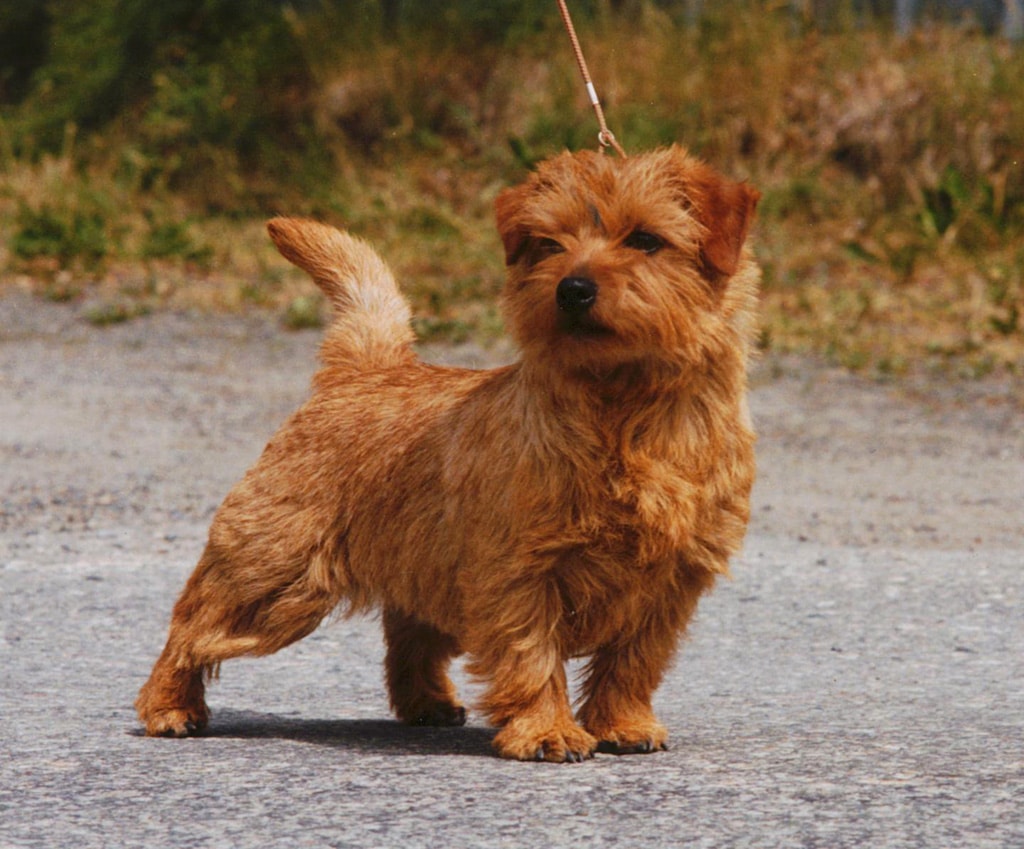
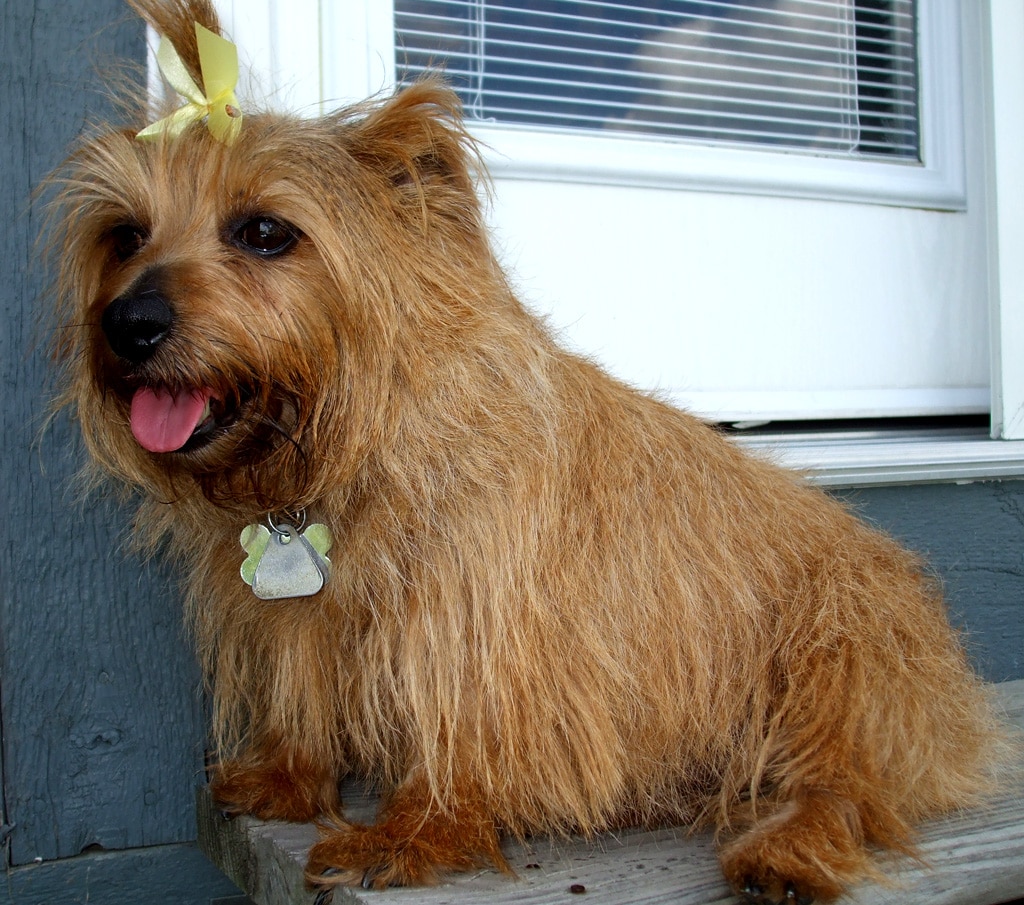
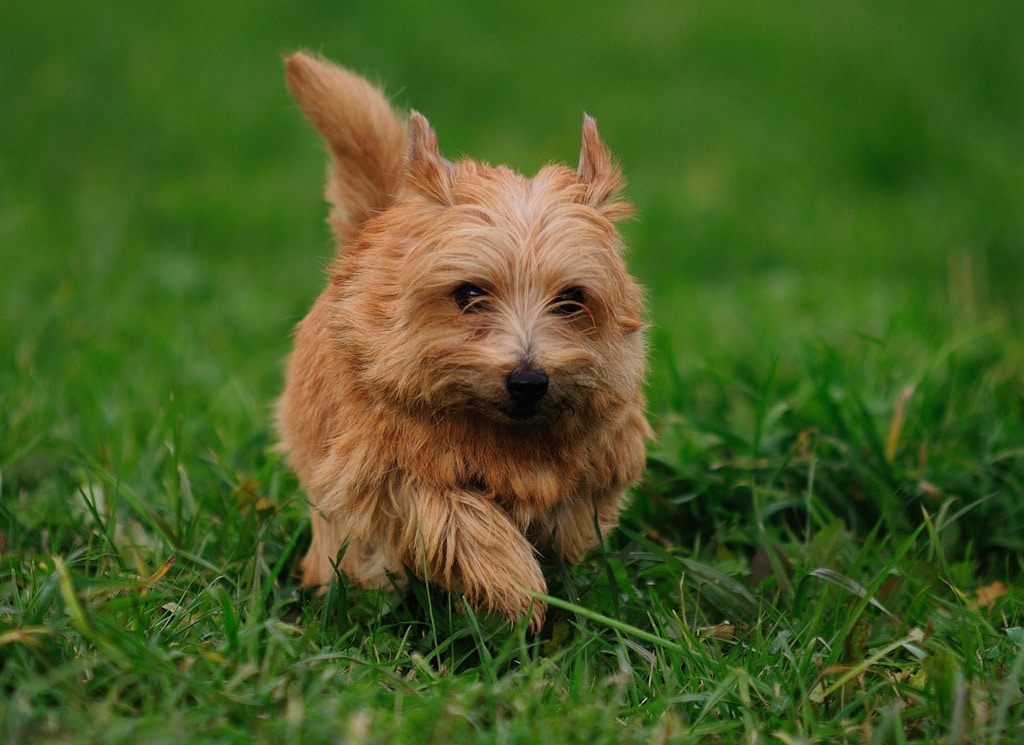
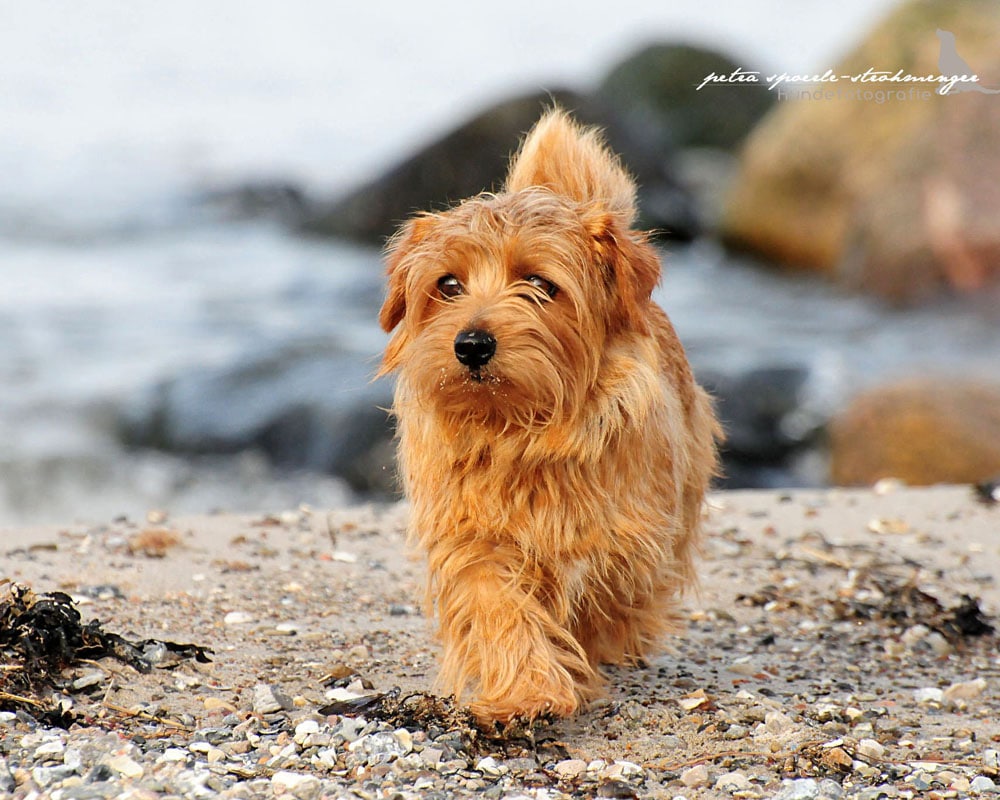
Norwich Terrier
Inglaterra FCI 72 . Small sized Terriers.
Norwich Terrier

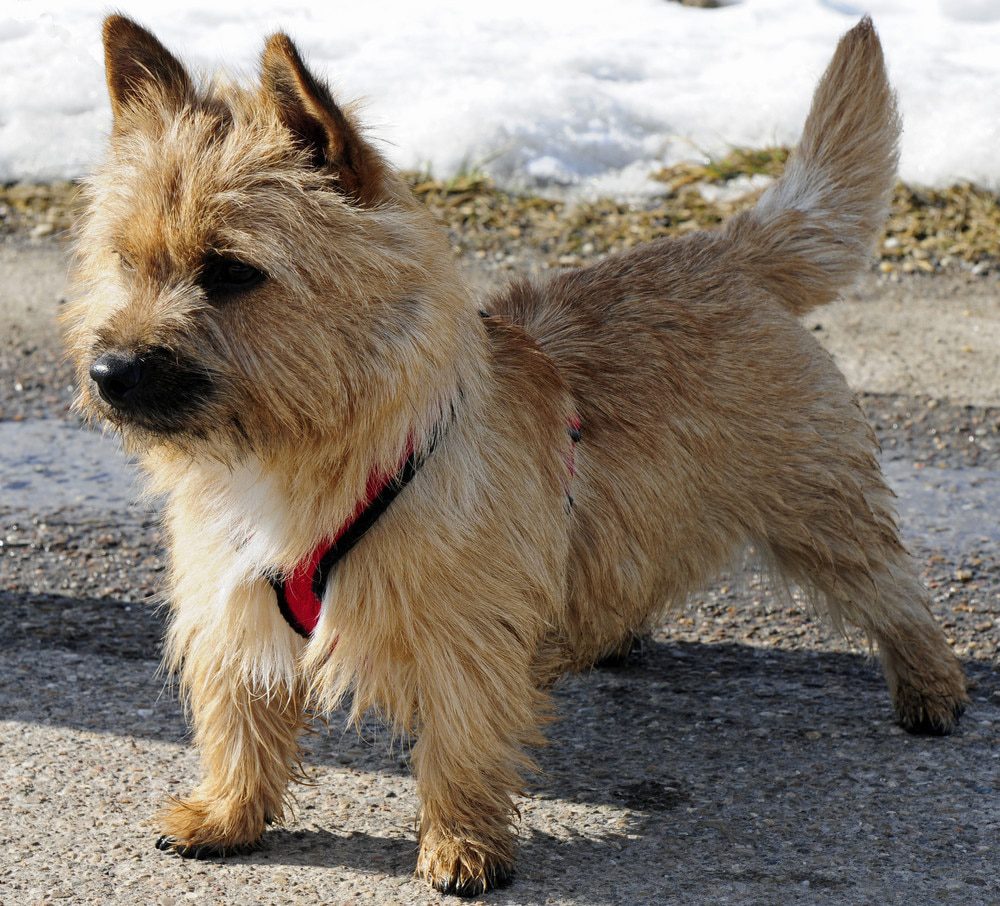
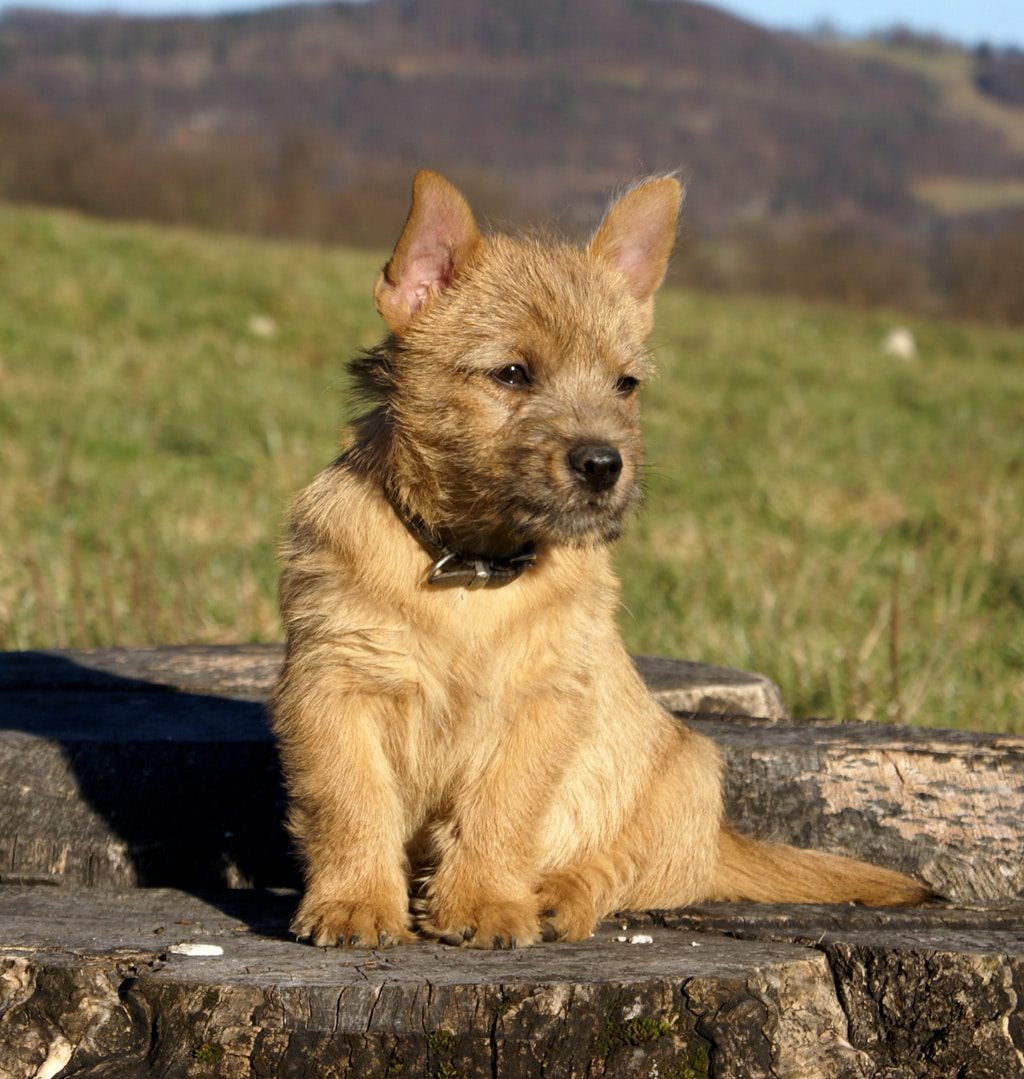
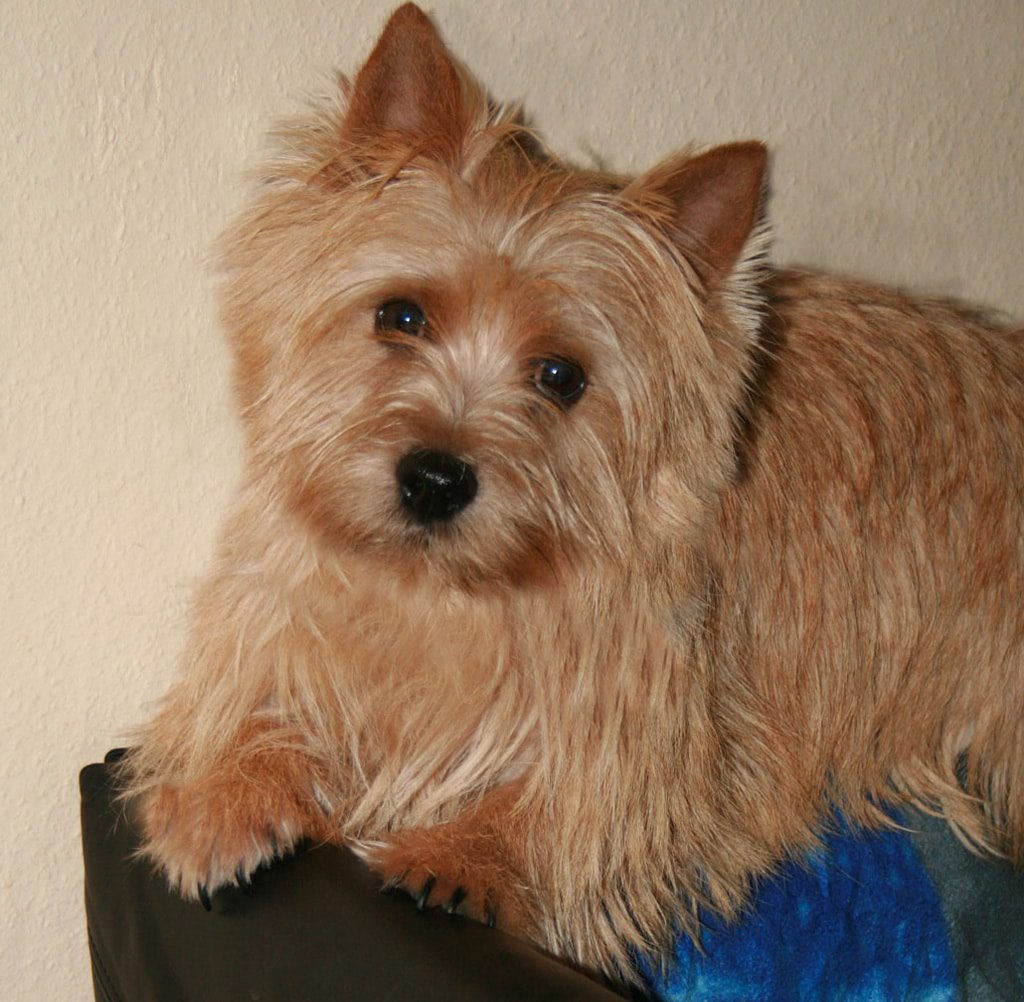
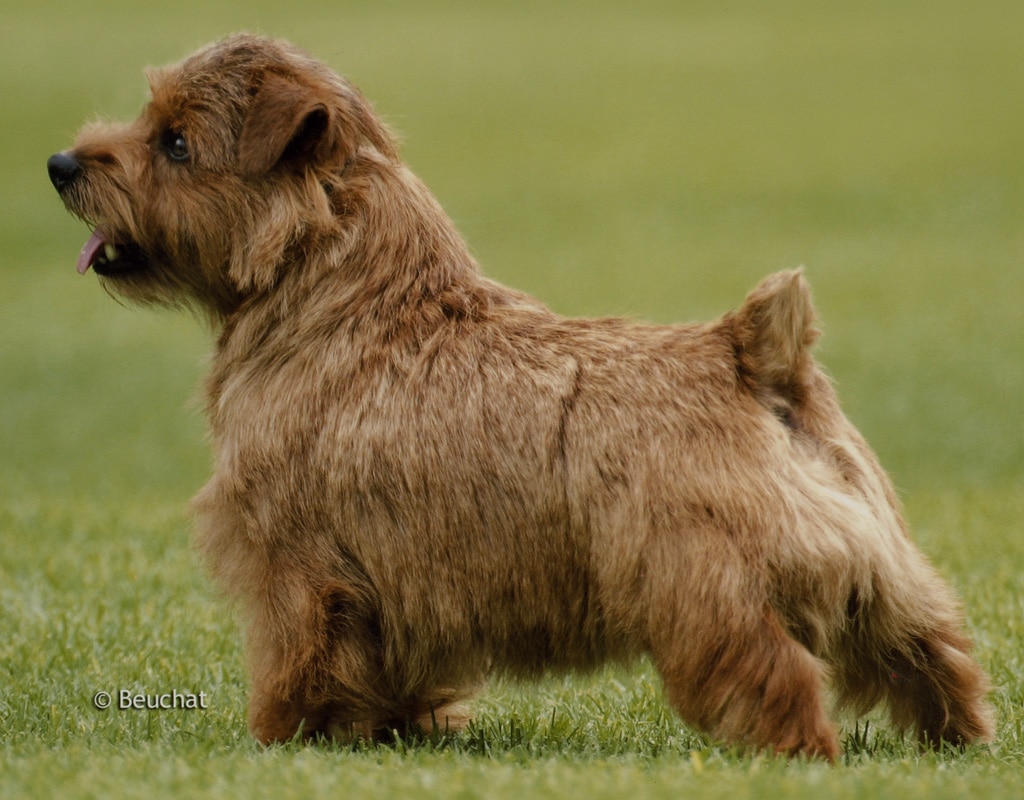
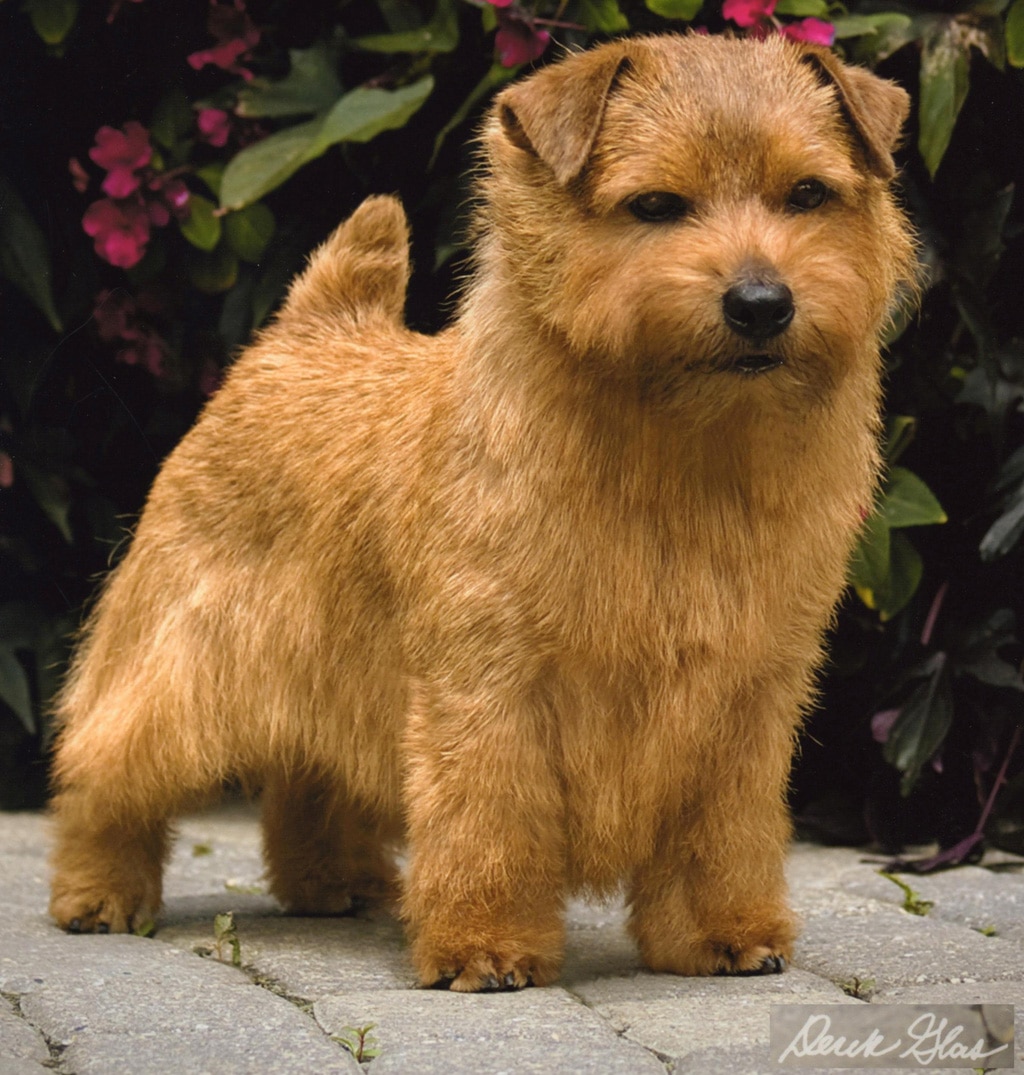
The Norwich Terrier, has lively character, joyful, affectionate and is curious by nature.

Content

History

One of the reasons there are so many Terrier breeds is because many were created to measure for a given area or population.. The Norwich comes from the East Anglia of England, Cambridge University Headquarters. Like college students of any age, Cambridge students of the decade 1880 they thought it was a lot of fun betting on sporting events, including your dogs' mouseing skills. Los terrier, including those in yorkshire and ireland, they were bred to develop small red or black and tan dogs with a spirit of play. They were known as Terriers Trumpington.

A Trumpington named Rags, he was a stable dog near the city of Norwich, He had such a reputation as a buzzard that he had a profound influence on what would become known as Norwich Terrier. Rags and their descendants were crossed with other Terriers, including a small Staffordshire Terrier, and became known for a new skill: get foxes out of their burrows.

Since the 19th century there are documented sources that confirm the breeding of the Norwich Terrier. But, At that time there was also Norfolk Terrier, which is closely related to the Norwich Terrier. Back then it was considered the same race, nowadays they differ in insignificant points. Since the decade of 1960 the two races have been handled differently.

A particularly different trait is the ears, in the Norwich Terrier tend to be more upright, While in the Norfolk Terrier they are slightly bent. After many years of upbringing, you can see some character differences. The Norwich Terrier, for example, is considered more affectionate than the Norfolk Terrier. At that time animals were especially used as rat catchers and were often used on farms.

Physical characteristics

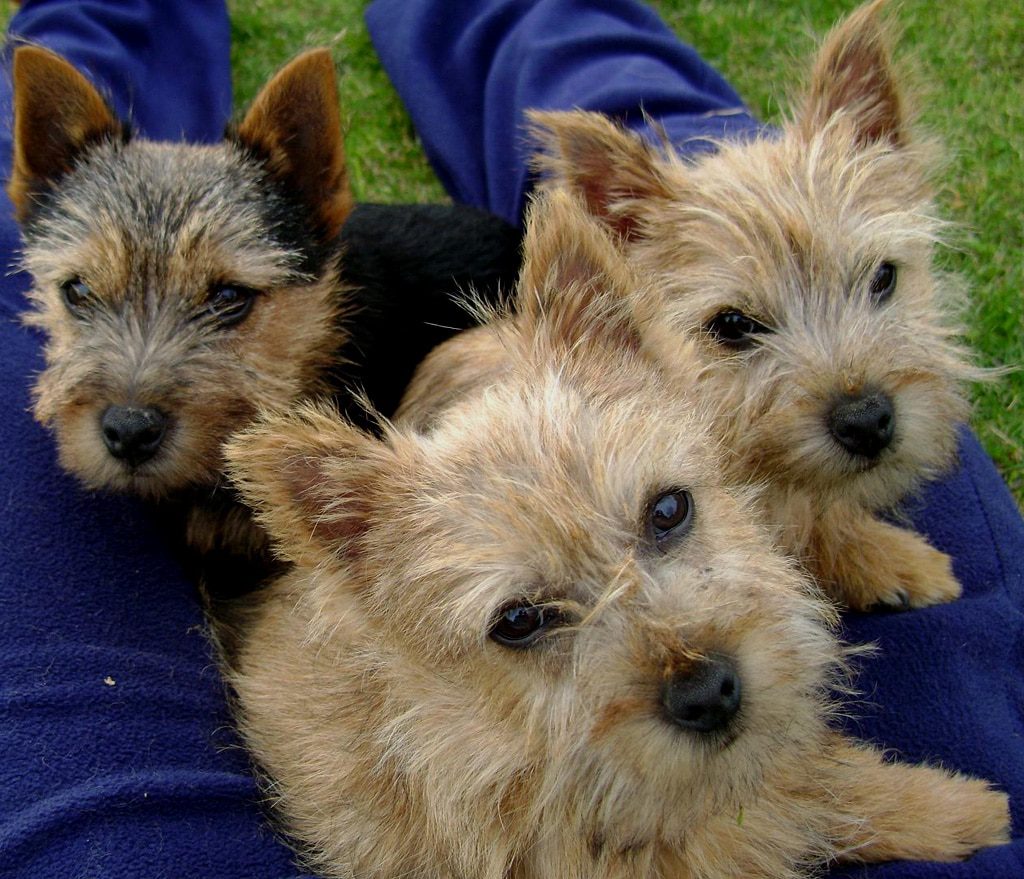
It is one the smaller Terrier its height is maximum 25 cm the cross and his weight is between 5 and 5.5 kg.

Recently on United States, There has been a great fraud with these dogs, they sold fake Norwich Terriers with pedigree, by Internet.

Son difficult to create because their births tend to be by caesarean section. His cloak is twofold and can be red, Red wheat, Black fire or salt and pepper (grey).

Norwich Terrier has a fur two layers, a foreign finish hard, rough and a warm and soft layer, attached to the skin.

Ideally, styling it once a week to remove the loose hairs killed.

As minimum, the hair should be stripped once in the fall and once in the spring.

Observations

The cut or Court it adversely affects the appearance of the natural colors of the layer and texture.

Character and skills

The Norwich Terrier, they have a character lively, joyful, loving and they are curious by nature.

One advantage is that they are not anti-social dogs or they tend to show aggressiveness.

They were originally bred to hunt burrowing animals but today they have become excellent companion animals..

These small but sturdy dog, brave, Smart and very loving. They were bred for chasing varmints and accompanied their owners farmers on horseback. A good daily walk is therefore, the minimum necessary to meet exercise requirements, and give a healthy lifestyle.

They are sensitive to the scolding, as the 100% Terrier. Much like family life, and very little loneliness. It is not meaningless ladrador, But if you notice something strange, It will be.

It is a dog that She loves children. They adapt perfectly to other pets.

The life expectancy the Norwich Terrier is 12 to 16 years.

Characteristics "Norwich Terrier"

Coexistence is important that you have with your new friend. Before considering the acquisition of a dog of the breed "Norwich Terrier" you know certain factors. Not all breeds of dogs are apt to live in an apartment, you must take into account his character, their need for exercise, their interaction with other pets, their care and if you have small children, their level of tolerance towards them.

Adaptation ⓘ

5,0 of 5 stars (based on 1 review)

friendly dog ​​ⓘ

5,0 of 5 stars (based on 1 review)

hair loss ⓘ

2,0 of 5 stars (based on 1 review)

Affection level ⓘ

4,0 of 5 stars (based on 1 review)

Need for exercise ⓘ

4,0 of 5 stars (based on 1 review)

Social need ⓘ

3,0 of 5 stars (based on 1 review)

Home ⓘ

4,0 of 5 stars (based on 1 review)

Toilet ⓘ

3,0 of 5 stars (based on 1 review)

Friendly with strangers ⓘ

2,0 of 5 stars (based on 1 review)

barking ⓘ

4,0 of 5 stars (based on 1 review)

Health ⓘ

2,0 of 5 stars (based on 1 review)

Territorial ⓘ

3,0 of 5 stars (based on 1 review)

Cat friendly ⓘ

4,0 of 5 stars (based on 1 review)

Intelligence ⓘ

4,0 of 5 stars (based on 1 review)

Versatility ⓘ

2,0 of 5 stars (based on 1 review)

Child friendly ⓘ

4,0 of 5 stars (based on 1 review)

Surveillance ⓘ

4,0 of 5 stars (based on 1 review)

joy ⓘ

3,0 of 5 stars (based on 1 review)

Norwich Terrier Images

Norwich Terrier Videos

Type and recognitions:

  • FCI CLASSIFICATION:
  • Group :
  • Section : . .

Federations:

  • – FCI – Terriers 2 Small sized Terriers. ⓘ
  • – AKC – Terriers ⓘ
  • – ANKC – Terriers ⓘ
  • – CKC – Terriers ⓘ
  • – ​KC – Terriers ⓘ
  • – NZKC – Terriers ⓘ
  • – UKC – Terriers ⓘ

FCI breed standard "Norwich Terrier"

Origin:
United Kingdom

Date of publication of the valid original standard:
13.10.2010.

Use:

Terrier


General appearance:

One of the smallest terriers. It's a cunning dog, short limb, compact and strong, with good structure and skeleton. Honorable scars resulting from deterioration and natural tears should not be unfairly penalized.


Behavior / temperament:

One of the smallest ground dogs. Loving but not quarrelsome, tremendously active and robustly built. Cheerful and brave.

Head:

---

Cranial region:
  • Skull: Wide and slightly rounded, with good width between the ears.
  • Depression links (Stop): Well defined.

facial region:

  • Snout: Strong and wedge-shaped (its length is less than a third of the distance measured from the occipital to the base of the naso-frontal depression).
  • Lips: Glued.
  • Jaws / Teeth: Strong and sharp jaws. Pretty big teeth, strong, with healthy teeth, complete and scissor bite, that is to say, that the inner face of the upper incisors is in close contact with the outer face of the lower incisors; the teeth should be set at right angles in the jaws.
  • Eyes: relativelysmall, oval-shaped, dark, full of expression, bright and lively.
  • Ears: erect, placed well apart on the skull. Medium-sized and pointed. When the dog is excited he carries them perfectly erect and can throw them back when he is not attentive.

Neck:

Strong and of good length, in proportion to the overall balance of the dog, and it descends harmoniously towards the well inclined shoulders.

Body:

Compact

  • top line: Level.
  • Back: Short
  • Pork loin: Short.
  • Breast : Long, well-rounded chest. With good depth.

Tail:

Previously optional tail amputation.
  • Medium amputation: High implementation, completing a perfectly level dorsal line. Carried upright.
  • Without amputation: Tail of moderate length to give the dog a general balance, thick at the base and is tuned toward the tip, as straight as possible, live, but not too happy, completing a perfectly level dorsal line.


Tips

PREVIOUS MEMBERS:

  • Elbows: Glued to the body.
  • Forearm: Short limbs, powerful and straight.
  • Metacarpus: Firm and straight.
  • Previous feet: Round, with thick, cat-like foot pads. Headed straight forward when the dog moves or stands.

LATER MEMBERS:

  • General appearance: Widths, strong and muscular.
  • Knee : good angulation.
  • Metatarsus: Hockslowered with great pushing capacity.
  • Hind feet: Round, with thick, cat-like foot pads. Headed straight forward when the dog moves or stands.

Movement:

The forelimbs should move forward in a straight line when the dog is moving.; the hind limbs follow the tread of the forelimbs; hocks are parallel and flex to show pads.

Mantle

  • Fur: Lasted, rough texture, straight and close to the body, with a dense undercoat. Longer and rougher at the neck forming a collar that frames the face. The hair on the head and ears is short and straight, except for slight eyebrows and a mustache.
  • Color: All shades of red, wheat, black and Tan or grey. Stains or white markings are undesirable.


Size and weight:

The ideal height to cross is between 25 cm..


Fouls:

Any deviation from the aforementioned criteria is considered as a fault and the severity of this is considered to the degree of the deviation to the standard and its consequences on the health and well-being of the dog..

FALTAS DESCALIFICANTES:

  1. Aggressiveness or extreme shyness.
  2. Any dog ​​showing clear signs of physical or behavioral abnormalities must be disqualified..


N.B.:
  1. Males should have two normal-appearing testicles fully descended into the scrotum..
  2. Only functionally and clinically healthy dogs, with the typical conformation of the breed, should be used for parenting.

The latest changes are in bold.

TRANSLATION: Brígida Nestler / Original version: (IN) Technical supervision: Miguel Angel Martinez

Source: F.C.I - International Cynological Federation

Alternative names:

1. Norwich (English).
2. Norwich (French).
3. Norwich (German).
4. Norwich (Portuguese).
5. Terrier de Norwich (español).

▷ The world of Pets: Dogs, cats, birds, reptiles, amphibians

German Hunting Terrier
Alemania FCI 103 - Large and medium sized Terriers

Jagdterrier

The German Hunting Terrier is in no way suitable exclusively as a companion or family dog.

Content

History

The German Hunting Terrier he is a high performance terrier. There are two varieties of it, the of wire hair and the of smooth hair. He is essentially a descendant of Fox Terrier. After World War I, some active hunters broke away from the Club de Fox Terrier to create a breed that would be oriented exclusively to hunting performance. This was successful and thus the German Hunting Terrier Club in 1926. Under the leadership of Dr. Herbert Lackner the new race, the German Hunting Terrier, was established systematically and finally very successfully.

After a separation from the brood of almost 100 years, you can certainly talk about a new breed today. It also, you can clearly see it in its appearance and also in the nature of this professional hunting dog. But, remained a terrier. One German Hunting Terrier you must be very brave, fearless and defensive. Must be able to work boar hunting without problems, which is one of the most difficult and dangerous tasks a hunting dog can master. Even today the German Hunting Terrier is still a highly prized hunting dog. Has become a versatile hunting assistant. Among other things, It is used very successfully in wild boar hunts., where it excels with amazing performances. His tireless work eagerness and leadership are especially appreciated while hunting..

The German Hunting Terrier he is fearless and with every fiber of his being he strives to do his job as well as possible. The German Hunting Terrier has been conceived as a breed from birth by hunters for hunters. Therefore, given exclusively to hunters. It is still successfully served today by the "Deutscher Jagdterrier-Club" in the VDH (German Canine Federation). It is exclusively cared for by breeders affiliated with this club. The breed is highly valued and popular with German hunters.

Physical characteristics

The German Hunting Terrier it is a small to medium sized dog with a distinctive appearance. He is a high speed terrier. Has an awake expression, well trained and full of tension, which leaves no doubt that you are always ready for an adventure. This is underlined by its wedge-shaped but not pointy skull, his deep and determined eyes and his ears leaned forward.

The standard briefly describes it:

The German Hunting Terrier is a small, generally black and red, compact and shapely hunting utility dog.

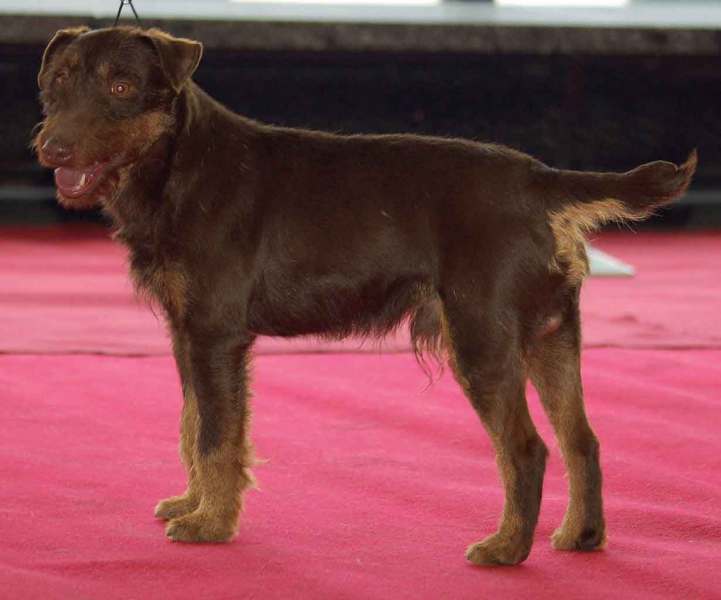
The small dog has a height at the cross of 33 to 40 centimeters in both male and female dogs. But, bitches should be a little bit lighter. In males, the weight, is of some 9 to 10 kg, in females 7,5 to 8,5. In the standard it says briefly, according to the proportions, neither too light nor too heavy. The German Hunting Terrierhas always been available in two types of fur: smooth hair, dense, hard and rough or thick straight hair. Its color is black, dark brown or black-gray mottled with red-yellow spots, very well defined clean marks.

Character and skills

The German Hunting Terrier is a thoroughbred hunting dog for the practicing hunter. The Hunter Terrier it's a power pack. It's not for people who imagine a potato-trainer. It is by no means exclusively suitable as a companion or family dog.. His history and highly developed hunting skills should also be on the mind of the non-hunter, when you think about keeping German Hunting Terrier as a companion dog. Can be a charming companion and family dog ​​fond of children, but only on the basis of its species-appropriate use as a hunting dog. Here he is shown as a First Class Hunting Helper, who convinces again and again for his performance.

The German Hunting Terrier it's hard and persistent, easy to handle and calm and especially for a Terrier quite compatible with other dogs. The official FCI standard describes its character in this way:

The German Hunting Terrier is brave and tough, eager to work and persevere, vital and energetic, reliable, sociable and manageable, neither shy nor aggressive.

The breed attaches great importance to suitability for hunting, firmness of character, hunting intelligence, fearlessness and low sensitivity. Must be a versatile dog, hard, noisy and water-loving with a pronounced hunting instinct and excellent training ability. Your determination, vitality, high intelligence and close relationship with his master and caretaker make him a very interesting companion, but also demanding.

Education German Hunting Terrier

This breed of dog can be very well educated and trained.. The clear announcement and the consequence are the miracle words here based on a respectful and loving relationship with the master or caretaker.. This terrier has been bred for many generations for its performance and good training ability. Only dogs that perform excellently here are used for breeding. For you, as your caregiver, this is both an opportunity and an obligation. With experience, consistency and a clear statement based on a trusting and emotionally positive bond, you can achieve everything with it.

German Hunting Terrier health and care

These German hunting terriers are extremely easy to care for. Brushing here and there is enough. His health is very robust.

Nutrition / Food

Feeding a German Hunter Terrier has no problems.

The life expectancy of the German Hunting Terrier

as a rule, the German Hunting Terrier enjoys a long and vital canine life, often over 12 years.

Buy German Hunting Terrier

If you are looking for a German Hunter Terrier, must contact a hunter, Ranger or breeder who is a member of the Club German Hunting Terrier long before I plan to buy one. Dogs are normally only given to hunters. Here and there it can happen that a dog looks for another place. But then you should be able and willing to give him species-appropriate living conditions.. A puppy of this breed of dog costs around 1.000 EUR.

Images "German Hunting Terrier"

Photos:

1 – Jagdterrier by No machine-readable author provided. Richard Huber assumed (based on copyright claims). / Public domain
2 – German Jagdterrier by Tux-Man / CC BY-SA
3 – Jagdterrier during dogs show in Katowice, Poland by Lilly M / CC BY-SA
4 – German Hunting Terrier during dogs show in Katowice, Poland by Pleple2000 / CC BY-SA
5 – Jagdterrier during dogs show in Katowice, Poland by Lilly M / CC BY-SA
6 – Jagdterrier by Pleple2000 / CC BY-SA

Videos "German Hunting Terrier"

Type and recognitions:

  • FCI CLASSIFICATION:
  • Group :
  • Section : . .

Federations:

  • – FCI – Terriers 1 Large and medium-sized terriers. ⓘ
  • – UKC ⓘ

FCI breed standard "German Hunting Terrier"

Origin:
Germany

Date of publication of the valid original standard:
19.03.2015.

Use:

Variable utility hunting dog, especially for hunting in burrows or for raising game.


General appearance:

It is a useful dog for hunting., small, reddish black, compact and well proportioned.

IMPORTANT PROPORTIONS:

  • Ratio between chest circumference / height of the cross: chest circumference is 10 to 12 cm greater than the height of the cross.
  • Body length / cross height: the body is a little longer than the height of the cross.
  • Chest depth / cross height: is approximately the 55-60% the height of the cross.


Behavior / temperament:

It is spirited and strong, likes work and is constant, full of vitality and temperament, reliable, docile and affable, He is not shy or aggressive.

Head:

Elongated, a little wedge-shaped, but not pointy. Muzzle a little shorter than the skull from the occipital protuberance to the frontal-nasal depression.

Cranial region:
  • Craging: Flat, broad skull between the ears. A little narrower between the eyes.
  • Ston: Poorly developed.

facial region:

  • Trufa: In relation to the muzzle it should not be too narrow nor too small; should not be divided; always black; if the primary coat color is brown, the truffle can also be that color.
  • Horcico: Powerful, well developed cheeks, deep and strong lower jaw, well delineated chin.
  • Labios: Well adherent and with good pigmentation.
  • Jaw/Bite/Teeth: Teeth are big. The jaw is powerful and has a perfect scissor bite, regular and complete, in which the upper incisors overlap the lower incisors without leaving space, and the teeth are upright in the maxilla. Should have 42 teeth according to the dental formula.
  • Ojors: dark, small, oval, sunken; with attached eyelids and determined expression.
  • Obars: Semi-upright so that the tips adhere lightly to the head, high insertion, not very small, “V” shaped.

Neck:

Strong, not too long, right next to the body; widens toward insertion with shoulders.

Body:

  • Línand the top: Straight.
  • Cruz: Marked.
  • Espalda: Strong, straight, not too short.
  • Pork loin: He has strong musculature.Rump: Very muscular, flat.
  • Torrax: Deep, well arched ribs, not very wide; long sternum; the ribs, well bowed, directed back.
  • Línand the bottom: Forms an elegant backward arch, short and firm flanks, slightly retracted belly.

Tail:

With good insertion in the long rump, shortened by about a third of its length. Can be carried slightly less upright than vertically straight, must not be leaning on the back. (In countries where laws prohibit tail docking, it can remain natural and in that case it must be carried horizontally or in the form of a saber).

Tips

PREVIOUS MEMBERS

  • Apgeneral arience: The forelimbs, front views, straight and parallel are observed; from the sides they look plumb under the body. The distance from the floor to the elbow is almost the same as from the elbow to the withers.
  • Hormbros: Long scapula, well oblique and directed backwards; muscular shoulders. Good angulation between the scapula and the arm.
  • Brazo: It is as long as possible, slim with good muscles.Elbows: Glued to the body, no deviations outwards or inwards. Good angulation between the arm and forearm.
  • Antarm: Delgado, vertical, with robust bones.
  • Articulation of the carpus: Strong.
  • Metacarpus: Slightly leaning forward, skeleton rather robust than fragile.
  • Pinis previous: Frequently wider than later ones, with fingers close together, and thick enough pads, hard, strong and well pigmented. Feet are placed on the floor in parallel; no deviations outwards or inwards both when standing and during movement.

LATER MEMBERS:

  • Apgeneral arience: Viewed from behind they are straight and parallel. They have good angulations between the thigh and the leg, as well as between the leg and the metatarsus. Strong bones.
  • Thigh: Long, wide and muscular.
  • Rodinllto: Strong, with good angulation between the thigh and the leg.Leg: Long, muscular and tendon.
  • Atibio-tarsal articulation: Strong and deep.
  • Metatarsus: Short and vertical.
  • Pinis later: Oval, almost round, with fingers close together and pads thick enough, hard, strong and well pigmented. They step in parallel both standing and in motion and do not show deviations towards the inside or outside.

Movement:

It covers the ground, with good progress and momentum; is fluid; fore and hind limbs are kept straight and parallel, no strides.

Mantle

PIEL: Thick, very attached, without forming folds.

MANTLE

Plink: Rough fur, hard, dense and straight or straight and straight hair.

Colorr: Color is black, dark brown or grayish black mixed with clean markings, well outlined reddish yellow over the eyes (eyebrows), snout, chest, limbs and around the anus. A light or dark mask is also allowed; a small white mark is tolerated on the chest and on the fingers.


Size and weight:

Height of the cross:

  • Males: 33 to 40 cm.
  • females: 33 to 40 cm.

Weight: Acorresponds to the relation with the height, not too light and not too heavy.


Fouls:

Any deviation from the aforementioned criteria is considered as a fault and the severity of this is considered to the degree of the deviation to the standard and its consequences on the health and well-being of the dog.and the dog's ability to perform its traditional task.

FALTAS GRAVES:

  • Narrow skull; narrow or pointed snout.
  • Fleeing Jaw, close.
  • Weak teeth, any irregular position of the incisor
  • light eyes, too big or prominent.
  • erect ears, floating, too thick, insertion too low
  • Steep anterior limb
  • Overdue or carp back, too short.
  • Short sternum.
  • Sill seen from the front too narrow or wide.
  • Steep hind limb, too high.
  • Elbows strongly turned in or out.
  • Fingers too close together or apart; cow hocks, in the shape of an “O” or in a narrow position, both standing and moving.
  • crushed feet, cat feet, hare foot.
  • Tail tilted forward, insertion too low, hanging tail.
  • Short hair, woolly, fine, not adhered to the skin.
  • Hairless belly and inner thighs

FALTAS DISQUALIFYING:

  • Aggressiveness or extreme shyness.
  • Any dog ​​showing clear signs of physical or behavioral abnormalities must be disqualified..
  • Atypical dogs
  • Upper or lower prognathism, deflected bite, partial or complete clamp bite, crossbite, irregularly placed teethon the top and/or bottom line, absence of teeth except M3.
  • Lack of pigmentation.
  • Entropion, ectropion, different colored eyes (anisochromia), blue or splattered eyes
  • Unauthorized coat colors
  • Height at the withers less than 33 cm and greater than 40 cm..


N.B.:
  • Males should have two normal-appearing testicles fully descended into the scrotum..
  • Only functionally and clinically healthy dogs, with the typical conformation of the breed, should be used for parenting.
  • Itlatest changes are in bold.

TRANSLATION: Brígida Nestler.
Technical supervision: SR. Miguel A. Martínez.

Source: F.C.I - International Cynological Federation

Alternative names:

1. Deutscher Jagdterrier, German Jagdterrier, German Hunting Terrier, German Hunt Terrier, Jagdterrier (English).
2. Jagdterrier (French).
3. Jagdterrier (German).
4. Jagdterrier (Portuguese).
5. Terrier alemán de caza, Terrier alemán (español).

▷ The world of Pets: Dogs, cats, birds, reptiles, amphibians

Jack Russell Terrier
Gran Bretañaa FCI 345 . Small sized Terriers.

Jack Russell Terrier

He has a bold and cheerful disposition and always appears full of self-confidence..

Content

History

The Jack Russel Terrier comes like most terrier breeds from England. It was first bred there more than 150 years by theologian John Russel. The future pastor had the nickname "Jack.", for which the dog breed was also named later. John Russel pursued the goal of creating a fox hunting terrier by crossing with other breeds. This should not only hunt foxes and other animals, but also chase them into their burrow and drive them out again.

Over the years, two types of Russel Terrier, a medium-sized variant, the Parson Russel Terrier, and another one of smaller size, the Jack Russel Terrier described here. The small-sized variant found its followers mainly in Australia, who used it mostly for hunting in rabbit holes. Due to crossbreeding with other breeds and exclusive breeding for hunting purposes, recognition as an independent race came relatively late.

So the dog was first listed by the Australian National Kennel Council in 1991 and in the year 2000 was recognized by the FCI.

Physical characteristics

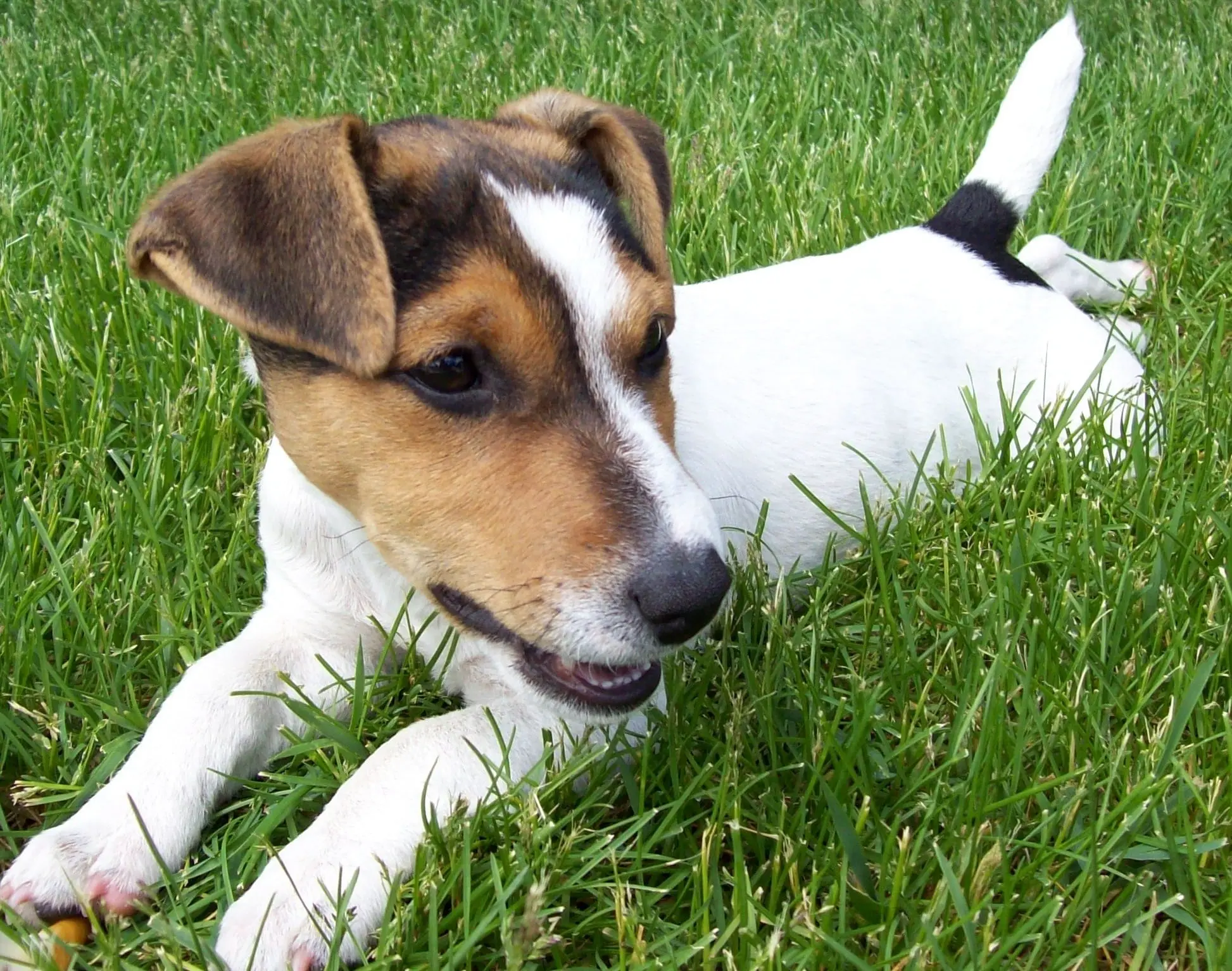
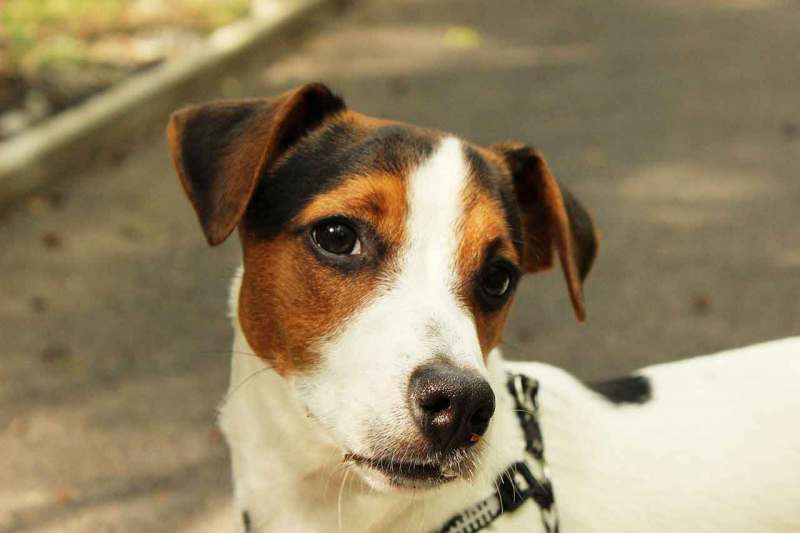
The appearance of the Jack Russel Terrier it is relatively easy to recognize. So he has a coat covered mostly in white, that bears black or brown markings. A completely white coat is also theoretically possible, but quite rare. The hairs are short and can be straight or coarse.

The Jack Russel Terrier it has an almost rectangular body shape and a height at the withers of up to 30 cm.. So, is on average 5 cm smaller than its direct relative, the Parson Russel Terrier. The weight of a Jack Russel Terrier can vary between 7 and 10 kg. The head of the Jack Russel it is quite thin and flat built. The dog's eyes are almond shaped and are normally surrounded by black eyelid edges.

Variedades «Jack Russel Terrier»

Jack Russell Terrier smooth hair
Jack Russell Terrier by the fence
Jack Russell Terrier through the fence
jack russell terrier hard hair
  • Straight hair variety
  • Wired hair variety
  • Wire hair variety

Character and skills

The Jack Russel Terrier he is an agile and lively dog ​​who loves to run in nature. He has a healthy self-confidence and is very brave.. Although her legs seem relatively short, loves to take long walks in nature. The dog is charged with energy and needs his run. In addition to sports activities, the dog also wants to be challenged on a mental level. One can make this possible thanks to sports modalities such as "Agility.". There he is with total commitment and tirelessly pursues his goal.

At the same time, the Jack Russel Terrier also very suitable as a family dog. In a calm and familiar environment, the dog is child friendly and has a social mindset.

Keeping and feeding a Jack Russel Terrier

Although the Jack Russel Terrier it's a smaller dog, there is a lot of power in him. The hunting instinct remains firmly anchored in it. You need to exercise a lot outdoors in nature. The Jack Russel it is a dog that needs to be encouraged and challenged by its owner. To push the dog to its limits, dog sports like agility are ideal.
Keeping the dog in an apartment is usually not a problem. But, it is practical to have a large garden in which the terrier can let off steam in between. The Jack Russel he is also a super family dog, that with the right training you will become a loving family member.

The Jack Russel Terrier usually has no special food preferences. It is important that the dog is fed a balanced diet. This means that the diet is based on a combination of a high meat content plus the addition of vegetables, fruits and cereals. The choice between dry or wet food is left to each owner. The food ration should be adapted to the size and workload of the dog.

Education and care of the Jack Russel Terrier

The Jack Russel Terriers they need a loving and consistent education. Already with the puppy you must define the rules and limits of coexistence. This is how the foundations of a common future are laid. Early neglect will regret later. The Jack Russel Terrier is an intelligent dog that wants to be challenged. So, it is important that you have the reins clearly in hand when dealing with the dog.

Due to its origin as a hunting dog, wants the guidance of its owner. Clear instructions and a system of positive rewards will be the best to encourage the dog in his development. With adequate training and if the dog is sufficiently exercised, adapts very well as a family dog ​​and integrates into it in an exemplary way.

Caring for a Jack Russel Terrier it is not usually complicated. In the rough-haired or hard-haired variety, the coat should be trimmed occasionally. Otherwise, brushing regularly is highly recommended. The dog can be cleaned with a damp cloth. The shampoo should not normally be used as it attacks the natural protection of the coat and skin.. In case of strong odors and a high level of dirt, a mild dog shampoo should be used.

Typical health and illnesses

The small quadrupeds are, Unfortunately, often very susceptible to disease. So, You should have a vet examine your dog as often as possible and parents undergo an examination for possible inherited diseases before purchasing. The possible clinical pictures with the Jack Russel Terrier are: Ataxia and myelopathy, atopia, dermatophytosis, cataract and catarrh, as well as other hereditary diseases.

Jack Russel Terrier life expectancy

The life expectancy of Terriers Jack Russel is of some 15-18 years.

Buy the Jack Russel Terrier breed

The Jack Russel Terriers can be purchased from numerous breeders. But, before buying, must ensure that the breeder is officially recognized. The Jack Russel Terrier responsible parenting can be obtained from a price of about 500 EUR.

Characteristics "Jack Russell Terrier"

Coexistence is important that you have with your new friend. Before considering the acquisition of a dog of the breed "Jack Russell Terrier" you know certain factors. Not all breeds of dogs are apt to live in an apartment, you must take into account his character, their need for exercise, their interaction with other pets, their care and if you have small children, their level of tolerance towards them.

Adaptation ⓘ

5,0 of 5 stars (based on 1 review)

friendly dog ​​ⓘ

1,0 of 5 stars (based on 1 review)

hair loss ⓘ

3,0 of 5 stars (based on 1 review)

Affection level ⓘ

5,0 of 5 stars (based on 1 review)

Need for exercise ⓘ

5,0 of 5 stars (based on 1 review)

Social need ⓘ

3,0 of 5 stars (based on 1 review)

Home ⓘ

1,0 of 5 stars (based on 1 review)

Toilet ⓘ

2,0 of 5 stars (based on 1 review)

Friendly with strangers ⓘ

3,0 of 5 stars (based on 1 review)

barking ⓘ

5,0 of 5 stars (based on 1 review)

Health ⓘ

3,0 of 5 stars (based on 1 review)

Territorial ⓘ

5,0 of 5 stars (based on 1 review)

Cat friendly ⓘ

1,0 of 5 stars (based on 1 review)

Intelligence ⓘ

5,0 of 5 stars (based on 1 review)

Versatility ⓘ

5,0 of 5 stars (based on 1 review)

Child friendly ⓘ

3,0 of 5 stars (based on 1 review)

Surveillance ⓘ

5,0 of 5 stars (based on 1 review)

joy ⓘ

5,0 of 5 stars (based on 1 review)

Images "Jack Russell Terrier"

Photos:

1 – Rough coat Jack Russell terrier by Sellys / CC BY-SA
2 . Jack Russell Terrier by Plank / CC BY
3 – Jack Russell Terrier by Steve-65 / CC BY-SA
4 – Portrait of Jack Russell Terrier in a park by Ria / CC BY-SA
5 – Jack Russell Terrier by DuncanMcC / Public domain
6 – Jack Russell Terrier by Plank / CC BY

Videos "Jack Russell Terrier"

Type and recognitions:

  • FCI CLASSIFICATION:
  • Group :
  • Section : . .

Federations:

  • – FCI – Terriers 2 Small sized Terriers. ⓘ
  • – AKC – Terriers ⓘ
  • – ANKC – Terriers ⓘ
  • – ​KC – Terriers ⓘ
  • – NZKC – Terriers ⓘ
  • – UKC – Terriers ⓘ

FCI breed standard "Jack Russell Terrier"

Origin:
United Kingdom

Date of publication of the valid original standard:
08.10.2012

Use:

A good working Terrier with the ability to go down to earth. An excellent companion dog


General appearance:

A strong working terrier, Active, of great character, with flexible body, long Middle. His deft movement matches his keen expression. The tail cut is optional and the coat can be short, hard or brittle.

PROPIMPORTANT ORTIONS: The dog as a whole is longer than tall, that is rectangular.

The depth of the body from the cross to the chest should be equal to the length of the front leg from the elbow to the ground. The circumference behind the elbows should be 40 to 43 cm..


Behavior / temperament:

Terrier vivaz, alert and active, with a sharp and intelligent expression. Bold and intrepid, friendly but quietly safe.

Head:

---

Cranial region:
  • Craging: The skull should be flat and of moderate width., gradually decreasing its width towards the eyes and thinning towards a wide muzzle.
  • Dfronto-nasal depression (Stop): Well defined but not pronounced.

facial region:

  • Trufa: black.
  • Horcico: The length from the stop to the truffle should be slightly shorter than the stop to the occiput.
  • Labios: Tight and pigmented in black.
  • Jaws / Teeth: Very strong, deep wide and powerful. Strong teeth closing in scissors.
  • Ojors: Small dark and with sharp expression. MUST NOT be prominent and must have well-attached eyelids. The edge of the eyelids must be pigmented in black. Almond biscuits.
  • Obars: Ears that are semi-droopy or fall forward, covering the external auditory canal, good texture and great mobility.
  • Cheeks: Cheek muscles should be well developed.

Neck:

Strong and clean allowing the head to be carried with balance.

Body:

  • Línand the top: Level. The length from the withers to the tail insert is somewhat greater than the height from the withers.
  • Itmor: Kidney region should be short, strong and very muscular.
  • Pecho: Chest deeper than wide, with good clarity from the floor, allowing the chest to be halfway down the cross to the ground. Ribs must be well arched from the spine, flattening to the sides so that the periphery behind the elbows can be held by two hands – approx.. 40 to 43 cm.. Point of the sternum clearly in front of the point of the shoulder.

Tail:

You can lower it at rest. In movement it must be erect and if it is cut the tip must be at the same level as the ears.

Tips

PREVIOUS MEMBERS:

  • Hormbros (Blades): Well sloped and not heavily muscled.
  • Brazos (Humerus): Long and angled enough to ensure that the elbows are positioned under the body.
  • Antarms: Straight bone from elbow to foot, seen from the front or side.
  • Pinis previous: Round, strong, padded, not big, moderately arched fingers, without turning in or out.

LATER MEMBERS:

  • ApGeneral arience: Strong and muscular, balanced in proportion to the scapulae.
  • Rodinllto: Well angled.
  • Corvejón: Close to the ground.
  • Metatarsals: Parallel when seen from behind and the specimen is standing freely.
  • Pinis later: Round, strong, padded, not big, moderately arched fingers, without turning in or out.

Movement:

Cash, free and elastic.

Mantle

Plink: Can be short, brittle or hard. Must be water resistant. The mantles must not be altered (ripped) to appear short or brittle.

Colorr: White must predominate, with black markingsand/orfire (tan). Fire markings can range from the palest to the strongest (Brown).


Size and weight:

Alturto ideal to the cross:

25 cm to 30 cm..

Pthat: The equivalent to 1 kg of weight per 5 height cm.

Example: a dog of 25 cm should weigh approx. 5 kg and a dog 30 cm must weigh 6 kg.


Fouls:

Any deviation from the aforementioned criteria is considered as a fault and the severity of this is considered to the degree of the deviation to the standard and its consequences on the health and well-being of the dog.and the dog's ability to perform its traditional task.

  • Lack of true Terrier characteristics
  • Lack of balance, example: over angle of any point
  • Heavy or shaky motion.
  • Defective denture.

FALTAS DISQUALIFYING:

  • Agextreme shyness.
  • Any dog ​​showing clear signs of physical or behavioral abnormalities must be disqualified..


N.B.:
  • Males should have two normal-appearing testicles fully descended into the scrotum..
  • Only functionally and clinically healthy dogs, with the typical conformation of the breed, should be used for parenting.

Itlatest changes are in bold.

TRADUCCION: J.Nallem (KCU) Suptechnical supervision: M.A. Martínez (FCA)

Source: F.C.I - International Cynological Federation

Alternative names:

1. JRT, Jack (English).
2. Jack Russell (French).
3. Jack Russell (German).
4. Jack Russell (Portuguese).
5. JRT, Jack (español).

▷ The world of Pets: Dogs, cats, birds, reptiles, amphibians

Irish Terrier
Irlanda FCI 139 . Large and medium sized Terriers

Terrier Irlandés

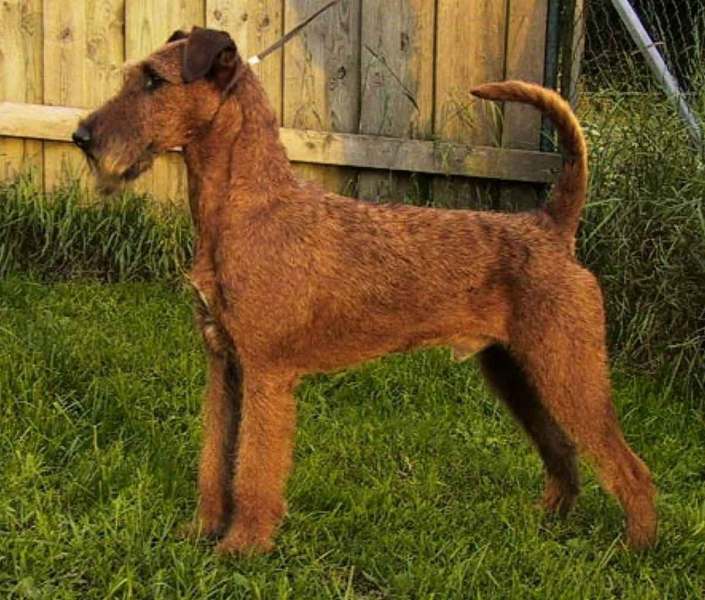
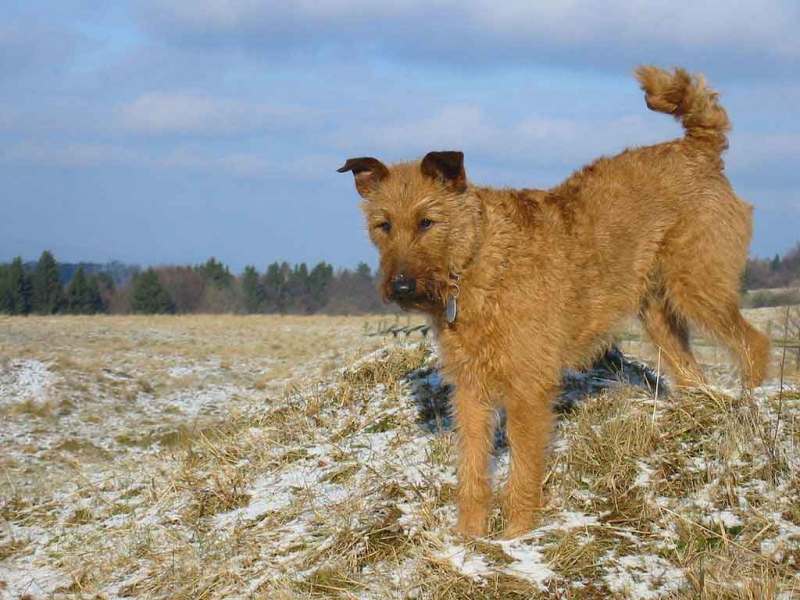
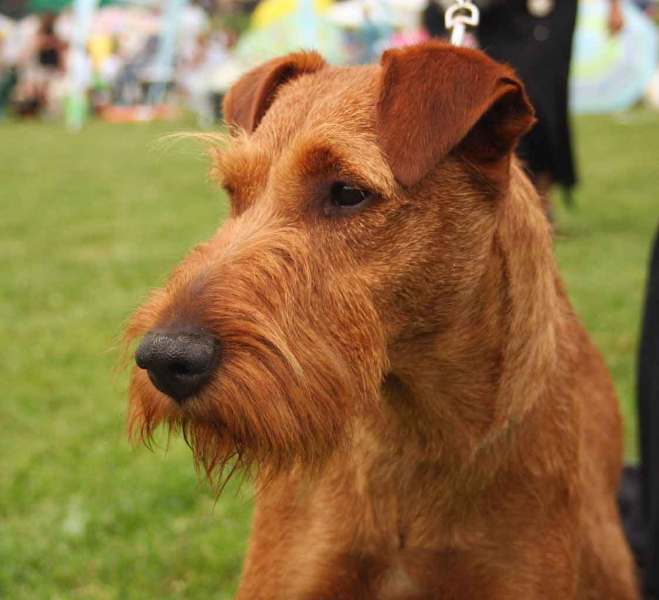
The Irish Terrier it is a dog of pleasant appearance and endowed with an exceptional character.

Content

History

Where did the "Irish Terrier" originally come from??

The "Irish Terrier", he is a high-ranking terrier. It is often called the "Red Irishman" for its distinctive reddish coat.. Its roots are, as in all terriers, a little on the ground. The name Terrier is derived from the Latin «Terra» for the earth. So they were dogs for movement on land and underground.

High-ranking terriers were supposed to run with the pack on fox hunts. When a fox took refuge in its burrow, the terriers had to chase him underground and get him out of the burrow, as it is called in the language of the hunters. One can imagine that the fox, after all a well fortified predator, does not voluntarily abandon its burrow. so a Irish Terrier I had to be very brave, fearless and defensive. Even today the "Red Irish" are hunting dogs in their hearts. They are not afraid and with every fiber they strive to do their job as well as possible. We can still experience all these qualities in the Irish Terrier as a companion dog.

They have a special charm but also the challenge of their ancestors.. But red Irish was also used in many different ways at home and on the farm.. He had to keep the yard free of mice and rats., protect chickens, pigeons and rabbits for the night of the martens and foxes. Finally, had to watch the farm and its inhabitants and, if necessary, protect them.

Ludwig Beckmann reported in 1895, in his two-volume work on the "Breeds of the Dog", that already in 1847 in Ireland they had begun to breed an independent terrier, the ancestor of the current Irish Terrier. At least that's what the Irish claimed, while the English for a long time dismissed this dog as a variety.

Until 1880 the color of the Irish Terrier was, in fact, still quite uneven. Only little by little did Irish breeders mark their dog with the red coat color as something special. But then it became very popular, even in England and especially in the US, where many Irish had emigrated. The first special breed club for Irish Terriers was founded very soon, the 31 in March of 1879 in Dublin. It was then the first race of Irish Terrier in being officially recognized by the British Kennel Club with Ireland as country of origin.

Physical characteristics

What is an "Irish Terrier" like??

The Irish Terrier it's a medium sized terrier, high-ranking and distinctive in appearance. This starts with their reddish fur. It is built almost square. The legs lower vertically, the long tail stands tall, the neck stretches up. The head, eyes and ears underline their alert appearance. You can feel that every fiber of his muscular body is under tension. The standard tells us…

…seem active, lively, agile and energetic and have a lot of substance without showing any clumsiness, because speed and endurance as well as strength are essential to the race. The Irish Terrier should not appear clumsy or amorphous; the contour of his body and figure must demonstrate speed, grace and fleetingness.

Their coat should be thick and lean in texture. Must be, according to technical jargon, broken or broken, that is to say, it should look tough and tough and, However, be extended. The head is also hairy, giving the impression of a beard. The "red Irish" must be uniformly red, wheat-red or yellow-red. Apart from color, the Irish Terrier reminds a bit of a small and elegant Airedale Terrier, which is also quite similar to him in character.

How tall is an "Irish Terrier"?

One Irish Terrier It has a height at the withers of about 45 centimeters with a weight of about 12 kg. Males are slightly larger and heavier than females.

How long does an "Irish Terrier" have??

as a rule, the Irish Terriers they enjoy a long canine life of more than 12 years in top physical condition.

Character and skills

The Irish Terrier it's a power pack. It is lively, alert, concise. Always attentive, vigilant, non-aggressive, but without fear and in an emergency you are also ready to fight. It is said that the Irish Terrier he is very hard on himself and would face dangers and even his own injuries with extreme contempt. It is still used as a working dog in its country of origin.. There he does a good job as a yard dog, guard and hunting. In today's hunting it is mainly used for post-shot work.. The official standard describes its character very accurately:

The Irish Terrier, although determined and able to face other dogs, is remarkably loyal, kind and affectionate with people; However, when he is attacked, show the courage of a lion and fight to the bitter end. It is wrongly said that the Irish Terrier he gets into fights with other dogs easily, sometimes even in the exhibition ring. Although it does not avoid any dispute when circumstances require it, the Irish Terrier it is easy to train and it is a sociable domestic dog; still embodies the qualities that, according to previous descriptions, They had made him the "guardian of the poor", "Friend of farmers and beloved of distinguished gentlemen.".

The Irish Terrier he is essentially a reckless and not a lapdog. But, nowadays it is doing very well as a companion and family dog. He is a faithful companion, vigilant, warm and loving for young and old, as long as one allows oneself and him the movement. It has a big character, self-confident and never submissive, that one should respect and appreciate. In his book about the Irishman "Jerry the Islander", the great writer Jack London expresses his respect for this great character in the following words: «Jerry, you are gold, pure gold, inside and outside, and no dog in the whole world can compete with you. You have a heart of gold, golden dog; be good to me and love me, and I will be good to you and I will love you now and always.".

Care and health «Irish Terrier»

The Irish Terriers they are very easy to care for. But, your coat should be professionally trimmed and should never be sheared. During clipping, three to four times a year, dead hair is professionally plucked.

Most Irish Terriers are in robust health. Here and there skin diseases occur (hiperqueratosis) or metabolic diseases (cistinuria). Sometimes inbreeding is a problem.

What food is best for an "Irish Terrier"?

The Irish Terrier has no special dietary needs. High quality food is of course good for your health. like most dogs, sometimes he likes a meaty beef bone.

Where can you buy an "Irish terrier"?

The best way to buy your puppy Irish Terrier is to buy it locally from a breeder registered with the FCI. You must have tested your dogs for the special risks of inherited diseases. There should also be no inbreeding, that can be estimated from the pedigree, if no name appears there twice. The breeder must have his litter well documented by photo. You should be able to see the litter along with the mother bitch, after the fix, in the place. Please, don't buy one Irish Terrier by Internet, because there is a high risk that the puppy will come from a dog vendor or breeder, normally well camouflaged.

Education and maintenance «Irish Terrier»

Keep a Irish Terrier It is not a problem. It has no demands regarding the size of the apartment. The biggest challenge is his temperament. The Irish Terriers they need challenges of a physical and mental nature.

As a companion dog they are suitable for a wide range of tasks.. They are very suitable for various dog sports. The Irish Terriers are well positioned as joggers or in moderation, companions of a cyclist. Their aptitude and willingness to work means both a challenge and an obligation to their masters and mistresses., and that in any weather.

They must be used to other pets from birth, otherwise they will be seen as prey. The Irish Terriers they are very suitable as playmates for children, since they are prepared for any adventure and are robust enough to play with children. But, the house rules must be correct and the terrier must know his role in the family. On the street he tends to fight with other dogs. Due to its moderate size, his low weight and his good obedience – properly trained – is a companion without problems in all life situations.

Can be carried very well in the transport box, if you've gotten used to it from a young age. The typical Irish Terrier can be trained and educated very well. The clear announcement and the consequence are the magic words here based on a respectful and loving relationship with the master or mistress. Its undoubted leadership role must always be present, otherwise the irishman thinks he has to handle things himself.

Characteristics "Irish Terrier"

Coexistence is important that you have with your new friend. Before considering the acquisition of a dog of the breed "Irish Terrier" you know certain factors. Not all breeds of dogs are apt to live in an apartment, you must take into account his character, their need for exercise, their interaction with other pets, their care and if you have small children, their level of tolerance towards them.

Adaptation ⓘ

5,0 of 5 stars (based on 1 review)

friendly dog ​​ⓘ

2,0 of 5 stars (based on 1 review)

hair loss ⓘ

2,0 of 5 stars (based on 1 review)

Affection level ⓘ

5,0 of 5 stars (based on 1 review)

Need for exercise ⓘ

4,0 of 5 stars (based on 1 review)

Social need ⓘ

4,0 of 5 stars (based on 1 review)

Home ⓘ

3,0 of 5 stars (based on 1 review)

Toilet ⓘ

3,0 of 5 stars (based on 1 review)

Friendly with strangers ⓘ

2,0 of 5 stars (based on 1 review)

barking ⓘ

4,0 of 5 stars (based on 1 review)

Health ⓘ

4,0 of 5 stars (based on 1 review)

Territorial ⓘ

5,0 of 5 stars (based on 1 review)

Cat friendly ⓘ

2,0 of 5 stars (based on 1 review)

Intelligence ⓘ

4,0 of 5 stars (based on 1 review)

Versatility ⓘ

2,0 of 5 stars (based on 1 review)

Child friendly ⓘ

4,0 of 5 stars (based on 1 review)

Surveillance ⓘ

4,0 of 5 stars (based on 1 review)

joy ⓘ

5,0 of 5 stars (based on 1 review)

Images "Irish Terrier"

Photos:

1 – Irish Red Terrier during dog’s show in Racibórz, Poland by https://commons.wikimedia.org/wiki/User:Pleple2000
2 – Irish Terrier by Batman1000 / CC BY-SA
3 – Irish Terrier by Anne Sollerud / CC BY
4 – Irish Terrier puppy by https://www.flickr.com/people/24649496@N00
5 – Irish Red Terrier during dog’s show in Racibórz, Poland by https://commons.wikimedia.org/wiki/User:Pleple2000
6 – Irish Red Terrier during dog’s show in Racibórz, Poland by Pleple2000 / CC BY-SA

Videos "Irish Terrier"

Type and recognitions:

  • FCI CLASSIFICATION:
  • Group :
  • Section : . .

Federations:

  • – FCI – Terriers 1 Large and medium-sized terriers. ⓘ
  • – AKC – Terrier ⓘ
  • – ANKC – Terrier ⓘ
  • – CKC – Terrier ⓘ
  • – ​KC – Terrier ⓘ
  • – NZKC – Terrier ⓘ
  • – UKC – Terrier ⓘ

FCI breed standard "Irish Terrier"

Origin:
Ireland

Date of publication of the valid original standard:
13.03.2001

Use:

It's a farm dog, family pet, guard dog very susceptible to danger or injury, hunter and dog for work after shooting.


General appearance:

The dog must have an active appearance, lively, agile and wiry, a lot of substance, and at the same time free from clumsiness, since speed and endurance as well as strength are very essential. It should not be thick or robust, but to be well built within lines that denote speed and present an elegant racer appearance.


Behavior / temperament:

The Irish Terrier, although it is a hunting dog and capable of facing other dogs, is extremely loyal, of good temperament and loving with the man, but when attacked he has the courage of a lion and will fight to the end. His reputation for fooling around with other dogs, sometimes even on the show floor, does not deserve it. While it's true that you can be fierce when circumstances warrant, the Irish Terrier can be easily trained and is a delicate pet, staying true to his old description of being "the sentinel of the needy man", the farmer's friend and the gentleman's favorite ».

Head:

Long, wrinkle free.

Cranial region:
  • Craging: Flattened and fairly narrow between the ears; narrows slightly towards the eyes.
  • Dnaso-frontal depression (Stop): Hardly visible except in profile.

facial region:

  • Trufa: It must be black.
  • Labios: They must be very adherent, and on the outside they should be almost black.
  • Jaws: They must be strong, muscular, of good length and fearsome.
  • Dinentities: They must be strong, leveled, no cavities, the upper incisors slightly overlapping the lower incisors.
  • Cheeks: Not very prominent. They should have a slight decline under the eye, such that they do not present a Greyhound appearance.
  • Ojors: They must be dark in color, small, not prominent and full of life, fire and intelligence. Light or yellow colored eyes are very objectionable.
  • Obars: Small and V-shaped, of moderate thickness, well implanted in the skull and fall forward next to the cheeks. The upper line of the ear fold should be well above the level of the skull. Ears hanging to the side of the skull, like those of a hound, They are not a characteristic of the terrier, while semi-erect ears are even more undesirable. Ear hair should be shorter and darker in color than body hair.

Neck:

Of moderate length and gradually widens towards the scapulae, with good bearing and without dewlap. Generally has a small swirl of hair, visible on each side of the neck, which goes almost to the angle of the ear.

Body:

It must be symmetrical, neither too long nor too short.

  • Espalda: It must be strong and straight, without any appearance of slack behind the shoulders.
  • Itmor: Muscular and slightly arched; the back of the females may be slightly longer than that of the males.
  • Pecho: Deep and muscular, without being prominent or wide. Ribs should be quite arched, deep and carried well back.

Tail:

Very high insertion, happily held, but not on the back or curled; good firmness and substance and good length. By custom a third of its original length is amputated; must be well covered with coarse hair, hard, and must not be fringed or feather-shaped. Natural glue (without amputation) It is only allowed in countries where amputations are prohibited by law.

Tips

PREVIOUS MEMBERS:

  • Hormbros: They must be clear, long and well sloped back.
  • Elbows: They must move freely without any obstacles to the sides.
  • Antarms: Moderately long, perfectly straight with good bone and muscle.
  • Metacarpus: Short and straight, barely noticeable.

LATER MEMBERS: They must be strong and muscular.

  • Thighs: Powerful.
  • Rodinllas: Moderately angled.
  • Corvejones: Well descended.
  • PinIt: Feet should be strong, moderately round and moderately small; the arched toes, without turning in or out; black nails are very desirable. Healthy pads without corneal cracks or excressions.

Movement:

The fore and hind limbs should be brought straight forward and parallel; the elbows move parallel to the axis of the body, without any obstacles on the sides; the femoro-tibio-patellar joints (knees) they should not be turned in or out.

Mantle

  • Plink: Hair must be dense and wire-like in texture, and present a brittle appearance, tough but still flat. The hair grows so close and dense that when you separate it with your fingers you can't see the skin; should not be smooth or silky, not so long that it hides the figure of the body, particularly in the hind limbs, and should not have loops or curls. The hair on the face should have the same texture as that on the body, but it must be short (0,75 cms long), almost smooth and squashed; a sparse beard is the only long hair (and it is only long compared to the rest of the hair), which is a characteristic. A "goat" beard suggests the existence of bad, silky hair in general throughout the coat..
  • Members: They must not have fringes and must be covered, just like the head, hair with a hard texture like the one that covers the body, but not so long.
  • Colorr: Must be of a uniform color, bright red is more preferred, leonado rojizo, or reddish yellow. The white color sometimes appears on the chest, a small amount of white is frequently seen in those single-color breeds.


Size and weight:

Alturto the cross: About 45,5 cm. (18 inches).

Pthat: Males 12,25 kg (27 English pounds, The females. 11,4 kg (25 English pounds).


Fouls:

Any deviation from the above mentioned criteria is considered to lack, and the gravity of this refers to the degree of deviation to the standard and its impact on the health and well-being of the dog.

FALTAS DISQUALIFYING:

  • Aggressiveness or extreme shyness.
  • Any dog ​​showing clear signs of physical or behavioral abnormalities must be disqualified..
  • Trufa: Any color other than black.
  • Jaw: Obvious overshot or overshot.
  • Colorr: Any color other than red, reddish yellow or reddish fawn. A small white spot on the chest is allowed, as in other breeds of uniform color.
  • PinIt: Corneal growths or cracks in the pads.


N.B.:
  • Males should have two normal-appearing testicles fully descended into the scrotum..
  • Only functionally and clinically healthy dogs, with the typical conformation of the breed, should be used for parenting.

TRANSLATION: Lic. Oscar Valverde (Costa Rica). Updated by J. Nallem (Uruguayan Kennel Club).

Source: F.C.I - International Cynological Federation

Alternative names:

1. Irish Red Terrier (English).
2. Irish Terrier (French).
3. Irischer Terrier (German).
4. Brocaire rua, rish red terrier, Irish terrier (Portuguese).
5. Irish Red Terrier, Irish terrier (español).

▷ The world of Pets: Dogs, cats, birds, reptiles, amphibians

Norfolk Terrier
Inglaterra FCI 272 . Small sized Terriers.
Norfolk Terrier

The Norfolk Terrier is lively, cheerful and adapts both the countryside and the city.

Content

History

The Norfolk Terrier he is a very small terrier, low rise. Until 1964 formed a dog breed along with the Norwich Terrier. Both differ only in the shape of their ears. While the Norfolk Terrier has slanted ears, the Norwich Terrier has standing ears. In the past these dogs were raised together and it was always a surprise that puppies had ears. Because the judges at the shows at least felt they preferred lop-eared dogs, wanted to have floppy or tilted ears in a class of their own. But, either standing or with ears hanging, they are wonderful terriers, vivacious little ones you can enjoy. They come from the Middle East of England. There these little terriers served the town for many years as watchdogs and hunters at home and at court..

Keeping rats and mice, driving away a marten or fox that wanted to feed on chickens or pigeons at night, they proved to be useful helpers at home and in court. But, the small Norfolk Terrier was not, like many other somewhat larger terriers, used for active fox hunting, the marten and the otter. Didn't have to go in pursuit of these predators. He would not have lacked courage and determination. The Terriers de Norwich and Norfolk they were useful as a cat, but much more defensive and effective, especially when it came to fighting rats. They also had the added value of being watchdogs and danger alarms and were better able to deal with harsh, wet and cold weather conditions of central England.

So these little terriers were already widespread in cities centuries ago.. Consequently, they were bred solely for their suitability for their tasks. Either with upturned or drooping ears, it did not matter. As their tasks drifted away from rats to accompany the human psyche, the subtleties of his outward appearance also came into play. One separated the terrier into two breeds. In 1954, both were officially recognized by the FCI under the name of Norwich Terrier. The tipped-ear variant was recognized as a separate breed in 1962.

Physical characteristics

It is a small dog, clever, short limb, compact and vigorous; It has short back and its structure and strong bones.

Norfolk Terrier has a hair double layer: a hard top layer, ribbed and a warm and soft layer.

Ideally, is due comb the hair once a week to remove the loose hairs, dead and prevent mat.

It´s one of the smaller Terrier dogs, a "demon" for its size. Affectionate but not quarrelsome, robust Constitution.

The tail amputation is optional. Medium amputation, set level with the dorsal line and carried erect. Tail of moderate size to give the dog an overall balance, thick at the base and is tuned toward the tip, as straight as possible, happily held, but not in an excessive manner.

Its movement is natural, low and high thrust. Previous members directed straight forward from the shoulders. A good angulation of the hindlimbs provides you with a great driving force.

The Member posterior move in line with the anterior, with free movements from the hips, and they must bend well at the knees and hocks. level top line.

The hair It hard, rough texture (wire), straight and well attached to the body. Long and rough in the neck and shoulders.

The hair is short and smooth on the head and ears, with the exception of a few light eyebrows and mustache.

With regard to the color, We find all the shades of reddish, wheat, black and Tan or grey. Stains or white markings are undesirable, but allowed.

The height ideal to the cross is between 25 and 26 cm..

Character and skills

Norfolk Terrier should not be aggressive despite being able to defend itself if necessary. Them, along with Norwich Terrier and the Border Terrier, has the softer temperament of the Terrier group.

Videos of the Norfolk Terrier
Two norfolk terriers playing
Norfolk TerrierLightbox for Video by VideoLightBox.com v1.11

Like fellow, they love people and children and they are good pets. His level of activity is generally a reflection that the pace of its environment.

This breed should not stay or live outside, that thrive with human contact. In general, Norfolk Terrier does not generally dig, but, like any dog, will dig out of boredom when left alone for too long a period.

Usually, living well with other pets when introduced as a dog. In the open air, they are natural hunters and have a strong instinct for prey to small bugs.

The Norfolk Terrier is a dog self-confident, they are elegant, they are erect tail and head. A Norfolk Terrier that is shy or tucks its tail between its legs is unusual..

The typical Norfolk Terrier temperament is happy, cheerful and self-confident. His greatest punishment would be to be ignored by the family..

Norfolk Terrier were bred as barn dogs to rid the stables of animal pests. Today, they are household companions and must have a pleasant willingness to live with the people.

The life expectancy of a Norfolk Terrier is of 12 to 15 years.

Observations

Today, the demand for Norfolk Terrier is much more to offer…

They are dogs that tend to have small litters and responsible breeders developed the breed, they only breed healthy dogs that are of good temperament, lineage, good pedigree and those that best reflect the breed standard.

Norfolk Terrier Education

The education of this breed is an often underestimated chapter. Although the already little dog looks so cute, especially in his first months of life, he is a true terrier very sure of himself. And such a terrier wants to be educated and guided. So, the Norfolk Terrier requires consequences in education from puppy age. Although small, dreams like most terriers in some corner of his brain of assuming leadership of the pack. Deep down he feels loose like a mastiff or a great dane. So you just have to take your education seriously.. Otherwise, there is no problem. He wants and needs the guidance of his master or mistress and is a docile companion., friendly and sociable, that always brings a smile to our faces.

Norfolk Terrier Health and Care

The coat should be regularly groomed. The Norfolk does not know a change of coat. Two or three times a year dead hair should be trimmed, that is to say, ripped – but with moderation.

The small Norfolk Terrier it is a fairly robust breed of dog.

Nutrition / Food

Norfolk Terrier nutrition has no problems.

Norfolk Terrier life expectancy

The Norfolk Terrier they tend to have robust health and an average life expectancy of 15 years and more.

Buy a Norfolk Terrier

The best way to buy your puppy Norfolk is to buy it locally from an FCI member breeder or take a look at the shelter. A dog of this breed costs around 1.000 EUR.

Characteristics "Norfolk Terrier"

Coexistence is important that you have with your new friend. Before considering the acquisition of a dog of the breed "Norfolk Terrier" you know certain factors. Not all breeds of dogs are apt to live in an apartment, you must take into account his character, their need for exercise, their interaction with other pets, their care and if you have small children, their level of tolerance towards them.

Adaptation ⓘ

5,0 of 5 stars (based on 1 review)

friendly dog ​​ⓘ

4,0 of 5 stars (based on 1 review)

hair loss ⓘ

4,0 of 5 stars (based on 1 review)

Affection level ⓘ

4,0 of 5 stars (based on 1 review)

Need for exercise ⓘ

4,0 of 5 stars (based on 1 review)

Social need ⓘ

3,0 of 5 stars (based on 1 review)

Home ⓘ

4,0 of 5 stars (based on 1 review)

Toilet ⓘ

1,0 of 5 stars (based on 1 review)

Friendly with strangers ⓘ

4,0 of 5 stars (based on 1 review)

barking ⓘ

4,0 of 5 stars (based on 1 review)

Health ⓘ

4,0 of 5 stars (based on 1 review)

Territorial ⓘ

3,0 of 5 stars (based on 1 review)

Cat friendly ⓘ

4,0 of 5 stars (based on 1 review)

Intelligence ⓘ

4,0 of 5 stars (based on 1 review)

Versatility ⓘ

5,0 of 5 stars (based on 1 review)

Child friendly ⓘ

4,0 of 5 stars (based on 1 review)

Surveillance ⓘ

4,0 of 5 stars (based on 1 review)

joy ⓘ

5,0 of 5 stars (based on 1 review)

Norfolk Terrier pictures

Norfolk Terrier Videos

Type and recognitions:

  • FCI CLASSIFICATION:
  • Group :
  • Section : . .

Federations:

  • – FCI – Terriers 2 Small sized Terriers. ⓘ
  • – AKC – Terriers ⓘ
  • – ANKC – Terriers ⓘ
  • – CKC – Terriers ⓘ
  • – ​KC – Terriers ⓘ
  • – NZKC – Terriers ⓘ
  • – UKC – Terriers ⓘ

FCI breed standard "Norfolk Terrier"

Origin:
United Kingdom

Date of publication of the valid original standard:
13.10.2010

Use:

Terriers


General appearance:

It is one of the smallest ground dogs. Crafty, short limb, compact and vigorous; It has short back and its structure and strong bones. Honorable scars resulting from deterioration are allowable.


Behavior / temperament:

He is a "demon" for his size. Affectionate but not quarrelsome, robust Constitution. Alert and brave.

Head:

---

Cranial region:
  • Skull: Width, just slightly rounded and wide between the ears.
  • Depression links (Stop): Well defined.

facial region:

  • Snout: Strong and wedge-shaped; its length is less than a third of the distance measured from the occipital to the frontal-nasal depression (Stop).
  • Lips: Attached.
  • Bite / Teeth : Robust jaws, strong and fairly large teeth, with healthy teeth, complete and scissor bite, that is to say that the internal face of the upper incisors is in contact with the external face of the lower incisors; teeth should be set at right angles in the jaws.
  • Eyes: Oval, dark brown or black, with an alert expression and a smart and lively look.
  • Ears: Medium-sized and V-shaped, slightly rounded at the tip, carried forward along the cheeks.


Neck:

Strong and medium length.

Body:

Compact, short, level back, well rounded ribs.

Tail:

Previously optional tail amputation.
  1. Medium amputation, tail set level with dorsal line and carried erect.
  2.  Tail of moderate size to give the dog an overall balance, thick at the base and is tuned toward the tip, as straight as possible, happily held, but not in an excessive manner.


Tips

PREVIOUS MEMBERS:

  • General appearance: Sharp.
  • Shoulder: Well leaning back and approximately arm length.
  • Forearm: Short forelimbs, powerful and upright.
  • Previous feet: Round and with thick pads.

LATER MEMBERS:

  • General appearance: Well muscled.
  • Knee: Well angulated.
  • Metatarsus: Hockswell descended and straight when viewed from behind, endowed with great driving force.
  • Hind feet: Round and with thick pads.

Movement:

Natural, low and high thrust. The forelimbs are directed straight forward from the shoulders. A good angulation of the hindlimbs provides you with a great driving force. The hind limbs move in line with the forelimbs., with free movements from the hips, and they must bend well at the knees and hocks. level top line.

Mantle

  • Fur: Lasted, rough texture (wire), straight and close to the body. Long and rough in the neck and shoulders. The hair is short and smooth on the head and ears, with the exception of a few light eyebrows and mustache. Excessive grooming is undesirable.
  • Color: All shades of red, wheat, black and Tan or grey. Stains or white markings are undesirable, but allowed.


Size and weight:

The ideal height at the withers is: 25 cm..


Fouls:

Any deviation from the aforementioned criteria is considered as a fault and the severity of this is considered to the degree of the deviation to the standard and its consequences on the health and well-being of the dog..

FALTAS DESCALIFICANTES:

  • Aggressiveness or extreme shyness.
  • Any dog ​​showing clear signs of physical or behavioral abnormalities must be disqualified..


N.B.:
  • Males should have two normal-appearing testicles fully descended into the scrotum..
  • Only functionally and clinically healthy dogs, with the typical conformation of the breed, should be used for parenting.

The latest changes are in bold.

TRADUCCION: Brígida Nestler / Original version: (IN) Technical supervision: Miguel Angel Martinez

Source: F.C.I - International Cynological Federation

Alternative names:

1. Norfolk (English).
2. Norfolk (French).
3. Norfolk (German).
4. Norfolk (Portuguese).
5. Terrier de Norfolk (español).