โ–ท The world of Pets: Dogs, cats, birds, reptiles, amphibians

Glossy black cockatoo
Calyptorhynchus lathami


Glossy black cockatoo

Content

Description

46 to 51 cm.. height and between 400 and 500 g. of weight.
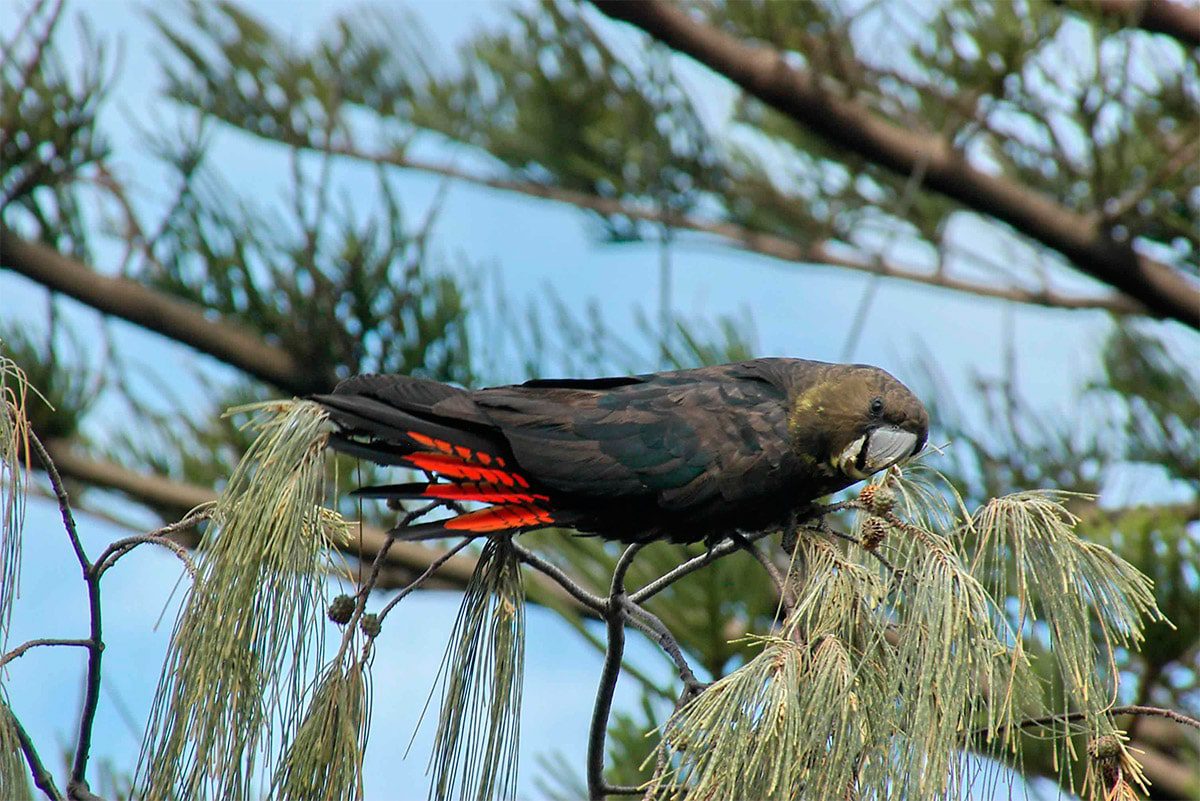
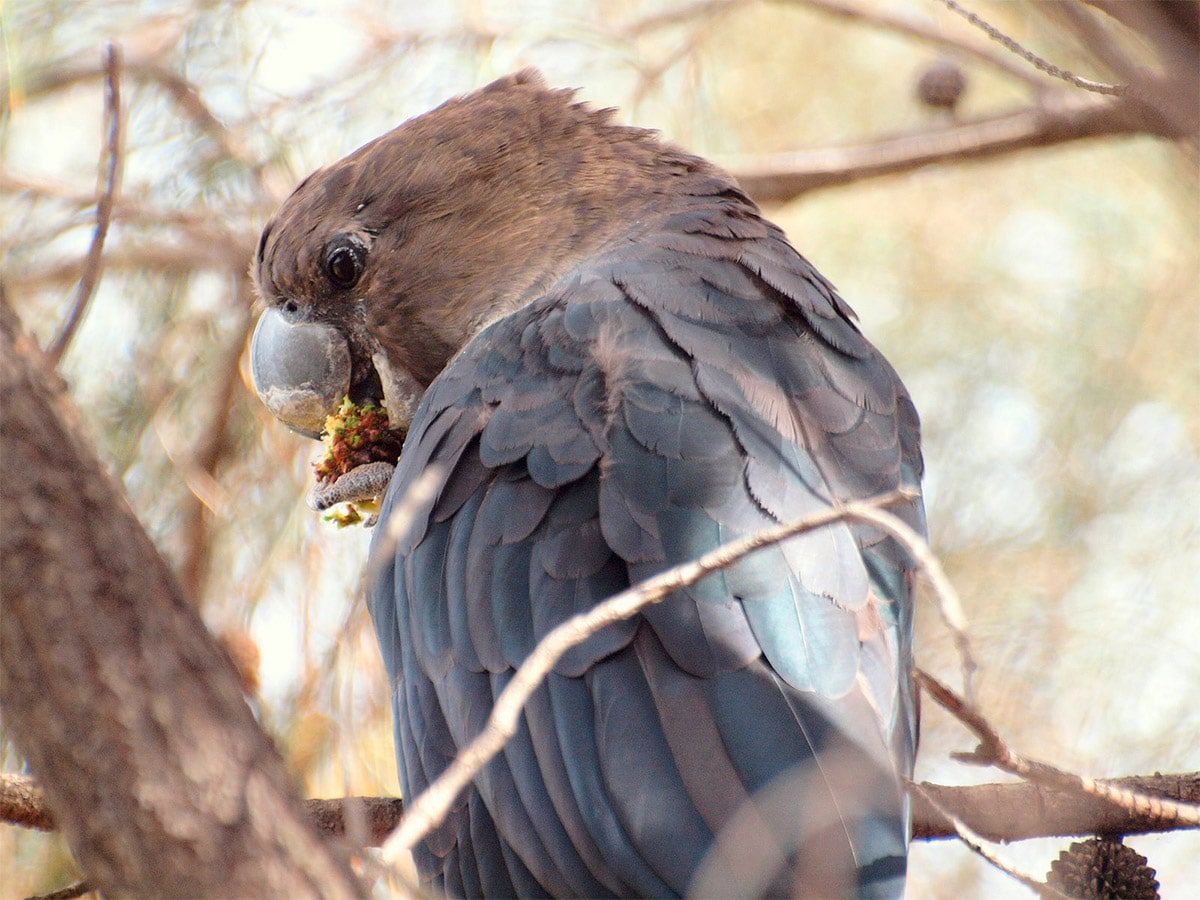
The Glossy black cockatoo (Calyptorhynchus lathami) is the smallest of the 5 black cockatoos and is restricted to the East coast of Australia (a population isolated also is reproduced in the Islands Kangaroo).
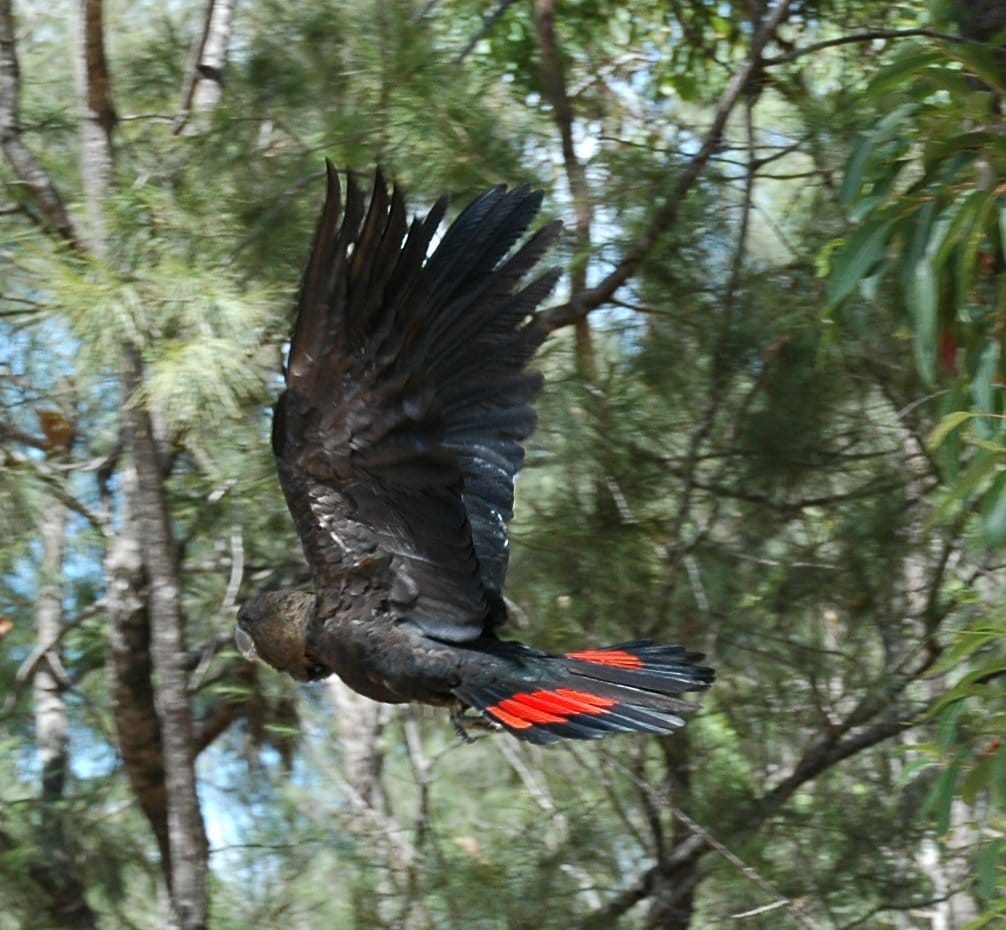
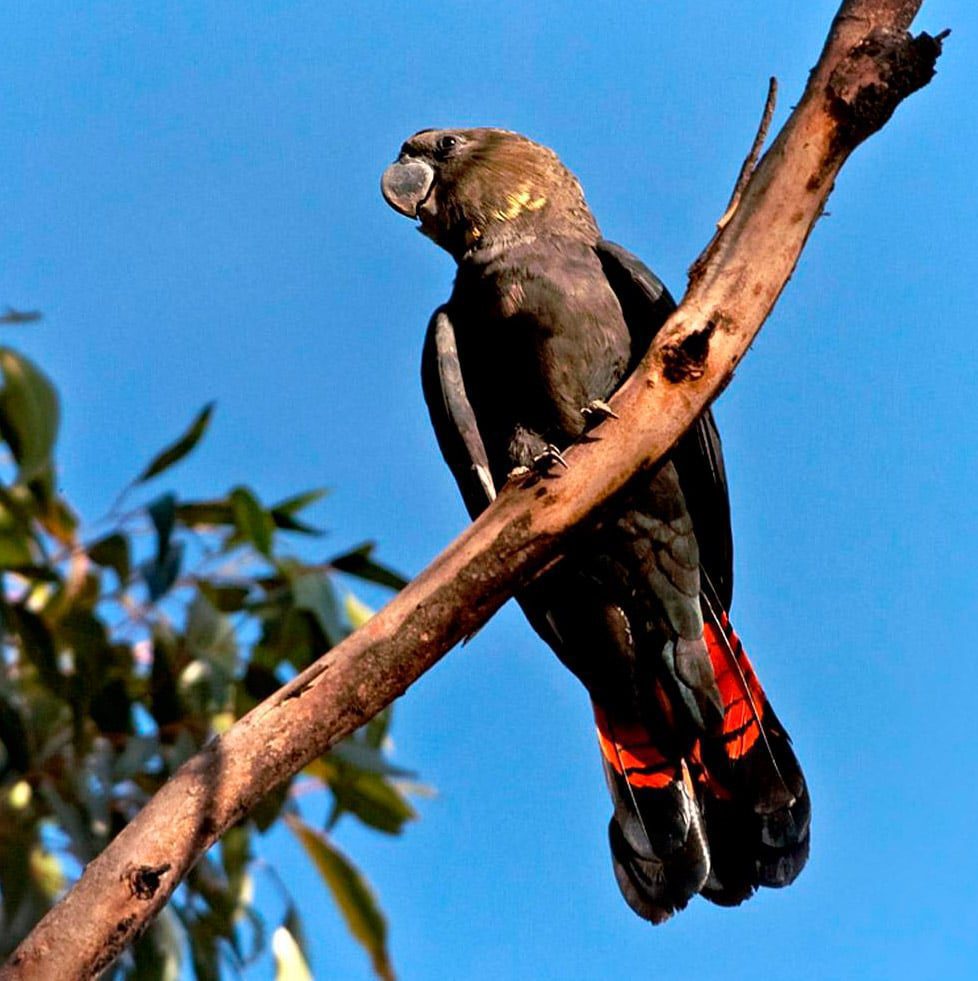
The male is brown-black color with a small crest rounded and bright Scarlet spots in the tail. The female shows spots irregular in color yellow in it head, The Scarlet patches in the tail they are permeated by narrow black bars and edges of pale yellow on the underparts of the wings.
The immature they are similar to the females, but they lack the yellow markings on the head and show different yellowish tones in the feathers, the chest and in the belly.

Subspecies description

  • Calyptorhynchus lathami lathami

    (Temminck, 1807) – The nominal.


  • Calyptorhynchus lathami halmaturinus

    (Mathews, 1912) – Medium-size ones 48 cm. length and 510 to 515 weight g, with a wing of approximately 90 cm.. The of adults they are mainly black, dark brown in the head, the neck and the bottom of the body, and Red panels (in males) or orange-red with bars Black (in females) on tail. The female adult is also conspicuous in the head. These patches are absent from most males., Although they can be expressed faintly in a few individuals (Higgins 1999).

    The immature are similar in appearance to the male adult, but have small stains yellow in it head; spots or bars yellow in the chest, belly and flanks; yellow or orange spots on the wing (mainly on the bottom); Red or orange-yellow panels with black bars at the tail; One bill pale grey (instead of dark); And a ring of skin around the eye pale grey (instead of grey dark) (Higgins 1999, L. Pedler 2007, com. Pers.).


  • Calyptorhynchus lathami erebus

    (Schodde & Mason,IJ, 1993) – The only difference with the nominal species resides in that has the bill shorter.

Habitat:

Video – "Glossy black cockatoo" (Calyptorhynchus lathami)

Glossy-black Cockatoo (Calyptorhynchus lathami ) HD Video clip 1/3

Areas forested frequently dominated by casuarinas of which are highly dependent for its food. These are small shrubs commonly known as the Sheoaks, wood for beef (Beefwood) or Australian pine. These shrubs are widespread in tropical and subtropical regions.

They are also distributed in open humid forests, difficult terrain where deforestation has not been too great. They have an imperative for natural tree cavities to nest.

Reproduction:

Forman couple during all the life. The couple has relationships throughout the year. This type of family of them parrots prefers to nest in cavities natural of the eucalyptus, whether dead or in full vitality. The nest usually placed at an altitude that ranges between the 3 and 30 meters above the ground. The cavity is filled with leaves and branches. Sometimes, together with other breeding pairs, they share the same tree year after year.

In New South Wales the season extends from March to August. The spawning It consists of a single egg white. It is the female that takes charge of most of the tasks.: It prepares the nest and incubates herself. Never leave the nest until the small is reached the age of one week. In most cases, the male provides the female with food and assistance until the young can fend for itself, normally four months which remains with them until the next breeding season.

Food:

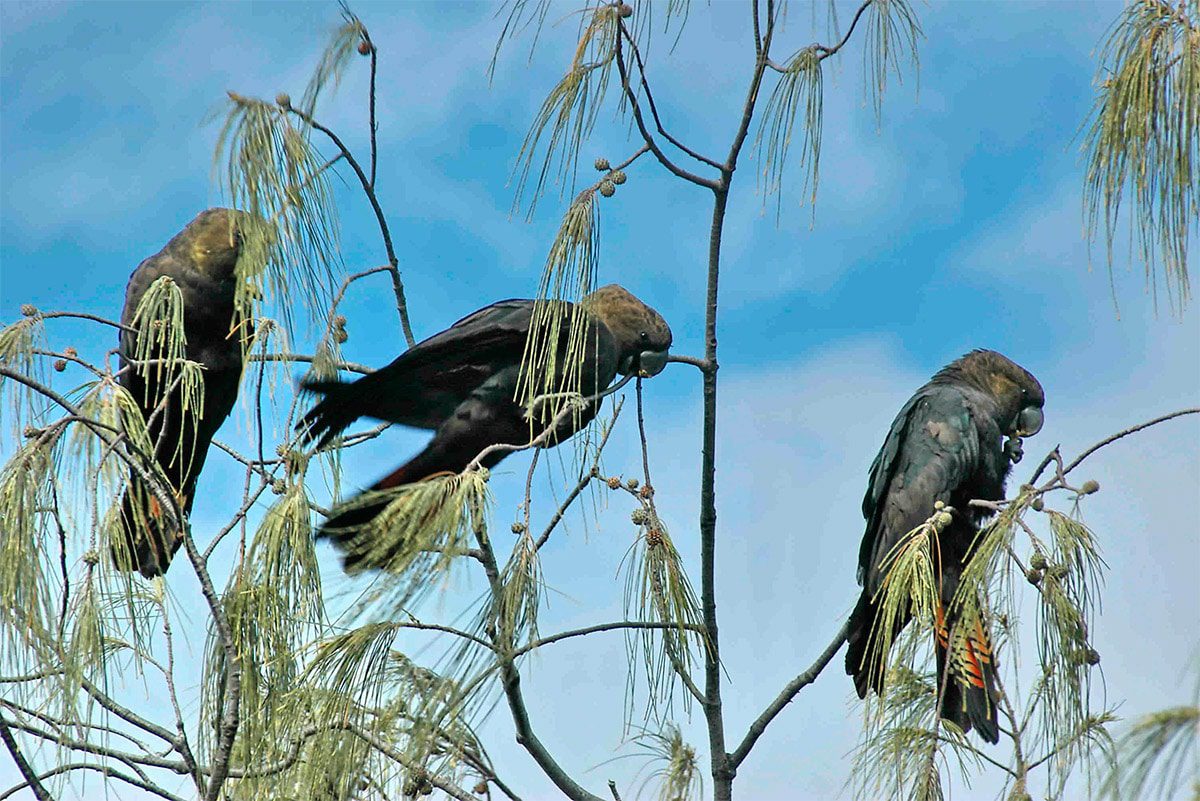
It feeds almost exclusively on the seeds several species of She-oak (Casuarina and Allocasuarina). You can also sometimes eat larvae of wood-boring. They feed in threes, less frequently in pairs, small groups or flocks of up to 60 birds. They can be detected by the snapping of their beaks and the remains of the casuarina cones and twigs that fall.

Distribution:

Size distribution (reproduction / resident): 770.000 km2

The species is Rare Although widespread in suitable forests of the central coast and forest habitats of Queensland and in the interior of the southern plateaus and Plains of the Midwest's New South Wales, with a small population in the Riverina. There is an isolated population in the Kangaroo Island, South of Australia.

Subspecies distribution

  • Calyptorhynchus lathami lathami

    (Temminck, 1807) – The nominal.


  • Calyptorhynchus lathami halmaturinus

    (Mathews, 1912) – Kangaroo Island (South of Australia)


  • Calyptorhynchus lathami erebus

    (Schodde & Mason,IJ, 1993) – It is from Australia (the central eastern coastal area of Queensland)

Conservation:

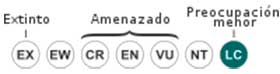
State of conservation โ“˜


minor concern Minor Concern โ“˜ (UICN)โ“˜

โ€ข Current category of the Red List of the UICN: Least concern.

โ€ข Population trend: Decreasing.

Like most parrot species, the Glossy black cockatoo is protected by the Convention on international trade in endangered species of Fauna and Flora Silvestres ( CITES ), with its inclusion in the list of the Appendix II of vulnerable species, What makes the import, the export and trade of animals captured in the wild is illegal.

Justification of the population

Garnett and Crowley (2000) estimated the size of the population in the following way: 12.000 individuals of the subspecies lathami, 70 breeding pairs of the subspecies halmaturinus (equivalent to 140 individuals) and 5.000 individuals of the subspecies erebus giving a total of 17.140 individuals.

Justification of trend

They suspected that the population is declining in general Since the largest subpopulation, lathami, It is slowly decreasing throughout its range. However it is believed that the subspecies Erebus is increasing and the subspecies halmaturinus It is increasing as a result of conservation efforts in the Island Ganguro (Garnett and Crowley 2000).

"Glossy black cockatoo" in captivity:

Like the other black cockatoos, the Glossy black cockatoo (Calyptorhynchus lathami) is extremely rare in the poultry. In Australia It has attained breed in captivity.

Alternative names:

– Glossy Black-Cockatoo, Casuarina Cockatoo, Casuarine Cockatoo, Latham’s Cockatoo, Leach’s Black-Cockatoo, Leach’s Red-tailed Cockatoo, Nutcracker (English).
– Cacatoรจs de Latham, Cacatoรจs noir รฉtincelant (French).
– Braunkopfkakadu (German).
– Cacatua-preto-brilhante (Portuguese).

scientific classification:

– Order: Psittaciformes
– Family: Cacatuidae
– Scientific name: Calyptorhynchus lathami
– Genus: Calyptorhynchus
– Citation: (Temminck, 1807)
– Protonimo: Psittacus Lathami

Images Calyptorhynchus lathami:


Species of the genus Calyptorhynchus
  • Calyptorhynchus banksii
  • —- Calyptorhynchus banksii banksii
  • —- Calyptorhynchus banksii graptogyne
  • —- Calyptorhynchus banksii macrorhynchus
  • —- Calyptorhynchus banksii naso
  • —- Calyptorhynchus banksii samueli
  • Calyptorhynchus lathami
  • —- Calyptorhynchus lathami erebus
  • —- Calyptorhynchus lathami halmaturinus
  • —- Calyptorhynchus lathami lathami

  • Sources:
    – Avibase
    – Parrots of the World โ€“ Forshaw Joseph M
    – Parrots A Guide to the Parrots of the World – Tony Juniper & Mike Parr
    – Birdlife

    – Photos: commons.wikimedia.org, The Glossy Black Conservancy,

    – Sounds: Nigel Jackett (Xeno-canto)
    โ–ท The world of Pets: Dogs, cats, birds, reptiles, amphibians

    Reunion Parakeet
    Psittacula eques

    Cotorra de Mauricio

    Content

    Description:

    Cotorra de Mauricio

    42 cm.. length and a weight between 167 and 193 g..

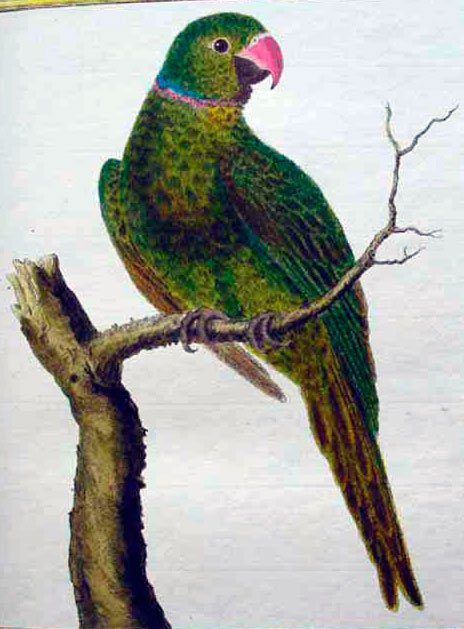
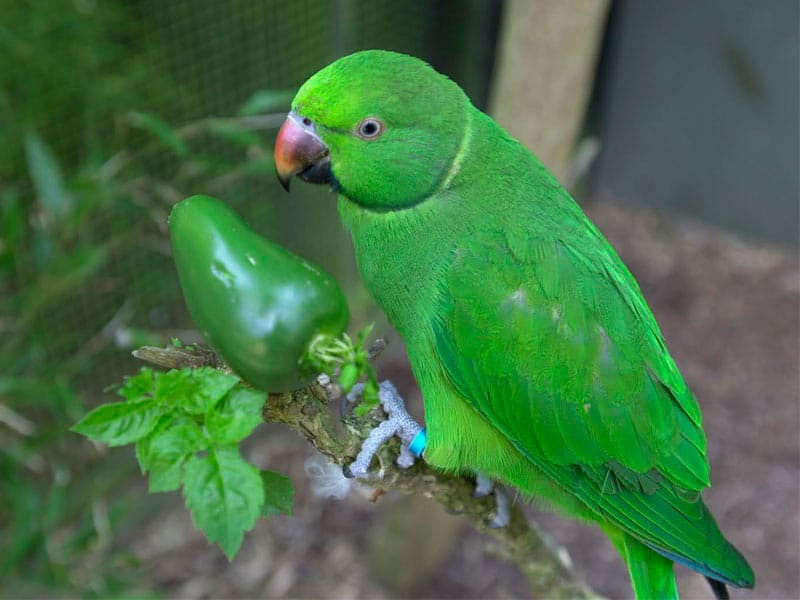
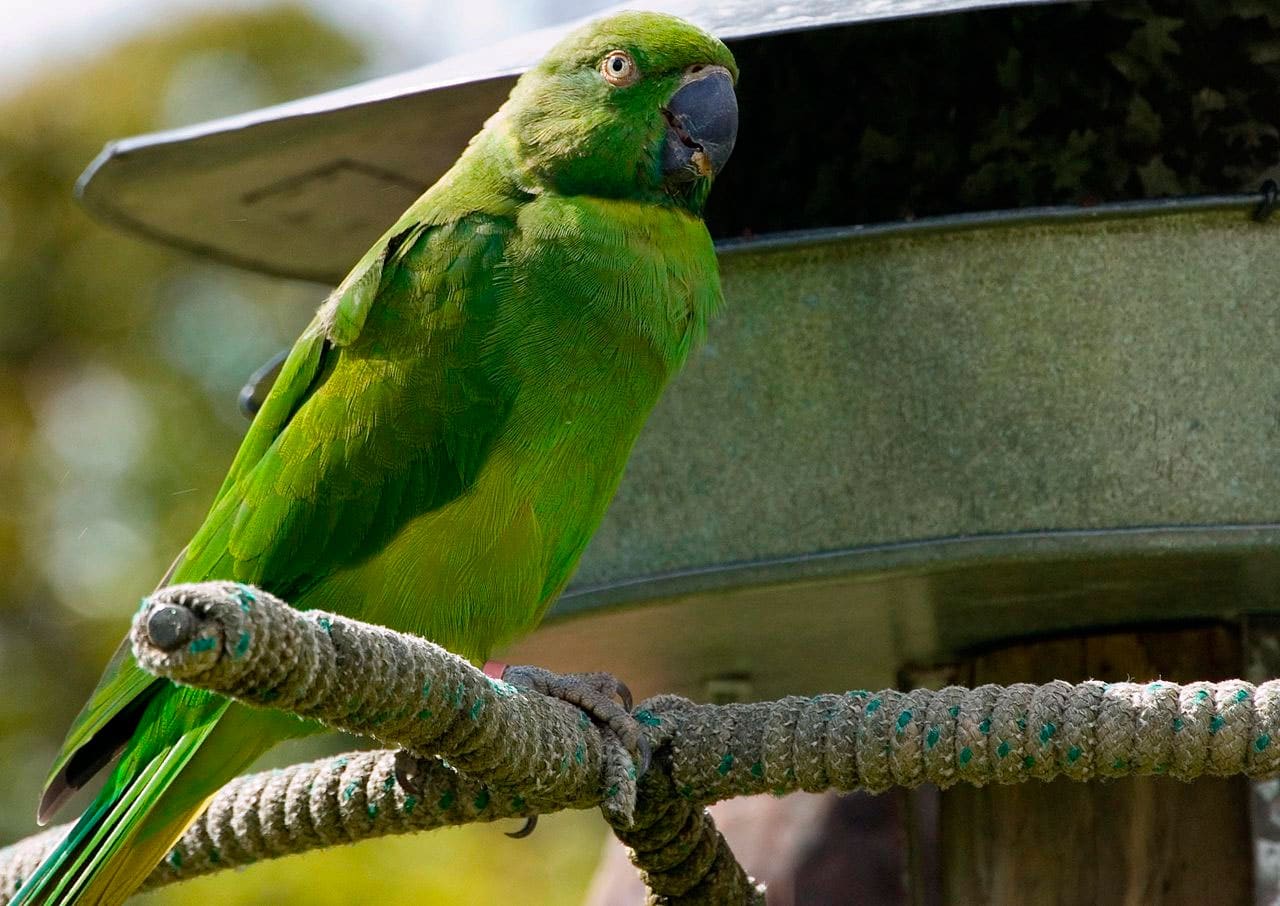
    The Reunion Parakeet (Psittacula eques) has the Lords and cheeks grass-green, deepening the emerald green upper cheeks, the forecrown and crown; wide swaths shaped mustache on the bottom of the cheeks and chin, fading on the sides of neck; narrow black stripes on the neck lined up with bluish patches on ear-coverts and sides neck and below by pink lines extending to the back of the neck, without getting to form an collar full.

    Upperparts, including upperwing-coverts, emerald green. Underparts paler and yellowish. Uppertail green; the undertail pale brown.

    upper jaw red, lower negruzca; irises pale yellow to greenish yellow; legs blackish.

    The female lacks black moustachial stripes, as well as black, pink and blue marks on the sides of neck; dark green tones cheeks with yellowish green at the collar of the back of the neck; dark (almost black) the upper jaw.

    The immature they are like the females, but the fledging bill It is red in both sexes, turning darker in females later.

    Description 2 subspecies:

    • knight knight knight โ€ 

      (Boddaert, 1783) – Nominal. Extinct.


    • Psittacula eques echo

      (Newton,A & Newton,E, 1876) – On the edge of the extinction.

    Habitat:

    The Reunion Parakeet It is closely linked to the native vegetation. A part of the population is in an area of รขโ‚ฌโ€นรขโ‚ฌโ€นupland forest containing some of the largest samples, for example, Canarium paniculatum, Syzygium contractum, Mimusops maxima and Labourdonnaisia left in the Mauritius. Scrub forests lower level are also important, especially for food.

    They are generally solitary, but they can also be seen in pairs or small groups (especially after breeding), but the extreme shortage should limit the normal social behavior.

    Reproduction:

    The Reunion Parakeet nests in cavities of large native trees (often Mimusops but also Calophyllum or Canarium) generally between 6-10 meters above the ground. The inlet has a diameter between 10-15cm.

    The peak in the egg laying It is late September to early October, although it may take place between August to November, is composed of 2 to 4 eggs. The female incubated eggs for three to four weeks, while teammate bring your food. Both parents then provide for the young until they leave the nest in about two months old.

    Food:

    The feeding of the Reunion Parakeet It is composed of a wide range of native plant parts, including outbreaks include, sprouts, leaves, flowers, fruits, seeds, remained, sap and bark. Introduced plants rarely eat. Plants which include feed Calophyllum, Canarium paniculatum, Tabernaemontana mauritiana, Diospyros, erythrospermum monticolum, Eugenia, Labourdonnaisia, Mimusops trials, M. petiolaris, Nuxia verticillata and Protium obtusifolium.

    The main feeding areas vary with the season.

    Distribution:

    Size of the area of distribution (reproduction / resident): 60 km2

    endemic to Mauritius, Indian Ocean, but also he lived before the Rรฉunion. The rest of the birds confined to the last fragments of native forest vegetation.

    In a time, widely distributed, but now reduced to a small relict population in the plateau south-west, around the Black River Gorges National Park and the Monte Cocotte.

    Mainly sedentary, but with some slight seasonal changes depending on availability of food.

    The main cause, apparently, the decline in the population of the Reunion Parakeet long-term, It is the loss of habitat (natural vegetation used for agriculture and forestry), nest predation by introduced species such as Crab-eating Macaque (Macaca fascicularis) and black rat (Rattus rattus) , competition with Rose-ringed Parakeet (Psittacula krameri) (introduced on 1886) and the effects of disease and storms.

    The total area of รขโ‚ฌโ€นรขโ‚ฌโ€นhabitat available It is 50km2. Population between 7-11 birds in 1984, aumentando a 30 birds in the wild and 8 in captivity 1995, with between 40-50 wild birds 1996. An intensive conservation program that includes captive breeding in Mauritius (first successful reproduction 1993-1994), predator control with veterinary assistance for wild birds, ecological research and habitat protection, It is getting a considerable increase in the population of the Reunion Parakeet.

    The National Park currently protect the last natural forests, but continuous invasion of exotic flora, It remains a long-term threat.

    Distribution 2 subspecies:

    Conservation:

    State of conservation โ“˜


    Endangered Endangered โ“˜ (UICN)โ“˜

    โ€ข Current Red List of UICN: Danger

    โ€ข Population trend: Growing

    At the end of the breeding season between 2011/2012, the population was estimated at approximately 580 birds (V. Tatayah in some. 2012).

    The population of the Reunion Parakeet It is estimated that it has experienced a very rapid increase in recent 23 years (three generations).

    The previous decline in the distribution of this species is for the serious destruction and its native habitat degradation (Jones 1987 Greenwood 1996).

    The population decreased probable total of several thousand individuals, as a result of the forest destruction and the replacement of their feeding habitat, upland dwarf forests, plantations (Jones et al., 1998).

    In 1996, only the 5% the island was covered with native vegetation (Jones et al. 1998).

    The areas of native forests remaining in the highlands still being highly degraded by cyclones, the influences of forestry practices of the past, the spread of introduced plants like Peruvian guava (Invasive cattleianum), privet (Ligustrum robustum) and Pomeroy (Syzygium jambos), as well as the effect of wild mammals introduced as boars (Sus scrofa) and the Timor deer (Cervuss) (Greenwood 1996, Thorsen y Jones 1998).

    The production of native fruit, from which the parrot feeds, and regeneration is possible trees nest, because, poor (Greenwood 1996).

    Recent research suggests that the food shortage due to deterioration of native forest is the main cause of nest failure; although exotic species can provide an abundant source of food, They are not available throughout the year, not even throughout the breeding season (Thorsen y Jones 1998).

    The crab-eating macaque (Macaca fascicularis) and black rats (Rattus rattus) are among a number of introduced tree species representing a threat for the Reunion Parakeet, raiding nests and competing for native fruits (Greenwood 1996).

    The European bee (Apis melรญfera), yellowjackets (Polistes hebraeus), termites, the common loptail (Phaethon lepturus), the introduced common mine (Acridotheres tristis) and Rose-ringed Parakeet (Psittacula krameri), They are all competing for nesting sites and can move active breeding pairs (Thorsen y Jones 1998, C. Jones in little. 2000, V. Tatayah in some. 2012).

    The decline in the number of old native trees, that perish damaged by storms and senescence, They have intensified competition for nesting cavities (Jones et al., 1998).

    Infestations fly larvae in the nests can be severe in some years and, without intervention, would kill many young people (C. Jones in a bit., 2000).

    Beak and Feather Disease (PBFD), It has been found in more than 20% of birds sampled, and at least 50% birds observed with PBFD It is believed to have died, However, a considerable number of specimens have been seen to recover from the disease (Richards 2010). Pesticides do not seem to have significantly affected the species (Greenwood 1996).

    According to Mauritius Wildlife Foundation (MWF), trying to stop this worrying phenomenon, the origin of evil is attributed to the imported parrots, mostly the Grey Parrot (Psittacus erithacus) and Coconut Lorikeet (Trichoglossus haematodus).

    The species has been the subject of a conservation program from 1973 (Jones et al. 1998). The spectacular increase in the population of the species in recent years is undoubtedly due to an intensive program to manage the wild population., combined with a program captive breeding great success since the season 1993/4 Playback (Jones et al., 1998).

    "Reunion Parakeet" in captivity:

    The Reunion Parakeet is the only survivor of the species Psittacula They are inhabiting the islands in the South Indian Ocean, about Madagascar. It is one of the parrots World's rarest existing.

    Some specimens bred in captivity (Hand rearing) for reintroduction into the wild; else not bred in captivity.

    In the news, the aviary captive population is 18 birds, with successful reproduction of a couple. The place of the old aviary, where the extraordinary work has been achieved in very primitive conditions, now it is being replaced with a new space, once completed this spring, It will house up 12 breeding pairs of the Reunion Parakeet, a large flight cage 60 meters for immature.

    Alternative names:

    – Mauritius Parakeet, Echo Parakeet, Maruitius parakeet, Mascarene Parakeet, Mauritian Parakeet (English).
    – Perruche de Maurice, Perruche ร  longue queue (French).
    – Mauritiussittich (German).
    – Periquito-de-maurรญcio (Portuguese).
    – Cotorra de Mauricio (espaรฑol).

    scientific classification:

    – Order: Psittaciformes
    – Family: Psittaculidae
    – Genus: Psittacula
    – Scientific name: Psittacula eques
    – Citation: (Newton, A & Newton, E, 1876)
    – Protonimo: Palaeornis echo

    Reunion Parakeet Images:

    Videos "Reunion Parakeet"


    Especies del gรฉnero Psittacula

    Reunion Parakeet (Psittacula eques)


    Sources:

    – Avibase
    – Parrots of the World โ€“ Forshaw Joseph M
    – Parrots A Guide to the Parrots of the World – Tony Juniper & Mike Parr
    – Birdlife

    – Photos:

    (1) – Echo parakeet (Psittacula eques echo), the rarest Parrokeet in the world, saved from extinction by captive breeding programme at the Durrell trust Blackwater Gorge By colin houston [CC BY 2.0], via Wikimedia Commons
    (2) – By Wildlife Preservation Canada – link
    (3) – Echo Parakeet, Mauritius by Tara – Miles to the wild
    (4) – Echo Parakeet, Mauritius by Tara – Miles to the wild
    (5) – Female Echo Parakeet (Psittacula eques) by Johannes Fischer – Mauritius January – July 2013, Petrin, Camp Field Station and Brise Fer
    (6) – Psittacula type illustration of a knight on horseback (Martinet in Buffon, 1779) By Franรงois-Nicolas Martinet [Public domain], via Wikimedia Commons

    – Sounds: George Sangster (Xeno-canto)
    โ–ท The world of Pets: Dogs, cats, birds, reptiles, amphibians

    Black-capped Parakeet
    Pyrrhura rupicola

    Should be noted that until the year 1981, The Blackcap Parakeet was considered a rarity in poultry farming.. From that date began to be imported in quantity although at a very high price.

    Black-capped Parakeet

    Content

    Description:

    25 cm. length and 70 g. weight.

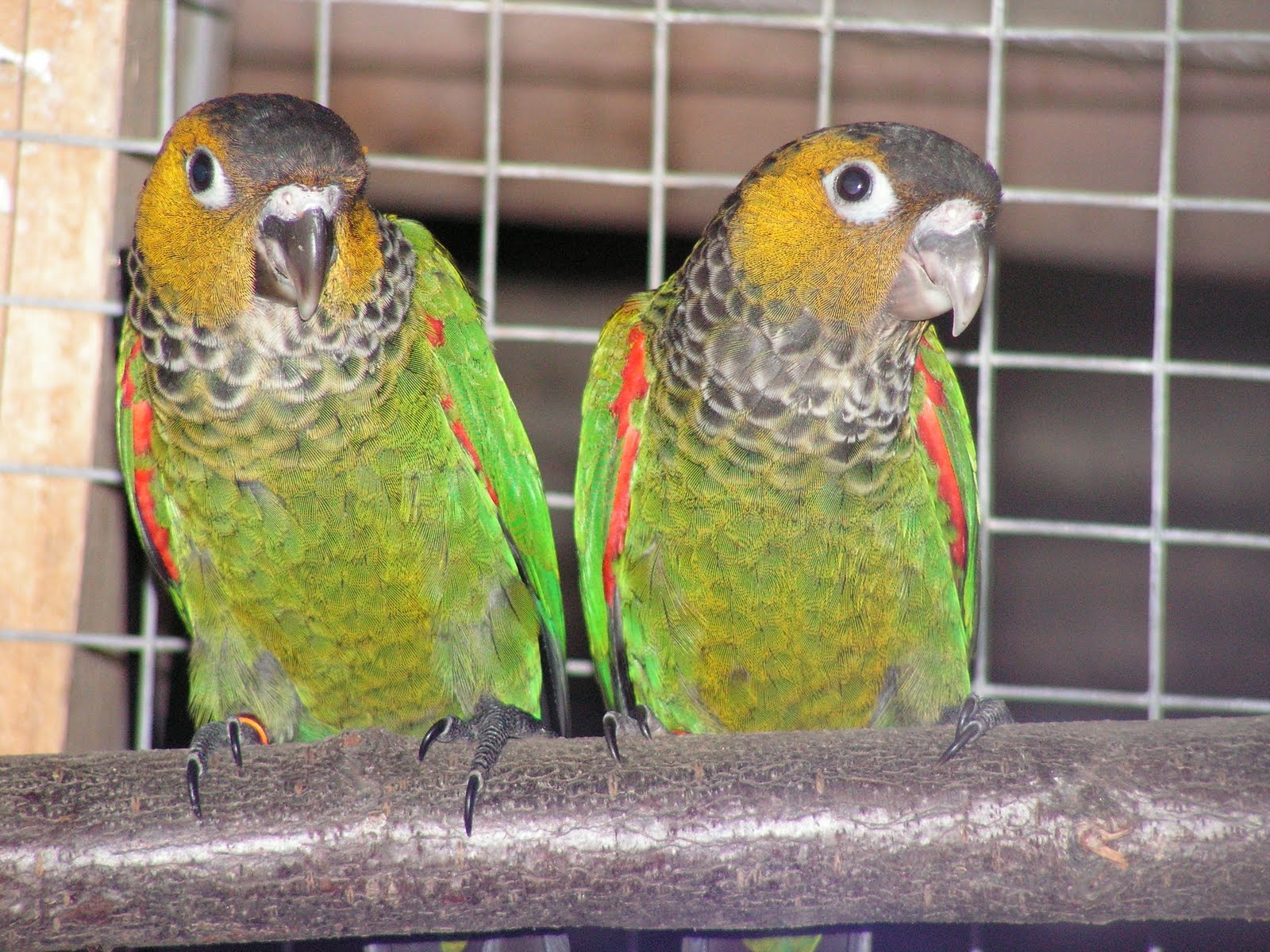
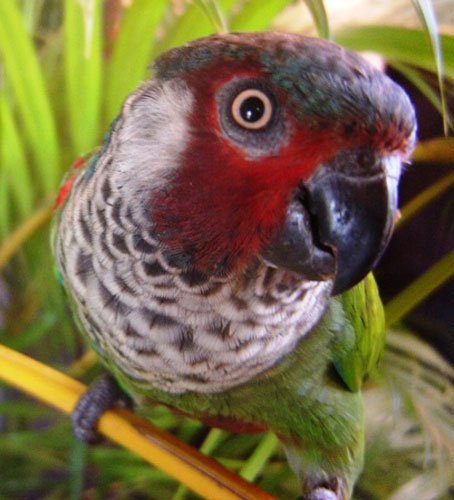
    The Black-capped Parakeet (Pyrrhura rupicola) has the lores, the forecrown and the Crown, blackish brown; cheeks, ear-coverts and supercilii area, of color olive beige; back of the neck brown with narrow pale edges.

    Upperparts green. External primary coverts, alula and leading edge of the wings bright red; other coverts mainly green. The flight feather, mainly bluish green, by top with narrow black tips; grey dark below.

    Underwing-coverts green. The throat feathers, sides neck and top of the chest, Black base with wide white margins, becoming yellowish-white at the bottom of the chest and almost no formation of continuous pale band; belly and undertail-coverts green with brown stain in the center of the belly. Upper, the tail mainly green.

    Black-capped Parakeet

    The bill slaty-grey; Cere pale grey; bare periophthalmic off-white; irises brown; legs blackish.

    Both sexes similar.

    The immature has primary coverts almost completely green, as well as the leading edge of the wings.

    Subspecies description:

    • Pyrrhura rupicola rupicola

      (Tschudi, 1844) – The nominal


    • Pyrrhura rupicola sandiae

      (Bond & Meyer de Schauensee, 1944) – It differs from the species nominal much closer to the Gray margins to the feathers of the throat and the front of the neck. These pale fringes measure only 2-2,5 mm. wide (specimens with new plumage) in comparison with the 4-5 mm of the nominal species. Like this, the dark basal portion of these pens is more prominent. It also, the whitish edges to the feathers of the back of the neck they are practically obsolete and the sides of the neck much smaller.

    Habitat:

    Video – "Black-capped Parakeet" (Pyrrhura rupicola)

    PYRRHURA RUPICOLA TAUGHT

    It lives in the Amazon rainforest., including formations of vรกrzea and the Mainland, below 300 m. Visits have been recorded in the East of the Andes. Fly in flocks of 30 individuals, or small groups in reproductive age.

    Reproduction:

    It is believed that it can nest in the months of February-March, although the copulation of observed during the month of September. Sunset until the seven eggs in captivity than hatch during 23 to 24 days.

    Food:

    Usually feed in the canopy but no specific information on diet or breeding.

    Distribution:

    Can be seen in the Western basin of the amazon. There has been in the East of Peru from the South of Loreto until Mother of God and Puno, and in the North of Bolivia in Pando.

    Also distributed in Peace and the Yungas and in the lowlands of the North of Beni, from the East to the border with Rondร ยดnia in Brazil, with a record until the date in the extreme west of Brazil (Rio Branco, Acre).

    In general common (Perhaps more scarce on the edges of the range), but it can be locally decreasing due to the alteration of its habitat.

    Subspecies distribution:

    • Pyrrhura rupicola rupicola

      (Tschudi, 1844) – The nominal


    • Pyrrhura rupicola sandiae

      (Bond & Meyer de Schauensee, 1944) – Southeast of Peru, West end of Brazil and North of Bolivia.

    Conservation:

    State of conservation โ“˜


    Near-threatened Near Threatened โ“˜ (UICN)โ“˜

    โ€ข Red List category of the UICN current: Near-threatened

    โ€ข Population trend: Decreasing

    The Parrot Capirotada world population size has not been quantified, but this species is described as "quite common" (Stotz et to the. (1996).

    This species is suspected that may be losing from the 13,7 to the 15,5% of their habitat within its distribution over three generations (18 years) based on a model of deforestation of the Amazon (Soares-Filho et to the., 2006, Bird et to the. 2011). Given the susceptibility of this species to be hunted or trapped, leads to the suspicion of a probable decline in population close to the 30% in three generations.

    "Black-capped Parakeet" in captivity:

    Should be noted that until the year 1981, the Black-capped Parakeet It was considered a rarity in aviculture. From that date began to be imported in quantity although at a very high price.

    Their behavior Active, his sympathetic character, their robustness and ease of reproduction attached to the made of own a voice very little annoying, they make an excellent animal for those poultry producers who are initiated into this wonderful hobby. These qualities allow us to intuit that if raised by hand they could be lovely pets.. It is sad to observe that, too often, the main maxim that justifies poultry farming "play to preserve" becomes "play to sellโ€.

    Alternative names:

    – Black-capped Parakeet, Black capped Parakeet, Black-capped Conure, Rock Conure, Rock Parakeet (English).
    – Conure ร  cape noire, Perriche ร  cape noire, Perruche ร  cape noire (French).
    – Schwarzkappensittich, Schwarzkappen-Sittich (German).
    – tiriba-rupestre (Portuguese).
    – Cotorra Capirotada, Perico de Frente Negra (espaรฑol).
    – Wewey, Aboro gushรณus (Chimane).


    scientific classification:

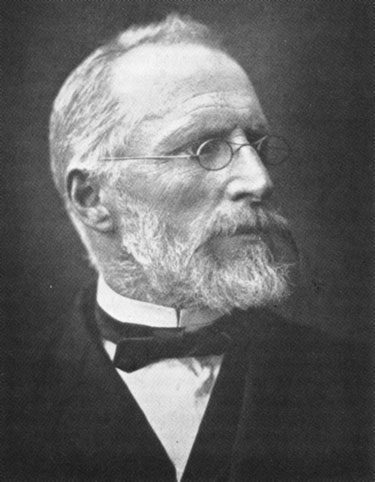
    Tschudi-Johann Jakob of
    Tschudi-Johann Jakob of

    – Order: Psittaciformes
    – Family: Psittacidae
    – Genus: Pyrrhura
    – Scientific name: Pyrrhura rupicola
    – Citation: (Tschudi, 1844)
    – Protonimo: Conurus rupicola

    Images "Black-capped Parakeet"


    Especies del gรฉnero Pyrrhura

    Sources:

    – Avibase
    – Parrots of the World โ€“ Forshaw Joseph M
    – Parrots A Guide to the Parrots of the World – Tony Juniper & Mike Parr
    – Birdlife

    – Photos:

    (1) – Pyrrhura rupicola sandiae by pedroduarte
    (2) – Maroon-tailed Parakeet ssp. (in front); and Pyrrhura rupicola, Black-capped Parakeet (behind) by John Gerrard Keulemans [Public domain], via Wikimedia Commons

    – Sounds: (Xeno-canto)

    โ–ท The world of Pets: Dogs, cats, birds, reptiles, amphibians

    Plain Parakeet
    Brotogeris tirica

    Plain Parakeet

    Content

    Description:

    Plain Parakeet

    23 cm.. long and about 63 g. of weight.
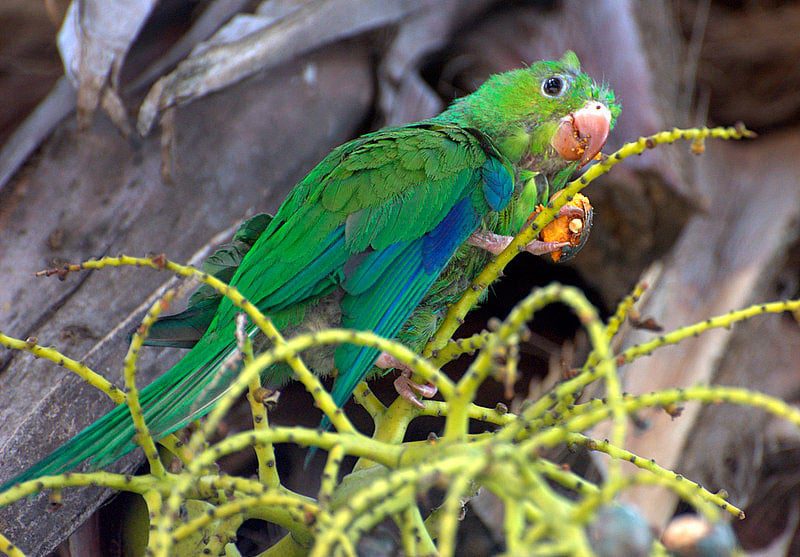
    The Plain Parakeet (Brotogeris tirica) has the forecrown, lores, crown and cheeks, pale green with yellowish tint. Sides of the neck and nape, green, duller than in the head.

    The upperparts green, slightly darker than the rest of the plumage. Most of the under wing-coverts, green, some feathers dyed olive brown, especially in lesser and median coverts. Primary coverts, primaries and outer secondaries, violet blue with green margins close to outerweb. Underwing-coverts greenish yellow, flight feather, bluish green. Underparts, pale yellowish green, tinged with bluish color on the sides of chest, the the thighs and undertail-coverts; flanks yellowish. Upper, the tail green with bluish tint to the central feathers; undertail, the tail is grayish blue-green. Bill color pale horn: irises brown: legs Rosaceae.

    Both sexes are similar. Immature with little or no blue in primary coverts.

    Habitat:

    Video – "Plain Parakeet" (Brotogeris tirica)

    Green parakeets at the feeder - Brotogeris tirica (Plain Parakeet)

    The Plain Parakeet They are experts in the art of adaptation; They can be found in a wider range of habitats than any other endemic parrot Brazilian Atlantic forest: in the lowlands and highlands, in the forest canopy and forest edges, parks and gardens (for example, of Rio de Janeiro and Sรฃo Paulo), farmland with trees, scattered patches of forest and secondary growth. Apparently more numerous in the forest edge habitats. Generally observed in the lowlands, but reported to 1.200 metres in the Itatiaia National Park on the border between the state of Rรญo and Sรฃo Paulo. Gregaria. Generally seen in pairs or small groups, although sometimes you can see several hundred birds together.

    It is the most common parrot in Sรฃo Paulo, where you can find even in the slums of the city.

    Reproduction:

    Observed in arboreal termite nests, in the crowns of Palmas or natural openings of trees; in the city of Sรฃo Paulo nest in crevices of buildings and roofs, regularly using the balconies to feed.

    The breeding season It has been recorded in September; observed immature in January. The clutch common in captivity is four eggs. They stay together for life.

    Food:

    Its diet it is very varied, It includes pulp of Posoqueria latifolia; seeds of Ficus, Trema micrantha, Xylopia brasiliensis, Vriesea, rhipsalis, Cecropia glazioui, Hyeronima alchorneoides and Merostachis; seeds and flowers of Tibouchina mutabilis and Psitticanthus; flowers of Norantea brasilensis and Eucatyptus and nectar of Pseudobombax. Sometimes they feed of insects and their larvae.

    Distribution:

    Size of its range (breeding/resident ): 1.010.000 km2

    The Plain Parakeet They found in southeast Brazil, from Alagoas south through the eastern and southern Bay, Espirito Santo, in the South of Minas Gerais, Rio de Janeiro, is of Sรฃo Paulo and Paranรก until Santa Catarina.

    The only records of Rio Grande do Sul and Goiรกs They are considered doubtful.

    Some seasonal movements. Uncommon to fairly common depending on locality, but apparently only reported very common in the city of Sao Paulo. Its population has declined in the Eastern European settlement Brazil, although less than other endemic parrots in the region. Live in several areas protected (for example, Itatiaia National Park).

    Conservation:

    State of conservation โ“˜


    minor concern Minor Concern โ“˜ (UICN)โ“˜

    โ€ข Current category of the Red List of the UICN: Least concern.

    โ€ข Population trend: Stable.

    Rationale for the Red List category

    This species has a very large range and therefore it is not close to the thresholds for Vulnerable under the criterion of size range (Extension Occurrence <20,000 km2 combinada con un tamaรฑo de rango decreciente o fluctuante, extensiรณn / calidad de hรกbitat o tamaรฑo de poblaciรณn y un pequeรฑo nรบmero De lugares o fragmentaciรณn severa). La demographic trend appears to be stable and, therefore, the species does not approach the thresholds Vulnerable under the criteria of population trend (> 30% decline over ten years or three generations). The population size has not been quantified, but it is not believed to be close to the thresholds for Vulnerable under the criterion of population size (<10.000 individuos maduros con un descenso continuo estimado> 10% in ten years or three generations or a population structure). For these reasons the species is evaluated as the least concern.

    Justification of the population

    The size of the world's population has not been quantified, but this species is described as ยซcommonยป (Stotz et to the., 1996).

    Justification of trend

    They suspected that the population is stable in absence of evidence of any decline or threatens substantial.

    "Plain Parakeet" in captivity:

    They are not very common in aviculture.

    Alternative names:

    – Plain Parakeet, All-green Parakeet, Tirica Parakeet (English).
    – Toui tirica, Perruche tirica (French).
    – Tirikasittich, Tiricasittich (German).
    – periquito-rico, periquito, periquito-verdadeiro, periquito-verde, tuim (Portuguese).
    – Catita Tirica, Periquito Amarillento (espaรฑol).


    scientific classification:

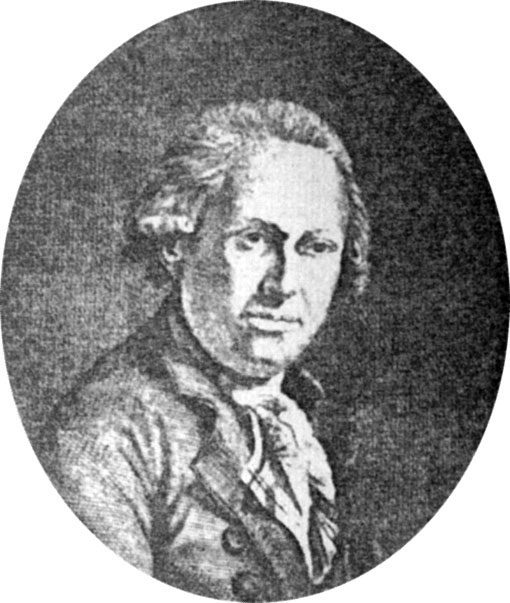
    Gmelin Johann Friedrich
    Gmelin Johann Friedrich

    – Order: Psittaciformes
    – Family: Psittacidae
    – Genus: Brotogeris
    – Scientific name: Brotogeris tirica
    – Citation: (Gmelin, JF, 1788)
    – Protonimo: Psittacus Tirica


    Images Plain Parakeet:


    Species of the genus Brotogeris

    Sources:

    – Avibase
    – Parrots of the World โ€“ Forshaw Joseph M
    – Parrots A Guide to the Parrots of the World – Tony Juniper & Mike Parr
    – Birdlife

    – Photos:

    (1) – A Plain Parakeet in Morretes, Paranรก, Brazil By Ben Tavener from Curitiba, Brazil [CC BY 2.0], via Wikimedia Commons
    (2) – Plain Parakeet in Brazil By Jรดnatas Cunha [CC BY-SA 2.0], via Wikimedia Commons
    (3) – Plain Parakeet in captivity By Lucas de Melo [CC BY 2.0], via Wikimedia Commons
    (4) – Independence Park, Ipiranga museum, Sao Paulo By Dario Sanches from SAO PAULO, BRAZIL (PERIQUITO-RICO ( Brotogeris tirica)) [CC BY-SA 2.0], via Wikimedia Commons
    (5) – Plain Parakeet (Brotogeris tirica) in Sรฃo Paulo By Dario Sanches [CC BY-SA 2.0], via Wikimedia Commons
    (6) – Independence Park, Ipiranga museum, Sao Paulo By Dario Sanches from SAO PAULO, BRAZIL (PERIQUITO-RICO ( Brotogeris tirica)) [CC BY-SA 2.0], via Wikimedia Commons
    (7) – Independence Park, Ipiranga museum, Sรฃo Paulo Species molting By Dario Sanches from SรƒO PAULO, BRAZIL (PERIQUITO-RICO ( Brotogeris tirica)) [CC BY-SA 2.0], via Wikimedia Commons
    (8) – Brotogeris tirica, Independence Park, Ipiranga museum, Sao Paulo By Dario Sanches from SAO PAULO, BRAZIL (PERIQUITO-RICO ( Brotogeris tirica)) [CC BY-SA 2.0], via Wikimedia Commons
    (9) – The Plain Parakeet in the Serra da Cantareira State Park, Sao Paulo, Brazil By Dario Sanches (Flickr: PERIQUITO-RICO (Brotogeris tirica)) [CC BY-SA 2.0], via Wikimedia Commons
    (10) – Illustration Ricardo Sanches, parakeets rich(Brotogeris tirica) in ABES-SP

    – Sounds: Jerome Fischer (Xeno-canto)

    โ–ท The world of Pets: Dogs, cats, birds, reptiles, amphibians

    Carolina Parakeet โ€ 
    Conuropsis carolinensis

    Carolina parrot

    Content

    Description:

    32 to 34 cm. length and 280 g. of weight.

    Male and female adults of Carolina parrot (Conuropsis carolinensis) They were identical in plumage, however males were slightly larger than females.
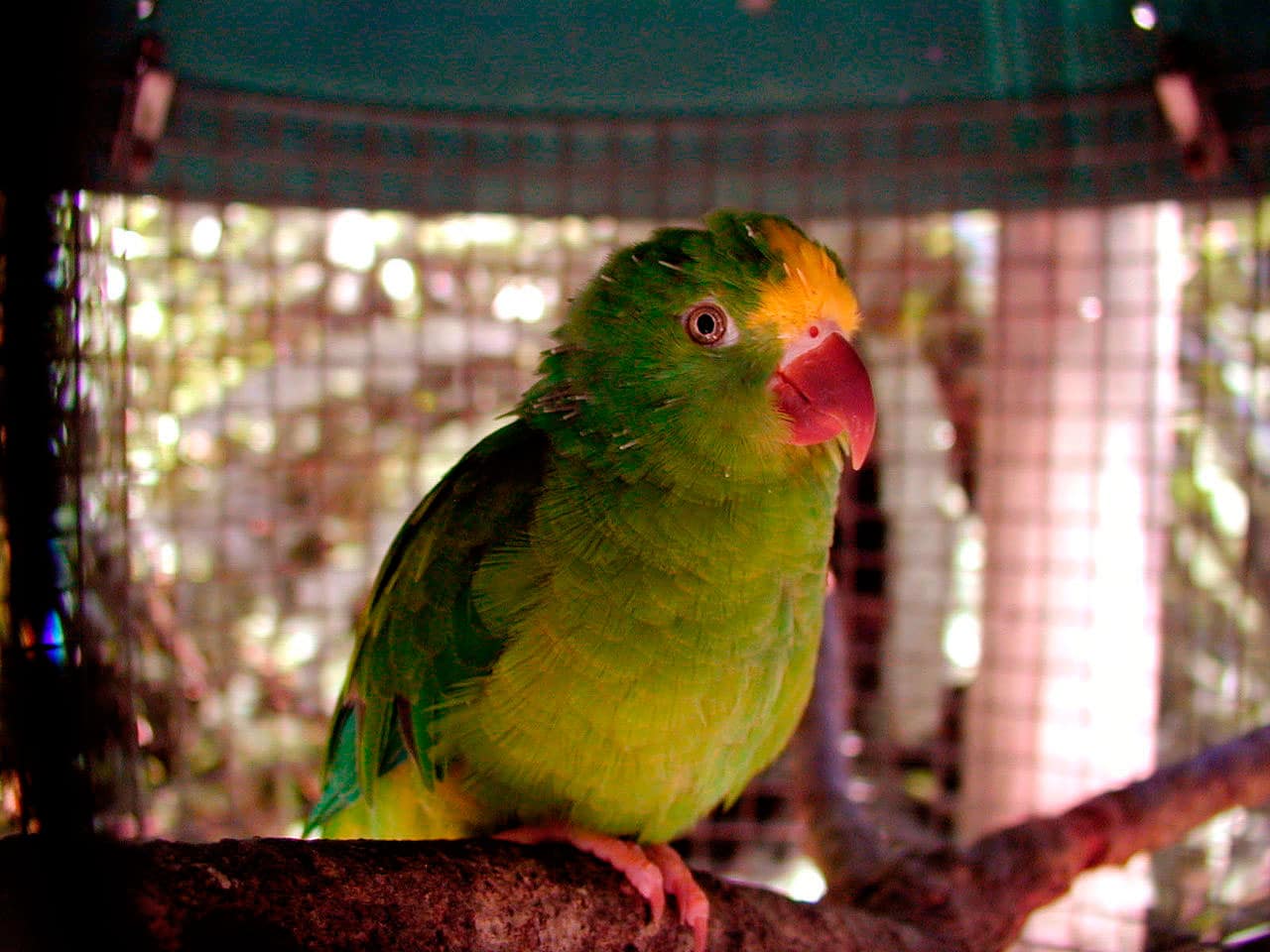
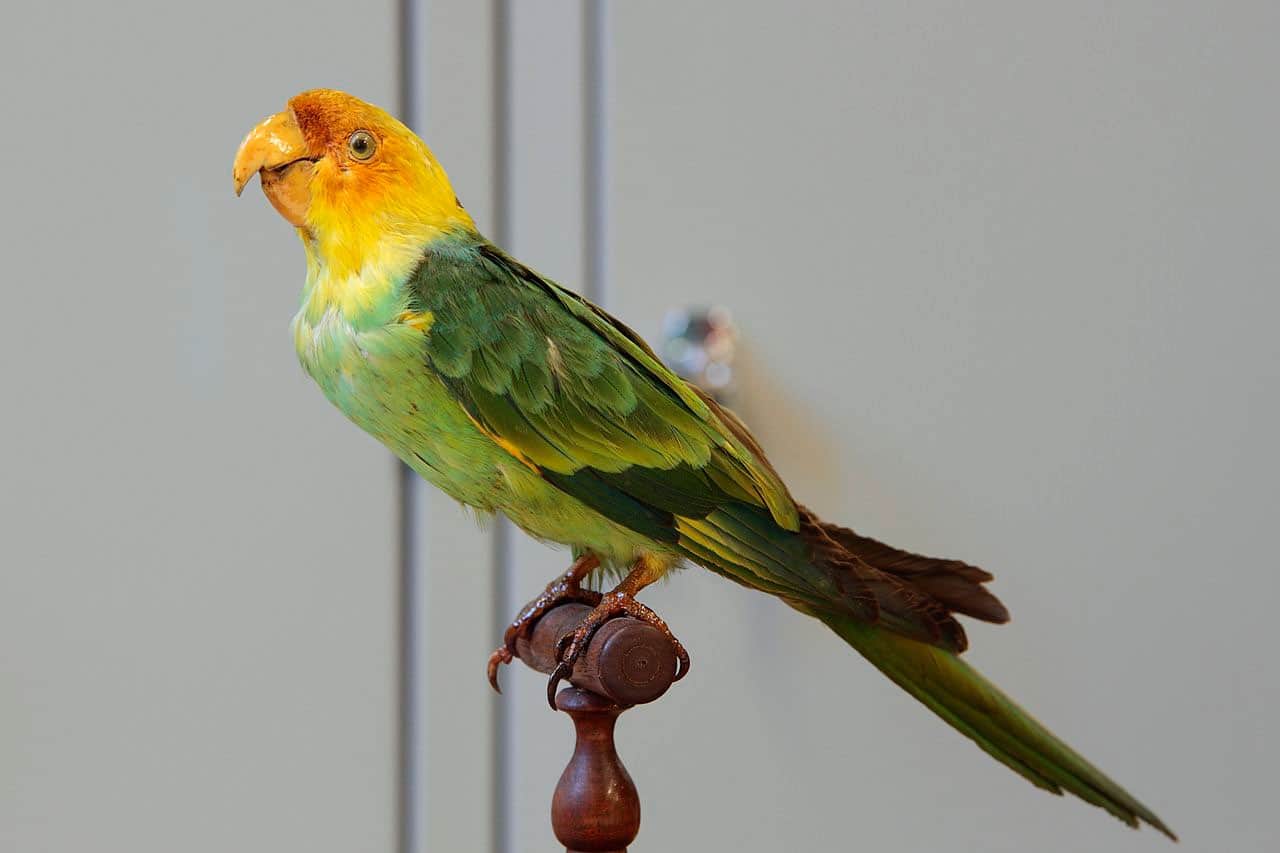
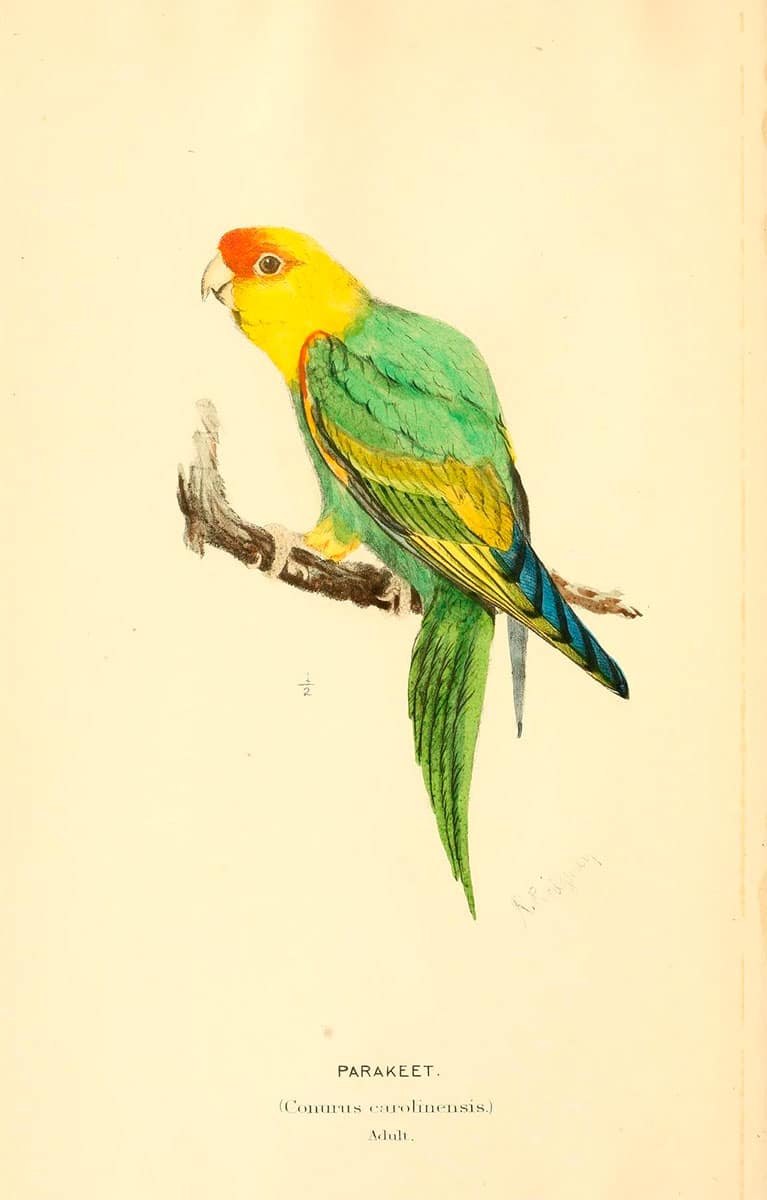
    Most of the plumage It was green with underparts light green. The primary feathers They were mainly green, but with yellow edges in outer primary. The shoulders They were yellow, continuing along the outer edge of the wings. The the thighs They were green and yellow up to the feet. The legs and feet They were light brown. The most distinctive feature of this species was the forecrown and face orange. The feathers orange spread to behind the eyes and upper cheeks (lores). The skin around the eyes It was white and bill They were pale flesh color. The plumage of the head It was completely bright.


    Carolina parrot

    The immature They differed slightly in coloration of adults. The face and all body They were green, with underparts paler. They lacked yellow or orange plumage on the face, wings and thighs. The young were covered in mouse-gray gray, up to approximately 39-40 days when the wings and queues green. The chicks had full adult plumage around 1 aรฑo de edad.

    Subspecies description:

    • Conuropsis carolinensis carolinensis โ€ 

      (Linnaeus, 1758) – Nominal.


    • Conuropsis carolinensis ludoviciana โ€ 

      (Gmelin, 1788) –

    Habitat:

    The habitats Preferred of Carolina parrot were the heavily vegetated and heavily forested lands that bordered swamps and rivers.. These parrots also lived on agricultural land and ate the crops.. Anidaban in large groups of hollow shafts. The forests of sicomoro and swamp cypress. (ยป Parakeetsยป, 2000; Fuller, 2001; Mauler, 2001; Snyder and Russell, 2002)

    They were traveling in flocks of 100 to 1000 birds. Anidaban up 30 birds in a nest. They were supposed to be Monogamie. It was about very social birds, it was probably one of the many factors that led to their extinction. When a man shot a bird, fellow herd member flitted over his lost flock, making them vulnerable too. Farmers were shooting all flock to save their crops. It is doubtful that the Carolina parrot migrated, as seen in the northern states during the cold winters. They were attracted to salt pacifiers and were observed ingesting saline waters., earth and sand.

    The Carolina parrot They are walking, They are jumping and climbing trees using their beaks as a third leg. Its flight was registered as a fast and elegant, but very noisy as birds rarely stayed silent during flight. Were involved in cleaning and grooming to keep their social cohesion. During the day they rested, slept or sunbathed. They fed in the morning and evening. (ยซParakeetsยป, 2000;ยปNature Serve, Conuropsis carolinensisยป, 2005; Howell, 1932; Rising, 2004; Snyder and Russell, 2002; Strattersfield y Capper, 2000)

    Reproduction:

    Some sources say that Carolina parrot they were Monogamie, having only one partner for life. But, no studies were conducted on mating systems and many birds apparently shared nests. (Laycock, Audobon Magazine, March of 1969; Snyder and Russell, 2002)

    There is little information available upon the reproduction of this species. They reproduced in spring, producing 2 to 5 eggs These perpetual Nidada, which then incubaban during 23 days. (Snyder and Russell, 2002; Snyder and Russell, 2002)

    Food:

    The Carolina parrot ate mainly seeds of genre Xanthium. They also consumed the fruits and seeds many other plants, as well as flower buds and, occasionally, insects. They were recorded as ruin of many fruit crops. They would pluck the immature fruit from the tree and eat the seeds. Flocks could ruin the fruit of a tree in a matter of minutes. When they ate, the Carolina parrot They are taking food with their beaks, they placed them in their claws and held them while using their beaks to eat them.. (Greenway, JR. 1967; Howell, 1932; Snyder and Russell, 2002; Strattersfield y Capper, 2000; Greenway, JR. 1967; Howell, 1932; Snyder and Russell, 2002; Strattersfield y Capper, 2000)

    Distribution:

    the former Conuropsis carolinensis It was found from southern Florida until North Carolina and in coastal areas as far north as New York City. The Carolina parrot he was in the states Gulf as far west as Texas eastern and northern along the rivers Arkansas, Missouri, Mississippi and Ohio and its tributaries. They were also recorded in South Dakota, Iowa, Wisconsin, Michigan, Ohio and W.V.. The westernmost appearances were in eastern Colorado. (ยป Nature Serve, Conuropsis carolinensisยป, 2005; Fuller, 2001; Laycock, Audobon Magazine, March of 1969; Snyder and Russell, 2002)

    Subspecies distribution:

    • Conuropsis carolinensis carolinensis โ€ 

      (Linnaeus, 1758) – Nominal.


    • Conuropsis carolinensis ludoviciana โ€ 

      (Gmelin, 1788) – Paler overall than the nominal.

    Conservation:

    This species was previously in the southeastern United States, but now it is EXTINCT, primarily as a result of persecution. The last wild records are of the subspecies Conuropsis carolinensis ludoviciana in 1910.

    The main causes of extinction of the species were the persecution (for feeding, crop protection, poultry production and trade of hats for ladies), and also deforestation (especially lowland), probably aggravated by his gregarious nature (Saikku 1991), and competition with introduced bees (McKinley 1960).

    "Carolina Parakeet โ€ " in captivity:

    One of the reasons for his extinction was the hunting of birds in the wild before their attempt to breed in captivity to sell them as pets, possibly because it was more profitable for them and it was difficult for them to breed in captivity. They could live up to 30 years in captivity.

    Alternative names:

    – Carolina Conure, Carolina Parakeet, Carolina Paroquet, Louisiana Parakeet (English).
    – Conure de Caroline, Perriche ร  tรชte jaune, Perruche ร  tรชte jaune, Perruche de la Caroline du Sud (French).
    – Carolinasittich, Karolinasittich (German).
    – Periquito-da-carolina (Portuguese).
    – Cotorra de Carolina (espaรฑol).


    scientific classification:

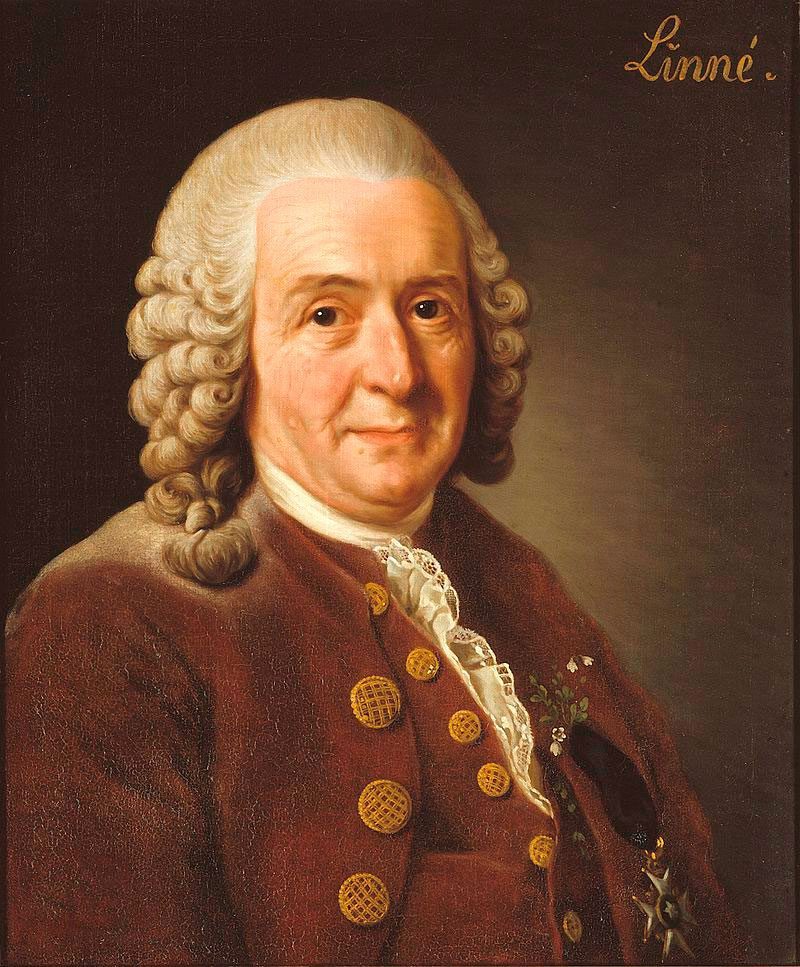
    Carlos-Linnaeus
    Carl Linnaeus

    – Order: Psittaciformes
    – Family: Psittacidae
    – Genus: conuropsis
    – Scientific name: Conuropsis carolinensis
    – Citation: (Linnaeus, 1758)
    – Protonimo: Psittacus carolinensis

    Carolina Parakeet Images:


    Sources:

    – Avibase
    – Parrots of the World โ€“ Forshaw Joseph M
    – Parrots A Guide to the Parrots of the World – Tony Juniper & Mike Parr
    – Birdlife
    – Animal Diversity Web

    – Photos:

    (1) – axidermied Carolina Parakeet. Teaching and research collections, Laval University Library By Cephas (Own work) [CC BY-SA 3.0], via Wikimedia Commons
    (2) – Conuropsis carolinensis (Linnaeus, 1758) – the extinct Carolina parakeet (mount, public display, Field Museum of Natural History, Chicago, Illinois, USA). By James St. John (Conuropsis carolinensis (Carolina parakeet) 2) [CC BY 2.0], via Wikimedia Commons
    (3) – Mounted specimen of Conuropsis carolinensis, Museum Wiesbaden, Germany By Fritz Geller-Grimm (Own work) [CC BY-SA 2.5], via Wikimedia Commons
    (4) – Taxodermic bird specimen in the Fairbanks Museum and Planetarium, St. Johnsbury, Vermont, USA. By Daderot (Own work) [CC0], via Wikimedia Commons
    (5) – Conuropsis carolinensis Linnaeus, 1758 by Huub Veldhuijzen van Zanten / Naturalis [CC BY-SA 3.0], via Wikimedia Commons
    (6) – Carolina Parakeet (Conuropsis carolinensis) by Biodiversity Heritage Library – Flickr

    โ–ท The world of Pets: Dogs, cats, birds, reptiles, amphibians

    Todl`s Parakeet (sub)
    Pyrrhura picta caeruleiceps

    Cotorrita de Perijรก

    Content

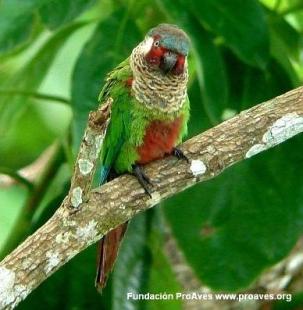
    Perija Parakeet. Copyright ProAves Colombia.

    Description:

    21-23 cm.. height.

    The Todl`s Parakeet (Pyrrhura picta caeruleiceps) It is generally green with the forehead and areas around the eyes, dark red.

    In flight the dark red stain is very evident abdomen. Wings below greyish. The crown and nape they are blue; the front and sides of the strip head, red and scaly appearance of the chest with wider margins. This subspecies is included within the species Pyrrhura picta.

    Cotorrita de Perijรก

    Notes:

      Historically, classification of Pyrrhura picta caeruleiceps (Todd 1947) He has been subject to opinions found. While some authors recognize this taxon at the species level, others consider it a subspecies of Pyrrhura subandina (Todd 1947) or Pyrrhura picta (Meyer de Schauensee 1949), the latter being the most widely followed classification (Hilty & Brown 1986, pit et to the. 1997, Rodrรญguez & Hernandez-Camacho 2002). Based on analysis of morphological characters, Joseph (2000) and Joseph & Stockwell (2002) suggested that P. caeruleiceps should be considered as a distinct phylogenetic species and that the taxon Pyrrhura pantchenkoi (Phelps 1977), described from two specimens with worn plumage, is its synonym. Hilty (2003) He continued this treatment, but the classification committee Bird South America of the American Ornithologists’ Union recently it considered that existing information was insufficient to support this taxonomic change according to the biological species concept and kept provisionally caeruleiceps like a subspecies of painted parakeet (Remsen et al. 2010).
      Source: Rediscovery and notes on the ecology and vocalizations of Toddโ€™s Parakeet (Pyrrhura picta caeruleiceps) in northeastern Colombia

    Ecology:

    They inhabit in humid jungle, semi-humid and low cloud forests.
    Nest sizable trees in abandoned nests of other species.

    Distribution:

    The enigmatic and little known Todl`s Parakeet (Pyrrhura picta caeruleiceps) It has a very restricted range in the rainforest, mainly between 500 and 900 Attitude meters along the border between Colombia and Venezuela, as well as patches of tropical forest in the foothills of the Serrania del Perija.

    Its Freedom population It is believed to be about 30 to 50 individuals.

    Conservation:

    State of conservation โ“˜


    Endangered Endangered โ“˜ (UICN)โ“˜

    The forest loss and fragmentation are the main threats facing this bird, but the species is also trapped and kept in cages as a pet. According to the categories of UICN It is considered In danger (IN), mainly due to the habitat destruction.

    Images "Todl`s Parakeet (sub)"

    Videos "Todl`s Parakeet (sub)"


    Especies del gรฉnero Pyrrhura

    Sources:


    – Parrot Book, Parrots and macaws Neotropical
    – Proaves

    โ–ท The world of Pets: Dogs, cats, birds, reptiles, amphibians

    Tui Parakeet
    Brotogeris sanctithomae

    Tui Parakeet

    Content

    Description:


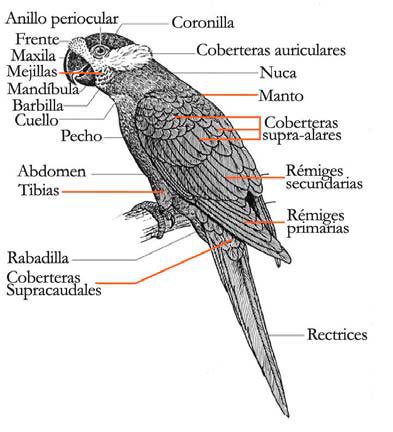
    Anatomy-parrots

    16,5 to 17,5 cm.. height.
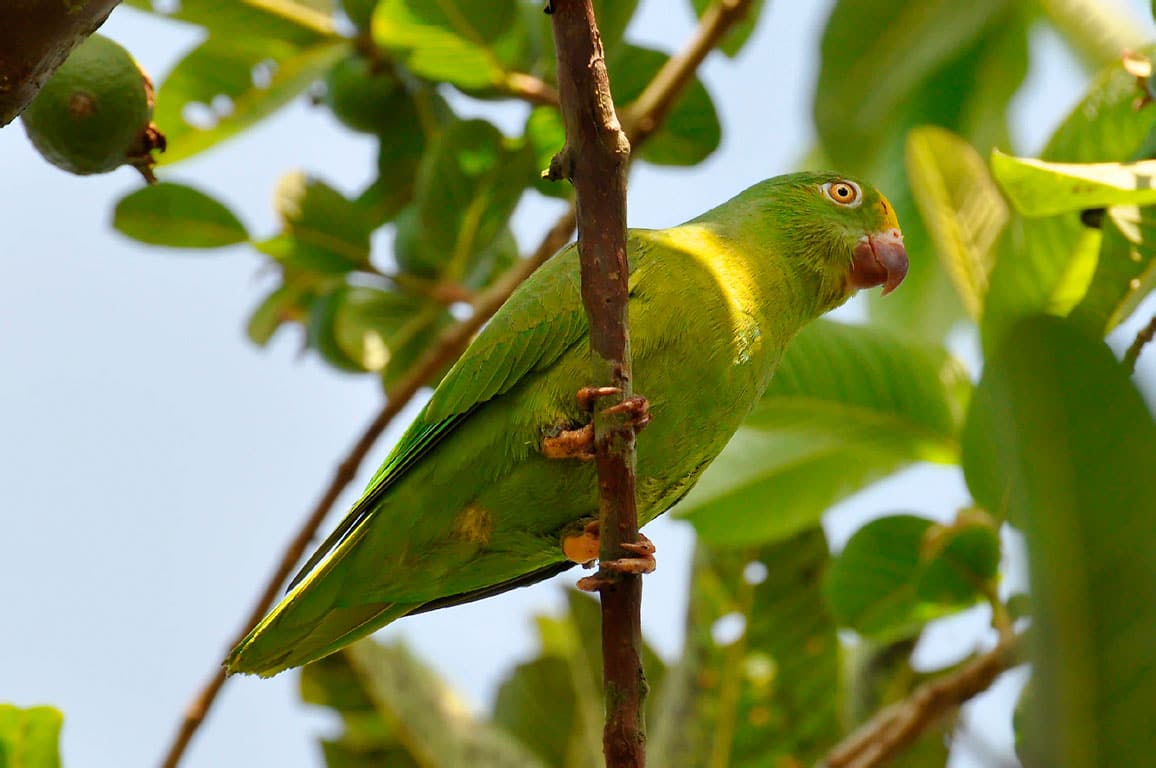
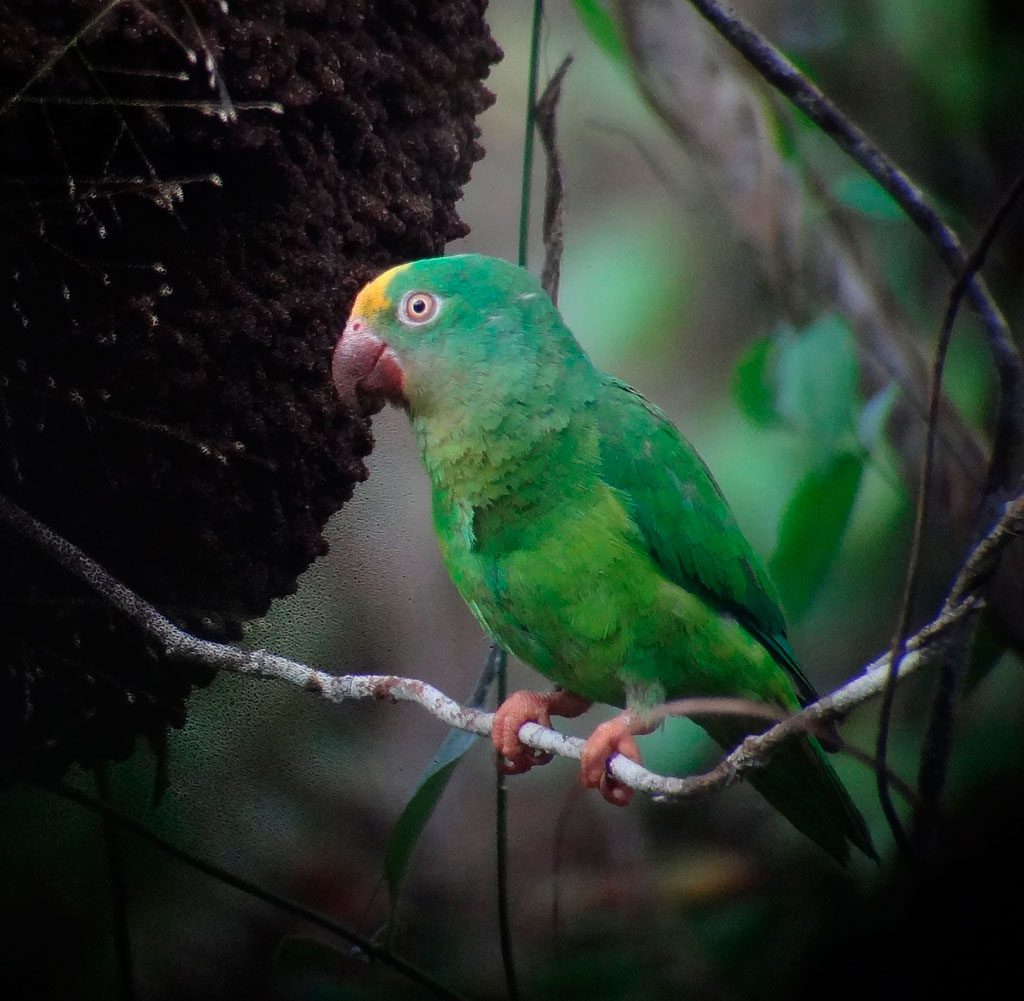
    The Tui Parakeet (Brotogeris sanctithomae) has the forecrown and the front of the crown, bright yellow; rest of the head and nape, bluish green.

    Mantle, back and scapulars dark green, paler and brighter in the rump and in the uppertail-coverts. Alula blue on the innerwebs, greenish on the outerweb; primary coverts greenish blue; other coverts green, the smaller and medium slightly impregnated olive green. Flight feathers greenish-blue on outerweb, dark green innerwebs, and light blue below; infra-wing coverts minor, green, the greater coverts, blue. Underparts brighter yellowish green. Upper, the tail is green; below is more yellowish.

    The bill It is quite dark orange-brown; Cere pale pink; the irises brown; legs grayish bone.

    Both sexes have similar plumage.

    Description 2 subspecies:

    • Brotogeris sanctithomae sanctithomae

      (Statius Mรผller, 1776) – Nominal.


    • Brotogeris sanctithomae takatsukasae

      (Neumann, 1931) – The yellow stripe behind (and sometimes below) of the eyes It extends over the ear-coverts. The yellow patch on the forecrown sometimes it is larger.

    Habitat:

    Mainly inhabits in second-growth forests, in humid areas of tropical forest, forests and marshes on the banks of large rivers and river islands and clearings near watercourses; to 100 metres in Colombia and 900 metres in Peru. Gregaria, usually in small flocks; sometimes in larger meetings. The Tui Parakeet it is very common in riverside towns and cities where it arrives in large flocks to spend the night. Visit palms on the banks of rivers.

    Reproduction:

    It nests on trees, in natural hollows or termiteros, small and noisy groups. views in nests in May and July, with immature during the month of June Colombia.

    Food:

    Few details about their diet; taking views flowers Erythrina in Colombia.

    Distribution:

    Size of the area of distribution (reproduction / resident): 3.870.000 km2

    This species is confined to the Basin Amazon Southeast Colombia (area of Leticia), northeast and southeast Peru and to the West of Brazil, possibly on the right bank of Black river and in river basins Purus, Solimรตes (this to about Cojadรกs) and south of Juruรก, to the North of Bolivia in Pando and Beni, It is able to see so dispersed in the Eastern Amazonas, around river mouths Negro and Madeira, to the this to Amapรก and Pari Eastern, possibly up area Bethlehem.

    Apparently sedentary. Local (for example, in Loreto, Peru) but common or abundant in many places (for example, about Leticia).

    Perhaps its population has been reduced due to trade locally (for example, in Peru), but the effect of habitat loss remains within the range lower. Present in many protected areas (for example, > Manu National Park, Peru).

    Distribution 2 subspecies:

    • Brotogeris sanctithomae sanctithomae

      (Statius Mรผller, 1776) – Nominal. West Basin amazon, from the southeast of Colombia to the North of Bolivia.


    • Brotogeris sanctithomae takatsukasae

      (Neumann, 1931) – Both sides of the basin under amazon, from the junction with the Black river to the East of Pari.

    Conservation:

    State of conservation โ“˜


    minor concern Minor Concern โ“˜ (UICN)โ“˜

    โ€ข Current category of the Red List of the UICN: Least concern.

    โ€ข Population trend: Stable.

    Justification of the population

    The size of the world population It has not been quantified, but this species is described as ยซcommonยป (Stotz et to the., 1996).

    Justification of trend

    It is suspected that this species has lost 15,9-17,4% of habitat within its distribution over three generations (15 years) starting from a model of deforestation Amazon (Soares-Filho et to the., 2006, Bird et to the., 2011). Given the susceptibility of the species to hunting and / or capture, suspected population decline in <25% durante tres generaciones.

    "Tui Parakeet" in captivity:

    saved pet locally but uncommon in captivity outside its range.

    Alternative names:

    – Tui Parakeet, Golden-headed Parakeet (English).
    – Toui ร  front d’or, Perruche toui, Perruche tui (French).
    – Tuisittich (German).
    – Periquito-testinha, estrelinha, estrelinha-do-parรก, periquito-brasileiro, periquito-de-testa-amarela, periquito-estrela, tuim, tuipara-estrelinha (Portuguese).
    – Catita Frentigualda, Periquito Cabeciamarillo, Periquito Pรกlido (espaรฑol).
    – Periquito Cabeciamarillo, Periquito frentiamarillo (Colombia).
    – Perico Tui (Peru).

    scientific classification:

    – Order: Psittaciformes
    – Family: Psittacidae
    – Genus: Brotogeris
    – Scientific name: Brotogeris sanctithomae
    – Citation: (Statius Mรผller, 1776)
    – Protonimo: Psittacus St. Thomas

    Images ยซCatita Frentigualdaยป:

    Videos "Tui Parakeet"


    Species of the genus Brotogeris

    Sources:

    – Avibase
    – Parrots of the World โ€“ Forshaw Joseph M
    – Parrots A Guide to the Parrots of the World – Tony Juniper & Mike Parr
    – Birdlife
    – Parrot Book, Parrots and macaws Neotropical

    – Photos:

    (1) – A Tui Parakeet in Uarini, amazon, Brazil By Claudio Dias Timm from Rio Grande do Sul [CC BY-SA 2.0], via Wikimedia Commons
    (2) – Tui Parakeet in a cage By Ruth Rogers (originally posted to Flickr as Tui Parrot) [CC BY 2.0], via Wikimedia Commons
    (3) – Brotogeris sanctithomae by Gabriel Smith – Flickr
    (4) – Brotogeris sanctithomae (Amazon river – Brazil) by Martha de Jong-Lantink – Flickr
    (5) – Photo taken from flickr.com โ€“ ยฉbarbetboy

    – Sounds: controles-canto.org

    โ–ท The world of Pets: Dogs, cats, birds, reptiles, amphibians

    Gang-gang cockatoo
    Callocephalon fimbriatum


    Gang-gang cockatoo

    Content

    Description

    Of approximately 35 cm.. height and an average weight of 257 g.
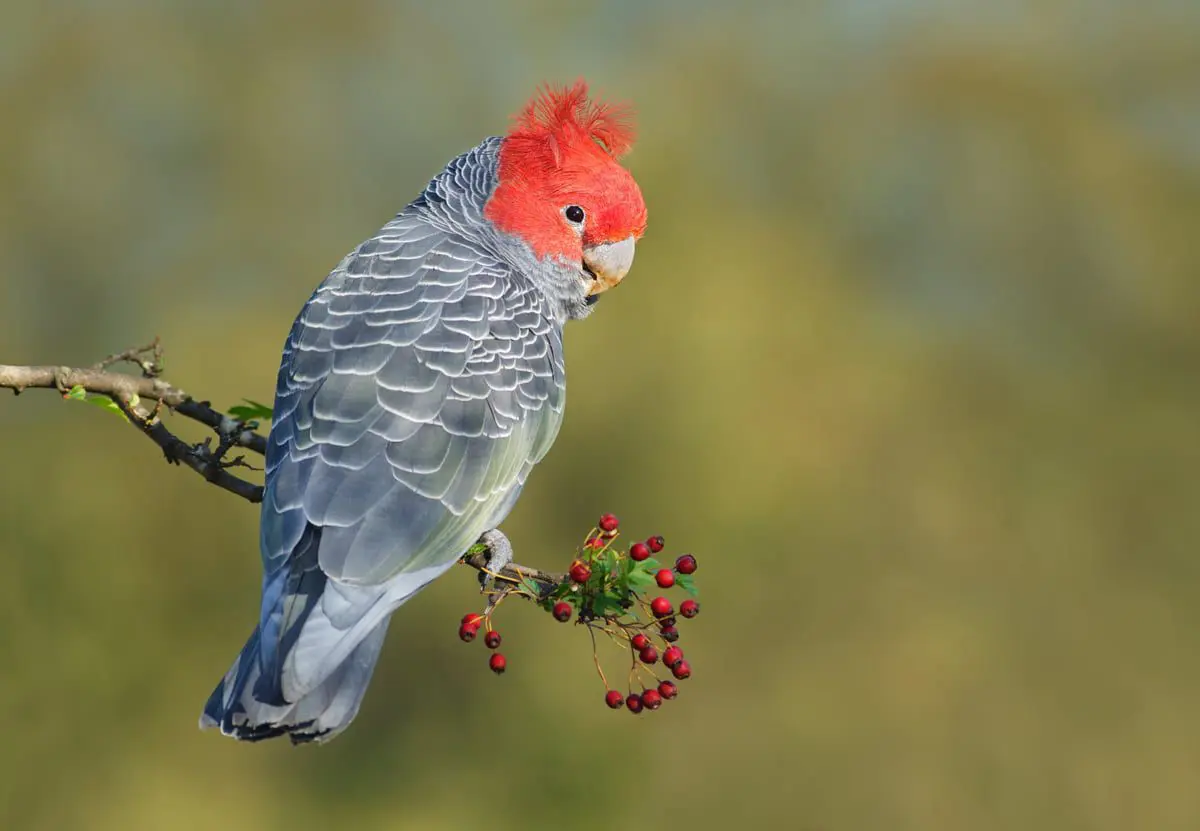
    The Gang-gang cockatoo (Callocephalon fimbriatum) it's a little cockatoo, robust, with one crest Dim, large wings wide, and tail short. Son gregarious but relatively calm.
    The males of the Gang-gang cockatoo they are immediately recognizable by their head and crest scarlet. The remaining plumage is slate grey.
    The females they have the head and crest grey. The feathers of the part inferior of the body are lined with green Orange and yellow, giving a scaly appearance. The tail also has stripes horizontal white. Otherwise, is identical to the male.

    The juveniles they are similar to the females, they differ in their top, the head Red and one crest shorter and less twisted.
    The Gang-gang cockatoo not can confuse it with other species of parrots. In flight, However, sometimes their shape resembles to the cacatรบa Galah.

    Habitat:

    Video – "Gang-gang cockatoo" (Callocephalon fimbriatum)

    Gang- gang Cockatoo (Callocephalon fimbriatum)

    During the summer are found in the forests of mountain and areas with understory of shrubs dense. In Winter they will move to more dry and low altitudes, more open forests. They can often be seen along the roads and in parks and gardens in urban areas. They require high hollow trees for nest.

    Reproduction:

    Forman couples monogamous. The female chooses a hole in the right tree and both sexes prepare the nest for egg-laying. They line the sides of the hole with sawdust and chewing dust. Both sexes incubate the eggs and care for the young. Parents feed their young for four to six weeks after hatching. Feather.

    Family groups are commonly seen feeding together during the breeding season.. In some cases, nurseries will be formed’ where have several couples nested together, their young perch together in the same tree, While their parents seek for food.

    Food:

    With feed mainly seeds trees and shrubs, native and introduced, with a preference for the eucalyptus, beards and thorns. They also eat berries, fruit, dried fruits, insects and their larvae.

    They are mainly arboreal, they perch on the ground only to drink and forage among the fallen fruits or cones.

    They feed in flocks of up 60 birds out of breeding season. Feed in pairs or small family groups during the breeding season.

    They are able to use exotic plants as food in the urban areas.

    Distribution:

    Size distribution (reproduction / resident): 333.000 km2

    They are endemic to the South-East of Australia. They are widespread in the East of New South Wales, from the Central slopes and plateaus to the South Coast, along the northeastern regions of Victoria to Seymour, with some records in the East of Melbourne, mornington peninsula and Southwest Gippsland.
    Have also been introduced in the Kangaroo Island to the South of Australia.

    Conservation:

    State of conservation โ“˜


    minor concern Minor Concern โ“˜ (UICN)โ“˜

    โ€ข Current category of the Red List of the UICN: Least concern.

    โ€ข Population trend: In increased.

    Is come affected negatively by deforestation and the removal of mature trees (potential breeding sites). A population is classified as threatened: in the Valley Cove Lane, New South Wales.

    The the rest of the population It is suspected that it may be increasing and now will spend the winter in the suburbs of Canberra.

    The world population are estimated at more of 20,000 individuals.

    "Gang-gang cockatoo" in captivity:

    Itร‚ยดs very rare in poultry and hard to find as a pet.

    Son Smart and playful, but they have a great tendency to suffer from software. They are very destructive for what need of abundant toys to not attack against the furniture of the House.

    When you get bored, they are often automutilan as a way to fight against boredom.

    Its life expectancy You can overcome the 60 years.

    Alternative names:

    – Gang-gang Cockatoo, Cockatoo Corella, Helmeted Cockatoo, Red-crowned Cockatoo, Red-headed Parrot (English).
    – Cacatoรจs ร  tรชte rouge, Cacatoรจs gang-gang (French).
    – Helmkakadu, Helm-Kakadu (German).
    – Cacatua-gang-gang (Portuguese).
    – Cacatรบa Gang Gang, Cacatรบa Gang-gang (espaรฑol).

    scientific classification:

    – Order: Psittaciformes
    – Family: Cacatuidae
    – Scientific name: Callocephalon fimbriatum
    – Genus: Callocephalon
    – Citation: (Grant,JB, 1803)
    – Protonimo: Psittacus fimbriatus

    Images Gang-gang Cockatoo:


    Sources:
    – Avibase
    – infoexoticos
    – Birdlife

    – Photos: Jan Wegener, Marbiz (Panoramio), papouch.webzdarma.cz, Benjamint444 (commons.wikimedia.org)

    – Sounds: (Xeno-canto)