โ–ท The world of Pets: Dogs, cats, birds, reptiles, amphibians

Newfoundland
Canadรก FCI 50 - Molossoid - Mountain

Terranova

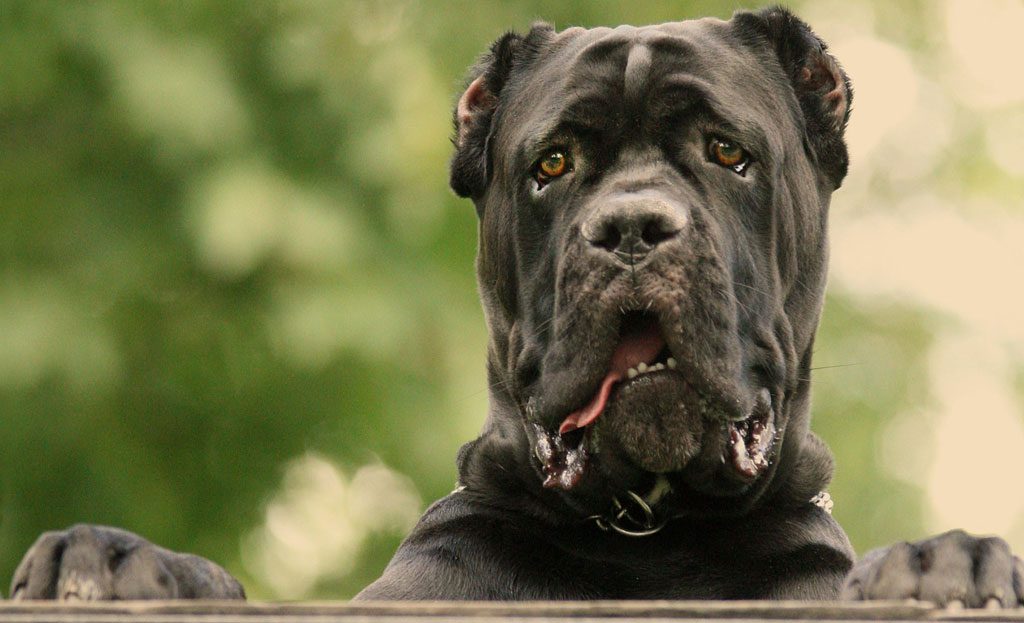
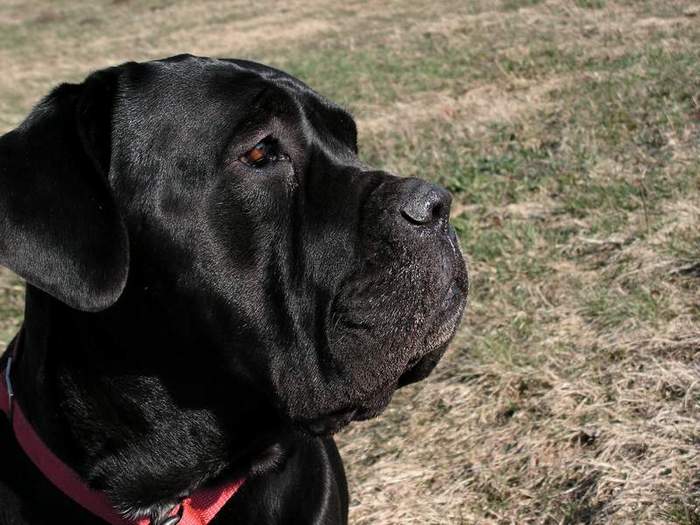
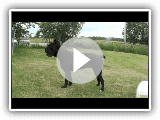
The Newfoundland radiates majestic serenity.

Content

History

The Newfoundland was born on the east coast of Canada. The great island of Newfoundland, which is in front of Canada, gave him his name. The fact that it descends from the dogs of the Vikings of pre-Columbian times or from the dogs of the Indians is a legend that has not been proven until now.. Its relationship with the molossi can be seen but also proved in the genetic map of the Heidi G dog breeds. Parker.

Probably the ancestors of the Newfoundlands came with the first settlers as molossi from Europe. It proved to be an aid to fishermen and sealers and was occasionally useful when hunting bear and big game on land.. It transported loads and served as a draft dog for the sleds with the dead game.. Working with fishermen in the rough North Atlantic was extremely demanding. The Newfoundland had to think, had to do heavy work on the networks. The Newfoundland saved the lives of the castaways over and over again. In this way, he developed the peculiarities of his character and physique that allowed him to face the harsh weather conditions on land and the dangers of the sea as a water and rescue dog..

With the cod ships he came to England over and over again as early as the 18th century. Here he became famous early on due to his impressive achievements. Was not up 1886 that the Club of Newfoundland in England, and soon after, in 1893, The club of Newfoundland for the Continent, now called the "German Club of Newfoundlandยซ. Even today, Newfoundland keep working as a water rescue dog.

Did you know??

One Newfoundland named Rigel sank with the Titanic and swam alongside a lifeboat for three hours in the icy water, apparently looking for its owner, that had gone down with the ship. The people in the lifeboat were nearly run over by the steamer Carpathia because the crew could not hear their faint cries., but Rigel's bark was noticed and the people and the dog were saved.

Physical characteristics

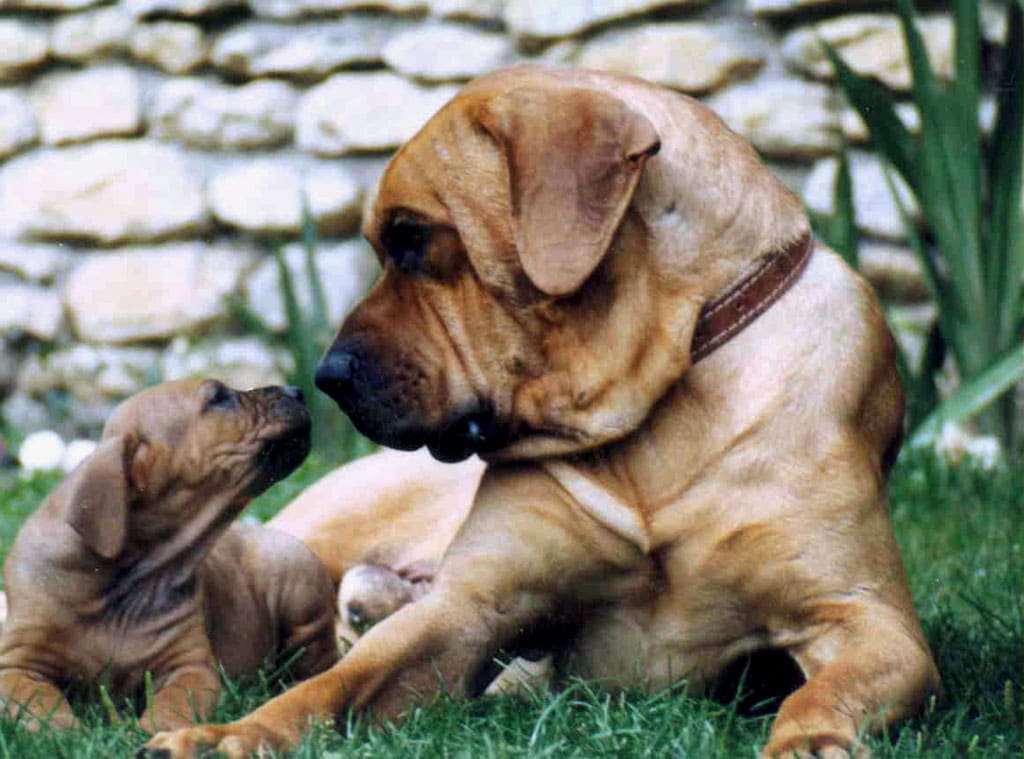
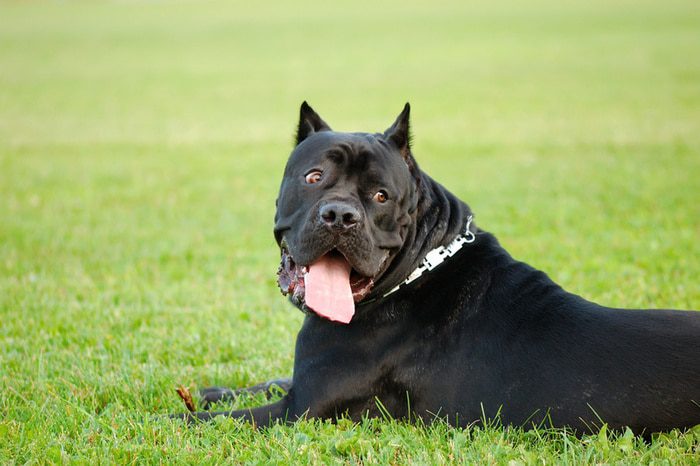
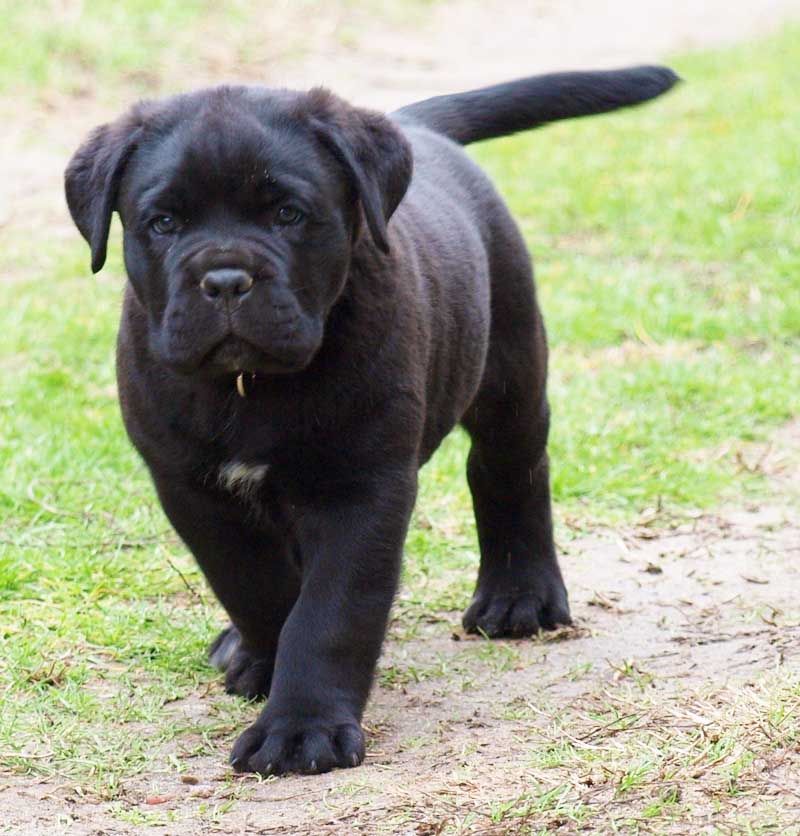
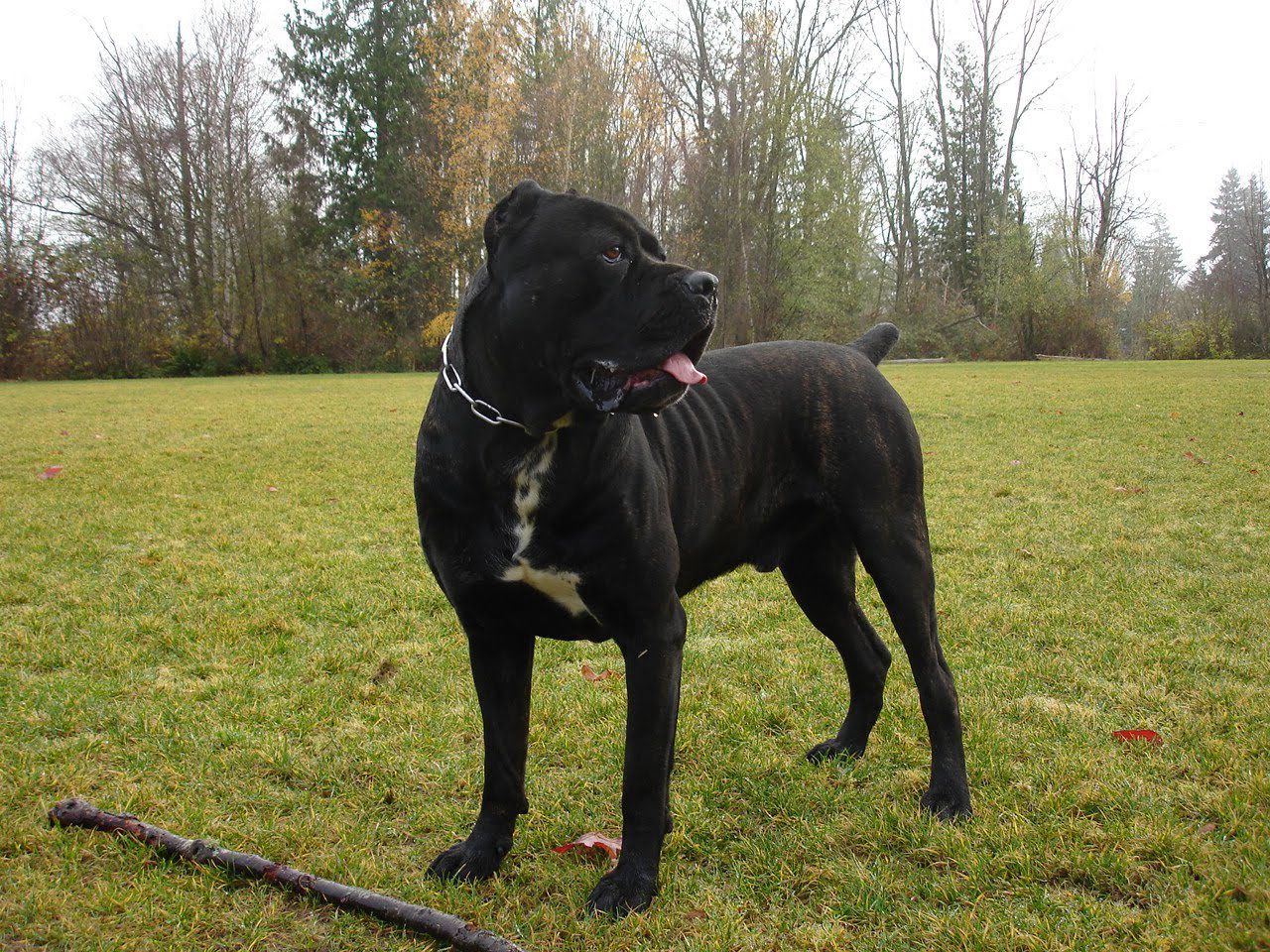
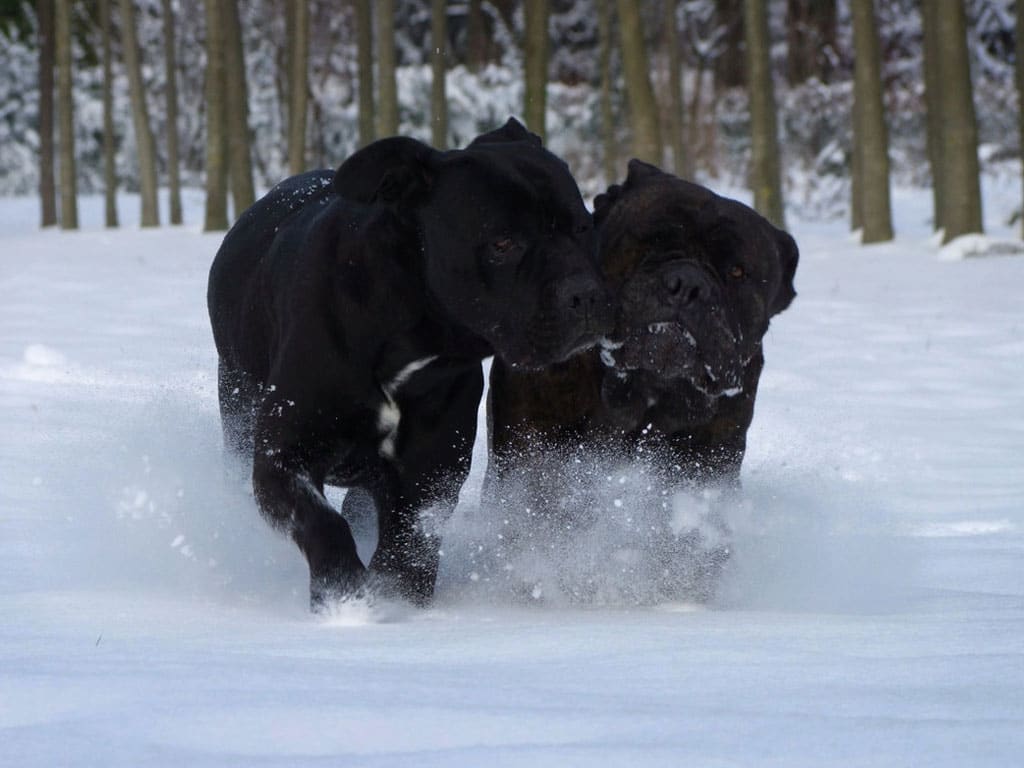
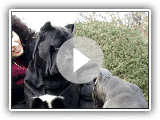
The Newfoundland is a big dog. According to the standard, adult males must weigh an average of 68 kg and females 54 kg. It is a very strong dog, very muscular and with long dense hair. Her coat is water repellent. It has a strong and soft undercoat, which makes it look even bulkier. This shouldn't tempt you to raise him like a teddy bear.. Because the real Newfoundland combines enormous power with agility, sportiness and impressive skills in the water. Its exterior does not deceive its interior. Master challenges with a committed calm. The hair on your head, muzzle and ears is short and thin. The front and rear legs are covered in fur. The tail is completely covered in long thick hair. The black, brown and black and white are allowed as coat colors.

Character and skills

Even the mere appearance of Newfoundland has a relaxing and calming effect, at least for people who are not usually afraid of dogs. The Newfoundland radiates majestic serenity. Its character is as stable as it appears on the outside. It has a friendly and kind nature. But that must not be misleading: He knows very well how to distinguish between friend and enemy, which you can unequivocally underline by your calm but more determined appearance. If required, defends his family with all his might without hesitation. Barking is not necessary to be heard.

He is extremely friendly with his friends. The Newfoundland he is very close to his family and loves children more than anything. He wants education and he absolutely needs it. Because like a powerful big dog it is always stronger than the other end of the leash.. Sometimes he has a hard head, but after a friendly request from his master or caretaker he does everything, as long as it's well connected. The Newfoundland impresses by the unity of two apparently irreconcilable poles: on the one hand it radiates calm and tranquility, on the other hand it can save people from drowning in a short time in the most difficult conditions. Usually, the Newfoundlands are real water rats. They are excellent swimmers, which they are happy to proudly demonstrate.

The Newfoundland not a dog for the city or a flat. He likes long walks, but water is the best for him. Due to its strength and the high technical demands of its maintenance, not suitable for beginners, although it can be trained and managed well. It is a great family dog. But he also likes to sleep outside, even with wind and rain. What you don't need is running or doing activities in the heat.

The Newfoundland It is a natural lifeguard and can be a good helper for parents who have a pool or enjoy taking children to the lake or ocean, although you should never be solely responsible for your safety.

Newfoundland Education

The Newfoundland can be educated very well. It is intelligent, interested and quickly understand what you are allowed to do and what you are not. Sometimes it's a little slow, but a little motivated, he is very cooperative and strives to make his master and lady happy. The puppy should already show itself clearly and without exception where the hammer hangs. There should be no doubt about the orientation of your humans, as well as about the intimate relationship and respect for him.

It must always be kept in mind that this dog is the physically strongest and that leadership only works through unquestioning recognition of the human leadership role.. With praise and results, basically you can achieve everything with it. On the basis of a good education you can train him very well Newfoundland. Many terranovas they are successfully used as guide dogs for the blind and especially as water rescue dogs, but also on land. For this you can do work tests with water in the clubs.

Caring for a Newfoundland

Maintain and care for the Newfoundland it is very expensive. The dense, weather-resistant coat must be brushed every day with a special brush.. Should not be sheared or trimmed. Due to its constitution and dense coat, do not tolerate heat well.

Nutrition / Food

Like all large dogs, Newfoundland need a lot of food. Especially in the growth phase you need professional nutritional planning.

Newfoundland life expectancy

Life expectancy is between 8 and 12 years. That depends a lot on the upbringing. Thin and light dogs tend to age more than heavy, plump dogs.

Newfoundland Health

as could be predicted, given its large size, the Newfoundland can suffer a series of joint and structural problems. It is important that young and growing dogs are kept lean and are not allowed to exercise too hard or eat too much, since this will cause injuries and problems that can be paralyzing in the future. In fact, all the Newfoundland they need to stay slim, since obesity increases the chances of them developing structural problems and makes them more painful when they occur.

One such structural problem is genetic hip deformation known as hip dysplasia.. The head of the femur does not fit well into the hip socket; with the time, the cartilage in the joint wears away and the underlying bone is damaged. Serious arthritis occurs that usually affects very young dogs. In some cases, expensive surgery required, including total hip replacement surgery. If not treated, the dog will suffer pain and a poor quality of life. Elbow dysplasia is another inherited joint problem, resulting from abnormal elbow formation.

The possibility that a Newfoundland develop dysplasia of the hip or elbow just because the parents are free of the disease, although it reduces the possibilities. And while a puppy's bones keep growing, it can sometimes be difficult to confirm a diagnosis, depending on the tests performed and the severity of the condition.

To each Newfoundland X-rays of your dog's hips and elbows should be taken by two years of age, regardless of whether or not he shows symptoms of lameness or stiffness. For dogs that show lameness before that age (that is to say, during the puppy stage), diagnostic tests should be performed promptly.

The Newfoundlands are at risk of heart disease, including dilated cardiomyopathy and subaortic stenosis (SAS). There is currently no genetic test for SAS, who has a complex inheritance, making it difficult to develop a test. Breeders must not breed Newfoundland with no signs of SAS and puppies should be examined by a certified veterinary cardiologist.

Cystinuria is a genetic kidney defect that leads to the formation of bladder stones that are very difficult to manage with diet or medication and often requires surgery both to remove the bladder stones and to repair urinary obstructions.. There may be no early signs that the dog is forming cystine stones, which can create a life-threatening emergency if they cause an obstruction. Fortunately, there is a genetic test for cystinuria. Given the availability of the genetic test, no need for a breeder to produce a dog with the disorder

Not all of these conditions are detectable on a growing puppy, and it can be difficult to predict whether an animal will be free of these diseases, so a reputable breeder must be found who is committed to raising the healthiest animals possible. Must be able to produce an independent certification that the parents of the dog (and grandparents, etc.) have been screened for these defects and considered healthy for breeding. That's where health records come in..

Not all visits by Newfoundland to the vet they are due to a genetic problem. It is known that the Newfoundland experience cruciate ligament rupture. They are also among the deep-breasted breeds predisposed to bloating., a condition in which the stomach is distended by gas and may twist in on itself (called gastric torsion), cutting off blood flow. Swelling and torsion appear very suddenly, and a dog that was fine a minute can die a few hours later. Watch for symptoms such as restlessness and pacing, la baba, the paleness of the gums, lip licking, unsuccessful attempt to vomit and signs of pain. Swelling requires immediate veterinary intervention, and surgery is necessary in many cases. Unfortunately, dogs that have swollen can do it again, So most veterinarians offer a procedure known as gastropexy or "stomach turning.", which anchors the stomach to the body wall to help prevent future twisting. This procedure can also be done as a preventive measure.

Buy a Newfoundland

You should only buy a puppy locally from a breeder who is affiliated with the FCI. should come from a baby, where dogs are rather sporty, thin and not too fat and ยซbearyยป. A puppy in the kennel is usually sold at a price between 1500 and 2000 EUR.

Valuations "Newfoundland"

Coexistence is important that you have with your new friend. Before considering the acquisition of a dog of the breed "Newfoundland" you know certain factors. Not all breeds of dogs are apt to live in an apartment, you must take into account his character, their need for exercise, their interaction with other pets, their care and if you have small children, their level of tolerance towards them.

Adaptation โ“˜

5,0 of 5 stars (based on 1 review)

friendly dog โ€‹โ€‹โ“˜

4,0 of 5 stars (based on 1 review)

hair loss โ“˜

5,0 of 5 stars (based on 1 review)

Affection level โ“˜

4,0 of 5 stars (based on 1 review)

Need for exercise โ“˜

3,0 of 5 stars (based on 1 review)

Social need โ“˜

4,0 of 5 stars (based on 1 review)

Home โ“˜

3,0 of 5 stars (based on 1 review)

Toilet โ“˜

5,0 of 5 stars (based on 1 review)

Friendly with strangers โ“˜

4,0 of 5 stars (based on 1 review)

barking โ“˜

3,0 of 5 stars (based on 1 review)

Health โ“˜

5,0 of 5 stars (based on 1 review)

Territorial โ“˜

5,0 of 5 stars (based on 1 review)

Cat friendly โ“˜

5,0 of 5 stars (based on 1 review)

Intelligence โ“˜

4,0 of 5 stars (based on 1 review)

Versatility โ“˜

3,0 of 5 stars (based on 1 review)

Child friendly โ“˜

5,0 of 5 stars (based on 1 review)

Surveillance โ“˜

3,0 of 5 stars (based on 1 review)

joy โ“˜

5,0 of 5 stars (based on 1 review)

Images "Newfoundland"

Photos:

1 – Terranova by Maria Amaro Jimenez / CC BY-SA
2 – Terranova by https://pixabay.com/es/photos/terranova-perro-negro-609531/
3 – Terranova by https://pxhere.com/es/photo/112392
4 – Terranova by https://www.publicdomainpictures.net/es/view-image.php?image=197196&picture=newfoundland-cute-puppy-dog
5 – Terranova by https://www.pxfuel.com/es/free-photo-obraa
6 – Terranova by https://www.pxfuel.com/es/free-photo-jttkx

Videos "Newfoundland"

Type and recognitions:

  • FCI CLASSIFICATION:
  • Group :
  • Section : . .

Federations:

  • FCI – Pinscher and Schnauzer-Molossoid type dogs – Swiss Mountain Dogs and Cattledogs. Section 2.2 Molossoid, mountain type. โ“˜
  • AKC – Dogs working โ“˜
  • ANKC – Group 6 (utility dogs) โ“˜
  • CKC – Group 3 โ“˜
  • โ€‹KC – Working dogs โ“˜
  • NZKC – Utility dog โ“˜
  • UKC – Watchdog โ“˜

FCI breed standard "Newfoundland"

Origin:
Canada

Date of publication of the valid original standard:
29.10.1996.

Use:

Sled dog for heavy loads, water dog.


General appearance:

The Newfoundland has a powerful body, solid, muscular. Their movements are well coordinated.

IMPORTANT PROPORTIONS: The length of the body, measured from the scapulo-humeral joint to the tip of the ischium, is greater than the distance from the cross to the ground (height to the cross). The body is compact. The female's body may be slightly longer and less massive than the male's. From the withers to the lower chest the distance is slightly greater than from the lower chest to the ground.


Behavior / temperament:

The expression of the Newfoundland reflects kindness and sweetness. Worthy, happy and creative, is characterized by its genuine gentleness and serenity.

Head:

Solid. The female's head has the same general configuration as the male's, but it is less massive.

Cranial region:
  • Skull: It is wide; the apex is slightly arched and the occipital bone is well developed.
  • Depression links (Stop): It is well observable, but never abrupt.

facial region:

  • Truffle: Wide and well pigmented. Windows are well developed. In black dogs and black and white, It is black; it is brown in dogs of this same color.
  • Snout: Definitely square, deep and moderately short. It is covered by short fine hair and has no wrinkles. The corners of the lips are apparent, but not too pronounced.
  • Belfos: soft.
  • Jaws / Teeth: The bite is uniform or scissor-shaped.

Eyes: Moderately sunken and relatively small. They are well separated and there is no presence of a third eyelid.. They are dark brown in black and black and white dogs. Lighter shades are allowed in brown dogs.

Ears: They are relatively small, triangular and rounded edges. They sit back on both sides of the head and are very heavy.. When the adult dog's ear is extended forward, it reaches the inner corner of the eye on the same side of the head.

Neck:

It is strong, muscular and well-seated on the shoulders. It is long enough to allow a distinguished bearing of the head. The double chin should not be excessive.

Body:

The bone structure is everywhere solid. In profile, the body is deep and vigorous.

  • top line: It is horizontal and firm from the cross to the rump.
  • Back: Wide.
  • Pork loin: Strong and well muscled.
  • Rump: Wide. Tilts at a 30ยฐ angle.
  • Breast : Width, deep and spacious; the ribs are well arched.
  • bottom line: Almost uniform and never raised.

Tail:

While the Newfoundland is swimming, the tail serves as rudder; therefore, It must be strong and wide at the root. When the dog is at rest, the tail is down, perhaps forming a small curve at the tip; reaches the hock or a little lower. When the dog is moving or animated, the tail is carried straight with a slight upward curve, but it never comes rolled up on the back, nor curved between the hind limbs.

Tips

PREVIOUS MEMBERS: They are straight and parallel also when the dog walks or jogs slowly.

  • Shoulder: They are well muscled and oblique.
  • Elbows: stuck to the chest.
  • Metacarpus: They are slightly inclined.
  • Previous feet: Large and in proportion to the body. They are rounded and compact, with also compact and firm fingers. The fingers have an interdigital membrane.

LATER MEMBERS: Since the urge to drag heavy loads, swimming and covering a lot of ground efficiently depends largely on the hindquarters, in Newfoundland their structure is very important. The pelvis must be strong, wide and long.

  • Thigh: He is broad and muscular.
  • Knee: It is well angled, but not enough to give the impression that the dog is crouched.
  • Leg: It is strong and quite long.
  • Hocks: They are relatively short and are well lowered and separated, parallel to each other. They don't even deviate inwards, nor out.
  • Hind feet: Firm and compact. In case of dewclaws, these must have been removed.

Movement:

The Newfoundland's forelimbs have good range and their hindlimbs give a strong boost, which denotes ease and strength. A slight rocking of the back is considered natural. As speed increases, the top line remains uniform.

Mantle

  • Fur: The Newfoundland has a double layer of waterproof hair. The outer layer is moderately long and straight hair without curls; a slight wave is allowed. The inner layer is soft and dense. It is denser in winter than in summer, but still it is always existing in the rump and chest. The hair of the head, the muzzle and ears are short and thin. Front and rear limbs have bangs. The tail is completely covered with long, dense hair, but it has no flag shape. Any haircut or grooming should not be encouraged.
  • Color: Negro, black and white and chestnut.
    • Negro: This is the traditional color. It should be as uniform as possible, but a slight tan tone is allowed. White markings on chest are also allowed, fingers and tip of tail, the both.
    • black and white: This variety has historical significance for the breed. The preferred marking pattern is: black head, preferably with a white list that extends to the muzzle, black saddle with uniform markings and black upper back and tail. Other parts of the body should be white with minimal mottling.
    • Chestnut: This color ranges from chocolate to bronze. White markings on chest allowed, fingers and tip of tail, the both. Black and white and brown dogs must be shown in the same class as blacks.


Size and weight:

Height to the cross: The average height at withers in adult males is 71 cm and of 66 cm in adult females. The average weight is approximately 68 kg in males and 54 kg in females.

A large animal is valued, but this should not be more important than the general state of health, symmetry, strong structure and correct movement.


Fouls:

Any deviation from the aforementioned criteria is considered as a fault and the severity of this is considered to the degree of the deviation to the standard and its consequences on the health and well-being of the dog..

  • General appearance: very long limbs, lack of substance.
  • General structure of the bones: flojedad, fine bones.
  • Character: aggressiveness or shyness.
  • Narrow head.
  • Long or pointed snout.
  • Pronounced noses.
  • Round eyes, saltones, yellow, or with a pronounced third eyelid.
  • Convex back, float or concave.
  • Forelimbs: sunken metacarpus, crushed feet, fingers that turn inward or outward, absence of membrane between fingers.
  • Hind limbs: knee joint very straight, cow hocks, crowded limbs, feet twisted inward.
  • Short tail, long, doubled or bent.
  • Take short, quick steps, dragging the feet, obliquely displaced like a crab; tight and knitting motion, crossing the front limbs, with deviated feet in or out; high movement (hockney action); amble step.
  • Sparse hair; absence of inner layer of hair

FALTAS DESCALIFICANTES:

  • Aggressiveness or extreme shyness.
  • Any dog โ€‹โ€‹showing clear signs of physical or behavioral abnormalities must be disqualified..
  • Upper or lower prognathism, arch of deviated incisors.
  • Short straight hair.
  • Marks of a color other than white on black or brown dogs.
  • Any color other than black or black and white or brown.


N.B.:
  • Males should have two normal-appearing testicles fully descended into the scrotum..
  • Only functionally and clinically healthy dogs, with the typical conformation of the breed, should be used for parenting.

TRANSLATION: IRIS Carrillo (Puerto Rico Kennel Federation).

Source: F.C.I - International Cynological Federation

Alternative names:

1. Newfs, Newfies (English).
2. Retriever de Terre-Neuve, Chien de Terre-neuve (French).
3. Newfoundland (German).
4. Cรฃo terra-nova (Portuguese).
5. Perro de Terranova (espaรฑol).

โ–ท The world of Pets: Dogs, cats, birds, reptiles, amphibians

Entelbucher Cattle Dog
Suiza FCI 47 - Swiss Cattle Dogs

Boyero de Entlebuch

The Entelbucher Cattle Dog they are kind and dedicated to people close to him

Content

History

The Entelbucher Cattle Dog is the smallest of the four Sennenhund, a type of dog that includes four races in the region. The name Sennenhund refers to the population Senn, dairy and livestock farmers in the Swiss Alps.

The distinctive of this variety of Sennenhund name responds to the District of Entlebuch (in German Amt Entlebuch) It is one of five districts of the Canton of Lucerne (Switzerland), Located southwest of Canton.

All races Sennenhund are believed to be descendants of large molossians brought to Switzerland by the Romans in the 1st century to. C. But, Entlebuch's Boyero was described as a separate breed in 1889. After World War I, the breed greatly decreased in number of specimens.

The first breed club was not formed until 1926, only sixteen examples of this type of dog were recorded in 1927, and it was so, the race was gradually restored. Although initially the race stayed for custody of goods and grazing, today the breed is generally reserved as a cheerful family companion.

The Entelbucher Cattle Dog is recognized by the International Cynological Federation, and the standard written in the native country of the breed is used, Switzerland.

Other national canine clubs not affiliated to the Federation Cynologique Internationale, They also recognize the race, but they often write their own versions of the standard of the breed.

The breed is recognized by numerous small clubs and registries on the Internet, where it is promoted as a rare breed to puppy buyers looking for a unique pet.

Physical characteristics

Entelbucher Cattle Dog is a square dog, robust, but medium-sized. It has small ears, triangular and rather small brown eyes. The head is well-proportioned to the body, with a flat and strong skull. His long jaw is well shaped and powerful. Toes are compact and provide cushioning and support his muscular body.

The layer of hair is smooth is thin and hard, with symmetrical markings of tricolor. White on their toes, the tip of the tail, the chest, the Tan always lies between the black and white. It has muscular broad hips. The tail is sometimes cut, a practice that is prohibited by law in many countries.

One Entelbucher Cattle Dog It has a height at the withers between 44 and 52 cm in males and between 42 and 50 cm in females. Weight is between 20 and 30 kg.

Character and skills

Like all large working dogs, very active, which is why, This race should be socialized at an early age with other dogs and people, and always with normal activity and training that can live safely as a pet (given its size, It may be a problem if you do not receive adequate education).

According to the breed standard, they are dedicated to people close to him and kind dogs, a little distrustful with strangers, and he loves children. But we must always bear in mind that the temperament of the dogs is individual, that is to say, may varyโ€ฆ

Entelbucher Cattle Dog Education

The Entelbucher Cattle Dog feel more comfortable in the field. He wants to move and be busy. Not a sofa dog. Not suitable for comfortable people and not for life in the middle of the city, but for challenges at work and dog sports. But, you don't necessarily need a house with a big garden, what would be ideal, because it also settles for an apartment. He has no special demands on his attitude, except the fact that we work with him and that on a daily basis. The nucleus and the end of their close participation is the human family. The Entelbucher Cattle Dog can be well trained. Loves to learn and learns with enthusiasm. It is strongly oriented towards its humans, which can be put to good use. The Entlebucher can read the mood and desires of your humans on their faces. This in turn means that one must approach one's education with feeling and of course with consequence.. You have a clear sense of justice and, therefore, questions fair treatment of him.

Entelbucher Cattle Dog Images

Videos Entlebuch Mountain Dog

Type and recognitions:

  • FCI CLASSIFICATION:
  • Group :
  • Section : . .

Federations:

FCI โ“˜, AKC โ“˜, ANKC โ“˜, CKC โ“˜, โ€‹KC โ“˜, UKC โ“˜

FCI breed standard Entelbucher Cattle Dog

FCIFCI - Entelbucher Cattle Dog
Cattle

Alternative names:

1. Entelbuch Mountain Dog, Entelbucher Cattle Dog, Entlebucher (English).
2. Bouvier de l’Entlebuch (French).
3. Entlebucher Sennenhund (German).
4. Entlebucher Sennenhund (Portuguese).
5. Entlebucher Sennenhund (espaรฑol).

โ–ท The world of Pets: Dogs, cats, birds, reptiles, amphibians

Karst Shepherd
Eslovenia FCI 278 - Molossoid . Mountain

Karst Shepherd

The Karst Shepherd a typical guard dog. Acts largely independently, which is also essential for the protection of the herd.

Content

History

The Karst Shepherd It is a breed that has existed for several centuries and belongs to the group of molosoids. Probably, This dog followed the Illyrian tribe in their migration through Styria and the Dalmatian islands and settled in the Slovenian region of the Karst Massif.. The first time that race is referred to in writing is in 1689, in the book of Baron Janez Vajkart Valvasor entitled ยซ The glory of the duchy of Carniole ยป. The breed and its standard were officially recognized on 2 in June of 1939 with the name of " Iliria Shepherd ยป during the general assembly of the F.C.I. in stockholm. During the F.C.I general assembly. in Bled-Slovenia in 1948, the standard was completed and the breed recognized again. But, to 16 in March of 1968, the Iliria Shepherd from the Karst massif, bore the same name as the Shepherd of the Sarplanina massif. In front of two shepherd dogs with the same name, the Yugoslav Central Society decided to name the one from the Karst region "Shepherd of the Karst Massif" and the other " Sarplaninac ยป. Since then, these two races are totally independent.

Physical characteristics

Externally, the Karst Shepherd they are hardly distinguishable from those of Yugoslavian Shepherd Dog Sharplanina. They are on average slightly smaller than their relatives who live further south, but the height at the withers accepted for breeding is the same for both breeds.

It is a dog's size medium, harmoniously built, robust, with well-developed muscles and a strong constitution.

The head is big, with powerful teeth. The eyes are almendrados, brown or almost black. The ears are set moderately high and fall flat in a "V" shape.. The tail, wide at the base, takes the form of a saber, drawing a light hook with the tip should reach the hock.
Fur: quite long, reaches the 14 cm.; the undercoat is well developed.

  • Color: grey iron. A dark shade is preferable on the cross; towards the abdomen and feet the color changes without visible transition to light gray or even sand color, with a dark gray band across the lower extremities. The dark mask on the head surrounded by beige gray hair.
  • Size: males, of 57 to 63 cm. (ideal 60 cm.); females, of 54 to 60 cm. (ideal 57 cm.).

Character and skills

The Karst Shepherd he is a typical watchdog. Acts largely independently, which is also essential for the protection of the herd. It is very territorial, brave and vigilant, but without biting. He is distrustful and even hostile to strangers, but a loyal and devoted companion of his master and his family.

The born Guardian needs early and careful socialization and loving but consistent education. He only submits to clear leadership.
Like all guard dogs, the Karst Shepherd is late development, reaches mental maturity only at 3-4 years.

He loves country life and being outdoors. Its ideal habitat is a house with a large parcel of land that it can monitor. With a close family relationship and a task that fits your natural waking instinct. The Karst Shepherd he is a nice companion dog, kind and also obedient, but he will never completely detach himself from his strong independence.

Overall Karst Shepherd It:

  • Incorruptible guard in the house
  • Does not get along with other dogs.
  • Patient, but still affectionate
  • Forgiving with children

Karst Shepherd Education and Maintenance

Only conditionally suitable for the city.
Outside the mountainous regions of Slovenia, these dogs are very rarely found. This is because, on the one hand, to his great need to move and, on the other hand, to the high demands of their education. The Karst Shepherd are more individual than other sheepdog breeds, as they are often left to their own devices in their โ€œnatural habitatโ€ and protect flocks independently. An experienced owner with a lot of patience and a sense of mind for your dog will have little trouble educating his Karst Shepherd towards an obedient and calm companion.

Karst Shepherd Health

The Karst Shepherd it's quite healthy for a sheepdog, but suffers from some typical problems of the breed. On average, they reach an age of 10 to 12 years and therefore become significantly older than most German shepherds. The Karst Shepherd, living in a family environment, they are less susceptible to disease than animals that have to sleep in kennels and are permanently exposed to the weather. Boredom is also a stressor and affects the mind and health of dogs..

Its claws must be shortened regularly.
They have sensitive ears that swell quickly.
Very long-growing dogs suffer more often from so-called dachshund paralysis (intervertebral disc disorders).
Dysplasia of the elbow and hip joints are also more common in these dogs..

Buy a Karst Shepherd

Several breeders of the Karst Shepherd they are members of the Dog Club of Southern and Eastern Europe.
Some Slovenian breeders offer their dogs for export.
Pay attention to good breeding conditions!!
Like the Karst Shepherd they are very rare outside of Slovenia, you will hardly be able to visit the breeder before buying. If you have the possibility, Combine buying a puppy with a multi-week vacation in Slovenia. If your puppy already knows you, you will feel much less stress during the transfer and during the first adaptation phase. You can also check the conservation conditions during a visit to the breeder.

Characteristics "Karst Shepherd"

Coexistence is important that you have with your new friend. Before considering the acquisition of a dog of the breed "Karst Shepherd" you know certain factors. Not all breeds of dogs are apt to live in an apartment, you must take into account his character, their need for exercise, their interaction with other pets, their care and if you have small children, their level of tolerance towards them.

Adaptation โ“˜

3,0 of 5 stars (based on 1 review)

friendly dog โ€‹โ€‹โ“˜

3,0 of 5 stars (based on 1 review)

hair loss โ“˜

3,0 of 5 stars (based on 1 review)

Affection level โ“˜

4,0 of 5 stars (based on 1 review)

Need for exercise โ“˜

4,0 of 5 stars (based on 1 review)

Social need โ“˜

2,0 of 5 stars (based on 1 review)

Home โ“˜

3,0 of 5 stars (based on 1 review)

Toilet โ“˜

2,0 of 5 stars (based on 1 review)

Friendly with strangers โ“˜

3,0 of 5 stars (based on 1 review)

barking โ“˜

2,0 of 5 stars (based on 1 review)

Health โ“˜

4,0 of 5 stars (based on 1 review)

Territorial โ“˜

5,0 of 5 stars (based on 1 review)

Cat friendly โ“˜

3,0 of 5 stars (based on 1 review)

Intelligence โ“˜

4,0 of 5 stars (based on 1 review)

Versatility โ“˜

3,0 of 5 stars (based on 1 review)

Child friendly โ“˜

4,0 of 5 stars (based on 1 review)

Surveillance โ“˜

5,0 of 5 stars (based on 1 review)

joy โ“˜

4,0 of 5 stars (based on 1 review)

Images "Karst Shepherd"

Photos:

1 – Owczarek_kraski en el World Dog Show en Poznan by Wikipedia
2 – Owczarek_kraski en el World Dog Show en Poznan by Pleple2000 / CC BY-SA
3 – Owczarek_kraski en el World Dog Show en Poznan by Pleple2000 / CC BY-SA
4 – Owczarek_kraski en el World Dog Show en Poznan by Wikipedia
5 – Owczarek_kraski en el World Dog Show en Poznan by Pleple2000 / CC BY-SA

Videos "Karst Shepherd"

Type and recognitions:

  • FCI CLASSIFICATION:
  • Group :
  • Section : . .

Federations:

  • FCI – Pinscher and Schnauzer-Molossoid type dogs – Swiss Mountain Dogs and Cattledogs. Section 2.2 Molossoid, mountain type. โ“˜
  • UKC – Watchdog โ“˜

FCI breed standard "Karst Shepherd"

Origin:
Slovenia

Date of publication of the valid original standard:
26.06.2000

Use:

The Shepherd of the Karst massif is a shepherd dog par excellence and a good guardian. In the news, increasingly used as a guard and defense dog. Although it is true that in recent times it is mainly a family dog, It does not stop being, in essence, a perfect shepherd dog.


General appearance:

This is a medium-sized dog, harmonious, robust, endowed with well-developed muscles and a strong constitution. The tail and ears are droopy. The hair, steel gray, it is long and abundant.

IMPORTANT PROPORTIONS:

  • Trunk length: height at the withers = 9 : 8 at least. A little longer in females.
  • Skull a little longer (13 to 14 cm.) that the muzzle (11 to 12 cm.).
  • Skull width (13 to 14 cm.) equal to its length.


Behavior / temperament:

Of good character, is brave and courageous without being too aggressive. It is dedicated to its master and moderately energetic temperament. Good incorruptible guardian, be wary of strangers. He is a pleasant and obedient companion dog., although it always retains a strong individuality.

Head:

Nice looking, although proportionally large relative to the body; it should not be fine, in tosca. The upper profiles of the skull and nasal canal are slightly convergent.. View from the top, it is wide in the region of the ears and decreases towards the region of the nose. Profile view, it is tall and rounded. Head length, from the occipital protuberance to the tip of the nose, is of 24 to 26 cm.. The skull is slightly longer than the muzzle.

Cranial region:
  • Skull: Pretty developed, muscular, delgado. Since its profile is slightly convex, seen from all sides it is rounded. The amplitude of the skull in the region of the ears is equal to its length. Zygomatic arcades are not accented, the front groove is moderate, the median ridge is slightly convex, without accentuating the occiput.
  • Depression links (Stop): It is a little marked, no sharp transition.

facial region:

  • Truffle: Black. Wide, well developed, slightly exceeds the front line.
  • Snout: Medium length. Width and height at its base, progressively decreases towards the nose area. The nasal helm is straight and wide.
  • Lips: They are thick, stretched, tight, without forming bags. They are black.
  • Jaws / Teeth: Teething is complete. Teeth are strong, especially the incisors. The bite is scissor-shaped.
  • Cheeks: laterally, they are somewhat bulky; they are plump, but not too developed, molding a fairly flat face.
  • Eyes: They are presented a little apart, no bumps, nor sunk in the orbits. Almond shaped. Its color ranges from light brown to dark brown. They are frank in expression, calm and firm, almost melancholic, because of the black color of the eyelids.
  • Ears: Moderately high implantation, its length is medium and its extremity extends to the outer corner of the eye. They fall along the cheeks in a "V" shape and the front edges are folded outwards..

Neck:

Width, thick, good muscular, oval cross section. The upper profile is rectilinear or slightly arched; the lower profile is rectilinear. Medium length (a few 25 cm.), it is deeply embedded between the shoulders and attached to the head by strong musculature. The skin is thick, well attached to the body, no dewlap. The coat is abundant with long hairs that form a very thick collar and mane, which makes the neck look beefier and shorter than it actually is. The bearing is haughty and slightly raised.

Body:

  • General appearance: It is well developed, medium length. The thoracic cavity is long.
  • top line: It is straight, horizontal or slightly oblique.
  • Cross: Long, not very high, of adequate width and well applied to the body.
  • Back: Straight, muscular and broad. Medium length.
  • Pork loin: The lumbar region is a little short, very muscular and broad. Rump: Medium length, broad and well muscled. The tail is slightly inclined at the birth.
  • Breast : It is well developed, bulky in length and breadth; the ribs are wide, flat and moderately arched. The front of the chest is well developed and the tip of the sternum is quite rounded. With a length of 25 to 28 cm., its circumference is 70 to 78 cm..
  • Bottom line and belly: The belly is slightly raised and tucked up, hard. The flanks are short, moderately shortened.

Tail:

It is solidly attached to the body; it is wide at its base. In its normal position, it is shaped like a saber and the extremity often traces a light hook. Medium length, must reach at least to the hock. It has abundant fur, with long hairs, but without forming a plume. When the dog is alert or on the move, the tail rises to or slightly above the back region. When the dog is at rest, the tail comes down.

Tips

PREVIOUS MEMBERS:

  • General appearance: They are straight when viewed from the front or in profile. In all its parts they unite very harmoniously with each other.
  • Shoulder: The shoulder blade is of medium length, width, oblique, well muscled and firmly attached to the body. The scapular angle- humeral is close to the right angle.
  • Arms: Relatively long, more oblique than the shoulder blade, endowed with strong musculature. They are well applied to the body.
  • Elbows: The humeral-radial angle is not very open. Well applied to the body, the elbows must be at least at the level of the sternum.
  • forearms: Of adequate length, straight. Bones and muscles are strong.
  • Carpi: Strong, well applied to the forearm as well as the metacarpus. Metacarpus: Widths, medium length, slightly oblique.
  • Previous feet: Of well proportioned dimensions to the trunk, its shape goes from oval to round. Fingers are well together and arched, nails are darkly pigmented. Central bearing and digital tubers are strong, black or darkly pigmented.

LATER MEMBERS:

  • General appearance: From behind, they are well proportioned and harmonize with the other parts of the body. Profile views, the angulations are closed enough.
  • Thighs: In the coxofemoral angle it is closed; thighs are long, widths, well muscled and solid.
  • Knee: Femoro-tibial angle slightly open, shapely knees. The kneecap is solid.
  • Legs: They are moderately long, inclined, robust. Hocks: Solid and moderately open.
  • Metatarsals: Massifs, short and straight. In the event that spurs appear, these must be removed.
  • Hind feet: With the same characteristics as the front feet.

Movement:

Harmonious, elastic, well coordinated steps. The favorite and most elegant movement is the trot. Galloping with long strides is less elegant

Mantle

SKIN: It's thick, compact, elastic, adheres well to the body and has no wrinkles; dark pigmentation; black pigmented lip and eyelid edge.

  • Fur: Well bushy, long, smooth; the inner layer of hairs is abundant. The head, the front edge of the ears and the front of the limbs are covered by short hair. The back edge of the ears features longer, softer hair. The upper part of the neck is covered by long hair, stretched and abundant that forms a mane. On the bottom, the hair is longer and softer, forming a collar that widens in the ligament of the neck. The trunk and belly have longer hair that becomes less hard on the belly. The tail, is usually bushy, but it doesn't form a plume. On the posterior aspect of the forelimbs, long soft hair forms bangs. On the posterior aspect of the posterior extremities, The hair is still long and thick and forms pants.. The length of the outer layer of hairs is about 10 cm..
  • Color: Steel gray. Especially on the cross, a dark shade is preferred. Towards the belly and feet region, color changes without visible transition to light gray or sand color, with dark gray specks on the front of the limbs. The dark mask of the head is surrounded by light brown-gray hair.


Size and weight:

Height to the cross:

  • In males, is of 57 to 63 (ideal size, 60 cm.),
  • In females, is of 54 to 60 cm. (ideal size, 57 cm.).
  • A tolerance of 2 cm others, but this will have a negative effect on the overall appreciation of the dog.

Weight: In the males of 30 to 42 kg, In the females of 25 to 37 kg.


Fouls:

Any deviation from the aforementioned criteria is considered as a fault and the severity of this is considered to the degree of the deviation to the standard and its consequences on the health and well-being of the dog..

MINOR FAULTS

  • Small flaws in the general constitution.
  • Somewhat small head, close, long or not high enough.
  • Indefinite naso-frontal depression.
  • Pronounced zygomatic arches.
  • Too plump or too plump cheeks.
  • Underdeveloped jaws.
  • Loose lips.
  • Very high or very low implantation ears; not close enough to the cheeks.
  • Eyes too wide, too clear, little apart.
  • Chin presence.
  • Slightly sunken back, slightly protruding or drooping rump.
  • Narrow chest, low tilt or barrel-shaped.
  • Narrow chest.
  • Tail too short.
  • Slightly defective limbs, fingers apart, hare foot.
  • Wrinkled or lightly pigmented skin. Absence of wrinkles on the forehead.
  • Insufficient pigmentation of the lip edge, of the eyelids and nose.
  • Hair that is not long enough.
  • Small white mark on the front of the chest, absence of mask.

SERIOUS FAULTS:

  • Serious offenses in the general constitution.
  • Square body silhouette.
  • Narrow head, too light or too coarse.
  • Very marked nasal-frontal depression.
  • Snout very pointed or very long.
  • Teeth: pincer bite, irregular alignment of incisors, lower canines that appear in front of the upper canines.
  • Clear eye.
  • erect ears.
  • Sunken back, rump visibly very raised.
  • Corkscrew or twisted tail.
  • The hind limbs are visibly separated when the dog walks.
  • Clumsy movement, especially in the hind limbs.
  • Soft and wavy hair.
  • Clear pigmentation of the mucosa, of the nose, and of the eyelids. White spot on the front of the greater chest of 2 cm wide and 10 cm length.

FALTAS DESCALIFICANTES:

  • Aggressiveness or extreme shyness.
  • Any dog โ€‹โ€‹showing clear signs of physical or behavioral abnormalities must be disqualified..
  • Exaggerated disproportion between different parts of the body.
  • Size below the minimum authorized by the standard.
  • Head too large in relation to the body.
  • Incomplete teeth. Prognathism or enognatismo.
  • Visibly narrow or wide standing position (barrel-shaped).
  • Tail very short or stump.
  • Depigmentation of the mucosa, of the nose or eyelids.
  • Any color other than gray, which must be at least clear. Two-color or multi-colored copies.
  • Well marked boundary between shades of gray. White markings on the chest or on the neck greater than 2 cm wide or 10 cm long.


N.B.:

Males should have two normal-appearing testicles fully descended into the scrotum..

Only functionally and clinically healthy dogs, with the typical conformation of the breed, should be used for parenting.

TRANSLATION: IRIS Carrillo (Federation Canรณfila de Puerto).

Source: F.C.I - International Cynological Federation

Alternative names:

1. KARST SHEPHERD DOG, kraลกki ovฤar, kraลกevec (English).
2. Kraski Ovcar (French).
3. Illyrischer Schรคferhund (German).
4. Pastor da รstria (Portuguese).
5. kraลกki ovฤar (espaรฑol).

โ–ท The world of Pets: Dogs, cats, birds, reptiles, amphibians

Dobermann
Germany FCI 143 . Pinscher and schnauzer type

Doberman

Although the Dobermann has a reputation for being a sharp and even sinister dog, his devoted fans consider him to be the most loving and loyal of his companions.

Content

History

The race Dobermann it is the only one in Germany to bear the name of its first known breeder: Friederich Louis Dobermann (2 of January 1834 – 9 of June 1894). according to history, he was a tax collector, trail manager, and also "dog dog", with the legal right to catch all free-roaming dogs. To create the smart and trustworthy watchdog he had in mind, crossed short haired sheepdogs with Rottweilers, black and tan terrier, and German Pinschers. Elegant dogs such as greyhounds and Weimaraners may also have been part of their "recipe". "Butcher dogs" played the most important role in the formation of the breed Dobermann, that in those times they were already seen as a race in itself. These dogs were of the type of the predecessors of the current Rottweiler, mixed with a type of Sheepdog black in color with rust-red markings that was common in the Thuringian region. With these mixtures, Dobermann started his hatchery in the years 70 of the century 19. In this way, he obtained "his breed" of utility dogs, home and ranches, they weren't just vigilantes, but also very attached to man.

It was used a lot as a protection dog and for the police. Its wide usefulness in the Police Service gave it the name "gendarme dog" at that time.. In hunting it was used mainly for the extermination of vermin. For all the above conditions, it was obvious that the FCI-St. Nยฐ 143 / 30.09.2016 3 Dobermann was officially recognized as a police dog at the beginning of the century 20. The upbringing of Dobermann resulted in a medium dog, strong and muscular, that despite all its substance allows to recognize elegance and nobility. It is ideal as a companion dog, protection and utility.

The race Dobermann it is the only one in Germany to bear the name of its first known breeder: Friederich Louis Dobermann (2 of January 1834 – 9 of June 1894). according to history, he was a tax collector, trail manager, and also "dog dog", with the legal right to catch all free-roaming dogs. For parenting, he mated especially biting dogs from the dog shelter. "Butcher dogs" played the most important role in the formation of the breed Dobermann, that in those times they were already seen as a race in itself. These dogs were of the type of the predecessors of the current Rottweiler, mixed with a type of Sheepdog black in color with rust-red markings that was common in the Thuringian region.

With these mixtures, Dobermann started his hatchery in the years 70 of the century 19. In this way, he obtained "his breed" of utility dogs, home and ranches, they weren't just vigilantes, but also very attached to man. It was used a lot as a protection dog and for the police. Its wide usefulness in the Police Service gave it the name "gendarme dog" at that time.. In hunting it was used mainly for the extermination of vermin. For all the above conditions, it was obvious that the FCI-St. Nยฐ 143 / 30.09.2016 3 Dobermann was officially recognized as a police dog at the beginning of the century 20. The upbringing of Dobermann resulted in a medium dog, strong and muscular, that despite all its substance allows to recognize elegance and nobility. It is ideal as a companion dog, protection and utility.

Physical characteristics

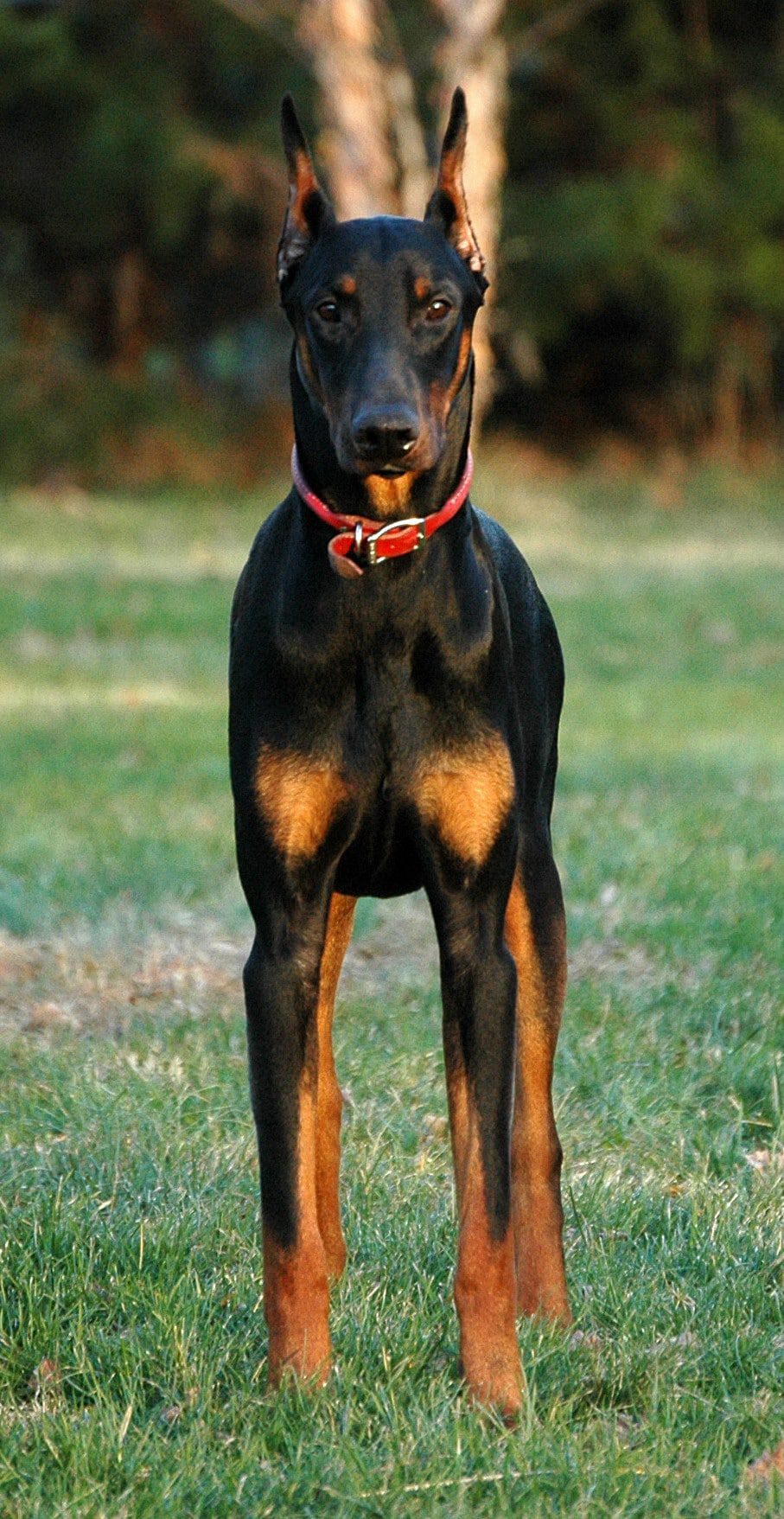
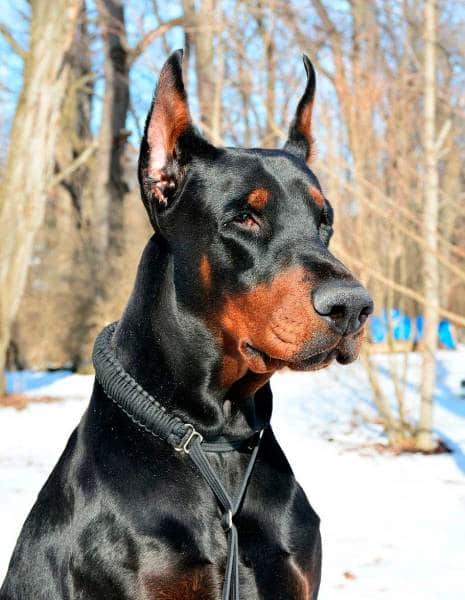
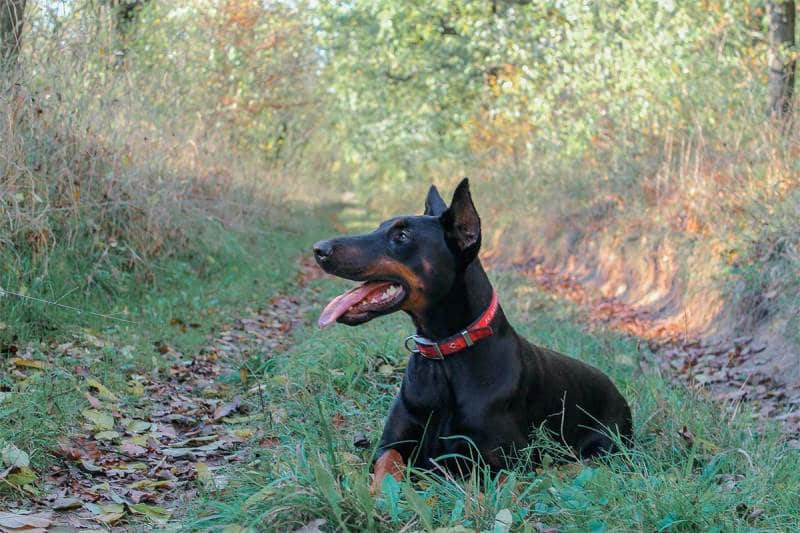
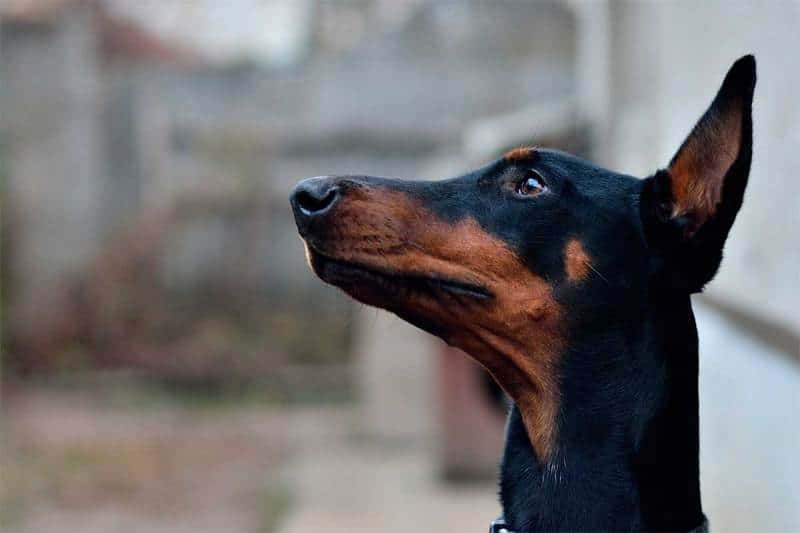
It is a medium-sized dog, robust and muscular, elegant lines and noble and haughty demeanor. The head is elongated cone shaped and bouquet. Craniofacial lines are parallel, the stop is light and the nose, deep. The eyes are medium and oval. The ears have a high insertion and the animal has them upright. If they are whole, fall to the sides of the head, with the edges well glued to the cheeks. The back is short and solid. The limbs are straight and plump. The tail is amputated leaving two vertebrae.

  • Fur: short, very sticky and smooth.
  • Color: black or brown with fire. Blue is no longer bred because it transmits serious genetic defects.
  • Size: in males, of 68 to 72 cm., for a weight of 40 to 45 kg. In females, of 63 to 68 cm., for a weight of 32 to 35 kg. The intermediate sizes are the most wanted.

Character and skills

It is one of the sweetest and most sensitive dogs in the world. He goes out of his way, with whom you should live in close contact. Leaving him alone in the garden would mean ruining his character. About him Dobermann a lot of gossip circulates, as for example that this dog "goes crazy" around the age of seven due to the lack of cranial capacity (one of the biggest absurdities, from the scientific point of view, never heard in cinofilia, and it is not that few are heard). Today, fortunately, there are rare cases in which there is talk of "mad" dogs or "irrepressible ferocity".

Very loving with family members and safe with children (provided they leave him alone), with strangers maintains the typical reserve of defense dogs. A balanced specimen, like all those from good hatcheries, will never behave aggressively for no reason, and it will show itself as a splendid companion dog delivered to its owner.

Start training your puppy the day you bring him home. Even at eight weeks old, He is able to absorb everything you can teach him. Don't wait until you have 6 months to start train or have to deal with more stubborn dog. If possible, Take it to a trainer when you have between 10 and 12 weeks, and socializes, socialice, socialice. But, Note that many kinds of training puppies require certain vaccinations (such as kennel cough) stay up to date, and many veterinarians recommend limited exposure to other dogs and public places until puppy vaccinations (including rabies, distemper and parvovirus) They are completed. Instead of formal training, You can start training your puppy to socialize at home and among family and friends until immunizations are completed in the puppy.

Talk to the breeder, Describe exactly what you want in a dog and ask for help choosing a puppy. Breeders see puppies daily and can make incredibly accurate recommendations once they know something about their lifestyle and personality. Regardless of what you want from a Dobermann, look for one whose parents have nice personalities and who has been well socialized since the puppy's first stage.

Observations and tips

Unselected dogs and the result of casual couplings are the only ones that can be nervous and in some cases bite. It is essential to buy the puppy in a good kennel that selects beauty and character.

Doberman health

All dogs have the potential to develop genetic health problems, just as all people have the potential to inherit a particular disease. Run, do not walk, from any breeder that does not offer a health guarantee on puppies, to tell you that the breed is 100 percent healthy and has no known problems, or tell you that your puppies are isolated from the main part of the home for health reasons. A reputable breeder will be honest and open about the breed's health problems and the incidence with which they occur in their lines..

One of the most serious breed-related health problems in the Doberman is cardiomyopathy., which causes an increase in the size of the heart. An annual heart exam is critical to detect this condition early., and no dog with cardiomyopathy should be bred. Neither should any Dobermann without a complete cardiac exam by a veterinary cardiologist in the past year. The sad reality, However, is that a dog that gets a good exam one day can develop heart disease the next, and the puppy of two parents without heart disease can still develop it.

Another race-related condition that affects the Dobermann is cervical vertebral instability (CVI), commonly called Wobbler syndrome. It is caused by a malformation of the vertebrae in the neck that causes pressure on the spinal cord and leads to weakness and lack of coordination in the hindquarters and sometimes to complete paralysis.. Symptoms can be managed to some extent in dogs that are not severely affected, and some dogs experience some relief with surgery, but the result is not certain. Although IVC is believed to be genetic, there is no disease screening test.

The Dobermans they are also prone to the bleeding disorder known as von Willebrand disease, as well as hypoadrenocorticism or Addison's disease.

Not all of these diseases are detectable in a growing puppy, and it is impossible to predict if an animal will be free of these diseases, so you need to find a reputable breeder who commit to raise healthier animals possible. Must be able to produce independent certification that the dog's parents (and grandparents, etc.) have been examined for common defects and considered healthy for breeding. That's where health records come in..

Breeders must accept that all test results, positive or negative, are published in the CHIC database. It is not necessary for a dog to perform well or even pass evaluations to obtain a CHIC number., so the CHIC record alone is not proof of robustness or absence of disease, but all test results are published on the CHIC website and can be accessed by anyone who wants to check the health of a puppy's parents. If the breeder tells you that you don't need to do those tests because they have never had problems with their lines and their dogs have been "vet checked", so you need to find a breeder who is more rigorous with genetic testing.

Careful breeders screen their breeding dogs for genetic diseases and breed only the healthiest, best-looking specimens., but sometimes mother nature has other ideas and a puppy develops one of these diseases despite good husbandry practices. Advances in veterinary medicine mean that in most cases dogs can still live a good life. If you are going to have a puppy, ask the breeder about the ages of the dogs in their lines and what they died of.

Not all visits by Dobermann to the vet they are due to a genetic problem. The Dobermans are one of the breeds with a deep chest and a tendency to swell, a condition in which the stomach expands with air. This can become the most serious condition, gastric torsion, if the stomach twists on itself, cutting off blood flow. gastric torsion, or gastric dilatation volvulus, suddenly attacks, and a dog that was fine a minute can die a few hours later. Watch for symptoms such as restlessness and gait, babeo, pale gums and lip licking, try to vomit but without bringing out anything, and signs of pain. Gastric torsion requires immediate veterinary surgery, and most dogs that have bloated once will bloat again. That means it's wise to opt for the procedure known as "gastric torsion.", which will prevent the stomach from twisting in the future. This procedure can also be done as a preventive measure..

Remember that after bringing a new puppy home, has the power to protect you from one of the most common health problems: the obesity. Keep a Dobermann with a proper weight is one of the easiest ways to prolong your life. Make the most of your preventive skills to help ensure a healthier dog for life.

Dobermann Grooming

The toilet is a piece of cake. Cepilla al Dobermann with a brush or hunting glove every week, or even run a wet towel over it. The days you need a bath, use a dog shampoo, not a human product. Rinse it well and let it stir to dry or towel dry.

The Dobermann comes off hair moderately. Regular brushing will help keep him and your house clean.. As with any dog, brushing before bathing helps remove more dead hair, leaving less hair to shed. Your vacuum cleaner will run longer if you brush your Dobermann regularly.

The rest is basic care. Trim nails as needed, usually every few weeks. Brush their teeth for general good health and fresh breath.

Characteristics "Dobermann"

Coexistence is important that you have with your new friend. Before considering the acquisition of a dog of the breed "Dobermann" you know certain factors. Not all breeds of dogs are apt to live in an apartment, you must take into account his character, their need for exercise, their interaction with other pets, their care and if you have small children, their level of tolerance towards them.

Adaptation โ“˜

5,0 of 5 stars (based on 1 review)

friendly dog โ€‹โ€‹โ“˜

2,0 of 5 stars (based on 1 review)

hair loss โ“˜

3,0 of 5 stars (based on 1 review)

Affection level โ“˜

5,0 of 5 stars (based on 1 review)

Need for exercise โ“˜

3,0 of 5 stars (based on 1 review)

Social need โ“˜

3,0 of 5 stars (based on 1 review)

Home โ“˜

5,0 of 5 stars (based on 1 review)

Toilet โ“˜

1,0 of 5 stars (based on 1 review)

Friendly with strangers โ“˜

1,0 of 5 stars (based on 1 review)

barking โ“˜

2,0 of 5 stars (based on 1 review)

Health โ“˜

4,0 of 5 stars (based on 1 review)

Territorial โ“˜

5,0 of 5 stars (based on 1 review)

Cat friendly โ“˜

3,0 of 5 stars (based on 1 review)

Intelligence โ“˜

5,0 of 5 stars (based on 1 review)

Versatility โ“˜

5,0 of 5 stars (based on 1 review)

Child friendly โ“˜

4,0 of 5 stars (based on 1 review)

Surveillance โ“˜

3,0 of 5 stars (based on 1 review)

joy โ“˜

5,0 of 5 stars (based on 1 review)

Images "Dobermann"

Videos "Dobermann"

Type and recognitions:

  • FCI CLASSIFICATION:
  • Group :
  • Section : . .

Federations:

  • FCI – Pinscher and Schanuezer dogs. Molossian type Dogs and Swiss Mountain and Cattle Dogs. , Section 1: Pinscher and Schnauzer. โ“˜
  • AKC – Dogs working โ“˜
  • ANKC – Group 6 (utility dogs) โ“˜
  • CKC – Group 3 – Working dogs โ“˜
  • โ€‹KC – Working dogs โ“˜
  • NZKC – Utility dog โ“˜
  • UKC – Watchdog โ“˜

FCI breed standard Dobermann

FCIFCI - Dobermann
Dobermann

Alternative names:

1. Doberman Pinscher, Dobie, Doberman (English).
2. Dobermann Pinscher (French).
3. Dobermann Pinscher (German).
4. Dobermann pinscher (Portuguese).
5. Dobermann, Dobermann pinscher (espaรฑol).

Photos:

1 – Doberman by https://www.pxfuel.com/es/free-photo-xqbqf
2 – Doberman by https://www.pexels.com/es-es/foto/36376/
3 – Jean Dark Snรถ of Sweden, dobermann by Felill / CC BY-SA
4 – Doberman by https://www.publicdomainpictures.net/es/view-image.php?image=232839&picture=doberman-dog-portrait
5 – Tallinn, Estonia, CACIB duo 2013 by Thomas / CC BY-SA
6 – Doberman by https://www.publicdomainpictures.net/es/view-image.php?image=158143&picture=doberman-pinscher-guard

โ–ท The world of Pets: Dogs, cats, birds, reptiles, amphibians

Tosa
Japรณn FCI 260 - Molossoid - Dogo

Tosa Inu

The Tosa is quiet, serene, dignified and extraordinarily peaceful.

Content

History

The Tosa It is a breed of dog originating in Japan. Molosser imposing aspect, It is one of the favorite breeds for the lovers of dogs large size around the world. The breed emerged in the mid-19th century, When crossing various European breeds of large size (Great Dane, Mastiff, St. Bernard, Bulldog, German Shorthaired) with the indigenous Shikoku.

In Spain is regarded as a potentially dangerous breed of dogs by Royal Decree, by which to his possession must obtain the licence for possession of dangerous dogs and register it in the corresponding Municipal registry of potentially dangerous animals. One of the things that are required for this license is insurance of civil liability to third parties.

The Tosa varies considerably in size. Japan-bred specimens tend to have half the size of the specimens bred in the rest of the world. Japanese copies are usually weigh between 35 and 55 kg, While exemplary foreigners have a weight which varies between the 60 and 100 kg. The mantle is characterized by short and smooth appearance and is often red, striped or brown clear. The maintenance of its fur is minimal.

This breed originated in the second half of the 19th century. The race started from the natives – Shikoku, an indigenous dog. It weighs some 25 kg and stand about 55 inches tall, that it resembles the European Spitz. These dogs were crossed with dogs of European races, as the Old English Bulldog in 1872, Mastiff, in 1874, St. Bernard, German pointer in 1876, Great Dane, in 1924, and the Bull Terrier. The goal was to raise a bigger dog, more powerful.

Read more

โ–ท The world of Pets: Dogs, cats, birds, reptiles, amphibians

Shar Pei
China FCI 309 - Molossoid - Dogo

Shar Pei

The Shar Pei he is affectionate with his owner; he is quite reserved with strangers.

Content

History

Dogs like breed Shar Pei have existed in southern China for centuries, perhaps from the Han dynasty around 200 A.C. Archaeologists have found statues from that period showing a dog similar to the Shar-Pei.. Later evidence includes a 13th century document referring to a wrinkled dog.

The first Shar-Pei they were farm and working dogs. They watched over property and livestock, they hunted and herded flocks. The Shar-Pei was a guardian of the house otherwise, as well. His purple tongue, shared with another race, the Chow Chow, and their wrinkled skin was believed to ward off evil spirits. In addition to being working dogs, the Shar Pei fighting dogs were also popular. Their loose fur and rough fur made it difficult for the other dog to hold on to them..

Life has always been hard in China, but for the Shar Pei became very dangerous after the communist takeover in the early 20th century. In the People's Republic of China, Dogs were a symbol of a decadent past and were virtually eliminated in the 1990s. 1950. Only a few remained in rural areas, as well as in Hong Kong (still under British rule at the time) and in Taiwan, plus a few that had been exported to the United States in 1966.

In 1973, a Hong Kong breeder named Matgo Law appealed to Western dog aficionados to help save the breed, it was on the verge of extinction. The unusual wrinkled dogs sparked enthusiastic interest among Americans and quickly became "the" dog to have.. The Shar Pei were fully recognized by the American Kennel Club in 1992. After that first burst of popularity, have achieved a moderate level of interest, they are currently in the position 50, below the post 37 a decade.

Physical characteristics

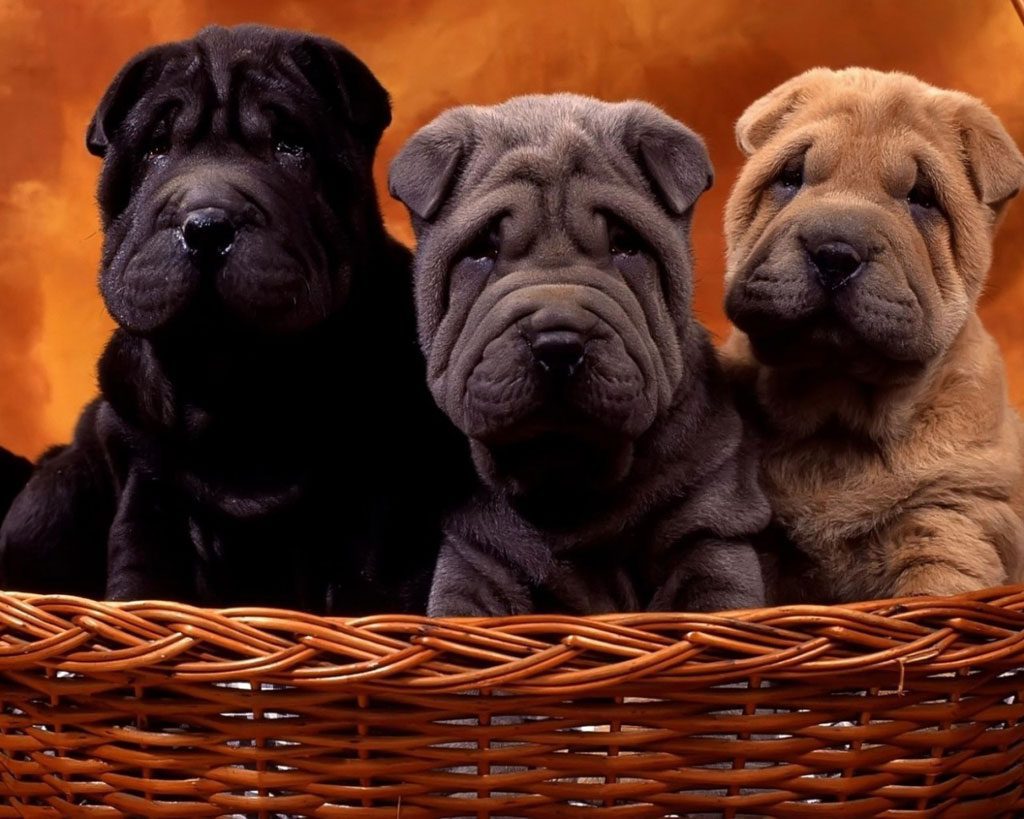
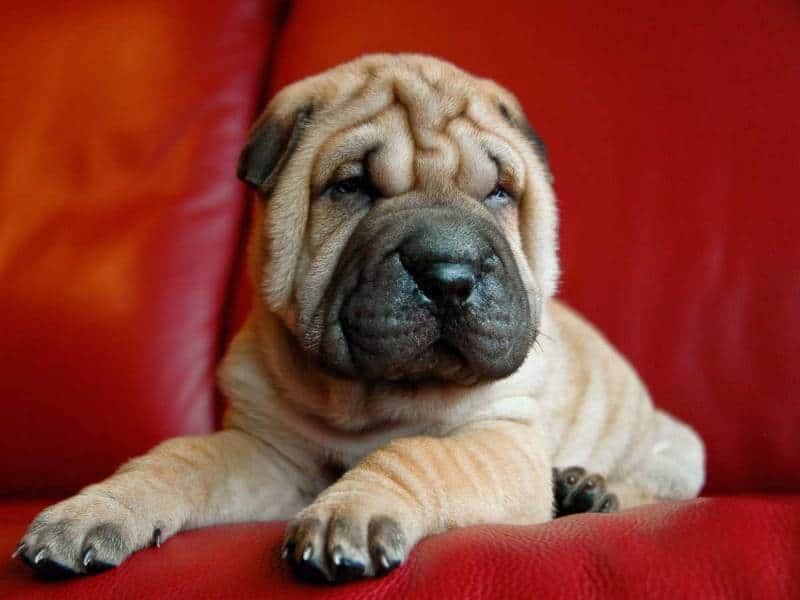
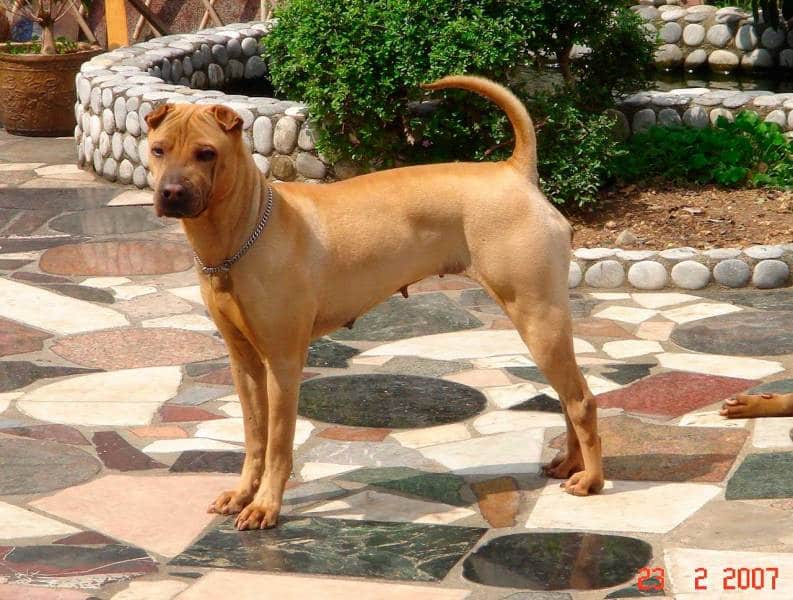
It is a robust dog, solid, compact, shorthair. The head is large in proportion to the body. The skull is wide and flat, and the โ“˜stop, very little pronounced. The forehead and the orbital region are covered with abundant and fine wrinkles that extend downwards forming ; eyes are small, sunken, black or brown color in beige specimens. Ears are very small, equilateral triangle, and high insertion and facing forward, above the eyes. The skin forms folds throughout the body, which is a peculiarity of the breed. The tail is inserted high and its carriage in the shape of a trunk above the back is characteristic., without touching it.

  • Fur: thick, very short and straight, with a very visible hardness.
  • Color: black, brown, leonado, beige and cream.
  • Size: 40 – 51 cm..

The Chinese line presents fewer wrinkles than the American one. Females are smaller in size than males.

Character and skills

The Shar Pei he's a little snobby. He's naturally reserved with people he doesn't know and stays aloof once they're introduced. Extensive socialization at a young age is necessary to prevent it from becoming too territorial or aggressive. Only family members receive the overwhelming devotion of this independent dog., alert and intelligent that watches the world go by in a calm and dignified way.

One Shar Pei it's quiet in the house. It is a remarkable watchdog and rarely barks unless it is playing. If they hear it, you should go and see what has caught your attention. A short, quick walk meets your exercise needs.

It is a strong and confident dog that learns fast, so don't put off training. The Shar Pei is independent and strong-willed. Be firm but never harsh or physical with him.. Teach him from the beginning to accept grooming procedures like trimming nails, clean ears and brush teeth. You never want you Shar Pei learn that you can be physically intimidated into stopping these procedures.

like most dogs, to the Shar Pei He doesn't like to have his feet touched and he doesn't like to have his nails cut. That also applies to other procedures..

The Shar Pei is a watchdog that has hunted and fought with other dogs. to most of the Shar Pei They do not like the company of other dogs., and are easily excited by aggression. A securely fenced yard will prevent you from conflict with other dogs or trying to expand your territory to include the entire block..

Start training your puppy the day you bring him home. Even at eight weeks old, He is able to absorb everything you can teach him. Don't wait until you have 6 months to start train or have to deal with more stubborn dog. If possible, Take it to a trainer when you have between 10 and 12 weeks, and socializes, socialice, socialice. But, Note that many kinds of training puppies require certain vaccinations (such as kennel cough) stay up to date, and many veterinarians recommend limited exposure to other dogs and public places until puppy vaccinations (including rabies, distemper and parvovirus) They are completed. Instead of formal training, You can start training your puppy to socialize at home and among family and friends until immunizations are completed in the puppy.

Talk to the breeder, Describe exactly what you want in a dog and ask for help choosing a puppy. Breeders see puppies daily and can make incredibly accurate recommendations once they know something about their lifestyle and personality. Whatever you want from a Shar Pei, look for one whose parents have nice personalities and who has been well socialized since the puppy's young age.

Health of the ยซShar Peiยป

All dogs have the potential to develop genetic health problems, just as all people have the potential to inherit a particular disease. Run, do not walk, from any breeder that does not offer a health guarantee on puppies, to tell you that the breed is 100 percent healthy and has no known problems, or tell you that your puppies are isolated from the main part of the home for health reasons. A reputable breeder will be honest and open about the breed's health problems and the incidence with which they occur in their lines..

The Shar Pei have many health problems, and their owners can develop a close relationship with their vet. Concerns include hip and elbow dysplasia; patella dislocation; Hypothyroidism; eye problems such as entropy, retinal dysplasia and glaucoma, allergies and infections of the skin folds.

A unique problem is a disease called c fever, a condition in which the dog experiences periodic fevers and its hock joints swell. Accompanying signs may include lethargy, vomiting, diarrhea and shallow breathing.

Not all of these conditions are detectable on a growing puppy, and it is impossible to predict if an animal will be free of these diseases, so you must find a reputable breeder who is committed to raising the healthiest animals possible.. Must be able to produce independent certification that the dog's parents (and grandparents, etc.) have been examined for common defects and considered healthy for breeding. That's where health records come in..

Careful breeders screen their breeding dogs for genetic diseases and breed only the healthiest, best-looking specimens., but sometimes mother nature has other ideas and a puppy develops one of these diseases despite good husbandry practices. Advances in veterinary medicine mean that in most cases dogs can still live a good life. If you are going to have a puppy, ask the breeder about the ages of the dogs in their lines and what they died of.

Remember that after you have welcomed a new puppy into your home, has the power to protect you from one of the most common health problems: the obesity. Keep a Shar Pei with proper weight is one of the easiest ways to extend your life. Make the most of your preventive skills to help ensure a healthier dog for life.

Care of the ยซShar Peiยป

Grooming requirements depend on each Shar Pei. Weekly brushing can meet the needs of both the "short-haired" variety and the "brushed" type. (slightly longer), but some Shar Pei of either type can be prone to skin problems. Dogs with skin problems may need a weekly bath and daily brushing.

All the Shar Pei need regular wrinkle care. Wrinkles should be cleaned with a damp cloth and then dried completely to prevent infection.. Do not oil the skin.

The Shar Pei they have small ears, tight and triangular that predispose them to chronic ear problems because there is not enough air circulating in the narrow ear canal. Although it is not so easy to clean the ears of a Shar Pei as it is for most races, regular cleaning should be done to help prevent recurrent yeast or bacterial infections.

Bathe your dog as you like or only when it gets dirty. With the gentle dog shampoos available now, can bathe a Shar Peiweekly if you wish without damaging your coat.

The rest is basic care. Trim nails as needed, usually every few weeks. Brush your teeth for general good health and fresh breath.

Characteristics "Shar Pei"

Coexistence is important that you have with your new friend. Before considering the acquisition of a dog of the breed "Shar Pei" you know certain factors. Not all breeds of dogs are apt to live in an apartment, you must take into account his character, their need for exercise, their interaction with other pets, their care and if you have small children, their level of tolerance towards them.

Adaptation โ“˜

3,0 of 5 stars (based on 1 review)

friendly dog โ€‹โ€‹โ“˜

2,0 of 5 stars (based on 1 review)

hair loss โ“˜

2,0 of 5 stars (based on 1 review)

Affection level โ“˜

5,0 of 5 stars (based on 1 review)

Need for exercise โ“˜

2,0 of 5 stars (based on 1 review)

Social need โ“˜

3,0 of 5 stars (based on 1 review)

Home โ“˜

4,0 of 5 stars (based on 1 review)

Toilet โ“˜

3,0 of 5 stars (based on 1 review)

Friendly with strangers โ“˜

1,0 of 5 stars (based on 1 review)

barking โ“˜

1,0 of 5 stars (based on 1 review)

Health โ“˜

5,0 of 5 stars (based on 1 review)

Territorial โ“˜

3,0 of 5 stars (based on 1 review)

Cat friendly โ“˜

3,0 of 5 stars (based on 1 review)

Intelligence โ“˜

5,0 of 5 stars (based on 1 review)

Versatility โ“˜

3,0 of 5 stars (based on 1 review)

Child friendly โ“˜

1,0 of 5 stars (based on 1 review)

Surveillance โ“˜

3,0 of 5 stars (based on 1 review)

joy โ“˜

3,0 of 5 stars (based on 1 review)

Images "Shar Pei"

Photos:

1 – This is a typical photo of a bone mouth traditional Shar-Pei. CH Dali Pinky, Hong Kong Kennel Club Champion by No machine-readable author provided. Inuyasya1106 assumed (based on copyright claims). / Public domain
2 – Shar_Pei_female_of_7_months._Chinese_line by Mcarrillo / CC BY-SA
3 – Shar Pei by https://pxhere.com/es/photo/1267570
4 – Shar Pei by https://pxhere.com/es/photo/1169173

Videos "Shar Pei"

Type and recognitions:

  • FCI CLASSIFICATION:
  • Group :
  • Section : . .

Federations:

  • FCI – Pinscher and Schnauzer-Molossoid type dogs – Swiss Mountain Dogs and Cattledogs. Section 2.1 Molossoid, mastiff type. โ“˜
  • AKC – Non-Sporting โ“˜
  • ANKC – Group 7 (Non-Sporting) โ“˜
  • CKC – Group 6 – Non-Sporting โ“˜
  • โ€‹KC – Utility dog โ“˜
  • NZKC – Non-Sporting โ“˜
  • UKC – Northern Breed โ“˜

FCI breed standard "Shar Pei"

Origin:
China

Date of publication of the valid original standard:
14.04.1999

Use:

Hunting and guard dog.


General appearance:

This is a medium-sized dog, Active, compact, square, short loin. Wrinkles of the skull and cross, Its small ears and hippo-like snout give it a unique appearance.. Males are more robust than females.

IMPORTANT PROPORTIONS: HeightShar Pei, from the cross to the ground, is approximately equal to the length of the body, from the tip of the shoulder to the tip of the buttock, especially in males.

The length of the nose to the naso-frontal depression is approximately equal to that of the naso-frontal depression to the occiput.


Behavior / temperament:

This is a calm animal, independent, loyal and affectionate with his family.

Head:

It's rather big, in proportion with the body. Wrinkles that form on the forehead and cheeks extend downward to form the double chin.

Cranial region:
  • Skull: Flat and spacious.
  • Depression links (Stop): Moderate.

facial region:

  • Truffle: It is great, wide, preferably black, but any other color that harmonizes with the coat color is allowed. The nostrils are wide open.
  • Snout: It is characteristic of the breed. Width, from the root to the tip of the nose, no sign of decline. The lips and the upper part of the muzzle are very full. The presence of a bulge in the nose is allowed.
  • Mouth: Language, the palate, the gums and lips are preferably bluish black. Pink spotted tongue allowed. Solid pink tongue is considered highly inappropriate. In dogs with diluted colored fur, the tongue is solid lavender.
  • Jaws / Teeth: The jaws are strong, with a perfect scissor joint (The upper incisors overlap the lower incisors in close contact and are at right angles to the jaws.). The fleshiness of the lower lip should not be so excessive as to interfere with the function of the jaws..

EYES: Are dark, almond shaped and frowning look. Lighter color is allowed in dogs with diluted coat. Nor the skin around the eyes, nor the folds, nor the hair, must impede normal function of the eyeball or eyelid. Any indication of irritation of the eyeball, the conjunctiva or the eyelids is considered highly undesirable. There must be no presence of entropion.

EARS: Very small, rather thick, equilateral triangular shape. The tips are slightly rounded. High implementation, with the tips pointed towards the eyes. Present well forward over the eyes; they are well separated and well attached to the skull. Erect ears are highly undesirable.

Neck:

Medium length, strong, well implanted in the shoulders. Loose skin under the neck should not be excessive.

Body:

The presence of body skin folds in adult dogs is considered highly undesirable, except at the cross and at the tail, where the folds must be moderate.

  • top line: Descend slightly behind the cross, then he stands up a little on his back.
  • Back: Short and strong.
  • Pork loin: Short, width, slightly arched.
  • Rump: Rather flat.
  • Breast : Broad and deep; the sternum region reaches the elbow. bottom line: Rises slightly below the back.

Tail:

Thick and round at the base; gradually thin to a fine point. Well established, a distinctive feature of the breed. Can be tall and hunched, carried in a closed curl, hunched over or falling to one side or the other of the back. The absence of tail or the cut tail are highly undesirable.

Tips

PREVIOUS MEMBERS: Straight, of moderate length, for strong bones. There is no presence of wrinkles in the forelimbs.

  • Shoulder: Muscular, well established and inclined.
  • Metacarpus: Slightly sloping, strong, รโ€œรหœรโ€˜รลกรหœรโ€ข.
  • Previous feet: Moderate in size, compact; they are not crushed.
    Fingers have strong joints. There is no presence of spurs on the hind feet.

LATER MEMBERS: They are muscular, strong, moderately angulated. Seen from the back, They are perpendicular to the ground and parallel to each other.. The presence of wrinkles on the thighs, the legs, the metatarsals, as well as thick skin on the hocks are undesirable.

  • Hocks: Very low.
  • Hind feet: Moderate in size, compact; they are not crushed. Fingers have strong joints. There is no presence of spurs on the hind feet.

Movement:

Jogging is the favorite movement. It's free, agile, balanced, with good range in the forelimbs and strong momentum of the hindlimbs. When the dog increases speed, feet tend to converge on a center line. Walking on stilts is undesirable.

Mantle

  • Fur: It is a distinctive characteristic of the breed: shorthair, tough and piggy. On the trunk, the coat is straight and separated, but in the extremities it is more stuck. There is no presence of an internal layer of hairs. Hair length can vary between 1 to 2,5 cm.. It should never be trimmed.
  • Color: All solid colors, except for the White, are accepted. The tail and back of the thighs are often lighter in color. Darker shading is allowed along the back and on the ears.


Size and weight:

  • Height to the cross: 44 to 51 cm. (17,5 to 20 inches).


Fouls:

Any deviation from the aforementioned criteria is considered as a fault and the severity of this is considered to the degree of the deviation to the standard and its consequences on the health and well-being of the dog..

SERIOUS FAULTS:

  • Joint not presented in the form of scissors (as a transitional measure, very light upper prognathism is allowed).
  • Pointed snout.
  • Spots on the tongue (except pink spots).
  • big ears.
  • Low set tail.
  • Coat over 2,5 cm..

FALTAS DESCALIFICANTES:

  • Aggressiveness or extreme shyness.
  • Any dog โ€‹โ€‹showing clear signs of physical or behavioral abnormalities.
  • Flat head front, with pronounced higher prognathism; lower prognathism.
  • Solid pink tongue.
  • Inner bent lower lip, preventing the bite.
  • Round and bulging eyes; entropion or ectropion.
  • Skin, folds or hair that impede normal eye function.
  • erect ears.
  • Absence of tail or tail short of birth.
  • Presence of thick folds of skin on the trunk and extremities (except at the cross and the tail).
  • Non-solid color (albino, striped, with patches, with stains, black and fire color, chair-shaped coloring).

WARNING: Any artificial physical alteration made to theShar Pei (especially on the lips and eyelids) eliminate the dog from competition.


N.B.:
  • Males should have two normal-appearing testicles fully descended into the scrotum..
  • Only functionally and clinically healthy dogs, with the typical conformation of the breed, should be used for parenting.

    TRANSLATION: IRIS Carrillo (Federation of Puerto Rico). Official language: IN.
    Revision: SR. Jorge Nallem.

Source: F.C.I - International Cynological Federation

Alternative names:

1. Cantonese Shar-Pei (English).
2. Shar-peรฏ, sharpeรฏ (French).
3. Shar-Pei (German).
4. Shar-pei (Portuguese).
5. Sharpei (espaรฑol).

โ–ท The world of Pets: Dogs, cats, birds, reptiles, amphibians

Fila Brasileiro
Brazil FCI 225 - Molossoid - Dogo

The Fila Brasileiro it is a rare dog in Europe, which implies that it is difficult to find a good puppy.

Fila Brasileiro

Content

Characteristics "Fila Brasileiro"

Coexistence is important that you have with your new friend. Before considering the acquisition of a dog of the breed "Fila Brasileiro" you know certain factors. Not all breeds of dogs are apt to live in an apartment, you must take into account his character, their need for exercise, their interaction with other pets, their care and if you have small children, their level of tolerance towards them.

Adaptation โ“˜

3,0 of 5 stars (based on 1 review)

friendly dog โ€‹โ€‹โ“˜

1,0 of 5 stars (based on 1 review)

hair loss โ“˜

3,0 of 5 stars (based on 1 review)

Affection level โ“˜

4,0 of 5 stars (based on 1 review)

Need for exercise โ“˜

4,0 of 5 stars (based on 1 review)

Social need โ“˜

3,0 of 5 stars (based on 1 review)

Home โ“˜

1,0 of 5 stars (based on 1 review)

Toilet โ“˜

1,0 of 5 stars (based on 1 review)

Friendly with strangers โ“˜

1,0 of 5 stars (based on 1 review)

barking โ“˜

2,0 of 5 stars (based on 1 review)

Health โ“˜

2,0 of 5 stars (based on 1 review)

Territorial โ“˜

5,0 of 5 stars (based on 1 review)

Cat friendly โ“˜

1,0 of 5 stars (based on 1 review)

Intelligence โ“˜

3,0 of 5 stars (based on 1 review)

Versatility โ“˜

2,0 of 5 stars (based on 1 review)

Child friendly โ“˜

2,0 of 5 stars (based on 1 review)

Surveillance โ“˜

3,0 of 5 stars (based on 1 review)

joy โ“˜

5,0 of 5 stars (based on 1 review)

History

The Fila Brasileiro its history is linked to both genetic mixing and Brazilian colonization. There is no consensus on its origin, but probably the Brazilian line is the result of a mixture of dogs whose specialty was hunting and herding animals in the field. The mastiff, the Bulldog, the Terceira line (a portuguese breed) and the Scent hound are just a few examples of possible breeds that have contributed to tracing the DNA of the Brazilian line. Some say that indigenous dogs (Aracambรฉ) and even the savages, like the guarbo wolf, they may also have participated in the miscegenation.

In some 19th century carvings, the breed was already known to assist in catching oxen, cows, sheep and even big cats, like jaguars, for example. This shows that the Brazilian line was not just a dog to keep at the door, taking a nap in the late afternoon: I was really going to fight! And maybe that's where his keen sense of protection comes from., always putting strangers in their place once they get home.

In 1946 the first effort was made to set the breed standard. In 1976, the second standard was recognized and approved during the 1st Symposium of the Brazilian Fila Race. In 1984 the third rule was defined, which is still valid today.

Physical characteristics

It is a trotting large but very agile. It has a powerful skeleton and a rectangular structure, compact and proportionate. The head is big, heavy and solid, although it is always proportionate to the body. The craniofacial relationship is almost 1:1, with the nose slightly shorter than the skull. The occipital ridge is very prominent, especially in the puppy. The stop is low and inclined, so it should not be seen when looking at the animal from the front. The eyes are medium or large, in the form of almond, quite sunken and colored according to the mantle (yellow to dark brown). Ears are wide and thick, dangling and "V" shaped. The limbs are parallel and straight, with strong bones. A characteristic of the breed is the way of moving in amble. The tail is very broad at the root and tapers rapidly when it reaches the hock..

  • Fur: short.
  • Color: all solid colors are supported, except white, the rat gray and the mottled or stained coat, liable to disqualification. Solid color layers may have stripes of less intense or very dark color. Black mask is optional.
  • Size: in males, of 63 to 75 cm., with a minimum weight of 50 kg; in females, of 60 to 70 cm., with a minimum weight of 40 kg.

Character and skills

The Brazilian Fila is very determined, brave and can be very fierce. They can be docile and very obedient to their owners and family and are very tolerant of children.. It is a dog that loves the company of its owner and always tries to be with him.. One of the most striking points of the Fila Brasileiro is the aversion to strangers. So they are excellent guard dogs..

The Fila Brasileiro are the protectors of the pack (that is to say, the family that raises him) and therefore they need to be educated from an early age. At the age of 7 months already begin to show surveillance potential. As they are very large and very strong dogs, it's important for owners to have a firm wrist and show leadership from an early age, so that the dog becomes obedient and respects the owners.

They are very smart and tend to easily learn the owners' teachings. Be careful not to be too rigid in your corrections when the Fila Brasileiro does something wrong, because they can be a bit stubborn and make training difficult.

This dog's aggressive instinct should not be stimulated (and less with bloody methods), because it could become a dangerous animal, given its great bulk. Without a doubt, this is a breed for experts.

Care of the ยซFila Brasileiroยป

Videos "Fila Brasileiro"

Brazilian Fila VideosFila brasileiro

Fila brasileiro puppies week 7

The maintenance of a โ€œFila Brasileiroโ€ is not laborious, not too different from other large, short-haired dogs. The frequency of the bath can vary according to the type and intensity of the activities carried out by each dog..

– Grooming: The "Fila Brasileiro" does not need more than weekly brushing, because its coat is short and the breed doesn't get too dirty. Ideally, you should bathe monthly in summer and, in winter, Every two months.

– Nails and ears: you always have to check them. The nail cannot grow too long and the ear cannot accumulate wax and dirt. Remember that the โ€œFila Brasileiroโ€ is prone to developing otitis and keeping it clean makes it easier to notice any problem..

– Eyes: if there is any spot near the eyes or accumulation of discharge, clean them with saline solution.

– Sol: sunbaths are welcome: stimulate the body to produce vitamin D, essential for strong teeth and bones. The ideal time for this is the same as for humans, avoid the hottest times of the day, between the 10 am and 4 pm.

Health of the ยซFila Brasileiroยป

The Fila Brasileiro it is a healthy breed of dog. Maintaining the basic care routine and controlling your physical condition, the chances of you having a happy life are great! See some problems that may affect you:

– Obesity: common cause of health problems that can affect not only the Fila Brasileiro, but to all overweight dogs. As the Fila Brasileiro have a tendency to gain weight, watch for changes in the general shape of the dog, avoid giving treats and respect the recommended amounts of food for the breed.

– Otitis is an infection that can affect the hearing of the Fila Brasileiro and it can be caused by age or even poor hygiene.

Dog's level of exercise

The Fila Brasileiro need plenty of exercise, what requires available space – even if you walk on walks. Must exercise for one hour daily. And how is a smart dog, seeks to diversify its activities. A simple change in the route of the walk offers new stimulation and keeps you happy.

Images "Fila Brasileiro"

Photos:

1 – PETRA VESELร has published this image ยซFila Brasileiroยป under public domain license.
2 – Original bitch Fila Brasileiro – branca to AJorgeSC / CC BY-SA
3 – Fila Brasileiro (ALMODOVAR Rio Grande – from RIO GRANDE kennel) by Pleple2000 / CC BY-SA
4 – Puppy OFB at 4 months old by AJorgeSC / CC BY-SA
5 – row brazilian-colombia hatchery – 223 | Julio Cesar Hoyos A | Flickr
6 – row brazilian-colombia hatchery – 086 – Flickr

Type and recognitions:

  • FCI CLASSIFICATION:
  • Group :
  • Section : . .

Federations:

  • FCI – Pinscher and Schnauzer-Molossoid type dogs – Swiss Mountain Dogs and Cattledogs. Section 2.1 Molossoid, mastiff type. โ“˜
  • CKC – Miscellaneous list โ“˜
  • NZKC – Utility dog โ“˜
  • UKC – Watchdog โ“˜

FCI breed standard "Fila Brasileiro"

Origin:
Brazil

Date of publication of the valid original standard:
29.09.2016

Use:

Watchdog


General appearance:

Race typically molosoid.

Powerful bone structure, rectangular and compact set, Although harmonious and well-proportioned. It presents, along with his body mass, highly concentrated and easily noticeable agility.Sexual dimorphism must be very well defined and obvious (female females, male males).

PROPIMPORTANT ORTIONS:

  • Muzzle slightly shorter than skull.
  • The length of the body, measured from the tip of the sternum to the tip of the buttock, exceeds height at withers by15%.


Behavior / temperament:

Has courage, remarkable determination and verve. With their masters and the family is docile, obedient and extremely tolerant towards children. Their loyalty is notorious, because he insistently seeks the company of his masters. One of his characteristics is to be distrustful of strangers..

Is quiet in nature, which reveals a security and self-confidence very typical of his character.. Adapt perfectly well to new environments and strange noises. It is a special guardian of properties, and it is, by instinct, a pasture for cattle dog, as well as a large game hunter.While one of its characteristics is a natural withdrawal towards strangers, especially in their own territory, must be susceptible to controlled manipulation, especially in the ring.

During rest, he is calm, noble and self-confident.

Never show a gaze lost or boredom. When is attentive, your expression must show determination, which results in a fixed and penetrating gaze.

Head:

Grand, heavy, solid, but always well proportioned to the body. View from the top, looks like a trapezoid into which the pear-shaped head has been inserted.

Cranial region:
  • Craging: Its profile presents a smooth curve, that extends from the naso-frontal depression to the occipital protuberance, which is marked and outgoing, especially in puppies. Head on, it's wide, with a curved top line. Its lateral lines descend in shallow curves, almost vertically, and decrease towards the snout in a continuous line.
  • Dnaso-frontal depression (Stop): Seen from the front, is practically non-existent. The middle groove gently rises almost to the middle of the skull. Profile view, it is little marked, inclined and almost formed thanks to the superciliary arches, which are well developed.

facial region:

  • Trufa: Nostrils, wide, well developed, although without occupying the entire width of the maxilla. Its color is black.
  • Horcico: Strong, width, celebrities, always in proportion to the skull. Of good prominence at the base, without being higher than long. Seen from above, it is well filled under the eyes and thinning very slightly to half, then widening slightly to the previous curve. In profile, the nasal passage has a straight or slightly arched upper line, but never ascending. The anterior line is almost perpendicular to the nasal passage., with a slight depression just below the nose.
  • Labios: The upper lip is thick and hanging and covers the bottom in a perfect curve: the lower line of the muzzle is thus almost parallel to the upper one. The lower lip is well applied to the region of the fangs; from there it's loose all the way back, with ยซtoothedยป edges, and ends with the always apparent corner. The edge of the lips forms a deep inverted U.
  • Jaws / Teeth: Teeth are characterized by being wider than they are long. They are strong and white. The upper incisors are wide at the roots and sharp at the edges.. The fangs are strong, are well positioned in the maxilla and are separated. The jointindit is scissor shaped.
  • Ojors: Medium to large, macaroons, well separated and placed medium to deep. Its color ranges from brown to yellow, always in harmony with the color of the coat.However a darker color is preferred.Because the skin is loose, many specimens have hanging eyelids, detail that should not be considered as a fault, since this accentuates the sad aspect of the look, typical of the breed.
  • Obars: Pendants, thick, large, V-shaped. Wide at the root, decrease in extremities, which are rounded. Inserted into the back of the skull, They occur at the level of the midline of the eyes, when the dog is at rest, and they rise above the primitive ligament when it is alert. The ears are tilted at the ligament, since the front edge is higher than the back. Hanging to one side or folded back, so that its interior is visible(Pink).

Neck:

Extraordinarily strong and muscular, seems short. The upper edge is slightly convex, well separated from the skull. Chin presence.

Body:

Strong trunk, wide and tall, covered by thick and loose skin. The thorax is longer than the abdomen.

  • Lรญnand the top: Height at withers is slightly lower than rump, downline; is wide, due to the separation of the shoulder blades. In the place where the cross ends, the top line changes direction, gently rising to the front of the rump, without any sign of a bulging or arched back (carpal back).
  • Itmo and flank: Less long and wide than the thorax. They are clearly separated. In the female, flank edge is more developed. Seen from above, the loin should be less broad and full than the thorax and rump, but without showing signs of tightness.
  • Glikeness: Wide, long, its obliqueness approaches the 30 degrees above the horizontal and ends in a smooth curve. It is a little higher than the cross. รยก back view, it should be wide, almost equal in width to the chest, and can be even wider in females.
  • Breast : Well arched ribs, although without affecting the position of the shoulders. The chest is broad and well sloped, reaches to the tip of the elbows; the pecs are very prominent.
  • Lรญnlower ea and belly: The chest is long and is parallel to the ground in all its extension. The belly rises gently and is never puffy.

Tail:

With wide roots and medium insertion. Quickly gets thinner to finish at hock level. When the dog is excited, the tail is raised, thus accentuating the curvature of the limb. The tail must not fall on the back, nor curl up.

Tips

PREVIOUS MEMBERS:

  • Apgeneral arience: Forelimb height, from elbow to floor, It must be equal to the height from the elbow to the withers.
  • Shoulder: The shoulder and arm must be made up of two bones of the same length, shoulder blade and humerus. The shoulder blade forms an angle of 45ยฐ with the horizontal, and the humerus approximately 90ยฐ with the shoulder blade. The scapulo-humeral joint forms the tip of the shoulder, which must be at the level of the tip of the sternum, a little behind this one. In the ideal case, the shoulder and arm must be located in the space that goes from the cross to the sternum, and the end of the shoulder should be in the middle of this path. An imaginary perpendicular descending from the withers should pass through the elbow and reach the foot.
  • Antarm: Members must be parallel. The bones are strong and straight.
  • CArpos: Strong and apparent.
  • Metacarpus: Short, slightly inclined.
  • Pinis previous: They are formed by strong and well arched fingers, although not too close. Support is carried out on thick fingers and wide bearings, long and thick. In the correct position, fingers should be facing forward. The nails are strong, dark, and they can be white when the corresponding finger is also white.

LATER MEMBERS:

  • Apgeneral arience: The bones are not as thick as those of the forelimbs, however as a whole, they should never look thin. The hind limbs are parallel.
  • Thighs: Widths, with arched edges, since they are formed by the muscles that descend from the ilium and ischium. These shape the curve of the gluteus, hence it is necessary to require a good sized ischium.
  • Ttorsos: they are strong.
  • Metatarsals: Slightly sloping, longer than metacarpus; angulation of the stifle and hock is moderate.
  • Pinis later: A little more oval than the previous ones and similar to these in everything else. There should be no dewclaws.

Movement:

Long and elastic step, like that of cats. Its main characteristic is the displacement of the two members on the same side, and then move to the two on the other side, ยซ camel step ยป. This produces a waddle, with lateral rocking of the thorax and haunches, accentuated by the tail when raised. When the dog walks, its head remains below the dorsal line.. Jogging is easy, harmonious, loose, with wide and powerful strides that cover the terrain well. The gallop is powerful and with it the dog reaches an unsuspected speed in such a large and heavy animal. Its movement is always influenced by the typical joints of the molossoid., they not only give the impression, but they actually allow sudden and rapid changes of direction.

Mantle

PIEL: One of the most important characteristics of the breed is that the skin must be thick and loose over the entire trunk., mainly on the neck, where it forms pronounced jowls, which in many cases, reach the chest and abdomen. Some dogs have a fold on the sides of the head and another that descends from the cross to the shoulder. During rest, the head should not show folds; when the dog is alert, contraction of the skull skin, which is formed when the dog lifts its ears, makes small longitudinal folds appear on the skull between these.

  • PlinkShort, dense, soft and well stretched over the body.
  • ColorrStriped, black & Fawn. A black mask may or may not be present. In all allowed colors there may be white marks on the feet, the chest and the tip of the tail.White markings on other parts of the mantle are considered missing.


Size and weight:

Alturto the cross:

  • Males: 65 to 75 cm.
  • females: 60 to 70 cm.

Weight:

  • Minimum, 40 kg for females.
  • Minimum, 50 kg for males.


Fouls:

Any deviation from the aforementioned criteria is considered as a fault and the severity of this is considered to the degree of the deviation to the standard and its consequences on the health and well-being of the dog..

  • Bite level.
  • Short snout.
  • Small ears
  • Ears that come up high
  • Overly clear eyes
  • Presence of folds while the dog is at rest.
  • Lower prognathism
  • Double chin (fold in the skin in front of the double chin)
  • Backless
  • Very narrow croup
  • Tail that appears curled on the back
  • Slightly sloping chest.
  • Markedly deviated metatarsals and metacarpus.
  • Highly angled posteriors
  • Short steps

FALTAS GRAVES:

  • Apathy and shyness.
  • Square silhouette
  • Small head
  • Pronounced naso-frontal depression, front view
  • Short upper lip.
  • Round eyes round eyes. Poor pigmentation of the eyelids.
  • Absence of 2 teeth, except PM1 (premolars 1) or the first premolars
  • Absence of papad
  • Arched back Horizontal top line.
  • Excessively raised bottom line
  • Light bones Lack of substance.
  • V hocks
  • Absence of angulation in the hind limbs (ยซpig's footยป).
  • White marks covering more than a quarter of the body.
  • Size above the maximum required.

FALTAS DISQUALIFYING:

  • Aggressiveness or extreme shyness.

Any dog โ€‹โ€‹showing clear signs of physical or behavioral abnormalities must be disqualified..

  • Pink truffle.
  • Prognatismo superio
  • Inferior prognathism that leaves teeth visible even if the muzzle is closed.
  • Missing tusk or one of a molar except M3).
  • blue eyes (different colored eyes).
  • Ears or tail cut off
  • Croup lower than the cross.
  • Dog that doesn't show ambulation.
  • Absence of loose and elastic skin
  • All white dogs, mouse gray color, mottled, black and tan, and blue
  • Males less than 65 cm and females less than 60 cm in height at the shoulder.
  • Cryptorchidism or monorchidism, use of devices, albino specimens, absence of typical characteristics


N.B.:
  • Males should have two normal-appearing testicles fully descended into the scrotum..
  • Only functionally and clinically healthy dogs, with the typical conformation of the breed, should be used for parenting.

TRANSLATION: Federation Canรณfila Mexicana, A.C. (Original version: IN).
Revision: Mrs. Brรญgida Nestler.
Technical supervision: SR. Miguel Angel Martinez.

Source: F.C.I - International Cynological Federation

Alternative names:

1. Brazilian Mastiff, Onceiro (Jaguar Hound), Cabeรงudo (Big-headed), Black Mouth (English).
2. chien de Fila (French).
3. Brasilianischer Mastiff (German).
4. Brazilian mastiff, Mastiff brasileiro, Boca Negra, Onceiro, Cabeรงudo, Boiadeiro das Minas Gerais, Cรฃo de Fila brasileiro (Portuguese).
5. Cabeรงudo boiadeiro, Fila brasileรฑo (espaรฑol).

โ–ท The world of Pets: Dogs, cats, birds, reptiles, amphibians

Standard Schnauzer
Alemania FCI 182 . Pinscher and Schnauzer type

Schnauzer Mediano

Starting at the Standard Schnauzer the other two varieties were developed (Giant and Enano)

Content

History

The Standard Schnauzer (standard) It is the original race of the three Schnauzer breeds, and despite his fur and aspect in general, This is not related to the English Terrier. This is one of the oldest breeds in Europe. This race is beautiful, robust, square build and medium-sized with a similar aristocratic, This was the favorite breed of Albrecht Dรผrer and Rembrandt.

In his country of origin he is known as Mittelschnauzer (Standard Schnauzer) to distinguish it from the giant form and the form miniature.

Regardless of the origin of the breed, It should be noted that the racial standard of the Schnauzer was set for the first time in the year 1880, and in the year 1885 the first breed club was established in Germany. He had to wait 40 more years, to be made in United States (1925).

The name of Schnauzer is given to the breed for its first appearance in public in a show contest.. This contest (Hannover 1879) won it a dog presented as wire-haired Pinscher. The winner can be called Schnauzer (ยซbigotudoยป) and thereafter, all the wire-haired Pinscher have received the name of Schnauzer.

The classification of the Schnauzer has always brought controversy, because that is what you don't want to classify as Terrier, likely as not being a race that cace as dog's burrow. The controversy is that dogs as the Manchester Terrier they are classified as Terrier and are, as it is the case of the above-mentioned, the prototype of the dog buzzard without being trained for hunting dog's burrow.

Physical characteristics

The Standard Schnauzer has a rough coat, with colors ranging from 'salt and pepper' to solid black.

The hair on the face is extended to form a beard and eyebrows. The race is robust, and must be "heavy" for its height with lots of muscle and bone.

The ideal ranges of the weight and of the height vary, considerably, from a standard race which is as follows: The males range between 45 and 50 cm of high cross and usually weigh between 15.5 and 22.5 kg. The females measure between 42.5 and 47.5 High Cross and usually weigh between 13.5 and 20.2 kg).

In United States, most dogs have cropped ears and tails.

Traditionally, the ears they are cut and the tail as well. But, in many European countries and in Australia, ear and tail docking is prohibited and dogs show off their natural ears and tails.

Character and skills

It's a race that, similar to the German Pinscher, It was created for the extermination of vermin on farms, Although he didn't mention in other tasks, becoming a multi-purpose dog. They included the roles played by the Schnauzer, driving cattle.

Itร‚ยดs jealous, It loving and a good former. All varieties of Schnauzer have a character that is described as impetuous, strong but very balanced.

Love your family, they are safe and affable with children and rather distrustful with strangers.

Schnauzer Health

All dogs have the potential to develop genetic health problems, just as all people have the potential to inherit a particular disease. Run, do not walk, from any breeder that does not offer a health guarantee on puppies, to tell you that the breed is 100 percent healthy and has no known problems, or tell you that your puppies are isolated from the main part of the home for health reasons. A reputable breeder will be honest and open about the breed's health problems and the incidence with which they occur in their lines..

Some of the conditions that affect standard Schnauzers include hip dysplasia; eye problems (including cataracts and retinal dysplasia); a heart condition known as pulmonary stenosis; hipotiriodismo; Hemophilia (a bleeding disorder); and bladder stones.

Not all of these conditions are detectable on a growing puppy, and it can be difficult to predict whether an animal will be free of these diseases, so a reputable breeder must be found who is committed to raising the healthiest animals possible. Must be able to produce an independent certification that the parents of the dog (and grandparents, etc.) have been screened for these defects and considered healthy for breeding. That's where health records come in..

Remember that after bringing a new puppy home, has the power to protect you from one of the most common health problems: the obesity. Maintaining a standard Schnauzer at the right weight is one of the easiest ways to extend your life.. Make the most of your preventive skills to help ensure a healthier dog for life.

Characteristics "Standard Schnauzer"

Coexistence is important that you have with your new friend. Before considering the acquisition of a dog of the breed "Standard Schnauzer" you know certain factors. Not all breeds of dogs are apt to live in an apartment, you must take into account his character, their need for exercise, their interaction with other pets, their care and if you have small children, their level of tolerance towards them.

Adaptation โ“˜

3,0 of 5 stars (based on 1 review)

friendly dog โ€‹โ€‹โ“˜

4,0 of 5 stars (based on 1 review)

hair loss โ“˜

2,0 of 5 stars (based on 1 review)

Affection level โ“˜

4,0 of 5 stars (based on 1 review)

Need for exercise โ“˜

4,0 of 5 stars (based on 1 review)

Social need โ“˜

4,0 of 5 stars (based on 1 review)

Home โ“˜

3,0 of 5 stars (based on 1 review)

Toilet โ“˜

4,0 of 5 stars (based on 1 review)

Friendly with strangers โ“˜

2,0 of 5 stars (based on 1 review)

barking โ“˜

5,0 of 5 stars (based on 1 review)

Health โ“˜

1,0 of 5 stars (based on 1 review)

Territorial โ“˜

5,0 of 5 stars (based on 1 review)

Cat friendly โ“˜

4,0 of 5 stars (based on 1 review)

Intelligence โ“˜

5,0 of 5 stars (based on 1 review)

Versatility โ“˜

5,0 of 5 stars (based on 1 review)

Child friendly โ“˜

4,0 of 5 stars (based on 1 review)

Surveillance โ“˜

5,0 of 5 stars (based on 1 review)

joy โ“˜

5,0 of 5 stars (based on 1 review)

Images Standard Schnauzer

Standard Schnauzer Videos

Photo: davolvoreta

Type and recognitions:

  • FCI CLASSIFICATION:
  • Group :
  • Section : . .

Federations:

  • FCI – Pinscher and Schanuezer dogs. Molossian type Dogs and Swiss Mountain and Cattle Dogs. , Section 1: Pinscher and Schnauzer. โ“˜
  • AKC – Dogs working โ“˜
  • ANKC – Group 6 (utility dogs) โ“˜
  • CKC – Group 3 – Working dogs โ“˜
  • โ€‹KC – Working dogs โ“˜
  • NZKC – Utility dog โ“˜
  • UKC – Watchdog โ“˜

FCI breed standard "Standard Schnauzer"

Origin:
Germany

Date of publication of the valid original standard:
06.03.2007

Use:

Guard and company


General appearance:

Medium size, vigorous, more compact than thin, rough-haired.


IMPORTANT PROPORTIONS<

  • Square construction, where the height at the withers corresponds more or less to the length of the body.
  • The length of the head (from the tip of the truffle to the occipital protuberance) is related to the length of the body (measured from withers to insertion of tail) approximately in a proportion of 1:2.


Behavior / temperament:

His typical traits are his confident temperament and his circumspect tranquility.. Especially notable is his good character., his joy for games and his proverbial attachment to his master. He loves children very much, it is unbribable guardian, although not noisy. Highly developed sense organs, prudence, great ability to be polite, fearlessness, perseverance and great power of rapid recovery against illnesses and climate changes, They give the Schnauzer all the assumptions that a utility dog โ€‹โ€‹must have to be a great family dog., company and utility.

Head:

---

Cranial region:
  • Skull: Strong and elongated, with the back of the little marked head. The head must correspond to the overall strength of the dog. The forehead is flat and paralelaa the nasal helm, without wrinkles.
  • Depression links (stop): Well differentiated between the eyebrows

facial region:

  • Truffle: Well developed with wide open windows. It is always black.
  • Snout: It ends in the shape of a truncated wedge. The nasal cannula is straight.
  • Lips: Blacks, rest firm and plans on the jaws; the corner of the mouth is closed.
  • Jaws/Teeth: Powerful upper jaw and lower. The bite is scissors, strong and full (42 clean, white teeth according to tooth formula of the dog).  It should close well. The chewing muscles are strongly developed without this, exaggerated cheeks spoil the rectilinear appearance of the head (with beard).
  • Eyes: Medium-sized, oval, directed forward, dark, with lively expression. Adherent eyelids.
  • Ears: Bent and falls, high insertion, โ€œVโ€ shaped; the inner edges of the ears rest on the cheeks. The bearing of the ears is symmetrical. They are directed forward towards the temple. The parallel fold should not exceed the top line of the skull.

Neck:

The neck is strong, muscular and maintained arched. The neck slides harmonically to the cross. Strongly inserted, is narrow, noble postage, contributing to the vibrant and elegant appearance. The skin of the throat is adherent and without dewlap.

Body:

  • top line: Slightly descending from the cross back.
  • Cross: It is the highest point of the top line.
  • Back: Strong, short, firm.
  • Pork loin: Short, strong, deep. The distance from the last rib to the hip is short so that the dog appears compact.
  • Rump: Slightly rounded, going unnoticed by the insertion of the tail.
  • Breast : Moderately wide, oval cut, deep up to elbows. The apron is especially marked by the tip of the sternum.
  • bottom line: Flanks not excessively gathered so as to provide a nice wavy line along the lower part of the thorax..

Tail:

Natural, the goal being to make it Sabre or sickle-shaped.

Tips

PREVIOUS MEMBERS: The forelimbs are, seen from the front, vigorous, straight and placed not too close together. Seen side forearms are straight.

  • Shoulder: The scapula is firmly resting on the chest. Well muscled on both sides of the spine of the bone, It protrudes above the vertebrae of the spine in its thoracic section. Tilted as much as possible and leaned back, makes an angle of 50ยบ with the horizontal.
  • Arm: Well on the body, strong and muscular; forms an angle of more or less 95ยบ to 105ยบ with the scapula.
  • Elbows: Tight, not rotated or outward or inward.
  • Forearm: Straight seen from either side, strongly developed and well muscled.
  • Carpo: Strong and stable. Its structure barely stands out from the forearm.
  • Metacarpus: Straight seen from the front; profile slightly oblique to the floor, strong and slightly elastic.
  • Front feet: Short and round; fingers pinched each others and arched (cat feet); nails short and dark colour and strong pads.

LATER MEMBERS: Views of oblique profile; from the back, they are parallel and not too close together.

  • Thigh: Moderately long, width and heavily muscled.
  • Knee: Must not be turned neither inward nor outward.
  • Leg: Long and strong, sinewy, continuing in a powerful Hock.
  • Hock: Well angled, strong, firm, not turned neither inward nor outward.
  • Metatarsus: Short and perpendicular in relation to the floor.
  • Rear feet: Short fingers, arched and tightened a few others ; nails short, black.

Movement:

Elastic, elegant, agile, free and with good coverage of land. The forelimbs are stretched forward as much as possible and the hindlimbs โ€“ with good elastic reach- they give the necessary propulsion. The front side and back on the other side simultaneously moving forward. Back, ligaments and joints are firm.

Mantle

  • SKIN: Tight throughout the body
  • HAIR: The hair should be hard, wiring and bushy. It is composed by a dense internal NAP and an outer layer (that it can never be too short) hard and well glued hair all over the body. The hair of the outer layer is rough, of sufficient length, to be able to test its texture, Neither ogres nor wavy.
  • The hair on the limbs tends not to be as coarse. On the forehead and ears it is short. Typical features are, on the snout, the beard, that should not be too soft and bushy eyebrows that make eye shadow.

COLORS

  •  Pure black with black interior NAP
  • Salt and pepper

For salt and pepper, the breeding objective is to obtain a medium tone with equal distribution of well-pigmented pepper color with gray undercoat.. Shades ranging from dark steel gray to silver gray are accepted. All colors must have a dark mask that underlines the expression and is in harmony with the color of the respective hue. White spots on the head, in the chest or the members are unwanted.


Size and weight:

HEIGHT AT THE WITHERS

  •  Males and females: 45 until 50 cm..

WEIGHT

  •  Males and females: 14 until 20 kg.


Fouls:

Any deviation from the aforementioned criteria is considered a fault and the severity of this is considered to the degree of the deviation from the standard and its consequences on the health and well-being of the dog. In particular:

  • Too small or too short head as a whole.
  • Heavy or round skull.
  • Wrinkles on the forehead.
  • Short snout, pointed or narrow.
  • Bite in clamp.
  • light eyes, too large or round.
  • Inclusion of low or very long ears, ears carried different from each other.
  • Cheeks or too marked cheeks bones.
  • The throat loose skin, Spada.
  • Narrow neck.
  • Too long back, collected or soft.
  • Encarpado back.
  • fallen group.
  • Inclusion of tail rotated toward the head.
  • Long feet.
  • Amble step.
  • Too short hair, too long, soft, wavy, with locks, silky, white or spotted or with mixing colors.
  • Brown undercoat. In the salt and pepper: black line of eel on the back or black saddle.
  • 1 cm in the height up or down.

SERIOUS FAULTS

  •  Heavy or light appearance, petizo or patilargo.
  • Reversed sexual characters (for example male female).
  • Elbows rotated out.
  • Stiff or barrel hindlimbs.
  • Hocks rotated inwards.
  • More than 1 cm.. and less than 3 cm.. in the limit measurements up and down.

MISS PLAYOFFS

  • Shyness, aggressiveness, evil, exaggerated suspicion, nervous behavior.
  • Any deformity.
  • Lack of racial characteristics.
  • Faults in the bite as upper or lower prognathism, incisor arcade deviated.
  • Miss runner in each region as construction defects, hair and color.
  • More than 3 cm.. in the limit measurements up and down.
  • Any dog โ€‹โ€‹showing clear signs of physical or behavioral abnormalities must be disqualified..


N.B.:

Males should have two normal-appearing testicles fully descended into the scrotum..

TRADUCCIร โ€œN: Lucas Rodriguez Bazzurro.

Source: F.C.I - International Cynological Federation

Alternative names:

1. Mittelschnauzer, Schnauzer, Wire-Haired Pinscher (English).
2. Schnauzer (French).
3. Schnauzer (German).
4. Schnauzer (Portuguese).
5. Schnauzer estรกndar, Schnauzer-Pinscher (espaรฑol).