โ–ท The world of Pets: Dogs, cats, birds, reptiles, amphibians

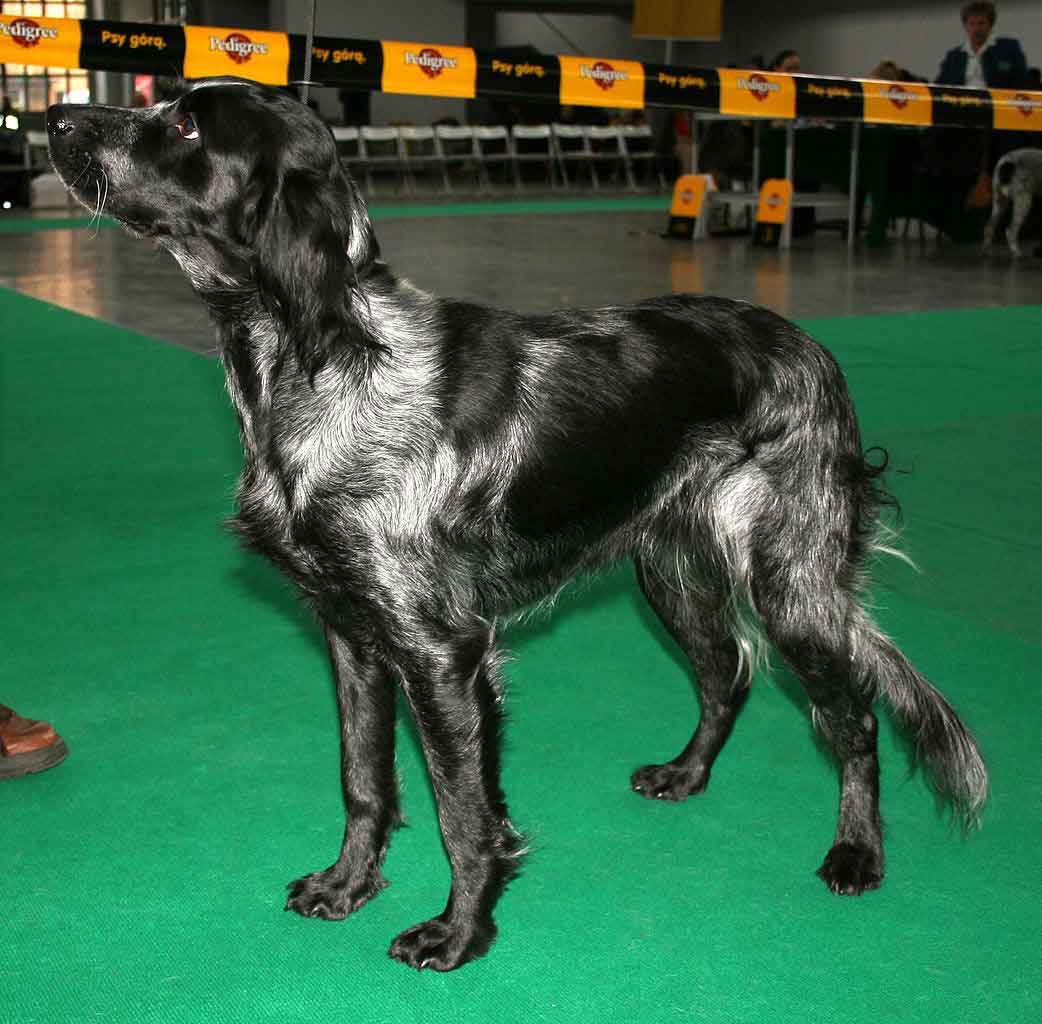
Burgos Pointer
Espaรฑa FCI 90 . Braque Type

Perdiguero de Burgos

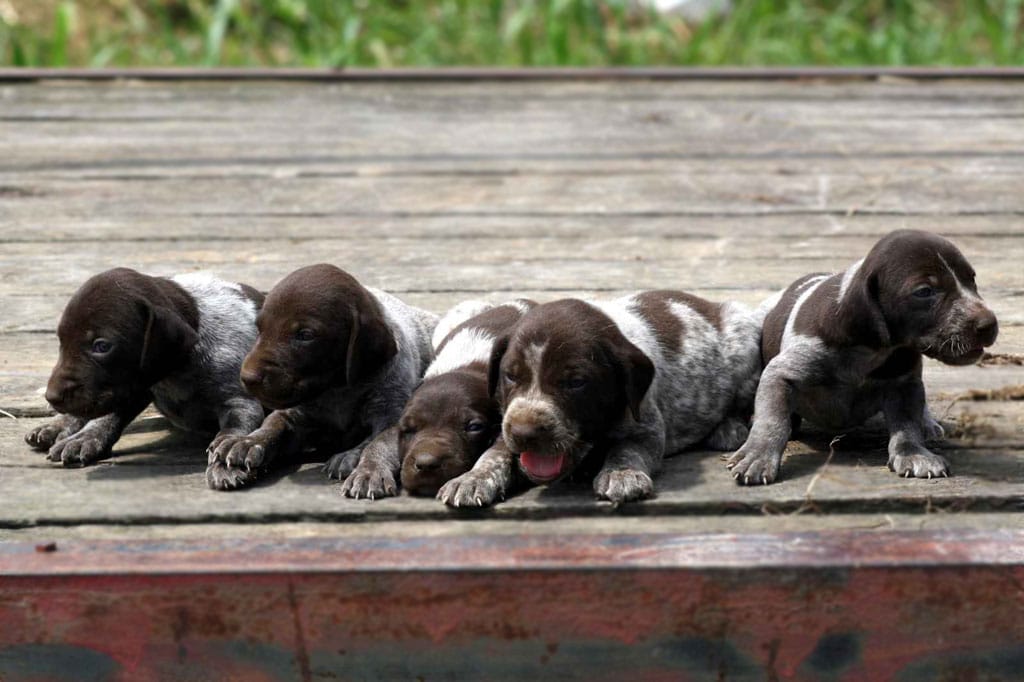
The Burgos Pointer is smart and learns easily, above all, tracking tasks.

Content

History

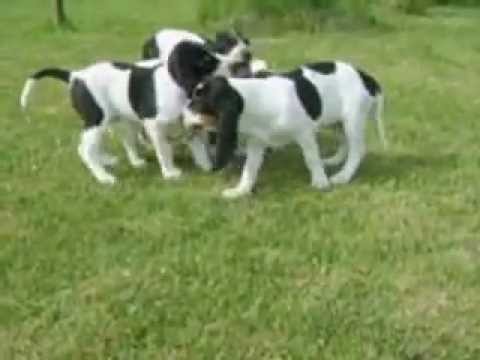
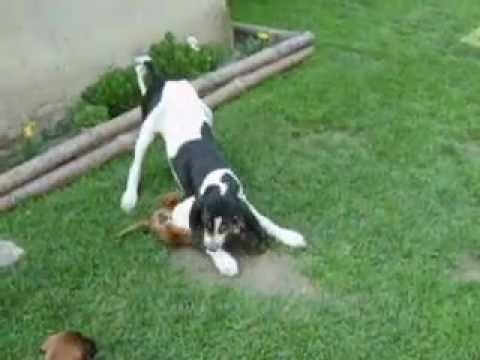
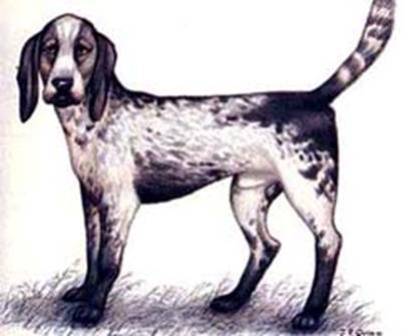
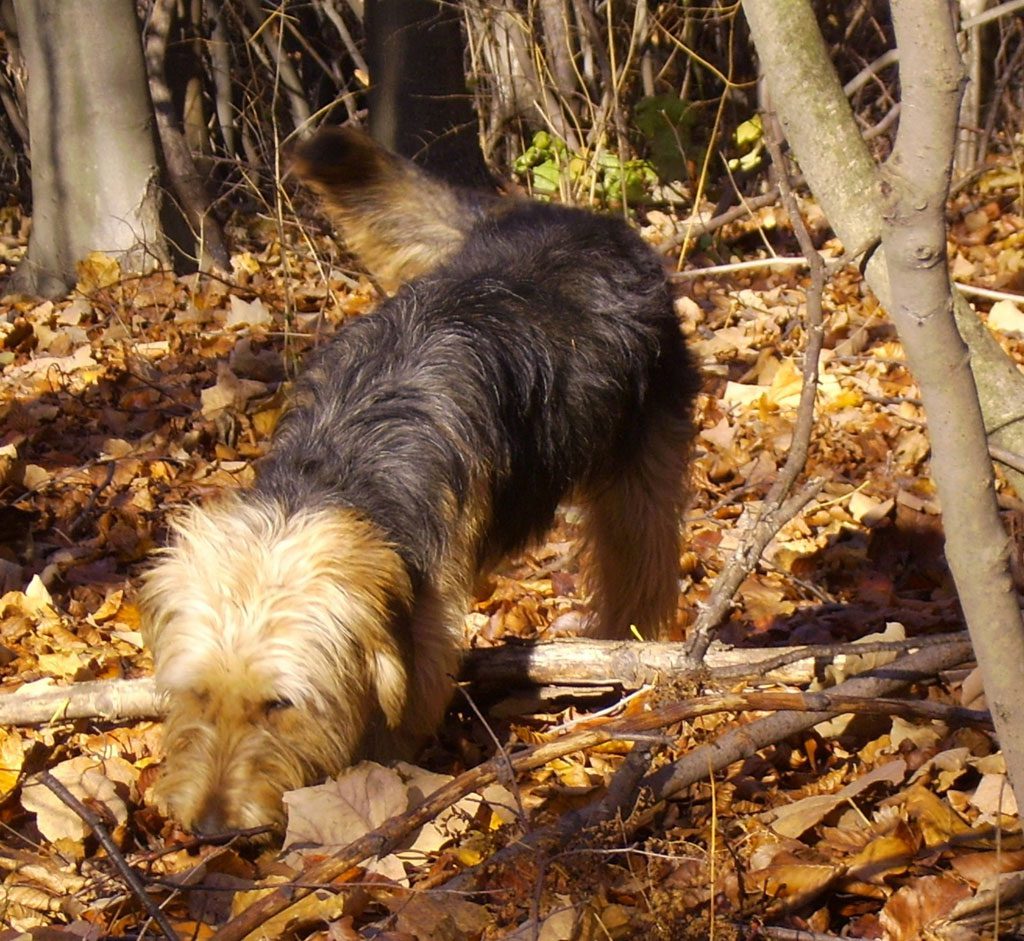
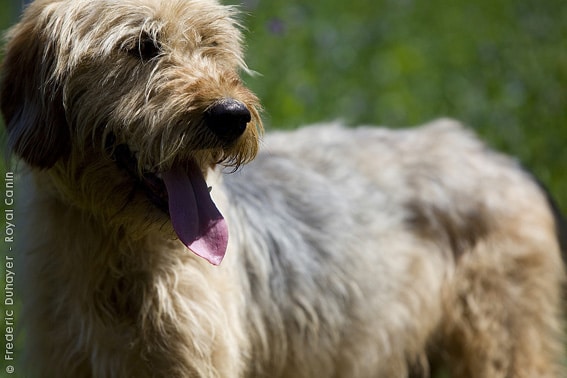
The Burgos Pointer It is a breed of dog Spain. Originally from Castile, especially in the province of Burgos, This rustic breed is intended for hunting and has exceptional characteristics for hunting small game..

It is an ancient breed from the Castilian tableland, is widespread, and according to some connoisseurs of the breed, it is likely that it has participated in the creation of other breeds of hunting dog, not only Spain.

The truth is that lot of documented material that speaks of this breed there is. Veterinary geneticist, Josรฉ Manuel Sanz rudder, has dedicated several lines to the history of this breed and in a document that appears cited in many web, speaks of the Origins and Ancient History (Until 1911). You can read the complete material on the website of the Spanish Association of el Perro Perdiguero de Burgos. Here we will only mention what refers to the word ยซPerdigueroยป and to the different theories about the origin but very briefly…

"The word ‘perdiguero‘ It occurs frequently in classical texts on venatoria and its reference corresponds to the generic Hunter dog of partridges, "perdicero" or "perdigero", but it cannot be lightly assumed that this dog was a Burgos Pointer. In numerous current texts we can read various theories about the origin of the race. The more absolute confusion arises from a whole once analysed separately. The most common mistakes that demonstrate a poor work of research are as follows:

  • Associate the word perdiguero the race Burgos Pointer.
  • Believing that the Pointing Dogs, as the Spanish classics tell us, they were Burgos Pointers and forget that they were other races.
  • Define like Burgos Pointer to the dogs that authors from Velรกzquez to Goya have been captured in numerous canvases where hunting dogs are reproduced.
  • Define incomprehensibly and lightly when Burgos Pointer as the origin of English Pointer, either in a display of patriotic enthusiasm, consider him further as the father of all European Braquesยซ.

"The authors, as often happens, they do not manage to agree on the theories about the origins of animals and while some affirm that the sample dog is originally from Italy, others say that France or Spain (according to the nationality of the author) which they were born.

On the formation of the current dog Burgos Pointer the news is null and we can only apply the parameters that are studied to form a race, they are:

  • Time and place of training.
  • Genetic basis provided the race.
  • Adaptation to the environment in which is born.
  • Geographical isolation and inbreeding operated.

With regard to the first of them, not a breed created by man ex process are being, with measured doses of one or another blood, both the time and the place of training are uncertain. A race not be based in short periods of time and having no initial selection at a single point, "We cannot think that the place of birth has only been a certain place."

(Author: Josรฉ Manuel Sanz rudder).

Physical characteristics

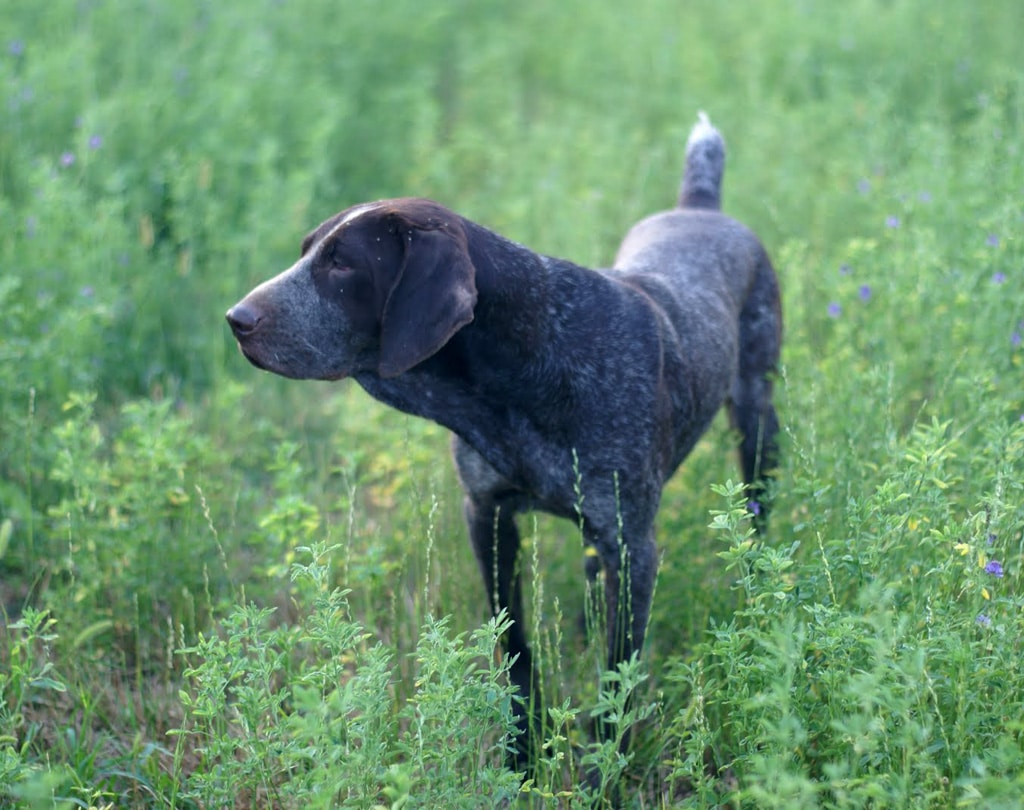
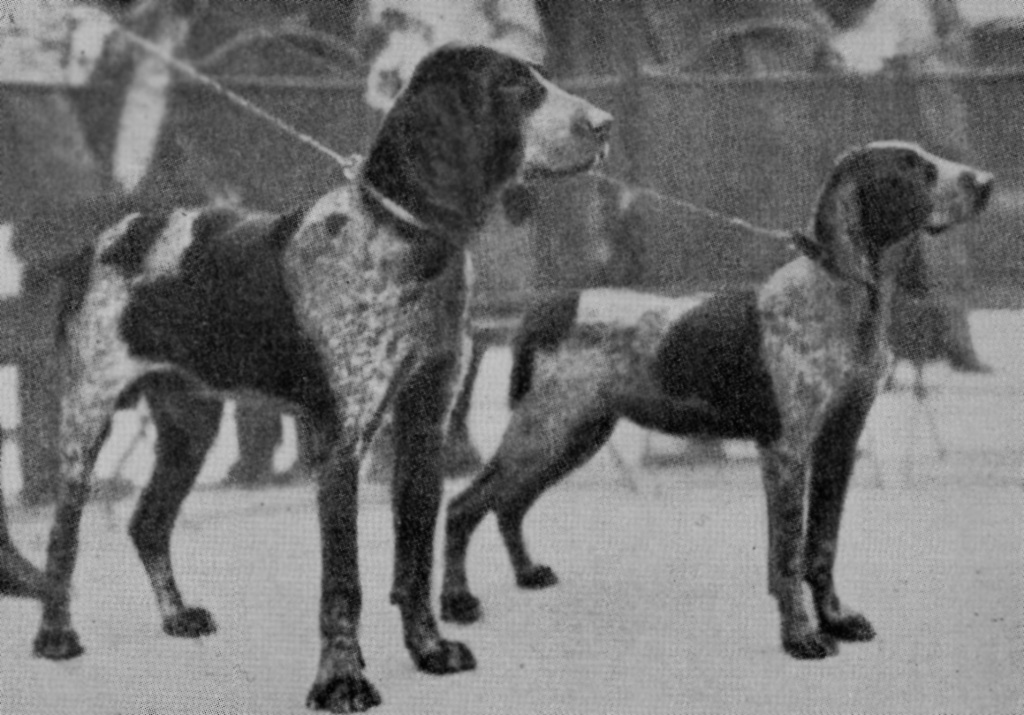
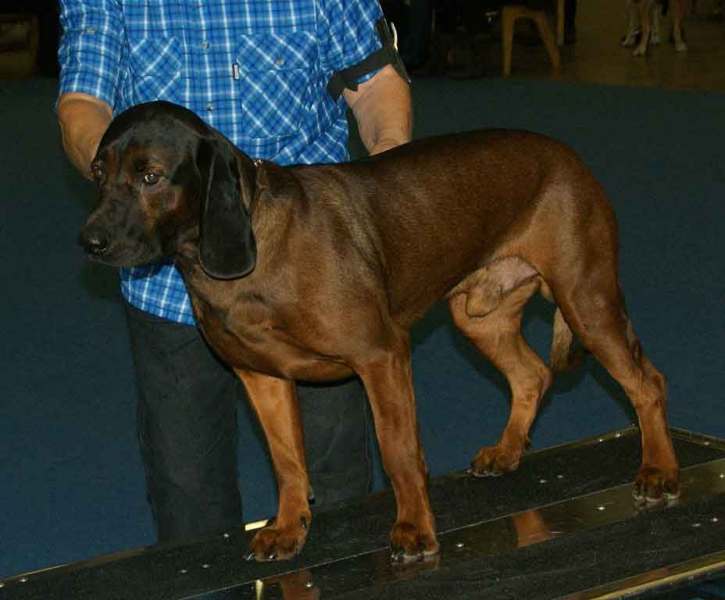
While the Burgos Pointer, It is not as robust and defined muscular level, like its relative the English Pointer, their appearance shows the strength of the race.

It has the ears long and the tail It tends to be cut one-third of its original length.

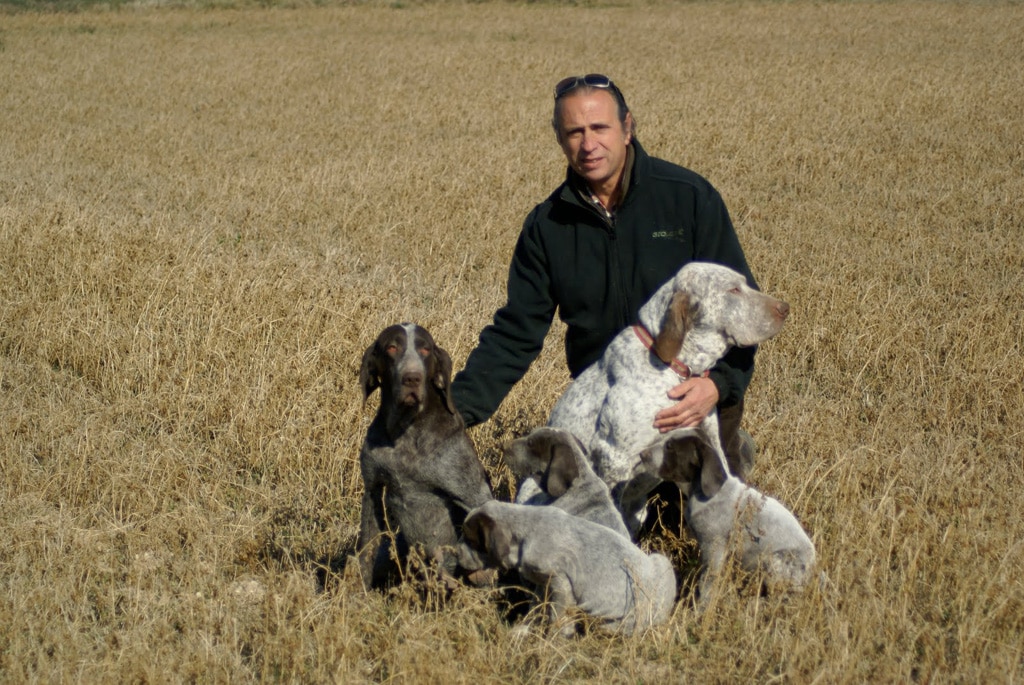
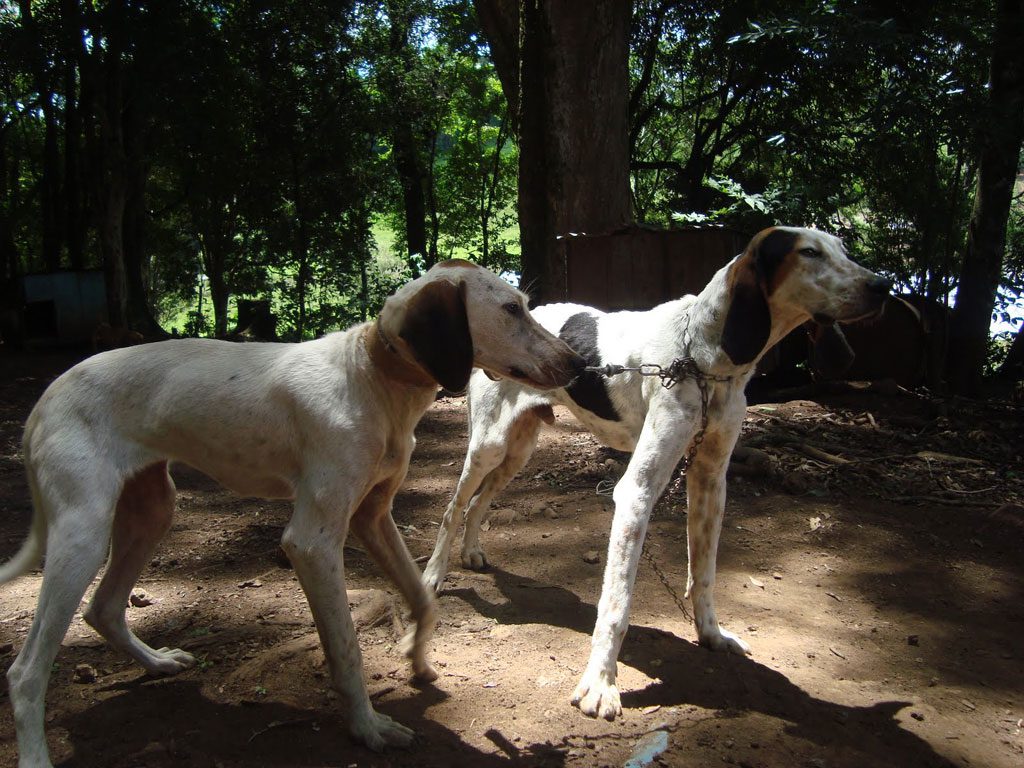
Its fur It has variants that can form different ranges within the basic color. The basic colors of the hair are the white and the liver. These colors mingle regularly, giving variegated layers that tend to liver, gray liver, mosqueados in liver and other various combinations, depending on whether the liver or white color is predominant and depending on whether the white spots are open or closed.

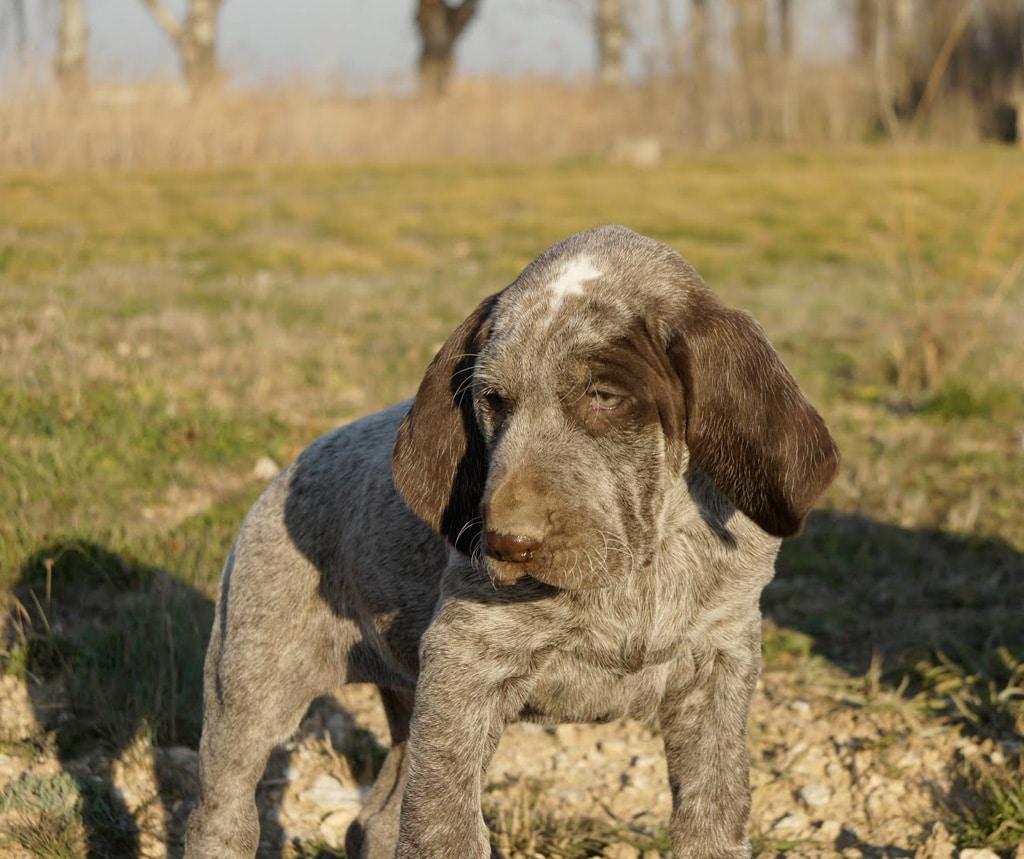
It is a very common feature (Although non-binding layer), that have a clear white spot on the forehead and the ears always spotted with a homogeneous liver color. Liver-colored hairs can form sharp, well-defined liver-colored patches, regularly distributed by the layer of the animal

Its the mantle is short, thick and soft. The hair is thinner in the head, ears and limbs.

The skin is elastic, but not printing, thick, abundant, pinkish spotless. All Oris they will be Brown, never black.

The height males will of 62 to 67 cm and females 59 to 64 cm to the cross. Thinking of 25 to 30 kg.

It is an animal that as all, It requires a dose of daily exercise. A long walk, and a few races in the open air will keep you happy.

Character and skills

It is a very friendly and quiet dog, not afraid easily. It is smart and learns easily, especially in tracking work.

It is not a dog that adapts very well to urban environments.

It is used for small game (rabbits, hares, etc.).

It's perfect for hunting in any field (no matter how hard it is), since it has an enviable physical resistance and a great speed.

The Burgos Pointer it is highly appreciated by hunters who want a rustic dog, hard in any terrain and type of hunting, obedient, strong and above all excellent winds and method of hunting, due to his calm and poise in the search, as well as his sample and his impeccable collection.

Although used for small game pieces not dismisses pieces of hunting trail, in which he demonstrates great bravery.

Characteristics "Burgos Pointer"

Coexistence is important that you have with your new friend. Before considering the acquisition of a dog of the breed "Burgos Pointer" you know certain factors. Not all breeds of dogs are apt to live in an apartment, you must take into account his character, their need for exercise, their interaction with other pets, their care and if you have small children, their level of tolerance towards them.

Adaptation โ“˜

3,0 of 5 stars (based on 1 review)

friendly dog โ€‹โ€‹โ“˜

3,0 of 5 stars (based on 1 review)

hair loss โ“˜

2,0 of 5 stars (based on 1 review)

Affection level โ“˜

3,0 of 5 stars (based on 1 review)

Need for exercise โ“˜

4,0 of 5 stars (based on 1 review)

Social need โ“˜

3,0 of 5 stars (based on 1 review)

Home โ“˜

2,0 of 5 stars (based on 1 review)

Toilet โ“˜

1,0 of 5 stars (based on 1 review)

Friendly with strangers โ“˜

3,0 of 5 stars (based on 1 review)

barking โ“˜

2,0 of 5 stars (based on 1 review)

Health โ“˜

3,0 of 5 stars (based on 1 review)

Territorial โ“˜

4,0 of 5 stars (based on 1 review)

Cat friendly โ“˜

2,0 of 5 stars (based on 1 review)

Intelligence โ“˜

4,0 of 5 stars (based on 1 review)

Versatility โ“˜

3,0 of 5 stars (based on 1 review)

Child friendly โ“˜

4,0 of 5 stars (based on 1 review)

Surveillance โ“˜

2,0 of 5 stars (based on 1 review)

joy โ“˜

4,0 of 5 stars (based on 1 review)

Images: Burgos Pointer

Videos: Burgos Pointer

Type and recognitions:

  • FCI CLASSIFICATION:
  • Group :
  • Section : . .

Federations:

  • FCI – Group 7: Pointing Dogs. – Section 1: Continental Pointing Dogs. 1.1: Braque Type โ“˜

FCI breed standard "Burgos Pointer"

Origin:
Spain

Date of publication of the valid original standard:
26.05.1982

Use:

Hair and Feather Pointer Dog. The Perdiguero de Burgos is highly appreciated by hunters who want a rustic dog., hard in any terrain and type of hunting, obedient; strong and above all excellent winds and method of hunting, due to his calm and poise in the search, as well as his sample and his impeccable collection. Although used for small game game, does not discard the trail of game pieces, in which he demonstrates great bravery.


General appearance:

Hunting dog of good size, eumetric and medioline. Well developed head, compact trunk and strong limbs. Droopy ears and short hair. Longitudinal diameter as close as possible to the height at the withers. Proportionality and functional harmony must be sought, both in static and in motion


Behavior / temperament:

Rustic, balanced, calm and sitting; turns out to be a great show dog, especially suitable for hunting hair and feathers. Fresh look, very noble, it is a breed of excellent character, docility and intelligence.

Head:

As a whole : Big and strong, well developed skull; strong face and muzzle and corkscrew ears.

The cranium, seen from above, It must be moderately rectangular with a progressive decrease towards the nose, without giving feeling of pointed snout. The ratio of the length of the skull to that of the face is 6:5. The craniofacial lines are divergent.


Cranial region:
  • Skull : Width, strong, domed and convex profile; well marked central groove, shallow occipital crest. Accused frontal sinuses.
  • Depression links (Stop) : Soft, little sharp.

facial region:

  • Truffle : dark brown, wet, big and wide with wide open windows.
  • Snout : Straight profile or with a very slight curve towards the nose. Width throughout its length, it should not give the impression of being pointed. Wide muzzle.
  • Lips : Sagging without sagging. The upper one will cover the lower one well. The bottom is marked labial commissure. The mucous membranes must be brown.
  • Jaws / Teeth : Strong teeth, white and healthy; scissor bite. All premolars exist.
  • Eyes : Medium, macaroons, preferably dark hazelnut, noble and sweet look, sometimes giving a feeling of sadness. The skin of the eyelids is moderately thick, pigmented like the mucous membranes in brown. The lower eyelid should be as close as possible to the eyeball.
  • Ears : long, drooping and triangular in shape. Inserted at eye line level, at rest they fall gracefully in corkscrew. Without exerting traction, they must reach the corner of the mouth and will not reach the nose.. Soft and soft to the touch, they have fine skin and hair; marked venous network. In higher insertion care and flatter frontal conformation.
  • Palate : Pink mucous with well marked beads.

Neck:

Strong and powerful; wide part at the head and continues with a slight widening to the trunk. Slightly arched top edge. Lower border with well defined dewlap that, starting from both lip corners, It is presented double without being exaggerated.

Body:

  • As a whole : Square, strong and robust, powerful chest and ribs, giving a feeling of power and agility.
  • Cross : Well defined.
  • top line : Straight and horizontal or desirable with a slight drop from the withers. Never saddled and no oscillations during movement.
  • Back : Powerful and muscular.
  • Pork loin : Medium-, broad and muscular, giving a feeling of power.
  • Rump : Wide and strong. Its inclination will be less than 45ยฐ with respect to the dorsal lumbar line and the floor.. Height at the croup equal to or less than the height at the withers;
  • Breast : Wide and deep, reaches elbow level; muscular and powerful. Tip of the sternum marked. Well developed ribs, rounded, not flat. Well marked and wide intercostal spaces as we move towards the floating ribs. The chest perimeter must be equal to the height at the withers plus ยผ of it.
  • Bellies and flanks : Belly moderately tucked towards the genitals. Low sides and well marked flanks.

Tail:

Thickness birth and average insertion. It is amputated between a third and a half of its length.

Tips

PREVIOUS MEMBERS :

  • As a whole : Perfectly Plumb, straight and parallel. Strong bones with short pasterns and well developed feet.
  • Shoulder : Moderately oblique, muscular. The scapula should be approximately the same length as the arm
  • Arm : Strong and well muscled; its length will be 2/3 of the forearm.
  • Elbows : Glued to the trunk.
  • Forearm : Strong bone, with marked tendons. Straight and well plumb. Its length is double the total length from the carpus to the ground.
  • Metacarpus : Seen little laterally inclined, is practically the continuation of the forearm. Strong bone.
  • Front feet : Of cat, tight fingers, high and strong phalanx. dark nails. Robust plantar tuber, very wide and hard pads. Moderate interdigital membrane.
  • Angles : Scapulo-humeral angle close to 100ยฐ,Humero-radial angle close to 125ยฐ.

LATER MEMBERS :

  • As a whole : Powerful and muscular, strong bone and well poised with correct angles, well marked and angulated hocks, giving a feeling of power and solidity.
  • Thigh : Very strong and with a clear appreciation of the muscles, well marked and developed. Its length is ยพ of the leg.
  • Leg : Long and strong of bone twice the length of the metatarsal.
  • Hocks : Well marked with clear appreciation of the tendon.
  • Metatarsus : Strong bone and perpendicular to the ground.
  • Rear feet : Cat as in the forelimbs, although slightly more elongated.
  • Angles : Coxo-femoral angle close to 100ยฐ,Femoro-tibial angle close to 120ยฐ ,Open hock angle greater than 130ยฐ.

Movement:

The typical gait of the breed is an economical trot, loose and powerful without tendency to laterity and without ambling.

Mantle

SKIN :
Elastic but not detached, thick, abundant, pinkish spotless. All mucous membranes will be brown, never black.

HAIR : Bushy, medium thickness, short, smooth and distributed throughout the body to the interdigital spaces. Finer on the head, ears and limbs.

COLOR : The basic hair colors are white and liver.. These colors are mixed unevenly, giving marbled layers in liver, gray liver, liverwort and various other combinations, depending on whether the liver or white color is predominant and whether the white spots are more widespread or closed. A very common feature of the coat, although not necessary, It is the clear white spot on the forehead and the ears always stained with a homogeneous liver color.. Liver-colored hairs can form clear, well-defined spots of that color distributed irregularly across the animal's coat.. The same can happen with white hairs that can form gaps of this color on the coat without being extremely extended.. Black colorations or fires on the eyes and limbs are never allowed.


Size and weight:

Height to the cross :

  • Males of 62 to 67 cm.,
  • females of 59 to 64 cm..

A high rate of sexual dimorphism is observed in this breed., being the males more homogeneous and the females of more variable height and less corpulent in general.


Fouls:

Any deviation from the aforementioned criteria is considered as a fault and the severity of this is considered to the degree of the deviation to the standard and its consequences on the health and well-being of the dog..

MINOR FAULTS

โ€ข Profile of the snout fleshy without excess.
โ€ข Absence of any premolar.
โ€ข Pincer bite.
โ€ข Conjunctiva ligerรญsimamente visible.
โ€ข Belfos or double chin that, without being excessive, are very marked.
โ€ข Poorly solid dorso-lumbar line.
โ€ข Metacarpos, weak metatarsals or feet, but not excessively.
โ€ข Scars, wounds and abrasions during hunting season.

SERIOUS FAULTS

โ€ข Light appearance, fragile or excessively heavy and lymphatic.
โ€ข Parallel craniofacial axes.
โ€ข Poor or small heads.
โ€ข Narrow skull.
โ€ข Pointed snout.
โ€ข Absence of several premolars and canines not due to trauma.
โ€ข Very pronounced ectropion or entropion, light eyes.
โ€ข Ears that are too long or set too low.
โ€ข Belfos or exaggerated jowls.
โ€ข Saddled dorso-lumbar line.
โ€ข Height at the rump noticeably higher than the height at the withers.
โ€ข Incorrect positions, weak or deviant.
โ€ข Detached elbows.
โ€ข Cow hocks.
โ€ข Wavy or very long hair.
โ€ข Unbalanced character.

MISS PLAYOFFS

โ€ข Aggressive or fearful dog.
โ€ข Decidedly convergent craniofacial axes.
โ€ข Depigmentation in the truffle.
โ€ข Broken or black nose.
โ€ข Any degree of lower prognathism.
โ€ข Excessive upper prognathism.
โ€ข Albinism in the coat accompanied by the mucous membranes.

Any dog โ€‹โ€‹showing clear signs of physical or behavioral abnormalities must be disqualified..


N.B.:

Males should have two normal-appearing testicles fully descended into the scrotum..

Source: F.C.I - International Cynological Federation

Alternative names:

1. Perdiguero de Burgos, Burgalese Pointer (English).
2. Retriever de Burgos, Braque de Burgos, Perdiguero (French).
3. Burgos-Hรผhnerhund (German).
4. Pointer espanhol, Pointer de Burgos (Portuguese).
5. Perdiguera (espaรฑol).

โ–ท The world of Pets: Dogs, cats, birds, reptiles, amphibians

Brittany Spaniel
Francia FCI 95 . Spaniel type

Spaniel Bretรณn

The Brittany Spaniel They are multi-faceted "Pointer Dogs", for all types of hunting and all-terrain.

Content

History

The Brittany Spaniel It, as the name reflects, originally from the Breton region, in the extreme west of France. It is probably one of the races Spaniel type and oldest โ€œShow Dogsโ€ in the country.

Some historians argue that it was developed a long time ago, about 150 years AD. In any case, the first traces of white and red dogs that resembled him and were undoubtedly the ancestors of the current Brittany Spaniel date back to 17th century tapestries and paintings. The dogs in question are represented hunting.

The most likely hypothesis is that the development of the breed began in the 18th century, but there is relatively little data on its exact origins. But, Specialists believe it probably originated from the "Welsh Springer Spaniel.", the English Setter and several breeds of "French Spaniel". The first representatives of the breed were surely born in the village of Ponthou, located in the department of Finistรจre, and are most likely the result of the first crosses between the "Welsh Springer Spaniel" and "French dogs.".

During the 19th century, in the city of Callac and its surroundings (Cรดtes-d'Armor department), the dogs thus created were crossed with the English Setter. The city then specialized in breeding the dogs resulting from these crosses., and today it is considered the capital of Brittany Spaniel.

There are several theories about the exact development of the breed, including how the English Setter used for breeding. One of the theories is that they belonged to British families who spent their holidays in Brittany., while according to another they were brought by hunters of the same nationality who came to hunt in the region.

About 1850, Reverend E. W. Davies, Anglican writer, minister and hunter who liked to spend winters hunting in the Breton region, mentioned in his writings a medium-sized hunting dog, type Pointer, with short tail. This was definitely the Brittany Spaniel as we know it today, since this short or even absent tail, due to an English ancestor who introduced the corresponding gene into the bloodlines, it is one of the peculiarities of the breed.

From the beginning of its development, the Brittany Spaniel was bred as both a pointer and a collection dog, regardless of time. In fact, was (and it still being) very adaptable, which allowed it to spread later in many French regions, as well as in several European countries, like the UK. French breeders, However, they predisposed him to hunt birds.

Used to working in collaboration with man and eager to please him, the Brittany Spaniel he was not only at the service of hunters, but also integrated into their homes. When i wasn't working, voluntarily stayed with their masters in their homes. His reputation as a good pet was quickly established.

Dog shows also played an important role, as they allowed the breed to become known outside their homeland. In fact, the end of the 19th century and the beginning of the 20th were marked by an important development of these events in Great Britain and other European countries, especially in France.

The year 1907 marked the creation of the Club l’ร‰pagneul Breton ร  courte queue naturelle. Next, a first draft of the breed standard was written, which was adopted at the first plenary meeting of the association the following year in Loudรฉac. It was later modified into 1923 and again in 1933, 1956, 1995, 2001 and 2003.

As with many races, World War II marked the end of the breeding of Brittany Spaniels. Then it suffered a certain decline, However, it could be compensated once the conflict ended thanks to the work of the breeders and the evolution of certain rules.. In effect, as the gene pool of the breed had become too small throughout Europe, it was decided to accept individuals with black spots, what did not happen until then.

The problem did not arise in the United States and Canada, so local organizations did not follow the example of their French counterparts, British and others. The situation has not changed since then: this particularity is still not recognized by the American Kennel Club (AKC), el United Kennel Club (UKC) and the Canadian Kennel Club (CCC).

The popularity of the ยซBreton Spanielยป

in your country of origin, the Brittany Spaniel It is very much appreciated, and its popularity has not waned over the decades. Like this, the number of new annual registrations at the Sociรฉtรฉ Centrale Canine (SCC) has never been below 4.000 since the middle of the years 70, and most of the time it even exceeds the 5.000. But, there has been a certain decline over the years 2010, in which the number of new registrations has dropped from almost 5.500 a year at about 4.500.

The Brittany Spaniel It is the only "French Spaniel" that is also very popular outside its country. Official recognition of the breed by the Fรฉdรฉration Cynologique Internationale (FCI) in 1954 obviously contributed to it.

He did not wait for the FCI to gain a foothold in the United States, where their first representatives arrived in 1931. Crossing with other "Setter" type dogs caused the breed to gain in size and muscularity., thus deviating from the original model. In fact, there is now a clear physical distinction between the American and French types, beyond the possible presence of black spots on the latter.

The Brittany Spaniel was recognized already in 1934 by the AKC under the name of Brittany Spaniel, then the latter was shortened to 1982 in favor of the simple denomination Brittany. In fact, both in Europe and America, This dog probably has more in common with Pointers than Spaniels.. It is the same choice made by the other reference organization in the country, the UKC, when he also accepted the breed in 1948, again with the simple name of Breton. The UKC has the particularity of being the only organization that recognizes both types of Brittany Spaniel like two different races. In fact, seeing how ยซBrittanyยป American had ended up diverging from his French ancestor, decided on 2002 also recognize the "French type" as a breed in its own right, with the name it bears in its country of origin.

But, This quick recognition should not obscure the fact that the lack of a tail was initially a major disruption to American hunters., so the Brittany Spaniel it took him a while to gain a foothold in the country. But, the general qualities of the breed eventually overcame this reluctance and the breed became very popular. Although it was also used as a hunting dog, its qualities as a companion dog, starting with his medium size and good character, also contributed greatly to its success. this last one is real, since it occupies around the post 25 (of something less than 200) in the breed ranking established by the AKC based on the number of annual births registered with the organization. This is even an improvement over the first decade of the 21st century., when he was around the post 30.

Also in North America, the Canadian CKC also recognizes the breed, and is quite appreciated in the country.
Closer to France, Great Britain contributed to the genesis of the breed thanks to the "Welsh Springer Spaniel" and the English Setter, and adopted her in turn, being their representatives used both for hunting and shows as well as for the company. But, its inhabitants seem to have subsequently moved away from it. Like this, was not up 1975 when the Kennel Club, the canine organization of reference in the country, recognized the Brittany Spaniel. Regarding the number of subjects enrolled each year, we cannot say that it reflects a great fondness for this dog, since it is below a hundred. This figure is even on the decline, since in the first semester of 2010 it was rather between 100 and 150.

But, other European countries have given it a much better reception. This is the case, in particular, of Italy, where hunting is very popular and widely practiced. This is, without a doubt, one of the reasons why, at the beginning of 2010, ranked 5th in the ranking of the most represented dogs in the country, based on the number of annual registrations in the Ente Nazionale Cinofilia Italiana (ENCI). But, since then the number has dropped steadily; now it is more or less around the 3.000, which is still considerable.

Worldwide, a classification established in 2013 and based on the sum of the annual registration statistics of 25 national organizations among the hundred members of the FCI places the Brittany Spaniel in the post 30, which confirms to what extent it has been able to gain a foothold around the world.

Physical characteristics

The Brittany Spaniel It is one of the smallest "Show Dogs" in the world, but it is longer than most "Spaniel Type" dogs. They are of the braccoid type, muscular and agile, quite high-legged and with a compact silhouette. They are distinguished from the "Pointer" type dogs by their head, typical of the ยซSpanielยป, and the frequent absence of tail.

straight and stiff, his back is generally as long as his height at the withers. The chest generally descends to the tips of the elbows, while the shoulders are long and very mobile.

Due to a genetic mutation introduced in the 19th century, the tail of Brittany Spaniel is absent or very short. When it is present, It is located in the upper part of the croup and usually measures between 3 and 6 cm., but the breed standard accepts up to 10 cm.. There was a time when the use of tail docking was common for dogs with a tail that was too long for their owner's liking. But, this practice is now banned in a large number of countries, like belgium, France, Switzerland and Quebec.

As for the legs, they are long and strong, and have flexible joints that allow them to run lightly without much effort. The feet are usually larger on the hind legs than on the front legs.. In all cases, they are well rounded, compact and have tight toes.

The head of the Brittany Spaniel rests on a moderately long neck, fine and strong. Whether viewed from the side or from the front, the skull is somewhat rounded. The stop is quite well defined. It also, this dog is slightly brachycephalic, which means that its muzzle is shorter than its skull. It ends in a nose with wide nostrils whose color corresponds to that of the fur, and tame scissor bite jaws.

Located on the top of the head and provided with semi-long hairs, sometimes wavy at the top, the ears are wide, short, triangles and falls. They are extremely mobile when you are on the lookout for something.
The eyes are slightly oblique and their color usually corresponds to the predominant color of the coat. His intelligent gaze shows the great alertness of this dog.

If there is no undercoat, the mantle of Brittany Spaniel consists simply of a thin layer of medium length hair, which is not very thick and can be smooth or slightly wavy. Most common color is fawn on white, but there are also brown and white dogs, fire and tricolor (black, Orange and white, or brown, Orange and white). Confidentially, the latter has gained in popularity in recent times. As for the black and white fur, there is debate: accepted by some organizations, as the Fรฉdรฉration Cynologique Internationale (FCI), but others reject it, as the American Kennel Club (AKC) or the Canadian Kennel Club (CCC). In any case, regardless of its color, some individuals have spots on the snout, the lips, around the eyes, on the legs or even on the chest.

Last, It should be noted that there are two very different types: the Brittany Spaniel French type and the Brittany Spaniel american type. They differ mainly by their size: the second (the most represented in the United States and Canada) it is bigger and more massive than the first (majority in Europe). As to the nature, tends to be more active and awake. These differences are explained by the fact that the first representatives of the breed imported to the United States in the decade of 1930 They were quickly crossed with "Setter" type dogs.

Whatever the type, there is only a very slight sexual dimorphism between males and females, although the former may be a bit larger and heavier. It also, regardless of gender, representatives of the breed reach their adult size between 14 and 16 months of age.

Height and weight

▷ Male size: Of 49 to 50 cm.

▷ female size: Of 48 to 49 cm.

▷ Male weight: Of 14 to 16 kg

▷ female weight: Of 13 to 16 kg

Varieties:

Although not strictly varieties, there are two types of Brittany Spaniel: the original French type and the American type, that appeared after the breed's arrival in the United States in the years 30 and their crossing with local Setters. This resulted in a larger dog, stronger and faster with a livelier temper.

Smaller and more compact, the Brittany Spaniel French type is easier to train and handle during hunting parties.
These two types can also be differentiated by their fur. The Brittany Spaniel American type has no black spots, unlike his cousin. It also, they tend to have shorter hairs.

El United Kennel Club (UKC) American is the only organization that recognizes these two types as distinct breeds. In 1948, the Brittany Spaniel was recognized as Brittany. Arrived in the country less than 20 years before, this dog was still broadly identical to the one found in France. But, as the gap widened over the decades, The breed finally decided that the "Brittany" corresponds to the Brittany Spaniel american type, and in 2002 decided to also recognize his ancestor, the french type, under the name of Brittany Spaniel.

Character and skills

The Brittany Spaniel it is one of the most popular dog breeds in France, and even to a certain extent the world. In effect, is sociable, Intelligent, attentive and cheerful. With the, it seems impossible to get bored and in a bad mood, so contagious is his joy of living!

Having said that, as it happens with many races, the temperament of this dog can vary according to sex. For an individual destined for hunting, a sterile male is often preferred, as it is considered calmer and more gentle than an uncastrated female or male.

In any case, it is a joy for the whole family, And he gets along especially well with children.. He loves to play actively with them and can be quite protective if he perceives a threat to them. But, his boundless energy and enthusiasm can lead him to unintentionally push or even knock over a small child. In any case, as with any dog, should never be left alone with a very young child without adult supervision, and those whose age allows it must learn to behave with respect towards him.

Loyal to his family and little tolerant of loneliness, this dog requires a lot of presence and affection to feel good: if he is left alone too long or does not receive enough attention from his masters, can quickly develop destructive behavior or bark excessively. Its need for attention and interaction also means that it is not suitable for a household where members are often away for long periods of time..

Sharing your home with another little companion is an interesting option to help you pass the time when your caregivers are away. In fact, the Brittany Spaniel not only appreciates humans: he is also very sociable with his peers, whether you come across them on walks or those you would have to deal with on a daily basis. He is also grateful that he is not the only dog โ€‹โ€‹in the family.. You can also plan a coexistence with a cat, as soon as I am in contact with him from a very young age. On the other hand, when he meets an unknown feline, you probably want to go after him. Good socialization is not enough for you to live under the same roof as a small prey-like animal, like a rodent or a bird. In fact, hunting instinct is in his genes and he is likely to regain the upper hand at any moment, ending this coexistence prematurely.

Their propensity to hunt small animals that pass by, as well as his permanent desire to run, also implies that if you live in a house with a garden, this must be well fenced, at the risk of sometimes going too far. A property with a large fenced area is the ideal environment for him, but it is quite adaptable. So, as long as your need for exercise is met each day with the help of long walks and other activities, you can even live in an apartment and in an urban environment.

But, keep in mind that they can be sensitive to noise. So, can get stressed out when your home is particularly noisy, for example, by very noisy children. The same type of problem can arise if you live in the city or move regularly (for example, when walking) in a very crowded environment, especially if you haven't gotten used to it from a very young. On the other hand, used since its inception for hunting, he is indifferent to the noise of rifle shots.

Although they live in the quiet countryside and have access to a very large garden at all times, this is not enough for this particularly active and hardy dog รขโ‚ฌโ€นรขโ‚ฌโ€นto be comfortable with his head and paws. To be able to expend his great energy, needs at least an hour or two of daily activity. It's not about being much less active during the week and trying to make up for it on the weekend.: if this dog does not expend enough energy each day, can quickly develop behavior disorders, such as excessive nervousness or hyperactivity.

Given your level of activity, it is easy to understand that the Brittany Spaniel it is not at all adapted to elderly or very homey people. On the other hand, he is the best friend of an active master who likes to run, hiking or taking long bike rides and dreams of taking his animal with him. Knowing that he also likes to swim, do not hesitate to take him swimming in a lake from time to time, or in planning a swim break when there is a water point along the way during any activity. It can also be very good at practicing canine sports such as cani-cross or cani-VTT. In fact, usually always willing to do any activity that involves exercise, especially if it is fun or is accompanied by other dogs.

During the walks, It is important to bear in mind that at any time you can run after a bird or any other animal that is in your way, or you can be tempted by a smell that will not leave you indifferent. Your determination and stamina can go a long way, even to get lost. To avoid this, the most effective solution is, of course, always carry him on a leash, but this is by no means ideal for your well-being, as he urgently needs to vent. So, it is better to put the emphasis on learning to withdraw, considering that it is impossible to completely trust such a dog: Investing in a connected dog collar is a good way to prevent walks from being a source of anxiety, since then it is possible to know where it is at all times.

But, it is not enough to give him physical exercise to keep him balanced: you also have to keep him mentally busy. So, the ideal is to keep him mentally occupied with activities that appeal to his intelligence, like certain canine disciplines (obedience, agility or flyball, for example), o solving puzzles and other problems. As a working dog, he likes his owner to assign him tasks, and usually takes them very seriously.

This is all the more true as his closeness to his caregiver, her desire to please him and her intelligence make the Brittany Spaniel an easy to train dog that learns very quickly. They are especially attentive to the orders of their owner, attentive to every facial expression and ready to react and respond to any request.

Unlike other races, the Brittany Spaniel are not particularly destructive or difficult during their adolescence, which starts around 6 months and continues until 18 months of age. Even if you start to adopt undesirable behavior, his great desire to please makes him very easy to correct.

Last, because of his personality, not very assertive by nature, not a good watchdog, although it can be protective in especially threatening situations. He does not hesitate to bark to warn of the arrival of a stranger, but it is not usually the kind that does much more to deter the intruder. They can also be especially loud barking at the top of their lungs when they are home alone.. He has a groan that is his own and that he can also show when he is in this situation, or when scared or intrigued.

Education

The education of Brittany Spaniel it's pretty easy, because it is an obedient dog that likes above all to please its master. Thus, not the type to use his intelligence to try to exploit loopholes and challenge his master's dominance, but it allows you to learn very quickly. This makes it a recommended dog breed for a beginner..

With the, sweetness is the key word. In fact, is sensible, does not support violence and is not at all receptive to education based on punishment or negative reinforcement. If these methods are used, is likely to show signs of anxiety and stress at work. Positive reinforcement, that is to say, a work method based on the assessment of good behavior through rewards (petting, stimuli, candies…) is much more effective and allows you to feel real pleasure from your work.

Hunting individuals can quickly learn their future role. In effect, the Brittany Spaniel has a great hunting instinct, to the point that it is not uncommon to see a cub that begins hunting from the 3 months of age. It is possible to take your dog hunting from the 5 months of age. Obviously, it is not at that moment when he catches his first woodcock, but it allows you to become familiar with the environment and hunting. It is important, However, stick to short games and be fairly sure to watch the game, so as not to demotivate him. It also, being still growing and being fragile, avoid trying too hard. Only when it reaches its adult size, between 14 and 16 months, you can fully participate in this activity.

Although not intended for hunting, any activity that reinforces their persecution instinct should be prohibited in their education. Obviously, this should not detract from your need to be active and exercise properly. The learning and regular practice of a dog sport, like agility, obedience or flyball, for example, is a good alternative, although it can also be practiced perfectly by an individual employed as a hunter.

Teaching your dog to remember is also helpful in preventing him from unleashing his predatory instincts in inappropriate circumstances.. But, since even well-trained dogs are difficult to trust completely, the leash is more or less often essential for your safety and that of the animals and people around you. So, learning to walk on a leash is another important aspect of your education.

Last, like any dog, the Brittany Spaniel should benefit from great socialization from a young age, especially as you can tend to be suspicious and shy around strangers, or being especially stressed when in a noisy environment. Getting used from a young age to meet all kinds of people and fellow humans, but also to live in different places and to face a great variety of situations and stimuli (noises, smells, etc.), we give you all the possibilities to make you feel good in your head, calm down and easily find your place with humans.

Use

The Brittany Spaniel was developed to be a versatile hunter. remarkable in search, the signaling and collection (both in water and on land), is specialized in hunting birds (especially the woodcock and the duck), acts alone and not in a pack and continues to be, Still today, the hunting dog breed preferred by many hunters.
From the beginning of its history, has also found its place in the homes of its owners, thanks to his friendly personality and his natural closeness to man.

Today, It is still appreciated as a companion dog and is an excellent choice for anyone who is active and available., hunter or not, wanting nothing better than hiking with your dog or taking it with you when you go for a run or ride a bike.

your energy, his resistance and his desire to please also make him a perfect student for many canine disciplines such as agility, the flyball, obedience, the cani-cross or the mountain bike.

Grooming

Due to her very moderate hair loss throughout the year, its lack of undercoat and its little tendency to tangle, the fur of the Brittany Spaniel requires little maintenance: a weekly brushing is enough. Your seasonal shed, in spring and autumn, it is not very pronounced, but still requires more regular brushing, on the order of 2 or 3 times per week.

It is also possible to take the dog to the groomer to cut the medium hairs of the legs (or do it yourself), to avoid knots, since this part of the body is especially prone to them. But, this is not essential: depends on the preferences of each caregiver.

How their coat is generally kept clean, it is not necessary to bathe the dog more than 2 or 3 times a year. In any case, unless it got especially dirty, avoid bathing him too close, as it could seriously damage the skin or fur. In any case, it is important to always use a shampoo specially designed for dogs, since the pH of human skin and that of your best friend are different.

The drooping shape of the ears of the Brittany Spaniel implies an increased risk of infections at this level (otitis, etc.), as it facilitates the accumulation of dirt and moisture. So, it is essential to examine and clean them weekly, as well as dry them after each prolonged moment in a humid place, and of course every time you swim.

The weekly maintenance session is also an opportunity to check the condition of your partner's eyes and clean the contours. This also greatly reduces the risk of infection. This is all the more important since the Brittany Spaniel is quite sensitive to the eyes and can have a number of eye diseases: the sooner they are detected, best.

Caring for a Brittany Spaniel it also involves taking care of your teeth, always using a toothpaste specially designed for dogs. This helps limit the build-up of dental plaque., which can lead to tartar formation, which can be the cause of many problems, some of which are potentially serious. The ideal is daily brushing and, in any case, it is better to avoid brushing less than once a week.

Last, the activity level of this hyperactive dog causes claw wear to occur normally naturally. So, they rarely need to be cut, unless, for example, your mobility is limited by a health problem. If you hear them rubbing when you walk on the hard ground, it's time to take care of them. Otherwise, they could hamper your movements or even break and injure you.

As with any race, the steps to take care of a Brittany Spaniel (either its fur, his eyes, his ears, their teeth or claws) should not be taken at random. In fact, beyond the risk of being ineffective, could hurt or even injure you. So, it is wise to see a vet or professional groomer the first time, to learn from him the best way to proceed. The sooner the animal gets used to these different manipulations, it will be easier for you to let them do it throughout your life. The sessions can then be beautiful moments of sweetness and complicity, instead of being tests feared by the two protagonists.

Another habit to take - and that also leads to manipulation- is to systematically examine your body when you return from every long moment you spend outdoors, in particular its fur, its feet and its pads. This ensures that you have not been injured, nor has he caught spikes or parasites.

Health

In general, the Brittany Spaniel enjoys robust health, which is illustrated by the fact that a good number of representatives of the breed are celebrating their 15th birthday.

It also, his Breton origins mean that bad weather does not impress him or prevent him from carrying out his outdoor activities. It is also capable of adapting to many weather conditions, even at extreme temperatures.

But, like all dogs, have a predisposition to develop certain diseases, many of which are hereditary:

  • Hip Dysplasia, a potentially inherited joint malformation that mostly affects medium and large dogs. Causes pain and lameness to a greater or lesser extent, as well as osteoarthritis from a certain age;
  • Cleft palate, a congenital and often inherited malformation responsible for poor communication between the puppy's mouth and nose. Then you may suffer from feeding difficulties, swallowing problems, choking or coughing. Difficulty feeding can lead to stunted growth and requires surgery to correct the problem;
  • Spinal muscular atrophy, a sometimes hereditary syndrome that causes a decrease in muscle mass. This can cause, among other things, difficulty moving, breathing problems or trouble eating properly. It is a progressive and often fatal disease for which there is no treatment;
  • La abiotrofia cerebelosa, a disease that causes tremors and a significant loss of coordination, that affects young men more. These symptoms initially occur only when the animal is in motion, and then they get worse over time, more or less quickly, until they appear when idle. There is no treatment for this rare disease, but it is not painful for the animal;
  • Epilepsy, a sometimes inherited disease causing more or less severe and often impressive seizures. Various treatments allow limiting or even eliminating them, so that, usually, those affected continue to lead an almost normal life;
  • Hypothyroidism, an endocrine disruption that corresponds to a defect in the regulation of thyroid hormones. You can have all kinds of symptoms: weight gain, decreased heart rate, dry skin, hair loss, increased sensitivity to cold.;
  • Hemophilia, an incurable inherited disease that causes a deficiency in coagulation and, Therefore, excessive bleeding. They can appear mostly under the skin, during tooth growth, in urine and feces, during vaccination or when the animal is injured. They can also be internal and invisible, and often lead to death;
  • Lupus erythematosus, a skin disease resulting from a deficiency of the immune system, what causes, among other things, depigmentation of certain parts of the body (nose first, then the ears and legs), erosions and ulcers ;
    external otitis, due to the drooping shape of their ears.

The Brittany Spaniel it is also predisposed to certain eye diseases:

  • Dislocation of the lens, causing instability and abnormal movement of the lens in the eye. In this breed, most often it is the result of hereditary transmission. Very painful, can lead to total loss of sight if not treated with surgery;
  • The waterfall, a potentially inherited eye disease that usually develops in old age. Cataracts cause a cloudy lens that gradually reduces the dog's vision until total blindness occurs. Can be treated by surgery;
  • Glaucoma, an often inherited disease that can cause sudden loss of vision. It is the result of an abnormal increase in pressure in the dog's eye and must be treated quickly, otherwise its consequences are irreversible.

It also, specimens used for hunting are at increased risk of injury, parasites and spikes.

Last, despite its high level of activity, the Brittany Spaniel does not get rid of obesity, that can cause or accentuate many health problems. It is also a vicious circle, since an overweight individual tends to be less active.

But, the long list of diseases to which the breed is predisposed should not obscure the fact that most of its representatives spend most of their lives in perfect health. This is confirmed by a study carried out in 2004 by the British Kennel Club and the British Small Animal Veterinary Association, which established that the leading cause of death in this breed is simply advanced age.

On the other hand, this list leads to many inherited conditions, or that are likely to be hereditary. This underlines how important it is to go to a serious and competent Brittany Spaniel breeder who rigorously selects his breeders.. If you are unable to present the results of the genetic tests carried out on the parents or offspring to prevent any transmission of said disease, it is better to go your way and go to another breeder; no lack of options. In addition to these documents, any serious professional should be able to provide a certificate from a veterinarian proving that the puppy is in good health, as well as your health or vaccination card, confirm that you have received all necessary vaccinations.

Adopting a healthy animal is one thing, but its usefulness is limited if you don't make sure it stays that way. So, it is essential to note that, until the age of 14 to 16 months, a puppy of Brittany Spaniel is still in its growth phase, and therefore is particularly fragile. Throughout this period, it is important to only very gradually increase the duration and intensity of your activities, at the risk of impairing the proper development of your bones and joints, or even causing injuries and/or malformations that he could suffer throughout his life. This is all the more important since you are predisposed to hip dysplasia.

Last, one of the best ways to keep your dog healthy is to take him to the vet at least once a year for a thorough check-up to detect any possible problems, which may not be visible to the inexperienced eye. It is also a great opportunity to take stock of vaccinations and any necessary withdrawals.. It also, antiparasitic treatments also help protect your pet against a number of diseases: it is up to the owner to renew them throughout the year, whenever necessary.

Life expectancy

Of 12 to 15 years

ยซBreton Spanielยป Price

In Switzerland, the lower popularity of the breed means that the number of breeders of Brittany Spaniel be quite limited. A solution to have many more options is to buy directly in France.

in Canada, the number of breeders barely exceeds ten, and also here the prices are very different, generally ranging between 750 and 1500 canadian dollars. Of course, It is also possible to go to the United States, where you have to have some 800 US dollars for a good quality puppy.

In the case of a purchase abroad, keep in mind that transportation and administrative costs are added to the price of the puppy and, of course, make sure you respect the regulations regarding the importation of a dog.

Characteristics "Brittany Spaniel"

Coexistence is important that you have with your new friend. Before considering the acquisition of a dog of the breed "Brittany Spaniel" you know certain factors. Not all breeds of dogs are apt to live in an apartment, you must take into account his character, their need for exercise, their interaction with other pets, their care and if you have small children, their level of tolerance towards them.

Adaptation โ“˜

3,0 of 5 stars (based on 1 review)

friendly dog โ€‹โ€‹โ“˜

4,0 of 5 stars (based on 1 review)

hair loss โ“˜

3,0 of 5 stars (based on 1 review)

Affection level โ“˜

5,0 of 5 stars (based on 1 review)

Need for exercise โ“˜

5,0 of 5 stars (based on 1 review)

Social need โ“˜

4,0 of 5 stars (based on 1 review)

Home โ“˜

4,0 of 5 stars (based on 1 review)

Toilet โ“˜

2,0 of 5 stars (based on 1 review)

Friendly with strangers โ“˜

3,0 of 5 stars (based on 1 review)

barking โ“˜

3,0 of 5 stars (based on 1 review)

Health โ“˜

3,0 of 5 stars (based on 1 review)

Territorial โ“˜

2,0 of 5 stars (based on 1 review)

Cat friendly โ“˜

2,0 of 5 stars (based on 1 review)

Intelligence โ“˜

4,0 of 5 stars (based on 1 review)

Versatility โ“˜

4,0 of 5 stars (based on 1 review)

Child friendly โ“˜

5,0 of 5 stars (based on 1 review)

Surveillance โ“˜

2,0 of 5 stars (based on 1 review)

joy โ“˜

5,0 of 5 stars (based on 1 review)

Images "Brittany Spaniel"

Photos:

1 – An eleven-month-old male Brittany Spaniel dog, named ยซKinwashkly That’s Mr. Jagger To Youยป (nickname ยซMickยป). by Pharaoh Hound, CC BY-SA 3.0, via Wikimedia Commons
2 – We had front row seats the second night of Westminster at Madison Square Garden in NYC. 2/2009 by Kjunstorm, CC BY 2.0, via Wikimedia Commons
3 – A liver and white Brittany Spaniel. by John Blyberg, CC BY 2.0, via Wikimedia Commons
4 – Brittany Spaniel Dog. Hank watches other dogs misbehaving at the dog beach by Uber Phot, CC BY-SA 2.0, via Wikimedia Commons
5 – ยซBreton Spanielยป by https://commons.wikimedia.org/wiki/File:Epagneul_Breton.jpg
6 – ยซBreton Spanielยป by https://pixabay.com/photos/brittany-brittany-spaniel-dog-3410384/

Videos "Brittany Spaniel"

Type and recognitions:

  • FCI CLASSIFICATION:
  • Group :
  • Section : . .

Federations:

  • FCI – Group 7: Pointing Dogs. – Section 1: Continental Pointing Dogs. 1.2: Spaniel type โ“˜
  • AKCDeportivo โ“˜
  • ANKCGroup 3 โ“˜
  • CKCPerros Deportivos โ“˜
  • โ€‹KC – Gundog โ“˜
  • NZKCGundog โ“˜
  • UKCGun Dog โ“˜

FCI breed standard "Brittany Spaniel"

Origin:
France

Date of publication of the valid original standard:
13.03.2001

Use:

Pointing Dogs.


General appearance:

It is the smallest of the dogs of sample.
It is a short-tailed bracoide, or without tail. Harmonious construction and strong bones, without being crude. The set is compact and robust, Although without heaviness, providing an elegant appearance. This is a vigorous dog, look alert and intelligent expression.
It looks like a small โ€œshort-membered COBโ€, full of energy, It has been preserved through its evolution the kind of small size desired and established by the reformers of the race.

IMPORTANT PROPORTIONS:

  • The skull is longer than the nasal canal by a ratio of 3:2.
  • The whole of the head is proportionate to the rest of the body. The height of the chest is slightly less than half the height at the withers.
  • The scapulo-ischial length is equal to the height at the withers (the body is shaped like a square).


Behavior / temperament:

It adapts to any environment, is sociable, alert and intelligent expression, balanced. Versatile sample dog, for all types of hunting and all-terrain. Sexual development is early. Stands out during search, in their movements, his sense of smell, as well as in the extent of exploration, spontaneity and continuity in the sample, and in their adaptation to the training.

Head:

Features well-molded reliefs. The skin is attached to the body.

Cranial region:

Slightly rounded, both head on, as in profile. View from the top, side walls are very slightly convex. The craniofacial lines are parallel. The breadth of the skull, taken between the zygomatic arches, is less than its length. The eyebrows are not very prominent, rather they form a slightly rounded curve. The middle groove, as well as the sagittal crest, they are not very marked. Naso-frontal depression gently descends. Both occiput, like zygomatic arks, are moderately marked.

facial region:

  • Truffle:Wide, with the windows wide open. Its color harmonizes with the coat, as well as with the edge of the eyelids and natural orifices.
  • Nose cane:It is rectilinear; the side walls of the muzzle are almost parallel.
  • Lips:They are not lazy, nor widths; they are fine and well applied. The upper lip is slightly covered by the lower, whose edge becomes progressively curved to the corner, that is little apparent and well closed. As a whole, no sign of depigmentation.
  • Jaws/Teeth:The teeth are well implanted, complete and healthy. The joint is in the form of scissors.
  • Cheeks:They are not very fleshy, the skin is well applied.

Eyes:They are slightly oblique. Your expression is sweet, smart and frank. Slightly oval, no globulosos, thin eyelids, well applied and pigmented. The colors of the iris harmonize with that of the fur.
which is preferably dark.
The expression of the eyes, along with the movement of the base of the ears up, agrees with the true โ€œBreton expressionโ€.

Ears:High insertion; they are triangular in shape, quite wide and rather short (when stretched to the front, the extremity of the pinna reaches the naso-frontal depression). They are partially covered with wavy hairs, especially at the top, and the limb is covered with hairs. They are always on the move when the dog is at rest or in action.

Neck:

Medium in length and well muscled, trunk-shaped and slightly arched. It is well separated from the shoulders and does not have a double chin.

Body:

  • top line:It is straight up to the loin and the beginning of the rump..
  • Cross: It is mobile enough and somewhat outstanding, although without being bulky.
  • Back:Rectilinear, short and rigid, well attached to the spine.
  • Pork loin:Short, wide and muscular.
  • Rump:Very slightly inclined. She is wide and muscular.
  • Breast :Down to the tip of the elbow. It is broad, sufficiently rounded ribs, without being cylindrical. The sternum is wide and does not rise much back. The last ribs are long and flexible.
  • Belly:Slightly raised.
  • Flanks:Little raised and of little amplitude.

Tail:

High insertion. It comes horizontally or slightly hanging. Dog moves it often when attentive or in action. The Brittany Epagneul can be born without a tail.

Tips

PREVIOUS MEMBERS:Well poised. Joints are flexible and robust.

Shoulder:Mobile phones, long (30% the height at the withers), well applied and compact muscles. Its obliquity is that of a galloper, comprised between 55 and 60 degrees above horizontal. The two vertices of the shoulder blades have 5 cms. approach.
Arms:Widths, thick, of protruding muscles. Its length is very slightly greater than that of the shoulders. The scapulo-humeral angle is about 115 to 120 years.
forearms:Muscular and vigorous. Its length is slightly greater than that of the arm. Your direction should be close to vertical.
Metacarpus:Robust, although they retain a certain elasticity. They are slightly oblique. (Its obliquity is about 10 to 15 degrees above vertical).
Previous feet:They are rather rounded. Fingers are together.
The bearings are firm and the nails short.

LATER MEMBERS:Seen from the back, they are parallel and well plumb.

Thighs:Widths, of thick and protruding muscles. Its obliquity with respect to the horizontal is about 70 to 75 degrees.
Legs:Slightly longer than thigh. The thighs are thin and protruding. They are wide at the top, and are progressively reduced towards the region of the tarsal joint.
The femoro-tibial angle is about 130 degrees.
Hock:It is thin and of apparent tendons.
Metatarsals:They are robust. Seen in profile, its direction is very close to vertical.
Hind feet:Longer than the previous ones, although with the same characteristics.

Movement:

The different movements are loose, but powerful, uniform and agile. The members move in a straight line, no exaggerated vertical oscillations of the body and no rocking. The back line remains firm. The gallop is the main movement on the ground; the strides are fast and of medium amplitude. Hind limbs are not pushed back (prone gallop).

Mantle

SKIN: It's fine, well adhered to the body and well pigmented.

HAIR: It must be fine, not silky. It is smooth or slightly wavy on the body, never erized. It is satin on the head and the anterior face of the members. Subsequent tips have an abundant hair, with a fringe that decreases progressively in length to the Carpus and the Tarsus, and even below.

COLOR: White fur, orange", โ€œblack and whiteโ€, โ€œblanco, Brown", with more or less extended different color patches, irregular stripes. Piebald or roan coat that is sometimes mottled on the nose ridge, the lips or the members. It sometimes also presents stains color fire (It goes from Orange to dark red), on the nasal helm, the lips, above the eyes and in the Member, in the front of the chest, and in the ligament of the tail in tricolor dogs. The fringe, narrow on the head is desirable in all coats. The fur is not supported in a single color.


Size and weight:

In males:

  • Minimum size:48 cm., with a tolerance of -1 cm..
  • Maximum size:51 cm., with a tolerance of + 1 cm..

In females:

  • Minimum size:47 cm., with a tolerance of -1cm.
  • Maximum size:50 cm., with a tolerance of +1 cm..

Ideal size:

  • In males:49 to 50 cm..
  • In females:48 to 49 cm..


Fouls:

Any deviation from the aforementioned criteria is considered a fault and its severity is considered to the degree of the standard deviation.

  • Character:Shyness, elusive look.
  • head lines:Very slightly divergent.
  • Truffle:Very slightly discolored. Depigmented inner part of the windows.
  • Teeth:Pin-shaped joint. Poorly implanted teeth.
  • Nose cane:Shrunk or bevel.
  • Lips:Thick. Too dangling or not dangling enough. Too lazy.
  • Eyes:Globular; almond or round.
  • Ears:Insertion too low; narrow at the ligament.
  • top line:Sunken or convex.
  • Rump:Too narrow or too saggy.
  • Abdomen:Bulky, whippety.
  • Pies: Crushed, too long or too round.
  • Neck:Too short and bulky. Slight double chin.
  • Pork loin:Long, narrow and loose.
  • Flanks:Too sunken, often due to a loose back;Straits.
  • Members:Fragile bone structure. Elbows detached from the body.Limb deviation inward or outward.
  • Fur:Short on body.

SERIOUS FAULTS:

  • Behavior:Indolent temperament.
  • Skull:Zygomatic arches, too prominent. Very marked nasal-frontal depression. Very prominent eyebrows.
  • Eyes:clear; evil look, bird of prey.
  • Neck:Excessively long. Marked dewlap.
  • Movement:Difficulty in movements.

FALTAS DESCALIFICANTES:

  • Any lack of character, namely:dog that bites, that is aggressive towards its peers or towards humans. Fearful specimens.
  • Lack of type:Insufficiency of ethnic characteristics; altogether, the specimen does not resemble its congeners.
  • Size:The size deviates from the limits of the standard.
  • head line:Characterized convergence.
  • Anomaly in patches of different color:White spot on the ears or eye in white color.
  • Eyes:Too light, heterochromes. Squint, entropion or ectropion.
  • Jaws:Prominent.
  • Teeth:PM1, as well as the M3 are considered unimportant. Only the absence of 2 PM2 or 1 PM2 and 1 PM3. The absence of these two teeth followed PM2 and PM3), it is eliminatory. The absence of any other teeth leads to removal.
  • Pigmentation:Marked discoloration on the nose or eyelids.
  • Presence of dewclaws, still superficial.
  • Serious morphological anomaly.


N.B.:

โ€ข Males must have two normal-appearing testicles fully descended into the scrotum..
โ€ข Only functionally and clinically healthy dogs, with the typical conformation of the breed, should be used for parenting.

The latest changes are in bold.

Source: F.C.I - International Cynological Federation

Alternative names:

1. Brittany Spaniel, Brittany Wiegref, Epagneul Breton, French Brittany (English).
2. ร‰pagneul breton (French).
3. Brittany, Bretonischer Vorstehhund (German).
4. Brittany, (em francรชs: ร‰pagneul breton) (Portuguese).
5. American Brittany Spaniel, Bretรณn Americano, Pointer Bretรณn, Spaniel bretรณn, Bretรณn Espaรฑol (espaรฑol).

โ–ท The world of Pets: Dogs, cats, birds, reptiles, amphibians

Blue Gascony Griffon
Francia FCI 32 - Medium-sized Hounds
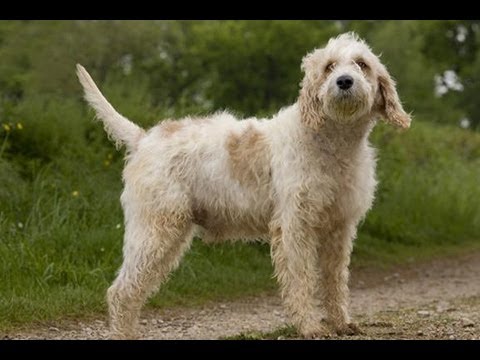
Blue Gascony Griffon

Originally bred for their tracking qualities, the Blue Gascony Griffon they are also affectionate companion dogs

Content

History

As its name implies, the roots of Blue Gascony Griffon are closely linked to the former French region of Gascony, which includes the lands between Bordeaux, Toulouse and Pyrenees. Some 14th-century writings recount the existence of a blue-haired hunting dog that was effective at tracking wild boar and deer., which is probably his ancestor.

Although we know with some accuracy where the race originated, it is more difficult to trace your family tree exactly before the decade of 1920.

But, it is believed to be a cross between the Great Gascony Blue, which in turn is the product of several crosses of old hounds (including the Bloodhound), and a french griffon: or the Griffon Nivernais or the Grand Griffon Vendรฉen. It is not possible to establish precisely which of the two is, because the available descriptions are too imprecise, but at least it is acquired that it is a French griffon.

In 1920, a special normalization commission of the club Great Gascony Blue, of the Small Blue Gascony and of the Blue Gascony Griffon first established a standard for the latter, what allowed the Livre des Origines Franรงais (LOF) officially differentiate him from his cousins. In fact, Until then it was considered a simple variety of the Great Gascony Blue. But, was not up 1963 which was officially recognized by the FCI (Fรฉdรฉration Cynologique Internationale).

This did not prevent the gradual decline of the breed, in particular due to its geographic isolation and confidentiality. In fact, was close to extinction, so that in 1977 only 10 individuals of 3 distinct lines were listed in the LOF. But, the situation improved considerably in the following years, since the number exceeded 100 in 1981.

At the beginning of the decade of 1990, the breed even saw a major revival in popularity with hunting enthusiasts, both in France and abroad (dog exports to Italy, Switzerland, Mauritius, Canada, Netherlands…), which led to an increase in the number of births. So that, the number of annual registrations LOF increased less than 80 prior to 1990 to more than 500 in 1994, and even more than 800 in 1996, before stabilizing between 700 and 800 in the following years.

This madness in France and abroad led to United Kennel Club, one of the leading organizations in the United States, to recognize the race in 1991. But, didn't actually make emulators: for example, neither him American Kennel Club (AKC), neither him Canadian Kennel Club (CKC), nor the prestigious British Kennel Club took the step.

Aware of the danger that this sudden interest could represent for the health of the few remaining specimens, with the risk, in particular, of health abuses caused by an intensive breeding program to meet a high demand, the Club of Small Blue Gascony, of the Gascon Saintongeois and Ariรฉgeois, in charge of the improvement of the race and affiliated with the Sociรฉtรฉ Centrale Canine (SCC), proposed to the Conservatory of Regional Biological Heritage the elaboration of a safeguarding and improvement plan. This approach (and the strict breeding practices that followed) contributed to the preservation of the good health of the breed, without hindering its development. So, in the first decade of the century, about 850 births were counted each year by the LOF. Since then, the figure has decreased slightly, but there is still an average of 600 to 700 by year.

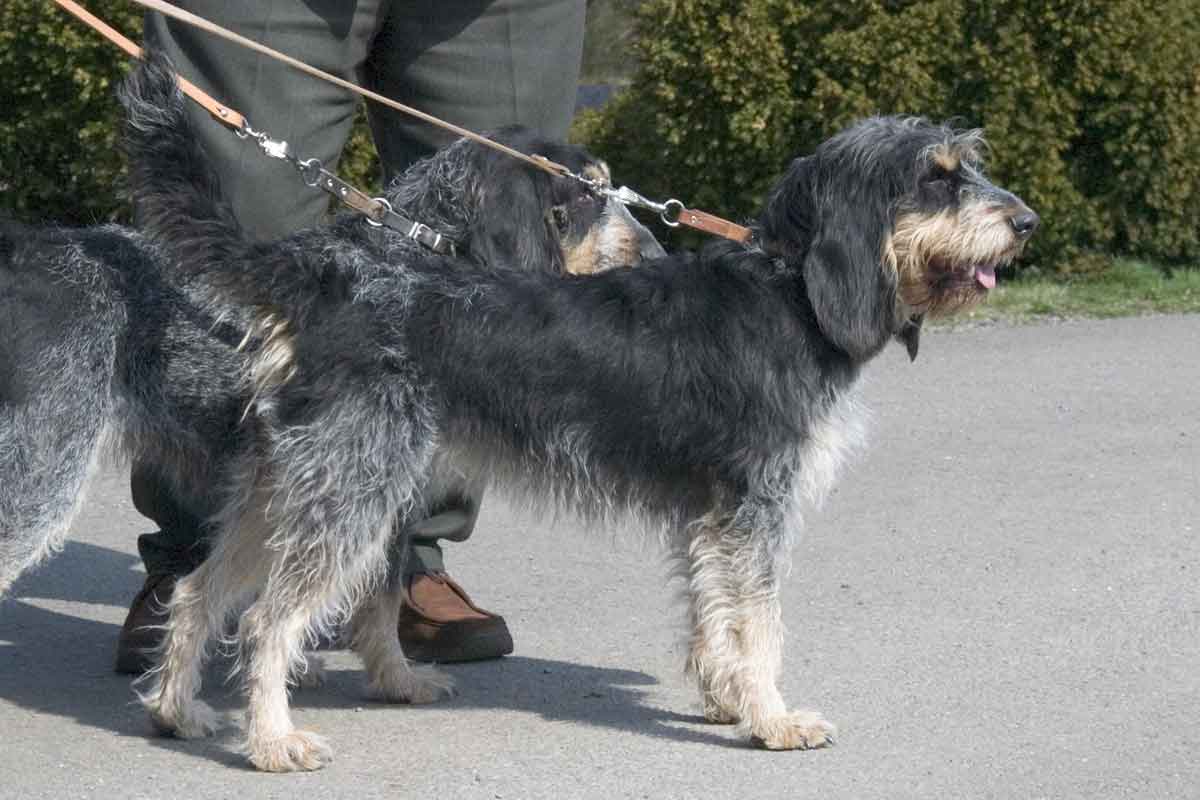
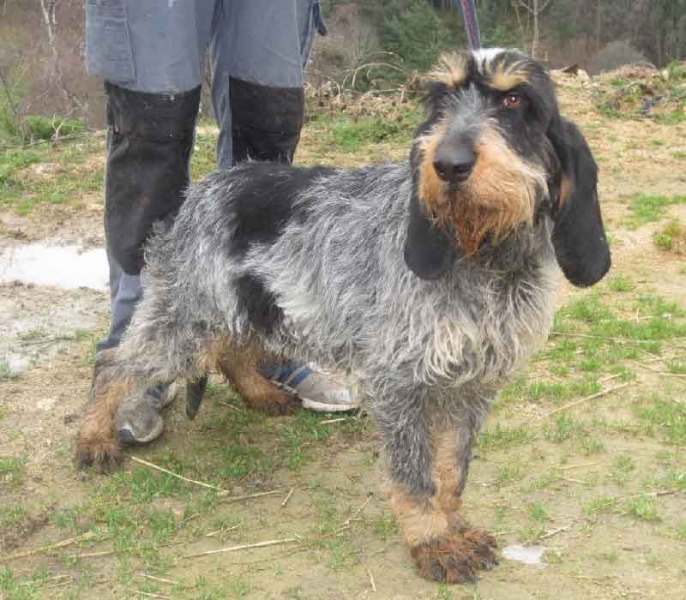
Photo: French Blue Gascony Griffon: Griffon Bleu de Gascogne by Alephalpha, CC BY-SA 3.0, via Wikimedia Commons

Physical characteristics ยซGrifรณn Blue Gascuรฑaยป

The Blue Gascony Griffon it is rustic and solidly built. Very athletic, has a well-developed chest and a short, straight back that extends into a rather shaggy tail carried like a saber blade.

The head is ogival shaped, slightly vaulted, with a full forehead and a snout with a slight stop, sometimes slightly arched. The nose is black and wide. The eyes are oval, and its color varies between dark brown and brown. It also, despite his wide eyebrows, his look is very expressive. Located just below the eye line, the ears are flexible, curly and not very pointed, and reach the tip of the nose.

The mark of this dog is its hard and rough coat, giving it a slightly shaggy look. The coat is completely black and white, giving it the slate blue glow that gave it its name. Your body may also have a few more or less extensive black spots. In the head, there are usually two black spots on each side of the skull, covering ears, wrapping the eyes and stopping at the cheeks. These spots are separated in the upper part of the skull by a white hole, in the middle of which there is usually a small oval black spot, typical of the breed. More or less bright brown marks also color the upper part of the eyebrow, cheeks, whisker pads, the inside of the ear, as well as the extremities and the lower part of the tail.

Last, sexual dimorphism is only slightly pronounced in this breed: the female is usually only a few centimeters smaller than the male.

Size:

  • Males of 50 to 57 cm.
  • females of 48 to 55 cm..
  • Weight: 18 to 20 kg

Character and skills "Gascuรฑa Azul Giffon"

Originally bred for their tracking qualities, the Blue Gascony Griffon They are also affectionate companion dogs that adapt well to family life., as long as the family is active. Loyal and very attached to their teachers, as shown through various displays of affection, accompany them in all their activities with great enthusiasm and energy, without the need for undue attention.

He is a dog that loves children, with whom he is very patient and gentle. Generally well returned, representing excellent playmates for him, also bursting with energy. It is much less suitable for the elderly, they will soon find it exhausting.

Used to living in a group, can be alone during the day, but it only prospers if it has company at all times. Adopting an extra dog can be a solution to help you cope with the absence of its owner.

People and animals who are strangers to the dog generally receive a reserved but not aggressive welcome. Take the time to observe them before deciding what attitude to adopt.

This relative distance does not make it a good guardian, especially because it is not very territorial. In fact, if he barks when he sees a newcomer, it is more to announce your presence than to prevent you from passing and dissuade you from moving on.

Coexistence with other dogs in the house is perfectly possible and usually does not pose any particular problem.. Even when you don't know them yet, the Blue Gascony Griffon he is very sociable with his companions, and is both curious and peaceful once introduced. They don't try to dominate other dogs, and they will only attack if they are repeatedly and aggressively confronted by them.

On the other hand, it is not a good idea to try to get him to live in a house that also has a cat or small pet (like a rodent or a bird). Being a hunter at heart, would tend to relentlessly chase him around the house, even if you receive a strict education on the subject.

True electric battery and always with the truffle glued to the ground, the Blue Gascony Griffon only really flourishes in large spaces and houses with gardens. Although he likes to gasp for hours at his family's feet, not a city dweller, and is very likely to attract the ire of the neighborhood with his inopportune howls. By the way, can live perfectly well in an outdoor dog house, as long as you have enough to stimulate your intelligence and abilities – especially through play sessions with his teacher.

He particularly likes to snoop, sniff out clues and follow them to their source without being distracted by anything. This trait is very popular with hunting dogs., but it is more problematic for companion dogs, as it can lead them to run away or stubbornly go in one direction while walking. A high fence should be provided at home, and a strong strap should be used to keep its paws – if you are not paying attention – To walk. A connected GPS collar can also be a good investment to make sure you know when he's out for a walk at all times.

In addition to hunting, this hardworking and hardy dog รขโ‚ฌโ€นรขโ‚ฌโ€นhas a taste for many other activities. Enjoy throwing games (to be played in moderation, as they reinforce their chasing instinct), object search games (that challenge your exceptional sense of smell), the long walks, the race, swimming or even canicross, in which it excels. Almost everything can be found thanks to your eyes, as long as it comes to exercising and / or pleasing your master.

In any case, if your significant need for exercise is not met, it is likely to attack objects and plants in the house to evacuate its excess energy, or even your stress.

Educaciรณn ยซGrifรณn Blue de Gascuรฑaยป

The kindness of the Blue Gascony Griffon and his loyalty make him an obedient and diligent student. But, do not forget that he is an intelligent dog, which means he learns the commands just as fast as the nonsense.

It also, it is important to socialize him from an early age to limit his shyness and natural distrust of people and dogs he does not know. This is especially true if you are intended for hunting, since then it is more likely that you will meet other dogs that you do not know.

Having said that, they are quite docile companions, easy to train and educate: an ideal breed of dog for a novice master. But, be aware that obedience is achieved more through cooperation than coercion. So, it is just as important to congratulate and/or reward him whenever a command has been well executed as it is to reprimand him in a firm voice when he does something stupid. By the way, being firm does not mean being aggressive: yelling or being aggressive will only make them run away, or it will even make them suspicious and stressed.

Hunting training can begin as soon as 6 months after learning the basic commands. Treasure hunting is recommended to help you develop your sense of smell and intelligence, while the presence of more experienced dogs can help you get used to the noise of guns and the company of strange dogs.

Health and care "Blue Gascuรฑa Giffon"

Sturdy and durable, the Blue Gascony Griffon it is made for outdoor living and can withstand both heat and cold.

The main health problems observed in this breed are related to outdoor life and, in particular, with hunting: fractures, wounds, bites, as well as diseases transmitted by parasites (piroplasmosis, leptospirosis, etc.).

You also have a predisposition to stomach inversion (stomach dilatation-torsion syndrome).

It also, the hanging shape of their ears carries an increased risk of ear infections.

Last, your voracity makes you prone to obesity, especially if your activity level is still limited. This can facilitate the appearance and aggravate the impact of various ailments and constitutes a true vicious circle., since an overweight dog tends to be less active and therefore… fatter.

Go through a serious breeder of Blue Gascony Griffon allows you to put all the possibilities on your part to adopt a puppy in good health (and that is still the case). The professional must be able to present a certificate issued by a veterinarian certifying that he is indeed healthy, as well as details of the vaccinations administered to the animal, recorded in your health book (or vaccination book).

It also, as with any dog, excessive activity should be avoided until you reach adulthood. In fact, the bones and joints of a growing puppy are particularly fragile, and problems at this level could have lifelong consequences (malformations, etc.).

Finally, but the Blue Gascony Griffon is generally in good health, this does not mean that you should not wear it regularly (At least once a year) to the vet for a complete health check, that allows you to detect any problems as soon as possible. It is also the occasion to carry out your vaccination reminders, that are especially important to a dog like him, who usually spends a lot of time outdoors. Your antiparasitic treatments are at least as important; your landlord should make sure to renew them whenever necessary.

The price of a "blue gas tap"

The price of a puppy Blue Gascony Griffon in France it is between 900 and 1400 EUR, depending on the prestige of the kennel, the lineage from which it comes and its intrinsic characteristics (more or less conformity to the breed standard, physical qualities, etc.).

Outside france, it is very difficult to find a breeder Blue Gascony Griffon. The most likely option is then to import one from its country of origin.. If required, transportation and administrative costs are added to the purchase price of the animal and, of course, it is advisable to know and respect the regulations regarding the importation of a dog from abroad.

Characteristics "Blue Gascony Griffon"

Coexistence is important that you have with your new friend. Before considering the acquisition of a dog of the breed "Blue Gascony Griffon" you know certain factors. Not all breeds of dogs are apt to live in an apartment, you must take into account his character, their need for exercise, their interaction with other pets, their care and if you have small children, their level of tolerance towards them.

Adaptation โ“˜

2,0 of 5 stars (based on 1 review)

friendly dog โ€‹โ€‹โ“˜

3,0 of 5 stars (based on 1 review)

hair loss โ“˜

3,0 of 5 stars (based on 1 review)

Affection level โ“˜

4,0 of 5 stars (based on 1 review)

Need for exercise โ“˜

5,0 of 5 stars (based on 1 review)

Social need โ“˜

3,0 of 5 stars (based on 1 review)

Home โ“˜

4,0 of 5 stars (based on 1 review)

Toilet โ“˜

3,0 of 5 stars (based on 1 review)

Friendly with strangers โ“˜

2,0 of 5 stars (based on 1 review)

barking โ“˜

4,0 of 5 stars (based on 1 review)

Health โ“˜

4,0 of 5 stars (based on 1 review)

Territorial โ“˜

4,0 of 5 stars (based on 1 review)

Cat friendly โ“˜

2,0 of 5 stars (based on 1 review)

Intelligence โ“˜

4,0 of 5 stars (based on 1 review)

Versatility โ“˜

3,0 of 5 stars (based on 1 review)

Child friendly โ“˜

3,0 of 5 stars (based on 1 review)

Surveillance โ“˜

4,0 of 5 stars (based on 1 review)

joy โ“˜

4,0 of 5 stars (based on 1 review)

Images "Blue Gascony Griffon"

Photos:

1 – A Blue Gascony Griffon female by Canarian, CC BY-SA 3.0, via Wikimedia Commons
2 – Blue griffin from Gascony by https://pxhere.com/es/photo/1331479
3 – Blue griffin from Gascony by https://pxhere.com/en/photo/1089317
4 – Blue griffin from Gascony by http://www.adopt-a-griffon.eu/en/breeds/griffon-bleu-de-gascogne/

Videos "Blue Gascony Griffon"

HTTPS://youtube.com/watch?v=AfvDdR1bX2s
Griffons bleus au Concours de meutes ร  Pranles
HTTPS://youtube.com/watch?v=YZWGz2C0DnY
Segugi Griffon Bleu de Gascogne – speciale cinofilia Game Fair 2015

Type and recognitions:

  • FCI CLASSIFICATION:
  • Group :
  • Section : . .

Federations:

  • FCI – Group 6: Scent hounds, and related breeds. – Section 1.2: Medium-sized Hounds. โ“˜
  • UKCScenthounds โ“˜
  • Central Canine Society โ“˜

FCI breed standard "Blue Gascony Griffon"

Origin:
France

Date of publication of the valid original standard:
24.01.1996

Use:

This is a multi-use dog. It is used for hunting with hare shotgun. His ardor and his good smell make him a very value assistant to follow the trail of the wild boar.


General appearance:

It is a rustic appearance tap, of solid constitution. Save the just medium between the two races from which it originates.


Behavior / temperament:

He has a good smell and his bark is sound. Is applied in hunting, that conducts con enthusiasm and initiative. It is unbelievable, But affectionate.

Head:

---

Cranial region:
  • Skull : Seen from the front, It is slightly bulging, but not too wide. The occipital protuberance is slightly marked.
    Seen from above, the back is ogival shaped. Forehead is bulging.
  • Depression links (Stop) : Little pointed.

facial region:

  • Truffle : It is black, wide. The Windows are wide open.
  • Lips : They are poorly developed, But they cover the lower jaw.
  • Snout : Straight nose cane, the lightly arched. Its length is almost equal to that of the skull.
  • Jaws / Teeth : The joint is in the form of scissors. The incisors are set at right angles to the jaws..
  • Cheeks : Thin.

Eyes : They have an oval shape. They are dark brown color; very expressive and living.

Ears : They are flexible, twisted, but not too much. They end on a slight tip and must reach the birth of the nose without exceeding their limb. Implanted just below the eye line.

Neck:

It is rather thin and presents some of the sock.

Body:

  • Back : Well pronounced, short.
  • Pork loin : Muscular and slightly arched.
  • Rump : Very slightly oblique.
  • Breast : Well developed. Rounded ribs, although not in excess.
  • Flanks : Bulky. The lower line is slightly raised backwards.

Tail:

It is quite hairy. It reaches precisely to the tip of the corvejรณn; The root is strong. It is brought happily in the form of saber.

Tips

PREVIOUS MEMBERS : Seen in conjunction, They are strong and well approved. They do not give an appearance of heaviness.

  • Shoulder : Quite oblique and muscular.
  • Elbows : Glued to the body.
  • forearms : Strong.

LATER MEMBERS : Seen in conjunction, the limbs are regular. The rear members are well developed.

  • Thighs : Well muscled.
  • Hock : Close to the ground.

FEET : They have oval shape and the fingers are thin and well together. The pads and nails are black.

Movement:

Is loose and alive.

Mantle

SKIN : It is quite thick and elastic. Black, or strongly streaked with black spots. It's never completely white. The mucous membranes are black.

HAIR : It's hard, harshly. It is a little shorter on the head, where the eyebrows, quite dense, They do not cover their eyes. It is much shorter and stuck on the ears.

COLOR : Completely speckled with black and white, imparting a slate blue reflection. It may or may not be marked with more or less extended black spots. Usually, there are two black spots on each side of the head, that cover the ears, circle the eyes and stop at the cheeks. These do not join over the top of the head, but they leave a white space in the center of which there is often a small oval black spot., typical of the breed. Above the eyes are two more or less uploaded fire marks located on the zygomatic arcades simulating four eyes. Traces of tan can also be found on the cheeks, the lips, the inside of the ears, the limbs and under the tail.


Size and weight:

Height to the cross :

  • In males it is 50 to 57 cm.,
  • in females it is 48 to 55 cm..


Fouls:

Any deviation from the above mentioned criteria is considered as missing and the gravity of this is considered in proportion to the degree of deviation to the standard and its consequences on the health and well-being of the dog.

Head :
โ€ข Head too short.
โ€ข Skull too wide.
โ€ข Pointed snout.
โ€ข Clear brown eyes.
โ€ข Apparent conjunctive.
โ€ข Too long ears, or very hairy.

Body :
โ€ข Largo; loose top line.
โ€ข Croup sagging.

Tail :
โ€ข Deviad or too short.

Tips :
โ€ข Hock closed, seen from behind.
โ€ข Crushed feet.

Behavior :
โ€ข Shy dog.

MISS PLAYOFFS

โ€ข Fearful or aggressive dog.
โ€ข Lack of characteristic type.
โ€ข It would be anatomic deformation.
โ€ข Notable lack that causes any impediment.
โ€ข Upper or lower prognathism.
โ€ข Light eyes.
โ€ข By the threaten the laugh.
โ€ข Any other color that is not established by the standard.

Any dog โ€‹โ€‹showing clear signs of physical or behavioral abnormalities should be disqualified..


N.B.:

Males should have two normal-appearing testicles fully descended into the scrotum..

Source: F.C.I - International Cynological Federation

Alternative names:

1. Griffon Bleu de Gascogne (English).
2. Griffon Bleu de Gascogne (French).
3. Griffon bleu de Gascogne (German).
4. Griffon bleu de Gascogne (Portuguese).
5. Griffon Bleu de Gascogne (espaรฑol).

โ–ท The world of Pets: Dogs, cats, birds, reptiles, amphibians

Briquet Griffon Vendรฉen
Francia FCI 19 - Medium-sized Hounds

Briquet Griffon Vendรฉen

Long lasting, fast and robust, the Briquet Griffon Vendรฉen he is a passionate hunter with extraordinary instincts.

Content

History

The selection of Briquet Griffon Vendรฉen dates back to before WWI, and was made by the Count of Elva.

It is a harmonious and enhanced reduction of Grand Griffon Vendรฉen. It is a distinguished dog and quite robust in its construction. Several times decimated during wars, the Briquet Griffon Vendรฉen reappears at Fontenay-le-Comte in 1946.

Today, there are many excellent quality individuals. In 1995, a group of Briquets they won the french roe deer cup, and numerous dogs work in the boar's footprint.

It is the only breed that retains the name of ยซBriquetยซ, which means "medium -sized dog".

Photo: This is a Briquet Griffon Vendรฉen. His name is Unno du Sentier D'Aimeron by Alephalpha, CC BY-SA 3.0, via Wikimedia Commons

Physical characteristics ยซBriquet Grifรณn Vendeanoยป

The Briquet Griffon Vendรฉen It is a medium-sized common griffon.. The head and body are collected. The head, quite light, shows parallel lines of skull and muzzle. The cranium, pretty short, is slightly domed with a well-marked stop. Eyes are dark brown. The flexible ones, narrow and thin ears are medium long and turned inward. The short tail is thick at birth and gradually tapers towards the tip. Carries like a saber blade.

The coat is well proportioned, hard and rough without ever being woolly. The most common coat is white and orange. Other coats are black and white, black and Brown, black and sand, tricolor, charcoal sand color with or without white.

SIZE:
Height to the cross: In males: of 50 to 55 cm., in females: of 48 to 53 cm..

Character and skills "Briquet Griffon sale"

Long lasting, fast and robust, the Briquet Griffon Vendรฉen he is a passionate hunter with extraordinary instincts. They are stubborn, enterprising and capable of taking initiative. So, the teacher must be obeyed.

Entrepreneurs and determined, they are also resistant and robust. But, he is not very patient and can be bitten.

It's a hound, used for hunting big game, the hare and the fox. Adapts to city life and makes a proper watchdog.

Characteristics "Briquet Griffon Vendรฉen"

Coexistence is important that you have with your new friend. Before considering the acquisition of a dog of the breed "Briquet Griffon Vendรฉen" you know certain factors. Not all breeds of dogs are apt to live in an apartment, you must take into account his character, their need for exercise, their interaction with other pets, their care and if you have small children, their level of tolerance towards them.

Adaptation โ“˜

2,0 of 5 stars (based on 1 review)

friendly dog โ€‹โ€‹โ“˜

3,0 of 5 stars (based on 1 review)

hair loss โ“˜

3,0 of 5 stars (based on 1 review)

Affection level โ“˜

4,0 of 5 stars (based on 1 review)

Need for exercise โ“˜

5,0 of 5 stars (based on 1 review)

Social need โ“˜

4,0 of 5 stars (based on 1 review)

Home โ“˜

3,0 of 5 stars (based on 1 review)

Toilet โ“˜

2,0 of 5 stars (based on 1 review)

Friendly with strangers โ“˜

4,0 of 5 stars (based on 1 review)

barking โ“˜

3,0 of 5 stars (based on 1 review)

Health โ“˜

2,0 of 5 stars (based on 1 review)

Territorial โ“˜

3,0 of 5 stars (based on 1 review)

Cat friendly โ“˜

3,0 of 5 stars (based on 1 review)

Intelligence โ“˜

4,0 of 5 stars (based on 1 review)

Versatility โ“˜

4,0 of 5 stars (based on 1 review)

Child friendly โ“˜

4,0 of 5 stars (based on 1 review)

Surveillance โ“˜

4,0 of 5 stars (based on 1 review)

joy โ“˜

4,0 of 5 stars (based on 1 review)

Images "Briquet Griffon Vendรฉen"

Photos:

1 – A Medium Griffon Vendรฉen. Colour: white by Canarian, CC BY-SA 4.0, via Wikimedia Commons
2 – Medium Vendรฉen Griffon, Griffon Vendรฉen lighter by Canarian, CC BY-SA 3.0, via Wikimedia Commons
3 – Briquet Grifรณn Vendeano by https://pin.it/1GsizhZ
4 – Briquet Grifรณn Vendeano by http://www.adopt-a-griffon.eu/en/breeds/briquet-griffon-vendeen-2/

Videos "Briquet Griffon Vendรฉen"

Lighter Griffon Vendรฉen ๐Ÿถ๐Ÿพ Everything Dog Breeds ๐Ÿพ๐Ÿถ
Briquet Griffon Vendรฉen ?? Everything Dog Breeds ??
Griffon Vendeen lighter / Briquet Vendรฉe Griffon
Briquet Griffon Vendeen

Type and recognitions:

  • FCI CLASSIFICATION:
  • Group :
  • Section : . .

Federations:

Federations:

  • FCI – Group 6: Scent hounds, and related breeds. – Section 1.2: Medium-sized Hounds. โ“˜
  • UKCScenthounds โ“˜
  • Central Canine Society โ“˜

FCI breed standard "Briquet Griffon Vendรฉen"

Origin:
France

Date of publication of the valid original standard:
09.01.1999

Use:

Hound used for hunting with shotgun, both of the big hunt, as of the hare and the fox.


General appearance:

It is a medium -sized tap, receptive and very determined. Your body is well proportioned and rather collected.


Behavior / temperament:

Behavior : It has a good smell, It is fast and his barking is nice. You don't mind moving in weed. It is very skilled in the rugged land and hunting with the nose to the wind.

Character : It has great initiative, It is resistant and robust. It must be able to lift the hunt and drive it near the hunter. He is a passionate hunter; Your master must make it obey.

Head:

---

Cranial region:

It is quite light; The upper lines of the skull and nasal cane must be parallel. : Slightly bulky, pretty short, not very wide.

  • Depression links (Stop) : Marked.

facial region:

  • Truffle : Grand, black, except for dogs with white and orange fur, in which the brown color is accepted. The nostrils are wide open.
  • Snout : Straight, rather short. Its length is almost equal to that of the skull. It is not very wide in its limb.
  • Lips : Poorly developed, Although they cover the lower jaw well. They are covered by large mustaches.
  • Jaws/Teeth : The joint is in the form of scissors. The incisors are set at right angles to the jaws..
  • Eyes : Large, dark, and vivacious expression. The eyebrows are well pronounced, but they don't cover the eye. The conjunctiva should not be apparent.
  • Ears : flexible, narrow and thin. They are covered with long hairs and their limb is pointed. They become well in and do not reach the limb of the nasal cane. Low-set, below the eye line.

Neck:

Is long and elegant lines. There is no presence of dewlap.

Body:

  • Back : Solid, short. It is straight or very slightly raised.
  • Pork loin : Straight, muscular and well accentuated.
  • Breast : It is quite high, not very wide. Reaches the elbow.
  • Ribs : Moderately rounded.
  • Flanks : Full. The lower line rises very slightly backwards.

Tail:

It is thick at the base and gradually tapers. High implementation, is taken in the form of saber, ever. Is rather short.

Tips

PREVIOUS MEMBERS

  • As a whole : Quite robust, but without the appearance of heaviness. They are well poised.
  • Shoulder : Long, thin and oblique.
  • Elbow : Descended and well attached to the body.
  • Forearm : Straight, for strong bones.

LATER MEMBERS

  • As a whole : well developed; the limbs are regular.
  • Thigh : Long and muscular.
  • Hock : Width and well descended. Seen from the back, It is never closed, Nor open. In profile, Your angle is medium.

FEET : They are not very big. Pads are hard; fingers are well arched and close together. The nails are solid. The appropriate pigmentation of the pads and nails is sought.

Movement:

Active, elastic, Never irregular, not even in jumps.

Mantle

SKIN : Is rather a bit thick, Although elastic; often veined in tricolor fur dogs. There is no presence of dewlap.

HAIR : It is long, Although not too much. Sometimes tangled, rough to touch; the inner layer of hairs is abundant. The belly and inner thighs should not be hairless.. The eyebrows are well pronounced, but they don't cover the eye.

COLOR : Black with white patches (black and white). Black with reddish markings (black and tan). Black with sand-colored markings. Fawn with white patches (Orange and white). Fawn with black blanket and white patches (tricolor). carbon fawn. Carbon sand color with white patches. Color arena carbonado. Traditional denominations : hare hair, wolf fur, Building hair, Woven hair.


Size and weight:

Height to the cross :

  • In males : of 50 to 55 cm..
  • In females : of 48 to 53 cm..

With a tolerance of 1 cm more or less.


Fouls:

Any deviation from the aforementioned criteria is considered a fault and the severity of it is considered to the extent of the deviation from the standard and its consequences on the health and well-being of the dog..

Head :

โ€ข Too big, similar to that of the great sale.
โ€ข Depigmentation of the truffle, lips and eyelids.
โ€ข Spine too long.
โ€ข Pincer-shaped joint.
โ€ข Light eyes.
โ€ข Very long ears, boring, With satin hair, of high implantation. body :
โ€ข Cylindrical the assault.
โ€ข Loose back.
โ€ข Sunken croup.

Tail :

โ€ข Too much wide the diverted.

Tips :

โ€ข Weak bones.
โ€ข Angles that are too straight.
โ€ข Crushed carpos.
โ€ข Not quite together fingers.

Fur :

โ€ข Scarce, fine.

Behavior :

โ€ข Shy dog.

MISS PLAYOFFS

โ€ข Fearful or aggressive dog.
โ€ข Lack of type.
โ€ข Prognathism.
โ€ข Gaze eyes. heterochromia.
โ€ข Narrow sternum region. Narrow ribs at the bottom.
โ€ข Knotted tail.
โ€ข Woolly fur.
โ€ข Solid black or white coat.
โ€ข Important depigmentation.
โ€ข Different size as stipulated by the standard.
โ€ข Visible disability. anatomical deformation.

Any dog โ€‹โ€‹showing clear signs of physical or behavioral abnormalities should be disqualified..


N.B.:

Males must have two normal appearance testicles completed in the scrotum.

Source: F.C.I - International Cynological Federation

Alternative names:

1. Medium Vendรฉen Griffon (English).
2. Briquet griffon vendรฉen (French).
3. Briquet griffon vendรฉen (German).
4. Briquet griffon vendรฉen (Portuguese).
5. Briquet griffon vendรฉen (espaรฑol).

โ–ท The world of Pets: Dogs, cats, birds, reptiles, amphibians

Bernese Hound
Suiza FCI 59 . Medium-sized Hounds

Bernese Hound

The Bernese Hound It is mainly used for hunting hare.

Content

History

The Swiss Hound has a very ancient origin. Its existence in Switzerland since the time of the Romans is verified thanks to a mosaic discovered in Avanches that represents hunting dogs whose characteristics coincide with the varieties of Swiss Hound. In the 15th century it was appreciated by Italian fans and in the 18th century by the French due to its extraordinary ability to hunt hare.. Its original local breeding was probably influenced by French small game dogs brought to Switzerland by mercenaries.. In the year 1882 a standard was established for each of the five existing varieties of Swiss Hound. In 1909 These standards were revised, confirming the total disappearance of the Thurgau Hound. The 22 in January of 1933 established a uniform standard for the 4 Swiss Hound varieties. The original variety of Jura Hound type St. Hubert has disappeared today.

There are four varieties of Swiss Hound:

Photo: Bernese Hound during dogs show in Katowice, Poland by Lilly M, CC BY-SA 2.5, via Wikimedia Commons

Physical characteristics

In the Bernese Hound the coat is white with black spots or saddle, sometimes slightly mottled. Light to dark beige marks the upper part of the eyes, cheeks, the inner side of the ears and around the anus.

▷ Male weight: 15 to 20 kg
▷ female weight: 15 to 20 kg
▷ The size of the male: 49 to 59 cm.
▷ female size: 49 to 59 cm.

Character and skills

The Bernese Hound he is alive and passionate. Its sensitivity is valued as positively as its ease of use and its attachment to the dog handler. When you follow a clue, expansive and fluid movements are noticeable, as well as the good thrust of the hindquarters. You can feel strength, stamina and temperament, so her fine nose is closely tied to the track.

Acute smell is atypical for Bernese Hound, whose passion for hunting is so tireless that the dog handler must prevent the dog from exaggerating beforehand. Otherwise, the dog chases the prey until he catches it himself. Diligent search is desirable, but the dog, except when used in the pack, must always remain in the hand of his guide.

While the Bernese Hound he was used in his homeland mainly as a lone deer hunter, foxes and hares; In western Switzerland, wild boar hunts are also carried out with hound dogs. In France and Italy they are more likely to continue to be used for herd hunting of hare, wild boar and deer.

In Switzerland, the Bernese Hound They are mainly used for patent and district hunting. In patent hunting, three to six hunters usually form a hunting party. They are distributed among the different posts and the dogs are tied simultaneously at a previously agreed time. This promotes the independent search of each dog and also the pursuit of hares or deer as a lone hunter.. For the hunt to be successful, the hunter must know which path the game will take to be able to shoot it with a shotgun at a maximum distance of 30 m.
During a hunt on hunting ground there are large groups of up to 30 hunters. The hunt leader distributes the hunters in different positions, while a hunter goes on the hunt with all the dogs, and finally hold all the dogs at once. Here the hunt leader must know how the game flees and, therefore, distribute hunters' positions. While hunting in the hunting ground, the hare, the deer and sometimes also the fox are shot from a maximum distance of 30 m.

Off the hunt, the Bernese Hound he is a nice and quiet family member. with whom you are closely linked.

Characteristics "Bernese Hound"

Coexistence is important that you have with your new friend. Before considering the acquisition of a dog of the breed "Bernese Hound" you know certain factors. Not all breeds of dogs are apt to live in an apartment, you must take into account his character, their need for exercise, their interaction with other pets, their care and if you have small children, their level of tolerance towards them.

Adaptation โ“˜

3,0 of 5 stars (based on 1 review)

friendly dog โ€‹โ€‹โ“˜

4,0 of 5 stars (based on 1 review)

hair loss โ“˜

3,0 of 5 stars (based on 1 review)

Affection level โ“˜

5,0 of 5 stars (based on 1 review)

Need for exercise โ“˜

5,0 of 5 stars (based on 1 review)

Social need โ“˜

4,0 of 5 stars (based on 1 review)

Home โ“˜

4,0 of 5 stars (based on 1 review)

Toilet โ“˜

2,0 of 5 stars (based on 1 review)

Friendly with strangers โ“˜

4,0 of 5 stars (based on 1 review)

barking โ“˜

4,0 of 5 stars (based on 1 review)

Health โ“˜

4,0 of 5 stars (based on 1 review)

Territorial โ“˜

4,0 of 5 stars (based on 1 review)

Cat friendly โ“˜

2,0 of 5 stars (based on 1 review)

Intelligence โ“˜

4,0 of 5 stars (based on 1 review)

Versatility โ“˜

3,0 of 5 stars (based on 1 review)

Child friendly โ“˜

4,0 of 5 stars (based on 1 review)

Surveillance โ“˜

4,0 of 5 stars (based on 1 review)

joy โ“˜

5,0 of 5 stars (based on 1 review)

Videos "Bernese Hound"

Bernese Hound (02 June 2012)
Berner Laufhund
Bernese Hound - Celer Cervarius and puppy ๐Ÿ™‚
Berner Laufhund

Type and recognitions:

  • FCI CLASSIFICATION:
  • Group :
  • Section : . .

Federations:

  • FCI – Group 6: Scent hounds, and related breeds. – Section 1.2: Medium-sized Hounds. โ“˜
  • UKCScenthounds โ“˜

FCI breed standard "Bernese Hound"

Origin:
Switzerland

Date of publication of the valid original standard:
28.11.2001

Use:

It is a small game hound that hunts hares, deer, foxes and sometimes wild boars. He is an independent hunter by hunting with a bark. Searches and corners its prey with great safety even in difficult terrain.


General appearance:

It is a dog with medium height at the withers. Your body structure indicates strength and tenacity. Its slim head with long snout and long ears give it an expression of nobility.

There are four varieties of Swiss Hound :

  • Bernese Hound
  • Jura Hound
  • Lucerne Hound
  • Schwyz Hound

IMPORTANT PROPORTIONS :

โ€ข Body length : Height at withers = approx. 1.15 : 1.
โ€ข Height of the withers : chest depth = approx. 2 : 1.
โ€ข Length of the nasal shank : skull length = approx. 1 : 1.


Behavior / temperament:

Lively and passionate about hunting. Sensitive, manageable and faithful.

Head:

---

Cranial region:
  • Skull : Long, narrow, delgado, noble. Bulging skull, visible occipital protrusion. The direction of the longitudinal axis of the skull and the muzzle shows a slight divergence. No frontal groove, no folds or wrinkles.
  • Depression links (Stop) : Not too developed.

facial region:

  • Truffle : Completely black, well developed; nostrils wide open.
  • Snout : Nobly developed, narrow ; it is not square or pointed ; the muzzle is straight or very slightly convex.
  • Lips : Moderately developed, the upper lips perfectly cover the lower jaw ; slightly open corner.
  • Jaws / Teeth : Powerful jaw. Powerful scissor bite, regular and complete, that is, the upper incisors overlap the lower ones without leaving space between them and the teeth are implanted vertically in the maxilla. Pincer bite allowed. The lack of one or two PM1 or PM2 is acceptable (premolars 1 or 2) . M3 are not taken into account (molars).
  • Cheeks : Loose, non-protruding supraciliary arches.

Eyes : They are more or less light or dark brown depending on the color of the coat ; they are medium in size and slightly oval. The edges of the eyelids are well pigmented. The eyelids are well adherent. The expression is sweet.

Ears : Placed below the eye line, in the posterior part of the cranial region and never implanted in its maximum width. Its length must reach at least the tip of the nose. The pinna is not prominent. The ears are thin. He wears them down, bent and twisted ; they are rounded at the bottom and have a fine, soft coat.

Neck:

Long, elegant, with good musculature ; throat skin is loose without forming a noticeable dewlap.

Body:

  • top line : The neck, the back, The rump and tail form a harmonious and noble line.
  • Cross : Bit strong, free and elegant neck insert.
  • Back : Firm and straight. : Muscular and slightly arched.
  • Rump : Elongated, extends the line of the back harmoniously and descends gently. It is not higher than the cross. The crest of the iliac bone is not too prominent.
  • Breast : Deeper than wide, well descended, reaches to the tips of the elbows. Elongated rib cage with slightly arched ribs.
  • Bottom line and belly : Belly slightly pulled back ; full flanks.

Tail:

Inserted in the extension of the croup. It is of medium length and tapers towards the tip ; at its end it has a slight incline up ; noble. In general, it remains hanging at rest and when walking calmly, without showing an important bend ; When he is attentive or in action he carries it along the line of his back , but never resting in it nor in a curled way. Is well covered with hair, but it doesn't have a spike shape.

Tips

PREVIOUS MEMBERS :

  • As a whole : They are well muscled, thin and not heavy in appearance. Seen from the front they are parallel and from the side they look vertical ; his bones are strong with his feet pointed forward.
  • Shoulder : Long oblique shoulder blades, closely linked to the rib cage. The ideal angulation of the scapulohumeral joint is approximately 100ยฐ.
  • Arm : A little longer than the shoulder blade, placed obliquely, closely attached to the chest. His musculature is fine.
  • Elbows : Naturally glued to the side.
  • Forearm : Straight, strong, delgado.
  • Carpo : Strong, wide metacarpus : Relatively short; Seen from the front it is located on the perpendicular line of the forearm; seen from the side it is slightly inclined.
  • Front feet : Rounded, with compact fingers ; hard and rough pads ; strong nails whose color depends on the color of the coat.

LATER MEMBERS :

  • As a whole : They have strong muscles and are in a balanced relationship with the forelimbs ; seen from behind the hind legs are vertical and parallel.
  • Thigh : Long and oblique, powerful although his muscles are thin. The angulation of the coxofemoral joint is approximately 100ยฐ.
  • Knee : No inward or outward deviations. Angulation of the femoral-tibian joint approximately 120ยฐ.
  • Leg : Relatively long, thin, visible muscles and tendons under the skin.
  • Hock : Tibiotarsal joint angulation approximately 130ยฐ.
  • Metatarsus : Pretty short, placed vertically and parallel. Without spurs, except in countries, in which amputation is not allowed by law.
  • Rear feet : Rounded, with compact fingers, hard and rough pads ; strong nails whose color depends on the color of the coat.

Movement:

It is unfolded, regular, harmonious and with good scope. Has good impulse from the hindlimbs. Drive the limbs parallel and straight. The cross moves smoothly and regularly up and down, the back remains straight and the head and neck wobble slightly from side to side.

Mantle

SKIN : Fina, flexible, well adherent, whose color varies in each of the four varieties.

โ€ข Bernese Hound : Skin is black under black hair and blackish-white marbling under white hair.
โ€ข Jura Hound : She is black under black hair and lighter under tan hair..
โ€ข Lucerne Hound : She is black under black hair and lighter under blue-flecked hair..
โ€ข Schwyz Hound : It is dark gray under the orange hair and blackish-white marbling under the white hair..

HAIR : Is short, smooth, thick, very fine on the head and ears.

COLOR :

โ€ข Bernese Hound : White with black spots or a black saddle-shaped spot. Tan color from pale to intense over the eyes, cheeks, on the inside of the ears and around the anus. Sometimes very lightly splattered (black splash).

โ€ข Jura Hound : Tan with black cape, sometimes nuanced black or black with tan over the eyes, cheeks, around the anus and on the extremities ; sometimes with a small white spot on the chest ; this stain may be splattered (black or gray splashes).

โ€ข Lucerne Hound : Called blue, with a mixture of black and white hairs, intensely splashed, with black spots or a saddle-shaped spot ; tan color from pale to intense over the eyes, cheeks, on the chest, around the anus and on the extremities ; a black cape is allowed.

โ€ข Schwyz Hound : White with orange or orange "saddle" spots, sometimes with orange splashes ; an orange coat is allowed.


Size and weight:

Height to the cross :

  • Males : 49-59 cm..
  • females : 47-57 cm No tolerance.


Fouls:

Any deviation from the aforementioned criteria is considered as a fault and the severity of this is considered to the degree of the deviation to the standard and its consequences on the health and well-being of the dog..

โ€ข Rough appearance, vulgar, weak body structure.
โ€ข Discordant proportions between body length, the height of the withers and the height of the chest.
โ€ข Skull too wide, too convex or too flat.
โ€ข Stop too marked.
โ€ข Very short or very long snout, too square or pointed.
โ€ข Concave nasal bridge.
โ€ข Lack of more than two premolars PM1 or PM2. Los M3 (molars 3) are not taken into account.
โ€ข Thick lips.
โ€ข Light eyes, acute expression, non-adherent eyelids.
โ€ข Ears that are too short or flattened, thick or set very high.
โ€ข Very short neck.
โ€ข Double chin too marked.
โ€ข Saddled or arched back (carp back).
โ€ข Croup too inclined or too short.
โ€ข Rib cage not deep enough, too flat or barrel-shaped.
โ€ข Retracted belly, fallen flanks.
โ€ข Tail with poor insertion, carried too high, very bent, stooped, very coarse or spike-shaped tail.
โ€ข Extremities with bones that are too thin or in a bad position.
โ€ข Very sloping shoulders, arm too short.
โ€ข Weak carpal joints.
โ€ข Insufficient angulations of the hind limbs ; cow or barrel shaped limbs.
โ€ข Dewclaws on the hind limbs, except in countries in which amputation is not permitted by law.
โ€ข Rough coat, not smooth.
โ€ข Flaws in color and markings.

  1. Bernese Hound : Too many black splashes on the white. Tan or white on the outside of the ears.
  2. Jura Hound : Uniform color. Noticeable white patch or heavily speckled patch on the chest.
  3. Lucerne Hound : Lack of ยซ blue ยป splash. Tan on the outside of the ears.
  4. Schwyz Hound : Too many orange splashes on the white. Uniform color. White on the outside of the ears.

โ€ข Slightly fearful or aggressive behavior.

MISS PLAYOFFS

โ€ข Excessively fearful or aggressive dog.
โ€ข Atypical general appearance of the breed.
โ€ข Completely depigmented nose.
โ€ข Upper or lower prognathism, incisor arcade deviated.
โ€ข Ectropion, entropion (even if it had been operated).
โ€ข Horn tail, threaded, knotty the hook.
โ€ข Size above or below tolerance.

Any dog โ€‹โ€‹showing clear signs of physical or behavioral abnormalities must be disqualified..


N.B.:

Males should have two normal-appearing testicles fully descended into the scrotum..

Source: F.C.I - International Cynological Federation

Varieties of ยซSwiss Houndsยป

The four varieties of Swiss Hounds have their own specific hunting characteristics.:

– The Bernese Hound, with her beautiful throat ("the howler of the Jura"), demanding, mainly used for hares;
– He "Jura Houndยซ, an excellent recuperator
– The Lucerne Hound, reminiscent of Small Blue Gascony, he is an active and passionate dog that hunts deer very well;
– The "Hound of Schwyz", less widespread outside of Switzerland, is reserved for rabbits and hares.

โ–ท The world of Pets: Dogs, cats, birds, reptiles, amphibians

Brazilian Tracker
Brasil FCI 275 . Large-sized Hounds

Rastreador Brasileรฑo

The Brazilian Tracker was a quiet and balanced dog, attached to his master.

Content

History

The Brazilian Tracker It was a breed of dog originating in Brazil, that was recognized by the FCI the 1 in September of 1967 in the Group 6 / Section 1.1 – Large size hounds with number 275. In fact, It was the first Brazilian to be recognized by the FCI breed of dog.

The Brazilian Tracker it's a Scent hound. The breed is also known under the names Urrador (his voice) or Urrador American.

It was developed in the Decade of 1950 by Oswaldo Aranha Filho (In janeiro river), to hunt peccaries (they are pigs of medium-sized and wild that found in all Central and South America), Jaguars, and other types of dams typical of the country.

Aranha Filho combined a number of breeds of hunting from America and Europe along with some native dogs of Brazil to create your dog. The Brazilian Tracker became Brazil's first race and it was what earned it the recognition of international dog associations.

The glory of being a breed officially recognized at the international level lasted barely six years, time in which by neglect and a series of relief, the race was decimated.

At that time there was only one breeder of Brazilian Tracker, Mr Oswaldo Aranha Filho, the creator of the race... And, their copies suffered because of two events, first of all an outbreak of babesiosis.

Babesiosis (or babesiosis) It is a parasitic disease similar to malaria caused by protozoa of the genus Babesia and usually affect pets, especially to dogs. Its name was established in honor of the Romanian biologist Victor BabeลŸ, He was the first to isolate the pathogen. It is the typical disease that is transmitted through a vector organism, usually the tick (Ixodes dammini); in fact, This mite is the same that transmit Lyme disease and, often, both are associated with.

Y, in the second place, many of the dogs suffered poisoning from excess pesticide used by an employee of the farm.

It was exactly in the year 1973, when the Fรฉdรฉration Cynologique Internationale declared the dog breed Brazilian Tracker, officially extinct. Which led to him losing his classification number since, prompted the cancellation of the registration.

Since the FCI and the Brazilian Confederation of Cynophilia They declared this extinct breed, have carried out various efforts and programs of to retrieve it.

Physical characteristics

The standard of the breed of 1970 declaring a size between 62 and 67 cm and very similar in appearance to the Black and tan coonhound.

There have been attempts underway to recreate the race from a mixture of American Foxhound, Black and tan coonhound, and the Small Blue Gascony, English Foxhound, and Bluetick Coonhound.

The Rescue Support Group Brazilian Tracker of Brazil, a club dedicated to the restoration of the breed, Brazil, He devoted himself to organize - aim- a list of forty breeding animals of the correct type as, puediesen be certified as members of the race, in order to restore the race and return to be recognised by the Kennel Club of Brazil.

The re-establishment of the breed, It has not been an easy task, due to the existence of very few pure specimens, and above all by the lack of social interest, There are very few people interested in the recovery of the true Brazilian cultural heritage and the genetics of the breed.

Character and skills

At the moment, the character is not easy to illustrate or define. Efforts to restore the breed continue today., and are being used in breeding programs, breeds used in his development with the descendants of mixed races found in all Brazil.

But, the race again in the various canine clubs list (small) and dog organizations in North America, for the promotion of a rare species for those seeking an unusual pet.

As it's a race in the process of being rebuilt, no data on specific diseases or extraordinary health demands.

The Brazilian Tracker is a hunting dog, not a type of dog that has traditionally been used as a pet.

The copies that exist today, fruit of the reconstruction, they tend to be very independent animals and, sometimes, somewhat stubborn, with a strong instinct of prey that, leads him to chase the small animals that live in the house... But with proper socialization, any dog is a good dog.

Type and recognitions:

  • FCI CLASSIFICATION:
  • Group :
  • Section : . .

Federations:

  • FCI โ“˜

  • FCI breed standard "Brazilian Tracker"

    Origin:
    Brazil

    Date of publication of the valid original standard:
    04.09.2019

    Use:

    Hunting dog used for picking up and rounding up prey animals.


    General appearance:

    Strong and rustic. Cheerful and never aggressive. It has an excellent sense of smell and the capacity for hunting above the average of hunting dogs. It is very resistant and persistent, and you can hunt in hostile terrain and high temperatures. Docile and loyal.

    IMPORTANT PROPORTIONS: The body has a length of 10:9 in relation to your height. The skull relationship - snout is from 1:1.


    Behavior / temperament:

    Calm and balanced, companion glued to his owner, self-confident, without fear, docile, without being shy or aggressive. Due to his work he must have a calm demeanor as he hunts as a couple, trios or pack, or even sometimes just as a trail dog.

    Head:

    Mesocephalus, triangular and a bit long.

    Cranial region:
    • Head: Triangular shape, skull and muzzle of similar length.
    • Depression links (Stop): moderate.

    facial region:

    • Truffle: Slightly directed downward, completely black in color.
    • Snout: Straight and long.
    • Lips: Fine, dry and sticky, well pigmented black. Jaws / Teeth: Strong jaws, scissor bite with
      complete denture (42 teeth).
    • Cheeks: Droughts.

    EYES: Almond biscuits, dark, with lively expression, well-pigmented black eyelids. Large eyes set wide apart, with typical bloodhound expression. Soft look, gentle and nice.

    EARS: long, low-set, flexible and round tips. The long, when you stretch without force, reaches the tip of the muzzle without exceeding it. Low erectile capacity, hang close to the head.

    Neck:

    Strong. Rises freely and lightly over the shoulders, strong in substance, but not heavy, medium long, clean throat, allowing a slight wrinkle under the angle of the jaw (with little double chin).

    Body:

    • top line: Well defined, going down with a gentle curve down the neck passing through the cross, strong and tall, continuing in the direction of the rump, which is slightly oblique and slightly lower than the height of the withers.
    • Cross: Strong, taller than the rump.
    • Back: Strong, firm, slightly long, muscular and straight. Pork loin: Wide and strong.
    • Rump: Slightly oblique, inclined 30ยฐ with respect to the horizontal. Breast : Good size and depth, reaching to the elbows, with a broad and well-developed thorax.
    • Bottom line and belly: Slightly retracted.

    Tail:

    Saber-shaped, without lateral deviation, inserted in the continuity of the croup, carried low at rest and above the top line when alert or moving. Long arriving or passing the garrรณn. The hair on the tail has the same texture as that on the body, stuck and short.

    Tips

    PREVIOUS MEMBERS:

    • General appearance: Shoulders with strong parallel bones, muscular, with wide limbs.
    • Shoulder (Scapula): Robust, with a good inclination of about 45ยฐ with respect to the horizontal line and the scapulo-humeral joint with an angle of about 105ยฐ).
    • Arms (Humeri): Strong and muscular, the same length as the scapulae.
    • Elbows: Close to the body and firm. forearms: Strong bone structure.
    • Carpi (dolls): Straight, parallel and strong. Metacarpus: Straight, parallel and strong.
    • Previous feet: Wide and powerful, with very resistant and elastic pads; dark pads and nails.

    LATER MEMBERS:

    • General appearance: Muscular and well angled, with firm hocks, with symmetrical and moderate angulations, wide feet.
    • Thighs (Femur): Strong and muscular.
    • Knees: Strong and moderate curvature.
    • Legs (Tibia): Moderate angulation with the femur. Hocks: Strong, short and firm, with moderate angulation.
    • Tarsos: Firms.
    • Metatarsals: Straight, parallel to each other.
    • Hind feet: Wide and powerful, with very resistant and elastic pads; dark pads and nails.

    Movement:

    It must be fluent, agile and firm, with good ground cover, with wide and balanced steps. At a trot, the tail can be above the top line. Very important for the dog's work is that the top line is kept level and firm..

    Mantle

    SKIN: Dark and tight to the body.

    Fur: Short, smooth, well glued to the body, dense and a little hard to the touch.

    Color: Completely speckled with black and white, imparting a slate blue reflection, with or without fawn and / or black spots on any part of the body; bicolor (white with leonate or black spots; or black and tawny, completely black with leonado color marks); tricolor (black and white with tawny spots); all colors with or without tawny spots on the head, on the chest, belly, in the fore and hind limbs and tail.


    Size and weight:

    Height to the cross:

    • Male: 60 to 65 cm.;
    • Female: 56 to 63 cm..

    Tolerance: approx.. 1 cm.

    Weight:

    • Males: 26 to 33 kg.
    • females: 21 to 30 kg.

    The size and weight must be in harmony with the structure of the specimen.


    Fouls:

    Any deviation from the aforementioned criteria is considered as a fault and the severity of this is considered to the degree of the deviation to the standard and its consequences on the health and well-being of the dog..

    • Ears in pink.
    • Flat ribs.

    SERIOUS FAULTS:

    • Deviation from the characteristics of the breed described above that hinder its ability to work.
    • Weak appearance.
    • Very clear tawny marking in black and tawny dogs.
    • Any deviation from the scissor bite and correct tooth formation, insofar as they are not disqualifying fouls.

    FALTAS DESCALIFICANTES:

    • Aggressiveness or extreme shyness.
    • Any dog โ€‹โ€‹showing clear signs of physical or behavioral abnormalities.
    • Short or Butterfly shaped ears.
    • Threaded queue.
    • Very lightweight bones.
    • Depression links (stop) marked.
    • Upper or lower prognathism.


    N.B.:
    • Males should have two normal-appearing testicles fully descended into the scrotum..
    • Only functionally and clinically healthy dogs, with the typical conformation of the breed, should be used for parenting.

    Source: F.C.I - International Cynological Federation

    Alternative names:

    1. Rastreador Brasileiro (English).
    2. Rastreador Brasileiro (French).
    3. Brasilianischer Spรผrhund, Amerikanischer Heuler (German).
    4. Urrador, Onceiro, Pantaneiro, Rastejador-brasileiro (Portuguese).
    5. Urrador, Urrador Americano (espaรฑol).

    โ–ท The world of Pets: Dogs, cats, birds, reptiles, amphibians

    Bavarian Mountain Hound
    Germany FCI 217 . Leash (scent) Hounds
    Bavarian Mountain Hound

    The Bavarian Mountain Hound is very suspicious of strangers, I am calm and balanced with its owner.

    Content

    History

    The Bavarian Mountain Hound it is a medium sized hunting dog. He is a highly developed specialist, but at the same time versatile in hunting. Tracking work is his specialty. Master the search and hunt and especially the tracking. On the trail, keep track of an injured animal. Fast and infallible dog work is crucial to reduce the suffering of the prey.

    The Bavarian Mountain Hound dates back to ancient dog breeds. These hounds are also called ยซBrackenยป. For hunting, which was an important way of life for our ancestors for thousands of years, dogs with a particularly good sense of smell and an intelligent sense of detection were of great importance. Trace Dogs were also needed to hunt criminals.

    For the Teutons a good Scent hound worth more than a horse. This is attested by a legal text of more than 1000 years of antiguaty, el Lex Baiuwariorum. A document of the year 1459 later attests to Bracken's donation to the Tegrinsee monastery (today Tegernsee) by a Count Kaspar Tรถrring. Already at that time the count systematically raised the Bracken according to a breeding book. The actual Bavarian Mountain Hound also descends from these Bracken.

    In 1870 he also grew up Hanoverian Scenthound. This resulted in a modern and versatile helper for the ranger and hunter.. The dogs had to be distinguished by their high performance in hunting. At the same time, they had to cope with the harsh conditions of the mountains. So, sharp stones were not allowed to bother them as much as storms, snow or high demands on your ability to climb. In 1883 took place the first official exhibition of the Bavarian Mountain Hound. In 1912 was founded the Klub fรผr Bayerische GebirgsschweiรŸhunde, who has since been very successful in caring for these dogs.

    After World War II, the genetic bottleneck was worked on by crossing into the Tyrolean hound. Although the breed is very rare, is spread throughout Germany. His breeding is organized in a very responsible way. To avoid โ€œelite or champion breedingโ€ the number of offspring of a breeding animal is limited to 18 to 20. On the other hand, at least one animal from each litter raised must be reintroduced into the breed if there are no signs of inherited diseases. It also, breeding is only allowed with dogs that have passed performance tests anyway. The breeding of Bavarian Mountain Hound is a model, a project, how to breed healthy and strong pedigree dogs, even with a numerically very small population. They are raised between 10 and 12 litters with 60 to 80 puppies per year. These go almost only to the professional hands of professional rangers and hunters.

    Photo: Bavarian Mountain Hound (name: Zoran Spod Ruskiej Granicy) by Ralf Lotys (Surely), CC BY 2.5, via Wikimedia Commons

    Physical characteristics

    The Bavarian Mountain Hound It is a strong dog, medium-sized, with a height at the withers of about 44 to 52 cm and a weight of 17 to 30 kg. Males, However, they are larger and heavier than females. For your size, has rather short legs. The standard describes its appearance in this way:

    A medium sized dog, harmonious, light, very agile and muscular. The body is slightly longer than tall, slightly raised from behind; leans on legs not too high. The head is carried horizontally or somewhat erect, tail horizontal or slanted down.

    The coat must be dense, smooth, moderately rough, low gloss. The standard requires the following colors:

    Dark red, deer red, Red brown, yellowish red, also pale yellow (even sand color); reddish gray like the winter hair of the red deer, also brindle or dark flecked.
    In the back, the basic color is generally more intense. Muzzle and ears dark.
    The tail is almost always dotted dark. A small, clear spot is allowed on the chest (hound star).

    The meaning is: The colors must camouflage the dog in its hunting work and not give it away, for example with large white marks.

    Character and skills

    The Bavarian Mountain Hound is a thoroughbred hunting dog with wide awake senses, but without nervousness. As long as you don't have a smell in your nose, impresses with a thoughtful nature, quiet and extremely gentle, that radiates pure slowdown for us humans. The official standard describes its nature as follows: ยซCalm and balanced; affectionate with his owner, reserved with strangers. What is required is a stable dog, self-confident, fearless and easy to handle, neither shy nor aggressive".

    The Bavarian Mountain Hound it is a very capable working dog that performs its tasks conscientiously and with the utmost dedication. He has a strong homing instinct and is a master of tracking.. Exploring nature with him is, therefore, a very special experience and happiness. The Bavarian Mountain Hound, professionally managed, it is also a very good family dog รขโ‚ฌโ€นรขโ‚ฌโ€นwith a gentle nature.

    Fitness

    One Bavarian Mountain Hound It is not a companion dog for the city or for walks in nature, even if they are daily. Not a dog for the home, but a professional hunting dog who wants and needs the job. Otherwise, his attitude is completely undemanding. So, Ideally, you should live in a house on the edge of the woods or in the country with a garden..

    The Bavarian Mountain Hound wants and can go out in all climates. The standard provides information on the conditions of its maintenance:

    ยซIn accordance with its hunting purpose as a specialist in monitoring cloven-hoofed hunting, the Bavarian Mountain Hound must possess all the qualities required of him to be useful in a difficult pursuit. The usefulness must be proven by appropriate performance tests.".

    Education ยซBavarian mountain trackerยป

    The Bavarian Mountain Hound is a very friendly and eager to learn four legged friend, that makes it easier for its owner to train and work with him. Why you want and need this guide. But it is not a dog that awaits orders from its owner. Since dogs have been admitted to breeding for many generations only if they have mastered many demanding performance tests, your level of training is extremely high. This is at the same time an obligation for the leadership of this dog. Because you need the hunting job, where it feels good. His element is search work. Here he has brought it to a stranglehold, you also need to live. But, you should take this into account if you are playing with the idea of รขโ‚ฌโ€นรขโ‚ฌโ€นsharing your life with a Bavarian Mountain Hound as not a hunter.

    Care and health

    The breed is very easy to care for. Brushing once in a while is enough.

    Typical diseases of the breed:

    Hereditary diseases are not known.

    Nutrition / Food

    The Bavarian Mountain Hound is undemanding in his diet.

    Life expectancy

    The Bavarian Mountain Hound has a life expectancy of about 12 years.

    Buy a โ€œBavarian Mountain Trackerโ€

    If you are looking for a dog of this breed, you should contact a breeder affiliated with the Club Bรกvaro del Bavarian Mountain Hound well in advance of your planned purchase. As a rule, dogs are only handled by rangers or hunters. From time to time, However, it may happen that a dog is looking for another place. But then you should be able and willing to give it living conditions that can be a substitute for its species-appropriate way of life.. A puppy of this breed costs about 1500 EUR.

    Characteristics "Bavarian Mountain Hound"

    Coexistence is important that you have with your new friend. Before considering the acquisition of a dog of the breed "Bavarian Mountain Hound" you know certain factors. Not all breeds of dogs are apt to live in an apartment, you must take into account his character, their need for exercise, their interaction with other pets, their care and if you have small children, their level of tolerance towards them.

    Adaptation โ“˜

    3,0 of 5 stars (based on 1 review)

    friendly dog โ€‹โ€‹โ“˜

    4,0 of 5 stars (based on 1 review)

    hair loss โ“˜

    3,0 of 5 stars (based on 1 review)

    Affection level โ“˜

    4,0 of 5 stars (based on 1 review)

    Need for exercise โ“˜

    4,0 of 5 stars (based on 1 review)

    Social need โ“˜

    3,0 of 5 stars (based on 1 review)

    Home โ“˜

    2,0 of 5 stars (based on 1 review)

    Toilet โ“˜

    2,0 of 5 stars (based on 1 review)

    Friendly with strangers โ“˜

    2,0 of 5 stars (based on 1 review)

    barking โ“˜

    4,0 of 5 stars (based on 1 review)

    Health โ“˜

    3,0 of 5 stars (based on 1 review)

    Territorial โ“˜

    4,0 of 5 stars (based on 1 review)

    Cat friendly โ“˜

    2,0 of 5 stars (based on 1 review)

    Intelligence โ“˜

    4,0 of 5 stars (based on 1 review)

    Versatility โ“˜

    4,0 of 5 stars (based on 1 review)

    Child friendly โ“˜

    4,0 of 5 stars (based on 1 review)

    Surveillance โ“˜

    4,0 of 5 stars (based on 1 review)

    joy โ“˜

    4,0 of 5 stars (based on 1 review)

    Images "Bavarian Mountain Hound"

    Photos:

    1 – Bavarian Mountain Hound, female and male by Canarian, CC BY-SA 3.0, via Wikimedia Commons
    2 – ยซBavarian mountain trackerยป by Wikimedia
    3 – A Bavarian Mountain Scenthound by Canarian, CC BY-SA 4.0, via Wikimedia Commons
    4 – Bavarian Mountain Hound during show of dogs in Rybnik – Kamieล„, Poland by Pleple2000, CC BY-SA 4.0, via Wikimedia Commons
    5 – Kafka und Frodo beim ersten Outdoor Treffen und Grillen bei Audigast. Februar 2014. Kafka ist ein Magyar Vizsla und Frodo ein Bayerischer GebirgsschweiรŸhund by Andreas Krรผger
    6 – Bavarian Mountain Hound by Pleple2000, CC BY-SA 3.0, via Wikimedia Commons

    Videos "Bavarian Mountain Hound"

    Type and recognitions:

    • FCI CLASSIFICATION:
    • Group :
    • Section : . .

    Federations:

    • FCI – Group 6: Scent hounds, and related breeds. – Section 2: Leash (scent) Hounds. โ“˜
    • AKCGrupo FSS โ“˜
    • โ€‹KCCazadores โ“˜
    • UKCScenthounds โ“˜

    FCI breed standard "Bavarian Mountain Hound"

    Origin:
    Germany

    Date of publication of the valid original standard:
    01.04.1996

    Use:

    Trail dog.


    General appearance:

    It is a generally harmonious dog, lighter, very active and muscular, medium-sized. The body is a bit elongated and raised in its posterior region ; stands on very long limbs. The head is horizontal or slightly erect ; has the tail carried horizontally or slightly tilted downwards.


    Behavior / temperament:

    It is quiet and balanced ; attached to its owner and distrustful of strangers. The dog is required to be firm, self-confident, fearless and docile, without being shy or aggressive.

    Head:

    ---

    Cranial region:

    Relatively wide, little rounded, with a well marked forehead, well-developed superciliary arches and shallow occipital protuberance.

    • Depression links (Stop) : Marked.

    facial region:

    • Truffle : Good size, not too wide, well open nostrils, black or deep red.
    • Snout : A little parted in front of the eyes, slightly shorter than the skull, wide enough, it is not pointed. The bridge of the nose is slightly arched or straight.
    • Lips : Upper lip falling well over the lower one, moderately thick. The corners of the lips are well visible.
    • Jaws / Teeth : Powerful jaws with a perfect scissor bite, regular and complete, in which the upper incisors overlap the lower incisors without leaving space ; teeth are implanted vertically in the maxilla. Should have 42 healthy teeth according to the dental formula. Pincer bite allowed.
    • Cheeks : Stand out moderately.

    Eyes : Clean, with an attentive expression. Not too big or round. Dark brown or lighter. Well attached and pigmented eyelids.

    Ears : Something more than moderately long, must reach a maximum up to the truffle ; heavy, high and wide insertion, rounded in its bottom edge, hang down close to the cheeks but not bent.

    Neck:

    Moderately strong. Throat skin is a little loose.

    Body:

    • top line : Rise a little from the withers to the rump.
    • Cross : Bit strong. Smooth transition from neck to back.
    • Back : Strong and elastic.
    • Pork loin : Proportionally short, broad, with good musculature.
    • Rump : Long and fairly flat.
    • Breast : Moderately wide, with well developed parapet; oval rib cage, deep and long, with ribs carried well back.
    • Bottom line and belly : Gradually ascends toward the back of the body; slightly retracted belly.

    Tail:

    Of medium length that reaches a maximum to the tibio-tarsal joint ; high insertion, carries it horizontally or slightly inclined downwards.

    Tips

    PREVIOUS MEMBERS

    • As a whole : Viewed from the front they are straight and parallel, and seen from the side they are well poised under the body. They have good angulations.
    • Shoulder : Strongly muscular. Scapulae oblique and directed backwards.
    • Arm : Long, with strong and thin muscles.
    • Elbows : Glued to the body, no outward or inward deflection.
    • Forearm : Vertical and slim. With strong bones and very good musculature.
    • Articulation of the carpus : Strong.
    • Metacarpus : A little forward directed.

    LATER MEMBERS :

    • As a whole : Strong bones. Viewed from behind they are straight and parallel. Good angulations.
    • Thigh : Wide and very muscular.
    • Knee : Strong leg : Relatively long, muscular and tendon.
    • Warm-foot joint : Strong.
    • Metatarsus : Short, vertical position.

    FEET : Spoon-shaped, with fingers well arched and joined together, as well as sufficiently cushioned pads, hard, strong and well pigmented. They are placed on the floor in parallel when standing or during movement, no deviations outwards or inwards. Black or horn-colored nails.

    Movement:

    Covers terrain with good range and excellent momentum, forelimbs and hindquarters straight and parallel ; slightly elastic movement.

    Mantle

    SKIN : Thick, firmly attached.

    HAIR : It's dense, glued, smooth, moderately rough, with little brilliance ; it is finer on the head and ears, rougher and longer on the belly , limbs and tail.

    COLOR : Dark red, deer red, Red brown, yellowish red, also pale yellow (even sand color); reddish gray like the winter hair of the red deer, also brindle or dark flecked. In the back, the basic color is generally more intense. Muzzle and ears dark. The tail is almost always dotted dark. A small, clear spot is allowed on the chest (hound star).


    Size and weight:

    Height to the cross :

    • Male : 47 โ€“ 52 cm..
    • Female : 44 โ€“ 48 cm..

    In both male and female tolerance is never allowed in the larger or smaller size.


    Fouls:

    Any deviation from the aforementioned criteria is considered as a fault and the severity of this is considered to the degree of the deviation to the standard and its consequences on the health and well-being of the dog..

    SERIOUS FAULTS

    โ€ข Flesh-colored truffle.
    โ€ข Mild upper or lower prognathism. Partial clamp.
    โ€ข Very loose eyelids.
    โ€ข Very bowed or arched back.
    โ€ข Very flattened or barrel-shaped rib cage.
    โ€ข Elbows turned very outward or inward.
    โ€ข Hindquarters too high.
    โ€ข Very narrow position of the hind limbs, or cow-shaped or O-shaped, both when standing and during movement.
    โ€ข Coat that is too fine or too thin.
    โ€ข Intense deviations in color; black with red markings.
    โ€ข Different size.

    MISS PLAYOFFS

    โ€ข Aggressive or fearful dog.
    โ€ข Marked upper or lower prognathism. Deviated arch of incisors.
    โ€ข Missing teeth (except P1).
    โ€ข Ectropion, entropion.
    โ€ข Congenital broken tail.
    โ€ข Weakness in character.

    Any dog โ€‹โ€‹showing clear signs of physical or behavioral abnormalities must be disqualified..


    N.B.:

    Males should have two normal-appearing testicles fully descended into the scrotum..

    Source: F.C.I - International Cynological Federation

    Alternative names:

    1. Bavarian Mountain Scenthound (English).
    2. Chien de recherche au sang de la montagne bavaroise (French).
    3. Bayerischer Gebirgsschweisshund (German).
    4. (em alemรฃo: Bayrischer gebirgsschweisshund) (Portuguese).
    5. Sabueso bรกvaro de montaรฑa, Rastreador de Baviera (espaรฑol).

    โ–ท The world of Pets: Dogs, cats, birds, reptiles, amphibians

    Bosnian Broken-haired Hound – Bosnian Broken-haired Hound
    Bosnia FCI 155 . Medium-sized Hounds

    Sabueso de bosnia de pelo duro - Barak

    The Bosnian Hound, nicknamed Barak, It is a dog developed in Bosnia.

    Content

    History

    This medium-sized breed of hound has been bred in Bosnia since the 19th century, at that time still under the name ยซHound of Illyriaยซ. Later the name was changed to ยซBosnian Broken-haired Hound – Bosnian Broken-haired Houndยซ. It is also called "Bracke Bosniaยซ. They have a full and deep bark.

    Its origin dates back to the crossing of local dog breeds (for example, Pariah) and greyhounds, from the Mediterranean area. With his resilient and persevering nature, shows itself as an excellent hunting companion, but also serves in his home country as a companion, family and guard dog.

    The famous ancestor of the Bosnian Hound is the St. Hubert Hound (or Bloodhound), It was par excellence the hunting dog in the 7th century.

    Barak's name is believed to come from the Turkish word 'Barak', the nominaban dogs of hard hair or thick hair.

    Physical characteristics

    The Bosnian Broken-haired Hound – Bosnian Broken-haired Hound he is a very robust dog, with a long, somewhat broad head and bushy, pronounced eyebrows. So, a serious, partly strict but also cheerful facial expression develops in this breed. The back is very muscular and wide, the loin is short and also muscular, while the rump is broad and slightly sloping (especially in females). The so-called hip humps are slightly prominent. The ears are of medium height, wide, falls and a little thick. Towards the tip, they get thinner and in the end they get rounded.

    The coat of the Bosnian hound it is very long, hard and hairy, with a lot of inner layer. So, It is especially in harsh climates and in cold and humid weather, broad protection.

    The Bosnian Broken-haired Hound has a size of 46 to 56 cm with a weight of 16 to 24 kg. Their life expectancy is of 12 to 14 years.

    Their fur can be yellow-red, wheat yellow, earth gray or a little blackish. There may be white marks on the head (fire or star), down the throat, below the neck, on the chest, under chest, on the tip of the tail or on the legs. Coat colors can also appear in different color combinations.

    The Bosnian hound requires a bit more grooming, the coat must be combed regularly and freed from coarse dirt.

    Character and skills

    The Bosnian Broken-haired Hound – Bosnian Broken-haired Hound appears with a lively temperament, great resistance and a lot of courage. The breed is very hardy and was used as a sniffer dog in the mountainous landscape of Bosnia. But besides being a hunting dog, the Bosnian Broken-haired Hound it is also an excellent watchdog, that hardly ever breaks or bites. He is a typical working dog., where excellent skills are the main focus of parenting.

    But, he is a friendly dog, that gets along well with children and their peers. So, he is also a great companion and a family dog, he likes to be close to his owners and is always happy to be caressed.

    The Bosnian Broken-haired Hound – Bosnian Broken-haired Hound needs a lot of exercise and occupation possibilities daily. Whoever decides on a Bosnian Broken-haired Hound, you should consider that this breed is not at all suitable for a life as a city dog. The optimal would be to keep it in a rural area, with a large property and sufficient runoff area.
    Also in breeding their owners must be consistent, because this breed has a certain stubbornness and a strong hunting instinct. But, if you use the docile nature of the Bosnian hound, you will get an anxious dog, loyal and hardworking, who likes to take on new challenges. Besides, scores with excellent social behavior and irresistible charm!

    Observations:

    It is virtually unknown outside the territory of the former Yugoslavia.

    Images Bosnian Broken-haired Hound – Bosnian Broken-haired Hound

    Videos Bosnian Broken-haired Hound – Bosnian Broken-haired Hound

    Type and recognitions:

    • FCI CLASSIFICATION:
    • Group :
    • Section : . .

    Federations:

    • FCI – Group 6: Scent hounds, and related breeds. – Section 1.2: Medium-sized Hounds. โ“˜
    • UKCScenthound Group โ“˜

    FCI breed standard "Bosnian Broken-haired Hound – Bosnian Broken-haired Hound"

    Origin:
    Bosnia y Herzegovina

    Date of publication of the valid original standard:
    15/01/1973

    Use:

    Good working bloodhound dog, it is resistant and persistent, with a loud bark of high pitch and sometimes low pitch.


    General appearance:

    It is a robust dog; its fur is long and shaggy; long and moderately wide head, pronounced and bushy eyebrows. Serious expression, serious, but playful. The basic color is reddish yellow or earth gray with white markings in the lower regions.

    IMPORTANT PROPORTIONS: The length of the body must exceed the height at the withers by a 10%.


    Behavior / temperament:

    It is a dog with a lively temperament, brave and persistent.

    Head:

    As a whole: Profile view, the occipital Protuberance is well developed, the frontal region is slightly convex and the moderate stop. Straight nose cane. Snout in a rectangular shape, covered with abundant a moustache and beard. View from the top, the head is of medium width, narrowing towards the nose. The muzzle is slightly longer than the skull. The total length of the head is of approximately 20 to 25 cm..

    Cranial region:
    • Skull: Very pronounced supraorbital arches. To the touch, front Groove feels moderately developed.
    • Depression links (Stop): It presents a moderate pitch.

    facial region:

    • Truffle: Long, with wide open Windows, pigmented dark brown or black.
    • Snout: Strong, long, deep, broader at its root, slimming to the truffle.
    • Lips: Stiff and a little thick.
    • Jaws / Teeth: Strong teeth; scissor bite, full dentition.
    • Eyes: Large, oval, Hazel, with a smart and playful expression.
    • Ears: Moderately high insertion, moderate and wide long. Pendulosas, slightly thick, being thin and rounded at the tip.

    Neck:

    • Profile: The insertion in the head shows a sharp demarcation. The neck is oblique from the top down.
    • Form: Average width, increases its depth to the region of the chest. Muscular.
    • Skin: Adherent, flexible and covered with dense hair.


    Body:

    • top line: It leans slightly towards the rump.
    • Cross: Moderately steep.
    • Back: Wide and muscular.
    • Lumbar region: Short and muscular.
    • Rump: Slightly inclined and wide (especially in females). The barely visible hip bones.
    • Breast : Long, average amplitude, slightly rounded ribs; its depth reaches at least up to elbows. Ample ribcage.
    • Belly and flanks: Slightly retracted belly.

    Tail:

    Properly inserted, thicker at its root, slimming to tip; it reaches up to the joint foot warm or slightly below. Held slightly curved upward in the form of scimitar. Well covered with hair.

    Tips

    PREVIOUS MEMBERS:

    • As a whole: Viewed in profile and from the front, the forelimbs are vertical, straight and parallel
    • Shoulder: Long, oblique and muscular.
    • Scapulohumeral angle: It must be 90ยฐ.
    • Arm: Long and muscular. Elbows set close to the body
    • Forearm: Vertical, straight, muscular and strong.
    • Articulation of the carpus: Just apparent.
    • Metacarpus: Short, vertical or slightly inclined at an angle of 10ยฐ with the vertical line.
    • Front feet: Cat feet, well United fingers, hard pads, strong and well pigmented nail.

    LATER MEMBERS:

    • As a whole: Seen from the rear and profile, the hind limbs are vertical and parallel.
    • Thigh: Moderate long, wide and muscular.
    • Leg: Strong, long, oblique and muscular.
    • Warm-foot joint: Strong and well positioned.
    • Metatarsus: Perpendicular to the ground, short and strong.
    • Rear feet: Same as previous, but a little longer.

    Movement:

    Long and energetic steps.

    Mantle

    SKIN: Moderate thickness, elastic, adherent, well pigmented and covered with dense hair.

    HAIR: Long, hard, Ogres, disheveled with a dense internal NAP.

    COLOR: The basic color can be yellow wheat, yellow red, Earth grey or blackish. White markings on the head are often found (Star, list), under the throat, down neck, above or below the chest, lower parts of the members or at the tip of the tail. Color can be combined with bi-color or tri-color.


    Size and weight:

    • Height to the cross: Of 46 to 56 cm., ideal height 52 cm., in the females a little less.
    • Weight: Of 16 to 24 kg, ideal weight 20 kg.


    Fouls:

    Any deviation from the aforementioned criteria is considered as a fault and the severity of this is considered to the degree of the deviation to the standard and its consequences on the health and well-being of the dog..

    SERIOUS FAULTS:

    • Insufficient proportions between parts.
    • Light bone structure.
    • Weak muscles.
    • Head long and heavy than in the standard.
    • Bitefork clamp.
    • Inadequate pigmentation of the edges of the eyelids and the belfos.
    • Folded or erect ears.
    • Chin only slightly pronounced.
    • Slightly sunken or arched back.
    • Too wide or narrow chest.
    • Irregularities of the extremities and the angles joints.
    • Hare feet.
    • Not enough United fingers, presence of spurs.

    MISS PLAYOFFS:

    • Aggressive or fearful dog.
    • Disproportion between the different parts of the body and especially between the height and the length of the body.
    • Non-typical head, excessively rough.
    • Depigmentation of the nose, the edges of the eyelids and the belfos.
    • Signs of degeneration of the dentition (lack of teeth), and of the jaws.
    • Very clear eyes or gazeos.
    • Diverted or curled tail.
    • Hocks cow or barrel-shaped.
    • Too long hair, woolly, wavy or curly.
    • All colors other than those listed, But first and foremost chocolate and black.
    • Height at the withers or too little.
    • Any dog โ€‹โ€‹showing clear signs of physical or behavioral abnormalities must be disqualified..


    N.B.:

    Males should have two normal-appearing testicles fully descended into the scrotum..

    TRANSLATION: Federation Canรณfila Mexicana, A.C.

    Source: F.C.I - International Cynological Federation

    Alternative names:

    1. Bosnian Broken-haired Hound, Bosnian Rough-haired Hound, Bosnian Rough-coated Hound, Bosnian Coarse-haired Hound, Bosnian Hound, Illyrian Hound, Barak (English).
    2. Chien courant d’Illyrie, Barak (French).
    3. Barak, Illyrischer Laufhund (German).
    4. Sabujo-da-bรณsnia, Barak (Portuguese).
    5. Cazador bosnio, Sabueso bosnio, Barak (espaรฑol).