โ–ท The world of Pets: Dogs, cats, birds, reptiles, amphibians

Grossespitz (Giant or Large Spitz)
Alemania FCI 97 . European Spitz

Grossespitz (Giant or Large Spitz)

Although I do not necessarily suspect it at first glance, the Grossespitz (Giant or Large Spitz) it is also extremely robust and weather resistant.

Content

History

While the small and medium varieties of the German Spitz (Pomeranian, Kleinspitz (Miniature or Small Spitz) and Mittelspitz (Standard or Medium Spitz), Keeshond) were more common among common people in the Middle Ages, the Grossespitz (Giant or Large Spitz) , with its impressive and elegant shape, found its way into the homes of the noble and middle classes. The Grossespitz (Giant or Large Spitz) white enjoyed great popularity even among representatives of the English nobility. He "German Spitzยป was also able to make a name for itself in America and was supported primarily by German immigrants. In the course of the negative image of Germany after the 1st World War, the Grossespitz (Giant or Large Spitz) was renamed "American Eskimoยป

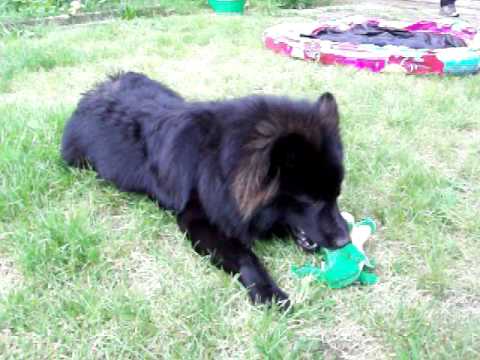
The Grossespitz (Giant or Large Spitz) black, on the other hand, used to be more common in the vineyards of Baden Wรผrttemberg. His excellent wakefulness instinct was a great help to the winegrowers in keeping off the grape thieves, both animals and humans, away from the valuable vines.

According to Gesellschaft zur Erhaltung alter und gefรคhrdeter Haustierrassen e. V. (Society for the Conservation of Ancient and Endangered Breeds of Domestic Animals), to the Grossespitz (Giant or Large Spitz) Today it is considered endangered. Over the years 2000 to 2002, for example, there was only 11 Grossespitz (Giant or Large Spitz) blacks in Germany and 38 white dogs. To preserve this breed of enterprising and cheerful dogs, there are initiatives to mate the Grossespitz (Giant or Large Spitz) whites and blacks among themselves and to cross them with the Mittelspitz (Standard or Medium Spitz) and the Keeshond.

Physical characteristics

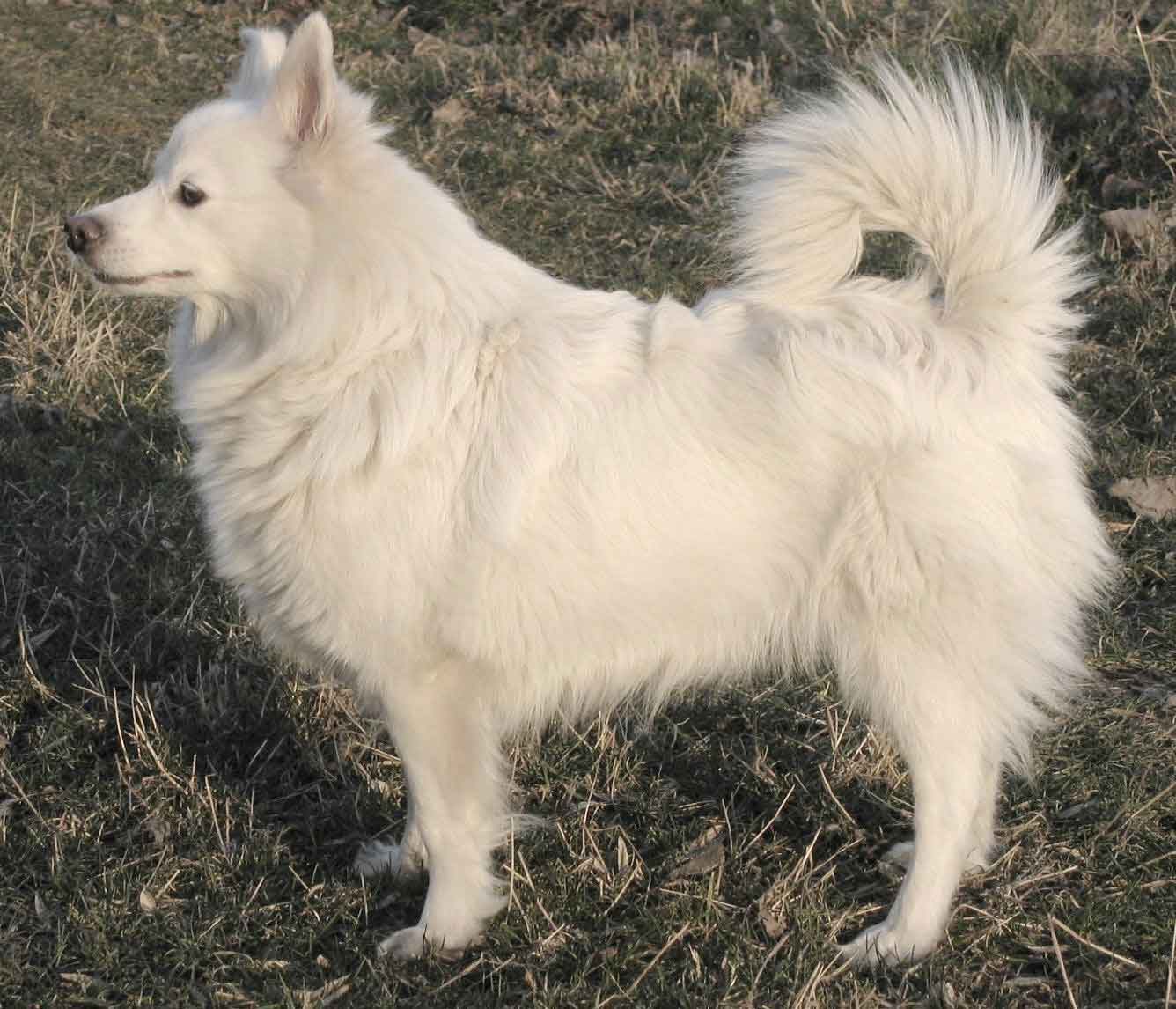
The Grossespitz (Giant or Large Spitz) is characterized by its special double layer. The long straight top layer looks very bushy due to the thick, padded undercoat and stays away from the body. Particularly striking is the strong horsehair fur collar and the bushy tail that curls over the back. The fox head with the agile eyes and the pointed ears, small and narrow give this Spitz its characteristic appearance.

With a shoulder height of up to 50 cm and a weight of 15-20 kg, the Grossespitz (Giant or Large Spitz) is the second largest representative of the German Spitz after the Keeshond. It breeds in the colors black, White and Brown.

The males and females of the category ยซGrossespitz (Giant or Large Spitz) ยป They are very similar in weight and size. But, the male representatives of the breed mostly appear heavier and larger. This is due to the fact that their coat is slightly longer and therefore appears more voluminous than that of female dogs..

Character and skills

The Grossespitz (Giant or Large Spitz) needs a lot of movement and exercise. So, long walks and running games and slides should always be on the agenda. It also, dog sports such as agility, obedience or tracking can bring additional variety to the dog's life and make optimal use of the breed.

Breed-specific character traits

The Grossespitz (Giant or Large Spitz) He is very affectionate by nature and would like to accompany his family everywhere.. Staying home alone does not suit them at all and can make dogs experience their grief intensely. As a rule, the more attention and affection a Grossespitz (Giant or Large Spitz) , more comfortable feels. That's why they like to be with the family, since they also get along very well with children. But, of course, every four legged friend, no matter how sociable I am, he also needs his rest. It is important that all members of the family respect these phases, which are usually quite rare with the Grossespitz (Giant or Large Spitz) . Thanks to his kind and loving character, many representatives of this breed of dog are also suitable as therapy dogs.

Although I do not necessarily suspect it at first glance, the Grossespitz (Giant or Large Spitz) it is also extremely robust and weather resistant. Due to its distinctive protective instinct, they are also considered ideal guardians for the house and yard. But, without proper training, can become a very barking dog. Through an appropriate workload for each species, good socialization and a consistent but loving upbringing, desirable behavior can be encouraged, that is to say, "don't bark".

Grossespitz training

Get enough attention and feel well integrated into family life. As they have almost no hunting instinct, they are usually relatively easy to train and can be recommended for beginners. But, it is important to inform yourself widely about the breed and its requirements beforehand.

Like all the other spitz, to the Grossespitz (Giant or Large Spitz) likes to be in contact with children and loves to play with and protect them. So, fits well in a lively little family, in which there is always something to do and much to discover.

So that the Grossespitz (Giant or Large Spitz) can exercise your favorite activity as a watchdog, The ideal would be to keep it in a house with a patio and garden. If the four-legged friend moves regularly and has mental problems, you can also consider keeping it in a city apartment, as long as there are enough opportunities for exercise nearby.

Videos of the Greater Spitz
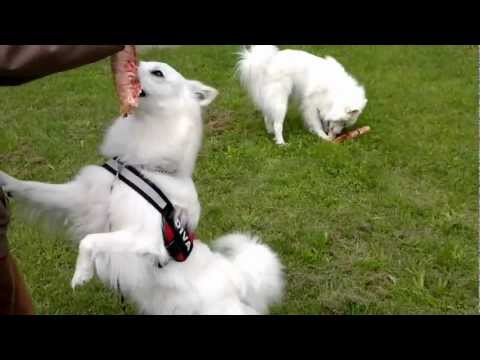
Great Spitz Bella+Bruno feeding predators.2012
GroรŸspitz Jacko + Schnappi

Type and recognitions:

  • FCI CLASSIFICATION:
  • Group :
  • Section : . .

FCI breed standard "Grossespitz (Giant or Large Spitz) "

Origin:
Germany

Date of publication of the valid original standard:
04.09.2019.

Use:

Guard and companion dog.


General appearance:

TheSpitzThey attract attention for their beautiful separated fur with the presence of a very dense undercoat.. The neck surrounded by an abundant mane and the tail covered with long hair is striking., turned up and spread boldly on the back. The head is similar to that of the fox with diligent eyes and small pointed ears. The ears, placed very close to each other, confer toSpitzhis characteristic relaxed appearance.

important proportions

Proportion of 1:1 between the height at the withers and the length of the dog.


Behavior / temperament:

TheGerman Spitz is constantly attentive, is active and exceptionally dependent on his master. Learn quickly and can be trained easily. His distrust of strangers and his lack of interest in hunting allow him to be considered the ideal watchman for the house and farm.. Its most notable characteristics are its resistance to weathering., its robustness and longevity.

Head:

----

Cranial region:
  • Skull: The skull ofSpitzis medium-sized; viewed from above seems to swell back becoming more narrow wedge shaped to the tip of the nose.
  • Depression links (Stop): Little steep until marked, but never abrupt.

facial region:

  • Truffle: Round, small, black; in all theSpitzbrown in color is dark brown in color.
  • Snout: Not very long, Neither coarse nor pointed; It presents a good proportion in relation to the skull (in the Spitz type Keeshond/Wolf, in the large Spitz and medium Spitz the ratio snout/skull is approximately 2/3, in the small Spitz and in theSpitz enano/Pomerania is approximately 2/4).
  • Lips: They are not hanging; they are well bonded and do not form folds in the corners. They are black in all colours, in theSpitzbrown in color are brown in color.
  • Jaws/Teeth: The jaws are normally developed and show a complete scissors bite with 42 teeth, That is, the upper incisors fall closely in front of the lower incisors., teeth being implanted perpendicular to the jaws. InSmall and dwarf spitz/Pomeranian the loss of a few promolars is tolerable. A pincer bite is allowed in all varieties ofSpitz.
  • Cheeks: The cheeks are slightly round and are not prominent.
  • Eyes: The eyes are medium-sized, elongated, a little oblique, dark colored. The eyelids have black pigmentation in all color varieties and are only dark brown in theSpitzof brown variety.
  • Ears: The pointed ears in the shape of a pointed triangle are small and rather closely placed together.. Its inclusion is high. They always remain erect with a rigid tip.

Neck:

The neck is moderately long and presents a broad inclusion with shoulders; the neck is slightly convex, without dewlap and covered with a mane shaped collar.

Body:

  • top line: The top line begins at the tip of the erect ears and passes in a gentle arc over the short, straight back.. The deployed and with abundant fur tail partially covers the back and rounded silhouette.
  • Cross/Back: The high cross falls imperceptibly on the short back, straight and strong.
  • Pork loin: Short, wide and strong.
  • Rump: The rump is short and wide, unexpired.
  • Breast : Deep chest, well arched; the apron is well developed.
  • Bottom line and belly: The chest is expanded as much as possible back; the abdomen is moderately retracted.

in the

Tail:

The tail has a high insertion and a medium length; bends upward from the root and rolls over the back, spreading firmly. Well covered with thick hair. A double loop in the tip of the tail is acceptable.

Tips

Former members

  • As a whole: Straight, large on the front.
  • Shoulder: The scapula is long, placed backwards at an angle. The arm, showing almost the same length, with the scapula forms an angle of approximately 90 degrees. Shoulders with good musculature are closely linked with the chest.
  • Arm: Medium length, robust and fully straight on the trunk, covered with long hair in the form of pen in the posterior region.
  • Elbows: The elbow joint is strong, close to the chest without bending inward or outward.
  • Metacarpus: The Metacarpus strong and medium length, forms an angle of approximately 20ยฐ in relation to the perpendicular line.
  • Front feet: The front feet are as small as possible, round, compact, as cat with well arched toes feet. Pads and nails are black in all varieties of Spitz, and they are only dark brown on brown dogs.

Later members

  • As a whole: The hindquarters are very muscular, covered with very long hair up to the Hock joint. The hind limbs are straight and parallel to each other..
  • Thigh and leg: They have approximately the same length.
  • Knee: The knee joint is strong, slightly angled and, during the movement, It does not twist outward or inward.
  • Metatarsus: Medium length, very strong, maintains a position perpendicular to the ground.
  • Rear feet: The hind feet are as small as possible, round, with toes well arched and together, as cat feet. Pads are hard. The color of nails, pads is much darker.

Movement:

TheSpitzmoves with enough coordination, with a good push and almost floating in light trot.

Mantle

Skin

The skin should be well attached to the body, without kinking.

Fur

TheSpitzThey have a double coat covered with hair: the outer layer is long-haired, straight and separate and the inner layer is short-haired, dense and woolly. The head, ears, anterior surface of the forelimbs and hindlimbs and feet are covered by short, dense hair (velvety). The rest of the body is long and abundant hair. The hair should not be wavy, chino, or form hair, You must not present a stripe on the back. A thick mane covers the neck and shoulders. The rear face of the forelimbs has hair in the form of feathers. The hindquarters should be covered with long hair from the rump to the Hock joint. The queue must be covered with hair is long and abundant.

Color

  • Wolf Spitz/Keeshond: Grayish.
  • Grossespitz (Giant or Large Spitz) Negro, brown, white.
  • Mittelspitz (Standard or Medium Spitz): Negro, brown, white, orange, grey, other colors.
  • Kleinspitz (Miniature or Small Spitz): Negro, brown, White Orange, grey, other colors.
  • Spitz enano/Pomerania: Negro, brown, white, orange, grey, other colors.
  • Black Spitz: The fur of the black Spitz should be dark in the skin as well as internal NAP and the color of the outer layer should be jet black color without any white spot.
  • Brown Spitz: The Brown Spitz should have a uniform dark brown color.
  • White Spitz: The hair should be pure white, no yellowish tones that can often occur in the ears.
  • Spitz anaranjando: The Orange Spitz should have a single uniform colour in the average range of the RAL (Registration International of the color scale).
  • Greyish Spitz/Keeshond: Gray is understood as grey silver with black hair tips. Snout and ears are dark. Around the eyes there is a drawing in the shape of glasses consisting of a delicate black line. (It extends from the outer corner of the eye to the lower part of the inclusion of the ear) or in broken lines and shading that draw short eyebrows, but expressive. Mane and ring shoulders are a tone clear. The anterior and posterior members are grey silver unmarked black below the elbows and knees, except delicate stripes on your fingers (pencilling). The tip of the tail is black. The lower part of the tail and the buttocks are grey Silver clear.
  • Spitz other colours: Under this description all tones are included as: cream-coloured, cream-saber, anaranjado-Sable, black with tan and stained. The spotted must have a white background color. Black stains, brown, gray or orange should be distributed throughout the body.


Size and weight:

Height to the cross

  • Wolf Spitz/Keeshond: 49 cm ยฑ 6 cm..
  • Grossespitz (Giant or Large Spitz) : 46 cm ยฑ 4 cm..
  • Mittelspitz (Standard or Medium Spitz): 34 cm ยฑ 4 cm..
  • Kleinspitz (Miniature or Small Spitz): 26 cm ยฑ 3 cm..
  • Spitz enano/Pomerania: 20 cm ยฑ 2 cm. (are undesirable specimens measuring less than 18 cm.).

Weight

Any variation in the size of theGerman Spitz must have a corresponding variation in its weight.


Fouls:

Any deviation from the above criteria is considered missing and the seriousness is considered to the extent of the deviation to the standard.

Serious misconduct

  • Defects in the Constitution.
  • Head too flat or sharp Apple-shaped.
  • Truffle, eyelids and lips of flesh-colored.
  • Defects in the premolars in Wolf Spitz/Keeshond, Medium and large Spitz.
  • Eyes too big or clear or very outgoing.
  • Defects in the movement.
  • Absence of classic drawing of the face inSpitzgrey.

ELIMINATING fAULTS

  • Aggressive or fearful dog.
  • Open fontanel.
  • Upper or lower prognathism.
  • Entropion or ectropion.
  • Floppy ears.
  • White spots visible on allSpitznon white.

Any dog โ€‹โ€‹showing clear signs of physical or behavioral abnormalities should be disqualified..


N.B.:

Males should have two normal-appearing testicles fully descended into the scrotum..

Source: F.C.I - International Cynological Federation

โ–ท The world of Pets: Dogs, cats, birds, reptiles, amphibians

Greater Swiss Mountain Dog
Suiza FCI 58 - Swiss Cattle Dogs

Gran Boyero Suizo

Despite its impressive size and weight, The Greater Swiss Mountain Dog is strong and agile.

Content

History

The Greater Swiss Mountain Dog is an old Swiss farm dog. It is the largest of the family of mountain dogs. These served in the mountains and valleys of the Swiss Alps as a complete tool for farmers. They watched the house and the farm. If a herd of cows had to be moved from one meadow to another, they made sure everyone stayed on the road and no cow was left behind.

The great mountain dogs, from which the current one emerged Greater Swiss Mountain Dog, harnessed in front of larger wagons and served as all-terrain and mountain tractors, more or less like the old one Unimog. It was not unusual for them to be harnessed in pairs in front of a cart full of valuable cheese, so they could independently find their way from the alpine pasture to the village, to the merchant and back. Mountain Dogs and Swiss Cattle Dogs used to be a single family of dogs. What they have in common is a strong bond with family and their farm., a confident self-awareness, a widely lost hunting instinct, a high degree of vigilance, a loving attitude towards his own people and a reserved attitude towards strangers.

A few ago 100 years, mountain dogs were divided into four breeds: Entlebucher, Appenzeller, Berne, Greater Swiss Mountain Dog – in order of size. This and the artificial fixation in a tricolorism conceived by the breed have not been good for the health of these great dogs.. So the statistics of the British Kennel Club 2014 document a life expectancy of only 8 years for Mountain Dogs and Bovine Dogs. Healthy servants could easily live 4 more years. More about this in the portrait of the respective mountain and cattle dogs.

The Greater Swiss Mountain Dog became a valuable companion dog, but still has the skills of a working dog. In 1912 The "Club of Great Swiss Mountain and Cattle Dogs" was founded in Switzerland.

Physical characteristics

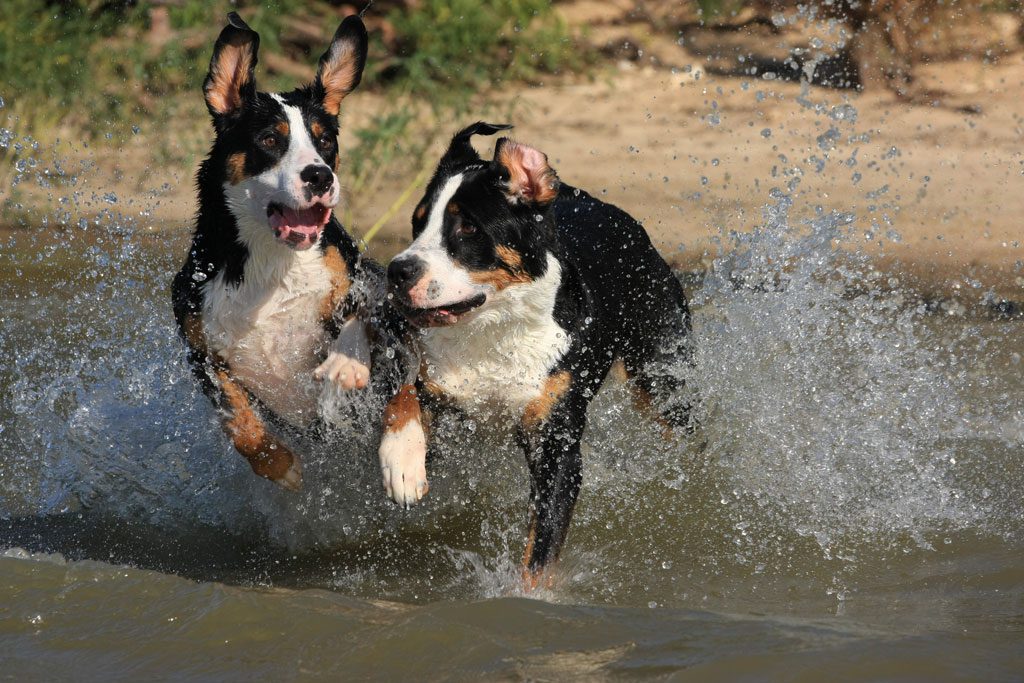
The Greater Swiss Mountain Dog is a big dog, robust, strong-boned and well-muscled. Radiates sovereign calm and self-confident composure, and that's how it is. The difference between the sexes should be quite large.
The males must have a height at the withers of 65 to 72 centimeters, the females of 60 to 68. The weight is between 35 and 50 kg.

The standard establishes numerous regulations on the details of coloring, texture and pattern of its coat. I should have brush hair and be tricolor. We see detailed regulations, where white marks are allowed and where they are not. In the interest of dogs, do not take these external characteristics so seriously, that are only devised by your breeder. Turning those details into breeding selection criteria is not in the interest of the welfare of the offspring. Greater Swiss Mountain Dog, they only have an extremely small gene pool anyway. What matters is the character and physical condition of the dogs. this last, Unfortunately, not too rare a problem. The Greater Swiss Mountain Dog it has better qualities than the color of its coat.

Character and skills

The Greater Swiss Mountain Dog feel more comfortable in the field. He wants to be moved and you can experience wonderful stress-free walks in nature with him. As it has little hunting instinct and usually has a good ear, you can enjoy relaxed and stress-free hours outdoors with it, even without a strap. But, It is not a companion dog for athletes..

One Greater Swiss Mountain Dog not suitable for life in the middle of the big city. You don't need a house with a big garden, what would be ideal. He likes to have a land or a yard where he can take care of things. Otherwise, does not have any special requirement regarding its maintenance. Most important is their close integration into the human family. For a permanent or even partial stay in a kennel these dogs are completely unsuitable.

Educating the Greater Swiss Mountain Dog

One Greater Swiss Mountain Dog can be trained very well. He likes to learn. It is strongly oriented towards its people, what you can use well. The Great swiss you can read the mood and wishes of your people on their faces. This in turn means that one must approach one's education with feeling and of course with consequence.. He has a pronounced sense of justice and, the other way, expect an equally fair deal. One must not only accept their occasional stubbornness, but you must like it. They challenge an intimate and mutually respectful relationship between dog and owner. The reward is a happy coexistence for both parties.

Care and health of the Greater Swiss Mountain Dog

The Greater Swiss Mountain Dog it is very easy to care for, just brush it occasionally.

Like many large dog breeds, tends to have hip problems (HD) or elbows (ED). La endogamia, unfortunately partly strong, has a negative effect on physical fitness and life expectancy.

Nutrition / Food

The Greater Swiss Mountain Dog has no special demands on their diet. Like many dogs of his size, tends to churn your stomach. Therefore you should not eat too fast and let it rest after eating.. Veterinarians often recommend an elevated feeding bowl, that can be purchased in specialized stores. During the breeding season, special attention must be paid to an adapted nutrition.

The life expectancy of the Greater Swiss Mountain Dog

One Greater Swiss Mountain Dog is relatively strongly affected by inbreeding and breeding selection that is one-sidedly oriented toward outward appearances, such as fur color details. So, their life expectancy has decreased in part enormously. It's between eight and -healthily- twelve years.

Buy a Greater Swiss Mountain Dog

When buying a puppy you must be careful that no ancestor appears twice in the pedigree. (endogamia). Otherwise, you should look for a breeder affiliated with the Swiss Mountain and Cattle Dog Club. You can also find the dog of your dreams at the animal shelter or in an emergency initiative.

Characteristics "Greater Swiss Mountain Dog"

Coexistence is important that you have with your new friend. Before considering the acquisition of a dog of the breed "Greater Swiss Mountain Dog" you know certain factors. Not all breeds of dogs are apt to live in an apartment, you must take into account his character, their need for exercise, their interaction with other pets, their care and if you have small children, their level of tolerance towards them.

Adaptation โ“˜

3,0 of 5 stars (based on 1 review)

friendly dog โ€‹โ€‹โ“˜

4,0 of 5 stars (based on 1 review)

hair loss โ“˜

3,0 of 5 stars (based on 1 review)

Affection level โ“˜

4,0 of 5 stars (based on 1 review)

Need for exercise โ“˜

3,0 of 5 stars (based on 1 review)

Social need โ“˜

4,0 of 5 stars (based on 1 review)

Home โ“˜

2,0 of 5 stars (based on 1 review)

Toilet โ“˜

1,0 of 5 stars (based on 1 review)

Friendly with strangers โ“˜

3,0 of 5 stars (based on 1 review)

barking โ“˜

4,0 of 5 stars (based on 1 review)

Health โ“˜

3,0 of 5 stars (based on 1 review)

Territorial โ“˜

5,0 of 5 stars (based on 1 review)

Cat friendly โ“˜

3,0 of 5 stars (based on 1 review)

Intelligence โ“˜

4,0 of 5 stars (based on 1 review)

Versatility โ“˜

4,0 of 5 stars (based on 1 review)

Child friendly โ“˜

4,0 of 5 stars (based on 1 review)

Surveillance โ“˜

3,0 of 5 stars (based on 1 review)

joy โ“˜

5,0 of 5 stars (based on 1 review)

Images "Greater Swiss Mountain Dog"

Photos:

1 – Greater Swiss Mountain Dog, tricolour by Canarian / CC BY-SA
2 – Greater Swiss Mountain Dog by jude / CC BY
3 – Big Swiss Mountain Dog and Entlebucher Mountain Dog during International show of dogs in Katowice – Saucer, Poland by Pleple2000 / CC BY-SA
4 – All Mountain Dogs: Greater Swiss Mountain Dog, the Bernese Mountain Dog, the Appenzeller Mountain Dog an the Entlebucher Mountain Dog by Shining dog / CC BY-SA

Videos "Greater Swiss Mountain Dog"

Type and recognitions:

  • FCI CLASSIFICATION:
  • Group :
  • Section : . .

Federations:

  • FCI – Pinscher and Schnauzer-Molossoid type dogs – Swiss Mountain Dogs and Cattledogs. Section 2.2 Molossoid, mountain type. โ“˜
  • AKC – Working dogs โ“˜
  • CKC – Working dogs โ“˜
  • โ€‹KC – Working dogs โ“˜
  • UKC – Watchdog โ“˜

FCI breed standard "Greater Swiss Mountain Dog"

Origin:
Switzerland

Date of publication of the valid original standard:
25.03.2003

Use:

Originally used as a guard and traction dog. He is currently used as a family dog., companionship and protection.


General appearance:

It is a tricolor dog, robust, strong bone and good musculature. Despite its size and weight, demonstrates agility and endurance. The sexual characteristics of the male and female are pronounced.

IMPORTANT PROPORTIONS:

  • body length (measured from the tip of the shoulder to the tip of the buttock: height of the cross: = 10 : 9.
  • Chest depth: height of the cross: = 1 : 2.
  • Length of the skull: nose length: = 1 : 1.
  • Skull width: muzzle width: = 2 : 1.


Behavior / temperament:

insurance, attentive, awake and fearless in everyday situations, kind and dependent with people he trusts and self-confident in relation to strangers; medium temperament.

Head:

In relation to the body, it's strong but not heavy. The head of the males is more powerful than that of the females.

Cranial region:
  • Skull: Flat and wide with a front groove that gradually heads and disappears upward.
  • Depression links (Stop): Notorious.

facial region:

  • Truffle: black.
  • Snout: Strong, longer than deep, without looking pointy from above or from the sides. Straight nose cane, no middle groove.
  • Lips: Poorly developed, tight; black pigmented; not hanging.
  • Jaw โ€“ Teeth: Strong jaws. Full scissor bite, strong and regular. Lack of 2 teeth (premolars 1 y/ o 2) is tolerated. The absence of the M3 is not taken into account.

Eyes: Medium, in the form of almond, not deep or bulging, hazelnut brown or chestnut, of happy and awake expression. Eyelids are well attached. The darkly pigmented edge of the eyelids.

Ears: Medium-sized, triangular and fairly high set. When the dog is calm, supported and flat; when you are attentive, directs them forward. With enough hair both on the outside and on the inside.

Neck:

Strong, muscular, chubby and no chin.

Body:

Slightly longer than the height at the withers.

  • Back: Moderately long, strong and straight.
  • Pork loin: Wide and well muscled.
  • Rump: Long and wide, with a gently rounded fall; neither too high nor abruptly dropped.
  • Breast : Strong, width, reaching to the elbows; round-oval rib diameter chest neither flat nor crowded. Well developed sill.
  • Abdomen and lower line: The abdomen and flanks are poorly gathered.


Tail:

Inserted in harmonic continuation with the rump. Pretty heavy, reaching the hock; if the dog is calm, the tail hangs; if you are at attention or on the move, wears it higher and slightly curved, but never ringed or on the back.

Tips

PREVIOUS MEMBERS:

  • As a whole: Seen from ahead straight and parallel placed rather apart.
  • Shoulder: The long shoulder blade, strong, inclined, glued and well muscled, forming a not very obtuse angle with the arm.
  • Forearm: Straight and strong bone.
  • Metacarpus: Strong, seen from the front, in straight extension of the forearm; seen from the sides almost perpendicular.

LATER MEMBERS:

  • En set: Seen from behind, straight and not too close. Metatarsals and feet must not be inclined inward or outward; dewclaws must be amputated, except in countries, in which amputation is not permitted by law.
  • Thigh: Rather long, width, strong and well muscled.
  • Knee: Claramente an obtuse angle.
  • PinScheme: Relatively long.Hock: Strong and well angled.

FEET: Strong, straight, closed, fingers well together, well arched and strong nails.

Movement:

Wide and uniform in all types of gears. Good forward reach and good momentum from hindlimbs. When jogging, limbs move in a straight line, seen both in front and behind.

Mantle

  • Fur: double hair, composed of dense outer layer of medium length, and inner fleece, equally dense, preferably dark gray to black. Short external hair is allowed, if the inner fleece is thick.
  • Color: Typically tricolor: Basic color is black with symmetrical reddish-brown fire markings and white markings. The reddish-brown fiery markings lie between black and white on the cheeks, above the eyes, on the inner side of the ears, at the sides of the chest, on all four limbs and at the bottom of the tail. White markings are located on the head (forehead and muzzle), from throat to chest (without interruption), on the feet and at the tip of the tail. Between the white mark on the forehead and the brown fire marks- reddish over the eyes should be a black streak. White spot on neck or white collar is tolerated.


Size and weight:

TAHAND:  
Alturto the cross In males: 65 โ€“ 72 cm.,
  In females: 60 โ€“ 68 cm..


Fouls:

Any deviation from the aforementioned criteria is considered as a fault and the severity of this is considered to the degree of the deviation to the standard and its consequences on the health and well-being of the dog..

  • Dubious behavior.
  • Lack of other teeth, maximum two premolars (PM1 and / or PM2). M3s are not taken into account caliper bite.
  • light eyes; insufficient eyelid occlusion
  • Mantle: Internal fleece of brownish-yellowish or light gray color visible. Dirty colors.
  • Lack of marking
    • Lack of white mark on the head; very wide list.
    • White mark of the muzzle visibly reaching beyond the corners of the lip
    • ยซWhite bootsยป (white color that reaches above the metacarpal or metatarsal joints.
  • Notoriously asymmetrical drawings

FALTAS DESCALIFICANTES:

  • Aggressiveness or extreme shyness.
  • Any dog โ€‹โ€‹showing clear signs of physical or behavioral abnormalities must be disqualified..
  • Upper or lower prognathism, arcade of the deviated incisors
  • Entropion, ectropion.
  • One eye or two blue eyes.
  • Short hair without undercoat.
  • Long hair.
  • Non tricolor dog.
  • Basic color other than black.


N.B.:
  • Males should have two normal-appearing testicles fully descended into the scrotum..
  • Only functionally and clinically healthy dogs, with the typical conformation of the breed, should be used for parenting.

TRANSLATION: Federation Canรณfila Mexicana a.c.

Source: F.C.I - International Cynological Federation

โ–ท The world of Pets: Dogs, cats, birds, reptiles, amphibians

Guatemalan Dogo
Guatemala Not recognized by the FCI

The Guatemalan Dogo It is a variant of the Doge race, a native of Guatemala. It's a watchdog.

Dogo Guatemalteco

Content

History

From the age 1990, the Guatemalan Canophila Association began the study of this breed so that the Federation Cynologique Internationale (FCI) grant worldwide recognition for the breeding of pedigree dogs, the only one in this region. In charge of studying the race to set their standard, approval and international recognition through the FCI is the veterinarian and zootechnician Arturo Chavez.

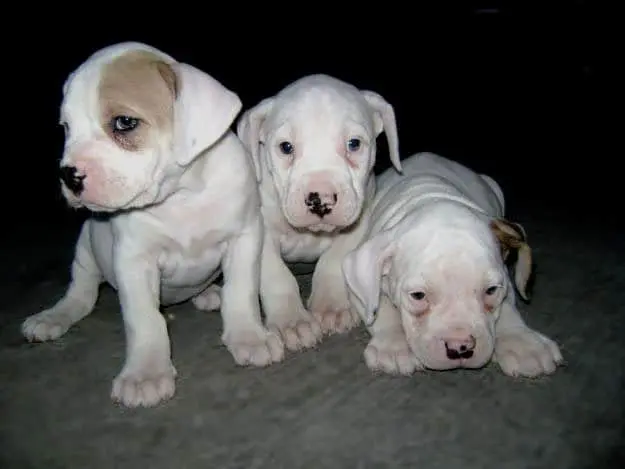
The Guatemalan Dogo is the product of random crosses between races Bull Terrier English, Dalmatian and Boxer. Records of its existence date from 1890, Well there are images of a Guatemalan Dogo in a collection of 12 photos of the day, property of Arturo Gallusser. It is also known that the family Gerardi, in 1910, I had some copies of these dogs, but it is unknown the offspring of the same.

Physical characteristics

"Guatemalan Dogo"

Dogo Guatemalteco
Dogo/Bull Terrier Guatemalteco: Owner Owner Oscar E. Lorenzana Gallusser – Oscar E. Lorenzana Gallusser, Public domain, via Wikimedia Commons

It is a dog that stands out for being a good watchdog, It is medium sized and somewhat longer than high, so it does not have a completely square appearance. His head is quite square and his lips are slightly; His jaw is quite strong and he has a scissor bite..

The weight males will of 40 to 45 kg and females in 35 to 40 kg. The height in the males is of 54 to 60 cm and the females of 52 to 58 cm..

The life expectancy of the Guatemalan Dogo, is of, approximately, 11 to 12 years.

Its color predominant is very bright white with some black or brown spots. The fur is short, rough, thick and quite attached to the body.

Character and skills

It is good guardian it ladra to strangers, but believes it only when necessary. You can get along with others but it creates a bond with his master, thus making it an excellent companion dog.

A bath is recommended only when necessary or it can be cleaned with a damp tissue to remove hair that has fallen or when it has become dirty. Socialization at an early age will be required with the people. Will also be made if you have other pets to be in the future not to fight with them, and that's not a totally aggressive dog.

Daily activities such as walks next to its owner is needed to not bored, since it is an energetic dog and can become destructive and stressed by not using the energy it possesses.

โ–ท The world of Pets: Dogs, cats, birds, reptiles, amphibians

German Mastiff
Alemania FCI 235 - Molossoid - Dogo

Dogo Alemรกn

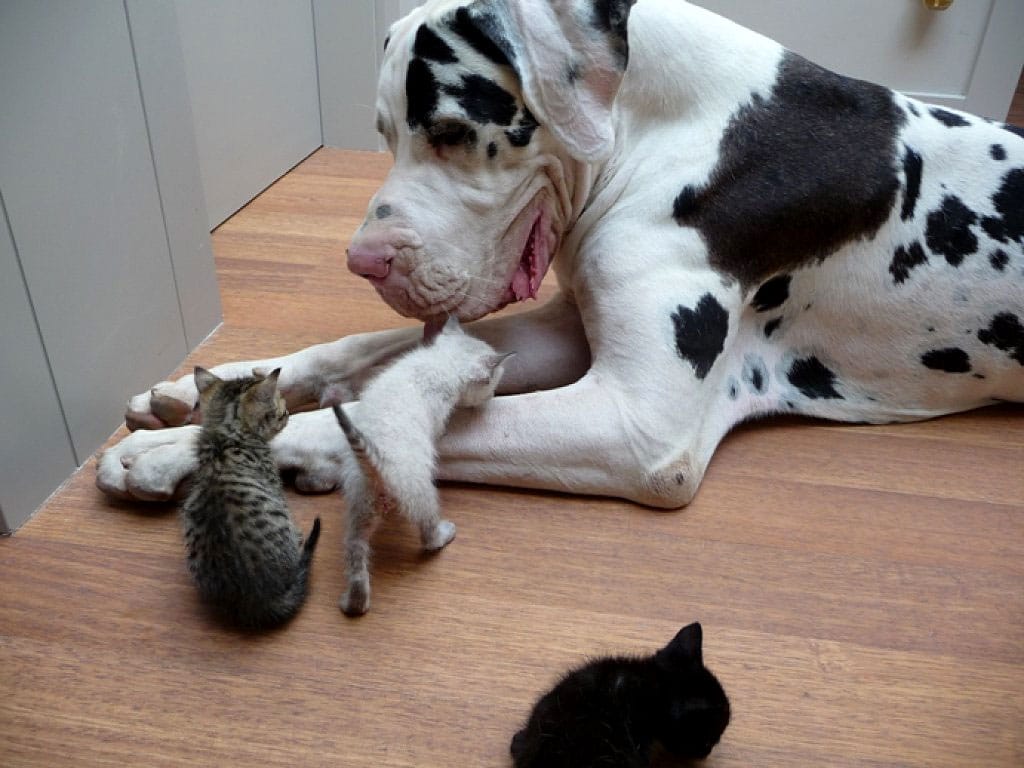
The German Mastiff, Great Dane or German Boarhound It is a breed of dog known for its large size and delicate personality, considered to be the "Apollo among all races" by the International Cynological Federation.

The great Dane, even being a giant race, should not be clumsy in his walk and movements. Your character should be friendly and never shy. Males should be stronger than the females Constitution.

Read more about the race by clicking on: Great Dane.

German Mastiff

โ–ท The world of Pets: Dogs, cats, birds, reptiles, amphibians

Armenian Gampr
Armenia Not recognized by the FCI

Gampr Armenio

Content

History

Armenian Gampr (Armenian Wolfhound Gampr) is the name of a breed of guard dog of cattle that originated in the Armenian mountains (including the territories known today as Eastern Anatolia of Turkey).

The Armenian Gampr was bred by the local population starting from the primitive dogs of the area that, It was on par with the evolution of societies domesticated.

Not even being recognized by several important canine clubs as a breed of dog and undergoing an intensive genetic research, in April of 2011 the International Canine Union officially recognized the Armenian Gampr as the national dog breed of Armenia.

The Gampr has been living for a long time in the prehistoric Armenian mountains, This is demonstrated by thousands of petroglyphs (that symbolic motifs are stones or rocks which have been carved, belonging to very ancient cultures) found throughout the territory. The teacher Oktay Belli from the University of Istanbul has studied petroglyphs found near the modern city of Kars and according to data from his research, various domestic breeds from the area have lived there since the Neolithic period.

It is not known for sure when the Gampr, and while there is a great diversity among endemic species, back to tens of thousands of years, the Gampr modern is believed to have existed for at least 3.000 years. Petroglyphs found in the plateau of Armenia, show a large number and variety of dogs similar to the Gampr, What has given rise to generate a comprehensive record of development.

Of the hundreds of petroglyphs found in Ughtasar and the Geghama mountain range, up a 20% of the carved motifs resemble modern ones Gampr, while others show a remarkable diversity of dogs that do not already exist.

The results of an excavation carried out in 1954 in Lake Sevan, site dating from 800 or 1000 years before Christ, they found the skeleton of a dog perfectly preserved in a tomb. When comparing the skull found with that of a Armenian Gampr and other indigenous dogs, They concluded that he was an ancestor of the race, Although it presented some differences from the modern form in the face, her you estreches of the skull and powerful teeth, counting on these data and adding the changes that caused the selection and breeding process of the last 3.000 years that inevitably, affect the general appearance of the dogs, could affirm that the Armenian Gampr was already established and formed as a race in the first millennium BC.

The issue is that, the Armenian Gampr modern has changed little through the history of its existence in the highlands of Armenia. It is one of the few natural breeds that exist, โ€œnaturalโ€ because they were not subjected to the harsh selection of phenotypes by the human hand. So they keep intact the genetic diversity they had initially, While they have crossed with other locatarios dogs. But that genetic variation has been something natural and spontaneous.

Physical characteristics

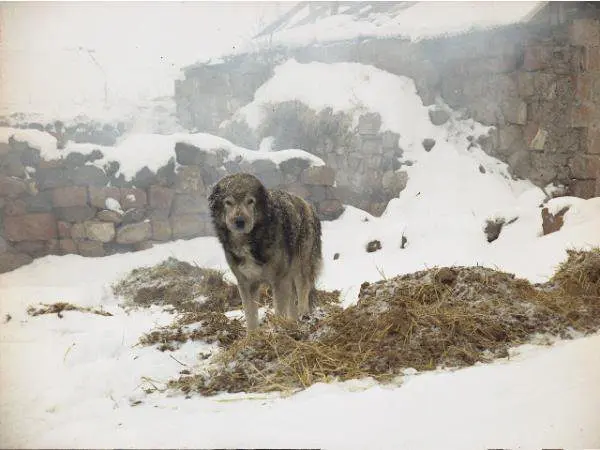
The Gampr it is a mountain dog that has a large head, body well delineated and developed, without prominent cheekbones. The back is wide, straight, muscular and strong. To the cross, the height in the males is of 65 centimeters or more, and in females is of 62 centimeters or more. The weight is proportional to the size of the dog, and generally varies between 45 and 60 kg.

The Armenian Gampr has a highly developed double-layer coat of hair in order to protect it from the extreme temperatures and harsh weather conditions of the area where it was born. The outer layer is long and thick hair, and the hair is short and dense internal.

Varieties

There are two varieties of Gampr, guardian and the of Pastor. Pastor tends to be smaller in size, tireless, and a little lighter. The Gampr the guardian type is, generally, higher, more square, and loving and very protective. They have a tendency to be more sedentary, and stay in one place.

The geographical and cultural coexistence of the Caucasian Shepherd Dog and the Central Asian Shepherd Dog, and its use on farms over time has caused a problem since the survival of the creole breed Armenian Gampr has been threatened…

The Club of the Armenian Gampr of the United States tries to make it clear -given the similarity between the dogs- that the Armenian Gampr IT IS NOT: a Caucasian Shepherd Dog, a Kangal Shepherd Dog, a Kangal Shepherd Dog, a Akbash, a Karakachan, a Alabai (Central Asian Shepherd Dog), a Koochee, a Tornjak, a Sharplaninac, Although it has some similarities it is good to be able to differentiate between these breeds.

Character and skills

The Gampr is distinguished by its vitality, its independence, intelligence and instinct of self-preservation, capacity in the defence and protection of livestock, the exclusive kindness to humans.

The Armenian Gampr it is a guard dog by nature, Unlike other dogs, This has developed this ability naturally, without previous training. In Armenian the word "Gampr" means "guard dogโ€, but it is also known by other names, like for example "Gelkhehtโ€ (which is derived from the word Wolf), if it is usually used for hunting bears it is known as โ€œArchashoonโ€ (โ€œdog-bearโ€) and if it performs typical functions of a shepherd dog, it is called "Chobanishoonโ€.

One of the main features of Gampr, It is his innate ability to adjust independently to different situations and reach a decision appropriate to the circumstances. If he Gampr he sees that his master needs his help, will protect it, but if not, pass it… They are affectionate but not corporate.

Images "Armenian Gampr"

Photos:

1 – Armenian Gampr dog by hy.wikipedia user Zara-arush, GFDL, via Wikimedia Commons
2 – Armenian Gampr by Gampr1, CC BY-SA 3.0, via Wikimedia Commons
3 – Armenian Gampr by Safi-iren, CC BY-SA 4.0, via Wikimedia Commons
4 – Sheepdog, Gampr dog in Azerbaijan by Elkhan Ganiyev, CC BY-SA 4.0, via Wikimedia Commons

Videos "Armenian Gampr"

Armenian Gampr

Gampr puppies

Photo: gampr.org