▷ The world of Pets: Dogs, cats, birds, reptiles, amphibians

English Foxhound
Gran Bretañaa FCI 159 - Large-sized Hounds

Foxhound Inglés

The English Foxhound is dog friendly appreciates life in the pack, where he gets along with his peers.

Content

English Foxhound History

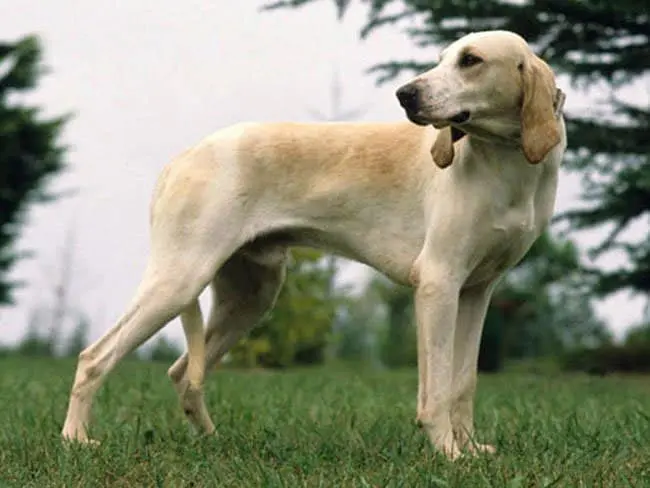
The English Foxhound can be considered a classic among British hunting dogs. This traditional breed is probably a cross between the Bracken medieval and the greyhounds, which were supposed to provide more lightness to previously heavier tracking dogs. Its field of application was and is hunting, more precisely: fox hunting mounted in pack, also called "hunting by force". In this hunt, the herd chases game animals such as roe deer or foxes until they are exhausted.. Persistent dogs can stay on their prey's heels for up to five hours. Although they are not faster than the pursued, tire the hunt so that the human hunter can hunt it. "Hunting by force" flourished in the 18th and 19th centuries, when it was practiced by the German nobility, British and French. Only the aristocracy could afford this elaborate form of hunting, and often destroyed numerous fields under the hooves of horse carts on the miles of unpredictable routes.

In the meantime, this form of hunting is prohibited in Great Britain, as well as in most European countries. In Germany, by the way, this prohibition was not originally justified by the practice of hunting, which is questionable from an animal welfare point of view. Rather, prohibition, when came into force in the years 30, was intended to limit the privileges of the nobility – and therefore also hunting. But a few decades later, hunting laws confirmed the ban. But this was not the end for him English Foxhound: Today, trawling is a friendly alternative – not the killing of the hunt, but the joy of riding fast along with the pack is the main focus. In 1964 the breed was recognized by the FCI. Besides of English Foxhound, there is also the American Foxhound, slightly lighter construction.

Physical Characteristics English Foxhound

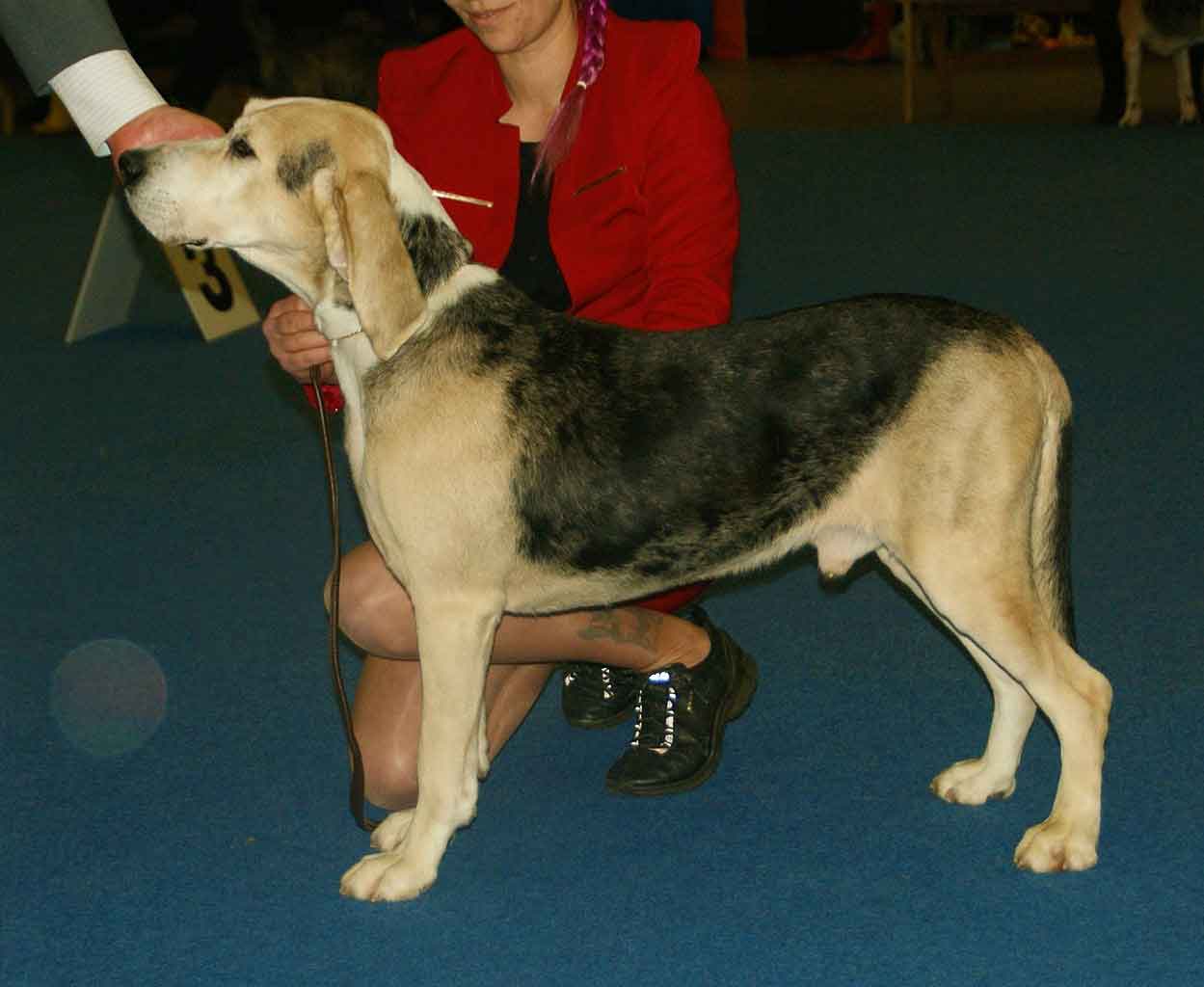
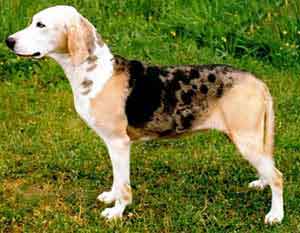
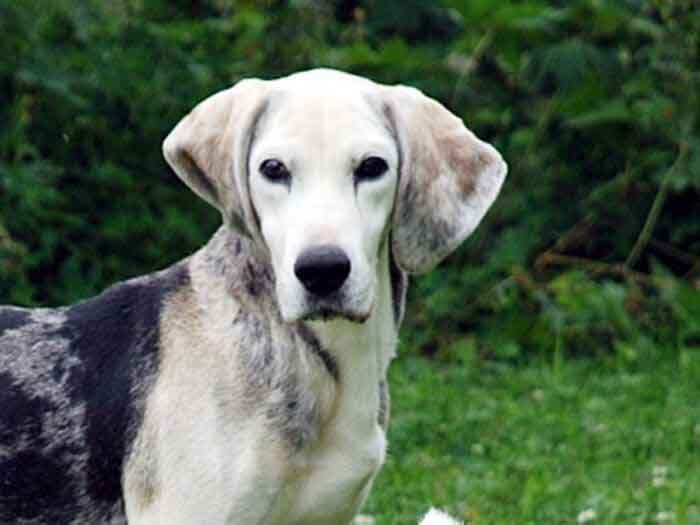
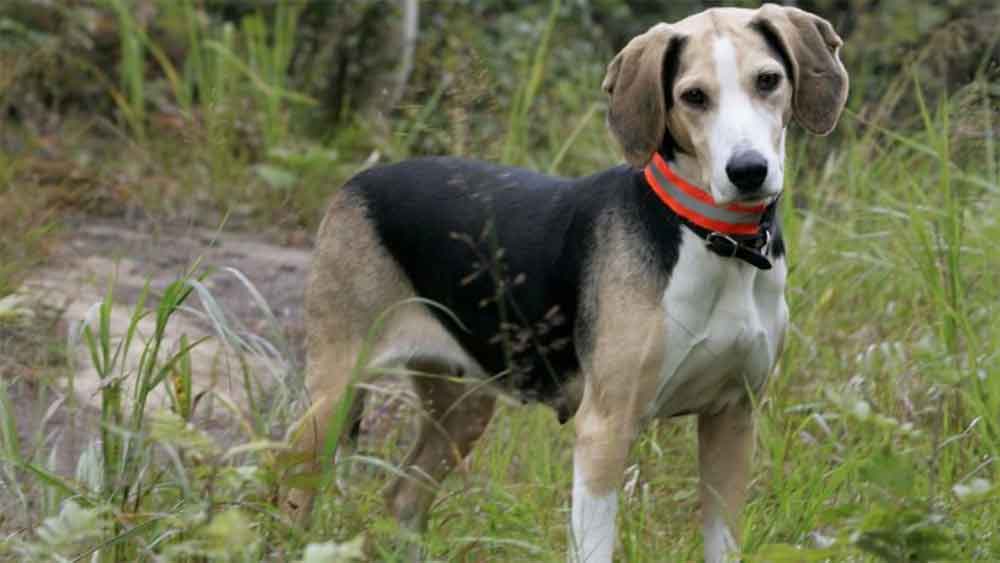
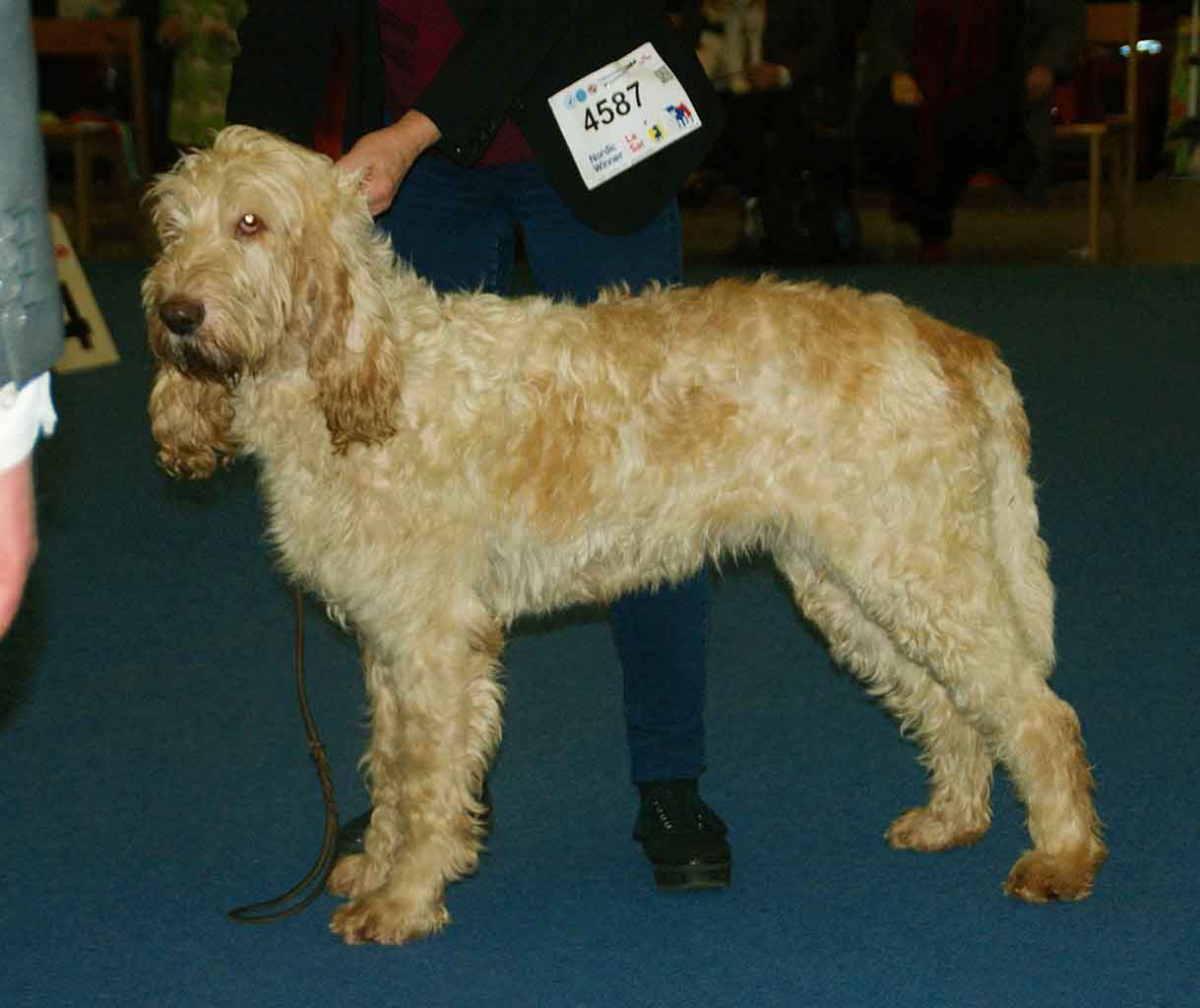
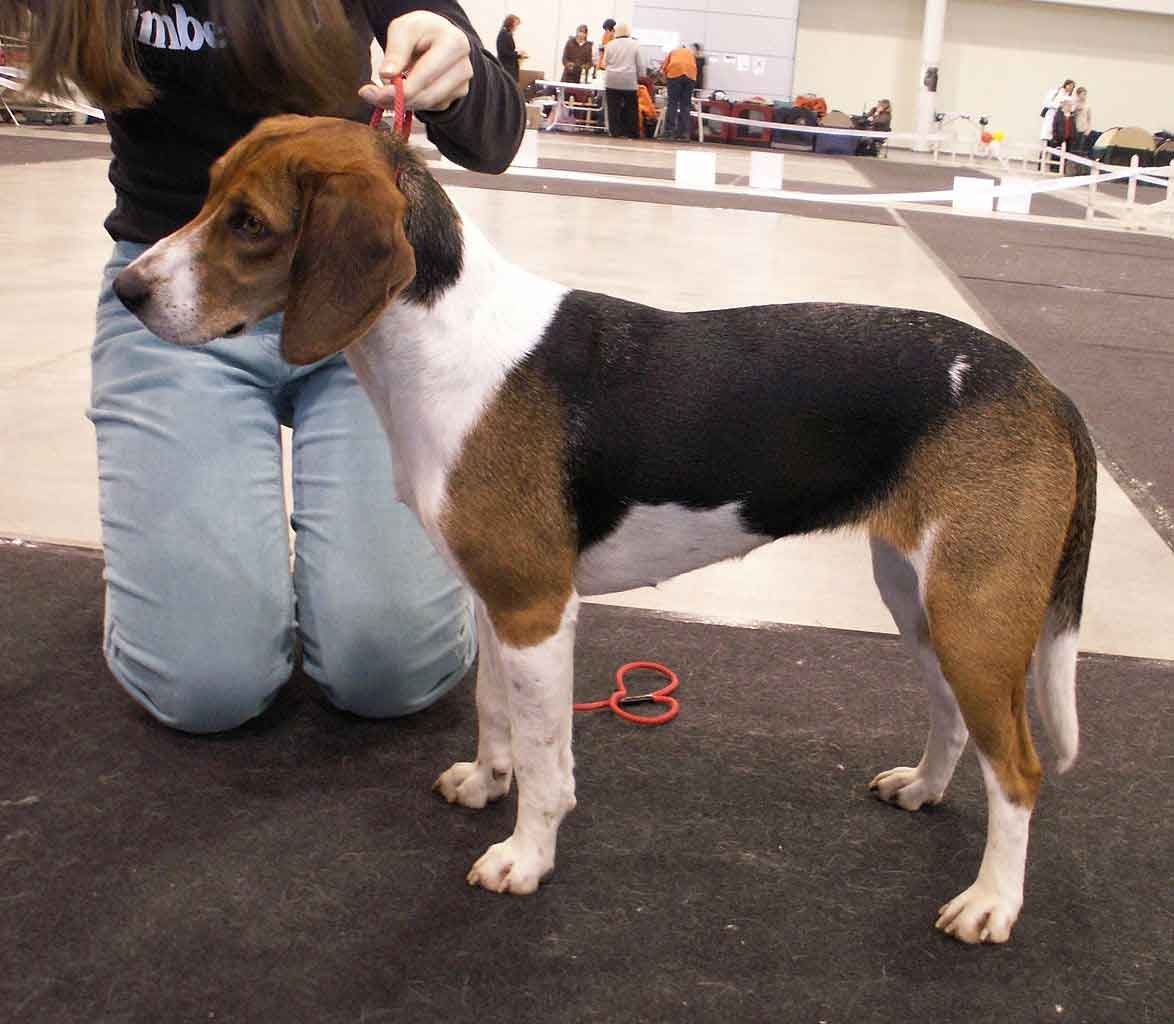
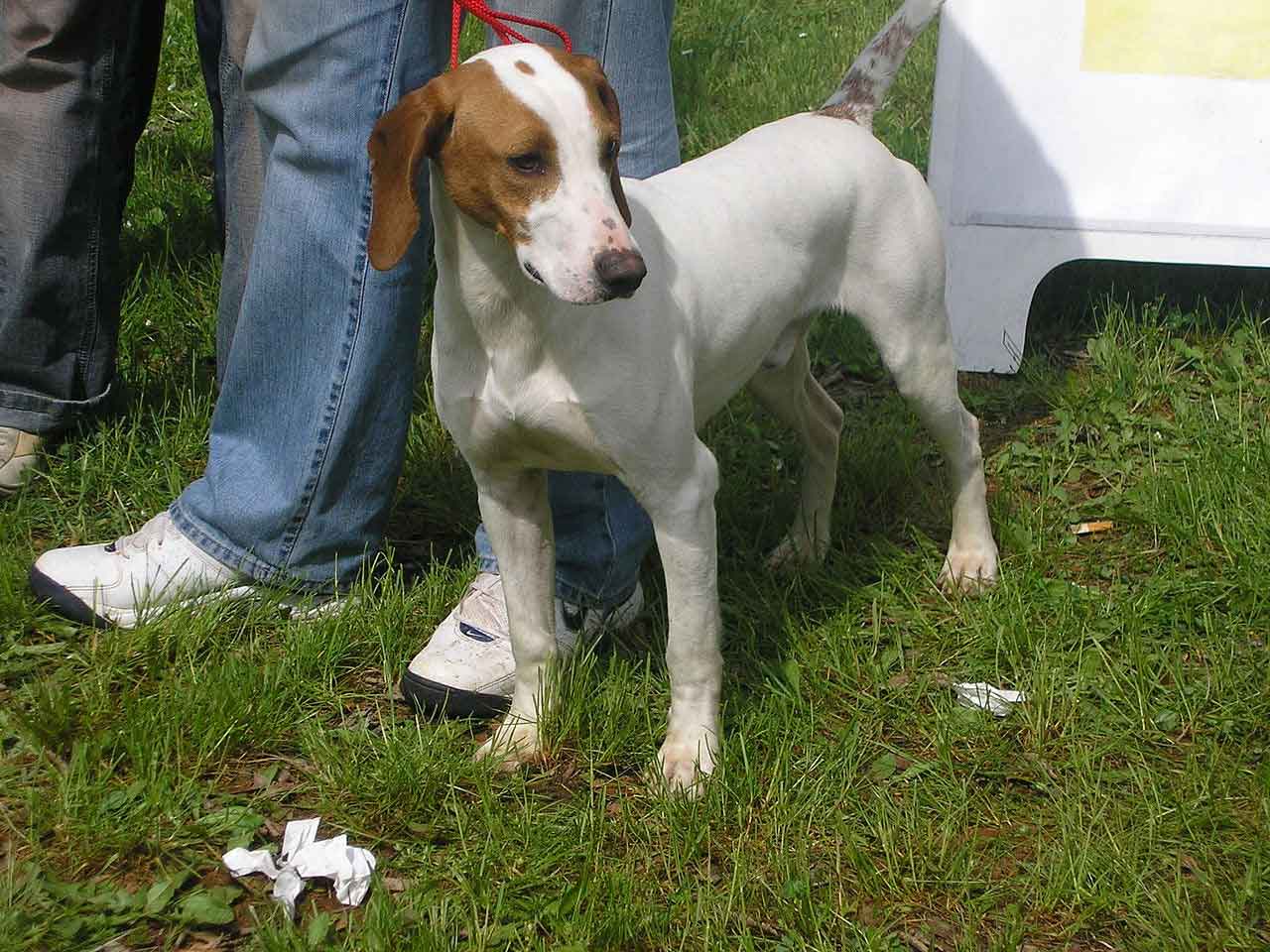
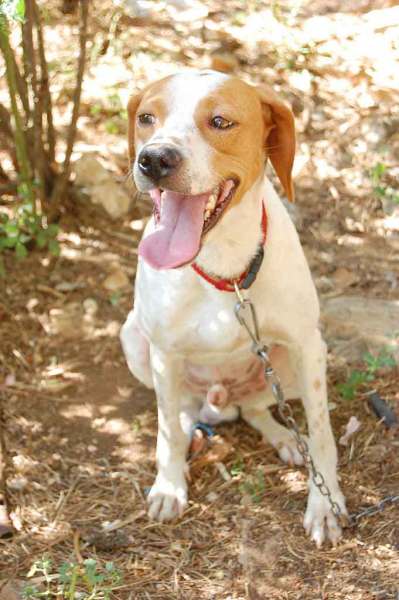
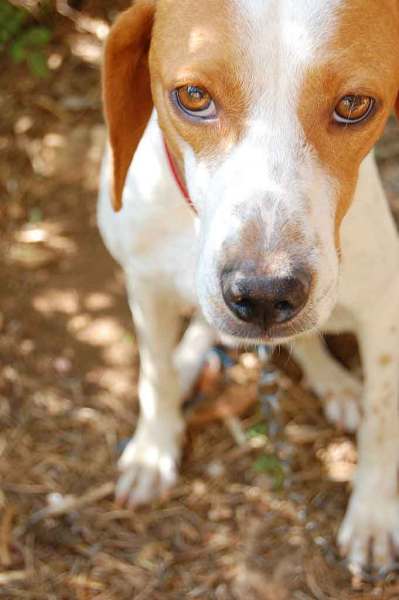
He bears a strong physical resemblance to him. Beagle, Although it is slightly larger. The average size of English Foxhound varies slightly depending on the gender of the animal. The males measure between 55 and 62,5 cm. up the cross, and females in 50,5 to 60 cm. up the cross. Generally weigh between 25 and 34 kg. Their fur is short and hard, tricolor-negro color, White and toasted or bicolor with a white background. It has a light head, and with pronounced eyebrows. The ears are medium and droopy, Hound style. His muscular back, It has straight legs and well located porte alegre queue, Whip style. The long legs allow the English Foxhound at a fast pace.

Character and skills English Foxhound

This friendly dog ​​appreciates life in the pack, where he gets along with his peers. In keeping with your original purpose and the life of your ancestors, almost without exception they lived in large herds, the English Foxhound show good obedience, but does not usually establish close relationships with humans individually. Even today the dogs grow up in the pack and stay there. If a stronger impression on humans is desired, the English Foxhound would have to be removed from the pack already at puppy age, but this is not practiced, because these dogs are primarily professional hunting companions and not companion dogs. It also, the Foxhound always retains a relatively high degree of stubbornness and does not show a pronounced "will to please". Despite your stubbornness, the breed also has an affectionate side: to much Foxhounds they love to be petted and are also quite playful.

English Foxhound Education

Most of the English Foxhounds are hunters and receive proper hunting dog training, which is absolutely necessary. When you keep a English Foxhound as a companion dog, there may be some obstacles to overcome, because this breed is a passionate hunter who does not have a close relationship with people individually. Especially if you have lived in a pack for a long time, it is difficult to establish a close relationship with the sociable four-legged friend.

Promote the bond with common rituals and a lot of positive motivation. This doesn't always have to consist of treats – petting or small games can also reward this breed of dog. The breed is considered to be very social and gets along very well with its peers. It should be clear to everyone that this four-legged friend has a great hunting instinct, adjust your walks accordingly and make sure the neighbor's cat or puppies by the roadside remain safe.

The diet of the English Foxhound

The English Foxhound needs a species-appropriate food, what it means: It must contain a lot of meat! Offer your English Foxhound grain-free wet or dry food, where meat is the main ingredient. Particularly for Foxhounds who are hunters, the energy requirement depends largely on the calories actually consumed – on days with long runs up to 15 km, the four-legged friend needs correspondingly more energy. A food with a higher fat content is recommended for the most demanding sports needs. Give your dog the last portion about three hours before a sports session, so you have enough time to digest it before you start. Snacks are rarely necessary even during the longest sports drives. It is important that you Foxhound get a nice meal and a long rest after the job is done. The Foxhound it is a very good food processor – to avoid being overweight, watch your waistline and cut your portions accordingly when you start to gain weight. Dry chews are a welcome change to the four-legged friend's diet. But, avoid feeding the rumen with food, as it is suspected of promoting bloodhound ataxia in Foxhounds.

Remember to give plenty of fluids to drink: allow your Foxhound drink water at least once an hour, even during a hunt. There should always be enough fresh water available for all the four-legged friends in the kennel.

English Foxhound Health

One Foxhound healthy is basically a very robust quadruped. But if you want to keep these dogs running, you must inform yourself in advance about the call Hound Ataxia. This is a neurological disorder that mainly affects the Foxhounds and to the Beagle. It usually occurs between the second and seventh year of life and manifests as movement disorders and spasticity. The cause is a breakdown of the white matter in the thoracic cord and of the gray matter in the dog's brain stem.. It is not conclusive if feeding in the rumen favors the outbreak of the disease; However, it is recommended to avoid it as a precautionary measure. Usually, the disease continues to progress without effective treatment options. The English Foxhounds they should also be screened for hip dysplasia before breeding with them. It also, it is important to avoid being overweight, since the English Foxhounds that don't have enough demand get fat quickly. Dogs can reach an age of up to 13 years.

Activity with the English Foxhound

Many kilometers at full gallop – this is the amount of work that English Foxhounds not only drive but also appreciate. Trawling is a good alternative to the old hunts and is now organized throughout Europe, for example, in trawling clubs. The animals follow a foxtail or a brine trail from the rumen that drips from the containers that the riders carry later. If, even if it is not the ideal case, you have a English Foxhound that is not used for hunting, you can take him for a bike ride or learn about sports like canicross. It also, their Foxhound should have room to romp, ideally within a large fenced property and with other dogs of the same species. If your specimen is no longer able to hunt due to physical handicaps, give him a mental workload instead and see if slower nasal work, like guided mantrailing, it's a good idea for your dog.

Caring for the English Foxhound

The short, soft coat of the English Foxhound does not present a challenge in terms of grooming. Regular brushing or massaging with a grooming mitt removes excess fur and is a pleasure for many quadrupeds.. Especially if you don't have a English Foxhound in a pack but as a companion dog, you should practice such bonding rituals with him from an early age. With older dogs, the claws should be examined regularly to avoid painful hooking when they get too long.. You should also regularly check your dog's coat for parasites and discuss prophylaxis with your vet..

Where can I find an English Foxhound?

This breed is usually bred by hunters for hunters, and that's a good thing. If you are interested in having these dogs and you have the time, money and space to raise a herd, you can find out in the trawling clubs. You're probably already familiar with them anyway, because without this form of organized hunting, forming your own herd makes little sense. In any case, stay away from Foxhounds individuals who were raised without papers and whose parents are not hunters. Most of them are dubious sellers who want to make money with the classic hunting dog. Puppies are not usually Foxhounds pure-bred, but mixed races. It is wiser to resort to the animal welfare when looking for mixed-breed dogs with a part of Foxhound, instead of supporting dubious breeding practices.

If you are looking for a English Foxhound adult, you can find one at professional trawler clubs, for example. These always give away older dogs that are not suitable for very demanding use in trawling.. But, you should ask yourself critically and clarify in discussions with the pack leader if you have the possibility to offer this sporting dog with the characteristics already described a species-appropriate home.

Characteristics "English Foxhound"

Coexistence is important that you have with your new friend. Before considering the acquisition of a dog of the breed "English Foxhound" you know certain factors. Not all breeds of dogs are apt to live in an apartment, you must take into account his character, their need for exercise, their interaction with other pets, their care and if you have small children, their level of tolerance towards them.

Training ?

3,0 of 5 stars (based on 1 review)

Suitability of the apartment ?

1,0 of 5 stars (based on 1 review)

Can be alone all day ?

1,0 of 5 stars (based on 1 review)

Suitable as a first dog ?

1,0 of 5 stars (based on 1 review)

Weight gain ?

4,0 of 5 stars (based on 1 review)

Health ?

3,0 of 5 stars (based on 1 review)

Intelligence ?

3,0 of 5 stars (based on 1 review)

Kindness with child ?

4,0 of 5 stars (based on 1 review)

Tendency to bite ?

2,0 of 5 stars (based on 1 review)

Tendency to bark ?

3,0 of 5 stars (based on 1 review)

Tendency to flee ?

5,0 of 5 stars (based on 1 review)

hair loss strength ?

3,0 of 5 stars (based on 1 review)

Suitable as a guard dog ?

3,0 of 5 stars (based on 1 review)

Joy ?

3,0 of 5 stars (based on 1 review)

Cat friendliness ?

1,0 of 5 stars (based on 1 review)

Power level ?

5,0 of 5 stars (based on 1 review)

Images "English Foxhound"

Photos:

1 – Foxhound inglés by https://pxhere.com/en/photo/1044061
2 – English Foxhounds. Cheshire Game and Country Fair 2014 by Photograph by Mike Peel (www.mikepeel.net)., CC BY-SA 4.0, via Wikimedia Commons
3 – Foxhound inglés by https://pixabay.com/de/photos/hund-foxhound-970780/
4 – Foxhound inglés by https://www.needpix.com/photo/1391525/foxhounds-foxhound-dog-horse-horses-riders-horseriders-hunt-hunting
5 – English Foxhound, male by Canarian, CC BY-SA 4.0, via Wikimedia Commons
6 – Foxhound inglés by https://pxhere.com/es/photo/1044065

Videos "English Foxhound"

Type and recognitions:

  • FCI CLASSIFICATION:
  • Group :
  • Section : . .

Federations:

  • FCI – Group 6: Scent hounds, and related breeds. – Section 1.1: Large-sized Hounds.
  • AKCHound
  • ANKCGroup 4 (Hounds)
  • CKCGroup 2 – Hounds
  • ​KCHound
  • NZKCHound
  • UKCScenthounds

FCI breed standard "English Foxhound"

Origin:
England, United Kingdom

Date of publication of the valid original standard:
26.03.2009

Use:

Pack dog for mounted hunting.


General appearance:

Well balanced, powerful and clean cut.


Behavior / temperament:

Great vigor and endurance, with natural ability to hunt. Friendly and not aggressive.

Head:

Well balanced.

Cranial region:
  • Skull : It is flat and of medium width.
  • Depression links (Stop) : Light.

facial region:

  • Truffle : Large nostrils.
  • Snout : Long and square.
  • Belfos: Moderately developed.
  • Jaws / Teeth : Strong jaws with a perfect scissors bite, regular and complete, the upper incisors closely overlapping the lower incisors and being implanted at right angles to the jaw.

Eyes : Medium-sized, hazel or brown. Cunning expression.

Ears : Falls, carried close to the head, high insertion.

Neck:

Long, slightly arched, well developed without being clumsy.

Body:

  • Back : Wide and level.
  • Pork loin : Strong.
  • Breast : Deep, well arched ribs.

Tail:

High insertion. Happily carried but never curled on the back.

Tips

PREVIOUS MEMBERS : Long, straight and good-boned down to the feet.

  • Shoulder : Well oblique back, muscular without being heavily loaded.
  • Metacarpus : Strong.

LATER MEMBERS : Powerful and well muscled. From good bones to the feet.

  • Knee : Well angled.
  • Hocks : Well descended.

FEET : Round, tight and strong. Well developed pads. Strong nails. Optional spurs.

Movement:

Free movement, tireless with the ability to gallop. Good rear thrust with no hint of rocking.

Mantle

HAIR : Short and dense. Impermeable.

COLOR : Any color and brand accepted on the hounds.


Size and weight:

Height to the cross : About 58-64 cm.. (23-25 inches).


Fouls:

Any deviation from the aforementioned criteria is considered as a fault and the severity of this is considered to the degree of the deviation to the standard and its consequences on the health and well-being of the dog..

Any dog ​​showing clear signs of physical or behavioral abnormalities must be disqualified..


N.B.:

Males should have two normal-appearing testicles fully descended into the scrotum..

Source: F.C.I - International Cynological Federation

Alternative names:

1. Foxhound (English).
2. Foxhound (French).
3. Foxhound (German).
4. English Foxhound (Portuguese).
5. Foxhound (español).

▷ The world of Pets: Dogs, cats, birds, reptiles, amphibians

Vizsla
Hungría FCI 57 . Braque Type

Vizsla

The Vizsla or Hungarian Braco It is a breed of dog originating in Hungary.. It is one of the best sporting and companion dogs, but little known outside his native Hungary.

The Vizsla was already known from the beginning of Hungarian history. The ancestors of today's Vizsla were the trusted hunting dogs and favorites of the Magyar tribes who lived in the Carpathian Basin in the 10th century.. There are primitive prints in stone - thousand years- It shows a Magyar Hunter with his Falcon and his Vizsla. The first written reference to the Vizsla breed was recorded in a chronic illustrated of the year 1357.

They were the companion dogs of royalty and barons early in the war, for which reason, the blood of the Vizsla has preserved its purity for centuries. The landed aristocracy jealously guarded them and encouraged the development of their hunting ability.Yellow pointer”. Records of letters and writings from the time show the high esteem in which Vizsla dogs were held..

The Vizsla, in spite of hard historical times which became, he survived the Turkish occupation (1526-1696), to the Hungarian Revolution (1848-49), the first and second world war, and the Russian occupation. But, was several times on the verge of extinction... In the year 1800 in Hungary the population of specimens of English Pointer and German Shorthaired Pointer, because they were more accessible to the entire population, This action, took them for the first time, on the verge of extinction, and then, the other nearest point was after World War II, when they thought they really..., they had disappeared.

Then, in Hungary a national survey of sports hunters was carried out, and the results revealed that only a dozen purebred Vizsla dogs had survived the debacle and were living in the country. From these copies, the race came to fame once more, After carrying out a thorough programme of recovery of the race. Outside of Hungary, Vizsla are commonly bred in Romania, Austria, Slovakia and Serbia.

The Vizsla at reached United States at the end of World War II and as the interest and devotion to the race was on the rise, the owners formed the Vizsla Club of America in order to obtain official recognition of the breed by the AKC to, took place the 25 in November of 1960.

The Vizsla was used in the development of other races, as of the Weimaraner, of the Vizsla hair hard and Braco German for short hair. There is considerable controversy regarding the races that, along with other Pointer breeds, were used to reestablish the Vizsla breed at the end of the 19th century. In any case, the similarity between the three races is undeniable…

The Vizsla is a medium-size of short hair dog, and elegant porte, light structure, with well defined muscles, that share physical characteristics with the Weimaraner or Weimaraner. Frequently confused them with dogs of other breeds such as, Redbone Coonhound, Braco of Weimar and the Rhodesian Ridgeback. Although with the races that closest thing it has is with Redbone Coonhound, the Weimaraner, the Vizsla is, As we said, the muscles are more defined and it is thinner than the aforementioned breeds.. The males measure of 56 to 63 cm. of height to the cross and weigh in 20 to 30 kg; the females measure of 53 to 61 cm. of height to the cross and weigh 18 to 25 kg. The Weimar Braco and Rhodesian Ridgeback are larger.

The nose of the Vizsla always has a reddish color that is mixed with the standard colour of the fur, It consists of different shades of the color solid oro-óxido (copper, brown, Golden reddish and Golden dark sand). The color of the eyes and nails should also mingle with the color of the fur (if the latter is not fulfilled, then we would talk about another race).

Some variations in the Vizsla's coat color may show markings along its back.Saddle’, is typical of the breed and for that reason, It is often confused with Rhodesian Ridgeback.

According to him American Kennel Club (AKC) and their standard of the breed, the Vizsla must have short hair, smooth, dense and glued to the body, without woolly subpelo. The Vizsla is not an animal prepared to live outdoors due to the absence of double layer, which leads them to be more susceptible to cold and intense heat. They are very clean dogs, they do not need to be bathed often, do not usually give off the characteristic “odor to dog” detectable by humans. After their forays into lakes and rivers they will develop a scent that is a very faint version of the "wet dog" scent.. A quick bath and the odor will vanish.

The Vizsla is a natural Hunter endowed with an extraordinary sense of smell, comparable to the Pointer and an above-average learning ability. Although they are encouraged, kind, emotional and sensitive, they are equally intrepid and have a well-developed protective instinct. Its hunting style is near, laceando without moving away from the Hunter hunting for the hand. They hunt in terrain, they are very versatile, and they can hunt all kinds of parts, either hair or feather. They are very athletic and resistant. Its recovery capacity is high, charge very well and can train you very easily.

Not only are large crawlers, but also, excellent collectors. Both on Earth and since water that, they are very good swimmers. Like all dogs hunting, the Vizsla require a good deal of exercise to stay healthy and happy. He is very intelligent and likes to feel challenged and stimulated, both mentally and physically. That is why they need training according to their characteristics, sweet, consistent and dedicated.

The Vizsla is a very energetic dog, soft and delicate manners, fair, loving and very warm. They often form close bonds with their owners, including children, that is why sometimes, they are nicknamed "velcro dog” due to his loyalty and affection, far from being lap it is always close to his master. They are quiet dogs, They ladrarán only if necessary. Many sleep in bed with their owners and, If they are allowed, They shall always endeavour to make a huequito under the sheets.

Dogs breeds: Vizsla


▷ The world of Pets: Dogs, cats, birds, reptiles, amphibians

Blue Gascony Griffon
Francia FCI 32 - Medium-sized Hounds

Blue Gascony Griffon

Originally bred for their tracking qualities, the Blue Gascony Griffon they are also affectionate companion dogs

Content

History

As its name implies, the roots of Blue Gascony Griffon are closely linked to the former French region of Gascony, which includes the lands between Bordeaux, Toulouse and Pyrenees. Some 14th-century writings recount the existence of a blue-haired hunting dog that was effective at tracking wild boar and deer., which is probably his ancestor.

Although we know with some accuracy where the race originated, it is more difficult to trace your family tree exactly before the decade of 1920.

But, it is believed to be a cross between the Great Gascony Blue, which in turn is the product of several crosses of old hounds (including the Bloodhound), and a french griffon: or the Griffon Nivernais or the Grand Griffon Vendéen. It is not possible to establish precisely which of the two is, because the available descriptions are too imprecise, but at least it is acquired that it is a French griffon.

In 1920, a special normalization commission of the club Great Gascony Blue, of the Small Blue Gascony and of the Blue Gascony Griffon first established a standard for the latter, what allowed the Livre des Origines Français (LOF) officially differentiate him from his cousins. In fact, Until then it was considered a simple variety of the Great Gascony Blue. But, was not up 1963 which was officially recognized by the FCI (Fédération Cynologique Internationale).

This did not prevent the gradual decline of the breed, in particular due to its geographic isolation and confidentiality. In fact, was close to extinction, so that in 1977 only 10 individuals of 3 distinct lines were listed in the LOF. But, the situation improved considerably in the following years, since the number exceeded 100 in 1981.

At the beginning of the decade of 1990, the breed even saw a major revival in popularity with hunting enthusiasts, both in France and abroad (dog exports to Italy, Switzerland, Mauritius, Canada, Netherlands…), which led to an increase in the number of births. So that, the number of annual registrations LOF increased less than 80 prior to 1990 to more than 500 in 1994, and even more than 800 in 1996, before stabilizing between 700 and 800 in the following years.

This madness in France and abroad led to United Kennel Club, one of the leading organizations in the United States, to recognize the race in 1991. But, didn't actually make emulators: for example, neither him American Kennel Club (AKC), neither him Canadian Kennel Club (CKC), nor the prestigious British Kennel Club took the step.

Aware of the danger that this sudden interest could represent for the health of the few remaining specimens, with the risk, in particular, of health abuses caused by an intensive breeding program to meet a high demand, the Club of Small Blue Gascony, of the Gascon Saintongeois and Ariégeois, in charge of the improvement of the race and affiliated with the Société Centrale Canine (SCC), proposed to the Conservatory of Regional Biological Heritage the elaboration of a safeguarding and improvement plan. This approach (and the strict breeding practices that followed) contributed to the preservation of the good health of the breed, without hindering its development. So, in the first decade of the century, about 850 births were counted each year by the LOF. Since then, the figure has decreased slightly, but there is still an average of 600 to 700 by year.

Photo: French Blue Gascony Griffon: Griffon Bleu de Gascogne by Alephalpha, CC BY-SA 3.0, via Wikimedia Commons

Physical characteristics «Grifón Blue Gascuña»

The Blue Gascony Griffon it is rustic and solidly built. Very athletic, has a well-developed chest and a short, straight back that extends into a rather shaggy tail carried like a saber blade.

The head is ogival shaped, slightly vaulted, with a full forehead and a snout with a slight stop, sometimes slightly arched. The nose is black and wide. The eyes are oval, and its color varies between dark brown and brown. It also, despite his wide eyebrows, his look is very expressive. Located just below the eye line, the ears are flexible, curly and not very pointed, and reach the tip of the nose.

The mark of this dog is its hard and rough coat, giving it a slightly shaggy look. The coat is completely black and white, giving it the slate blue glow that gave it its name. Your body may also have a few more or less extensive black spots. In the head, there are usually two black spots on each side of the skull, covering ears, wrapping the eyes and stopping at the cheeks. These spots are separated in the upper part of the skull by a white hole, in the middle of which there is usually a small oval black spot, typical of the breed. More or less bright brown marks also color the upper part of the eyebrow, cheeks, whisker pads, the inside of the ear, as well as the extremities and the lower part of the tail.

Last, sexual dimorphism is only slightly pronounced in this breed: the female is usually only a few centimeters smaller than the male.

Size:

  • Males of 50 to 57 cm.
  • females of 48 to 55 cm..
  • Weight: 18 to 20 kg

Character and skills "Gascuña Azul Giffon"

Originally bred for their tracking qualities, the Blue Gascony Griffon They are also affectionate companion dogs that adapt well to family life., as long as the family is active. Loyal and very attached to their teachers, as shown through various displays of affection, accompany them in all their activities with great enthusiasm and energy, without the need for undue attention.

He is a dog that loves children, with whom he is very patient and gentle. Generally well returned, representing excellent playmates for him, also bursting with energy. It is much less suitable for the elderly, they will soon find it exhausting.

Used to living in a group, can be alone during the day, but it only prospers if it has company at all times. Adopting an extra dog can be a solution to help you cope with the absence of its owner.

People and animals who are strangers to the dog generally receive a reserved but not aggressive welcome. Take the time to observe them before deciding what attitude to adopt.

This relative distance does not make it a good guardian, especially because it is not very territorial. In fact, if he barks when he sees a newcomer, it is more to announce your presence than to prevent you from passing and dissuade you from moving on.

Coexistence with other dogs in the house is perfectly possible and usually does not pose any particular problem.. Even when you don't know them yet, the Blue Gascony Griffon he is very sociable with his companions, and is both curious and peaceful once introduced. They don't try to dominate other dogs, and they will only attack if they are repeatedly and aggressively confronted by them.

On the other hand, it is not a good idea to try to get him to live in a house that also has a cat or small pet (like a rodent or a bird). Being a hunter at heart, would tend to relentlessly chase him around the house, even if you receive a strict education on the subject.

True electric battery and always with the truffle glued to the ground, the Blue Gascony Griffon only really flourishes in large spaces and houses with gardens. Although he likes to gasp for hours at his family's feet, not a city dweller, and is very likely to attract the ire of the neighborhood with his inopportune howls. By the way, can live perfectly well in an outdoor dog house, as long as you have enough to stimulate your intelligence and abilities – especially through play sessions with his teacher.

He particularly likes to snoop, sniff out clues and follow them to their source without being distracted by anything. This trait is very popular with hunting dogs., but it is more problematic for companion dogs, as it can lead them to run away or stubbornly go in one direction while walking. A high fence should be provided at home, and a strong strap should be used to keep its paws – if you are not paying attention – To walk. A connected GPS collar can also be a good investment to make sure you know when he's out for a walk at all times.

In addition to hunting, this hardworking and hardy dog ​​has a taste for many other activities. Enjoy throwing games (to be played in moderation, as they reinforce their chasing instinct), object search games (that challenge your exceptional sense of smell), the long walks, the race, swimming or even canicross, in which it excels. Almost everything can be found thanks to your eyes, as long as it comes to exercising and / or pleasing your master.

In any case, if your significant need for exercise is not met, it is likely to attack objects and plants in the house to evacuate its excess energy, or even your stress.

Educación «Grifón Blue de Gascuña»

The kindness of the Blue Gascony Griffon and his loyalty make him an obedient and diligent student. But, do not forget that he is an intelligent dog, which means he learns the commands just as fast as the nonsense.

It also, it is important to socialize him from an early age to limit his shyness and natural distrust of people and dogs he does not know. This is especially true if you are intended for hunting, since then it is more likely that you will meet other dogs that you do not know.

Having said that, they are quite docile companions, easy to train and educate: an ideal breed of dog for a novice master. But, be aware that obedience is achieved more through cooperation than coercion. So, it is just as important to congratulate and/or reward him whenever a command has been well executed as it is to reprimand him in a firm voice when he does something stupid. By the way, being firm does not mean being aggressive: yelling or being aggressive will only make them run away, or it will even make them suspicious and stressed.

Hunting training can begin as soon as 6 months after learning the basic commands. Treasure hunting is recommended to help you develop your sense of smell and intelligence, while the presence of more experienced dogs can help you get used to the noise of guns and the company of strange dogs.

Health and care "Blue Gascuña Giffon"

Sturdy and durable, the Blue Gascony Griffon it is made for outdoor living and can withstand both heat and cold.

The main health problems observed in this breed are related to outdoor life and, in particular, with hunting: fractures, wounds, bites, as well as diseases transmitted by parasites (piroplasmosis, leptospirosis, etc.).

You also have a predisposition to stomach inversion (stomach dilatation-torsion syndrome).

It also, the hanging shape of their ears carries an increased risk of ear infections.

Last, your voracity makes you prone to obesity, especially if your activity level is still limited. This can facilitate the appearance and aggravate the impact of various ailments and constitutes a true vicious circle., since an overweight dog tends to be less active and therefore… fatter.

Go through a serious breeder of Blue Gascony Griffon allows you to put all the possibilities on your part to adopt a puppy in good health (and that is still the case). The professional must be able to present a certificate issued by a veterinarian certifying that he is indeed healthy, as well as details of the vaccinations administered to the animal, recorded in your health book (or vaccination book).

It also, as with any dog, excessive activity should be avoided until you reach adulthood. In fact, the bones and joints of a growing puppy are particularly fragile, and problems at this level could have lifelong consequences (malformations, etc.).

Finally, but the Blue Gascony Griffon is generally in good health, this does not mean that you should not wear it regularly (At least once a year) to the vet for a complete health check, that allows you to detect any problems as soon as possible. It is also the occasion to carry out your vaccination reminders, that are especially important to a dog like him, who usually spends a lot of time outdoors. Your antiparasitic treatments are at least as important; your landlord should make sure to renew them whenever necessary.

The price of a "blue gas tap"

The price of a puppy Blue Gascony Griffon in France it is between 900 and 1400 EUR, depending on the prestige of the kennel, the lineage from which it comes and its intrinsic characteristics (more or less conformity to the breed standard, physical qualities, etc.).

Outside france, it is very difficult to find a breeder Blue Gascony Griffon. The most likely option is then to import one from its country of origin.. If required, transportation and administrative costs are added to the purchase price of the animal and, of course, it is advisable to know and respect the regulations regarding the importation of a dog from abroad.

Characteristics "Blue Gascony Griffon"

Coexistence is important that you have with your new friend. Before considering the acquisition of a dog of the breed "Blue Gascony Griffon" you know certain factors. Not all breeds of dogs are apt to live in an apartment, you must take into account his character, their need for exercise, their interaction with other pets, their care and if you have small children, their level of tolerance towards them.

Adaptation ⓘ

2,0 of 5 stars (based on 1 review)

friendly dog ​​ⓘ

3,0 of 5 stars (based on 1 review)

hair loss ⓘ

3,0 of 5 stars (based on 1 review)

Affection level ⓘ

4,0 of 5 stars (based on 1 review)

Need for exercise ⓘ

5,0 of 5 stars (based on 1 review)

Social need ⓘ

3,0 of 5 stars (based on 1 review)

Home ⓘ

4,0 of 5 stars (based on 1 review)

Toilet ⓘ

3,0 of 5 stars (based on 1 review)

Friendly with strangers ⓘ

2,0 of 5 stars (based on 1 review)

barking ⓘ

4,0 of 5 stars (based on 1 review)

Health ⓘ

4,0 of 5 stars (based on 1 review)

Territorial ⓘ

4,0 of 5 stars (based on 1 review)

Cat friendly ⓘ

2,0 of 5 stars (based on 1 review)

Intelligence ⓘ

4,0 of 5 stars (based on 1 review)

Versatility ⓘ

3,0 of 5 stars (based on 1 review)

Child friendly ⓘ

3,0 of 5 stars (based on 1 review)

Surveillance ⓘ

4,0 of 5 stars (based on 1 review)

joy ⓘ

4,0 of 5 stars (based on 1 review)

Images "Blue Gascony Griffon"

Photos:

1 – A Blue Gascony Griffon female by Canarian, CC BY-SA 3.0, via Wikimedia Commons
2 – Blue griffin from Gascony by https://pxhere.com/es/photo/1331479
3 – Blue griffin from Gascony by https://pxhere.com/en/photo/1089317
4 – Blue griffin from Gascony by http://www.adopt-a-griffon.eu/en/breeds/griffon-bleu-de-gascogne/

Videos "Blue Gascony Griffon"

HTTPS://youtube.com/watch?v=AfvDdR1bX2s
Griffons bleus au Concours de meutes à Pranles
HTTPS://youtube.com/watch?v=YZWGz2C0DnY
Segugi Griffon Bleu de Gascogne – speciale cinofilia Game Fair 2015

Type and recognitions:

  • FCI CLASSIFICATION:
  • Group :
  • Section : . .

Federations:

  • FCI – Group 6: Scent hounds, and related breeds. – Section 1.2: Medium-sized Hounds.
  • UKCScenthounds
  • Central Canine Society

FCI breed standard "Blue Gascony Griffon"

Origin:
France

Date of publication of the valid original standard:
24.01.1996

Use:

This is a multi-use dog. It is used for hunting with hare shotgun. His ardor and his good smell make him a very value assistant to follow the trail of the wild boar.


General appearance:

It is a rustic appearance tap, of solid constitution. Save the just medium between the two races from which it originates.


Behavior / temperament:

He has a good smell and his bark is sound. Is applied in hunting, that conducts con enthusiasm and initiative. It is unbelievable, But affectionate.

Head:

---

Cranial region:
  • Skull : Seen from the front, It is slightly bulging, but not too wide. The occipital protuberance is slightly marked.
    Seen from above, the back is ogival shaped. Forehead is bulging.
  • Depression links (Stop) : Little pointed.

facial region:

  • Truffle : It is black, wide. The Windows are wide open.
  • Lips : They are poorly developed, But they cover the lower jaw.
  • Snout : Straight nose cane, the lightly arched. Its length is almost equal to that of the skull.
  • Jaws / Teeth : The joint is in the form of scissors. The incisors are set at right angles to the jaws..
  • Cheeks : Thin.

Eyes : They have an oval shape. They are dark brown color; very expressive and living.

Ears : They are flexible, twisted, but not too much. They end on a slight tip and must reach the birth of the nose without exceeding their limb. Implanted just below the eye line.

Neck:

It is rather thin and presents some of the sock.

Body:

  • Back : Well pronounced, short.
  • Pork loin : Muscular and slightly arched.
  • Rump : Very slightly oblique.
  • Breast : Well developed. Rounded ribs, although not in excess.
  • Flanks : Bulky. The lower line is slightly raised backwards.

Tail:

It is quite hairy. It reaches precisely to the tip of the corvejón; The root is strong. It is brought happily in the form of saber.

Tips

PREVIOUS MEMBERS : Seen in conjunction, They are strong and well approved. They do not give an appearance of heaviness.

  • Shoulder : Quite oblique and muscular.
  • Elbows : Glued to the body.
  • forearms : Strong.

LATER MEMBERS : Seen in conjunction, the limbs are regular. The rear members are well developed.

  • Thighs : Well muscled.
  • Hock : Close to the ground.

FEET : They have oval shape and the fingers are thin and well together. The pads and nails are black.

Movement:

Is loose and alive.

Mantle

SKIN : It is quite thick and elastic. Black, or strongly streaked with black spots. It's never completely white. The mucous membranes are black.

HAIR : It's hard, harshly. It is a little shorter on the head, where the eyebrows, quite dense, They do not cover their eyes. It is much shorter and stuck on the ears.

COLOR : Completely speckled with black and white, imparting a slate blue reflection. It may or may not be marked with more or less extended black spots. Usually, there are two black spots on each side of the head, that cover the ears, circle the eyes and stop at the cheeks. These do not join over the top of the head, but they leave a white space in the center of which there is often a small oval black spot., typical of the breed. Above the eyes are two more or less uploaded fire marks located on the zygomatic arcades simulating four eyes. Traces of tan can also be found on the cheeks, the lips, the inside of the ears, the limbs and under the tail.


Size and weight:

Height to the cross :

  • In males it is 50 to 57 cm.,
  • in females it is 48 to 55 cm..


Fouls:

Any deviation from the above mentioned criteria is considered as missing and the gravity of this is considered in proportion to the degree of deviation to the standard and its consequences on the health and well-being of the dog.

Head :
• Head too short.
• Skull too wide.
• Pointed snout.
• Clear brown eyes.
• Apparent conjunctive.
• Too long ears, or very hairy.

Body :
• Largo; loose top line.
• Croup sagging.

Tail :
• Deviad or too short.

Tips :
• Hock closed, seen from behind.
• Crushed feet.

Behavior :
• Shy dog.

MISS PLAYOFFS

• Fearful or aggressive dog.
• Lack of characteristic type.
• It would be anatomic deformation.
• Notable lack that causes any impediment.
• Upper or lower prognathism.
• Light eyes.
• By the threaten the laugh.
• Any other color that is not established by the standard.

Any dog ​​showing clear signs of physical or behavioral abnormalities should be disqualified..


N.B.:

Males should have two normal-appearing testicles fully descended into the scrotum..

Source: F.C.I - International Cynological Federation

Alternative names:

1. Griffon Bleu de Gascogne (English).
2. Griffon Bleu de Gascogne (French).
3. Griffon bleu de Gascogne (German).
4. Griffon bleu de Gascogne (Portuguese).
5. Griffon Bleu de Gascogne (español).

▷ The world of Pets: Dogs, cats, birds, reptiles, amphibians

Lucerne Hound
Suiza FCI 59 . Medium-sized Hounds

Lucerne Hound

The Lucerne Hound is a lively dog, but gentle and docile. Very attached to his master.

Content

History

The breed was originally bred in the Lucerne area, Switzerland. Already in appearance it is closely related to the dog Bloodhound. It can be assumed that the Small Blue Gascony may also have played a role in the development of the breed: Striking colored coat with speckled pattern suggests this. It is one of the four Swiss Hounds, that have been combined by the FCI under a single breed standard, but they are judged separately in the exhibitions. The other varieties of the breed are:

Physical characteristics

Height at the withers up to 59 cm..
The ears are far back, very large, heavy, bent and turned.
Fur: Short, thick and thick, Fox fur
color: blue, of a combination of black and white hairs, very mottled, with black spots or a black chair.

Character and skills

The Lucerne Hound is a lively dog, but gentle and docile. Very attached to his master.

Like all dogs Swiss hounds, this breed is also relatively small. This is partly due to the fact that environmental conditions in the mountains, where were these dogs born, they are extremely hard, so animals with low energy requirements survived better than larger dogs. The Lucerne Hound used for a wide variety of hunting, from wild boars to deer and hares. Although the dense fur protects the dog from the cold and he likes to live outdoors, look for comfort; therefore he feels comfortable in the city, but needs a lot of activity and enough exercise. There is an almost identical breed with shorter legs – the Small Lucerne Hound, one of the varieties of Small swiss hound. It is suitable as a working dog, hunting and company.

Characteristics "Lucerne Hound"

Coexistence is important that you have with your new friend. Before considering the acquisition of a dog of the breed "Lucerne Hound" you know certain factors. Not all breeds of dogs are apt to live in an apartment, you must take into account his character, their need for exercise, their interaction with other pets, their care and if you have small children, their level of tolerance towards them.

Adaptation ⓘ

4,0 of 5 stars (based on 1 review)

friendly dog ​​ⓘ

4,0 of 5 stars (based on 1 review)

hair loss ⓘ

3,0 of 5 stars (based on 1 review)

Affection level ⓘ

4,0 of 5 stars (based on 1 review)

Need for exercise ⓘ

5,0 of 5 stars (based on 1 review)

Social need ⓘ

4,0 of 5 stars (based on 1 review)

Home ⓘ

4,0 of 5 stars (based on 1 review)

Toilet ⓘ

2,0 of 5 stars (based on 1 review)

Friendly with strangers ⓘ

3,0 of 5 stars (based on 1 review)

barking ⓘ

4,0 of 5 stars (based on 1 review)

Health ⓘ

4,0 of 5 stars (based on 1 review)

Territorial ⓘ

4,0 of 5 stars (based on 1 review)

Cat friendly ⓘ

2,0 of 5 stars (based on 1 review)

Intelligence ⓘ

4,0 of 5 stars (based on 1 review)

Versatility ⓘ

4,0 of 5 stars (based on 1 review)

Child friendly ⓘ

4,0 of 5 stars (based on 1 review)

Surveillance ⓘ

4,0 of 5 stars (based on 1 review)

joy ⓘ

5,0 of 5 stars (based on 1 review)

Videos "Lucerne Hound"

chiens courant lucernois entrainement 2
chiens courant lucernois entrainement 1

Type and recognitions:

  • FCI CLASSIFICATION:
  • Group :
  • Section : . .

Federations:

  • FCI – Group 6: Scent hounds, and related breeds. – Section 1.2: Medium-sized Hounds.
  • UKCScenthounds

FCI breed standard "Lucerne Hound"

Origin:
Switzerland

Date of publication of the valid original standard:
28.11.2001

Use:

It is a small game hound that hunts hares, deer, foxes and sometimes wild boars. He is an independent hunter by hunting with a bark. Searches and corners its prey with great safety even in difficult terrain.


General appearance:

It is a dog with medium height at the withers. Your body structure indicates strength and tenacity. Its slim head with long snout and long ears give it an expression of nobility.

There are four varieties of Swiss Hound :

  • Bernese Hound
  • Jura Hound
  • Lucerne Hound
  • Schwyz Hound

IMPORTANT PROPORTIONS :

• Body length : Height at withers = approx. 1.15 : 1.
• Height of the withers : chest depth = approx. 2 : 1.
• Length of the nasal shank : skull length = approx. 1 : 1.


Behavior / temperament:

Lively and passionate about hunting. Sensitive, manageable and faithful.

Head:

---

Cranial region:
  • Skull : Long, narrow, delgado, noble. Bulging skull, visible occipital protrusion. The direction of the longitudinal axis of the skull and the muzzle shows a slight divergence. No frontal groove, no folds or wrinkles.
  • Depression links (Stop) : Not too developed.

facial region:

  • Truffle : Completely black, well developed; nostrils wide open.
  • Snout : Nobly developed, narrow ; it is not square or pointed ; the muzzle is straight or very slightly convex.
  • Lips : Moderately developed, the upper lips perfectly cover the lower jaw ; slightly open corner.
  • Jaws / Teeth : Powerful jaw. Powerful scissor bite, regular and complete, that is, the upper incisors overlap the lower ones without leaving space between them and the teeth are implanted vertically in the maxilla. Pincer bite allowed. The lack of one or two PM1 or PM2 is acceptable (premolars 1 or 2) . M3 are not taken into account (molars).
  • Cheeks : Loose, non-protruding supraciliary arches.

Eyes : They are more or less light or dark brown depending on the color of the coat ; they are medium in size and slightly oval. The edges of the eyelids are well pigmented. The eyelids are well adherent. The expression is sweet.

Ears : Placed below the eye line, in the posterior part of the cranial region and never implanted in its maximum width. Its length must reach at least the tip of the nose. The pinna is not prominent. The ears are thin. He wears them down, bent and twisted ; they are rounded at the bottom and have a fine, soft coat.

Neck:

Long, elegant, with good musculature ; throat skin is loose without forming a noticeable dewlap.

Body:

  • top line : The neck, the back, The rump and tail form a harmonious and noble line.
  • Cross : Bit strong, free and elegant neck insert.
  • Back : Firm and straight. : Muscular and slightly arched.
  • Rump : Elongated, extends the line of the back harmoniously and descends gently. It is not higher than the cross. The crest of the iliac bone is not too prominent.
  • Breast : Deeper than wide, well descended, reaches to the tips of the elbows. Elongated rib cage with slightly arched ribs.
  • Bottom line and belly : Belly slightly pulled back ; full flanks.

Tail:

Inserted in the extension of the croup. It is of medium length and tapers towards the tip ; at its end it has a slight incline up ; noble. In general, it remains hanging at rest and when walking calmly, without showing an important bend ; When he is attentive or in action he carries it along the line of his back , but never resting in it nor in a curled way. Is well covered with hair, but it doesn't have a spike shape.

Tips

PREVIOUS MEMBERS :

  • As a whole : They are well muscled, thin and not heavy in appearance. Seen from the front they are parallel and from the side they look vertical ; his bones are strong with his feet pointed forward.
  • Shoulder : Long oblique shoulder blades, closely linked to the rib cage. The ideal angulation of the scapulohumeral joint is approximately 100°.
  • Arm : A little longer than the shoulder blade, placed obliquely, closely attached to the chest. His musculature is fine.
  • Elbows : Naturally glued to the side.
  • Forearm : Straight, strong, delgado.
  • Carpo : Strong, wide metacarpus : Relatively short; Seen from the front it is located on the perpendicular line of the forearm; seen from the side it is slightly inclined.
  • Front feet : Rounded, with compact fingers ; hard and rough pads ; strong nails whose color depends on the color of the coat.

LATER MEMBERS :

  • As a whole : They have strong muscles and are in a balanced relationship with the forelimbs ; seen from behind the hind legs are vertical and parallel.
  • Thigh : Long and oblique, powerful although his muscles are thin. The angulation of the coxofemoral joint is approximately 100°.
  • Knee : No inward or outward deviations. Angulation of the femoral-tibian joint approximately 120°.
  • Leg : Relatively long, thin, visible muscles and tendons under the skin.
  • Hock : Tibiotarsal joint angulation approximately 130°.
  • Metatarsus : Pretty short, placed vertically and parallel. Without spurs, except in countries, in which amputation is not allowed by law.
  • Rear feet : Rounded, with compact fingers, hard and rough pads ; strong nails whose color depends on the color of the coat.

Movement:

It is unfolded, regular, harmonious and with good scope. Has good impulse from the hindlimbs. Drive the limbs parallel and straight. The cross moves smoothly and regularly up and down, the back remains straight and the head and neck wobble slightly from side to side.

Mantle

SKIN : Fina, flexible, well adherent, whose color varies in each of the four varieties.

• Bernese Hound : Skin is black under black hair and blackish-white marbling under white hair.
• Jura Hound : She is black under black hair and lighter under tan hair..
• Lucerne Hound : She is black under black hair and lighter under blue-flecked hair..
• Schwyz Hound : It is dark gray under the orange hair and blackish-white marbling under the white hair..

HAIR : Is short, smooth, thick, very fine on the head and ears.

COLOR :

• Bernese Hound : White with black spots or a black saddle-shaped spot. Tan color from pale to intense over the eyes, cheeks, on the inside of the ears and around the anus. Sometimes very lightly splattered (black splash).

• Jura Hound : Tan with black cape, sometimes nuanced black or black with tan over the eyes, cheeks, around the anus and on the extremities ; sometimes with a small white spot on the chest ; this stain may be splattered (black or gray splashes).

• Lucerne Hound : Called blue, with a mixture of black and white hairs, intensely splashed, with black spots or a saddle-shaped spot ; tan color from pale to intense over the eyes, cheeks, on the chest, around the anus and on the extremities ; a black cape is allowed.

• Schwyz Hound : White with orange or orange "saddle" spots, sometimes with orange splashes ; an orange coat is allowed.


Size and weight:

Height to the cross :

  • Males : 49-59 cm..
  • females : 47-57 cm No tolerance.


Fouls:

Any deviation from the aforementioned criteria is considered as a fault and the severity of this is considered to the degree of the deviation to the standard and its consequences on the health and well-being of the dog..

• Rough appearance, vulgar, weak body structure.
• Discordant proportions between body length, the height of the withers and the height of the chest.
• Skull too wide, too convex or too flat.
• Stop too marked.
• Very short or very long snout, too square or pointed.
• Concave nasal bridge.
• Lack of more than two premolars PM1 or PM2. Los M3 (molars 3) are not taken into account.
• Thick lips.
• Light eyes, acute expression, non-adherent eyelids.
• Ears that are too short or flattened, thick or set very high.
• Very short neck.
• Double chin too marked.
• Saddled or arched back (carp back).
• Croup too inclined or too short.
• Rib cage not deep enough, too flat or barrel-shaped.
• Retracted belly, fallen flanks.
• Tail with poor insertion, carried too high, very bent, stooped, very coarse or spike-shaped tail.
• Extremities with bones that are too thin or in a bad position.
• Very sloping shoulders, arm too short.
• Weak carpal joints.
• Insufficient angulations of the hind limbs ; cow or barrel shaped limbs.
• Dewclaws on the hind limbs, except in countries in which amputation is not permitted by law.
• Rough coat, not smooth.
• Flaws in color and markings.

  1. Bernese Hound : Too many black splashes on the white. Tan or white on the outside of the ears.
  2. Jura Hound : Uniform color. Noticeable white patch or heavily speckled patch on the chest.
  3. Lucerne Hound : Lack of « blue » splash. Tan on the outside of the ears.
  4. Schwyz Hound : Too many orange splashes on the white. Uniform color. White on the outside of the ears.

• Slightly fearful or aggressive behavior.

MISS PLAYOFFS

• Excessively fearful or aggressive dog.
• Atypical general appearance of the breed.
• Completely depigmented nose.
• Upper or lower prognathism, incisor arcade deviated.
• Ectropion, entropion (even if it had been operated).
• Horn tail, threaded, knotty the hook.
• Size above or below tolerance.

Any dog ​​showing clear signs of physical or behavioral abnormalities must be disqualified..


N.B.:

Males should have two normal-appearing testicles fully descended into the scrotum..

Source: F.C.I - International Cynological Federation

Alternative names:

1. Lucerne Hound (English).
2. Courant lucernois (French).
3. Blausprenkel (German).
4. Sabujo Lucerna (Portuguese).
5. Perro sabueso suizo de Lucerna (español).

Varieties of «Swiss Hounds»

The four varieties of Swiss Hounds have their own specific hunting characteristics.:

– The Bernese Hound, with her beautiful throat ("the howler of the Jura"), demanding, mainly used for hares;
– He "Jura Hound«, an excellent recuperator
– The "Hound of Lucerne", reminiscent of Small Blue Gascony, he is an active and passionate dog that hunts deer very well;
– The Schwyz Hound, less widespread outside of Switzerland, is reserved for rabbits and hares.

▷ The world of Pets: Dogs, cats, birds, reptiles, amphibians

Gascon Saintongeois
Francia FCI 21 - Large-sized Hounds

Gascón Saintongeois

His great passion is hunting, therefore it is advisable for those who practice it.

Content

The Gascon Saintongeois he is a strong sporting dog, confident and robust that was invented in France in the mid-19th century. His sweet and good-natured character makes him an excellent family dog ​​that is very careful when interacting with young children.. Today the breed remains unpopular even in its native country., so it can disappear completely in a matter of several decades.

Gascon Saintongeois History

In the mid-19th century, Carayon-Lantour Joseph Earl wanted to regenerate the dog breed of Saintonge, weakened as a result of the French Revolution (they only survived 3 These copies) and united the last descendants with Blue Gascony dogs owned by the Baron de Ruble. Thus was created the Gascon Saintongeois, but that creation, caused the disappearance of Saintonge's dog.

This breed of dog, It was developed, in its origins, mainly for hunting, greater and hares.

Physical characteristics Gascón Saintongeois

It is a very well established dog, It conveys an image of strong dog, but elegant at the same time. Their fur is short and dense, white background, with black spots; It may be mottled, but slightly. They usually have two black spots on each side of the head covering the ears, surrounding the eyes and cheeks-reach. The cheeks are color fire, but soft (as clay). They have, also two spots in that color, on top of the eyes, What gives them the appearance of having four eyes.

There is also the Petite Gascon Saintongeois, that shares the characteristics of Gascon Saintongeois, but its dimensions are smaller (measured 54 and 62 height cm). It is also a versatile Hunter, but above all of hares, but also, used to be used for hunting big game.

Gascon Saintongeois character and skills

The Gascon Saintongeois, is a pack dog, from its origins, has a highly developed sense of smell, is bold, and has a nice bark.

It can become the ultimate companion to any hunter, but it also has all the essential qualities to play the role of a family dog. It has a peaceful and adaptable nature and normally perceives its owners as members of its pack.. Early and thorough socialization is necessary if you want your pet to be tolerant of children in the family and other animals in the house.. The breed is usually very gentle with young children although it is large enough to knock a young child down in the heat of play..

Human aggressiveness can become a serious problem if your Gascon Saintongeois not adequately displayed to people of all ages from a young age. But, this dog is commonly courteous to house guests and resorts to violence only in an extreme case. Thanks to his unsurpassed vigilance and deep sonorous voice, he is an excellent watchdog.. In general, this dog has no desire to defend his territory, so it cannot be considered a good guardian.

The Gascon Saintongeois welcomes any opportunity to communicate with peers and, in fact, prefers to live in a large canine group. But, may be ill-disposed towards unfamiliar homeless canines and the owner should take this character trait of his pet into account and keep him on a leash in public places. The breed is not compatible with other types of pets due to its powerful hunting instinct. But she is usually friendly with the individual cats she has been raised with from a young age as a puppy..

Gascon Saintongeois Toilet and Care

The toilet of the Gascon Saintongeois requires a minimum of effort. His short self-cleaning coat should be brushed regularly but infrequently (only once a week). This procedure will effectively remove loose hair and reinforce the natural shine of the dog's coat.. This breed only needs an occasional bath.

Since this bloodhound is predisposed to ear infections, the caregiver should periodically examine their ears and clean them if necessary. Trim your pet's nails at least once every two months and clean their teeth weekly.

Gascon Saintongeois Education and Training

The Gascon Saintongeois It is an obedient and intelligent dog whose training is usually a piece of cake. Learns basic tricks with a reasonable amount of repetitions and succeeds in agility and obedience tests. Keep in mind that his character is stubborn and will ignore the orders of a shy person.

It also, the breed is irresponsible to negative training methods and reacts appropriately only to food incentives and kind words. Like any hound, tends to distract from the learning process by attracting smells, so be lenient with your pet's behavior.

Gascón Saintongeois Exercise

The Gascon Saintongeois is notable for both its incredulous stamina and great power, so you need a lot of physical activity. This large dog is not appropriate to be kept in an apartment where there is no room to play. At the same time it is strong enough to become a wonderful companion for runners or even cyclists..

Your pet should have the daily opportunity to run unrestricted in a well fenced yard, otherwise you may become hyperactive and totally undisciplined on the inside. Without a lot of vigorous daily exercise, the Gascon Saintongeois it can also develop into an unreasonable barking habit.

Videos "Gascon Saintongeois"

HTTPS://youtube.com/watch?v=FaejbradvYs
Gascon Saintongeois – Dog breeds
HTTPS://youtube.com/watch?v=TW6XQ62z03k
Gascon Saintongeois

Type and recognitions:

  • FCI CLASSIFICATION:
  • Group :
  • Section : . .

Federations:

  • FCI – Group 6: Scent hounds, and related breeds. – Section 1.1: Large-sized Hounds.
  • Central Canine Society

FCI breed standard "Gascon Saintongeois"

Origin:
France

Date of publication of the valid original standard:
06.03.2007

Use:

Gran Gascon Saintongeois: Used for rifle hunting and sometimes for small game, big game and also hare. It is generally used in a pack or alone, as a tracker. Pequeño Gascon Saintongeois: Multi-purpose dog used for rifle hunting. Because of its origin it hunts especially the hare, but it is also very good for hunting big game.


General appearance:

Gedge: Very well built dog, which gives at the same time an impression of strength and elegance. He is of a very French type when it comes to the head, fur and expression.

Psmall: Medium-sized dog, well proportioned and distinguished.

PROPORCIONES IMPORTANT:

Height at withers/scapulo-ischial length in a ratio of 10/10.5 The length of the muzzle is equal to the skull.


Behavior / temperament:

Pack dog par excellence, up to the sense of smell, bold, gifted with a beautiful voice. He joins the pack by instinct. It's calm, affectionate and obeys orders easily.

Head:

The lines of the skull and the nasal passage are divergent.

Cranial region:
  • Craging: Seen from the front, It is arched and rather narrow; the occipital protuberance is well marked. Seen from above, the back has a pronounced ogival shape.
  • Dnaso-frontal depression: Little pointed.

facial region:

  • Trufa: black, well developed, the windows wide open.
  • Labios: They cover the lower jaw, the corner is discreet. The edge of the lips is black.
  • Cnasal year: Powerful, slightly arched.
  • Jaws: Scissor joint. The incisors are at right angles to the jaws..
  • Cheeks: Thin.

OJOS: Oval, browns. The edge of the eyelids is black. The expression is sweet and confident.

OREJAS: Fine, bent. They must reach at least the end of the truffle. They occur below the eye line, quite far back, leaving the skull very clear.

Neck:

Of medium length and thickness. It is slightly arched and has little dewlap.

Body:

  • lynand the top: It is firm and not excessively long.
  • Lomo: It is well attached to the body. It is slightly convex, quite muscular and not too long.
  • Glikeness: Slightly oblique, wide enough.
  • Pecho: Large, long, descends to the level of the elbows. The front part of the chest is quite open.
  • Costillas: Slightly rounded and long.
  • Flank: It's a little raised.

Tail:

It is thick at the base; very thin at its end. Reaches to the tip of the hock. The elegant bearing, Sabre-shaped.

Tips

PREVIOUS MEMBERS:

  • Ageneral appearance: The previous room is powerful.
  • Hshoulder: Rather long, muscular, moderately oblique.
  • Elbow: Well adhered to the body.
  • Aforearm: Strong bones.
  • Pinis previous: Slightly elongated oval shape. The fingers are thin and close together. The foot pads and nails are black.

LATER MEMBERS:

  • Ageneral appearance: The hindquarters are well proportioned.Thighs: Long and well muscled.
  • Corvejón: Width, well angled. Well inclined, visibly directed towards the axis of the body.
  • Pinis later: Slightly elongated oval shape. The fingers are thin and close together. The foot pads and nails are black.

Movement:

Uniform and loose.

Mantle

PIEL: Stretchy and not too thick. It is white with black spots.

Plink: Short and dense.

Codor: The background is white, with black spots; sometimes it is speckled, although not in excess. Two black spots are usually present on each side of the head.; cover the ears, surrounding the eyes and cheeks-reach. The cheeks are color fire, preferably pale. Two fire-colored brands, located on the top of the eyebrows, They simulate “four eyes”. They are also observed, tan traces on the inner surface of the ear and specks along the extremities. Some tawny hairs may appear on the top of the ear, without this giving the head a tricolor appearance. Sometimes a typical dead leaf spot is observed on the lower part of the thigh., known as “roe deer mark”.


Size and weight:

Altura to the cross:

Gedge: Males: 65 to 72 cm..
  Hblaze: 62 to 68 cm..
Psmall: Males: 56 to 62 cm..
  Hblaze: 54 to 59 cm..

With a tolerance of approximately 1 cm..


Fouls:

Any deviation from the aforementioned criteria is considered as a fault and the severity of this is considered to the degree of the deviation to the standard and its consequences on the health and well-being of the dog..

Cthey are not coming:

  • Short.
  • Wide skull.
  • Short ears; ears that stand high.
  • Total absence of fire color.

Cfamily:

  • Absence of volume
  • Sagging top margin.
  • sunken croup.
  • Deviated tail.

Members:

  • Bone structure that is not sufficiently developed
  • Shoulders that are too oblique or too straight.
  • crushed feet.
  • Straight posterior angulation.
  • closed hock, seen from behind.

FALTAS DISQUALIFYERS:

  • Aggressiveness or extreme shyness.
  • Any dog ​​showing clear signs of physical or behavioral abnormalities.
  • Lack of type, and in particular wide and round skull.
  • Upper or lower prognathism.
  • Clear eyes
  • Any other layer other than that established in the standard.


N.B.:
  • Males should have two normal-appearing testicles fully descended into the scrotum..
  • Only functionally and clinically healthy dogs, with the typical conformation of the breed, should be used for parenting.

Source: F.C.I - International Cynological Federation

Alternative names:

1. Grand Gascon Saintongeois (English).
2. Gascon de Saintonge, Grand gascon saintongeois (French).
3. Grand Gascon Saintongeois (German).
4. Gascon Saintongeois (Portuguese).
5. Gascon Saintongeois (español).

▷ The world of Pets: Dogs, cats, birds, reptiles, amphibians

Bloodhound
Bélgica FCI 84 - Large-sized Hounds

Bloodhound

The Bloodhound It is the dog with thinner smell of the planet.

Content

History

The Bloodhound (Bloodhound) It is a breed of dog originally from Belgium, more specifically in the region of the Ardennes. It is one of the different breeds of hound recognized by the FCI in Group 6.

Has been traditionally considered to the monks of the monastery of St. Hubert as the creators of the race (for this reason also, are known as St. Hubert Hound), and they based their selection on the hunting dogs used by the monk Hubert, founder of the order and which later to be canonized became the patron saint of hunters. King William the Conqueror took copies of this breed to England when he ascended to the throne. The descendants of these specimens, They were known in the country as Bloodhound, referring to the purity of their blood.

Did you know??

The name "Bloodhound" does not come from this dog's ability to track game and people, but from a long history of carefully recorded bloodlines. In other words, He is a "blood" hound, a kind of dog of the aristocracy, if it can be said like that.

This legend has it that a rich nobleman hunted in a good Friday accompanied by a group of noisy dogs, and in the distance he could see a deer and when he was about to shoot he saw the image of the cross of Jesus Christ drawn on its antlers and since then he retired from his dissipated life to dedicate his fortune to good works. Since then usually give the nobles, the best specimen of his beloved dogs. Today the tradition continues, but now is a religious service and gives blessing to copies, continuing with the exposure of the race in the community of St. Hubert at Belgium.

After the race was introduced in the United States where one of his missions was the search and hunt down the fugitive slaves. For many years the recognition by a Bloodhound incriminating evidence was considered by American courts.

Physical characteristics

The Bloodhound is a powerful hunting dog. The back is very strong compared to the size of the dog. The head is long and narrow. The muzzle is long with a nose of black. Deeply sunken eyes and drooping eyelids. The Chin is very pronounced.

The Bloodhound is a dog with a nose finest of the planet.

Despite its size, is an agile dog. His body is longer than high. Wrinkles on the head and jowls are perhaps one of the most characteristic features, along with the length of its hanging ears. The accepted colors are black and fire, Brown and red in its different shades and fire.

The appeal is of 67 cm for males and 60 cm for females.

It has been documented that they are capable of following a trail of up to fifteen days, because of the enormous sensitivity of their sense of smell, caused by the internal folds of their nostrils. For that reason it is used as a police dog in tracking tasks..

These hounds cannot be kept in a yard without fences. There is a good chance that your tracker instinct carried them wander and get away until the end of their trail.

It is a dog that needs to be exercised (like all dogs), and usually live more happily in large spaces, Although adapts very well to home life.

The Blodhound (Bloodhound), Despite the allusion to the term blood contained in its name (blood), It is one of the animals most affable that exists. It is a dog of noble nature, can be shy around strangers. He is very patient and persevering when looking for a trail…

It is excellent Playmate for children, defend them from any danger. They tend to be very well with other dogs and pets.

Pictures Bloodhound

Videos Dog of St. Hubert

Characteristics "Bloodhound"

Coexistence is important that you have with your new friend. Before considering the acquisition of a dog of the breed "Bloodhound" you know certain factors. Not all breeds of dogs are apt to live in an apartment, you must take into account his character, their need for exercise, their interaction with other pets, their care and if you have small children, their level of tolerance towards them.

Adaptation ⓘ

3,0 of 5 stars (based on 1 review)

friendly dog ​​ⓘ

5,0 of 5 stars (based on 1 review)

hair loss ⓘ

5,0 of 5 stars (based on 1 review)

Affection level ⓘ

5,0 of 5 stars (based on 1 review)

Need for exercise ⓘ

5,0 of 5 stars (based on 1 review)

Social need ⓘ

5,0 of 5 stars (based on 1 review)

Home ⓘ

1,0 of 5 stars (based on 1 review)

Toilet ⓘ

5,0 of 5 stars (based on 1 review)

Friendly with strangers ⓘ

5,0 of 5 stars (based on 1 review)

barking ⓘ

5,0 of 5 stars (based on 1 review)

Health ⓘ

5,0 of 5 stars (based on 1 review)

Territorial ⓘ

1,0 of 5 stars (based on 1 review)

Cat friendly ⓘ

5,0 of 5 stars (based on 1 review)

Intelligence ⓘ

5,0 of 5 stars (based on 1 review)

Versatility ⓘ

3,0 of 5 stars (based on 1 review)

Child friendly ⓘ

5,0 of 5 stars (based on 1 review)

Surveillance ⓘ

5,0 of 5 stars (based on 1 review)

joy ⓘ

1,0 of 5 stars (based on 1 review)

Type and recognitions:

  • FCI CLASSIFICATION:
  • Group :
  • Section : . .

Federations:

  • FCI ,
  • AKC ,
  • ANKC ,
  • CKC , ​
  • KC ,
  • NZKC , UKC

  • FCI breed standard "Bloodhound"

    Origin:
    Belgium

    Date of publication of the valid original standard:
    13.03.2001

    Use:

    Big Game Hound, trail dog and family dog. It was and still is a hunting dog, that due to his remarkable sense of smell is above all a tracker, used both to find the trail of the injured small game, in search of the trail as well as to search for missing persons, in police operations. For its functional construction, the Chien de Saint-Hubert is endowed with great resistance as well as an exceptional smell, allowing you to easily follow a track over a long distance and over rough terrain.


    General appearance:

    Massive plus size hunting and tracker dog, the most powerful of hunting dogs. Its lines are harmonious and it is equipped with strong bones, well muscled and full of substance, although without giving the impression of heaviness. Its structure is elongated and the body is shaped like a rectangle. The set is imposing and full of nobility. His attitude is solemn. Head and neck draw attention to abundant skin, flexible and thin that hangs in deep folds. His movements are impressive, rather slow and with a certain sway, though flexible, elastic and loose. No characteristic can be exaggerated to the point of breaking the harmony of the whole., to give an impression of coarseness, far from harming the health or well-being of the dog. Possible exaggerations may be mentioned: very sunken or very small eyes; distended eyelids; excessively thick, loose skin, with too many folds and too deep; too much double chin; very small head. Large dogs are also undesirable, very heavy or very solid body, since this affects its use.

    IMPORTANT PROPORTIONS

    • body length / height to the cross: 10/9.
    • Chest height / height to the cross: 1/2.
    • Head length / body length: 3/7.
    • Length of the muzzle / head length: 1 /2.


    Behavior / temperament:

    Is meek, calm and gentle with people. Particularly attached to his master. Tolerant of his cage mates and other pets. Rather reserved and stubborn in temperament. He's so sensitive to praise, as to corrections. Is never aggressive. His voice is serious, but he is not barking.

    Head:

    It is the most characteristic aspect of the breed; imposing, majestic and full of nobility. Is high, but narrow in relation to its length, and long in relation to the length of the body. The bone structure is well visible. The lateral faces are flat and the profile is square. The nasal ridge is visibly parallel to the long upper line of the forehead.. The skin, fine and abundant, forms deep wrinkles and folds on the forehead and cheeks that fall when the head is down and extend into the folds of the double chin, which is highly developed. In females, the skin is less abundant.

    Cranial region:

    The skull is tall, long, rather narrow, and the side faces are flat. Superciliary arches are not very prominent, although they may seem so. The occipital protuberance is well developed and clearly protruding.

    Depression links (Stop): Bit strong.

    facial region:

    • Truffle: Black or brown in color; always black in black and tan dogs. It is wide, well developed and windows are wide open.
    • Snout: High; as long as the skull. It is wide near the nostrils and of uniform width throughout its length. The
      Nasal cane is either straight or slightly arched (slight ram's nose). Lips: They are very long and loose. The upper lip hangs over the
      bottom and forms a right angle to the front of the muzzle, which imparts a square profile to the muzzle. Behind the corners they turn into fleshy lips (less pronounced in females), that blend imperceptibly with the double chin, which is abundant. The edge of the upper lip descends a few 5 cm lower than the lower jaw. The edge of the lips is well pigmented black or brown, depending on the color of the truffle.
    • Jaws / Teeth: Complete denture, correct "scissor" joint; strong, white teeth set evenly in well-developed jaws. “Clamp-shaped” dentures are accepted.
    • Cheeks: Sunken and thin, especially under the eyes.

    EYES: Dark brown or hazelnut color, of a lighter shade (amber) in dogs without a chair or black blanket. Medium-sized; oval, not tearful, nor outgoing, nor sunk in the orbits, thus leaving the iris completely visible. The eyelids, no irregularities in its contour, are normally adapted to the eyeball. Tolerated, However, lower eyelids somewhat distended, so that the conjunctiva is a little visible. The eyelashes cannot under any circumstances touch the eyes, nor hinder them. Your expression is sweet, gentle and dignified, the look a little melancholic.

    EARS: Thin, and flexible, covered with short hairs, fine and velvety to the touch. The pavilion is very long, exceeding at least the tip of the nose when placed on the top of the nasal bridge. Very low implantation, at eye level or below, on the sides of the head, falling in funny folds, castled in and back (corkscrew).

    Neck:

    It is long, so that the dog can keep track of it while keeping the truffle on the ground. Well muscled; throat skin is loose and extremely developed, presented a double chin, although this is less pronounced in females.

    Body:

    The top and bottom margin lines are almost parallel.

    • Cross: Slightly marked.
    • Back: Straight, wide, long and solid.
    • Pork loin: Width, solid, short, very slightly arched.
    • Rump: Well muscled, almost horizontal, never sunk. It is very wide and quite long.
    • Breast : It has an oval shape. It is broad, alto, clearly forming a keel between the forelimbs. The rib cage is long enough; the front of the thorax and the point of the shoulder are well protruding. The ribs are well sprung, ni planas, nor barrel-shaped.
    • Bottom line and belly: The bottom margin is almost horizontal; the lower part of the chest is well lowered. The flanks are very solid, wide and lowered. The belly is very little raised.

    Tail:

    It is long, strong, thick, set high; It is located in the extension of the dorsal line, and gradually becomes thinner towards the limb. It comes in the shape of a saber. When is the dog in action, forms a graceful curve above the dorsal line; never kinks, nor does it deviate laterally. His part covered with rougher hair, of about 5 cm., that gets progressively shorter towards the limb.

    Tips

    PREVIOUS MEMBERS:

    • General appearance: They are well muscled. The forelimbs are straight, powerful and perfectly parallel.
    • Shoulder: Long, well oblique and well muscled, although not heavy.
    • Arms: Oblique lengths, forming a good angle with the shoulders.
    • Elbows: They are well applied, or peeled, or together.
    • forearms: Straight, strong and round bones. Carpi: His firms.
    • Metacarpus: Robust; seen from the front, they are leaden. Seen in profile, they are slightly inclined towards the front.
    • Previous feet: They are compact and very solid; they do not deviate even inwards, nor out. The fingers are well arched, well articulated and together (Jack's foot). The pads are thick and solid, and short and strong nails.

    LATER MEMBERS:

    • General appearance: They are solid, powerfully muscular, in harmony with previous members. Seen from behind, are
      perfectly parallel, or together, nor separated.
    • Thighs: Of good length and well muscled.
    • Knees: Well angulated; they do not deviate even inwards, nor out.
    • Legs: Long enough and well muscled.
    • Hock: Solid, well angled; comes close to the ground. Metatarsals: Strong and short.
    • Hind feet: As the front.

    Movement:

    The judging of the marches, very typical of Chien de Saint-Hubert, it's extremely important. During the normal step, that is to say, the trot, the movement is uniform, steps provided; it is elastic and loose, covering more ground than any other hunting dog, and something that is very characteristic, with a balance, although not through. Hind limbs are directed well back, with good rear third drive. The amplitude of the movements of the forelimbs and hindlimbs is uniform and the upper line remains horizontal. The members move in parallel, but at a higher speed the feet get closer. The tail is high, Sabre-shaped, not too kinky though. The Chien de Saint-Hubert must be able to maintain a long trot without showing signs of fatigue.

    Mantle

    Flexible over the whole body, loose and elastic. Thin skin is very characteristic, very loose and abundant on the head. On the forehead and lateral faces of the muzzle, the skin forms hanging folds that are even more marked when the head is down. But, Very pronounced wrinkles and folds on the forehead and superciliary arches should never obstruct the eyes. Folds on the body caused by overly extended skin are undesirable.

    Fur: On the body the hair is straight, short, dense, quite hard and resistant to inclement weather. Over the ears and head, it is very short and soft to the touch. The lower part of the tail has slightly longer and rougher hairs.

    Color:

    We can distinguish three colors in the fur:

    • the bicolor black and tan («black and tan»),
    • liver and fire («liver and tan»
    • solid red («red»).

    In black and tan dogs, the black varies, depending on whether it is a blanket or a chair. In a dog with a blanket, black predominates; the fire (leonado), occurs only on the muzzle, cheeks, on top of the eyes, on the front of the thorax, in the limbs and in the perianal region. A dog with a chair has a more widespread tan color, since the black is more or less limited to the dorsal part. The same arrangements of color zones are present in bicolor liver and tan dogs.. Colors are not always well defined, nor clearly delimited. In the darkest parts, longer or badger hairs may be scattered. This mix of different color hairs is accepted. In unicolor dogs, red can vary from light to dark. Faded tan is not desirable in bicolor dogs, nor the faded red in single-colored dogs. Tolerated, although it is not favored, a little white on the front of the chest, on the fingers and the tip of the tail.


    Size and weight:

    Height to the cross:

    The ideal height is:

    • 68 cm for males,
    • 62 cm for females.

    Tolerance: 4 cm more or less.

    Weight:

    • the males, a few 46 - 54 kg,
    • the females, approximately 40 - 48 kg.

    Size and weight must be in harmony.


    Fouls:

    • Any deviation from the aforementioned criteria is considered as a fault and the severity of this is considered to the degree of the deviation to the standard and its consequences on the health and well-being of the dog..
    • General aspect: appearance of heaviness; little substance; Lightweight bones; body raised or close to the ground; rather square than rectangular construction; absence of nobility.
    • Head: broad and bulky or excessively narrow skull; elusive forehead; forehead skin that deviates too much; shallow occipital protrusion; marked naso-frontal depression; concave muzzle; snout short or lacking in altitude; very little hanging upper lip.
    • Nose and lips: loss of pigmentation.
    • Teeth: absence of teeth.
    • Eyes: too small, deep in their orbits; too hanging lower eyelid, highly visible conjunctiva.
    • Ears: too short, very thick; occur above eye level; too close to the head or too flat.
    • Neck: short; delgado, with little double chin.
    • Body: short or too long; slightly lowered chest; anterior part of the thorax little protrusion seen in profile; flat or barrel ribs; loose or arched back, rump very raised or sunken; belly too raised.
    • Tail: appears low; squirrel tail, ring-shaped, threaded; tail knotted or folded; hooked or deviated.
    • Members: too little or too angled; short arms; incorrect poise, viewed profile (eg., Very oblique pasterns or weak carpals), front (for ex. feet that turn inward or outward, bowed forearms, elbows off), the one behind (eg., hind limbs together, separated or in barrel, hock closed or open); open feet, hare or flat.
    • Movement: closed or open; pass crossed; short steps or rigid movement; little drive, the back does not provide a good transmission.
    • Hair color: light or faded colors.
    • Character: insecurity or nervousness.

    FALTAS DESCALIFICANTES:

    • Aggressiveness or extreme shyness.
    • Any dog ​​showing clear signs of physical or behavioral abnormalities must be disqualified..
    • General aspect: absence of racial type.
    • Teeth: undershot or overshot; Cross occlusion; crooked mouth.
    • Nose and lips: excessive depigmentation or pink color; colors other than black in “black and tan” dogs; other colors than brown or black in dogs without a chair or black blanket
    • Eyes: light yellow (raptor eyes).
    • Hair color: all colors not corresponding to the descriptions: widespread white markings, such as white that reaches the wrists or hocks, or too widespread white color in the front part of the thorax: white patches somewhere other than the front of the chest, on the fingers and the tip of the tail, as for example, a white snout, a white stripe, etc.
    • Size: outside tolerance limits.
    • A dog that shows any signs of physical abnormality should be eliminated.


    N.B.:
    • Males should have two normal-appearing testicles fully descended into the scrotum..
    • Only functionally and clinically healthy dogs, with the typical conformation of the breed, should be used for parenting.

    Source: F.C.I - International Cynological Federation

    Alternative names:

    1. Sleuth hound, St. Hubert Hound (English).
    2. bloodhound (French).
    3. Bluthund, Bloodhound (German).
    4. Cão-de-santo-humberto, Chien de St. Humbert, Bloodhound (Portuguese).
    5. Perro de San Huberto (español).

    ▷ The world of Pets: Dogs, cats, birds, reptiles, amphibians

    Briquet Griffon Vendéen
    Francia FCI 19 - Medium-sized Hounds

    Briquet Griffon Vendéen

    Long lasting, fast and robust, the Briquet Griffon Vendéen he is a passionate hunter with extraordinary instincts.

    Content

    History

    The selection of Briquet Griffon Vendéen dates back to before WWI, and was made by the Count of Elva.

    It is a harmonious and enhanced reduction of Grand Griffon Vendéen. It is a distinguished dog and quite robust in its construction. Several times decimated during wars, the Briquet Griffon Vendéen reappears at Fontenay-le-Comte in 1946.

    Today, there are many excellent quality individuals. In 1995, a group of Briquets they won the french roe deer cup, and numerous dogs work in the boar's footprint.

    It is the only breed that retains the name of «Briquet«, which means "medium -sized dog".

    Photo: This is a Briquet Griffon Vendéen. His name is Unno du Sentier D'Aimeron by Alephalpha, CC BY-SA 3.0, via Wikimedia Commons

    Physical characteristics «Briquet Grifón Vendeano»

    The Briquet Griffon Vendéen It is a medium-sized common griffon.. The head and body are collected. The head, quite light, shows parallel lines of skull and muzzle. The cranium, pretty short, is slightly domed with a well-marked stop. Eyes are dark brown. The flexible ones, narrow and thin ears are medium long and turned inward. The short tail is thick at birth and gradually tapers towards the tip. Carries like a saber blade.

    The coat is well proportioned, hard and rough without ever being woolly. The most common coat is white and orange. Other coats are black and white, black and Brown, black and sand, tricolor, charcoal sand color with or without white.

    SIZE:
    Height to the cross: In males: of 50 to 55 cm., in females: of 48 to 53 cm..

    Character and skills "Briquet Griffon sale"

    Long lasting, fast and robust, the Briquet Griffon Vendéen he is a passionate hunter with extraordinary instincts. They are stubborn, enterprising and capable of taking initiative. So, the teacher must be obeyed.

    Entrepreneurs and determined, they are also resistant and robust. But, he is not very patient and can be bitten.

    It's a hound, used for hunting big game, the hare and the fox. Adapts to city life and makes a proper watchdog.

    Characteristics "Briquet Griffon Vendéen"

    Coexistence is important that you have with your new friend. Before considering the acquisition of a dog of the breed "Briquet Griffon Vendéen" you know certain factors. Not all breeds of dogs are apt to live in an apartment, you must take into account his character, their need for exercise, their interaction with other pets, their care and if you have small children, their level of tolerance towards them.

    Adaptation ⓘ

    2,0 of 5 stars (based on 1 review)

    friendly dog ​​ⓘ

    3,0 of 5 stars (based on 1 review)

    hair loss ⓘ

    3,0 of 5 stars (based on 1 review)

    Affection level ⓘ

    4,0 of 5 stars (based on 1 review)

    Need for exercise ⓘ

    5,0 of 5 stars (based on 1 review)

    Social need ⓘ

    4,0 of 5 stars (based on 1 review)

    Home ⓘ

    3,0 of 5 stars (based on 1 review)

    Toilet ⓘ

    2,0 of 5 stars (based on 1 review)

    Friendly with strangers ⓘ

    4,0 of 5 stars (based on 1 review)

    barking ⓘ

    3,0 of 5 stars (based on 1 review)

    Health ⓘ

    2,0 of 5 stars (based on 1 review)

    Territorial ⓘ

    3,0 of 5 stars (based on 1 review)

    Cat friendly ⓘ

    3,0 of 5 stars (based on 1 review)

    Intelligence ⓘ

    4,0 of 5 stars (based on 1 review)

    Versatility ⓘ

    4,0 of 5 stars (based on 1 review)

    Child friendly ⓘ

    4,0 of 5 stars (based on 1 review)

    Surveillance ⓘ

    4,0 of 5 stars (based on 1 review)

    joy ⓘ

    4,0 of 5 stars (based on 1 review)

    Images "Briquet Griffon Vendéen"

    Photos:

    1 – A Medium Griffon Vendéen. Colour: white by Canarian, CC BY-SA 4.0, via Wikimedia Commons
    2 – Medium Vendéen Griffon, Griffon Vendéen lighter by Canarian, CC BY-SA 3.0, via Wikimedia Commons
    3 – Briquet Grifón Vendeano by https://pin.it/1GsizhZ
    4 – Briquet Grifón Vendeano by http://www.adopt-a-griffon.eu/en/breeds/briquet-griffon-vendeen-2/

    Videos "Briquet Griffon Vendéen"

    Lighter Griffon Vendéen 🐶🐾 Everything Dog Breeds 🐾🐶
    Briquet Griffon Vendéen ?? Everything Dog Breeds ??
    Griffon Vendeen lighter / Briquet Vendée Griffon
    Briquet Griffon Vendeen

    Type and recognitions:

    • FCI CLASSIFICATION:
    • Group :
    • Section : . .

    Federations:

    Federations:

    • FCI – Group 6: Scent hounds, and related breeds. – Section 1.2: Medium-sized Hounds.
    • UKCScenthounds
    • Central Canine Society

    FCI breed standard "Briquet Griffon Vendéen"

    Origin:
    France

    Date of publication of the valid original standard:
    09.01.1999

    Use:

    Hound used for hunting with shotgun, both of the big hunt, as of the hare and the fox.


    General appearance:

    It is a medium -sized tap, receptive and very determined. Your body is well proportioned and rather collected.


    Behavior / temperament:

    Behavior : It has a good smell, It is fast and his barking is nice. You don't mind moving in weed. It is very skilled in the rugged land and hunting with the nose to the wind.

    Character : It has great initiative, It is resistant and robust. It must be able to lift the hunt and drive it near the hunter. He is a passionate hunter; Your master must make it obey.

    Head:

    ---

    Cranial region:

    It is quite light; The upper lines of the skull and nasal cane must be parallel. : Slightly bulky, pretty short, not very wide.

    • Depression links (Stop) : Marked.

    facial region:

    • Truffle : Grand, black, except for dogs with white and orange fur, in which the brown color is accepted. The nostrils are wide open.
    • Snout : Straight, rather short. Its length is almost equal to that of the skull. It is not very wide in its limb.
    • Lips : Poorly developed, Although they cover the lower jaw well. They are covered by large mustaches.
    • Jaws/Teeth : The joint is in the form of scissors. The incisors are set at right angles to the jaws..
    • Eyes : Large, dark, and vivacious expression. The eyebrows are well pronounced, but they don't cover the eye. The conjunctiva should not be apparent.
    • Ears : flexible, narrow and thin. They are covered with long hairs and their limb is pointed. They become well in and do not reach the limb of the nasal cane. Low-set, below the eye line.

    Neck:

    Is long and elegant lines. There is no presence of dewlap.

    Body:

    • Back : Solid, short. It is straight or very slightly raised.
    • Pork loin : Straight, muscular and well accentuated.
    • Breast : It is quite high, not very wide. Reaches the elbow.
    • Ribs : Moderately rounded.
    • Flanks : Full. The lower line rises very slightly backwards.

    Tail:

    It is thick at the base and gradually tapers. High implementation, is taken in the form of saber, ever. Is rather short.

    Tips

    PREVIOUS MEMBERS

    • As a whole : Quite robust, but without the appearance of heaviness. They are well poised.
    • Shoulder : Long, thin and oblique.
    • Elbow : Descended and well attached to the body.
    • Forearm : Straight, for strong bones.

    LATER MEMBERS

    • As a whole : well developed; the limbs are regular.
    • Thigh : Long and muscular.
    • Hock : Width and well descended. Seen from the back, It is never closed, Nor open. In profile, Your angle is medium.

    FEET : They are not very big. Pads are hard; fingers are well arched and close together. The nails are solid. The appropriate pigmentation of the pads and nails is sought.

    Movement:

    Active, elastic, Never irregular, not even in jumps.

    Mantle

    SKIN : Is rather a bit thick, Although elastic; often veined in tricolor fur dogs. There is no presence of dewlap.

    HAIR : It is long, Although not too much. Sometimes tangled, rough to touch; the inner layer of hairs is abundant. The belly and inner thighs should not be hairless.. The eyebrows are well pronounced, but they don't cover the eye.

    COLOR : Black with white patches (black and white). Black with reddish markings (black and tan). Black with sand-colored markings. Fawn with white patches (Orange and white). Fawn with black blanket and white patches (tricolor). carbon fawn. Carbon sand color with white patches. Color arena carbonado. Traditional denominations : hare hair, wolf fur, Building hair, Woven hair.


    Size and weight:

    Height to the cross :

    • In males : of 50 to 55 cm..
    • In females : of 48 to 53 cm..

    With a tolerance of 1 cm more or less.


    Fouls:

    Any deviation from the aforementioned criteria is considered a fault and the severity of it is considered to the extent of the deviation from the standard and its consequences on the health and well-being of the dog..

    Head :

    • Too big, similar to that of the great sale.
    • Depigmentation of the truffle, lips and eyelids.
    • Spine too long.
    • Pincer-shaped joint.
    • Light eyes.
    • Very long ears, boring, With satin hair, of high implantation. body :
    • Cylindrical the assault.
    • Loose back.
    • Sunken croup.

    Tail :

    • Too much wide the diverted.

    Tips :

    • Weak bones.
    • Angles that are too straight.
    • Crushed carpos.
    • Not quite together fingers.

    Fur :

    • Scarce, fine.

    Behavior :

    • Shy dog.

    MISS PLAYOFFS

    • Fearful or aggressive dog.
    • Lack of type.
    • Prognathism.
    • Gaze eyes. heterochromia.
    • Narrow sternum region. Narrow ribs at the bottom.
    • Knotted tail.
    • Woolly fur.
    • Solid black or white coat.
    • Important depigmentation.
    • Different size as stipulated by the standard.
    • Visible disability. anatomical deformation.

    Any dog ​​showing clear signs of physical or behavioral abnormalities should be disqualified..


    N.B.:

    Males must have two normal appearance testicles completed in the scrotum.

    Source: F.C.I - International Cynological Federation

    Alternative names:

    1. Medium Vendéen Griffon (English).
    2. Briquet griffon vendéen (French).
    3. Briquet griffon vendéen (German).
    4. Briquet griffon vendéen (Portuguese).
    5. Briquet griffon vendéen (español).

    ▷ The world of Pets: Dogs, cats, birds, reptiles, amphibians

    Schwyz Hound
    Suiza FCI 59 . Medium-sized Hounds

    Schwyz Hound

    The Schwyz Hound they are a very lively and energetic breed that requires a significant amount of daily exercise.

    Content

    History

    The Schwyz Hound has ancient origins, the details are a bit confusing though. Dogs of this type are represented in mosaics dating from the Roman Helvetian era and the first specimens of the breed were highly sought after in Italy during the 15th century and then by the French during the 18th century..

    It is believed that the Schwyz Hound It was influenced by the French Hounds brought to Switzerland by traveling mercenaries and eventually became one of the five varieties of "Swiss Hound.". More specifically, the Schwyz Hound it is one of the four breeds sometimes referred to – the other varieties are:

    The first breed standard for the Schwyz Hound was established in 1882 and reviewed in 1909. The breed was accepted by the FCI under the name of Schweizer Laufhund in 2001.

    Physical characteristics

    It is a dog with medium height at the withers. Your body structure indicates strength and tenacity. Its slim head with long snout and long ears give it an expression of nobility.

    Size: Males: 49-59 cm.. females: 47-57 cm..

    Color: White with orange or orange "saddle" spots, sometimes with orange splashes; an orange coat is allowed.

    Character and skills

    The Schwyz Hound it is a friendly breed that can do well in a family environment as long as its exercise requirements are consistent. These dogs get along well with other dogs and can also be gentle with children. Just be careful around cats and other household pets because these dogs have strong hunting instincts – raising pets together and working on early socialization will help. You should also make sure your dog gets plenty of mental and physical exercise to avoid the kind of boredom that can lead to destructive behavior..

    The Schwyz Hound they are a very lively and energetic breed that requires a significant amount of daily exercise. These dogs need at least an hour of moderate to vigorous exercise each day and will also appreciate having time to run around in a fenced yard.. This breed can also be a good candidate for dog sports, if you are looking for opportunities to get you some extra exercise.

    Training

    The Schwyz Hound has strong hunting instincts that can be developed and controlled through training. These dogs are trained to hunt in packs., so they are a bit independent by nature and can be stubborn at times. Keeping your training sessions short and offering plenty of food rewards will help ensure training success., in addition you must maintain a firm and consistent hand in leadership with this breed. Early socialization is also important for this breed.

    Characteristics "Schwyz Hound"

    Coexistence is important that you have with your new friend. Before considering the acquisition of a dog of the breed "Schwyz Hound" you know certain factors. Not all breeds of dogs are apt to live in an apartment, you must take into account his character, their need for exercise, their interaction with other pets, their care and if you have small children, their level of tolerance towards them.

    Adaptation ⓘ

    3,0 of 5 stars (based on 1 review)

    friendly dog ​​ⓘ

    4,0 of 5 stars (based on 1 review)

    hair loss ⓘ

    3,0 of 5 stars (based on 1 review)

    Affection level ⓘ

    5,0 of 5 stars (based on 1 review)

    Need for exercise ⓘ

    5,0 of 5 stars (based on 1 review)

    Social need ⓘ

    4,0 of 5 stars (based on 1 review)

    Home ⓘ

    4,0 of 5 stars (based on 1 review)

    Toilet ⓘ

    2,0 of 5 stars (based on 1 review)

    Friendly with strangers ⓘ

    4,0 of 5 stars (based on 1 review)

    barking ⓘ

    4,0 of 5 stars (based on 1 review)

    Health ⓘ

    4,0 of 5 stars (based on 1 review)

    Territorial ⓘ

    4,0 of 5 stars (based on 1 review)

    Cat friendly ⓘ

    2,0 of 5 stars (based on 1 review)

    Intelligence ⓘ

    4,0 of 5 stars (based on 1 review)

    Versatility ⓘ

    3,0 of 5 stars (based on 1 review)

    Child friendly ⓘ

    4,0 of 5 stars (based on 1 review)

    Surveillance ⓘ

    4,0 of 5 stars (based on 1 review)

    joy ⓘ

    5,0 of 5 stars (based on 1 review)

    Videos "Schwyz Hound"

    Willie de Schwyzer Hound 2
    Willie de Schwyzer Laufhund 2
    Willie de Schwyzer Hound
    Willie de Schwyzer Laufhund

    Type and recognitions:

    • FCI CLASSIFICATION:
    • Group :
    • Section : . .

    Federations:

    • FCI – Group 6: Scent hounds, and related breeds. – Section 1.2: Medium-sized Hounds.
    • UKCScenthounds

    FCI breed standard "Schwyz Hound"

    Origin:
    Switzerland

    Date of publication of the valid original standard:
    28.11.2001

    Use:

    It is a small game hound that hunts hares, deer, foxes and sometimes wild boars. He is an independent hunter by hunting with a bark. Searches and corners its prey with great safety even in difficult terrain.


    General appearance:

    It is a dog with medium height at the withers. Your body structure indicates strength and tenacity. Its slim head with long snout and long ears give it an expression of nobility.

    There are four varieties of Swiss Hound :

    • Bernese Hound
    • Jura Hound
    • Lucerne Hound
    • Schwyz Hound

    IMPORTANT PROPORTIONS :

    • Body length : Height at withers = approx. 1.15 : 1.
    • Height of the withers : chest depth = approx. 2 : 1.
    • Length of the nasal shank : skull length = approx. 1 : 1.


    Behavior / temperament:

    Lively and passionate about hunting. Sensitive, manageable and faithful.

    Head:

    ---

    Cranial region:
    • Skull : Long, narrow, delgado, noble. Bulging skull, visible occipital protrusion. The direction of the longitudinal axis of the skull and the muzzle shows a slight divergence. No frontal groove, no folds or wrinkles.
    • Depression links (Stop) : Not too developed.

    facial region:

    • Truffle : Completely black, well developed; nostrils wide open.
    • Snout : Nobly developed, narrow ; it is not square or pointed ; the muzzle is straight or very slightly convex.
    • Lips : Moderately developed, the upper lips perfectly cover the lower jaw ; slightly open corner.
    • Jaws / Teeth : Powerful jaw. Powerful scissor bite, regular and complete, that is, the upper incisors overlap the lower ones without leaving space between them and the teeth are implanted vertically in the maxilla. Pincer bite allowed. The lack of one or two PM1 or PM2 is acceptable (premolars 1 or 2) . M3 are not taken into account (molars).
    • Cheeks : Loose, non-protruding supraciliary arches.

    Eyes : They are more or less light or dark brown depending on the color of the coat ; they are medium in size and slightly oval. The edges of the eyelids are well pigmented. The eyelids are well adherent. The expression is sweet.

    Ears : Placed below the eye line, in the posterior part of the cranial region and never implanted in its maximum width. Its length must reach at least the tip of the nose. The pinna is not prominent. The ears are thin. He wears them down, bent and twisted ; they are rounded at the bottom and have a fine, soft coat.

    Neck:

    Long, elegant, with good musculature ; throat skin is loose without forming a noticeable dewlap.

    Body:

    • top line : The neck, the back, The rump and tail form a harmonious and noble line.
    • Cross : Bit strong, free and elegant neck insert.
    • Back : Firm and straight. : Muscular and slightly arched.
    • Rump : Elongated, extends the line of the back harmoniously and descends gently. It is not higher than the cross. The crest of the iliac bone is not too prominent.
    • Breast : Deeper than wide, well descended, reaches to the tips of the elbows. Elongated rib cage with slightly arched ribs.
    • Bottom line and belly : Belly slightly pulled back ; full flanks.

    Tail:

    Inserted in the extension of the croup. It is of medium length and tapers towards the tip ; at its end it has a slight incline up ; noble. In general, it remains hanging at rest and when walking calmly, without showing an important bend ; When he is attentive or in action he carries it along the line of his back , but never resting in it nor in a curled way. Is well covered with hair, but it doesn't have a spike shape.

    Tips

    PREVIOUS MEMBERS :

    • As a whole : They are well muscled, thin and not heavy in appearance. Seen from the front they are parallel and from the side they look vertical ; his bones are strong with his feet pointed forward.
    • Shoulder : Long oblique shoulder blades, closely linked to the rib cage. The ideal angulation of the scapulohumeral joint is approximately 100°.
    • Arm : A little longer than the shoulder blade, placed obliquely, closely attached to the chest. His musculature is fine.
    • Elbows : Naturally glued to the side.
    • Forearm : Straight, strong, delgado.
    • Carpo : Strong, wide metacarpus : Relatively short; Seen from the front it is located on the perpendicular line of the forearm; seen from the side it is slightly inclined.
    • Front feet : Rounded, with compact fingers ; hard and rough pads ; strong nails whose color depends on the color of the coat.

    LATER MEMBERS :

    • As a whole : They have strong muscles and are in a balanced relationship with the forelimbs ; seen from behind the hind legs are vertical and parallel.
    • Thigh : Long and oblique, powerful although his muscles are thin. The angulation of the coxofemoral joint is approximately 100°.
    • Knee : No inward or outward deviations. Angulation of the femoral-tibian joint approximately 120°.
    • Leg : Relatively long, thin, visible muscles and tendons under the skin.
    • Hock : Tibiotarsal joint angulation approximately 130°.
    • Metatarsus : Pretty short, placed vertically and parallel. Without spurs, except in countries, in which amputation is not allowed by law.
    • Rear feet : Rounded, with compact fingers, hard and rough pads ; strong nails whose color depends on the color of the coat.

    Movement:

    It is unfolded, regular, harmonious and with good scope. Has good impulse from the hindlimbs. Drive the limbs parallel and straight. The cross moves smoothly and regularly up and down, the back remains straight and the head and neck wobble slightly from side to side.

    Mantle

    SKIN : Fina, flexible, well adherent, whose color varies in each of the four varieties.

    • Bernese Hound : Skin is black under black hair and blackish-white marbling under white hair.
    • Jura Hound : She is black under black hair and lighter under tan hair..
    • Lucerne Hound : She is black under black hair and lighter under blue-flecked hair..
    • Schwyz Hound : It is dark gray under the orange hair and blackish-white marbling under the white hair..

    HAIR : Is short, smooth, thick, very fine on the head and ears.

    COLOR :

    • Bernese Hound : White with black spots or a black saddle-shaped spot. Tan color from pale to intense over the eyes, cheeks, on the inside of the ears and around the anus. Sometimes very lightly splattered (black splash).

    • Jura Hound : Tan with black cape, sometimes nuanced black or black with tan over the eyes, cheeks, around the anus and on the extremities ; sometimes with a small white spot on the chest ; this stain may be splattered (black or gray splashes).

    • Lucerne Hound : Called blue, with a mixture of black and white hairs, intensely splashed, with black spots or a saddle-shaped spot ; tan color from pale to intense over the eyes, cheeks, on the chest, around the anus and on the extremities ; a black cape is allowed.

    • Schwyz Hound : White with orange or orange "saddle" spots, sometimes with orange splashes ; an orange coat is allowed.


    Size and weight:

    Height to the cross :

    • Males : 49-59 cm..
    • females : 47-57 cm No tolerance.


    Fouls:

    Any deviation from the aforementioned criteria is considered as a fault and the severity of this is considered to the degree of the deviation to the standard and its consequences on the health and well-being of the dog..

    • Rough appearance, vulgar, weak body structure.
    • Discordant proportions between body length, the height of the withers and the height of the chest.
    • Skull too wide, too convex or too flat.
    • Stop too marked.
    • Very short or very long snout, too square or pointed.
    • Concave nasal bridge.
    • Lack of more than two premolars PM1 or PM2. Los M3 (molars 3) are not taken into account.
    • Thick lips.
    • Light eyes, acute expression, non-adherent eyelids.
    • Ears that are too short or flattened, thick or set very high.
    • Very short neck.
    • Double chin too marked.
    • Saddled or arched back (carp back).
    • Croup too inclined or too short.
    • Rib cage not deep enough, too flat or barrel-shaped.
    • Retracted belly, fallen flanks.
    • Tail with poor insertion, carried too high, very bent, stooped, very coarse or spike-shaped tail.
    • Extremities with bones that are too thin or in a bad position.
    • Very sloping shoulders, arm too short.
    • Weak carpal joints.
    • Insufficient angulations of the hind limbs ; cow or barrel shaped limbs.
    • Dewclaws on the hind limbs, except in countries in which amputation is not permitted by law.
    • Rough coat, not smooth.
    • Flaws in color and markings.

    1. Bernese Hound : Too many black splashes on the white. Tan or white on the outside of the ears.
    2. Jura Hound : Uniform color. Noticeable white patch or heavily speckled patch on the chest.
    3. Lucerne Hound : Lack of « blue » splash. Tan on the outside of the ears.
    4. Schwyz Hound : Too many orange splashes on the white. Uniform color. White on the outside of the ears.

    • Slightly fearful or aggressive behavior.

    MISS PLAYOFFS

    • Excessively fearful or aggressive dog.
    • Atypical general appearance of the breed.
    • Completely depigmented nose.
    • Upper or lower prognathism, incisor arcade deviated.
    • Ectropion, entropion (even if it had been operated).
    • Horn tail, threaded, knotty the hook.
    • Size above or below tolerance.

    Any dog ​​showing clear signs of physical or behavioral abnormalities must be disqualified..


    N.B.:

    Males should have two normal-appearing testicles fully descended into the scrotum..

    Source: F.C.I - International Cynological Federation

    Varieties of «Swiss Hounds»

    The four varieties of Swiss Hounds have their own specific hunting characteristics.:

    – The Bernese Hound, with her beautiful throat ("the howler of the Jura"), demanding, mainly used for hares;
    – He "Jura Hound«, an excellent recuperator
    – The Lucerne Hound, reminiscent of Small Blue Gascony, he is an active and passionate dog that hunts deer very well;
    – The "Hound of Schwyz", less widespread outside of Switzerland, is reserved for rabbits and hares.