โ–ท The world of Pets: Dogs, cats, birds, reptiles, amphibians

German Roughhaired Pointer
Alemania FCI 232 . Braque Type

German Roughhaired Pointer

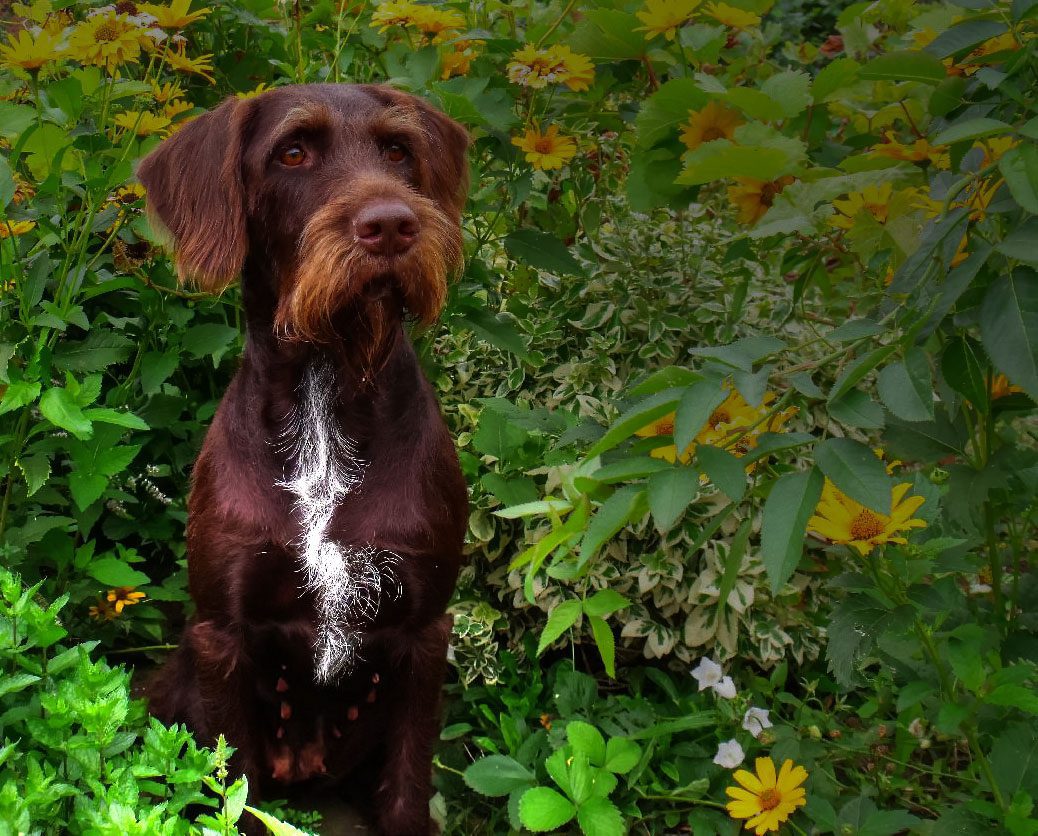
The German Roughhaired Pointer has a calm and balanced character.

Content

History

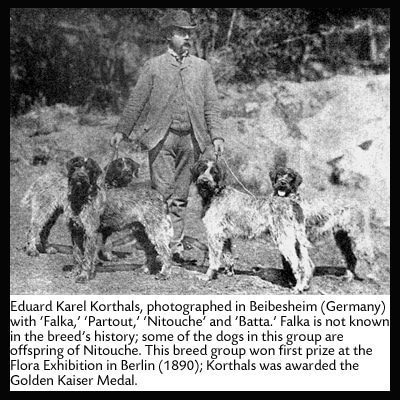
The German Roughhaired Pointer It is the oldest breed of wire-haired dogs. The history of German Roughhaired Pointer goes back many hundreds of years. Already in 1539 this breed of dog could be admired in bronze engravings. In 1888 Hans Von Kaddisch showed that this breed is not a variety of the Shorthaired Pointer Dog, but the wire-haired counterpart of the Old German Wirehaired Pointer, and that it was selected and developed from rare surviving subjects that had survived in Germany.

The breed club, founded in 1892 As the "Club Stichelhaarยซ, changed his name to "Verein Deutsch Stichelhaar" in 1976. Since the beginning, has applied the rules of purebred breeding from the beginning, and excludes any crossing with the English breeds.

Photo: The german pointing dog Deutsch Stichelhaar by Alephalpha, CC BY-SA 3.0, via Wikimedia Commons

Physical characteristics

GERMAN BRISTY-COATED POINKING DOG
German Roughhaired Pointer

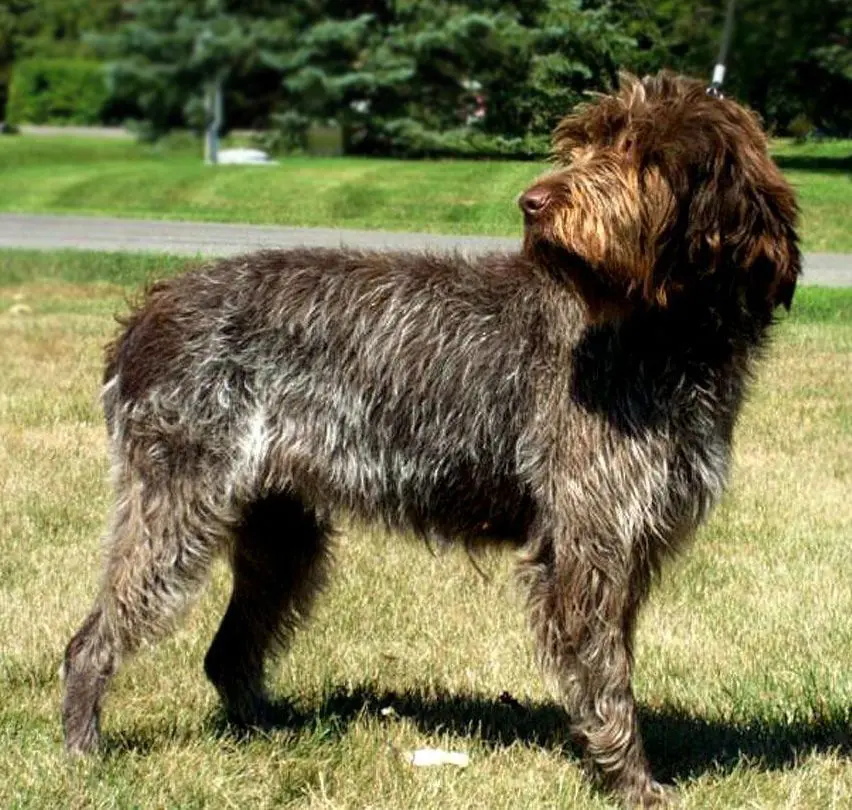
Males reach a withers height of 60 to 70 centimeters. Females are somewhat smaller, growing up to about 58 to 68 centimeters. The weight of a German Roughhaired Pointer it is usually between 20 and 29 kg.

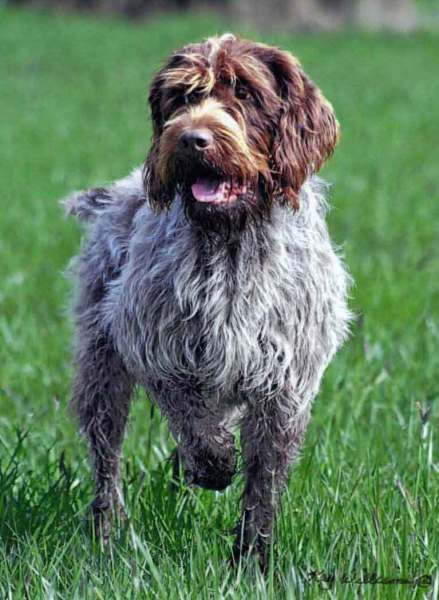
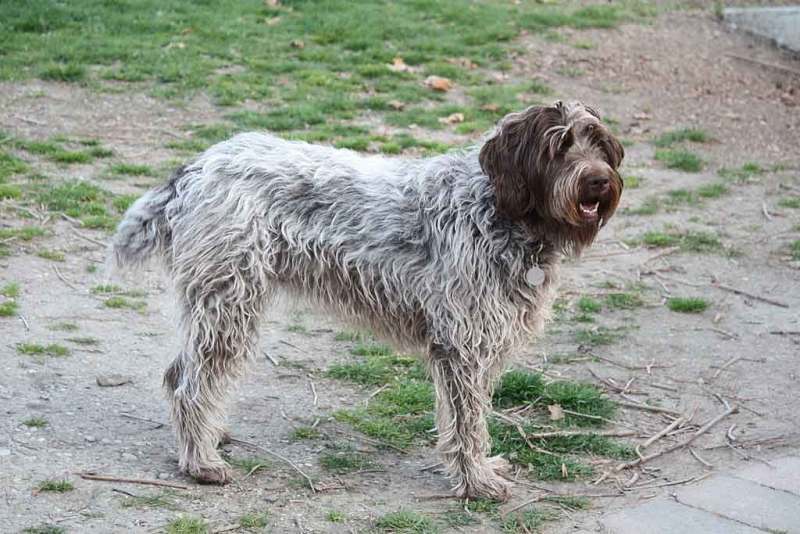
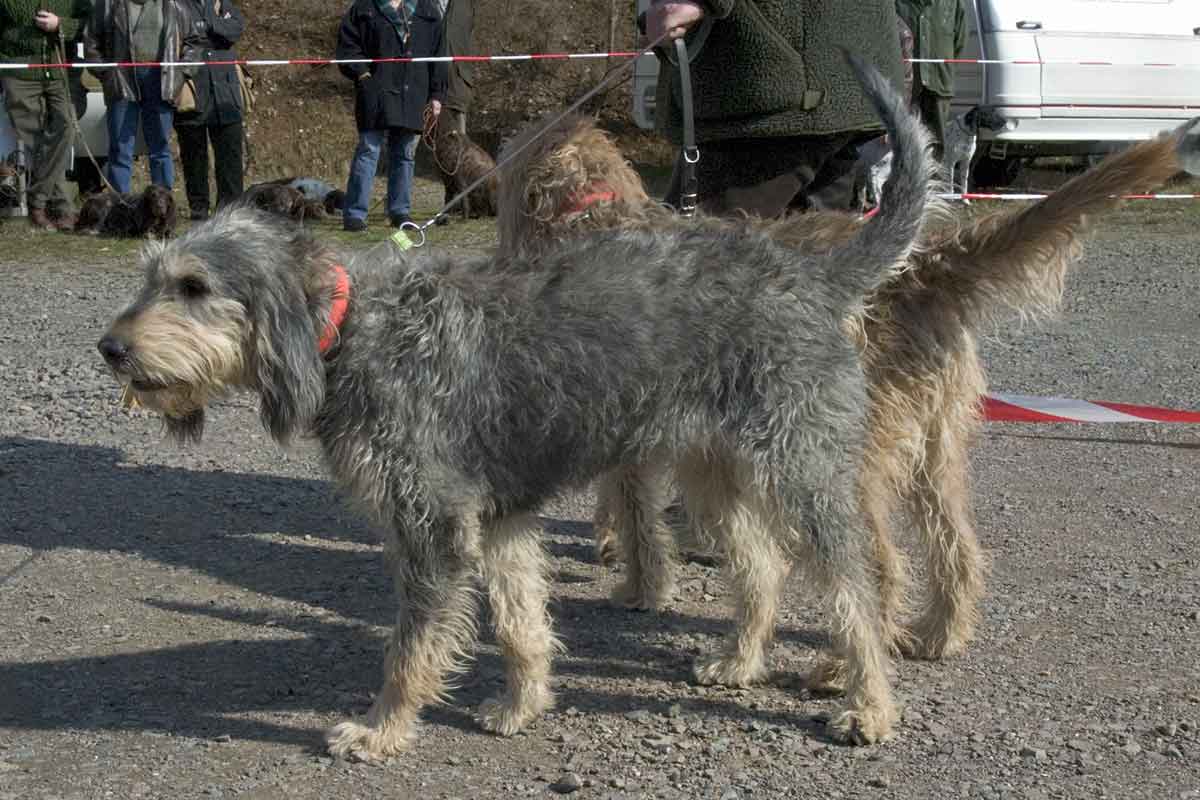
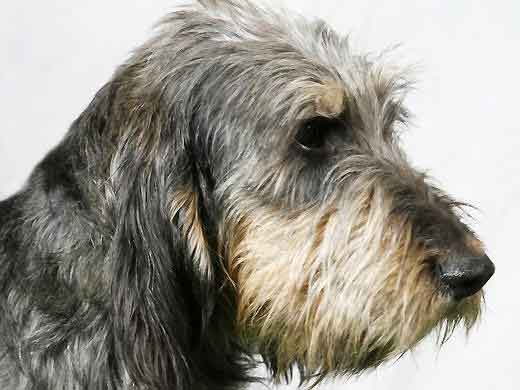
The coat of this dog is hard and bristly. Is loose and has a moderate undercoat. The German Roughhaired Pointer comes in a variety of colors and patterns. They are often solid brown in color, or have a white patch on the chest. There are also light browns and grays. The dog's coat has a few 4 centimeters long.

The structure of this breed of dog is square and strong. He has a straight back line, leaning slightly towards the rump. The skull is widely built and slightly domed. The ears are smooth and hanging and have a high base. The appearance of the German Roughhaired Pointer reminds a German Wirehaired Pointer.

Character and skills

The German Roughhaired Pointer has a calm and balanced character. He is very easy to train and very willing to learn. His alertness and protective instincts are strong, but they can be controlled well.

The temperament of German Roughhaired Pointer it is usually quiet. Your temperament manifests when your abilities are nurtured through regular training. When you bring a German Roughhaired Pointer to your family, you have a new friendly roommate.

Your new pet is neither shy nor aggressive. If you keep your friend busy enough, will be a loyal companion. But, you must make it clear to him that you have the position of leader within the hierarchy. Only then will he be a loyal dog to you.

The German Roughhaired Pointer it is very popular with hunters. But, not suitable as a pure family dog. As this breed of dog is very self-confident, you should also be a strong leader.

Training

The natural instincts of German Roughhaired Pointer can be controlled well with proper training. The best way to do this is to train him to be a hunting dog.. The training of the German Roughhaired Pointer it is much more complex than that of other dogs. Just visiting a normal dog school is not enough. Usually the German Roughhaired Pointer it is only given to hunters for this reason.

Grooming

Health and Grooming

When it comes to grooming, the German Roughhaired Pointer it is similar to many other hunting dogs. So, the amount of grooming required is low. If you brush your four-legged friend's coat once a week, is perfectly enough. The German Roughhaired Pointer it is very robust in health. So, fortunately it is not very susceptible to disease.

Characteristics "German Roughhaired Pointer"

Coexistence is important that you have with your new friend. Before considering the acquisition of a dog of the breed "German Roughhaired Pointer" you know certain factors. Not all breeds of dogs are apt to live in an apartment, you must take into account his character, their need for exercise, their interaction with other pets, their care and if you have small children, their level of tolerance towards them.

Adaptation โ“˜

3,0 of 5 stars (based on 1 review)

friendly dog โ€‹โ€‹โ“˜

4,0 of 5 stars (based on 1 review)

hair loss โ“˜

2,0 of 5 stars (based on 1 review)

Affection level โ“˜

5,0 of 5 stars (based on 1 review)

Need for exercise โ“˜

4,0 of 5 stars (based on 1 review)

Social need โ“˜

4,0 of 5 stars (based on 1 review)

Home โ“˜

2,0 of 5 stars (based on 1 review)

Toilet โ“˜

2,0 of 5 stars (based on 1 review)

Friendly with strangers โ“˜

3,0 of 5 stars (based on 1 review)

barking โ“˜

3,0 of 5 stars (based on 1 review)

Health โ“˜

3,0 of 5 stars (based on 1 review)

Territorial โ“˜

3,0 of 5 stars (based on 1 review)

Cat friendly โ“˜

2,0 of 5 stars (based on 1 review)

Intelligence โ“˜

4,0 of 5 stars (based on 1 review)

Versatility โ“˜

3,0 of 5 stars (based on 1 review)

Child friendly โ“˜

5,0 of 5 stars (based on 1 review)

Surveillance โ“˜

3,0 of 5 stars (based on 1 review)

joy โ“˜

4,0 of 5 stars (based on 1 review)

Videos "German Roughhaired Pointer"

Stichelhaar Dog wide
German Roughhaired Pointer
โ–บ German wire hair [2018] race, Looks & Nature
German Roughhaired Pointer

Type and recognitions:

  • FCI CLASSIFICATION:
  • Group :
  • Section : . .

Federations:

  • FCI – Group 7: Pointing Dogs. – Section 1: Continental Pointing Dogs. 1.1: Braque Type โ“˜

FCI breed standard "German Roughhaired Pointer"

Origin:
Germany

Date of publication of the valid original standard:
29.11.2001

Use:

---


General appearance:

He is a strong pointing dog, medium to large in size with a strong, hard coat and moderate beard.
Clearly accentuated eyebrows give the dog a irascible look. His temperament is calm and balanced.

IMPORTANT PROPORTIONS :

โ€ข The length of the body and the height at the shoulders should be equal if possible..
โ€ข Body length may slightly exceed shoulder height.


Behavior / temperament:

Balanced, quiet, robust, courageous but controlled, neither shy nor aggressive.

Head:

Proportionate to body size and according to sex.

Cranial region:
  • Skull : Slightly rounded, width seen from the side with the highest part of the convexity in the center. Occipital protuberance not too developed.
  • Stop: Gradually ascending fronto-nasal depression, not abruptly.

facial region:

  • Truffle : From light to dark brown, not flesh colored.
  • Snout : Long, strong, half-width. Not pointed. Straight nasal bridge.
  • Lips : They hang closed properly and form a fold at the corner of the lips..
  • Jaws / Teeth : Strong jaws. Teeth with a regular and complete appearance according to the dental formula, scissor bite.

Eyes : Slightly oval, medium-sized, clear, neither protruding nor sunken; eyelids that close tightly around the eyes. They are brown; when the fur is lighter, also the eyes can be lighter, but not yellow.

Ears : Long Middle, in its insertion not too wide, rounded at the bottom edge. High insertion, in all its width and symmetrical. They should not exceed the height of the occiput too much and hang without forming folds, close to the head..

Neck:

Medium length, strong, slightly arched at the nape; gradually widens downward until it is completely inserted into the chest; does not form a double chin.

Body:

  • top line : Straight, something descending.
  • Cross : Clearly marked.
  • Back : Straight, strong, well muscled, hard.
  • Pork loin : Muscular.
  • Rump : It is not too short and slightly descending.
  • Breast : deep rib cage, well accentuated front view. Well arched ribs, never flat.
  • Bottom line and belly : moderately retracted towards the back and strong especially in the flank area.

Tail:

Long Middle, strong at the base and with an insertion not too low. In countries where tail amputation is prohibited by law, it can remain at its natural length.. The length should be up to the joint of the hoof and straight and in any case its carriage with a slight upward curvature.

Tips

PREVIOUS MEMBERS : Seen from the front, rights and parallels, seen in profile well placed under the body. The distance between the elbow and the ground should be slightly greater than the distance from the elbow to the withers.

  • Shoulder : Scapulas placed obliquely, strongly muscled.
  • Forearm : Not too long, heavily muscled.
  • Elbows : No outward or inward deviation.
  • Arm : Strong and straight.
  • Articulation of the carpus : Strongly developed.
  • Metacarpus : Strong and straight.
  • Previous feet : Round, tight. Large, hard pads, well arched nails.

LATER MEMBERS : Viewed from the back, straight and parallel, with strong bones, good muscular. Good tibio-tarsal angulation.

  • Thigh : Muscular, wide with good angulation towards the pelvis.
  • Knee : Strong with good angulation.
  • Leg : Long, muscular and tendon.
  • Warm-foot joint : Strong
  • Metatarsus : Placed under the tibiotarsal joints without being too inclined, but almost straight.
  • Hind Feet : Oval to round with toes close together and tight. Large, hard pads, well arched nails. Placed parallel without turning in or out.

Movement:

Covering the surface well, with good reach and strong thrust, parallel in the anterior and posterior with upright posture.

Mantle

SKIN : Tight, without forming wrinkles.

HAIR : On the body the hair should be tight, duro e hirsuto, placed in the direction of growth, loose and approximately 4 cm long. On the shoulders and lower part of the body the hair is somewhat longer and forms from the throat, down, on the central line of the chest and belly a short stripe or feather. Times, On the body there is a barely visible undercoat.

โ€ข On the snout, the hair forms a moderate beard, on the bridge of the nose the hair is short and coarse, It is not long or soft or falls to the sides. โ€ข On the skull, the hair is well glued, short and hard, above the ears somewhat longer than in the short-haired pointing dog and not as rough as above the skull.
โ€ข The head should be free of both soft and, woolly or silky. The eyebrows are thick and strong and the hair protrudes forward in a slanted and arched manner..
โ€ข On the front part of the forelimbs the short, hard hair is well attached., On the back it forms a somewhat longer feather from the elbow to the metacarpus..
โ€ข The hind limbs, On the back they also have a light feather up to the tibio-tarsal joint.. There are short hairs between the fingers, somewhat softer but should not stand out.
โ€ข The tail should be heavily covered with hair, well attached in the direction of growth. At the bottom the hair is somewhat longer but without forming a brush or flag.-

COLOR ;

โ€ข Brown with or without a white mark on the chest.
โ€ข Mottled brown with or without brown plates.
โ€ข Light mottling with or without brown patches.


Size and weight:

Height of the cross :

  • Males : 60 โ€“ 70 cm.
  • females : 58 โ€“ 68 cm..


Fouls:

Any deviation from the above mentioned criteria is considered to lack, and the gravity of this refers to the degree of deviation to the standard and its impact on the health and well-being of the dog.

โ€ข Heavy or coarse overall appearance.
โ€ข Exaggeratedly large head.
โ€ข Occiput with conical development, overdeveloped occipital protuberance.
โ€ข Flesh or black nose.
โ€ข Ears that are too long, with folds or fleshy.
โ€ข Sunken or steep back.
โ€ข Twisted forelimbs.
โ€ข Elbows markedly tilted outward or inward.
โ€ข Pie plano, open or turned outward, hare foot.
โ€ข Split back hair.

MISS PLAYOFFS :

โ€ข Shyness, afraid of shooting and hunting prey, aggressiveness, biting animal.
โ€ข Prognathism, enognatismo, crossbite, lack of teeth with the exception of two PM1
โ€ข Ectropion, entropion.
โ€ข By blando or semiblando (except for beard and eyebrows)
โ€ข Black fur, yellow or red marks on the head or limbs.

Any dog โ€‹โ€‹showing physical or behavioral abnormalities must be disqualified..


N.B.:

Males should have two normal-appearing testicles fully descended into the scrotum..

Source: F.C.I - International Cynological Federation

Alternative names:

1. German Roughhaired Pointer , Stichelhaar (English).
2. Braque allemand ร  poil raide (French).
3. Stichelhaar (German).
4. (Portuguese).
5. Perro de muestra alemรกn de pelo cerdoso (espaรฑol).

โ–ท The world of Pets: Dogs, cats, birds, reptiles, amphibians

Gordon Setter
Escocia Reino Unido FCI 6 - Setter

Gordon Setter

The name Gordon Setter is due to the Dukes of Richmond-Gordon, creators of the breed

Content

History

Scottish native, the Gordon Setter was called for almost a century Black and Tan Setter, in reference to the color of their fur. Was not up 1924 when its name was changed to The Kennel Club, in memory of the Scottish Duke Alexander Gordon (1743-1827).

The latter played an important role in the development of the breed, creating at the end of the 18th century a hatchery in one of its castles, entirely dedicated to him, which allowed its standardization. Some believe other races also came into play (starting with the Saint Hubert Hound), but at least it is proven that the Gordon Setter is the result of the crossing between English Setter and Colleys. The resulting dogs had various coat colors ranging from black and white to red.. But, the Duke chose to favor black and tan subjects, excluding others from the brood; this explains why all representatives of the breed today wear this coat color.

Like this, the Gordon Setter became popular throughout Scotland and the rest of the UK in the early 19th century, to the point that it was one of the dogs exhibited in the first dog show in modern history, that was held in 1859 en Newcastle. In fact, its ability to adapt to any terrain, even the most rugged, makes you a perfect co-worker for hunting game birds.

Nor did he wait to leave his homeland. Like this, the first import of a Gordon Setter in France it dates back to 1840. Logically, the hunters would have been in charge of taking it to France. Just two years later, in 1842, Rake and Rachel were the first two representatives of the breed to cross the Atlantic and be imported to the United States. Your buyers, George Blunt y Daniel Webster, they acquired the breed directly from the kennel of the 5th Duke of Gordon, son and successor of Alexander Gordon.

The Gordon Setter was one of the first breeds recognized by the Kennel Club, the British organization of reference, since its creation in 1873. It was also one of the first nine breeds recognized by the American Kennel Club (AKC) when it was founded in 1884. But, the other reference organization in the country, the United Kennel Club (UKC), waited until 1949 to do the same. The Fรฉdรฉration Cynologique Internationale (FCI) it took even longer, since it was not until 1963 when he had to do the same.

But, although it is recognized around the world, the Gordon Setter is still a relatively rare breed. In United States, the Gordon Setter ranks 110 (of something less than 200) in the AKC breed classification, based on the number of births registered with the AKC each year, and the trend is for a slight decrease. In France, the number of new annual registrations in the Livre des Origines Franรงais (LOF) has not stopped declining since the 1990s, having reached a peak in the late eighties. At that time there were more than 1.000, but today there are only a few 600, what to compare, for example, with the more than 5.000 of the English Setter.

In the United Kingdom, the Gordon Setter is considered by the Kennel Club as a vulnerable native breed. But, the number of births registered in the organization each year remains relatively stable around 250.

Physical characteristics

The Gordon Setter is a big dog, robust and well muscled. But, there are differences in size between individuals belonging to display lines and those belonging to hunting lines, the latter being significantly smaller.

The general appearance of the Gordon Setter conveys an impression of nobility and dignity. His chest is not very wide in front and his back is strong, rather short, with well arched ribs. His body is of medium length, short from shoulder to hips. Its tail is rather short and can be straight or slightly curved.

The head is taller than it is wide, with a well developed skull. The upper part of the skull is slightly rounded and the stop is well marked. Located at the end of a long snout, his nose is black and wide, with wide open nostrils. Master a strong and regular jaw.

The eyes of the Gordon Setter they are a good size, not too deep not too bulging. Dark brown and shiny, give it a lively look. Looking at your ears, they are falls, medium size and fine. They are set low and worn close to the head.

Like others Setters, the coat is soft and shiny, smooth or slightly wavy, but it should not be curly. It is of medium length over most of the body. But, is short on the top of the head and on the front of the legs, long and silky at the top of the ears, long and thin on the back of the hind legs. Last, on the belly forms a strip that can extend across the chest and throat.

Its fur is bicolor, mixing deep charcoal black and shiny chestnut. The border between black and brown must be clearly defined.

It also, chestnut-red markings can be seen in different places on the body. This is the case, in particular, above the eyes, with two spots that do not exceed 2 cm each. They are also found in the throat and on each side of the muzzle. They should not exceed the base of the nose; look like a band around the end of the muzzle. There are also two large chestnut-red spots on the chest.

Tan markings are also present on the inside of the hind legs, spreading out from the paws to the toes. They are also present on or slightly above the front legs and around the anus.

Some individuals also have a white patch on the chest and/or black spots on the toes and under the jaw..

Last, sexual dimorphism is not very pronounced, since males are not normally taller than 4 cm more at the withers than females.

Height and weight

    ▷ Male size: Of 66 to 66 cm.

    ▷ female size: Of 62 to 62 cm.

    ▷ Male weight: 29 kg

    ▷ female weight: 25 kg

Character and skills

The Gordon Setter He is a kind and very affectionate companion with his master. He is quite energetic in his youth, but it becomes much calmer as an adult.

It is an ideal dog especially with children, with whom he is tolerant and protective, and with whom he enjoys playing. But, given its size, it is better if they are already a certain age, as you will soon be able to involuntarily push them. In any case, regardless of race, a dog should never be left alone with a small child, that is to say, without adult supervision. In fact, An accident can happen at any time if you misinterpret a child's behavior and think that they are attacking. The risk of unfortunate consequences - even very serious ones- is even greater with an animal of that size, that could unintentionally upset a young child.

The close bond with the family can become problematic and can be counterproductive if the family has to be away from home often and/or for long periods of time. The dog is very likely to develop separation anxiety, what can lead to destructive behavior, escape attempts or excessive moaning.

You're also likely to be upset if you can't exercise for at least an hour a day. Although it is not at all suitable for an elderly and / or very sedentary person, it is an ideal companion for the owner of a dog who dreams, for example, with jogging with your dog, ride a bike with him or take him for long walks. But, it is essential that the rappelling process is mastered so that the dog can run without a leash, as his hunting instinct can take over at any time. He also likes games and loves to swim and play in the water.

If he is walked several times a day and his important need for exercise is satisfied, the Gordon Setter it is quiet and peaceful inside the home, able to live both in the city and in the country, and easily adapts to apartment living. If you live in a house with a garden, we must ensure that it is well fenced, since he is a fugitive by nature. Using an underground electric fence would not be an effective solution, since your determination is much stronger than the discomfort caused by electrical impulses, especially when it has sniffed a prey. In any case, it cannot be a question of making him live outside. In fact, to be happy and balanced, needs to be surrounded and interact with their masters, to feel like he is a full member of the family pack.

Although at Gordon Setter he likes to be surrounded, you greatly prefer to be around people you know or, at least, of other animals that you are used to seeing. On the other hand, he is quite suspicious, reserved and impassive with strangers, not hesitating to bark if it perceives the slightest danger. So, can be a good watchdog. They are also sometimes aggressive towards other dogs they meet for the first time.. In fact, is often a dog with a dominant temperament, who therefore wishes to seize his companions. A thorough socialization started at a very young age is de rigueur so that you learn to respect them.

But, coexistence with other animals in the home is not impossible, and having a playmate is a good way to avoid boredom in the absence of their masters. In fact, if they have grown up together, everything usually goes very well. On the other hand, the arrival of a new animal at home is only possible if it is used to living with other animals since childhood. If that is not the case, your hunting instinct is likely to lead you to regard the newcomer as prey. The same goes for the animals you see outside, especially those who venture into your garden.

His dominant character, independent and determined can also be a source of problems in the relationship with his master, if he does not know how to impose himself and make his dog respect him. A firm education is essential to prevent him from becoming difficult to handle., doing what he pleases.

Education

The socialization of Gordon Setter should be done at a young age, period when learning is easier, since it is more malleable and adaptable. Thus, it is necessary to get used as often as possible to meet new people and to face all kinds of situations and external stimuli (noises, smells, vehicles…). On the other hand, it is just as essential to teach them to tolerate loneliness, so your teacher's absences don't become a problem later. These two aspects are essential requirements to achieve a balanced and serene companion.

Given its size and its significant need for maintenance, it is convenient to get used to being handled without flinching from an early age, otherwise he will have problems when he is an adult. In view of his strong hunting instinct, learning to remember your dog is at least as important as basic commands ("Sit down", "walk", "stay", etc.). This allows the dog to shed without having to worry too much, which makes it easier for him to exercise by himself and, Therefore, make you feel comfortable. Of course, this is especially important if it is used as a hunting dog. As long as I don't obey this order, must be carried on a leash when walking.

It also, the Gordon Setter it is an intelligent breed of dog and learns quickly. But, as is often the case with intelligent dogs, They are not the kind that take for granted: with a strong character, can quickly become very stubborn. This means that, to be obedient, You have to give him a firm education to prevent his intelligence from turning against his master and getting the best of him as soon as he gets home. But, do not punish your dog in any way when he does something wrong: as the Gordon Setter not really receptive to reprimands, it is better to opt for the positive reinforcement method, with the help of treats in particular.

Last, if it is intended to be used for hunting, the report and the notion of resignation are added to the reminder as indispensable teachings. In effect, must be able at all times to return when his master calls him, to catch a prey without biting it and to give it up if its owner asks.

Health

The Gordon Setter is generally in good health.

But, may be exposed to various pathologies of varying severity, as :

  • The stomach dilation-torsion syndrome, common to most large breeds of dogs and can lead to rapid death of the animal if not attended to quickly;
  • The hip and elbow dysplasia, also common in large dogs. Produces pain and lameness caused by inflammation of the joints, which can lead to osteoarthritis.
  • The progressive retinal atrophy, an inherited disease that causes retinal degeneration and can lead to total loss of vision;
  • The Hypothyroidism, a hormonal disorder responsible for many symptoms that vary from person to person;
    ear infections, due to the drooping shape of their ears;
  • The abiotrofia cortical cerebelosa, a severe inherited neurological disease due to premature degeneration of cerebellar cells. If adopted from a breeder Gordon Setter, DNA test results should be requested to establish that the puppy does not have the gene responsible for this disease. In any case, a worthy breeder does not breed an individual with a genetic disease. In the case of adoption by another route, DNA testing can be done before taking the plunge, in order to rule out this risk.

It also, as with all large breeds, It is strongly recommended to avoid subjecting a puppy to Gordon Setter to excessive physical exertion. In effect, it is very fragile during its growth, especially at the level of your bones and joints. The utmost care must be taken during this period.

Life expectancy

13 years

Grooming

The coat of the Gordon Setter requires special care and maintenance. Brushing two to three times a week with a brush or glove is essential for the sebum to be well distributed throughout the coat., removing dead hairs and preventing them from tangling. Although hair loss is moderate, brushing should be daily, during the seasonal moult in spring and fall. It is also necessary to wash the dog once every one or two months to avoid bad smells and clean its coat: due to hair length, tends to collect dirt easily. But, you must be careful not to wet the inside of their ears, as it is easily prone to ear infections.

It also, the hair between the pads and inside the ears should be trimmed once a month to reduce the risk of infections caused by small plants or spikelets that could get stuck in the pads.

It also, pay special attention to your ears. Like any dog โ€‹โ€‹with floppy ears, are at increased risk of infections (otitis, etc.). So, should be inspected and cleaned at least once a week, and ideally every time the dog comes into contact with water, for example during a hunting trip or after bathing. This is also an opportunity to check your eyes and clean them if necessary..

Looking at your teeth, cleaning is necessary at least once a week, as for all other dogs. Regular use of a dog toothbrush or finger pad will help limit tartar and bad breath..

Last, given your level of activity, natural wear and tear is usually enough to trim the claws of the Gordon Setter. But, as you get older or don't walk enough, claws can become too long and become a nuisance or even injury. If this happens, must be trimmed with a special file or nail clippers. If the owner is not very comfortable with this maintenance task, you can ask your vet to do it or, at least, teach him how to do it so he can do it himself.

Use

Born hunter, the Gordon Setter has long been used as a hunting dog and as a pointing and collecting dog. Although they are not very fast compared to others Setter, their stamina and keen sense of smell make them excellent woodcock hunters, partridges and retrievers.

Today, although they are still used primarily as bird hunting dogs, they are also increasingly found as companion and show dogs. His calm character, gentle and affectionate makes them very endearing pets, as long as their owners are able to satisfy their need for exercise.

Their loyalty to their owners and their distrust of strangers also make them excellent watchdogs.. So, it is also a good companion for canicross, canine mountain biking or any other sporting activity, thanks above all to its resistance and its robust character.

Last, its elegance, as well as his noble attitude, also make him a competitor of choice in canine beauty contests.

Price

The price of a puppy Gordon Setter varies between the 700 and 1200 euros in Europe .

Regardless of location, price differences from one individual to another are explained by their greater or lesser conformity with the norm, as well as by their sex: males are significantly more expensive than females.

Characteristics "Gordon Setter"

Coexistence is important that you have with your new friend. Before considering the acquisition of a dog of the breed "Gordon Setter" you know certain factors. Not all breeds of dogs are apt to live in an apartment, you must take into account his character, their need for exercise, their interaction with other pets, their care and if you have small children, their level of tolerance towards them.

Adaptation โ“˜

2,0 of 5 stars (based on 1 review)

friendly dog โ€‹โ€‹โ“˜

4,0 of 5 stars (based on 1 review)

hair loss โ“˜

3,0 of 5 stars (based on 1 review)

Affection level โ“˜

5,0 of 5 stars (based on 1 review)

Need for exercise โ“˜

5,0 of 5 stars (based on 1 review)

Social need โ“˜

3,0 of 5 stars (based on 1 review)

Home โ“˜

3,0 of 5 stars (based on 1 review)

Toilet โ“˜

3,0 of 5 stars (based on 1 review)

Friendly with strangers โ“˜

2,0 of 5 stars (based on 1 review)

barking โ“˜

3,0 of 5 stars (based on 1 review)

Health โ“˜

3,0 of 5 stars (based on 1 review)

Territorial โ“˜

2,0 of 5 stars (based on 1 review)

Cat friendly โ“˜

2,0 of 5 stars (based on 1 review)

Intelligence โ“˜

3,0 of 5 stars (based on 1 review)

Versatility โ“˜

3,0 of 5 stars (based on 1 review)

Child friendly โ“˜

4,0 of 5 stars (based on 1 review)

Surveillance โ“˜

2,0 of 5 stars (based on 1 review)

joy โ“˜

5,0 of 5 stars (based on 1 review)

Images "Gordon Setter"

Photos:

1 – The picture shows a Gordon Setter in the typical work of the race in the field. by Nordic-Gordon-Hunters, CC BY-SA 3.0, via Wikimedia Commons
2 – Gordon Setter by richkidsunite
3 – Gordon Setter at a dog show in Konopiska, Poland. by Pleple2000, CC BY-SA 3.0, via Wikimedia Commons
4 – Gordon Setter at a dog show in Konopiska, Polonia by Pleple2000, CC BY-SA 3.0, via Wikimedia Commons
5 – Gordon Setter by https://pixabay.com/photos/dog-setter-gordon-animal-pet-4320937/
6 – Gordon Setter by https://pixabay.com/photos/dog-setter-gordon-animal-pet-4320945/

Videos "Gordon Setter"

Type and recognitions:

  • FCI CLASSIFICATION:
  • Group :
  • Section : . .

Federations:

  • FCI – Group 7: Pointing Dogs. – Section 2: British and Irish Pointers and Setters. 2.2: Setter โ“˜
  • AKCSporting โ“˜
  • โ€‹KC – Gundog โ“˜
  • UKCGun Dogs โ“˜

FCI breed standard "Gordon Setter"

Origin:
United Kingdom

Date of publication of the valid original standard:
14.06.1987

Use:

Pointing Dogs.


General appearance:

It is an elegant dog with features that denote speed. It has a harmonious constitution that can be compared to that of an efficient hunting horse.. In symmetrical ways in all respects.


Behavior / temperament:

Intelligent, skillful and noble. Intrepid, bold and affable and stable character.

Head:

The head is rather deep than wide. The distance between the occiput and the stop is greater than that between the stop and the nose. The area around the eyes should be thin.

Cranial region:
  • Skull: Slightly round, being the widest point between the ears. Wider than the muzzle, with good cranial cavity.
  • Depression links (Stop): Clearly defined.

facial region:

  • Truffle: Grand, wide, black; with open nostrils.
  • Snout: long, of almost parallel lines; it is not pointed or sharp. Not so deep how long.
  • Lips: The lips should not hang down and the lips should be clearly defined.
  • Jaws / Teeth : Strong jaws with healthy teeth, complete and scissor bite, that is to say, that the internal face of the upper incisors is in contact with the external face of the lower incisors, the teeth being placed perpendicular to the jaws.
  • Cheeks: The cheekbones are as narrow as the thinness of the head allows.

Eyes: Dark brown and bright. They must not be protruding or sunken; well positioned under the brow ridges, with a cunning and intelligent expression.

Ears: Ears should be medium in size and thin. Their implantation is low and they must be worn next to the head.

Neck:

Long, delgado, arched and without dewlap.

Body:

Moderate long.

  • Pork loin: Wide and slightly arched.
  • Breast : deep and not very wide. The ribs are well arched and well developed backwards.

Tail:

Straight or slightly scimitar-shaped, without exceeding the hocks and carried horizontally or below the dorsal line. It is thick at the base and gradually decreases in thickness to the tip. It has long, straight hair in the shape of a fringe or flag near the base, which decreases in size as it reaches the tip.

Tips

PREVIOUS MEMBERS: Front limbs are flat bone, straight and strong.

  • Shoulder: The scapulae are long and well sloped back, flat and broad bone, together in the region of the cross without being loaded.
  • Elbows: Well lowered and close to the body.
  • Metacarpus: Vertical.

LATER MEMBERS: They must be long, wide and muscular from hips to hocks, short and strong from hock to foot and straight from tibio-tarsal joint to floor. The pelvis tends to be horizontal.

  • Knees: Well angulated.

FEET: Oval, tight, with well arched fingers well provided with hair between them. Well-developed finger and foot pads.

Movement:

Firm movement, free and natural, with powerful impulse in the hind limbs.

Mantle

HAIR: The hair of the head, the front edge of the limbs and the tips of the ears is short and fine; in the rest of the body it has a moderate length, it is smooth and without waves or curls. The fringed hair at the top of the ears is long and silky; on the back of the hind limbs the fringe hair is long, fine, smooth and straight. The belly bangs can be extended to the chest and throat, and if possible they should not be curly or wavy.

COLOR: Deep shiny black, no reddish tones oxides, with brownish-red spots, that is to say, bright tan color. Fine black spots are allowed on the fingers and black streaks under the jawbone.

Tan stains: Two distinct spots on the superciliary areas with a diameter of no more than three-quarters of an inch. (2 mm.). On the sides of the muzzle tan spots no higher than the base of the nose, and resemble a band that surrounds the well-defined end of the muzzle.

On the throat and on the chest two large and defined spots; on the inside of the hind limbs, as well as in the thigh, can extend to the knee and extend to the outside of the hindquarters from the hocks to the toes; in the forelimbs up to the elbow on the inside and slightly above the carpus in front; fire spot around ear. A small white spot on the chest is allowed. Other colors are not allowed.


Size and weight:

Height of the cross: In males it should be 66 cm.. (26 inches) and in females 62 cm.. (24 ยฝ inch).

Weight: In males it should be 29,5 kg (65 English pounds) and in females 25,5 kg (56 English pounds).


Fouls:

Any deviation from the aforementioned criteria is considered as a fault and the severity of this is considered to the degree of the deviation to the standard and its consequences on the health and well-being of the dog., and the dog's ability to perform its traditional task.

FALTAS DESCALIFICANTES:

โ€ข Aggressiveness or extreme shyness.
โ€ข Any dog โ€‹โ€‹showing clear signs of physical or behavioral abnormalities.


N.B.:

โ€ข Males must have two normal-appearing testicles fully descended into the scrotum..
โ€ข Only functionally and clinically healthy dogs, with the typical conformation of the breed, should be used for parenting.

Source: F.C.I - International Cynological Federation

Alternative names:

1. Black and tans (English).
2. Setter Gordon (French).
3. Gordon Setter (German).
4. Setter gordon (Portuguese).
5. Setter escocรฉs (espaรฑol).

โ–ท The world of Pets: Dogs, cats, birds, reptiles, amphibians

Gascon Saintongeois
Francia FCI 21 - Large-sized Hounds

Gascรณn Saintongeois

His great passion is hunting, therefore it is advisable for those who practice it.

Content

The Gascon Saintongeois he is a strong sporting dog, confident and robust that was invented in France in the mid-19th century. His sweet and good-natured character makes him an excellent family dog รขโ‚ฌโ€นรขโ‚ฌโ€นthat is very careful when interacting with young children.. Today the breed remains unpopular even in its native country., so it can disappear completely in a matter of several decades.

Gascon Saintongeois History

In the mid-19th century, Carayon-Lantour Joseph Earl wanted to regenerate the dog breed of Saintonge, weakened as a result of the French Revolution (they only survived 3 These copies) and united the last descendants with Blue Gascony dogs owned by the Baron de Ruble. Thus was created the Gascon Saintongeois, but that creation, caused the disappearance of Saintonge's dog.

This breed of dog, It was developed, in its origins, mainly for hunting, greater and hares.

Physical characteristics Gascรณn Saintongeois

It is a very well established dog, It conveys an image of strong dog, but elegant at the same time. Their fur is short and dense, white background, with black spots; It may be mottled, but slightly. They usually have two black spots on each side of the head covering the ears, surrounding the eyes and cheeks-reach. The cheeks are color fire, but soft (as clay). They have, also two spots in that color, on top of the eyes, What gives them the appearance of having four eyes.

There is also the Petite Gascon Saintongeois, that shares the characteristics of Gascon Saintongeois, but its dimensions are smaller (measured 54 and 62 height cm). It is also a versatile Hunter, but above all of hares, but also, used to be used for hunting big game.

Gascon Saintongeois character and skills

The Gascon Saintongeois, is a pack dog, from its origins, has a highly developed sense of smell, is bold, and has a nice bark.

It can become the ultimate companion to any hunter, but it also has all the essential qualities to play the role of a family dog. It has a peaceful and adaptable nature and normally perceives its owners as members of its pack.. Early and thorough socialization is necessary if you want your pet to be tolerant of children in the family and other animals in the house.. The breed is usually very gentle with young children although it is large enough to knock a young child down in the heat of play..

Human aggressiveness can become a serious problem if your Gascon Saintongeois not adequately displayed to people of all ages from a young age. But, this dog is commonly courteous to house guests and resorts to violence only in an extreme case. Thanks to his unsurpassed vigilance and deep sonorous voice, he is an excellent watchdog.. In general, this dog has no desire to defend his territory, so it cannot be considered a good guardian.

The Gascon Saintongeois welcomes any opportunity to communicate with peers and, in fact, prefers to live in a large canine group. But, may be ill-disposed towards unfamiliar homeless canines and the owner should take this character trait of his pet into account and keep him on a leash in public places. The breed is not compatible with other types of pets due to its powerful hunting instinct. But she is usually friendly with the individual cats she has been raised with from a young age as a puppy..

Gascon Saintongeois Toilet and Care

The toilet of the Gascon Saintongeois requires a minimum of effort. His short self-cleaning coat should be brushed regularly but infrequently (only once a week). This procedure will effectively remove loose hair and reinforce the natural shine of the dog's coat.. This breed only needs an occasional bath.

Since this bloodhound is predisposed to ear infections, the caregiver should periodically examine their ears and clean them if necessary. Trim your pet's nails at least once every two months and clean their teeth weekly.

Gascon Saintongeois Education and Training

The Gascon Saintongeois It is an obedient and intelligent dog whose training is usually a piece of cake. Learns basic tricks with a reasonable amount of repetitions and succeeds in agility and obedience tests. Keep in mind that his character is stubborn and will ignore the orders of a shy person.

It also, the breed is irresponsible to negative training methods and reacts appropriately only to food incentives and kind words. Like any hound, tends to distract from the learning process by attracting smells, so be lenient with your pet's behavior.

Gascรณn Saintongeois Exercise

The Gascon Saintongeois is notable for both its incredulous stamina and great power, so you need a lot of physical activity. This large dog is not appropriate to be kept in an apartment where there is no room to play. At the same time it is strong enough to become a wonderful companion for runners or even cyclists..

Your pet should have the daily opportunity to run unrestricted in a well fenced yard, otherwise you may become hyperactive and totally undisciplined on the inside. Without a lot of vigorous daily exercise, the Gascon Saintongeois it can also develop into an unreasonable barking habit.

Videos "Gascon Saintongeois"

HTTPS://youtube.com/watch?v=FaejbradvYs
Gascon Saintongeois – Dog breeds
HTTPS://youtube.com/watch?v=TW6XQ62z03k
Gascon Saintongeois

Type and recognitions:

  • FCI CLASSIFICATION:
  • Group :
  • Section : . .

Federations:

  • FCI – Group 6: Scent hounds, and related breeds. – Section 1.1: Large-sized Hounds. โ“˜
  • Central Canine Society โ“˜

FCI breed standard "Gascon Saintongeois"

Origin:
France

Date of publication of the valid original standard:
06.03.2007

Use:

Gran Gascon Saintongeois: Used for rifle hunting and sometimes for small game, big game and also hare. It is generally used in a pack or alone, as a tracker. Pequeรฑo Gascon Saintongeois: Multi-purpose dog used for rifle hunting. Because of its origin it hunts especially the hare, but it is also very good for hunting big game.


General appearance:

Gedge: Very well built dog, which gives at the same time an impression of strength and elegance. He is of a very French type when it comes to the head, fur and expression.

Psmall: Medium-sized dog, well proportioned and distinguished.

PROPORCIONES IMPORTANT:

Height at withers/scapulo-ischial length in a ratio of 10/10.5 The length of the muzzle is equal to the skull.


Behavior / temperament:

Pack dog par excellence, up to the sense of smell, bold, gifted with a beautiful voice. He joins the pack by instinct. It's calm, affectionate and obeys orders easily.

Head:

The lines of the skull and the nasal passage are divergent.

Cranial region:
  • Craging: Seen from the front, It is arched and rather narrow; the occipital protuberance is well marked. Seen from above, the back has a pronounced ogival shape.
  • Dnaso-frontal depression: Little pointed.

facial region:

  • Trufa: black, well developed, the windows wide open.
  • Labios: They cover the lower jaw, the corner is discreet. The edge of the lips is black.
  • Cnasal year: Powerful, slightly arched.
  • Jaws: Scissor joint. The incisors are at right angles to the jaws..
  • Cheeks: Thin.

OJOS: Oval, browns. The edge of the eyelids is black. The expression is sweet and confident.

OREJAS: Fine, bent. They must reach at least the end of the truffle. They occur below the eye line, quite far back, leaving the skull very clear.

Neck:

Of medium length and thickness. It is slightly arched and has little dewlap.

Body:

  • lynand the top: It is firm and not excessively long.
  • Lomo: It is well attached to the body. It is slightly convex, quite muscular and not too long.
  • Glikeness: Slightly oblique, wide enough.
  • Pecho: Large, long, descends to the level of the elbows. The front part of the chest is quite open.
  • Costillas: Slightly rounded and long.
  • Flank: It's a little raised.

Tail:

It is thick at the base; very thin at its end. Reaches to the tip of the hock. The elegant bearing, Sabre-shaped.

Tips

PREVIOUS MEMBERS:

  • Ageneral appearance: The previous room is powerful.
  • Hshoulder: Rather long, muscular, moderately oblique.
  • Elbow: Well adhered to the body.
  • Aforearm: Strong bones.
  • Pinis previous: Slightly elongated oval shape. The fingers are thin and close together. The foot pads and nails are black.

LATER MEMBERS:

  • Ageneral appearance: The hindquarters are well proportioned.Thighs: Long and well muscled.
  • Corvejรณn: Width, well angled. Well inclined, visibly directed towards the axis of the body.
  • Pinis later: Slightly elongated oval shape. The fingers are thin and close together. The foot pads and nails are black.

Movement:

Uniform and loose.

Mantle

PIEL: Stretchy and not too thick. It is white with black spots.

Plink: Short and dense.

Codor: The background is white, with black spots; sometimes it is speckled, although not in excess. Two black spots are usually present on each side of the head.; cover the ears, surrounding the eyes and cheeks-reach. The cheeks are color fire, preferably pale. Two fire-colored brands, located on the top of the eyebrows, They simulate โ€œfour eyesโ€. They are also observed, tan traces on the inner surface of the ear and specks along the extremities. Some tawny hairs may appear on the top of the ear, without this giving the head a tricolor appearance. Sometimes a typical dead leaf spot is observed on the lower part of the thigh., known as โ€œroe deer markโ€.


Size and weight:

Altura to the cross:

Gedge: Males: 65 to 72 cm..
  Hblaze: 62 to 68 cm..
Psmall: Males: 56 to 62 cm..
  Hblaze: 54 to 59 cm..

With a tolerance of approximately 1 cm..


Fouls:

Any deviation from the aforementioned criteria is considered as a fault and the severity of this is considered to the degree of the deviation to the standard and its consequences on the health and well-being of the dog..

Cthey are not coming:

  • Short.
  • Wide skull.
  • Short ears; ears that stand high.
  • Total absence of fire color.

Cfamily:

  • Absence of volume
  • Sagging top margin.
  • sunken croup.
  • Deviated tail.

Members:

  • Bone structure that is not sufficiently developed
  • Shoulders that are too oblique or too straight.
  • crushed feet.
  • Straight posterior angulation.
  • closed hock, seen from behind.

FALTAS DISQUALIFYERS:

  • Aggressiveness or extreme shyness.
  • Any dog โ€‹โ€‹showing clear signs of physical or behavioral abnormalities.
  • Lack of type, and in particular wide and round skull.
  • Upper or lower prognathism.
  • Clear eyes
  • Any other layer other than that established in the standard.


N.B.:
  • Males should have two normal-appearing testicles fully descended into the scrotum..
  • Only functionally and clinically healthy dogs, with the typical conformation of the breed, should be used for parenting.

Source: F.C.I - International Cynological Federation

Alternative names:

1. Grand Gascon Saintongeois (English).
2. Gascon de Saintonge, Grand gascon saintongeois (French).
3. Grand Gascon Saintongeois (German).
4. Gascon Saintongeois (Portuguese).
5. Gascon Saintongeois (espaรฑol).

โ–ท The world of Pets: Dogs, cats, birds, reptiles, amphibians

Great Anglo-French Tricolour Hound
Francia FCI 322 - Large-sized Hounds

Great Anglo-French Tricolour Hound

The Great Anglo-French Tricolour Hound is considered rare, very little spread outside of France and currently little used even in your country.

Content

The Great Anglo-French Tricolour Hound is a large and powerful sporting dog with its origin in France. He is praised for his incredible stamina, work skills and ability to operate on any type of terrain and for any weather condition. This breed is poorly adapted to apartment living due to its high exercise requirements. This type of Anglo-French hound is considered the most powerful.

Photo: This dog is one of a pack of Grand anglo-franรงais tricolore by Alephalpha, CC BY-SA 3.0, via Wikimedia Commons

History Great Anglo-French Tricolour Hound

The origin of the Anglo-French hound dates back to the 19th century, when hunting with large packs was at its height in France. However, the exact date of its development remains unclear, since the crossing of the French hound with various types of English hounds was a common practice in this country since the 16th century.

French hunters cared little for the appearance or pedigree of their dogs as long as they demonstrated unparalleled hunting prowess.. That is why these hounds were perceived more like stray dogs until the 20th century. The situation changed when in 1957 the breeders decided to organize the dogs according to their ancestry. His efforts resulted in the appearance of seven unique French breeds of sizes, coat texture and distinctive colors. The Great Anglo-French Tricolour Hound appeared as the result of the crossing of native French dogs, in particular the Poitevin hound and the Gascon Saintongeois and the English Foxhound. The breed is very rare, little used and virtually unknown outside of mainland France.

The word "Grandยป was put in front of the breed name because it was used to hunt large game and functioned predominantly in packs of several dozen other canines. The Great Anglo-French Tricolour Hound is characterized by its resonant voice, his keen sense of smell and his relentless pursuit. This brave and passionate hunter will never be hampered by difficult terrain and harsh weather and can work for numerous hours without breaks.. The packs of the Anglo-French hounds They generally specialized in hunting roe deer and wild boar., although they could also hunt foxes and other small game animals.

Currently members of the breed are mostly active hunters as this dog is not suitable for the role of pet or show dog.. Its population was concentrated almost exclusively in its native France, where it is also considered a rare breed. But, the Great Anglo-French Tricolour Hound has the recognition of the Fรฉdรฉration Cynologique Internationale (FCI) and in 2006 was officially recognized by the United Kennel Club (the UKC).

Physical Characteristics Great Tricolor Anglo-French Hound

The Great Tricolor Anglo-French Hound should appear elegant and almost old-fashioned in appearance. They must be robust, with a deep chest and a straight back that is supported by straight, muscular limbs. His broad skull has an obvious stop, while its square-shaped snout should contain a full set of teeth that meet in a scissor bite. Her big brown eyes, its pendulous ears and prominent black nose are all characteristic features of a scent hound. Its long, thin tail tends to have a white tip.

as its name suggests, it is a tricolor breed with white fur, fire and black. Its double coat is short and soft. Dogs measure between 60 and 70 cm in height to the cross, generally weigh between 30 and 35 kg. Your walk should be effortless and a pleasure to behold.

Character and skills Great Anglo-French Tricolour Hound

The Great Anglo-French Tricolour Hound he is a magnificent sporting dog, that is very rarely used only as a pet. It gets used to living in large packs of other canines and requires a spacious yard to unleash its exuberant nature.. Some fans of the breed claim that their well-socialized specimen is fine with children. In any case, this vigorous and strong dog will not make an acceptable playmate for a young child.

The breed often demonstrates unwavering loyalty and affection towards their favorite people, but he stays quite distant from strangers. But, a Great Anglo-French Tricolour Hound well educated will treat a new person with essential courtesy. Usually does not express enough interest in protecting its territory to be an effective watchdog. At the same time, some specimens can make good watchdogs. This breed definitely won't make any use of it in the guard dog role anyway due to its non-aggressive disposition..

The Great Anglo-French Tricolour Hound was bred to live and work with other dogs and usually yearns to have several permanent canine companions. He does quite well with strange dogs although he will not back down from confrontation if provoked. That is why this dog should always be kept on a leash while walking. Being a tenacious and reliable hunter, it can show high aggression towards other species of animals., especially towards homeless cats. It is possible to introduce this dog into the house with other non-canine pets while it is still a friendly and inquisitive pup.

Health of the Great Anglo-French Tricolour Hound

The most common problems for the breed include:

– canine hip dysplasia;
– patella dislocation;
– arthritis;
– frequent muscle tension;
– chronic ear infections;
– hearing problems;
– cryptorchidism;
– gastric torsion.

Caring for the Great Anglo-French Tricolour Hound

The Great Anglo-French Tricolour Hound should receive fairly basic maintenance. The owner should brush his dog a couple of times a week to keep his short, sleek coat in a healthy condition. The dog's nails should be trimmed monthly.

After every hunting trip, the coat and ears of a working specimen should be thoroughly examined for signs of ticks and other external parasites. The breed easily picks up various ear infections, so they need regular and careful cleaning. The Great Anglo-French Tricolour Hound he is a moderate biter.

Training of the Great Anglo-French Tricolour Hound

The training of the Great Anglo-French Tricolour Hound usually requires an average investment of time and effort. In fact, takes on a very natural hunting behavior and will effectively carry out its original hunting duties with a minimum of training. At the same time, is characterized by a certain streak of stubbornness and will not follow the orders of a week or an indecisive person. This dog usually has a strong desire to impress its owner and easily learns basic commands.

Breed training should be done exclusively with reward-based methods, with an emphasis on the dog's favorite treats. The Great Anglo-French Tricolour Hound will not put up with abusive or disrespectful treatment and will respond to it with even more obstinacy and disobedience.

Exercise with the Great Anglo-French Tricolour Hound

The Great Anglo-French Tricolour Hound is an extremely vigorous working dog, accustomed to very intense physical exercise. When not hunting, he must be given the opportunity to expend his excessive energy. This dog is an infamous cat hunter, so it should never be released without a leash until it is in a closed and secure area.

During the hunting season it is advisable to offer the dog some type of exercise that emulates its hunting behavior.. It is worth remembering that if the Great Anglo-French Tricolour Hound lacks opportunities to vent, will gradually turn into a rebellious animal, hyperactive and destructive.

Videos "Great Anglo-French Tricolour Hound"

HTTPS://youtube.com/watch?v=TQlS7Fba0i0&feature=emb_logo
Pack of Anglo Saxons hunting wounded boar
HTTPS://youtube.com/watch?v=iOVr7Al5XYI
Grand Anglo Franรงais Tricolore ?? Everything Dog Breeds ??

Type and recognitions:

  • FCI CLASSIFICATION:
  • Group :
  • Section : . .

Federations:

  • FCI – Group 6: Scent hounds, and related breeds. – Section 1.1: Large-sized Hounds. โ“˜
  • UKCScenthounds โ“˜
  • Central Canine Society โ“˜

FCI breed standard "Great Anglo-French Tricolour Hound"

Origin:
France

Date of publication of the valid original standard:
27.01.1983

Use:

Hound


General appearance:

This is a solid dog, predominantly French type, that has a certain air of distinction. To different degrees it can show its Fox-Hound origin.


Behavior / temperament:

---

Head:

---

Cranial region:
  • Craging: The skull is of moderate width and rather flat.. The occipital protuberance is slightly visible and the eyebrows are not very prominent..
  • Dnaso-frontal depression (Stop): Marked.

facial region:

  • Hocico: Well sculpted under eyes. The nasal cannula is of medium length, approximately equal to that of the skull. It is usually straight.
  • Belves: They are quite developed, giving the muzzle a rather square appearance. They are never pointy.

OJOS: Large, browns; black color is seen around.

OREJAS: Medium length, fairly long implantation in the plane of the eye line. They are flat at the root and then twist a little.

Neck:

It is quite long and thick. No pronounced double chin.

Body:

  • Espalda: It is straight and pointed.
  • Lomo: Width, muscular, rectilinear and rather short.
  • Rump: It is long and oblique.
  • Pecho: It is well descended and quite wide. Long, rounded ribs, never flat.
  • Flalso: They are slightly raised and quite solid.

Tail:

It is long, well covered with hair. The dog carries it with elegant bearing.

Tips

PREVIOUS MEMBERS:

  • Ageneral appearance: Strong and perfectly poised.
  • Shoulder: Long and flat.
  • Pinis previous: Thin and rather rounded.

LATER MEMBERS:

  • Thighs: Muscular, descended and somewhat โ€ณfleshyโ€ณ.
  • Corvejรณn: It comes close to the ground. It is wide and slightly angled.
  • Pinis later: Thin and rather rounded.

Movement:

It is loose and imparts an impression of solidity.

Mantle

PIEL: Black and white in color.

MANTLE

  • Plink: Short and more or less thick.
  • Codor: Tricolor; often has a black blanket or more or less widespread black spots. High fire color or copper color, without being carbonated. Mixed hair called โ€œwolf hairโ€ is not excluded.. Excessively mottled fur is undesirable..


Size and weight:

Altura to the cross: Of 60 to 70 cm..


Fouls:

Any deviation from the aforementioned criteria is considered as a fault and the severity of this is considered to the degree of the deviation to the standard and its consequences on the health and well-being of the dog..

  • Constitutional defects that prevent the proper use of the animal.
  • Upper or lower prognathism.
  • light eyes.
  • Tail that bends to one side or curls.
  • Partial depigmentation of the nose.
  • Faded fire color.
  • Any color other than the established one.

FALTAS DISQUALIFYERS:

  • Aggressiveness or extreme shyness.
  • Any dog โ€‹โ€‹showing clear signs of physical or behavioral abnormalities.


N.B.:
  • Males should have two normal-appearing testicles fully descended into the scrotum..
  • Only functionally and clinically healthy dogs, with the typical conformation of the breed, should be used for parenting.

Source: F.C.I - International Cynological Federation

Alternative names:

1. Grand Anglo-Francais Tricolore Hound (English).
2. Grand anglo-franรงais tricolore (French).
3. Grand Anglo-Franรงais, Grand anglo-franรงais tricolore (German).
4. Grand anglo-franรงais tricolore (Portuguese).
5. Gran anglo-francรฉs tricolor (espaรฑol).

โ–ท The world of Pets: Dogs, cats, birds, reptiles, amphibians

Great Anglo-French White and Black Hound
Francia FCI 323 - Large-sized Hounds

Great Anglo-French White and Black Hound

The Great Anglo-French White and Black Hound can be used both in pack and individually.

Content

History

This breed is originally from the "Bรขtard Anglo - Saintongeois" a species that emerged in the mid-nineteenth century and was the result of the cross between the Gascon Saintongeois and the English Foxhound. Currently the breed has approximately 2000 specimens with approximately 200 births per year. They form a group of 20 or more deer hunters and a deer hunter.
The text of the year 2007 was written by M. Pierre Astiรฉ, President of the "Club du Chien d'ordre" and its committee in collaboration with Mr..
Raymond Triquet.

Physical Characteristics Black and White Great Anglo-French Hound

The Great Anglo-French White and Black Hound is a big dog, pretty powerful, resilient and robust with strong bones that recall its origins with the Gascon Saintongeois. Its ears are medium-length. Extended forward, reach at most the snout two fingers behind the nose. Rather they end up at one point. Strong at birth, its tail ends at a conical point, long and straight; above the line of the back when the dog is in action but not reaching the vertical.

He has short hair, pretty strong and tight, necessarily black and white, with a large fur and more or less extensive black spots, which may show black or bluish spots, or even small tan marks, but these only in the limbs. A pale tanned spot over each eye and a pale tan on the cheeks, under the eyes, under the ears and at the base of the tail. The โ€œdeer markโ€ on the thigh is quite common.

CARVING:

– Males: 65 to 72 cm.
– females: 62 to 68 cm.

Weight: On 25 kg.

Character and skills Great Anglo-French White and Black Hound

GREAT ANGLO-FRENCH BLACK AND WHITE Hound

The Great Anglo-French White and Black Hound lives mainly in packs and kennels. Used for deer hunting, roe deer or wild boars. Hunting on any terrain, even wet or wooded. The Great Anglo-French White and Black Hound form packs of about twenty dogs on hunts in their country of origin, France. You can also hunt alone with your master.

For a companion dog, the field and a large fenced garden are preferable. An accomplished athlete, the Great Anglo-French White and Black Hound will delight a good runner. In the presence of young children, it is not advisable to adopt an adult kennel dog without making sure it has been well socialized with children.

Health Great Anglo-French White and Black Hound

Like all large races, the great black-and-white Anglo-French can suffer from joint pain. Their soft ears are sometimes prone to ear infections..

Hunting accidents are common and cause injuries, fractures or sprains.

Groomed Great Anglo-French White and Black Hound

The short coat of the Great Anglo-French White and Black Hound should be brushed once a week.

Returning from the hunt, the fur will be inspected for wounds, parasites or thorns. Good vaccination and pest control coverage is recommended.

Great black and white Anglo-French hound training

The Great Anglo-French White and Black Hound he is friendly, but with a strong character. You'll have to be politely educated.

as a companion dog, it is preferable to bring a puppy that can be raised and socialized. Dog hunting training will be conducted by a hunter.

Exercise Great Anglo-French White and Black Hound

The Great Anglo-French White and Black Hound is an extremely vigorous working dog, accustomed to very intense physical exercise. When not hunting, he must be given the opportunity to expend his excessive energy. This dog is an infamous cat hunter, so it should never be released without a leash until it is in a closed and secure area.

During the hunting season it is advisable to offer the dog some type of exercise that emulates its hunting behavior.. It is worth remembering that if the Great Anglo-French White and Black Hound lacks opportunities to vent, will gradually turn into a rebellious animal, hyperactive and destructive.

Videos "Great Anglo-French White and Black Hound"

Great Anglo French White and Black ๐Ÿถ๐Ÿพ Everything Dog Breeds ๐Ÿพ๐Ÿถ
Grand Anglo Franรงais Blanc et Noir ?? Everything Dog Breeds ??
HTTPS://youtu.be/sPQufNrtDwA

Grand Anglo Francais Blanc et Noir Dog Breed

Type and recognitions:

  • FCI CLASSIFICATION:
  • Group :
  • Section : . .

Federations:

  • FCI – Group 6: Scent hounds, and related breeds. – Section 1.1: Large-sized Hounds. โ“˜
  • Central Canine Society โ“˜

FCI breed standard "Great Anglo-French White and Black Hound"

Origin:
France

Date of publication of the valid original standard:
04.11.2008

Use:

Pack hound for big game.


General appearance:

This is a fairly strong dog with solid bones.. Its appearance shows very well its Gascon origin- Saintongeois.

PROPORCIONES IMPORTANT:

  • The snout is somewhat shorter than the skull.
  • The length of the body from the point of the shoulders to the point of the ischium is equal to its height at the withers..


Behavior / temperament:

Outstanding in hunting deer and deer in wet and dense terrain.. It is a friendly dog, attached to people and easy to handle in the kennels.

Head:

Strong, rather short with parallel skull/snout planes.

Cranial region:
  • Craging: The skull is rather flat. The occipital protuberance is barely marked and the eyebrows are prominent.
  • Dnaso-frontal depression (Stop): Well marked.

facial region:

  • Trufa: black, developed and somewhat raised. Well open nasal Windows.
  • Hocico: A little longer than the skull. Straight and somewhat shorter than the skull.
  • Belves: The lips are clearly square when seen from the sides., the upper lip perfectly covers the lower lip.

OJOS: Brown and quite sunken but not excessively.

OREJAS: Rather wide insertion and at eye level. Relatively flat at insertion then bending toward the end; long Middle. When stretched forward they should not reach more than two fingers before the base of the nose.. Rather pointed.

Neck:

Strong, rather short. A slight double chin is tolerated.

Body:

  • Espalda: Straight and well accentuated.
  • Lomo: Very wide, straight and rather short.
  • Glikeness: The rump is oblique and the haunches are quite prominent..
  • Pecho: It is wide and quite descended to the level of the elbows.. Medium round ribs.
  • Flalso: Well solid.
  • Lรญlower line and belly: Slightly ascending.

Tail:

It is thick at the root and fine and thin at the tip.. When on the move, the carriage is on the top line but not vertical.

Tips

PREVIOUS MEMBERS: Aligned with the body, more rounded than flat.

  • Hshoulders: They are long and well muscled.
  • Elbows: Well attached to the body.
  • Brazo: Plumbed.
  • Metacarpus: Slightly inclined seen in profile.
  • Pinis previous: Thick and big, rather round.

LATER MEMBERS:

  • Thighs: They are well lowered and muscular, although not thick.
  • Hock: Only slightly inclined when seen in profile.
  • Pinis later: Thick and big, rather round.

Movement:

Natural. Preferred step: agile with extended canter.

Mantle

PIEL: White under white hair, and black under the black hair. Sometimes there are blue or dark brown spots on the belly and inner thighs..

MANTLE

  • Plink: Short, quite strong and dense.
  • Codor: It must be black and white, with a large blanket and more or less widespread black spots.

May present black or bluish mottling, and even fire colored. The latter, However, only allowed on the extremities. Has a pale spot above each eye, as well as pale fire in the cheeks, under the eyes, below the ears and below the base of the tail. The โ€ณroe deer markโ€ณ on the lower thigh is quite common.


Size and weight:

Altura to the cross:

  • Males: 65 to 72 cm in males,
  • females: 62 to 68 cm in females.

Tolerance + / โ€“ 1 cm..


Fouls:

Any deviation from the aforementioned criteria is considered as a fault and the severity of this is considered to the degree of the deviation to the standard and its consequences on the health and well-being of the dog..

FALTAS GRAVES:

  • Nose: Significant lack of pigmentation.
  • Jaws: Prognathism or enognatismo.
  • Eyes: Too light color.
  • Ears: Asymmetrically folded, too long.
  • Spada: excessive.
  • Color: on the cheeks the black extending towards the lips.

FALTAS DISQUALIFYERS:

  • Aggressiveness or extreme shyness.
  • Any dog โ€‹โ€‹showing clear signs of physical or behavioral abnormalities.
    • Tips: weak
    • Severe deviation of the limbs.
    • Pies: Long.
    • Color: Tricolor mantle.


N.B.:
  • Males should have two normal-appearing testicles fully descended into the scrotum..
  • Only functionally and clinically healthy dogs, with the typical conformation of the breed, should be used for parenting.

Source: F.C.I - International Cynological Federation

Alternative names:

1. Grand Anglo-Franรงais Blanc et Noir (English).
2. Grand Anglo-Franรงais Blanc et Noir (French).
3. Grand Anglo-Franรงais, Grand anglo-franรงais blanc et noir (German).
4. Grand anglo-franรงais blanc et noir (Portuguese).
5. Grand anglo-franรงais blanc et noir (espaรฑol).

Photos:

1 – A Grand Anglo-Fancais blanc et noir at full gallop by Alephalpha, CC BY-SA 3.0, via Wikimedia Commons
2 – Anglo-French white and black face by ArnaudM63, CC BY-SA 4.0 , via Wikimedia Commons

โ–ท The world of Pets: Dogs, cats, birds, reptiles, amphibians

Great Anglo-French White and Orange Hound
Francia FCI 324 - Large-sized Hounds

l GREAT ORANGE AND WHITE ANGLO-FRENCH Hound

The Great Anglo-French White and Orange Hound it is considered little spread outside of France and little used even within its country.

Content

History Great Anglo-French White and Orange Hound

It probably dates from the 16th century and is originally from France, the Great Anglo-French White and Orange Hound comes from the cross between English Foxhound, French dogs and the addition of a contribution most likely from the Billy.

The addition of English and French blood produced a versatile all-rounder hunting dog that was particularly prized towards the end of the 19th century..

The boar, the Fox, deer and roe deer have been part of their specialties ever since.

Along with the Great Anglo-French White and Black Hound and the Great Anglo-French Tricolour Hound, it is one of the three French breeds that have been crossed with English blood.

Physical Characteristics Great White and Orange Anglo-French Hound

The Great Anglo-French White and Orange Hound it is a quite strong and powerful dog, with more English blood on his head than his tricolor counterpart. His eyes are big, brown and dark. The ears are quite thick, slightly turned and quite short. Its tail is quite long and sometimes slightly spied on.

His hair is short and not too thick, lemon white or orange white, as long as the orange is not too dark, tending towards red.

Height: 60 to 70 cm..
Weight: Of 30 to 35 kg.

Character and skills Great Anglo-French White and Black Hound

Solitary or in a pack, brave, tenacious, rapid, gentle and friendly, the Great White and Orange Anglo-French Hound is a sociable hunting dog with an obedient nature.

Usually, they are easy to learn, like your socialization.

Tenacious, vigorous, brave and fast in the hunt, they are tender and gentle with their family, including children in the home.

Health Great Anglo-French White and Black Hound

Quite robust and very solid, this large dog generally enjoys very good health.
He rarely gets sick and his longevity is still appreciable for a dog of his size..
The breed is not affected by any genetic defects or diseases.

Caring for Great Anglo-French White and Black Hound

Brush him from time to time, to remove dead hairs and keep the coat healthy and beautiful, It is more than enough.

Training Great Anglo-French White and Black Hound

Its socialization is easy, but your education must remain firm and adequate, although it requires less firmness than the other breeds in its category, because it is less dominant by nature than the other two.

His great intelligence also facilitates his education.

Exercise Great Anglo-French White and Black Hound

The Great Anglo-French White and Orange Hound is an extremely vigorous working dog, accustomed to very intense physical exercise. When not hunting, he must be given the opportunity to expend his excessive energy. This dog is an infamous cat hunter, so it should never be released without a leash until it is in a closed and secure area.

During the hunting season it is advisable to offer the dog some type of exercise that emulates its hunting behavior.. It is worth remembering that if the Great Anglo-French White and Orange Hound lacks opportunities to vent, will gradually turn into a rebellious animal, hyperactive and destructive.

Videos "Great Anglo-French White and Orange Hound"

HTTPS://youtube.com/watch?v=J0DEDEqOimA&list=PLcj6J71Gt710QwEM_fhrp9Eq6e4x6w06H&index=2
Horus sucht ein Zuhause
HTTPS://youtube.com/watch?v=UJjm2cAT46s
Grand Anglo Franรงais Blanc et Orange ?? Everything Dog Breeds ??

Type and recognitions:

  • FCI CLASSIFICATION:
  • Group :
  • Section : . .

Federations:

  • FCI – Group 6: Scent hounds, and related breeds. – Section 1.1: Large-sized Hounds. โ“˜
  • Central Canine Society โ“˜

FCI breed standard "Great Anglo-French White and Orange Hound"

Origin:
France

Date of publication of the valid original standard:
27.01.1983

Use:

Hound


General appearance:

It is a fairly strong and robust dog.. In his head the English blood stands out more than in that of his tricolor counterpart..


Behavior / temperament:

---

Head:

It is quite short and big.

Cranial region:
  • Craging: It is rather wide and flat, without occipital bulge. The eyebrows are not prominent.
  • Dnaso-frontal depression (Stop): Well marked.

facial region:

  • Trufa: It is black or brown-orange in color.
  • Snout: Rather short nasal passage.
  • Belves: They extend beyond the lower jaw and give the muzzle a slightly square appearance..

OJOS: They are large, brown and dark.

OREJAS: Fairly long implantation in the plane of the eye line or slightly higher. They are rather thick, slightly crooked and rather short.

Neck:

It is straight and has a slight dewlap.

Body:

  • Espalda: Wide and muscular.
  • Pork loin: Wide and rather short.
  • Rump: Rather rounded.
  • Pecho: Quite high and low. Long, slightly rounded ribs.
  • Flalso: Massifs.

Tail:

It is quite long and sometimes spindly (towards the tip of the tail around some longer and thicker hairs slightly separated in the shape of a spike).

Tips

PREVIOUS MEMBERS:

  • Ageneral appearance: They're strong, wide and well plumb.
  • Shoulder: They are close to the chest, but they are very muscular.
  • Pinis previous: Rather rounded.

LATER MEMBERS:

  • Thighs: Muscular and thick.
  • Corvejones: Somewhat angled and are located close to the ground.
  • Hind feet: Rather rounded.

Movement:

This is a dog that moves easily.

Mantle

PIEL: White with orange or yellow spots.

Plink: Short and not very thick.

Codor: White โ€“ lemon or white โ€“ orange, provided the orange is not too dark (pulling red)


Size and weight:

Altura to the cross: Of 60 to 70 cm..


Fouls:

Any deviation from the aforementioned criteria is considered as a fault and the severity of this is considered to the degree of the deviation to the standard and its consequences on the health and well-being of the dog..

  • Constitutional defects.
  • Partial depigmentation of the truffle
  • Nasal cane too narrow.
  • Upper or lower prognathism.
  • light eyes.
  • Excess double chin.
  • Tail curled or drawn to one side.
  • Fur of another color than the established one (black or red hair).

FALTAS DISQUALIFYERS:

  • Aggressiveness or extreme shyness.
  • Any dog โ€‹โ€‹showing clear signs of physical or behavioral abnormalities.


N.B.:
  • Males should have two normal-appearing testicles fully descended into the scrotum..
  • Only functionally and clinically healthy dogs, with the typical conformation of the breed, should be used for parenting.

Source: F.C.I - International Cynological Federation

Alternative names:

1. Chien Franรงais Blanc et Orange (English).
2. Franรงais blanc et orange (French).
3. Franรงais blanc et orange (German).
4. Grande sabujo francรชs branco e laranja (Portuguese).
5. Franรงais blanc et orange (espaรฑol).

โ–ท The world of Pets: Dogs, cats, birds, reptiles, amphibians

Great Gascony Blue
Francia FCI 22 - Large-sized Hounds

Big Blue of Gascony

The Great Gascony Blue is known for its deep barks

Content

History

The Great Gascony Blue is an ancient race resulting from the cross between the Bloodhound and other breeds of hounds. It is also said to descend from the dog Hubertus, a species of hound that has become extinct. In the fourteenth century, the first blue hounds were described in the Livre de Chasse de Gaston Fรฉbus to hunt wolves, bears and boars. Even today these dogs still go hunting big game. (deer and wild boar) and they are still more specialist dogs than pets. Very widespread in the south and south-west of France, especially in Gascuรฑa, the Great Gascony Blue is at the origin of all breeds of hounds in the South.

There are four races of Blue Gascony: the Small Blue Gascony, the Basset hound and the Blue Gascony Griffon. The Great Gascony Blue is one of the most widespread.

This breed is also an important ancestor of the Bluetick Coonhound, a breed of dog from the deep south of the United States; the Marquis de Lafayette gave George Washington several of these Biscayan dogs in August of 1785. Other French Fled the French Revolution 20 years later and they brought more to Louisiana. That is why the American race has a remarkable resemblance to its progenitor, except for its morphological needs and its more active character.

Observation:

Although the common opinion is that most dogs are family dogs or get along with children, the dog and the children need to receive some education on how to treat each other respectfully and safely. Dogs and young children should never be alone, but they should always play together under supervision.

Physical characteristics

The Great Gascony Blue it's a large hound, French type because of the shape of the head, fur and expression. The tail, big enough, reaches to the tip of the hock and is carried like a saber. The head has a slightly domed and not too wide skull with a marked occipital protrusion and a slightly pointed stop. The eyes are oval and brown in color. Just placed, the thin, curly ears are pointed and protrude past the tip of the nose.

The hair is short and quite thick. The coat is completely black and white speckled, giving a slate blue glow. May be marked with more or less extensive black spots. Two black dots are usually placed on each side of the head, covering ears, wrapping the eyes and stopping at the cheeks. Two tan markings are placed on the forehead bone, cheeks, the ears, the limbs and under the tail.

Character and skills

This breed is known for its deep barks, one of the reasons why Great Gascony Blue It is a dog for specialists and not a common pet – The neighbors won't like your loud voice very much!! It's something like a gentle giant, with typical friendly hunting dog nature and pack mentality.

Health

The Great Gascony Blue it is generally a healthy and robust breed with no known specific health problems.

Daily exercise

With regard to the exercise, the Great Gascony Blue need at least two hours of exercise a day. This is due to the fact that this dog has been bred for hunting and will therefore be unhappy if he is not allowed to follow his nose for hours and miles..

Nutrition

Large breed dogs not only have a huge appetite, they also require a different nutrient distribution than smaller dogs, also in terms of minerals and vitamins.

Care

The big blue has a short, easy-care coat that requires very little attention – only needs to be brushed once a week. Their long floppy ears must be checked regularly to keep them clean and healthy..

Images "Great Gascony Blue"

.
Photos:

1 – Great Blue Gascogne Hound by ooreka
2 – Great Gascony Blue by chien.com
3 – Great Gascony Blue by mag.bullebleue.fr
4 – Great Gascony Blue by jardinage.lemonde.fr
5 – Great Gascony Blue by www.wattpad.com
6 – Great Blue Gascogne Hound by www.holidogtimes.com

Videos "Great Gascony Blue"

HTTPS://youtube.com/watch?v=0DNQMOsmmgw
Grands bleus de gascogne Mr Bruno brevet sanglier orgnac l’aven 2013
HTTPS://youtube.com/watch?v=r3QUWgLShWY
Great Gascony Blue / Breed of dog

Type and recognitions:

  • FCI CLASSIFICATION:
  • Group :
  • Section : . .

Federations:

  • FCI – Group 6: Scent hounds, and related breeds. – Section 1.1: Large-sized Hounds. โ“˜
  • UKCScenthounds โ“˜
  • Central Canine Society โ“˜

FCI breed standard "Great Gascony Blue"

Origin:
France

Date of publication of the valid original standard:
24.01.1996

Use:

Used for hunting with a shotgun, hunting and large or small game (of the hare). Usually, pack hunting, or just as a crawl finder


General appearance:

This is an ancient breed animal, of a perfectly French type as to the head, fur and expression. It is imposing and gives an impression of calm strength and great nobility..


Behavior / temperament:

It has a very good sense of smell and its howl is low-pitched.. He is very dedicated to hunting and joins the pack instinctively.. His character is calm and he easily learns to obey..

Head:

---

Cranial region:
  • Skull: Seen from the front, it is slightly domed and not too wide. The occipital protuberance is marked. Seen from above, the upper part has an ogival shape. The forehead is full.
  • Depression links: Little pointed.

facial region:

  • Truffle: black, well developed. The Windows are wide open. Snout: The length of the nasal canal is equal to that of the skull. It is strong and slightly arched.
  • Lips: They are quite low and cover the lower jaw well., imparting a square profile to the end of the snout. The commissure is well marked, although it is not lazy.
  • Jaws/Teeth:  The joint is scissor-shaped.  The incisors are set at right angles to the jaws..
  • Cheeks: They are thin and one or two folds are drawn on their skin..


Eyes: They are oval in shape and appear somewhat sunken under the thick eyelids.. They are brown. The lower eyelid is sometimes somewhat lax. Sweet and a little sad expression.

EARS: They are characteristics of this blue breed, thin, twisted, ending at tip. They must be able to exceed the end of the nose. They are narrow in the insertion region, which is well below the eye line..

Neck:

It is medium long and somewhat arched. The double chin is developed.

Body:

  • Back: Rather long, but very firm.
  • Pork loin: Well attached to the body.
  • Rump: Slightly oblique, which makes the haunches stand out.
  • Breast : Long, wide and descends to the level of the elbows. The sternum is wide. Medium rounded and long ribs.
  • Flanks: Flat and well descended.

Tail:

It's rather thick, sometimes spike-shaped (towards the tip around the tail some longer and thicker hairs slightly distant). Reaches to the tip of the hock; the root is strong. It comes in the shape of a saber.

Tips

PREVIOUS MEMBERS:

  • General appearance:   The previous members are powerful. Shoulder: They are quite long, muscular, and well oblique.
  • Elbows: Glued to the body.
  • Forearm: Strong bones and protruding tendons.
  • Previous feet: Oval, although slightly elongated. The fingers are thin and well together. The pads and nails are black.

LATER MEMBERS:

  • General appearance:   Hindquarters are solid.
  • Thighs: They are long and muscular.
  • Hock: Width, slightly bent; its placement is very low.
  • Hind feet: Oval, although slightly elongated. The fingers are thin and well together. The pads and nails are black.

Movement:

It is regular and executed with ease.

Mantle

PIEL: Quite dense and elastic. It is black or heavily streaked with black spots. It's never completely white. The mucous membranes are black.

Fur: Short, quite thick and very dense.

Color: Completely speckled with black and white, imparting a slate blue reflection. It may or may not be marked with more or less extensive black spots..

Usually, there are two black spots on each side of the head, that cover the ears, They surround the eyes and end on the cheeks. These do not join over the top of the head, in order to leave a white space in the center of which there is often a small oval black spot, typical of this breed. There are also two more or less bright tan markings located on the zygomatic arches that give the dog the impression of having four eyes.. Hints of tan color can also be found on the cheeks., the lips, the inside of the ears, the limbs and under the tail.


Size and weight:

Height to the cross:

  • 65 to 72 cm in males,
  • 62 to 68 cm in females.


Fouls:

Any deviation from the aforementioned criteria is considered as a fault and the severity of this is considered to the degree of the deviation to the standard and its consequences on the health and well-being of the dog..

Head:

  • Too short.
  • Skull too flat or too narrow.
  • High insertion ears; short; not twisted enough.

Body:

  • Lack of volume.
  • Loose top line.
  • fallen group.
  • Deviated tail.

Tips:

  • Bones that are not sufficiently developed
  • Straight shoulders.
  • closed hock, seen from behind.
  • crushed feet.

Fur: Too thin and satin.

Behavior: shy dog.

FALTAS DISQUALIFYERS:

  • Aggressiveness or extreme shyness.
  • Any dog โ€‹โ€‹showing clear signs of physical or behavioral abnormalities.
  • Lack of typical characteristics.
  • Noticeable lack that causes impediment of use.
  • Serious anatomical deformation.
  • Upper or lower prognathism.
  • light eyes.
  • Any other coat than that established by the standard.


N.B.:
  • Males should have two normal-appearing testicles fully descended into the scrotum..
  • Only functionally and clinically healthy dogs, with the typical conformation of the breed, should be used for parenting.

Source: F.C.I - International Cynological Federation

Alternative names:

1. Grand Bleu de Gascogne (English).
2. Grand chien de Gascogne (French).
3. Grand Bleu de Gascogne (German).
4. Grand Bleu de Gascogne (Portuguese).
5. Grand Bleu de Gascogne, Gran Azul (espaรฑol).

โ–ท The world of Pets: Dogs, cats, birds, reptiles, amphibians

Grand Griffon Vendรฉen
Francia FCI 282 - Large-sized Hounds
Grand Griffon Vendรฉen

The Grand Griffon Vendรฉen he is a dog of great character, beautiful cloak and dreamy look. It is a pity its little diffusion.

Content

History Grand Griffon Vendรฉen

In the beginning, there was only the Greater Vendean. This one belonged to a variety of short-coated Vendean dogs., descendants of the โ€ณscribesโ€ณ (so named because one of the original kennels was the king's clerk) or of the king's white dogs. Regarding its origin, neither can we fail to point out the Basset Fauve de Bretagne, since these are an essential part of the lineage of the โ€ณscribe dogโ€ณ. The missing gray of Saint-Louis and Bresse grifones (descendants of Segussian ancestors) also contributed to the creation of Grand Griffon Vendรฉen.

There are also several other breeds of griffons from the Vendรฉe, all of them smaller: the Briquet Griffon Vendรฉen, y el Grand y Petit Basset Griffon Vendรฉen. Related breeds of Griffon include the Griffon Fauve de Bretagne, the Griffon Bleu de Gascogne and the Griffon Nivernais.

Physical Characteristics Gran Griffon Vendeano

This is an ancient breed animal, French type, receptive and determined, distinguished in its forms and movements. It is of well proportioned construction, robust, no appearance of heaviness.

SIZE: Height to the cross: In males, of 62 – 68 cm., In females, of 60 – 65 cm..

Character and abilities Grand Griffon Vendรฉen

It is docile, though willful and passionate. Must be well trained.
It is an energetic dog with a passion for hunting that needs space and a lot of physical exercise.: you are strongly discouraged from living in the city. Character is balanced, However, training should be carried out from a very early age as it is considered difficult due to its very firm character: booster must be purchased very soon.

It has a very good nose and a beautiful bark. Applied to follow the footstep, does not refuse to enter the undergrowth and prefers large territories.
Before it was used to hunt wolves and now it is used to hunt wild boars.

Grand Griffon Vendรฉen Care

The mantle of Grand Griffon Vendรฉen requires daily attention because it can easily become tangled.

Videos of the Great Basset Griffon Vendean

Great Basset Griffon Vendeano

Grand Basset Griffon Vendeen / Breed of dog

Type and recognitions:

  • FCI CLASSIFICATION:
  • Group :
  • Section : . .

Federations:

  • FCI – Group 6: Scent hounds, and related breeds. – Section 1.1: Large-sized Hounds. โ“˜
  • Central Canine Society โ“˜

FCI breed standard "Grand Griffon Vendรฉen"

Origin:
France

Date of publication of the valid original standard:
09.01.1999

Use:

This is the perfect assistant for the shotgun hunter in medium-sized territories.; the fastest of all bassets. It's tenacious, courageous, a little stubborn. It is necessary to train him from an early age to obey the call; Their training involves will and sanctions that the animal does not resent..


General appearance:

Slightly elongated construction, straight limbs, basset setup; Its appearance should not be that of a small briquet. Its shapes are harmonious and elegant.


Behavior / temperament:
  • Temperament : He is fast and brave; has a good bark; He is passionate about hunting and likes to be in the undergrowth and brambles..
  • Character : Although somewhat stubborn, has good character. It is up to the master to know how to control it.

Head:

---

Cranial region:
  • Skull : No appearance of heaviness; convex. It is long and not very wide. It appears well chiseled under the eyes. The occipital bone is well developed.
  • Depression links (stop) : Well marked.

facial region:

It is very prominent. The Windows are wide open. It is black, except for dogs with white and orange fur, in which the brown color is accepted.

  • Snout : The end is square. Its length significantly exceeds the length of the skull. It is very slightly arched.
  • Lips : They are quite pendulous and cover the lower jaw well., giving the end of the snout a square profile. They are covered with big mustaches.

Eyes : Oval, large, dark; there is no presence of the white of the eye. His expression is confident and intelligent. The conjunctiva should not be apparent.

Ears : flexible, narrow and thin. They are covered with long hairs and their end is shaped like an elongated oval.; they are well turned inwards. Low insertion, below the eye line. They must be able to extend beyond the tip of the nose..

Neck:

Long, robust, well muscled and strong insertion. It presents no Chin.

Body:

Typical Basset body, although not excessively long.

  • Back : Long, wide and very straight; never sunk. It begins to arch in the region where it joins the spine. The cross is very little protruding.
  • Pork loin : Solid, well muscled and slightly arched.
  • Breast : Quite wide and well descended to the elbows.
  • Ribs : Rounded, never flat, nor cylindrical. The chest is a little less wide at the elbow to facilitate movement.
  • Flanks : rather full. The belly is never picked up.

Tail:

It is thick at the base and gradually tapers until it reaches the tip.. Set quite high, It is carried in the shape of a saber or slightly bent, but never bent over, doesn't even touch the back. It's rather long.

Tips

Overall views, the bones are well developed, although they are thin. It goes without saying that quality is not a question of volume, but of density.

PREVIOUS MEMBERS

  • As a whole : They must be straight; the forearm is thick and the carpus is very little marked, although it is very solid.
  • Shoulder : Long, thin and oblique.
  • Elbows : They should not be too close to the body., nor too far apart from it.
  • Forearm : Thick; the carpals should never be touched.

LATER MEMBERS

  • As a whole : The hind limbs are solid and well aligned on the axis of the body..
  • Hip : Visible.
  • Thigh : Well muscled, but not very rounded. Bones and joints are solid.
  • Hock : It is wide and angled; never straight. Seen from the back, it should not deviate even inwards, nor out.

FEET : Strong and compact. The pads are hard and the nails are solid. The appropriate pigmentation of the pads and nails is sought.

Movement:

When the dog is in action it must give the impression of resistance and lightness. Movement should be loose and harmonious.

Mantle

SKIN : Thick enough. It often appears streaked in dogs with tricolor coats.. There is no presence of dewlap.

HAIR : Hard to the touch, not too long. It's stretched, never silky, ni lanudo. The fringes should not be very abundant. The belly and inner thighs should not be hairless.. The eyebrows are well pronounced, but they don't cover the eyes.

COLOR :

  • Black with white patches (black and white).
  • Black with reddish markings (black and tan).
  • Black with sand-colored markings.
  • Fawn with white patches (Orange and white).
  • Fawn with black blanket and white patches (tricolor).
  • carbon fawn.
  • Carbon sand color with white patches.
  • Color arena carbonado.

Traditional denominations : hare hair, wolf fur, badger hair or boar hair.


Size and weight:

Height to the cross :

  • In males : of 40 to 44 cm.
  • In females : of 39 to 43 cm..

With a tolerance of 1 cm more or less.


Fouls:

Any deviation from the aforementioned criteria is considered a fault and the severity of it is considered to the extent of the deviation from the standard and its consequences on the health and well-being of the dog..

Head

โ€ข Too short.
โ€ข Flat skull.
โ€ข Short snout.
โ€ข Depigmentation of the truffle, lips or eyelids.
โ€ข Pincer-shaped joint.
โ€ข Light eyes.
โ€ข High set ears, short, not crooked enough or not hairy enough.

Body

โ€ข Too long or too short in construction.
โ€ข Lack of harmony.
โ€ข Loose back.
โ€ข Sunken croup.

Tail

โ€ข Diverted tail.

Tips

โ€ข Weak bones.
โ€ข Angles that are too straight.
โ€ข Hocks too closed.
โ€ข Crushed feet.

Fur

โ€ข Until, little abundant.

Behavior

โ€ข Shy dog.

MISS PLAYOFFS

โ€ข Fearful or aggressive dog.
โ€ข Lack of type.
โ€ข Prognathism.
โ€ข Gaze eyes. heterochromia.
โ€ข Narrow sternum; narrow ribs at the bottom.
โ€ข Knotted tail.
โ€ข Twisted or semi-twisted ends.
โ€ข Woolly fur.
โ€ข Solid black or white coat.
โ€ข Important depigmentation.
โ€ข Size that deviates from the norms of the standard.
โ€ข Visible disability. anatomical deformation.

Any dog โ€‹โ€‹showing clear signs of physical or behavioral abnormalities must be disqualified..


N.B.:

Males should have two normal-appearing testicles fully descended into the scrotum..

Source: F.C.I - International Cynological Federation

Alternative names:

1. Large Vendรฉen Griffon (English).
2. grand griffon vendรฉen (French).
3. GROSSER GRIFFON VENDEEN (German).
4. Grand griffon Vendรฉen (Portuguese).
5. Grifรณn vandeano grande (espaรฑol).

source: fci
Photos: A large Vendรฉe griffon by Canarian, CC BY-SA 4.0, via Wikimedia Commons