โ–ท The world of Pets: Dogs, cats, birds, reptiles, amphibians

American Cocker Spaniel
USA FCI 167 . Flushing Dogs

Cocker Spaniel Americano

The American Cocker Spaniel will go is easy to train, friendly and playful, and loves to splash around in the water.

Content

History

The references to the ยซSpanyellsยป date from the 14th century. Different types of spaniels They evolved over the centuries, some working on collecting land and other water birds. the Cocker, hunting and hunting under the command retrieves, It derives its name from his skill in hunting woodcock, a type of wader.

The spaniels they used to be sorted by size, and different types of spaniels could be born in the same litter. Eventually, The different types of spanieles They became individual races, and so it was with him Cocker. For 1946 the size and appearance of the Cocker and what is now the English Cocker Spaniel they had changed enough for the two to split into separate races.

The popularity of the Cocker spiked after the release of the classic Disney film โ€œLady and the Trampโ€ in 1955. The immense popularity fueled an increase in bad parenting that resulted in some bad temperaments, but the breeders American Cocker Spaniel They have worked hard to correct the situation. But, It's still important today to find a responsible breeder who maintains the breed's hallmark cheerful disposition rather than continuing to bring out the fearful, gruff dogs that nearly ruined the breed..

Until 1990, the American Cocker Spaniel It was the most popular breed registered by the American Kennel Club. Today it is ranked 25, but you will always have a place among people who appreciate its moderate size, sweet nature and intelligence.

Physical characteristics

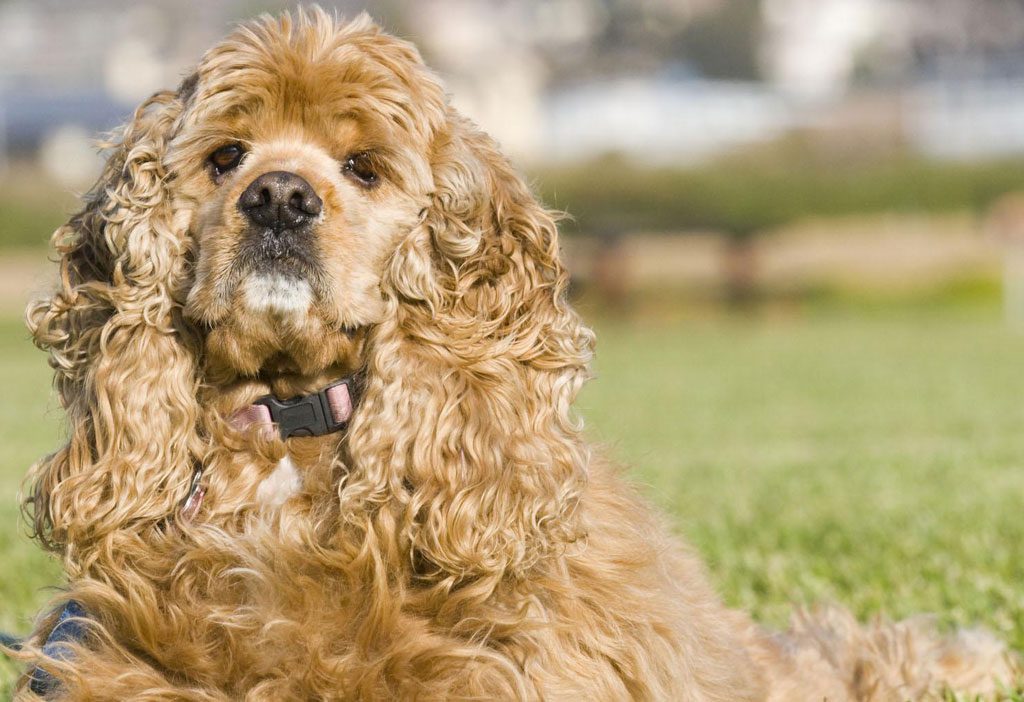
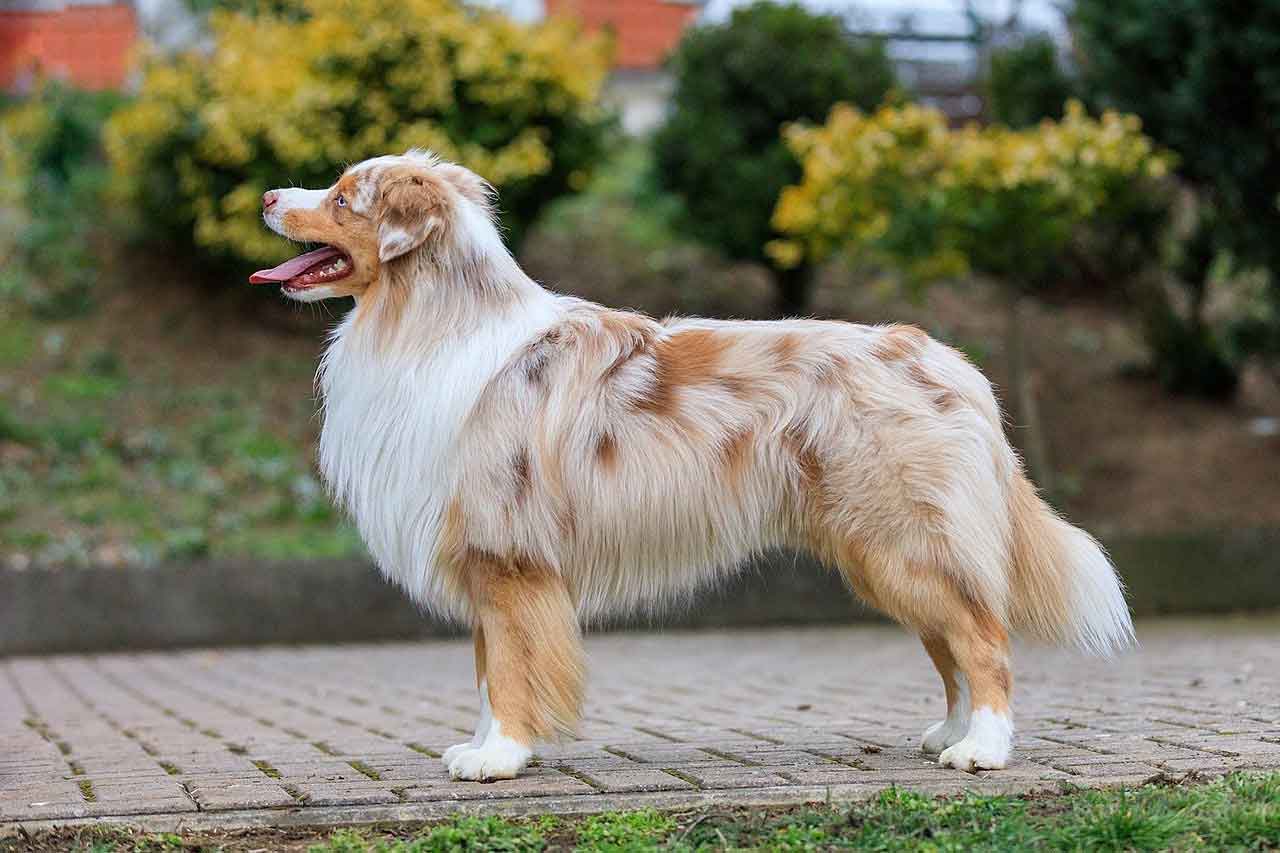
The American Cocker Spaniel It is the smallest member of the sporting dogs hunting. His body is strong, compact, delicately modeled head and refined. As a whole, It is a dog well balanced and ideal size. Well shoulders upright on a straight forelegs, its topline slopes slightly towards strong hindquarters, muscled and moderately angulated. A dog is able to develop a considerable speed, combined with a lot of resistance. Above all, It must be a brash and cheerful dog, healthy and well balanced in all its parts; vehement action shows inclination towards work. A well-balanced dog in all its parts is more desirable than a dog with strong contrasting good features and flaws..

The females weigh on average 9 to 12 kg and have a size of 34 to 36 cm., While males weigh in 10 to 13 kg and measure of 37 to 39 cm..

Character and skills

Cheerful and lively, the American Cocker Spaniel It's also smart and confident. Although it still retains a strong hunting instinct, It is often a housemate. With her family is loving and docile. It may be a bit reserved at the beginning with strangers, but soon makes friends. Cockers can be good companions for children. when they grow up together, They can make friends with other pets, including cats, but birds can be an irresistible lure – and not in a good way.

The Cocker It is highly trainable, but it has a sensitive soul. Early socialization is critical, and even with it some Cockers submissively urinate when your people get home or when they meet new people or dogs or go to new places. Focused training with positive reinforcement methods, especially praise and food rewards.

The Cocker It can be good in the field tests and as a hunting dog, although for years he was thought of as "just" a companion. One Cocker It is versatile and can do much more than walk around the house, but he is happy to do it because you love being with you.

any dog, no matter how pleasant it, detestable levels can develop barking, excavations and other undesirable behavior if you are bored, He is not trained or are unsupervised. And any dog รขโ‚ฌโ€นรขโ‚ฌโ€นcan be a test that live during adolescence. In the case of the Cocker, The "adolescence" years begin at six months and continue until the dog is one year old. Barking can be a problem unless the frenes.

Start training your puppy the day you bring him home. Even at eight weeks old, He is able to absorb everything you can teach. Don't wait until you have 6 months to start training him or you'll have to deal with a more stubborn dog. If possible, take him to puppy kindergarten class when he's between 10 and 12 weeks, y socialize, socialize, socialize.

But, Note that many kinds of training puppies require certain vaccinations (such as kennel cough) stay up to date, and many veterinarians recommend limited exposure to other dogs and public places until puppy vaccinations (including rabies, distemper and parvovirus) They are completed. Instead of formal training, You can start training your puppy to socialize at home and among family and friends until immunizations are completed in the puppy.

Talk to the breeder, It describes exactly what you are looking for a dog and asks for help to select a puppy. Breeders see puppies daily and can make incredibly accurate recommendations once they know something about their lifestyle and personality.

The American Cocker Spaniel Perfect not fully formed out of the whelping box. It is a product of his background and upbringing. Cockers are bred too much in the past, sometimes resulting in a fearful dog, slightly scary in no way represents a good breeding Cocker. Look for one whose parents have good personalities and has been well socialized from an early age puppy.

ยซAmerican Cocker Spanielยป Grooming

Beautiful silky coat Cocker seen in dogs in the exhibition circuit does not occur by chance. It takes a lot of work to keep it shiny and tangle. For good reason, most people keep their pets in a trim everywhere, known as cut puppy. Even that requires some maintenance. Dogs with cuts puppy should be bathed, brushed and cut approximately every two weeks.

If you want long flowing coat, You must be more careful and time, and usually the bathroom, brushing and trimming are done once a week. Most people choose to wear their Cocker a professional groomer, but you can learn to do it yourself. The cost of the equipment amounts to only a few grooming sessions, you will not have to ask for appointments and you will discover that you increase your bond with your Cocker. But, the toilet is not for everyone, so if you don't want to do it, find a hairdresser you like because it is an absolute requirement for a Cocker.

Like the ears of Cocker They are prone to infections, check them weekly to make sure the inside is a healthy, deep pink color and free of a bad odor. If that is not the case, get to the vet quickly before the ear infection becomes a major problem. Take special care when checking a puppy's ears as there is a significant buildup of wax as the ear canal develops. Clean the ears with a solution recommended by the veterinarian.

The rest is basic care. Cut toenails every few weeks. Should never last long enough to drown out the noise from the floor. Long nails can make uncomfortable walking in the Cocker, and they can get caught on things and tear. That is so painful, and bleed much. Brush your teeth often for good dental health and fresh breath.

Health ยซAmerican Cocker Spanielยป

All dogs have the potential to develop genetic health problems, just as all people have the potential to inherit a particular disease. Run, not walk, from any breeder that does not offer a health guarantee on puppies, tell you that race is 100 percent healthy and has no known problems, or to tell you that their puppies are isolated from the main part of the home for health reasons. A reputable breeder will be honest and open about the breed's health problems and the incidence with which they occur in their lines.. Here is a brief summary of what you should know about the health of the Cocker.

The American Cocker Spaniel are susceptible to a number of health problems that are, at least in part, genetic. These include many different eye disorders, including cataracts and glaucoma, as well as painful defects of the hips and knees.

Disc disease can cause the movement is painful for the American Cocker Spaniel, which it is by nature an active dog who loves to run and play. Heart diseases, liver, epilepsy… the Cocker It is at risk of all.

The variety of eye problems that can afflict the Cocker Spaniel ranging from the aesthetic – a condition called "cherry eye" that can be corrected through surgery – and sight-threatening, including cataracts and glaucoma. While many Cocker completely lose vision in old age, some may already losing two years of age due to progressive retinal atrophy. The Cockers They are also prone to keratoconjunctivitis sicca, a condition known as dry eye, a deficiency of tears that can lead to corneal problems.

Make sure your pet's eyes are examined by a board-certified veterinary ophthalmologist. Cocker Spaniel once a year and seeking veterinary attention immediately for any signs of vision loss, cloudiness, redness, eye irritation or if the dog squints or bumble.

The Cockers They may also have hypothyroidism, It is underproduction of thyroid hormone. This can cause weight gain, lethargy, loss of hair, chills and skin infections. a blood test whenever a suspected thyroid disease should be. Skin problems also may indicate allergies, which they are common in the breed, As to the skin masses, which may be benign or cancerous.

Some Cocker Spaniels They seem to be prone to congenital deafness, associated with white hair and blue eyes. At the age of three or four weeks, in some of these dogs the blood supply to the inner ear is degenerated. It can occur in one or both ears and is permanent.

those long ears spaniel tend to trap warm, moist air inside the ear canals, creating the perfect environment for the growth of bacteria and yeast, that lead to ear infections. Ear infections can be chronic in some dogs with long ears, so it is necessary to be aware of the care of the ears and clean them religiously. Repeated infections can cause so much damage to the ear canal that the dog will lose their hearing. Severely affected ears may require surgery. Follow-up care is especially important for the ear to prevent new flare-ups of old problems..

Many Cocker Spaniels are prone to autoimmune hemolytic anemia (AIHA), in which the immune system attacks the dog its own red blood cells to the point that the dog becomes anemic. Although there is treatment, the mortality rate is high.

Not all of these conditions are detectable on a growing puppy, and it is impossible to predict if an animal will be free of these diseases, so you need to find a reputable breeder who commit to raise healthier animals possible. They should be able to provide an independent certification that the parents of the dog (and grandparents, etc.) have been examined for common defects and considered healthy for breeding. That's where health records come in..

Careful breeders screen their breeding dogs for genetic diseases and breed only the healthiest, best-looking specimens., but sometimes mother nature has other ideas and a puppy develops one of these diseases despite good husbandry practices. Advances in veterinary medicine mean that in most cases dogs can still live a good life. If you're going to have a puppy, ask the breeder about the ages of the dogs in their lines and what they died of.

Remember that after getting a new puppy at home, You have the power to protect one of the most common health problems: the obesity. Keep a Cocker Spaniel with a proper weight is one of the easiest ways to prolong your life. Make the most of your preventive skills to help ensure a healthier dog for life.

Characteristics "American Cocker Spaniel"

Coexistence is important that you have with your new friend. Before considering the acquisition of a dog of the breed "American Cocker Spaniel" you know certain factors. Not all breeds of dogs are apt to live in an apartment, you must take into account his character, their need for exercise, their interaction with other pets, their care and if you have small children, their level of tolerance towards them.

Adaptation โ“˜

5,0 of 5 stars (based on 1 review)

friendly dog โ€‹โ€‹โ“˜

4,0 of 5 stars (based on 1 review)

hair loss โ“˜

3,0 of 5 stars (based on 1 review)

Affection level โ“˜

5,0 of 5 stars (based on 1 review)

Need for exercise โ“˜

4,0 of 5 stars (based on 1 review)

Social need โ“˜

5,0 of 5 stars (based on 1 review)

Home โ“˜

5,0 of 5 stars (based on 1 review)

Toilet โ“˜

5,0 of 5 stars (based on 1 review)

Friendly with strangers โ“˜

5,0 of 5 stars (based on 1 review)

barking โ“˜

4,0 of 5 stars (based on 1 review)

Health โ“˜

4,0 of 5 stars (based on 1 review)

Territorial โ“˜

3,0 of 5 stars (based on 1 review)

Cat friendly โ“˜

3,0 of 5 stars (based on 1 review)

Intelligence โ“˜

5,0 of 5 stars (based on 1 review)

Versatility โ“˜

5,0 of 5 stars (based on 1 review)

Child friendly โ“˜

5,0 of 5 stars (based on 1 review)

Surveillance โ“˜

4,0 of 5 stars (based on 1 review)

joy โ“˜

3,0 of 5 stars (based on 1 review)

Images "American Cocker Spaniel"

credits:

1. golden-american-cocker-spaniel by www.localpuppybreeders.com
2. American Cocker Spaniel at the Cloisters City Park in Morro Bay, California by "Mike" Michael L. Baird / CC BY
3. Golden American Cocker SpanielRyan Johnson / CC BY-SA
4. American Cocker in Tallinn duo CACIB, 17-18 Aug 2013 by Thomas / CC BY-SA
5. AMERICAN COCKER SPANIEL PUPPY 7 WEEKS – https://commons.wikimedia.org/wiki/File:AMERICAN_COCKER_SPANIEL_PUPPY_7_WEEKS.jpg
6. A black American Cocker Spaniel. By Yoko / CC BY-SA

Videos "American Cocker Spaniel"

Type and recognitions:

  • FCI CLASSIFICATION:
  • Group :
  • Section : . .

Federations:

FCI โ“˜, AKC โ“˜, ANKC โ“˜, CKC โ“˜, โ€‹KC โ“˜, NZKC โ“˜, UKC โ“˜

FCI breed standard American Cocker Spaniel

FCIFCI - American Cocker Spaniel
Cocker

Alternative names:

1. Cocker Spaniel, Cocker, Merry Cocker (English).
2. Cocker (French).
3. American Cocker Spaniel, Cocker (German).
4. American Cocker Spaniel, Cocker (Portuguese).
5. Cocker americano, Cocker spaniel, Cocker (espaรฑol).

โ–ท The world of Pets: Dogs, cats, birds, reptiles, amphibians

Chesapeake Bay Retriever
USA FCI 263 . Retrievers

The Chesapeake is a hunting dog, pure and simple.

Chesapeake Bay Retriever

Content

Characteristics "Chesapeake Bay Retriever"

Coexistence is important that you have with your new friend. Before considering the acquisition of a dog of the breed "Chesapeake Bay Retriever" you know certain factors. Not all breeds of dogs are apt to live in an apartment, you must take into account his character, their need for exercise, their interaction with other pets, their care and if you have small children, their level of tolerance towards them.

Adaptation โ“˜

3,0 of 5 stars (based on 1 review)

friendly dog โ€‹โ€‹โ“˜

2,0 of 5 stars (based on 1 review)

hair loss โ“˜

3,0 of 5 stars (based on 1 review)

Affection level โ“˜

3,0 of 5 stars (based on 1 review)

Need for exercise โ“˜

5,0 of 5 stars (based on 1 review)

Social need โ“˜

3,0 of 5 stars (based on 1 review)

Home โ“˜

1,0 of 5 stars (based on 1 review)

Toilet โ“˜

2,0 of 5 stars (based on 1 review)

Friendly with strangers โ“˜

2,0 of 5 stars (based on 1 review)

barking โ“˜

3,0 of 5 stars (based on 1 review)

Health โ“˜

3,0 of 5 stars (based on 1 review)

Territorial โ“˜

3,0 of 5 stars (based on 1 review)

Cat friendly โ“˜

3,0 of 5 stars (based on 1 review)

Intelligence โ“˜

5,0 of 5 stars (based on 1 review)

Versatility โ“˜

5,0 of 5 stars (based on 1 review)

Child friendly โ“˜

3,0 of 5 stars (based on 1 review)

Surveillance โ“˜

4,0 of 5 stars (based on 1 review)

joy โ“˜

3,0 of 5 stars (based on 1 review)

History

When a British brig was wrecked off the coast of Maryland in 1807, part of the cargo that was rescued included two Newfoundland dogs. Called Sailor and Canton, they were found to have excellent retrieval skills. The locals raised them with local dogs, and became the ancestors of the "Chesapeake Retriever". Other races that may have contributed to the composition of the Chesapeake were the ยซFlat-coated Retriever" and the "Curly-coated Retrieverยซ.

The result was a hard Retriever that he was ready and willing to endure the harsh and icy Chesapeake Bay being able to recover from 100 to 200 ducks a day. The first dogs came only in dark brown, but now any shade of brown, sedge or dead grass is acceptable.

The American Kennel Club registered your first Chessie, called Sunday, in 1878. The Chesapeake is ranked 48 breeds registered by the AKC, under the 41 a decade.

Physical characteristics

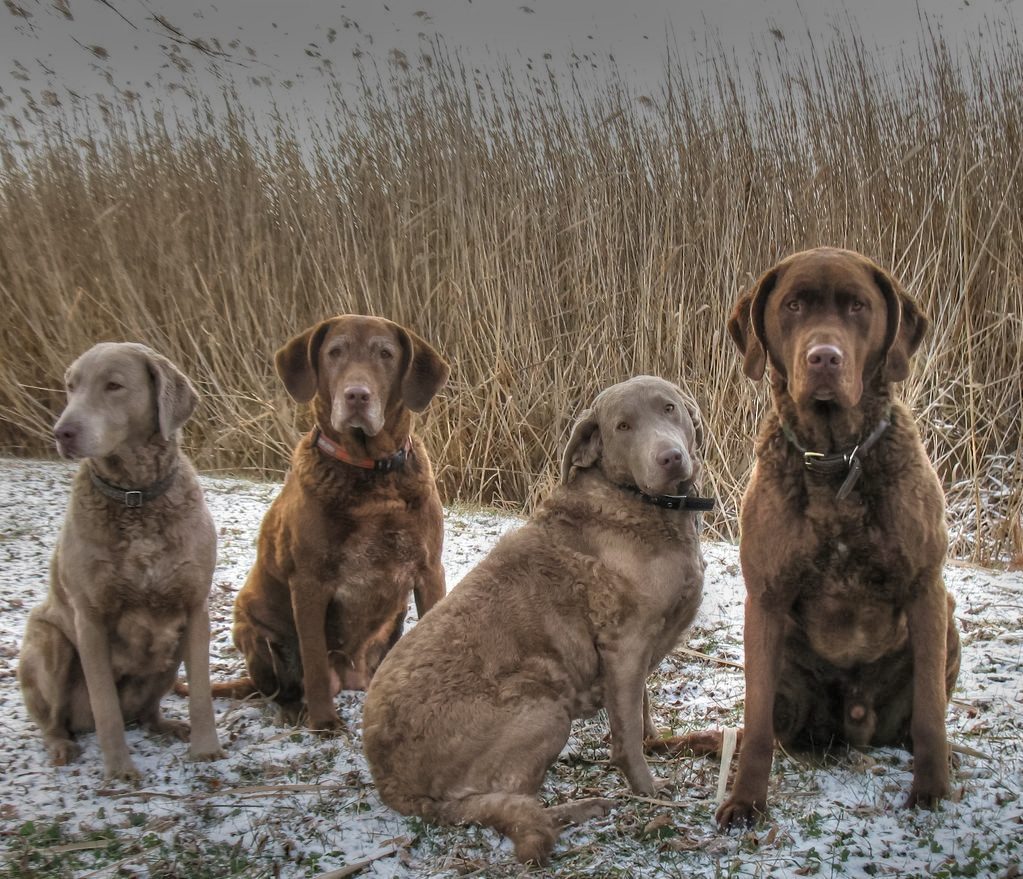
Distinctive features include eyes very clear, yellow or amber, rear quarters as high or slightly higher than the shoulders, and a double layer which tends to wave on shoulders, the neck, back and loins.

The Raincoats feels slightly oily and often is associated with a slight musky odor. three basic colors are usually seen on race: the brown, which it includes all shades from light brown to a deep dark brown; sedge, ranging from reddish yellow to bright red and brown tones; and dead grass in all shades, ranging from a faded tan to a muted straw color.

The breed standard states that the target may also appear, but it should be limited to the chest, the belly, the toes or back of feet. The head is round and wide with an average stop and muzzle. The lips are thin, and ears are small and medium leather. The Forelegs should be straight with good bone. The hindquarters are especially strong and the toes webbed as excellent swimming ability is important to the Chesapeake.

This breed is also known for its large and powerful chest, used to break ice when submerged in cold water while duck hunting.

Character and skills

The "Chesapeake Retriever" is highly appreciated for its alert and cheerful disposition., his intelligence, his calm demeanor and his affectionate nature and protective. The value, the willingness to work, vivacity, good sense of smell, the intelligence, The enjoyment of the water and especially the general quality and dispositions must take priority when selecting and breeding the "Chesapeake Retriever.". Extreme shyness or aggression are not desirable in this breed, whether the animal is used as a hunting dog or pet.

In the countryside, the Chesapeake he is a serious worker and has even been called neurotic in his eagerness to find fallen birds. It's not out there to play. The Chesapeake They are known for their excellent vision and memories when it comes to seeing where birds fall and remembering where to go to collect them.. His favorite activity is hunting for ducks.

When you train, respects their learning ability. Don't continue training him long after it's clear he knows what to do. The perfect Chesapeake is not prepared by the breeder. any dog, no matter how pleasant it, detestable levels can develop barking, excavation and other undesirable behavior if you are bored, untrained or unsupervised.

Did you know??

The Chessie not designed to be a companion, is a hunting dog, pure and simple. And not just any old hunting dog… He is a waterfowl dog and lives to get wet in pursuit of his feathered prey..

The health of the Chesapeake Retriever

According to a survey conducted in 2005 by the American Chesapeake Club, the most common health problems seen in the breed are hip dysplasia, progressive retinal atrophy and other eye problems, cancer, degenerative myelopathy and hypothyroidism. This breed can also be prone to a bleeding disorder called von Willebrand disease.

Find a breeder who uses the newly available genetic test for degenerative myelopathy, a form of progressive weakness and paralysis of the limbs. Although DM is rare, It is incurable and crippling. Not all dogs that test positive in the test of DM develop the disease, but farmers who try their race for this condition are probably the most conscientious.

The test can be used to determine whether a puppy's parents are clean, they are carriers or are at risk; a puppy whose parents are clean – neither carriers nor at risk – also will be. A puppy two carrier parents will be at risk, and a puppy parent with a carrier may be at risk. Even dogs tested for having two copies of the gene never show symptoms of the disease., but the status of the parents of your puppy, and his own dog, It can help you be aware of the early warning signs.

Careful breeders test their breeding dogs for genetic diseases and only breed the healthiest and best looking dogs., but sometimes mother nature has other ideas and a puppy develops one of these diseases despite good husbandry practices. Advances in veterinary medicine mean that in most cases dogs can still live a good life. If you're going to have a puppy, ask the breeder about the ages of the dogs in their lines and what they died of.

Remember that after hosting a new puppy home ut, has the power to protect you from one of the most common health problems: the obesity. Keeping a Chesapeake Retriever at an appropriate weight is one of the easiest ways to prolong its life.. Make the most of your preventative abilities to help ensure a healthier dog for life.

Chesapeake Retriever Grooming

The Chesapeake has a tough, oily outer coat over a dense undercoat, fine and wooly. The dirt and debris are easily removed with a rubber brush. The undercoat is very clear in spring, so be prepared to brush the dog more frequently during this time to prevent loose hair from collecting on clothing and furniture..

Give the Chessie Fresh water rinse after it has been in salt water or has swum in the mud of a pond or lake, but to keep the resistance of the coat to water, avoid bathing unless absolutely necessary. That can be as little as twice a year.

The rest is basic care. Keep your ears clean and dry so they don't get infected, and trim nails as needed, usually every two weeks. Brush your teeth for general good health and fresh breath.

ยซChesapeake Retrieverยป Images

credits:

1. A Chesapeake Bay Retriever by Keith Rousseau at en.wikipedia / CC BY-SA
2. Chesapeaker Bay retriever by Nevilley / CC BY-SA
3. Male, Chesapeake Bay Retriever competing in the conformation ring by George Makatura / Public domain
4. Chesapeaker Bay retriever by https://pxhere.com/es/photo/1407301
5. Chesapeaker Bay retriever by https://pixabay.com/es/photos/perros-mascotas-el-agua-1582148/
6. Chesapeake Bay Retriever by Diane – HTTPS://flic.kr/p/6k1uFQ
7. chesapeake bay retriever by https://www.peakpx.com/611264/chesapeake-bay-retriever
8. Brown Chesapeake Bay Retriever in the snow, carrying a plant part in its snout by Will Thomas / CC BY

Videos ยซChesapeake Retrieverยป

Type and recognitions:

  • FCI CLASSIFICATION:
  • Group :
  • Section : . .

Federations:

FCI โ“˜, AKC โ“˜, ANKC โ“˜, CKC โ“˜, โ€‹KC โ“˜, NZKC โ“˜, UKC โ“˜

FCI breed standard Chesapeake Bay Retriever

FCIFCI - Chesapeake Bay Retriever
Retriever

Alternative names:

1. Chessie, CBR, Chesapeake (English).
2. Chesapeake Bay Retriever, Chesapeake (French).
3. Chesapeake Bay Retriever (German).
4. Chesapeake bay retriever (Portuguese).
5. Chessie, CBR, Chesapeake (espaรฑol).

โ–ท The world of Pets: Dogs, cats, birds, reptiles, amphibians

American Water Spaniel
Estados Unidos FCI 301 . Water Dogs

Perro de Agua Americano

The American Water Spaniel always delivered to work, He is obedient and easy to train..

Content

History

The American Water Spaniel It is a breed of dog originating in United States, little-known outside of North America.

Although the exact origins of the American Water Spaniel remain a mystery, experts agree that it probably developed in the first half of the 19th century in the Fox and Wolf river valleys of Wisconsin, an American state in the Great Lakes region.

During the conquest of the West in the 19th century, European settlers who moved to the Midwest regions of the United States brought their hunting dogs with them to help meet their food needs. Over the years, used various Old World breeds to create a new dog perfectly adapted to the peculiarities of hunting in the Great Lakes region. They needed a versatile animal with an excellent sense of smell, able to work both on land and in water, and expert in recovering downed waterfowl. They also wanted their companion to be compact enough to carry in a small boat or canoe., and could withstand the cold Wisconsin water temperatures.

It is not possible to know with total certainty which races were used to achieve this, but experts believe they were the English Water Spaniel (now extinct), the Irish Water Spaniel, the Curly-coated Retriever, the Poodle and the Sussex Spaniel or other type of Spaniel. Native American dogs were also used in the various crosses.

The small brown animal thus created was known at the time as American Brown Spaniel. It had thick curly fur that protected it from cold water and winter temperatures.. They were used to hunt and retrieve waterfowl, but also for hunting on land, like grouse, quail and pheasant, as well as the occasional rabbit. At the end of the 19th century, the American Brown Spaniel had made a name for itself in the Great Lakes region and enjoyed some popularity with Wisconsin hunters, Michigan y Minnesota.

But, the number of specimens of this breed began to decline rapidly at the beginning of the 20th century, due both to the reduction of the duck population in these areas and to changes in hunting practices. In fact, hunting became at that time a leisure activity, more than in a true feeding medium. It also, hunters began to prefer new European hunting dogs that were larger and more specialized in a specific type of hunting, already were Retrievers, Pointers or Spaniels.

Fortunately, the American Brown Spaniel had an ardent admirer in Dr.. Fred J. Pfeifer, based in New London, Wisconsin. Firmly convinced that this dog should be preserved and recognized, Pfeifer created a kennel dedicated to the breed, Wolf River Cattery, and set out to save it from extinction. He spared no effort to offer his puppies to all corners of the country, mostly through various advertisements.

The American Water Spaniel is probably one of the main races that contributed to the development of the Boykin Spaniel.

The recognition and dissemination of American Water Spaniel

The efforts of Fred Pfeifer and other enthusiasts who joined him paved the way for official recognition of the breed by the United Kennel Club (UKC) in 1920, with the name of American Water Spaniel. It was Pfeifer's own dog, called Curly Pfeifer, the first representative of the breed to be registered with the organization. The breed was also recognized by the Field Dog Stud Book in 1938 and by the American Kennel Club (AKC) in 1940.

The breed took much longer to be recognized in other parts of the world. Like this, acceptance by the Fรฉdรฉration Cynologique Internationale (FCI) did not occur until 1979, followed shortly after by that of British Kennel Club in 1981. The Canadian Kennel Club it is also among the organizations that recognize the race.

Distribution and popularity

In United States, the American Water Spaniel still extremely rare today, with a world population estimated at about 3.000 specimens, most of them in the American Midwest, especially in the states of Wisconsin, Minnesota y Michigan, where it is still very popular with hunters. The race occupies the position 165 (of something less than 200) in the breed classification of the American Kennel Club (AKC) depending on the number of annual registrations in the organization, and the situation has been comparable at least since the beginning of the 21st century. Obviously, the fact that it is one of only two sporting breeds developed in the United States (along with the Chesapeake Bay Retriever) does not seem to be enough to make her popular with the American public.

In the rest of the world, race is even more confidential.

In France, for example, There are less than 10 registrations per year in the Livre des Origines Franรงaises.

In Great Britain, the number of births registered with the Kennel Club is even zero most years.

Physical characteristics

The American Water Spaniel it is a compact dog, medium in size and well muscled. Designed to work in the icy waters and swampy shores of the Great Lakes region of the United States, they are perfectly equipped for it: the pads of its feet are thick, their toes are webbed and small enough to jump off a small boat without capsizing it. It also, their hips and hind legs are strongly developed, which gives it some propulsion force and prevents it from jamming. Like this, is able to break through even on wet hunting grounds.

The head is well proportioned to the body. ears are drooping. The eyes are long and wide, and they can be hazel colored, brown or amber. They contribute to a cheerful expression and a smart look. The nose is black or brown and the nostrils are well developed, which reminds us that this dog was designed to sniff out game. The nose is dominated by tight lips.

The American Water Spaniel has a dense undercoat that greatly protects it from water, extreme temperatures and branches. The top layer is of medium length and can have even waves or tight curls. The density of the latter can vary from one area of โ€‹โ€‹the body to another.. In all cases, the head is covered with short, straight hair and the tail is moderately bushy.

It also, its top layer is naturally very oily to be waterproof and avoid scratches from vegetation. Thus, their fur has a strong odor, and can sometimes leave a greasy stain when rubbed against a wall or furniture.

The coat of the American Water Spaniel it is always uniform and liver-colored, chocolate or black, although a small amount of white hairs are sometimes found on the fingers or on the chest.

Last, sexual dimorphism is quite marked in this breed, since the males are, average, considerably heavier and more massive than females.

The standard the FCI is the same as the American Kennel Club. This indicates that the American Water Spaniel has a size ranging from the 38 to 45 cm and weigh in 13 to 20 kg. Some reaching a height of 50 cm and a weight of 23 kg. This not disqualifies them but costs them points.

Character and skills

Like most hunting dogs, the American Water Spaniel is full of energy and enthusiasm, and you need a good dose of daily exercise and mental stimulation to be balanced. As long as its owner meets your needs, either making them hunt, taking them for a run or letting them play with the children, They are excellent companion dogs..

In fact, he's basically a jolly dog, friendly and loving, eager to please their owners and who likes to spend time with them. You may also become especially fond of the person who dedicates the most time and attention to you., but he is still very friendly with the rest of the tribe.

Usually, have a strong affinity with the youngest, to the point of being a recommended dog breed with children. Inexhaustible, they love spending time with them, entertain them and participate in all kinds of activities with them, either on land or in the water. However, it is important to teach children to interact with them in a respectful way, to avoid any accident. In any case, no dog, whatever race he is and no matter how friendly he is, should be left unsupervised with a young child.

You can play all day and, At night, snuggle into your family's lap for a hug.

Sociable and affectionate with his family, the American Water Spaniel It, on the other hand, shy and suspicious of strangers, without showing aggressiveness. As a result, It may take several introductions before you finally decide to befriend someone you regularly meet..

Nor does he feel very comfortable with his companions, and can sometimes be territorial and aggressive towards them. But, if you share your home with one of them or with a cat, considers you as a full member of your family, so normally there is no problem. This is even more true if you are used to being with him from a young age..

The same cannot be said for a possible coexistence with a rodent or a bird., even if it starts when he is still very young. In fact, the hunting instinct that makes him chase these species when he finds them during his walks could lead him to do the same at any moment, and thus put an end to said coexistence.

Letting him live with a dog or cat is not without interest in any case., because his proximity to his masters makes him easily suffer from separation anxiety if he stays alone for more than a few hours. So it's likely to bark excessively, which can quickly become a source of tension with neighbors. The presence of a little companion can keep you busy and ease your anxieties., although the best is, Obviously, have your family at home as often as possible. In any case, this dog is not really adapted for people who generally spend their days away from home.

Developed to be a tough hunting companion, the American Water Spanielhave energy to spare: one or two short walks around the neighborhood a day are not enough to meet your exercise needs, and then he would have every chance of developing various behavioral problems.

Although it depends on the age and health of each, in general it is necessary to anticipate not less than one or two hours of activity a day so that the dog can keep moving. It is best to divide it into several opportunities spread throughout the day, for example combining two or three walks, jogging sessions or bike rides with a good period of play. Of course, if any of these activities offer the opportunity to bathe, Will be delighted, since it is a water-loving breed of dog.

Giving him plenty of opportunities to exercise is the best way to avoid a number of potentially problematic behaviors., as it has a strong natural tendency to bite, dig and jump.

It also, as soon as your need for exercise is satisfied, that is to say, as the day is full of outings that are so many opportunities to make you spend, can live in an apartment, although obviously it is far from being an ideal environment for him. In any case, if you spend a lot of time indoors, it is important to provide all kinds of balls, chew toys and other distractions that allow you to burn energy throughout the day.

The fact is that the American Water Spaniel it's a country dog รขโ‚ฌโ€นรขโ‚ฌโ€นat heart, much happier when you have access at all times to a large outdoor space where you can expend your energy. But, although he loves to play and spend time outdoors, it is out of place to put him there and make him spend most of his time away from his family, since you need prolonged and daily contact with her.

It also, if the house has a garden, it is advisable to make sure that it is well fenced, to avoid any leak. In fact, this dog has a pronounced hunting instinct and is a wanderer at heart: if given the opportunity, he is likely to run off hunting small critters or just exploring the surroundings.

However, how he usually responds well to withdrawal orders once he has been properly trained, it is possible to walk without a leash in nature. On the other hand, in places where the presence of other dogs is very likely or even safe, it is better to wear him systematically on a leash, to avoid any risk of dog fighting.

Last, it is not likely that the American Water Spaniel be the best friend of the neighbor. In fact, although he is calm and affectionate with his family, he is very awake and barks a lot, sometimes for no apparent reason. This makes for an excellent watchdog., especially since his barks are quite loud, but also a potential source of trouble. But, this propensity to bark can be mitigated by addressing the problem in the context of their education.

Education

The American Water Spaniel can be stubborn and independent at times: he likes to do what he wants and may try to impose himself by behaving as a dominant, both with their masters and with other dogs. Thus, you need to have an experienced and solid master in front of you, able to show your dog who decides and to keep a steady hand throughout his life, because at any time you can try to question the established order.

But, he is also an intelligent dog and eager to please his caregiver, as soon as he recognizes him as the leader of the pack. So, responds well to an education that is firm, smooth and consistent, and this can give excellent results when in good hands.

To get it, it is best to opt for short and motivating training sessions and not skimp on the use of positive reinforcement techniques: compliments, petting, candies, etc. On the other hand, it is advisable to avoid the use of punishments, that could affect this sensitive dog and degrade the trust it should have in its master.

Learning to call back should be a top of his education if he's allowed to live off-leash. Otherwise, his hunting instinct would make him flee soon when small animals similar to prey passed by.

In any case, this instinct obviously makes it a good potential to be used for hunting. A little more training on the different hunting techniques is still necessary to fully exploit it..

Another aspect to address in the context of your education is barking, because he tends to be very barking. The ideal is to make him distinguish between what he deserves to bark and what he does not, as well as simply teaching him to stop immediately when asked.

Last, like any dog, the American Water Spaniel needs to be thoroughly socialized from a young age, facing all kinds of people, animals, places, situations and stimuli, to hone your social skills and allow you to grow balanced. This is all the more necessary as he tends to be shy., distrustful or even aggressive towards people or dogs you don't know.

Health

The American Water Spaniel is generally robust and healthy, which is explained in particular by the selection work that was at the origin of its creation and the multiple criteria that it had to meet at that time.

Among these, resistance to cold and weather stood out., and its double layer perfectly fulfills the objective: protects her wonderfully from the cold (both on land and in the water) and from the elements, but also from the heat, even if in case of a heat wave you should be able to take refuge in the shade, or even in an air-conditioned place, in general it is able to adapt to almost any type of climate.

His good general health does not prevent the American Water Spaniel are particularly prone to certain diseases:

  • theHip Dysplasia, joint malformation that can be caused by a hereditary cause causes pain, limp then causeosteoarthritis afrom a certain age;
  • Dermatitis sensitive to growth hormone,alopecia (hair loss)caused by a lack of growth hormone (somatropina).The latter is secreted by the pituitary gland., an endocrine gland that secretes many hormones and is necessary for coat growth. Affected people have varying degrees ofalopecia., but are otherwise healthy. Veterinarians do not yet know if this condition is genetic or not. Hair loss often begins at puberty and men between 1 and 5 years are the most affected., it comes in the neck, torso, thighs and abdomen, and the underlying skin is noticeably darker due to increased pigmentation.This condition can be treated with injections of growth hormones, but it is expensive and difficult to obtain. Sterilization can sometimes solve the problem in men. In any case, in the absence of treatment, alopecia and hyperpigmentation can spread throughout the body, with the exception of the head and feet.How hereditary transmission is suspected,
  • The symmetric alopecia, causing a gradual loss of hair that usually begins between the 6 and 9 months of the puppy and progresses until the affected areas are completely bald, these are the neck, the back of the thighs and the tail.There is no treatment to date, but this condition does not significantly affect the lives of the affected people;
  • The waterfall, which is an increasing clouding of the lens of the eye, causing increasing difficulty in seeing, even blindness The disease can be inherited, usually occurs in old age and can be treated with surgery.
  • Retinal dysplasia, an abnormal development of the retina that often has a hereditary cause and results in the appearance of retinal folds. They bother the dog's sight in a more or less pronounced way, according to the degree of severity. The latter does not progressively progress, because the disease is not progressive, there is no cure, but the other senses can compensate for the visual impairment.
  • The progressive retinal atrophy, incurable inherited disease that causes loss of photoreceptor cells in the retina of the eye, gradually leading to the total blindness of the animal;
  • Entropion, which can be of hereditary origin and corresponds to the turning of an eyelid towards the inside of the eye, causing severe irritation of the eyeball (Red eyes, tearing, etc.). But, this condition can be treated surgically;
  • The epilepsy, sometimes an inherited disorder causing sometimes impressive seizures cannot be cured, but lifelong treatment can allow affected people to lead near normal lives;
  • The Hypothyroidism, a deficiency of hormones produced by the thyroid gland that can cause all kinds of mild symptoms. Lifelong treatment helps prevent them;
  • Allergies, that can be hereditary and have all kinds of origins: foods, domestic products, pollen, dust, insects, etc. The cause may be difficult to identify and, Therefore, allergies difficult to treat.
  • Theear infectionsbecause the sloping shape of the past favors the accumulation of moisture and dirt.

It also, an individual used for hunting is also more exposed to the risks involved in this activity: injuries, parasites,spikelets,etc.

Taking into account that several diseases to which the breed is predisposed are or may be hereditary, going through a serious breeder who carefully selects his breeders is essential to maximize the chances ofadopt a puppythat not only has he benefited from good socialization since his first weeks. , but also that it gets rid of any hereditary ailment.

The American Water Spaniel Club of America participate in the Canine Health Information Center (CHIC), a database ofcanine health.Any breeder worthy of the name must, Therefore, get a CHIC number for your dogs, which requires transmitting the results of the health tests of the Orthopedic Foundation for Animals (OFA) and those of the eye tests of the Canine Eye Registry Foundation (CERF)., Whatever your conclusions. The fact that a dog has a CHIC number is not, therefore, a guarantee of good health, but your test results are publicly accessible on the CHIC website: This allows anyone considering theadoption of a puppycheck your results and also those of your parents.

The breeder will also be able to present the results of additional genetic tests carried out to the parents or the puppy to detect some other diseases as well., in addition to providing a certificate of good health established by a veterinarian, as well as details of vaccinations. administered. to the little one.

Once the latter has moved into its new home, keep in mind that their bones and joints are especially fragile until they reach adulthood., it is necessary to avoid physical exercises that are too intense or prolonged while you are still young and growing, under penalty of causing injury or even deformity, so potentially life-long consequences.

It also, even if he seems to be in perfect health, any dog รขโ‚ฌโ€นรขโ‚ฌโ€นshould be examined by a vet at least once a year for a full checkup, this can allow detecting a possible problem as soon as possible, and you can also take the opportunity to have your vaccination reminders done at the same time., your teacher should make sure to renew your deworming treatments throughout the year whenever necessary, so that also at this level you are never unprotected.This is even more important as you spend a lot of time outdoors.

Life expectancy

12 to 13 years

Grooming

The curly coat of the American Water Spaniel needs to be brushed once or twice a week to prevent tangling and to help evenly distribute sebum, the natural oil that protects your skin. This dog sheds relatively little throughout the year, but much more in spring and autumn, so it is necessary to opt for a greater frequency of brushing during these times to remove dead hair and prevent it from accumulating throughout the house.

Some hunters choose to shear their pets regularly to prevent foliage and branches from sticking to their fur.. A pet dog can be left with its coat untrimmed., or cropped and ears shaved for a more polished look.

It must be taken into account that the upper layer of the American Water Spaniel is naturally rich in sebum. This can cause some discomfort in everyday life., like a certain smell or grease marks in the house, when rubbed against a wall or furniture.

But, it only needs to be washed when it is very dirty or smells bad. In effect, too frequent bathing would lead to the loss of the natural oils that protect their coat, which would cause irritations by making your skin drier. In any case, it is essential to systematically use a shampoo specially designed for dogs, since the pH of your skin is different from that of human skin. It also, a good habit to adopt is to systematically rinse the dog with fresh water after each visit to salt water or algae, to avoid any irritation.

It is also useful to dry the ears after each bath or after being in a humid place for a long time., because its drooping shape predisposes it to otitis. They should also be inspected and cleaned every week, to prevent moisture or dirt build-up that can cause infection.

Like any dog, it is also advisable to check your eyes and clean their contour every week, there too to avoid any infection. This is especially useful since he is prone to various diseases at this level., some of which can be treated.

The weekly maintenance session is also an opportunity to brush your teeth, making sure to use a toothpaste designed for canines. This helps prevent tartar buildup and the risks that come with it.: bad breath, oral diseases, etc. Ideally, do it more often, even every day if possible.

The nails of the American Water Spaniel generally require less attention, as their high level of activity means that they generally wear out naturally and do not need to be trimmed manually. But, it is better to make sure every one or two months. In any case, as soon as rubbing is heard when walking on hard surfaces, it's time to take care of them. Otherwise, could get in the way, but also break it or even hurt it.

coat care, the ears, the eyes, your dog's teeth and nails is not something to be taken lightly. If they are not done correctly, could not only be ineffective, but they could also harm you. So don't hesitate to learn them from a vet or professional groomer the first time., to learn how to do it. It also, it's better not to wait to start: the sooner the dog gets used to these different manipulations, more easily accept them throughout your life.

Last, a brief visual inspection of its coat and different parts of its body each time you return from a long stay abroad (for example, during a hunting day) allows you to quickly detect a possible wound or the presence of a parasite, a spike, A spike…, and act accordingly to avoid taking too large proportions.

Utility

The American Water Spaniel was developed to be a versatile hunter. Specialized in hunting waterfowl, this talented and resilient swimmer is delighted to jump into the water to retrieve the downed game, so much so that it could be considered a Retriever like a Spaniel. On land, they are mainly used to hunt grouse, quail, pheasants and rabbits. Still popular with hunters in the Midwest, where are they from?.

In addition to his athletic qualities, his intelligence also allows him to excel in many sports and dog activities such as agility, obedience, flyball, canicross, field trial, tracking… and of course hunting competitions.

How much can you exercise?, it is also a wonderful pet. It is the ideal companion for an experienced owner, who has a garden and who is active enough to satisfy his important need for activity (or that I can delegate this task in part to the children) and that he is present enough at home to avoid being alone too long. His distrust of strangers and loud barking also make him an excellent watchdog..

Last, sometimes found as a therapy dog โ€‹โ€‹entrusted to a person suffering from a problem, a use where your gentle and affectionate temperament can work wonders.

Price

The American Water Spaniel It is a rare breed of dog., so very few puppies are born per year. The vast majority of breeders are located in Michigan and Wisconsin ((UNITED STATES)UU.), and they usually have waiting lists of a few months to a year. They usually offer their puppies between 600 and 1.000 $ (between 500 and 900 EUR).

It is very difficult to find a breeder outside of the United States..

Importing from abroad is often the only possible option to adopt a American Water Spaniel, transportation and administrative costs are added to the purchase price, without mentioning the cost of eventual registration in the national registry of the country of adoption. It also, it is important to respect the regulations regarding the importation of a dog from abroad.

Characteristics "American Water Spaniel"

Coexistence is important that you have with your new friend. Before considering the acquisition of a dog of the breed "American Water Spaniel" you know certain factors. Not all breeds of dogs are apt to live in an apartment, you must take into account his character, their need for exercise, their interaction with other pets, their care and if you have small children, their level of tolerance towards them.

Adaptation โ“˜

3,0 of 5 stars (based on 1 review)

friendly dog โ€‹โ€‹โ“˜

2,0 of 5 stars (based on 1 review)

hair loss โ“˜

3,0 of 5 stars (based on 1 review)

Affection level โ“˜

3,0 of 5 stars (based on 1 review)

Need for exercise โ“˜

5,0 of 5 stars (based on 1 review)

Social need โ“˜

3,0 of 5 stars (based on 1 review)

Home โ“˜

2,0 of 5 stars (based on 1 review)

Toilet โ“˜

2,0 of 5 stars (based on 1 review)

Friendly with strangers โ“˜

2,0 of 5 stars (based on 1 review)

barking โ“˜

2,0 of 5 stars (based on 1 review)

Health โ“˜

3,0 of 5 stars (based on 1 review)

Territorial โ“˜

4,0 of 5 stars (based on 1 review)

Cat friendly โ“˜

2,0 of 5 stars (based on 1 review)

Intelligence โ“˜

3,0 of 5 stars (based on 1 review)

Versatility โ“˜

3,0 of 5 stars (based on 1 review)

Child friendly โ“˜

5,0 of 5 stars (based on 1 review)

Surveillance โ“˜

4,0 of 5 stars (based on 1 review)

joy โ“˜

5,0 of 5 stars (based on 1 review)

ยซAmerican water dogยป images

ยซAmerican Water Dogยป Videos

Type and recognitions:

  • FCI CLASSIFICATION:
  • Group 8: Retrievers, Hunting Lifting Dogs, Water Dogs.
  • Section 3: Water Dogs. .

Federations:

  • FCI – Group 8: Retrievers - Flushing Dogs - Water Dogs – Section 3: Water Dogs โ“˜
  • AKCSporting โ“˜
  • CKCSporting Dogs โ“˜
  • โ€‹KC – Gundog โ“˜
  • UKCGun Dogs โ“˜

FCI breed standard "American Water Spaniel"

Origin:
United States

Date of publication of the valid original standard:
14.02.1995

Use:

The American Water Dog was developed in the United States as a hunting dog of mixed abilities., bred to collect from small boats and canoes, as well as the land, with relative ease.


General appearance:

It is an active dog, muscular, medium-sized, with a coat that goes from wavy to curly. Emphasis is placed on proper size and symmetrical relationship of parts, as well as the texture and color of the coat. This dog, tough and muscular, brims with strength and distinction. Substance and bones are enough to support the bodybuilding, but without any sign of heaviness.

important proportions: It's something longer than tall, and not too square or compact. But, exact proportions are not as important as the dog being well balanced, robust and perform the proper functions of the breed.


Behavior / temperament:

His behavior denotes intelligence, desire to please and a personable character. Shows great energy and dedication to hunting, although it is controllable on the ground.

Head:

It must be in proportion to the general constitution of the dog. Its length is moderate. His expression is alert, denotes self-confidence, attractive force, and intelligence.

Cranial region:
  • Skull : It is rather wide and padded.
  • Depression links (Stop) : Moderately defined, although not very pronounced.

facial region:

  • Truffle: It is dark in color, black or dark brown. It is wide enough and has well-developed windows to allow good use of smell..
  • Snout: No tendency to be pointy, of moderate length, square and very deep.
  • Lips: Well-defined and glued. There is no presence of excess skin or lips.
  • Bite: The bite is in the shape of scissors or pincers.
  • Eyes: They are medium in size and well spaced.. Although they are somewhat round, They should not be bouncy, nor bulky. The eyelids are contiguous, not hanging. Eye color can range from light yellowish brown to hazel brown., or a dark tone that harmonizes with the coat. Yellow eyes will be disqualified. Yellow eyes have a bright color, like lemon, and should not be confused with light yellowish brown.
  • Ears: Set slightly above the eye line, although not too high. Son lobulares, long and wide. The pavilion extends to the nose.

Neck:

It is rounded and of medium length, strong and muscular without a double chin; the head is inserted into it with dignity; it's not too arched.

Body:

Well developed, strongly built, although not too compact.

  • top line : It is level and uniform, or with a slight inclination that starts from the cross.
  • Pork loin : Strong.
  • Breast : It is well developed and extends to the elbow. Not too wide, not too narrow. Snugly ribs, but not so much as to interfere with the movement of the forelimbs.
  • Flank : not lifted.

Tail:

Of moderate length, slouches in the shape of a rocking chair. Can be worn slightly below or above the level of the back. Gradually decreases to the tip; lively, It is covered with a moderate fringe of hair.

Tips

Former members:

Medium length, straight and strong boned. They are not so short as to prevent work, nor so heavy as to move clumsily.

  • Shoulder: They are inclined, muscular and well outlined.
  • Metacarpus: They're strong, no tendency of weakness. Front dewclaws are allowed.
Later members:

The entire hindquarter denotes strength and energy. From hock joint to pads, moderately long limbs, straight and with good bone structure.

  • Hips: Well developed.
  • Thighs: well developed.
  • The Hock joint: Slightly rounded; the angulation is moderate. The contour should not be even thin, nor outstanding.
  • Metatarsals: Parallels.
  • Pies: Well together, joined by a membrane. The pads are strong. The size of the feet must match the size of the dog..

Movement:

This is characterized by a balance between the reach of the forelimbs and the push of the hind limbs.. When watching a dog move towards you there should be no signs that the elbows are sticking out.. If you look at the dog from behind, one should have the impression that the hind limbs, They are well muscled and not in the shape of a cow, they move as parallel as possible, and that the hocks have good movement and are flexible, thus denoting strength and power.

Mantle

Fur: Can fluctuate from even waves to tight curls. The amount of waves or curls can vary from one part of the body to another. The presence of an inner layer of hair that is dense enough to protect against inclement weather is important., from water or in thick bushes. The inner layer of hair should not be too rough, not too soft. The throat, the neck and back of the body are well covered with hair. Both sides of the ears are well covered with hair and, when examined, the ear canal must be observable. The forehead is covered with short, soft hair, but without a pompadour. The tail is covered with hair up to the tip, which has not very abundant fringes.. The fringes of hair on the limbs are not very abundant and the waves or curls on this part must harmonize with the rest of the coat.. The coat can be trimmed to impart a good appearance and the ears can be shaved. But it is not necessary.

Color: Liver, brown or solid dark chocolate. Some white color is acceptable on the fingers and chest.


Size and weight:

▷ The size fluctuates between 38-46 cm. (15 and 18 inches) for both sexes.

Weight: Males weigh in 13,5-20,5 kg (30 to 45 English pounds) and females 11,5-18 kg (25 to 40 English pounds). Females tend to be somewhat smaller than males..

There is no size preference within the measurements indicated for each sex, as long as proper proportions are maintained, solidity and balance.


Fouls:

Any deviation from the aforementioned criteria is considered as a fault and the severity of this is considered to the degree of the deviation to the standard and its consequences on the health and well-being of the dog..


ELIMINATING fAULTS:
  • Aggressive or fearful dog.
  • Yellow eyes.

Any dog โ€‹โ€‹showing clear signs of physical or behavioral abnormalities must be disqualified..


N.B.:

Males should have two normal-appearing testicles fully descended into the scrotum..


Via: FCI

Source: F.C.I - International Cynological Federation

Alternative names:

1. American Brown Spaniel, American Brown Water Spaniel, AWS (English).
2. American Water Spaniel, Epagneul d’eau amรฉricain (French).
3. American Water Spaniel (German).
4. (em inglรชs: american water spaniel) (Portuguese).
5. American Water Spaniel, Spaniel de Agua Americano (espaรฑol).

โ–ท The world of Pets: Dogs, cats, birds, reptiles, amphibians

Black and tan coonhound
Estados Unidos FCI 300 - Large-sized Hounds

Perro negro y fuego para la caza del mapache

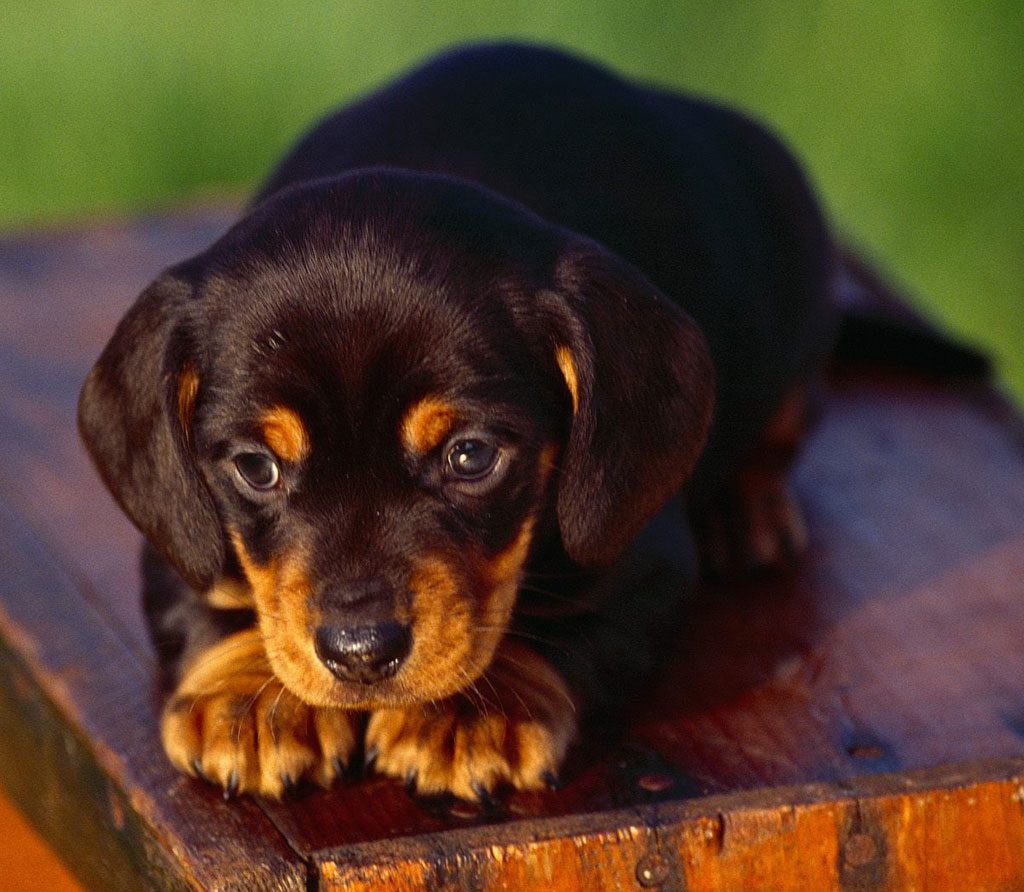
The Black and tan coonhound they are very vocal and ladradores and, they tend to howl frequently.

Content

History

The black and tan dog for raccoon hunting is a breed of dog used especially to track raccoons. It is a cross between Bloodhound and the Black and Tan Virginia Foxhound (ยซBlack fox hunter and virginia fireยป).

The Black and tan coonhound It is one of the oldest breeds that exist in America. It is considered that its origin is in the old packs of Fox Hound Cross with Bloodhound they were imported from England in the 17TH century.

The Black and tan coonhound is a descendant of dog Talbot (extinct race), It was in medieval England from the 11th century. His ancestry is, years. At that time, drawn through the Bloodhound and the Black and Tan Virginia Foxhound.

The Black and tan coonhound it is the only one of the six races of the group โ€œCoonhoundโ€ (hunting dog breed belonging to hounds) officially recognized by the American Kennel Club.

In 1945 the Black and tan coonhound was recognized by the American Kennel Club.

The Redbone Coonhound and the Plott Hound since then they have been recognized in the miscellaneous class. The other three varieties of Coonhound are the Bluetick Coonhound, the American English Coonhound, and the Treeing Walker Coonhound.

Physical characteristics

The standard of the Black and tan coonhound mark that your weight is 29 to 59 Kg. Y, the height at the cross of 58 to 69 cm..
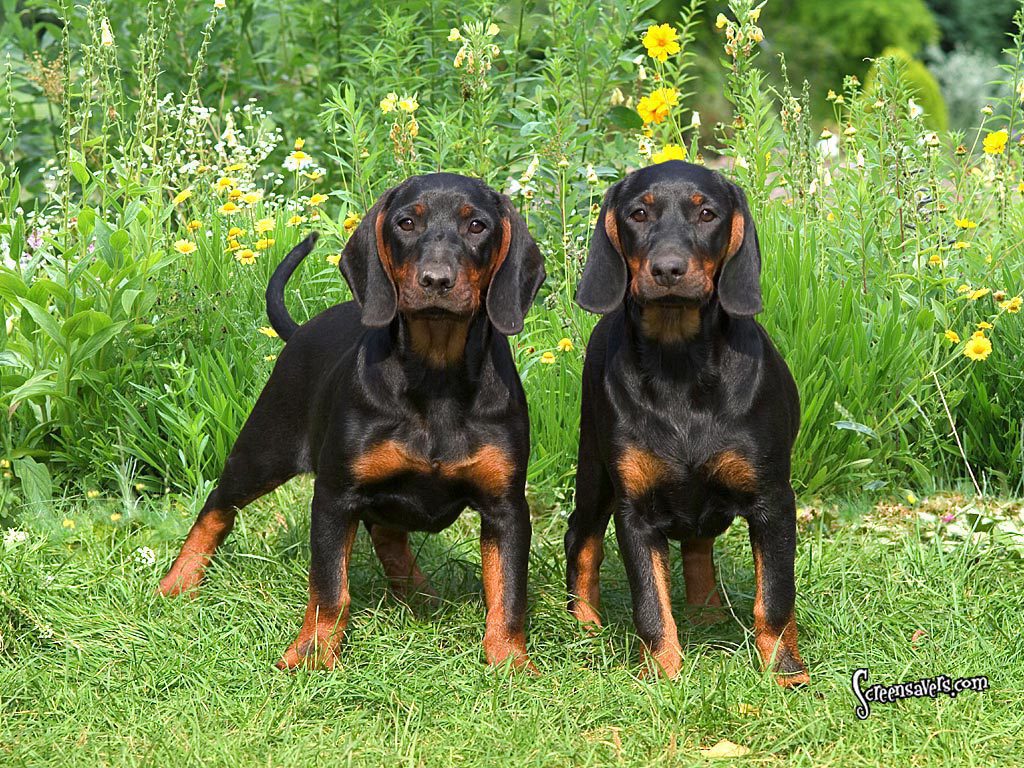
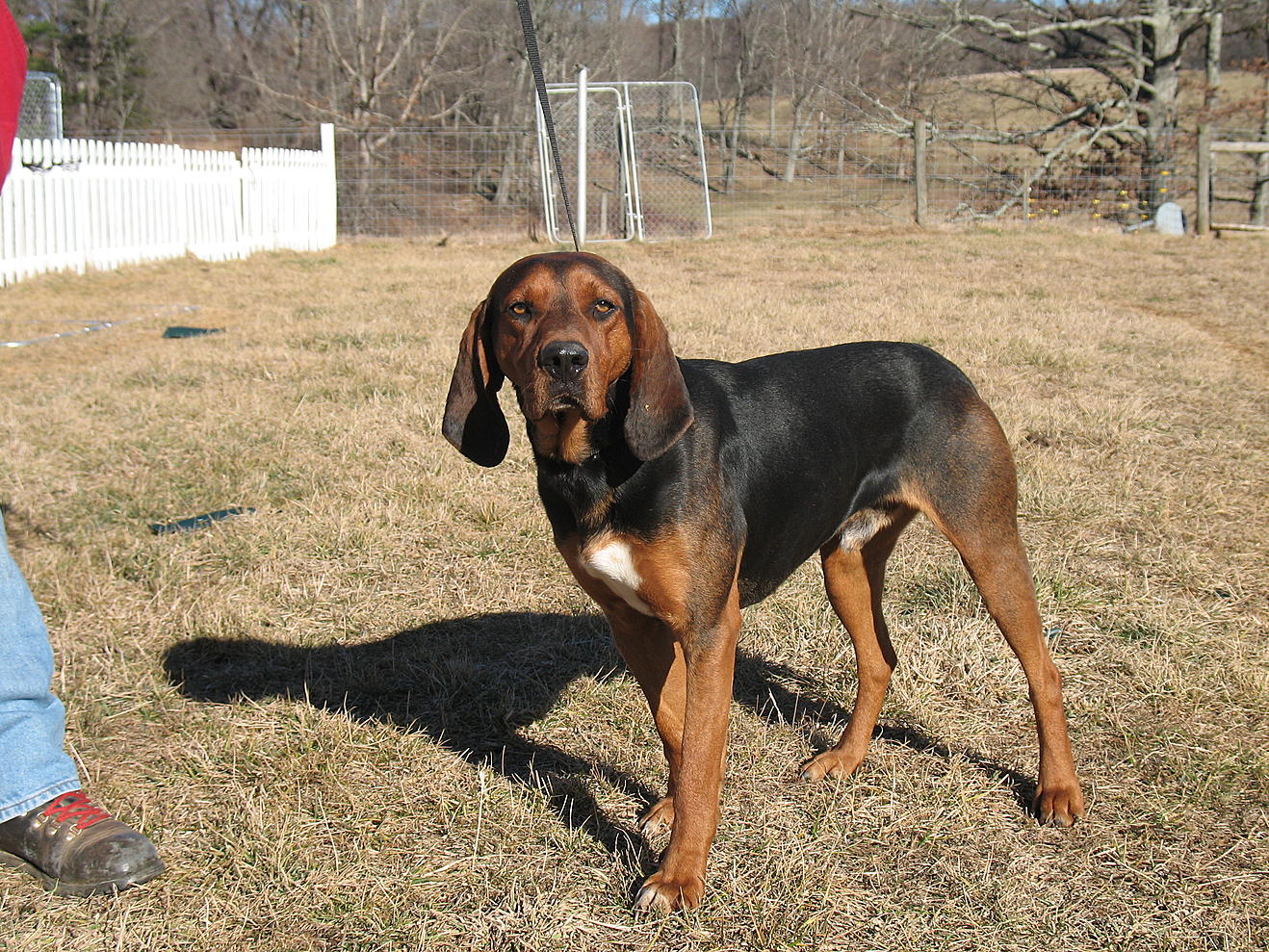
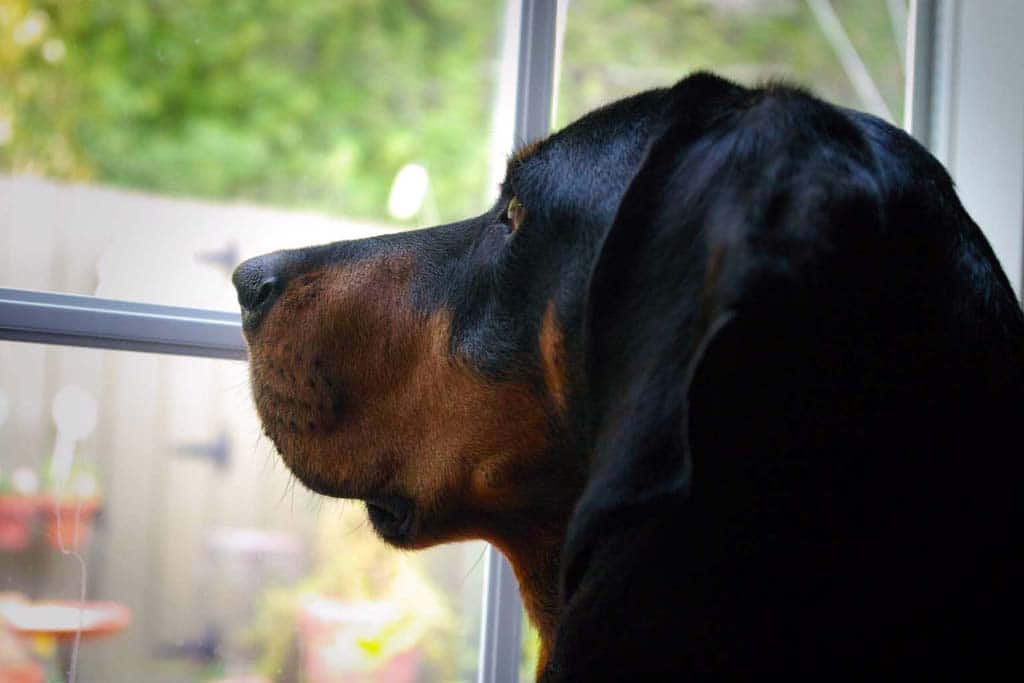
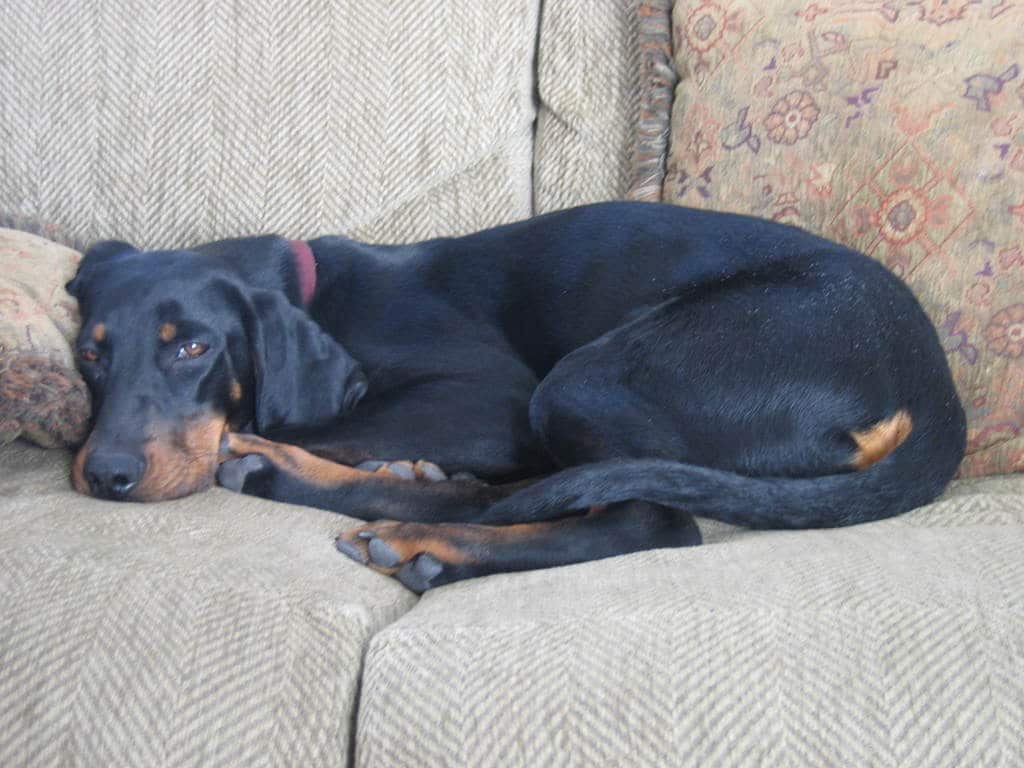
Its pelage is short, dense and glossy. Their brand of black colour and fire are similar to the Dobermann and the Rottweiler, but with key differences that, It doesn't help to distinguish it from other races. The most prominent are the ears and long tails, and his strong bark, like no other. The eyes are Hazel color, throwing more dark in some cases.

The legs are long in proportion to the length of the body, that is very muscular and thin, males tend to be more bony than females.

The size of the litter of a Black and Tan Coonhound dog round the 8 Puppies. Y, the life expectancy of this breed is of 10 to 12 years.

Generally healthy, but there is some risk of the Hip Dysplasia, ear cancer and other ear infections and eye problems.

Character and skills

The Black and tan coonhound achieves its objective by guiding itself only by smell, What makes it also efficient to find deer, bears, Pumas and other pieces of hunting, although in many countries this type of hunting with dogs is restricted.

The general impression is the of the power, agility and alertness, with the ability to quickly drop to the ground and move down with powerful rhythmic strides. It also, every dog has his own voice, recognisable for their owners from a great distance.

The Black and tan coonhound he is a gentle dog, adaptable and worthy to be loved. While adapt very well to different environments of life, This dog will be very happy when you can do the work for which has been raised.

Thanks to its amazing sense of smell, is a dog that easily distracted, he is obedient but if any trail crosses his path he will go after himโ€ฆ Reason why, they are dogs that require a constant and patient training.

Although most of the Black and tan coonhound they are dogs trust, balanced and sweet temperament, puppies need a fair amount of encouragement to build their confidence, especially, When living in the interior of a home as pets. You can have despanzurrado and happy on the sofa, If and when, It gives you a lot of exercise, years. At that time, they enjoy the company of their human family.

The Black and tan coonhound, It may seem cautious or nervous in the presence of strangers or unfamiliar dogs, but if they are well socialized from puppies there will be no problem, they are dogs bred for hunting and working group.

The Black and tan coonhound he is better known as "raccoon hunter", but she has also been used successfully for hunting other animals such as the bear, the deer, the Fox and the mountain lion – even on difficult terrain. Since, It is a dog that supports well the rigors of winter, as well as intense heat.

The Black and tan coonhound it is a breed that tends to drool a lot, This is a feature that can be problematic. This race is not very appropriate for someone who is looking for a quiet dog, like all Coonhound, they are very vocal and ladradores and, as well, they tend to howl frequently. They are effective in warning their owners when a stranger enters the courtyard, the appearance of the dog at that time may seem threatening, but it is not likely to bite or attack unless smell the real danger or feel threatened.

Despite being a dog that is not often seen in urban areas, they enjoyed much popularity in rural areas. It is said that a Coonhound they are found on the porch of most rural homes in the United States, more than any other race. While it is not a statistical fact, his place in the AKC registered breeds list that ranks as one of the most popular races.

It is the image that has inspired the character of Pluto, the companion of Mickey Mouse.

Characteristics "Black and tan coonhound"

Coexistence is important that you have with your new friend. Before considering the acquisition of a dog of the breed "Black and tan coonhound" you know certain factors. Not all breeds of dogs are apt to live in an apartment, you must take into account his character, their need for exercise, their interaction with other pets, their care and if you have small children, their level of tolerance towards them.

Adaptation โ“˜

5,0 of 5 stars (based on 1 review)

friendly dog โ€‹โ€‹โ“˜

5,0 of 5 stars (based on 1 review)

hair loss โ“˜

5,0 of 5 stars (based on 1 review)

Affection level โ“˜

5,0 of 5 stars (based on 1 review)

Need for exercise โ“˜

5,0 of 5 stars (based on 1 review)

Social need โ“˜

3,0 of 5 stars (based on 1 review)

Home โ“˜

1,0 of 5 stars (based on 1 review)

Toilet โ“˜

1,0 of 5 stars (based on 1 review)

Friendly with strangers โ“˜

3,0 of 5 stars (based on 1 review)

barking โ“˜

5,0 of 5 stars (based on 1 review)

Health โ“˜

3,0 of 5 stars (based on 1 review)

Territorial โ“˜

1,0 of 5 stars (based on 1 review)

Cat friendly โ“˜

5,0 of 5 stars (based on 1 review)

Intelligence โ“˜

3,0 of 5 stars (based on 1 review)

Versatility โ“˜

2,0 of 5 stars (based on 1 review)

Child friendly โ“˜

5,0 of 5 stars (based on 1 review)

Surveillance โ“˜

3,0 of 5 stars (based on 1 review)

joy โ“˜

1,0 of 5 stars (based on 1 review)

Images Black and tan coonhound

Videos of the black and tan dog for raccoon hunting

Type and recognitions:

  • FCI CLASSIFICATION:
  • Group :
  • Section : . .

Federations:

  • FCI โ“˜, AKC โ“˜, ANKC โ“˜, CKC โ“˜, UKC โ“˜

  • FCI breed standard Black and tan coonhound

    FCIFCI - Black and tan coonhound
    Dog

    Alternative names:

    1. American Black and Tan Coonhound (English).
    2. Chien noir et feu pour la chasse au raton laveur (French).
    3. Schwarz-lohfarbene Waschbรคrenhund (German).
    4. Coonhound preto e castanho (Portuguese).
    5. Black and tan coonhound, perro negro y fuego para la caza del mapache (espaรฑol).

    โ–ท The world of Pets: Dogs, cats, birds, reptiles, amphibians

    Alaskan Malamute
    Estados Unidos FCI 243 . Nordic Sledge Dogs

    The Alaskan Malamute he has a reputation for being stubborn and difficult to train among people who do not know him.

    Alaskan Malamute

    Content

    Characteristics "Alaskan Malamute"

    Coexistence is important that you have with your new friend. Before considering the acquisition of a dog of the breed "Alaskan Malamute" you know certain factors. Not all breeds of dogs are apt to live in an apartment, you must take into account his character, their need for exercise, their interaction with other pets, their care and if you have small children, their level of tolerance towards them.

    Adaptation โ“˜

    3,0 of 5 stars (based on 1 review)

    friendly dog โ€‹โ€‹โ“˜

    1,0 of 5 stars (based on 1 review)

    hair loss โ“˜

    5,0 of 5 stars (based on 1 review)

    Affection level โ“˜

    3,0 of 5 stars (based on 1 review)

    Need for exercise โ“˜

    4,0 of 5 stars (based on 1 review)

    Social need โ“˜

    4,0 of 5 stars (based on 1 review)

    Home โ“˜

    1,0 of 5 stars (based on 1 review)

    Toilet โ“˜

    5,0 of 5 stars (based on 1 review)

    Friendly with strangers โ“˜

    4,0 of 5 stars (based on 1 review)

    barking โ“˜

    4,0 of 5 stars (based on 1 review)

    Health โ“˜

    3,0 of 5 stars (based on 1 review)

    Territorial โ“˜

    5,0 of 5 stars (based on 1 review)

    Cat friendly โ“˜

    1,0 of 5 stars (based on 1 review)

    Intelligence โ“˜

    3,0 of 5 stars (based on 1 review)

    Versatility โ“˜

    2,0 of 5 stars (based on 1 review)

    Child friendly โ“˜

    4,0 of 5 stars (based on 1 review)

    Surveillance โ“˜

    4,0 of 5 stars (based on 1 review)

    joy โ“˜

    5,0 of 5 stars (based on 1 review)

    Alaskan Malamute History

    Also called Mally. It is native to the Arctic dog, and one of the oldest breeds within the sledge dogs.

    It's a dog with a strong appearance, strong, with good musculature. It is capable of carrying significant weight (until 20 kg) for tens of kilometres. This is a very ancient race, from the first races of sled dogs.

    Raised by a tribe of Inuit call mahlemiut. The meaning of the word mahle It is unknown, but it is known that mouse means "people of". Mahlemiut as Mahle people can therefore be interpreted. Following the English phonetics, diction is then transformed into MALAMUTE.

    The area inhabited by the people of the MALAMUTE were the banks of Kotzebue Sound, a territory between two great rivers: the Kobuk and the Noatak. Men and women of the tribe mahlemiut (MALAMUTE) They were highly prized among others Inuit tribes for their courage, his pride and his skill in hunting and fishing.

      These dogs were famous for their beauty and for their characteristics of strength and endurance., that made them excellent elements for shooting.

    They were, in general, larger and more powerful than the other Nordic dogs, with similar in appearance to the Wolf and large and soft tails carried on the back. Contemporary witnesses tell it between 1870 and 1880 approximately, caribou, for unexplained reasons, changed their usual migratory routes, thus taking away from the Malamute tribes an important source of livelihood.

    Under these conditions, families could no longer afford to keep groups of dogs made up of more than two or three dogs.: testimonies of the time talking about men, women and even children helped their dogs to pull the sledges. So the population began to decline and the same fate befell their dogs.

    His ability to bear heavy loads becomes apparent when he is chosen to go on expeditions to the Arctic Circle., as the two who placed the Admiral Byrd. They were also used as a rescue of injured dog in World War II.

    His presence, always with the head-up, It gives some impressive aspect that, However, It is not at odds with a very friendly and playful character with their owners, Although it gives the impression of being a very serious dog anyone that knows no race.

    Alaskan Malamute Physical Characteristics

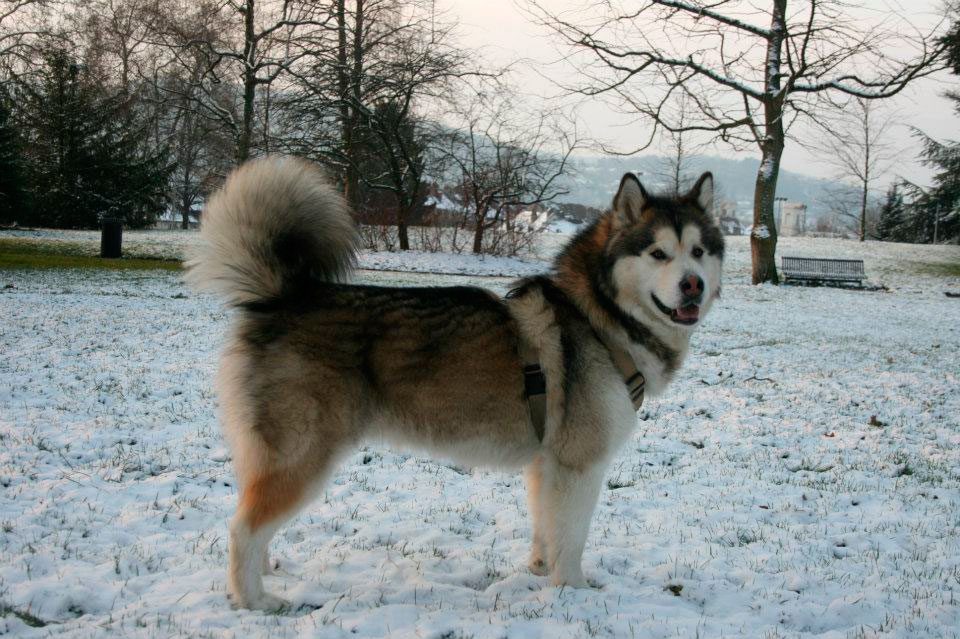
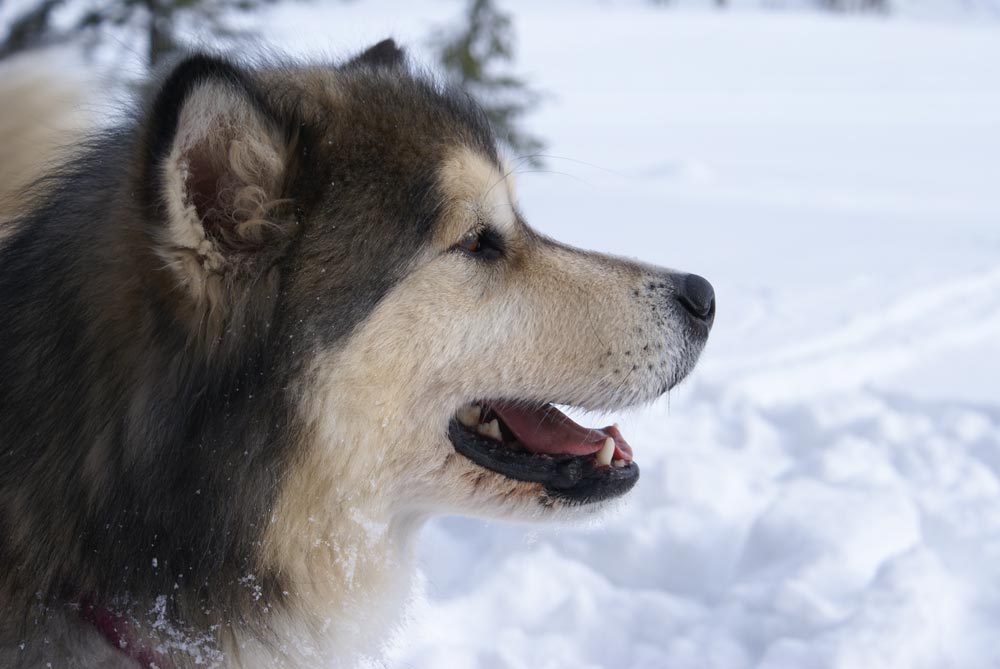
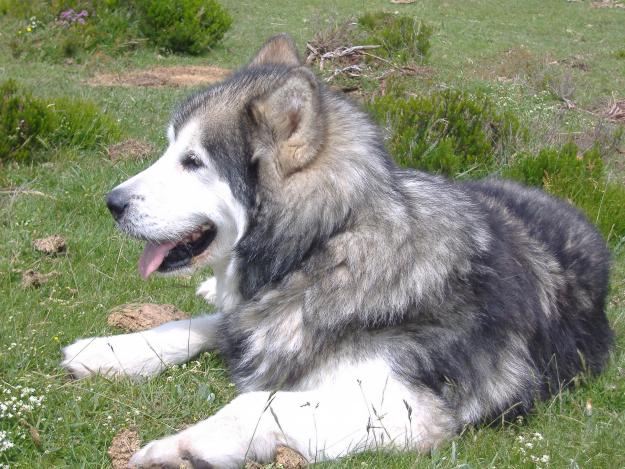
    It has two layers hair: an external, thick and rough, and an internal feel oily and woolly, and it is longer in the area of the neck and shoulders, on the back and the tail. Its color It is predominantly gray but colors ranging from white to reddish sand allowed.

    The tail is well covered and is carried over the back; has the appearance of a feather bush that sways.

    The Malamute stands upright on its legs and embodies the pride and great joy of movement with its head-up posture and eyes that radiate alertness., interest and curiosity. His head is wide. Ears are triangular and are pricked when attention is drawn. The muzzle is massive and tapers only slightly from the base to the nose. It is neither pointed nor long nor short and thick. … The Malamute must have heavy bones and powerful legs, good legs, a deep chest, powerful shoulders and all the other physical conditions you need to do your job efficiently. Your movement should be smooth, harmonious, tireless and completely efficient. He was not bred as a racing sled dog for speed competitions.

    In contrast to other races, When it gets wet is not drastically reduced its size.

    There are different colors in the Alaskan Malamute, Black with white, coffee, reddish and recently found a color of white Malamute. The history of this color is equal to of the Siberian Husky; that are white to camouflage themselves with the snow and thus be able to catch their prey.

    How big is an Alaskan Malamute??

    Malamutes have a height at the withers of 64 centimeters in males and 59 centimeters in females. The weight is between 34 and 38 kg.

    How long can an Alaskan Malamute live??

    His life expectancy is more than 12 years.

    Character and skills Alaskan Malamute

    It is a sled dog with very ancient origins, little changed from its origin Wolf. This does not mean that it is aggressive. While his appearance and pride can impress the external observer, It's a playful animal (When you are invited to do so), faithful to his master and a great protective instinct with children.

    It is a dog outside, She loves the outdoors and is happy to live in the open air; If locks it after a fence, It is very likely that finding the way to escape, because likes freedom and not lose a chance to go in search of an adventure or a career.

    Shyness is usually not a good sign, but fortunately, seems to be a pretty rare feature in this race and if it occurs it may be due to causes outside of the animal genetics and having been produced by an owner who has failed to give a proper socialization, keeping him locked up and devoid of psychic stimuli, interaction with the same kind and a very limited human contact. If it detects, It should be monitored and provide training to overcome the problem, that otherwise his behavior may become unpredictable and therefore dangerous.

    On the other hand, given the way of Eskimo and nomadic life share everything, is not a race of protection, but it can be a good Dog Alert, It will notify the owner that he sees something strange, with the so particular sound it emits, It is a combination between howl and bark.

      It is not a dog to guard and defense than by nature tend to be friendly with humans.

    As a result of his former life, It is a dog with strong herd instinct and hierarchy, which results in frequent attacks with other animals. It also, males are very territorial and competitive with each other so it is not advisable to house them together. Females may be easier to train and better adapted to living in houses. This breed likes human company, has huge doses of loyalty, love and willingness to work, What makes a good dog home.

    It is affectionate with children, even with strangers, and he loves to accompany them on all sides. Because of its independent character is reputed to be stubborn and difficult to train among people who do not know. But, There are Malamutes champions working with blind obedience.

    They are sensitive, affectionate and playful, but they know to protect themselves effectively. With a good training and socialization are balanced dogs, both physically and psychologically, because they have good potential for learning because they are quick to learn and acute reflexes.

    Popular mixes

    Mixtures of Alaskan Malamute with other dog breeds are common in the sled dog scene. Many โ“˜ mushers they try it to improve the performance of their dogs. Individuals who from the point of view of the mushers do not bring optimal performance against the sled, they are then sometimes found in the shelter or offered as a companion dog.

    Caution, health and diseases

    How much care does an Alaskan Malamute need??

    The Alaskan Malamute needs regular brushing, at least weekly, of the coat. Change of coat, twice a year, is particularly intensive. Then your house, his car and his clothes will be full of his long hair, even though they brush it daily. But the main effort for its care is due to its nature as a sled dog.

    Are there any diseases typical of the Alaskan Malamute?

    The Alaskan Malamute it is a very healthy breed of dog, as long as it is not bred in extreme form, which fortunately is seen very little so far: too heavy dogs with too short legs.

    What food is best for an Alaskan Malamute?

    The Alaskan Malamute is often a picky eater. The โ“˜ mushers they have secret recipes with treats to provide their dogs with enough energy before the races. like most dogs, likes a meaty beef bone and fresh meat.

    Activities

    The Alaskan Malamute has to work. This usually means its use as a sled dog.. An attitude like that of a farm or family dog โ€‹โ€‹would not be appropriate for the species.

    Considerations before purchase

    Where can you buy an Alaskan Malamute?

    If you are interested in a Alaskan Malamute, the first thing to do is visit some sled dog races. Then you should check if you want to spend at least the next ten years an ordinary life, sporting and intensive with these dogs and also having the objective conditions for it. Then you should get information from a local breeder who is affiliated with a sled dog club.. If everything goes well, you will have a wonderful experience.

    Breeding and maintenance

    Is an Alaskan Malamute right for me??

    The Alaskan Malamute a dog is not for beginners. You have high demands on your attitude, stemming from its destiny as an original sled dog. All the lives of their caregivers, your human family must adjust to your needs. The real MALAMUTE needs the challenge before the sled physically and mentally. Here are several replacement possibilities even without snow. We see a kind of sled on wheels like a tricycle or a training car with four tires. Especially for Malamutes, drag competitions are organized, which are accepted by the dogs with great joy and full commitment. Especially the sport of dogsledding has something very special. Driving with the sleigh of the MALAMUTE through a snowy landscape in winter is one of the greatest experiences of all.

    It also allows you to experience a deep unity between man-dog and nature in a way that is hardly possible otherwise.. Of course it is also good for your health.

    When traveling, it is better to take the MALAMUTE in an aluminum transport box. The Malamute is not a dog for an apartment. A house with a "garden" should be an ideal space for this race.

    The MALAMUTE it is one of the few breeds of dog that can be kept as a pack in a kennel without any problem. But this kennel must be well secured. It is not that Malamutes are a danger to the environment, but they are kings of escape and they dig well and with gusto. You can hardly believe, through which little holes these heavy dogs can escape.

    To the malamutes they like to sleep outside and snuggle with their head under their tail during the biggest snowstorm. The garden, where the Malamutes, should not be considered as an ornamental garden, to put it in a nice way. The malamutes require that the entire lifestyle be in tune with this association.

    The Alaskan Malamute can be well trained by an experienced dog owner. One must accept the challenge, even love, of fighting mentally with these primitive and self-confident dogs. They will gladly accept their masters and caregivers, will be loyal to them, but they must have leadership qualities combined with a lot of doggy mind. You have to fully commit to the experience of having a MALAMUTE. Not a dog for people without deep canine experience.

    Alaskan Malamute photos

    Alaskan Malamute Videos

    Big Funny Alaskan Malamute

    Type and recognitions:

    • FCI CLASSIFICATION:
    • Group :
    • Section : . .

    Federations:

    • FCI – Group 5: Section: 1 Nordic Sledge Dogs โ“˜
    • AKC – Work Toy โ“˜
    • ANKC – Group 6 – (Utility) โ“˜
    • CKC – Group 3 – (Working dogs) โ“˜
    • โ€‹KC – Work โ“˜
    • NZKC – Utility Toy โ“˜
    • UKC – Northern races โ“˜

    FCI breed standard "Alaskan Malamute"

    Origin:
    Alaska, United States

    Date of publication of the valid original standard:
    14.08.1996

    Use:

    Sledge dog


    General appearance:

    The Alaskan Malamute is one of the oldest breeds of sled dogs. This is a mighty dog, solidly built, deep chest and strong, muscular body. Its limbs are well approved when standing and its attitude denotes great energy. The head takes her high, with a haughty bearing; the look, always alert, expresses interest and curiosity. The head is wide; the ears are triangular and stand erect when the dog is attentive. The muzzle is compact and its width, from the root to the truffle, only slightly decreases. It's not long, or pointed, but it is not truncated either. The pelage is dense; the hair on the outer coat is coarse and of sufficient length to protect the inner coat of hair which is woolly.
    This breed exists in different colors. Face markings are a distinctive feature. These consist of a kind of headdress that covers the head. The face, or is it completely white, or has a stripe and / or a mask. The tail carried over the back has the appearance of an undulating plume. Her hair is abundant.

    The malamute is endowed with a strong boss and its limbs do not present any defect. Feet are good, the chest is deep and the shoulders are powerful.

    It has all the other necessary physical structures that allow the effective fulfillment of your task. His movements are fluid, balanced, tireless and fully efficient. This dog is not designed to compete with others pulling the sled in speed races, its value lies in its strength and endurance. Any individual characteristic, including temperament, that interferes in the realization of this purpose, must be considered the most serious of offenses.

    IMPORTANT PROPORTIONS: The height of the chest corresponds to approximately half the height at the withers; The lowest chest point is exactly behind the forearm. The length of the body, taken from the tip of the shoulder to the tip of the buttock, exceeds the height at the withers.


    Behavior / temperament:

    The Malamute is an affectionate dog, friendly and not a single master's dog. He is a loyal and devoted companion, willing to play when encouraged, but usually impresses with dignity as an adult.

    Head:

    It's wide and deep, but it is not coarse or heavy and should be proportionate to the size of the dog. The expression is sweet and indicates an affectionate disposition.

    Cranial region:
    • Skull: Wide and moderately rounded between the ears. Narrowing and gradually flattening at the top, close to the eyes; it is round in the region of the cheeks, which are rather flat. A slight furrow can be seen between the eyes. The upper line of the skull and the upper line of the snout form almost a straight line.
    • Depression links (Stop): Light.

    facial region:

    • Truffle: In all the colors of the fur, except for the red, It is black, as well as the lips and edge of the eyelids.
      Brown is allowed in red-coated dogs. The nose "e snow" is accepted, which is marked by a lighter band.
    • Snout: It is big and massive, in relation to the size of the skull. Its width and depth decrease very little from the junction with the skull to the nose..
    • Lips: They are tight.
    • Jaws / Teeth: Both jaws are wide and have strong teeth. The incisors form a scissor bite. Both upper and lower prognathism constitute a fault.

    EYES: They are arranged obliquely on the skull. They are chestnut, almond-shaped and medium-sized. Blue eyes are an eliminatory foul.

    EARS: Medium-sized, although small in relation to the skull. They are triangular in shape and slightly rounded at the end.. Well separated implantation, They are located on the external edges of the back of the skull, aligned to the upper corner of the eye, for which, when the ears are pricked, seem to move away from the skull. When they are upright, ears point slightly forward, but when the dog works, sometimes they bend and stick to the skull. High set ears are a fault.

    Neck:

    They are arranged obliquely on the skull. They are chestnut, almond-shaped and medium-sized. Blue eyes are an eliminatory foul.

    Body:

    It is compact in construction, but it is not excessively short. Must not be overweight, and bone structure is in proportion to size.

    • Back: Straight; descends in a slight incline to the hips. Pork loin: Solid and well muscled. A long loin that can weaken
      the back constitutes a foul.
    • Breast : Well developed.

    Tail:

    Medium insertion following the spine line. The dog carries it on his back when he is at rest. It does not support the upper line, nor does it twist into a closed curl on the back, nor is it covered with short hairs like the fox's tail. The Malamute's tail is very bushy and has the appearance of a wavy plume..

    Tips

    PREVIOUS MEMBERS: They are muscular and strong boned. Seen from the front, are straight up to the metacarpals.

    Shoulder: They are moderately oblique.

    Metacarpus: Seen in profile, they are short, solid and slightly oblique.

    Previous feet: The feet are "snow racket" type, closed and thick with well-cushioned ear cushions for a firm and compact look. They are large and the toes are close together and well arched. Protective hair grows between the fingers. The pads are thick and tough. Fingernails are short and strong.

    LATER MEMBERS: They must be wide. Seen from the back, both when the dog is standing, like when in action, they must be perfectly aligned with the forelimbs. Seen from the back, the dog is not too narrow, not too wide. Hind limb dewclaws are undesirable and should be removed soon after the pups are born.

    Thigh: It must be well muscled.Knee: Its angulation is moderate.

    Hocks: Its joint is moderately bent and well lowered.

    Hind feet: The feet are "snow racket" type, closed and thick with well-cushioned ear cushions for a firm and compact look. They are large and the toes are close together and well arched. Protective hair grows between the fingers. The pads are thick and tough. Fingernails are short and strong.

    Movement:

    Is loose, fluid, balanced and powerful. The Malamute is agile, taking into consideration its weight and size. Profile views, the hindlimbs produce a strong impulse that is transmitted to the forelimbs through a well-muscled lumbar region. This impulse received by the forelimbs produces a sustained and long movement. Front or back views The limbs move in a straight line and are not even together, not too far apart. During the fast jog, limbs tend to converge on the body's center of gravity. A rigid step, or any movement that is not completely effective and tireless should be penalized.

    Mantle

    Fur: The outer layer of hairs is thick and rough, never long, nor soft. The undercoat of hairs is dense, of 2,5 to 5 cm. (1-2 ins) of thickness. It is also oily and woolly. Hair length is variable, both on the rough outer coat, as in the inner layer. The hair ranges from relatively short to medium on the lateral parts of the body; its length increases around the shoulders and neck, on the back and on the rump, as well as in pants and plume. Usually, the Malamute has shorter and less dense hair during the summer months. At the exhibitions, this breed must be presented in the natural state. Grooming is only allowed to give the feet a clean appearance.

    Color: Usual colors vary, from light gray through intermediate tones to black to red. The combination of colors in the inner layer of hairs is accepted, in the face (supraciliary arches, ears, lips, nose) and between the white and pigmented areas. The only uniform color that is accepted is white. This is always the predominant color in the lower parts of the trunk, a part of the limbs, the feet and a part of the facial markings. A white stripe across the forehead, a necklace, the both, as well as a small spot on the neck they attract attention and are admitted. The Malamute's coat is laid out like a blanket; an irregular color spreading over the whole body or in the form of asymmetric splashes should not be allowed.


    Size and weight:

    This breed has a natural range of sizes.

    For work, the desired sizes are: 63,5 cm. (25 inches) height at the withers for a weight of 38 kg (85 English pounds) in males, and in females 58,5 cm. (23 inches) height at the withers for a weight of 34 kg (75 English pounds). But, size considerations should not be more important than type, the proportions, movement and everything that concerns function. If during the judging some dogs are of equal type, proportions and function, The one that is closest to the desired size will be selected to be able to carry out heavy work.

    IMPORTANT: When judging the Malamute, what should prevail over any other consideration is its function as a sled dog used to haul heavy loads. The severity of the penalty will depend on how far the specimen deviates from the description of the ideal Malamute and to what extent a particular defect affects work ability.. Malamute's extremities must show an unusual force and a very great propulsion power. Any sign of imperfection in the limbs or feet, front or rear, either when the dog is standing, or when in action, should be considered a serious offense. Given these preconditions, Faults would be the following: crushed feet, cow hocks, defective metacarpals, straight shoulders, lack of angulation, Rigid movement (or any movement that is not balanced, energetic and uniform), lack of substance, chest that is not deep enough, thick or light-boned body and mediocre overall proportions.


    Fouls:

    Any deviation from the aforementioned criteria is considered as a fault and the severity of this is considered to the degree of the deviation to the standard and its consequences on the health and well-being of the dog..

    FALTAS DESCALIFICANTES:

    • Aggressiveness or extreme shyness.
    • Any dog โ€‹โ€‹showing clear signs of physical or behavioral abnormalities.
    • Aggressive or fearful dog.
    • Blue eyes.


    N.B.:
    • Males should have two normal-appearing testicles fully descended into the scrotum..
    • Only functionally and clinically healthy dogs, with the typical conformation of the breed, should be used for parenting.

    Source: F.C.I - International Cynological Federation

    Alternative names

    1. Alaskan Malamute, Mal, Mally (English).
    2. Malamute de l’Alaska (French).
    3. Alaskan Malamute (German).
    4. Malamute-do-alasca (Portuguese).
    5. Alaskan malamute (espaรฑol).

    โ–ท The world of Pets: Dogs, cats, birds, reptiles, amphibians

    Siberian Husky
    Estados Unidos FCI 270 . Nordic Sledge Dogs

    Husky Siberiano

    The Siberian Husky is a highly specialized working dog. Running is his passion.

    Content

    History

    Where does he come from Siberian Husky originally?

    The history of the Siberian Husky is inseparably connected with the lives of the people of the Arctic Circle. Only with their dogs, that pulled the sleds, they helped in the hunt, provided reliable GPS, they protected them from polar bears and finally warmed them on cold nights, the people there managed to survive. But, the Siberian Husky as a modern dog breed it is quite young. Its history began around 1910, and in Alaska the huskies they were bigger and stronger, comparable to current MALAMUTE.

    At the sled races a Siberian fur trader appeared with his thin dogs. They were called "Huskyยซ, at that time an expletive for the eskimos. But these dogs won race after race. The polar explorer Roald Amundsen noticed them. Norwegian Leonard Seppala began to reproduce them. His breakthrough came in 1925 when a diphtheria epidemic broke out in the remote city of Name in the middle of the polar winter. In the extremely heavy snow there was no way to get through. Adults and children died. so brave โ“˜ mushers under Seppala's leadership they decided to bring the salivary serum to more than 1000 kilometers with their sleds of huskies. They gave it their all and the people were saved. A monument was erected on the Central Park in New York in honor of Husky. Even today theGreat Iditarod Sled Raceยป continues to be celebrated every year in Name.

    The Husky Siberian began his triumphal procession with the people of the sled dogs. He benefited from the fact that โ“˜ mushers they wanted fast dogs for short distances, While the inuit depended on endurance and long distances. There are many breeds of sled dogs that vary according to need, as the Husky de Alaska. But only the Siberian Husky is recognized as a breed of dog.

    In 1932 The standard that defines it as a working sled dog according to โ€œform for functionโ€ was approved. In the USA., breeders started around 1970 to create a Husky For the general public. Two lines developed, the Showdog and the Siberian Husky employee.

    Popular mixes

    Mixes with Siberian Husky they are not rare. But due to the highly specialized nature of this sled dog it is not infrequently problematic.. So it's not uncommon for nervous dogs to emerge, that can also bite.

    Physical characteristics

    What is a "Siberian Husky" like??

    The Siberian Husky, call Husky To abreviate, it is one of the most original dog breeds. Has an unmistakable appearance. One Husky embodies wildlife, he immediately remembers his father the wolf. In fact, it is one of the dog breeds most closely genetically related to the wolf. And that, even though he has been working as a sled dog for over 10.000 years and there has been no significant interbreeding with wolves since then, as shown by genetic investigations from 2020. The official FCI standard still defines the Siberian Husky as:

    Medium size working dog, fast, light feet… extremely capable of performing its original task as a sled dog and pulling light loads at moderate speed over long distances.

    All colors from black to white are allowed. Characteristic is the structure of its coat with a very dense undercoat and a skin-like topcoat.. As a whole, the Husky reminds of a wolf in appearance, complexion and sometimes in his coat.

    One Husky moves with light feet. His walk is unmistakable. It is a special pleasure to see your elegance and power in space while running. But, only one legend says that a black eye belongs to the Husky. Although it is allowed by the rule, still a genetic defect. Inuit have avoided blue eyes, because they reduce your vision in the polar sun.

    How big is a โ€œSiberian Husky?โ€?

    The height at the withers is between 50 and 60 cm with a weight between 20 and 28 kg.

    Characteristics and traits

    The Husky is a highly specialized working dog. Running is his passion, especially pulling sleds. If you are interested in a Husky, you should visit the sled dog races in winter. It is deeply impressive and fascinating. You can feel the extreme tension of the dogs much earlier. When you go to the exit, there is hardly a stop. Like in an explosion, this tension dissolves in the rapid acceleration of the sled, which can then be dragged over dozens of kilometers in a stretch. The Siberian Husky loves this job and needs it too. This is a challenge to your position.

    The Husky it is a modern and archaic dog. In his character there is much wolf life although – purely genetically speaking – is not more closely related to him than other dogs. The huskies they are quiet but excellent observers and can, for example, steal a piece of sausage from your plate in an instant and with great precision. They don't make much of a fuss about their actions. At most before a common excursion the temper crosses them. The huskies they are excellent hunters. To their humans they are friendly and gentle. The Husky he is not a guard dog but is willing to defend his family effectively.

    Caution, health and diseases

    How much care does a "Siberian Husky" need??

    The Siberian Husky needs regular grooming, at least weekly. Coat changes, twice a year, they are particularly intense. Then your house, his car and his clothes will be full of his long hair, even if you brush it daily.

    Typical diseases of the breed

    The Siberian Husky it is a very healthy breed as long as it is not raised in extreme conditions. One extreme is the racing huskies, that are only optimized for the sporting success of mushers. Here we see many deformations of the march, thermal balance, the entire cardiovascular system and even the psyche. Partially bad in both directions, what is made of these extremely robust primitive dogs today.

    What food is best for a "Siberian Husky"?

    The Siberian Husky is often a very picky eater. That is why their diet is often demanding. Of course, this always depends a little on each dog. The โ“˜ mushers they have secret recipes with treats to provide their dogs with enough energy before the races.

    Activities

    How much exercise does our โ€œSiberian Huskyโ€ need??

    The Siberian Husky Nowadays it is divided into two types as described. In both, However, the Husky
    authentic still alive. The huskies they want to run. This doesn't just mean an extensive nature walk. Can you feel the essence of a Husky when you experience it at sled dog races. You can only keep one Siberian Husky in a species-appropriate way, if you do a sled sport or its variants for training without snow. Otherwise, you have to give it a lot of activity, all days.

    Considerations before purchase

    Where can you buy a "Siberian Husky"?

    If you are interested in a Siberian Husky, the first thing to do is check if you want and can spend at least the next ten years of a common sporting life with these dogs. Then you should find a trusted local breeder, or in an animal shelter.

    Education and maintenance

    Should a "Siberian Husky" suit me??

    The Siberian Husky a dog is not for beginners. You have high demands on your attitude, stemming from your destiny as a sled dog. All of our routines must be tailored to your needs. This applies especially to working line dogs.. In the case of show lines for family dogs, these requirements are only valid up to a point. Dogs accustomed to living in an apartment can sometimes even be seen directly here. But are they still huskies?

    The real Siberian Husky needs the challenge in front of the sled physically and mentally. There are many possibilities here even without snow. We see a kind of sled on wheels like a tricycle or a training car with four tires. Canicross is the name of the discipline in which huskies they pull a runner by the lap belt. In bike riding they pull a mountain bike, in scooterjรถring of a special scooter, in skiing of a skier. This type of dog sport has something very special. It allows you to experience a deep unity between the man-dog and nature in a way that is otherwise almost impossible..

    Ride with a sleigh of Huskies through a snowy landscape in winter is one of the greatest experiences of all. Of course it is also good for your health.

    Sporting success should never be sought at the expense of dogs. The Siberian Husky not a dog for an apartment. The ideal would be a house with a garden. The Husky it is one of the few dog breeds that can be kept in a kennel with several dogs. He likes to sleep outside and curls his head under his tail during the heaviest snowfall and enjoys his peace and quiet. The garden, where to Huskies they like to stay, should not be considered as an ornamental garden.

    The Siberian Husky can be well trained by an experienced dog owner. He is open and honest and likes to work alongside his master or carer, although their "will to please" is limited. Not a partner for any kind of tricks. Only when it comes to pulling a sled are you with all your senses and all your will to do so. Quickly learn to follow the orders of the โ“˜ musher. In daily contact he is trouble free and frugal. Must be used to other pets, especially cats or rabbits, from the puppy, otherwise it sees them as prey.

    Breeders list "Siberian Husky"

    REGISTER KENNEL

    Siberian Husky breeders

    Offer your puppies for free. Sign up here.

    • This field is a validation field and should be left unchanged.
    • Enter an image of your kennel.


    Characteristics "Siberian Husky"

    Coexistence is important that you have with your new friend. Before considering the acquisition of a dog of the breed "Siberian Husky" you know certain factors. Not all breeds of dogs are apt to live in an apartment, you must take into account his character, their need for exercise, their interaction with other pets, their care and if you have small children, their level of tolerance towards them.

    Adaptation โ“˜

    5,0 of 5 stars (based on 1 review)

    friendly dog โ€‹โ€‹โ“˜

    5,0 of 5 stars (based on 1 review)

    hair loss โ“˜

    5,0 of 5 stars (based on 1 review)

    Affection level โ“˜

    5,0 of 5 stars (based on 1 review)

    Need for exercise โ“˜

    4,0 of 5 stars (based on 1 review)

    Social need โ“˜

    3,0 of 5 stars (based on 1 review)

    Home โ“˜

    2,0 of 5 stars (based on 1 review)

    Toilet โ“˜

    2,0 of 5 stars (based on 1 review)

    Friendly with strangers โ“˜

    3,0 of 5 stars (based on 1 review)

    barking โ“˜

    4,0 of 5 stars (based on 1 review)

    Health โ“˜

    3,0 of 5 stars (based on 1 review)

    Territorial โ“˜

    1,0 of 5 stars (based on 1 review)

    Cat friendly โ“˜

    1,0 of 5 stars (based on 1 review)

    Intelligence โ“˜

    5,0 of 5 stars (based on 1 review)

    Versatility โ“˜

    1,0 of 5 stars (based on 1 review)

    Child friendly โ“˜

    5,0 of 5 stars (based on 1 review)

    Surveillance โ“˜

    4,0 of 5 stars (based on 1 review)

    joy โ“˜

    1,0 of 5 stars (based on 1 review)

    Images "Siberian Husky"

    Photos:

    1 – A black-and-white Siberian Husky with blue eyes by Flickr user Pamela Carls (IrisDragon) / CC BY-SA
    2 – Siberian Huskies by Dolphin / CC BY-SA
    3 – A ยซsableยป-coloured Siberian Husky by Original photo taken by Flickr user Sue and Marty. Edited by User:Pharaoh Hound / CC BY-SA
    4 – Husky Siberiano in Mont-Tremblant, Canada by Ellie Lord ellie_lord / CC0
    5 – Five year old female Siberian Husky named Luna by Biowk / CC BY-SA
    6 – A head of 3-months old Siberian Husky by MrPanyGoff / CC BY-SA

    Videos "Siberian Husky"

    Type and recognitions:

    • FCI CLASSIFICATION:
    • Group :
    • Section : . .

    Federations:

    • FCI – Group 5 – Section 1 Nordic Sledge Dogs. โ“˜
    • AKC – Nordic Sledge Dogs โ“˜
    • ANKC – Nordic Sledge Dogs โ“˜
    • CKC – Nordic Sledge Dogs โ“˜
    • โ€‹KC – Nordic Sledge Dogs โ“˜
    • NZKC – Nordic Sledge Dogs โ“˜
    • UKC – Nordic Sledge Dogs โ“˜

    FCI breed standard "Siberian Husky"

    Origin:
    United States

    Date of publication of the valid original standard:
    02.02.1995.

    Use:

    Working dog to pull sleds


    General appearance:

    The โ€œSiberian Huskyโ€ is a medium-sized working dog., fast and light. Her movement is free and graceful. His body moderately compact and well covered with hair, erect ears and bushy tail with brush hair suggest its Nordic heritage. His characteristic gait is smooth and seemingly effortless.. It performs its original role as a dog to pull in the most capable way, carrying a light load at moderate speed over long distances. The proportions and shape of his body reflect his basic balance of power, speed and endurance. The males of the โ€œSiberian Huskyโ€ breed are masculine, but never rough; the females are female but without showing weakness in their structure. In good health, with firm and well developed muscles, The โ€œSiberian Huskyโ€ should not be overweight.

    PROPIMPORTANT ORTIONS:

    • In profile, the length of the body from the point of the shoulder to the point of the buttock is slightly greater than the height of the body from the floor to the withers.
    • The distance from the tip of the nose to the stop is equal to the distance from the stop to the occipital bone.


    Behavior / temperament:

    The characteristic temperament of the โ€œSiberian Huskyโ€ is friendly and gentle., but also alert and extroverted. Does not manifest the possessive qualities of the guard dog, nor is he overly suspicious of strangers or aggressive towards other dogs. A certain reserve and dignity is expected in the adult dog. His intelligence, docility and disposition for pleasure make this dog a pleasant companion and an always willing worker.

    Head:

    ---

    Cranial region:
    • Craging: Medium in size and proportionate to the body; slightly rounded at the top and gradually tapering from its widest point towards the eyes.
    • Dnaso-frontal depression (Stop): Well defined.

    facial region:

    • Trufa: Black on gray dogs, leonados or black; liver color in copper dogs; can be flesh-colored in all-white dogs. Pink striped โ€œsnow noseโ€ is acceptable.
    • Horcico: Medium long. The muzzle is of medium width, slimming gradually towards the truffle; the tip is not pointed or square. The nasal bridge is straight from the stop to the tip.
    • Labios: Well pigmented and tight.
    • Jaws / Teeth: They close in a scissor bite.
    • Ojors: Almond biscuits, moderately spread and very slightly oblique. The color of the eyes can be brown or blue; two different colored eyes or one heterochrome eye are acceptable. Vivacious expression, but kind, interested and even naughty.
    • Obars: Medium in size and triangular in shape, placed very close to each other, set high on the head. They are thick, well covered with hair, slightly arched at the back and intensely erect, with slightly rounded tips, which are directed straight up.

    Neck:

    Medium long, bowed and carried proudly upright when the dog is standing. During the trotting movement, It extends the neck so that the head is carried slightly forward.

    Body:

    • Espalda: Straight and strong, with a level top line from withers to rump. It is of medium length, nor relatively short like a "cob" dog, nor elastic due to excessive length.
    • Itmor: It is tight and thin, narrower than the rib cage and slightly raised.
    • Glikeness: It is inclined in relation to the spine, but never so inclined as to restrict the rear thrust of the hind limbs.
    • Pecho: Deep and strong, but not too wide; its deepest point is just behind and at the elbow level. The ribs are well sprung from the spine, but flattened on the sides to allow greater freedom of movement.

    Tail:

    The tail, that is well covered with hair, shaped like a fox brush; It is inserted just below the level of the upper line and is usually, when the dog is attentive, It is carried on the back in the shape of a curved sickle. When carried up, tail does not curl to either side of the body, nor does it lie flat on the back. It is normal to wear it hanging when the dog is at rest. The hair that covers the tail is of medium length and approximately the same length at the top and bottom and at the sides, thus giving the impression of a round brush.

    Tips

    PREVIOUS MEMBERS: When the dog is standing and seen from the front, limbs are moderately separated, parallel and straight. The bones are substancial but never heavy. The length of the limb from the elbow to the ground is slightly greater than the distance from the elbow to the point of the withers.. The rams of the forelegs may be extirpated.

    • Hormbrivers and arms: Scapula well placed back. The arm is slightly oblique back from the point of the shoulder to the elbow and is never perpendicular to the ground. The muscles and ligaments that attach the shoulders to the rib cage are firm and well developed..
    • Elbows: Close to the body and without deviations outward or inward.
    • Acarpal joint: Strong, but flexible.Metacarpus: Viewed from the side they are slightly inclined.

    LATER MEMBERS: When the dog is standing and seen from behind, hindlimbs are moderately apart and parallel. If there are spurs, must be removed.

    • Thigh: Well muscular and powerful.
    • Rodinllto: Well angled.
    • Atibio-tarsal articulation: Well defined and placed low close to the floor.

    FEET: Oval, without being long. Are medium-sized, compact and well covered with hair between the fingers and the pads. The latter are hard and well padded. When the dog adopts the natural posture, the feet show no outward or inward deflection.

    Movement:

    The characteristic movement of the โ€œSiberian Huskyโ€ is smooth and seemingly effortless.. He is fast and light on his feet and on the show ring with a loosely handled guide, shows a moderately fast trot thus showing good reach in the forelimbs and good drive in the hindlimbs. Seen from the front to the back while walking, The โ€œSiberian Huskyโ€ does not show a single footprint, but as the speed increases, the limbs gradually tilt inward until the pads are situated in a line directly below the longitudinal center of the body. As the footprints of the pads converge, the forelimbs and hindlimbs are carried in a straight line, without the elbows or femoral-tibio-patellar joints deviating inward or outward. Each hind limb moves in the tread of the corresponding fore limb on the same side. While the dog is in motion, top line remains firm and level.

    Mantle

    Plink: The coat of the โ€œSiberian Huskyโ€ is double and of medium length., giving the appearance of being bushy, but never so long as to cover the well-defined external lines of the dog. The undercoat is soft, dense and long enough to support the outer layer. The hairs of the outer coat are straight and somewhat glued gently to the body; they are never rough or separated from the body. It should be noted that the absence of undercoat during molt is normal. Mustache hairs and hairs between the toes and around the feet are allowed to be trimmed for a cleaner appearance. Trimming hair in any other region of the body is unforgivable and must be severely penalized.

    Colorr: All colors from black to pure white are allowed. A variety of markings on the head are common, including many striking patterns not found in other breeds.


    Size and weight:

    Alturto the cross:

    • Males: 21 to 23,5 inches to the withers (53,5 โ€“ 60 cm.),
    • females: 20 to 22 inches to the withers (50,5 โ€“ 56 cm.).

    Pthat:

    • Males: 45 to 60 english pounds (20,5 โ€“ 28 kg),
    • females: 35 to 50 english pounds (15,5 โ€“ 23 kg).

    The weight is proportional to height. The measurements mentioned above represent the extreme limits of size and weight without giving preference to either extreme.. Any appearance of skeleton or excessive weight should be penalized.

    Resumen: The most important racial characteristics of the โ€œSiberian Huskyโ€ are its medium size, moderate skeleton, well balanced proportions, free and easy movement, appropriate coat, nice head and ears, correct tail and good nature. Any excess weight, rough bones, constricted or heavy movement or a long or coarse coat should be penalized. The โ€œSiberian Huskyโ€ is never so heavy and coarse in appearance as to suggest that it is a powerful pack animal., nor is it so light and brittle as to suggest that it is a sprint sprinting animal. In both sexes, The โ€œSiberian Huskyโ€ has the appearance of great capacity and resistance. In addition to the fouls already mentioned, The obvious structural faults common to all breeds are undesirable in the โ€œSiberian Huskyโ€ as in any other breed., although they are not specifically mentioned in this standard.


    Fouls:

    Any deviation from the aforementioned criteria is considered as a fault and the severity of this is considered to the degree of the deviation to the standard and its consequences on the health and well-being of the dog..

    • Heavy or rough head; thin head too chiseled
    • Insufficient stop
    • Muzzle too pointed or too thick; snout too short or too long.
    • Any bite other than scissors
    • Eyes too slanted or too close together
    • Ears too large in relation to the head; too separate; not upright enough
    • Neck too short and thick; neck too long.
    • Weak or elastic back; convex back; inclined top line
    • Chest too wide, rack of ribs, ribs too flat or weak
    • Tail bent or tightly curled; tail with many feathers; insertion tail too high or too low
    • Straight shoulders; loose shoulders
    • Weak pasterns; too heavy bones; limbs too narrow or too far apart in front; elbows turned out
    • Straight knee joints, cow hocks, viewed from behind too narrow or too far apart
    • Flexible or squashed fingers; feet too big and heavy; feet too small and delicate; fingers deviated outward or inward
    • Short step, elastic, jumping, heavy or wobbly movement; crossed or like a crab.
    • Long coat, rough the hirsute; too rough or too silky texture; haircut, except where allowed

    FALTAS DISQUALIFYING:

    • Aggressiveness or extreme shyness.
    • Any dog โ€‹โ€‹showing clear signs of physical or behavioral abnormalities must be disqualified..
    • Males older than 60 cm. (23,5 inches) and females over 56 cm. (22 inches).


    N.B.:
    • Males should have two normal-appearing testicles fully descended into the scrotum..
    • Only functionally and clinically healthy dogs, with the typical conformation of the breed, should be used for parenting.

    Source: F.C.I - International Cynological Federation

    Alternative names:

    1. Chukcha, Husky, Sibe (English).
    2. Husky sibรฉrien, Husky (French).
    3. Husky (German).
    4. Husky (Portuguese).
    5. Siberian husky, Husky siberiano, Chukcha, Shusha, Keshia, Siberiano (espaรฑol).

    โ–ท The world of Pets: Dogs, cats, birds, reptiles, amphibians

    Miniature American Shepherd
    Estados Unidos FCI 270 . Sheepdogs

    Miniature American Shepherd

    With his alert expression, attentive and intelligent, the Miniature American Shepherd has all the qualities of Sheepdogs

    Content

    History

    In forty years, Americans have managed to fix the characteristics of this new breed, from the strains of small Australian Shepherds. Recently, the American Kennel Club (AKC) agreed to integrate and, therefore, recognize the Miniature American Shepherd as a race in its own right, integrating it into the Herding Group โ€œShepherd Dogsโ€ … next to his ancestor, the Australian Shepherd.

    In the decade of 1960, the little ones Australian Shepherd who worked on the United States rodeo circuit were selectively bred to further reduce their size. The new breed was originally called the Miniature โ€œAustralian Shepherdโ€. "They became especially popular with riders who traveled to horse shows, since his intelligence, "loyalty and size made them an excellent travel companion.", say the experts of the Club del Miniature American Shepherd from the USA. "In this way its popularity spread throughout the country."

    Currently, the breed is recognized by the FCI (International Cynological Federation), in view of the number of breeders that are embarking on the selection of this breed of dog in Europe.

    Photo: Buddyยป Miniature American Shepherd โ€“ Lost Island’s Roy ‘Arsenal’ Harper โ€“ bred by: Julia Bettendorf, Lost River Miniature American ShepherdsJugabe3b, CC BY-SA 4.0, via Wikimedia Commons

    Physical characteristics

    The Miniature American Shepherd shares many physical traits with its predecessor the Australian Shepherd, only on a smaller scale. The females measure between 33 – 43 cm at shoulder; the males between 35,5 – 46 cm.. Despite its size, they are every inch a real herding dog: energetic, versatile, robust and extremely bright. Striking fur comes in black, blue merle, red and red merle. (Merle exhibits any amount of marbling, spots or mottling.) The Miniature American Shepherd they move with the smooth, agile stride of a dog built for hard work on rough terrain.

    Character and skills

    With his alert expression, attentive and intelligent, dogs Miniature American Shepherd they have all the qualities of a little Shepherd dog, with a pronounced instinct to lead and watch over the herds. Easy to train, able to respond to a variety of demands that allow them to evolve in different sports disciplines. the Miniature American Shepherd However, they are reserved for people who are not familiar to them.. But once you "know" them, becomes a wild playmate, and capable of real feats, thanks to its agility and small size.
    Like all working dogs, especially those able to work in their original profession, when in a situation with a herd of animals, their behavior changes and they become attentive and tireless helpers.

    Its small size, your cleanliness reduced to a minimum, their adaptability and listening skills, greatly facilitate your life and your education in the city. But, like all shepherds, you need to spend and "empty" your overflowing energy. Beautiful walks and runs in the forest are essential to maintain your tone, his physical form and his playful character.

    Health and nutrition

    This solid and sturdy dog, just like their ancestors, does not pose any particular problem in feeding. His health is that of a dog from generations of working dogs, although many buyers take the step of having a companion dog that is easy to live with. Never forget where it comes from, as you deserve regular physical activity to maintain your figure and strength.

    The Miniature American Shepherd is generally a healthy dog, and responsible breeders test their breed for health conditions, communicating with other breeders dedicated to working together for the health of the breed and the preservation of the unique qualities of the breed.

    Although the Miniature American Shepherd it is a relatively healthy breed, the following complications have been observed:

  • Juvenile cataracts
  • PRA (progressive retinal atrophy)
  • Iris Colobomas
  • PPM (persistent pupillary membrane)
  • Regular visits to the vet for checkups and parasite control help ensure a long and healthy life for the dog.

    Grooming

    The Miniature American Shepherd has a double coat, with a longer outer coat and a wool underlayer. The breed shows a good amount, even more so during shedding season, which can happen once or twice a year. Weekly brushing, daily during molting season, will help remove dirt and loose hair and keep the dog looking its best. Balls or tangles can be resolved with a finer brush or metal comb. As in all races, nails must be trimmed regularly, too long nails can cause discomfort to the dog.

    Training

    As in all races, early socialization and training classes for puppies are recommended, which help to ensure that the dog becomes a well-adjusted and well-behaved companion. Smart and willing to please, the Miniature American Shepherd is highly trainable and will reach its best potential as a partner when taught at least basic obedience.

    Physical exercises

    The Miniature American Shepherd he is active and athletic, and requires a moderate amount of exercise but is also very adaptable to your family's way of life. They do well as city dogs as long as their owners provide them with enough exercise.. They enjoy outings with their people that will occupy both their mind and their body. They enjoy and excel at many dog รขโ‚ฌโ€นรขโ‚ฌโ€นevents, including obedience, agility and tracking.

    Characteristics "Miniature American Shepherd"

    Coexistence is important that you have with your new friend. Before considering the acquisition of a dog of the breed "Miniature American Shepherd" you know certain factors. Not all breeds of dogs are apt to live in an apartment, you must take into account his character, their need for exercise, their interaction with other pets, their care and if you have small children, their level of tolerance towards them.

    Adaptation โ“˜

    3,0 of 5 stars (based on 1 review)

    friendly dog โ€‹โ€‹โ“˜

    4,0 of 5 stars (based on 1 review)

    hair loss โ“˜

    3,0 of 5 stars (based on 1 review)

    Affection level โ“˜

    5,0 of 5 stars (based on 1 review)

    Need for exercise โ“˜

    4,0 of 5 stars (based on 1 review)

    Social need โ“˜

    4,0 of 5 stars (based on 1 review)

    Home โ“˜

    3,0 of 5 stars (based on 1 review)

    Toilet โ“˜

    2,0 of 5 stars (based on 1 review)

    Friendly with strangers โ“˜

    4,0 of 5 stars (based on 1 review)

    barking โ“˜

    3,0 of 5 stars (based on 1 review)

    Health โ“˜

    4,0 of 5 stars (based on 1 review)

    Territorial โ“˜

    4,0 of 5 stars (based on 1 review)

    Cat friendly โ“˜

    3,0 of 5 stars (based on 1 review)

    Intelligence โ“˜

    5,0 of 5 stars (based on 1 review)

    Versatility โ“˜

    5,0 of 5 stars (based on 1 review)

    Child friendly โ“˜

    4,0 of 5 stars (based on 1 review)

    Surveillance โ“˜

    3,0 of 5 stars (based on 1 review)

    joy โ“˜

    4,0 of 5 stars (based on 1 review)

    Images "Miniature American Shepherd"

    Photos:

    1 – Blue Merle Miniature American Shepherd by Lextergrace, CC BY-SA 4.0, via Wikimedia Commons
    2 – Miniature American Shepherd with Frisbee by Mullinspw, CC0, via Wikimedia Commons
    3 – Miniature american shepherd puppy by TanSinVic, CC BY-SA 4.0, via Wikimedia Commons
    4 – Miniature american shepherd by TanSinVic, CC BY-SA 4.0, via Wikimedia Commons
    5 – Miniature American Shepherd, blue merle, female by Canarian, CC BY-SA 4.0, via Wikimedia Commons
    6 – American miniature shepherd by https://pxhere.com/en/photo/1029669

    Videos "Miniature American Shepherd"

    Type and recognitions:

    • FCI CLASSIFICATION:
    • Group :
    • Section : . .

    Federations:

    • FCI โ“˜
    • AKC โ“˜

    FCI breed standard "Miniature American Shepherd"

    Origin:
    United States

    Date of publication of the valid original standard:
    04/09/2019

    Use:

    Utilization

    As the name suggests, is a herding dog. Can work in herds of farm animals (sheep, cows, horses).


    General appearance:

    The Miniature American Shepherd is a small sheepdog of the United States of America. It is slightly longer than it is tall with a moderate bone structure in proportion to its body size and weight without extremes.. His movements are fluid, easy and balanced. His exceptional agility combined with strength and ​​resistance allows you to work on a wide variety of terrain. This very versatile and energetic dog is an excellent athlete with great intelligence and a willingness to please those to whom he is present. dedicated. He is a faithful companion and a hard worker. His expression is attentive. Fur hairs, medium length and texture, can be solid in color or mixed with or without whiteness, with or without fires. Traditionally has no tail, shortened or natural short tail.
    A solid build with a mid-frame in relation to its size and weight. The structure of the dog reflects masculinity without being too rough for males.. Females appear feminine without being too light. Overall structure gives an impression of strength without being over the top.

    important proportions

    Length, measured from the tip of the sternum to the tip of the buttock, is slightly higher than the height, measured from the top of the cross to the ground.


    Behavior / temperament:
    The Miniature American Shepherd is an intelligent working dog. Has a pronounced instinct for behavior and keeping herds. He is an exceptional companion, versatile and very easy to educate. Although reserved with strangers, He is not shy. He is an energetic and long-lasting worker who adjusts his behavior and shows the right emotion for the task at hand. With his family he is protective, devoted and faithful.

    Head:

    ---

    Cranial region:

    Head

    The head must be clearly drawn and in proportion to the dog's body. The expression is alert, attentive and intelligent. The dog may express a reserved look and / or vigilant towards foreigners.

    Skull

    The skull is flat or slightly domed and may show a slight occipital protrusion. The width and length of the skull are equal.

    Depression links (stop)

    It is moderate but defined.

    facial region:

    Truffle

    The truffle is liver pigmentation for red or red merle and black subjects for black or blue merle subjects. Fully pigmented truffle is preferred.

    Snout

    Fades a bit of the truffle base and rounds out at the end. The length of the muzzle is equal to that of the skull in the profile. The top line of the skull and the chamfer line are slightly oblique to each other, and the top line of the skull forms a slight downward angle.

    Jaws / Teeth

    The teeth must be complete and in scissors. Dogs with broken teeth, missing or accidentally discolored will not be penalized.

    Eyes

    The eyes are obliquely set, in the form of almond, without projection or sunken and in proportion to the head. Whatever the color of the dress, all eye colors are allowed. Eyes are allowed, specks and specks. The edge of the eyelid has liver pigmentation for red or red merle subjects and black pigmentation for black or blue merle subjects.

    Ears

    The ears are triangular, medium-sized, attached to the top of the head. When is the dog attentive, fold back or to the side, ru รย รยพรยทรยฐ.

    Neck:

    The neck is solid and in proportion to the body, is of medium length and slightly curved. Neck fits well between shoulders.


    Body:

    Generality

    The body is firm and well muscled but without exaggeration.

    Back

    Firm and straight in static as well as in motion.

    Pork loin

    Strong and wide seen from above.

    Rump

    Moderately inclined.

    Breast

    The chest is full and deep. Reaches elbow with well-curved ribs.

    bottom line

    Moderately elevated.

    Tail:

    Traditionally has no tail, shortened or natural short tail. The long, uncut tail can form a slight curve when the dog is around. Resting. When the dog is moving, can be used with a slightly steeper curve.


    Tips

    Former members

    Generality

    The front legs are well muscled and balanced with the hindquarters.

    Shoulder

    Shoulders are long, plans, quite close to the withers and well inclined.

    Arm

    The humerus should be the same length as the scapula and form a right angle with it.

    Elbow

    The elbow joint is equidistant from the floor and the tourniquet. The elbows should be close to the ribs.

    Forearm

    They are straight and strong. The bone is oval instead of round.

    Metacarpus

    Metacarpals are short, thick and strong but still flexible, showing a slight angle seen from the side.

    Front feet

    The feet are oval, compact, with tight fingers. The toes are well arched. The pads are thick and elastic. Nails are short and hard. Lugs can be removed in countries that allow the practice.

    Later members

    Generality

    The width of the hindquarters is equal to that of the front hand at the shoulders. รยญรยปร‘ล’ angle, roughly right, formed by the scapula and humerus corresponds to that formed by the pelvis and thigh.

    Knee

    Hot flashes are clearly drawn.

    Hock

    The hocks are short, perpendicular to the ground and parallel to each other as seen from behind.

    Rear feet

    The feet are oval, compact, with tight fingers. The toes are well arched. The pads are thick and elastic. Nails are short and hard. Lugs can be removed in countries that allow the practice.

    Movement:

    The steps are fluid, clear and easy. The American Mini Shepherd shows great ease in his movements with well covered strides. The forelimb and hindlimb move in planes parallel to the median axis. As speed increases, front and hind legs converge toward the median plane, while the top remains firm and horizontal. The Miniature American Shepherd must be agile and able to change course and pace instantly.


    Mantle

    Fur

    The hair is of medium and long texture, straight to wavy. The inner layer varies according to the seasons. Hair is short and straight on the head and the front of the front legs. The back of the front legs and the panties are moderately provided. The mane and culture are more marked in males than in females. The ears, the feet, the back of the hocks and tail can be fixed. The dog must be presented with natural hair.

    Color

    The colors are varied and unique. In no order of preference, recognized colors are black, red, merle blue and merle red. The blackbird will be exposed with any number of stains, spots or stains. Undercoat may be slightly lighter than undercoat hair. Asymmetric markings are not a defect.
    No fire marks required (Sun tanning). When they are present, are allowed in the following locations: around the eyes, in feet, in the legs, below the neck, in the face, at the bottom of the ear, under the base of the tail, and panties can also emphasize the end result. The tone of the marks "fire" can range from creamy beige to black red, no preference.
    White markings are not mandatory and must not be invasive. They are limited to the mouth, cheeks, skull, neck, with a partial or full collar, chest, belly, forelimbs and hindquarters to the end of the hock. The tip of the tail may be white. The eyes must be completely surrounded by color. Rolling eyes are forbidden. The ears should preferably be completely covered with colored hair. If there is white in the ear, should not be more than 25% in one ear.


    Size and weight:

    Size and weight

    Height to the cross

    The size for males should be between 35,5 cm and 45,5 cm to the cross.
    The size for females should be between 33 cm and 43 cm to the cross.


    Fouls:

    Any deviation from the above mentioned criteria is considered to lack, and the severity of this is considered the degree of deviation from the standard and its consequences on the health and well-being of the dog and the dog's ability to perform its traditional task.

    Serious misconduct

    ▷Ears hanging or fully erect.
    ▷25 to 50% unpigmented truffle.
    ▷Atypical hair.
    ▷White markings covering more than 25% from the surface of the ears.
    ▷The hair roots of a white necklace protruding from the cross.

    disqualifying fouls:

    ▷Aggressive or shy dog.
    ▷Lack of type.
    ▷Size at the withers outside the limits of the standard: less than 35,5 cm and more than 45,5 for males, less than 33 cm and more than 43 cm for females.
    ▷More than 50% unpigmented truffle.
    ▷Color no compatible, different from those allowed by the standard.
    ▷The color of the mucous membranes does not match the dress.
    ▷Non-pigmented hairs.
    ▷Eyes not completely colored.
    ▷White tasks in another place that is not specified in the standard.
    ▷The lowest or highest prognathism.
    ▷Cryptorchid or perro monorchid.


    N.B.:
    NB:
    • Any dog โ€‹โ€‹showing clear signs of physical or behavioral abnormalities must be disqualified..
    • The aforementioned fouls that are more pronounced or more marked are eliminatory..
    • Males should have two normal-appearing testicles fully descended into the scrotum..
    • Only functionally and clinically healthy dogs, with the typical conformation of the breed, should be used for parenting.

    Source: F.C.I - International Cynological Federation

    Alternative names:

    1. Miniature Australian Shepherd, MAS (English).
    2. Miniature Australian Shepherd (French).
    3. Miniature Australian Shepherd, Mini-Aussie (German).
    4. Miniature Australian Shepherd (Portuguese).
    5. Miniature Australian Shepherd (espaรฑol).

    โ–ท The world of Pets: Dogs, cats, birds, reptiles, amphibians

    Australian Shepherd
    Estados Unidos FCI 342 - Sheepdogs

    Pastor australiano

    The Australian Shepherd It has a stable temperament and is good in nature.

    Content

    History

    The Australian Shepherd It is a breed of dog of grazing which has developed on ranches in the West of United States. despite its name, the race, did not originate in Australia. It acquired its name because some of the dogs, Australian Shepherds arrived in United States with shipments of Australian sheep.

    Race gradually rose in popularity with the rise of the riding following the first world war western. For many years, the Australian Shepherd, has been dog valued by farmers for its versatility and capacity of training inherent. The race has gained recognition, with its training capacity and the desire to please, and are highly respected for his skills in obedience. They became known to the general public through roundups, horse shows, and through Disney made-for-TV movies.

    Physical characteristics

    The Australian Shepherd is a dog from medium-sized and solid construction, known for its natural 'bob' or amputated tail. He is an active breed of grazing, generally very good with pets and other well-known people, but they can be reserved with strangers. They are not a fair race, tender, who prefer the company of their owners.

    Its mantle is double layer, and the colors are black, red (sometimes called the liver), tricolor (black marble, White and grey), and the Red merle (red marble, White and beige), each of these colors may also have copper and / or white spots in various combinations in the face, the chest and legs.

    The wide variety of color combinations comes from the interaction between the color of one allele, that is recessive, dominant or red black color, and the dominant allele marble. Together, They provide the color of the fur, and they can appear in any combination:

    Negro, with spot color fire and / or white markings on the face, neck, legs, chest, belly. Copies of a black are equally valid as the Tan and / or white.

    Red (liver), with or without points bronze and / or white markings on the face, neck, legs, chest, belly. White or Brown points are required.

    Blue Merle (a mottled patchwork of black and grey) with or without stain color fire and / or white markings on the face, neck, legs, chest, belly.

    Red Merle (a variegated mosaic of cream and liver red) with or without stain color fire and / or white markings on the face, neck, legs, chest, belly.

    There is also great variety in the color of the eyes australian shepherd, they can be of any color or shade of brown or blue, You can have two different colored eyes, or even have "split" or bicolor eyes (for example, Brown half, Blue half).

    Character and skills

    The race is usually is highly energetic, they require a large amount of exercise, education and care. The Australian Shepherd is playful, that is why it is good that training included days of games.

    Like all races work, the Australian Shepherd you have considerable energy that you need to expend, therefore, need a job to do. Often stands in canine sports, such as agility, the flyball and the Frisbee . As well, are good as rescue dogs, disaster dogs, detection dogs, guide, service and therapy dogs.

    They are very loyal to their owners, and they are grateful when they receive a good deal, and love. Because the breed was developed to serve at the ranch, a work that includes being protective of its property, usually always alert and slope of the movements of the environment.

    The Australian Shepherd, is a dog Intelligent, learn quickly and loves to play. It is important that whoever assumes the responsibility of having such a dog, values that detail, because if you do not receive the necessary daily exercise, When they get bored they can become very destructive.

    They require a minimum of 2 or 3 game hours per day, exercise and attention. They need space to run and play, If living in an urban environment.

    It is a hardy breed that, It can live in a wide variety of terrain. For this reason they are a very popular choice for Trail dogs and working dogs.

    Australian Shepherd Dog Health

    All dogs have the potential to develop genetic health problems, just as all people have the potential to inherit a particular disease. Run, do not walk, from any breeder that does not offer a health guarantee on puppies, to tell you that the breed is 100 percent healthy and has no known problems, or tell you that your puppies are isolated from the main part of the home for health reasons. A reputable breeder will be honest and open about the breed's health problems and the incidence with which they occur in their lines..

    The australian shepherds they are generally healthy dogs, but they can develop certain health problems, including hip dysplasia, various eye diseases, sensitivity to certain drugs and epilepsy. Here is a brief summary of what you should know.

    The hip dysplasia is a genetic malformation of the hip socket. Dogs with hip dysplasia may appear perfectly normal, but because the head of the thigh bone does not fit properly in the hip socket, over time the cartilage on the surface of the bone begins to wear down. Constant inflammation leads to arthritis.

    The Australians can be affected by a number of genetic eye problems. These include colobomas, in which part of the structure of the eye is missing. They can also suffer from different types of cataracts, progressive retinal atrophy (PRA) and retinal detachment. Another eye problem is persistent pupillary membrane, tiny threads of fetal tissue crossing over the iris. Australians are also among the races that can be affected by the Anomaly of the Collie Eye, a group of eye disorders ranging from mild to severe.

    But, eye disease screening doesn't end with parents. All puppies should be examined by an ophthalmologist after six weeks of age and before you bring them home.. You should continue to have a veterinary ophthalmologist examine your eyes annually..

    The Australians are also one of the breeds that can be affected by Multiple Drug Sensitivity (MDS). Dogs with MDS can have fatal reactions to a number of common veterinary medications., including preventive ivermectin against heartworm. Detection of these diseases not only in the parents of the puppy, but also in the dog, it's a life-saving need. The test is very simple and only requires a cheek smear.; information on how to test your dog is available here.

    The epilepsy also occurs in the breed, but there is currently no screening test for seizure disorders in Australian Shepherds. A good breeder will be able to discuss the prevalence of all health problems, those who have and those without genetic testing, in the lines of their dogs, and help puppy buyers make an informed decision about your dog's health risks.

    Not all of these conditions are detectable on a growing puppy, and it is impossible to predict whether an animal will be free from these evils, so you need to find a reputable breeder who is committed to raising the healthiest animals possible. Must be able to produce independent certification that the dog's parents (and grandparents, etc.) have been examined for common defects and considered healthy for breeding. That's where health records come in..

    Careful breeders screen their breeding dogs for genetic diseases and breed only the healthiest, best-looking specimens., but sometimes mother nature has other ideas and a puppy develops one of these diseases despite good husbandry practices. Advances in veterinary medicine mean that in most cases dogs can still live a good life. If you are going to have a puppy, ask the breeder about the ages of the dogs in their lines and what they died of.

    Remember that after you have welcomed a new puppy into your home, has the power to protect you from one of the most common health problems: the obesity. Keep a Australian Shepherd with a proper weight is one of the easiest ways to prolong your life. Make the most of your preventive skills to help ensure a healthier dog for life.

    Grooming of the "Australian Shepherd"

    The Australian Shepherd he has a lot of hair and his grooming needs may seem daunting, but taking care of it is not as much work as you might think. Brush your coat regularly to remove dead hair that would otherwise fall on your clothing and furniture.

    Frequent brushing, hot baths and thorough drying during molting time, Spring and autumn, will help keep handfuls of hair under control. Outside the molting season, bathe the Australian only when it gets dirty.

    The rest is basic care. Active Australian Shepherds often wear down their nails naturally, but it's a good idea to check them weekly to see if they need a cut. Otherwise, just keep your ears clean and brush your teeth frequently for general good health and fresh breath.

    Characteristics "Australian Shepherd"

    Coexistence is important that you have with your new friend. Before considering the acquisition of a dog of the breed "Australian Shepherd" you know certain factors. Not all breeds of dogs are apt to live in an apartment, you must take into account his character, their need for exercise, their interaction with other pets, their care and if you have small children, their level of tolerance towards them.

    Adaptation โ“˜

    5,0 of 5 stars (based on 1 review)

    friendly dog โ€‹โ€‹โ“˜

    3,0 of 5 stars (based on 1 review)

    hair loss โ“˜

    3,0 of 5 stars (based on 1 review)

    Affection level โ“˜

    4,0 of 5 stars (based on 1 review)

    Need for exercise โ“˜

    5,0 of 5 stars (based on 1 review)

    Social need โ“˜

    4,0 of 5 stars (based on 1 review)

    Home โ“˜

    3,0 of 5 stars (based on 1 review)

    Toilet โ“˜

    3,0 of 5 stars (based on 1 review)

    Friendly with strangers โ“˜

    2,0 of 5 stars (based on 1 review)

    barking โ“˜

    5,0 of 5 stars (based on 1 review)

    Health โ“˜

    3,0 of 5 stars (based on 1 review)

    Territorial โ“˜

    5,0 of 5 stars (based on 1 review)

    Cat friendly โ“˜

    3,0 of 5 stars (based on 1 review)

    Intelligence โ“˜

    5,0 of 5 stars (based on 1 review)

    Versatility โ“˜

    5,0 of 5 stars (based on 1 review)

    Child friendly โ“˜

    5,0 of 5 stars (based on 1 review)

    Surveillance โ“˜

    5,0 of 5 stars (based on 1 review)

    joy โ“˜

    5,0 of 5 stars (based on 1 review)

    Images of the ยซAustralian Shepherdยป

    ยซAustralian Shepherdยป Videos

    Type and recognitions:

    • FCI CLASSIFICATION:Group –> Pastor and Boyeros dogs (except Swiss Cattle Dogs)
      / Section –> Pastor dogs. Without working trial.
    • FCI 342

    Federations:

    • FCI – Group 1 Herding dogs, Section 1 Sheepdogs โ“˜
    • AKC – PASTORAGE โ“˜
    • ANKC – Group 5 (working dogs) โ“˜
    • CKC – Group 7 – Herding dogs โ“˜
    • โ€‹KC – Pastoral โ“˜
    • NZKC – Working dog โ“˜
    • UKC – Herding dogs โ“˜

    FCI breed standard Australian Shepherd

    FCIFCI - Australian Shepherd
    Pastor

    Alternative names:

    1. Aussie (English).
    2. Australian Shepherd (French).
    3. Australian Shepherd (German).
    4. Aussie (Portuguese).
    5. Pastor ovejero australiano, Perro de pastor australiano (espaรฑol).