▷ The world of Pets: Dogs, cats, birds, reptiles, amphibians

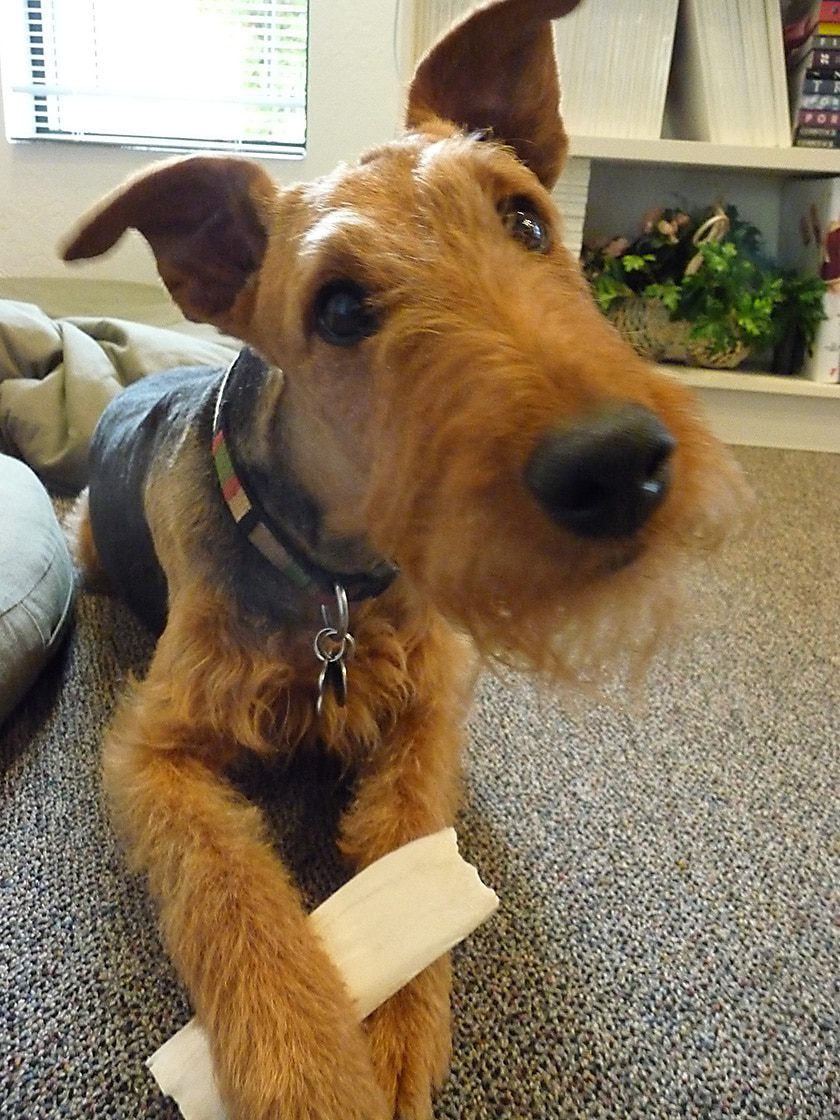
Airedale Terrier
Inglaterra FCI 7 - Large and medium-sized Terrier
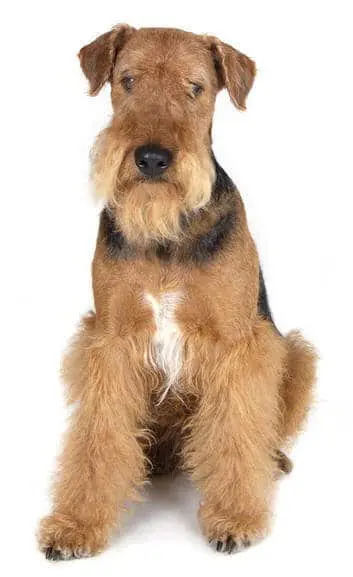
Intelligent, fell, quiet and an unconditional companion. in Canada, the Airedale Terrier, used for hunting large bears and deer.

Airedale Terrier

Content

Characteristics "Airedale Terrier"

Coexistence is important that you have with your new friend. Before considering the acquisition of a dog of the breed "Airedale Terrier" you know certain factors. Not all breeds of dogs are apt to live in an apartment, you must take into account his character, their need for exercise, their interaction with other pets, their care and if you have small children, their level of tolerance towards them.

Adaptation ⓘ

5,0 of 5 stars (based on 1 review)

friendly dog ​​ⓘ

1,0 of 5 stars (based on 1 review)

hair loss ⓘ

3,0 of 5 stars (based on 1 review)

Affection level ⓘ

4,0 of 5 stars (based on 1 review)

Need for exercise ⓘ

4,0 of 5 stars (based on 1 review)

Social need ⓘ

4,0 of 5 stars (based on 1 review)

Home ⓘ

3,0 of 5 stars (based on 1 review)

Toilet ⓘ

4,0 of 5 stars (based on 1 review)

Friendly with strangers ⓘ

2,0 of 5 stars (based on 1 review)

barking ⓘ

3,0 of 5 stars (based on 1 review)

Health ⓘ

2,0 of 5 stars (based on 1 review)

Territorial ⓘ

5,0 of 5 stars (based on 1 review)

Cat friendly ⓘ

1,0 of 5 stars (based on 1 review)

Intelligence ⓘ

5,0 of 5 stars (based on 1 review)

Versatility ⓘ

4,0 of 5 stars (based on 1 review)

Child friendly ⓘ

4,0 of 5 stars (based on 1 review)

Surveillance ⓘ

5,0 of 5 stars (based on 1 review)

joy ⓘ

5,0 of 5 stars (based on 1 review)

History of the Airedale Terrier

This King of the Terriers is a breed of large, strong dogs belonging to the group Terrier. It is of British origin, of the Yorkshire region. It is believed that he descended from a cross between the Otterhound, otter hunter optimal, Terrier and the Old Español. The breeding of these animals began in the mid-nineteenth century.

In the countries where it is most widespread, it has never managed to be a "fashionable" dog., so it has some protection from trade and indiscriminate breeding, factors that destroy the zootechnical characteristics of the vast majority of dog breeds.

His personality is cheerful, sometimes relied, insurance. It is almost always on alert but not aggressive, if not annoying or it urges.

Did you know??

The Airedale is the largest of the terrier breeds and was one of the first races trained for police work in Germany and Britain. In World War, he worked as a guard dog and messenger.

Physical characteristics Airedale Terrier

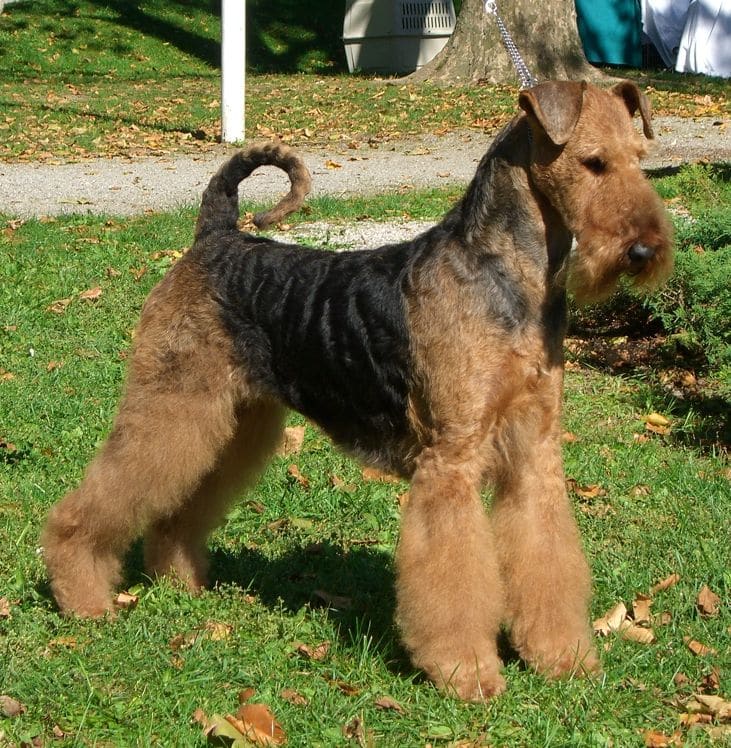
His teeth presents a quadrature and much strength to the of a Rottweiler, Despite having a thinner jaw. His coat is black and tan, varying its intensity but not the distribution, black or gray color extends to the upper neck, back, back, rump, while the flanks, thighs and belly have a mixed shade of gray hairs and golden, the rest of the body, is tan or sand in different shades.

Is from the Terriers bigger, muscular and active. His character shines through the lively and alert expression of her eyes, the way that carries its tail erect and ears. He has a lump between 59 and 61 cm in males with an average weight of 25 kg. The females among 56 and 59 cm and weighing approximately 20 kg. The eyes should never be prominent but small, dark and at an angle, with a typical expression Terrier, alert and intelligent. The ears are V-shaped, sometimes lighter or darker than the skull. Like other Terrier, traditionally a third of the tail was amputated a few days after birth. But, this practice has recently been banned in some countries.

It has a long, flat skull. Is well proportioned to the body. The well modeled muzzle should not have a concave or stop shape that descends abruptly below the line of the eyes.. The skin should be smooth, firm and tight. The upper and lower jaws are large, powerful and strong, but should not excess development. Scissor bite, that is to say, the inside of the upper incisors in contact with the outside of the lower incisors preferably set square to the jaws; but if you accept the bite in pincer. The lips are firm and black muzzle.

Airedale Terrier character and skills

It is an intelligent dog, fell, quiet, a stalwart companion who enjoys going for walks and responds to basic training of simple commands with no problem.

In Canada They are used for hunting bear and deer.

They have problems with ears that require continuous observation and a lot of hygiene. They may also have skin problems, known as hot patch.

Breeders list "Airedale Terrier"

In Spain we have not been able to contact any «Airedale Terrier» breeder.. There are very few international breeders who maintain this wonderful breed that was on the verge of extinction..

REGISTER KENNEL

Airedale Terrier breeders

Offer your puppies for free. Sign up here.

  • This field is a validation field and should be left unchanged.
  • Enter an image of your kennel.

Airedale Terrier images

Airedale Terrier Videos

Dogs 101 Airedale Terrier

Type and recognitions:

  • FCI CLASSIFICATION:
  • Group :
  • Section : . .

Federations:

  • – FCI – Terriers 1 Large and medium-sized terriers. ⓘ
  • – AKC – Dogs working ⓘ
  • – ANKC – Group 6 (utility dogs) ⓘ
  • – CKC – Miscellaneous list ⓘ
  • – ​KC – Working dogs ⓘ
  • – NZKC – Utility dog ⓘ
  • – UKC – Watchdog ⓘ

FCI breed standard "Airedale Terrier"

Origin:
United Kingdom

Date of publication of the valid original standard:
08.10.2012.

Use:

Terriers.


General appearance:

Airedale is the largest of the terriers; he is a muscular dog, Active, pretty compact; you must not have excessively long limbs or your body be disproportionate.


Behavior / temperament:

The dog must have a lively expression, agile movement and be aware of any movement. Its character is revealed by the expression of the eyes and by the size of the ears and its erect tail. Outgoing and confident, friendly, brave and intelligent. Always alert, not aggressive but courageous.

Head:

Without wrinkles. Well proportioned, without any apparent difference between the length of the skull and muzzle.

Cranial region:
  • Skull: Long, plane, not very wide between the ears and tapers slightly towards eye level.
  • Depression links (stop): Stop little marked.

facial region:

  • Truffle: black.
  • Snout: Well modeled in front of the eyes; should not have a concave shape or a sharp drop below the eye line; should be delicately modeled so that it does not have a sphenoid or flat appearance.
  • Lips: Firms.
  • Jaws / Teeth: Large upper and lower jaws, powerful, strong and muscular, since a strong muzzle is highly desirable. The jaws should not be overdeveloped to give the cheeks a round or protruding appearance, since protruding masseters are not desirable. Strong teeth. Scissor bite, that is, the internal face of the upper incisors is in close contact with the external face of the lower incisors and preferably placed at right angles to the maxillae.; However, clamp bite accepted. Upper or lower prognathism are not desirable.
  • Cheeks: Smooth and not prominent. The “cheeked” dog is unwanted.
  • Eyes: dark colored, small, never prominent, with typical terrier expression, alert and intelligent. Clear, expressionless eyes are highly undesirable.
  • Ears: V-shaped and carried to the sides, small but in proportion to the size of the dog. The upper line of the fold slightly above the height of the skull. Drop ears or set very high are undesirable.

Neck:

crisp, muscular, of moderate length and thickness. Gradually widens towards the back, and must not have a double chin.

Body:

  • Back: Short, strong, straight and level, that does not show looseness.
  • Pork loin: Muscular. In those dogs that have a short back as well as well-developed and well-placed ribs, there is little space between the lower ribs and the pelvis; when the back is long, there will be some slack in this area.
  • Breast : Deep (that is to say, almost at elbow level), but not wide. Well arched ribs.

Tail:

Previously the custom was to amputate the tail.
  • amputee: High insertion and erect bearing, not curved on the back. With good potency and substance. The tip at approximately the same height as the top of the skull.
  • Without amputating: High insertion and erect bearing. With good potency and substance.


Tips

PREVIOUS MEMBERS:

  • Hormbros: Long, well tilted back obliquely. Flat Shoulders.
  • Elbows: Located on the axis of the body; free movement.
  • Antarms: Perfectly straight and very bony.
  • Pinis previous: Small, round and compact, large and thick pads, and with moderately arched fingers, without turning in or out.

LATER MEMBERS:

  • Thigh: Long and strong.
  • Rodinllto: Well angled, neither turned in nor out.Leg: Muscled.
  • Metatarsus: Holes well lowered; seen from behind they must appear parallel.
  • Pinis later: Small, round and compact, large and thick pads, and with moderately arched fingers, without turning in or out.

Movement:

Previous members must take them forward, in free movement parallel to the sides. Moving closer, the front members must constitute a continuation of the straight line of the front, keeping the feet as far apart from each other as the elbows. Subsequent members must provide a strong driving power.

Mantle

Plink: Lasted, bushy and wire, not too long to give the appearance of tattered. Rigid and compact, covers the body and limbs. The outer layer is made up of hard and rigid hair.; the undercoat is made of shorter and softer hair.

Hard coat may be rough or slightly wavy; curly or soft hair is highly undesirable.

Colorr: With black or dark gray frame, like the top of the neck and the dorsal surface of the tail. All other fire colored parts. The ears are often darker in fire color, and there may be a shaded color around the neck and sides of the skull. A few white hairs are accepted on the sill.


Size and weight:

Alturto the cross: Approximate height:

  • Males between 58 and 61 cm..
  • Females between 56 and 59 cm..


Fouls:

Any deviation from the aforementioned criteria is considered as a fault and the severity of this is considered to the degree of the deviation to the standard and its consequences on the health and well-being of the dog..

FALTAS DISQUALIFYING:

  • Aggressiveness or extreme shyness.
  • Any dog ​​showing clear signs of physical or behavioral abnormalities must be disqualified..


N.B.:
  • Males should have two normal-appearing testicles fully descended into the scrotum..
  • Only functionally and clinically healthy dogs, with the typical conformation of the breed, should be used for parenting.

TRADUCCION: Brigida Nestler/ Original version: (IN)

SupTechnical ervision: Miguel Angel Martinez

Source: F.C.I - International Cynological Federation

Alternative names:

1. Airedale Terrier, Waterside Terrier, Bingley Terrier, AIREDALE, King of Terriers (English).
2. Airedale Terrier, Waterside Terrier, Bingley Terrier, Working Terrier, Warfedale Terrier (French).
3. Waterside Terrier, Terrier, Bingley Terrier (German).
4. Airedale terrier, O rei dos terriers, Waterside Terrier (Portuguese).
5. Airedale terrier, Rey de los Terriers (español).

▷ The world of Pets: Dogs, cats, birds, reptiles, amphibians

American Staffordshire Terrier
Estados Unidos FCI 286 - Bull type Terriers

The American Staffordshire Terrier they are brave, tenacious, friendly, extremely attentive

American Staffordshire Terrier

Content

Characteristics "American Staffordshire Terrier"

Coexistence is important that you have with your new friend. Before considering the acquisition of a dog of the breed "American Staffordshire Terrier" you know certain factors. Not all breeds of dogs are apt to live in an apartment, you must take into account his character, their need for exercise, their interaction with other pets, their care and if you have small children, their level of tolerance towards them.

Adaptation ⓘ

3,0 of 5 stars (based on 1 review)

friendly dog ​​ⓘ

1,0 of 5 stars (based on 1 review)

hair loss ⓘ

2,0 of 5 stars (based on 1 review)

Affection level ⓘ

5,0 of 5 stars (based on 1 review)

Need for exercise ⓘ

3,0 of 5 stars (based on 1 review)

Social need ⓘ

4,0 of 5 stars (based on 1 review)

Home ⓘ

2,0 of 5 stars (based on 1 review)

Toilet ⓘ

1,0 of 5 stars (based on 1 review)

Friendly with strangers ⓘ

4,0 of 5 stars (based on 1 review)

barking ⓘ

3,0 of 5 stars (based on 1 review)

Health ⓘ

3,0 of 5 stars (based on 1 review)

Territorial ⓘ

3,0 of 5 stars (based on 1 review)

Cat friendly ⓘ

1,0 of 5 stars (based on 1 review)

Intelligence ⓘ

4,0 of 5 stars (based on 1 review)

Versatility ⓘ

4,0 of 5 stars (based on 1 review)

Child friendly ⓘ

4,0 of 5 stars (based on 1 review)

Surveillance ⓘ

4,0 of 5 stars (based on 1 review)

joy ⓘ

3,0 of 5 stars (based on 1 review)

History

The American Staffordshire Terrier or Amstaff (different to the American Pitbull Terrier), is a breed of dog type Terrier well known worldwide.

It is a young breed of dog from the USA.. Among his ancestors are, Besides of Terrier, the Old english bulldog.

In England and North America, dog fighting had a tradition dating back to ancient times.. The Old english bulldog was sent to fight bulls in the arenas of animal fighting. Although Old english bulldog are the forerunners of Bulldogs of today, his physique was much more similar to the current one American Staffordshire Terrier. After animal fighting was officially banned, continued illegally; In the USA. until today. Its origin in the 19th century was the black county of central England, called Staffordshire. Workers from the coal mines and clay pits crossed the Old english bulldog with the terriers. In the official scene of the fight against animals such crosses had been prohibited. It was feared that the fighting power and toughness of the Bulldog will combine with the predatory acuity of the terriers, which would lead to uncontrollable fighting machines. In the illegality of the backyards nobody cared. This is how he was born «Bull and Terrier» and very quickly came to the US. There they liked to call them «Pit Bulls». Pit is the name given to the dogfighting ring.

In 1898 The United Kennel Club was founded (UKC), who wanted to take over the breeding of these dogs. But the UKC was nothing more than a professional dogfighting organizer. So the community was divided around these dogs. Lovers of Pit Bull they condemned dog fighting, they wanted a friendly family dog. In the meantime, the Pit Bulls they had earned a great reputation in US society. In World War, the courage of Pit Bulls became a stimulus for the combat power of American troops. Even celebrities like the President of the United States Theodore Roosevelt showed up with the Pit Bulls.

On cinemas, "The Little Rascals", a gang of kids with a dog, was very popular and was featured in 220 episodes between 1922 and 1944. The dog was the guardian and protector, children's playmate and dildo. This dog was a Pitbull. He later became the first dog registered with the American Kennel Club (AKC) for the new raceStaffordshire terrier«. To draw a clear line at the fighting dog scene, the AKC had insisted on a name change. The first standard was published in 1936. In 1972 there was the second name change to «American Staffordshire Terrier» to distinguish it from its British relative. The Amstaff, what's been called since then, Is higher, bigger and heavier. It is still cared for by the American Staffordshire Terrier Club of America., who from the beginning clearly condemned dog fighting and trusted his upbringing as a family dog.

In many countries, Its social discrimination as a fighting machine and the technically unjustifiable classification as a "dangerous dog breed" have hit it hard..

Popular American Staffordshire Terrier Mixes

Mixtures of American Staffordshire Terrier seriously bred with other dog breeds or hybrids are quite rare. But, there is an abundance of hybrids of all kinds, that remind the Amstaff and are marketed as such or Pitbull. Here I should make a clear distinction. The American Staffordshire Terriers Serious breeding have nothing to do with the general mixes under which troublesome dogs can frolic. Unfortunately, there is a financially strong scene using such dogs as a weapon or to intimidate.

Physical characteristics

How is an American Staffordshire Terrier?

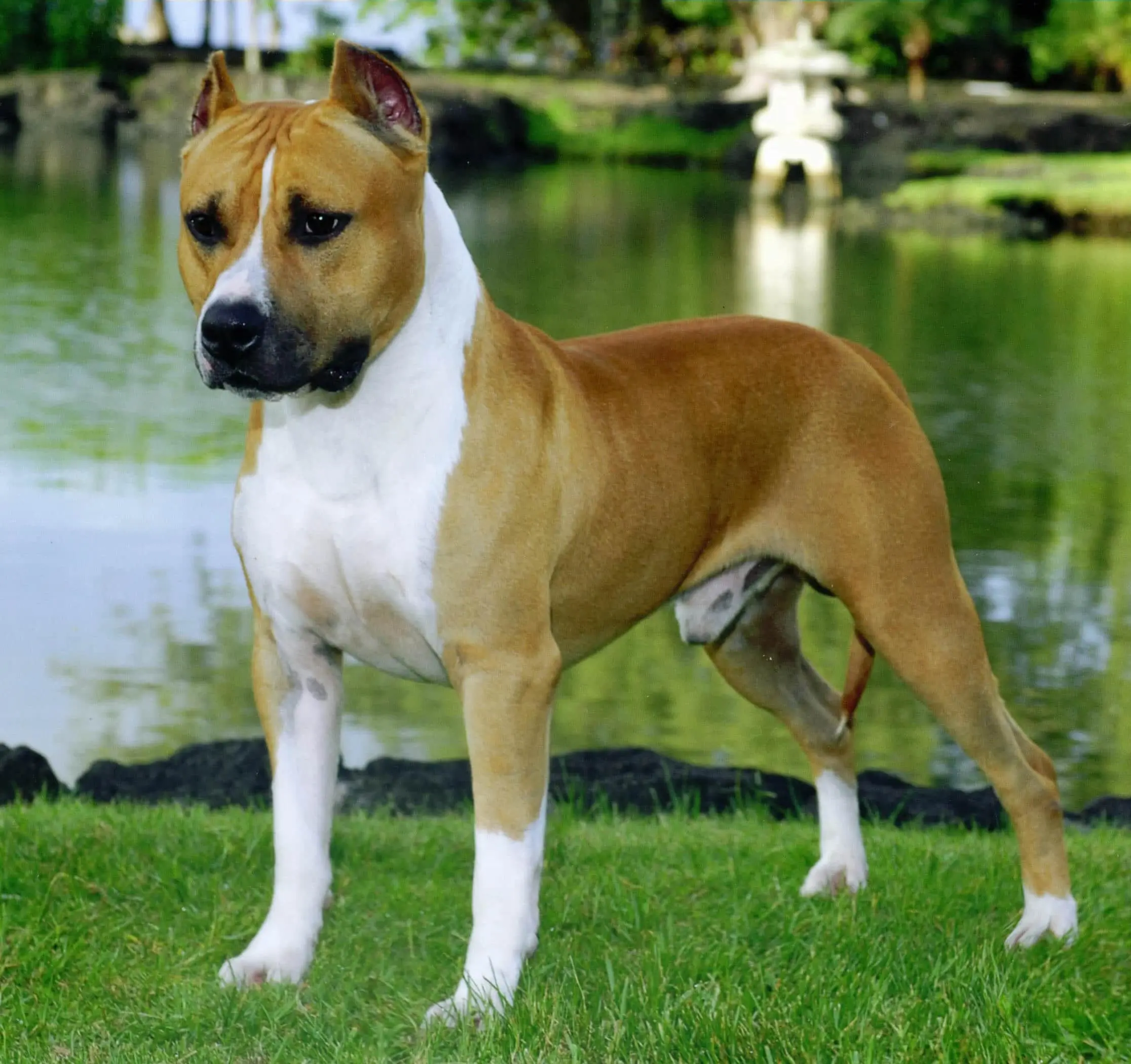
The American Staffordshire Terrier is a dog's size medium, Awesome, very strong and at the same time elegant. has short hair, dense and shiny that sits gently on the body. Emphasizes your muscular and sporty complexion. The standard says: «It must be robust and compact, not of legs or of light construction». Any color, solid, multicolor or speckled is allowed. The standard of the American Staffordshire Terrier is pleasantly different from many other dog breeds, which go into great detail on where hair color or crease is allowed. It is one of the few standards that consistently focus on the healthy dog.. This is emphasized by the "1st American Staffordshire Terrier Club":

We give top priority to performance and health. Beauty is considered desirable but secondary. The correct interpretation of the rule, that is free from crippling regulations, It is our obligation. Muscular, dry dogs with long bones, persistent and fast, are our breeding goal. We categorically reject supercharged “monstrosities”, low with extremely high weights. We consider mental performance to be even more important. Nerve strength and impeccable character are an absolute requirement.

How big is an American Staffordshire Terrier??

El American Staffordshire Terrier mide entre 43 and 48 cm tall and weighs between 20 and 30 kg.

How long can an American Staffordshire Terrier live??

Because the breeding of the American Staffordshire Terrier is not oriented so much to external appearances as to aptitude and character, The American Staffordshire Terrier enjoys a fit constitution into old age and a relatively long life expectancy of about 12 years.

Character and skills

The American Staffordshire Terrier he is a relaxed dog. He is very vigilant and intelligent. It is enormously strong, brave and has great fighting strength potential. At the same time it is extremely adorable, loyal and affectionate, even dedicated to his humans. Is neutral with strangers. Is of good character and has an extraordinarily high threshold for irritation. Can hardly be provoked. As with the English Bulldog and other breeds of dogs that were used in the past in the arenas of animal fighting, these dogs have been given a particularly high level of control and stimulus threshold. It also, these dogs have been used in serious breeding for many generations exclusively as family and companion dogs. Unfortunately this has not protected the dogs from criminals. Especially in the decade of 1990, dogs like Amstaff became aggressive by irresponsible breeders and owners, Savagely crossed and abused like living weapons. the same politicians, who tolerated these illegal practices for a long time, they were then the first to start the discrimination, pointing to American Staffordshire Terrier like a dangerous race, something technically unfounded. Breeding can cause even chihuahuas or caniches toy become aggressive in a few generations. The breed of dogs American Staffordshire Terrier is the victim, not the author. Seriously raised, they make excellent family dogs and careful companions to children.

Caution, health and diseases

How much care does an American Staffordshire Terrier need??

The American Staffordshire Terrier it is absolutely easy to care. Brushing here and there is enough.

Are there any breed-typical diseases in the American Staffordshire Terrier?

The American Staffordshire Terrier enjoy robust health. Sporadically hip or knee problems.

What food is best for an American Stafford Terrier?

The American Staffordshire Terrier has no special dietary requirements. Of course high quality food is good for your health and proof. Like most dogs, he likes a meat bone now and then..

Activities

One American Staffordshire Terrier it is suitable for almost all activities that can be done with a dog.

Considerations before purchase

Where can you buy an American Staffordshire Terrier?

If you want to buy a American Staffordshire Terrier, you should consider that it is a dog from the list. Your whole life has to be prepared for the restrictions of the state and society. You should look at a reputable breeder affiliated with a club that meets the FCI standards. Please, only there and do not buy a puppy from a dubious source. There are many American Staffordshire Terrier and hybrids in refuges. Get tips for choosing your dog here. But, only with a serious breeding dog can you be reasonably certain that your Amstaff has the character qualities described here.

Education and attitude of the American Staffordshire Terrier

¿Me conviene un American Staffordshire Terrier?

The American Staffordshire Terrier is undemanding in his attitude. It is not a dog that only needs to walk around the block for a walk.. Want to exercise mentally and physically. Even with a puppy it should be clear who is in charge of the house. There should be no doubt about it. The Amstaff is a bright and occasionally playful four-legged friend who likes to roam the countryside. It is suitable for dog sports of all kinds. Sometimes it is also used as a rescue dog. Is a good guardian.

The American Staffordshire Terrier is widely on the lists of supposedly dangerous dogs. Travel to the Netherlands or Denmark is prohibited, because there is a risk that dogs will be confiscated on the street and euthanized. On the street you should expect people to harass you because of the dog. That is, Unfortunately, the social reality in Central Europe today.

The American Staffordshire Terrier needs consistent upbringing from puppyhood. Consistency means, especially with this physically very strong dog but at the same time sensitive and intelligent, that the master or caregiver should work on the basis of a deep relationship of trust. The dog wants the guidance of its owner. Find the nearby connection. This should be given with a calm hand, respectful and strong. Coercive measures are counterproductive, certain consequences are intentional. The American Staffordshire Terrier must socialize with other dogs at an early stage. Due to its strength and joy of working, it is not a dog for beginners.. Even experienced dog owners should consciously work with it and preferably attend a suitable dog school. Well mannered, don't just listen to the word, rather, he reads the wishes of his master and caregiver through their eyes.

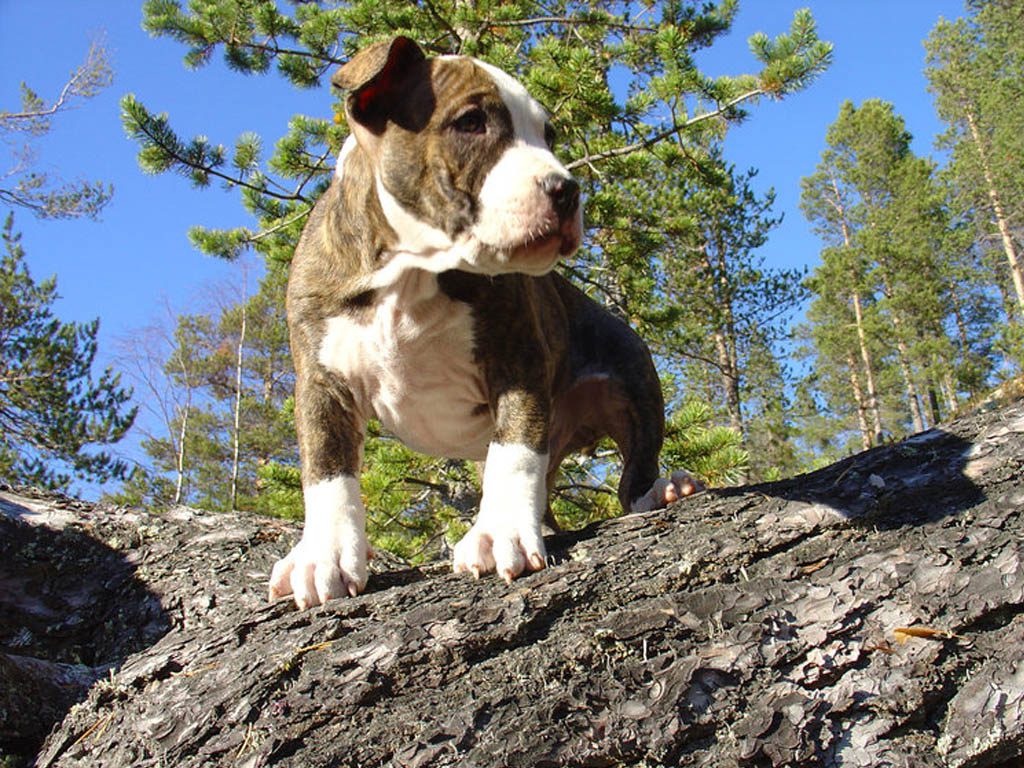
American Staffordshire Terrier pictures

Vídeos American Staffordshire Terrier

American Staffordshire Terrier (AmStaff) AKSA playing at the pond
Type and recognitions:

  • FCI CLASSIFICATION:
  • Group :
  • Section : . .

Federations:

  • – FCI – Group 3 – Section 3 Bull type Terriers. ⓘ
  • – AKC – Terriers ⓘ
  • – ANKC – Terriers ⓘ
  • – CKC – Terriers ⓘ
  • – NZKC – Terriers ⓘ

FCI breed standard "American Staffordshire Terrier"

Origin:
United States

Date of publication of the valid original standard:
03.09.1996.

Use:

---


General appearance:

You must give the impression of great strength, in relation to its size. This is a good solid and muscular dog, Although agile and elegant. He is always aware of what surrounds. His body should be collected, Neither lifted nor agalgado. Its value is noticeable.


Behavior / temperament:

---

Head:

Medium length, large, view from all sides.

Cranial region:
  • Craging: Large.
  • Dnaso-frontal depression (stop): Marked.

facial region:

  • Nariz: It's clearly black.
  • Horcico: Medium length, rounded on top. It descends in a sharp slope below the eyes.
  • Labios: They are joined by the edges and are not loose.
  • Jaws / Teeth: They are well defined. The lower jaw must be powerful, so I can hold tight. The upper incisors are in close contact with the anterior aspect of the lower incisors.
  • Cheeks: The cheek muscles are very prominent.
  • Ojors: They are round, dark colored. They are well sunken and well separated. There should be no depigmentation on the eyelids.
  • Obars: High implanted, may or may not be cropped. Ears not cropped are preferable, they must be short, carried in the shape of a rose or semi-erect. Completely hanging ears will be penalized.

Neck:

Heavy, slightly arched. Gradually tapering from shoulders to insertion into head. Is medium length, without jowl.

Body:

  • Línand the top: The back is quite short. There is a slight slope from the withers to the rump, which slopes slightly to the beginning of the tail.
  • Itmor: Slightly arched.
  • Pecho: Very deep and wide. The ribs are tight, together and well developed back.

Tail:

It is short, compared to the size of the dog. Low-set, gradually taper to a fine point. It is not presented or curled, nor carried over the back. Nor should it be amputated.

Tips

PREVIOUS MEMBERS: They must be straight and strong boned. With good separation to allow a good development of the thorax.

  • Hormbros: Strong and muscular. The shoulder blades are broad and oblique.
  • Metacarpus: Plumb.

LATER MEMBERS: They are well muscled.

  • Corvejones: In low position and should not drift or inward, nor out.
  • PinIt: Medium-sized, well arched and compact.

Movement:

It is elastic, without sway or amble.

Mantle

  • Plink: Is short, tight, hard to the touch and lustrous.
  • Colorr: All colors are allowed, but the fur with more than 80% white, the black and tan fur and the liver should not be valued.


Size and weight:

There must be a proportionate correlation between size and weight. Desirable height at withers should be: 46 to 48 cm. (18 to 19 inches) in males and 43 to 46 cm. (17 to 18 inches) in females.


Fouls:

Any deviation from the aforementioned criteria is considered as a fault and the severity of this is considered to the degree of the deviation to the standard and its consequences on the health and well-being of the dog..

  • Depigmentation of the truffle in the form of white spots.
  • Upper or lower prognathism.
  • light eyes.
  • Lack of pigmentation on eyelids.
  • Tail that is too long or is worn improperly.

FALTAS DISQUALIFYING:

  • Aggressiveness or extreme shyness.
  • Any dog ​​showing clear signs of physical or behavioral abnormalities must be disqualified..


N.B.:
  • Males should have two normal-appearing testicles fully descended into the scrotum..
  • Only functionally and clinically healthy dogs, with the typical conformation of the breed, should be used for parenting.

TRANSLATION: IRIS Carrillo (Puerto Rico Kennel Federation).

Source: F.C.I - International Cynological Federation

Alternative names:

1. AmStaff, American Staffy (English).
2. American terrier, staff, amstaff (French).
3. Amstaff (German).
4. AST, Staffordshire terrier americano, Amstaff (Portuguese).
5. AmStaff, AST (español).

▷ The world of Pets: Dogs, cats, birds, reptiles, amphibians

Polish Greyhound
Polonia FCI 333 . Short-haired Sighthounds.

Polish Greyhound

The Polish Greyhound born to hunt, not only of the hare, the bustard and the fox, but also the wolf.

Content

History

The "Polish Greyhound" is a very old breed. In the chronicles of Galla Anonymous there are references to the royal court's expenses in maintaining the Greyhounds. According to an old Polish dictionary, in the 13th century there were more than 300 terms to refer to Greyhounds, which shows that in Poland at that time they were known and popular animals.

The first description of hunting with Greyhounds is located in Myślistwie z ogary (Hunting with stallions), of Jan Ostroróg, and the first description of a Greyhound data of 1600 (A. Gostomski, Equestrian farm). Another description of hunting with Greyhounds found in the poem The fighter de Tomasz Bielawski, published in 1595.

Last, "Nature" of the 13 in July of 1895, describing the visit of Grand Duke Nicolas to a dog show in Tuilleries, gives the following information about the Polish Greyhound, prince's property: "These Greyhounds shorthair come from Poland, from where they entered Russia in large numbers with the expedition of Prince Dimitri in 1505; are bigger than Sighthounds, but less delicate, and his hair is longer.

All these data confirm that the Polish Greyhound was present in the Polish lands before the Borzoi – Russian Hound for hunting and the "English Greyhound". The Polish Greyhound has many features in common with the Saluki, like its fur, that is not found in others Short-haired Sighthounds nor in the Borzoi. The coats like dominoes, flame black or tricolor are also common in the Saluki. At the same time, the Polish Greyhound does not have the black color without fire with white variants, so common in the «English Greyhound».

The Greyhounds spread throughout Europe thanks to the migrations of Celtic tribes. The Celts valued hunting on horseback with Greyhounds as a sport and its ouertragoi (in latin transcription – contract), originating from Asia, they became the ancestor of most European races of Greyhounds.

It is also believed that Polish Greyhound descends directly from the Asian type. While the English selected their Greyhounds for the speed with which they could hunt hares in a relatively limited space, in central europe, in the great flat areas of Poland at that time, in a dry and harsh climate, the Greyhounds Asians evolved into larger dogs, robust and strong, used to hunt any type of game, including foxes and wolves.

The Greyhounds Asians also came to our area with the nomadic Scythian tribes. Written sources show that, in the 18th and 19th centuries, the Polish Greyhound original crossed with other Greyhounds, as the Irish wolfhound.

The heyday of Polish Greyhound irretrievably happened at the end of the 19th century, when - as a result of the progressive divisions of the land- the search for game began to be hampered by fences. The population of Polish Greyhound was significantly reduced in not very numerous kennels of tradition-loving nobility, especially in southern Poland, in Podolia and Ukraine. Until World War II, the Greyhounds hunted in the voivodeship of Kielce, in the estate of the lords Niemojewski – Oleszno Kielecki. Oleszno Kieleckie It was the last bastion of Polish Greyhound.

The Second World War and the harsh postwar years caused the almost total extinction of these beautiful dogs. The fate of this breed after the war was turbulent and complicated. In southern areas of Poland, dogs from scattered kennels used to fall into the hands of poachers, which is why, as outlaws, they were viciously exterminated by hunters, forest guards and militiamen. At that time everything that was "stately" was methodically destroyed. Nonetheless, some Polish Greyhound survived, and the selection was carried out according to the speed, agility and "passivity" (skill in catching). That skill in the capture allowed to keep the race pure.

Over the years 70, a group of enthusiasts strove to save and restore the breed. In 1981 a registration book was opened for the Polish Greyhound. In 1989 the breed was officially recognized by the FCI as the fourth Polish breed.

Character and skills

The Polish Greyhound is a quiet dog, sober and brave. Show distance to strangers, while towards his own family he is very attached and affectionate. Raised together with a cat, you can live with him at home, but if you see a cat outside, your hunting instincts will kick in.

Video of the Polish Greyhound
Polish greyhound- CHROBRY.MOV

It must be remembered that the Polish Greyhound will generally not be satisfied with the chase itself, but can actually hunt a pet, so in the places where stray cats walk, must absolutely be kept on a leash. Usually, is not aggressive with strangers, but like a dog with a strong character, can get into a fight if provoked. He also has a strong territorial instinct.

The Polish Greyhound he is very devoted to his owner, and properly guided is "a man's dog", an excellent companion at home and, when necessary, a vigilant guardian of the property.

It feels better in a house with a garden (However, some rides must be provided), but it will also suit apartment living, as long as your activity needs are met.

Physical characteristics

  • Size: desired height at withers for females 68-75 cm., for males 70-80 cm.
  • Weight: 25-35 kg
  • Fur: hair elastic to the touch, pretty hard, but without wires or silky; of unequal length on the body: the hair is longer at the withers, the shortest on the sides, chest and limbs, the belly is covered with thin and sparse hair. On the back of the thighs and on the bottom of the tail, the hair is longer but also hard; pants and a light feather.
  • Color: all colors are ok; the edges of the eyelids and the tip of the nose are black or dark; only with light tones, like beige or blue, the tip of the nose is respectively beige or blue.
  • Life expectancy:

    10-12 years

    Health

    The Polish Greyhound he is a very healthy dog. They're strong, fit and resistant. They tolerate low temperatures well, whenever they are in motion. Despite its thick undercoat, cool down pretty quickly, because they have thin, highly vascularized skin and a very thin layer of subcutaneous fat.

    So far no special predisposition to genetic diseases has been found in Polish Greyhound. A young dog should receive an adequate amount of exercise, for your body to develop properly. Puppies and young dogs should not be over-exercised and the dog should be introduced to training gradually..

    Grooming

    The short hair of a Polish Greyhound does not require any special treatment. During the molting period, the dog should be combed once every few days, and less frequent brushing is sufficient. We bathe the dog as needed. It also, we control the state of the ears and teeth. If required, trim claws.

    Characteristics "Polish Greyhound"

    Coexistence is important that you have with your new friend. Before considering the acquisition of a dog of the breed "Polish Greyhound" you know certain factors. Not all breeds of dogs are apt to live in an apartment, you must take into account his character, their need for exercise, their interaction with other pets, their care and if you have small children, their level of tolerance towards them.

    Adaptation ⓘ

    3,0 of 5 stars (based on 1 review)

    friendly dog ​​ⓘ

    2,0 of 5 stars (based on 1 review)

    hair loss ⓘ

    2,0 of 5 stars (based on 1 review)

    Affection level ⓘ

    3,0 of 5 stars (based on 1 review)

    Need for exercise ⓘ

    4,0 of 5 stars (based on 1 review)

    Social need ⓘ

    3,0 of 5 stars (based on 1 review)

    Home ⓘ

    3,0 of 5 stars (based on 1 review)

    Toilet ⓘ

    2,0 of 5 stars (based on 1 review)

    Friendly with strangers ⓘ

    2,0 of 5 stars (based on 1 review)

    barking ⓘ

    1,0 of 5 stars (based on 1 review)

    Health ⓘ

    4,0 of 5 stars (based on 1 review)

    Territorial ⓘ

    4,0 of 5 stars (based on 1 review)

    Cat friendly ⓘ

    2,0 of 5 stars (based on 1 review)

    Intelligence ⓘ

    4,0 of 5 stars (based on 1 review)

    Versatility ⓘ

    3,0 of 5 stars (based on 1 review)

    Child friendly ⓘ

    3,0 of 5 stars (based on 1 review)

    Surveillance ⓘ

    4,0 of 5 stars (based on 1 review)

    joy ⓘ

    3,0 of 5 stars (based on 1 review)

    Type and recognitions:

    • FCI CLASSIFICATION:
    • Group :
    • Section : . .

    Federations:

    • FCI – Group 10: Section 3: Short-haired Sighthounds ⓘ
    • – CKC – Miscellaneous? ⓘ
    • Standard UKC (United Kennel Club) – Sighthound and Pariah ⓘ

    FCI breed standard "Polish Greyhound"

    Origin:
    Poland

    Date of publication of the valid original standard:
    1.10.1999

    Use:

    Dog for hunting not only the hare, zorro, roe deer and bustard, but also the wolf.


    General appearance:

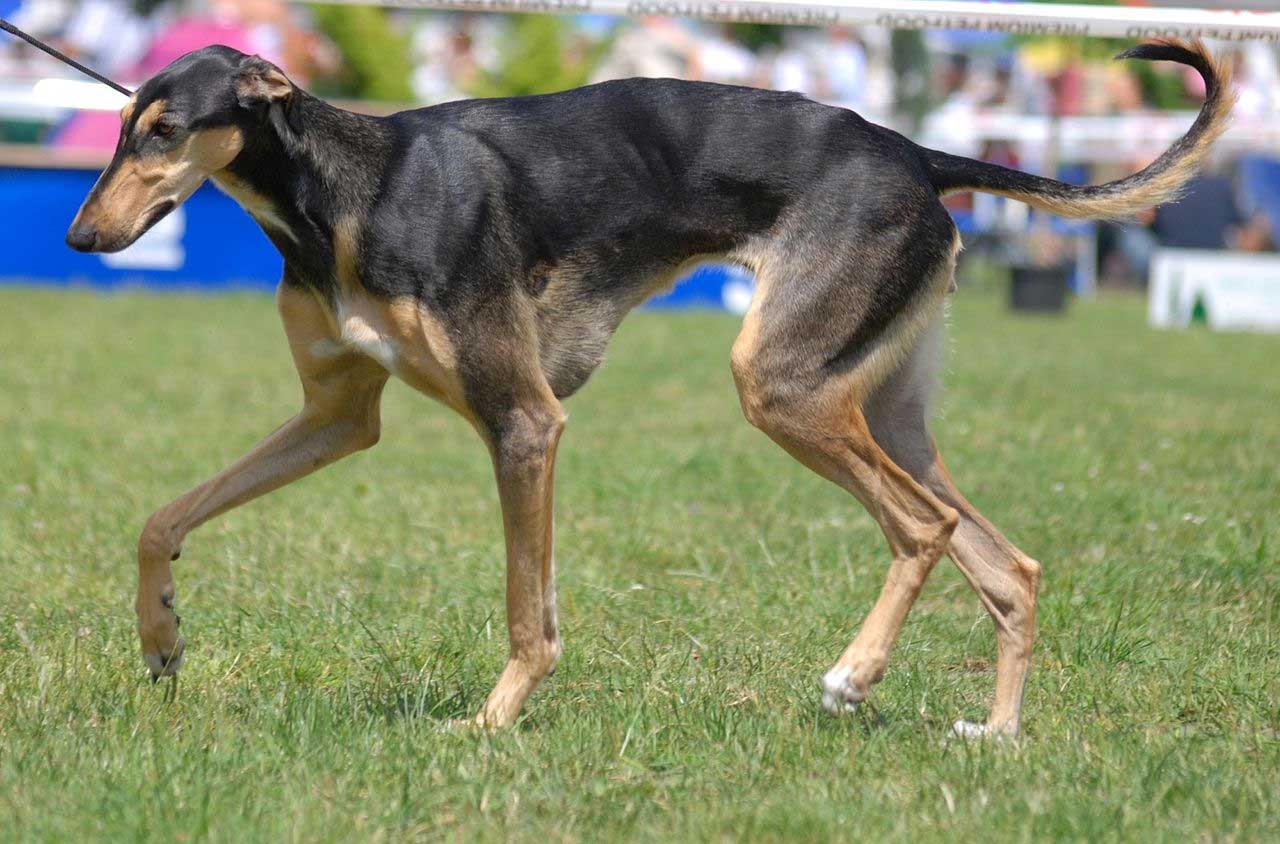
    The Polish Greyhound is a large dog, powerful, muscular, distinctly stronger and less fine in ways than other short-haired sighthounds (However, should not be heavy or lymphatic). By its appearance, He's close to the Asian hound type, what is your ancestor. The strong skeleton, the compact structure of the body, the clean musculature and the powerful jaws testify that this dog has been used for hunting in the difficult conditions of the Polish climate.
    expressive eyes, awake and penetrating gaze, play an important role in the overall appearance of the Polish Greyhound.


    IMPORTANT PROPORTIONS: The ratio of the length of the body in relation to the height at the withers must be 10,2- 10,3 : 10.


    Behavior / temperament:

    The Polish Greyhound is his master, trusted, reserved and brave. In pursuit it's fast and tough. In action he reacts quickly and brutally.

    Head:

    Strong, dry and long. The length of the head in relation to the height at the withers, in males, is of 37-39: 100, in the females of 36-38 : 100. The length of the muzzle in relation to the length of the head is 1:1, but the muzzle may be slightly longer. The ratio of the width of the head at the level of the zygomatic arches to the length of the head is around 38 : 100. The desirable ratio between the perimeter of the snout in front of the orbits and the length of the head is about 80 : 100.

    Cranial region:
    • Skull: The top of the skull should be flat; little marked frontal furrow, of a desirable depth of 5 mm. Frontal protrusions and slightly marked supra-orbital arches. The profile of the skull must blend perfectly with the profile of the muzzle.
    • Stop (naso-frontal depression) : Very little marked.

    facial region:

    • Truffle: Black or dark, large, protrudes above the lips.
    • Snout: Strong, tapering towards the nose in such a smooth way that it does not give the impression of being pointed, but rather to be flat for a greyhound. The position of the nose is preferably a little below the line of the nasal cane. The upper lines of the muzzle and skull should be slightly divergent..
    • Lips: Long drawn, dry without excess; on the first part of the snout they may form a minimal fold covering the pigmented edges of the lower lip, but they are never pendant and do not mask the lower jaw.
    • Jaws / teeth: Strong jaws and teeth; scissor joint, acceptable in pliers.
    • Eyes: Dark eyes are desirable; Depending on the dog's coat, the iris has a tint that ranges from dark brown to amber.; they are expressive, quite large, arranged slightly skewed (almond eye). The expression of the eyes must be characteristic: awake and penetrating.
    • Ears: Medium-sized, quite narrow; if they are folded forward, its ends easily touch the inner corners of the eyes. Implanted at eye level. The pinna of the ear has relatively soft cartilage; the ears give the impression of being quite fleshy.

      Admitted sizes of the ears:

      • Folded back, touching neck,

      • Position in the form of a roof,

      • In a state of excitement fully erect ears, or with the end slightly broken forward

    Neck:

    Long, muscled, powerful, oval profile, gently rising from the cross line; head held high (the resting Polish Greyhound has its head slightly lower than the Greyhound).

    Body:

    When the dog is in a free position, the height at the withers must be equal to the height of the culminating point of the croup.

    • Cross: Small, but marked
    • top line: Straight in the thoracic region, slightly domed in the lumbar region. In females, the almost straight topline in the lumbar region is not a defect
    • Pork loin: Wide and muscled.
    • Rump: Oblique croup, gently sloping, long, muscular and wide; the tips of the hips widely spaced (the width between the tips of the hips represents the 12-14 % the height at the withers.
    • Breast : Very spacious rib cage, well descended (the ideal is a rib cage reaching to the tip of the elbow in the sternal region); moderately wide seen from the front; the back ribs should be clearly arched, but not in a barrel ring. Long ribs, located skewed relative to the spine. Long sternum.
    • Belly: picked up.

    Tail:

    With feathers, long, thick at the base, idle carried low; the end of the tail should be in the shape of a sickle curved upwards or form a complete ring. At rest, the dog can sometimes wear it hanging and completely straight, but without resembling the drooping tail of a cow. In motion, the tail can be carried higher, However, the base of the tail should not be carried higher than the level of the loin.

    Tips

    PREVIOUS MEMBERS: Long, net, good muscular, very little separated. Seen from the front, the members must be arranged in parallel.

    • Forearm: Long; the proportion between the distance from the point of the elbow to the ground and the height at the withers should be around the 54% and be proportionate, so that the sighthound does not give the impression of being
      exaggeratedly high number of members.
    • Metacarpus: Slightly oblique in relation to the ground.
    • Front feet: Ovals; tight fingers, well arched.

    LATER MEMBERS: Long, good muscular, fairly well angulated, slightly set back and slightly apart, However, clearly less than in the case of the Greyhound. Seen from the back, members must be parallel.

    • Leg: Long.
    • Hock: Strong.
    • Rear feet: Ovals, but a little more elongated than the previous feet; fingers tight, compact.

    Movement:

    The movement should be easy and energetic; proper angulation of the forelimbs and hindlimbs allows an extension of the limb forward in a long, loose movement, walking as well as trotting. Sighthounds carried slowly may march amble, but after accelerating the speed of movement, should return to normal pace. The action of the hind limbs is one of the characteristics: without being a defect, in the short trot, rear feet can be supported on a straight center line.

    Mantle

    • SKIN: Well adhered, elastic.
    • HAIR: Hair stretchy to the touch, pretty hard, not "steel wire", but not silky either. Variable length depending on the trunk set; on the withers the hair as a whole can be longer, shorter on the sides; in the sternum and in the limbs it is very short. The belly is covered with a more delicate hair, thinner. On the buttocks and under the tail, in all its length, the hair is long, but also hard; the ″pants″ and feathers are well developed.
    • COLOR: All colors are supported. Black or dark edge of the eyelids and nose; when the hair color is lighter, ie blue or beige, the truffle is in blue or beige ratio.


    Size and weight:

    The optimal size of the female is 68-75 cm to the cross, of the male of 70-80 cm to the cross. Specimens larger than the optimum size are admitted on condition that they preserve a typical morphology. A size slightly lower than that indicated in the standard is not, However, an eliminatory flaw, yes apart from this, the dog does not provoke any reservations.


    Fouls:

  • Any deviation from the aforementioned criteria is considered as a fault and the severity of this is considered to the degree of the deviation to the standard and its consequences on the health and well-being of the dog..

  • General features

  • Significant variation in the desired proportion between body length and height at the withers.
  • Fragile bone, weak.
  • Weak muscles, heavy constitution.

  • Head

  • Frontal region too convex.
  • Clearly marked frontal furrow.
  • Clearly marked stop.
  • Fine truffle, sharp.
  • Muzzle too convex.
  • Overdeveloped fluff.
  • Weak jaws; upper or lower prognathism; significant lack of teeth ( except for PM1).
  • Protruding eyes.
  • Ears touching the sides of the head flat.

  • Neck

  • Short, fine; head carried exaggeratedly high or exaggeratedly low.

  • Body

  • Back arched from thoracic vertebrae.
  • Lumbar region too convex.
  • Flat rib cage, little descended; sternum so retracted that, looking in profile, not seen behind the edge of the shoulder blade.

  • Tail

  • Entirely hunched over the back, tail carried sideways

  • Former members

  • Steeply sloping scapulae (straight shoulder).
  • Elbows out or too much in.
  • Feet turned out, pad deformation.

  • Later members

  • Angulation too weak.
  • Hocks cow or barrel-shaped.
  • Separate fingers.

  • Skin

  • Thick, detached, little elastic.

  • Mantle

  • Nose and edge of the eyelids pink or mottled, the same as a lightening of the color of the nose and the edge of the eyelids in the other hair colors than in blue and beige.


  • FALTAS DESCALIFICANTES:

  • Aggressiveness or extreme shyness.
  • Any dog ​​showing clear signs of physical or behavioral abnormalities.
  • lymphatic constitution, apathy.
  • Small eyes, triangular.


  • N.B.:
  • Males should have two normal-appearing testicles fully descended into the scrotum..
  • Only functionally and clinically healthy dogs, with the typical conformation of the breed, should be used for parenting.
  • Source: F.C.I - International Cynological Federation

    Alternative names:

    1. Polish Sighthound, Chart Polski (Polish) (English).
    2. Chart polski (French).
    3. Chart polski (German).
    4. (em polonês/polaco: chart polski) (Portuguese).
    5. Chart Polski (Polaco) (español).

    ▷ The world of Pets: Dogs, cats, birds, reptiles, amphibians

    Deerhound
    Escocia FCI 164 . Rough-haired Sighthounds
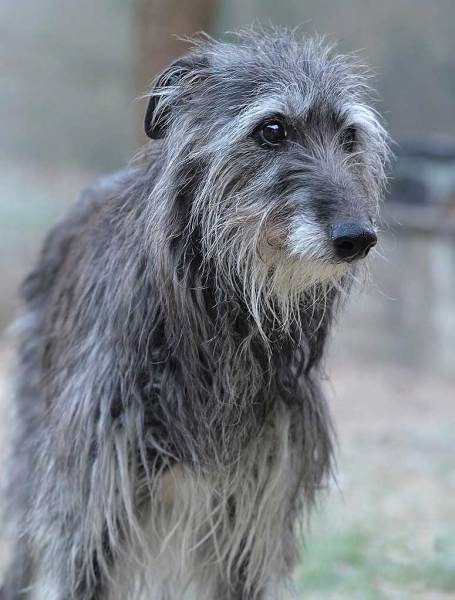
    The Scottish Deerhound resembles a Greyhound larger coarse hair and stronger bone.

    Lebrel Escocés

    Content

    Characteristics "Deerhound"

    Coexistence is important that you have with your new friend. Before considering the acquisition of a dog of the breed "Deerhound" you know certain factors. Not all breeds of dogs are apt to live in an apartment, you must take into account his character, their need for exercise, their interaction with other pets, their care and if you have small children, their level of tolerance towards them.

    Adaptation ⓘ

    3,0 of 5 stars (based on 1 review)

    friendly dog ​​ⓘ

    3,0 of 5 stars (based on 1 review)

    hair loss ⓘ

    3,0 of 5 stars (based on 1 review)

    Affection level ⓘ

    5,0 of 5 stars (based on 1 review)

    Need for exercise ⓘ

    5,0 of 5 stars (based on 1 review)

    Social need ⓘ

    5,0 of 5 stars (based on 1 review)

    Home ⓘ

    2,0 of 5 stars (based on 1 review)

    Toilet ⓘ

    2,0 of 5 stars (based on 1 review)

    Friendly with strangers ⓘ

    3,0 of 5 stars (based on 1 review)

    barking ⓘ

    1,0 of 5 stars (based on 1 review)

    Health ⓘ

    3,0 of 5 stars (based on 1 review)

    Territorial ⓘ

    2,0 of 5 stars (based on 1 review)

    Cat friendly ⓘ

    2,0 of 5 stars (based on 1 review)

    Intelligence ⓘ

    3,0 of 5 stars (based on 1 review)

    Versatility ⓘ

    3,0 of 5 stars (based on 1 review)

    Child friendly ⓘ

    4,0 of 5 stars (based on 1 review)

    Surveillance ⓘ

    2,0 of 5 stars (based on 1 review)

    joy ⓘ

    4,0 of 5 stars (based on 1 review)

    History

    Where does the Deerhound «Deerhound»?

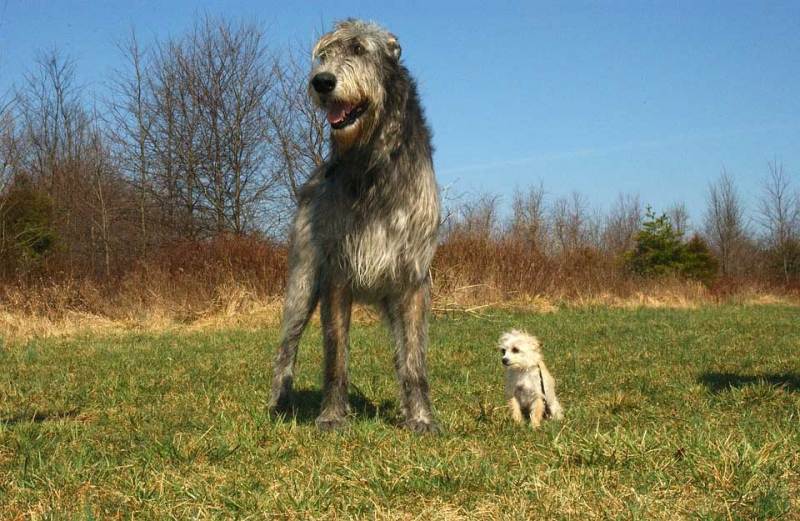
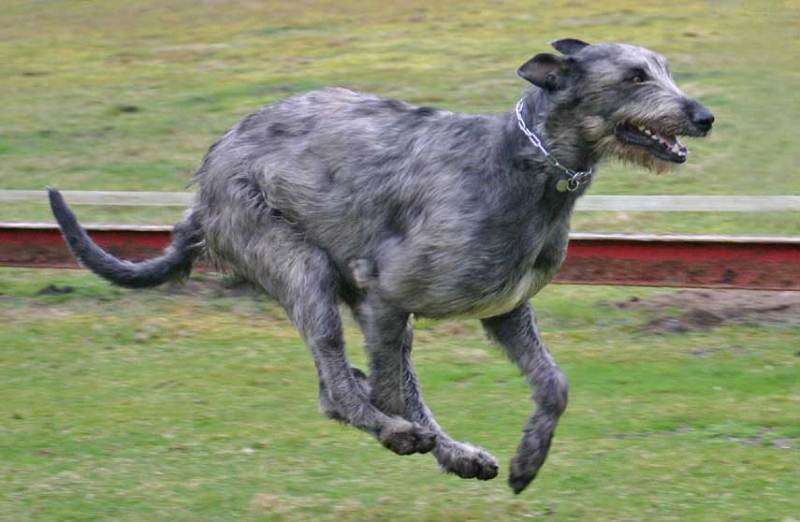
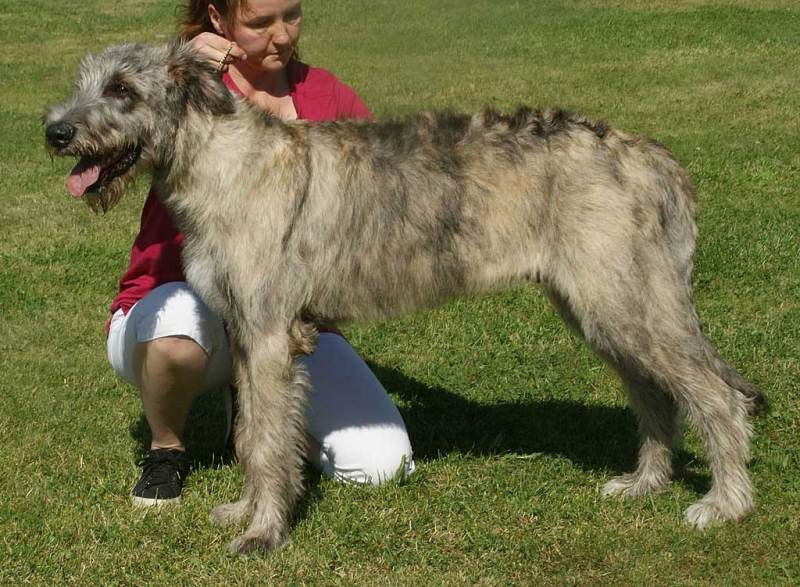
    The Deerhound it is one of the oldest and noblest dog breeds in the world. It is an impressive hunting dog and sighthound. Together with his cousin, the Irish wolfhound, slightly larger, displays a distinctive and strongly impressive dog type.

    It has the complexion of a large and very strong greyhound and at the same time a rough and shaggy coat. As the name suggests, was the hunting dog of the Scottish high nobility for the red deer. The Scottish Deerhound must be fast, brave and strong enough to attack an adult deer and, at least, knock him down until the hunter can finish him off with the spear. The Deerhound it was also used in other game such as elk or wild boar. The hunts took place in the rugged Scottish Highlands. Dogs had to be fast, strong, persistent and, at the same time, extremely robust and resistant. So later they were also used to exterminate wolves.

    With the decline of classical hunting by the high nobility and new firearms with which a deer could be easily shot from a distance, the Deerhound lost importance and was finally almost extinct. British dog lovers, like the great painter Edwin Landseer, were involved in its conservation after 1800. Fortunately, this was very successful. The Scottish Deerhound is closely related to the Irish wolfhound, which is supported by genetic studies carried out by a team of geneticists led by Heidi Parker in 2017. Even today, the appearance of Deerhound singlehandedly distills the conditions of antiquity and medieval times in the Highlands.

    There are few more impressive dogs. Although there are still places in the Scottish mountains named after dogs that died hunting, the Scottish Deerhound is a breed in decline now found almost exclusively in South Africa.

    Physical characteristics

    The Deerhound he has the typical build of a large greyhound. Over this he wears his trademark wiry fur, lean and moisture repellent. The official standard describes its appearance as follows:

    The Scottish Deerhound resembles a Greyhound larger coarse hair and stronger bone. His build gives the impression of a unique combination of speed, strength and endurance needed to shoot down a deer; However, its general bearing is of noble dignity.

    His coat is disheveled, but not excessive. Woolly hair is not allowed. The correct coat is dense, tight, disheveled, feels hard or stiff. In the body, neck and hindquarters are hard and lean, of about 7-10 cm.; in the head, chest and belly is much softer. Slight fringe of hair on the inside of the front and back legs.

    Must measure between 7 and 10 centimeters. The allowed colors are dark blue-gray, the gray or the brindle, the yellow. White spots are undesirable. Unfortunately, It has become common practice at shows that dogs must show at least one 10% additional height at the withers. This tendency to gigantism is detrimental to the health of dogs and makes the already difficult growth phase even more difficult..

    How big is a Deerhound??

    With a height at the withers from 71 centimeters in females and up to 79 in males, they look awesome. Bitches must weigh about 36, the males ones 45 kg.

    How many years does a "Deerhound" live??

    The life expectancy of a "Deerhound" is difficult to measure. There are specimens that barely reach the 6 years, others even reach the 12 and more years in the best physical shape.

    Character and skills

    The Scottish Deerhound is a Sighthound and a hunting dog. But it's much more than that. He is a sensitive friend who absolutely needs a close connection with his human family.. Shows great empathy and adaptability to its humans. This strong and fast hunter is extremely gentle, calm and free from any aggressiveness.

    He is kind and patient with children. At the same time, always show some pride. Thanks to his intelligence and sensitivity, notices any unfair treatment. This hurts. The Deerhound it is an extremely nice and easy to drive companion. It is also an ideal companion for horseback riding or jogging. Given their willingness to hunt, this requires good training and a close bond with its owner, that I should be able to call you at any time. It is an incomparable experience to walk through nature with these dogs. But, A prerequisite for a harmonious coexistence is that the Scottish Deerhound can satisfy your basic needs. This includes running, ideally chasing a dummy hare during coursing.

    One Scottish Deerhound who can live up to a certain point his natural running abilities makes an excellent companion and family dog. The official standard describes its character as follows:

    Its build evokes the impression of a unique combination of speed, strength and endurance needed to shoot down a deer; However, its general bearing is of noble dignity. Soft and friendly. Obedient and easy to train, as it is eager to please. Docile and fair, never suspicious, aggressive or shy. Shown with quiet dignity.

    Care and health of a "Scottish Greyhound"

    What care does a "Deerhound" need??

    The Scottish Deerhound adult is a low maintenance dog. Regular brushing is enough.

    Are there typical diseases of the «Deerhound» breed?

    The Deerhounds, once grown, they are a robust breed.

    What is the best food for a Deerhound??

    The Deerhounds value a high-quality and varied diet. Expert guidance is essential, especially during the growth phase.

    The Scottish Deerhound it's a greyhound. The free run, fast and extensive, it is a basic requirement for the life of its species. Thus, in some regions there are special facilities where greyhounds can satisfy their need to run. Either he runs after a dummy rabbit at the racetrack or during the coursing, or else the dog is made happy with a ball thrower.

    Where can you buy a "Deerhound"?

    If you want to spend your life with a Scottish Deerhound, you should first check if you have the possibility to leave this Hound released regularly. Ideally, you should enjoy racing. You should only buy your puppy from a reputable breeder.

    Images "Deerhound"

    Photos:

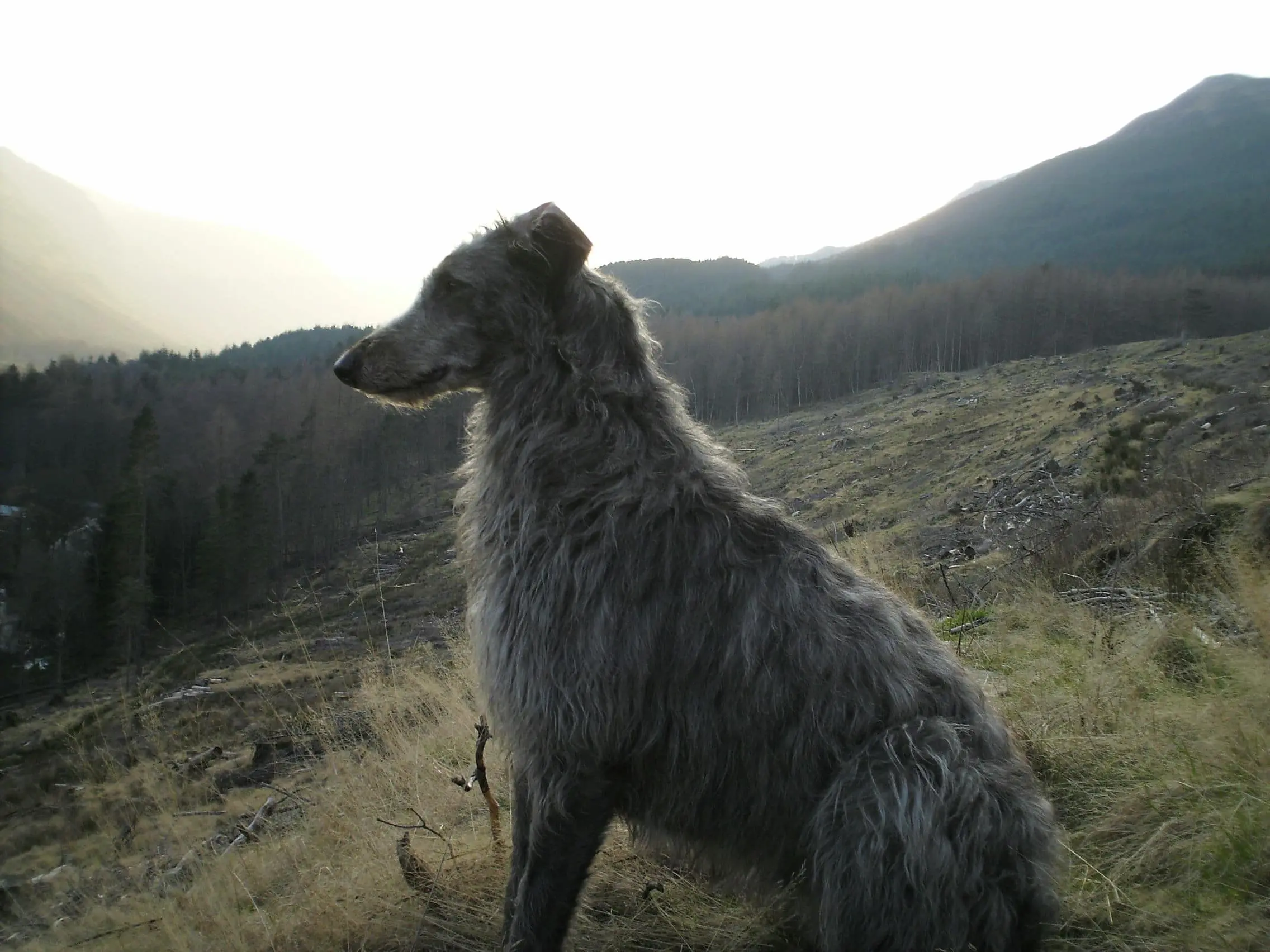
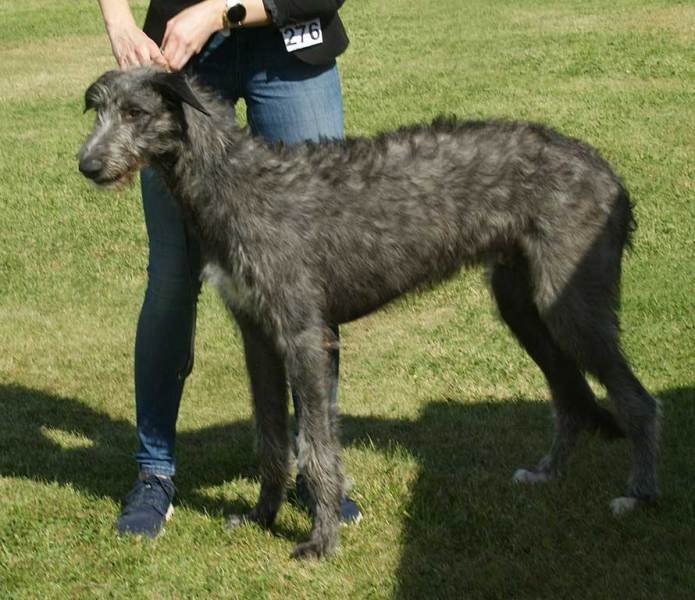
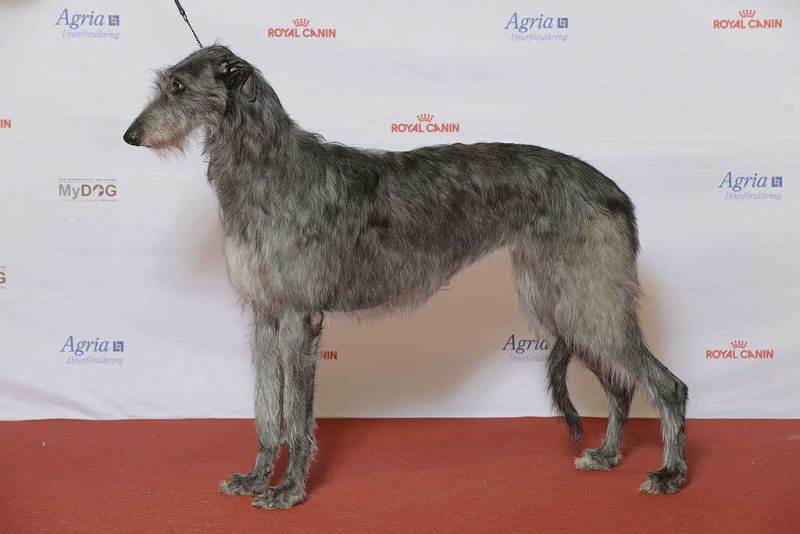
    1 – Female "Scottish Greyhound" with exceptional longevity: 14 years and 7 months. by Manialize, CC BY-SA 4.0, via Wikimedia Commons
    2 – «Scottish Deerhound» by Mark Robinson
    3 – Gray Scottish Deerhound, male. by Canarian, CC BY-SA 4.0, via Wikimedia Commons
    4 – "Scottish Greyhound" by Manialize, CC BY-SA 4.0, via Wikimedia Commons
    5 – “Scottish Deerhound” at Theodore Roosevelt Dog Park by Andrea Arden
    6 – "Scottish Greyhound" by Svenska Mässan from Sweden, CC BY 2.0, via Wikimedia Commons

    Videos "Deerhound"

    Type and recognitions:

    • FCI CLASSIFICATION:
    • Group :
    • Section : . .

    Federations:

    • Standard FCI (International Cynological Federation) Group 10: Section 2: Rough-haired Sighthounds ⓘ
    • CCC standard (Canadian Kennel Club / Canadian Kennel Club)
    • KC standard (The Kennel Club) ⓘ
    • AKC standard (American Kennel Club) (Hound) ⓘ

    FCI breed standard "Deerhound"

    Origin:
    Scotland

    Date of publication of the valid original standard:
    08.10.2012

    Use:

    Hunting dog, career and company.


    General appearance:

    It resembles a larger rough-haired Greyhound with stronger bones.


    Behavior / temperament:

    His body build suggests the unique combination of speed, strength and endurance needed to knock down a deer, but his general bearing is of dignity and nobility. He is noble and friendly. It is obedient and easy to train because of its willingness to please. He is docile and of good character, never suspicious, aggressive or nervous.
    He behaves with a quiet dignity.

    Head:

    Elongated,

    Cranial region:
    • Skull : It is more flattened than round, with a slight bump over the eyes. Wider at the level of the ears, thinning slightly towards the eyes. It is covered with moderately long hair and softer than the rest of the body.
    • Depression links (Stop) : No stop.

    facial region:

    • Truffle : Black. Slightly aquiline nose.
    • Snout : Tapers more markedly towards the tip of the nose. In dogs with lighter fur, black muzzle preferred.
    • Lips : Glued. They have a good mustache with quite silky hair and a little beard.
    • Jaws / Teeth : Strong jaws with a perfect scissors bite, regular and complete, that is to say, that the upper incisors closely overlap the lower incisors and are implanted vertically in the jaws.
    • Eyes : dark. Usually dark brown or hazelnut in color. Light eyes are undesirable. Moderately rounded, with a soft expression at rest, but with a sharp look, penetrating and distant when active. Black pigmented eye rims.
    • Ears : Set high and bent back when idle. In activity it raises them above the head without losing the fold and sometimes in a semi-erect way.. It is very undesirable for the ears to be thick and large falling flat against the head or for the ears to be erect. The ears should be soft to the touch, satin, like the ears of a mouse; the smaller the better, no long fur or stripes. Its color must be black or dark.

    Neck:

    Very strong, of a convenient length, which is sometimes disguised with the mane. The nape is very prominent at its insertion with the head. It presents no Chin.

    Body:

    It generally presents the body shape of a larger Greyhound and skeleton.

    • Back : Straight top line is undesirable.
    • Pork loin : Well arched, descends to the root of the tail.
    • Rump : Descendant, wide and powerful.
    • Breast : Deeper than wide, not too narrow or ribs flattened on the sides.

    Tail:

    Long, thick at its root, thinning towards the tip and reaching almost to the floor. When the specimen is standing, falls perfectly straight or curved. He wears it curved during movement, but never lifts it above the line of the back. Well covered with hair; on the top the hair is thick and hard (like wire) and in its lower part it is longer; a slight fringe is allowed near the tip. Curled or ringed tail is undesirable.

    Tips

    PREVIOUS MEMBERS : From elbows to straight feet, wide and flat.

    • Shoulder : Well angled and not too far apart. Heavy, straight shoulders are undesirable.
    • Elbows and forearms : Very wide.

    LATER MEMBERS : With a great distance from the hip to the tibio-tarsal joint. Broad and flat bones.

    • Hips : Well separated.
    • Knees : Well angulated.

    FEET : Compact and well angulated fingers. Strong nails.

    Movement:

    It is easy, active and aligned, with a good range.

    Mantle

    • HAIR : He is disheveled, but not in excess; woolly fur is unacceptable. The correct coat is thick, tight, irregular; frizzy or rough to the touch. Body hair, neck and limbs is hard as wire and approximately 7 cm. (3 inches) to 10 cm. (4 inches) long. The hair of the head, chest and belly is softer. Presents a slight fringe of hair on the inside of the forelimbs and hindquarters.
    • COLOR : Dark blue-gray, lighter or darker shades of gray; tawny and yellow, sand red or fire red with mask, eyes, black limbs and tail. White chest allowed, white fingers and a small white spot on the tip of the tail; but it is preferable that it is as little white as possible, because it is a unicolor dog. A white collar or a white list on the head is unacceptable.


    Size and weight:

    Males : Desirable minimum height at the withers : 76 cm. (30 inches)

    Approximate weight : 45,5 kg (100 English pounds)

    females : Desirable minimum height at the withers : 71 cm. (28 inches)

    Approximate weight : 36,5 kg (80 English pounds)


    Fouls:

    Any deviation from the aforementioned criteria is considered a fault and its severity is considered to the degree of the deviation from the standard and its consequences on the health and well-being of your health..

    Any dog ​​showing clear signs of physical or behavioral abnormalities must be disqualified..


    N.B.:

    Males should have two normal-appearing testicles fully descended into the scrotum..

    Source: F.C.I - International Cynological Federation

    Alternative names:

    1. Scottish Deerhound (English).
    2. Scottish Deerhound, Deerhound (French).
    3. Scottish Deerhound, Highland Deerhound (German).
    4. Deerhound, Galgo escocês, Deerhound escocês (Portuguese).
    5. Deerhound (español).

    ▷ The world of Pets: Dogs, cats, birds, reptiles, amphibians

    Borzoi – Russian Hunting Sighthound
    Rusia FCI 193 . Long-haired or fringed Sighthounds.

    Borzoi

    The Borzoi It is an affectionate and obedient dog with the master

    Content

    Characteristics "Borzoi – Russian Hunting Sighthound"

    Coexistence is important that you have with your new friend. Before considering the acquisition of a dog of the breed "Borzoi – Russian Hunting Sighthound" you know certain factors. Not all breeds of dogs are apt to live in an apartment, you must take into account his character, their need for exercise, their interaction with other pets, their care and if you have small children, their level of tolerance towards them.

    Adaptation ⓘ

    3,0 of 5 stars (based on 1 review)

    friendly dog ​​ⓘ

    4,0 of 5 stars (based on 1 review)

    hair loss ⓘ

    3,0 of 5 stars (based on 1 review)

    Affection level ⓘ

    4,0 of 5 stars (based on 1 review)

    Need for exercise ⓘ

    4,0 of 5 stars (based on 1 review)

    Social need ⓘ

    4,0 of 5 stars (based on 1 review)

    Home ⓘ

    3,0 of 5 stars (based on 1 review)

    Toilet ⓘ

    3,0 of 5 stars (based on 1 review)

    Friendly with strangers ⓘ

    3,0 of 5 stars (based on 1 review)

    barking ⓘ

    2,0 of 5 stars (based on 1 review)

    Health ⓘ

    4,0 of 5 stars (based on 1 review)

    Territorial ⓘ

    2,0 of 5 stars (based on 1 review)

    Cat friendly ⓘ

    2,0 of 5 stars (based on 1 review)

    Intelligence ⓘ

    3,0 of 5 stars (based on 1 review)

    Versatility ⓘ

    3,0 of 5 stars (based on 1 review)

    Child friendly ⓘ

    2,0 of 5 stars (based on 1 review)

    Surveillance ⓘ

    2,0 of 5 stars (based on 1 review)

    joy ⓘ

    3,0 of 5 stars (based on 1 review)

    History

    Dogs are mentioned in 17th century publications, with which our ancestors successfully hunted not only hares, but also wolves. Presumably, the first and most famous breeder of greyhounds It was the Russian Tsar Alexey Mikhailovich Romanov, who received several dogs of this breed as a gift from the Zaporozhye Cossacks. The version that the ancestors of the Borzoi – Russian Hunting Sighthound current were brought to us from Persia and the Kazakh Khanate during the reign of Ivan the Terrible also has its foundation. The Tsar had great respect for the greyhounds and was sincerely interested in the new hunting breeds.

    From the 18th century, the clan of greyhounds He underwent extensive "training". To improve the performance of hunting dogs, they crossed paths with Sighthounds local and english and, later, with Greyhounds of the Crimea and the Highlands. Breeding activity was spontaneous, since the main breeder of the breed was the aristocracy who maintained their own kennels and had the opportunity to freely experiment with breeding. Unlimited, the owners had to raise the animals according to their own preferences, which ended up dividing the family of the Greyhounds and slow down the standardization of the breed. As a result, the first standard for the exterior of the Borzoi could be written in 1888.

    The breed has been featured in Russian dog shows since 1872 and was immediately disappointed by all the aesthetes who saw the animals as a common mongrel who had lost all the classic traits of the Borzoi Russian. But, the jury of the Moscow exhibition of the Imperial Hunting Society was more faithful to the four-legged contestants and awarded a gold medal to the Borzoi nicknamed "Reward" in 1874. But even this decision did not put an end to the desperate debates among experts about what exactly a Borzoi Russian. Thus, supporters of the tradition continue to campaign to return to the original appearance of dogs, while the other half of the breeders persist in voting for a renewed appearance of the greyhounds.

    Since the beginning of the 20th century, the breeding of Russian Wolfhound sped up and in 1917 the number of purebreds in Russia had already exceeded 2000. Of course, during the years of the Civil Wars and the Great Patriotic War the Russian clan of Borzoi greyhounds suffered considerable losses, but despite everything it existed, and this gave Soviet enthusiasts the opportunity to start breeding these amazing animals again. The breed has reached America and Canada in the early 20th century, after Europe got fed up with the grace and hunting talent of its representatives and even managed to cool them down a bit. By the way, across the Atlantic the Borzoi they became more popular and were accepted there not as hunting but as sporting and show pets.

    Physical characteristics

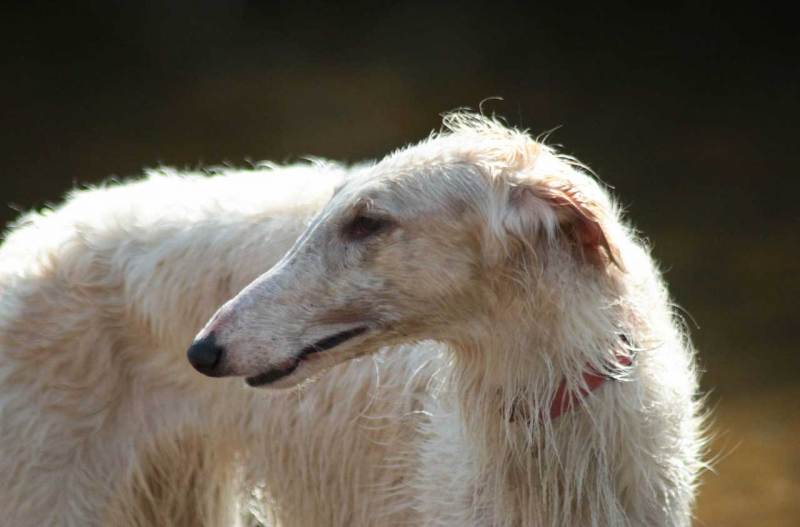
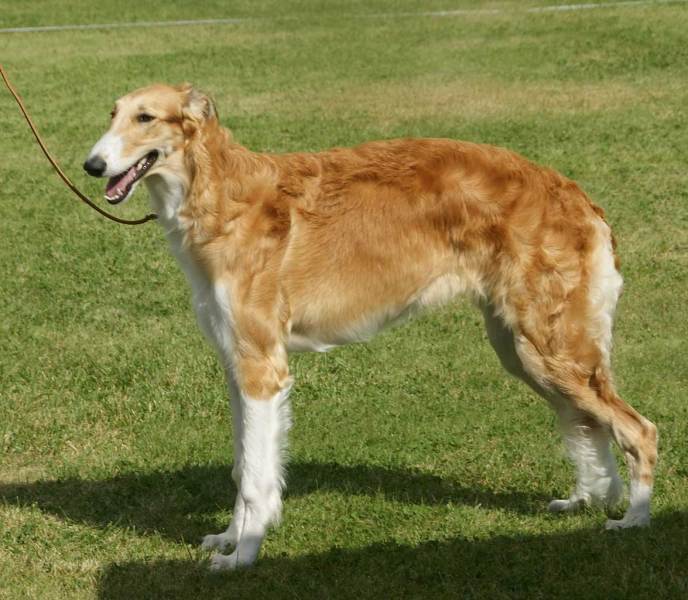
    The Borzoi – Russian Hunting Sighthound, they are the epitome of sophistication and elegance. Among his peers, These slim, ascetic beauties are noted for their exquisite exterior and mesmerizing ease of movement. Despite his relatively tall stature (the males up 85 cm to the cross, the females up 78 cm.), the Borzoi does not look like a giant of great weight. At the time, this characteristic of the breed was subtly interpreted by the genius of the Art Nouveau era Louis Icarus. After a couple of photos of the artist with a stretched and proud silhouette of a Borzoi Russian, became a fashion trend, and the illustrations, engravings and even sculptures depicting the majestic posture of the Greyhound, massively attracted the attention of French and Russian fans of the breed.

    Character and skills

    The Borzoi Russians are geniuses of reincarnation. They are irrepressible and gamble when they hunt, but as soon as they get into the walls of their houses, they immediately awaken the melancholic tranquility. In general, the Russian Wolfhound they are one of the most comfortable pets: they don't bark much and don't go after their owners to get their share of attention. When not hunting or walking, the Borzoi Russian prefers to spend his time passively resting on the sofa or curled up at his owner's feet. Nor is it a breed capable of giving all kinds of nasty surprises., how to tear the wallpaper or bite the shoes, as long as, of course, take walks regularly.

    The Borzoi they do not feel love towards children, but not great hostility. Sudden screaming and laughing mostly bothers him, so when groups of noisy children arrive at the master's house, the dog usually tries to get away. Due to his peaceful nature and his innate sensitivity, the Russian Wolfhound is moderately educated in communication, even with strangers, but in response it demands exactly the same treatment. Being a sensitive dog, the Borzoi is sensitive to injustice and punishment is a tragedy for this breed.

    Irritability is another characteristic of the Borzoi. At one point your dog walked imposingly at your feet, the next minute an occasional cat appears and the wind carries your dog away. The reason for this abrupt transition from one state to another is a chasing instinct, which in this race has evolved to the level of mania.

    The intellectual performance of the Borzoi it's pretty good, although inexperienced owners may find it difficult to educate and train their pet at first. It is important to understand that the Borzoi not a companion or service dog, but a professional hunter whose main objective is to work with hunting. Consequently, all the intelligence and ingenuity of the breed go exactly to the hunting process. At the same time, in normal life the dog's brain works in energy saving mode, what is sometimes confused with stupidity.

    Character and skills

    Even though that him Borzoi it is a mostly docile and obedient dog, they are not very good students. By the way, experienced hunters are of the opinion that enrolling representatives of the breed in a general training course only spoils their natural talents. The Borzoi must always be alert: an accidental yell or threatening movement toward the dog, and immediately regards it as an attempt to degrade his dignity. So you have to be respectful when training with these "aristocrats". It also, the Borzoi it is one of those races that have a different personality, so the training program and style for each individual can vary drastically.

    The first and most important skill that owners must teach is the ability to distinguish between hunting and social life.. Gently train your puppy to chase anything that moves during walks, using the side-by-side pursuit order. Never leave him off a leash if there are smaller four-legged critters nearby. It also, don't try to raise a Borzoi as a domestic or circus dog. Despite his gentle nature, will not look for slippers or walk on hind legs.

    You will have to forget about monotonous training with this breed, since monotony is the worst of evils for the Borzoi. Guide him seriously but without forcing him, rewarding your progress with treats. To the 6 months, your pup should have learned basic obedience commands ("Come here!», «¡Fence!») and be able to walk on a leash. The period of 6 to 10 months is considered a period of adolescent rebellion. Attempts to assert your authority by defying rules and regulations.

    The best way to combat adolescent leadership in Russian Wolfhound is the additional physical training. The more you work and train, less time the puppy will have to do mischief. The easiest in this regard is for owners who already have a Borzoi adult at home besides puppy. An experienced dog will quickly put the overexcited teenager in his place and be an example and a teacher for him..

    Hunting with a «Borzoi»

    The Borzoi he is an excellent midland hunter who can successfully hunt both hares and foxes as well as wolves. This is not only due to natural instincts and innate cunning, but also to a peculiar linear position of the legs that allows the dog to abruptly change the direction of movement, allowing you to capture prey at lightning speed. But, despite these clear breed advantages, today's hunters often reject their representatives as untrained pets. The reason for such carelessness lies in the fact that Russian Wolfhound they are often crossed with other hunting dogs, so the descendants' stalking instinct is not alive enough. It also, not all owners understand that, although hunting with a Borzoi it's a seasonal affair, the dog will have to develop and hone his skills for the rest of his life. A dog that goes hunting twice a year and lies on the couch the rest of the time will never win a hunting trophy for its owner..

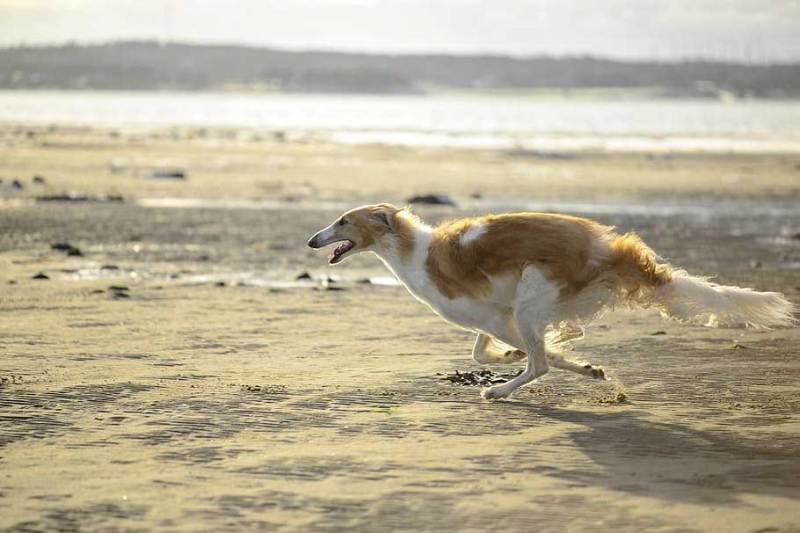
    The Russian Hunting Sighthound is a short distance runner. The optimal conditions for dogs to show their hunting skills are a treeless area of ​​up to 500 metres in length, although practice shows that most animals only need between 200 and 300 meters to catch a prey and deliver it to its owner. The innate impulsiveness of dogs also plays a role in hunting: when seeing the prey, the Borzoi Go from waiting to chasing in a split second. If your attempts to hunt the prey are unsuccessful, they can repeat the unsuccessful march after a half-hour break.

    The Borzoi is used to a dog collar in preparation for the first hunt. Training will begin at approximately 6 months of age and the puppy should learn to walk in a group without throwing himself forward and without lagging behind at the end of the pack. The Borzoi can be trained to 10-12 months, but in the beginning they are not allowed to make more than a chase attempt. Youngsters are not yet as hardy as older dogs and tire easily. It is advisable for the owner to raise two puppies at the same time, not necessarily both of the same race. As they mature and compete for the role of alpha male, they will try harder to prove themselves in training.

    The training of the Borzoi Teenager in the wolf is better to do in the company of experienced dogs and their owners. But it is allowed to ride hares alone and, in general, it is better to start training the Greyhounds young people to pursue game with a pack of "dropping-eared dogs". Often, during the first hunt Greyhounds they cannot contain themselves and tear the small prey to pieces and even eat it before the master arrives. This, of course, not a reason to get angry, but even so, it is worth reproaching the dog a little for that behavior.

    Care

    The Borzoi they need little space, so they are suitable for a flat in the city with a lot of exercise. But, it must be remembered that this breed does not respect a common cradle and is unlikely to settle for a modest corner in the hallway. To the Russian Wolfhound they like to lie on the couch or in the master's bed better and do not get angry with them for it. It is a way for the dog to relax, trying to rest your back and tired muscles. Some experts even recommend placing the pet on a separate sofa with an orthopedic mattress if space permits.. Regarding outdoor animals, it is worth building a large enclosure and placing a house of at least 1 meter high and about 1,5 square m² with insulated walls and floor. If there are two Greyhounds in the home, the inner surface of the kennel should be increased to 2,5 m².

    Grooming

    The fine wool of a Russian Wolfhound has practically no undercoat and is often tangled. But, they can keep their fur clean by themselves. The owners only have to brush a couple of times a week and after walks pick up the fluff that has become tangled. During the molting period, the same routine will have to be repeated daily, which is quite common in all races.

    When it comes to the frequency of baths, the breeders of Russian Wolfhound They disagree. Thus, some breeders recommend bathing the Borzoi once every three months, while others advise to give up this occupation completely and do bathing days only in emergencies, for example, when the dog gets dirty in the liquid mud. Your dog's eyes and ears do not need any special care.. You just have to keep them clean by removing the wax from the ear canal and cleaning the dirt that accumulates in the corner of the eyes with a piece of damp cloth.

    The claws of the Russian Wolfhound must be trimmed so that they do not obstruct the animal during the race. The hair between the toes should also be trimmed, as it gets dirty very quickly and can become a source of bacteria, which can lead to skin infections. It also, the Greyhounds living in flats will have to wash their paws after every walk.

    Walking with a «Borzoi»

    If you find it difficult to motivate yourself to go for a run in the morning and in the afternoon, the Borzoi Russian is your dog. As passive as this breed is at home, it is not uncommon for you to stroll along sidewalks and park lanes, which means you will have plenty of opportunities to stretch while he walks. If the walk is not very stimulating, tie your Greyhound to the bike and pedal at full speed: to the Russian Wolfhound they also love. By the way, the walks with the Borzoi Russians should be practiced in any weather, so you can't go out for a walk in the drizzle.

    It will be good if you have the opportunity to take your dog to the field, where you can let your hunting instincts flow. The city is useless, so make sure you walk your dog on a leash if you don't want him to be abandoned forever, because a Russian Wolfhound chased simply cannot hear the orders and screams of their owners. It also, dogs that are not going to be hunted should find an interesting alternative hobby. Can be treated, for example, of a coursing (chase of a mechanical "hare") or some simple activities like running after a ball or a Frisbee.

    Food

    In the case of Borzoi russians, experts advise sticking to the principles of divided meals. This breed feeds 3-4 times a day, dividing the daily ration into small portions. Dry food is not contraindicated either, unless it's an inexpensive version of the nearest supermarket. The basis of the diet of Borzoi Russians fed “directly” should be lean raw meat. Ranchers consider horse meat to be ideal, since it is rarely infected with brucellosis. Lean cod is on the dog's menu, but if it is desired and funds are available, can be easily substituted for squid.

    buckwheat, oatmeal and rice are suitable cereals, which can be turned into porridge by boiling broth or milk and leaving them to swell for half an hour. To the Russian Wolfhound they are given vegetables boiled or simply added to the soup. You also can't go overboard with sour dairy products, so pamper your four-legged friend with kefir or ryazhenka more often.

    A correct balance of protein and calcium is very important for the normal growth and development of the Borzoi Russian. For this reason, mineral supplements are added to the menu from the 4 months, when the puppy's teeth start to change. It also, up to six months of age, dogs are given calcified cottage cheese and a chicken egg several times a week. But, be careful with preparations containing calcium, since an excess of this macronutrient is no less harmful to puppies than a lack.

    Forbidden food:

    • Any food from the owner's table;
    • Potatoes and other high-starch vegetables;
    • Sweet;
    • Fatty meat and lard;
    • Tubular bones;
    • river fish.

    The Russian Wolfhound usually feed after a walk by putting enough food in a bowl. The dog must not chase the bowl across the floor, licking it to clean it.

    Health

    The Borzoi it is a relatively healthy breed, but very sensitive to all kinds of anesthetics. It also, many dogs are allergic to flea and tick remedies, so the choice of such drugs should be especially careful. Regarding the genetic predisposition to specific diseases, most of the time the Russian Wolfhound suffer from volvulus, abdominal distension, retinopathy (retinal damage), cataracts and wobbler syndrome (compression of the spinal cord in the cervical spine).

    How to Choose a Borzoi Puppy

    • Choose from February or March litters, whose babies will be ready to move into a new home in May-June. In this case, you can diversify your pet's diet with seasonal fruits and vegetables, they contain most of the vitamins necessary for a growing body.
    • Do not get hung up on a specific type of appearance of the future pet (for example, the owner breeds white dogs and you want a gray one). The Russian Wolfhound it is one of the most diverse breeds, and each of its representatives is beautiful in its own way.
    • If in the foreseeable future you hope to raise a professional hunter from a puppy, ask if their parents have field diplomas. Hereditary talents are not worth praising too much, either., as hunting skills are not always passed down from parent to child and are highly dependent on proper training.
    • The exterior of a puppy Russian Wolfhound growing constantly changes, so it is unlikely that you will be able to choose the most spectacular baby of the litter. But, it is still worthwhile to visually assess the correction of the bite, the cleanliness of the dog and the general condition of the future pet.

    Images "Borzoi – Russian Hunting Sighthound"

    Photos:

    1 – Borzoi by https://pixabay.com/es/photos/borzoi-perro-galgo-raza-retrato-4950553/
    2 – Borzoi by https://www.pxfuel.com/es/search?q=perro+lobo+ruso
    3 – Borzoi by https://pixabay.com/es/photos/borzoi-galgo-perro-animales-raza-4966781/
    4 – Russian Wolfhound Borzoi, red & white, female by Canarian, CC BY-SA 4.0, via Wikimedia Commons
    5 – Borzoi by https://en.Wikipedia.org/wiki/file:Borzoi-2ym-body.png
    6 – Borzoi by https://www.piqsels.com/en/public-domain-photo-jidhs

    Videos "Borzoi – Russian Hunting Sighthound"

    Type and recognitions:

    • FCI CLASSIFICATION:
    • Group :
    • Section : . .

    Federations:

    • FCI – Group 10: Section 1: Long-haired or fringed Sighthounds ⓘ
    • AKC – Hound ⓘ
    • ANKC – Group 4 (Hounds) ⓘ
    • CKC – Group 2 – Hounds ⓘ
    • ​KC – Hound ⓘ
    • NZKC – Hound ⓘ
    • UKC – Sighthound and Pariah ⓘ

    FCI breed standard "Borzoi – Russian Hunting Sighthound"

    Origin:
    Russia

    Date of publication of the valid original standard:
    04.09.2019

    Use:

    Greyhound hunting and running. The Borzoi is a sighthound that is used mainly to hunt hares and foxes, to a lesser extent for wolf hunting. Combines great agility and endurance, and the ability to skillfully tackle prey. It is also used for chases and races.


    General appearance:

    Aristocratic looking dog, oversized, both slim and robust in constitution and slightly elongated construction.
    Females are generally longer than males. Strong but not massive bone.
    The bones are quite flat.
    The muscles are lean and well developed, especially in the thighs, but they should not stand out. Harmony of shapes and movements is of utmost importance.

    IMPORTANT PROPORTIONS

  • In males, the height at the withers is equal to or slightly greater than that from the highest point of the croup to the ground.
  • In females, these two heights are the same.
  • The height at the withers should be slightly less than the length of the body.
  • The depth of the chest is approximately equal to half the height at the withers.
  • Muzzle length, from the naso-frontal depression to the tip of the nose, is equal to or slightly greater than that of the skull from the occiput to the naso-frontal depression.


  • Behavior / temperament:

    He has a calm temperament; the visual response is very evident.
    Typical gait: before finding the prey is the slow trot and even to the step; when chasing the prey, moves at a full gallop.
    Attitude towards people is neutral to friendly.

    Head:

    Top and side view she is thin, long, narrow and aristocratic-looking. Profile views, the upper lines of the skull and the nasal cannula form a long line, slightly convex, since the line of the vertex region (sagittal crest) is straight or slightly oblique to the region of the occipital protuberance, which is well marked. The head is so graceful and slim that the large veins are visible under the skin.

    Cranial region:
    • Skull : Seen from above it is narrow, elongated oval shape; seen in profile it is almost flat.
    • Depression links (Stop) : Very slightly marked.

    facial region:

    • Truffle : Big and mobile. It is quite prominent in relation to the lower jaw.
    • Nose cane : Long and compact throughout. Near the nose is slightly arched.
    • Snout : Muzzle length, from the naso-frontal depression to the tip of the nose, is equal to or slightly larger than that of the skull, from occiput to naso-frontal depression.
    • Lips : They are thin, fine; they are well attached to the jaw. The eye contour, the lips and the truffle are black, no matter what the color of the coat.
    • Jaw/Teeth : Strong jaws. White teeth, strong. The complete denture; scissor or pincer bite.
    • Eyes : Large, expressive, dark hazelnut or dark brown color, very slightly prominent, almendrada form, but not torn, oblique implantation.
    • Ears : Small, thin, Mobile. Insertion above the eye line and backwards, pointing almost in the direction of the neck when not alert. The tips of the ears are located very close or are directed downwards along the neck and close to it. When is the dog alert, the ears are carried high and on the sides or towards the front; Sometimes one or both ears are erected like a "horse ear.".

    Neck:

    Long, delgado, the side is flat. He is muscular and slightly arched.Never carried high.

    Body:

    • Cross : It is not marked.
    • Back : Wide, muscular and elastic. The back forms, together with the loin and rump, a curvature that is more pronounced in males.. The highest point of this curvature is located in front of the middle of the spine or in the region of the first or second lumbar vertebra..
    • Pork loin : Long, celebrities, muscular and moderately broad.
    • Rump : Long, wide, slightly tilted. The width of the croup measured between the two hip bones (Mian ridges) must not be less than 8 cm..
    • Breast : Its cross section is oval, it is not narrow, although it is not wider than the rump, deep, well developed in length, spacious, reaching down almost to the level of the elbows. The shoulder region being flatter, the chest gradually widens towards the false rib region, which are short; in profile, this causes a change in incline. The ribs are long, slightly prominent. The sill is slightly prominent in relation to the scapulo-humeral joint.
    • Belly : Well collected. The lower line rises abruptly towards the abdomen.

    Tail:

    Shaped like a sickle or saber. Long, slim and low set. When placed between the hindlimbs, must reach the protuberance of the iliac bone; it is provided with abundant feather. When the dog is standing course, tail hangs down. When is the dog moving, raises her, but it should not be carried above the level of the back.

    Tips

    PREVIOUS MEMBERS : They are lean and muscular. Seen from the front, are perfectly straight and parallel. The height of the forelimbs, from elbow to floor is equal to or slightly higher than half the height at the withers.
    Shoulder : Long oblique shoulder blades.

    • Arm : Moderately oblique; its length is slightly greater than the length of the scapulae. The angle of the scapulo-humeral joint is well pronounced.
    • Elbows : They are in planes parallel to the median plane of the body.
    • Forearm : Long, delgado, oval cross section. Seen from the front, is narrow; seen in profile is wide.
    • Metacarpus : Slightly oblique in relation to the ground.

    LATER MEMBERS : Seen from the back, they are straight, parallel and slightly further apart than the forelimbs. When the dog is standing, the vertical descending from the ischial tuberosity must pass in front of the center of the hock and metatarsus.

    • Thighs : Well muscled, long; obliquely.
    • Leg : Long, muscular, obliquely. The tibio-femoral and tibi-tarsal joints are well developed; they are wide and clean. The angles must be well marked.
    • Metatarsals : They are not long; almost upright. All joints are well angulated.

      FEET : Thin, Straits, in the shape of an elongated oval (called ²hare's foot²); arched toes, tight; nails, long, strong, touching the ground.

    Movement:

    Outside of the hunting activity, the typical movement of the Borzoi is the long trot., agile, very elastic and airy. During hunting it has an extremely fast gallop, with wide footsteps.

    Mantle

  • SKIN: Loose and elastic.
  • HAIR: It's silky, soft and loose, wavy or forming short curls, but never tight little curls. In the head, the ears and the limbs is satin (silky, but thicker), short, taut on the body. On the body the hair is longer, wavy; in the shoulder and rump region forms finer curls; on the sides and thighs the hair is shorter; the fur that forms the bangs, the pants and the feather on the tail is longer. The coat on the neck is dense and abundant.
  • COLOR: All color combination, but never with blue, brown (chocolate) and any derivatives of these colors. All mentioned colors can be solid or stained.
    The bangs, pants and tail feather are considerably lighter than background color. In carbon colors the black mask is typical.


  • Size and weight:

    Desirable height at withers:

  • 75 - 85 cm in males,
  • 68 - 78 cm in females.
  • In males, the height at the withers is equal to or slightly greater than that of the highest point of the croup to the floor. In females, these two heights are the same. Animals exceeding the maximum height are accepted provided that their typical morphology is preserved..


    Fouls:

    Any deviation from the aforementioned criteria is considered a fault and its seriousness is considered to the degree of
    deviation from the standard and its consequences on the health and well-being of the dog, and the dog's ability to perform its traditional task.

    •  Size 2 cm above or below the measurement indicated in the standard.
    •  Body length more than one 10 % or less than one 5 % greater than the height at the withers.
    •  Eyes that are not big enough; sunken; rounded; clear (all shades of hazelnut color).
    •  Small teeth; diastemas between the teeth; absence of one or two PM2. Absence of one or more incisors due to injury, whether the bite can be clearly assessed.
    •  Top line not smooth enough. Pronounced cross. Asymmetric arch. The highest point of the top line that obviously tends towards the rump.
    •  Insufficiently retracted belly; paunchy or hanging.
    •  Tail somewhat short, too tall, with lateral deviation and with the end screwed.
    •  Abundant fringes on the body, the same shade as the base color.
    •  Coat too smooth, hairy, matte and tousled; poorly developed fringes and feathers; absence of feathered.
      Equal length of coat all over the body; coat too hard when molting.

    SERIOUS FAULTS:

    •  Coarse head with thick, flabby skin; hanging lips. Seen in profile, blunt snout due to nose not prominent enough. Very pronounced naso-frontal depression.
    •  Truffle, discolored eyelids or lips (not dark enough) in all colors. Truffle, partially depigmented lips and eyelids (pink), without showing symptoms of injuries.
    •  Small eyes; yellow; poor eyesight; with the third eyelid too developed.
    •  Absence of any tooth not mentioned in the missing section.
    •  Low set ears; not arranged close to the body and directed downward along the nape; separate insert; too big; thick, heavy, enough with hard cartilage; with rounded tips.
    •  The length of the body equivalent to the length of the body plus a 12 % or less one 3% regarding the height at the withers. Size larger or smaller than 2 cm.. with respect to the stipulated.
    •  High or low insert collar, circular cross section.
    •  Top line descending from a well-pronounced wither towards the insertion of the tail; upper line with a very pronounced arch or straight back in males.
    •  Narrow loin, short or too long (the length of the loin is comparable to the length of the back), straight.
    •  Belly not retracted.
    •  Solid forearms, with round bone in cross section.
    •  Rounded or flat fleshy feet, with spread fingers.
    •  Short tail, thick, no feathered.
    •  Striking fringes on the body in colors other than the main one; color on the body that does not lighten in intensity downwards.
    •  Abundant fur all over the body, excessive undercoat, rough, hard, bristling fur not in the molt, absence of feathered.

    FALTAS DESCALIFICANTES:

    • Aggressiveness or extreme shyness.
    • Any dog ​​showing clear signs of physical or behavioral abnormalities.
    • Color: brown (including cocoa shades, coffee and chocolate); blue, isabelino (lilac), colors diluted with the truffle of a color other than black.
    • Truffle, eyelids and lips completely depigmented (pink).
    • Eyes: in all shades of gray, green or blue; different colored eyes.
    • Teeth: prognathism or inferior; crooked mouth. Incomplete incisors if they are widely spaced; lack of at least one canine,
      if it ain't broke. Lack of proper closure between the upper and lower canines. Jaws that do not close.
    •  Legs: with knuckles (knuckling over). Presence of dewclaws.
    •  Tail: corkscrew, rota (fused vertebrae); cut, even if only partially.


    N.B.:
  • Males should have two normal-appearing testicles fully descended into the scrotum..
  • Only functionally and clinically healthy dogs, with the typical conformation of the breed, should be used for parenting
  • Source: F.C.I - International Cynological Federation

    Alternative names:

    1. Russian Hunting Sighthound, Russian Wolfhound, Barzoï (English).
    2. Lévrier russe (French).
    3. Barzaia, Russischer Windhund, Russischer Wolfshund, Borzoi (German).
    4. Nome original «Russkaya Psovaya Borzaya» (Portuguese).
    5. Galgo Ruso, Lebrel ruso (español).

    ▷ The world of Pets: Dogs, cats, birds, reptiles, amphibians

    Saluki
    Egipto FCI 269 . Long-haired or fringed Sighthounds.
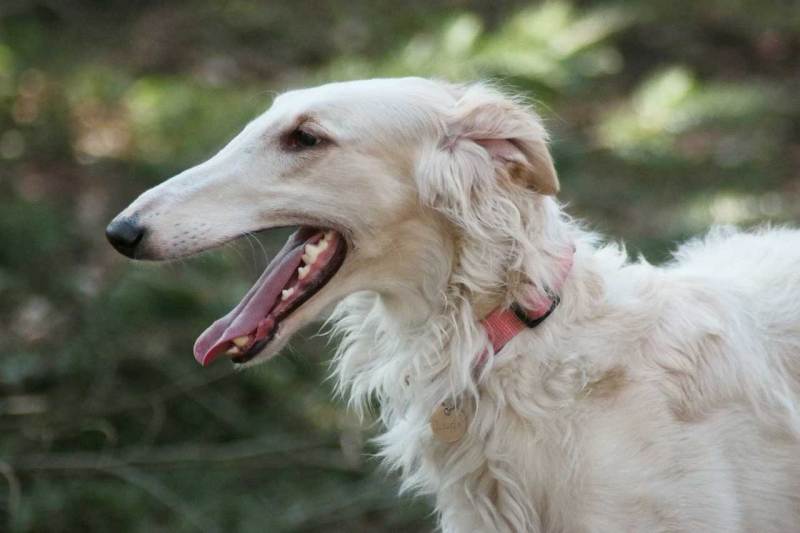
    Saluki

    In the Middle East a Saluki You can never be sold, You can only give away in signal estimation.

    Content

    History

    The Saluki, commonly known as "Royal Dog of Egypt", It is perhaps the oldest known breed of domesticated dog and the oldest of the Sighthounds, It is believed descended from wolves in the wilderness of Ara. The Bedouins hold them in high esteem and use them for hunting gazelles and as pets..

    As in the case of some other breeds in United States, including the Basenji and the Portuguese Podengo, the current Saluki population is descended from a small number of the first dogs to be introduced to the country since the 19th century.

    Read more

    ▷ The world of Pets: Dogs, cats, birds, reptiles, amphibians

    hungarian hound (Magyar Agár)
    Hungría FCI 240 . Short-haired Sighthounds

    Lebrel Húngaro

    The nature of hungarian hound, like its appearance, It is elegant. Extremely sensitive and smart, friendly sweetie, but never nosy.

    Content

    History

    The hungarian hound is a real specialty among Hungarian dog breeds. But, it is perhaps the least known four-legged Hungarian. It has been threatened with extinction several times throughout its history, although he is a very valuable and lovable companion with an impressive talent for hunting. Due to its rarity, has crossed with other dogs over the years, reason why many people nowadays do not consider that the Greyhound non-hunter kept for hobby purposes is a hungarian hound pure breed.

    Its origin

    Like all Greyhounds, the ancestor of this Hungarian breed also comes from Egypt. They first appeared around the third millennium BC, the first finds come from that time. Several theories were born about its formation, but the only thing certain is that they reached the Carpathian Basin with the Hungarian conquerors, who used them for hunting. The first memories of hungarian hound go back to the time of San Esteban. At that moment, This Sighthound it was very popular, just like it was a fashionable pastime in the days of Matthias Hunyadi. The king himself often spent his time hunting with them on horseback.. After his death, with the country divided into three parts, the breeding of hungarian hound started to decline.

    During Turkish rule, the hungarian greyhound was crossed with oriental type greyhounds. Hunting went from being a real hobby to poaching, since it was the best way to hunt without attracting attention.

    The reformist count István Széchenyi popularized greyhound racing and the hungarian hound became the national dog. At that time, Greyhound races were considered special and prestigious social events. Almost constantly, associations were formed to deal with the breed and hunting with it. Horse and greyhound racing also attracted foreigners. This is how English thoroughbreds and the “English Greyhound” were introduced into Hungary.. The resistance of the indigenous race was a rare treasure, but it did not correspond to the speed of the English Greyhound. Thus, the two dogs crossed often and the hungarian hound lost its original character. Thus, many people continue to question the Hungarian character of the greyhound, some say the old character has completely disappeared from current dogs.

    After World War II, the breed almost disappeared. In 1963 a movie was made about King Matthias, for which they were needed hungarian sighthounds. But, this dog was so rare that it was almost impossible to find one in the country. For the movie, nature filmmaker and hunter Kálmán Szigethy found some specimens, bought them and started raising them. Thanks to Szigethy, the hungarian hound revived and in 1966 was officially recognized by the FCI. Since then, it has slowly but inexorably spread throughout Europe and is not in danger of extinction. In 2004, all breeds of domestic dogs, including hungarian hound, were declared a national treasure by the Hungarian Parliament, and in 2017 it was even named hungarian heritage dog.

    Physical characteristics

    The hungarian hound it is a thin hunting dog, his joints are dry and his musculature is prominent. The chest is flat and deep. The trunk is rectangular. The coat is short and of varied colors, and is bred in most greyhound colors.

    Body weight of 22-31 kg, according to sex, and height at the cross of 62-70 cm.. It has a strong bone structure and a long head with character.. Almond-shaped eyes, dark brown. Black nose. The ears are called rose ears, that are small and bent back. Long tail, fine, regularly screwed. Its movement is flexible, elegant and graceful.

    When run, can reach speeds of up to 60 km/h.

    Life expectancy is 12-14 years.

    Video of the Hungarian Greyhound
    Magyar Agár - Agárfesztivál - Osagárd 2008

    Character and skills

    The hungarian hound has a very persistent and determined character. This is why he is so successful in greyhound racing. Compared to other dogs, can keep fast speed for a long time and, in case of stumbling, will continue on his way with the same vigor. He has a big heart in his deep chest, that helps you gallop with persistence. Radiates strength, elegance and great presence of mind. Although he loves to run, he is not hyperactive. typical of greyhounds, rests relatively frequently but requires a lot of exercise. So, regular daily exercise is important.

    Your nature - like your appearance- It is elegant. He's extremely smart and sharp, loving but never intrusive. It is also recommended with children, they love them and a well socialized dog is not aggressive towards them. He is protective of his family but is not a biter and never barks unnecessarily. It is reserved with strangers. Has a balanced temperament, which makes it an ideal family pet. Early socialization and frequent exercise are important, otherwise you may develop behavior problems. This will most likely manifest itself in the flight. It is also excellent for various dog sports, especially greyhound racing, hunting or agility. Its calm nature also makes it ideal as a therapy dog..

    Ideal environment

    Greyhounds can stay indoors if they get adequate exercise every day. Get plenty of rest and can sleep up to 18 hours a day. Consequently, is very fond of comfort and soft beds. In a garden shed, it is necessary to ensure that a high enough fence is erected around it, since it will easily skip the lowest. He gets along very well with children, if they are treated well. It does not require a particularly active owner and is perfect for a family with an average lifestyle. A great hiking companion.

    Grooming

    The hungarian hound does not require any special care. You need to bathe him a couple of times a year and clean his eyes and ears at appropriate intervals. Brushing with a brushing glove is recommended once a week. More frequent brushing is recommended during the shedding season.

    Health

    The hungarian hound it is a healthy breed, does not have any specific disease.

    Characteristics "hungarian hound (Magyar Agár)"

    Coexistence is important that you have with your new friend. Before considering the acquisition of a dog of the breed "hungarian hound (Magyar Agár)" you know certain factors. Not all breeds of dogs are apt to live in an apartment, you must take into account his character, their need for exercise, their interaction with other pets, their care and if you have small children, their level of tolerance towards them.

    Adaptation ⓘ

    4,0 of 5 stars (based on 1 review)

    friendly dog ​​ⓘ

    3,0 of 5 stars (based on 1 review)

    hair loss ⓘ

    2,0 of 5 stars (based on 1 review)

    Affection level ⓘ

    4,0 of 5 stars (based on 1 review)

    Need for exercise ⓘ

    4,0 of 5 stars (based on 1 review)

    Social need ⓘ

    3,0 of 5 stars (based on 1 review)

    Home ⓘ

    3,0 of 5 stars (based on 1 review)

    Toilet ⓘ

    2,0 of 5 stars (based on 1 review)

    Friendly with strangers ⓘ

    2,0 of 5 stars (based on 1 review)

    barking ⓘ

    1,0 of 5 stars (based on 1 review)

    Health ⓘ

    5,0 of 5 stars (based on 1 review)

    Territorial ⓘ

    4,0 of 5 stars (based on 1 review)

    Cat friendly ⓘ

    2,0 of 5 stars (based on 1 review)

    Intelligence ⓘ

    4,0 of 5 stars (based on 1 review)

    Versatility ⓘ

    3,0 of 5 stars (based on 1 review)

    Child friendly ⓘ

    5,0 of 5 stars (based on 1 review)

    Surveillance ⓘ

    2,0 of 5 stars (based on 1 review)

    joy ⓘ

    3,0 of 5 stars (based on 1 review)

    Images "hungarian hound (Magyar Agár)"

    Photos:

    1 – hungarian hound Color: of course by Canarian, CC BY-SA 4.0, via Wikimedia Commons
    2 – hungarian hound by https://pixabay.com/es/photos/magyar-agar-perro-animal-galgo-5016524/
    3 – hungarian hound by Magpie (vitalap / edits), CC BY-SA 3.0, via Wikimedia Commons
    4 – hungarian hound at the Katowice dog show (2005) by Pleple2000, CC BY-SA 3.0, via Wikimedia Commons
    5 – hungarian hound by Hachieko, CC BY-SA 4.0, via Wikimedia Commons
    6 – hungarian hound by http://www.magyaragar.eu/blog/tag/ungarischer-windhund/page/24/

    Videos "hungarian hound (Magyar Agár)"


    Type and recognitions:

    • FCI CLASSIFICATION:
    • Group :
    • Section : . .

    Federations:

    • FCI – Group 10: Section 3: Short-haired Sighthounds ⓘ
    • Standard CCC (Canadian Kennel Club / Canadian Kennel Club)
    • Standard KC (The Kennel Club) – Hound ⓘ
    • Standard UKC (United Kennel Club) – Sighthound and Pariah ⓘ

    FCI breed standard "hungarian hound (Magyar Agár)"

    Origin:
    Hungary

    Date of publication of the valid original standard:
    06.04.2000.

    Use:

    It is a hunting and racing dog that hunts on sight. But, his nose is also remarkable. It is especially suitable for racing and decoy hunting. (coursings) where it is considered by all as highly accredited in long sections. He is a very good companion dog and a faithful guardian..


    General appearance:

    His appearance radiates strength; bone structure and muscles are well developed. It is elegant.


    IMPORTANT PROPORTIONS:

    • The length of the body is slightly greater than the height at the withers.
    • The length of the muzzle corresponds to half the length of the head.


    Behavior / temperament:

    Tireless, persistent, fast, hardened and resistant. Excellent for racing.
    In some distances it is faster than the Greyhound.
    He is reserved by nature but not shy, it's sensible, smart and faithful. Is vigilant; your instinct to protect people, houses or farms is highly developed but with no hint of aggressiveness or sharpness.

    Head:

    Viewed from above and in profile, it is wedge-shaped with a fairly wide base.

    Cranial region:
    • Skull: Moderately strong, broad. The forehead is relatively broad.
    • Stop (naso-frontal depression) : Well marked.

    facial region:

    • Truffle: relatively large, well pigmented with large wide windows.
    • Snout: Strong, elongated, although as a whole it is not too pointed.
    • Belfos : Closing well, adherents, well pigmented.
    • Jaws / teeth: Strong jaws, powerful. Scissor bite, complete, well developed and according to the dog's dental formula.
    • Cheeks: Strong, muscular.
    • Eyes: Medium size, dark, neither deeply placed in the sockets nor bulging. Lively and intelligent look.
    • Ears: They are quite large and their weave is thick. Inserted at mid-height, they fold back over the neck in the shape of a perfectly worn rose. In attention they get up. Heavy ears are preferred over light ones. Always erect ears are wrong.

    Neck:

    Medium length but elegant, dry, muscular, without wrinkles.

    Body:

    • Cross: Well developed, muscular, long.
    • Back: Wide, straight, firm, very well muscled.
    • Pork loin: Very wide, straight, heavily muscled.
    • Rump: Wide, slightly descending, with strong muscles.
    • Breast : The rib cage is deep and strongly arched to allow enough room for the heart and powerful lungs.. Well sprung ribs well extended back.
    • Belly: Moderately collected.

    Tail:

    Strong tail insertion, thick and slightly curved is moderately high. It is moderately thinned and reaches the hock. Its underside is covered by wire hair. At rest it falls vertically to the ground; in action it can be raised to the height of the top line

    Tips

    PREVIOUS MEMBERS: The forelimbs are strong and tendinous. Seen both from the front and the back, they are straight and parallel.

    • Shoulder: Moderately oblique, Mobile, muscular and long.
    • Arm: Long and somewhat oblique, muscular.
    • Elbows: Elastically conform to the rib cage. They are mobile and must not be turned either inwards or outwards.
    • Forearm: Long, straight, strong bone structure and dry muscles.
    • Carpo: Wide and strong.
    • Metacarpus: Short and vertical to the ground.
    • Front feet: Relatively large, elongated. Strong pads, nails kept short.

    LATER MEMBERS: The hindquarters are well angulated but not over angulated., strongly muscled and with good bone strength. Seen from behind are parallel.

    • Thigh: powerfully muscled, with rather elongated muscles.
    • Knee: Moderately angled, strong, not turned neither in nor out.
    • Leg: Long, with dry muscles.
    • Hock: Powerful, strong, low placement.
    • Metatarsals: Seen from behind, both standing and moving are parallel.
    • Rear feet: Relatively large, somewhat elongated with strong pads and nails.

    Movement:

    Good ground coverage, elastic trot, seen from front and back, limbs move in parallel planes.

    Mantle

    • SKIN: Relatively thick, well adjusted all over the body, no creases or double chin.
    • HAIR: Short, thick, rough, smooth and well glued. In winter it can present a dense internal fluff in considerable quantity.
    • COLOR: All known colors and color combinations in sighthounds, with the exception of those colors and combinations of colors mentioned as elimination fouls.


    Size and weight:

    HEIGHT AT THE WITHERS

    • Ideal height for males: 65 until 70 cm..
    • Ideal height for females: 62 until 67 cm..

    The height measured in centimeters is not as important as the harmony of the proportions..


    Fouls:

    Any deviation from the aforementioned criteria is considered as a fault and the severity of this is considered to the degree of the deviation to the standard and its consequences on the health and well-being of the dog..


    MISS PLAYOFFS

  • Aggressive or fearful dog.
  • Atypical head shape.
  • Upper or lower prognathism, incisor arcade deviated.
  • Missing one tooth or more than one tooth on the incisors, of the fangs, of the premolars 2-4, and molar 1-2; of more than 2 x PM1; go M 3 will not be taken into consideration .
  • Entropion, ectropion.
  • Colors: blue; blue spotted white white; brown; wolf gray as well as black and tan; tricolor dogs.
  • Any dog ​​showing clear signs of physical or behavioral abnormalities must be disqualified..


    N.B.:

    Males should have two normal-appearing testicles fully descended into the scrotum..

    Source: F.C.I - International Cynological Federation

    Alternative names:

    1. Magyar agár, Hungarian agar (English).
    2. Magyar Agár (French).
    3. Magyar Agár (German).
    4. Magyar Agár, Lébrel húngaro (Portuguese).
    5. Galgo húngaro, Magyar Agár (español).

    ▷ The world of Pets: Dogs, cats, birds, reptiles, amphibians

    Irish wolfhound
    Irlanda FCI 160 . Rough-haired Sighthounds
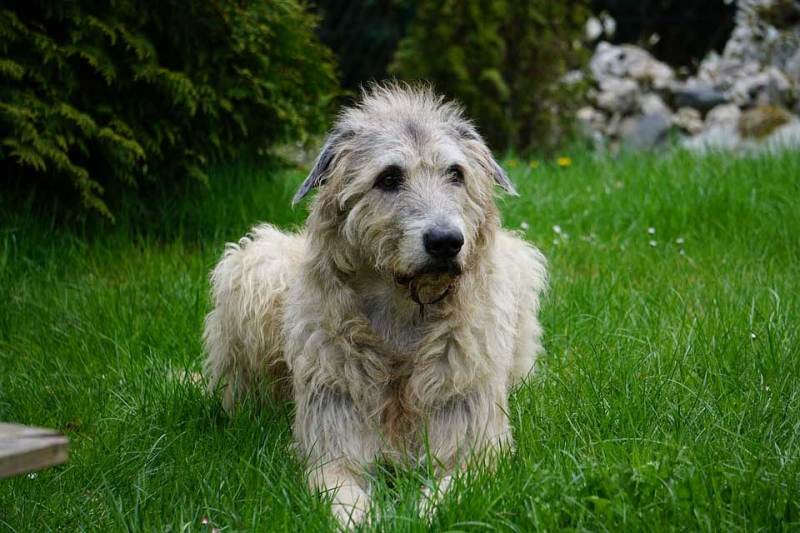
    The Irish wolfhound It is the largest breed of dog that exists.; adults reach an average height of between 95 and 100 cm to the cross.

    Lebrél irlandés

    Content

    Characteristics "Irish wolfhound"

    Coexistence is important that you have with your new friend. Before considering the acquisition of a dog of the breed "Irish wolfhound" you know certain factors. Not all breeds of dogs are apt to live in an apartment, you must take into account his character, their need for exercise, their interaction with other pets, their care and if you have small children, their level of tolerance towards them.

    Adaptation ⓘ

    3,0 of 5 stars (based on 1 review)

    friendly dog ​​ⓘ

    4,0 of 5 stars (based on 1 review)

    hair loss ⓘ

    3,0 of 5 stars (based on 1 review)

    Affection level ⓘ

    5,0 of 5 stars (based on 1 review)

    Need for exercise ⓘ

    4,0 of 5 stars (based on 1 review)

    Social need ⓘ

    4,0 of 5 stars (based on 1 review)

    Home ⓘ

    2,0 of 5 stars (based on 1 review)

    Toilet ⓘ

    3,0 of 5 stars (based on 1 review)

    Friendly with strangers ⓘ

    3,0 of 5 stars (based on 1 review)

    barking ⓘ

    1,0 of 5 stars (based on 1 review)

    Health ⓘ

    2,0 of 5 stars (based on 1 review)

    Territorial ⓘ

    2,0 of 5 stars (based on 1 review)

    Cat friendly ⓘ

    2,0 of 5 stars (based on 1 review)

    Intelligence ⓘ

    3,0 of 5 stars (based on 1 review)

    Versatility ⓘ

    3,0 of 5 stars (based on 1 review)

    Child friendly ⓘ

    4,0 of 5 stars (based on 1 review)

    Surveillance ⓘ

    2,0 of 5 stars (based on 1 review)

    joy ⓘ

    4,0 of 5 stars (based on 1 review)

    History

    The Irish wolfhound it is a very old canine breed, It was used as a war and hunting dog as early as the 3rd century BC..

    As the greatest of the Sighthounds and hunting dogs, they were already admired. In fact, its impressive size and exceptional bravery even allowed it to hunt the now-extinct Irish elk, that doubled him in size. But, It was his ability to attack wolves that gave the name to the Irish Wolfhound. Before taking this name, he was known simply as Cu, a Gaelic word whose meaning is not very clear; according to the texts, this word was sometimes translated as dog, sometimes like war dog, sometimes like wolf.

    In any case, it's easy to imagine how, on the battlefield, the Irish wolfhoundhe could look like a fierce fighter and impress with his size. Its main use was to knock men off their horses or from enemy chariots. But, although his warrior past is mentioned during the various Celtic wars, there are few texts that narrate his exploits with greater precision. However, It should be noted that during the sacking of Delphi in the year 279 a.C., one survivor mentioned the presence of giant dogs fighting alongside their masters, but without giving more details.

    Although it was used against him in some conflicts with the Celts, was admired by the Romans. This is attested by writings such as those of the Roman consul Quinto Aurelio, who received them as a gift and reported in the year 391 a.C. that Rome admired them in amazement. The Romans also used them as fighting dogs in the arenas., making them compete with other animals and prisoners of war.

    The Irish wolfhound is intrinsically linked to the history and folklore of its country of origin, which is the national dog. In addition to the historical mentions of his role in wars and conflicts, this gentle giant is also at the center of the legends told in various writings, already in the 3rd and 4th centuries. In fact, its popularity has endured throughout the ages, as illustrated by numerous examples. One of the most famous comes from a twelfth-century writing that relates that Mesrodia, then king of Leinstern, In Ireland, owned an Irish Wolfhound so remarkable that the King of Connacht offered him six thousand cows and other treasures in exchange for his dog. Mesrodia's refusal led to a war between the two kingdoms, but the text does not specify what happened to the Greyhound, called Aibe.

    In ancient ireland (until the 5th century AD), A law reserved to kings and nobles the possibility of owning a Irish wolfhound, and his number was a prestige mark of the person's title. These may include, minor members of the nobility could only own a maximum of two Irish wolfhound. But, this did not mean that the number of representatives of the breed in the country was extremely limited, since Ireland was divided at that time into more than 150 kingdoms, with many kings and nobles.

    The Irish wolfhound it was a popular gift among the nobility, and was often delivered with silver and gold chains to develop or strengthen alliances. One of the most famous exchanges was the sending of an Irish greyhound named Gelert to Prince Llewellyn of Wales by King John of England in 1210, and the burial place of the august dog can be seen today in Wales.

    Either used in battle or gifted to consolidate alliances, The Irish Greyhound has also made a name for itself outside its native country; mentions of the breed can be found in numerous writings. In 1596, in Spain, the poet Lope de Vega wrote a sonnet entirely dedicated to the Irish wolfhound.

    Despite its glorious past, the Irish greyhound was not far from extinction in the early 1800s. At that time, the Irish wolfhound it was used mainly for hunting, but the disappearance or near disappearance of wolves, deer, roe deer and wild boar in Ireland took away much of its usefulness. It survived because some families already used it as a pet.

    The Irish wolfhound he probably owes his salvation to Commander H as well. D. Richardson, who wrote a book about dogs in 1842 (The Dog: Its Origin, Natural History, and Varieties), in which he suggested that the Irish wolfhound and the Deerhound they were the same race. This led him to start a breeding program for the Irish wolfhound using Irish wolfhound from the Glengarry area (Ireland), saving the race from the brink of extinction.

    Captain George Augustus Graham was another breeder who, in the decade of 1860, kept the race alive. Crossed the Irish wolfhound with the Scottish Greyhoundby Glengarry, Borzoi – Russian Hunting Sighthound and the Tibetan Mastiff (Do-Khy) to avoid inbreeding. He also used the Irish wolfhound that had been crossed with the Great Dane harlequin. Graham was also responsible for the creation of the first breed club of the Irish wolfhound in 1885.

    The Kennel Club, the leading british kennel club, was founded in 1873, but did not recognize the breed until 1925.

    In United States, was recognized already in 1897 by the American Kennel Club (AKC). The other leading American organization, the UKC (United Kennel Club), it took a little longer to do the same, since it was not until 1921. It also, in 1927 a breed club was founded. Today, the irish greyhound is moderately popular in ireland, occupying an average of 75th place in 200 in the number of pedigrees issued annually by the AKC.

    The International Cynological Federation did not recognize the Irish wolfhound until 1955.

    Physical characteristics

    The Irish wolfhound is the largest of Sighthounds and has an elongated and imposing body, with massive musculature and a broad back. Their legs are long, straight and strong; perfect to let you jump high.

    His head is long and flat, and the skull is not very wide. The ears are located high on the skull and fold along it., in the characteristic style of Greyhounds.

    The muzzle is long and slightly pointed, and the small dark eyes.

    Finally, their fur has a wire texture; it is rough and quite short. The hair under the eyes and under the jaw is slightly curly and longer than the rest of the body. The color of the coat is gray, white, black, red, beige or tabby.

    Weight and size

    ▷ Male size: 81 to 94 cm.
    ▷ female size: 71 to 81 cm.
    ▷ Male weight: 55 to 85 kg
    ▷ female weight: 50 to 70 kg

    Character and skills

    the size of the Irish wolfhound makes it not a suitable dog for everyone. In fact, even if it is quite passive, it is not recommended to live in an apartment, due to its size. You have to have enough space for everyone to move around easily. It also, how prone to joint problems (starting with the Hip Dysplasia), they are also not recommended for homes with stairs.

    So, the Irish wolfhound is much more comfortable in a place with enough space to stretch his legs, preferably with a fenced garden, to prevent the dog from escaping. A wireless electric fence probably wouldn't stop it, since his hunting instinct prevails.

    In any case, even if you have access to a garden, it is important that you plan walks with your adult dog for at least 40 minutes a day. Once your need for exercise is satisfied, you will be happier to walk around the house with your family.

    Whether walking or running, daily exercise should be much more limited with a puppy of Irish wolfhound, due to the fragility of your joints. It is best to start with a five-minute walk each day and then gradually increase the walking time.. The gradual increase in time and distance of exercise should continue until the child reaches maturity., to prevent joint damage. In any case, children under one year of age should not travel more than three kilometers.

    It also, despite your affection and devotion to your loved ones, the Irish wolfhound not the most effective guard dog, as they do not have the reflex to start barking to warn of potential danger. It also, although its large size may be enough to scare away potential intruders, They are not the type to adopt an aggressive temperament towards a human, even if it is malicious. This is not incompatible with his ability to display great bravery; simply, despite his origin as a warrior dog, does not a priori perceive humans as a source of danger. They are often described as gentle giants who, despite its size, they can be very gentle with family and children.

    In fact, this intelligent dog naturally seeks human company, making him an extremely loyal companion. They get along with everyone, and this is also true if they have to share their daily life with another dog.

    On the other hand, as they have a strong hunting instinct, it can be quite difficult to get them to live with other pets, as they will soon be mistaken for prey. Although he is socialized from a young age to the presence of other species, there is always the risk that your natural instincts will overtake you, so this coexistence must always be carried out under supervision.

    It is also his hunting instinct which explains why it is advisable to always keep him on a leash., to prevent it from chasing small animals, unfamiliar cats or even small dogs that may pass by. In fact, there is a real risk that you will be the victim of a traffic accident, 'Cause when he's worried about the hunt, he forgets his immediate surroundings, to the extent, for example, to cross a road without paying attention to possible vehicles.

    Education

    The Irish wolfhound he is a sensitive and intelligent dog, that it is easy to train if the owner uses positive reinforcement dog training techniques and knows how to stay calm in case of problems, but also rewards the dog when it responds well to instructions. On the other hand, if he is punished or if his owner raises his voice too much, likely to retract and isolate. It also requires a certain consistency in your education..

    It also, when they are still small, the Irish wolfhound have a tendency to steal various objects, like shoes. Thus, it is often easier and safer to leave your dog in a crate at home when you are away. But, duration should be minimal: more than half a day would start to cause problems, as your dog needs to move and stretch to prevent joint damage. As i grow, and as long as your education is not deficient, You should understand that this is not acceptable behavior., and that impulse should pass, which would allow him to be let loose at home.

    Health

    The Irish wolfhound is one of the shortest-lived dog breeds and is prone to a variety of health problems, several of which are common to all large dogs :

    ▷ The hepatic dog
    This disease is the result of liver failure., that no longer fulfills its metabolic functions. This functional loss is the cause of serious metabolic disorders. (dehydration, diarrhea, etc.) and can cause the death of the dog . In the Irish wolfhound, the most common cause is intoxication from an inadequate dose of certain medications to which it is particularly sensitive.

    ▷ Hip Dysplasia
    Common in dogs of this size, can have several causes. In the case of the Irish wolfhound, is an inherited condition most often caused by the femur not fully inserting into the hip joint.

    ▷ heart disorders
    Dog heart problems do not spare the Irish Wolfhound. In particular, a third of the representatives of the breed have an increased risk of cardiac arrest caused by dilated cardiomyopathy (also called a heart strain).

    ▷ The dilation-torsion of the stomach.

    It also, like all breeds of greyhounds , the Irish wolfhound have an increased sensitivity to anesthetics and certain medications. In the event of an intervention that requires anesthetizing the dog, it is essential to choose a veterinarian familiar with the Irish wolfhound and its physiological specificities, since a normal dose in another race can be fatal for him.

    Life expectancy

    Of 6 to 8 years

    Grooming

    The Irish wolfhound constantly changes, but not in excess. The dog's coat should be brushed once or twice a week to remove dead hair.. However, the coat is generally easy to care for, and it should not be necessary to bathe the dog more than once or twice a year, unless, Of course, that you come into contact with a substance that is dirty or harmful to your health.

    Some owners trim their fur Irish wolfhound, but this is more for aesthetic reasons than a real need. This is done primarily for individuals shown at dog shows. In any case, longer hair around the ears can be trimmed slightly, legs or neck. The underbelly and tail hair can also be shortened to give the dog a proud appearance..

    It is also advisable to brush the dog's teeth two or three times a week.. The dog's nails should be trimmed once or twice a month, depending on its wear.

    Once a week, brushing the dog's coat is an opportunity to examine its general physical condition, for example, to make sure your ears or skin are not red or show other signs of infection.

    Food

    Like all large dogs, the Irish wolfhound has a big food budget. In fact, needed between 540 and 1.000 grams of quality dry food each day, administered in two meals: one in the morning and one at night. The exact amount should be determined with the help of your veterinarian., depending on the age and activity level of the dog.

    In any case, due to the high risk of stomach bloating, it is important to avoid any intense physical activity in the hour before and especially after each meal.

    Price of an "Irish Greyhound"

    The Irish wolfhound not only is it an expensive dog to breed (due to the budget for food that it represents), but it is also one of the most expensive breeds to buy. The price of a puppy Irish wolfhound varies between the 1.350 and 1.800 EUR, without there being a significant difference between males and females.

    Images "Irish wolfhound"

    Photos:

    1 – «Irish Greyhound» by https://pixabay.com/es/photos/irish-wolfhound-chihuahua-poodle-mix-85578/
    2 – Meet drew, the new "Irish Greyhound" rescued from my mother. A precious animal by Airwolfhound, CC BY-SA 2.0, via Wikimedia Commons
    3 – «Irish Greyhound» by https://pixabay.com/es/photos/irish-wolfhound-perro-1789938/
    4 – Attila, Irish Wolfhound, owner Ms.. Sylvie Saulue by Sylvie Saulue/Design Madeleine, CC BY-SA 3.0, via Wikimedia Commons
    5 – Irish Wolfhound, striped, macho by Canarian, CC BY-SA 4.0, via Wikimedia Commons
    6 – Yesterday my mother received a rescued "Irish Greyhound". His owner couldn't keep him any longer due to a terminal illness, so the wolf rescue society contacted my mother to see if she would take him in, and he said yes 🙂 Amy and I picked it up yesterday, and this is me bonding with him 🙂 Taken with Amy's phone camera, so excuse the quality. by Airwolfhound, CC BY-SA 2.0, via Wikimedia Commons

    Videos "Irish wolfhound"

    Type and recognitions:

    • FCI CLASSIFICATION:
    • Group :
    • Section : . .

    Federations:

    • FCI – Group 10: Section 2: Rough-haired Sighthounds ⓘ
    • AKC – Hound ⓘ
    • ANKC – Group 4 (Hounds) ⓘ
    • CKC – Group 2 – Hounds ⓘ
    • ​KC – Hound ⓘ
    • NZKC – Hound ⓘ
    • UKC – Sighthound and Pariah ⓘ

    FCI breed standard "Irish wolfhound"

    Origin:
    Ireland

    Date of publication of the valid original standard:
    13.03.2001

    Use:

    Until the late 17th century Irish wolfhounds were used to hunt wolves and deer in Ireland. Also to hunt the wolves that plagued large regions of Europe before the forests were cut down.


    General appearance:

    The Irish Wolfhound should not be as heavy or massive as the German Shepherd but more robust than the Scottish Deerhound., to which it must resemble altogether by its type. It is a large dog with an imposing appearance, very muscular, strong yet elegantly structured; its movements are easy and dynamic; the head and neck should be held high and the tail is carried down with a slight upward curve, ending in another small curve at the tip.

    Big size, including height at the withers and proportionally length of body, is the desideratum to be targeted, and it is desirable to firmly establish a race which must average among the 81 and 86 cm. (32 and 34 inches) in males, showing power, exercise, courage and symmetry required.


    Behavior / temperament:

    "Lambs in the home, lions on the hunt"

    Head:

    Long and level, haughty. The frontal bones are slightly raised with a very slight depression between the eyes.

    Cranial region:

    Skull: Not too wide.

    facial region:

  • Snout: Long and moderately pointed.
  • Teeth: Ideal scissor bite, pincer bite is accepted.
  • Eyes: dark.
  • Ears: Small, rose shaped (like greyhounds).
  • Neck:

    Rather long, very strong and muscular, well arched, no double chin or loose skin around the throat.

    Body:

    Long, broad chest.

  • Back: Rather long than short.
  • Pork loin: Slightly arched.
  • Rump: Wide between the iliac protrusions.
  • Breast : Very deep, moderately wide; wide sill.
  • Ribs: Well arched.
  • Belly: Well collected.
  • Tail:

    The tail is long and slightly curved, moderately thick and well covered with hair.

    Tips

    PREVIOUS MEMBERS: On the whole quite straight with strong bones.

  • Shoulder: Muscular and oblique, that give breadth to the chest.
  • Elbows: Well attached to the body, without turning inward or outward.
  • Forearm: Muscular, with good bone, pretty straight.
  • LATER MEMBERS:

  • Thighs: Long and muscular.
  • Knee: Well angled.
  • Leg: Well muscled, long and strong.
  • Hocks: Well descended; must not be turned in or out.
  • FEET: Moderately large and round, without turning inward or outward; fingers well arched and together; very strong and curved nails.

    Movement:

    Free and active.

    Mantle

    HAIR: Strong and hard all over the body, limbs and head; especially wirey and long over the eyes and under the jaw.

    COLOR: The recognized colors are gray, striped, red black, pure white, Fawn or any other color that appears in the Deerhound.


    Size and weight:

  • Desired height: averaging 81 to 86 cms (32 to 34 inches) in males.
  • Minimum height: Males : 79 cms. (31 inches).
  • Minimum weight: Males : 54,5 kgs. ( 120 pounds).
  • Minimum height: females : 71 cms (28 inches).
  • Minimum weight: females : 40,5 kgs. (90 pounds).


  • Fouls:

    Any deviation from the aforementioned criteria is considered a fault and its severity is considered with respect to the degree of deviation from the standard and its consequences on the health and well-being of the dog..

  • Very light or very heavy head.
  • Frontal bone very arched upwards.
  • Crooked forelimbs; carpus too angulated.
  • Weak hindlimbs and general lack of muscle.
  • Body too short.
  • Back sunken or concave or completely straight.
  • Large, dangling ears close to the face.
  • Crooked feet.
  • Separate fingers.
  • Short neck; well developed double chin.
  • Very narrow or very wide chest.
  • Tail too curled.
  • Nose of any color other than black.
  • Lips of any color other than black.
  • Very light eyes; pink or liver-colored eyelids.
  • FALTAS DESCALIFICANTES:

  • Aggressiveness or extreme shyness.
  • Any dog ​​showing clear signs of physical or behavioral abnormalities.


  • N.B.:
    • Males should have two normal-appearing testicles fully descended into the scrotum..
    • Only functionally and clinically healthy dogs, with the typical conformation of the breed, should be used for parenting.

    Source: F.C.I - International Cynological Federation

    Alternative names:

    1. Irish wolfhound (English).
    2. Irish wolfhound (French).
    3. Irish Wolfhound (German).
    4. (em inglês: Irish Wolfhound), Lébrel irlandês (Portuguese).
    5. Cazador de lobos irlandés, Lobero irlandés (español).