โ–ท The world of Pets: Dogs, cats, birds, reptiles, amphibians

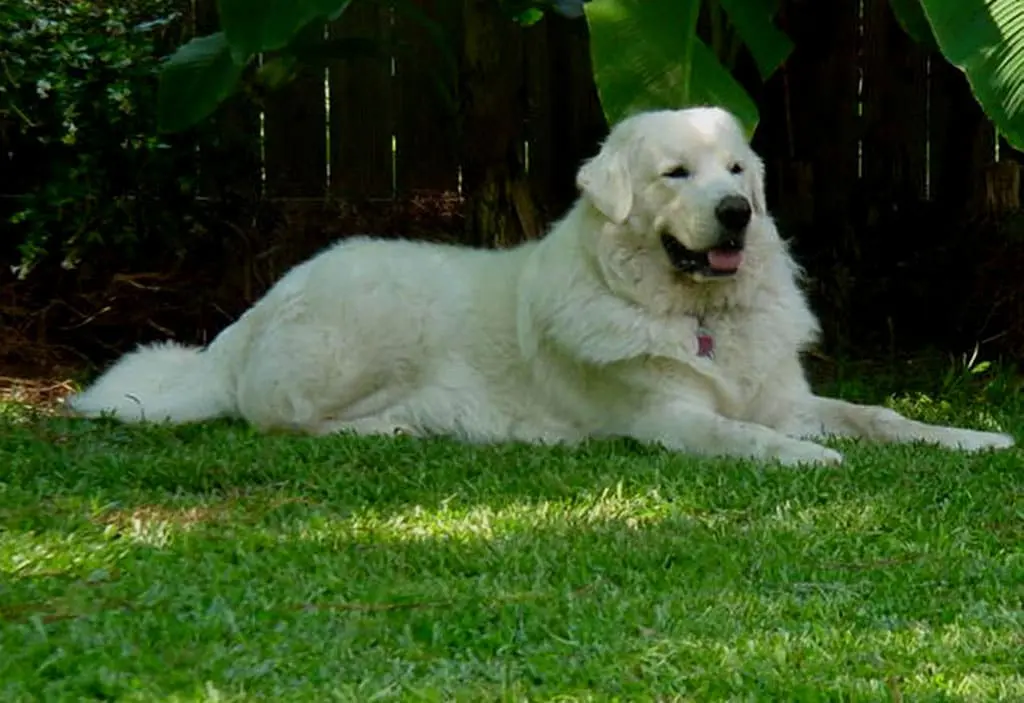
White Swiss Shepherd Dog
Suiza FCI 347 - Sheepdogs.

Pastor Blanco Suizo

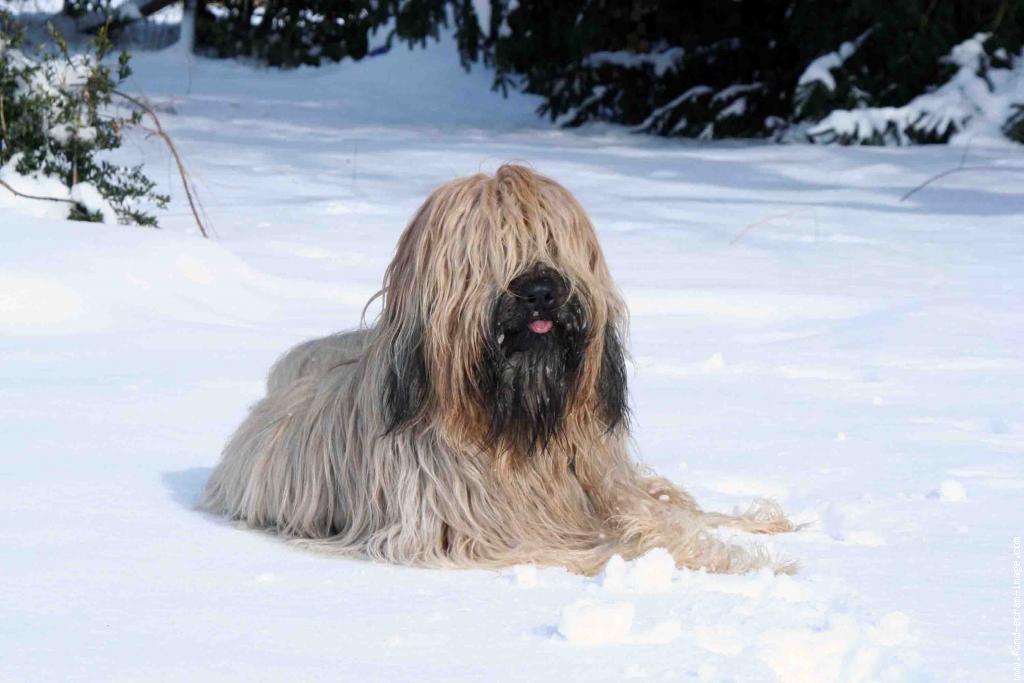
The White Swiss Shepherd Dog is a dog of great temperament, attentive and guardian and never nervous.

Content

History

The White Swiss Shepherd Dog a breed of dog is pastor of Swiss origin. Share origins with the German Shepherd, but has been recognized provisionally as a breed apart by the FCI.

The 3 in April of 1899, the first dog German Shepherd, as we know it today, It was officially registered. This dog was a completely white male which was used by ranchers and sheepherders for grazing because it was very easy to distinguish it from the wolves.

The first news about a hatchery White Swiss Shepherd Dog are earlier than the year 1900 and its origin is found in Alsace-Lorraine, to be more exact in the Royal Court of the Habsburgs. In their enclosure they had a kennel of purebred white shepherds.

After the creation of the race German Shepherd, all colors were accepted. It was in the first decades of the 20th century, When were the white copies excluded, Therefore, persecuted and almost wiped out in Europe.

Back in the years 70, Switzerland had imported the first specimens of white shepherds, while in Germany - as we said above- as these dogs did not meet the standard of the German Shepherd as we know it today, White shepherds were almost wiped out.

The first Club of White Swiss Shepherd Dog was founded in the decade of 1970 in United States. For which reason, the race returned to appear in Europe. At first in Switzerland and Denmark, and later in Germany. Little by little, European Cynological societies began to open their stud books for the White Swiss Shepherd Dog.

A dog born in 1966, it was the first White Swiss Shepherd Dog which was registered in Europe, in Switzerland.

The breed was recognized in Switzerland of 1991, followed by the Netherlands in 1992. Czech Republic, Austria and Denmark, They also recognized the breed.

Switzerland, Despite the low popularity of this breed, He recovered the race and also assumed the same motherhood, so in the 26 in November of the year 2002 the Federation Cynologique Internationale acknowledged - on a provisional basis- to the White Swiss Shepherd Dog, as a separate breed.

Physical characteristics

The White Swiss Shepherd Dog, to the naked eye and as far as the physical, He is a German Shepherd in all rule, It is only slightly more elongated and less angular.

According to him standard, the White Swiss Shepherd Dog, is a dog from size medium, powerful, muscular and robust. According to the standard, males must have a tall cross ranging from 60 to 66 cm., females are slightly smaller their stature is about 55 to 61 cm..

It has the ears large, straight and triangular. The tail scimitar-shaped, is low and at rest reaches the Hock.

It is the eyes they are fed and slightly oblique tend to be of color dark brown or purplish-brown fire.

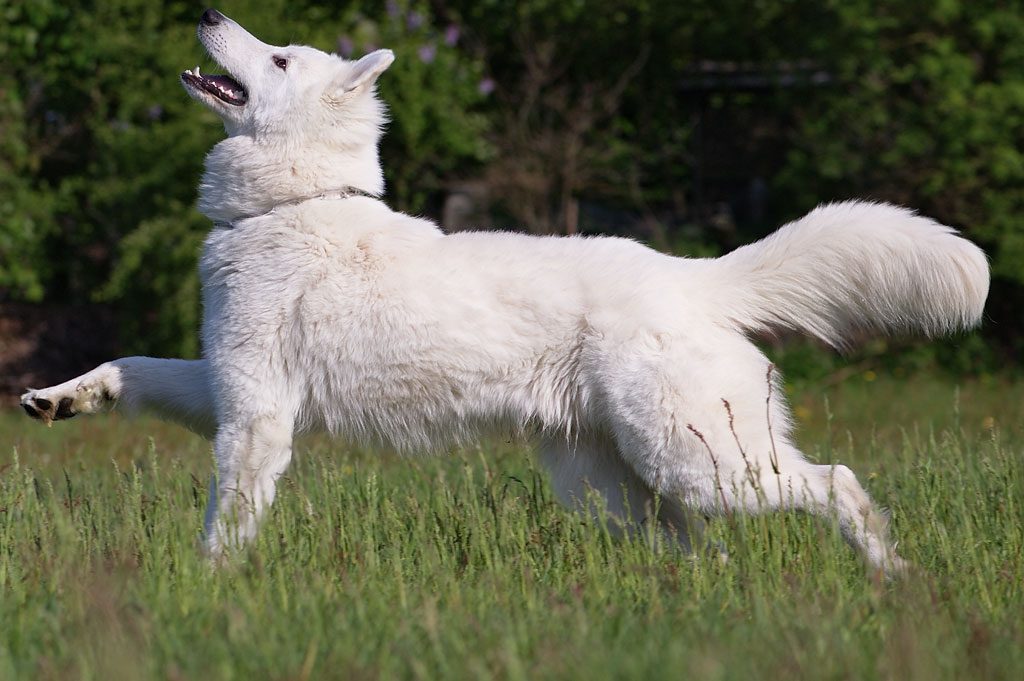
And perhaps, The most outstanding feature of this beautiful dog is its white mantle of double layer and medium long length. Dense and well separated hair.

The colour of the mantle is white. The nose, the lips and pads are absolutely black.

In the year 1933, the white color of the coat was pointed out as a defect that had to be eliminated by the German Shepherd Club of Germany, of America and Canada.

There are even theories, in the news, that continues to hold the white color is due to a physical defect, to a pathology but that type of theory lacks foundation and the first proof of it, It is a very healthy dog.

Its white color comes from a simple recessive gene that both parents must be carriers to continue the color, that is the reality.

Character and skills

The German Shepherd, not only the color of the mantle but also in its character differ.

While it is a dog of great temperament he displays never nervous, But if attentive and vigilant. It tends to be suspicious with strangers but never aggressive.

It is a dog friendly, very Intelligent and learn with ease.

Itร‚ยดs fair to his family and -as we said- he can be cautious with strangers, but should never show shy or fearful behavior and less aggressiveness. Some people think that the Arctic Wolf mixed with the breed, and that's where his caution comes from, but that only a legend.

It is a balanced dog, very good watchdog and has even been trained as a guide dog on occasion.

It is a great companion for everything physical exercise that is its scope, loves to play with sticks, balls, run…

While its origin speaks of a shepherd dog, today despite the fact that in some countries it is still used in such tasks, is widely accepted as a companion dog.

It adapts perfectly to the home, fond of children but remember that need exercise like all dogs, This always necessary if we want to keep happy balanced our puppies. Let's not forget that he is a working dog that needs physical and mental challenges.

The White Swiss Shepherd Dog gets along well with other dogs and, as well, It is usually good in agility competitions, search, rescue and obedience. They are also used as assistance dogs.

The character of White Swiss Shepherd Dog it is softer than the German Shepherd, But if you take genius to protect his family, will not hesitate it to.

White Swiss Shepherd Dog Images

White Swiss Shepherd Dog videos

Type and recognitions:

  • FCI CLASSIFICATION:
  • Group :
  • Section : . .

Federations:

  • FCI – Group 1 Herding dogs, Section 1 Sheepdogs โ“˜
  • ANKC – Group 5 (working dogs) โ“˜
  • โ€‹KC – Pastoral โ“˜
  • NZKC – Working dog โ“˜

FCI breed standard "White Swiss Shepherd Dog"

Origin:
Switzerland

Date of publication of the valid original standard:
04.07.2011

Use:

Family and companion dog.


General appearance:

It is a powerful White Shepherd dog, good muscular, medium-sized, with erect ears, double coat that can be medium or long; elongated; medium and elegant bone, harmonious silhouette.

IMPORTANT PROPORTIONS: Moderately long with a rectangular shape: body length (from the tip of the shoulder to the tip of the ischium) and height at the withers = 12 : 10.

The distance from the stop to the tip of the nose is slightly greater than from the stop to the occipital protuberance.


Behavior / temperament:

Lively and balanced temperament, enjoy the action, attentive with good ability to be trained. Friendly and discreet. With high social capacity and devoted to his master. Never skittish or aggressive without provocation. A cheerful and easily teachable working and sporting dog; with the ability to be educated in any discipline.
Its high social capacity allows it to be integrated into any kind of events and situations.

Head:

---

Cranial region:

Strong, clean cut and finely chiseled, in good proportion to the body. Wedge shaped, top or side view. The axes of the skull and muzzle are parallel.

  • Skull: Only somewhat rounded; the central groove is barely perceptible.
  • Depression links (Stop): Slightly marked, but clearly perceptible.

facial region:

Truffle: Medium-sized; black pigmentation is desirable; lighter pigmented and winter nose is accepted.

  • Snout: Powerful and moderately long in relation to the skull; straight nose bridge and lower muzzle line, converging slightly towards the nose.
  • Lips: Dried, closing fairly, as black as possible.
  • Jaws / Teeth: Strong and complete scissor bite. The teeth are set at right angles to the jaws.
  • EYES: Medium size, almendrada form, placed somewhat obliquely; brown to dark brown color, dark brown. Well attached eyelids, it is desirable that it has black edges.
  • EARS: erect, set high, parallel and directed forward; in the shape of an elongated triangle with a slightly rounded tip.

Neck:

Moderately long and well muscled, harmoniously inserting into the body, without jowl; the elegant upper neck line runs in a continuous line from the head, which is carried moderately high, to the cross.

Body:

  • top line: Strong, muscular of medium length.Cross: Pronounced.
  • Back: Level and firm.Pork loin: Well muscled.
  • Rump: Long and medium wide, leans gently towards the root of the tail.
  • Breast : Not too wide. Its depth (approx.. the 50% of the height to the cross); reaching elbow; torch oval box, spreading well back. Marked chest.
  • Bottom line and belly: Thin flanks, firm: moderately retracted lower line.

Tail:

Saber-shaped and thick, slimming to tip; rather low insertion; reaching at least the hock; at rest it hangs downwards straight or with a slight saber-like curve in its last third; in action it takes it higher but never higher than the top line.

Tips

PREVIOUS MEMBERS:

  • General appearance: Strong, vigorous, with medium bone. Straight, seen from the front; only moderately separated; viewed profile, they are well angulated.
  • Shoulder: The scapula is long and well sloped, well angled; the entire shoulder region well muscled.
  • Arms: Of adequate length and well muscled.Elbows: They are well attached to the body.forearms: Long, straight and vigorous.Metacarpus: Firm and only slightly oblique.
  • Previous feet: Oval; fingers are well arched and close together, footpads are firm, resistant and black. Are desired dark nails.

LATER MEMBERS:

  • General appearance: Strong, vigorous, with medium bone. Viewed from behind they are straight and parallel; while standing they are not too separated; viewed from the side with adequate angulation.
  • Thigh: Medium in length and well muscled.Knee: With adequate angulation.
  • Leg: Medium length, oblique, with solid bone and well muscular.
  • Hock: Strong, of good angulation.Metatarsus: Medium length, straight, robust.
  • Hind feet: Oval; hind feet are slightly longer than fore feet. Fingers are arched and well together, footpads are firm and black, dark nails are desired.

Movement:

Rhythmic sequence of steps with push and resistance; forelimbs reaching well forward, with strong push; the trot is free, with good ground cover.

Mantle

  • SKIN: No creases with dark pigmentation.

Fur:

  • Medium length mantle: Denso, glued with double hair; abundant undercoat covered with stiff hair, protection straight; the face, ears and forehead of limbs is covered by shorter hair; on the neck and on the back of the limbs the hair is slightly longer. Slightly wavy but hard hair is allowed.
  • Long hair: Denso, double glued mantle; with abundant undercoat covered with hard hair, protection straight. The face, ears and forehead of limbs are covered by shorter hair; on the neck the long hair forms a clear mane and on the back of the legs are short and the hair on the tail is dense. The length of the coat should never be exaggerated. Slightly wavy but hard hair is allowed.
  • Color: White.


Size and weight:

Height to the cross:

  • Males: 58 โ€“ 66 cm.. females: approximately 53 โ€“ 61 cm.Weight:
  • Males: 30 โ€“ 40 kg. females: approximately 25 โ€“ 35 kg.

Typical dogs slightly below or above the stipulated measurements should not be disqualified.


Fouls:

Any deviation from the aforementioned criteria is considered as a fault and the severity of this is considered to the degree of the deviation to the standard and its consequences on the health and well-being of the dog., and the dog's ability to perform its traditional task.

  • Slight bay color overlapping (light yellow or shades of bay) on the tips of the ears, at the back and top of the tail.
  • Partial loss of pigmentation giving a mottled appearance to the nose, lips and / or on the edge of the eyelids.
  • Spurs. Except in countries where its removal is prohibited by law.


    SERIOUS FAULTS:
  • Heavy appearance, too short under construction (square silhouette).
  • Absence of sexual dimorphism.
  • Missing more than two PM1; M3 are not taken into account.
  • Floppy ears (hanging), semi-erect ears, button ears.
  • Severely falling top line.
  • Ring on tail, curled tail, hooked tail, tail carried higher than top line.
  • Soft mantle, silky outer hair; woolly, curly, open hair; decidedly long hair without undercoat.
  • Decidedly bay color (clear yellowish or bay overlay) on the tips of the ears, back or top of the tail.

    FALTAS DESCALIFICANTES:

  • Aggressiveness or extreme shyness.
  • Any dog โ€‹โ€‹showing clear physical or behavioral abnormalities.
  • Anxiety, fear in high degree, aggressiveness due to anxiety, unnecessary aggression, lethargic behavior.
  • One or both blue eyes. Protruding eyes.
  • Entropion, ectropion.
  • Upper or lower prognathism, deviated jaw.
  • Total loss of pigmentation in the nose, lips and / or edge of the eyelids.
  • Total loss of pigmentation in the skin or footpads.
  • albinism.


N.B.:
  • Males should have two normal-appearing testicles fully descended into the scrotum..
  • Only functionally and clinically healthy dogs, with the typical conformation of the breed, should be used for parenting.

Source: F.C.I - International Cynological Federation

Alternative names:

1. Berger Blanc Suisse, White German Shepherd (English).
2. berger blanc (French).
3. Berger Blanc Suisse (German).
4. Pastor branco suรญรงo (Portuguese).
5. Perro de pastor suizo blanco (espaรฑol).

โ–ท The world of Pets: Dogs, cats, birds, reptiles, amphibians

Shetland Sheepdog
Escocia FCI 88 . Sheepdogs

The Shetland Sheepdog is very familiero, lovely with children, intelligent and loyal.

Pastor de las Islas Shetland

Content

History

The Shetland Sheepdog comes from the Shetland Islands (Scotland, United Kingdom), intentionally was raised in small size. At first sight, seems to be a copy of Rough Collie miniaturized, However, are 2 different races with a similar look.

The "father" race Shetland Sheepdog o โ€œSheltieโ€ as they are often nicknamed, they are the Border Collie.

Physical characteristics

The Sheltie they have a double mantle, What makes this breed peleche much more than other dogs. Long hair covering the thick and soft layer base, is repellent to water, while the base layer provides relief from hot and cold.

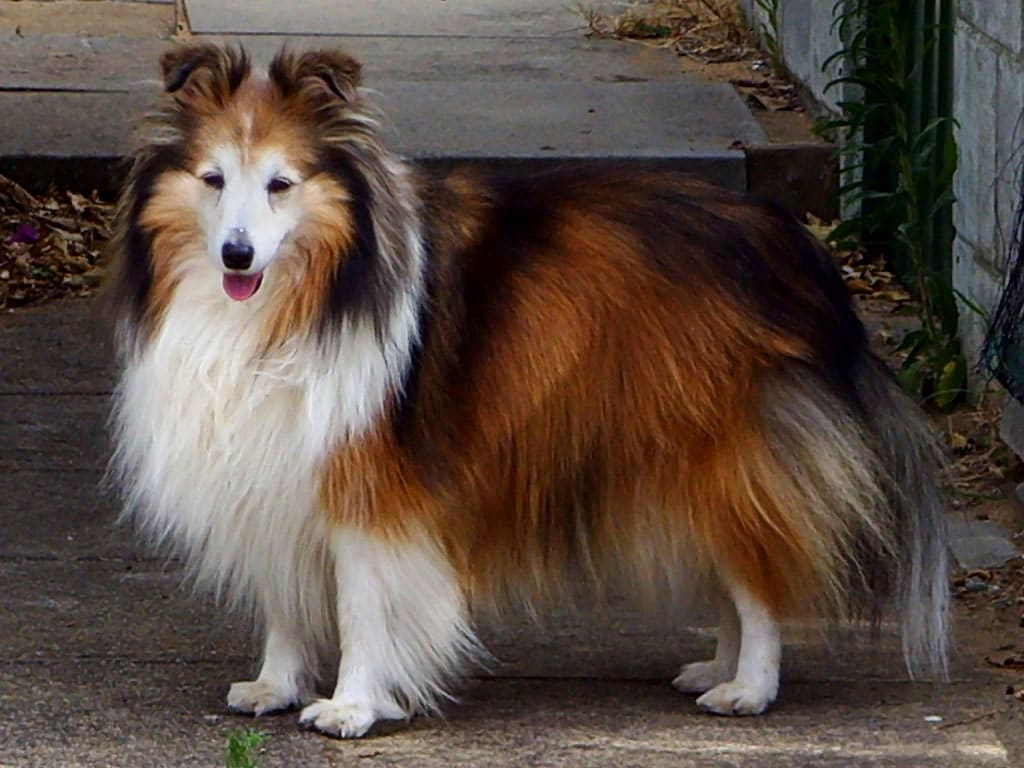
There are three main colors: Sable, It ranges from the Golden to mahogany; Tri-color, formed by the black, White and Tan, and blue mirlo, composite grayscale, white, black and Tan.

black and white: it is less common but still acceptable.

Sand: the best-known color, dominates over other colors. The shadow Sabre, or mahogany can sometimes be confused with the Sheltie tricolor because of the large amount of dark shading in their coats. Another name for him Sheltie "shading", is trifactorado sable and white. This name comes from the mixture of a tricolor and a sable and white. Another acceptable but less common color is Sable merle, that it can sometimes be difficult to distinguish between the regular sable after puppyhood. The Sable merle has patches of dark brown on a light brown background compared to the black and grey blue Merle.

There are other two colors that are a bit rare, which are unacceptable in the ring. The White Color-headed (majority of white with the head "normally" marked), It is the product of two dogs crossed white facotrados. Double Merle, the product of the crossing of two Shetland Sheepdog blue merle, they can be crossed but have a high incidence of deafness or blindness than other colors.

The ideal height at the cross, in males 37,5 cm.. The females. 35,5 cm.. One greater diversion of 2,5 cm above or below these measures is regarded as highly undesirable.

Character and skills

It is an excellent companion dog, highly loyal. It is joyful, intelligent and always ready to obey. The Shetland Sheepdog they are loving, loyal and affectionate with the family and of course, on the sidelines, with strangers; for this reason the Sheltie They must be socialized. Some may be very reserved. This breed gets along very well with children if they are raised with them from a young age.; However, its small size makes it easy for a child to accidentally harm them, This monitoring is necessary. Consider well bringing a Sheltie adult to a house with small children, may not be compatible.

Some Shetland Sheepdog tend to display a personality similar to that of a Terrier who tends to be hyperactive, and always ready, However this temperament is not sanctioned in the breed standard. Some may be shy, but this temperament is specifically discouraged by the standard. The trend towards shyness, It can be reduced with proper socialization. The Sheltie average is an excellent watchdog, giving alarm barks when a person is at the door or pass a car on the street.

The herding instinct is strong in many Shetland Sheepdog. Love to chase and pasture including, squirrels, ducks, pigeons and children. To the Shetland Sheepdog they like to run in large open areas.

They usually enjoy playing. They are better with a sensitive owner, but firm. The Sheltie It, first and foremost, a smart pastor and love to keep them busy, Although his level of activity, usually, It coincides with the level of its owner. As they are very intelligent, they are highly trainable. Lack of exercise and intellectual stimulation, It can lead to undesirable behaviors, including excessive barking, phobias and nervousness. Fortunately the annoying behaviors may decrease largely by an hour of exercise to make the dog with its owner.

in your category, this breed dominates in the competitions of Agility. They also look at obedience competition, Flyball, Grazing, Tracking and proof of talent.

It is a very intelligent dog, according to him Dr. Stanley city, expert on animal intelligence. The Sheltie is one of the brightest dogs occupying the position number 6 in the Ranking of 132 evaluated races. His research determined that an average Sheltie could understand a new command in less than 5 repetitions and would obey the command the first time the 95% of the times or more.

Health

Similar to the Rough Collie, There is a tendency to inherit malformations and diseases in the eye. Each puppy should have his eyes examined by a qualified eye veterinarian. Some lines may be susceptible to hypothyroidism, epilepsy, Hip Dysplasia, or skin allergies. The life expectancy of Shetland Sheepdog is between 10 and 15 years, Although some in some it may be more, and in others may be less.

The disease of Von Willebrand is an inherited bleeding disorder. On race Sheltie, affected dogs, as a general rule, they do not live long. The Shetland Sheepdog carry type III of Von Willebrand, which, It is the most severe of the three levels. There are DNA tests that were developed to find this disease in dogs Sheltie. It can be done at any age and will showcase one of the following results: affected, carrier or affected not. The Shetland Sheepdog they can also suffer from Hypothyroidism, It is the low functioning of the thyroid gland. Clinical symptoms include, loss of hair, on low weight and faintness.

Although small breed dogs are not usually affected by the Hip Dysplasia, has been identified in some specimens of Sheltie. It occurs when the head of the femur and the acetabulum they don't fit properly, This causes pain and/or lameness. Hip Dysplasia is thought to be genetic; Many breeders sent to test their dogs to certify that they are free from this.

  • Otros nombres: Pastor de las Islas Shetland / Shetland Collie / Dwarf Scotch Shepherd / Toonie dog / Apartment Collie / Miniature Collie / Sheltie / Berger des Shetland.
  • Group 1 / Section 1 – Sheepdogs.

โ–ท The world of Pets: Dogs, cats, birds, reptiles, amphibians

Polish Tatra Sheepdog (Tatra Shepherd Dog)
Polonia FCI 252 - Sheepdogs

Pastor de Tatras

The Polish Tatra Sheepdog is intelligent, quiet and independent, loyal and protective.

Content

History

The breed of dog Polish Tatra Sheepdog, It originated in the region of Podhale, in the area of the Tatra mountains of Poland, hence its name.

The race lived the Polish mountains since thousands of years ago, but there is no exact date to record the start of the race. There are theories that suggest similar terraces that inhabited the mountains mixed together and from there arose the Polish Tatra Sheepdog.

Other historians, They suggest that it was born from dogs imported by Phoenician traders from the East and probably came to Europe from Africa.. They also argue, that the Phoenicians used these dogs as merchandise to exchange for valuable products, as glass, Silver and tissues.

As well, other historians recount that the Romans used in battles and also as guard of prisoners, and that the nobles used to use it as a companion and guard dog.

Although there is much controversy regarding the origin of Polish Tatra Sheepdog, breeders of race in Poland, they assure that it comes from a Mastiff-type dog.

Historically, the Polish Tatra Sheepdog has been very successful among pastors for various reasons, but one of them, and perhaps the most remarkable - in addition to its inteligencia-es the color of his cloak, that allowed shepherds to quickly identify it from a bear or a wolf, for example.

It also, owners used to trim the dog's hair and use it like wool.

While the grazing of sheep will be the most important task of this dog, Historically, It wasn't the only job I did.. As well, they used it as a personal guard dog, of factories and private in general property.

But despite all these wonders that describe the Polish Tatra Sheepdog, After the world wars was on the verge of extinction.

It was the Federation Cynologique Internationale (FCI) who prevented that you happen starting in the year 1960 an exhaustive breeding program in order to avoid the extinction of the breed.

Thanks to this action, the race was slowly stretching to far and wide throughout Europe, for the year 1981 the race was already present in Canada.

Although it is currently bred more frequently and remains relatively stable, the Polish Tatra Sheepdog still known as a rare breed, It is estimated that there are only 3000 copies of the race around the world. Most are in Poland, they have with 600 registered copies, the if United States with 300 registered copies, and then countries like France, for example in the year 2003 registered 150 births this race.

And in Poland, approximately 150 of those 600 specimens, are they still used for grazing.

Physical characteristics

The Polish Tatra Sheepdog, is a dog from large size, is very similar to the Newfoundland but completely white.

The males they have a height to the cross ranging from 65 to 70 cm. and females -slightly smaller- they have a height ranging from 60 to 65 cm.. The weight is proportional to its size, but it is usually located 39 to 59 kg.

In one head huge, with a wide barrel and slightly arched Vault but with well marked but not abrupt stop.

Their eyes are showy and medium-sized, they transmit - by the general-una smart look, lively, the shape of the eyes is gently almendrada and gives us the feeling of that would sleep, transmits tenderness.

The ears they have an average length and are triangular, fitted with long hair.

The tail, planted at mid-height has a length that reaches at least the hock.

The the mantle of the Pastor of Tatras, is of double layer. The subpelo, is dense and fluffy, and the outer layer is a fairly notorious long mane around the neck.

Character and skills

His instinct, through hundreds of years of ageing, was to protect livestock, reason why easily adopt a family as a herd if it were.

It is a companion dog and very protective of their own (whether families or herds). It is not an attack dog, but perceived threats to the distance and try to scare it through intimidation, using as I support his strong bark.

Although maintained similarities in appearance and temperament with at the Pyrenean Mountain Dog and with the Kuvasz (Hungarian). The Polish Tatra Sheepdog it is less distant than those two races mentioned, tends to be more attached to his offspring and is more attached to his own.

The Polish Tatra Sheepdog, is a quiet dog, very powerful but aware of his strength shows sensitivity to the weakest (for example, children).

Temperament is very balanced, It independent and autonomous but very easy to educate and always ready to learn.

With children is, especially, cheerful and friendly. It will take care of them like its young, displaying its strong protection instinct backed by its history..

Observations

In the mountainous regions of Poland, where this precious dog usually lived, shepherds used to place an iron or spiked collar to protect it from wolves. It was a way to avoid bites that wolves usually allocated to the neck or throat of its prey. In the news, they still used kind of necklaces.

In United States, the dog Polish Tatra Sheepdog it is considered a rare breed. And is not recognized by the American Kennel Club.

Images ยซTatra Shepherdยป

ยซTatra Shepherdยป Videos

Type and recognitions:

  • FCI CLASSIFICATION:
  • Group :
  • Section : . .

Federations:

  • FCI – Group 1 Herding dogs, Section 1 Sheepdogs โ“˜
  • UKC – Herding dogs โ“˜

FCI breed standard Polish Tatra Sheepdog (Tatra Shepherd Dog)

FCIFCI - Polish Tatra Sheepdog (Tatra Shepherd Dog)
Pastor

Alternative names:

1. Tatra Mountain Sheepdog, Owczarek Tatrzaล„ski, Owczarek, Podhalaล„ski, Polski Owczarek, Podhalan, Tatra (English).
2. Berger de Podhale (French).
3. Tatra Schรคferhund, Tatrahund, Tatra-Hirtenhund sowie Podhalaner (German).
4. Polski Owczarek Podhalaล„ski (Portuguese).
5. Pastor polaco de Podhale (espaรฑol).

โ–ท The world of Pets: Dogs, cats, birds, reptiles, amphibians

Shetland Sheepdog
Escocia FCI 88 . Sheepdogs.

Shetland Sheepdog

The Shetland Sheepdog it's really friendly, lovely with children, intelligent and loyal.

Content

History

In the 19th century, in the North Shetland Islands of Scotland, the ancestors of Shetland Sheepdog, often called Sheltie, they helped the flocks of sheep and sounded the alarm when strangers approached their farm.

But, the exact origins of this dog are as obscure as the mist that covers its homeland. Its resemblance to him Rough Collie supports the theory that it descends from these dogs, believed to have been imported from Scotland. But, Colleys breeders and various specialists refute this claim.

For them, the Sheltie would have developed in isolation on these islands, and would be the result of different crosses. The races most frequently cited as contributors to its creation are the Icelandic Sheepdog, the Yakki de Groenlandia (an extinct race), the Cavalier King Charles spaniel, the Pomeranian and the Border Collie.

In any case, at the beginning of the 20th century it was often crossed Rough Collie, which reinforced the resemblance between the two races.

What is certain is that its small size was the result of the most rational selection work. Like the "Shetland pony", known for its miniature size, locals gave preference to animals that needed little food, a rare commodity in this difficult region.

Although the Shetland Sheepdog it was especially appreciated in its native islands for its qualities of a sheepdog and alert, it was mainly her appearance that got her out of there. Visitors to England in the late 19th century were delighted with the small size and texture of the dog's coat. Shetland Sheepdog, and soon they wanted to take something home, which they did. Soon, some locals decided to start breeding for export, selecting breeders for height and coat. More and more individuals set out to conquer Britain and then the rest of the world. But, there were neither breed standards nor consultations between the different breeders, so the race developed in directions sometimes very distant from each other.

Things changed after the official recognition in 1909 by the Kennel Club, the leading organization in Great Britain. The name chosen was simply the name by which the dog had been known until then., the Shetland Sheepdog. This recognition helped to stabilize the breed by establishing a well-defined framework in which the different breeders had to work..

But, the chosen name was not to the liking of the colleys breeders, who pressured them and won their case in 1914: then it was officially renamed as Shetland Sheepdog.

In the meantime, the first specimens had reached the United States and, already in 1911, the American Kennel Club (AKC) also accepted it. Was not up 1948 that the United Kennel Club (UKC), the other reference organization in the United States, he did the same. It was followed by the Fรฉdรฉration Cynologique Internationale (FCI) in 1954, as well as by all other important institutions, including the Canadian Kennel Club (CCC).

Although the Shetland Sheepdog is now common worldwide, paradoxically it has become rare on its home island, where it has been replaced by the Border Collie for grazing.

This decline can also be seen in the rest of Britain. These may include, Annual Kennel Club enrollments have dropped from more than 1300 less than 800 in less than a decade.

The phenomenon is also occurring in the United States, where he now occupies the position 25 (of a little less than 200) on the AKC popularity rankings, based on the annual number of people registered in the organization. In other words, has lost a lot of ground compared to the decades of 1980 and 1990, in which he was almost constantly among the 10 first, reaching a maximum of 40.000 records in 1993. The fall is slow but steady, since at the beginning of 2010, was still in the 20 first positions.

The "father" race Shetland Sheepdog o โ€œSheltieโ€ as they are often nicknamed, they are the Border Collie.

Physical characteristics

The Sheltie they have a double mantle, What makes this breed peleche much more than other dogs. Long hair covering the thick and soft layer base, is repellent to water, while the base layer provides relief from hot and cold.

There are three main colors: Sable, It ranges from the Golden to mahogany; Tri-color, formed by the black, White and Tan, and blue mirlo, composite grayscale, white, black and Tan.

black and white: it is less common but still acceptable.

Sand: the best-known color, dominates over other colors. The shadow Sabre, or mahogany can sometimes be confused with the Sheltie tricolor because of the large amount of dark shading in their coats. Another name for him Sheltie "shading", is trifactorado sable and white. This name comes from the mixture of a tricolor and a sable and white. Another acceptable but less common color is the Sable Blackbird., that it can sometimes be difficult to distinguish between the regular sable after puppyhood. The Sable merle has patches of dark brown on a light brown background compared to the black and grey blue Merle.

There are other two colors that are a bit rare, which are unacceptable in the ring. The White Color-headed (majority of white with the head "normally" marked), It is the product of two dogs crossed white facotrados. Double Merle, the product of the crossing of two Sheltie blue merle, they can be crossed but have a high incidence of deafness or blindness than other colors.

The ideal height at the cross, in males 37,5 cm.. The females. 35,5 cm.. One greater diversion of 2,5 cm above or below these measures is regarded as highly undesirable.

Character and skills

It is an excellent companion dog, highly loyal. It is joyful, intelligent and always ready to obey. The Sheltie is love, loyal and affectionate with the family and of course, on the sidelines, with strangers; for this reason the Sheltie must be socialized. Some may be very reserved. This breed gets along very well with children if they are raised with them from a young age.; However, its small size makes it easy for a child to accidentally harm them, This monitoring is necessary. Well consider bringing an adult Sheltie for a House with young children, they may not be compatible.

Some Sheltie tend to show a similar to a Terrier personality that tends to be hyperactive, and always ready, However this temperament is not sanctioned in the breed standard. Some may be shy, but this temperament is specifically discouraged by the standard. The trend towards shyness, It can be reduced with proper socialization. The average Sheltie is an excellent watch dog, giving alarm barks when a person is at the door or pass a car on the street.

The herding instinct is strong in many Sheltie. Love to chase and pasture including, squirrels, ducks, pigeons and children. The Sheltie love run in large open areas.

They normally love to play. They are better with a sensitive owner, but firm. The Sheltie is, first and foremost, a smart pastor and love to keep them busy, Although his level of activity, usually, It coincides with the level of its owner. As they are very intelligent, they are highly trainable. Lack of exercise and intellectual stimulation, It can lead to undesirable behaviors, including excessive barking, phobias and nervousness. Fortunately the annoying behaviors may decrease largely by an hour of exercise to make the dog with its owner.

in your category, the breed dominates Dog Agility competition. They also look at obedience competition, Flyball, Grazing, Tracking and proof of talent.

It is a very intelligent dog, according to Dr.. Stanley city, expert on animal intelligence. The Sheltie is one of the brightest dogs occupying the position number 6 in the Ranking of 132 evaluated races. His research determined that an average Sheltie could understand a new command in less than 5 repetitions and would obey the command the first time the 95% of the times or more.

Health

Similar to the Rough Collie, There is a tendency to inherit malformations and diseases in the eye. Each puppy should have his eyes examined by a qualified eye veterinarian. Some lines may be susceptible to hypothyroidism, epilepsy, Hip Dysplasia, or skin allergies. The life expectancy of the Sheltie is between 10 and 15 years, Although some in some it may be more, and in others may be less.

Von Willebrand disease is an inherited bleeding disorder. The Sheltie breed, affected dogs, as a general rule, they do not live long. The Sheltie carry type III Von Willebrand, which, It is the most severe of the three levels. There are DNA tests that were developed to find the disease in dogs Sheltie. It can be done at any age and will showcase one of the following results: affected, carrier or affected not. The Sheltie may also suffer from hypothyroidism, It is the low functioning of the thyroid gland. Clinical symptoms include, loss of hair, on low weight and faintness.

Although small breed dogs are unlikely to be affected by hip dysplasia, It has been identified in some specimens of Sheltie. Occurs when the head of the femur and the acetabulum do not fit correctly, This causes pain and/or lameness. Hip Dysplasia is thought to be genetic; Many breeders sent to test their dogs to certify that they are free from this.

Characteristics "Shetland Sheepdog"

Coexistence is important that you have with your new friend. Before considering the acquisition of a dog of the breed "Shetland Sheepdog" you know certain factors. Not all breeds of dogs are apt to live in an apartment, you must take into account his character, their need for exercise, their interaction with other pets, their care and if you have small children, their level of tolerance towards them.

Adaptation โ“˜

4,0 of 5 stars (based on 1 review)

friendly dog โ€‹โ€‹โ“˜

3,0 of 5 stars (based on 1 review)

hair loss โ“˜

4,0 of 5 stars (based on 1 review)

Affection level โ“˜

4,0 of 5 stars (based on 1 review)

Need for exercise โ“˜

4,0 of 5 stars (based on 1 review)

Social need โ“˜

4,0 of 5 stars (based on 1 review)

Home โ“˜

3,0 of 5 stars (based on 1 review)

Toilet โ“˜

3,0 of 5 stars (based on 1 review)

Friendly with strangers โ“˜

3,0 of 5 stars (based on 1 review)

barking โ“˜

5,0 of 5 stars (based on 1 review)

Health โ“˜

5,0 of 5 stars (based on 1 review)

Territorial โ“˜

3,0 of 5 stars (based on 1 review)

Cat friendly โ“˜

3,0 of 5 stars (based on 1 review)

Intelligence โ“˜

5,0 of 5 stars (based on 1 review)

Versatility โ“˜

4,0 of 5 stars (based on 1 review)

Child friendly โ“˜

5,0 of 5 stars (based on 1 review)

Surveillance โ“˜

2,0 of 5 stars (based on 1 review)

joy โ“˜

4,0 of 5 stars (based on 1 review)

Type and recognitions:

  • FCI CLASSIFICATION:
  • Group :
  • Section : . .

Federations:

  • FCI – Group 1 Herding dogs, Section 1 Sheepdogs โ“˜
  • AKC – PASTORAGE โ“˜
  • ANKC – Group 5 (Working dogs) โ“˜
  • CKC – Group 5 (Pastoral) โ“˜
  • โ€‹KC – Pastoral โ“˜
  • NZKC – Work โ“˜
  • UKCScenthounds โ“˜

FCI breed standard "Shetland Sheepdog"

Origin:
Scotland, United Kingdom

Date of publication of the valid original standard:
19.08.2013

Use:

Shepherd dog


General appearance:

The Shetland Sheepdog is a small-sized, long-haired working dog, Of great beauty, no signs of heaviness or coarseness, free and graceful action. Its structure must be symmetrical so that no part of its body appears disproportionate.
The fur, very abundant mane and bib, the beauty of the head and the sweetness of the expression combine to present the ideal specimen.

IMPORTANT PROPORTIONS;
The skull and muzzle must be the same length, the balance point being the internal angle of the eye.
Slightly longer from point of shoulder to point of croup than height at withers.


Behavior / temperament:

It is an alert dog, delicate, Intelligent, strong and active. Affectionate and loyal to his master, reserved with strangers, but never nervous.

Head:

The head should be refined and elegant without exaggeration; viewed from above or from the side should be in the shape of a long truncated wedge, that is refined from the ears to the truffle. Width and depth of the skull must be proportionate to its length and the length of the muzzle. It should be considered in conjunction with the size of the dog.

Cranial region:
  • Skull : Flattened, moderately wide between the ears, without showing any occipital protuberance. The upper line of the skull is parallel to - the upper line of the snout.
  • Depression links ( Stop) : Light, but defined.

facial region:

The characteristic expression is obtained from the perfect harmony and combination of the skull and snout, of the form, the color and placement of your eyes and the correct position and bearing of your ears.

  • Truffle : black.
  • Snout : Well rounded.
  • Lips : Blacks, firm.
  • Jaws / teeth : Jaws of equal length, net and strong, well developed lower jaw. Healthy teeth with perfect scissor bite, regular and complete, that is to say that the internal face of the maxillary incisors is in close contact with the outer side of the lower incisors and placed at right angles to the jaws. It is highly desirable that the denture contains 42 properly placed teeth.
  • Cheeks : Flat, bind gently with the muzzle.
  • Eyes : Are medium-sized, almond shaped and placed in an oblique position. Color should be dark brown, except in the case of merle specimens, in which one or both eyes may be blue or streaked blue. The rims of the eyes should be black.
  • Ears : Small, moderately wide at the base, placed fairly close to each other at the top of the skull. When the dog is at rest, they are thrown back; When it is attentive it brings them forward and carries them semi -erect with the fallen tips forward.

Neck:

Muscular and well arched, long enough to wear your head proudly.

Body:

  • Back : Straight, with a delicate curvature.
  • Rump : Gradually descends towards the hind limbs.
  • Breast : Deep, descends to the elbows. The ribs are well sprung, but taper in the lower half to allow free movement of the forelimbs and shoulders.

Tail:

Has a low implantation, vertebrae gradually decrease in size towards the tip, which reaches at least the hocks. It is provided with abundant hair and has a slight upward curvature. When the dog is moving it can be carried slightly raised, but never on the back and curled.

Tips

FORELIMBS

Forelimbs appear straight when viewed from the front; they are muscular and well proportioned with strong but not heavy bone.

  • Shoulder : The shoulder blades should be tilted, separated in the cross region only by the vertebrae, and should slope outward to allow for the desired bowing of the ribs. The shoulder joint must be well angulated.
  • Arm : Arm and scapula should be approximately the same length.
  • Elbows : The humerus-radio-cubital joint (elbow) is equidistant from the ground to the region of the cross.
  • Metacarpus : Strong and flexible.

HINDQUARTERS

  • Thigh : Wide and muscular; the femur should join the pelvis at a right angle.
  • Knee : The femoro-tibio-patellar joint must have a marked angulation.
  • Hock : crisp, angled, well descended. With strong bones. Viewed from behind they should be straight.
  • Pies : Oval, with strong pads. Fingers arched and together.

Movement:

Of agile movement, reunited and funny; with a driving due to the posterior members that cover the maximum extension with the minimum effort. Ambling movement is highly undesirable, march across the limbs, swinging the body, as well as the rigid and important vertical displacement.

Mantle

HAIR:

  • The coat is double: the outer coat is long hair, rough and smooth. The undercoat is short haired, smooth and dense. The mane and chest have abundant hair. The forelimbs have abundant fringes. Hind limbs, on the hocks, they are covered with very abundant hair, while below them, the hair is shorter. The coat should accommodate the body and not dominate or change the shape of the dog. The hair on the face is short. Short-haired specimens are highly undesirable.

COLOR:

  • Cebellina : Light or dark. All shades are admitted, from pale gold to dark mahogany; but those tones must be of an intense tone. Wolf and gray colors are undesirable.
  • Tricolor : Intense black color on the body, and in them bright fire colored spots are preferred.
  • Blue Merle : Light silver blue, splashed or mottled with black. Deep tan stains are preferred, although its absence should not be penalized. Large black markings and slate or rust-colored markings on the outer or inner coat of hair are highly undesirable. The overall appearance should be blue.
  • Black and white and black and tan : They are also recognized colors.
    White spots may exist (except in the black and tan specimens) on the forehead, the collar and the sill, the chest, the limbs and the tip of the tail. All or some white spots are preferable (except in the black and tan specimens), but its absence should not be penalized. White spots on the body are highly undesirable.


Size and weight:

Ideal height at the withers :

  • Males : 37 cm.
  • females : 35,5 cm.

    One greater diversion of 2,5 cm above or below these measurements is considered highly undesirable.


Fouls:

Any deviation from the aforementioned criteria is considered a fault, and the severity of this is considered in proportion to the degree of the deviation to the standard and its consequences on the health and well-being of the dog.


FALTAS DESCALIFICANTES

  • Aggressive or fearful dog.

Any dog โ€‹โ€‹showing clear signs of physical or behavioral abnormalities must be disqualified..


N.B.:

Males should have two normal-appearing testicles fully descended into the scrotum..
Only functionally and clinically healthy dogs, with the typical conformation of the breed, They should be used for parenting.

DATE OF PUBLICATION OF THE ORIGINAL VALID STANDARD: 19.08.2013.
TRANSLATION: Lic. Valverde Calvo (Costa Rica) and Jorge Nallem (Uruguay).
Information obtained fromhttps://www.fci.be/es/nomenclature/PERRO-PASTOR-DE-SHETLAND-88.html

Source: F.C.I - International Cynological Federation

Alternative names:

1. Shetland Collie, Dwarf Scotch Shepherd, Sheltie (English).
2. Shetland, Sheltie (French).
3. Sheltie (German).
4. Sheltie (Portuguese).
5. Miniature Collie, Sheltie (espaรฑol).

โ–ท The world of Pets: Dogs, cats, birds, reptiles, amphibians

Belgian Shepherd
Bรฉlgica FCI 15 . Sheepdogs

Pastor Belga

The Belgian Shepherd originates from Belgium, the Campine region and North of Brabant.

Content

History

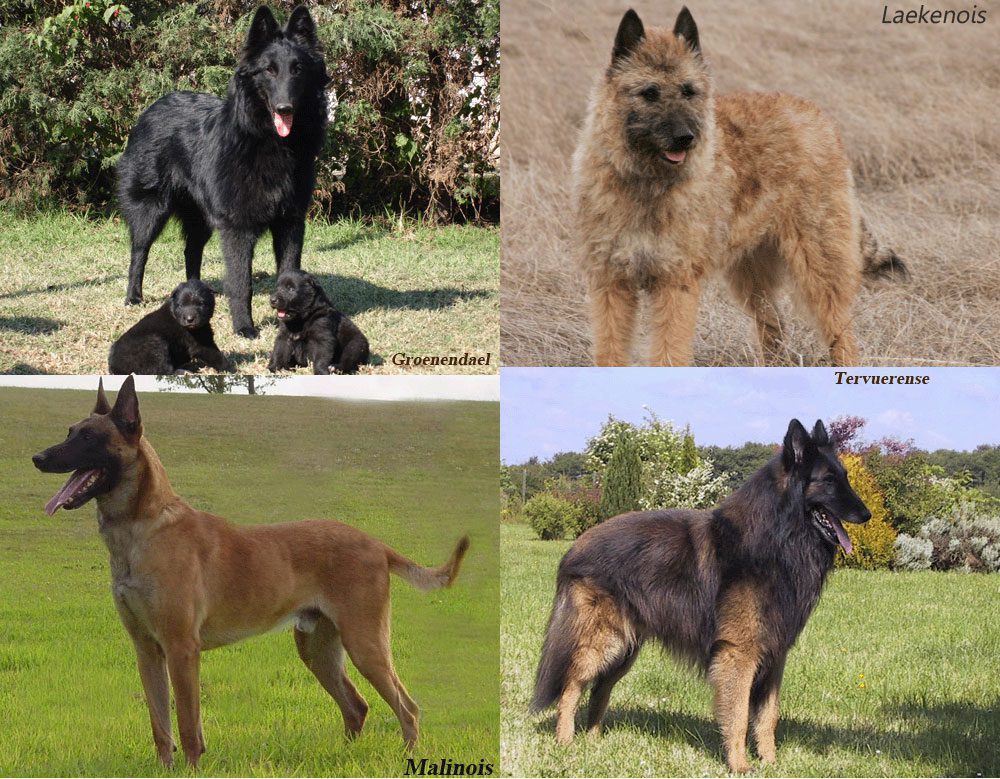
The Belgian Shepherd Dog is the name of four breeds or varieties of dogs, depending on the Cynological Association we consult. The four breeds or varieties are: Groenendael, Laekenois, Tervueren and Malinois.

At the end of the 19th century, in Belgium there was a large number of herding dogs whose type was heterogeneous and their coats were of great diversity. In order to put order into this situation, some cinรณfilos (cinรณgrafos) enthusiasts formed a group led by Professor A. Reul, the school of veterinary medicine of Cureghem, who can be considered as a true pioneer and founder of the race.

The Belgian Shepherd was officially born as a race between 1891 and 1897. The 29 in September of 1891, The "Belgian Sheepdog Club" was founded in Brussels and that same year, the 15 November, Professor A.. Reul manages to gather in Cureghem, 117 dogs, allowing you to carry out a census and form a group with the best copies. In the following years becomes a real selection, making an extreme inbreeding on some stallions.

Read more

โ–ท The world of Pets: Dogs, cats, birds, reptiles, amphibians

Beauceron
Francia FCI 44 . Sheepdogs

Pastor de Beauce

The Beauceron It is one of the best job in the world dogs.

Content

History

The Beauceron, It is a breed of dog originating in the French Brie region; This race is quite old and well known in France.

True that the canine world, the history of this beautiful dog is not of the noveladas. The Beauceron, It was presented for the first time in a dogshow in the year 1897, but the race is actually quite old.

The specimens of Beauceron older, the first to set foot on our land, they had hard and coarse hair, but the characteristic that stood out the most was his marked aggressiveness.

With the passage of time, Select mediantes, breeders have succeeded in lowering the level of aggressiveness, but even so, it is not an easy dog โ€‹โ€‹to train, it retains certain ferocious traits.

At first the Beauceron It was used to hunt wild boar but later developed the ability to guide herds, being able to defend it from any attack by a predator; is a great guardian.

Physical characteristics

The Beauceron, often confused with the Dobermann due to the combination of color bronze and fire of his cloak. This coincides with the fact that the most widespread variety of the Beauceron.

Despite the similarity in the colors of the coat, it has many differences with him Dobermann, the Beauceron It is a dog with a more rustic and robust structure, the hair is also different and the tail does not cut.

Another differential characteristic, It is that the hind legs should stand double spur. This is one distinctive feature of the race.

The height males will of 65 to 70 cm and the females of 61 to 68 cm.. The approximate weight is between 40 and 50 kg. Females tend to be lighter.

It has a aspect rustic, Wolf. Long head and flat, the muzzle and skull have the same length, dark eyes to harmonize with the fur, their ears hang naturally if they have not been cut.

They have the long neck, the elongated body and deep chest. Their limbs are strong.

The Beauceron has two layers of hair, the exterior is strong, thick, thick and smooth (Although they tend to present ripples around the neck). Internal hair layer is more dense and velvety, color grey mouse and must not be seen through the upper layer.

The colors supported are the black and tan and the Harlequin.

Character and skills

According to experts, It one of the best job in the world dogs, and all dogs of pastor is one who is more prepared for the defense.

Then, his character allows you to carry out defense, foster, useful but it is good to take into account that it is not a dog to be in the hands of inexperienced or too permissive.

He has a very independent character and a strong instinct for responsibility that allows him to make his own decisions. If he notices the slightest insecurity in his master, he will not take long and seconds to make the decisions himself..

With the strangers will be very suspicious, for this reason it is very important that the owner of the dog can control it because if it feels minimally intimidated it can be very biting.

If you receive adequate training and education will be an excellent companion.

Observations

Before purchasing a copy of Beauceron, We must take into account that it is not an easy dog. The person who decides to have a copy of this breed as a pet should be able to train him and raise him with full security.

The dog needs to know who is charge, It is also important to understand that all members of the family are heads of the herd, because if you can not pass it only obey one person whom he recognizes as head of the herd and the rest of the family will ignore or or them even try to impose.

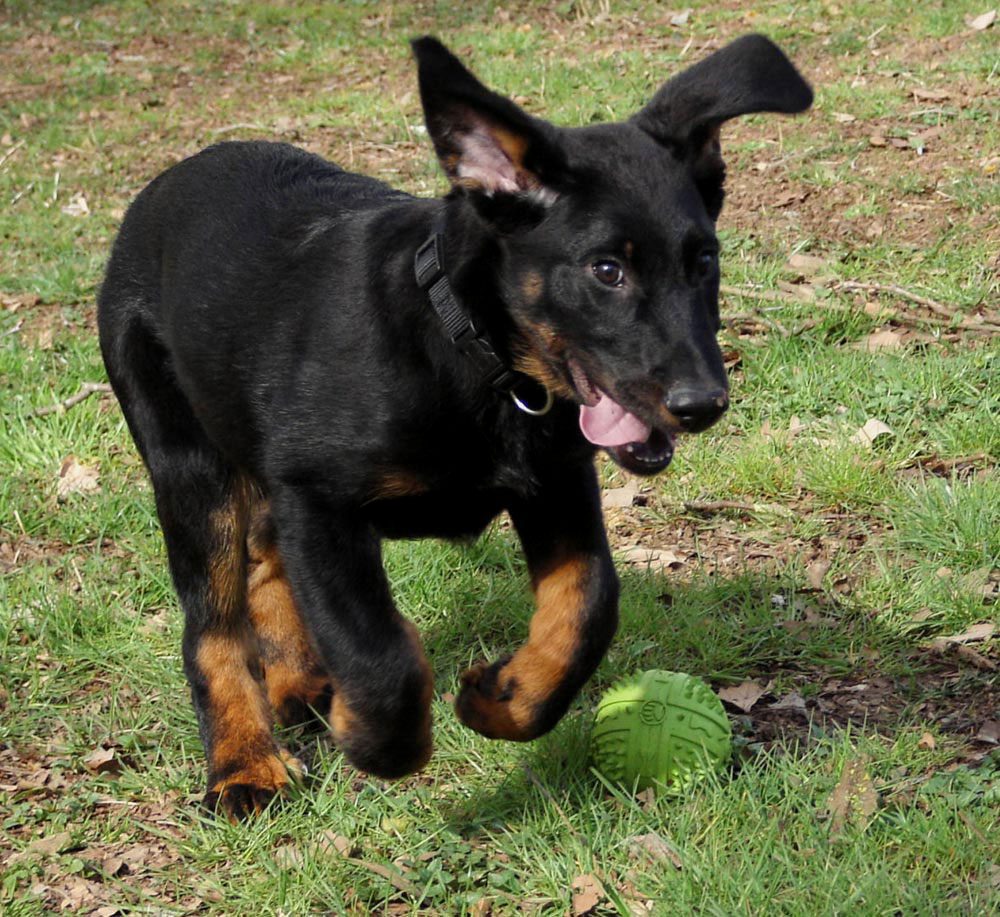
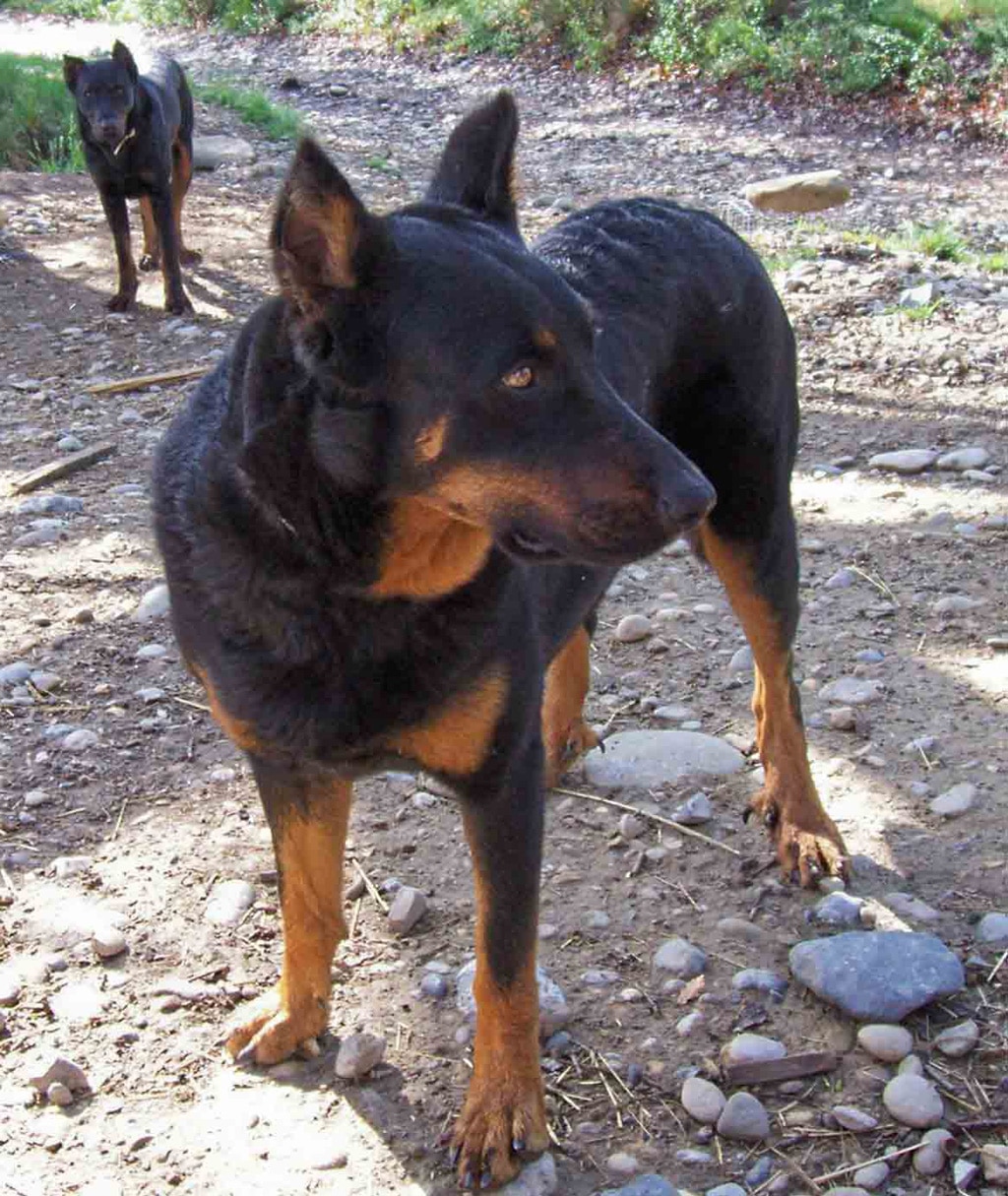
Images of the "Beauce Pastor"

Videos del "Pastor de Beauce"

Characteristics "Beauceron"

Coexistence is important that you have with your new friend. Before considering the acquisition of a dog of the breed "Beauceron" you know certain factors. Not all breeds of dogs are apt to live in an apartment, you must take into account his character, their need for exercise, their interaction with other pets, their care and if you have small children, their level of tolerance towards them.

Adaptation โ“˜

3,0 of 5 stars (based on 1 review)

friendly dog โ€‹โ€‹โ“˜

2,0 of 5 stars (based on 1 review)

hair loss โ“˜

3,0 of 5 stars (based on 1 review)

Affection level โ“˜

4,0 of 5 stars (based on 1 review)

Need for exercise โ“˜

5,0 of 5 stars (based on 1 review)

Social need โ“˜

4,0 of 5 stars (based on 1 review)

Home โ“˜

2,0 of 5 stars (based on 1 review)

Toilet โ“˜

2,0 of 5 stars (based on 1 review)

Friendly with strangers โ“˜

2,0 of 5 stars (based on 1 review)

barking โ“˜

4,0 of 5 stars (based on 1 review)

Health โ“˜

2,0 of 5 stars (based on 1 review)

Territorial โ“˜

5,0 of 5 stars (based on 1 review)

Cat friendly โ“˜

2,0 of 5 stars (based on 1 review)

Intelligence โ“˜

5,0 of 5 stars (based on 1 review)

Versatility โ“˜

5,0 of 5 stars (based on 1 review)

Child friendly โ“˜

3,0 of 5 stars (based on 1 review)

Surveillance โ“˜

4,0 of 5 stars (based on 1 review)

joy โ“˜

5,0 of 5 stars (based on 1 review)

Type and recognitions:

  • FCI CLASSIFICATION:
  • Group :
  • Section : . .

Federations:

  • FCI โ“˜
  • AKC โ“˜
  • โ€‹KC โ“˜
  • UKC โ“˜

FCI breed standard Beauceron

FCIFCI - Beauceron
Pastor

Alternative names:

  • Alternative names: French Shorthaired Shepherd / Beauce Shepherd / Berger de Beauce / Bas Rouge (Red Stocking)

โ–ท The world of Pets: Dogs, cats, birds, reptiles, amphibians

Romanian Carpathian Shepherd Dog
Rumanรญa FCI 350 - Sheepdogs

Romanian Carpathian Shepherd Dog

The Romanian Carpathian Shepherd Dog is slightly more sensitive and less independent than other guard dog breeds

Content

History

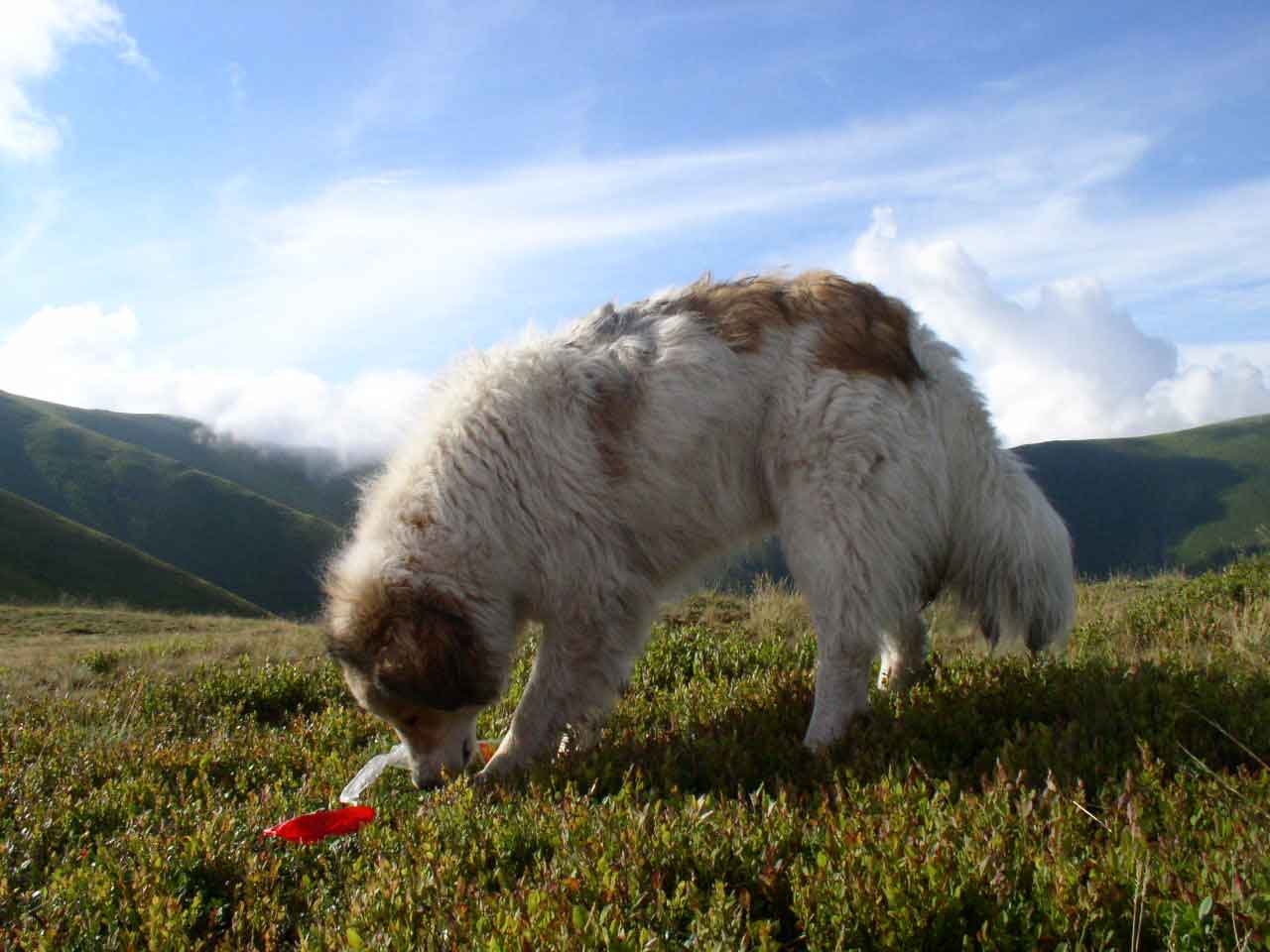
The โ€œRomanian Carpathian Shepherd Dogโ€, also known as Carpatin (of his original name Ciobanesc Romanesc Carpatin), He is native to Romania, more precisely from the Danube Delta.

It is said to be descended from the Lupo races – molosoides, comparable in size to ancient mastiffs, but with a morphology closer to that of the wolf, and that has been used to protect herds for more than 9.000 years, that is to say, since the beginning of the domestication of cattle in this region.

Legend has it that their ancestors, to whom he is physically very close, they interbred naturally with wolves, resulting in a powerful and fearsome race. Although there is no irrefutable evidence, such hybridizations between dog and wolf are known to have in fact occurred in various regions of the world, what makes this theory plausible.

Often hunting in packs, nothing stops this dog with his courage and unerring protective instinct. There have even been cases where a herd of Carpathian shepherds has been seen repelled by an adult bear. The Romanian Carpathian Shepherd Dog has been selected over the centuries with the main criterion of utility, which explains why it has kept its herding dog qualities intact to this day, especially since Romania still has many predators on its territory, including wolves and bears. Over the years, they have also become increasingly integrated into the family as guard dogs; very protective of their master, it's a role they play wonderfully.

The first breed standard was developed in Romania in 1934. After the fall of communism in 1989, a few passionate breeders of the Romanian Carpathian Shepherd Dog developed the breed so that its standard could meet the criteria of the Fรฉdรฉration Cynologique Internationale. Their efforts paid off, since the latter finally recognized it provisionally in 2005, and then definitely ten years later, in 2015. Among the other large canine organisms, the Sociรฉtรฉ Centrale Canine and the United Kennel Club also recognize the Romanian Carpathian Shepherd Dog, what is not the case with the American Kennel Club, the Canadian Kennel Club or the Kennel Club, the leading organization in Great Britain.

Although they are increasingly known and appreciated in the rest of the world, the Romanian Carpathian Shepherd Dog still quite rare outside of its home country. On the other hand, still very popular in Romania, where it is used as a herding dog and as a guard and companion dog.

Photo: Possibly Carpathian sheepdog or Bucovina sheepdog by Alex Zelenko, CC BY-SA 4.0, via Wikimedia Commons

Physical characteristics

The Romanian Carpathian Shepherd Dog he is a large dog with an impressive physique.

The body is rectangular, vigorous and well developed, without heaviness. Its length is greater than the height at the withers, and the lumbar region may be slightly longer in females than in males.

The tail is held high, reaching or slightly exceeding the point of the hock. With abundant hair, hangs at rest but is carried high and slightly curved in action. It is neither flat nor rolled in the back.

The head is strong but not heavy, of type lupoid, with a stop moderately marked. The nose is always black, big and wide. The scissor bite is powerful. The eyes are medium in size, almendrada form, dark brown. The ears, located slightly above the eye line, they are triangular in shape, a little rounded at the tip, and fall close to the cheeks.

The inner layer is dense and flexible, color clear, but the hair is rough, smooth and dense. It is shorter and flatter on the head and front of the legs, longer in the neck, the back of the legs and tail. It is abundant and of medium length in the rest of the body. The fur is sable (Wolf) with white markings, and the skin is ash colored.

Character and skills

The Romanian Carpathian Shepherd Dog is balanced, calm and brave. They are innate herding dogs with a very strong protective instinct, with an unconditional attachment to his flock and a closeness to his master and family that is far greater than that of most other watchdog breeds.

This protective instinct makes them mistrust strangers. In the presence of a stranger, will come between him and his family and bark as a warning, until his master makes him understand that there is no danger.

But, due to its friendlier temperament than the average of other guard dog breeds, It is also an excellent companion dog.. As a breed of dog adapted to children, he is very gentle with them and is a great playmate for them. Regarding the cohabitation of the dog with the cat, generally goes well. Last, the fact that they have long gotten used to defending themselves and working in packs also explains why they generally manage to get along with their peers, although they can be dominant with them.

Although it suits all families quite well, this large, energetic dog needs plenty of exercise and play to maintain his mental balance and physical health. So, better suited to a family that likes to move, and thus you can enjoy hiking with your dog (dogs-rando), from running with your dog (canicross) or cycling with your dog (cani-mountain biking). To feel completely fine, need at least an hour of daily exercise.

So, not at all suitable for use in an apartment: too small a space and insufficient physical exercise could cause behavioral disorders in the dog, including uncontrolled aggression (even towards their owners) and / or destructive behavior on the part of the dog. This is all the more true since the Romanian Carpathian Shepherd Dog is slightly more sensitive and less independent than other guard dog breeds; therefore shows more anxiety in case of prolonged loneliness, especially if you are indoors with nothing to do to keep busy. So, the ideal home for him is one with a large enclosed garden where he can run, and a master who is available to play with his dog and walk him for long hours.

Education ยซRomanian Carpathian Shepherd Dogยป

Although the Romanian Carpathian Shepherd Dog it is a calm and balanced dog that is easier to train than other guard dog breeds, needs a strong education to start at an early age, since it has a strong character. It is imperative that the owner immediately show his dog who the master is and impose his authority, at the risk of seeing his partner with his impressive physique take control.

Of course, firm does not mean brutal. Positive dog training, with incentives and rewards, is always the best way to earn respect and obedience. Purely authoritarian training would only lead to confrontation with this willfully dominant dog..

Health ยซRomanian Carpathian Shepherd Dogยป

Although there have been cases of hip dysplasia or eye problems in some individuals, the Romanian Carpathian Shepherd Dog it is a robust breed of dog, able to stay outdoors in inclement weather without being unduly hindered and, In addition, does not have a congenital predisposition to certain pathologies.

So, daily exercise and a balanced diet are enough to keep the dog healthy, vigorous and toned.

But, care must be taken not to give too large a portion of food before physical exertion: like all big breeds, is particularly exposed to the risk of stomach dilation-torsion.

Grooming ยซRomanian Carpathian Shepherd Dogยป

Although the Romanian Carpathian Shepherd Dog has a long fur, rarely needs professional grooming. But, it is recommended to brush the dog's hair daily with a wire brush or detangler, especially during the molting period.

If you spend most of your time outdoors, it is recommended to wash your dog once a month. But, if you stay inside, a dog bath every three to four months is sufficient.

On the other hand, it is important to regularly examine and clean the dog's ears, as for all dogs with floppy ears. A buildup of earwax or bacteria could lead to infections, like ear infections.

It also, as in all races, brushing your dog's teeth at regular intervals is essential to avoid tartar problems. Ideally, you should be able to do this two to three times a week..

Finally, how often a dog's claws are trimmed depends on its level of activity. It is best to inspect them from time to time and trim them if necessary.

Characteristics "Romanian Carpathian Shepherd Dog"

Coexistence is important that you have with your new friend. Before considering the acquisition of a dog of the breed "Romanian Carpathian Shepherd Dog" you know certain factors. Not all breeds of dogs are apt to live in an apartment, you must take into account his character, their need for exercise, their interaction with other pets, their care and if you have small children, their level of tolerance towards them.

Adaptation โ“˜

3,0 of 5 stars (based on 1 review)

friendly dog โ€‹โ€‹โ“˜

3,0 of 5 stars (based on 1 review)

hair loss โ“˜

4,0 of 5 stars (based on 1 review)

Affection level โ“˜

5,0 of 5 stars (based on 1 review)

Need for exercise โ“˜

4,0 of 5 stars (based on 1 review)

Social need โ“˜

4,0 of 5 stars (based on 1 review)

Home โ“˜

2,0 of 5 stars (based on 1 review)

Toilet โ“˜

2,0 of 5 stars (based on 1 review)

Friendly with strangers โ“˜

2,0 of 5 stars (based on 1 review)

barking โ“˜

3,0 of 5 stars (based on 1 review)

Health โ“˜

3,0 of 5 stars (based on 1 review)

Territorial โ“˜

4,0 of 5 stars (based on 1 review)

Cat friendly โ“˜

4,0 of 5 stars (based on 1 review)

Intelligence โ“˜

4,0 of 5 stars (based on 1 review)

Versatility โ“˜

4,0 of 5 stars (based on 1 review)

Child friendly โ“˜

5,0 of 5 stars (based on 1 review)

Surveillance โ“˜

4,0 of 5 stars (based on 1 review)

joy โ“˜

4,0 of 5 stars (based on 1 review)

Images "Romanian Carpathian Shepherd Dog"

Carpathian Shepherd

Carpathian Shepherd

Photos:

1 – ยซRomanian Carpathian Shepherd Dogยป by https://pxhere.com/es/photo/1434185
2 – ยซRomanian Carpathian Shepherd Dogยป by https://pxhere.com/es/photo/1625909

Videos "Romanian Carpathian Shepherd Dog"

Jeff the Carpathian Shepherd - 4 Weeks Residential Dog Training
Jeff the Carpathian Shepherd – 4 Weeks Residential Dog Training
Sanziana, a Carpathian Shepherd Dog baby girl

Type and recognitions:

  • FCI CLASSIFICATION:
  • Group :
  • Section : . .

Federations:

  • FCI – Group 1 Herding dogs, Section 1 Sheepdogs โ“˜
  • UKC – Herding dogs โ“˜

FCI breed standard "Romanian Carpathian Shepherd Dog"

Origin:
Romania

Date of publication of the valid original standard:
09.06.2015

Use:

Shepherd dog used by Romanian shepherds of the Carpathians for centuries to defend flocks and at the same time as an excellent guard dog


General appearance:

This is a pretty big dog, agile,never weighed, Its general appearance is that of a vigorous dog. His body is rectangular, the rump is wide, slightly tilted, the rib cage is wide and high, long, slightly sloping shoulders. Sexual dimorphism is well marked, males should be taller and larger than females.


IMPORTANT PROPORTIONS:

  • The length of the skull is slightly greater than or equal to half the total length of the head.
  • The length of the body is always greater than the height at the withers. The lumbar region of females may be slightly longer.
  • The height of the chest corresponds to approximately half the height at the withers.


Behavior / temperament:

Innate and brave guardian, He stands out for his instinctive and unconditional affection towards the flocks and towards his master.. It is a dog with dignified behavior, quiet and balanced.

Head:

lupoid type.

Cranial region:
  • Cranial region: The Carpathian Shepherd is a mesocephalic dog, with a strong head, but not heavy. The forehead is wide and slightly bulging. The skull is wider between the ears and progressively decreases towards the naso-frontal depression.. The frontal furrow is quite long and sufficiently well marked.
  • Depression links: Moderate, never too marked, ni huidiza.

facial region:

  • Truffle:Grand, wide, always black.
  • Snout:Powerful, with an approximately oval profile, slightly truncated. The length of the snout is a little less than that of the skull or the maximum, equal.
  • Lips:Thick, well pigmented, well stretched, with a tightly closed commissure.
  • Jaws / Teeth:Strong jaws, solid and straight. The teeth are powerful; scissor joint, the incisor arches are slightly rounded.
  • Cheeks:Thin. Powerful maseteros, never outstanding. The skin is well stretched.
  • Eyes:Almond biscuits, slightly oblique, They are not too large in relation to the dimensions of the skull, its color is very dark. They are not even jumpy, nor are they sunk in the orbits. The eyelids are black and fit well into the shape of the eyeball..
  • Ears:Triangular, not too big, They appear a little higher than the eye line. They are stuck to the cheeks. The limb is slightly rounded.

Neck:

Muscular, very powerful, medium length. Its angle is about 50ยฐ in relation to the horizontal..

Body:

Vigorous, well developed, slightly rectangular.

  • Top margin: Straight and firm.
  • Height to the cross: Bit strong.
  • Back: Medium length, straight, and solid and muscular.
  • Pork loin: Powerful, muscular, but not too wide. Of moderate length, not too long (the top margin is not firm), not too short.
  • Rump: Muscular and wide, medium length. Slightly inclined, never runs away.
  • Breast : Very wide, well developed and well inclined to the level of the elbows. solid ribs, well shaped, never barrel shaped.
  • Lower margin: Moderately ascending, raised abdomen, nor sunk, nor fallen.

Tail:

It appears quite high, bushy, provided with abundant hair. During rest, appears low, straight or slightly saber-shaped, reaching the tip of the hock. When the dog is attentive or in action, It appears raised and can exceed the level of the back; It's not even stretched, nor twisted about it.

Tips

PREVIOUS MEMBERS: Strong bones.

  • In general: Front or profile views, the forelimbs are plumb and perpendicular to the ground.
  • Shoulder: Solid, moderately inclined.
  • Elbows: Well attached to the body, they do not deviate even outwards, nor inward.
  • Forearm:Straight, very vigorous, with oval profile.
  • Metacarpus: Short, slightly inclined.
  • Previous foot: Oval, solid, compact.

LATER MEMBERS: Muscular, with solid bones and good angulations.

  • In general: They are leaden.
  • Thigh:Width, well muscled.
  • Legs: Powerful, muscular, medium length.
  • Hock: Solid, firm, not too high (determining an accentuation of the angulation of the stifle) not too inclined.
  • Metatarsus: Solid, vertical.
  • Rear foot: Oval, well developed and compact, slightly smaller than the previous one. Fingers arched and together. Any spurs must be removed, except in countries where this practice is prohibited by law. The plantar pads are elastic and resistant.

Movement:

Loose, with a good range. The trot is vigorous and sustained. The limbs move in parallel planes.

Mantle

  • Pigmented ash color. The truffle, the edge, of the eyelids and lips must be black. Ash or black nails are preferred.


  • Fur: Rough, dense and stretched. The undercoat is dense and soft. With the exception of the head and the inner surfaces of the extremities, where the hair is short and straight, the hair is abundant over the entire body, medium length. about the neck, the back of the limbs and on the tail, the hair is longer, its abundance being typical in these areas.
  • Color: carbon sand (dark bay) with different nuances, often lighter on the lateral parts and darker on the upper part of the trunk. carbon sand (dark bay) with white markings, preferably not very widespread.


Size and weight:

  • Height to the cross: Ideal: 65 โ€“ 73 cm in males. 59 โ€“ 67 cm in females. But, the general appearance is always the most important.
  • Weight: In proportion to the size, giving the impression of a powerful dog, but not heavy.


Fouls:

Any deviation from the aforementioned criteria is considered as a fault and its seriousness is considered to the degree of the deviation to the standard and its consequences on the health and well-being of the dog.

SERIOUS FAULTS:

  • Any deviation from the above that impairs the use.
  • Fragile or too heavy constitution.
  • Eyes that are too light in color.
  • Lower eyelids that are too hanging, exposing the eyeball.
  • Very full lips and hanging corners.
  • Significant pigmentation defects.
  • Excessive body length (more than 10%) and square body.

FALTAS DESCALIFICANTES:

  • Aggressiveness or extreme shyness.
  • Any dog โ€‹โ€‹showing clear signs of physical or behavioral abnormalities must be disqualified..
  • apathetic dog.
  • Clearly atypical dog, similar in appearance to the molossoid.
  • Lack of a P3 and another tooth. Lack of a canine, of a P4, of a molar, or three or more teeth (except PM1y M3).
  • Upper or lower prognathism, pincer joint.
  • Very fine bones.
  • Rib cage that is not sufficiently developed.
  • Lack of an inner layer of hair, hair that is not short on the head and the front surfaces of the limbs.
  • Curly hair the griffon type, wire hair, Longhair, soft, silky, forming a clear separation on the midline of the body.
  • Considerable depigmentation of the eyelids, of the truffle, of the skin or lips. ocular heterochromia (different color eye).
  • Color: brown, mottled, yellow or with spots of these colors.
  • Adult dogs smaller than 62 cm in males and 58 cm in females.


N.B.:
  • Males should have two normal-appearing testicles fully descended into the scrotum..
  • Only functionally and clinically healthy dogs, with the typical conformation of the breed, should be used for parenting.

The latest changes are in bold.

Source: F.C.I - International Cynological Federation

Alternative names:

1. Romanian Shepherd, Romanian Carpathian Shepherd, Carpathian Sheepdog (English).
2. Chien de berger des Carpathes (French).
3. Carpatin, Zavod (German).
4. (em romeno: Ciobฤƒnesc romรขnesc carpatin) (Portuguese).
5. Carpatin, Pastor de los Cรกrpatos, Perro pastor de los Cรกrpatos (espaรฑol).

โ–ท The world of Pets: Dogs, cats, birds, reptiles, amphibians

Briard
Francia FCI 113 - Sheepdogs

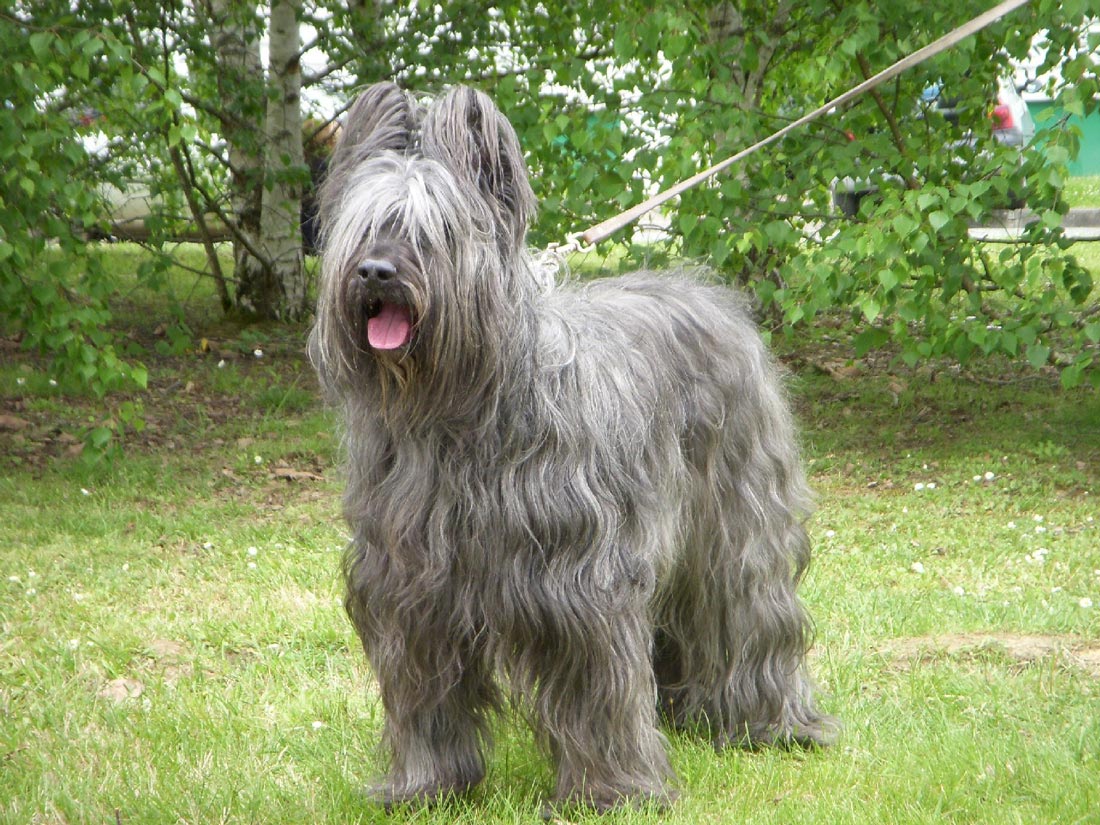
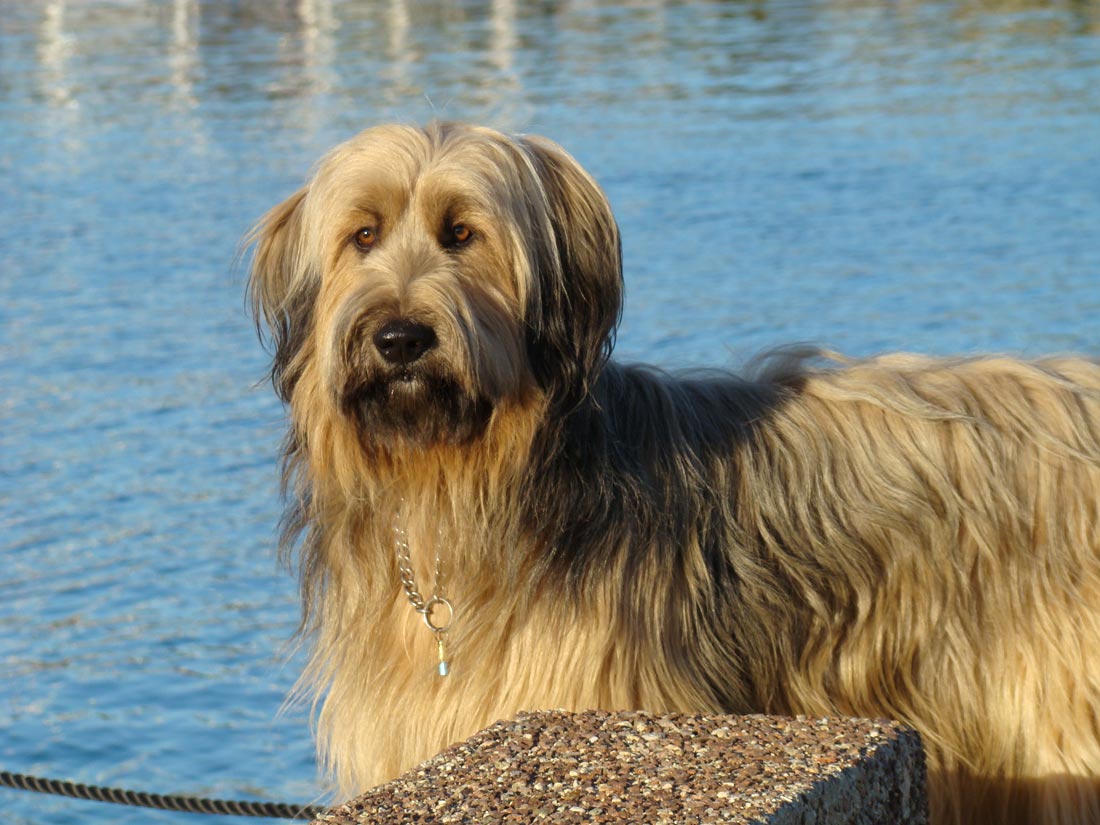
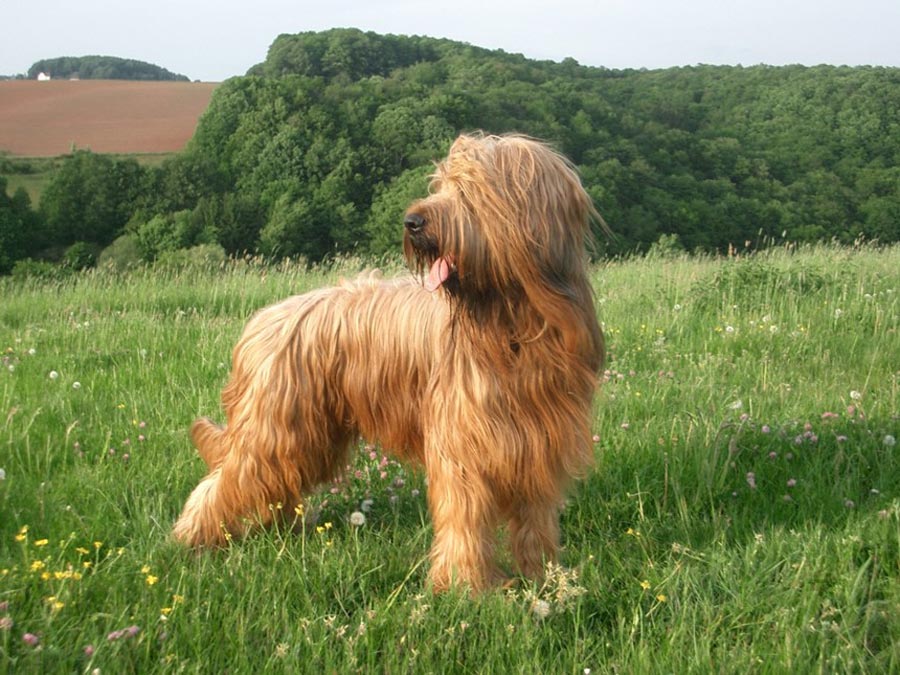
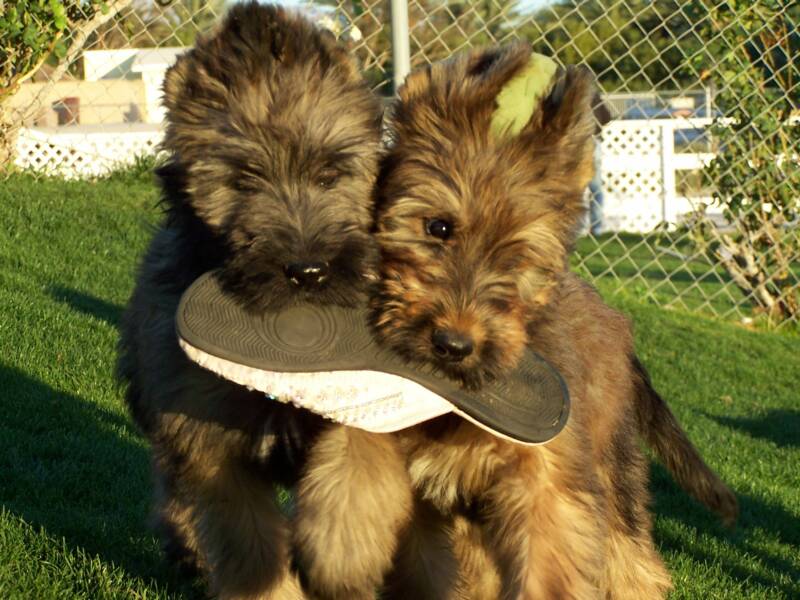
The Berger de Brie It is an excellent race to raise with children of all ages.

Pastor de Brie

Content

Characteristics "Briard"

Coexistence is important that you have with your new friend. Before considering the acquisition of a dog of the breed ยซยซ you know certain factors. Not all breeds of dogs are apt to live in an apartment, you must take into account his character, their need for exercise, their interaction with other pets, their care and if you have small children, their level of tolerance towards them.

Adaptation โ“˜

4,0 of 5 stars (based on 1 review)

friendly dog โ€‹โ€‹โ“˜

3,0 of 5 stars (based on 1 review)

hair loss โ“˜

3,0 of 5 stars (based on 1 review)

Affection level โ“˜

5,0 of 5 stars (based on 1 review)

Need for exercise โ“˜

5,0 of 5 stars (based on 1 review)

Social need โ“˜

4,0 of 5 stars (based on 1 review)

Home โ“˜

4,0 of 5 stars (based on 1 review)

Toilet โ“˜

5,0 of 5 stars (based on 1 review)

Friendly with strangers โ“˜

2,0 of 5 stars (based on 1 review)

barking โ“˜

3,0 of 5 stars (based on 1 review)

Health โ“˜

3,0 of 5 stars (based on 1 review)

Territorial โ“˜

5,0 of 5 stars (based on 1 review)

Cat friendly โ“˜

3,0 of 5 stars (based on 1 review)

Intelligence โ“˜

5,0 of 5 stars (based on 1 review)

Versatility โ“˜

5,0 of 5 stars (based on 1 review)

Child friendly โ“˜

4,0 of 5 stars (based on 1 review)

Surveillance โ“˜

3,0 of 5 stars (based on 1 review)

joy โ“˜

5,0 of 5 stars (based on 1 review)

History

The Berger de Brie or Briard is a breed dog, one of the many existing breeds of dogs pastors. Its origin is French. The history of the Briard has already some centuries… Charlemagne, Napoleon, Thomas Jefferson and Lafayette, they all had a dog of this breed.

Some theories say that, the Briard descends from Asian dogs brought to the region by the barbaric invasions that attacked Europe during the Middle Ages.

This former guardian of sheep and shepherd has also been used, as well, by the French Navy as Sentinel, messenger and in search of wounded soldiers because of his fine sense of hearing. They were used in the first world war in an indiscriminate way to bring them to extinction. This breed is still used as guardian and Shepherd of herds, as well as as a pet.

They became popular just after the ยซParis Dog Show" from 1863, in large part due to an improvement in the appearance of animal achieved by crossing with the Beauceron and the Barbet.

It is believed that they take their name from the French province of Brie, although the animal probably does not come from that locality., the population of Briard is slowly recovering. It is believed that this breed is related to the Berger Picard.

Physical characteristics

The Briard, is a dog from medium-sized, robust but flexible, to coat hard and resistant to the weather inclement. It has a double spur on each rear leg that, They seem to extra toes, giving the appearance of a wider rear leg. Additional toes on each hind leg give the Briard the ability to turn on one foot in fast turns, they are necessary when performing tasks of grazing and protection of their flocks.

Throughout history, the Briard has maintained a proper balance between size and lightness that is required both for grazing and to protect its herds. They are not too big, but they are large enough to defend themselves from predators such as Fox and the Wolf.

The coat of the Briard can be of various solid colors or light colors with darker ears. Allowed all colors except black. They prefer dark colors.

The height at the cross in the males is of 58 to 68.5 cm and the females of 56 to 64 cm.. The weight is around the 34 Kg.

Ear cropping has been a common practice for a long time, but it is no longer done since -fortunately- It is illegal in many European countries., including France.

Character and skills

The Briard has very good memory. Once he learns a lesson, is something good or bad, knowledge shall retain it for a long time. It may sometimes seem very stubborn, or what its owner, but those are some of the features of the Briard, let's not forget that they were bred for centuries to think for themselves and act on their conclusions, Sometimes to the point of thinking what the "flock" will do ahead. It is a dog very independent, in this regard.

Those are some of the traits that the Briard has preserved throughout history. Even, a Briard what does the city live, retains within itself a great grazing capacity. If you ever, During his lifetime, He has a herd sheep, automatically, will begin to do your homework, to perform the functions for which they were raised, grazing.

Also don't be surprised if at some point when you're out for a walk with your family, the Berger de Brie nibbles on the ankles or nods to a family member who moves away a bit, because the dog that group of human beings will be his flock and will guide his master and the other members of group.

The Berger de Brie It is a very dog loyal and protective, often described as "a heart of gold wrapped in fur". Once you have joined the members of his family, It will be very protective and very reserved with strangers, that is why it is important to bear in mind that any Member who is a family, as an infant for example, You will need a friendly adaptation, the Briard, a sample of which the new intrusion is friendly and free of conflicts. Should be taught that it is a good thing and is not harmful. It is a race excellent to raise with children of all ages.

Images "Briard"

Videos "Briard"

Type and recognitions:

  • FCI CLASSIFICATION:
  • Group :
  • Section : . .
Federations:
  • FCI โ“˜
  • AKC โ“˜
  • ANKC โ“˜
  • CKC โ“˜
  • KC โ“˜
  • NZKC โ“˜
  • UKC โ“˜

โ€‹


FCI breed standard "Briard"

Origin:
France

Date of publication of the valid original standard:
04.11.2008

Use:

---


General appearance:

The Briard is rustic, flexible, muscular and well proportioned, cheerful and alert.


Behavior / temperament:

Balanced temperament, never aggressive or shy.
The Briard must be confident and fearless.

Head:

Strong, long, cover of hair forming beard, whiskers and eyebrows slightly covering eyes. Profile view The skull and snout lines are parallel.

Cranial region:
  • Skull: Strong, slightly rounded seen profile
  • Stop: Pronounced, located at equal distance from the occipital Crest and the truffle tip.

facial region:

  • Truffle: Strong. Well open nasal Windows. The nose is always black except in blue dogs that have a blue or bluish-truffle.
  • Snout: The end of the snout is rather square. Strong nose, wide enough and never pointed.
  • Nose caneRectilinear.
  • Lips: Tight lips.
  • Jaws / Teeth: Strong jaws, white teeth. Scissor bite.
  • EYES: Oval. Horizontal, wide open, rather large and dark in color. Blue dogs are allowed lighter colored eyes.
  • EARS: High insertion without being glued to the head and rather short in the wild. The natural ears cartilage must be the same or slightly less than half of the head of the head. The ears are always flat and covered with long hair. If you are cut, In countries where this practice is allowed, your port must be erect, never divergent or convergent.

Neck:

Muscular and detachment of the shoulders.

Body:

  • top line: The back is straight. The loin is short and firm.Rump: Little inclined, slightly rounded shape.
  • Breast : Wide and long deep and well descended to elbows. Well arched ribs.

Tail:

Natural, low postage, You must reach at least the articulation of the Hock, without deviations, forming a slight hook in the form of "J". In motion the tail must be carried as prolongation of the upper line.

Tips

Good muscular with strong and straight bones.

PREVIOUS MEMBERS:

  • Shoulder: Oblique, well angled, moderately long, well glued to the rib cage.
  • Elbows: In line with the body.
  • Forearm: Straight and muscular.
  • Metacarpus: Slightly inclined seen profile.
  • Previous feet: Strong, round and well in axis with the body. The nails are always black (except in blue) and thick pads. Fingers closed and arched.

LATER MEMBERS:

  • Thigh: Muscled.
  • The Hock joint: Not too low and well angled.
  • Metatarsus: Perfectly vertical seen from behind.
  • Hind feet: Strong, round. The nails are always black (except in blue) and thick pads. Fingers tightly closed.
  • Spurs: By tradition, the shepherds want to keep the double spur. The Spurs are fingers, well separated and nails, relatively close to the foot.

Movement:

Regular, agile, harmonious so that it allows the dog to cover the surface and can do its work with a minimum of effort and fatigue. The Briard must have a long trot with good range and good push from the back.

Mantle

  • Fur: Hair texture Goat, dry, soft, long with a light Undercoat.
  • Color: Negro, leonado, Fawn with a black layer (mild to medium), many times with mask gray or blue.

A warm tawny mantle may show a lighter color on the tips and inclined body areas (Fawn marked with color sand). Black mantles, gray and blue can also show areas clearer. All colors may show different degrees of grey.


Size and weight:

Males: 62 cm. - 68 cm to the cross. females: 56 cm. - 64 cm to the cross.


Fouls:

Any deviation from the above criteria is considered missing and the seriousness is considered to the extent of the deviation to the standard and their effect on the health and welfare of the dog.


SERIOUS FAULTS:

  • Serious defects of limbs.
  • In general the hair color too light.
  • Mantle: Insufficient length (less than 7 cm.) soft or woolly hair.

FALTAS DESCALIFICANTES:

  • Aggressiveness or extreme shyness.
  • Any dog โ€‹โ€‹showing clear signs of physical or behavioral abnormalities.
  • Non-existent stop.
  • Any other color that is not blue or black truffle, presence of pink (Depigmented areas).
  • Prognathism or inferior with loss of contact of the incisors, absence of 2 PM4 lower or absence of 3 teeth or more any that are. (Except for PM1)
  • Eyes too light (yellow), huraรฑos.
  • Ears folded inward, low insertion, below the level of the eyes, short hair covers, naturally erect.
  • Tail curled up or carried vertically.
  • Simple RAM or total absence of spurs on the hind limbs.
  • White color, Brown or mahogany, mantle of two different colors, stain white, white hairs at the ends of the members, Fawn blanket.
  • Size outside the limit specified in the standard with a tolerance of + 2 cm o - 1 cm..
  • Fraudulent modification of the dog or evidence of these practices through the use of substances or surgeries.


N.B.:
  • Males should have two normal-appearing testicles fully descended into the scrotum..
  • Only functionally and clinically healthy dogs, with the typical conformation of the breed, should be used for parenting.

Source: F.C.I - International Cynological Federation

Alternative names:

1. Berger de Brie (English).
2. Chien de Berger franรงais de Plaine, Briard (French).
3. Franzรถsisch auch berger de Brie (German).
4. Berger de Brie (Portuguese).
5. Briard (espaรฑol).